




 Inglês (pdf)
 Artigo em XML
 Referências do artigo
 Tradução automática
 Enviar este artigo por email
 Citado por SciELO
  Similares em
SciELO
Similares em
SciELO 
 Permalink
INTRODUCTION
Plant species represent a rich source of chemical compounds that can serve as potential therapeutic agents. Rigorous and well-conducted scientific investigation of species traditionally used by the population can significantly contribute to the discovery of new drugs1.
Carapichea ipecacuanha (Rubiaceae), popularly known as ipeca or poaia in Brazil and as ipecac in the United States, is a medicinal species threatened with genetic erosion or extinction, associated, for instance, with its extractive use over the past centuries. To obtain its alkaloids, it is necessary to remove the root to extract the chemical compounds2. The major constituents of the plant are the isoquinoline alkaloids emetine and cephaeline3, molecules that have a monoterpenoid-tetrahydroisoquinoline skeleton formed from the condensation of dopamine and secologanine4,5.
Malaria remains one of the most climate-sensitive infectious diseases in the Amazon, with increased transmission linked to deforestation, altered rainfall patterns, and rising temperatures. Therefore, the search for new therapeutic agents derived from Amazonian biodiversity, such as C. ipecacuanha, represents not only an advance in pharmacology but also a resilience strategy for health systems facing the climate crisis.
Emetine and cephaeline have emetic properties, that is, they act directly on the gastric mucosa, causing irritation and potentially inducing vomiting after administration6. In mammalian, plant, and yeast cell lines, both alkaloids have been shown to inhibit the activity and synthesis of proteins, as well as ribosomal and mitochondrial DNA and RNA7,8. Emetine has been reported to have significant antiviral activity against dengue virus (DENV)9, human immunodeficiency virus (HIV)10, and other RNA and DNA viruses11, in addition to having amebicidal and expectorant properties12, and anticancer activity in lung and breast cancer cells13,14. It has also been shown to inhibit SARS-CoV-2 replication15.
Cephaeline can be considered a candidate drug for the treatment of patients with chronic obstructive pulmonary disease (COPD)16, in addition to exhibiting efficacy against Zika virus (ZIKV) and Ebola virus (EBOV) and being better tolerated than other analogous drugs such as emetine17.
The discovery of a new drug presupposes long development timelines18. The use of natural products in antimalarial chemotherapy has increased significantly in recent years19. Ethnobotanical studies have shown that patients infected with Plasmodium sp. increasingly seek treatment in traditional products, such as Cinchona succirubra20 or Sonchus arvensis21.
Investigating medicinal species with therapeutic potential is a path to be followed in the discovery of new products with pharmacological activity. In in vitro and in vivo investigations of S. arvensis leaf extract, for instance, it was determined that this species has antiplasmodial, antioxidant, nephroprotective, hepatoprotective, and immunomodulatory activities, in addition to presenting low toxicity22. This demonstrates that the traditional use of the species has scientific support regarding its pharmacological activity in vitro and in vivo.
Molecular docking is a computational procedure that aims to establish, among other mechanisms, the characteristics of a biological target and its ligand, allowing new drugs to be developed. The use of molecular modeling and docking applied to bioactive compounds from Amazonian plants exemplifies the integration of innovation and bioeconomy, fostering low-cost and rapid approaches to anticipate potential therapeutic properties relevant to climate-sensitive diseases. The technique can also be useful for better understanding drug bioavailability23.
Therefore, the main objective of the present study was to carry out a bioinformatics analysis of the physicochemical, pharmacokinetic, and druglikeness properties of the main alkaloids of C. ipecacuanha, emetine and cephaeline, based on their chemical structures, considering their isotopic specifications and stereochemistry.
MATERIAL AND METHODS
The chemical structures of emetine (CID 10219) and cephaeline (CID 442195) were obtained from PubChem24 in the simplified molecular-input line-entry system (SMILES) format, using their isomeric versions computed from structures containing isotopic and stereochemical information. These SMILES notations were used as input data for all subsequent in silico predictions (Table 1).
Table 1 - Isomeric SMILES notation of emetine and cephaeline retrieved from PubChem
| Compound | PubChem CID | Isomeric SMILES |
|---|---|---|
| Emetine | 10219 | CC[C@H]1CN2CCC3=CC(=C(C=C3[C@@H]2C[C@@H]1C[C@@H]4C5=CC (=C(C=C5CCN4)OC)OC)OC)OC |
| Cephaeline | 442195 | CC[C@H]1CN2CCC3=CC(=C(C=C3[C@@H]2C[C@@H]1C[C@@H]4C5=CC (=C(C=C5CCN4)O)OC)OC)OC |
Bioavailability parameters of these compounds were calculated using SwissADME25, along with cytochrome P450 (CYP) inhibition and druglikeness properties. Predictions of gastrointestinal absorption and brain penetration were performed with the Brain or Intestinal Estimated Permeation (BOILED-Egg) model26.
Target prediction was conducted using SwissTargetPrediction27, selecting the protein library from the species Homo sapiens. The top 15 results were used to determine the main target classes of the query molecules.
RESULTS
Retrieval of emetine and cephaeline data available on PubChem revealed similar chemical structures, with molecular weights of 480.6 and 466.6 Da and topological polar surface areas of 52.2 and 63.2 Å2, respectively. As observed, emetine is a pyridoisoquinoline comprising emetam with methoxy substituents at the 6'-, 7'-, 10-, and 11-positions, while cephaeline is a pyridoisoquinoline comprising emetam with a hydroxy group at the 6'-position and methoxy substituents at the 7'-, 10-, and 11-positions (Figure 1).
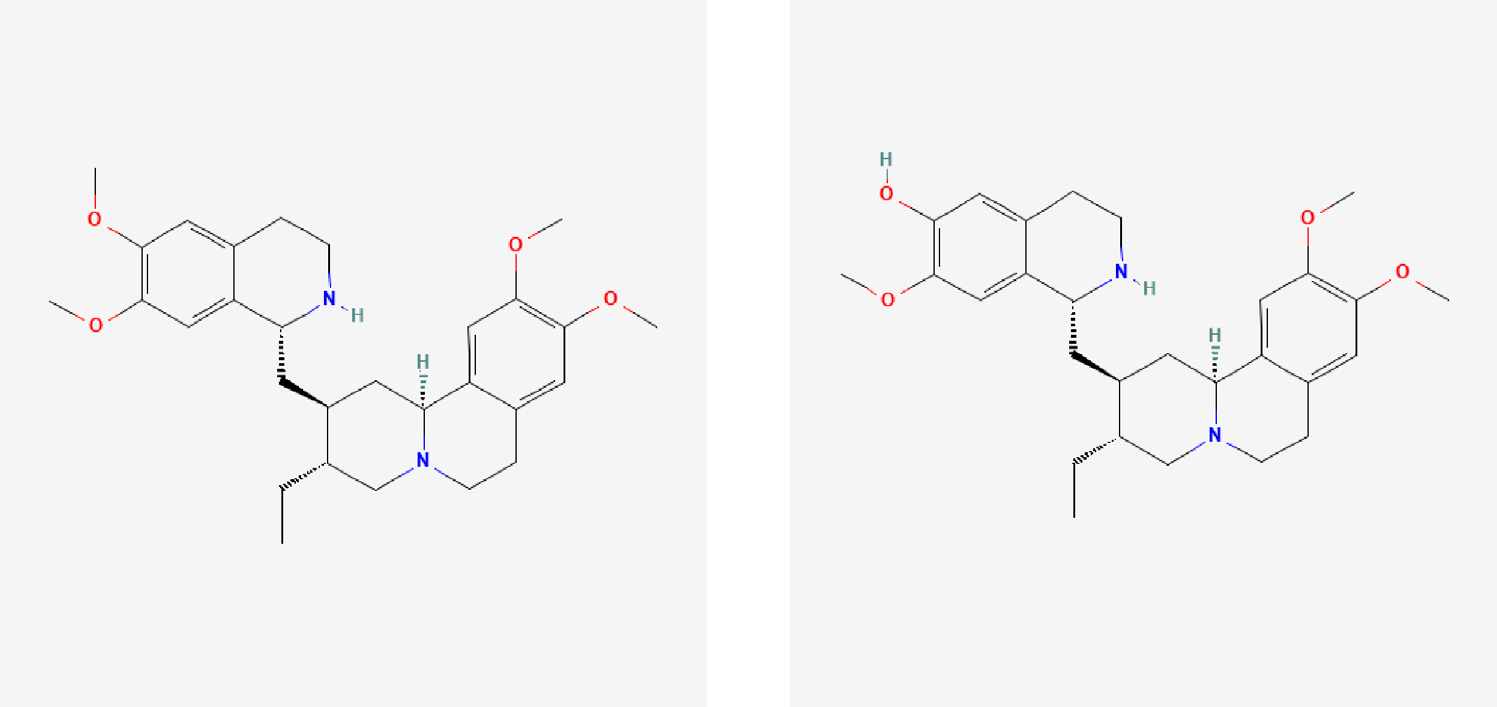
Chemical structures of the alkaloids emetine (left) and cephaeline (right) retrieved from PubChem (Compound Identifiers CID 10219 and CID 442195, respectively). Molecular depictions were generated or calculated by PubChem, with stereochemical orientation indicated by wedges and dashes in the perspective formulas. Hydrogen, nitrogen, and oxygen atoms are shown in green, blue, and red, respectively.
Figure 1 - Isomeric structures of emetine and cephaeline
On SwissADME, both emetine and cephaeline presented a bioavailability score (probability of F > 10% in rats) of 0.55 and favorable druglikeness according to the Lipinski, Veber, Egan, and Muegge filters, but showed three and two violations in the Ghose filter, respectively (Table 2). In addition, neither emetine nor cephaeline were indicated as inhibitors of the main CYP isozymes involved in drug metabolism (i.e., CYP1A2, CYP2C19, CYP2C9, CYP2D6, and CYP3A4). As expected, lipophilicity, size, polarity, insolubility, unsaturation, and flexibility were similar for both compounds, with slightly higher scores of lipophilicity, size, insolubility, and flexibility for emetine and slightly higher scores of polarity and unsaturation for cephaeline (Figure 2).
Table 2 - Druglikeness parameters of emetine and cephaeline according to SwissADME predictions
| Parameter | Emetine | Cephaeline |
|---|---|---|
| Lipinski filter | Passed; 0 violation | Passed; 0 violation |
| Ghose filter | Failed; 3 violations: MW > 480, MR > 130, #atoms > 70 | Failed; 2 violations: MR > 130, #atoms > 70 |
| Veber filter | Passed | Passed |
| Egan filter | Passed | Passed |
| Muegge filter | Passed | Passed |
| Bioavailability score | 0.55 | 0.55 |
MW: molecular weight; MR: molar refractivity; #atoms: number of atoms.
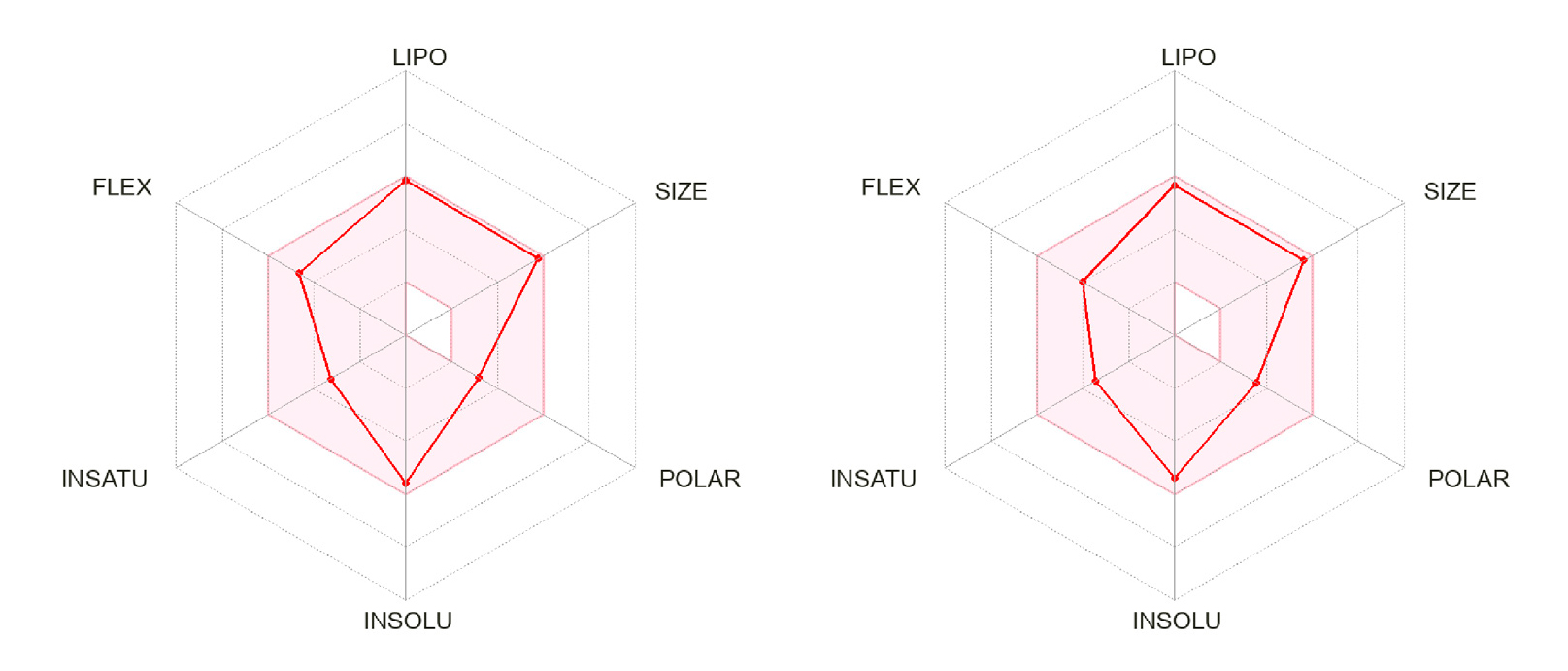
Lipophilicity (LIPO), size (SIZE), polarity (POLAR), insolubility (INSOLU), unsaturation (INSATU), and flexibility (FLEX) parameters were calculated using SwissADME. The colored zone represents the optimal physicochemical space for oral bioavailability.
Figure 2 - Bioavailability radar of emetine (left) and cephaeline (right)
Regarding human intestinal absorption (HIA) and blood-brain barrier (BBB) transposition, emetine and cephaeline showed equivalent abilities, both acting as substrates of P-glycoprotein (PGP), which limits their permanence in the central nervous system (CNS) after reaching it, as predicted by the BOILED-Egg model (Figure 3). These predictions suggest that both alkaloids could be prioritized for further validation studies in malaria, arboviruses, and respiratory diseases, which are expected to increase in incidence and distribution under climate change scenarios in the Amazon.
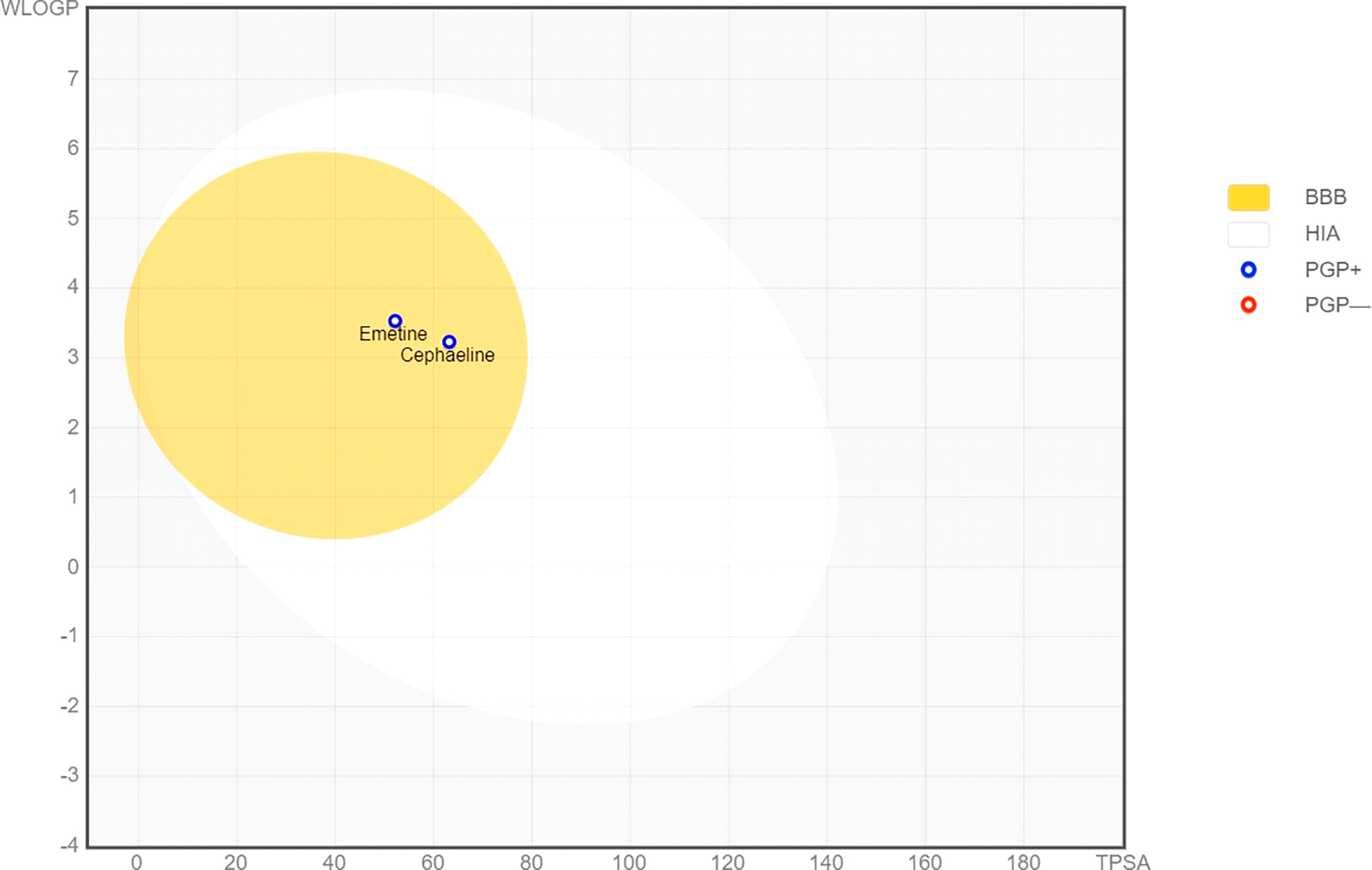
Data were calculated using the BOILED-Egg model. Points located within the white ellipse represent compounds with high probability of passive absorption through the gastrointestinal tract, while points within the yellow ellipse (the yolk) correspond to compounds with high probability of permeating the BBB to access the CNS. The white and yellow regions are not mutually exclusive. Blue points indicate molecules predicted to be substrates of P-glycoprotein (PGP⁺) and actively pumped out from the brain or into the gastrointestinal lumen. Red points indicate non-substrates of PGP (PGP⁻).
Figure 3 - Predicted gastrointestinal absorption and brain penetration of emetine and cephaeline
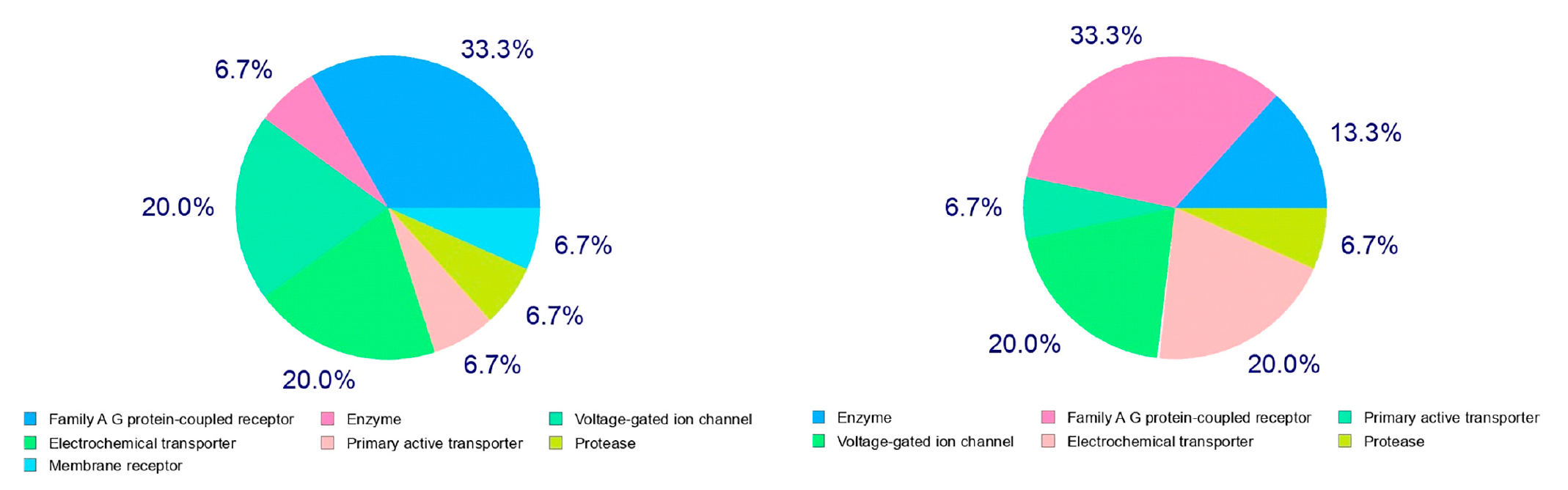
As assessed on SwissTargetPrediction, the α2A-adrenergic receptor (ADRA2A) and the putative hydrolase RBBP9 were identified as the most likely protein targets of emetine (probability ≈ 0.58) and cephaeline (probability ≈ 0.64), respectively. Despite this difference, the top 15 protein targets of these query molecules comprised mainly family A G protein-coupled receptors (33.3%), electrochemical transporters (20.0%), and voltage-gated ion channels (20.0%) (Figure 4).
DISCUSSION
The alkaloids emetine and cephaeline are compounds with similar molecular structures, differing from each other by one substituent: a hydroxyl group (-OH) in cephaeline and a methoxy group (-OCH₃) in emetine. They have emetic and antiparasitic properties28,29, extracted from the roots of C. ipecacuanha and widely used in traditional medicine, mainly for the treatment of intestinal amebiasis3. However, their use has been associated with side effects such as vomiting and nausea, and at high doses, cardiotoxic effects30. Yang et al.17 observed that both molecules inhibited the replication of ZIKV and EBOV, and that this antiviral effect is independent of cytotoxicity.
Adrenergic receptors are glycoproteins located on the surface of effector cells and are responsible for the adrenergic activity of the sympathetic autonomic nervous system. α2-adrenergic receptors are inhibitory and, when activated, induce antihypertensive, anxiolytic, sympatholytic, and sedative effects31. The predilection (33%) of emetine and cephaeline for the α2A-adrenergic receptor suggests a partial agonist action on this receptor. These receptors can, for instance, inhibit the release of noradrenaline32, reduce gastric and intestinal motility and tone33, and cause dose-dependent effects such as cardiovascular alterations, sedation, and analgesia34. The active compounds can also bind to adenosine and μ-opioid receptors.
The alkaloids showed affinity for ionic channels (20%), particularly potassium channels activated by high-conductance calcium. These channels help restore the resting state after depolarization or decrease excitability through hyperpolarization31, which could potentiate a bronchodilator effect, among others.
The evaluated compounds also showed a predilection for electrochemical receptors (20%), such as histamine H1 receptors in cattle, intestinal microbiota bacteria (Bacteroides stercoris), and the vesicular amine synaptic transporter. In this context, emetine and cephaeline could be investigated as potential drug candidates for the treatment of Tourette syndrome (TS), a disorder characterized by motor and vocal tics35, as one of the accepted theories for TS suggests a dysfunction in the interconnected pathways between the cerebral cortex and the basal ganglia36.
Cephaeline and emetine have notable anorexigenic effects when administered orally compared to the parenteral route, an activity induced by stimulation of the gastric mucosa sensory receptor and the central chemoreceptor, followed by activation of the trigger zone37. Among the two alkaloids, emetine is the most cardiotoxic; its toxic dose is approximately ten times higher than the therapeutic dose, and the resulting damage is associated with frequent exposure38. Emetine can block protein synthesis by binding to ribosomal subunits, a mechanism that may be relevant for studies investigating anorectic activity14.
The site of action of emetine in Plasmodium falciparum is the 40S subunit of the eukaryotic 80S ribosome39, according to molecular modeling studies assessing potency against multidrug-resistant P. falciparum strains (reference clone K1)40. Since the 1970s, both alkaloids have been described as protein synthesis inhibitors41, findings that are consistent with our data. The gametocidal activity of emetine was demonstrated by Panwar et al.42, corroborating the results obtained in this investigation.
Among the main limitations of the study, it was not possible to analyze the toxicity parameters of emetine and cephaeline. Furthermore, future studies should evaluate possible synergistic effects between these alkaloids and other chemical compounds present in the root extract of C. ipecacuanha.
Nevertheless, the preliminary prediction of the main potential human targets of emetine and cephaeline suggests that both alkaloids have a significant probability of interacting with family A (rhodopsin-like) G protein-coupled receptors (GPCRs), mainly α1A-adrenergic and α2A-adrenergic receptors, as well as with enzymes such as the putative hydrolase RBBP9 and voltage-gated ion channels43.
The integrated analysis of the pharmacological properties of emetine and cephaeline highlights their potential as starting points for drug repositioning and structural optimization strategies. The identification of properties influencing bioavailability, permeability, and toxicity provides insights for designing derivatives with improved pharmacokinetic profiles and greater therapeutic margins. Furthermore, the in silico findings support the feasibility of using these alkaloids in targeted delivery platforms aimed at minimizing adverse effects and maximizing biological efficacy. Therefore, the results presented herein not only reinforce the pharmacological relevance of emetine and cephaeline but also provide valuable guidance for future studies involving molecular modeling, rational drug design, and the development of specific delivery systems.
The findings also reinforce the importance of exploring Amazonian biodiversity as a source of pharmacological innovation. In the context of climate change, where malaria and arboviral outbreaks are projected to expand, identifying molecules with predicted antiplasmodial and antiviral potential is highly strategic. In silico approaches are cost-effective tools that accelerate the prioritization of bioactive molecules for laboratory validation, strengthening adaptive health strategies.
Moreover, aligning this research with the climate-health interface highlights that the discovery of new therapeutic candidates contributes to building resilience in public health. By applying computational modeling to native Amazonian species, this study supports the dual agenda of preserving biodiversity and fostering sustainable solutions for diseases exacerbated by climate variability.
CONCLUSIONS
Emetine and cephaeline potentially exhibit druglike physicochemical and pharmacokinetic properties, with probable high HIA and the ability to cross the BBB. A priori, the two compounds do not appear to inhibit major cytochrome P450 (CYP) enzymes. Among the probable pharmacological properties, we highlight the possible antiplasmodial activity of the alkaloids emetine and cephaeline, mediated by binding to protein receptors. However, further analyses are required to predict homologous protein domains in Plasmodium spp.
Beyond their pharmacological promise, the study of emetine and cephaeline exemplifies how molecular modeling of Amazonian bioactive compounds can serve as scientific innovation aligned with climate-health challenges. Such in silico approaches contribute to adaptive public health strategies and resilience in the Pan-Amazon region in the face of the climate crisis.

