<?xml version="1.0" encoding="ISO-8859-1"?><article xmlns:mml="http://www.w3.org/1998/Math/MathML" xmlns:xlink="http://www.w3.org/1999/xlink" xmlns:xsi="http://www.w3.org/2001/XMLSchema-instance">
<front>
<journal-meta>
<journal-id>1981-8114</journal-id>
<journal-title><![CDATA[Boletim do Museu Paraense Emílio Goeldi Ciências Naturais]]></journal-title>
<abbrev-journal-title><![CDATA[Bol. Mus. Para. Emilio Goeldi Cienc. Nat.]]></abbrev-journal-title>
<issn>1981-8114</issn>
<publisher>
<publisher-name><![CDATA[Museu Paraense Emílio Goeldi, Ministério da Ciência e Tecnologia]]></publisher-name>
</publisher>
</journal-meta>
<article-meta>
<article-id>S1981-81142010000100002</article-id>
<title-group>
<article-title xml:lang="en"><![CDATA[Notes on the Vertebrates of northern Pará, Brazil: a forgotten part of the Guianan Region, I. Herpetofauna]]></article-title>
<article-title xml:lang="pt"><![CDATA[Notas sobre os vertebrados do norte do Pará, Brasil: uma parte esquecida da Região das Guianas, I. Herpetofauna]]></article-title>
</title-group>
<contrib-group>
<contrib contrib-type="author">
<name>
<surname><![CDATA[Avila-Pires]]></surname>
<given-names><![CDATA[Teresa Cristina Sauer]]></given-names>
</name>
<xref ref-type="aff" rid="A01"/>
</contrib>
<contrib contrib-type="author">
<name>
<surname><![CDATA[Hoogmoed]]></surname>
<given-names><![CDATA[Marinus Steven]]></given-names>
</name>
<xref ref-type="aff" rid="A02"/>
</contrib>
<contrib contrib-type="author">
<name>
<surname><![CDATA[Rocha]]></surname>
<given-names><![CDATA[Wáldima Alves da]]></given-names>
</name>
<xref ref-type="aff" rid="A03"/>
</contrib>
</contrib-group>
<aff id="A01">
<institution><![CDATA[,Museu Paraense Emílio Goeldi  ]]></institution>
<addr-line><![CDATA[Belém Pará]]></addr-line>
<country>Brasil</country>
</aff>
<aff id="A02">
<institution><![CDATA[,Museu Paraense Emílio Goeldi  ]]></institution>
<addr-line><![CDATA[Belém Pará]]></addr-line>
<country>Brasil</country>
</aff>
<aff id="A03">
<institution><![CDATA[,Museu Paraense Emílio Goeldi  ]]></institution>
<addr-line><![CDATA[Canto do Buriti Piauí]]></addr-line>
<country>Brasi</country>
</aff>
<pub-date pub-type="pub">
<day>00</day>
<month>04</month>
<year>2010</year>
</pub-date>
<pub-date pub-type="epub">
<day>00</day>
<month>04</month>
<year>2010</year>
</pub-date>
<volume>5</volume>
<numero>1</numero>
<fpage>13</fpage>
<lpage>112</lpage>
<copyright-statement/>
<copyright-year/>
<self-uri xlink:href="http://scielo.iec.gov.br/scielo.php?script=sci_arttext&amp;pid=S1981-81142010000100002&amp;lng=en&amp;nrm=iso"></self-uri><self-uri xlink:href="http://scielo.iec.gov.br/scielo.php?script=sci_abstract&amp;pid=S1981-81142010000100002&amp;lng=en&amp;nrm=iso"></self-uri><self-uri xlink:href="http://scielo.iec.gov.br/scielo.php?script=sci_pdf&amp;pid=S1981-81142010000100002&amp;lng=en&amp;nrm=iso"></self-uri><abstract abstract-type="short" xml:lang="en"><p><![CDATA[We discuss the herpetological results of seven expeditions to the Guianan part of Pará, which resulted in a total of 80 species of amphibians (77 frogs and three caecilians) and 95 species of reptiles (36 species of lizards, three species of amphisbaenians, 49 species of snakes, five species of chelonians and two species of caiman). We report six species new to science (three frogs, one caecilian, one lizard, one amphisbaenian), six new records for Brazil (five frogs, one caecilian) and 23 new records for Pará (13 frogs, four lizards, six snakes). For each of the new records we provide comments. Special comment is made about a large population of the toad Atelopus hoogmoedi that seems to be doing well and does not show any signs of population decline as many species of Atelopus at higher elevations do. We provide a complete list of species collected per locality containing data on endemicity, habitat, reproduction and food. For each of the seven collecting sites we provide data on richness and abundance of species. The sites are compared regarding their species composition, even though we can not say how much of the differences are due to specific habitats or geographic variation, seasonal variation or sampling deficiency. We synonymised the Bufonid Rhinella martyi with Bufo margaritifer and selected a lectotype for Rana margaritifera in order to resolve the problems about this name.]]></p></abstract>
<abstract abstract-type="short" xml:lang="pt"><p><![CDATA[Os resultados herpetológicos de sete expedições à parte guianense do estado do Pará são apresentados e discutidos, registrando-se um total de 80 espécies de anfíbios (77 anuros e três Gymnophiona) e 95 espécies de répteis (36 espécies de lagartos, três espécies de anfisbenídeos, 49 espécies de ofídios, cinco espécies de quelônios e duas espécies de jacarés). Dessas espécies, seis são novas para a ciência (três anuros, um Gymnophiona, um lagarto, um anfisbenídeo), seis representam novos registros para o Brasil (cinco anuros, um Gymnophiona) e 23 novos registros para o Pará (13 anuros, quatro lagartos, seis ofídios). Comenta-se cada um dos novos registros. Comentários especiais são feitos sobre uma grande população do sapo Atelopus hoogmoedi, a qual parece estar bem saudável e não mostra sinais de declínio populacional, como muitas espécies de Atelopus em outros lugares de maior altitude. Uma lista completa das espécies coletadas por localidade, incluindo dados sobre endemismo, habitat, reprodução e alimentação, é apresentada. Para cada uma das sete áreas de coleta, apresentamos dados sobre riqueza e abundância de espécies. As áreas são comparadas quanto à similaridade na composição das espécies, ainda que não seja possível indicar quanto das diferenças encontradas deve-se a ambientes específicos ou variação geográfica, variação sazonal ou deficiência na amostragem das espécies. O Bufonidae Rhinella martyi é considerado sinônimo de Bufo margaritifer e um lectótipo para Rana margaritifera é selecionado visando dirimir dúvidas sobre o nome da espécie.]]></p></abstract>
<kwd-group>
<kwd lng="en"><![CDATA[Amphibia]]></kwd>
<kwd lng="en"><![CDATA[Reptilia]]></kwd>
<kwd lng="en"><![CDATA[Guiana Centre of Endemism]]></kwd>
<kwd lng="en"><![CDATA[Brazil]]></kwd>
<kwd lng="en"><![CDATA[Species richness. Species list]]></kwd>
<kwd lng="pt"><![CDATA[Amphibia]]></kwd>
<kwd lng="pt"><![CDATA[Reptilia]]></kwd>
<kwd lng="pt"><![CDATA[Centro de Endemismo Guiana]]></kwd>
<kwd lng="pt"><![CDATA[Brasil]]></kwd>
<kwd lng="pt"><![CDATA[Riqueza de espécies]]></kwd>
<kwd lng="pt"><![CDATA[Lista de espécies]]></kwd>
</kwd-group>
</article-meta>
</front><body><![CDATA[ <p><font size="4" face="Verdana"><b> <a name="topo"></a>Notes on the Vertebrates of northern Par&aacute;,  Brazil: a forgotten part of the Guianan Region, I. Herpetofauna</b></font></p>     <p>&nbsp;</p>     <p><font size="3" face="Verdana"><b>Notas sobre os vertebrados do norte  do Par&aacute;, Brasil: uma parte esquecida da Regi&atilde;o das Guianas, I. Herpetofauna</b></font></p>     <p>&nbsp;</p>     <p>&nbsp;</p>     <p><font size="2" face="Verdana"><b>Teresa Cristina Sauer Avila-Pires<sup>I</sup>; Marinus  Steven Hoogmoed<sup>II</sup>; W&aacute;ldima Alves da Rocha<sup>III</sup></b></font></p>     <p><font size="2" face="Verdana"> <sup>I</sup>Museu Paraense Em&iacute;lio Goeldi. Bel&eacute;m, Par&aacute;, Brasil (<a href="mailto:avilapires@museu-goeldi.br">avilapires@museu-goeldi.br</a>)    <br>     <sup>II</sup>Museu Paraense Em&iacute;lio Goeldi. Bel&eacute;m, Par&aacute;, Brasil (<a href="mailto:marinus@museu-goeldi.br">marinus@museu-goeldi.br</a>)    <br>     <sup>III</sup>Universidade Aberta  do Brasil. Canto do Buriti, Piau&iacute;, Brasil (<a href="mailto:waldima@yahoo.com.br">waldima@yahoo.com.br</a>)</font></p>     <p><font size="2" face="Verdana"><a href="#endereco">Correspondence</a></font></p>     ]]></body>
<body><![CDATA[<p>&nbsp;</p>     <p>&nbsp;</p> <hr size="1" noshade>     <p><font size="2" face="Verdana"><b>ABSTRACT</b></font></p>     <p><font size="2" face="Verdana">We discuss the herpetological results of seven expeditions to the Guianan  part of Par&aacute;, which resulted in a total of 80 species of amphibians (77 frogs  and three caecilians) and 95 species of reptiles (36 species of lizards, three  species of amphisbaenians, 49 species of snakes, five species of chelonians and  two species of caiman). We report six species new to science (three frogs, one  caecilian, one lizard, one amphisbaenian), six new records for Brazil (five  frogs, one caecilian) and 23 new records for Par&aacute; (13 frogs, four lizards, six  snakes). For each of the new records we provide comments. Special comment is  made about a large population of the toad <i>Atelopus hoogmoedi </i>that seems  to be doing well and does not show any signs of population decline as many  species of <i>Atelopus </i>at higher elevations do. We provide a complete list  of species collected per locality containing data on endemicity, habitat,  reproduction and food. For each of the seven collecting sites we provide data  on richness and abundance of species. The sites are compared regarding their  species composition, even though we can not say how much of the differences are  due to specific habitats or geographic variation, seasonal variation or  sampling deficiency. We synonymised the Bufonid <i>Rhinella martyi </i>with <i>Bufo  margaritifer </i>and selected a lectotype for <i>Rana margaritifera </i>in  order to resolve the problems about this name.</font></p>     <p><font size="2" face="Verdana">  <b>Keywords: </b>Amphibia. Reptilia. Guiana Centre of  Endemism. Brazil.  Species richness. Species list.</font></p> <hr size="1" noshade>     <p><font size="2" face="Verdana"><b><font size="2" face="Verdana">RESUMO</font></b></font></p>     <p><font size="2" face="Verdana">Os resultados  herpetol&oacute;gicos de sete expedi&ccedil;&otilde;es &agrave; parte guianense do estado do Par&aacute; s&atilde;o apresentados  e discutidos, registrando-se um total de 80 esp&eacute;cies de anf&iacute;bios (77 anuros e tr&ecirc;s Gymnophiona) e 95 esp&eacute;cies de r&eacute;pteis (36 esp&eacute;cies de lagartos,  tr&ecirc;s esp&eacute;cies de anfisben&iacute;deos, 49 esp&eacute;cies de of&iacute;dios,  cinco esp&eacute;cies de quel&ocirc;nios e duas esp&eacute;cies de jacar&eacute;s). Dessas esp&eacute;cies, seis  s&atilde;o novas para a ci&ecirc;ncia (tr&ecirc;s anuros, um Gymnophiona, um lagarto, um  anfisben&iacute;deo), seis representam novos registros para o Brasil (cinco anuros, um  Gymnophiona) e 23 novos registros para o Par&aacute; (13 anuros, quatro lagartos, seis  of&iacute;dios). Comenta-se cada um dos novos registros. Coment&aacute;rios especiais s&atilde;o  feitos sobre uma grande popula&ccedil;&atilde;o do sapo <i>Atelopus hoogmoedi, </i>a qual  parece estar bem saud&aacute;vel e n&atilde;o mostra sinais de decl&iacute;nio populacional, como  muitas esp&eacute;cies de <i>Atelopus </i>em outros lugares de maior altitude. Uma  lista completa das esp&eacute;cies coletadas por localidade, incluindo dados sobre  endemismo, habitat, reprodu&ccedil;&atilde;o e alimenta&ccedil;&atilde;o, &eacute; apresentada. Para cada uma das  sete &aacute;reas de coleta, apresentamos dados sobre riqueza e abund&acirc;ncia de  esp&eacute;cies. As &aacute;reas s&atilde;o comparadas quanto &agrave; similaridade na composi&ccedil;&atilde;o das  esp&eacute;cies, ainda que n&atilde;o seja poss&iacute;vel indicar quanto das diferen&ccedil;as encontradas  deve-se a ambientes espec&iacute;ficos ou varia&ccedil;&atilde;o geogr&aacute;fica, varia&ccedil;&atilde;o sazonal ou  defici&ecirc;ncia na amostragem das esp&eacute;cies. O Bufonidae <i>Rhinella martyi </i>&eacute;  considerado sin&ocirc;nimo de <i>Bufo margaritifer </i>e um lect&oacute;tipo para <i>Rana  margaritifera </i>&eacute; selecionado visando dirimir d&uacute;vidas sobre o nome da esp&eacute;cie.</font></p>     <p><font size="2" face="Verdana">  <b>Palavras-chave: </b>Amphibia. Reptilia. Centro de Endemismo Guiana. Brasil. Riqueza de esp&eacute;cies. Lista de  esp&eacute;cies.</font></p> <hr size="1" noshade>     <p>&nbsp;</p>     <p>&nbsp;</p>     ]]></body>
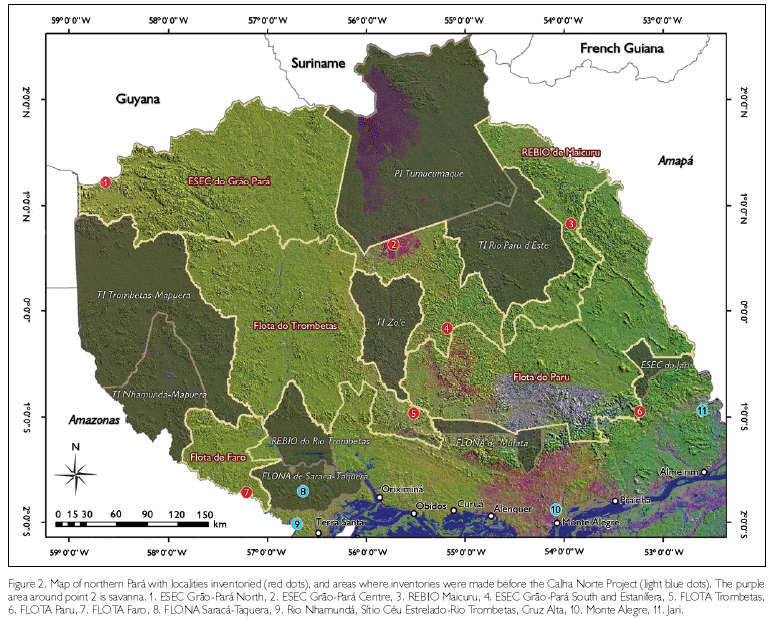
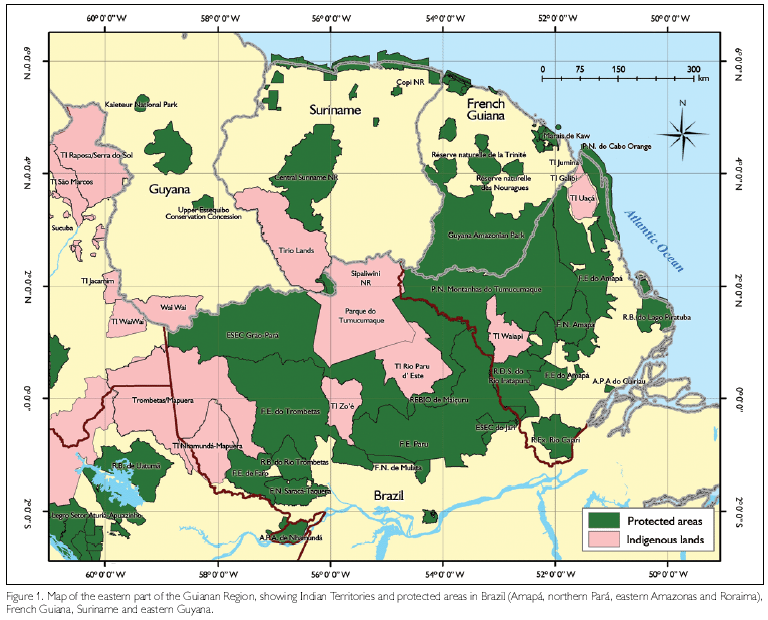
<body><![CDATA[<p><font size="3" face="Verdana"><b>INTRODUCTION</b></font></p>     <p><font size="2" face="Verdana"> On December 4, 2006, the State of Par&aacute; created  five new conservation units in the northern part of Par&aacute;, north of the Amazon,  in order to establish a large and protected, mostly forested, area that would  form a continuous block with similarly protected areas in Amap&aacute; (Parque  Nacional &#91;PARNA&#93; Montanhas de  Tumucumaque), French Guiana, Suriname and Guyana, and with  Indian Territories in the region (<a href="#f1">Figure 1</a>) (Governo do Estado do Par&aacute;, 2006). The  five conservation units created by the state were: Esta&ccedil;&atilde;o Ecol&oacute;gica (ESEC) Gr&atilde;o-Par&aacute;  (4.2 million ha), Reserva Biol&oacute;gica (REBIO) Maicuru (1.2 million ha), and the Florestas  Estaduais (FLOTA) de Faro (0.6 million ha),  Trombetas (3.2 million ha) and Paru (3.6 million ha). Together they cover an area of 13.2 million ha and, with the already  existing protected areas - Indian territories (TI) of Trombetas-Mapuera,  Tumucumaque, rio Paru d'Este, Nhamund&aacute;-Mapuera  and Zo'&eacute;; two 'Quilombola' (African-Brazilian)  territories; the Florestas Nacionais (FLONA) Sarac&aacute;-Taquera and da  Mulata, REBIO do rio Trombetas, and ESEC Jari - they form an enormous block,  although with different degrees of protection (besides TI and 'quilombola'  sites, that harbour traditional populations, FLOTAs and FLONAs aim at the  sustainable use of natural resources). Most of the newly created conservation  units are covered by non-flooded tropical rainforest ('terra-firme' forest), but in several places other vegetation types, like flooded forests  ('v&aacute;rzea' and 'igap&oacute;'), savanna and 'cerrad&atilde;o', are present as well. Only a relatively narrow  band of land in 'Calha Norte Paraense' (CNP) along the Amazon is not protected  and open to unregulated human occupation. We here consider as CNP that part of Par&aacute;  that is situated north of the Amazon River.</font></p>     <p><a name="f1"></a></p>     <p>&nbsp;</p>     <p align="center"><img src="/img/revistas/bmpegcn/v5n1/1a02f1.gif" border="0"></p>     <p>&nbsp;</p>     <p><font size="2" face="Verdana"> On  February 14, 2007 several parties (Government of Par&aacute; &#91;SEMA-PA&#93;, Conserva&ccedil;&atilde;o  Internacional &#91;CI-Brasil&#93;, Museu Paraense Em&iacute;lio Goeldi &#91;MPEG&#93;, Instituto do  Homem e Meio Ambiente da Amaz&ocirc;nia &#91;IMAZON&#93;, Instituto de Desenvolvimento  Florestal do Estado do Par&aacute; &#91;IDEFLOR&#93;, Instituto de Manejo e Certifica&ccedil;&atilde;o  Florestal e Agr&iacute;cola &#91;IMAFLORA&#93;, and  the German Technical Cooperation Agency &#91;GTZ&#93;) signed an agreement to form a  consortium to provide data to develop management plans for the five state  protected areas ('Projeto Diagn&oacute;stico da Biodiversidade das Unidades de  Conserva&ccedil;&atilde;o Estaduais do Mosaico Calha Norte, Estado do Par&aacute;'). As a result of this agreement seven expeditions to investigate the  biodiversity of the recently established protected areas were planned. The  localities to be inventoried were chosen by specialists from SEMA-PA,  CI-Brasil, Imazon and MPEG, on the basis of satellite photographs,  georeferenced databases, and vegetation and altitude data, with the goal to  optimize the coverage of the different phytophysionomies and altitudes present  in the area during seven three-week long expeditions distributed over a year.  An additional overflight helped with the final definition of the areas chosen  for sampling. As final transportation to five of the research areas was planned  by helicopter, the localities could be chosen independent of road or river  transport. Fieldwork started in January 2008 and ended in January 2009. During  this period three expeditions to different localities in ESEC Gr&atilde;o-Par&aacute; and one  each to a locality in the other four newly created conservation units were  carried out by 12 - 13 researchers of the MPEG and about ten technical  assistants.</font></p>     <p><font size="2" face="Verdana"> Due to its continental size, many Amazonian  areas are still poorly known regarding their herpetofauna. The northern part of  the state of Par&aacute;, in Brazil,  is one of these areas, with only a few spots reasonably well surveyed. This  area north of the Amazon River forms part of the Guianan Region (or 'Guianas')  as defined by Hoogmoed (1979b), mainly delimited by the Orinoco, Negro and  Amazonas rivers on the west and south, and the Atlantic Ocean on the north and  east. The Guianan Region encompasses the three Guianas (Guyana, Suriname,  French Guiana), the southeastern part of Venezuela, and in Brazil the states of  Amap&aacute; and Roraima, the state of Par&aacute; north of the Amazon River, and the  relatively small northeastern part of the state of Amazonas, north of the  Amazon River and east and north of the rio Negro. Silva <i>et al. </i>(2005) considered  the area as the Guianan Area of Endemism, the largest of eight areas  of endemism in the Amazon region, with half of its surface in Brazil.  According to Silva <i>et al., </i>2005) in the  Brazilian part of this area of endemism, only 4.06% had been deforested,  although this percentage may have gone up in the past few years. We do not  include part of Colombia in  the Guianan Region (and neither do Silva <i>et al., </i>2005), as was done by the 2002 Paramaribo  workshop (Hollowell &amp; Reynolds, 2005 and articles therein), as there are no  good zoogeographical reasons for that inclusion. Concerning herpetofauna, the  area west of the rio Negro has no Guiana  endemics. The Guianan Region has a number of species in common with other areas  of Amazonia, but also has a number of endemic  species. This is especially true for the 'tepuis', sandstone mountains with  elevations above 1,500 m,  usually considered a distinct biogeographic region ('Pantepui') within the  Guianan Region (Hoogmoed, 1979b; McDiarmid &amp; Donnelly, 2005), in Venezuela,  western Guyana and extreme northern Brazil (Roraima and Amazonas States). In Suriname  there is one sandstone mountain of 1,200 m altitude, but it has no Pantepui  endemics (MSH, pers. obs.), which generally only occur above 1,500 m. In northern Par&aacute;, Amap&aacute; and French Guiana no tepuis are found  and elevations just reach 900   m, thus explaining the absence of any herpetological  tepui endemics in the area. A number of lowland species are also endemic to the  Guianan region or part of it, although numbers have dropped when new range  extensions became available (e.g. Caldwell &amp; Hoogmoed, 1998).</font></p>     <p><font size="2" face="Verdana"> About 350 species of amphibians and a similar  number of reptiles are known from the whole of Amazonia, including the Guianas  (see Eva &amp; Huber, 2005: 11 for the limits of Amazonia, here considered as  the area named Amazonia <i>sensu lato </i>&#91;Ia+IIa+IIb&#93;),  of which c. 82% of the amphibians and 62% of the reptiles are endemic (Avila-Pires <i>et al., </i>2007; Duellman,  1999). Hoogmoed (1979b) estimated that, for the Guianan lowlands, c. 52% of the  amphibians and 26% of the reptiles were endemic. However, as more areas were  better surveyed, many of the lowland species considered endemic to the Guianas  in 1979 were shown to  have a wider distribution throughout Amazonia  (e.g. <i>Allophryne ruthveni </i>&#91;Caldwell &amp; Hoogmoed, 1998&#93;, <i>Bufo guttatus </i>and <i>Lithodytes lineatus </i>&#91;MSH, unpublished data, material in  MPEG&#93;). Including also the fauna of the tepuis, Se&ntilde;aris &amp; MacCulloch (2005) found that 54% of the  amphibian species from the Guianas were endemic to the region, while Avila-Pires (2005) indicated that 30% of the reptile species were endemic. As there  are still large gaps in our knowledge about the herpetofauna of the Guianan  Region, both range extensions and new species are expected to be found in  northern Par&aacute;.</font></p>     <p><font size="2" face="Verdana"> A number of recent herpetofaunal studies  focus on (part of) the Guianan Region, among them those on amphibians (Fouquet <i>et  al., </i>2007a, b; Lescure &amp; Marty, 2000; Kok, 2000;  Kok <i>et al., </i>2006a), lizards (Hoogmoed  &amp; Lescure, 1975; Hoogmoed &amp; Avila-Pires, 1989; Gasc, 1990),  amphisbaenians and snakes (Gasc &amp; Rodrigues, 1980; Chippeaux, 1986; Starace, 1998) from French Guiana; anurans (Hoogmoed, 1969a,  b, 1971a, b, 1979a), wormsalamanders (Nussbaum &amp;  Hoogmoed, 1979), lizards and amphisbaenians (Hoogmoed, 1973), and some groups  of snakes (Hoogmoed, 1977, 1980, 1983, 1985) from Suriname; an increasing  number of studies on the herpetofauna of Guyana, especially the western  (Pantepui) part of this country (Cole &amp; Kok, 2006; Kok,   2005, 2006a, b, 2008a, b, 2009; Kok <i>et al., </i>2006b;  Kok  &amp; Castroviejo-Fisher, 2008; Kok &amp;  Kalamandeen, 2008;   Lathrop &amp; MacCulloch, 2007; MacCulloch &amp;  Lathrop, 2001, 2002, 2004a, b, 2005, 2009; MacCulloch <i>et al.,</i>  2006, 2007, 2008a, b), several from the central and   southern Guyana lowlands, like the Mabura Hill and Iwokrama region (Donnelly <i>et al., </i>1998, 2005a, b, 2006;   Ernst <i>et al., </i>2005, 2007; Kok &amp; Ernst,  2007, Kok <i>et al.,</i>  2007, Se&ntilde;aris <i>et al., </i>2008) and from the coastal area (EMC, 2006); the study by Gorzula &amp; Se&ntilde;aris (1999) on the herpetofauna of Venezuelan Guayana, and by Pritchard &amp; Trebbau (1984) on chelonians from Venezuela; and those on  amphibians (Lima <i>et al., </i>2006), snakes (Martins &amp;  Oliveira, 1993, 1998), and lizards (Vitt <i>et al., </i>2008) from the Manaus  area, Amazonas, Brazil. More specific papers are  those by Hoogmoed &amp; Avila-Pires (1991a), with data on Amphisbaenidae; by  Hoogmoed &amp; Avila-Pires (1992) on the lizard genus <i>Arthrosaura, </i>by Cunha <i>et al. </i>(1980), Carvalho (1997, 2002) and Vanzolini  &amp; Carvalho (1991), on lizards and snakes from Roraima. Some publications deal  with species that occur throughout a large part of the Guianan Region (Campbell  &amp; Lamar, 2004; Dixon <i>et al., </i>1993; Medem, 1983; Noonan &amp; Gaucher,  2005, 2006;   Noonan &amp; Wray, 2006; Roze, 1996; Wollenberg <i>et al.,</i>  2006, 2008). Conserva&ccedil;&atilde;o Internacional  organized a series of expeditions to the Tumucumaque  Mountains on the border of French  Guiana and Amap&aacute;, between 2004 and 2006, but the herpetological results (Lima, 2008) are still  under discussion and at the moment only can be used with much care, checking  each species record. Hoogmoed (1979b, 1983), Hoogmoed &amp; Avila-Pires (1991b), Se&ntilde;aris &amp; MacCulloch (2005) and Avila-Pires (2005) present lists of Guianan herpetofauna, including data from Amap&aacute;, Amazonas, Par&aacute; and Roraima. In Avila-Pires (1995), a catalogue of the lizards of  Brazilian Amazonia, data on lizards from the Guianan Region can also be found,  while data on chelonians may be found in Vogt (2008). Bartlett &amp; Bartlett  (2003) is a good general introductory book for the Amazonian herpetofauna, and  Rueda-Almonacid <i>et al. </i>(2007) is an excellent fieldguide for chelonians  and crocodiles, but both are not complete for the Guianan Region. Avila-Pires <i>et al. </i>(2009) compared the lizard faunas from three  sites on the Guiana Shield (Brokopondo and Sipaliwini &#91;both Suriname, the last one on the border with Brazil&#93; and Balbina &#91;Amazonas, Brazil&#93;)  with ten sites in other areas of the Amazon Region. They showed that the  Guianan sites were most closely related to Bel&eacute;m and Caxiuan&atilde; (both in Par&aacute;) in  the lower Amazon area.</font></p>     ]]></body>
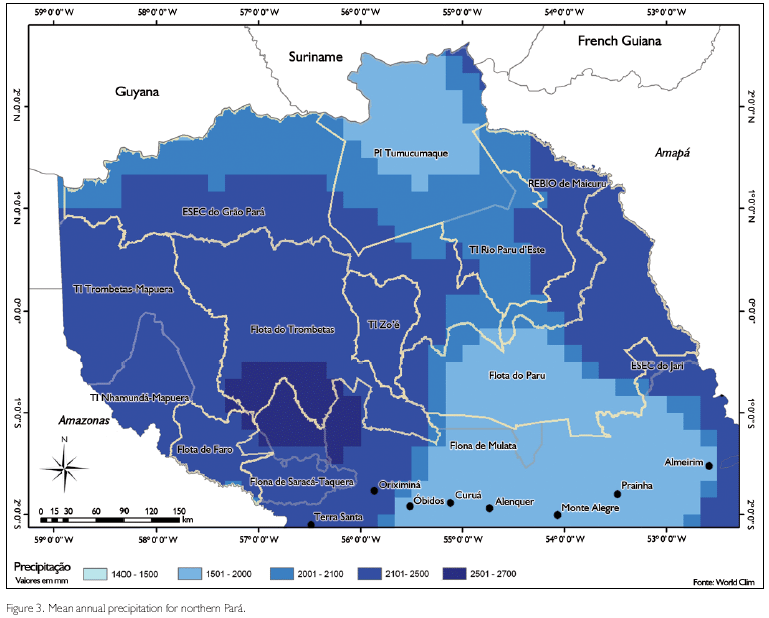
<body><![CDATA[<p><font size="2" face="Verdana"> A list of species of amphibians and reptiles  present in CNP as a whole does not exist. The areas that have been better  studied are the lower Trombetas River, where environmental studies have been done  in the context of a large bauxite mining project in the area (U. Galatti, pers.  obs.); and the Jari (Monte Dourado) area, at the border with Amap&aacute; state, as part of a two-year multidisciplinary study by C. Peres and T.  A. Gardner of the University of East Anglia (United Kingdom), and  collaborators. Most data on the Trombetas studies, however, are not published.  Part of the results of the Jari project, regarding herpetofauna, can be found  in Gardner <i>et al. </i>(2007) and Ribeiro-Junior <i>et al. </i>(2008). Hoogmoed  and Avila-Pires made collections (material in Museu Paraense Emilio Goeldi, Bel&eacute;m, Par&aacute; &#91;MPEG&#93; and in  the National Museum of Natural History, Leiden, The Netherlands &#91;RMNH&#93;) in the rio Nhamund&aacute; area in 1988, the results of which have only partly (lizards) been  published by Avila-Pires (1995). Between 1980 and 2006 personnel of MPEG made several collecting  trips to the municipalities Almeirim and Monte Alegre and obtained small, but interesting  collections, which are now in MPEG. Besides, occasional expeditions have been  made, especially following the large rivers, which account for the sparse data  found in the literature and specimens in collections. Avila-Pires (1995) registered a number of lizards from this area, even though only  from few localities, showing large gaps of information for the area as a whole.  Vogt (1994, 2008) and Haller &amp; Rodrigues (2005, 2006) give data on chelonian species  from the Trombetas   River.</font></p>     <p><font size="2" face="Verdana"> Based on the existing literature, for CNP we  may expect approximately 100 species of anurans and up to nine species of  Gymnophiona (Lescure &amp; Marty, 2000; Lima <i>et al., </i>2006; Se&ntilde;aris &amp; MacCulloch, 2005; A.O. Maciel &amp; Hoogmoed, unpublished data).  Among reptiles, we could expect about 40 species of lizards, ten species of  amphisbaenians, 100 of snakes, 11 of chelonians, and three species of caimans  (Hoogmoed, 1973; Chippeaux, 1986; Martins &amp; Oliveira, 1993, 1998;   Avila-Pires,  1995, 2005; Starace, 1998; Rueda-Almonacid <i>et</i>  al., 2007; Vogt, 2008; MSH, unpublished  data). As no tepuis are present in the CNP area, tepui endemics are not  expected to be found there, only lowland species (&lt; 750 m). On the other hand, a  number of species not present in other Guianan countries (French   Guiana, Suriname,  Guyana and Venezuela)&nbsp;  possibly can be expected to occur in the areas under influence of the Amazon River.</font></p>     <p><font size="2" face="Verdana"> The study here presented as part of the CNP  Project intended to inventory the herpetofauna from key localities surveyed  during seven expeditions (<a href="#f2">Figure 2</a>), taking into account the necessity to  produce management plans for the five conservation units created by the State  of Par&aacute;, Brazil, in 2006 - Floresta Estadual de Faro (FLOTA Faro), Floresta Estadual do Paru (FLOTA Paru), Floresta Estadual do Trombetas (FLOTA Trombetas), Reserva Biol&oacute;gica de Maicuru (REBIO  Maicuru) and Esta&ccedil;&atilde;o Ecol&oacute;gica do Gr&atilde;o-Par&aacute; (ESEC  Gr&atilde;o-Par&aacute;). Considering the large extension of the area covered by the five conservation  units (13.2 million ha), it was impossible, within the period of 13 months, to  accomplish intensive studies on the fauna of each of them. Therefore it was  decided to select a number of points that together could cover the different  phytophysionomies encountered in northern Par&aacute;, as explained before, and to perform in each  of them a Rapid Assessment Program (RAP). Although the results obtained are not  exhaustive, and new studies will be necessary to improve our understanding of  the herpetofauna of the area, they represent an important advance in our  knowledge, and provide the basis for management plans. We present here an  analysis based on all expeditions, because much information is common to all or  is complementary, and after that we highlight several species that represent  new or interesting zoogeographic data.</font></p>     <p><a name="f2"></a></p>     <p>&nbsp;</p>     <p align="center"><img src="/img/revistas/bmpegcn/v5n1/1a02f2.gif" border="0"></p>     <p>&nbsp;</p>     <p><font size="3" face="Verdana">  <b>MATERIAL AND METHODS</b></font></p>     <p><font size="2" face="Verdana"><b>STUDY AREAS</b></font></p>     <p><font size="2" face="Verdana"> The greater part of CNP is on the Guiana  Shield, only a wide band north of the Amazon belongs to the alluvial Amazon  valley. The core of the Guiana Shield is made up of pre-Cambrian metamorphic  and igneous rocks, especially granites and gneisses. On all sides the core of  the Guiana Shield is surrounded by a band of low areas of varying width  consisting of alluvial sediments. The higher part of the Guiana Shield is  covered with sandstone remnants of the Roraima Formation, which was deposited  in Proterozoic time, 1.6-1.8 billion years ago. After uplift, this formation  covered the Guiana Shield as an extensive sandstone plateau or tableland.  During the Late Cretaceous and in the Tertiary there were new periods of  further uplift of the area, at the same time that erosion shaped the present-day  table mountains or tepuis, which are concentrated in the NW part of the Guiana  Shield, in SE Venezuela and adjacent W Guyana, with some tepuis on the border  of Brazil (Roraima and Amazonas States) with these countries (Hoogmoed, 1979b  and literature cited therein). In northern Par&aacute; no sandstone tepuis are  present, and consequently, by definition, no herpetofaunal tepui endemics. The  northern and southern part of the Guianan Region are separated by the divide  between rivers that are part of the Amazon basin and flow S from the divide to  that river, and rivers of the Guianas that flow north directly to the Atlantic  Ocean. The mountains of the divide, which is formed by the Acarai Mountains in  the West (between Brazil and Guyana) and the Tumucumaque Mountains in the East  (between Suriname and French Guiana on one side and Brazil on the other) are  relatively low (in some places, like the Sipaliwini area, not higher than 250 m, in one place reaching  up to about 900 m,  but generally below 800 m).  From the Amazon River the area of northern Par&aacute;  gradually slopes north, up towards the divide. The area is hilly, with rounded  hills and elevated plateaus at a level of about 500 m, that at least in part  contain bauxite deposits. All rivers in the area run roughly N-S and have  numerous rapids and waterfalls from their upper reaches to close to the Amazon,  and therefore are difficult to navigate. The Trombetas  River in the South and the Suriname River in the north (Hoogmoed, 1973) seem to  divide the Guianan Region in an estern and a western part and may form a  distribution barrier for some species.</font></p>     ]]></body>
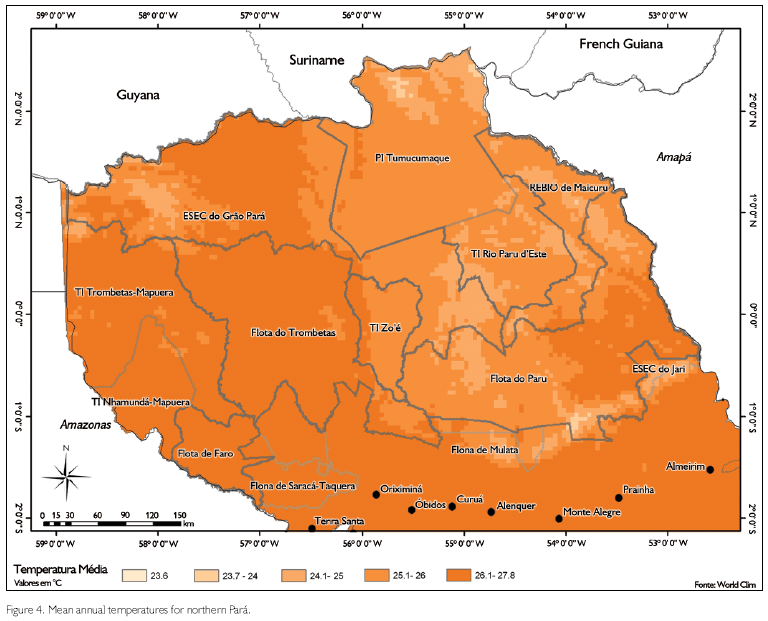
<body><![CDATA[<p><font size="2" face="Verdana"> Most areas we inventoried have a wet tropical  climate (Am according to the K&otilde;ppen classification), but site ESEC Gr&atilde;o-Par&aacute; North  is in an area that is&nbsp; characterized as  Aw (Peel <i>et </i>al., 2007; SUDAM, 1984). The rainy season generally is  between December and June, with a short drier break in February/March, the dry  season is between July and November. Total mean annual rainfall is around 2,100-2,500 mm per year for most  areas inventoried, except for sites ESEC Gr&atilde;o-Par&aacute; North and ESEC Gr&atilde;o-Par&aacute; Centre,  which are in areas with 2,000-2,100   mm, and site FLOTA Paru, which is in an area with a mean  annual rainfall of 1,500-2,000   mm (<a href="#f3">Figure 3</a>). Mean annual temperatures in most of the  area are about 25-26 <sup>o</sup>C,  but sites FLOTA's Faro, Trombetas and Paru are in areas where that temperature  is about 27  <sup>o</sup>C (<a href="#f4">Figure 4</a>) (SUDAM, 1984).</font></p>     <p><a name="f3"></a></p>     <p>&nbsp;</p>     <p align="center"><img src="/img/revistas/bmpegcn/v5n1/1a02f3.gif" border="0"></p>     <p>&nbsp;</p>     <p><a name="f4"></a></p>     <p>&nbsp;</p>     <p align="center"><img src="/img/revistas/bmpegcn/v5n1/1a02f4.gif" border="0"></p>     <p>&nbsp;</p>     <p><font size="2" face="Verdana"> The study areas are located in the Guianan  Region of the northern part of Par&aacute;, north of the Amazon   River, in the five conservation units established in December 2006:  one each in the FLOTA's Faro, Trombetas and Paru, one in the REBIO Maicuru and  three in the ESEC Gr&atilde;o-Par&aacute; (<a href="#f2">Figure 2</a>). Because of its large size, covering  several vegetation types, three expeditions were made to ESEC Gr&atilde;o-Par&aacute;: one to  the most northwestern part, close to the frontier with Guyana, one to  the central part, just south of the Indian Territory of Tumucumaque, and one to  the southeastern part, close to the border with FLOTA Paru. A short description  of the research areas is provided below. Unfortunately, no details on the  vegetation have been provided by the botanists yet, so general terms are used.</font></p>     ]]></body>
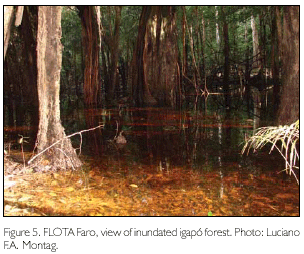
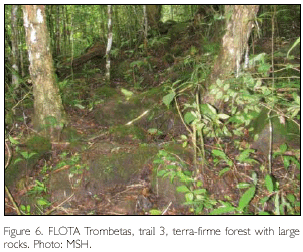
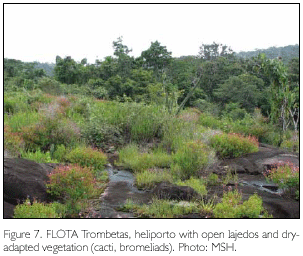
<body><![CDATA[<p><font size="2" face="Verdana"> FLOTA Faro (0.6 million ha) is situated in  the municipalities of Faro and Oriximin&aacute;, on the right bank of the rio Nhamund&aacute;,  which forms the border of Par&aacute; with Amazonas. The area belongs to the rio Nhamund&aacute;  basin and is covered by tropical rain forest (terra-firme forest = 'Floresta  Ombr&oacute;fila Densa das Terras Baixas' according to RADAM-Brasil &#91;&quot;Radar na  Amaz&ocirc;nia&quot; project&#93; terminology), except in a band of about 700 m along the river and  some distance up along the creeks, that is covered by v&aacute;rzea forest ('Floresta  Ombr&oacute;fila Densa Aluvial'), which is inundated during part of the year (<a href="#f5">Figure 5</a>).  Four trails (all in the municipality   of Faro) were cut,  radiating from a base camp (S 1<sup>o</sup> 42' 50.44&quot; W 57<sup>o</sup> 12' 47.88&quot;) that  was located on the northern (left) bank of the rio Nhamund&aacute;, some distance WNW  of Faro, where the river runs more or less east-west. Trails 1-3 ran in a  northerly direction, parallel to each other and separated by 800 m, for a distance of 3 km. They started out in v&aacute;rzea  forest and after about 700 m  entered terra-firme forest. Trail 4 ran 1.5 km SW and 1.5 km SE of the camp,  following the riverbank through v&aacute;rzea forest. The area studied was between 0  and 30 m  above sea level, with low hills. The river is in open contact with the Amazon,  no rapids or waterfalls being present downstream from the collecting area.  Pitfall traps were installed in each of the trails 1, 2 and 3, with a distance  of 250 m  between them within each trail. Because of inundation, no poitfalls were  installed in trail 4. The first two pitfalls in trail 1 were inundated and did  not work. Trail 1 had pitfalls at 50   m, 250   m, 500 m and 750 m. Trail 2 had pitfalls at 600 m, 850   m, 1,100 m and 1,350 m. Trail 3 had  pitfalls at 200 m,  450 m, 700 m, 950 m, 1,200 m, 1,450 m, 1,700 m and 1,950 m. FLOTA Faro was  sampled during the first expedition, between January 14 and 28, 2008, during  the wet season. At that time the level of the river was high.</font></p>     <p><a name="f5"></a></p>     <p>&nbsp;</p>     <p align="center"><img src="/img/revistas/bmpegcn/v5n1/1a02f5.gif" border="0"></p>     <p>&nbsp;</p>     <p><font size="2" face="Verdana"> FLOTA Trombetas (3.2 million ha) is situated  in the municipalities of Oriximin&aacute;, &Oacute;bidos and Alenquer. It forms part of the  basin of the Trombetas   River and in the north it  borders on the western part of ESEC Gr&atilde;o-Par&aacute;. Our camp (S 0<sup>o</sup> 57' 45.97&quot; W  55<sup>o</sup> 31' 20.28&quot;) was in the municipality   of &Oacute;bidos, in the  southeastern corner of the unit, in an area mainly covered by terra-firme  forest ('Floresta Ombr&oacute;fila Aberta Submontana'). The camp was situated in an  opening in a forest with many old <i>Cecropia </i>trees, at about 100 m from a creek with rocks  and a sandy bottom. It was at the base of a higher area with large rocks and an  open forest resembling secondary forest ('capoeira'). Three trails radiated  from the camp. Trail 1 ran initially E for 2 km, passing the helicopter landing area at 500 m and than turned N for 7 km, reaching the rio  Cuminapanema in a transitional area. Trail 2 ran W for 5 km, first rather level, but  after crossing two small creeks steadily uphill, in the last few hundred meters reaching 'Floresta Ombrofila Densa Submontana'. Trail  3 ran SE for 3 km,  the first kilometer up a hill (the same one with the helicopter landing area on  top) that was strewn with large granite boulders and covered by a low, open  type of forest with lianas (<a href="#f6">Figure 6</a>), and then descending into a lower, flat  area with several creeks. The area studied was between 300 and 450 m above sea level, and  was hilly, with a number of small, shallow, clear water creeks, sometimes with  steep banks, cut about 10 m  into the surrounding terrain. The helicopter landing area was at an altitude of  350 m on  a rocky hill top with rockslates (lajedos) and an open vegetation of low  bushes, cactus <i>(Cereus) </i>and bromeliads (<a href="#f7">Figure 7</a>). This area formed a  distinctive habitat, quite different from the surrounding terra-firme forest.  Some large rockslates and boulders also were present in part of the adjacent  terra-firme forest (between the helicopter landing area and the camp), which  caused some of the open habitat and rockdwelling species to enter the forest.  Pitfalls and driftfences were placed in trail 1 at 100 m, 400 m and 950 m from camp. In trail 2 at  200 m, 450 m, 700 m, 1,000 m, 1,250 m, 1,500 m, 1,750   m, 2,100 m, 3,250 m, 3,500 m, 3,750 m, 4,000 m and   4,250 m. The pitfalls at distances over 3,250 m on April 19, 2008 were  relocated to 300 m,  1,100 m,  1,350 m,  1,600 m  and 1,900 m  because of logistical problems with pitfalls beyond 2,100 m. In trail 3 no  pitfalls were placed. FLOTA Trombetas was the target of the second expedition,  which took place between April 16 and May 1, 2008, in the middle of the  rainy season.</font></p>     <p><a name="f6"></a></p>     <p>&nbsp;</p>     <p align="center"><img src="/img/revistas/bmpegcn/v5n1/1a02f6.gif" border="0"></p>     <p>&nbsp;</p>     ]]></body>
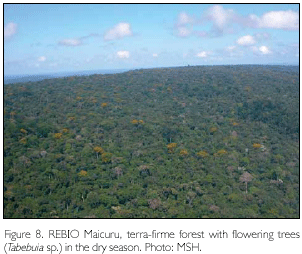
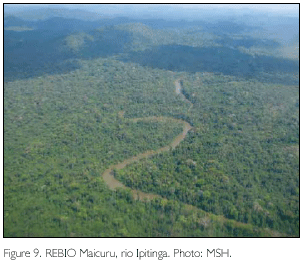
<body><![CDATA[<p><a name="f7"></a></p>     <p>&nbsp;</p>     <p align="center"><img src="/img/revistas/bmpegcn/v5n1/1a02f7.gif" border="0"></p>     <p>&nbsp;</p>     <p><font size="2" face="Verdana"> REBIO Maicuru (1.2 million ha) is situated in  the municipalities of Almeirim and Monte Alegre and is drained by the rivers Maicuru,  Paru and Jari. On the north-northeast it reaches the rio Jari (border with Amap&aacute;),  on the southeast and south it is bordered by FLOTA Paru, and on the west (and  partly northwest) it borders on the ESEC Gr&atilde;o-Par&aacute; (for a short distance), and  the Indian Territories (TI) Rio Paru d'Este and Tumucumaque. Our camp (N 0<sup>o</sup> 49'  43.03&quot; W 53<sup>o</sup> 55' 52.32&quot;) was located in the municipality of Almeirim,  in the middle of the conservation unit, at an altitude of 150 m above sea level, at  some distance from the rio Ipitinga and about 15 m above the river plain.  The research area was covered with terra-firme forest ('Floresta &Oacute;mbrofila  Densa Submontana') (<a href="#f8">Figure 8</a>), but the forest along the river apparently was  regularly flooded, as shown by high water marks on the vegetation. This river  forest (igap&oacute;) differed from terra-firme forest by being denser, with many  low-slung lianas and growth of smaller trees and in some places by the presence  of large <i>Guadua </i>bamboo stands. The banks of the river were steep, but in  several places there were sandy beaches that dropped steeply in the water  (<a href="#f9">Figure 9</a>). From the camp, trail 1 ran NNW for 4.7 km, parallel to, but at  some distance from, the river, through terra-firme forest; at about 1 km from camp it crossed a  large inundated area along a creek. Trail 2 ran WNW for 5 km through terra-firme  forest in terrain with steep hills and ridges. Trail 3 ran SW for 6 km, steadily climbing and  near its end reached an altitude of about 550 m. Trail 4 ran S, closely following the  river bank through regularly flooded (dry at the time) forest. The area was  rather flat, with isolated small hills, but in the SW part there was a large  hill-complex reaching an altitude of 550 m. Pitfalls and driftfences were placed in  trail 1 at 360 m,  600 m, 800 m and 950 m from camp. In trail 2 they  were placed at 350 m,  500 m, 700 m and 900 m from camp. Both trails  1 and 2 ran through terra-firme forest. In trail 3, also through terra-firme  forest, no pitfalls were installed. Trail 4 ran through regularly flooded (dry  at the time) forest close to the riverbank. In order to get a comparable effort  in terra-firme and river bank forest, eight pitfalls were installed in trail 4,  at 370 m,  750 m, 900 m, 1,040 m, 1,450 m, 1,600 m, 1,800 m and 2,000 m from camp. The  fifth expedition visited REBIO Maicuru between October 21 and November 6, 2008,  during the dry season.</font></p>     <p><a name="f8"></a></p>     <p>&nbsp;</p>     <p align="center"><img src="/img/revistas/bmpegcn/v5n1/1a02f8.gif" border="0"></p>     <p>&nbsp;</p>     <p><a name="f9"></a></p>     ]]></body>
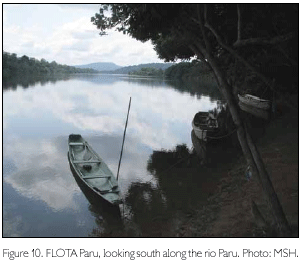
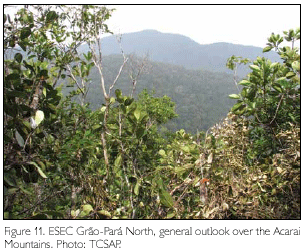
<body><![CDATA[<p>&nbsp;</p>     <p align="center"><img src="/img/revistas/bmpegcn/v5n1/1a02f9.gif" border="0"></p>     <p>&nbsp;</p>     <p><font size="2" face="Verdana"> FLOTA Paru (3.6 million ha) is situated in  the municipalities of Monte Alegre, Alenquer and &Oacute;bidos and is drained by the  rivers Maicuru, Paru and Jari. On the north it is bordered by the eastern part  of ESEC Gr&atilde;o-Par&aacute; and REBIO Maicuru, on the east it is bordered by the rio  Jari, that forms the border with Amap&aacute;. Our camp (S 0<sup>o</sup> 56' 38.29&quot; W 53<sup>o</sup>  14' 10.68&quot;) was locateded in the municipality of Almeirim,  in the SE part of the FLOTA, where its border is formed by the rio Paru (<a href="#f10">Figure  10</a>). The camp was situated at about 100 m from the W bank of the river, in a large  patch of low secondary vegetation, and on the S and E side it was bordered by a  belt of dense liana forest of 500   m wide. Along the river there was an irregular band of 'Floresta  Ombr&oacute;fila Aberta de Terras Baixas' with antropogenic influences, in several  places caused by the presence of isolated houses on this bank of the river. The  vegetation on the riverbank itself was rather open, apparently regularly  flooded ('igap&oacute;'), with hardly any undergrowth in the forest, although in some  places there were large clearings, completely taken over by grass and bamboo.  The banks of the river were gently sloping and the water of the river was  clear, but not very transparent. Some distance downriver from our camp there  was a complex of rapids, separating this part of the river from direct contact  with the waters of the Amazon. The vegetation away from the river consisted of  terra-firme forest ('Floresta Ombr&oacute;fila Densa de Terras Baixas'). The area  along the riverbank was flat, but at about one kilometer from the river bank  became hilly with steep slopes, no plateaus, and traversed by several large and  small creeks with clear, transparent water. From the camp, trail 1 ran for 5 km NE through 'Floresta Ombr&oacute;fila  Aberta de Terra Baixa', crossing one creek and ending on the river bank  upstream from the camp. There were many signs of human activities in this area,  with hunting trails, felled trees, open areas and overgrown agricultural  fields. Trail 2 ran NW for 9 km  through terra-firme forest, crossing several creeks and with many changes in  altitude. Trail 3 ran SW for 4   km, first crossing the liana forest around the camp,  after 1 km  it reached an open cultivated area and then ran through terra-firme forest,  crossing a partly dry creek with isolated pools of water in a rocky bed and  reaching a creek with running water. In the creeks there were rock outcrops.  Trail 4 branched off from trail 3 at the open cultivated area and then ran S  for 4 km,  closely following the river bank through open river-bank vegetation ('Floresta Ombr&oacute;fila  Aberta de Terra Baixa'), and crossing some creeks. Altitude in the study area  varied from 30 to 100 m.  Four pitfalls were placed along each trail at distances of 250 m, 500 m, 750 m and 1,000 m, all in level  terrain of about 30 - 90 m.  The sixth expedition inventoried FLOTA Paru between December 4 and 19, 2008, at  the beginning of the rainy season.</font></p>     <p><a name="f10"></a></p>     <p>&nbsp;</p>     <p align="center"><img src="/img/revistas/bmpegcn/v5n1/1a02f10.gif" border="0"></p>     <p>&nbsp;</p>     <p><font size="2" face="Verdana"> ESEC Gr&atilde;o-Par&aacute; occupies 4.2 million ha in the  municipalities Oriximin&aacute;, &Oacute;bidos, Alenquer and Monte Alegre, and runs from the  frontier with Guyana  in the NW to the TI Tumucumaque, TI Rio Paru d'Este and REBIO Maicuru in the E.  A large, more or less triangular western part connects by a narrow neck to a  smaller more or less rectangular eastern part. On the south it is bordered by  the TI Trombetas-Mapuera, FLOTA Trombetas, TI Zo'&eacute; and FLOTA Paru. Because of  its great size and different physionomies three localities were sampled in this  conservation unit, respectively ESEC Gr&atilde;o-Par&aacute; North, Centre and South. Some  haphazard collections were made in Camp   Curu&aacute; (Estan&iacute;fera) of the  mining company rio Tinto. The area is drained, from W to E, by the headwaters  of the Mapuera and Trombetas rivers, and by the Paru de Oeste, Cuminapanema,  Curu&aacute; and Maicuru rivers.</font></p>     <p><font size="2" face="Verdana"> Camp ESEC Gr&atilde;o-Par&aacute; North (N 1<sup>o</sup> 17'  7.51&quot; W 58<sup>o</sup> 41' 45.24&quot;) was situated in the NW part of the unit, in  the municipality of Oriximin&aacute;, close to the border with Guyana in the Acarai Mountains  (<a href="#f11">Figure 11</a>), at an altitude of 500   m on a hill. The area is covered by terra-firme forest ('Floresta  Ombr&oacute;fila Densa Submontana') and is very hilly, with steep slopes leading down  to creeks with clear, transparent water. Relatively small rock outcrops occur  sparsely in the area, completely covered by forest. From the camp, trail 1 ran  SE for 4.35 km,  first descending into a valley at 400   m, than climbing out of the valley up a spur of a hill  to 600 m,  down again to a second valley at about 460 m and up another hillside to 500 m. Trail 2 ran S for 900 m and then SW, following  a spur of the hill on which the camp was situated, at the end slightly going  down, and to the west, after 2.8   km joining trail 3 at km 2.5. Trail 3 ran SSW for 4. km, descending into a  valley at 400 m  altitude, following a creek, at km 2.5 it was joined by trail 2 from the east.  Trail 4 started at km 0.9 of trail 2 where it split off to SSE for 2.1 km, down from the camp  into a valley at 400 m  altitude. Pitfalls were placed in trail 1 at 150 m, 250 m, 450 m, 650 m, 1,800 m, 2,000 m, 2,150 m and 2,260 m from camp; and in  trail 3 at 300 m,  550 m, 750 m, 950 m, 1,100 m, 1,250 m, 1,450 m, and 1,650 m from camp. In  trails 2 and 4 no pitfalls were placed. Altitudes varied between 350 and 600 m above sea level. ESEC Gr&atilde;o-Par&aacute;  North was the aim of the fourth expedition, between August 25 and September 11,  2008, during the dry season.</font></p>     ]]></body>
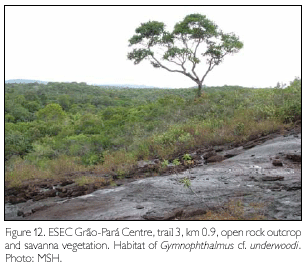
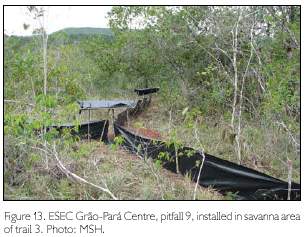
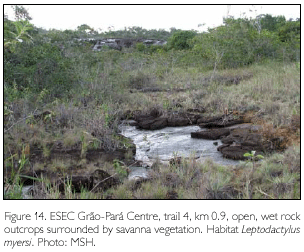
<body><![CDATA[<p><a name="f11"></a></p>     <p>&nbsp;</p>     <p align="center"><img src="/img/revistas/bmpegcn/v5n1/1a02f11.gif" border="0"></p>     <p>&nbsp;</p>     <p><font size="2" face="Verdana"> Camp ESEC Gr&atilde;o-Par&aacute; Centre (N 0<sup>o</sup> 37'  49.01&quot; W 55<sup>o</sup> 43' 42.60&quot;) was situated in the municipality of &Oacute;bidos,  in the northern part of the eastern half of the ESEC, close to the southern  border of the TI Tumucumaque. It was at an altitude of 400 m in a transition zone at  the W margin of a large island of terra-firme forest ('Floresta Ombr&oacute;fila Densa  Submontana') within a large savanna enclave. The savanna area consisted of  hilly terrain (300 to 500 m),  with many areas of rock outcrops (from horizonally flat to curved and steep)  and with a vegetation of shrubs and low forest (<a href="#f12">Figure 12</a>), sometimes interrupted  by grassy areas with isolated trees (e.g. <i>Curatella) </i>(<a href="#f13">Figure 13</a>). Creeks  in the savanna were rare. One encountered was a deep (3 m) gully with vertical banks  and did not contain any water. Another creek arose at the base of a large  complex of rock outcrops and contained clear, transparent water. This creek ran  at the border between open rock outcrop and savanna forest and formed some  deeper pools connected by shallower areas. Open rock outcrops were generally  wet and retained water in crevices and under loose rocks, well after rains had  stopped (<a href="#f14">Figure 14</a>). Hillsides were generally steep. The forest was terra-firme  forest with large trees and a high canopy at about 30 m. The forest island was  traversed by a large creek with (at the time shallow) clear, transparent water,  in some places forming deeper pools. The transitional forest between forest and  savanna consisted of small, slender-stemmed, low trees with some&nbsp; larger trees interspersed; this vegetation  was characterized by the botanists as 'cerrad&atilde;o'. From camp, trail 1 ran N for 5 km through terra-firme  forest and slightly undulating terrain, crossing the creek in the forest island  at about 1 km  from camp. Trail 2 ran NE for 5   km, reaching the E edge of the forest, first dropping  into the bed of the afore&shy;mentioned creek, than steeply climbing up to a  plateau at 500 m  and than dropping again to a level of 400 m. Trail 3 ran S for 4.4 km, generally through  savanna over steep hills, but at 700   m and at 2.5   km entering narrow areas of forest with creeks. Trail 4 ran  roughly W for 5 km  through open savanna, savanna forest and open rock outcrops, twice crossing  narrow areas of terra-firme forest without creeks. The first part of the trail  was in an area with steep hills, and after 1450 m descended into a relatively  flat area. Pitfalls in trails 1 and 2 were placed at 500 m, 750 m, 1,000 m and 1,250 m from camp, all in  forest. In trail 3 (savanna) they were placed at 200 m, 450 m, 750 m and 900 m. In trail 4 (savanna)  they were placed at 400 m,  800 m, 1,240 m and 1,440 m. Altitudes varied  between 310 and 450 m  above sea level. ESEC Gr&atilde;o-Par&aacute; Centre was inventoried between January 10 and 31,  2009, during the early rainy season.</font></p>     <p><a name="f12"></a></p>     <p>&nbsp;</p>     <p align="center"><img src="/img/revistas/bmpegcn/v5n1/1a02f12.gif" border="0"></p>     <p>&nbsp;</p>     <p><a name="f13"></a></p>     ]]></body>
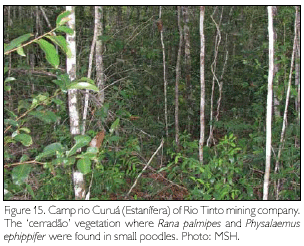
<body><![CDATA[<p>&nbsp;</p>     <p align="center"><img src="/img/revistas/bmpegcn/v5n1/1a02f13.gif" border="0"></p>     <p>&nbsp;</p>     <p><a name="f14"></a></p>     <p>&nbsp;</p>     <p align="center"><img src="/img/revistas/bmpegcn/v5n1/1a02f14.gif" border="0"></p>     <p>&nbsp;</p>     <p><font size="2" face="Verdana"> Camp ESEC Gr&atilde;o-Par&aacute; South (S 0<sup>o</sup> 9'  55.76&quot; W 55<sup>o</sup> 11' 11.04&quot;) was situated in the municipality of  Alenquer, in the SE part of the ESEC, close to its border with FLOTA Paru, and  only 6 km  NW of the Base Curu&aacute; (Estan&iacute;fera) of Rio Tinto, at an altitude of 300 m. It was situated in a  wide creek valley surrounded by hills. The area, according to vegetation maps,  was covered by 'Floresta Ombr&oacute;fila Densa Submontana', but along creeks, around  a lake present W of the camp, and on top of a plateau, the forest was clearly  different from the terra-firme forest covering the hills. In the creek valleys and  near a lake were patches of 'a&ccedil;aizal', a&ccedil;a&iacute; forest dominated by <i>Euterpe </i>palms  in shallow water. The forest along creeks in low-lying areas generally was  open, with a muddy surface and pools, tufts of grasses, few large trees and  many thin trees; it was considered as 'igap&oacute; forest' by the botanists. From the  camp, trail 1 ran NNE for 5 km,  first crossing the side of a hill, than dipping into a partly inundated creek  valley, before starting a long climb up to a plateau that was covered by a low  type of forest (canopy at 10 m)  that consisted of closely growing small trees with thin stems (called  'cerradao' by the botanists). Only few larger trees were present. Trail 2 ran E  for 5 km,  first through a level creek valley, but after 2 km climbing a ridge and going  down again to the next creek valley. Trail 3 ran SE for 5 km, through a swampy area  along a creek, after 3 km  continuing on the lower part of a hill, more or less parallel to a creek  valley. Trail 4 ran W for 3.4   km through a creek valley, in the first 50 m crossing a very dense  liana forest, than entering igapo forest and crossing a large deep creek, with  steep sides and water with much organic particles, several times. Along this  trail there were several ponds (1.5   m deep) in the forest. At the end the trail reached a  sizeable open lake and ran around it. The lake on most sides was bordered by  palms <i>(Attaleiaspinosus,  A. maripa, Mautitia flexuosa), </i>but on its  north side was bordered by a sloping area with terra-firme forest that reached  the water margin. The centre of the lake was covered by a vegetation of  Cyperaceae and grasses, along its edges there were waterlilies. The water was  very clear and transparent (at least 2 m view). A creek flowed out of the lake on  the east and passed the camp about 3   km downstream. On the west a small creek, completely  overgrown with vegetation, flowed into the lake. The altitude varied from 300 m in the creek valleys to  450 m on  top of the plateaus. Pitfalls were only placed in trails 1 (10 sets) and 3 (6  sets). In trail one they were at 1,550 m, 1,650 m, 1,800 m,   2,000 m, 4,000 m, 4,100 m, 4,200 m, 4,300 m, 4,400   m and 4,500 m. The first four were in terra-firme  forest between 320 and 380 m  altitude, the last six, from 4,000   m on, were in cerradao forest at 420 m altitude. Those in  trail 3 were at distances of 800   m, 1,230   m, 1,280   m, 1,500   m, 1,650   m, and 1,750   m from camp. No pitfalls were placed in trails 2 and 4  because large areas of those trails were inundated creek valley. The third  expedition targeted ESEC Gr&atilde;o-Par&aacute; South between June 6 and 21, 2008, towards  the end of the wet season.</font></p>     <p><font size="2" face="Verdana"> Base Curu&aacute; (Estan&iacute;fera) of mining company Rio  Tinto (S 0<sup>o</sup> 13' 16.5&quot; W 55<sup>o</sup> 09' 45.0&quot;), in the municipality of  Alenquer, although not an area that was systematically collected, like the ones  described before, is shortly mentioned because some species were collected here  that were not collected elsewhere. It is situated 8 km SE of ESEC Gr&atilde;o-Par&aacute; South,  on top of a plateau (450 m),  with an airstrip and an area where semi-permanent barracks have been mounted  for personnel of Rio Tinto working in the area. The area around the campsite  and near the airstrip embarking site consists of a low forest (canopy 5 m) with many narrowly spaced  thin-stemmed trees (<a href="#f15">Figure 15</a>). This forest was characterized by the botanists  as 'cerrad&atilde;o'. Aong a trail to the rio Curu&aacute; there was a small open rock  savanna, with large areas of bauxite rock on the surface and a sparse  vegetation of herbs, Ananas and shrubs.</font></p>     <p><a name="f15"></a></p>     ]]></body>
<body><![CDATA[<p>&nbsp;</p>     <p align="center"><img src="/img/revistas/bmpegcn/v5n1/1a02f15.gif" border="0"></p>     <p>&nbsp;</p>     <p><font size="2" face="Verdana">  <b>LOGISTICS</b></font></p>     <p><font size="2" face="Verdana"> All expeditions started in Bel&eacute;m and went to Santar&eacute;m  by commercial flight, except the expedition to ESEC Gr&atilde;o-Par&aacute; North which flew  from Bel&eacute;m to Boa Vista, Roraima. The expedition to FLOTA Faro used a boat as  base camp. The expedition to ESEC Gr&atilde;o-Par&aacute; North traveled by bus from Boa  Vista to Caroebe (still in Roraima) and from there by helicopter to base camp  ESEC Gr&atilde;o-Par&aacute; North. In the other five expeditions participants were  transported from Santar&eacute;m by one-engine planes to either Camp Curu&aacute;  (Estan&iacute;fera) of Rio Tinto, to airstrip '13 de maio' (REBIO Maicuru) or to Monte  Dourado (FLOTA Paru). From those places transport to the cam ps was by  helicopter, except for the exped ition to FLOTA Paru, which from Monte Dourado went  by bus to the rio Paru and crossed the river by canoes with an outboard motor.  Base camps, trails and pitfalls were prepared shortly before arrival of the  scientific participants. Camp size tended to increase during the year that  expeditions were held, from 210   m<sup>2</sup> in FLOTA Trombetas, to 350 m<sup>2</sup> during the  last expedition (ESEC Gr&atilde;o-Par&aacute; Centre). Helicopter time amounted to 287:10 h,  small airplanes time to 334:53 h.</font></p>     <p><font size="2" face="Verdana">  <b>COLLECTING AND PREPARATION OF HERPETOFAUNA</b></font></p>     <p><font size="2" face="Verdana">  Reptiles and amphibians were collected by  means of two complementary methods, <i>viz. </i>active sampling (AS), which  combined two techniques: time constrained searches (TCS) and visual and audio  encounter surveys (VES) (no recordings of calls were made); and passive  sampling by pitfall traps with drift fences (PD). Systematic collecting took  place in all seven expedition areas described above. Camp Curua  (Estanifera) is not a major collecting site, no systematic sampling was done  there and it has not been included in any calculations, except for total number  of species in the whole area, since a few species have been collected only there.  For the same reason it appears in the table presented in the <a href="pdf/bmpegcn/v5n1/1apenv5n1a01.pdf" target="_blank">Appendix 1</a>.</font></p>     <p><font size="2" face="Verdana"> All trails and most pitfalls were  georeferenced, but we here only present the coordinates of the centrally  located campsites (mark 0 of the trails of every expedition).</font></p>     <p><font size="2" face="Verdana"> Active sampling (Crump &amp; Scott, 1994;  Scott, 1994; Ribeiro-Junior <i>et al., </i>2008) consisted in actively  searching for animals during day and night, along marked trails and in  different habitats, noting time spent (unit of collecting = person.hour). AS is  important for a general inventory, considering both taxonomic coverage  (pitfalls are only adequate for some groups) and coverage of different  habitats. This method requires trained personal, and, even with experienced  collectors, is subject to personal bias, which causes problems to compare areas  or studies done by this method. Another unequal factor, in the present case,  was that three expeditions had two herpetologists and four had three, and thus  collecting effort in active sampling was not uniform for all expeditions.</font></p>     <p><font size="2" face="Verdana"> Pitfall traps with drift fences (Corn, 1994;  Cechin &amp; Martins, 2000; Ribeiro-Junior <i>et al., </i>2008): each trapping  unit consisted of four buckets (pitfalls) of 60 l each, that were dug into  the ground with their rim flush with the surface, positioned in a Y with the  central bucket connected to the three peripheral ones by eight meters of black  plastic sheet with a height of 60   cm. A total of 16 trapping units was&nbsp; used, positioned in two, three or four groups  (each group in a different trail), depending on the local conditions (type of  substrate, rocks, flooding, logistics). Within each group, trapping units  generally were positioned at distances of 250 m from each other, but in FLOTA Trombetas  they were partly 125 m  apart, and in some cases greater distances were used in order to also sample  different vegetations or because of physical problems encountered in the  terrain. Pitfalls were checked once a day during the entire sampling period.  Trapping units were installed in the week before the start of each expedition  and removed at the end of each expedition. Collecting with pitfalls has the  advantage to be independent of collector and they collect species (generally  (semi) fossorial) that are only rarely caught during active collecting. On the  other hand, pitfalls are directed to leaf litter and terrestrial species,  although some arboreal species that come to the ground are also collected with  certain regularity; other groups, especially arboreal/climbing and aquatic  species, large terrestrial species and medium-sized to large snakes, and a  number of amphibians that are able to climb or jump out of the buckets, are  rarely collected. Besides, it is not always possible to use pitfalls; flooded  or rocky areas, or areas far from basecamp, can not be sampled by this method,  because of the impossibility to install the buckets in the first areas, and the  impossibility to check the pitfalls every day in the last case.</font></p>     ]]></body>
<body><![CDATA[<p><font size="2" face="Verdana"> Specimens collected by the fieldworkers or by  other researchers were considered as occasional encounters.</font></p>     <p><font size="2" face="Verdana"> For each specimen observed by the  herpetologists and/or collected the following data (if applicable) were  annotated: identification, locality (GPS or distance in trail), habitat,  microhabitat, day, time, and name of collector/ observer. Collected animals'  standard measurements and weight were taken, and when possible the sex was  determined. In many cases notes of life colouration were made, and digital  photographs and tissue samples (liver or muscle) for molecular studies were  taken.</font></p>     <p><font size="2" face="Verdana"> Collected specimens were euthanized by an  overdose of veterinary anesthetic, fixed in formaldehyde 4% (one part of commercial formaldehyde 37% and nine parts of water) for  maximally 24 hours, labeled with fieldnumbers (a field series 'CN' &#91;Calha Norte&#93;  was created for all specimens collected during the expeditions), and preserved  in alcohol 70%, except tadpoles that were preserved in 4% formaldehyde (Franco <i>et  al.</i>, 2002). Tissue samples were preserved in absolute alcohol, maintained  at environmental temperature in the field and transferred to a freezer after  arrival in the museum. Even though we refer here to number of specimens per  site, it is important to keep in mind that each site covers a few square  kilometers and different environments. Thus specimens dealt with as coming from  one site may have been collected up to 8,000 m apart. All material was deposited in  the herpetological collection of Museu Paraense Em&iacute;lio Goeldi (MPEG) in Bel&eacute;m, Par&aacute;, Brazil  (<a href="pdf/bmpegcn/v5n1/2apenv5n1a01.pdf" target="_blank">Appendix 2</a>). Collections were made under licence 001/2008 of the Secretaria Estadual do Meio Ambiente (SEMA-PA).</font></p>     <p><font size="2" face="Verdana"> Collecting effort, number of specimens  collected per group, and rarefaction curves for amphibians and reptiles  separately, are presented for each major collecting site (thus, not for Estan&iacute;fera).  Species rarefaction curves were constructed with the help of the program  EstimateS version 7.5 (Colwell, 2005), on the basis of grouped AS and PD  collections, considering as sampling unit each collecting day - they represent  the cumulative number of species against the increase of collecting effort,  obtained after 50 randomizations. Species composition in the seven sites is  compared, using the Biogeographic Similarity Coefficient (Duellman, 1990), equivalent  to 2C/(N<sub>1</sub> + N<sub>2</sub>), where N<sub>1</sub> = number of species  in locality 1, N<sub>2</sub> = number of species in locality 2, and C = number  of species common to both localities. We present a gross estimation of relative  abundance of amphibians and reptiles, for each site and for each group as a  whole, based on numbers of specimens caught by pitfall traps and all those  collected by active searches. Species observed but not collected are added to  the graphs as presenting '0' (zero) specimens. </font></p>     <p><font size="2" face="Verdana"> Species were considered endemic for the  Guianan Region mainly based on Hoogmoed (1979b) (reptiles and amphibians), Se&ntilde;aris &amp; MacCulloch (2005) and Duellman (1999) for amphibians, and Avila-Pires (2005) for reptiles.</font></p>     <p><font size="2" face="Verdana"> For familial and generic nomenclature we  adhere to the nomenclature used before the Faivovitch <i>et al. </i>(2005),  Frost <i>et al. </i>(2006), and Grant <i>et al. </i>(2006) papers, because we  are not convinced that the wholesale changes in nomenclature proposed by these  authors are really necessary and correct. We prefer to await further  independent studies that corroborate the alterations those publications  proposed. We have made an exception for the former species of <i>Colostethus </i>in  the Guianan Region with a mid-lingual papilla, which are clearly recognizable  morphologically and now are named <i>Anomaloglossus </i>(Grant <i>et al., </i>2006).  Also, we have not yet taken into account the changes proposed for the genus <i>Eleutherodactylus </i>by Heinicke <i>et al. </i>(2007) and by Hedges <i>et al. </i>(2008).  Discussion about these issues is still going on, and by maintaining the  pre-2005 names we keep the relation with older (= pre-2005) literature, thus  facilitating the work of conservationists and managers of natural areas.</font></p>     <p><font size="2" face="Verdana"> Two recent publications, Zaher <i>et al. </i>(2009)  and Vidal <i>et al. </i>(2010),  proposed changes in the classification of South American Colubrid snakes.  Because of the short time to properly evaluate them (when they appeared this  paper already had been completed), we preferred not to incorporate their  changes here.</font></p>     <p><font size="2" face="Verdana"> We tried to identify material of the <i>Bufo granulosus </i>complex with  Narvaes &amp; Rodrigues (2009), but had serious problems trying to separate  the species recognized by these autors in the area north of the Amazon River (Gorzula &amp; Se&ntilde;aris (1999) who also doubted the validity of  different taxa in Venezuelan Guiana). We doubt whether all taxa recognized by  Narvaes &amp; Rodrigues (2009) are real entities and for the time  being we have adhered to the use of <i>Bufo granulosus </i>for the medium-sized granular toad with  dorsally directed nostrils, occurring north of the Amazon, realising that e.g. <i>Bufo mirandaribeiroi </i>Gallardo, 1965 is a good taxon.</font></p>     <p><font size="2" face="Verdana">  <b>COLOUR PHOTOS</b></font></p>     <p><font size="2" face="Verdana">  We present colour photos of some of the  species found during the expeditions (<a href="#f16">Figures 16-75</a>). They generally appear in  the same sequence as used in <a href="pdf/bmpegcn/v5n1/1apenv5n1a01.pdf" target="_blank">Appendix 1</a>.</font></p>     ]]></body>
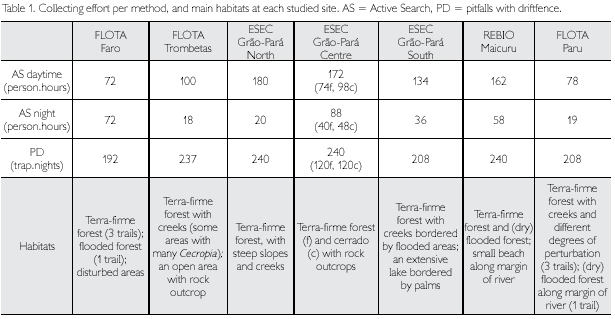
<body><![CDATA[<p><a name="f16"></a></p>     <p>&nbsp;</p>     <p align="center"><img src="/img/revistas/bmpegcn/v5n1/1a02f16.gif" border="0"></p>     <p>&nbsp;</p>     <p><font size="3" face="Verdana">  <b>RESULTS AND DISCUSSION</b></font></p>     <p><font size="2" face="Verdana"><b>COLLECTING EFFORT AND SPECIES RICHNESS</b></font></p>     <p><font size="2" face="Verdana">  Collecting effort per expedition for each  method is shown in <a href="#t1">Table 1</a>, which also refers to the main habitats found in  each site. Taking all areas together we registered 80 species of amphibians (77  frogs and three caecilians) and 95 species of reptiles (36 species of lizards, three  of amphisbaenians, 49 species of snakes, five species of chelonians and two  species of caiman). The large lizard <i>Tupinambis teguixin </i>(Linnaeus,  1758) (jacuraru or teiu) seems to have been seen in some areas, but not by  herpetologists. Because of doubts remaining about the identification, we have  not included this species in our list, although it is expected to occur  throughout the area (see below). Comparing these numbers with what is expected  to occur in the area based on the literature (see introduction), we see that  lizards are well represented, followed by frogs, while caecilians,  amphisbaenians, snakes and chelonians are well below the expected richness,  being clearly underrepresented in the samples. Chelonians, living mainly in  aquatic environments, need special collecting techniques, not used in the  surveys. Caecilians, partially aquatic and partially fossorial, and  amphisbaenians, which are mainly fossorial, are only sporadically found, even  when digging extensively for them. Snakes have usually secretive habits and are  known to need long periods for inventorying them satisfactorily in tropical  rainforests.</font></p>     <p><a name="t1"></a></p>     <p>&nbsp;</p>     <p align="center"><img src="/img/revistas/bmpegcn/v5n1/1a02t1.gif" border="0"></p>     ]]></body>
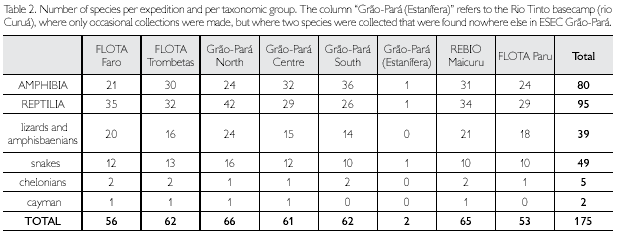
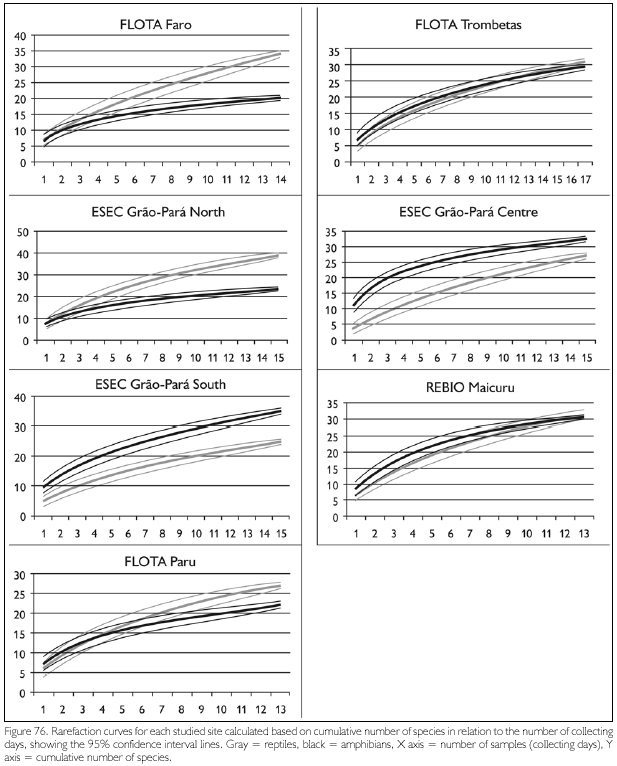
<body><![CDATA[<p>&nbsp;</p>     <p><font size="2" face="Verdana"> <a href="#t2">Table 2</a> shows the number of species per  expedition. The highest number of amphibians (36 species) was registered for  ESEC Grao-Para South and the lowest number (21 species) for the FLOTA Faro. The  highest number of reptiles (42 species) was collected in ESEC Grao-Para North,  and the lowest number (27 species) in ESEC Gr&atilde;o-Par&aacute; South. However, none of  the rarefaction curves, calculated for each site, separately for amphibians and  reptiles, reached the asymptote (<a href="#f76">Figure 76</a>), indicating that more species are  expected to occur in each area. The need of prolonged effort to adequately  survey the herpetofauna is well documented in the literature (e.g., Duellman,  1978; Myers &amp; Rand, 1969). Duellman (2005) reported that, in Cusco Amaz&oacute;nico,  it took 442 person-days to record 89% of the species of anurans, 81% of the  lizard species, and 79% of the snake species present in the area.  Ribeiro-Junior <i>etal. </i>(2008) also showed the necessity of a large  collecting effort, using multiple techniques, for an adequate representation of  the herpetofauna. Results of collections vary due to several factors, among  others time of the year, meteorological circumstances during the expedition,  micro- and meso-habitats sampled, and in the case of active collecting the  collectors and the number of collectors. For example, in ESEC Gr&atilde;o-Par&aacute; South,  the larger number of amphibian species was partly due to the presence of ponds  and a lake that provided good conditions for amphibians, especially Hylidae.  Although similar habitats have not been encountered in the other sampled areas,  it is very unlikely that they do not occur in all conservation units. Besides,  it should be remembered that some amphibians use for reproduction temporary  pools that only form during the rainy season, and some species have explosive  reproduction which only lasts a few days. All these factors influence the  number of species found during the limited period of an expedition.</font></p>     <p><a name="t2"></a></p>     <p>&nbsp;</p>     <p align="center"><img src="/img/revistas/bmpegcn/v5n1/1a02t2.gif" border="0"></p>     <p>&nbsp;</p>     <p><a name="f76"></a></p>     <p>&nbsp;</p>     <p align="center"><img src="/img/revistas/bmpegcn/v5n1/1a02f76.gif" border="0"></p>     <p>&nbsp;</p>     ]]></body>
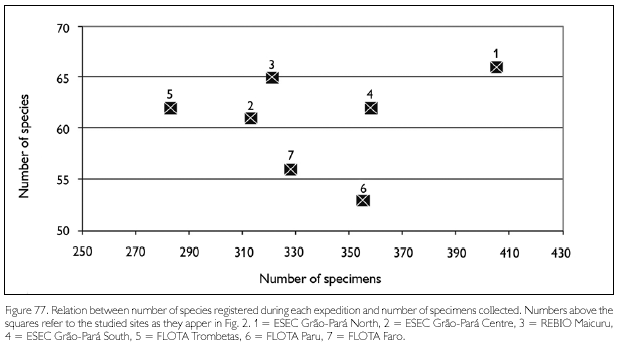
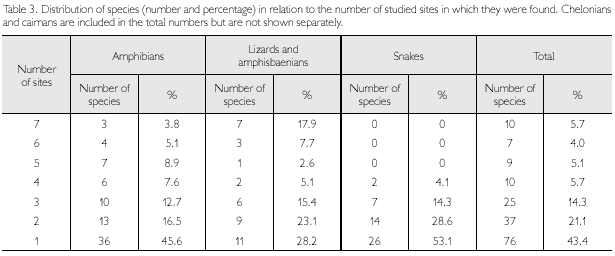
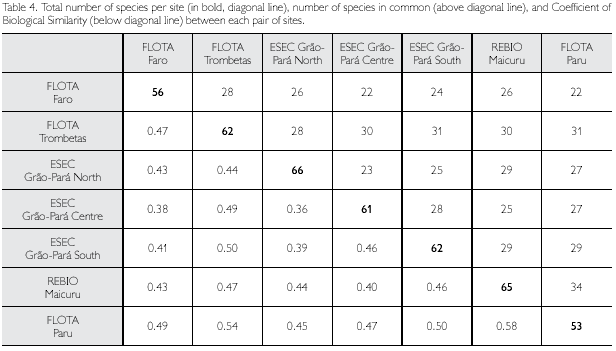
<body><![CDATA[<p><font size="2" face="Verdana"> Comparing species richness obtained for each  area with number of specimens collected (<a href="#f77">Figure 77</a>), the studied sites in FLOTA  Trombetas, REBIO Maicuru and ESEC Gr&atilde;o-Par&aacute; show an increasing number of  species with increasing number of specimens collected. Richness in FLOTA Faro  and FLOTA Paru, on the other hand, is proportionally less in relation to the  number of specimens collected. These two areas are situated along large rivers  bordered by flooded forest, a habitat that usually has less species than  terra-firme forest (also present in these sites). However, the savanna  vegetation that covered part of ESEC Grao-Para Centre also harbors a lower  number of species than terra-firme forest, but in spite ofthat, relative  richness was proportional to that in other sites. The two FLOTA, Faro and Paru,  also had in common areas of disturbed and secondary forests, and one  possibility is that the lower relative richness of species in these two areas  is a result of environmental disturbance. Habitat alteration may have caused  the disappearance, or a population reduction (making them more difficult to be  captured), of a number of species.</font></p>     <p><a name="f77"></a></p>     <p>&nbsp;</p>     <p align="center"><img src="/img/revistas/bmpegcn/v5n1/1a02f77.gif" border="0"></p>     <p>&nbsp;</p>     <p><font size="2" face="Verdana">  <b>SPECIES COMPOSITION</b></font></p>     <p><font size="2" face="Verdana"> A complete list of species (including authors  and years), expeditions during which they were collected and basic biological  data are presented in the <a href="pdf/bmpegcn/v5n1/1apenv5n1a01.pdf" target="_blank">Appendix 1</a>. Looking at the herpetofauna as a whole,  only 5.7% of the species were found in all seven sites, while 43.4% were found  in only one of the sites (<a href="#t3">Table 3</a>). Lizards and amphisbaenians, as a group, showed  the most even distribution in the samples, with almost 18% of the species  captured in all sites, and only 28% in only one site. Of amphibians, about   46% were found in only one site, and of snakes 53%. The   maximum number of sites a species of snake occurred in   was four, once more showing the haphazardness of finding   these animals. The low number of amphibians common to   all sites is partially linked to differences in habitats available   and surveyed, as well as in period of the year. But certainly   for all groups part of the differences is due to chance and   should decrease as collecting effort increases. The same   applies when we look at the Biogeographic Similarity   Coefficient (BSC) (<a href="#t4">Table 4</a>). This coefficient, that represents the proportion of species common to two areas, in relation to the total number of species in both areas, is lowest (0.36) between  ESEC Gr&atilde;o-Par&aacute; Centre and ESEC Gr&atilde;o-Par&aacute; North. While the northern part of this  ESEC lies in the Acarai Mountains, covered by rainforest in an extremely hilly  area, the site in the central part of this conservation unit presents a large  isolated area of open vegetation (savanna) (with its specific fauna), with a  patch of more or less isolated forest in its interior, which explains part of  the difference found between these two areas. In addition, the northern sector  was sampled in August-September, thus during the dry season, while sampling in  the central sector occurred in January, in the early rainy season, which  probably also accounts for part of the differences found. Going to the other  extreme, FLOTA Paru and REBIO Maicuru were the most similar areas (BSC 0.58). These  two areas were sampled within a period of three months and both have seasonally  flooded areas (igap&oacute;) influenced by a river, which may explain their larger  similarity. But again, the expectation is that these coefficients, between all  these areas, will become larger (indicating more similar herpetofaunas) as a  better representation of the herpetofauna, from all around the year, is  obtained.</font></p>     <p><a name="t3"></a></p>     <p>&nbsp;</p>     <p align="center"><img src="/img/revistas/bmpegcn/v5n1/1a02t3.gif" border="0"></p>     ]]></body>
<body><![CDATA[<p>&nbsp;</p>     <p><a name="t4"></a></p>     <p>&nbsp;</p>     <p align="center"><img src="/img/revistas/bmpegcn/v5n1/1a02t4.gif" border="0"></p>     <p>&nbsp;</p>     <p><font size="2" face="Verdana"> Some species however are restricted to  special habitats, which may account for real differences between sites. Thus,  for example, <i>Hyla wavrini, </i>a v&aacute;rzea and igap&oacute; species, was only  collected in FLOTA Faro, whereas in other localities <i>Hyla boans, </i>a very  similar species that occurs along creeks and rivers in terra-firme rainforest  or in gallery forest (Hoogmoed, 1990a), was collected. It is possible that  these two species are mutually exclusive. <i>Atelopus hoogmoedi </i>and the two  species of Centrolenidae collected depend on the presence of (relatively)  clear, running water with rapids in terra-firme forest, and only were recorded  for ESEC Gr&atilde;o-Par&aacute; Centre (with unidentified Centrolenid tadpoles collected in  ESEC Gr&atilde;o-Par&aacute; North and South). Although they are without doubt present in  other areas of CNP their distribution is limited to specific habitats. The same  is true for <i>Leptodactylus myersi, </i>restricted to large, open rocky slabs,  either surrounded by terra-firme forest (FLOTA Trombetas) or in savanna areas  (ESEC Grao-Para Centre). Savanna enclaves, as encountered in ESEC Grao-Para  Centre, have a herpetofauna that is largely different from that of forested  areas, among which <i>Adenomera hylaedactyla, Leptodactylus longirostris,  Anolis auratus, Kentropyxstriatus, Gymnophthalmus </i>cf. <i>underwoodi </i>and <i>Pseudoboa neuwiedii. </i>These species are restricted to these enclaves and,  some of them, to river beaches along the Amazon River.</font></p>     <p><font size="2" face="Verdana"> The caimans <i>Paleosuchus trigonatus </i>and <i>P palpebrosus </i>(Cuvier, 1807) are small and live in creeks in the forest,  while <i>Caiman crocodilus </i>occurs in rivers and larger creeks which are not  completely roofed over by forest canopy. <i>Paleosuchus trigonatus </i>was  found in creeks in FLOTA Trombetas and ESEC Grao-Para North and Centre. <i>Paleosuchus  palpebrosus </i>was not encountered during the expeditions, but it is known  from Oriximina, Trombetas   River (Medem, 1983), and  is probably present in other areas of CNP as well. <i>Caiman crocodilus </i>was  found in FLOTA Faro and in REBIO Maicuru, and it is possible that it also  occurs in the Jari, Paru and Trombetas rivers, but not far from the main course  of these larger rivers.</font></p>     <p><font size="2" face="Verdana">  <i>Dendrobates tinctorius </i>(blue variant) only was encountered in the Acarai Mountains  near the border with Guyana,  in the northern part of ESEC Grao-Para, where it was quite numerous. However,  there are also records of this species from Porto Trombetas (blue variant)  (material in MPEG) and in Monte Dourado (variant with large dorsal yellow patch  and lines) (material in MPEG), where they occur in some forest localities, but  not in others. In this case, the distribution of the species seems to be  patchy, but it is not clear which environmental parameters are important to  decide in which parts of an area it occurs.</font></p>     <p><font size="2" face="Verdana"> The southeastern portion of ESEC Grao-Para,  including the studied points in the centre and south of the reserve, presents  patches of forest consisting of small, slender-stemmed, low trees with some  larger trees interspersed, known as 'cerradao'. No amphibian or reptile species  was found only in this type of vegetation, where at least some of the forest  species are present.</font></p>     <p><font size="2" face="Verdana">  <b>COMPARISON WITH A SITE IN SOUTHERN   GUYANA</b></font></p>     ]]></body>
<body><![CDATA[<p><font size="2" face="Verdana"> As pointed out above, publications dealing  with the fauna of northern Par&aacute; are scarce. However, there is one paper  (Senaris <i>et al., </i>2008) that deals with a site in southern Guyana that is  only about 50 airline kilometers southwest of our collecting site ESEC Gr&atilde;o-Par&aacute;  North. This is much nearer than ESEC Gr&atilde;o-Par&aacute; North is to any of the other six  studied localities in CNP It could be expected that the herpetofaunas of these  two areas would be very similar. Although the methodology of Senaris <i>et al. </i>(2008)  differs considerably from ours (they did not use pitfalls and driftfences, only  opportunistic surveys and Visual Encounter Survey) it seems worthwhile to make  some comparisons. Senaris <i>et al. </i>(2008) reported 26 species of  amphibians (25 frogs, one Gymnophiona) and 34 species of reptiles (12 lizards,  one amphisbaenian, 16 snakes, three chelonians, two caiman). The respective  numbers for ESEC Gr&atilde;o-Par&aacute; North were 24 species of amphibians (23 frogs, one  Gymnophiona) and 42 species of reptiles (24 lizards, 16 snakes, one chelonian,  one caiman). Only five species of frogs, nine species of lizards, five species  of snakes, one species of chelonian and one species of caiman were common to  both localities. Especially the number of frogs in common was low. Another  remarkable fact was that Sen&atilde;ris <i>et al. </i>(2008) only collected one  Gymnophthalmid lizard (an aquatic one) and 13 species of Hylidae, whereas in  contrast to these numbers, in ESEC Gr&atilde;o-Par&aacute; North we collected 11 species of  Gymnophthalmids and only two species of Hylidae. Both expeditions took place in  the dry season, so climate does not explain the differences found. Even though  differences in habitats found in each area (e.g. presence of large rivers and  Indian villages in the Guyana site, both absent in the Brazilian site) can  explain part of the differences observed, they are arguably also due to the use  of pitfalls in only one of the sites (Brazil) and to collector bias (collectors  in the Guyana team predominantly work with frogs, those in the Brazilian Acarai  team predominantly with reptiles). In our opinion this comparison reinforces the  results of the Biogeographic Similarity Coefficient, and shows the weakness of  RAP's that usually only obtain a relatively small proportion of the  herpetofauna available. However, combining the results of both expeditions we  come to a total of 45 amphibians and 60 reptiles for this cross border area, a  result closer to what could be expected than that obtained by either of the  expeditions.</font></p>     <p><font size="2" face="Verdana">  <b>DATA FROM OTHER LOCALITIES IN CNP</b></font></p>     <p><font size="2" face="Verdana">  As mentioned above several other studies took  place in CNP most of them not published. These studies yielded collections (in  MPEG and RMNH) which provide further data for an inventory of CNP</font>.</p>     <p><font size="2" face="Verdana"> The studies in Jari (Monte Dourado) conducted  by the University of East Anglia (Gardner <i>et al., </i>2007; Ribeiro-Junior <i>et  al., </i>2008) were undertaken with a special purpose and focused on leaf  litter frogs and lizards (Stokstad, 2008). Consequently, in those collections  (deposited in MPEG) hardly any Hylids are present. From Jari a number of  species (20) were reported that were not collected during our recent work in  the CNP localities <i>&#91;Bufo granulosus </i>Spix, 1824; <i>Hyla raniceps </i>Cope, 1862; <i>Scinax </i>sp. n. 2 (to  be described by MSH shortly) &#91;slides Enrico Bernard&#93;; <i>Leptodactylus  macrosternum </i>Miranda-Ribeiro, 1926; <i>Gonatodes </i>sp. n. (to be  described shortly by Sturaro &amp; Avila-Pires) &#91;MPEG 23822-27; MPEG 27719&#93;; <i>Cnemidophorus  cryptus </i>Cole &amp; Dessauer, 1993 (all female population); <i>Tupinambis  teguixin </i>(Linnaeus, 1758); <i>Anilius scytale </i>(Linnaeus, 1758); <i>Epicrates  cenchria </i>(Linnaeus, 1759); <i>Typhlops reticulata </i>(Linnaeus, 1766); <i>Atractus  snethlagae </i>Cunha &amp; Nascimento, 1983; <i>Oxybelis aeneus </i>(Wagler,  1824); <i>O. fulgidus </i>(Daudin, 1803); <i>Oxyrhopus melanogenys </i>(Tschudi,  1845); <i>Philodryas viridissimus </i>(Linnaeus, 1758); <i>Siphlophis cervinus </i>(Laurenti,  1768); <i>Spilotes pullatus </i>(Linnaeus, 1758); <i>Micrurus psyches </i>(Daudin,  1803); <i>Bothrops brazili </i>Hoge, 1953; <i>Rhinoclemmys punctularia </i>(Daudin,  1801)&#93;. These species therefore can be added to the total list of species known  from CNP.</font></p>     <p><font size="2" face="Verdana"> Personnel of MPEG collected a further 12  species of snakes in Jari that were not collected during the project of the  University of East Anglia and of which the following seven have not been  collected elsewhere in CNP: <i>Eunectes deschauenseei </i>Dunn &amp; Conant,  1936; <i>Helicops leopardinus </i>(Schlegel, 1837); <i>H. polylepis </i>G&uuml;nther, 1861; <i>Hydrodynastes gigas </i>(Herrmann, 1804); <i>Liophis cobellus </i>(Linnaeus,  1758); <i>Liophis lineatus </i>(Linnaeus, 1758); <i>Mastigodryas bifossatus </i>(Raddi,  1820). Moreover they collected material of the caecilian <i>Microcaecila </i>sp.  n. (to be described shortly by Maciel &amp; Hoogmoed) &#91;MPEG 14596-97&#93;.</font></p>     <p><font size="2" face="Verdana"> Also some small collections were made in  Monte Alegre that yielded some species of squamates not yet known from  elsewhere in CNP These are <i>Tropidurus hispidus </i>Spix 1825 &#91;MPEG 24119-22,  24170-71&#93;; <i>Leptotyphlops</i><i>septemstriatus </i>(Schneider, 1801) &#91;MPEG 21514-15&#93;;  <i>Epicrates maurus </i>Gray, 1849 &#91;MPEG 21507-08&#93; .</font></p>     <p><font size="2" face="Verdana"> Ecological herpetological work on plateaus in  Floresta Nacional Sarac&aacute;-Taquera (J.FM. Sarmento &amp; U. Galatti, unpublished  data) provided additional species (ten) that were not collected during the  Calha Norte expeditions, in Jari or in Almeirim: <i>Hyla marmorata </i>(Laurenti,  1768); <i>Phrynohyas resinifictrix </i>(Goeldi, 1907); <i>Leptodactylus fuscus </i>(Schneider,  1799); <i>Hemidactylus mabouia </i>(Moreau de Jonn&eacute;s, 1818); <i>Amphisbaena  alba </i>(Linnaeus, 17858); <i>Chironius carinatus </i>(Linnaeus, 1758); <i>Dipsas  variegata </i>(Dum&eacute;ril, Bibron &amp; Dum&eacute;ril, 1854); <i>Drymarchon  corais </i>(Boie, 1827); <i>Umbrivaga pygmaea </i>(Cope, 1868) &#91;MPEG 20996&#93;  (this is the first record of this species for Par&aacute;); <i>Micrurus spixii </i>Wagler, 1824. The lizard <i>Hemidactylus  mabouia, </i>however, is an introduced species, present only in human altered  habitats and it will not be counted as part of the local herpetofauna.</font></p>     <p><font size="2" face="Verdana"> Hoogmoed and Avila-Pires in 1988  collected reptiles and amphibians on the banks of rio Nhamund&aacute; (Sitio C&eacute;u Estrelado) and on the right bank of rio Trombetas (Cruz Alta). During this work they obtained several  species not obtained elsewhere in CNP: <i>Typhlonectes compressicauda </i>(Dum&eacute;ril &amp; Bibron, 1841); <i>Cnemidophorus lemniscatus </i>(Linnaeus, 1758) (with  males and females); <i>Uracentron azureum </i>(Linnaeus, 1758); <i>Helicops  hagmanni </i>Roux, 1910; <i>Peltocephalus dumerilianus </i>(Schweigger, 1812); <i>Podocnemis  expansa </i>(Schweigger, 1812); <i>Podocnemis unifilis </i>Troschel, 1848.</font></p>     <p><font size="2" face="Verdana"> Morales (2002) described <i>Colostethus  sumtuosus </i>from the Trombetas river. This species was not collected during  our recent or any of the other expeditions.</font></p>     <p><font size="2" face="Verdana"> Avila-Pires (1995) described <i>Tretioscincus oriximinensis </i>from the village  of Oriximin&aacute; on the bank of the Amazon. This species was not collected during our  recent or any of the other expeditions.</font></p>     ]]></body>
<body><![CDATA[<p><font size="2" face="Verdana"> Fran&ccedil;a <i>et al. </i>(2006) reported  two species of snakes from Monte Alegre that had not been reported from CNP  before: <i>Mastigodryas pleei </i>(Dum&eacute;ril, Bibron &amp;  Dum&eacute;ril, 1854) (also collected by MSH on the  frontier between Brazil and Suriname (Sipaliwini  savanna) &#91;MSH 1970-68, material in RMNH&#93; and <i>Phimophis guianensis</i>  (Troschel, 1848).</font></p>     <p><font size="2" face="Verdana">A.O. Maciel &amp; M.S. Hoogmoed, in a paper that has been submitted to Zootaxa, report Potamotyphlus kaupii (Berthold, 1859) from Cachoeira Porteira, Oriximin&aacute;, Par&aacute;.</font></p>     <p><font size="2" face="Verdana"> Summarizing, at the moment we are aware of three species of caecilians, eight species of frogs, seven species of lizards, one species of amphisbaenid, 29 species of snakes, four species of turtles and one caiman (Medem, 1983) that have been collected in CNP, but were not collected or observed during our recent expeditions. Adding those species to our totals for CNP we get the following totals per group: caecilians six species, anurans 85 species, lizards 43 species, amphisbaenians four species, snakes 78 species, chelonians nine species, and caiman three species. This gives a total of 90 amphibians and 137 reptiles. These numbers, which refer to all habitats present in the entire area, are getting close to what may be expected (see Introduction). However, our knowledge about the distribution of species within CNP is still very limited and mainly based on 11 localities (<a href="#f2">Figure 2</a>) with different intensity of collecting effort. </font></p>     <p><font size="2" face="Verdana"><b>DATA FROM SURINAME NEAR THE BRAZILIAN   BORDER</b></font></p>     <p><font size="2" face="verdana">Parker  (1940) described <i>Ninia hudsoni </i>from the border between Suriname and Brazil.</font></p>     <p><font size="2" face="verdana">Hoogmoed  (1969b) described <i>Dendrobates azureus </i>from a locality in Suriname  close to the Brazilian border. This species was synonimised with <i>D.  tinctorius </i>by Wollenberg <i>et al. </i>(2006), but we are ofthe opinion  that this synonymisation is not correct, and that possibly the authors have  been confused by using terrarium animals with unreliable locality data and by  the fact that there also is a blue variant of <i>D. tinctorius </i>(collected  by us in ESEC Gr&atilde;o-Par&aacute; North) that is similar to, but different from <i>D.  azureus </i>in pattern. The pattern of <i>D. azureus, </i>as described by  Hoogmoed (1969b; Letters <i>et al., </i>2007: <a href="pdf/bmpegcn/v5n1/2apenv5n1a01.pdf">figure 708</a>), consists of black  spots haphazardly distributed on a blue background, without any reminiscence of  the basic light linear pattern on the back of <i>D. tinctorius </i>(light head  spot and two dorsolateral lines converging on the sacral area and continuing as  a sacral line to the cloaca, &#91;Letters <i>et al., </i>2007: <a href="pdf/bmpegcn/v5n1/2apenv5n1a01.pdf">figures 691-700</a>, <a href="pdf/bmpegcn/v5n1/2apenv5n1a01.pdf">701&shy;706</a>).  This basic light pattern is still distinctly recognisable in the blue form of <i>D.  tinctorius, </i>present in the western part of northern Par&aacute; (Letters <i>et  al., </i>2007: <a href="pdf/bmpegcn/v5n1/2apenv5n1a01.pdf">figure 707</a>).</font></p>     <p><font size="2" face="verdana">Hoogmoed  &amp; Gorzula (1979) described <i>Ololygon trilineata </i>&#91;= <i>Scinax trilineatus </i>(Hoogmoed &amp; Gorzula, 1979)&#93; based on material from Venezuela, Guyana  and Suriname.  The Suriname  paratype (RMNH 18260) from the Sipaliwini savanna was collected within 7 km of the Brazilian border.</font></p>     <p><font size="2" face="verdana">Heyer  (1994) reported a specimen of <i>Leptodactylus pallidirostris </i>Lutz, 1930 from  the Sipaliwini savanna, Suriname.  This name now has been synonymised with <i>L. validus </i>Garman, 1887 by Yanek <i>et al. </i>(2009).</font></p>     <p><font size="2" face="verdana">Nussbaum  &amp; Hoogmoed (1979) described <i>Microcaecilia taylori </i>Nussbaum &amp;  Hoogmoed, 1979, from a locality in Suriname  (Sipaliwini) that is less than 7   km from the border with Brazil.</font></p>     <p><font size="2" face="verdana">Hoogmoed (1977) reported <i>Leptotyphlops  septemstriatus </i>(Schneider, 1801) in Suriname from two localities close  to the Brazilian border.</font></p>     ]]></body>
<body><![CDATA[<p><font size="2" face="verdana">During  fieldwork in the Sipaliwini savanna in Suriname  in 1968 and 1970, MSH collected <i>Hydrodynastes bicinctus </i>(Herrmann, 1804)  from within 7 km  ofthe border with Brazil  &#91;RMNH 15965 and fieldnumber MSH 1970&shy;127, material in RMNH&#93;.</font></p>     <p><font size="2" face="verdana">R.  A. Mittermeier in 1976 collected a series of <i>Pseudopaludicola boliviana </i>Parker,  1927 on the Sipaliwini savanna in Suriname &#91;Museum Comparative  Zoology (MCZ 92418-25)&#93;</font></p>     <p><font size="2" face="verdana">The  species mentioned above might be expected to occur in northern Para as well, but to our knowledge have not yet been  collected there. None of these species has been included in the species counts  for northern Para.</font></p>     <p><font size="2" face="verdana"><b>SPECIES  ABUNDANCE</b></font></p>     <p><font size="2" face="verdana">Faunal  assemblages in different places may have similar composition but differ in  species abundance. Comparison between areas and definition of conservation  measurements therefore also should take into consideration this parameter. To  obtain data on abundance, however, is quite difficult, especially in tropical  rainforests where many species appear to have low densities. A coarse measure  of relative abundance may be obtained by looking at numbers of registered  individuals, even though these numbers tend to underrepresent the most common  species (where not all individuals seen are registered) and species with  seclusive habits or which occupy habitats not well surveyed. Amphibians that  form breeding aggregations, some only during short times, present another  difficulty in such comparisons, since their numbers are not correlated with  total collecting effort. Anyway, comparing numbers of registered specimens  gives an idea of the most observable species in each area, during the period of  the expedition. <a href="#f78">Figures 78</a>-<a href="#f79">79</a>, <a href="#f80">80</a>-<a href="#f81">81</a> and <a href="#f82">82</a>-<a href="#f83">83</a> show the number of specimens per  species collected at each site and for all sites together, for respectively amphibians,  lizards and snakes (except for snakes from FLOTA Faro and ESEC Grao-Para  Centre, where but for one species only one specimen per species was  registered). Even when only the five most common species in each area are  compared, no two sites were the same. No species, in any of the groups, appear  between the five most abundant in all sites. Among amphibians, <i>Bufo  margaritifer, Adenomera andreae, Bufo </i>sp. n., <i>Anomaloglossus  baeobatrachus, </i>and <i>Leptodactylus mystaceus </i>are the most numerous in  all areas together. Considering these five species, <i>A. andreae </i>was among  the five most abundant species in five of the seven sites, <i>B. margaritifer </i>in  four of the sites, and <i>Bufo </i>sp. n., <i>Anomaloglossus baeobatrachus </i>and <i>L. mystaceus </i>in only two sites. Some of the most common species in one  site, like <i>Atelopus hoogmoedi </i>and <i>Dendrobates tinctorius, </i>were  found in no other site at all. The five most abundant lizards were <i>Kentropyx  calcarata, Leposoma guianense, Coleodactylus amazonicus, Anolis chrysolepis </i>and <i>Arthrosaura reticulata. Leposoma guianense </i>was among the five most  abundant species in five sites, and was the most abundant species in two of  them. <i>Coleodactylus amazonicus </i>was the most abundant lizard species in  three sites, and the third most abundant in a fourth site. <i>Kentropyx  calcarata </i>and <i>Anolis chrysolepis </i>appeared each in three sites among  the most abundant species, while <i>Arthrosaura reticulata </i>was abundant in  only one site, FLOTA Faro. The five most abundant species of snakes were <i>Bothrops  atrox, Liophis reginae, Liophis typhlus, Dendrophidion dendrophis </i>and <i>Leptotyphlops  albifrons. Bothrops atrox, </i>the most abundant species, was represented by 13  specimens, while of the last two species of this list only five specimens were  found. As pointed out before, no species was found in more than four of the  sites, and only <i>D. dendrophis </i>was sampled in four sites; the other four  species were registered in three sites. Differences in the most abundant  species are less likely to result from sampling bias or by chance, and are more  likely to reflect real differences. However, especially for amphibians part of  the differences may be due to different periods of the year, but another part  reflects probably differences in the available habitats - even though for most  species we do not know exactly which conditions favor them.</font></p>     <p><a name="f78"></a></p>     <p>&nbsp;</p>     <p align="center"><img src="/img/revistas/bmpegcn/v5n1/1a02f78.gif" border="0"></p>     <p>&nbsp;</p>     <p><a name="f79"></a></p>     ]]></body>
<body><![CDATA[<p>&nbsp;</p>     <p align="center"><img src="/img/revistas/bmpegcn/v5n1/1a02f79.gif" border="0"></p>     <p>&nbsp;</p>     <p><a name="f80"></a></p>     <p>&nbsp;</p>     <p align="center"><img src="/img/revistas/bmpegcn/v5n1/1a02f80.gif" border="0"></p>     <p>&nbsp;</p>     <p><a name="f81"></a></p>     <p>&nbsp;</p>     <p align="center"><img src="/img/revistas/bmpegcn/v5n1/1a02f81.gif" border="0"></p>     ]]></body>
<body><![CDATA[<p>&nbsp;</p>     <p><a name="f82"></a></p>     <p>&nbsp;</p>     <p align="center"><img src="/img/revistas/bmpegcn/v5n1/1a02f82.gif" border="0"></p>     <p>&nbsp;</p>     <p><a name="f83"></a></p>     <p>&nbsp;</p>     <p align="center"><img src="/img/revistas/bmpegcn/v5n1/1a02f83.gif" border="0"></p>     <p>&nbsp;</p>     <p><font size="2" face="Verdana"> <b>OBSERVATIONS ABOUT SOME SPECIES</b></font></p>     ]]></body>
<body><![CDATA[<p><font size="2" face="verdana"><b>Amphibians</b></font></p>     <p><font size="2" face="verdana"><i>Atelopus hoogmoedi </i>is a colourfull small  toad that until recently was known as <i>Atelopus spumarius </i>or <i>A.  spumarius hoogmoedi </i>(Frost, 2009). The distribution of <i>A. spumarius </i>was  supposed to reach from the Andes to the Guianas, with a gap in between those  two extremes in western Amazonia. Letters <i>et  al. </i>(2002) were of the opinion that this was a species complex and that for  the Guiana population the name <i>A. hoogmoedi </i>would be available. Letters <i>et al. </i>(2005) used the name <i>A.  hoogmoedi </i>for the Guiana population. <i>Atelopus  hoogmoedi </i>was described from French Guiana and is known to occur th  roughout the three Guianas and adjace nt Brazil (Noonan &amp; Gaucher, 2005).  In Par&aacute; the species was known from one small area in Monte Dourado and from a  rather undefined locality &quot;Brazil,  30 km S  of the Suriname border&quot;  (material in RMNH), with outlying populations in Tucuru&iacute;, Serra de Caraj&aacute;s,  Itaituba and near Santar&eacute;m, all four localities in Par&aacute; south of the Amazon   River. The species is also known from several localities in Amap&aacute; (Lima, 2008) and from the surroundings of Manaus, Amazonas (Lima <i>et al., </i>2006). The  Brazilian populations mentioned here are rather uniform in dorsal pattern (dark  brown with vermiculate yellow to pale greenish lines on the back), but in Amap&aacute;  the colour may become dark purple, with lighter purple vermiculations in some  populations. The ventral colour is variable, from bright yellow everywhere, to  bright yellow with bright or faint red palms, soles and seat patch, or entirely  bright purple in Amap&aacute; in some populations. The genus <i>Atelopus </i>is known  for the fact that many species (all from the high Andes)  are threatened by extinction (a few already are extinct) probably as a result  of infection with the chytrid fungus <i>Batrachochytrium dendrobatidis </i>(=Bd),  which can cause the populations to collapse in a short time. Luger <i>et al. </i>(2008)  checked on the viability of populations of <i>A. hoogmoedi </i>in Suriname (Brownsberg) and in Guyana (Mabura  Hill Forest Reserve) and found healthy populations in numbers that are  comparable with &quot;those recorded for other <i>Atelopus </i>species before  catastrophic declines&quot;. During our stay in ESEC Gr&aacute;o-Par&aacute; Centre we encountered a large population of <i>A. hoogmoedi. </i>We  collected 31 adult individuals, both males (most) and females (no juveniles) in  15 days, all during active searching, none were found in pitfalls. In daytime  males were regularly heard calling. During this field period we spent 74  person-hours collecting in forest in daytime and 40 person-hours at night, a  total of 114 person-hours. <i>Atelopus hoogmoedi </i>were collected both at day  (most) and at night in two relatively small areas where trails crossed a creek  in terra-firme forest. The species does not occur in savanna areas. Thus our  collecting rate was 31/114 = 0.272 <i>A. hoogmoedi </i>per person-hour spent in the  field, but it should be noted that only a small part of our field time was  spent in <i>A. hoogmoedi </i>habitat near creeks, although this cannot be  quantified. Our research was not exclusively directed at <i>A. hoogmoedi, </i>but  to an inventory of the herpetofauna in general. Thus, the value of 0.272  calculated above should be considered as a minimum value and the real  population size may be considerably larger than suggested by this number.  Although not directly comparable to the data from Suriname  (57 specimens in 37 days) and Guyana  (202 specimens, during 393.5 transect hours &#91;0.513 individuals per transect  hour&#93;) it is our impression that the population we encountered was comparable  to, or larger than, those in Suriname  and Guyana  and thus appears healthy. At ESEC Gr&aacute;o-Par&aacute; Centre we  have the special situation of a large forest island in the middle of a savanna  area that probably to a large extent is isolated from the terra-firme forest  surrounding the savanna. Apparently there is some gallery forest along creeks  that connects it in some places to the surrounding terra-firme forest. <i>Atelopus  hoogmoedi </i>is restricted to that terra-firme forest island and does not  occur in savanna. Whether the species occurs in the terra-firme forest surrounding our research area or in the  gallery forests is not known as we were not able to collect there, but it seems  likely. The large forest island in the savanna may form a natural refuge for <i>A.  hoogmoedi, </i>isolating it to a certain degree from surrounding populations in  continuous terra-firme forest. In the case of a Bd infection in the terra-firme  forest surrounding the savanna, the population of <i>A. hoogmoedi </i>at  collecting station ESEC Gr&atilde;o-Par&aacute; Centre might be naturally protected against  infection, just by this isolation. Considering the increasing spread of Bd  (fortunately not yet found in Amazonia) this  area merits special attention for conservation purposes. In contrast to most  other species of <i>Atelopus </i>(except those in Suriname, French Guiana and Amap&aacute;  that have the same altitudinal range as <i>A. hoogmoedi), A. hoogmoedi </i>occurs  only at low elevations, from 20   m at Monte Dourado, Par&aacute;, to at the most 600 m  in Caraj&aacute;s, Par&aacute;  and 700 m on the Lely Mountains  in Suriname  (MSH, unpublished data). According to Ron (2005) the presence of Bd at lower  elevations at the moment is not very likely because medium temperatures seem to  be too high for Bd infections. Thus, we might conclude that the fact that this  species occurs at low altitudes provides a certain protection against Bd  infection. However, this can not be considered a safeguard against Bd  infection, as the way of infection and transport of the pathogen is not yet  completely known.</font></p>     <p><font size="2" face="verdana"><i>Bufo margaritifer </i>is a large species of toad (SVL females 87 mm, SVL males 66 mm &#91;Hoogmoed, 1986&#93;, but in our CNP material resp. 95 mm &#91;CN515&#93; and 77.5 mm &#91;CN496&#93;) with well  developed bony cranial crests, especially in the supratympanic region, which  may extend vertically or horizontally, and with neural vertebral spines  protruding through the dorsal skin in females, whereas males have low cranial  crests and no protruding vertebral spines. In our material from FLOTA Paru,  however, there is one male (CN 1726, SVL 67 mm) that has a testis, vocal slits and  copulatory warts, but externally very much resembles a female by having high  cranial crests, a large jaw knob and protruding neural spines. Both sexes have  a distict bony knob on the corner of the mouth (generally smaller in males) and  an oblique row of tubercles from the parotoid gland to the groin (Hoogmoed,  1986). Fouquet <i>et al. </i>(2007a), thinking they were describing a new  species, actually redescribed <i>B. margaritifera </i>under the name <i>Rhinella  martyi, </i>as a result of not being acquainted with the species of the <i>B.  margaritifer </i>group, putting too much emphasis on molecular data, working  with few specimens from a restricted area and not knowing how exactly <i>B. margaritifer </i>should be defined. Neither did they bother to check whether one of the many  synonyms available could be used for their &quot;new&quot; species. Laurenti  (1768, p. 30) in his description of <i>Rana margaritifera </i>refers to two  drawings in Seba (1734; pl. 71, <a href="#f6">figures 6</a> and <a href="#f7">7</a>) and for his &quot;Var. &beta;&quot; he refers to Seba (1734: pl. 71 <a href="#f8">figure 8</a>, which shows an aberrant  specimen with five fingers on the left hand, the right hand not being visible).  Thus, the two specimens represented in the drawings (Seba, 1734 pl. 71 <a href="#f6">figures  6</a> and <a href="#f7">7</a> being a dorsal and ventral view of one specimen) thus can be considered  the type series of <i>Rana margaritifera </i>Laurenti, 1768. The type locality  is given as Brazil  (&quot;Habitat in Brasilia&quot;),  probably based on the names used in the text in Seba (1734). Because of the  problematic situation concerning this group of toads, as demonstrated by  Fouquet <i>et al. </i>(2007a) and by Haas (2004) who considered a female of <i>B.  margaritifer </i>with well developed crests as a male, and a male of <i>B.  margaritifer </i>with low crests as a female of another species, it seems  useful to indicate the specimen depicted in Seba (1734 pl. 71, <a href="#f6">figures 6</a> and <a href="#f7">7</a>)  as the lectotype of <i>Ranamargaritifera </i>Laurenti,  1768, in  order to avoid further confusion. The specimen depicted in Seba (1734 pl. 71, <a href="#f8">figure  8</a>) becomes the paralectotype of <i>Rana margaritifera </i>Laurenti, 1768. This  species, mentioned by Hoogmoed (1979b) as <i>B. typhonius, </i>has a  distribution that at least covers Guyana,  Suriname, French Guiana and,  in Brazil,  Amap&aacute; and Par&aacute; north and south of the Amazon. Thus, this is not a Guiana endemic. The description of <i>Rhinella martyi </i>completely  agrees with the data available for the lectotype of <i>B. margaritifer </i>and  the artifical distribution provided for it, due to lack of material, completely  falls within the known distribution of <i>B. margaritifer. </i>Therefore, we  here synonymise <i>R. martyi </i>with <i>B. margaritifer. </i>This species  generally inhabits rainforest and is an explosive breeder in temporary pools  and inundated areas, where large numbers may assemble. Although this species is  active in daytime on the forest floor, males form choruses and call at night  sitting in shallow water or on objects floating in the water (Hoogmoed, 1990b).  The other species described by Fouquet <i>etal. </i>(2007a), <i>Rhinella  lescurei, </i>is a good species that was already recognised by Hoogmoed (1979  b) as <i>Bufo </i>sp. &quot;B&quot;, with an altitudinal distribution of 0-300 m, and occurring in Guyana, Suriname  and French Guiana (many localities &#91;MSH,  unpublished data&#93;). Thus it is not restricted to French   Guiana as suggested by Fouquet <i>et al., </i>2007a). During our  recent surveys in CNP we did not collect this species. This small species is  easily distinguished from <i>B. margaritifer </i>by its greenish iris (golden  in <i>B. margaritifer), </i>a character not mentioned by Fouquet <i>et al. </i>(2007a),  by several morphological characters described by Fouquet <i>et al. </i>(2007a),  and by its ecology. This is a species that is active in daytime, and of which  the males call singly, separated several meters from each other, from elevated  posts 50 - 300 cm  above the ground (rocks, leaves, palm-fronds, lianas), always near creeks in  the rainforest, during daytime. They lay their eggs in small bodies of standing  water near creeks (Hoogmoed, 1990b). </font></p>     <p><font size="2"><i><font face="verdana">Bufo </font></i><font face="verdana">sp. n., collected in FLOTA  Faro and ESEC Gr&atilde;o-Par&aacute; North, is a small species of the <i>Bufo margaritifer </i>group,  with green iris and no cranial crests. The species is also known from French  Guiana (Hoogmoed &amp; Avila-Pires, 1991b),  Jari (Monte Dourado, Par&aacute;) and  Amap&aacute;, and wil be  described as a new species in a forthcoming paper by MSH. It was mentioned by  Hoogmoed (1979b) as <i>Bufo </i>sp.  &quot;A&quot;.</font></font></p>     <p><font size="2" face="verdana"><i>Cochranella </i>sp. It has not yet been possible to identify this  species with certainty. The taxonomy of Centrolenidae in the Guianan Region is  still in flux and several species from other areas in eastern Amazonia, both in  the Guianan Region and south of the Amazon river,  still await identification. The presence of this taxon constitutes a new record  for Par&aacute;. Generally Centrolenidae  are considered absent from south of the Amazon River in eastern Amazonia, but  several species (still to be identified) have been collected in localities in Par&aacute;  like Caxiuan&aacute;, Gunma,  lower rio Xingu etc., thus changing  the general idea of the distribution of this family (Se&ntilde;aris &amp;  Ayarzag&uuml;ena, 2005).</font></p>     <p><font size="2" face="verdana"><i>Hyalinobatrachium  iaspidiense </i>was collected in ESEC Gr&aacute;o-Par&aacute;  Centre, together with <i>Cochranella </i>sp., above  a creek in a large area of terra-firme forest surrounded by savanna. Y&aacute;nez-Mu&ntilde;oz <i>et al. </i>(2009)  synonymised <i>H. nouraguensis </i>with <i>H. iaspidiense </i>and discussed  some new localities for the species in Peru  and Ecuador.  Moreover, they mentioned localities in Venezuela,  Guyana, Suriname (collected by MSH) and French Guiana  and two localities in Brazil:  Presidente Figueiredo, in  the Guianan part of the state of Amazonas, and  the lower Cristalino River  in northern Mato Grosso. The present record  is the first for the state of Par&aacute;.</font></p>     <p><font size="2" face="verdana">Centrolenid  larvae were collected in all three localities in ESEC Gr&aacute;o-Par&aacute;,  but no connection could be established between them  and the two species of which adults were collected in ESEC Gr&aacute;o-Par&aacute;  Centre. In this last area an egg mass was discoverd  hanging from the tip of a leaf of a bush over a creek, close to the calling  stations of the males of <i>H. iaspidiense </i>and <i>Cochranella </i>sp.  collected there. From MSH's experience in Suriname it is clear that the  eggmass does not belong to <i>H. iaspidiense, </i>which lays its clutches on  the upper surface of leaves, not at the tips. Thus, the eggmass probably  belongs to <i>Cochranella </i>sp. found closeby, but there is no certainty for  that. We were not succesful in raising the tadpoles much beyond hatching from  the eggs.</font></p>     <p><font size="2" face="verdana"><i>Allobates  spumaponens </i>was described from Guyana  by Kok &amp; Ernst (2007) and is here reported for the first time from Brazil.  It was collected in all three localities in the ESEC Grao-Para, in REBIO  Maicuru and FLOTA Paru. Thus its distribution is much wider than was known up  till now and it may turn out to occur throughout the western part of the  Guianan Region. Identification was made by comparison with the original  description (Kok &amp; Ernst, 2007).</font></p>     <p><font size="2" face="verdana"><i>Dendrobates  tinctorius </i>(blue variant, not to be confused with <i>D.  azureus </i>from Suriname)  only was collected by us in ESEC Grao-Para North, where it was very abundant  throughout the area. It is a blue and black, or a black and blue, frog in which  the basic <i>tinctorius </i>pattern of a light head patch and two dorsolateral  stripes converging on the sacrum and continued from there as a sacral line to  the cloaca, is reflected in the blue elements. The blue may be restricted to  some narrow lines, often interconnected, on a black background, or it may  expand to form the background color with the black reduced to a number of  larger and smaller spots, still leaving the basic pattern visible. During our  visit there was much courtship activity, with specimens following each other  and pressing each other to the ground. <i>D. tinctorius </i>(blue variant) at  present is known from ESEC Grao-Para North, FLONA Saraca-Taquera in CNP and  from the Konashen area in southern Guyana (Seharis <i>et al., </i>2008).  All these localities are west of the Trombetas   River, and this  distribution is similar to that of <i>Leposoma </i>sp. n. and <i>Bachia  panoplia. D. tinctorius </i>from eastern CNP (Jari) are black with the basic  yellow pattern known for this species.</font></p>     <p><font size="2" face="verdana"><i>Epipedobates </i>cf. <i>guayanensis </i>and <i>E. hahneli. </i>Haddad  &amp; Martins (1994) reviewed the species of the <i>E. pictus </i>group,  concentrating on Brazil,  and came to the conclusion that only one species, <i>E. hahneli, </i>occurred  along the Amazon and its main southern tributaries. At FLOTA Trombetas we  collected syntopically two small species of <i>Epipedobates </i>of similar size  (25 mm  svl, both with larvae and calling males - apparently in full breeding season in  mid-May, like all other Dendrobatids in the area). They differed in call, in  body shape, and in pattern and colour of lipstripe, lateral stripe,  dorsolateral stripes, belly, colour and shape of spots in the axilla, in the  inguinal region, on the thighs and on the tibia. We have identified the  specimens with yellow axil, inguinal and tibia spots, a white lipstripe that  starts a short distance in front of the eye, no lateral white stripe and narrow  white dorsolateral stripes as <i>E. hahneli, </i>a species that also occurs in Amap&aacute;  (Mazag&atilde;o &#91;MPEG 810, 6936&#93;, Oiapoque &#91;MPEG 20381-82&#93;), Amazonas (Balbina  &#91;MPEG5966-67&#93;, Mamirau&aacute; &#91;MPEG 7281-83, 7286-7289, 7310-7318&#93;, Urucu &#91;MPEG 5155&#93;,  Benjamin Constant &#91;MPEG 5394&shy;95, 5489-90, 5505-5507, 561817668&#93;), Par&aacute; (Paraupebas  &#91;MPEG 25076-83&#93;, Belo Monte &#91;MPEG 22008&#93;, S&atilde;o Felix do Xingu &#91;MPEG 9347-48&#93;), southern  Suriname (Sipaliwini airstrip, south bank of Coeroeni River &#91;Posts Tigrie and  Gonini&#93;) (Hoogmoed, 1971a, b as <i>Dendrobates pictus) </i>and French Guiana  (Azevedo-Ramos <i>et al.</i>, 2004; Lescure &amp; Marty, 2000; Lima, 2008; Silverstone,  1976 &#91;part of his <i>Phyllobates pictus</i>&#93;). The other taxon, with red spots  in axil, inguina and back of thigh (the last two spots connected by a narrow  orangish stripe across the dorsal surface of the thigh), a large red spot on  the back of the tibia, a white lip stripe that commences close to the tip of  the snout, an irregular white lateral stripe and relatively broad golden to  orange dorsolateral stripes, we provisionally have identified as <i>E. </i>cf. <i>guayanensis, </i>a taxon that was described as <i>Dendrobates pictus guayanensis </i>from northern  Venezuelan Guiana (Heatwole <i>et al., </i>1965), and with whose description  our specimens agree well. This taxon was not considered by Haddad &amp; Martins  (1994) in their revision of the <i>pictus</i>-group, although their description  of <i>E. pictus </i>from Bolivia  and SW Brazil resembles our material of <i>E. </i>cf. <i>guayanensis </i>very much. But the distance between the localities of <i>E.  pictus </i>and <i>E. </i>cf. <i>guayanensis </i>seems too large to consider  them as one species. Letters <i>et al. </i>(2007) reporting <i>E. </i>cf. <i>guayanensis </i>(as <i>Ameerega pictus guayanensis) </i>from Venezuela  and Guyana,  reached the same conclusions as we do, and suggested that this may be a good  species. We can not yet eliminate the possibility we are dealing with a new  species here, and further study is needed to provide a decisive answer. We have  located more material of <i>Epipedobates </i>cf.<i>guayanensis </i>in the  collection of MPEG: from Mazag&atilde;o, Amap&aacute; &#91;MPEG 6935&#93;, from Jari (Monte Dourado),  Par&aacute; &#91;MPEG 17495-505&#93;, and from Monte Alegre, Par&aacute; &#91;MPEG 19747-52 , 20192,  20197-20203&#93;. Only in Mazag&atilde;o, Amap&aacute;, both species were also registered syntopically. <i>E. </i>cf. <i>guayanensis </i>was much more abundant (ten specimens) in  FLOTA Trombetas than <i>E. hahneli, </i>of which we only collected a single  specimen in a rather open area of terra-firme forest. In REBIO Maicuru we only  collected one specimen of <i>E. hahneli </i>and no <i>E. </i>cf. <i>guayanensis. </i>Unfortunately no calls could be recorded. Based on the material we  examined, <i>E. </i>cf. <i>guayanensis </i>does not occur south of the Amazon River, and <i>E. hahneli </i>seems to be rare  north of the Amazon, although present from Amap&aacute; west through Par&aacute; to Balbina,  in Amazonas. <i>E. hahneli </i>is known from south of the Amazon, from Belo Monte  (Par&aacute;) in the east to Benjamin Constant (Amazonas) in the west. The eastern end  of its distribution area in Brazil  falls largely outside the &quot;predicted niche&quot; for this species computed  by Twomey &amp; Brown (2008), showing that such models should be considered  with much care.</font></p>     ]]></body>
<body><![CDATA[<p><font size="2" face="verdana"><i>Hyla  dentei, </i>described from Amap&aacute;, was reported from French  Guiana by Lescure &amp; Marty (2000) and from additional localities in Amap&aacute; by  Lima (2008).  The species was only collected at REBIO Maicuru and is a new record for Par&aacute;.</font></p>     <p><font size="2" face="verdana"><i>Hyla  gaucheri </i>was described from coastal French Guiana and also  is known from coastal and isolated savanna areas in interior Suriname (MSH, unpublished data).  The species was collected near some pools and a lake in ESEC Gr&atilde;o-Par&aacute; South  and is here reported for the first time from Brazil. The presence of pools and  the lake in this locality caused the number of Hylid frog species to be  considerably higher here than in any of the other localities sampled, despite  the relatively advanced season (end of rainy season).</font></p>     <p><font size="2" face="verdana"><i>Phrynohyas  hadroceps </i>was described from southern Guyana (Duellman &amp; Hoogmoed, 1992) and since  has been reported from French Guiana (Lescure &amp;  Marty, 2000). Its characteristic call is a loud, regular, &quot;woody&quot;  sound, like a metronome, that is repeated hours at an end. This call was heard  (but not recorded) in REBIO Maicuru, but no specimen could be observed or  collected. On the basis of the call, we report this species as new for Brazil.</font></p>     <p><font size="2" face="verdana"><i>Scinax  garbei </i>is known from Ecuador,  western Brazil, adjacent Peru, Bolivia,  Colombia and Venezuela  (Duellman, 1972; Frost, 2009; La   Marca <i>et al., </i>2004). Its easternmost known locality in  Brazil was Manaus, Amazonas (Lima <i>et al., </i>2006).  The record from REBIO Maicuru extends the eastern border of distribution well  into Par&aacute;, for which this is a new record.</font></p>     <p><font size="2" face="verdana"><i>Scinax  proboscidea </i>was described from Suriname  and since has been reported from several other localities in the Guianas  (Duellman, 1972; Lescure &amp; Marty, 2000; MSH, unpublished data) and Amap&aacute; (Lima, 2008). The record  from ESEC Gr&atilde;o-Par&aacute; South is the first record for Par&aacute;.</font></p>     <p><font size="2" face="verdana"><i>Scinax </i>sp. n. is a small species of <i>Scinax </i>that was  only collected in REBIO Maicuru. It does not agree with any of the known  species from the area and will be described as new in a separate paper.</font></p>     <p><font size="2" face="verdana"><i>Scinax</i> gr. <i>ruber </i>is a large species related to <i>S. ruber, </i>but certainly  different from it and from <i>S. x-signatus </i>(Spix, 1824). Its correct  identification still has to be checked.</font></p>     <p><font size="2" face="verdana"><i>Adenomera  heyeri </i>was recently described from French Guiana (Boistel <i>et  al., </i>2006; Angulo <i>et al., </i>2006) and has not yet been reported from  outside that country, although MSH (unpublished data, material in RMNH) has  collected it in several places in Suriname (Lely Mountains, Patamaca,  Brownsberg, Kabalebo, Mozes Creek, Van Ams Creek, 20 km N. Lucie River,  Oelemari, Lo&egrave; Creek, Airstrip Tafelberg) and French Guiana (Mont Mahury, Mont La Gabrielle, D&eacute;grad des Cannes)  as well. The record for ESEC Gr&atilde;o-Par&aacute; North is the first record for Brazil.</font></p>     <p><font size="2" face="verdana"><i>Eleutherodactylus  chiastonotus </i>was known from Suriname,  French Guiana and Amap&aacute;, and its presence in northern Par&aacute; was to be  expected. The records from FLOTA Trombetas and REBIO Maicuru are the first for  Par&aacute;.</font></p>     <p><font size="2" face="verdana"><i>Eleutherodactylus  fenestratus </i>is generally considered a species from south  of the Amazon River, but reaching Manaus and southern Guyana (Lima <i>et al., </i>2006).We  have collected it in ESEC Gr&atilde;o-Par&aacute; North, which is the first record from Par&aacute; north  of the Amazon.</font></p>     ]]></body>
<body><![CDATA[<p><font size="2" face="verdana"><i>Eleutherodactylus  inguinalis </i>was described from the border of Suriname and  Brazil, but had not yet been reported from northern Par&aacute;, where it was to be  expected, as it was already known from several localities in Suriname (MSH  unpublished data, material in RMNH), French Guiana (Lescure &amp; Marty, 2000)  and Amap&aacute; (Lima, 2008). Our records from ESEC Gr&atilde;o-Par&aacute; North and REBIO Maicuru  are the first for Par&aacute;.</font></p>     <p><font size="2" face="verdana"><i>Eleutherodactylus  marmoratus </i>is known from the three Guianas and Amap&aacute; (MacCulloch <i>et al.</i>, 2004; Lima,  2008) and its presence in northern Par&aacute; was to be expected. The record from  ESEC Gr&atilde;o-Par&aacute; North is the first for Par&aacute;.</font></p>     <p><font size="2" face="verdana"><i>Leptodactylus  bolivianus </i>has a d istribution from southern Central America  to Bolivia  and the Guianas, but had not yet been reported from northern Par&aacute; where it was  expected to occur. It is here reported from FLOTA Trombetas, ESEC Gr&atilde;o-Par&aacute; South,  REBIO Maicuru and FLOTA Paru. The species also has been collected in Jari  (Monte Dourado), Par&aacute;.</font></p>     <p><font size="2" face="verdana"><i>Leptodactylus myersi </i>was described from Roraima  (Brazil), Suriname and French Guiana,  from isolated rock outcrops and granitic inselbergs in savannas and in  rainforest (Heyer, 1995). The species was collected in FLOTA Trombetas in an  isolated open area with flat granitic rock outcrops and boulders and a low open  vegetation, surrounded by terra-firme forest, and in ESEC Gr&atilde;o-Par&aacute; Centre on  rock outcrops (lajedos) in a savanna and in cerrad&atilde;o (transitional) forest  bordering the savanna. However, it should be noted that in FLOTA Trombetas two  specimens of this species were collected well inside the forest, in areas with  large rocks, about 100 m  and 300 m  respectively from the open rock area. This indicates that the species does  enter forest, apparently in association with rocks, at least for some distance.  Heyer (2005) reported the species from the campos de  Ariramba, near Monte Alegre. The present records nicely fill the gap between  the Suriname/French Guiana localities, the southern CNP locality and the Roraima  localities.</font></p>     <p><font size="2" face="verdana"><i>Chiasmocleishudsoni, </i>a minute fossorial species, was described from  southern Guyana, close to  the border with Brazil.  It was reported from the neighbourhood of Manaus,  Amazonas, by Lima <i>et al. </i>(2006) and is also known from southern Suriname close  to the Brazilian border (MSH, unpublished data). It could be expected to occur  in Par&aacute;, but had not yet been reported from there and our records are the first  for the state.</font></p>     <p><font size="2" face="verdana"><i>Chiasmocleis </i>sp. n. is a small fossorial species of a genus from  which recently a number of new species have been described, but all from south  of the Amazon (Caramaschi &amp; Cruz, 2001; Peloso &amp; Sturaro, 2008) or from  the Atlantic forest. The species here referred to does not agree with any of  those newly described species <i>(C.jimi </i>Caramaschi &amp; Cruz, 2001; <i>C.  avilapiresae </i>Peloso &amp; Sturaro, 2008), or with <i>C. shudikarensis </i>Dunn,  1949, known from Guyana, Suriname, French Guiana and Amazonas, Brazil (Dunn, 1949;  Lescure &amp; Marty, 2000; Lima <i>et al. </i>2006; MSH, unpublished data). The  distribution given by Rodrigues <i>et al. </i>(2004) for <i>C. shudikarensis </i>seems  to be too extensive and to include distribution areas of other species as well.</font></p>     <p><font size="2" face="verdana"><i>Otophryne  pyburni </i>was known from eastern Colombia  close to the Brazilian border, southern Venezuela,  Suriname (Campbell &amp; Clarke,  1998 &#91;no locality&#93;; MSH, unpublished data: Tepoe &#91;RMNH MSH fieldnumber 4017&#93; and  Kwamalasemoetoe &#91;Slide J. de Bruin&#93;), French Guiana  and Amap&aacute; (Campbell &amp; Clarke, 1998; Lescure &amp; Marty, 2000). Carvalho <i>et  al. </i>(2007) reported it from Parque Nacional  Pico de Neblina, Amazonas State,   Brazil, and  MacCulloch <i>et al. </i>(2008b) mentioned it from Par&aacute;, without further  specification, and without indicating it in their map. We recorded it from ESEC  Gr&atilde;o-Par&aacute; North and we also collected it at Monte Dourado, Par&aacute; &#91;MPEG 17605&#93;.  These are the first specific localities from Par&aacute;. Senaris &amp; Acosta-Galvis  (2004), in their distribution map (which differs  from the distribution as given in the text), show a narrow band through  northern Par&aacute; connecting the known distribution areas of French Guiana/Amap&aacute;  with the localities in Venezuela  and E. Colombia. We interprete this map as not  being based on material from Par&aacute;, but as just an interpretation of a possible  distribution. In fact, based on our collecting data the species most likely  occurs throughout much of northern Par&aacute; and in southern Suriname  (Kwamalasemoetoe and Tepoe, MSH, unpublished data). In Guyana it is  known from Kartabo, in the northern part of the country (Campbell &amp; Clarke,  1998). A distinctive character of the species is the presence of a solid,  black, heart-shaped spot around the cloaca. It is visible in <a href="#f4">Figure 4</a> of the  description by Campbell &amp; Clarke (1998), but they did not specifically  mention it. In the ESEC Gr&atilde;o-Par&aacute; North a large series of tadpoles was  collected, including metamorphosing specimens, which will be described  elsewhere.</font></p>     <p><font size="2" face="verdana"><i>Synapturanus  mirandaribeiroi </i>is a medium-sized fossorial species living  just under the mat of superficial roots in rain forest, which makes it  difficult to collect without using pitfalls. It was described from southern  Guyana and is known from Guyana, Suriname, French Guiana, southern Venezuela,  and eastern Colombia; it was reported moreover from the neighbourhood of  Manaus, Amazonas (Lima <i>et al., </i>2006) and from Amap&aacute; (Lima, 2008), in  Brazil. The records from FLOTA Faro, FLOTA Trombetas and ESEC Gr&atilde;o-Par&aacute; North  are the first ones for Par&aacute;.</font></p>     <p><font size="2" face="verdana"><i>Pipa snethlageae </i>was described from Bel&eacute;m,  Par&aacute;, in 1914 and since has only rarely been collected. Trueb &amp; Cannatella (1986)  reported 13 specimens from six localities in the Amazon basin: four in Brazil, and one each in Colombia and Peru. Recently the species was  reported from French Guiana by Massemin <i>et  al. </i>(2003, 2007). This species is neither new for the fauna of Brazil nor for  that of Par&aacute;, but it never has been reported from northern Par&aacute;. Our specimen  &#91;CN 319&#93; was collected with a fishing net in inundated igap&oacute; forest on the bank  of rio Nhamund&aacute;, in FLOTA Faro. MSH in 2006 collected a juvenile in the rio  Mutum, Amazonas (Reserva de Desenvolvimento Sustent&aacute;vel Cujubim) &#91;MSH 10111 in MPEG&#93;, also in inundated  forest. Another specimen &#91;MPEG 16939&#93; was collected in Juruti, Par&aacute;, on the  south bank of the Amazon River. This seems to  be a species restricted to large rivers and lakes of the Amazonian lowlands,  that just enters the Guianan Region in its southern part along large rivers and  in the east (French Guiana) via the coastal  marshes of Amap&aacute;, as happens with other amphibians and reptiles. Its  distribution area completely falls within that of <i>Pipa pipa. </i>The species  is easily separated from the other species of <i>Pipa </i>by not having a skin  appendage under the snout, like <i>Pipa pipa, </i>by having only a simple  tubercle-like appendage at the corners of the mouth, by having a wide and short  head and by having the tips of the fingers forming a square, flat surface  perpendicular to the longitudinal axis of the fingers, with a pointed tubercle  sticking out of each of the tips of the square.</font></p>     <p><font size="2" face="verdana"><i>Rana  palmipes </i>has a wide distribution in Amazonia and also is  present in a small isolated area in northeastern coastal Brazil (northern end of the  Atlantic forest). Generally the species is associated with large bodies of  water like ponds and creeks. In the study area the species strangely enough  only was encountered on top of the plateau where Rio Tinto's basecamp Rio Curu&aacute;  (Estan&iacute;fera) is established, near small pools on the road, in 'cerrad&atilde;o' forest  (consisting of very thin small trees, standing very close together) close to  the airstrip, with the nearest larger water body (rio Curu&aacute;) being hundreds of  meters away at a lower elevation as well. This is the first record of this  species in Par&aacute; north of the Amazon.</font></p>     ]]></body>
<body><![CDATA[<p><font size="2" face="verdana"><i>Microcaecilia  unicolor </i>was only known with certainty from French Guiana (A.  O. Maciel &amp; M.S. Hoogmoed, unpublished data), but its occurrence in this  part of the Guianan Region (FLOTA Trombetas) does not come as a surprise  because, like many other Gymnophiona, this species is difficult to collect and  only known from relatively few specimens and localities. Earlier reports of  this species from Brazil  were based on mis-identified material. </font></p>     <p><font size="2"><i><font face="verdana">Rhinatrema </font></i><font face="verdana">sp. n. was found in ESEC Gr&atilde;o-Par&aacute; North and in  Porto Trombetas (also in northern Par&aacute;). It differs from <i>R. bivittatum </i>(Gu&eacute;rin  de M&eacute;neville, 1838) in several morphological and colour characters and shortly  will be described by A.O. Maciel &amp; M.S. Hoogmoed &#91;type-material in MPEG&#93;.</font></font></p>     <p><font size="2" face="verdana"><b>Reptiles</b></font></p>     <p><font size="2" face="verdana"><i>Amapasaurus  tetradactylus </i>was collected in FLOTA Trombetas and in ESEC Gr&atilde;o-Par&aacute;  North (Acarai Mountains). Since its description in 1970  it had not been found again until it was collected during the 2004-2006  Tumucumaque Expeditions of Conservation International, in northwestern Amap&aacute; (Lima,  2008), close to the border with Par&aacute;. The new localities here reported for Par&aacute;  suggest that the species is widely distributed in northern Par&aacute;, but it is not  yet possible to say whether this is a continuous distribution, or which  environmental parameters define its occurrence. In the Acarai  Mountains the species was collected at  a short distance from the border with Guyana,  so this species may turn up in southern Guyana as well.</font></p>     <p><font size="2" face="verdana"><i>Bachia  panoplia, </i>which was only known from the surroundings of Manaus, Amazonas, and from Oriximin&aacute;, Par&aacute;, was collected  in FLOTA Faro, which may indicate its distribution is limited to the  southwestern part of the Guianan Region, west of the Trombetas River.</font></p>     <p><font size="2" face="verdana"><i>Leposoma </i>sp. n. still has to be described, but already was  known from the surroundings of Manaus,  Amazonas (Vitt <i>et al., </i>2008), and seems to extend its distribution at  least to the western part of northern Par&aacute;, like <i>B. panoplia. </i>It was  only collected in FLOTA Faro, whereas <i>Leposoma guianense </i>occurred in all  studied sites and <i>Leposoma percarinatum, </i>a parthenogenetic species, in  five of the seven sites. In FLOTA Faro all three species were collected, and it  would be interesting to know if and how they interact.</font></p>     <p><font size="2" face="verdana"><i>Gymnophthalmus </i>cf. <i>underwoodi </i>is a savanna inhabitant  probably with a relatively large distribution in its specific habitat in  southern Guiana and possibly beyond, in Alter-do-Ch&atilde;o, Santar&eacute;m, south of the Amazon River. Our only specimen is a female and was  captured in ESEC Gr&aacute;o-Par&aacute; Centre under a  rock on a rock slab in savanna. Whether males are present in this taxon is  unknown. Most likely this is the species that was reported by Carvalho (1997)  from Campos de Ariramba and Alter-do-Ch&aacute;o as <i>&quot;Gymnophthalmus </i>com cauda vermelha&quot;  &#91;= <i>Gymnophthalmus </i>with red tail&#93;, and, fleetingly, by Vanzolini &amp;  Carvalho (1991) from &quot;northern Par&aacute;&quot;. It  differs from <i>Gymnophthalmus vanzoi </i>Carvalho, 1997 by lacking a light  upper lip, having two white bands bordered by black on the mentals, indistinct  dorsolateral stripes, black flanks, and by having a reddish tail. It is similar  to <i>G. underwoodi </i>in pattern, but differs from it by its reddish tail and  by having all scales of the tail, from base to tip smooth, whereas in G. <i>underwoodi </i>the scales towards the tip of the tail have low keels, forming ten  longitudinal ridges. We need to compare this specimen more extensively with  material from other species/populations.</font></p>     <p><font size="2" face="verdana">In  FLOTA Paru a single specimen of <i>Neusticurus </i>was observed swimming in a  creek in rain forest close to a waterfall. The specimen could not be captured,  and specific identification was not possible because of light conditions.  Considering what is known about the distribution of this genus in Guiana (Avila-Pires, 1995;  Hoogmoed, 1973) it probably was either <i>N. bicarinatus </i>or <i>N. rudis. </i>Both  species were collected in the same creek in ESEC Gr&aacute;o-Par&aacute; North.</font></p>     <p><font size="2" face="verdana"><i>Ptychoglossus  brevifrontalis </i>was considered a western Amazonian species,  until one specimen was reported from the border of Suriname  and Brazil  by Hoogmoed (1973). In recent years however the species has been found in many  localities in eastern and central Amazonia  (Pinto &amp; Quatman, 2005; Peloso &amp;  Avila-Pires, in press). The  material from FLOTA Faro and ESEC Gr&aacute;o-Par&aacute; North  has been incorporated in the paper by Peloso &amp;  Avila-Pires (in press) and  is the first reported from Par&aacute;, but  we are aware of material from several other localities in Par&aacute;  south of the Amazon as well.</font></p>     <p><font size="2" face="verdana">The  small amphisbaenian <i>Mesobaena rhachicephalus </i>Hoogmoed, Pinto Rocha  &amp; Pereira, 2009, with conical, pointed snout,  belongs to a genus that was only known from southwestern Venezuela and adjacent eastern Colombia, at the edge of the  Guianan Region (Gans, 1971). Its occurrence in FLOTA Faro (with two additinal  specimens from Porto Trombetas, Par&aacute;) (Hoogmoed <i>et al., </i>2009) came as a  surprise. Being a fossorial animal its collecting is highly dependent on  chance, but it is quite possible that its distribution is restricted to part of  the Guianan Region. A number of small amphisbaenians in Amazonia  show relatively small distributions (Hoogmoed &amp; Avila-Pires, 1991a),  although a closer study of them may show some of them to be synonymous with  others (e.g. Hoogmoed &amp; Mott, 2003). We can state here already that the  large sample of small amphisbaenids in ESEC Gr&atilde;o-Par&aacute; South (19 specimens) has  enabled us to establish that <i>Amphisbaena tragorrhectes </i>Vanzolini, 1971, described  from this area, is a junior synonym of <i>Amphisbaena vanzolinii. </i>Further  arguments for this synonymisation will be provided in a forthcoming paper.</font></p>     ]]></body>
<body><![CDATA[<p><font size="2" face="verdana">We  use the name <i>Leptotyphlops albifrons </i>(Wagler, 1824) for the species that  by some authors is still named <i>L. tenella </i>or <i>tenellus </i>Klauber,  1939. We consider this species to occur from Trinidad  to the Guianas, but not south of the Amazon.We do not agree with the reasoning  of Franco &amp; Pinto (2009) that the name <i>Stenostoma albifrons </i>Wagler, 1824  would be a nomen dubium because of a lot of wrong identifications (which is  true). In our opinion the drawing presented by Wagler (1824) clearly shows what  later was described as <i>L. tenella </i>(large eyes, dark body with light  zigzag lines and yellow spots on snout and tip of tail), in which we also  concur with Franco &amp; Pinto (2009). However, we think these authors are too  much fixed on the type-locality given by Wagler (1824) (environs of Bel&eacute;m), where  the species never again has been found in nearly 200 years. Spix's localities  are not always reliable, and the type specimen may have been collected on the Guiana side of the Amazon. Thus there is no reason to  declare <i>S. albifrons </i>Wagler a <i>nomen dubium, </i>but instead it  becomes a senior synonym of <i>L. tenella </i>Klauber. Other material from  south of the Amazon apparently has been erroneously identified.</font></p>     <p><font size="2" face="verdana"><i>Leptotyphlops  cupinensis </i>CN902A, from Grao-Para South, was regurgitated by a  half-grown <i>Apostolepis quinquelineatus </i>after it had been collected. It  only concerned the posterior part of the body and tail. CN767 was collected  while digging in black earth at the edge of a lake. It was inadvertently cut in  several pieces, one of which was the posterior part of the body and tail, but  the head could not be recovered. When dug up it was patternless bright orange.  Comparison of both specimens shows them to belong to the same species - same  number of scales under the tail (16), 14 scales around the middle of the tail  and around the posterior part of the body, the spine at end of tail not very  distinct, but present, and same body colour (no pattern), although that of  CN902A was largely faded. We compared the remains of our specimens with  specimens of several species of <i>Leptotyphlops, Typhlophis squamosus </i>and <i>Liotyphlops  ternetzii </i>in the MPEG collection. <i>T. squamosus </i>has a blackish dorsal  region and for that reason does not qualify. <i>Lioptyphlops ternetzii </i>has  a high number of scales around the posterior end ofthe body (Dixon &amp;  Kofron, 1983), and therefore does not fit our specimens. The species of <i>Leptotyphlops </i>examined or known to us from previous studies (Hoogmoed, 1977), either have  a blackish body with light zigzag stripes and a white spot on tip of tail (L. <i>albifrons), </i>a brown body with a white spot on the postanal scales (L. <i>collaris </i>Hoogmoed,  1977), a brown back and white belly (L. <i>dimidiatus </i>(Jan, 1861)), dorsal  scales with brown spots (L. <i>macrolepis </i>(Peters, 1857)) or a distinct  pattern of longitudinal lines (L. <i>septemstriatus). </i>Moreover, they all  have either ten or 12 scales around the middle ofthe tail. <i>Leptotyphlops  cupinensis </i>is the only <i>Leptotyphlops </i>known from the Guianan Region  that is patternless and light and has 14 scales around the middle of the tail.  The number of subcaudals of our two specimens falls well within the variation  known for <i>L. cupinensis </i>(14-17) (Bailey &amp; Carvalho, 1946; Orejas  Miranda, 1967; Hoogmoed, 1977). We therefore came to the conclusion that the  remains we have fit well with the same parts of <i>Leptotyphlops cupinensis </i>of  which the colour was described by Bailey &amp; Carvalho (1946) as &quot;pale  flesh, in alcohol creamy white, with no trace of a pigmented pattern&quot; and  by Hoogmoed (1977),  from a specimen in alcohol, as &quot;pale yellowish brown without apparent  pattern&quot;. Two slides of a live specimen of <i>L. cupinensis </i>from the rio  Teles Pires, Mato Grosso, Brazil, show a similar colour as CN767 when it was  dug up. It seems that <i>Leptotyphlops cupinensis </i>is the only species of <i>Leptotyphlops </i>known from the Guiana Shield that in life might be patternless bright  orange. Thus, by a process of elimination and on the basis of colour, scales  around posterior body, scales around the middle of the tail and number of  subcaudals, we deduce that the remains we have belong to <i>L. cupinensis. </i>We  realize there is margin for error, but nevertheless we are rather confident  about this identification. This is the first mention of this species from Par&aacute;.  From the Guianan Region it has been reported from Serra do Navio, Amap&aacute;,  Brasil, and Lely Mountains,   Suriname (Hoogmoed,  1977). It is not known from French Guiana.</font></p>     <p><font size="2" face="verdana"><i>Typhlophis  squamosus </i>was known from Venezuela,  Guyana, Suriname and French Guiana  (Kok &amp; Rivas Fuenmayor, 2008). Cunha &amp; Nascimento (1978) reported the  species from eastern Par&aacute;, but not from north of the Amazon   River. We collected a specimen in ESEC Gr&atilde;o-Par&aacute; Centre, but  unfortunately it escaped before it could be photographed or preserved. Its identification  does not pose a problem, it had the typically dark body and the light pink head  known for this species (see Starace, 1998 for a picture). It is a new record  for northern Par&aacute;.</font></p>     <p><font size="2" face="verdana"><i>Corallus caninus </i>was considered a species  with a wide Amazonian distribution. Recently Henderson <i>et al. </i>(2009) demonstrated  that two species occurred in the Amazon area, viz. <i>Coralluscaninus </i>in  the Guianan region and <i>C. batesii</i>(Gray, 1860) in the rest of Amazonia. According to these authors <i>C. batesii </i>also  could be a species complex. In <a href="pdf/bmpegcn/v5n1/1apenv5n1a01.pdf" target="_blank">Appendix 1</a> we indicate <i>C. caninus </i>therefore  as a Guianan endemic.</font></p>     <p><font size="2" face="verdana"><i>Apostolepis  nigrolineata </i>generally is considered a species from south  of the Amazon, where it is widely distributed (Lema &amp; Renner, 1998; Lema,  2001). We collected it in ESEC Gr&atilde;o-Par&aacute; North and Centre. In the ESEC Gr&atilde;o-Par&aacute;  North it was sympatric with <i>A. quinquelineata.</i></font></p>     <p><font size="2" face="verdana"><i>Atractus  badius. </i>This species has been cited for a large area in Amazonia, but Hoogmoed (1980) pointed out that it was  restricted to the Guianan Region and that specimens examined from outside that  region belonged to different species. He reported a specimen from Serrra do  Navio, Amap&aacute;. One specimen was collected in ESEC Gr&atilde;o-Par&aacute; South, which  constitutes the first record for Par&aacute;.</font></p>     <p><font size="2" face="verdana"><i>Taeniophallus nicagus </i>was resurrected as a valid species  by Myers &amp; Cadle (1994) and at that time was only known from Suriname.  Martins &amp; Oliveira (1998) reported it from the surroundings of Manaus. Hoogmoed and M.  A. Ribeiro-Junior in 2006 collected a specimen in southern Amap&aacute;, near Mazag&atilde;o,  in terra-firme forest &#91;MPEG 23312&#93;. We collected it in ESEC Gr&atilde;o-Par&aacute; North and  this constitutes the first record for Par&aacute;. In this locality the species was  collected sympatrically with <i>T. brevirostris</i>.</font></p>     <p><font size="2" face="verdana"><i>Thalesius  viridis </i>was known only from Suriname  and French Guiana (Hoogmoed, 1985; Ferreira-Yuki, 1993) until it was reported  (as <i>Xenodon werneri </i>Eiselt, 1963) by Lima  (2008) from the Tumucumaque   Mountains, in Amap&aacute;. One  specimen was collected in ESEC Gr&atilde;o-Par&aacute; North, and this constitutes the first  record for Par&aacute;. Again, as it was collected close to the border with Guyana,  it may turn up in the southern part of that country as well.</font></p>     <p><font size="2" face="verdana"><i>Micrurus  averyi </i>was described from the border of Suriname and Brazil  and was already known from Manaus,  Amazonas, but the record from ESEC Gr&atilde;o-Par&aacute; North is the first record of this  species from Par&aacute;.</font></p>     <p>&nbsp;</p>     ]]></body>
<body><![CDATA[<p><font size="3" face="verdana"><b>CONCLUSIONS</b></font></p>     <p><font size="2" face="verdana">The  goal of the expeditions to northern Par&aacute; was to obtain a good impression of the  herpetofauna present in the area. With a total of 80 amphibians and 95 reptiles  collected or observed out of an expected total of 109 amphibians and 164 reptiles,  we may conclude that the results of the expeditions were satisfactory. Taking  into account material collected in other areas of northern Par&aacute;, reported in  literature or present in the collection of MPEG, we even get a better result: 89  amphibians and 138 reptiles. We collected six species new to science (three frogs <i>&#91;Bufo </i>sp. n., <i>Scinax </i>sp. n., <i>Chiasmocleis </i>sp. n.&#93;, one  caecilian <i>&#91;Rhinatrema </i>sp. n.&#93;, one lizard <i>&#91;Leposoma </i>sp. n.,  already reported in the literature&#93;, and one amphisbaenian <i>&#91;Mesobaena  rhachicephala&#93;); </i>one species of lizard possibly new to science <i>&#91;Gymnophthalmus </i>cf. <i>underwoodi, </i>possibly already reported in the literature&#93;; six  new records for Brazil (five frogs <i>&#91;Allobates spumaponens, Epipedobates </i>cf. <i>guayanensis, Hyla gaucheri, Phrynohyas hadroceps, Adenomera heyeri&#93;, </i>one  caecilian <i>&#91;Microcaecilia unicolor&#93;) </i>and  23 new records for (northern) Par&aacute; (13  frogs <i>&#91;Cochranella </i>sp., <i>Hyalinobatrachium  iaspidiense, Hyla dentei, Scinax garbei, Scinax proboscideus, Eleutherodactylus  chiastonotus, E. fenestratus, E. inguinalis, E. marmoratus, Leptodactylus  bolivianus, Chiasmocleis hudsoni, Synapturanus mirandaribeiroi, Rana palmipes&#93;, </i>four lizards <i>&#91;Amapasaurus tetradactylus, Bachia panoplia, Leposoma </i>sp.  n., <i>Ptychoglossus brevifrontalis&#93;, </i>six  snakes <i>&#91;Leptotyphlops cupinensis, Apostolepis nigrolineatus, Atractus  badius, Taeniophallus nicagus, Thalesius viridis, Micrurus averyi&#93;). </i>These  data show that our knowledge of the herpetofauna of northern Par&aacute;  has increased considerably, and has come to a level  comparable to our knowledge about the herpetofauna of the two neighbouring  countries Suriname and French Guiana.</font></p>     <p><font size="2" face="verdana">It  will be clear that these results are just a first step towards a better  knowledge of the herpetofauna of northern Par&aacute;. We  still have to learn a lot about geographic distribution within the area, and  about ecological and topographic factors determining that distribution. It is  hoped that the establishment of the protected areas in northern Par&aacute;  will lead to a further intensification of research  in that area, in order to be able to better protect the herpetofauna that still  has many novelties to offer.</font></p>     <p>&nbsp;</p>     <p><font size="3" face="verdana"><b>FINAL  REMARKS</b></font></p>     <p><font size="2" face="verdana">This  study of seven sites in the state of Par&aacute;, Brazil,  north of the Amazon, as part of a large project aiming to establish management  plans for a number of state conservation units, has allowed us to greatly  improve our knowledge of this region, until now only poorly studied. These data  will certainly give a better basis for establishing conservation policies for  the area. However, it is important to keep in mind that for such a large area  the results obtained are just partial, and that faunistic studies in  conservation units should not be limited to those that are necessary for  elaborating initial management plans. It is important that long term  inventories are planned and executed in conservation units, in order to  effectively know their biodiversity and monitor it, and if necessary to adapt  management plans to new data. Even though the use of some statistical tests, as  estimators of richness (e.g., Chao 1,  2, Jackknife 1, 2, Bootstrap) may help in some analyses, it should be realized  that these statistical tests are just that and they only can provide an  estimate based on the data assembled, frequently over a short period. These  tests do not take into account important biological (and other) factors that  are of utmost importance to the organisms studied and that directly influence  any estimation based on numbers collected. At best these tests can give some  estimate based on the data available, just for the short period and for the  speciefic area when and where they were obtained, and they should not be used  to extrapolate data for larger areas. In the case of the herpetofauna, future  studies should consider the effects of seasonality, since not all species are  active throughout the year, or their apparent abundance in different periods of  the year may vary. Moreover, our study indicates that many species are not  evenly distributed in the whole region, but in most cases we do not know which  environmental parameters are important for their distribution. Finally, not all  microhabitats can be sampled adequately, and thus a number of habitat  specialists (canopy, fossorial, aquatic) usually remains underrepresented. Only  long term, careful studies can effectively lead to a thorough knowledge of the  environment, giving better support for their conservation.</font></p>     <p><font size="2" face="verdana">A  positive development is that the northern part of Par&aacute;, together with Amap&aacute; and  the neighbouring Guianan countries (<a href="#f1">Figure 1</a>), at present form a carefully  planned corridor of protected areas, following a landscape-scale approach to  conservation - a core of Indian territories and more restrictive conservation  units ('Esta&ccedil;&atilde;o Ecol&oacute;gica', 'Reserva  Biol&oacute;gica', 'Parque Nacional', according to the  Brazilian system of conservation units), surrounded by areas where the use of  biodiversity is regulated to guarantee its sustainable use ('Floresta  Estadual', 'Floresta Nacional', 'Reserva de Desenvolvimento  Sustent&aacute;vel'). This gives hope that the fauna and flora of this region may  escape from the threat of extinction, if indeed economic greed does not  override our efforts of truly searching for a sustainable world.</font></p>     <p>&nbsp;</p>     <p><b><font size="3" face="verdana">ACKNOWLEDGEMENTS</font></b></p>     <p><font size="2" face="verdana">We  thank all students that participated in the fieldwork: Paula Carolina de  Almeida, Annelise d'Angiolella, Adriano Oliveira Maciel, Pedro Luiz Vieira del  Peloso, and also M.Sc. Marco Antonio Ribeiro Junior, all of  whom had to work hard, often under adverse conditions, but at the same time  learned the pleasant and not-so-pleasant aspects of fieldwork in isolated  places. Weverton Souza Bandeira Mota was part of the ichthyological team, but  in his spare moments at night joined the herpetological team as much as possible,  thus effectively increasing its efficiency. Adauto Lima Cardoso tried to  compensate the poor collecting results of mammal traps by joining the  herpetological team at night and provided us with some interesting specimens. A  special word of thanks is due to the field assistants that installed the  pitfalls and drift fences and also participated in checking the pitfalls, at  times installed at places that required long walks in hilly terrain: Zailson  Santos da Silva, Francisco Alves  Martins and Ronei de Sousa Oliveira. Also many other participants in the  expeditions contributed to the final inventory by contributing specimens, or  photos that served as records for the presence of certain species, even if not  collected. Ariane Araujo provided slides of live <i>Leptotyphlops cupinensis </i>that  were made by Robson W &Aacute;vila. Luis Barbosa of  Conserva&ccedil;&atilde;o Internacional (Bel&eacute;m) provided the maps.</font></p>     ]]></body>
<body><![CDATA[<p><font size="2" face="verdana">Conserva&ccedil;&atilde;o Internacional  (CI-Brasil) financed travel from Bel&eacute;m to Santar&eacute;m and Boa Vista, the costs of  the boat for the first expedition, subsistence costs of all expeditions, as  well as grants to some of the researchers. Waldima Alves da Rocha wants to  express her gratitude to CI-Brasil for the grant  that enabled her to participate in the project and in publishing the results.  As conditioned by the mining research licence given by SEMA-PA, mining company  Rio Tinto, exploring for bauxite in the area, covered all costs regarding  logistics from Santar&eacute;m and Boa Vista to the campsites, and took care of  opening up heliports, mounting and disassembling camps, flying in personal,  food and material, and removing all extraneous material from the campsites.  Personnel of SEMA-Par&aacute; gave us all support within their possibilities. </font></p>     <p>&nbsp;</p>     <p><font size="2"><font size="3" face="verdana"><b>REFERENCES</b></font></font></p>     <!-- ref --><p><font size="2"><font face="verdana"> ANGULO, A., J.-C. MASSARY &amp;  R. BOISTEL, 2006. Addenda and errata to &quot;Description of a new species of  the genus <i>Adenomera </i>(Amphibia, Anura, Leptodactylidae) from French Guiana&quot;. <b>Acta Herpetologica </b>1(2):  159-162.</font></font><!-- ref --><p><font size="2"><font face="verdana"> AVILA-PIRES,  T. C. S., 1995. Lizards  of Brazilian Amazonia (Reptilia: Squamata). <b>Zoologische Verhandelingen  Leiden </b>299: 1- 706.</font></font><!-- ref --><p><font size="2"><font face="verdana"> AVILA-PIRES,  T. C. S., 2005. Reptiles.  In: T. HOLLOWELL &amp; R. P. REYNOLDS (Eds.): Checklist of the terrestrial  vertebrates of the Guiana Shield. <b>Bulletin of the Biological Society of Washington</b> 13: 22-40.</font></font><!-- ref --><p><font size="2" face="verdana">AVILA-PIRES,  T. C. S., M. S. HOOGMOED &amp; L. J. VITT, 2007. Herpetofauna da Amaz&ocirc;nia. In: L. B. NASCIMENTO  &amp; M. E. OLIVEIRA (Eds.): <b>Herpetologia no Brasil II: </b>13-43. Sociedade  Brasileira de Herpetologia, Belo Horizonte.</font><!-- ref --><p><font size="2" face="verdana">AVILA-PIRES,  T. C. S., L. J. VITT, S.  S. SARTORIUS &amp; P. A. ZANI, 2009. Squamate  (Reptilia) from four sites in southern Amazonia,  with a biogeographic analysis of Amazonian lizards. <b>Boletim do Museu Paraense Em&iacute;lio Goeldi.  Ci&ecirc;ncias Naturais </b>4(2):  99-118.</font><!-- ref --><p><font size="2" face="verdana">AZEVEDO-RAMOS, C., L. A. COLOMA, S. RON, F. CASTRO &amp; C. GASCON, 2004. <i>Ameerega hahneli</i>. In: <b>IUCN 2009. IUCN Red List of Threatened Species. Version 2009.1</b>. Disponible in: &lt;<a href="www.iucnredlist.org" target="_blank">www.iucnredlist.org</a>&gt;. Acessed on: 23 August 2009.</font><!-- ref --><p><font size="2" face="verdana">BAILEY,  J. R. &amp; A. L. CARVALHO, 1946.   A new <i>Leptotyphlops </i>from Mato Grosso, with notes  on <i>Leptotyphlops tenella </i>Klauber. <b>Boletim do Museu Nacional. Nova S&eacute;rie Zoologia </b>52: 1-7.</font><!-- ref --><p><font size="2" face="verdana"> BARTLETT, R. D. &amp; P. BARTLETT, 2003. <b>Reptiles and amphibians of the  Amazon. An ecotourist guide: </b>1-291. University Press of Florida,  Gainesville.</font><!-- ref --><p><font size="2" face="verdana"> BOISTEL,  R., J.-C. MASSARY &amp; A. ANGULO, 2006. Description of a new species of the  genus <i>Adenomera </i>(Amphibia, Anura, Leptodactylidae) from French Guiana. <b>Acta Herpetologica </b>1(1): 1-14.</font><!-- ref --><p><font size="2" face="verdana"> CALDWELL,  J. P. &amp; M. S. HOOGMOED, 1998. Allophrynidae, <i>Allophryne, A. ruthveni. </i><b>Catalogue  of American Amphibians and Reptiles </b>666: 1-3.</font><!-- ref --><p><font size="2" face="verdana"> CAMPBELL,  J. A. &amp; B. T. CLARKE, 1998.   A review of frogs of the genus <i>Otophryne </i>(Microhylidae)  with the description of a new species. <b>Herpetologica </b>54(3): 301-317.</font><!-- ref --><p><font size="2" face="verdana"> CAMPBELL,  J. A. &amp; W. W. LAMAR, 2004. <b>The venomous reptiles of the western  hemisphere: </b>i-xviii, 1-476, &#91;1-28&#93;, i-xiv, 477-870, &#91;1-28&#93;. Cornell University  Press, Ithaca and London.</font><!-- ref --><p><font size="2" face="verdana"> CARAMASCHI,  U. &amp; C. A. G. CRUZ, 2001.   A new species of <i>Chiasmocleis </i>from Brazilian Amaz&ocirc;nia  (Amphibia, Anura, Microhylidae). <b>Boletim do Museu Nacional, Nova s&eacute;rie Zoologia</b> 469: 1-8.</font><!-- ref --><p><font size="2" face="verdana"> CARVALHO, C. M., 1997. Uma nova esp&eacute;cie de Microteiideo do g&ecirc;nero <i>Gymnophthalmus </i>do estado de Roraima, Brasil (Sauria, Gymnophthalmidae). <b>Pap&eacute;is Avulsos  de Zoologia </b>40(10): 161-174.</font><!-- ref --><p><font size="2" face="verdana"> CARVALHO, C. M., 2002. Descri&ccedil;&atilde;o de uma nova esp&eacute;cie de <i>Micrurus </i>do estado de Roraima, Brasil (Serpentes, Elapidae). <b>Pap&eacute;is Avulsos de Zoologia </b>42(8):  183-192.</font><!-- ref --><p><font size="2" face="verdana"> CARVALHO, V. T.; L. BONORA &amp; R. C.  VOGT, 2007. Geographic  distribution: <i>Otophrynepyburni. </i><b>Herpetological Review </b>38(3): 349.</font><!-- ref --><p><font size="2" face="verdana"> CECHIN,  S. Z. &amp; M. MARTINS, 2000. Efici&ecirc;ncia de armadilhas de queda (pitfall traps) em anf&iacute;bios e r&eacute;pteis no  Brasil. <b>Revista Brasileira</b> <b>de Zoologia </b>117(3): 729-740.</font><!-- ref --><p><font size="2" face="verdana">CHIPPEAUX,  J. P., 1986. <b>Les serpents  de la Guyane</b> <b>fran&ccedil;aise:</b> 1-165. Editions de l'ORSTOM  (Faune Tropicale, 27), Paris.</font><!-- ref --><p><font size="2" face="verdana"> COLE, C. J. &amp; P. J. R.  KOK, 2006. A  new species of gekkonid lizard (Sphaerodactylinae: <i>Gonatodes) </i>from Guyana, South America. <b>American Museum Novitates </b>3524:  1-13.</font><!-- ref --><p><font size="2" face="verdana"> COLWELL,  R. K., 2005. <b>EstimateS: Statistical estimation of species richness and  shared species from samples. </b>Version 7.5. Sinauer Associates, Sunderland, Massachusetts.</font><!-- ref --><p><font size="2" face="verdana"> CORN,  P. S., 1994. Straight line drift fences and pitfall traps. In: W. R. HEYER, M.  A. DONNELLY, R. W. MCDIARMID, L. C. HAYEK &amp; M. S. FOSTER (Eds.): <b>Measuring  and monitoring biological diversity. Standard methods for amphibians: </b>109-117.  Smithsonian Institution Press, Washington.</font><!-- ref --><p><font size="2" face="verdana"> CRUMP,  M. L. &amp; N. J. SCOTT, 1994. Visual encounter surveys. In: W. R. HEYER, M. A.  DONNELLY, R. W. MCDIARMID, L.-A.   C.  HAYEK &amp; M. S. FOSTER (Eds.): <b>Measuring and monitoring biologiocal  diversity. Standard methods for amphibians: </b>84-92. Smithsonian Institution  Press, Washington.</font><!-- ref --><p><font size="2" face="verdana"> CUNHA, O. R. &amp; F. P. NASCIMENTO,  1978. Of&iacute;dios da Amaz&ocirc;nia. X. As cobras da regi&atilde;o leste do Par&aacute;. <b>Publica&ccedil;&otilde;es  Avulsas do Museu Paraense Em&iacute;lio Goeldi </b>32: 1-218.</font><!-- ref --><p><font size="2" face="verdana"> CUNHA, O. R.,  F. P. NASCIMENTO &amp;  A. R. HOGE, 1980. Ofidios da  Amazonia. XI. Ofidios de  Roraima e notas sobre <i>Erythrolamprus bauperthuisii </i>(Linnaeus, 1752). <b>Boletim  do Museu Paraense Em&iacute;lio Goeldi, s&eacute;rie Zoologia </b>120: 1-21.</font><!-- ref --><p><font size="2" face="verdana"> DIXON, J. R. &amp; C. P. KOFRON,  1983. The  Central and South American Anomalepid snakes of the  genus <i>Liotyphlops. </i><b>Amphibia-Reptilia </b>4(2-4): 241-264.</font><!-- ref --><p><font size="2" face="verdana"> DIXON, J. R., J. A. WIEST, JR. &amp; J. M.  CEI, 1993. Revision  of the neotropical snake genus Chironius Fitzinger (Serpentes, Colubridae). <b>Museu  Regionale di Scienze Naturali Monografie</b> 13:  1-279.</font><!-- ref --><p><font size="2" face="verdana"> DONNELLY,  M., M.CHEN, C. WATSON &amp; G.G. WATKINS, 1998. Amphibians and Reptiles of the  Iwokrama forest. In: ANONYMOUS (Ed.) <b>The vertebrate fauna of the Iwokrama Forest. Final report from work carried  out in the Iwokrama Forest by the Academy  of Natural Sciences of Philadelphia 1996-1998: </b>18-36.</font><!-- ref --><p><font size="2" face="verdana"> DONNELLY,  M. A., M. H. CHEN &amp; G. G. WATKINS, 2005a.   Sampling  amphibians and reptiles in the Iwokrama   Forest ecosystem. <b>Proceedings  of the Academy of Natural Sciences of Philadelphia</b> 154:  55-69.</font><!-- ref --><p><font size="2" face="verdana"> DONNELLY,  M. A., M. H. CHEN &amp; G. G.  WATKINS, 2005b. The Iwokrama herpetofauna: an exploration of diversity in a  Guyanan rainforest. In: M. A. DONNELLY, B. I. CROTHER, C. GUYER,  M. H. WAKE &amp; M. E.  WHITE (Eds.): <b>Ecology and evolution in the tropics: a herpetological  perspective: </b>428-460. University   of Chicago Press,  Chicago.</font><!-- ref --><p><font size="2" face="verdana"> DONNELLY,  M. A., R. D. MACCULLOCH, C. A.  UGARTE &amp; D. KIZIRIAN, 2006.   A new riparian Gymnophthalmid (Squamata) from Guyana. <b>Copeia </b>2006(3): 396-403.</font><!-- ref --><p><font size="2" face="verdana"> DUELLMAN,  W. E., 1972. South American  frogs ofthe <i>Hyla rostrata </i>group  (Amphibia, Anura, Hylidae). <b>Zoologische Mededelingen Leiden </b>47: 177-192.</font><!-- ref --><p><font size="2" face="verdana"> DUELLMAN,  W. E., 1978. The biology of an  equatorial herpetofauna in Amazonian Ecuador. <b>Miscellaneous Publications,  Museum of Natural History, University of Kansas </b>65: 1-352.</font><!-- ref --><p><font size="2" face="verdana">DUELLMAN,  W E., 1990. Herpetofaunas in  Neotropical rainforests: comparative composition, history, and resource use.  In: A. H. GENTRY (Ed.): <b>Four Neotropical Rainforests: </b>455-505.</font><font size="2" face="verdana">Yale University  Press, New Haven. </font><!-- ref --><p><font size="2" face="verdana">DUELLMAN,  W. E., 1999. Distribution  patterns of amphibians in   South America. In: W. E.  DUELLMAN (Ed.): <b>Patterns of distribution of  amphibians: a global perspective: </b>255-328. John Hopkins   University Press,  Baltimore.</font><!-- ref --><p><font size="2" face="verdana">DUELLMAN, W. E.,  2005. <b>Cusco Amaz&oacute;nico. The lives of  amphibians and reptiles in an Amazonian forest: </b>i-xv, 1-433.  Comstock Publishing Association, Ithaca and London.</font><!-- ref --><p><font size="2" face="verdana"> DUELLMAN,  W. E. &amp; M. S.  HOOGMOED, 1992. Some hylid frogs  from the Guiana highlands, northeastern South America:  new species, distributional records, and a generic reallocation. <b>Occasional  Papers of the Museum of Natural History, University of Kansas </b>147: 1-21.</font><!-- ref --><p><font size="2" face="verdana"> DUNN,  E. R., 1949. Notes on South American frogs of the family Microhylidae. <b>American Museum Novitates </b>1419: 1-21.</font><p><font size="2" face="verdana">EMC (Environmental Management Consultants), 2006. <b>Rapid biodiversity assessment of Halcrow and Guysuco conservancies (E1751). Final Report:</b> 1-47. Disponible in: &lt;<a href="http://www-wds.worldbank.org/external/default/WDSContentServer/WDSP/IB/2007/11/12/000020439_20071112132643/Rendered/PDF/E17510Final0Report010GUYSUCO0RBA.pdf" target="_blank">http://www-wds.worldbank.org/external/default/WDSContentServer/WDSP/IB/2007/11/12/000020439</a></font></p>     <p><font size="2" face="verdana"><a href="http://www-wds.worldbank.org/external/default/WDSContentServer/WDSP/IB/2007/11/12/000020439_20071112132643/Rendered/PDF/E17510Final0Report010GUYSUCO0RBA.pdf" target="_blank">_20071112132643/Rendered/PDF/E17510Final0Report010GUYSUCO0RBA.pdf</a>&gt;. Accessed on: 12   March 2010.</font></p>     <!-- ref --><p><font size="2" face="verdana"> ERNST,  R., M.-O. R&Otilde;DEL &amp; D. ARJOON, 2005. On the cutting edge - The anuran fauna  ofthe Mabura Hill Forest Reserve, Central Guyana. <b>Salamandra </b>41(4): 179-194.</font><!-- ref --><p><font size="2" face="verdana"> ERNST, R., T. KONRAD, K. E. LINSENMAIR &amp;  M.-O. R&Otilde;DEL, 2007. Impacts of selective logging on three  sympatric species of <i>Leptodactylus </i>in a Central   Guyana rainforest. <b>Amphibia-Reptilia </b>28: 51-64.</font><!-- ref --><p><font size="2" face="verdana"> EVA,  H. D. &amp; O. HUBER (Eds.), 2005. <b>EUR 21808 A proposal for  defining the geographical boundaries of Amazonia. </b>Synthesis of the results from an Expert Consultation Workshop organized by  the European Commission in collaboration with the Amazon Cooperation Treaty  Organization: i-x + 1-39. Office for Official Publications of the European  Communities, Luxembourg.</font><!-- ref --><p><font size="2" face="verdana"> FAIVOVITCH,  J., C. F. B. HADDAD, P. C. D. A. GARCIA, D. R.   FROST,  J. A. CAMPBELL &amp; W. C. WHEELER, 2005. Systematic   review  of the frog family Hylidae, with special reference to Hylinae: a phylogenetic  analysis and taxonomic revision. <b>Bulletin of the American Museum  of Natural History </b>294: 1-240.</font><!-- ref --><p><font size="2" face="verdana"> FERREIRA-YUKI,  V. L., 1993. Realoca&ccedil;&atilde;o  gen&eacute;rica de <i>Xenodon werneri </i>Eiselt, 1963 (Serpentes: Colubridae). <b>Comunica&ccedil;&otilde;es  do Museu de Ci&ecirc;ncias da PUCRS </b>50-54: 39-47.</font><!-- ref --><p><font size="2" face="verdana"> FOUQUET,  A., P. GAUCHER, M. BLANC &amp;  C. M. VELEZ-RODRIGUES, 2007a. Description  of two new species of <i>Rhinella </i>(Anura: Bufonidae) from the lowlands of  the Guiana Shield. <b>Zootaxa </b>1663: 17-32.</font><!-- ref --><p><font size="2" face="verdana"> FOUQUET  A., M. VENCES, M.-D. SALDUCCI,  A. MEYER, C. MARTY M. BLANC &amp; A. GILLES, 2007b. Revealing cryptic diversity  using molecular phylogenetics and phylogeography in frogs of the <i>Scinax  ruber </i>and <i>Rhinella margaritifera </i>species groups. <b>Molecular  phylogenetics and Evolution </b>45: 567-582.</font><!-- ref --><p><font size="2" face="verdana">FRAN&Ccedil;A, F. G. R., D. O.  MESQUITA &amp; G. R. COLLI, 2006.   A checklist of snakes from Amazonian savannas in Brazil, housed  in the Cole&ccedil;&atilde;o Herpetol&oacute;gica da Universidade de Bras&iacute;lia, with new distribution  records. <b>Occasional Papers   Sam Noble   Oklahoma Museum  of Natural History </b>17: 1-13.</font><!-- ref --><p><font size="2" face="verdana"> FRANCO, F. L., M. G. SALOM&Atilde;O &amp; P. AURICCHIO, 2002.  R&eacute;pteis. In: P. AURICCHIO &amp; M. G. SALOM&Atilde;O (Eds.): <b>Manual de  T&eacute;cnicas e Prepara&ccedil;&atilde;o de Vertebrados: </b>77-121. Instituto Pau-Brasil de  Hist&oacute;ria Natural, S&atilde;o Paulo.</font><!-- ref --><p><font size="2" face="verdana">FRANCO, F. L. &amp; R. R. PINTO, 2009. <i>Stenostoma albifrons </i>Wagler in Spix, 1824 as  nomen dubium and recognition of the name <i>Leptotyphlops tenellus </i>Klauber,  1939 (Serpentes: Leptotyphlopidae). <b>Salamandra </b>45(4): 239-244.</font><!-- ref --><p><font size="2" face="verdana">FROST, D. R., 2009. <b>Amphibian species of the world: an online reference</b>. American Museum of Natural History, New York. Version 5.3. Disponible in: &lt;<a href="http://research.amnh.org/vz/herpetology/amphibia/index.php" target="_blank">http://research.amnh.org/herpetology/amphibia/index.php</a>&gt;. Access on: 12 February 2009. </font><!-- ref --><p><font size="2" face="verdana">FROST, D.  R., T. GRANT J. FAIVOVITCH, R. H. BAIN, A. HAAS, C. F B. HADDAD, R. O. DE S&Aacute;, A.  CHANNING, M. WILKINSON, S. C. DONNELLAN, C. J. RAXWORTHY, J. A. CAMPBELL, B. L.    BLOTTO, P.  E. MOLER, R. C. DREWES, R. A. NUSSBAUM, J. D. LYNCH, D. M. GREEN &amp; W. C. WHEELER, 2006. The amphibian tree of life. <b>Bulletin  of the American Museum of Natural History</b> 297:  1-370.</font><!-- ref --><p><font size="2" face="verdana"> GANS,  C., 1971. Redescription of three monotypic genera of amphisbaenians from South America: <i>Aulura </i>Barbour, <i>Bronia </i>Gray,  and <i>Mesobaena </i>Mertens. <b>American Museum Novitates </b>2475:  1-32.</font><!-- ref --><p><font size="2" face="verdana"> GARDNER,  T. A., M. A. RIBEIRO-JUNIOR, J. BARLOW, T. C.   S. AVILA-PIRES,  M. S. HOOGMOED &amp; C. A.  PERES, 2007. The value of primary, secondary, and plantation  forests for a neotropical herpetofauna. <b>Conservation Biology </b>21(3):  775-787.</font><!-- ref --><p><font size="2" face="verdana"> GASC,  J.-P, 1990. <b>Les l&eacute;zards de Guyane: </b>1-76. Ed.  Raymond Chabanaud, Paris.</font><!-- ref --><p><font size="2" face="verdana"> GASC,  J.-P. &amp; M. T. RODRIGUES, 1980. Liste pr&eacute;liminaire des   serpents  de la Guyane  fran&ccedil;aise. <b>Bulletin Museum National  d'Histoire Naturelle </b>(4) 2A(2): 559-598.</font><!-- ref --><p><font size="2" face="verdana">GORZULA, S. &amp; J. C. SE&Ntilde;ARIS, 1999. Contribution to the herpetofauna of the Venezuelan Guayana. I. A data base. <b>Scientia  Guaianae </b>8: i-xviii, 1-269.</font><!-- ref --><p><font size="2" face="verdana">GOVERNO DO ESTADO DO PAR&Aacute;, 2006. <b>Par&aacute; cria maior &aacute;rea cont&iacute;nua de preserva&ccedil;&atilde;o do mundo</b>. Disponible in: &lt;<a href="http://www.amazonia.org.br/noticias/noticia.cfm?id=227652" target="_blank">http://www.amazonia.org.br/noticias/noticia.cfm?id=227652</a>&gt;. Accessed on: 4 February 2010. </font><!-- ref --><p><font size="2" face="verdana">GRANT,  T., D. R. FROST, J. P. CALDWELL, R. GAGLIARDO, C. F. B. HADDAD, P. J. R. KOK,  D. B. MEANS, B. P. NOONAN, W. E. SCHARGEL &amp; W. C. WHEELER, 2006.  Phylogenetic systematics   of  dart-poison frogs and their relatives (Amphibia: Athespatanura: Dendrobatidae). <b>Bulletin of the American   Museum of Natural History </b>299: 1-262.</font><!-- ref --><p><font size="2" face="verdana"> HAAS,  W., 2004. Beitrag zur Biologie und Verbreitung dreier Vertreter des  neotropischen <i>Bufo typhonius</i>-Komplexes (Anura:   Bufonidae). <b>Salamandra </b>40(3/4): 207-216.</font><!-- ref --><p><font size="2" face="verdana"> HADDAD,  C. F. B. &amp; M. MARTINS, 1994. Four species of Brazilian poison frogs related  to <i>Epipedobates pictus </i>(Dendrobatidae): taxonomy and natural history  observations. <b>Herpetologica </b>59(3): 282-295.</font><!-- ref --><p><font size="2" face="verdana"> HALLER,  E. C. P. &amp; M. T. RODRIGUES, 2005. <i>Podocnemis uniplis </i>(Yellow-spotted River Turtle). Nests and Nesting. <b>Herpetological  Review </b>36(1): 60.</font><!-- ref --><p><font size="2" face="verdana"> HALLER,  E. C. P. &amp; M. T. RODRIGUES, 2006. Reproductive biology of the Amazonian  Turtle <i>Podocnemis sextuberculata </i>(Testudinata: Pelomedusidae) in the  Biological Reserve of Rio Trombetas, Para,   Brazil. <b>Chelonian  Conservation and Biology </b>5: 280-284.</font><!-- ref --><p><font size="2" face="verdana"> HEATWOLE,  H., H. SOLANO &amp; A. HEATWOLE, 1965. Notes on amphibians ofthe Venezuelan  Guayanas with description oftwo new forms. <b>Acta Biologica Venezuelica </b>4(12):  349-364.</font><!-- ref --><p><font size="2" face="verdana"> HEDGES,  S. B., W. E. DUELLMAN &amp; M. P. HEINICKE, 2008. New world direct-developing  frogs (Anura: Terrarana): molecular phylogeny, classification, biogeography,  and conservation. <b>Zootaxa </b>1737: 1-182.</font><!-- ref --><p><font size="2" face="verdana"> HEINICKE,  M. P., W. E. DUELLMAN &amp; S. B. HEDGES, 2007. Major Caribbean and Central  American frog faunas originated by ancient oceanic dispersal. <b>Proceedings of  the Academy of Natural Sciences</b> 104:  10092-10097.</font><!-- ref --><p><font size="2" face="verdana"> HENDERSON,  R. W., P. PASSOS &amp; D. FEITOSA, 2009. Geographic variation in the emerald  treeboa, <i>Corallus caninus </i>(Squamata: Boidae). <b>Copeia </b>2009(3): 572-582.</font><!-- ref --><p><font size="2" face="verdana"> HEYER,  W. R., 1994. Variation within the <i>Leptodactylus podicipinus-wagneri </i>complex  of frogs (Amphibia: Leptodactylidae). <b>Smithsonian Contributions to Zoology </b>546:  1-124.</font><!-- ref --><p><font size="2" face="verdana"> HEYER,  W. R., 1995. South American rocky habitat <i>Leptodactylus </i>(Amphibia:  Anura: Leptodactylidae) with description oftwo new species. <b>Proceedings of  the Biological Society of Washington </b>108(4): 695-716.</font><!-- ref --><p><font size="2" face="verdana"> HEYER,  W. R., 2005. Variation and taxonomic clarification ofthe large species of the <i>Leptodactylus  pentadactylus </i>species group (Amphibia: Leptodactylidae) from Middle  America, northern South America, and Amazonia. <b>Arquivos de Zoologia </b>37(3): 269-348.</font><!-- ref --><p><font size="2" face="verdana"> HOLLOWELL,  T. &amp; R. P REYNOLDS (Eds.), 2005. Checklist of the terrestrial vertebrates  ofthe Guiana Shield. <b>Bulletin of the Biological Society of Washington </b>13:  i-ix, 1-98.</font><!-- ref --><p><font size="2" face="verdana"> HOOGMOED,  M. S., 1969a. Notes on the fauna of Surinam   II. - On the occurrence of <i>Allophryne  ruthveni </i>Gaige (Amphibia, Salientia, Hylidae) in Surinam. <b>Zoologische  Mededelingen Leiden</b> 44(5):  75-81.</font><!-- ref --><p><font size="2" face="verdana"> HOOGMOED,  M. S., 1969b. Notes on the herpetofauna of Surinam   III. - A new species of <i>Dendrobates </i>(Amphibia Salientia, Dendrobatidae) from Surinam. <b>Zoologische  Mededelingen Leiden </b>44(9): 133-141.</font><!-- ref --><p><font size="2" face="verdana"> HOOGMOED,  M. S., 1971a. <i>Dendrobates, </i>eine farbenreiche Gattung. <b>Die Aquarien- und Terrarien-Zeitschrift (DATZ) </b>24(1):  1-7.</font><!-- ref --><p><font size="2" face="verdana"> HOOGMOED,  M. S., 1971b. <i>Dendrobates, </i>een  kleurrijk genus. <b>Het Aquarium </b>41(8): 182-189.</font><!-- ref --><p><font size="2" face="verdana"> HOOGMOED,  M. S., 1973. <b>Notes on the  herpetofauna of Surinam. </b>IV The lizards and amphisbaenians of Surinam: 1-417. Dr. W. Junk  Publishers (Biogeographica, v. 4), The    Hague.</font><!-- ref --><p><font size="2" face="verdana"> HOOGMOED,  M. S., 1977. On a new species  of <i>Leptotyphlops </i>from Surinam,  with notes on the other Surinam  species of the genus (Leptotyphlopidae, Serpentes). Notes  on the herpetofauna of Surinam V <b>Zoologische Mededelingen Leiden </b>51(7):  99-123.</font><!-- ref --><p><font size="2" face="verdana"> HOOGMOED,  M. S., 1979a. Resurrection of<i>Hylaornatissima </i>Noble (Amphibia, Hylidae) and remarks on related species of green tree  frogs from the Guiana area. Notes on the  herpetofauna of Surinam VI. <b>Zoologische Verhandelingen Leiden </b>172: 1-46.</font><!-- ref --><p><font size="2" face="verdana"> HOOGMOED,  M. S., 1979b. The herpetofauna  ofthe Guianan Region. In: W. E. DUELLMAN  (Ed.): The South American herpetofauna: its origin, evolution and dispersal. <b>Museum of Natural   History, The University   of Kansas Monographs </b>7:  241-279.</font><!-- ref --><p><font size="2" face="verdana"> HOOGMOED,  M. S., 1980. Revision ofthe  genus <i>Atractus </i>in Surinam,  with the resurrection of two species (Reptilia, Colubridae). Notes on the  herpetofauna of Surinam VII. <b>Zoologische Verhandelingen Leiden</b> 175: 1-47.</font><!-- ref --><p><font size="2" face="verdana"> HOOGMOED,  M. S., 1983 &#91;1982&#93;. Snakes of  the Guianan Region. <b>Memorias  do Institute Butantan </b>46:  219-254.</font><!-- ref --><p><font size="2" face="verdana"> HOOGMOED, M. S., 1985. <i>Xenodon werneri </i>Eiselt, a poorly known snake from Guiana,  with notes on <i>Waglerophis merremii </i>(Wagler) (Reptilia: Serpentes:  Colubridae). Notes on the Herpetofauna of Surinam IX. <b>Zoologische  Mededelingen Leiden</b> 59(8):  79-88.</font><!-- ref --><p><font size="2" face="verdana"> HOOGMOED,  M. S., 1986. Biosystematic  studies ofthe <i>Bufo &quot;typhonius&quot; </i>group. A preliminary progress  report. In: Z. RO&#268;EK (Ed.): <b>Studies in  Herpetology: </b>147-150. Societas Europaea Herpetologica, Prague.</font><!-- ref --><p><font size="2" face="verdana"> HOOGMOED,  M. S., 1990a. Resurrection of <i>Hyla  wavrini </i>Parker (Amphibia: Anura: Hylidae), a gladiator frog from northern South America. <b>Zoologische Mededelingen Leiden </b>64(6): 71-93.</font><!-- ref --><p><font size="2" face="verdana"> HOOGMOED,  M. S., 1990b. Biosystematics  of South American Bufonidae, with special reference to the <i>Bufo  &quot;typhonius&quot; </i>group. In: G. PETERS &amp; R. HUTTERER  (Eds.): <b>Vertebrates in the tropics: </b>113-123. Museum Alexander Koenig, Bonn.</font><!-- ref --><p><font size="2" face="verdana"> HOOGMOED,  M. S. &amp; T.  C. S. AVILA-PIRES,  1989. Observations on the nocturnal activity of lizards in a marshy area in Serra  do Navio,   Brazil. <b>Tropical  Zoology </b>2: 165-173.</font><!-- ref --><p><font size="2" face="verdana"> HOOGMOED,  M. S. &amp; T. C. S. AVILA-PIRES, 1991a. A  new species of <i>Amphisbaena </i>(Reptilia: Amphisbaenia: Amphisbaenidae) from  western Amazonian Brazil. <b>Boletim do Museu Paraense Emflio Goeldi, s&eacute;rie Zoologia </b>7(1): 77-94.</font><!-- ref --><p><font size="2" face="verdana"> HOOGMOED,  M. S. &amp; T. C.  S. AVILA-PIRES, 1991b. Annotated checklist of  the herpetofauna of Petit Saut, Sinnamary  River, French   Guiana. <b>Zoologische Mededelingen  Leiden </b>65(5): 53-88.</font><!-- ref --><p><font size="2" face="verdana"> HOOGMOED,  M. S. &amp; T. C.  S. AVILA-PIRES,  1992. Studies on the  species of the South American lizard genus <i>Arthrosaura </i>Boulenger  (Reptilia: Sauria: Teiidae), with the resurrection of two species. <b>Zoologische Mededelingen Leiden </b>66(35): 453-484.</font><!-- ref --><p><font size="2" face="verdana"> HOOGMOED,  M. S. &amp; S. J. GORZULA, 1979.  Checklist of the savanna inhabiting frogs of the El  Manteco region with notes on their ecology and the description of a new species  of tree frog (Hylidae,   Anura). <b>Zoologische Mededelingen Leiden </b>54(13): 183-216.</font><!-- ref --><p><font size="2" face="verdana"> HOOGMOED,  M. S. &amp; J.  LESCURE, 1975. An annotated  checklist of the lizards of French Guiana,  mainly based on &quot;two recent collections. <b>Zoologische  Mededelingen Leiden </b>49(13): 141-171.</font><!-- ref --><p><font size="2" face="verdana"> HOOGMOED,  M. S. &amp; T. MOTT,  2003. On the identity  of <i>Amphisbaena hugoi </i>Vanzolini, 1990 (Reptilia:  Squamata: Amphisbaenidae). <b>Zoologische Mededelingen Leiden </b>77(28):   455-457.</font><!-- ref --><p><font size="2" face="verdana"> HOOGMOED, M. S., R. R. PINTO, W. A. ROCHA &amp;  E. G.   PEREIRA, 2009. A new species of <i>Mesobaena </i>Mertens, 1925   (Squamata:  Amphisbaenidae) from Brazilian Guiana, with a key to the Amphisbaenidae of the  Guianan Region. <b>Herpetologica </b>65(4):   436-448.</font><!-- ref --><p><font size="2" face="verdana"> KOK, P. J.  R., 2000. A  survey ofthe anuran fauna of Montagne Belv&eacute;d&egrave;re, county of Sa&uuml;l, French Guiana: field list with  comments on taxonomy and ecology. <b>The British Herpetological Society  Bulletin </b>71: 6-26.</font><!-- ref --><p><font size="2" face="verdana"> KOK, P. J.  R., 2005. A  new genus and species of gymnophthalmid lizard (Squamata: Gymnophthalmidae)  from Kaieteur National Park,   Guyana. <b>Bulletin de l'Institut Royal des Sciences Naturelles de Belgique, Biologie </b>75:  35-45.</font><!-- ref --><p><font size="2" face="verdana"> KOK, P. J.  R., 2006a. A new species of <i>Hypsiboas </i>(Amphibia:  Anura: Hylidae) from Kaieteur  National Park, eastern edge of the Pakaraima Mountains, Guyana. <b>Bulletin de l'Institut Royal des Sciences</b></font> <font size="2" face="verdana"><b>Naturelles de Belgique, Biologie </b>76: 191-200.</font><!-- ref --><p><font size="2" face="verdana">KOK, P. J. R., 2006b.  A new snake of the genus <i>Atractus </i>Wagler, 1828 (Reptilia: Squamata:  Colubridae) from Kaieteur National Park, Guyana, northeastern South   America. <b>Zootaxa </b>1378: 19-35.</font><!-- ref --><p><font size="2" face="verdana"> KOK, P.  J. R., 2008a. A new  highland species <i>of Arthrosaura </i>Boulenger, 1885 (Squamata:  Gymnophthalmidae) from Maringma tepui on the border of Guyana and Brazil. <b>Zootaxa </b>1909: 1-15.</font><!-- ref --><p><font size="2" face="verdana"> KOK, P.  J. R., 2008b. Lizard in the clouds: a new highland genus and species of  Gymnophthalmidae (Reptilia: Squamata) from Maringma tepui, western Guyana. <b>Zootaxa </b>1992: 53-67.</font><!-- ref --><p><font size="2" face="verdana"> KOK, P.  J. R., 2009. A  new species of <i>Oreophrynella </i>(Anura: Bufonidae) from the Pantepui region  of Guyana,  with notes on <i>O. macconnelli </i>Boulenger, 1900. <b>Zootaxa </b>2071: 35-49.</font><!-- ref --><p><font size="2" face="verdana"> KOK, P.  J. R., R. D. MACCULLOCH, P. GAUCHER, E. H. POELMAN, G. R. BOURNE, A. LATHROP &amp; G.  L. LENGLET, 2006a. A new species of <i>Colostethus </i>(Anura: Dendrobatidae)  from French Guiana with a redescription of <i>Colostethus  beebei </i>(Noble, 1923) from its type  locality. <b>Phyllomedusa </b>5(1): 43-66.</font><!-- ref --><p><font size="2" face="verdana"> KOK, P.  J. R., H. SAMBHU, I. ROOPSIND, G. L. LENGLET &amp; G.  R. BOURNE, 2006b. A new species of <i>Colostethus </i>(Anura:   Dendrobatidae)  with maternal care from Kaieteur    National Park, Guyana. <b>Zootaxa </b>1238: 35-61.</font><!-- ref --><p><font size="2" face="verdana"> KOK, P.  J. R., M. N. C. KOKUBUM, R. D. MACCULLOCH &amp; A.  LATHROP, 2007. Morphological variation in <i>Leptodactylus  lutzi </i>(Heyer, 1975) (Anura:  Leptodactylidae) with description of its advertisement call and notes on its  courtship behavior. <b>Phyllomedusa</b> 6(1):  45-60.</font><!-- ref --><p><font size="2" face="verdana"> KOK, P.  J. R. &amp; R. ERNST, 2007. A  new species of <i>Allobates </i>(Anura: Aromobatidae: Allobatinae) exhibiting a  novel reproductive behaviour. <b>Zootaxa </b>1555: 21-38.</font><!-- ref --><p><font size="2" face="verdana"> KOK, P.  J. R. &amp; S. CASTROVIEJO-FISHER, 2008. Glassfrogs  (Anura: Centrolenidae) of Kaieteur    National Park, Guyana,  with notes on the distribution and taxonomy of some species of the family in  the Guiana Shield. <b>Zootaxa </b>1680: 25-53.</font><!-- ref --><p><font size="2" face="verdana"> KOK, P. J. R. &amp; M. KALAMANDEEN, 2008. Introduction  to the taxonomy of the amphibians of Kaieteur    National Park, Guyana. <b>Abc Taxa </b>5: 1-278.</font><!-- ref --><p><font size="2" face="verdana">KOK, P. J. R. &amp; G. RIVAS FUENMAYOR, 2008. <i>Typhlophis ayarzaguenai </i>Seharis, 1998 is a junior synonym of <i>Typhlophis squamosus </i>(Schlegel, 1837). <b>Amphibia-Reptilia </b>29(4):  555-558.</font><!-- ref --><p><font size="2" face="verdana">LA MARCA, E., C.  AZEVEDO-RAMOS, L. A. COLOMA  &amp; S. RON, 2004. <i>Scinax garbei. </i>In: IUCN 2009. <b>IUCN Red  List of Threatened Species. Version 2009.1. </b>Disponible  in: &lt;<a href="http://www.iucnredlist.org/" target="_blank">www.iucnredlist.org</a>&gt;.  Accessed on: 23 August 2009. </font><!-- ref --><p><font size="2" face="verdana">LATHROP,  A. &amp; R. D. MACCULLOCH, 2007. A new species of <i>Oreophrynella </i>(Anura: Bufonidae) from the highlands  of Guyana. <b>Herpetologica </b>63: 87-93.</font><!-- ref --><p><font size="2" face="verdana"> LAURENTI, J. N., 1768. <b><i>Specimen medicum, exhibens synopsin Reptilium  emendatam cum experimentis circavenena et antidota reptilium austriagorum: </i></b>1-214.  Trattern, Vienna.</font><!-- ref --><p><font size="2" face="verdana"> LEMA, T., 2001 Fossorial snake genus <i>Apostolepis </i>from  South America (Serpentes: Colubridae: Elapomorphinae). <b>Cuadernos de Herpetologia </b>15(1): 29-43.</font><!-- ref --><p><font size="2" face="verdana"> LEMA, T. &amp; M. F. RENNER, 1998. O status de <i>Apostolepis quinquelineata </i>Boulenger, 1896, <i>A. pymi, </i>Boulenger,  1903, e <i>A. rondoni </i>Amaral, 1925 (Serpentes, Colubridae, Elapomorphini). <b>Biociencias </b>6(1): 99-121.</font><!-- ref --><p><font size="2" face="verdana"> LESCURE,  J. &amp; C. MARTY, 2000. Atlas des amphibiens de Guyane. <b>Patrimoines  Naturels </b>45: 1-388.</font><!-- ref --><p><font size="2" face="verdana"> LIMA,  A. P., W. E. MAGNUSSON, M. MENIN, L. K. ERDMANN, D.  J. RODRIGUES, C. KELLER &amp; W. H&Ouml;DL, 2006. <b>Guia  de sapos da Reserva Adolpho  Ducke, Amaz&ocirc;nia Central: </b>1-168. INPA, Manaus.</font><!-- ref --><p><font size="2" face="verdana">LIMA, J. D., 2008.   A herpetofauna  do Parque Nacional  Montanhas do Tumucumaque, Amap&aacute;, Brasil, Expedi&ccedil;&otilde;es I - V In: E. BERNARD (Ed.):  Invent&aacute;rios Biol&oacute;gicos  R&aacute;pidos no Parque Nacional Montanhas do Tumucumaque, Amap&aacute;, Brasil. <b>RAP  Bulletin of Biological Assessment </b>48: 38-50. Disponible  in: </font><font size="2" face="verdana">&lt;<a href="http://www.conservation.org.br/publicacoes/files/RAP_Tumucumaque.pdf" target="_blank">http<b>:/</b>/www.conservation.  org.br/publicacoes/files/RAP_Tumucumaque.pdf</a>&gt;. Accessed on:   12  March 2010.</font><!-- ref --><p><font size="2" face="verdana">L&Ouml;TTERS,  S., W. HAAS, S. SCHICK &amp; W. B&Ouml;HME, 2002.  On the systematics of the harlequin  frogs (Amphibia: Bufonidae: <i>Atelopus) </i>from Amazonia.  II. Redescription of <i>Atelopus  pulcher </i>(Boulenger, 1882) from the eastern Andean versant in Peru. <b>salamandra </b>38: 165-184.</font><!-- ref --><p><font size="2" face="verdana"> L&Ouml;TTERS,  S., R. BOISTEL, M. BLANC, C. F. B.  HADDAD &amp; A. VAN DER MEIDEN, 2005. <i>Atelopus hoogmoedi. </i>In: J. E. RUEDA-ALMONACID, J. V. RODRIGUEZ-MAHECHA,  E. LA MARCA,  S. L&Ouml;TTERS, T. KAHN &amp; A. ANGULO (Eds.): <b>Ranas  arlequines: </b>132&shy;134.  Conservacion Internacional (Serie libretas de campo,  5), Bogot&aacute;.</font><!-- ref --><p><font size="2" face="verdana"> L&Ouml;TTERS,  S., K.-H. JUNGFER,  F. W. HENKEL &amp; W. SCHMIDT,   2007. <b>Poison frogs. Biology,  species &amp; captive care: </b>1-668. Edition Chimaira, Frankfurt.</font><!-- ref --><p><font size="2" face="verdana"> LUGER,  M., T. W. J. GARNER, R. ERNST, W. H&Ouml;DL &amp;  S. L&Ouml;TTERS,   2008. No evidence for precipitous declines of harlequin  frogs (Atelopus) in the Guyanas. <b>Studies  on Neotropical Fauna and Environment </b>43(3): 177-180.</font><!-- ref --><p><font size="2" face="verdana"> MACCULLOCH,  R. D. &amp; A. LATHROP, 2001.   A new species of <i>Arthrosaura </i>(Sauria: Teiidae)  from the highlands of Guyana. <b>Caribbean Journal of Science </b>37: 174-181.</font><!-- ref --><p><font size="2" face="verdana"> MACCULLOCH,  R. D. &amp; A. LATHROP, 2002. Exceptional diversity of <i>Stefania </i>(Anura:  Hylidae) on Mount Ayanganna,   Guyana: three  new species and new distribution records. <b>Herpetologica </b>58:   327-346.</font><!-- ref --><p><font size="2" face="verdana"> MACCULLOCH,  R. D. &amp; A. LATHROP, 2004a. A new species of <i>Dipsas </i>(Squamata:  Colubridae) from Guyana. <b>Revista de Biolog&iacute;a Tropical </b>52: 239-247.</font><!-- ref --><p><font size="2" face="verdana"> MACCULLOCH, R. D. &amp; A. LATHROP,  2004b. <i>Micrurusibiboboca </i>(Serpentes, Elapidae) is not a Guiana Shield  species. <b>Phyllomedusa</b> 3(2): 141-144.</font><!-- ref --><p><font size="2" face="verdana"> MACCULLOCH, R., R. REYNOLDS, M. T. RODRIGUES  &amp; A. MIJARES, 2004. <i>Pristimantis marmoratus. </i>In:  IUCN 2009. <b>IUCN Red List of  Threatened Species. Version 2009.1</b>. Disponible  in: &lt;<a href="http://www.iucnredlist.org/" target="_blank">www.iucnredlist.org</a>&gt;.  Accessed on: 23 August 2009.</font><!-- ref --><p><font size="2" face="verdana"> MACCULLOCH,  R. D &amp; A. LATHROP, 2005. Hylid frogs from   Mount Ayanganna,   Guyana:  new species, redescriptions, and distributional records. <b>Phyllomedusa </b>4:  17-37.</font><!-- ref --><p><font size="2" face="verdana"> MACCULLOCH,  R. D., A. LATHROP &amp; S. Z. KAHN, 2006. Exceptional  diversity of <i>Stefania </i>(Anura, Cryptobatrachidae) II: six species from Mount Wokomung, Guyana. <b>Phyllomedusa </b>5(1):  31-41.</font><!-- ref --><p><font size="2" face="verdana"> MACCULLOCH,  R. D., A. LATHROP, R. P. REYNOLDS, J. CELSA SE&Ntilde;ARIS &amp;  G. SCHNEIDER, 2007. Herpetofauna of Mount  Roraima, Guiana Shield Region, Northeastern South America. <b>Herpetological Review </b>38(1):  24-30.</font><!-- ref --><p><font size="2" face="verdana"> MACCULLOCH,  R. D., A. LATHROP, P. J. R. KOK, L. R. MINTER,  S. Z. KHAN &amp; C. L. BARRIO-AMOR&Oacute;S, 2008a. A new species of <i>Adelophryne </i>(Anura:  Eleutherodactylidae) from Guyana,  with additional description of <i>A. gutturosa. </i><b>Zootaxa</b> 1884:  36-50.</font><!-- ref --><p><font size="2" face="verdana">MACCULLOCH,  R. D., A. LATHROP, L. R. MINTER &amp; S. Z. KAHN, 2008b. <i>Otophryne </i>(Anura: Microhylidae) from the highlands of Guyana:  redescriptions, vocalizations, tadpoles and new distributions. <b>Pap&eacute;is Avulsos de Zoologia </b>48(22):  247-261.</font><!-- ref --><p><font size="2" face="verdana"> MACCULLOCH, R. D. &amp; A. LATHROP, 2009.  Herpetofauna of Mount Ayanganna, Guyana. <b>ROM Contributions in Science </b>4:  1-35.</font><!-- ref --><p><font size="2" face="verdana">MARTINS,  M. &amp; M. E. OLIVEIRA, 1993. The snakes of the genus <i>Atractus </i>Wagler  (Reptilia: Squamata) from the Manaus region,  central Amazonia, Brazil. <b>Zoologische Mededelingen  Leiden</b> 67(2): 21-40.</font><!-- ref --><p><font size="2" face="verdana"> MARTINS, M. &amp; M. E. OLIVEIRA, 1998.  Natural history of snakes in forests of the Manaus region, Central  Amazonia, Brazil. <b>Herpetological  Natural History </b>6(2): 78-150.</font><!-- ref --><p><font size="2" face="verdana"> MASSEMIN,  D., D. BORDAGE &amp; K. KUNZ, 2003. Entdeckung  einer f&uuml;r Franz&ouml;sch-Guyana neuen <i>Pipa-Art. </i><b>DRACO </b>3:  96.</font><!-- ref --><p><font size="2" face="verdana"> MASSEMIN,  D., D. BORDAGE &amp;  K. KUNZ, 2007. Report  on the occurrence of <i>Pipa snethlageae </i>(Anura:  Pipidae) in French Guiana, with notes on its natural history. <b>salamandra </b>43:  139-147.</font><!-- ref --><p><font size="2" face="verdana"> MCDIARMID,  R. W. &amp; M. A.  DONNELLY, 2005. The Herpetofauna of the Guayana  Highlands: Amphibians and Reptiles of the Lost   World.  In: M. A. DONNELLY, B. I. CROTHER, C. GUYER, M.   H.  WAKE &amp; M. E. WHITE (Eds.): <b>Ecology and evolution in the tropics. A  herpetological perspective: </b>461-560. University of Chicago  Press, Chicago.</font><!-- ref --><p><font size="2" face="verdana"> MEDEM,  F., 1983. <b>Los  Crocodylia de Sur America. </b>Volumen II:   1-270. Universidade Nacional de Colombia  &amp; Colciencias, Bogot&aacute;.</font><!-- ref --><p><font size="2" face="verdana">MORALES, V. R., 2002 &#91;2000&#93;. Sistematica  y biogeograf&iacute;a del grupo <i>trilineatus </i>(Amphibia, Anura,  Dendrobatidae, <i>Colostethus), </i>com descripci&oacute;n  de once nuevas especies. <b>Publicaciones de la Asociacion de Amigos de  Dona&ntilde;a </b>13: 1-59.</font><!-- ref --><p><font size="2" face="verdana"> MYERS, C. W. &amp;  A. S. RAND, 1969.  Checklist of amphibians and reptiles of Barro Colorado   Island, with comments on  faunal change and sampling. <b>Smithsonian Contributions to Zoology </b>10:  1-11.</font><!-- ref --><p><font size="2" face="verdana"> MYERS,  C. W. &amp; J. E. CADLE, 1994.   A new genus for South American snakes related to <i>Rhadinea  obtusa </i>Cope (Colubridae) and resurrection of <i>Taeniophallus </i>Cope for  the <i>&quot;Rhadinea&quot; brevirostris </i>group. <b>American Museum  Novitates </b>3102: 1-33.</font><!-- ref --><p><font size="2" face="verdana"> NARVAES,  P. &amp; M. T RODRIGUES, 2009. Taxonomic revision of <i>Rhinella granulosa </i>species  group (Amphibia, Anura, Bufonidae), with a description of a new species. <b>Arquivos  de Zoologia </b>40(1): 1-73.</font><!-- ref --><p><font size="2" face="verdana"> NOONAN,  B. P. &amp; P. GAUCHER, 2005. Phylogeography and demography of Guianan harlequin  frogs <i>(Atelopus): </i>diversification within a refuge. <b>Molecular Ecology </b>14:  3017-3031.</font><!-- ref --><p><font size="2" face="verdana"> NOONAN,  B. P. &amp; P. GAUCHER, 2006. Refugiai isolation and secondary contact in the  dyeing poison frog <i>Dendrobates tinctorius.</i><b>Molecular  Ecology </b>15: 4425-4435. </font><!-- ref --><p><font size="2" face="verdana">NOONAN,  B. P. &amp; K. P. WRAY, 2006. Neotropical diversification: the effects of a complex  history within the poison frog genus <i>Dendrobates. </i><b>Journal of  Biogeography </b>33: 1007-1020.</font><!-- ref --><p><font size="2" face="verdana"> NUSSBAUM,  R. A. &amp; M. S. HOOGMOED, 1979. Surinam Caecilians, with notes on <i>Rhinatrema  bivittatum </i>and the description of a new species of <i>Microcaecilia </i>(Amphibia,  Gymnophiona). <b>Zoologische  Mededelingen Leiden </b>54(14):  217-235.</font><!-- ref --><p><font size="2" face="verdana"> OREJAS-MIRANDA, B., 1967. El genero <i>&quot;Leptotyphlops&quot; </i>en el region Amaz&oacute;nica. <b>Atas do simp&oacute;sio sobre a Biota Amaz&oacute;nica </b>5   (Zoologia):  421-442.</font><!-- ref --><p><font size="2" face="verdana"> PARKER,  H. W., 1940. Undescribed anatomical structures and new species of reptiles and  amphibians. <b>The Annals and Magazine of Natural History </b>11: 257-274.</font><!-- ref --><p><font size="2" face="verdana"> PEEL,  M. C., B. L. FINLAYSON &amp; T. A. MCMAHON, 2007. Updated world map of the K&oacute;ppen-Geiger  climate classification. <b>Hydrology and Earth System Sciences </b>1:  1633-1644.</font><!-- ref --><p><font size="2" face="verdana"> PELOSO,  P. L. V. &amp; T. C. S. AVILA-PIRES. Morphological variation in <i>Ptychoglossus  brevifrontalis </i>Boulenger, 1912 and the status of <i>Ptychoglossus nicefori </i>(Loveridge,  1929) (Squamata, Gymnophthalmidae). <b>Herpetologica </b>(in press).</font><!-- ref --><p><font size="2" face="verdana"> PELOSO,  P. L. V. &amp; M. J. STURARO, 2008.   A new species of narrow-mouthed frog ofthe genus <i>Chiasmocleis </i>M&eacute;hely 1904 (Anura, Microhylidae) from the Amazonian rainforest of Brazil. <b>Zootaxa </b>1947: 39-52.</font><!-- ref --><p><font size="2" face="verdana"> PINTO,  M. G. M. &amp; W. E. QUATMAN, 2005. Geographic Distribution: <i>Ptychoglossus  brevifrontalis </i>(Boulenger's Large-scaled Lizard). <b>Herpetological Review </b>36:  202.</font><!-- ref --><p><font size="2" face="verdana"> PRITCHARD,  P. C. H. &amp; P. TREBBAU, 1984. <b>The turtles of Venezuela:</b> 1-399.  Society for the Study of Amphibians and Reptiles, Ithaca.</font><!-- ref --><p><font size="2" face="verdana"> RIBEIRO-JUNIOR,  M. A., T. A. GARDNER &amp; T. C. S. AVILA-PIRES, 2008. Evaluating the  effectiveness of herpetofaunal sampling techniques across a gradient of habitat  change in a tropical forest landscape. <b>Journal of Herpetology </b>42(4):  733-749.</font><!-- ref --><p><font size="2" face="verdana">RODRIGUES, M. T., R. REYNOLDS &amp; C. GASCON, 2004. <i>Chiasmocleis shudikarensis</i>. In: IUCN 2009. <b>IUCN Red List of Threatened Species. Version 2009.1</b>. Disponible in: &lt;<a href="www. iucnredlist.org" target="_blank">www. iucnredlist.org</a>&gt;. Accessed on: 23 August 2009.</font><!-- ref --><p><font size="2" face="verdana">RON,  S., 2005. Predicting the distribution ofthe amphibian pathogen <i>Batrachochytrium  dendrobatidis </i>in the New World. <b>Biotropica </b>37(2): 209-221.</font><!-- ref --><p><font size="2" face="verdana"> ROZE,  J., 1996. <b>Coral snakes of the Americas: </b>i-xii, 1-328. Krieger, Malabar.</font><!-- ref --><p><font size="2" face="verdana"> RUEDA-ALMONACID, J. V., J. L. CARR, R.  A. MITTERMEIER, J. V. RODR&Iacute;GUEZ-MAHECHA, R. B. MAST, R. C. VOGT, A. G. J. RHODIN,  J. OSSA-VEL&Aacute;SQUEZ, J. N. RUEDA &amp; C. G. MITTERMEIER, 2007. <b>Las Tortugas  y los cocodrilianos de los pa&iacute;ses andi nos del tr&oacute;pico: </b>1-537. Serie Gu&iacute;as  Tropicales de Campo, Conservaci&oacute;n Internacional, Bogot&aacute;.</font><!-- ref --><p><font size="2" face="verdana"> SCOTT, N. J., 1994. Complete species  inventories. In: W. R. HEYER, M. A. DONNELLY, R.  W. MCDIARMID, L.-A. C. HAYEK &amp; M.  S. FOSTER (Eds.): <b>Measuring and monitoring  biological diversity. Standard methods for amphibians: </b>84-92. Smithsonian  Institution Press, Washington.</font><!-- ref --><p><font size="2" face="verdana"> SEBA,  A., 1734. <b><i>Locupletissimi  rerum naturalium thesauri accurata descriptio, et iconibus artificiossissimis  expressio, per universam physiceps historiam. </i></b>Vol. 1: 1-212.  J. Wetstenius, G. Smith, J. Waesbergius, Amsterdam.</font><!-- ref --><p><font size="2" face="verdana"> SE&Ntilde;ARIS,  C. J. &amp; A. ACOSTA-GALVIS, 2004. <i>Otophryne  pyburni. </i>In: IUCN 2009. <b>IUCN Red List of Threatened Species. Version  2009.2.</b> Disponible  in: &lt;<a href="http://www.iucnredlist.org/" target="_blank">www.iucnredlist.org</a>&gt;.  Accessed on: 17 February 2010.</font><!-- ref --><p><font size="2" face="verdana"> SE&Ntilde;ARIS,  J. C. &amp; J. AYARZAG&Uuml;ENA,  2005. <b>Revisi&oacute;n  taxon&oacute;mica de la   Familia Centrolenidae (Amphibia; Anura) de  Venezuela: </b>i-vii, 1-337. Publicaciones  del Comit&eacute; Espa&ntilde;ol del Programa Hombre y Biosfera - Red  IberoMaB de la UNESCO,  Sevilla.</font><!-- ref --><p><font size="2" face="verdana"> SE&Ntilde;ARIS,  J. C. &amp; R. MACCULLOCH, 2005. Amphibians. In: T.   HOLLOWELL  &amp; R. P  REYNOLDS (Eds.): Checklist ofthe terrestrial  vertebrates of the Guiana Shield. <b>Bulletin of the Biological Society of  Washington </b>13: 9-23.</font><!-- ref --><p><font size="2" face="verdana"> SE&Ntilde;ARIS,  J. C., C. A. LASSO, G. RIVAS, M. KALAMANDEEN  &amp; E. MANAWANARU, 2008. Amphibians and reptiles of the Acarai   Mountains,  and Sipu, Kamoa and Essequibo rivers in the Konashen   COCA,  southern Guyana. In: L. A. ALONSO, J. N. MCCULLOUGH,   P.  NASKRECKI, E. ALEXANDER &amp; W. E. WRIGHT (Eds.): <b>A rapid biological  assessment of the Konashen Community Owned Conservation Area, Southern Guyana: </b>55-62.  Conservation International (RAP Bulletin of Biological Assessment, 51),  Arlington.</font><!-- ref --><p><font size="2" face="verdana"> SILVA,  J. M. C., A. B. RYLANDS &amp; G. A. B. FONSECA, 2005. The fate of the Amazonian  areas of endemism. <b>Conservation Biology</b> 19(3):  689-694.</font><!-- ref --><p><font size="2" face="verdana"> SILVERSTONE, P. A., 1976. A revision of the  poison-arrow frogs of the genus <i>Phyllobates </i>Bibron <i>in </i>Sagra  (Family Dendrobatidae). <b>Natural History Museum  of Los Angeles County Science Bulletin </b>27: 1-53.</font><!-- ref --><p><font size="2" face="verdana"> STARACE,  F., 1998. <b>Guide des serpents et amphisb&egrave;nes de Guyane: </b>1-449. Ibis  Rouge Editions, Guyane.</font><!-- ref --><p><font size="2" face="verdana">STOKSTAD,  E., 2008. A  second chance for rainforest biodiversity. <b>Science </b>329: 1436-1438.</font><!-- ref --><p><font size="2" face="verdana"> SUDAM,  1984. <b>Atlas climatol&oacute;gico da Amaz&ocirc;nia Brasileira: </b>1-125. SUDAM (Projeto de hidrologia e  climatologia da Amaz&ocirc;nia, 19), Bel&eacute;m.</font><!-- ref --><p><font size="2" face="verdana"> TRUEB, L. &amp; D. C. CANNATELLA, 1986. Systematics, morphology  and phylogeny of genus <i>Pipa </i>(Anura: Pipidae). <b>Herpetologica </b>42(4):   412-449.</font><!-- ref --><p><font size="2" face="verdana"> TWOMEY, E. &amp; J. L. BROWN, 2008. A  partial revision of the <i>Ameerega hahneli </i>complex (Anura: Dendrobatidae) and a new cryptic species from the East-Andean versant of Central Peru. <b>Zootaxa </b>1757: 49-65.</font><!-- ref --><p><font size="2" face="verdana"> VANZOLINI,  P. E. &amp; C. M.  CARVALHO, 1991. Two sibling and sympatric species of <i>Gymnophthalmus </i>in  Roraima, Brasil (Sauria: Teiidae). <b>Pap&eacute;is Avulsos de Zoologia </b>37(12): 173-226.</font><!-- ref --><p><font size="2" face="verdana"> VIDAL,  N., M. DEWYNTER &amp;  D. GOWER, 2010. Dissecting the major American snake  radiation: A molecular phylogeny  of the Dipsadidae Bonaparte (Serpentes,  Caenophidia). <b>Comptes Rendus Biologies </b>333(2010): 48-55.</font><!-- ref --><p><font size="2" face="verdana">VITT,  L. J., W. E. MAGNUSSON, T. C.  S. AVILA-PIRES &amp; A. P. LIMA, 2008. <b>Guia de lagartos da  Reserva Adolpho  Ducke, Amaz&ocirc;nia Central: </b>1-175. INPA, Manaus.</font><!-- ref --><p><font size="2" face="verdana"> VOGT, R. C., 1994. Reproduction of  the cabe&ccedil;udo, <i>Peltocephalus dumerilianus, </i>in the Biological Reserve of  Rio Trombetas, Brazil. <b>Chelonian Conservation and Biology </b>1: 159-162.</font><!-- ref --><p><font size="2" face="verdana"> VOGT,  R. C., 2008. <b>Amazon  turtles: </b>1-104. Gr&aacute;fica Biblio,  Lima.</font><!-- ref --><p><font size="2" face="verdana"> WAGLER, J., 1824. <b><i>Serpentum  brasiliensium species novae </i>ou Histoire  Naturelle des esp&egrave;ces nouvelles de serpens, recueillis et  observ&eacute;es pendant le voyage dans l'int&eacute;rieur du Br&eacute;sil dans les ann&eacute;es 1817, 1818, 1819, 1820 execute par  ordre de Sa Majest&eacute; le Roi de Bavi&egrave;re, publi&eacute;e par Jean de Spix, &eacute;crite d'apr&egrave;s  les notes du voyageur: </b>1-75. Typis franc. Seraph. H&uuml;bschmanni,  Munich.</font><!-- ref --><p><font size="2" face="verdana"> WOLLENBERG,  K. C., M. VEITH, B. P. NOONAN &amp; S. L&Oacute;TTERS,  2006. Polymorphism versus species  richness - systematic of large <i>Dendrobates </i>from the eastern Guiana  Shield (Amphibia: Dendrobatidae). <b>Copeia </b>2006(4): 623-629.</font><!-- ref --><p><font size="2" face="verdana"> WOLLENBERG,  K. C., S. L&Oacute;TTERS,  C. MORA-FERRER &amp; M. VEITH, 2008. Disentangling  composite colour patterns in a poison frog species. <b>Biological Journal of  the Linnean Society </b>93: 433-444.</font><!-- ref --><p><font size="2" face="verdana"> YANEK,  K., W. R. HEYER &amp; R. O.  DE S&Aacute;, 2006. Genetic resolution of the enigmatic Lesser  Antillean distribution ofthe frog <i>Leptodactylus validus </i>(Anura,  Leptodactylidae). <b>South American Journal of Herpetology </b>1(3): 192-201.</font><!-- ref --><p><font size="2" face="verdana"> Y&Aacute;NEZ-MU&Ntilde;OZ,  M., P. P&Eacute;REZ-PE&Ntilde;A  &amp; D. CISNEROS-HEREDIA,  2009. New country records of <i>Hyalinobatrachium iaspidiense </i>(Amphibia,  Anura, Centrolenidae) from the Amazonian lowlands of Ecuador and Peru. <b>Herpetology  Notes </b>2: 49-52.</font><!-- ref --><p><font size="2" face="verdana">ZAHER, H., F. G. GRAZIOTTIN, J. E. CADLE, R. W. MURPHY, J. C. MOURA LEITE &amp; S. L. BONATTO, 2009.  Molecular phylogeny of advanced snakes (Serpentes, Caenophidia) with an  emphasis on South American Xenodontines: a revised classification and  descriptions of new taxa. <b>Pap&eacute;is Avulsos de Zoologia </b>49(11): 115-153.</font><p>&nbsp;</p>     <p>&nbsp;</p>     <p><font size="2" face="Verdana"><a name="endereco"></a><a href="#topo"><img src="/img/revistas/bmpegcn/v5n2/seta.gif" border="0"></a><b>Mailing address:</b>    <br>   Museu Paraense Em&iacute;lio Goeldi    <br>   Editor do Boletim do Museu Paraense Em&iacute;lio Goeldi. Ci&ecirc;ncias Naturais    <br>   Av. Magalh&atilde;es Barata, 376    <br>   S&atilde;o Braz &ndash; CEP 66040-170    <br>   Bel&eacute;m - PA - Brazil    ]]></body>
<body><![CDATA[<br> Caixa Postal 399    <br> Phone: 55-91-3182-3246    <br> Fax: 55- 91-3249-6373    <br> E-mail: <a href="mailto:boletim.naturais@museu-goeldi.br" target="_blank">boletim.naturais@museu-goeldi.br</a></font></p>     <p><font size="2" face="Verdana">Recebido: 07/09/2009    <br> Aprovado: 16/03/2010</font></p>      ]]></body><back>
<ref-list>
<ref id="B1">
<nlm-citation citation-type="journal">
<person-group person-group-type="author">
<name>
<surname><![CDATA[ANGULO]]></surname>
<given-names><![CDATA[A.]]></given-names>
</name>
<name>
<surname><![CDATA[MASSARY]]></surname>
<given-names><![CDATA[J.-C.]]></given-names>
</name>
<name>
<surname><![CDATA[BOISTEL]]></surname>
<given-names><![CDATA[R.]]></given-names>
</name>
</person-group>
<article-title xml:lang="en"><![CDATA[Addenda and errata to "Description of a new species of the genus Adenomera (Amphibia, Anura, Leptodactylidae) from French Guiana"]]></article-title>
<source><![CDATA[Acta Herpetologica]]></source>
<year>2006</year>
<volume>1</volume>
<numero>2</numero>
<issue>2</issue>
<page-range>159-162</page-range></nlm-citation>
</ref>
<ref id="B2">
<nlm-citation citation-type="journal">
<person-group person-group-type="author">
<name>
<surname><![CDATA[AVILA-PIRES]]></surname>
<given-names><![CDATA[T. C. S.]]></given-names>
</name>
</person-group>
<article-title xml:lang="en"><![CDATA[Lizards of Brazilian Amazonia (Reptilia: Squamata)]]></article-title>
<source><![CDATA[Zoologische Verhandelingen Leiden]]></source>
<year>1995</year>
<volume>299</volume>
<page-range>1- 706</page-range></nlm-citation>
</ref>
<ref id="B3">
<nlm-citation citation-type="journal">
<person-group person-group-type="author">
<name>
<surname><![CDATA[AVILA-PIRES]]></surname>
<given-names><![CDATA[T. C. S.]]></given-names>
</name>
</person-group>
<person-group person-group-type="editor">
<name>
<surname><![CDATA[HOLLOWELL]]></surname>
<given-names><![CDATA[T.]]></given-names>
</name>
<name>
<surname><![CDATA[REYNOLDS]]></surname>
<given-names><![CDATA[R. P.]]></given-names>
</name>
</person-group>
<source><![CDATA[Bulletin of the Biological Society of WashingtonChecklist of the terrestrial vertebrates of the Guiana Shiel]]></source>
<year>2005</year>
<volume>13</volume>
<page-range>22-40</page-range></nlm-citation>
</ref>
<ref id="B4">
<nlm-citation citation-type="book">
<person-group person-group-type="author">
<name>
<surname><![CDATA[AVILA-PIRES]]></surname>
<given-names><![CDATA[T. C. S.]]></given-names>
</name>
<name>
<surname><![CDATA[HOOGMOED]]></surname>
<given-names><![CDATA[M. S.]]></given-names>
</name>
<name>
<surname><![CDATA[VITT]]></surname>
<given-names><![CDATA[L. J.]]></given-names>
</name>
</person-group>
<article-title xml:lang="pt"><![CDATA[Herpetofauna da Amazônia]]></article-title>
<person-group person-group-type="editor">
<name>
<surname><![CDATA[NASCIMENTO]]></surname>
<given-names><![CDATA[L. B.]]></given-names>
</name>
<name>
<surname><![CDATA[OLIVEIRA]]></surname>
<given-names><![CDATA[M. E.]]></given-names>
</name>
</person-group>
<source><![CDATA[Herpetologia no Brasil II]]></source>
<year>2007</year>
<page-range>13-43</page-range><publisher-loc><![CDATA[Belo Horizonte ]]></publisher-loc>
<publisher-name><![CDATA[Sociedade Brasileira de Herpetologia]]></publisher-name>
</nlm-citation>
</ref>
<ref id="B5">
<nlm-citation citation-type="journal">
<person-group person-group-type="author">
<name>
<surname><![CDATA[AVILA-PIRES]]></surname>
<given-names><![CDATA[T. C. S.]]></given-names>
</name>
<name>
<surname><![CDATA[VITT]]></surname>
<given-names><![CDATA[L. J.]]></given-names>
</name>
<name>
<surname><![CDATA[SARTORIUS]]></surname>
<given-names><![CDATA[S. S.]]></given-names>
</name>
<name>
<surname><![CDATA[ZANI]]></surname>
<given-names><![CDATA[P. A.]]></given-names>
</name>
</person-group>
<article-title xml:lang="en"><![CDATA[Squamate (Reptilia) from four sites in southern Amazonia, with a biogeographic analysis of Amazonian lizards]]></article-title>
<source><![CDATA[Boletim do Museu Paraense Emílio Goeldi. Ciências Naturais]]></source>
<year>2009</year>
<volume>4</volume>
<numero>2</numero>
<issue>2</issue>
<page-range>99-118</page-range></nlm-citation>
</ref>
<ref id="B6">
<nlm-citation citation-type="">
<person-group person-group-type="author">
<name>
<surname><![CDATA[AZEVEDO-RAMOS]]></surname>
<given-names><![CDATA[C.]]></given-names>
</name>
<name>
<surname><![CDATA[COLOMA]]></surname>
<given-names><![CDATA[L. A.]]></given-names>
</name>
<name>
<surname><![CDATA[RON]]></surname>
<given-names><![CDATA[S.]]></given-names>
</name>
<name>
<surname><![CDATA[CASTRO]]></surname>
<given-names><![CDATA[F.]]></given-names>
</name>
<name>
<surname><![CDATA[GASCON]]></surname>
<given-names><![CDATA[C.]]></given-names>
</name>
</person-group>
<article-title xml:lang="en"><![CDATA[Ameerega hahneli]]></article-title>
<collab>IUCN 2009^dIUCN Red List of Threatened Species. Version 2009.1</collab>
<source><![CDATA[]]></source>
<year>2004</year>
<month>23</month>
<day> A</day>
</nlm-citation>
</ref>
<ref id="B7">
<nlm-citation citation-type="journal">
<person-group person-group-type="author">
<name>
<surname><![CDATA[BAILEY]]></surname>
<given-names><![CDATA[J. R.]]></given-names>
</name>
<name>
<surname><![CDATA[CARVALHO]]></surname>
<given-names><![CDATA[A. L.]]></given-names>
</name>
</person-group>
<article-title xml:lang="en"><![CDATA[A new Leptotyphlops from Mato Grosso, with notes on Leptotyphlops tenella Klauber]]></article-title>
<source><![CDATA[Boletim do Museu Nacional. Nova Série Zoologia]]></source>
<year>1946</year>
<volume>52</volume>
<page-range>1-7</page-range></nlm-citation>
</ref>
<ref id="B8">
<nlm-citation citation-type="book">
<person-group person-group-type="author">
<name>
<surname><![CDATA[BARTLETT]]></surname>
<given-names><![CDATA[R. D.]]></given-names>
</name>
<name>
<surname><![CDATA[BARTLETT]]></surname>
<given-names><![CDATA[P.]]></given-names>
</name>
</person-group>
<source><![CDATA[Reptiles and amphibians of the Amazon. An ecotourist guide]]></source>
<year>2003</year>
<page-range>1-291</page-range><publisher-loc><![CDATA[Gainesville ]]></publisher-loc>
<publisher-name><![CDATA[University Press of Florida]]></publisher-name>
</nlm-citation>
</ref>
<ref id="B9">
<nlm-citation citation-type="journal">
<person-group person-group-type="author">
<name>
<surname><![CDATA[BOISTEL]]></surname>
<given-names><![CDATA[R.]]></given-names>
</name>
<name>
<surname><![CDATA[MASSARY]]></surname>
<given-names><![CDATA[J.-C.]]></given-names>
</name>
<name>
<surname><![CDATA[ANGULO]]></surname>
<given-names><![CDATA[A.]]></given-names>
</name>
</person-group>
<article-title xml:lang="en"><![CDATA[Description of a new species of the genus Adenomera (Amphibia, Anura, Leptodactylidae) from French Guiana]]></article-title>
<source><![CDATA[Acta Herpetologica]]></source>
<year>2006</year>
<volume>1</volume>
<numero>1</numero>
<issue>1</issue>
<page-range>1-14</page-range></nlm-citation>
</ref>
<ref id="B10">
<nlm-citation citation-type="journal">
<person-group person-group-type="author">
<name>
<surname><![CDATA[CALDWELL]]></surname>
<given-names><![CDATA[J. P.]]></given-names>
</name>
<name>
<surname><![CDATA[HOOGMOED]]></surname>
<given-names><![CDATA[M. S.]]></given-names>
</name>
</person-group>
<article-title xml:lang="en"><![CDATA[Allophrynidae, Allophryne, A. ruthveni]]></article-title>
<source><![CDATA[Catalogue of American Amphibians and Reptiles]]></source>
<year>1998</year>
<volume>666</volume>
<page-range>1-3</page-range></nlm-citation>
</ref>
<ref id="B11">
<nlm-citation citation-type="journal">
<person-group person-group-type="author">
<name>
<surname><![CDATA[CAMPBELL]]></surname>
<given-names><![CDATA[J. A.]]></given-names>
</name>
<name>
<surname><![CDATA[CLARKE]]></surname>
<given-names><![CDATA[B. T.]]></given-names>
</name>
</person-group>
<article-title xml:lang="en"><![CDATA[A review of frogs of the genus Otophryne (Microhylidae) with the description of a new species]]></article-title>
<source><![CDATA[Herpetologica]]></source>
<year>1998</year>
<volume>54</volume>
<numero>3</numero>
<issue>3</issue>
<page-range>301-317</page-range></nlm-citation>
</ref>
<ref id="B12">
<nlm-citation citation-type="book">
<person-group person-group-type="author">
<name>
<surname><![CDATA[CAMPBELL]]></surname>
<given-names><![CDATA[J. A.]]></given-names>
</name>
<name>
<surname><![CDATA[LAMAR]]></surname>
<given-names><![CDATA[W. W.]]></given-names>
</name>
</person-group>
<source><![CDATA[The venomous reptiles of the western hemisphere: -xviii]]></source>
<year>2004</year>
<page-range>1-476</page-range><publisher-loc><![CDATA[London ]]></publisher-loc>
<publisher-name><![CDATA[Cornell University Press]]></publisher-name>
</nlm-citation>
</ref>
<ref id="B13">
<nlm-citation citation-type="journal">
<person-group person-group-type="author">
<name>
<surname><![CDATA[CARAMASCHI]]></surname>
<given-names><![CDATA[U.]]></given-names>
</name>
<name>
<surname><![CDATA[CRUZ]]></surname>
<given-names><![CDATA[C. A. G.]]></given-names>
</name>
</person-group>
<article-title xml:lang="en"><![CDATA[A new species of Chiasmocleis from Brazilian Amazônia (Amphibia, Anura, Microhylidae)]]></article-title>
<source><![CDATA[Boletim do Museu Nacional, Nova série Zoologia]]></source>
<year>2001</year>
<volume>469</volume>
<page-range>1-8</page-range></nlm-citation>
</ref>
<ref id="B14">
<nlm-citation citation-type="journal">
<person-group person-group-type="author">
<name>
<surname><![CDATA[CARVALHO]]></surname>
<given-names><![CDATA[C. M.]]></given-names>
</name>
</person-group>
<article-title xml:lang="pt"><![CDATA[Uma nova espécie de Microteiideo do gênero Gymnophthalmus do estado de Roraima, Brasil (Sauria, Gymnophthalmidae)]]></article-title>
<source><![CDATA[Papéis Avulsos de Zoologia]]></source>
<year>1997</year>
<volume>40</volume>
<numero>10</numero>
<issue>10</issue>
<page-range>161-174</page-range></nlm-citation>
</ref>
<ref id="B15">
<nlm-citation citation-type="journal">
<person-group person-group-type="author">
<name>
<surname><![CDATA[CARVALHO]]></surname>
<given-names><![CDATA[C. M.]]></given-names>
</name>
</person-group>
<article-title xml:lang="pt"><![CDATA[Descrição de uma nova espécie de Micrurus do estado de Roraima, Brasil (Serpentes, Elapidae)]]></article-title>
<source><![CDATA[Papéis Avulsos de Zoologia]]></source>
<year>2002</year>
<volume>42</volume>
<numero>8</numero>
<issue>8</issue>
<page-range>183-192</page-range></nlm-citation>
</ref>
<ref id="B16">
<nlm-citation citation-type="journal">
<person-group person-group-type="author">
<name>
<surname><![CDATA[CARVALHO]]></surname>
<given-names><![CDATA[V. T.]]></given-names>
</name>
<name>
<surname><![CDATA[BONORA]]></surname>
<given-names><![CDATA[L.]]></given-names>
</name>
<name>
<surname><![CDATA[VOGT]]></surname>
<given-names><![CDATA[R. C.]]></given-names>
</name>
</person-group>
<article-title xml:lang="en"><![CDATA[Geographic distribution: Otophrynepyburni]]></article-title>
<source><![CDATA[Herpetological Review]]></source>
<year>2007</year>
<volume>38</volume>
<numero>3</numero>
<issue>3</issue>
<page-range>349</page-range></nlm-citation>
</ref>
<ref id="B17">
<nlm-citation citation-type="journal">
<person-group person-group-type="author">
<name>
<surname><![CDATA[CECHIN]]></surname>
<given-names><![CDATA[S. Z.]]></given-names>
</name>
<name>
<surname><![CDATA[MARTINS]]></surname>
<given-names><![CDATA[M.]]></given-names>
</name>
</person-group>
<article-title xml:lang="pt"><![CDATA[Eficiência de armadilhas de queda (pitfall traps) em anfíbios e répteis no Brasil]]></article-title>
<source><![CDATA[Revista Brasileira de Zoologia]]></source>
<year>2000</year>
<volume>117</volume>
<numero>3</numero>
<issue>3</issue>
<page-range>729-740</page-range></nlm-citation>
</ref>
<ref id="B18">
<nlm-citation citation-type="book">
<person-group person-group-type="author">
<name>
<surname><![CDATA[CHIPPEAUX]]></surname>
<given-names><![CDATA[J. P.]]></given-names>
</name>
</person-group>
<source><![CDATA[Les serpents de la Guyane française]]></source>
<year>1986</year>
<page-range>1-165</page-range><publisher-loc><![CDATA[Paris ]]></publisher-loc>
<publisher-name><![CDATA[Editions de l'ORSTOM (Faune Tropicale, 27)]]></publisher-name>
</nlm-citation>
</ref>
<ref id="B19">
<nlm-citation citation-type="journal">
<person-group person-group-type="author">
<name>
<surname><![CDATA[COLE]]></surname>
<given-names><![CDATA[C. J.]]></given-names>
</name>
<name>
<surname><![CDATA[KOK]]></surname>
<given-names><![CDATA[P. J. R.]]></given-names>
</name>
</person-group>
<article-title xml:lang="en"><![CDATA[A new species of gekkonid lizard (Sphaerodactylinae: Gonatodes) from Guyana, South America]]></article-title>
<source><![CDATA[American Museum Novitates]]></source>
<year>2006</year>
<volume>3524</volume>
<page-range>1-13</page-range></nlm-citation>
</ref>
<ref id="B20">
<nlm-citation citation-type="book">
<person-group person-group-type="author">
<name>
<surname><![CDATA[COLWELL]]></surname>
<given-names><![CDATA[R. K.]]></given-names>
</name>
</person-group>
<source><![CDATA[EstimateS: Statistical estimation of species richness and shared species from samples]]></source>
<year>2005</year>
<publisher-loc><![CDATA[Sunderland^eMassachusetts Massachusetts]]></publisher-loc>
<publisher-name><![CDATA[Sinauer Associates]]></publisher-name>
</nlm-citation>
</ref>
<ref id="B21">
<nlm-citation citation-type="book">
<person-group person-group-type="author">
<name>
<surname><![CDATA[CORN]]></surname>
<given-names><![CDATA[P. S.]]></given-names>
</name>
</person-group>
<article-title xml:lang="en"><![CDATA[Straight line drift fences and pitfall traps]]></article-title>
<person-group person-group-type="editor">
<name>
<surname><![CDATA[HEYER]]></surname>
<given-names><![CDATA[W. R.]]></given-names>
</name>
<name>
<surname><![CDATA[DONNELLY]]></surname>
<given-names><![CDATA[M. A.]]></given-names>
</name>
<name>
<surname><![CDATA[MCDIARMID]]></surname>
<given-names><![CDATA[R. W.]]></given-names>
</name>
<name>
<surname><![CDATA[HAYEK]]></surname>
<given-names><![CDATA[L. C.]]></given-names>
</name>
<name>
<surname><![CDATA[FOSTER]]></surname>
<given-names><![CDATA[M. S.]]></given-names>
</name>
</person-group>
<source><![CDATA[Measuring and monitoring biological diversity. Standard methods for amphibians]]></source>
<year>1994</year>
<page-range>109-117</page-range><publisher-loc><![CDATA[Washington ]]></publisher-loc>
<publisher-name><![CDATA[Smithsonian Institution Press]]></publisher-name>
</nlm-citation>
</ref>
<ref id="B22">
<nlm-citation citation-type="book">
<person-group person-group-type="author">
<name>
<surname><![CDATA[CRUMP]]></surname>
<given-names><![CDATA[M. L.]]></given-names>
</name>
<name>
<surname><![CDATA[SCOTT]]></surname>
<given-names><![CDATA[N. J.]]></given-names>
</name>
</person-group>
<article-title xml:lang="en"><![CDATA[Visual encounter surveys]]></article-title>
<person-group person-group-type="editor">
<name>
<surname><![CDATA[HEYER]]></surname>
<given-names><![CDATA[W. R.]]></given-names>
</name>
<name>
<surname><![CDATA[DONNELLY]]></surname>
<given-names><![CDATA[M. A.]]></given-names>
</name>
<name>
<surname><![CDATA[MCDIARMID]]></surname>
<given-names><![CDATA[R. W.]]></given-names>
</name>
<name>
<surname><![CDATA[HAYEK]]></surname>
<given-names><![CDATA[L.-A. C.]]></given-names>
</name>
<name>
<surname><![CDATA[FOSTER]]></surname>
<given-names><![CDATA[M. S.]]></given-names>
</name>
</person-group>
<source><![CDATA[Measuring and monitoring biologiocal diversity. Standard methods for amphibians]]></source>
<year>1994</year>
<page-range>84-92</page-range><publisher-loc><![CDATA[Washington ]]></publisher-loc>
<publisher-name><![CDATA[Smithsonian Institution Press]]></publisher-name>
</nlm-citation>
</ref>
<ref id="B23">
<nlm-citation citation-type="journal">
<person-group person-group-type="author">
<name>
<surname><![CDATA[CUNHA]]></surname>
<given-names><![CDATA[O. R.]]></given-names>
</name>
<name>
<surname><![CDATA[NASCIMENTO]]></surname>
<given-names><![CDATA[F. P.]]></given-names>
</name>
</person-group>
<article-title xml:lang="en"><![CDATA[Ofídios da Amazônia: X. As cobras da região leste do Pará]]></article-title>
<source><![CDATA[Publicações Avulsas do Museu Paraense Emílio Goeldi]]></source>
<year>1978</year>
<volume>32</volume>
<page-range>1-218</page-range></nlm-citation>
</ref>
<ref id="B24">
<nlm-citation citation-type="journal">
<person-group person-group-type="author">
<name>
<surname><![CDATA[CUNHA]]></surname>
<given-names><![CDATA[O. R.]]></given-names>
</name>
<name>
<surname><![CDATA[NASCIMENTO]]></surname>
<given-names><![CDATA[F. P.]]></given-names>
</name>
<name>
<surname><![CDATA[HOGE]]></surname>
<given-names><![CDATA[A. R.]]></given-names>
</name>
</person-group>
<article-title xml:lang="pt"><![CDATA[Ofidios da Amazonia: XI. Ofidios de Roraima e notas sobre Erythrolamprus bauperthuisii (Linnaeus, 1752)]]></article-title>
<source><![CDATA[Boletim do Museu Paraense Emílio Goeldi, série Zoologia]]></source>
<year>1980</year>
<volume>120</volume>
<page-range>1-21</page-range></nlm-citation>
</ref>
<ref id="B25">
<nlm-citation citation-type="">
<person-group person-group-type="author">
<name>
<surname><![CDATA[DIXON]]></surname>
<given-names><![CDATA[J. R.]]></given-names>
</name>
<name>
<surname><![CDATA[KOFRON]]></surname>
<given-names><![CDATA[C. P.]]></given-names>
</name>
</person-group>
<article-title xml:lang="en"><![CDATA[The Central and South American Anomalepid snakes of the genus Liotyphlops]]></article-title>
<source><![CDATA[]]></source>
<year>1983</year>
</nlm-citation>
</ref>
<ref id="B26">
<nlm-citation citation-type="journal">
<person-group person-group-type="author">
<name>
<surname><![CDATA[DIXON]]></surname>
<given-names><![CDATA[J. R.]]></given-names>
</name>
<name>
<surname><![CDATA[WIEST JR.]]></surname>
<given-names><![CDATA[J. A.]]></given-names>
</name>
<name>
<surname><![CDATA[CEI]]></surname>
<given-names><![CDATA[J. M.]]></given-names>
</name>
</person-group>
<article-title xml:lang="en"><![CDATA[Revision of the neotropical snake genus Chironius Fitzinger (Serpentes, Colubridae)]]></article-title>
<source><![CDATA[Museu Regionale di Scienze Naturali Monografie]]></source>
<year>1993</year>
<volume>13</volume>
<page-range>1-279</page-range></nlm-citation>
</ref>
<ref id="B27">
<nlm-citation citation-type="">
<person-group person-group-type="author">
<name>
<surname><![CDATA[DONNELLY]]></surname>
<given-names><![CDATA[M.]]></given-names>
</name>
<name>
<surname><![CDATA[CHEN]]></surname>
<given-names><![CDATA[M.]]></given-names>
</name>
<name>
<surname><![CDATA[WATSON]]></surname>
<given-names><![CDATA[C.]]></given-names>
</name>
<name>
<surname><![CDATA[WATKINS]]></surname>
<given-names><![CDATA[G.G.]]></given-names>
</name>
</person-group>
<article-title xml:lang="en"><![CDATA[Amphibians and Reptiles of the Iwokrama forest]]></article-title>
<collab>ANONYMOUS</collab>
<source><![CDATA[The vertebrate fauna of the Iwokrama Forest: Final report from work carried out in the Iwokrama Forest by the Academy of Natural Sciences of Philadelphia 1996-1998]]></source>
<year>1998</year>
<page-range>18-36</page-range></nlm-citation>
</ref>
<ref id="B28">
<nlm-citation citation-type="journal">
<person-group person-group-type="author">
<name>
<surname><![CDATA[DONNELLY]]></surname>
<given-names><![CDATA[M. A.]]></given-names>
</name>
<name>
<surname><![CDATA[CHEN]]></surname>
<given-names><![CDATA[M. H.]]></given-names>
</name>
<name>
<surname><![CDATA[WATKINS]]></surname>
<given-names><![CDATA[G. G.]]></given-names>
</name>
</person-group>
<article-title xml:lang="en"><![CDATA[Sampling amphibians and reptiles in the Iwokrama Forest ecosystem]]></article-title>
<source><![CDATA[Proceedings of the Academy of Natural Sciences of Philadelphia]]></source>
<year>2005</year>
<volume>154</volume>
<page-range>55-69</page-range></nlm-citation>
</ref>
<ref id="B29">
<nlm-citation citation-type="book">
<person-group person-group-type="author">
<name>
<surname><![CDATA[DONNELLY]]></surname>
<given-names><![CDATA[M. A.]]></given-names>
</name>
<name>
<surname><![CDATA[CHEN]]></surname>
<given-names><![CDATA[M. H.]]></given-names>
</name>
<name>
<surname><![CDATA[WATKINS]]></surname>
<given-names><![CDATA[G. G.]]></given-names>
</name>
</person-group>
<article-title xml:lang="en"><![CDATA[The Iwokrama herpetofauna: an exploration of diversity in a Guyanan rainforest]]></article-title>
<person-group person-group-type="editor">
<name>
<surname><![CDATA[DONNELLY]]></surname>
<given-names><![CDATA[M. A.]]></given-names>
</name>
<name>
<surname><![CDATA[CROTHER]]></surname>
<given-names><![CDATA[B. I.]]></given-names>
</name>
<name>
<surname><![CDATA[GUYER]]></surname>
<given-names><![CDATA[C.]]></given-names>
</name>
<name>
<surname><![CDATA[WAKE]]></surname>
<given-names><![CDATA[M. H.]]></given-names>
</name>
<name>
<surname><![CDATA[WHITE]]></surname>
<given-names><![CDATA[M. E.]]></given-names>
</name>
</person-group>
<source><![CDATA[Ecology and evolution in the tropics: a herpetological perspective]]></source>
<year>2005</year>
<page-range>428-460</page-range><publisher-loc><![CDATA[Chicago ]]></publisher-loc>
<publisher-name><![CDATA[University of Chicago Press]]></publisher-name>
</nlm-citation>
</ref>
<ref id="B30">
<nlm-citation citation-type="journal">
<person-group person-group-type="author">
<name>
<surname><![CDATA[DONNELLY]]></surname>
<given-names><![CDATA[M. A.]]></given-names>
</name>
<name>
<surname><![CDATA[MACCULLOCH]]></surname>
<given-names><![CDATA[R. D.]]></given-names>
</name>
<name>
<surname><![CDATA[UGARTE]]></surname>
<given-names><![CDATA[C. A.]]></given-names>
</name>
<name>
<surname><![CDATA[KIZIRIAN]]></surname>
<given-names><![CDATA[D.]]></given-names>
</name>
</person-group>
<article-title xml:lang="en"><![CDATA[A new riparian Gymnophthalmid (Squamata) from Guyana]]></article-title>
<source><![CDATA[Copeia]]></source>
<year>2006</year>
<volume>2006</volume>
<numero>3</numero>
<issue>3</issue>
<page-range>396-403</page-range></nlm-citation>
</ref>
<ref id="B31">
<nlm-citation citation-type="journal">
<person-group person-group-type="author">
<name>
<surname><![CDATA[DUELLMAN]]></surname>
<given-names><![CDATA[W. E.]]></given-names>
</name>
</person-group>
<article-title xml:lang="en"><![CDATA[South American frogs ofthe Hyla rostrata group (Amphibia, Anura, Hylidae)]]></article-title>
<source><![CDATA[Zoologische Mededelingen Leiden]]></source>
<year>1972</year>
<volume>47</volume>
<page-range>177-192</page-range></nlm-citation>
</ref>
<ref id="B32">
<nlm-citation citation-type="journal">
<person-group person-group-type="author">
<name>
<surname><![CDATA[DUELLMAN]]></surname>
<given-names><![CDATA[W. E.]]></given-names>
</name>
</person-group>
<article-title xml:lang="en"><![CDATA[The biology of an equatorial herpetofauna in Amazonian Ecuador]]></article-title>
<source><![CDATA[Miscellaneous Publications, Museum of Natural History, University of Kansas]]></source>
<year>1978</year>
<volume>65</volume>
<page-range>1-352</page-range></nlm-citation>
</ref>
<ref id="B33">
<nlm-citation citation-type="book">
<person-group person-group-type="author">
<name>
<surname><![CDATA[DUELLMAN]]></surname>
<given-names><![CDATA[W E.]]></given-names>
</name>
</person-group>
<article-title xml:lang="en"><![CDATA[Herpetofaunas in Neotropical rainforests: comparative composition, history, and resource use]]></article-title>
<person-group person-group-type="editor">
<name>
<surname><![CDATA[GENTRY]]></surname>
<given-names><![CDATA[A. H.]]></given-names>
</name>
</person-group>
<source><![CDATA[Four Neotropical Rainforests]]></source>
<year>1990</year>
<page-range>455-505</page-range><publisher-loc><![CDATA[New Haven ]]></publisher-loc>
<publisher-name><![CDATA[Yale University Press]]></publisher-name>
</nlm-citation>
</ref>
<ref id="B34">
<nlm-citation citation-type="book">
<person-group person-group-type="author">
<name>
<surname><![CDATA[DUELLMAN]]></surname>
<given-names><![CDATA[W. E.]]></given-names>
</name>
</person-group>
<article-title xml:lang="en"><![CDATA[Distribution patterns of amphibians in South America]]></article-title>
<person-group person-group-type="editor">
<name>
<surname><![CDATA[DUELLMAN]]></surname>
<given-names><![CDATA[W. E.]]></given-names>
</name>
</person-group>
<source><![CDATA[Patterns of distribution of amphibians: a global perspective]]></source>
<year>1999</year>
<page-range>255-328</page-range><publisher-loc><![CDATA[Baltimore ]]></publisher-loc>
<publisher-name><![CDATA[John Hopkins University Press]]></publisher-name>
</nlm-citation>
</ref>
<ref id="B35">
<nlm-citation citation-type="book">
<person-group person-group-type="author">
<name>
<surname><![CDATA[DUELLMAN]]></surname>
<given-names><![CDATA[W. E.]]></given-names>
</name>
</person-group>
<source><![CDATA[Cusco Amazónico: The lives of amphibians and reptiles in an Amazonian forest]]></source>
<year>2005</year>
<page-range>1-433</page-range><publisher-loc><![CDATA[Ithaca ]]></publisher-loc>
<publisher-name><![CDATA[Comstock Publishing Association]]></publisher-name>
</nlm-citation>
</ref>
<ref id="B36">
<nlm-citation citation-type="journal">
<person-group person-group-type="author">
<name>
<surname><![CDATA[DUELLMAN]]></surname>
<given-names><![CDATA[W. E.]]></given-names>
</name>
<name>
<surname><![CDATA[HOOGMOED]]></surname>
<given-names><![CDATA[M. S.]]></given-names>
</name>
</person-group>
<article-title xml:lang="en"><![CDATA[Some hylid frogs from the Guiana highlands, northeastern South America: new species, distributional records, and a generic reallocation]]></article-title>
<source><![CDATA[Occasional Papers of the Museum of Natural History, University of Kansas]]></source>
<year>1992</year>
<volume>147</volume>
<page-range>1-21</page-range></nlm-citation>
</ref>
<ref id="B37">
<nlm-citation citation-type="journal">
<person-group person-group-type="author">
<name>
<surname><![CDATA[DUNN]]></surname>
<given-names><![CDATA[E. R.]]></given-names>
</name>
</person-group>
<article-title xml:lang="en"><![CDATA[Notes on South American frogs of the family Microhylidae]]></article-title>
<source><![CDATA[American Museum Novitates]]></source>
<year>1949</year>
<volume>1419</volume>
<page-range>1-21</page-range></nlm-citation>
</ref>
<ref id="B38">
<nlm-citation citation-type="">
<collab>Environmental Management Consultants</collab>
<source><![CDATA[Rapid biodiversity assessment of Halcrow and Guysuco conservancies (E1751). Final Report]]></source>
<year>2006</year>
<page-range>1-47</page-range></nlm-citation>
</ref>
<ref id="B39">
<nlm-citation citation-type="journal">
<person-group person-group-type="author">
<name>
<surname><![CDATA[ERNST]]></surname>
<given-names><![CDATA[R.]]></given-names>
</name>
<name>
<surname><![CDATA[RÕDEL]]></surname>
<given-names><![CDATA[M.-O.]]></given-names>
</name>
<name>
<surname><![CDATA[ARJOON]]></surname>
<given-names><![CDATA[D.]]></given-names>
</name>
</person-group>
<article-title xml:lang="en"><![CDATA[On the cutting edge: The anuran fauna ofthe Mabura Hill Forest Reserve, Central Guyana]]></article-title>
<source><![CDATA[Salamandra]]></source>
<year>2005</year>
<volume>41</volume>
<numero>4</numero>
<issue>4</issue>
<page-range>179-194</page-range></nlm-citation>
</ref>
<ref id="B40">
<nlm-citation citation-type="journal">
<person-group person-group-type="author">
<name>
<surname><![CDATA[ERNST]]></surname>
<given-names><![CDATA[R.]]></given-names>
</name>
<name>
<surname><![CDATA[KONRAD]]></surname>
<given-names><![CDATA[T.]]></given-names>
</name>
<name>
<surname><![CDATA[LINSENMAIR]]></surname>
<given-names><![CDATA[K. E.]]></given-names>
</name>
<name>
<surname><![CDATA[RÕDEL]]></surname>
<given-names><![CDATA[M.-O.]]></given-names>
</name>
</person-group>
<article-title xml:lang="en"><![CDATA[Impacts of selective logging on three sympatric species of Leptodactylus in a Central Guyana rainforest]]></article-title>
<source><![CDATA[Amphibia-Reptilia]]></source>
<year>2007</year>
<volume>28</volume>
<page-range>51-64</page-range></nlm-citation>
</ref>
<ref id="B41">
<nlm-citation citation-type="book">
<person-group person-group-type="author">
<name>
<surname><![CDATA[EVA]]></surname>
<given-names><![CDATA[H. D.]]></given-names>
</name>
<name>
<surname><![CDATA[HUBER]]></surname>
<given-names><![CDATA[O.]]></given-names>
</name>
</person-group>
<source><![CDATA[EUR 21808 A proposal for defining the geographical boundaries of Amazonia: Synthesis of the results from an Expert Consultation Workshop organized by the European Commission in collaboration with the Amazon Cooperation Treaty Organization]]></source>
<year>2005</year>
<page-range>1-39</page-range><publisher-loc><![CDATA[^eLuxembourg Luxembourg]]></publisher-loc>
<publisher-name><![CDATA[Office for Official Publications of the European Communities]]></publisher-name>
</nlm-citation>
</ref>
<ref id="B42">
<nlm-citation citation-type="journal">
<person-group person-group-type="author">
<name>
<surname><![CDATA[FAIVOVITCH]]></surname>
<given-names><![CDATA[J.]]></given-names>
</name>
<name>
<surname><![CDATA[HADDAD]]></surname>
<given-names><![CDATA[C. F. B.]]></given-names>
</name>
<name>
<surname><![CDATA[GARCIA]]></surname>
<given-names><![CDATA[P. C. D. A.]]></given-names>
</name>
<name>
<surname><![CDATA[FROST]]></surname>
<given-names><![CDATA[D. R.]]></given-names>
</name>
<name>
<surname><![CDATA[CAMPBELL]]></surname>
<given-names><![CDATA[J. A.]]></given-names>
</name>
<name>
<surname><![CDATA[WHEELER]]></surname>
<given-names><![CDATA[W. C.]]></given-names>
</name>
</person-group>
<article-title xml:lang="en"><![CDATA[Systematic review of the frog family Hylidae, with special reference to Hylinae: a phylogenetic analysis and taxonomic revision]]></article-title>
<source><![CDATA[Bulletin of the American Museum of Natural History]]></source>
<year>2005</year>
<volume>294</volume>
<page-range>1-240</page-range></nlm-citation>
</ref>
<ref id="B43">
<nlm-citation citation-type="journal">
<person-group person-group-type="author">
<name>
<surname><![CDATA[FERREIRA-YUKI]]></surname>
<given-names><![CDATA[V. L.]]></given-names>
</name>
</person-group>
<article-title xml:lang="en"><![CDATA[Realocação genérica de Xenodon werneri Eiselt, 1963 (Serpentes: Colubridae)]]></article-title>
<source><![CDATA[Comunicações do Museu de Ciências da PUCRS]]></source>
<year>1993</year>
<volume>50-54</volume>
<page-range>39-47</page-range></nlm-citation>
</ref>
<ref id="B44">
<nlm-citation citation-type="journal">
<person-group person-group-type="author">
<name>
<surname><![CDATA[FOUQUET]]></surname>
<given-names><![CDATA[A.]]></given-names>
</name>
<name>
<surname><![CDATA[GAUCHER]]></surname>
<given-names><![CDATA[P.]]></given-names>
</name>
<name>
<surname><![CDATA[BLANC]]></surname>
<given-names><![CDATA[M.]]></given-names>
</name>
<name>
<surname><![CDATA[VELEZ-RODRIGUES]]></surname>
<given-names><![CDATA[C. M.]]></given-names>
</name>
</person-group>
<article-title xml:lang="en"><![CDATA[Description of two new species of Rhinella (Anura: Bufonidae) from the lowlands of the Guiana Shield]]></article-title>
<source><![CDATA[Zootaxa]]></source>
<year>2007</year>
<volume>1663</volume>
<page-range>17-32</page-range></nlm-citation>
</ref>
<ref id="B45">
<nlm-citation citation-type="journal">
<person-group person-group-type="author">
<name>
<surname><![CDATA[FOUQUET]]></surname>
<given-names><![CDATA[A.]]></given-names>
</name>
<name>
<surname><![CDATA[VENCES]]></surname>
<given-names><![CDATA[M.]]></given-names>
</name>
<name>
<surname><![CDATA[SALDUCCI]]></surname>
<given-names><![CDATA[M.-D.]]></given-names>
</name>
<name>
<surname><![CDATA[MEYER]]></surname>
<given-names><![CDATA[A.]]></given-names>
</name>
<name>
<surname><![CDATA[MARTY]]></surname>
<given-names><![CDATA[C.]]></given-names>
</name>
<name>
<surname><![CDATA[BLANC]]></surname>
<given-names><![CDATA[M.]]></given-names>
</name>
<name>
<surname><![CDATA[GILLES]]></surname>
<given-names><![CDATA[A.]]></given-names>
</name>
</person-group>
<article-title xml:lang="en"><![CDATA[Revealing cryptic diversity using molecular phylogenetics and phylogeography in frogs of the Scinax ruber and Rhinella margaritifera species groups]]></article-title>
<source><![CDATA[Molecular phylogenetics and Evolution]]></source>
<year>2007</year>
<volume>45</volume>
<page-range>567-582</page-range></nlm-citation>
</ref>
<ref id="B46">
<nlm-citation citation-type="journal">
<person-group person-group-type="author">
<name>
<surname><![CDATA[FRANÇA]]></surname>
<given-names><![CDATA[F. G. R.]]></given-names>
</name>
<name>
<surname><![CDATA[MESQUITA]]></surname>
<given-names><![CDATA[D. O.]]></given-names>
</name>
<name>
<surname><![CDATA[COLLI]]></surname>
<given-names><![CDATA[G. R.]]></given-names>
</name>
</person-group>
<article-title xml:lang="en"><![CDATA[A checklist of snakes from Amazonian savannas in Brazil, housed in the Coleção Herpetológica da Universidade de Brasília, with new distribution records]]></article-title>
<source><![CDATA[Occasional Papers Sam Noble Oklahoma Museum of Natural History]]></source>
<year>2006</year>
<volume>17</volume>
<page-range>1-13</page-range></nlm-citation>
</ref>
<ref id="B47">
<nlm-citation citation-type="book">
<person-group person-group-type="author">
<name>
<surname><![CDATA[FRANCO]]></surname>
<given-names><![CDATA[F. L.]]></given-names>
</name>
<name>
<surname><![CDATA[SALOMÃO]]></surname>
<given-names><![CDATA[M. G.]]></given-names>
</name>
<name>
<surname><![CDATA[AURICCHIO]]></surname>
<given-names><![CDATA[P.]]></given-names>
</name>
</person-group>
<article-title xml:lang="en"><![CDATA[Répteis]]></article-title>
<person-group person-group-type="editor">
<name>
<surname><![CDATA[AURICCHIO]]></surname>
<given-names><![CDATA[P.]]></given-names>
</name>
<name>
<surname><![CDATA[SALOMÃO]]></surname>
<given-names><![CDATA[M. G.]]></given-names>
</name>
</person-group>
<source><![CDATA[Manual de Técnicas e Preparação de Vertebrados]]></source>
<year>2002</year>
<page-range>77-121</page-range><publisher-loc><![CDATA[São Paulo ]]></publisher-loc>
<publisher-name><![CDATA[Instituto Pau-Brasil de História Natural]]></publisher-name>
</nlm-citation>
</ref>
<ref id="B48">
<nlm-citation citation-type="journal">
<person-group person-group-type="author">
<name>
<surname><![CDATA[FRANCO]]></surname>
<given-names><![CDATA[F. L.]]></given-names>
</name>
<name>
<surname><![CDATA[PINTO]]></surname>
<given-names><![CDATA[R. R.]]></given-names>
</name>
</person-group>
<article-title xml:lang="en"><![CDATA[Stenostoma albifrons Wagler in Spix, 1824 as nomen dubium and recognition of the name Leptotyphlops tenellus Klauber, 1939 (Serpentes: Leptotyphlopidae)]]></article-title>
<source><![CDATA[Salamandra]]></source>
<year>2009</year>
<volume>45</volume>
<numero>4</numero>
<issue>4</issue>
<page-range>239-244</page-range></nlm-citation>
</ref>
<ref id="B49">
<nlm-citation citation-type="book">
<person-group person-group-type="author">
<name>
<surname><![CDATA[FROST]]></surname>
<given-names><![CDATA[D. R.]]></given-names>
</name>
</person-group>
<source><![CDATA[Amphibian species of the world: an online reference]]></source>
<year>2009</year>
<publisher-loc><![CDATA[New York ]]></publisher-loc>
<publisher-name><![CDATA[American Museum of Natural History]]></publisher-name>
</nlm-citation>
</ref>
<ref id="B50">
<nlm-citation citation-type="journal">
<person-group person-group-type="author">
<name>
<surname><![CDATA[FROST]]></surname>
<given-names><![CDATA[D. R.]]></given-names>
</name>
<name>
<surname><![CDATA[GRANT]]></surname>
<given-names><![CDATA[T.]]></given-names>
</name>
<name>
<surname><![CDATA[FAIVOVITCH]]></surname>
<given-names><![CDATA[J.]]></given-names>
</name>
<name>
<surname><![CDATA[BAIN]]></surname>
<given-names><![CDATA[R. H.]]></given-names>
</name>
<name>
<surname><![CDATA[HAAS]]></surname>
<given-names><![CDATA[A.]]></given-names>
</name>
<name>
<surname><![CDATA[HADDAD]]></surname>
<given-names><![CDATA[C. F B.]]></given-names>
</name>
<name>
<surname><![CDATA[SÁ]]></surname>
<given-names><![CDATA[R. O. DE]]></given-names>
</name>
<name>
<surname><![CDATA[CHANNING]]></surname>
<given-names><![CDATA[A.]]></given-names>
</name>
<name>
<surname><![CDATA[WILKINSON]]></surname>
<given-names><![CDATA[M.]]></given-names>
</name>
<name>
<surname><![CDATA[DONNELLAN]]></surname>
<given-names><![CDATA[S. C.]]></given-names>
</name>
<name>
<surname><![CDATA[RAXWORTHY]]></surname>
<given-names><![CDATA[C. J.]]></given-names>
</name>
<name>
<surname><![CDATA[CAMPBELL]]></surname>
<given-names><![CDATA[J. A.]]></given-names>
</name>
<name>
<surname><![CDATA[BLOTTO]]></surname>
<given-names><![CDATA[B. L.]]></given-names>
</name>
<name>
<surname><![CDATA[MOLER]]></surname>
<given-names><![CDATA[P. E.]]></given-names>
</name>
<name>
<surname><![CDATA[DREWES]]></surname>
<given-names><![CDATA[R. C.]]></given-names>
</name>
<name>
<surname><![CDATA[NUSSBAUM]]></surname>
<given-names><![CDATA[R. A.]]></given-names>
</name>
<name>
<surname><![CDATA[LYNCH]]></surname>
<given-names><![CDATA[J. D.]]></given-names>
</name>
<name>
<surname><![CDATA[GREEN]]></surname>
<given-names><![CDATA[D. M.]]></given-names>
</name>
<name>
<surname><![CDATA[WHEELER]]></surname>
<given-names><![CDATA[W. C.]]></given-names>
</name>
</person-group>
<article-title xml:lang="en"><![CDATA[The amphibian tree of life]]></article-title>
<source><![CDATA[Bulletin of the American Museum of Natural History]]></source>
<year>2006</year>
<volume>297</volume>
<page-range>1-370</page-range></nlm-citation>
</ref>
<ref id="B51">
<nlm-citation citation-type="journal">
<person-group person-group-type="author">
<name>
<surname><![CDATA[C.]]></surname>
<given-names><![CDATA[GANS]]></given-names>
</name>
</person-group>
<article-title xml:lang="en"><![CDATA[Redescription of three monotypic genera of amphisbaenians from South America: Aulura Barbour, Bronia Gray, and Mesobaena Mertens]]></article-title>
<source><![CDATA[American Museum Novitates]]></source>
<year>1971</year>
<volume>2475</volume>
<page-range>1-32</page-range></nlm-citation>
</ref>
<ref id="B52">
<nlm-citation citation-type="journal">
<person-group person-group-type="author">
<name>
<surname><![CDATA[GARDNER]]></surname>
<given-names><![CDATA[T. A.]]></given-names>
</name>
<name>
<surname><![CDATA[RIBEIRO-JUNIOR]]></surname>
<given-names><![CDATA[M. A.]]></given-names>
</name>
<name>
<surname><![CDATA[BARLOW]]></surname>
<given-names><![CDATA[J.]]></given-names>
</name>
<name>
<surname><![CDATA[AVILA-PIRES]]></surname>
<given-names><![CDATA[T. C. S.]]></given-names>
</name>
<name>
<surname><![CDATA[HOOGMOED]]></surname>
<given-names><![CDATA[M. S.]]></given-names>
</name>
<name>
<surname><![CDATA[PERES]]></surname>
<given-names><![CDATA[C. A.]]></given-names>
</name>
</person-group>
<article-title xml:lang="en"><![CDATA[The value of primary, secondary, and plantation forests for a neotropical herpetofauna]]></article-title>
<source><![CDATA[Conservation Biology]]></source>
<year>2007</year>
<volume>21</volume>
<numero>3</numero>
<issue>3</issue>
<page-range>775-787</page-range></nlm-citation>
</ref>
<ref id="B53">
<nlm-citation citation-type="book">
<person-group person-group-type="author">
<name>
<surname><![CDATA[GASC]]></surname>
<given-names><![CDATA[J.-P]]></given-names>
</name>
</person-group>
<source><![CDATA[Les lézards de Guyane]]></source>
<year>1990</year>
<page-range>1-76</page-range><publisher-loc><![CDATA[Paris ]]></publisher-loc>
<publisher-name><![CDATA[Ed. Raymond Chabanaud]]></publisher-name>
</nlm-citation>
</ref>
<ref id="B54">
<nlm-citation citation-type="journal">
<person-group person-group-type="author">
<name>
<surname><![CDATA[GASC]]></surname>
<given-names><![CDATA[J.-P.]]></given-names>
</name>
<name>
<surname><![CDATA[RODRIGUES]]></surname>
<given-names><![CDATA[M. T.]]></given-names>
</name>
</person-group>
<article-title xml:lang="fr"><![CDATA[Liste préliminaire des serpents de la Guyane française]]></article-title>
<source><![CDATA[Bulletin Museum National d'Histoire Naturelle]]></source>
<year>1980</year>
<volume>4</volume>
<numero>2^s2</numero>
<issue>2^s2</issue>
<supplement>2</supplement>
<page-range>559-598</page-range></nlm-citation>
</ref>
<ref id="B55">
<nlm-citation citation-type="journal">
<person-group person-group-type="author">
<name>
<surname><![CDATA[GORZULA]]></surname>
<given-names><![CDATA[S.]]></given-names>
</name>
<name>
<surname><![CDATA[SEÑARIS]]></surname>
<given-names><![CDATA[J. C.]]></given-names>
</name>
</person-group>
<article-title xml:lang="en"><![CDATA[Contribution to the herpetofauna of the Venezuelan Guayana: I. A data base]]></article-title>
<source><![CDATA[Scientia Guaianae]]></source>
<year>1999</year>
<volume>8</volume>
<numero>i-xviii</numero>
<issue>i-xviii</issue>
<page-range>1-269</page-range></nlm-citation>
</ref>
<ref id="B56">
<nlm-citation citation-type="">
<collab>GOVERNO DO ESTADO DO PARÁ</collab>
<source><![CDATA[Pará cria maior área contínua de preservação do mundo]]></source>
<year>2006</year>
</nlm-citation>
</ref>
<ref id="B57">
<nlm-citation citation-type="journal">
<person-group person-group-type="author">
<name>
<surname><![CDATA[GRANT]]></surname>
<given-names><![CDATA[T.]]></given-names>
</name>
<name>
<surname><![CDATA[FROST]]></surname>
<given-names><![CDATA[D. R.]]></given-names>
</name>
<name>
<surname><![CDATA[CALDWELL]]></surname>
<given-names><![CDATA[J. P.]]></given-names>
</name>
<name>
<surname><![CDATA[GAGLIARDO]]></surname>
<given-names><![CDATA[R.]]></given-names>
</name>
<name>
<surname><![CDATA[HADDAD]]></surname>
<given-names><![CDATA[C. F. B.]]></given-names>
</name>
<name>
<surname><![CDATA[KOK]]></surname>
<given-names><![CDATA[P. J. R.]]></given-names>
</name>
<name>
<surname><![CDATA[MEANS]]></surname>
<given-names><![CDATA[D. B.]]></given-names>
</name>
<name>
<surname><![CDATA[NOONAN]]></surname>
<given-names><![CDATA[B. P.]]></given-names>
</name>
<name>
<surname><![CDATA[SCHARGEL]]></surname>
<given-names><![CDATA[W. E.]]></given-names>
</name>
<name>
<surname><![CDATA[WHEELER]]></surname>
<given-names><![CDATA[W. C.]]></given-names>
</name>
</person-group>
<article-title xml:lang="en"><![CDATA[Phylogenetic systematics of dart-poison frogs and their relatives (Amphibia: Athespatanura: Dendrobatidae)]]></article-title>
<source><![CDATA[Bulletin of the American Museum of Natural History]]></source>
<year>2006</year>
<volume>299</volume>
<page-range>1-262</page-range></nlm-citation>
</ref>
<ref id="B58">
<nlm-citation citation-type="journal">
<person-group person-group-type="author">
<name>
<surname><![CDATA[HAAS]]></surname>
<given-names><![CDATA[W.]]></given-names>
</name>
</person-group>
<article-title xml:lang="de"><![CDATA[Beitrag zur Biologie und Verbreitung dreier Vertreter des neotropischen Bufo typhonius-Komplexes (Anura: Bufonidae)]]></article-title>
<source><![CDATA[Salamandra]]></source>
<year>2004</year>
<volume>40</volume>
<numero>3/4</numero>
<issue>3/4</issue>
<page-range>207-216</page-range></nlm-citation>
</ref>
<ref id="B59">
<nlm-citation citation-type="journal">
<person-group person-group-type="author">
<name>
<surname><![CDATA[HADDAD]]></surname>
<given-names><![CDATA[C. F. B.]]></given-names>
</name>
<name>
<surname><![CDATA[MARTINS]]></surname>
<given-names><![CDATA[M.]]></given-names>
</name>
</person-group>
<article-title xml:lang="en"><![CDATA[Four species of Brazilian poison frogs related to Epipedobates pictus (Dendrobatidae): taxonomy and natural history observations]]></article-title>
<source><![CDATA[Herpetologica]]></source>
<year>1994</year>
<volume>59</volume>
<numero>3</numero>
<issue>3</issue>
<page-range>282-295</page-range></nlm-citation>
</ref>
<ref id="B60">
<nlm-citation citation-type="journal">
<person-group person-group-type="author">
<name>
<surname><![CDATA[HALLER]]></surname>
<given-names><![CDATA[E. C. P.]]></given-names>
</name>
<name>
<surname><![CDATA[RODRIGUES]]></surname>
<given-names><![CDATA[M. T.]]></given-names>
</name>
</person-group>
<article-title xml:lang="en"><![CDATA[Podocnemis uniplis (Yellow-spotted River Turtle): Nests and Nesting]]></article-title>
<source><![CDATA[Herpetological Review]]></source>
<year>2005</year>
<volume>36</volume>
<numero>1</numero>
<issue>1</issue>
<page-range>60</page-range></nlm-citation>
</ref>
<ref id="B61">
<nlm-citation citation-type="journal">
<person-group person-group-type="author">
<name>
<surname><![CDATA[HALLER]]></surname>
<given-names><![CDATA[E. C. P.]]></given-names>
</name>
<name>
<surname><![CDATA[RODRIGUES]]></surname>
<given-names><![CDATA[M. T.]]></given-names>
</name>
</person-group>
<article-title xml:lang="en"><![CDATA[Reproductive biology of the Amazonian Turtle Podocnemis sextuberculata (Testudinata: Pelomedusidae) in the Biological Reserve of Rio Trombetas, Para, Brazil]]></article-title>
<source><![CDATA[Chelonian Conservation and Biology]]></source>
<year>2006</year>
<volume>5</volume>
<page-range>280-284</page-range></nlm-citation>
</ref>
<ref id="B62">
<nlm-citation citation-type="journal">
<person-group person-group-type="author">
<name>
<surname><![CDATA[HEATWOLE]]></surname>
<given-names><![CDATA[H.]]></given-names>
</name>
<name>
<surname><![CDATA[SOLANO]]></surname>
<given-names><![CDATA[H.]]></given-names>
</name>
<name>
<surname><![CDATA[HEATWOLE]]></surname>
<given-names><![CDATA[A.]]></given-names>
</name>
</person-group>
<article-title xml:lang="en"><![CDATA[Notes on amphibians ofthe Venezuelan Guayanas with description oftwo new forms]]></article-title>
<source><![CDATA[Acta Biologica Venezuelica]]></source>
<year>1965</year>
<volume>4</volume>
<numero>12</numero>
<issue>12</issue>
<page-range>349-364</page-range></nlm-citation>
</ref>
<ref id="B63">
<nlm-citation citation-type="journal">
<person-group person-group-type="author">
<name>
<surname><![CDATA[HEDGES]]></surname>
<given-names><![CDATA[S. B.]]></given-names>
</name>
<name>
<surname><![CDATA[DUELLMAN]]></surname>
<given-names><![CDATA[W. E.]]></given-names>
</name>
<name>
<surname><![CDATA[HEINICKE]]></surname>
<given-names><![CDATA[M. P.]]></given-names>
</name>
</person-group>
<article-title xml:lang="en"><![CDATA[New world direct-developing frogs (Anura: Terrarana): molecular phylogeny, classification, biogeography, and conservation]]></article-title>
<source><![CDATA[Zootaxa]]></source>
<year>2008</year>
<volume>1737</volume>
<page-range>1-182</page-range></nlm-citation>
</ref>
<ref id="B64">
<nlm-citation citation-type="journal">
<person-group person-group-type="author">
<name>
<surname><![CDATA[HEINICKE]]></surname>
<given-names><![CDATA[M. P.]]></given-names>
</name>
<name>
<surname><![CDATA[DUELLMAN]]></surname>
<given-names><![CDATA[W. E.]]></given-names>
</name>
<name>
<surname><![CDATA[HEDGES]]></surname>
<given-names><![CDATA[S. B.]]></given-names>
</name>
</person-group>
<article-title xml:lang="en"><![CDATA[Major Caribbean and Central American frog faunas originated by ancient oceanic dispersal]]></article-title>
<source><![CDATA[Proceedings of the Academy of Natural Sciences]]></source>
<year>2007</year>
<volume>104</volume>
<page-range>10092-10097</page-range></nlm-citation>
</ref>
<ref id="B65">
<nlm-citation citation-type="journal">
<person-group person-group-type="author">
<name>
<surname><![CDATA[HENDERSON]]></surname>
<given-names><![CDATA[R. W.]]></given-names>
</name>
<name>
<surname><![CDATA[PASSOS]]></surname>
<given-names><![CDATA[P.]]></given-names>
</name>
<name>
<surname><![CDATA[FEITOSA]]></surname>
<given-names><![CDATA[D.]]></given-names>
</name>
</person-group>
<article-title xml:lang="en"><![CDATA[Geographic variation in the emerald treeboa, Corallus caninus (Squamata: Boidae)]]></article-title>
<source><![CDATA[Copeia]]></source>
<year>2009</year>
<volume>2009</volume>
<numero>3</numero>
<issue>3</issue>
<page-range>572-582</page-range></nlm-citation>
</ref>
<ref id="B66">
<nlm-citation citation-type="journal">
<person-group person-group-type="author">
<name>
<surname><![CDATA[HEYER]]></surname>
<given-names><![CDATA[W. R.]]></given-names>
</name>
</person-group>
<article-title xml:lang="en"><![CDATA[Variation within the Leptodactylus podicipinus-wagneri complex of frogs (Amphibia: Leptodactylidae)]]></article-title>
<source><![CDATA[Smithsonian Contributions to Zoology]]></source>
<year>1994</year>
<volume>546</volume>
<page-range>1-124</page-range></nlm-citation>
</ref>
<ref id="B67">
<nlm-citation citation-type="journal">
<person-group person-group-type="author">
<name>
<surname><![CDATA[HEYER]]></surname>
<given-names><![CDATA[W. R.]]></given-names>
</name>
</person-group>
<article-title xml:lang="en"><![CDATA[South American rocky habitat Leptodactylus (Amphibia: Anura: Leptodactylidae) with description oftwo new species]]></article-title>
<source><![CDATA[Proceedings of the Biological Society of Washington]]></source>
<year>1995</year>
<volume>108</volume>
<numero>4</numero>
<issue>4</issue>
<page-range>695-716</page-range></nlm-citation>
</ref>
<ref id="B68">
<nlm-citation citation-type="journal">
<person-group person-group-type="author">
<name>
<surname><![CDATA[HEYER]]></surname>
<given-names><![CDATA[W. R.]]></given-names>
</name>
</person-group>
<article-title xml:lang="en"><![CDATA[Variation and taxonomic clarification ofthe large species of the Leptodactylus pentadactylus species group (Amphibia: Leptodactylidae) from Middle America, northern South America, and Amazonia]]></article-title>
<source><![CDATA[Arquivos de Zoologia]]></source>
<year>2005</year>
<volume>37</volume>
<numero>3</numero>
<issue>3</issue>
<page-range>269-348</page-range></nlm-citation>
</ref>
<ref id="B69">
<nlm-citation citation-type="journal">
<person-group person-group-type="author">
<name>
<surname><![CDATA[HOLLOWELL]]></surname>
<given-names><![CDATA[T.]]></given-names>
</name>
<name>
<surname><![CDATA[REYNOLDS]]></surname>
<given-names><![CDATA[R. P]]></given-names>
</name>
</person-group>
<article-title xml:lang="en"><![CDATA[Checklist of the terrestrial vertebrates ofthe Guiana Shield]]></article-title>
<source><![CDATA[Bulletin of the Biological Society of Washington]]></source>
<year>2005</year>
<volume>13</volume>
<numero>i-ix</numero>
<issue>i-ix</issue>
<page-range>1-98</page-range></nlm-citation>
</ref>
<ref id="B70">
<nlm-citation citation-type="journal">
<person-group person-group-type="author">
<name>
<surname><![CDATA[HOOGMOED]]></surname>
<given-names><![CDATA[M. S.]]></given-names>
</name>
</person-group>
<article-title xml:lang="en"><![CDATA[Notes on the fauna of Surinam II: On the occurrence of Allophryne ruthveni Gaige (Amphibia, Salientia, Hylidae) in Surinam]]></article-title>
<source><![CDATA[Zoologische Mededelingen Leiden]]></source>
<year>1969</year>
<volume>44</volume>
<numero>5</numero>
<issue>5</issue>
<page-range>75-81</page-range></nlm-citation>
</ref>
<ref id="B71">
<nlm-citation citation-type="journal">
<person-group person-group-type="author">
<name>
<surname><![CDATA[HOOGMOED]]></surname>
<given-names><![CDATA[M. S.]]></given-names>
</name>
</person-group>
<article-title xml:lang="en"><![CDATA[Notes on the herpetofauna of Surinam III: A new species of Dendrobates (Amphibia Salientia, Dendrobatidae) from Surinam]]></article-title>
<source><![CDATA[Zoologische Mededelingen Leiden]]></source>
<year>1969</year>
<volume>44</volume>
<numero>9</numero>
<issue>9</issue>
<page-range>133-141</page-range></nlm-citation>
</ref>
<ref id="B72">
<nlm-citation citation-type="journal">
<person-group person-group-type="author">
<name>
<surname><![CDATA[HOOGMOED]]></surname>
<given-names><![CDATA[M. S.]]></given-names>
</name>
</person-group>
<article-title xml:lang="en"><![CDATA[Dendrobates, eine farbenreiche Gattung]]></article-title>
<source><![CDATA[Die Aquarien- und Terrarien-Zeitschrift (DATZ)]]></source>
<year>1971</year>
<volume>24</volume>
<numero>1</numero>
<issue>1</issue>
<page-range>1-7</page-range></nlm-citation>
</ref>
<ref id="B73">
<nlm-citation citation-type="journal">
<person-group person-group-type="author">
<name>
<surname><![CDATA[HOOGMOED]]></surname>
<given-names><![CDATA[M. S.]]></given-names>
</name>
</person-group>
<article-title xml:lang="en"><![CDATA[Dendrobates, een kleurrijk genus]]></article-title>
<source><![CDATA[Het Aquarium]]></source>
<year>1971</year>
<volume>41</volume>
<numero>8</numero>
<issue>8</issue>
<page-range>182-189</page-range></nlm-citation>
</ref>
<ref id="B74">
<nlm-citation citation-type="book">
<person-group person-group-type="author">
<name>
<surname><![CDATA[HOOGMOED]]></surname>
<given-names><![CDATA[M. S.]]></given-names>
</name>
</person-group>
<source><![CDATA[Notes on the herpetofauna of Surinam: IV The lizards and amphisbaenians of Surinam]]></source>
<year>1973</year>
<volume>4</volume>
<page-range>1-417</page-range><publisher-loc><![CDATA[Hague ]]></publisher-loc>
<publisher-name><![CDATA[Dr. W. Junk Publishers]]></publisher-name>
</nlm-citation>
</ref>
<ref id="B75">
<nlm-citation citation-type="journal">
<person-group person-group-type="author">
<name>
<surname><![CDATA[HOOGMOED]]></surname>
<given-names><![CDATA[M. S.]]></given-names>
</name>
</person-group>
<article-title xml:lang="en"><![CDATA[On a new species of Leptotyphlops from Surinam, with notes on the other Surinam species of the genus (Leptotyphlopidae, Serpentes): Notes on the herpetofauna of Surinam V]]></article-title>
<source><![CDATA[Zoologische Mededelingen Leiden]]></source>
<year>1977</year>
<volume>51</volume>
<numero>7</numero>
<issue>7</issue>
<page-range>99-123</page-range></nlm-citation>
</ref>
<ref id="B76">
<nlm-citation citation-type="journal">
<person-group person-group-type="author">
<name>
<surname><![CDATA[HOOGMOED]]></surname>
<given-names><![CDATA[M. S.]]></given-names>
</name>
</person-group>
<article-title xml:lang="en"><![CDATA[Resurrection ofHylaornatissima Noble (Amphibia, Hylidae) and remarks on related species of green tree frogs from the Guiana area: Notes on the herpetofauna of Surinam VI]]></article-title>
<source><![CDATA[Zoologische Verhandelingen Leiden]]></source>
<year>1979</year>
<volume>172</volume>
<page-range>1-46</page-range></nlm-citation>
</ref>
<ref id="B77">
<nlm-citation citation-type="journal">
<person-group person-group-type="author">
<name>
<surname><![CDATA[HOOGMOED]]></surname>
<given-names><![CDATA[M. S.]]></given-names>
</name>
</person-group>
<article-title xml:lang="en"><![CDATA[The herpetofauna ofthe Guianan Region]]></article-title>
<person-group person-group-type="editor">
<name>
<surname><![CDATA[DUELLMAN]]></surname>
<given-names><![CDATA[W. E.]]></given-names>
</name>
</person-group>
<source><![CDATA[Museum of Natural History, The University of Kansas MonographsThe South American herpetofauna: its origin, evolution and dispersal]]></source>
<year>1979</year>
<volume>7</volume>
<page-range>241-279</page-range></nlm-citation>
</ref>
<ref id="B78">
<nlm-citation citation-type="journal">
<person-group person-group-type="author">
<name>
<surname><![CDATA[HOOGMOED]]></surname>
<given-names><![CDATA[M. S.]]></given-names>
</name>
</person-group>
<article-title xml:lang="en"><![CDATA[Revision ofthe genus Atractus in Surinam, with the resurrection of two species (Reptilia, Colubridae): Notes on the herpetofauna of Surinam VII]]></article-title>
<source><![CDATA[Zoologische Verhandelingen Leiden]]></source>
<year>1980</year>
<volume>175</volume>
<page-range>1-47</page-range></nlm-citation>
</ref>
<ref id="B79">
<nlm-citation citation-type="journal">
<person-group person-group-type="author">
<name>
<surname><![CDATA[HOOGMOED]]></surname>
<given-names><![CDATA[M. S.]]></given-names>
</name>
</person-group>
<article-title xml:lang="en"><![CDATA[Snakes of the Guianan Region]]></article-title>
<source><![CDATA[Memorias do Institute Butantan]]></source>
<year>1983</year>
<volume>46</volume>
<page-range>219-254</page-range></nlm-citation>
</ref>
<ref id="B80">
<nlm-citation citation-type="journal">
<person-group person-group-type="author">
<name>
<surname><![CDATA[HOOGMOED]]></surname>
<given-names><![CDATA[M. S.]]></given-names>
</name>
</person-group>
<article-title xml:lang="en"><![CDATA[Xenodon werneri Eiselt, a poorly known snake from Guiana, with notes on Waglerophis merremii (Wagler) (Reptilia: Serpentes: Colubridae): Notes on the Herpetofauna of Surinam IX]]></article-title>
<source><![CDATA[Zoologische Mededelingen Leiden]]></source>
<year>1985</year>
<volume>59</volume>
<numero>8</numero>
<issue>8</issue>
<page-range>79-88</page-range></nlm-citation>
</ref>
<ref id="B81">
<nlm-citation citation-type="book">
<person-group person-group-type="author">
<name>
<surname><![CDATA[HOOGMOED]]></surname>
<given-names><![CDATA[M. S.]]></given-names>
</name>
</person-group>
<article-title xml:lang="en"><![CDATA[Biosystematic studies ofthe Bufo "typhonius" group: A preliminary progress report]]></article-title>
<person-group person-group-type="editor">
<name>
<surname><![CDATA[ROEK]]></surname>
<given-names><![CDATA[Z.]]></given-names>
</name>
</person-group>
<source><![CDATA[Studies in Herpetology]]></source>
<year>1986</year>
<page-range>147-150</page-range><publisher-loc><![CDATA[Prague ]]></publisher-loc>
<publisher-name><![CDATA[Societas Europaea Herpetologica]]></publisher-name>
</nlm-citation>
</ref>
<ref id="B82">
<nlm-citation citation-type="journal">
<person-group person-group-type="author">
<name>
<surname><![CDATA[HOOGMOED]]></surname>
<given-names><![CDATA[M. S.]]></given-names>
</name>
</person-group>
<article-title xml:lang="en"><![CDATA[Resurrection of Hyla wavrini Parker (Amphibia: Anura: Hylidae), a gladiator frog from northern South America]]></article-title>
<source><![CDATA[Zoologische Mededelingen Leiden]]></source>
<year>1990</year>
<volume>64</volume>
<numero>6</numero>
<issue>6</issue>
<page-range>71-93</page-range></nlm-citation>
</ref>
<ref id="B83">
<nlm-citation citation-type="book">
<person-group person-group-type="author">
<name>
<surname><![CDATA[HOOGMOED]]></surname>
<given-names><![CDATA[M. S.]]></given-names>
</name>
</person-group>
<article-title xml:lang="en"><![CDATA[Biosystematics of South American Bufonidae, with special reference to the Bufo "typhonius" group]]></article-title>
<person-group person-group-type="editor">
<name>
<surname><![CDATA[PETERS]]></surname>
<given-names><![CDATA[G.]]></given-names>
</name>
<name>
<surname><![CDATA[HUTTERER]]></surname>
<given-names><![CDATA[R.]]></given-names>
</name>
</person-group>
<source><![CDATA[Vertebrates in the tropics]]></source>
<year>1990</year>
<page-range>113-123</page-range><publisher-loc><![CDATA[Bonn ]]></publisher-loc>
<publisher-name><![CDATA[Museum Alexander Koenig]]></publisher-name>
</nlm-citation>
</ref>
<ref id="B84">
<nlm-citation citation-type="journal">
<person-group person-group-type="author">
<name>
<surname><![CDATA[HOOGMOED]]></surname>
<given-names><![CDATA[M. S.]]></given-names>
</name>
<name>
<surname><![CDATA[AVILA-PIRES]]></surname>
<given-names><![CDATA[T. C. S.]]></given-names>
</name>
</person-group>
<article-title xml:lang="en"><![CDATA[Observations on the nocturnal activity of lizards in a marshy area in Serra do Navio, Brazil]]></article-title>
<source><![CDATA[Tropical Zoology]]></source>
<year>1989</year>
<volume>2</volume>
<page-range>165-173</page-range></nlm-citation>
</ref>
<ref id="B85">
<nlm-citation citation-type="journal">
<person-group person-group-type="author">
<name>
<surname><![CDATA[HOOGMOED]]></surname>
<given-names><![CDATA[M. S.]]></given-names>
</name>
<name>
<surname><![CDATA[AVILA-PIRES]]></surname>
<given-names><![CDATA[T. C. S.]]></given-names>
</name>
</person-group>
<article-title xml:lang="en"><![CDATA[A new species of Amphisbaena (Reptilia: Amphisbaenia: Amphisbaenidae) from western Amazonian Brazil]]></article-title>
<source><![CDATA[Boletim do Museu Paraense Emflio Goeldi, série Zoologia]]></source>
<year>1991</year>
<volume>7</volume>
<numero>1</numero>
<issue>1</issue>
<page-range>77-94</page-range></nlm-citation>
</ref>
<ref id="B86">
<nlm-citation citation-type="journal">
<person-group person-group-type="author">
<name>
<surname><![CDATA[HOOGMOED]]></surname>
<given-names><![CDATA[M. S.]]></given-names>
</name>
<name>
<surname><![CDATA[AVILA-PIRES]]></surname>
<given-names><![CDATA[T. C. S.]]></given-names>
</name>
</person-group>
<article-title xml:lang="en"><![CDATA[Annotated checklist of the herpetofauna of Petit Saut, Sinnamary River, French Guiana]]></article-title>
<source><![CDATA[Zoologische Mededelingen Leiden]]></source>
<year>1991</year>
<volume>65</volume>
<numero>5</numero>
<issue>5</issue>
<page-range>53-88</page-range></nlm-citation>
</ref>
<ref id="B87">
<nlm-citation citation-type="journal">
<person-group person-group-type="author">
<name>
<surname><![CDATA[HOOGMOED]]></surname>
<given-names><![CDATA[M. S.]]></given-names>
</name>
<name>
<surname><![CDATA[AVILA-PIRES]]></surname>
<given-names><![CDATA[T. C. S.]]></given-names>
</name>
</person-group>
<article-title xml:lang="en"><![CDATA[Studies on the species of the South American lizard genus Arthrosaura Boulenger (Reptilia: Sauria: Teiidae), with the resurrection of two species]]></article-title>
<source><![CDATA[Zoologische Mededelingen Leiden]]></source>
<year>1992</year>
<volume>66</volume>
<numero>35</numero>
<issue>35</issue>
<page-range>453-484</page-range></nlm-citation>
</ref>
<ref id="B88">
<nlm-citation citation-type="journal">
<person-group person-group-type="author">
<name>
<surname><![CDATA[HOOGMOED]]></surname>
<given-names><![CDATA[M. S.]]></given-names>
</name>
<name>
<surname><![CDATA[GORZULA]]></surname>
<given-names><![CDATA[S. J.]]></given-names>
</name>
</person-group>
<article-title xml:lang="en"><![CDATA[Checklist of the savanna inhabiting frogs of the El Manteco region with notes on their ecology and the description of a new species of tree frog (Hylidae, Anura)]]></article-title>
<source><![CDATA[Zoologische Mededelingen Leiden]]></source>
<year>1979</year>
<volume>54</volume>
<numero>13</numero>
<issue>13</issue>
<page-range>183-216</page-range></nlm-citation>
</ref>
<ref id="B89">
<nlm-citation citation-type="journal">
<person-group person-group-type="author">
<name>
<surname><![CDATA[HOOGMOED]]></surname>
<given-names><![CDATA[M. S.]]></given-names>
</name>
<name>
<surname><![CDATA[LESCURE]]></surname>
<given-names><![CDATA[J.]]></given-names>
</name>
</person-group>
<article-title xml:lang="en"><![CDATA[An annotated checklist of the lizards of French Guiana, mainly based on "two recent collections]]></article-title>
<source><![CDATA[Zoologische Mededelingen Leiden]]></source>
<year>1975</year>
<volume>49</volume>
<numero>13</numero>
<issue>13</issue>
<page-range>141-171</page-range></nlm-citation>
</ref>
<ref id="B90">
<nlm-citation citation-type="journal">
<person-group person-group-type="author">
<name>
<surname><![CDATA[HOOGMOED]]></surname>
<given-names><![CDATA[M. S.]]></given-names>
</name>
<name>
<surname><![CDATA[MOTT]]></surname>
<given-names><![CDATA[T.]]></given-names>
</name>
</person-group>
<article-title xml:lang="en"><![CDATA[On the identity of Amphisbaena hugoi Vanzolini, 1990 (Reptilia: Squamata: Amphisbaenidae)]]></article-title>
<source><![CDATA[Zoologische Mededelingen Leiden]]></source>
<year>2003</year>
<volume>77</volume>
<numero>28</numero>
<issue>28</issue>
<page-range>455-457</page-range></nlm-citation>
</ref>
<ref id="B91">
<nlm-citation citation-type="journal">
<person-group person-group-type="author">
<name>
<surname><![CDATA[HOOGMOED]]></surname>
<given-names><![CDATA[M. S.]]></given-names>
</name>
<name>
<surname><![CDATA[PINTO]]></surname>
<given-names><![CDATA[R. R.]]></given-names>
</name>
<name>
<surname><![CDATA[ROCHA]]></surname>
<given-names><![CDATA[W. A.]]></given-names>
</name>
<name>
<surname><![CDATA[PEREIRA]]></surname>
<given-names><![CDATA[E. G.]]></given-names>
</name>
</person-group>
<article-title xml:lang="en"><![CDATA[A new species of Mesobaena Mertens, 1925 (Squamata: Amphisbaenidae) from Brazilian Guiana, with a key to the Amphisbaenidae of the Guianan Region]]></article-title>
<source><![CDATA[Herpetologica]]></source>
<year>2009</year>
<volume>65</volume>
<numero>4</numero><numero>436-448</numero>
<issue>4</issue><issue>436-448</issue>
</nlm-citation>
</ref>
<ref id="B92">
<nlm-citation citation-type="journal">
<person-group person-group-type="author">
<name>
<surname><![CDATA[KOK]]></surname>
<given-names><![CDATA[P. J. R.]]></given-names>
</name>
</person-group>
<article-title xml:lang="en"><![CDATA[A survey ofthe anuran fauna of Montagne Belvédère, county of Saül, French Guiana: field list with comments on taxonomy and ecology]]></article-title>
<source><![CDATA[The British Herpetological Society Bulletin]]></source>
<year>2000</year>
<volume>71</volume>
<page-range>6-26</page-range></nlm-citation>
</ref>
<ref id="B93">
<nlm-citation citation-type="journal">
<person-group person-group-type="author">
<name>
<surname><![CDATA[KOK]]></surname>
<given-names><![CDATA[P. J. R.]]></given-names>
</name>
</person-group>
<article-title xml:lang="en"><![CDATA[A new genus and species of gymnophthalmid lizard (Squamata: Gymnophthalmidae) from Kaieteur National Park, Guyana]]></article-title>
<source><![CDATA[Bulletin de l'Institut Royal des Sciences Naturelles de Belgique, Biologie]]></source>
<year>2005</year>
<volume>75</volume>
<page-range>35-45</page-range></nlm-citation>
</ref>
<ref id="B94">
<nlm-citation citation-type="journal">
<person-group person-group-type="author">
<name>
<surname><![CDATA[KOK]]></surname>
<given-names><![CDATA[P. J. R.]]></given-names>
</name>
</person-group>
<article-title xml:lang="en"><![CDATA[A new species of Hypsiboas (Amphibia: Anura: Hylidae) from Kaieteur National Park, eastern edge of the Pakaraima Mountains, Guyana]]></article-title>
<source><![CDATA[Bulletin de l'Institut Royal des Sciences Naturelles de Belgique, Biologie]]></source>
<year>2006</year>
<volume>76</volume>
<page-range>191-200</page-range></nlm-citation>
</ref>
<ref id="B95">
<nlm-citation citation-type="journal">
<person-group person-group-type="author">
<name>
<surname><![CDATA[KOK]]></surname>
<given-names><![CDATA[P. J. R.]]></given-names>
</name>
</person-group>
<article-title xml:lang="en"><![CDATA[A new snake of the genus Atractus Wagler, 1828 (Reptilia: Squamata: Colubridae) from Kaieteur National Park, Guyana, northeastern South America]]></article-title>
<source><![CDATA[Zootaxa]]></source>
<year>2006</year>
<volume>1378</volume>
<page-range>19-35</page-range></nlm-citation>
</ref>
<ref id="B96">
<nlm-citation citation-type="journal">
<person-group person-group-type="author">
<name>
<surname><![CDATA[KOK]]></surname>
<given-names><![CDATA[P. J. R.]]></given-names>
</name>
</person-group>
<article-title xml:lang="en"><![CDATA[A new highland species of Arthrosaura Boulenger, 1885 (Squamata: Gymnophthalmidae) from Maringma tepui on the border of Guyana and Brazil]]></article-title>
<source><![CDATA[Zootaxa]]></source>
<year>2008</year>
<volume>1909</volume>
<page-range>1-15</page-range></nlm-citation>
</ref>
<ref id="B97">
<nlm-citation citation-type="journal">
<person-group person-group-type="author">
<name>
<surname><![CDATA[KOK]]></surname>
<given-names><![CDATA[P. J. R.]]></given-names>
</name>
</person-group>
<article-title xml:lang="en"><![CDATA[Lizard in the clouds: a new highland genus and species of Gymnophthalmidae (Reptilia: Squamata) from Maringma tepui, western Guyana]]></article-title>
<source><![CDATA[Zootaxa]]></source>
<year>2008</year>
<month>19</month>
<day>92</day>
<page-range>53-67</page-range></nlm-citation>
</ref>
<ref id="B98">
<nlm-citation citation-type="journal">
<person-group person-group-type="author">
<name>
<surname><![CDATA[KOK]]></surname>
<given-names><![CDATA[P. J. R.]]></given-names>
</name>
</person-group>
<article-title xml:lang="en"><![CDATA[A new species of Oreophrynella (Anura: Bufonidae) from the Pantepui region of Guyana, with notes on O. macconnelli Boulenger, 1900]]></article-title>
<source><![CDATA[Zootaxa]]></source>
<year>2009</year>
<volume>2071</volume>
<page-range>35-49</page-range></nlm-citation>
</ref>
<ref id="B99">
<nlm-citation citation-type="journal">
<person-group person-group-type="author">
<name>
<surname><![CDATA[KOK]]></surname>
<given-names><![CDATA[P. J. R.]]></given-names>
</name>
<name>
<surname><![CDATA[MACCULLOCH]]></surname>
<given-names><![CDATA[R. D.]]></given-names>
</name>
<name>
<surname><![CDATA[GAUCHER]]></surname>
<given-names><![CDATA[P.]]></given-names>
</name>
<name>
<surname><![CDATA[POELMAN]]></surname>
<given-names><![CDATA[E. H.]]></given-names>
</name>
<name>
<surname><![CDATA[BOURNE]]></surname>
<given-names><![CDATA[G. R.]]></given-names>
</name>
<name>
<surname><![CDATA[LATHROP]]></surname>
<given-names><![CDATA[A.]]></given-names>
</name>
<name>
<surname><![CDATA[LENGLET]]></surname>
<given-names><![CDATA[G. L.]]></given-names>
</name>
</person-group>
<article-title xml:lang="en"><![CDATA[A new species of Colostethus (Anura: Dendrobatidae) from French Guiana with a redescription of Colostethus beebei (Noble, 1923) from its type locality]]></article-title>
<source><![CDATA[Phyllomedusa]]></source>
<year>2006</year>
<volume>5</volume>
<numero>1</numero>
<issue>1</issue>
<page-range>43-66</page-range></nlm-citation>
</ref>
<ref id="B100">
<nlm-citation citation-type="journal">
<person-group person-group-type="author">
<name>
<surname><![CDATA[KOK]]></surname>
<given-names><![CDATA[P. J. R.]]></given-names>
</name>
<name>
<surname><![CDATA[SAMBHU]]></surname>
<given-names><![CDATA[H.]]></given-names>
</name>
<name>
<surname><![CDATA[ROOPSIND]]></surname>
<given-names><![CDATA[I.]]></given-names>
</name>
<name>
<surname><![CDATA[LENGLET]]></surname>
<given-names><![CDATA[G. L.]]></given-names>
</name>
<name>
<surname><![CDATA[BOURNE]]></surname>
<given-names><![CDATA[G. R.]]></given-names>
</name>
</person-group>
<article-title xml:lang="en"><![CDATA[A new species of Colostethus (Anura: Dendrobatidae) with maternal care from Kaieteur National Park, Guyana]]></article-title>
<source><![CDATA[Zootaxa]]></source>
<year>2006</year>
<volume>1238</volume>
<page-range>35-61</page-range></nlm-citation>
</ref>
<ref id="B101">
<nlm-citation citation-type="journal">
<person-group person-group-type="author">
<name>
<surname><![CDATA[KOK]]></surname>
<given-names><![CDATA[P. J. R.]]></given-names>
</name>
<name>
<surname><![CDATA[KOKUBUM]]></surname>
<given-names><![CDATA[M. N. C.]]></given-names>
</name>
<name>
<surname><![CDATA[MACCULLOCH]]></surname>
<given-names><![CDATA[R. D.]]></given-names>
</name>
<name>
<surname><![CDATA[LATHROP]]></surname>
<given-names><![CDATA[A.]]></given-names>
</name>
</person-group>
<article-title xml:lang="en"><![CDATA[Morphological variation in Leptodactylus lutzi (Heyer, 1975) (Anura: Leptodactylidae) with description of its advertisement call and notes on its courtship behavior]]></article-title>
<source><![CDATA[Phyllomedusa]]></source>
<year>2007</year>
<volume>6</volume>
<numero>1</numero>
<issue>1</issue>
<page-range>45-60</page-range></nlm-citation>
</ref>
<ref id="B102">
<nlm-citation citation-type="journal">
<person-group person-group-type="author">
<name>
<surname><![CDATA[KOK]]></surname>
<given-names><![CDATA[P. J. R.]]></given-names>
</name>
<name>
<surname><![CDATA[ERNST]]></surname>
<given-names><![CDATA[R.]]></given-names>
</name>
</person-group>
<article-title xml:lang="en"><![CDATA[A new species of Allobates (Anura: Aromobatidae: Allobatinae) exhibiting a novel reproductive behaviour]]></article-title>
<source><![CDATA[Zootaxa]]></source>
<year>2007</year>
<volume>1555</volume>
<page-range>21-38</page-range></nlm-citation>
</ref>
<ref id="B103">
<nlm-citation citation-type="journal">
<person-group person-group-type="author">
<name>
<surname><![CDATA[KOK]]></surname>
<given-names><![CDATA[P. J. R.]]></given-names>
</name>
<name>
<surname><![CDATA[CASTROVIEJO-FISHER]]></surname>
<given-names><![CDATA[S.]]></given-names>
</name>
</person-group>
<article-title xml:lang="en"><![CDATA[Glassfrogs (Anura: Centrolenidae) of Kaieteur National Park, Guyana, with notes on the distribution and taxonomy of some species of the family in the Guiana Shield]]></article-title>
<source><![CDATA[Zootaxa]]></source>
<year>2008</year>
<volume>1680</volume>
<page-range>25-53</page-range></nlm-citation>
</ref>
<ref id="B104">
<nlm-citation citation-type="journal">
<person-group person-group-type="author">
<name>
<surname><![CDATA[KOK]]></surname>
<given-names><![CDATA[P. J. R.]]></given-names>
</name>
<name>
<surname><![CDATA[KALAMANDEEN]]></surname>
<given-names><![CDATA[M.]]></given-names>
</name>
</person-group>
<article-title xml:lang="en"><![CDATA[Introduction to the taxonomy of the amphibians of Kaieteur National Park, Guyana]]></article-title>
<source><![CDATA[Abc Taxa]]></source>
<year>2008</year>
<volume>5</volume>
<page-range>1-278</page-range></nlm-citation>
</ref>
<ref id="B105">
<nlm-citation citation-type="journal">
<person-group person-group-type="author">
<name>
<surname><![CDATA[KOK]]></surname>
<given-names><![CDATA[P. J. R.]]></given-names>
</name>
<name>
<surname><![CDATA[RIVAS FUENMAYOR]]></surname>
<given-names><![CDATA[G.]]></given-names>
</name>
</person-group>
<article-title xml:lang="en"><![CDATA[Typhlophis ayarzaguenai Seharis, 1998 is a junior synonym of Typhlophis squamosus (Schlegel, 1837)]]></article-title>
<source><![CDATA[Amphibia-Reptilia]]></source>
<year>2008</year>
<volume>29</volume>
<numero>4</numero>
<issue>4</issue>
<page-range>555-558</page-range></nlm-citation>
</ref>
<ref id="B106">
<nlm-citation citation-type="">
<person-group person-group-type="author">
<name>
<surname><![CDATA[LA MARCA]]></surname>
<given-names><![CDATA[E.]]></given-names>
</name>
<name>
<surname><![CDATA[AZEVEDO-RAMOS]]></surname>
<given-names><![CDATA[C.]]></given-names>
</name>
<name>
<surname><![CDATA[COLOMA]]></surname>
<given-names><![CDATA[L. A.]]></given-names>
</name>
<name>
<surname><![CDATA[RON]]></surname>
<given-names><![CDATA[S.]]></given-names>
</name>
</person-group>
<article-title xml:lang="en"><![CDATA[Scinax garbei]]></article-title>
<collab>IUCN</collab>
<source><![CDATA[IUCN Red List of Threatened Species: Version 2009.1]]></source>
<year>2004</year>
<month>20</month>
<day>09</day>
</nlm-citation>
</ref>
<ref id="B107">
<nlm-citation citation-type="journal">
<person-group person-group-type="author">
<name>
<surname><![CDATA[LATHROP]]></surname>
<given-names><![CDATA[A.]]></given-names>
</name>
<name>
<surname><![CDATA[MACCULLOCH]]></surname>
<given-names><![CDATA[R. D.]]></given-names>
</name>
</person-group>
<article-title xml:lang="en"><![CDATA[A new species of Oreophrynella (Anura: Bufonidae) from the highlands of Guyana]]></article-title>
<source><![CDATA[Herpetologica]]></source>
<year>2007</year>
<volume>63</volume>
<page-range>87-93</page-range></nlm-citation>
</ref>
<ref id="B108">
<nlm-citation citation-type="book">
<person-group person-group-type="author">
<name>
<surname><![CDATA[LAURENTI]]></surname>
<given-names><![CDATA[J. N.]]></given-names>
</name>
</person-group>
<source><![CDATA[Specimen medicum, exhibens synopsin Reptilium emendatam cum experimentis circavenena et antidota reptilium austriagorum]]></source>
<year>1768</year>
<page-range>1-214</page-range><publisher-loc><![CDATA[Vienna ]]></publisher-loc>
<publisher-name><![CDATA[Trattern]]></publisher-name>
</nlm-citation>
</ref>
<ref id="B109">
<nlm-citation citation-type="journal">
<person-group person-group-type="author">
<name>
<surname><![CDATA[LEMA]]></surname>
<given-names><![CDATA[T.]]></given-names>
</name>
</person-group>
<article-title xml:lang="en"><![CDATA[Fossorial snake genus Apostolepis from South America (Serpentes: Colubridae: Elapomorphinae)]]></article-title>
<source><![CDATA[Cuadernos de Herpetologia]]></source>
<year>2001</year>
<volume>15</volume>
<numero>1</numero>
<issue>1</issue>
<page-range>29-43</page-range></nlm-citation>
</ref>
<ref id="B110">
<nlm-citation citation-type="journal">
<person-group person-group-type="author">
<name>
<surname><![CDATA[LEMA]]></surname>
<given-names><![CDATA[T.]]></given-names>
</name>
<name>
<surname><![CDATA[RENNER]]></surname>
<given-names><![CDATA[M. F.]]></given-names>
</name>
</person-group>
<article-title xml:lang="pt"><![CDATA[O status de Apostolepis quinquelineata Boulenger, 1896, A. pymi, Boulenger, 1903, e A. rondoni Amaral, 1925 (Serpentes, Colubridae, Elapomorphini)]]></article-title>
<source><![CDATA[Biociencias]]></source>
<year>1998</year>
<volume>6</volume>
<numero>1</numero>
<issue>1</issue>
<page-range>99-121</page-range></nlm-citation>
</ref>
<ref id="B111">
<nlm-citation citation-type="journal">
<person-group person-group-type="author">
<name>
<surname><![CDATA[LESCURE]]></surname>
<given-names><![CDATA[J.]]></given-names>
</name>
<name>
<surname><![CDATA[MARTY]]></surname>
<given-names><![CDATA[C.]]></given-names>
</name>
</person-group>
<article-title xml:lang="en"><![CDATA[Atlas des amphibiens de Guyane]]></article-title>
<source><![CDATA[Patrimoines Naturels]]></source>
<year>2000</year>
<volume>45</volume>
<page-range>1-388</page-range></nlm-citation>
</ref>
<ref id="B112">
<nlm-citation citation-type="book">
<person-group person-group-type="author">
<name>
<surname><![CDATA[LIMA]]></surname>
<given-names><![CDATA[A. P.]]></given-names>
</name>
<name>
<surname><![CDATA[MAGNUSSON]]></surname>
<given-names><![CDATA[W. E.]]></given-names>
</name>
<name>
<surname><![CDATA[MENIN]]></surname>
<given-names><![CDATA[M.]]></given-names>
</name>
<name>
<surname><![CDATA[ERDMANN]]></surname>
<given-names><![CDATA[L. K.]]></given-names>
</name>
<name>
<surname><![CDATA[RODRIGUES]]></surname>
<given-names><![CDATA[D. J.]]></given-names>
</name>
<name>
<surname><![CDATA[KELLER]]></surname>
<given-names><![CDATA[C.]]></given-names>
</name>
<name>
<surname><![CDATA[HÖDL]]></surname>
<given-names><![CDATA[W.]]></given-names>
</name>
</person-group>
<source><![CDATA[Guia de sapos da Reserva Adolpho Ducke, Amazônia Central]]></source>
<year>2006</year>
<page-range>1-168</page-range><publisher-loc><![CDATA[Manaus ]]></publisher-loc>
<publisher-name><![CDATA[INPA]]></publisher-name>
</nlm-citation>
</ref>
<ref id="B113">
<nlm-citation citation-type="">
<person-group person-group-type="author">
<name>
<surname><![CDATA[LIMA]]></surname>
<given-names><![CDATA[J. D.]]></given-names>
</name>
</person-group>
<article-title xml:lang="pt"><![CDATA[A herpetofauna do Parque Nacional Montanhas do Tumucumaque, Amapá, Brasil, Expedições I - V]]></article-title>
<person-group person-group-type="editor">
<name>
<surname><![CDATA[BERNARD]]></surname>
<given-names><![CDATA[E.]]></given-names>
</name>
</person-group>
<source><![CDATA[Inventários Biológicos Rápidos no Parque Nacional Montanhas do Tumucumaque, Amapá, Brasil: RAP Bulletin of Biological Assessment]]></source>
<year>2008</year>
<volume>48</volume>
<page-range>38-50</page-range></nlm-citation>
</ref>
<ref id="B114">
<nlm-citation citation-type="journal">
<person-group person-group-type="author">
<name>
<surname><![CDATA[LÖTTERS]]></surname>
<given-names><![CDATA[S.]]></given-names>
</name>
<name>
<surname><![CDATA[HAAS]]></surname>
<given-names><![CDATA[W.]]></given-names>
</name>
<name>
<surname><![CDATA[SCHICK]]></surname>
<given-names><![CDATA[S.]]></given-names>
</name>
<name>
<surname><![CDATA[BÖHME]]></surname>
<given-names><![CDATA[W.]]></given-names>
</name>
</person-group>
<article-title xml:lang="en"><![CDATA[On the systematics of the harlequin frogs (Amphibia: Bufonidae: Atelopus) from Amazonia: II. Redescription of Atelopus pulcher (Boulenger, 1882) from the eastern Andean versant in Peru]]></article-title>
<source><![CDATA[salamandra]]></source>
<year>2002</year>
<volume>38</volume>
<page-range>165-184</page-range></nlm-citation>
</ref>
<ref id="B115">
<nlm-citation citation-type="">
<person-group person-group-type="author">
<name>
<surname><![CDATA[LÖTTERS]]></surname>
<given-names><![CDATA[S.]]></given-names>
</name>
<name>
<surname><![CDATA[BOISTEL]]></surname>
<given-names><![CDATA[R.]]></given-names>
</name>
<name>
<surname><![CDATA[BLANC]]></surname>
<given-names><![CDATA[M.]]></given-names>
</name>
<name>
<surname><![CDATA[HADDAD]]></surname>
<given-names><![CDATA[C. F. B.]]></given-names>
</name>
<name>
<surname><![CDATA[MEIDEN]]></surname>
<given-names><![CDATA[A. VAN DER]]></given-names>
</name>
</person-group>
<article-title xml:lang="en"><![CDATA[Atelopus hoogmoedi]]></article-title>
<person-group person-group-type="editor">
<name>
<surname><![CDATA[RUEDA-ALMONACID]]></surname>
<given-names><![CDATA[J. E.]]></given-names>
</name>
<name>
<surname><![CDATA[RODRIGUEZ-MAHECHA]]></surname>
<given-names><![CDATA[J. V.]]></given-names>
</name>
<name>
<surname><![CDATA[LA MARCA]]></surname>
<given-names><![CDATA[E.]]></given-names>
</name>
<name>
<surname><![CDATA[LÖTTERS]]></surname>
<given-names><![CDATA[S.]]></given-names>
</name>
<name>
<surname><![CDATA[KAHN]]></surname>
<given-names><![CDATA[T.]]></given-names>
</name>
<name>
<surname><![CDATA[ANGULO]]></surname>
<given-names><![CDATA[A.]]></given-names>
</name>
</person-group>
<source><![CDATA[Ranas arlequines: 132­134. Conservacion Internacional]]></source>
<year>2005</year>
<volume>5</volume>
<publisher-loc><![CDATA[Bogotá ]]></publisher-loc>
</nlm-citation>
</ref>
<ref id="B116">
<nlm-citation citation-type="book">
<person-group person-group-type="author">
<name>
<surname><![CDATA[LÖTTERS]]></surname>
<given-names><![CDATA[S.]]></given-names>
</name>
<name>
<surname><![CDATA[JUNGFER]]></surname>
<given-names><![CDATA[K.-H.]]></given-names>
</name>
<name>
<surname><![CDATA[HENKEL]]></surname>
<given-names><![CDATA[F. W.]]></given-names>
</name>
<name>
<surname><![CDATA[SCHMIDT]]></surname>
<given-names><![CDATA[W.]]></given-names>
</name>
</person-group>
<source><![CDATA[Poison frogs. Biology, species & captive care]]></source>
<year>2007</year>
<page-range>1-668</page-range><publisher-loc><![CDATA[Frankfurt ]]></publisher-loc>
<publisher-name><![CDATA[Edition Chimaira]]></publisher-name>
</nlm-citation>
</ref>
<ref id="B117">
<nlm-citation citation-type="journal">
<person-group person-group-type="author">
<name>
<surname><![CDATA[LUGER]]></surname>
<given-names><![CDATA[M.]]></given-names>
</name>
<name>
<surname><![CDATA[GARNER]]></surname>
<given-names><![CDATA[T. W. J.]]></given-names>
</name>
<name>
<surname><![CDATA[ERNST]]></surname>
<given-names><![CDATA[R.]]></given-names>
</name>
<name>
<surname><![CDATA[HÖDL]]></surname>
<given-names><![CDATA[W.]]></given-names>
</name>
<name>
<surname><![CDATA[LÖTTERS]]></surname>
<given-names><![CDATA[S.]]></given-names>
</name>
</person-group>
<article-title xml:lang="en"><![CDATA[No evidence for precipitous declines of harlequin frogs (Atelopus) in the Guyanas]]></article-title>
<source><![CDATA[Studies on Neotropical Fauna and Environment]]></source>
<year>2008</year>
<volume>43</volume>
<numero>3</numero>
<issue>3</issue>
<page-range>177-180</page-range></nlm-citation>
</ref>
<ref id="B118">
<nlm-citation citation-type="journal">
<person-group person-group-type="author">
<name>
<surname><![CDATA[MACCULLOCH]]></surname>
<given-names><![CDATA[R. D.]]></given-names>
</name>
<name>
<surname><![CDATA[LATHROP]]></surname>
<given-names><![CDATA[A.]]></given-names>
</name>
</person-group>
<article-title xml:lang="en"><![CDATA[A new species of Arthrosaura (Sauria: Teiidae) from the highlands of Guyana]]></article-title>
<source><![CDATA[Caribbean Journal of Science]]></source>
<year>2001</year>
<volume>37</volume>
<page-range>174-181</page-range></nlm-citation>
</ref>
<ref id="B119">
<nlm-citation citation-type="journal">
<person-group person-group-type="author">
<name>
<surname><![CDATA[MACCULLOCH]]></surname>
<given-names><![CDATA[R. D.]]></given-names>
</name>
<name>
<surname><![CDATA[LATHROP]]></surname>
<given-names><![CDATA[A.]]></given-names>
</name>
</person-group>
<article-title xml:lang="en"><![CDATA[Exceptional diversity of Stefania (Anura: Hylidae) on Mount Ayanganna, Guyana: three new species and new distribution records]]></article-title>
<source><![CDATA[Herpetologica]]></source>
<year>2002</year>
<volume>58</volume>
<page-range>327-346</page-range></nlm-citation>
</ref>
<ref id="B120">
<nlm-citation citation-type="journal">
<person-group person-group-type="author">
<name>
<surname><![CDATA[MACCULLOCH]]></surname>
<given-names><![CDATA[R. D.]]></given-names>
</name>
<name>
<surname><![CDATA[LATHROP]]></surname>
<given-names><![CDATA[A.]]></given-names>
</name>
</person-group>
<article-title xml:lang="en"><![CDATA[A new species of Dipsas (Squamata: Colubridae) from Guyana]]></article-title>
<source><![CDATA[Revista de Biología Tropical]]></source>
<year>2004</year>
<volume>52</volume>
<page-range>239-247</page-range></nlm-citation>
</ref>
<ref id="B121">
<nlm-citation citation-type="journal">
<person-group person-group-type="author">
<name>
<surname><![CDATA[MACCULLOCH]]></surname>
<given-names><![CDATA[R. D.]]></given-names>
</name>
<name>
<surname><![CDATA[LATHROP]]></surname>
<given-names><![CDATA[A.]]></given-names>
</name>
</person-group>
<article-title xml:lang="en"><![CDATA[Micrurusibiboboca (Serpentes, Elapidae) is not a Guiana Shield species]]></article-title>
<source><![CDATA[Phyllomedusa]]></source>
<year>2004</year>
<volume>3</volume>
<numero>2</numero>
<issue>2</issue>
<page-range>141-144</page-range></nlm-citation>
</ref>
<ref id="B122">
<nlm-citation citation-type="">
<person-group person-group-type="author">
<name>
<surname><![CDATA[MACCULLOCH]]></surname>
<given-names><![CDATA[R.]]></given-names>
</name>
<name>
<surname><![CDATA[REYNOLDS]]></surname>
<given-names><![CDATA[R.]]></given-names>
</name>
<name>
<surname><![CDATA[RODRIGUES]]></surname>
<given-names><![CDATA[M. T.]]></given-names>
</name>
<name>
<surname><![CDATA[MIJARES]]></surname>
<given-names><![CDATA[A.]]></given-names>
</name>
</person-group>
<article-title xml:lang="en"><![CDATA[Pristimantis marmoratus]]></article-title>
<collab>IUCN</collab>
<source><![CDATA[IUCN Red List of Threatened Species: Version 2009.1]]></source>
<year>2004</year>
<month>20</month>
<day>09</day>
</nlm-citation>
</ref>
<ref id="B123">
<nlm-citation citation-type="journal">
<person-group person-group-type="author">
<name>
<surname><![CDATA[MACCULLOCH]]></surname>
<given-names><![CDATA[R. D]]></given-names>
</name>
<name>
<surname><![CDATA[LATHROP]]></surname>
<given-names><![CDATA[A.]]></given-names>
</name>
</person-group>
<article-title xml:lang="en"><![CDATA[Hylid frogs from Mount Ayanganna, Guyana: new species, redescriptions, and distributional records]]></article-title>
<source><![CDATA[Phyllomedusa]]></source>
<year>2005</year>
<volume>4</volume>
<page-range>17-37</page-range></nlm-citation>
</ref>
<ref id="B124">
<nlm-citation citation-type="journal">
<person-group person-group-type="author">
<name>
<surname><![CDATA[MACCULLOCH]]></surname>
<given-names><![CDATA[R. D.]]></given-names>
</name>
<name>
<surname><![CDATA[LATHROP]]></surname>
<given-names><![CDATA[A.]]></given-names>
</name>
<name>
<surname><![CDATA[KAHN]]></surname>
<given-names><![CDATA[S. Z.]]></given-names>
</name>
</person-group>
<article-title xml:lang="en"><![CDATA[Exceptional diversity of Stefania (Anura, Cryptobatrachidae) II: six species from Mount Wokomung, Guyana]]></article-title>
<source><![CDATA[Phyllomedusa]]></source>
<year>2006</year>
<volume>5</volume>
<numero>1</numero>
<issue>1</issue>
<page-range>31-41</page-range></nlm-citation>
</ref>
<ref id="B125">
<nlm-citation citation-type="journal">
<person-group person-group-type="author">
<name>
<surname><![CDATA[MACCULLOCH]]></surname>
<given-names><![CDATA[R. D.]]></given-names>
</name>
<name>
<surname><![CDATA[LATHROP]]></surname>
<given-names><![CDATA[A.]]></given-names>
</name>
<name>
<surname><![CDATA[REYNOLDS]]></surname>
<given-names><![CDATA[R. P.]]></given-names>
</name>
<name>
<surname><![CDATA[CELSA SEÑARIS]]></surname>
<given-names><![CDATA[J.]]></given-names>
</name>
<name>
<surname><![CDATA[SCHNEIDER]]></surname>
<given-names><![CDATA[G.]]></given-names>
</name>
</person-group>
<article-title xml:lang="en"><![CDATA[Herpetofauna of Mount Roraima, Guiana Shield Region, Northeastern South America]]></article-title>
<source><![CDATA[Herpetological Review]]></source>
<year>2007</year>
<volume>38</volume>
<numero>1</numero>
<issue>1</issue>
<page-range>24-30</page-range></nlm-citation>
</ref>
<ref id="B126">
<nlm-citation citation-type="journal">
<person-group person-group-type="author">
<name>
<surname><![CDATA[MACCULLOCH]]></surname>
<given-names><![CDATA[R. D.]]></given-names>
</name>
<name>
<surname><![CDATA[LATHROP]]></surname>
<given-names><![CDATA[A.]]></given-names>
</name>
<name>
<surname><![CDATA[KOK]]></surname>
<given-names><![CDATA[P. J. R.]]></given-names>
</name>
<name>
<surname><![CDATA[MINTER]]></surname>
<given-names><![CDATA[L. R.]]></given-names>
</name>
<name>
<surname><![CDATA[KHAN]]></surname>
<given-names><![CDATA[S. Z.]]></given-names>
</name>
<name>
<surname><![CDATA[BARRIO-AMORÓS]]></surname>
<given-names><![CDATA[C. L.]]></given-names>
</name>
</person-group>
<article-title xml:lang="en"><![CDATA[A new species of Adelophryne (Anura: Eleutherodactylidae) from Guyana, with additional description of A. gutturosa]]></article-title>
<source><![CDATA[Zootaxa]]></source>
<year>2008</year>
<volume>1884</volume>
<page-range>36-50</page-range></nlm-citation>
</ref>
<ref id="B127">
<nlm-citation citation-type="journal">
<person-group person-group-type="author">
<name>
<surname><![CDATA[MACCULLOCH]]></surname>
<given-names><![CDATA[R. D.]]></given-names>
</name>
<name>
<surname><![CDATA[LATHROP]]></surname>
<given-names><![CDATA[A.]]></given-names>
</name>
<name>
<surname><![CDATA[MINTER]]></surname>
<given-names><![CDATA[L. R.]]></given-names>
</name>
<name>
<surname><![CDATA[KAHN]]></surname>
<given-names><![CDATA[S. Z.]]></given-names>
</name>
</person-group>
<article-title xml:lang="en"><![CDATA[Otophryne (Anura: Microhylidae) from the highlands of Guyana: redescriptions, vocalizations, tadpoles and new distributions]]></article-title>
<source><![CDATA[Papéis Avulsos de Zoologia]]></source>
<year>2008</year>
<volume>48</volume>
<numero>22</numero>
<issue>22</issue>
<page-range>247-261</page-range></nlm-citation>
</ref>
<ref id="B128">
<nlm-citation citation-type="journal">
<person-group person-group-type="author">
<name>
<surname><![CDATA[MACCULLOCH]]></surname>
<given-names><![CDATA[R. D.]]></given-names>
</name>
<name>
<surname><![CDATA[LATHROP]]></surname>
<given-names><![CDATA[A.]]></given-names>
</name>
</person-group>
<article-title xml:lang="en"><![CDATA[Herpetofauna of Mount Ayanganna, Guyana]]></article-title>
<source><![CDATA[ROM Contributions in Science]]></source>
<year>2009</year>
<volume>4</volume>
<page-range>1-35</page-range></nlm-citation>
</ref>
<ref id="B129">
<nlm-citation citation-type="journal">
<person-group person-group-type="author">
<name>
<surname><![CDATA[MARTINS]]></surname>
<given-names><![CDATA[M.]]></given-names>
</name>
<name>
<surname><![CDATA[OLIVEIRA]]></surname>
<given-names><![CDATA[M. E.]]></given-names>
</name>
</person-group>
<article-title xml:lang="en"><![CDATA[The snakes of the genus Atractus Wagler (Reptilia: Squamata) from the Manaus region, central Amazonia, Brazil]]></article-title>
<source><![CDATA[Zoologische Mededelingen Leiden]]></source>
<year>1993</year>
<volume>67</volume>
<numero>2</numero>
<issue>2</issue>
<page-range>21-40</page-range></nlm-citation>
</ref>
<ref id="B130">
<nlm-citation citation-type="journal">
<person-group person-group-type="author">
<name>
<surname><![CDATA[MARTINS]]></surname>
<given-names><![CDATA[M.]]></given-names>
</name>
<name>
<surname><![CDATA[OLIVEIRA]]></surname>
<given-names><![CDATA[M. E.]]></given-names>
</name>
</person-group>
<article-title xml:lang="en"><![CDATA[Natural history of snakes in forests of the Manaus region, Central Amazonia, Brazil]]></article-title>
<source><![CDATA[Herpetological Natural History]]></source>
<year>1998</year>
<volume>6</volume>
<numero>2</numero>
<issue>2</issue>
<page-range>78-150</page-range></nlm-citation>
</ref>
<ref id="B131">
<nlm-citation citation-type="journal">
<person-group person-group-type="author">
<name>
<surname><![CDATA[MASSEMIN]]></surname>
<given-names><![CDATA[D.]]></given-names>
</name>
<name>
<surname><![CDATA[BORDAGE]]></surname>
<given-names><![CDATA[D.]]></given-names>
</name>
<name>
<surname><![CDATA[KUNZ]]></surname>
<given-names><![CDATA[K.]]></given-names>
</name>
</person-group>
<article-title xml:lang="de"><![CDATA[Entdeckung einer für Französch-Guyana neuen Pipa-Art]]></article-title>
<source><![CDATA[DRACO]]></source>
<year>2003</year>
<volume>3</volume>
<page-range>96</page-range></nlm-citation>
</ref>
<ref id="B132">
<nlm-citation citation-type="journal">
<person-group person-group-type="author">
<name>
<surname><![CDATA[MASSEMIN]]></surname>
<given-names><![CDATA[D.]]></given-names>
</name>
<name>
<surname><![CDATA[BORDAGE]]></surname>
<given-names><![CDATA[D.]]></given-names>
</name>
<name>
<surname><![CDATA[KUNZ]]></surname>
<given-names><![CDATA[K.]]></given-names>
</name>
</person-group>
<article-title xml:lang="en"><![CDATA[Report on the occurrence of Pipa snethlageae (Anura: Pipidae) in French Guiana, with notes on its natural history]]></article-title>
<source><![CDATA[salamandra]]></source>
<year>2007</year>
<volume>43</volume>
<page-range>139-147</page-range></nlm-citation>
</ref>
<ref id="B133">
<nlm-citation citation-type="book">
<person-group person-group-type="author">
<name>
<surname><![CDATA[MCDIARMID]]></surname>
<given-names><![CDATA[R. W.]]></given-names>
</name>
<name>
<surname><![CDATA[DONNELLY]]></surname>
<given-names><![CDATA[M. A.]]></given-names>
</name>
</person-group>
<article-title xml:lang="en"><![CDATA[The Herpetofauna of the Guayana Highlands: Amphibians and Reptiles of the Lost World]]></article-title>
<person-group person-group-type="editor">
<name>
<surname><![CDATA[DONNELLY]]></surname>
<given-names><![CDATA[M. A.]]></given-names>
</name>
<name>
<surname><![CDATA[CROTHER]]></surname>
<given-names><![CDATA[B. I.]]></given-names>
</name>
<name>
<surname><![CDATA[GUYER]]></surname>
<given-names><![CDATA[C.]]></given-names>
</name>
<name>
<surname><![CDATA[WAKE]]></surname>
<given-names><![CDATA[M. H.]]></given-names>
</name>
<name>
<surname><![CDATA[WHITE]]></surname>
<given-names><![CDATA[M. E.]]></given-names>
</name>
</person-group>
<source><![CDATA[Ecology and evolution in the tropics: A herpetological perspective]]></source>
<year>2005</year>
<page-range>461-560</page-range><publisher-loc><![CDATA[Chicago ]]></publisher-loc>
<publisher-name><![CDATA[University of Chicago Press]]></publisher-name>
</nlm-citation>
</ref>
<ref id="B134">
<nlm-citation citation-type="book">
<person-group person-group-type="author">
<name>
<surname><![CDATA[MEDEM]]></surname>
<given-names><![CDATA[F.]]></given-names>
</name>
</person-group>
<source><![CDATA[Los Crocodylia de Sur America]]></source>
<year>1983</year>
<volume>II</volume>
<page-range>1-270</page-range><publisher-loc><![CDATA[Bogotá ]]></publisher-loc>
<publisher-name><![CDATA[Universidade Nacional de Colombia & Colciencias]]></publisher-name>
</nlm-citation>
</ref>
<ref id="B135">
<nlm-citation citation-type="journal">
<person-group person-group-type="author">
<name>
<surname><![CDATA[MORALES]]></surname>
<given-names><![CDATA[V. R.]]></given-names>
</name>
</person-group>
<article-title xml:lang="es"><![CDATA[Sistematica y biogeografía del grupo trilineatus (Amphibia, Anura, Dendrobatidae, Colostethus), com descripción de once nuevas especies]]></article-title>
<source><![CDATA[Publicaciones de la Asociacion de Amigos de Donaña]]></source>
<year>2002</year>
<volume>13</volume>
<page-range>1-59</page-range></nlm-citation>
</ref>
<ref id="B136">
<nlm-citation citation-type="journal">
<person-group person-group-type="author">
<name>
<surname><![CDATA[MYERS]]></surname>
<given-names><![CDATA[C. W.]]></given-names>
</name>
<name>
<surname><![CDATA[RAND]]></surname>
<given-names><![CDATA[A. S.]]></given-names>
</name>
</person-group>
<article-title xml:lang="en"><![CDATA[Checklist of amphibians and reptiles of Barro Colorado Island, with comments on faunal change and sampling]]></article-title>
<source><![CDATA[Smithsonian Contributions to Zoology]]></source>
<year>1969</year>
<volume>10</volume>
<page-range>1-11</page-range></nlm-citation>
</ref>
<ref id="B137">
<nlm-citation citation-type="journal">
<person-group person-group-type="author">
<name>
<surname><![CDATA[MYERS]]></surname>
<given-names><![CDATA[C. W.]]></given-names>
</name>
<name>
<surname><![CDATA[CADLE]]></surname>
<given-names><![CDATA[J. E.]]></given-names>
</name>
</person-group>
<article-title xml:lang="en"><![CDATA[A new genus for South American snakes related to Rhadinea obtusa Cope (Colubridae) and resurrection of Taeniophallus Cope for the "Rhadinea" brevirostris group]]></article-title>
<source><![CDATA[American Museum Novitates]]></source>
<year>1994</year>
<volume>3102</volume>
<page-range>1-33</page-range></nlm-citation>
</ref>
<ref id="B138">
<nlm-citation citation-type="journal">
<person-group person-group-type="author">
<name>
<surname><![CDATA[NARVAES]]></surname>
<given-names><![CDATA[P.]]></given-names>
</name>
<name>
<surname><![CDATA[RODRIGUES]]></surname>
<given-names><![CDATA[M. T]]></given-names>
</name>
</person-group>
<article-title xml:lang="en"><![CDATA[Taxonomic revision of Rhinella granulosa species group (Amphibia, Anura, Bufonidae), with a description of a new species]]></article-title>
<source><![CDATA[Arquivos de Zoologia]]></source>
<year>2009</year>
<volume>40</volume>
<numero>1</numero>
<issue>1</issue>
<page-range>1-73</page-range></nlm-citation>
</ref>
<ref id="B139">
<nlm-citation citation-type="journal">
<person-group person-group-type="author">
<name>
<surname><![CDATA[NOONAN]]></surname>
<given-names><![CDATA[B. P.]]></given-names>
</name>
<name>
<surname><![CDATA[GAUCHER]]></surname>
<given-names><![CDATA[P.]]></given-names>
</name>
</person-group>
<article-title xml:lang="en"><![CDATA[Phylogeography and demography of Guianan harlequin frogs (Atelopus): diversification within a refuge]]></article-title>
<source><![CDATA[Molecular Ecology]]></source>
<year>2005</year>
<volume>14</volume>
<page-range>3017-3031</page-range></nlm-citation>
</ref>
<ref id="B140">
<nlm-citation citation-type="journal">
<person-group person-group-type="author">
<name>
<surname><![CDATA[NOONAN]]></surname>
<given-names><![CDATA[B. P.]]></given-names>
</name>
<name>
<surname><![CDATA[GAUCHER]]></surname>
<given-names><![CDATA[P.]]></given-names>
</name>
</person-group>
<article-title xml:lang="en"><![CDATA[Refugiai isolation and secondary contact in the dyeing poison frog Dendrobates tinctorius]]></article-title>
<source><![CDATA[Molecular Ecology]]></source>
<year>2006</year>
<volume>15</volume>
<page-range>4425-4435</page-range></nlm-citation>
</ref>
<ref id="B141">
<nlm-citation citation-type="journal">
<person-group person-group-type="author">
<name>
<surname><![CDATA[NOONAN]]></surname>
<given-names><![CDATA[B. P.]]></given-names>
</name>
<name>
<surname><![CDATA[WRAY]]></surname>
<given-names><![CDATA[K. P.]]></given-names>
</name>
</person-group>
<article-title xml:lang="en"><![CDATA[Neotropical diversification: the effects of a complex history within the poison frog genus Dendrobates]]></article-title>
<source><![CDATA[Journal of Biogeography]]></source>
<year>2006</year>
<volume>33</volume>
<page-range>1007-1020</page-range></nlm-citation>
</ref>
<ref id="B142">
<nlm-citation citation-type="journal">
<person-group person-group-type="author">
<name>
<surname><![CDATA[NUSSBAUM]]></surname>
<given-names><![CDATA[R. A.]]></given-names>
</name>
<name>
<surname><![CDATA[HOOGMOED]]></surname>
<given-names><![CDATA[M. S.]]></given-names>
</name>
</person-group>
<article-title xml:lang="en"><![CDATA[Surinam Caecilians, with notes on Rhinatrema bivittatum and the description of a new species of Microcaecilia (Amphibia, Gymnophiona)]]></article-title>
<source><![CDATA[Zoologische Mededelingen Leiden]]></source>
<year>1979</year>
<volume>54</volume>
<numero>14</numero>
<issue>14</issue>
<page-range>217-235</page-range></nlm-citation>
</ref>
<ref id="B143">
<nlm-citation citation-type="journal">
<person-group person-group-type="author">
<name>
<surname><![CDATA[OREJAS-MIRANDA]]></surname>
<given-names><![CDATA[B.]]></given-names>
</name>
</person-group>
<article-title xml:lang="es"><![CDATA[El genero "Leptotyphlops" en el region Amazónica]]></article-title>
<source><![CDATA[Atas do simpósio sobre a Biota Amazónica]]></source>
<year>1967</year>
<volume>5</volume>
<page-range>421-442</page-range></nlm-citation>
</ref>
<ref id="B144">
<nlm-citation citation-type="journal">
<person-group person-group-type="author">
<name>
<surname><![CDATA[PARKER]]></surname>
<given-names><![CDATA[H. W.]]></given-names>
</name>
</person-group>
<article-title xml:lang="en"><![CDATA[Undescribed anatomical structures and new species of reptiles and amphibians]]></article-title>
<source><![CDATA[The Annals and Magazine of Natural History]]></source>
<year>1940</year>
<volume>11</volume>
<page-range>257-274</page-range></nlm-citation>
</ref>
<ref id="B145">
<nlm-citation citation-type="journal">
<person-group person-group-type="author">
<name>
<surname><![CDATA[PEEL]]></surname>
<given-names><![CDATA[M. C.]]></given-names>
</name>
<name>
<surname><![CDATA[FINLAYSON]]></surname>
<given-names><![CDATA[B. L.]]></given-names>
</name>
<name>
<surname><![CDATA[MCMAHON]]></surname>
<given-names><![CDATA[T. A.]]></given-names>
</name>
</person-group>
<article-title xml:lang="en"><![CDATA[Updated world map of the Kóppen-Geiger climate classification]]></article-title>
<source><![CDATA[Hydrology and Earth System Sciences]]></source>
<year>2007</year>
<volume>1</volume>
<page-range>1633-1644</page-range></nlm-citation>
</ref>
<ref id="B146">
<nlm-citation citation-type="journal">
<person-group person-group-type="author">
<name>
<surname><![CDATA[PELOSO]]></surname>
<given-names><![CDATA[P. L. V.]]></given-names>
</name>
<name>
<surname><![CDATA[AVILA-PIRES]]></surname>
<given-names><![CDATA[T. C. S.]]></given-names>
</name>
</person-group>
<article-title xml:lang="en"><![CDATA[Morphological variation in Ptychoglossus brevifrontalis Boulenger, 1912 and the status of Ptychoglossus nicefori (Loveridge, 1929) (Squamata, Gymnophthalmidae)]]></article-title>
<source><![CDATA[Herpetologica]]></source>
<year></year>
</nlm-citation>
</ref>
<ref id="B147">
<nlm-citation citation-type="journal">
<person-group person-group-type="author">
<name>
<surname><![CDATA[PELOSO]]></surname>
<given-names><![CDATA[P. L. V.]]></given-names>
</name>
<name>
<surname><![CDATA[STURARO]]></surname>
<given-names><![CDATA[M. J.]]></given-names>
</name>
</person-group>
<article-title xml:lang="en"><![CDATA[A new species of narrow-mouthed frog ofthe genus Chiasmocleis Méhely 1904 (Anura, Microhylidae) from the Amazonian rainforest of Brazil]]></article-title>
<source><![CDATA[Zootaxa]]></source>
<year>2008</year>
<volume>1947</volume>
<page-range>39-52</page-range></nlm-citation>
</ref>
<ref id="B148">
<nlm-citation citation-type="journal">
<person-group person-group-type="author">
<name>
<surname><![CDATA[PINTO]]></surname>
<given-names><![CDATA[M. G. M.]]></given-names>
</name>
<name>
<surname><![CDATA[QUATMAN]]></surname>
<given-names><![CDATA[W. E.]]></given-names>
</name>
</person-group>
<article-title xml:lang="en"><![CDATA[Geographic Distribution: Ptychoglossus brevifrontalis (Boulenger's Large-scaled Lizard)]]></article-title>
<source><![CDATA[Herpetological Review]]></source>
<year>2005</year>
<volume>36</volume>
<page-range>202</page-range></nlm-citation>
</ref>
<ref id="B149">
<nlm-citation citation-type="book">
<person-group person-group-type="author">
<name>
<surname><![CDATA[PRITCHARD]]></surname>
<given-names><![CDATA[P. C. H.]]></given-names>
</name>
<name>
<surname><![CDATA[TREBBAU]]></surname>
<given-names><![CDATA[P.]]></given-names>
</name>
</person-group>
<source><![CDATA[The turtles of Venezuela]]></source>
<year>1984</year>
<page-range>1-399</page-range><publisher-loc><![CDATA[Ithaca ]]></publisher-loc>
<publisher-name><![CDATA[Society for the Study of Amphibians and Reptiles]]></publisher-name>
</nlm-citation>
</ref>
<ref id="B150">
<nlm-citation citation-type="journal">
<person-group person-group-type="author">
<name>
<surname><![CDATA[RIBEIRO-JUNIOR]]></surname>
<given-names><![CDATA[M. A.]]></given-names>
</name>
<name>
<surname><![CDATA[GARDNER]]></surname>
<given-names><![CDATA[T. A.]]></given-names>
</name>
<name>
<surname><![CDATA[AVILA-PIRES]]></surname>
<given-names><![CDATA[T. C. S.]]></given-names>
</name>
</person-group>
<article-title xml:lang="en"><![CDATA[Evaluating the effectiveness of herpetofaunal sampling techniques across a gradient of habitat change in a tropical forest landscape]]></article-title>
<source><![CDATA[Journal of Herpetology]]></source>
<year>2008</year>
<volume>42</volume>
<numero>4</numero>
<issue>4</issue>
<page-range>733-749</page-range></nlm-citation>
</ref>
<ref id="B151">
<nlm-citation citation-type="">
<person-group person-group-type="author">
<name>
<surname><![CDATA[RODRIGUES]]></surname>
<given-names><![CDATA[M. T.]]></given-names>
</name>
<name>
<surname><![CDATA[REYNOLDS]]></surname>
<given-names><![CDATA[R.]]></given-names>
</name>
<name>
<surname><![CDATA[GASCON]]></surname>
<given-names><![CDATA[C.]]></given-names>
</name>
</person-group>
<article-title xml:lang="en"><![CDATA[Chiasmocleis shudikarensis]]></article-title>
<collab>IUCN</collab>
<source><![CDATA[IUCN Red List of Threatened Species: Version 2009.1]]></source>
<year>2004</year>
<month>20</month>
<day>09</day>
</nlm-citation>
</ref>
<ref id="B152">
<nlm-citation citation-type="journal">
<person-group person-group-type="author">
<name>
<surname><![CDATA[RON]]></surname>
<given-names><![CDATA[S.]]></given-names>
</name>
</person-group>
<article-title xml:lang="en"><![CDATA[Predicting the distribution ofthe amphibian pathogen Batrachochytrium dendrobatidis in the New World]]></article-title>
<source><![CDATA[Biotropica]]></source>
<year>2005</year>
<volume>37</volume>
<numero>2</numero>
<issue>2</issue>
<page-range>209-221</page-range></nlm-citation>
</ref>
<ref id="B153">
<nlm-citation citation-type="book">
<person-group person-group-type="author">
<name>
<surname><![CDATA[ROZE]]></surname>
<given-names><![CDATA[J.]]></given-names>
</name>
</person-group>
<source><![CDATA[Coral snakes of the Americas]]></source>
<year>1996</year>
<volume>i-xii</volume>
<page-range>1-328</page-range><publisher-loc><![CDATA[Malabar ]]></publisher-loc>
<publisher-name><![CDATA[Krieger]]></publisher-name>
</nlm-citation>
</ref>
<ref id="B154">
<nlm-citation citation-type="book">
<person-group person-group-type="author">
<name>
<surname><![CDATA[RUEDA-ALMONACID]]></surname>
<given-names><![CDATA[J. V.]]></given-names>
</name>
<name>
<surname><![CDATA[CARR]]></surname>
<given-names><![CDATA[J. L.]]></given-names>
</name>
<name>
<surname><![CDATA[MITTERMEIER]]></surname>
<given-names><![CDATA[R. A.]]></given-names>
</name>
<name>
<surname><![CDATA[RODRÍGUEZ-MAHECHA]]></surname>
<given-names><![CDATA[J. V.]]></given-names>
</name>
<name>
<surname><![CDATA[MAST]]></surname>
<given-names><![CDATA[R. B.]]></given-names>
</name>
<name>
<surname><![CDATA[VOGT]]></surname>
<given-names><![CDATA[R. C.]]></given-names>
</name>
<name>
<surname><![CDATA[RHODIN]]></surname>
<given-names><![CDATA[A. G. J.]]></given-names>
</name>
<name>
<surname><![CDATA[OSSA-VELÁSQUEZ]]></surname>
<given-names><![CDATA[J.]]></given-names>
</name>
<name>
<surname><![CDATA[RUEDA]]></surname>
<given-names><![CDATA[J. N.]]></given-names>
</name>
<name>
<surname><![CDATA[MITTERMEIER]]></surname>
<given-names><![CDATA[C. G.]]></given-names>
</name>
</person-group>
<source><![CDATA[Las Tortugas y los cocodrilianos de los países andi nos del trópico]]></source>
<year>2007</year>
<page-range>1-537</page-range><publisher-loc><![CDATA[Bogotá ]]></publisher-loc>
<publisher-name><![CDATA[Conservación Internacional]]></publisher-name>
</nlm-citation>
</ref>
<ref id="B155">
<nlm-citation citation-type="book">
<person-group person-group-type="author">
<name>
<surname><![CDATA[SCOTT]]></surname>
<given-names><![CDATA[N. J.]]></given-names>
</name>
</person-group>
<article-title xml:lang="en"><![CDATA[Complete species inventories]]></article-title>
<person-group person-group-type="editor">
<name>
<surname><![CDATA[HEYER]]></surname>
<given-names><![CDATA[W. R.]]></given-names>
</name>
<name>
<surname><![CDATA[DONNELLY]]></surname>
<given-names><![CDATA[M. A.]]></given-names>
</name>
<name>
<surname><![CDATA[MCDIARMID]]></surname>
<given-names><![CDATA[R. W.]]></given-names>
</name>
<name>
<surname><![CDATA[HAYEK]]></surname>
<given-names><![CDATA[L.-A. C.]]></given-names>
</name>
<name>
<surname><![CDATA[FOSTER]]></surname>
<given-names><![CDATA[M. S.]]></given-names>
</name>
</person-group>
<source><![CDATA[Measuring and monitoring biological diversity. Standard methods for amphibians]]></source>
<year>1994</year>
<page-range>84-92</page-range><publisher-loc><![CDATA[Washington ]]></publisher-loc>
<publisher-name><![CDATA[Smithsonian Institution Press]]></publisher-name>
</nlm-citation>
</ref>
<ref id="B156">
<nlm-citation citation-type="book">
<person-group person-group-type="author">
<name>
<surname><![CDATA[SEBA]]></surname>
<given-names><![CDATA[A.]]></given-names>
</name>
</person-group>
<source><![CDATA[Locupletissimi rerum naturalium thesauri accurata descriptio, et iconibus artificiossissimis expressio, per universam physiceps historiam]]></source>
<year>1734</year>
<volume>1</volume>
<page-range>1-212</page-range><publisher-loc><![CDATA[Amsterdam ]]></publisher-loc>
<publisher-name><![CDATA[J. Wetstenius, G. Smith, J. Waesbergius]]></publisher-name>
</nlm-citation>
</ref>
<ref id="B157">
<nlm-citation citation-type="">
<person-group person-group-type="author">
<name>
<surname><![CDATA[SEÑARIS]]></surname>
<given-names><![CDATA[C. J.]]></given-names>
</name>
<name>
<surname><![CDATA[ACOSTA-GALVIS]]></surname>
<given-names><![CDATA[A.]]></given-names>
</name>
</person-group>
<article-title xml:lang="en"><![CDATA[Otophryne pyburni]]></article-title>
<collab>IUCN</collab>
<source><![CDATA[IUCN Red List of Threatened Species: Version 2009.2]]></source>
<year>2004</year>
<month>20</month>
<day>09</day>
</nlm-citation>
</ref>
<ref id="B158">
<nlm-citation citation-type="book">
<person-group person-group-type="author">
<name>
<surname><![CDATA[SEÑARIS]]></surname>
<given-names><![CDATA[J. C.]]></given-names>
</name>
<name>
<surname><![CDATA[AYARZAGÜENA]]></surname>
<given-names><![CDATA[J.]]></given-names>
</name>
</person-group>
<source><![CDATA[Revisión taxonómica de la Familia Centrolenidae (Amphibia; Anura) de Venezuela]]></source>
<year>2005</year>
<volume>i-vii</volume>
<page-range>1-337</page-range><publisher-loc><![CDATA[Sevilla ]]></publisher-loc>
<publisher-name><![CDATA[Red IberoMaB de la UNESCO]]></publisher-name>
</nlm-citation>
</ref>
<ref id="B159">
<nlm-citation citation-type="book">
<person-group person-group-type="author">
<name>
<surname><![CDATA[SEÑARIS]]></surname>
<given-names><![CDATA[J. C.]]></given-names>
</name>
<name>
<surname><![CDATA[MACCULLOCH]]></surname>
<given-names><![CDATA[R.]]></given-names>
</name>
</person-group>
<article-title xml:lang="en"><![CDATA[Amphibians]]></article-title>
<person-group person-group-type="editor">
<name>
<surname><![CDATA[HOLLOWELL]]></surname>
<given-names><![CDATA[T.]]></given-names>
</name>
<name>
<surname><![CDATA[REYNOLDS]]></surname>
<given-names><![CDATA[R. P]]></given-names>
</name>
</person-group>
<source><![CDATA[Checklist ofthe terrestrial vertebrates of the Guiana Shield]]></source>
<year>2005</year>
<volume>13</volume>
<page-range>9-23</page-range><publisher-name><![CDATA[Bulletin of the Biological Society of Washington]]></publisher-name>
</nlm-citation>
</ref>
<ref id="B160">
<nlm-citation citation-type="book">
<person-group person-group-type="author">
<name>
<surname><![CDATA[SEÑARIS]]></surname>
<given-names><![CDATA[J. C.]]></given-names>
</name>
<name>
<surname><![CDATA[LASSO]]></surname>
<given-names><![CDATA[C. A.]]></given-names>
</name>
<name>
<surname><![CDATA[RIVAS]]></surname>
<given-names><![CDATA[G.]]></given-names>
</name>
<name>
<surname><![CDATA[KALAMANDEEN]]></surname>
<given-names><![CDATA[M.]]></given-names>
</name>
<name>
<surname><![CDATA[MANAWANARU]]></surname>
<given-names><![CDATA[E.]]></given-names>
</name>
</person-group>
<article-title xml:lang="en"><![CDATA[Amphibians and reptiles of the Acarai Mountains, and Sipu, Kamoa and Essequibo rivers in the Konashen COCA, southern Guyana]]></article-title>
<person-group person-group-type="editor">
<name>
<surname><![CDATA[ALONSO]]></surname>
<given-names><![CDATA[L. A.]]></given-names>
</name>
<name>
<surname><![CDATA[MCCULLOUGH]]></surname>
<given-names><![CDATA[J. N.]]></given-names>
</name>
<name>
<surname><![CDATA[NASKRECKI]]></surname>
<given-names><![CDATA[P.]]></given-names>
</name>
<name>
<surname><![CDATA[ALEXANDER]]></surname>
<given-names><![CDATA[E.]]></given-names>
</name>
<name>
<surname><![CDATA[WRIGHT]]></surname>
<given-names><![CDATA[W. E.]]></given-names>
</name>
</person-group>
<source><![CDATA[A rapid biological assessment of the Konashen Community Owned Conservation Area, Southern Guyana]]></source>
<year>2008</year>
<volume>51</volume>
<page-range>55-62</page-range><publisher-loc><![CDATA[Arlington ]]></publisher-loc>
<publisher-name><![CDATA[Conservation International]]></publisher-name>
</nlm-citation>
</ref>
<ref id="B161">
<nlm-citation citation-type="journal">
<person-group person-group-type="author">
<name>
<surname><![CDATA[SILVA]]></surname>
<given-names><![CDATA[J. M. C.]]></given-names>
</name>
<name>
<surname><![CDATA[RYLANDS]]></surname>
<given-names><![CDATA[A. B.]]></given-names>
</name>
<name>
<surname><![CDATA[FONSECA]]></surname>
<given-names><![CDATA[G. A. B.]]></given-names>
</name>
</person-group>
<article-title xml:lang="en"><![CDATA[The fate of the Amazonian areas of endemism]]></article-title>
<source><![CDATA[Conservation Biology]]></source>
<year>2005</year>
<volume>19</volume>
<numero>3</numero>
<issue>3</issue>
<page-range>689-694</page-range></nlm-citation>
</ref>
<ref id="B162">
<nlm-citation citation-type="journal">
<person-group person-group-type="author">
<name>
<surname><![CDATA[SILVERSTONE]]></surname>
<given-names><![CDATA[P. A.]]></given-names>
</name>
</person-group>
<article-title xml:lang="en"><![CDATA[A revision of the poison-arrow frogs of the genus Phyllobates Bibron in Sagra (Family Dendrobatidae)]]></article-title>
<source><![CDATA[Natural History Museum of Los Angeles County Science Bulletin]]></source>
<year>1976</year>
<volume>27</volume>
<page-range>1-53</page-range></nlm-citation>
</ref>
<ref id="B163">
<nlm-citation citation-type="book">
<person-group person-group-type="author">
<name>
<surname><![CDATA[STARACE]]></surname>
<given-names><![CDATA[F.]]></given-names>
</name>
</person-group>
<source><![CDATA[Guide des serpents et amphisbènes de Guyane]]></source>
<year>1998</year>
<page-range>1-449</page-range><publisher-loc><![CDATA[Guyane ]]></publisher-loc>
<publisher-name><![CDATA[Ibis Rouge Editions]]></publisher-name>
</nlm-citation>
</ref>
<ref id="B164">
<nlm-citation citation-type="journal">
<person-group person-group-type="author">
<name>
<surname><![CDATA[STOKSTAD]]></surname>
<given-names><![CDATA[E.]]></given-names>
</name>
</person-group>
<article-title xml:lang="en"><![CDATA[A second chance for rainforest biodiversity]]></article-title>
<source><![CDATA[Science]]></source>
<year>2008</year>
<volume>329</volume>
<page-range>1436-1438</page-range></nlm-citation>
</ref>
<ref id="B165">
<nlm-citation citation-type="book">
<collab>SUDAM</collab>
<source><![CDATA[Atlas climatológico da Amazônia Brasileira]]></source>
<year>1984</year>
<volume>19</volume>
<page-range>1-125</page-range><publisher-loc><![CDATA[Belém ]]></publisher-loc>
<publisher-name><![CDATA[SUDAM]]></publisher-name>
</nlm-citation>
</ref>
<ref id="B166">
<nlm-citation citation-type="journal">
<person-group person-group-type="author">
<name>
<surname><![CDATA[TRUEB]]></surname>
<given-names><![CDATA[L.]]></given-names>
</name>
<name>
<surname><![CDATA[CANNATELLA]]></surname>
<given-names><![CDATA[D. C.]]></given-names>
</name>
</person-group>
<article-title xml:lang="en"><![CDATA[Systematics, morphology and phylogeny of genus Pipa (Anura: Pipidae)]]></article-title>
<source><![CDATA[Herpetologica]]></source>
<year>1986</year>
<volume>42</volume>
<numero>4</numero>
<issue>4</issue>
<page-range>412-449</page-range></nlm-citation>
</ref>
<ref id="B167">
<nlm-citation citation-type="journal">
<person-group person-group-type="author">
<name>
<surname><![CDATA[TWOMEY]]></surname>
<given-names><![CDATA[E.]]></given-names>
</name>
<name>
<surname><![CDATA[BROWN]]></surname>
<given-names><![CDATA[J. L.]]></given-names>
</name>
</person-group>
<article-title xml:lang="en"><![CDATA[A partial revision of the Ameerega hahneli complex (Anura: Dendrobatidae) and a new cryptic species from the East-Andean versant of Central Peru]]></article-title>
<source><![CDATA[Zootaxa]]></source>
<year>2008</year>
<volume>1757</volume>
<page-range>49-65</page-range></nlm-citation>
</ref>
<ref id="B168">
<nlm-citation citation-type="journal">
<person-group person-group-type="author">
<name>
<surname><![CDATA[VANZOLINI]]></surname>
<given-names><![CDATA[P. E.]]></given-names>
</name>
<name>
<surname><![CDATA[CARVALHO]]></surname>
<given-names><![CDATA[C. M.]]></given-names>
</name>
</person-group>
<article-title xml:lang="en"><![CDATA[Two sibling and sympatric species of Gymnophthalmus in Roraima, Brasil (Sauria: Teiidae)]]></article-title>
<source><![CDATA[Papéis Avulsos de Zoologia]]></source>
<year>1991</year>
<volume>37</volume>
<numero>12</numero>
<issue>12</issue>
<page-range>173-226</page-range></nlm-citation>
</ref>
<ref id="B169">
<nlm-citation citation-type="journal">
<person-group person-group-type="author">
<name>
<surname><![CDATA[VIDAL]]></surname>
<given-names><![CDATA[N.]]></given-names>
</name>
<name>
<surname><![CDATA[DEWYNTER]]></surname>
<given-names><![CDATA[M.]]></given-names>
</name>
<name>
<surname><![CDATA[GOWER]]></surname>
<given-names><![CDATA[D.]]></given-names>
</name>
</person-group>
<article-title xml:lang="en"><![CDATA[Dissecting the major American snake radiation: A molecular phylogeny of the Dipsadidae Bonaparte (Serpentes, Caenophidia)]]></article-title>
<source><![CDATA[Comptes Rendus Biologies]]></source>
<year>2010</year>
<volume>333</volume>
<numero>2010</numero>
<issue>2010</issue>
<page-range>48-55</page-range></nlm-citation>
</ref>
<ref id="B170">
<nlm-citation citation-type="book">
<person-group person-group-type="author">
<name>
<surname><![CDATA[VITT]]></surname>
<given-names><![CDATA[L. J.]]></given-names>
</name>
<name>
<surname><![CDATA[MAGNUSSON]]></surname>
<given-names><![CDATA[W. E.]]></given-names>
</name>
<name>
<surname><![CDATA[AVILA-PIRES]]></surname>
<given-names><![CDATA[T. C. S.]]></given-names>
</name>
<name>
<surname><![CDATA[LIMA]]></surname>
<given-names><![CDATA[A. P.]]></given-names>
</name>
</person-group>
<source><![CDATA[Guia de lagartos da Reserva Adolpho Ducke, Amazônia Central]]></source>
<year>2008</year>
<page-range>1-175</page-range><publisher-loc><![CDATA[Manaus ]]></publisher-loc>
<publisher-name><![CDATA[INPA]]></publisher-name>
</nlm-citation>
</ref>
<ref id="B171">
<nlm-citation citation-type="journal">
<person-group person-group-type="author">
<name>
<surname><![CDATA[VOGT]]></surname>
<given-names><![CDATA[R. C.]]></given-names>
</name>
</person-group>
<article-title xml:lang="en"><![CDATA[Reproduction of the cabeçudo, Peltocephalus dumerilianus, in the Biological Reserve of Rio Trombetas, Brazil]]></article-title>
<source><![CDATA[Chelonian Conservation and Biology]]></source>
<year>1994</year>
<volume>1</volume>
<page-range>159-162</page-range></nlm-citation>
</ref>
<ref id="B172">
<nlm-citation citation-type="book">
<person-group person-group-type="author">
<name>
<surname><![CDATA[VOGT]]></surname>
<given-names><![CDATA[R. C.]]></given-names>
</name>
</person-group>
<source><![CDATA[Amazon turtles]]></source>
<year>2008</year>
<page-range>1-104</page-range><publisher-loc><![CDATA[Lima ]]></publisher-loc>
<publisher-name><![CDATA[Gráfica Biblio]]></publisher-name>
</nlm-citation>
</ref>
<ref id="B173">
<nlm-citation citation-type="book">
<person-group person-group-type="author">
<name>
<surname><![CDATA[WAGLER]]></surname>
<given-names><![CDATA[J.]]></given-names>
</name>
</person-group>
<source><![CDATA[Serpentum brasiliensium species novae ou Histoire Naturelle des espèces nouvelles de serpens, recueillis et observées pendant le voyage dans l'intérieur du Brésil dans les années 1817, 1818, 1819, 1820 execute par ordre de Sa Majesté le Roi de Bavière, publiée par Jean de Spix, écrite d'après les notes du voyageur]]></source>
<year>1824</year>
<page-range>1-75</page-range><publisher-loc><![CDATA[Hübschmanni^eMunich Munich]]></publisher-loc>
<publisher-name><![CDATA[Typis franc. Seraph]]></publisher-name>
</nlm-citation>
</ref>
<ref id="B174">
<nlm-citation citation-type="journal">
<person-group person-group-type="author">
<name>
<surname><![CDATA[WOLLENBERG]]></surname>
<given-names><![CDATA[K. C.]]></given-names>
</name>
<name>
<surname><![CDATA[VEITH]]></surname>
<given-names><![CDATA[M.]]></given-names>
</name>
<name>
<surname><![CDATA[NOONAN]]></surname>
<given-names><![CDATA[B. P.]]></given-names>
</name>
</person-group>
<source><![CDATA[Copeia]]></source>
<year>2006</year>
<numero>4</numero>
<issue>4</issue>
<page-range>623-629</page-range></nlm-citation>
</ref>
<ref id="B175">
<nlm-citation citation-type="journal">
<person-group person-group-type="author">
<name>
<surname><![CDATA[WOLLENBERG]]></surname>
<given-names><![CDATA[K. C.]]></given-names>
</name>
<name>
<surname><![CDATA[LÓTTERS]]></surname>
<given-names><![CDATA[S.]]></given-names>
</name>
<name>
<surname><![CDATA[MORA-FERRER]]></surname>
<given-names><![CDATA[C.]]></given-names>
</name>
<name>
<surname><![CDATA[VEITH]]></surname>
<given-names><![CDATA[M.]]></given-names>
</name>
</person-group>
<article-title xml:lang="en"><![CDATA[Disentangling composite colour patterns in a poison frog species]]></article-title>
<source><![CDATA[Biological Journal of the Linnean Society]]></source>
<year>2008</year>
<volume>93</volume>
<page-range>433-444</page-range></nlm-citation>
</ref>
<ref id="B176">
<nlm-citation citation-type="journal">
<person-group person-group-type="author">
<name>
<surname><![CDATA[YANEK]]></surname>
<given-names><![CDATA[K.]]></given-names>
</name>
<name>
<surname><![CDATA[HEYER]]></surname>
<given-names><![CDATA[W. R.]]></given-names>
</name>
<name>
<surname><![CDATA[DE SÁ]]></surname>
<given-names><![CDATA[R. O.]]></given-names>
</name>
</person-group>
<article-title xml:lang="en"><![CDATA[Genetic resolution of the enigmatic Lesser Antillean distribution ofthe frog Leptodactylus validus (Anura, Leptodactylidae)]]></article-title>
<source><![CDATA[South American Journal of Herpetology]]></source>
<year>2006</year>
<volume>1</volume>
<numero>3</numero>
<issue>3</issue>
<page-range>192-201</page-range></nlm-citation>
</ref>
<ref id="B177">
<nlm-citation citation-type="journal">
<person-group person-group-type="author">
<name>
<surname><![CDATA[YÁNEZ-MUÑOZ]]></surname>
<given-names><![CDATA[M.]]></given-names>
</name>
<name>
<surname><![CDATA[PÉREZ-PEÑA]]></surname>
<given-names><![CDATA[P.]]></given-names>
</name>
<name>
<surname><![CDATA[CISNEROS-HEREDIA]]></surname>
<given-names><![CDATA[D.]]></given-names>
</name>
</person-group>
<article-title xml:lang="en"><![CDATA[New country records of Hyalinobatrachium iaspidiense (Amphibia, Anura, Centrolenidae) from the Amazonian lowlands of Ecuador and Peru]]></article-title>
<source><![CDATA[Herpetology Notes]]></source>
<year>2009</year>
<volume>2</volume>
<page-range>49-52</page-range></nlm-citation>
</ref>
<ref id="B178">
<nlm-citation citation-type="journal">
<person-group person-group-type="author">
<name>
<surname><![CDATA[ZAHER]]></surname>
<given-names><![CDATA[H.]]></given-names>
</name>
<name>
<surname><![CDATA[GRAZIOTTIN]]></surname>
<given-names><![CDATA[F. G.]]></given-names>
</name>
<name>
<surname><![CDATA[CADLE]]></surname>
<given-names><![CDATA[J. E.]]></given-names>
</name>
<name>
<surname><![CDATA[MURPHY]]></surname>
<given-names><![CDATA[R. W.]]></given-names>
</name>
<name>
<surname><![CDATA[MOURA LEITE]]></surname>
<given-names><![CDATA[J. C.]]></given-names>
</name>
<name>
<surname><![CDATA[BONATTO]]></surname>
<given-names><![CDATA[S. L.]]></given-names>
</name>
</person-group>
<article-title xml:lang="en"><![CDATA[Molecular phylogeny of advanced snakes (Serpentes, Caenophidia) with an emphasis on South American Xenodontines: a revised classification and descriptions of new taxa]]></article-title>
<source><![CDATA[Papéis Avulsos de Zoologia]]></source>
<year>2009</year>
<volume>49</volume>
<numero>11</numero>
<issue>11</issue>
<page-range>115-153</page-range></nlm-citation>
</ref>
</ref-list>
</back>
</article>