<?xml version="1.0" encoding="ISO-8859-1"?><article xmlns:mml="http://www.w3.org/1998/Math/MathML" xmlns:xlink="http://www.w3.org/1999/xlink" xmlns:xsi="http://www.w3.org/2001/XMLSchema-instance">
<front>
<journal-meta>
<journal-id>1981-8114</journal-id>
<journal-title><![CDATA[Boletim do Museu Paraense Emílio Goeldi Ciências Naturais]]></journal-title>
<abbrev-journal-title><![CDATA[Bol. Mus. Para. Emilio Goeldi Cienc. Nat.]]></abbrev-journal-title>
<issn>1981-8114</issn>
<publisher>
<publisher-name><![CDATA[Museu Paraense Emílio Goeldi, Ministério da Ciência e Tecnologia]]></publisher-name>
</publisher>
</journal-meta>
<article-meta>
<article-id>S1981-81142011000300003</article-id>
<title-group>
<article-title xml:lang="en"><![CDATA[On the presence of Scinax pedromedinae (Henle, 1991) (Amphibia: Anura: Hylidae) in Amazonian Brazil and northern Peru]]></article-title>
<article-title xml:lang="pt"><![CDATA[Sobre a presença de Scinax pedromedinae (Henle, 1991) (Amphibia: Anura: Hylidae) na Amazônia brasileira e norte do Peru]]></article-title>
</title-group>
<contrib-group>
<contrib contrib-type="author">
<name>
<surname><![CDATA[Hoogmoed]]></surname>
<given-names><![CDATA[Marinus Steven]]></given-names>
</name>
<xref ref-type="aff" rid="A01"/>
</contrib>
<contrib contrib-type="author">
<name>
<surname><![CDATA[Avila-Pires]]></surname>
<given-names><![CDATA[Teresa Cristina Sauer]]></given-names>
</name>
<xref ref-type="aff" rid="A01"/>
</contrib>
</contrib-group>
<aff id="A01">
<institution><![CDATA[,Museu Paraense Emílio Goeldi Coordenação de Zoologia ]]></institution>
<addr-line><![CDATA[Belém Pará]]></addr-line>
<country>Brasil</country>
</aff>
<pub-date pub-type="pub">
<day>00</day>
<month>12</month>
<year>2011</year>
</pub-date>
<pub-date pub-type="epub">
<day>00</day>
<month>12</month>
<year>2011</year>
</pub-date>
<volume>6</volume>
<numero>3</numero>
<fpage>263</fpage>
<lpage>271</lpage>
<copyright-statement/>
<copyright-year/>
<self-uri xlink:href="http://scielo.iec.gov.br/scielo.php?script=sci_arttext&amp;pid=S1981-81142011000300003&amp;lng=en&amp;nrm=iso"></self-uri><self-uri xlink:href="http://scielo.iec.gov.br/scielo.php?script=sci_abstract&amp;pid=S1981-81142011000300003&amp;lng=en&amp;nrm=iso"></self-uri><self-uri xlink:href="http://scielo.iec.gov.br/scielo.php?script=sci_pdf&amp;pid=S1981-81142011000300003&amp;lng=en&amp;nrm=iso"></self-uri><abstract abstract-type="short" xml:lang="en"><p><![CDATA[We report the presence of Scinax pedromedinae in northern Peru, near the point where the borders of Peru, Brazil, and Colombia meet (660 km northeast of Pucallpa and 900 km N of Puerto Maldonado), and in the Estação Ecológica Mamirauá in central Amazonas State, Brazil (1,200 km NE of Pucallpa, 1,100 km NNE of Puerto Maldonado, and 600 km E of the northern Peruvian locality reported here). These new records suggest a continuous distribution of this species in the western Amazon Basin, in eastern Peru, western Brazil, and northern Bolivia.]]></p></abstract>
<abstract abstract-type="short" xml:lang="pt"><p><![CDATA[Registra-se a presença de Scinax pedromedinae no norte do Peru, próximo à tríplice fronteira entre Peru, Brasil e Colômbia (660 km a nordeste de Pucallpa e 900 km a norte de Puerto Maldonado), e na Estação Ecológica Mamirauá, na região central do estado do Amazonas, Brasil (1.200 km a nordeste de Pucallpa, 1.100 km a nor-nordeste de Puerto Maldonado e 600 km a leste da localidade do norte do Peru aqui mencionada). Esses novos registros sugerem a distribuição contínua dessa espécie na parte oeste da bacia amazônica, englobando o leste do Peru, oeste do Brasil e norte da Bolívia.]]></p></abstract>
<kwd-group>
<kwd lng="en"><![CDATA[Scinax pedromedinae]]></kwd>
<kwd lng="en"><![CDATA[Brazil]]></kwd>
<kwd lng="en"><![CDATA[Peru]]></kwd>
<kwd lng="en"><![CDATA[Amazonia]]></kwd>
<kwd lng="en"><![CDATA[Distribution extension]]></kwd>
<kwd lng="pt"><![CDATA[Scinax pedromedinae]]></kwd>
<kwd lng="pt"><![CDATA[Brasil]]></kwd>
<kwd lng="pt"><![CDATA[Peru]]></kwd>
<kwd lng="pt"><![CDATA[Amazônia]]></kwd>
<kwd lng="pt"><![CDATA[Extensão de distribuição]]></kwd>
</kwd-group>
</article-meta>
</front><body><![CDATA[ <p><font size="2" face="verdana"><b><a name="topo"></a><font size="4">On the  presence of <i>Scinax  pedromedinae</i> (Henle, 1991) (Amphibia: Anura: Hylidae) in  Amazonian Brazil and  northern Peru</font></b></font></p>     <p>&nbsp;</p>     <p><font size="3" face="verdana"><b>Sobre a presen&ccedil;a de <i>Scinax pedromedinae</i> (Henle, 1991) (Amphibia: Anura: Hylidae) na Amaz&ocirc;nia  brasileira e norte do Peru</b></font></p>     <p>&nbsp;</p>     <p>&nbsp;</p>     <p><font size="2" face="verdana"><b>Marinus Steven Hoogmoed; Teresa Cristina Sauer  Avila-Pires</b></font></p>     <p><font size="2" face="verdana">Museu Paraense Em&iacute;lio Goeldi. Coordena&ccedil;&atilde;o de  Zoologia. Bel&eacute;m, Par&aacute;, Brasil</font></p>     <p><font size="2" face="verdana"><a href="#endereco">Autor para correspond&ecirc;ncia</a></font></p>     <p>&nbsp;</p>     <p>&nbsp;</p> <hr size="1" noshade>     ]]></body>
<body><![CDATA[<p><font size="2" face="verdana"><b>ABSTRACT</b></font></p>     <p><font size="2" face="verdana">We report  the presence of <i>Scinax pedromedinae</i> in northern Peru, near the point  where the borders of Peru, Brazil, and Colombia meet (660 km northeast of Pucallpa  and 900 km  N of Puerto Maldonado), and in the Esta&ccedil;&atilde;o Ecol&oacute;gica Mamirau&aacute; in central Amazonas  State, Brazil (1,200 km  NE of Pucallpa, 1,100 km  NNE of Puerto Maldonado, and 600   km E of the northern Peruvian locality reported here).  These new records suggest a continuous distribution of this species in the  western Amazon Basin,  in eastern Peru, western Brazil, and northern Bolivia.</font></p>     <p><font size="2" face="verdana"><b>Keywords: </b><i>Scinax pedromedinae</i>. Brazil. Peru. Amazonia. Distribution  extension.</font></p> <hr size="1" noshade>     <p><font size="2" face="verdana"><b>RESUMO</b></font></p>     <p><font size="2" face="verdana">Registra-se a presen&ccedil;a de <i>Scinax pedromedinae</i> no norte  do Peru, pr&oacute;ximo &agrave; tr&iacute;plice fronteira entre Peru, Brasil  e Col&ocirc;mbia (660 km  a nordeste de Pucallpa e 900   km a norte de Puerto Maldonado), e na Esta&ccedil;&atilde;o Ecol&oacute;gica  Mamirau&aacute;, na regi&atilde;o central do estado do Amazonas, Brasil (1.200 km a nordeste de  Pucallpa, 1.100 km a nor-nordeste de Puerto Maldonado e 600   km a leste da localidade do norte do Peru aqui  mencionada). Esses novos registros sugerem a distribui&ccedil;&atilde;o cont&iacute;nua dessa  esp&eacute;cie na parte oeste da bacia amaz&ocirc;nica, englobando o leste do Peru, oeste do  Brasil e norte da Bol&iacute;via.</font></p>     <p><font size="2" face="verdana"><b>Palavras-chave: </b><i>Scinax pedromedinae</i>. Brasil. Peru.  Amaz&ocirc;nia. Extens&atilde;o de distribui&ccedil;&atilde;o.</font></p> <hr size="1" noshade>     <p>&nbsp;</p>     <p>&nbsp;</p>     <p><font size="3" face="verdana"><b>INTRODUCTION</b></font></p>     <p><font size="2" face="verdana">Henle (1991) described <i>Ololygon pedromedinae</i> based on four  specimens from Rio Tambopata (in the ZFMK collection) and 16 specimens from  Cuzco Amaz&ocirc;nico (in the collection of Kansas  University), Department Madre de Dios,  southern Peru.  Duellman &amp; Wiens (1992) changed the name of the genus <i>Ololygon</i> to <i>Scinax</i>, because of priority reasons. According to the original description, the  species belonged to the <i>Ololygon</i> &#091;= <i>Scinax</i>&#093;<i> rostrata</i> group as defined by Duellman (1972) and  Fouquette Jr. &amp; Delahoussaye (1977) and which at that time contained eight  species, of which <i>S. epacrorhina</i> (Duellman, 1972) was synonymized with <i>Scinax  garbei</i> (Miranda-Ribeiro, 1926) by Duellman &amp; Wiens (1993). Lescure &amp;  Marty (2000) described <i>Scinaxjolyi</i> from French Guiana, thus bringing the  total, including <i>S. pedromedinae</i>, to nine, a number mentioned by  Faivovich <i>et al</i>. (2005) and to ten species according to Sturaro <i>et al</i>. (2010) (who added <i>Scinax constrictus</i> Lima, Bastos &amp; Giaretta,  2004). Faivovich (2002) concluded that the <i>S. rostratus</i> group was  monophyletic, based on nine anatomical characters and one behavioural character  (head down calling position). Several external characters have been used to try  to identify this group, but several turned out to be variable within and  between species, although the habitus of members of this group is quite  distinct. In our opinion, the best external characters to recognize members of  this group are the dark triangular mark between the eyes (apex pointing  posteriorly) and the acuminate tip of the snout that projects well in front of  the mouth and may or may not have a triangular skin flap or tubercle on top of  it.</font></p>     ]]></body>
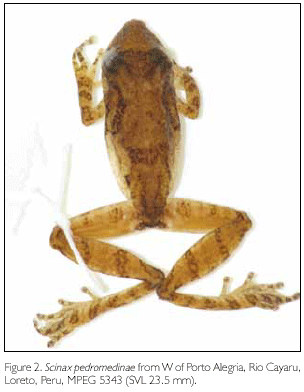
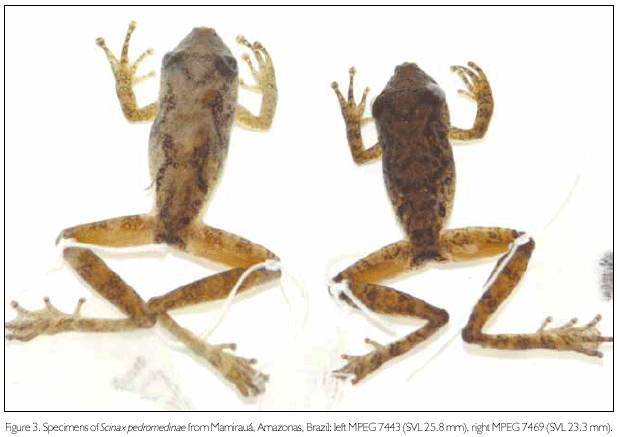
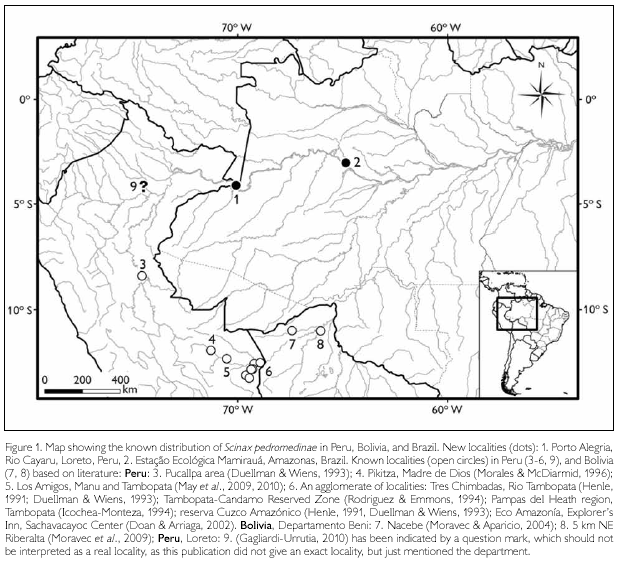
<body><![CDATA[<p><font size="2" face="verdana">Duellman &amp; Wiens (1993) emended the specific name to <i>pedromedinai</i>, but both Henle (1997) and Dubois (2007) pointed out that this was  unjustified and that the correct name should remain <i>S. pedromedinae</i>. Frost  (2011) lists the  species as <i>S. pedromedinae</i>.</font></p>     <p><font size="2" face="verdana">Since its description, <i>S. pedromedinae</i> has been mentioned several  times, mostly with localities in southern Peru  and only recently from northern Bolivia.</font> <font size="2" face="verdana">Henle (1992), in his overview of the amphibians of Peru, only  mentioned the type material and did not add new localities. Duellman &amp;  Wiens (1993) gave its distribution as &quot;confined to the upper Amazon Basin  in extreme eastern Peru,  where it occurs in the drainages of the Rio Purus and Rio Madre de Dios&quot;.  In the map of distribution they provided a locality in Department Ucayali that  is, or is near to, Pucallpa,  although they did not list material from that locality in the list of specimens  examined. It remains uncertain on what they based their record from the Pucallpa area. Duellman  &amp; Wiens (1993) examined large series of several localities in the wider  surroundings of Puerto Maldonado, most from Cuzco Amazonico. Duellman (1993)  cited &quot;Rio Madre de Dios drainage in southern Peru&quot; as distribution.  Duellman (1995, 2005) provided data on this species from Cuzco Amazonico, where  it is very abundant in primary rainforest. Morales (1995), in his checklist of  Peruvian amphibians, just mentioned the species but did not provide localities.  Morales &amp; McDiarmid (1996) reported the species from Pakitza, Manu National    Park, Department Madre de Dios, and mentioned it  to be diurnal and nocturnal, uncommon, arboreal, and inhabiting dissected  alluvial terrace forest. Duellman (1999) considered <i>S. pedromedinae</i> an  endemic of southwestern Amazonia. Lehr (2002)  only noted that the species was endemic to Peru. Angulo <i>et al</i>. (2004)  mentioned the same distribution as given by Duellman &amp; Wiens (1993), adding  that the species occurs at 200   m above sea level, and they provided a map that connects  the four points given by Duellman &amp; Wiens (1993). This map shows a rather  artificial shape defined by Peru's  international borders with Brazil  and Bolivia.  Riva <i>et al</i>. (2000) and Kohler (2000) suggested that this species still  might be found in Bolivia.  Reichle (2007) did not mention the species for Bolivia,  although it had already been reported from Nacene, Department Beni, northern Bolivia, by  Moravec &amp; Aparicio (2004). Moravec <i>et al</i>. (2009) reported another  specimen of <i>S. pedromedinae</i> from 5 km NE of  Riberalta, Department Beni, Bolivia. Young (2007), dealing with endemic species  of the eastern slopes of the Andes in Peru  and Bolivia  (and adjacent Amazonian lowlands), in his table mentioned <i>S. pedromedinae</i> from  12 localities but did not specify those localities. In a map based on just ten  localities in the Department Madre de Dios, Peru (which can be accessed in  Young (2007) by clicking on <i>Scinax pedromedinae</i> in the list of endemic  species), an area of distribution of 44, 897 km<sup>2</sup> (within the  Department of Madre de Dios) is predicted for <i>S. pedromedinae</i>. May <i>et al</i>. (2009) reported <i>S. pedromedinae</i> from all nine areas studied by  them in western and southern Department Madre de Dios around Puerto Maldonado  and Manu National Park. Aguilar <i>et al</i>. (2010) mentioned <i>S. pedromedinae</i> in their Table 1 and the only information they provided  is that it occurs at an altitude of 200 m. May <i>et al</i>. (2010) published  photos of <i>S. pedromedinae</i> from the Manu and  Tambopata areas in Peru.  Gagliardi-Urrutia (2010) provided a picture of <i>S. pedromedinae</i> from the  Department Loreto, but without detailed locality. Frost (2011) gave as its  distribution &quot;Upper Amazon Basin in extreme eastern Peru, in the drainages  of the Rio Purus and Rio Madre de Dios&quot;, apparently not considering Gagliardi-Urrutia's (2010) (unspecified)  Loreto, Peru, record and specimens reported by Moravec &amp; Aparicio (2004) and  Moravec <i>et al</i>. (2009) from  northern Bolivia.</font></p>     <p>&nbsp;</p>     <p><font size="3" face="verdana"><b>RESULTS</b></font></p>     <p><font size="2" face="verdana">During fieldwork in the border region between Brazil, Peru, and Colombia  in 1989, and again during fieldwork in 1994 in the Esta&ccedil;&atilde;o Ecol&oacute;gica Mamirau&aacute; (now Reserva  de Desenvolvimento  Sustent&aacute;vel Mamirau&aacute;), Amazonas, Brazil, we collected a number of small hylids  (see <a href="pdf/bmpegcn/v6n3/apenv6n3a03.pdf" target="_blank">Appendix</a>) that seemed to  belong to the <i>Scinax rostratus</i> group, but at the time could not be  identified (<a href="#f1">Figure 1</a>). They were relatively small, flattened,  had an acuminate snout, a tubercular dorsal skin, a row of tubercles on the  forearm and on the lower jaw, and in general resembled <i>Scinax nebulosus</i> (Spix,  1824), but  differed from that species by having a uniformly coloured posterior aspect of  the thighs (<a href="#f2">Figures 2</a> and <a href="#f3">3</a>).  Both the Mamirau&aacute;  and Porto  Alegria specimens have numerous round white spots on the belly in preservative.</font></p>     <p><a name="f1"></a></p>     <p>&nbsp;</p>     <p align="center"><img src="/img/revistas/bmpegcn/v6n3/3a03f1.gif" border="0"></p>     <p>&nbsp;</p>     <p><a name="f2"></a></p>     ]]></body>
<body><![CDATA[<p>&nbsp;</p>     <p align="center"><img src="/img/revistas/bmpegcn/v6n3/3a03f2.gif" border="0"></p>     <p>&nbsp;</p>     <p><a name="f3"></a></p>     <p>&nbsp;</p>     <p align="center"><img src="/img/revistas/bmpegcn/v6n3/3a03f3.gif" border="0"></p>     <p>&nbsp;</p>     <p><font size="2" face="verdana">Hoogmoed &amp; Avila-Pires (2001) reported the Mamirau&aacute; material  as <i>Scinax</i> sp. Some of the specimens collected by us were directly  compared with the holotype (ZFMK 39737) and the paratype ZFMK 36310 of <i>Ololygon  pedromedinae</i>, both adult females. B&ouml;hme (2010, p. 83), in his  list of ZFMK types, mentioned the holotype of <i>Ololygon pedromedinae</i> and  categorically, but incorrectly, stated that there are &quot;no paratypes&quot;.  As Henle (1991) described the species on the basis of the holotype and 19 paratypes  (three from ZFMK, 16 from Kansas University), and as the senior author examined the holotype  and the paratype ZFMK 36310 in November  2009 in Leiden, B&ouml;hme (2010) clearly  erred in stating that there are &quot;no paratypes&quot;. Hopefully the ZFMK  paratypes just were misplaced and are not really missing. Our material  completely agreed with the type specimens examined and we now identify it as <i>Scinax  pedromedinae</i>.</font></p>     <p><font size="2" face="verdana">On  December 5, 1989, between 10:30 a.m. and 14:30 p.m. we  collected a total of ten specimens, adults (<a href="#f2">Figure 2</a>) and juveniles, west of Porto Alegria, Rio  Cayar&uacute;, Paran&aacute; Yah&uacute;, in Department Loreto, Peru, just across the  border from Benjamin Constant, Brazil. This locality is 660 km  northeast of Pucallpa and 900 km N of the  wider Puerto Maldonado area, the two localities from where the species has been  reported in Peru.  It is 900 km NW of  the Bolivian localities Nacebe and Riberalta. All specimens were collected in  dry 'v&aacute;rzea' forest, on the forest floor between leaf litter,  some on the bank of a creek.</font></p>     <p><font size="2" face="verdana">We also collected <i>S. pedromedinae</i> in Mamirau&aacute; (<a href="#f3">Figure 3</a>), in 1994 between  July 26 and August 3 ('cheia' = period of flooding), and between December 9 and 18 ('seca'  = period  with falling water levels). This locality is 1,200 km NE of  Pucallpa, 1,100 km NNE of  Puerto Maldonado, 600 km E of Rio  Cayaru, the northern Peruvian locality reported here, and 900 km N of the Bolivian  localities Nacebe and Riberalta. Most specimens were found in dry  &quot;restinga baixa&quot; (Bannerman, 2001) on the forest floor among leaf  litter. Only MPEG 7279 was found in flooded &quot;restinga baixa&quot; sitting  on a dead twig 10 cm  above the water. During the 'cheia', only half grown specimens were found,  during the 'seca' only adults were found. All specimens were collected during  daytime between 13:00 and 18:00 p.m.</font></p>     ]]></body>
<body><![CDATA[<p>&nbsp;</p>     <p><font size="3" face="verdana"><b>DISCUSSION</b></font></p>     <p><font size="2" face="verdana">The  habitat of the Rio Cayaru and Mamirau&aacute; material (forest along waterways) agrees  with that described for the type material (Henle, 1991) and other material from  Peru (Duellman &amp; Wiens, 1993; Duellman, 1995, 2005) and Bolivia (Moravec &amp;  Aparicio, 2004). The habitat known for this species is completely different  from that of the similar <i>S. nebulosus</i> (Spix, 1824) (a closely related  species &#091;Faivovich, 2002&#093;) which occurs in open situations (Hoogmoed, 1993), like savannas, floating meadows, and  disturbed areas with secondary vegetation, but never in forest.</font></p>     <p><font size="2" face="verdana">In  addition to a remark made by Duellman &amp; Wiens (1992, p. 16) about the  calling behaviour of males of the <i>S. rostratus</i> group, we can add that  males of <i>S. nebulosus</i> in Suriname, French Guiana, and Brazil generally  (but not always) also call sitting in a more or less vertical position with the  head pointing down.</font></p>     <p><font size="2" face="verdana">Another  species of the <i>S. rostratus</i> group of Duellman (1972) and Duellman &amp; Wiens  (1992) that occurs in the area between Mamirau&aacute; and Benjamin Constant is <i>S.  garbei</i> (Miranda-Ribeiro, 1926), but this is a much larger species that has  brightly (yellow or orange) patterned anterior and posterior surfaces of the  thighs and can not be confused with <i>S. pedromedinae</i>.</font></p>     <p><font size="2" face="verdana">The  distinct light inguinal spot as reported by Henle (1991) is evident in most of  our specimens either as an inguinal or as a flank spot, in some specimens (MPEG  7443 and 7469, RMNH 42009) it is indistinct. The northern Peruvian specimens in  life had a large light to reddish brown area on the back, with dark green to  black marks, the flanks were green. The back of the thighs was dark blue-green  without black pattern. The ventral parts of limbs were bluish green. Belly and  throat white. Bones green. The upper part of the iris was brown, the lower part  silvery.</font></p>     <p><font size="2" face="verdana">The  recognition of <i>S. pedromedinae</i>, and its discovery in Mamirau&aacute;, might  give rise to speculations that <i>Hyla nebulosa</i> Spix, 1824, described from  the Rio Tef&eacute; on the southern bank of the Rio Solim&otilde;es, not far from Mamirau&aacute;, actually  could be the same species as the one reported here. Hoogmoed &amp; Gruber (1983)  synonymised <i>Hyla egleri</i> Lutz, 1968 with <i>H. nebulosa</i> and  designated the holotype of the first name as the neotype for <i>Hyla nebulosa</i>, thus  changing the type locality of <i>H. nebulosa</i> (currently <i>Scinax nebulosus</i>) to Bel&eacute;m, State of Par&aacute;,   Brazil.  Considering the fact that Spix (1824) in his description specifically mentioned  the black bars on the anterior aspect of the thighs and the blue spots on the  posterior aspect, lead us to believe that Hoogmoed &amp; Gruber (1983) were  right in synonymising <i>H. nebulosa</i> and <i>H. egleri</i>. This leads to  the conclusion that either <i>S. nebulosus</i> still might be found in Tef&eacute; or  surroundings (in open situations), or that the type locality mentioned by Spix (1824)  was wrong (most likely in our opinion). There is a good possibility that many  or all specimens referred to <i>S. nebulosus</i> from central and western  Brazil and Bolivia in fact are <i>S. pedromedinae</i> (Hoogmoed, 1993; Riva <i>et al</i>., 2000, but see Moravec <i>et al</i>., 2009, who reported among their  comparative material <i>S. nebulosus</i> from a locality only 3 km distant from the locality  from where they report <i>S. pedromedinae</i>).</font></p>     <p>&nbsp;</p>     <p><font size="3" face="verdana"><b>CONCLUSIONS</b></font></p>     <p><font size="2" face="verdana">The  present findings show that <i>S. pedromedinae</i> is not a species endemic to  Peru, and do extend the range of the species considerably to the north and  northeast of the Peruvian localities reported by Duellman &amp; Wiens (1993) and  other authors. These new records and the material recently reported from  northern Bolivia (Moravec &amp;  Aparicio, 2004; Moravec <i>et al</i>., 2009) suggest a continuous distribution  of this species in the western Amazon Basin in eastern Peru,  western Brazil (and most  likely also in adjacent Colombia),  and northern Bolivia.  This is the first time this species is reported from Brazil  and northern Peru.</font></p>     ]]></body>
<body><![CDATA[<p>&nbsp;</p>     <p><font size="3" face="verdana"><b>ACKNOWLEDGEMENTS</b></font></p>     <p><font size="2" face="verdana">We thank  the Sociedade Civil Mamirau&aacute; (now Instituto de Desenvolvimento Sustent&aacute;vel  Mamirau&aacute;) in Tef&eacute;, Amazonas, Brazil, for the invitation to  perform fieldwork in Mamirau&aacute; and for providing transport and lodging during  our stays in 1994. Dr. Wolfgang B&ouml;hme, Zoologisches Forschungsinstitut   und Museum  A. Koenig, Bonn  (ZFMK), kindly permitted the senior author to examine type material under his  care. M arcelo J. Sturaro (MPEG) made the distribution map and provided some  pertinent recent references. Fieldwork in 1989 was financed by the Nationaal  Natuurhistorisch Museum, Leiden, the Netherlands (RMNH), the Stichting  Wetenschappelijk Onderzoek in de Tropen &#091;Netherlands Foundation for Tropical Research  (WOTRO, grant WR 87-218.89)&#093;, and the Van Tienhoven Stichting (= Foundation),  the Netherlands, and that in 1994 also by the Sociedade Civil Mamirau&aacute;. Material  was collected in Brazil  under IBAMA licenses 065/89-DEVIS and 036/94-DIFAS and expedition permit  EX-21/89 and Portaria MCT 178 (July 13, 1993) for field work of the senior  author. Material was deposited in the collections of the Museu Paraense Em&iacute;lio Goeldi,  Bel&eacute;m, Par&aacute;, Brazil (MPEG) and in the RMNH.</font></p>     <p>&nbsp;</p>     <p><font size="3" face="verdana"><b>REFERENCES</b></font></p>     <!-- ref --><p><font size="2" face="verdana">AGUILAR, C., C.  RAMIREZ, D. RIVERA, K. SIU-TING, J. SUAREZ &amp; C. TORRES, 2010. Anf&iacute;bios  andinos del Peru fuera de &Aacute;reas Naturales Protegidas: amenazas y estado de  conservaci&oacute;n. <b>Revista Peruana  de Biologia </b>17(1): 5-28.</font><!-- ref --><p><font size="2" face="verdana">ANGULO, A., J. ICOCHEA &amp; R. REYNOLDS, 2004. <i>Scinax pedromedinae</i>. In: INTERNATIONAL UNION  FOR CONSERVATION OF NATURE AND NATURAL RESOURCES - IUCN, 2010. <b>IUCN Red List  of Threatened Species. </b>Version 2010.4. Available at: &lt;<a href="http://www.iucnredlist.org/" target="_blank">www.iucnredlist.org</a>&gt;. Accessed on: 18   February  2011.</font><!-- ref --><p><font size="2" face="verdana">BANNERMAN,  M., 2001. <b>Mamirau&aacute;. </b>A guide to the natural history of the Amazon flooded  forest: 1-175. Instituto de Desenvolvimento Sustent&aacute;vel Mamirau&aacute;, Tef&eacute;.</font><!-- ref --><p><font size="2" face="verdana">B&Ouml;HME, W., 2010. A list of the  herpetological type specimens in the Zoologisches Forschungsmuseum Alexander  Koenig, Bonn. <b>Bonn Zoological  Bulletin </b>59: 79-108.</font><!-- ref --><p><font size="2" face="verdana">DOAN, T.  M. &amp; W. A. ARRIAGA, 2002. Microgeographic variation in species composition  of the herpetofaunal communities of Tambopata region, Peru. <b>Biotropica </b>34(1): 101-117.</font><!-- ref --><p><font size="2" face="verdana">DUBOIS, A., 2007. Genitives  of species and subspecies nomina derived from personal names should not be  emended. <b>Zootaxa </b>1550: 49-68.</font><!-- ref --><p><font size="2" face="verdana">DUELLMAN,  W. E., 1972. South American frogs of the <i>Hyla rostrata</i> group (Amphibia,  Anura, Hylidae). <b>Zoologische Mededelingen Leiden </b>47:  177-192.</font><!-- ref --><p><font size="2" face="verdana">DUELLMAN,  W. E., 1993. Amphibian species ofthe world: Additions and corrections. <b>Museum  of Natural History of the University of Kansas Special Publication </b>21: iii +  372.</font><!-- ref --><p><font size="2" face="verdana">DUELLMAN,  W. E., 1995. Temporal fluctuations in abundances of anuran amphibians in a  seasonal Amazonian rainforest. <b>Journal of Herpetology </b>29(1): 13-21.</font><!-- ref --><p><font size="2" face="verdana">DUELLMAN,  W. E., 1999. Distribution patterns of amphibians in South   America. In: W. E. DUELLMAN (Ed.): <b>Patterns of  distribution of amphibians. A global perspective: </b>255-328. Johns Hopkins   University Press,  Baltimore.</font><!-- ref --><p><font size="2" face="verdana">DUELLMAN,  W. E., 2005. <b>Cusco Amaz&oacute;nico. </b>The  lives of amphibians and reptiles in an Amazonian rainforest: i-xv, 1-433.  Comstock Publishing Associates, Ithaca and London.</font><!-- ref --><p><font size="2" face="verdana">DUELLMAN,  W. E. &amp; J. J. WIENS, 1992. The status of the hylid frog genus <i>Ololygon</i> and  the recognition of <i>Scinax</i> Wagler, 1830. <b>Occasional Papers of the Museum of Natural History,  University of Kansas </b>151: 1-23.</font><!-- ref --><p><font size="2" face="verdana">DUELLMAN,  W. E. &amp; J. J. WIENS, 1993. Hylid frogs ofthe genus <i>Scinax</i> Wagler, 1830, in Amazonian Ecuador  and Peru. <b>Occasional Papers of the Museum of Natural History, University of Kansas </b>153: 1-57.</font><!-- ref --><p><font size="2" face="verdana">FAIVOVICH,  J., 2002. A cladistic  analysis <i>of Scinax</i> (Anura: Hylidae). <b>Cladistics </b>18(4): 367-393.</font><!-- ref --><p><font size="2" face="verdana">FAIVOVICH,  J., C. F. B. HADDAD, P. C. A. GARCIA, D. R. FROST, J. A. CAMPBELL &amp; W. C.  WHEELER, 2005. Systematic review ofthe frog family Hylidae, with special reference to  Hylinae: a phylogenetic analysis and taxonomic revision. <b>Bulletin of the American Museum of Natural History </b>294: 1-240.</font><!-- ref --><p><font size="2" face="verdana">FOUQUETTE,  M. J., JR. &amp; A. J. DELAHOUSSAYE, 1977. Sperm morphology in the <i>Hyla rubra</i> group  (Amphibia, Anura, Hylidae), and its bearing on generic status. <b>Journal of  Herpetology </b>11(4): 387-396.</font><!-- ref --><p><font size="2" face="verdana">FROST, D.  R., 2011. <b>Amphibian Species of the world: </b>an Online  Reference. Version 5.5 (31 January 2011). American Museum of Natural History, New York.  Available at: &lt;<a href="http://research.amnh.org/vz/herpetology/amphibia/" target="_blank">http://research.amnh.org/vz/herpetology/amphibia/</a>&gt;.  Accessed on: 21 September 2011.</font><!-- ref --><p><font size="2" face="verdana">GAGLIARDI-URRUTIA, G., 2010. Anfibios y reptiles de Loreto, Peru. <b>Rapid  Color Guide </b>262 version 1: pls. 1-14. Available at: &lt;<a href="http://www.pingleton.com/field/Post/2010-photoguide_Herps_Loreto_02.pdf" target="_blank">http://www.pingleton.com/field/Post/2010-photoguide_Herps_Loreto_02.pdf</a>&gt;  Accessed on: 13 October 2011.</font><!-- ref --><p><font size="2" face="verdana">HENLE, K., 1991. <i>Ololygon  pedromedinae</i> sp. nov., ein neuer Knickzehenlaubfrosch (Hylidae) aus Peru. <b>Salamandra </b>27(1): 76-82.</font><!-- ref --><p><font size="2" face="verdana">HENLE, K., 1992.  Zur Amphibienfauna Perus nebst Beschreibung eines neuen <i>Eleutherodactylus</i> (Leptodactylidae). <b>Bonner zoologische Beitr&auml;ge </b>43(1): 79-129.</font><!-- ref --><p><font size="2" face="verdana">HENLE, K., 1997 <i>Scinax pedromedinai</i>: an unjustified  emendation of <i>Ololygon pedromedinae</i> Henle, 1991. <b>Herpetological Review </b>28(2):  67.</font><!-- ref --><p><font size="2" face="verdana">HOOGMOED, M. S., 1993. The herpetofauna of floating  meadows. In: P. E. OUBOTER (Ed.): <b>Freshwater ecosystems of Suriname: </b>199-213. Kluwer  Academic Publishers, Dordrecht.</font><!-- ref --><p><font size="2" face="verdana">HOOGMOED, M. S. &amp;  U. GRUBER, 1983. Spix and Wagler type specimens of reptiles and amphibians in  the Natural History Musea in Munich (Germany) and Leiden (The  Netherlands). <b>Spixiana </b>Supplement 9: 319-415.</font><!-- ref --><p><font size="2" face="verdana">HOOGMOED, M. S. &amp; T. C. S.  AVILA-PIRES, 2001. Amphibia. In: M. BANNERMAN: <b>Mamirau&aacute;. </b>A  guide to the natural history of the Amazon flooded forest: 164. Instituto de Desenvolvimento Sustent&aacute;vel  Mamirau&aacute;, Tef&eacute;.</font><!-- ref --><p><font size="2" face="verdana">ICOCHEA-MONTEZA,  J., 1994. Amphibians and reptiles of the Pampas del Heath Region. In: R. B.  FOSTER, J. L. CARR &amp; A. B. FORSYTH (Eds.): The Tambopata-Candamo Reserved  Zone of Southeastern Per&uacute;: a biological assessment. <b>RAP working Papers,  Conservation International </b>6: 71-72, 154-155.</font><!-- ref --><p><font size="2" face="verdana">K&Ouml;HLER, J., 2000. Amphibian  diversity in Bolivia:  a study with special reference to montane forest regions. <b>Bonner zoologische Monographien </b>48: 1-243.</font><!-- ref --><p><font size="2" face="verdana">LEHR, E., 2002. <b>Amphibien  und Reptilien in Peru. Die Herpetofauna entlang des 10. Breitengrades von Peru:  Arterfassung, Taxonomie, &ouml;kologische Bemerkungen und biogeographische  Beziehungen: </b>1-208. Natur und Tier-Verlag GmbH, M&uuml;nster.</font><!-- ref --><p><font size="2" face="verdana">LESCURE, J. &amp; C.  MARTY, 2000. Atlas des amphibiens de Guyane. <b>Patrimoines Natureis </b>45:  1-388</font><!-- ref --><p><font size="2" face="verdana">MAY, R. VON, K. SIU-TING, J. M. JACOBS, M. MEDINA-M&Uuml;LLER, G. GAGLIARDI,  L. O. RODR&Iacute;GUEZ &amp; M. A. DONNELLY, 2009. Species  diversity and conservation status of amphibians in Madre de Dios, southern Peru. <b>Herpetological  Conservation and Biology </b>4(1): 14-29.</font><!-- ref --><p><font size="2" face="verdana">MAY, R.  VON, J. M. JACOBS, R. D. JENNINGS, A. CATENAZZI &amp; L. O. RODRIGUEZ, 2010. Anfibios  de Los Amigos, Manu y Tambopata, Per&uacute;. <b>Rapid Color Guide </b>236 version 2: pis. 1-12. Available  at: &lt;<a href="http://fm2.fieldmuseum.org/plantguides/guideimages.asp?ID=350" target="_blank">http://fm2.fieldmuseum.org/plantguides/guideimages.asp?ID=350</a>&gt;.  Accessed on: 13 October 2011. </font><!-- ref --><p><font size="2" face="verdana">MORALES,  V. R., 1995. Checklist and taxonomic bibliography ofthe amphibians from Peru. <b>Smithsonian  Herpetological Information Service </b>107: 1-20.</font><!-- ref --><p><font size="2" face="verdana">MORALES, V. R. &amp; R. W. MCDIARMID,  1996. Annotated checklist of the amphibians and reptiles of Pakitza, Manu National  Park Reserve Zone, with comments on the herpetofauna of Madre de Dios, Peru. In: D. E. WILSON &amp; A. SANDOVAL (Eds.): <b>Manu: The biodiversity  of southeastern Peru: </b>503-522. Smithsonian Institution, Washington.</font><!-- ref --><p><font size="2" face="verdana">MORAVEC, J. &amp; J. APARICIO, 2004. Notes on the herpetofauna of Nacebe (Provincia  Abuna, Departamento  Pando, Bolivia). <b>&#268;asopis N&aacute;rodn&iacute;ho muzea, &#344;ada p&#345;&iacute;rodov&#283;dn&aacute; (Journal National Museum,  Natural History Series)</b> 173 (1-4): 13-28. </font><!-- ref --><p><font size="2" face="verdana">MORAVEC, J.,  I. A. TUANAMA, P. E. P&Eacute;REZ &amp; E. LEHR, 2009. A new species of <i>Scinax</i> (Anura:  Hylidae) from the area of Iquitos,  Amazonian Peru. <b>South American Journal of Herpetology </b>4(1): 9-16.</font><!-- ref --><p><font size="2" face="verdana">REICHLE, S., 2007. <b>Distribution, diversity and conservation status  of Bolivian amphibians: </b>1-183 + 103 p. unnumbered. Available in: &lt;<a href="http://hss.ulb.uni-bonn.de/2007/1171/1171.pdf" target="_blank">http://hss.ulb.uni-bonn.de/2007/1171/1171.pdf</a>&gt;.  Accessed on: 21 September 2011. </font><!-- ref --><p><font size="2" face="verdana">RIVA,  I. DE LA, J. K&Ouml;HLER, S. L&Ouml;TTERS &amp; S. REICHLE, 2000. Ten years of research on Bolivian amphibians:  updated checklist, distribution, taxonomic problems, literature and  iconography. <b>Revista  Espa&ntilde;ola de Herpetologia </b>14: 19-164. </font><!-- ref --><p><font size="2" face="verdana">RODRIGUEZ,  L. &amp; L. H. EMMONS, 1994. Amphibians and reptiles in the Tambopata-Candamo Reserved Zone. In: R.  B. FOSTER, J. L. CARR &amp; A. B. FORSYTH (Eds.): The Tambopata-Candamo  Reserved Zone of Southeastern Per&uacute;: A biological  assessment. <b>RAP Working Papers, Conservation International </b>6: 150-153,  184. </font><!-- ref --><p><font size="2" face="verdana">SPIX, J. B. VON, 1824. <b>Animalia nova sive  species novae Testudinarum et Ranarum, quas in itinere per Brasiliam annis  MDCCCXVII-MDCCCXX jussu et auspicius Maximiliani Josephi I Bavariae Regis.  Amphibia: </b>25-53, pls. I-XXII. F S. H&uuml;bschman, Munich,   Germany.</font><!-- ref --><p><font size="2" face="verdana">STURARO,  M. J., J. F. MELO SARMENTO, A. A. LIMA, H. M. CHALKIDIKIS &amp; R. A. T. ROCHA,  2010. New records and  distribution of the treefrog <i>Scinax rostratus</i> (Peters, 1863) (Amphibia:  Anura: Hylidae). <b>Herpetology Notes </b>3: 161-166. </font><!-- ref --><p><font size="2" face="verdana">YOUNG, B. E. (Ed.), 2007. <b>Endemic species  distributions on the east slopes of the Andes in Peru  and Bolivia: </b>1-89. NatureServe, Arlington,   Virginia. Available at: &lt;<a href="http://www.natureserve.org/aboutUs/latinamerica/maps_amphibians.jsp" target="_blank">http://www.natureserve.org/aboutUs/latinamerica/maps_amphibians.jsp</a>&gt;  and &lt;<a href="http://www.natureserve.org/aboutUs/latinamerica/maps_dist_amphibians/Scinax_pedromedinae.jsp" target="_blank">http://www.natureserve.org/aboutUs/latinamerica/maps_dist_amphibians/Scinax_pedromedinae.jsp</a>&gt;.  Accessed on: 21 September 2011.</font><p>&nbsp;</p>     <p>&nbsp;</p>     <p><a name="endereco"></a><a href="#topo"><img src="img/revistas/bmpegcn/v5n3/seta.gif" border="0"></a><font size="2" face="verdana"><b>Autor  para correspond&ecirc;ncia:</b>    <br>   Marinus  Steven Hoogmoed.    <br>   Museu  Paraense Em&iacute;lio Goeldi.    ]]></body>
<body><![CDATA[<br>   Coordena&ccedil;&atilde;o  de Zoologia.    <br>   Av.  Perimetral, 1901 &ndash; Terra Firme.    <br>   Bel&eacute;m,  PA, Brasil.    <br>   CEP 66017-970    <br> (<a href="mailto:marinus@museu-goeldi.br">marinus@museu-goeldi.br</a>)</font></p>     <p><font size="2" face="verdana">Recebido  em 14/04/2011    <br> Aprovado  em 29/09/2011</font></p>     <p><font size="2" face="verdana">Responsabilidade editorial: Hilton Tulio Costi</font></p>      ]]></body><back>
<ref-list>
<ref id="B1">
<nlm-citation citation-type="journal">
<person-group person-group-type="author">
<name>
<surname><![CDATA[AGUILAR]]></surname>
<given-names><![CDATA[C.]]></given-names>
</name>
<name>
<surname><![CDATA[RAMIREZ]]></surname>
<given-names><![CDATA[C.]]></given-names>
</name>
<name>
<surname><![CDATA[RIVERA]]></surname>
<given-names><![CDATA[D]]></given-names>
</name>
<name>
<surname><![CDATA[SIU-TING]]></surname>
<given-names><![CDATA[K.]]></given-names>
</name>
<name>
<surname><![CDATA[SUAREZ]]></surname>
<given-names><![CDATA[J.]]></given-names>
</name>
<name>
<surname><![CDATA[TORRES]]></surname>
<given-names><![CDATA[C.]]></given-names>
</name>
</person-group>
<article-title xml:lang="es"><![CDATA[Anfíbios andinos del Peru fuera de Áreas Naturales Protegidas: amenazas y estado de conservación]]></article-title>
<source><![CDATA[Revista Peruana de Biologia]]></source>
<year>2010</year>
<volume>17</volume>
<numero>1</numero>
<issue>1</issue>
<page-range>5-28</page-range></nlm-citation>
</ref>
<ref id="B2">
<nlm-citation citation-type="">
<person-group person-group-type="author">
<name>
<surname><![CDATA[ANGULO]]></surname>
<given-names><![CDATA[A.]]></given-names>
</name>
<name>
<surname><![CDATA[ICOCHEA]]></surname>
<given-names><![CDATA[J.]]></given-names>
</name>
<name>
<surname><![CDATA[REYNOLDS]]></surname>
<given-names><![CDATA[R]]></given-names>
</name>
</person-group>
<article-title xml:lang="en"><![CDATA[Scinax pedromedinae]]></article-title>
<collab>INTERNATIONAL UNION FOR CONSERVATION OF NATURE AND NATURAL RESOURCES - IUCN</collab>
<source><![CDATA[IUCN Red List of Threatened Species: Version 2010.4]]></source>
<year>2004</year>
<month>20</month>
<day>10</day>
</nlm-citation>
</ref>
<ref id="B3">
<nlm-citation citation-type="book">
<person-group person-group-type="author">
<name>
<surname><![CDATA[BANNERMAN]]></surname>
<given-names><![CDATA[M.]]></given-names>
</name>
</person-group>
<source><![CDATA[Mamirauá: A guide to the natural history of the Amazon flooded forest]]></source>
<year>2001</year>
<page-range>1-175</page-range><publisher-loc><![CDATA[Tefé ]]></publisher-loc>
<publisher-name><![CDATA[Instituto de Desenvolvimento Sustentável Mamirauá]]></publisher-name>
</nlm-citation>
</ref>
<ref id="B4">
<nlm-citation citation-type="journal">
<person-group person-group-type="author">
<name>
<surname><![CDATA[BÖHME]]></surname>
<given-names><![CDATA[W.]]></given-names>
</name>
</person-group>
<article-title xml:lang="en"><![CDATA[A list of the herpetological type specimens in the Zoologisches Forschungsmuseum Alexander Koenig, Bonn]]></article-title>
<source><![CDATA[Bonn Zoological Bulletin]]></source>
<year>2010</year>
<volume>59</volume>
<page-range>79-108</page-range></nlm-citation>
</ref>
<ref id="B5">
<nlm-citation citation-type="journal">
<person-group person-group-type="author">
<name>
<surname><![CDATA[DOAN]]></surname>
<given-names><![CDATA[T. M.]]></given-names>
</name>
<name>
<surname><![CDATA[ARRIAGA]]></surname>
<given-names><![CDATA[W. A.]]></given-names>
</name>
</person-group>
<article-title xml:lang="en"><![CDATA[Microgeographic variation in species composition of the herpetofaunal communities of Tambopata region, Peru]]></article-title>
<source><![CDATA[Biotropica]]></source>
<year>2002</year>
</nlm-citation>
</ref>
<ref id="B6">
<nlm-citation citation-type="journal">
<person-group person-group-type="author">
<name>
<surname><![CDATA[DUBOIS]]></surname>
<given-names><![CDATA[A.]]></given-names>
</name>
</person-group>
<article-title xml:lang="en"><![CDATA[Genitives of species and subspecies nomina derived from personal names should not be emended]]></article-title>
<source><![CDATA[Zootaxa]]></source>
<year>2007</year>
<volume>1550</volume>
<page-range>49-68</page-range></nlm-citation>
</ref>
<ref id="B7">
<nlm-citation citation-type="journal">
<person-group person-group-type="author">
<name>
<surname><![CDATA[DUELLMAN]]></surname>
<given-names><![CDATA[W. E.]]></given-names>
</name>
</person-group>
<article-title xml:lang="en"><![CDATA[South American frogs of the Hyla rostrata group (Amphibia, Anura, Hylidae)]]></article-title>
<source><![CDATA[Zoologische Mededelingen Leiden]]></source>
<year>1972</year>
<volume>47</volume>
<page-range>177-192</page-range></nlm-citation>
</ref>
<ref id="B8">
<nlm-citation citation-type="journal">
<person-group person-group-type="author">
<name>
<surname><![CDATA[DUELLMAN]]></surname>
<given-names><![CDATA[W. E]]></given-names>
</name>
</person-group>
<article-title xml:lang="en"><![CDATA[Amphibian species ofthe world: Additions and corrections]]></article-title>
<source><![CDATA[Museum of Natural History of the University of Kansas Special Publication]]></source>
<year>1993</year>
<volume>21</volume>
<numero>iii</numero>
<issue>iii</issue>
<page-range>372</page-range></nlm-citation>
</ref>
<ref id="B9">
<nlm-citation citation-type="journal">
<person-group person-group-type="author">
<name>
<surname><![CDATA[DUELLMAN]]></surname>
<given-names><![CDATA[W. E.]]></given-names>
</name>
</person-group>
<article-title xml:lang="en"><![CDATA[Temporal fluctuations in abundances of anuran amphibians in a seasonal Amazonian rainforest]]></article-title>
<source><![CDATA[Journal of Herpetology]]></source>
<year>1995</year>
<volume>29</volume>
<numero>1</numero>
<issue>1</issue>
<page-range>13-21</page-range></nlm-citation>
</ref>
<ref id="B10">
<nlm-citation citation-type="book">
<person-group person-group-type="author">
<name>
<surname><![CDATA[DUELLMAN]]></surname>
<given-names><![CDATA[W. E.]]></given-names>
</name>
</person-group>
<article-title xml:lang="en"><![CDATA[Distribution patterns of amphibians in South America]]></article-title>
<person-group person-group-type="editor">
<name>
<surname><![CDATA[DUELLMAN]]></surname>
<given-names><![CDATA[W. E.]]></given-names>
</name>
</person-group>
<source><![CDATA[Patterns of distribution of amphibians: A global perspective]]></source>
<year>1999</year>
<page-range>255-328</page-range><publisher-loc><![CDATA[Baltimore ]]></publisher-loc>
<publisher-name><![CDATA[Johns Hopkins University Press]]></publisher-name>
</nlm-citation>
</ref>
<ref id="B11">
<nlm-citation citation-type="book">
<person-group person-group-type="author">
<name>
<surname><![CDATA[DUELLMAN]]></surname>
<given-names><![CDATA[W. E.]]></given-names>
</name>
</person-group>
<source><![CDATA[Cusco Amazónico: The lives of amphibians and reptiles in an Amazonian rainforest]]></source>
<year>2005</year>
<page-range>1-433</page-range><publisher-loc><![CDATA[IthacaLondon ]]></publisher-loc>
<publisher-name><![CDATA[Comstock Publishing Associates]]></publisher-name>
</nlm-citation>
</ref>
<ref id="B12">
<nlm-citation citation-type="journal">
<person-group person-group-type="author">
<name>
<surname><![CDATA[DUELLMAN]]></surname>
<given-names><![CDATA[W. E.]]></given-names>
</name>
<name>
<surname><![CDATA[WIENS]]></surname>
<given-names><![CDATA[J. J.]]></given-names>
</name>
</person-group>
<article-title xml:lang="en"><![CDATA[The status of the hylid frog genus Ololygon and the recognition of Scinax Wagler, 1830]]></article-title>
<source><![CDATA[Occasional Papers of the Museum of Natural History, University of Kansas]]></source>
<year>1992</year>
<volume>151</volume>
<page-range>1-23</page-range></nlm-citation>
</ref>
<ref id="B13">
<nlm-citation citation-type="journal">
<person-group person-group-type="author">
<name>
<surname><![CDATA[DUELLMAN]]></surname>
<given-names><![CDATA[W. E.]]></given-names>
</name>
<name>
<surname><![CDATA[WIENS]]></surname>
<given-names><![CDATA[J. J.]]></given-names>
</name>
</person-group>
<article-title xml:lang="en"><![CDATA[Hylid frogs ofthe genus Scinax Wagler, 1830, in Amazonian Ecuador and Peru]]></article-title>
<source><![CDATA[Occasional Papers of the Museum of Natural History, University of Kansas]]></source>
<year>1993</year>
<volume>153</volume>
<page-range>1-57</page-range></nlm-citation>
</ref>
<ref id="B14">
<nlm-citation citation-type="journal">
<person-group person-group-type="author">
<name>
<surname><![CDATA[FAIVOVICH]]></surname>
<given-names><![CDATA[J.]]></given-names>
</name>
</person-group>
<article-title xml:lang="en"><![CDATA[A cladistic analysis of Scinax (Anura: Hylidae)]]></article-title>
<source><![CDATA[Cladistics]]></source>
<year>2002</year>
<volume>18</volume>
<numero>4</numero>
<issue>4</issue>
<page-range>367-393</page-range></nlm-citation>
</ref>
<ref id="B15">
<nlm-citation citation-type="">
<person-group person-group-type="author">
<name>
<surname><![CDATA[FAIVOVICH]]></surname>
<given-names><![CDATA[J]]></given-names>
</name>
<name>
<surname><![CDATA[HADDAD]]></surname>
<given-names><![CDATA[C. F. B]]></given-names>
</name>
<name>
<surname><![CDATA[GARCIA]]></surname>
<given-names><![CDATA[P. C. A.]]></given-names>
</name>
<name>
<surname><![CDATA[FROST]]></surname>
<given-names><![CDATA[D. R.]]></given-names>
</name>
<name>
<surname><![CDATA[CAMPBELL]]></surname>
<given-names><![CDATA[J. A.]]></given-names>
</name>
<name>
<surname><![CDATA[WHEELER]]></surname>
<given-names><![CDATA[W. C.]]></given-names>
</name>
</person-group>
<source><![CDATA[]]></source>
<year>2005</year>
</nlm-citation>
</ref>
<ref id="B16">
<nlm-citation citation-type="journal">
<person-group person-group-type="author">
<name>
<surname><![CDATA[FOUQUETTE]]></surname>
<given-names><![CDATA[M. J., JR]]></given-names>
</name>
<name>
<surname><![CDATA[DELAHOUSSAYE]]></surname>
<given-names><![CDATA[A. J]]></given-names>
</name>
</person-group>
<article-title xml:lang="en"><![CDATA[Sperm morphology in the Hyla rubra group (Amphibia, Anura, Hylidae), and its bearing on generic status]]></article-title>
<source><![CDATA[Journal of Herpetology]]></source>
<year>1977</year>
<volume>11</volume>
<numero>4</numero>
<issue>4</issue>
<page-range>387-396</page-range></nlm-citation>
</ref>
<ref id="B17">
<nlm-citation citation-type="book">
<person-group person-group-type="author">
<name>
<surname><![CDATA[FROST]]></surname>
<given-names><![CDATA[D. R.]]></given-names>
</name>
</person-group>
<source><![CDATA[Amphibian Species of the world: an Online Reference. Version 5.5 (31 January 2011)]]></source>
<year>2011</year>
<publisher-loc><![CDATA[New York ]]></publisher-loc>
<publisher-name><![CDATA[American Museum of Natural History]]></publisher-name>
</nlm-citation>
</ref>
<ref id="B18">
<nlm-citation citation-type="">
<person-group person-group-type="author">
<name>
<surname><![CDATA[GAGLIARDI-URRUTIA]]></surname>
<given-names><![CDATA[G.]]></given-names>
</name>
</person-group>
<source><![CDATA[Anfibios y reptiles de Loreto, Peru: Rapid Color Guide 262 version 1]]></source>
<year>2010</year>
<page-range>1-14</page-range></nlm-citation>
</ref>
<ref id="B19">
<nlm-citation citation-type="journal">
<person-group person-group-type="author">
<name>
<surname><![CDATA[HENLE]]></surname>
<given-names><![CDATA[K.]]></given-names>
</name>
</person-group>
<article-title xml:lang="de"><![CDATA[Ololygon pedromedinae sp. nov., ein neuer Knickzehenlaubfrosch (Hylidae) aus Peru]]></article-title>
<source><![CDATA[Salamandra]]></source>
<year>1991</year>
<volume>27</volume>
<numero>1</numero>
<issue>1</issue>
<page-range>76-82</page-range></nlm-citation>
</ref>
<ref id="B20">
<nlm-citation citation-type="journal">
<person-group person-group-type="author">
<name>
<surname><![CDATA[HENLE]]></surname>
<given-names><![CDATA[K.]]></given-names>
</name>
</person-group>
<article-title xml:lang="de"><![CDATA[Zur Amphibienfauna Perus nebst Beschreibung eines neuen Eleutherodactylus (Leptodactylidae)]]></article-title>
<source><![CDATA[Bonner zoologische Beiträge]]></source>
<year>1992</year>
<volume>43</volume>
<numero>1</numero>
<issue>1</issue>
<page-range>79-129</page-range></nlm-citation>
</ref>
<ref id="B21">
<nlm-citation citation-type="journal">
<person-group person-group-type="author">
<name>
<surname><![CDATA[HENLE]]></surname>
<given-names><![CDATA[K.]]></given-names>
</name>
</person-group>
<article-title xml:lang="en"><![CDATA[Scinax pedromedinai: an unjustified emendation of Ololygon pedromedinae Henle, 1991]]></article-title>
<source><![CDATA[Herpetological Review]]></source>
<year>1997</year>
<volume>28</volume>
<numero>2</numero>
<issue>2</issue>
<page-range>67</page-range></nlm-citation>
</ref>
<ref id="B22">
<nlm-citation citation-type="book">
<person-group person-group-type="author">
<name>
<surname><![CDATA[HOOGMOED]]></surname>
<given-names><![CDATA[M. S.]]></given-names>
</name>
</person-group>
<article-title xml:lang="en"><![CDATA[The herpetofauna of floating meadows]]></article-title>
<person-group person-group-type="editor">
<name>
<surname><![CDATA[OUBOTER]]></surname>
<given-names><![CDATA[P. E]]></given-names>
</name>
</person-group>
<source><![CDATA[Freshwater ecosystems of Suriname]]></source>
<year>1993</year>
<page-range>199-213</page-range><publisher-loc><![CDATA[Dordrecht ]]></publisher-loc>
<publisher-name><![CDATA[Kluwer Academic Publishers]]></publisher-name>
</nlm-citation>
</ref>
<ref id="B23">
<nlm-citation citation-type="journal">
<person-group person-group-type="author">
<name>
<surname><![CDATA[HOOGMOED]]></surname>
<given-names><![CDATA[M. S]]></given-names>
</name>
<name>
<surname><![CDATA[GRUBER]]></surname>
<given-names><![CDATA[U]]></given-names>
</name>
</person-group>
<article-title xml:lang="en"><![CDATA[Spix and Wagler type specimens of reptiles and amphibians in the Natural History Musea in Munich (Germany) and Leiden (The Netherlands)]]></article-title>
<source><![CDATA[Spixiana]]></source>
<year>1983</year>
<numero>^s9</numero>
<issue>^s9</issue>
<supplement>9</supplement>
<page-range>319-415</page-range></nlm-citation>
</ref>
<ref id="B24">
<nlm-citation citation-type="book">
<person-group person-group-type="author">
<name>
<surname><![CDATA[HOOGMOED]]></surname>
<given-names><![CDATA[M. S]]></given-names>
</name>
<name>
<surname><![CDATA[AVILA-PIRES]]></surname>
<given-names><![CDATA[T. C. S.]]></given-names>
</name>
</person-group>
<article-title xml:lang="en"><![CDATA[Amphibia]]></article-title>
<person-group person-group-type="editor">
<name>
<surname><![CDATA[BANNERMAN]]></surname>
<given-names><![CDATA[M]]></given-names>
</name>
</person-group>
<source><![CDATA[Mamirauá: A guide to the natural history of the Amazon flooded forest]]></source>
<year>2001</year>
<page-range>164</page-range><publisher-loc><![CDATA[Tefé ]]></publisher-loc>
<publisher-name><![CDATA[Instituto de Desenvolvimento Sustentável Mamirauá]]></publisher-name>
</nlm-citation>
</ref>
<ref id="B25">
<nlm-citation citation-type="book">
<person-group person-group-type="author">
<name>
<surname><![CDATA[ICOCHEA-MONTEZA]]></surname>
<given-names><![CDATA[J.]]></given-names>
</name>
</person-group>
<article-title xml:lang="en"><![CDATA[Amphibians and reptiles of the Pampas del Heath Region]]></article-title>
<person-group person-group-type="editor">
<name>
<surname><![CDATA[FOSTER]]></surname>
<given-names><![CDATA[R. B.]]></given-names>
</name>
<name>
<surname><![CDATA[CARR]]></surname>
<given-names><![CDATA[J. L]]></given-names>
</name>
<name>
<surname><![CDATA[FORSYTH]]></surname>
<given-names><![CDATA[A. B.]]></given-names>
</name>
</person-group>
<source><![CDATA[The Tambopata-Candamo Reserved Zone of Southeastern Perú: a biological assessment]]></source>
<year>1994</year>
<volume>6</volume>
<page-range>71-72</page-range><publisher-name><![CDATA[RAP working Papers, Conservation International]]></publisher-name>
</nlm-citation>
</ref>
<ref id="B26">
<nlm-citation citation-type="journal">
<person-group person-group-type="author">
<name>
<surname><![CDATA[KÖHLER]]></surname>
<given-names><![CDATA[J]]></given-names>
</name>
</person-group>
<article-title xml:lang="en"><![CDATA[Amphibian diversity in Bolivia: a study with special reference to montane forest regions]]></article-title>
<source><![CDATA[Bonner zoologische Monographien]]></source>
<year>2000</year>
<volume>48</volume>
<page-range>1-243</page-range></nlm-citation>
</ref>
<ref id="B27">
<nlm-citation citation-type="book">
<person-group person-group-type="author">
<name>
<surname><![CDATA[LEHR]]></surname>
<given-names><![CDATA[E]]></given-names>
</name>
</person-group>
<source><![CDATA[Amphibien und Reptilien in Peru. Die Herpetofauna entlang des 10: Breitengrades von Peru: Arterfassung, Taxonomie, ökologische Bemerkungen und biogeographische Beziehungen]]></source>
<year>2002</year>
<page-range>1-208</page-range><publisher-loc><![CDATA[Münster ]]></publisher-loc>
<publisher-name><![CDATA[Natur und Tier-Verlag GmbH]]></publisher-name>
</nlm-citation>
</ref>
<ref id="B28">
<nlm-citation citation-type="journal">
<person-group person-group-type="author">
<name>
<surname><![CDATA[LESCURE]]></surname>
<given-names><![CDATA[J.]]></given-names>
</name>
<name>
<surname><![CDATA[MARTY]]></surname>
<given-names><![CDATA[C.]]></given-names>
</name>
</person-group>
<article-title xml:lang="es"><![CDATA[Atlas des amphibiens de Guyane]]></article-title>
<source><![CDATA[Patrimoines Natureis]]></source>
<year>2000</year>
<volume>45</volume>
<page-range>1-388</page-range></nlm-citation>
</ref>
<ref id="B29">
<nlm-citation citation-type="journal">
<person-group person-group-type="author">
<name>
<surname><![CDATA[MAY]]></surname>
<given-names><![CDATA[R. VON]]></given-names>
</name>
<name>
<surname><![CDATA[SIU-TING]]></surname>
<given-names><![CDATA[K]]></given-names>
</name>
<name>
<surname><![CDATA[JACOBS]]></surname>
<given-names><![CDATA[J. M]]></given-names>
</name>
<name>
<surname><![CDATA[MEDINA-MÜLLER]]></surname>
<given-names><![CDATA[M]]></given-names>
</name>
<name>
<surname><![CDATA[GAGLIARDI]]></surname>
<given-names><![CDATA[G]]></given-names>
</name>
<name>
<surname><![CDATA[RODRÍGUEZ]]></surname>
<given-names><![CDATA[L. O.]]></given-names>
</name>
<name>
<surname><![CDATA[DONNELLY]]></surname>
<given-names><![CDATA[M. A]]></given-names>
</name>
</person-group>
<article-title xml:lang="en"><![CDATA[Species diversity and conservation status of amphibians in Madre de Dios, southern Peru]]></article-title>
<source><![CDATA[Herpetological Conservation and Biology]]></source>
<year>2009</year>
<volume>4</volume>
<numero>1</numero>
<issue>1</issue>
<page-range>14-29</page-range></nlm-citation>
</ref>
<ref id="B30">
<nlm-citation citation-type="">
<person-group person-group-type="author">
<name>
<surname><![CDATA[MAY]]></surname>
<given-names><![CDATA[R. VON]]></given-names>
</name>
<name>
<surname><![CDATA[JACOBS]]></surname>
<given-names><![CDATA[J. M]]></given-names>
</name>
<name>
<surname><![CDATA[JENNINGS]]></surname>
<given-names><![CDATA[R. D]]></given-names>
</name>
<name>
<surname><![CDATA[CATENAZZI]]></surname>
<given-names><![CDATA[A.]]></given-names>
</name>
<name>
<surname><![CDATA[RODRIGUEZ]]></surname>
<given-names><![CDATA[L. O]]></given-names>
</name>
</person-group>
<source><![CDATA[Anfibios de Los Amigos, Manu y Tambopata, Perú: Rapid Color Guide 236 version 2]]></source>
<year>2010</year>
<page-range>1-12</page-range></nlm-citation>
</ref>
<ref id="B31">
<nlm-citation citation-type="journal">
<person-group person-group-type="author">
<name>
<surname><![CDATA[MORALES]]></surname>
<given-names><![CDATA[V. R.]]></given-names>
</name>
</person-group>
<article-title xml:lang="en"><![CDATA[Checklist and taxonomic bibliography ofthe amphibians from Peru]]></article-title>
<source><![CDATA[Smithsonian Herpetological Information Service]]></source>
<year>1995</year>
<volume>107</volume>
<page-range>1-20</page-range></nlm-citation>
</ref>
<ref id="B32">
<nlm-citation citation-type="book">
<person-group person-group-type="author">
<name>
<surname><![CDATA[MORALES]]></surname>
<given-names><![CDATA[V. R.]]></given-names>
</name>
<name>
<surname><![CDATA[MCDIARMID]]></surname>
<given-names><![CDATA[R. W.]]></given-names>
</name>
</person-group>
<article-title xml:lang="en"><![CDATA[Annotated checklist of the amphibians and reptiles of Pakitza, Manu National Park Reserve Zone, with comments on the herpetofauna of Madre de Dios, Peru]]></article-title>
<person-group person-group-type="editor">
<name>
<surname><![CDATA[WILSON]]></surname>
<given-names><![CDATA[D. E.]]></given-names>
</name>
<name>
<surname><![CDATA[SANDOVAL]]></surname>
<given-names><![CDATA[A.]]></given-names>
</name>
</person-group>
<source><![CDATA[Manu: The biodiversity of southeastern Peru]]></source>
<year>1996</year>
<page-range>503-522</page-range><publisher-loc><![CDATA[Washington ]]></publisher-loc>
<publisher-name><![CDATA[Smithsonian Institution]]></publisher-name>
</nlm-citation>
</ref>
<ref id="B33">
<nlm-citation citation-type="journal">
<person-group person-group-type="author">
<name>
<surname><![CDATA[MORAVEC]]></surname>
<given-names><![CDATA[J]]></given-names>
</name>
<name>
<surname><![CDATA[APARICIO]]></surname>
<given-names><![CDATA[J]]></given-names>
</name>
</person-group>
<article-title xml:lang="en"><![CDATA[Notes on the herpetofauna of Nacebe (Provincia Abuna, Departamento Pando, Bolivia)]]></article-title>
<source><![CDATA[asopis Národního muzea, ada pírodovdná (Journal National Museum, Natural History Series)]]></source>
<year>2004</year>
<volume>173</volume>
<numero>1-4</numero>
<issue>1-4</issue>
<page-range>13-28</page-range></nlm-citation>
</ref>
<ref id="B34">
<nlm-citation citation-type="journal">
<person-group person-group-type="author">
<name>
<surname><![CDATA[MORAVEC]]></surname>
<given-names><![CDATA[J]]></given-names>
</name>
<name>
<surname><![CDATA[TUANAMA]]></surname>
<given-names><![CDATA[I. A.]]></given-names>
</name>
<name>
<surname><![CDATA[PÉREZ]]></surname>
<given-names><![CDATA[P. E.]]></given-names>
</name>
<name>
<surname><![CDATA[LEHR]]></surname>
<given-names><![CDATA[E]]></given-names>
</name>
</person-group>
<article-title xml:lang="en"><![CDATA[A new species of Scinax (Anura: Hylidae) from the area of Iquitos, Amazonian Peru]]></article-title>
<source><![CDATA[South American Journal of Herpetology]]></source>
<year>2009</year>
<volume>4</volume>
<numero>1</numero>
<issue>1</issue>
<page-range>9-16</page-range></nlm-citation>
</ref>
<ref id="B35">
<nlm-citation citation-type="">
<person-group person-group-type="author">
<name>
<surname><![CDATA[REICHLE]]></surname>
<given-names><![CDATA[S]]></given-names>
</name>
</person-group>
<source><![CDATA[Distribution, diversity and conservation status of Bolivian amphibians]]></source>
<year>2007</year>
<page-range>1-183</page-range></nlm-citation>
</ref>
<ref id="B36">
<nlm-citation citation-type="journal">
<person-group person-group-type="author">
<name>
<surname><![CDATA[RIVA]]></surname>
<given-names><![CDATA[I. DE LA]]></given-names>
</name>
<name>
<surname><![CDATA[KÖHLER]]></surname>
<given-names><![CDATA[J.]]></given-names>
</name>
<name>
<surname><![CDATA[LÖTTERS]]></surname>
<given-names><![CDATA[S.]]></given-names>
</name>
<name>
<surname><![CDATA[REICHLE]]></surname>
<given-names><![CDATA[S.]]></given-names>
</name>
</person-group>
<article-title xml:lang="en"><![CDATA[Ten years of research on Bolivian amphibians: updated checklist, distribution, taxonomic problems, literature and iconography]]></article-title>
<source><![CDATA[Revista Española de Herpetologia]]></source>
<year>2000</year>
<volume>14</volume>
<page-range>19-164</page-range></nlm-citation>
</ref>
<ref id="B37">
<nlm-citation citation-type="book">
<person-group person-group-type="author">
<name>
<surname><![CDATA[RODRIGUEZ]]></surname>
<given-names><![CDATA[L.]]></given-names>
</name>
<name>
<surname><![CDATA[EMMONS]]></surname>
<given-names><![CDATA[L. H.]]></given-names>
</name>
</person-group>
<article-title xml:lang="en"><![CDATA[Amphibians and reptiles in the Tambopata-Candamo Reserved Zone]]></article-title>
<person-group person-group-type="editor">
<name>
<surname><![CDATA[FOSTER]]></surname>
<given-names><![CDATA[R. B.]]></given-names>
</name>
<name>
<surname><![CDATA[CARR]]></surname>
<given-names><![CDATA[J. L.]]></given-names>
</name>
<name>
<surname><![CDATA[FORSYTH]]></surname>
<given-names><![CDATA[A. B.]]></given-names>
</name>
</person-group>
<source><![CDATA[The Tambopata-Candamo Reserved Zone of Southeastern Perú: A biological assessment]]></source>
<year>1994</year>
<volume>6</volume>
<page-range>150-153, 184</page-range><publisher-name><![CDATA[RAP Working Papers, Conservation International]]></publisher-name>
</nlm-citation>
</ref>
<ref id="B38">
<nlm-citation citation-type="book">
<person-group person-group-type="author">
<name>
<surname><![CDATA[SPIX]]></surname>
<given-names><![CDATA[J. B. VON]]></given-names>
</name>
</person-group>
<source><![CDATA[Animalia nova sive species novae Testudinarum et Ranarum, quas in itinere per Brasiliam annis MDCCCXVII-MDCCCXX jussu et auspicius Maximiliani Josephi I Bavariae Regis: Amphibia]]></source>
<year>1824</year>
<page-range>25-53</page-range><publisher-loc><![CDATA[Munich ]]></publisher-loc>
<publisher-name><![CDATA[F S. Hübschman]]></publisher-name>
</nlm-citation>
</ref>
<ref id="B39">
<nlm-citation citation-type="journal">
<person-group person-group-type="author">
<name>
<surname><![CDATA[STURARO]]></surname>
<given-names><![CDATA[M. J.]]></given-names>
</name>
<name>
<surname><![CDATA[MELO SARMENTO]]></surname>
<given-names><![CDATA[J. F.]]></given-names>
</name>
<name>
<surname><![CDATA[LIMA]]></surname>
<given-names><![CDATA[A. A.]]></given-names>
</name>
<name>
<surname><![CDATA[CHALKIDIKIS]]></surname>
<given-names><![CDATA[H. M.]]></given-names>
</name>
<name>
<surname><![CDATA[ROCHA]]></surname>
<given-names><![CDATA[R. A. T.]]></given-names>
</name>
</person-group>
<article-title xml:lang="en"><![CDATA[New records and distribution of the treefrog Scinax rostratus (Peters, 1863) (Amphibia: Anura: Hylidae)]]></article-title>
<source><![CDATA[Herpetology Notes]]></source>
<year>2010</year>
<volume>3</volume>
<page-range>161-166</page-range></nlm-citation>
</ref>
<ref id="B40">
<nlm-citation citation-type="book">
<person-group person-group-type="author">
<name>
<surname><![CDATA[YOUNG]]></surname>
<given-names><![CDATA[B. E.]]></given-names>
</name>
</person-group>
<source><![CDATA[Endemic species distributions on the east slopes of the Andes in Peru and Bolivia]]></source>
<year>2007</year>
<page-range>1-89</page-range><publisher-loc><![CDATA[Arlington^eVirginia Virginia]]></publisher-loc>
<publisher-name><![CDATA[NatureServe]]></publisher-name>
</nlm-citation>
</ref>
</ref-list>
</back>
</article>