<?xml version="1.0" encoding="ISO-8859-1"?><article xmlns:mml="http://www.w3.org/1998/Math/MathML" xmlns:xlink="http://www.w3.org/1999/xlink" xmlns:xsi="http://www.w3.org/2001/XMLSchema-instance">
<front>
<journal-meta>
<journal-id>2176-6223</journal-id>
<journal-title><![CDATA[Revista Pan-Amazônica de Saúde]]></journal-title>
<abbrev-journal-title><![CDATA[Rev Pan-Amaz Saude]]></abbrev-journal-title>
<issn>2176-6223</issn>
<publisher>
<publisher-name><![CDATA[Instituto Evandro Chagas. Secretaria de Vigilância em Saúde e Ambiente. Ministério da Saúde]]></publisher-name>
</publisher>
</journal-meta>
<article-meta>
<article-id>S2176-62232011000100012</article-id>
<article-id pub-id-type="doi">10.5123/S2176-62232011000100012</article-id>
<title-group>
<article-title xml:lang="en"><![CDATA[Congenital Chagas disease due to acute maternal Trypanosoma cruzi infection transmitted by the oral route]]></article-title>
<article-title xml:lang="pt"><![CDATA[Doença de Chagas congênita por infecção aguda maternal por Trypanosoma cruzi transmitida via oral]]></article-title>
<article-title xml:lang="es"><![CDATA[Enfermedad de Chagas congénita por infección aguda maternal por Trypanosoma cruzi transmitida vía oral]]></article-title>
</title-group>
<contrib-group>
<contrib contrib-type="author">
<name>
<surname><![CDATA[Pinto]]></surname>
<given-names><![CDATA[Ana Yecê das Neves]]></given-names>
</name>
<xref ref-type="aff" rid="A01"/>
</contrib>
<contrib contrib-type="author">
<name>
<surname><![CDATA[Valente]]></surname>
<given-names><![CDATA[Vera da Costa]]></given-names>
</name>
<xref ref-type="aff" rid="A01"/>
</contrib>
<contrib contrib-type="author">
<name>
<surname><![CDATA[Valente]]></surname>
<given-names><![CDATA[Sebastião Aldo da Silva]]></given-names>
</name>
<xref ref-type="aff" rid="A01"/>
</contrib>
<contrib contrib-type="author">
<name>
<surname><![CDATA[Figueiras]]></surname>
<given-names><![CDATA[Amira Consuelo de Melo]]></given-names>
</name>
<xref ref-type="aff" rid="A02"/>
</contrib>
</contrib-group>
<aff id="A01">
<institution><![CDATA[,Instituto Evandro Chagas/SVS/MS Seção de Parasitologia ]]></institution>
<addr-line><![CDATA[Ananindeua Pará]]></addr-line>
<country>Brasil</country>
</aff>
<aff id="A02">
<institution><![CDATA[,Universidade Federal do Pará  ]]></institution>
<addr-line><![CDATA[Belém Pará]]></addr-line>
<country>Brasil</country>
</aff>
<pub-date pub-type="pub">
<day>00</day>
<month>03</month>
<year>2011</year>
</pub-date>
<pub-date pub-type="epub">
<day>00</day>
<month>03</month>
<year>2011</year>
</pub-date>
<volume>2</volume>
<numero>1</numero>
<fpage>89</fpage>
<lpage>94</lpage>
<copyright-statement/>
<copyright-year/>
<self-uri xlink:href="http://scielo.iec.gov.br/scielo.php?script=sci_arttext&amp;pid=S2176-62232011000100012&amp;lng=en&amp;nrm=iso"></self-uri><self-uri xlink:href="http://scielo.iec.gov.br/scielo.php?script=sci_abstract&amp;pid=S2176-62232011000100012&amp;lng=en&amp;nrm=iso"></self-uri><self-uri xlink:href="http://scielo.iec.gov.br/scielo.php?script=sci_pdf&amp;pid=S2176-62232011000100012&amp;lng=en&amp;nrm=iso"></self-uri><abstract abstract-type="short" xml:lang="en"><p><![CDATA[A family of four, including a 24-year-old female, presented to our laboratory in December 2006 with a prolonged febrile syndrome of unknown etiology. After extensive laboratory screening, acute Chagas disease was confirmed by positive T. cruzi blood culture, combined with clinical, epidemiological and serological findings. The young female, her parents and husband received a daily dose of benznidazole, but she developed serious drug intolerance and amenorrhea. Her treatment was interrupted by a confirmed pregnancy of about 12 weeks of gestational age. The child was born prematurely on April 18, 2007 with low weight and signs of respiratory distress syndrome. Diagnostic screening tests for congenital infections, including Chagas disease, were negative during the perinatal period. About four months after birth, clinical findings generated the following clinical indicators of congenital disease: convergent strabismus, microcephaly and delayed psychomotor development. Serological tests confirmed seroconversion, and magnetic resonance findings included cystic lesions and intracranial calcifications. The authors discuss the critical nature of this serious public health problem in the region and suggest necessary revisions to the recommended treatment for pregnant patients with acute Chagas disease.]]></p></abstract>
<abstract abstract-type="short" xml:lang="pt"><p><![CDATA[Uma família de quatro pessoas, incluindo uma mulher de 24 anos de idade, apresentou-se em nosso laboratório em dezembro de 2006 com uma síndrome febril prolongada de etiologia desconhecida. Após uma triagem laboratorial extensa, foi confirmada, por meio de hemocultura positiva para T. cruzi, combinada com achados clínicos, epidemiológicos e sorológicos, a ocorrência de doença de Chagas aguda. A paciente, seus pais e marido receberam uma dose diária de Benzonidazol, porém ela desenvolveu intolerância severa à droga e amenorreia. Seu tratamento foi interrompido devido à confirmação de gravidez de cerca de 12 semanas de idade gestacional. A criança nasceu prematuramente em 18 de abril de 2007 com baixo peso e sinais de síndrome do desconforto respiratório. Testes de triagem diagnóstica para infecções congênitas, incluindo a doença de Chagas, resultaram negativos durante o período perinatal. Aproximadamente quatro meses após o nascimento, os achados clínicos forneceram os seguintes indicadores clínicos de doença congênita: esotropia, microcefalia e atraso no desenvolvimento psicomotor. Testes sorológicos confirmaram a soroconversão e a ressonância magnética apresentou lesões císticas e calcificações intracranianas. Os autores discutem a natureza crítica deste grave problema de saúde pública na região e sugerem revisões necessárias ao tratamento recomendado para pacientes grávidas com a doença de Chagas aguda.]]></p></abstract>
<abstract abstract-type="short" xml:lang="es"><p><![CDATA[Una familia de cuatro personas, incluyendo a una mujer de 24 años de edad, se presentó en nuestro laboratorio en diciembre de 2006 con un síndrome febril prolongado de etiología desconocida. Luego de una extensa selección y análisis de laboratorio, se confirmó, por medio de hemocultivo positivo para T. cruzi, combinado con hallazgos clínicos, epidemiológicos y serológicos, la ocurrencia de la enfermedad de Chagas aguda. La paciente, sus padres y marido recibieron una dosis diaria de benzonidazol, pero ella desarrolló intolerancia severa a la droga y amenorrea. Su tratamiento fue interrumpido debido a la confirmación del embarazo con cerca de 12 semanas de edad gestacional. El niño nació prematuramente el 18 de abril de 2007 con bajo peso y señales de síndrome de dificultad respiratoria. Pruebas de selección diagnóstica para infecciones congénitas, incluyendo la enfermedad de Chagas, resultaron negativas durante el período perinatal. Aproximadamente cuatro meses después del nacimiento, los hallazgos clínicos suministraron los siguientes indicadores clínicos de enfermedad congénita: esotropia, microcefalia y retraso en el desarrollo psicomotor. Pruebas serológicas confirmaron la seroconversión y la resonancia magnética presentó lesiones císticas y calcificaciones intracraneanas. Los autores discuten la naturaleza crítica de este grave problema de salud pública en la región y sugieren revisiones necesarias al tratamiento recomendado para pacientes embarazadas con la enfermedad de Chagas aguda.]]></p></abstract>
<kwd-group>
<kwd lng="en"><![CDATA[Chagas disease]]></kwd>
<kwd lng="en"><![CDATA[Infectious disease Transmission]]></kwd>
<kwd lng="en"><![CDATA[Vertical]]></kwd>
<kwd lng="en"><![CDATA[Trypanocidal Agents]]></kwd>
<kwd lng="pt"><![CDATA[Doença de Chagas]]></kwd>
<kwd lng="pt"><![CDATA[Transmissão Vertical de Doença Infecciosa]]></kwd>
<kwd lng="pt"><![CDATA[Tripanossomicidas]]></kwd>
<kwd lng="es"><![CDATA[Enfermedad de Chagas]]></kwd>
<kwd lng="es"><![CDATA[Transmisión Vertical de Enfermedad Infecciosa]]></kwd>
<kwd lng="es"><![CDATA[Agentes Tripanocidas]]></kwd>
</kwd-group>
</article-meta>
</front><body><![CDATA[ <p align="right"><font size="2" face="verdana"><b> CASE REPORT | RELATO DE CASO | RELATO DE CASO </b></font></p>     <p>&nbsp;</p>     <p align="left"><font size="4" face="verdana"><b><a name="topo"></a>Congenital Chagas disease due to  acute maternal <i>Trypanosoma cruzi</i> infection transmitted by the oral route</b></font></p>     <p align="left">&nbsp;</p>     <p><b><font size="3" face="verdana">Doen&ccedil;a de Chagas cong&ecirc;nita por infec&ccedil;&atilde;o aguda maternal por <i>Trypanosoma  cruzi </i>transmitida via oral</font></b></p>     <p>&nbsp;</p>     <p> <b><font size="3" face="verdana">Enfermedad de Chagas cong&eacute;nita por infecci&oacute;n aguda maternal por <i>Trypanosoma cruzi </i>transmitida  v&iacute;a oral</font></b></p>     <p align="left">&nbsp;</p>     <p align="left">&nbsp;</p>     <p align="left"><font size="2" face="verdana"> <b>Ana Yec&ecirc; das Neves Pinto<sup>I</sup>; Vera da Costa Valente<sup>I</sup>; Sebasti&atilde;o  Aldo da Silva Valente<sup>I</sup>; Amira Consuelo de Melo Figueiras<sup>II</sup></b></font></p>     ]]></body>
<body><![CDATA[<p><font face="verdana"><font size="2" face="verdana"><sup>I</sup></font><i><font size="2">Se&ccedil;&atilde;o de </font></i><font size="2"><i>Parasitologia, Instituto Evandro Chagas/SVS/MS,  Ananindeua, Par&aacute;, Brasil    <br> </i></font><font size="2" face="verdana"><sup>II</sup></font><font size="2"><i>Universidade Federal do  Par&aacute;, Bel&eacute;m, Par&aacute;, Brasil</i></font></font></p>     <p align="left"><font size="2" face="Verdana"><a href="#endereco">Endere&ccedil;o para correspond&ecirc;ncia</a></font><font size="2" face="Verdana"><a href="#endereco"><br /> Correspondence<br /> Direcci&oacute;n para correspondencia</a></font><font size="2" face="verdana"><a href="#endereco"></a></font></p>     <p>&nbsp;</p>     <p>&nbsp;</p> <hr size="1" noshade>     <p><font size="2" face="verdana"><b>ABSTRACT</b></font></p>     <p><font size="2" face="verdana">A family of four, including a 24-year-old female, presented to our laboratory in December 2006 with a prolonged febrile syndrome of unknown etiology. After extensive laboratory screening, acute Chagas disease was confirmed by positive <em>T. cruzi</em> blood culture, combined with clinical, epidemiological and serological findings. The young female, her parents and husband received a daily dose of benznidazole, but she developed serious drug intolerance and amenorrhea. Her treatment was interrupted by a confirmed pregnancy of about 12 weeks of gestational age. The child was born prematurely on April 18, 2007 with low weight and signs of respiratory distress syndrome. Diagnostic screening tests for congenital infections, including Chagas disease, were negative during the perinatal period. About four months after birth, clinical findings generated the following clinical indicators of congenital disease: convergent strabismus, microcephaly and delayed psychomotor development. Serological tests confirmed seroconversion, and magnetic resonance findings included cystic lesions and intracranial calcifications. The authors discuss the critical nature of this serious public health problem in the region and suggest necessary revisions to the recommended treatment for pregnant patients with acute Chagas disease.</font></p>     <p><font size="2" face="verdana"><b>Keywords:</b> Chagas disease; Infectious disease Transmission, Vertica; Trypanocidal Agents. </font></p> <hr size="1" noshade>     <p><font face="verdana"><b><font size="2">RESUMO</font></b></font></p>     <p><font size="2" face="verdana">Uma  fam&iacute;lia de quatro pessoas, incluindo uma mulher de 24 anos de idade, apresentou-se em nosso  laborat&oacute;rio em dezembro de 2006 com uma s&iacute;ndrome febril  prolongada de etiologia desconhecida. Ap&oacute;s uma triagem laboratorial extensa,  foi confirmada, por meio de hemocultura positiva para <em>T. cruzi</em>, combinada com  achados cl&iacute;nicos, epidemiol&oacute;gicos e sorol&oacute;gicos, a ocorr&ecirc;ncia de doen&ccedil;a de  Chagas aguda. A paciente, seus pais e marido receberam uma dose di&aacute;ria de  Benzonidazol, por&eacute;m ela desenvolveu intoler&acirc;ncia severa &agrave; droga e amenorreia.  Seu tratamento foi interrompido devido &agrave; confirma&ccedil;&atilde;o de gravidez de cerca de 12 semanas de idade  gestacional. A crian&ccedil;a nasceu prematuramente em 18 de abril de 2007 com baixo peso e  sinais de s&iacute;ndrome do desconforto respirat&oacute;rio. Testes de triagem diagn&oacute;stica para infec&ccedil;&otilde;es cong&ecirc;nitas, incluindo a doen&ccedil;a  de Chagas, resultaram negativos durante o per&iacute;odo perinatal. Aproximadamente  quatro meses ap&oacute;s o nascimento, os achados cl&iacute;nicos forneceram os seguintes  indicadores cl&iacute;nicos de doen&ccedil;a cong&ecirc;nita: esotropia, microcefalia e atraso  no desenvolvimento psicomotor. Testes sorol&oacute;gicos confirmaram a soroconvers&atilde;o e  a resson&acirc;ncia magn&eacute;tica apresentou les&otilde;es c&iacute;sticas e calcifica&ccedil;&otilde;es  intracranianas. Os autores discutem a natureza cr&iacute;tica deste grave problema de  sa&uacute;de p&uacute;blica na regi&atilde;o e sugerem revis&otilde;es necess&aacute;rias ao tratamento  recomendado para pacientes gr&aacute;vidas com a doen&ccedil;a de Chagas aguda.</font></p>     ]]></body>
<body><![CDATA[<p>  <font size="2" face="verdana"><b>Palavras-chaves: </b>Doen&ccedil;a de Chagas;  Transmiss&atilde;o Vertical de Doen&ccedil;a Infecciosa; Tripanossomicidas.</font></p> <hr size="1" noshade>     <p><font size="2" face="verdana"><b>RESUMEN</b></font></p>     <p><font size="2" face="verdana"> Una  familia de cuatro personas, incluyendo a una mujer de 24 a&ntilde;os de edad, se  present&oacute; en nuestro laboratorio en   diciembre  de 2006 con un s&iacute;ndrome febril prolongado de etiolog&iacute;a desconocida. Luego de  una extensa selecci&oacute;n y an&aacute;lisis   de  laboratorio, se confirm&oacute;, por medio de hemocultivo positivo para <em>T. cruzi</em>,  combinado con hallazgos cl&iacute;nicos,   epidemiol&oacute;gicos  y serol&oacute;gicos, la ocurrencia de la enfermedad de Chagas aguda. La paciente, sus  padres y marido   recibieron  una dosis diaria de benzonidazol, pero ella desarroll&oacute; intolerancia severa a la  droga y amenorrea. Su   tratamiento  fue interrumpido debido a la confirmaci&oacute;n del embarazo con cerca de 12 semanas  de edad gestacional. El   ni&ntilde;o  naci&oacute; prematuramente el 18 de abril de 2007 con bajo peso y se&ntilde;ales de s&iacute;ndrome  de dificultad respiratoria. Pruebas   de  selecci&oacute;n diagn&oacute;stica para infecciones cong&eacute;nitas, incluyendo la enfermedad de  Chagas, resultaron negativas durante   el  per&iacute;odo perinatal. Aproximadamente cuatro meses despu&eacute;s del nacimiento, los  hallazgos cl&iacute;nicos suministraron los   siguientes  indicadores cl&iacute;nicos de enfermedad cong&eacute;nita: esotropia, microcefalia y retraso  en el desarrollo psicomotor.   Pruebas  serol&oacute;gicas confirmaron la seroconversi&oacute;n y la resonancia magn&eacute;tica present&oacute;  lesiones c&iacute;sticas y calcificaciones   intracraneanas.  Los autores discuten la naturaleza cr&iacute;tica de este grave problema de salud p&uacute;blica  en la regi&oacute;n y sugieren   revisiones  necesarias al tratamiento recomendado para pacientes embarazadas con la  enfermedad de Chagas aguda.</font></p>     <p><font size="2" face="verdana"> <b>Palabras clave:</b> Enfermedad  de Chagas; Transmisi&oacute;n Vertical de Enfermedad Infecciosa; Agentes Tripanocidas.</font></p> <hr size="1" noshade>     <p>&nbsp;</p>     <p>&nbsp;</p>     <p><font size="3" face="verdana"><b>INTRODUCTION</b></font></p>     <p><font size="2" face="verdana"> Brazil has been certified as free of <i>Triatoma  infestans</i>, the major vector of Chagas disease. The  last seroprevalence survey of Chagas disease made in rural areas from Brazil shows  low infection rates among children up to five years of age and demonstrated  0.025% of congenital transmission<sup>1</sup>.</font></p>     <p><font size="2" face="verdana"> Despite this achievement, continuous entomological surveillance should not be halted. Indeed,  this paper presents evidence that direct or indirect transmission by other non-domiciliated  vectors could be improved, mainly in the Amazon region. <a>This region has well-established <i>T. cruzi</i> enzootic cycles and has suffered ecological imbalance as a  result of major anthropogenic</a> changes in the nineties. These  multifactorial influences increase the focal risk of Chagas disease in the Amazon  region, as previously described<sup>2,3,4</sup>.</font></p>     <p><font size="2" face="verdana"> This is the first report of congenital Chagas  disease autochthonous from Amazon region, resulting from maternal acute  infection acquired during a family-centered outbreak of oral transmission.</font></p>     ]]></body>
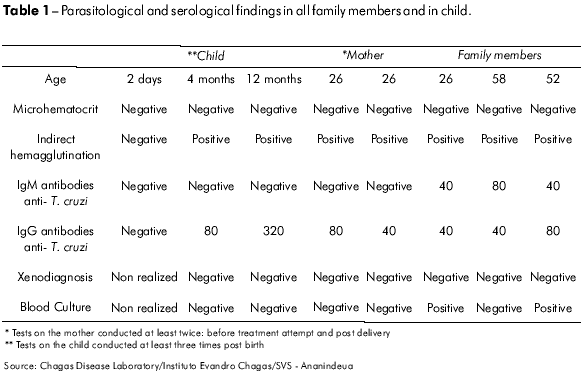
<body><![CDATA[<p>&nbsp;</p>     <p><font size="3" face="verdana"><b>CASE PRESENTATION </b></font></p>     <p><font size="2" face="verdana"> A family of four, including a young couple (male, 26 years old, and female,  24 years old) and her parents (52 and 56 years old) presented to Instituto  Evandro Chagas (IEC), seeking a cure for their prolonged febrile illness. This  disease appeared simultaneously in all four family members and was of  approximately 18 days' duration. Diagnostics were conducted by two serological  and three parasitological tests. Parasitological (positive <i>T.  cruzi</i> blood culture  in two of the patients), clinical and serological findings confirmed an acute  Chagas disease outbreak  in this family (<a href="#t1">Table  1</a>).</font></p>     <p><a name="t1"></a></p>     <p>&nbsp;</p>     <p align="center"><img src="/img/revistas/rpas/v2n1/1a12t1.gif" border="0"></p>     <p>&nbsp;</p>     <p><font size="2" face="verdana"> Epidemiologic investigation did not find  vectors associated with transmission in this family outbreak. In addition, the  occurrence in an urban area and the almost simultaneous onset of symptoms in  all four patients suggest an association between illness and a food (a&ccedil;a&iacute; juice) ingested by all  four familiy members, which is not  further discussed in this paper.</font></p>     <p><font size="2" face="verdana"> All patients received daily doses of  benznidazole in January of 2007. The young woman  showed serious drug intolerance with nausea, vomiting,  abdominal pain and dizziness. Therefore, her treatment was interrupted due to  suspected pregnancy (amenorrhea) and she experienced a spontaneous remission of  symptoms. A pregnancy of 12 weeks' gestational age was confirmed, and  the patient was followed clinically throughout the pregnancy. The patient's IgG  anti-<i>T. cruzi</i> tests were consistently positive by Indirect Hemagglutination  assay (IHA) and Indirect Immunofluorescent Assay Test (IFAT). Her serial  parasitological tests (3) showed negative results. Throughout the pregnancy, the  patient had no symptoms of Chagas disease. A morphological ultrasonograph from  the 29<sup>th</sup> week of pregnancy showed no abnormalities.</font></p>     <p><font size="2" face="verdana"> The female child was born prematurely (34  weeks) on Apr. 18 2007, by cesarean section, <a>with a low birth weight (1850  grs), jaundice and signs of respiratory distress syndrome (RDS), </a>requiring  intensive care. While in intensive care, she was  diagnosed with bacterial pneumonia. Two days after birth, the newborn was  submitted to parasitological and serological exams to detect <i>T. cruzi</i> infection  by thick blood film, IFAT and IH. All of these test results were negative  (<a href="#t1">Table 1</a>). </font></p>     ]]></body>
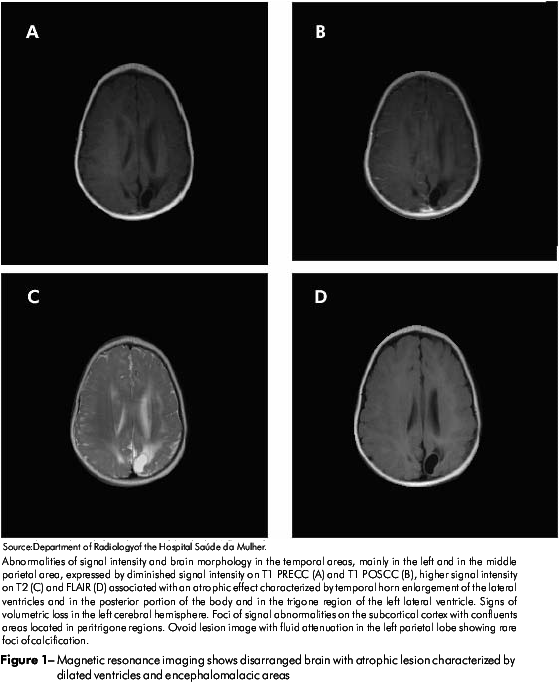
<body><![CDATA[<p><font size="2" face="verdana"> The newborn recovered after three weeks and showed  no alterations up to the fourth month of life. During a routine visit to our  laboratory when the child had reached four months of age, we observed convergent  strabismus and delayed psychomotor development (the child could not support her  head). On physical examination, microcephaly and closed bregmatic suture were  observed. Hematological parameters showed hemoglobin levels of 9.7 g%. </font></p>     <p><font size="2" face="verdana"> During this period, results of the search for <i>T.  cruzi</i> in peripheral blood by the microhematocrit method, blood culture for<i> T. cruzi,</i> and indirect xenodiagnosis remained negative; however, we  observed serological positive conversion by IH and IFAT (IgG anti &ndash; <i>T. cruzi</i>:  80). <a href="#t1">Table 1</a> shows all results from the mother and child at different times and  the results from all persons studied in the course of this outbreak during the  acute phase of Chagas disease. In order to evaluate other possible agents  of congenital infection, a serologic study was conducted to detect the  following: toxoplasmosis (IFAT); cytomegalovirs by the ELISA method; syphilis  by the VDRL and FTA-Abs methods and rubella by the ELISA method. The results for  all of these tests were negative in both mother and child, except for the test  for IgG antibodies to cytomegalovirosis, which was positive in the mother.</font></p>     <p><font size="2" face="verdana">  <a>Magnetic resonance imaging showed abnormalities in the brain  with atrophic lesions characterized by dilated ventricules and encephalomalacia  areas, suggesting intracranial calcifications as well as cystic lesions </a>(<a href="#f1">Figure 1</a>).</font></p>     <p><a name="f1"></a></p>     <p>&nbsp;</p>     <p align="center"><img src="/img/revistas/rpas/v2n1/1a12f1.gif" border="0"></p>     <p>&nbsp;</p>     <p><font size="2" face="verdana"> The child was treated with benznidazole for 45 days and the case was reported to the Ananindeua  Municipality Health Department. At 12 months of age, she remains under  clinical observation. <a></a><a>Her mother was treated, and the side effects of  this treatment were rigorously controlled. The serological exams of both mother  and daughter remained positive</a>.</font></p>     <p>&nbsp;</p>     <p><b><span style="font-family:Verdana">DISCUSSION</span></b></p>     ]]></body>
<body><![CDATA[<p><font size="2" face="verdana">  Studies conducted in <i>T. cruzi-</i>endemic areas found a Chagas disease prevalence of  about 1% in pregnant women from Brazil,  4% to 6% in pregnant women from Argentina,  2% to 3% in pregnant women from Chile  and 12% in pregnant women from Bolivia<sup>5</sup>.  These rates are related to chronic maternal infection, in which the blood  levels of parasites are low (1 to 10%)<sup>6</sup>.   In contrast, during the acute phase, the blood parasite  levels are high and induce the host  immunological response. This state increases the risk of congenital infection<sup>7</sup>. However, the Brazilian Amazon is an area with  active transmission of <span style="font-size:10.0pt;font-family:Verdana">ACD</span> and underestimated rates of chagasic  infection<sup>8</sup>. These  occurrences of ACD outbreaks in urban areas probably free of vectors and  transmission by unusual form bring forward new epidemiological approaches to  the control strategies of this ancient disease. </font></p>     <p><font size="2" face="verdana">Moretti <i>et al.</i><a></a> (2005) described three pregnant women with <span style="font-size:10.0pt;font-family:Verdana">ACD</span> in Argentina. Two  of them were infected during the third trimester and had uninfected newborns.  One of the women became infected during the second trimester and gave birth to  a sick child with hepatosplenomegaly<sup>9</sup>.  As with any infection with the potential for vertical transmission, early  pregnancy is associated with a high risk of infection. In this case, the  mother's infection during the first trimester may have been a determinant of  the child's infection and serious neurological involvement.</font></p>     <p><font size="2" face="verdana"> Studies carried out in Argentina, Bolivia,  Paraguay and Brazil  describe clinical spectra of congenital infection as well as asymptomatic to  symptomatic forms. In symptomatic forms the clinical signs vary from mild to  severe symptoms: premature births, low birth weight, hepatomegaly,  splenomegaly, neurologic signs, jaundice, anemia, anasarca and RDS are commonly described<sup>10,11,12,13</sup>.  In the child of the Amazon, the main  clinical features were jaundice, anemia and RDS; however, low neurological  development with intracranial calcifications is rarely described in congenital  Chagas disease. <a></a><a>Only one report from </a>La Paz, Bol&iacute;via  is similar to the one described here<sup>14</sup>.  On the other hand, another series of cases in Argentina shows  that 64.8% of children lacked clinical signs and the hepatomegaly was the main  clinical sign in symptomatic children<sup>12</sup>.&nbsp;&nbsp;&nbsp; </font></p>     <p><font size="2" face="verdana">We were unable to find parasites in the child's  peripheral blood at any point during the follow-up. The diagnosis was  accomplished by serological conversion tests, epidemiological data (data  related to mother-to-child transmission from a mother with ACD)  and clinical findings. The sensibility of  parasitological tests is reduced in congenital cases due to low parasitaemias  and the diagnosis is frequently realized by serology. Thus, the clinical  follow-up of a child plays an important role in diagnosis and, subsequently, in  the potential response (negative serology) to treatment.</font></p>     <p><font size="2" face="verdana"> Rigorous control of ACD in  pregnant women and their newborns from high-risk areas of the Amazon during the  prenatal and perinatal periods poses an important challenge to public health surveillance  systems. Mothers with positive serological reactions should, together with their  newborns, undergo direct <a></a><a>parasitological exams by microhematocrit  immediately after birth. In addition, these children must be followed at least  up to nine months of age</a>. In Brazil,  the consensus of experts reinforces the serological screening of pregnants and  follow-up of children born from chagasic mothers<sup>15,16</sup>.  Nevertheless, this important recommendation is frequently neglected in Brazil and in  most of the endemic countries. </font></p>     <p><font size="2" face="verdana">The second challenge in the control of Chagas  disease is the revision of treatment protocols for administering benznidazole  to pregnant women with ACD. Pregnant women may need close, individualized care  to use benznidazole safely<sup>17</sup>. We  suggest that, especially after the twenty-fourth week of pregnancy (when the  potential drug harm to fetus is diminished), the indication for benznidazole  could be discussed with the mother. Mainly, the development of effective drugs  with minimal side effects must be a priority of Public Health Systems in areas  with active foci of Chagas disease transmission.</font></p>     <p><font size="2" face="verdana"> Moreover, all efforts should be made to strengthen the health  surveillance systems to Chagas disease in Brazil. Therefore, capability of  human resources is the main control strategy to enhance the quality of  laboratory diagnosis and to improve the sensibility of clinical suspicion at  individual primary care level, as well as to prepare specialized personnel with  sustainable performance  to understand the complexity of transmission cycles  components of this ancient public health problem in Brazil, but emerging in  Amazon region.</font></p>     <p>&nbsp;</p>     <p><font size="3" face="verdana"><b><span style="font-family:Verdana">CONCLUSIONS</span></b></font></p>     <p><font size="2" face="verdana"> In pregnant women with ACD,  there is an increased risk of disease transmission to the fetus compared to  mothers with chronic infection. In addition, the potential for irreversible  lesions in the newborns as a result of this vertical transmission (as found in  this report), suggests that it is necessary to revise policy recommendations on  the use of trypanocidal drugs in these  cases.</font></p>     ]]></body>
<body><![CDATA[<p>&nbsp;</p>     <p><font size="3" face="verdana"><b>ACKNOWLEDGMENTS</b></font></p>     <p><font size="2" face="verdana">we thank Francelino de Almeida Ara&uacute;jo J&uacute;nior  from Sa&uacute;de da Mulher Hospital, Bel&eacute;m, for RM images.</font></p>     <p>&nbsp;</p>     <p><font size="2" face="verdana"> <b><font size="3">FINANCIAL SUPPORT</font></b></font></p>     <p><font size="2" face="verdana"> Instituto Evandro Chagas and  UNESCO </font></p>     <p>&nbsp;</p>     <p><font face="verdana"><b><font size="3">REFER&Ecirc;NCIAS</font></b></font></p>     <!-- ref --><p><font face="verdana"><font size="2"> 1 Ostermayer AL,  Passos ADC, Silveira AC, Ferreria AW, Macedo V, Prata A. O inqu&eacute;rito nacional  de soropreval&ecirc;ncia de avalia&ccedil;&atilde;o do controle da doen&ccedil;a de Chagas no Brasil  (2001-2008). Rev Soc Bras Med Trop. 2011;44 Suppl 2:S108-21. &#91;<a href="http://www.scielo.br/pdf/rsbmt/v44s2/a15v44s2.pdf" target="_blank">Link</a>&#93; </font></font><!-- ref --><p><font face="verdana"><font size="2"> 2 Coura JR, Junqueira AC, Fernandes O, Valente SA, Miles MA. Emerging Chagas disease  in Amazonian Brazil. Trends Parasitol. 2002 Apr;18(4):171-6. Doi:doi:10.1016/S1471-4922(01)02200-0 &#91;<a href="http://www.sciencedirect.com/science/article/pii/S1471492201022000" target="_blank">Link</a>&#93; </font></font><!-- ref --><p><font face="verdana"><font size="2"> 3 Pinto AYN, Ferreira Jr AG, Valente VC, Harada GS, Valente  SAS. Urban Outbreak of Emerging acute Trypanosomiasis in Brazilian Amazon: 4-year  follow-up post treatment with benznidazol. Rev Panam Salud Publica. 2009 Jan;25(1):77-83. </font></font><!-- ref --><p><font face="verdana"><font size="2"> 4 Valente SA,  Valente VC, Pinto AYN. Epidemiologia e transmiss&atilde;o oral da doen&ccedil;a de Chagas na  Amaz&ocirc;nia brasileira. In: Organizaci&oacute;n Panamericana de la Salud. Organizaci&oacute;n  Mundial de la Salud.   Unidad. Informe de la consulta t&eacute;cnica en Epidemiolog&iacute;a,  Prevenci&oacute;n y Manejo de la   Transmisi&oacute;n de la Enfermedad de Chagas como Enfermedad Transmitida  por Alimentos. Rio de Janeiro: OPS/OMS;  2006. p. 21-6. &#91;<a href="http://bvs1.panaftosa.org.br/local/file/textoc/informe_eta.pdf" target="_blank">Link</a>&#93; </font></font><!-- ref --><p><font face="verdana"><font size="2"> 5 Schmunis GA. A  Tripanosom&iacute;ase Americana e seu impacto na Sa&uacute;de P&uacute;blica das Am&eacute;ricas. In:  Brener Z, Andrade ZA, Barral-Neto M, editors. <i>Trypanosoma cruzi</i> e Doen&ccedil;a  de Chagas. 2. ed. Rio de Janeiro: Guanabara Koogan; 2000. p. 1-15.</font></font><!-- ref --><p><font face="verdana"><font size="2"> 6 Bittencourt AL.  Transmiss&atilde;o vertical da doen&ccedil;a de Chagas. In: Brener Z, Andrade ZA, Barral-Neto  M, editors. <i>Trypanosoma cruzi</i> e doen&ccedil;a de Chagas. 2. ed. Rio de Janeiro: Guanabara  Koogan; 2000. p. 16-20.</font></font><!-- ref --><p><font face="verdana"><font size="2"> 7 Hermann E, Truyens C, Alonso-Vega C, Rodriguez P, Berthe A, Torrico F,  et al. Congenital  transmission of <i>Trypanosoma cruzi</i> is associated with maternal enhanced  parasitemia and decreased production of interferon- gamma in response to parasite antigens. J Infect Dis. 2004 Apr;189(7):1274-81. &#91;<a href="http://jid.oxfordjournals.org/content/189/7/1274.full.pdf+html" target="_blank">Link</a>&#93; </font></font><!-- ref --><p><font face="verdana"><font size="2"> 8 Organiza&ccedil;&atilde;o Pan Americana da Sa&uacute;de<b>. </b>Guia para vigil&acirc;ncia, preven&ccedil;&atilde;o, controle e manejo cl&iacute;nico da doen&ccedil;a de  Chagas aguda transmitida por alimentos. Rio de Janeiro: PANAFTOSA-VP/OPAS/OMS;  2009. p. 92. (Serie de Manuais T&eacute;cnicos, 12). &#91;<a href="http://bvs.panalimentos.org/local/File/Guia_Doenca_Chagas_2009.pdf" target="_blank">Link</a>&#93;</font></font><!-- ref --><p><font size="2" face="verdana">9 Moretti E, Basso B, Castro I, Carrizo Paez M, Chaul M, Barbieri G, et al. Chagas disease: study of  congenital transmission in cases of acute maternal&nbsp; infection. Rev Soc Bras Med Trop. 2005  <span style="font-size:10.0pt;font-family:Verdana">Jan-Feb</span>;38(1):53-5. &#91;<a href="http://www.scielo.br/pdf/rsbmt/v38n1/22773.pdf" target="_blank">Link</a>&#93;</font><!-- ref --><p><font size="2" face="verdana"> 10 Torrico F, Alonso-Vega C, Suarez E, Rodr&iacute;guez P, Torrico MC, Dramaix M, et al. &#91;Endemic level of congenital <i>Trypanosoma  cruzi</i> infection in the areas of maternal residence and the development of  congenital Chagas disease in Bolivia&#93;. Rev Soc  Bras Med Trop. 2005;38 Suppl 2:17-20. &#91;<a href="http://www.ncbi.nlm.nih.gov/pubmed/16482806" target="_blank">Link</a>&#93;</font><!-- ref --><p><font size="2" face="verdana"> 11&nbsp; Negrette OS, Mora MC, Basombrio MA. High prevalence of  Congenital <i>Trypanosoma cruzi </i>infection and family clustering in Salta, Argentina.  Pediatrics 2005 Jun; 115(6):668-72. &#91;<a href="http://pediatrics.aappublications.org/content/115/6/e668.long" target="_blank">Link</a>&#93; </font><!-- ref --><p><font size="2" face="verdana"> 12&nbsp; Freilij H, Altched J. Congenital Chagas' disease: diagnostic  and clinical aspects. Clin Infect Dis. 1995 Sep;21(3):551-5. &#91;<a href="http://www.ncbi.nlm.nih.gov/pubmed/8527542" target="_blank">Link</a>&#93; </font><!-- ref --><p><font size="2" face="verdana"> 13&nbsp; G&uuml;rtler ER, Segura E, Cohen J. Congenital transmission  of <i>Trypanosoma cruzi</i> infection in Argentina. Emerg Inf dis. 2003 Jan;9(1):29-32. &#91;<a href="http://www.cdc.gov/ncidod/eid/vol9no1/pdfs/02-0274.pdf" target="_blank">Link</a>&#93;</font><!-- ref --><p><font size="2" face="verdana"> 14&nbsp; Pehrson P, Walgren M, Bengstsson E. Intracranial  calcifications probably due to congenital chagas disease. Am J Trop Med Hyg. 1982 May;31(3):449-51. </font><!-- ref --><p><font size="2" face="verdana"> 15&nbsp; Minist&eacute;rio da Sa&uacute;de (BR). Secretaria de Vigil&acirc;ncia em Sa&uacute;de. Consenso   Brasileiro em Doen&ccedil;a de Chagas. Rev Soc Bras Med Trop.  2005;38 Suppl 3:S30.&#91;<a href="http://portal.saude.gov.br/portal/arquivos/pdf/consenso_chagas.pdf" target="_blank">Link</a>&#93;</font><!-- ref --><p><font size="2" face="verdana"> 16&nbsp; Gontijo ED, Andrade GMQ, Santos SE, Galv&atilde; LMC, Moreira EF, Pinto FS, et  al. Triagem neonatal da infec&ccedil;&atilde;o pelo <i>Trypanosoma cruzi </i>em Minas Gerais, Brasil:  transmiss&atilde;o cong&ecirc;nita e mapeamento das &aacute;reas end&ecirc;micas. Epidemiol Serv Sa&uacute;de.  2009 jul-set;18(3):243-54. &#91;<a href="http://scielo.iec.pa.gov.br/pdf/ess/v18n3/v18n3a07.pdf" target="_blank">Link</a>&#93;</font><!-- ref --><p><font size="2" face="verdana"> 17&nbsp; Bittencourt AL. Actual  aspects and epidemiological significance of congenital transmission of Chagas'  disease. Mem Inst Oswaldo Cruz. 1984;79 Suppl:133-7. &#91;<a href="http://www.scielo.br/pdf/mioc/v79s0/vol79(fsup)_133-137.pdf" target="_blank">Link</a>&#93; </font><p>&nbsp;</p>     <p>&nbsp;</p>     <p><font size="2" face="Verdana"><b><a name="endereco" id="endereco"></a><a href="#topo"><img src="/img/revistas/rpas/v1n4/seta.gif" border="0" /></a></b></font><font size="2" face="verdana"><b></b></font><font size="2" face="verdana"><b>Correspondence / Correspond&ecirc;ncia / Correspondencia:</b>    <br> </font><font size="2" face="verdana">   Ana Yec&ecirc; das Neves Pinto,    <br>   Setor M&eacute;dico Unificado (SOAMU)/Epidemiologia,    ]]></body>
<body><![CDATA[<br>   Instituto Evandro Chagas/SVS/MS    <br>   BR 316 Km  7 s/n,    <br>   ZIP code: 67030-070, Ananindeua/PA    <br>   Phone &ndash;  FAX number: 91 32142189    <br>   E.mail:<a href="mailto:ayece@iec.pa.gov.br">ayece@iec.pa.gov.br</a></font></p>     <p><font size="2" face="verdana">Recebido em / Received / Recibido en: 10/5/2011    <br>   Aceito em / Accepted / Aceito en: 18/7/2011</font></p>   <script type="text/javascript"> var gaJsHost = (("https:" == document.location.protocol) ? "https://ssl." : "http://www."); document.write(unescape("%3Cscript src='" + gaJsHost + "google-analytics.com/ga.js' type='text/javascript'%3E%3C/script%3E")); </script> <script type="text/javascript"> try { var pageTracker = _gat._getTracker("UA-7885746-4"); pageTracker._setDomainName("none"); pageTracker._setAllowLinker(true); pageTracker._trackPageview(); } catch(err) {}</script>      ]]></body><back>
<ref-list>
<ref id="B1">
<label>1</label><nlm-citation citation-type="journal">
<person-group person-group-type="author">
<name>
<surname><![CDATA[Ostermayer]]></surname>
<given-names><![CDATA[AL]]></given-names>
</name>
<name>
<surname><![CDATA[Passos]]></surname>
<given-names><![CDATA[ADC]]></given-names>
</name>
<name>
<surname><![CDATA[Silveira]]></surname>
<given-names><![CDATA[AC]]></given-names>
</name>
<name>
<surname><![CDATA[Ferreria]]></surname>
<given-names><![CDATA[AW]]></given-names>
</name>
<name>
<surname><![CDATA[Macedo]]></surname>
<given-names><![CDATA[V]]></given-names>
</name>
<name>
<surname><![CDATA[Prata]]></surname>
<given-names><![CDATA[A]]></given-names>
</name>
</person-group>
<article-title xml:lang="pt"><![CDATA[O inquérito nacional de soroprevalência de avaliação do controle da doença de Chagas no Brasil (2001-2008)]]></article-title>
<source><![CDATA[Rev Soc Bras Med Trop]]></source>
<year>2011</year>
<volume>44</volume>
<numero>^s2</numero>
<issue>^s2</issue>
<supplement>2</supplement>
<page-range>108-21</page-range></nlm-citation>
</ref>
<ref id="B2">
<label>2</label><nlm-citation citation-type="journal">
<person-group person-group-type="author">
<name>
<surname><![CDATA[Coura]]></surname>
<given-names><![CDATA[JR]]></given-names>
</name>
<name>
<surname><![CDATA[Junqueira]]></surname>
<given-names><![CDATA[AC]]></given-names>
</name>
<name>
<surname><![CDATA[Fernandes]]></surname>
<given-names><![CDATA[O]]></given-names>
</name>
<name>
<surname><![CDATA[Valente]]></surname>
<given-names><![CDATA[SA]]></given-names>
</name>
<name>
<surname><![CDATA[Miles]]></surname>
<given-names><![CDATA[MA]]></given-names>
</name>
</person-group>
<article-title xml:lang="en"><![CDATA[Emerging Chagas disease in Amazonian Brazil]]></article-title>
<source><![CDATA[Trends Parasitol]]></source>
<year>2002</year>
<month> A</month>
<day>pr</day>
<volume>18</volume>
<numero>4</numero>
<issue>4</issue>
<page-range>171-6</page-range></nlm-citation>
</ref>
<ref id="B3">
<label>3</label><nlm-citation citation-type="journal">
<person-group person-group-type="author">
<name>
<surname><![CDATA[Pinto]]></surname>
<given-names><![CDATA[AYN]]></given-names>
</name>
<name>
<surname><![CDATA[Ferreira Jr]]></surname>
<given-names><![CDATA[AG]]></given-names>
</name>
<name>
<surname><![CDATA[Valente]]></surname>
<given-names><![CDATA[VC]]></given-names>
</name>
<name>
<surname><![CDATA[Harada]]></surname>
<given-names><![CDATA[GS]]></given-names>
</name>
<name>
<surname><![CDATA[Valente]]></surname>
<given-names><![CDATA[SAS]]></given-names>
</name>
</person-group>
<article-title xml:lang="en"><![CDATA[Urban Outbreak of Emerging acute Trypanosomiasis in Brazilian Amazon: 4-year follow-up post treatment with benznidazol]]></article-title>
<source><![CDATA[Rev Panam Salud Publica]]></source>
<year>2009</year>
<month> J</month>
<day>an</day>
<volume>25</volume>
<numero>1</numero>
<issue>1</issue>
<page-range>77-83</page-range></nlm-citation>
</ref>
<ref id="B4">
<label>4</label><nlm-citation citation-type="book">
<person-group person-group-type="author">
<name>
<surname><![CDATA[Valente]]></surname>
<given-names><![CDATA[SA]]></given-names>
</name>
<name>
<surname><![CDATA[Valente]]></surname>
<given-names><![CDATA[VC]]></given-names>
</name>
<name>
<surname><![CDATA[Pinto]]></surname>
<given-names><![CDATA[AYN]]></given-names>
</name>
</person-group>
<article-title xml:lang="pt"><![CDATA[Epidemiologia e transmissão oral da doença de Chagas na Amazônia brasileira]]></article-title>
<collab>Organización Panamericana de la Salud^dOrganización Mundial de la Salud</collab>
<source><![CDATA[Unidad: Informe de la consulta técnica en Epidemiología, Prevención y Manejo de la Transmisión de la Enfermedad de Chagas como Enfermedad Transmitida por Alimentos]]></source>
<year>2006</year>
<page-range>21-6</page-range><publisher-loc><![CDATA[Rio de Janeiro ]]></publisher-loc>
<publisher-name><![CDATA[OPS/OMS]]></publisher-name>
</nlm-citation>
</ref>
<ref id="B5">
<label>5</label><nlm-citation citation-type="book">
<person-group person-group-type="author">
<name>
<surname><![CDATA[Schmunis]]></surname>
<given-names><![CDATA[GA]]></given-names>
</name>
</person-group>
<article-title xml:lang="pt"><![CDATA[A Tripanosomíase Americana e seu impacto na Saúde Pública das Américas]]></article-title>
<person-group person-group-type="editor">
<name>
<surname><![CDATA[Brener]]></surname>
<given-names><![CDATA[Z]]></given-names>
</name>
<name>
<surname><![CDATA[Andrade]]></surname>
<given-names><![CDATA[ZA]]></given-names>
</name>
<name>
<surname><![CDATA[Barral-Neto]]></surname>
<given-names><![CDATA[M]]></given-names>
</name>
</person-group>
<source><![CDATA[Trypanosoma cruzi e Doença de Chagas]]></source>
<year>2000</year>
<edition>2</edition>
<page-range>1-15</page-range><publisher-loc><![CDATA[Rio de Janeiro ]]></publisher-loc>
<publisher-name><![CDATA[Guanabara Koogan]]></publisher-name>
</nlm-citation>
</ref>
<ref id="B6">
<label>6</label><nlm-citation citation-type="book">
<person-group person-group-type="author">
<name>
<surname><![CDATA[Bittencourt]]></surname>
<given-names><![CDATA[AL]]></given-names>
</name>
</person-group>
<article-title xml:lang="pt"><![CDATA[Transmissão vertical da doença de Chagas]]></article-title>
<person-group person-group-type="editor">
<name>
<surname><![CDATA[Brener]]></surname>
<given-names><![CDATA[Z]]></given-names>
</name>
<name>
<surname><![CDATA[Andrade]]></surname>
<given-names><![CDATA[ZA]]></given-names>
</name>
<name>
<surname><![CDATA[Barral-Neto]]></surname>
<given-names><![CDATA[M]]></given-names>
</name>
</person-group>
<source><![CDATA[Trypanosoma cruzi e doença de Chagas]]></source>
<year>2000</year>
<edition>2</edition>
<page-range>16-20</page-range><publisher-loc><![CDATA[Rio de Janeiro ]]></publisher-loc>
<publisher-name><![CDATA[Guanabara Koogan]]></publisher-name>
</nlm-citation>
</ref>
<ref id="B7">
<label>7</label><nlm-citation citation-type="journal">
<person-group person-group-type="author">
<name>
<surname><![CDATA[Hermann]]></surname>
<given-names><![CDATA[E]]></given-names>
</name>
<name>
<surname><![CDATA[Truyens]]></surname>
<given-names><![CDATA[C]]></given-names>
</name>
<name>
<surname><![CDATA[Alonso-Vega]]></surname>
<given-names><![CDATA[C]]></given-names>
</name>
<name>
<surname><![CDATA[Rodriguez]]></surname>
<given-names><![CDATA[P]]></given-names>
</name>
<name>
<surname><![CDATA[Berthe]]></surname>
<given-names><![CDATA[A]]></given-names>
</name>
<name>
<surname><![CDATA[Torrico]]></surname>
<given-names><![CDATA[F]]></given-names>
</name>
</person-group>
<article-title xml:lang="en"><![CDATA[Congenital transmission of Trypanosoma cruzi is associated with maternal enhanced parasitemia and decreased production of interferon- gamma in response to parasite antigens]]></article-title>
<source><![CDATA[J Infect Dis]]></source>
<year>2004</year>
<month> A</month>
<day>pr</day>
<volume>189</volume>
<numero>7</numero>
<issue>7</issue>
<page-range>1274-81</page-range></nlm-citation>
</ref>
<ref id="B8">
<label>8</label><nlm-citation citation-type="book">
<collab>Organização Pan Americana da Saúde</collab>
<source><![CDATA[Guia para vigilância, prevenção, controle e manejo clínico da doença de Chagas aguda transmitida por alimentos]]></source>
<year>2009</year>
<page-range>92</page-range><publisher-loc><![CDATA[Rio de Janeiro ]]></publisher-loc>
<publisher-name><![CDATA[PANAFTOSA-VP/OPAS/OMS]]></publisher-name>
</nlm-citation>
</ref>
<ref id="B9">
<label>9</label><nlm-citation citation-type="journal">
<person-group person-group-type="author">
<name>
<surname><![CDATA[Moretti]]></surname>
<given-names><![CDATA[E]]></given-names>
</name>
<name>
<surname><![CDATA[Basso]]></surname>
<given-names><![CDATA[B]]></given-names>
</name>
<name>
<surname><![CDATA[Castro]]></surname>
<given-names><![CDATA[I]]></given-names>
</name>
<name>
<surname><![CDATA[Carrizo Paez]]></surname>
<given-names><![CDATA[M]]></given-names>
</name>
<name>
<surname><![CDATA[Chaul]]></surname>
<given-names><![CDATA[M]]></given-names>
</name>
<name>
<surname><![CDATA[Barbieri]]></surname>
<given-names><![CDATA[G]]></given-names>
</name>
</person-group>
<article-title xml:lang="en"><![CDATA[Chagas disease: study of congenital transmission in cases of acute maternal infection]]></article-title>
<source><![CDATA[Rev Soc Bras Med Trop]]></source>
<year>2005</year>
<month> J</month>
<day>an</day>
<volume>38</volume>
<numero>1</numero>
<issue>1</issue>
<page-range>53-5</page-range></nlm-citation>
</ref>
<ref id="B10">
<label>10</label><nlm-citation citation-type="journal">
<person-group person-group-type="author">
<name>
<surname><![CDATA[Torrico]]></surname>
<given-names><![CDATA[F]]></given-names>
</name>
<name>
<surname><![CDATA[Alonso-Vega]]></surname>
<given-names><![CDATA[C]]></given-names>
</name>
<name>
<surname><![CDATA[Suarez]]></surname>
<given-names><![CDATA[E]]></given-names>
</name>
<name>
<surname><![CDATA[Rodríguez]]></surname>
<given-names><![CDATA[P]]></given-names>
</name>
<name>
<surname><![CDATA[Torrico]]></surname>
<given-names><![CDATA[MC]]></given-names>
</name>
<name>
<surname><![CDATA[Dramaix]]></surname>
<given-names><![CDATA[M]]></given-names>
</name>
</person-group>
<article-title xml:lang="en"><![CDATA[[Endemic level of congenital Trypanosoma cruzi infection in the areas of maternal residence and the development of congenital Chagas disease in Bolivia]]]></article-title>
<source><![CDATA[Rev Soc Bras Med Trop]]></source>
<year>2005</year>
<volume>38</volume>
<numero>^s2</numero>
<issue>^s2</issue>
<supplement>2</supplement>
<page-range>17-20</page-range></nlm-citation>
</ref>
<ref id="B11">
<label>11</label><nlm-citation citation-type="journal">
<person-group person-group-type="author">
<name>
<surname><![CDATA[Negrette]]></surname>
<given-names><![CDATA[OS]]></given-names>
</name>
<name>
<surname><![CDATA[Mora]]></surname>
<given-names><![CDATA[MC]]></given-names>
</name>
<name>
<surname><![CDATA[Basombrio]]></surname>
<given-names><![CDATA[MA]]></given-names>
</name>
</person-group>
<article-title xml:lang="en"><![CDATA[High prevalence of Congenital Trypanosoma cruzi infection and family clustering in Salta, Argentina]]></article-title>
<source><![CDATA[Pediatrics]]></source>
<year>2005</year>
<month> J</month>
<day>un</day>
<volume>115</volume>
<numero>6</numero>
<issue>6</issue>
<page-range>668-72</page-range></nlm-citation>
</ref>
<ref id="B12">
<label>12</label><nlm-citation citation-type="journal">
<person-group person-group-type="author">
<name>
<surname><![CDATA[Freilij]]></surname>
<given-names><![CDATA[H]]></given-names>
</name>
<name>
<surname><![CDATA[Altched]]></surname>
<given-names><![CDATA[J]]></given-names>
</name>
</person-group>
<article-title xml:lang="en"><![CDATA[Congenital Chagas' disease: diagnostic and clinical aspects]]></article-title>
<source><![CDATA[Clin Infect Dis]]></source>
<year>1995</year>
<month> S</month>
<day>ep</day>
<volume>21</volume>
<numero>3</numero>
<issue>3</issue>
<page-range>551-5</page-range></nlm-citation>
</ref>
<ref id="B13">
<label>13</label><nlm-citation citation-type="journal">
<person-group person-group-type="author">
<name>
<surname><![CDATA[Gürtler]]></surname>
<given-names><![CDATA[ER]]></given-names>
</name>
<name>
<surname><![CDATA[Segura]]></surname>
<given-names><![CDATA[E]]></given-names>
</name>
<name>
<surname><![CDATA[Cohen]]></surname>
<given-names><![CDATA[J]]></given-names>
</name>
</person-group>
<article-title xml:lang="en"><![CDATA[Congenital transmission of Trypanosoma cruzi infection in Argentina]]></article-title>
<source><![CDATA[Emerg Inf dis]]></source>
<year>2003</year>
<month> J</month>
<day>an</day>
<volume>9</volume>
<numero>1</numero>
<issue>1</issue>
<page-range>29-32</page-range></nlm-citation>
</ref>
<ref id="B14">
<label>14</label><nlm-citation citation-type="journal">
<person-group person-group-type="author">
<name>
<surname><![CDATA[Pehrson]]></surname>
<given-names><![CDATA[P]]></given-names>
</name>
<name>
<surname><![CDATA[Walgren]]></surname>
<given-names><![CDATA[M]]></given-names>
</name>
<name>
<surname><![CDATA[Bengstsson]]></surname>
<given-names><![CDATA[E]]></given-names>
</name>
</person-group>
<article-title xml:lang="en"><![CDATA[Intracranial calcifications probably due to congenital chagas disease]]></article-title>
<source><![CDATA[Am J Trop Med Hyg]]></source>
<year>1982</year>
<month> M</month>
<day>ay</day>
<volume>31</volume>
<numero>3</numero>
<issue>3</issue>
<page-range>449-51</page-range></nlm-citation>
</ref>
<ref id="B15">
<label>15</label><nlm-citation citation-type="journal">
<collab>Ministério da Saúde</collab>
<article-title xml:lang="pt"><![CDATA[Secretaria de Vigilância em Saúde. Consenso Brasileiro em Doença de Chagas]]></article-title>
<source><![CDATA[Rev Soc Bras Med Trop]]></source>
<year>2005</year>
<volume>38</volume>
<numero>^s3</numero>
<issue>^s3</issue>
<supplement>3</supplement>
<page-range>30</page-range></nlm-citation>
</ref>
<ref id="B16">
<label>16</label><nlm-citation citation-type="journal">
<person-group person-group-type="author">
<name>
<surname><![CDATA[Gontijo]]></surname>
<given-names><![CDATA[ED]]></given-names>
</name>
<name>
<surname><![CDATA[Andrade]]></surname>
<given-names><![CDATA[GMQ]]></given-names>
</name>
<name>
<surname><![CDATA[Santos]]></surname>
<given-names><![CDATA[SE]]></given-names>
</name>
<name>
<surname><![CDATA[Galvã]]></surname>
<given-names><![CDATA[LMC]]></given-names>
</name>
<name>
<surname><![CDATA[Moreira]]></surname>
<given-names><![CDATA[EF]]></given-names>
</name>
<name>
<surname><![CDATA[Pinto]]></surname>
<given-names><![CDATA[FS]]></given-names>
</name>
</person-group>
<article-title xml:lang="pt"><![CDATA[Triagem neonatal da infecção pelo Trypanosoma cruzi em Minas Gerais, Brasil: transmissão congênita e mapeamento das áreas endêmicas]]></article-title>
<source><![CDATA[Epidemiol Serv Saúde]]></source>
<year>2009</year>
<month> j</month>
<day>ul</day>
<volume>18</volume>
<numero>3</numero>
<issue>3</issue>
<page-range>243-54</page-range></nlm-citation>
</ref>
<ref id="B17">
<label>17</label><nlm-citation citation-type="journal">
<person-group person-group-type="author">
<name>
<surname><![CDATA[Bittencourt]]></surname>
<given-names><![CDATA[AL]]></given-names>
</name>
</person-group>
<article-title xml:lang="en"><![CDATA[Actual aspects and epidemiological significance of congenital transmission of Chagas' disease]]></article-title>
<source><![CDATA[Mem Inst Oswaldo Cruz]]></source>
<year>1984</year>
<volume>79</volume>
<page-range>133-7</page-range></nlm-citation>
</ref>
</ref-list>
</back>
</article>