<?xml version="1.0" encoding="ISO-8859-1"?><article xmlns:mml="http://www.w3.org/1998/Math/MathML" xmlns:xlink="http://www.w3.org/1999/xlink" xmlns:xsi="http://www.w3.org/2001/XMLSchema-instance">
<front>
<journal-meta>
<journal-id>2176-6223</journal-id>
<journal-title><![CDATA[Revista Pan-Amazônica de Saúde]]></journal-title>
<abbrev-journal-title><![CDATA[Rev Pan-Amaz Saude]]></abbrev-journal-title>
<issn>2176-6223</issn>
<publisher>
<publisher-name><![CDATA[Instituto Evandro Chagas. Secretaria de Vigilância em Saúde e Ambiente. Ministério da Saúde]]></publisher-name>
</publisher>
</journal-meta>
<article-meta>
<article-id>S2176-62232011000300008</article-id>
<article-id pub-id-type="doi">10.5123/S2176-62232011000300008</article-id>
<title-group>
<article-title xml:lang="en"><![CDATA[Detection of corona-like virus in a case of flaccid paraparesis in Belém, Pará State, Brazil]]></article-title>
<article-title xml:lang="pt"><![CDATA[Detecção de virus corona-like em um caso de paraparesia flácida em Belém, Estado do Pará, Brasil]]></article-title>
<article-title xml:lang="es"><![CDATA[Detección de virus corona-like en un caso de paraparesia flácida en Belém, Estado de Pará, Brasil]]></article-title>
</title-group>
<contrib-group>
<contrib contrib-type="author">
<name>
<surname><![CDATA[Bezerra]]></surname>
<given-names><![CDATA[Delana Andreza Melo]]></given-names>
</name>
<xref ref-type="aff" rid="A01"/>
</contrib>
<contrib contrib-type="author">
<name>
<surname><![CDATA[Diniz Júnior]]></surname>
<given-names><![CDATA[José Antonio Picanço]]></given-names>
</name>
<xref ref-type="aff" rid="A02"/>
</contrib>
<contrib contrib-type="author">
<name>
<surname><![CDATA[Ribeiro]]></surname>
<given-names><![CDATA[Nelson Antonio Bailão]]></given-names>
</name>
<xref ref-type="aff" rid="A03"/>
</contrib>
<contrib contrib-type="author">
<name>
<surname><![CDATA[Gomes]]></surname>
<given-names><![CDATA[Maria de Lourdes Contente]]></given-names>
</name>
<xref ref-type="aff" rid="A04"/>
</contrib>
<contrib contrib-type="author">
<name>
<surname><![CDATA[Linhares]]></surname>
<given-names><![CDATA[Alexandre da Costa]]></given-names>
</name>
<xref ref-type="aff" rid="A04"/>
</contrib>
<contrib contrib-type="author">
<name>
<surname><![CDATA[Wanzeller]]></surname>
<given-names><![CDATA[Ana Lucia Monteiro]]></given-names>
</name>
<xref ref-type="aff" rid="A04"/>
</contrib>
</contrib-group>
<aff id="A01">
<institution><![CDATA[,Universidade Federal do Pará Mestranda do Curso de Farmácia ]]></institution>
<addr-line><![CDATA[Belém ]]></addr-line>
<country>Brasil</country>
</aff>
<aff id="A02">
<institution><![CDATA[,Instituto Evandro Chagas/SVS/MS Unidade de Microscopia Eletrônica ]]></institution>
<addr-line><![CDATA[Belém Pará]]></addr-line>
<country>Brasil</country>
</aff>
<aff id="A03">
<institution><![CDATA[,Instituto Evandro Chagas/SVS/MS Unidade de Microscopia Eletrônica Seção de Arbovirologia e Febres Hemorrágicas]]></institution>
<addr-line><![CDATA[Belém Pará]]></addr-line>
<country>Brasil</country>
</aff>
<aff id="A04">
<institution><![CDATA[,Instituto Evandro Chagas/SVS/MS Unidade de Microscopia Eletrônica Seção de Arbovirologia e Febres Hemorrágicas]]></institution>
<addr-line><![CDATA[Ananindeua Pará]]></addr-line>
<country>Brasil</country>
</aff>
<pub-date pub-type="pub">
<day>00</day>
<month>09</month>
<year>2011</year>
</pub-date>
<pub-date pub-type="epub">
<day>00</day>
<month>09</month>
<year>2011</year>
</pub-date>
<volume>2</volume>
<numero>3</numero>
<fpage>59</fpage>
<lpage>62</lpage>
<copyright-statement/>
<copyright-year/>
<self-uri xlink:href="http://scielo.iec.gov.br/scielo.php?script=sci_arttext&amp;pid=S2176-62232011000300008&amp;lng=en&amp;nrm=iso"></self-uri><self-uri xlink:href="http://scielo.iec.gov.br/scielo.php?script=sci_abstract&amp;pid=S2176-62232011000300008&amp;lng=en&amp;nrm=iso"></self-uri><self-uri xlink:href="http://scielo.iec.gov.br/scielo.php?script=sci_pdf&amp;pid=S2176-62232011000300008&amp;lng=en&amp;nrm=iso"></self-uri><abstract abstract-type="short" xml:lang="en"><p><![CDATA[In this study, we analyzed a fecal sample of a female infant with paralysis and other clinical symptoms that resembled poliomyelitis. Negative staining electron microscopy showed viral particles with a diameter of approximately 120 nm and displaying a crown-like appearance with surface projections. Ultrathin sections showed particles budding from the membranes of the Golgi apparatus. Based on these results, we propose the association of this virus with the neurological disorder and tentatively assign it to the Coronaviridae family. Further studies are required on this proposed relationship.]]></p></abstract>
<abstract abstract-type="short" xml:lang="pt"><p><![CDATA[Neste estudo, analisamos uma amostra fecal de criança do sexo feminino com paralisia e outros sintomas clínicos que se assemelharam à poliomielite. A microscopia eletrônica (contrastação negativa) mostrou partículas com 120 nm de diâmetro, exibindo projeções na superfície semelhantes a uma coroa. Cortes ultrafinos mostraram partículas brotando do complexo de Golgi. Com base nesses resultados, propomos a associação deste vírus com o distúrbio neurológico e o associamos provisoriamente à família Coronaviridae. Estudos adicionais são necessários para esclarecer a relação proposta.]]></p></abstract>
<abstract abstract-type="short" xml:lang="es"><p><![CDATA[En este estudio, analizamos una muestra fecal de niña con parálisis y otros síntomas clínicos semejantes a la poliomielitis. La microscopia electrónica (por contraste negativo) mostró partículas con 120 nm de diámetro, exhibiendo proyecciones en la superficie semejantes a una corona. Cortes ultrafinos mostraron partículas brotando del complejo de Golgi. Con base en esos resultados, proponemos la asociación de este virus al disturbio neurológico y lo asociamos provisoriamente a la familia Coronaviridae. Se necesitan estudios adicionales para aclarar la relación propuesta.]]></p></abstract>
<kwd-group>
<kwd lng="en"><![CDATA[Coronaviridae]]></kwd>
<kwd lng="en"><![CDATA[Paraparesis]]></kwd>
<kwd lng="en"><![CDATA[Transmission Electron Microscopy]]></kwd>
<kwd lng="en"><![CDATA[Motor Disorders]]></kwd>
<kwd lng="pt"><![CDATA[Coronaviridae]]></kwd>
<kwd lng="pt"><![CDATA[Paraparesia]]></kwd>
<kwd lng="pt"><![CDATA[Microscopia Eletrônica de Transmissão]]></kwd>
<kwd lng="pt"><![CDATA[trastornos motores]]></kwd>
<kwd lng="es"><![CDATA[Coronaviridae]]></kwd>
<kwd lng="es"><![CDATA[Paraparesia]]></kwd>
<kwd lng="es"><![CDATA[Microscopía Electrónica de Transmisión]]></kwd>
<kwd lng="es"><![CDATA[trastornos motores]]></kwd>
</kwd-group>
</article-meta>
</front><body><![CDATA[ <p align="right"><font size="2" face="Verdana"><b>COMMUNICATION | COMUNICA&Ccedil;&Atilde;O | COMUNICACI&Oacute;N</b></font></p>     <p align="left"><font size="2" face="Verdana"><i>&nbsp;</i></font></p>     <p><font size="4" face="Verdana"><b><a name="topo"></a>Detection of corona-like virus in a case of  flaccid paraparesis in Bel&eacute;m, Par&aacute; State,   Brazil</b></font></p>     <p>&nbsp;</p>     <p><b><font size="3" face="Verdana">Detec&ccedil;&atilde;o de virus corona-like em um caso de paraparesia fl&aacute;cida em  Bel&eacute;m, Estado do Par&aacute;, Brasil</font></b></p>     <p>&nbsp;</p>     <p><font size="3"><b><font face="Verdana">Detecci&oacute;n de virus corona-like en un caso de paraparesia fl&aacute;cida  en Bel&eacute;m, Estado de Par&aacute;, Brasil</font></b></font></p>     <p>&nbsp;</p>     <p>&nbsp;</p>     <p><font size="2" face="Verdana"><b>Delana Andreza Melo Bezerra<sup>I</sup>; </b></font><font size="2"><b><font face="Verdana"></font></b></font><b><font size="2" face="Verdana">Jos&eacute; Antonio Pican&ccedil;o Diniz J&uacute;nior<sup>II</sup></font>; <font size="2" face="Verdana">Nelson Antonio Bail&atilde;o Ribeiro<sup>III</sup></font>; <font size="2" face="Verdana">Maria de Lourdes Contente Gomes<sup>IV</sup></font>; <font size="2" face="Verdana">Alexandre da Costa Linhares<sup>IV</sup></font>; <font size="2" face="Verdana">Ana Lucia Monteiro Wanzeller<sup>IV</sup></font></b></p>     ]]></body>
<body><![CDATA[<p><font size="2" face="Verdana"><sup>I</sup><i>Mestranda do Curso de Farm&aacute;cia, Universidade  Federal do Par&aacute;, Bel&eacute;m, Brasil</i></font>    <br> <font size="2" face="Verdana"><sup>II</sup><i>Unidade de Microscopia Eletr&ocirc;nica, Instituto  Evandro Chagas/SVS/MS, Bel&eacute;m, Par&aacute;, Brasil</i></font>    <br> <font size="2" face="Verdana"><sup>III</sup><i>Se&ccedil;&atilde;o de  Arbovirologia e Febres Hemorr&aacute;gicas, Instituto Evandro Chagas/SVS/MS, Bel&eacute;m,  Par&aacute;, Brasil</i></font>    <br> <font size="2" face="Verdana"><sup>IV</sup><i>Se&ccedil;&atilde;o de Virologia, Instituto Evandro Chagas/SVS/MS,  Ananindeua, Par&aacute;, Brasil</i></font></p>     <p><font size="2" face="Verdana"><a href="#endereco">Endere&ccedil;o para correspond&ecirc;ncia</a></font><font size="2" face="Verdana"><a href="#endereco">    <br> Correspondence    <br> Direcci&oacute;n para correspondencia</a></font></p>     <p>&nbsp;</p>     <p>&nbsp;</p> <hr size="1" noshade>     <p><font size="2" face="Verdana"><b>ABSTRACT</b></font></p>     ]]></body>
<body><![CDATA[<p><font size="2" face="Verdana">In this study, we analyzed a fecal sample of  a female infant with paralysis and other clinical symptoms that resembled  poliomyelitis. Negative staining electron microscopy showed viral particles  with a diameter of approximately 120 nm and displaying a crown-like appearance  with surface projections. Ultrathin sections showed particles budding from the  membranes of the Golgi apparatus. Based on these results, we propose the association  of this virus with the neurological disorder and tentatively assign it to the <i>Coronaviridae </i>family. Further studies are required on this proposed relationship.</font></p>     <p><font size="2" face="Verdana"><b>Keywords: </b><i>Coronaviridae; </i>Paraparesis; Transmission Electron Microscopy;  Motor Disorders.</font></p> <hr size="1" noshade>     <p><font size="2" face="Verdana"><b>RESUMO</b></font></p>     <p><font size="2" face="Verdana">Neste estudo,  analisamos uma amostra fecal de crian&ccedil;a do sexo feminino com paralisia e outros  sintomas cl&iacute;nicos que se assemelharam &agrave; poliomielite. A microscopia  eletr&ocirc;nica  (contrasta&ccedil;&atilde;o negativa) mostrou part&iacute;culas com 120 nm de di&acirc;metro, exibindo  proje&ccedil;&otilde;es na superf&iacute;cie semelhantes a uma coroa. Cortes ultrafinos mostraram  part&iacute;culas brotando do complexo de Golgi. Com base nesses resultados, propomos  a associa&ccedil;&atilde;o deste v&iacute;rus com o dist&uacute;rbio neurol&oacute;gico e o associamos  provisoriamente &agrave; fam&iacute;lia <i>Coronaviridae. </i>Estudos adicionais s&atilde;o  necess&aacute;rios para esclarecer a rela&ccedil;&atilde;o proposta.</font></p>     <p><font size="2" face="Verdana"><b>Palavras chaves: </b><i>Coronaviridae; </i>Paraparesia; Microscopia Eletr&ocirc;nica de Transmiss&atilde;o; trastornos  motores.</font></p> <hr size="1" noshade>     <p><font size="2" face="Verdana"><b>RESUMEN</b></font></p>     <p><font size="2" face="Verdana">En este estudio, analizamos una muestra  fecal de ni&ntilde;a con par&aacute;lisis y otros s&iacute;ntomas cl&iacute;nicos semejantes a la  poliomielitis. La microscopia electr&oacute;nica (por contraste negativo)  mostr&oacute; part&iacute;culas con 120 nm de di&aacute;metro, exhibiendo proyecciones en la  superficie semejantes a una corona. Cortes ultrafinos mostraron part&iacute;culas  brotando del complejo de Golgi. Con base en esos resultados, proponemos la  asociaci&oacute;n de este virus al disturbio neurol&oacute;gico y lo asociamos provisoriamente a la familia <i>Coronaviridae. </i>Se necesitan estudios adicionales para aclarar la relaci&oacute;n propuesta.</font></p>     <p><font size="2" face="Verdana"><b>Palabras  claves: </b><i>Coronaviridae</i>; Paraparesia; Microscop&iacute;a Electr&oacute;nica de  Transmisi&oacute;n; trastornos motores. </font></p> <hr size="1" noshade>     <p>&nbsp;</p>     <p>&nbsp;</p>     ]]></body>
<body><![CDATA[<p><font size="3" face="Verdana"><b>INTRODUCTION</b></font></p>     <p><font size="2" face="Verdana">The acute flaccid paraparesis (AFP) may be  associated with various etiologies, including viral infections. Coronavirus, an  agent of AFP, belongs to the order Nidovirales, the family <i>Coronaviridae </i>and  the sub-family <i>Coronavirinae </i>that comprises three genera: <i>Alphacoronavirus,  Betacoronavirus </i>and <i>Gamacoronavirus</i><sup>1</sup>. The origin of the term  &quot;corona&quot; is from Latin and means &quot;crown&quot; because of the  appearance of surface projections. The <i>Coronaviridae </i>family genome is  non-segmented and is composed of positive-sense single-stranded RNA. The  virions are spherical or pleomorphic, exhibit helical symmetry and are  approximately 150 nm in diameter<sup>2</sup>.</font></p>     <p><font size="2" face="Verdana">The incubation period can vary in most cases  between 1-2 weeks. Transmission occurs through aerosols or fecal-oral  infection. The human symptoms can be enteric (diarrhea)<sup>2</sup> or associated with the  respiratory tract (RT). The replication of this virus may also occur in the  nervous system. The laboratory diagnosis of enteroviruses can be performed with  the isolation and identification of the viruses in cell cultures, serological  tests or polymerase chain reaction reverse transcription (RT-PCR)<sup>3,4</sup>.</font></p>     <p><font size="2" face="Verdana">In this paper, we performed an  ultrastructural identification of 89351 viral sample isolated from the fecal  sample of a patient with AFP between 1998 and 2004 within the national  surveillance network for acute motor deficiency (AMD).</font></p>     <p>&nbsp;</p>     <p><font size="3" face="Verdana"><b>MATERIALS AND METHODS</b></font></p>     <p><font size="2" face="Verdana"><b>VIRUS ISOLATION</b></font></p>     <p><font size="2" face="Verdana">The sample studied was obtained through the  national surveillance network for AMD, with the primary purpose of searching  for the possible circulation of wild poliovirus in Brazil. A corona-like virus was  analyzed from a fecal sample from a female infant with paralysis and other  clinical symptoms that resembled poliomyelitis.</font></p>     <p><font size="2" face="Verdana"><b>VIRUS INFECTION</b></font></p>     <p><font size="2" face="Verdana">To infect cell cultures with the corona-like  virus, 1 mL of a 1:20 fecal suspension was inoculated into the center of a  confluent (70% to 80%) monolayer of L-20B cells (a transgenic mouse cell line  expressing the human poliovirus surface receptor). The viral particles were  adsorbed to the cells for 1 h. Cell culture maintenance was performed according  to Wanzeller et al<sup>5</sup>. When the cells showed a cytopathic effect  (CPE), the supernatant was aliquoted and stored at -70<sup>o</sup> C.</font></p>     ]]></body>
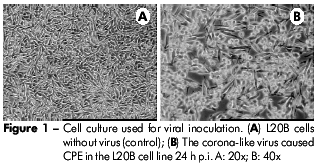
<body><![CDATA[<p><font size="2" face="Verdana"><b>TRANSMISSION ELECTRON MICROSCOPY</b></font></p>     <p><font size="2" face="Verdana"><b>Negative staining</b></font></p>     <p><font size="2" face="Verdana">The procedure was previously described in  Wanzeller et al<sup>5</sup>, and the sample was examined with a transmission  electron microscope (TEM) (Zeiss EM 900).</font></p>     <p><font size="2" face="Verdana"><b>Ultrathin sections</b></font></p>     <p><font size="2" face="Verdana">The L20B cell line was used for conventional  electron microscopy. The method used was similar to that described in Wanzeller  et al<sup>5</sup>. The sections were stained and observed with TEM (Zeiss EM  900).</font></p>     <p>&nbsp;</p>     <p><font size="3" face="Verdana"><b>RESULTS</b></font></p>     <p><font size="2" face="Verdana"><b>CULTURE</b></font></p>     <p><font size="2" face="Verdana">The corona-like  virus caused CPE in the L20B cell line 24 h p.i., and the cells were completely  destroyed 48 h p.i., (<a href="#f1">Figure 1</a>). The sample was negative when tested for  poliovirus.</font></p>     <p><a name="f1" id="f1"></a></p>     ]]></body>
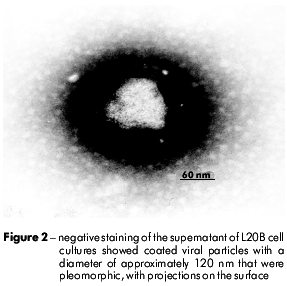
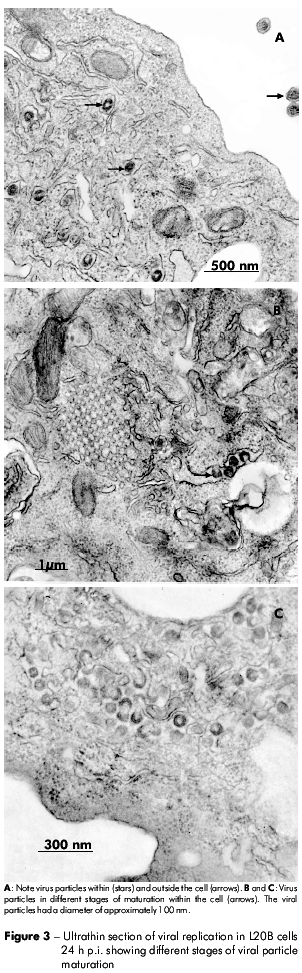
<body><![CDATA[<p>&nbsp;</p>     <p align="center"><img src="/img/revistas/rpas/v2n3/3a08f1.gif" border="0"></p>     <p>&nbsp;</p>     <p><font size="2" face="Verdana"><b>TRANSMISSION ELECTRON MICROSCOPY</b></font></p>     <p><font size="2" face="Verdana">The  negatively stained viral particles were approximately 120 nm in diameter. These  particles had an envelope that consisted of a bilaminar membrane covered with  projecting structures on the surface (<a href="#f2">Figure 2</a>). In <a href="#f3">figure 3</a>, different stages  of viral replication can be observed.</font></p>     <p><a name="f2"></a></p>     <p>&nbsp;</p>     <p align="center"><img src="/img/revistas/rpas/v2n3/3a08f2.gif" border="0"></p>     <p>&nbsp;</p>     <p><a name="f3"></a></p>     ]]></body>
<body><![CDATA[<p>&nbsp;</p>     <p align="center"><img src="/img/revistas/rpas/v2n3/3a08f3.gif" border="0"></p>     <p>&nbsp;</p>     <p><font size="2" face="Verdana">The sample studied was tested with primers to <i>Coronaviridae </i>family, demonstrating a positive result by RT-PCR  technique (data not shown).</font></p>     <p>&nbsp;</p>     <p><font size="3" face="Verdana"><b>DISCUSSION</b></font></p>     <p><font size="2" face="Verdana">A number of morphological features of this  virus in L20B cells were similar to those previously described for other  members of the <i>Coronaviridae </i>family<sup>2,6</sup>.</font></p>     <p><font size="2" face="Verdana">The budding of the gastroenteric coronavirus  and severe acute respiratory syndrome coronavirus (SARS-CoV)<sup>7</sup> in all stages of  maturation has been primarily observed to be inside membranes of the Golgi  structure or endoplasmic reticulum and has been considered a hallmark of  members of the <i>Coronaviridae </i>family<sup>7,2,8,9</sup>.</font></p>     <p><font size="2" face="Verdana"> The stages of viral replication observed in  this study are in complete agreement with those of others coronavirus<sup>10</sup>.  Lai et al<sup>2</sup> described changes that occur during the replication  process: I) the viral proteins appear as an electron-dense layer in the  cytoplasm; II) viral envelope proteins adhere to vesicular membranes within the  cytoplasm; and III) an electron-dense area, possibly corresponding to viral  spikes, can be observed in the lumen of vesicles.</font></p>     <p><font size="2" face="Verdana">In this study, we also found these  characteristics<sup>7,8</sup>, reinforcing the association of this virus with  the neurological disorder presented by this patient. We have tentatively  assigned this virus to the <i>Coronaviridae </i>family.</font></p>     ]]></body>
<body><![CDATA[<p><font size="2" face="Verdana">The association between coronaviruses and  neuropathology in animals has been shown by Pasick et al<sup>11</sup>, who  reported a variety of neurotropic strains that cause diseases, such as  encephalitis, acute poliomyelitis and chronic inflammatory demyelination caused  by mouse hepatitis virus (MHV4).</font></p>     <p><font size="2" face="Verdana">There are few reports in humans concerning  the potential association of coronaviruses with neurological diseases. Among  these studies, Yeh et al<sup>12</sup> detected human coronavirus in the  cerebrospinal fluid of a child who was diagnosed with disseminated acute  encephalomyelitis similar to that presented in diseases such as multiple  sclerosis.</font></p>     <p>&nbsp;</p>     <p><font size="3" face="Verdana"><b>CONCLUSION</b></font></p>     <p><font size="2" face="Verdana">Based on the viral morphology presented in  this study, we provisionally proposed the inclusion of this virus in the <i>Coronaviridae </i>family and attributed an association of this virus with neurological  diseases, such as AMD.</font></p>     <p><font size="2" face="Verdana">This is the first detection of the  association of a viral particle similar to coronavirus with patients with AFP  in Brazil;  however, it is still not possible to confirm this association, and future  studies are necessary to determine this correlation.</font></p>     <p>&nbsp;</p>     <p><font size="3" face="Verdana"><b>ACKNOWLEDGEMENTS</b></font></p>     <p><font size="2" face="Verdana">To Walber  Victor de Moraes Pinto for help in the optical illustrations. Edna Silveira, Antonia dos Santos Alves, Euda Galiza Primo Souza, Jainara  Alves and Nazar&eacute; Valadares for contribution on the laboratory techniques.</font></p>     <p>&nbsp;</p>     ]]></body>
<body><![CDATA[<p><font size="3" face="Verdana"><b>REFERENCES</b></font></p>     <!-- ref --><p><font size="2" face="Verdana">1 International Committee on Taxonomy of  Viruses. Virus  Taxonomy. &#91;Internet&#93;. 2011. (citado 2012 maio 18). Dispon&iacute;vel em: <a href="http://www.ictvonline.org/virusTaxonomy.asp?version=2011&bhcp=1" target="_blank">http://www.ictvonline.org/virusTaxonomy.asp?version=2011</a>.</font><!-- ref --><p><font size="2" face="Verdana">2 Lai MMC, Holmes KV. Coronaviridae. In: Knipe DM, Howley PM, editors. Fields virology. 4th ed. Philadelphia: Lippincott  Williams &amp; Wilkins; 2001. p.1163-85.</font><!-- ref --><p><font size="2" face="Verdana">3 Romero JR. Reverse-transcription  polymerase chain reaction detection of the enteroviroses. Arch Pathol Lab Med. 1999  Dec;123(12):1161-9. &#91;<a href="http://www.ncbi.nlm.nih.gov/pubmed/10583920" target="_blank">Link</a>&#93;</font><!-- ref --><p><font size="2" face="Verdana">4 Sawyer MH. Enterovirus infections:  diagnosis and treatment. Pediatr Infect Dis J. 1999 Dec;18(12):1033-9.</font><!-- ref --><p><font size="2" face="Verdana">5 Wanzeller ALM,  Diniz JAP,  Gomes MLC, Cruz ACR, Soares MCP, Souza W, et al.  Ultrastructural, antigenic and physicochemical  characterization of the Moju&iacute; dos Campos (<i>Bunyavirus</i>) isolated from bat  in the Brazilian Amazon Region. Mem Inst Oswaldo Cruz. 2002 Apr;97(3):307-11. &#91;<a href="http://www.scielo.br/scielo.php?script=sci_arttext&pid=S0074-02762002000300005&lng=en&nrm=iso&tlng=en" target="_blank">Link</a>&#93;</font><!-- ref --><p><font size="2" face="Verdana">6 Ng ML, Tan SH, See EE, Ooi EE, Ling AE.  Proliferative growth of SARS coronavirus in Vero E6 cells. J Gen Virol. 2003 Dec;84(Pt  12):3291-303. &#91;<a href="http://www.ncbi.nlm.nih.gov/pubmed/14645910" target="_blank">Link</a>&#93;</font><!-- ref --><p><font size="2" face="Verdana">7 Goldsmith CS,  Tatti KM, Ksiazek TG,  Rollin PE, Comer JA, Lee WW, et al.  Ultrastructural characterization of SARS coronavirus. Emerg Infect Dis. 2004 Feb;10(2):320-6.</font><!-- ref --><p><font size="2" face="Verdana">8 Novoa RR, Calderita G, Arranz R, Fontana J,  Granzow H, Risco C. Virus factories: associations of cell organelles for viral  replication and morphogenesis. Biol Cell. 2005;97:147-72. DOI:10.1042/BC20040058 &#91;<a href="http://onlinelibrary.wiley.com/doi/10.1042/BC20040058/pdf" target="_blank">Link</a>&#93;</font><!-- ref --><p><font size="2" face="Verdana">9 Salanueva IJ, Carrascosa JL, Risco C.  Structural maturation of the transmissible gastroenteritis coronavirus. J  Virol. 1999 Oct;73(10):7952-64.</font><!-- ref --><p><font size="2" face="Verdana">10 Snijder EJ, van der Meer Y, Zevenhoven-Dobbe  J, Onderwater JJ, van der Meulen J, Koerten HK, et al. Ultrastructure and  origin of membrane vesicles associated with the severe acute respiratory  syndrome coronavirus replication&nbsp;complex. J Virol. 2006 Jun;80(12):5927-40.</font><!-- ref --><p><font size="2" face="Verdana">11 Pasick JMM, Kalicharran K, Dales S.  Distribution and tafficking of JHM coronavirus structural proteins and virions  in primary neurons and the OBL-21 neuronal cell line. J Virol. 1994  May;68(5):2915-28. &#91;<a href="http://www.ncbi.nlm.nih.gov/pubmed/8151762" target="_blank">Link</a>&#93;</font><!-- ref --><p><font size="2" face="Verdana">12 Yeh EA, Collins A, Cohenc ME, Duffner PK,  Faden H. Disseminated encephalomyelitis detection of coronavirus in the central  nervous system of a child with acute. Pediatrics. 2004 Apr;113(1):73-6.</font><p>&nbsp;</p>     <p>&nbsp;</p>     <p><font size="2" face="Verdana"><b><a name="endereco" id="endereco"></a><a href="#topo"><img src="/img/revistas/rpas/v2n3/seta.gif" border="0"></a>Correspond&ecirc;ncia / Correspondence / Correspondencia:</b>    <br> Ana Lucia Monteiro Wanzeller    <br> Instituto Evandro Chagas,    <br> Laborat&oacute;rio de Cultivo  Celular da Se&ccedil;&atilde;o de Virologia    <br> Rodovia BR316, km 7, s/n<sup>o</sup>, Levil&acirc;ndia    ]]></body>
<body><![CDATA[<br> CEP: 67030-000    <br> Ananindeua-Par&aacute;-Brasil    <br> E-mail: <a href="mailto:anawanzeller@iec.pa.gov.br">anawanzeller@iec.pa.gov.br</a> </font></p>     <p><font size="2" face="Verdana"> Received / Recebido em / Recibido en: 10/5/2011</font>    <br> <font size="2" face="Verdana">Accepted  / Aceito em / Aceito en:14/8/2011</font></p> <script type="text/javascript"> var gaJsHost = (("https:" == document.location.protocol) ? "https://ssl." : "http://www."); document.write(unescape("%3Cscript src='" + gaJsHost + "google-analytics.com/ga.js' type='text/javascript'%3E%3C/script%3E")); </script> <script type="text/javascript"> try { var pageTracker = _gat._getTracker("UA-7885746-4"); pageTracker._setDomainName("none"); pageTracker._setAllowLinker(true); pageTracker._trackPageview(); } catch(err) {}</script>      ]]></body><back>
<ref-list>
<ref id="B1">
<label>1</label><nlm-citation citation-type="">
<collab>International Committee on Taxonomy of Viruses</collab>
<source><![CDATA[Virus Taxonomy]]></source>
<year></year>
</nlm-citation>
</ref>
<ref id="B2">
<label>2</label><nlm-citation citation-type="book">
<person-group person-group-type="author">
<name>
<surname><![CDATA[Lai]]></surname>
<given-names><![CDATA[MMC]]></given-names>
</name>
<name>
<surname><![CDATA[Holmes]]></surname>
<given-names><![CDATA[KV]]></given-names>
</name>
</person-group>
<article-title xml:lang="en"><![CDATA[Coronaviridae]]></article-title>
<person-group person-group-type="editor">
<name>
<surname><![CDATA[Knipe]]></surname>
<given-names><![CDATA[DM]]></given-names>
</name>
<name>
<surname><![CDATA[Howley]]></surname>
<given-names><![CDATA[PM]]></given-names>
</name>
</person-group>
<source><![CDATA[Fields virology]]></source>
<year>2001</year>
<edition>4</edition>
<page-range>1163-85</page-range><publisher-loc><![CDATA[Philadelphia ]]></publisher-loc>
<publisher-name><![CDATA[Lippincott Williams & Wilkins]]></publisher-name>
</nlm-citation>
</ref>
<ref id="B3">
<label>3</label><nlm-citation citation-type="journal">
<person-group person-group-type="author">
<name>
<surname><![CDATA[Romero]]></surname>
<given-names><![CDATA[JR]]></given-names>
</name>
</person-group>
<article-title xml:lang="en"><![CDATA[Reverse-transcription polymerase chain reaction detection of the enteroviroses]]></article-title>
<source><![CDATA[Arch Pathol Lab Med]]></source>
<year>1999</year>
<month> D</month>
<day>ec</day>
<volume>123</volume>
<numero>12</numero>
<issue>12</issue>
<page-range>1161-9</page-range></nlm-citation>
</ref>
<ref id="B4">
<label>4</label><nlm-citation citation-type="journal">
<person-group person-group-type="author">
<name>
<surname><![CDATA[Sawyer]]></surname>
<given-names><![CDATA[MH]]></given-names>
</name>
</person-group>
<article-title xml:lang="en"><![CDATA[Enterovirus infections: diagnosis and treatment]]></article-title>
<source><![CDATA[Pediatr Infect Dis J]]></source>
<year>1999</year>
<month> D</month>
<day>ec</day>
<volume>18</volume>
<numero>12</numero>
<issue>12</issue>
<page-range>1033-9</page-range></nlm-citation>
</ref>
<ref id="B5">
<label>5</label><nlm-citation citation-type="journal">
<person-group person-group-type="author">
<name>
<surname><![CDATA[Wanzeller]]></surname>
<given-names><![CDATA[ALM]]></given-names>
</name>
<name>
<surname><![CDATA[Diniz]]></surname>
<given-names><![CDATA[JAP]]></given-names>
</name>
<name>
<surname><![CDATA[Gomes]]></surname>
<given-names><![CDATA[MLC]]></given-names>
</name>
<name>
<surname><![CDATA[Cruz]]></surname>
<given-names><![CDATA[ACR]]></given-names>
</name>
<name>
<surname><![CDATA[Soares]]></surname>
<given-names><![CDATA[MCP]]></given-names>
</name>
<name>
<surname><![CDATA[Souza]]></surname>
<given-names><![CDATA[W]]></given-names>
</name>
</person-group>
<article-title xml:lang="en"><![CDATA[Ultrastructural, antigenic and physicochemical characterization of the Mojuí dos Campos (Bunyavirus) isolated from bat in the Brazilian Amazon Region]]></article-title>
<source><![CDATA[Mem Inst Oswaldo Cruz]]></source>
<year>2002</year>
<month> A</month>
<day>pr</day>
<volume>97</volume>
<numero>3</numero>
<issue>3</issue>
<page-range>307-11</page-range></nlm-citation>
</ref>
<ref id="B6">
<label>6</label><nlm-citation citation-type="journal">
<person-group person-group-type="author">
<name>
<surname><![CDATA[Ng]]></surname>
<given-names><![CDATA[ML]]></given-names>
</name>
<name>
<surname><![CDATA[Tan]]></surname>
<given-names><![CDATA[SH]]></given-names>
</name>
<name>
<surname><![CDATA[See]]></surname>
<given-names><![CDATA[EE]]></given-names>
</name>
<name>
<surname><![CDATA[Ooi]]></surname>
<given-names><![CDATA[EE]]></given-names>
</name>
<name>
<surname><![CDATA[Ling]]></surname>
<given-names><![CDATA[AE]]></given-names>
</name>
</person-group>
<article-title xml:lang="en"><![CDATA[Proliferative growth of SARS coronavirus in Vero E6 cells]]></article-title>
<source><![CDATA[J Gen Virol]]></source>
<year>2003</year>
<month> D</month>
<day>ec</day>
<volume>84</volume>
<page-range>3291-303</page-range></nlm-citation>
</ref>
<ref id="B7">
<label>7</label><nlm-citation citation-type="journal">
<person-group person-group-type="author">
<name>
<surname><![CDATA[Goldsmith]]></surname>
<given-names><![CDATA[CS]]></given-names>
</name>
<name>
<surname><![CDATA[Tatti]]></surname>
<given-names><![CDATA[KM]]></given-names>
</name>
<name>
<surname><![CDATA[Ksiazek]]></surname>
<given-names><![CDATA[TG]]></given-names>
</name>
<name>
<surname><![CDATA[Rollin]]></surname>
<given-names><![CDATA[PE]]></given-names>
</name>
<name>
<surname><![CDATA[Comer]]></surname>
<given-names><![CDATA[JA]]></given-names>
</name>
<name>
<surname><![CDATA[Lee]]></surname>
<given-names><![CDATA[WW]]></given-names>
</name>
</person-group>
<article-title xml:lang="en"><![CDATA[Ultrastructural characterization of SARS coronavirus]]></article-title>
<source><![CDATA[Emerg Infect Dis]]></source>
<year>2004</year>
<month> F</month>
<day>eb</day>
<volume>10</volume>
<numero>2</numero>
<issue>2</issue>
<page-range>320-6</page-range></nlm-citation>
</ref>
<ref id="B8">
<label>8</label><nlm-citation citation-type="journal">
<person-group person-group-type="author">
<name>
<surname><![CDATA[Novoa]]></surname>
<given-names><![CDATA[RR]]></given-names>
</name>
<name>
<surname><![CDATA[Calderita]]></surname>
<given-names><![CDATA[G]]></given-names>
</name>
<name>
<surname><![CDATA[Arranz]]></surname>
<given-names><![CDATA[R]]></given-names>
</name>
<name>
<surname><![CDATA[Fontana]]></surname>
<given-names><![CDATA[J]]></given-names>
</name>
<name>
<surname><![CDATA[Granzow]]></surname>
<given-names><![CDATA[H]]></given-names>
</name>
<name>
<surname><![CDATA[Risco]]></surname>
<given-names><![CDATA[C]]></given-names>
</name>
</person-group>
<article-title xml:lang="en"><![CDATA[Virus factories: associations of cell organelles for viral replication and morphogenesis]]></article-title>
<source><![CDATA[Biol Cell]]></source>
<year>2005</year>
<volume>97</volume>
<page-range>147-72</page-range></nlm-citation>
</ref>
<ref id="B9">
<label>9</label><nlm-citation citation-type="journal">
<person-group person-group-type="author">
<name>
<surname><![CDATA[Salanueva]]></surname>
<given-names><![CDATA[IJ]]></given-names>
</name>
<name>
<surname><![CDATA[Carrascosa]]></surname>
<given-names><![CDATA[JL]]></given-names>
</name>
<name>
<surname><![CDATA[Risco]]></surname>
<given-names><![CDATA[C]]></given-names>
</name>
</person-group>
<article-title xml:lang="en"><![CDATA[Structural maturation of the transmissible gastroenteritis coronavirus]]></article-title>
<source><![CDATA[J Virol]]></source>
<year>1999</year>
<month> O</month>
<day>ct</day>
<volume>73</volume>
<numero>10</numero>
<issue>10</issue>
<page-range>7952-64</page-range></nlm-citation>
</ref>
<ref id="B10">
<label>10</label><nlm-citation citation-type="journal">
<person-group person-group-type="author">
<name>
<surname><![CDATA[Snijder]]></surname>
<given-names><![CDATA[EJ]]></given-names>
</name>
<name>
<surname><![CDATA[van der Meer]]></surname>
<given-names><![CDATA[Y]]></given-names>
</name>
<name>
<surname><![CDATA[Zevenhoven-Dobbe]]></surname>
<given-names><![CDATA[J]]></given-names>
</name>
<name>
<surname><![CDATA[Onderwater]]></surname>
<given-names><![CDATA[JJ]]></given-names>
</name>
<name>
<surname><![CDATA[van der Meulen]]></surname>
<given-names><![CDATA[J]]></given-names>
</name>
<name>
<surname><![CDATA[Koerten]]></surname>
<given-names><![CDATA[HK]]></given-names>
</name>
</person-group>
<article-title xml:lang="en"><![CDATA[Ultrastructure and origin of membrane vesicles associated with the severe acute respiratory syndrome coronavirus replication complex]]></article-title>
<source><![CDATA[J Virol]]></source>
<year>2006</year>
<month> J</month>
<day>un</day>
<volume>80</volume>
<numero>12</numero>
<issue>12</issue>
<page-range>5927-40</page-range></nlm-citation>
</ref>
<ref id="B11">
<label>11</label><nlm-citation citation-type="journal">
<person-group person-group-type="author">
<name>
<surname><![CDATA[Pasick]]></surname>
<given-names><![CDATA[JMM]]></given-names>
</name>
<name>
<surname><![CDATA[Kalicharran]]></surname>
<given-names><![CDATA[K]]></given-names>
</name>
<name>
<surname><![CDATA[Dales]]></surname>
<given-names><![CDATA[S]]></given-names>
</name>
</person-group>
<article-title xml:lang="en"><![CDATA[Distribution and tafficking of JHM coronavirus structural proteins and virions in primary neurons and the OBL-21 neuronal cell line]]></article-title>
<source><![CDATA[J Virol]]></source>
<year>1994</year>
<month> M</month>
<day>ay</day>
<volume>68</volume>
<numero>5</numero>
<issue>5</issue>
<page-range>2915-28</page-range></nlm-citation>
</ref>
<ref id="B12">
<label>12</label><nlm-citation citation-type="journal">
<person-group person-group-type="author">
<name>
<surname><![CDATA[Yeh]]></surname>
<given-names><![CDATA[EA]]></given-names>
</name>
<name>
<surname><![CDATA[Collins]]></surname>
<given-names><![CDATA[A]]></given-names>
</name>
<name>
<surname><![CDATA[Cohenc]]></surname>
<given-names><![CDATA[ME]]></given-names>
</name>
<name>
<surname><![CDATA[Duffner]]></surname>
<given-names><![CDATA[PK]]></given-names>
</name>
<name>
<surname><![CDATA[Faden]]></surname>
<given-names><![CDATA[H]]></given-names>
</name>
</person-group>
<article-title xml:lang="en"><![CDATA[Disseminated encephalomyelitis detection of coronavirus in the central nervous system of a child with acute]]></article-title>
<source><![CDATA[Pediatrics]]></source>
<year>2004</year>
<month> A</month>
<day>pr</day>
<volume>113</volume>
<numero>1</numero>
<issue>1</issue>
<page-range>73-6</page-range></nlm-citation>
</ref>
</ref-list>
</back>
</article>