<?xml version="1.0" encoding="ISO-8859-1"?><article xmlns:mml="http://www.w3.org/1998/Math/MathML" xmlns:xlink="http://www.w3.org/1999/xlink" xmlns:xsi="http://www.w3.org/2001/XMLSchema-instance">
<front>
<journal-meta>
<journal-id>2176-6223</journal-id>
<journal-title><![CDATA[Revista Pan-Amazônica de Saúde]]></journal-title>
<abbrev-journal-title><![CDATA[Rev Pan-Amaz Saude]]></abbrev-journal-title>
<issn>2176-6223</issn>
<publisher>
<publisher-name><![CDATA[Instituto Evandro Chagas. Secretaria de Vigilância em Saúde e Ambiente. Ministério da Saúde]]></publisher-name>
</publisher>
</journal-meta>
<article-meta>
<article-id>S2176-62232013000400005</article-id>
<article-id pub-id-type="doi">10.5123/S2176-62232013000400005</article-id>
<title-group>
<article-title xml:lang="en"><![CDATA[The effect of Rosmarinus officinalis essential oil on germ tube formation in Candida dubliniensis recovered from denture users]]></article-title>
<article-title xml:lang="pt"><![CDATA[O efeito do óleo essencial de Rosmarinus officinalis sobre a formação do tubo germinativo em Candida dubliniensis isolada de usuários de dentadura]]></article-title>
<article-title xml:lang="es"><![CDATA[El efecto del aceite esencial de Rosmarinus officinalis sobre la formación del tubo germinativo en Candida dubliniensis aislada de usuarios de dentadura]]></article-title>
</title-group>
<contrib-group>
<contrib contrib-type="author">
<name>
<surname><![CDATA[Gauch]]></surname>
<given-names><![CDATA[Lurdete Maria Rocha]]></given-names>
</name>
<xref ref-type="aff" rid="A01"/>
</contrib>
<contrib contrib-type="author">
<name>
<surname><![CDATA[Pedrosa]]></surname>
<given-names><![CDATA[Simone Soares]]></given-names>
</name>
<xref ref-type="aff" rid="A02"/>
</contrib>
<contrib contrib-type="author">
<name>
<surname><![CDATA[Esteves]]></surname>
<given-names><![CDATA[Renata Antunes]]></given-names>
</name>
<xref ref-type="aff" rid="A02"/>
</contrib>
<contrib contrib-type="author">
<name>
<surname><![CDATA[Silveira-Gomes]]></surname>
<given-names><![CDATA[Fabíola]]></given-names>
</name>
<xref ref-type="aff" rid="A03"/>
</contrib>
<contrib contrib-type="author">
<name>
<surname><![CDATA[Gurgel]]></surname>
<given-names><![CDATA[Ely Simone Cajueiro]]></given-names>
</name>
<xref ref-type="aff" rid="A04"/>
</contrib>
<contrib contrib-type="author">
<name>
<surname><![CDATA[Arruda]]></surname>
<given-names><![CDATA[Alberto Cardoso]]></given-names>
</name>
<xref ref-type="aff" rid="A05"/>
</contrib>
<contrib contrib-type="author">
<name>
<surname><![CDATA[Marques-da-Silva]]></surname>
<given-names><![CDATA[Silvia Helena]]></given-names>
</name>
<xref ref-type="aff" rid="A06"/>
</contrib>
</contrib-group>
<aff id="A01">
<institution><![CDATA[,Universidade Federal do Pará Instituto de Ciências Biológicas Instituto de Ciências da Saúde]]></institution>
<addr-line><![CDATA[Belém Pará]]></addr-line>
<country>Brasil</country>
</aff>
<aff id="A02">
<institution><![CDATA[,Universidade Federal do Pará Instituto de Ciências da Saúde Faculdade de Odontologia]]></institution>
<addr-line><![CDATA[Belém Pará]]></addr-line>
<country>Brasil</country>
</aff>
<aff id="A03">
<institution><![CDATA[,Universidade Federal do Pará Instituto de Ciências Biológicas Programa de Pós-graduação em Biologia de Agentes Infecciosos e Parasitários]]></institution>
<addr-line><![CDATA[Belém Pará]]></addr-line>
<country>Brasil</country>
</aff>
<aff id="A04">
<institution><![CDATA[,Museu Paraense Emílio Goeldi Laboratório de Botânica ]]></institution>
<addr-line><![CDATA[Belém Pará]]></addr-line>
<country>Brasil</country>
</aff>
<aff id="A05">
<institution><![CDATA[,Universidade Federal do Pará Instituto de Ciências Exatas e Naturais ]]></institution>
<addr-line><![CDATA[Belém Pará]]></addr-line>
<country>Brasil</country>
</aff>
<aff id="A06">
<institution><![CDATA[,Instituto Evandro Chagas/SVS/MS Seção de Bacteriologia e Micologia ]]></institution>
<addr-line><![CDATA[Belém Pará]]></addr-line>
<country>Brasil</country>
</aff>
<pub-date pub-type="pub">
<day>00</day>
<month>12</month>
<year>2013</year>
</pub-date>
<pub-date pub-type="epub">
<day>00</day>
<month>12</month>
<year>2013</year>
</pub-date>
<volume>4</volume>
<numero>4</numero>
<fpage>43</fpage>
<lpage>47</lpage>
<copyright-statement/>
<copyright-year/>
<self-uri xlink:href="http://scielo.iec.gov.br/scielo.php?script=sci_arttext&amp;pid=S2176-62232013000400005&amp;lng=en&amp;nrm=iso"></self-uri><self-uri xlink:href="http://scielo.iec.gov.br/scielo.php?script=sci_abstract&amp;pid=S2176-62232013000400005&amp;lng=en&amp;nrm=iso"></self-uri><self-uri xlink:href="http://scielo.iec.gov.br/scielo.php?script=sci_pdf&amp;pid=S2176-62232013000400005&amp;lng=en&amp;nrm=iso"></self-uri><abstract abstract-type="short" xml:lang="en"><p><![CDATA[Candida dubliniensis is an emerging pathogenic yeast that is closely related to C. albicans and colonizes or infects the oral cavities of denture users. Similar to C. albicans, C. dubliniensis produces germ tubes as a major virulence factor. Due to the scarcity of data demonstrating that natural products have anti-C. dubliniensis activity, the objective of this study was to evaluate the effect of an essential oil from Rosmarinus officinalis on C. dubliniensis germ tube formation. Six isolates of C. dubliniensis were recovered from the oral cavities (n = 5/denture base and n = 1/palatal mucosa) of six denture users either with (n = 4) or without (n = 2) stomatitis. Germ tube formation was induced in Sabouraud dextrose broth containing 10% fetal bovine serum in the presence (test) or absence (control) of 4% R. officinalis essential oil. The complete inhibition of germ tube formation for all of the tested isolates of C. dubliniensis was observed (p = 0.004). Our results demonstrate the potent anti-C. dubliniensis effect of R. officinalis essential oil, indicating the need to further investigate the pharmaceutical use of R. officinalis essential oil, particularly as it impacts the colonization of denture resin and stomatitis.]]></p></abstract>
<abstract abstract-type="short" xml:lang="pt"><p><![CDATA[Candida dubliniensis é uma levedura patogênica emergente, muito semelhante à C. albicans, que coloniza ou infecta as cavidades bucais de usuários de dentaduras. Similar à C. albicans, C. dubliniensis produz tubos germinativos com fator de virulência maior. Devido à escassez de dados, demonstrando que produtos naturais têm atividade anti-C. dubliniensis, o objetivo deste estudo foi avaliar o efeito de um óleo essencial de Rosmarinus officinalis sobre a formação de tubo germinativo em C. dubliniensis. Seis isolados de C. dubliniensis foram coletados de cavidades orais (n = 5/base da dentadura e n = 1/mucosa palatal) de seis usuários de dentaduras com (n = 4) ou sem (n = 2) estomatite. A formação do tubo germinativo foi induzida em caldo Sabouraud dextrose, contendo soro fetal bovino a 10% na presença (teste) ou ausência (controle) de óleo essencial de R. officinalis a 4%. Observou-se a completa inibição da formação do tubo germinativo de todos os isolados de C. dubliniensis (p = 0,004). Nossos resultados demonstraram o potente efeito anti-C. dubliniensis do óleo essencial R. officinalis, indicando a necessidade maiores investigações sobre o uso farmacêutico do óleo essencial R. officinalis, particularmente o seu impacto sobre a colonização da resina para dentaduras e a estomatite.]]></p></abstract>
<abstract abstract-type="short" xml:lang="es"><p><![CDATA[Candida dubliniensis es una levadura patógena emergente, muy parecida a la C. albicans, que coloniza o infecta las cavidades bucales de usuarios de dentaduras. Similar a C. albicans, C. dubliniensis produce tubos germinativos con un mayor factor de virulencia. Debido a la escasez de datos, demostrando que productos naturales tienen una actividad anti-C. dubliniensis, el objetivo de este estudio fue el de evaluar el efecto de un aceite esencial de Rosmarinus officinalis sobre la formación de tubo germinativo en C. dubliniensis. Se recolectaron seis aislados de C. dubliniensis de cavidades orales (n = 5/base de la dentadura y n = 1/mucosa palatal) de seis usuarios de dentaduras con (n = 4) o sin (n = 2) estomatitis. La formación del tubo germinativo fue inducida en caldo Sabouraud dextrosa, conteniendo suero fetal bovino a 10% en presencia (prueba) o ausencia (control) de aceite esencial de R. officinalis a 4%. Se observó la completa inhibición de la formación del tubo germinativo de todos los aislados de C. dubliniensis (p = 0,004). Nuestros resultados demostraron el potente efecto anti-C. Dubliniensis del aceite esencial R. officinalis, indicando la necesidad de más investigaciones sobre el uso farmacéutico del aceite esencial R. officinalis, particularmente su impacto sobre la colonización de la resina para dentaduras y la estomatitis.]]></p></abstract>
<kwd-group>
<kwd lng="en"><![CDATA[Candida dubliniensis]]></kwd>
<kwd lng="en"><![CDATA[Rosmarinus officinalis]]></kwd>
<kwd lng="en"><![CDATA[Stomatitis, Dentures]]></kwd>
<kwd lng="pt"><![CDATA[Candida dubliniensis]]></kwd>
<kwd lng="pt"><![CDATA[Rosmarinus officinalis]]></kwd>
<kwd lng="pt"><![CDATA[Estomatite]]></kwd>
<kwd lng="pt"><![CDATA[Dentaduras]]></kwd>
<kwd lng="es"><![CDATA[Candida dubliniensis]]></kwd>
<kwd lng="es"><![CDATA[Rosmarinus officinalis]]></kwd>
<kwd lng="es"><![CDATA[Estomatitis]]></kwd>
<kwd lng="es"><![CDATA[Dentaduras]]></kwd>
</kwd-group>
</article-meta>
</front><body><![CDATA[ <p align="right"><font face="Verdana" size="2"><b>ORIGINAL ARTICLE | ARTIGO ORIGINAL | ART&#205;CULO ORIGINAL</b></font></p>     <p>&nbsp;</p>     <p><font face="Verdana" size="4"><b><a name="topo"></a>The effect of <i>Rosmarinus officinalis </i>essential oil on germ tube formation in <i>Candida dubliniensis </i>recovered from denture users</b></font></p>     <p>&nbsp;</p>     <p><font face="Verdana" size="3"><b>O efeito do &#243;leo essencial de <i>Rosmarinus officinalis </i>sobre a forma&#231;&#227;o do tubo germinativo em <i>Candida dubliniensis </i>isolada de usu&#225;rios de dentadura</b></font></p>     <p>&nbsp;</p>     <p><b><font face="Verdana" size="3">El efecto del aceite esencial de <i>Rosmarinus officinalis </i>sobre la formaci&#243;n del tubo germinativo en <i>Candida dubliniensis </i>aislada de usuarios de dentadura</font></b></p>     <p>&nbsp;</p>     <p>&nbsp;</p>     <p><font face="Verdana" size="2"><b>Lurdete Maria Rocha Gauch<sup>I</sup>; Simone Soares Pedrosa<sup>II</sup>; Renata Antunes Esteves<sup>II</sup>; Fab&#237;ola Silveira-Gomes<sup>III</sup>; Ely Simone Cajueiro Gurgel<sup>IV</sup>; Alberto Cardoso Arruda<sup>V</sup>; Silvia Helena Marques-da-Silva<sup>VI</sup></b></font></p>     ]]></body>
<body><![CDATA[<p><font face="Verdana" size="2"><sup>I</sup><i>Programa de P&#243;s-gradua&#231;&#227;o em Biologia de Agentes Infecciosos e Parasit&#225;rios, Instituto de Ci&#234;ncias Biol&#243;gicas, Universidade Federal do Par&#225;, Bel&#233;m, Par&#225;, Brasil</i></font>. <font face="Verdana" size="2"><i>Faculdade de Odontologia, Instituto de Ci&#234;ncias da Sa&#250;de, Universidade Federal do Par&#225;, Bel&#233;m, Par&#225;, Brasil</i></font>    <br> <font face="Verdana" size="2"><sup>II</sup><i>Faculdade de Odontologia, Instituto de Ci&#234;ncias da Sa&#250;de, Universidade Federal do Par&#225;, Bel&#233;m, Par&#225;, Brasil</i></font>    <br> <font face="Verdana" size="2"><sup>III</sup><i>Programa de P&#243;s-gradua&#231;&#227;o em Biologia de Agentes Infecciosos e Parasit&#225;rios, Instituto de Ci&#234;ncias Biol&#243;gicas, Universidade Federal do Par&#225;, Bel&#233;m, Par&#225;, Brasil</i></font>    <br> <font face="Verdana" size="2"><sup>IV</sup><i>Laborat&#243;rio de Bot&#226;nica, Museu Paraense Em&#237;lio Goeldi, Bel&#233;m, Par&#225;, Brasil</i></font>    <br> <font face="Verdana" size="2"><sup>V</sup><i>Laborat&#243;rio de Extra&#231;&#227;o, Instituto de Ci&#234;ncias Exatas e Naturais, Universidade Federal do Par&#225;, Bel&#233;m, Par&#225;, Brasil</i></font>    <br> <font face="Verdana" size="2"><sup>VI</sup><i>Laborat&#243;rio de Micologia, Se&#231;&#227;o de Bacteriologia e Micologia, Instituto Evandro Chagas/SVS/MS, Bel&#233;m, Par&#225;, Brasil</i></font></p>     <p><font face="Verdana" size="2"><a href="#endereco">Endere&ccedil;o para correspond&ecirc;ncia    <br> Correspondence    <br> Direcci&oacute;n para correspondencia</a></font></p>     <p>&nbsp;</p>     ]]></body>
<body><![CDATA[<p>&nbsp;</p> <hr size="1" noshade>     <p><font face="Verdana" size="2"><b>ABSTRACT</b></font></p>     <p><font face="Verdana" size="2"><i>Candida dubliniensis </i>is an emerging pathogenic yeast that is closely related to <i>C. albicans </i>and colonizes or infects the oral cavities of denture users. Similar to <i>C. albicans, C. dubliniensis </i>produces germ tubes as a major virulence factor. Due to the scarcity of data demonstrating that natural products have anti-C. <i>dubliniensis </i>activity, the objective of this study was to evaluate the effect of an essential oil from <i>Rosmarinus officinalis </i>on <i>C. dubliniensis </i>germ tube formation. Six isolates of <i>C. dubliniensis </i>were recovered from the oral cavities (n = 5/denture base and n = 1/palatal mucosa) of six denture users either with (n = 4) or without (n = 2) stomatitis. Germ tube formation was induced in Sabouraud dextrose broth containing 10% fetal bovine serum in the presence (test) or absence (control) of 4% <i>R. officinalis </i>essential oil. The complete inhibition of germ tube formation for all of the tested isolates of <i>C. dubliniensis </i>was observed (p = 0.004). Our results demonstrate the potent anti-C. <i>dubliniensis </i>effect of <i>R. officinalis </i>essential oil, indicating the need to further investigate the pharmaceutical use of <i>R. officinalis </i>essential oil, particularly as it impacts the colonization of denture resin and stomatitis.</font></p>     <p><font face="Verdana" size="2"><b>Keywords: </b><i>Candida dubliniensis; Rosmarinus officinalis; </i>Stomatitis, Dentures.</font></p> <hr size="1" noshade>     <p><font face="Verdana" size="2"><b>RESUMO</b></font></p>     <p><font face="Verdana" size="2"><i>Candida dubliniensis </i>&#233; uma levedura patog&#234;nica emergente, muito semelhante &#224; <i>C. albicans, </i>que coloniza ou infecta as cavidades bucais de usu&#225;rios de dentaduras. Similar &#224; <i>C. albicans, C. dubliniensis </i>produz tubos germinativos com fator de virul&#234;ncia maior. Devido &#224; escassez de dados, demonstrando que produtos naturais t&#234;m atividade anti-C. <i>dubliniensis, </i>o objetivo deste estudo foi avaliar o efeito de um &#243;leo essencial de <i>Rosmarinus officinalis </i>sobre a forma&#231;&#227;o de tubo germinativo em <i>C. dubliniensis. </i>Seis isolados de <i>C. dubliniensis </i>foram coletados de cavidades orais (n = 5/base da dentadura e n = 1/mucosa palatal) de seis usu&#225;rios de dentaduras com (n = 4) ou sem (n = 2) estomatite. A forma&#231;&#227;o do tubo germinativo foi induzida em caldo Sabouraud dextrose, contendo soro fetal bovino a 10% na presen&#231;a (teste) ou aus&#234;ncia (controle) de &#243;leo essencial de <i>R. officinalis </i>a 4%. Observou-se a completa inibi&#231;&#227;o da forma&#231;&#227;o do tubo germinativo de todos os isolados de <i>C. dubliniensis </i>(p = 0,004). Nossos resultados demonstraram o potente efeito anti-C. <i>dubliniensis </i>do &#243;leo essencial <i>R. officinalis, </i>indicando a necessidade maiores investiga&#231;&#245;es sobre o uso farmac&#234;utico do &#243;leo essencial <i>R. officinalis, </i>particularmente o seu impacto sobre a coloniza&#231;&#227;o da resina para dentaduras e a estomatite.</font></p>     <p><font face="Verdana" size="2"><b>Palavras-chave: </b><i>Candida dubliniensis; Rosmarinus officinalis; </i>Estomatite; Dentaduras.</font></p> <hr size="1" noshade>     <p><font face="Verdana" size="2"><b>RESUMEN</b></font></p>     <p><font face="Verdana" size="2"><i>Candida dubliniensis </i>es una levadura pat&#243;gena emergente, muy parecida a la <i>C. albicans, </i>que coloniza o infecta las cavidades bucales de usuarios de dentaduras. Similar a <i>C. albicans, C. dubliniensis </i>produce tubos germinativos con un mayor factor de virulencia. Debido a la escasez de datos, demostrando que productos naturales tienen una actividad anti-C. <i>dubliniensis, </i>el objetivo de este estudio fue el de evaluar el efecto de un aceite esencial de <i>Rosmarinus officinalis </i>sobre la formaci&#243;n de tubo germinativo en <i>C. dubliniensis. </i>Se recolectaron seis aislados de <i>C. dubliniensis </i>de cavidades orales (n = 5/base de la dentadura y n = 1/mucosa palatal) de seis usuarios de dentaduras con (n = 4) o sin (n = 2) estomatitis. La formaci&#243;n del tubo germinativo fue inducida en caldo Sabouraud dextrosa, conteniendo suero fetal bovino a 10% en presencia (prueba) o ausencia (control) de aceite esencial de <i>R. officinalis </i>a 4%. Se observ&#243; la completa inhibici&#243;n de la formaci&#243;n del tubo germinativo de todos los aislados de <i>C. dubliniensis </i>(p = 0,004). Nuestros resultados demostraron el potente efecto anti<i>-C. Dubliniensis </i>del aceite esencial <i>R. officinalis, </i>indicando la necesidad de m&#225;s investigaciones sobre el uso farmac&#233;utico del aceite esencial <i>R. officinalis, </i>particularmente su impacto sobre la colonizaci&#243;n de la resina para dentaduras y la estomatitis.</font></p>     <p><font face="Verdana" size="2"><b>Palabras clave: </b><i>Candida dubliniensis; Rosmarinus officinalis; </i>Estomatitis; Dentaduras.</font></p> <hr size="1" noshade>     ]]></body>
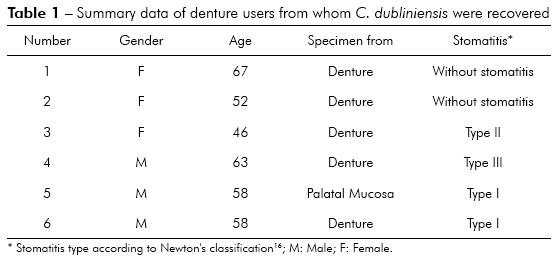
<body><![CDATA[<p>&nbsp;</p>     <p>&nbsp;</p>     <p><font face="Verdana" size="3"><b>INTRODUCTION</b></font></p>     <p><font face="Verdana" size="2"><i>Candida dubliniensis </i>has been described by Sullivan et al<sup>1</sup> as a group of atypical isolates of <i>Candida </i>due to the significant genomic differences from <i>C. tropicalis, C. parapsilosis, C. glabrata, C. kefyr, </i>and <i>C.</i></font> <font face="Verdana" size="2"><i>krusei. C. dubliniensis </i>is closely related to <i>C. albicans; </i>both are chlamydospore and germ-tube producing species that are differentiated by the use of a variety of techniques for yeast identification, including the VITEK 2 ID-YST system and differential media<sup>2</sup>, such as Tobacco agar<sup>3</sup>. Reports on the isolation of <i>C. dubliniensis </i>show a link to oral infections in HIV-negative and HIV-positive individuals<sup>4</sup>. <i>C. dubliniensis </i>can cause oral infections in denture users (with or without stomatitis), either in the presence<sup>5</sup> or absence<sup>6</sup> of <i>C. albicans. </i>The pathogenesis of oral candidiasis due to <i>C. dubliniensis </i>begins with the initial adherence of the organism to mucosal surfaces via a mechanism that directly involves cell surface hydrophobicity and then</font> <font face="Verdana" size="2">switches to pseudohyphae or true hyphae<sup>7</sup>, considered the major virulence factor<sup>8</sup>. Therefore, this species is considered an emerging yeast associated with oral candidiasis<sup>9</sup>, despite being the smallest constituent of the oral microflora in humans<sup>10</sup>. Within this context, studies have demonstrated the effectiveness of compounds (synthetic or natural) for inhibiting the pathogenicity of <i>C. dubliniensis </i>recovered from the oral cavity<sup>11</sup>. Indeed, previous reports have indicated the antifungal activity of the essential oils of medicinal plants<sup>12 </sup>against <i>Candida </i>spp., including compounds from <i>Rosmarinus officinalis</i><sup>13,</sup><sup>14</sup>. Therefore, the aim of the present study was to evaluate the inhibition of germ tube formation by <i>C. dubliniensis </i>recovered from denture users using <i>R. officinalis </i>essential oil.</font></p>     <p>&nbsp;</p>     <p><font face="Verdana" size="3"><b>MATERIALS AND METHODS</b></font></p>     <p><font face="Verdana" size="2"><b>FUNGAL ISOLATES AND GROWTH CONDITIONS</b></font></p>     <p><font face="Verdana" size="2">A total of six isolates of <i>C. dubliniensis </i>were recovered from the oral cavities of six denture users (<a href="#t1">Table 1</a>). The yeasts were recovered from the denture base or palatal mucosa using a sterile swab. Sampling was conducted from March 2012 to October 2012 at the dental school clinic of the Universidade Federal do Par&#225;, Brazil. The study was approved by the Research Ethics Committee of the Instituto Evandro Chagas (CEP/IEC 032/10; January 13, 2011), and all denture users gave informed consent. The isolates were identified from a carbohydrate assimilation profile using the VITEK 2 system (bioM&#233;rieux, Marcy l'Etoile, France). After 3 hours of incubation in fetal bovine serum at 37<sup>o</sup> C<sup>15</sup>, germ tube formation and the production of wrinkled colonies with the presence of hyphae and chlamydospores in Tobacco agar<sup>3</sup> were used to confirm the presence of <i>C. dubliniensis. </i>The <i>C. dubliniensis </i>isolates were then cultivated in Sabouraud dextrose agar (Difco, Laboratories, Detroit, MI, USA) under aerobic conditions at 37<sup>o</sup> C for 24 hours. A suspension of 10<sup>6</sup> cells/mL in sterile (pH 7.2) phosphate-buffered saline (PBS) was produced for each isolate and used to assay the inhibition of germ tube formation.</font></p>     <p><a name="t1"></a></p>     <p>&nbsp;</p>     ]]></body>
<body><![CDATA[<p align="center"><img src="/img/revistas/rpas/v4n4/4a05t1.gif" border="0"></p>     <p>&nbsp;</p>     <p><font face="Verdana" size="2"><b>EXTRACTION OF <i>R. OFFICINALIS </i>ESSENTIAL OIL</b></font></p>     <p><font face="Verdana" size="2"><i>R. officinalis </i>was collected (collector: Gauch, L.M.R 01) and identified by Ely Simone Cajueiro Gurgel (Museu Paraense Em&#237;lio Goeldi, Par&#225; State, Brazil) under registration code MG 204.248. The essential oil was obtained from fresh leaves (350 g) by steam distillation for 240 minutes using the Clevenger system. In this process, 2 mL of the essential oil was obtained and subsequently stored under cool, dark conditions. The experiments were conducted using the pure essential oil without fractionation.</font></p>     <p><font face="Verdana" size="2"><b>GERM TUBE INHIBITION TEST</b></font></p>     <p><font face="Verdana" size="2">The effect of <i>R. officinalis </i>essential oil on germ tube formation was evaluated as described by Bernardes et al<sup>17</sup>. Briefly, germ tube formation was induced in Sabouraud dextrose broth containing fetal bovine serum (10%) and the essential oil from <i>R. officinalis </i>(4%) (assay tube) or broth alone (control tube). The yeast suspension (100 &#181;L) was inoculated, and the assay was performed at 37<sup>o</sup> C for 3 hours. The total cell number was determined using a Neubauer chamber, and germ tube formation was expressed as the percentage of germ tube-forming cells relative to the total number of cells.</font></p>     <p><font face="Verdana" size="2"><b>STATISTICAL ANALYSIS</b></font></p>     <p><font face="Verdana" size="2">The data were analyzed using BioEstat version 5.3 (Mann-Whitney, Kruskal-Wallis, and Fisher exact tests), with p &#8804; 0.05 considered to be statistically significant.</font></p>     <p>&nbsp;</p>     <p><font face="Verdana" size="3"><b>RESULTS</b></font></p>     ]]></body>
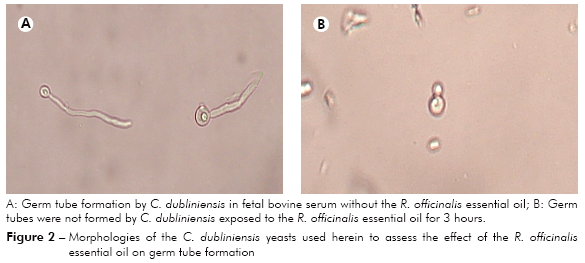
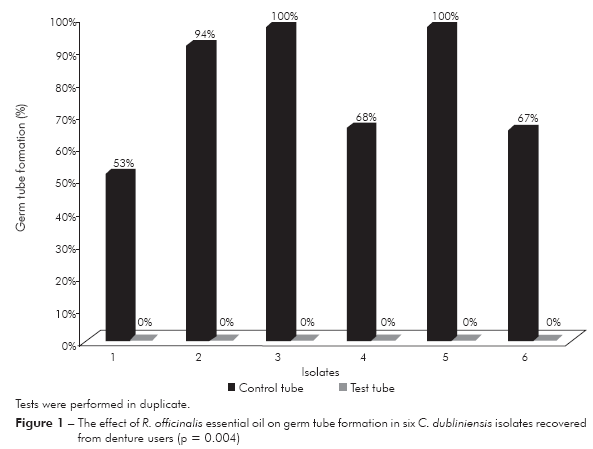
<body><![CDATA[<p><font face="Verdana" size="2">The percentage of cells from each isolate tested, forming germ tube ranged from 53% to 100% (<a href="#f1">Figure 1</a>), with no significant difference indicated by either the variation in germ tube formation (p = 0.06) or the presence or absence of stomatitis (p = 0.47) (<a href="#t1">Table 1</a>, <a href="#f1">Figure 1</a>). Following the exposure to 4% <i>R. officinalis </i>essential oil, a complete inhibition of germ tube formation was observed for all isolates of <i>C. dubliniensis </i>tested (p = 0.004) (<a href="#f1">Figure 1</a>). <a href="#f2">Figure 2</a> illustrates the morphology observed during the germ tube inhibition assay.</font></p>     <p><a name="f1"></a></p>     <p>&nbsp;</p>     <p align="center"><img src="/img/revistas/rpas/v4n4/4a05f1.gif" border="0"></p>     <p>&nbsp;</p>     <p><a name="f2"></a></p>     <p>&nbsp;</p>     <p align="center"><img src="/img/revistas/rpas/v4n4/4a05f2.gif" border="0"></p>     <p>&nbsp;</p>     <p><font face="Verdana" size="3"><b>DISCUSSION</b></font></p>     ]]></body>
<body><![CDATA[<p><font face="Verdana" size="2">In the present study, six isolates of <i>C. dubliniensis </i>recovered from the oral cavities of denture users were tested, reflecting the low frequency of this species in the microbiota of the individuals included in the study. This finding is corroborated by studies of <i>C. dubliniensis </i>isolated from the oral cavity<sup>15</sup> and from denture users presenting with stomatitis<sup>5,6</sup>. Although the pathogenesis of oral infection due to <i>C. dubliniensis </i>is poorly understood, germ tube formation is the primary virulence factor that triggers yeast proliferation during the infection process<sup>7,18</sup>. Depending on the isolate, different percentages of cells forming germ tubes were observed (<a href="#f1">Figure 1</a>, p = 0.06), variation that might be related to variability in the adaptation of each isolate to the incubation    conditions    in    the    test.    Indeed,    the</font> <font face="Verdana" size="2">development of hyphae by <i>C. dubliniensis </i>depends on the association between the activation level of transcription factor Crz1 and the composition of the medium that induces filamentation<sup>19</sup>. The results from the inhibition of germ tube formation assay observed in this study agree with those described by Pozzatti et al<sup>20</sup>, reinforcing the need for the evaluation of pharmaceuticals based on the essential oil of <i>R. officinalis.</i></font></p>     <p><font face="Verdana" size="2">Additionally, the reduction in <i>C. dubliniensis </i>colonization of denture resins has been described in an assay using sub-therapeutic concentrations of chlorhexidine gluconate (0.005% and 0.0025%) that are capable of reducing the hydrophobicity of the yeast cell surface<sup>11</sup> and inhibiting the formation of germ tubes<sup>20</sup>, thus contributing to the reduction of <i>in vivo </i>pathogenicity. Such reduced pathogenicity is due</font> <font face="Verdana" size="2">to reduced host cell adherence and the prevention of morphology switching. In comparison, gels containing 1% <i>Pelargonium graveolens</i><sup>22</sup> or <i>Satureja hortensis</i><sup>23</sup> essential oil have been described, and a significant reduction in stomatitis caused by <i>C. albicans </i>was observed. These data strongly encourage further studies aimed at evaluating the effects of natural products or synthetic compounds on oral infections caused by yeasts of the <i>Candida </i>genus, such as <i>C. dubliniensis, </i>particularly with regard to the targeted inhibition of its filamentous form.</font></p>     <p><font face="Verdana" size="2">Using 4% <i>R. officinalis </i>essential oil, the present study showed a complete inhibition of germ tube formation for all isolates of <i>C. dubliniensis </i>tested. Our data demonstrate the ability of this oil to potently inhibit <i>C. dubliniensis, </i>which is important considering the lack of data showing the activity of natural products against this species. Given that four of the six <i>C. dubliniensis </i>isolates tested in this study were recovered from cases of stomatitis (<a href="#t1">Table 1</a>) and that all were susceptible to the</font> <font face="Verdana" size="2">inhibition of germ tube formation in the presence of this essential oil (<a href="#f1">Figure 1</a>), it is imperative to study this oil more thoroughly. It will be necessary to investigate the applicability of pharmaceutical preparations containing <i>R. officinalis </i>essential oil as inhibitors of denture resin colonization and its effectiveness in treating stomatitis caused by this species of <i>Candida.</i></font></p>     <p>&nbsp;</p>     <p><font face="Verdana" size="3"><b>CONCLUSION</b></font></p>     <p><font face="Verdana" size="2">The present study describes the complete inhibition of germ tube formation in six isolates of <i>C. dubliniensis </i>by exposure to 4% <i>R. officinalis </i>essential oil. The development of pharmaceutical preparations containing this essential oil and the assessment of their potential for the treatment of stomatitis associated with <i>C. dubliniensis </i>are suggested.</font></p>     <p>&nbsp;</p>     <p><font face="Verdana" size="3"><b>CONFLICTS OF INTEREST</b></font></p>     <p><font face="Verdana" size="2">The authors declare no conflicts of interest.</font></p>     <p>&nbsp;</p>     ]]></body>
<body><![CDATA[<p><font face="Verdana" size="3"><b>REFERENCES</b></font></p>     <!-- ref --><p><font face="Verdana" size="2">1 Sullivan DJ, Westerneng TJ, Haynes KA, Bennett DE, Coleman DC. <i>Candida dubliniensis </i>sp. nov.: phenotypic and molecular characterization of a novel species associated with oral candidosis in HIV-infected individuals. Microbiol. 1995 Jul;141(7):1507-21. Doi:10.1099/13500872-141-7-1507 &#91;<a href="http://mic.sgmjournals.org/content/141/7/1507.long" target="_blank">Link</a>&#93;</font><!-- ref --><p><font face="Verdana" size="2">2 Moran GP, Coleman DC, Sullivan DJ. <i>Candida albicans </i>versus <i>Candida dubliniensis: </i>why is <i>C. albicans </i>more pathogenic? Int J Microbiol. 2012 Sep;2012:205921 .Doi.10.1155/2012/205921 &#91;<a href="http://www.ncbi.nlm.nih.gov/pmc/articles/PMC3166774/" target="_blank">Link</a>&#93;</font><!-- ref --><p><font face="Verdana" size="2">3 Khan ZU, Ahmad S, Mokaddas E, Chandy R. Tobacco agar, a new medium for differentiating <i>Candida dubliniensis </i>from <i>Candida albicans. </i>J Clin Microbiol. 2004 Oct;42(10):4796-8. Doi:10.1128/JCM.42.10.4796-4798.2004 &#91;<a href="http://jcm.asm.org/content/42/10/4796.long" target="_blank">Link</a>&#93;</font><!-- ref --><p><font face="Verdana" size="2">4 Sullivan DJ, Moran GP, Coleman DC. <i>Candida dubliniensis: </i>ten years on. FEMS Microbiol Lett. 2005 Dec;253(1):9-17. &#91;<a href="http://www.ncbi.nlm.nih.gov/pubmed/16213674" target="_blank">Link</a>&#93;</font><!-- ref --><p><font face="Verdana" size="2">5 Gasparoto TH, Dion&#237;sio TJ, Oliveira CE, Porto VC, Gelani V, Santos CF, et al. Isolation of <i>Candida dubliniensis </i>from denture wearers. J Med Microbiol.</font> <font face="Verdana" size="2">2009 Jul;58:959-62. Doi:10.1099/jmm.0.008391-0 &#91;<a href="http://jmm.sgmjournals.org/content/58/7/959.long#aff-2" target="_blank">Link</a>&#93;</font><!-- ref --><p><font face="Verdana" size="2">6 Marcos-Arias C, Vicente JL, Sahand IH, Eguia A, De-Juan A, Madariaga L, et al. Isolation of <i>Candida dubliniensis </i>in denture stomatitis. Arch Oral Biol.</font> <font face="Verdana" size="2">2009 Feb;54(52):127-31. Doi:10.1016/j.archoralbio.2008.09.005 &#91;<a href="http://www.ncbi.nlm.nih.gov/pubmed/18950745" target="_blank">Link</a>&#93; </font><!-- ref --><p><font face="Verdana" size="2">7 Whiteway M, Bachewich C. Morphogenesis in <i>Candida albicans. </i>Annu Rev Microbiol. 2007 Jun;61:529-53. Doi:10.1146/annurev.micro.61.080706.093341 &#91;<a href="http://www.ncbi.nlm.nih.gov/pubmed/?term=Annu+Rev+Microbiol.+2007%3B61%3A529%E2%80%93553." target="_blank">Link</a>&#93;</font><!-- ref --><p><font face="Verdana" size="2">8 Guti&#233;rrez J, Morales P, Gonz&#225;lez MA, Quind&#243;s G. <i>Candida dubliniensis, </i>a new fungal pathogen. J Basic</font> <font face="Verdana" size="2">Microbiol. 2002;42(3):207-27. &#91;<a href="http://www.ncbi.nlm.nih.gov/pubmed/?term=Guti%C3%A9rrez+J%2C+Morales+P%2C+Gonz%C3%A1lez+MA%2C+Quind%C3%B3s+G.+Candida+dubliniensis%2C+a+new+fungal+pathogen.+J+Basic+Microbiol.+2002%3B42%283%29%3A207-27." target="_blank">Link</a>&#93;</font><!-- ref --><p><font face="Verdana" size="2">9 Nonaka CFW, Nascimento GJF, Goulart Filho JAV, Lima KC, Milan EP. <i>Candida dubliniensis: </i>emergent yeast associated with oral candidosis. Rev Odontol</font> <font face="Verdana" size="2">UNESP. 2008;37(2):125-31. &#91;<a href="http://www.revodontolunesp.com.br/articles/view/id/51ae4aa01ef1faca3d002dfe" target="_blank">Link</a>&#93;</font><!-- ref --><p><font face="Verdana" size="2">10 Loreto ES, Scheid LA, Nogueira CW, Zeni G, Santurio JM, Alves SH. <i>Candida dubliniensis: </i>epidemiology and     phenotypic     methods     for     identification.</font> <font face="Verdana" size="2">Mycopathologia. 2010 Jun;1699(6):431-43. Doi:10.1007/s11046-010-9286-5 &#91;<a href="http://link.springer.com/article/10.1007/s11046-010-9286-5#page-1" target="_blank">Link</a>&#93;</font><!-- ref --><p><font face="Verdana" size="2">11 Ellepola ANB, Joseph BK, Khan ZU. Cell surface</font> <font face="Verdana" size="2">hydrophobicity of oral <i>Candida dubliniensis </i>isolates following limited exposure to sub-therapeutic concentrations of chlorhexidine gluconate. Mycoses.</font> <font face="Verdana" size="2">2013 Jan;56(1):82-8. Doi:10.1111/j.1439-0507.2012.02203.x &#91;<a href="http://www.ncbi.nlm.nih.gov/pubmed/?term=Mycoses+2013%3B+56%3A82%E2%80%9388" target="_blank">Link</a>&#93;</font><!-- ref --><p><font face="Verdana" size="2">12 Castro RD, Lima EO. Atividade antif&#250;ngica in vitro do &#243;leo essencial de <i>Eucalyptus globulus </i>L. sobre</font> <font face="Verdana" size="2"><i>Candida </i>spp. Rev Odontol UNESP. 2010 mai-jun;39(3):179-84. &#91;<a href="http://www.revodontolunesp.com.br/files/v39n3/v39n3a08.pdf" target="_blank">Link</a>&#93;</font> <!-- ref --><p><font face="Verdana" size="2">13 Lima IO, Oliveira RAG, Lima EO, Farias NMP, Souza EL. Antifungal activity from essential oils on <i>Candida </i>species. Braz J Pharmacogn. 2006 Apr-Jun;16(2):197-201. Doi:10.1590/S0102-695X2006000200011 &#91;<a href="http://www.scielo.br/scielo.php?pid=S0102-695X2006000200011&script=sci_arttext" target="_blank">Link</a>&#93;</font><!-- ref --><p><font face="Verdana" size="2">14 Castro RD, Lima EO. Atividade antif&#250;ngica dos &#243;leos essenciais de sassafras (<i>Ocotea odor&#237;fera </i>Vell.) e alecrim (<i>Rosmarinus officinalis </i>L.) sobre o g&#234;nero <i>Candida. </i>Rev Bras Pl Med. 2011;13(2):203-8. Doi:10.1590/S1516-05722011000200012 &#91;<a href="http://www.scielo.br/scielo.php?script=sci_arttext&pid=S1516-05722011000200012&lng=en&nrm=iso&tlng=pt" target="_blank">Link</a>&#93;</font><!-- ref --><p><font face="Verdana" size="2">15 Arikan S, Darka O, Hascelik G, Gunalp A. Identification of <i>Candida dubliniensis </i>strains using heat tolerance tests, morphological characteristics and   molecular   methods.   Mikrobiyol   Bul.   2003 </font><font face="Verdana" size="2">Jan;37(1):49-57. &#91;<a href="http://www.ncbi.nlm.nih.gov/pubmed/?term=Arikan+S%2C+Darka+O%2C+Hascelik+G%2C+Gunalp+A.+Identification+of+Candida+dubliniensis+strains+using+heat+tolerance+tests%2C+morphological+characteristics+and+molecular+methods." target="_blank">Link</a>&#93;</font><!-- ref --><p><font face="Verdana" size="2">16 Newton AV. Denture sore mouth: a possible etiology.</font> <font face="Verdana" size="2">Br Dent J. 1962;112:357-60. Doi:10.1111/j.1439-0507.2011.02079.x &#91;<a href="http://onlinelibrary.wiley.com/doi/10.1111/j.1439-0507.2011.02079.x/abstract;jsessionid=22EC34B9930329AB2967C981967FA3B5.f02t01" target="_blank">Link</a>&#93;</font><!-- ref --><p><font face="Verdana" size="2">17 Bernardes I, Rodrigues MPF, Bacelli GK, Munin E, Alves LP, Costa MS. Aloe vera extract reduces both growth and germ tube formation by <i>Candida albicans.</i></font> <font face="Verdana" size="2">Mycoses. 2012 May;55(3):257-61. Doi:10.1007/s11046-011-9447-1 &#91;<a href="http://www.ncbi.nlm.nih.gov/pubmed/?term=Mycopathologia.+2011%3B172%3A465-71" target="_blank">Link</a>&#93;</font><!-- ref --><p><font face="Verdana" size="2">18 Ge YP, He GX, Lin T, Lu GX, Shen YN, Liu WD. First isolation of <i>Candida dubliniensis </i>from oral cavities of   dermatological   patients   in   Nanjing,   China.</font> <font face="Verdana" size="2">Mycopathologia. 2011 Dec;172(6):465-71. Doi:10.1128/EC.00310-10 &#91;<a href="http://ec.asm.org/content/10/6/803.full" target="_blank">Link</a>&#93;</font><!-- ref --><p><font face="Verdana" size="2">19 Chen YL, Brand A, Morrison EL, Silao FGS, Bigol UG, Malbas Junior FF, et al. Calcineurin controls drug tolerance, hyphal growth, and virulence in <i>Candida dubliniensis. </i>Eukaryot Cell. 2011 Jun;10(6):803-19. Doi:10.1016/j.mycmed.2010.06.003 &#91;<a href="http://www.sciencedirect.com/science/article/pii/S1156523310000739" target="_blank">Link</a>&#93;</font><!-- ref --><p><font face="Verdana" size="2">20 Pozzatti P, Loreto &#201;S, Nunes Mario DA, Rossato L, Santurio JM, Alves SH. Activities of essential oils in the inhibition of <i>Candida albicans </i>and <i>Candida dubliniensis </i>germ tube formation. J Mycol Med. 2010</font> <font face="Verdana" size="2">Sep;20(3):185-9. Doi:10.1111/j.1439-0507.2010.01915.x &#91;<a href="http://www.ncbi.nlm.nih.gov/pubmed/?term=Mycoses+2010%3B54%3Ae330-5." target="_blank">Link</a>&#93;</font><!-- ref --><p><font face="Verdana" size="2">21 Ellepola ANB. The effect of brief exposure to sub-therapeutic concentrations of chlorhexidine gluconate on germ tube formation of oral <i>Candida dubliniensis.</i></font> <font face="Verdana" size="2">Mycoses. 2010 Sep;54(5):e330-5. &#91;<a href="http://www.ncbi.nlm.nih.gov/pubmed/?term=Dent+Res+J+%28Isfahan%29.+2011%3B8%28Suppl+1%29%3AS105-8" target="_blank">Link</a>&#93;</font><!-- ref --><p><font face="Verdana" size="2">22 Sabzghabaee AM, Shirdare Z, Ebadian B, Aslani A, Ghannadi A. Clinical evaluation of the essential oil of <i>Pelargonium graveolens </i>for the treatment of denture stomatitis. Dent Res J (Isfahan). 2011  Dec;8(Suppl</font> <font face="Verdana" size="2">1):S105-8. &#91;<a href="http://www.ncbi.nlm.nih.gov/pubmed/?term=Dent+Res+J+%28Isfahan%29.+2012%3B9%282%29%3A198-202" target="_blank">Link</a>&#93;</font><!-- ref --><p><font face="Verdana" size="2">23 Sabzghabaee AM, Davoodi N, Ebadian B, Aslani A, Ghannadi A. Clinical evaluation of the essential oil of &quot;<i>Satureja Hortensis</i>&quot; for the treatment of denture stomatitis. Dent Res J (Isfahan). 2012 Mar-</font><font face="Verdana" size="2">Apr;9(2):198-202.</font><p>&nbsp;</p>     <p>&nbsp;</p>     <p><font size="2"><b><font size="2" face="verdana"><b><b><a name="endereco"></a><a href="#topo"><img src="img/revistas/ess/v20n1/seta.gif" border="0"></a></b></b></font></b></font><font face="Verdana" size="2"><b>Correspond&#234;ncia / Correspondence / Correspondencia:</b></font>    <br> <font face="Verdana" size="2">Lurdete Maria Rocha Gauch</font>    <br> <font face="Verdana" size="2">Instituto de Ci&#234;ncias da Sa&#250;de,    <br> Faculdade de Odontologia,</font><font face="Verdana" size="2">    ]]></body>
<body><![CDATA[<br> Universidade Federal do Par&#225;</font>    <br> <font face="Verdana" size="2">Av. Augusto Corr&#234;a, 1. Bairro: Guam&#225;    <br> </font><font face="Verdana" size="2">CEP: 66075-110       Bel&#233;m-Par&#225;-Brasil</font>    <br> <font face="Verdana" size="2">Tel.: +55 (91) 3201-7637</font>    <br> <font face="Verdana" size="2">E-mail: <a href="mailto:lrgauch@ufpa.br">lrgauch@ufpa.br</a></font></p>     <p><font face="Verdana" size="2">Received / Recebido em / Recibido en: 25/07/2013    <br> Accepted / Aceito em / Aceito en: 13/11/2013</font></p> <script type="text/javascript"> var gaJsHost = (("https:" == document.location.protocol) ? "https://ssl." : "http://www."); document.write(unescape("%3Cscript src='" + gaJsHost + "google-analytics.com/ga.js' type='text/javascript'%3E%3C/script%3E")); </script> <script type="text/javascript"> try { var pageTracker = _gat._getTracker("UA-7885746-4"); pageTracker._setDomainName("none"); pageTracker._setAllowLinker(true); pageTracker._trackPageview(); } catch(err) {}</script>      ]]></body><back>
<ref-list>
<ref id="B1">
<label>1</label><nlm-citation citation-type="journal">
<person-group person-group-type="author">
<name>
<surname><![CDATA[Sullivan]]></surname>
</name>
<name>
<surname><![CDATA[Westerneng]]></surname>
<given-names><![CDATA[TJ]]></given-names>
</name>
<name>
<surname><![CDATA[Haynes]]></surname>
<given-names><![CDATA[KA]]></given-names>
</name>
<name>
<surname><![CDATA[Bennett]]></surname>
<given-names><![CDATA[DE]]></given-names>
</name>
<name>
<surname><![CDATA[Coleman]]></surname>
<given-names><![CDATA[DC]]></given-names>
</name>
</person-group>
<article-title xml:lang="en"><![CDATA[Candida dubliniensis sp. nov.: phenotypic and molecular characterization of a novel species associated with oral candidosis in HIV-infected individuals]]></article-title>
<source><![CDATA[Microbiol]]></source>
<year>1995</year>
<month> J</month>
<day>ul</day>
<volume>141</volume>
<numero>7</numero>
<issue>7</issue>
<page-range>1507-21</page-range></nlm-citation>
</ref>
<ref id="B2">
<label>2</label><nlm-citation citation-type="journal">
<person-group person-group-type="author">
<name>
<surname><![CDATA[Moran]]></surname>
<given-names><![CDATA[GP]]></given-names>
</name>
<name>
<surname><![CDATA[Coleman]]></surname>
<given-names><![CDATA[DC]]></given-names>
</name>
<name>
<surname><![CDATA[Sullivan]]></surname>
<given-names><![CDATA[DJ]]></given-names>
</name>
</person-group>
<article-title xml:lang="en"><![CDATA[Candida albicans versus Candida dubliniensis: why is C. albicans more pathogenic]]></article-title>
<source><![CDATA[Int J Microbiol]]></source>
<year>2012</year>
<month> S</month>
<day>ep</day>
<volume>2012</volume>
<page-range>205921</page-range></nlm-citation>
</ref>
<ref id="B3">
<label>3</label><nlm-citation citation-type="journal">
<person-group person-group-type="author">
<name>
<surname><![CDATA[Khan]]></surname>
<given-names><![CDATA[ZU]]></given-names>
</name>
<name>
<surname><![CDATA[Ahmad]]></surname>
<given-names><![CDATA[S]]></given-names>
</name>
<name>
<surname><![CDATA[Mokaddas]]></surname>
<given-names><![CDATA[E]]></given-names>
</name>
<name>
<surname><![CDATA[Chandy]]></surname>
<given-names><![CDATA[R]]></given-names>
</name>
</person-group>
<article-title xml:lang="en"><![CDATA[Tobacco agar, a new medium for differentiating Candida dubliniensis from Candida albicans]]></article-title>
<source><![CDATA[J Clin Microbiol]]></source>
<year>2004</year>
<month> O</month>
<day>ct</day>
<volume>42</volume>
<numero>10</numero>
<issue>10</issue>
<page-range>4796-8</page-range></nlm-citation>
</ref>
<ref id="B4">
<label>4</label><nlm-citation citation-type="journal">
<person-group person-group-type="author">
<name>
<surname><![CDATA[Sullivan]]></surname>
<given-names><![CDATA[DJ]]></given-names>
</name>
<name>
<surname><![CDATA[Moran]]></surname>
<given-names><![CDATA[GP]]></given-names>
</name>
<name>
<surname><![CDATA[Coleman]]></surname>
<given-names><![CDATA[DC]]></given-names>
</name>
</person-group>
<article-title xml:lang="en"><![CDATA[Candida dubliniensis: ten years on]]></article-title>
<source><![CDATA[FEMS Microbiol Lett]]></source>
<year>2005</year>
<month> D</month>
<day>ec</day>
<volume>253</volume>
<numero>1</numero>
<issue>1</issue>
<page-range>9-17</page-range></nlm-citation>
</ref>
<ref id="B5">
<label>5</label><nlm-citation citation-type="journal">
<person-group person-group-type="author">
<name>
<surname><![CDATA[Gasparoto]]></surname>
<given-names><![CDATA[TH]]></given-names>
</name>
<name>
<surname><![CDATA[Dionísio]]></surname>
<given-names><![CDATA[TJ]]></given-names>
</name>
<name>
<surname><![CDATA[Oliveira]]></surname>
<given-names><![CDATA[CE]]></given-names>
</name>
<name>
<surname><![CDATA[Porto]]></surname>
<given-names><![CDATA[VC]]></given-names>
</name>
<name>
<surname><![CDATA[Gelani]]></surname>
<given-names><![CDATA[V]]></given-names>
</name>
<name>
<surname><![CDATA[Santos]]></surname>
<given-names><![CDATA[CF]]></given-names>
</name>
</person-group>
<article-title xml:lang="en"><![CDATA[Isolation of Candida dubliniensis from denture wearers]]></article-title>
<source><![CDATA[J Med Microbiol]]></source>
<year>2009</year>
<month> J</month>
<day>ul</day>
<volume>58</volume>
<page-range>959-62</page-range></nlm-citation>
</ref>
<ref id="B6">
<label>6</label><nlm-citation citation-type="journal">
<person-group person-group-type="author">
<name>
<surname><![CDATA[Marcos-Arias]]></surname>
<given-names><![CDATA[C]]></given-names>
</name>
<name>
<surname><![CDATA[Vicente]]></surname>
<given-names><![CDATA[JL]]></given-names>
</name>
<name>
<surname><![CDATA[Sahand]]></surname>
<given-names><![CDATA[IH]]></given-names>
</name>
<name>
<surname><![CDATA[Eguia]]></surname>
<given-names><![CDATA[A]]></given-names>
</name>
<name>
<surname><![CDATA[De-Juan]]></surname>
<given-names><![CDATA[A]]></given-names>
</name>
<name>
<surname><![CDATA[Madariaga]]></surname>
<given-names><![CDATA[L]]></given-names>
</name>
</person-group>
<article-title xml:lang="en"><![CDATA[Isolation of Candida dubliniensis in denture stomatitis]]></article-title>
<source><![CDATA[Arch Oral Biol]]></source>
<year>2009</year>
<month> F</month>
<day>eb</day>
<volume>54</volume>
<numero>52</numero>
<issue>52</issue>
<page-range>127-31</page-range></nlm-citation>
</ref>
<ref id="B7">
<label>7</label><nlm-citation citation-type="journal">
<person-group person-group-type="author">
<name>
<surname><![CDATA[Whiteway]]></surname>
<given-names><![CDATA[M]]></given-names>
</name>
<name>
<surname><![CDATA[Bachewich]]></surname>
<given-names><![CDATA[C]]></given-names>
</name>
</person-group>
<article-title xml:lang="en"><![CDATA[Morphogenesis in Candida albicans]]></article-title>
<source><![CDATA[Annu Rev Microbiol]]></source>
<year>2007</year>
<month> J</month>
<day>un</day>
<volume>61</volume>
<page-range>529-53</page-range></nlm-citation>
</ref>
<ref id="B8">
<label>8</label><nlm-citation citation-type="journal">
<person-group person-group-type="author">
<name>
<surname><![CDATA[Gutiérrez]]></surname>
<given-names><![CDATA[J]]></given-names>
</name>
<name>
<surname><![CDATA[Morales]]></surname>
<given-names><![CDATA[P]]></given-names>
</name>
<name>
<surname><![CDATA[González]]></surname>
<given-names><![CDATA[MA]]></given-names>
</name>
<name>
<surname><![CDATA[Quindós]]></surname>
<given-names><![CDATA[G]]></given-names>
</name>
</person-group>
<article-title xml:lang="en"><![CDATA[Candida dubliniensis, a new fungal pathogen]]></article-title>
<source><![CDATA[J Basic Microbiol]]></source>
<year>2002</year>
<volume>42</volume>
<numero>3</numero>
<issue>3</issue>
<page-range>207-27</page-range></nlm-citation>
</ref>
<ref id="B9">
<label>9</label><nlm-citation citation-type="journal">
<person-group person-group-type="author">
<name>
<surname><![CDATA[Nonaka]]></surname>
<given-names><![CDATA[CFW]]></given-names>
</name>
<name>
<surname><![CDATA[Nascimento]]></surname>
<given-names><![CDATA[GJF]]></given-names>
</name>
<name>
<surname><![CDATA[Goulart Filho]]></surname>
<given-names><![CDATA[JAV]]></given-names>
</name>
<name>
<surname><![CDATA[Lima]]></surname>
<given-names><![CDATA[KC]]></given-names>
</name>
<name>
<surname><![CDATA[Milan]]></surname>
<given-names><![CDATA[EP]]></given-names>
</name>
</person-group>
<article-title xml:lang="en"><![CDATA[Candida dubliniensis: emergent yeast associated with oral candidosis]]></article-title>
<source><![CDATA[Rev Odontol UNESP]]></source>
<year>2008</year>
<volume>37</volume>
<numero>2</numero>
<issue>2</issue>
<page-range>125-31</page-range></nlm-citation>
</ref>
<ref id="B10">
<label>10</label><nlm-citation citation-type="journal">
<person-group person-group-type="author">
<name>
<surname><![CDATA[Loreto]]></surname>
<given-names><![CDATA[ES]]></given-names>
</name>
<name>
<surname><![CDATA[Scheid]]></surname>
<given-names><![CDATA[LA]]></given-names>
</name>
<name>
<surname><![CDATA[Nogueira]]></surname>
<given-names><![CDATA[CW]]></given-names>
</name>
<name>
<surname><![CDATA[Zeni]]></surname>
<given-names><![CDATA[G]]></given-names>
</name>
<name>
<surname><![CDATA[Santurio]]></surname>
<given-names><![CDATA[JM]]></given-names>
</name>
<name>
<surname><![CDATA[Alves]]></surname>
<given-names><![CDATA[SH]]></given-names>
</name>
</person-group>
<article-title xml:lang="en"><![CDATA[Candida dubliniensis: epidemiology and phenotypic methods for identification]]></article-title>
<source><![CDATA[Mycopathologia]]></source>
<year>2010</year>
<month> J</month>
<day>un</day>
<volume>1699</volume>
<numero>6</numero>
<issue>6</issue>
<page-range>431-43</page-range></nlm-citation>
</ref>
<ref id="B11">
<label>11</label><nlm-citation citation-type="journal">
<person-group person-group-type="author">
<name>
<surname><![CDATA[Ellepola]]></surname>
<given-names><![CDATA[ANB]]></given-names>
</name>
<name>
<surname><![CDATA[Joseph]]></surname>
<given-names><![CDATA[BK]]></given-names>
</name>
<name>
<surname><![CDATA[Khan]]></surname>
<given-names><![CDATA[ZU]]></given-names>
</name>
</person-group>
<article-title xml:lang="en"><![CDATA[Cell surface hydrophobicity of oral Candida dubliniensis isolates following limited exposure to sub-therapeutic concentrations of chlorhexidine gluconate]]></article-title>
<source><![CDATA[Mycoses]]></source>
<year>2013</year>
<month> J</month>
<day>an</day>
<volume>56</volume>
<numero>1</numero>
<issue>1</issue>
<page-range>82-8</page-range></nlm-citation>
</ref>
<ref id="B12">
<label>12</label><nlm-citation citation-type="journal">
<person-group person-group-type="author">
<name>
<surname><![CDATA[Castro]]></surname>
<given-names><![CDATA[RD]]></given-names>
</name>
<name>
<surname><![CDATA[Lima]]></surname>
<given-names><![CDATA[EO]]></given-names>
</name>
</person-group>
<article-title xml:lang="pt"><![CDATA[Atividade antifúngica in vitro do óleo essencial de Eucalyptus globulus L. sobre Candida spp]]></article-title>
<source><![CDATA[Rev Odontol UNESP]]></source>
<year>2010</year>
<month> m</month>
<day>ai</day>
<volume>39</volume>
<numero>3</numero>
<issue>3</issue>
<page-range>179-84</page-range></nlm-citation>
</ref>
<ref id="B13">
<label>13</label><nlm-citation citation-type="journal">
<person-group person-group-type="author">
<name>
<surname><![CDATA[Lima]]></surname>
<given-names><![CDATA[IO]]></given-names>
</name>
<name>
<surname><![CDATA[Oliveira]]></surname>
<given-names><![CDATA[RAG]]></given-names>
</name>
<name>
<surname><![CDATA[Lima]]></surname>
<given-names><![CDATA[EO]]></given-names>
</name>
<name>
<surname><![CDATA[Farias]]></surname>
<given-names><![CDATA[NMP]]></given-names>
</name>
<name>
<surname><![CDATA[Souza]]></surname>
<given-names><![CDATA[EL]]></given-names>
</name>
</person-group>
<article-title xml:lang="en"><![CDATA[Antifungal activity from essential oils on Candida species]]></article-title>
<source><![CDATA[Braz J Pharmacogn]]></source>
<year>2006</year>
<month> A</month>
<day>pr</day>
<volume>16</volume>
<numero>2</numero>
<issue>2</issue>
<page-range>197-201</page-range></nlm-citation>
</ref>
<ref id="B14">
<label>14</label><nlm-citation citation-type="journal">
<person-group person-group-type="author">
<name>
<surname><![CDATA[Castro]]></surname>
<given-names><![CDATA[RD]]></given-names>
</name>
<name>
<surname><![CDATA[Lima]]></surname>
<given-names><![CDATA[EO]]></given-names>
</name>
</person-group>
<article-title xml:lang="pt"><![CDATA[Atividade antifúngica dos óleos essenciais de sassafras (Ocotea odorífera Vell.) e alecrim (Rosmarinus officinalis L.) sobre o gênero Candida]]></article-title>
<source><![CDATA[Rev Bras Pl Med]]></source>
<year>2011</year>
<volume>13</volume>
<numero>2</numero>
<issue>2</issue>
<page-range>203-8</page-range></nlm-citation>
</ref>
<ref id="B15">
<label>15</label><nlm-citation citation-type="journal">
<person-group person-group-type="author">
<name>
<surname><![CDATA[Arikan]]></surname>
<given-names><![CDATA[S]]></given-names>
</name>
<name>
<surname><![CDATA[Darka]]></surname>
<given-names><![CDATA[O]]></given-names>
</name>
<name>
<surname><![CDATA[Hascelik]]></surname>
<given-names><![CDATA[G]]></given-names>
</name>
<name>
<surname><![CDATA[Gunalp]]></surname>
<given-names><![CDATA[A]]></given-names>
</name>
</person-group>
<article-title xml:lang="en"><![CDATA[Identification of Candida dubliniensis strains using heat tolerance tests, morphological characteristics and molecular methods]]></article-title>
<source><![CDATA[Mikrobiyol Bul]]></source>
<year>2003</year>
<month> J</month>
<day>an</day>
<volume>37</volume>
<numero>1</numero>
<issue>1</issue>
<page-range>49-57</page-range></nlm-citation>
</ref>
<ref id="B16">
<label>16</label><nlm-citation citation-type="journal">
<person-group person-group-type="author">
<name>
<surname><![CDATA[Newton]]></surname>
<given-names><![CDATA[AV]]></given-names>
</name>
</person-group>
<article-title xml:lang="en"><![CDATA[Denture sore mouth: a possible etiology]]></article-title>
<source><![CDATA[Br Dent J]]></source>
<year>1962</year>
<volume>112</volume>
<page-range>357-60</page-range></nlm-citation>
</ref>
<ref id="B17">
<label>17</label><nlm-citation citation-type="journal">
<person-group person-group-type="author">
<name>
<surname><![CDATA[Bernardes]]></surname>
<given-names><![CDATA[I]]></given-names>
</name>
<name>
<surname><![CDATA[Rodrigues]]></surname>
<given-names><![CDATA[MPF]]></given-names>
</name>
<name>
<surname><![CDATA[Bacelli]]></surname>
<given-names><![CDATA[GK]]></given-names>
</name>
<name>
<surname><![CDATA[Munin]]></surname>
<given-names><![CDATA[E]]></given-names>
</name>
<name>
<surname><![CDATA[Alves]]></surname>
<given-names><![CDATA[LP]]></given-names>
</name>
<name>
<surname><![CDATA[Costa]]></surname>
<given-names><![CDATA[MS]]></given-names>
</name>
</person-group>
<article-title xml:lang="en"><![CDATA[Aloe vera extract reduces both growth and germ tube formation by Candida albicans]]></article-title>
<source><![CDATA[Mycoses]]></source>
<year>2012</year>
<month> M</month>
<day>ay</day>
<volume>55</volume>
<numero>3</numero>
<issue>3</issue>
<page-range>257-61</page-range></nlm-citation>
</ref>
<ref id="B18">
<label>18</label><nlm-citation citation-type="journal">
<person-group person-group-type="author">
<name>
<surname><![CDATA[Ge]]></surname>
<given-names><![CDATA[YP]]></given-names>
</name>
<name>
<surname><![CDATA[He]]></surname>
<given-names><![CDATA[GX]]></given-names>
</name>
<name>
<surname><![CDATA[Lin]]></surname>
<given-names><![CDATA[T]]></given-names>
</name>
<name>
<surname><![CDATA[Lu]]></surname>
<given-names><![CDATA[GX]]></given-names>
</name>
<name>
<surname><![CDATA[Shen]]></surname>
<given-names><![CDATA[YN]]></given-names>
</name>
<name>
<surname><![CDATA[Liu]]></surname>
<given-names><![CDATA[WD]]></given-names>
</name>
</person-group>
<article-title xml:lang="en"><![CDATA[First isolation of Candida dubliniensis from oral cavities of dermatological patients in Nanjing, China]]></article-title>
<source><![CDATA[Mycopathologia]]></source>
<year>2011</year>
<month> D</month>
<day>ec</day>
<volume>172</volume>
<numero>6</numero>
<issue>6</issue>
<page-range>465-71</page-range></nlm-citation>
</ref>
<ref id="B19">
<label>19</label><nlm-citation citation-type="journal">
<person-group person-group-type="author">
<name>
<surname><![CDATA[Chen]]></surname>
<given-names><![CDATA[YL]]></given-names>
</name>
<name>
<surname><![CDATA[Brand]]></surname>
<given-names><![CDATA[A]]></given-names>
</name>
<name>
<surname><![CDATA[Morrison]]></surname>
<given-names><![CDATA[EL]]></given-names>
</name>
<name>
<surname><![CDATA[Silao]]></surname>
<given-names><![CDATA[FGS]]></given-names>
</name>
<name>
<surname><![CDATA[Bigol]]></surname>
<given-names><![CDATA[UG]]></given-names>
</name>
<name>
<surname><![CDATA[Malbas Junior]]></surname>
<given-names><![CDATA[FF]]></given-names>
</name>
</person-group>
<article-title xml:lang="en"><![CDATA[Calcineurin controls drug tolerance, hyphal growth, and virulence in Candida dubliniensis]]></article-title>
<source><![CDATA[Eukaryot Cell]]></source>
<year>2011</year>
<month> J</month>
<day>un</day>
<volume>10</volume>
<numero>6</numero>
<issue>6</issue>
<page-range>803-19</page-range></nlm-citation>
</ref>
<ref id="B20">
<label>20</label><nlm-citation citation-type="journal">
<person-group person-group-type="author">
<name>
<surname><![CDATA[Pozzatti]]></surname>
<given-names><![CDATA[P]]></given-names>
</name>
<name>
<surname><![CDATA[Loreto]]></surname>
<given-names><![CDATA[ÉS]]></given-names>
</name>
<name>
<surname><![CDATA[Nunes Mario]]></surname>
<given-names><![CDATA[DA]]></given-names>
</name>
<name>
<surname><![CDATA[Rossato]]></surname>
<given-names><![CDATA[L]]></given-names>
</name>
<name>
<surname><![CDATA[Santurio]]></surname>
<given-names><![CDATA[JM]]></given-names>
</name>
<name>
<surname><![CDATA[Alves]]></surname>
<given-names><![CDATA[SH]]></given-names>
</name>
</person-group>
<article-title xml:lang="en"><![CDATA[Activities of essential oils in the inhibition of Candida albicans and Candida dubliniensis germ tube formation]]></article-title>
<source><![CDATA[J Mycol Med]]></source>
<year>2010</year>
<month> S</month>
<day>ep</day>
<volume>20</volume>
<numero>3</numero>
<issue>3</issue>
<page-range>185-9</page-range></nlm-citation>
</ref>
<ref id="B21">
<label>21</label><nlm-citation citation-type="journal">
<person-group person-group-type="author">
<name>
<surname><![CDATA[Ellepola]]></surname>
<given-names><![CDATA[ANB]]></given-names>
</name>
</person-group>
<article-title xml:lang="en"><![CDATA[The effect of brief exposure to sub-therapeutic concentrations of chlorhexidine gluconate on germ tube formation of oral Candida dubliniensis]]></article-title>
<source><![CDATA[Mycoses]]></source>
<year>2010</year>
<month> S</month>
<day>ep</day>
<volume>54</volume>
<numero>5</numero>
<issue>5</issue>
<page-range>330-5</page-range></nlm-citation>
</ref>
<ref id="B22">
<label>22</label><nlm-citation citation-type="journal">
<person-group person-group-type="author">
<name>
<surname><![CDATA[Sabzghabaee]]></surname>
<given-names><![CDATA[AM]]></given-names>
</name>
<name>
<surname><![CDATA[Shirdare]]></surname>
<given-names><![CDATA[Z]]></given-names>
</name>
<name>
<surname><![CDATA[Ebadian]]></surname>
<given-names><![CDATA[B]]></given-names>
</name>
<name>
<surname><![CDATA[Aslani]]></surname>
<given-names><![CDATA[A]]></given-names>
</name>
<name>
<surname><![CDATA[Ghannadi]]></surname>
<given-names><![CDATA[A]]></given-names>
</name>
</person-group>
<article-title xml:lang="en"><![CDATA[Clinical evaluation of the essential oil of Pelargonium graveolens for the treatment of denture stomatitis]]></article-title>
<source><![CDATA[Dent Res J (Isfahan)]]></source>
<year>2011</year>
<month> D</month>
<day>ec</day>
<volume>8</volume>
<numero>^s1</numero>
<issue>^s1</issue>
<supplement>1</supplement>
<page-range>105-8</page-range></nlm-citation>
</ref>
<ref id="B23">
<label>23</label><nlm-citation citation-type="journal">
<person-group person-group-type="author">
<name>
<surname><![CDATA[Sabzghabaee]]></surname>
<given-names><![CDATA[AM]]></given-names>
</name>
<name>
<surname><![CDATA[Davoodi]]></surname>
<given-names><![CDATA[N]]></given-names>
</name>
<name>
<surname><![CDATA[Ebadian]]></surname>
<given-names><![CDATA[B]]></given-names>
</name>
<name>
<surname><![CDATA[Aslani]]></surname>
<given-names><![CDATA[A]]></given-names>
</name>
<name>
<surname><![CDATA[Ghannadi]]></surname>
<given-names><![CDATA[A]]></given-names>
</name>
</person-group>
<article-title xml:lang="en"><![CDATA[Clinical evaluation of the essential oil of "Satureja Hortensis" for the treatment of denture stomatitis]]></article-title>
<source><![CDATA[Dent Res J (Isfahan)]]></source>
<year>2012</year>
<month> M</month>
<day>ar</day>
<volume>9</volume>
<numero>2</numero>
<issue>2</issue>
<page-range>198-202</page-range></nlm-citation>
</ref>
</ref-list>
</back>
</article>