<?xml version="1.0" encoding="ISO-8859-1"?><article xmlns:mml="http://www.w3.org/1998/Math/MathML" xmlns:xlink="http://www.w3.org/1999/xlink" xmlns:xsi="http://www.w3.org/2001/XMLSchema-instance">
<front>
<journal-meta>
<journal-id>2176-6223</journal-id>
<journal-title><![CDATA[Revista Pan-Amazônica de Saúde]]></journal-title>
<abbrev-journal-title><![CDATA[Rev Pan-Amaz Saude]]></abbrev-journal-title>
<issn>2176-6223</issn>
<publisher>
<publisher-name><![CDATA[Instituto Evandro Chagas. Secretaria de Vigilância em Saúde e Ambiente. Ministério da Saúde]]></publisher-name>
</publisher>
</journal-meta>
<article-meta>
<article-id>S2176-62232014000200004</article-id>
<title-group>
<article-title xml:lang="en"><![CDATA[Phlebotomine sand flies (Diptera: Psychodidae) in forest fragments of Belém metropolitan area, Pará State, Brazil, with considerations on vectors of American cutaneous leishmaniasis agents]]></article-title>
<article-title xml:lang="pt"><![CDATA[Flebotomíneos (Diptera: Psychodidae) em fragmentos florestais da região metropolitana de Belém, Estado do Pará, Brasil, com considerações sobre vetores da leishmaniose tegumentar americana]]></article-title>
<article-title xml:lang="es"><![CDATA[Flebótomos (Diptera: Psychodidae) en fragmentos forestales de la región metropolitana de Belém, Estado de Pará, Brasil, con consideraciones sobre vectores de la leishmaniasis tegumentaria americana]]></article-title>
</title-group>
<contrib-group>
<contrib contrib-type="author">
<name>
<surname><![CDATA[Ferreira]]></surname>
<given-names><![CDATA[João Victor Silva]]></given-names>
</name>
<xref ref-type="aff" rid="A01"/>
</contrib>
<contrib contrib-type="author">
<name>
<surname><![CDATA[Santos]]></surname>
<given-names><![CDATA[Thiago Vasconcelos dos]]></given-names>
</name>
<xref ref-type="aff" rid="A02"/>
</contrib>
<contrib contrib-type="author">
<name>
<surname><![CDATA[Santos]]></surname>
<given-names><![CDATA[Emerson Monteiro dos]]></given-names>
</name>
<xref ref-type="aff" rid="A03"/>
</contrib>
<contrib contrib-type="author">
<name>
<surname><![CDATA[Gorayeb]]></surname>
<given-names><![CDATA[Inocêncio de Sousa]]></given-names>
</name>
<xref ref-type="aff" rid="A01"/>
</contrib>
</contrib-group>
<aff id="A01">
<institution><![CDATA[,Museu Paraense Emílio Goeldi Laboratório de Entomologia, Coordenação de Zoologia ]]></institution>
<addr-line><![CDATA[Belém Pará]]></addr-line>
<country>Brasil</country>
</aff>
<aff id="A02">
<institution><![CDATA[,Instituto Evandro Chagas/SVS/MS Laboratório de Leishmanioses ]]></institution>
<addr-line><![CDATA[Ananindeua Pará]]></addr-line>
<country>Brasil</country>
</aff>
<aff id="A03">
<institution><![CDATA[,Universidade Federal do Amapá Campus Binacional ]]></institution>
<addr-line><![CDATA[Oiapoque Amapá]]></addr-line>
<country>Brasil</country>
</aff>
<pub-date pub-type="pub">
<day>00</day>
<month>06</month>
<year>2014</year>
</pub-date>
<pub-date pub-type="epub">
<day>00</day>
<month>06</month>
<year>2014</year>
</pub-date>
<volume>5</volume>
<numero>2</numero>
<fpage>29</fpage>
<lpage>35</lpage>
<copyright-statement/>
<copyright-year/>
<self-uri xlink:href="http://scielo.iec.gov.br/scielo.php?script=sci_arttext&amp;pid=S2176-62232014000200004&amp;lng=en&amp;nrm=iso"></self-uri><self-uri xlink:href="http://scielo.iec.gov.br/scielo.php?script=sci_abstract&amp;pid=S2176-62232014000200004&amp;lng=en&amp;nrm=iso"></self-uri><self-uri xlink:href="http://scielo.iec.gov.br/scielo.php?script=sci_pdf&amp;pid=S2176-62232014000200004&amp;lng=en&amp;nrm=iso"></self-uri><abstract abstract-type="short" xml:lang="en"><p><![CDATA[In order to identify vectors of American cutaneous leishmaniasis (ACL) agents in urban forest fragments of Belém metropolitan area, Pará State, Brazil, an entomological study was conducted between 2009 and 2011 in seven ecologically isolated areas using CDC light traps. A total of 1,119 phlebotomine sand flies were collected and out of 22 species identified, six presented epidemiological importance due to their proven and/or putative implications in the transmission of ACL agents in the Brazilian Amazon. These results reveal the need of entomological surveillance in such areas.]]></p></abstract>
<abstract abstract-type="short" xml:lang="pt"><p><![CDATA[Com o objetivo de identificar agentes transmissores da leishmaniose tegumentar americana (LTA) em fragmentos florestais na área urbana da região metropolitana de Belém, Estado do Pará, Brasil, foi conduzido um estudo entre 2009 e 2011 em sete áreas ecologicamente isoladas usando armadilhas luminosas CDC. Um total de 1.119 flebotomíneos foi coletado e das 22 espécies identificadas, seis apresentaram importância epidemiológica devido as suas implicações comprovadas e/ou suspeitas na transmissão dos agentes de LTA na Amazônia brasileira. Tais resultados revelam a necessidade de vigilância entomológica nessas áreas.]]></p></abstract>
<abstract abstract-type="short" xml:lang="es"><p><![CDATA[Con el objetivo de identificar agentes transmisores de la leishmaniasis tegumentaria americana (LTA) en fragmentos forestales en el área urbana de la región metropolitana de Belém, Estado de Pará, Brasil, se llevó a cabo un estudio entre 2009 y 2011 en siete áreas ecológicamente aisladas usando trampas luminosas CDC. Se colectó un total de 1.119 flebótomos e de las 22 especies identificadas, seis presentaron importancia epidemiológica debido a sus implicaciones comprobadas y/o putativas en la transmisión de los agentes de LTA en la Amazonia brasileña. Tales resultados revelan la necesidad de vigilancia entomológica en esas áreas.]]></p></abstract>
<kwd-group>
<kwd lng="en"><![CDATA[Psychodidae]]></kwd>
<kwd lng="en"><![CDATA[Insect Vectors]]></kwd>
<kwd lng="en"><![CDATA[Leishmaniasis, Cutaneous]]></kwd>
<kwd lng="pt"><![CDATA[Psychodidae]]></kwd>
<kwd lng="pt"><![CDATA[Insetos Vetores]]></kwd>
<kwd lng="pt"><![CDATA[Leishmaniose Cutânea]]></kwd>
<kwd lng="es"><![CDATA[Psychodidae]]></kwd>
<kwd lng="es"><![CDATA[Insectos Vectores]]></kwd>
<kwd lng="es"><![CDATA[Leishmaniasis Cutánea]]></kwd>
</kwd-group>
</article-meta>
</front><body><![CDATA[ <p align="left"><span style="line-height:115%; font-family:'Arial','sans-serif'; font-size:9.0pt; "><font color="#990033">http://dx.doi.org/10.5123/S2176-62232014000200004</font></span></p>     <p align="right"><font face="Verdana" size="2"><b>ORIGINAL ARTICLE | ARTIGO ORIGINAL  | ART&#205;CULO ORIGINAL</b></font></p>     <p align="right">&nbsp;</p>     <p><font face="Verdana" size="4"><b><a name="topo"></a>Phlebotomine sand flies (Diptera: Psychodidae) in forest fragments of Bel&#233;m metropolitan area, Par&#225; State, Brazil, with considerations on vectors of American cutaneous leishmaniasis agents</b></font></p>     <p>&nbsp;</p>     <p><font face="Verdana" size="3"><b>Flebotom&#237;neos (Diptera: Psychodidae) em fragmentos florestais da regi&#227;o metropolitana de Bel&#233;m, Estado do Par&#225;, Brasil, com considera&#231;&#245;es sobre vetores da leishmaniose tegumentar americana</b></font></p>     <p>&nbsp;</p>     <p><font face="Verdana" size="3"><b>Fleb&#243;tomos (Diptera: Psychodidae) en fragmentos forestales de la regi&#243;n metropolitana de Bel&#233;m, Estado de Par&#225;, Brasil, con consideraciones sobre vectores de la leishmaniasis tegumentaria americana</b></font></p>     <p>&nbsp;</p>     <p>&nbsp;</p>     ]]></body>
<body><![CDATA[<p><font size="2" face="Verdana"><b>Jo&atilde;o Victor Silva Ferreira<sup>I</sup>; Thiago Vasconcelos dos Santos<sup>II</sup>; Emerson Monteiro dos Santos<sup>III</sup>; Inoc&ecirc;ncio de Sousa Gorayeb<sup>I</sup></b></font></p>     <p><font size="2" face="Verdana"> <sup>I</sup><i>Laborat&oacute;rio de Entomologia, Coordena&ccedil;&atilde;o de Zoologia, Museu Paraense Em&iacute;lio Goeldi, Bel&eacute;m, Par&aacute;, Brasil</i></font><i>    <br>  </i><font size="2" face="Verdana"><sup>II</sup></font><i><font size="2" face="Verdana">Laborat&oacute;rio de Leishmanioses &quot;Prof. Dr. Ralph Lainson&quot;, Instituto Evandro Chagas/SVS/MS, Ananindeua, Par&aacute;, Brasil</font>    <br>     </i><font size="2" face="Verdana"><sup>III</sup></font><i><font size="2" face="Verdana">Campus Binacional, Universidade Federal do Amap&aacute;, Oiapoque, Amap&aacute;, Brasil</font></i></p>     <p><font face="Verdana" size="2"><a href="#endereco">Correspondence    <br> </a></font><font face="Verdana" size="2"><a href="#endereco">Endere&ccedil;o para correspond&ecirc;ncia    <br> </a></font><font face="Verdana" size="2"><a href="#endereco">Direcci&oacute;n para correspondencia</a></font></p>     <p>&nbsp;</p>     <p>&nbsp;</p> <hr size="1">     <p><font face="Verdana" size="2"><b>ABSTRACT</b></font></p>     ]]></body>
<body><![CDATA[<p><font face="Verdana" size="2">In order to identify vectors of American cutaneous leishmaniasis (ACL) agents in urban forest fragments of Bel&#233;m metropolitan area, Par&#225; State, Brazil, an entomological study was conducted between 2009 and 2011 in seven ecologically isolated areas using CDC light traps. A total of 1,119 phlebotomine sand flies were collected and out of 22 species identified, six presented epidemiological importance due to their proven and/or putative implications in the transmission of ACL agents in the Brazilian Amazon. These results reveal the need of entomological surveillance in such areas.</font></p>     <p><font face="Verdana" size="2"><b>Keywords: </b>Psychodidae; Insect Vectors; Leishmaniasis, Cutaneous.</font></p> <hr size="1">     <p><font face="Verdana" size="2"><b>RESUMO</b></font></p>     <p><font face="Verdana" size="2">Com o objetivo de  identificar agentes transmissores da leishmaniose tegumentar americana (LTA) em fragmentos florestais na &#225;rea urbana da regi&#227;o metropolitana de Bel&#233;m, Estado do Par&#225;, Brasil, foi conduzido um estudo entre 2009 e 2011 em sete &#225;reas ecologicamente isoladas usando armadilhas luminosas CDC. Um total de 1.119 flebotom&#237;neos foi coletado e das 22 esp&#233;cies identificadas, seis apresentaram import&#226;ncia epidemiol&#243;gica devido as suas implica&#231;&#245;es comprovadas e/ou suspeitas na transmiss&#227;o dos agentes de LTA na Amaz&#244;nia brasileira. Tais resultados revelam a necessidade de vigil&#226;ncia entomol&#243;gica nessas &#225;reas.</font></p>     <p><font face="Verdana" size="2"><b>Palavras-chave: </b>Psychodidae; Insetos Vetores; Leishmaniose Cut&#226;nea.</font></p> <hr size="1">     <p><font face="Verdana" size="2"><b>RESUMEN</b></font></p>     <p><font face="Verdana" size="2">Con el objetivo de identificar agentes transmisores de la leishmaniasis tegumentaria americana (LTA) en fragmentos forestales en el &#225;rea urbana de la regi&#243;n metropolitana de Bel&#233;m, Estado de Par&#225;, Brasil, se llev&#243; a cabo un estudio entre 2009 y 2011 en siete &#225;reas ecol&#243;gicamente aisladas usando trampas luminosas CDC. Se colect&#243; un total de 1.119 fleb&#243;tomos e de las 22 especies identificadas, seis presentaron importancia epidemiol&#243;gica debido a sus implicaciones comprobadas y/o putativas en la transmisi&#243;n de los agentes de LTA en la Amazonia brasile&#241;a. Tales resultados revelan la necesidad de vigilancia entomol&#243;gica en esas &#225;reas.</font></p>     <p><font face="Verdana" size="2"><b>Palabras clave: </b>Psychodidae; Insectos Vectores; Leishmaniasis Cut&#225;nea.</font></p> <hr size="1">     <p>&nbsp;</p>     <p>&nbsp;</p>     ]]></body>
<body><![CDATA[<p><font face="Verdana" size="3"><b>INTRODUCTION</b></font></p>     <p><font face="Verdana" size="2">Phlebotomine sand flies (Diptera: Psychodidae: Phlebotominae) are group of insects of medical importance due to the fact that they are considered natural vectors of <i>Leishmania </i>Ross, 1903 species (Euglenozoa: Trypanosomatidae), etiological agents of leishmaniasis<sup>1,2</sup>. Of the total of 900 sand fly species described, approximately 70 have been implicated in the epidemiology of this disease<sup>3,4</sup>.</font></p>     <p><font face="Verdana" size="2">In Brazil, American visceral leishmaniasis (AVL), whose transmission only takes place by a proven phlebotomine sand fly species<sup>5,6</sup>, differs from American cutaneous leishmaniasis (ACL) that is caused by a variety of dermotropic agents and involves a high diversity of phlebotomine sand fly species with zoophilic behavior in the environment, which bite mammalian hosts. Consequently the disease presents several different enzootic transmission cycles<sup>7</sup>.</font></p>     <p><font face="Verdana" size="2">In the last ten years, an increase of ACL cases has been reported in several states of the Amazon Region<sup>8</sup>. In Par&#225; State, the disease has been spreading in several mesoregions, including the Northeast region of Par&#225;, where the capital Bel&#233;m is located. The urbanization of ACL is unusual because of the sylvatic habits of the vectors involved<sup>1</sup>. However, the increasing adaptation of some phlebotomine species to artificial ecotopes and peridomiciliar conditions, as occurs in southeastern Brazil<sup>9</sup>, suggests that forest fragments with eco-epidemiological conditions in the center of big cities could be potential sources of human infection. In Bel&#233;m, this fact was highlighted when an outbreak of ACL caused by, until that moment, an unknown parasite described as <i>Leishmania </i>(<i>Viannia</i>)<i> lindenbergi </i>(Silveira et al., 2002) occurred in a small forest fragment surrounded by an urban area<sup>10</sup>.</font></p>     <p><font face="Verdana" size="2">Bel&#233;m metropolitan area is composed by the Municipalities of Ananindeua, Bel&#233;m, Marituba, Benevides, Santa Isabel do Par&#225; and Santa B&#225;rbara do Par&#225;, has a total of 154 forest fragments and four urban parks with areas varying from 1 to 1,200 hectares<sup>11</sup>. Moreover, previous and recent data have been demonstrated that some of these fragments can support enzootic   transmission   cycles   evolving   at   least  four<i> Leishmania </i>species as follows: <i>Leishmania</i> (<i>Leishmania</i>)<i> amazonensis </i>Lainson &amp; Shaw, 1972, <i>L. </i>(<i>V.</i>) <i>lainsoni </i>(Silveira et al., 1987), <i>L. </i>(<i>V.</i>) <i>naiffi </i>(Lainson &amp; Shaw, 1989) and <i>L. </i>(<i>V.</i>) <i>lindenbergi</i><sup>12,13,14,15</sup>.</font></p>     <p><font face="Verdana" size="2">Regarding that fact, from 1940's to 1980's several entomological studies were carried out in forest areas of Bel&#233;m and surrounding areas, such as Utinga (Bel&#233;m), Aur&#225; (Ananindeua) and Pirelli (Marituba) providing an extensive knowledge on the distribution of 62 Phlebotominae species, emphasizing the records of incriminated vectors of ACL, <i>Lutzomyia </i>(<i>Nyssomyia</i>)<i> flaviscutellata </i>(Mangabeira, 1942), <i>Lu. </i>(<i>Trichophoromyia</i>)<i> ubiquitalis </i>(Mangabeira, 1942) and the suspected vectors <i>Lu. </i>(<i>N.</i>)<i> antunesi </i>(Coutinho, 1939) and <i>Lu. </i>(<i>Psychodopygus</i>)<i> davisi </i>(Root, 1934). However, owing to the progressive urbanization and environmental changes over the years, these data seem to be outdated<sup>16,17</sup>.</font></p>     <p><font face="Verdana" size="2">Due to these previous described facts, this study aimed to investigate the Phlebotominae in seven forest fragments in Bel&#233;m metropolitan area in order to update their fauna and identify potential vectors of cutaneous leishmaniasis.</font></p>     <p>&nbsp;</p>     <p><font face="Verdana" size="3"><b>MATERIALS AND METHODS</b></font></p>     <p><font face="Verdana" size="2"><b>STUDY AREA</b></font></p>     ]]></body>
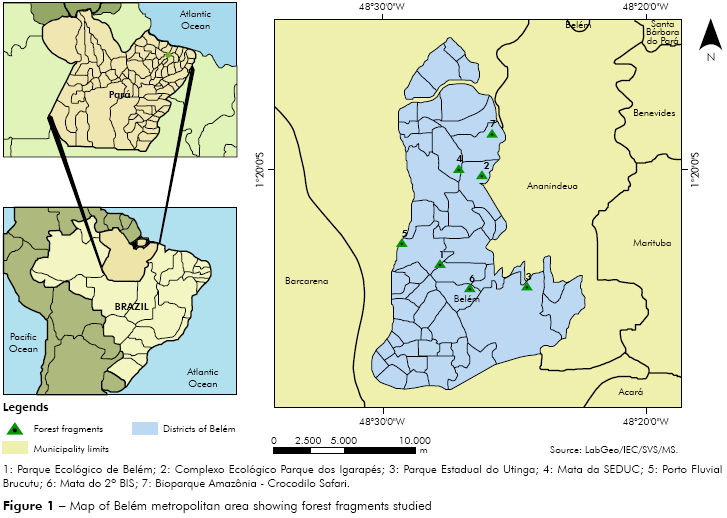
<body><![CDATA[<p><font face="Verdana" size="2">Size, geometry and the distance between vegetation fragments can influence many ecological processes, such as death, migration and colonizations of plants and animals<sup>18</sup>, so it was selected seven different and ecologically isolated areas (<a href="#f1">Figure 1</a>): 1- Parque Ecol&#243;gico do Munic&#237;pio de Bel&#233;m (1<sup>o</sup>23'47.11&quot;S; 48<sup>o</sup>27'56.62&quot;W), with 212 hectares, is a unit of environmental conservation under the responsibility of Secretaria Municipal de Meio Ambiente (SEMMA). It is destinated to fauna and flora preservation, and scientific studies and researches, as well as promoting education for integration between man and nature; 2- Complexo Ecol&#243;gico Parque dos Igarap&#233;s (1<sup>o</sup>20'15.36&quot;S; 48<sup>o</sup>26'19.14&quot;W) is a private area to provide recreation and ecological tourism in a place of environmental sustainability and preservation of the remaining forest in the urban area; 3- Parque Estadual do Utinga (1<sup>o</sup>24'39.55&quot;S; 48<sup>o</sup>24'37.27&quot;W), with 1,200 hectares, is considered the biggest urban park of Bel&#233;m and with the best ecological conditions due to their size, form and the degree of isolation of forest fragments; 4- Mata da SEDUC (1<sup>o</sup>19'56.87&quot;S; 48<sup>o</sup>27'13.38&quot;W), a forest fragment that belongs to Secretaria de Estado de Educa&#231;&#227;o, presenting some depredated   areas   of   rainforest;   5-   Porto   Fluvial Brucutu (1<sup>o</sup>22'58.47&quot;S; 48<sup>o</sup>29'22.16&quot;W), a small forest fragment that serves as air force operational area at Val-de-c&#227;es air base; 6- Mata do 2<sup>o</sup> BIS (1<sup>o</sup>24'45.15&quot;S; 48<sup>o</sup>26'47.82&quot;W), a forest operational area of Army's Infantry;  7-  Bioparque Amaz&#244;nia  - Crocodilo Safari (1<sup>o</sup>18'33.58&quot;S; 48<sup>o</sup>25'52.80&quot;W), a private ecological park with approximately 80 hectares providing contact with four different ecosystems by tracking and ecotourism far away 15 km from the town.</font></p>     <p><a name="f1"></a></p>     <p>&nbsp;</p>     <p align="center"><img src="/img/revistas/rpas/v5n2/2a04f1.gif" border="0"></p>     <p>&nbsp;</p>     <p><font face="Verdana" size="2"><b>CAPTURING</b></font></p>     <p><font face="Verdana" size="2">During the rainy seasons from 2009 to 2011, 11 capture campaigns (three days each) were performed in each area described previously: 2009 (March, April, May and June), 2010 (January, February, March, April and May) and 2011 (January and February). Phlebotomine sand flies captures were undertaken using six battery-operated CDC miniature light traps installed at 1.5 m from ground and 10 m distant from each other in a horizontal transect started on the edge of vegetation, from 6:00 pm to 6:00 am providing a total of 12 h capture <i>per </i>trap-night. The sampling effort was calculated, in hours <i>per </i>trap, multiplying the trap exposure time (12 h) with the total days of campaign (33). The phlebotomine sand flies were triaged, killed in ethyl acetate, washed in a detergent solution (neutral soap 5%), saline solution (NaCl 0.9%) and then stored in alcohol 70% until mounting.</font></p>     <p><font face="Verdana" size="2"><b>MOUNTING AND IDENTIFICATION</b></font></p>     <p><font face="Verdana" size="2">The specimens were mounted in microscope slides individually using berlese's fluid (GBI labs, USA). Damaged specimens could not be identified and therefore they were excluded from the analysis. The identification and nomenclature were carried out in accordance with Young and Duncan<sup>4</sup> taxonomic criteria, assisted with a regional pictorial key<sup>17</sup>. Abbreviations of sand fly names were written with two letters for genus and three for subgenera to avoid confusion to <i>Leishmania </i>abbreviation terms (just one letter for both genus and subgenera). A part of sampled material was deposited in the Phlebotomine Sand fly Collection of the Instituto Evandro Chagas (Cole&#231;&#227;o de Flebotom&#237;neos do Instituto Evandro Chagas - ColFleb IEC), Ananindeua, Par&#225;, Brazil.</font></p>     <p>&nbsp;</p>     ]]></body>
<body><![CDATA[<p><font face="Verdana" size="3"><b>RESULTS</b></font></p>     <p><font face="Verdana" size="2">With 360 h/trap of sampling, a total of 1,119 phlebotomine sand fly specimens were collected in the seven studied areas that belong to 22 species/subspecies. All them belonging to the genus <i>Lutzomyia </i>(<i>Lu.</i>) Fran&#231;a, 1924 and were distributed in nine subgenera: <i>Psychodopygus </i>(<i>Psy.</i>) Mangabeira, 1941 - four species; <i>Trichophoromyia </i>(<i>Tho.</i>) Barretto, 1962 -three species; <i>Nyssomyia </i>(<i>Nys.</i>) Barretto, 1962 - three species; <i>Evandromyia </i>(<i>Eva.</i>) Mangabeira, 1941 - three species; <i>Viannamyia </i>(<i>Via.</i>) Mangabeira, 1941 - two species; <i>Sciopemyia </i>(<i>Sci.</i>) Barretto, 1962 - two species; <i>Lutzomyia </i>(<i>Lut.</i>) - one species; <i>Trichopygomyia </i>(<i>Thy.</i>) Barretto, 1962 - one species; and <i>Pressatia </i>(<i>Pre.</i>) Mangabeira, 1942 - one species; and group <i>Oswaldoi </i>Theodor, 1965 - two species (<a href="#t1">Table 1</a>).</font></p>     <p><a name="t1"></a></p>     <p>&nbsp;</p>     <p align="center"><img src="/img/revistas/rpas/v5n2/2a04t1.gif" border="0"></p>     <p>&nbsp;</p>     <p><font face="Verdana" size="2">The most frequent species were <i>Lu. </i>(<i>Tho.</i>)<i> brachipyga </i>(Mangabeira, 1942) (32.88%), <i>Lu. </i>(<i>Psy.</i>) <i>davisi </i>(Root, 1934) (23.27%), <i>Lu. </i>(<i>Tho.</i>)<i> ubiquitalis </i>(23.05%) and <i>Lu.</i> (<i>Nys.</i>)<i> flaviscutellata </i>(8.14%). A more diverse and abundant fauna was found at Parque Estadual do Utinga (790 specimens, 22 species), followed by Mata da Seduc (250 specimens, five species) and Complexo Ecol&#243;gico Parque dos Igarap&#233;s (37 specimens, five species). <i>Lu. </i>(<i>Nys.</i>)<i> flaviscutellata </i>was the most widely distributed species in the areas, being captured in all the seven capture points sampled and <i>Lu. </i>(<i>Psy.</i>)<i> davisi </i>and <i>Lu. rorotaensis </i>were found in five of them.</font></p>     <p>&nbsp;</p>     <p><font face="Verdana" size="3"><b>DISCUSSION</b></font></p>     <p><font face="Verdana" size="2">The Phlebotominae fauna of Bel&#233;m metropolitan area has been studied since the 1940's<sup>16</sup>, but few recent data regards the distribution on forest fragments remaining to the progressive vegetal suppression have been reported. As like other recent studies of the sand flies of the Amazon biome, known as having the most diverse fauna<sup>19</sup>, the present report shows a high diversity of species (22 species) distributed in ten supraspecific <i>taxa </i>(nine subgenera and one species group). However, despite this high diversity, is noteworthy its reduction, since in accordance with Ryan<sup>17</sup> the sand fly fauna of Bel&#233;m consisted of 62 species. On the other side these present results are in accordance with a recent survey carried out in Ananindeua municipality, where a diversity of 23 species in a forest fragment surrounded by urban area was found<sup>15</sup>.</font></p>     ]]></body>
<body><![CDATA[<p><font face="Verdana" size="2">In fact the present study does not seem to have an extensive sampling effort when compared with the previous ones<sup>16,17</sup>. Anyway, it is the first time that ecologically isolated areas are analyzed and give us relevant eco-epidemiological information.</font></p>     <p><font face="Verdana" size="2">The sand flies captured in this study provided an updated picture of the phlebotomine fauna in forested areas of the Bel&#233;m metropolitan region and also indicates, with previous data, that some species could be potentially involved in the transmission of ACL. Besides 22 species, six of them presented epidemiological importance due to their proven and/or putative implications in the transmission of ACL in Brazilian Amazon as follows: <i>Lu. </i>(<i>Tho.</i>) <i>ubiquitalis, Lu. </i>(<i>Psy.</i>) <i>davisi, Lu. </i>(<i>Nys.</i>)<i> flaviscutellata, Lu. </i>(<i>Nys.</i>)<i> antunesi, Lu. </i>(<i>Psy.</i>)<i> paraensis </i>(Costa Lima, 1941) and <i>Lu. </i>(<i>Psy.</i>)<i> ayrozai </i>(Barretto &amp; Coutinho, 1940). Entomoepidemiological aspects of the most frequent potential vectors discussed below.</font></p>     <p><font face="Verdana" size="2"><i>Lu. </i>(<i>Psy.</i>)<i> davisi, </i>the second most numerous species (26.27%) and the first one in epidemiological importance is considered as other species of <i>Psychodopygus </i>with a strong anthropophilic tendency<sup>20</sup>. Moreover, several previous studies about frequency and infection rates have shown that this species should be a potential vector of zoonotic cutaneous leishmaniasis since some specimens have been recorded naturally infected with <i>L. </i>(<i>V.</i>)<i> braziliensis </i>and <i>L. </i>(<i>V.</i>)<i> naiffi </i>in Brazilian Amazon<sup>19,21,22,23</sup>.</font></p>     <p><font face="Verdana" size="2"><i>Lu. </i>(<i>Tho.</i>)<i> ubiquitalis </i>was the third numerous species found in this study (23.05%) and the second most epidemiologically important. In previous studies at Bel&#233;m metropolitan area, in the Municipality of Benevides, this phlebotomine was found to be infected with <i>L. </i>(<i>V.</i>)<i> lainsoni</i><sup>14</sup> and latter incriminated as the main vector in the transmission of this parasite on the basis of its antropophilic behavior under laboratory conditions<sup>24</sup>.</font></p>     <p><font face="Verdana" size="2">Despite it was not used a more specific trap (Disney) for catching <i>Lu. </i>(<i>Nys.</i>)<i> flaviscutellata, </i>this species was found in all seven areas studied, with frequencies varying from 2.7% to 62.5%, indicating a irregular distribution in the metropolitan area of Bel&#233;m. Moreover, it's known that this species is also distributed in other areas of this region: contiguous areas to the Parque Estadual do Utinga, as Mocambo, Utinga, Catu and &Aacute;gua Preta forests<sup>25</sup>, and others far away as Enviromental Protected Area of Pirelli and Bosque Rodrigues Alves (unpublished data). These data have considered the possibility of <i>Lu. </i>(<i>Nys.</i>)<i> flaviscutellata </i>is being adapted to different environments along over Bel&#233;m reinforcing its epidemiological importance since this species is so far recognized as the main vector of <i>L. </i>(<i>V.</i>) <i>amazonensis</i><sup>7,12,26</sup>.</font></p>     <p><font face="Verdana" size="2"><i>Lu. </i>(<i>Nys.</i>)<i> antunesi </i>was rarely found (0.71%) and in only two areas sampled (Parque Estadual do Utinga and Complexo Ecol&#243;gico Parque dos Igarap&#233;s). This fact was unexpected, mainly for the absence of specimens in the samples of the Mata do 2<sup>o</sup> BIS. A entomological survey was done to describe an outbreak of <i>L. </i>(<i>V.</i>)<i> lindenbergi </i>during 1996 in this same area, although no female of <i>Lu. </i>(<i>Nys.</i>)<i> antunesi </i>was found infected for this parasite, it remains in the list of possible vectors, at that moment, the most frequent (50.7%) among the species captured and predominant (83.7%) within the antropophilic ones captured<sup>10</sup>.</font></p>     <p><font face="Verdana" size="2">To explain that fact, it would be possible that, once the sampling of this area was undertaken only at rainy season, probably carried out in the beginning of the emergence of adult population. Moreover, recent studies on the seasonal variation of <i>Lu. </i>(<i>Nys.</i>)<i> antunesi </i>in Colombia<sup>27</sup> and in Ananindeua Municipality<sup>15</sup>, near from the present study area, showed that this species had been increased in abundance inversely correlating with the precipitation. Other probable reason is that <i>Lu. antunesi </i>is known to be attracted by Shannon trap<sup>10</sup>, because of technical conditions it was not possible to be used.</font></p>     <p><font face="Verdana" size="2">It's necessary to give attention for the most frequent species found, <i>Lu. </i>(<i>Tho.</i>)<i> brachipyga </i>(32.88%). Although most of the species from <i>Trichophoromyia </i>subgenus does not seem to be very anthropophilic and <i>Lu. </i>(<i>Tho.</i>)<i> ubiquitalis </i>is, up to now, the only one incriminated in the transmission of ACL<sup>14,24</sup>. In Bolivia, <i>Lu. </i>(<i>Tho.</i>)<i> vellascoi </i>Le Pont &amp; Desjeux, 1992 was found infected by an unidentified Leishmanian parasite in a ACL endemic area where a first human case attributed to <i>L. </i>(<i>V.</i>)<i> lainsoni </i>was identified<sup>28</sup> and recently in Peru, <i>Lu. </i>(<i>Tho.</i>)<i> auraensis </i>(Mangabeira,   1942) was found  infected with <i>L.</i> (<i>V.</i>) <i>lainsoni </i>and <i>L. </i>(<i>V.</i>)<i> braziliensis<sup>29</sup>. </i>Moreover, two dissected females of <i>Lu. </i>(<i>Tho.</i>) sp. &#91;ambiguous identification of <i>Lu. </i>(<i>Tho.</i>)<i> brachipyga </i>or <i>Lu.</i> (<i>Tho.</i>)<i> adelsonsouzai </i>(Santos, Silva Barata Andrade &amp; Galati, 2014)&#93; were found housing flagellates potentially compatible to peripylarian <i>Leishmania </i>parasites in an area under occurrence of ACL at Brazilian Amazon (TV Santos, unpublished data). All these findings indicate that some <i>Trichophoromyia </i>species could play an important role in the transmission of leishmaniasis agents and their high frequency in entomological surveys, such as <i>Lu. </i>(<i>Tho.</i>)<i> brachipyga </i>in this study may present epidemiological relevancy.</font></p>     <p><font face="Verdana" size="2">The Parque Estadual do Utinga presented the most richness species (22 species out of 22 total) and abundance of specimens (70.7%) than the other areas analyzed. These data are in accordance with previous studies about this complex of contiguous areas that were indicated as the best ecological conditions to environmental preservation due their size and degree of isolation<sup>11</sup>, such characteristics also favor to maintain <i>Leishmania </i>life cycles<sup>7,8</sup>.</font></p>     <p>&nbsp;</p>     ]]></body>
<body><![CDATA[<p><font face="Verdana" size="3"><b>CONCLUSION</b></font></p>     <p><font face="Verdana" size="2">With these present data, it can be concluded that the phlebotomine sand fly fauna of Bel&#233;m metropolitan area presents 22 species currently, with at least six beings of epidemiological interest in the potential transmission of five leishmaniasis agents, indicating that continuous investigations on the sampled fragments are need for the entomological surveillance.</font></p>     <p>&nbsp;</p>     <p><font face="Verdana" size="3"><b>ACKNOWLEDGMENTS</b></font></p>     <p><font face="Verdana" size="2">To dr. Adelson Alcimar Almeida de Souza (<i>in memoriam</i>) for providing facilities (technical and logistic) for the laboratory work; to the technicians of Instituto Evandro Chagas: Edna de Freitas Le&atilde;o, F&aacute;bio M&aacute;rcio Medeiros da Silva, Iorlando da Rocha Barata, Jos&eacute; Apr&iacute;gio Nunes Lima, Luciene Aranha da Silva Santos, Maria Sueli Barros Pinheiro and Roberto Carlos Feitosa Brand&atilde;o for their technical assistance in the laboratory work; to the biologist Paoola Cristina Vieira Amorim and to the technicians of the Laborat&oacute;rio Central da Secretaria do Estado de Sa&uacute;de P&uacute;blica (LACEN/SESPA): D&iacute;dimo Roberto Pimentel, Antonio Edivaldo Fernandes de Aguiar, Gilberto Gomes Barbosa, Jo&atilde;o Guilherme Duarte Pereira, Luis Carlos Feitosa Brand&atilde;o, Marcos C&eacute;sar da Silva Faria and Raimundo Brand&atilde;o Baia, for their assistance in the laboratory and field work; to the technicians of the Museu Paraense Em&iacute;lio Goeldi: Domingo Dalcides dos Reis Guimar&atilde;es and Luis Augusto Quaresma, for their general technical assistance; to Clistenes Pamplona Catete (LabGeo/IEC) for his support in the mapping and to the LACEN/SESPA for logistic support that was given to the fieldwork.</font></p>     <p>&nbsp;</p>     <p><font face="Verdana" size="3"><b>FINANCIAL SUPPORT</b></font></p>     <p><font face="Verdana" size="2">The authors are also gratiful to the National Council for Scientific and Technological Development (CNPq) for their financial support given to Jo&atilde;o Victor Silva Ferreira (official announcements PIBIC/MPEG/MCTI n. 001/2009 and n. 001/2010).</font></p>     <p>&nbsp;</p>     <p><font face="Verdana" size="3"><b>REFERENCES</b></font></p>     ]]></body>
<body><![CDATA[<!-- ref --><p><font face="Verdana" size="2">1 Killick-Kendrick R. Phlebotomine vectors of the leishmaniases: a review. Med Vet Entomol. 1990 Jan;4(1):1-24. Doi: 10.1111/j.1365-2915.1990.tb00255.x &#91;<a href="http://dx.doi.org/10.1111/j.1365-2915.1990.tb00255.x" target="_blank">Link</a>&#93;</font><!-- ref --><p><font face="Verdana" size="2">2 Ready PD. Biology of phlebotomine sand flies as vectors of disease agents. Annu Rev Entomol. 2013 Jan;58:227-50. Doi: 10.1146/annurev-ento-120811-153557 &#91;<a href="http://www.annualreviews.org/doi/abs/10.1146/annurev-ento-120811-153557" target="_blank">Link</a>&#93;</font><!-- ref --><p><font face="Verdana" size="2">3 Seccombe AK, Ready PD, Huddleston LM. A catalogue of Old World phlebotomine sandflies (Diptera: Psychodidae, Phlebotominae). Occ Pap Syst Entomol. 1993;8:1-57. &#91;<a href="http://www.mosquitocatalog.org/files/pdfs/Sandfly/SF07160703.pdf" target="_blank">Link</a>&#93;</font><!-- ref --><p><font face="Verdana" size="2">4 Young DG, Duncan MA. Guide to the identification and geographic distribution of <i>Lutzomyia </i>sand flies in Mexico, the West Indies, Central and South America (Diptera: Psychodidae). Gainesville: Associated Publishers American Entomological Institute; 1994. 881 p. &#91;<a href="http://www.dtic.mil/cgi-bin/GetTRDoc?Location=U2&doc=GetTRDoc.pdf&AD=ADA285737" target="_blank">Link</a>&#93;</font><!-- ref --><p><font face="Verdana" size="2">5 Lainson R, Rangel EF. <i>Lutzomyia longipalpis </i>and the eco-epidemiology of American visceral leishmaniasis, with particular reference to Brazil: a review. Mem Inst Oswaldo Cruz. 2005 Dec;100(8):811-27. Doi:10.1590/S0074-02762005000800001 &#91;<a href="http://dx.doi.org/10.1590/S0074-02762005000800001" target="_blank">Link</a>&#93;</font><!-- ref --><p><font face="Verdana" size="2">6 Missawa NA, Veloso MAE, Maciel GBML, Michalsky EM, Dias ES. Evidence of transmission of visceral leishmaniasis by <i>Lutzomyia cruzi </i>in the municipality of Jaciara, state of Mato Grosso, Brazil. Rev Soc Bras Med Trop. 2011 Jan-Feb;44(1):76-8. Doi: 10.1590/S0037-86822011000100017 &#91;<a href="http://dx.doi.org/10.1590/S0037-86822011000100017" target="_blank">Link</a>&#93;</font><!-- ref --><p><font face="Verdana" size="2">7 Rangel EF, Lainson R. Proven and putative vectors of American cutaneous leishmaniasis in Brazil: aspects of their biology and vectorial competence. Mem Inst Oswaldo Cruz. 2009 Nov;104(7):937-54. Doi: 10.1590/S0074-02762009000700001 &#91;<a href="http://dx.doi.org/10.1590/S0074-02762009000700001" target="_blank">Link</a>&#93;</font><!-- ref --><p><font face="Verdana" size="2">8 Minist&#233;rio da Sa&#250;de (BR). Secretaria de Vigil&#226;ncia em Sa&#250;de. Manual de vigil&#226;ncia da leishmaniose tegumentar americana. 2. ed. atual. Bras&#237;lia: Minist&#233;rio da Sa&#250;de; 2007. 180 p. (S&#233;rie A. Normas e manuais t&#233;cnicos).&#91;<a href="http://bvsms.saude.gov.br/bvs/publicacoes/manual_vigilancia_leishmaniose_tegumentar_americana.pdf" target="_blank">Link</a>&#93; </font><!-- ref --><p><font face="Verdana" size="2">9 Silva LMR, Cunha PR. A urbaniza&#231;&#227;o da leishmaniose tegumentar americana no munic&#237;pio de Campinas - S&#227;o Paulo (SP) e regi&#227;o: magnitude do problema e desafios. An Bras Dermatol. 2007 nov-dez;82(6):515-9. Doi:  10.1590/S0365-05962007000600003 &#91;<a href="http://dx.doi.org/10.1590/S0365-05962007000600003" target="_blank">Link</a>&#93;</font><!-- ref --><p><font face="Verdana" size="2">10 Silveira FT, Ishikawa EA, Souza AAA, Lainson R. An outbreak of cutaneous leishmaniasis among soldiers in Bel&#233;m, Par&#225; state, Brazil, caused by <i>Leishmania </i>(<i>Viannia</i>)<i> lindenbergi </i>n.sp. A new leishmanial parasite of man in the Amazon Region. Parasite. 2002 Mar;9(1):43-50.</font><!-- ref --><p><font face="Verdana" size="2">11 Ferreira LV, Mu&#241;oz SH, Parolin P, Chaves PP. O efeito da fragmenta&#231;&#227;o e isolamento florestal das &#225;reas verdes da regi&#227;o metropolitana de Bel&#233;m. Pesqui Bot. 2012;63:357-67. &#91;<a href="http://www.anchietano.unisinos.br/publicacoes/botanica/botanica63/14.pdf" target="_blank">Link</a>&#93;</font><!-- ref --><p><font face="Verdana" size="2">12 Lainson R, Shaw JJ. Leishmaniasis in Brazil: I. observations on enzootic rodent leishmaniasis-incrimination of <i>Lutzomyia flaviscutellata </i>(mangabeira) as the vector in the lower amazonian basin. Trans R Soc Trop Med Hyg. 1968;62(3):385-95. Doi:  10.1016/0035-9203(68)90090-4 &#91;<a href="http://dx.doi.org/10.1016/0035-9203(68)90090-4" target="_blank">Link</a>&#93;</font><!-- ref --><p><font face="Verdana" size="2">13 Silveira FT, Shaw JJ, Braga RR, Ishikawa E. Dermal leishmaniasis in the Amazon region of Brazil: <i>Leishmania </i>(<i>Viannia</i>)<i> lainsoni </i>sp.n., a new parasite from the state of Par&#225;. Mem Inst Oswaldo Cruz. 1987 Apr-Jun;82(2):289-91. Doi:  10.1590/S0074-02761987000200018 &#91;<a href="http://dx.doi.org/10.1590/S0074-02761987000200018" target="_blank">Link</a>&#93;</font><!-- ref --><p><font face="Verdana" size="2">14 Silveira FT, Souza AAA, Lainson R, Shaw JJ, Braga RR, Ishikawa EA. Cutaneous leishmaniasis in the Amazon region: natural infection of the sandfly <i>Lutzomyia ubiquitalis </i>(Psychodidae: Phlebotominae) by <i>Leishmania </i>(<i>Viannia</i>)<i> lainsoni </i>in Par&#225; state, Brazil.  Mem   Inst  Oswaldo  Cruz.   1991   Apr-Jun;86(1):127-30. Doi: 10.1590/S0074-02761987000200018 &#91;<a href="http://dx.doi.org/10.1590/S0074-02761987000200018" target="_blank">Link</a>&#93;</font><!-- ref --><p><font face="Verdana" size="2">15 Lima JAN, Oliveira DMS, Brandao RCF, Silva FMM, Santos LAS, Pinheiro MSB, et al. Epidemiological evaluation of phlebotomine (Diptera: Psychodidae) fauna in area of coverage in the field of Instituto Evandro Chagas, municipality of Ananindeua, Brazil. In: 28<sup>o</sup> Annual Meeting of the Brazilian Society of Protozoology, 39<sup>o</sup> Annual Meeting on Basic Research in Chagas Diesase; 2012 out 1-3; Caxambu: Sociedade Brasileira de Protozoologia; 2012.</font><!-- ref --><p><font face="Verdana" size="2">16 Damasceno RG, Arouck R, Causey OR. Estudos sobre <i>Phebotomus </i>no Vale Amaz&#244;nico, parte VI. Contribui&#231;&#227;o ao conhecimento da distribui&#231;&#227;o geogr&#225;fica e da incid&#234;ncia por tipo de captura de 64 esp&#233;cies identificadas. Rev Serv Espec Saude Publica. 1949 jul;2(3):817-42. &#91;<a href="http://iah.iec.pa.gov.br/iah/fulltext/memo_iec/v5p235-259.pdf" target="_blank">Link</a>&#93;</font><!-- ref --><p><font face="Verdana" size="2">17 Ryan L. Fleb&#243;tomos do estado do Par&#225;, Brasil (Diptera: Psychodidae). Bel&#233;m: Instituto Evandro Chagas; 1986. 154 p. (Documento t&#233;cnico; No.1). &#91;<a href="http://iah.iec.pa.gov.br/iah/fulltext/pc/monografias/iec/flebotosdoestadopara/flebotmosestadodoparabrasil1986.pdf" target="_blank">Link</a>&#93;</font><!-- ref --><p><font face="Verdana" size="2">18 Laurance WF, Lovejoy TE, Vasconcelos HL, Bruna EM, Didham RK, Stouffer FC, et al. Ecosystem decay of Amazonian Forest fragments: a 22 year investigation. Conserv Biol. 2002 Jun;16(3):605-18. Doi:  10.1046/j.1523-1739.2002.01025.x &#91;<a href="http://onlinelibrary.wiley.com/doi/10.1046/j.1523-1739.2002.01025.x/pdf" target="_blank">Link</a>&#93;</font><!-- ref --><p><font face="Verdana" size="2">19 Souza AAA, Silveira FT, Lainson R, Barata IR, Silva MGS, Lima JAN, et al. The <i>Phlebotominae </i>fauna of Serra dos Caraj&#225;s, Par&#225;, Brazil, and its possible implication in the transmission of American tegumentary leishmaniasis. Rev Pan-Amaz Saude. 2010 Mar;1(1):45-51. Doi:  10.5123/S2176-62232010000100007 &#91;<a href="http://dx.doi.org/10.5123/S2176-62232010000100007" target="_blank">Link</a>&#93;</font><!-- ref --><p><font face="Verdana" size="2">20 Castell&#243;n EG, Arias JR, Freitas RA, Naiff RD. Os flebotom&iacute;neos da regi&atilde;o Amaz&ocirc;nica, estrada Manaus Humait&aacute;, estado do Amazonas, Brasil (Diptera: Psychodidae; Phlebotominae). Acta Amaz. 1994 jan-jun;24(1/2):91-102. &#91;<a href="https://acta.inpa.gov.br/fasciculos/24-2/PDF/v24n2a10.pdf" target="_blank">Link</a>&#93;</font><!-- ref --><p><font face="Verdana" size="2">21 Grimaldi Jr G, Momen H, Naiff RD, McMahon-Pratt D, Barrett TV. Characterization and classification of leishmanial parasites from humans, wild mammals, and sand flies in the Amazon region of Brazil. Am J Trop Med Hyg. 1991 Jun;44(6):645-61. &#91;<a href="http://www.ajtmh.org/content/44/6/645.long" target="_blank">Link</a>&#93;</font><!-- ref --><p><font face="Verdana" size="2">22 Gil LHS, Basano SA, Souza AAA, Silva MGS, Barata IR, Ishikawa EAY, et al. Recent observations on the sand fly (Diptera: Psychodidae) fauna of the state of Rond&ocirc;nia, Western Amaz&ocirc;nia, Brazil: the importance of Psychodopygus davisi as a vector of zoonotic cutaneous leishmaniasis. Mem Inst Oswaldo Cruz. 2003 Sep;98(6):751-5. Doi: 10.1590/S0074-02762003000600007 &#91;<a href="http://dx.doi.org/10.1590/S0074-02762003000600007" target="_blank">Link</a>&#93; </font><!-- ref --><p><font face="Verdana" size="2">23 Silva FMM, Santos TV, Santos LAS, Le&#227;o EF, Brand&#227;o RCFS, Silveira FT. Phlebotomine sand fly fauna (Diptera: Psychodidae) and natural flagellate infections in American cutaneous leishmaniasis endemic area under the influence of Belo Monte hydroelectric plant at state of Par&#225;, Amazonian Brazil. In: 5<sup>th</sup> World Congress on Leishmaniasis - WorldLeish 5. Abstracts; 2013 May 13-17; Porto de Galinhas; 2013. p. 928.</font><!-- ref --><p><font face="Verdana" size="2">24 Lainson R, Shaw JJ, Souza AAA, Silveira FT, Falqueto A. Further observations on <i>Lutzomyia ubiquitalis </i>(Psychodidae: Phlebotominae), the sandfly vector of <i>Leishmania</i> (<i>Viannia</i>) <i>lainsoni</i>. Mem Inst Oswaldo  Cruz. 1992 Jul-Sep;87(3):437-9. Doi: 10.1590/S0074-02761992000300016 &#91;<a href="http://dx.doi.org/10.1590/S0074-02761992000300016" target="_blank">Link</a>&#93;</font><!-- ref --><p><font face="Verdana" size="2">25 Shaw JJ, Lainson R, Ward RW. Leishmaniasis in Brazil: VII. Further observations on the feeding habitats of <i>Lutzomyia flaviscutellata </i>(Mangabeira) with particular reference to its biting habitats at different heights. Trans R Soc Trop Med Hyg. 1972;66(5):718-23. Doi:  10.1016/0035-9203(72)90085-5 &#91;<a href="http://dx.doi.org/10.1016/0035-9203(72)90085-5" target="_blank">Link</a>&#93;</font><!-- ref --><p><font face="Verdana" size="2">26 Ward R, Lainson R, Shaw JJ. Further evidence of the role of <i>Lutzomyia flaviscutellata </i>(Mangabeira) as the vector of <i>Leishmania mexicana amazonensis </i>in Brazil. Trans R Soc Trop Med Hyg. 1973;67(4):608-9. Doi: 10.1016/0035-9203(73)90092-8 &#91;<a href="http://dx.doi.org/10.1016/0035-9203(73)90092-8" target="_blank">Link</a>&#93;</font><!-- ref --><p><font face="Verdana" size="2">27 V&#225;squez Trujillo A, Gonz&#225;lez Reina AE, G&#243;ngora Orjuela A, Su&#225;rez EP, Palomares JE, Buitrago Alvarez LS. Seasonal variation and natural infection of <i>Lutzomyia antunesi </i>(Diptera: Psychodidae: Phlebotominae), an endemic species in the Orinoquia region of Colombia. Mem Inst Oswaldo Cruz. 2013 Jun;108(4):463-9. Doi:10.1590/S0074-0276108042013011 &#91;<a href="http://dx.doi.org/10.1590/S0074-0276108042013011" target="_blank">Link</a>&#93;</font><!-- ref --><p><font face="Verdana" size="2">28 Martinez E, Le Ponte F, Mollinedo S, Cupollilo EA. First case of cutaneous leishmaniasis due to <i>Leishmania </i>(<i>Viannia</i>)<i> lainsoni </i>in Bolivia. Trans R Soc Trop Med Hyg. 2001 Jul-Aug:95(4):375-7. Doi: 10.1016/S0035-9203(01)90185-3 &#91;<a href="http://dx.doi.org/10.1016/S0035-9203(01)90185-3" target="_blank">Link</a>&#93;</font><!-- ref --><p><font face="Verdana" size="2">29 Valdivia HO, Santos MB, Fernandez R, Baldeviano GC, Zorrilla VO, Vera H, et al. Natural <i>Leishmania </i>infection of <i>Lutzomyia </i>(<i>Trichophoromyia</i>)<i> auraensis </i>in Madre de Dios, Peru, detected by a fluorescence resonance energy transfer-based real-time polymerase chain reaction. Am J Trop Med Hyg. 2012 Sep;87(3):511-7. Doi:  10.4269/ajtmh.2012.11-0708 &#91;<a href="http://dx.doi.org/10.4269/ajtmh.2012.11-0708" target="_blank">Link</a>&#93;</font><p>&nbsp;</p>     ]]></body>
<body><![CDATA[<p>&nbsp;</p>     <p><font face="Verdana" size="2"><b><a name="endereco"></a><a href="#topo"><img src="img/revistas/ess/v20n1/seta.gif" border="0"></a>Correspondence / Correspond&#234;ncia  / Correspondencia:</b></font>    <br> <font face="Verdana" size="2">Thiago Vasconcelos dos Santos</font>    <br>   <font face="Verdana" size="2">Instituto Evandro Chagas,    <br>  Se&#231;&#227;o de Parasitologia</font>    <br> <font face="Verdana" size="2">Rodovia BR 316, km 7, s/n<sup>o</sup>.    <br>  Bairro: Levil&#226;ndia</font> <font face="Verdana" size="2">CEP: 67030-000    <br>        Ananindeua-Par&#225;-Brasil</font>    <br> <font face="Verdana" size="2">Phone #: +55 (91) 3214-2003</font>    <br> <font face="Verdana" size="2">E-mail: <a href="mailto:thiagovasconcelos@iec.pa.gov.br">thiagovasconcelos@iec.pa.gov.br</a></font></p>     ]]></body>
<body><![CDATA[<p><font face="Verdana" size="2">Received / Recebido em / Recibido en: 11/12/2013    <br>  Accepted / Aceito em / Aceito en: 2/5/2014</font></p> <script type="text/javascript"> var gaJsHost = (("https:" == document.location.protocol) ? "https://ssl." : "http://www."); document.write(unescape("%3Cscript src='" + gaJsHost + "google-analytics.com/ga.js' type='text/javascript'%3E%3C/script%3E"));   </script>   <script type="text/javascript"> try { var pageTracker = _gat._getTracker("UA-7885746-4"); pageTracker._setDomainName("none"); pageTracker._setAllowLinker(true); pageTracker._trackPageview(); } catch(err) {}</script>      ]]></body><back>
<ref-list>
<ref id="B1">
<label>1</label><nlm-citation citation-type="journal">
<person-group person-group-type="author">
<name>
<surname><![CDATA[Killick-Kendrick]]></surname>
<given-names><![CDATA[R]]></given-names>
</name>
</person-group>
<article-title xml:lang="en"><![CDATA[Phlebotomine vectors of the leishmaniases: a review]]></article-title>
<source><![CDATA[Med Vet Entomol]]></source>
<year>1990</year>
<month> J</month>
<day>an</day>
<volume>4</volume>
<numero>1</numero>
<issue>1</issue>
<page-range>1-24</page-range></nlm-citation>
</ref>
<ref id="B2">
<label>2</label><nlm-citation citation-type="journal">
<person-group person-group-type="author">
<name>
<surname><![CDATA[Ready]]></surname>
<given-names><![CDATA[PD]]></given-names>
</name>
</person-group>
<article-title xml:lang="en"><![CDATA[Biology of phlebotomine sand flies as vectors of disease agents]]></article-title>
<source><![CDATA[Annu Rev Entomol]]></source>
<year>2013</year>
<month> J</month>
<day>an</day>
<volume>58</volume>
<page-range>227-50</page-range></nlm-citation>
</ref>
<ref id="B3">
<label>3</label><nlm-citation citation-type="journal">
<person-group person-group-type="author">
<name>
<surname><![CDATA[Seccombe]]></surname>
<given-names><![CDATA[AK]]></given-names>
</name>
<name>
<surname><![CDATA[Ready]]></surname>
<given-names><![CDATA[PD]]></given-names>
</name>
<name>
<surname><![CDATA[Huddleston]]></surname>
<given-names><![CDATA[LM]]></given-names>
</name>
</person-group>
<article-title xml:lang="en"><![CDATA[A catalogue of Old World phlebotomine sandflies (Diptera: Psychodidae, Phlebotominae)]]></article-title>
<source><![CDATA[Occ Pap Syst Entomol]]></source>
<year>1993</year>
<volume>8</volume>
<page-range>1-57</page-range></nlm-citation>
</ref>
<ref id="B4">
<label>4</label><nlm-citation citation-type="book">
<person-group person-group-type="author">
<name>
<surname><![CDATA[Young]]></surname>
<given-names><![CDATA[DG]]></given-names>
</name>
<name>
<surname><![CDATA[Duncan]]></surname>
<given-names><![CDATA[MA]]></given-names>
</name>
</person-group>
<source><![CDATA[Guide to the identification and geographic distribution of Lutzomyia sand flies in Mexico, the West Indies, Central and South America (Diptera: Psychodidae)]]></source>
<year>1994</year>
<page-range>881</page-range><publisher-loc><![CDATA[Gainesville ]]></publisher-loc>
<publisher-name><![CDATA[Associated Publishers American Entomological Institute]]></publisher-name>
</nlm-citation>
</ref>
<ref id="B5">
<label>5</label><nlm-citation citation-type="journal">
<person-group person-group-type="author">
<name>
<surname><![CDATA[Lainson]]></surname>
<given-names><![CDATA[R]]></given-names>
</name>
<name>
<surname><![CDATA[Rangel]]></surname>
<given-names><![CDATA[EF]]></given-names>
</name>
</person-group>
<article-title xml:lang="pt"><![CDATA[Lutzomyia longipalpis and the eco-epidemiology of American visceral leishmaniasis, with particular reference to Brazil: a review]]></article-title>
<source><![CDATA[Mem Inst Oswaldo Cruz]]></source>
<year>2005</year>
<month> D</month>
<day>ec</day>
<volume>100</volume>
<numero>8</numero>
<issue>8</issue>
<page-range>811-27</page-range></nlm-citation>
</ref>
<ref id="B6">
<label>6</label><nlm-citation citation-type="journal">
<person-group person-group-type="author">
<name>
<surname><![CDATA[Missawa]]></surname>
<given-names><![CDATA[NA]]></given-names>
</name>
<name>
<surname><![CDATA[Veloso]]></surname>
<given-names><![CDATA[MAE]]></given-names>
</name>
<name>
<surname><![CDATA[Maciel]]></surname>
<given-names><![CDATA[GBML]]></given-names>
</name>
<name>
<surname><![CDATA[Michalsky]]></surname>
<given-names><![CDATA[EM]]></given-names>
</name>
<name>
<surname><![CDATA[Dias]]></surname>
<given-names><![CDATA[ES]]></given-names>
</name>
</person-group>
<article-title xml:lang="en"><![CDATA[Evidence of transmission of visceral leishmaniasis by Lutzomyia cruzi in the municipality of Jaciara, state of Mato Grosso, Brazil]]></article-title>
<source><![CDATA[Rev Soc Bras Med Trop]]></source>
<year>2011</year>
<month> J</month>
<day>an</day>
<volume>44</volume>
<numero>1</numero>
<issue>1</issue>
<page-range>76-8</page-range></nlm-citation>
</ref>
<ref id="B7">
<label>7</label><nlm-citation citation-type="journal">
<person-group person-group-type="author">
<name>
<surname><![CDATA[Rangel]]></surname>
<given-names><![CDATA[EF]]></given-names>
</name>
<name>
<surname><![CDATA[Lainson]]></surname>
<given-names><![CDATA[R]]></given-names>
</name>
</person-group>
<article-title xml:lang="en"><![CDATA[Proven and putative vectors of American cutaneous leishmaniasis in Brazil: aspects of their biology and vectorial competence]]></article-title>
<source><![CDATA[Mem Inst Oswaldo Cruz]]></source>
<year>2009</year>
<month> N</month>
<day>ov</day>
<volume>104</volume>
<numero>7</numero>
<issue>7</issue>
<page-range>937-54</page-range></nlm-citation>
</ref>
<ref id="B8">
<label>8</label><nlm-citation citation-type="book">
<collab>Ministério da Saúde (BR)^dSecretaria de Vigilância em Saúde</collab>
<source><![CDATA[Manual de vigilância da leishmaniose tegumentar americana]]></source>
<year>2007</year>
<edition>2</edition>
<page-range>180</page-range><publisher-loc><![CDATA[Brasília ]]></publisher-loc>
<publisher-name><![CDATA[Ministério da Saúde]]></publisher-name>
</nlm-citation>
</ref>
<ref id="B9">
<label>9</label><nlm-citation citation-type="journal">
<person-group person-group-type="author">
<name>
<surname><![CDATA[Silva]]></surname>
<given-names><![CDATA[LMR]]></given-names>
</name>
<name>
<surname><![CDATA[Cunha]]></surname>
<given-names><![CDATA[PR]]></given-names>
</name>
</person-group>
<article-title xml:lang="pt"><![CDATA[A urbanização da leishmaniose tegumentar americana no município de Campinas - São Paulo (SP) e região: magnitude do problema e desafios]]></article-title>
<source><![CDATA[An Bras Dermatol]]></source>
<year>2007</year>
<month> n</month>
<day>ov</day>
<volume>82</volume>
<numero>6</numero>
<issue>6</issue>
<page-range>515-9</page-range></nlm-citation>
</ref>
<ref id="B10">
<label>10</label><nlm-citation citation-type="journal">
<person-group person-group-type="author">
<name>
<surname><![CDATA[Silveira]]></surname>
<given-names><![CDATA[FT]]></given-names>
</name>
<name>
<surname><![CDATA[Ishikawa]]></surname>
<given-names><![CDATA[EA]]></given-names>
</name>
<name>
<surname><![CDATA[Souza]]></surname>
<given-names><![CDATA[AAA]]></given-names>
</name>
<name>
<surname><![CDATA[Lainson]]></surname>
<given-names><![CDATA[R]]></given-names>
</name>
</person-group>
<article-title xml:lang="pt"><![CDATA[An outbreak of cutaneous leishmaniasis among soldiers in Belém, Pará state, Brazil, caused by Leishmania (Viannia) lindenbergi n.sp. A new leishmanial parasite of man in the Amazon Region]]></article-title>
<source><![CDATA[Parasite]]></source>
<year>2002</year>
<month> M</month>
<day>ar</day>
<volume>9</volume>
<numero>1</numero>
<issue>1</issue>
<page-range>43-50</page-range></nlm-citation>
</ref>
<ref id="B11">
<label>11</label><nlm-citation citation-type="journal">
<person-group person-group-type="author">
<name>
<surname><![CDATA[Ferreira]]></surname>
<given-names><![CDATA[LV]]></given-names>
</name>
<name>
<surname><![CDATA[Muñoz]]></surname>
<given-names><![CDATA[SH]]></given-names>
</name>
<name>
<surname><![CDATA[Parolin]]></surname>
<given-names><![CDATA[P]]></given-names>
</name>
<name>
<surname><![CDATA[Chaves]]></surname>
<given-names><![CDATA[PP]]></given-names>
</name>
</person-group>
<article-title xml:lang="pt"><![CDATA[O efeito da fragmentação e isolamento florestal das áreas verdes da região metropolitana de Belém]]></article-title>
<source><![CDATA[Pesqui Bot]]></source>
<year>2012</year>
<volume>63</volume>
<page-range>357-67</page-range></nlm-citation>
</ref>
<ref id="B12">
<label>12</label><nlm-citation citation-type="journal">
<person-group person-group-type="author">
<name>
<surname><![CDATA[Lainson]]></surname>
<given-names><![CDATA[R]]></given-names>
</name>
<name>
<surname><![CDATA[Shaw]]></surname>
<given-names><![CDATA[JJ]]></given-names>
</name>
</person-group>
<article-title xml:lang="en"><![CDATA[Leishmaniasis in Brazil: I. observations on enzootic rodent leishmaniasis-incrimination of Lutzomyia flaviscutellata (mangabeira) as the vector in the lower amazonian basin]]></article-title>
<source><![CDATA[Trans R Soc Trop Med Hyg]]></source>
<year>1968</year>
<volume>62</volume>
<numero>3</numero>
<issue>3</issue>
<page-range>385-95</page-range></nlm-citation>
</ref>
<ref id="B13">
<label>13</label><nlm-citation citation-type="journal">
<person-group person-group-type="author">
<name>
<surname><![CDATA[Silveira]]></surname>
<given-names><![CDATA[FT]]></given-names>
</name>
<name>
<surname><![CDATA[Shaw]]></surname>
<given-names><![CDATA[JJ]]></given-names>
</name>
<name>
<surname><![CDATA[Braga]]></surname>
<given-names><![CDATA[RR]]></given-names>
</name>
<name>
<surname><![CDATA[Ishikawa]]></surname>
<given-names><![CDATA[E]]></given-names>
</name>
</person-group>
<article-title xml:lang="en"><![CDATA[Dermal leishmaniasis in the Amazon region of Brazil: Leishmania (Viannia) lainsoni sp.n., a new parasite from the state of Pará]]></article-title>
<source><![CDATA[Mem Inst Oswaldo Cruz]]></source>
<year>1987</year>
<month> A</month>
<day>pr</day>
<volume>82</volume>
<numero>2</numero>
<issue>2</issue>
<page-range>289-91</page-range></nlm-citation>
</ref>
<ref id="B14">
<label>14</label><nlm-citation citation-type="journal">
<person-group person-group-type="author">
<name>
<surname><![CDATA[Silveira]]></surname>
<given-names><![CDATA[FT]]></given-names>
</name>
<name>
<surname><![CDATA[Souza]]></surname>
<given-names><![CDATA[AAA]]></given-names>
</name>
<name>
<surname><![CDATA[Lainson]]></surname>
<given-names><![CDATA[R]]></given-names>
</name>
<name>
<surname><![CDATA[Shaw]]></surname>
<given-names><![CDATA[JJ]]></given-names>
</name>
<name>
<surname><![CDATA[Braga]]></surname>
<given-names><![CDATA[RR]]></given-names>
</name>
<name>
<surname><![CDATA[Ishikawa]]></surname>
<given-names><![CDATA[EA]]></given-names>
</name>
</person-group>
<article-title xml:lang="en"><![CDATA[Cutaneous leishmaniasis in the Amazon region: natural infection of the sandfly Lutzomyia ubiquitalis (Psychodidae: Phlebotominae) by Leishmania (Viannia) lainsoni in Pará state, Brazil]]></article-title>
<source><![CDATA[Mem Inst Oswaldo Cruz]]></source>
<year>1991</year>
<month> A</month>
<day>pr</day>
<volume>86</volume>
<numero>1</numero>
<issue>1</issue>
<page-range>127-30</page-range></nlm-citation>
</ref>
<ref id="B15">
<label>15</label><nlm-citation citation-type="confpro">
<person-group person-group-type="author">
<name>
<surname><![CDATA[Lima]]></surname>
<given-names><![CDATA[JAN]]></given-names>
</name>
<name>
<surname><![CDATA[Oliveira]]></surname>
<given-names><![CDATA[DMS]]></given-names>
</name>
<name>
<surname><![CDATA[Brandao]]></surname>
<given-names><![CDATA[RCF]]></given-names>
</name>
<name>
<surname><![CDATA[Silva]]></surname>
<given-names><![CDATA[FMM]]></given-names>
</name>
<name>
<surname><![CDATA[Santos]]></surname>
<given-names><![CDATA[LAS]]></given-names>
</name>
<name>
<surname><![CDATA[Pinheiro]]></surname>
<given-names><![CDATA[MSB]]></given-names>
</name>
</person-group>
<source><![CDATA[Epidemiological evaluation of phlebotomine (Diptera: Psychodidae) fauna in area of coverage in the field of Instituto Evandro Chagas, municipality of Ananindeua, Brazil]]></source>
<year>2012</year>
<conf-name><![CDATA[28 Annual Meeting of the Brazilian Society of Protozoology, 39º Annual Meeting on Basic Research in Chagas Diesase]]></conf-name>
<conf-date>2012 out 1-3</conf-date>
<conf-loc>Caxambu </conf-loc>
<publisher-name><![CDATA[Sociedade Brasileira de Protozoologia]]></publisher-name>
</nlm-citation>
</ref>
<ref id="B16">
<label>16</label><nlm-citation citation-type="journal">
<person-group person-group-type="author">
<name>
<surname><![CDATA[Damasceno]]></surname>
<given-names><![CDATA[RG]]></given-names>
</name>
<name>
<surname><![CDATA[Arouck]]></surname>
<given-names><![CDATA[R]]></given-names>
</name>
<name>
<surname><![CDATA[Causey]]></surname>
<given-names><![CDATA[OR]]></given-names>
</name>
</person-group>
<article-title xml:lang="pt"><![CDATA[Estudos sobre Phebotomus no Vale Amazônico, parte VI. Contribuição ao conhecimento da distribuição geográfica e da incidência por tipo de captura de 64 espécies identificadas]]></article-title>
<source><![CDATA[Rev Serv Espec Saude Publica]]></source>
<year>1949</year>
<month> j</month>
<day>ul</day>
<volume>2</volume>
<numero>3</numero>
<issue>3</issue>
<page-range>817-42</page-range></nlm-citation>
</ref>
<ref id="B17">
<label>17</label><nlm-citation citation-type="book">
<person-group person-group-type="author">
<name>
<surname><![CDATA[Ryan]]></surname>
<given-names><![CDATA[L]]></given-names>
</name>
</person-group>
<source><![CDATA[Flebótomos do estado do Pará, Brasil (Diptera: Psychodidae)]]></source>
<year>1986</year>
<page-range>154</page-range><publisher-loc><![CDATA[Belém ]]></publisher-loc>
<publisher-name><![CDATA[Instituto Evandro Chagas]]></publisher-name>
</nlm-citation>
</ref>
<ref id="B18">
<label>18</label><nlm-citation citation-type="journal">
<person-group person-group-type="author">
<name>
<surname><![CDATA[Laurance]]></surname>
<given-names><![CDATA[WF]]></given-names>
</name>
<name>
<surname><![CDATA[Lovejoy]]></surname>
<given-names><![CDATA[TE]]></given-names>
</name>
<name>
<surname><![CDATA[Vasconcelos]]></surname>
<given-names><![CDATA[HL]]></given-names>
</name>
<name>
<surname><![CDATA[Bruna]]></surname>
<given-names><![CDATA[EM]]></given-names>
</name>
<name>
<surname><![CDATA[Didham]]></surname>
<given-names><![CDATA[RK]]></given-names>
</name>
<name>
<surname><![CDATA[Stouffer]]></surname>
<given-names><![CDATA[FC]]></given-names>
</name>
</person-group>
<article-title xml:lang="en"><![CDATA[Ecosystem decay of Amazonian Forest fragments: a 22 year investigation]]></article-title>
<source><![CDATA[Conserv Biol]]></source>
<year>2002</year>
<month> J</month>
<day>un</day>
<volume>16</volume>
<numero>3</numero>
<issue>3</issue>
<page-range>605-18</page-range></nlm-citation>
</ref>
<ref id="B19">
<label>19</label><nlm-citation citation-type="journal">
<person-group person-group-type="author">
<name>
<surname><![CDATA[Souza]]></surname>
<given-names><![CDATA[AAA]]></given-names>
</name>
<name>
<surname><![CDATA[Silveira]]></surname>
<given-names><![CDATA[FT]]></given-names>
</name>
<name>
<surname><![CDATA[Lainson]]></surname>
<given-names><![CDATA[R]]></given-names>
</name>
<name>
<surname><![CDATA[Barata]]></surname>
<given-names><![CDATA[IR]]></given-names>
</name>
<name>
<surname><![CDATA[Silva]]></surname>
<given-names><![CDATA[MGS]]></given-names>
</name>
<name>
<surname><![CDATA[Lima]]></surname>
<given-names><![CDATA[JAN]]></given-names>
</name>
</person-group>
<article-title xml:lang="en"><![CDATA[The Phlebotominae fauna of Serra dos Carajás, Pará, Brazil, and its possible implication in the transmission of American tegumentary leishmaniasis]]></article-title>
<source><![CDATA[Rev Pan-Amaz Saude]]></source>
<year>2010</year>
<month> M</month>
<day>ar</day>
<volume>1</volume>
<numero>1</numero>
<issue>1</issue>
<page-range>45-51</page-range></nlm-citation>
</ref>
<ref id="B20">
<label>20</label><nlm-citation citation-type="journal">
<person-group person-group-type="author">
<name>
<surname><![CDATA[Castellón]]></surname>
<given-names><![CDATA[EG]]></given-names>
</name>
<name>
<surname><![CDATA[Arias]]></surname>
<given-names><![CDATA[JR]]></given-names>
</name>
<name>
<surname><![CDATA[Freitas]]></surname>
<given-names><![CDATA[RA]]></given-names>
</name>
<name>
<surname><![CDATA[Naiff]]></surname>
<given-names><![CDATA[RD]]></given-names>
</name>
</person-group>
<article-title xml:lang="pt"><![CDATA[Os flebotomíneos da região Amazônica, estrada Manaus Humaitá, estado do Amazonas, Brasil (Diptera: Psychodidae; Phlebotominae)]]></article-title>
<source><![CDATA[Acta Amaz]]></source>
<year>1994</year>
<month> j</month>
<day>an</day>
<volume>24</volume>
<numero>1/2</numero>
<issue>1/2</issue>
<page-range>91-102</page-range></nlm-citation>
</ref>
<ref id="B21">
<label>21</label><nlm-citation citation-type="journal">
<person-group person-group-type="author">
<name>
<surname><![CDATA[Grimaldi Jr]]></surname>
<given-names><![CDATA[G]]></given-names>
</name>
<name>
<surname><![CDATA[Momen]]></surname>
<given-names><![CDATA[H]]></given-names>
</name>
<name>
<surname><![CDATA[Naiff]]></surname>
<given-names><![CDATA[RD]]></given-names>
</name>
<name>
<surname><![CDATA[McMahon-Pratt]]></surname>
<given-names><![CDATA[D]]></given-names>
</name>
<name>
<surname><![CDATA[Barrett]]></surname>
<given-names><![CDATA[TV]]></given-names>
</name>
</person-group>
<article-title xml:lang="en"><![CDATA[Characterization and classification of leishmanial parasites from humans, wild mammals, and sand flies in the Amazon region of Brazil]]></article-title>
<source><![CDATA[Am J Trop Med Hyg]]></source>
<year>1991</year>
<month> J</month>
<day>un</day>
<volume>44</volume>
<numero>6</numero>
<issue>6</issue>
<page-range>645-61</page-range></nlm-citation>
</ref>
<ref id="B22">
<label>22</label><nlm-citation citation-type="journal">
<person-group person-group-type="author">
<name>
<surname><![CDATA[Gil]]></surname>
<given-names><![CDATA[LHS]]></given-names>
</name>
<name>
<surname><![CDATA[Basano]]></surname>
<given-names><![CDATA[SA]]></given-names>
</name>
<name>
<surname><![CDATA[Souza]]></surname>
<given-names><![CDATA[AAA]]></given-names>
</name>
<name>
<surname><![CDATA[Silva]]></surname>
<given-names><![CDATA[MGS]]></given-names>
</name>
<name>
<surname><![CDATA[Barata]]></surname>
<given-names><![CDATA[IR]]></given-names>
</name>
<name>
<surname><![CDATA[Ishikawa]]></surname>
<given-names><![CDATA[EAY]]></given-names>
</name>
</person-group>
<article-title xml:lang="en"><![CDATA[Recent observations on the sand fly (Diptera: Psychodidae) fauna of the state of Rondônia, Western Amazônia, Brazil: the importance of Psychodopygus davisi as a vector of zoonotic cutaneous leishmaniasis]]></article-title>
<source><![CDATA[Mem Inst Oswaldo Cruz]]></source>
<year>2003</year>
<month> S</month>
<day>ep</day>
<volume>98</volume>
<numero>6</numero>
<issue>6</issue>
<page-range>751-5</page-range></nlm-citation>
</ref>
<ref id="B23">
<label>23</label><nlm-citation citation-type="confpro">
<person-group person-group-type="author">
<name>
<surname><![CDATA[Silva]]></surname>
<given-names><![CDATA[FMM]]></given-names>
</name>
<name>
<surname><![CDATA[Santos]]></surname>
<given-names><![CDATA[TV]]></given-names>
</name>
<name>
<surname><![CDATA[Santos]]></surname>
<given-names><![CDATA[LAS]]></given-names>
</name>
<name>
<surname><![CDATA[Leão]]></surname>
<given-names><![CDATA[EF]]></given-names>
</name>
<name>
<surname><![CDATA[Brandão]]></surname>
<given-names><![CDATA[RCFS]]></given-names>
</name>
<name>
<surname><![CDATA[Silveira]]></surname>
<given-names><![CDATA[FT]]></given-names>
</name>
</person-group>
<article-title xml:lang="en"><![CDATA[Phlebotomine sand fly fauna (Diptera: Psychodidae) and natural flagellate infections in American cutaneous leishmaniasis endemic area under the influence of Belo Monte hydroelectric plant at state of Pará, Amazonian Brazil]]></article-title>
<source><![CDATA[]]></source>
<year>2013</year>
<conf-name><![CDATA[5 World Congress on Leishmaniasis - WorldLeish]]></conf-name>
<conf-date>2013 May13-17</conf-date>
<conf-loc>Porto de Galinhas </conf-loc>
<page-range>928</page-range></nlm-citation>
</ref>
<ref id="B24">
<label>24</label><nlm-citation citation-type="journal">
<person-group person-group-type="author">
<name>
<surname><![CDATA[Lainson]]></surname>
<given-names><![CDATA[R]]></given-names>
</name>
<name>
<surname><![CDATA[Shaw]]></surname>
<given-names><![CDATA[JJ]]></given-names>
</name>
<name>
<surname><![CDATA[Souza]]></surname>
<given-names><![CDATA[AAA]]></given-names>
</name>
<name>
<surname><![CDATA[Silveira]]></surname>
<given-names><![CDATA[FT]]></given-names>
</name>
<name>
<surname><![CDATA[Falqueto]]></surname>
<given-names><![CDATA[A]]></given-names>
</name>
</person-group>
<article-title xml:lang="en"><![CDATA[Further observations on Lutzomyia ubiquitalis (Psychodidae: Phlebotominae), the sandfly vector of Leishmania (Viannia) lainsoni]]></article-title>
<source><![CDATA[Mem Inst Oswaldo Cruz]]></source>
<year>1992</year>
<month> J</month>
<day>ul</day>
<volume>87</volume>
<numero>3</numero>
<issue>3</issue>
<page-range>437-9</page-range></nlm-citation>
</ref>
<ref id="B25">
<label>25</label><nlm-citation citation-type="journal">
<person-group person-group-type="author">
<name>
<surname><![CDATA[Shaw]]></surname>
<given-names><![CDATA[JJ]]></given-names>
</name>
<name>
<surname><![CDATA[Lainson]]></surname>
<given-names><![CDATA[R]]></given-names>
</name>
<name>
<surname><![CDATA[Ward]]></surname>
<given-names><![CDATA[RW]]></given-names>
</name>
</person-group>
<article-title xml:lang="en"><![CDATA[Leishmaniasis in Brazil: VII. Further observations on the feeding habitats of Lutzomyia flaviscutellata (Mangabeira) with particular reference to its biting habitats at different heights]]></article-title>
<source><![CDATA[Trans R Soc Trop Med Hyg]]></source>
<year>1972</year>
<volume>66</volume>
<numero>5</numero>
<issue>5</issue>
<page-range>718-23</page-range></nlm-citation>
</ref>
<ref id="B26">
<label>26</label><nlm-citation citation-type="journal">
<person-group person-group-type="author">
<name>
<surname><![CDATA[Ward]]></surname>
<given-names><![CDATA[R]]></given-names>
</name>
<name>
<surname><![CDATA[Lainson]]></surname>
<given-names><![CDATA[R]]></given-names>
</name>
<name>
<surname><![CDATA[Shaw]]></surname>
<given-names><![CDATA[JJ]]></given-names>
</name>
</person-group>
<article-title xml:lang="en"><![CDATA[Further evidence of the role of Lutzomyia flaviscutellata (Mangabeira) as the vector of Leishmania mexicana amazonensis in Brazil]]></article-title>
<source><![CDATA[Trans R Soc Trop Med Hyg]]></source>
<year>1973</year>
<volume>67</volume>
<numero>4</numero>
<issue>4</issue>
<page-range>608-9</page-range></nlm-citation>
</ref>
<ref id="B27">
<label>27</label><nlm-citation citation-type="journal">
<person-group person-group-type="author">
<name>
<surname><![CDATA[Vásquez Trujillo]]></surname>
<given-names><![CDATA[A]]></given-names>
</name>
<name>
<surname><![CDATA[González Reina]]></surname>
<given-names><![CDATA[AE]]></given-names>
</name>
<name>
<surname><![CDATA[Góngora Orjuela]]></surname>
<given-names><![CDATA[A]]></given-names>
</name>
<name>
<surname><![CDATA[Suárez]]></surname>
<given-names><![CDATA[EP]]></given-names>
</name>
<name>
<surname><![CDATA[Palomares]]></surname>
<given-names><![CDATA[JE]]></given-names>
</name>
<name>
<surname><![CDATA[Buitrago Alvarez]]></surname>
<given-names><![CDATA[LS]]></given-names>
</name>
</person-group>
<article-title xml:lang="en"><![CDATA[Seasonal variation and natural infection of Lutzomyia antunesi (Diptera: Psychodidae: Phlebotominae), an endemic species in the Orinoquia region of Colombia]]></article-title>
<source><![CDATA[Mem Inst Oswaldo Cruz]]></source>
<year>2013</year>
<month> J</month>
<day>un</day>
<volume>108</volume>
<numero>4</numero>
<issue>4</issue>
<page-range>463-9</page-range></nlm-citation>
</ref>
<ref id="B28">
<label>28</label><nlm-citation citation-type="journal">
<person-group person-group-type="author">
<name>
<surname><![CDATA[Martinez]]></surname>
<given-names><![CDATA[E]]></given-names>
</name>
<name>
<surname><![CDATA[Le Ponte]]></surname>
<given-names><![CDATA[F]]></given-names>
</name>
<name>
<surname><![CDATA[Mollinedo]]></surname>
<given-names><![CDATA[S]]></given-names>
</name>
<name>
<surname><![CDATA[Cupollilo]]></surname>
<given-names><![CDATA[EA]]></given-names>
</name>
</person-group>
<article-title xml:lang="en"><![CDATA[First case of cutaneous leishmaniasis due to Leishmania (Viannia) lainsoni in Bolivia]]></article-title>
<source><![CDATA[Trans R Soc Trop Med Hyg]]></source>
<year>2001</year>
<month> J</month>
<day>ul</day>
<volume>95</volume>
<numero>4</numero>
<issue>4</issue>
<page-range>375-7</page-range></nlm-citation>
</ref>
<ref id="B29">
<label>29</label><nlm-citation citation-type="journal">
<person-group person-group-type="author">
<name>
<surname><![CDATA[Valdivia]]></surname>
<given-names><![CDATA[HO]]></given-names>
</name>
<name>
<surname><![CDATA[Santos]]></surname>
<given-names><![CDATA[MB]]></given-names>
</name>
<name>
<surname><![CDATA[Fernandez]]></surname>
<given-names><![CDATA[R]]></given-names>
</name>
<name>
<surname><![CDATA[Baldeviano]]></surname>
<given-names><![CDATA[GC]]></given-names>
</name>
<name>
<surname><![CDATA[Zorrilla]]></surname>
<given-names><![CDATA[VO]]></given-names>
</name>
<name>
<surname><![CDATA[Vera]]></surname>
<given-names><![CDATA[H]]></given-names>
</name>
</person-group>
<article-title xml:lang="en"><![CDATA[Natural Leishmania infection of Lutzomyia (Trichophoromyia) auraensis in Madre de Dios, Peru, detected by a fluorescence resonance energy transfer-based real-time polymerase chain reaction]]></article-title>
<source><![CDATA[Am J Trop Med Hyg]]></source>
<year>2012</year>
<month> S</month>
<day>ep</day>
<volume>87</volume>
<numero>3</numero>
<issue>3</issue>
<page-range>511-7</page-range></nlm-citation>
</ref>
</ref-list>
</back>
</article>
