<?xml version="1.0" encoding="ISO-8859-1"?><article xmlns:mml="http://www.w3.org/1998/Math/MathML" xmlns:xlink="http://www.w3.org/1999/xlink" xmlns:xsi="http://www.w3.org/2001/XMLSchema-instance">
<front>
<journal-meta>
<journal-id>1981-8114</journal-id>
<journal-title><![CDATA[Boletim do Museu Paraense Emílio Goeldi Ciências Naturais]]></journal-title>
<abbrev-journal-title><![CDATA[Bol. Mus. Para. Emilio Goeldi Cienc. Nat.]]></abbrev-journal-title>
<issn>1981-8114</issn>
<publisher>
<publisher-name><![CDATA[Museu Paraense Emílio Goeldi, Ministério da Ciência e Tecnologia]]></publisher-name>
</publisher>
</journal-meta>
<article-meta>
<article-id>S1981-81142010000300009</article-id>
<title-group>
<article-title xml:lang="en"><![CDATA[On a poorly known amazonian ant-plant association: Myrcia madida McVaugh (Myrtaceae) and Myrcidris epicharis Ward (Hymenoptera: Formicidae: Pseudomyrmednae)]]></article-title>
<article-title xml:lang="pt"><![CDATA[Uma associação mirmecófila amazônica pouco conhecida: Myrcia madida McVaugh (Myrtaceae) e Myrcidris epicharis Ward (Hymenoptera: Formicidae: Pseudomyrmecinae)]]></article-title>
</title-group>
<contrib-group>
<contrib contrib-type="author">
<name>
<surname><![CDATA[Ferreira]]></surname>
<given-names><![CDATA[Leandro Valle]]></given-names>
</name>
<xref ref-type="aff" rid="A01"/>
</contrib>
<contrib contrib-type="author">
<name>
<surname><![CDATA[Vasconcelos]]></surname>
<given-names><![CDATA[Heraldo Luis de]]></given-names>
</name>
<xref ref-type="aff" rid="A02"/>
</contrib>
</contrib-group>
<aff id="A01">
<institution><![CDATA[,Museu Paraense Emílio Goeldi  ]]></institution>
<addr-line><![CDATA[Belém Pará]]></addr-line>
<country>Brasil</country>
</aff>
<aff id="A02">
<institution><![CDATA[,Universidade Federal de Uberlândia Instituto de Biologia ]]></institution>
<addr-line><![CDATA[Uberlândia Minas Gerais]]></addr-line>
<country>Brasil</country>
</aff>
<pub-date pub-type="pub">
<day>00</day>
<month>12</month>
<year>2010</year>
</pub-date>
<pub-date pub-type="epub">
<day>00</day>
<month>12</month>
<year>2010</year>
</pub-date>
<volume>5</volume>
<numero>3</numero>
<fpage>363</fpage>
<lpage>367</lpage>
<copyright-statement/>
<copyright-year/>
<self-uri xlink:href="http://scielo.iec.gov.br/scielo.php?script=sci_arttext&amp;pid=S1981-81142010000300009&amp;lng=en&amp;nrm=iso"></self-uri><self-uri xlink:href="http://scielo.iec.gov.br/scielo.php?script=sci_abstract&amp;pid=S1981-81142010000300009&amp;lng=en&amp;nrm=iso"></self-uri><self-uri xlink:href="http://scielo.iec.gov.br/scielo.php?script=sci_pdf&amp;pid=S1981-81142010000300009&amp;lng=en&amp;nrm=iso"></self-uri><abstract abstract-type="short" xml:lang="en"><p><![CDATA[Ecological data are provided for the first time on the myrmecophilious relationship between the ant Myrcidris epicharis Ward (Hymenoptera: Formicidae: Pseudomyrmecinae) and the Amazonian tree Myrcia madida McVaugh (Myrtaceae), the only Neotropical species of its family to produce domatia in hollow branches. Ants were collected from 30 plants of various sizes (0.9 to 18 m in height) and all plants were inhabited by Myrcidris epicharis Ward. On average, there were 13.3 adult ant workers, 3.8 larvae, 1.5 pupae, and 2.3 eggs per domatium. Ants tend scale insects that live inside the hollow stems. New colonies of M. epicharis are founded by a single queen, and in none of the plants examined more than one queen was found, suggesting that secondary adoption of queens may not take place in this ant species. Myrcidris epicharis Ward appears to provide protection to its host-plant against both vertebrate and invertebrate herbivores.]]></p></abstract>
<abstract abstract-type="short" xml:lang="pt"><p><![CDATA[São apresentados, pela primeira vez, dados ecológicos sobre a relação entre a formiga Myrcidris epicharis Ward (Hymenoptera: Formicidae: Pseudomyrmecinae) e a árvore amazônica Myrcia madida McVaugh (Myrtaceae), a única espécie Neotropical da sua família a produzir domáceas em ramos ocos. Foram coletadas 30 plantas de diversos tamanhos (de 0,9 a 18 m de altura) e todas estavam colonizadas pela formiga Myrcidris epicharis Ward. Em cada domácea, foram encontradas, em média, 13,3 formigas operárias adultas, 3,8 larvas, 1,5 pupas e 2,3 ovos. As formigas cuidam de cochinilhas dentro dos galhos ocos. Novas colônias de M. epicharis são fundadas por uma rainha desacompanhada de operárias e nenhuma das plantas examinadas abrigou mais de uma rainha, indicando que a adoção de rainhas secundárias não ocorre. Myrcidris epicharis Ward aparentemente protege a planta-hospedeira contra herbivoria de vertebrados e invertebrados.]]></p></abstract>
<kwd-group>
<kwd lng="en"><![CDATA[Amazon]]></kwd>
<kwd lng="en"><![CDATA[Myrmecophily]]></kwd>
<kwd lng="en"><![CDATA[Ant]]></kwd>
<kwd lng="pt"><![CDATA[Amazônia]]></kwd>
<kwd lng="pt"><![CDATA[Mirmecofilia]]></kwd>
<kwd lng="pt"><![CDATA[Formiga]]></kwd>
</kwd-group>
</article-meta>
</front><body><![CDATA[ <p><font size="4"><font face="verdana"><b><a name="topo"></a>On a  poorly known amazonian ant-plant association: <i>Myrcia madida </i>McVaugh (Myrtaceae) and <i>Myrcidris epicharis </i>Ward (Hymenoptera: Formicidae:  Pseudomyrmednae)</b></font></font></p>     <p>&nbsp;</p>     <p><font size="3" face="verdana"><b>Uma associa&ccedil;&atilde;o mirmec&oacute;fila amaz&ocirc;nica pouco conhecida: <i>Myrcia madida </i>McVaugh (Myrtaceae) e <i>Myrcidris epicharis </i>Ward (Hymenoptera: Formicidae: Pseudomyrmecinae)</b></font></p>     <p>&nbsp;</p>     <p>&nbsp;</p>     <p><font size="2" face="verdana"><b>Leandro  Valle Ferreira<sup>I</sup>; Heraldo Luis de Vasconcelos<sup>II</sup></b></font></p>     <p><font size="2" face="verdana"><sup>I</sup>Museu Paraense Em&iacute;lio  Goeldi. Bel&eacute;m, Par&aacute;, Brasil (<a href="mailto:lvferreira@museu-goeldi.br">lvferreira@museu-goeldi.br</a>)    <br> <sup>II</sup>Universidade  Federal de Uberl&acirc;ndia. Instituto de Biologia. Uberl&acirc;ndia, Minas Gerais, Brasil (<a href="mailto:heraldo@umuarama.ufu.br">heraldo@umuarama.ufu.br</a>)</font></p>     <p><a href="#endereco"><font size="2" face="verdana">Correspondence</font></a></p>     <p>&nbsp;</p>     ]]></body>
<body><![CDATA[<p>&nbsp;</p> <hr size="1" noshade>     <p><font size="2" face="verdana"><b>ABSTRACT</b></font></p>     <p><font size="2" face="verdana">Ecological data are provided for the first  time on the myrmecophilious relationship between the ant <i>Myrcidris epicharis </i>Ward (Hymenoptera: Formicidae: Pseudomyrmecinae) and the Amazonian tree <i>Myrcia  madida </i>McVaugh (Myrtaceae), the only Neotropical species of its family to  produce domatia in hollow branches. Ants were collected from 30 plants of  various sizes (0.9 to 18 m  in height) and all plants were inhabited by <i>Myrcidris epicharis </i>Ward. On  average, there were 13.3 adult ant workers, 3.8 larvae, 1.5 pupae, and 2.3 eggs  per domatium. Ants tend scale insects that live inside the hollow stems. New  colonies of <i>M. epicharis </i>are founded by a single queen, and in none of  the plants examined more than one queen was found, suggesting that secondary  adoption of queens may not take place in this ant species. <i>Myrcidris  epicharis </i>Ward appears to provide protection to its host-plant against both  vertebrate and invertebrate herbivores.</font></p>     <p><font size="2" face="verdana"><b>Keywords: </b>Amazon. Myrmecophily. Ant.</font></p> <hr size="1" noshade>     <p><font size="2" face="verdana"><b>RESUMO</b></font></p>     <p><font size="2" face="verdana">S&atilde;o apresentados, pela  primeira vez, dados ecol&oacute;gicos sobre a rela&ccedil;&atilde;o entre a formiga <i>Myrcidris  epicharis </i>Ward (Hymenoptera: Formicidae: Pseudomyrmecinae) e a  &aacute;rvore amaz&ocirc;nica <i>Myrcia madida </i>McVaugh (Myrtaceae), a &uacute;nica esp&eacute;cie Neotropical da sua fam&iacute;lia a produzir dom&aacute;ceas em ramos ocos. Foram coletadas  30 plantas de diversos tamanhos (de 0,9 a 18 m de altura) e todas estavam colonizadas  pela formiga <i>Myrcidris epicharis </i>Ward. Em cada dom&aacute;cea, foram  encontradas, em m&eacute;dia, 13,3 formigas oper&aacute;rias adultas, 3,8 larvas, 1,5 pupas e  2,3 ovos. As formigas cuidam de cochinilhas dentro dos galhos ocos. Novas  col&ocirc;nias de <i>M. epicharis </i>s&atilde;o fundadas por uma rainha desacompanhada de  oper&aacute;rias e nenhuma das plantas examinadas abrigou mais de uma rainha, indicando  que a ado&ccedil;&atilde;o de rainhas secund&aacute;rias n&atilde;o ocorre. <i>Myrcidris epicharis </i>Ward  aparentemente protege a planta-hospedeira contra herbivoria de vertebrados e  invertebrados.</font></p>     <p><font size="2" face="verdana"><b>Palavras-chave: </b>Amaz&ocirc;nia. Mirmecofilia. Formiga.</font></p> <hr size="1" noshade>     <p>&nbsp;</p>     <p>&nbsp;</p>     <p><font size="3" face="verdana"><b>INTRODUCTION</b></font></p>     ]]></body>
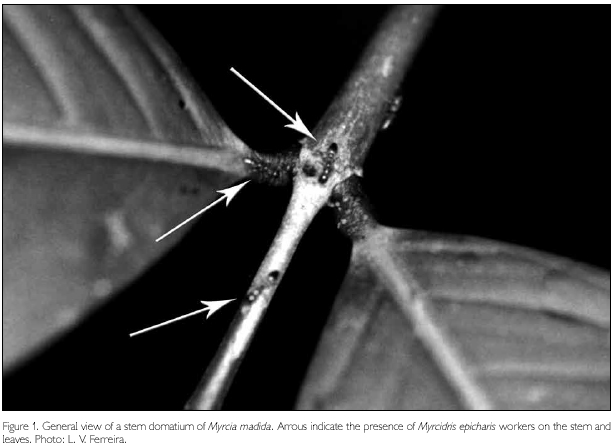
<body><![CDATA[<p><font size="2" face="verdana">Myrmecophytes  or ant-plants often produce specialized structures known as domatia to house  ants that, in turn, often provide protection against herbivores or competing  plants, or supply nutrients to their host-plants (Davidson &amp; McKey, 1993).  The domatia consist of hollow stems (e.g., <i>Cecropia </i>Loefl., <i>Leonardoxa </i>Aubrev., <i>Macaranga </i>Thouars, <i>Tachigali </i>Aubl., hollow thorns <i>(Acacia </i>Mill.), petioles <i>(Piper </i>L.), or leaf pouches (e.g., <i>Hirtella </i>L., <i>Maieta </i>Aubl., <i>Scaphopetalum </i>Mast., <i>Tococa </i>Aubl.) (Martin  &amp; McKey, 2003), and therefore can be of primary (in the case of hollow  stems or thorns) or secondary origi n (leaf pouches) (Benson, 1985).  Myrmecophytes are typically tropical forest plants whose associated ants have  been noted to vary at both regional and local scales (Fonseca &amp; Ganade,  1996).</font></p>     <p><font size="2" face="verdana">In his review  of Amazonian ant-plants, Benson (1985) recorded more than 200 species of  myrmecophytes from 27 genera in the Amazon region. He listed <i>Siparuna </i>Aubl.  (Monimiaceae) that was later found to be <i>Myrcia</i>DC. Ex Guill. (Myrtaceae)  (Ward, 1990). To date, only one of the 300 described species of<i>Myrcia (M.  madida </i>McVaugh) has been recorded as producing domatia (Benson, 1985), but  the myrmecophytic relationship of <i>Myrcia </i>remains poorly understood. This  note provides basic information on the ant<i>-Myrcia </i>relationship.</font></p>     <p>&nbsp;</p>     <p><font size="3" face="verdana"><b>METHODS</b></font></p>     <p><font size="2" face="verdana">The study was  conducted in central Amazonian rainforest, 70 km north of Manaus, Amazonas,   Brazil (2<sup>o</sup> 30'  S and 60&deg; 00' W). Forests in the study area are lowland (100-150 m elevation) but not  seasonally flooded (locally termed 'terra firme'). Annual rainfall ranges from  1.900-2.500 mm  with a pronounced dry season from June through October (Ferreira &amp;  Laurance, 1997). The forest canopy is 30-37 m tall, with emergent trees to 55 m. The flora of the study  area is remarkably diverse in tree species (Ferreira &amp; Rankin-de-Merona,  1997).</font></p>     <p><font size="2" face="verdana">Detailed  measurements were made on 50 domatia collected randomly from <i>M. madida </i>individuals  located along human trails in Biological Dynamics of Forest Fragments Project  (BDFFP). A total of 30 plants were also examined with regard to ant occupancy  (i.e. ant species, and number of ants per domatium).</font></p>     <p><font size="2" face="verdana">Examining  voucher specimens deposited in the herbarium of the National Institute of  Amazonian Research (INPA-Manaus) and in the reference collection of the BDFFP,  one of us identified <i>Myrcia </i>sp. as <i>Myrcia madida </i>McVaugh. <i>Myrcia  madida </i>McVaugh is a small- to medium- sized tree of up to 20 m in height, whose  distribution ranges from the Napo River, in Peru,  to the Negro River,  in Brazil.</font></p>     <p>&nbsp;</p>     <p><font size="3" face="verdana"><b>RESULTS AND DISCUSSION</b></font></p>     <p><font size="2" face="verdana"><i>Myrcia madida </i>McVaugh has domatia in hollow stems (<a href="#f1">Figure  1</a>), i.e. the domatia produced by this plant species is of primary origin <i>(sensu </i>Benson, 1985).</font></p>     ]]></body>
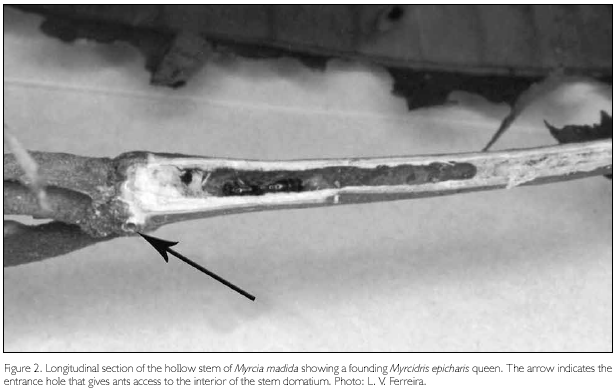
<body><![CDATA[<p><a name="f1"></a></p>     <p>&nbsp;</p>     <p align="center"><img src="/img/revistas/bmpegcn/v5n3/3a09f1.gif" border="0"></p>     <p>&nbsp;</p>     <p><font size="2" face="verdana">In the studied  area, <i>M. madida </i>occurs at low densities, averaging 0.15 trees (diameter  at breast height &gt;10 cm)  per hectare (N = 66 plots of 1   hectare). Bruna <i>et al. </i>(2005) found a density of  1.38 plants per hectare, including both trees and saplings (&gt; 0.5 m in height).</font></p>     <p><font size="2" face="verdana">The length of  each stem internode (domatium) of <i>M. madida </i>varied from 2.54 to 8.35 cm (Mean &#177; SD = 6.71 &#177;  1.43, N = 50). The maximum width varied from 0.19 to 0.41 cm (0.28 &#177; 0.05, N =  50), while the minimum width from 0.10 to 0.13 cm (0.12 &#177; 0.01, N =  50). Stems are filled with soft pith that ants remove to form a hollow cavity.  An entrance hole is cut in each stem internode, just below the insertion of the  opposite leaves (Figure 1). The diameter of these holes varied from 0.19 to 0.45 cm (0.25 &#177; 0.07, N =  50), with one or two holes being found per domatium.</font></p>     <p><font size="2" face="verdana">Ants were  collected from 30 plants of various sizes (0.9 to 18 m in height), and all  plants were inhabited by the same pseudomyrmecine ant, <i>Myrcidris epicharis </i>Ward,  1990, which is the only known species of the genus <i>Myrcidris </i>(Ward,  1990). A total of 81 domatia were dissected from ten trees. On average there  were 13.3 adult ant workers (SD = 3.8), 3.8 larvae (SD = 3.7), 1.5 pupae (SD =  1.1), and 2.3 eggs (SD = 2.8) per domatium. One plant housed larvae and pupae  with adult male ants. Scale insects were found in the interior of most domatia  (Mean = 0.97 scale insects per domatium, SD = 0.67), and these are probably an  important source of food (honeydew) for <i>M. epicharis. </i>In one incipient  colony (defined as incipient because it was the only colony present in a small,  young tree sapling), composed of a single queen, three workers, two larvae and  one pupa, all in the same domatium, two scale insects were found. The presence  of scale insects in incipient ant colonies suggests that either plant  colonization by these herbivorous insects occurs almost concomitantly with ant  colonization or that these are transported by founding queens when they leave  their maternal nests (Trager &amp; Bruna, 2006).</font></p>     <p><font size="2" face="verdana">New colonies of <i>M. epicharis </i>are founded by a single queen (haplometrosis; <a href="#f2">Figure 2</a>),  and none of the examined plants harbored more than one queen, suggesting that  secondary adoption of queens (secondary polygyny) may not take place in this  species. It is not clear how long a colony of <i>M. epicharis </i>lives, but it  seems unlikely that a given host-plant will host the same colony throughout its  life. Ants colonize <i>M. madida </i>at an early stage (saplings as small as 50 cm in height often harbor  ants), and several decades may be required for this plant to reach maturity. In  some other species of myrmecophytic trees, such as <i>Tachigali myrmecophylla </i>Ducke  an ontogenetic succession of ant species occurs throughout the life of the  tree, from the sapling stage until the plant reaches the forest canopy and  eventually dies (Fonseca &amp; Benson, 2003). Such succession of ant species  does not appear to take place in <i>M. madida, </i>since all plants examined  were inhabited by <i>M. epicharis. </i>Similarly, all ant-inhabited individuals  of <i>M. madida </i>found by Bruna <i>et al. </i>(2005) were associated with <i>M.  epicharis.</i></font></p>     <p><a name="f2"></a></p>     <p>&nbsp;</p>     ]]></body>
<body><![CDATA[<p align="center"><img src="/img/revistas/bmpegcn/v5n3/3a09f2.gif" border="0"></p>     <p>&nbsp;</p>     <p><font size="2" face="verdana">Protective  ant-plant interactions, important in both temperate and tropical communities,  are increasingly used to study a wide range of phenomena of general interest  (Martin &amp; McKey, 2003). In contrast, to other pseudomymecine ants  associated with myrmecophytes (Janzen, 1966), <i>M. epicharis </i>is not very  aggressive against human intruders. In collecting ants from cut and branches  from several trees, the authors were bitten and stung by the ants only  occasionally during the first day. However, on the following day the ant's  stings caused a strong allergic reaction, which made the collectors more  reluctant to manipulate ant-protected branches. This suggests that <i>M.  epicharis </i>may be efficient in deterring vertebrate attacks on its  host-plant, but this possibility remains to be evaluated with proper field  experiments. The ants also appear to be efficient in deterring herbivorous  insects, resulting in the observed low level of damage on its leaves. Herbivore  damage was quantified in 19 randomly collected leaves from four plants and most  (68.4%) of these leaves were found to have less than 2% of the leaf area  damaged by insects (most commonly by leaf miners).</font></p>     <p><font size="2" face="verdana">Overall, our  observations suggest that the association between <i>M. epicharis </i>and <i>M.  madida </i>is a mutually benificial one; the plants provide shelter and  indirectly food (scale insects), while ants provide defense against herbivores.  However, experimental studies are needed to confirm this hypothesis. These  observations will hopefully stimulate further work on this poorly-known  ant-plant association.</font></p>     <p>&nbsp;</p>     <p><font size="3" face="verdana"><b>ACKNOWLEDGEMENTS</b></font></p>     <p><font size="2" face="verdana">We thank Jo&atilde;o de Deus for his help during the  field work. We thank the Biological Dynamics of Forest Fragments Project for  providing working facilities in the study area.</font></p>     <p>&nbsp;</p>     <p><font size="3" face="verdana"><b>REFERENCES</b></font></p>     <!-- ref --><p><font size="2" face="verdana">BENSON, W. W., 1985. Amazon ant-plants. In:  G. T. PRANCE &amp; T. E. LOVEJOY (Eds.): <b>Amazonia: </b>key environment: 239-266. Pergamon Press, London.</font><!-- ref --><p><font size="2" face="verdana">BRUNA, E. M., H. L. VASCONCELOS  &amp; S. HEREDIA, 2005. The effect of habitat  fragmentations on communities of mutualists: Amazon ants and their host plants. <b>Biological Conservation </b>124: 209-216.</font><!-- ref --><p><font size="2" face="verdana">DAVIDSON, D. W. &amp; D. MCKEY, 1993. The  evolutionary ecology of ant-plant relationships. <b>Journal of Hymenopteran  Research </b>2: 13-83.</font><!-- ref --><p><font size="2" face="verdana">FERREIRA, L. P. &amp; W. F. LAURANCE, 1997. Effects of fragmentation on  tree mortality and damage in the Central Amazonian forest. <b>Conservation  Biology </b>11:  797-801.</font><!-- ref --><p><font size="2" face="verdana">FERREIRA,  L. V. &amp; J. RANKIN-DE-M&Eacute;RONA, 1997. Floristic  composition and structure of a one-hectare plot in terra firme forest in Central Amazonia. In: F. DALLMEIER &amp; J. A. COMISKEY  (Eds.): <b>Forest biodiversity in North, Central and South America and the Caribbean: </b>Research and monitoring: 655-668.  Parthenon Publishing (Man and Biosphere series, 22), Carnforth.</font><!-- ref --><p><font size="2" face="verdana">FONSECA, C. R. &amp; G.  GANADE, 1996. Compartments, asymetries and null  interactions in an Amazonian ant-plant community. <b>Journal of Animal Ecology </b>65:  73-77.</font><!-- ref --><p><font size="2" face="verdana">FONSECA, C. R. &amp; W.  W. BENSON, 2003. Ontogenetic succession on Amazonian  ant-trees. <b>Oikos </b>102(2): 407-412.</font><!-- ref --><p><font size="2" face="verdana">JANZEN, D. H., 1966. Coevolution of mutualism  between ants and acacias in Central America. <b>Evolution </b>20(3): 249-275.</font><!-- ref --><p><font size="2" face="verdana">MARTIN, H. &amp; D. MCKEY, 2003. Protective  ant-plant interactions as model systems in ecological and evolutionary  research. <b>Annual Review of Ecology, Evolution, and Systematics </b>34:  425-553.</font><!-- ref --><p><font size="2" face="verdana">TRAGER, M. D. &amp; E. M. BRUNA, 2006. Effects  of plant age, experimental nutrient addition and ant occupancy on herbivory in  a neotropical myrmecophyte. <b>Journal of Ecology </b>94: 1156-1163.</font><!-- ref --><p><font size="2" face="verdana">WARD, P. S., 1990.  The ant subfamily Pseudomyrmecinae (Hymenoptera: Formicidae): generic revision  and relationship to other formicids. <b>Systematic Entomology </b>15:  449-489</font>.<p>&nbsp;</p>     <p>&nbsp;</p>     <p><font size="2" face="Verdana"><b><a name="endereco"></a><a href="#topo"><img src="img/revistas/bmpegcn/v5n3/seta.gif" border="0" /></a></b></font><font size="2" face="verdana"><b>Mailing address</b>:    <br>   Museu Paraense Em&iacute;lio Goeldi    <br>   Editor do Boletim do Museu Paraense Em&iacute;lio Goeldi. Ci&ecirc;ncias Naturais    <br>   Av. Magalh&atilde;es Barata, 376    <br>   S&atilde;o Braz &ndash; CEP 66040-170    <br>   Bel&eacute;m - PA - Brazil    <br>   Caixa Postal 399    <br>   Phone: 55-91-3182-3246    ]]></body>
<body><![CDATA[<br>   Fax: 55- 91-3249-6373    <br> E-mail: <a href="mailto:boletim.naturais@museu-goeldi.br">boletim.naturais@museu-goeldi.br</a></font></p>     <p><font size="2" face="verdana">Recebido:  18/05/2009    <br>   Aprovado:  26/04/2010    <br>   Responsabilidade  editorial: Hilton Tulio Costi</font></p>      ]]></body><back>
<ref-list>
<ref id="B1">
<nlm-citation citation-type="book">
<person-group person-group-type="author">
<name>
<surname><![CDATA[BENSON]]></surname>
<given-names><![CDATA[W. W.]]></given-names>
</name>
</person-group>
<article-title xml:lang="en"><![CDATA[Amazon ant-plants]]></article-title>
<person-group person-group-type="editor">
<name>
<surname><![CDATA[PRANCE]]></surname>
<given-names><![CDATA[G. T.]]></given-names>
</name>
<name>
<surname><![CDATA[LOVEJOY]]></surname>
<given-names><![CDATA[T. E.]]></given-names>
</name>
</person-group>
<source><![CDATA[Amazonia: key environment]]></source>
<year>1985</year>
<page-range>239-266</page-range><publisher-loc><![CDATA[London ]]></publisher-loc>
<publisher-name><![CDATA[Pergamon Press]]></publisher-name>
</nlm-citation>
</ref>
<ref id="B2">
<nlm-citation citation-type="">
<person-group person-group-type="author">
<name>
<surname><![CDATA[BRUNA]]></surname>
<given-names><![CDATA[E. M.]]></given-names>
</name>
<name>
<surname><![CDATA[VASCONCELOS]]></surname>
<given-names><![CDATA[H. L.]]></given-names>
</name>
<name>
<surname><![CDATA[HEREDIA]]></surname>
<given-names><![CDATA[S.]]></given-names>
</name>
</person-group>
<article-title xml:lang="en"><![CDATA[The effect of habitat fragmentations on communities of mutualists: Amazon ants and their host plants]]></article-title>
<source><![CDATA[]]></source>
<year>2005</year>
<volume>124</volume>
<page-range>209-216</page-range></nlm-citation>
</ref>
<ref id="B3">
<nlm-citation citation-type="journal">
<person-group person-group-type="author">
<name>
<surname><![CDATA[DAVIDSON]]></surname>
<given-names><![CDATA[D. W.]]></given-names>
</name>
<name>
<surname><![CDATA[MCKEY]]></surname>
<given-names><![CDATA[D.]]></given-names>
</name>
</person-group>
<article-title xml:lang="en"><![CDATA[The evolutionary ecology of ant-plant relationships]]></article-title>
<source><![CDATA[Journal of Hymenopteran Research]]></source>
<year>1993</year>
<volume>2</volume>
<page-range>13-83</page-range></nlm-citation>
</ref>
<ref id="B4">
<nlm-citation citation-type="journal">
<person-group person-group-type="author">
<name>
<surname><![CDATA[FERREIRA]]></surname>
<given-names><![CDATA[L. P.]]></given-names>
</name>
<name>
<surname><![CDATA[LAURANCE]]></surname>
<given-names><![CDATA[W. F.]]></given-names>
</name>
</person-group>
<article-title xml:lang="en"><![CDATA[Effects of fragmentation on tree mortality and damage in the Central Amazonian forest]]></article-title>
<source><![CDATA[Conservation Biology]]></source>
<year>1997</year>
<volume>11</volume>
<page-range>797-801</page-range></nlm-citation>
</ref>
<ref id="B5">
<nlm-citation citation-type="book">
<person-group person-group-type="author">
<name>
<surname><![CDATA[FERREIRA]]></surname>
<given-names><![CDATA[L. V.]]></given-names>
</name>
<name>
<surname><![CDATA[RANKIN-DE-MÉRONA]]></surname>
<given-names><![CDATA[J.]]></given-names>
</name>
</person-group>
<article-title xml:lang="en"><![CDATA[Floristic composition and structure of a one-hectare plot in terra firme forest in Central Amazonia]]></article-title>
<person-group person-group-type="editor">
<name>
<surname><![CDATA[DALLMEIER]]></surname>
<given-names><![CDATA[F.]]></given-names>
</name>
<name>
<surname><![CDATA[COMISKEY]]></surname>
<given-names><![CDATA[J. A.]]></given-names>
</name>
</person-group>
<source><![CDATA[Forest biodiversity in North, Central and South America and the Caribbean: Research and monitoring]]></source>
<year>1997</year>
<page-range>655-668</page-range><publisher-loc><![CDATA[Carnforth ]]></publisher-loc>
<publisher-name><![CDATA[Parthenon Publishing (Man and Biosphere series, 22)]]></publisher-name>
</nlm-citation>
</ref>
<ref id="B6">
<nlm-citation citation-type="journal">
<person-group person-group-type="author">
<name>
<surname><![CDATA[FONSECA]]></surname>
<given-names><![CDATA[C. R.]]></given-names>
</name>
<name>
<surname><![CDATA[GANADE]]></surname>
<given-names><![CDATA[G.]]></given-names>
</name>
</person-group>
<article-title xml:lang="en"><![CDATA[Compartments, asymetries and null interactions in an Amazonian ant-plant community]]></article-title>
<source><![CDATA[Journal of Animal Ecology]]></source>
<year>1996</year>
<volume>65</volume>
<page-range>73-77</page-range></nlm-citation>
</ref>
<ref id="B7">
<nlm-citation citation-type="journal">
<person-group person-group-type="author">
<name>
<surname><![CDATA[FONSECA]]></surname>
<given-names><![CDATA[C. R.]]></given-names>
</name>
<name>
<surname><![CDATA[BENSON]]></surname>
<given-names><![CDATA[W. W.]]></given-names>
</name>
</person-group>
<article-title xml:lang="en"><![CDATA[Ontogenetic succession on Amazonian ant-trees]]></article-title>
<source><![CDATA[Oikos]]></source>
<year>2003</year>
<volume>102</volume>
<numero>2</numero>
<issue>2</issue>
<page-range>407-412</page-range></nlm-citation>
</ref>
<ref id="B8">
<nlm-citation citation-type="journal">
<person-group person-group-type="author">
<name>
<surname><![CDATA[JANZEN]]></surname>
<given-names><![CDATA[D. H.]]></given-names>
</name>
</person-group>
<article-title xml:lang="en"><![CDATA[Coevolution of mutualism between ants and acacias in Central America]]></article-title>
<source><![CDATA[Evolution]]></source>
<year>1966</year>
<volume>20</volume>
<numero>3</numero>
<issue>3</issue>
<page-range>249-275</page-range></nlm-citation>
</ref>
<ref id="B9">
<nlm-citation citation-type="journal">
<person-group person-group-type="author">
<name>
<surname><![CDATA[MARTIN]]></surname>
<given-names><![CDATA[H.]]></given-names>
</name>
<name>
<surname><![CDATA[MCKEY]]></surname>
<given-names><![CDATA[D.]]></given-names>
</name>
</person-group>
<article-title xml:lang="en"><![CDATA[Protective ant-plant interactions as model systems in ecological and evolutionary research]]></article-title>
<source><![CDATA[Annual Review of Ecology, Evolution, and Systematics]]></source>
<year>2003</year>
<volume>34</volume>
<page-range>425-553</page-range></nlm-citation>
</ref>
<ref id="B10">
<nlm-citation citation-type="journal">
<person-group person-group-type="author">
<name>
<surname><![CDATA[TRAGER]]></surname>
<given-names><![CDATA[M. D.]]></given-names>
</name>
<name>
<surname><![CDATA[BRUNA]]></surname>
<given-names><![CDATA[E. M.]]></given-names>
</name>
</person-group>
<article-title xml:lang="en"><![CDATA[Effects of plant age, experimental nutrient addition and ant occupancy on herbivory in a neotropical myrmecophyte]]></article-title>
<source><![CDATA[Journal of Ecology]]></source>
<year>2006</year>
<volume>94</volume>
<page-range>1156-1163</page-range></nlm-citation>
</ref>
<ref id="B11">
<nlm-citation citation-type="journal">
<person-group person-group-type="author">
<name>
<surname><![CDATA[WARD]]></surname>
<given-names><![CDATA[P. S.]]></given-names>
</name>
</person-group>
<article-title xml:lang="en"><![CDATA[The ant subfamily Pseudomyrmecinae (Hymenoptera: Formicidae): generic revision and relationship to other formicids]]></article-title>
<source><![CDATA[Systematic Entomology]]></source>
<year>1990</year>
<volume>15</volume>
<page-range>449-489</page-range></nlm-citation>
</ref>
</ref-list>
</back>
</article>