<?xml version="1.0" encoding="ISO-8859-1"?><article xmlns:mml="http://www.w3.org/1998/Math/MathML" xmlns:xlink="http://www.w3.org/1999/xlink" xmlns:xsi="http://www.w3.org/2001/XMLSchema-instance">
<front>
<journal-meta>
<journal-id>2176-6223</journal-id>
<journal-title><![CDATA[Revista Pan-Amazônica de Saúde]]></journal-title>
<abbrev-journal-title><![CDATA[Rev Pan-Amaz Saude]]></abbrev-journal-title>
<issn>2176-6223</issn>
<publisher>
<publisher-name><![CDATA[Instituto Evandro Chagas. Secretaria de Vigilância em Saúde e Ambiente. Ministério da Saúde]]></publisher-name>
</publisher>
</journal-meta>
<article-meta>
<article-id>S2176-62232010000200004</article-id>
<article-id pub-id-type="doi">10.5123/S2176-62232010000200004</article-id>
<title-group>
<article-title xml:lang="en"><![CDATA[Maternal periodontal disease and preterm birth: a case-control study]]></article-title>
<article-title xml:lang="pt"><![CDATA[Doença periodontal materna e parto pré-termo: um estudo de caso-controle]]></article-title>
<article-title xml:lang="es"><![CDATA[Enfermedad periodontal materna y parto pretérmino: un estúdio de caso-control]]></article-title>
</title-group>
<contrib-group>
<contrib contrib-type="author">
<name>
<surname><![CDATA[Grandi]]></surname>
<given-names><![CDATA[Carlos]]></given-names>
</name>
<xref ref-type="aff" rid="A01"/>
</contrib>
<contrib contrib-type="author">
<name>
<surname><![CDATA[Trungadi]]></surname>
<given-names><![CDATA[Mariano]]></given-names>
</name>
<xref ref-type="aff" rid="A02"/>
</contrib>
<contrib contrib-type="author">
<name>
<surname><![CDATA[Meritano]]></surname>
<given-names><![CDATA[Javier]]></given-names>
</name>
<xref ref-type="aff" rid="A03"/>
</contrib>
</contrib-group>
<aff id="A01">
<institution><![CDATA[,Universidad de Buenos Aires Hospital Materno Infantil Ramón Sardá Epidemiología Perinatal y Bioestadística]]></institution>
<addr-line><![CDATA[Buenos Aires ]]></addr-line>
<country>Argentina</country>
</aff>
<aff id="A02">
<institution><![CDATA[,Universidad de Buenos Aires Hospital Materno Infantil Ramón Sardá Unidad de Odontología]]></institution>
<addr-line><![CDATA[Buenos Aires ]]></addr-line>
<country>Argentina</country>
</aff>
<aff id="A03">
<institution><![CDATA[,Universidad de Buenos Aires Hospital Materno Infantil Ramón Sardá Departamento de Neonatología]]></institution>
<addr-line><![CDATA[Buenos Aires ]]></addr-line>
<country>Argentina</country>
</aff>
<pub-date pub-type="pub">
<day>00</day>
<month>06</month>
<year>2010</year>
</pub-date>
<pub-date pub-type="epub">
<day>00</day>
<month>06</month>
<year>2010</year>
</pub-date>
<volume>1</volume>
<numero>2</numero>
<fpage>41</fpage>
<lpage>48</lpage>
<copyright-statement/>
<copyright-year/>
<self-uri xlink:href="http://scielo.iec.gov.br/scielo.php?script=sci_arttext&amp;pid=S2176-62232010000200004&amp;lng=en&amp;nrm=iso"></self-uri><self-uri xlink:href="http://scielo.iec.gov.br/scielo.php?script=sci_abstract&amp;pid=S2176-62232010000200004&amp;lng=en&amp;nrm=iso"></self-uri><self-uri xlink:href="http://scielo.iec.gov.br/scielo.php?script=sci_pdf&amp;pid=S2176-62232010000200004&amp;lng=en&amp;nrm=iso"></self-uri><abstract abstract-type="short" xml:lang="en"><p><![CDATA[OBJECTIVES: Periodontal disease can be a source of subclinical and persistent infection that may induce systemic inflammatory responses that increase the risk of preterm birth. The goal of this study was to establish whether periodontal disease is a risk factor for preterm birth, and to evaluate the association of this risk with gestational age. METHODS: This case-control study included postpartum women with singleton gestations; 53 women who gave birth before the 37th week (cases) were compared to 79 women with term deliveries (controls). Full-mouth clinical periodontal parameters were determined within 72 h after delivery. RESULTS: The prevalence of periodontal disease was 41% (54/132). The preterm birth cases showed a significantly higher proportion of bleeding than the term birth controls (86.7% versus 68%, p = 0.026) and a greater maximum periodontal pocket depth on probing (3.9 ± 1.6 mm versus 3.2 ± 1 mm, p = 0.043). No differences in previous periodontal disease, attachment loss, or the percentage of periodontal disease were detected between the study groups. Logistic regression revealed that preterm birth was associated with the bleeding index (adjusted odds ratio 4.19; 95% CI: 1.28 - 13.69, p = 0.018) and with periodontal pocket depth (5.14; 95% CI: 1.50 - 17.6, p = 0.009). The risk of preterm birth associated with periodontal disease decreased as gestational age increased. In addition, the population attributable risk was 16% overall; this risk increased as gestational age decreased. CONCLUSION: In this study population, only the bleeding index and periodontal pocket depth were risk factors for preterm birth; increased risk was associated with greater prematurity.]]></p></abstract>
<abstract abstract-type="short" xml:lang="pt"><p><![CDATA[OBJETIVOS: A doença periodontal pode ser uma fonte de infecção subclínica persistente que pode induzir respostas inflamatórias sistêmicas que aumentam o risco de parto pré-termo. O objetivo deste estudo foi determinar se a doença periodontal é um fator de risco para o parto pré-termo, bem como avaliar a associação deste risco com a idade gestacional. MÉTODOS: Este estudo de caso-controle abrangeu mulheres puérperas de gestações únicas; 53 mulheres que deram à luz antes da 37ª semana de gestação (casos) foram comparadas a 79 que evoluíram com parto a termo (controles). Procedeu-se a uma avaliação clínica periodontal completa dentro das 72 h após o parto. RESULTADOS: A taxa de prevalência da doença periodontal foi de 41% (54/132). Os casos de parto pré-termo apresentaram uma proporção de sangramento muito maior em comparação com os controles (86,7% versus 68%; p = 0,026), bem como uma profundidade máxima da bolsa periodontal maior após medição por sonda (3,9 ± 1,6 mm versus 3,2 ± 1 mm; p = 0,043). Não foram detectadas diferenças relacionadas à doença periodontal prévia, à perda de adesão ou à porcentagem de doença periodontal entre os grupos estudados. A análise de regressão logística revelou que o parto pré-termo foi associado ao índice de sangramento (odds ratio ajustada de 4,19; 95% CI: 1,28 - 13,69; p = 0,018) e à profundidade da bolsa periodontal (5,14; 95% CI: 1,50 - 17,6; p = 0,009). O risco de nascimento pré-termo associado à doença periodontal diminuiu com o aumento da idade gestacional. Além disso, o risco atribuído à população em geral é de 16%, risco este que aumentou com a diminuição da idade gestacional. CONCLUSÃO: Neste estudo com base na população, apenas o índice de sangramento e a profundidade da bolsa periodontal foram considerados fatores de risco para o parto prematuro; um risco maior foi associado à maior prematuridade.]]></p></abstract>
<abstract abstract-type="short" xml:lang="es"><p><![CDATA[OBJETIVOS: La enfermedad periodontal puede ser una fuente de infección subclínica persistente que puede inducir a respuestas inflamatorias sistémicas que aumentan el riesgo de parto pretérmino. El objetivo de este estudio objetivo fue de determinar si la enfermedad periodontal es un factor de riesgo para el parto pretérmino, bien como evaluar la asociación de este riesgo con la edad gestacional. MÉTODOS: Este estudio de caso-control abarcó mujeres puérperas de gestaciones únicas; 53 mujeres que dieron a luz antes de la 37ª semana de gestación (casos) fueron comparadas a 79 que evolucionaron con parto a término (controles). Se procedió a una evaluación clínica periodontal completa dentro de las 72 h en seguida al parto. RESULTADOS: La tasa de prevalencia de la enfermedad periodontal fue de 41% (54/132). Los casos de parto pretérmino presentaron una proporción de sangrado mucho mayor en comparación a los controles (86,7 versus 68%; p = 0,026), bien como una profundidad máxima de la bolsa periodontal mayor luego de medición por sonda (3,9 ± 1,6 mm versus 3,2 ± 1 mm; p = 0,043). No se detectaron diferencias relacionadas a la enfermedad periodontal previa, a la pérdida de la adhesión o al porcentaje de enfermedad periodontal entre los grupos estudiados. El análisis de regresión logística reveló que el parto pretérmino fue asociado al índice de sangrado (odds ratio ajustada de 4,19; 95% CI: 1,28 - 13,69; p = 0,018) y a la profundidad de la bolsa periodontal (5,14; 95% CI: 1,50 - 17,6; p = 0,009). El riesgo de nacimiento prematuro asociado a la enfermedad periodontal disminuyó con el aumento de la edad gestacional. Además, el riesgo atribuido a la población en general es de 16%, riesgo este que aumenta con la disminución de la edad gestacional. CONCLUSIÓN: En este estudio con base en la población, apenas el índice de sangrado y la profundidad de la bolsa periodontal fueron considerados factores de riesgo para el parto prematuro; un mayor riesgo fue asociado a mayor prematuridad.]]></p></abstract>
<kwd-group>
<kwd lng="en"><![CDATA[Periodontal Diseases]]></kwd>
<kwd lng="en"><![CDATA[Premature Birth]]></kwd>
<kwd lng="en"><![CDATA[Pregnancy]]></kwd>
<kwd lng="en"><![CDATA[Risk Factors]]></kwd>
<kwd lng="pt"><![CDATA[Doenças Periodontais]]></kwd>
<kwd lng="pt"><![CDATA[Nascimento Prematuro]]></kwd>
<kwd lng="pt"><![CDATA[Gravidez]]></kwd>
<kwd lng="pt"><![CDATA[Fatores de Risco]]></kwd>
<kwd lng="es"><![CDATA[Enfermedades Periodontales]]></kwd>
<kwd lng="es"><![CDATA[Nacimiento Prematuro]]></kwd>
<kwd lng="es"><![CDATA[Embarazo]]></kwd>
<kwd lng="es"><![CDATA[Factores de Riesgo]]></kwd>
</kwd-group>
</article-meta>
</front><body><![CDATA[ <p align="right"><font size="2" face="Verdana"><b>ARTIGO ORIGINAL | ORIGINAL ARTICLE | ART&Iacute;CULO ORIGINAL</b></font></p>     <p>&nbsp;</p>     <p><font size="4" face="Verdana"><b><a name="topo"></a>Maternal periodontal disease and preterm birth: a case-control study</b></font></p>     <p>&nbsp;</p>     <p><font size="3" face="Verdana"> <b>Doen&ccedil;a periodontal materna e parto pr&eacute;-termo:   um estudo de caso-controle</b></font></p>     <p>&nbsp;</p>     <p><font size="3" face="Verdana"><b>Enfermedad periodontal materna y parto pret&eacute;rmino: un est&uacute;dio   de caso-control</b></font></p>     <p>&nbsp;</p>     <p>&nbsp;</p>     <p><font size="2" face="Verdana"><b>Carlos Grandi<sup>I</sup>; Mariano Trungadi<sup>II</sup>;</b></font> <font size="2" face="Verdana"><b>Javier Meritano<sup>III</sup></b></font></p>     ]]></body>
<body><![CDATA[<p><font size="2" face="Verdana"><sup>I</sup>Epidemiolog&iacute;a Perinatal y Bioestad&iacute;stica, Hospital Materno Infantil Ram&oacute;n Sard&aacute;, Universidad de Buenos Aires, Buenos Aires, Argentina</font>    <br> <font size="2" face="Verdana"><sup>II</sup>Unidad de Odontolog&iacute;a, Hospital Materno Infantil Ram&oacute;n Sard&aacute;, Universidad de Buenos Aires, Buenos Aires, Argentina</font>    <br> <sup>III</sup><font size="2" face="Verdana">Departamento de Neonatolog&iacute;a,     Hospital Materno Infantil Ram&oacute;n Sard&aacute;, Universidad de Buenos Aires, Buenos Aires, Argentina</font></p>     <p><font size="2"><a href="#endereco"><font face="verdana">Endere&ccedil;o para         correspond&ecirc;ncia    <br> Correspondence    <br> Direcci&oacute;n para correspondencia</font></a></font></p>     <p>&nbsp;</p>     <p>&nbsp;</p> <hr size="1" noshade>     <p><font size="2" face="Verdana"><b>ABSTRACT</b></font></p>     <p><font size="2" face="Verdana"> <b>OBJECTIVES:</b> Periodontal disease can     be a source of subclinical and persistent infection that may induce systemic     inflammatory responses that increase the risk of preterm birth. The goal     of this study was to establish whether periodontal disease is a risk factor     for preterm birth, and to evaluate the association of this risk with gestational     age.    ]]></body>
<body><![CDATA[<br>   <b> METHODS:</b> This case-control study included postpartum women with singleton    gestations; 53 women who gave birth before the 37<sup>th</sup> week (cases) were compared    to 79 women with term deliveries (controls). Full-mouth clinical periodontal    parameters were determined within 72 h after delivery.    <br>   <b> RESULTS:</b> The prevalence   of periodontal disease was 41% (54/132). The preterm birth cases showed a   significantly higher proportion of bleeding than the term birth controls   (86.7% versus 68%, p = 0.026) and a greater maximum periodontal pocket depth   on probing (3.9 &plusmn; 1.6 mm versus 3.2 &plusmn; 1   mm, p = 0.043). No differences in previous periodontal disease, attachment   loss, or the percentage of periodontal disease were detected between the study   groups. Logistic regression revealed that preterm birth was associated with   the bleeding index (adjusted odds ratio 4.19; 95% CI: 1.28 - 13.69, p = 0.018)   and with periodontal pocket depth (5.14; 95% CI: 1.50 - 17.6, p = 0.009). The   risk of preterm birth associated with periodontal disease decreased as gestational   age increased. In addition, the population attributable risk was 16% overall;   this risk increased as gestational age decreased.    <br>   <b> CONCLUSION:</b> In this study   population, only the bleeding index and periodontal pocket depth were risk   factors for preterm birth; increased risk was associated with greater prematurity.</font></p>     <p><font size="2" face="Verdana"><b> Keywords:</b> Periodontal Diseases; Premature Birth;     Pregnancy; Risk Factors.</font></p> <hr size="1" noshade>     <p><font size="2" face="Verdana"><b>RESUMO</b></font></p>     <p><font size="2" face="Verdana"> <b>OBJETIVOS:</b> A doen&ccedil;a periodontal     pode ser uma fonte de infec&ccedil;&atilde;o   subcl&iacute;nica persistente que pode induzir respostas inflamat&oacute;rias   sist&ecirc;micas que aumentam o risco de parto pr&eacute;-termo. O objetivo   deste estudo foi determinar se a doen&ccedil;a periodontal &eacute; um fator   de risco para o parto pr&eacute;-termo, bem como avaliar a associa&ccedil;&atilde;o   deste risco com a idade gestacional.    <br>   <b> M&Eacute;TODOS:</b> Este estudo de caso-controle   abrangeu mulheres pu&eacute;rperas de gesta&ccedil;&otilde;es &uacute;nicas;   53 mulheres que deram &agrave; luz antes da 37<sup>a</sup> semana de gesta&ccedil;&atilde;o   (casos) foram comparadas a 79 que evolu&iacute;ram com parto a termo (controles).   Procedeu-se a uma avalia&ccedil;&atilde;o cl&iacute;nica periodontal completa   dentro das 72 h ap&oacute;s o parto.    <br>   <b> RESULTADOS:</b> A taxa de preval&ecirc;ncia   da doen&ccedil;a   periodontal foi de 41% (54/132). Os casos de parto pr&eacute;-termo apresentaram   uma propor&ccedil;&atilde;o de sangramento muito maior em compara&ccedil;&atilde;o   com os controles (86,7% versus 68%; p = 0,026), bem como uma profundidade m&aacute;xima   da bolsa periodontal maior ap&oacute;s medi&ccedil;&atilde;o por sonda (3,9 &plusmn; 1,6   mm versus 3,2 &plusmn; 1 mm; p = 0,043). N&atilde;o foram detectadas diferen&ccedil;as   relacionadas &agrave; doen&ccedil;a periodontal pr&eacute;via, &agrave; perda   de ades&atilde;o ou &agrave; porcentagem de doen&ccedil;a periodontal entre   os grupos estudados. A an&aacute;lise de regress&atilde;o log&iacute;stica   revelou que o parto pr&eacute;-termo foi associado ao  &iacute;ndice de sangramento <i>(odds     ratio </i>ajustada de 4,19; 95% CI: 1,28 - 13,69; p = 0,018) e &agrave; profundidade   da bolsa periodontal (5,14; 95% CI: 1,50 - 17,6; p = 0,009). O risco de nascimento   pr&eacute;-termo associado &agrave; doen&ccedil;a periodontal diminuiu com   o aumento da idade gestacional. Al&eacute;m disso, o risco atribu&iacute;do &agrave; popula&ccedil;&atilde;o   em geral &eacute; de 16%, risco este que aumentou com a diminui&ccedil;&atilde;o   da idade gestacional.    <br>   <b> CONCLUS&Atilde;O:</b> Neste estudo com base na popula&ccedil;&atilde;o,   apenas o &iacute;ndice de sangramento e a profundidade da bolsa periodontal   foram considerados fatores de risco para o parto prematuro; um risco maior   foi associado &agrave; maior   prematuridade.</font></p>     <p><font size="2" face="Verdana"><b> Palavras-chave:</b> Doen&ccedil;as Periodontais; Nascimento Prematuro; Gravidez;   Fatores de Risco.</font></p> <hr size="1" noshade>     ]]></body>
<body><![CDATA[<p><font size="2" face="Verdana"><b>RESUMEN</b></font></p>     <p><font size="2" face="Verdana"><b>OBJETIVOS:</b> La enfermedad periodontal   puede ser una fuente de infecci&oacute;n   subcl&iacute;nica persistente que puede inducir a respuestas inflamatorias   sist&eacute;micas   que aumentan el riesgo de parto pret&eacute;rmino. El objetivo de este estudio   objetivo fue de determinar si la enfermedad periodontal es un factor de riesgo   para el parto pret&eacute;rmino, bien como evaluar la asociaci&oacute;n de   este riesgo con la edad gestacional.    <br>   <b> M&Eacute;TODOS:</b> Este estudio de caso-control   abarc&oacute; mujeres pu&eacute;rperas de gestaciones &uacute;nicas; 53 mujeres   que dieron a luz antes de la 37<sup>a</sup> semana de gestaci&oacute;n (casos) fueron   comparadas a 79 que evolucionaron con parto a t&eacute;rmino (controles). Se   procedi&oacute; a   una evaluaci&oacute;n cl&iacute;nica periodontal completa dentro de las 72   h en seguida al parto.    <br>   <b>RESULTADOS:</b> La tasa de prevalencia de la enfermedad   periodontal fue de 41% (54/132). Los casos de parto pret&eacute;rmino presentaron   una proporci&oacute;n   de sangrado mucho mayor en comparaci&oacute;n a los controles (86,7 versus   68%; p = 0,026), bien como una profundidad m&aacute;xima de la bolsa periodontal   mayor luego de medici&oacute;n por sonda (3,9 &plusmn; 1,6 mm versus 3,2 &plusmn; 1   mm; p = 0,043). No se detectaron diferencias relacionadas a la enfermedad periodontal   previa, a la p&eacute;rdida de la adhesi&oacute;n o al porcentaje de enfermedad   periodontal entre los grupos estudiados. El an&aacute;lisis de regresi&oacute;n   log&iacute;stica revel&oacute; que el parto pret&eacute;rmino fue asociado   al  &iacute;ndice   de sangrado <i>(odds ratio </i>ajustada de 4,19; 95% CI: 1,28 - 13,69; p =   0,018) y a la profundidad de la bolsa periodontal (5,14; 95% CI: 1,50 - 17,6;   p = 0,009). El riesgo de nacimiento prematuro asociado a la enfermedad periodontal   disminuy&oacute; con   el aumento de la edad gestacional. Adem&aacute;s, el riesgo atribuido a la   poblaci&oacute;n   en general es de 16%, riesgo este que aumenta con la disminuci&oacute;n de   la edad gestacional.    <br>   <b> CONCLUSI&Oacute;N:</b> En este estudio con base en la poblaci&oacute;n,   apenas el &iacute;ndice de sangrado y la profundidad de la bolsa periodontal   fueron considerados factores de riesgo para el parto prematuro; un mayor riesgo   fue asociado a mayor prematuridad.</font></p>     <p><font size="2" face="Verdana"><b> Palabras clave:</b> Enfermedades Periodontales;     Nacimiento Prematuro; Embarazo; Factores de Riesgo.</font></p> <hr size="1" noshade>     <p>&nbsp;</p>     <p>&nbsp;</p>     <p><b><font size="3" face="Verdana">INTRODUCTION</font></b></p>     <p><font size="2" face="Verdana"> Preterm birth (PB) is a primary public health challenge in both developed   and underdeveloped nations. PB causes between 40% and 60% of all perinatal deaths and is linked to over 50% of all neurological handicaps at later ages<sup>29,16,18</sup>.</font></p>     ]]></body>
<body><![CDATA[<p><font size="2" face="Verdana"> Despite improvements in obstetric care, especially in developed countries,   rates of preterm birth have not decreased during the last 40 years and, in   fact, have increased slightly in most countries<sup>8</sup>.</font></p>     <p><font size="2" face="Verdana"> The incidence of PB is around 11% in the United States and between 5% and   7% in Europe<sup>7</sup>. In Argentina, official data are unavailable, but local data,   such as those from the <i>Hospital Materno-Infantil Ram&oacute;n Sard&aacute; </i>(HMIRS),   provide information on about two-thirds of the population of Buenos Aires as   well as that of surrounding suburbs, where people have a low socioeconomic status. This data shows a rate of preterm birth of around 9%<sup>14</sup>.</font></p>     <p><font size="2" face="Verdana"> There are several different subgroups of preterm delivery (i.e., delivery   might be due to the premature rupture of membranes, indicated for medical reasons,   or of unknown etiology)<sup>15</sup>, and evidence suggests there is a multifactorial   etiology for preterm delivery<sup>22,25</sup>. Prevention strategies should not only focus   on preventing the initiation of preterm labor or on inhibiting it once it has   started, but also on addressing the issues underlying the risk factors.</font></p>     <p><font size="2" face="Verdana"> The etiological role of maternal infection, either in the genital tract or   elsewhere, on preterm delivery remains unclear; however, preterm delivery may   be an indirect consequence of the production of increased levels of inflammatory   mediators (such as cytokines, mainly interleukin 1 beta and interleukin 6,   prostaglandin E<sub>2</sub>, and tumor necrosis factor alpha) that shorten gestation<sup>3,15</sup>.</font></p>     <p><font size="2" face="Verdana">The hypothesis that infection remote from the fetal placental unit may influence   PB has led to an increased awareness of the potential role of chronic bacterial   infections elsewhere in the body. Periodontal disease (PD) is one of the most   common chronic infectious diseases in humans, with a reported prevalence varying   between 10% and 60% in adults, depending on diagnostic criteria<sup>30</sup>. This type   of infection is caused primarily by Gram-negative, anaerobic, and microaerophilic   bacteria that colonize the subgingival area and produce significant amounts of pro-inflammatory cytokines that may have systemic effects on the host.</font></p>     <p><font size="2" face="Verdana"> PD may therefore influence PB through an indirect mechanism involving inflammatory   mediators or through a direct bacterial assault on the amnion<sup>12,13</sup>. To date,   only one study addressing this topic has been carried out among pregnant women   in Argentina<sup>4</sup>.</font></p>     <p><font size="2" face="Verdana"> The aim of the present study is to establish whether periodontal disease   is associated with preterm birth in an Argentinean case-control population   in the largest maternity hospital in Buenos Aires.</font></p>     <p>&nbsp;</p>     <p>  <font size="3" face="Verdana"><b>MATERIAL AND METHODS</b></font></p>     <p><font size="2" face="Verdana">  This study was conducted at the HMIRS between May 2007 and April 2008. Women   with singleton gestations were recruited from the delivery room or within three   days postpartum and enrolled in a case-control study after giving written informed   consent. HMIRS is a tertiary referral and teaching hospital associated with   the <i>Universidad     de Buenos Aires </i>School of Medicine and serves a large population of patients   with low socioeconomic status.</font></p>     ]]></body>
<body><![CDATA[<p><font size="2" face="Verdana"> The hospital birth register was examined each day by the study team members   to identify all preterm <i>cases, </i>defined as those mothers who delivered   an infant born alive before 37 weeks gestation, as well as term <i>controis, </i>those   infants born between 37 and 41 weeks. Gestational age in completed weeks was   estimated from the first day of the last menstrual period and was usually confirmed   with ultrasound at the beginning of the second trimester.</font></p>     <p><font size="2" face="Verdana"> Exclusion criteria included twins, the presence of congenital anomalies,   and mothers who required antibiotics up to seven days prior to delivery.</font></p>     <p><font size="2" face="Verdana"> A neonatologist administered a structured questionnaire before the dental   examination to ascertain risk factors for preterm delivery and periodontal   disease<sup>28</sup>.</font></p>     <p><font size="2" face="Verdana"> Maternity hospital records were reviewed by the neonatologist to recover   past obstetric and clinical details for each mother. Where feasible, information   on the questionnaire was verified with the maternity records. These included   histories of infection, medications, prenatal care, and alcohol and tobacco   use.</font></p>     <p><font size="2" face="Verdana"> The following <i>maternal </i>variables       were included: age, education, parity, previous stillbirth, low birth weight,     preterm infant, and previous periodontal disease (&quot;chronic&quot;  periodontitis   was defined as the progression of the disease over time without treatment)<sup>27</sup>.</font></p>     <p><font size="2" face="Verdana">Variables related to the present pregnancy included prenatal care, gestational   weight gain, cigarette smoking, anemia, diabetes, hypertension, intrauterine growth restriction, premature rupture of membranes, and endometritis.</font></p>     <p><font size="2" face="Verdana"> The following <i>infant </i>characteristics were recorded: sex, gestational   age (GA in weeks), birth weight, small for gestational age (SGA, or a birth   weight below the tenth percentile for local standards)<sup>24</sup>, Apgar score at 5   min, and neonatal admission to the intensive care unit.</font></p>     <p><font size="2" face="Verdana"> One dentist (author MP) was trained and calibrated prior to the beginning   of the study and carried out all periodontal examinations in a research dental   clinic within three days postpartum; this dentist was blinded to case-control   status. No women were excluded because of insufficient teeth (less than 20).   A disposable periodontal probe (Hu-friedy PCP-UNC 15, Chicago, IL, USA) was   used.</font></p>     <p><font size="2" face="Verdana"> Clinical measures of periodontal parameters     included level of inflammation of the periodontal tissues (using a bleeding     index of 0-3), maximum periodontal pocket depth (PPD, mm), and severity according     to the amount of clinical attachment loss (CAL, mm) recorded at six sites     on each tooth<sup>20</sup>. Finally, actual PD was registered according to the Periodontal     Disease Classification System of the American Academy of Periodontology<sup>16</sup>;     this classification was based on the presence of localized or generalized     chronic periodontitis (CAL &gt; 1 mm and &gt; 30%   of sites involved).</font></p>     <p><font size="2" face="Verdana"> These criteria were adopted because there is no universally accepted standard   for the diagnosis of periodontal disease; the criteria helped to prevent the   misclassification of patients who positively exhibited PD<sup>15</sup>.</font></p>     ]]></body>
<body><![CDATA[<p><font size="2" face="Verdana"> The primary outcome measure was preterm birth, defined by the World Health   Organization (WHO) as a birth that occurs between 20 and 37 gestational weeks,   or before 259 days when counting from the first day of the last menstrual period<sup>29</sup>.</font></p>     <p><font size="2" face="Verdana"> Power calculations assumed a 20% prevalence of periodontal disease in mothers   between the ages of 16 and 44 years. At a ratio of one control to one case,   72 controls and 72 cases were required for the detection of an odds ratio of   three with 80% power at a 5% significance level.</font></p>     <p><font size="2" face="Verdana"> The study was approved by the <i>Maternidad       Sard&aacute; </i>Research and   Ethics Committee.</font></p>     <p><font size="2" face="Verdana"><b>STATISTICAL ANALYSES</b></font></p>     <p><font size="2" face="Verdana"> Measures of central trends (means or proportions, as applicable) were performed   for descriptive analyses. A Student's t-test was used to compare means. A chi-square   test was applied to compare proportions and risks across preterm categories   with stratified analysis; a chi-square test was also used to analyze linear   trends.</font></p>     <p><font size="2" face="Verdana"> The bivariate risk between clinical measures of maternal periodontal disease   (risk factors) and preterm birth (outcome) was calculated with crude odds ratios   (OR) and 95% confidence intervals (CI). Finally, an approximation of the population   attributable risk (PAR) was calculated according to the method described by   Benichou<sup>1</sup>. PAR describes the proportion of outcomes (i.e., cases of preterm   birth) in a given population that can be attributed to exposure to the risk factors.</font></p>     <p><font size="2" face="Verdana"> The risk of preterm birth when a clinical measure of maternal periodontal   disease was present, as well as risks from other major risk factors for preterm   birth, was estimated using multivariable logistic regression models (adjusted   OR, aOR, with 95% confidence intervals).</font></p>     <p><font size="2" face="Verdana"> Periodontal pocket depth and attachment       loss were dichotomized (</font><font size="2" face="verdana">&#8805;</font><font size="2" face="Verdana"> 1 mm   = Yes) for use in a model. Goodness of fit was assessed by the likelihood test.</font></p>     <p><font size="2" face="Verdana"> All analyses were performed with Statistica     6.0 (Statsoft, Tulsa, OK) and Epidat 2.0 (PAHO/WHO and Xunta de Galicia)   software. The statistical significance level was set at p &lt; 0.05 (one-tailed).</font></p>     <p>&nbsp;</p>     ]]></body>
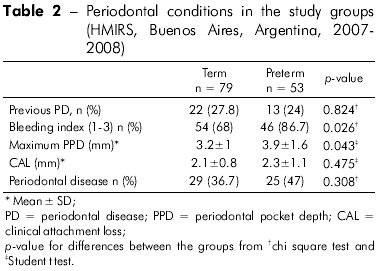
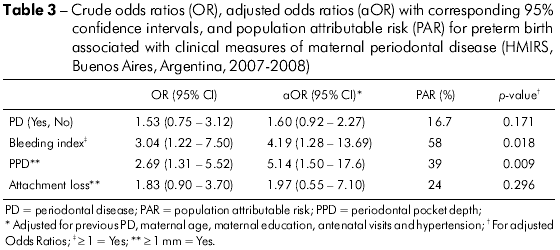
<body><![CDATA[<p>  <font size="3" face="Verdana"><b>RESULTS</b></font></p>     <p><font size="2" face="Verdana">  A total of 53 cases and 79 controls were recruited into the study. The maternal   and obstetric characteristics of each study group are shown in <a href="#t1">table   1</a>. The   majority of mothers were in the 20 to 34 year age group (65.1%), although cases   were slightly older than controls. Most mothers had no tertiary education and   were primiparous. As expected, mothers in the case group had a higher proportion   of recognized risk factors for preterm birth, such as a previous stillborn,   low birth weight, or preterm infant, a lower percentage of prenatal visits,   and lower gestational weight   gain.</font></p>     <p><a name="t1"></a></p>     <p>&nbsp;</p>     <p align="center"><img src="/img/revistas/rpas/v1n2/2a04t1.gif" border="0"></p>     <p>&nbsp;</p>     <p><font size="2" face="Verdana">Those pregnancy outcomes most strongly associated with preterm birth were   hypertension during pregnancy, intrauterine growth restriction, and premature   rupture of membranes, all of which showed statistically significant differences   when compared with those of mothers in the control group. In the bivariate   analysis, we found a significant association between hypertension during pregnancy and preterm birth (OR 4.36; 95 CI: 1.16 -17.7, p = 0.025).</font></p>     <p><font size="2" face="Verdana"> When compared to term infants, preterm infants     showed a lower gestational age, birth weight, sex ratio and mean Apgar score     at 5 min; higher proportions of preterm infants were small for gestational   age and required neonatal admission (p &lt; 0.001, data not shown).</font></p>     <p><font size="2" face="Verdana"> The prevalence of periodontal disease was common: 41% of women overall (54/132)   had periodontal disease, including 47.1% of women with preterm births (95%   confidence interval 34.4 to 60.3) and 36.7% of women with term births (95%   CI 27 to 47). There was no evidence for an association between previous PD   and the study group. Cases had a significantly higher proportion of bleeding   (1 - 3) and maximum periodontal pocket depth on probing; these findings are   evidence of greater inflammation of the periodontal tissues.</font></p>     <p><font size="2" face="Verdana"> The study groups were compared for evidence     of severe periodontal disease; i.e., the percent of PPD 4 mm or greater and     percent of CAL 3 mm or greater. No significant differences were found (PPD &#8805; 4 mm: 26.4% versus 27.8%, p = 0.985; CAL &#8805; 3   mm: 24.5% versus 11.3%, p = 0.087, for preterm and term pregnancies, respectively).</font></p>     ]]></body>
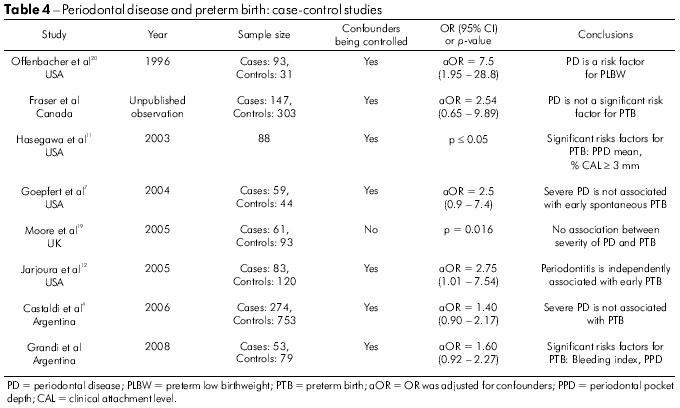
<body><![CDATA[<p><font size="2" face="Verdana"> Although the difference was not statistically significant, other indicators,   such as median attachment loss and the proportion of periodontal disease, were   higher in cases than in controls (<a href="#t2">Table 2</a>).</font></p>     <p><a name="t2"></a></p>     <p>&nbsp;</p>     <p align="center"><img src="/img/revistas/rpas/v1n2/2a04t2.gif" border="0"></p>     <p>&nbsp;</p>     <p><font size="2" face="Verdana">The crude odds ratio for a woman having a preterm    birth with periodontal disease was 1.50 (95% confidence interval 0.75 to 2.99,    p = 0.264). The risk of preterm birth associated with periodontal disease reduced    as gestational age increased (</font><font size="2" face="verdana">&#8804;</font><font size="2" face="Verdana"> 32 weeks GA, OR 2.90 (95% CI 1.26 - 6.64);    33-34 weeks, OR = 1.46 (0.44 - 4.81), and 35-36 weeks, OR = 0.24 (0.02 - 2.06)).    This trend was not, however, statistically significant (Chi square for trends    p = 0.202). In addition, the population attributable risk was higher at a lower    gestational age; it was 41% at or before 32 weeks, 14.7% at 33-34 weeks, and    25% between 35&shy;36 weeks.</font></p>     <p><font size="2" face="Verdana"> <a href="#t3">Table 3</a> shows the crude OR, adjusted OR,       and population attributable risk of preterm birth associated with clinical       measures of maternal periodontal disease. In the univariate analysis, mothers       had a more than two-fold risk of having a preterm infant if they had periodontal     pocket depths of &#8805; 1 mm and a bleeding   index &#8805; 1; these findings were all statistically significant. No significant   association was found between the other variables studied (attachment loss   and periodontal disease) and preterm   birth.</font></p>     <p><a name="t3"></a></p>     <p>&nbsp;</p>     <p align="center"><img src="/img/revistas/rpas/v1n2/2a04t3.gif" border="0"></p>     ]]></body>
<body><![CDATA[<p>&nbsp;</p>     <p><font size="2" face="Verdana"> Several variables were considered <i>a priori </i>to     be potential cofounders; these included previous PD, maternal age, maternal     education, prenatal visits, and hypertension during pregnancy. When these     factors were controlled for, the significant association found in the univariate     analysis persisted; in fact, an increased risk was observed. The inclusion     of previous preterm/low birth weight in the models did not change the parameters.     The logistic model showed a satisfactory goodness of fit (likelihood test     = 37.87; p &lt; 0.001). In the present study,   the population attributable risk of preterm birth, determined with several     clinical criteria for maternal periodontal disease, was high (greater than     10%); this high risk was most likely due to the high prevalence of these   additional factors (<a href="#t2">Table 2</a>).</font></p>     <p>&nbsp;</p>     <p>  <font size="3" face="Verdana"><b>DISCUSSION</b></font></p>     <p><font size="2" face="Verdana">  In this study, we partially address the question of whether pregnant women   with periodontal disease are at a greater risk for preterm birth. Increased   risk was found to be significantly linked to bleeding and maximum periodontal   pocket depth. It is noteworthy that in the vast number of published studies   examining the association between PD and preterm/low birth weight, only those   employing periodontal pocket depth as a definition of <i>exposure </i>observed   statistically significant results<sup>2</sup>.</font></p>     <p><font size="2" face="Verdana"> In a stratified analysis, we found no increased risk of preterm birth associated   with increasing attachment loss or periodontal pocket depth (data not shown).</font></p>     <p><font size="2" face="Verdana">Our findings that preterm birth was linked to higher maternal age, low maternal   education, hypertension during pregnancy, intrauterine growth restriction,   and premature rupture of membranes correspond to those of other reports. Indeed,   all these variables are well-known sociodemographic and clinically relevant risk factors for preterm delivery<SUP>10</SUP>.</font></p>     <p><font size="2" face="Verdana"> The observed 41% prevalence of PD in pregnant women is also similar to the   findings reported by other researchers<sup>5,7,21,30</sup>. Interestingly, we found that   the risk of premature birth associated with PD increased with the extent of   prematurity; that is, the association of PD with gestational age was strongest   with the most severe prematurity. Before 33 weeks <i>(severe prematurity), </i>the   risk was nearly three times greater than in term pregnancies; this difference   was statistically significant. Two studies of other populations found similar   results<sup>11,13</sup>, although the failure of this trend to reach statistical significance   in these studies could be due to their small sample sizes.</font></p>     <p><font size="2" face="Verdana"> Adjustment for potential confounding variables showed an independent and   increased risk of preterm birth associated with bleeding and periodontal pocket   depth. This risk may be the result of cumulative tissue destruction over a   lifetime rather than only a pregnancy-related risk of periodontal susceptibility<sup>6</sup>.   In addition, low socioeconomic status has historically been associated with   greater rates of gingivitis and poor oral hygiene. Furthermore, pregnancy increases   the likelihood of the onset of new periodontal disease<sup>20</sup> and preexisting PD   may become active during pregnancy because of the increased concentration of   progesterone during the third trimester<sup>4</sup>.</font></p>     <p><font size="2" face="Verdana"> Population attributable risk is a function of both the OR and the exposure   prevalence of the population to the risk factor, so common risk factors account   for a much higher PAR than those that are uncommon. Therefore, because the   prevalence of several clinical measures of maternal periodontal disease and   the ORs were relatively elevated, the population attributable risk in this   study was high. Similar findings have been reported in other studies<sup>2,3,20</sup>.   This high PAR implies that 16% of the approximately 70 thousand preterm births   that occur annually in Argentina may be attributable to PD. Theoretically,   the elimination of periodontal infection in pregnant women could result in   the prevention of approximately 11,200 preterm births a year, with concomitant   savings in the costs of intensive care.</font></p>     ]]></body>
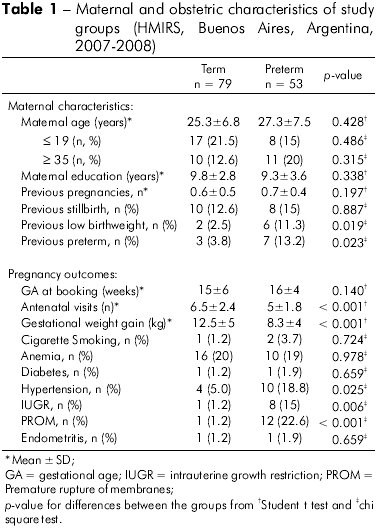
<body><![CDATA[<p><font size="2" face="Verdana">Studies linking periodontal disease to adverse pregnancy outcomes began in   1996, when Offenbacher et al<sup>20</sup> claimed to have found a strong association between   the two. Since then, several studies and two excellent reviews have been conducted   on the relationship between periodontal disease and adverse pregnancy outcomes<sup>26,30</sup>.   To allow for comparison with our study, <a href="#t4">table 4</a> shows only those case-control   studies that explored the relationship between periodontal disease as the exposure   and preterm birth as the main outcome. Only half of the studies<sup>11,12,20</sup> in   which the exposure variables were periodontitis, the bleeding index, periodontal   pocket depth, and clinical attachment level (CAL), and one in which low preterm   birth weight was the outcome, suggest that periodontal disease is a risk factor   for preterm birth (with adjusted ORs ranging from 2.75 to 7.5, one not informed).   However, the remaining studies failed to find a significant association between preterm birth and periodontal disease<sup>4,7,19</sup>.</font></p>     <p><a name="t4"></a></p>     <p>&nbsp;</p>     <p align="center"><img src="/img/revistas/rpas/v1n2/2a04t4.gif" border="0"></p>     <p>&nbsp;</p>     <p><font size="2" face="Verdana"> These findings have several implications. First, they demonstrate the weakness   of retrospective studies (i.e., information bias). Second, methodological limitations   raise serious doubts concerning the validity of earlier outcomes and conclusions.   Methodological quality varied considerably in these studies and virtually every   study showed serious shortcomings, including small sample size, a limited number   of statistical analyses, inadequate control for potential confounders, and   inadequate assessment of gestational age and measurement of periodontal disease.   Finally, although some of the studies adjusted for important confounding variables   by using multivariable regression analysis, it is possible that some residual   confounding effects remained.</font></p>     <p><font size="2" face="Verdana"> The combined analysis of epidemiological studies is made more difficult by   the variety of periodontal disease measurements and the lack of consensus on   the definition and classification of periodontal disease. These methodological   differences may explain the lack of consistency between the studies. A robust   measurement of periodontal disease should use periodontal pocket depth and clinical attachment level<sup>26</sup>.</font></p>     <p><font size="2" face="Verdana"> The present study has several strengths. Observer bias was minimized; only   one experienced odontologist collected information, and rigorous selection   criteria were used to define cases and controls. In addition, several indicators   of periodontal disease were verified.</font></p>     <p><font size="2" face="Verdana"> The study also includes several limitations that must be considered. First,   we were not able to achieve the required sample size. Nevertheless, a recalculating   power analysis with actual sample sizes yielded a value of 0.78, which shows   a negligible difference from the planned original value. Therefore, it is unlikely   that the present results could be due to chance. We recognize that our study   is limited by the analysis of data from a single institution. While participants   were blind to the research hypotheses, recall bias might have been present;   women whose pregnancy finished in the preterm period could have recalled past   exposures more accurately than controls<sup>9,23</sup>. On the other hand, when a disease   is as common as PD and several risk factors for preterm delivery are well known,   it becomes difficult to differentiate a new risk factor<sup>23</sup>. Moreover, mothers   of preterm babies appear to have an increased risk of poor oral conditions   than mothers of term babies; these differences can lead to results showing   bleeding gums and deeper pockets from temporary gingivitis<sup>12</sup>.</font></p>     <p><font size="2" face="Verdana"> This is the second study of PD among pregnant women in Argentina; in the   first, a different outcome measurement of PD was employed, but the design was   similar and included 1,562 women in the postpartum period<sup>4</sup>.  However, this   earlier study found no significant association between periodontal disease and preterm birth (stratified Mantel-Haenzel OR 1.06, 95% CI 0.70 - 1.50).</font></p>     ]]></body>
<body><![CDATA[<p><font size="2" face="Verdana"> While the promotion of good oral health       remains an important part of perinatal health care, our results suggest       that a specific drive to improve the periodontal health of pregnant women       could be a means of improving pregnancy outcomes. Nevertheless, it is not       clear whether periodontal diseases play a causal role in adverse pregnancy&nbsp;&nbsp; outcomes.&nbsp;&nbsp;  Additional&nbsp;&nbsp; longitudinal,   epidemiologic, and interventional studies with clear and consistent definitions   of periodontal disease and adverse pregnancy outcomes, sufficiently large sample   sizes, and controls for key confounders are needed to validate this association   and to determine whether it is causal.</font></p>     <p>&nbsp;</p>     <p><font size="3" face="Verdana"><b>CONCLUSIONS</b></font></p>     <p><font size="2" face="Verdana"> In this population, only the bleeding index and periodontal pocket depth are   risk factors for preterm birth in pregnant women. This risk rose with an increase in prematurity.</font></p>     <p>&nbsp;</p>     <p><font size="3" face="Verdana"><b>REFERENCES</b></font></p>     <!-- ref --><p><font size="2" face="Verdana"> 1 Benichou J. A review of adjusted estimators     of attributable&nbsp;&nbsp; risk.&nbsp;&nbsp;  Stat&nbsp;&nbsp; Methods&nbsp;&nbsp; Med&nbsp;&nbsp;  Res.   2001;10:195-216.</font><font size="2" face="verdana"><font size="2" face="verdana"> DOI:10.1177/096228020101000303&nbsp; &nbsp; &nbsp; &nbsp;  &nbsp;&#91; <a href="http://www.ncbi.nlm.nih.gov/pubmed/11446148" target="_blank">Links</a> &#93;</font></font><!-- ref --><p><font size="2" face="Verdana"> 2 Boggess KA, Edelstein BL. Oral health in     women during preconception and pregnancy: implications for birth outcomes     and infant oral health. Matern Child Health J. 2006;10(5 Suppl):169-74. DOI:10.1007/s10995-006-0095-x</font><font size="2" face="verdana"><font size="2" face="verdana">&nbsp; &nbsp; &nbsp; &nbsp;  &nbsp;&#91; <a href="http://www.ncbi.nlm.nih.gov/pubmed/16816998" target="_blank">Links</a> &#93;</font></font><!-- ref --><p><font size="2" face="Verdana"> 3 Brocklehurst P. Infection and preterm delivery.     Br Med J 1999;318:548-9.</font><font size="2" face="verdana"><font size="2" face="verdana">&nbsp; &nbsp; &nbsp; &nbsp;  &nbsp;&#91; <a href="http://www.ncbi.nlm.nih.gov/pmc/articles/PMC1115007/?tool=pubmed" target="_blank">Links</a> &#93;</font></font><!-- ref --><p><font size="2" face="Verdana"> 4 Castaldi JL, Bertin MS, Jim&eacute;nez       F, Lede R. Periodontal disease: Is it a risk factor for premature labor,       low birth weight or preeclampsia? Rev Panam Salud Publica.   2006 Apr;19(4):253-8.</font><font size="2" face="verdana"><font size="2" face="verdana">&nbsp; &nbsp; &nbsp; &nbsp;  &nbsp;&#91; <a href="http://www.ncbi.nlm.nih.gov/pubmed/16723066" target="_blank">Links</a> &#93;</font></font><!-- ref --><p><font size="2" face="Verdana"> 5 Davenport ES, Williams CE, Sterne JA, Murad     S, Sivapathasundram V, Curtis MA. Maternal periodontal disease and preterm     low birthweight: case-control study. J Dent Res. 2002 May;81(5):313-8.</font><font size="2" face="Verdana"></font><font size="2" face="verdana"><font size="2" face="verdana"> DOI:10.1177/154405910208100505&nbsp; &nbsp; &nbsp; &nbsp;  &nbsp;&#91; <a href="http://www.ncbi.nlm.nih.gov/pubmed/12097443" target="_blank">Links</a> &#93;</font></font><!-- ref --><p><font size="2" face="Verdana"> 6 Douglass C. Risk assessment and management of periodontal disease. J Am   Dent Assoc. 2006 Nov;137:Suppl:27S-32S.</font><font size="2" face="verdana"><font size="2" face="verdana">&nbsp; &nbsp; &nbsp; &nbsp;  &nbsp;&#91; <a href="http://www.ncbi.nlm.nih.gov/pubmed/17035673" target="_blank">Links</a> &#93;</font></font><!-- ref --><p><font size="2" face="Verdana"> 7 Goepfert AR, Jeffcoat MK, Andrews WW, Faye-Petersen O, Cliver SP, Goldenberg   RL, et al. Periodontal disease and upper genital tract inflammation in early   spontaneous preterm birth. Obstet Gynecol. 2004 Oct;104(4):777-83.</font><font size="2" face="verdana"><font size="2" face="verdana">&nbsp; &nbsp; &nbsp; &nbsp;  &nbsp;&#91; <a href="http://www.ncbi.nlm.nih.gov/pubmed/15458901" target="_blank">Links</a> &#93;</font></font><!-- ref --><p><font size="2" face="Verdana"> 8 Goldenberg RL. The management of preterm labor. Obstet Gynecol. 2002 Nov;100(5pt.   1):1020 -37.</font><font size="2" face="verdana"><font size="2" face="verdana">&nbsp; &nbsp; &nbsp; &nbsp;  &nbsp;&#91; <a href="http://www.ncbi.nlm.nih.gov/pubmed/12423870" target="_blank">Links</a> &#93;</font></font><!-- ref --><p><font size="2" face="Verdana"> 9 Grandi C, Tapia JL, Marshall G, Grupo Colaborativo NEOCOSUR. An assessment   of the severity, proportionality and risk of mortality of very low birth weight   infants with fetal growth restriction. A multicenter South American analysis.   J Pediatr. 2005   May-Jun;81(3):198-204.</font><font size="2" face="Verdana"></font><font size="2" face="verdana"><font size="2" face="verdana">&nbsp; &nbsp; &nbsp; &nbsp;  &nbsp;&#91; <a href="http://www.ncbi.nlm.nih.gov/pubmed/15951903" target="_blank">Links</a> &#93;</font></font><!-- ref --><p><font size="2" face="Verdana"> 10 Hartikainen-Sorri A, Sorri M. Occupational and socio-medical factors in   preterm birth. Obstet Gynecol.   1989;74:13-6.</font><!-- ref --><p><font size="2" face="Verdana"> 11 Hasegawa K, Furuichi Y, Shimotsu A, Nakamura M, Yoshinaga M, Kamitomo   M, et al. Associations between systemic status, periodontal status, serum cytokine   levels, and delivery outcomes in pregnant women with a diagnosis of threatened   premature labor. J Periodontol. 2003 Dec;74(12):1764-70.</font><font size="2" face="verdana"><font size="2" face="verdana">&nbsp; &nbsp; &nbsp; &nbsp;  &nbsp;&#91; <a href="http://www.ncbi.nlm.nih.gov/pubmed/14974817" target="_blank">Links</a> &#93;</font></font><!-- ref --><p><font size="2" face="Verdana"> 12 Jarjoura K, Devine PC, Perez-Delboy A, Herrera-Abreu    M, D'Alton M, Papapanou PN. Markers of periodontal infection and preterm birth.    Am J Obstet Gynecol. 2005 Feb;192(2):513-9.</font><font size="2" face="verdana"><font size="2" face="verdana">&nbsp;DOI:<img width="1" height="10" src="v1n2a04_clip_image002_0003.gif">10.1016/j.ajog.2004.07.018    &nbsp; &nbsp; &nbsp; &nbsp;&#91; <a href="http://www.ncbi.nlm.nih.gov/pubmed/15695995" target="_blank">Links</a>    &#93;</font></font><!-- ref --><p><font size="2" face="Verdana"> 13 Jeffcoat MK, Geurs NC, Reddy MS, Cliver SP,   Goldenberg RL, Hauth JC. Periodontal infection and preterm birth. Results of   a prospective study. J Am Dent Assoc. 2001 Jul;132(7):875-80.</font><font size="2" face="verdana"><font size="2" face="verdana">&nbsp; &nbsp; &nbsp; &nbsp;  &nbsp;&#91; <a href="http://www.ncbi.nlm.nih.gov/pubmed/11480640" target="_blank">Links</a> &#93;</font></font><!-- ref --><p><font size="2" face="Verdana">14 Laterra C, Luchtenberg G, Grandi C, Pensotti     A. Estad&iacute;sticas Hospital   M. I. Ram&oacute;n Sard&aacute; 2006: Sistema Inform&aacute;tico Perinatal (S.I.P). Rev Hosp Matern Infant Ramon Sarda. 2007;26(4):182-7.</font><!-- ref --><p><font size="2" face="Verdana"> 15 L&oacute;pez NJ, Smith PC, Gutierrez       J. Higher risk of preterm birth and low birth weight in women with periodontal   disease. J Dent Res. 2002 Jan;81(1):58-63. DOI:10.1177/154405910208100113</font><font size="2" face="verdana"><font size="2" face="verdana">&nbsp; &nbsp; &nbsp; &nbsp;  &nbsp;&#91; <a href="http://www.ncbi.nlm.nih.gov/pubmed/11820369" target="_blank">Links</a> &#93;</font></font><!-- ref --><p><font size="2" face="Verdana"> 16 McCormick MC. The contribution of low birth     weight to infant mortality and childhood morbidity. N Engl J Med. 1985 Jan;312(2):82-90.</font><font size="2" face="verdana"><font size="2" face="verdana">&nbsp; &nbsp; &nbsp; &nbsp;  &nbsp;&#91; <a href="http://www.ncbi.nlm.nih.gov/pubmed/3880598" target="_blank">Links</a> &#93;</font></font><!-- ref --><p><font size="2" face="Verdana"> 17 Meis PJ, Goldenberg RL, Mercer BM, Iams JD,    Moawad AH, Miodovnik M, et al. The preterm prediction study: risk factors for    indicated preterm births. Am J Obstet Gynecol. 1998 May;178(2):562-7.</font><font size="2" face="verdana"><font size="2" face="verdana">&nbsp;    &nbsp; &nbsp; &nbsp; &nbsp;&#91; <a href="http://www.ncbi.nlm.nih.gov/pubmed/9539527" target="_blank">Links</a>    &#93;</font></font><p><font size="2" face="Verdana"> 18 Ministerio de Salud (AR). Secretaria       de Politicas, Regulacion e Institutos. Direcci&oacute;n de Estad&iacute;sticas       e Informaci&oacute;n de Salud. Estad&iacute;sticas Vitales &ndash;   informaci&oacute;n       b&aacute;sica a&ntilde;o 2006. Argentina;       2007. 132 p. (Serie 5-N&uacute;mero 50). Dispon&iacute;vel       em: <a href="http://www.deis.gov.ar/publicaciones/archivos/Serie5Nro50.pdf" target="_blank">http://www.deis.gov.ar/publicaciones/archivos/Serie5Nro50.pdf</a>.</font><font size="2" face="verdana"><font size="2" face="verdana">&nbsp; &nbsp; &nbsp; &nbsp;  &nbsp;&#91; <a href="http://www.deis.gov.ar/publicaciones/archivos/Serie5Nro50.pdf" target="_blank">Links</a> &#93;</font></font></p>     <!-- ref --><p><font size="2" face="Verdana"> 19 Moore S, Randhawa M, Ide M. A case-control     study to investigate an association between adverse pregnancy outcomes and     periodontal disease. J Clin Periodont. 2005 Jan;32(1):1-5.</font><font size="2" face="verdana"><font size="2" face="verdana"> DOI:10.1111/j.1600-051X.2004.00598.x&nbsp; &nbsp; &nbsp; &nbsp;  &nbsp;&#91; <a href="http://www.ncbi.nlm.nih.gov/pubmed/15642050" target="_blank">Links</a> &#93;</font></font><!-- ref --><p><font size="2" face="Verdana"> 20 Offenbacher S, Katz V, Fertik G, Collins J, Boyd D,   Maynor G, et al. Periodontal infection as a possible risk factor for preterm   low birth weight. J Periodontol. 1996 Oct;67(10 Suppl):1103-13.</font><font size="2" face="verdana"><font size="2" face="verdana">&nbsp; &nbsp; &nbsp; &nbsp;  &nbsp;&#91; <a href="http://www.ncbi.nlm.nih.gov/pubmed/8910829" target="_blank">Links</a> &#93;</font></font><!-- ref --><p><font size="2" face="Verdana"> 21 Offenbacher S, Boggess KA, Murtha AP, Jared HL, Lieff S, McKaig RG, et   al. Progressive periodontal disease and risk of very preterm delivery. Obstet   Gynecol.   2006 Jan;29-36.</font><font size="2" face="Verdana"></font><font size="2" face="verdana"><font size="2" face="verdana">&nbsp; &nbsp; &nbsp; &nbsp;  &nbsp;&#91; <a href="http://www.ncbi.nlm.nih.gov/pubmed/16394036" target="_blank">Links</a> &#93;</font></font><!-- ref --><p><font size="2" face="Verdana"> 22 Romero R, Sepulveda W, Baumann P. The preterm     labour syndrome: biochemical, cytologic, inmunologic, pathologic, microbiologic     and clinical evidence that preterm labor is a heterogeneous disease. Am J     Obstet Gynecol. 1993;168:288.</font><!-- ref --><p><font size="2" face="Verdana"> 23 Rothman K, Greenland S. Modern Epidemiology.   2nd ed. Philadelphia: Lippincott Williams &amp; Wilkins; 1998.</font><!-- ref --><p><font size="2" face="Verdana"> 24 San Pedro M, Grandi C, Largu&iacute;a M,     Solana C. Est&aacute;ndar de Peso   para la Edad Gestacional en 55706 reci&eacute;n nacidos sanos de una Maternidad   p&uacute;blica de Buenos Aires. Medicina (Buenos&nbsp;&nbsp; Aires).   2001;1619(1):15-22.</font><font size="2" face="verdana"><font size="2" face="verdana">&nbsp; &nbsp; &nbsp; &nbsp;  &nbsp;&#91; <a href="http://bases.bireme.br/cgi-bin/wxislind.exe/iah/online/?IsisScript=iah/iah.xis&src=google&base=ADOLEC&lang=p&nextAction=lnk&exprSearch=286373&indexSearch=ID" target="_blank">Links</a> &#93;</font></font><!-- ref --><p><font size="2" face="Verdana"> 25 Savitz DA, Blackmore CA, Thorp JM. Epidemiologic     characteristics of preterm delivery: etiologic heterogeneity.&nbsp;&nbsp;  Am&nbsp;&nbsp; J&nbsp;&nbsp; Obstet&nbsp;&nbsp;  Gynecol.&nbsp;&nbsp; 1991   Feb;164(2):467-71.</font><font size="2" face="Verdana"></font><font size="2" face="verdana"><font size="2" face="verdana">&nbsp; &nbsp; &nbsp; &nbsp;  &nbsp;&#91; <a href="http://www.ncbi.nlm.nih.gov/pubmed/1992685" target="_blank">Links</a> &#93;</font></font><!-- ref --><p><font size="2" face="Verdana"> 26 Vettore MV, Lamarca GA, Le&atilde;o AT,     Thomaz FB, Sheiham A, Leal MC. Periodontal infection and adverse pregnancy     outcomes: a systematic review of epidemiological studies. Cad Saude Publica.   2006 Oct;22(10):2041-53. DOI:10.1590/S0102-311X2006001000010</font><font size="2" face="Verdana"></font><font size="2" face="Verdana"></font><font size="2" face="verdana"><font size="2" face="verdana">&nbsp; &nbsp; &nbsp; &nbsp;  &nbsp;&#91; <a href="http://www.ncbi.nlm.nih.gov/pubmed/16951876" target="_blank">Links</a> &#93;</font></font><!-- ref --><p><font size="2" face="Verdana">27 Wiebe CB, Putnins EE. The periodontal disease    classification system of the American Academy of Periodontology - An update.    J Can Dent Assoc. 2000 Dec;66(11):594-7<i>.</i></font><font size="2" face="verdana"><font size="2" face="verdana">&nbsp;    &nbsp; &nbsp; &nbsp; &nbsp;&#91; <a href="http://www.ncbi.nlm.nih.gov/pubmed/11253351" target="_blank">Links</a>    &#93;</font></font><!-- ref --><p><font size="2" face="Verdana"> 28 Williams CE , Davenport ES , Sterne     JA, Sivapathasundaram V, Fearne JM, Curtis MA, et al. Mechanism of risk     in preterm low birthweight infants. Periodontol 2000. 2000 Jun;23:142-50.     DOI.10.1034/j.1600-0757.2000.2230115.x</font><font size="2" face="verdana"><font size="2" face="verdana">&nbsp; &nbsp; &nbsp; &nbsp;  &nbsp;&#91; <a href="http://www.ncbi.nlm.nih.gov/pubmed/11276762" target="_blank">Links</a> &#93;</font></font> <!-- ref --><p><font size="2" face="Verdana">29 World Health Organization. Report of a Scientific Group on Health Statistics   Methodology Related to Perinatal Events. Geneva: 1974. p 1-32. (Document no. ICD/PE/74.4).</font><!-- ref --><p><font size="2" face="Verdana"> 30 Xiong X, Buekens P, Fraser WD, Beck J, Offenbacher     S. Periodontal disease and adverse pregnancy outcomes: a systematic review.     BJOG. 2006 Fev;113(2):135-43.</font><font size="2" face="Verdana"><i></i></font><font size="2" face="Verdana"></font><font size="2" face="Verdana"></font><font size="2" face="verdana"><font size="2" face="verdana"> DOI:10.1111/j.1471-0528.2005.00827.x&nbsp; &nbsp; &nbsp; &nbsp;  &nbsp;&#91; <a href="http://www.ncbi.nlm.nih.gov/pubmed/16411989" target="_blank">Links</a> &#93;</font></font><p>&nbsp;</p>     <p>&nbsp;</p>     <p><font size="2" face="Verdana"><b><a name="endereco"></a><a href="#topo"><img src="/img/revistas/rpas/v1n1/seta.gif" border="0"></a>Correspond&ecirc;ncia / Correspondence /   Correspondencia:</b>    <br>   Carlos Grandi</font>    ]]></body>
<body><![CDATA[<br>   <font size="2" face="Verdana">Cabello 3150, 7 B (1425)    <br>    Buenos   Aires-Argentina    <br>   Phone/Fax: (5411) 48037622    <br>   E-mail:<a href="mailto:cgrandi@intramed.net">cgrandi@intramed.net</a></font></p>     <p><font size="2" face="Verdana">Recebido em / Received / Recibido en: 21/6/2009    <br>   Aceito em / Accepted / Aceito en: 9/3/2010</font></p>   <script type="text/javascript"> var gaJsHost = (("https:" == document.location.protocol) ? "https://ssl." : "http://www."); document.write(unescape("%3Cscript src='" + gaJsHost + "google-analytics.com/ga.js' type='text/javascript'%3E%3C/script%3E")); </script> <script type="text/javascript"> try { var pageTracker = _gat._getTracker("UA-7885746-4"); pageTracker._setDomainName("none"); pageTracker._setAllowLinker(true); pageTracker._trackPageview(); } catch(err) {}</script>      ]]></body><back>
<ref-list>
<ref id="B1">
<label>1</label><nlm-citation citation-type="journal">
<person-group person-group-type="author">
<name>
<surname><![CDATA[Benichou]]></surname>
<given-names><![CDATA[J]]></given-names>
</name>
</person-group>
<article-title xml:lang="en"><![CDATA[A review of adjusted estimators of attributable risk]]></article-title>
<source><![CDATA[Stat Methods Med Res]]></source>
<year>2001</year>
<volume>10</volume>
<page-range>195-216</page-range></nlm-citation>
</ref>
<ref id="B2">
<label>2</label><nlm-citation citation-type="journal">
<person-group person-group-type="author">
<name>
<surname><![CDATA[Boggess]]></surname>
<given-names><![CDATA[KA]]></given-names>
</name>
<name>
<surname><![CDATA[Edelstein]]></surname>
<given-names><![CDATA[BL]]></given-names>
</name>
</person-group>
<article-title xml:lang="en"><![CDATA[Oral health in women during preconception and pregnancy: implications for birth outcomes and infant oral health]]></article-title>
<source><![CDATA[Matern Child Health J]]></source>
<year>2006</year>
<volume>10</volume>
<numero>^s5</numero>
<issue>^s5</issue>
<supplement>5</supplement>
<page-range>169-74</page-range></nlm-citation>
</ref>
<ref id="B3">
<label>3</label><nlm-citation citation-type="journal">
<person-group person-group-type="author">
<name>
<surname><![CDATA[Brocklehurst]]></surname>
<given-names><![CDATA[P]]></given-names>
</name>
</person-group>
<article-title xml:lang="en"><![CDATA[Infection and preterm delivery]]></article-title>
<source><![CDATA[Br Med J]]></source>
<year>1999</year>
<volume>318</volume>
<page-range>548-9</page-range></nlm-citation>
</ref>
<ref id="B4">
<label>4</label><nlm-citation citation-type="journal">
<person-group person-group-type="author">
<name>
<surname><![CDATA[Castaldi]]></surname>
<given-names><![CDATA[JL]]></given-names>
</name>
<name>
<surname><![CDATA[Bertin]]></surname>
<given-names><![CDATA[MS]]></given-names>
</name>
<name>
<surname><![CDATA[Jiménez]]></surname>
<given-names><![CDATA[F]]></given-names>
</name>
<name>
<surname><![CDATA[Lede]]></surname>
<given-names><![CDATA[R]]></given-names>
</name>
</person-group>
<article-title xml:lang="en"><![CDATA[Periodontal disease: Is it a risk factor for premature labor, low birth weight or preeclampsia?]]></article-title>
<source><![CDATA[Rev Panam Salud Publica]]></source>
<year>2006</year>
<month> A</month>
<day>pr</day>
<volume>19</volume>
<numero>4</numero>
<issue>4</issue>
<page-range>253-8</page-range></nlm-citation>
</ref>
<ref id="B5">
<label>5</label><nlm-citation citation-type="journal">
<person-group person-group-type="author">
<name>
<surname><![CDATA[Davenport]]></surname>
<given-names><![CDATA[ES]]></given-names>
</name>
<name>
<surname><![CDATA[Williams]]></surname>
<given-names><![CDATA[CE]]></given-names>
</name>
<name>
<surname><![CDATA[Sterne]]></surname>
<given-names><![CDATA[JA]]></given-names>
</name>
<name>
<surname><![CDATA[Murad]]></surname>
<given-names><![CDATA[S]]></given-names>
</name>
<name>
<surname><![CDATA[Sivapathasundram]]></surname>
<given-names><![CDATA[V]]></given-names>
</name>
<name>
<surname><![CDATA[Curtis]]></surname>
<given-names><![CDATA[MA]]></given-names>
</name>
</person-group>
<article-title xml:lang="en"><![CDATA[Maternal periodontal disease and preterm low birthweight: case-control study]]></article-title>
<source><![CDATA[J Dent Res]]></source>
<year>2002</year>
<month> M</month>
<day>ay</day>
<volume>81</volume>
<numero>5</numero>
<issue>5</issue>
<page-range>313-8</page-range></nlm-citation>
</ref>
<ref id="B6">
<label>6</label><nlm-citation citation-type="journal">
<person-group person-group-type="author">
<name>
<surname><![CDATA[Douglass]]></surname>
<given-names><![CDATA[C]]></given-names>
</name>
</person-group>
<article-title xml:lang="en"><![CDATA[Risk assessment and management of periodontal disease]]></article-title>
<source><![CDATA[J Am Dent Assoc]]></source>
<year>2006</year>
<month> N</month>
<day>ov</day>
<volume>137</volume>
<page-range>27S-32</page-range></nlm-citation>
</ref>
<ref id="B7">
<label>7</label><nlm-citation citation-type="journal">
<person-group person-group-type="author">
<name>
<surname><![CDATA[Goepfert]]></surname>
<given-names><![CDATA[AR]]></given-names>
</name>
<name>
<surname><![CDATA[Jeffcoat]]></surname>
<given-names><![CDATA[MK]]></given-names>
</name>
<name>
<surname><![CDATA[Andrews]]></surname>
<given-names><![CDATA[WW]]></given-names>
</name>
<name>
<surname><![CDATA[Faye-Petersen]]></surname>
<given-names><![CDATA[O]]></given-names>
</name>
<name>
<surname><![CDATA[Cliver]]></surname>
<given-names><![CDATA[SP]]></given-names>
</name>
<name>
<surname><![CDATA[Goldenberg]]></surname>
<given-names><![CDATA[RL]]></given-names>
</name>
</person-group>
<article-title xml:lang="en"><![CDATA[Periodontal disease and upper genital tract inflammation in early spontaneous preterm birth]]></article-title>
<source><![CDATA[Obstet Gynecol]]></source>
<year>2004</year>
<month> O</month>
<day>ct</day>
<volume>104</volume>
<numero>4</numero>
<issue>4</issue>
<page-range>777-83</page-range></nlm-citation>
</ref>
<ref id="B8">
<label>8</label><nlm-citation citation-type="journal">
<person-group person-group-type="author">
<name>
<surname><![CDATA[Goldenberg]]></surname>
<given-names><![CDATA[RL]]></given-names>
</name>
</person-group>
<article-title xml:lang="en"><![CDATA[The management of preterm labor]]></article-title>
<source><![CDATA[Obstet Gynecol]]></source>
<year>2002</year>
<month> N</month>
<day>ov</day>
<volume>100</volume>
<page-range>1020 -37</page-range></nlm-citation>
</ref>
<ref id="B9">
<label>9</label><nlm-citation citation-type="journal">
<person-group person-group-type="author">
<name>
<surname><![CDATA[Grandi]]></surname>
<given-names><![CDATA[C]]></given-names>
</name>
<name>
<surname><![CDATA[Tapia]]></surname>
<given-names><![CDATA[JL]]></given-names>
</name>
<name>
<surname><![CDATA[Marshall]]></surname>
<given-names><![CDATA[G]]></given-names>
</name>
</person-group>
<collab>Grupo Colaborativo NEOCOSUR</collab>
<article-title xml:lang="en"><![CDATA[An assessment of the severity, proportionality and risk of mortality of very low birth weight infants with fetal growth restriction: A multicenter South American analysis]]></article-title>
<source><![CDATA[J Pediatr]]></source>
<year>2005</year>
<month> M</month>
<day>ay</day>
<volume>81</volume>
<numero>3</numero>
<issue>3</issue>
<page-range>198-204</page-range></nlm-citation>
</ref>
<ref id="B10">
<label>10</label><nlm-citation citation-type="journal">
<person-group person-group-type="author">
<name>
<surname><![CDATA[Hartikainen-Sorri]]></surname>
<given-names><![CDATA[A]]></given-names>
</name>
<name>
<surname><![CDATA[Sorri]]></surname>
<given-names><![CDATA[M]]></given-names>
</name>
</person-group>
<article-title xml:lang="en"><![CDATA[Occupational and socio-medical factors in preterm birth]]></article-title>
<source><![CDATA[Obstet Gynecol]]></source>
<year>1989</year>
<volume>74</volume>
<page-range>13-6</page-range></nlm-citation>
</ref>
<ref id="B11">
<label>11</label><nlm-citation citation-type="journal">
<person-group person-group-type="author">
<name>
<surname><![CDATA[Hasegawa]]></surname>
<given-names><![CDATA[K]]></given-names>
</name>
<name>
<surname><![CDATA[Furuichi]]></surname>
<given-names><![CDATA[Y]]></given-names>
</name>
<name>
<surname><![CDATA[Shimotsu]]></surname>
<given-names><![CDATA[A]]></given-names>
</name>
<name>
<surname><![CDATA[Nakamura]]></surname>
<given-names><![CDATA[M]]></given-names>
</name>
<name>
<surname><![CDATA[Yoshinaga]]></surname>
<given-names><![CDATA[M]]></given-names>
</name>
<name>
<surname><![CDATA[Kamitomo]]></surname>
<given-names><![CDATA[M]]></given-names>
</name>
</person-group>
<article-title xml:lang="en"><![CDATA[Associations between systemic status, periodontal status, serum cytokine levels, and delivery outcomes in pregnant women with a diagnosis of threatened premature labor]]></article-title>
<source><![CDATA[J Periodontol]]></source>
<year>2003</year>
<month> D</month>
<day>ec</day>
<volume>74</volume>
<numero>12</numero>
<issue>12</issue>
<page-range>1764-70</page-range></nlm-citation>
</ref>
<ref id="B12">
<label>12</label><nlm-citation citation-type="journal">
<person-group person-group-type="author">
<name>
<surname><![CDATA[Jarjoura]]></surname>
<given-names><![CDATA[K]]></given-names>
</name>
<name>
<surname><![CDATA[Devine]]></surname>
<given-names><![CDATA[PC]]></given-names>
</name>
<name>
<surname><![CDATA[Perez-Delboy]]></surname>
<given-names><![CDATA[A]]></given-names>
</name>
<name>
<surname><![CDATA[Herrera-Abreu]]></surname>
<given-names><![CDATA[M]]></given-names>
</name>
<name>
<surname><![CDATA[D'Alton]]></surname>
<given-names><![CDATA[M]]></given-names>
</name>
<name>
<surname><![CDATA[Papapanou]]></surname>
<given-names><![CDATA[PN]]></given-names>
</name>
</person-group>
<article-title xml:lang="en"><![CDATA[Markers of periodontal infection and preterm birth]]></article-title>
<source><![CDATA[Am J Obstet Gynecol]]></source>
<year>2005</year>
<month> F</month>
<day>eb</day>
<volume>192</volume>
<numero>2</numero>
<issue>2</issue>
<page-range>513-9</page-range></nlm-citation>
</ref>
<ref id="B13">
<label>13</label><nlm-citation citation-type="journal">
<person-group person-group-type="author">
<name>
<surname><![CDATA[Jeffcoat]]></surname>
<given-names><![CDATA[MK]]></given-names>
</name>
<name>
<surname><![CDATA[Geurs]]></surname>
<given-names><![CDATA[NC]]></given-names>
</name>
<name>
<surname><![CDATA[Reddy]]></surname>
<given-names><![CDATA[MS]]></given-names>
</name>
<name>
<surname><![CDATA[Cliver]]></surname>
<given-names><![CDATA[SP]]></given-names>
</name>
<name>
<surname><![CDATA[Goldenberg]]></surname>
<given-names><![CDATA[RL]]></given-names>
</name>
<name>
<surname><![CDATA[Hauth]]></surname>
<given-names><![CDATA[JC]]></given-names>
</name>
</person-group>
<article-title xml:lang="en"><![CDATA[Periodontal infection and preterm birth: Results of a prospective study]]></article-title>
<source><![CDATA[J Am Dent Assoc]]></source>
<year>2001</year>
<month> J</month>
<day>ul</day>
<volume>132</volume>
<numero>7</numero>
<issue>7</issue>
<page-range>875-80</page-range></nlm-citation>
</ref>
<ref id="B14">
<label>14</label><nlm-citation citation-type="journal">
<person-group person-group-type="author">
<name>
<surname><![CDATA[Laterra]]></surname>
<given-names><![CDATA[C]]></given-names>
</name>
<name>
<surname><![CDATA[Luchtenberg]]></surname>
<given-names><![CDATA[G]]></given-names>
</name>
<name>
<surname><![CDATA[Grandi]]></surname>
<given-names><![CDATA[C]]></given-names>
</name>
<name>
<surname><![CDATA[Pensotti]]></surname>
<given-names><![CDATA[A]]></given-names>
</name>
</person-group>
<article-title xml:lang="es"><![CDATA[Estadísticas Hospital M. I. Ramón Sardá 2006: Sistema Informático Perinatal (S.I.P)]]></article-title>
<source><![CDATA[Rev Hosp Matern Infant Ramon Sarda]]></source>
<year>2007</year>
<volume>26</volume>
<numero>4</numero>
<issue>4</issue>
<page-range>182-7</page-range></nlm-citation>
</ref>
<ref id="B15">
<label>15</label><nlm-citation citation-type="journal">
<person-group person-group-type="author">
<name>
<surname><![CDATA[López]]></surname>
<given-names><![CDATA[NJ]]></given-names>
</name>
<name>
<surname><![CDATA[Smith]]></surname>
<given-names><![CDATA[PC]]></given-names>
</name>
<name>
<surname><![CDATA[Gutierrez]]></surname>
<given-names><![CDATA[J]]></given-names>
</name>
</person-group>
<article-title xml:lang="en"><![CDATA[Higher risk of preterm birth and low birth weight in women with periodontal disease]]></article-title>
<source><![CDATA[J Dent Res]]></source>
<year>2002</year>
<month> J</month>
<day>an</day>
<volume>81</volume>
<numero>1</numero>
<issue>1</issue>
<page-range>58-63</page-range></nlm-citation>
</ref>
<ref id="B16">
<label>16</label><nlm-citation citation-type="journal">
<person-group person-group-type="author">
<name>
<surname><![CDATA[McCormick]]></surname>
<given-names><![CDATA[MC]]></given-names>
</name>
</person-group>
<article-title xml:lang="en"><![CDATA[The contribution of low birth weight to infant mortality and childhood morbidity]]></article-title>
<source><![CDATA[N Engl J Med]]></source>
<year>1985</year>
<month> J</month>
<day>an</day>
<volume>312</volume>
<numero>2</numero>
<issue>2</issue>
<page-range>82-90</page-range></nlm-citation>
</ref>
<ref id="B17">
<label>17</label><nlm-citation citation-type="journal">
<person-group person-group-type="author">
<name>
<surname><![CDATA[Meis]]></surname>
<given-names><![CDATA[PJ]]></given-names>
</name>
<name>
<surname><![CDATA[Goldenberg]]></surname>
<given-names><![CDATA[RL]]></given-names>
</name>
<name>
<surname><![CDATA[Mercer]]></surname>
<given-names><![CDATA[BM]]></given-names>
</name>
<name>
<surname><![CDATA[Iams]]></surname>
<given-names><![CDATA[JD]]></given-names>
</name>
<name>
<surname><![CDATA[Moawad]]></surname>
<given-names><![CDATA[AH]]></given-names>
</name>
<name>
<surname><![CDATA[Miodovnik]]></surname>
<given-names><![CDATA[M]]></given-names>
</name>
</person-group>
<article-title xml:lang="en"><![CDATA[The preterm prediction study: risk factors for indicated preterm births]]></article-title>
<source><![CDATA[Am J Obstet Gynecol]]></source>
<year>1998</year>
<month> M</month>
<day>ay</day>
<volume>178</volume>
<numero>2</numero>
<issue>2</issue>
<page-range>562-7</page-range></nlm-citation>
</ref>
<ref id="B18">
<label>18</label><nlm-citation citation-type="">
<collab>Ministerio de Salud (AR)^dSecretaria de Politicas, Regulacion e Institutos</collab>
<source><![CDATA[Dirección de Estadísticas e Información de Salud: Estadísticas Vitales - información básica año 2006]]></source>
<year>2007</year>
<page-range>132</page-range><publisher-loc><![CDATA[Argentina ]]></publisher-loc>
</nlm-citation>
</ref>
<ref id="B19">
<label>19</label><nlm-citation citation-type="journal">
<person-group person-group-type="author">
<name>
<surname><![CDATA[Moore]]></surname>
<given-names><![CDATA[S]]></given-names>
</name>
<name>
<surname><![CDATA[Randhawa]]></surname>
<given-names><![CDATA[M]]></given-names>
</name>
<name>
<surname><![CDATA[Ide]]></surname>
<given-names><![CDATA[M]]></given-names>
</name>
</person-group>
<article-title xml:lang="en"><![CDATA[A case-control study to investigate an association between adverse pregnancy outcomes and periodontal disease]]></article-title>
<source><![CDATA[J Clin Periodont]]></source>
<year>2005</year>
<month> J</month>
<day>an</day>
<volume>32</volume>
<numero>1</numero>
<issue>1</issue>
<page-range>1-5</page-range></nlm-citation>
</ref>
<ref id="B20">
<label>20</label><nlm-citation citation-type="journal">
<person-group person-group-type="author">
<name>
<surname><![CDATA[Offenbacher]]></surname>
<given-names><![CDATA[S]]></given-names>
</name>
<name>
<surname><![CDATA[Katz]]></surname>
<given-names><![CDATA[V]]></given-names>
</name>
<name>
<surname><![CDATA[Fertik]]></surname>
<given-names><![CDATA[G]]></given-names>
</name>
<name>
<surname><![CDATA[Collins]]></surname>
<given-names><![CDATA[J]]></given-names>
</name>
<name>
<surname><![CDATA[Boyd]]></surname>
<given-names><![CDATA[D]]></given-names>
</name>
<name>
<surname><![CDATA[Maynor]]></surname>
<given-names><![CDATA[G]]></given-names>
</name>
</person-group>
<article-title xml:lang="en"><![CDATA[Periodontal infection as a possible risk factor for preterm low birth weight]]></article-title>
<source><![CDATA[J Periodontol]]></source>
<year>1996</year>
<month> O</month>
<day>ct</day>
<volume>67</volume>
<numero>^s10</numero>
<issue>^s10</issue>
<supplement>10</supplement>
<page-range>1103-13</page-range></nlm-citation>
</ref>
<ref id="B21">
<label>21</label><nlm-citation citation-type="journal">
<person-group person-group-type="author">
<name>
<surname><![CDATA[Offenbacher]]></surname>
<given-names><![CDATA[S]]></given-names>
</name>
<name>
<surname><![CDATA[Boggess]]></surname>
<given-names><![CDATA[KA]]></given-names>
</name>
<name>
<surname><![CDATA[Murtha]]></surname>
<given-names><![CDATA[AP]]></given-names>
</name>
<name>
<surname><![CDATA[Jared]]></surname>
<given-names><![CDATA[HL]]></given-names>
</name>
<name>
<surname><![CDATA[Lieff]]></surname>
<given-names><![CDATA[S]]></given-names>
</name>
<name>
<surname><![CDATA[McKaig]]></surname>
<given-names><![CDATA[RG]]></given-names>
</name>
</person-group>
<article-title xml:lang="en"><![CDATA[Progressive periodontal disease and risk of very preterm delivery]]></article-title>
<source><![CDATA[Obstet Gynecol]]></source>
<year>2006</year>
<month> J</month>
<day>an</day>
<page-range>29-36</page-range></nlm-citation>
</ref>
<ref id="B22">
<label>22</label><nlm-citation citation-type="journal">
<person-group person-group-type="author">
<name>
<surname><![CDATA[Romero]]></surname>
<given-names><![CDATA[R]]></given-names>
</name>
<name>
<surname><![CDATA[Sepulveda]]></surname>
<given-names><![CDATA[W]]></given-names>
</name>
<name>
<surname><![CDATA[Baumann]]></surname>
<given-names><![CDATA[P]]></given-names>
</name>
</person-group>
<article-title xml:lang="en"><![CDATA[The preterm labour syndrome: biochemical, cytologic, inmunologic, pathologic, microbiologic and clinical evidence that preterm labor is a heterogeneous disease]]></article-title>
<source><![CDATA[Am J Obstet Gynecol]]></source>
<year>1993</year>
<volume>168</volume>
<numero>288</numero>
<issue>288</issue>
</nlm-citation>
</ref>
<ref id="B23">
<label>23</label><nlm-citation citation-type="book">
<person-group person-group-type="author">
<name>
<surname><![CDATA[Rothman]]></surname>
<given-names><![CDATA[K]]></given-names>
</name>
<name>
<surname><![CDATA[Greenland]]></surname>
<given-names><![CDATA[S]]></given-names>
</name>
</person-group>
<source><![CDATA[Modern Epidemiology]]></source>
<year>1998</year>
<edition>2</edition>
<publisher-loc><![CDATA[Philadelphia ]]></publisher-loc>
<publisher-name><![CDATA[Lippincott Williams & Wilkins]]></publisher-name>
</nlm-citation>
</ref>
<ref id="B24">
<label>24</label><nlm-citation citation-type="journal">
<person-group person-group-type="author">
<name>
<surname><![CDATA[San Pedro]]></surname>
<given-names><![CDATA[M]]></given-names>
</name>
<name>
<surname><![CDATA[Grandi]]></surname>
<given-names><![CDATA[C]]></given-names>
</name>
<name>
<surname><![CDATA[Larguía]]></surname>
<given-names><![CDATA[M]]></given-names>
</name>
<name>
<surname><![CDATA[Solana]]></surname>
<given-names><![CDATA[C]]></given-names>
</name>
</person-group>
<article-title xml:lang="es"><![CDATA[Estándar de Peso para la Edad Gestacional en 55706 recién nacidos sanos de una Maternidad pública de Buenos Aires]]></article-title>
<source><![CDATA[Medicina (Buenos Aires)]]></source>
<year>2001</year>
<volume>1619</volume>
<numero>1</numero>
<issue>1</issue>
<page-range>15-22</page-range></nlm-citation>
</ref>
<ref id="B25">
<label>25</label><nlm-citation citation-type="journal">
<person-group person-group-type="author">
<name>
<surname><![CDATA[Savitz]]></surname>
<given-names><![CDATA[DA]]></given-names>
</name>
<name>
<surname><![CDATA[Blackmore]]></surname>
<given-names><![CDATA[CA]]></given-names>
</name>
<name>
<surname><![CDATA[Thorp]]></surname>
<given-names><![CDATA[JM]]></given-names>
</name>
</person-group>
<article-title xml:lang="en"><![CDATA[Epidemiologic characteristics of preterm delivery: etiologic heterogeneity]]></article-title>
<source><![CDATA[Am J Obstet Gynecol]]></source>
<year>1991</year>
<month> F</month>
<day>eb</day>
<volume>164</volume>
<numero>2</numero>
<issue>2</issue>
<page-range>467-71</page-range></nlm-citation>
</ref>
<ref id="B26">
<label>26</label><nlm-citation citation-type="journal">
<person-group person-group-type="author">
<name>
<surname><![CDATA[Vettore]]></surname>
<given-names><![CDATA[MV]]></given-names>
</name>
<name>
<surname><![CDATA[Lamarca]]></surname>
<given-names><![CDATA[GA]]></given-names>
</name>
<name>
<surname><![CDATA[Leão]]></surname>
<given-names><![CDATA[AT]]></given-names>
</name>
<name>
<surname><![CDATA[Thomaz]]></surname>
<given-names><![CDATA[FB]]></given-names>
</name>
<name>
<surname><![CDATA[Sheiham]]></surname>
<given-names><![CDATA[A]]></given-names>
</name>
<name>
<surname><![CDATA[Leal]]></surname>
<given-names><![CDATA[MC]]></given-names>
</name>
</person-group>
<article-title xml:lang="en"><![CDATA[Periodontal infection and adverse pregnancy outcomes: a systematic review of epidemiological studies]]></article-title>
<source><![CDATA[Cad Saude Publica]]></source>
<year>2006</year>
<month> O</month>
<day>ct</day>
<volume>22</volume>
<numero>10</numero>
<issue>10</issue>
<page-range>2041-53</page-range></nlm-citation>
</ref>
<ref id="B27">
<label>27</label><nlm-citation citation-type="journal">
<person-group person-group-type="author">
<name>
<surname><![CDATA[Wiebe]]></surname>
<given-names><![CDATA[CB]]></given-names>
</name>
<name>
<surname><![CDATA[Putnins]]></surname>
<given-names><![CDATA[EE]]></given-names>
</name>
</person-group>
<article-title xml:lang="en"><![CDATA[The periodontal disease classification system of the American Academy of Periodontology: An update]]></article-title>
<source><![CDATA[J Can Dent Assoc]]></source>
<year>2000</year>
<month> D</month>
<day>ec</day>
<volume>66</volume>
<numero>11</numero>
<issue>11</issue>
<page-range>594-7</page-range></nlm-citation>
</ref>
<ref id="B28">
<label>28</label><nlm-citation citation-type="journal">
<person-group person-group-type="author">
<name>
<surname><![CDATA[Williams]]></surname>
<given-names><![CDATA[CE]]></given-names>
</name>
<name>
<surname><![CDATA[Davenport]]></surname>
<given-names><![CDATA[ES]]></given-names>
</name>
<name>
<surname><![CDATA[Sterne]]></surname>
<given-names><![CDATA[JA]]></given-names>
</name>
<name>
<surname><![CDATA[Sivapathasundaram]]></surname>
<given-names><![CDATA[V]]></given-names>
</name>
<name>
<surname><![CDATA[Fearne]]></surname>
<given-names><![CDATA[JM]]></given-names>
</name>
<name>
<surname><![CDATA[Curtis]]></surname>
<given-names><![CDATA[MA]]></given-names>
</name>
</person-group>
<article-title xml:lang="en"><![CDATA[Mechanism of risk in preterm low birthweight infants]]></article-title>
<source><![CDATA[Periodontol 2000]]></source>
<year>2000</year>
<month> J</month>
<day>un</day>
<volume>23</volume>
<page-range>142-50</page-range></nlm-citation>
</ref>
<ref id="B29">
<label>29</label><nlm-citation citation-type="book">
<collab>World Health Organization</collab>
<source><![CDATA[Report of a Scientific Group on Health Statistics Methodology Related to Perinatal Events]]></source>
<year>1974</year>
<page-range>1-32</page-range><publisher-loc><![CDATA[Geneva ]]></publisher-loc>
<publisher-name><![CDATA[(Document no. ICD/PE/74.4)]]></publisher-name>
</nlm-citation>
</ref>
<ref id="B30">
<label>30</label><nlm-citation citation-type="journal">
<person-group person-group-type="author">
<name>
<surname><![CDATA[Xiong]]></surname>
<given-names><![CDATA[X]]></given-names>
</name>
<name>
<surname><![CDATA[Buekens]]></surname>
<given-names><![CDATA[P]]></given-names>
</name>
<name>
<surname><![CDATA[Fraser]]></surname>
<given-names><![CDATA[WD]]></given-names>
</name>
<name>
<surname><![CDATA[Beck]]></surname>
<given-names><![CDATA[J]]></given-names>
</name>
<name>
<surname><![CDATA[Offenbacher]]></surname>
<given-names><![CDATA[S]]></given-names>
</name>
</person-group>
<article-title xml:lang="en"><![CDATA[Periodontal disease and adverse pregnancy outcomes: a systematic review]]></article-title>
<source><![CDATA[BJOG]]></source>
<year>2006</year>
<month> F</month>
<day>ev</day>
<volume>113</volume>
<numero>2</numero>
<issue>2</issue>
<page-range>135-43</page-range></nlm-citation>
</ref>
</ref-list>
</back>
</article>