<?xml version="1.0" encoding="ISO-8859-1"?><article xmlns:mml="http://www.w3.org/1998/Math/MathML" xmlns:xlink="http://www.w3.org/1999/xlink" xmlns:xsi="http://www.w3.org/2001/XMLSchema-instance">
<front>
<journal-meta>
<journal-id>2176-6223</journal-id>
<journal-title><![CDATA[Revista Pan-Amazônica de Saúde]]></journal-title>
<abbrev-journal-title><![CDATA[Rev Pan-Amaz Saude]]></abbrev-journal-title>
<issn>2176-6223</issn>
<publisher>
<publisher-name><![CDATA[Instituto Evandro Chagas. Secretaria de Vigilância em Saúde e Ambiente. Ministério da Saúde]]></publisher-name>
</publisher>
</journal-meta>
<article-meta>
<article-id>S2176-62232010000200005</article-id>
<article-id pub-id-type="doi">10.5123/S2176-62232010000200005</article-id>
<title-group>
<article-title xml:lang="en"><![CDATA[Comparison of two DNA obtainment methods as alternative protocols for the detection of human malaria parasites by nested PCR]]></article-title>
<article-title xml:lang="pt"><![CDATA[Comparação entre dois métodos de obtenção de DNA a serem usados como protocolos alternativos para a detecção de parasitas humanos causadores de malária por nested PCR]]></article-title>
<article-title xml:lang="es"><![CDATA[Comparación entre dos métodos de obtención de DNA a ser usados como protocolos alternativos para la detección de parásitos humanos causadores de malaria por nested PCR]]></article-title>
</title-group>
<contrib-group>
<contrib contrib-type="author">
<name>
<surname><![CDATA[Viana]]></surname>
<given-names><![CDATA[Giselle Maria Rachid]]></given-names>
</name>
<xref ref-type="aff" rid="A01"/>
</contrib>
<contrib contrib-type="author">
<name>
<surname><![CDATA[Barbosa]]></surname>
<given-names><![CDATA[Danielle Regina Lima]]></given-names>
</name>
<xref ref-type="aff" rid="A01"/>
</contrib>
<contrib contrib-type="author">
<name>
<surname><![CDATA[Carmo]]></surname>
<given-names><![CDATA[Ediclei Lima do]]></given-names>
</name>
<xref ref-type="aff" rid="A01"/>
</contrib>
<contrib contrib-type="author">
<name>
<surname><![CDATA[Peres]]></surname>
<given-names><![CDATA[José Mário Veloso]]></given-names>
</name>
<xref ref-type="aff" rid="A01"/>
</contrib>
<contrib contrib-type="author">
<name>
<surname><![CDATA[Nascimento]]></surname>
<given-names><![CDATA[José Maria Souza]]></given-names>
</name>
<xref ref-type="aff" rid="A01"/>
</contrib>
<contrib contrib-type="author">
<name>
<surname><![CDATA[Póvoa]]></surname>
<given-names><![CDATA[Marinete Marins]]></given-names>
</name>
<xref ref-type="aff" rid="A01"/>
</contrib>
</contrib-group>
<aff id="A01">
<institution><![CDATA[,Instituto Evandro Chagas/SVS/MS Seção de Parasitologia Laboratório de Pesquisas Básicas em Malária]]></institution>
<addr-line><![CDATA[Ananindeua Pará]]></addr-line>
<country>Brasil</country>
</aff>
<pub-date pub-type="pub">
<day>00</day>
<month>06</month>
<year>2010</year>
</pub-date>
<pub-date pub-type="epub">
<day>00</day>
<month>06</month>
<year>2010</year>
</pub-date>
<volume>1</volume>
<numero>2</numero>
<fpage>49</fpage>
<lpage>54</lpage>
<copyright-statement/>
<copyright-year/>
<self-uri xlink:href="http://scielo.iec.gov.br/scielo.php?script=sci_arttext&amp;pid=S2176-62232010000200005&amp;lng=en&amp;nrm=iso"></self-uri><self-uri xlink:href="http://scielo.iec.gov.br/scielo.php?script=sci_abstract&amp;pid=S2176-62232010000200005&amp;lng=en&amp;nrm=iso"></self-uri><self-uri xlink:href="http://scielo.iec.gov.br/scielo.php?script=sci_pdf&amp;pid=S2176-62232010000200005&amp;lng=en&amp;nrm=iso"></self-uri><abstract abstract-type="short" xml:lang="en"><p><![CDATA[The correct and precise laboratory diagnosis of human malaria is still a challenge because the reference method, the Giemsa-stained thick blood smear (TS), has limitations that present problems for malaria control. Because of these problems, several studies have attempted to develop alternative methods for malaria diagnosis. Many of these studies focus on molecular diagnosis methods and have led to the development of some alternatives to TS. However, their limitations include high cost, protocol complexity and variable quality of DNA sources and reagents. Nested PCR has been shown to be a good method in this respect and it can be improved by using a high-quality source of DNA. In this study we evaluated two methods for the obtainment of DNA from dried blood samples on filter paper: 1) washing and 2) saponin/chelex-100. The second method showed higher sensitivity and specificity compared to the first, as it detected more infections, whether single or mixed, as well as Plasmodium malariae infections. Based on these results, we present this method as the protocol of choice for DNA obtainment. Nested PCR using saponin/chelex-100 for DNA extraction could be an alternative or complementary diagnosis method for human malaria parasites, but it is not appropriate for routine use.]]></p></abstract>
<abstract abstract-type="short" xml:lang="pt"><p><![CDATA[Um diagnóstico laboratorial correto e preciso de malária humana ainda é considerado um desafio, pois o método de referência, o da gota espessa com colocação pelo Giemsa, apresenta limitações que dificultam o controle da malária. Devido a esses problemas, várias pesquisas têm objetivado desenvolver métodos alternativos para o diagnóstico da malária. Grande parte desses estudos aborda métodos de diagnóstico molecular, que têm acarretado o desenvolvimento de algumas alternativas ao método de coloração pelo Giemsa. No entanto, esses métodos, por sua vez, apresentam suas limitações, que incluem seu alto custo, a complexidade do protocolo e a variação da qualidade das fontes de DNA e de reagentes. Neste aspecto, a técnica de nested PCR tem demonstrado ser um bom método e pode ser melhorado usando uma fonte de DNA de alta qualidade. Neste estudo foram avaliados dois métodos para a obtenção de DNA de amostras de sangue seco colhidas em papel de filtro: 1) lavagem e 2) saponina/Chelex-100. O segundo método apresentou sensibilidade e especificidade mais altas em relação ao primeiro, pois detectou mais infecções, tanto simples como mistas, bem como infecções por Plasmodium malariae. Com base nesses resultados, apresentamos o segundo como o protocolo de escolha para a obtenção de DNA. A técnica de nested PCR usando saponina/Chelex-100 para extração de DNA pode ser um método alternativo ou complementar de diagnóstico de parasitas da malária humana, mas não é considerado adequado para o uso de rotina.]]></p></abstract>
<abstract abstract-type="short" xml:lang="es"><p><![CDATA[Un diagnóstico de laboratorio correcto y preciso de malaria humana todavia se considera un desafio, pues el método de referencia, el de la gota espesa con colocación en Giemsa, presenta limitaciones que dificultan el control de la malaria. Debido a esos problemas, varias investigaciones han tenido como objetivo desarrollar métodos alternativos para el diagnóstico de la malaria. Gran parte de esos estudios aborda métodos de diagnóstico molecular, que han resultado en el desarrollo de algunas alternativas al método de tenido por Giemsa. Sin embargo, esos métodos, por su vez, presentan limitaciones, que incluyen su alto costo, la complejidad del protocolo y la variación de la calidad de las fuentes de DNA y de reactivos. En este aspecto, la técnica de nested PCR ha demostrado ser un buen método y puede ser mejorado usando una fuente de DNA de alta calidad. En este estudio se evaluaron dos métodos para la obtención de DNA de muestras de sangre seca recogidas en papel de filtro: 1) lavado y 2) saponina/Chelex-100. El segundo método presentó sensibilidad y especificidad más altas en relación al primero, pues detectó más infecciones, tanto simples como mixtas, bien como infecciones por Plasmodium malariae. Con base en estos resultados, presentamos el segundo método como el protocolo de elección para la obtención de DNA. La técnica de nested PCR usando saponina/Chelex-100 para extracción de DNA puede ser un método alternativo o complementario de diagnóstico de parásitos de la malaria humana, pero no se considera adecuado para uso de rutina.]]></p></abstract>
<kwd-group>
<kwd lng="en"><![CDATA[Malaria]]></kwd>
<kwd lng="en"><![CDATA[DNA]]></kwd>
<kwd lng="en"><![CDATA[Polymerase Chain Reaction]]></kwd>
<kwd lng="pt"><![CDATA[Malária]]></kwd>
<kwd lng="pt"><![CDATA[DNA]]></kwd>
<kwd lng="pt"><![CDATA[Reação em Cadeia da Polimerase]]></kwd>
<kwd lng="es"><![CDATA[Malaria]]></kwd>
<kwd lng="es"><![CDATA[ADN]]></kwd>
<kwd lng="es"><![CDATA[Reacción en Cadena de la Polimerasa]]></kwd>
</kwd-group>
</article-meta>
</front><body><![CDATA[ <p align="right"><font size="2" face="Verdana"><b>ARTIGO ORIGINAL | ORIGINAL ARTICLE | ART&Iacute;CULO ORIGINAL</b></font></p>     <p>&nbsp;</p>     <p><font size="2" face="Verdana"><b><b><a name="topo"></a></b><font size="4">Comparison       of two DNA obtainment methods as alternative protocols for the detection   of human malaria parasites by nested PCR</font></b></font></p>     <p>&nbsp;</p>     <p><b><font size="3" face="Verdana"> Compara&ccedil;&atilde;o entre dois m&eacute;todos de obten&ccedil;&atilde;o   de DNA a serem usados como protocolos alternativos para a detec&ccedil;&atilde;o   de parasitas humanos causadores de mal&aacute;ria por nested PCR</font></b></p>     <p>&nbsp;</p>     <p><b><font size="3" face="Verdana"> Comparaci&oacute;n entre dos m&eacute;todos de obtenci&oacute;n de DNA a ser   usados como protocolos alternativos para la detecci&oacute;n de par&aacute;sitos   humanos causadores de malaria por nested PCR</font></b></p>     <p>&nbsp;</p>     <p>&nbsp;</p>     <p><font size="2" face="Verdana"><b>Giselle Maria Rachid Viana</b></font><b>; <font size="2" face="Verdana">Danielle Regina Lima Barbosa</font>; <font size="2" face="Verdana">Ediclei Lima do Carmo</font>; <font size="2" face="Verdana">Jos&eacute; M&aacute;rio Veloso Peres</font>; <font size="2" face="Verdana">Jos&eacute; Maria Souza Nascimento</font>; <font size="2" face="Verdana">Marinete Marins P&oacute;voa</font></b></p>     ]]></body>
<body><![CDATA[<p>  <font size="2" face="Verdana"><i>Laborat&oacute;rio de Pesquisas B&aacute;sicas em Mal&aacute;ria, Se&ccedil;&atilde;o   de Parasitologia, Instituto Evandro Chagas/SVS/MS, Ananindeua, Par&aacute;, Brasil</i></font></p>     <p><font size="2" face="Verdana"><a href="#endereco">Endere&ccedil;o para correspond&ecirc;ncia    <br>   Correspondence    <br>   Direcci&oacute;n para correspondencia</a></font></p>     <p>&nbsp;</p>     <p>&nbsp;</p> <hr size="1" noshade>     <p><font size="2" face="Verdana"><b>ABSTRACT</b></font></p>     <p><font size="2" face="Verdana"> The correct and precise laboratory diagnosis of human malaria is still a challenge   because the reference method, the Giemsa-stained thick blood smear (TS), has   limitations that present problems for malaria control. Because of these problems,   several studies have attempted to develop alternative methods for malaria diagnosis.   Many of these studies focus on molecular diagnosis methods and have led to   the development of some alternatives to TS. However, their limitations include   high cost, protocol complexity and variable quality of DNA sources and reagents.   Nested PCR has been shown to be a good method in this respect and it can be   improved by using a high-quality source of DNA. In this study we evaluated   two methods for the obtainment of DNA from dried blood samples on filter paper:   1) washing and 2) saponin/chelex-100. The second method showed higher sensitivity   and specificity compared to the first, as it detected more infections, whether   single or mixed, as well as <i>Plasmodium malariae </i>infections. Based on   these results, we present this method as the protocol of choice for DNA obtainment.   Nested PCR using saponin/chelex-100 for DNA extraction could be an alternative   or complementary diagnosis method for human malaria parasites, but it is not appropriate for routine use.</font></p>     <p>  <font size="2" face="Verdana"><b>Keywords: </b>Malaria; DNA; Polymerase Chain Reaction.</font></p> <hr size="1" noshade>     <p><font size="2" face="Verdana"><b>RESUMO</b></font></p>     ]]></body>
<body><![CDATA[<p><font size="2" face="Verdana"> Um diagn&oacute;stico laboratorial correto e preciso de mal&aacute;ria humana   ainda &eacute; considerado um desafio, pois o m&eacute;todo de refer&ecirc;ncia,   o da gota espessa com coloca&ccedil;&atilde;o pelo Giemsa, apresenta limita&ccedil;&otilde;es   que dificultam o controle da mal&aacute;ria. Devido a esses problemas, v&aacute;rias   pesquisas t&ecirc;m objetivado desenvolver m&eacute;todos alternativos para o   diagn&oacute;stico da mal&aacute;ria. Grande parte desses estudos aborda m&eacute;todos   de diagn&oacute;stico molecular, que t&ecirc;m acarretado o desenvolvimento de   algumas alternativas ao m&eacute;todo de colora&ccedil;&atilde;o pelo Giemsa.   No entanto, esses m&eacute;todos, por sua vez, apresentam suas limita&ccedil;&otilde;es,   que incluem seu alto custo, a complexidade do protocolo e a varia&ccedil;&atilde;o   da qualidade das fontes de DNA e de reagentes. Neste aspecto, a t&eacute;cnica   de nested PCR tem demonstrado ser um bom m&eacute;todo e pode ser melhorado usando   uma fonte de DNA de alta qualidade. Neste estudo foram avaliados dois m&eacute;todos   para a obten&ccedil;&atilde;o de DNA de amostras de sangue seco colhidas em papel   de filtro: 1) lavagem e 2) saponina/Chelex-100. O segundo m&eacute;todo apresentou   sensibilidade e especificidade mais altas em rela&ccedil;&atilde;o ao primeiro,   pois detectou mais infec&ccedil;&otilde;es, tanto simples como mistas, bem como   infec&ccedil;&otilde;es por <i>Plasmodium malariae. </i>Com base nesses resultados,   apresentamos o segundo como o protocolo de escolha para a obten&ccedil;&atilde;o   de DNA. A t&eacute;cnica de nested PCR usando saponina/Chelex-100 para extra&ccedil;&atilde;o   de DNA pode ser um m&eacute;todo alternativo ou complementar de diagn&oacute;stico   de parasitas da mal&aacute;ria humana, mas n&atilde;o &eacute; considerado   adequado para o uso de rotina.</font></p>     <p>  <font size="2" face="Verdana"><b>Palavras-chave: </b>Mal&aacute;ria; DNA; Rea&ccedil;&atilde;o   em Cadeia da Polimerase.</font></p> <hr size="1" noshade>     <p><font size="2" face="Verdana"><b>RESUMEN</b></font></p>     <p><font size="2" face="Verdana"> Un diagn&oacute;stico de laboratorio correcto y preciso de malaria humana todavia   se considera un desafio, pues el m&eacute;todo de referencia, el de la gota espesa   con colocaci&oacute;n en Giemsa, presenta limitaciones que dificultan el control   de la malaria. Debido a esos problemas, varias investigaciones han tenido como   objetivo desarrollar m&eacute;todos alternativos para el diagn&oacute;stico de   la malaria. Gran parte de esos estudios aborda m&eacute;todos de diagn&oacute;stico   molecular, que han resultado en el desarrollo de algunas alternativas al m&eacute;todo   de tenido por Giemsa. Sin embargo, esos m&eacute;todos, por su vez, presentan   limitaciones, que incluyen su alto costo, la complejidad del protocolo y la variaci&oacute;n   de la calidad de las fuentes de DNA y de reactivos. En este aspecto, la t&eacute;cnica   de nested PCR ha demostrado ser un buen m&eacute;todo y puede ser mejorado usando   una fuente de DNA de alta calidad. En este estudio se evaluaron dos m&eacute;todos   para la obtenci&oacute;n de DNA de muestras de sangre seca recogidas en papel   de filtro: 1) lavado y 2) saponina/Chelex-100. El segundo m&eacute;todo present&oacute; sensibilidad   y especificidad m&aacute;s altas en relaci&oacute;n al primero, pues detect&oacute; m&aacute;s   infecciones, tanto simples como mixtas, bien como infecciones por <i>Plasmodium     malariae. </i>Con base en estos resultados, presentamos el segundo m&eacute;todo   como el protocolo de elecci&oacute;n para la obtenci&oacute;n de DNA. La t&eacute;cnica   de nested PCR usando saponina/Chelex-100 para extracci&oacute;n de DNA puede   ser un m&eacute;todo alternativo o complementario de diagn&oacute;stico de par&aacute;sitos   de la malaria humana, pero no se considera adecuado para uso de rutina.</font></p>     <p>  <font size="2" face="Verdana"><b>Palabras clave: </b>Malaria; ADN; Reacci&oacute;n en Cadena de la Polimerasa.</font></p> <hr size="1" noshade>     <p>&nbsp;</p>     <p>&nbsp;</p>     <p><b><font size="3" face="Verdana">INTRODUCTION</font></b></p>     <p><font size="2" face="Verdana"> Malaria is one of the main public health problems      in Brazil, affecting mainly poor populations in the Amazon region<sup>16,18</sup>.       The precise identification of the human-infecting <i>Plasmodium </i>species        is very important to ensure adequate and early treatment. The reference       method  for malaria diagnosis is the Giemsa-stained thick blood smear (TS);       it is inexpensive,  has good sensitivity and specificity and allows for       the identification of all  developing forms of the <i>Plasmodium </i>species       as well as the quantification  of parasite stages<sup>8,21</sup>. Generally,       the sensitivity range for detection  by microscopists is 10-30 parasites/&#181;L       of blood; however, sensitivity can  be limited when there is a high volume       of samples to be examined in a very short  time. It is possible to obtain       false-negative results due to low levels of parasitemia,  mixed infections       or inexperience on the part of the microscopist. This fact  can compromise       one of the main strategies for malaria control: early and precise  diagnosis       for the implementation of the correct treatment<sup>2,3,7,20</sup>.</font></p>     <p><font size="2" face="Verdana"> In order to overcome some of the limitations      of TS, methods based on the Polymerase Chain Reaction (PCR), such as the     nested  PCR protocol developed by Kimura et al<sup>11</sup>, have been used     to detect  and identify malaria parasites. These methods are more sensitive     and specific  than TS and can detect even a single parasite per microliter     of blood<sup>5,10,21,23</sup>.    However, the success of a PCR technique depends on various factors, such as      the quality of the DNA obtained from different sources and of the reagents.      In addition, it has been demonstrated that DNA amplification from dried     blood  samples on filter paper is a reliable source of DNA when the transportation      conditions, manipulation and packing are adequate to prevent DNA contamination      or degradation<sup>1,4,6,12</sup>. For this reason, it is important to test       different DNA obtainment methods as alternative protocols for the detection       of human malaria parasites by nested PCR. This study aimed to compare the      two  following techniques: 1) DNA extraction by washing<sup>26</sup> and      2) DNA extraction  by saponin/chelex-100 treatment of dried blood samples      on filter paper<sup>27</sup>.</font></p>     ]]></body>
<body><![CDATA[<p>&nbsp;</p>     <p><font size="3" face="Verdana"><b>MATERIALS AND METHODS</b></font></p>     <p><font size="2" face="Verdana"> In this study we used 75 positive (range of      parasitemia &#8211; 0.001% to 2%) and 78 negative dried blood samples on      2.5-cm-diameter  Whatman<sup><sup>&reg;</sup></sup> filter paper discs (Titertek,      ICN Biomedicals    &#8211; England). Blood samples were collected from people living in the municipalities    of Novo Repartimento (04<sup>o</sup>14' 55'' N; 50<sup>o</sup> 07' 25'' W),     Parauapebas (06<sup>o</sup> 04' 03&quot; N; 49<sup>o</sup> 54' 08&quot; W),      Tucuru&iacute; (03<sup>o</sup> 45' 03&quot; N; 49<sup>o</sup> 40' 03&quot; W)       and Bel&eacute;m (01<sup>o</sup> 27' 20&quot; N; 48<sup>o</sup> 30' 15&quot;    W), in the State of Par&aacute;. Controls for each human malaria parasite included    well characterized positive samples and ultrapure water and human DNA for   the  negative controls. All samples were examined by Giemsa-stained thick blood   smear  (TS) for diagnosis. Quantification of parasites was carried out for   the positive  slides<sup>14</sup>.</font></p>     <p><font size="2" face="Verdana"><b>DNA OBTAINED BY THE WASHING METHOD</b></font></p>     <p><font size="2" face="Verdana"> The filter paper samples were prepared with    five drops of 20 &#181;L of each sample on Whatman<sup><sup>&reg;</sup></sup>    filter paper discs (2.5-cm diameter) (Titertek, ICN Biomedicals &#8211; England)    and dried at room temperature (RT, 25-27<sup>o</sup> C). The samples were then    packed into pre-labeled plastic bags (BHL Limited, Poole &#8211; England) that    were kept at -20<sup>o</sup> C until needed. They were washed with sterile distilled    water and 0.9% saline solution using a Millipore<sup>&reg;</sup> filter system    to remove all PCR inhibitors<sup>26</sup>. </font></p>     <p><font size="2" face="Verdana"><b>DNA&nbsp; EXTRACTION&nbsp;  BY THE&nbsp; SAPONIN/CHELEX-100 METHOD</b></font></p>     <p><font size="2" face="Verdana"> One-quarter of each dried blood spot on filter     paper was cut into small pieces and incubated with 0.5% saponin solution     in PBS in an ice bath for one hour. Afterwards, the solution was mixed using     a vortex and the supernatant was discarded. This was followed by a wash with     PBS, the addition of 20% chelex-100 solution in water and incubation in a     dry bath for one hour. After the incubation, the supernatant was transferred   to sterile Eppendorf<sup>&reg;</sup> tubes and kept at -20<sup>o</sup> C<sup>27</sup>.</font></p>     <p><font size="2" face="Verdana"> <b>NESTED PCR REACTION</b></font></p>     <p><font size="2" face="Verdana"> The reaction for the amplification of the 18S      gene subunit of the <i>Plasmodium </i>rRNA (ssu-rRNA) was conducted according       to the protocol of Kimura et al<sup>11</sup>. Primers P1 and P2 were used       as  universal primers in the first round and primers F2, M1 and V1 were       used as  specific primers for <i>P. falciparum, P. malariae </i>and <i>P.       vivax, </i>respectively,    in the second round. The nested PCR products obtained were fractionated electrophoretically        in 2% agarose gel (Ultra pure agarose, BRL 155517-014) at 100 V for one       hour  and stained with ethidium bromide (5 &#181;L/mL). The expected PCR       product sizes were  130 bp for the first step and 100-110 bp for the second       step. Technicians conducting  the nested PCR procedure were blinded to       any microscopy results.</font></p>     <p><font size="2" face="Verdana"> <b>ETHICS</b></font></p>     ]]></body>
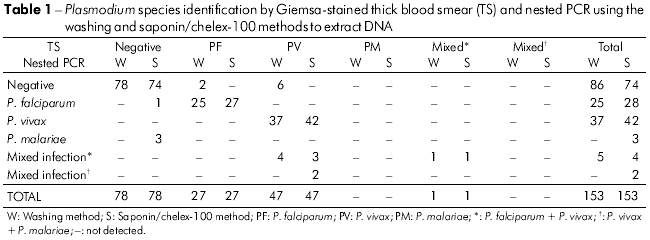
<body><![CDATA[<p><font size="2" face="Verdana"> The protocol of this study was approved by the Research Ethics Committee   of the Instituto Evandro Chagas (004/2003-CEP/IEC/SVS/MS). The purpose and   procedures of the study were explained to all participants, signature on a   written informed consent form was obtained from all patients and socio-demographic   and clinical data were collected.</font></p>     <p>&nbsp;</p>     <p>  <font size="3" face="Verdana"><b>RESULTS</b></font></p>     <p><font size="2" face="Verdana">  Out of 153 samples, 49.01% (75/153) were positive by   TS (parasitemia range 0.001% to 2.0%) and 50.98% (78/153) were negative. With   nested PCR, 43.79%   (67/153) of samples were positive and 56.20% (86/153) were found to be negative   with the washing method for DNA extraction, compared to 51.63% (79/153) positive   and 48.36% (74/153) negative with the saponin-chelex-100 method (<a href="#t1">Table   1</a>).</font></p>     <p><font size="2" face="Verdana"><a name="t1"></a></font></p>     <p>&nbsp;</p>     <p align="center"><img src="/img/revistas/rpas/v1n2/2a05t1.gif" border="0"></p>     <p>&nbsp;</p>     <p><font size="2" face="Verdana">The performance of nested PCR compared to TS    was as follows: 1) washing method - sensitivity = 89.33%, specificity = 100%,    accuracy = 94.77%; and 2) saponin/chelex-100 method - sensitivity = 100%, specificity    = 94.87%, accuracy = 97.39%. The agreement between these methods and microscopic    examination was almost perfect [<i>Kappa </i>= 0.8952 and 0.9477, respectively;   CI range: 0.80 to 1.00&#093;. The saponin/chelex-100 method provides a higher    quality DNA sample than is obtained by the washing method.</font></p>     <p><font size="2" face="Verdana"> The frequency of <i>Plasmodium </i>species and mixed infections detected   by nested PCR using DNA extracted by the washing and saponin/chelex-100 methods   is shown in <a href="#t2">table 2</a>. The saponin/chelex-100 method provided better DNA samples,   as demonstrated by the fact that, with this method, nested PCR could detect <i>P. malariae </i>infections   either alone or in mixed infection and detected a greater number of other infections   compared to the washing method.</font></p>     ]]></body>
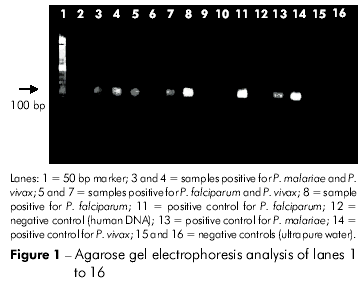
<body><![CDATA[<p><a name="t2"></a></p>     <p>&nbsp;</p>     <p align="center"><img src="/img/revistas/rpas/v1n2/2a05t2.gif" border="0"></p>     <p>&nbsp;</p>     <p><font size="2" face="Verdana"><a href="#f1">Figure 1</a> shows the results of a nested PCR analysis using DNA obtained by   the saponin-chelex-100 method. Lanes 2, 3 and 4 contain samples from a single   patient; each well corresponds to reactions for <i>P. falciparum, P. malariae </i>and <i>P.   vivax </i>respectively, showing that the patient has a mixed infection with <i>P. malariae </i>and <i>P. vivax.</i></font></p>     <p><a name="f1"></a></p>     <p>&nbsp;</p>     <p align="center"><img src="/img/revistas/rpas/v1n2/2a05f1.gif" border="0"></p>     <p>&nbsp;</p>     <p><font size="3" face="Verdana"><b>DISCUSSION</b></font></p>     ]]></body>
<body><![CDATA[<p><font size="2" face="Verdana"> Although the Giemsa-stained thick blood smear     (TS) remains the reference method for malaria diagnosis, molecular techniques     are more sensitive and specific in detecting parasites and they can be used     to evaluate the performance of microscopy<sup>20,28</sup>.</font></p>     <p><font size="2" face="Verdana"> Dried blood samples on filter paper provide      a simple and feasible method for collection and storage and they have be     widely  adopted in diagnostic screening, genetic analysis and molecular epidemiologic      studies in remote areas with tropical climates where transport and storage     conditions  are often not optimal. Loss of sensitivity of PCR-based methods     due to field  conditions has already been reported and it is probably a consequence     of lower  purity, stability and integrity of the DNA obtained from blood     samples on filter  paper. A problem with sample collection on filter paper     is the limitation in  the sample volume that can be used for DNA extraction.     Therefore, an optimal  DNA isolation process is a prerequisite to ensuring     the quality and efficiency  of molecular methods<sup>7,20</sup>.</font></p>     <p><font size="2" face="Verdana"> Several studies have been aimed at decreasing    the costs of PCR-based protocols and making them rapid and accurate. One part    of the protocol that is crucial for getting good results is the obtainment of    a high-quality DNA sample<sup>1,5,6,7</sup>.</font></p>     <p><font size="2" face="Verdana"> In this study, we carried out a comparative      analysis of two protocols for DNA obtainment, taking into account the time     requirement,  the cost and the quality of the extracted DNA<sup>7</sup>.     The results showed  that the nested PCR/washing method failed to detect eight     positive samples (six    <i>P. vivax </i>and two <i>P. falciparum</i>)<i> </i>identified by TS whereas    the nested PCR/saponin/chelex-100 method detected all positive samples detected    by TS, as well as an additional five samples (three <i>P. malariae </i>single     infections and two mixed infections with <i>P. vivax </i>and <i>P. malariae</i>)<i>.    </i>One possible reason for the failure to detect some positive samples is   that  the washing method did not properly eliminate nested PCR inhibitors such   as  hemoglobin. Results showed that the nested PCR/saponin/chelex-100 method   was  more sensitive and specific than the washing method, especially for the   detection  of <i>P. malariae.</i></font></p>     <p><font size="2" face="Verdana"> Analyses of DNA extraction by washing as described    by Warhurst et al<sup>26</sup> and DNA extraction with saponin/chelex-100 by    Wooden et al<sup>27</sup> from 153 dried blood samples on filter paper demonstrated that    both methods are sensitive and have high specificity, in addition to being easy    and quick to perform. Furthermore, because these methods consist of &quot;in    house&quot; protocols, the cost was lower than that of available commercial    kits. However, the saponin/chelex-100 method was found to be more sensitive    and thus should be the protocol of choice for the DNA-based detection of malaria    parasites by nested PCR.</font></p>     <p><font size="2" face="Verdana"> The nested PCR protocol developed by Kimura      et al<sup>11</sup> for human-infecting <i>Plasmodium </i>species proved      to be useful, as it is highly sensitive and specific as well as reproducible      and there  was no evidence of cross-contamination in the study. Using this      protocol, we  detected mixed infections that were identified by TS as single      infections, which  is in accordance with the data from Ebrahimzadeh et al<sup>5</sup>,      Scopel et al<sup>21</sup>, Singh    et al<sup>22</sup>, Snounou et al<sup>24</sup> and Toma et al<sup>25</sup>.</font></p>     <p><font size="2" face="Verdana">In mixed infections there is a predominance of one <i>Plasmodium </i>species   that generally is the one detected by both TS and nested PCR, whereas the non-dominant   species is identified only by PCR-based methods. Moreover, low-level <i>P.   malariae </i>parasitemia is especially frequent in mixed infections, probably   because of the characteristics of this species and the density-dependant regulation   mechanism. Thus, this species could easily be overlooked by microscopy when <i>P.   falciparum </i>or <i>P. vivax </i>is the major species. This fact also helps   to explain the greater number of mixed infections detected with molecular biology methods compared to conventional microscopic tools<sup>27</sup>.</font></p>     <p><font size="2" face="Verdana"> PCR-based malaria diagnosis methods are very      specific and sensitive but they cannot replace conventional microscopy in     routine  use<sup>9</sup>, as they do not allow for the quantification of     parasite forms;  moreover, they are complex techniques with several steps     and high costs. Thus,  they can be useful as alternative and complementary     tools for the diagnosis  of human malaria in developing countries<sup>4,13,19,22</sup>.</font></p>     <p>&nbsp;</p>     <p><font size="3" face="Verdana"><b>CONCLUSION</b></font></p>     ]]></body>
<body><![CDATA[<p><font size="2" face="Verdana"> The results suggest that there were mixed infections    (<i>P. falciparum </i>+ <i>P. vivax; P. vivax </i>+ <i>P. malariae</i>)<i> </i>in    the study area that were not identified by the conventional microscopy method    (TS). Furthermore, the two DNA obtainment methods evaluated, washing<sup>26</sup> and extraction    with saponin/chelex-100<sup>27</sup>, showed sensitivity and high specificity, as well as    lower cost compared to available commercial kits; they were also easy and quick    to perform. However, the second method was more sensitive; it provides a simple    protocol for DNA extraction from dried blood spots and could be the protocol    of choice for the DNA extraction step.</font></p>     <p>&nbsp;</p>     <p><font size="3" face="Verdana"><b>ACKNOWLEDGEMENTS</b></font></p>     <p><font size="2" face="Verdana"> To Ivana Pimentel and the technicians from the malaria research laboratory of   the Instituto Evandro Chagas for their technical assistance. </font></p>     <p>&nbsp;</p>     <p><font size="3" face="Verdana"><b>REFERENCES</b></font></p>     <!-- ref --><p><font size="2" face="Verdana"> 1 Alger J, Acosta MC, Lozano C, Velasquez C, Labrada LA. Stained smears as a source of DNA. Mem Inst Oswaldo Cruz. 1996;91(5):589-91.</font><!-- ref --><p><font size="2" face="Verdana"> 2 Alves FP, Durlacher RR, Menezes MJ, Krieger H, Silva LH, Camargo EP. High   prevalence of asymptomatic <i>Plasmodium vivax </i>and <i>Plasmodium falciparum </i>infections   in native Amazonian populations. Am J Trop   Med Hyg. 2002;66(6):641-8.</font><font size="2" face="verdana">&nbsp; &nbsp; &nbsp; &nbsp;    &nbsp;&#91; <a href="http://www.ncbi.nlm.nih.gov/pubmed/12224567" target="_blank">Links</a> &#93;</font><!-- ref --><p><font size="2" face="Verdana">3 Ciceron L, Jaureguiberry G, Gay F, Danis M.     Development of a <i>Plasmodium </i>for monitoring efficacy of&nbsp; antimalarial     treatment. J Clin Microbiol. 1999;37(1):35-8.</font><font size="2" face="verdana">&nbsp; &nbsp; &nbsp; &nbsp;  &nbsp;&#91; <a href="http://www.ncbi.nlm.nih.gov/pmc/articles/PMC84160/?tool=pmcentrez&report=abstract" target="_blank">Links</a> &#93;</font><!-- ref --><p><font size="2" face="Verdana">4 Di Santi SM, Kirchgatter K, Brunialti KC,   Oliveira AM, Ferreira SR, Boulos M. PCR - based diagnosis to evaluate the   performance of malaria reference centers. Rev Inst Med Trop Sao Paulo. 2004   Jul-Aug;46(4):183-7. Doi:10.1590/S0036-46652004000400002</font><font size="2" face="verdana">&nbsp; &nbsp; &nbsp; &nbsp;    &nbsp;&#91; <a href="http://www.scielo.br/scielo.php?script=sci_arttext&pid=S0036-46652004000400002&lng=en&nrm=iso&tlng=en" target="_blank">Links</a> &#93;</font><!-- ref --><p> <font size="2" face="Verdana">5  Ebrahimzadeh A, Fouladi B, Fazaeli A. High rate of detection of mixed infections   of <i>Plasmodium vivax </i>and <i>Plasmodium falciparum </i>in South-East     of Iran, using nested PCR. Parasitol Int. 2007;56(1):61-4. Doi:10.1016/J.Parint.2006.12.001</font><font size="2" face="verdana">&nbsp; &nbsp; &nbsp; &nbsp;    &nbsp;&#91; <a href="http://www.sciencedirect.com/science?_ob=ArticleURL&_udi=B6TB7-4MWY06T-2&_user=10&_coverDate=03/31/2007&_rdoc=1&_fmt=high&_orig=search&_sort=d&_docanchor=&view=c&_acct=C000050221&_version=1&_urlVersion=0&_userid=10&md5=812ebe97809b174c7ee6d6b61d99b57b" target="_blank">Links</a> &#93;</font><!-- ref --><p><font size="2" face="Verdana"> 6 Edoh D, Steiger S, Genton B, Beck HP. PCR   amplifications of DNA from malaria parasites on fixed and stained thick and   thin blood films. Trans R Soc Trop Med Hyg. 1997 May-Jun;91:361-3.</font><font size="2" face="verdana">&nbsp; &nbsp; &nbsp; &nbsp;    &nbsp;&#91; <a href="http://www.ncbi.nlm.nih.gov/pubmed/9231218" target="_blank">Links</a> &#93;</font><!-- ref --><p> <font size="2" face="Verdana">7  Farnert A, Arez AP, Correia AT, Bjorkman A, Snounou G, Ros&aacute;rio V.     Sampling and storage of blood and detection of malaria parasites by polymerase     chain reaction. Trans R Soc Trop Med Hyg. 1999 Jan-Fev;93:50-3.</font><font size="2" face="verdana">&nbsp; &nbsp; &nbsp; &nbsp;    &nbsp;&#91; <a href="http://www.ncbi.nlm.nih.gov/pubmed/10492790" target="_blank">Links</a> &#93;</font><!-- ref --><p><font size="2" face="Verdana"> 8   Gilles HM. The malaria parasite. In: Gilles HM, Warrell DA, editors. Essential   Malariology. London: Edward   Arnold. 1993. p. 12-34.</font><!-- ref --><p><font size="2" face="Verdana"> 9     Haghdoost AA, Mazhari S, Bahadini K. Comparing the results of light microscopy   with the results of PCR method in the diagnosis of <i>Plasmodium vivax. </i>J   Vec Dis. 2006;43:53-7.</font><font size="2" face="verdana">&nbsp; &nbsp; &nbsp; &nbsp;    &nbsp;&#91; <a href="http://www.ncbi.nlm.nih.gov/pubmed/16967816" target="_blank">Links</a> &#93;</font><!-- ref --><p> <font size="2" face="Verdana">10     Imirzalioglu C, Soydan N, Schaller M, Bretzel RG, Chakraborty T, Domann E.     Diagnosis of mixed <i>Plasmodium malariae </i>and <i>P. vivax </i>infection     in a development aid volunteer by examination of bone-marrow specimens by     real-time PCR. J Clin Microbiol. 2006 Jun;44(6):2307-10.</font><font size="2" face="Verdana"></font><font size="2" face="verdana"> Doi:     10.1128/JCM.02687-05&nbsp; &nbsp; &nbsp; &nbsp;    &nbsp;&#91; <a href="http://www.ncbi.nlm.nih.gov/pmc/articles/PMC1489408/?tool=pubmed" target="_blank">Links</a> &#93;</font><!-- ref --><p><font size="2" face="Verdana"> 11 Kimura M, Kaneko O, Liu Q, Zhou M, Kawamoto F, Wataya Y, et al. Identification   of the four species of human malaria parasites by nested PCR that targets variant   sequences in the small subunit rRNA gene. Parasitology Int. 1997;46:91-5.</font><!-- ref --><p><font size="2" face="Verdana"> 12 Maeno Y, Nakazawa S, Dao le D, Yamamoto     N, Giang ND, Van Hanh T, et al. A dried blood sample on filter paper is suitable     for detecting <i>Plasmodium falciparum </i>gametocytes by reverse transcription     polymerase chain reaction. Acta Trop. 2008;107(2):121-7. Doi:10.1016/j.actatropica.2008.05.001</font><font size="2" face="verdana">&nbsp; &nbsp; &nbsp; &nbsp;  &nbsp;&#91; <a href="http://www.sciencedirect.com/science?_ob=ArticleURL&_udi=B6T1R-4SFXK8F-2&_user=10&_coverDate=08%2F31%2F2008&_rdoc=1&_fmt=high&_orig=search&_sort=d&_docanchor=&view=c&_acct=C000050221&_version=1&_urlVersion=0&_userid=10&md5=f892f919ede9a877b35346acafe9faa0" target="_blank">Links</a> &#93;</font><!-- ref --><p><font size="2" face="Verdana"> 13 McNamara DT, Thomson JM, Kasehagen LJ, Zimmerman PA. Development of a multiplex PCR-ligase detection reaction assay for diagnosis of infection by the four parasite species causing malaria in humans. J Clin Microbiol. 2004 Jun;42(6):2403-10. </font><font size="2" face="verdana">Doi: 10.1128/JCM.42.6.2403-2410.2004&nbsp; &nbsp; &nbsp; &nbsp;  &nbsp;&#91; <a href="http://www.ncbi.nlm.nih.gov/pmc/articles/PMC427836/?tool=pubmed" target="_blank">Links</a> &#93;</font><!-- ref --><p><font size="2" face="Verdana">14 Minist&eacute;rio da Sa&uacute;de (BR). Manual     de Diagn&oacute;stico Laboratorial da Mal&aacute;ria. 2. ed. Bras&iacute;lia; 2009. 112 p.</font><!-- ref --><p><font size="2" face="Verdana"> 15 Minist&eacute;rio da Sa&uacute;de (BR), Secretaria de Vigil&acirc;ncia em Sa&uacute;de. Boletim epidemiol&oacute;gico da mal&aacute;ria n<sup>o</sup> 02. 2005.</font><!-- ref --><p><font size="2" face="Verdana"> </font><font size="2" face="verdana"></font><font size="2" face="Verdana">16     Minist&eacute;rio da Sa&uacute;de (BR). Situa&ccedil;&atilde;o Epidemiol&oacute;gica     da Mal&aacute;ria no Brasil, ano de 2008. Bras&iacute;lia, 2008. Dispon&iacute;vel   em: <a href="http://portal.saude.gov.br/portal/arquivos/pdf/folder_malaria_2009_web.pdf" target="_blank">http://portal.saude.gov.br/portal/arquivos/pdf/folder_malaria_2009_web.pdf</a>.</font><!-- ref --><p><font size="2" face="Verdana">17 Organiza&ccedil;&atilde;o Mundial de Sa&uacute;de.     revised July, 2003. Fact sheet n<sup>o</sup> 94. Dispon&iacute;vel em: <a href="http://www.who.int/en/" target="_blank">http://www.who.int.dsa</a>.</font><!-- ref --><p><font size="2" face="Verdana"> 18     Pan American Health Organization. Regional Strategic Plan for Malaria in the Americas 2006-2010. Washington, D.C: PAHO; 2006. 85 p.</font><!-- ref --><p><font size="2" face="Verdana"> 19 Rougemont M,     Van Saanen M, Sahli R, Hinrikson HP, Bille J, Jaton K. Detection of Four <i>Plasmodium </i>Species     in Blood from Humans by 18S rRNA Gene Subunit-Based and Species-Specific     Real-Time PCR Assays. J Clin Microbiol. 2004 Dec;42(12):5636-43.</font><font size="2" face="verdana">&nbsp; &nbsp; &nbsp; &nbsp;  &nbsp;&#91; <a href="http://www.ncbi.nlm.nih.gov/pubmed/15583293" target="_blank">Links</a> &#93;</font><!-- ref --><p><font size="2" face="Verdana"> 20 Schindler HC, Montenegro L, Montenegro R, Carvalho AB, Abath FG, Jaureguiberry   G. Development and optimization of polymerase chain reaction-based malaria   diagnostic methods and their comparison with quantitative buffy coat assay.   Am J Trop Med Hyg.   2001 Oct;65(4):355-61.</font><font size="2" face="verdana">&nbsp; &nbsp; &nbsp; &nbsp;  &nbsp;&#91; <a href="http://www.ncbi.nlm.nih.gov/pubmed/11693884" target="_blank">Links</a> &#93;</font><!-- ref --><p><font size="2" face="Verdana"> 21 Scopel KK, Fontes CJ, Nunes AC, Horta MF, Braga EM. High prevalence of <i>Plasmodium malariae </i>infections in a Brazilian Amazon endemic area (Apiac&aacute;s - Mato Grosso State) as detected by polymerase chain reaction. Acta Trop. 2004 Mar;90(1):61-4.</font> <font size="2" face="verdana">Doi:10.1016/J.Actatropica.2003.11.002&nbsp; &nbsp; &nbsp; &nbsp;  &nbsp;&#91; <a href="http://www.sciencedirect.com/science?_ob=ArticleURL&_udi=B6T1R-4B6KM37-4&_user=10&_coverDate=03/31/2004&_rdoc=1&_fmt=high&_orig=search&_sort=d&_docanchor=&view=c&_acct=C000050221&_version=1&_urlVersion=0&_userid=10&md5=2ee0f6e3f6aed8ae6dfc109517d6923a" target="_blank">Links</a> &#93;</font><!-- ref --><p><font size="2" face="Verdana"> 22 Singh B, Bobogare A, Cox-Singh J, Snounou G, Abdullah MS, Rahman HA. A Genus - and species-specific nested polymerase chain reaction malaria detection assay for epidemoiologic studies. Am J Trop Med Hyg. 1999 Apr;60(4):687-92.</font><font size="2" face="verdana">&nbsp; &nbsp; &nbsp; &nbsp;  &nbsp;&#91; <a href="http://www.ncbi.nlm.nih.gov/pubmed/10348249" target="_blank">Links</a> &#93;</font><!-- ref --><p><font size="2" face="Verdana"> 23 Snounou G, Viriyakosol S, Jarra W, Thaithong    S, Brown KN. Identification of the four human malaria parasite species in field    samples by the polymerase chain reaction and detection of a high prevalence    of mixed infections. Mol Biochem Parasitol. 1993 Apr;58(2):283-92.</font><font size="2" face="verdana">&nbsp; &nbsp; &nbsp; &nbsp;  &nbsp;&#91; <a href="http://www.ncbi.nlm.nih.gov/pubmed/8479452" target="_blank">Links</a> &#93;</font><!-- ref --><p><font size="2" face="Verdana"> 24 Snounou G, Viriyakosol S, Zhu XP, Jarra W,    Pinheiro L, Rosario VE, et al. High sensitivity of detection of human malaria    parasites by the use of nested polymerase chain reaction. Mol Biochem Parasitol.    1993 Oct;61(2):315-20.</font><font size="2" face="Verdana"></font><font size="2" face="verdana">&nbsp; &nbsp; &nbsp; &nbsp;  &nbsp;&#91; <a href="http://www.ncbi.nlm.nih.gov/pubmed/8264734" target="_blank">Links</a> &#93;</font><!-- ref --><p><font size="2" face="Verdana"> 25 Toma H, Kobayashi J, Bouakham V, Arakawa     T, Sato Y, Nambanya S, et al. A field study on malaria prevalence in southeastern     Laos by polymerase chain reaction assay. Am J Trop Med Hyg. 2001;64(5,6):257-61.</font><font size="2" face="Verdana"></font><font size="2" face="Verdana"></font><font size="2" face="verdana">&nbsp; &nbsp; &nbsp; &nbsp;  &nbsp;&#91; <a href="http://www.ncbi.nlm.nih.gov/pubmed/11463112" target="_blank">Links</a> &#93;</font><!-- ref --><p><font size="2" face="Verdana">26 Warhurst DC, Awad el Kariem FM, Miles MA.      Simplified preparation of malarial blood samples for polymerase chain reaction.      Lancet. 1991 Feb;337(8736):303-4.</font><font size="2" face="verdana">&nbsp; &nbsp; &nbsp; &nbsp;  &nbsp;&#91; <a href="http://www.ncbi.nlm.nih.gov/pubmed/1671140" target="_blank">Links</a> &#93;</font><!-- ref --><p><font size="2" face="Verdana"> 27 Wooden J, Kyes S, Silbley CH. PCR and strain   identification in <i>Plasmodium falciparum. </i>Parasitol Today. 1993 Aug;9(8):303-5.</font><!-- ref --><p><font size="2" face="Verdana">28 World Health Organization. Malaria diagnosis - new perspectives: report   of a joint WHO/USAID informal consultation, 25-27 October 1999. Geneva: WHO; 2000. 1091 p. </font><p>&nbsp;</p>     <p>&nbsp;</p>     <p><font size="2" face="Verdana"><b><b><a href="#topo" name="endereco"><img src="/img/revistas/rpas/v1n2/seta.gif" border="0"></a></b>Correspond&ecirc;ncia / Correspondence / Correspondencia:</b></font>    <br> <font size="2" face="Verdana">Giselle Maria Rachid Viana</font>    <br> <font size="2" face="Verdana">Laborat&oacute;rio de Pesquisas B&aacute;sicas em Mal&aacute;ria,    <br> Se&ccedil;&atilde;o de Parasitologia Instituto Evandro Chagas</font>    ]]></body>
<body><![CDATA[<br> <font size="2" face="Verdana">BR 316, km 7, s/n. 67030-000,    <br> Levil&acirc;ndia. Ananindeua-Par&aacute;-Brasil    <br> Phone: 55 91 3214-2148    <br> E-mail:<a href="mailto:giselleviana@iec.pa.gov.br">giselleviana@iec.pa.gov.br</a></font></p>     <p><font size="2" face="Verdana">Recebido em / Received / Recibido en: 23/7/2009    <br>   Aceito     em / Accepted / Aceito en: 21/9/2010</font></p> 	<script type="text/javascript"> var gaJsHost = (("https:" == document.location.protocol) ? "https://ssl." : "http://www."); document.write(unescape("%3Cscript src='" + gaJsHost + "google-analytics.com/ga.js' type='text/javascript'%3E%3C/script%3E")); </script> <script type="text/javascript"> try { var pageTracker = _gat._getTracker("UA-7885746-4"); pageTracker._setDomainName("none"); pageTracker._setAllowLinker(true); pageTracker._trackPageview(); } catch(err) {}</script>      ]]></body><back>
<ref-list>
<ref id="B1">
<label>1</label><nlm-citation citation-type="journal">
<person-group person-group-type="author">
<name>
<surname><![CDATA[Alger]]></surname>
<given-names><![CDATA[J]]></given-names>
</name>
<name>
<surname><![CDATA[Acosta]]></surname>
<given-names><![CDATA[MC]]></given-names>
</name>
<name>
<surname><![CDATA[Lozano]]></surname>
<given-names><![CDATA[C]]></given-names>
</name>
<name>
<surname><![CDATA[Velasquez]]></surname>
<given-names><![CDATA[C]]></given-names>
</name>
<name>
<surname><![CDATA[Labrada]]></surname>
<given-names><![CDATA[LA]]></given-names>
</name>
</person-group>
<article-title xml:lang="en"><![CDATA[Stained smears as a source of DNA]]></article-title>
<source><![CDATA[Mem Inst Oswaldo Cruz]]></source>
<year>1996</year>
<volume>91</volume>
<numero>5</numero>
<issue>5</issue>
<page-range>589-91</page-range></nlm-citation>
</ref>
<ref id="B2">
<label>2</label><nlm-citation citation-type="journal">
<person-group person-group-type="author">
<name>
<surname><![CDATA[Alves]]></surname>
<given-names><![CDATA[FP]]></given-names>
</name>
<name>
<surname><![CDATA[Durlacher]]></surname>
<given-names><![CDATA[RR]]></given-names>
</name>
<name>
<surname><![CDATA[Menezes]]></surname>
<given-names><![CDATA[MJ]]></given-names>
</name>
<name>
<surname><![CDATA[Krieger]]></surname>
<given-names><![CDATA[H]]></given-names>
</name>
<name>
<surname><![CDATA[Silva]]></surname>
<given-names><![CDATA[LH]]></given-names>
</name>
<name>
<surname><![CDATA[Camargo]]></surname>
<given-names><![CDATA[EP]]></given-names>
</name>
</person-group>
<article-title xml:lang="en"><![CDATA[High prevalence of asymptomatic Plasmodium vivax and Plasmodium falciparum infections in native Amazonian populations]]></article-title>
<source><![CDATA[Am J Trop Med Hyg]]></source>
<year>2002</year>
<volume>66</volume>
<numero>6</numero>
<issue>6</issue>
<page-range>641-8</page-range></nlm-citation>
</ref>
<ref id="B3">
<label>3</label><nlm-citation citation-type="journal">
<person-group person-group-type="author">
<name>
<surname><![CDATA[Ciceron]]></surname>
<given-names><![CDATA[L]]></given-names>
</name>
<name>
<surname><![CDATA[Jaureguiberry]]></surname>
<given-names><![CDATA[G]]></given-names>
</name>
<name>
<surname><![CDATA[Gay]]></surname>
<given-names><![CDATA[F]]></given-names>
</name>
<name>
<surname><![CDATA[Danis]]></surname>
<given-names><![CDATA[M]]></given-names>
</name>
</person-group>
<article-title xml:lang="en"><![CDATA[Development of a Plasmodium for monitoring efficacy of antimalarial treatment]]></article-title>
<source><![CDATA[J Clin Microbiol]]></source>
<year>1999</year>
<volume>37</volume>
<numero>1</numero>
<issue>1</issue>
<page-range>35-8</page-range></nlm-citation>
</ref>
<ref id="B4">
<label>4</label><nlm-citation citation-type="journal">
<person-group person-group-type="author">
<name>
<surname><![CDATA[Di Santi]]></surname>
<given-names><![CDATA[SM]]></given-names>
</name>
<name>
<surname><![CDATA[Kirchgatter]]></surname>
<given-names><![CDATA[K]]></given-names>
</name>
<name>
<surname><![CDATA[Brunialti]]></surname>
<given-names><![CDATA[KC]]></given-names>
</name>
<name>
<surname><![CDATA[Oliveira]]></surname>
<given-names><![CDATA[AM]]></given-names>
</name>
<name>
<surname><![CDATA[Ferreira]]></surname>
<given-names><![CDATA[SR]]></given-names>
</name>
<name>
<surname><![CDATA[Boulos]]></surname>
<given-names><![CDATA[M]]></given-names>
</name>
</person-group>
<article-title xml:lang="en"><![CDATA[PCR: based diagnosis to evaluate the performance of malaria reference centers]]></article-title>
<source><![CDATA[Rev Inst Med Trop Sao Paulo]]></source>
<year>2004</year>
<month> J</month>
<day>ul</day>
<volume>46</volume>
<numero>4</numero>
<issue>4</issue>
<page-range>183-7</page-range></nlm-citation>
</ref>
<ref id="B5">
<label>5</label><nlm-citation citation-type="journal">
<person-group person-group-type="author">
<name>
<surname><![CDATA[Ebrahimzadeh]]></surname>
<given-names><![CDATA[A]]></given-names>
</name>
<name>
<surname><![CDATA[Fouladi]]></surname>
<given-names><![CDATA[B]]></given-names>
</name>
<name>
<surname><![CDATA[Fazaeli]]></surname>
<given-names><![CDATA[A]]></given-names>
</name>
</person-group>
<article-title xml:lang="en"><![CDATA[High rate of detection of mixed infections of Plasmodium vivax and Plasmodium falciparum in South-East of Iran, using nested PCR]]></article-title>
<source><![CDATA[Parasitol Int]]></source>
<year>2007</year>
<volume>56</volume>
<numero>1</numero>
<issue>1</issue>
<page-range>61-4</page-range></nlm-citation>
</ref>
<ref id="B6">
<label>6</label><nlm-citation citation-type="journal">
<person-group person-group-type="author">
<name>
<surname><![CDATA[Edoh]]></surname>
<given-names><![CDATA[D]]></given-names>
</name>
<name>
<surname><![CDATA[Steiger]]></surname>
<given-names><![CDATA[S]]></given-names>
</name>
<name>
<surname><![CDATA[Genton]]></surname>
<given-names><![CDATA[B]]></given-names>
</name>
<name>
<surname><![CDATA[Beck]]></surname>
<given-names><![CDATA[HP]]></given-names>
</name>
</person-group>
<article-title xml:lang="en"><![CDATA[PCR amplifications of DNA from malaria parasites on fixed and stained thick and thin blood films]]></article-title>
<source><![CDATA[Trans R Soc Trop Med Hyg]]></source>
<year>1997</year>
<month> M</month>
<day>ay</day>
<volume>91</volume>
<page-range>361-3</page-range></nlm-citation>
</ref>
<ref id="B7">
<label>7</label><nlm-citation citation-type="journal">
<person-group person-group-type="author">
<name>
<surname><![CDATA[Farnert]]></surname>
<given-names><![CDATA[A]]></given-names>
</name>
<name>
<surname><![CDATA[Arez]]></surname>
<given-names><![CDATA[AP]]></given-names>
</name>
<name>
<surname><![CDATA[Correia]]></surname>
<given-names><![CDATA[AT]]></given-names>
</name>
<name>
<surname><![CDATA[Bjorkman]]></surname>
<given-names><![CDATA[A]]></given-names>
</name>
<name>
<surname><![CDATA[Snounou]]></surname>
<given-names><![CDATA[G]]></given-names>
</name>
<name>
<surname><![CDATA[Rosário]]></surname>
<given-names><![CDATA[V]]></given-names>
</name>
</person-group>
<article-title xml:lang="en"><![CDATA[Sampling and storage of blood and detection of malaria parasites by polymerase chain reaction]]></article-title>
<source><![CDATA[Trans R Soc Trop Med Hyg]]></source>
<year>1999</year>
<month> J</month>
<day>an</day>
<volume>93</volume>
<page-range>50-3</page-range></nlm-citation>
</ref>
<ref id="B8">
<label>8</label><nlm-citation citation-type="book">
<person-group person-group-type="author">
<name>
<surname><![CDATA[Gilles]]></surname>
<given-names><![CDATA[HM]]></given-names>
</name>
</person-group>
<article-title xml:lang="en"><![CDATA[The malaria parasite]]></article-title>
<person-group person-group-type="editor">
<name>
<surname><![CDATA[Gilles]]></surname>
<given-names><![CDATA[HM]]></given-names>
</name>
<name>
<surname><![CDATA[Warrell]]></surname>
<given-names><![CDATA[DA]]></given-names>
</name>
</person-group>
<source><![CDATA[Essential Malariology]]></source>
<year>1993</year>
<page-range>12-34</page-range><publisher-loc><![CDATA[London ]]></publisher-loc>
<publisher-name><![CDATA[Edward Arnold]]></publisher-name>
</nlm-citation>
</ref>
<ref id="B9">
<label>9</label><nlm-citation citation-type="journal">
<person-group person-group-type="author">
<name>
<surname><![CDATA[Haghdoost]]></surname>
<given-names><![CDATA[AA]]></given-names>
</name>
<name>
<surname><![CDATA[Mazhari]]></surname>
<given-names><![CDATA[S]]></given-names>
</name>
<name>
<surname><![CDATA[Bahadini]]></surname>
<given-names><![CDATA[K]]></given-names>
</name>
</person-group>
<article-title xml:lang="en"><![CDATA[Comparing the results of light microscopy with the results of PCR method in the diagnosis of Plasmodium vivax]]></article-title>
<source><![CDATA[J Vec Dis]]></source>
<year>2006</year>
<volume>43</volume>
<page-range>53-7</page-range></nlm-citation>
</ref>
<ref id="B10">
<label>10</label><nlm-citation citation-type="journal">
<person-group person-group-type="author">
<name>
<surname><![CDATA[Imirzalioglu]]></surname>
<given-names><![CDATA[C]]></given-names>
</name>
<name>
<surname><![CDATA[Soydan]]></surname>
<given-names><![CDATA[N]]></given-names>
</name>
<name>
<surname><![CDATA[Schaller]]></surname>
<given-names><![CDATA[M]]></given-names>
</name>
<name>
<surname><![CDATA[Bretzel]]></surname>
<given-names><![CDATA[RG]]></given-names>
</name>
<name>
<surname><![CDATA[Chakraborty]]></surname>
<given-names><![CDATA[T]]></given-names>
</name>
<name>
<surname><![CDATA[Domann]]></surname>
<given-names><![CDATA[E]]></given-names>
</name>
</person-group>
<article-title xml:lang="en"><![CDATA[Diagnosis of mixed Plasmodium malariae and P. vivax infection in a development aid volunteer by examination of bone-marrow specimens by real-time PCR]]></article-title>
<source><![CDATA[J Clin Microbiol]]></source>
<year>2006</year>
<month> J</month>
<day>un</day>
<volume>44</volume>
<numero>6</numero>
<issue>6</issue>
<page-range>2307-10</page-range></nlm-citation>
</ref>
<ref id="B11">
<label>11</label><nlm-citation citation-type="journal">
<person-group person-group-type="author">
<name>
<surname><![CDATA[Kimura]]></surname>
<given-names><![CDATA[M]]></given-names>
</name>
<name>
<surname><![CDATA[Kaneko]]></surname>
<given-names><![CDATA[O]]></given-names>
</name>
<name>
<surname><![CDATA[Liu]]></surname>
<given-names><![CDATA[Q]]></given-names>
</name>
<name>
<surname><![CDATA[Zhou]]></surname>
<given-names><![CDATA[M]]></given-names>
</name>
<name>
<surname><![CDATA[Kawamoto]]></surname>
<given-names><![CDATA[F]]></given-names>
</name>
<name>
<surname><![CDATA[Wataya]]></surname>
<given-names><![CDATA[Y]]></given-names>
</name>
</person-group>
<article-title xml:lang="en"><![CDATA[Identification of the four species of human malaria parasites by nested PCR that targets variant sequences in the small subunit rRNA gene]]></article-title>
<source><![CDATA[Parasitology Int]]></source>
<year>1997</year>
<volume>46</volume>
<page-range>91-5</page-range></nlm-citation>
</ref>
<ref id="B12">
<label>12</label><nlm-citation citation-type="journal">
<person-group person-group-type="author">
<name>
<surname><![CDATA[Maeno]]></surname>
<given-names><![CDATA[Y]]></given-names>
</name>
<name>
<surname><![CDATA[Nakazawa]]></surname>
<given-names><![CDATA[S]]></given-names>
</name>
<name>
<surname><![CDATA[Dao le]]></surname>
<given-names><![CDATA[D]]></given-names>
</name>
<name>
<surname><![CDATA[Yamamoto]]></surname>
<given-names><![CDATA[N]]></given-names>
</name>
<name>
<surname><![CDATA[Giang]]></surname>
<given-names><![CDATA[ND]]></given-names>
</name>
<name>
<surname><![CDATA[Van Hanh]]></surname>
<given-names><![CDATA[T]]></given-names>
</name>
</person-group>
<article-title xml:lang="en"><![CDATA[A dried blood sample on filter paper is suitable for detecting Plasmodium falciparum gametocytes by reverse transcription polymerase chain reaction]]></article-title>
<source><![CDATA[Acta Trop]]></source>
<year>2008</year>
<volume>107</volume>
<numero>2</numero>
<issue>2</issue>
<page-range>121-7</page-range></nlm-citation>
</ref>
<ref id="B13">
<label>13</label><nlm-citation citation-type="journal">
<person-group person-group-type="author">
<name>
<surname><![CDATA[McNamara]]></surname>
<given-names><![CDATA[DT]]></given-names>
</name>
<name>
<surname><![CDATA[Thomson]]></surname>
<given-names><![CDATA[JM]]></given-names>
</name>
<name>
<surname><![CDATA[Kasehagen]]></surname>
<given-names><![CDATA[LJ]]></given-names>
</name>
<name>
<surname><![CDATA[Zimmerman]]></surname>
<given-names><![CDATA[PA]]></given-names>
</name>
</person-group>
<article-title xml:lang="en"><![CDATA[Development of a multiplex PCR-ligase detection reaction assay for diagnosis of infection by the four parasite species causing malaria in humans]]></article-title>
<source><![CDATA[J Clin Microbiol]]></source>
<year>2004</year>
<month> J</month>
<day>un</day>
<volume>42</volume>
<numero>6</numero>
<issue>6</issue>
<page-range>2403-10</page-range></nlm-citation>
</ref>
<ref id="B14">
<label>14</label><nlm-citation citation-type="">
<collab>Ministério da Saúde</collab>
<source><![CDATA[Manual de Diagnóstico Laboratorial da Malária]]></source>
<year>2009</year>
<edition>2</edition>
<page-range>112</page-range><publisher-loc><![CDATA[Brasília ]]></publisher-loc>
</nlm-citation>
</ref>
<ref id="B15">
<label>15</label><nlm-citation citation-type="">
<collab>Ministério da Saúde^dSecretaria de Vigilância em Saúde</collab>
<source><![CDATA[Boletim epidemiológico da malária]]></source>
<year>2005</year>
</nlm-citation>
</ref>
<ref id="B16">
<label>16</label><nlm-citation citation-type="">
<collab>Ministério da Saúde</collab>
<source><![CDATA[Situação Epidemiológica da Malária no Brasil, ano de 2008]]></source>
<year>2008</year>
<publisher-loc><![CDATA[Brasília ]]></publisher-loc>
</nlm-citation>
</ref>
<ref id="B17">
<label>17</label><nlm-citation citation-type="">
<collab>Organização Mundial de Saúde</collab>
<source><![CDATA[revised July, 2003: Fact sheet nº 94]]></source>
<year></year>
</nlm-citation>
</ref>
<ref id="B18">
<label>18</label><nlm-citation citation-type="book">
<collab>Pan American Health Organization</collab>
<source><![CDATA[Regional Strategic Plan for Malaria in the Americas 2006-2010]]></source>
<year>2006</year>
<page-range>85</page-range><publisher-loc><![CDATA[Washington ]]></publisher-loc>
<publisher-name><![CDATA[PAHO]]></publisher-name>
</nlm-citation>
</ref>
<ref id="B19">
<label>19</label><nlm-citation citation-type="journal">
<person-group person-group-type="author">
<name>
<surname><![CDATA[Rougemont]]></surname>
<given-names><![CDATA[M]]></given-names>
</name>
<name>
<surname><![CDATA[Van Saanen]]></surname>
<given-names><![CDATA[M]]></given-names>
</name>
<name>
<surname><![CDATA[Sahli]]></surname>
<given-names><![CDATA[R]]></given-names>
</name>
<name>
<surname><![CDATA[Hinrikson]]></surname>
<given-names><![CDATA[HP]]></given-names>
</name>
<name>
<surname><![CDATA[Bille]]></surname>
<given-names><![CDATA[J]]></given-names>
</name>
<name>
<surname><![CDATA[Jaton]]></surname>
<given-names><![CDATA[K]]></given-names>
</name>
</person-group>
<article-title xml:lang="en"><![CDATA[Detection of Four Plasmodium Species in Blood from Humans by 18S rRNA Gene Subunit-Based and Species-Specific Real-Time PCR Assays]]></article-title>
<source><![CDATA[J Clin Microbiol]]></source>
<year>2004</year>
<month> D</month>
<day>ec</day>
<volume>42</volume>
<numero>12</numero>
<issue>12</issue>
<page-range>5636-43</page-range></nlm-citation>
</ref>
<ref id="B20">
<label>20</label><nlm-citation citation-type="journal">
<person-group person-group-type="author">
<name>
<surname><![CDATA[Schindler]]></surname>
<given-names><![CDATA[HC]]></given-names>
</name>
<name>
<surname><![CDATA[Montenegro]]></surname>
<given-names><![CDATA[L]]></given-names>
</name>
<name>
<surname><![CDATA[Montenegro]]></surname>
<given-names><![CDATA[R]]></given-names>
</name>
<name>
<surname><![CDATA[Carvalho]]></surname>
<given-names><![CDATA[AB]]></given-names>
</name>
<name>
<surname><![CDATA[Abath]]></surname>
<given-names><![CDATA[FG]]></given-names>
</name>
<name>
<surname><![CDATA[Jaureguiberry]]></surname>
<given-names><![CDATA[G]]></given-names>
</name>
</person-group>
<article-title xml:lang="en"><![CDATA[Development and optimization of polymerase chain reaction-based malaria diagnostic methods and their comparison with quantitative buffy coat assay]]></article-title>
<source><![CDATA[Am J Trop Med Hyg]]></source>
<year>2001</year>
<month> O</month>
<day>ct</day>
<volume>65</volume>
<numero>4</numero>
<issue>4</issue>
<page-range>355-61</page-range></nlm-citation>
</ref>
<ref id="B21">
<label>21</label><nlm-citation citation-type="journal">
<person-group person-group-type="author">
<name>
<surname><![CDATA[Scopel]]></surname>
<given-names><![CDATA[KK]]></given-names>
</name>
<name>
<surname><![CDATA[Fontes]]></surname>
<given-names><![CDATA[CJ]]></given-names>
</name>
<name>
<surname><![CDATA[Nunes]]></surname>
<given-names><![CDATA[AC]]></given-names>
</name>
<name>
<surname><![CDATA[Horta]]></surname>
<given-names><![CDATA[MF]]></given-names>
</name>
<name>
<surname><![CDATA[Braga]]></surname>
<given-names><![CDATA[EM]]></given-names>
</name>
</person-group>
<article-title xml:lang="en"><![CDATA[High prevalence of Plasmodium malariae infections in a Brazilian Amazon endemic area (Apiacás - Mato Grosso State) as detected by polymerase chain reaction]]></article-title>
<source><![CDATA[Acta Trop]]></source>
<year>2004</year>
<month> M</month>
<day>ar</day>
<volume>90</volume>
<numero>1</numero>
<issue>1</issue>
<page-range>61-4</page-range></nlm-citation>
</ref>
<ref id="B22">
<label>22</label><nlm-citation citation-type="journal">
<person-group person-group-type="author">
<name>
<surname><![CDATA[Singh]]></surname>
<given-names><![CDATA[B]]></given-names>
</name>
<name>
<surname><![CDATA[Bobogare]]></surname>
<given-names><![CDATA[A]]></given-names>
</name>
<name>
<surname><![CDATA[Cox-Singh]]></surname>
<given-names><![CDATA[J]]></given-names>
</name>
<name>
<surname><![CDATA[Snounou]]></surname>
<given-names><![CDATA[G]]></given-names>
</name>
<name>
<surname><![CDATA[Abdullah]]></surname>
<given-names><![CDATA[MS]]></given-names>
</name>
<name>
<surname><![CDATA[Rahman]]></surname>
<given-names><![CDATA[HA]]></given-names>
</name>
</person-group>
<article-title xml:lang="en"><![CDATA[A Genus - and species-specific nested polymerase chain reaction malaria detection assay for epidemoiologic studies]]></article-title>
<source><![CDATA[Am J Trop Med Hyg]]></source>
<year>1999</year>
<month> A</month>
<day>pr</day>
<volume>60</volume>
<numero>4</numero>
<issue>4</issue>
<page-range>687-92</page-range></nlm-citation>
</ref>
<ref id="B23">
<label>23</label><nlm-citation citation-type="journal">
<person-group person-group-type="author">
<name>
<surname><![CDATA[Snounou]]></surname>
<given-names><![CDATA[G]]></given-names>
</name>
<name>
<surname><![CDATA[Viriyakosol]]></surname>
<given-names><![CDATA[S]]></given-names>
</name>
<name>
<surname><![CDATA[Jarra]]></surname>
<given-names><![CDATA[W]]></given-names>
</name>
<name>
<surname><![CDATA[Thaithong]]></surname>
<given-names><![CDATA[S]]></given-names>
</name>
<name>
<surname><![CDATA[Brown]]></surname>
<given-names><![CDATA[KN]]></given-names>
</name>
</person-group>
<article-title xml:lang="en"><![CDATA[Identification of the four human malaria parasite species in field samples by the polymerase chain reaction and detection of a high prevalence of mixed infections]]></article-title>
<source><![CDATA[Mol Biochem Parasitol]]></source>
<year>1993</year>
<month> A</month>
<day>pr</day>
<volume>58</volume>
<numero>2</numero>
<issue>2</issue>
<page-range>283-92</page-range></nlm-citation>
</ref>
<ref id="B24">
<label>24</label><nlm-citation citation-type="journal">
<person-group person-group-type="author">
<name>
<surname><![CDATA[Snounou]]></surname>
<given-names><![CDATA[G]]></given-names>
</name>
<name>
<surname><![CDATA[Viriyakosol]]></surname>
<given-names><![CDATA[S]]></given-names>
</name>
<name>
<surname><![CDATA[Zhu]]></surname>
<given-names><![CDATA[XP]]></given-names>
</name>
<name>
<surname><![CDATA[Jarra]]></surname>
<given-names><![CDATA[W]]></given-names>
</name>
<name>
<surname><![CDATA[Pinheiro]]></surname>
<given-names><![CDATA[L]]></given-names>
</name>
<name>
<surname><![CDATA[Rosario]]></surname>
<given-names><![CDATA[VE]]></given-names>
</name>
</person-group>
<article-title xml:lang="en"><![CDATA[High sensitivity of detection of human malaria parasites by the use of nested polymerase chain reaction]]></article-title>
<source><![CDATA[Mol Biochem Parasitol]]></source>
<year>1993</year>
<month> O</month>
<day>ct</day>
<volume>61</volume>
<numero>2</numero>
<issue>2</issue>
<page-range>315-20</page-range></nlm-citation>
</ref>
<ref id="B25">
<label>25</label><nlm-citation citation-type="journal">
<person-group person-group-type="author">
<name>
<surname><![CDATA[Toma]]></surname>
<given-names><![CDATA[H]]></given-names>
</name>
<name>
<surname><![CDATA[Kobayashi]]></surname>
<given-names><![CDATA[J]]></given-names>
</name>
<name>
<surname><![CDATA[Bouakham]]></surname>
<given-names><![CDATA[V]]></given-names>
</name>
<name>
<surname><![CDATA[Arakawa]]></surname>
<given-names><![CDATA[T]]></given-names>
</name>
<name>
<surname><![CDATA[Sato]]></surname>
<given-names><![CDATA[Y]]></given-names>
</name>
<name>
<surname><![CDATA[Nambanya]]></surname>
<given-names><![CDATA[S]]></given-names>
</name>
</person-group>
<article-title xml:lang="en"><![CDATA[A field study on malaria prevalence in southeastern Laos by polymerase chain reaction assay]]></article-title>
<source><![CDATA[Am J Trop Med Hyg]]></source>
<year>2001</year>
<volume>64</volume>
<numero>5,6</numero>
<issue>5,6</issue>
</nlm-citation>
</ref>
<ref id="B26">
<label>26</label><nlm-citation citation-type="journal">
<person-group person-group-type="author">
<name>
<surname><![CDATA[Warhurst]]></surname>
<given-names><![CDATA[DC]]></given-names>
</name>
<name>
<surname><![CDATA[Awad el Kariem]]></surname>
<given-names><![CDATA[FM]]></given-names>
</name>
<name>
<surname><![CDATA[Miles]]></surname>
<given-names><![CDATA[MA]]></given-names>
</name>
</person-group>
<article-title xml:lang="en"><![CDATA[Simplified preparation of malarial blood samples for polymerase chain reaction]]></article-title>
<source><![CDATA[Lancet]]></source>
<year>1991</year>
<month> F</month>
<day>eb</day>
<volume>337</volume>
<numero>8736</numero>
<issue>8736</issue>
<page-range>303-4</page-range></nlm-citation>
</ref>
<ref id="B27">
<label>27</label><nlm-citation citation-type="journal">
<person-group person-group-type="author">
<name>
<surname><![CDATA[Wooden]]></surname>
<given-names><![CDATA[J]]></given-names>
</name>
<name>
<surname><![CDATA[Kyes]]></surname>
<given-names><![CDATA[S]]></given-names>
</name>
<name>
<surname><![CDATA[Silbley]]></surname>
<given-names><![CDATA[CH]]></given-names>
</name>
</person-group>
<article-title xml:lang="en"><![CDATA[PCR and strain identification in Plasmodium falciparum]]></article-title>
<source><![CDATA[Parasitol Today]]></source>
<year>1993</year>
<month> A</month>
<day>ug</day>
<volume>9</volume>
<numero>8</numero>
<issue>8</issue>
<page-range>303-5</page-range></nlm-citation>
</ref>
<ref id="B28">
<label>28</label><nlm-citation citation-type="book">
<collab>World Health Organization</collab>
<source><![CDATA[Malaria diagnosis - new perspectives: report of a joint WHO/USAID informal consultation, 25-27 October 1999]]></source>
<year>2000</year>
<page-range>1091</page-range><publisher-loc><![CDATA[Geneva ]]></publisher-loc>
<publisher-name><![CDATA[WHO]]></publisher-name>
</nlm-citation>
</ref>
</ref-list>
</back>
</article>