<?xml version="1.0" encoding="ISO-8859-1"?><article xmlns:mml="http://www.w3.org/1998/Math/MathML" xmlns:xlink="http://www.w3.org/1999/xlink" xmlns:xsi="http://www.w3.org/2001/XMLSchema-instance">
<front>
<journal-meta>
<journal-id>2176-6223</journal-id>
<journal-title><![CDATA[Revista Pan-Amazônica de Saúde]]></journal-title>
<abbrev-journal-title><![CDATA[Rev Pan-Amaz Saude]]></abbrev-journal-title>
<issn>2176-6223</issn>
<publisher>
<publisher-name><![CDATA[Instituto Evandro Chagas. Secretaria de Vigilância em Saúde e Ambiente. Ministério da Saúde]]></publisher-name>
</publisher>
</journal-meta>
<article-meta>
<article-id>S2176-62232010000300015</article-id>
<article-id pub-id-type="doi">10.5123/S2176-62232010000300015</article-id>
<title-group>
<article-title xml:lang="en"><![CDATA[Methods for assessment of antimalarial activity in the different phases of the Plasmodium life cycle]]></article-title>
<article-title xml:lang="pt"><![CDATA[Métodos para avaliação da atividade antimalárica nas diferentes fases do ciclo de vida do Plasmodium]]></article-title>
<article-title xml:lang="es"><![CDATA[Métodos para evaluación de la actividad antimalárica en las diferentes fases del ciclo de vida del Plasmodium]]></article-title>
</title-group>
<contrib-group>
<contrib contrib-type="author">
<name>
<surname><![CDATA[Nogueira]]></surname>
<given-names><![CDATA[Fátima]]></given-names>
</name>
<xref ref-type="aff" rid="A01"/>
</contrib>
<contrib contrib-type="author">
<name>
<surname><![CDATA[Rosário]]></surname>
<given-names><![CDATA[Virgílio Estólio do]]></given-names>
</name>
<xref ref-type="aff" rid="A01"/>
</contrib>
</contrib-group>
<aff id="A01">
<institution><![CDATA[,Universidade Nova de Lisboa Instituto de Higiene e Medicina Tropical Centro de Malária e Outras Doenças Tropicais, Laboratório Associado]]></institution>
<addr-line><![CDATA[Lisboa ]]></addr-line>
<country>Portugal</country>
</aff>
<pub-date pub-type="pub">
<day>00</day>
<month>09</month>
<year>2010</year>
</pub-date>
<pub-date pub-type="epub">
<day>00</day>
<month>09</month>
<year>2010</year>
</pub-date>
<volume>1</volume>
<numero>3</numero>
<fpage>109</fpage>
<lpage>124</lpage>
<copyright-statement/>
<copyright-year/>
<self-uri xlink:href="http://scielo.iec.gov.br/scielo.php?script=sci_arttext&amp;pid=S2176-62232010000300015&amp;lng=en&amp;nrm=iso"></self-uri><self-uri xlink:href="http://scielo.iec.gov.br/scielo.php?script=sci_abstract&amp;pid=S2176-62232010000300015&amp;lng=en&amp;nrm=iso"></self-uri><self-uri xlink:href="http://scielo.iec.gov.br/scielo.php?script=sci_pdf&amp;pid=S2176-62232010000300015&amp;lng=en&amp;nrm=iso"></self-uri><abstract abstract-type="short" xml:lang="en"><p><![CDATA[Malaria is a mosquito-borne disease caused by parasites of the genus Plasmodium. In humans, parasites multiply in the liver and then infect red blood cells. The Plasmodium life cycle consists of a sexual phase in the mosquito vector (sporogony) and an asexual phase in the vertebrate host (schizogony); both life cycle phases can be detected in assays. In general, in vivo and in vitro are the two basic approaches routinely used to evaluate the antimalarial activity of compounds. The antimalarial activity measured in an in vivo test results from a variety of factors associated with both the parasite and the host. Conversely, in vitro tests reflect more accurately the "isolated" effects of the compounds on parasite metabolism. In vivo assessment of antiplasmodial activity can be achieved using rodent models and by assessing transmission-blocking activity using mosquitoes. There are several in vitro tests for the assessment of antimalarial activity based upon observation of parasite development in blood cells through thick films, isotopic assays, quantification of parasite proteins and DNA dye intercalation assays. Besides antimalarial activity, a promising antimalarial compound should also lack toxicity to host cells; the degree of selectivity of a compound towards the malaria parasite includes such assessment. In this manuscript, we intend to summarize the most frequently used methods for assessing the antimalarial activity of compounds in the different stages of the Plasmodium life cycle.]]></p></abstract>
<abstract abstract-type="short" xml:lang="pt"><p><![CDATA[A malária é uma doença transmitida por mosquitos e causada por parasitas do gênero Plasmodium. Em seres humanos, os parasitas multiplicam-se no fígado e, em seguida, infectam os eritrocitos. O ciclo de vida do Plasmodium consiste em uma fase sexuada no mosquito vetor (esporogonia) e uma fase assexuada no hospedeiro vertebrado (esquizogonia); ambas as fases podem ser detectadas por meio de testes. Em geral, a avaliação da atividade antimalárica de compostos é feita por testes in vivo e in vitro. A atividade antimalárica determinada por testes in vivo decorre de uma variedade de fatores associados tanto ao parasita quanto ao hospedeiro. Por outro lado, os testes in vitro mostram com mais precisão os efeitos "isolados" dos compostos sobre o metabolismo do parasita. A análise in vivo da atividade antiplasmódica pode ser realizada com o uso de modelos de roedores e pela avaliação da atividade bloqueadora do potencial vetor utilizando mosquitos. Há diversos testes in vitro para a avaliação da atividade antimalárica com base na observação do desenvolvimento do parasita em células sanguíneas por meio de gota espessa, ensaios isotópicos, quantificação de proteínas do parasita e testes de intercalação no DNA com o uso de corantes. Além da atividade antimalárica, um composto antimalárico promissor não deve apresentar toxicidade em relação às células hospedeiras; o grau de seletividade de um composto em relação ao parasita da malária envolve esta análise. Neste artigo, pretende-se resumir os métodos mais comumente utilizados para avaliar a atividade antimalárica de compostos durante os diferentes estágios do ciclo de vida do Plasmodium.]]></p></abstract>
<abstract abstract-type="short" xml:lang="es"><p><![CDATA[La malaria es una enfermedad transmitida por mosquitos y causada por parásitos del género Plasmodium. En seres humanos, los parásitos se multiplican en el hígado y en seguida, infectan los eritrocitos. El ciclo de vida del Plasmodium consiste en una fase sexuada en el mosquito vector (esporogonia) y una fase asexuada en el huésped vertebrado (esquizogonia); ambas fases pueden detectarse por intermedio de pruebas. En general, la evaluación de la actividad antimalárica de compuestos se hace por ensayos in vivo e in vitro. La actividad antimalárica determinada por ensayo in vivo resulta de una variedad de factores asociados tanto al parásito como al huésped. Por otro lado, las pruebas in vitro muestran con más precisión los efectos "aislados" de los compuestos sobre el metabolismo del parásito. El análisis in vivo de la actividad antiplasmódica pode realizarse con el uso de modelos de roedores y por la evaluación de la actividad bloqueadora del potencial vector utilizando mosquitos. Existen diversos testes in vitro para la evaluación de la actividad antimalárica basados en la observación del desarrollo del parásito en células sanguíneas a través de gota espesa, ensayos isotópicos, cuantificación de proteínas del parásito y pruebas de intercalación en el ADN con el uso de colorantes. Además de la actividad antimalárica, un compuesto antimalárico prometedor no debe presentar toxicidad en relación a las células huéspedes; el grado de selectividad de un compuesto en relación al parásito de la malaria está involucrado en este análisis. En este artículo, se pretende resumir los métodos más comúnmente utilizados para evaluar la actividad antimalárica de compuestos durante las diferentes etapas del ciclo de vida del Plasmodium.]]></p></abstract>
<kwd-group>
<kwd lng="en"><![CDATA[Malaria]]></kwd>
<kwd lng="en"><![CDATA[Drug Resistance]]></kwd>
<kwd lng="en"><![CDATA[Antimalarials]]></kwd>
<kwd lng="en"><![CDATA[Cytotoxicity Tests]]></kwd>
<kwd lng="en"><![CDATA[Immunologic]]></kwd>
<kwd lng="en"><![CDATA[Plasmodium]]></kwd>
<kwd lng="pt"><![CDATA[Malária]]></kwd>
<kwd lng="pt"><![CDATA[Resistência a Medicamentos]]></kwd>
<kwd lng="pt"><![CDATA[Antimaláricos]]></kwd>
<kwd lng="pt"><![CDATA[Testes Imunológicos de Citotoxicidade]]></kwd>
<kwd lng="pt"><![CDATA[Plasmodium]]></kwd>
<kwd lng="es"><![CDATA[Malaria]]></kwd>
<kwd lng="es"><![CDATA[Resistencia a Medicamentos]]></kwd>
<kwd lng="es"><![CDATA[Antimaláricos]]></kwd>
<kwd lng="es"><![CDATA[Pruebas Inmunológicas de Citotoxicidad]]></kwd>
<kwd lng="es"><![CDATA[Plasmodium]]></kwd>
</kwd-group>
</article-meta>
</front><body><![CDATA[ <p align="right"><font face="verdana"><b><font size="2">ARTIGO DE REVIS&Atilde;O | REVIEW ARTICLE | ART&Iacute;CULO DE REVISI&Oacute;N</font></b></font></p>     <p>&nbsp;</p>     <p><font size="2" face="Verdana"><b><b><a name="topo" id="topo"></a></b><font size="4">Methods for assessment of antimalarial activity in the different phases of the <i>Plasmodium</i> life cycle</font></b></font></p>     <p>&nbsp;</p>     <p><font size="3" face="Verdana"><b>M&eacute;todos para avalia&ccedil;&atilde;o da  atividade antimal&aacute;rica nas diferentes fases do  ciclo de vida do <i>Plasmodium</i></b></font></p>     <p>&nbsp;</p>     <p><font size="3" face="Verdana"><b>M&eacute;todos  para evaluaci&oacute;n de la actividad antimal&aacute;rica en las  diferentes fases del ciclo de vida del <i>Plasmodium</i></b></font></p>     <p>&nbsp;</p>     <p>&nbsp;</p>     <p><font size="2" face="Verdana"><b>F&aacute;tima Nogueira; Virg&iacute;lio Est&oacute;lio do Ros&aacute;rio</b></font></p>     ]]></body>
<body><![CDATA[<p><font size="2" face="Verdana"><i>Unidade de Ensino e  Investiga&ccedil;&atilde;o da Mal&aacute;ria, Centro de Mal&aacute;ria e Outras Doen&ccedil;as Tropicais, Laborat&oacute;rio Associado, Instituto de  Higiene e Medicina Tropical, Universidade Nova de Lisboa, Lisboa, Portugal</i></font></p>     <p><font size="2" face="Verdana"><a href="#endereco">Endere&ccedil;o para correspond&ecirc;ncia</a></font><font size="2" face="Verdana"><a href="#endereco">    <br> Correspondence    <br> Direcci&oacute;n para correspondencia</a></font></p>     <p>&nbsp;</p>     <p>&nbsp;</p> <hr size="1" noshade>     <p><font size="2" face="Verdana"><b>ABSTRACT</b></font></p>     <p><font size="2" face="Verdana">  Malaria is a mosquito-borne disease caused by  parasites of the genus <i>Plasmodium. </i>In humans, parasites multiply in the  liver and then infect red blood cells. The <i>Plasmodium </i>life cycle  consists of a sexual phase in the mosquito vector (sporogony) and an asexual  phase in the vertebrate host (schizogony); both life cycle phases can be  detected in assays. In general, <i>in vivo </i>and <i>in vitro </i>are the two  basic approaches routinely used to evaluate the antimalarial activity of  compounds. The antimalarial activity measured in an <i>in vivo </i>test results  from a variety of factors associated with both the parasite and the host.  Conversely, <i>in vitro </i>tests reflect more accurately the  &quot;isolated&quot; effects of the compounds on parasite metabolism. <i>In  vivo </i>assessment of antiplasmodial activity can be achieved using rodent  models and by assessing transmission-blocking activity using mosquitoes. There  are several <i>in vitro </i>tests for the assessment of antimalarial activity  based upon observation of parasite development in blood cells through thick  films, isotopic assays, quantification of parasite proteins and DNA dye  intercalation assays. Besides antimalarial activity, a promising antimalarial  compound should also lack toxicity to host cells; the degree of selectivity of  a compound towards the malaria parasite includes such assessment. In this  manuscript, we intend to summarize the most frequently used methods for  assessing the antimalarial activity of compounds in the different stages of the <i>Plasmodium </i>life cycle.</font></p>     <p><font size="2" face="Verdana">  <b>Keywords: </b>Malaria; Drug Resistance; Antimalarials;  Cytotoxicity Tests, Immunologic; <i>Plasmodium.</i></font></p> <hr size="1" noshade>     <p><font size="2" face="Verdana"><b>RESUMO</b></font></p>     ]]></body>
<body><![CDATA[<p><font size="2" face="Verdana"> A mal&aacute;ria &eacute; uma doen&ccedil;a  transmitida por mosquitos e causada por parasitas do g&ecirc;nero <i>Plasmodium. </i>Em  seres humanos, os parasitas multiplicam-se no f&iacute;gado e, em seguida, infectam os eritrocitos. O ciclo de vida do <i>Plasmodium </i>consiste em uma fase sexuada no mosquito vetor (esporogonia) e uma fase assexuada no hospedeiro  vertebrado (esquizogonia); ambas as fases podem ser  detectadas por meio de testes. Em geral, a avalia&ccedil;&atilde;o da atividade antimal&aacute;rica de compostos &eacute; feita por testes <i>in vivo </i>e <i>in vitro. </i>A  atividade antimal&aacute;rica determinada por testes <i>in vivo </i>decorre de uma  variedade de fatores associados tanto ao parasita quanto ao hospedeiro. Por  outro lado, os testes <i>in vitro </i>mostram com mais precis&atilde;o os efeitos  &quot;isolados&quot; dos compostos sobre o metabolismo do parasita. A an&aacute;lise <i>in  vivo </i>da atividade antiplasm&oacute;dica pode ser realizada com o  uso de modelos de roedores e pela avalia&ccedil;&atilde;o da atividade bloqueadora do  potencial vetor utilizando mosquitos. H&aacute; diversos testes <i>in vitro </i>para a  avalia&ccedil;&atilde;o da atividade antimal&aacute;rica com base na  observa&ccedil;&atilde;o do desenvolvimento do parasita em c&eacute;lulas sangu&iacute;neas por meio de  gota espessa, ensaios isot&oacute;picos, quantifica&ccedil;&atilde;o de prote&iacute;nas do parasita e  testes de intercala&ccedil;&atilde;o no DNA com o uso de corantes.  Al&eacute;m da atividade antimal&aacute;rica, um composto antimal&aacute;rico promissor n&atilde;o deve apresentar toxicidade em rela&ccedil;&atilde;o &agrave;s c&eacute;lulas  hospedeiras; o grau de seletividade de um composto em rela&ccedil;&atilde;o ao parasita da  mal&aacute;ria envolve esta an&aacute;lise. Neste artigo, pretende-se resumir os m&eacute;todos mais  comumente utilizados para avaliar a atividade antimal&aacute;rica  de compostos  durante os diferentes est&aacute;gios do ciclo de vida do <i>Plasmodium.</i></font></p>     <p><font size="2" face="Verdana"><b>Palavras-chave: </b>Mal&aacute;ria; Resist&ecirc;ncia a Medicamentos; Antimal&aacute;ricos; Testes Imunol&oacute;gicos de Citotoxicidade; <i>Plasmodium.</i></font></p> <hr size="1" noshade>     <p><font size="2" face="Verdana"><b>RESUMEN</b></font></p>     <p><font size="2" face="Verdana"> La malaria es una enfermedad transmitida  por mosquitos y causada por par&aacute;sitos del g&eacute;nero <i>Plasmodium. </i>En seres humanos, los par&aacute;sitos se multiplican en  el h&iacute;gado y en seguida, infectan los eritrocitos. El ciclo de vida del <i>Plasmodium </i>consiste en una fase sexuada en el mosquito  vector (esporogonia) y una fase asexuada en el hu&eacute;sped vertebrado  (esquizogonia); ambas fases pueden detectarse por intermedio de pruebas. En  general, la evaluaci&oacute;n de la actividad antimal&aacute;rica de compuestos se hace por  ensayos <i>in vivo </i>e <i>in vitro. </i>La actividad antimal&aacute;rica determinada  por ensayo <i>in vivo </i>resulta de una variedad de factores asociados tanto  al par&aacute;sito como al hu&eacute;sped. Por otro lado, las pruebas <i>in vitro </i>muestran con m&aacute;s precisi&oacute;n los efectos  &quot;aislados&quot; de los compuestos sobre el metabolismo del par&aacute;sito. El  an&aacute;lisis <i>in vivo </i>de la actividad antiplasm&oacute;dica pode realizarse  con el uso de modelos de roedores y por la evaluaci&oacute;n de la actividad bloqueadora del potencial vector utilizando mosquitos.  Existen diversos testes <i>in vitro </i>para la evaluaci&oacute;n de la actividad  antimal&aacute;rica basados en la observaci&oacute;n del desarrollo del par&aacute;sito en c&eacute;lulas  sangu&iacute;neas a trav&eacute;s de gota espesa, ensayos isot&oacute;picos, cuantificaci&oacute;n de  prote&iacute;nas del par&aacute;sito y pruebas de intercalaci&oacute;n en el ADN con el uso de colorantes. Adem&aacute;s de la actividad antimal&aacute;rica, un  compuesto antimal&aacute;rico prometedor no debe presentar toxicidad en relaci&oacute;n a las  c&eacute;lulas hu&eacute;spedes; el grado de selectividad de un compuesto en relaci&oacute;n al  par&aacute;sito de la malaria est&aacute; involucrado en este an&aacute;lisis. En este art&iacute;culo, se  pretende resumir los m&eacute;todos m&aacute;s com&uacute;nmente utilizados para evaluar la  actividad antimal&aacute;rica de compuestos durante las diferentes etapas del ciclo de  vida del <i>Plasmodium.</i></font></p>     <p><font size="2" face="Verdana"><b>Palabras  clave: </b>Malaria;  Resistencia a Medicamentos; Antimal&aacute;ricos; Pruebas Inmunol&oacute;gicas de  Citotoxicidad; <i>Plasmodium.</i></font></p> <hr size="1" noshade>     <p>&nbsp;</p>     <p>&nbsp;</p>     <p><font size="3" face="Verdana"><b>INTRODUCTION</b></font></p>     <p><font size="2" face="Verdana">  Approximately  300 million people worldwide are affected by malaria and between 1 and 1.5  million people die from it every year. Previously extremely widespread, malaria  is now mainly confined to Africa, Asia and Latin America.  Malaria species predominate with different prevalence depending on geographic  region; for example <i>Plasmodium vivax </i>is more prevalent than <i>P.  falciparum </i>in Latin America. In general,  the absence of a vaccine and the problem of drug resistance has hindered many  malaria control programs.</font></p>     <p><font size="2" face="Verdana"><i><b>PLASMODIUM </b></i><b>LIFE CYCLE</b></font></p>     ]]></body>
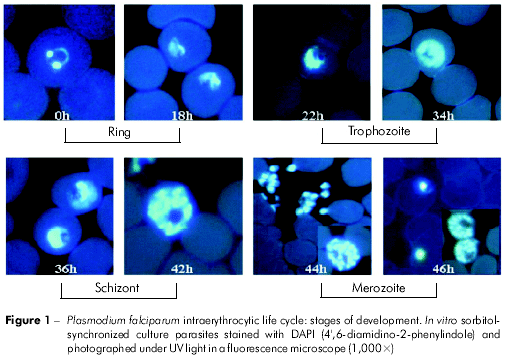
<body><![CDATA[<p><font size="2" face="Verdana"> Malaria infects  both a vertebrate and an invertebrate host. Mosquitoes ingest <i>Plasmodium </i>gametocytes  in a blood meal from an infected vertebrate host, and the gametocytes then  develop into infectious form (sporozoites) within the salivary glands of the  mosquito. Sporogony in the mosquito takes approximately 10 - 20 days, and  thereafter the mosquito remains infective for 1 - 2 months. The schizogonic  phase starts with the inoculation of the parasite into the blood of the  vertebrate host by the bite of a female <i>Anopheles </i>mosquito. In a short  period of time, the sporozoites invade liver cells through a complex cycle<sup>1</sup>  and initiate schizogony, which has two stages, the hepatic stage  (pre-erythrocytic schizogony) and the erythrocytic stage (erythrocytic  schizogony). Within hepatocytes, the trophozoites start their intracellular  asexual division. At the completion of this stage, thousands of  exo-erythrocytic merozoites are released from each infected hepatocyte. The  time taken for the completion of the tissue phase is variable and depends on  the infecting species: 8 - 25 days for <i>P. falciparum, </i>8 - 27 days for <i>P.  vivax, </i>9 - 17 days for <i>P. ovale, </i>15 - 30 days for <i>P. malariae </i>and  9 - 12 days for <i>P.</i></font> <font size="2" face="Verdana"><i>knowlesi</i><sup>2</sup>. This interval is called the pre-patent  period. In the case of <i>P. vivax </i>and <i>P. ovale, </i>some sporozoites  may go into latency, also known as the cryptobiotic phase, where they are  called hypnozoites. They can lie dormant for months or years, and upon  reactivation they cause clinical relapse. The merozoites released from the  hepatocytes enter red blood cells and start asexual division, developing  through the stages of rings, trophozoites, early schizonts and mature  schizonts. Each mature schizont consists of thousands of erythrocytic  merozoites. These merozoites are then released by the lysis of the erythrocyte,  and they immediately invade uninfected erythrocytes. This repetitive cycle of  invasion - multiplication - release - invasion continues. It synchronously  occurs as the merozoites are released at approximately the same time, resulting  in the characteristic clinical manifestations of the disease. A small  proportion of the merozoites in the erythrocyte undergo transformation into  gametocytes, male and female, and the full cycle will be reinitiated if another  female mosquito feeds on the infected vertebrate host.</font></p>     <p><font size="2" face="Verdana"> <b>ASSESSMENT OF ANTIMALARIAL ACTIVITY</b></font></p>     <p><font size="2" face="Verdana"> In general, two basic approaches are  routinely used to study or measure antimalarial activity of compounds: a) <i>in  vivo </i>and b) <i>in vitro. </i>These can be complementary, as data obtained  from <i>in vitro </i>assays require confirmation from the use of live models.</font></p>     <p><font size="2" face="Verdana"> A - An <i>in vivo </i>test is associated with  animal models and their compulsory ethical issues. In these assays, one  measures mainly a) the clearance of parasites as detected by optical microscopy  or other more sensitive methods (polymerase chain reaction - PCR), b) the time  that elapses between last drug dose and clearance of parasitemia, and c) the  drug dosage that clears parasites in a dose response manner.</font></p>     <p><font size="2" face="Verdana"> When adjusted to humans, <i>in vivo </i>studies  usually represent the following of a selected group of symptomatic and  parasitemic individuals that underwent carefully controlled treatment with  subsequent monitoring of the parasitological and/or clinical responses over  time. Diminished therapeutic efficacy of a drug/compound can be masked by  immune-mediated clearance of parasites among hosts with acquired immunity. When  performed with human subjects, <i>in vivo </i>tests most closely reflect actual  clinical or epidemiological situations; that is, the therapeutic response of  currently circulating parasites infecting the actual population in which the  drug will be used.</font></p>     <p><font size="2" face="Verdana"> The screening of antimalarial activity of new  compounds follows standard procedures<sup><a href="#1">*</a></sup>. Non-human <a name="-1" id="-1"></a>primates have provided  experimental models for <i>P. falciparum </i>malaria<sup>3</sup>. Nevertheless,  the use of this animal model has been difficult because of the economic and ethical  considerations, a limited supply of monkeys, the narrow range of parasite lines  that are adapted to primate infection and the different pathology that is seen  in these models<sup>4,5,6</sup>. Consequently, most <i>in vivo </i>experimental  studies on malaria have relied on different combinations of various murine  strains and <i>Plasmodium </i>spp. of rodents<sup>7,8</sup>; however, the  biological differences between parasite species must be taken into account<sup>9</sup>.</font></p>     <p><font size="2" face="Verdana"> External factors, such as host immunity,  variations of drug absorption and metabolism, are reduced by the use of naive  animals from well-known lines in the experiments. Also, potential  misclassification of re-infection is not an issue, as assays use direct  inoculation of blood stage parasites in well-protected animal house  surroundings. However, antimalarial activity measured in an <i>in vivo </i>test  does not always consider relevant side factors, such as metabolism and host  genetics, which can affect the outcome of the experiment.</font></p>     <p><font size="2" face="Verdana"> B - <i>In vitro </i>tests avoid some of the  confounding factors listed above by removing parasites from the host and placing  them into a controlled experimental environment. In the most frequently used  procedure, <i>P. falciparum </i>parasites, obtained from culture or a human  patient, are exposed to precisely known quantities of a drug or compound. Then  the inhibition of parasite maturation is monitored to examine a dose dependent  effect of the drug in preventing parasite development from ring into schizont.  For assays related to sporozoite infectivity, <i>P. berghei </i>sporozoites in  a HepG2 liver cell culture are usually used to study the drug dose effect on  schizont maturation. The correlation of <i>in vitro </i>response data with  clinical response in patients is not consistent, as clinical cure is affected  by the patient's immune system. Another example of the limitation of <i>in  vitro </i>assays is the use of prodrugs, such as proguanil, which requires host  conversion into active metabolites. Although adaptation of erythrocytic forms  of <i>P. vivax </i>to continuous culture has been achieved, their use in assays  is complex and infeasible. In general, these tests are demanding and relatively  expensive, but innovations are being implemented which may make them easier to  adapt to routine field-work and make them more efficient as high-throughput  tools for drug activity screens.</font></p>     <p>&nbsp;</p>     <p><font size="3" face="Verdana"><b>ASSESSMENT OF ANTIMALARIAL ACTIVITY OF  COMPOUNDS DURING ERYTHROCYTIC STAGE</b></font></p>     ]]></body>
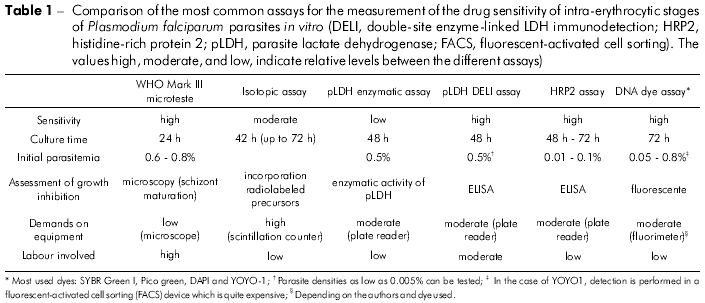
<body><![CDATA[<p><font size="2" face="Verdana">  Antimalarial drug screening and validation is  relatively time consuming and complicated. The first phase of drug screening is  usually comprised of two steps. The first step involves the use of whole cell  assays for the determination of the effect of the compound on the growth of the  human parasite <i>P. falciparum in vitro. </i>The second step involves the  testing of the <i>in vivo </i>efficacy of selected drugs in small animal models  of malaria, mainly using the rodent parasites <i>P. berghei, P. yoelii </i>and <i>P.  chabaudi </i>in laboratory mice.</font></p>     <p><font size="2" face="Verdana"> <b>PARASITE CULTURE</b></font></p>     <p><font size="2" face="Verdana"> Most approaches  to <i>in vitro </i>drug-sensitivity assays are based on the culturing of  malaria parasites in erythrocytes, which was developed in the 1970s<sup>10,11</sup>.  This development allowed for the removal of the parasite from the patient's  bloodstream and its transfer into a highly controlled laboratory environment.  It also allows research in non-endemic regions where there is no supply of  fresh parasite samples. Short-term culture of <i>P. falciparum </i>parasites is  fairly simple and requires little laboratory equipment, and it can be easily  performed under field conditions. Although continuous culture poses  considerably more technical and logistic challenges, it has nevertheless  become  an essential tool in laboratories working on malaria drug development and basic  research. Together, with the capability to cryopreserve live parasites<sup>12</sup>,  culturing provides the basis for studies that require high parasite densities  (proteomics) and for cloning. Although <i>P. falciparum </i>is asynchronous  during <i>in vitro </i>culture, artificial synchronization (<a href="#f1">Figure 1</a>) of  erythrocytic stages of the parasite in culture is useful for studies searching  for erythrocytic stage malaria vaccine candidates.</font></p>     <p><a name="f1" id="f1"></a></p>     <p>&nbsp;</p>     <p align="center"><img src="/img/revistas/rpas/v1n3/3a15f1.gif" border="0"></p>     <p>&nbsp;</p>     <p><font size="2" face="Verdana"><i><b>IN VITRO</b></i><b> TESTS</b></font></p>     <p><font size="2" face="Verdana"> The main objective in drug-sensitivity  testing is to evaluate or measure the parasite (<i>P. falciparum</i>) sensitivity  to increasing drug dosages <i>in vitro; </i>data are presented as percentages  of parasite growth compared to untreated cultures. This approach allows for an  almost complete exclusion of interfering host-related factors, such as host  immunity and host metabolism of the compound, thus offering a direct evaluation  of drug impact. <i>In vitro </i>tests are basically without risk to the  patient, are non-invasive (apart from the collection of a blood sample), and  are crucial for drug development. <i>In vitro </i>tests for screening of  antimalarial activity generally utilize the method of continuous culture  developed by Trager and Jensen<sup>11</sup> and the microculture technique  developed by Rieckmann et al<sup>13</sup>. The short-term <i>in vitro </i>culture  of freshly collected field isolates of <i>P. vivax </i>and <i>P. ovale </i>has  also been established<sup>14,15</sup>, also allowing for the assessment of  antimalarial activity of different drugs on these plasmodium species.</font></p>     <p><font size="2" face="Verdana"> In terms of drug screening, several <i>in  vitro </i>methods are commonly used for the assessment of <i>P. falciparum </i>growth  inhibition: a) schizont counting on thick films, known as the World Health  Organization (WHO) Schizont Maturation assay<sup>16</sup>; b) incorporation of  a radiolabeled nucleic acid precursor (e.g., radiolabeled hypoxanthine) known  as the isotopic assay<sup>17,18</sup>; c) the quantification of parasite  proteins histidine-rich protein 2 (HRP2) and lactate dehydrogenase (LDH) by  enzyme-linked immunosorbent assay (ELISA)<sup>19,20</sup>; and d) DNA dye  intercalation assays<sup>21,22,23,24</sup>.</font></p>     ]]></body>
<body><![CDATA[<p><font size="2" face="Verdana">  <b>Schizont counting on thick films</b></font></p>     <p><font size="2" face="Verdana">  This drug  sensitivity test is based on parasite counts following the evaluation of the  morphology of parasite growth (rings into schizonts) by light microscopy. The  WHO Mark III microtest assay (<a href="#t1">Table 1</a>) is a low-cost alternative standardized  by the WHO<a href="#2"><sup>*</sup></a>. Experienced microscopists<a name="-2" id="-2"></a> should carry out this test, as it is  labor-intensive and prone to individual variability. It is based on the  maturation of <i>P. falciparum </i>in a 24 to 36 h microculture, by  microscopically counting the number of parasites that develop into schizonts  (i.e. parasites with three or more chromatins) in Giemsa-stained thick films.  Despite these drawbacks, the WHO assay is economical and simple to perform in the  field. A number of published reports from Brazil have utilized this technique<sup>25,26,27,28</sup>.</font></p>     <p><a name="t1" id="t1"></a></p>     <p>&nbsp;</p>     <p align="center"><img src="/img/revistas/rpas/v1n3/3a15t1.gif" border="0"></p>     <p>&nbsp;</p>     <p><font size="2" face="Verdana"><b>Isotopic assays</b></font></p>     <p><font size="2" face="Verdana">  The radiolabeled hypoxanthine incorporation  assay (<a href="#t1">Table 1</a>) has been used as the gold standard in <i>P. falciparum </i>drug  susceptibility testing<sup>18</sup>. As an alternative to using radiolabeled  hypoxanthine, Elabbadi et al<sup>29</sup> proposed ethanolamine, which has the  major advantage that the culture medium can be supplemented with hypoxanthine  to improve parasite growth. Several other precursors (e.g., palmitate, serine,  choline, inositol and isoleucine) have also been suggested for use in isotopic  assays<sup>29</sup>. However, regulations regarding the handling of radioactive  materials have become considerably more restrictive, aiming to limit the  application to domains where there is no alternative methodology available.  Another limitation is the high purchase cost of the necessary equipment, such  as liquid scintillation counters and harvesting machines. In addition, the  relatively high parasite densities required for this test (approximately 0.5%)  limits its application to the use of culture-adapted parasite strains or field  samples with adequately high parasitemia. These limitations make it costly and  difficult to routinely use in research and clinical settings, particularly in  resource-limited environments.</font></p>     <p><font size="2" face="Verdana">  <b>Quantification of parasite proteins</b></font></p>     <p><font size="2" face="Verdana">A method that is simple to establish, highly  reproducible, requires little technical equipment and could be applicable to a  field laboratory is the ELISA. A few commercialized ELISA tests are already  available, targeting <i>P. falciparum </i>lactate dehydrogenase (pLDH), pLDH  activity or HRP2<sup>30,19,31,32,33</sup>. The principle behind the use of pLDH  production as a measure of parasite growth comes from the different enzyme  structure of pLDH compared to human LDHs<sup>34</sup> and the rapid decline of  pLDH levels when the parasites die<sup>35</sup>.</font></p>     ]]></body>
<body><![CDATA[<p><font size="2" face="Verdana"> The double-site enzyme-linked pLDH  immunodetection (DELI) assay (<a href="#t1">Table 1</a>) has been used to assess <i>P. falciparum </i>antimalarial drug susceptibility<sup>36,30,19</sup>. It is highly  sensitive, more sensitive than the detection of <i>P. falciparum </i>in blood  smears and equally as sensitive as PCR<sup>19</sup>. This technique can be used  to measure <i>in vitro </i>drug sensitivity of <i>P. falciparum </i>with  greater ease, greater speed, and simpler equipment than that required for  isotopic assays. In contrast with the latter, lower parasite densities can be  tested in the DELI assay (as low as 0.005%), thereby extending the number of  isolates that can be investigated.</font></p>     <p><font size="2" face="Verdana"> The pLDH enzyme activity assay is based on  the observation that the LDH enzyme of <i>P. falciparum </i>has the ability to  rapidly use 3-acetyl pyridine NAD (APAD) as a coenzyme in the reaction, leading  to the formation of pyruvate from lactate. In contrast, human red blood cell  LDH carries out this reaction at a slow rate in the presence of APAD. The  development of APADH is measured, and there is a correlation between levels of  parasitemia and the activity of parasite LDH<sup>37,38</sup>.</font></p>     <p><font size="2" face="Verdana"> The HRP2 assay  (<a href="#t1">Table 1</a>) is based on the measurement of the increase in HRP2 concentrations in <i>P. falciparum </i>culture samples. There is a commercial kit available  (Malaria Ag CELISA, Cellabs Pty. Ltd., Brookvale, NSW, Australia; <a href="http://www.cellabs.com.au/" target="_blank">http://www.cellabs.com.au</a>), which takes  only about 2.5 h to perform. If parasite growth is inhibited by antimalarial  drugs, the inhibition is reflected in the increment of HRP2 levels and can  therefore easily be quantified by antibody-mediated detection<sup>39</sup>.  HRP2 has been reported to show extensive protein sequence diversity (mainly  insertions) in <i>P. falciparum </i>isolates from geographically different  areas<sup>40</sup>, and some isolates from the Amazon region of Peru even the  lack of <i>pfhrp2 </i>gene<sup>41</sup>. Importantly, it has been demonstrated  that the HRP2 protein diversity has an effect on the sensitivities of the HRP2  detection antibodies. For these reasons, there are growing concerns about<a name="-3" id="-3"></a> its  application for field studies. However, this method is widely used by the  Amazon Network for the Surveillance of Antimalarial Drug Resistance (RAVREDA)<sup><a href="#3">*</a></sup>  for drug susceptibility testing.</font></p>     <p><font size="2" face="Verdana"><b>DNA dye intercalation assays</b></font></p>     <p><font size="2" face="Verdana">  Several screening methods have been published  that offer the potential for high-throughput screening of drugs against <i>P.  falciparum, </i>and most are based on automated quantification of parasite  growth after staining parasites with fluorescent DNA binding dyes<sup>42,21,43,44,23,24</sup>.  The principle behind these assays is the contrast between host erythrocytes,  which lack DNA and RNA, and the malaria parasites, which have both DNA and RNA;  thus, parasites are readily stained with dyes that show enhanced fluorescence  in the presence of nucleic acids.</font></p>     <p><font size="2" face="Verdana"> DNA dye-based technologies (<a href="#t1">Table 1</a>), such as  those using DAPI (4, 6-diamidino-2-phenylindole), Pico green, YOYO-1, and SYBR  Green I, have been shown to have comparable results to isotopic assays. In  these assays, the fluorescence of the dyes is measured using either  fluorescence microplate readers or fluorescence activated cell sorters (FACS).  To date, only two of these dyes have been successfully used for high-throughput  screening of existing libraries of compounds: YOYO-1 and DAPI<sup>42,24</sup>. The use of  these assays has increased because they are relatively simple and inexpensive  to run compared to their radioactive and ELISA counterparts</font>.</p>     <p><font size="2" face="Verdana">  <i><b>IN VIVO </b></i><b>ASSESSMENT OF ANTIPLASMODIAL ACTIVITY</b></font></p>     <p><font size="2" face="Verdana"> Drug resistance in malaria has been defined  as the &quot;ability of a parasite strain to survive and/or multiply despite  the administration and absorption of a drug given in doses equal to or higher  than those usually recommended, but within the limits of tolerance of the  subject&quot;. Another reason for failing to clear the parasite from the  patient's body may be that not enough of the drug, or its active metabolite,  reaches the parasite, an event that is termed therapeutic failure. Unlike drug  resistance, therapeutic failure is a process directly related to the parasite  and highly dependent on both the host and the properties of the drug.</font></p>     <p><font size="2" face="Verdana"> Obviously, antimalarial drug discovery  technologies are targeted to eliminate human disease. There is large  heterogeneity in the behavior of patients and between different populations  owing to gene polymorphisms, redundant targets, differently regulated pathways  and environment challenges.</font></p>     <p><font size="2" face="Verdana">  <b>Follow-up of patients</b></font></p>     ]]></body>
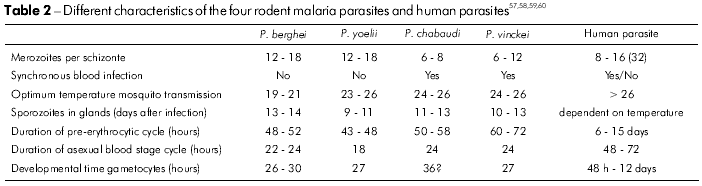
<body><![CDATA[<p><font size="2" face="Verdana">  In humans, the most traditional approach to  determine <i>P. falciparum </i>susceptibility to antimalarial drugs is the  assessment of the therapeutic (<i>in vivo) </i>response, which was originally  defined by WHO in terms of parasite clearance &#91;sensitive (S) and three  increasing degrees of resistance (RI, RII, RIII)&#93;. Because re-infection is difficult to exclude in areas with intense malaria transmission, WHO introduced  a modified protocol based on clinical outcome (adequate clinical response,  early treatment failure and late treatment failure) for areas with intense  transmission, where parasitemia in the absence of clinical signs<a name="-4" id="-4"></a> or symptoms is  common<sup><a href="#4">*</a></sup>. Currently, the classification system extends the follow-up period to  28 days and includes different criteria for the definition of Early Treatment  Failure, Late Clinical Failure and Late Parasitologic Failure, for<a name="-5" id="-5"></a> areas with  intense and low to moderate transmission<sup><a href="#5">&#134;</a></sup>. The development of  molecular tools has made it possible to distinguish incidents of recrudescence  from re-infections<sup>45</sup>. All <i>in vivo </i>tests should be carried out  with standard therapeutic doses and performed according to WHO guidelines<sup><a href="#6">&#135;</a></sup>. For <i>P. vivax, </i>criteria <a name="-5" id="-5"></a>are different from those for <i>P. falciparum</i><sup><a href="#5">&#134;</a></sup>. The  proliferation of antimalarial drug trials in the last ten years provides the  opportunity to launch a concerted global surveillance effort to monitor  antimalarial drug efficacy. The proposed World Antimalarial Resistance Network  (WARN)<sup><a href="#7">&#167;</a></sup> aims to establish <a name="-7" id="-7"></a>a comprehensive clinical database from which  standardized estimates of antimalarial efficacy can be derived and monitored  over time for diverse geographical and endemic regions<sup>46</sup>. The  widespread adoption of such an approach will permit accurate and timely  recognition of trends in drug efficacy, guiding the appropriate interventions  to deal with established multidrug-resistant parasite strains and accelerate  action when new strains of drug-resistant plasmodia first emerge.</font></p>     <p><font size="2" face="Verdana">  <b>Rodent models for <i>in vivo </i>screening of  antimalarial activity</b></font></p>     <p><font size="2" face="Verdana">  Four species of African rodent malaria  parasites have been adapted for growth in laboratory mice: <i>P. berghei, </i>1948<sup>47</sup>; <i>P. chabaudi, </i>1965<sup>48</sup>; <i>P. vinckei, </i>1952<sup>49</sup>; and <i>P. yoelii, </i>1965<sup>50</sup> (<a href="#t2">Table 2</a>). These  model parasites have become widely used primarily due to the ease of handling  and maintaining rats and mice in the laboratory; additionally, their life cycle  can be maintained in the laboratory through cyclical transmission, using <i>Anopheles  stephensi </i>and <i>A. gambiae, </i>which are also easily maintained in the  laboratory.</font></p>     <p><a name="t2" id="t2"></a></p>     <p>&nbsp;</p>     <p align="center"><img src="/img/revistas/rpas/v1n3/3a15t2.gif" border="0"></p>     <p>&nbsp;</p>     <p><font size="2" face="Verdana"> Although direct  extrapolation from rodent model biology to <i>P. falciparum </i>biology might  not be applicable in all situations, each of the four rodent malaria species  has similar characteristics to the four human malaria species, making them  suitable for parallel study. For example, antigenic variation in <i>P. chabaudf</i><sup>51</sup> <i>in vivo </i>drug testing with <i>P. berghei</i><sup>52</sup>, or <i>P.  chabaudi</i><sup>53</sup>, cerebral malaria with <i>P. bergei </i>ANKA<sup>54</sup>,  pre-erythrocytic stage vaccines with <i>P. yoelii</i><sup>55</sup> and  chronobiology of <i>P. vinckei</i><sup>56</sup>.</font></p>     <p><font size="2" face="Verdana">One of the most used <i>in vivo </i>dose-response  tests for antimalarial activity is the four-day suppression test, originally  designed by Peters<sup>61</sup>. Briefly, female mice are infected with rodent  malaria parasites and the different treatment doses are given after infection  on day 0 and repeated once daily for three days. On day 4 and day 7  post-infection, parasitemia is assessed. After day 7, no further manipulations  are performed on the mice and they are monitored for survival.</font></p>     <p><font size="2" face="Verdana">  Non-human primate, rodent or avian parasites  have been used as surrogates of <i>P. falciparum</i><sup>62</sup>. However, in  spite of their value, there are significant biological differences between  these species and the human parasites<sup>63,64</sup>. Recently, a reliable  murine model of <i>P. falciparum </i>malaria has been established and is a  valuable research tool, particularly in the field of drug discovery. The  development of <i>P. falciparum</i>-infected humanized mice (HM) by  successfully infecting <i>nude </i>or <i>scid </i>mice with <i>P. falciparum </i>parasites<sup>65,66,67,68,69</sup>  has facilitated the harvesting of exo-erythrocytic, intra-erythrocytic, and  cytoadherent intraerythrocytic stages of the parasite. It is possible to devise  new <i>falciparum </i>murine models using HM immunodeficient mice expressing  human adhesion molecules in the endothelium that also have specific defects in  phagocyte activity/activation. These tools will hopefully open up additional  ways to study the biology of the erythrocytic stages of <i>P. falciparum in  vivo; </i>further, its molecular responses to selective pressures imposed by  antimalarials or the human immune system reconstituted in mice could also be  examined<sup>70,71,65,72</sup>. In fact, Angulo-Barturen and collaborators<sup>73</sup>  succeeded in obtaining a dose-response relationship for antimalarials using a <i>P.  falciparum </i>HM model.</font></p>     ]]></body>
<body><![CDATA[<p>&nbsp;</p>     <p><font size="3" face="Verdana"><b>SAFETY (CYTOTOXICITY) ASSAYS</b></font></p>     <p><font size="2" face="Verdana">  A cytotoxicity assay is a rapid and  cost-effective tool to help choose optimal candidates and to sort out likely  failures before a compound is entered into the costly development process.  Cytotoxicity primarily is considered as the potential of a compound to induce  cell death. A reasonably good correlation has been found between basal  cytotoxicity and acute toxicity in animals and humans<sup>74</sup>. Besides  antimalarial activity, a promising antimalarial compound must also lack  toxicity to host cells. The degree of selectivity a compound shows for the  malaria parasite can be expressed by its selectivity index &#91;SI = IC50cells/IC50  parasite (IC50, concentration that inhibits 50% of parasites)&#93;. The higher the  SI, the more promise a compound holds, due to its selectivity for the malaria  parasite<sup>75</sup>. However, an SI below 2.0 indicates that a compound may  possess strong antimalarial activity but may be a general toxin and should not  be considered as a candidate. In practice, a drug is potentially interesting as  an antimalarial if its IC50 is below 10 &#181;M<sup>76</sup>.</font></p>     <p><font size="2" face="Verdana"> Though a number of organisms can be used, <i>in  vitro </i>cell culture methods are generally accepted as an effective method  for cytotoxicity screening of new compounds. The advantages of these systems  over classical methods, such as long-term studies on experimental animals like  rats, mice or even the less frequent brine shrimp lethality assay<sup>77</sup>,  include relatively well-controlled variables, decreased costs, a reduced time  to completion, and reduced numbers of animals necessary to complete the study.  There are six common targets of xenobiotic toxicity: liver, blood, kidney,  nerve, lung and skin. There are many cell types available for each target:  liver, HepG2<sup>78</sup> and BEL-7402; blood, HL60 and K160; kidney, Vero and  HEK293; nerve, XF498 and NG108-15; lung, WI-38 and A549; skin, SK-MEL-2 and  Lox. HepG2 is one of the most frequently used cell lines by pharmaceutical  companies (GlaxoSmithKline<sup>79</sup>) to screen for cytotoxicity in  libraries of compounds.</font></p>     <p><font size="2" face="Verdana"> In works involving active anti-plasmodium  compounds, the most frequently used cytotoxicity endpoints tested are based on  a) the breakdown of the cellular permeability barrier (LDH leakage assay)<sup>80</sup>,  b) protein content<sup>81</sup>, c) neutral red accumulation<sup>82</sup>, and  d) reduced mitochondrial function &#91;MTT assay  (3-(4,5-dimethylthiazol-2-yl)-2,5-dimethyltetrazolium bromide&#93;<sup>83</sup>.  Each of these methods can be performed in microcultures, using multiple sample  concentrations on 96-well or 384-well plates, thus allowing high throughput  testing of large libraries of compounds.</font></p>     <p><font size="2" face="Verdana"> a) The LDH  leakage assay is based on the measurement of LDH activity in the extracellular  medium. LDH activity is measured based on the diaphorase-mediated conversion of  resazurin into the fluorescent resorufin product after LDH-catalyzed enzymatic  conversion of lactate to pyruvate. The loss of intracellular LDH and its  release into the culture medium is an indicator of irreversible cell death due  to cell membrane damage. This assay is characterized by its reliability, speed  and simple evaluation<sup>80</sup>.</font></p>     <p><font size="2" face="Verdana">b) The protein content assay is an indirect  measurement of the cellular protein content of adherent and suspension  cultures. It works by coloration with sul-forhodamine B (SRB) and subsequent  determination of optical density (490 nm) in a microtiter plate reader. The  assay provides a colorimetric endpoint test, but SRB also fluoresces strongly  with laser excitation at 488 nm and can be measured quantitatively at the  single-cell level by static fluorescence cytometry<sup>81</sup>.</font></p>     <p><font size="2" face="Verdana"> c) The neutral red assay is based on the ability  of viable cells to incorporate and bind the supravital dye neutral red in the  lysosomes<sup>82</sup>. The dye is then extracted and quantified by absorbance  reading using a spectrophotometer.</font></p>     <p><font size="2" face="Verdana"> d) Finally, the MTT assay has been used in  different cell lines to assess cell viability. The assay involves conversion of  the tetrazolium salt MTT, by mitochondrial dehydrogenases in viable  proliferating cells, to an insoluble purple product formazan. Amounts of  formazan are then rapidly quantitated using an automated spectrophotometric  microplate reader<sup>83</sup>.</font></p>     <p>&nbsp;</p>     ]]></body>
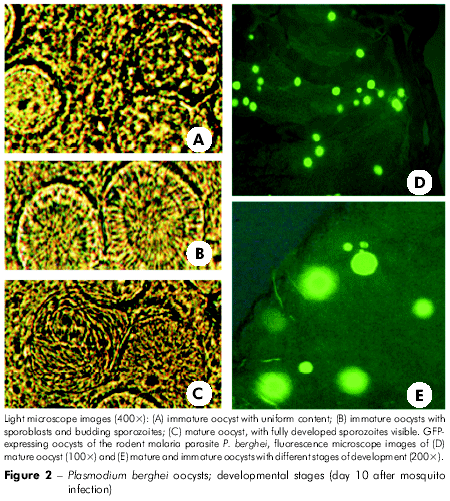
<body><![CDATA[<p><font size="3" face="Verdana">  <b>ASSESSMENT OF TRANSMISSION-BLOCKING ACTIVITY  OF CANDIDATE DRUGS</b></font></p>     <p><font size="2" face="Verdana">  The rapid emergence of resistance to  antimalarial <a name="-8" id="-8"></a>drugs from diverse chemical classes<sup><a href="#8">*</a></sup> is a major factor affecting  the treatment and control of malaria<sup>84</sup>. The use of compounds capable  of interrupting the transmission of malaria has been advocated as a way of  preventing the development of drug resistance and limiting the spread of  resistant parasites<sup>85,86,87,88</sup>. Gametocytocidal antimalarials, and  the artemisinines in particular, might accelerate the process of malaria  control as they reduce post-treatment transmission<sup>89,90,91</sup>. However,  artemisinin derivatives do not completely prevent post-treatment transmission<sup>92</sup>,  and in view of emerging artemisinin combined therapy (ACT) resistance in South-East Asia<sup>93,94,95</sup>,  alternative drugs effective against gametocytes are urgently needed.</font></p>     <p><font size="2" face="Verdana"> Transmission-blocking antimalarial drugs can  affect the sexual stages of the parasite in the human host (gametocytocidal  activity) or the development of the parasite in the mosquito (sporontocidal  activity).</font></p>     <p><font size="2" face="Verdana"> <b>EFFECT ON MICROGAMETOGENESIS (EXFLAGELLATION  ASSAY)</b></font></p>     <p><font size="2" face="Verdana"> Exflagellation is the process in which an  activated microgametocyte produces flagellar microgametes. The microgametes  avidly adhere to neighboring erythrocytes to form multicellular exflagellation  centers, which can be observed microscopically<sup>96</sup>. Gametocyte  activation is triggered <i>in vitro </i>by simultaneous exposure to two  stimuli: a drop in temperature of more than 5<sup>o</sup> C<sup>97</sup> and a pH shift from 7.5&nbsp; to&nbsp; 8.0<sup>98,99,100</sup>.&nbsp; The standard&nbsp;  method&nbsp; to&nbsp; monitor successful gametogenesis is by  counting exflagellation centers under the microscope. However, as this method  is labor-intensive, somewhat subjective, and cannot be automated, it is not  suited for medium-throughput applications. DNA replication during  microgametogenesis has been previously investigated, using DNA staining with  various fluorescent dyes and subsequent analysis of individual cells by  fluorescence microscopy or of cell populations by flow cytometry<sup>101,102</sup>.  However, these methods are not easily adapted to higher throughput assays.  Recently, an assay adapted to the 96-well format to monitor activation of  gametocytes based on the incorporation of radioactive hypoxanthine into the  newly synthesized DNA of microgametes has been developed<sup>103</sup>.</font></p>     <p><font size="2" face="Verdana"> <b>EVALUATION OF THE IMPACT OF ANTIMALARIALS ON  SPOROGONIC DEVELOPMENT</b></font></p>     <p><font size="2" face="Verdana"> Post-treatment gametocyte carriage in humans  can be examined<sup>104</sup>, despite a number of ethical considerations.  Alternatively, a rodent model where the animals are infected and then treated  can be used. Experimental mice are infected by intraperitoneal inoculation of  infected red blood cells, and five days after infection, the presence of mature  gametocytes is verified by the presence of exflagellation observed  microscopically in blood drops. Gametocytemic mice are then treated with the  compound to be tested and placed over cages containing mosquitoes. Ten days  after the blood meal, mosquitoes are dissected and their midguts are examined  under the light microscope (400x) to assess for the presence or absence of  oocysts<sup>105,106</sup>. Traditionally, oocysts were visualized by staining  with 0.5% mercurochrome. The development of fluorescent protein (GFP)  transformed rodent parasites has made the detection of oocysts in the midgut  easier because GFP-generated fluorescence can be easily and rapidly detected in  a fluorescent microscope (<a href="#f2">Figure 2</a>).</font></p>     <p><a name="f2" id="f2"></a></p>     <p>&nbsp;</p>     <p align="center"><img src="/img/revistas/rpas/v1n3/3a15f2.gif" border="0"></p>     ]]></body>
<body><![CDATA[<p>&nbsp;</p>     <p><font size="2" face="Verdana"> Evaluation of the impact on oocyst maturation  can be established by observing the oocyst developmental status. Example  categories of development include the following: a) immature oocyst, before the  formation of sporoblasts; b) immature oocyst, with visible sporoblasts and  budding sporozoites; and c) mature oocyst, containing fully developed  sporozoites. Oocyst development can also be quantified by measuring oocyst  diameter using an ocular micrometer.</font></p>     <p><font size="2" face="Verdana"> Transmission-blocking  activity is ultimately evaluated by removing mosquito salivary glands on day 21  post&shy;infection and examining them for the presence or  absence of sporozoites by phase-contrast microscopy<sup>86,87,88</sup>, or by  allowing these mosquitoes to feed on uninfected mice and then checking for  parasitemia in the mice on subsequent days.</font></p>     <p>&nbsp;</p>     <p><font size="3" face="Verdana"><b>ASSESSMENT OF ANTIMALARIAL ACTIVITY OF  COMPOUNDS DURING THE HEPATIC STAGE</b></font></p>     <p><font size="2" face="Verdana">  This stage is a  link between the extracellular sporozoite, inoculated by the mosquito vector,  and the blood stage, which is responsible for producing disease.</font></p>     <p><font size="2" face="Verdana"><b>ANTIMALARIAL EXO- ERYTHROCYTIC SCHIZONTOCIDAL  ASSAY</b></font></p>     <p><font size="2" face="Verdana"> The development of pharmaceutical products  inhibiting the growth of hepatic forms of <i>Plasmodium </i>is relevant for two  main reasons. First, such compounds could be used as prophylactic agents by  people exposed for a limited duration in an area where malaria is endemic  (e.g., refugees and travelers) and, second, the emergence of drug-resistant  strains is theoretically limited during the liver phase because of the lower  parasitic load compared to the blood phase. Although hepatic stages provide  attractive targets for antimalarial chemotherapy, the list of effective and  widely available drugs is still limited. The only currently available  prophylactic drugs are atovaquone and the two related drugs, primaquine and  tafenoquine. Atovaquone has been demonstrated to be efficient in the inhibition  of parasite development<sup>107</sup>, however, its use is limited because of  its high cost. Hematological toxicity restricts the use of primaquine,  particularly in Africa because of the elevated  frequency of Glucose-6-phosphate dehydrogenase (G6PD) deficiency in the human  population<sup>108</sup>. The identification of new drugs is slowed down by the  lack of a reliable and sensitive method that can be utilized in high-throughput  screening.</font></p>     <p><font size="2" face="Verdana"> Despite the  significant advances, the exo-erythrocytic (EE) stages of mammalian malarial  parasites remain the east understood of all stages of the parasite's life  cycle. The earliest and most prolific cultures of EE stages were achieved using  the avian parasites <i>P. fallax, P. gallinaceum </i>and <i>P. cathemerium, </i>cultured  in chicken embryos or <i>in </i>vitro<sup>109,110,111,112</sup>.  However, the biological disparity between the EE cycle in avian and mammalian  malarial parasites, the differences in host immune systems, and the role of the  hepatocyte greatly limit the use of the culture system as a model for human  malaria. Some laboratories have pursued the use of primary hepatocytes from  susceptible natural and laboratory hosts<sup>113</sup>. Primary hepatocytes have the  advantage that they can be obtained from animals that are histocompatible to  experimentally immunized hosts. In addition, they may allow for the testing of  drugs requiring metabolic activation, although qualitative and quantitative  inter-species differences commonly exist in the pathways of hepatic drug  metabolism. However, primary hepatocytes also suffer from a number of major disadvantages:  (1) the metabolic profile of the hepatocyte will vary during the period of  culture; (2) the density of parasites obtained using these cells is relatively  low; (3) for technical reasons, preparations will vary from experiment to  experiment and between laboratories; and (4) the preparations will vary  depending upon the nutritional status and other characteristics of the host.</font></p>     <p><font size="2" face="Verdana">Advances were made by the introduction of the  hepatoma cell lines HepG2-A16 and Huh7<sup>114</sup>. However, in  drug-sensitivity studies hepatoma cell lines may not faithfully reproduce drug  metabolism by primary hepatocytes. For example, although HepG2 cells can perform  cytochrome P-450 dependent mixed function oxidase and conjugation reactions,  differences have been observed in the activities of some of the drug  metabolizing enzymes as compared with freshly isolated primary human  hepatocytes<sup>115,116</sup>. Primaquine, which is believed to require  activation by the host cell, has a low activity against <i>P. berghei </i>EE  forms cultured in HepG2 cells<sup>117</sup> compared to <i>P. yoelii </i>grown  in primary <i>Thamnomys </i>hepatocytes<sup>118</sup>. This may reflect the  inability of HepG2 to transform primaquine into its active state. To obtain a  more complete picture of the activity of individual drugs, several different  culture systems should ideally be used.</font></p>     ]]></body>
<body><![CDATA[<p><font size="2" face="Verdana"> The <i>in vitro </i>cultivation of the EE  forms of <i>P. berghei </i>(ANKA strain) or <i>P. yoelii </i>(265BY strain), by  infection of the HepG2 cell line with sporozoites produced in <i>Anopheles  stephensi </i>mosquitoes<sup>119,78</sup>, constitutes one of the most used assays to assess  the antimalarial activity of compounds during the hepatic stage.</font></p>     <p><font size="2" face="Verdana">  <i>In vitro </i>drug sensitivity assays are largely based on  counting the number of hepatic cells containing schizonts in  sporozoite-infected cultures<sup>120,113,114</sup>. Although alternative  methods have been proposed to detect exo-erythrocytic schizonts including the  use of quantitative RT-PCR (qRT-PCR) methods<sup>121,122,123</sup>, the use of  ribosomal RNA probes<sup>124</sup>, the use of infrared imaging system combined  with a colony counter<sup>125</sup>, and detection in culture and in live mice  using real-time luminescence imaging<sup>126</sup>, the number of infected  cells is still largely measured by fluorescence microscopy analysis. These  methods are not only prone to large variations between observers but are also  time consuming given the low infection rates (generally less than 2%) observed  in cultured hepatocytes<sup>125</sup>. Transgenic rodent malaria parasites  (GFP-expressing parasites) expressing the fluorescent reporter protein  luciferase have been developed<sup>127,128</sup>. The luminescence-based  analysis of the effects of various drugs on <i>in vitro </i>hepatocyte  infection using these parasites shows that these models can effectively be used  for <i>in vitro </i>and <i>in vivo </i>screening of compounds targeting <i>Plasmodium </i>liver stages<sup>129</sup>. This strategy is a reproducible system in which  a cloned parasite grows to maturity in a defined host cell, at the same rate  and with the same morphology as that observed in a convenient laboratory host.  Further, it represents a routine and reproducible assay for the growth of EE  stages, which is both objective and statistically robust.</font></p>     <p>&nbsp;</p>     <p><font size="3" face="Verdana"><b>THE ORDEAL OF CHOICE</b></font></p>     <p><font size="2" face="Verdana">  The abundance of available drug-sensitivity  assays obviously leaves the researcher with the difficulty of choice. Both the  WHO microtest and the isotopic assays have proven their reliability in their  respective disciplines after more than two decades of use; the WHO assay in the  field, the isotopic assay in well-equipped research laboratories. However, both  assays are associated with serious drawbacks. The WHO assay is both subjective  and labor-intensive, whereas the isotopic assay lacks sensitivity and involves  the handling of radioactive material. The new colorimetric assays, the  ELISA-based DELI and HRP2 assays and the DNA dye intercalation assays overcome  many of these disadvantages and might currently be the methods of choice. They  are sensitive, relatively simple and rapid, do not require highly specialized  equipment, and have the potential to replace traditional assays. However, they  are still a long way from the 'drug resistance dipstick'. As more information  on the genetic background of resistance becomes available, and as new and  improved tools (such as real-time PCR) are developed, molecular techniques  might become an extremely valuable tool for the surveillance and early  detection of antimalarial drug resistance in the future.</font></p>     <p><font size="2" face="Verdana"> Drug assays are  fundamental to malaria research and should always be complemented with clinical  studies, host genetic studies related to drug metabolism, molecular markers for  the quicker identification of presence of resistance in the field, and new  diagnostic methods mainly applied to drug susceptibility characterization.</font></p>     <p>&nbsp;</p>     <p><font size="3" face="Verdana">  <b>ACKNOWLEDGMENTS</b></font></p>     <p><font size="2" face="Verdana"> The authors  would like to acknowledge the many valuable suggestions made by Dr. Marcelo  Silva (PhD), researcher at Centro de Mal&aacute;ria e Outras Doen&ccedil;as Tropicais LA,  Universidade Nova de Lisboa, Lisbon,   Portugal.</font></p>     <p>&nbsp;</p>     ]]></body>
<body><![CDATA[<p><font size="3" face="Verdana"><b>REFERENCES</b></font></p>     <!-- ref --><p><font size="2" face="Verdana">  1 Mota MM, Rodriguez A. Invasion of mammalian host  cells by <i>Plasmodium </i>sporozoites. Bioessays. 2002 Feb;24(2):149-56.</font><font size="2" face="verdana"><font size="2" face="verdana">&nbsp; &nbsp; &nbsp; &nbsp;  &nbsp;&#91; <a href="http://www.ncbi.nlm.nih.gov/pubmed/11835279" target="_blank">Links</a> &#93;</font></font><!-- ref --><p><font size="2" face="Verdana"> 2 Ng OT, Ooi EE, Lee CC, Lee PJ, Ng LC, Pei SW, et al. Naturally acquired human <i>Plasmodium knowlesi </i>infection, Singapore.  Emerg Infect Dis. 2008 May;14(5):814-6.</font><font size="2" face="verdana"><font size="2" face="verdana">&nbsp; &nbsp; &nbsp; &nbsp;  &nbsp;&#91; <a href="http://www.cdc.gov/eid/content/14/5/814.htm" target="_blank">Links</a> &#93;</font></font><!-- ref --><p><font size="2" face="Verdana"> 3 Carlton JM, Muller R, Yowell CA, Fluegge MR, Sturrock KA, Pritt JR, et al. <i>Plasmodium falciparum: </i>studies on mature exoerythrocytic forms in the liver  of the chimpanzee, <i>Pan troglodytes. </i>Exp Parasitol. 1990 Jan;70(1):1-11.</font><font size="2" face="verdana"><font size="2" face="verdana"> DOI:10.1016/0014-4894(90)90080-V&nbsp; &nbsp; &nbsp; &nbsp;  &nbsp;&#91; <a href="http://www.ncbi.nlm.nih.gov/pubmed/2403931" target="_blank">Links</a> &#93;</font></font><!-- ref --><p><font size="2" face="Verdana"> 4 Evans KJ, Hansen DS, van Rooijen N, Buckingham  LA, Schofield L. Severe malarial anemia of low parasite burden in rodent models  results from accelerated clearance of uninfected erythrocytes. Blood. 2006 Feb;107(3):1192-9. DOI:10.1182/blood-2005-08-3460 </font><font size="2" face="verdana"><font size="2" face="verdana">&nbsp; &nbsp; &nbsp; &nbsp;  &nbsp;&#91; <a href="http://www.ncbi.nlm.nih.gov/pmc/articles/PMC1895912/?tool=pubmed" target="_blank">Links</a> &#93;</font></font><!-- ref --><p><font size="2" face="Verdana"> 5 Sanni LA, Fonseca LF, Langhorne J. Mouse models  for erythrocytic-stage malaria. Methods Mol Med.   2002;72:57-76. DOI:10.1385/1-59259-271-6:57</font><font size="2" face="verdana"><font size="2" face="verdana">&nbsp; &nbsp; &nbsp; &nbsp;  &nbsp;&#91; <a href="http://www.springerlink.com/content/g208131482374k21/" target="_blank">Links</a> &#93;</font></font><!-- ref --><p><font size="2" face="Verdana"> 6 Stevenson MM, Gros P, Olivier M, Fortin A,  Serghides L. Cerebral malaria: human versus mouse studies. Trends Parasitol.  2010 Jun;26(6):274-5.</font><font size="2" face="verdana"><font size="2" face="verdana"> DOI:10.1016/J.PT.2010.03.008&nbsp; &nbsp; &nbsp; &nbsp;  &nbsp;&#91; <a href="http://www.ncbi.nlm.nih.gov/pubmed/20382077" target="_blank">Links</a> &#93;</font></font><!-- ref --><p><font size="2" face="Verdana"> 7 Carlton JM, Muller R, Yowell CA, Fluegge MR, Sturrock KA, Pritt JR, et al. Profiling the malaria genome: a gene survey  of three species of malaria parasite with comparison to other apicomplexan species.  Mol Biochem  Parasitol. 2001 Dec;118(2):201-10.</font><font size="2" face="verdana"><font size="2" face="verdana"> DOI:10.1016/S0166-6851(01)00371-1&nbsp; &nbsp; &nbsp; &nbsp;  &nbsp;&#91; <a href="http://www.ncbi.nlm.nih.gov/pubmed/11738710" target="_blank">Links</a> &#93;</font></font><!-- ref --><p><font size="2" face="Verdana"> 8 Hernandez-Valladares  M, Rihet P, ole-MoiYoi OK, Iraqi FA. Mapping of a new quantitative trait locus for resistance to malaria in mice  by a comparative mapping approach with human Chromosome 5q31-q33.  Immunogenetics. 2004 May;56(2):115-7. DOI 10.1007/s00251-004-0667-0</font><font size="2" face="verdana"><font size="2" face="verdana">&nbsp; &nbsp; &nbsp; &nbsp;  &nbsp;&#91; <a href="http://www.springerlink.com/content/ugyx7u5xh2epb9y9/" target="_blank">Links</a> &#93;</font></font><!-- ref --><p><font size="2" face="Verdana"> 9 Walliker D. Ronald Ross: malariologist and  polymath. A biography. Parasitol Today. 1998 May;14(5):210.</font> <font size="2" face="Verdana">DOI:10.1016/S0169-4758(98)01230-7</font><!-- ref --><p><font size="2" face="Verdana"> 10 Haynes JD, Diggs CL, Hines FA, Desjardins RE. Culture  of human malaria parasites <i>Plasmodium falciparum. </i>Nature. 1976 Oct;263(5580):767-9. DOI:10.1038/263767a0</font><font size="2" face="verdana"><font size="2" face="verdana">&nbsp; &nbsp; &nbsp; &nbsp;  &nbsp;&#91; <a href="http://www.nature.com/nature/journal/v263/n5580/abs/263767a0.html" target="_blank">Links</a> &#93;</font></font><!-- ref --><p><font size="2" face="Verdana"> 11 Trager W, Jensen JB. Human malaria parasites  in continuous culture. Science. 1976 Aug;193(4254):673-5.</font><font size="2" face="verdana"><font size="2" face="verdana"> DOI:10.1126/science.781840&nbsp; &nbsp; &nbsp; &nbsp;  &nbsp;&#91; <a href="http://www.ncbi.nlm.nih.gov/pubmed/781840" target="_blank">Links</a> &#93;</font></font><!-- ref --><p><font size="2" face="Verdana"> 12 Diggs C, Joseph K, Flemmings B, Snodgrass R,  Hines F. Protein synthesis in vitro by cryopreserved <i>Plasmodium falciparum. </i>Am  J Trop Med Hyg. 1975   Sep;24(5):760-3.</font><font size="2" face="verdana"><font size="2" face="verdana">&nbsp; &nbsp; &nbsp; &nbsp;  &nbsp;&#91; <a href="http://www.ncbi.nlm.nih.gov/pubmed/811124" target="_blank">Links</a> &#93;</font></font><!-- ref --><p><font size="2" face="Verdana"> 13 Rieckmann KH, Campbell GH, Sax LJ, Mrema JE. Drug sensitivity of <i>Plasmodium falciparum: </i>an <i>in-vitro</i>  microtechnique. Lancet. 1978 Jun;1(8054):22-3.</font><!-- ref --><p><font size="2" face="Verdana"> 14 Basco LK, Le Bras J. In vitro susceptibility of  Cambodian isolates of <i>Plasmodium falciparum </i>to halofantrine,  pyrona rid in e an d a rtemi sin in derivatives. Ann Trop Med&nbsp;&nbsp; Parasitol. 1994 </font><font size="2" face="Verdana">Apr;88(2):137-44.</font><font size="2" face="verdana"><font size="2" face="verdana">&nbsp; &nbsp; &nbsp; &nbsp;  &nbsp;&#91; <a href="http://www.ncbi.nlm.nih.gov/pubmed/8067809" target="_blank">Links</a> &#93;</font></font><!-- ref --><p><font size="2" face="Verdana"> 15 Russell BM, Udomsangpetch R, Rieckmann KH,  Kotecka BM, Coleman RE, Sattabongkot J. Simple <i>in vitro </i>assay for  determining the sensitivity of <i>Plasmodium vivax </i>isolates from fresh  human blood to antimalarials in areas where <i>P. vivax </i>is endemic.  Antimicrob Agents Chemother. 2003  Jan;47(1):170-3. DOI:10.1128/AAC.47.1.170-173.2003</font><font size="2" face="verdana"><font size="2" face="verdana">&nbsp; &nbsp; &nbsp; &nbsp;  &nbsp;&#91; <a href="http://aac.asm.org/cgi/content/full/47/1/170?view=long&amp;pmid=12499187" target="_blank">Links</a> &#93;</font></font><!-- ref --><p><font size="2" face="Verdana"> 16 Wernsdorfer WH, Kouznetsov RL. Drug-resistant  malaria: occurrence, control, and surveillance. Bull World Health Organ.  1980;58(3):341-52.</font><font size="2" face="verdana"><font size="2" face="verdana">&nbsp; &nbsp; &nbsp; &nbsp;  &nbsp;&#91; <a href="http://www.ncbi.nlm.nih.gov/pubmed/6998589" target="_blank">Links</a> &#93;</font></font><!-- ref --><p><font size="2" face="Verdana"> 17 Chulay JD, Haynes JD, Diggs CL. <i>Plasmodium  falciparum: </i>assessment of <i>in vitro </i>growth by &#91;<sup>3</sup>H&#93; hypoxanthine  incorporation. Exp Parasitol. 1983   Feb;55(1):138-46. </font><font size="2" face="verdana"><font size="2" face="verdana">DOI:10.1016/0014-4894(83)90007-3&nbsp; &nbsp; &nbsp; &nbsp;  &nbsp;&#91; <a href="http://www.ncbi.nlm.nih.gov/pubmed/6337059" target="_blank">Links</a> &#93;</font></font><!-- ref --><p><font size="2" face="Verdana"> 18 Desjardins RE, Canfield CJ, Haynes JD, Chulay  JD. Quantitative assessment of antimalarial activity <i>in vitro </i>by a  semiautomated microdilution technique. Antimicrob Agents Chemother. 1979 Dec;16(6):710-8.</font><font size="2" face="verdana"><font size="2" face="verdana">&nbsp; &nbsp; &nbsp; &nbsp;  &nbsp;&#91; <a href="http://www.ncbi.nlm.nih.gov/pmc/articles/PMC352941/?tool=pubmed" target="_blank">Links</a> &#93;</font></font><!-- ref --><p><font size="2" face="Verdana"> 19 Druilhe P, Moreno A, Blanc C, Brasseur PH, Jacquier P. A colorimetric <i>in vitro </i>drug sensitivity assay for <i>Plasmodium  falciparum </i>based on a highly sensitive double-site lactate dehydrogenase  antigen-capture enzyme-linked immunosorbent assay. Am J Trop Med Hyg. 2001  May-Jun;64(5-6):233-41.</font><font size="2" face="verdana"><font size="2" face="verdana">&nbsp; &nbsp; &nbsp; &nbsp;  &nbsp;&#91; <a href="http://www.ajtmh.org/cgi/reprint/64/5/233.pdf" target="_blank">Links</a> &#93;</font></font><!-- ref --><p><font size="2" face="Verdana"> 20 Noedl H, Wernsdorfer WH, Miller RS, Wongsrichanalai C. Histidine-rich protein II: a novel approach to  malaria drug sensitivity testing. Antimicrob Agents Chemother. 2002 Jun;46(6):1658-64.</font><font size="2" face="verdana"><font size="2" face="verdana">&nbsp; &nbsp; &nbsp; &nbsp;  &nbsp;&#91; <a href="http://aac.asm.org/cgi/content/full/46/6/1658?view=long&amp;pmid=12019072" target="_blank">Links</a> &#93;</font></font><!-- ref --><p><font size="2" face="Verdana"> 21 Corbett Y, Herrera L,  Gonzalez J, Cubilla L, Capson TL, Coley PD, et al. A novel  DNA-based microfluorimetric method to evaluate antimalarial drug activity. Am J  Trop Med Hyg. 2004 Feb;70(2):119-24.</font><font size="2" face="verdana"><font size="2" face="verdana">&nbsp; &nbsp; &nbsp; &nbsp;  &nbsp;&#91; <a href="http://www.ajtmh.org/cgi/reprint/70/2/119.pdf" target="_blank">Links</a> &#93;</font></font><!-- ref --><p><font size="2" face="Verdana"> 22 Johnson JD, Dennull RA, Gerena L,  Lopez-Sanchez M, Roncal NE, Waters NC. Assessment and  continued validation of the MSF assay for use in malaria drug screening.  Antimicrob Agents Chemother. 2007 Jun;51(6):1926-33.</font><font size="2" face="verdana"><font size="2" face="verdana"> DOI:10.1128/AAC.01607-06&nbsp; &nbsp; &nbsp; &nbsp;  &nbsp;&#91; <a href="http://aac.asm.org/cgi/content/abstract/AAC.01607-06v1" target="_blank">Links</a> &#93;</font></font><!-- ref --><p><font size="2" face="Verdana"> 23 Smilkstein M,  Sriwilaijaroen N, Kelly JX, Wilairat P, Riscoe M. Simple and inexpensive  fluorescence-based technique for high-throughput antimalarial drug  screening. Antimicrob Agents Chemother.  2004   May;48(5):1803-6.</font><font size="2" face="verdana"><font size="2" face="verdana"> DOI:10.1128/AAC.48.5.1803-1806.2004&nbsp; &nbsp; &nbsp; &nbsp;  &nbsp;&#91; <a href="http://aac.asm.org/cgi/content/full/48/5/1803?view=long&amp;pmid=15105138" target="_blank">Links</a> &#93;</font></font><!-- ref --><p><font size="2" face="Verdana"> 24 Weisman JL, Liou AP, Shelat  AA, Cohen FE, Guy RK, DeRisi JL.  Searching for new antimalarial therapeutics amongst known drugs. Chem Biol Drug  Des. 2006   Jun;67(6):409-16.</font><font size="2" face="verdana"><font size="2" face="verdana"> DOI:10.1111/j.1747-0285.2006.00391.x  &nbsp; &nbsp; &nbsp; &nbsp;  &nbsp;&#91; <a href="http://onlinelibrary.wiley.com/doi/10.1111/j.1747-0285.2006.00391.x/abstract;jsessionid=A236C3EDC02BB673F943D42D616E79F7.d02t02" target="_blank">Links</a> &#93;</font></font><!-- ref --><p><font size="2" face="Verdana"> 25 Best Plummer W, Pinto Pereira L. Diminished <i>Plasmodium falciparum </i>sensitivity to quinine exposure <i>in vitro </i>and  in a sequential multi-drug regimen: a preliminary investigation in Guyana,  South America. Int J  Infect Dis. 2008 Nov;12(6):e27-31. DOI:10.1016/j.ijid.2008.03.024  </font><font size="2" face="verdana"><font size="2" face="verdana">&nbsp; &nbsp; &nbsp; &nbsp;  &nbsp;&#91; <a href="http://www.ijidonline.com/article/S1201-9712(08)00101-X/abstract" target="_blank">Links</a> &#93;</font></font><!-- ref --><p><font size="2" face="Verdana"> 26 Calvosa VS, Adagu IS, Povoa MM. <i>Plasmodium falciparum: </i>emerging  mefloquine resistance <i>in vitro </i>in Para  State, north Brazil. Trans R Soc Trop Med Hyg.   2001  May-Jun;95(3):330-1.</font><!-- ref --><p><font size="2" face="Verdana"> 27 Ferreira  ID, Martinelli A, Rodrigues LA, Carmo EL, Ros&aacute;rio VE, P&oacute;voa MM, et al. <i>Plasmodium falciparum </i>from Para State (Brazil) shows satisfactory <i>in  vitro </i>response to artemisinin derivatives and absence of the   S769N mutation in the SERCA-type PfATPase6.  Trop Med Int Health. 2008 Feb;13(2):199-207.</font><font size="2" face="verdana"><font size="2" face="verdana">&nbsp; &nbsp; &nbsp; &nbsp;  &nbsp;&#91; <a href="http://www.ncbi.nlm.nih.gov/pubmed/18304266" target="_blank">Links</a> &#93;</font></font><!-- ref --><p><font size="2" face="Verdana"> 28 Le Bras J, Deloron P, Hartmann JF, Coulanges  P, Dourado HV, Larouze B. Application of an <i>in vitro </i>semi-microtest to  the study of drug sensitivity of 66 <i>Plasmodium falciparum </i>isolates from  15 countries. Trans R Soc Trop Med Hyg. 1984;78(4):485-8.</font><font size="2" face="verdana"><font size="2" face="verdana">&nbsp; &nbsp; &nbsp; &nbsp;  &nbsp;&#91; <a href="http://www.ncbi.nlm.nih.gov/pubmed/6385359" target="_blank">Links</a> &#93;</font></font><!-- ref --><p><font size="2" face="Verdana"> 29 Elabbadi N, Ancelin ML,  Vial HJ. Use of radioactive ethanolamine incorporation into phospholipids to  assess <i>in vitro </i>antimalarial activity by the semiautomated microdilution  technique. Antimicrob Agents Chemother. 1992 Jan;36(1):50-5.</font><font size="2" face="verdana"><font size="2" face="verdana">&nbsp; &nbsp; &nbsp; &nbsp;  &nbsp;&#91; <a href="http://www.ncbi.nlm.nih.gov/pmc/articles/PMC189224/" target="_blank">Links</a> &#93;</font></font><!-- ref --><p><font size="2" face="Verdana"> 30 Brockman A, Singlam S, Phiaphun L,  Looareesuwan S, White NJ, Nosten F. Field evaluation of a novel colorimetric  method--double-site enzyme-linked lactate dehydrogenase immunodetection  assay--to determine drug susceptibilities of <i>Plasmodium falciparum </i>clinical  isolates from northwestern Thailand. Antimicrob Agents Chemother. 2004   Apr;48(4):1426-9.</font><font size="2" face="verdana"><font size="2" face="verdana"> DOI:10.1128/AAC.48.4.1426-1429.2004  &nbsp; &nbsp; &nbsp; &nbsp;  &nbsp;&#91; <a href="http://aac.asm.org/cgi/content/full/48/4/1426?view=long&amp;pmid=15047560" target="_blank">Links</a> &#93;</font></font><!-- ref --><p><font size="2" face="Verdana"> 31 Kaddouri H, Nakache S, Houze S, Mentre F, Le  Bras J. Assessment of the drug susceptibility of <i>Plasmodium falciparum </i>clinical  isolates from Africa by using a <i>Plasmodium </i>lactate  dehydrogenase immunodetection assay and an inhibitory maximum effect model for  precise measurement of the 50-percent inhibitory concentration. Antimicrob  Agents Chemother. 2006 Oct;50(10):3343-9.</font><font size="2" face="verdana"><font size="2" face="verdana"> DOI:10.1128/AAC.00367-06&nbsp; &nbsp; &nbsp; &nbsp;  &nbsp;&#91; <a href="http://aac.asm.org/cgi/content/full/50/10/3343?view=long&amp;pmid=17005815" target="_blank">Links</a> &#93;</font></font><!-- ref --><p><font size="2" face="Verdana"> 32 Noedl H, Attlmayr B, Wernsdorfer WH,  Kollaritsch H, Miller RS. A histidine-rich protein 2-based malaria drug sensitivity assay for field  use. Am J Trop Med Hyg.   2004 Dec;71(6):711-4.</font><font size="2" face="verdana"><font size="2" face="verdana">&nbsp; &nbsp; &nbsp; &nbsp;  &nbsp;&#91; <a href="http://www.ncbi.nlm.nih.gov/pubmed/15642959" target="_blank">Links</a> &#93;</font></font><!-- ref --><p><font size="2" face="Verdana"> 33 Noedl H, Wernsdorfer WH, Kollaritsch  H, Looareesuwan S, Miller RS,  Wongsrichanalai C. Malaria  drug-susceptibility testing. HRP2-based assays: current data, future  perspectives. Wien Klin Wochenschr. 2003;115 Suppl 3:23-7.</font><font size="2" face="verdana"><font size="2" face="verdana">&nbsp; &nbsp; &nbsp; &nbsp;  &nbsp;&#91; <a href="http://www.ncbi.nlm.nih.gov/pubmed/15508776" target="_blank">Links</a> &#93;</font></font><!-- ref --><p><font size="2" face="Verdana"> 34 Brown WM, Yowell CA, Hoard A, Vander Jagt TA,  Hunsaker LA, Deck LM, et al. Comparative structural a nalysis and kin eti c  properties of l actate dehydrogenases from the four species of human malarial  parasites. Biochemistry. 2004 May;43(20):6219-29. DOI<strong>: </strong>10.1021/bi049892w</font><font size="2" face="verdana"><font size="2" face="verdana">&nbsp; &nbsp; &nbsp; &nbsp;  &nbsp;&#91; <a href="http://pubs.acs.org/doi/abs/10.1021/bi049892w" target="_blank">Links</a> &#93;</font></font><!-- ref --><p><font size="2" face="Verdana"> 35 Piper KP, Roberts DJ, Day KP. <i>Plasmodium  falciparum: </i>analysis of  the antibody specificity to the surface of the trophozoite-infected  erythrocyte. Exp Parasitol. 1999   Feb;91(2):161-9.</font><font size="2" face="verdana"><font size="2" face="verdana"> DOI:10.1006/EXPR.1998.4368&nbsp; &nbsp; &nbsp; &nbsp;  &nbsp;&#91; <a href="http://www.sciencedirect.com/science?_ob=ArticleURL&amp;_udi=B6WFH-45GMDBF-G&amp;_user=10&amp;_coverDate=02%2F28%2F1999&amp;_rdoc=1&amp;_fmt=high&amp;_orig=search&amp;_origin=search&amp;_sort=d&amp;_docanchor=&amp;view=c&amp;_searchStrId=1585885747&amp;_rerunOrigin=google&amp;_acct=C000050221&amp;_v" target="_blank">Links</a> &#93;</font></font><!-- ref --><p><font size="2" face="Verdana"> 36 Barends M, Jaidee A, Khaohirun N,  Singhasivanon P, Nosten F. In vitro activity of ferroquine (SSR 97193) against <i>Plasmodium falciparum </i>isolates from the Thai-Burmese  border. Malar J. 2007 Jun;6:81. DOI:10.1186/1475-2875-6-81</font><font size="2" face="verdana"><font size="2" face="verdana">&nbsp; &nbsp; &nbsp; &nbsp;  &nbsp;&#91; <a href="http://www.ncbi.nlm.nih.gov/pmc/articles/PMC1934364/?tool=pubmed">Links</a> &#93;</font></font><!-- ref --><p><font size="2" face="Verdana"> 37 Basco LK, Marquet F, Makler MM, Le Bras J. <i>Plasmodium  falciparum </i>and <i>Plasmodium vivax: </i>lactate dehydrogenase activity and  its application for <i>in vitro </i>drug susceptibility assay. Exp Parasitol.  1995   Mar;80(2):260-71.</font><font size="2" face="verdana"><font size="2" face="verdana"><img width="1" height="10" src="v1n3a15_clip_image002.gif"> DOI:10.1006/Expr.1995.1032&nbsp; &nbsp; &nbsp; &nbsp;  &nbsp;&#91; <a href="http://www.ncbi.nlm.nih.gov/pubmed/7895836" target="_blank">Links</a> &#93;</font></font><!-- ref --><p><font size="2" face="Verdana"> 38 Makler MT, Ries JM, Williams JA, Bancroft JE, Piper RC, Gibbins BL, et al. Parasite lactate dehydrogenase as an assay for <i>Plasmodium falciparum </i>drug   sensitivity. Am J Trop Med Hyg. 1993  Jun;48(6):739-41.</font><font size="2" face="verdana"><font size="2" face="verdana">&nbsp; &nbsp; &nbsp; &nbsp;  &nbsp;&#91; <a href="http://www.ncbi.nlm.nih.gov/pubmed/8333566" target="_blank">Links</a> &#93;</font></font><!-- ref --><p><font size="2" face="Verdana"> 39 Noedl H, Bronnert J, Yingyuen K, Attlmayr B,  Kollaritsch H, Fukuda M. Simple histidine-rich protein 2 double-site sandwich  enzyme-linked immunosorbent assay for use in malaria drug sensitivity testing.  Antimicrob Agents Chemother.   2005 Aug;49(8):3575-7.</font><font size="2" face="verdana"><font size="2" face="verdana"> DOI:10.1128/AAC.49.8.3575-3577.2005&nbsp; &nbsp; &nbsp; &nbsp;  &nbsp;&#91; <a href="http://aac.asm.org/cgi/content/full/49/8/3575?view=long&amp;pmid=16048989" target="_blank">Links</a> &#93;</font></font><!-- ref --><p><font size="2" face="Verdana"> 40 Baker J, McCarthy J, Gatton M, Kyle DE,  Belizario V,   Luchavez J, et al. Genetic diversity of <i>Plasmodium  falciparum </i>histidine-rich protein 2 (PfHRP2) and its effect on the  performance of PfHRP2-based rapid diagnostic tests. J Infect Dis. 2005 Sep;192(5):870-7.</font><font size="2" face="verdana"><font size="2" face="verdana"> DOI:10.1086/432010&nbsp; &nbsp; &nbsp; &nbsp;  &nbsp;&#91; <a href="http://www.journals.uchicago.edu/doi/abs/10.1086/432010" target="_blank">Links</a> &#93;</font></font><!-- ref --><p><font size="2" face="Verdana"> 41 Gamboa D, Ho MF, Bendezu J, Torres K, Chiodini PL, Barnwell JW, et al. A large proportion of <i>P. falciparum </i>isolates  in the Amazon region of Peru  lack <i>pfhrp2 </i>and <i>pfhrp3: </i>implications for malaria rapid diagnostic  tests. PLoS One. 2010 Jan;5(1):e8091.</font><font size="2" face="verdana"><font size="2" face="verdana"> DOI:10.1371/journal.pone.0008091&nbsp; &nbsp; &nbsp; &nbsp;  &nbsp;&#91; <a href="http://www.ncbi.nlm.nih.gov/pmc/articles/PMC2810332/?tool=pubmed" target="_blank">Links</a> &#93;</font></font><!-- ref --><p><font size="2" face="Verdana"> 42 Baniecki ML, Wirth DF, Clardy J.  High-throughput  <i>Plasmodium falciparum </i>growth assay for malaria drug discovery. Antimicrob Agents Chemother. 2007   Feb;51(2):716-23. DOI:10.1128/AAC.01144-06</font><font size="2" face="verdana"><font size="2" face="verdana">&nbsp; &nbsp; &nbsp; &nbsp;  &nbsp;&#91; <a href="http://aac.asm.org/cgi/content/abstract/51/2/716" target="_blank">Links</a> &#93;</font></font><!-- ref --><p><font size="2" face="Verdana"> 43 Johnson JD, Dennull RA, Gerena L,  Lopez-Sanchez M, Roncal NE, Waters NC. Assessment and continued validation of  the malaria SYBR green I-based fluorescence assay for use in malaria drug  screening. Antimicrob Agents Chemother. 2007 Jun;51(6):1926-33. Doi:10.1128/AAC.01607-06</font><font size="2" face="verdana"><font size="2" face="verdana">&nbsp; &nbsp; &nbsp; &nbsp;  &nbsp;&#91; <a href="http://aac.asm.org/cgi/content/short/51/6/1926" target="_blank">Links</a> &#93;</font></font><!-- ref --><p><font size="2" face="Verdana"> 44 Madrid PB, Wilson NT, DeRisi JL, Guy RK. Parallel   synthesis and antimalarial screening of a  4-aminoquinoline library. J Comb Chem. 2004 May-Jun;6(3):437-42. DOI<strong>: </strong>10.1021/cc0340473</font><font size="2" face="verdana"><font size="2" face="verdana">&nbsp; &nbsp; &nbsp; &nbsp;  &nbsp;&#91; <a href="http://pubs.acs.org/doi/abs/10.1021/cc0340473" target="_blank">Links</a> &#93;</font></font><!-- ref --><p><font size="2" face="Verdana"> 45 Snounou G, Beck HP. The use of PCR genotyping  in the assessment of recrudescence or reinfection after antimalarial drug  treatment. Parasitol Today. 1998   Nov;14(11):462-7. </font><font size="2" face="verdana"><font size="2" face="verdana">DOI:10.1016/S0169-4758(98)01340-4&nbsp; &nbsp; &nbsp; &nbsp;  &nbsp;&#91; <a href="http://www.ncbi.nlm.nih.gov/pubmed/17040849" target="_blank">Links</a> &#93;</font></font><!-- ref --><p><font size="2" face="Verdana"> 46 Price RN, Dorsey G, Ashley EA, Barnes KI,  Baird JK,   Guerin PJ, et al. World Antimalarial  Resistance Network I: clinical efficacy of antimalarial drugs. Malar J. 2007 Sep;6:119.</font><font size="2" face="verdana"><font size="2" face="verdana"> DOI:10.1186/1475-2875-6-119&nbsp; &nbsp; &nbsp; &nbsp;  &nbsp;&#91; <a href="http://www.malariajournal.com/content/6/1/119" target="_blank">Links</a> &#93;</font></font><!-- ref --><p><font size="2" face="Verdana"> 47 van den Berghe L, Vincke I, Chardome M.  Tissular phase of <i>Plasmodium berghei. </i>Ann Soc Belg Med Trop   (1920). 1950 Mar;30(1):79-82.</font><!-- ref --><p><font size="2" face="Verdana"> 48 Landau I, Chabaud AG. Natural infection by 2  plasmodia of the rodent <i>Thamnomys rutilans </i>in the Central African Republic.  C R Acad Sci Hebd Seances Acad Sci D. 1965 Jun;261(1):230-2.</font><font size="2" face="verdana"><font size="2" face="verdana">&nbsp; &nbsp; &nbsp; &nbsp;  &nbsp;&#91; <a href="http://www.ncbi.nlm.nih.gov/pubmed/4954324" target="_blank">Links</a> &#93;</font></font><!-- ref --><p><font size="2" face="Verdana"> 49 Bafort JM. The biology of rodent malaria with  particular reference to <i>Plasmodium vinckei vinckei </i>Rodhain 1952. Ann Soc  Belges Med Trop Parasitol   Mycol. 1971 May;51(1):5-203.</font><!-- ref --><p><font size="2" face="Verdana"> 50 Landau I, Chabaud AG. Secondary hepatic  schizonts in spontaneous malaria in rodents. C R Acad Sci Hebd Seances Acad Sci  D. 1968 Apr;266(17):1730-3.</font><font size="2" face="verdana"><font size="2" face="verdana">&nbsp; &nbsp; &nbsp; &nbsp;  &nbsp;&#91; <a href="http://www.ncbi.nlm.nih.gov/pubmed/4968747" target="_blank">Links</a> &#93;</font></font><!-- ref --><p><font size="2" face="Verdana"> 51 Phillips RS, Brannan LR, Balmer P, Neuville  P. Antigenic variation during  malaria infection: the contribution from the murine parasite <i>Plasmodium  chabaudi. </i>Parasite Immunol. 1997  Sep;19(9):427-34.</font><font size="2" face="verdana"><font size="2" face="verdana">&nbsp; &nbsp; &nbsp; &nbsp;  &nbsp;&#91; <a href="C:\Documents and Settings\isabellamateus\Configura&ccedil;&otilde;es locais\Temporary Internet Files\Meus documentos\Documents and SettingsmarcelobragaDesktopAntigenic variation during malaria infection--the contribution from the murine parasite Plasmodium chabaudi" target="_blank">Links</a> &#93;</font></font><!-- ref --><p><font size="2" face="Verdana"> 52 van Vianen PH, van Engen A, Thaithong S, van  der Keur M, Tanke HJ, van der Kaay HJ, et al. Flow cytometric screening of  blood samples for malaria   parasites. Cytometry. 1993;14(3):276-80.</font><font size="2" face="verdana"><font size="2" face="verdana">&nbsp; &nbsp; &nbsp; &nbsp;  &nbsp;&#91; <a href="http://www.ncbi.nlm.nih.gov/pubmed/7682494" target="_blank">Links</a> &#93;</font></font><!-- ref --><p><font size="2" face="Verdana"> 53 Ancelin ML, Calas M, Bonhoure A, Herbute S, Vial HJ. In vivo antimalarial activities of mono- and bis quaternary  ammonium salts interfering with <i>Plasmodium </i>phospholipid metabolism.  Antimicrob Agents Chemother. 2003  Aug;47(8):2598-605.</font><font size="2" face="verdana"><font size="2" face="verdana"> DOI:<strong> </strong>10.1128/AAC.47.8.2598-2605.2003&nbsp; &nbsp; &nbsp; &nbsp;  &nbsp;&#91; <a href="http://www.ncbi.nlm.nih.gov/pmc/articles/PMC166095/?tool=pubmed" target="_blank">Links</a> &#93;</font></font><!-- ref --><p><font size="2" face="Verdana"> 54 Bagot S, Nogueira F, Collette A, Rosario V, Lemonier F, Cazenave PA, et  al. Comparative study of brain CD8+ T cells induced by sporozoites and those  induced by blood-stage <i>Plasmodium berghei </i>ANKA involved in the  development of cerebral malaria. Infect Immun. 2004 May;72(5):2817-26. DOI:10.1128/IAI.72.5.2817-2826.2004</font><font size="2" face="verdana"><font size="2" face="verdana">&nbsp; &nbsp; &nbsp; &nbsp;  &nbsp;&#91; <a href="http://www.ncbi.nlm.nih.gov/pubmed?term=Comparative study of brain CD8+ T cells induced by sporozoites and those induced by blood-stage Plasmodium berghei ANKA involved in the development of cerebral malaria" target="_blank">Links</a> &#93;</font></font><!-- ref --><p><font size="2" face="Verdana">55 Becker SI, Wang R, Hedstrom RC, Aguiar JC, Jones TR, Hoffman SL, et al. Protection of mice against <i>Plasmodium yoelii </i>sporozoite  challenge with <i>P. yoelii </i>merozoite surface protein 1 DNA vaccines. Infect Immun. 1998 Jul;66(7):3457-61.</font><font size="2" face="verdana"><font size="2" face="verdana">&nbsp; &nbsp; &nbsp; &nbsp;  &nbsp;&#91; <a href="http://www.ncbi.nlm.nih.gov/pmc/articles/PMC108371/pdf/ii003457.pdf" target="_blank">Links</a> &#93;</font></font><!-- ref --><p><font size="2" face="Verdana"> 56 Gautret P, Chabaud AG, Landau I. <i>Plasmodium  vinckei vinckei </i>and <i>P. yoelii nigeriensis: </i>pattern of gametocyte production and development. Parassitologia. 1995 Apr;37(1):17-24.</font><font size="2" face="verdana"><font size="2" face="verdana">&nbsp; &nbsp; &nbsp; &nbsp;  &nbsp;&#91; <a href="http://www.ncbi.nlm.nih.gov/pubmed/8532362" target="_blank">Links</a> &#93;</font></font><!-- ref --><p><font size="2" face="Verdana"> 57 Carter R, Beach RF. Gametogenesis in culture by  gametocytes of <i>Plasmodium falciparum. </i>Nature. 1977 Nov;270(5634):240-1.</font><!-- ref --><p><font size="2" face="Verdana"> 58 Landau I, Chabaud AG. Latency of <i>Plasmodium  merozoites </i>and drug-resistance: a review. Parasite. 1994 Jun;1(2):105-14.</font><font size="2" face="verdana"><font size="2" face="verdana">&nbsp; &nbsp; &nbsp; &nbsp;  &nbsp;&#91; <a href="http://www.ncbi.nlm.nih.gov/pubmed/9140478" target="_blank">Links</a> &#93;</font></font><!-- ref --><p><font size="2" face="Verdana"> 59 Killick-Kendrick R, Rajapaksa N, Peters W,  Garnham PC, Cheong WH, Cadigan FC. Malaria parasites of the orang-utan. Trans R  Soc Trop Med Hyg. 1973;67(1):1-2.</font><!-- ref --><p><font size="2" face="Verdana"> 60 Landau I, Boulard Y, Seureau C, Peters W.  Retarded schizogony of <i>Plasmodium yoelii yoelii </i>in rodents treated with  ethionine or subjected to a methionine deficiency: histological and  ultrastructural studies. Ann Parasitol Hum Comp. 1982;57(1):1-20.</font><font size="2" face="verdana"><font size="2" face="verdana">&nbsp; &nbsp; &nbsp; &nbsp;  &nbsp;&#91; <a href="http://www.ncbi.nlm.nih.gov/pubmed/7081885" target="_blank">Links</a> &#93;</font></font><!-- ref --><p><font size="2" face="Verdana"> 61 Peters W. The chemotherapy of rodent malaria:  XXII. The value of drug-resistant strains of <i>P. berghei </i>in screening for  blood schizontocidal activity. Ann Trop Med Parasitol. 1975 Jun;69(2):155-71.</font><font size="2" face="verdana"><font size="2" face="verdana">&nbsp; &nbsp; &nbsp; &nbsp;  &nbsp;&#91; <a href="http://www.ncbi.nlm.nih.gov/pubmed?term=The%20chemotherapy%20of%20rodent%20malaria%2C%20XXII.%20The%20value%20of%20drug-resistant%20strains%20of%20P.%20berghei%20in%20screening%20for%20blood%20schizontocidal%20activity" target="_blank">Links</a> &#93;</font></font><!-- ref --><p><font size="2" face="Verdana"> 62 Fidock DA, Rosenthal PJ, Croft SL, Brun R,  Nwaka S.   Antimalarial drug discovery: efficacy models  for compound screening. Nat Rev Drug Discov. 2004</font><font size="2" face="Verdana"> Jun;3(6):509-20.</font><font size="2" face="verdana"><font size="2" face="verdana">DOI:10.1038/nrd1416  &nbsp; &nbsp; &nbsp; &nbsp;  &nbsp;&#91; <a href="http://www.nature.com/nrd/journal/v3/n6/full/nrd1416.html" target="_blank">Links</a> &#93;</font></font><!-- ref --><p><font size="2" face="Verdana"> 63 Carlton JM, Angiuoli SV, Suh BB, Kooij TW, Pertea M, Silva JC, et al. Genome sequence and  comparative analysis of the model rodent malaria parasite <i>Plasmodium yoelii yoelii</i>.&nbsp;&nbsp; Nature. 2002   Oct;419(6906):512-9.</font><font size="2" face="verdana"><font size="2" face="verdana"> DOI:10.1038/nature01099&nbsp; &nbsp; &nbsp; &nbsp;  &nbsp;&#91; <a href="http://www.nature.com/nature/journal/v419/n6906/full/nature01099.html" target="_blank">Links</a> &#93;</font></font><!-- ref --><p><font size="2" face="Verdana"> 64 Gautret P, Coquelin F, Mora-Silvera E,  Chabaud AG, Landau I. Chronosexuality of <i>Plasmodium </i>species of  Central African Muridae. Parassitologia. 1998   Sep;40(3):255-8.</font><font size="2" face="verdana"><font size="2" face="verdana">&nbsp; &nbsp; &nbsp; &nbsp;  &nbsp;&#91; <a href="http://www.ncbi.nlm.nih.gov/pubmed/10376280" target="_blank">Links</a> &#93;</font></font><!-- ref --><p><font size="2" face="Verdana"> 65 Moore  JM, Kumar N, Shultz LD, Rajan TV.   Maintenance of the human malarial parasite, <i>Plasmodium  falciparum, </i>in <i>scid </i>mice and transmission of gametocytes to  mosquitoes. J Exp Med. 1995   Jun;181(6):2265-70.</font><!-- ref --><p><font size="2" face="Verdana"> 66 Moreno A, Badell E, Van Rooijen N, Druilhe P.  Human malaria in immunocompromised mice: new in vivo model for chemotherapy  studies. Antimicrob Agents   Chemother. 2001 Jun;45(6):1847-53. DOI:10.1128/AAC.45.6.1847-1853.2001</font><font size="2" face="verdana"><font size="2" face="verdana">&nbsp; &nbsp; &nbsp; &nbsp;  &nbsp;&#91; <a href="http://aac.asm.org/cgi/content/short/45/6/1847" target="_blank">Links</a> &#93;</font></font><!-- ref --><p><font size="2" face="Verdana"> 67 Moreno A, Ferrer E, Arahuetes S, Eguiluz C,  Van Rooijen N, Benito A. The course of infections and pathology in  immunomodulated NOD/LtSz-SCID mice inoculated with <i>Plasmodium falciparum </i>laboratory  lines and clinical isolates. Int J Parasitol.   2006  Mar;36(3):361-9. DOI:10.1016/J.IJPARA.2005.10.012</font><font size="2" face="verdana"><font size="2" face="verdana">&nbsp; &nbsp; &nbsp; &nbsp;  &nbsp;&#91; <a href="http://www.ncbi.nlm.nih.gov/pubmed?term=The course of infections and pathology in immunomodulated NOD/LtSz-SCID mice inoculated with Plasmodium falciparum laboratory lines and clinical isolates" target="_blank">Links</a> &#93;</font></font><!-- ref --><p><font size="2" face="Verdana"> 68 Moreno Sabater A, Moreno M, Moreno FJ,  Eguiluz C, van Rooijen N, Benito A. Experimental infection of immunomodulated  NOD/LtSz-SCID mice as a new model for <i>Plasmodium falciparum </i>erythrocytic  stages. Parasitol Res. 2005 Jan;95(2):97-105.</font><font size="2" face="verdana"><font size="2" face="verdana"> DOI:10.1007/s00436-004-1249-7&nbsp; &nbsp; &nbsp; &nbsp;  &nbsp;&#91; <a href="http://www.springerlink.com/content/0lucynlcclhn41up/" target="_blank">Links</a> &#93;</font></font><!-- ref --><p><font size="2" face="Verdana"> 69 Tsuji M, Ishihara C, Arai S, Hiratai R, Azuma  I. Establishment of a SCID mouse model having circulating human red blood cells  and a possible growth of <i>Plasmodium falciparum </i>in the mouse.   Vaccine.  1995;13(15):1389-92.</font><font size="2" face="verdana"><font size="2" face="verdana"> DOI:10.1016/0264-410X(95)00081-B&nbsp; &nbsp; &nbsp; &nbsp;  &nbsp;&#91; <a href="http://www.ncbi.nlm.nih.gov/pubmed/8578814" target="_blank">Links</a> &#93;</font></font><!-- ref --><p><font size="2" face="Verdana"> 70 Jimenez-Diaz  MB, Mulet T, Viera S, Gomez V, Garuti H, Ibanez J, et al. Improved murine model of malaria using <i>Plasmodium  falciparum </i>competent strains and non-myelodepleted NOD-scid IL2Rgammanull  mice engrafted with human erythrocytes. Antimicrob Agents   Chemother. 2009 Oct;53(10):4533-6.</font><font size="2" face="verdana"><font size="2" face="verdana"> DOI:10.1128/AAC.00519-09&nbsp; &nbsp; &nbsp; &nbsp;  &nbsp;&#91; <a href="http://www.ncbi.nlm.nih.gov/pmc/articles/PMC2764183/" target="_blank">Links</a> &#93;</font></font><!-- ref --><p><font size="2" face="Verdana"> 71 Legrand N, Ploss A, Balling R, Becker PD,  Borsotti C,   Brezillon N, et al. Humanized mice for  modeling human infectious disease: challenges, progress, and outlook. Cell Host  Microbe. 2009 Jul;6(1):5-9.</font><font size="2" face="verdana"><font size="2" face="verdana"> DOI:10.1016/J.CHOM.2009.06.006&nbsp; &nbsp; &nbsp; &nbsp;  &nbsp;&#91; <a href="http://www.cell.com/cell-host-microbe/retrieve/pii/S1931312809002182" target="_blank">Links</a> &#93;</font></font><!-- ref --><p><font size="2" face="Verdana"> 72 Moreno JE, Rubio-Palis Y, Paez E, Perez E,  Sanchez V. Abundance, biting behaviour and parous rate of anopheline mosquito  species in relation to malaria incidence in gold-mining areas of southern  Venezuela. Med Vet Entomol. 2007 Dec;21(4):339-49.</font><!-- ref --><p><font size="2" face="Verdana"> 73 Angulo-Barturen I, Jimenez-Diaz MB, Mulet T,  Rullas J, Herreros E, Ferrer S, et al. A murine model of <i>falciparum</i>-malaria  by <i>in vivo </i>selection of competent strains in non-myelodepleted mice  engrafted with human erythrocytes. PLoS One. 2008 May;3(5):e2252.</font><font size="2" face="verdana"><font size="2" face="verdana"> DOI:10.1371/journal.pone.0002252&nbsp; &nbsp; &nbsp; &nbsp;  &nbsp;&#91; <a href="http://www.ncbi.nlm.nih.gov/pmc/articles/PMC2375113/?tool=pubmed" target="_blank">Links</a> &#93;</font></font><!-- ref --><p><font size="2" face="Verdana"> 74 Clemedson C, Kolman A, Forsby A. The  integrated acute systemic toxicity project (ACuteTox) for the optimisation and  validation of alternative <i>in vitro </i>tests. Altern Lab  Anim. 2007 Mar;35(1):33-8.</font><font size="2" face="verdana"><font size="2" face="verdana">&nbsp; &nbsp; &nbsp; &nbsp;  &nbsp;&#91; <a href="http://www.ncbi.nlm.nih.gov/pubmed/17411349" target="_blank">Links</a> &#93;</font></font><!-- ref --><p><font size="2" face="Verdana"> 75 Jonville  MC, Kodja H, Humeau L, Fournel J, De Mol P, Cao M, et al. Screening of medicinal plants from Reunion Island  for antimalarial and cytotoxic activity. J Ethnopharmacol. 2008  Dec;120(3):382-6.</font><font size="2" face="verdana"><font size="2" face="verdana">&nbsp; &nbsp; &nbsp; &nbsp;  &nbsp;&#91; <a href="http://www.ncbi.nlm.nih.gov/pubmed/18848979" target="_blank">Links</a> &#93;</font></font><!-- ref --><p><font size="2" face="Verdana"> 76 Mahmoudi N, Julian-Ortiz JV, Ciceron L,  Galvez J, Mazier D, Danis M, et al. Identification of new antimalarial drugs by  linear discriminant analysis and topological&nbsp;&nbsp;  virtual&nbsp;&nbsp; screening. J Antimicrob   Chemother. 2006 Mar;57(3):489-97.</font><font size="2" face="verdana"><font size="2" face="verdana"> DOI:10.1093/JAC/DKI470&nbsp; &nbsp; &nbsp; &nbsp;  &nbsp;&#91; <a href="http://jac.oxfordjournals.org/content/57/3/489.long" target="_blank">Links</a> &#93;</font></font><!-- ref --><p><font size="2" face="Verdana"> 77 Solis PN, Wright CW, Anderson MM, Gupta MP,  Phillipson JD. A microwell cytotoxicity assay using <i>Artemia salina </i>(brine&nbsp;&nbsp; shrimp). Planta Med. 1993 Jun;59(3):250-2.</font><font size="2" face="verdana"><font size="2" face="verdana"> DOI:10.1055/s-2006-959661&nbsp; &nbsp; &nbsp; &nbsp;  &nbsp;&#91; <a href="https://www.thieme-connect.com/DOI/DOI?10.1055/s-2006-959661" target="_blank">Links</a> &#93;</font></font><!-- ref --><p><font size="2" face="Verdana"> 78 Hollingdale MR, Leland P, Schwartz AL. In vitro cultivation  of the exoerythrocytic stage of <i>Plasmodium berghei </i>in a hepatoma cell  line. Am J Trop Med Hyg.   1983  Jul;32(4):682-4.</font><font size="2" face="verdana"><font size="2" face="verdana">&nbsp; &nbsp; &nbsp; &nbsp;  &nbsp;&#91; <a href="http://www.ncbi.nlm.nih.gov/pubmed/6349397" target="_blank">Links</a> &#93;</font></font><!-- ref --><p><font size="2" face="Verdana"> 79 Gamo  FJ, Sanz LM, Vidal J, Cozar C, Alvarez E, Lavandera JL, et al. Thousands of chemical starting points for  antimalarial lead identification. Nature.   2010  May;465(7296):305-10. </font><font size="2" face="verdana"><font size="2" face="verdana">DOI:10.1038/nature09107&nbsp; &nbsp; &nbsp; &nbsp;  &nbsp;&#91; <a href="http://www.ncbi.nlm.nih.gov/pubmed/20485427" target="_blank">Links</a> &#93;</font></font><!-- ref --><p><font size="2" face="Verdana"> 80 Decker T, Lohmann-Matthes ML. A quick and  simple method for the quantitation of lactate dehydrogenase release in  measurements of cellular cytotoxicity and tumor necrosis factor (TNF) activity. J Immunol Methods. 1988  Nov;115(1):61-9.</font><font size="2" face="verdana"><font size="2" face="verdana">&nbsp; &nbsp; &nbsp; &nbsp;  &nbsp;&#91; <a href="http://www.ncbi.nlm.nih.gov/pubmed/3192948" target="_blank">Links</a> &#93;</font></font><!-- ref --><p><font size="2" face="Verdana"> 81 Skehan P, Storeng R, Scudiero D, Monks A, McMahon J, Warren JT, et al. New colorimetric cytotoxicity assay for anticancer-drug screening. J  Nat Cancer Inst.   1990 Jul;82(13):1107-12.</font><font size="2" face="verdana"><font size="2" face="verdana">&nbsp; &nbsp; &nbsp; &nbsp;  &nbsp;&#91; <a href="http://www.mendeley.com/research/new-colorimetric-cytotoxicity-assay-for-anticancerdrug-screening/" target="_blank">Links</a> &#93;</font></font><!-- ref --><p><font size="2" face="Verdana"> 82 Zhang SZ, Lipsky MM, Trump BF, Hsu IC. Neutral red (NR) assay for cell  viability and xenobiotic-induced cytotoxicity in primary cultures of human and  rat   hepatocytes.  Cell Biol Toxicol. 1990 Apr;6(2):219-34.</font><font size="2" face="verdana"><font size="2" face="verdana">&nbsp; &nbsp; &nbsp; &nbsp;  &nbsp;&#91; <a href="http://www.ncbi.nlm.nih.gov/pubmed/2113829" target="_blank">Links</a> &#93;</font></font><!-- ref --><p><font size="2" face="Verdana"> 83 Pieters R, Huismans DR, Leyva A, Veerman AJ. Adaptation of the rapid  automated tetrazolium dye based (MTT) assay for chemosensitivity testing in  childhood&nbsp;&nbsp; leukemia. Cancer Lett. 1988 Aug;41(3):323-32.</font><font size="2" face="verdana"><font size="2" face="verdana">&nbsp; &nbsp; &nbsp; &nbsp;  &nbsp;&#91; <a href="http://www.ncbi.nlm.nih.gov/pubmed/3165705" target="_blank">Links</a> &#93;</font></font><!-- ref --><p><font size="2" face="Verdana"> 84 Wongsrichanalai C, Varma JK, Juliano JJ, Kimerling ME, MacArthur JR.  Extensive drug resistance in malaria and tuberculosis. Emerg Infect Dis. 2010   Jul;16(7):1063-7.</font><font size="2" face="verdana"><font size="2" face="verdana">&nbsp; &nbsp; &nbsp; &nbsp;  &nbsp;&#91; <a href="http://www.ncbi.nlm.nih.gov/pubmed/20587175" target="_blank">Links</a> &#93;</font></font><!-- ref --><p><font size="2" face="Verdana"> 85 Butcher GA. Antimalarial drugs and the mosquito transmission of <i>Plasmodium. </i>Int J Parasitol. 1997   Sep;27(9):975-87.</font><font size="2" face="verdana"><font size="2" face="verdana"> DOI:10.1016/S0020-7519(97)00079-9&nbsp; &nbsp; &nbsp; &nbsp;  &nbsp;&#91; <a href="http://www.ncbi.nlm.nih.gov/pubmed/9363480" target="_blank">Links</a> &#93;</font></font><!-- ref --><p><font size="2" face="Verdana"> 86 Coleman RE . Sporontocidal activity of the  antimalarial WR-238605 against <i>Plasmodium berghei </i>ANKA in <i>Anopheles  stephensi. </i>Am J Trop Med Hyg. 1990  Mar;42(3):196-205.</font><font size="2" face="verdana"><font size="2" face="verdana">&nbsp; &nbsp; &nbsp; &nbsp;  &nbsp;&#91; <a href="http://www.ncbi.nlm.nih.gov/pubmed/2180334" target="_blank">Links</a> &#93;</font></font><!-- ref --><p><font size="2" face="Verdana"> 87 Coleman RE, Nath AK, Schneider I, Song GH, Klein TA, Milhous WK.  Prevention of sporogony of <i>Plasmodium falciparum </i>and <i>P. berghei </i>in <i>Anopheles stephensi </i>mosquitoes by transmission-blocking  antimalarials. Am J Trop Med Hyg. 1994   May;50(5):646-53.</font><font size="2" face="verdana"><font size="2" face="verdana">&nbsp; &nbsp; &nbsp; &nbsp;  &nbsp;&#91; <a href="http://www.ncbi.nlm.nih.gov/pubmed/8203716" target="_blank">Links</a> &#93;</font></font><!-- ref --><p><font size="2" face="Verdana">88 Coleman RE, Polsa N, Eikarat N, Kollars Jr  TM,   Sattabongkot J. Prevention of sporogony of <i>Plasmodium  vivax </i>in <i>Anopheles dirus </i>mosquitoes by transmission-blocking  antimalarials. Am J Trop Med   Hyg.  2001 Sep;65(3):214-8.</font><font size="2" face="verdana"><font size="2" face="verdana">&nbsp; &nbsp; &nbsp; &nbsp;  &nbsp;&#91; <a href="http://www.ajtmh.org/cgi/reprint/65/3/214.pdf" target="_blank">Links</a> &#93;</font></font><!-- ref --><p><font size="2" face="Verdana">89 Garner P, Graves PM. The benefits of  artemisinin combination therapy for malaria extend beyond the individual  patient. PLoS Med. 2005 Apr;2(4):e105. DOI:10.1371/journal.pmed.0020105</font><font size="2" face="verdana"><font size="2" face="verdana">&nbsp; &nbsp; &nbsp; &nbsp;  &nbsp;&#91; <a href="http://www.ncbi.nlm.nih.gov/pmc/articles/PMC1087214/?tool=pubmed" target="_blank">Links</a> &#93;</font></font><!-- ref --><p><font size="2" face="Verdana"> 90 Price RN, Nosten F, Luxemburger C, Paiphun L, Chongsuphajaisiddhi T,  White NJ, et al. Effects of artemisinin derivatives on  malaria transmissibility.   Lancet. 1996  Jun;347(9016):1654-8.</font><font size="2" face="verdana"><font size="2" face="verdana">&nbsp; &nbsp; &nbsp; &nbsp;  &nbsp;&#91; <a href="http://www.ncbi.nlm.nih.gov/pubmed/8642959" target="_blank">Links</a> &#93;</font></font><!-- ref --><p><font size="2" face="Verdana"> 91 Sutherland CJ, Ord R, Dunyo S, Jawara M,  Drakeley CJ, Pinder M, et al. Reduction of malaria transmission to <i>Anopheles </i>mosquitoes with a six-dose regimen of co-artemether. PLoS Med.  2005 Apr;2(4):e92.</font><font size="2" face="verdana"><font size="2" face="verdana"> DOI:10.1371/JOURNAL.PMED.0020092&nbsp; &nbsp; &nbsp; &nbsp;  &nbsp;&#91; <a href="http://www.plosmedicine.org/article/info:doi/10.1371/journal.pmed.0020092" target="_blank">Links</a> &#93;</font></font><!-- ref --><p><font size="2" face="Verdana"> 92 Targett G, Drakeley C, Jawara M, von Seidlein  L, Coleman R, Deen J, et al. Artesunate reduces but does not prevent  posttreatment transmission of <i>Plasmodium falciparum </i>to <i>Anopheles  gambiae. </i>J Infect Dis.   2001;183(8):1254-9. DOI:10.1086/319689 </font><font size="2" face="verdana"><font size="2" face="verdana">&nbsp; &nbsp; &nbsp; &nbsp;  &nbsp;&#91; <a href="http://www.journals.uchicago.edu/doi/abs/10.1086/319689" target="_blank">Links</a> &#93;</font></font><!-- ref --><p><font size="2" face="Verdana"> 93 Duffy PE, Sibley CH. Are we losing artemisinin  combination therapy already? Lancet. 2005 Dec;366(9501):1908-9. </font><font size="2" face="verdana"><font size="2" face="verdana">DOI:10.1016/S0140-6736(05)67768-9&nbsp; &nbsp; &nbsp; &nbsp;  &nbsp;&#91; <a href="http://www.thelancet.com/journals/lancet/article/PIIS0140-6736(05)67768-9/fulltext" target="_blank">Links</a> &#93;</font></font><!-- ref --><p><font size="2" face="Verdana"> 94 Jambou  R, Legrand E,  Niang M, Khim N, Lim P,  Volney B, et al. Resistance  of <i>Plasmodium falciparum </i>field isolates to <i>in-vitro </i>artemether  and point mutations of the SERCA-type&nbsp;&nbsp; PfATPase6. Lancet. 2005   Dec;366(9501):1960-3.</font><font size="2" face="verdana"><font size="2" face="verdana"> DOI:10.1016/S0140-6736(05)67787-2&nbsp; &nbsp; &nbsp; &nbsp;  &nbsp;&#91; <a href="http://www.radiologysource.org/periodicals/medima/article/S0140-6736(05)67787-2/abstract" target="_blank">Links</a> &#93;</font></font><!-- ref --><p><font size="2" face="Verdana"> 95 Noedl H, Krudsood S, Leowattana W, Tangpukdee  N, Thanachartwet W, Looareesuwan S, et al. <i>In vitro </i>antimalarial  activity of azithromycin, artesunate, and quinine in combination and  correlation with clinical outcome. Antimicrob Agents Chemother. 2007   Feb;51(2):651-6. </font><font size="2" face="verdana"><font size="2" face="verdana">DOI:10.1128/AAC.01023-06&nbsp; &nbsp; &nbsp; &nbsp;  &nbsp;&#91; <a href="http://aac.asm.org/cgi/content/full/51/2/651?view=long&amp;pmid=17116669" target="_blank">Links</a> &#93;</font></font><!-- ref --><p><font size="2" face="Verdana"> 96 Pradel G. Proteins of the malaria parasite  sexual stages: expression, function and potential for transmission blocking  strategies. Parasitology. 2007   Dec;134(Pt 14):1911-29.</font><font size="2" face="verdana"><font size="2" face="verdana"> DOI:10.1017/S0031182007003381&nbsp; &nbsp; &nbsp; &nbsp;  &nbsp;&#91; <a href="http://www.ncbi.nlm.nih.gov/pubmed/17714601" target="_blank">Links</a> &#93;</font></font><!-- ref --><p><font size="2" face="Verdana"> 97 Sinden RE. The cell biology of sexual  development in  <i>Plasmodium. </i>Parasitology. 1983 Apr;86(Pt 4):7-28.</font><font size="2" face="verdana"><font size="2" face="verdana">&nbsp; &nbsp; &nbsp; &nbsp;  &nbsp;&#91; <a href="http://www.ncbi.nlm.nih.gov/pubmed/6191269" target="_blank">Links</a> &#93;</font></font><!-- ref --><p><font size="2" face="Verdana"> 98 Billker O, Lindo V, Panico M, Etienne AE, Paxton  T, Dell A, et al. Identification of xanthurenic acid as the  putative inducer of malaria development in the   mosquito. Nature. 1998 Mar;392(6673):289-92.</font><font size="2" face="verdana"><font size="2" face="verdana"> DOI:10.1038/32667&nbsp; &nbsp; &nbsp; &nbsp;  &nbsp;&#91; <a href="http://www.nature.com/nature/journal/v392/n6673/full/392289a0.html" target="_blank">Links</a> &#93;</font></font><!-- ref --><p><font size="2" face="Verdana"> 99 Garcia GE, Wirtz RA, Barr JR, Woolfitt A, Rosenberg R. Xanthurenic acid induces gametogenesis in <i>Plasmodium, </i>the malaria parasite. J Biol Chem. 1998   May;273(20):12003-5.</font><font size="2" face="verdana"><font size="2" face="verdana">&nbsp; &nbsp; &nbsp; &nbsp;  &nbsp;&#91; <a href="http://www.jbc.org/content/273/20/12003.full.pdf" target="_blank">Links</a> &#93;</font></font><!-- ref --><p><font size="2" face="Verdana"> 100 Nijhout MM, Carter R. Gamete development in malaria parasites: bicarbonate-dependent stimulation by pH <i>in  vitro. </i>Parasitology. 1978 Feb;76(1):39-53.</font><!-- ref --><p><font size="2" face="Verdana"> 101 Billker O, Dechamps S, Tewari R, Wenig G,  Franke-Fayard B, Brinkmann V. Calcium and a calcium-dependent protein kinase  regulate gamete formation and mosquito transmission in a malaria parasite.  Cell.   2004 May;117(4):503-14. </font><font size="2" face="verdana"><font size="2" face="verdana">DOI:10.1016/S0092-8674(04)00449-0&nbsp; &nbsp; &nbsp; &nbsp;  &nbsp;&#91; <a href="http://www.cell.com/retrieve/pii/S0092867404004490" target="_blank">Links</a> &#93;</font></font><!-- ref --><p><font size="2" face="Verdana"> 102 Tewari R, Ogun SA, Gunaratne RS, Crisanti A,  Holder AA. Disruption of <i>Plasmodium berghei </i>merozoite surface protein 7  gene modulates parasite growth <i>in vivo. </i>Blood. 2005 Jan;105(1):394-6.</font><font size="2" face="verdana"><font size="2" face="verdana"> DOI  10.1182/blood-2004-06-2106&nbsp; &nbsp; &nbsp; &nbsp;  &nbsp;&#91; <a href="http://bloodjournal.hematologylibrary.org/cgi/content/full/105/1/394" target="_blank">Links</a> &#93;</font></font><!-- ref --><p><font size="2" face="Verdana"> 103 Raabe AC, Billker O, Vial HJ, Wengelnik K.   Quantitative  assessment of DNA replication to monitor microgametogenesis in <i>Plasmodium  berghei. </i>Mol Biochem Parasitol. 2009 Dec;168(2):172-6.</font><font size="2" face="verdana"><font size="2" face="verdana"><img width="1" height="10" src="v1n3a15_clip_image002_0000.gif"> DOI:10.1016/J.MOLBIOPARA.2009.08.004&nbsp; &nbsp; &nbsp; &nbsp;  &nbsp;&#91; <a href="http://www.sciencedirect.com/science?_ob=ArticleURL&amp;_udi=B6T29-4X315CT-2&amp;_user=10&amp;_coverDate=12%2F31%2F2009&amp;_rdoc=1&amp;_fmt=high&amp;_orig=search&amp;_origin=search&amp;_sort=d&amp;_docanchor=&amp;view=c&amp;_acct=C000050221&amp;_version=1&amp;_urlVersion=0&amp;_userid=10&amp;md5=5fbd91" target="_blank">Links</a> &#93;</font></font><!-- ref --><p><font size="2" face="Verdana"> 104 Zoungrana A, Coulibaly B, Sie A, Meissner P, Mockenhaupt FP, Kouyat&eacute; B, et al. Safety and efficacy of methylene blue combined with artesunate or  amodiaquine for uncomplicated <i>falciparum </i>malaria: a randomized  controlled trial from Burkina    Faso. PLoS One. 2008 Feb;3(2):e1630. </font><font size="2" face="verdana"><font size="2" face="verdana">doi:10.1371/journal.pone.0001630&nbsp; &nbsp; &nbsp; &nbsp;  &nbsp;&#91; <a href="http://www.plosone.org/article/info%3Adoi%2F10.1371%2Fjournal.pone.0001630" target="_blank">Links</a> &#93;</font></font><!-- ref --><p><font size="2" face="Verdana"> 105 Lucantoni L, Yerbanga RS, Lupidi G, Pasqualini L, Esposito F, Habluetzel A. Transmission  blocking activity of a standardized neem <i>(Azadirachta indica) </i>seed extract on the rodent malaria parasite <i>Plasmodium  berghei </i>in its vector <i>Anopheles stephensi. </i>Malar  J. 2010 Mar;9:66.</font><font size="2" face="verdana"><font size="2" face="verdana"> DOI:10.1186/1475-2875-9-66  &nbsp; &nbsp; &nbsp; &nbsp;  &nbsp;&#91; <a href="http://malariajournal.com/content/9/1/66/abstract/" target="_blank">Links</a> &#93;</font></font><!-- ref --><p><font size="2" face="Verdana"> 106 Vale N, Prudencio M, Marques CA, Collins MS, Gut J, Nogueira F, et al. Imidazoquines as  antimalarial and antipneumocystis agents. J Med Chem. 2009 Dec;52(23):7800-7.</font><font size="2" face="verdana"><font size="2" face="verdana"> DOI: 10.1021/jm900738c&nbsp; &nbsp; &nbsp; &nbsp;  &nbsp;&#91; <a href="http://pubs.acs.org/doi/abs/10.1021/jm900738c" target="_blank">Links</a> &#93;</font></font><!-- ref --><p><font size="2" face="Verdana"> 107 Davies CS, Pudney M, Nicholas JC, Sinden RE. The novel  hydroxynaphthoquinone 566C80 inhibits the development of liver stages of <i>Plasmodium  berghei </i>cultured <i>in vitro. </i>Parasitology. 1993 Jan;106(Pt   1):1-6.</font><font size="2" face="verdana"><font size="2" face="verdana">&nbsp; &nbsp; &nbsp; &nbsp;  &nbsp;&#91; <a href="http://www.ncbi.nlm.nih.gov/pubmed/8479795" target="_blank">Links</a> &#93;</font></font><!-- ref --><p><font size="2" face="Verdana"> 108 Shanks GD, Biomndo K, Guyatt HL, Snow RW. Travel  as a risk factor for uncomplicated <i>Plasmodium falciparum </i>malaria in the  highlands of western Kenya.  Trans R Soc Trop Med Hyg. 2005  Jan;99(1):71-4. </font><font size="2" face="verdana"><font size="2" face="verdana">DOI:10.1016/J.TRSTMH.2004.04.001&nbsp; &nbsp; &nbsp; &nbsp;  &nbsp;&#91; <a href="http://www.tropicalmedandhygienejrnl.net/article/S0035-9203(04)00200-7/abstract" target="_blank">Links</a> &#93;</font></font><!-- ref --><p><font size="2" face="Verdana"> 109 Beaudoin RL, Strome CP, Clutter WG.  Cultivation of   avian malaria parasites in mammalian liver  cells. Exp   Parasitol. 1974 Dec;36(3):355-9.</font> Doi:10.1016/0014-4894(74)90075-7<!-- ref --><p><font size="2" face="Verdana"> 110 Dubin IN, Laird RL, Drinnon VP. Further  observations on the development of sporozoites of <i>Plasmodium gallinaceum </i>into  cryptozoites in tissue culture. J Natl Malar Soc. 1950 Jun;9(2):119-27.</font><!-- ref --><p><font size="2" face="Verdana"> 111 Hawking F. Growth of Protozoa in tissue  culture 1. <i>Plasmodium gallinaceum, </i>exoerythrocytic forms. Trans R Soc  Trop Med Hyg. 1945 Dec;39(3):245-63. </font><font size="2" face="verdana"><font size="2" face="verdana">DOI:10.1016/0035-9203(45)90026-5&nbsp; &nbsp; &nbsp; &nbsp;  &nbsp;&#91; <a href="http://www.journals.elsevierhealth.com/periodicals/trstmh/article/PII0035920345900265/abstract" target="_blank">Links</a> &#93;</font></font><!-- ref --><p><font size="2" face="Verdana"> 112 Laird RL, Dubin IN, Drinnon VP. The infection of  chicks with pre-erythrocytic stages of <i>Plasmodium gallinaceum </i>grown in  tissue culture. J Natl Malar Soc. 1950  Jun;9(2):128-31.</font><!-- ref --><p><font size="2" face="Verdana"> 113 Millet P, Landau I, Baccam D, Miltgen F, Peters  W. Cultivation of exo-erythrocytic schizonts of rodent <i>Plasmodium </i>in  hepatocytes: a new experimental model for chemotherapy of malaria. C R Acad Sci  III.   1985;301(8):403-6.</font><font size="2" face="verdana"><font size="2" face="verdana">&nbsp; &nbsp; &nbsp; &nbsp;  &nbsp;&#91; <a href="http://www.ncbi.nlm.nih.gov/pubmed/3933782" target="_blank">Links</a> &#93;</font></font><!-- ref --><p><font size="2" face="Verdana"> 114 Sinden RE, Suhrbier A, Davies CS, Fleck SL, Hodivala K, Nicholas JC. The development and routine application  of high-density exoerythrocytic-stage cultures of <i>Plasmodium berghei. </i>Bull  World Health   Organ. 1990;68 Suppl:115-25.</font><font size="2" face="verdana"><font size="2" face="verdana">&nbsp; &nbsp; &nbsp; &nbsp;  &nbsp;&#91; <a href="http://www.ncbi.nlm.nih.gov/pubmed/2094577" target="_blank">Links</a> &#93;</font></font><!-- ref --><p><font size="2" face="Verdana"> 115 Dawson JR, Adams DJ, Wolf CR. Induction of drug metabolizing enzymes in human  liver cell line Hep G2. FEBS Lett. 1985  Apr;183(2):219-22.</font><font size="2" face="verdana"><font size="2" face="verdana">&nbsp; &nbsp; &nbsp; &nbsp;  &nbsp;&#91; <a href="http://www.ncbi.nlm.nih.gov/pubmed/3921402" target="_blank">Links</a> &#93;</font></font><!-- ref --><p><font size="2" face="Verdana"> 116 Doostdar H, Demoz A, Burke MD, Melvin WT, Grant MH. Variation in drug-metabolizing enzyme activities  during the growth of human HepG2 hepatoma cells. Xenobiotica. 1990 Apr;20(4):435-41.</font><font size="2" face="verdana"><font size="2" face="verdana">&nbsp; &nbsp; &nbsp; &nbsp;  &nbsp;&#91; <a href="http://www.ncbi.nlm.nih.gov/pubmed/2161167" target="_blank">Links</a> &#93;</font></font><!-- ref --><p><font size="2" face="Verdana"> 117 Millet P, Collins WE, Aikawa M, Cochrane AH,  Nguyen-Dinh P. Use of non-human primate hepatocytes for <i>in vitro </i>study  of the pre-erythrocytic stages of malaria parasites. Bull World Health Organ.   1990;68 Suppl:60-5.</font><font size="2" face="verdana"><font size="2" face="verdana">&nbsp; &nbsp; &nbsp; &nbsp;  &nbsp;&#91; <a href="http://www.ncbi.nlm.nih.gov/pubmed/2094593" target="_blank">Links</a> &#93;</font></font><!-- ref --><p><font size="2" face="Verdana"> 118 Mazier D, Landau I, Miltgen F, Druilhe P,  Lambiotte M, Baccam D, et al. <i>In vitro </i>infection of adult <i>Thamnomys </i>hepatocytes by  sporozoites of <i>Plasmodium yoelii: </i>development of schizonts and release  of infective merozoites. Ann Parasitol Hum Comp. 1982;57(1):99-100.</font><!-- ref --><p><font size="2" face="Verdana">119 Gruner AC, Hez-Deroubaix S, Snounou G, Hall  N, Bouchier C, Letourneur F, et al. Insights into the <i>P. y. yoelii </i>hepatic  stage transcriptome reveal complex transcriptional patterns. Mol Biochem  Parasitol. 2005 Aug;142(2):184-92. DOI:10.1016/j.molbiopara.2005.03.019</font><font size="2" face="verdana"><font size="2" face="verdana">&nbsp; &nbsp; &nbsp; &nbsp;  &nbsp;&#91; <a href="http://www.ncbi.nlm.nih.gov/pubmed/15913805" target="_blank">Links</a> &#93;</font></font><!-- ref --><p><font size="2" face="Verdana"> 120 Mahmoudi N, Ciceron L, Franetich JF, Farhati  K, Silvie O, Eling W, et al. <i>In vitro </i>activities of 25 quinolones and  fluoroquinolones against liver and blood stage <i>Plasmodium&nbsp; </i>spp. Antimicrob Agents Chemother.   2003 Aug;47(8):2636-9.</font><font size="2" face="verdana"><font size="2" face="verdana"> DOI:10.1128/AAC.47.8.2636-2639.2003&nbsp; &nbsp; &nbsp; &nbsp;  &nbsp;&#91; <a href="http://aac.asm.org/cgi/content/full/47/8/2636?view=long&amp;pmid=12878530" target="_blank">Links</a> &#93;</font></font><!-- ref --><p><font size="2" face="Verdana"> 121 Bru&ntilde;a-Romero O, Hafalla JCR, Gonz&aacute;lez-Aseguinolaza G, Sano G, Tsuji M, Zavala  F. Detection of malaria liver-stages in mice infected through the bite of a  single <i>Anopheles </i>mosquito using a highly sensitive real-time PCR. Int J Parasitol. 2001   Nov;31(13):1499-502. DOI:10.1016/S0020-7519(01)00265-X</font><font size="2" face="verdana"><font size="2" face="verdana">&nbsp; &nbsp; &nbsp; &nbsp;  &nbsp;&#91; <a href="http://www.ncbi.nlm.nih.gov/pubmed/11595237" target="_blank">Links</a> &#93;</font></font><!-- ref --><p><font size="2" face="Verdana"> 122 Siau A, Silvie O, Franetich JF, Yalaoui S,  Marinach C, Hannoun L, et al. Temperature shift and host cell contact  up-regulate sporozoite expression of <i>Plasmodium falciparum </i>genes involved in   hepatocyte infection. PLoS Pathog. 2008 Aug;4(8):e1000121. DOI:10.1371/JOURNAL.PPAT.1000121</font><font size="2" face="verdana"><font size="2" face="verdana">&nbsp; &nbsp; &nbsp; &nbsp;  &nbsp;&#91; <a href="http://www.plospathogens.org/article/info%3Adoi%2F10.1371%2Fjournal.ppat.1000121" target="_blank">Links</a> &#93;</font></font><!-- ref --><p><font size="2" face="Verdana">123 Witney AA, Doolan DL, Anthony RM, Weiss WR,   Hoffman SL, Carucci DJ. Determining liver  stage parasite burden by real time quantitative PCR as a method for evaluating  pre-erythrocytic malaria vaccine&nbsp;  efficacy. Mol Biochem Parasitol. 2001 </font><font size="2" face="Verdana">Dec;118(2):233-45. </font><font size="2" face="verdana"><font size="2" face="verdana">DOI:10.1016/S0166-6851(01)00372-3&nbsp; &nbsp; &nbsp; &nbsp;  &nbsp;&#91; <a href="http://www.ncbi.nlm.nih.gov/pubmed/11738713" target="_blank">Links</a> &#93;</font></font><!-- ref --><p><font size="2" face="Verdana"> 124 Li J, Wirtz RA, Schneider I, Muratova OV,  McCutchan   TF, Appiah A, et al. <i>Plasmodium  falciparum: </i>stage-specific ribosomal RNA as a potential target for  monitoring parasite development in <i>Anopheles stephensi. </i>Exp Parasitol. 1993 Feb;76(1):32-8. DOI:10.1006/EXPR.1993.1004</font><font size="2" face="verdana"><font size="2" face="verdana">&nbsp; &nbsp; &nbsp; &nbsp;  &nbsp;&#91; <a href="http://www.ncbi.nlm.nih.gov/pubmed/8467898" target="_blank">Links</a> &#93;</font></font><!-- ref --><p><font size="2" face="Verdana"> 125 Gego A, Silvie O, Franetich JF, Farhati K, Hannoun L, Luty AJ, et al. New approach for  high-throughput screening of drug activity on <i>Plasmodium </i>liver stages.  Antimicrob Agents Chemother. 2006 Apr;50(4):1586-9.</font><font size="2" face="verdana"><font size="2" face="verdana"> DOI:10.1128/AAC.50.4.1586-1589.2006&nbsp; &nbsp; &nbsp; &nbsp;  &nbsp;&#91; <a href="http://www.ncbi.nlm.nih.gov/pmc/articles/PMC1426939/?tool=pubmed" target="_blank">Links</a> &#93;</font></font><!-- ref --><p><font size="2" face="Verdana"> 126 Tarun AS, Baer K, Dumpit RF, Gray S, Lejarcegui  N, Frevert U, et al. Quantitative isolation and <i>in vivo </i>imaging of  malaria parasite liver stages. Int  J Parasitol.   2006 Oct;36(12):1283-93.</font><font size="2" face="verdana"><font size="2" face="verdana"> DOI:10.1016/J.IJPARA.2006.06.009&nbsp; &nbsp; &nbsp; &nbsp;  &nbsp;&#91; <a href="http://www.sciencedirect.com/science?_ob=ArticleURL&amp;_udi=B6T7F-4KCXG36-1&amp;_user=10&amp;_coverDate=10%2F31%2F2006&amp;_rdoc=1&amp;_fmt=high&amp;_orig=search&amp;_origin=search&amp;_sort=d&amp;_docanchor=&amp;view=c&amp;_acct=C000050221&amp;_version=1&amp;_urlVersion=0&amp;_userid=10&amp;md5=b79e00" target="_blank">Links</a> &#93;</font></font><!-- ref --><p><font size="2" face="Verdana"> 127 Ono K, Okajima T, Tani M, Kuroda S, Sun D,  Davidson VL, et al. Involvement of a putative.  &#91;Fe-S&#93;-cluster-binding protein in the biogenesis of quinohemoprotein&nbsp; amine&nbsp;  dehydrogenase. J Biol   Chem.  2006;281(19):13672-84.</font><font size="2" face="verdana"><font size="2" face="verdana">&nbsp; &nbsp; &nbsp; &nbsp;  &nbsp;&#91; <a href="http://www.jbc.org/content/281/19/13672.full" target="_blank">Links</a> &#93;</font></font><!-- ref --><p><font size="2" face="Verdana"> 128 Waters AP, Thomas AW, van Dijk MR, Janse CJ.  Transfection of malaria parasites. Methods. 1997 Oct;13(2):134-47.</font><font size="2" face="verdana"><font size="2" face="verdana"> DOI:10.1006/METH.1997.0506&nbsp; &nbsp; &nbsp; &nbsp;  &nbsp;&#91; <a href="http://www.ncbi.nlm.nih.gov/pubmed/9405197" target="_blank">Links</a> &#93;</font></font><!-- ref --><p><font size="2" face="Verdana"> 129 Ploemen IH, Prudencio  M, Douradinha BG, Ramesar  J, Fonager J, van Gemert GJ, et al. Visualisation and quantitative analysis of  the rodent malaria liver stage by real time imaging. PLoS One. 2009 Nov;4(11):e7881.</font><font size="2" face="verdana"><font size="2" face="verdana">&nbsp; &nbsp; &nbsp; &nbsp;  &nbsp;&#91; <a href="http://www.plosone.org/article/info%3Adoi%2F10.1371%2Fjournal.pone.0007881" target="_blank">Links</a> &#93;</font></font><p>&nbsp;</p>     <p>&nbsp;</p>     <p><font size="2" face="Verdana"><b><a name="endereco" id="endereco"></a><a href="#topo"><img src="/img/revistas/rpas/v1n3/seta.gif" border="0"></a>Correspond&ecirc;ncia / Correspondence  / Correspondencia:</b>    <br>   F&aacute;tima Nogueira    <br>   Instituto de Higiene e  Medicina Tropical,    <br>   Universidade Nova de Lisboa    <br>   Rua da Junqueira, n<sup>o</sup> 100    <br>   CEP: 1349-008&nbsp;&nbsp;&nbsp;&nbsp;&nbsp; Lisboa-Portugal    <br>   Tel: 00351213652600    <br>   E-mail:<a href="mailto:fnogueira@ihmt.unl.pt">fnogueira@ihmt.unl.pt</a></font></p>     ]]></body>
<body><![CDATA[<p><font size="2" face="Verdana">Recebido  em / Received /  Recibido en: 22/7/2010    <br>   Aceito em / Accepted / Aceito en: 28/9/2010</font></p>     <p>&nbsp;</p>     <p>&nbsp;</p>     <p><font size="2" face="Verdana"><a name="1" id="1"></a><sup><a href="#-1">*</a></sup>World Health  Organization. Assessment of therapeutic efficacy of antimalarial drugs for  uncomplicated falciparum malaria in areas with intense transmission. Geneva: World Health  Organization; 1996. Available at: <a href="http://www.who.int/drugresistance/malaria/en/Assessment_malaria_96.pdf" target="_blank">http://www.who.int/drugresistance/malaria/en/Assessment_malaria_96.pdf</a>.</font></p>     <p><font size="2" face="Verdana"><a name="2" id="2"></a><sup><a href="#-2">*</a></sup>World Health Organization. Drug resistance:  malaria. Available at: <a href="http://www.who.int/drugresistance/malaria/en/" target="_blank">http://www.who.int/drugresistance/malaria/en/</a>.</font></p>     <p><font size="2" face="Verdana"><a name="3" id="3"></a><sup><a href="#-3">*</a></sup>Pan American  Health Organization. RAVREDA-AMI: Amazon Network for the Surveillance of  Antimalarial Drug Resistance (RAVREDA) / Amazon Malaria Initiative  (AMI). Available at: <a href="http://www.paho.org/English/ad/dpc/cd/ravreda-ami.htm" target="_blank">http://www.paho.org/English/ad/dpc/cd/ravreda-ami.htm</a>.</font></p>     <p><font size="2" face="Verdana"><a name="4" id="4"></a><sup><a href="#-4">*</a></sup>World Health Organization. Assessment of  therapeutic efficacy of antimalarial drugs for uncomplicated falciparum malaria  in areas with intense transmission &#91;Internet&#93;. Geneva: World Health Organization; 1996. Available at: <a href="http://www.who.int/drugresistance/malaria/en/Assessment_malaria_96.pdf" target="_blank">http://www.who.int/drugresistance/malaria/en/Assessment_malaria_96.pdf</a>.</font></p>     <p><font size="2" face="Verdana"><a name="5" id="5"></a><sup><a href="#-5">&#134;</a></sup>World Health Organization. Monitoring  Antimalarial Drug Resistance, Report of a WHO Consultation &#91;Internet&#93;. Geneva: World Health  Organization; 2001. Available at: <a href="http://www.who.int/drugresistance/publications/WHO_CDS_CSR_EPH_2002_17/en/index.html" target="_blank">http://www.who.int/drugresistance/publications/WHO_CDS_CSR_EPH_2002_17/en/index.html</a>.</font></p>     <p><font size="2" face="Verdana"><a name="6" id="6"></a><sup><a href="#-5">&#135;</a></sup>World Health Organization. Drug resistance:  malaria. Available at: <a href="http://www.who.int/drugresistance/malaria/en/" target="_blank">http://www.who.int/drugresistance/malaria/en/</a>.</font></p>     ]]></body>
<body><![CDATA[<p><font size="2" face="Verdana"><a name="7" id="7"></a><sup><a href="#-6"></a></sup><sup><a href="#-7">&#167;</a></sup>WorldWide  Antimalarial Resistance Network &#91;Internet&#93;. 2011. Available at: <a href="http://www.wwarn.org/" target="_blank">http://www.wwarn.org/</a>.</font></p>     <p><font size="2" face="Verdana"><a name="8" id="8"></a><sup><a href="#-8">*</a></sup>World Health  Organization. Emergence and Spread of Antimicrobial Resistance. Geneva: World Health  Organization. Available at:    <a href="http://www.who.int/drugresistance/AMR_Emergence_Spread/en/index.html" target="_blank">http://www.who.int/drugresistance/AMR_Emergence_Spread/en/index.html</a>.</font></p> <script type="text/javascript"> var gaJsHost = (("https:" == document.location.protocol) ? "https://ssl." : "http://www."); document.write(unescape("%3Cscript src='" + gaJsHost + "google-analytics.com/ga.js' type='text/javascript'%3E%3C/script%3E")); </script> <script type="text/javascript"> try { var pageTracker = _gat._getTracker("UA-7885746-4"); pageTracker._setDomainName("none"); pageTracker._setAllowLinker(true); pageTracker._trackPageview(); } catch(err) {}</script>      ]]></body><back>
<ref-list>
<ref id="B1">
<label>1</label><nlm-citation citation-type="journal">
<person-group person-group-type="author">
<name>
<surname><![CDATA[Mota]]></surname>
<given-names><![CDATA[MM]]></given-names>
</name>
<name>
<surname><![CDATA[Rodriguez]]></surname>
<given-names><![CDATA[A]]></given-names>
</name>
</person-group>
<article-title xml:lang="en"><![CDATA[Invasion of mammalian host cells by Plasmodium sporozoites]]></article-title>
<source><![CDATA[Bioessays]]></source>
<year>2002</year>
<month> F</month>
<day>eb</day>
<volume>24</volume>
<numero>2</numero>
<issue>2</issue>
<page-range>149-56</page-range></nlm-citation>
</ref>
<ref id="B2">
<label>2</label><nlm-citation citation-type="journal">
<person-group person-group-type="author">
<name>
<surname><![CDATA[Ng]]></surname>
<given-names><![CDATA[OT]]></given-names>
</name>
<name>
<surname><![CDATA[Ooi]]></surname>
<given-names><![CDATA[EE]]></given-names>
</name>
<name>
<surname><![CDATA[Lee]]></surname>
<given-names><![CDATA[CC]]></given-names>
</name>
<name>
<surname><![CDATA[Lee]]></surname>
<given-names><![CDATA[PJ]]></given-names>
</name>
<name>
<surname><![CDATA[Ng]]></surname>
<given-names><![CDATA[LC]]></given-names>
</name>
<name>
<surname><![CDATA[Pei]]></surname>
<given-names><![CDATA[SW]]></given-names>
</name>
</person-group>
<article-title xml:lang="en"><![CDATA[Naturally acquired human Plasmodium knowlesi infection, Singapore]]></article-title>
<source><![CDATA[Emerg Infect Dis]]></source>
<year>2008</year>
<month> M</month>
<day>ay</day>
<volume>14</volume>
<numero>5</numero>
<issue>5</issue>
<page-range>814-6</page-range></nlm-citation>
</ref>
<ref id="B3">
<label>3</label><nlm-citation citation-type="journal">
<person-group person-group-type="author">
<name>
<surname><![CDATA[Carlton]]></surname>
<given-names><![CDATA[JM]]></given-names>
</name>
<name>
<surname><![CDATA[Muller]]></surname>
<given-names><![CDATA[R]]></given-names>
</name>
<name>
<surname><![CDATA[Yowell]]></surname>
<given-names><![CDATA[CA]]></given-names>
</name>
<name>
<surname><![CDATA[Fluegge]]></surname>
<given-names><![CDATA[MR]]></given-names>
</name>
<name>
<surname><![CDATA[Sturrock]]></surname>
<given-names><![CDATA[KA]]></given-names>
</name>
<name>
<surname><![CDATA[Pritt]]></surname>
<given-names><![CDATA[JR]]></given-names>
</name>
</person-group>
<article-title xml:lang="en"><![CDATA[Plasmodium falciparum: studies on mature exoerythrocytic forms in the liver of the chimpanzee, Pan troglodytes]]></article-title>
<source><![CDATA[Exp Parasitol]]></source>
<year>1990</year>
<month> J</month>
<day>an</day>
<volume>70</volume>
<numero>1</numero>
<issue>1</issue>
<page-range>1-11</page-range></nlm-citation>
</ref>
<ref id="B4">
<label>4</label><nlm-citation citation-type="journal">
<person-group person-group-type="author">
<name>
<surname><![CDATA[Evans]]></surname>
<given-names><![CDATA[KJ]]></given-names>
</name>
<name>
<surname><![CDATA[Hansen]]></surname>
<given-names><![CDATA[DS]]></given-names>
</name>
<name>
<surname><![CDATA[van Rooijen]]></surname>
<given-names><![CDATA[N]]></given-names>
</name>
<name>
<surname><![CDATA[Buckingham]]></surname>
<given-names><![CDATA[LA]]></given-names>
</name>
<name>
<surname><![CDATA[Schofield]]></surname>
<given-names><![CDATA[L]]></given-names>
</name>
</person-group>
<article-title xml:lang="en"><![CDATA[Severe malarial anemia of low parasite burden in rodent models results from accelerated clearance of uninfected erythrocytes]]></article-title>
<source><![CDATA[Blood]]></source>
<year>2006</year>
<month> F</month>
<day>eb</day>
<volume>107</volume>
<numero>3</numero>
<issue>3</issue>
<page-range>1192-9</page-range></nlm-citation>
</ref>
<ref id="B5">
<label>5</label><nlm-citation citation-type="journal">
<person-group person-group-type="author">
<name>
<surname><![CDATA[Sanni]]></surname>
<given-names><![CDATA[LA]]></given-names>
</name>
<name>
<surname><![CDATA[Fonseca]]></surname>
<given-names><![CDATA[LF]]></given-names>
</name>
<name>
<surname><![CDATA[Langhorne]]></surname>
<given-names><![CDATA[J]]></given-names>
</name>
</person-group>
<article-title xml:lang="en"><![CDATA[Mouse models for erythrocytic-stage malaria]]></article-title>
<source><![CDATA[Methods Mol Med]]></source>
<year>2002</year>
<volume>72</volume>
<page-range>57-76</page-range></nlm-citation>
</ref>
<ref id="B6">
<label>6</label><nlm-citation citation-type="journal">
<person-group person-group-type="author">
<name>
<surname><![CDATA[Stevenson]]></surname>
<given-names><![CDATA[MM]]></given-names>
</name>
<name>
<surname><![CDATA[Gros]]></surname>
<given-names><![CDATA[P]]></given-names>
</name>
<name>
<surname><![CDATA[Olivier]]></surname>
<given-names><![CDATA[M]]></given-names>
</name>
<name>
<surname><![CDATA[Fortin]]></surname>
<given-names><![CDATA[A]]></given-names>
</name>
<name>
<surname><![CDATA[Serghides]]></surname>
<given-names><![CDATA[L]]></given-names>
</name>
</person-group>
<article-title xml:lang="en"><![CDATA[Cerebral malaria: human versus mouse studies]]></article-title>
<source><![CDATA[Trends Parasitol]]></source>
<year>2010</year>
<month> J</month>
<day>un</day>
<volume>26</volume>
<numero>6</numero>
<issue>6</issue>
<page-range>274-5</page-range></nlm-citation>
</ref>
<ref id="B7">
<label>7</label><nlm-citation citation-type="journal">
<person-group person-group-type="author">
<name>
<surname><![CDATA[Carlton]]></surname>
<given-names><![CDATA[JM]]></given-names>
</name>
<name>
<surname><![CDATA[Muller]]></surname>
<given-names><![CDATA[R]]></given-names>
</name>
<name>
<surname><![CDATA[Yowell]]></surname>
<given-names><![CDATA[CA]]></given-names>
</name>
<name>
<surname><![CDATA[Fluegge]]></surname>
<given-names><![CDATA[MR]]></given-names>
</name>
<name>
<surname><![CDATA[Sturrock]]></surname>
<given-names><![CDATA[KA]]></given-names>
</name>
<name>
<surname><![CDATA[Pritt]]></surname>
<given-names><![CDATA[JR]]></given-names>
</name>
</person-group>
<article-title xml:lang="en"><![CDATA[Profiling the malaria genome: a gene survey of three species of malaria parasite with comparison to other apicomplexan species]]></article-title>
<source><![CDATA[Mol Biochem Parasitol]]></source>
<year>2001</year>
<month> D</month>
<day>ec</day>
<volume>118</volume>
<numero>2</numero>
<issue>2</issue>
<page-range>201-10</page-range></nlm-citation>
</ref>
<ref id="B8">
<label>8</label><nlm-citation citation-type="journal">
<person-group person-group-type="author">
<name>
<surname><![CDATA[Hernandez-Valladares]]></surname>
<given-names><![CDATA[M]]></given-names>
</name>
<name>
<surname><![CDATA[Rihet]]></surname>
<given-names><![CDATA[P]]></given-names>
</name>
<name>
<surname><![CDATA[ole-MoiYoi]]></surname>
<given-names><![CDATA[OK]]></given-names>
</name>
<name>
<surname><![CDATA[Iraqi]]></surname>
<given-names><![CDATA[FA]]></given-names>
</name>
</person-group>
<article-title xml:lang="en"><![CDATA[Mapping of a new quantitative trait locus for resistance to malaria in mice by a comparative mapping approach with human Chromosome 5q31-q33]]></article-title>
<source><![CDATA[Immunogenetics]]></source>
<year>2004</year>
<month> M</month>
<day>ay</day>
<volume>56</volume>
<numero>2</numero>
<issue>2</issue>
<page-range>115-7</page-range></nlm-citation>
</ref>
<ref id="B9">
<label>9</label><nlm-citation citation-type="journal">
<person-group person-group-type="author">
<name>
<surname><![CDATA[Walliker]]></surname>
<given-names><![CDATA[D]]></given-names>
</name>
</person-group>
<article-title xml:lang="en"><![CDATA[Ronald Ross: malariologist and polymath. A biography]]></article-title>
<source><![CDATA[Parasitol Today]]></source>
<year>1998</year>
<month> M</month>
<day>ay</day>
<volume>14</volume>
<numero>5</numero>
<issue>5</issue>
<page-range>210</page-range></nlm-citation>
</ref>
<ref id="B10">
<label>10</label><nlm-citation citation-type="journal">
<person-group person-group-type="author">
<name>
<surname><![CDATA[Haynes]]></surname>
<given-names><![CDATA[JD]]></given-names>
</name>
<name>
<surname><![CDATA[Diggs]]></surname>
<given-names><![CDATA[CL]]></given-names>
</name>
<name>
<surname><![CDATA[Hines]]></surname>
<given-names><![CDATA[FA]]></given-names>
</name>
<name>
<surname><![CDATA[Desjardins]]></surname>
<given-names><![CDATA[RE]]></given-names>
</name>
</person-group>
<article-title xml:lang="en"><![CDATA[Culture of human malaria parasites Plasmodium falciparum]]></article-title>
<source><![CDATA[Nature]]></source>
<year>1976</year>
<month> O</month>
<day>ct</day>
<volume>263</volume>
<numero>5580</numero>
<issue>5580</issue>
<page-range>767-9</page-range></nlm-citation>
</ref>
<ref id="B11">
<label>11</label><nlm-citation citation-type="journal">
<person-group person-group-type="author">
<name>
<surname><![CDATA[Trager]]></surname>
<given-names><![CDATA[W]]></given-names>
</name>
<name>
<surname><![CDATA[Jensen]]></surname>
<given-names><![CDATA[JB]]></given-names>
</name>
</person-group>
<article-title xml:lang="en"><![CDATA[Human malaria parasites in continuous culture]]></article-title>
<source><![CDATA[Science]]></source>
<year>1976</year>
<month> A</month>
<day>ug</day>
<volume>193</volume>
<numero>4254</numero>
<issue>4254</issue>
<page-range>673-5</page-range></nlm-citation>
</ref>
<ref id="B12">
<label>12</label><nlm-citation citation-type="journal">
<person-group person-group-type="author">
<name>
<surname><![CDATA[Diggs]]></surname>
<given-names><![CDATA[C]]></given-names>
</name>
<name>
<surname><![CDATA[Joseph]]></surname>
<given-names><![CDATA[K]]></given-names>
</name>
<name>
<surname><![CDATA[Flemmings]]></surname>
<given-names><![CDATA[B]]></given-names>
</name>
<name>
<surname><![CDATA[Snodgrass]]></surname>
<given-names><![CDATA[R]]></given-names>
</name>
<name>
<surname><![CDATA[Hines]]></surname>
<given-names><![CDATA[F]]></given-names>
</name>
</person-group>
<article-title xml:lang="en"><![CDATA[Protein synthesis in vitro by cryopreserved Plasmodium falciparum]]></article-title>
<source><![CDATA[Am J Trop Med Hyg]]></source>
<year>1975</year>
<month> S</month>
<day>ep</day>
<volume>24</volume>
<numero>5</numero>
<issue>5</issue>
<page-range>760-3</page-range></nlm-citation>
</ref>
<ref id="B13">
<label>13</label><nlm-citation citation-type="journal">
<person-group person-group-type="author">
<name>
<surname><![CDATA[Rieckmann]]></surname>
<given-names><![CDATA[KH]]></given-names>
</name>
<name>
<surname><![CDATA[Campbell]]></surname>
<given-names><![CDATA[GH]]></given-names>
</name>
<name>
<surname><![CDATA[Sax]]></surname>
<given-names><![CDATA[LJ]]></given-names>
</name>
<name>
<surname><![CDATA[Mrema]]></surname>
<given-names><![CDATA[JE]]></given-names>
</name>
</person-group>
<article-title xml:lang="en"><![CDATA[Drug sensitivity of Plasmodium falciparum: an in-vitro microtechnique]]></article-title>
<source><![CDATA[Lancet]]></source>
<year>1978</year>
<month> J</month>
<day>un</day>
<volume>1</volume>
<numero>8054</numero>
<issue>8054</issue>
<page-range>22-3</page-range></nlm-citation>
</ref>
<ref id="B14">
<label>14</label><nlm-citation citation-type="journal">
<person-group person-group-type="author">
<name>
<surname><![CDATA[Basco]]></surname>
<given-names><![CDATA[LK]]></given-names>
</name>
<name>
<surname><![CDATA[Le Bras]]></surname>
<given-names><![CDATA[J]]></given-names>
</name>
</person-group>
<article-title xml:lang="en"><![CDATA[In vitro susceptibility of Cambodian isolates of Plasmodium falciparum to halofantrine, pyronaridine and artemisinin derivatives]]></article-title>
<source><![CDATA[Ann Trop Med Parasitol]]></source>
<year>1994</year>
<month> A</month>
<day>pr</day>
<volume>88</volume>
<numero>2</numero>
<issue>2</issue>
<page-range>137-44</page-range></nlm-citation>
</ref>
<ref id="B15">
<label>15</label><nlm-citation citation-type="journal">
<person-group person-group-type="author">
<name>
<surname><![CDATA[Russell]]></surname>
<given-names><![CDATA[BM]]></given-names>
</name>
<name>
<surname><![CDATA[Udomsangpetch]]></surname>
<given-names><![CDATA[R]]></given-names>
</name>
<name>
<surname><![CDATA[Rieckmann]]></surname>
<given-names><![CDATA[KH]]></given-names>
</name>
<name>
<surname><![CDATA[Kotecka]]></surname>
<given-names><![CDATA[BM]]></given-names>
</name>
<name>
<surname><![CDATA[Coleman]]></surname>
<given-names><![CDATA[RE]]></given-names>
</name>
<name>
<surname><![CDATA[Sattabongkot]]></surname>
<given-names><![CDATA[J]]></given-names>
</name>
</person-group>
<article-title xml:lang="en"><![CDATA[Simple in vitro assay for determining the sensitivity of Plasmodium vivax isolates from fresh human blood to antimalarials in areas where P. vivax is endemic]]></article-title>
<source><![CDATA[Antimicrob Agents Chemother]]></source>
<year>2003</year>
<month> J</month>
<day>an</day>
<volume>47</volume>
<numero>1</numero>
<issue>1</issue>
<page-range>170-3</page-range></nlm-citation>
</ref>
<ref id="B16">
<label>16</label><nlm-citation citation-type="journal">
<person-group person-group-type="author">
<name>
<surname><![CDATA[Wernsdorfer]]></surname>
<given-names><![CDATA[WH]]></given-names>
</name>
<name>
<surname><![CDATA[Kouznetsov]]></surname>
<given-names><![CDATA[RL]]></given-names>
</name>
</person-group>
<article-title xml:lang="en"><![CDATA[Drug-resistant malaria: occurrence, control, and surveillance]]></article-title>
<source><![CDATA[Bull World Health Organ]]></source>
<year>1980</year>
<volume>58</volume>
<numero>3</numero>
<issue>3</issue>
<page-range>341-52</page-range></nlm-citation>
</ref>
<ref id="B17">
<label>17</label><nlm-citation citation-type="journal">
<person-group person-group-type="author">
<name>
<surname><![CDATA[Chulay]]></surname>
<given-names><![CDATA[JD]]></given-names>
</name>
<name>
<surname><![CDATA[Haynes]]></surname>
<given-names><![CDATA[JD]]></given-names>
</name>
<name>
<surname><![CDATA[Diggs]]></surname>
<given-names><![CDATA[CL]]></given-names>
</name>
</person-group>
<article-title xml:lang="en"><![CDATA[Plasmodium falciparum: assessment of in vitro growth by [³H] hypoxanthine incorporation]]></article-title>
<source><![CDATA[Exp Parasitol]]></source>
<year>1983</year>
<month> F</month>
<day>eb</day>
<volume>55</volume>
<numero>1</numero>
<issue>1</issue>
<page-range>138-46</page-range></nlm-citation>
</ref>
<ref id="B18">
<label>18</label><nlm-citation citation-type="journal">
<person-group person-group-type="author">
<name>
<surname><![CDATA[Desjardins]]></surname>
<given-names><![CDATA[RE]]></given-names>
</name>
<name>
<surname><![CDATA[Canfield]]></surname>
<given-names><![CDATA[CJ]]></given-names>
</name>
<name>
<surname><![CDATA[Haynes]]></surname>
<given-names><![CDATA[JD]]></given-names>
</name>
<name>
<surname><![CDATA[Chulay]]></surname>
<given-names><![CDATA[JD]]></given-names>
</name>
</person-group>
<article-title xml:lang="en"><![CDATA[Quantitative assessment of antimalarial activity in vitro by a semiautomated microdilution technique]]></article-title>
<source><![CDATA[Antimicrob Agents Chemother]]></source>
<year>1979</year>
<month> D</month>
<day>ec</day>
<volume>16</volume>
<numero>6</numero>
<issue>6</issue>
<page-range>710-8</page-range></nlm-citation>
</ref>
<ref id="B19">
<label>19</label><nlm-citation citation-type="journal">
<person-group person-group-type="author">
<name>
<surname><![CDATA[Druilhe]]></surname>
<given-names><![CDATA[P]]></given-names>
</name>
<name>
<surname><![CDATA[Moreno]]></surname>
<given-names><![CDATA[A]]></given-names>
</name>
<name>
<surname><![CDATA[Blanc]]></surname>
<given-names><![CDATA[C]]></given-names>
</name>
<name>
<surname><![CDATA[Brasseur]]></surname>
<given-names><![CDATA[PH]]></given-names>
</name>
<name>
<surname><![CDATA[Jacquier]]></surname>
<given-names><![CDATA[P]]></given-names>
</name>
</person-group>
<article-title xml:lang="en"><![CDATA[A colorimetric in vitro drug sensitivity assay for Plasmodium falciparum based on a highly sensitive double-site lactate dehydrogenase antigen-capture enzyme-linked immunosorbent assay]]></article-title>
<source><![CDATA[Am J Trop Med Hyg]]></source>
<year>2001</year>
<month> M</month>
<day>ay</day>
<volume>64</volume>
<numero>5-6</numero>
<issue>5-6</issue>
<page-range>233-41</page-range></nlm-citation>
</ref>
<ref id="B20">
<label>20</label><nlm-citation citation-type="journal">
<person-group person-group-type="author">
<name>
<surname><![CDATA[Noedl]]></surname>
<given-names><![CDATA[H]]></given-names>
</name>
<name>
<surname><![CDATA[Wernsdorfer]]></surname>
<given-names><![CDATA[WH]]></given-names>
</name>
<name>
<surname><![CDATA[Miller]]></surname>
<given-names><![CDATA[RS]]></given-names>
</name>
<name>
<surname><![CDATA[Wongsrichanalai]]></surname>
<given-names><![CDATA[C]]></given-names>
</name>
</person-group>
<article-title xml:lang="en"><![CDATA[Histidine-rich protein II: a novel approach to malaria drug sensitivity testing]]></article-title>
<source><![CDATA[Antimicrob Agents Chemother]]></source>
<year>2002</year>
<month> J</month>
<day>un</day>
<volume>46</volume>
<numero>6</numero>
<issue>6</issue>
<page-range>1658-64</page-range></nlm-citation>
</ref>
<ref id="B21">
<label>21</label><nlm-citation citation-type="journal">
<person-group person-group-type="author">
<name>
<surname><![CDATA[Corbett]]></surname>
<given-names><![CDATA[Y]]></given-names>
</name>
<name>
<surname><![CDATA[Herrera]]></surname>
<given-names><![CDATA[L]]></given-names>
</name>
<name>
<surname><![CDATA[Gonzalez]]></surname>
<given-names><![CDATA[J]]></given-names>
</name>
<name>
<surname><![CDATA[Cubilla]]></surname>
<given-names><![CDATA[L]]></given-names>
</name>
<name>
<surname><![CDATA[Capson]]></surname>
<given-names><![CDATA[TL]]></given-names>
</name>
<name>
<surname><![CDATA[Coley]]></surname>
<given-names><![CDATA[PD]]></given-names>
</name>
</person-group>
<article-title xml:lang="en"><![CDATA[A novel DNA-based microfluorimetric method to evaluate antimalarial drug activity]]></article-title>
<source><![CDATA[Am J Trop Med Hyg]]></source>
<year>2004</year>
<month> F</month>
<day>eb</day>
<volume>70</volume>
<numero>2</numero>
<issue>2</issue>
<page-range>119-24</page-range></nlm-citation>
</ref>
<ref id="B22">
<label>22</label><nlm-citation citation-type="journal">
<person-group person-group-type="author">
<name>
<surname><![CDATA[Johnson]]></surname>
<given-names><![CDATA[JD]]></given-names>
</name>
<name>
<surname><![CDATA[Dennull]]></surname>
<given-names><![CDATA[RA]]></given-names>
</name>
<name>
<surname><![CDATA[Gerena]]></surname>
<given-names><![CDATA[L]]></given-names>
</name>
<name>
<surname><![CDATA[Lopez-Sanchez]]></surname>
<given-names><![CDATA[M]]></given-names>
</name>
<name>
<surname><![CDATA[Roncal]]></surname>
<given-names><![CDATA[NE]]></given-names>
</name>
<name>
<surname><![CDATA[Waters]]></surname>
<given-names><![CDATA[NC]]></given-names>
</name>
</person-group>
<article-title xml:lang="en"><![CDATA[Assessment and continued validation of the MSF assay for use in malaria drug screening]]></article-title>
<source><![CDATA[Antimicrob Agents Chemother]]></source>
<year>2007</year>
<month> J</month>
<day>un</day>
<volume>51</volume>
<numero>6</numero>
<issue>6</issue>
<page-range>1926-33</page-range></nlm-citation>
</ref>
<ref id="B23">
<label>23</label><nlm-citation citation-type="journal">
<person-group person-group-type="author">
<name>
<surname><![CDATA[Smilkstein]]></surname>
<given-names><![CDATA[M]]></given-names>
</name>
<name>
<surname><![CDATA[Sriwilaijaroen]]></surname>
<given-names><![CDATA[N]]></given-names>
</name>
<name>
<surname><![CDATA[Kelly]]></surname>
<given-names><![CDATA[JX]]></given-names>
</name>
<name>
<surname><![CDATA[Wilairat]]></surname>
<given-names><![CDATA[P]]></given-names>
</name>
<name>
<surname><![CDATA[Riscoe]]></surname>
<given-names><![CDATA[M]]></given-names>
</name>
</person-group>
<article-title xml:lang="en"><![CDATA[Simple and inexpensive fluorescence-based technique for high-throughput antimalarial drug screening]]></article-title>
<source><![CDATA[Antimicrob Agents Chemother]]></source>
<year>2004</year>
<month> M</month>
<day>ay</day>
<volume>48</volume>
<numero>5</numero>
<issue>5</issue>
<page-range>1803-6</page-range></nlm-citation>
</ref>
<ref id="B24">
<label>24</label><nlm-citation citation-type="journal">
<person-group person-group-type="author">
<name>
<surname><![CDATA[Weisman]]></surname>
<given-names><![CDATA[JL]]></given-names>
</name>
<name>
<surname><![CDATA[Liou]]></surname>
<given-names><![CDATA[AP]]></given-names>
</name>
<name>
<surname><![CDATA[Shelat]]></surname>
<given-names><![CDATA[AA]]></given-names>
</name>
<name>
<surname><![CDATA[Cohen]]></surname>
<given-names><![CDATA[FE]]></given-names>
</name>
<name>
<surname><![CDATA[Guy]]></surname>
<given-names><![CDATA[RK]]></given-names>
</name>
<name>
<surname><![CDATA[DeRisi]]></surname>
<given-names><![CDATA[JL]]></given-names>
</name>
</person-group>
<article-title xml:lang="en"><![CDATA[Searching for new antimalarial therapeutics amongst known drugs]]></article-title>
<source><![CDATA[Chem Biol Drug Des]]></source>
<year>2006</year>
<month> J</month>
<day>un</day>
<volume>67</volume>
<numero>6</numero>
<issue>6</issue>
<page-range>409-16</page-range></nlm-citation>
</ref>
<ref id="B25">
<label>25</label><nlm-citation citation-type="journal">
<person-group person-group-type="author">
<name>
<surname><![CDATA[Best Plummer]]></surname>
<given-names><![CDATA[W]]></given-names>
</name>
<name>
<surname><![CDATA[Pinto Pereira]]></surname>
<given-names><![CDATA[L]]></given-names>
</name>
</person-group>
<article-title xml:lang="en"><![CDATA[Diminished Plasmodium falciparum sensitivity to quinine exposure in vitro and in a sequential multi-drug regimen: a preliminary investigation in Guyana, South America]]></article-title>
<source><![CDATA[Int J Infect Dis]]></source>
<year>2008</year>
<month> N</month>
<day>ov</day>
<volume>12</volume>
<numero>6</numero>
<issue>6</issue>
<page-range>27-31</page-range></nlm-citation>
</ref>
<ref id="B26">
<label>26</label><nlm-citation citation-type="journal">
<person-group person-group-type="author">
<name>
<surname><![CDATA[Calvosa]]></surname>
<given-names><![CDATA[VS]]></given-names>
</name>
<name>
<surname><![CDATA[Adagu]]></surname>
<given-names><![CDATA[IS]]></given-names>
</name>
<name>
<surname><![CDATA[Povoa]]></surname>
<given-names><![CDATA[MM]]></given-names>
</name>
</person-group>
<article-title xml:lang="en"><![CDATA[Plasmodium falciparum: emerging mefloquine resistance in vitro in Para State, north Brazil]]></article-title>
<source><![CDATA[Trans R Soc Trop Med Hyg]]></source>
<year>2001</year>
<month> M</month>
<day>ay</day>
<volume>95</volume>
<numero>3</numero>
<issue>3</issue>
<page-range>330-1</page-range></nlm-citation>
</ref>
<ref id="B27">
<label>27</label><nlm-citation citation-type="journal">
<person-group person-group-type="author">
<name>
<surname><![CDATA[Ferreira]]></surname>
<given-names><![CDATA[ID]]></given-names>
</name>
<name>
<surname><![CDATA[Martinelli]]></surname>
<given-names><![CDATA[A]]></given-names>
</name>
<name>
<surname><![CDATA[Rodrigues]]></surname>
<given-names><![CDATA[LA]]></given-names>
</name>
<name>
<surname><![CDATA[Carmo]]></surname>
<given-names><![CDATA[EL]]></given-names>
</name>
<name>
<surname><![CDATA[Rosário]]></surname>
<given-names><![CDATA[VE]]></given-names>
</name>
<name>
<surname><![CDATA[Póvoa]]></surname>
<given-names><![CDATA[MM]]></given-names>
</name>
</person-group>
<article-title xml:lang="en"><![CDATA[Plasmodium falciparum from Para State (Brazil) shows satisfactory in vitro response to artemisinin derivatives and absence of the S769N mutation in the SERCA-type PfATPase6]]></article-title>
<source><![CDATA[Trop Med Int Health]]></source>
<year>2008</year>
<month> F</month>
<day>eb</day>
<volume>13</volume>
<numero>2</numero>
<issue>2</issue>
<page-range>199-207</page-range></nlm-citation>
</ref>
<ref id="B28">
<label>28</label><nlm-citation citation-type="journal">
<person-group person-group-type="author">
<name>
<surname><![CDATA[Le Bras]]></surname>
<given-names><![CDATA[J]]></given-names>
</name>
<name>
<surname><![CDATA[Deloron]]></surname>
<given-names><![CDATA[P]]></given-names>
</name>
<name>
<surname><![CDATA[Hartmann]]></surname>
<given-names><![CDATA[JF]]></given-names>
</name>
<name>
<surname><![CDATA[Coulanges]]></surname>
<given-names><![CDATA[P]]></given-names>
</name>
<name>
<surname><![CDATA[Dourado]]></surname>
<given-names><![CDATA[HV]]></given-names>
</name>
<name>
<surname><![CDATA[Larouze]]></surname>
<given-names><![CDATA[B]]></given-names>
</name>
</person-group>
<article-title xml:lang="en"><![CDATA[Application of an in vitro semi-microtest to the study of drug sensitivity of 66 Plasmodium falciparum isolates from 15 countries]]></article-title>
<source><![CDATA[Trans R Soc Trop Med Hyg]]></source>
<year>1984</year>
<volume>78</volume>
<numero>4</numero>
<issue>4</issue>
<page-range>485-8</page-range></nlm-citation>
</ref>
<ref id="B29">
<label>29</label><nlm-citation citation-type="journal">
<person-group person-group-type="author">
<name>
<surname><![CDATA[Elabbadi]]></surname>
<given-names><![CDATA[N]]></given-names>
</name>
<name>
<surname><![CDATA[Ancelin]]></surname>
<given-names><![CDATA[ML]]></given-names>
</name>
<name>
<surname><![CDATA[Vial]]></surname>
<given-names><![CDATA[HJ]]></given-names>
</name>
</person-group>
<article-title xml:lang="en"><![CDATA[Use of radioactive ethanolamine incorporation into phospholipids to assess in vitro antimalarial activity by the semiautomated microdilution technique]]></article-title>
<source><![CDATA[Antimicrob Agents Chemother]]></source>
<year>1992</year>
<month> J</month>
<day>an</day>
<volume>36</volume>
<numero>1</numero>
<issue>1</issue>
<page-range>50-5</page-range></nlm-citation>
</ref>
<ref id="B30">
<label>30</label><nlm-citation citation-type="journal">
<person-group person-group-type="author">
<name>
<surname><![CDATA[Brockman]]></surname>
<given-names><![CDATA[A]]></given-names>
</name>
<name>
<surname><![CDATA[Singlam]]></surname>
<given-names><![CDATA[S]]></given-names>
</name>
<name>
<surname><![CDATA[Phiaphun]]></surname>
<given-names><![CDATA[L]]></given-names>
</name>
<name>
<surname><![CDATA[Looareesuwan]]></surname>
<given-names><![CDATA[S]]></given-names>
</name>
<name>
<surname><![CDATA[White]]></surname>
<given-names><![CDATA[NJ]]></given-names>
</name>
<name>
<surname><![CDATA[Nosten]]></surname>
<given-names><![CDATA[F]]></given-names>
</name>
</person-group>
<article-title xml:lang="en"><![CDATA[Field evaluation of a novel colorimetric method--double-site enzyme-linked lactate dehydrogenase immunodetection assay--to determine drug susceptibilities of Plasmodium falciparum clinical isolates from northwestern Thailand]]></article-title>
<source><![CDATA[Antimicrob Agents Chemother]]></source>
<year>2004</year>
<month> A</month>
<day>pr</day>
<volume>48</volume>
<numero>4</numero>
<issue>4</issue>
<page-range>1426-9</page-range></nlm-citation>
</ref>
<ref id="B31">
<label>31</label><nlm-citation citation-type="journal">
<person-group person-group-type="author">
<name>
<surname><![CDATA[Kaddouri]]></surname>
<given-names><![CDATA[H]]></given-names>
</name>
<name>
<surname><![CDATA[Nakache]]></surname>
<given-names><![CDATA[S]]></given-names>
</name>
<name>
<surname><![CDATA[Houze]]></surname>
<given-names><![CDATA[S]]></given-names>
</name>
<name>
<surname><![CDATA[Mentre]]></surname>
<given-names><![CDATA[F]]></given-names>
</name>
<name>
<surname><![CDATA[Le Bras]]></surname>
<given-names><![CDATA[J]]></given-names>
</name>
</person-group>
<article-title xml:lang="en"><![CDATA[Assessment of the drug susceptibility of Plasmodium falciparum clinical isolates from Africa by using a Plasmodium lactate dehydrogenase immunodetection assay and an inhibitory maximum effect model for precise measurement of the 50-percent inhibitory concentration]]></article-title>
<source><![CDATA[Antimicrob Agents Chemother]]></source>
<year>2006</year>
<month> O</month>
<day>ct</day>
<volume>50</volume>
<numero>10</numero>
<issue>10</issue>
<page-range>3343-9</page-range></nlm-citation>
</ref>
<ref id="B32">
<label>32</label><nlm-citation citation-type="journal">
<person-group person-group-type="author">
<name>
<surname><![CDATA[Noedl]]></surname>
<given-names><![CDATA[H]]></given-names>
</name>
<name>
<surname><![CDATA[Attlmayr]]></surname>
<given-names><![CDATA[B]]></given-names>
</name>
<name>
<surname><![CDATA[Wernsdorfer]]></surname>
<given-names><![CDATA[WH]]></given-names>
</name>
<name>
<surname><![CDATA[Kollaritsch]]></surname>
<given-names><![CDATA[H]]></given-names>
</name>
<name>
<surname><![CDATA[Miller]]></surname>
<given-names><![CDATA[RS]]></given-names>
</name>
</person-group>
<article-title xml:lang="en"><![CDATA[A histidine-rich protein 2-based malaria drug sensitivity assay for field use]]></article-title>
<source><![CDATA[Am J Trop Med Hyg]]></source>
<year>2004</year>
<month> D</month>
<day>ec</day>
<volume>71</volume>
<numero>6</numero>
<issue>6</issue>
<page-range>711-4</page-range></nlm-citation>
</ref>
<ref id="B33">
<label>33</label><nlm-citation citation-type="journal">
<person-group person-group-type="author">
<name>
<surname><![CDATA[Noedl]]></surname>
<given-names><![CDATA[H]]></given-names>
</name>
<name>
<surname><![CDATA[Wernsdorfer]]></surname>
<given-names><![CDATA[WH]]></given-names>
</name>
<name>
<surname><![CDATA[Kollaritsch]]></surname>
<given-names><![CDATA[H]]></given-names>
</name>
<name>
<surname><![CDATA[Looareesuwan]]></surname>
<given-names><![CDATA[S]]></given-names>
</name>
<name>
<surname><![CDATA[Miller]]></surname>
<given-names><![CDATA[RS]]></given-names>
</name>
<name>
<surname><![CDATA[Wongsrichanalai]]></surname>
<given-names><![CDATA[C]]></given-names>
</name>
</person-group>
<article-title xml:lang="en"><![CDATA[Malaria drug-susceptibility testing. HRP2-based assays: current data, future perspectives]]></article-title>
<source><![CDATA[Wien Klin Wochenschr]]></source>
<year>2003</year>
<volume>115</volume>
<numero>^s3</numero>
<issue>^s3</issue>
<supplement>3</supplement>
<page-range>23-7</page-range></nlm-citation>
</ref>
<ref id="B34">
<label>34</label><nlm-citation citation-type="journal">
<person-group person-group-type="author">
<name>
<surname><![CDATA[Brown]]></surname>
<given-names><![CDATA[WM]]></given-names>
</name>
<name>
<surname><![CDATA[Yowell]]></surname>
<given-names><![CDATA[CA]]></given-names>
</name>
<name>
<surname><![CDATA[Hoard]]></surname>
<given-names><![CDATA[A]]></given-names>
</name>
<name>
<surname><![CDATA[Vander Jagt]]></surname>
<given-names><![CDATA[TA]]></given-names>
</name>
<name>
<surname><![CDATA[Hunsaker]]></surname>
<given-names><![CDATA[LA]]></given-names>
</name>
<name>
<surname><![CDATA[Deck]]></surname>
<given-names><![CDATA[LM]]></given-names>
</name>
</person-group>
<article-title xml:lang="en"><![CDATA[Comparative structural analysis and kin etic properties of lactate de hydrogenases from the four species of human malarial parasites]]></article-title>
<source><![CDATA[Biochemistry]]></source>
<year>2004</year>
<month> M</month>
<day>ay</day>
<volume>43</volume>
<numero>20</numero>
<issue>20</issue>
<page-range>6219-29</page-range></nlm-citation>
</ref>
<ref id="B35">
<label>35</label><nlm-citation citation-type="journal">
<person-group person-group-type="author">
<name>
<surname><![CDATA[Piper]]></surname>
<given-names><![CDATA[KP]]></given-names>
</name>
<name>
<surname><![CDATA[Roberts]]></surname>
<given-names><![CDATA[DJ]]></given-names>
</name>
<name>
<surname><![CDATA[Day]]></surname>
<given-names><![CDATA[KP]]></given-names>
</name>
</person-group>
<article-title xml:lang="en"><![CDATA[Plasmodium falciparum: analysis of the antibody specificity to the surface of the trophozoite-infected erythrocyte]]></article-title>
<source><![CDATA[Exp Parasitol]]></source>
<year>1999</year>
<month> F</month>
<day>eb</day>
<volume>91</volume>
<numero>2</numero>
<issue>2</issue>
<page-range>161-9</page-range></nlm-citation>
</ref>
<ref id="B36">
<label>36</label><nlm-citation citation-type="journal">
<person-group person-group-type="author">
<name>
<surname><![CDATA[Barends]]></surname>
<given-names><![CDATA[M]]></given-names>
</name>
<name>
<surname><![CDATA[Jaidee]]></surname>
<given-names><![CDATA[A]]></given-names>
</name>
<name>
<surname><![CDATA[Khaohirun]]></surname>
<given-names><![CDATA[N]]></given-names>
</name>
<name>
<surname><![CDATA[Singhasivanon]]></surname>
<given-names><![CDATA[P]]></given-names>
</name>
<name>
<surname><![CDATA[Nosten]]></surname>
<given-names><![CDATA[F]]></given-names>
</name>
</person-group>
<article-title xml:lang="en"><![CDATA[In vitro activity of ferroquine (SSR 97193) against Plasmodium falciparum isolates from the Thai-Burmese border]]></article-title>
<source><![CDATA[Malar J]]></source>
<year>2007</year>
<month> J</month>
<day>un</day>
<volume>6</volume>
<page-range>81</page-range></nlm-citation>
</ref>
<ref id="B37">
<label>37</label><nlm-citation citation-type="journal">
<person-group person-group-type="author">
<name>
<surname><![CDATA[Basco]]></surname>
<given-names><![CDATA[LK]]></given-names>
</name>
<name>
<surname><![CDATA[Marquet]]></surname>
<given-names><![CDATA[F]]></given-names>
</name>
<name>
<surname><![CDATA[Makler]]></surname>
<given-names><![CDATA[MM]]></given-names>
</name>
<name>
<surname><![CDATA[Le Bras]]></surname>
<given-names><![CDATA[J]]></given-names>
</name>
</person-group>
<article-title xml:lang="en"><![CDATA[Plasmodium falciparum and Plasmodium vivax: lactate dehydrogenase activity and its application for in vitro drug susceptibility assay]]></article-title>
<source><![CDATA[Exp Parasitol]]></source>
<year>1995</year>
<month> M</month>
<day>ar</day>
<volume>80</volume>
<numero>2</numero>
<issue>2</issue>
<page-range>260-71</page-range></nlm-citation>
</ref>
<ref id="B38">
<label>38</label><nlm-citation citation-type="journal">
<person-group person-group-type="author">
<name>
<surname><![CDATA[Makler]]></surname>
<given-names><![CDATA[MT]]></given-names>
</name>
<name>
<surname><![CDATA[Ries]]></surname>
<given-names><![CDATA[JM]]></given-names>
</name>
<name>
<surname><![CDATA[Williams]]></surname>
<given-names><![CDATA[JA]]></given-names>
</name>
<name>
<surname><![CDATA[Bancroft]]></surname>
<given-names><![CDATA[JE]]></given-names>
</name>
<name>
<surname><![CDATA[Piper]]></surname>
<given-names><![CDATA[RC]]></given-names>
</name>
<name>
<surname><![CDATA[Gibbins]]></surname>
<given-names><![CDATA[BL]]></given-names>
</name>
</person-group>
<article-title xml:lang="en"><![CDATA[Parasite lactate dehydrogenase as an assay for Plasmodium falciparum drug sensitivity]]></article-title>
<source><![CDATA[Am J Trop Med Hyg]]></source>
<year>1993</year>
<month> J</month>
<day>un</day>
<volume>48</volume>
<numero>6</numero>
<issue>6</issue>
<page-range>739-41</page-range></nlm-citation>
</ref>
<ref id="B39">
<label>39</label><nlm-citation citation-type="journal">
<person-group person-group-type="author">
<name>
<surname><![CDATA[Noedl]]></surname>
<given-names><![CDATA[H]]></given-names>
</name>
<name>
<surname><![CDATA[Bronnert]]></surname>
<given-names><![CDATA[J]]></given-names>
</name>
<name>
<surname><![CDATA[Yingyuen]]></surname>
<given-names><![CDATA[K]]></given-names>
</name>
<name>
<surname><![CDATA[Attlmayr]]></surname>
<given-names><![CDATA[B]]></given-names>
</name>
<name>
<surname><![CDATA[Kollaritsch]]></surname>
<given-names><![CDATA[H]]></given-names>
</name>
<name>
<surname><![CDATA[Fukuda]]></surname>
<given-names><![CDATA[M]]></given-names>
</name>
</person-group>
<article-title xml:lang="en"><![CDATA[Simple histidine-rich protein 2 double-site sandwich enzyme-linked immunosorbent assay for use in malaria drug sensitivity testing]]></article-title>
<source><![CDATA[Antimicrob Agents Chemother]]></source>
<year>2005</year>
<month> A</month>
<day>ug</day>
<volume>49</volume>
<numero>8</numero>
<issue>8</issue>
<page-range>3575-7</page-range></nlm-citation>
</ref>
<ref id="B40">
<label>40</label><nlm-citation citation-type="journal">
<person-group person-group-type="author">
<name>
<surname><![CDATA[Baker]]></surname>
<given-names><![CDATA[J]]></given-names>
</name>
<name>
<surname><![CDATA[McCarthy]]></surname>
<given-names><![CDATA[J]]></given-names>
</name>
<name>
<surname><![CDATA[Gatton]]></surname>
<given-names><![CDATA[M]]></given-names>
</name>
<name>
<surname><![CDATA[Kyle]]></surname>
<given-names><![CDATA[DE]]></given-names>
</name>
<name>
<surname><![CDATA[Belizario]]></surname>
<given-names><![CDATA[V]]></given-names>
</name>
<name>
<surname><![CDATA[Luchavez]]></surname>
<given-names><![CDATA[J]]></given-names>
</name>
</person-group>
<article-title xml:lang="en"><![CDATA[Genetic diversity of Plasmodium falciparum histidine-rich protein 2 (PfHRP2) and its effect on the performance of PfHRP2-based rapid diagnostic tests]]></article-title>
<source><![CDATA[J Infect Dis]]></source>
<year>2005</year>
<month> S</month>
<day>ep</day>
<volume>192</volume>
<numero>5</numero>
<issue>5</issue>
<page-range>870-7</page-range></nlm-citation>
</ref>
<ref id="B41">
<label>41</label><nlm-citation citation-type="journal">
<person-group person-group-type="author">
<name>
<surname><![CDATA[Gamboa]]></surname>
<given-names><![CDATA[D]]></given-names>
</name>
<name>
<surname><![CDATA[Ho]]></surname>
<given-names><![CDATA[MF]]></given-names>
</name>
<name>
<surname><![CDATA[Bendezu]]></surname>
<given-names><![CDATA[J]]></given-names>
</name>
<name>
<surname><![CDATA[Torres]]></surname>
<given-names><![CDATA[K]]></given-names>
</name>
<name>
<surname><![CDATA[Chiodini]]></surname>
<given-names><![CDATA[PL]]></given-names>
</name>
<name>
<surname><![CDATA[Barnwell]]></surname>
<given-names><![CDATA[JW]]></given-names>
</name>
</person-group>
<article-title xml:lang="en"><![CDATA[A large proportion of P. falciparum isolates in the Amazon region of Peru lack pfhrp2 and pfhrp3: implications for malaria rapid diagnostic tests]]></article-title>
<source><![CDATA[PLoS One]]></source>
<year>2010</year>
<month> J</month>
<day>an</day>
<volume>5</volume>
<numero>1</numero>
<issue>1</issue>
<page-range>8091</page-range></nlm-citation>
</ref>
<ref id="B42">
<label>42</label><nlm-citation citation-type="journal">
<person-group person-group-type="author">
<name>
<surname><![CDATA[Baniecki]]></surname>
<given-names><![CDATA[ML]]></given-names>
</name>
<name>
<surname><![CDATA[Wirth]]></surname>
<given-names><![CDATA[DF]]></given-names>
</name>
<name>
<surname><![CDATA[Clardy]]></surname>
<given-names><![CDATA[J]]></given-names>
</name>
</person-group>
<article-title xml:lang="en"><![CDATA[High-throughput Plasmodium falciparum growth assay for malaria drug discovery]]></article-title>
<source><![CDATA[Antimicrob Agents Chemother]]></source>
<year>2007</year>
<month> F</month>
<day>eb</day>
<volume>51</volume>
<numero>2</numero>
<issue>2</issue>
<page-range>716-23</page-range></nlm-citation>
</ref>
<ref id="B43">
<label>43</label><nlm-citation citation-type="journal">
<person-group person-group-type="author">
<name>
<surname><![CDATA[Johnson]]></surname>
<given-names><![CDATA[JD]]></given-names>
</name>
<name>
<surname><![CDATA[Dennull]]></surname>
<given-names><![CDATA[RA]]></given-names>
</name>
<name>
<surname><![CDATA[Gerena]]></surname>
<given-names><![CDATA[L]]></given-names>
</name>
<name>
<surname><![CDATA[Lopez-Sanchez]]></surname>
<given-names><![CDATA[M]]></given-names>
</name>
<name>
<surname><![CDATA[Roncal]]></surname>
<given-names><![CDATA[NE]]></given-names>
</name>
<name>
<surname><![CDATA[Waters]]></surname>
<given-names><![CDATA[NC]]></given-names>
</name>
</person-group>
<article-title xml:lang="en"><![CDATA[Assessment and continued validation of the malaria SYBR green I-based fluorescence assay for use in malaria drug screening]]></article-title>
<source><![CDATA[Antimicrob Agents Chemother]]></source>
<year>2007</year>
<month> J</month>
<day>un</day>
<volume>51</volume>
<numero>6</numero>
<issue>6</issue>
<page-range>1926-33</page-range></nlm-citation>
</ref>
<ref id="B44">
<label>44</label><nlm-citation citation-type="journal">
<person-group person-group-type="author">
<name>
<surname><![CDATA[Madrid]]></surname>
<given-names><![CDATA[PB]]></given-names>
</name>
<name>
<surname><![CDATA[Wilson]]></surname>
<given-names><![CDATA[NT]]></given-names>
</name>
<name>
<surname><![CDATA[DeRisi]]></surname>
<given-names><![CDATA[JL]]></given-names>
</name>
<name>
<surname><![CDATA[Guy]]></surname>
<given-names><![CDATA[RK]]></given-names>
</name>
</person-group>
<article-title xml:lang="en"><![CDATA[Parallel synthesis and antimalarial screening of a 4-aminoquinoline library]]></article-title>
<source><![CDATA[J Comb Chem]]></source>
<year>2004</year>
<month> M</month>
<day>ay</day>
<volume>6</volume>
<numero>3</numero>
<issue>3</issue>
<page-range>437-42</page-range></nlm-citation>
</ref>
<ref id="B45">
<label>45</label><nlm-citation citation-type="journal">
<person-group person-group-type="author">
<name>
<surname><![CDATA[Snounou]]></surname>
<given-names><![CDATA[G]]></given-names>
</name>
<name>
<surname><![CDATA[Beck]]></surname>
<given-names><![CDATA[HP]]></given-names>
</name>
</person-group>
<article-title xml:lang="en"><![CDATA[The use of PCR genotyping in the assessment of recrudescence or reinfection after antimalarial drug treatment]]></article-title>
<source><![CDATA[Parasitol Today]]></source>
<year>1998</year>
<month> N</month>
<day>ov</day>
<volume>14</volume>
<numero>11</numero>
<issue>11</issue>
<page-range>462-7</page-range></nlm-citation>
</ref>
<ref id="B46">
<label>46</label><nlm-citation citation-type="journal">
<person-group person-group-type="author">
<name>
<surname><![CDATA[Price]]></surname>
<given-names><![CDATA[RN]]></given-names>
</name>
<name>
<surname><![CDATA[Dorsey]]></surname>
<given-names><![CDATA[G]]></given-names>
</name>
<name>
<surname><![CDATA[Ashley]]></surname>
<given-names><![CDATA[EA]]></given-names>
</name>
<name>
<surname><![CDATA[Barnes]]></surname>
<given-names><![CDATA[KI]]></given-names>
</name>
<name>
<surname><![CDATA[Baird]]></surname>
<given-names><![CDATA[JK]]></given-names>
</name>
<name>
<surname><![CDATA[Guerin]]></surname>
<given-names><![CDATA[PJ]]></given-names>
</name>
</person-group>
<article-title xml:lang="en"><![CDATA[World Antimalarial Resistance Network I: clinical efficacy of antimalarial drugs]]></article-title>
<source><![CDATA[Malar J]]></source>
<year>2007</year>
<month> S</month>
<day>ep</day>
<volume>6</volume>
<page-range>119</page-range></nlm-citation>
</ref>
<ref id="B47">
<label>47</label><nlm-citation citation-type="journal">
<person-group person-group-type="author">
<name>
<surname><![CDATA[van den Berghe]]></surname>
<given-names><![CDATA[L]]></given-names>
</name>
<name>
<surname><![CDATA[Vincke]]></surname>
<given-names><![CDATA[I]]></given-names>
</name>
<name>
<surname><![CDATA[Chardome]]></surname>
<given-names><![CDATA[M]]></given-names>
</name>
</person-group>
<article-title xml:lang="en"><![CDATA[Tissular phase of Plasmodium berghei]]></article-title>
<source><![CDATA[Ann Soc Belg Med Trop]]></source>
<year>1950</year>
<month> M</month>
<day>ar</day>
<volume>30</volume>
<numero>1</numero>
<issue>1</issue>
<page-range>79-82</page-range></nlm-citation>
</ref>
<ref id="B48">
<label>48</label><nlm-citation citation-type="journal">
<person-group person-group-type="author">
<name>
<surname><![CDATA[Landau]]></surname>
<given-names><![CDATA[I]]></given-names>
</name>
<name>
<surname><![CDATA[Chabaud]]></surname>
<given-names><![CDATA[AG]]></given-names>
</name>
</person-group>
<article-title xml:lang="en"><![CDATA[Natural infection by 2 plasmodia of the rodent Thamnomys rutilans in the Central African Republic]]></article-title>
<source><![CDATA[C R Acad Sci Hebd Seances Acad Sci D]]></source>
<year>1965</year>
<month> J</month>
<day>un</day>
<volume>261</volume>
<numero>1</numero>
<issue>1</issue>
<page-range>230-2</page-range></nlm-citation>
</ref>
<ref id="B49">
<label>49</label><nlm-citation citation-type="journal">
<person-group person-group-type="author">
<name>
<surname><![CDATA[Bafort]]></surname>
<given-names><![CDATA[JM]]></given-names>
</name>
</person-group>
<article-title xml:lang="en"><![CDATA[The biology of rodent malaria with particular reference to Plasmodium vinckei vinckei Rodhain 1952]]></article-title>
<source><![CDATA[Ann Soc Belges Med Trop Parasitol Mycol]]></source>
<year>1971</year>
<month> M</month>
<day>ay</day>
<volume>51</volume>
<numero>1</numero>
<issue>1</issue>
<page-range>5-203</page-range></nlm-citation>
</ref>
<ref id="B50">
<label>50</label><nlm-citation citation-type="journal">
<person-group person-group-type="author">
<name>
<surname><![CDATA[Landau]]></surname>
<given-names><![CDATA[I]]></given-names>
</name>
<name>
<surname><![CDATA[Chabaud]]></surname>
<given-names><![CDATA[AG]]></given-names>
</name>
</person-group>
<article-title xml:lang="en"><![CDATA[Secondary hepatic schizonts in spontaneous malaria in rodents]]></article-title>
<source><![CDATA[C R Acad Sci Hebd Seances Acad Sci D]]></source>
<year>1968</year>
<month> A</month>
<day>pr</day>
<volume>266</volume>
<numero>17</numero>
<issue>17</issue>
<page-range>1730-3</page-range></nlm-citation>
</ref>
<ref id="B51">
<label>51</label><nlm-citation citation-type="journal">
<person-group person-group-type="author">
<name>
<surname><![CDATA[Phillips]]></surname>
<given-names><![CDATA[RS]]></given-names>
</name>
<name>
<surname><![CDATA[Brannan]]></surname>
<given-names><![CDATA[LR]]></given-names>
</name>
<name>
<surname><![CDATA[Balmer]]></surname>
<given-names><![CDATA[P]]></given-names>
</name>
<name>
<surname><![CDATA[Neuville]]></surname>
<given-names><![CDATA[P]]></given-names>
</name>
</person-group>
<article-title xml:lang="en"><![CDATA[Antigenic variation during malaria infection: the contribution from the murine parasite Plasmodium chabaudi]]></article-title>
<source><![CDATA[Parasite Immunol]]></source>
<year>1997</year>
<month> S</month>
<day>ep</day>
<volume>19</volume>
<numero>9</numero>
<issue>9</issue>
<page-range>427-34</page-range></nlm-citation>
</ref>
<ref id="B52">
<label>52</label><nlm-citation citation-type="journal">
<person-group person-group-type="author">
<name>
<surname><![CDATA[van Vianen]]></surname>
<given-names><![CDATA[PH]]></given-names>
</name>
<name>
<surname><![CDATA[van Engen]]></surname>
<given-names><![CDATA[A]]></given-names>
</name>
<name>
<surname><![CDATA[Thaithong]]></surname>
<given-names><![CDATA[S]]></given-names>
</name>
<name>
<surname><![CDATA[van der Keur]]></surname>
<given-names><![CDATA[M]]></given-names>
</name>
<name>
<surname><![CDATA[Tanke]]></surname>
<given-names><![CDATA[HJ]]></given-names>
</name>
<name>
<surname><![CDATA[van der Kaay]]></surname>
<given-names><![CDATA[HJ]]></given-names>
</name>
</person-group>
<article-title xml:lang="en"><![CDATA[Flow cytometric screening of blood samples for malaria parasites]]></article-title>
<source><![CDATA[Cytometry]]></source>
<year>1993</year>
<volume>14</volume>
<numero>3</numero>
<issue>3</issue>
<page-range>276-80</page-range></nlm-citation>
</ref>
<ref id="B53">
<label>53</label><nlm-citation citation-type="journal">
<person-group person-group-type="author">
<name>
<surname><![CDATA[Ancelin]]></surname>
<given-names><![CDATA[ML]]></given-names>
</name>
<name>
<surname><![CDATA[Calas]]></surname>
<given-names><![CDATA[M]]></given-names>
</name>
<name>
<surname><![CDATA[Bonhoure]]></surname>
<given-names><![CDATA[A]]></given-names>
</name>
<name>
<surname><![CDATA[Herbute]]></surname>
<given-names><![CDATA[S]]></given-names>
</name>
<name>
<surname><![CDATA[Vial]]></surname>
<given-names><![CDATA[HJ]]></given-names>
</name>
</person-group>
<article-title xml:lang="en"><![CDATA[In vivo antimalarial activities of mono- and bis quaternary ammonium salts interfering with Plasmodium phospholipid metabolism]]></article-title>
<source><![CDATA[Antimicrob Agents Chemother]]></source>
<year>2003</year>
<month> A</month>
<day>ug</day>
<volume>47</volume>
<numero>8</numero>
<issue>8</issue>
<page-range>2598-605</page-range></nlm-citation>
</ref>
<ref id="B54">
<label>54</label><nlm-citation citation-type="journal">
<person-group person-group-type="author">
<name>
<surname><![CDATA[Bagot]]></surname>
<given-names><![CDATA[S]]></given-names>
</name>
<name>
<surname><![CDATA[Nogueira]]></surname>
<given-names><![CDATA[F]]></given-names>
</name>
<name>
<surname><![CDATA[Collette]]></surname>
<given-names><![CDATA[A]]></given-names>
</name>
<name>
<surname><![CDATA[Rosario]]></surname>
<given-names><![CDATA[V]]></given-names>
</name>
<name>
<surname><![CDATA[Lemonier]]></surname>
<given-names><![CDATA[F]]></given-names>
</name>
<name>
<surname><![CDATA[Cazenave]]></surname>
<given-names><![CDATA[PA]]></given-names>
</name>
</person-group>
<article-title xml:lang="en"><![CDATA[Comparative study of brain CD8+ T cells induced by sporozoites and those induced by blood-stage Plasmodium berghei ANKA involved in the development of cerebral malaria]]></article-title>
<source><![CDATA[Infect Immun]]></source>
<year>2004</year>
<month> M</month>
<day>ay</day>
<volume>72</volume>
<numero>5</numero>
<issue>5</issue>
<page-range>2817-26</page-range></nlm-citation>
</ref>
<ref id="B55">
<label>55</label><nlm-citation citation-type="journal">
<person-group person-group-type="author">
<name>
<surname><![CDATA[Becker]]></surname>
<given-names><![CDATA[SI]]></given-names>
</name>
<name>
<surname><![CDATA[Wang]]></surname>
<given-names><![CDATA[R]]></given-names>
</name>
<name>
<surname><![CDATA[Hedstrom]]></surname>
<given-names><![CDATA[RC]]></given-names>
</name>
<name>
<surname><![CDATA[Aguiar]]></surname>
<given-names><![CDATA[JC]]></given-names>
</name>
<name>
<surname><![CDATA[Jones]]></surname>
<given-names><![CDATA[TR]]></given-names>
</name>
<name>
<surname><![CDATA[Hoffman]]></surname>
<given-names><![CDATA[SL]]></given-names>
</name>
</person-group>
<article-title xml:lang="en"><![CDATA[Protection of mice against Plasmodium yoelii sporozoite challenge with P. yoelii merozoite surface protein 1 DNA vaccines]]></article-title>
<source><![CDATA[Infect Immun]]></source>
<year>1998</year>
<month> J</month>
<day>ul</day>
<volume>66</volume>
<numero>7</numero>
<issue>7</issue>
<page-range>3457-61</page-range></nlm-citation>
</ref>
<ref id="B56">
<label>56</label><nlm-citation citation-type="journal">
<person-group person-group-type="author">
<name>
<surname><![CDATA[Gautret]]></surname>
<given-names><![CDATA[P]]></given-names>
</name>
<name>
<surname><![CDATA[Chabaud]]></surname>
<given-names><![CDATA[AG]]></given-names>
</name>
<name>
<surname><![CDATA[Landau]]></surname>
<given-names><![CDATA[I]]></given-names>
</name>
</person-group>
<article-title xml:lang="en"><![CDATA[Plasmodium vinckei vinckei and P. yoelii nigeriensis: pattern of gametocyte production and development]]></article-title>
<source><![CDATA[Parassitologia]]></source>
<year>1995</year>
<month> A</month>
<day>pr</day>
<volume>37</volume>
<numero>1</numero>
<issue>1</issue>
<page-range>17-24</page-range></nlm-citation>
</ref>
<ref id="B57">
<label>57</label><nlm-citation citation-type="journal">
<person-group person-group-type="author">
<name>
<surname><![CDATA[Carter]]></surname>
<given-names><![CDATA[R]]></given-names>
</name>
<name>
<surname><![CDATA[Beach]]></surname>
<given-names><![CDATA[RF]]></given-names>
</name>
</person-group>
<article-title xml:lang="en"><![CDATA[Gametogenesis in culture by gametocytes of Plasmodium falciparum]]></article-title>
<source><![CDATA[Nature]]></source>
<year>1977</year>
<month> N</month>
<day>ov</day>
<volume>270</volume>
<numero>5634</numero>
<issue>5634</issue>
<page-range>240-1</page-range></nlm-citation>
</ref>
<ref id="B58">
<label>58</label><nlm-citation citation-type="journal">
<person-group person-group-type="author">
<name>
<surname><![CDATA[Landau]]></surname>
<given-names><![CDATA[I]]></given-names>
</name>
<name>
<surname><![CDATA[Chabaud]]></surname>
<given-names><![CDATA[AG]]></given-names>
</name>
</person-group>
<article-title xml:lang="en"><![CDATA[Latency of Plasmodium merozoites and drug-resistance: a review]]></article-title>
<source><![CDATA[Parasite]]></source>
<year>1994</year>
<month> J</month>
<day>un</day>
<volume>1</volume>
<numero>2</numero>
<issue>2</issue>
<page-range>105-14</page-range></nlm-citation>
</ref>
<ref id="B59">
<label>59</label><nlm-citation citation-type="journal">
<person-group person-group-type="author">
<name>
<surname><![CDATA[Killick-Kendrick]]></surname>
<given-names><![CDATA[R]]></given-names>
</name>
<name>
<surname><![CDATA[Rajapaksa]]></surname>
<given-names><![CDATA[N]]></given-names>
</name>
<name>
<surname><![CDATA[Peters]]></surname>
<given-names><![CDATA[W]]></given-names>
</name>
<name>
<surname><![CDATA[Garnham]]></surname>
<given-names><![CDATA[PC]]></given-names>
</name>
<name>
<surname><![CDATA[Cheong]]></surname>
<given-names><![CDATA[WH]]></given-names>
</name>
<name>
<surname><![CDATA[Cadigan]]></surname>
<given-names><![CDATA[FC]]></given-names>
</name>
</person-group>
<article-title xml:lang="en"><![CDATA[Malaria parasites of the orang-utan]]></article-title>
<source><![CDATA[Trans R Soc Trop Med Hyg]]></source>
<year>1973</year>
<volume>67</volume>
<numero>1</numero>
<issue>1</issue>
<page-range>1-2</page-range></nlm-citation>
</ref>
<ref id="B60">
<label>60</label><nlm-citation citation-type="journal">
<person-group person-group-type="author">
<name>
<surname><![CDATA[Landau]]></surname>
<given-names><![CDATA[I]]></given-names>
</name>
<name>
<surname><![CDATA[Boulard]]></surname>
<given-names><![CDATA[Y]]></given-names>
</name>
<name>
<surname><![CDATA[Seureau]]></surname>
<given-names><![CDATA[C]]></given-names>
</name>
<name>
<surname><![CDATA[Peters]]></surname>
<given-names><![CDATA[W]]></given-names>
</name>
</person-group>
<article-title xml:lang="en"><![CDATA[Retarded schizogony of Plasmodium yoelii yoelii in rodents treated with ethionine or subjected to a methionine deficiency: histological and ultrastructural studies]]></article-title>
<source><![CDATA[Ann Parasitol Hum Comp]]></source>
<year>1982</year>
<volume>57</volume>
<numero>1</numero>
<issue>1</issue>
<page-range>1-20</page-range></nlm-citation>
</ref>
<ref id="B61">
<label>61</label><nlm-citation citation-type="journal">
<person-group person-group-type="author">
<name>
<surname><![CDATA[Peters]]></surname>
<given-names><![CDATA[W]]></given-names>
</name>
</person-group>
<article-title xml:lang="en"><![CDATA[The chemotherapy of rodent malaria: XXII. The value of drug-resistant strains of P. berghei in screening for blood schizontocidal activity]]></article-title>
<source><![CDATA[Ann Trop Med Parasitol]]></source>
<year>1975</year>
<month> J</month>
<day>un</day>
<volume>69</volume>
<numero>2</numero>
<issue>2</issue>
<page-range>155-71</page-range></nlm-citation>
</ref>
<ref id="B62">
<label>62</label><nlm-citation citation-type="journal">
<person-group person-group-type="author">
<name>
<surname><![CDATA[Fidock]]></surname>
<given-names><![CDATA[DA]]></given-names>
</name>
<name>
<surname><![CDATA[Rosenthal]]></surname>
<given-names><![CDATA[PJ]]></given-names>
</name>
<name>
<surname><![CDATA[Croft]]></surname>
<given-names><![CDATA[SL]]></given-names>
</name>
<name>
<surname><![CDATA[Brun]]></surname>
<given-names><![CDATA[R]]></given-names>
</name>
<name>
<surname><![CDATA[Nwaka]]></surname>
<given-names><![CDATA[S]]></given-names>
</name>
</person-group>
<article-title xml:lang="en"><![CDATA[Antimalarial drug discovery: efficacy models for compound screening]]></article-title>
<source><![CDATA[Nat Rev Drug Discov]]></source>
<year>2004</year>
<month> J</month>
<day>un</day>
<volume>3</volume>
<numero>6</numero>
<issue>6</issue>
<page-range>509-20</page-range></nlm-citation>
</ref>
<ref id="B63">
<label>63</label><nlm-citation citation-type="journal">
<person-group person-group-type="author">
<name>
<surname><![CDATA[Carlton]]></surname>
<given-names><![CDATA[JM]]></given-names>
</name>
<name>
<surname><![CDATA[Angiuoli]]></surname>
<given-names><![CDATA[SV]]></given-names>
</name>
<name>
<surname><![CDATA[Suh]]></surname>
<given-names><![CDATA[BB]]></given-names>
</name>
<name>
<surname><![CDATA[Kooij]]></surname>
<given-names><![CDATA[TW]]></given-names>
</name>
<name>
<surname><![CDATA[Pertea]]></surname>
<given-names><![CDATA[M]]></given-names>
</name>
<name>
<surname><![CDATA[Silva]]></surname>
<given-names><![CDATA[JC]]></given-names>
</name>
</person-group>
<article-title xml:lang="en"><![CDATA[Genome sequence and comparative analysis of the model rodent malaria parasite Plasmodium yoelii yoelii]]></article-title>
<source><![CDATA[Nature]]></source>
<year>2002</year>
<month> O</month>
<day>ct</day>
<volume>419</volume>
<numero>6906</numero>
<issue>6906</issue>
<page-range>512-9</page-range></nlm-citation>
</ref>
<ref id="B64">
<label>64</label><nlm-citation citation-type="journal">
<person-group person-group-type="author">
<name>
<surname><![CDATA[Gautret]]></surname>
<given-names><![CDATA[P]]></given-names>
</name>
<name>
<surname><![CDATA[Coquelin]]></surname>
<given-names><![CDATA[F]]></given-names>
</name>
<name>
<surname><![CDATA[Mora-Silvera]]></surname>
<given-names><![CDATA[E]]></given-names>
</name>
<name>
<surname><![CDATA[Chabaud]]></surname>
<given-names><![CDATA[AG]]></given-names>
</name>
<name>
<surname><![CDATA[Landau]]></surname>
<given-names><![CDATA[I]]></given-names>
</name>
</person-group>
<article-title xml:lang="en"><![CDATA[Chronosexuality of Plasmodium species of Central African Muridae]]></article-title>
<source><![CDATA[Parassitologia]]></source>
<year>1998</year>
<month> S</month>
<day>ep</day>
<volume>40</volume>
<numero>3</numero>
<issue>3</issue>
<page-range>255-8</page-range></nlm-citation>
</ref>
<ref id="B65">
<label>65</label><nlm-citation citation-type="journal">
<person-group person-group-type="author">
<name>
<surname><![CDATA[Moore]]></surname>
<given-names><![CDATA[JM]]></given-names>
</name>
<name>
<surname><![CDATA[Kumar]]></surname>
<given-names><![CDATA[N]]></given-names>
</name>
<name>
<surname><![CDATA[Shultz]]></surname>
<given-names><![CDATA[LD]]></given-names>
</name>
<name>
<surname><![CDATA[Rajan]]></surname>
<given-names><![CDATA[TV]]></given-names>
</name>
</person-group>
<article-title xml:lang="en"><![CDATA[Maintenance of the human malarial parasite, Plasmodium falciparum, in scid mice and transmission of gametocytes to mosquitoes]]></article-title>
<source><![CDATA[J Exp Med]]></source>
<year>1995</year>
<month> J</month>
<day>un</day>
<volume>181</volume>
<numero>6</numero>
<issue>6</issue>
<page-range>2265-70</page-range></nlm-citation>
</ref>
<ref id="B66">
<label>66</label><nlm-citation citation-type="journal">
<person-group person-group-type="author">
<name>
<surname><![CDATA[Moreno]]></surname>
<given-names><![CDATA[A]]></given-names>
</name>
<name>
<surname><![CDATA[Badell]]></surname>
<given-names><![CDATA[E]]></given-names>
</name>
<name>
<surname><![CDATA[Van Rooijen]]></surname>
<given-names><![CDATA[N]]></given-names>
</name>
<name>
<surname><![CDATA[Druilhe]]></surname>
<given-names><![CDATA[P]]></given-names>
</name>
</person-group>
<article-title xml:lang="en"><![CDATA[Human malaria in immunocompromised mice: new in vivo model for chemotherapy studies]]></article-title>
<source><![CDATA[Antimicrob Agents Chemother]]></source>
<year>2001</year>
<month> J</month>
<day>un</day>
<volume>45</volume>
<numero>6</numero>
<issue>6</issue>
<page-range>1847-53</page-range></nlm-citation>
</ref>
<ref id="B67">
<label>67</label><nlm-citation citation-type="journal">
<person-group person-group-type="author">
<name>
<surname><![CDATA[Moreno]]></surname>
<given-names><![CDATA[A]]></given-names>
</name>
<name>
<surname><![CDATA[Ferrer]]></surname>
<given-names><![CDATA[E]]></given-names>
</name>
<name>
<surname><![CDATA[Arahuetes]]></surname>
<given-names><![CDATA[S]]></given-names>
</name>
<name>
<surname><![CDATA[Eguiluz]]></surname>
<given-names><![CDATA[C]]></given-names>
</name>
<name>
<surname><![CDATA[Van Rooijen]]></surname>
<given-names><![CDATA[N]]></given-names>
</name>
<name>
<surname><![CDATA[Benito]]></surname>
<given-names><![CDATA[A]]></given-names>
</name>
</person-group>
<article-title xml:lang="en"><![CDATA[The course of infections and pathology in immunomodulated NOD/LtSz-SCID mice inoculated with Plasmodium falciparum laboratory lines and clinical isolates]]></article-title>
<source><![CDATA[Int J Parasitol]]></source>
<year>2006</year>
<month> M</month>
<day>ar</day>
<volume>36</volume>
<numero>3</numero>
<issue>3</issue>
<page-range>361-9</page-range></nlm-citation>
</ref>
<ref id="B68">
<label>68</label><nlm-citation citation-type="journal">
<person-group person-group-type="author">
<name>
<surname><![CDATA[Moreno Sabater]]></surname>
<given-names><![CDATA[A]]></given-names>
</name>
<name>
<surname><![CDATA[Moreno]]></surname>
<given-names><![CDATA[M]]></given-names>
</name>
<name>
<surname><![CDATA[Moreno]]></surname>
<given-names><![CDATA[FJ]]></given-names>
</name>
<name>
<surname><![CDATA[Eguiluz]]></surname>
<given-names><![CDATA[C]]></given-names>
</name>
<name>
<surname><![CDATA[van Rooijen]]></surname>
<given-names><![CDATA[N]]></given-names>
</name>
<name>
<surname><![CDATA[Benito]]></surname>
<given-names><![CDATA[A]]></given-names>
</name>
</person-group>
<article-title xml:lang="en"><![CDATA[Experimental infection of immunomodulated NOD/LtSz-SCID mice as a new model for Plasmodium falciparum erythrocytic stages]]></article-title>
<source><![CDATA[Parasitol Res]]></source>
<year>2005</year>
<month> J</month>
<day>an</day>
<volume>95</volume>
<numero>2</numero>
<issue>2</issue>
<page-range>97-105</page-range></nlm-citation>
</ref>
<ref id="B69">
<label>69</label><nlm-citation citation-type="journal">
<person-group person-group-type="author">
<name>
<surname><![CDATA[Tsuji]]></surname>
<given-names><![CDATA[M]]></given-names>
</name>
<name>
<surname><![CDATA[Ishihara]]></surname>
<given-names><![CDATA[C]]></given-names>
</name>
<name>
<surname><![CDATA[Arai]]></surname>
<given-names><![CDATA[S]]></given-names>
</name>
<name>
<surname><![CDATA[Hiratai]]></surname>
<given-names><![CDATA[R]]></given-names>
</name>
<name>
<surname><![CDATA[Azuma]]></surname>
<given-names><![CDATA[I]]></given-names>
</name>
</person-group>
<article-title xml:lang="en"><![CDATA[Establishment of a SCID mouse model having circulating human red blood cells and a possible growth of Plasmodium falciparum in the mouse]]></article-title>
<source><![CDATA[Vaccine]]></source>
<year>1995</year>
<volume>13</volume>
<numero>15</numero>
<issue>15</issue>
<page-range>1389-92</page-range></nlm-citation>
</ref>
<ref id="B70">
<label>70</label><nlm-citation citation-type="journal">
<person-group person-group-type="author">
<name>
<surname><![CDATA[Jimenez-Diaz]]></surname>
<given-names><![CDATA[MB]]></given-names>
</name>
<name>
<surname><![CDATA[Mulet]]></surname>
<given-names><![CDATA[T]]></given-names>
</name>
<name>
<surname><![CDATA[Viera]]></surname>
<given-names><![CDATA[S]]></given-names>
</name>
<name>
<surname><![CDATA[Gomez]]></surname>
<given-names><![CDATA[V]]></given-names>
</name>
<name>
<surname><![CDATA[Garuti]]></surname>
<given-names><![CDATA[H]]></given-names>
</name>
<name>
<surname><![CDATA[Ibanez]]></surname>
<given-names><![CDATA[J]]></given-names>
</name>
</person-group>
<article-title xml:lang="en"><![CDATA[Improved murine model of malaria using Plasmodium falciparum competent strains and non-myelodepleted NOD-scid IL2Rgammanull mice engrafted with human erythrocytes]]></article-title>
<source><![CDATA[Antimicrob Agents Chemother]]></source>
<year>2009</year>
<month> O</month>
<day>ct</day>
<volume>53</volume>
<numero>10</numero>
<issue>10</issue>
<page-range>4533-6</page-range></nlm-citation>
</ref>
<ref id="B71">
<label>71</label><nlm-citation citation-type="journal">
<person-group person-group-type="author">
<name>
<surname><![CDATA[Legrand]]></surname>
<given-names><![CDATA[N]]></given-names>
</name>
<name>
<surname><![CDATA[Ploss]]></surname>
<given-names><![CDATA[A]]></given-names>
</name>
<name>
<surname><![CDATA[Balling]]></surname>
<given-names><![CDATA[R]]></given-names>
</name>
<name>
<surname><![CDATA[Becker]]></surname>
<given-names><![CDATA[PD]]></given-names>
</name>
<name>
<surname><![CDATA[Borsotti]]></surname>
<given-names><![CDATA[C]]></given-names>
</name>
<name>
<surname><![CDATA[Brezillon]]></surname>
<given-names><![CDATA[N]]></given-names>
</name>
</person-group>
<article-title xml:lang="en"><![CDATA[Humanized mice for modeling human infectious disease: challenges, progress, and outlook]]></article-title>
<source><![CDATA[Cell Host Microbe]]></source>
<year>2009</year>
<month> J</month>
<day>ul</day>
<volume>6</volume>
<numero>1</numero>
<issue>1</issue>
<page-range>5-9</page-range></nlm-citation>
</ref>
<ref id="B72">
<label>72</label><nlm-citation citation-type="journal">
<person-group person-group-type="author">
<name>
<surname><![CDATA[Moreno]]></surname>
<given-names><![CDATA[JE]]></given-names>
</name>
<name>
<surname><![CDATA[Rubio-Palis]]></surname>
<given-names><![CDATA[Y]]></given-names>
</name>
<name>
<surname><![CDATA[Paez]]></surname>
<given-names><![CDATA[E]]></given-names>
</name>
<name>
<surname><![CDATA[Perez]]></surname>
<given-names><![CDATA[E]]></given-names>
</name>
<name>
<surname><![CDATA[Sanchez]]></surname>
<given-names><![CDATA[V]]></given-names>
</name>
</person-group>
<article-title xml:lang="en"><![CDATA[Abundance, biting behaviour and parous rate of anopheline mosquito species in relation to malaria incidence in gold-mining areas of southern Venezuela]]></article-title>
<source><![CDATA[Med Vet Entomol]]></source>
<year>2007</year>
<month> D</month>
<day>ec</day>
<volume>21</volume>
<numero>4</numero>
<issue>4</issue>
<page-range>339-49</page-range></nlm-citation>
</ref>
<ref id="B73">
<label>73</label><nlm-citation citation-type="journal">
<person-group person-group-type="author">
<name>
<surname><![CDATA[Angulo-Barturen]]></surname>
<given-names><![CDATA[I]]></given-names>
</name>
<name>
<surname><![CDATA[Jimenez-Diaz]]></surname>
<given-names><![CDATA[MB]]></given-names>
</name>
<name>
<surname><![CDATA[Mulet]]></surname>
<given-names><![CDATA[T]]></given-names>
</name>
<name>
<surname><![CDATA[Rullas]]></surname>
<given-names><![CDATA[J]]></given-names>
</name>
<name>
<surname><![CDATA[Herreros]]></surname>
<given-names><![CDATA[E]]></given-names>
</name>
<name>
<surname><![CDATA[Ferrer]]></surname>
<given-names><![CDATA[S]]></given-names>
</name>
</person-group>
<article-title xml:lang="en"><![CDATA[A murine model of falciparum-malaria by in vivo selection of competent strains in non-myelodepleted mice engrafted with human erythrocytes]]></article-title>
<source><![CDATA[PLoS One]]></source>
<year>2008</year>
<month> M</month>
<day>ay</day>
<volume>3</volume>
<numero>5</numero>
<issue>5</issue>
<page-range>2252</page-range></nlm-citation>
</ref>
<ref id="B74">
<label>74</label><nlm-citation citation-type="journal">
<person-group person-group-type="author">
<name>
<surname><![CDATA[Clemedson]]></surname>
<given-names><![CDATA[C]]></given-names>
</name>
<name>
<surname><![CDATA[Kolman]]></surname>
<given-names><![CDATA[A]]></given-names>
</name>
<name>
<surname><![CDATA[Forsby]]></surname>
<given-names><![CDATA[A]]></given-names>
</name>
</person-group>
<article-title xml:lang="en"><![CDATA[The integrated acute systemic toxicity project (ACuteTox) for the optimisation and validation of alternative in vitro tests]]></article-title>
<source><![CDATA[Altern Lab Anim]]></source>
<year>2007</year>
<month> M</month>
<day>ar</day>
<volume>35</volume>
<numero>1</numero>
<issue>1</issue>
<page-range>33-8</page-range></nlm-citation>
</ref>
<ref id="B75">
<label>75</label><nlm-citation citation-type="journal">
<person-group person-group-type="author">
<name>
<surname><![CDATA[Jonville]]></surname>
<given-names><![CDATA[MC]]></given-names>
</name>
<name>
<surname><![CDATA[Kodja]]></surname>
<given-names><![CDATA[H]]></given-names>
</name>
<name>
<surname><![CDATA[Humeau]]></surname>
<given-names><![CDATA[L]]></given-names>
</name>
<name>
<surname><![CDATA[Fournel]]></surname>
<given-names><![CDATA[J]]></given-names>
</name>
<name>
<surname><![CDATA[De Mol]]></surname>
<given-names><![CDATA[P]]></given-names>
</name>
<name>
<surname><![CDATA[Cao]]></surname>
<given-names><![CDATA[M]]></given-names>
</name>
</person-group>
<article-title xml:lang="en"><![CDATA[Screening of medicinal plants from Reunion Island for antimalarial and cytotoxic activity]]></article-title>
<source><![CDATA[J Ethnopharmacol]]></source>
<year>2008</year>
<month> D</month>
<day>ec</day>
<volume>120</volume>
<numero>3</numero>
<issue>3</issue>
<page-range>382-6</page-range></nlm-citation>
</ref>
<ref id="B76">
<label>76</label><nlm-citation citation-type="journal">
<person-group person-group-type="author">
<name>
<surname><![CDATA[Mahmoudi]]></surname>
<given-names><![CDATA[N]]></given-names>
</name>
<name>
<surname><![CDATA[Julian-Ortiz]]></surname>
<given-names><![CDATA[JV]]></given-names>
</name>
<name>
<surname><![CDATA[Ciceron]]></surname>
<given-names><![CDATA[L]]></given-names>
</name>
<name>
<surname><![CDATA[Galvez]]></surname>
<given-names><![CDATA[J]]></given-names>
</name>
<name>
<surname><![CDATA[Mazier]]></surname>
<given-names><![CDATA[D]]></given-names>
</name>
<name>
<surname><![CDATA[Danis]]></surname>
<given-names><![CDATA[M]]></given-names>
</name>
</person-group>
<article-title xml:lang="en"><![CDATA[Identification of new antimalarial drugs by linear discriminant analysis and topological virtual screening]]></article-title>
<source><![CDATA[J Antimicrob Chemother]]></source>
<year>2006</year>
<month> M</month>
<day>ar</day>
<volume>57</volume>
<numero>3</numero>
<issue>3</issue>
<page-range>489-97</page-range></nlm-citation>
</ref>
<ref id="B77">
<label>77</label><nlm-citation citation-type="journal">
<person-group person-group-type="author">
<name>
<surname><![CDATA[Solis]]></surname>
<given-names><![CDATA[PN]]></given-names>
</name>
<name>
<surname><![CDATA[Wright]]></surname>
<given-names><![CDATA[CW]]></given-names>
</name>
<name>
<surname><![CDATA[Anderson]]></surname>
<given-names><![CDATA[MM]]></given-names>
</name>
<name>
<surname><![CDATA[Gupta]]></surname>
<given-names><![CDATA[MP]]></given-names>
</name>
<name>
<surname><![CDATA[Phillipson]]></surname>
<given-names><![CDATA[JD]]></given-names>
</name>
</person-group>
<article-title xml:lang="en"><![CDATA[A microwell cytotoxicity assay using Artemia salina (brine shrimp)]]></article-title>
<source><![CDATA[Planta Med]]></source>
<year>1993</year>
<month> J</month>
<day>un</day>
<volume>59</volume>
<numero>3</numero>
<issue>3</issue>
<page-range>250-2</page-range></nlm-citation>
</ref>
<ref id="B78">
<label>78</label><nlm-citation citation-type="journal">
<person-group person-group-type="author">
<name>
<surname><![CDATA[Hollingdale]]></surname>
<given-names><![CDATA[MR]]></given-names>
</name>
<name>
<surname><![CDATA[Leland]]></surname>
<given-names><![CDATA[P]]></given-names>
</name>
<name>
<surname><![CDATA[Schwartz]]></surname>
<given-names><![CDATA[AL]]></given-names>
</name>
</person-group>
<article-title xml:lang="en"><![CDATA[In vitro cultivation of the exoerythrocytic stage of Plasmodium berghei in a hepatoma cell line]]></article-title>
<source><![CDATA[Am J Trop Med Hyg]]></source>
<year>1983</year>
<month> J</month>
<day>ul</day>
<volume>32</volume>
<numero>4</numero>
<issue>4</issue>
<page-range>682-4</page-range></nlm-citation>
</ref>
<ref id="B79">
<label>79</label><nlm-citation citation-type="journal">
<person-group person-group-type="author">
<name>
<surname><![CDATA[Gamo]]></surname>
<given-names><![CDATA[FJ]]></given-names>
</name>
<name>
<surname><![CDATA[Sanz]]></surname>
<given-names><![CDATA[LM]]></given-names>
</name>
<name>
<surname><![CDATA[Vidal]]></surname>
<given-names><![CDATA[J]]></given-names>
</name>
<name>
<surname><![CDATA[Cozar]]></surname>
<given-names><![CDATA[C]]></given-names>
</name>
<name>
<surname><![CDATA[Alvarez]]></surname>
<given-names><![CDATA[E]]></given-names>
</name>
<name>
<surname><![CDATA[Lavandera]]></surname>
<given-names><![CDATA[JL]]></given-names>
</name>
</person-group>
<article-title xml:lang="en"><![CDATA[Thousands of chemical starting points for antimalarial lead identification]]></article-title>
<source><![CDATA[Nature]]></source>
<year>2010</year>
<month> M</month>
<day>ay</day>
<volume>465</volume>
<numero>7296</numero>
<issue>7296</issue>
<page-range>305-10</page-range></nlm-citation>
</ref>
<ref id="B80">
<label>80</label><nlm-citation citation-type="journal">
<person-group person-group-type="author">
<name>
<surname><![CDATA[Decker]]></surname>
<given-names><![CDATA[T]]></given-names>
</name>
<name>
<surname><![CDATA[Lohmann-Matthes]]></surname>
<given-names><![CDATA[ML]]></given-names>
</name>
</person-group>
<article-title xml:lang="en"><![CDATA[A quick and simple method for the quantitation of lactate dehydrogenase release in measurements of cellular cytotoxicity and tumor necrosis factor (TNF) activity]]></article-title>
<source><![CDATA[J Immunol Methods]]></source>
<year>1988</year>
<month> N</month>
<day>ov</day>
<volume>115</volume>
<numero>1</numero>
<issue>1</issue>
<page-range>61-9</page-range></nlm-citation>
</ref>
<ref id="B81">
<label>81</label><nlm-citation citation-type="journal">
<person-group person-group-type="author">
<name>
<surname><![CDATA[Skehan]]></surname>
<given-names><![CDATA[P]]></given-names>
</name>
<name>
<surname><![CDATA[Storeng]]></surname>
<given-names><![CDATA[R]]></given-names>
</name>
<name>
<surname><![CDATA[Scudiero]]></surname>
<given-names><![CDATA[D]]></given-names>
</name>
<name>
<surname><![CDATA[Monks]]></surname>
<given-names><![CDATA[A]]></given-names>
</name>
<name>
<surname><![CDATA[McMahon]]></surname>
<given-names><![CDATA[J]]></given-names>
</name>
<name>
<surname><![CDATA[Warren]]></surname>
<given-names><![CDATA[JT]]></given-names>
</name>
</person-group>
<article-title xml:lang="en"><![CDATA[New colorimetric cytotoxicity assay for anticancer-drug screening]]></article-title>
<source><![CDATA[J Nat Cancer Inst]]></source>
<year>1990</year>
<month> J</month>
<day>ul</day>
<volume>82</volume>
<numero>13</numero>
<issue>13</issue>
<page-range>1107-12</page-range></nlm-citation>
</ref>
<ref id="B82">
<label>82</label><nlm-citation citation-type="journal">
<person-group person-group-type="author">
<name>
<surname><![CDATA[Zhang]]></surname>
<given-names><![CDATA[SZ]]></given-names>
</name>
<name>
<surname><![CDATA[Lipsky]]></surname>
<given-names><![CDATA[MM]]></given-names>
</name>
<name>
<surname><![CDATA[Trump]]></surname>
<given-names><![CDATA[BF]]></given-names>
</name>
<name>
<surname><![CDATA[Hsu]]></surname>
<given-names><![CDATA[IC]]></given-names>
</name>
</person-group>
<article-title xml:lang="en"><![CDATA[Neutral red (NR) assay for cell viability and xenobiotic-induced cytotoxicity in primary cultures of human and rat hepatocytes]]></article-title>
<source><![CDATA[Cell Biol Toxicol]]></source>
<year>1990</year>
<month> A</month>
<day>pr</day>
<volume>6</volume>
<numero>2</numero>
<issue>2</issue>
<page-range>219-34</page-range></nlm-citation>
</ref>
<ref id="B83">
<label>83</label><nlm-citation citation-type="journal">
<person-group person-group-type="author">
<name>
<surname><![CDATA[Pieters]]></surname>
<given-names><![CDATA[R]]></given-names>
</name>
<name>
<surname><![CDATA[Huismans]]></surname>
<given-names><![CDATA[DR]]></given-names>
</name>
<name>
<surname><![CDATA[Leyva]]></surname>
<given-names><![CDATA[A]]></given-names>
</name>
<name>
<surname><![CDATA[Veerman]]></surname>
<given-names><![CDATA[AJ]]></given-names>
</name>
</person-group>
<article-title xml:lang="en"><![CDATA[Adaptation of the rapid automated tetrazolium dye based (MTT) assay for chemosensitivity testing in childhood leukemia]]></article-title>
<source><![CDATA[Cancer Lett]]></source>
<year>1988</year>
<month> A</month>
<day>ug</day>
<volume>41</volume>
<numero>3</numero>
<issue>3</issue>
<page-range>323-32</page-range></nlm-citation>
</ref>
<ref id="B84">
<label>84</label><nlm-citation citation-type="journal">
<person-group person-group-type="author">
<name>
<surname><![CDATA[Wongsrichanalai]]></surname>
<given-names><![CDATA[C]]></given-names>
</name>
<name>
<surname><![CDATA[Varma]]></surname>
<given-names><![CDATA[JK]]></given-names>
</name>
<name>
<surname><![CDATA[Juliano]]></surname>
<given-names><![CDATA[JJ]]></given-names>
</name>
<name>
<surname><![CDATA[Kimerling]]></surname>
<given-names><![CDATA[ME]]></given-names>
</name>
<name>
<surname><![CDATA[MacArthur]]></surname>
<given-names><![CDATA[JR]]></given-names>
</name>
</person-group>
<article-title xml:lang="en"><![CDATA[Extensive drug resistance in malaria and tuberculosis]]></article-title>
<source><![CDATA[Emerg Infect Dis]]></source>
<year>2010</year>
<month> J</month>
<day>ul</day>
<volume>16</volume>
<numero>7</numero>
<issue>7</issue>
<page-range>1063-7</page-range></nlm-citation>
</ref>
<ref id="B85">
<label>85</label><nlm-citation citation-type="journal">
<person-group person-group-type="author">
<name>
<surname><![CDATA[Butcher]]></surname>
<given-names><![CDATA[GA]]></given-names>
</name>
</person-group>
<article-title xml:lang="en"><![CDATA[Antimalarial drugs and the mosquito transmission of Plasmodium]]></article-title>
<source><![CDATA[Int J Parasitol]]></source>
<year>1997</year>
<month> S</month>
<day>ep</day>
<volume>27</volume>
<numero>9</numero>
<issue>9</issue>
<page-range>975-87</page-range></nlm-citation>
</ref>
<ref id="B86">
<label>86</label><nlm-citation citation-type="journal">
<person-group person-group-type="author">
<name>
<surname><![CDATA[Coleman]]></surname>
<given-names><![CDATA[RE]]></given-names>
</name>
</person-group>
<article-title xml:lang="en"><![CDATA[Sporontocidal activity of the antimalarial WR-238605 against Plasmodium berghei ANKA in Anopheles stephensi]]></article-title>
<source><![CDATA[Am J Trop Med Hyg]]></source>
<year>1990</year>
<month> M</month>
<day>ar</day>
<volume>42</volume>
<numero>3</numero>
<issue>3</issue>
<page-range>196-205</page-range></nlm-citation>
</ref>
<ref id="B87">
<label>87</label><nlm-citation citation-type="journal">
<person-group person-group-type="author">
<name>
<surname><![CDATA[Coleman]]></surname>
<given-names><![CDATA[RE]]></given-names>
</name>
<name>
<surname><![CDATA[Nath]]></surname>
<given-names><![CDATA[AK]]></given-names>
</name>
<name>
<surname><![CDATA[Schneider]]></surname>
<given-names><![CDATA[I]]></given-names>
</name>
<name>
<surname><![CDATA[Song]]></surname>
<given-names><![CDATA[GH]]></given-names>
</name>
<name>
<surname><![CDATA[Klein]]></surname>
<given-names><![CDATA[TA]]></given-names>
</name>
<name>
<surname><![CDATA[Milhous]]></surname>
<given-names><![CDATA[WK]]></given-names>
</name>
</person-group>
<article-title xml:lang="en"><![CDATA[Prevention of sporogony of Plasmodium falciparum and P. berghei in Anopheles stephensi mosquitoes by transmission-blocking antimalarials]]></article-title>
<source><![CDATA[Am J Trop Med Hyg]]></source>
<year>1994</year>
<month> M</month>
<day>ay</day>
<volume>50</volume>
<numero>5</numero>
<issue>5</issue>
<page-range>646-53</page-range></nlm-citation>
</ref>
<ref id="B88">
<label>88</label><nlm-citation citation-type="journal">
<person-group person-group-type="author">
<name>
<surname><![CDATA[Coleman]]></surname>
<given-names><![CDATA[RE]]></given-names>
</name>
<name>
<surname><![CDATA[Polsa]]></surname>
<given-names><![CDATA[N]]></given-names>
</name>
<name>
<surname><![CDATA[Eikarat]]></surname>
<given-names><![CDATA[N]]></given-names>
</name>
<name>
<surname><![CDATA[Kollars Jr]]></surname>
<given-names><![CDATA[TM]]></given-names>
</name>
<name>
<surname><![CDATA[Sattabongkot]]></surname>
<given-names><![CDATA[J]]></given-names>
</name>
</person-group>
<article-title xml:lang="en"><![CDATA[Prevention of sporogony of Plasmodium vivax in Anopheles dirus mosquitoes by transmission-blocking antimalarials]]></article-title>
<source><![CDATA[Am J Trop Med Hyg]]></source>
<year>2001</year>
<month> S</month>
<day>ep</day>
<volume>65</volume>
<numero>3</numero>
<issue>3</issue>
<page-range>214-8</page-range></nlm-citation>
</ref>
<ref id="B89">
<label>89</label><nlm-citation citation-type="journal">
<person-group person-group-type="author">
<name>
<surname><![CDATA[Garner]]></surname>
<given-names><![CDATA[P]]></given-names>
</name>
<name>
<surname><![CDATA[Graves]]></surname>
<given-names><![CDATA[PM]]></given-names>
</name>
</person-group>
<article-title xml:lang="en"><![CDATA[The benefits of artemisinin combination therapy for malaria extend beyond the individual patient]]></article-title>
<source><![CDATA[PLoS Med]]></source>
<year>2005</year>
<month> A</month>
<day>pr</day>
<volume>2</volume>
<numero>4</numero>
<issue>4</issue>
<page-range>105</page-range></nlm-citation>
</ref>
<ref id="B90">
<label>90</label><nlm-citation citation-type="journal">
<person-group person-group-type="author">
<name>
<surname><![CDATA[Price]]></surname>
<given-names><![CDATA[RN]]></given-names>
</name>
<name>
<surname><![CDATA[Nosten]]></surname>
<given-names><![CDATA[F]]></given-names>
</name>
<name>
<surname><![CDATA[Luxemburger]]></surname>
<given-names><![CDATA[C]]></given-names>
</name>
<name>
<surname><![CDATA[Paiphun]]></surname>
<given-names><![CDATA[L]]></given-names>
</name>
<name>
<surname><![CDATA[Chongsuphajaisiddhi]]></surname>
<given-names><![CDATA[T]]></given-names>
</name>
<name>
<surname><![CDATA[White]]></surname>
<given-names><![CDATA[NJ]]></given-names>
</name>
</person-group>
<article-title xml:lang="en"><![CDATA[Effects of artemisinin derivatives on malaria transmissibility]]></article-title>
<source><![CDATA[Lancet]]></source>
<year>1996</year>
<month> J</month>
<day>un</day>
<volume>347</volume>
<numero>9016</numero>
<issue>9016</issue>
<page-range>1654-8</page-range></nlm-citation>
</ref>
<ref id="B91">
<label>91</label><nlm-citation citation-type="journal">
<person-group person-group-type="author">
<name>
<surname><![CDATA[Sutherland]]></surname>
<given-names><![CDATA[CJ]]></given-names>
</name>
<name>
<surname><![CDATA[Ord]]></surname>
<given-names><![CDATA[R]]></given-names>
</name>
<name>
<surname><![CDATA[Dunyo]]></surname>
<given-names><![CDATA[S]]></given-names>
</name>
<name>
<surname><![CDATA[Jawara]]></surname>
<given-names><![CDATA[M]]></given-names>
</name>
<name>
<surname><![CDATA[Drakeley]]></surname>
<given-names><![CDATA[CJ]]></given-names>
</name>
<name>
<surname><![CDATA[Pinder]]></surname>
<given-names><![CDATA[M]]></given-names>
</name>
</person-group>
<article-title xml:lang="en"><![CDATA[Reduction of malaria transmission to Anopheles mosquitoes with a six-dose regimen of co-artemether]]></article-title>
<source><![CDATA[PLoS Med]]></source>
<year>2005</year>
<month> A</month>
<day>pr</day>
<volume>2</volume>
<numero>4</numero>
<issue>4</issue>
<page-range>92</page-range></nlm-citation>
</ref>
<ref id="B92">
<label>92</label><nlm-citation citation-type="journal">
<person-group person-group-type="author">
<name>
<surname><![CDATA[Targett]]></surname>
<given-names><![CDATA[G]]></given-names>
</name>
<name>
<surname><![CDATA[Drakeley]]></surname>
<given-names><![CDATA[C]]></given-names>
</name>
<name>
<surname><![CDATA[Jawara]]></surname>
<given-names><![CDATA[M]]></given-names>
</name>
<name>
<surname><![CDATA[von Seidlein]]></surname>
<given-names><![CDATA[L]]></given-names>
</name>
<name>
<surname><![CDATA[Coleman]]></surname>
<given-names><![CDATA[R]]></given-names>
</name>
<name>
<surname><![CDATA[Deen]]></surname>
<given-names><![CDATA[J]]></given-names>
</name>
</person-group>
<article-title xml:lang="en"><![CDATA[Artesunate reduces but does not prevent posttreatment transmission of Plasmodium falciparum to Anopheles gambiae]]></article-title>
<source><![CDATA[J Infect Dis]]></source>
<year>2001</year>
<volume>183</volume>
<numero>8</numero>
<issue>8</issue>
<page-range>1254-9</page-range></nlm-citation>
</ref>
<ref id="B93">
<label>93</label><nlm-citation citation-type="journal">
<person-group person-group-type="author">
<name>
<surname><![CDATA[Duffy]]></surname>
<given-names><![CDATA[PE]]></given-names>
</name>
<name>
<surname><![CDATA[Sibley]]></surname>
<given-names><![CDATA[CH]]></given-names>
</name>
</person-group>
<article-title xml:lang="en"><![CDATA[Are we losing artemisinin combination therapy already?]]></article-title>
<source><![CDATA[Lancet]]></source>
<year>2005</year>
<month> D</month>
<day>ec</day>
<volume>366</volume>
<numero>9501</numero>
<issue>9501</issue>
<page-range>1908-9</page-range></nlm-citation>
</ref>
<ref id="B94">
<label>94</label><nlm-citation citation-type="journal">
<person-group person-group-type="author">
<name>
<surname><![CDATA[Jambou]]></surname>
<given-names><![CDATA[R]]></given-names>
</name>
<name>
<surname><![CDATA[Legrand]]></surname>
<given-names><![CDATA[E]]></given-names>
</name>
<name>
<surname><![CDATA[Niang]]></surname>
<given-names><![CDATA[M]]></given-names>
</name>
<name>
<surname><![CDATA[Khim]]></surname>
<given-names><![CDATA[N]]></given-names>
</name>
<name>
<surname><![CDATA[Lim]]></surname>
<given-names><![CDATA[P]]></given-names>
</name>
<name>
<surname><![CDATA[Volney]]></surname>
<given-names><![CDATA[B]]></given-names>
</name>
</person-group>
<article-title xml:lang="en"><![CDATA[Resistance of Plasmodium falciparum field isolates to in-vitro artemether and point mutations of the SERCA-type PfATPase6]]></article-title>
<source><![CDATA[Lancet]]></source>
<year>2005</year>
<month> D</month>
<day>ec</day>
<volume>366</volume>
<numero>9501</numero>
<issue>9501</issue>
<page-range>1960-3</page-range></nlm-citation>
</ref>
<ref id="B95">
<label>95</label><nlm-citation citation-type="journal">
<person-group person-group-type="author">
<name>
<surname><![CDATA[Noedl]]></surname>
<given-names><![CDATA[H]]></given-names>
</name>
<name>
<surname><![CDATA[Krudsood]]></surname>
<given-names><![CDATA[S]]></given-names>
</name>
<name>
<surname><![CDATA[Leowattana]]></surname>
<given-names><![CDATA[W]]></given-names>
</name>
<name>
<surname><![CDATA[Tangpukdee]]></surname>
<given-names><![CDATA[N]]></given-names>
</name>
<name>
<surname><![CDATA[Thanachartwet]]></surname>
<given-names><![CDATA[W]]></given-names>
</name>
<name>
<surname><![CDATA[Looareesuwan]]></surname>
<given-names><![CDATA[S]]></given-names>
</name>
</person-group>
<article-title xml:lang="en"><![CDATA[In vitro antimalarial activity of azithromycin, artesunate, and quinine in combination and correlation with clinical outcome]]></article-title>
<source><![CDATA[Antimicrob Agents Chemother]]></source>
<year>2007</year>
<month> F</month>
<day>eb</day>
<volume>51</volume>
<numero>2</numero>
<issue>2</issue>
<page-range>651-6</page-range></nlm-citation>
</ref>
<ref id="B96">
<label>96</label><nlm-citation citation-type="journal">
<person-group person-group-type="author">
<name>
<surname><![CDATA[Pradel]]></surname>
<given-names><![CDATA[G]]></given-names>
</name>
</person-group>
<article-title xml:lang="en"><![CDATA[Proteins of the malaria parasite sexual stages: expression, function and potential for transmission blocking strategies]]></article-title>
<source><![CDATA[Parasitology]]></source>
<year>2007</year>
<month> D</month>
<day>ec</day>
<volume>134</volume>
<page-range>1911-29</page-range></nlm-citation>
</ref>
<ref id="B97">
<label>97</label><nlm-citation citation-type="journal">
<person-group person-group-type="author">
<name>
<surname><![CDATA[Sinden]]></surname>
<given-names><![CDATA[RE]]></given-names>
</name>
</person-group>
<article-title xml:lang="en"><![CDATA[The cell biology of sexual development in Plasmodium]]></article-title>
<source><![CDATA[Parasitology]]></source>
<year>1983</year>
<month> A</month>
<day>pr</day>
<volume>86</volume>
<page-range>7-28</page-range></nlm-citation>
</ref>
<ref id="B98">
<label>98</label><nlm-citation citation-type="journal">
<person-group person-group-type="author">
<name>
<surname><![CDATA[Billker]]></surname>
<given-names><![CDATA[O]]></given-names>
</name>
<name>
<surname><![CDATA[Lindo]]></surname>
<given-names><![CDATA[V]]></given-names>
</name>
<name>
<surname><![CDATA[Panico]]></surname>
<given-names><![CDATA[M]]></given-names>
</name>
<name>
<surname><![CDATA[Etienne]]></surname>
<given-names><![CDATA[AE]]></given-names>
</name>
<name>
<surname><![CDATA[Paxton]]></surname>
<given-names><![CDATA[T]]></given-names>
</name>
<name>
<surname><![CDATA[Dell]]></surname>
<given-names><![CDATA[A]]></given-names>
</name>
</person-group>
<article-title xml:lang="en"><![CDATA[Identification of xanthurenic acid as the putative inducer of malaria development in the mosquito]]></article-title>
<source><![CDATA[Nature]]></source>
<year>1998</year>
<month> M</month>
<day>ar</day>
<volume>392</volume>
<numero>6673</numero>
<issue>6673</issue>
<page-range>289-92</page-range></nlm-citation>
</ref>
<ref id="B99">
<label>99</label><nlm-citation citation-type="journal">
<person-group person-group-type="author">
<name>
<surname><![CDATA[Garcia]]></surname>
<given-names><![CDATA[GE]]></given-names>
</name>
<name>
<surname><![CDATA[Wirtz]]></surname>
<given-names><![CDATA[RA]]></given-names>
</name>
<name>
<surname><![CDATA[Barr]]></surname>
<given-names><![CDATA[JR]]></given-names>
</name>
<name>
<surname><![CDATA[Woolfitt]]></surname>
<given-names><![CDATA[A]]></given-names>
</name>
<name>
<surname><![CDATA[Rosenberg]]></surname>
<given-names><![CDATA[R]]></given-names>
</name>
</person-group>
<article-title xml:lang="en"><![CDATA[Xanthurenic acid induces gametogenesis in Plasmodium, the malaria parasite]]></article-title>
<source><![CDATA[J Biol Chem]]></source>
<year>1998</year>
<month> M</month>
<day>ay</day>
<volume>273</volume>
<numero>20</numero>
<issue>20</issue>
<page-range>12003-5</page-range></nlm-citation>
</ref>
<ref id="B100">
<label>100</label><nlm-citation citation-type="journal">
<person-group person-group-type="author">
<name>
<surname><![CDATA[Nijhout]]></surname>
<given-names><![CDATA[MM]]></given-names>
</name>
<name>
<surname><![CDATA[Carter]]></surname>
<given-names><![CDATA[R]]></given-names>
</name>
</person-group>
<article-title xml:lang="en"><![CDATA[Gamete development in malaria parasites: bicarbonate-dependent stimulation by pH in vitro]]></article-title>
<source><![CDATA[Parasitology]]></source>
<year>1978</year>
<month> F</month>
<day>eb</day>
<volume>76</volume>
<numero>1</numero>
<issue>1</issue>
<page-range>39-53</page-range></nlm-citation>
</ref>
<ref id="B101">
<label>101</label><nlm-citation citation-type="journal">
<person-group person-group-type="author">
<name>
<surname><![CDATA[Billker]]></surname>
<given-names><![CDATA[O]]></given-names>
</name>
<name>
<surname><![CDATA[Dechamps]]></surname>
<given-names><![CDATA[S]]></given-names>
</name>
<name>
<surname><![CDATA[Tewari]]></surname>
<given-names><![CDATA[R]]></given-names>
</name>
<name>
<surname><![CDATA[Wenig]]></surname>
<given-names><![CDATA[G]]></given-names>
</name>
<name>
<surname><![CDATA[Franke-Fayard]]></surname>
<given-names><![CDATA[B]]></given-names>
</name>
<name>
<surname><![CDATA[Brinkmann]]></surname>
<given-names><![CDATA[V]]></given-names>
</name>
</person-group>
<article-title xml:lang="en"><![CDATA[Calcium and a calcium-dependent protein kinase regulate gamete formation and mosquito transmission in a malaria parasite]]></article-title>
<source><![CDATA[Cell]]></source>
<year>2004</year>
<month> M</month>
<day>ay</day>
<volume>117</volume>
<numero>4</numero>
<issue>4</issue>
<page-range>503-14</page-range></nlm-citation>
</ref>
<ref id="B102">
<label>102</label><nlm-citation citation-type="journal">
<person-group person-group-type="author">
<name>
<surname><![CDATA[Tewari]]></surname>
<given-names><![CDATA[R]]></given-names>
</name>
<name>
<surname><![CDATA[Ogun]]></surname>
<given-names><![CDATA[SA]]></given-names>
</name>
<name>
<surname><![CDATA[Gunaratne]]></surname>
<given-names><![CDATA[RS]]></given-names>
</name>
<name>
<surname><![CDATA[Crisanti]]></surname>
<given-names><![CDATA[A]]></given-names>
</name>
<name>
<surname><![CDATA[Holder]]></surname>
<given-names><![CDATA[AA]]></given-names>
</name>
</person-group>
<article-title xml:lang="en"><![CDATA[Disruption of Plasmodium berghei merozoite surface protein 7 gene modulates parasite growth in vivo]]></article-title>
<source><![CDATA[Blood]]></source>
<year>2005</year>
<month> J</month>
<day>an</day>
<volume>105</volume>
<numero>1</numero>
<issue>1</issue>
<page-range>394-6</page-range></nlm-citation>
</ref>
<ref id="B103">
<label>103</label><nlm-citation citation-type="journal">
<person-group person-group-type="author">
<name>
<surname><![CDATA[Raabe]]></surname>
<given-names><![CDATA[AC]]></given-names>
</name>
<name>
<surname><![CDATA[Billker]]></surname>
<given-names><![CDATA[O]]></given-names>
</name>
<name>
<surname><![CDATA[Vial]]></surname>
<given-names><![CDATA[HJ]]></given-names>
</name>
<name>
<surname><![CDATA[Wengelnik]]></surname>
<given-names><![CDATA[K]]></given-names>
</name>
</person-group>
<article-title xml:lang="en"><![CDATA[Quantitative assessment of DNA replication to monitor microgametogenesis in Plasmodium berghei]]></article-title>
<source><![CDATA[Mol Biochem Parasitol]]></source>
<year>2009</year>
<month> D</month>
<day>ec</day>
<volume>168</volume>
<numero>2</numero>
<issue>2</issue>
<page-range>172-6</page-range></nlm-citation>
</ref>
<ref id="B104">
<label>104</label><nlm-citation citation-type="journal">
<person-group person-group-type="author">
<name>
<surname><![CDATA[Zoungrana]]></surname>
<given-names><![CDATA[A]]></given-names>
</name>
<name>
<surname><![CDATA[Coulibaly]]></surname>
<given-names><![CDATA[B]]></given-names>
</name>
<name>
<surname><![CDATA[Sie]]></surname>
<given-names><![CDATA[A]]></given-names>
</name>
<name>
<surname><![CDATA[Meissner]]></surname>
<given-names><![CDATA[P]]></given-names>
</name>
<name>
<surname><![CDATA[Mockenhaupt]]></surname>
<given-names><![CDATA[FP]]></given-names>
</name>
<name>
<surname><![CDATA[Kouyaté]]></surname>
<given-names><![CDATA[B]]></given-names>
</name>
</person-group>
<article-title xml:lang="en"><![CDATA[Safety and efficacy of methylene blue combined with artesunate or amodiaquine for uncomplicated falciparum malaria: a randomized controlled trial from Burkina Faso]]></article-title>
<source><![CDATA[PLoS One]]></source>
<year>2008</year>
<month> F</month>
<day>eb</day>
<volume>3</volume>
<numero>2</numero>
<issue>2</issue>
<page-range>1630</page-range></nlm-citation>
</ref>
<ref id="B105">
<label>105</label><nlm-citation citation-type="journal">
<person-group person-group-type="author">
<name>
<surname><![CDATA[Lucantoni]]></surname>
<given-names><![CDATA[L]]></given-names>
</name>
<name>
<surname><![CDATA[Yerbanga]]></surname>
<given-names><![CDATA[RS]]></given-names>
</name>
<name>
<surname><![CDATA[Lupidi]]></surname>
<given-names><![CDATA[G]]></given-names>
</name>
<name>
<surname><![CDATA[Pasqualini]]></surname>
<given-names><![CDATA[L]]></given-names>
</name>
<name>
<surname><![CDATA[Esposito]]></surname>
<given-names><![CDATA[F]]></given-names>
</name>
<name>
<surname><![CDATA[Habluetzel]]></surname>
<given-names><![CDATA[A]]></given-names>
</name>
</person-group>
<article-title xml:lang="en"><![CDATA[Transmission blocking activity of a standardized neem (Azadirachta indica) seed extract on the rodent malaria parasite Plasmodium berghei in its vector Anopheles stephensi]]></article-title>
<source><![CDATA[Malar J]]></source>
<year>2010</year>
<month> M</month>
<day>ar</day>
<volume>9</volume>
<page-range>66</page-range></nlm-citation>
</ref>
<ref id="B106">
<label>106</label><nlm-citation citation-type="journal">
<person-group person-group-type="author">
<name>
<surname><![CDATA[Vale]]></surname>
<given-names><![CDATA[N]]></given-names>
</name>
<name>
<surname><![CDATA[Prudencio]]></surname>
<given-names><![CDATA[M]]></given-names>
</name>
<name>
<surname><![CDATA[Marques]]></surname>
<given-names><![CDATA[CA]]></given-names>
</name>
<name>
<surname><![CDATA[Collins]]></surname>
<given-names><![CDATA[MS]]></given-names>
</name>
<name>
<surname><![CDATA[Gut]]></surname>
<given-names><![CDATA[J]]></given-names>
</name>
<name>
<surname><![CDATA[Nogueira]]></surname>
<given-names><![CDATA[F]]></given-names>
</name>
</person-group>
<article-title xml:lang="en"><![CDATA[Imidazoquines as antimalarial and antipneumocystis agents]]></article-title>
<source><![CDATA[J Med Chem]]></source>
<year>2009</year>
<month> D</month>
<day>ec</day>
<volume>52</volume>
<numero>23</numero>
<issue>23</issue>
<page-range>7800-7</page-range></nlm-citation>
</ref>
<ref id="B107">
<label>107</label><nlm-citation citation-type="journal">
<person-group person-group-type="author">
<name>
<surname><![CDATA[Davies]]></surname>
<given-names><![CDATA[CS]]></given-names>
</name>
<name>
<surname><![CDATA[Pudney]]></surname>
<given-names><![CDATA[M]]></given-names>
</name>
<name>
<surname><![CDATA[Nicholas]]></surname>
<given-names><![CDATA[JC]]></given-names>
</name>
<name>
<surname><![CDATA[Sinden]]></surname>
<given-names><![CDATA[RE]]></given-names>
</name>
</person-group>
<article-title xml:lang="en"><![CDATA[The novel hydroxynaphthoquinone 566C80 inhibits the development of liver stages of Plasmodium berghei cultured in vitro]]></article-title>
<source><![CDATA[Parasitology]]></source>
<year>1993</year>
<month> J</month>
<day>an</day>
<volume>106</volume>
<page-range>1-6</page-range></nlm-citation>
</ref>
<ref id="B108">
<label>108</label><nlm-citation citation-type="journal">
<person-group person-group-type="author">
<name>
<surname><![CDATA[Shanks]]></surname>
<given-names><![CDATA[GD]]></given-names>
</name>
<name>
<surname><![CDATA[Biomndo]]></surname>
<given-names><![CDATA[K]]></given-names>
</name>
<name>
<surname><![CDATA[Guyatt]]></surname>
<given-names><![CDATA[HL]]></given-names>
</name>
<name>
<surname><![CDATA[Snow]]></surname>
<given-names><![CDATA[RW]]></given-names>
</name>
</person-group>
<article-title xml:lang="en"><![CDATA[Travel as a risk factor for uncomplicated Plasmodium falciparum malaria in the highlands of western Kenya]]></article-title>
<source><![CDATA[Trans R Soc Trop Med Hyg]]></source>
<year>2005</year>
<month> J</month>
<day>an</day>
<volume>99</volume>
<numero>1</numero>
<issue>1</issue>
<page-range>71-4</page-range></nlm-citation>
</ref>
<ref id="B109">
<label>109</label><nlm-citation citation-type="journal">
<person-group person-group-type="author">
<name>
<surname><![CDATA[Beaudoin]]></surname>
<given-names><![CDATA[RL]]></given-names>
</name>
<name>
<surname><![CDATA[Strome]]></surname>
<given-names><![CDATA[CP]]></given-names>
</name>
<name>
<surname><![CDATA[Clutter]]></surname>
<given-names><![CDATA[WG]]></given-names>
</name>
</person-group>
<article-title xml:lang="en"><![CDATA[Cultivation of avian malaria parasites in mammalian liver cells]]></article-title>
<source><![CDATA[Exp Parasitol]]></source>
<year>1974</year>
<month> D</month>
<day>ec</day>
<volume>36</volume>
<numero>3</numero>
<issue>3</issue>
<page-range>355-9</page-range></nlm-citation>
</ref>
<ref id="B110">
<label>110</label><nlm-citation citation-type="journal">
<person-group person-group-type="author">
<name>
<surname><![CDATA[Dubin]]></surname>
<given-names><![CDATA[IN]]></given-names>
</name>
<name>
<surname><![CDATA[Laird]]></surname>
<given-names><![CDATA[RL]]></given-names>
</name>
<name>
<surname><![CDATA[Drinnon]]></surname>
<given-names><![CDATA[VP]]></given-names>
</name>
</person-group>
<article-title xml:lang="en"><![CDATA[Further observations on the development of sporozoites of Plasmodium gallinaceum into cryptozoites in tissue culture]]></article-title>
<source><![CDATA[J Natl Malar Soc]]></source>
<year>1950</year>
<month> J</month>
<day>un</day>
<volume>9</volume>
<numero>2</numero>
<issue>2</issue>
<page-range>119-27</page-range></nlm-citation>
</ref>
<ref id="B111">
<label>111</label><nlm-citation citation-type="journal">
<person-group person-group-type="author">
<name>
<surname><![CDATA[Hawking]]></surname>
<given-names><![CDATA[F]]></given-names>
</name>
</person-group>
<article-title xml:lang="en"><![CDATA[Growth of Protozoa in tissue culture 1: Plasmodium gallinaceum, exoerythrocytic forms]]></article-title>
<source><![CDATA[Trans R Soc Trop Med Hyg]]></source>
<year>1945</year>
<month> D</month>
<day>ec</day>
<volume>39</volume>
<numero>3</numero>
<issue>3</issue>
<page-range>245-63</page-range></nlm-citation>
</ref>
<ref id="B112">
<label>112</label><nlm-citation citation-type="journal">
<person-group person-group-type="author">
<name>
<surname><![CDATA[Laird]]></surname>
<given-names><![CDATA[RL]]></given-names>
</name>
<name>
<surname><![CDATA[Dubin]]></surname>
<given-names><![CDATA[IN]]></given-names>
</name>
<name>
<surname><![CDATA[Drinnon]]></surname>
<given-names><![CDATA[VP]]></given-names>
</name>
</person-group>
<article-title xml:lang="en"><![CDATA[The infection of chicks with pre-erythrocytic stages of Plasmodium gallinaceum grown in tissue culture]]></article-title>
<source><![CDATA[J Natl Malar Soc]]></source>
<year>1950</year>
<month> J</month>
<day>un</day>
<volume>9</volume>
<numero>2</numero>
<issue>2</issue>
<page-range>128-31</page-range></nlm-citation>
</ref>
<ref id="B113">
<label>113</label><nlm-citation citation-type="journal">
<person-group person-group-type="author">
<name>
<surname><![CDATA[Millet]]></surname>
<given-names><![CDATA[P]]></given-names>
</name>
<name>
<surname><![CDATA[Landau]]></surname>
<given-names><![CDATA[I]]></given-names>
</name>
<name>
<surname><![CDATA[Baccam]]></surname>
<given-names><![CDATA[D]]></given-names>
</name>
<name>
<surname><![CDATA[Miltgen]]></surname>
<given-names><![CDATA[F]]></given-names>
</name>
<name>
<surname><![CDATA[Peters]]></surname>
<given-names><![CDATA[W]]></given-names>
</name>
</person-group>
<article-title xml:lang="en"><![CDATA[Cultivation of exo-erythrocytic schizonts of rodent Plasmodium in hepatocytes: a new experimental model for chemotherapy of malaria]]></article-title>
<source><![CDATA[C R Acad Sci III]]></source>
<year>1985</year>
<volume>301</volume>
<numero>8</numero>
<issue>8</issue>
<page-range>403-6</page-range></nlm-citation>
</ref>
<ref id="B114">
<label>114</label><nlm-citation citation-type="journal">
<person-group person-group-type="author">
<name>
<surname><![CDATA[Sinden]]></surname>
<given-names><![CDATA[RE]]></given-names>
</name>
<name>
<surname><![CDATA[Suhrbier]]></surname>
<given-names><![CDATA[A]]></given-names>
</name>
<name>
<surname><![CDATA[Davies]]></surname>
<given-names><![CDATA[CS]]></given-names>
</name>
<name>
<surname><![CDATA[Fleck]]></surname>
<given-names><![CDATA[SL]]></given-names>
</name>
<name>
<surname><![CDATA[Hodivala]]></surname>
<given-names><![CDATA[K]]></given-names>
</name>
<name>
<surname><![CDATA[Nicholas]]></surname>
<given-names><![CDATA[JC]]></given-names>
</name>
</person-group>
<article-title xml:lang="en"><![CDATA[The development and routine application of high-density exoerythrocytic-stage cultures of Plasmodium berghei]]></article-title>
<source><![CDATA[Bull World Health Organ]]></source>
<year>1990</year>
<volume>68</volume>
<page-range>115-25</page-range></nlm-citation>
</ref>
<ref id="B115">
<label>115</label><nlm-citation citation-type="journal">
<person-group person-group-type="author">
<name>
<surname><![CDATA[Dawson]]></surname>
<given-names><![CDATA[JR]]></given-names>
</name>
<name>
<surname><![CDATA[Adams]]></surname>
<given-names><![CDATA[DJ]]></given-names>
</name>
<name>
<surname><![CDATA[Wolf]]></surname>
<given-names><![CDATA[CR]]></given-names>
</name>
</person-group>
<article-title xml:lang="en"><![CDATA[Induction of drug metabolizing enzymes in human liver cell line Hep G2]]></article-title>
<source><![CDATA[FEBS Lett]]></source>
<year>1985</year>
<month> A</month>
<day>pr</day>
<volume>183</volume>
<numero>2</numero>
<issue>2</issue>
<page-range>219-22</page-range></nlm-citation>
</ref>
<ref id="B116">
<label>116</label><nlm-citation citation-type="journal">
<person-group person-group-type="author">
<name>
<surname><![CDATA[Doostdar]]></surname>
<given-names><![CDATA[H]]></given-names>
</name>
<name>
<surname><![CDATA[Demoz]]></surname>
<given-names><![CDATA[A]]></given-names>
</name>
<name>
<surname><![CDATA[Burke]]></surname>
<given-names><![CDATA[MD]]></given-names>
</name>
<name>
<surname><![CDATA[Melvin]]></surname>
<given-names><![CDATA[WT]]></given-names>
</name>
<name>
<surname><![CDATA[Grant]]></surname>
<given-names><![CDATA[MH]]></given-names>
</name>
</person-group>
<article-title xml:lang="en"><![CDATA[Variation in drug-metabolizing enzyme activities during the growth of human HepG2 hepatoma cells]]></article-title>
<source><![CDATA[Xenobiotica]]></source>
<year>1990</year>
<month> A</month>
<day>pr</day>
<volume>20</volume>
<numero>4</numero>
<issue>4</issue>
<page-range>435-41</page-range></nlm-citation>
</ref>
<ref id="B117">
<label>117</label><nlm-citation citation-type="journal">
<person-group person-group-type="author">
<name>
<surname><![CDATA[Millet]]></surname>
<given-names><![CDATA[P]]></given-names>
</name>
<name>
<surname><![CDATA[Collins]]></surname>
<given-names><![CDATA[WE]]></given-names>
</name>
<name>
<surname><![CDATA[Aikawa]]></surname>
<given-names><![CDATA[M]]></given-names>
</name>
<name>
<surname><![CDATA[Cochrane]]></surname>
<given-names><![CDATA[AH]]></given-names>
</name>
<name>
<surname><![CDATA[Nguyen-Dinh]]></surname>
<given-names><![CDATA[P]]></given-names>
</name>
</person-group>
<article-title xml:lang="en"><![CDATA[Use of non-human primate hepatocytes for in vitro study of the pre-erythrocytic stages of malaria parasites]]></article-title>
<source><![CDATA[Bull World Health Organ]]></source>
<year>1990</year>
<volume>68</volume>
<page-range>60-5</page-range></nlm-citation>
</ref>
<ref id="B118">
<label>118</label><nlm-citation citation-type="journal">
<person-group person-group-type="author">
<name>
<surname><![CDATA[Mazier]]></surname>
<given-names><![CDATA[D]]></given-names>
</name>
<name>
<surname><![CDATA[Landau]]></surname>
<given-names><![CDATA[I]]></given-names>
</name>
<name>
<surname><![CDATA[Miltgen]]></surname>
<given-names><![CDATA[F]]></given-names>
</name>
<name>
<surname><![CDATA[Druilhe]]></surname>
<given-names><![CDATA[P]]></given-names>
</name>
<name>
<surname><![CDATA[Lambiotte]]></surname>
<given-names><![CDATA[M]]></given-names>
</name>
<name>
<surname><![CDATA[Baccam]]></surname>
<given-names><![CDATA[D]]></given-names>
</name>
</person-group>
<article-title xml:lang="en"><![CDATA[In vitro infection of adult Thamnomys hepatocytes by sporozoites of Plasmodium yoelii: development of schizonts and release of infective merozoites]]></article-title>
<source><![CDATA[Ann Parasitol Hum Comp]]></source>
<year>1982</year>
<volume>57</volume>
<numero>1</numero>
<issue>1</issue>
<page-range>99-100</page-range></nlm-citation>
</ref>
<ref id="B119">
<label>119</label><nlm-citation citation-type="journal">
<person-group person-group-type="author">
<name>
<surname><![CDATA[Gruner]]></surname>
<given-names><![CDATA[AC]]></given-names>
</name>
<name>
<surname><![CDATA[Hez-Deroubaix]]></surname>
<given-names><![CDATA[S]]></given-names>
</name>
<name>
<surname><![CDATA[Snounou]]></surname>
<given-names><![CDATA[G]]></given-names>
</name>
<name>
<surname><![CDATA[Hall]]></surname>
<given-names><![CDATA[N]]></given-names>
</name>
<name>
<surname><![CDATA[Bouchier]]></surname>
<given-names><![CDATA[C]]></given-names>
</name>
<name>
<surname><![CDATA[Letourneur]]></surname>
<given-names><![CDATA[F]]></given-names>
</name>
</person-group>
<article-title xml:lang="en"><![CDATA[Insights into the P. y. yoelii hepatic stage transcriptome reveal complex transcriptional patterns]]></article-title>
<source><![CDATA[Mol Biochem Parasitol]]></source>
<year>2005</year>
<month> A</month>
<day>ug</day>
<volume>142</volume>
<numero>2</numero>
<issue>2</issue>
<page-range>184-92</page-range></nlm-citation>
</ref>
<ref id="B120">
<label>120</label><nlm-citation citation-type="journal">
<person-group person-group-type="author">
<name>
<surname><![CDATA[Mahmoudi]]></surname>
<given-names><![CDATA[N]]></given-names>
</name>
<name>
<surname><![CDATA[Ciceron]]></surname>
<given-names><![CDATA[L]]></given-names>
</name>
<name>
<surname><![CDATA[Franetich]]></surname>
<given-names><![CDATA[JF]]></given-names>
</name>
<name>
<surname><![CDATA[Farhati]]></surname>
<given-names><![CDATA[K]]></given-names>
</name>
<name>
<surname><![CDATA[Silvie]]></surname>
<given-names><![CDATA[O]]></given-names>
</name>
<name>
<surname><![CDATA[Eling]]></surname>
<given-names><![CDATA[W]]></given-names>
</name>
</person-group>
<article-title xml:lang="en"><![CDATA[In vitro activities of 25 quinolones and fluoroquinolones against liver and blood stage Plasmodium spp]]></article-title>
<source><![CDATA[Antimicrob Agents Chemother]]></source>
<year>2003</year>
<month> A</month>
<day>ug</day>
<volume>47</volume>
<numero>8</numero>
<issue>8</issue>
<page-range>2636-9</page-range></nlm-citation>
</ref>
<ref id="B121">
<label>121</label><nlm-citation citation-type="journal">
<person-group person-group-type="author">
<name>
<surname><![CDATA[Bruña-Romero]]></surname>
<given-names><![CDATA[O]]></given-names>
</name>
<name>
<surname><![CDATA[Hafalla]]></surname>
<given-names><![CDATA[JCR]]></given-names>
</name>
<name>
<surname><![CDATA[González-Aseguinolaza]]></surname>
<given-names><![CDATA[G]]></given-names>
</name>
<name>
<surname><![CDATA[Sano]]></surname>
<given-names><![CDATA[G]]></given-names>
</name>
<name>
<surname><![CDATA[Tsuji]]></surname>
<given-names><![CDATA[M]]></given-names>
</name>
<name>
<surname><![CDATA[Zavala]]></surname>
<given-names><![CDATA[F]]></given-names>
</name>
</person-group>
<article-title xml:lang="en"><![CDATA[Detection of malaria liver-stages in mice infected through the bite of a single Anopheles mosquito using a highly sensitive real-time PCR]]></article-title>
<source><![CDATA[Int J Parasitol]]></source>
<year>2001</year>
<month> N</month>
<day>ov</day>
<volume>31</volume>
<numero>13</numero>
<issue>13</issue>
<page-range>1499-502</page-range></nlm-citation>
</ref>
<ref id="B122">
<label>122</label><nlm-citation citation-type="journal">
<person-group person-group-type="author">
<name>
<surname><![CDATA[Siau]]></surname>
<given-names><![CDATA[A]]></given-names>
</name>
<name>
<surname><![CDATA[Silvie]]></surname>
<given-names><![CDATA[O]]></given-names>
</name>
<name>
<surname><![CDATA[Franetich]]></surname>
<given-names><![CDATA[JF]]></given-names>
</name>
<name>
<surname><![CDATA[Yalaoui]]></surname>
<given-names><![CDATA[S]]></given-names>
</name>
<name>
<surname><![CDATA[Marinach]]></surname>
<given-names><![CDATA[C]]></given-names>
</name>
<name>
<surname><![CDATA[Hannoun]]></surname>
<given-names><![CDATA[L]]></given-names>
</name>
</person-group>
<article-title xml:lang="en"><![CDATA[Temperature shift and host cell contact up-regulate sporozoite expression of Plasmodium falciparum genes involved in hepatocyte infection]]></article-title>
<source><![CDATA[PLoS Pathog]]></source>
<year>2008</year>
<month> A</month>
<day>ug</day>
<volume>4</volume>
<numero>8</numero>
<issue>8</issue>
<page-range>1000121</page-range></nlm-citation>
</ref>
<ref id="B123">
<label>123</label><nlm-citation citation-type="journal">
<person-group person-group-type="author">
<name>
<surname><![CDATA[Witney]]></surname>
<given-names><![CDATA[AA]]></given-names>
</name>
<name>
<surname><![CDATA[Doolan]]></surname>
<given-names><![CDATA[DL]]></given-names>
</name>
<name>
<surname><![CDATA[Anthony]]></surname>
<given-names><![CDATA[RM]]></given-names>
</name>
<name>
<surname><![CDATA[Weiss]]></surname>
<given-names><![CDATA[WR]]></given-names>
</name>
<name>
<surname><![CDATA[Hoffman]]></surname>
<given-names><![CDATA[SL]]></given-names>
</name>
<name>
<surname><![CDATA[Carucci]]></surname>
<given-names><![CDATA[DJ]]></given-names>
</name>
</person-group>
<article-title xml:lang="en"><![CDATA[Determining liver stage parasite burden by real time quantitative PCR as a method for evaluating pre-erythrocytic malaria vaccine efficacy]]></article-title>
<source><![CDATA[Mol Biochem Parasitol]]></source>
<year>2001</year>
<month> D</month>
<day>ec</day>
<volume>118</volume>
<numero>2</numero>
<issue>2</issue>
<page-range>233-45</page-range></nlm-citation>
</ref>
<ref id="B124">
<label>124</label><nlm-citation citation-type="journal">
<person-group person-group-type="author">
<name>
<surname><![CDATA[Li]]></surname>
<given-names><![CDATA[J]]></given-names>
</name>
<name>
<surname><![CDATA[Wirtz]]></surname>
<given-names><![CDATA[RA]]></given-names>
</name>
<name>
<surname><![CDATA[Schneider]]></surname>
<given-names><![CDATA[I]]></given-names>
</name>
<name>
<surname><![CDATA[Muratova]]></surname>
<given-names><![CDATA[OV]]></given-names>
</name>
<name>
<surname><![CDATA[McCutchan]]></surname>
<given-names><![CDATA[TF]]></given-names>
</name>
<name>
<surname><![CDATA[Appiah]]></surname>
<given-names><![CDATA[A]]></given-names>
</name>
</person-group>
<article-title xml:lang="en"><![CDATA[Plasmodium falciparum: stage-specific ribosomal RNA as a potential target for monitoring parasite development in Anopheles stephensi]]></article-title>
<source><![CDATA[Exp Parasitol]]></source>
<year>1993</year>
<month> F</month>
<day>eb</day>
<volume>76</volume>
<numero>1</numero>
<issue>1</issue>
<page-range>32-8</page-range></nlm-citation>
</ref>
<ref id="B125">
<label>125</label><nlm-citation citation-type="journal">
<person-group person-group-type="author">
<name>
<surname><![CDATA[Gego]]></surname>
<given-names><![CDATA[A]]></given-names>
</name>
<name>
<surname><![CDATA[Silvie]]></surname>
<given-names><![CDATA[O]]></given-names>
</name>
<name>
<surname><![CDATA[Franetich]]></surname>
<given-names><![CDATA[JF]]></given-names>
</name>
<name>
<surname><![CDATA[Farhati]]></surname>
<given-names><![CDATA[K]]></given-names>
</name>
<name>
<surname><![CDATA[Hannoun]]></surname>
<given-names><![CDATA[L]]></given-names>
</name>
<name>
<surname><![CDATA[Luty]]></surname>
<given-names><![CDATA[AJ]]></given-names>
</name>
</person-group>
<article-title xml:lang="en"><![CDATA[New approach for high-throughput screening of drug activity on Plasmodium liver stages]]></article-title>
<source><![CDATA[Antimicrob Agents Chemother]]></source>
<year>2006</year>
<month> A</month>
<day>pr</day>
<volume>50</volume>
<numero>4</numero>
<issue>4</issue>
<page-range>1586-9</page-range></nlm-citation>
</ref>
<ref id="B126">
<label>126</label><nlm-citation citation-type="journal">
<person-group person-group-type="author">
<name>
<surname><![CDATA[Tarun]]></surname>
<given-names><![CDATA[AS]]></given-names>
</name>
<name>
<surname><![CDATA[Baer]]></surname>
<given-names><![CDATA[K]]></given-names>
</name>
<name>
<surname><![CDATA[Dumpit]]></surname>
<given-names><![CDATA[RF]]></given-names>
</name>
<name>
<surname><![CDATA[Gray]]></surname>
<given-names><![CDATA[S]]></given-names>
</name>
<name>
<surname><![CDATA[Lejarcegui]]></surname>
<given-names><![CDATA[N]]></given-names>
</name>
<name>
<surname><![CDATA[Frevert]]></surname>
<given-names><![CDATA[U]]></given-names>
</name>
</person-group>
<article-title xml:lang="en"><![CDATA[Quantitative isolation and in vivo imaging of malaria parasite liver stages]]></article-title>
<source><![CDATA[Int J Parasitol]]></source>
<year>2006</year>
<month> O</month>
<day>ct</day>
<volume>36</volume>
<numero>12</numero>
<issue>12</issue>
<page-range>1283-93</page-range></nlm-citation>
</ref>
<ref id="B127">
<label>127</label><nlm-citation citation-type="journal">
<person-group person-group-type="author">
<name>
<surname><![CDATA[Ono]]></surname>
<given-names><![CDATA[K]]></given-names>
</name>
<name>
<surname><![CDATA[Okajima]]></surname>
<given-names><![CDATA[T]]></given-names>
</name>
<name>
<surname><![CDATA[Tani]]></surname>
<given-names><![CDATA[M]]></given-names>
</name>
<name>
<surname><![CDATA[Kuroda]]></surname>
<given-names><![CDATA[S]]></given-names>
</name>
<name>
<surname><![CDATA[Sun]]></surname>
<given-names><![CDATA[D]]></given-names>
</name>
<name>
<surname><![CDATA[Davidson]]></surname>
<given-names><![CDATA[VL]]></given-names>
</name>
</person-group>
<article-title xml:lang="en"><![CDATA[Involvement of a putative. [Fe-S]-cluster-binding protein in the biogenesis of quinohemoprotein amine dehydrogenase]]></article-title>
<source><![CDATA[J Biol Chem]]></source>
<year>2006</year>
<numero>19</numero>
<issue>19</issue>
<page-range>281</page-range><page-range>13672-84</page-range></nlm-citation>
</ref>
<ref id="B128">
<label>128</label><nlm-citation citation-type="journal">
<person-group person-group-type="author">
<name>
<surname><![CDATA[Waters]]></surname>
<given-names><![CDATA[AP]]></given-names>
</name>
<name>
<surname><![CDATA[Thomas]]></surname>
<given-names><![CDATA[AW]]></given-names>
</name>
<name>
<surname><![CDATA[van Dijk]]></surname>
<given-names><![CDATA[MR]]></given-names>
</name>
<name>
<surname><![CDATA[Janse]]></surname>
<given-names><![CDATA[CJ]]></given-names>
</name>
</person-group>
<article-title xml:lang="en"><![CDATA[Transfection of malaria parasites]]></article-title>
<source><![CDATA[Methods]]></source>
<year>1997</year>
<month> O</month>
<day>ct</day>
<volume>13</volume>
<numero>2</numero>
<issue>2</issue>
<page-range>134-47</page-range></nlm-citation>
</ref>
<ref id="B129">
<label>129</label><nlm-citation citation-type="journal">
<person-group person-group-type="author">
<name>
<surname><![CDATA[Ploemen]]></surname>
<given-names><![CDATA[IH]]></given-names>
</name>
<name>
<surname><![CDATA[Prudencio]]></surname>
<given-names><![CDATA[M]]></given-names>
</name>
<name>
<surname><![CDATA[Douradinha]]></surname>
<given-names><![CDATA[BG]]></given-names>
</name>
<name>
<surname><![CDATA[Ramesar]]></surname>
<given-names><![CDATA[J]]></given-names>
</name>
<name>
<surname><![CDATA[Fonager]]></surname>
<given-names><![CDATA[J]]></given-names>
</name>
<name>
<surname><![CDATA[van Gemert]]></surname>
<given-names><![CDATA[GJ]]></given-names>
</name>
</person-group>
<article-title xml:lang="en"><![CDATA[Visualisation and quantitative analysis of the rodent malaria liver stage by real time imaging]]></article-title>
<source><![CDATA[PLoS One]]></source>
<year>2009</year>
<month> N</month>
<day>ov</day>
<volume>4</volume>
<numero>11</numero>
<issue>11</issue>
<page-range>7881</page-range></nlm-citation>
</ref>
</ref-list>
</back>
</article>