<?xml version="1.0" encoding="ISO-8859-1"?><article xmlns:mml="http://www.w3.org/1998/Math/MathML" xmlns:xlink="http://www.w3.org/1999/xlink" xmlns:xsi="http://www.w3.org/2001/XMLSchema-instance">
<front>
<journal-meta>
<journal-id>2176-6223</journal-id>
<journal-title><![CDATA[Revista Pan-Amazônica de Saúde]]></journal-title>
<abbrev-journal-title><![CDATA[Rev Pan-Amaz Saude]]></abbrev-journal-title>
<issn>2176-6223</issn>
<publisher>
<publisher-name><![CDATA[Instituto Evandro Chagas. Secretaria de Vigilância em Saúde e Ambiente. Ministério da Saúde]]></publisher-name>
</publisher>
</journal-meta>
<article-meta>
<article-id>S2176-62232010000400005</article-id>
<article-id pub-id-type="doi">10.5123/S2176-62232010000400005</article-id>
<title-group>
<article-title xml:lang="en"><![CDATA[Diversity of Culicoides (Diptera: Ceratopogonidae) in the National Forest of Caxiuanã, Melgaço, Pará State, Brazil]]></article-title>
<article-title xml:lang="pt"><![CDATA[Diversidade de Culicoides (Diptera: Ceratopogonidae) na Floresta Nacional de Caxiuanã, Melgaço, Estado do Pará, Brasil]]></article-title>
<article-title xml:lang="es"><![CDATA[Diversidad de Culicoides (Díptera: Ceratopogonidae) en el Bosque Nacional de Caxiuanã, Melgaço, Estado de Pará, Brasil]]></article-title>
</title-group>
<contrib-group>
<contrib contrib-type="author">
<name>
<surname><![CDATA[Santarém]]></surname>
<given-names><![CDATA[Maria Clara Alves]]></given-names>
</name>
<xref ref-type="aff" rid="A01"/>
</contrib>
<contrib contrib-type="author">
<name>
<surname><![CDATA[Confalonieri]]></surname>
<given-names><![CDATA[Ulisses Eugénio Cavalcanti]]></given-names>
</name>
<xref ref-type="aff" rid="A02"/>
</contrib>
<contrib contrib-type="author">
<name>
<surname><![CDATA[Felippe-Bauer]]></surname>
<given-names><![CDATA[Maria Luiza]]></given-names>
</name>
<xref ref-type="aff" rid="A01"/>
</contrib>
</contrib-group>
<aff id="A01">
<institution><![CDATA[,Instituto Oswaldo Cruz Laboratório de Diptera ]]></institution>
<addr-line><![CDATA[Rio de Janeiro Rio de Janeiro]]></addr-line>
<country>Brasil</country>
</aff>
<aff id="A02">
<institution><![CDATA[,Fundação Oswaldo Cruz Centro de Pesquisas René Rachou Laboratório de Educação em Saúde e Ambiente]]></institution>
<addr-line><![CDATA[Belo Horizonte Minas Gerais]]></addr-line>
<country>Brasil</country>
</aff>
<pub-date pub-type="pub">
<day>00</day>
<month>12</month>
<year>2010</year>
</pub-date>
<pub-date pub-type="epub">
<day>00</day>
<month>12</month>
<year>2010</year>
</pub-date>
<volume>1</volume>
<numero>4</numero>
<fpage>29</fpage>
<lpage>33</lpage>
<copyright-statement/>
<copyright-year/>
<self-uri xlink:href="http://scielo.iec.gov.br/scielo.php?script=sci_arttext&amp;pid=S2176-62232010000400005&amp;lng=en&amp;nrm=iso"></self-uri><self-uri xlink:href="http://scielo.iec.gov.br/scielo.php?script=sci_abstract&amp;pid=S2176-62232010000400005&amp;lng=en&amp;nrm=iso"></self-uri><self-uri xlink:href="http://scielo.iec.gov.br/scielo.php?script=sci_pdf&amp;pid=S2176-62232010000400005&amp;lng=en&amp;nrm=iso"></self-uri><abstract abstract-type="short" xml:lang="en"><p><![CDATA[The genus Culicoides is distributed worldwide and includes nearly 82 species recorded in the Brazilian Amazon. In spite of the sanitary and economic relevance of the genus, few studies have been addressed to its members in this region. This study provides a survey of Culicoides species in a research plot of the Brazilian Biodiversity Research Program in the Amazon region in Caxiuanã National Forest. Collections were carried out with CDC light traps at five terrestrial sampling points from February 9 to February 13 in 2007 on the ground and at the sub-canopy level. After identifying the collected species, the frequency of species in each stratus and the Simpson's diversity index were calculated. A total of 542 specimens were collected, belonging to six species: C. foxi Ortiz, C. fusipalpis Wirth & Blanton, C. glabrior Macfie, C. guerrai Wirth & Blanton, C. hylas Macfie and C. vernoni Wirth & Blanton. The diversity of species was low in both strata {&#955; = 0.91 on the ground; &#955; = 0.89 in the sub-canopy). C. fusipalpis was the most abundant species at all sampling points and in both strata, corresponding to 94.8% of the collected specimens. This species can be found in both floodplain ecosystems and modified areas, such as hydroelectric dams, in the Amazon Region, feeding on humans. In spite of its hematophagic activities, the species is not implicated as a vector of tropical diseases.]]></p></abstract>
<abstract abstract-type="short" xml:lang="pt"><p><![CDATA[O gênero Culicoídes apresenta distribuição global e abrange cerca de 82 espécies registradas na Amazônia Brasileira. Apesar de sua relevância nas áreas sanitária e econômica, poucas pesquisas têm sido realizadas sobre suas espécies na região. Este estudo apresenta um levantamento das espécies de Culicoídes em um sítio de pesquisa do Programa de Pesquisa em Biodiversidade na Floresta Nacional de Caxiuanã, na Região Amazônica. As coletas foram realizadas com armadilhas luminosas tipo CDC em cinco pontos de amostragem de 9 de fevereiro a 13 de fevereiro de 2007, nos níveis do solo e subdossel. Após a identificação das espécies coletadas, a sua frequência em cada estrato e seu índice de diversidade de Simpson foram calculados. Foram coletados 542 espécimes, pertencentes a seis espécies: C. foxi Ortiz, C. fusipalpis Wirth & Blanton, C. glabrior Macfie, C. guerrai Wirth & Blanton, C. hylas Macfie e C. vernoni Wirth & Blanton. A diversidade de espécies foi baixa em ambos os estratos (&#955; = 0,91 no solo; &#955; = 0,89 em nível subdossel). C. fusipalpis foi a espécie mais abundante em todos os pontos de amostragem e em ambos os estratos, correspondendo a 94,8% dos espécimes coletados. Na Região Amazônica, esta espécie pode ser encontrada tanto em ecossistemas de várzea como em áreas modificadas, como as localizadas no entorno de usinas hidrelétricas, alimentando-se em seres humanos. Apesar de seus hábitos hematófagos, a espécie não é apontada como vetor de doenças tropicais.]]></p></abstract>
<abstract abstract-type="short" xml:lang="es"><p><![CDATA[El género Culicoides presenta distribución global y abarca cerca de 82 especies registradas en la Amazonia Brasileña. A pesar de su relevancia en las áreas sanitaria y económica, han sido realizadas pocas investigaciones sobre sus especies en la región. Este estudio presenta un registro de las especies de Culicoides en un local de investigación del Programa de Investigación en Biodiversidad en el Bosque Nacional de Caxiuanã, en la Región Amazónica. Las colectas se realizaron con trampas luminosas de tipo CDC en cinco puntos de muestreo entre 9 y 13 de febrero de 2007, a niveles del suelo y subdosel. Luego de la identificación de las especies colectadas, fueron calculados su frecuencia en cada estrato y su Índice de diversidad de Simpson. Se colectaron 542 especímenes, pertenecientes a seis especies: C. foxi Ortiz, C. fusipalpis Wirth & Blanton, C. glabrior Macfie, C. guerrai Wirth & Blanton, C. hylas Macfie y C. vernoni Wirth & Blanton. La diversidad de especies fue baja en ambos estratos (&#955; = 0,91 en el suelo; &#955; = 0,89 a nivel subdosel). C. fusipalpis fue la especie más abundante en todos los locales de muestreo y en ambos estratos, correspondiendo a 94,8% de los especímenes colectados. En la Región Amazónica, esta especie puede ser encontrada tanto en ecosistemas de várzea (humedales) como en áreas modificadas, como las localizadas en el entorno de usinas hidroeléctricas, alimentándose en seres humanos. A pesar de sus hábitos hematófagos, la especie no se señala como vector de enfermedades tropicales.]]></p></abstract>
<kwd-group>
<kwd lng="en"><![CDATA[Ceratopogonidae]]></kwd>
<kwd lng="en"><![CDATA[Biodiversity]]></kwd>
<kwd lng="en"><![CDATA[Insect Vectors]]></kwd>
<kwd lng="pt"><![CDATA[Ceratopogonidae]]></kwd>
<kwd lng="pt"><![CDATA[Biodiversidade]]></kwd>
<kwd lng="pt"><![CDATA[Insetos Vetores]]></kwd>
<kwd lng="es"><![CDATA[Ceratopogonidae]]></kwd>
<kwd lng="es"><![CDATA[Biodiversidad]]></kwd>
<kwd lng="es"><![CDATA[Insectos Vectores]]></kwd>
</kwd-group>
</article-meta>
</front><body><![CDATA[ <p align="right"><font size="2" face="Verdana"><b>ORIGINAL  ARTICLE | ARTIGO ORIGINAL | ART&Iacute;CULO ORIGINAL</b></font></p>     <p><b><font size="2" face="Verdana">&nbsp;</font></b></p>     <p><font size="4" face="Verdana"><b><a name="topo"></a>Diversity of <i>Culicoides </i>(Diptera:  Ceratopogonidae) in the National Forest  of Caxiuan&atilde;, Melga&ccedil;o, Par&aacute; State, Brazil</b></font></p>     <p>&nbsp;</p>     <p><font size="2" face="Verdana"><b><font size="3">Diversidade de <i>Culicoides </i>(Diptera:  Ceratopogonidae) na Floresta Nacional de Caxiuan&atilde;, Melga&ccedil;o, Estado  do Par&aacute;, Brasil</font></b></font></p>     <p>&nbsp;</p>     <p><font size="3"><b><font face="Verdana">Diversidad de <i>Culicoides </i>(D&iacute;ptera:  Ceratopogonidae) en el Bosque Nacional de Caxiuan&atilde;, Melga&ccedil;o, Estado de Par&aacute;,  Brasil</font></b></font></p>     <p>&nbsp;</p>     <p>&nbsp;</p>     <p><font size="2" face="Verdana"><b>Maria Clara Alves Santar&eacute;m<sup>I</sup>; Ulisses Eug&eacute;nio Cavalcanti Confalonieri<sup>II</sup>; Maria Luiza Felippe-Bauer<sup>I</sup></b></font></p>     ]]></body>
<body><![CDATA[<p><font size="2" face="Verdana"><sup>I</sup><i>Laborat&oacute;rio de Diptera, Instituto Oswaldo Cruz, Rio de Janeiro, Rio de  Janeiro, Brasil</i></font>    <br> <font size="2" face="Verdana"><sup>II</sup><i>Laborat&oacute;rio de Educa&ccedil;&atilde;o em Sa&uacute;de e Ambiente, Centro  de Pesquisas Ren&eacute; Rachou, Funda&ccedil;&atilde;o Oswaldo Cruz, Belo Horizonte, Minas Gerais,  Brasil</i></font></p>     <p><font size="2" face="Verdana"><a href="#endereco">Endere&ccedil;o para correspond&ecirc;ncia</a></font><font size="2" face="Verdana"><a href="#endereco">    <br> Correspondence    <br> Direcci&oacute;n para correspondencia</a></font></p>     <p><font size="2" face="Verdana"><b>&nbsp;</b></font></p>     <p>&nbsp;</p> <hr size="1" noshade>     <p><font size="2" face="Verdana"><b>ABSTRACT</b></font></p>     <p><font size="2" face="Verdana">The genus <i>Culicoides </i>is distributed  worldwide and includes nearly 82 species recorded in the Brazilian Amazon. In  spite of the sanitary and economic relevance of the genus, few studies have  been addressed to its members in this region. This study provides a survey of <i>Culicoides </i>species in a research plot of the Brazilian Biodiversity Research Program  in the Amazon region in Caxiuan&atilde;   National Forest.  Collections were carried out with CDC light traps at five terrestrial sampling  points from February 9 to February 13 in 2007 on the ground and at the sub-canopy  level. After identifying the collected species, the frequency of species in  each stratus and the Simpson's diversity index were calculated. A total of 542  specimens were collected, belonging to six species: <i>C. foxi </i>Ortiz, <i>C.  fusipalpis </i>Wirth &amp; Blanton, <i>C. glabrior </i>Macfie, <i>C. guerrai </i>Wirth  &amp; Blanton, <i>C. hylas </i>Macfie and <i>C. vernoni </i>Wirth &amp;  Blanton. The diversity of species was low in both strata {&#955; = 0.91 on the  ground; &#955; = 0.89 in  the sub-canopy). <i>C. fusipalpis </i>was the most abundant species at all  sampling points and in both strata, corresponding to 94.8% of the collected  specimens. This species can be found in both floodplain ecosystems and modified  areas, such as hydroelectric dams, in the Amazon Region, feeding on humans. In  spite of its hematophagic activities, the species is not implicated as a vector  of tropical diseases.</font></p>     <p><font size="2" face="Verdana"><b>Keywords: </b>Ceratopogonidae; Biodiversity; Insect Vectors.</font></p> <hr size="1" noshade>     ]]></body>
<body><![CDATA[<p><font size="2" face="Verdana"><b>RESUMO</b></font></p>     <p><font size="2" face="Verdana">O g&ecirc;nero <i>Culico&iacute;des </i>apresenta  distribui&ccedil;&atilde;o global e abrange cerca de 82 esp&eacute;cies registradas  na Amaz&ocirc;nia Brasileira. Apesar de sua relev&acirc;ncia nas &aacute;reas  sanit&aacute;ria e econ&ocirc;mica, poucas pesquisas t&ecirc;m sido realizadas sobre suas  esp&eacute;cies na regi&atilde;o. Este estudo apresenta um levantamento das esp&eacute;cies de <i>Culico&iacute;des </i>em um s&iacute;tio de pesquisa do Programa de Pesquisa em Biodiversidade na  Floresta Nacional de Caxiuan&atilde;, na Regi&atilde;o Amaz&ocirc;nica. As coletas foram realizadas com armadilhas luminosas tipo CDC  em cinco pontos de amostragem de 9 de fevereiro a 13 de fevereiro de 2007, nos n&iacute;veis do solo e subdossel. Ap&oacute;s a  identifica&ccedil;&atilde;o das esp&eacute;cies coletadas, a sua frequ&ecirc;ncia em cada estrato e seu &iacute;ndice de diversidade de Simpson  foram calculados. Foram coletados 542 esp&eacute;cimes, pertencentes a seis esp&eacute;cies: <i>C. foxi </i>Ortiz, <i>C. fusipalpis </i>Wirth &amp; Blanton, <i>C. glabrior </i>Macfie, <i>C. guerrai </i>Wirth &amp; Blanton, <i>C. hylas </i>Macfie e <i>C. vernoni </i>Wirth &amp; Blanton. A diversidade de esp&eacute;cies foi baixa em ambos os estratos (&#955; = 0,91 no solo; &#955; = 0,89 em n&iacute;vel subdossel). <i>C. fusipalpis </i>foi a  esp&eacute;cie mais abundante em todos os pontos de amostragem e em ambos os estratos,  correspondendo a 94,8% dos esp&eacute;cimes coletados. Na Regi&atilde;o Amaz&ocirc;nica, esta esp&eacute;cie pode ser encontrada tanto em  ecossistemas de v&aacute;rzea como em &aacute;reas modificadas, como as localizadas no  entorno de usinas hidrel&eacute;tricas, alimentando-se em seres humanos.  Apesar de seus h&aacute;bitos hemat&oacute;fagos, a esp&eacute;cie n&atilde;o &eacute; apontada como vetor de doen&ccedil;as tropicais. </font></p>     <p><font size="2" face="Verdana"><b>Palavras-chave: </b>Ceratopogonidae;  Biodiversidade; Insetos Vetores.</font></p> <hr size="1" noshade>     <p><font size="2" face="Verdana"><b>RESUMEN</b></font></p>     <p><font size="2" face="Verdana">El g&eacute;nero <i>Culicoides </i>presenta  distribuci&oacute;n global y abarca cerca de 82 especies registradas en la Amazonia  Brasile&ntilde;a. A pesar de su relevancia en las &aacute;reas sanitaria y econ&oacute;mica, han  sido realizadas pocas investigaciones sobre sus especies en la regi&oacute;n. Este  estudio presenta un registro de las especies de <i>Culicoides </i>en un local  de investigaci&oacute;n del Programa de Investigaci&oacute;n en Biodiversidad en el Bosque  Nacional de Caxiuan&atilde;, en la Regi&oacute;n Amaz&oacute;nica. Las colectas se realizaron con trampas  luminosas de tipo CDC en cinco puntos de muestreo entre 9 y 13 de febrero de 2007, a niveles del suelo y  subdosel. Luego de la identificaci&oacute;n de las especies colectadas, fueron  calculados su frecuencia en cada estrato y su &Iacute;ndice de diversidad de Simpson.  Se colectaron 542 espec&iacute;menes, pertenecientes a seis especies: <i>C. foxi </i>Ortiz, <i>C. fusipalpis </i>Wirth &amp; Blanton, <i>C. glabrior </i>Macfie, <i>C.  guerrai </i>Wirth &amp; Blanton, <i>C. hylas </i>Macfie y <i>C. vernoni </i>Wirth  &amp; Blanton. La diversidad de especies fue baja en ambos estratos (&#955; = 0,91  en el suelo; &#955;<i> </i>= 0,89   a nivel subdosel). <i>C. fusipalpis </i>fue la especie  m&aacute;s abundante en todos los locales de muestreo y en ambos estratos,  correspondiendo a 94,8% de los espec&iacute;menes colectados. En la Regi&oacute;n Amaz&oacute;nica,  esta especie puede ser encontrada tanto en ecosistemas de <i>v&aacute;rzea </i>(humedales)  como en &aacute;reas modificadas, como las localizadas en el entorno de usinas  hidroel&eacute;ctricas, aliment&aacute;ndose en seres humanos. A pesar de sus h&aacute;bitos hemat&oacute;fagos,  la especie no se se&ntilde;ala como vector de enfermedades tropicales. </font></p>     <p><font size="2" face="Verdana"><b>Palavras clave: </b>Ceratopogonidae;  Biodiversidad; Insectos Vectores.</font></p> <hr size="1" noshade>     <p>&nbsp;</p>     <p>&nbsp;</p>     <p><font size="3" face="Verdana"><b>INTRODUCTION</b></font></p>     <p><font size="2" face="Verdana">Ceratopogonidae are small nematoceran Diptera  that can present different habits. Some of the genera in this group are  ectoparasites of large insects, while others are important pollinators.  Haematophagous midges are known to transmit three types of organisms, including  66 types of viruses, 15 species of protozoa and 26 species of filarial nematodes, to a diversity  of hosts, including humans and domestic and wild animals<sup>1</sup>.  Additionally, their intensive biting activity leads to significant nuisance and  may cause dermatological problems when these insects are present in abundance.  Animal diseases, such as bluetongue, encephalitis and equine onchorcercasis,  are transmitted by different species of biting midges. The human disease  mansonellosis (<i>Mansonella ozzardi</i>) is transmitted by <i>Culicoides </i>in  Central America, on Caribbean islands and in South America, and Shelley and  Coscaron<sup>2</sup> recently suggested its transmission by <i>C. lahillei </i>(Iches)  in Argentina.  Oropouche fever is one of the most important arboviral diseases in the Americas<sup>3</sup>.  It is transmitted to humans by <i>C. paraensis </i>(Goeldi) in urban sites of  the Brazilian Amazon Region, and more than 30 outbreaks have been reported in  the Amazon and Central Plateau regions, reaching up to 100,000 human infections  in some cases<sup>4</sup>.</font></p>     ]]></body>
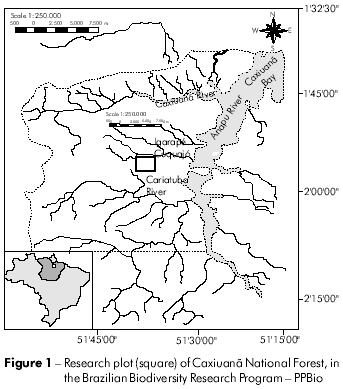
<body><![CDATA[<p><font size="2" face="Verdana">The genus <i>Culicoides </i>includes 1,311  extant species distributed worldwide<sup>1</sup>. Borkent and Spinelli<sup>5</sup>  listed 266 species from the Neotropical Region and nearly 82 in the Brazilian Amazon.  In spite of the sanitary and economic relevance of the genus, few studies have  been carried out on its members in this region. Wirth and Blanton<sup>6</sup> described  15 new species in a list of 60 species recorded for the Amazon Basin.  Two new species were described posteriorly by Felippe-Bauer et al<sup>7,8</sup>, <i>C. kampa </i>Felippe-Bauer, Veras &amp; Castellon and <i>C. baniwa </i>Felippe-Bauer,  from the Brazilian states of Acre and  Amazonas, and Spinelli et al<sup>9</sup> described <i>C. felippebauerae </i>Spinelli  from Amazonas. Surveys of <i>Culicoides </i>were performed by Castellon<sup>10</sup>  and Castellon and Ferreira<sup>11</sup> in the Ducke Forest Reserve, Manaus, Amazonas State, and Trindade and Gorayeb<sup>12,13</sup> in  coastal areas in the Itatup&atilde;-Baqui&aacute;  Reserve in Par&aacute;  State, Brazil.</font></p>     <p><font size="2" face="Verdana">The aim of this study is to provide a survey  of <i>Culicoides </i>species in a research plot of the Caxiuan&atilde;  National  Forest, a forested freshwater ecosystem, in collaboration with the Brazilian  Biodiversity Research Program (<i>Programa de Pesquisa em Biodiversidade </i>-  PPBio) aimed at improving our knowledge about the biodiversity of the Brazilian  Amazon Region.</font></p>     <p>&nbsp;</p>     <p><font size="3" face="Verdana"><b>MATERIALS AND METHODS</b></font></p>     <p><font size="2" face="Verdana">The Caxiuan&atilde; National Forest is a typical  dense rain forest located in the north central region of Par&aacute; State, Brazil,  characterized by &quot;terra firme&quot;, or upper level forest (80%), a small  floodplain and several &quot;igap&oacute;&quot; (flooded forest) areas (20%). The  climate is tropical humid, with a short dry period. Meteorological studies show  two defined periods in the area: humid or rainy, from January to March, and  dry, from September to November. The average temperature is approximately 26<sup>o</sup> C,  with a minimum of 22<sup>o</sup> C and a maximum of 32<sup>o</sup> C<sup>14</sup>. This study was  developed at the Ferreira Penna Research Station, which covers an area of 33,000 ha within the National Forest of Caxiuan&atilde; (<a href="#f1">Figure 1</a>) and is under the  administration of the Museu Paraense Em&iacute;lio Goeldi (MPEG). The plot at Caxiuan&atilde;  of PPBio had an area of 25 km<sup>2</sup> and was divided into 30 sampling  sites. Collections were performed using ten CDC light traps, with two in each  of the five terrestrial sites of the plot (1, 4, 7, 8 and 9), from February 9 to  February 13 in  2007 between 6 pm and 6 am on the ground and in the sub-canopy stratus (around 20 m of height).</font></p>     <p><a name="f1"></a></p>     <p>&nbsp;</p>     <p align="center"><img src="/img/revistas/rpas/v1n4/4a05f1.gif" border="0"></p>     <p>&nbsp;</p>     <p><font size="2" face="Verdana">The specimens collected by the Funda&ccedil;&atilde;o Oswaldo  Cruz and MPEG team were preserved dry using naphthalene and sent to the  Ceratopogonidae Collection of the Laboratory of Diptera of the Instituto Oswaldo  Cruz for identification. Individual specimens were mounted on microscope slides  in phenol-balsam as described by Wirth and Marston<sup>15</sup>. For  identification, we used the reports on <i>Culicoides </i>by Wirth and Blanton<sup>6</sup>  for the Amazon Basin, Spinelli et al<sup>16</sup> for  the <i>guttatus </i>group, Felippe-Bauer et al<sup>8</sup> for the <i>hylas </i>group  of the <i>Hoffmania </i>subgenus, and the atlas of wing photographs of  neotropical species produced by Wirth et al<sup>17</sup>. Voucher specimens  were deposited in the collection of the MPEG.</font></p>     ]]></body>
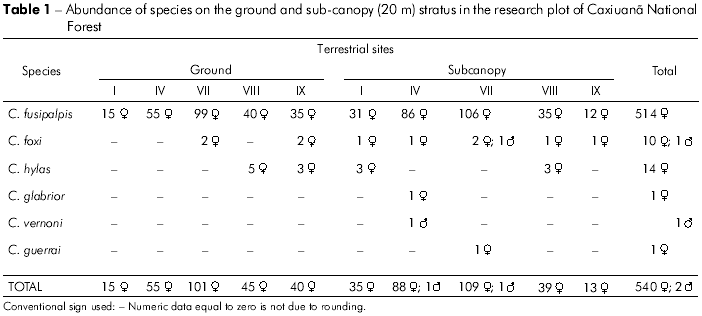
<body><![CDATA[<p><font size="2" face="Verdana">The frequencies of the <i>Culicoides </i>species  were calculated based on the abundance of each species in relation to the total  abundance of all of the collected species from the ground and the sub-canopy  strata. The diversity of each stratus and site was assessed by Simpson's  diversity index.</font></p>     <p>&nbsp;</p>     <p><font size="3" face="Verdana"><b>RESULTS</b></font></p>     <p><font size="2" face="Verdana">A total of 542 specimens of <i>Culicoides </i>were  collected during the sampling period on the ground and in the sub-canopy  stratus, with 99.6% female and 0.4% male specimens being captured. Six species  were collected: <i>C. foxi </i>Ortiz; <i>C. fusipalpis </i>Wirth &amp; Blanton; <i>C. glabrior </i>Macfie; <i>C. guerrai </i>Wirth &amp; Blanton; <i>C. hylas </i>Macfie;  and <i>C. vernoni </i>Wirth &amp; Blanton. The most abundant species were <i>C.  fusipalpis </i>(94.8%), <i>C. hylas </i>(2.6%) and <i>C. foxi </i>(2%). The remaining  species represented 0.6% of the sample.</font></p>     <p><font size="2" face="Verdana">The distributions of the species for each  stratus and site are shown in <a href="#t1">table 1</a>. The frequency of the most abundant  species, <i>C. fusipalpis, </i>was similar in both strata (95.3% on the ground;  94.4% in the sub-canopy). The diversity of species was low in both strata (&#955; =  0.91 on the ground; &#955; = 0.89   in sub-canopy) and in all sites (&#955;= 0.85 in site I; &#955; = 0.96 in site IV; &#955; = 0.94 in site VII; &#955; = 0.80 in site VIII; &#955; = 0.78 in site IX). For <i>C.  fusipalpis </i>and <i>C. hylas, </i>we obtained only females both on the ground  and at the sub-canopy level, while for <i>C. foxi, </i>females were found in  both strata, and a single male was found in the sub-canopy (<a href="#t1">Table 1</a>).</font></p>     <p><a name="t1"></a></p>     <p>&nbsp;</p>     <p align="center"><img src="/img/revistas/rpas/v1n4/4a05t1.gif" border="0"></p>     <p>&nbsp;</p>     <p><font size="3" face="Verdana"><b>DISCUSSION</b></font></p>     ]]></body>
<body><![CDATA[<p><font size="2" face="Verdana">Aitken (nec. Wirth and Blanton<sup>6</sup>)  found the same six species collected in this study in Caxiuan&atilde;  National Forest while working in  floodplain areas in the &Aacute;rea de  Pesquisas Ecol&oacute;gicas do Guam&aacute; (APEG) forest, Par&aacute; State, Brazil.  Both of these localities in Par&aacute; are freshwater ecosystems, which may explain  the similarity of the results.</font></p>     <p><font size="2" face="Verdana">In agreement with our data, Veras and Castell&oacute;n<sup>18</sup> observed <i>C. fusipalpis, C. hylas </i>and <i>C.  foxi </i>on the ground and at different levels (1, 5, 10 and 15 m) and obtained a few male  specimens in Ducke Reserve in Manaus, Amazonas State. However, Aitken (nec. Wirth and  Blanton<sup>6</sup>) collected a greater number of <i>C. fusipalpis </i>on the  ground than in the sub-canopy stratus in APEG Forest, and Castell&oacute;n et al<sup>19</sup> found male specimens corresponding to 31% of the <i>C. hylas </i>collected  at all levels (1, 5 and 10 m)  in hydroelectric dam areas in Amazonas.</font></p>     <p><font size="2" face="Verdana"><i>C. fusipalpis </i>has been observed feeding on mammals and birds as <i>Didelphis </i>sp.  (opossum), <i>Mesocricetus </i>sp. (hamster) and <i>Gallus </i>sp. (chicken),  as well as feeding on humans<sup>6,18,19,20,21</sup>,  which indicates an eclectic biting habit of this species.</font></p>     <p><font size="2" face="Verdana">In previous reports, it has been observed  that <i>C. fusipalpis </i>is abundant in floodplain ecosystems in the Amazon  Region, such as natural preserved areas, and areas subjected to considerable  human interference, like hydroelectric dams<sup>6,19</sup>. These areas are  enriched by the mixture of estuarine waters with sediments, favoring the  development of the <i>Culicoides </i>fauna in such regions<sup>6</sup>.</font></p>     <p>&nbsp;</p>     <p><font size="3" face="Verdana"><b>CONCLUSION</b></font></p>     <p><font size="2" face="Verdana">The species collected in this study in Caxiuan&atilde; National Forest are common in different  ecosystems in the Amazon Region, including environments impacted by human  activities, where <i>C. fusipalpis </i>has been observed in great numbers. This  species can be found from the ground up to heights of 15 m and exhibits eclectic  haematophagous habits, biting humans and other mammals and birds. In spite of  its anthropophilic behavior, this species is not implicated as vector of  tropical diseases.</font></p>     <p><font size="2" face="Verdana">We suggest that the reason that we observed  females outnumbering male specimens may be due to having performed collections  in a dry terrestrial area. If the captures had been carried out near breeding  sites, where sources of water are present, more males would have been found.</font></p>     <p><font size="2" face="Verdana">Additional studies regarding bio-ecological  aspects of <i>Culicoides, </i>such as their spatial distribution and breeding  sites, in preserved areas like Caxiuan&atilde; National Forest are necessary to  understand the natural cycles of the species of this genus in forest/freshwater  ecosystems. Such studies will provide data that can be useful for future  management strategies for the control of biting midges.</font></p>     <p>&nbsp;</p>     ]]></body>
<body><![CDATA[<p><font size="3" face="verdana"><b>ACKNOWLEDGEMENTS</b></font></p>     <p><font size="2" face="verdana">We thank the students Claudeth S. Pinto  and Waldemar C. Neto of the PPBio program for their support in the collection  of <i>Culicoides </i>specimens on the research plot in  Caxiuan&atilde;; Tiago do Nascimento da Silva for producing the a map of the studied  area; Dr. Orlando Tobias Silveira and Dr. Marl&uacute;cia Martins from the MPEG for  the loan of the material for identification.</font></p>     <p>&nbsp;</p>     <p><b><font size="3" face="verdana">FINANCIAL  SUPPORT</font></b></p>     <p><font size="2" face="verdana">We  also thank Conselho Nacional de Desenvolvimento Cient&iacute;fico e Tecnol&oacute;gico  (CNPq), Brazil, for financial support of the Project (479240/2009-4) to  M.L.F.-B. and for Programa Institucional de Bolsas de Inicia&ccedil;&atilde;o Cient&iacute;fica (PIBIC)  scholarships, Research Grant to M.C.A.S</font>.</p>     <p>&nbsp;</p>     <p><font size="3" face="Verdana"><b>REFERENCES</b></font><font size="2" face="Verdana"><b></b></font></p>     <!-- ref --><p><font size="2" face="Verdana">1 Borkent A. World species of biting midges (Diptera: Ceratopogonidae). 2009.  Available from: <a href="http://www.inhs.illinois.edu/programs/index.html" target="_blank">http://www.inhs.illinois.edu/research/FLYTREE/Borkent.html.</a></font> <!-- ref --><p><font size="2" face="Verdana">2 Shelley AJ, Coscar&oacute;n S. Simuliid blackflies (Diptera: Simuliidae) and  ceratopogonid midges (Diptera: Ceratopogonidae) as vectors of <i>Mansonella  ozzardi </i>(Nematoda: Onchorcercidae) in Nothern Argentina. Mem Inst Oswaldo Cruz. 2001 May;96(4):451-8. Doi:10.1590/S0074-02762001000400003</font><font size="2" face="verdana"><font size="2" face="verdana">&nbsp; &nbsp;&nbsp; &nbsp; &nbsp; &nbsp;    &nbsp;&#91; <a href="http://cat.inist.fr/?aModele=afficheN&cpsidt=17897078" target="_blank">Links</a> &#93;</font></font><!-- ref --><p><font size="2" face="Verdana">3 Pinheiro FP, Travassos  da Rosa APA, Vasconcelos PFC. An overview of Oropouche fever epidemics  in Brazil  and neighbor countries. In: Travassos da  Rosa APA, Vasconcelos PFC, Travassos da Rosa JFS, editors. An overview of arbovirology in Brazil and neighbouring countries. Bel&eacute;m:  Instituto Evandro Chagas; 1998. p. 186-92.</font><font size="2" face="verdana"><font size="2" face="verdana">&nbsp; &nbsp;&nbsp; &nbsp; &nbsp; &nbsp;    &nbsp;&#91; <a href="http://iah.iec.pa.gov.br/iah/fulltext/pc/monografias/iec/overview/overview15p186-192.pdf" target="_blank">Links</a> &#93;</font></font><!-- ref --><p><font size="2" face="Verdana">4 Figueiredo LTM. Emergent arboviruses in Brazil. Rev Soc  Med Trop. 2007 Mar-Apr;40(2):224-9.</font><font size="2" face="verdana"><font size="2" face="verdana"> Doi: 10.1590/S0037-86822007000200016&nbsp; &nbsp;&nbsp; &nbsp; &nbsp; &nbsp;    &nbsp;&#91; <a href="http://www.scielo.br/scielo.php?script=sci_arttext&pid=S0037-86822007000200016" target="_blank">Links</a> &#93;</font></font><!-- ref --><p><font size="2" face="Verdana">5 Borkent A, Spinelli GR. Neotropical  Ceratopogonidae (Diptera: Insecta). In: Adis J,  Arias JR, Rueda-Delgado G, Wantzen KM, editors. Aquatic biodiversity in Latin   America. Moscow:  Pensoft Publishers; 2007. 198 p.</font><!-- ref --><p><font size="2" face="Verdana">6 Wirth WW, Blanton FS. A review of the maruins  or biting midges of the genus <i>Culicoides </i>(Diptera: Ceratopogonidae) in  the Amazon Basin. Amazoniana. 1973;4:405-70.</font><!-- ref --><p><font size="2" face="Verdana">7 Felippe-Bauer  ML, Veras RS, Castellon EG, Moreira NA. A new <i>Culicoides </i>from the Amazonian Region, Brazil  (Diptera: Ceratopogonidae). Mem Inst Oswaldo Cruz. 2000 Jan-Feb;95(1):35-7.</font><font size="2" face="verdana"><font size="2" face="Verdana"> Doi:  10.1590/S0074-02762000000100004</font><font size="2" face="verdana">&nbsp; &nbsp;&nbsp; &nbsp; &nbsp; &nbsp;    &nbsp;&#91; <a href="http://www.scielo.br/scielo.php?script=sci_arttext&pid=S0074-02762000000100004&lng=en&nrm=iso" target="_blank">Links</a> &#93;</font></font><!-- ref --><p><font size="2" face="Verdana">8 Felippe-Bauer ML, Damasceno CP, Py-Daniel V,  Spinelli GR. <i>Culicoides baniwa </i>sp.nov. from the Brazilian Amazon Region  with a synopsis of the <i>hylas </i>species group (Diptera: Ceratopogonidae).  Mem Inst Oswaldo Cruz. 2009 Sep;104(6):851-7. Doi:  10.1590/S0074-02762009000600005</font><font size="2" face="verdana"><font size="2" face="verdana">&nbsp; &nbsp;&nbsp; &nbsp; &nbsp; &nbsp;    &nbsp;&#91; <a href="http://www.scielo.br/scielo.php?pid=S0074-02762009000600005&script=sci_arttext" target="_blank">Links</a> &#93;</font></font><font size="2" face="Verdana"> </font> <!-- ref --><p><font size="2" face="Verdana">9 Spinelli GR, Ronderos MM, Marino PI, Carrasco DS, Ferreira RLM. Description of <i>Culicoides </i>(<i>Mataemyia</i>)<i> felippebauerae </i>sp.n., <i>Forcipomyia  musae </i>immatures, and occurrence of <i>F. genualis, </i>breeding in banana  stems in Brazilian Amazonia (Diptera: Ceratopogonidae). Mem Inst Oswaldo  Cruz. 2007 Sep;102(6):659-9.</font><font size="2" face="verdana"><font size="2" face="verdana"> Doi:  10.1590/S0074-02762007005000083&nbsp; &nbsp;&nbsp; &nbsp; &nbsp; &nbsp;    &nbsp;&#91; <a href="http://www.scielo.br/scielo.php?pid=S0074-02762007000600001&script=sci_arttext&tlng=pt" target="_blank">Links</a> &#93;</font></font><!-- ref --><p><font size="2" face="Verdana">10 Castellon EG. <i>Culicoides </i>(Diptera: Ceratopogonidae) na Amaz&ocirc;nia brasileira. II.  Esp&eacute;cies coletadas na Reserva Florestal  Ducke, aspectos ecol&oacute;gicos e distribui&ccedil;&atilde;o geogr&aacute;fica. Acta Amaz. 1990;20:83-93.</font><!-- ref --><p><font size="2" face="Verdana">11 Castell&oacute;n EG,  Ferreira RLM. <i>Culicoides </i>Latreille (Diptera: Ceratopogonidae) da  Amaz&ocirc;nia. III. Resultados de coletas noturnas, na Reserva Florestal Ducke,  Estado do Amazonas, Brasil. Bol Mus Para Emilio Goeldi. 1991;7(2):117-23.</font><!-- ref --><p><font size="2" face="Verdana">12 Trindade RL, Gorayeb IS. Maruins (Ceratopogonidae: Diptera) do estu&aacute;rio do  Rio Par&aacute; e do litoral do Estado do Par&aacute;, Brasil. Entomol Vect. 2005 jan-mar;12(1):61-74. DOI:10.1590/S0328-03812005000100005</font><font size="2" face="verdana"><font size="2" face="verdana">&nbsp; &nbsp;&nbsp; &nbsp; &nbsp; &nbsp;    &nbsp;&#91; <a href="http://www.scielo.br/scielo.php?pid=S0328-03812005000100005&script=sci_arttext" target="_blank">Links</a> &#93;</font></font><font size="2" face="Verdana"> </font><!-- ref --><p><font size="2" face="Verdana">13 Trindade RL, Gorayeb  IS. Maruins (Diptera: Ceratopogonidae: <i>Culicoides</i>), ap&oacute;s a esta&ccedil;&atilde;o  chuvosa, na Reserva de Desenvolvimento Sustent&aacute;vel Itatup&atilde;-Baqui&aacute;, Gurup&aacute;,  Par&aacute;, Brasil. Rev Pan-Amaz Saude. 2010 Jun;1(2):121-30. Doi:  10.5123/S2176-62232010000200015</font><font size="2" face="verdana"><font size="2" face="verdana">&nbsp; &nbsp;&nbsp; &nbsp; &nbsp; &nbsp;    &nbsp;&#91; <a href="http://scielo.iec.pa.gov.br/scielo.php?script=sci_arttext&pid=S2176-62232010000200015&lng=pt&nrm=iso" target="_blank">Links</a> &#93;</font></font><font size="2" face="Verdana"></font><!-- ref --><p><font size="2" face="Verdana">14 Silva SS. Vespas sociais da Floresta Nacional  de Caxiuan&atilde;, Melga&ccedil;o, Par&aacute;. Descri&ccedil;&atilde;o da fauna numa grade de 25 km<sup>2</sup> e compara&ccedil;&atilde;o entre protocolos de amostragem (Hymenoptera, Vespidae)  [disserta&ccedil;&atilde;o]. Bel&eacute;m (PA): Universidade Federal do Par&aacute;, Museu Parense Em&iacute;lio  Goeldi; 2007. 102 p.</font><font size="2" face="verdana"><font size="2" face="verdana">&nbsp; &nbsp;&nbsp; &nbsp; &nbsp; &nbsp;    &nbsp;&#91; <a href="http://www.iieb.org.br/enviados/publicador_pdf/trab_Dissert_Suzanna_Silva.pdf" target="_blank">Links</a> &#93;</font></font><!-- ref --><p><font size="2" face="Verdana">15 Wirth WW, Marston N. A method for mounting  small insects on microscope slides in Canada balsam. Ann Entomol Soc Am.  1968;61(3):783-4.</font><!-- ref --><p><font size="2" face="Verdana">16 Spinelli GR, Greiner EC, Wirth WW. The  neotropical bloodsucking midges of the <i>Culicoides guttatus </i>group of the  subgenus <i>Hoffmania </i>(Diptera: Ceratopogonidae). Contrib Am Entomol Inst.  1993;27(3):1-91.</font><!-- ref --><p><font size="2" face="Verdana">17 Wirth WW, Dyce AL, Spinelli GR. An atlas of wing photographs,  with a summary of the numerical characters of the neotropical species of <i>Culicoides </i>(Diptera: Ceratopogonidae). Contrib Am Entomol   Inst. 1988;25:1-72.</font><!-- ref --><p><font size="2" face="Verdana">18 Veras RS, Castell&oacute;n EG. <i>Culicoides </i>Latreille (Diptera: Ceratopogonidae) in Brazilian  Amazon. V. Efficiency of traps and baits and vertical stratification in the  forest reserve Adolpho Ducke. Rev Bras Zool. 1998;15(1):145-52. Doi: 10.1590/S0101-81751998000100012</font><font size="2" face="verdana"><font size="2" face="verdana">&nbsp; &nbsp;&nbsp; &nbsp; &nbsp; &nbsp;    &nbsp;&#91; <a href="http://www.scielo.br/scielo.php?pid=S0101-81751998000100012&script=sci_arttext" target="_blank">Links</a> &#93;</font></font><!-- ref --><p><font size="2" face="Verdana">19 Castell&oacute;n EG, Ferreira RLM, Silva MNT. <i>Culicoides </i>(Diptera: Ceratopogonidae) da Amaz&ocirc;nia  Brasileira. I. Coletas na usina hidrel&eacute;trica (UHE) de  Balbina, usina hidrel&eacute;trica (UHE) Cachoeira Porteira e Cachoeira dos Espelhos (Rio Xing&uacute;). Acta Amaz. 1990;20:77-81.</font><!-- ref --><p><font size="2" face="Verdana">20 Castell&oacute;n EG, Ferreira RM, Silva MNT. <i>Culicoides </i>(Diptera:  Ceratopogonidae) in the Brazilian Amazon. IV. Species collected  with CDC light trap in the Ducke Forest Reserve (RFD), Amazon State, Brazil.  Acta Amaz. 1993;23(2-3):309-10.</font><!-- ref --><p><font size="2" face="Verdana">21 Tikasingh ES. Seasonal and diurnal  activities of four species of Trinidadian <i>Culicoides </i>(Diptera:  Ceratopogonidae). Mosq News. 1972;32(3):447-52.</font><p>&nbsp;</p>     <p>&nbsp;</p>     ]]></body>
<body><![CDATA[<p><font size="2" face="Verdana"><b><a name="endereco" id="endereco"></a><a href="#topo"><img src="/img/revistas/rpas/v1n4/seta.gif" border="0" /></a>Correspondence  / Correspond&ecirc;ncia / Correspondencia:</b>    <br> Maria Luiza  Felippe Bauer    <br> Laborat&oacute;rio de Diptera,    <br> Instituto Oswaldo Cruz    <br> Av. Brasil, 4365. Bairro: Manguinhos    <br> CEP: 21040-360    <br> Rio de Janeiro-Rio de Janeiro-Brasil    <br> E-mail: <a href="mailto:mlfbauer@ioc.fiocruz.br">mlfbauer@ioc.fiocruz.br</a></font></p>     <p><font size="2" face="Verdana">Received / Recebido em / Recibido en: 12/1  7/2010    <br> Accepted / Aceito em / Aceito en: 4/14/2011</font></p> <script type="text/javascript"> var gaJsHost = (("https:" == document.location.protocol) ? "https://ssl." : "http://www."); document.write(unescape("%3Cscript src='" + gaJsHost + "google-analytics.com/ga.js' type='text/javascript'%3E%3C/script%3E")); </script> <script type="text/javascript"> try { var pageTracker = _gat._getTracker("UA-7885746-4"); pageTracker._setDomainName("none"); pageTracker._setAllowLinker(true); pageTracker._trackPageview(); } catch(err) {}</script>     ]]></body>
<body><![CDATA[ ]]></body><back>
<ref-list>
<ref id="B1">
<label>1</label><nlm-citation citation-type="">
<person-group person-group-type="author">
<name>
<surname><![CDATA[Borkent]]></surname>
<given-names><![CDATA[A]]></given-names>
</name>
</person-group>
<source><![CDATA[World species of biting midges (Diptera: Ceratopogonidae)]]></source>
<year>2009</year>
</nlm-citation>
</ref>
<ref id="B2">
<label>2</label><nlm-citation citation-type="journal">
<person-group person-group-type="author">
<name>
<surname><![CDATA[Shelley]]></surname>
<given-names><![CDATA[AJ]]></given-names>
</name>
<name>
<surname><![CDATA[Coscarón]]></surname>
<given-names><![CDATA[S]]></given-names>
</name>
</person-group>
<article-title xml:lang="en"><![CDATA[Simuliid blackflies (Diptera: Simuliidae) and ceratopogonid midges (Diptera: Ceratopogonidae) as vectors of Mansonella ozzardi (Nematoda: Onchorcercidae) in Nothern Argentina]]></article-title>
<source><![CDATA[Mem Inst Oswaldo Cruz]]></source>
<year>2001</year>
<month> M</month>
<day>ay</day>
<volume>96</volume>
<numero>4</numero>
<issue>4</issue>
<page-range>451-8</page-range></nlm-citation>
</ref>
<ref id="B3">
<label>3</label><nlm-citation citation-type="book">
<person-group person-group-type="author">
<name>
<surname><![CDATA[Pinheiro]]></surname>
<given-names><![CDATA[FP]]></given-names>
</name>
<name>
<surname><![CDATA[Travassos da Rosa]]></surname>
<given-names><![CDATA[APA]]></given-names>
</name>
<name>
<surname><![CDATA[Vasconcelos]]></surname>
<given-names><![CDATA[PFC]]></given-names>
</name>
</person-group>
<article-title xml:lang="en"><![CDATA[An overview of Oropouche fever epidemics in Brazil and neighbor countries]]></article-title>
<person-group person-group-type="editor">
<name>
<surname><![CDATA[Travassos da Rosa]]></surname>
<given-names><![CDATA[APA]]></given-names>
</name>
<name>
<surname><![CDATA[Vasconcelos]]></surname>
<given-names><![CDATA[PFC]]></given-names>
</name>
<name>
<surname><![CDATA[Travassos da Rosa]]></surname>
<given-names><![CDATA[JFS]]></given-names>
</name>
</person-group>
<source><![CDATA[An overview of arbovirology in Brazil and neighbouring countries]]></source>
<year>1998</year>
<page-range>186-92</page-range><publisher-loc><![CDATA[Belém ]]></publisher-loc>
<publisher-name><![CDATA[Instituto Evandro Chagas]]></publisher-name>
</nlm-citation>
</ref>
<ref id="B4">
<label>4</label><nlm-citation citation-type="journal">
<person-group person-group-type="author">
<name>
<surname><![CDATA[LTM]]></surname>
<given-names><![CDATA[Figueiredo]]></given-names>
</name>
</person-group>
<article-title xml:lang="en"><![CDATA[Emergent arboviruses in Brazil]]></article-title>
<source><![CDATA[Rev Soc Med Trop]]></source>
<year>2007</year>
<month> M</month>
<day>ar</day>
<volume>40</volume>
<numero>2</numero>
<issue>2</issue>
<page-range>224-9</page-range></nlm-citation>
</ref>
<ref id="B5">
<label>5</label><nlm-citation citation-type="book">
<person-group person-group-type="author">
<name>
<surname><![CDATA[Borkent]]></surname>
<given-names><![CDATA[A]]></given-names>
</name>
<name>
<surname><![CDATA[Spinelli]]></surname>
<given-names><![CDATA[GR]]></given-names>
</name>
</person-group>
<article-title xml:lang="en"><![CDATA[Neotropical Ceratopogonidae (Diptera: Insecta)]]></article-title>
<person-group person-group-type="editor">
<name>
<surname><![CDATA[Adis]]></surname>
<given-names><![CDATA[J]]></given-names>
</name>
<name>
<surname><![CDATA[Arias]]></surname>
<given-names><![CDATA[JR]]></given-names>
</name>
<name>
<surname><![CDATA[Rueda-Delgado]]></surname>
<given-names><![CDATA[G]]></given-names>
</name>
<name>
<surname><![CDATA[Wantzen]]></surname>
<given-names><![CDATA[KM]]></given-names>
</name>
</person-group>
<source><![CDATA[Aquatic biodiversity in Latin America]]></source>
<year>2007</year>
<page-range>198</page-range><publisher-loc><![CDATA[Moscow ]]></publisher-loc>
<publisher-name><![CDATA[Pensoft Publishers]]></publisher-name>
</nlm-citation>
</ref>
<ref id="B6">
<label>6</label><nlm-citation citation-type="journal">
<person-group person-group-type="author">
<name>
<surname><![CDATA[Wirth]]></surname>
<given-names><![CDATA[WW]]></given-names>
</name>
<name>
<surname><![CDATA[Blanton]]></surname>
<given-names><![CDATA[FS]]></given-names>
</name>
</person-group>
<article-title xml:lang="en"><![CDATA[A review of the maruins or biting midges of the genus Culicoides (Diptera: Ceratopogonidae) in the Amazon Basin]]></article-title>
<source><![CDATA[Amazoniana]]></source>
<year>1973</year>
<volume>4</volume>
<page-range>405-70</page-range></nlm-citation>
</ref>
<ref id="B7">
<label>7</label><nlm-citation citation-type="journal">
<person-group person-group-type="author">
<name>
<surname><![CDATA[Felippe-Bauer]]></surname>
<given-names><![CDATA[ML]]></given-names>
</name>
<name>
<surname><![CDATA[Veras]]></surname>
<given-names><![CDATA[RS]]></given-names>
</name>
<name>
<surname><![CDATA[Castellon]]></surname>
<given-names><![CDATA[EG]]></given-names>
</name>
<name>
<surname><![CDATA[Moreira]]></surname>
<given-names><![CDATA[NA]]></given-names>
</name>
</person-group>
<article-title xml:lang="en"><![CDATA[A new Culicoides from the Amazonian Region, Brazil (Diptera: Ceratopogonidae)]]></article-title>
<source><![CDATA[Mem Inst Oswaldo Cruz]]></source>
<year>2000</year>
<month> J</month>
<day>an</day>
<volume>95</volume>
<numero>1</numero>
<issue>1</issue>
<page-range>35-7</page-range></nlm-citation>
</ref>
<ref id="B8">
<label>8</label><nlm-citation citation-type="journal">
<person-group person-group-type="author">
<name>
<surname><![CDATA[Felippe-Bauer]]></surname>
<given-names><![CDATA[ML]]></given-names>
</name>
<name>
<surname><![CDATA[Damasceno]]></surname>
<given-names><![CDATA[CP]]></given-names>
</name>
<name>
<surname><![CDATA[Py-Daniel]]></surname>
<given-names><![CDATA[V]]></given-names>
</name>
<name>
<surname><![CDATA[Spinelli]]></surname>
<given-names><![CDATA[GR]]></given-names>
</name>
</person-group>
<article-title xml:lang="en"><![CDATA[Culicoides baniwa sp.nov. from the Brazilian Amazon Region with a synopsis of the hylas species group (Diptera: Ceratopogonidae)]]></article-title>
<source><![CDATA[Mem Inst Oswaldo Cruz]]></source>
<year>2009</year>
<month> S</month>
<day>ep</day>
<volume>104</volume>
<numero>6</numero>
<issue>6</issue>
<page-range>851-7</page-range></nlm-citation>
</ref>
<ref id="B9">
<label>9</label><nlm-citation citation-type="journal">
<person-group person-group-type="author">
<name>
<surname><![CDATA[Spinelli]]></surname>
<given-names><![CDATA[GR]]></given-names>
</name>
<name>
<surname><![CDATA[Ronderos]]></surname>
<given-names><![CDATA[MM]]></given-names>
</name>
<name>
<surname><![CDATA[Marino]]></surname>
<given-names><![CDATA[PI]]></given-names>
</name>
<name>
<surname><![CDATA[Carrasco]]></surname>
<given-names><![CDATA[DS]]></given-names>
</name>
<name>
<surname><![CDATA[Ferreira]]></surname>
<given-names><![CDATA[RLM]]></given-names>
</name>
</person-group>
<article-title xml:lang="en"><![CDATA[Description of Culicoides (Mataemyia) felippebauerae sp.n., Forcipomyia musae immatures, and occurrence of F. genualis, breeding in banana stems in Brazilian Amazonia (Diptera: Ceratopogonidae)]]></article-title>
<source><![CDATA[Mem Inst Oswaldo Cruz]]></source>
<year>2007</year>
<month> S</month>
<day>ep</day>
<volume>102</volume>
<numero>6</numero>
<issue>6</issue>
<page-range>659-9</page-range></nlm-citation>
</ref>
<ref id="B10">
<label>10</label><nlm-citation citation-type="journal">
<person-group person-group-type="author">
<name>
<surname><![CDATA[Castellon]]></surname>
<given-names><![CDATA[EG]]></given-names>
</name>
</person-group>
<article-title xml:lang="pt"><![CDATA[Culicoides (Diptera: Ceratopogonidae) na Amazônia brasileira: II. Espécies coletadas na Reserva Florestal Ducke, aspectos ecológicos e distribuição geográfica]]></article-title>
<source><![CDATA[Acta Amaz]]></source>
<year>1990</year>
<volume>20</volume>
<page-range>83-93</page-range></nlm-citation>
</ref>
<ref id="B11">
<label>11</label><nlm-citation citation-type="journal">
<person-group person-group-type="author">
<name>
<surname><![CDATA[Castellón]]></surname>
<given-names><![CDATA[EG]]></given-names>
</name>
<name>
<surname><![CDATA[Ferreira]]></surname>
<given-names><![CDATA[RLM]]></given-names>
</name>
</person-group>
<article-title xml:lang="pt"><![CDATA[Culicoides Latreille (Diptera: Ceratopogonidae) da Amazônia: III. Resultados de coletas noturnas, na Reserva Florestal Ducke, Estado do Amazonas, Brasil]]></article-title>
<source><![CDATA[Bol Mus Para Emilio Goeldi]]></source>
<year>1991</year>
<volume>7</volume>
<numero>2</numero>
<issue>2</issue>
<page-range>117-23</page-range></nlm-citation>
</ref>
<ref id="B12">
<label>12</label><nlm-citation citation-type="journal">
<person-group person-group-type="author">
<name>
<surname><![CDATA[Trindade]]></surname>
<given-names><![CDATA[RL]]></given-names>
</name>
<name>
<surname><![CDATA[Gorayeb]]></surname>
<given-names><![CDATA[IS]]></given-names>
</name>
</person-group>
<article-title xml:lang="pt"><![CDATA[Maruins (Ceratopogonidae: Diptera) do estuário do Rio Pará e do litoral do Estado do Pará, Brasil]]></article-title>
<source><![CDATA[Entomol Vect]]></source>
<year>2005</year>
<month> j</month>
<day>an</day>
<volume>12</volume>
<numero>1</numero>
<issue>1</issue>
<page-range>61-74</page-range></nlm-citation>
</ref>
<ref id="B13">
<label>13</label><nlm-citation citation-type="journal">
<person-group person-group-type="author">
<name>
<surname><![CDATA[Trindade]]></surname>
<given-names><![CDATA[RL]]></given-names>
</name>
<name>
<surname><![CDATA[Gorayeb]]></surname>
<given-names><![CDATA[IS]]></given-names>
</name>
</person-group>
<article-title xml:lang="pt"><![CDATA[Maruins (Diptera: Ceratopogonidae: Culicoides), após a estação chuvosa, na Reserva de Desenvolvimento Sustentável Itatupã-Baquiá, Gurupá, Pará, Brasil]]></article-title>
<source><![CDATA[Rev Pan-Amaz Saude]]></source>
<year>2010</year>
<month> J</month>
<day>un</day>
<volume>1</volume>
<numero>2</numero>
<issue>2</issue>
<page-range>121-30</page-range></nlm-citation>
</ref>
<ref id="B14">
<label>14</label><nlm-citation citation-type="book">
<person-group person-group-type="author">
<name>
<surname><![CDATA[Silva]]></surname>
<given-names><![CDATA[SS]]></given-names>
</name>
</person-group>
<source><![CDATA[Vespas sociais da Floresta Nacional de Caxiuanã, Melgaço, Pará: Descrição da fauna numa grade de 25 km² e comparação entre protocolos de amostragem (Hymenoptera, Vespidae)]]></source>
<year>2007</year>
<page-range>102</page-range><publisher-loc><![CDATA[Belém^ePA PA]]></publisher-loc>
<publisher-name><![CDATA[Universidade Federal do Pará, Museu Parense Emílio Goeldi]]></publisher-name>
</nlm-citation>
</ref>
<ref id="B15">
<label>15</label><nlm-citation citation-type="journal">
<person-group person-group-type="author">
<name>
<surname><![CDATA[Wirth]]></surname>
<given-names><![CDATA[WW]]></given-names>
</name>
<name>
<surname><![CDATA[Marston]]></surname>
<given-names><![CDATA[N]]></given-names>
</name>
</person-group>
<article-title xml:lang="en"><![CDATA[A method for mounting small insects on microscope slides in Canada balsam]]></article-title>
<source><![CDATA[Ann Entomol Soc Am]]></source>
<year>1968</year>
<volume>61</volume>
<numero>3</numero>
<issue>3</issue>
<page-range>783-4.</page-range></nlm-citation>
</ref>
<ref id="B16">
<label>16</label><nlm-citation citation-type="journal">
<person-group person-group-type="author">
<name>
<surname><![CDATA[Spinelli]]></surname>
<given-names><![CDATA[GR]]></given-names>
</name>
<name>
<surname><![CDATA[Greiner]]></surname>
<given-names><![CDATA[EC]]></given-names>
</name>
<name>
<surname><![CDATA[Wirth]]></surname>
<given-names><![CDATA[WW]]></given-names>
</name>
</person-group>
<article-title xml:lang="en"><![CDATA[The neotropical bloodsucking midges of the Culicoides guttatus group of the subgenus Hoffmania (Diptera: Ceratopogonidae)]]></article-title>
<source><![CDATA[Contrib Am Entomol Inst]]></source>
<year>1993</year>
<volume>27</volume>
<numero>3</numero>
<issue>3</issue>
<page-range>1-91</page-range></nlm-citation>
</ref>
<ref id="B17">
<label>17</label><nlm-citation citation-type="journal">
<person-group person-group-type="author">
<name>
<surname><![CDATA[Wirth]]></surname>
<given-names><![CDATA[WW]]></given-names>
</name>
<name>
<surname><![CDATA[Dyce]]></surname>
<given-names><![CDATA[AL]]></given-names>
</name>
<name>
<surname><![CDATA[Spinelli]]></surname>
<given-names><![CDATA[GR]]></given-names>
</name>
</person-group>
<article-title xml:lang="en"><![CDATA[An atlas of wing photographs, with a summary of the numerical characters of the neotropical species of Culicoides (Diptera: Ceratopogonidae)]]></article-title>
<source><![CDATA[Contrib Am Entomol Inst]]></source>
<year>1988</year>
<volume>25</volume>
<page-range>1-72</page-range></nlm-citation>
</ref>
<ref id="B18">
<label>18</label><nlm-citation citation-type="journal">
<person-group person-group-type="author">
<name>
<surname><![CDATA[Veras]]></surname>
<given-names><![CDATA[RS]]></given-names>
</name>
<name>
<surname><![CDATA[Castellón]]></surname>
<given-names><![CDATA[EG]]></given-names>
</name>
</person-group>
<article-title xml:lang="en"><![CDATA[Culicoides Latreille (Diptera: Ceratopogonidae) in Brazilian Amazon: V. Efficiency of traps and baits and vertical stratification in the forest reserve Adolpho Ducke]]></article-title>
<source><![CDATA[Rev Bras Zool]]></source>
<year>1998</year>
<volume>15</volume>
<numero>1</numero>
<issue>1</issue>
<page-range>145-52</page-range></nlm-citation>
</ref>
<ref id="B19">
<label>19</label><nlm-citation citation-type="journal">
<person-group person-group-type="author">
<name>
<surname><![CDATA[Castellón]]></surname>
<given-names><![CDATA[EG]]></given-names>
</name>
<name>
<surname><![CDATA[Ferreira]]></surname>
<given-names><![CDATA[RLM]]></given-names>
</name>
<name>
<surname><![CDATA[Silva]]></surname>
<given-names><![CDATA[MNT]]></given-names>
</name>
</person-group>
<article-title xml:lang="pt"><![CDATA[Culicoides (Diptera: Ceratopogonidae) da Amazônia Brasileira: I. Coletas na usina hidrelétrica (UHE) de Balbina, usina hidrelétrica (UHE) Cachoeira Porteira e Cachoeira dos Espelhos (Rio Xingú)]]></article-title>
<source><![CDATA[Acta Amaz]]></source>
<year>1990</year>
<volume>20</volume>
<page-range>77-81</page-range></nlm-citation>
</ref>
<ref id="B20">
<label>20</label><nlm-citation citation-type="journal">
<person-group person-group-type="author">
<name>
<surname><![CDATA[Castellón]]></surname>
<given-names><![CDATA[EG]]></given-names>
</name>
<name>
<surname><![CDATA[Ferreira]]></surname>
<given-names><![CDATA[RM]]></given-names>
</name>
<name>
<surname><![CDATA[Silva]]></surname>
<given-names><![CDATA[MNT]]></given-names>
</name>
</person-group>
<article-title xml:lang="en"><![CDATA[Culicoides (Diptera: Ceratopogonidae) in the Brazilian Amazon: IV. Species collected with CDC light trap in the Ducke Forest Reserve (RFD), Amazon State, Brazil]]></article-title>
<source><![CDATA[Acta Amaz]]></source>
<year>1993</year>
<volume>23</volume>
<numero>2-3</numero>
<issue>2-3</issue>
<page-range>309-10</page-range></nlm-citation>
</ref>
<ref id="B21">
<label>21</label><nlm-citation citation-type="journal">
<person-group person-group-type="author">
<name>
<surname><![CDATA[Tikasingh]]></surname>
<given-names><![CDATA[ES]]></given-names>
</name>
</person-group>
<article-title xml:lang="en"><![CDATA[Seasonal and diurnal activities of four species of Trinidadian Culicoides (Diptera: Ceratopogonidae)]]></article-title>
<source><![CDATA[Mosq News]]></source>
<year>1972</year>
<volume>32</volume>
<numero>3</numero>
<issue>3</issue>
<page-range>447-52</page-range></nlm-citation>
</ref>
</ref-list>
</back>
</article>