<?xml version="1.0" encoding="ISO-8859-1"?><article xmlns:mml="http://www.w3.org/1998/Math/MathML" xmlns:xlink="http://www.w3.org/1999/xlink" xmlns:xsi="http://www.w3.org/2001/XMLSchema-instance">
<front>
<journal-meta>
<journal-id>2176-6223</journal-id>
<journal-title><![CDATA[Revista Pan-Amazônica de Saúde]]></journal-title>
<abbrev-journal-title><![CDATA[Rev Pan-Amaz Saude]]></abbrev-journal-title>
<issn>2176-6223</issn>
<publisher>
<publisher-name><![CDATA[Instituto Evandro Chagas. Secretaria de Vigilância em Saúde e Ambiente. Ministério da Saúde]]></publisher-name>
</publisher>
</journal-meta>
<article-meta>
<article-id>S2176-62232010000400010</article-id>
<article-id pub-id-type="doi">10.5123/S2176-62232010000400010</article-id>
<title-group>
<article-title xml:lang="en"><![CDATA[Microbial evaluation of the handling of antineoplastic agents at a reference cancer treatment hospital in Pará State, Brazil]]></article-title>
<article-title xml:lang="pt"><![CDATA[Avaliação microbiológica do processo de manipulação de antineoplásicos em um hospital de referência no tratamento de câncer no Estado do Pará, Brasil]]></article-title>
<article-title xml:lang="es"><![CDATA[Evaluación microbiológica del proceso de manipulación de antineoplásicos en un hospital de referencia en el tratamiento de cáncer en el Estado de Pará, Brasil]]></article-title>
</title-group>
<contrib-group>
<contrib contrib-type="author">
<name>
<surname><![CDATA[Carrera]]></surname>
<given-names><![CDATA[Jackeline Sousa]]></given-names>
</name>
<xref ref-type="aff" rid="A01"/>
</contrib>
<contrib contrib-type="author">
<name>
<surname><![CDATA[Nascimento]]></surname>
<given-names><![CDATA[Daisy Esther Batista do]]></given-names>
</name>
<xref ref-type="aff" rid="A01"/>
</contrib>
<contrib contrib-type="author">
<name>
<surname><![CDATA[Mascarenhas]]></surname>
<given-names><![CDATA[Celso da Silva]]></given-names>
</name>
<xref ref-type="aff" rid="A02"/>
</contrib>
<contrib contrib-type="author">
<name>
<surname><![CDATA[Mendonça]]></surname>
<given-names><![CDATA[Lúcia Carla Vasconcelos de]]></given-names>
</name>
<xref ref-type="aff" rid="A03"/>
</contrib>
<contrib contrib-type="author">
<name>
<surname><![CDATA[Monteiro]]></surname>
<given-names><![CDATA[Marta Chagas]]></given-names>
</name>
<xref ref-type="aff" rid="A03"/>
</contrib>
<contrib contrib-type="author">
<name>
<surname><![CDATA[Maia]]></surname>
<given-names><![CDATA[Cristiane do Socorro Ferraz]]></given-names>
</name>
<xref ref-type="aff" rid="A03"/>
</contrib>
</contrib-group>
<aff id="A01">
<institution><![CDATA[,Universidade Federal do Pará Hospital Universitário João de Barros Barreto Programa de Residência Multiprofissional em Saúde]]></institution>
<addr-line><![CDATA[Belém Pará]]></addr-line>
<country>Brasil</country>
</aff>
<aff id="A02">
<institution><![CDATA[,Hospital Ophir Loyola Farmácia Satélite da Quimioterapia ]]></institution>
<addr-line><![CDATA[Belém Pará]]></addr-line>
<country>Brasil</country>
</aff>
<aff id="A03">
<institution><![CDATA[,Universidade Federal do Pará Faculdade de Farmácia ]]></institution>
<addr-line><![CDATA[Belém Pará]]></addr-line>
<country>Brasil</country>
</aff>
<pub-date pub-type="pub">
<day>00</day>
<month>12</month>
<year>2010</year>
</pub-date>
<pub-date pub-type="epub">
<day>00</day>
<month>12</month>
<year>2010</year>
</pub-date>
<volume>1</volume>
<numero>4</numero>
<fpage>65</fpage>
<lpage>70</lpage>
<copyright-statement/>
<copyright-year/>
<self-uri xlink:href="http://scielo.iec.gov.br/scielo.php?script=sci_arttext&amp;pid=S2176-62232010000400010&amp;lng=en&amp;nrm=iso"></self-uri><self-uri xlink:href="http://scielo.iec.gov.br/scielo.php?script=sci_abstract&amp;pid=S2176-62232010000400010&amp;lng=en&amp;nrm=iso"></self-uri><self-uri xlink:href="http://scielo.iec.gov.br/scielo.php?script=sci_pdf&amp;pid=S2176-62232010000400010&amp;lng=en&amp;nrm=iso"></self-uri><abstract abstract-type="short" xml:lang="en"><p><![CDATA[The Agência Nacional de Vigilância Sanitária RDC 220/04 sets minimum requirements for operating an antineoplastic therapy service, which emphasizes the importance of a quality assurance system that incorporates the best practices for the preparation of antineoplastic therapy. According to pharmacy protocols, pharmaceutical products must be of a quality that complies with specifications determined by official codes. The microbiological quality of the environment for the preparation of these medicines is a critical factor in achieving efficiency and safety. Patient safety depends on the sterility of the product because these patients are usually immunocompromised. The aim of this study was to assess the microbiological quality of the process of handling anti-cancer drugs at a reference cancer treatment hospital in Pará State, Brazil. Material was collected by surface swab and spontaneous sedimentation from the biological safety cabinet (BSC), the handlers' gloves and the air conditioning system. The bacteria and fungi were identified using standard biochemical procedures and microculture. We isolated 31 colony forming units: 22 were from samples from the BSC, six from the air conditioning system and three from the handler's glove. The majority of the microorganisms identified in the BSC samples were Staphylococcus and Bacillus sp. Staphylococcus and Klebsiella sp were found on the handlers' gloves and in the air conditioning system. These results showed microbiological contamination of processes involved in antineoplastic preparations. A continuous monitoring of microbiological quality of the processes, equipment and the environment is necessary as well as a validation of asepsis and restructuring of the physical space to conform to the RDC 50/02 and 220/04.]]></p></abstract>
<abstract abstract-type="short" xml:lang="pt"><p><![CDATA[A Resolução RDC 220/04 da Agência Nacional de Vigilância Sanitária estabelece os requisitos mínimos para o funcionamento dos serviços de terapia antineoplásica e enfatiza a importância de um sistema de garantia da qualidade que abranja as melhores práticas para a preparação da terapia antineoplásica. De acordo com os protocolos farmacêuticos, os produtos devem obedecer às especificações determinadas pelas normas da legislação oficial. A qualidade microbiológica do ambiente na preparação das drogas antineoplásicas é um fator essencial para que seja realizada com eficiência e segurança. A segurança dos pacientes depende da esterilidade do produto, pois eles são geralmente imunocomprometidos. O objetivo deste estudo foi avaliar a qualidade microbiológica do processo de manipulação de drogas antineoplásicas em um hospital de referência no tratamento de câncer no Estado do Pará, Brasil. O material foi coletado da cabine de segurança biológica (CSB), de luvas de manipuladores e do sistema de ar-condicionado, por meio de swab de superfície e sedimentação espontânea. Os espécimes de bactéria e fungo foram identificados por procedimentos bioquímicos padrões, bem como por microcultura. Foram isoladas 31 unidades formadoras de colônias: 22 de amostras da CSB, seis do sistema de ar-condicionado e três de luvas de manipuladores. A maioria dos micro-organismos identificados nas amostras da CSB era de Staphylococcus e Bacillus sp. Foram encontrados Staphylococcus e Klebsiella sp nas luvas dos manipuladores e no sistema de ar-condicionado. Os resultados apresentados demonstraram uma contaminação microbiológica nos processos envolvidos na preparação de antineoplásicos. É necessário que se faça um monitoramento contínuo da qualidade microbiológica desses processos, dos equipamentos e do ambiente, e que seja feita a validação da assepsia e a reestruturação do espaço físico, para que sejam obedecidas as Resoluções RDC 50/02 e 220/04.]]></p></abstract>
<abstract abstract-type="short" xml:lang="es"><p><![CDATA[La Resolución RDC 220/04 de la Agência Nacional de Vigilância Sanitária establece los requisitos mínimos para el funcionamiento de los servicios de terapia antineoplásica y enfatiza la importancia de un sistema de garantía de la calidad que abarque las mejores prácticas para el preparo de la terapia antineoplásica. De acuerdo a los protocolos farmacéuticos, los productos deben obedecer a las especificaciones determinadas por las normas de la legislación oficial. La calidad microbiológica del ambiente en el preparo de las drogas antineoplásicas es un factor esencial para que éste sea realizado con eficiencia y seguridad. La seguridad de los pacientes depende de la esterilidad del producto, ya que son pacientes generalmente inmunocomprometidos. El objetivo de este estudio fue el de evaluar la calidad microbiológica del proceso de manipulación de drogas antineoplásicas en un hospital de referencia en el tratamiento del cáncer en el Estado de Pará, Brasil. El material se colectó de la cabina de seguridad biológica (CSB), de guantes de manipuladores y del sistema de aire acondicionado, por medio de swab de superficie y sedimentación espontánea. Los especímenes de bacteria y hongos fueron identificados por procedimientos bioquímicos estándar, bien como por microcultivo. Se aislaron 31 unidades formadoras de colonias: 22 de las muestras de la CSB, seis del sistema de aire acondicionado y tres de guantes de manipuladores. La mayoría de los microorganismos identificados en las muestras de la CSB era de Staphylococcus y Bacillus sp. Se hallaron Staphylococcus y Klebsiella sp en los guantes de manipuladores y en el sistema de aire acondicionado. Los resultados presentados demuestran una contaminación microbiológica en los procesos involucrados en el preparo de antineoplásicos. Es necesario realizar un monitoreo continuo de la calidad microbiológica de esos procesos, de los equipos y del ambiente, y que se valide la asepsia y la reestructura del espacio físico, para que se obedezcan las Resoluciones RDC 50/02 y 220/04.]]></p></abstract>
<kwd-group>
<kwd lng="en"><![CDATA[Antineoplastic Agents]]></kwd>
<kwd lng="en"><![CDATA[Drug Contamination]]></kwd>
<kwd lng="en"><![CDATA[Good Manipulation Practices]]></kwd>
<kwd lng="en"><![CDATA[Staphylococcus]]></kwd>
<kwd lng="en"><![CDATA[Bacillus]]></kwd>
<kwd lng="en"><![CDATA[Klebsiella]]></kwd>
<kwd lng="pt"><![CDATA[Antineoplásicos]]></kwd>
<kwd lng="pt"><![CDATA[Contaminação de Medicamentos]]></kwd>
<kwd lng="pt"><![CDATA[Boas Práticas de Manipulação; Staphylococcus]]></kwd>
<kwd lng="pt"><![CDATA[Bacillus]]></kwd>
<kwd lng="pt"><![CDATA[Klebsiella]]></kwd>
<kwd lng="es"><![CDATA[Agentes Antineoplásicos]]></kwd>
<kwd lng="es"><![CDATA[Contaminación de Medicamentos]]></kwd>
<kwd lng="es"><![CDATA[Buenas Prácticas de Manipulación]]></kwd>
<kwd lng="es"><![CDATA[Staphylococcus]]></kwd>
<kwd lng="es"><![CDATA[Bacillus]]></kwd>
<kwd lng="es"><![CDATA[Klebsiella]]></kwd>
</kwd-group>
</article-meta>
</front><body><![CDATA[ <p align="right"><font size="2" face="verdana"><b>ORIGINAL ARTICLE | ARTIGO  ORIGINAL  | ART&Iacute;CULO ORIGINAL</b></font></p>     <p align="right">&nbsp;</p>     <p><font size="4" face="verdana"><b><a name="topo"></a>Microbial evaluation of the handling of antineoplastic agents at a  reference cancer treatment hospital in Par&aacute; State, Brazil</b></font></p>     <p>&nbsp;</p>     <p><b><font size="3" face="verdana"> Avalia&ccedil;&atilde;o  microbiol&oacute;gica do  processo de manipula&ccedil;&atilde;o de antineopl&aacute;sicos em um  hospital de refer&ecirc;ncia no tratamento de c&acirc;ncer no Estado do Par&aacute;, Brasil</font></b></p>     <p>&nbsp;</p>     <p><b><font size="3" face="verdana">Evaluaci&oacute;n microbiol&oacute;gica del proceso de manipulaci&oacute;n de antineopl&aacute;sicos en un hospital de  referencia en el tratamiento de c&aacute;ncer en el Estado de Par&aacute;, Brasil</font></b></p>     <p>&nbsp;</p>     <p>&nbsp;</p>     <p><font size="2" face="verdana"> <b>Jackeline  Sousa Carrera<sup>I</sup>; Daisy  Esther Batista do Nascimento<sup>I</sup>;  Celso  da Silva Mascarenhas<sup>II</sup>; L&uacute;cia  Carla Vasconcelos de Mendon&ccedil;a<sup>III</sup>; Marta  Chagas Monteiro<sup>III</sup>; Cristiane  do Socorro Ferraz Maia<sup>III</sup></b></font></p>     ]]></body>
<body><![CDATA[<p><font size="2" face="verdana"><sup>I</sup><i>Programa  de Resid&ecirc;ncia Multiprofissional em Sa&uacute;de, Hospital Universit&aacute;rio Jo&atilde;o de Barros  Barreto, Universidade Federal do Par&aacute;, Bel&eacute;m, Par&aacute;, Brasil</i>    <br>   <sup>II</sup><i>Farm&aacute;cia  Sat&eacute;lite da Quimioterapia, Hospital Ophir Loyola, Bel&eacute;m, Par&aacute;, Brasil</i>    <br>   <sup>III</sup><i>Faculdade  de Farm&aacute;cia, Universidade Federal do Par&aacute;, Bel&eacute;m, Par&aacute;, Brasil</i></font></p>     <p><font size="2" face="Verdana"><a href="#endereco">Endere&ccedil;o para correspond&ecirc;ncia</a></font><font size="2" face="Verdana"><a href="#endereco">    <br> Correspondence    <br> Direcci&oacute;n para correspondencia</a></font></p>     <p>&nbsp;</p>     <p>&nbsp;</p> <hr size="1" noshade>     <p><font size="2" face="verdana"><b>ABSTRACT</b></font></p>     <p><font size="2" face="verdana"> The Ag&ecirc;ncia Nacional de Vigil&acirc;ncia Sanit&aacute;ria RDC 220/04 sets minimum  requirements for operating an antineoplastic therapy service, which emphasizes  the importance of a quality assurance system that incorporates the best  practices for the preparation of antineoplastic therapy. According to pharmacy  protocols, pharmaceutical products must be of a quality that complies with  specifications determined by official codes. The microbiological quality of the  environment for the preparation of these medicines is a critical factor in  achieving efficiency and safety. Patient safety depends on the sterility of the  product because these patients are usually immunocompromised. The aim of this  study was to assess the microbiological quality of the process of handling  anti-cancer drugs at a reference cancer treatment hospital in Par&aacute; State, Brazil. Material was collected by surface swab  and spontaneous sedimentation from the biological safety cabinet (BSC), the  handlers' gloves and the air conditioning system. The bacteria and fungi were  identified using standard biochemical procedures and microculture. We isolated 31 colony forming units: 22 were from samples from the BSC, six from the air  conditioning system and three from the handler's glove. The majority of the microorganisms  identified in the BSC samples were <i>Staphylococcus </i>and <i>Bacillus </i>sp. <i>Staphylococcus </i>and <i>Klebsiella </i>sp were found on the handlers'  gloves and in the air conditioning system. These results showed microbiological  contamination of processes involved in antineoplastic preparations. A  continuous monitoring of microbiological quality of the processes, equipment  and the environment is necessary as well as a validation of asepsis and  restructuring of the physical space to conform to the RDC 50/02 and 220/04.</font></p>     ]]></body>
<body><![CDATA[<p><font size="2" face="verdana">  <b>Keywords: </b>Antineoplastic Agents; Drug  Contamination; Good Manipulation Practices; <i>Staphylococcus; Bacillus;  Klebsiella.</i></font></p> <hr size="1" noshade>     <p><font size="2" face="verdana"><b>RESUMO</b></font></p>     <p><font size="2" face="verdana"> A  Resolu&ccedil;&atilde;o RDC 220/04 da Ag&ecirc;ncia Nacional de Vigil&acirc;ncia Sanit&aacute;ria estabelece os  requisitos m&iacute;nimos para o   funcionamento  dos servi&ccedil;os de terapia antineopl&aacute;sica e enfatiza a import&acirc;ncia de um sistema  de garantia da qualidade que   abranja  as melhores pr&aacute;ticas para a prepara&ccedil;&atilde;o da terapia antineopl&aacute;sica. De acordo com  os protocolos farmac&ecirc;uticos, os   produtos  devem obedecer &agrave;s especifica&ccedil;&otilde;es determinadas pelas normas da legisla&ccedil;&atilde;o  oficial. A qualidade microbiol&oacute;gica   do  ambiente na prepara&ccedil;&atilde;o das drogas antineopl&aacute;sicas &eacute; um fator essencial para que  seja realizada com efici&ecirc;ncia e   seguran&ccedil;a.  A seguran&ccedil;a dos pacientes depende da esterilidade do produto, pois eles s&atilde;o  geralmente imunocomprometidos.   O  objetivo deste estudo foi avaliar a qualidade microbiol&oacute;gica do processo de  manipula&ccedil;&atilde;o de drogas antineopl&aacute;sicas em   um  hospital de refer&ecirc;ncia no tratamento de c&acirc;ncer no Estado do Par&aacute;, Brasil. O  material foi coletado da cabine de   seguran&ccedil;a  biol&oacute;gica (CSB), de luvas de manipuladores e do sistema de ar-condicionado, por  meio de <i>swab </i>de  superf&iacute;cie e   sedimenta&ccedil;&atilde;o  espont&acirc;nea. Os esp&eacute;cimes de bact&eacute;ria e fungo foram identificados por  procedimentos bioqu&iacute;micos padr&otilde;es,   bem  como por microcultura. Foram isoladas 31 unidades formadoras de col&ocirc;nias: 22 de  amostras da CSB, seis do sistema   de  ar-condicionado e tr&ecirc;s de luvas de manipuladores. A maioria dos  micro-organismos identificados nas amostras da CSB   era  de <i>Staphylococcus </i>e <i>Bacillus </i>sp.  Foram encontrados <i>Staphylococcus </i>e <i>Klebsiella </i>sp  nas luvas dos manipuladores e no   sistema  de ar-condicionado. Os resultados apresentados demonstraram uma contamina&ccedil;&atilde;o  microbiol&oacute;gica nos processos   envolvidos  na prepara&ccedil;&atilde;o de antineopl&aacute;sicos. &Eacute; necess&aacute;rio que se fa&ccedil;a um monitoramento  cont&iacute;nuo da qualidade   microbiol&oacute;gica  desses processos, dos equipamentos e do ambiente, e que seja feita a valida&ccedil;&atilde;o  da assepsia e a   reestrutura&ccedil;&atilde;o  do espa&ccedil;o f&iacute;sico, para que sejam obedecidas as Resolu&ccedil;&otilde;es RDC 50/02 e 220/04.</font></p>     <p> <font size="2" face="verdana"><b>Palavras-chave: </b>Antineopl&aacute;sicos; Contamina&ccedil;&atilde;o de Medicamentos; Boas Pr&aacute;ticas de  Manipula&ccedil;&atilde;o; <i>Staphylococcus</i>;  <i>Bacillus</i>; <i>Klebsiella</i>.</font></p> <hr size="1" noshade>     <p><font size="2" face="verdana"><b>RESUMEN</b></font></p>     <p><font size="2" face="verdana"> La Resoluci&oacute;n   RDC 220/04 de la Ag&ecirc;ncia Nacional  de Vigil&acirc;ncia Sanit&aacute;ria establece los requisitos m&iacute;nimos para el   funcionamiento  de los servicios de terapia antineopl&aacute;sica y enfatiza la importancia de un  sistema de garant&iacute;a de la calidad   que  abarque las mejores pr&aacute;cticas para el preparo de la terapia antineopl&aacute;sica. De  acuerdo a los protocolos farmac&eacute;uticos,   los  productos deben obedecer a las especificaciones determinadas por las normas de  la legislaci&oacute;n oficial. La calidad   microbiol&oacute;gica  del ambiente en el preparo de las drogas antineopl&aacute;sicas es un factor esencial  para que &eacute;ste sea realizado   con  eficiencia y seguridad. La seguridad de los pacientes depende de la esterilidad  del producto, ya que son pacientes   generalmente  inmunocomprometidos. El objetivo de este estudio fue el de evaluar la calidad  microbiol&oacute;gica del proceso de   manipulaci&oacute;n  de drogas antineopl&aacute;sicas en un hospital de referencia en el tratamiento del c&aacute;ncer  en el Estado de Par&aacute;,   Brasil.  El material se colect&oacute; de la cabina de seguridad biol&oacute;gica (CSB), de guantes de  manipuladores y del sistema de aire   acondicionado,  por medio de <i>swab </i>de  superficie y sedimentaci&oacute;n espont&aacute;nea. Los espec&iacute;menes de bacteria y hongos  fueron   identificados  por procedimientos bioqu&iacute;micos est&aacute;ndar, bien como por microcultivo. Se  aislaron 31 unidades formadoras de   colonias:  22 de las muestras de la CSB,  seis del sistema de aire acondicionado y tres de guantes de manipuladores. La   mayor&iacute;a  de los microorganismos identificados en las muestras de la CSB era de <i>Staphylococcus </i>y <i>Bacillus </i>sp. Se hallaron  <i>Staphylococcus </i>y <i>Klebsiella </i>sp en los  guantes de manipuladores y en el sistema de aire acondicionado. Los resultados   presentados  demuestran una contaminaci&oacute;n microbiol&oacute;gica en los procesos involucrados en el  preparo de antineopl&aacute;sicos.   Es  necesario realizar un monitoreo continuo de la calidad microbiol&oacute;gica de esos  procesos, de los equipos y del ambiente, y   que  se valide la asepsia y la reestructura del espacio f&iacute;sico, para que se  obedezcan las Resoluciones RDC 50/02 y 220/04.</font></p>     <p><font size="2" face="verdana"><b> Palabras  clave:</b> Agentes Antineopl&aacute;sicos; Contaminaci&oacute;n de  Medicamentos; Buenas Pr&aacute;cticas de Manipulaci&oacute;n;  <i>Staphylococcus</i>; <i>Bacillus</i>; <i>Klebsiella</i>.</font></p> <hr size="1" noshade>     <p>&nbsp;</p>     <p>&nbsp;</p>     <p><font size="3" face="verdana"><b>INTRODUCTION</b></font></p>     ]]></body>
<body><![CDATA[<p><font size="2" face="verdana">Anticancer drug therapy, or chemotherapy, has become one of the most  important and promising anti-cancer procedures and involves the use of chemical  agents,</font> <font size="2" face="verdana">individually or in combination, that are administered orally,  intravenously, intra-a rteria l ly, intracavita rially or intramuscularly for the treatment of malignancies. This therapy is a  form of systemic treatment and differs from older therapies and localized  treatment options, such as surgery and radiotherapy<sup>1</sup>.</font></p>     <p><font size="2" face="verdana"> The preparation and handling of sterile products,  such as chemotherapy agents, require care and should be performed by qualified  personnel who are trained specifically for aseptic procedures to ensure  consistency in obtaining sterile products of acceptable quality<sup>2</sup>.  Microbial contamination can compromise the performance of the product by  causing a breach of the stability of the formulation or by modification of physical and organoleptic  characteristics, leading to the inactivation of the active ingredients and the  excipients of formulation<sup>3</sup>.</font></p>     <p><font size="2" face="verdana"> Aseptic technique for the preparation of intravenous solutions is of  extreme importance for patient survival because once contaminated, the therapy  can cause systemic infections after it is injected into the bloodstream<sup>4</sup>.  Because these patients are typically immunosuppressed and most chemotherapeutic  drugs do not have antimicrobial activity (especially against <i>Pseudomonas  aeruginosa </i>and multi-resistant <i>Staphylococcus aureus), </i>patient  safety depends on the sterility of the product<sup>5</sup>.</font></p>     <p><font size="2" face="verdana"> Thus, studies that evaluate the processes of preparing the sterile  product are extremely important because they allow the evaluation of possible  microbial contaminations during all stages. Microbial growth is evidence that  the technique and/or physical structure of the environment does not fit the  Technical Regulations established by the Ag&ecirc;ncia Nacional de Vigil&acirc;ncia  Sanit&aacute;ria (Anvisa) RDC 220/04, which sets the minimum requirements for the  operation of the antineoplastic therapy service (ATS). The regulations demand  that a quality assurance system should be incorporated into the good practices  for preparation of antineoplastic therapy (GPPAT) and an effectively documented  and monitored quality control. Therefore, the aim of this study was to evaluate  the microbiological quality of the handling stage of the ATS at a reference  hospital for cancer treatment in the City of Bel&eacute;m,  Par&aacute; State, Brazil, to comply with the GPPAT  and thus ensure product and service quality and to correct any non-compliance  with the current legislation<sup>6,7</sup>.</font></p>     <p>&nbsp;</p>     <p><font size="3" face="verdana">  <b>MATERIALS AND METHODS</b></font></p>     <p><font size="2" face="verdana">  <b>SAMPLE AND STUDY SITE</b></font></p>     <p><font size="2" face="verdana"> The samples were collected over three days and were chosen at random  during the preparation of chemotherapeutic agents in the ATS handling room at a  reference hospital in oncology in the City of Bel&eacute;m.</font></p>     <p><font size="2" face="verdana"> The study material consisted of 31 colonies that were collected as  follows: one plate was placed within the biological safety cabinet (BSC) for 6 h  (sedimentation method); one plate contained a sample that was collected by  swabbing the surface of the BSC; two plates each contained swab sample from the  gloves of the three handlers, named A, B and C, collected at the beginning of  the testing period and at the end of the testing period and one plate was  placed in front of the air conditioning system for 5 min.</font></p>     <p><font size="2" face="verdana"> <b>PRINCIPLE OF THE TECHNIQUES</b></font></p>     ]]></body>
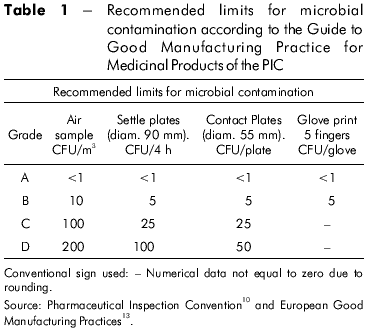
<body><![CDATA[<p><font size="2" face="verdana"> This was an observational, descriptive, prospective study in which two  air sampling techniques were used for microbiological environment control: the  sedimentation plate method<sup>8,9</sup> and the surface contact method<sup>10</sup>.</font></p>     <p><font size="2" face="verdana"> The surface swab method was used to collect material from contact  surfaces and from the handlers' gloves. The   sedimentation method was used to collect samples from the air  conditioning system and from the BSC and consisted of exposing a 90-mm diameter  petri plate with 20 mL of selective or non-selective medium (the nutrient agar)  to the air in that environment for 6 h. The colonies were deposited by gravity  and then counted. The plates were identified and packed in thermic styrofoam  boxes under aseptic conditions and subsequently transported to the microbiology  laboratory, where they were incubated at 37<sup>o</sup> C for 24 to 48 h; the evaluation  was performed by determining the number of colony forming units (CFU) according  to Pasquarella et al<sup>8</sup>.</font></p>     <p><font size="2" face="verdana"> Subsequently, the colonies were identified based on their Gram stain  characteristics and were cultivated at 37<sup>o</sup> C in MacConkey Agar medium (HIMEDIA)  or Mannitol Agar Salt (HIMEDIA) (in two plates of each medium). The colonies  that presented themselves as Gram-positive cocci grouped in clusters were subjected  to biochemical identification tests for catalase, oxidase and coagulase  activity<sup>11</sup>. The Gram-negative organisms were identified based on  their growth on MacConkey Agar and underwent biochemical tests, such as  citrate, urea, H2S, indole, motility, lysine decarboxylase and oxidase/glucose  and sucrose fermentation, for identification of enterobacteria and  non-fermenting bacilli . In the case of fungal growth in Sabouraud medium,  growth was evaluated on a slide using cotton blue dye or clarified with KOH and  microculture.</font></p>     <p><font size="2" face="verdana"> The microculture technique involves placing a small  sample of the culture medium containing the fungus on a slide for microscopy. A  coverslip is laid over the sample and the slide is placed in a moist room. The  fungus grows at the bottom of the coverslip and develops fructifications that  can be analyzed directly through the microscope without being destroyed by  manipulation<sup>11</sup>. The recommended limits for microbiological  monitoring of clean rooms in the operation are determined based on the Pharmaceutical  Inspection Convention (PIC) in which the aseptic preparation of solutions is  described in group A<sup>10,13</sup> (<a href="#t1">Table 1</a>).</font></p>     <p><font size="2" face="verdana"><a name="t1"></a></font></p>     <p>&nbsp;</p>     <p align="center"><img src="/img/revistas/rpas/v1n4/4a10t1.gif" border="0" /></p>     <p>&nbsp;</p>     <p><font size="2" face="verdana"><b>ETHICS</b></font></p>     <p><font size="2" face="verdana"> The project (protocol 1329/10) was approved by the Ethics in Research  Committee of the Hospital Universit&aacute;rio Jo&atilde;o de Barros Barreto of the Universidade  Federal do Par&aacute; (HUJBB/UFPA) (CAAE - 3076.0.000.071-10), and the procedures  comply with Resolution 196/96 of the Conselho Nacional de Sa&uacute;de.</font></p>     ]]></body>
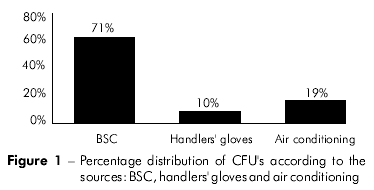
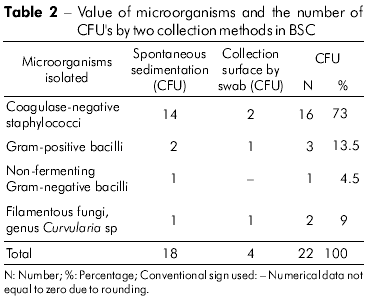
<body><![CDATA[<p>&nbsp;</p>     <p><font size="3" face="verdana">  <b>RESULTS</b></font></p>     <p><font size="2" face="verdana">  A total of 31 CFU's were isolated from the analyzed  sources: 22 (71%) were obtained from the BSC, three (10%) were obtained from  the handlers' gloves and six (19%) were obtained from the air conditioning  system (<a href="#f1">Figure 1</a>).</font></p>     <p><a name="f1"></a></p>     <p>&nbsp;</p>     <p align="center"><img src="/img/revistas/rpas/v1n4/4a10f1.gif" border="0" /></p>     <p>&nbsp;</p>     <p><font size="2" face="verdana">The qualitative analysis of the colonies demonstrated that potentially  pathogenic microorganisms had been isolated from all samples from the three  analyzed sources. Bacteria from the coagulase-negative staphylococcus group  were the most commonly detected microorganisms in the analyzed samples (23 of  31 colonies or 74.19%).</font></p>     <p><font size="2" face="verdana"> Overall, 18 (82%) of the 22 CFU's isolated from the  BSC were obtained with the sedimentation method and four (18%) were obtained  with the surface swab method. The results showed a higher frequency of  Gram-positive bacteria, and the most common microorganism was  coagulase-negative staphylococcus (73%), followed by Gram-positive bacillus  (13.5%). Only one Gram-negative bacterium was isolated: a non-fermenting  Gram-negative bacillus (4.5%)<sup>14</sup>. Furthermore, filamentous fungi of  the genus <i>Curvularia </i>sp were found at a frequency of 9% (<a href="#t2">Table 2</a>).</font></p>     <p><a name="t2"></a></p>     ]]></body>
<body><![CDATA[<p>&nbsp;</p>     <p align="center"><img src="/img/revistas/rpas/v1n4/4a10t2.gif" border="0" /></p>     <p>&nbsp;</p>     <p><font size="2" face="verdana">Glove samples were obtained at two timepoints: before and after the  handling process. At the beginning of manipulation, there was no growth from  any glove samples, which demonstrated that the gloves were sterile. However,  contamination was observed in samples collected during the second day of the  collection.</font></p>     <p><font size="2" face="verdana"> Among the three technicians' gloves that were analyzed, only the samples  collected from the handler B's glove showed microbiological contamination with  coagulase-negative bacteria (two CFU's, 67%) and <i>Klebsiella </i>sp (one CFU,  33%).</font></p>     <p><font size="2" face="verdana"> In the manipulation room air conditioning system samples, five (83%)  CFU's of coagulase-negative staphylococcus and one (17%) CFU of <i>Klebsiella </i>sp  were found. Moreover, variations in room temperature were observed, and the air  conditioner cleaning filter was absent from the register.</font></p>     <p>&nbsp;</p>     <p>  <font size="3" face="verdana"><b>DISCUSSION</b></font></p>     <p><font size="2" face="verdana">  Air microbes are difficult to quantify, and four main methods can be  used: the counting of CFU/m<sup>3</sup> in air, the counting of CFU on plates,  the measurement of chemical components of microbial cells/m<sup>3</sup> in air;  and counting under the microscope. Air samples can be collected in two ways.  Active air sampling involves collecting a known volume of air in a nutrient  medium using differentiated and specific techniques, and the passive method  consists of the use of petri plates containing solid nutrient medium that are  left exposed to air for a given time period; this is considered a qualitative  method<sup>8</sup>.</font></p>     <p><font size="2" face="verdana"> In this study, the analysis revealed a high rate of contamination in the  studied samples, mainly in the 2BII class cabinet and on the technicians'  gloves, where no type of microbial growth should occur<sup>15</sup>.</font></p>     ]]></body>
<body><![CDATA[<p><font size="2" face="verdana"> The main microorganisms isolated from the samples from the BSC, which  were coagu lase-negative staphylococci (73%) and Gram-positive bacilli (13.5%),  are widely distributed in the environment and are found as part of the normal  flora of the skin and mucous membranes of humans and animals. Recent studies of  microbiological monitoring in non-classified environments using the same  methodology detected the presence of these microorganisms<sup>9</sup>.</font></p>     <p><font size="2" face="verdana"> Although these microorganisms are considered environmental contaminants,  they may behave as opportunistic pathogens and are capable of  producing disease in immunocompromised individuals, which is important because  most cancer patients are immunocompromised<sup>16</sup>. Coagulase-negative  staphylococci, in particular, have been highlighted as an important agent of  human diseases, such as bacteremia, endocarditis and osteomyelitis, in addition  to the emergence of resistance to commonly-used antimicrobials<sup>11</sup>.</font></p>     <p><font size="2" face="verdana"> The two methods of collection from the BSC showed  growth of Gram-positive bacilli and the filamentous fungi of the <i>Curvularia </i>sp  genus, which is considered a common</font> <font size="2" face="verdana">environmental contaminant<sup>16</sup>. Bacteria and fungi are most  often associated as biocontaminants that compromise indoor air quality<sup>17</sup>.</font></p>     <p><font size="2" face="verdana"> The results of a study conducted by Andrade Silva et al<sup>18</sup> in  an operating room of a hospital, using the same methodology as used in this  study also showed the presence of filamentous fungi and other microorganisms.</font></p>     <p><font size="2" face="verdana"> The presence of these organisms suggests that the process of room and  equipment cleaning is not adequate, or the entry and exit of individuals who  work in these rooms are not being controlled. Studies conducted in Brazil  emphasize the importance of restricting access to the handling area to trained  personnel only to minimize particulate and microbial contamination<sup>19,20</sup>.</font></p>     <p><font size="2" face="verdana"> The contamination of handlers' gloves by microorganisms usually involve  normal flora, coagulase-negative staphylococci and <i>Klebsiella </i>sp and  highlights the role of the technician as a carrier of contamination<sup>21</sup>.  In cases where contamination was detected on the handlers' gloves, it was  observed that the hands were repeatedly removed from the cabinet during the  manipulation process to obtain medicine bottles, syringes or other material;  this did not occur with the other technicians. This procedure should be avoided  because it can result in the introduction of contamination since the laminar  flow is interrupted and microorganisms can be transferred from the gloves into  the BSC<sup>22</sup>. According to the American Society of Health-System  Pharmacists, all materials necessary for aseptic preparation should be prepared  in the critical area, i.e., inside the BSC to avoid interruption of the airflow  between the HEPA filter and the critical placement of bottles and containers.  This scenario is likely to have occurred because the samples from gloves before  the handling process presented no microbiological growth, which confirmed their  sterility<sup>12</sup>. Therefore, the validation of hand sterilization,  education and training of the professional handler is extremely important for  maintaining an aseptic area.</font></p>     <p><font size="2" face="verdana"> The major groups of air contaminant particles present in air-conditioned  ambient conditions include fungi, bacteria, spores and viruses that originate  from the outside air, air conditioning system, construction, furniture and  especially from its occupants<sup>23</sup>. In this study, the contamination in  the samples from the handlers' gloves was the same as the contamination found  in the air conditioner samples, differing only in the number of CFU's (five  coagulase-negative staphylococci colonies and one <i>Klebsiella </i>sp colony).  Based on this methodology, the presence of contaminant fungi was not observed,  perhaps as a result of the exposure time of this study. However, other studies  have reported the frequency of bacterial contamination in clean hospital  environments. Many studies have shown that   assessing the level of contamination in areas considered at risk is very  important in preventing infection<sup>24</sup>.</font></p>     <p><font size="2" face="verdana"> It is important to note that the physical space of the hospital  chemotherapy pharmacy in this study does not conform to the RDC 220/04 and  50/02, which may contribute to contamination of the room air. In 2004, the  Anvisa set the minimum requirements for the operation of the ATS in the  Technical Regulation established by RDC 220/04. These include the requirements  that the ATS should have a quality management system that is incorporated into  GPPAT and an effectively documented and monitored quality control protocol.  This system ensures the assessment and periodic registry of critical points in  the process and implementation of corrective actions and continually improves  the processes that ensure the quality of these products<sup>6,7</sup>.</font></p>     <p><font size="2" face="verdana"> This study was socialized among pharmacists of the Department of  Oncology in the hospital in which changes in standard operating procedures had  been immediately made, adopting mainly the presence of an assistant in the room  for manipulation to avoid excessive removal of manipulator hand from inside the  cabin and the disinfection of medicines and air conditioning of the clean room  with 70% alcohol to minimize microbiological contamination. However, the  validation of the procedures to guarantee the aseptic quality of the products  is important.</font></p>     <p>&nbsp;</p>     ]]></body>
<body><![CDATA[<p><font size="3" face="verdana">  <b>CONCLUSION</b></font></p>     <p><font size="2" face="verdana">  In short, this study showed the environmental and process contamination,  mainly by bacteria and fungi, which can be potentially pathogenic to  immunocompromised individuals.</font></p>     <p><font size="2" face="verdana"> Our findings, in addition to those described by other authors and  current laws, suggest the need for continuous monitoring of microbiological  quality of processes, equipment and environmental preparation of chemotherapy  agents, as well as a validation of the asepsis and the restructuring of  physical space according to the RDC 50/02 and 220/04  to optimize therapy and minimize risks to public  health.</font></p>     <p><font size="2" face="verdana"> Further studies are necessary to evaluate the final product and confirm  contamination as a result of dubious and non-validated manipulation processes.</font></p>     <p>&nbsp;</p>     <p><font size="3" face="verdana">  <b>FINANCIAL SUPPORT</b></font></p>     <p><font size="2" face="verdana"> Project funded by grants from the Minist&eacute;rio da Educa&ccedil;&atilde;o,  on the multiprofessional residency of  health, linked to the HUJBB/UFPA.</font></p>     <p>&nbsp;</p>     <p><font size="3" face="verdana"><b>REFERENCES</b></font></p>     <!-- ref --><p><font size="2" face="verdana"> 1 Cleton FJ.  Chemotherapy: general aspects. In: Peckham M, Pinedo HM, Veronesi H, editors. Oxford textbook of oncology. New York: Oxford  University Press; 1995. vol. 1, p. 445-53.</font><!-- ref --><p><font size="2" face="verdana"> 2 Schneider PJ.  Process validation. In: Buchanan EC, McKinnon BT, Scheckelhoff DJ, Schneider  PJ, editors. Principles of sterile product preparation. Bethesda: American Society of&nbsp; Health-System Pharmacists;   1995. p. 121-4.</font><!-- ref --><p><font size="2" face="verdana"> 3 Yamamoto CH, Pinto TJA,  Meurer VM. Controle de qualidade microbiol&oacute;gico de produtos farmac&ecirc;uticos,  cosm&eacute;ticos e fototer&aacute;picos produzidos na Zona da Mata, Minas Gerais. Anais do 2<sup>o</sup> Congresso  Brasileiro de Extens&atilde;o Universit&aacute;ria; 2004  set 12-15; Belo Horizonte. Belo Horizonte: Universidade Federal de  Minas Gerais; 2004. p. 1-7.</font><font size="2" face="verdana"><font size="2" face="verdana">&nbsp;&nbsp; &nbsp; &nbsp; &nbsp;  &nbsp;&#91; <a href="http://www.ufmg.br/congrext/Desen/Desen7.pdf" target="_blank">Links</a> &#93;</font></font><!-- ref --><p><font size="2" face="verdana"> 4 Dalgo  ML. Normatiza&ccedil;&atilde;o farmac&ecirc;utica em terapia nutricional. In: Waitzberg DL, editor.  Nutri&ccedil;&atilde;o oral, enteral e parenteral na pr&aacute;tica cl&iacute;nica. 2. ed. S&atilde;o Paulo:  Atheneu; 2002.  p. 929-45.</font><!-- ref --><p><font size="2" face="verdana">5 Kr&auml;mer I, Wenchel HM.  Viability of microorganisms in antineoplastic drug solutions. Eur J Hosp Pharm. 1991  Jun;1:14-9.</font><!-- ref --><p><font size="2" face="verdana"> 6 Ag&ecirc;ncia Nacional de Vigil&acirc;ncia Sanit&aacute;ria (BR). Resolu&ccedil;&atilde;o RDC n<sup>o</sup>  220, de 21 de setembro de 2004. Aprova o regulamento t&eacute;cnico de funcionamento  dos servi&ccedil;os de terapia antineopl&aacute;sica. Di&aacute;rio Oficial da Uni&atilde;o. Bras&iacute;lia, 23 set.  2004.</font><!-- ref --><p><font size="2" face="verdana"> 7 Ag&ecirc;ncia Nacional de Vigil&acirc;ncia&nbsp;Sanit&aacute;ria (BR).   Resolu&ccedil;&atilde;o RDC n<sup>o</sup> 50, de 21 de fevereiro de 2002. Disp&otilde;e sobre o Regulamento T&eacute;cnico para planejamento,  programa&ccedil;&atilde;o, elabora&ccedil;&atilde;o e avalia&ccedil;&atilde;o de projetos f&iacute;sicos de estabelecimentos assistenciais de sa&uacute;de. Di&aacute;rio Oficial da Uni&atilde;o, 20 mar. 2002.</font><!-- ref --><p><font size="2" face="verdana"> 8 Pasquarella C, Pitzurra  O, Sarno A. The index of microbial air  contamination. J Hosp Infect. 2000 Dec;46(4):241-56.</font><font size="2" face="verdana"><font size="2" face="verdana">&nbsp;&nbsp; &nbsp; &nbsp; &nbsp;  &nbsp;&#91; <a href="http://www.ncbi.nlm.nih.gov/pubmed?term=index%5BTitle%5D%20AND%20microbial%5BTitle%5D%20AND%20air%5BTitle%5D%20AND%20contamination%5BTitle%5D" target="_blank">Links</a> &#93;</font></font><!-- ref --><p><font size="2" face="verdana"> 9 Morais GR, Silva MA, Carvalho MV, Santos  JGS, Dolinger EJO, Brito DD. Qualidade do ar interno em uma institui&ccedil;&atilde;o de  ensino superior brasileira. Biosci J. 2010 mar-abr;26(2):305-10.</font><font size="2" face="verdana"><font size="2" face="verdana">&nbsp;&nbsp; &nbsp; &nbsp; &nbsp;  &nbsp;&#91; <a href="http://www.esac.pt/Abelho/Monitor_ambiental/MOrais%20et%20al.%202010_ar.pdf" target="_blank">Links</a> &#93;</font></font><!-- ref --><p><font size="2" face="verdana"> 10 Pharmaceutical  inspection convention. Pharmaceutical inspection co-operation scheme: guide to  good manufacturing practice for medicinal products. Geneva: PIC/S; 2004. 143 p.<font size="2" face="verdana">&nbsp;&nbsp; &nbsp; &nbsp; &nbsp;  &nbsp;&#91; <a href="http://www.hpci.ch/files/documents/guidelines/hh_gl_gmp.pdf" target="_blank">Links</a> &#93;</font></font><!-- ref --><p><font size="2" face="verdana"> 11 Koneman EW, Allen SD, Janda WM, Schreckenberger PC, Winn Jr WC. Diagn&oacute;stico microbiol&oacute;gico: texto e atlas colorido. S&atilde;o Paulo: Medsi; 2001. 1465 p.</font><!-- ref --><p><font size="2" face="verdana"> 12 Koneman EW, Allen SD, Janda WM, Schreckenberger PC,  Winn Jr WC. Diagn&oacute;stico  microbiol&oacute;gico: texto e atlas colorido. 6.  ed.  S&atilde;o Paulo: Guanabara Koogan;   2008. 1468 p.</font><!-- ref --><p><font size="2" face="verdana"> 13 European good manufacturing  practices. Guide to manufacture of sterile medicinal products; 1997.</font><!-- ref --><p><font size="2" face="verdana"> 14 Neder RN. Microbiologia:  manual de laborat&oacute;rio. S&atilde;o Paulo: Nobel; 1992. p. 25-6.</font><!-- ref --><p><font size="2" face="verdana"> 15 ASHP guidelines on quality  assurance for pharmacy-prepared sterile products. Am J Health Syst  Pharm.   2000  Jun;57(12):1150-69.</font><!-- ref --><p><font size="2" face="verdana"> 16 Zanon U. Riscos  infecciosos imputados ao lixo hospitalar: realidade epidemiol&oacute;gica ou fic&ccedil;&atilde;o  sanit&aacute;ria? Rev Soc Bras  Med Trop.  1990 jul-set;23(3):163-70.</font><font size="2" face="verdana"><font size="2" face="verdana">&nbsp;&nbsp; &nbsp; &nbsp; &nbsp;  &nbsp;&#91; <a href="http://bases.bireme.br/cgi-bin/wxislind.exe/iah/online/?IsisScript=iah/iah.xis&src=google&base=LILACS&lang=p&nextAction=lnk&exprSearch=105558&indexSearch=ID" target="_blank">Links</a> &#93;</font></font><!-- ref --><p><font size="2" face="verdana"> 17 Gontijo Filho PP, Silva CRM, Kritski AL. Ambientes climatizados, portaria 3.523 de 28/8/98 do Minist&eacute;rio da Sa&uacute;de e  padr&otilde;es de qualidade do ar de interiores do Brasil. J Bras Pneumol. 2000 set-out;26(5):254-8. Doi:10.1590/S0102-35862000000500006</font><font size="2" face="verdana"><font size="2" face="verdana">&nbsp;&nbsp; &nbsp; &nbsp; &nbsp;  &nbsp;&#91; <a href="http://www.jornaldepneumologia.com.br/PDF/2000_26_5_6_portugues.pdf" target="_blank">Links</a> &#93;</font></font><!-- ref --><p><font size="2" face="verdana"> 18 Andrade SI, Gontijo Filho  PP, Melo GB. An&aacute;lise microbiol&oacute;gica quantitativa e qualitativa do ar do centro  cir&uacute;rgico durante realiza&ccedil;&atilde;o de cirurgias card&iacute;acas no hospital de cl&iacute;nicas da  Universidade Federal de Uberl&acirc;ndia. Hor Ci. 2010;3(2):1-19.</font><!-- ref --><p><font size="2" face="verdana"> 19 Maravich MD, Morgan B. Alkylating  Agents. In: Kirkwood JM, Lotze MT, Yasko JM, editors. Current Cancer  Therapeutics. 2. ed. Churchill Livingstone;   1996. p. 1-36.</font><!-- ref --><p><font size="2" face="verdana"> 20 Polliack A. A  handbook of essential drugs and regimens in hematological oncology. Chur:  Harwood Academic Publishers; 1991. 180 p.</font><!-- ref --><p><font size="2" face="verdana"> 21 Pratt RJ, Pellowe CM,  Wilson JA, Loveday HP, Haper PJ, Jones SRLJ, et al. Epic2: national  evidence-based guidelines for preventing healthcare-associated infections in  NHS hospitals in England. J Hosp Infect.   2007 Feb;65 Suppl 1:S1-64.</font><font size="2" face="verdana"><font size="2" face="verdana">&nbsp;&nbsp; &nbsp; &nbsp; &nbsp;  &nbsp;&#91; <a href="http://www.ncbi.nlm.nih.gov/pubmed/17307562" target="_blank">Links</a> &#93;</font></font><!-- ref --><p><font size="2" face="verdana"> 22 Flores A.  Appropriate glove use in the prevention of cross-infection. Nurs Stand. 2007 May;21(35):45-8.</font><font size="2" face="verdana"><font size="2" face="verdana">&nbsp;&nbsp; &nbsp; &nbsp; &nbsp;  &nbsp;&#91; <a href="http://www.ncbi.nlm.nih.gov/pubmed/17515152" target="_blank">Links</a> &#93;</font></font><!-- ref --><p><font size="2" face="verdana"> 23 World Health  Organization. Indoor air quality: biological contaminants, report on a WHO  meeting, Rautavaara, 29 August - 2 September 1988. Copenhagen: WHO Regional  Office for Europe;   1990. 67 p.</font><!-- ref --><p><font size="2" face="verdana"> 24 Wanner H-U, Verhoeff A,  Colombi A, Flannigan B, Gravesen S, Mouilleseaux A, et al. European  collaborative action: environment &amp; quality of life indoor air quality and  its impact on man. Luxembourg: Office for Official Publications of the European  Communities; 1993. 81 p. (Environment and quality of life, Report N<sup>o</sup>. 12: Biological  particles in indoor).</font><p>&nbsp;</p>     <p>&nbsp;</p>     <p><font size="2" face="Verdana"><b><a name="endereco"></a><a href="#topo"><img src="/img/revistas/rpas/v1n4/seta.gif" border="0"></a></b></font><font size="2" face="verdana"><b>Correspondence / Correspond&ecirc;ncia / Correspondencia:</b>    <br> Cristiane do Socorro Ferraz Maia    <br> Faculdade  de Farm&aacute;cia,    <br> Universidade Federal do Par&aacute;    <br> Av.  Augusto Corr&ecirc;a, n<sup>o </sup>01, Bairro: Guam&aacute;    ]]></body>
<body><![CDATA[<br> CEP:  66075-110    <br> Bel&eacute;m-Par&aacute;-Brasil    <br> Tel.: +55  (91) 3201-7202    <br> E-mail: <a href="mailto:crismaia@ufpa.br">crismaia@ufpa.br</a></font></p>     <p><font size="2" face="verdana">Received  / Recebido em / Recibido en: 3/9/2011    <br> Accepted / Aceito  em / Aceito  en: 4/12/2011</font></p> <script type="text/javascript"> var gaJsHost = (("https:" == document.location.protocol) ? "https://ssl." : "http://www."); document.write(unescape("%3Cscript src='" + gaJsHost + "google-analytics.com/ga.js' type='text/javascript'%3E%3C/script%3E")); </script> <script type="text/javascript"> try { var pageTracker = _gat._getTracker("UA-7885746-4"); pageTracker._setDomainName("none"); pageTracker._setAllowLinker(true); pageTracker._trackPageview(); } catch(err) {}</script>      ]]></body><back>
<ref-list>
<ref id="B1">
<label>1</label><nlm-citation citation-type="book">
<person-group person-group-type="author">
<name>
<surname><![CDATA[Cleton]]></surname>
<given-names><![CDATA[FJ]]></given-names>
</name>
</person-group>
<article-title xml:lang="en"><![CDATA[Chemotherapy: general aspects]]></article-title>
<person-group person-group-type="editor">
<name>
<surname><![CDATA[Peckham]]></surname>
<given-names><![CDATA[M]]></given-names>
</name>
<name>
<surname><![CDATA[Pinedo]]></surname>
<given-names><![CDATA[HM]]></given-names>
</name>
<name>
<surname><![CDATA[Veronesi]]></surname>
<given-names><![CDATA[H]]></given-names>
</name>
</person-group>
<source><![CDATA[Oxford textbook of oncology]]></source>
<year>1995</year>
<page-range>445-53</page-range><publisher-loc><![CDATA[New York ]]></publisher-loc>
<publisher-name><![CDATA[Oxford University Press]]></publisher-name>
</nlm-citation>
</ref>
<ref id="B2">
<label>2</label><nlm-citation citation-type="book">
<person-group person-group-type="author">
<name>
<surname><![CDATA[Schneider]]></surname>
<given-names><![CDATA[PJ]]></given-names>
</name>
</person-group>
<article-title xml:lang="en"><![CDATA[Process validation]]></article-title>
<person-group person-group-type="editor">
<name>
<surname><![CDATA[Buchanan]]></surname>
<given-names><![CDATA[EC]]></given-names>
</name>
<name>
<surname><![CDATA[McKinnon]]></surname>
<given-names><![CDATA[BT]]></given-names>
</name>
<name>
<surname><![CDATA[Scheckelhoff]]></surname>
<given-names><![CDATA[DJ]]></given-names>
</name>
<name>
<surname><![CDATA[Schneider]]></surname>
<given-names><![CDATA[PJ]]></given-names>
</name>
</person-group>
<source><![CDATA[Principles of sterile product preparation]]></source>
<year>1995</year>
<page-range>121-4</page-range><publisher-loc><![CDATA[Bethesda ]]></publisher-loc>
<publisher-name><![CDATA[American Society of Health-System Pharmacists]]></publisher-name>
</nlm-citation>
</ref>
<ref id="B3">
<label>3</label><nlm-citation citation-type="confpro">
<person-group person-group-type="author">
<name>
<surname><![CDATA[Yamamoto]]></surname>
<given-names><![CDATA[CH]]></given-names>
</name>
<name>
<surname><![CDATA[Pinto]]></surname>
<given-names><![CDATA[TJA]]></given-names>
</name>
<name>
<surname><![CDATA[Meurer]]></surname>
<given-names><![CDATA[VM]]></given-names>
</name>
</person-group>
<source><![CDATA[Controle de qualidade microbiológico de produtos farmacêuticos, cosméticos e fototerápicos produzidos na Zona da Mata, Minas]]></source>
<year>2004</year>
<conf-name><![CDATA[2º Congresso Brasileiro de Extensão Universitária]]></conf-name>
<conf-date>2004 set 12-15</conf-date>
<conf-loc>Belo Horizonte </conf-loc>
<page-range>1-7</page-range><publisher-loc><![CDATA[Belo Horizonte ]]></publisher-loc>
<publisher-name><![CDATA[Universidade Federal de Minas Gerais]]></publisher-name>
</nlm-citation>
</ref>
<ref id="B4">
<label>4</label><nlm-citation citation-type="book">
<person-group person-group-type="author">
<name>
<surname><![CDATA[Dalgo]]></surname>
<given-names><![CDATA[ML]]></given-names>
</name>
</person-group>
<article-title xml:lang="pt"><![CDATA[Normatização farmacêutica em terapia nutricional]]></article-title>
<source><![CDATA[Nutrição oral, enteral e parenteral na prática clínica]]></source>
<year>2002</year>
<edition>2</edition>
<page-range>929-45</page-range><publisher-loc><![CDATA[São Paulo ]]></publisher-loc>
<publisher-name><![CDATA[Atheneu]]></publisher-name>
</nlm-citation>
</ref>
<ref id="B5">
<label>5</label><nlm-citation citation-type="journal">
<person-group person-group-type="author">
<name>
<surname><![CDATA[Krämer]]></surname>
<given-names><![CDATA[I]]></given-names>
</name>
<name>
<surname><![CDATA[Wenchel]]></surname>
<given-names><![CDATA[HM]]></given-names>
</name>
</person-group>
<article-title xml:lang="en"><![CDATA[Viability of microorganisms in antineoplastic drug solutions]]></article-title>
<source><![CDATA[Eur J Hosp Pharm]]></source>
<year>1991</year>
<month> J</month>
<day>un</day>
<volume>1</volume>
<page-range>14-9</page-range></nlm-citation>
</ref>
<ref id="B6">
<label>6</label><nlm-citation citation-type="journal">
<collab>Agência Nacional de Vigilância Sanitária (BR)</collab>
<article-title xml:lang="pt"><![CDATA[Resolução RDC nº 220, de 21 de setembro de 2004: Aprova o regulamento técnico de funcionamento dos serviços de terapia antineoplásica]]></article-title>
<source><![CDATA[Diário Oficial da União]]></source>
<year>23 s</year>
<month>et</month>
<day>. </day>
</nlm-citation>
</ref>
<ref id="B7">
<label>7</label><nlm-citation citation-type="journal">
<collab>Agência Nacional de Vigilância Sanitária (BR)</collab>
<article-title xml:lang="pt"><![CDATA[Resolução RDC nº 50, de 21 de fevereiro de 2002: Dispõe sobre o Regulamento Técnico para planejamento, programação, elaboração e avaliação de projetos físicos de estabelecimentos assistenciais de saúde]]></article-title>
<source><![CDATA[Diário Oficial da União]]></source>
<year>20 m</year>
<month>ar</month>
<day>. </day>
</nlm-citation>
</ref>
<ref id="B8">
<label>8</label><nlm-citation citation-type="journal">
<person-group person-group-type="author">
<name>
<surname><![CDATA[Pasquarella]]></surname>
<given-names><![CDATA[C]]></given-names>
</name>
<name>
<surname><![CDATA[Pitzurra]]></surname>
<given-names><![CDATA[O]]></given-names>
</name>
<name>
<surname><![CDATA[Sarno]]></surname>
<given-names><![CDATA[A]]></given-names>
</name>
</person-group>
<article-title xml:lang="en"><![CDATA[The index of microbial air contamination]]></article-title>
<source><![CDATA[J Hosp Infect]]></source>
<year>2000</year>
<month> D</month>
<day>ec</day>
<volume>46</volume>
<numero>4</numero>
<issue>4</issue>
<page-range>241-56</page-range></nlm-citation>
</ref>
<ref id="B9">
<label>9</label><nlm-citation citation-type="journal">
<person-group person-group-type="author">
<name>
<surname><![CDATA[Morais]]></surname>
<given-names><![CDATA[GR]]></given-names>
</name>
<name>
<surname><![CDATA[Silva]]></surname>
<given-names><![CDATA[MA]]></given-names>
</name>
<name>
<surname><![CDATA[Carvalho]]></surname>
<given-names><![CDATA[MV]]></given-names>
</name>
<name>
<surname><![CDATA[Santos]]></surname>
<given-names><![CDATA[JGS]]></given-names>
</name>
<name>
<surname><![CDATA[Dolinger]]></surname>
<given-names><![CDATA[EJO]]></given-names>
</name>
<name>
<surname><![CDATA[Brito]]></surname>
<given-names><![CDATA[DD]]></given-names>
</name>
</person-group>
<article-title xml:lang="pt"><![CDATA[Qualidade do ar interno em uma instituição de ensino superior brasileira]]></article-title>
<source><![CDATA[Biosci J]]></source>
<year>2010</year>
<month> m</month>
<day>ar</day>
<volume>26</volume>
<numero>2</numero>
<issue>2</issue>
<page-range>305-10</page-range></nlm-citation>
</ref>
<ref id="B10">
<label>10</label><nlm-citation citation-type="book">
<collab>Pharmaceutical inspection convention</collab>
<source><![CDATA[Pharmaceutical inspection co-operation scheme: guide to good manufacturing practice for medicinal products]]></source>
<year>2004</year>
<page-range>143</page-range><publisher-loc><![CDATA[Geneva ]]></publisher-loc>
<publisher-name><![CDATA[PIC/S]]></publisher-name>
</nlm-citation>
</ref>
<ref id="B11">
<label>11</label><nlm-citation citation-type="book">
<person-group person-group-type="author">
<name>
<surname><![CDATA[Koneman]]></surname>
<given-names><![CDATA[EW]]></given-names>
</name>
<name>
<surname><![CDATA[Allen]]></surname>
<given-names><![CDATA[SD]]></given-names>
</name>
<name>
<surname><![CDATA[Janda]]></surname>
<given-names><![CDATA[WM]]></given-names>
</name>
<name>
<surname><![CDATA[Schreckenberger]]></surname>
<given-names><![CDATA[PC]]></given-names>
</name>
<name>
<surname><![CDATA[Winn Jr]]></surname>
<given-names><![CDATA[WC]]></given-names>
</name>
</person-group>
<source><![CDATA[Diagnóstico microbiológico: texto e atlas colorido]]></source>
<year>2001</year>
<page-range>1465</page-range><publisher-loc><![CDATA[São Paulo ]]></publisher-loc>
<publisher-name><![CDATA[Medsi]]></publisher-name>
</nlm-citation>
</ref>
<ref id="B12">
<label>12</label><nlm-citation citation-type="book">
<person-group person-group-type="author">
<name>
<surname><![CDATA[Koneman]]></surname>
<given-names><![CDATA[EW]]></given-names>
</name>
<name>
<surname><![CDATA[Allen]]></surname>
<given-names><![CDATA[SD]]></given-names>
</name>
<name>
<surname><![CDATA[Janda]]></surname>
<given-names><![CDATA[WM]]></given-names>
</name>
<name>
<surname><![CDATA[Schreckenberger]]></surname>
<given-names><![CDATA[PC]]></given-names>
</name>
<name>
<surname><![CDATA[Winn Jr]]></surname>
<given-names><![CDATA[WC]]></given-names>
</name>
</person-group>
<source><![CDATA[Diagnóstico microbiológico: texto e atlas colorido]]></source>
<year>2008</year>
<edition>6</edition>
<page-range>1468</page-range><publisher-loc><![CDATA[São Paulo ]]></publisher-loc>
<publisher-name><![CDATA[Guanabara Koogan]]></publisher-name>
</nlm-citation>
</ref>
<ref id="B13">
<label>13</label><nlm-citation citation-type="">
<collab>European good manufacturing practices</collab>
<source><![CDATA[Guide to manufacture of sterile medicinal products]]></source>
<year>1997</year>
</nlm-citation>
</ref>
<ref id="B14">
<label>14</label><nlm-citation citation-type="book">
<person-group person-group-type="author">
<name>
<surname><![CDATA[Neder]]></surname>
<given-names><![CDATA[RN]]></given-names>
</name>
</person-group>
<source><![CDATA[Microbiologia: manual de laboratório]]></source>
<year>1992</year>
<page-range>25-6</page-range><publisher-loc><![CDATA[São Paulo ]]></publisher-loc>
<publisher-name><![CDATA[Nobel]]></publisher-name>
</nlm-citation>
</ref>
<ref id="B15">
<label>15</label><nlm-citation citation-type="journal">
<article-title xml:lang="en"><![CDATA[ASHP guidelines on quality assurance for pharmacy-prepared sterile products]]></article-title>
<source><![CDATA[Am J Health Syst Pharm]]></source>
<year>2000</year>
<month> J</month>
<day>un</day>
<volume>57</volume>
<numero>12</numero>
<issue>12</issue>
<page-range>1150-69</page-range></nlm-citation>
</ref>
<ref id="B16">
<label>16</label><nlm-citation citation-type="journal">
<person-group person-group-type="author">
<name>
<surname><![CDATA[Zanon]]></surname>
<given-names><![CDATA[U]]></given-names>
</name>
</person-group>
<article-title xml:lang="pt"><![CDATA[Riscos infecciosos imputados ao lixo hospitalar: realidade epidemiológica ou ficção sanitária?]]></article-title>
<source><![CDATA[Rev Soc Bras Med Trop]]></source>
<year>1990</year>
<month> j</month>
<day>ul</day>
<volume>23</volume>
<numero>3</numero>
<issue>3</issue>
<page-range>163-70</page-range></nlm-citation>
</ref>
<ref id="B17">
<label>17</label><nlm-citation citation-type="journal">
<person-group person-group-type="author">
<name>
<surname><![CDATA[Gontijo Filho]]></surname>
<given-names><![CDATA[PP]]></given-names>
</name>
<name>
<surname><![CDATA[Silva]]></surname>
<given-names><![CDATA[CRM]]></given-names>
</name>
<name>
<surname><![CDATA[Kritski]]></surname>
<given-names><![CDATA[AL]]></given-names>
</name>
</person-group>
<article-title xml:lang="pt"><![CDATA[Ambientes climatizados, portaria 3.523 de 28/8/98 do Ministério da Saúde e padrões de qualidade do ar de interiores do Brasil]]></article-title>
<source><![CDATA[J Bras Pneumol]]></source>
<year>2000</year>
<month> s</month>
<day>et</day>
<volume>26</volume>
<numero>5</numero>
<issue>5</issue>
<page-range>254-8</page-range></nlm-citation>
</ref>
<ref id="B18">
<label>18</label><nlm-citation citation-type="journal">
<person-group person-group-type="author">
<name>
<surname><![CDATA[Andrade]]></surname>
<given-names><![CDATA[SI]]></given-names>
</name>
<name>
<surname><![CDATA[Gontijo Filho]]></surname>
<given-names><![CDATA[PP]]></given-names>
</name>
<name>
<surname><![CDATA[Melo]]></surname>
<given-names><![CDATA[GB]]></given-names>
</name>
</person-group>
<article-title xml:lang="pt"><![CDATA[Análise microbiológica quantitativa e qualitativa do ar do centro cirúrgico durante realização de cirurgias cardíacas no hospital de clínicas da Universidade Federal de Uberlândia]]></article-title>
<source><![CDATA[Hor Ci]]></source>
<year>2010</year>
<volume>3</volume>
<numero>2</numero>
<issue>2</issue>
<page-range>1-19</page-range></nlm-citation>
</ref>
<ref id="B19">
<label>19</label><nlm-citation citation-type="book">
<person-group person-group-type="author">
<name>
<surname><![CDATA[Maravich]]></surname>
<given-names><![CDATA[MD]]></given-names>
</name>
<name>
<surname><![CDATA[Morgan]]></surname>
<given-names><![CDATA[B]]></given-names>
</name>
</person-group>
<article-title xml:lang="en"><![CDATA[Alkylating Agents]]></article-title>
<person-group person-group-type="editor">
<name>
<surname><![CDATA[Kirkwood]]></surname>
<given-names><![CDATA[JM]]></given-names>
</name>
<name>
<surname><![CDATA[Lotze]]></surname>
<given-names><![CDATA[MT]]></given-names>
</name>
<name>
<surname><![CDATA[Yasko]]></surname>
<given-names><![CDATA[JM]]></given-names>
</name>
</person-group>
<source><![CDATA[Current Cancer Therapeutics]]></source>
<year>1996</year>
<edition>2</edition>
<page-range>1-36</page-range><publisher-name><![CDATA[Churchill Livingstone]]></publisher-name>
</nlm-citation>
</ref>
<ref id="B20">
<label>20</label><nlm-citation citation-type="book">
<person-group person-group-type="author">
<name>
<surname><![CDATA[Polliack]]></surname>
<given-names><![CDATA[A]]></given-names>
</name>
</person-group>
<source><![CDATA[A handbook of essential drugs and regimens in hematological oncology]]></source>
<year>1991</year>
<page-range>180</page-range><publisher-loc><![CDATA[Chur ]]></publisher-loc>
<publisher-name><![CDATA[Harwood Academic Publishers]]></publisher-name>
</nlm-citation>
</ref>
<ref id="B21">
<label>21</label><nlm-citation citation-type="journal">
<person-group person-group-type="author">
<name>
<surname><![CDATA[Pratt]]></surname>
<given-names><![CDATA[RJ]]></given-names>
</name>
<name>
<surname><![CDATA[Pellowe]]></surname>
<given-names><![CDATA[CM]]></given-names>
</name>
<name>
<surname><![CDATA[Wilson]]></surname>
<given-names><![CDATA[JA]]></given-names>
</name>
<name>
<surname><![CDATA[Loveday]]></surname>
<given-names><![CDATA[HP]]></given-names>
</name>
<name>
<surname><![CDATA[Haper]]></surname>
<given-names><![CDATA[PJ]]></given-names>
</name>
<name>
<surname><![CDATA[Jones]]></surname>
<given-names><![CDATA[SRLJ]]></given-names>
</name>
</person-group>
<article-title xml:lang="en"><![CDATA[Epic2: national evidence-based guidelines for preventing healthcare-associated infections in NHS hospitals in England]]></article-title>
<source><![CDATA[J Hosp Infect]]></source>
<year>2007</year>
<month> F</month>
<day>eb</day>
<volume>65</volume>
<numero>^s1</numero>
<issue>^s1</issue>
<supplement>1</supplement>
<page-range>S1-64</page-range></nlm-citation>
</ref>
<ref id="B22">
<label>22</label><nlm-citation citation-type="journal">
<person-group person-group-type="author">
<name>
<surname><![CDATA[Flores]]></surname>
<given-names><![CDATA[A]]></given-names>
</name>
</person-group>
<article-title xml:lang="en"><![CDATA[Appropriate glove use in the prevention of cross-infection]]></article-title>
<source><![CDATA[Nurs Stand]]></source>
<year>2007</year>
<month> M</month>
<day>ay</day>
<volume>21</volume>
<numero>35</numero>
<issue>35</issue>
<page-range>45-8</page-range></nlm-citation>
</ref>
<ref id="B23">
<label>23</label><nlm-citation citation-type="book">
<collab>World Health Organization</collab>
<source><![CDATA[Indoor air quality: biological contaminants, report on a WHO meeting, Rautavaara, 29 August - 2 September 1988]]></source>
<year>1990</year>
<page-range>67</page-range><publisher-loc><![CDATA[Copenhagen ]]></publisher-loc>
<publisher-name><![CDATA[WHO Regional Office for Europe]]></publisher-name>
</nlm-citation>
</ref>
<ref id="B24">
<label>24</label><nlm-citation citation-type="book">
<person-group person-group-type="author">
<name>
<surname><![CDATA[Wanner]]></surname>
<given-names><![CDATA[H-U]]></given-names>
</name>
<name>
<surname><![CDATA[Verhoeff]]></surname>
<given-names><![CDATA[A]]></given-names>
</name>
<name>
<surname><![CDATA[Colombi]]></surname>
<given-names><![CDATA[A]]></given-names>
</name>
<name>
<surname><![CDATA[Flannigan]]></surname>
<given-names><![CDATA[B]]></given-names>
</name>
<name>
<surname><![CDATA[Gravesen]]></surname>
<given-names><![CDATA[S]]></given-names>
</name>
<name>
<surname><![CDATA[Mouilleseaux]]></surname>
<given-names><![CDATA[A]]></given-names>
</name>
</person-group>
<source><![CDATA[European collaborative action: environment & quality of life indoor air quality and its impact on man]]></source>
<year>1993</year>
<page-range>81</page-range><publisher-loc><![CDATA[Luxembourg ]]></publisher-loc>
<publisher-name><![CDATA[Office for Official Publications of the European Communities]]></publisher-name>
</nlm-citation>
</ref>
</ref-list>
</back>
</article>