<?xml version="1.0" encoding="ISO-8859-1"?><article xmlns:mml="http://www.w3.org/1998/Math/MathML" xmlns:xlink="http://www.w3.org/1999/xlink" xmlns:xsi="http://www.w3.org/2001/XMLSchema-instance">
<front>
<journal-meta>
<journal-id>2176-6223</journal-id>
<journal-title><![CDATA[Revista Pan-Amazônica de Saúde]]></journal-title>
<abbrev-journal-title><![CDATA[Rev Pan-Amaz Saude]]></abbrev-journal-title>
<issn>2176-6223</issn>
<publisher>
<publisher-name><![CDATA[Instituto Evandro Chagas. Secretaria de Vigilância em Saúde e Ambiente. Ministério da Saúde]]></publisher-name>
</publisher>
</journal-meta>
<article-meta>
<article-id>S2176-62232011000100003</article-id>
<article-id pub-id-type="doi">10.5123/S2176-62232011000100003</article-id>
<title-group>
<article-title xml:lang="en"><![CDATA[Descriptive study of American tegumentary leishmaniasis in the urban area of the Municipality of Governador Valadares, Minas Gerais State, Brazil]]></article-title>
<article-title xml:lang="pt"><![CDATA[Estudo descritivo sobre a leishmaniose tegumentar americana na área urbana do Município de Governador Valadares, Estado de Minas Gerais, Brasil]]></article-title>
<article-title xml:lang="es"><![CDATA[Estudio descriptivo sobre la leishmaniasis tegumentaria americana en el área urbana del Municipio de Governador Valadares, Estado de Minas Gerais, Brasil]]></article-title>
</title-group>
<contrib-group>
<contrib contrib-type="author">
<name>
<surname><![CDATA[Miranda]]></surname>
<given-names><![CDATA[Thiago Mourão de]]></given-names>
</name>
<xref ref-type="aff" rid="A01"/>
</contrib>
<contrib contrib-type="author">
<name>
<surname><![CDATA[Malaquias]]></surname>
<given-names><![CDATA[Luiz Cosme Cotta]]></given-names>
</name>
<xref ref-type="aff" rid="A02"/>
</contrib>
<contrib contrib-type="author">
<name>
<surname><![CDATA[Escalda]]></surname>
<given-names><![CDATA[Patrícia Maria Fonseca]]></given-names>
</name>
<xref ref-type="aff" rid="A01"/>
</contrib>
<contrib contrib-type="author">
<name>
<surname><![CDATA[Ramalho]]></surname>
<given-names><![CDATA[Katiuscia Cardoso]]></given-names>
</name>
<xref ref-type="aff" rid="A03"/>
</contrib>
<contrib contrib-type="author">
<name>
<surname><![CDATA[Coura-Vital]]></surname>
<given-names><![CDATA[Wendel]]></given-names>
</name>
<xref ref-type="aff" rid="A04"/>
</contrib>
<contrib contrib-type="author">
<name>
<surname><![CDATA[Silva]]></surname>
<given-names><![CDATA[Alexandre Rotondo da]]></given-names>
</name>
<xref ref-type="aff" rid="A04"/>
</contrib>
<contrib contrib-type="author">
<name>
<surname><![CDATA[Corrêa-Oliveira]]></surname>
<given-names><![CDATA[Rodrigo]]></given-names>
</name>
<xref ref-type="aff" rid="A05"/>
</contrib>
<contrib contrib-type="author">
<name>
<surname><![CDATA[Reis]]></surname>
<given-names><![CDATA[Alexandre Barbosa]]></given-names>
</name>
<xref ref-type="aff" rid="A06"/>
</contrib>
</contrib-group>
<aff id="A01">
<institution><![CDATA[,Universidade Vale do Rio Doce Laboratório de Imunologia ]]></institution>
<addr-line><![CDATA[Governador Valadares Minas Gerais]]></addr-line>
<country>Brasil</country>
</aff>
<aff id="A02">
<institution><![CDATA[,Universidade Federal de Alfenas, Alfenas Departamento de Ciências Biomédicas ]]></institution>
<addr-line><![CDATA[Alfenas Minas Gerais]]></addr-line>
<country>Brasil</country>
</aff>
<aff id="A03">
<institution><![CDATA[,Secretaria Municipal de Saúde Departamento de Atenção à Saúde ]]></institution>
<addr-line><![CDATA[Governador Valadares Minas Gerais]]></addr-line>
<country>Brasil</country>
</aff>
<aff id="A04">
<institution><![CDATA[,Universidade Federal de Ouro Preto Núcleo de Pesquisas em Ciências Biológicas Laboratório de Imunopatologia]]></institution>
<addr-line><![CDATA[Ouro Preto Minas Gerais]]></addr-line>
<country>Brasil</country>
</aff>
<aff id="A05">
<institution><![CDATA[,Fundação Oswaldo Cruz Instituto René Rachou Laboratório de Imunologia Celular e Molecular]]></institution>
<addr-line><![CDATA[Belo Horizonte , Minas Gerais]]></addr-line>
<country>Brasil</country>
</aff>
<aff id="A06">
<institution><![CDATA[,Universidade Federal de Ouro Preto Escola de Farmácia Departamento de Análises Clínicas]]></institution>
<addr-line><![CDATA[Ouro Preto Minas Gerais]]></addr-line>
<country>Brasil</country>
</aff>
<pub-date pub-type="pub">
<day>00</day>
<month>03</month>
<year>2011</year>
</pub-date>
<pub-date pub-type="epub">
<day>00</day>
<month>03</month>
<year>2011</year>
</pub-date>
<volume>2</volume>
<numero>1</numero>
<fpage>27</fpage>
<lpage>35</lpage>
<copyright-statement/>
<copyright-year/>
<self-uri xlink:href="http://scielo.iec.gov.br/scielo.php?script=sci_arttext&amp;pid=S2176-62232011000100003&amp;lng=en&amp;nrm=iso"></self-uri><self-uri xlink:href="http://scielo.iec.gov.br/scielo.php?script=sci_abstract&amp;pid=S2176-62232011000100003&amp;lng=en&amp;nrm=iso"></self-uri><self-uri xlink:href="http://scielo.iec.gov.br/scielo.php?script=sci_pdf&amp;pid=S2176-62232011000100003&amp;lng=en&amp;nrm=iso"></self-uri><abstract abstract-type="short" xml:lang="en"><p><![CDATA[To understand the emergence and re-emergence pattern of American tegumentary leishmaniasis (ATL), the clinical and epidemiological profiles and the spatial distribution of the disease were evaluated between 2001 and 2006 in an endemic area located in the Rio Doce valley in the north-eastern part of the Minas Gerais State, Brazil. The number of reported cases increased from six in the first year to 111 in the last year during this period. Disease cases predominated in the urban area (75.9%) and affected males and females equally in all age groups. The transmission of ATL occurred within dwellings and the surrounding areas, with the largest number of reported cases originating from poor areas, particularly those located on the margins of the Rio Doce lacking suitable sanitary infrastructure. Diagnosis was based on clinical criteria and the Montenegro skin test, with most patients (93.8%) exhibiting the cutaneous form of ATL. First-line treatment involved administration of pentavalent antimonial drugs (99.1%), and these provided a cure for > 75% of patients. The prevalence of ATL varied between 11.38 and 15.99 cases per 100,000 inhabitants, which is high in comparison with the national average. Urgent measures, including improved means of diagnosis at the local health units, education of schoolchildren and motivation of the general population, are required to decrease transmission and control the disease.]]></p></abstract>
<abstract abstract-type="short" xml:lang="pt"><p><![CDATA[Para entender os padrões de emergência e re-emergência da leishmaniose tegumentar americana (LTA), foram avaliados os perfis clínico e epidemiológico e a distribuição espacial da doença entre 2001 e 2006 em uma área endêmica situada no vale do Rio Doce, no nordeste do Estado de Minas Gerais, Brasil. O número de casos notificados aumentou de seis, no primeiro ano, para 111 no último ano do período estudado. Os casos da doença predominaram na área urbana (75,9%) e atingiram igualmente homens e mulheres em todas as faixas etárias. A transmissão de LTA ocorreu dentro de residências e em áreas vizinhas, com o maior número de casos registrados oriundo de áreas pobres, sobretudo as localizadas às margens do Rio Doce, sem uma infraestrutura sanitária adequada. O diagnóstico baseou-se em critérios clínicos e no teste de Montenegro. A maioria dos pacientes apresentou a forma cutânea da LTA. O tratamento de primeira linha abrangeu a utilização de drogas antimoniais pentavalentes (99,1%), que foram responsáveis pela cura de > 75% dos pacientes. A incidência da LTA variou entre 11,38 e 15,99 casos por 100.000 habitantes, valor alto em comparação com a média nacional. Medidas urgentes, incluindo a melhoria de técnicas de diagnóstico nas unidades de saúde locais, a conscientização de crianças em idade escolar e a motivação da população em geral, são necessárias para reduzir a transmissão da doença e controlá-la.]]></p></abstract>
<abstract abstract-type="short" xml:lang="es"><p><![CDATA[Para entender los estándares de emergencia y reemergencia de la leishmaniasis tegumentaria americana (LTA), se evaluaron los perfiles clínico y epidemiológico y la distribución espacial de la enfermedad entre 2001 y 2006, en una área endémica situada en el valle del Rio Doce, al noreste del Estado de Minas Gerais, Brasil. El número de casos notificados aumentó de seis, el primer año, para 111 el último año del período estudiado. Los casos de la enfermedad predominaron en el área urbana (75,9%) y atacaron igualmente a hombres y mujeres en todas las franjas etarias. La transmisión de LTA ocurrió dentro de las casas y en áreas vecinas, con el mayor número de casos registrados originarios de áreas pobres, sobre todo de las localizadas a los márgenes del Rio Doce, sin una infraestructura sanitaria adecuada. El diagnóstico se basó en criterios clínicos y en la prueba de Montenegro. La mayoría de los pacientes presentó la forma cutánea de la LTA. El tratamiento de primera línea involucró la utilización de drogas antimoniales pentavalentes (99,1%), que fueron responsables por la cura de > 75% de los pacientes. La incidencia de la LTA varió entre 11,38 y 15,99 casos por 100.000 habitantes, valor alto en comparación con el promedio nacional. Medidas urgentes, incluyendo la mejoría de técnicas de diagnóstico en las unidades de salud locales, la concienciación de niños en edad escolar y la motivación de la población en general, se hacen necesarias para reducir la transmisión de la enfermedad y controlarla.]]></p></abstract>
<kwd-group>
<kwd lng="pt"><![CDATA[Leishmaniose]]></kwd>
<kwd lng="pt"><![CDATA[Estudos Transversais]]></kwd>
<kwd lng="pt"><![CDATA[Notificação de Doenças]]></kwd>
<kwd lng="pt"><![CDATA[Saúde da População Urbana]]></kwd>
<kwd lng="pt"><![CDATA[Leishmaniose Tegumentar Americana]]></kwd>
<kwd lng="es"><![CDATA[Leishmaniasis]]></kwd>
<kwd lng="es"><![CDATA[Estudios Transversales]]></kwd>
<kwd lng="es"><![CDATA[Notificación de Enfermedades]]></kwd>
<kwd lng="es"><![CDATA[Salud Urbana]]></kwd>
<kwd lng="es"><![CDATA[Leishmaniasis tegumentari americana]]></kwd>
</kwd-group>
</article-meta>
</front><body><![CDATA[ <p align="right"><font size="2" face="verdana"><b>ORIGINAL ARTICLE | ARTIGO ORIGINAL | ART&Iacute;CULO ORIGINAL</b></font></p>     <p>&nbsp;</p>     <p><font size="2" face="verdana"><b><a name="topo"></a><font size="4">Descriptive  study of American tegumentary leishmaniasis in the urban area of the  Municipality of Governador Valadares, Minas Gerais State, Brazil</font></b></font></p>     <p>&nbsp;</p>     <p><b><font size="3" face="verdana"> Estudo descritivo sobre a leishmaniose tegumentar americana na &aacute;rea urbana do Munic&iacute;pio de Governador Valadares,  Estado de Minas Gerais, Brasil</font></b></p>     <p>&nbsp;</p>     <p><b><font size="3" face="verdana"> Estudio descriptivo sobre la leishmaniasis tegumentaria  americana en el &aacute;rea urbana del Municipio de Governador  Valadares, Estado de Minas Gerais, Brasil</font></b></p>     <p>&nbsp;</p>     <p>&nbsp;</p>     <p><font size="2" face="verdana"><b>Thiago  Mour&atilde;o de Miranda<sup>I</sup>; Luiz  Cosme Cotta Malaquias<sup>II</sup>; Patr&iacute;cia  Maria Fonseca Escalda<sup>I</sup>;  Katiuscia  Cardoso Ramalho<sup>III</sup>;  Wendel  Coura-Vital<sup>IV</sup>; Alexandre  Rotondo da Silva<sup>IV</sup>; Rodrigo  Corr&ecirc;a-Oliveira<sup>V</sup>; Alexandre  Barbosa Reis<sup>VI</sup></b></font></p>     ]]></body>
<body><![CDATA[<p><font size="2" face="verdana"><sup>I</sup><i>Laborat&oacute;rio  de Imunologia, Universidade Vale do Rio Doce, Governador Valadares, Minas  Gerais, Brasil</i>    <br>     <sup>II</sup><i>Departamento  de Ci&ecirc;ncias Biom&eacute;dicas, Universidade Federal de Alfenas, Alfenas, Minas Gerais,  Brasil</i>    <br>   <sup>III</sup><i>Departamento  de Aten&ccedil;&atilde;o &agrave; Sa&uacute;de, Secretaria Municipal de Sa&uacute;de, Governador Valadares, Minas  Gerais, Brasil</i>    <br>   <sup>IV</sup><i>Laborat&oacute;rio  de Imunopatologia, N&uacute;cleo de Pesquisas em Ci&ecirc;ncias Biol&oacute;gicas, Universidade  Federal de Ouro Preto, Ouro Preto, Minas Gerais, Brasil</i>    <br>   <sup>V</sup><i>Laborat&oacute;rio  de Imunologia Celular e Molecular, Instituto Ren&eacute; Rachou, Funda&ccedil;&atilde;o Oswaldo  Cruz, Belo Horizonte, Minas Gerais, Brasil</i>    <br>   <sup>VI</sup><i>Departamento  de An&aacute;lises Cl&iacute;nicas, Escola de Farm&aacute;cia, Universidade Federal de Ouro Preto,  Ouro Preto, Minas Gerais, Brasil</i></font></p>     <p><font size="2" face="Verdana"><a href="#endereco">Endere&ccedil;o para correspond&ecirc;ncia</a></font><font size="2" face="Verdana"><a href="#endereco"><br /> Correspondence<br /> Direcci&oacute;n para correspondencia</a></font></p>     <p>&nbsp;</p>     <p>&nbsp;</p> <hr size="1" noshade>     <p><font size="2" face="verdana"><b>ABSTRACT</b></font></p>     ]]></body>
<body><![CDATA[<p><font size="2" face="verdana"> To  understand the emergence and re-emergence pattern of American tegumentary  leishmaniasis (ATL), the clinical and epidemiological profiles and the spatial  distribution of the disease were evaluated between 2001 and 2006 in an endemic  area located in the Rio Doce valley  in the north-eastern part of the Minas Gerais  State, Brazil. The number of reported cases increased from six in the first  year to 111 in the last year during this period. Disease cases predominated in  the urban area (75.9%) and affected males and females equally in all age  groups. The transmission of ATL occurred within dwellings and the surrounding  areas, with the largest number of reported cases originating from poor areas,  particularly those located on the margins of the Rio Doce lacking  suitable sanitary infrastructure. Diagnosis was based on clinical criteria and  the Montenegro skin test, with most patients (93.8%) exhibiting the cutaneous  form of ATL. First-line treatment involved administration of pentavalent antimonial  drugs (99.1%), and these provided a cure for &gt;  75% of patients. The prevalence of ATL varied between 11.38 and 15.99 cases per  100,000 inhabitants, which is high in comparison with the national average.  Urgent measures, including improved means of diagnosis at the local health  units, education of schoolchildren and motivation of the general population,  are required to decrease transmission and control the disease.</font></p>     <p><font size="2" face="verdana">  <b>Keywords: </b>Leishmaniasis; Cross-Sectional Studies; Disease  Notification; Urban Health; American Tegumentary Leishmaniasis.</font></p> <hr size="1" noshade>     <p><font size="2" face="verdana"><b>RESUMO</b></font></p>     <p><font size="2" face="verdana"> Para  entender os padr&otilde;es de emerg&ecirc;ncia e re-emerg&ecirc;ncia da leishmaniose tegumentar  americana (LTA), foram avaliados os perfis cl&iacute;nico e epidemiol&oacute;gico e a  distribui&ccedil;&atilde;o espacial da doen&ccedil;a entre 2001 e 2006 em uma &aacute;rea end&ecirc;mica situada no vale do  Rio Doce, no nordeste do Estado de Minas Gerais, Brasil. O n&uacute;mero de casos  notificados aumentou de seis, no primeiro ano, para 111 no &uacute;ltimo ano do  per&iacute;odo estudado. Os casos da doen&ccedil;a predominaram na &aacute;rea urbana (75,9%) e atingiram igualmente  homens e mulheres em todas as faixas et&aacute;rias. A transmiss&atilde;o de LTA ocorreu  dentro de resid&ecirc;ncias e em &aacute;reas vizinhas, com o maior n&uacute;mero de casos  registrados oriundo de &aacute;reas pobres, sobretudo as localizadas &agrave;s margens do Rio  Doce, sem uma infraestrutura sanit&aacute;ria adequada. O diagn&oacute;stico baseou-se em crit&eacute;rios cl&iacute;nicos  e no teste de Montenegro. A maioria dos pacientes apresentou a forma cut&acirc;nea da  LTA. O tratamento de primeira linha abrangeu a utiliza&ccedil;&atilde;o de drogas antimoniais  pentavalentes (99,1%),  que foram respons&aacute;veis pela cura de &gt; 75% dos pacientes. A  incid&ecirc;ncia da LTA variou entre 11,38 e 15,99 casos por 100.000 habitantes, valor alto em  compara&ccedil;&atilde;o com a m&eacute;dia nacional. Medidas urgentes, incluindo a melhoria de  t&eacute;cnicas de diagn&oacute;stico nas unidades de sa&uacute;de locais, a conscientiza&ccedil;&atilde;o de  crian&ccedil;as em idade escolar e a motiva&ccedil;&atilde;o da popula&ccedil;&atilde;o em geral, s&atilde;o necess&aacute;rias  para reduzir a transmiss&atilde;o da doen&ccedil;a e control&aacute;-la.</font></p>     <p><font size="2" face="verdana">  <b>Palavras-chave: </b>Leishmaniose; Estudos  Transversais; Notifica&ccedil;&atilde;o de Doen&ccedil;as; Sa&uacute;de da Popula&ccedil;&atilde;o Urbana; Leishmaniose  Tegumentar Americana.</font></p> <hr size="1" noshade>     <p><font size="2" face="verdana"><b>RESUMEN</b></font></p>     <p><font size="2" face="verdana"> Para  entender los est&aacute;ndares de emergencia y reemergencia de la leishmaniasis  tegumentaria americana (LTA), se   evaluaron  los perfiles cl&iacute;nico y epidemiol&oacute;gico y la distribuci&oacute;n espacial de la  enfermedad entre 2001 y 2006, en una &aacute;rea   end&eacute;mica  situada en el valle del Rio Doce, al noreste del Estado de Minas Gerais,  Brasil. El n&uacute;mero de casos notificados   aument&oacute;  de seis, el primer a&ntilde;o, para 111 el &uacute;ltimo a&ntilde;o del per&iacute;odo estudiado. Los casos  de la enfermedad predominaron   en  el &aacute;rea urbana (75,9%) y atacaron igualmente a hombres y mujeres en todas las  franjas etarias. La transmisi&oacute;n de LTA   ocurri&oacute;  dentro de las casas y en &aacute;reas vecinas, con el mayor n&uacute;mero de casos  registrados originarios de &aacute;reas pobres,   sobre  todo de las localizadas a los m&aacute;rgenes del Rio Doce, sin una infraestructura  sanitaria adecuada. El diagn&oacute;stico se   bas&oacute;  en criterios cl&iacute;nicos y en la prueba de Montenegro. La mayor&iacute;a de los pacientes  present&oacute; la forma cut&aacute;nea de la LTA. El   tratamiento  de primera l&iacute;nea involucr&oacute; la utilizaci&oacute;n de drogas antimoniales pentavalentes  (99,1%), que fueron   responsables  por la cura de &gt; 75% de los pacientes. La incidencia de la LTA vari&oacute; entre  11,38 y 15,99 casos por 100.000   habitantes,  valor alto en comparaci&oacute;n con el promedio nacional. Medidas urgentes,  incluyendo la mejor&iacute;a de t&eacute;cnicas de   diagn&oacute;stico  en las unidades de salud locales, la concienciaci&oacute;n de ni&ntilde;os en edad escolar y  la motivaci&oacute;n de la poblaci&oacute;n   en  general, se hacen necesarias para reducir la transmisi&oacute;n de la enfermedad y  controlarla.</font></p>     <p><font size="2" face="verdana"><b>Palabras  clave:</b> Leishmaniasis; Estudios Transversales;  Notificaci&oacute;n de Enfermedades; Salud Urbana; Leishmaniasis   tegumentari americana.</font></p> <hr size="1">     <p>&nbsp;</p>     <p>&nbsp;</p>     ]]></body>
<body><![CDATA[<p><font size="3" face="verdana"><b>INTRODUCTION</b></font></p>     <p><font size="2" face="verdana">  Leishmaniasis  is caused by various protozoan members of <i>Leishmania </i>(Kinetoplastida: Trypanosomatidae), a genus that comprises many unicellular digenetic  (heteroxenous) species<sup>1</sup>. In Latin America, the parasite is ransmitted  through bites of female hematophagous insects belonging to the family  Phlebotominae<sup>2</sup>.</font></p>     <p><font size="2" face="verdana"> The disease is estimated to cause 1.6 million new  cases annually, of which an estimated 500 thousand are visceral, and 1.1  million are cutaneous or mucocutaneous<sup>3</sup>. Overall prevalence  indicates that 12 million people in 88 countries suffer from leishmaniasis,  whilst 350 million people live in at-risk areas<sup>4</sup>. American  tegumentary leishmaniasis (ATL) is widely distributed within the American  continent, from the south of the United States to the north of Argentina<sup>5,6</sup>.  In Brazil, the disease represents a serious public health problem because it  has been diagnosed in most of the constituent states<sup>7,8</sup>.</font></p>     <p><font size="2" face="verdana">The  clinical manifestations of the disease depend on a variety of factors,  including the nutritional status and immune response to infection of the  individual and the diversity of vectors and parasite species involved<sup>9</sup>.  ATL can emerge in three different forms: (i) cutaneous leishmaniasis  characterized by single or multiple lesions, often ulcerated, in the vicinity  of the insect bite; (ii) mucosal leishmaniasis characterized by the destruction  of nasal and oral mucosa, and consequent disfiguration of the patient, that may  occur separately or concomitantly with (i); and (iii) diffuse cutaneous  leishmaniasis characterized by multiple, non-ulcerated, nodular lesions that  may be distant from the insect bite<sup>10</sup>. ATL is an occupational  disease because exposure is typically related to occupation, and the consequent  psychological distress induced by the disease reflects on the social and  economical performance of the individuals<sup>11,6</sup>.</font></p>     <p><font size="2" face="verdana"> Epidemiological  studies have revealed that ATL is a zoonosis that initially affects animals and  eventually humans. In man, the average incubation period is two months,  although it may be somewhat shorter (around two weeks) or, more rarely, longer  (up to two years)<sup>6</sup>. A definitive diagnosis of ATL depends on the  clinical and epidemiological assessment of the patient, together with the  results of parasitological, immunological and molecular tests<sup>11</sup>.  First-line therapy consists of administration of pentavalent antimonial drugs,  whereas secondary therapy includes treatment with amphotericin B and  pentamidine, both of which are relatively toxic and expensive<sup>12,13,14</sup>.  Owing to the complexity of the disease, the design of appropriate prophylactic  strategies must consider all components of the <i>Leishmania </i>cycle  including insect vectors, domestic and wild reservoirs, and susceptible and  infected humans<sup>10</sup>.</font></p>     <p><font size="2" face="verdana"> The  clinical and epidemiological profiles of ATL are complex by virtue of the  diverse environmental, social, human and biological factors involved.  Historical records clearly show that the epidemiological profile of the disease  in Brazil is cyclic<sup>15,16,17,18</sup>. During the 1950s the number of  ATL cases diminished, but more recently, the incidence of new, confirmed cases  has risen to 30 thousand per year<sup>19,17</sup>. According to the Secretaria  de Vigil&acirc;ncia em  Sa&uacute;de<sup>6</sup>, the  Northern Region possesses the highest coefficient of disease detection (100  cases per 100,000 inhabitants) followed by the Central-Western and the  Northeastern, whilst the Southeastern Region accounts for only 10% of all reported  cases.</font></p>     <p><font size="2" face="verdana"> In  Minas Gerais, the  largest State in the Southeastern Region of Brazil, an average of 10.5 new cases of  ATL per 100,000 inhabitants were reported annually during the period 1990-2006.  Furthermore, the number of affected individuals increased during this period,  and the disease spread to various municipalities. In the metropolitan area of Belo Horizonte, the  capital of Minas  Gerais State, autochthonous cases of ATL have been registered  by official health institutions since 1987<sup>19</sup>, with infection cycles  varying according to climatic and social factors, such as deforestation,  drought and disordered land occupation. In general terms, the incidence of ATL  has been shown to be positively correlated with seasons because increases in   temperature  or humidity favor the multiplication of phlebotomines<sup>20</sup>. For this  reason, each geographical region presents specific characteristics that  determine the pattern and complexity of ATL transmission.</font></p>     <p><font size="2" face="verdana"> ATL  was first diagnosed in the Rio Doce valley, which constitutes one of the most  important mining areas of Minas  Gerais, in the 1960s. Mayrink and  co-workers<sup>16</sup> observed that the characteristics of ATL in the Rio  Doce valley were different from those of other endemic areas in Brazil because  the infected individuals had little or no contact with forest environments.  Although there is some evidence for the occurrence of the disease in the  Municipality of Governador  Valadares since the 1940s<sup>21,22</sup>, it has not been  possible to determine the number of registered cases prior to 2001 by  examination of the records maintained at the municipal, state or federal level,  or from other publications. It is expected that the results of this study will  contribute to the understanding of the factors associated with the emergence  and re-emergence of the disease.</font></p>     <p>&nbsp;</p>     <p><font size="3" face="verdana">  <b>MATERIALS  AND METHODS</b></font></p>     ]]></body>
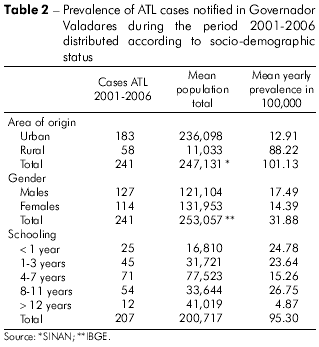
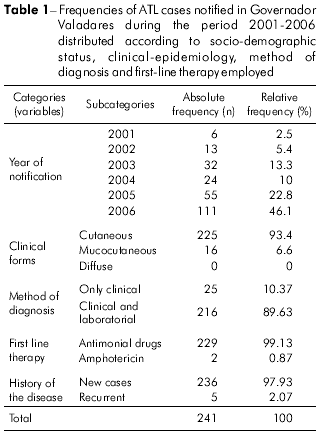
<body><![CDATA[<p><b><font size="2" face="verdana">  STUDY  AREA</font></b></p>     <p><font size="2" face="verdana"> The  260,396 inhabitants  of Governador Valadares (latitude  18<sup>o</sup>51'01&quot; S;  longitude 41<sup>o</sup>56'18&quot; W; altitude 170 m) are  distributed within 100  urban and ten rural districts. The semi-humid,  tropical climate is characterized by an average temperature of 24.5<sup>o</sup> C,  with only slight deviations during the year. Maximum precipitation occurs in  the summer and autumn seasons (December to May), whilst winter is typically  dry. The relative humidity is, on average, 76% in the winter and 84% in the summer. Governador Valadares represents one of  the most important economic centers of the Rio Doce valley and  influences human activity in all surrounding areas. The local economy is based  on mining, heavy industry, commercialization of precious stones, agriculture,  cattle breeding and tourism.</font></p>     <p><b><font size="2" face="verdana"> STUDY  DESIGN AND DATA COLLECTION</font></b></p>     <p><font size="2" face="verdana"> The descriptive study described herein was based on  data supplied by the Sistema de Informa&ccedil;&atilde;o de Agravos de Notifica&ccedil;&atilde;o (SINAN) of  the Brazilian Health Ministry for the period 2001-2006. Profiles of individuals  affected by ATL were established; the protocols documented socio-demographic  status (age, gender, schooling and area of origin), clinical epidemiology  (number of cases reported per year, clinical forms, presence of lesions and  history of the disease), diagnosis (clinical and laboratory tests) and therapy  (initial drug administered, evolution of the disease). Average values for  variables associated with the base population during the study period were  determined from the arithmetic means of the respective variables in the years  2003 and 2004, calculated on the basis of the growth estimates from the  Instituto Brasileiro de Geografia e Estat&iacute;stica (IBGE) available at the Sistema  &Uacute;nico de Sa&uacute;de databank (DATASUS)<sup>23</sup>. The average number  of ATL cases recorded per year was determined by totaling the number of  cases for each  variable and dividing by the total number of years evaluated (i.e., six years).  The annual average prevalence was expressed as the number of ATL cases recorded  per 100,000 inhabitants.</font></p>     <p><b><font size="2" face="verdana">EVALUATION  OF THE SPATIAL DISTRIBUTION OF ATL</font></b></p>     <p><font size="2" face="verdana"> A  map of the urban zone of Governador Valadares was prepared, showing the limits  of the individual census sectors, according to information provided by IBGE.  Each recorded ATL case was located in its respective census sector, and each  sector was shaded differently according to the total number of cases. The  population was divided into groups according to similarity of socio-economic  and sanitary variables established by cluster analysis of data extracted from  the 2000 Demographic Census databank. Additionally, the census sectors were  classified into three groups according to their common characteristics, and the  ATL prevalence in each group was established from the IBGE population data. All  statistical analyses were performed using SPSS Data Editor for Windows (version  13.0).</font></p>     <p>&nbsp;</p>     <p><font size="3" face="verdana">  <b>RESULTS</b></font></p>     <p><font size="2" face="verdana">  According  to SINAN, 241 cases of ATL were recorded in Governador Valadares during the period  2001-2006, and, of these, 46.1 0% were reported for 2006 alone. The frequencies  of ATL cases distributed according to clinical-epidemiology, diagnosis and  therapy parameters are shown in <a href="#t1">table 1</a> and according to socio-demographic  parameters in <a href="#t2">table 2</a>. Most of the affected individuals lived in the urban zone  (75.93%) and were males (52.70%). The annual average prevalence of infection  was   17.49  per 100,000 males and 14.39 per 100,000   females. The majority (approximately 68%) of the  infected population had attended school for a maximum of only 11 years.</font></p>     <p><a name="t1"></a></p>     ]]></body>
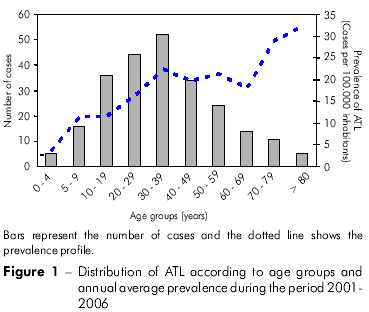
<body><![CDATA[<p>&nbsp;</p>     <p align="center"><img src="/img/revistas/rpas/v2n1/1a03t1.gif" border="0"></p>     <p>&nbsp;</p>     <p><a name="t2"></a></p>     <p>&nbsp;</p>     <p align="center"><img src="/img/revistas/rpas/v2n1/1a03t2.gif" border="0"></p>     <p>&nbsp;</p>     <p><font size="2" face="verdana">The frequencies of ATL cases distributed according  to age group are shown in <a href="#f1">figure 1</a>. The largest number of infections occurred  in individuals aged 30-39 years (n = 52; 21.58%), and, indeed, the majority  (some 55%) of individuals affected by ATL (n = 132) were teenagers and younger  adults in the age range 10-39 years old. In contrast, the numbers of ATL cases  amongst infants (&#8804; 4 years old) and the elderly (&#8805; 80 years old) were  very small. The two youngest affected individuals were &lt; 1 year old, and the  oldest was 86 years old. However, the prevalence of ATL in the 0-4-year-old  group and the &gt; 80-year-old group were very different (3.58 and 32.05 per  100,000 inhabitants, respectively) because of the small number of elderly  individuals in the study population.</font></p>     <p><font size="2" face="verdana"><a name="f1"></a></font></p>     <p>&nbsp;</p>     ]]></body>
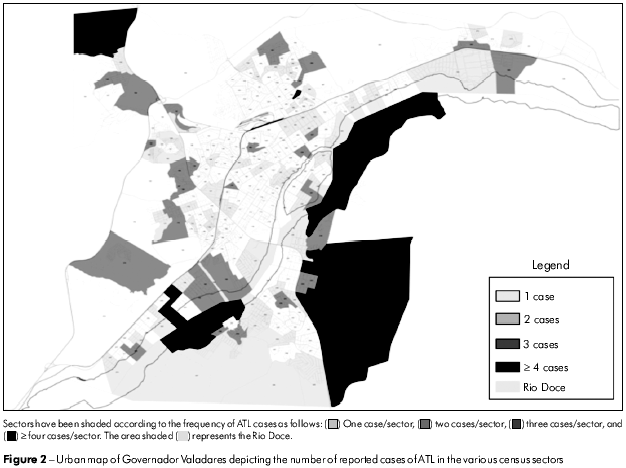
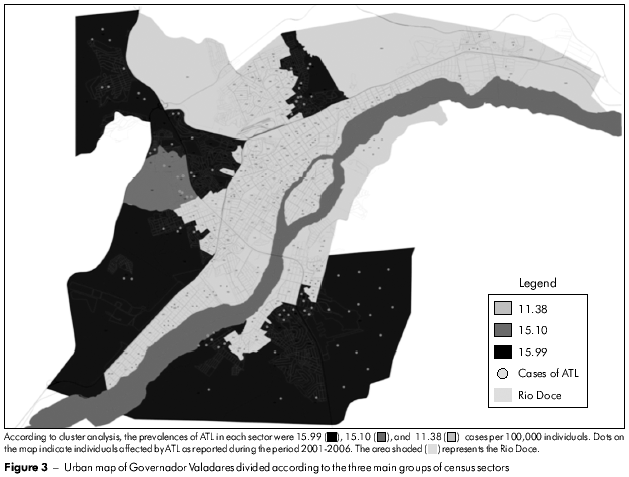
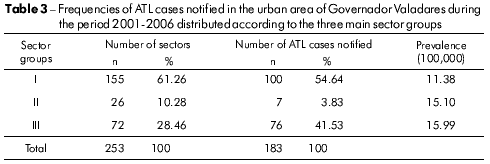
<body><![CDATA[<p align="center"><img src="/img/revistas/rpas/v2n1/1a03f1.gif" border="0"></p>     <p>&nbsp;</p>     <p><font size="2" face="verdana">Diagnosis of the disease was based on clinical  evidence complemented by laboratory tests. The Montenegro skin test was performed  in the cases of 191 individuals (79.25% of the affected population), 177 of  which were positive (92.67%).  Histopathological examination of skin samples using hematoxylin eosin was  performed on 76 individuals (31.53% of the affected population), 30 (39.47%) of  which were positive for the presence of the parasite, 41 (53.95%) of which  presented a reaction compatible with ATL and five (6.58%) of which presented a  non-compatible reaction. Direct parasitological tests were performed on only  ten individuals (4.15%), of which six individuals (60%) were positive for the  presence of the parasite and of which four (40%) were negative. Twenty-five  individuals (10.37%) were diagnosed with ATL exclusively on the basis of  clinical evidence because 17 (7.05%) patients were not submitted to laboratory  tests, and eight (3.32%) patients, despite being submitted to the tests, were  either negative for the presence of the parasite or presented a non-compatible  reaction.</font></p>     <p><font size="2" face="verdana"> The  cutaneous form of ATL was by far the most common (&gt;90%). First-line therapy  was based mainly on pentavalent antimonial drugs  (approximately 99%), and most ATL cases were newly diagnosed.</font></p>     <p><font size="2" face="verdana"> <a href="#f2">Figure 2</a> shows the census sectors (n = 253) of the  urban area of Governador Valadares shaded according to the number of cases,  thus permitting the identification of areas where ATL was concentrated. Cluster  analysis of the results permitted the classification of these census sectors  into three groups, as shown in <a href="#f3">figure 3</a>. The highest prevalence of ATL was in  group III (15.99 per 100,000 inhabitants), followed by group II (15.10 per  100,000 inhabitants), whereas group I presented the lowest prevalence (11.38  per 100,000 inhabitants). The absolute and relative frequencies of ATL in these  locations are provided in <a href="#t3">table 3</a>.</font></p>     <p><a name="f2"></a></p>     <p>&nbsp;</p>     <p align="center"><a href="#dd"><img src="/img/revistas/rpas/v2n1/1a03f2.gif" border="0"></a></p>     <p>&nbsp;</p>     <p><a name="f3"></a></p>     ]]></body>
<body><![CDATA[<p>&nbsp;</p>     <p align="center"><img src="/img/revistas/rpas/v2n1/1a03f3.gif" border="0"></p>     <p>&nbsp;</p>     <p><a name="t3"></a></p>     <p>&nbsp;</p>     <p align="center"><a href="#tt"><img src="/img/revistas/rpas/v2n1/1a03t3.gif" border="0"></a></p>     <p>&nbsp;</p>     <p><font size="3" face="verdana"><b>DISCUSSION</b></font></p>     <p><font size="2" face="verdana"> The  escalating prevalence of ATL in Brazil  is causing special concern to the public health authorities due to the high  morbidity amongst populations living in endemic areas and because of the  urbanization of the disease in recent years, with outbreaks occurring in  various state capitals<sup>24</sup>. Moreover, while the reported incidence of  ATL has increased substantially, the acknowledged under-reporting of cases  still obscures the real magnitude of the problem<sup>25</sup>. According to  official sources, the total number of reported cases of ATL in Brazilian  territory increased from 3,000 in 1980 to 22,264 in 2006, with peaks of  transmission every five years<sup>6</sup>. During the period 2001-2006, the  number of reported cases of the disease in Governador Valadares increased by  18.5 fold (from six to 111), whereas the number of cases in Minas  Gerais increased slightly (from 1,116 to 1,851),  and in Brazil as a whole, the number diminished from 26,636 to 22,264 during  the same period.</font></p>     <p><font size="2" face="verdana"> On  the basis of evidence gathered from the period 2001-2006, the prevalence of ATL  in the study area appears not to be associated with gender because the numbers  of males and females affected by the disease were comparable. This finding  corroborates results from previous studies conducted in the Rio  Doce valley<sup>16</sup> and in other endemic areas<sup>26,27,28</sup>.  Individuals of all age groups were exposed to the ATL vector independent of  work and leisure locations, demonstrating that the disease vector  represents&nbsp; a&nbsp; widespread &nbsp;&nbsp;and&nbsp;&nbsp;  common&nbsp;&nbsp; problem<sup>29</sup>.   Moreover,  the gender and age distribution profiles of the disease suggest a common site  of exposure that was probably the domicile and/or its environment.</font></p>     ]]></body>
<body><![CDATA[<p><font size="2" face="verdana"> Although  the means of prevalence in rural areas were higher in Governador Valadares, the  occurrence of ATL was predominantly urban, a situation most likely resulting  from the domestication of the components of the transmission cycle as has been  observed in Belo Horizonte and in Manaus, Amazonas State, Brazil<sup>20,19,29</sup>.  Alteration of the habits and life style of a population can result in  modifications of the environment, particularly changes in temperature and  humidity, that may give rise to variations in the transmission patterns of ATL  and other diseases. In the case of the <i>Leishmania </i>parasite,  domestication is caused primarily by the spread of insect vectors and mammalian  hosts to areas inhabited by humans<sup>30,8</sup>.</font></p>     <p><font size="2" face="verdana"> Diagnoses of the cases of ATL reported during the  period 2001-2006 in the study area were based mainly on clinical criteria and  on the Montenegro skin test. Histopathological and parasitological tests were  performed on only one third of the patients, indicating a lack of laboratory  infrastructure within the municipal health units of Governador Valadares. As  observed by Luz and co-workers<sup>19</sup>, ill-equipped facilities are a  common reality in areas that are endemic for <i>Leishmania, </i>even in state  capitals. As for many other diseases, early diagnosis and the application of  more refined techniques are important in the control of ATL.</font></p>     <p><font size="2" face="verdana">In  the present study, cutaneous ATL predominated over the other forms of  leishmaniasis, as has been reported for other endemic areas<sup>7,31,28,16,24</sup>, although 6.6% of affected  individuals presented the mucosal form. The incidence of this more serious form  of the disease during the period studied was higher than the national average  (3-5%)<sup>6</sup> and may be associated with various factors such as late  diagnosis, parasite virulence, nutritional status and/or co-morbidity  conditions that altered the immune response of the patients<sup>32,33</sup>.</font></p>     <p><font size="2" face="verdana"> Although  most of the cases recorded related to new patients, approximately 2.1% were recurrent,  a situation that could be a consequence of a series of factors relating to the  hosts and parasites or to the medication employed. In Governador  Valadares, as in other parts of the world<sup>34,24,35</sup>, first-line  ATL therapy consisted of the administration of antimonials, and 95% of patients  received this class of drug. However, the efficacy of therapy depends on many  factors including the strain of <i>Leishmania, </i>previous misuse of the  medication (with consequential parasite resistance), the number of cutaneous  lesions and the expansion of the disease to the mucosas<sup>36</sup>.</font></p>     <p><font size="2" face="verdana"> Following  classification of the census sectors of the urban area of Governador Valadares  into three groups according to their common characteristics, it was possible to  verify that ATL was less prevalent within the wealthier socio-economic group I  (<a href="#t3">Table 3</a>) who<a name="tt"></a>  enjoyed the benefit of good sanitation. The prevalences of ATL in groups II and  III were similar but much larger than that of group I because of poorer  socio-economic status and sanitation conditions that favored the transmission  of ATL. However, according to the Secretaria de Vigil&acirc;ncia em  Sa&uacute;de, an average ATL  detection coefficient in the range &#8805; 10 and &lt; 71 per 100,000 inhabitants is  considered high<sup>6</sup>. Within this context, all three groups in  Governador Valadares presented a high detection coefficient and, therefore,  require the application of urgent measures (i.e., improved diagnosis facilities  and appropriate treatment of the affected individuals) in order to eliminate or  minimize the transmission of ATL in the area.</font></p>     <p><font size="2" face="verdana"> Through  analysis of the spatial distribution of leishmaniasis in Rio de Janeiro,  Brazil, Kawa and Sabroza<sup>28</sup> established that the average incidence rates of the  disease were greater in zones of intense population growth. The  endemic-epidemic dynamics of ATL is associated with human occupation and  transformation of the native landscape because adaptation of phlebotomines to  houses and their surroundings is favored by the presence of humans and dogs,  both of which represent accessible sources of food<sup>3</sup>. Moreover, the  presence of vegetation in the vicinity of dwellings favors the appearance of  rodents and wild fauna, which are not only potential food sources for  phlebotomines but are also hosts for <i>Leishmania</i> spp<sup>30</sup>.</font></p>     <p><font size="2" face="verdana"> As  shown in <a href="#f2">figure 2</a>, the  <a name="dd"></a>largest numbers of ATL cases were concentrated in areas located along the  margins of the Rio Doce, which traverses  Governador Valadares, suggesting its participation  in the transmission cycle of <i>Leishmania. </i>These areas clearly demand the  urgent and special attention of health authorities and the mobilization of  community leaders to confront the problem. A number of   studies  have demonstrated a positive correlation between the occurrence of ATL and  individuals living or working close to rivers<sup>37,38</sup>. Thus, aquifers  (rivers and lakes) constitute risk factors for the transmission of ATL because  the migration of infected animals to inhabited areas is facilitated. On the  other hand, the presence of cats in areas inhabited by humans is considered a  protective factor against ATL because these domesticated animals are natural  predators of rodents, which are potential <i>Leishmania </i>reservoirs<sup>5</sup>.</font></p>     <p><font size="2" face="verdana"> The  most important aspect with respect to the disturbing situation concerning the  spread of ATL in Governador  Valadares is due to the educational level of most individuals  to be basic. However, knowledge of ATL epidemiology alone might not be  sufficient to motive the population to adopt preventive practices, as has been  observed by Moreira  and co-workers<sup>39</sup> in Maranh&atilde;o State, Brazil.  As has been previously suggested, the implementation of a concerted effort by  health authorities, together with both young and adult members of the  community, is essential<sup>40,41</sup>.</font></p>     <p>&nbsp;</p>     <p><font size="3" face="verdana">  <b>CONCLUSION</b></font></p>     ]]></body>
<body><![CDATA[<p><font size="2" face="verdana">  In  summary, a retrospective descriptive study of ATL in Governador Valadares has  been performed for the first time, in which cases reported during the period 2001-2006 were analyzed  and spatially distributed according to the urban areas. The difficulty in obtaining  data concerning the incidence of the disease in the years preceding the study  period demonstrates that there was no previous epidemiological surveillance in  the municipality. Furthermore, the results have shown that it is necessary to  improve the means of diagnosis and to maintain strict control over the  transmission of ATL. Finally, the present study overlaid demographic and socio-  economic information relating to small census sectors, as employed by IBGE, onto maps of  the municipality supplied by the local public authority Prefeitura Municipal,  enabling the risk areas to be readily identified. This type of diagrammatic  assessment could be useful in planning the strategies (educational and social  programs as well as health policies and investments) needed for the eradication  of the debilitating and disfiguring disease of ATL.</font></p>     <p>&nbsp;</p>     <p><font size="3" face="verdana">  <b>ACKNOWLEDGMENTS</b></font></p>     <p><font size="2" face="verdana">  The  authors wish to thank the Prefeitura Municipal de Governador Valadares, Minas  Gerais State, Brazil, for the provision of data and for most kind assistance with  the development of this project.</font></p>     <p>&nbsp;</p>     <p><font size="3" face="verdana">  <b>FINANCIAL  SUPPORT</b></font></p>     <p><font size="2" face="verdana"> This  work was supported by Funda&ccedil;&atilde;o  de Amparo &agrave; Pesquisa do Estado de Minas Gerais (FAPEMIG: grant  PRONEX 2007). ABR and  RCO are grateful for the fellowships awarded by Conselho Nacional de  Desenvolvimento  Cient&iacute;fico e Tecnol&oacute;gico (CNPq).</font></p>     <p>&nbsp;</p>     <p><font size="3" face="verdana">  <b>ETHICAL  APPROVAL</b></font></p>     <p><font size="2" face="verdana">  Details of the project were submitted to and  approved by the Ethical Committee in Research of the Universidade do Vale  do Rio Doce (no  CEP/UNIVALE 08/2007).</font></p>     ]]></body>
<body><![CDATA[<p>&nbsp;</p>     <p><font size="3" face="verdana"><b>REFERENCES</b></font></p>     <!-- ref --><p><font size="2" face="verdana"> 1 Lainson R, Shaw JJ. Evolution, classification and  geographical&nbsp; distribution.&nbsp;  In: Peters W, Killinck-Kendrick R, editors. The  leishmaniases in biology and medicine: biology and&nbsp;&nbsp; epidemiology. London: Academic Press; 1987. p. 1-120.</font><!-- ref --><p><font size="2" face="verdana"> 2 Cupolillo E, Grimaldi Jr G, Momen H. A general  classification of new world <i>Leishmania </i>using  numerican zymotaxonomy. Am J Trop Med Hyg. 1994 Mar;50(3):296-311.<font size="2" face="verdana">&nbsp;&#91; <a href="http://www.ncbi.nlm.nih.gov/pubmed/8147488" target="_blank">Links</a> &#93;</font></font><!-- ref --><p><font size="2" face="verdana"> 3 World Health Organization. First WHO report on neglected  tropical diseases: working to overcome the global impact of neglected tropical  diseases. Geneva: WHO; 2010.</font><!-- ref --><p><font size="2" face="verdana"> 4 Desjeux  P. Leishmaniasis: current situation and new  perspectives. Comp Immunol Microbiol Infect Dis. 2004 Sep;27(5):305-18. Doi:10.1016/J.Cimid.2004.03.004 &#91;<a href="http://www.ncbi.nlm.nih.gov/pubmed/15225981" target="_blank">Link</a>&#93;</font><!-- ref --><p><font size="2" face="verdana"> 5 Salom&oacute;n  OD, Sosa-Estani S, Ramos K, Orellano PW,  Sanguesa G, Fern&aacute;ndez G, et al.  Tegumentary leishmaniasis  outbreak in Bella Vista City, Corrientes, Argentina  during 2003. Mem Inst Oswaldo Cruz. 2006 Nov;101(7):767-74. DOI:10.1590/S0074-02762006000700010&nbsp; &#91;<a href="http://www.scielo.br/scielo.php?script=sci_arttext&pid=S0074-02762006000700010&lng=en&nrm=iso&tlng=en" target="_blank">Link</a>&#93;</font><!-- ref --><p><font size="2" face="verdana"> 6 Minist&eacute;rio  da Sa&uacute;de (BR). Secretaria de  Vigil&acirc;ncia em Sa&uacute;de. Manual de  Vigil&acirc;ncia da Leishmaniose Tegumentar Americana. 2. ed. Bras&iacute;lia:  Minist&eacute;rio da   Sa&uacute;de; 2007. 180 p.</font><!-- ref --><p><font size="2" face="verdana">7 Ampuero J, Mac&ecirc;do V, Marsden P. Clinical findings of  tegumentary leishmaniasis in children under five years of age in an endemic  area of Leishmania (Viannia)  braziliensis. Rev Soc Bras Med Trop. 2006 Jan-Feb;39(1):22-6. DOI:10.1590/S0037-86822006000100004&nbsp;&#91;<a href="http://www.scielo.br/scielo.php?script=sci_arttext&pid=S0037-86822006000100004&lng=en&nrm=iso&tlng=en" target="_blank">Link</a>&#93;</font><!-- ref --><p><font size="2" face="verdana"> 8 Costa SM, Cechinel M, Bandeira  V, Zannuncio JC, Lainson R, Rangel EF. Lutzomyia (Nyssomyia) whitmani s.l. (Antunes  &amp; Coutinho, 1939) (Diptera:  Psychodidae: Phlebotominae): geographical distribution and the epidemiology of  American cutaneous leishmaniasis in Brazil - Mini-review.  Mem Inst Oswaldo Cruz. 2007 May;102(2):149-53. DOI:10.1590/S0074-02762007005000016&nbsp;&#91;<a href="http://www.scielo.br/scielo.php?script=sci_arttext&pid=S0074-02762007000200004&lng=en&nrm=iso&tlng=en" target="_blank">Link</a>&#93; </font><!-- ref --><p><font size="2" face="verdana"> 9 Neuber H. Leishmaniasis. J Dtsch Dermatol Ges.  2008   Sep;6(9):754-65. DOI:10.1111/j.1610-0387.2008.06809.x  &#91;<a href="http://onlinelibrary.wiley.com/doi/10.1111/j.1610-0387.2008.06809.x/abstract" target="_blank">Link</a>&#93;</font><!-- ref --><p><font size="2" face="verdana"> 10 Marzochi MCA, Marzochi KB. Tegumentary and visceral  leishmaniases in Brazil: emerging anthropozoonosis and possibilities for their  control. Cad Saude Publica. 1994 Jan;10 Suppl  2:S359-75. DOI:10.1590/S0102-311X1994000800014&nbsp; &#91;<a href="http://www.scielosp.org/scielo.php?script=sci_arttext&pid=S0102-311X1994000800014&lng=pt" target="_blank">Link</a>&#93;</font><!-- ref --><p><font size="2" face="verdana"> 11 Gontijo B, Carvalho MLR. American  cutaneous leishmaniasis. Rev Soc Bras Med Trop. 2003 Jan-   Feb;36(1):71-80. DOI:10.1590/S0037-86822003000100011&nbsp;&#91;<a href="http://www.scielo.br/scielo.php?pid=S0037-86822003000100011&script=sci_arttext">Link</a>    &#93;</font></p>     <!-- ref --><p><font size="2" face="verdana"> 12 Croft SL, Seifert K, Yardley V.  Current scenario of drug development for leishmaniasis. Indian J Med Res.   2006  Mar;123:399-410. &#91;<a href="http://www.icmr.nic.in/ijmr/2006/march/0318.pdf" target="_blank">Link</a>&#93;</font><!-- ref --><p><font size="2" face="verdana"> 13 Machado-Pinto J, Pinto J,  Costa CA, Genaro O, Marques MJ, Modabber F, et al.  Immunochemotherapy for cutaneous leishmaniasis: a  controlled trial using killed Leishmania (Leishmania) amazonensis  vaccine plus antimonial. Int Soc Dermatol. 2002 Feb;41(2):73-8. DOI:10.1046/j.1365-4362.2002.01336.x &#91;<a href="http://onlinelibrary.wiley.com/doi/10.1046/j.1365-4362.2002.01336.x/abstract" target="_blank">Link</a>&#93;</font><!-- ref --><p><font size="2" face="verdana"> 14 Ouellette M, Drummelsmith  J, Papadopoulou B. Leishmaniasis: drugs in the clinic, resistance and new  developments. Drug Resist Updat. 2004 Aug-Oct;7(4):257-66. DOI:10.1016/j.drup.2004.07.002  &#91;<a href="http://www.drupjournal.com/article/S1368-7646(04)00065-2/abstract" target="_blank">Link</a>&#93;</font><!-- ref --><p><font size="2" face="verdana"> 15 Machado-Coelho GLL, Assun&ccedil;&atilde;o R,  Mayrink W, Caiaffa WT. American cutaneous leishmaniasis in southeast Brazil:  space-time clustering. Int J Epidemiol.   1999  Oct;28(5):982-9. &#91;<a href="http://www.ncbi.nlm.nih.gov/pubmed/10598000" target="_blank">Link</a>&#93;</font><!-- ref --><p><font size="2" face="verdana"> 16 Mayrink W, Williams P, Coelho MV, Dias M,  Martins AV, Magalh&atilde;es PA, et al.  Epidemiology of dermal leishmaniasis in the Rio Doce valley, State of Minas  Gerais, Brazil. Ann Trop&nbsp; Med Parasitol. 1979   Apr;73(2):123-37. &#91;<a href="http://www.ncbi.nlm.nih.gov/pubmed/315210" target="_blank">Link</a>&#93;</font><!-- ref --><p><font size="2" face="verdana"> 17 Ferreira P. Epidemiologia  das leishmanioses. In: Sabroza P, organizador. Gloss&aacute;rio de  doen&ccedil;as &#91;Internet&#93;. Rio de Janeiro: FIOCRUZ; 2008 &#91;citado  2008 nov 1&#93;. Dispon&iacute;vel em: <a href="http://www.fiocruz.br/ccs/cgi/cgilua.exe/sys/start.htm?infoid=355&sid=6" target="_blank">http://www.fiocruz.br/ccs/cgi/cgilua.exe/sys/start.htm?infoid=355&amp;sid=6</a>.</font><!-- ref --><p><font size="2" face="verdana"> 18 Zare S, Baghestani S. Cutaneous leishmaniasis in   Hormozgan,  Iran. Int J Dermatol. 2001 Oct;40(10):629-31. DOI:10.1046/j.1365-4362.2001.01279.x &#91;<a href="http://onlinelibrary.wiley.com/doi/10.1046/j.1365-4362.2001.01279.x/abstract" target="_blank">Link</a>&#93;</font><!-- ref --><p><font size="2" face="verdana"> 19 Luz ZMP, Pimenta DN, Cabral  ALLV, Fi&uacute;za VOP, Rabello  A. Leishmaniasis: urbanization and low diagnosis capacity in the metropolitan  region of Belo Horizonte. Rev Soc Bras  Med Trop. 2001 May-Jun;34(3):249-54. DOI:10.1590/S0037-86822001000300004&nbsp;&#91;<a href="http://www.scielo.br/scielo.php?script=sci_arttext&pid=S0037-86822001000300004&lng=en&nrm=iso&tlng=pt" target="_blank">Link</a>&#93;</font><!-- ref --><p><font size="2" face="verdana"> 20 Guerra JAO, Ribeiro JAS,  Coelho LIARC, Barbosa MGV, Paes MG. Epidemiology of tegumentary leishmaniasis in S&atilde;o Jo&atilde;o, Manaus, Brazil. Cad Saude Publica. 2006 Nov;22(11):2319-27. DOI:10.1590/S0102-311X2006001100006&nbsp;&#91;<a href="http://www.scielosp.org/scielo.php?script=sci_arttext&pid=S0102-311X2006001100006&lng=pt" target="_blank">Link</a>&#93;</font><!-- ref --><p><font size="2" face="verdana"> 21 Aleixo J. Leishmaniose com  localiza&ccedil;&atilde;o genital. An Bras Dermatol Sifilogr. 1945;20:89-91.</font><!-- ref --><p><font size="2" face="verdana"> 22 Furtado TA, Viegas AC. Ensaios  terap&ecirc;uticos na leishmaniose  tegumentar&nbsp; americana. An Bras   Dermatol.  1967;42(1):47-55.</font><!-- ref --><p><font size="2" face="verdana"> 23 Minist&eacute;rio da Sa&uacute;de (BR).  Departamento de Inform&aacute;tica do SUS &#91;Internet&#93;. Bras&iacute;lia &#91;citado 2008 mar 11&#93;. Dispon&iacute;vel  em: <a href="http://www.datasus.gov.br/" target="_blank">http://www.datasus.gov.br</a>.</font><!-- ref --><p><font size="2" face="verdana"> 24 Oliveira-Neto MP, Mattos MS, Perez MA, Da-Cruz AM, Fernandes O,  Moreira J, et al. American tegumentary leishmaniasis (ATL) in Rio de Janeiro  State, Brazil: main clinical and epidemiologic characteristics. Int J Dermatol. 2000 Jul;39(7):506-14. DOI:&nbsp;10.1046/j.1365-4362.2000.00969.x &#91;<a href="http://onlinelibrary.wiley.com/doi/10.1046/j.1365-4362.2000.00969.x/abstract" target="_blank">Link</a>&#93;</font><!-- ref --><p><font size="2" face="verdana"> 25 Nunes AG, Paula EV, Teodoro R, Prata A, Silva-Vergara ML.  Epidemiological aspects of American tegumentary leishmaniasis  in Varzel&acirc;ndia, Minas Gerais, Brazil.  Cad Saude Publica. 2006;22(6):1343-7. DOI:10.1590/S0102-311X2006000600023&nbsp; &#91;<a href="http://www.scielo.br/scielo.php?pid=S0102-311X2006000600023&script=sci_arttext" target="_blank">Link</a>&#93;</font><!-- ref --><p><font size="2" face="verdana"> 26 Cunha JCL, Lima JWO, Pompeu  MML. Domestic  transmission of cutaneous leishmaniasis, during an epidemic in Serra de Baturit&eacute;, State of Cear&aacute;, Brazil. Rev Bras Epidemiol.  2006 Dec;9(4):425-35. DOI:10.1590/S1415-790X2006000400003&nbsp;&#91;<a href="http://www.scielo.br/scielo.php?script=sci_arttext&pid=S1415-790X2006000400003" target="_blank">Link&#93; </a></font><!-- ref --><p><font size="2" face="verdana"> 27 Gontijo CMF, Silva ES, Fuccio MB, Sousa MCA, Pacheco RS, Dias ES, et al.  Epidemiological studies of an outbreak of cutaneous leishmaniasis in the Rio Jequitinhonha valley, Minas Gerais, Brazil. Acta Trop.   2002  Feb;81(2):143-50. DOI:10.1016/S0001-706x(01)00205-4  &#91;<a href="http://www.ncbi.nlm.nih.gov/pubmed/11801221" target="_blank">Link</a>&#93;</font><!-- ref --><p><font size="2" face="verdana"> 28 Kawa H, Sabroza PC. Spatial  distribution of tegumentary leishmaniasis in the city of Rio de Janeiro. Cad Saude Publica. 2002  May-Jun;18(3):853-65. DOI:10.1590/S0102-311X2002000300034&nbsp;&#91;<a href="http://www.scielo.br/scielo.php?script=sci_arttext&pid=S0102-311X2002000300034" target="_blank">Link</a>&#93;</font><!-- ref --><p><font size="2" face="verdana"> 29 Passos VM, Barreto SM,  Romanha AJ, Krettli AU,   Volpini  AC, Gontijo CM, et al. Cutaneous  leishmaniasis in the metropolitan region of Belo Horizonte: clinical,  laboratorial, therapeutic and prognosis features (1989-1995). Rev Soc Bras Med   Trop.  2001 Jan-Feb;34(1):5-12. DOI:10.1590/S0037-86822001000100002&nbsp;&#91;<a href="http://www.ncbi.nlm.nih.gov/pubmed/11340491" target="_blank">Link</a>&#93;</font><!-- ref --><p><font size="2" face="verdana"> 30 Chaves LF, Cohen LM,  Pascual M, Wilson ML. Social exclusion modifies climate and deforestation  impacts on a vector-borne disease. PLoS Negl Trop Dis. 2008   Feb;2(2):e176. DOI:10.1371/journal.pntd.0000176. &#91;<a href="http://www.ncbi.nlm.nih.gov/pmc/articles/PMC2238711/?tool=pubmed">Link</a>&#93;</font><!-- ref --><p><font size="2" face="verdana"> 31 Castro EA, Soccol VT,  Membrive N, Luz E. Epidemiological and clinical study of 332 cases of cutaneous  leishmaniasis in the north of Paran&aacute; State   from  1993 to 1998. Rev Soc Bras Med Trop. 2002 Sep-Oct;35(5):445-52. &#91;<a href="http://www.ncbi.nlm.nih.gov/pubmed/12621662" target="_blank">Link</a>&#93;</font><!-- ref --><p><font size="2" face="verdana"> 32 Machado-Coelho GLL, Caiaffa  WT, Genaro O,   Magalh&atilde;es PA, Mayrink W.  Risk factors for mucosal manifestation of American cutaneous leishmaniasis.  Trans R Soc Trop Med Hyg. 2005 Jan;99(1):55-61. DOI:10.1016/j.trstmh.2003.08.001 &#91;<a href="http://www.tropicalmedandhygienejrnl.net/article/S0035-9203(04)00197-X/abstract" target="_blank">Link</a>&#93;</font><!-- ref --><p><font size="2" face="verdana">33 Passos VMA, Falc&atilde;o AL, Marzochi MCA, Gontijo CMF, Dias ES, Barbosa-Santos EGO, et al. Epidemiological aspects of American  cutaneous leishmaniasis in a periurban area of the  metropolitan region of Belo Horizonte, Minas Gerais, Brazil. Mem Inst Oswaldo Cruz. 1993  Jan-Mar;88(1):103-10. DOI:10.1590/S0074-02761993000100016&nbsp; &#91;<a href="http://www.scielo.br/scielo.php?script=sci_arttext&pid=S0074-02761993000100016&lng=en&nrm=iso&tlng=en" target="_blank">Link</a>&#93;</font><!-- ref --><p><font size="2" face="verdana"> 34 Brochu C, Wang J, Roy G,  Messier N, Wang XY, Saravia   NG, et al. Antimony uptake  systems in the protozoan   parasite Leishmania and  accumulation differences in   antimony-resistant  parasites. Antimicrob Agents Chemother. 2003  Oct;47(10):3073-9. DOI:10.1128/AAC.47.10.3073-3079.2003. &#91;<a href="http://www.ncbi.nlm.nih.gov/pmc/articles/PMC201146/?tool=pubmed" target="_blank">Link</a>&#93;</font><!-- ref --><p><font size="2" face="verdana"> 35 Rastogi V, Nirwan PS. Cutaneous  leishmaniasis: an   emerging infection in a  non-endemic area and a brief   update. Indian J Med  Microbiol. 2007 Jul;25(3): 272-5. DOI: 10.4103/0255-0857.34774 &#91;<a href="http://www.ijmm.org/article.asp?issn=0255-0857;year=2007;volume=25;issue=3;spage=272;epage=275;aulast=Rastogi" target="_blank">Link</a>&#93;</font><!-- ref --><p><font size="2" face="verdana"> 36 Rodrigues AM, Hueb M, Santos TARR, Fontes CJF.   &#91;Factors associated with treatment  failure of cutaneous   leishmaniasis with  meglumine antimoniate&#93;. Rev Soc Bras Med Trop. 2006 Mar-Apr;39(2):139-45. DOI:10.1590/S0037-86822006000200001&nbsp; &#91;<a href="http://www.ncbi.nlm.nih.gov/pubmed/16699638" target="_blank">Link</a>&#93;</font><!-- ref --><p><font size="2" face="verdana"> 37 Ryan JR, Mbui J, Rashid JR, Wasunna MK, Kirigi G,   Magiri C, et al. Spatial  clustering and epidemiological   aspects of visceral leishmaniasis  in two endemic   villages, Baringo district,  Kenya.  Am J Trop Hyg. 2006 Feb;74(2):308-17. &#91;<a href="http://www.ajtmh.org/cgi/content/abstract/74/2/308" target="_blank">Link</a>&#93;</font><!-- ref --><p><font size="2" face="verdana">38 Salom&oacute;n OD, Orellano PW,  Lamfri M, Scavuzzo M, Dri   L, Farace MI, et al. Phlebotominae  spatial distribution   associated with a focus of  tegumentary leishmaniasis in   Las Lomitas, Formosa, Argentina, 2002. Mem Inst Oswaldo Cruz. 2006 May;101(3):295-9. DOI:10.1590/S0074-02762006000300013&nbsp; &#91;<a href="http://www.scielo.br/scielo.php?script=sci_arttext&pid=S0074-02762006000300013&lng=en&nrm=iso&tlng=en" target="_blank">Link</a>&#93;</font><!-- ref --><p><font size="2" face="verdana"> 39 Moreira RCR, Reb&ecirc;lo JMM, Gama MEA, Costa JML.   N&iacute;vel de conhecimento sobre leishmaniose   tegumentar americana (LTA) e uso de terapias   alternativas por popula&ccedil;&otilde;es de uma &aacute;rea end&ecirc;mica da   Amaz&ocirc;nia do Maranh&atilde;o, Brasil. Cad Saude Publica. 2002 jan-fev;18(1):187-95. DOI:10.1590/S0102-311X2002000100019&nbsp;&#91;<a href="http://www.scielo.br/scielo.php?script=sci_arttext&pid=S0102-311X2002000100019&lng=pt" target="_blank">Link</a>&#93;</font><!-- ref --><p><font size="2" face="verdana"> 40 Costa JML, Vale KC, Fran&ccedil;a F, Coat&aacute; MAF, Silva JO,   Lago EL, et al. A leishmaniose tegumentar americana   em uma regi&atilde;o end&ecirc;mica como fator de mobiliza&ccedil;&atilde;o   comunit&aacute;ria. Rev Soc Bras Med Trop. 1994 out-dez;27(4):255-7. &#91;<a href="http://bases.bireme.br/cgi-bin/wxislind.exe/iah/online/?IsisScript=iah/iah.xis&src=google&base=LILACS&lang=p&nextAction=lnk&exprSearch=163239&indexSearch=ID" target="_blank">Link</a>&#93;</font><!-- ref --><p><font size="2" face="verdana"> 41 Freitas JS, Santana RG, Melo SR. A survey on cases of   leishmaniosis recorded at  the municipal district of   Jussara, Paran&aacute;, Brazil. Arq Ciencias Saude UNIPAR.   2006 Jan-Apr;10(1):23-7.</font><p>&nbsp;</p>     <p>&nbsp;</p>     <p><font size="2" face="Verdana"><b><a name="endereco" id="endereco"></a><a href="#topo"><img src="/img/revistas/rpas/v1n4/seta.gif" border="0" /></a></b></font><font size="2" face="verdana"><b></b></font><font size="2" face="verdana"><b>Correspondence / Correspond&ecirc;ncia / Correspondencia:</b>    <br> Alexandre  Barbosa Reis    <br> Laborat&oacute;rio  de Imunopatologia,    <br> Instituto de Ci&ecirc;ncias Exatas e Biol&oacute;gicas,    ]]></body>
<body><![CDATA[<br> Universidade  Federal de Ouro Preto.    <br> Morro do Cruzeiro CEP: 35400-000    <br> Ouro Preto-Minas  Gerais-Brasil    <br> Tel.: 55 (21) 31 3559-1694 | Fax: 55 (21) 31 3559-1680    <br> E-mail: <a href="mailto:alexreis@nupeb.ufop.br">alexreis@nupeb.ufop.br</a></font></p>     <p><font size="2" face="verdana">Received / Recebido em / Recibido en: 21/7/2010    <br> Accepted / Aceito em / Aceito en: 16/2/2011</font></p> <script type="text/javascript"> var gaJsHost = (("https:" == document.location.protocol) ? "https://ssl." : "http://www."); document.write(unescape("%3Cscript src='" + gaJsHost + "google-analytics.com/ga.js' type='text/javascript'%3E%3C/script%3E")); </script> <script type="text/javascript"> try { var pageTracker = _gat._getTracker("UA-7885746-4"); pageTracker._setDomainName("none"); pageTracker._setAllowLinker(true); pageTracker._trackPageview(); } catch(err) {}</script>      ]]></body><back>
<ref-list>
<ref id="B1">
<label>1</label><nlm-citation citation-type="book">
<person-group person-group-type="author">
<name>
<surname><![CDATA[Lainson]]></surname>
<given-names><![CDATA[R]]></given-names>
</name>
<name>
<surname><![CDATA[Shaw]]></surname>
<given-names><![CDATA[JJ]]></given-names>
</name>
</person-group>
<article-title xml:lang="en"><![CDATA[Evolution, classification and geographical distribution]]></article-title>
<person-group person-group-type="editor">
<name>
<surname><![CDATA[Peters]]></surname>
<given-names><![CDATA[W]]></given-names>
</name>
<name>
<surname><![CDATA[Killinck-Kendrick]]></surname>
<given-names><![CDATA[R]]></given-names>
</name>
</person-group>
<source><![CDATA[The leishmaniases in biology and medicine: biology and epidemiology]]></source>
<year>1987</year>
<page-range>1-120</page-range><publisher-loc><![CDATA[London ]]></publisher-loc>
<publisher-name><![CDATA[Academic Press]]></publisher-name>
</nlm-citation>
</ref>
<ref id="B2">
<label>2</label><nlm-citation citation-type="journal">
<person-group person-group-type="author">
<name>
<surname><![CDATA[Cupolillo]]></surname>
<given-names><![CDATA[E]]></given-names>
</name>
<name>
<surname><![CDATA[Grimaldi Jr]]></surname>
<given-names><![CDATA[G]]></given-names>
</name>
<name>
<surname><![CDATA[Momen]]></surname>
<given-names><![CDATA[H]]></given-names>
</name>
</person-group>
<article-title xml:lang="en"><![CDATA[A general classification of new world Leishmania using numerican zymotaxonomy]]></article-title>
<source><![CDATA[Am J Trop Med Hyg]]></source>
<year>1994</year>
<month> M</month>
<day>ar</day>
<volume>50</volume>
<numero>3</numero>
<issue>3</issue>
<page-range>296-311</page-range></nlm-citation>
</ref>
<ref id="B3">
<label>3</label><nlm-citation citation-type="book">
<collab>World Health Organization</collab>
<source><![CDATA[First WHO report on neglected tropical diseases: working to overcome the global impact of neglected tropical diseases]]></source>
<year>2010</year>
<publisher-loc><![CDATA[Geneva ]]></publisher-loc>
<publisher-name><![CDATA[WHO]]></publisher-name>
</nlm-citation>
</ref>
<ref id="B4">
<label>4</label><nlm-citation citation-type="journal">
<person-group person-group-type="author">
<name>
<surname><![CDATA[Desjeux]]></surname>
<given-names><![CDATA[P]]></given-names>
</name>
</person-group>
<article-title xml:lang="en"><![CDATA[Leishmaniasis: current situation and new perspectives]]></article-title>
<source><![CDATA[Comp Immunol Microbiol Infect Dis]]></source>
<year>2004</year>
<month> S</month>
<day>ep</day>
<volume>27</volume>
<numero>5</numero>
<issue>5</issue>
<page-range>305-18</page-range></nlm-citation>
</ref>
<ref id="B5">
<label>5</label><nlm-citation citation-type="journal">
<person-group person-group-type="author">
<name>
<surname><![CDATA[Salomón]]></surname>
<given-names><![CDATA[OD]]></given-names>
</name>
<name>
<surname><![CDATA[Sosa-Estani]]></surname>
<given-names><![CDATA[S]]></given-names>
</name>
<name>
<surname><![CDATA[Ramos]]></surname>
<given-names><![CDATA[K]]></given-names>
</name>
<name>
<surname><![CDATA[Orellano]]></surname>
<given-names><![CDATA[PW]]></given-names>
</name>
<name>
<surname><![CDATA[Sanguesa]]></surname>
<given-names><![CDATA[G]]></given-names>
</name>
<name>
<surname><![CDATA[Fernández]]></surname>
<given-names><![CDATA[G]]></given-names>
</name>
</person-group>
<article-title xml:lang="en"><![CDATA[Tegumentary leishmaniasis outbreak in Bella Vista City, Corrientes, Argentina during 2003]]></article-title>
<source><![CDATA[Mem Inst Oswaldo Cruz]]></source>
<year>2006</year>
<month> N</month>
<day>ov</day>
<volume>101</volume>
<numero>7</numero>
<issue>7</issue>
<page-range>767-74</page-range></nlm-citation>
</ref>
<ref id="B6">
<label>6</label><nlm-citation citation-type="book">
<collab>Ministério da Saúde (BR)^dSecretaria de Vigilância em Saúde</collab>
<source><![CDATA[Manual de Vigilância da Leishmaniose Tegumentar Americana]]></source>
<year>2007</year>
<edition>2</edition>
<page-range>180</page-range><publisher-loc><![CDATA[Brasília ]]></publisher-loc>
<publisher-name><![CDATA[Ministério da Saúde]]></publisher-name>
</nlm-citation>
</ref>
<ref id="B7">
<label>7</label><nlm-citation citation-type="journal">
<person-group person-group-type="author">
<name>
<surname><![CDATA[Ampuero]]></surname>
<given-names><![CDATA[J]]></given-names>
</name>
<name>
<surname><![CDATA[Macêdo]]></surname>
<given-names><![CDATA[V]]></given-names>
</name>
<name>
<surname><![CDATA[Marsden]]></surname>
<given-names><![CDATA[P]]></given-names>
</name>
</person-group>
<article-title xml:lang="en"><![CDATA[Clinical findings of tegumentary leishmaniasis in children under five years of age in an endemic area of Leishmania (Viannia) braziliensis]]></article-title>
<source><![CDATA[Rev Soc Bras Med Trop]]></source>
<year>2006</year>
<month> J</month>
<day>an</day>
<volume>39</volume>
<numero>1</numero>
<issue>1</issue>
<page-range>22-6</page-range></nlm-citation>
</ref>
<ref id="B8">
<label>8</label><nlm-citation citation-type="journal">
<person-group person-group-type="author">
<name>
<surname><![CDATA[Costa]]></surname>
<given-names><![CDATA[SM]]></given-names>
</name>
<name>
<surname><![CDATA[Cechinel]]></surname>
<given-names><![CDATA[M]]></given-names>
</name>
<name>
<surname><![CDATA[Bandeira]]></surname>
<given-names><![CDATA[V]]></given-names>
</name>
<name>
<surname><![CDATA[Zannuncio]]></surname>
<given-names><![CDATA[JC]]></given-names>
</name>
<name>
<surname><![CDATA[Lainson]]></surname>
<given-names><![CDATA[R]]></given-names>
</name>
<name>
<surname><![CDATA[Rangel]]></surname>
<given-names><![CDATA[EF]]></given-names>
</name>
</person-group>
<article-title xml:lang="en"><![CDATA[Lutzomyia (Nyssomyia) whitmani s.l. (Antunes & Coutinho, 1939) (Diptera: Psychodidae: Phlebotominae): geographical distribution and the epidemiology of American cutaneous leishmaniasis in Brazil - Mini-review]]></article-title>
<source><![CDATA[Mem Inst Oswaldo Cruz]]></source>
<year>2007</year>
<month> M</month>
<day>ay</day>
<volume>102</volume>
<numero>2</numero>
<issue>2</issue>
<page-range>149-53</page-range></nlm-citation>
</ref>
<ref id="B9">
<label>9</label><nlm-citation citation-type="journal">
<person-group person-group-type="author">
<name>
<surname><![CDATA[Neuber]]></surname>
<given-names><![CDATA[H]]></given-names>
</name>
</person-group>
<article-title xml:lang="en"><![CDATA[Leishmaniasis]]></article-title>
<source><![CDATA[J Dtsch Dermatol Ges]]></source>
<year>2008</year>
<month> S</month>
<day>ep</day>
<volume>6</volume>
<numero>9</numero>
<issue>9</issue>
<page-range>754-65</page-range></nlm-citation>
</ref>
<ref id="B10">
<label>10</label><nlm-citation citation-type="journal">
<person-group person-group-type="author">
<name>
<surname><![CDATA[Marzochi]]></surname>
<given-names><![CDATA[MCA]]></given-names>
</name>
<name>
<surname><![CDATA[Marzochi]]></surname>
<given-names><![CDATA[KB]]></given-names>
</name>
</person-group>
<article-title xml:lang="en"><![CDATA[Tegumentary and visceral leishmaniases in Brazil: emerging anthropozoonosis and possibilities for their control]]></article-title>
<source><![CDATA[Cad Saude Publica]]></source>
<year>1994</year>
<month> J</month>
<day>an</day>
<volume>10</volume>
<numero>^s2</numero>
<issue>^s2</issue>
<supplement>2</supplement>
<page-range>S359-75</page-range></nlm-citation>
</ref>
<ref id="B11">
<label>11</label><nlm-citation citation-type="journal">
<person-group person-group-type="author">
<name>
<surname><![CDATA[Gontijo]]></surname>
<given-names><![CDATA[B]]></given-names>
</name>
<name>
<surname><![CDATA[Carvalho]]></surname>
<given-names><![CDATA[MLR]]></given-names>
</name>
</person-group>
<article-title xml:lang="en"><![CDATA[American cutaneous leishmaniasis]]></article-title>
<source><![CDATA[Rev Soc Bras Med Trop]]></source>
<year>2003</year>
<month> J</month>
<day>an</day>
<volume>36</volume>
<numero>1</numero>
<issue>1</issue>
<page-range>71-80</page-range></nlm-citation>
</ref>
<ref id="B12">
<label>12</label><nlm-citation citation-type="journal">
<person-group person-group-type="author">
<name>
<surname><![CDATA[Croft]]></surname>
<given-names><![CDATA[SL]]></given-names>
</name>
<name>
<surname><![CDATA[Seifert]]></surname>
<given-names><![CDATA[K]]></given-names>
</name>
<name>
<surname><![CDATA[Yardley]]></surname>
<given-names><![CDATA[V]]></given-names>
</name>
</person-group>
<article-title xml:lang="en"><![CDATA[Current scenario of drug development for leishmaniasis]]></article-title>
<source><![CDATA[Indian J Med Res]]></source>
<year>2006</year>
<month> M</month>
<day>ar</day>
<volume>123</volume>
<page-range>399-410</page-range></nlm-citation>
</ref>
<ref id="B13">
<label>13</label><nlm-citation citation-type="journal">
<person-group person-group-type="author">
<name>
<surname><![CDATA[Machado-Pinto]]></surname>
<given-names><![CDATA[J]]></given-names>
</name>
<name>
<surname><![CDATA[Pinto]]></surname>
<given-names><![CDATA[J]]></given-names>
</name>
<name>
<surname><![CDATA[Costa]]></surname>
<given-names><![CDATA[CA]]></given-names>
</name>
<name>
<surname><![CDATA[Genaro]]></surname>
<given-names><![CDATA[O]]></given-names>
</name>
<name>
<surname><![CDATA[Marques]]></surname>
<given-names><![CDATA[MJ]]></given-names>
</name>
<name>
<surname><![CDATA[Modabber]]></surname>
<given-names><![CDATA[F]]></given-names>
</name>
</person-group>
<article-title xml:lang="en"><![CDATA[Immunochemotherapy for cutaneous leishmaniasis: a controlled trial using killed Leishmania (Leishmania) amazonensis vaccine plus antimonial]]></article-title>
<source><![CDATA[Int Soc Dermatol]]></source>
<year>2002</year>
<month> F</month>
<day>eb</day>
<volume>41</volume>
<numero>2</numero>
<issue>2</issue>
<page-range>73-8</page-range></nlm-citation>
</ref>
<ref id="B14">
<label>14</label><nlm-citation citation-type="journal">
<person-group person-group-type="author">
<name>
<surname><![CDATA[Ouellette]]></surname>
<given-names><![CDATA[M]]></given-names>
</name>
<name>
<surname><![CDATA[Drummelsmith]]></surname>
<given-names><![CDATA[J]]></given-names>
</name>
<name>
<surname><![CDATA[Papadopoulou]]></surname>
<given-names><![CDATA[B]]></given-names>
</name>
</person-group>
<article-title xml:lang="en"><![CDATA[Leishmaniasis: drugs in the clinic, resistance and new developments]]></article-title>
<source><![CDATA[Drug Resist Updat]]></source>
<year>2004</year>
<month> A</month>
<day>ug</day>
<volume>7</volume>
<numero>4</numero>
<issue>4</issue>
<page-range>257-66</page-range></nlm-citation>
</ref>
<ref id="B15">
<label>15</label><nlm-citation citation-type="journal">
<person-group person-group-type="author">
<name>
<surname><![CDATA[Machado-Coelho]]></surname>
<given-names><![CDATA[GLL]]></given-names>
</name>
<name>
<surname><![CDATA[Assunção]]></surname>
<given-names><![CDATA[R]]></given-names>
</name>
<name>
<surname><![CDATA[Mayrink]]></surname>
<given-names><![CDATA[W]]></given-names>
</name>
<name>
<surname><![CDATA[Caiaffa]]></surname>
<given-names><![CDATA[WT]]></given-names>
</name>
</person-group>
<article-title xml:lang="en"><![CDATA[American cutaneous leishmaniasis in southeast Brazil: space-time clustering]]></article-title>
<source><![CDATA[Int J Epidemiol]]></source>
<year>1999</year>
<month> O</month>
<day>ct</day>
<volume>28</volume>
<numero>5</numero>
<issue>5</issue>
<page-range>982-9</page-range></nlm-citation>
</ref>
<ref id="B16">
<label>16</label><nlm-citation citation-type="journal">
<person-group person-group-type="author">
<name>
<surname><![CDATA[Mayrink]]></surname>
<given-names><![CDATA[W]]></given-names>
</name>
<name>
<surname><![CDATA[Williams]]></surname>
<given-names><![CDATA[P]]></given-names>
</name>
<name>
<surname><![CDATA[Coelho]]></surname>
<given-names><![CDATA[MV]]></given-names>
</name>
<name>
<surname><![CDATA[Dias]]></surname>
<given-names><![CDATA[M]]></given-names>
</name>
<name>
<surname><![CDATA[Martins]]></surname>
<given-names><![CDATA[AV]]></given-names>
</name>
<name>
<surname><![CDATA[Magalhães]]></surname>
<given-names><![CDATA[PA]]></given-names>
</name>
</person-group>
<article-title xml:lang="en"><![CDATA[Epidemiology of dermal leishmaniasis in the Rio Doce valley, State of Minas Gerais, Brazil]]></article-title>
<source><![CDATA[Ann Trop Med Parasitol]]></source>
<year>1979</year>
<month> A</month>
<day>pr</day>
<volume>73</volume>
<numero>2</numero>
<issue>2</issue>
<page-range>123-37</page-range></nlm-citation>
</ref>
<ref id="B17">
<label>17</label><nlm-citation citation-type="book">
<person-group person-group-type="author">
<name>
<surname><![CDATA[Ferreira]]></surname>
<given-names><![CDATA[P]]></given-names>
</name>
</person-group>
<article-title xml:lang="en"><![CDATA[Epidemiologia das leishmanioses]]></article-title>
<person-group person-group-type="editor">
<name>
<surname><![CDATA[Sabroza]]></surname>
<given-names><![CDATA[P]]></given-names>
</name>
</person-group>
<source><![CDATA[Glossário de doenças]]></source>
<year>2008</year>
<publisher-loc><![CDATA[Rio de Janeiro ]]></publisher-loc>
<publisher-name><![CDATA[FIOCRUZ]]></publisher-name>
</nlm-citation>
</ref>
<ref id="B18">
<label>18</label><nlm-citation citation-type="journal">
<person-group person-group-type="author">
<name>
<surname><![CDATA[Zare]]></surname>
<given-names><![CDATA[S]]></given-names>
</name>
<name>
<surname><![CDATA[Baghestani]]></surname>
<given-names><![CDATA[S]]></given-names>
</name>
</person-group>
<article-title xml:lang="en"><![CDATA[Cutaneous leishmaniasis in Hormozgan, Iran]]></article-title>
<source><![CDATA[Int J Dermatol]]></source>
<year>2001</year>
<month> O</month>
<day>c</day>
<volume>40</volume>
<numero>10</numero>
<issue>10</issue>
<page-range>629-31</page-range></nlm-citation>
</ref>
<ref id="B19">
<label>19</label><nlm-citation citation-type="journal">
<person-group person-group-type="author">
<name>
<surname><![CDATA[Luz]]></surname>
<given-names><![CDATA[ZMP]]></given-names>
</name>
<name>
<surname><![CDATA[Pimenta]]></surname>
<given-names><![CDATA[DN]]></given-names>
</name>
<name>
<surname><![CDATA[Cabral]]></surname>
<given-names><![CDATA[ALLV]]></given-names>
</name>
<name>
<surname><![CDATA[Fiúza]]></surname>
<given-names><![CDATA[VOP]]></given-names>
</name>
<name>
<surname><![CDATA[Rabello]]></surname>
<given-names><![CDATA[A]]></given-names>
</name>
</person-group>
<article-title xml:lang="en"><![CDATA[Leishmaniasis: urbanization and low diagnosis capacity in the metropolitan region of Belo Horizonte]]></article-title>
<source><![CDATA[Rev Soc Bras Med Trop]]></source>
<year>2001</year>
<month> M</month>
<day>ay</day>
<volume>34</volume>
<numero>3</numero>
<issue>3</issue>
<page-range>249-54</page-range></nlm-citation>
</ref>
<ref id="B20">
<label>20</label><nlm-citation citation-type="journal">
<person-group person-group-type="author">
<name>
<surname><![CDATA[Guerra]]></surname>
<given-names><![CDATA[JAO]]></given-names>
</name>
<name>
<surname><![CDATA[Ribeiro]]></surname>
<given-names><![CDATA[JAS]]></given-names>
</name>
<name>
<surname><![CDATA[Coelho]]></surname>
<given-names><![CDATA[LIARC]]></given-names>
</name>
<name>
<surname><![CDATA[Barbosa]]></surname>
<given-names><![CDATA[MGV]]></given-names>
</name>
<name>
<surname><![CDATA[Paes]]></surname>
<given-names><![CDATA[MG]]></given-names>
</name>
</person-group>
<article-title xml:lang="en"><![CDATA[Epidemiology of tegumentary leishmaniasis in São João, Manaus, Brazil]]></article-title>
<source><![CDATA[Cad Saude Publica]]></source>
<year>2006</year>
<month> N</month>
<day>ov</day>
<volume>22</volume>
<numero>11</numero>
<issue>11</issue>
<page-range>2319-27</page-range></nlm-citation>
</ref>
<ref id="B21">
<label>21</label><nlm-citation citation-type="journal">
<person-group person-group-type="author">
<name>
<surname><![CDATA[Aleixo]]></surname>
<given-names><![CDATA[J]]></given-names>
</name>
</person-group>
<article-title xml:lang="pt"><![CDATA[Leishmaniose com localização genital]]></article-title>
<source><![CDATA[An Bras Dermatol Sifilogr]]></source>
<year>1945</year>
<volume>20</volume>
<page-range>89-91</page-range></nlm-citation>
</ref>
<ref id="B22">
<label>22</label><nlm-citation citation-type="journal">
<person-group person-group-type="author">
<name>
<surname><![CDATA[Furtado]]></surname>
<given-names><![CDATA[TA]]></given-names>
</name>
<name>
<surname><![CDATA[Viegas]]></surname>
<given-names><![CDATA[AC]]></given-names>
</name>
</person-group>
<article-title xml:lang="pt"><![CDATA[Ensaios terapêuticos na leishmaniose tegumentar americana]]></article-title>
<source><![CDATA[An Bras Dermatol]]></source>
<year>1967</year>
<volume>42</volume>
<numero>1</numero>
<issue>1</issue>
<page-range>47-55</page-range></nlm-citation>
</ref>
<ref id="B23">
<label>23</label><nlm-citation citation-type="">
<collab>Ministério da Saúde (BR)</collab>
<source><![CDATA[Departamento de Informática do SUS]]></source>
<year>2008</year>
<month> m</month>
<day>ar</day>
<publisher-loc><![CDATA[Brasília ]]></publisher-loc>
</nlm-citation>
</ref>
<ref id="B24">
<label>24</label><nlm-citation citation-type="journal">
<person-group person-group-type="author">
<name>
<surname><![CDATA[Oliveira-Neto]]></surname>
<given-names><![CDATA[MP]]></given-names>
</name>
<name>
<surname><![CDATA[Mattos]]></surname>
<given-names><![CDATA[MS]]></given-names>
</name>
<name>
<surname><![CDATA[Perez]]></surname>
<given-names><![CDATA[MA]]></given-names>
</name>
<name>
<surname><![CDATA[Da-Cruz]]></surname>
<given-names><![CDATA[AM]]></given-names>
</name>
<name>
<surname><![CDATA[Fernandes]]></surname>
<given-names><![CDATA[O]]></given-names>
</name>
<name>
<surname><![CDATA[Moreira]]></surname>
<given-names><![CDATA[J]]></given-names>
</name>
</person-group>
<article-title xml:lang="en"><![CDATA[American tegumentary leishmaniasis (ATL) in Rio de Janeiro State, Brazil: main clinical and epidemiologic characteristics]]></article-title>
<source><![CDATA[Int J Dermatol]]></source>
<year>2000</year>
<month> J</month>
<day>ul</day>
<volume>39</volume>
<numero>7</numero>
<issue>7</issue>
<page-range>506-14</page-range></nlm-citation>
</ref>
<ref id="B25">
<label>25</label><nlm-citation citation-type="journal">
<person-group person-group-type="author">
<name>
<surname><![CDATA[Nunes]]></surname>
<given-names><![CDATA[AG]]></given-names>
</name>
<name>
<surname><![CDATA[Paula]]></surname>
<given-names><![CDATA[EV]]></given-names>
</name>
<name>
<surname><![CDATA[Teodoro]]></surname>
<given-names><![CDATA[R]]></given-names>
</name>
<name>
<surname><![CDATA[Prata]]></surname>
<given-names><![CDATA[A]]></given-names>
</name>
<name>
<surname><![CDATA[Silva-Vergara]]></surname>
<given-names><![CDATA[ML]]></given-names>
</name>
</person-group>
<article-title xml:lang="en"><![CDATA[Epidemiological aspects of American tegumentary leishmaniasis in Varzelândia, Minas Gerais, Brazil]]></article-title>
<source><![CDATA[Cad Saude Publica]]></source>
<year>2006</year>
<volume>22</volume>
<numero>6</numero>
<issue>6</issue>
<page-range>1343-7</page-range></nlm-citation>
</ref>
<ref id="B26">
<label>26</label><nlm-citation citation-type="journal">
<person-group person-group-type="author">
<name>
<surname><![CDATA[Cunha]]></surname>
<given-names><![CDATA[JCL]]></given-names>
</name>
<name>
<surname><![CDATA[Lima]]></surname>
<given-names><![CDATA[JWO]]></given-names>
</name>
<name>
<surname><![CDATA[Pompeu]]></surname>
<given-names><![CDATA[MML]]></given-names>
</name>
</person-group>
<article-title xml:lang="en"><![CDATA[Domestic transmission of cutaneous leishmaniasis, during an epidemic in Serra de Baturité, State of Ceará, Brazil]]></article-title>
<source><![CDATA[Rev Bras Epidemiol]]></source>
<year>2006</year>
<month> D</month>
<day>ec</day>
<volume>9</volume>
<numero>4</numero>
<issue>4</issue>
<page-range>425-35</page-range></nlm-citation>
</ref>
<ref id="B27">
<label>27</label><nlm-citation citation-type="journal">
<person-group person-group-type="author">
<name>
<surname><![CDATA[Gontijo]]></surname>
<given-names><![CDATA[CMF]]></given-names>
</name>
<name>
<surname><![CDATA[Silva]]></surname>
<given-names><![CDATA[ES]]></given-names>
</name>
<name>
<surname><![CDATA[Fuccio]]></surname>
<given-names><![CDATA[MB]]></given-names>
</name>
<name>
<surname><![CDATA[Sousa]]></surname>
<given-names><![CDATA[MCA]]></given-names>
</name>
<name>
<surname><![CDATA[Pacheco]]></surname>
<given-names><![CDATA[RS]]></given-names>
</name>
<name>
<surname><![CDATA[Dias]]></surname>
<given-names><![CDATA[ES]]></given-names>
</name>
</person-group>
<article-title xml:lang="en"><![CDATA[Epidemiological studies of an outbreak of cutaneous leishmaniasis in the Rio Jequitinhonha valley, Minas Gerais, Brazil]]></article-title>
<source><![CDATA[Acta Trop]]></source>
<year>2002</year>
<month> F</month>
<day>eb</day>
<volume>81</volume>
<numero>2</numero>
<issue>2</issue>
<page-range>143-50</page-range></nlm-citation>
</ref>
<ref id="B28">
<label>28</label><nlm-citation citation-type="journal">
<person-group person-group-type="author">
<name>
<surname><![CDATA[Kawa]]></surname>
<given-names><![CDATA[H]]></given-names>
</name>
<name>
<surname><![CDATA[Sabroza]]></surname>
<given-names><![CDATA[PC]]></given-names>
</name>
</person-group>
<article-title xml:lang="en"><![CDATA[Spatial distribution of tegumentary leishmaniasis in the city of Rio de Janeiro]]></article-title>
<source><![CDATA[Cad Saude Publica]]></source>
<year>2002</year>
<month> M</month>
<day>ay</day>
<volume>18</volume>
<numero>3</numero>
<issue>3</issue>
<page-range>853-65</page-range></nlm-citation>
</ref>
<ref id="B29">
<label>29</label><nlm-citation citation-type="journal">
<person-group person-group-type="author">
<name>
<surname><![CDATA[Passos]]></surname>
<given-names><![CDATA[VM]]></given-names>
</name>
<name>
<surname><![CDATA[Barreto]]></surname>
<given-names><![CDATA[SM]]></given-names>
</name>
<name>
<surname><![CDATA[Romanha]]></surname>
<given-names><![CDATA[AJ]]></given-names>
</name>
<name>
<surname><![CDATA[Krettli]]></surname>
<given-names><![CDATA[AU]]></given-names>
</name>
<name>
<surname><![CDATA[Volpini]]></surname>
<given-names><![CDATA[AC]]></given-names>
</name>
<name>
<surname><![CDATA[Gontijo]]></surname>
<given-names><![CDATA[CM]]></given-names>
</name>
</person-group>
<article-title xml:lang="en"><![CDATA[Cutaneous leishmaniasis in the metropolitan region of Belo Horizonte: clinical, laboratorial, therapeutic and prognosis features (1989-1995)]]></article-title>
<source><![CDATA[Rev Soc Bras Med Trop]]></source>
<year>2001</year>
<month> J</month>
<day>an</day>
<volume>34</volume>
<numero>1</numero>
<issue>1</issue>
<page-range>5-12</page-range></nlm-citation>
</ref>
<ref id="B30">
<label>30</label><nlm-citation citation-type="journal">
<person-group person-group-type="author">
<name>
<surname><![CDATA[Chaves]]></surname>
<given-names><![CDATA[LF]]></given-names>
</name>
<name>
<surname><![CDATA[Cohen]]></surname>
<given-names><![CDATA[LM]]></given-names>
</name>
<name>
<surname><![CDATA[Pascual]]></surname>
<given-names><![CDATA[M]]></given-names>
</name>
<name>
<surname><![CDATA[Wilson]]></surname>
<given-names><![CDATA[ML]]></given-names>
</name>
</person-group>
<article-title xml:lang="en"><![CDATA[Social exclusion modifies climate and deforestation impacts on a vector-borne disease]]></article-title>
<source><![CDATA[PLoS Negl Trop Dis]]></source>
<year>2008</year>
<month> F</month>
<day>eb</day>
<volume>2</volume>
<numero>2</numero>
<issue>2</issue>
<page-range>e17</page-range></nlm-citation>
</ref>
<ref id="B31">
<label>31</label><nlm-citation citation-type="journal">
<person-group person-group-type="author">
<name>
<surname><![CDATA[Castro]]></surname>
<given-names><![CDATA[EA]]></given-names>
</name>
<name>
<surname><![CDATA[Soccol]]></surname>
<given-names><![CDATA[VT]]></given-names>
</name>
<name>
<surname><![CDATA[Membrive]]></surname>
<given-names><![CDATA[N]]></given-names>
</name>
<name>
<surname><![CDATA[Luz]]></surname>
<given-names><![CDATA[E]]></given-names>
</name>
</person-group>
<article-title xml:lang="en"><![CDATA[Epidemiological and clinical study of 332 cases of cutaneous leishmaniasis in the north of Paraná State from 1993 to 1998]]></article-title>
<source><![CDATA[Rev Soc Bras Med Trop]]></source>
<year>2002</year>
<month> S</month>
<day>ep</day>
<volume>35</volume>
<numero>5</numero>
<issue>5</issue>
<page-range>445-52</page-range></nlm-citation>
</ref>
<ref id="B32">
<label>32</label><nlm-citation citation-type="journal">
<person-group person-group-type="author">
<name>
<surname><![CDATA[Machado-Coelho]]></surname>
<given-names><![CDATA[GLL]]></given-names>
</name>
<name>
<surname><![CDATA[Caiaffa]]></surname>
<given-names><![CDATA[WT]]></given-names>
</name>
<name>
<surname><![CDATA[Genaro]]></surname>
<given-names><![CDATA[O]]></given-names>
</name>
<name>
<surname><![CDATA[Magalhães]]></surname>
<given-names><![CDATA[PA]]></given-names>
</name>
<name>
<surname><![CDATA[Mayrink]]></surname>
<given-names><![CDATA[W]]></given-names>
</name>
</person-group>
<article-title xml:lang="en"><![CDATA[Risk factors for mucosal manifestation of American cutaneous leishmaniasis]]></article-title>
<source><![CDATA[Trans R Soc Trop Med Hyg]]></source>
<year>2005</year>
<month> J</month>
<day>an</day>
<volume>99</volume>
<numero>1</numero>
<issue>1</issue>
<page-range>55-61</page-range></nlm-citation>
</ref>
<ref id="B33">
<label>33</label><nlm-citation citation-type="journal">
<person-group person-group-type="author">
<name>
<surname><![CDATA[Passos]]></surname>
<given-names><![CDATA[VMA]]></given-names>
</name>
<name>
<surname><![CDATA[Falcão]]></surname>
<given-names><![CDATA[AL]]></given-names>
</name>
<name>
<surname><![CDATA[Marzochi]]></surname>
<given-names><![CDATA[MCA]]></given-names>
</name>
<name>
<surname><![CDATA[Gontijo]]></surname>
<given-names><![CDATA[CMF]]></given-names>
</name>
<name>
<surname><![CDATA[Dias]]></surname>
<given-names><![CDATA[ES]]></given-names>
</name>
<name>
<surname><![CDATA[Barbosa-Santos]]></surname>
<given-names><![CDATA[EGO]]></given-names>
</name>
</person-group>
<article-title xml:lang="en"><![CDATA[Epidemiological aspects of American cutaneous leishmaniasis in a periurban area of the metropolitan region of Belo Horizonte, Minas Gerais, Brazil]]></article-title>
<source><![CDATA[Mem Inst Oswaldo Cruz]]></source>
<year>1993</year>
<month> J</month>
<day>an</day>
<volume>88</volume>
<numero>1</numero>
<issue>1</issue>
<page-range>103-10</page-range></nlm-citation>
</ref>
<ref id="B34">
<label>34</label><nlm-citation citation-type="journal">
<person-group person-group-type="author">
<name>
<surname><![CDATA[Brochu]]></surname>
<given-names><![CDATA[C]]></given-names>
</name>
<name>
<surname><![CDATA[Wang]]></surname>
<given-names><![CDATA[J]]></given-names>
</name>
<name>
<surname><![CDATA[Roy]]></surname>
<given-names><![CDATA[G]]></given-names>
</name>
<name>
<surname><![CDATA[Messier]]></surname>
<given-names><![CDATA[N]]></given-names>
</name>
<name>
<surname><![CDATA[Wang]]></surname>
<given-names><![CDATA[XY]]></given-names>
</name>
<name>
<surname><![CDATA[Saravia]]></surname>
<given-names><![CDATA[NG]]></given-names>
</name>
</person-group>
<article-title xml:lang="en"><![CDATA[Antimony uptake systems in the protozoan parasite Leishmania and accumulation differences in antimony-resistant parasites]]></article-title>
<source><![CDATA[Antimicrob Agents Chemother]]></source>
<year>2003</year>
<month> O</month>
<day>ct</day>
<volume>47</volume>
<numero>10</numero>
<issue>10</issue>
<page-range>3073-9</page-range></nlm-citation>
</ref>
<ref id="B35">
<label>35</label><nlm-citation citation-type="journal">
<person-group person-group-type="author">
<name>
<surname><![CDATA[Rastogi]]></surname>
<given-names><![CDATA[V]]></given-names>
</name>
<name>
<surname><![CDATA[Nirwan]]></surname>
<given-names><![CDATA[PS]]></given-names>
</name>
</person-group>
<article-title xml:lang="en"><![CDATA[Cutaneous leishmaniasis: an emerging infection in a non-endemic area and a brief update]]></article-title>
<source><![CDATA[Indian J Med Microbiol]]></source>
<year>2007</year>
<month> J</month>
<day>ul</day>
<volume>25</volume>
<numero>3</numero>
<issue>3</issue>
<page-range>272-5</page-range></nlm-citation>
</ref>
<ref id="B36">
<label>36</label><nlm-citation citation-type="journal">
<person-group person-group-type="author">
<name>
<surname><![CDATA[Rodrigues]]></surname>
<given-names><![CDATA[AM]]></given-names>
</name>
<name>
<surname><![CDATA[Hueb]]></surname>
<given-names><![CDATA[M]]></given-names>
</name>
<name>
<surname><![CDATA[Santos]]></surname>
<given-names><![CDATA[TARR]]></given-names>
</name>
<name>
<surname><![CDATA[Fontes]]></surname>
<given-names><![CDATA[CJF]]></given-names>
</name>
</person-group>
<article-title xml:lang="en"><![CDATA[[Factors associated with treatment failure of cutaneous leishmaniasis with meglumine antimoniate]]]></article-title>
<source><![CDATA[Rev Soc Bras Med Trop]]></source>
<year>2006</year>
<month> M</month>
<day>ar</day>
<volume>39</volume>
<numero>2</numero>
<issue>2</issue>
<page-range>139-45</page-range></nlm-citation>
</ref>
<ref id="B37">
<label>37</label><nlm-citation citation-type="journal">
<person-group person-group-type="author">
<name>
<surname><![CDATA[Ryan]]></surname>
<given-names><![CDATA[JR]]></given-names>
</name>
<name>
<surname><![CDATA[Mbui]]></surname>
<given-names><![CDATA[J]]></given-names>
</name>
<name>
<surname><![CDATA[Rashid]]></surname>
<given-names><![CDATA[JR]]></given-names>
</name>
<name>
<surname><![CDATA[Wasunna]]></surname>
<given-names><![CDATA[MK]]></given-names>
</name>
<name>
<surname><![CDATA[Kirigi]]></surname>
<given-names><![CDATA[G]]></given-names>
</name>
<name>
<surname><![CDATA[Magiri]]></surname>
<given-names><![CDATA[C]]></given-names>
</name>
</person-group>
<article-title xml:lang="en"><![CDATA[Spatial clustering and epidemiological aspects of visceral leishmaniasis in two endemic villages, Baringo district, Kenya]]></article-title>
<source><![CDATA[Am J Trop Hyg]]></source>
<year>2006</year>
<month> F</month>
<day>eb</day>
<volume>74</volume>
<numero>2</numero>
<issue>2</issue>
<page-range>308-17</page-range></nlm-citation>
</ref>
<ref id="B38">
<label>38</label><nlm-citation citation-type="journal">
<person-group person-group-type="author">
<name>
<surname><![CDATA[Salomón]]></surname>
<given-names><![CDATA[OD]]></given-names>
</name>
<name>
<surname><![CDATA[Orellano]]></surname>
<given-names><![CDATA[PW]]></given-names>
</name>
<name>
<surname><![CDATA[Lamfri]]></surname>
<given-names><![CDATA[M]]></given-names>
</name>
<name>
<surname><![CDATA[Scavuzzo]]></surname>
<given-names><![CDATA[M]]></given-names>
</name>
<name>
<surname><![CDATA[Dri]]></surname>
<given-names><![CDATA[L]]></given-names>
</name>
<name>
<surname><![CDATA[Farace]]></surname>
<given-names><![CDATA[MI]]></given-names>
</name>
</person-group>
<article-title xml:lang="en"><![CDATA[Phlebotominae spatial distribution associated with a focus of tegumentary leishmaniasis in Las Lomitas, Formosa, Argentina, 2002]]></article-title>
<source><![CDATA[Mem Inst Oswaldo Cruz]]></source>
<year>2006</year>
<month> M</month>
<day>ay</day>
<volume>101</volume>
<numero>3</numero>
<issue>3</issue>
<page-range>295-9</page-range></nlm-citation>
</ref>
<ref id="B39">
<label>39</label><nlm-citation citation-type="journal">
<person-group person-group-type="author">
<name>
<surname><![CDATA[Moreira]]></surname>
<given-names><![CDATA[RCR]]></given-names>
</name>
<name>
<surname><![CDATA[Rebêlo]]></surname>
<given-names><![CDATA[JMM]]></given-names>
</name>
<name>
<surname><![CDATA[Gama]]></surname>
<given-names><![CDATA[MEA]]></given-names>
</name>
<name>
<surname><![CDATA[Costa]]></surname>
<given-names><![CDATA[JML]]></given-names>
</name>
</person-group>
<article-title xml:lang="pt"><![CDATA[Nível de conhecimento sobre leishmaniose tegumentar americana (LTA) e uso de terapias alternativas por populações de uma área endêmica da Amazônia do Maranhão, Brasil]]></article-title>
<source><![CDATA[Cad Saude Publica]]></source>
<year>2002</year>
<month> j</month>
<day>an</day>
<volume>18</volume>
<numero>1</numero>
<issue>1</issue>
<page-range>187-95</page-range></nlm-citation>
</ref>
<ref id="B40">
<label>40</label><nlm-citation citation-type="journal">
<person-group person-group-type="author">
<name>
<surname><![CDATA[Costa]]></surname>
<given-names><![CDATA[JML]]></given-names>
</name>
<name>
<surname><![CDATA[Vale]]></surname>
<given-names><![CDATA[KC]]></given-names>
</name>
<name>
<surname><![CDATA[França]]></surname>
<given-names><![CDATA[F]]></given-names>
</name>
<name>
<surname><![CDATA[Coatá]]></surname>
<given-names><![CDATA[MAF]]></given-names>
</name>
<name>
<surname><![CDATA[Silva]]></surname>
<given-names><![CDATA[JO]]></given-names>
</name>
<name>
<surname><![CDATA[Lago]]></surname>
<given-names><![CDATA[EL]]></given-names>
</name>
</person-group>
<article-title xml:lang="pt"><![CDATA[A leishmaniose tegumentar americana em uma região endêmica como fator de mobilização comunitária]]></article-title>
<source><![CDATA[Rev Soc Bras Med Trop]]></source>
<year>1994</year>
<month> o</month>
<day>ut</day>
<volume>27</volume>
<numero>4</numero>
<issue>4</issue>
<page-range>255-7</page-range></nlm-citation>
</ref>
<ref id="B41">
<label>41</label><nlm-citation citation-type="journal">
<person-group person-group-type="author">
<name>
<surname><![CDATA[Freitas]]></surname>
<given-names><![CDATA[JS]]></given-names>
</name>
<name>
<surname><![CDATA[Santana]]></surname>
<given-names><![CDATA[RG]]></given-names>
</name>
<name>
<surname><![CDATA[Melo]]></surname>
<given-names><![CDATA[SR]]></given-names>
</name>
</person-group>
<article-title xml:lang="en"><![CDATA[A survey on cases of leishmaniosis recorded at the municipal district of Jussara, Paraná, Brazil]]></article-title>
<source><![CDATA[Arq Ciencias Saude UNIPAR]]></source>
<year>2006</year>
<month> J</month>
<day>an</day>
<volume>10</volume>
<numero>1</numero>
<issue>1</issue>
<page-range>23-7</page-range></nlm-citation>
</ref>
</ref-list>
</back>
</article>