<?xml version="1.0" encoding="ISO-8859-1"?><article xmlns:mml="http://www.w3.org/1998/Math/MathML" xmlns:xlink="http://www.w3.org/1999/xlink" xmlns:xsi="http://www.w3.org/2001/XMLSchema-instance">
<front>
<journal-meta>
<journal-id>2176-6223</journal-id>
<journal-title><![CDATA[Revista Pan-Amazônica de Saúde]]></journal-title>
<abbrev-journal-title><![CDATA[Rev Pan-Amaz Saude]]></abbrev-journal-title>
<issn>2176-6223</issn>
<publisher>
<publisher-name><![CDATA[Instituto Evandro Chagas. Secretaria de Vigilância em Saúde e Ambiente. Ministério da Saúde]]></publisher-name>
</publisher>
</journal-meta>
<article-meta>
<article-id>S2176-62232011000100007</article-id>
<article-id pub-id-type="doi">10.5123/S2176-62232011000100007</article-id>
<title-group>
<article-title xml:lang="en"><![CDATA[Identification of a long-standing colony of Proechimys at the Instituto Evandro Chagas, Pará, Brazil, based on cytogenetic information]]></article-title>
<article-title xml:lang="pt"><![CDATA[Identificação de uma colonia de longo prazo de Proechimys no Instituto Evandro Chagas, Pará, Brasil, com base em informações citogenéticas]]></article-title>
<article-title xml:lang="es"><![CDATA[Identificación de una colonia de largo plazo de Proechimys en el Instituto Evandro Chagas, Pará, Brasil, con base en informaciones citogenéticas]]></article-title>
</title-group>
<contrib-group>
<contrib contrib-type="author">
<name>
<surname><![CDATA[Ribeiro]]></surname>
<given-names><![CDATA[Nelson Antonio Bailão]]></given-names>
</name>
<xref ref-type="aff" rid="A01"/>
</contrib>
<contrib contrib-type="author">
<name>
<surname><![CDATA[Pieczarka]]></surname>
<given-names><![CDATA[Julio Cesar]]></given-names>
</name>
<xref ref-type="aff" rid="A02"/>
</contrib>
<contrib contrib-type="author">
<name>
<surname><![CDATA[Soares]]></surname>
<given-names><![CDATA[Manoel do Carmo Pereira]]></given-names>
</name>
<xref ref-type="aff" rid="A03"/>
</contrib>
<contrib contrib-type="author">
<name>
<surname><![CDATA[Nagamachi]]></surname>
<given-names><![CDATA[Cleusa Yoshiko]]></given-names>
</name>
<xref ref-type="aff" rid="A03"/>
</contrib>
</contrib-group>
<aff id="A01">
<institution><![CDATA[,Instituto Evandro Chagas/SVS/MS  ]]></institution>
<addr-line><![CDATA[Belém Pará]]></addr-line>
<country>Brasil</country>
</aff>
<aff id="A02">
<institution><![CDATA[,Conselho Nacional de Desenvolvimento Científico e Tecnológico Researcher  ]]></institution>
<addr-line><![CDATA[ Pará]]></addr-line>
<country>Brasil</country>
</aff>
<aff id="A03">
<institution><![CDATA[,Conselho Nacional de Desenvolvimento Científico e Tecnológico Researcher Instituto Evandro Chagas/SVS/MS ]]></institution>
<addr-line><![CDATA[Belém Pará]]></addr-line>
<country>Brasil</country>
</aff>
<pub-date pub-type="pub">
<day>00</day>
<month>03</month>
<year>2011</year>
</pub-date>
<pub-date pub-type="epub">
<day>00</day>
<month>03</month>
<year>2011</year>
</pub-date>
<volume>2</volume>
<numero>1</numero>
<fpage>59</fpage>
<lpage>66</lpage>
<copyright-statement/>
<copyright-year/>
<self-uri xlink:href="http://scielo.iec.gov.br/scielo.php?script=sci_arttext&amp;pid=S2176-62232011000100007&amp;lng=en&amp;nrm=iso"></self-uri><self-uri xlink:href="http://scielo.iec.gov.br/scielo.php?script=sci_abstract&amp;pid=S2176-62232011000100007&amp;lng=en&amp;nrm=iso"></self-uri><self-uri xlink:href="http://scielo.iec.gov.br/scielo.php?script=sci_pdf&amp;pid=S2176-62232011000100007&amp;lng=en&amp;nrm=iso"></self-uri><abstract abstract-type="short" xml:lang="en"><p><![CDATA[The taxonomic classification of the genus Proechimys is complex because many of its species are morphologically similar but chromosomally different, with diploid (2n) values ranging from 14 to 62. The "Seção de Criação e Produção de Animais de Laboratório do Instituto Evandro Chagas" (The Division for Breeding and Production of Laboratory Animals, Instituto Evandro Chagas, Brazil) maintains a Proechimys colony for biomedical research. The colony members have been classified as P. guyannensis, which reportedly has 2n=40 and a fundamental number (FN) = 54. However, using karyotype analysis to aid in their taxonomic classification, we instead observed that a sample of the animals in this colony have 2n = 30 and FN = 56, with a medium-sized submetacentric X chromosome and a small acrocentric Y chromosome. Constitutive heterochromatin was distributed as follows: in the pericentromeric regions of chromosomes 6, 7, 9, 10, 11, 12, 13, 14 and X; on the distal short arms of chromosomes 3, 6, 10 and X; on the distal long arm of chromosome 12; on the long arm of the Y chromosome; and distally on both arms of chromosomes 7, 9 and 11. The nucleolar organizer regions (NORs) are located on the long arm of chromosome 9. This karyotype is consistent with that described previously for P. roberti, but not P. guyannensis, thus demonstrating the importance of using karyotyping for the taxonomic identification of Proechimys.]]></p></abstract>
<abstract abstract-type="short" xml:lang="pt"><p><![CDATA[A classificação taxonómica do gênero Proechimys é complexa porque muitas de suas espécies são morfologicamente semelhantes, porém diferentes cromossomicamente, com números de diploide (2n) que variam entre 14 e 62. A Seção de Criação e Produção de Animais de Laboratório do Instituto Evandro Chagas mantém uma colónia de Proechimys para pesquisa biomédica. Os membros da colónia foram classificados como P. guyannensis, que possui 2n = 40 e um número fundamental (NF) = 54. No entanto, ao utilizar a análise do cariótipo para auxiliar em sua classificação taxonómica, observamos que uma amostra dos animais desta colónia possuem 2n = 30 e NF = 56, com um cromossomo X submetacêntrico de tamanho médio e um cromossomo Y acrocêntrico pequeno. A heterocromatina constitutiva foi distribuída da seguinte forma: nas regiões pericentroméricas dos cromossomos 6, 7, 9, 10, 11, 12, 13, 14 e X; na porção distal dos braços curtos dos cromossomos 3, 6, 10 e X; na porção distal do braço longo do cromossomo 12; no braço longo do cromossomo Y; e nas porções distais de ambos os braços dos cromossomos 7, 9 e 11. As regiões organizadoras nucléolos (NORs) localizam-se no braço longo do cromossomo 9. Este cariótipo é consistente com o descrito anteriormente para P. roberti, não para P. guyannensis, o que demonstra a importância do uso de cariotipagem para a identificação taxonómica de Proechimys.]]></p></abstract>
<abstract abstract-type="short" xml:lang="es"><p><![CDATA[La clasificación taxonómica del género Proechimys es compleja porque muchas de sus especies son morfológicamente semejantes, aunque diferentes cromosómicamente, con números de diploide (2n) que varían entre 14 y 62. La Sección de Cría y Producción de Animales de Laboratorio del Instituto Evandro Chagas mantiene una colonia de Proechimys para investigación biomédica. Los miembros de la colonia fueron clasificados como P. guyannensis, que posee 2n = 40 y un número fundamental (NF) = 54. Sin embargo, al utilizar el análisis del cariotipo para auxiliar en su clasificación taxonómica, observamos que una muestra de los animales de esta colonia tenía 2n = 30 y NF = 56, con un cromosoma X submetacéntrico de tamaño mediano y un cromosoma Y acrocéntrico pequeño. La heterocromatina constitutiva fue distribuida de la siguiente forma: en las regiones pericentromérica de los cromosomas 6, 7, 9, 10, 11, 12, 13, 14 y X; en la porción distal de los brazos cortos de los cromosomas 3, 6, 10 y X; en la porción distal del brazo largo del cromosoma 12; en el brazo largo del cromosoma Y; y en las porciones distales de ambos brazos de los cromosomas 7, 9 y 11. Las regiones organizadoras nucleolares (NORs)se localizan en el brazo largo del cromosoma 9. Este cariotipo es consistente con lo descrito anteriormente para P. roberti, no para P. guyannensis, lo que demuestra la importancia del uso de cariotipado para la identificación taxonómica de Proechimys.]]></p></abstract>
<kwd-group>
<kwd lng="en"><![CDATA[Chromosomes]]></kwd>
<kwd lng="en"><![CDATA[Proechimys]]></kwd>
<kwd lng="en"><![CDATA[Rodentia]]></kwd>
<kwd lng="en"><![CDATA[Karyotyping]]></kwd>
<kwd lng="pt"><![CDATA[Cromossomos]]></kwd>
<kwd lng="pt"><![CDATA[Proechimys]]></kwd>
<kwd lng="pt"><![CDATA[Roedores]]></kwd>
<kwd lng="pt"><![CDATA[Cariotipagem]]></kwd>
<kwd lng="es"><![CDATA[Cromossomos]]></kwd>
<kwd lng="es"><![CDATA[Proechimys]]></kwd>
<kwd lng="es"><![CDATA[Roedores]]></kwd>
<kwd lng="es"><![CDATA[Cariotipificación]]></kwd>
</kwd-group>
</article-meta>
</front><body><![CDATA[ <p align="right"><font size="2" face="verdana"><b>ORIGINAL ARTICLE | ARTIGO ORIGINAL | ART&Iacute;CULO ORIGINAL</b></font></p>     <p>&nbsp;</p>     <p><font size="4" face="verdana"><b><a name="topo"></a>Identification of a long-standing colony  of <i>Proechimys </i>at the Instituto Evandro Chagas, Par&aacute;, Brazil, based on cytogenetic information</b></font></p>     <p>&nbsp;</p>     <p><b><font size="3" face="verdana"> Identifica&ccedil;&atilde;o  de uma colonia de longo prazo de <i>Proechimys </i>no Instituto Evandro Chagas, Par&aacute;, Brasil, com base em  informa&ccedil;&otilde;es citogen&eacute;ticas</font></b></p>     <p>&nbsp;</p>     <p><font size="3" face="verdana"> <b>Identificaci&oacute;n de una colonia de largo plazo de <i>Proechimys </i>en el Instituto  Evandro Chagas, Par&aacute;, Brasil, con base en  informaciones citogen&eacute;ticas</b></font></p>     <p>&nbsp;</p>     <p>&nbsp;</p>     <p><font size="2" face="verdana"> <b>Nelson  Antonio Bail&atilde;o Ribeiro<sup>I</sup>; Julio Cesar Pieczarka<sup>II</sup>; Manoel  do Carmo Pereira Soares<sup>III</sup>; Cleusa  Yoshiko Nagamachi</b></font><font size="2" face="verdana"><b><sup>II</sup></b></font></p>     ]]></body>
<body><![CDATA[<p><font size="2" face="verdana">  <sup>I</sup><i>Instituto  Evandro Chagas/SVS/MS, Bel&eacute;m, Par&aacute;, Brasil, CAPES Doctor Scholarship on Genetics and Molecular Biology, Brazil</i>    <br>     <sup>II</sup><i>Laborat&oacute;rio  de Citogen&eacute;tica, Instituto de Ci&ecirc;ncias Biol&oacute;gicas, Universidade Federal do  Par&aacute;, Bel&eacute;m, Par&aacute;, Brasil, Conselho Nacional de Desenvolvimento Cient&iacute;fico e  Tecnol&oacute;gico Researcher, Brazil</i>    <br>     <sup>III</sup><i>Instituto  Evandro Chagas/SVS/MS, Bel&eacute;m, Par&aacute;, Brasil</i></font></p>     <p><font size="2" face="Verdana"><a href="#endereco">Endere&ccedil;o para correspond&ecirc;ncia</a></font><font size="2" face="Verdana"><a href="#endereco">    <br> Correspondence    <br> Direcci&oacute;n para correspondencia</a></font></p>     <p>&nbsp;</p>     <p>&nbsp;</p> <hr size="1" noshade>     <p><font size="2" face="verdana"><b>ABSTRACT</b></font></p>     <p><font size="2" face="verdana">  The taxonomic classification of the genus <i>Proechimys </i>is complex  because many of its species are morphologically similar but chromosomally  different, with diploid (2n) values ranging from 14 to 62. The &quot;Se&ccedil;&atilde;o de Cria&ccedil;&atilde;o e Produ&ccedil;&atilde;o  de Animais de Laborat&oacute;rio do Instituto Evandro Chagas&quot; (The Division for Breeding and Production of Laboratory Animals, Instituto Evandro Chagas, Brazil) maintains a <i>Proechimys </i>colony for biomedical  research. The colony members have been classified as <i>P. guyannensis, </i>which  reportedly has 2n=40 and a fundamental number (FN) = 54. However, using  karyotype analysis to aid in their taxonomic classification, we instead  observed that a sample of the animals in this colony have 2n = 30 and FN = 56,  with a medium-sized submetacentric X chromosome and a small acrocentric Y  chromosome. Constitutive heterochromatin was  distributed as follows: in the pericentromeric regions of chromosomes 6, 7, 9, 10, 11, 12, 13, 14 and X; on the distal short arms of chromosomes 3, 6, 10 and X; on the  distal long arm of chromosome 12; on the long arm of the Y  chromosome; and distally on both arms of  chromosomes 7,  9 and 11. The nucleolar organizer  regions (NORs) are located on the long arm of chromosome 9. This  karyotype is consistent with that described previously for <i>P. roberti, </i>but  not <i>P. guyannensis, </i>thus demonstrating the importance of using  karyotyping for the taxonomic identification of <i>Proechimys.</i></font></p>     ]]></body>
<body><![CDATA[<p><font size="2" face="verdana"><b>Keywords: </b>Chromosomes; <i>Proechimys; </i>Rodentia; Karyotyping.</font></p> <hr size="1" noshade>     <p><font size="2" face="verdana"><b>RESUMO</b></font></p>     <p><font size="2" face="verdana"> A classifica&ccedil;&atilde;o taxon&oacute;mica do  g&ecirc;nero <i>Proechimys </i>&eacute; complexa porque muitas de suas esp&eacute;cies s&atilde;o morfologicamente semelhantes, por&eacute;m diferentes cromossomicamente, com n&uacute;meros de  diploide (2n) que variam entre 14 e 62. A Se&ccedil;&atilde;o de Cria&ccedil;&atilde;o e Produ&ccedil;&atilde;o de  Animais de Laborat&oacute;rio do Instituto Evandro Chagas  mant&eacute;m uma col&oacute;nia  de <i>Proechimys </i>para pesquisa biom&eacute;dica. Os membros da col&oacute;nia foram  classificados como <i>P. guyannensis, </i>que  possui 2n = 40 e um n&uacute;mero fundamental (NF) = 54. No entanto, ao utilizar a  an&aacute;lise do cari&oacute;tipo para auxiliar em sua classifica&ccedil;&atilde;o taxon&oacute;mica, observamos que uma amostra dos animais desta col&oacute;nia possuem 2n = 30 e NF = 56, com um cromossomo X submetac&ecirc;ntrico  de tamanho m&eacute;dio e um cromossomo Y acroc&ecirc;ntrico  pequeno. A heterocromatina constitutiva foi distribu&iacute;da da seguinte forma: nas  regi&otilde;es pericentrom&eacute;ricas dos cromossomos 6, 7, 9, 10, 11, 12, 13, 14 e X; na  por&ccedil;&atilde;o distal dos bra&ccedil;os curtos dos cromossomos 3, 6, 10 e X; na por&ccedil;&atilde;o distal  do bra&ccedil;o longo do cromossomo 12; no bra&ccedil;o longo do cromossomo Y; e nas por&ccedil;&otilde;es  distais de ambos os bra&ccedil;os dos cromossomos 7, 9 e 11. As regi&otilde;es organizadoras  nucl&eacute;olos (NORs) localizam-se no bra&ccedil;o longo do cromossomo 9. Este cari&oacute;tipo  &eacute; consistente com o descrito anteriormente para <i>P. roberti, </i>n&atilde;o para <i>P.  guyannensis, </i>o que demonstra a import&acirc;ncia do uso de cariotipagem para a  identifica&ccedil;&atilde;o taxon&oacute;mica de <i>Proechimys.</i></font></p>     <p><font size="2" face="verdana"><b>Palavras chave: </b>Cromossomos; <i>Proechimys; </i>Roedores; Cariotipagem.</font></p> <hr size="1" noshade>     <p><font size="2" face="verdana"><b>RESUMEN</b></font></p>     <p><font size="2" face="verdana"> La clasificaci&oacute;n taxon&oacute;mica del g&eacute;nero <i>Proechimys </i>es compleja  porque muchas de sus especies son morfol&oacute;gicamente semejantes, aunque  diferentes cromos&oacute;micamente, con n&uacute;meros de diploide (2n) que var&iacute;an entre 14 y 62. La  Secci&oacute;n de Cr&iacute;a y Producci&oacute;n de Animales de Laboratorio del Instituto Evandro Chagas mantiene  una colonia de <i>Proechimys </i>para investigaci&oacute;n biom&eacute;dica. Los miembros de  la colonia fueron clasificados como <i>P. guyannensis, </i>que posee 2n = 40 y un  n&uacute;mero fundamental (NF) =  54. Sin embargo, al utilizar el an&aacute;lisis del  cariotipo para auxiliar en su clasificaci&oacute;n taxon&oacute;mica, observamos que una  muestra de los animales de esta colonia ten&iacute;a 2n = 30 y NF = 56, con un  cromosoma X submetac&eacute;ntrico de tama&ntilde;o mediano y un cromosoma Y acroc&eacute;ntrico  peque&ntilde;o. La heterocromatina constitutiva fue distribuida de la siguiente forma:  en las regiones pericentrom&eacute;rica de los cromosomas 6, 7, 9, 10, 11, 12, 13, 14 y X; en la porci&oacute;n distal de los brazos cortos de los cromosomas 3, 6, 10 y X; en  la porci&oacute;n distal del brazo largo del cromosoma 12; en el  brazo largo del cromosoma Y; y en las porciones distales de ambos brazos de los  cromosomas 7,  9 y 11. Las  regiones organizadoras nucleolares (NORs)se localizan en el brazo largo del  cromosoma 9.  Este cariotipo es consistente con lo descrito  anteriormente para <i>P. roberti, </i>no para <i>P. guyannensis, </i>lo que  demuestra la importancia del uso de cariotipado para la identificaci&oacute;n  taxon&oacute;mica de <i>Proechimys.</i></font></p>     <p><font size="2" face="verdana"><b>Palabras clave: </b>Cromossomos; <i>Proechimys; </i>Roedores; Cariotipificaci&oacute;n.</font></p> <hr size="1" noshade>     <p>&nbsp;</p>     <p>&nbsp;</p>     <p><font size="3" face="verdana"><b>INTRODUCTION</b></font></p>     ]]></body>
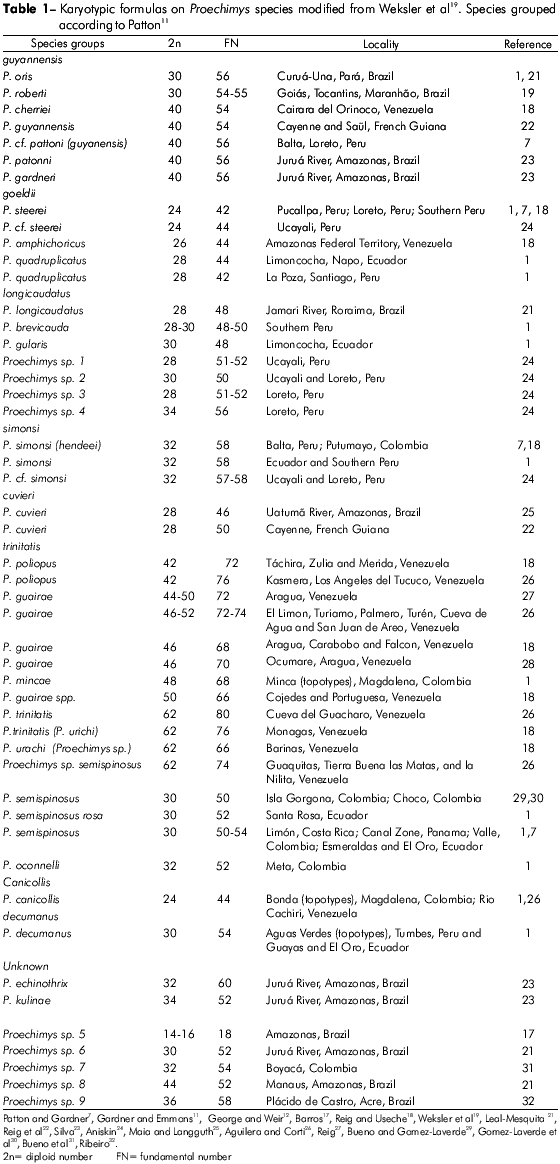
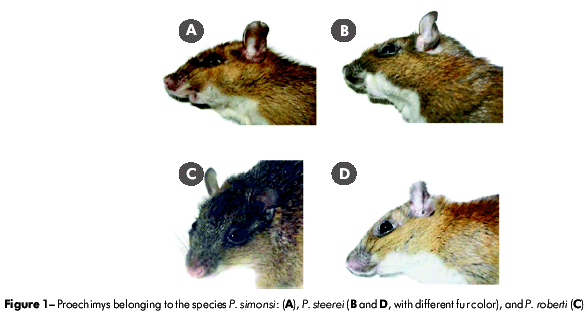
<body><![CDATA[<p><font size="2" face="verdana">  The taxonomic classification of representatives of  the family Echimyidae (Hystricognathi - Rodentia) is controversial, with the  number of recognized genera ranging from 14<sup>1</sup> to 16<sup>2</sup> . Patton and Rogers<sup>3</sup> stated  that <i>Proechimys </i>is one of the less well-known and more taxonomically  complex genera among the Neotropical rodents. There is debate regarding the number of species in this genus  because many of these species vary little in their morphological traits.  Furthermore, many of the traits that are traditionally used in the systematic  classification of mammals, such as fur color, dental enamel pattern, and the  number and position of plantar tubercles<sup>4,5,6,7</sup>, differ in these  species based on geography and the age of the animal, further complicating the  clear definition of populations and taxa (<a href="#f1">Figure 1</a>).</font></p>     <p><a name="f1"></a></p>     <p>&nbsp;</p>     <p align="center"><img src="/img/revistas/rpas/v2n1/1a07f1.gif" border="0"></p>     <p>&nbsp;</p>     <p><font size="2" face="verdana"> The number of <i>Proechimys </i>species identified  in the literature ranges across different authors and papers: Tate<sup>8</sup> recognized  46 species, Gardner and Emmons<sup>1</sup> identified 32, Ellerman<sup>9</sup>  reported 21, Moojen<sup>5</sup> found 15, and Cabrera<sup>10</sup> recognized  only 12. Patton<sup>11'</sup> used bacular and skull data to define 59 species  of <i>Proechimys </i>organized into nine groups: </font></p>     <p><font size="2" face="verdana">three monotypic groups (<i>decumanus, canicollis, </i>and <i>simonsi</i>) and  six polytypic groups (<i>semispinosus, longicaudatus, goeldii, cuvieri,  trinitatus </i>and <i>guyannensis</i>)<i>. </i>According to this classification, the  guyannensis group was composed of the species <i>P. guyannensis, P. cherriei,  P. roberti, P. vacilator, P. oris, P. warreni, P. boimensis, P. arescens, P.  riparum, </i>and <i>P. arabupu.</i></font></p>     <p><font size="2" face="verdana"> These species range from the coastal lands of the Guyanas to the Rio Negro  basin and the eastern half of the Amazon basin. Some populations are also found  in Goi&aacute;s and Minas Gerais in Brazil.  From this study, the geographic distribution of many species of this genus was  defined, such as <i>P. guyannensis, </i>which was found in the left banks of  the Amazon River, and <i>P. roberti, </i>which  was found in the right banks. This was confirmed by other authors<sup>2,12,15,16</sup>.  However, despite this extensive classification, the number of species in each  group remains unclear. More recently, Emmons and Feer<sup>12</sup> reported  that there are probably no more than 20 or 30 species of <i>Proechimys, </i>whereas  Nowak<sup>2</sup> found 32 species. Clearly, additional lines of evidence, such  as skull structure and karyotype, must also be analyzed concurrently to devise  a more precise strategy for identifying the species within <i>Proechimys</i><sup>11</sup><i>.</i></font></p>     <p><font size="2" face="verdana">  Based on studies of the sequence of the mitochondrial gene Cytochrome b,  Lara et al<sup>13</sup> suggested elevating <i>Trinomys, </i>a former subgenus  of <i>Proechimys, </i>to the genus level. Leite and Patton<sup>14</sup>  analyzed the sequences of Cytochrome b, as well as the 12S and 16S genes, which  provided support for the proposal of Lara et al<sup>13</sup>. These data show  the potential of molecular studies to elucidate the taxonomy and phylogenetic  relationships of this group of rodents.</font></p>     <p><font size="2" face="verdana"> As <i>Proechimys </i>has huge karyotypic  variability, with a diploid (2n) number ranging from 14<sup>17</sup> to 62<sup>18</sup>,  cytogenetic analysis appears to be particularly well-suited for resolving the  taxonomic problems of this genus. Weksler et al<sup>19</sup> used cytogenetic  data and other information to evaluate the taxonomic status of the species <i>P.  roberti </i>Thomas, 1901 and <i>P. oris </i>Thomas, 1904, and concluded that <i>P.  oris </i>is actually a junior synonym of <i>P. roberti. </i>The authors  combined their data with that of previous reports to compile a table of the 48 karyotypes  described for <i>Proechimys </i>(<a href="#t1">Table 1</a>), organized according to the species  groups proposed by Patton<sup>11</sup>. The karyotypic characterization of <i>P.  roberti </i>was later confirmed by Machado et al<sup>20</sup>, using samples obtained from Piau&iacute;,  Tocantins, and Mato Grosso States  in Brazil.</font></p>     ]]></body>
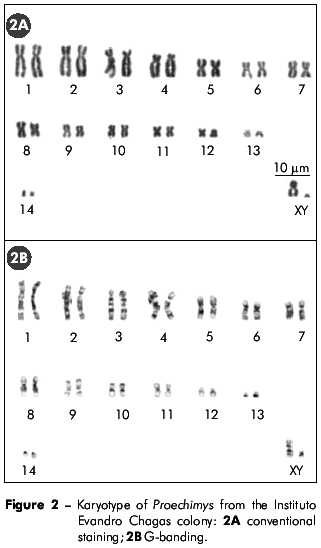
<body><![CDATA[<p><a name="t1"></a></p>     <p>&nbsp;</p>     <p align="center"><img src="/img/revistas/rpas/v2n1/1a07t1.gif" border="0"></p>     <p>&nbsp;</p>     <p><font size="3" face="verdana"><b>MATERIAL AND METHODS</b></font></p>     <p><font size="2" face="verdana"> The karyotypes of four animals (two males and two females) of <i>Proechimys </i>belonging to the SACPA-IEC colony were studied. The chromosomes were  obtained by direct extraction from bone marrow<sup>33</sup> and analyzed by  conventional staining using Giemsa, G-banding<sup>34</sup>, C-banding<sup>35</sup> and  Ag-NOR staining<sup>36</sup>. The metaphase chromosomes were photographed under Carl Zeiss  III and Axiophot Zeiss microscopes, and karyotypes were mounted based on  chromosome morphology, in order of decreasing size. This work was performed in  accordance with the Brazilian national ethic rules (Law no. 11.794/08; Arouca  Law).</font></p>     <p>&nbsp;</p>     <p><font size="3" face="verdana">  <b>RESULTS</b></font></p>     <p><font size="2" face="verdana">  The four animals were found to have 2n = 30 ,  fundamental number (FN) = 56. The autosomes comprised 13 pairs of biarmed  chromosomes, ranging in size from large to small, and one pair of  subtelocentrics. The X chromosome was found to be a medium-sized submetacentric  chromosome, whereas the Y was a small acrocentric chromosome (<a href="#f2">Figure 2A</a>). The  determination of the chromosome pairs was made by G-banding pattern analysis  (<a href="#f2">Figure 2B</a>).</font></p>     <p><font size="2" face="verdana"><a name="f2"></a></font></p>     ]]></body>
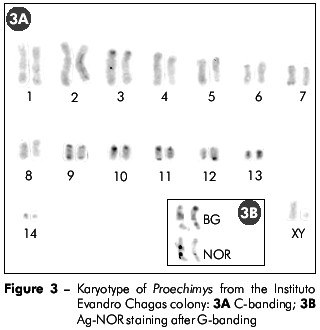
<body><![CDATA[<p>&nbsp;</p>     <p align="center"><img src="/img/revistas/rpas/v2n1/1a07f2.gif" border="0"></p>     <p>&nbsp;</p>     <p><font size="2" face="verdana">C-banding (<a href="#f3">Figure 3A</a>) revealed the presence of small blocks of  pericentromeric constitutive heterochromatin (CH) in nine autosome pairs (6, 7,  9, 10, 11, 12, 13, 14, and X). CH was also found on the distal short arm of  chromosomes 3, 6, 10, and X, on the distal long arm of chromosome 12, on the  long arm of the Y chromosome, and distally on  both arms of chromosomes 7, 9, and 11.</font></p>     <p><a name="f3"></a></p>     <p>&nbsp;</p>     <p align="center"><img src="/img/revistas/rpas/v2n1/1a07f3.gif" border="0"></p>     <p>&nbsp;</p>     <p><font size="2" face="verdana"> The nucleolar organizer regions (NORs) were located  in the interstitial region of the long arm of chromosome 9 (<a href="#f3">Figure 3B</a>). </font></p>     <p>&nbsp;</p>     ]]></body>
<body><![CDATA[<p><font size="3" face="verdana"><b>DISCUSSION</b></font></p>     <p><font size="2" face="verdana"> When the rodent colonies were initially established at the Instituto  Evandro Chagas, the <i>Proechimys </i>were classified as <i>P. guyannensis. </i>The  published cytogenetic data on this species show karyotypic formulas of 2n=40,  FN = 56<sup>7</sup> for a sample from Balta (Peru),  and 2n=40, FN = 54<sup>22</sup> for samples from Cayenne and Saul (French Guyana). In sharp  contrast, we found that the sample from the SACPA-IEC colony had 2n = 30, FN =  56. Comparison of our data (karyotypic formula, G- and C-banding, and Ag-NOR  staining patterns) with those found in the literature for <i>Proechimys </i>shows  that our cytogenetic results match those described by Weksler et al<sup>19</sup> and Machado  et al<sup>20</sup> for <i>P. roberti. </i>Additionally, these animals were originally  collected in the southwestern region of the Para  state. This further suggests that the tested samples must belong to the <i>P.  roberti </i>species because previous studies<sup>2,12,15,16</sup> demonstrated  that <i>P. roberti </i>is found only at the right banks of the Amazon River, where there are no records of <i>P.  guyannensis.</i></font></p>     <p><font size="2" face="verdana">  Based on these results and those of other studies<sup>19,20</sup>,  the karyotype of the species <i>P. roberti </i>does not have numerical  variation, with all tested samples having 2n = 30. However, there are morphological  differences involving chromosome 14, the last autosome pair. Populations can be  found with a homomorphic, acrocentric pair (FN = 54), a heteromorphic pair with one  acrocentric chromosome and a bi-armed chromosome (FN = 54-56), and a  homomorphic pair with two bi-armed chromosomes (FN = 56). As previously  defined<sup>19,20</sup>, such chromosomal differences are typical in  populations with a defined geographic distribution. This makes them useful to  identify populations with biogeographical and phylogenetic similarities.</font></p>     <p><font size="2" face="verdana"> Weksler et al<sup>19</sup> analyzed samples from Goi&aacute;s and from Par&aacute;,  Maranh&atilde;o and Tocantins in the Amazonian  region. In the north of Tocantins and Maranh&atilde;o,  they found karyotypes with FN = 54, in which both copies of chromosome 14 were  acrocentric. In the other localities, the entire sample had FN = 56, with both  copies of chromosome 14 being bi-armed. This is in agreement with the data of  Gardner and Emmons<sup>1</sup> and Leal-Mesquita<sup>21</sup> for samples  collected in Curu&aacute;-Una, Par&aacute;   State, and with the data  of Barros<sup>17</sup> for samples of the Transamazonia Road in Par&aacute;. The <i>Proechimys </i>colony from SACPA - IEC originated from the Barros collection<sup>17</sup>. Thus, our  data for this colony are in agreement with Barros. Apart from the homomorphic  states of the chromosome 14 pair (acrocentric or bi-armed), Weksler et al<sup>19</sup>  identified some karyotypes with FN = 56 and FN = 54-56 in the same locality,  meaning the chromosome 14 pair is heteromorphic. According to the authors, this  is a consequence of a pericentric inversion in one of the homologues. These  karyotypic patterns (NF = 56 and NF =54-56) were found in populations of the  Cavalcante Farm, northeastern Goi&aacute;s, and Primavera Farm, northeastern Par&aacute;. Machado  et al<sup>20</sup> also analyzed karyotypes of <i>P. roberti </i>from six  regions of three Brazilian states where they found karyotypes with FN = 56 and  bi-armed chromosome 14 homologues: the Ecological Station at Uru&ccedil;u&iacute;-Una, Piau&iacute;;  Parana and Peixe, Tocantins;  Cl&aacute;udia, Ga&uacute;cha do Norte and Vila Rica, Mato Grosso.</font></p>     <p><font size="2" face="verdana"> From the geographic and  karyotypic analyses of <i>P. roberti, </i>the existence of two populations can  be noted: a western population, in Par&aacute;, north of Tocantins, Goi&aacute;s and Mato  Grosso, with FN = 56 and a homomorphic, bi-armed chromosome 14 homolog pair;  and an eastern population, located in Maranh&atilde;o, south of Tocantins, with FN =  54 and an acrocentric chromosome 14 homolog pair. However, Weksler et al<sup>19</sup>  found karyotypes with FN = 54-56 (with heteromorphic copies of chromosome 14)  in populations from the Cavalcante farm, northeastern Goi&aacute;s, and Primavera  Farm, northeastern Par&aacute;. However, it is possible that these are hybrid  populations, resulting from the mix of the homomorphic groups (one-armed in the  east and bi-armed in the west), as the heteromorphic populations are observed  in the contact region of both the homomorphic types (northeast of Para and Goi&aacute;s).  This region may thus constitute a potential hybridization zone.</font></p>     <p>&nbsp;</p>     <p><font size="3" face="verdana">  <b>CONCLUSION</b></font></p>     <p><font size="2" face="verdana">  This mistake in classification is very understandable given all the  problems related to classifying members of genus <i>Proechimys, </i>such as the  relative lack of morphological variability among species and the  intrapopulational variations in some traits typically used for mammal  systematics. At the time of the colony's initial classification four decades  ago, taxonomic identification was made exclusively using morphology.</font></p>     <p><font size="2" face="verdana"> Since many biomedical studies deal with the species-specific  relationships among vertebrate reservoirs and pathogenic species (viruses,  bacteria, fungi, protozoa, helminthes, etc.) that have been established over  thousands of years of co-evolution, with different vertebrate species having  different reactions to pathogens, it is very important that model animals be  correctly characterized. Due to the morphological similarities among species of <i>Proechimys, </i>these rodents should be accurately identified using  techniques beyond morphological examination. Here, we show that cytogenetic  studies, in conjunction with other data, are very useful tools for the precise  definition of members of <i>Proechimys.</i></font></p>     <p><font size="2" face="verdana">  By comparing the cytogenetic data of the sample of <i>P. roberti </i>from  SACPA-IEC with published samples, we concluded that the SACPA-IEC sample  belongs to the largest populational group of this species, with FN = 56 and a  geographical distribution ranging from Par&aacute; to Mato Grosso. This suggests that  the sample shares a similar evolutionary origin with that group and therefore  must have the same genetic and biological properties that allow its  distribution and survival in a forest environment characterized by a particular  complement of pathogenic species. The SACPA-IEC <i>P. roberti </i>samples may  thus represent an ideal model system in which to study species-specific  relationships with pathogens.</font></p>     ]]></body>
<body><![CDATA[<p>&nbsp;</p>     <p><font size="3" face="verdana">  <b>ACKNOWLEDGMENTS</b></font></p>     <p><font size="2" face="verdana"> We thank Dr. Regina Barros (UFPa) for her expertise in the field of  cytogenetics, Doctor Reinaldo Carvalho (chairman of the SACPA-IEC at the time  of this study) for permission to collect samples, the Instituto Evandro Chagas and  Universidade Federal do Par&aacute; for the use of laboratory facilities, and CNPq and  CAPES for financial support.</font></p>     <p>&nbsp;</p>     <p><font size="3" face="verdana">  <b>FINANCIAL SUPPORT</b></font></p>     <p><font size="2" face="verdana"> Coordena&ccedil;&atilde;o de  Aperfei&ccedil;oamento de Pessoal de N&iacute;vel Superior, Conselho Nacional de  Desenvolvimento Cient&iacute;fico e Tecnol&oacute;gico, Universidade Federal do Par&aacute;,  Instituto Evandro Chagas.</font></p>     <p>&nbsp;</p>     <p><font size="3" face="verdana"><b>REFERENCES</b></font></p>     <!-- ref --><p><font size="2" face="verdana"> 1 Gardner AL,  Emmons LH. Species groups in <i>Proechimys </i>(Rodentia, Echimyidae) as  indicated by kariology and bullar morfology. J mammal. 1984;65:10-25.</font><p><font size="2" face="verdana"> 2 Nowak RM.  Walker's Mammals of the World. 5th. ed. Baltimore: The Johns Hopkins University Press; 1999. 642 p.</font></p>     ]]></body>
<body><![CDATA[<!-- ref --><p><font size="2" face="verdana"> 3 Patton JL,  Rogers A. Systematic implications of non-geographic variation in the spiny rats  genus <i>Proechimys </i>(Echimyidae). Z Sdugetierkd. 1983;48:363-70.</font><!-- ref --><p><font size="2" face="verdana"> 4 Thomas O. The  Godman-Thomas expedition to Peru. VII. The mammals of the Rio Ucayali. Ann Mag  Nat Hist Ser. 1928;6:294-302.</font><!-- ref --><p><font size="2" face="verdana"> 5 Moojen J.  Speciation in the Brazilian spiny rats (genus <i>Proechimys, </i>family  Echimyidae). Univ Kans Pubis Mus Nat Hist. 1948;1:301-406.</font><!-- ref --><p><font size="2" face="verdana"> 6 Hershkovitz P. Mammals of norther Colombia. Preliminary report n<sup>o</sup> 2:  Spiny Rats (Echimyidae), with suplemental notes on related forms. Proceedings  of the United States National Museum. 1948;97:125-40</font>. <font size="2" face="verdana">&#91;<a href="http://si-pddr.si.edu/dspace/bitstream/10088/16482/1/USNMP-97_3214_1948.pdf" target="_blank">Link</a>&#93;</font><!-- ref --><p><font size="2" face="verdana">7 Patton JL, Gardner LA. Notes  on the systematics of <i>Proechimys </i>(Rodentia: Echimyidae), with emphasis  on Peruvian forms. Occasional papers of the Museum of Zoology. 1972;44:1-30.</font><!-- ref --><p><font size="2" face="verdana">8 Tate GHH. The taxonomy of the genera of Neotropical   hystricoid rodents. Bull Amer Mus Nat Hist. 1935;68:295-447.</font><!-- ref --><p><font size="2" face="verdana"> 9 Ellerman JR. The  families and genera of living rodents. London, British: Museum Natural  History; 1940. 689 p.</font><!-- ref --><p><font size="2" face="verdana"> 10 Cabrera A. Catalogo de los  mam&iacute;feros de Am&eacute;rica del Sur.&nbsp;Mus Argent Ci Nat "Bernardino Rivadavia". 1961;4(2):309-732.</font><!-- ref --><p><font size="2" face="verdana"> 11 Patton JL.  Species groups of spiny rats, genus <i>Proechimys </i>(Rodenta: Echimyidae). Fieldiana Zool. 1987;39:305-45.</font><!-- ref --><p><font size="2" face="verdana"> 12 Emmons LH, Feer F. Neotropical rainforest  mammals: a field guide. 2nd. ed. Chicago:  University  of Chicago;   1997.307 p.</font><!-- ref --><p><font size="2" face="verdana"> 13 Lara MC,  Patton JL, Silva MNF. The simultaneous Diversification of South American  Echimyid Rodents (Hystricognathi) Basead on Complete Cytochrome b Sequences. Mol Phylogenet Evol. 1996 Apr;5(2):403-13. Doi:<img width="1" height="10" src="v2n1a07_clip_image002.gif">10.1006/mpev.1996.0035</font> <font size="2" face="verdana">&#91;<a href="http://www.mendeley.com/research/the-simultaneous-diversi-cation-of-south-american-echimyid-rodents-hystricognathi-based-on-complete-cytochrome-b-sequences/" target="_blank">Link</a>&#93;</font><!-- ref --><p><font size="2" face="verdana"> 14 Leite YLR, Patton JL.  Evolution of South American spiny rats (Rodentia, Echimyidae): the  star-phylogeny hypothesis&nbsp;  revisited. Mol Phylogenet Evol. 2002   Dec;25(3):455-64. Doi:10.1016/S1055-7903(02)00279-8</font> <font size="2" face="verdana">&#91;<a href="http://www.mendeley.com/research/evolution-south-american-spiny-rats-rodentia-echimyidae-starphylogeny-hypothesis-revisited/" target="_blank">Link</a>&#93;</font><!-- ref --><p><font size="2" face="verdana"> 15 Wilson DE, Reeder DM. Mammal species of  the world. A taxonomic and geographic reference. 2nd. ed. Washington: Smithsonian Inst. Press; 1993. 1114 p.</font><!-- ref --><p><font size="2" face="verdana"> 16 Eisenberg JF, Redford KH. Mammals of the  Neotropics. Central Neotropics. Chicago: University of Chicago   Press; 1999. s.n.</font><!-- ref --><p><font size="2" face="verdana"> 17 Barros RMS. Variabilidade cromoss&ocirc;mica em <i>Proechimys </i>e <i>Oryzomys </i>(Rodentia) da Amaz&ocirc;nia &#91;Tese&#93;. S&atilde;o Paulo (SP): Universidade de S&atilde;o Paulo, Instituto de Bioci&ecirc;ncias; 1978.</font><!-- ref --><p><font size="2" face="verdana"> 18 Reig AO, Useche M. Diversidad cariot&iacute;pica y sistem&aacute;tica en poblaciones  venezolanas de <i>Proechimys </i>(Rodentia: Echimyidae), com datos adicionales sobre poblaciones de Peru y  Colombia. Acta  Cient Venz. 1976;27(3):132-40.</font><!-- ref --><p><font size="2" face="verdana"> 19 Weksler M, Bonvicino CR,  Otazu I, Silva Junior JSS. Status of <i>Proechimys roberti </i>and <i>P-oris </i>(Rodentia:  Echimyidae) from eastern Amazonia and central Brazil. J Mammal. 2001;82(1):109-22.<SPAN lang="EN-US"> Doi:10.1644/1545-1542(2001)082&lt;0109:SOPRAP&gt;2.0.CO;2</SPAN></font> <font size="2" face="verdana">&#91;<a href="http://www.bioone.org/doi/abs/10.1644/1545-1542%282001%29082%3C0109%3ASOPRAP%3E2.0.CO%3B2?journalCode=mamm" target="_blank">Link</a>&#93;</font><!-- ref --><p><font size="2" face="verdana"> 20 Machado T, Silva MJJ, Leal-Mesquita ER, Carmignotto  AP, Yonenaga-Yassuda Y. Nine karyomorphs for spiny rats of the genus <i>Proechimys </i>(Echimyidae, Rodentia) from North and Central Brazil. Genet mol Biol. 2005;28:682-92. Doi:10.1590/S1415-47572005000500007</font> <font size="2" face="verdana">&#91;<a href="http://www.scielo.br/pdf/gmb/v28n4/a07v28n4.pdf" target="_blank">Link</a>&#93;</font><!-- ref --><p><font size="2" face="verdana"> 21 LLeal-Mesquita ERRBP. Estudos Citogen&eacute;ticos em dez esp&eacute;cies de  roedores brasileiros da fam&iacute;lia Echimyidae  &#91;Tese&#93;. S&atilde;o  Paulo (SP): Universidade de S&atilde;o Paulo; 1991.</font><!-- ref --><p><font size="2" face="verdana"> 22 Reig OA, Trainer M, Barros MA. Sur l'i'dentification  chromosomique de <i>Proechimys guyannensis </i>(E. Geoffroy, 1803) et de <i>Proechimys cuvieri </i>Petter, 1978 (Rodentia :  Echimyidae).  Mammalia.  1979;43:501-5.</font><!-- ref --><p><font size="2" face="verdana"> 23 Silva MNF. Four new species of  spiny rats of the genus <i>Proechimys </i>(Rodentia: Echimyidae) from the  western Amazon of Brasil. Proc Biol Soc Wash. 1998;111(2):436-71.</font><!-- ref --><p><font size="2" face="verdana"> 24 Aniskin VM.  Evolutionary cytogenetics of spiny rats from Peruvian Amazonia (Rodentia,  Echimyidae). In: Mlekopitayushchie Peruanskoi Amazonii. Moskow, Russia: V. E.  Sokolov; 1994. 62-82 p.</font><!-- ref --><p><font size="2" face="verdana"> 25 Maia V, Langguth A.  Constitutive heterochromatin polymorphism and NORs in <i>Proechimys cuvieri </i>Petter,  (Rodentia, Echimyidae). Rev bras genet. 1993;16(1):145-54.</font> <font size="2" face="verdana">&#91;<a href="http://web2.sbg.org.br/gmb/edicoesanteriores/v16n1/pdf/a14v16n1.pdf" target="_blank">Link</a>&#93;</font><!-- ref --><p><font size="2" face="verdana"> 26 Aguilera M, Corti M.  Craniometric differentiation and chromosomal speciation of the genus <i>Proechimys </i>(Rodentia:&nbsp;&nbsp; Echimyidae).&nbsp;&nbsp; Z&nbsp; S&atilde;ugetierkunde.   1994;59:366-77.</font><!-- ref --><p><font size="2" face="verdana"> 27 Reig OA. Karyotypic  repatterning as one triggering factor in explosive speciation. In: Evolutionary  biology of transient unstable populations. Berlin, Germany: Springer-Verlag; 1989. 246-89 p.</font><!-- ref --><p><font size="2" face="verdana"> 28 George W, Weir BJ. A  note on the karyotype of <i>Proechimys guairae </i>(Rodentia: Hystricomorpha).  Mammalia. 1973;37:330-2.</font><!-- ref --><p><font size="2" face="verdana"> 29 Bueno ML, Gomez- Laverde M. Variacion Heterocrom&aacute;tica em <i>Proechimys  semispinosus </i>(Rodentia:&nbsp;&nbsp;  Echimyidae) de la  Region Pacifica   Colombiana. Caldasia. 1993;7(2):333-40.</font><!-- ref --><p><font size="2" face="verdana"> 30 Gomez-Laverde  M, Bueno ML, Cadena A. Poblaciones de ratas (<i>Proechimys semispinosus</i>) (Rodentia:  Echimyidae). In: Aguirre J, Rangel O, editors. Biota y Ecosistema de Gorgona y  Gorgonilla. Bogot&aacute;,  Colombia: Editorial Presencia; 1990. 244-51   p.</font><!-- ref --><p><font size="2" face="verdana"> 31 Bueno ML, Gomez-Laverde  M, Morales A. Caracterizaci&oacute;n  cariol&oacute;gica de <i>Proechimys </i>sp (Rodentia: Echimyidae) de una col&ocirc;nia experimental.  Biom&eacute;dica. 1989;9:13-22.</font><!-- ref --><p><font size="2" face="verdana"> 32 Ribeiro NAB. An&aacute;lises Cromoss&ocirc;micas e Filogenia de Roedores do G&ecirc;nero <i>Proechimys </i>(Echimyidae, Rodentia) &#91;Tese&#93;. Bel&eacute;m (PA): Universidade  Federal  do Par&aacute;, Centro de Ci&ecirc;ncias Biol&oacute;gicas; 2006.</font> <font size="2" face="verdana">&#91;<a href="http://iah.iec.pa.gov.br/iah/fulltext/pc/teses/ribeironelson/ribeironelson.pdf" target="_blank">Link</a>&#93;</font><!-- ref --><p><font size="2" face="verdana"> 33 Ford CE, Hamerton JL. A colchicine, hypotonic -citrate, squash sequence for mammalian chromosomes.  Stain Technol. 1956;31(6):247-51.</font><!-- ref --><p><font size="2" face="verdana"> 34 Seabright M. &quot;The  use of proteolitic enzymes for the mapping of structural rearrangements of man&quot;.   Chromosoma. 1971;36:204-10.</font><!-- ref --><p><font size="2" face="verdana"> 35 Sumner AT. A  simple technique for demosntrating cen tromeric heterocromatin. Exp cell Res.   1972;75:304-6.</font><!-- ref --><p><font size="2" face="verdana">36 Howell WM, Black DA. Controlled silver- staining of   nucleolar organizer regions whith protective colloidal   developer: a 1-step method. Experientia. 1980;36(8):1014-5.</font><p>&nbsp;</p>     <p>&nbsp;</p>     <p><font size="2" face="Verdana"><b><a name="endereco"></a><a href="#topo"><img src="/img/revistas/rpas/v1n4/seta.gif" border="0"></a></b></font><font size="2" face="verdana"><b>Correspond&ecirc;ncia /Correspondence / Correspondencia:</b>    <br>   Nelson Antonio Bail&atilde;o  Ribeiro    <br>   Rua dos Pariqu&iacute;s    <br>   Alameda Gon&ccedil;alo Duarte  n<sup>o</sup> 56    ]]></body>
<body><![CDATA[<br>   Bairro: Jurunas    <br>   CEP:66030-040    <br>   Bel&eacute;m-Par&aacute;-Brasil    <br> E-mail:<a href="mailto:nelsonribeiro@iec.pa.gov.br">nelsonribeiro@iec.pa.gov.br</a></font></p>     <p><font size="2" face="Verdana">Recebido em: 9/9/2010    <br> Aprovado em: 4/5/2011</font></p> <script type="text/javascript"> var gaJsHost = (("https:" == document.location.protocol) ? "https://ssl." : "http://www."); document.write(unescape("%3Cscript src='" + gaJsHost + "google-analytics.com/ga.js' type='text/javascript'%3E%3C/script%3E")); </script> <script type="text/javascript"> try { var pageTracker = _gat._getTracker("UA-7885746-4"); pageTracker._setDomainName("none"); pageTracker._setAllowLinker(true); pageTracker._trackPageview(); } catch(err) {}</script>      ]]></body><back>
<ref-list>
<ref id="B1">
<label>1</label><nlm-citation citation-type="journal">
<person-group person-group-type="author">
<name>
<surname><![CDATA[Gardner]]></surname>
<given-names><![CDATA[AL]]></given-names>
</name>
<name>
<surname><![CDATA[Emmons]]></surname>
<given-names><![CDATA[LH]]></given-names>
</name>
</person-group>
<article-title xml:lang="en"><![CDATA[Species groups in Proechimys (Rodentia, Echimyidae) as indicated by kariology and bullar morfology]]></article-title>
<source><![CDATA[J mammal]]></source>
<year>1984</year>
<volume>65</volume>
<page-range>10-25</page-range></nlm-citation>
</ref>
<ref id="B2">
<label>2</label><nlm-citation citation-type="book">
<person-group person-group-type="author">
<name>
<surname><![CDATA[Nowak]]></surname>
<given-names><![CDATA[RM]]></given-names>
</name>
</person-group>
<source><![CDATA[Walker's Mammals of the World]]></source>
<year>1999</year>
<edition>5</edition>
<page-range>642</page-range><publisher-loc><![CDATA[Baltimore ]]></publisher-loc>
<publisher-name><![CDATA[The Johns Hopkins Univ. Press]]></publisher-name>
</nlm-citation>
</ref>
<ref id="B3">
<label>3</label><nlm-citation citation-type="journal">
<person-group person-group-type="author">
<name>
<surname><![CDATA[Patton]]></surname>
<given-names><![CDATA[JL]]></given-names>
</name>
<name>
<surname><![CDATA[Rogers]]></surname>
<given-names><![CDATA[A]]></given-names>
</name>
</person-group>
<article-title xml:lang="en"><![CDATA[Systematic implications of non-geographic variation in the spiny rats genus Proechimys (Echimyidae)]]></article-title>
<source><![CDATA[Z Sdugetierkd]]></source>
<year>1983</year>
<volume>48</volume>
<page-range>363-70</page-range></nlm-citation>
</ref>
<ref id="B4">
<label>4</label><nlm-citation citation-type="journal">
<person-group person-group-type="author">
<name>
<surname><![CDATA[Thomas]]></surname>
<given-names><![CDATA[O]]></given-names>
</name>
</person-group>
<article-title xml:lang="en"><![CDATA[The Godman-Thomas expedition to Peru: VII. The mammals of the Rio Ucayali]]></article-title>
<source><![CDATA[Ann Mag Nat Hist Ser]]></source>
<year>1928</year>
<volume>6</volume>
<page-range>294-302</page-range></nlm-citation>
</ref>
<ref id="B5">
<label>5</label><nlm-citation citation-type="journal">
<person-group person-group-type="author">
<name>
<surname><![CDATA[Moojen]]></surname>
<given-names><![CDATA[J]]></given-names>
</name>
</person-group>
<article-title xml:lang="en"><![CDATA[Speciation in the Brazilian spiny rats (genus Proechimys, family Echimyidae)]]></article-title>
<source><![CDATA[Univ Kans Pubis Mus Nat Hist]]></source>
<year>1948</year>
<volume>1</volume>
<page-range>301-406</page-range></nlm-citation>
</ref>
<ref id="B6">
<label>6</label><nlm-citation citation-type="journal">
<person-group person-group-type="author">
<name>
<surname><![CDATA[Hershkovitz]]></surname>
<given-names><![CDATA[P]]></given-names>
</name>
</person-group>
<article-title xml:lang="en"><![CDATA[Mammals of norther Colombia: Preliminary report nº 2: Spiny Rats (Echimyidae), with suplemental notes on related forms]]></article-title>
<source><![CDATA[Proceedings of the United States National Museum]]></source>
<year>1948</year>
<volume>97</volume>
<page-range>125-40</page-range></nlm-citation>
</ref>
<ref id="B7">
<label>7</label><nlm-citation citation-type="journal">
<person-group person-group-type="author">
<name>
<surname><![CDATA[Patton]]></surname>
<given-names><![CDATA[JL]]></given-names>
</name>
<name>
<surname><![CDATA[Gardner]]></surname>
<given-names><![CDATA[LA]]></given-names>
</name>
</person-group>
<article-title xml:lang="en"><![CDATA[Notes on the systematics of Proechimys (Rodentia: Echimyidae), with emphasis on Peruvian forms]]></article-title>
<source><![CDATA[Occasional papers of the Museum of Zoology]]></source>
<year>1972</year>
<volume>44</volume>
<page-range>1-30</page-range></nlm-citation>
</ref>
<ref id="B8">
<label>8</label><nlm-citation citation-type="journal">
<person-group person-group-type="author">
<name>
<surname><![CDATA[Tate]]></surname>
<given-names><![CDATA[GHH]]></given-names>
</name>
</person-group>
<article-title xml:lang="en"><![CDATA[The taxonomy of the genera of Neotropical hystricoid rodents]]></article-title>
<source><![CDATA[Bull Amer Mus Nat Hist]]></source>
<year>1935</year>
<volume>68</volume>
<page-range>295-447</page-range></nlm-citation>
</ref>
<ref id="B9">
<label>9</label><nlm-citation citation-type="book">
<person-group person-group-type="author">
<name>
<surname><![CDATA[Ellerman]]></surname>
<given-names><![CDATA[JR]]></given-names>
</name>
</person-group>
<source><![CDATA[The families and genera of living rodents]]></source>
<year>1940</year>
<page-range>689</page-range><publisher-loc><![CDATA[London^eBritish British]]></publisher-loc>
<publisher-name><![CDATA[Museum Natural History]]></publisher-name>
</nlm-citation>
</ref>
<ref id="B10">
<label>10</label><nlm-citation citation-type="journal">
<person-group person-group-type="author">
<name>
<surname><![CDATA[Cabrera]]></surname>
<given-names><![CDATA[A]]></given-names>
</name>
</person-group>
<article-title xml:lang="es"><![CDATA[Catalogo de los mamíferos de América del Sur]]></article-title>
<source><![CDATA[Mus Argent Ci Nat "Bernardino Rivadavia"]]></source>
<year>1961</year>
<volume>4</volume>
<numero>2</numero>
<issue>2</issue>
<page-range>309-732</page-range></nlm-citation>
</ref>
<ref id="B11">
<label>11</label><nlm-citation citation-type="journal">
<person-group person-group-type="author">
<name>
<surname><![CDATA[Patton]]></surname>
<given-names><![CDATA[JL]]></given-names>
</name>
</person-group>
<article-title xml:lang="en"><![CDATA[Species groups of spiny rats, genus Proechimys (Rodenta: Echimyidae)]]></article-title>
<source><![CDATA[Fieldiana Zool]]></source>
<year>1987</year>
<volume>39</volume>
<page-range>305-45</page-range></nlm-citation>
</ref>
<ref id="B12">
<label>12</label><nlm-citation citation-type="book">
<person-group person-group-type="author">
<name>
<surname><![CDATA[Emmons]]></surname>
<given-names><![CDATA[LH]]></given-names>
</name>
<name>
<surname><![CDATA[Feer]]></surname>
<given-names><![CDATA[F]]></given-names>
</name>
</person-group>
<source><![CDATA[Neotropical rainforest mammals: a field guide]]></source>
<year>1997</year>
<edition>2</edition>
<page-range>307</page-range><publisher-loc><![CDATA[Chicago ]]></publisher-loc>
<publisher-name><![CDATA[University of Chicago]]></publisher-name>
</nlm-citation>
</ref>
<ref id="B13">
<label>13</label><nlm-citation citation-type="journal">
<person-group person-group-type="author">
<name>
<surname><![CDATA[Lara]]></surname>
<given-names><![CDATA[MC]]></given-names>
</name>
<name>
<surname><![CDATA[Patton]]></surname>
<given-names><![CDATA[JL]]></given-names>
</name>
<name>
<surname><![CDATA[Silva]]></surname>
<given-names><![CDATA[MNF]]></given-names>
</name>
</person-group>
<article-title xml:lang="en"><![CDATA[The simultaneous Diversification of South American Echimyid Rodents (Hystricognathi) Basead on Complete Cytochrome b Sequences]]></article-title>
<source><![CDATA[Mol Phylogenet Evol]]></source>
<year>1996</year>
<month> A</month>
<day>pr</day>
<volume>5</volume>
<numero>2</numero>
<issue>2</issue>
<page-range>403-13</page-range></nlm-citation>
</ref>
<ref id="B14">
<label>14</label><nlm-citation citation-type="journal">
<person-group person-group-type="author">
<name>
<surname><![CDATA[Leite]]></surname>
<given-names><![CDATA[YLR]]></given-names>
</name>
<name>
<surname><![CDATA[Patton]]></surname>
<given-names><![CDATA[JL]]></given-names>
</name>
</person-group>
<article-title xml:lang="en"><![CDATA[Evolution of South American spiny rats (Rodentia, Echimyidae): the star-phylogeny hypothesis revisited]]></article-title>
<source><![CDATA[Mol Phylogenet Evol]]></source>
<year>2002</year>
<month> D</month>
<day>ec</day>
<volume>25</volume>
<numero>3</numero>
<issue>3</issue>
<page-range>455-64</page-range></nlm-citation>
</ref>
<ref id="B15">
<label>15</label><nlm-citation citation-type="book">
<person-group person-group-type="author">
<name>
<surname><![CDATA[Wilson]]></surname>
<given-names><![CDATA[DE]]></given-names>
</name>
<name>
<surname><![CDATA[Reeder]]></surname>
<given-names><![CDATA[DM]]></given-names>
</name>
</person-group>
<source><![CDATA[Mammal species of the world: A taxonomic and geographic reference]]></source>
<year>1993</year>
<edition>2</edition>
<page-range>1114</page-range><publisher-loc><![CDATA[Washington ]]></publisher-loc>
<publisher-name><![CDATA[Smithsonian Inst. Press]]></publisher-name>
</nlm-citation>
</ref>
<ref id="B16">
<label>16</label><nlm-citation citation-type="book">
<person-group person-group-type="author">
<name>
<surname><![CDATA[Eisenberg]]></surname>
<given-names><![CDATA[JF]]></given-names>
</name>
<name>
<surname><![CDATA[Redford]]></surname>
<given-names><![CDATA[KH]]></given-names>
</name>
</person-group>
<source><![CDATA[Mammals of the Neotropics: Central Neotropics]]></source>
<year>1999</year>
<publisher-loc><![CDATA[Chicago ]]></publisher-loc>
<publisher-name><![CDATA[University of Chicago Press]]></publisher-name>
</nlm-citation>
</ref>
<ref id="B17">
<label>17</label><nlm-citation citation-type="">
<person-group person-group-type="author">
<name>
<surname><![CDATA[Barros]]></surname>
<given-names><![CDATA[RMS]]></given-names>
</name>
</person-group>
<source><![CDATA[Variabilidade cromossômica em Proechimys e Oryzomys (Rodentia) da Amazônia]]></source>
<year></year>
</nlm-citation>
</ref>
<ref id="B18">
<label>18</label><nlm-citation citation-type="journal">
<person-group person-group-type="author">
<name>
<surname><![CDATA[Reig]]></surname>
<given-names><![CDATA[AO]]></given-names>
</name>
<name>
<surname><![CDATA[Useche]]></surname>
<given-names><![CDATA[M]]></given-names>
</name>
</person-group>
<article-title xml:lang="es"><![CDATA[Diversidad cariotípica y sistemática en poblaciones venezolanas de Proechimys (Rodentia: Echimyidae), com datos adicionales sobre poblaciones de Peru y Colombia]]></article-title>
<source><![CDATA[Acta Cient Venz]]></source>
<year>1976</year>
<volume>27</volume>
<numero>3</numero>
<issue>3</issue>
<page-range>132-40</page-range></nlm-citation>
</ref>
<ref id="B19">
<label>19</label><nlm-citation citation-type="journal">
<person-group person-group-type="author">
<name>
<surname><![CDATA[Weksler]]></surname>
<given-names><![CDATA[M]]></given-names>
</name>
<name>
<surname><![CDATA[Bonvicino]]></surname>
<given-names><![CDATA[CR]]></given-names>
</name>
<name>
<surname><![CDATA[Otazu]]></surname>
<given-names><![CDATA[I]]></given-names>
</name>
<name>
<surname><![CDATA[Silva Junior]]></surname>
<given-names><![CDATA[JSS]]></given-names>
</name>
</person-group>
<article-title xml:lang="en"><![CDATA[Status of Proechimys roberti and P-oris (Rodentia: Echimyidae) from eastern Amazonia and central Brazil]]></article-title>
<source><![CDATA[J Mammal]]></source>
<year>2001</year>
<volume>82</volume>
<numero>1</numero>
<issue>1</issue>
<page-range>109-22</page-range></nlm-citation>
</ref>
<ref id="B20">
<label>20</label><nlm-citation citation-type="journal">
<person-group person-group-type="author">
<name>
<surname><![CDATA[Machado]]></surname>
<given-names><![CDATA[T]]></given-names>
</name>
<name>
<surname><![CDATA[Silva]]></surname>
<given-names><![CDATA[MJJ]]></given-names>
</name>
<name>
<surname><![CDATA[Leal-Mesquita]]></surname>
<given-names><![CDATA[ER]]></given-names>
</name>
<name>
<surname><![CDATA[Carmignotto]]></surname>
<given-names><![CDATA[AP]]></given-names>
</name>
<name>
<surname><![CDATA[Yonenaga-Yassuda]]></surname>
<given-names><![CDATA[Y]]></given-names>
</name>
</person-group>
<article-title xml:lang="en"><![CDATA[Nine karyomorphs for spiny rats of the genus Proechimys (Echimyidae, Rodentia) from North and Central Brazil]]></article-title>
<source><![CDATA[Genet mol Biol]]></source>
<year>2005</year>
<volume>28</volume>
<page-range>682-92</page-range></nlm-citation>
</ref>
<ref id="B21">
<label>21</label><nlm-citation citation-type="">
<person-group person-group-type="author">
<name>
<surname><![CDATA[LLeal-Mesquita]]></surname>
<given-names><![CDATA[ERRBP]]></given-names>
</name>
</person-group>
<source><![CDATA[Estudos Citogenéticos em dez espécies de roedores brasileiros da família Echimyidae]]></source>
<year></year>
</nlm-citation>
</ref>
<ref id="B22">
<label>22</label><nlm-citation citation-type="journal">
<person-group person-group-type="author">
<name>
<surname><![CDATA[Reig]]></surname>
<given-names><![CDATA[OA]]></given-names>
</name>
<name>
<surname><![CDATA[Trainer]]></surname>
<given-names><![CDATA[M]]></given-names>
</name>
<name>
<surname><![CDATA[Barros]]></surname>
<given-names><![CDATA[MA]]></given-names>
</name>
</person-group>
<article-title xml:lang="fr"><![CDATA[Sur l'i'dentification chromosomique de Proechimys guyannensis (E. Geoffroy, 1803) et de Proechimys cuvieri Petter, 1978 (Rodentia : Echimyidae)]]></article-title>
<source><![CDATA[Mammalia]]></source>
<year>1979</year>
<volume>43</volume>
<page-range>501-5</page-range></nlm-citation>
</ref>
<ref id="B23">
<label>23</label><nlm-citation citation-type="journal">
<person-group person-group-type="author">
<name>
<surname><![CDATA[Silva]]></surname>
<given-names><![CDATA[MNF]]></given-names>
</name>
</person-group>
<article-title xml:lang="en"><![CDATA[Four new species of spiny rats of the genus Proechimys (Rodentia: Echimyidae) from the western Amazon of Brasil]]></article-title>
<source><![CDATA[Proc Biol Soc Wash]]></source>
<year>1998</year>
<volume>111</volume>
<numero>2</numero>
<issue>2</issue>
<page-range>436-71</page-range></nlm-citation>
</ref>
<ref id="B24">
<label>24</label><nlm-citation citation-type="book">
<person-group person-group-type="author">
<name>
<surname><![CDATA[Aniskin]]></surname>
<given-names><![CDATA[VM]]></given-names>
</name>
</person-group>
<article-title xml:lang="en"><![CDATA[Evolutionary cytogenetics of spiny rats from Peruvian Amazonia (Rodentia, Echimyidae)]]></article-title>
<source><![CDATA[Mlekopitayushchie Peruanskoi Amazonii]]></source>
<year>1994</year>
<page-range>62-82</page-range><publisher-loc><![CDATA[Moskow ]]></publisher-loc>
<publisher-name><![CDATA[V. E. Sokolov]]></publisher-name>
</nlm-citation>
</ref>
<ref id="B25">
<label>25</label><nlm-citation citation-type="journal">
<person-group person-group-type="author">
<name>
<surname><![CDATA[Maia]]></surname>
<given-names><![CDATA[V]]></given-names>
</name>
<name>
<surname><![CDATA[Langguth]]></surname>
<given-names><![CDATA[A]]></given-names>
</name>
</person-group>
<article-title xml:lang="en"><![CDATA[Constitutive heterochromatin polymorphism and NORs in Proechimys cuvieri Petter, (Rodentia, Echimyidae)]]></article-title>
<source><![CDATA[Rev bras genet]]></source>
<year>1993</year>
<volume>16</volume>
<numero>1</numero>
<issue>1</issue>
<page-range>145-54</page-range></nlm-citation>
</ref>
<ref id="B26">
<label>26</label><nlm-citation citation-type="journal">
<person-group person-group-type="author">
<name>
<surname><![CDATA[Aguilera]]></surname>
<given-names><![CDATA[M]]></given-names>
</name>
<name>
<surname><![CDATA[Corti]]></surname>
<given-names><![CDATA[M]]></given-names>
</name>
</person-group>
<article-title xml:lang="en"><![CDATA[Craniometric differentiation and chromosomal speciation of the genus Proechimys (Rodentia: Echimyidae)]]></article-title>
<source><![CDATA[Z Sãugetierkunde]]></source>
<year>1994</year>
<volume>59</volume>
<page-range>366-77</page-range></nlm-citation>
</ref>
<ref id="B27">
<label>27</label><nlm-citation citation-type="book">
<person-group person-group-type="author">
<name>
<surname><![CDATA[Reig]]></surname>
<given-names><![CDATA[OA]]></given-names>
</name>
</person-group>
<article-title xml:lang="en"><![CDATA[Karyotypic repatterning as one triggering factor in explosive speciation]]></article-title>
<source><![CDATA[Evolutionary biology of transient unstable populations]]></source>
<year>1989</year>
<page-range>246-89</page-range><publisher-loc><![CDATA[Berlin ]]></publisher-loc>
<publisher-name><![CDATA[Springer-Verlag]]></publisher-name>
</nlm-citation>
</ref>
<ref id="B28">
<label>28</label><nlm-citation citation-type="journal">
<person-group person-group-type="author">
<name>
<surname><![CDATA[George]]></surname>
<given-names><![CDATA[W]]></given-names>
</name>
<name>
<surname><![CDATA[Weir]]></surname>
<given-names><![CDATA[BJ]]></given-names>
</name>
</person-group>
<article-title xml:lang="en"><![CDATA[A note on the karyotype of Proechimys guairae (Rodentia: Hystricomorpha)]]></article-title>
<source><![CDATA[Mammalia]]></source>
<year>1973</year>
<volume>37</volume>
<page-range>330-2</page-range></nlm-citation>
</ref>
<ref id="B29">
<label>29</label><nlm-citation citation-type="journal">
<person-group person-group-type="author">
<name>
<surname><![CDATA[Bueno]]></surname>
<given-names><![CDATA[ML]]></given-names>
</name>
<name>
<surname><![CDATA[Gomez- Laverde]]></surname>
<given-names><![CDATA[M]]></given-names>
</name>
</person-group>
<article-title xml:lang="es"><![CDATA[Variacion Heterocromática em Proechimys semispinosus (Rodentia: Echimyidae) de la Region Pacifica Colombiana]]></article-title>
<source><![CDATA[Caldasia]]></source>
<year>1993</year>
<volume>7</volume>
<numero>2</numero>
<issue>2</issue>
<page-range>333-40</page-range></nlm-citation>
</ref>
<ref id="B30">
<label>30</label><nlm-citation citation-type="book">
<person-group person-group-type="author">
<name>
<surname><![CDATA[Gomez-Laverde]]></surname>
<given-names><![CDATA[M]]></given-names>
</name>
<name>
<surname><![CDATA[Bueno]]></surname>
<given-names><![CDATA[ML]]></given-names>
</name>
<name>
<surname><![CDATA[Cadena]]></surname>
<given-names><![CDATA[A]]></given-names>
</name>
</person-group>
<article-title xml:lang="en"><![CDATA[Poblaciones de ratas (Proechimys semispinosus) (Rodentia: Echimyidae)]]></article-title>
<person-group person-group-type="editor">
<name>
<surname><![CDATA[Aguirre]]></surname>
<given-names><![CDATA[J]]></given-names>
</name>
<name>
<surname><![CDATA[Rangel]]></surname>
<given-names><![CDATA[O]]></given-names>
</name>
</person-group>
<source><![CDATA[Biota y Ecosistema de Gorgona y Gorgonilla]]></source>
<year>1990</year>
<page-range>244-51</page-range><publisher-loc><![CDATA[Bogotá^eColombia Colombia]]></publisher-loc>
<publisher-name><![CDATA[Editorial Presencia]]></publisher-name>
</nlm-citation>
</ref>
<ref id="B31">
<label>31</label><nlm-citation citation-type="journal">
<person-group person-group-type="author">
<name>
<surname><![CDATA[Bueno]]></surname>
</name>
<name>
<surname><![CDATA[Gomez-Laverde]]></surname>
<given-names><![CDATA[M]]></given-names>
</name>
<name>
<surname><![CDATA[Morales]]></surname>
<given-names><![CDATA[A]]></given-names>
</name>
</person-group>
<article-title xml:lang="en"><![CDATA[Caracterización cariológica de Proechimys sp (Rodentia: Echimyidae) de una colônia experimental]]></article-title>
<source><![CDATA[Biomédica]]></source>
<year>1989</year>
<volume>9</volume>
<page-range>13-22</page-range></nlm-citation>
</ref>
<ref id="B32">
<label>32</label><nlm-citation citation-type="">
<person-group person-group-type="author">
<name>
<surname><![CDATA[Ribeiro]]></surname>
<given-names><![CDATA[NAB]]></given-names>
</name>
</person-group>
<source><![CDATA[Análises Cromossômicas e Filogenia de Roedores do Gênero Proechimys (Echimyidae, Rodentia)]]></source>
<year></year>
</nlm-citation>
</ref>
<ref id="B33">
<label>33</label><nlm-citation citation-type="journal">
<person-group person-group-type="author">
<name>
<surname><![CDATA[Ford]]></surname>
<given-names><![CDATA[CE]]></given-names>
</name>
<name>
<surname><![CDATA[Hamerton]]></surname>
<given-names><![CDATA[JL]]></given-names>
</name>
</person-group>
<article-title xml:lang="en"><![CDATA[A colchicine, hypotonic -citrate, squash sequence for mammalian chromosomes]]></article-title>
<source><![CDATA[Stain Technol]]></source>
<year>1956</year>
<volume>31</volume>
<numero>6</numero>
<issue>6</issue>
<page-range>247-51</page-range></nlm-citation>
</ref>
<ref id="B34">
<label>34</label><nlm-citation citation-type="journal">
<person-group person-group-type="author">
<name>
<surname><![CDATA[Seabright]]></surname>
<given-names><![CDATA[M]]></given-names>
</name>
</person-group>
<article-title xml:lang="en"><![CDATA["The use of proteolitic enzymes for the mapping of structural rearrangements of man"]]></article-title>
<source><![CDATA[Chromosoma]]></source>
<year>1971</year>
<volume>36</volume>
<page-range>204-10</page-range></nlm-citation>
</ref>
<ref id="B35">
<label>35</label><nlm-citation citation-type="journal">
<person-group person-group-type="author">
<name>
<surname><![CDATA[Sumner]]></surname>
<given-names><![CDATA[AT]]></given-names>
</name>
</person-group>
<article-title xml:lang="en"><![CDATA[A simple technique for demosntrating cen tromeric heterocromatin]]></article-title>
<source><![CDATA[Exp cell Res]]></source>
<year>1972</year>
<volume>75</volume>
<page-range>304-6</page-range></nlm-citation>
</ref>
<ref id="B36">
<label>36</label><nlm-citation citation-type="journal">
<person-group person-group-type="author">
<name>
<surname><![CDATA[Howell]]></surname>
<given-names><![CDATA[WM]]></given-names>
</name>
<name>
<surname><![CDATA[Black]]></surname>
<given-names><![CDATA[DA]]></given-names>
</name>
</person-group>
<article-title xml:lang="en"><![CDATA[Controlled silver- staining of nucleolar organizer regions whith protective colloidal developer: a 1-step method]]></article-title>
<source><![CDATA[Experientia]]></source>
<year>1980</year>
<volume>36</volume>
<numero>8</numero>
<issue>8</issue>
<page-range>1014-5</page-range></nlm-citation>
</ref>
</ref-list>
</back>
</article>