<?xml version="1.0" encoding="ISO-8859-1"?><article xmlns:mml="http://www.w3.org/1998/Math/MathML" xmlns:xlink="http://www.w3.org/1999/xlink" xmlns:xsi="http://www.w3.org/2001/XMLSchema-instance">
<front>
<journal-meta>
<journal-id>2176-6223</journal-id>
<journal-title><![CDATA[Revista Pan-Amazônica de Saúde]]></journal-title>
<abbrev-journal-title><![CDATA[Rev Pan-Amaz Saude]]></abbrev-journal-title>
<issn>2176-6223</issn>
<publisher>
<publisher-name><![CDATA[Instituto Evandro Chagas. Secretaria de Vigilância em Saúde e Ambiente. Ministério da Saúde]]></publisher-name>
</publisher>
</journal-meta>
<article-meta>
<article-id>S2176-62232011000300002</article-id>
<article-id pub-id-type="doi">10.5123/S2176-62232011000300002</article-id>
<title-group>
<article-title xml:lang="en"><![CDATA[Antidepressant use, pain severity and pain at multiple sites in patients with bruxism]]></article-title>
<article-title xml:lang="pt"><![CDATA[Uso de antidepressivos, intensidade da dor e dor em locais múltiplos em pacientes com bruxismo]]></article-title>
<article-title xml:lang="es"><![CDATA[Uso de antidepresivos, intensidad del dolor y dolor en multiples locales en pacientes con bruxismo]]></article-title>
</title-group>
<contrib-group>
<contrib contrib-type="author">
<name>
<surname><![CDATA[Molina]]></surname>
<given-names><![CDATA[Omar Franklin]]></given-names>
</name>
<xref ref-type="aff" rid="A01"/>
</contrib>
<contrib contrib-type="author">
<name>
<surname><![CDATA[Santos]]></surname>
<given-names><![CDATA[Zeila Coelho]]></given-names>
</name>
<xref ref-type="aff" rid="A01"/>
</contrib>
<contrib contrib-type="author">
<name>
<surname><![CDATA[Rank]]></surname>
<given-names><![CDATA[Rise Consolação luata]]></given-names>
</name>
<xref ref-type="aff" rid="A01"/>
</contrib>
<contrib contrib-type="author">
<name>
<surname><![CDATA[Simião]]></surname>
<given-names><![CDATA[Bruno Ricardo Huber]]></given-names>
</name>
<xref ref-type="aff" rid="A02"/>
</contrib>
<contrib contrib-type="author">
<name>
<surname><![CDATA[Eid]]></surname>
<given-names><![CDATA[Nayene Leocádia Manzutti]]></given-names>
</name>
<xref ref-type="aff" rid="A02"/>
</contrib>
<contrib contrib-type="author">
<name>
<surname><![CDATA[Corrêa]]></surname>
<given-names><![CDATA[Marcelo Bressan]]></given-names>
</name>
<xref ref-type="aff" rid="A03"/>
</contrib>
<contrib contrib-type="author">
<name>
<surname><![CDATA[Gama]]></surname>
<given-names><![CDATA[Karla Regina]]></given-names>
</name>
<xref ref-type="aff" rid="A04"/>
</contrib>
</contrib-group>
<aff id="A01">
<institution><![CDATA[,Centro Universitário UnirG Faculdade de Odontologia, Dor Orofacial e Odontopediatria ]]></institution>
<addr-line><![CDATA[Gurupi Tocantins]]></addr-line>
<country>Brasil</country>
</aff>
<aff id="A02">
<institution><![CDATA[,Centro Universitário UnirG Faculdade de Odontologia, Departamento de Prótese Dental e Clinica ]]></institution>
<addr-line><![CDATA[Gurupi Tocantins]]></addr-line>
<country>Brasil</country>
</aff>
<aff id="A03">
<institution><![CDATA[,Instituto Tocantinense Presidente Antônio Carlos Departamento de Prótese e Implantes ]]></institution>
<addr-line><![CDATA[Araguaína Tocantins]]></addr-line>
<country>Brasil</country>
</aff>
<aff id="A04">
<institution><![CDATA[,Departamento de Odontologia Clinica UNIRG  ]]></institution>
<addr-line><![CDATA[Gurupi Tocantins]]></addr-line>
<country>Brasil</country>
</aff>
<pub-date pub-type="pub">
<day>00</day>
<month>09</month>
<year>2011</year>
</pub-date>
<pub-date pub-type="epub">
<day>00</day>
<month>09</month>
<year>2011</year>
</pub-date>
<volume>2</volume>
<numero>3</numero>
<fpage>11</fpage>
<lpage>17</lpage>
<copyright-statement/>
<copyright-year/>
<self-uri xlink:href="http://scielo.iec.gov.br/scielo.php?script=sci_arttext&amp;pid=S2176-62232011000300002&amp;lng=en&amp;nrm=iso"></self-uri><self-uri xlink:href="http://scielo.iec.gov.br/scielo.php?script=sci_abstract&amp;pid=S2176-62232011000300002&amp;lng=en&amp;nrm=iso"></self-uri><self-uri xlink:href="http://scielo.iec.gov.br/scielo.php?script=sci_pdf&amp;pid=S2176-62232011000300002&amp;lng=en&amp;nrm=iso"></self-uri><abstract abstract-type="short" xml:lang="en"><p><![CDATA[OBJECTIVE: The aim of this study was to compare the duration, pain severity, painful complaints and antidepressant use in patients with craniomandibular disorders (CMDs) and bruxing and control subjects. MATERIAL AND METHODS: Clinical evaluation, questionnaires for pain, bruxism and antidepressant use, self-report of signs and symptoms and history regarding pain and muscle palpation were used to evaluate 389 patients presenting with CMDs and bruxing behavior and 69 controls. RESULTS: The mean age of the experimental group was 33.3 years. The duration of the chief complaint was not different in the bruxism and CMD patients (Kruskal-Wallis test p = 0.13, which is non-significant). Severe pain was more frequently observed in the severe bruxing behavior subgroup (Chi-squared test for trends p = 0.01, significant). Patients with severe bruxism had used or were using more antidepressants than patients with mild or moderate bruxism and non-CMD control subjects (Chi-squared test for independence p = 0.006, significant). A greater number of pain complaints was observed in the severe bruxing behavior group (Kruskal-Wallis test p = 0.0001, extremely significant). CONCLUSIONS: Patients with severe bruxism presented with a history of pain. Antidepressant use increased from the mild to the severe bruxing behavior group. In addition, the severe group demonstrated a greater number of painful complaints.]]></p></abstract>
<abstract abstract-type="short" xml:lang="pt"><p><![CDATA[OBJETIVOS: Comparar a duração, a severidade da dor, sua ocorrência em locais múltiplos e o uso de antidepressivos por pacientes com distúrbios craniomandibulares (DCMs) e bruxismo com indivíduos de um grupo controle. MATERIAIS E MÉTODOS: Avaliação clínica; questionários sobre dor, bruxismo e uso de antidepressivos; autorrelato de sinais e sintomas; e histórico relacionado à dor e palpação muscular em 389 indivíduos com DCMs e bruxismo e 69 controles. RESULTADOS: A idade média do grupo experimental foi de 33,3 anos. A cronicidade da queixa principal não diferiu entre os grupos com DCMs e bruxismo (teste de Kruskal-Wallis p = 0.13, considerado não significante). Dor intensa foi observada mais frequentemente no subgrupo com bruxismo severo (teste do Chi-quadrado para análise de tendências p = 0.01, considerado significante). Os indivíduos com bruxismo severo haviam usado ou estavam usando mais antidepressivos quando comparados com os outros grupos com bruxismo leve ou moderado e com o grupo controle (teste do Chi-quadrado p = 0.006, muito significante). Um número bem maior de queixas de dor foi registrado no grupo com bruxismo severo (teste de Kruskal-Wallis p = 0.0001, extremamente significante). CONCLUSÃO: Os pacientes com bruxismo severo relataram histórico de dor. O uso de antidepressivos aumentou com a severidade do bruxismo. O número de locais com dor, a severidade da dor e o uso de antidepressivos aumentou com a severidade do bruxismo.]]></p></abstract>
<abstract abstract-type="short" xml:lang="es"><p><![CDATA[OBJETIVOS: Comparar la duración, la severidad del dolor, su ocurrencia en múltiples locales y el uso de antidepresivos por pacientes con disturbios cráneomandibulares (DCMs) y bruxismo en individuos de un grupo control. MATERIALES Y MÉTODOS: Evaluación clínica; cuestionarios sobre dolor, bruxismo y uso de antidepresivos; relato de señales y síntomas; e histórico relacionado al dolor y al palpado muscular en 389 individuos con DCMs y bruxismo y 69 controles. RESULTADOS: La edad promedio del grupo experimental fue de 33,3 años. La cronicidad de la queja principal no fue diferente entre los grupos con DCMs y bruxismo (prueba de Kruskal-Wallis p = 0.13, considerado no significativo). Se observó dolor intenso con más frecuencia en el subgrupo con bruxismo severo (prueba de Chi-cuadrado para análisis de tendencias p = 0.01, considerado significativo). Los individuos con bruxismo severo habían usado o estaban usando más antidepresivos cuando comparados a otros grupos con bruxismo leve o moderado y con el grupo control (prueba de Chi-cuadrado p = 0.006, muy significativo). Un número mucho mayor de quejas de dolor se registró en el grupo con bruxismo severo (prueba de Kruskal-Wallis p = 0.0001, altamente significativo). CONCLUSIÓN: Los pacientes con bruxismo severo relataron histórico de dolor. El uso de antidepresivos aumentó con la severidad del bruxismo. El número de locales con dolor, la severidad del dolor y el uso de antidepresivos aumentó con la severidad del bruxismo.]]></p></abstract>
<kwd-group>
<kwd lng="en"><![CDATA[Temporomandibular joint disorders]]></kwd>
<kwd lng="en"><![CDATA[Bruxism]]></kwd>
<kwd lng="en"><![CDATA[Facial pain]]></kwd>
<kwd lng="en"><![CDATA[Antidepressant agents]]></kwd>
<kwd lng="pt"><![CDATA[Distúrbios Temporomandibulares]]></kwd>
<kwd lng="pt"><![CDATA[Bruxismo]]></kwd>
<kwd lng="pt"><![CDATA[Dor Facial]]></kwd>
<kwd lng="pt"><![CDATA[Agentes Antidepressivos]]></kwd>
<kwd lng="es"><![CDATA[Disturbios temporomandibulares]]></kwd>
<kwd lng="es"><![CDATA[Bruxismo]]></kwd>
<kwd lng="es"><![CDATA[Dolor facial]]></kwd>
<kwd lng="es"><![CDATA[Agentes antidepresivos]]></kwd>
</kwd-group>
</article-meta>
</front><body><![CDATA[ <p align="right"><font size="2" face="Verdana"><b>ORIGINAL ARTICLE </b></font><font size="2" face="verdana"><b>|</b></font><font size="2" face="Verdana"><b>ARTIGO ORIGINAL</b></font> <font size="2" face="verdana"><b>|</b></font><font size="2" face="Verdana"><b> ART&Iacute;CULO  ORIGINAL</b></font></p>     <p>&nbsp;</p>     <p><font size="2" face="Verdana"><b><font size="4"><a name="topo"></a>Antidepressant use, pain severity and pain at  multiple sites in patients with bruxism</font></b></font></p>     <p>&nbsp;</p>     <p><font size="4"><b><font size="3" face="Verdana">Uso  de  antidepressivos, intensidade da dor e dor em  locais m&uacute;ltiplos em pacientes com bruxismo</font></b></font></p>     <p>&nbsp;</p>     <p><font size="3"><b><font face="Verdana">Uso  de antidepresivos, intensidad del dolor y dolor en multiples locales en pacientes con bruxismo</font></b></font></p>     <p>&nbsp;</p>     <p>&nbsp;</p>     <p><font size="2" face="Verdana"><b>Omar Franklin Molina<sup>I</sup>; Zeila Coelho Santos<sup>I</sup>; Rise Consola&ccedil;&atilde;o luata Rank<sup>I</sup>; Bruno Ricardo Huber Simi&atilde;o<sup>II</sup>; Nayene Leoc&aacute;dia Manzutti Eid<sup>II</sup>; Marcelo Bressan Corr&ecirc;a<sup>III</sup>; Karla Regina Gama<sup>IV</sup></b></font></p>     ]]></body>
<body><![CDATA[<p><font size="2" face="Verdana"><sup>I</sup><i>Faculdade de Odontologia, Dor Orofacial e  Odontopediatria, Centro Universit&aacute;rio UnirG, Gurupi, Tocantins, Brasil</i>    <br> <sup>II</sup><i>Faculdade de  Odontologia, Departamento de Pr&oacute;tese Dental e Clinica, Centro Universit&aacute;rio  UnirG, Gurupi, Tocantins, Brasil</i>    <br> <sup>III</sup><i>Departamento de Pr&oacute;tese e Implantes, Instituto  Tocantinense Presidente Ant&ocirc;nio Carlos, Aragua&iacute;na, Tocantins, Brasil</i>    <br> <sup>IV</sup><i>Departamento de  Odontologia Clinica UNIRG, Gurupi, Tocantins, Brasil</i></font></p>     <p><font size="2" face="Verdana"><a href="#endereco">Endere&ccedil;o para correspond&ecirc;ncia</a></font><font size="2" face="Verdana"><a href="#endereco">    <br> Correspondence    <br> Direcci&oacute;n para correspondencia</a></font></p>     <p><font size="2" face="Verdana"><b>&nbsp;</b></font></p>     <p>&nbsp;</p> <hr size="1" noshade>     <p><font size="2" face="Verdana"><b>ABSTRACT</b></font></p>     ]]></body>
<body><![CDATA[<p><font size="2" face="Verdana"><b>OBJECTIVE:</b>  The aim of this study was to compare the duration, pain severity, painful  complaints and antidepressant use in patients with craniomandibular disorders  (CMDs) and bruxing and control subjects.    <br>   <b>MATERIAL AND METHODS:</b> Clinical  evaluation, questionnaires for pain, bruxism and antidepressant use,  self-report of signs and symptoms and history regarding pain and muscle  palpation were used to evaluate 389 patients presenting with CMDs and bruxing  behavior and 69 controls.    <br> <b>RESULTS:</b> The mean age of the experimental group was  33.3 years. The duration of the chief complaint was not different in the  bruxism and CMD patients (Kruskal-Wallis test p = 0.13, which is  non-significant). Severe pain was more frequently observed in the severe  bruxing behavior subgroup (Chi-squared test for trends p = 0.01, significant).  Patients with severe bruxism had used or were using more antidepressants than  patients with mild or moderate bruxism and non-CMD control subjects  (Chi-squared test for independence p = 0.006, significant). A greater number of  pain complaints was observed in the severe bruxing behavior group  (Kruskal-Wallis test p = 0.0001, extremely significant).    <br> <b>CONCLUSIONS:</b> Patients  with severe bruxism presented with a history of pain. Antidepressant use  increased from the mild to the severe bruxing behavior group. In addition, the  severe group demonstrated a greater number of painful complaints.</font></p>     <p><font size="2" face="Verdana"><b>Keywords: </b>Temporomandibular  joint disorders; Bruxism; Facial pain; Antidepressant agents.</font></p> <hr size="1" noshade>     <p><font size="2" face="Verdana"><b>RESUMO</b></font></p>     <p><font size="2" face="Verdana"><b>OBJETIVOS:</b> Comparar a  dura&ccedil;&atilde;o, a severidade da dor, sua ocorr&ecirc;ncia em locais m&uacute;ltiplos e o uso de  antidepressivos por pacientes com dist&uacute;rbios craniomandibulares (DCMs) e  bruxismo com indiv&iacute;duos de um grupo controle.    <br> <b>MATERIAIS E M&Eacute;TODOS:</b> Avalia&ccedil;&atilde;o  cl&iacute;nica; question&aacute;rios sobre dor, bruxismo e uso de antidepressivos;  autorrelato de sinais e sintomas; e hist&oacute;rico relacionado &agrave; dor e palpa&ccedil;&atilde;o muscular em 389 indiv&iacute;duos com DCMs e bruxismo e 69 controles.    <br>   <b>RESULTADOS:</b> A idade m&eacute;dia do grupo experimental foi de 33,3 anos. A cronicidade  da queixa principal n&atilde;o diferiu entre os grupos com DCMs e bruxismo (teste de  Kruskal-Wallis p = 0.13, considerado n&atilde;o significante). Dor intensa foi observada mais frequentemente no subgrupo com bruxismo severo (teste do Chi-quadrado para  an&aacute;lise de tend&ecirc;ncias p = 0.01, considerado significante). Os indiv&iacute;duos com  bruxismo severo haviam usado ou estavam usando mais antidepressivos quando  comparados com os outros grupos com bruxismo leve ou moderado e com o grupo  controle (teste do Chi-quadrado p = 0.006, muito significante). Um n&uacute;mero bem  maior de queixas de dor foi registrado no grupo com bruxismo severo (teste de  Kruskal-Wallis p = 0.0001, extremamente significante).    <br>   <b>CONCLUS&Atilde;O:</b> Os pacientes com bruxismo severo relataram hist&oacute;rico  de dor. O uso de antidepressivos aumentou com a severidade do bruxismo. O  n&uacute;mero de locais com dor, a severidade da dor e o uso de antidepressivos  aumentou com a severidade do bruxismo.</font></p>     ]]></body>
<body><![CDATA[<p><font size="2" face="Verdana"><b>Palavras-chave: </b>Dist&uacute;rbios Temporomandibulares; Bruxismo; Dor Facial,  Agentes Antidepressivos.</font></p> <hr size="1" noshade>     <p><font size="2" face="Verdana"></font><font size="2" face="Verdana"><b>RESUMEN</b></font></p>     <p><font size="2" face="Verdana"><b>OBJETIVOS:</b> Comparar la duraci&oacute;n, la  severidad del dolor, su ocurrencia en m&uacute;ltiples locales y el uso de  antidepresivos por pacientes con disturbios cr&aacute;neomandibulares (DCMs) y  bruxismo en individuos de un grupo control.    <br> <b>MATERIALES Y M&Eacute;TODOS:</b> Evaluaci&oacute;n  cl&iacute;nica; cuestionarios sobre dolor, bruxismo y uso de antidepresivos; relato de  se&ntilde;ales y s&iacute;ntomas; e hist&oacute;rico relacionado al dolor y al palpado muscular en  389 individuos con DCMs y bruxismo y 69 controles.    <br>   <b>RESULTADOS:</b> La edad promedio  del grupo experimental fue de 33,3 a&ntilde;os. La cronicidad de la queja principal no  fue diferente entre los grupos con DCMs y bruxismo (prueba de Kruskal-Wallis p  = 0.13, considerado no significativo). Se observ&oacute; dolor intenso con m&aacute;s  frecuencia en el subgrupo con bruxismo severo (prueba de Chi-cuadrado para  an&aacute;lisis de tendencias p = 0.01, considerado significativo). Los individuos con  bruxismo severo hab&iacute;an usado o estaban usando m&aacute;s antidepresivos cuando  comparados a otros grupos con bruxismo leve o moderado y con el grupo control  (prueba de Chi-cuadrado p = 0.006, muy significativo). Un n&uacute;mero mucho mayor de  quejas de dolor se registr&oacute; en el grupo con bruxismo severo (prueba de  Kruskal-Wallis p = 0.0001, altamente significativo).    <br>   <b>CONCLUSI&Oacute;N:</b> Los pacientes con  bruxismo severo relataron hist&oacute;rico de dolor. El uso de antidepresivos aument&oacute;  con la severidad del bruxismo. El n&uacute;mero de locales con dolor, la severidad del  dolor y el uso de antidepresivos aument&oacute; con la severidad del bruxismo.</font></p>     <p><font size="2" face="Verdana"><b>Palabras  clave: </b>Disturbios temporomandibulares; Bruxismo; Dolor  facial; Agentes antidepresivos.</font></p> <hr size="1" noshade>     <p>&nbsp;</p>     <p>&nbsp;</p>     <p><font size="3" face="Verdana"><b>INTRODUCTION</b></font></p>     ]]></body>
<body><![CDATA[<p><font size="2" face="Verdana">Craniomandibular  disorders (CMDs) is a collective term describing a number of signs and symptoms  involving the temporomandibular joints (TMJs), masticatory muscles and other  anatomic structures of the stomatognathic system<sup>1</sup>. Major signs and symptoms of  CMDs include pain, impairment of jaw movements, joint sounds, tenderness to  palpation of the masticatory muscles and headaches<sup>2</sup>. Bruxing  behavior is the habit of grinding, clenching, bracing or gnashing the teeth  with no functional purpose, which occurs during the day, at night or both<sup>3</sup>.  Nocturnal bruxing behavior is a complex motor and neurophysiological disorder  thought to occur during transition to lighter sleep stages, but high amplitude  parafunctions occur predominantly during REM sleep<sup>4</sup>.</font> <font size="2" face="Verdana">Bruxing behavior can be classified into different  sub-types based on the following specific characteristics: strain, severity,  association with sleep and depression, destructiveness and pain<sup>5,6</sup>.  The current literature suggests that patients with CMDs can also be categorized  into subgroups depending on whether they exhibit bruxing behavior<sup>1,7,4,8</sup>.  Pain in the orofacial region predisposes patients to significant discomfort,  suffering and psychosocial morbidity and is often classified into acute and  chronic<sup>9</sup>.</font></p>     <p><font size="2" face="Verdana">Chronic pain patients exhibit a frustrating medical  and dental picture, multiple physical diagnoses, pain, costly invasive  treatments, repeated doctor visits and long-term medication use<sup>10</sup>.  Classification of pain as acute or chronic is a subjective phenomenon  associated with the interaction of psychological and physiologic variables.  Bruxism may be related to psychological and psychosocial variables including  anxiety and depression. The severe form of bruxism is characterized by the  presence of early morning pain, tiredness and hypertrophy in the region of the  masseter muscle<sup>11</sup>. One study<sup>12</sup> reported that baseline  depression is a common finding in the majority of patients presenting with  chronic facial pain, temporomandibular disorders and bruxing behavior. Anxiety  is a feature of acute pain, and chronic pain is frequently characterized by  depression, addictive behaviors, substance abuse and eating disorders<sup>13</sup>.  Chronic pain in the orofacial region occurs frequently and yet remains a  significant problem that has been subjected to a variety of treatment  modalities<sup>14</sup>. Chronic pain patients are more difficult to diagnose  and treat. They may become obsessed, hypochondriacal and worried about any  sensation they perceive in their bodies<sup>15</sup>. They are also more likely  to use the health care system, take greater amounts of medication including  antidepressants, have multiple drug dependencies and addictions, and present  with higher stress scores and partial or permanent disability<sup>15</sup>.</font></p>     <p><font size="2" face="Verdana">Patients with chronic facial pain and  temporomandibular disorders may present with somatization, &quot;learned  helplessness&quot;, various types of headaches including tension-type headache  and mild, moderate, severe and extreme bruxing behavior<sup>16</sup>. Additionally, these  patients may become discouraged after repeated treatment failures<sup>16</sup>, and these  negative outcomes may contribute to increased use of antidepressants and other  drugs. Depression is defined as the pervasive inability to experience pleasure  and is characterized by a loss of energy and vitality, retardation, lowered  interest, ambitions and responsiveness to environmental events of interpersonal  interest<sup>15</sup>. It is often associated with symptoms of stress and anxiety, and  stress and associated oral jaw behaviors commonly cause signs and symptoms of  temporomandibular joint disorders (TMDs). Depressive symptoms cause patients to  feel overwhelmed and demoralized from the perception of helplessness,  hopelessness and lack of control<sup>17</sup>. Depression and anxiety secondary to chronic  pain occur more frequently in women and are commonly associated with jaw and  facial pain<sup>18</sup>. Myofascial pain patients with more than one diagnosis may present  more severe pain and more severe bruxing behavior. In addition, chronic  myogenic disorders, including myofascial pain, are associated with depression<sup>19</sup>.</font></p>     <p><font size="2" face="Verdana">Recent  studies in a group of chronic facial pain patients reported substantial  evidence of symptoms of anxiety and depression<sup>20</sup>. One study<sup>4</sup>  described different subgroups of bruxing behavior patients. One of these  subgroups has been shown to be more impaired clinically and psychologically.  Sleep bruxism may cause a number of signs and symptoms including pain in  diverse components of the masticatory system, and antidepressants are  frequently used in the management of such parafunction<sup>21</sup>. Evaluating the duration  and intensity of pain, anatomic sites of pain and antidepressant use in  patients with CMDs and severe bruxism is fundamental to better characterize  severe bruxism; therefore, the objective of this study is twofold. First, we  wanted to test the hypothesis that patients with more severe bruxism and CMD  have a longer history of pain and that they present with more severe pain and  pain in more anatomic sites compared to patients with mild and moderate bruxism  and control subjects. Second, we wanted to assess antidepressant use in CMD  patients categorized by the degree of severity of bruxism.</font></p>     <p>&nbsp;</p>     <p><font size="3" face="Verdana"><b>MATERIALS AND METHODS</b></font></p>     <p><font size="2" face="Verdana">Information about the frequency of signs and  symptoms of CMDs, headaches, presence and severity of bruxing behavior, and  medication use including antidepressants was obtained and reviewed  retrospectively from a population of patients with CMDs and bruxing behavior  who had been consecutively referred to a Center for the Study of CMDs and  Facial Pain UNIRG-Tocantins over a period of five years. The group consisted of  340 females and 49 males, and the mean age of the group was 33.3 years (range  13-70, SD: 11.6). The control group consisted of patients referred to the same  center for routine dental treatment during the same time. The patients in this  group were not seeking treatment for CMDs. The group consisted of 69 subjects,  including 49 or 71.0% females with a mean age of 30.0 years (range 16-66, SD: 10.9).  CMD patients and control subjects were examined consecutively over the same  period of time. A comprehensive protocol was initially used to diagnose and  classify patients into mild, moderate or severe bruxing behavior and to  characterize the pain complaints based on anatomic site, severity, duration and  past/present antidepressant medication use. A brief description of the protocol  is as follows:</font></p>     <p><font size="2" face="Verdana">1 - A set of questionnaires.    <br> 2 -  History of signs and symptoms    <br> 3 -  Clinical examination including palpation of muscle and joints, evaluation of  jaw movements, analysis of the occlusion, identification of trigger points and  patterns of referred pain. We also used diagnostic biomechanical tests to  evaluate the presence of specific internal derangements of the  temporomandibular joints.    ]]></body>
<body><![CDATA[<br> 4 -  The visual analogue scale (VAS) from 0 (no pain at all) to 10 (the most intense  pain) was used to evaluate the severity of pain in patients with CMDs and  bruxing behavior and control subjects when pain was the chief complaint. The  working definition of the severity of pain was mild (1-3 points), moderate (4-7  points) and severe (8-10 points). Once patients were diagnosed with CMDs, a  part of the comprehensive questionnaires was also used to evaluate the presence  of bruxing behavior (diurnal, nocturnal or both). Specific criteria to diagnose  patients with CMDs were presented in a previous study<sup>2</sup>. All the  patients diagnosed with CMDs and bruxing behavior met the criteria for CMDs and  bruxism and were actively seeking treatment. Many patients had been taking  self-prescribed drugs, including analgesics and muscle relaxants to reduce  muscle pain, joint pain and/or headaches, before the first visit for  examination and diagnosis. A section of one of the questionnaires was used to  gather data about past/present medication use, including antidepressants. Once  the comprehensive questionnaires and clinical examination were completed, all  patients were allocated to subgroups of CMDs and mild bruxism, CMDs and  moderate bruxism, CMDs and severe bruxism, and non-CMDs/non-bruxism (controls).  The specific criteria for the specific subgroups were as follows:</font></p>     <p><font size="2" face="Verdana">1 -  Observation of teeth with visible wear on facets.    <br> 2 -  History (last six months) of noises, suggesting nocturnal bruxism, according to  a report by a friend, relative and/or spouse.    <br> 3 - Patient's report of  catching himself/herself clenching his/her teeth diurnally.    <br> 4 -  Patient's report of diurnal tension/stiffness in the masseter muscles.    <br> 5 -  Patient's account of muscle tension/stiffness along the masseter muscles on  awakening in the morning.    <br> 6 -  Patient's report of awakening while grinding or clenching at night.    <br> 7 -  Noticeable hypertrophy of the masseter and/or temporalis muscle.    <br> 8 -  A clinical and subjective report of fatigue of the masseter muscles on  awakening.    <br> 9 -  Patient's report of fatigue of the masseter muscles during the day.    ]]></body>
<body><![CDATA[<br> 10 -  Patient's report of jaws locking on awakening at night or in the morning    <br> 11 -  Report of cervical pain on awakening in the morning.    <br> 12. Patient's report of facial pain on awakening in  the morning, specifically of the masseter and/or the temporalis muscles;    <br> 13 -  Patient's report of body fatigue and/or a feeling of having slept poorly during  the previous night.    <br> 14 -  Toothache or feeling of dental discomfort in the morning.    <br> 15 -  Patient's report of frequent dislocation of dental restorations.</font></p>     <p><font size="2" face="Verdana">Patients scoring 3-5 points, 6-10 points and 11-15  points in the above list of 15 items were classified as mild, moderate and  severe bruxism, respectively. The scale of severity was designed and developed  with the understanding that it would be validated or at least clinically  acceptable in future epidemiological findings of patients with CMDs and bruxing  behavior if these patients demonstrated higher frequencies of specific joint  and muscle disorders with increasing severity of bruxism. The severity of pain  in the CMD patients and control subjects presenting with a chief complaint of  pain (52 in  the mild, 84 in  the moderate, 182 in  the severe and 10 in  the control groups) was evaluated using the VAS scale. Pain sites and the  severity of pain in adjacent anatomic areas were also recorded in CMD patients  and control subjects. Patients and control subjects who agreed to participate  in the study signed a formal consent. The study was approved by the School of Dentistry  (number 003-2011).</font></p>     <p><font size="2" face="Verdana">Statistical analysis: We used the Chi-squared test  to assess for independence of groups when proportions were compared and for  trends to evaluate a trend comparing various groups when using proportions,  non-parametric ANOVA (Kruskal-Wallis) followed by post hoc tests to evaluate  for possible significant differences when more than two groups were compared  and finally Bartlett's test as a pre-test to evaluate the homogeneity of the  variance.</font></p>     <p>&nbsp;</p>     <p><font size="3" face="Verdana"><b>RESULTS</b></font></p>     ]]></body>
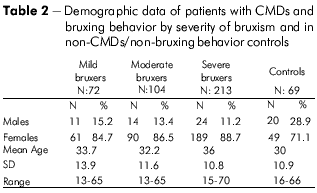
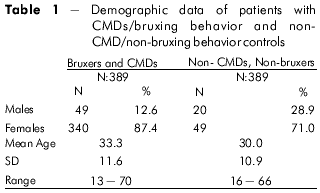
<body><![CDATA[<p><font size="2" face="Verdana">The results  of this study are shown in tables 1 through 5. <a href="#t1">Table 1</a> summarizes the  demographic data of 389 patients with CMDs and bruxing behavior and 69 non-CMD  non-bruxing behavior controls.</font></p>     <p><a name="t1"></a></p>     <p>&nbsp;</p>     <p align="center"><img src="/img/revistas/rpas/v2n3/3a02t1.gif" border="0"></p>     <p>&nbsp;</p>     <p><font size="2" face="Verdana"><a href="#t2">Table 2</a> shows  additional demographic data of patients with CMDs and bruxing behavior  classified by the severity of bruxing behavior.</font></p>     <p><a name="t2"></a></p>     <p>&nbsp;</p>     <p align="center"><img src="/img/revistas/rpas/v2n3/3a02t2.gif" border="0"></p>     <p>&nbsp;</p>     ]]></body>
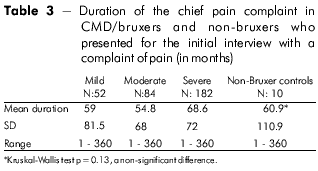
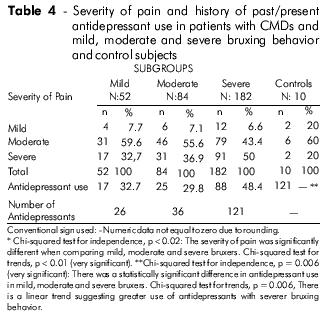
<body><![CDATA[<p><font size="2" face="Verdana"><a href="#t3">Table 3</a>  provides data on the duration of the chief pain complaint in the subgroups of  52 mild, 84 moderate and 182 severe bruxers and 10 control non-bruxers  presenting with pain. The mean duration of the pain complaint was 59 months in  the mild, 54.8 in  the moderate, 68.6 in  the severe and 60.9 in  the non-bruxer controls. Kruskal-Wallis test (p = 0.130) showed no  statistically significant difference in the duration of the pain complaint.</font></p>     <p><a name="t3"></a></p>     <p>&nbsp;</p>     <p align="center"><img src="/img/revistas/rpas/v2n3/3a02t3.gif" border="0"></p>     <p>&nbsp;</p>     <p><font size="2" face="Verdana"><a href="#t4">Table 4</a>  demonstrates the frequencies of mild, moderate and severe pain and the history  of past and present use of antidepressants in bruxers and CMD patients and in  control subjects. The frequencies of mild pain were 7.7%, 7.1% and 6.6% in the  mild, moderate and severe groups of bruxers, respectively. The frequencies of  moderate pain were 59.6%, 55.6% and 43.4%, respectively, in the same groups.  The frequencies of severe pain were 32.7%, 36.9% and 50% in the mild, moderate  and severe bruxing behavior groups, respectively. There was a statistically  significant difference in the severity of pain in the three subgroups of  bruxers (Chi-squared for independence, p = 0.02 and  Chi-squared for trends, p = 0.01). There  was no statistically significant difference in the frequency of severe pain in  the mild and moderate groups and in the moderate and severe groups (p =  0.06). However, there was a statistically significant  difference in the severity of pain between the mild and severe bruxing behavior  groups (p = 0.02).</font></p>     <p><a name="t4"></a></p>     <p>&nbsp;</p>     <p align="center"><img src="/img/revistas/rpas/v2n3/3a02t4.gif" border="0"></p>     <p>&nbsp;</p>     ]]></body>
<body><![CDATA[<p><font size="2" face="Verdana">Interestingly, the frequency of mild pain in the  subgroups of CMDs and bruxing behavior was very low, suggesting that most CMD  and bruxing behavior patients are more likely to seek treatment when the pain  is moderate or severe. Only 10 subjects in the control group had a complaint of  pain and most of them reported that the pain was moderate. Two subjects  reported mild pain and two other individuals reported severe pain. Because only  some subjects reported pain in this group, a comparison with the bruxing behavior  groups could be meaningless.</font></p>     <p><font size="2" face="Verdana">The same table shows that 17 patients or 32.7% in  the mild group, 25 patients or 29.8% in the moderate group and 88 patients or  48.4% in the severe group reported a history of past/present antidepressant use  (Chi-square test for independence, p = 0.006, Chi-squared for trends, p =  0.006, extremely significant difference).</font></p>     <p><font size="2" face="Verdana"><a href="#t5">Table 5</a> shows  that the mean number of painful sites in the mild, moderate and severe CMD and  bruxing behavior groups was 2.8, 3.6 and 4.9, respectively. A one-way analysis  of variance was also performed to assess a possible significant difference in  the number of painful complaints (<a href="#t5">Table 5</a>) between the CMD and bruxing behavior  groups. Because F = 71.953 and p &lt; 0.0001, we can state that there was a  statistically significant difference between the three groups of bruxers  regarding painful complaints. Additionally, the <i>post hoc </i>test  supported the findings that, regarding painful sites, mild bruxers were  different compared to moderate bruxers (p &lt; 0.01), moderate bruxers were  different compared to severe bruxers (p &lt; 0.001), and mild bruxers were also  different compared to severe bruxers (p &lt; 0.001).</font></p>     <p><a name="t5"></a></p>     <p>&nbsp;</p>     <p align="center"><img src="/img/revistas/rpas/v2n3/3a02t5.gif" border="0"></p>     <p>&nbsp;</p>     <p><font size="3" face="Verdana"><b>DISCUSSION</b></font></p>     <p><font size="2" face="Verdana"><b>MEAN DURATION OF THE PAIN COMPLAINT</b></font></p>     <p><font size="2" face="Verdana">The mean duration of the chief pain complaint was  longer in the severe bruxing behavior group, and although the difference was  not significant, a longer duration of the pain complaint may be a major  characteristic of severe bruxers. A longer duration of pain and depression are  closely interrelated, as depression renders the subject more vulnerable to  physical and emotional trauma<sup>22</sup>. Increased muscle tension in severe  bruxers may cause more damage to muscles, nerves and joints, thereby creating a  vicious cycle responsible for a longer duration of pain. One study<sup>23</sup> indicated  that high-level muscle tension may facilitate sensitization of pain pathways,  which may partially be responsible for a longer duration of pain. It is also  likely that bruxers presenting a longer duration of their pain complaint are  presenting with chronic bruxism. In one study<sup>3</sup>, chronic bruxers had  higher scores on the somatic and muscle tension scales. Chronic muscle tension  may be a contributing factor for a longer duration of pain, which in severe  bruxers may also be associated with psychosocial factors including anxiety,  psychosomatic tendencies, depression and persistent oral jaw behaviors<sup>3,24</sup>.</font></p>     ]]></body>
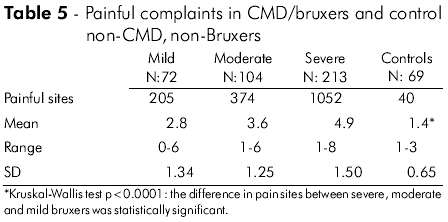
<body><![CDATA[<p><font size="2" face="Verdana"><b>SEVERE PAIN</b></font></p>     <p><font size="2" face="Verdana">In the current study, the frequency of severe pain  increased with the severity of bruxing behavior (Chi-square test for trends,  p = 0.01). The frequency of more severe pain in bruxers was only significantly  different (p &lt; 0.02) between the mild and the severe bruxing behavior  groups. There was no statistically significant difference in the severity of  pain when comparing the mild and moderate groups (Chi-squared test, p = 0.06).  Interestingly, only a few patients in all sub-groups presented for the initial  interview with a complaint of mild pain, suggesting that most bruxers and  patients with CMDs only seek active treatment when the pain has reached a  certain intensity. It may be that severer bruxism is characterized by a  combination of severe pain, depression and a greater number of pain sites  adjacent and distant to the masticatory system. This assumption was at least  partially supported by one study<sup>25</sup> demonstrating that patients  presenting with higher scores for depression report more severe pain, more  numerous clinical symptoms and seek more consultations with physicians. In the  current study, not all bruxers had a complaint of CMD pain during the initial  interview. Thus, the results of this investigation are in accordance with a  previous study<sup>6</sup> reporting that some CMDs and patients with bruxing  behavior had pain complaints while others did not and that some of them  reported higher pain scores. It is apparent that the intensity of pain in  bruxers varies widely. This difference may be related to the pain duration,  scores in somatization, depression, stress, pain from single and multiple  sites, cognitive factors, lower pain thresholds and the forces that are  generated on the masticatory structures reflecting intensity of muscle activity<sup>6</sup>.</font></p>     <p><font size="2" face="Verdana"><b>NUMBER OF PAIN COMPLAINTS</b></font></p>     <p><font size="2" face="Verdana">We found that the number of pain complaints  increased with the severity of bruxing behavior. The severe bruxing behavior  group demonstrated more pain sites and the difference was statistically  significant (p &lt; 0.0001). That type of pain may be the result of strong  neuromuscular forces applied to the masticatory system or a tendency toward  somatization in bruxers and CMD patients. In cases of severe bruxism, the  damaging consequences reach beyond damage to the teeth, pain may be of a longer  duration and multiple symptoms may occur<sup>26</sup>. Additional support for  the relationship between severe bruxism and a greater number of pain sites  comes from a study<sup>24</sup> that compared severe bruxism and sleep  architecture and reported that 60-80% of the bruxers had pain in multiple  sites, including the TMJs and masticatory muscles. A previous investigation<sup>25</sup>,  reported positive and significant correlations between severe bruxism and  depression and between severe bruxism and a greater number of painful sites.  Although pain at multiple sites was studied in another investigation<sup>27</sup>,  this is the first study that compared pain sites in subgroups of bruxers.</font></p>     <p><font size="2" face="Verdana"><b>ANTIDEPRESSANT USE</b></font></p>     <p><font size="2" face="Verdana">We found that compared to mild and moderate  bruxers, severe bruxers had used or were using more antidepressant medication  at the time of the first interview, and the difference was statistically  significant (Chi-squared test for independence = 13,1932, p &lt; 0.006). Of the  318 patients with CMDs and bruxing behavior with pain, 130 or 40.8% (or 33.4%  of all bruxers with or without pain) had a history of past or present  antidepressant use. The results showed no statistically significant difference  in antidepressant use between mild and moderate bruxers. The frequency of  antidepressant use reported in the current study is very similar to the  reported frequency of 35.7% in a previous study involving a group of patients  with CMDs and headaches in which 73% were bruxers<sup>28</sup>. Bruxers and  individuals with CMDs may be more prone to depression and more severe bruxism  is more commonly equated with depression resulting in a stronger tendency to  use antidepressant medication. This line of reasoning has been partially  supported by a previous study<sup>29</sup> indicating that antidepressants can  help control nocturnal bruxism, particularly in periods of exacerbation. When  severe bruxism is left untreated, it can lead to tooth destruction,  temporomandibular dysfunction, headache and depression, thereby resulting in a  higher need for antidepressant medication use<sup>30</sup> including selective  serotonin reuptake inhibitors. Psychological factors including stress, anxiety  and depression play a role in the etiopathogenesis of bruxism<sup>11</sup> and  lead to the use of antidepressants in individuals with this disorder. In cases  of sleep bruxism, clonazepam may the drug of choice because it may be improve  sleep, depression and anxiety symptoms<sup>31</sup>.</font></p>     <p>&nbsp;</p>     <p><font size="3" face="Verdana"><b>CONCLUSIONS</b></font></p>     <p><font size="2" face="Verdana">Based on the  results of the current investigation and data from previous studies, we  conclude that more severe bruxers present with a longer history of pain and the  severity of pain increases from mild to moderate and severe bruxing behavior  groups. The number of local and distant pain sites also increases with the  severity of bruxism. Additionally, severe bruxers have more pain complaints,  which may indicate somatization or a state of general physical and emotional  distress. In addition, they also use antidepressant medication more commonly.</font></p>     <p>&nbsp;</p>     ]]></body>
<body><![CDATA[<p><font size="3" face="Verdana"><b>REFERENCES</b></font></p>     <!-- ref --><p><font size="2" face="Verdana">1 Lobbezoo-Scholte  AM, Leeuw JR, Steenks MH, Bosman F, Buchner R, Olthoff LW. Diagnostic subgroups  of craniomandibular disorders patients Part I: self-report data and clinical  findings. J Orofac Pain. 1995 Winter;9(1):24-36. &#91;<a href="http://www.ncbi.nlm.nih.gov/pubmed/7581202" target="_blank">Link</a>&#93;</font><!-- ref --><p><font size="2" face="Verdana">2 Molina  OF, Santos Jr,  Nelson SJ, Nowlin T. A clinical study of specific signs and symptoms of CMD in  bruxers clasified by the degree of severity. Cranio. 1999 Oct;17(4):268-79. &#91;<a href="http://www.ncbi.nlm.nih.gov/pubmed/10650399" target="_blank">Link</a>&#93;</font><!-- ref --><p><font size="2" face="Verdana">3 Kampe  T, Edman G, Bader G, Tagdae T, Karlsson S. Personality traits in a group of  subjects with longstanding bruxing behavior. J Oral Rehab. 1997 Aug;24(8):588-93. &#91;<a href="http://www.ncbi.nlm.nih.gov/pubmed/9291251" target="_blank">Link</a>&#93;</font><!-- ref --><p><font size="2" face="Verdana">4 Bader  G, Lavigne GJ. Sleep bruxism: overview of an oromandibular sleep movement  disorder. Sleep  Med Ver. 2000 Feb;4(1):27-43. &#91;<a href="http://www.ncbi.nlm.nih.gov/pubmed?term=Sleep%20bruxism%3A%20overview%20of%20an%20oromandibular%20sleep%20movement%20disorder" target="_blank">Link</a>&#93;</font><!-- ref --><p><font size="2" face="Verdana">5 Molina OF, Gaio DC, Cury MDN, Cury  SE, Gimenez SRM, Salom&atilde;o EC, et al. Uma an&aacute;lise  cr&iacute;tica dos sistemas de classifica&ccedil;&atilde;o sobre o bruxismo: implica&ccedil;&otilde;es com o  diagn&oacute;stico, severidade e tratamento dos sinais e sintomas de DTM associados com o h&aacute;bito. JBA. 2002; jan-mar;2(5):61-9. &#91;<a href="http://ojs.1000grad.com/index.php/orthodontics_JBA/article/viewFile/194/178" target="_blank">Link</a>&#93;</font><!-- ref --><p><font size="2" face="Verdana">6 Dao  TT, Lund JP, Lavigne GJ. Comparison of pain and quality of life in bruxers and  patients with myofascial pain of the masticatory muscles. J Orofac Pain. 1994;8(4):350-56.</font><!-- ref --><p><font size="2" face="Verdana">7 Tan  EK, Chan LL, Chang HM. Severe bruxism following basal ganglia infarcts:  insights into pathophysiology. J Neurol Sci. 2004 Feb;217(2):229-32.</font><!-- ref --><p><font size="2" face="Verdana">8 Dworkin SF. Behavioral characteristics of temporomandibular  disorders. In: Sessle BJ, Bryant PS, Dione RA, editors. Temporomandibular disorders  and related pain conditions. Seattle:  IASP Press; 1995. p. 175-92.</font><!-- ref --><p><font size="2" face="Verdana">9 Harkins SW, Bush FM, Price DD, Hamer RM.  Symptoms report in orofacial pain patients. Clin J  Pain. 1991 Jun;7(2):102-8.</font><!-- ref --><p><font size="2" face="Verdana">10  Fricton J. Myogenous temporomandibular disorders: diagnosis and management considerations. Dent Clin  N Amer. 2007  Jan;51(1):61-83.</font><!-- ref --><p><font size="2" face="Verdana">11 Balatsouras D, Kaberos A, Psaltakos  V, Papaliakos E, Economou N. Bruxism: two case reports. Acta  Othorinolarongol Ital. 2004 Jun;24(3):165-70. &#91;<a href="http://www.ncbi.nlm.nih.gov/pubmed/15584589" target="_blank">Link</a>&#93;</font><!-- ref --><p><font size="2" face="Verdana">12 Yap  AU, Dworkin SF, Chua EK, List  T, Tan KB, Tan HH. Prevalence of temporomandibular disorders subtypes,  psychological distress and psychological dysfunction in asian patients. J  Orofac Pain. 2003 Winter;17(1 ):21-8. &#91;<a href="http://www.ncbi.nlm.nih.gov/pubmed/12756927" target="_blank">Link</a>&#93;</font><!-- ref --><p><font size="2" face="Verdana">13 Gatchell  RJ, Garofalo PJ, Ellis E, Holt C. Major psychological disorders in acute and  chronic TMD: an initial examination. J Am Dent Assoc. 1996 Sep;127(9):1365-70.</font><!-- ref --><p><font size="2" face="Verdana">14 DeNucci  DJ, Sobiski C, Dionne RA. Triazolan  improves sleep but fails to alter pain in TMD patients. J Orofac Pain. 1998  Spring;12(2):116-23. &#91;<a href="http://www.ncbi.nlm.nih.gov/pubmed/9656889" target="_blank">Link&#93;</a></font><!-- ref --><p><font size="2" face="Verdana">15 Fricton  JR, Olsen T. Predictors of outcome for treatment of temporomandibular  disorders. J Orofac Pain. 1996 Winter;10(1):54-65. &#91;<a href="http://www.ncbi.nlm.nih.gov/pubmed/8995917" target="_blank">Link</a>&#93;</font><!-- ref --><p><font size="2" face="Verdana">16 Molina  OF, Peixoto MG, Eid NLM, Aquilino RN,  Rank RCIC. Headache and bruxing behavior types in Craniomandibular Disorders  (Cmds) patients. Rev Neurocienc. 2011;19(3):449-57.</font><!-- ref --><p><font size="2" face="Verdana">17 Rodin  G, Craven J, Littlefield C. Depression in the medically ILL: An integrated  approach. New York:  Brunner/Mazel; 1991.</font><!-- ref --><p><font size="2" face="Verdana">18 Saheeb BD, Otakpor AN.  Co-morbid psychiatric disorders in Nigerian patients suffering temporomandibular joint pain and dysfunction. Niger J Clin Pract. 2005  Jun;8(1):23-8.</font><!-- ref --><p><font size="2" face="Verdana">19 Rossetti L, Pereira ACR, Rossetti PH,  Conti PC. Association  between rhythmic masticatory muscle activity during sleep and masticatory  myofascial pain: a polysomnographic study. J Orofac Pain. 2008 Summer;22(3):190-200.</font><!-- ref --><p><font size="2" face="Verdana">20 Brown  FF, Robinson ME, Riley JL, Gremillion HA. Pain severity, negative affect, and  microstressors as predictors of life interference in TMD patients. Cranio. 1996  Jan;14(1):63-70.</font><!-- ref --><p><font size="2" face="Verdana">21 Huynh  N, Manzini C, Rompr&eacute; PH, Lavigne  GJ. Weighing the potential effectiveness of various treatments for sleep  bruxism. J Can Dent Assoc. 2007 Oct;73(8):727-31.</font><!-- ref --><p><font size="2" face="Verdana">22 Lautenbacher  S, Krieg SJ. Pain  perception in psychiatric disorders: a review of the literature. J Psychiatr  Res. 1994 Mar-Apr;28(2):109-22.</font><!-- ref --><p><font size="2" face="Verdana">23 Glaros  AG, Williams K, Lausten L. The role of parafunctions, emotions and stress in  predicting facial pain. J Am Dent Assoc. 2005 Apr;136(4):451-8.</font><!-- ref --><p><font size="2" face="Verdana">24 Boutros  NN, Montgomery MT, Nishioka G, Hatch JP. The effect of  severe bruxism on sleep architecture. a preliminary report. Clin Electroencephalogr. 1993 Apr;24(2):59-62.</font><!-- ref --><p><font size="2" face="Verdana">25 Franklin  MO, Pablo TG, Raphael A, Rise R, Zeila CS, Wilson  CED, et al. Depression, pain, and  site: a clinical comparison study in mild, moderate, severe and extreme bruxers. Rev&nbsp; Neurocienc. 2007 Jan-Mar;15(1):10-17.</font><!-- ref --><p><font size="2" face="Verdana">26 Clark  GT, Ram S. Four oral motor disorders: bruxism, dystonia, dyskinesia and  drug-induced dystonic extrapyramidal reactions. Dent Clin North Am.  2007 Jan;51(1):225-43.</font><!-- ref --><p><font size="2" face="Verdana">27 Dworkin  SF, Von Korff M, LeResche L. Multiple pains and psychiatric disturbances. Arch  Gen Psychiatry. 1990 Mar;47(3):239-44.</font><!-- ref --><p><font size="2" face="Verdana">28 Reik  L Jr, Hale M. The temporomandibular joint pain dysfunction syndrome: a frequent  cause of headache. Headache. 1981 Jul;21(4):151-6.</font><!-- ref --><p><font size="2" face="Verdana">29 Hoz-Aizpurua JL, D&iacute;az ED,  LaTouche R, Mesa J. Sleep bruxism. Conceptual review and update. Med Oral Patol  Cir Bucal. 2011  Mar;16(2):e231-8.</font><!-- ref --><p><font size="2" face="Verdana">30 Jankovic  J. Disease-oriented approach to botulinum toxin. Toxicon. 2009;54:614-623. &#91;<a href="http://www.medicinaoral.com/pubmed/medoralv16_i2_p231.pdf" target="_blank">Link</a>&#93;</font><!-- ref --><p><font size="2" face="Verdana">31 Saletu  A, Parapatics S, Saletu B, Anderer P, Prause W, Putz H, et al. On the  pharmacotherapy of sleep bruxism: placebo-controlled polysomnographic and  psychometric studies&nbsp;&nbsp; with clonazepan. Neuropsychobiol. 2005;51(4):214-25.</font><p>&nbsp;</p>     <p>&nbsp;</p>     <p><font size="2" face="Verdana"><b><a name="endereco"></a><a href="#topo"><img src="/img/revistas/rpas/v2n3/seta.gif" border="0"></a>Correspondence / Correspond&ecirc;ncia / Correspondencia:</b>    <br> Omar Franklin Molina    <br> Faculdade de Odontologia    <br> (Dor Orofacial e  Odontopediatria) UNIRG</font>    <br> <font size="2" face="Verdana">Avenida Par&aacute; n<sup>o</sup> 1544    <br> CEP: 77400-020    ]]></body>
<body><![CDATA[<br> Gurupi - Tocantins - Brasil    <br> Email: <a href="mailto:ofrank.nyork.harvard.texas@hotmail.com">ofrank.nyork.harvard.texas@hotmail.com</a></font></p>     <p><font size="2" face="Verdana">Received / Recebido em / Recibido en: 14/6/2011</font>    <br> <font size="2" face="Verdana">Accepted / Aceito em  / Aceito en: 29/11/2011</font></p> <script type="text/javascript"> var gaJsHost = (("https:" == document.location.protocol) ? "https://ssl." : "http://www."); document.write(unescape("%3Cscript src='" + gaJsHost + "google-analytics.com/ga.js' type='text/javascript'%3E%3C/script%3E")); </script> <script type="text/javascript"> try { var pageTracker = _gat._getTracker("UA-7885746-4"); pageTracker._setDomainName("none"); pageTracker._setAllowLinker(true); pageTracker._trackPageview(); } catch(err) {}</script>      ]]></body><back>
<ref-list>
<ref id="B1">
<label>1</label><nlm-citation citation-type="journal">
<person-group person-group-type="author">
<name>
<surname><![CDATA[Lobbezoo-Scholte]]></surname>
<given-names><![CDATA[AM]]></given-names>
</name>
<name>
<surname><![CDATA[Leeuw]]></surname>
<given-names><![CDATA[JR]]></given-names>
</name>
<name>
<surname><![CDATA[Steenks]]></surname>
<given-names><![CDATA[MH]]></given-names>
</name>
<name>
<surname><![CDATA[Bosman]]></surname>
<given-names><![CDATA[F]]></given-names>
</name>
<name>
<surname><![CDATA[Buchner]]></surname>
<given-names><![CDATA[R]]></given-names>
</name>
<name>
<surname><![CDATA[Olthoff]]></surname>
<given-names><![CDATA[LW]]></given-names>
</name>
</person-group>
<article-title xml:lang="en"><![CDATA[Diagnostic subgroups of craniomandibular disorders patients Part I: self-report data and clinical findings]]></article-title>
<source><![CDATA[J Orofac Pain]]></source>
<year>1995</year>
<volume>9</volume>
<numero>1</numero>
<issue>1</issue>
<page-range>24-36</page-range></nlm-citation>
</ref>
<ref id="B2">
<label>2</label><nlm-citation citation-type="journal">
<person-group person-group-type="author">
<name>
<surname><![CDATA[Molina]]></surname>
<given-names><![CDATA[OF]]></given-names>
</name>
<name>
<surname><![CDATA[Santos]]></surname>
<given-names><![CDATA[Jr]]></given-names>
</name>
<name>
<surname><![CDATA[Nelson]]></surname>
<given-names><![CDATA[SJ]]></given-names>
</name>
<name>
<surname><![CDATA[Nowlin]]></surname>
<given-names><![CDATA[T]]></given-names>
</name>
</person-group>
<article-title xml:lang="en"><![CDATA[A clinical study of specific signs and symptoms of CMD in bruxers clasified by the degree of severity]]></article-title>
<source><![CDATA[Cranio]]></source>
<year>1999</year>
<month> O</month>
<day>ct</day>
<volume>17</volume>
<numero>4</numero>
<issue>4</issue>
<page-range>268-79</page-range></nlm-citation>
</ref>
<ref id="B3">
<label>3</label><nlm-citation citation-type="journal">
<person-group person-group-type="author">
<name>
<surname><![CDATA[Kampe]]></surname>
<given-names><![CDATA[T]]></given-names>
</name>
<name>
<surname><![CDATA[Edman]]></surname>
<given-names><![CDATA[G]]></given-names>
</name>
<name>
<surname><![CDATA[Bader]]></surname>
<given-names><![CDATA[G]]></given-names>
</name>
<name>
<surname><![CDATA[Tagdae]]></surname>
<given-names><![CDATA[T]]></given-names>
</name>
<name>
<surname><![CDATA[Karlsson]]></surname>
<given-names><![CDATA[S]]></given-names>
</name>
</person-group>
<article-title xml:lang="en"><![CDATA[Personality traits in a group of subjects with longstanding bruxing behavior]]></article-title>
<source><![CDATA[J Oral Rehab]]></source>
<year>1997</year>
<month> A</month>
<day>ug</day>
<volume>24</volume>
<numero>8</numero>
<issue>8</issue>
<page-range>588-93</page-range></nlm-citation>
</ref>
<ref id="B4">
<label>4</label><nlm-citation citation-type="journal">
<person-group person-group-type="author">
<name>
<surname><![CDATA[Bader]]></surname>
<given-names><![CDATA[G]]></given-names>
</name>
<name>
<surname><![CDATA[Lavigne]]></surname>
<given-names><![CDATA[GJ]]></given-names>
</name>
</person-group>
<article-title xml:lang="en"><![CDATA[Sleep bruxism: overview of an oromandibular sleep movement disorder]]></article-title>
<source><![CDATA[Sleep Med Ver]]></source>
<year>2000</year>
<month> F</month>
<day>eb</day>
<volume>4</volume>
<numero>1</numero>
<issue>1</issue>
<page-range>27-43</page-range></nlm-citation>
</ref>
<ref id="B5">
<label>5</label><nlm-citation citation-type="journal">
<person-group person-group-type="author">
<name>
<surname><![CDATA[Molina]]></surname>
<given-names><![CDATA[OF]]></given-names>
</name>
<name>
<surname><![CDATA[Gaio]]></surname>
<given-names><![CDATA[DC]]></given-names>
</name>
<name>
<surname><![CDATA[Cury]]></surname>
<given-names><![CDATA[MDN]]></given-names>
</name>
<name>
<surname><![CDATA[Cury]]></surname>
<given-names><![CDATA[SE]]></given-names>
</name>
<name>
<surname><![CDATA[Gimenez]]></surname>
<given-names><![CDATA[SRM]]></given-names>
</name>
<name>
<surname><![CDATA[Salomão]]></surname>
<given-names><![CDATA[EC]]></given-names>
</name>
</person-group>
<article-title xml:lang="pt"><![CDATA[Uma análise crítica dos sistemas de classificação sobre o bruxismo: implicações com o diagnóstico, severidade e tratamento dos sinais e sintomas de DTM associados com o hábito]]></article-title>
<source><![CDATA[JBA]]></source>
<year>2002</year>
<month>; </month>
<day>ja</day>
<volume>2</volume>
<numero>5</numero>
<issue>5</issue>
<page-range>61-9</page-range></nlm-citation>
</ref>
<ref id="B6">
<label>6</label><nlm-citation citation-type="journal">
<person-group person-group-type="author">
<name>
<surname><![CDATA[Dao]]></surname>
<given-names><![CDATA[TT]]></given-names>
</name>
<name>
<surname><![CDATA[Lund]]></surname>
<given-names><![CDATA[JP]]></given-names>
</name>
<name>
<surname><![CDATA[Lavigne]]></surname>
<given-names><![CDATA[GJ]]></given-names>
</name>
</person-group>
<article-title xml:lang="en"><![CDATA[Comparison of pain and quality of life in bruxers and patients with myofascial pain of the masticatory muscles]]></article-title>
<source><![CDATA[J Orofac Pain]]></source>
<year>1994</year>
<volume>8</volume>
<numero>4</numero>
<issue>4</issue>
<page-range>350-56</page-range></nlm-citation>
</ref>
<ref id="B7">
<label>7</label><nlm-citation citation-type="journal">
<person-group person-group-type="author">
<name>
<surname><![CDATA[Tan]]></surname>
<given-names><![CDATA[EK]]></given-names>
</name>
<name>
<surname><![CDATA[Chan]]></surname>
<given-names><![CDATA[LL]]></given-names>
</name>
<name>
<surname><![CDATA[Chang]]></surname>
<given-names><![CDATA[HM]]></given-names>
</name>
</person-group>
<article-title xml:lang="en"><![CDATA[Severe bruxism following basal ganglia infarcts: insights into pathophysiology]]></article-title>
<source><![CDATA[J Neurol Sci]]></source>
<year>2004</year>
<month> F</month>
<day>eb</day>
<volume>217</volume>
<numero>2</numero>
<issue>2</issue>
<page-range>229-32</page-range></nlm-citation>
</ref>
<ref id="B8">
<label>8</label><nlm-citation citation-type="book">
<person-group person-group-type="author">
<name>
<surname><![CDATA[Dworkin]]></surname>
<given-names><![CDATA[SF]]></given-names>
</name>
</person-group>
<article-title xml:lang="en"><![CDATA[Behavioral characteristics of temporomandibular disorders]]></article-title>
<person-group person-group-type="editor">
<name>
<surname><![CDATA[Sessle]]></surname>
<given-names><![CDATA[BJ]]></given-names>
</name>
<name>
<surname><![CDATA[Bryant]]></surname>
<given-names><![CDATA[PS]]></given-names>
</name>
<name>
<surname><![CDATA[Dione]]></surname>
<given-names><![CDATA[RA]]></given-names>
</name>
</person-group>
<source><![CDATA[Temporomandibular disorders and related pain conditions]]></source>
<year>1995</year>
<page-range>175-92</page-range><publisher-loc><![CDATA[Seattle ]]></publisher-loc>
<publisher-name><![CDATA[IASP Press]]></publisher-name>
</nlm-citation>
</ref>
<ref id="B9">
<label>9</label><nlm-citation citation-type="journal">
<person-group person-group-type="author">
<name>
<surname><![CDATA[Harkins]]></surname>
<given-names><![CDATA[SW]]></given-names>
</name>
<name>
<surname><![CDATA[Bush]]></surname>
<given-names><![CDATA[FM]]></given-names>
</name>
<name>
<surname><![CDATA[Price]]></surname>
<given-names><![CDATA[DD]]></given-names>
</name>
<name>
<surname><![CDATA[Hamer]]></surname>
<given-names><![CDATA[RM]]></given-names>
</name>
</person-group>
<article-title xml:lang="en"><![CDATA[Symptoms report in orofacial pain patients]]></article-title>
<source><![CDATA[Clin J Pain]]></source>
<year>1991</year>
<month> J</month>
<day>un</day>
<volume>7</volume>
<numero>2</numero>
<issue>2</issue>
<page-range>102-8</page-range></nlm-citation>
</ref>
<ref id="B10">
<label>10</label><nlm-citation citation-type="journal">
<person-group person-group-type="author">
<name>
<surname><![CDATA[Fricton]]></surname>
<given-names><![CDATA[J]]></given-names>
</name>
</person-group>
<article-title xml:lang="en"><![CDATA[Myogenous temporomandibular disorders: diagnosis and management considerations]]></article-title>
<source><![CDATA[Dent Clin N Amer]]></source>
<year>2007</year>
<month> J</month>
<day>an</day>
<volume>51</volume>
<numero>1</numero>
<issue>1</issue>
<page-range>61-83</page-range></nlm-citation>
</ref>
<ref id="B11">
<label>11</label><nlm-citation citation-type="journal">
<person-group person-group-type="author">
<name>
<surname><![CDATA[Balatsouras]]></surname>
<given-names><![CDATA[D]]></given-names>
</name>
<name>
<surname><![CDATA[Kaberos]]></surname>
<given-names><![CDATA[A]]></given-names>
</name>
<name>
<surname><![CDATA[Psaltakos]]></surname>
<given-names><![CDATA[V]]></given-names>
</name>
<name>
<surname><![CDATA[Papaliakos]]></surname>
<given-names><![CDATA[E]]></given-names>
</name>
<name>
<surname><![CDATA[Economou]]></surname>
<given-names><![CDATA[N]]></given-names>
</name>
</person-group>
<article-title xml:lang="en"><![CDATA[Bruxism: two case reports]]></article-title>
<source><![CDATA[Acta Othorinolarongol Ital]]></source>
<year>2004</year>
<month> J</month>
<day>un</day>
<volume>24</volume>
<numero>3</numero>
<issue>3</issue>
<page-range>165-70</page-range></nlm-citation>
</ref>
<ref id="B12">
<label>12</label><nlm-citation citation-type="journal">
<person-group person-group-type="author">
<name>
<surname><![CDATA[Yap]]></surname>
<given-names><![CDATA[AU]]></given-names>
</name>
<name>
<surname><![CDATA[Dworkin]]></surname>
<given-names><![CDATA[SF]]></given-names>
</name>
<name>
<surname><![CDATA[Chua]]></surname>
<given-names><![CDATA[EK]]></given-names>
</name>
<name>
<surname><![CDATA[List]]></surname>
<given-names><![CDATA[T]]></given-names>
</name>
<name>
<surname><![CDATA[Tan]]></surname>
<given-names><![CDATA[KB]]></given-names>
</name>
<name>
<surname><![CDATA[Tan]]></surname>
<given-names><![CDATA[HH]]></given-names>
</name>
</person-group>
<article-title xml:lang="en"><![CDATA[Prevalence of temporomandibular disorders subtypes, psychological distress and psychological dysfunction in asian patients]]></article-title>
<source><![CDATA[J Orofac Pain]]></source>
<year>2003</year>
<volume>17</volume>
<numero>1</numero>
<issue>1</issue>
<page-range>21-8</page-range></nlm-citation>
</ref>
<ref id="B13">
<label>13</label><nlm-citation citation-type="journal">
<person-group person-group-type="author">
<name>
<surname><![CDATA[Gatchell]]></surname>
<given-names><![CDATA[RJ]]></given-names>
</name>
<name>
<surname><![CDATA[Garofalo]]></surname>
<given-names><![CDATA[PJ]]></given-names>
</name>
<name>
<surname><![CDATA[Ellis]]></surname>
<given-names><![CDATA[E]]></given-names>
</name>
<name>
<surname><![CDATA[Holt]]></surname>
<given-names><![CDATA[C]]></given-names>
</name>
</person-group>
<article-title xml:lang="en"><![CDATA[Major psychological disorders in acute and chronic TMD: an initial examination]]></article-title>
<source><![CDATA[J Am Dent Assoc]]></source>
<year>1996</year>
<month> S</month>
<day>ep</day>
<volume>127</volume>
<numero>9</numero>
<issue>9</issue>
<page-range>1365-70</page-range></nlm-citation>
</ref>
<ref id="B14">
<label>14</label><nlm-citation citation-type="journal">
<person-group person-group-type="author">
<name>
<surname><![CDATA[DeNucci]]></surname>
<given-names><![CDATA[DJ]]></given-names>
</name>
<name>
<surname><![CDATA[Sobiski]]></surname>
<given-names><![CDATA[C]]></given-names>
</name>
<name>
<surname><![CDATA[Dionne]]></surname>
<given-names><![CDATA[RA]]></given-names>
</name>
</person-group>
<article-title xml:lang="en"><![CDATA[Triazolan improves sleep but fails to alter pain in TMD patients]]></article-title>
<source><![CDATA[J Orofac Pain]]></source>
<year>1998</year>
<volume>12</volume>
<numero>2</numero>
<issue>2</issue>
<page-range>116-23</page-range></nlm-citation>
</ref>
<ref id="B15">
<label>15</label><nlm-citation citation-type="journal">
<person-group person-group-type="author">
<name>
<surname><![CDATA[Fricton]]></surname>
<given-names><![CDATA[JR]]></given-names>
</name>
<name>
<surname><![CDATA[Olsen]]></surname>
<given-names><![CDATA[T]]></given-names>
</name>
</person-group>
<article-title xml:lang="en"><![CDATA[Predictors of outcome for treatment of temporomandibular disorders]]></article-title>
<source><![CDATA[J Orofac Pain]]></source>
<year>1996</year>
<volume>10</volume>
<numero>1</numero>
<issue>1</issue>
<page-range>54-65</page-range></nlm-citation>
</ref>
<ref id="B16">
<label>16</label><nlm-citation citation-type="journal">
<person-group person-group-type="author">
<name>
<surname><![CDATA[Molina]]></surname>
<given-names><![CDATA[OF]]></given-names>
</name>
<name>
<surname><![CDATA[Peixoto]]></surname>
<given-names><![CDATA[MG]]></given-names>
</name>
<name>
<surname><![CDATA[Eid]]></surname>
<given-names><![CDATA[NLM]]></given-names>
</name>
<name>
<surname><![CDATA[Aquilino]]></surname>
<given-names><![CDATA[RN]]></given-names>
</name>
<name>
<surname><![CDATA[Rank]]></surname>
<given-names><![CDATA[RCIC]]></given-names>
</name>
</person-group>
<article-title xml:lang="en"><![CDATA[Headache and bruxing behavior types in Craniomandibular Disorders (Cmds) patients]]></article-title>
<source><![CDATA[Rev Neurocienc]]></source>
<year>2011</year>
<volume>19</volume>
<numero>3</numero>
<issue>3</issue>
<page-range>449-57</page-range></nlm-citation>
</ref>
<ref id="B17">
<label>17</label><nlm-citation citation-type="book">
<person-group person-group-type="author">
<name>
<surname><![CDATA[Rodin]]></surname>
<given-names><![CDATA[G]]></given-names>
</name>
<name>
<surname><![CDATA[Craven]]></surname>
<given-names><![CDATA[J]]></given-names>
</name>
<name>
<surname><![CDATA[Littlefield]]></surname>
<given-names><![CDATA[C]]></given-names>
</name>
</person-group>
<source><![CDATA[Depression in the medically ILL: An integrated approach]]></source>
<year>1991</year>
<publisher-loc><![CDATA[New York ]]></publisher-loc>
<publisher-name><![CDATA[Brunner/Mazel]]></publisher-name>
</nlm-citation>
</ref>
<ref id="B18">
<label>18</label><nlm-citation citation-type="journal">
<person-group person-group-type="author">
<name>
<surname><![CDATA[Saheeb]]></surname>
<given-names><![CDATA[BD]]></given-names>
</name>
<name>
<surname><![CDATA[Otakpor]]></surname>
<given-names><![CDATA[AN]]></given-names>
</name>
</person-group>
<article-title xml:lang="en"><![CDATA[Co-morbid psychiatric disorders in Nigerian patients suffering temporomandibular joint pain and dysfunction]]></article-title>
<source><![CDATA[Niger J Clin Pract]]></source>
<year>2005</year>
<month> J</month>
<day>un</day>
<volume>8</volume>
<numero>1</numero>
<issue>1</issue>
<page-range>23-8</page-range></nlm-citation>
</ref>
<ref id="B19">
<label>19</label><nlm-citation citation-type="journal">
<person-group person-group-type="author">
<name>
<surname><![CDATA[Rossetti]]></surname>
<given-names><![CDATA[L]]></given-names>
</name>
<name>
<surname><![CDATA[Pereira]]></surname>
<given-names><![CDATA[ACR]]></given-names>
</name>
<name>
<surname><![CDATA[Rossetti]]></surname>
<given-names><![CDATA[PH]]></given-names>
</name>
<name>
<surname><![CDATA[Conti]]></surname>
<given-names><![CDATA[PC]]></given-names>
</name>
</person-group>
<article-title xml:lang="en"><![CDATA[Association between rhythmic masticatory muscle activity during sleep and masticatory myofascial pain: a polysomnographic study]]></article-title>
<source><![CDATA[J Orofac Pain]]></source>
<year>2008</year>
<volume>22</volume>
<numero>3</numero>
<issue>3</issue>
<page-range>190-200</page-range></nlm-citation>
</ref>
<ref id="B20">
<label>20</label><nlm-citation citation-type="journal">
<person-group person-group-type="author">
<name>
<surname><![CDATA[Brown]]></surname>
<given-names><![CDATA[FF]]></given-names>
</name>
<name>
<surname><![CDATA[Robinson]]></surname>
<given-names><![CDATA[ME]]></given-names>
</name>
<name>
<surname><![CDATA[Riley]]></surname>
<given-names><![CDATA[JL]]></given-names>
</name>
<name>
<surname><![CDATA[Gremillion]]></surname>
<given-names><![CDATA[HA]]></given-names>
</name>
</person-group>
<article-title xml:lang="en"><![CDATA[Pain severity, negative affect, and microstressors as predictors of life interference in TMD patients]]></article-title>
<source><![CDATA[Cranio]]></source>
<year>1996</year>
<month> J</month>
<day>an</day>
<volume>14</volume>
<numero>1</numero>
<issue>1</issue>
<page-range>63-70</page-range></nlm-citation>
</ref>
<ref id="B21">
<label>21</label><nlm-citation citation-type="journal">
<person-group person-group-type="author">
<name>
<surname><![CDATA[Huynh]]></surname>
<given-names><![CDATA[N]]></given-names>
</name>
<name>
<surname><![CDATA[Manzini]]></surname>
<given-names><![CDATA[C]]></given-names>
</name>
<name>
<surname><![CDATA[Rompré]]></surname>
<given-names><![CDATA[PH]]></given-names>
</name>
<name>
<surname><![CDATA[Lavigne]]></surname>
<given-names><![CDATA[GJ]]></given-names>
</name>
</person-group>
<article-title xml:lang="en"><![CDATA[Weighing the potential effectiveness of various treatments for sleep bruxism]]></article-title>
<source><![CDATA[J Can Dent Assoc]]></source>
<year>2007</year>
<month> O</month>
<day>ct</day>
<volume>73</volume>
<numero>8</numero>
<issue>8</issue>
<page-range>727-31</page-range></nlm-citation>
</ref>
<ref id="B22">
<label>22</label><nlm-citation citation-type="journal">
<person-group person-group-type="author">
<name>
<surname><![CDATA[Lautenbacher]]></surname>
<given-names><![CDATA[S]]></given-names>
</name>
<name>
<surname><![CDATA[Krieg]]></surname>
<given-names><![CDATA[SJ]]></given-names>
</name>
</person-group>
<article-title xml:lang="en"><![CDATA[Pain perception in psychiatric disorders: a review of the literature]]></article-title>
<source><![CDATA[J Psychiatr Res]]></source>
<year>1994</year>
<month> M</month>
<day>ar</day>
<volume>28</volume>
<numero>2</numero>
<issue>2</issue>
<page-range>109-22</page-range></nlm-citation>
</ref>
<ref id="B23">
<label>23</label><nlm-citation citation-type="journal">
<person-group person-group-type="author">
<name>
<surname><![CDATA[Glaros]]></surname>
<given-names><![CDATA[AG]]></given-names>
</name>
<name>
<surname><![CDATA[Williams]]></surname>
<given-names><![CDATA[K]]></given-names>
</name>
<name>
<surname><![CDATA[Lausten]]></surname>
<given-names><![CDATA[L]]></given-names>
</name>
</person-group>
<article-title xml:lang="en"><![CDATA[The role of parafunctions, emotions and stress in predicting facial pain]]></article-title>
<source><![CDATA[J Am Dent Assoc]]></source>
<year>2005</year>
<month> A</month>
<day>pr</day>
<volume>136</volume>
<numero>4</numero>
<issue>4</issue>
<page-range>451-8</page-range></nlm-citation>
</ref>
<ref id="B24">
<label>24</label><nlm-citation citation-type="journal">
<person-group person-group-type="author">
<name>
<surname><![CDATA[NN]]></surname>
<given-names><![CDATA[Boutros]]></given-names>
</name>
<name>
<surname><![CDATA[Montgomery]]></surname>
<given-names><![CDATA[MT]]></given-names>
</name>
<name>
<surname><![CDATA[Nishioka]]></surname>
<given-names><![CDATA[G]]></given-names>
</name>
<name>
<surname><![CDATA[Hatch]]></surname>
<given-names><![CDATA[JP]]></given-names>
</name>
</person-group>
<article-title xml:lang="en"><![CDATA[The effect of severe bruxism on sleep architecture: a preliminary report]]></article-title>
<source><![CDATA[Clin Electroencephalogr]]></source>
<year>1993</year>
<month> A</month>
<day>pr</day>
<volume>24</volume>
<numero>2</numero>
<issue>2</issue>
<page-range>59-62</page-range></nlm-citation>
</ref>
<ref id="B25">
<label>25</label><nlm-citation citation-type="journal">
<person-group person-group-type="author">
<name>
<surname><![CDATA[Franklin]]></surname>
<given-names><![CDATA[MO]]></given-names>
</name>
<name>
<surname><![CDATA[Pablo]]></surname>
<given-names><![CDATA[TG]]></given-names>
</name>
<name>
<surname><![CDATA[Raphael]]></surname>
<given-names><![CDATA[A]]></given-names>
</name>
<name>
<surname><![CDATA[Rise]]></surname>
<given-names><![CDATA[R]]></given-names>
</name>
<name>
<surname><![CDATA[Zeila]]></surname>
<given-names><![CDATA[CS]]></given-names>
</name>
<name>
<surname><![CDATA[Wilson]]></surname>
<given-names><![CDATA[CED]]></given-names>
</name>
</person-group>
<article-title xml:lang="en"><![CDATA[Depression, pain, and site: a clinical comparison study in mild, moderate, severe and extreme bruxers]]></article-title>
<source><![CDATA[Rev Neurocienc]]></source>
<year>2007</year>
<month> J</month>
<day>an</day>
<volume>15</volume>
<numero>1</numero>
<issue>1</issue>
<page-range>10-17</page-range></nlm-citation>
</ref>
<ref id="B26">
<label>26</label><nlm-citation citation-type="journal">
<person-group person-group-type="author">
<name>
<surname><![CDATA[Clark]]></surname>
<given-names><![CDATA[GT]]></given-names>
</name>
<name>
<surname><![CDATA[Ram]]></surname>
<given-names><![CDATA[S]]></given-names>
</name>
</person-group>
<article-title xml:lang="en"><![CDATA[Four oral motor disorders: bruxism, dystonia, dyskinesia and drug-induced dystonic extrapyramidal reactions]]></article-title>
<source><![CDATA[Dent Clin North Am]]></source>
<year>2007</year>
<month> J</month>
<day>an</day>
<volume>51</volume>
<numero>1</numero>
<issue>1</issue>
<page-range>225-43</page-range></nlm-citation>
</ref>
<ref id="B27">
<label>27</label><nlm-citation citation-type="journal">
<person-group person-group-type="author">
<name>
<surname><![CDATA[Dworkin]]></surname>
<given-names><![CDATA[SF]]></given-names>
</name>
<name>
<surname><![CDATA[Von Korff]]></surname>
<given-names><![CDATA[M]]></given-names>
</name>
<name>
<surname><![CDATA[LeResche]]></surname>
<given-names><![CDATA[L]]></given-names>
</name>
</person-group>
<article-title xml:lang="en"><![CDATA[Multiple pains and psychiatric disturbances]]></article-title>
<source><![CDATA[Arch Gen Psychiatry]]></source>
<year>1990</year>
<month> M</month>
<day>ar</day>
<volume>47</volume>
<numero>3</numero>
<issue>3</issue>
<page-range>239-44</page-range></nlm-citation>
</ref>
<ref id="B28">
<label>28</label><nlm-citation citation-type="journal">
<person-group person-group-type="author">
<name>
<surname><![CDATA[Reik]]></surname>
<given-names><![CDATA[L Jr]]></given-names>
</name>
<name>
<surname><![CDATA[Hale]]></surname>
<given-names><![CDATA[M]]></given-names>
</name>
</person-group>
<article-title xml:lang="en"><![CDATA[The temporomandibular joint pain dysfunction syndrome: a frequent cause of headache]]></article-title>
<source><![CDATA[Headache]]></source>
<year>1981</year>
<month> J</month>
<day>ul</day>
<volume>21</volume>
<numero>4</numero>
<issue>4</issue>
<page-range>151-6</page-range></nlm-citation>
</ref>
<ref id="B29">
<label>29</label><nlm-citation citation-type="journal">
<person-group person-group-type="author">
<name>
<surname><![CDATA[Hoz-Aizpurua]]></surname>
<given-names><![CDATA[JL]]></given-names>
</name>
<name>
<surname><![CDATA[Díaz]]></surname>
<given-names><![CDATA[ED]]></given-names>
</name>
<name>
<surname><![CDATA[LaTouche]]></surname>
<given-names><![CDATA[R]]></given-names>
</name>
<name>
<surname><![CDATA[Mesa]]></surname>
<given-names><![CDATA[J]]></given-names>
</name>
</person-group>
<article-title xml:lang="en"><![CDATA[Sleep bruxism: Conceptual review and update]]></article-title>
<source><![CDATA[Med Oral Patol Cir Bucal]]></source>
<year>2011</year>
<month> M</month>
<day>ar</day>
<volume>16</volume>
<numero>2</numero>
<issue>2</issue>
<page-range>231-8</page-range></nlm-citation>
</ref>
<ref id="B30">
<label>30</label><nlm-citation citation-type="journal">
<person-group person-group-type="author">
<name>
<surname><![CDATA[Jankovic]]></surname>
<given-names><![CDATA[J]]></given-names>
</name>
</person-group>
<article-title xml:lang="en"><![CDATA[Disease-oriented approach to botulinum toxin]]></article-title>
<source><![CDATA[Toxicon]]></source>
<year>2009</year>
<volume>54</volume>
<page-range>614-623</page-range></nlm-citation>
</ref>
<ref id="B31">
<label>31</label><nlm-citation citation-type="journal">
<person-group person-group-type="author">
<name>
<surname><![CDATA[Saletu]]></surname>
<given-names><![CDATA[A]]></given-names>
</name>
<name>
<surname><![CDATA[Parapatics]]></surname>
<given-names><![CDATA[S]]></given-names>
</name>
<name>
<surname><![CDATA[Saletu]]></surname>
<given-names><![CDATA[B]]></given-names>
</name>
<name>
<surname><![CDATA[Anderer]]></surname>
<given-names><![CDATA[P]]></given-names>
</name>
<name>
<surname><![CDATA[Prause]]></surname>
<given-names><![CDATA[W]]></given-names>
</name>
<name>
<surname><![CDATA[Putz]]></surname>
<given-names><![CDATA[H]]></given-names>
</name>
</person-group>
<article-title xml:lang="en"><![CDATA[On the pharmacotherapy of sleep bruxism: placebo-controlled polysomnographic and psychometric studies with clonazepan]]></article-title>
<source><![CDATA[Neuropsychobiol]]></source>
<year>2005</year>
<volume>51</volume>
<numero>4</numero>
<issue>4</issue>
<page-range>214-25</page-range></nlm-citation>
</ref>
</ref-list>
</back>
</article>