<?xml version="1.0" encoding="ISO-8859-1"?><article xmlns:mml="http://www.w3.org/1998/Math/MathML" xmlns:xlink="http://www.w3.org/1999/xlink" xmlns:xsi="http://www.w3.org/2001/XMLSchema-instance">
<front>
<journal-meta>
<journal-id>2176-6223</journal-id>
<journal-title><![CDATA[Revista Pan-Amazônica de Saúde]]></journal-title>
<abbrev-journal-title><![CDATA[Rev Pan-Amaz Saude]]></abbrev-journal-title>
<issn>2176-6223</issn>
<publisher>
<publisher-name><![CDATA[Instituto Evandro Chagas. Secretaria de Vigilância em Saúde e Ambiente. Ministério da Saúde]]></publisher-name>
</publisher>
</journal-meta>
<article-meta>
<article-id>S2176-62232012000100003</article-id>
<article-id pub-id-type="doi">10.5123/S2176-62232012000100003</article-id>
<title-group>
<article-title xml:lang="en"><![CDATA[Eggshell as a characteristic to identify Lutzomyia (Nyssomyia) intermedia (Lutz & Neiva, 1912) and Lutzomyia (Nyssomyia) neivai (Pinto, 1926) (Diptera: Psychodidae: Phlebotominae), vectors of cutaneous leishmaniasis]]></article-title>
<article-title xml:lang="pt"><![CDATA[Cascas de ovos como um fator de identificação de Lutzomyia (Nyssomyia) intermedia (Lutz & Neiva, 1912) e Lutzomyia (Nyssomyia) neivai (Pinto, 1926) (Diptera: Psychodidae: Phlebotominae), vetores da leishmaniose tegumentar]]></article-title>
<article-title xml:lang="es"><![CDATA[Cascaras de huevos como un factor de identificación de Lutzomyia (Nyssomyia) intermedia (Lutz & Neiva, 1912) y Lutzomyia (Nyssomyia) neivai (Pinto, 1926) (Diptera: Psychodidae: Phlebotominae), vectores de la leishmaniasis tegumentaria]]></article-title>
</title-group>
<contrib-group>
<contrib contrib-type="author">
<name>
<surname><![CDATA[Costa]]></surname>
<given-names><![CDATA[Wagner Alexandre]]></given-names>
</name>
<xref ref-type="aff" rid="A01"/>
</contrib>
<contrib contrib-type="author">
<name>
<surname><![CDATA[Costa]]></surname>
<given-names><![CDATA[Simone Miranda da]]></given-names>
</name>
<xref ref-type="aff" rid="A01"/>
</contrib>
<contrib contrib-type="author">
<name>
<surname><![CDATA[Rangel]]></surname>
<given-names><![CDATA[Elizabeth Ferreira]]></given-names>
</name>
<xref ref-type="aff" rid="A01"/>
</contrib>
<contrib contrib-type="author">
<name>
<surname><![CDATA[Santos-Mallet]]></surname>
<given-names><![CDATA[Jacenir Reis dos]]></given-names>
</name>
<xref ref-type="aff" rid="A01"/>
</contrib>
<contrib contrib-type="author">
<name>
<surname><![CDATA[Serrão]]></surname>
<given-names><![CDATA[José Eduardo]]></given-names>
</name>
<xref ref-type="aff" rid="A02"/>
</contrib>
</contrib-group>
<aff id="A01">
<institution><![CDATA[,Instituto Oswaldo Cruz Laboratório de Transmissores de Leishmanioses ]]></institution>
<addr-line><![CDATA[Rio de Janeiro Rio de Janeiro]]></addr-line>
<country>Brasil</country>
</aff>
<aff id="A02">
<institution><![CDATA[,Universidade Federal de Viçosa Departamento de Biologia Geral ]]></institution>
<addr-line><![CDATA[Viçosa Minas Gerais]]></addr-line>
<country>Brasil</country>
</aff>
<pub-date pub-type="pub">
<day>00</day>
<month>03</month>
<year>2012</year>
</pub-date>
<pub-date pub-type="epub">
<day>00</day>
<month>03</month>
<year>2012</year>
</pub-date>
<volume>3</volume>
<numero>1</numero>
<fpage>19</fpage>
<lpage>24</lpage>
<copyright-statement/>
<copyright-year/>
<self-uri xlink:href="http://scielo.iec.gov.br/scielo.php?script=sci_arttext&amp;pid=S2176-62232012000100003&amp;lng=en&amp;nrm=iso"></self-uri><self-uri xlink:href="http://scielo.iec.gov.br/scielo.php?script=sci_abstract&amp;pid=S2176-62232012000100003&amp;lng=en&amp;nrm=iso"></self-uri><self-uri xlink:href="http://scielo.iec.gov.br/scielo.php?script=sci_pdf&amp;pid=S2176-62232012000100003&amp;lng=en&amp;nrm=iso"></self-uri><abstract abstract-type="short" xml:lang="en"><p><![CDATA[Sand flies are the main vectors of leishmaniasis diseases that infect approximately 12 million people in 88 countries, with approximately 350 million people living in risk areas. Sand fly species are identified based on the morphology of the adults, and there are few studies of the immature insects, making the accurate identification of these vectors prior to adult emergence difficult. This study investigated the eggshell morphology of Lutzomyia (Nyssomyia) intermedia and Lutzomyia (Nyssomyia) neivai. The results obtained with scanning electron microscopy and quantitative analyses showed the occurrence of significant differences among numbers of tubercles in the eggshell of both species, besides the presence of some cross-conections between ridges, only in L. (N.) intermedia, thus enabling the morphological differentiation between eggs of both species.]]></p></abstract>
<abstract abstract-type="short" xml:lang="pt"><p><![CDATA[Os flebotomíneos são os principais vetores das leishmanioses. Essas doenças atingem aproximadamente 12 milhões de pessoas em 88 países, e cerca de 350 milhões de pessoas vivem em áreas de risco. As espécies de flebotomíneos são identificadas com base na morfologia de seus espécimes adultos. A existência de poucas pesquisas sobre espécimes imaturos torna difícil uma identificação exata desses vetores antes de atingirem a idade adulta. Este estudo investigou a morfologia das cascas de ovos das espécies Lutzomyia (Nyssomyia) intermedia e Lutzomyia (Nyssomyia) neivai. Os resultados obtidos por meio de microscopia eletrônica e análises quantitativas demonstraram a ocorrência de diferenças significativas entre os números de tubérculos nas cascas de ovos de ambas as espécies, além da presença de algumas conexões cruzadas entre cristas apenas nos espécimes de L. (N.) intermedia, possibilitando assim a diferenciação morfológica de seus ovos.]]></p></abstract>
<abstract abstract-type="short" xml:lang="es"><p><![CDATA[Los flebótomos son los principales vectores de las leishmaniasis. Esas enfermedades alcanzan a aproximadamente 12 millones de personas en 88 países, y cerca de 350 millones de personas viven en áreas de riesgo. Las especies de flebótomos se identifican con base en la morfología de sus especímenes adultos. La existencia de pocas investigaciones sobre especímenes inmaduros torna difícil una identificación exacta de esos vectores antes de alcanzar la edad adulta. Este estudio investigó la morfología de las cascaras de huevos de las especies Lutzomyia (Nyssomyia) intermedia y Lutzomyia (Nyssomyia) neivai. Los resultados obtenidos a través de microscopia electrónica y análisis cuantitativos demostraron la ocurrencia de diferencias significativas entre los números de tubérculos en las cascaras de huevos de ambas especies, además de la presencia de algunas conexiones cruzadas entre cristas apenas en los especímenes de L. (N.) intermedia, posibilitando así la diferenciación morfológica de sus huevos.]]></p></abstract>
<kwd-group>
<kwd lng="en"><![CDATA[Psychodidae]]></kwd>
<kwd lng="en"><![CDATA[Insect Vectors]]></kwd>
<kwd lng="en"><![CDATA[Animal Structure]]></kwd>
<kwd lng="en"><![CDATA[Scanning Electron Microscopy]]></kwd>
<kwd lng="en"><![CDATA[Chorionic Sculpturing]]></kwd>
<kwd lng="en"><![CDATA[Systematics]]></kwd>
<kwd lng="pt"><![CDATA[Psychodidae]]></kwd>
<kwd lng="pt"><![CDATA[Insetos Vetores]]></kwd>
<kwd lng="pt"><![CDATA[Estrutura Animal]]></kwd>
<kwd lng="pt"><![CDATA[Microscopia Eletrônica de Varredura]]></kwd>
<kwd lng="pt"><![CDATA[Escultura Coriônica]]></kwd>
<kwd lng="pt"><![CDATA[Sistemática]]></kwd>
<kwd lng="es"><![CDATA[Psychodidae]]></kwd>
<kwd lng="es"><![CDATA[Insectos Vectores]]></kwd>
<kwd lng="es"><![CDATA[Estructura Animal]]></kwd>
<kwd lng="es"><![CDATA[Microscopía Electrónica de Barridoa]]></kwd>
<kwd lng="es"><![CDATA[Escultura Coriónica]]></kwd>
<kwd lng="es"><![CDATA[Sistemático]]></kwd>
</kwd-group>
</article-meta>
</front><body><![CDATA[ <p align="right"><font size="2" face="verdana"><b>ORIGINAL ARTICLE | ARTIGO ORIGINAL | ART&Iacute;CULO ORIGINAL </b></font></p>     <p>&nbsp;</p>     <p><font size="2" face="verdana"><b><a name="topo"></a><font size="2" face="verdana"><b><font size="4">Eggshell</font></b></font><font size="4">  as a characteristic to identify <i>Lutzomyia </i>(<i>Nyssomyia</i>)<i> intermedia </i>(Lutz &amp; Neiva, 1912) and <i>Lutzomyia  </i>(<i>Nyssomyia</i>)<i> neivai </i>(Pinto, 1926) (Diptera: Psychodidae: Phlebotominae), vectors of  cutaneous leishmaniasis</font></b></font></p>     <p>&nbsp;</p>     <p><font size="3" face="verdana"><b> Cascas de ovos como um fator de identifica&ccedil;&atilde;o de <i>Lutzomyia </i>(<i>Nyssomyia</i>)<i> intermedia </i>(Lutz &amp; Neiva, 1912) e <i>Lutzomyia </i>(<i>Nyssomyia</i>)<i> neivai </i>(Pinto,  1926) (Diptera: Psychodidae: Phlebotominae), vetores da leishmaniose tegumentar</b></font></p>     <p>&nbsp;</p>     <p><font size="3" face="verdana"><b> Cascaras  de huevos como un factor de identificaci&oacute;n de <i>Lutzomyia </i>(<i>Nyssomyia</i>)<i> intermedia </i>(Lutz &amp; Neiva,  1912) y <i>Lutzomyia </i>(<i>Nyssomyia</i>)<i> neivai </i>(Pinto, 1926) (Diptera:  Psychodidae: Phlebotominae), vectores de la leishmaniasis  tegumentaria</b></font></p>     <p>&nbsp;</p>     <p>&nbsp;</p>     <p><font size="2" face="verdana"> <b>Wagner Alexandre Costa<sup>I</sup>; Simone Miranda da Costa<sup>I</sup>; Elizabeth Ferreira  Rangel<sup>I</sup>; Jacenir Reis dos Santos-Mallet<sup>I</sup>; Jos&eacute; Eduardo Serr&atilde;o<sup>II</sup></b></font></p>     ]]></body>
<body><![CDATA[<p><font size="2" face="verdana"><sup>I</sup><i>Laborat&oacute;rio de Transmissores de Leishmanioses, Instituto Oswaldo  Cruz, Rio de Janeiro, Rio de Janeiro, Brasil</i>    <br>   <sup>II</sup><i>Departamento de Biologia Geral, Universidade Federal de Vi&ccedil;osa,  Vi&ccedil;osa, Minas Gerais, Brasil</i></font></p>     <p><font size="2" face="verdana"><a href="#endereco">Endere&ccedil;o para correspond&ecirc;ncia    <br> Correspondence    <br> Direcci&oacute;n para correspondencia</a></font></p>     <p>&nbsp;</p>     <p>&nbsp;</p> <hr size="1" noshade>     <p><font size="2" face="verdana"><b>ABSTRACT</b></font></p>     <p><font size="2" face="verdana">  Sand  flies are the main vectors of leishmaniasis diseases that infect approximately  12 million people in 88 countries, with approximately 350 million people living  in risk areas. Sand fly species are identified based on the morphology of the  adults, and there are few studies of the immature insects, making the accurate  identification of these vectors prior to adult emergence difficult. This study  investigated the eggshell morphology of <i>Lutzomyia </i>(<i>Nyssomyia</i>)<i> intermedia </i>and <i>Lutzomyia </i>(<i>Nyssomyia</i>)<i> neivai. </i>The results obtained with scanning  electron microscopy and quantitative analyses showed the occurrence of  significant differences among numbers of tubercles in the eggshell of both  species, besides the presence of some cross-conections between ridges, only in <i>L.  </i>(<i>N.</i>)<i> intermedia, </i>thus enabling the morphological differentiation between  eggs of both species.</font></p>     <p><font size="2" face="verdana">  <b>Keywords: </b>Psychodidae; Insect Vectors; Animal Structure; Scanning Electron  Microscopy; Chorionic Sculpturing; Systematics.</font></p> <hr size="1" noshade>     ]]></body>
<body><![CDATA[<p><font size="2" face="verdana"><b>RESUMO</b></font></p>     <p><font size="2" face="verdana"> Os flebotom&iacute;neos  s&atilde;o os principais vetores das leishmanioses.  Essas doen&ccedil;as atingem aproximadamente 12 milh&otilde;es de pessoas em 88 pa&iacute;ses, e cerca de 350 milh&otilde;es de pessoas  vivem em &aacute;reas de risco. As esp&eacute;cies de flebotom&iacute;neos s&atilde;o identificadas com  base na morfologia de seus esp&eacute;cimes adultos. A exist&ecirc;ncia de poucas pesquisas  sobre esp&eacute;cimes imaturos torna dif&iacute;cil uma identifica&ccedil;&atilde;o exata desses vetores antes de atingirem  a idade adulta. Este estudo investigou a morfologia das cascas de ovos das  esp&eacute;cies <i>Lutzomyia </i>(<i>Nyssomyia</i>)<i> intermedia </i>e <i>Lutzomyia </i>(<i>Nyssomyia</i>)<i> neivai. </i>Os resultados  obtidos por meio de microscopia eletr&ocirc;nica  e an&aacute;lises  quantitativas demonstraram a ocorr&ecirc;ncia de diferen&ccedil;as significativas entre os  n&uacute;meros de tub&eacute;rculos nas cascas de ovos de ambas as esp&eacute;cies, al&eacute;m da presen&ccedil;a  de algumas conex&otilde;es cruzadas entre cristas apenas nos esp&eacute;cimes de <i>L. </i>(<i>N.</i>)<i> intermedia, </i>possibilitando  assim a diferencia&ccedil;&atilde;o morfol&oacute;gica de seus ovos.</font></p>     <p><font size="2" face="verdana">  <b>Palavras-chave: </b>Psychodidae; Insetos Vetores; Estrutura Animal; Microscopia Eletr&ocirc;nica de Varredura; Escultura Cori&ocirc;nica; Sistem&aacute;tica.</font></p> <hr size="1" noshade>     <p><font size="2" face="verdana"><b>RESUMEN</b></font></p>     <p><font size="2" face="verdana"> Los  fleb&oacute;tomos son los principales vectores de las leishmaniasis.  Esas enfermedades alcanzan a aproximadamente 12 millones  de personas en 88 pa&iacute;ses, y cerca de 350 millones  de personas viven en &aacute;reas de riesgo. Las especies de fleb&oacute;tomos se identifican  con base en la morfolog&iacute;a de sus espec&iacute;menes adultos. La existencia de pocas  investigaciones sobre espec&iacute;menes inmaduros torna dif&iacute;cil una identificaci&oacute;n  exacta de esos vectores antes de alcanzar la edad adulta. Este estudio  investig&oacute; la morfolog&iacute;a de las cascaras de huevos de las especies <i>Lutzomyia  </i>(<i>Nyssomyia</i>)<i> intermedia </i>y <i>Lutzomyia </i>(<i>Nyssomyia</i>)<i> neivai. </i>Los  resultados obtenidos a trav&eacute;s de microscopia electr&oacute;nica y an&aacute;lisis  cuantitativos demostraron la ocurrencia de diferencias significativas entre los  n&uacute;meros de tub&eacute;rculos en las cascaras de huevos de ambas especies, adem&aacute;s de la  presencia de algunas conexiones cruzadas entre cristas apenas en los  espec&iacute;menes de <i>L. </i>(<i>N.</i>)<i> intermedia, </i>posibilitando as&iacute; la diferenciaci&oacute;n  morfol&oacute;gica de sus huevos.</font></p>     <p><font size="2" face="verdana">  <b>Palabras clave: </b>Psychodidae;  Insectos Vectores; Estructura Animal; Microscop&iacute;a Electr&oacute;nica de Barridoa;  Escultura Cori&oacute;nica; Sistem&aacute;tico.</font></p> <hr size="1" noshade>     <p>&nbsp;</p>     <p>&nbsp;</p>     <p><font size="3" face="verdana">  <b>INTRODUCTION</b></font></p>     <p><font size="2" face="verdana">  Sand  flies are important to public health because they are the main vectors of  leishmaniasis diseases, including American cutaneous leishmaniasis (ACL), which  affects 25,500 individuals/year in Brazil<sup>1</sup>. The disease has  different clinical and pathological features due to the diversity of the  parasites and the immunity of the infected   individuals<sup>2,3,4</sup>.  To date, 45 species of  sand flies are estimated to be associated with the transmission of cutaneous  leishmaniasis in the New World<sup>5,6</sup>.</font></p>     ]]></body>
<body><![CDATA[<p><font size="2" face="verdana"> Sand  fly species are identified based on the morphology of the adult insects, and  there are few studies of the immature stages. The immature stages of only  approximately 70 species  of the 510 described  species of Neotropical sand&nbsp;flies have been&nbsp;well   characterized<sup>7,8,9,10,11,12</sup>.</font></p>     <p><font size="2" face="verdana">  <i>Lutzomyia </i>(<i>Nyssomyia</i>)<i> intermedia </i>and <i>Lutzomyia  </i>(<i>Nyssomyia</i>)<i> neivai </i>are the main vectors of dermal leishmaniasis in Southern  and Southeastern Brazil<sup>4,5,13</sup>. <i>L. </i>(<i>N.</i>)<i> intermedia </i>was described by Lutz &amp; Neiva (1912) using  adult specimens collected in Ouro  Fino farm, in the City of Al&eacute;m  Para&iacute;ba, Minas Gerais State. <i>L. </i>(<i>N.</i>)<i> intermedia </i>is considered as the  first species described in the  Neotropics and was redescribed in 1996 by Marcondes<sup>14</sup>. <i>L.  </i>(<i>N.</i>)<i> neivai </i>was described by Pinto (1926) using a male  trapped inside a residence at the Instituto Butantan, in the City of S&atilde;o Paulo, S&atilde;o Paulo State.  These species may occur together in the same place, especially in the Vale da Ribeira, S&atilde;o Paulo State.  For several years, these two species were synonyms; however, morphological  studies of different populations of <i>L. </i>(<i>N.</i>)<i> intermedia </i>in Brazil, showed  that this species could be a species complex of <i>L. </i>(<i>N.</i>)<i> intermedia </i>sensu  strictu together with <i>L. </i>(<i>N.</i>)<i> neivai. </i>The former species is found in  regions of low altitude, and the second is adapted to cold and dry environments<sup>14,15,16</sup>.</font></p>     <p><font size="2" face="verdana"> Although  both species show some degree of genetic introgression, revisited <i>L. </i>(<i>N.</i>)<i> intermedia </i>and <i>L. </i>(<i>N.</i>)<i> neivai </i>were concluded to be valid species  based on the following characteristics: the maximum width of the spermathecal  rings, symmetry of annulation, head shape, length of the spermathecal duct and  shape of the male genital filaments<sup>15,17</sup>.</font></p>     <p><font size="2" face="verdana"> The  advent of taxonomic tools based on such technological advances as scanning  electron microscopy (SEM) since  1 965 has  been useful to clarify the taxonomic status of some species complexes<sup>18,19,20,21,22</sup>.  Thus, the characterization of immature stages of insects using high&shy;resolution tools  may contribute to the accurate identification of sand fly species. This study  investigated the eggshell ornamentation of the eggs of <i>L. </i>(<i>N.</i>)<i> intermedia </i>and <i>L. </i>(<i>N.</i>)<i> neivai, </i>showing that the eggs can be used to identify both of  the species.</font></p>     <p>&nbsp;</p>     <p><font size="3" face="verdana">  <b>MATERIALS  AND METHODS</b></font></p>     <p><font size="2" face="verdana">  <b>INSECTS</b></font></p>     <p><font size="2" face="verdana"> The  adult specimens were collected from areas with an occurrence of leishmaniasis  in Southeast Brazil. <i>L. </i>(<i>N.</i>)<i> intermedia </i>was collected in Jacarepagu&aacute;, a  Municipality of Rio de Janeiro, Rio de Janeiro State, and in the Municipality  of Iporanga, S&atilde;o Paulo  State. <i>L. </i>(<i>N.</i>)<i> neivai </i>was collected in the Planalto region of S&atilde;o Paulo State.  Both species were collected using HP-type light traps<sup>23</sup>.</font></p>     <p><font size="2" face="verdana"> Colonies  of these two species were maintained in the Laborat&oacute;rio de Transmissores de Leishmanioses,  Instituto Oswaldo  Cruz and in the Escola  de Sa&uacute;de P&uacute;blica, Universidade de S&atilde;o&nbsp;Paulo following described      procedures<sup>24,25</sup>.</font></p>     <p><font size="2" face="verdana"> <b>SCANNING  ELECTRON MICROSCOPY</b></font></p>     ]]></body>
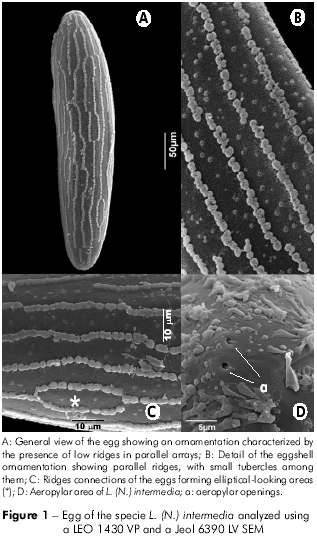
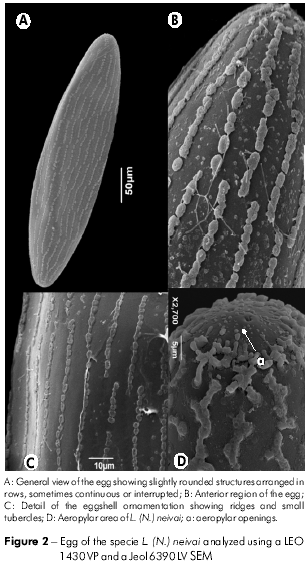
<body><![CDATA[<p><font size="2" face="verdana"> A  total of 80 eggs of each  species was obtained from the colonies and transferred to a 2.5% glutaraldehyde  solution in 0.1 M sodium  cacodylate buffer (pH 7.2) for 1 h. The eggs  were then post-fixed in 1% osmium tetroxide in the same buffer for 1 h at room  temperature. After washing in the same buffer, the eggs were dehydrated in a  graded ethanol series, dried in a critical point dryer with CO<sub>2</sub> (Balzers),  covered with gold (20 nm) and analyzed using a LEO 1430 VP scanning  electron microscope (SEM) at  the Centro de Microscopia  e Microan&aacute;lise at  the Universidade Federal  de Vi&ccedil;osa, Minas Gerais State,  Brazil, and using a   Jeol 6390 LV in the Rudolf Barth Electron  Microcopy Platform at Funda&ccedil;&atilde;o  Oswaldo  Cruz, Rio de Janeiro State, Brazil.</font></p>     <p><font size="2" face="verdana"> <b>MORPHOMETRY</b></font></p>     <p><font size="2" face="verdana"> The SEM images were  analyzed using the computer program SemAfore 3.0 (JEOL, Sollentuna, Sweden), and the number of  eggshell tubercles was calculated considering a 1 &#181;m<sup>2</sup> area/egg.</font></p>     <p><font size="2" face="verdana"><b> STATISTICAL  ANALYSIS</b></font></p>     <p><font size="2" face="verdana"> The  ANOVA test was applied at a significance level of 0.05 using SPSS 10.0 for Windows  (SPSS Inc., 233 South Wacker Drive,  11th Floor,  Chicago, IL).</font></p>     <p>&nbsp;</p>     <p><font size="3" face="verdana">  <b>RESULTS</b></font></p>     <p><font size="2" face="verdana">  The eggs of <i>L. </i>(<i>N.</i>)<i> intermedia </i>and <i>L. </i>(<i>N.</i>)<i> neivai </i>were  dark, elliptical, elongated and slightly flattened. The anterior and posterior  regions of the eggs of both species were rounded, presenting two round  aeropylar apertures at the end (<a href="#f1">Figures 1D</a>, <a href="#f2">2B</a> and <a href="#f2">2D</a>). The <i>L. </i>(<i>N.</i>)<i> intermedia </i>eggs measured 361 &#181;m in length and 75.4 &#181;m in width in  their central region; the <i>L. </i>(<i>N.</i>)<i> neivai </i>eggs measured 343 &#181;m in length  and 85.5 &#181;m in  width (<a href="#f1">Figures 1A</a> and <a href="#f2">2A</a>).</font></p>     <p><a name="f1"></a></p>     <p>&nbsp;</p>     ]]></body>
<body><![CDATA[<p align="center"><img src="/img/revistas/rpas/v3n1/1a03f1.gif" border="0"></p>     <p>&nbsp;</p>     <p><a name="f2"></a></p>     <p>&nbsp;</p>     <p align="center"><img src="/img/revistas/rpas/v3n1/1a03f2.gif" border="0"></p>     <p>&nbsp;</p>     <p><font size="2" face="verdana">The  exochorion showed an ornamentation characterized by the presence of low ridges,  with parallel arrays along the long axis of the egg (<a href="#f1">Figures 1A</a> and <a href="#f2">2A</a>), which  were formed by slightly rounded structures arranged in rows that were  continuous or interrupted (<a href="#f1">Figures 1B</a> and <a href="#f2">2C</a>). The ridges had no  cross-connections between them on the <i>L. </i>(<i>N.</i>)<i> neivai </i>eggs (<a href="#f2">Figures 2B</a>  and <a href="#f2">2C</a>), whereas some connections were observed on the <i>L. </i>(<i>N.</i>)<i> intermedia </i>eggs,  forming elliptical-looking areas (<a href="#f1">Figure 1C</a>). Small isolated tubercles were  found between the spaces formed by the ridges (<a href="#f1">Figures 1B</a> and <a href="#f2">2B</a>), varying in  number between the two studied species: 8.55 &plusmn; 1.80  tubercles/1  &#181;m<sup>2</sup><i> </i>in <i>L.  </i>(<i>N.</i>)<i> intermedia </i>and 5.95 &plusmn; 1.87 tubercles/1  &#181;m<sup>2</sup> in <i>L. </i>(<i>N.</i>)<i> neivai. </i>When applying ANOVA, a  difference was observed between the number of tubercles per 1 &#181;m<sup>2</sup>  (0,05 &lt; p; p  = 0,0).</font></p>     <p>&nbsp;</p>     <p><font size="3" face="verdana">  <b>DISCUSSION</b></font></p>     <p><font size="2" face="verdana"> Several  studies investigating the surfaces of eggs have been conducted in Diptera with  regard to taxonomic identification and oviposition sites<sup>26,27,28,29,30,31</sup>.  SEM is a powerful tool that complements classical taxonomy, as   many  structures that are not visible using light microscopy may be important for the  morphological characterization   of  insects<sup>32,33,34,35</sup>.</font></p>     ]]></body>
<body><![CDATA[<p><font size="2" face="verdana"> The  occurrence of structures on the <i>L. </i>(<i>N.</i>)<i> intermedia </i>and <i>L. </i>(<i>N.</i>)<i> neivai </i>exochorion characterized by the occurrence of longitudinal ridges without  connections between each other is a character commonly found in sand flies. A  study of five sand fly species reported parallel ridges forming polygons at  irregular intervals in <i>L. caballeroi </i>or connected ridges and a reticular  pattern in <i>L. peruensis. </i>Some of these ridges are subdivided to form  elliptical or hexagonal areas<sup>20,22</sup>, similar to our  observations on some regions of the chorion of <i>L. </i>(<i>N.</i>)<i> intermedia</i>. In  contrast, the authors of the above study observed an undefined pattern in <i>L.  tejedai. </i>Our results show that it is possible to identify <i>L. </i>(<i>N.</i>)<i> intermedia </i>and <i>L. </i>(<i>N.</i>)<i> neivai </i>based on the eggshell morphology,  similar to the sand flies Phlebotomus and Sergentomyia<sup>36</sup>,  corroborating that the ornamentation of the exochorion is   a good characteristic for species  identification in      Diptera<sup>27,28</sup>.</font></p>     <p><font size="2" face="verdana"> Considering  the origin and function of the exochorion, some authors have suggested the  existence of a relationship between the species and their larval development in  micro-ecosystems and that the eggshell ornamentations are adaptive structures  that facilitate oviposition in different environments<sup>18,20</sup>.  The chorion is secreted by the ovarian follicular epithelial cells during  choriogenesis, and its viscosity allows the egg to adhere to the substrate. The  chorion is a rigid structure forming the eggshell and is composed of two  layers: an inner layer, the endochorion in contact with the embryo, and an  outer layer, the exochorion in contact with the environment<sup>36</sup>. When  desiccated, the chorion presents distinct layers, generally forming elaborate  structures on the surface of the egg, with the patterns being characteristic  for each species. This layer serves to cover and protect the embryo, preventing  it from desiccation and regulating gaseous exchange<sup>37,21,38</sup>. Since <i>L.  </i>(<i>N.</i>)<i> intermedia </i>is found in warm and humid environments, whereas <i>L. </i>(<i>N.</i>)<i> neivai </i>is found in cold and dry environments possible association between  differences on egg surface of both species to enviroments should be evaluated.  In addition to studies on the ecological adaptations, the eggshell structures  of these species may contribute to future investigations of the phylogenetic   relationships  of the genus <i>Lutzomyia, </i>as suggested for      other  representative sand flies<sup>37,19,20,21,38</sup>.</font></p>     <p>&nbsp;</p>     <p><font size="3" face="verdana">  <b>CONCLUSION</b></font></p>     <p><font size="2" face="verdana">  The  study of the immature insect forms by SEM produces a deeper knowledge of the  different species of sandflies, with the purpose of giving a precise  identification based on the immature stages.</font></p>     <p><font size="2" face="verdana"> Our findings using scanning electron microscopy and the quantitative  analysis of the eggshell tubercles showed a variation of this structure that  enables a morphological differentiation between <i>L. </i>(<i>N.</i>)<i> intermedia </i>and <i>L.  </i>(<i>N.</i>)<i> neivai</i>.</font></p>     <p>&nbsp;</p>     <p><font size="3" face="verdana"><b>ACKNOWLEDGMENTS</b></font></p>     <p><font size="2" face="verdana"> The authors thank the Centro de Microscopia e Microan&aacute;lise at the Universidade Federal de Vi&ccedil;osa for technical assistance; Dr. Claudio  Casanova of the Superintend&ecirc;ncia para Controle de Doen&ccedil;as End&ecirc;micas de S&atilde;o Paulo; Dr. Eunice Aparecida Bianchi Galati and Ms. Edna Maria F&aacute;tima Bueno of the Departamento de  Epidemiologia at the Escola de Sa&uacute;de  P&uacute;blica; Universidade de S&atilde;o Paulo for the donation of the eggs; Dr. Alfredo Azevedo for his assistance in statistical  analysis   and Dr. Simone Patricia Carneiro de  Freitas, Mr. William Marques de Almeida and Mr. Jos&eacute; Adalberto da Silva of the Laborat&oacute;rio de  Transmissores de Leishmanioses, Instituto Oswaldo Cruz/FIOCRUZ for their technical assistance.</font></p>     <p>&nbsp;</p>     ]]></body>
<body><![CDATA[<p><font size="3" face="verdana">  <b>FINANCIAL SUPPORT</b></font></p>     <p><font size="2" face="verdana"> This research was supported by Funda&ccedil;&atilde;o de Amparo &agrave; Pesquisa  do Estado de Minas Gerais and Conselho  Nacional de Desenvolvimento Cient&iacute;fico e Tecnol&oacute;gico.</font></p>     <p>&nbsp;</p>     <p><font size="3" face="verdana"><b>REFERENCES</b></font></p>     <!-- ref --><p><font size="2" face="verdana">1 Minist&eacute;rio da Sa&uacute;de (BR). Secretaria de  Vigil&acirc;ncia em Sa&uacute;de. Coordena&ccedil;&atilde;o Geral de Doen&ccedil;as Transmiss&iacute;veis.  Coordena&ccedil;&atilde;o Ger&ecirc;ncia T&eacute;cnica das Leishmanioses. Bras&iacute;lia: Minist&eacute;rio da Sa&uacute;de; 2011.</font><!-- ref --><p><font size="2" face="verdana"> 2 Lainson R, Shaw JJ. Epidemiology and ecology of  leishmaniasis in Latin-America. Nature. 1978 Jun;273(5664):595-600. <a href="http://www.ncbi.nlm.nih.gov/pubmed/351409" target="_blank">&#91;Link&#93;</a></font><!-- ref --><p><font size="2" face="verdana"> 3 Minist&eacute;rio da Sa&uacute;de (BR). Secretaria de Vigil&acirc;ncia em Sa&uacute;de.  Manual de vigil&acirc;ncia e controle da Leishmaniose visceral. Bras&iacute;lia: Mist&eacute;rio da  Sa&uacute;de; 2003. 122 p. (S&eacute;rie A. Normas e Manuais T&eacute;cnicos).</font><!-- ref --><p><font size="2" face="verdana"> 4 Minist&eacute;rio da Sa&uacute;de (BR). Secretaria de Vigil&acirc;ncia em Sa&uacute;de.  Manual de Vigil&acirc;ncia da Leishmaniose Tegumentar Americana. 2. ed. Bras&iacute;lia:  Minist&eacute;rio da Sa&uacute;de; 2007. 182 p. (Serie A. Normas e Manuais T&eacute;cnicos).</font><!-- ref --><p><font size="2" face="verdana">5 Rangel EF, Laison R. Proven and  putative vectors of American cutaneous leishmaniasis in Brazil: aspects of  their biology and vectorial competence. Mem Inst Oswaldo Cruz. 2009 Nov;104(7):937-54. http://dx.doi.org/10.1590/S0074-02762009000700001&nbsp;&#91;<a href="http://www.scielo.br/scielo.php?pid=S0074-02762009000700001&script=sci_arttext&tlng=es" target="_blank">Link</a>&#93;</font><!-- ref --><p><font size="2" face="verdana"> 6 World Health Organization.  Leishmaniasis &#91;Internet&#93;. Geneva. (cited 2012 Jul 4). Available  from: <a href="http://www.who.int/leishmaniasis/en/" target="_blank">http://www.who.int/leishmaniasis/en/</a>.</font><!-- ref --><p><font size="2" face="verdana"> 7 Andrade-Filho JD. Morfologia do Complexo <i>Nyssomyia intermedia </i>(Diptera: Psychodidae:  Phlebotominae). &#91;disserta&ccedil;&atilde;o&#93;.  S&atilde;o Paulo (SP): Universidade de S&atilde;o Paulo, Faculdade  de Sa&uacute;de P&uacute;blica; 2003.</font><!-- ref --><p><font size="2" face="verdana"> 8 Araki AS, Vigoder FM, Bauzer LG, Ferreira  GE, Souza NA, Ara&uacute;jo IB,  et al. Molecular and behavioral differentiation  among Brazilian populations of <i>Lutzomyia longipalpis </i>(Diptera: Psychodidae: Phlebotominae). PLoS Negl Trop Dis. 2009;3(1):e365. Doi:10.1371/journal.pntd.0000365 <a href="http://www.ncbi.nlm.nih.gov/pmc/articles/PMC2628317/" target="_blank">&#91;Link&#93;</a></font><!-- ref --><p><font size="2" face="verdana"> 9 Bauzer LGSR, Gesto JSM, Souza NA, Ward RD,   Hamilton JGC,  Kyriacou CP, et al. Molecular divergence in the <i>period </i>gene between two  putative sympatric species of the <i>Lutzomyia longipalpis </i>complex. Mol Biol Evol. 2002 Sep;19(9):1624-7. &#91;<a href="http://mbe.oxfordjournals.org/content/19/9/1624.long" target="_blank">Link</a>&#93;</font><!-- ref --><p><font size="2" face="verdana"> 10 Bauzer LG, Souza NA, Maingon RD, Peixoto AA.  <i>Lutzomyia  longipalpis </i>in Brazil: a complex or a single species? A  mini-review. Mem Inst Oswaldo Cruz. 2007 Feb;102(1):1-12.</font><!-- ref --><p><font size="2" face="verdana"> 11 Ready PD, Rangel EF. Caracteres isoenzim&aacute;ticos e moleculares: esp&eacute;cies cr&iacute;pticas. In: Rangel  EF, Lainson R, editores. Flebotom&iacute;neos do Brasil. Rio de Janeiro: FIOCRUZ; 2003. p. 185-206. &#91;<a href="http://bases.bireme.br/cgi-bin/wxislind.exe/iah/online/?IsisScript=iah/iah.xis&src=google&base=LILACS&lang=p&nextAction=lnk&exprSearch=359665&indexSearch=ID" target="_blank">Link</a>&#93;</font><!-- ref --><p><font size="2" face="verdana"> 12 Vigoder FM, Souza NA, Peixoto AA. Acoustic signals in the sand  fly <i>Lutzomyia </i>(<i>Nyssomyia</i>)<i> intermedia </i>(Diptera:   Psychodidae).  Parasit Vectors. 2011 May;4:76. Doi:10.1186/1756-3305-4-76 &#91;<a href="http://www.ncbi.nlm.nih.gov/pmc/articles/PMC3114007/" target="_blank">Link&#93;</a></font><!-- ref --><p><font size="2" face="verdana"> 13 Pita-Pereira D, Souza GD, Zwetsch A, Alves  CR, Brito C, Rangel EF. First report of <i>Lutzomyia  </i>(<i>Nyssomyia</i>)<i> neivai </i>(Diptera:  Psychodidae: Phlebotominae) naturally infected by <i>Leishmania </i>(<i>V.</i>)<i> braziliensis </i>in a periurban area of South Brazil, State of Rio Grande do Sul, using a PCR multiplex assay. Am J Trop Med Hyg. 2009   Apr;80(4):593-5.</font><!-- ref --><p><font size="2" face="verdana"> 14 Marcondes CB. A redescription of <i>Lutzomyia  </i>(<i>Nyssomyia</i>)<i> intermedia </i>(Lutz &amp; Neiva, 1912) and  resurrection of <i>L. neivai </i>(Pinto 1926) (Diptera: Psychodidae: Phlebotominae). Mem&nbsp;  Inst Oswaldo   Cruz.  1996 Jul-Aug;91(4):457-62. http://dx.doi.org/10.1590/S0074-02761996000400012&nbsp;&#91;<a href="http://www.scielo.br/scielo.php?script=sci_arttext&pid=S0074-02761996000400012&lng=pt&nrm=iso&tlng=en" target="_blank">Link</a>&#93;</font><!-- ref --><p><font size="2" face="verdana"> 15 Andrade Filho JDA, Galati EAB, Falc&atilde;o AL. <i>Nyssomyia intermedia </i>(Lutz &amp; Neiva, 1912) and <i>Nyssomyia neivai </i>(Pinto, 1926)  (Diptera: Psychodidae: Phlebotominae) geographical distribution and  epidemiological importance. Mem Inst Oswaldo Cruz. 2007   Jun;102(4):481-7. &#91;<a href="http://www.scielo.br/pdf/mioc/v102n4/5725.pdf" target="_blank">Link</a>&#93;</font><!-- ref --><p><font size="2" face="verdana"> 16 Marcondes CB, Lozovei AL, Vilela JH. Distribui&ccedil;&atilde;o  geogr&aacute;fica de flebotom&iacute;neos do complexo <i>Lutzomyia intermedia </i>(Lutz &amp;  N eiva , 1912) (Diptera , Psychodidae). Rev Soc Bras Med Trop. 1998 jan-fev;31(1):51-8.</font><!-- ref --><p><font size="2" face="verdana"> 17 Marcondes CB. Morfometria e DNA mitochondrial  de popula&ccedil;&otilde;es  sul americanas de <i>Lutzomyia </i>(<i>Nyssomyia</i>)<i> intermedia </i>(Lutz &amp; N eiva, 1912) (Diptera: Psychodidae: Phlebotominae) &#91;tese&#93;. Curitiba (PR): Universidade  Federal do Paran&aacute;, Departamento de Ci&ecirc;ncias Biol&oacute;gicas; 1997.</font><!-- ref --><p><font size="2" face="verdana"> 18 Ward RD, Ready PA. Chorioic sculpturing in some sandfly eggs (Diptera:  Psychodidae). J Entomol. 1975   Jul;50(2):127-34. DOI:10.1111/j.1365-3032.1975.tb00101.x &#91;<a href="http://onlinelibrary.wiley.com/doi/10.1111/j.1365-3032.1975.tb00101.x/abstract" target="_blank">Link</a>&#93;</font><!-- ref --><p><font size="2" face="verdana"> 19 Feliciangeli MD, Castejon OC, Limongi J. Egg surface ultrastructure of eight  new world phlebotomine sandfly species (Diptera: Psychodidae). J Med Entomol.  1993   Jul;30(4):651-6. &#91;<a href="http://www.ncbi.nlm.nih.gov/pubmed/8360889" target="_blank">Link</a>&#93;</font><!-- ref --><p><font size="2" face="verdana"> 20 Perez JE, Ogusuku E. Chorion pattern on eggs  of <i>Lutzomyia </i>sandflies from the Peruvian Andes. Med Vet Entomol. 1997 Apr;11(2):127-33. DOI:10.1111/j.1365-2915.1997.tb00301.x &#91;<a href="http://onlinelibrary.wiley.com/doi/10.1111/j.1365-2915.1997.tb00301.x/abstract" target="_blank">Link</a>&#93;</font><!-- ref --><p><font size="2" face="verdana"> 21 Fausto AM, Feliciangeli MD, Maroli M, Mazzini  M. Ootaxonomic investigation of five <i>Lutzomyia </i>species (Diptera,  Psychodidae) from Venezuela. Mem Inst Oswaldo Cruz. 2001 Feb;96(2):197-204. http://dx.doi.org/10.1590/S0074-02762001000200011 &#91;<a href="http://www.scielo.br/scielo.php?script=sci_arttext&pid=S0074-02762001000200011&lng=en&nrm=iso&tlng=en" target="_blank">Link</a>&#93;</font><!-- ref --><p><font size="2" face="verdana"> 22 Almeida DN, Oliveira RS, Brazil BG, Soares  MJ.   Patterns  of exochorion ornaments on eggs of seven South American species of <i>Lutzomyia </i>sand flies (Diptera: Psychodidae). J  Med&nbsp; Entomol. 2004   Sep;41(5):819-25. http://dx.doi.org/10.1603/0022-2585-41.5.819 &#91;<a href="http://www.bioone.org/doi/abs/10.1603/0022-2585-41.5.819" target="_blank">Link</a>&#93;</font><!-- ref --><p><font size="2" face="verdana"> 23 Pugeto H, Barata RA, Fran&ccedil;a-Silva JC,  Silva JC, Dias ES. HP: an improved modelo of sucction light trap for the  capture of small insects. Rev Soc Bras Med Trop.   2005  Jan-Feb;38 (1):70-2. &#91;<a href="http://www.ncbi.nlm.nih.gov/pubmed/15717102" target="_blank">Link</a>&#93;</font><!-- ref --><p><font size="2" face="verdana"> 24 Modi GB, Tesh RB. A simple technique for mass  rearing <i>Lutzomyia longipalpis </i>and <i>Phlebotomus papatasi </i>(Diptera:  Psychodidae) in the laboratory. J Med Entomol. 1983 Oct;20(5):568-9.</font><!-- ref --><p><font size="2" face="verdana"> 25 Rangel EF, Souza NA, Wermelinger ED, Barbosa  AF. Estabelecimento  de col&ocirc;nia, em laborat&oacute;rio, de <i>Lutzomyia  intermedia </i>Lutz &amp; Neiva, 1912 (Diptera, Psychodidae, Phlebotominae).  Mem Inst Oswaldo Cruz. 1985 abr-jun;80(2):219-26. &#91;<a href="http://www.scielo.br/pdf/mioc/v80n2/vol80(f2)_090-097.pdf" target="_blank">Link</a>&#93;</font><!-- ref --><p><font size="2" face="verdana"> 26 Choochote W, Jitpakdi A, Sukontason K, Suntaravitun T,  Wongkamchai S, Sukontason K, et al. Scanning electron microscopy of <i>Aedes  lineatopennis </i>(Diptera:   Culicidae)  Eggs. J Med Entomol. 2001 Sep;38(5):753-5. http://dx.doi.org/10.1603/0022-2585-38.5.753 &#91;<a href="http://www.bioone.org/doi/abs/10.1603/0022-2585-38.5.753?journalCode=ment" target="_blank">Link</a>&#93;</font><!-- ref --><p><font size="2" face="verdana"> 27 Alencar J, Guimar&atilde;es AE, Mello RP, Lopes CM, D&eacute;gallier N,  Santos-Mallet JR. Scanning electron microscopy of eggs of <i>Hemagogus  leucocelaenus </i>(Diptera: Culicidae). Rev Saude Publica. 2003   Oct;37(5):658-61. http://dx.doi.org/10.1590/S0034-89102003000500017&nbsp; &#91;<a href="http://www.scielosp.org/scielo.php?script=sci_arttext&pid=S0034-89102003000500017&lng=en&nrm=iso&tlng=en" target="_blank">Link</a>&#93;</font><!-- ref --><p><font size="2" face="verdana"> 28 Alencar J, Guimar&atilde;es AE, Gil-Santana HR,  Santos-Mallet JR. Scanning electron microscopy of eggs of <i>Ochlerotatus  </i>(<i>Protomacleaya</i>)<i> terrens </i>Walker. J Am   Mosq Control Assoc. 2005 Dec;21(4):355-9. &#91;<a href="http://www.ncbi.nlm.nih.gov/pubmed/16506559" target="_blank">Link</a>&#93;</font><!-- ref --><p><font size="2" face="verdana">29 Mendon&ccedil;a PM, Santos-Mallet JR, Mello RP, Gomes L, Queiroz MMC. Identification  of fly eggs using scanning electron microscopy for forensic investigations.  Micron. 2008 Oct;39(7):802-7. &#91;<a href="http://www.sciencedirect.com/science/article/pii/S0968432808000231" target="_blank">Link</a>&#93;</font><!-- ref --><p><font size="2" face="verdana"> 30 Santos-Mallet JR, Gleiser RM, Alencar J,  Marques WA, Sarmento JS, Muller GA, et al. Scanning  electron microscopy of the eggs of <i>Ochlerotatus albifasciatus </i>(Diptera:  Culicidae). J Med Entomol. 2009 Sep;46(5):980-5. http://dx.doi.org/10.1603/033.046.0502 &#91;<a href="http://www.bioone.org/doi/abs/10.1603/033.046.0502" target="_blank">Link</a>&#93;</font><!-- ref --><p><font size="2" face="verdana"> 31 Santos-Malet JR, Muller GA, Gleiser  RM, Alencar J,  Marques WA, Sarmento JS. Scanning electron microscopy of the eggs of <i>Aedes  scapularis </i>from southern South America. J Am Mosq Control Assoc. 2010  Jun;26(2):205-9. http://dx.doi.org/10.2987/09-5959.1 &#91;<a href="http://www.bioone.org/doi/abs/10.2987/09-5959.1" target="_blank">Link&#93;</a></font><!-- ref --><p><font size="2" face="verdana"> 32 Serr&atilde;o JE. A comparative study of the proventricular structure in corbiculate apinae (Hymenoptera, Apidae). Micron. 2001 Jun;32(4):379-85. http://dx.doi.org/10.1016/S0968-4328(00)00014-7 &#91;<a href="http://www.sciencedirect.com/science/article/pii/S0968432800000147" target="_blank">Link</a>&#93;</font><!-- ref --><p><font size="2" face="verdana"> 33 Serr&atilde;o JE. Proventricular  structure in the solitary bees (Hymenoptera, Apidae). Org Divers Evol. 2005 Jun;5(2):125-33. http://dx.doi.org/10.1016/j.ode.2004.10.011 <a href="http://www.sciencedirect.com/science/article/pii/S1439609205000267" target="_blank">&#91;Link</a>&#93;</font><!-- ref --><p><font size="2" face="verdana"> 34 Serr&atilde;o JE. Proventricular  structure in the bee tribe Augochlorini (Hymenoptera, Halictidae). Org Divers  Evol. 2007 Nov;7(3):175-80. http://dx.doi.org/10.1016/j.ode.2006.05.002 &#91;<a href="http://www.sciencedirect.com/science/article/pii/S1439609207000190" target="_blank">Link</a>&#93;</font><!-- ref --><p><font size="2" face="verdana"> 35 Szinwelski N, Rodrigues MS, Pereira MR, Serr&atilde;o JE, Sperber CF. Proventriculus of three nemobiinae crickets  (Orthoptera: Grylloidea: Trigonidiidae). J Orthoptera Res. 2009;18(1):59-63.</font><!-- ref --><p><font size="2" face="verdana"> 36 Perfil'iev PP. Phlebotominae  (sandflies). In: Fauna of the USSR. Israel Program for of Scientific  Translations. Jerusalem: Academy of Sciences of USSR; 1968. 362 p.</font><!-- ref --><p><font size="2" face="verdana"> 37 Endris RG, Young DG, Perkins PV.  Ultrastructural comparison of egg surface morphology of five <i>Lutzomyia </i>species  (Diptera: Psychodidae). J Med Entomol. 1987 Jul;24(4):412-5.</font><!-- ref --><p><font size="2" face="verdana"> 38 Bahia AC, Secundino NFC, Miranda JC, Prates  DB, Souza APA, Fernandes FF, et al. Ultrastructural comparison of external  morphology of immature stages of <i>Lutzomyia </i>(<i>Nyssomyia</i>)<i> intermedia </i>and <i>Lutzomyia  </i>(<i>Nyssomyia</i>)<i> whitmani </i>(Diptera: Psychodidae), vectors of cutaneous  leishmaniasis, by scanning electron microscopy. J Med Entomol. 2007  Nov;44(6):903-14. http://dx.doi.org/10.1603/0022-2585(2007)44&#91;903:UCOEMO&#93;2.0.CO;2 &#91;<a href="http://www.bioone.org/doi/abs/10.1603/0022-2585(2007)44%5B903:UCOEMO%5D2.0.CO%3B2" target="_blank">Link</a>&#93;</font><p>&nbsp;</p>     <p>&nbsp;</p>     <p><font size="2"><b><font size="2" face="verdana"><b><b><a name="endereco"></a><a href="#topo"><img src="img/revistas/ess/v20n1/seta.gif" border="0"></a></b></b></font></b></font><font size="2" face="verdana"><b>Correspondence / Correspond&ecirc;ncia /Correspondencia:</b>    <br> Jacenir  Reis dos  Santos-Mallet    <br> Av.  Brasil, 4365. Bairro: Manguinhos    <br> CEP: 21040-360    <br> Rio de Janeiro-Rio de  Janeiro-Brasil    <br> Tel.:  +55 (21) 2562-1352    ]]></body>
<body><![CDATA[<br> E-mail: <a href="mailto:&iexcl;acenir@ioc.fiocruz.br">&iexcl;acenir@ioc.fiocruz.br</a></font></p>     <p><font size="2" face="verdana">Received / Recebido em / Recibido en: 23/3/2012    <br> Accepted / Aceito em / Aceito en: 20/8/2012</font></p> <font size="2" face="verdana"> <script type="text/javascript"> var gaJsHost = (("https:" == document.location.protocol) ? "https://ssl." : "http://www."); document.write(unescape("%3Cscript src='" + gaJsHost + "google-analytics.com/ga.js' type='text/javascript'%3E%3C/script%3E")); </script> <script type="text/javascript"> try { var pageTracker = _gat._getTracker("UA-7885746-4"); pageTracker._setDomainName("none"); pageTracker._setAllowLinker(true); pageTracker._trackPageview(); } catch(err) {}</script> </font>      ]]></body><back>
<ref-list>
<ref id="B1">
<label>1</label><nlm-citation citation-type="book">
<collab>Ministério da Saúde (BR)^dSecretaria de Vigilância em Saúde. Coordenação Geral de Doenças Transmissíveis</collab>
<source><![CDATA[Coordenação Gerência Técnica das Leishmanioses]]></source>
<year>2011</year>
<publisher-loc><![CDATA[Brasília ]]></publisher-loc>
<publisher-name><![CDATA[Ministério da Saúde]]></publisher-name>
</nlm-citation>
</ref>
<ref id="B2">
<label>2</label><nlm-citation citation-type="journal">
<person-group person-group-type="author">
<name>
<surname><![CDATA[Lainson]]></surname>
<given-names><![CDATA[R]]></given-names>
</name>
<name>
<surname><![CDATA[Shaw]]></surname>
<given-names><![CDATA[JJ]]></given-names>
</name>
</person-group>
<article-title xml:lang="en"><![CDATA[Epidemiology and ecology of leishmaniasis in Latin-America]]></article-title>
<source><![CDATA[Nature]]></source>
<year>1978</year>
<month> J</month>
<day>un</day>
<volume>273</volume>
<numero>5664</numero>
<issue>5664</issue>
<page-range>595-600</page-range></nlm-citation>
</ref>
<ref id="B3">
<label>3</label><nlm-citation citation-type="book">
<collab>Ministério da Saúde (BR)^dSecretaria de Vigilância em Saúde</collab>
<source><![CDATA[Manual de vigilância e controle da Leishmaniose visceral]]></source>
<year>2003</year>
<page-range>122</page-range><publisher-loc><![CDATA[Brasília ]]></publisher-loc>
<publisher-name><![CDATA[Mistério da Saúde]]></publisher-name>
</nlm-citation>
</ref>
<ref id="B4">
<label>4</label><nlm-citation citation-type="book">
<collab>Ministério da Saúde (BR)^dSecretaria de Vigilância em Saúde</collab>
<source><![CDATA[Manual de Vigilância da Leishmaniose Tegumentar Americana]]></source>
<year>2007</year>
<edition>2</edition>
<page-range>182</page-range><publisher-loc><![CDATA[Brasília ]]></publisher-loc>
<publisher-name><![CDATA[Ministério da Saúde]]></publisher-name>
</nlm-citation>
</ref>
<ref id="B5">
<label>5</label><nlm-citation citation-type="journal">
<person-group person-group-type="author">
<name>
<surname><![CDATA[Rangel]]></surname>
<given-names><![CDATA[EF]]></given-names>
</name>
<name>
<surname><![CDATA[Laison]]></surname>
<given-names><![CDATA[R]]></given-names>
</name>
</person-group>
<article-title xml:lang="en"><![CDATA[Proven and putative vectors of American cutaneous leishmaniasis in Brazil: aspects of their biology and vectorial competence]]></article-title>
<source><![CDATA[Mem Inst Oswaldo Cruz]]></source>
<year>2009</year>
<month> N</month>
<day>ov</day>
<volume>104</volume>
<numero>7</numero>
<issue>7</issue>
<page-range>937-54</page-range></nlm-citation>
</ref>
<ref id="B6">
<label>6</label><nlm-citation citation-type="">
<collab>World Health Organization</collab>
<source><![CDATA[Leishmaniasis]]></source>
<year></year>
<publisher-loc><![CDATA[Geneva ]]></publisher-loc>
</nlm-citation>
</ref>
<ref id="B7">
<label>7</label><nlm-citation citation-type="book">
<person-group person-group-type="author">
<name>
<surname><![CDATA[Andrade-Filho]]></surname>
<given-names><![CDATA[JD]]></given-names>
</name>
</person-group>
<source><![CDATA[Morfologia do Complexo Nyssomyia intermedia (Diptera: Psychodidae: Phlebotominae)]]></source>
<year>2003</year>
<publisher-loc><![CDATA[São Paulo^eSP SP]]></publisher-loc>
<publisher-name><![CDATA[Universidade de São Paulo, Faculdade de Saúde Pública]]></publisher-name>
</nlm-citation>
</ref>
<ref id="B8">
<label>8</label><nlm-citation citation-type="journal">
<person-group person-group-type="author">
<name>
<surname><![CDATA[Araki]]></surname>
<given-names><![CDATA[AS]]></given-names>
</name>
<name>
<surname><![CDATA[Vigoder]]></surname>
<given-names><![CDATA[FM]]></given-names>
</name>
<name>
<surname><![CDATA[Bauzer]]></surname>
<given-names><![CDATA[LG]]></given-names>
</name>
<name>
<surname><![CDATA[Ferreira]]></surname>
<given-names><![CDATA[GE]]></given-names>
</name>
<name>
<surname><![CDATA[Souza]]></surname>
<given-names><![CDATA[NA]]></given-names>
</name>
<name>
<surname><![CDATA[Araújo]]></surname>
<given-names><![CDATA[IB]]></given-names>
</name>
</person-group>
<article-title xml:lang="en"><![CDATA[Molecular and behavioral differentiation among Brazilian populations of Lutzomyia longipalpis (Diptera: Psychodidae: Phlebotominae)]]></article-title>
<source><![CDATA[PLoS Negl Trop Dis]]></source>
<year>2009</year>
<volume>3</volume>
<numero>1</numero>
<issue>1</issue>
<page-range>365</page-range></nlm-citation>
</ref>
<ref id="B9">
<label>9</label><nlm-citation citation-type="journal">
<person-group person-group-type="author">
<name>
<surname><![CDATA[Bauzer]]></surname>
<given-names><![CDATA[LGSR]]></given-names>
</name>
<name>
<surname><![CDATA[Gesto]]></surname>
<given-names><![CDATA[JSM]]></given-names>
</name>
<name>
<surname><![CDATA[Souza]]></surname>
<given-names><![CDATA[NA]]></given-names>
</name>
<name>
<surname><![CDATA[Ward]]></surname>
<given-names><![CDATA[RD]]></given-names>
</name>
<name>
<surname><![CDATA[Hamilton]]></surname>
<given-names><![CDATA[JGC]]></given-names>
</name>
<name>
<surname><![CDATA[Kyriacou]]></surname>
<given-names><![CDATA[CP]]></given-names>
</name>
</person-group>
<article-title xml:lang="en"><![CDATA[Molecular divergence in the period gene between two putative sympatric species of the Lutzomyia longipalpis complex]]></article-title>
<source><![CDATA[Mol Biol Evol]]></source>
<year>2002</year>
<month> S</month>
<day>ep</day>
<volume>19</volume>
<numero>9</numero>
<issue>9</issue>
<page-range>1624-7</page-range></nlm-citation>
</ref>
<ref id="B10">
<label>10</label><nlm-citation citation-type="journal">
<person-group person-group-type="author">
<name>
<surname><![CDATA[Bauzer]]></surname>
<given-names><![CDATA[LG]]></given-names>
</name>
<name>
<surname><![CDATA[Souza]]></surname>
<given-names><![CDATA[NA]]></given-names>
</name>
<name>
<surname><![CDATA[Maingon]]></surname>
<given-names><![CDATA[RD]]></given-names>
</name>
<name>
<surname><![CDATA[Peixoto]]></surname>
<given-names><![CDATA[AA]]></given-names>
</name>
</person-group>
<article-title xml:lang="en"><![CDATA[Lutzomyia longipalpis in Brazil: a complex or a single species? A mini-review]]></article-title>
<source><![CDATA[Mem Inst Oswaldo Cruz]]></source>
<year>2007</year>
<month> F</month>
<day>eb</day>
<volume>102</volume>
<numero>1</numero>
<issue>1</issue>
<page-range>1-12</page-range></nlm-citation>
</ref>
<ref id="B11">
<label>11</label><nlm-citation citation-type="book">
<person-group person-group-type="author">
<name>
<surname><![CDATA[Ready]]></surname>
<given-names><![CDATA[PD]]></given-names>
</name>
<name>
<surname><![CDATA[Rangel]]></surname>
<given-names><![CDATA[EF]]></given-names>
</name>
</person-group>
<article-title xml:lang="pt"><![CDATA[Caracteres isoenzimáticos e moleculares: espécies crípticas]]></article-title>
<person-group person-group-type="editor">
<name>
<surname><![CDATA[Rangel]]></surname>
<given-names><![CDATA[EF]]></given-names>
</name>
<name>
<surname><![CDATA[Lainson]]></surname>
<given-names><![CDATA[R]]></given-names>
</name>
</person-group>
<source><![CDATA[Flebotomíneos do Brasil]]></source>
<year>2003</year>
<page-range>185-206</page-range><publisher-loc><![CDATA[Rio de Janeiro ]]></publisher-loc>
<publisher-name><![CDATA[FIOCRUZ]]></publisher-name>
</nlm-citation>
</ref>
<ref id="B12">
<label>12</label><nlm-citation citation-type="journal">
<person-group person-group-type="author">
<name>
<surname><![CDATA[Vigoder]]></surname>
<given-names><![CDATA[FM]]></given-names>
</name>
<name>
<surname><![CDATA[Souza]]></surname>
<given-names><![CDATA[NA]]></given-names>
</name>
<name>
<surname><![CDATA[Peixoto]]></surname>
<given-names><![CDATA[AA]]></given-names>
</name>
</person-group>
<article-title xml:lang="en"><![CDATA[Acoustic signals in the sand fly Lutzomyia (Nyssomyia) intermedia (Diptera: Psychodidae)]]></article-title>
<source><![CDATA[Parasit Vectors]]></source>
<year>2011</year>
<month> M</month>
<day>ay</day>
<volume>4</volume>
<page-range>76</page-range></nlm-citation>
</ref>
<ref id="B13">
<label>13</label><nlm-citation citation-type="journal">
<person-group person-group-type="author">
<name>
<surname><![CDATA[Pita-Pereira]]></surname>
<given-names><![CDATA[D]]></given-names>
</name>
<name>
<surname><![CDATA[Souza]]></surname>
<given-names><![CDATA[GD]]></given-names>
</name>
<name>
<surname><![CDATA[Zwetsch]]></surname>
<given-names><![CDATA[A]]></given-names>
</name>
<name>
<surname><![CDATA[Alves]]></surname>
<given-names><![CDATA[CR]]></given-names>
</name>
<name>
<surname><![CDATA[Brito]]></surname>
<given-names><![CDATA[C]]></given-names>
</name>
<name>
<surname><![CDATA[Rangel]]></surname>
<given-names><![CDATA[EF]]></given-names>
</name>
</person-group>
<article-title xml:lang="en"><![CDATA[First report of Lutzomyia (Nyssomyia) neivai (Diptera: Psychodidae: Phlebotominae) naturally infected by Leishmania (V.) braziliensis in a periurban area of South Brazil, State of Rio Grande do Sul, using a PCR multiplex assay]]></article-title>
<source><![CDATA[Am J Trop Med Hyg]]></source>
<year>2009</year>
<month> A</month>
<day>pr</day>
<volume>80</volume>
<numero>4</numero>
<issue>4</issue>
<page-range>593-5</page-range></nlm-citation>
</ref>
<ref id="B14">
<label>14</label><nlm-citation citation-type="journal">
<person-group person-group-type="author">
<name>
<surname><![CDATA[Marcondes]]></surname>
<given-names><![CDATA[CB]]></given-names>
</name>
</person-group>
<article-title xml:lang="en"><![CDATA[A redescription of Lutzomyia (Nyssomyia) intermedia (Lutz & Neiva, 1912) and resurrection of L. neivai (Pinto 1926) (Diptera: Psychodidae: Phlebotominae)]]></article-title>
<source><![CDATA[Mem Inst Oswaldo Cruz]]></source>
<year>1996</year>
<month> J</month>
<day>ul</day>
<volume>91</volume>
<numero>4</numero>
<issue>4</issue>
<page-range>457-62</page-range></nlm-citation>
</ref>
<ref id="B15">
<label>15</label><nlm-citation citation-type="journal">
<person-group person-group-type="author">
<name>
<surname><![CDATA[Andrade Filho]]></surname>
<given-names><![CDATA[JDA]]></given-names>
</name>
<name>
<surname><![CDATA[Galati]]></surname>
<given-names><![CDATA[EAB]]></given-names>
</name>
<name>
<surname><![CDATA[Falcão]]></surname>
<given-names><![CDATA[AL]]></given-names>
</name>
</person-group>
<article-title xml:lang="en"><![CDATA[Nyssomyia intermedia (Lutz & Neiva, 1912) and Nyssomyia neivai (Pinto, 1926) (Diptera: Psychodidae: Phlebotominae) geographical distribution and epidemiological importance]]></article-title>
<source><![CDATA[Mem Inst Oswaldo Cruz]]></source>
<year>2007</year>
<month> J</month>
<day>un</day>
<volume>102</volume>
<numero>4</numero>
<issue>4</issue>
<page-range>481-7</page-range></nlm-citation>
</ref>
<ref id="B16">
<label>16</label><nlm-citation citation-type="journal">
<person-group person-group-type="author">
<name>
<surname><![CDATA[Marcondes]]></surname>
<given-names><![CDATA[CB]]></given-names>
</name>
<name>
<surname><![CDATA[Lozovei]]></surname>
<given-names><![CDATA[AL]]></given-names>
</name>
<name>
<surname><![CDATA[Vilela]]></surname>
<given-names><![CDATA[JH]]></given-names>
</name>
</person-group>
<article-title xml:lang="pt"><![CDATA[Distribuição geográfica de flebotomíneos do complexo Lutzomyia intermedia (Lutz & N eiva , 1912) (Diptera , Psychodidae)]]></article-title>
<source><![CDATA[Rev Soc Bras Med Trop]]></source>
<year>1998</year>
<month> j</month>
<day>an</day>
<volume>31</volume>
<numero>1</numero>
<issue>1</issue>
<page-range>51-8</page-range></nlm-citation>
</ref>
<ref id="B17">
<label>17</label><nlm-citation citation-type="book">
<person-group person-group-type="author">
<name>
<surname><![CDATA[Marcondes]]></surname>
<given-names><![CDATA[CB]]></given-names>
</name>
</person-group>
<source><![CDATA[Morfometria e DNA mitochondrial de populações sul americanas de Lutzomyia (Nyssomyia) intermedia (Lutz & N eiva, 1912) (Diptera: Psychodidae: Phlebotominae)]]></source>
<year>1997</year>
<publisher-loc><![CDATA[Curitiba^ePR PR]]></publisher-loc>
<publisher-name><![CDATA[Universidade Federal do Paraná, Departamento de Ciências Biológicas]]></publisher-name>
</nlm-citation>
</ref>
<ref id="B18">
<label>18</label><nlm-citation citation-type="journal">
<person-group person-group-type="author">
<name>
<surname><![CDATA[Ward]]></surname>
<given-names><![CDATA[RD]]></given-names>
</name>
<name>
<surname><![CDATA[Ready]]></surname>
<given-names><![CDATA[PA]]></given-names>
</name>
</person-group>
<article-title xml:lang="en"><![CDATA[Chorioic sculpturing in some sandfly eggs (Diptera: Psychodidae)]]></article-title>
<source><![CDATA[J Entomol]]></source>
<year>1975</year>
<month> J</month>
<day>ul</day>
<volume>50</volume>
<numero>2</numero>
<issue>2</issue>
<page-range>127-34</page-range></nlm-citation>
</ref>
<ref id="B19">
<label>19</label><nlm-citation citation-type="journal">
<person-group person-group-type="author">
<name>
<surname><![CDATA[Feliciangeli]]></surname>
<given-names><![CDATA[MD]]></given-names>
</name>
<name>
<surname><![CDATA[Castejon]]></surname>
<given-names><![CDATA[OC]]></given-names>
</name>
<name>
<surname><![CDATA[Limongi]]></surname>
<given-names><![CDATA[J]]></given-names>
</name>
</person-group>
<article-title xml:lang="en"><![CDATA[Egg surface ultrastructure of eight new world phlebotomine sandfly species (Diptera: Psychodidae)]]></article-title>
<source><![CDATA[J Med Entomol]]></source>
<year>1993</year>
<month> J</month>
<day>ul</day>
<volume>30</volume>
<numero>4</numero>
<issue>4</issue>
<page-range>651-6</page-range></nlm-citation>
</ref>
<ref id="B20">
<label>20</label><nlm-citation citation-type="journal">
<person-group person-group-type="author">
<name>
<surname><![CDATA[Perez]]></surname>
<given-names><![CDATA[JE]]></given-names>
</name>
<name>
<surname><![CDATA[Ogusuku]]></surname>
<given-names><![CDATA[E]]></given-names>
</name>
</person-group>
<article-title xml:lang="en"><![CDATA[Chorion pattern on eggs of Lutzomyia sandflies from the Peruvian Andes]]></article-title>
<source><![CDATA[Med Vet Entomol]]></source>
<year>1997</year>
<month> A</month>
<day>pr</day>
<volume>11</volume>
<numero>2</numero>
<issue>2</issue>
<page-range>127-33</page-range></nlm-citation>
</ref>
<ref id="B21">
<label>21</label><nlm-citation citation-type="journal">
<person-group person-group-type="author">
<name>
<surname><![CDATA[Fausto]]></surname>
<given-names><![CDATA[AM]]></given-names>
</name>
<name>
<surname><![CDATA[Feliciangeli]]></surname>
<given-names><![CDATA[MD]]></given-names>
</name>
<name>
<surname><![CDATA[Maroli]]></surname>
<given-names><![CDATA[M]]></given-names>
</name>
<name>
<surname><![CDATA[Mazzini]]></surname>
<given-names><![CDATA[M]]></given-names>
</name>
</person-group>
<article-title xml:lang="en"><![CDATA[Ootaxonomic investigation of five Lutzomyia species (Diptera, Psychodidae) from Venezuela]]></article-title>
<source><![CDATA[Mem Inst Oswaldo Cruz]]></source>
<year>2001</year>
<month> F</month>
<day>eb</day>
<volume>96</volume>
<numero>2</numero>
<issue>2</issue>
<page-range>197-204</page-range></nlm-citation>
</ref>
<ref id="B22">
<label>22</label><nlm-citation citation-type="journal">
<person-group person-group-type="author">
<name>
<surname><![CDATA[Almeida]]></surname>
<given-names><![CDATA[DN]]></given-names>
</name>
<name>
<surname><![CDATA[Oliveira]]></surname>
<given-names><![CDATA[RS]]></given-names>
</name>
<name>
<surname><![CDATA[Brazil]]></surname>
<given-names><![CDATA[BG]]></given-names>
</name>
<name>
<surname><![CDATA[Soares]]></surname>
<given-names><![CDATA[MJ]]></given-names>
</name>
</person-group>
<article-title xml:lang="en"><![CDATA[Patterns of exochorion ornaments on eggs of seven South American species of Lutzomyia sand flies (Diptera: Psychodidae)]]></article-title>
<source><![CDATA[J Med Entomol]]></source>
<year>2004</year>
<month> S</month>
<day>ep</day>
<volume>41</volume>
<numero>5</numero>
<issue>5</issue>
<page-range>819-25</page-range></nlm-citation>
</ref>
<ref id="B23">
<label>23</label><nlm-citation citation-type="journal">
<person-group person-group-type="author">
<name>
<surname><![CDATA[Pugeto]]></surname>
<given-names><![CDATA[H]]></given-names>
</name>
<name>
<surname><![CDATA[Barata]]></surname>
<given-names><![CDATA[RA]]></given-names>
</name>
<name>
<surname><![CDATA[França-Silva]]></surname>
<given-names><![CDATA[JC]]></given-names>
</name>
<name>
<surname><![CDATA[Silva]]></surname>
<given-names><![CDATA[JC]]></given-names>
</name>
<name>
<surname><![CDATA[Dias]]></surname>
<given-names><![CDATA[ES]]></given-names>
</name>
</person-group>
<article-title xml:lang="en"><![CDATA[HP: an improved modelo of sucction light trap for the capture of small insects]]></article-title>
<source><![CDATA[Rev Soc Bras Med Trop]]></source>
<year>2005</year>
<month> J</month>
<day>an</day>
<volume>38</volume>
<numero>1</numero>
<issue>1</issue>
<page-range>70-2</page-range></nlm-citation>
</ref>
<ref id="B24">
<label>24</label><nlm-citation citation-type="journal">
<person-group person-group-type="author">
<name>
<surname><![CDATA[Modi]]></surname>
<given-names><![CDATA[GB]]></given-names>
</name>
<name>
<surname><![CDATA[Tesh]]></surname>
<given-names><![CDATA[RB]]></given-names>
</name>
</person-group>
<article-title xml:lang="en"><![CDATA[A simple technique for mass rearing Lutzomyia longipalpis and Phlebotomus papatasi (Diptera: Psychodidae) in the laboratory]]></article-title>
<source><![CDATA[J Med Entomol]]></source>
<year>1983</year>
<month> O</month>
<day>ct</day>
<volume>20</volume>
<numero>5</numero>
<issue>5</issue>
<page-range>568-9</page-range></nlm-citation>
</ref>
<ref id="B25">
<label>25</label><nlm-citation citation-type="journal">
<person-group person-group-type="author">
<name>
<surname><![CDATA[Rangel]]></surname>
<given-names><![CDATA[EF]]></given-names>
</name>
<name>
<surname><![CDATA[Souza]]></surname>
<given-names><![CDATA[NA]]></given-names>
</name>
<name>
<surname><![CDATA[Wermelinger]]></surname>
<given-names><![CDATA[ED]]></given-names>
</name>
<name>
<surname><![CDATA[Barbosa]]></surname>
<given-names><![CDATA[AF]]></given-names>
</name>
</person-group>
<article-title xml:lang="pt"><![CDATA[Estabelecimento de colônia, em laboratório, de Lutzomyia intermedia Lutz & Neiva, 1912 (Diptera, Psychodidae, Phlebotominae)]]></article-title>
<source><![CDATA[Mem Inst Oswaldo Cruz]]></source>
<year>1985</year>
<month> a</month>
<day>br</day>
<volume>80</volume>
<numero>2</numero>
<issue>2</issue>
<page-range>219-26</page-range></nlm-citation>
</ref>
<ref id="B26">
<label>26</label><nlm-citation citation-type="journal">
<person-group person-group-type="author">
<name>
<surname><![CDATA[Choochote]]></surname>
<given-names><![CDATA[W]]></given-names>
</name>
<name>
<surname><![CDATA[Jitpakdi]]></surname>
<given-names><![CDATA[A]]></given-names>
</name>
<name>
<surname><![CDATA[Sukontason]]></surname>
<given-names><![CDATA[K]]></given-names>
</name>
<name>
<surname><![CDATA[Suntaravitun]]></surname>
<given-names><![CDATA[T]]></given-names>
</name>
<name>
<surname><![CDATA[Wongkamchai]]></surname>
<given-names><![CDATA[S]]></given-names>
</name>
<name>
<surname><![CDATA[Sukontason]]></surname>
<given-names><![CDATA[K]]></given-names>
</name>
</person-group>
<article-title xml:lang="en"><![CDATA[Scanning electron microscopy of Aedes lineatopennis (Diptera: Culicidae) Eggs]]></article-title>
<source><![CDATA[J Med Entomol]]></source>
<year>2001</year>
<month> S</month>
<day>ep</day>
<volume>38</volume>
<numero>5</numero>
<issue>5</issue>
<page-range>753-5</page-range></nlm-citation>
</ref>
<ref id="B27">
<label>27</label><nlm-citation citation-type="journal">
<person-group person-group-type="author">
<name>
<surname><![CDATA[Alencar]]></surname>
<given-names><![CDATA[J]]></given-names>
</name>
<name>
<surname><![CDATA[Guimarães]]></surname>
<given-names><![CDATA[AE]]></given-names>
</name>
<name>
<surname><![CDATA[Mello]]></surname>
<given-names><![CDATA[RP]]></given-names>
</name>
<name>
<surname><![CDATA[Lopes]]></surname>
<given-names><![CDATA[CM]]></given-names>
</name>
<name>
<surname><![CDATA[Dégallier]]></surname>
<given-names><![CDATA[N]]></given-names>
</name>
<name>
<surname><![CDATA[Santos-Mallet]]></surname>
<given-names><![CDATA[JR]]></given-names>
</name>
</person-group>
<article-title xml:lang="en"><![CDATA[Scanning electron microscopy of eggs of Hemagogus leucocelaenus (Diptera: Culicidae)]]></article-title>
<source><![CDATA[Rev Saude Publica]]></source>
<year>2003</year>
<month> O</month>
<day>ct</day>
<volume>37</volume>
<numero>5</numero>
<issue>5</issue>
<page-range>658-61</page-range></nlm-citation>
</ref>
<ref id="B28">
<label>28</label><nlm-citation citation-type="journal">
<person-group person-group-type="author">
<name>
<surname><![CDATA[Alencar]]></surname>
<given-names><![CDATA[J]]></given-names>
</name>
<name>
<surname><![CDATA[Guimarães]]></surname>
<given-names><![CDATA[AE]]></given-names>
</name>
<name>
<surname><![CDATA[Gil-Santana]]></surname>
<given-names><![CDATA[HR]]></given-names>
</name>
<name>
<surname><![CDATA[Santos-Mallet]]></surname>
<given-names><![CDATA[JR]]></given-names>
</name>
</person-group>
<article-title xml:lang="en"><![CDATA[Scanning electron microscopy of eggs of Ochlerotatus (Protomacleaya) terrens Walker]]></article-title>
<source><![CDATA[J Am Mosq Control Assoc]]></source>
<year>2005</year>
<month> D</month>
<day>ec</day>
<volume>21</volume>
<numero>4</numero>
<issue>4</issue>
<page-range>355-9</page-range></nlm-citation>
</ref>
<ref id="B29">
<label>29</label><nlm-citation citation-type="journal">
<person-group person-group-type="author">
<name>
<surname><![CDATA[Mendonça]]></surname>
<given-names><![CDATA[PM]]></given-names>
</name>
<name>
<surname><![CDATA[Santos-Mallet]]></surname>
<given-names><![CDATA[JR]]></given-names>
</name>
<name>
<surname><![CDATA[Mello]]></surname>
<given-names><![CDATA[RP]]></given-names>
</name>
<name>
<surname><![CDATA[Gomes]]></surname>
<given-names><![CDATA[L]]></given-names>
</name>
<name>
<surname><![CDATA[Queiroz]]></surname>
<given-names><![CDATA[MMC]]></given-names>
</name>
</person-group>
<article-title xml:lang="en"><![CDATA[Identification of fly eggs using scanning electron microscopy for forensic investigations]]></article-title>
<source><![CDATA[Micron]]></source>
<year>2008</year>
<month> O</month>
<day>ct</day>
<volume>39</volume>
<numero>7</numero>
<issue>7</issue>
<page-range>802-7</page-range></nlm-citation>
</ref>
<ref id="B30">
<label>30</label><nlm-citation citation-type="journal">
<person-group person-group-type="author">
<name>
<surname><![CDATA[Santos-Mallet]]></surname>
<given-names><![CDATA[JR]]></given-names>
</name>
<name>
<surname><![CDATA[Gleiser]]></surname>
<given-names><![CDATA[RM]]></given-names>
</name>
<name>
<surname><![CDATA[Alencar]]></surname>
<given-names><![CDATA[J]]></given-names>
</name>
<name>
<surname><![CDATA[Marques]]></surname>
<given-names><![CDATA[WA]]></given-names>
</name>
<name>
<surname><![CDATA[Sarmento]]></surname>
<given-names><![CDATA[JS]]></given-names>
</name>
<name>
<surname><![CDATA[Muller]]></surname>
<given-names><![CDATA[GA]]></given-names>
</name>
</person-group>
<article-title xml:lang="en"><![CDATA[Scanning electron microscopy of the eggs of Ochlerotatus albifasciatus (Diptera: Culicidae)]]></article-title>
<source><![CDATA[J Med Entomol]]></source>
<year>2009</year>
<month> S</month>
<day>ep</day>
<volume>46</volume>
<numero>5</numero>
<issue>5</issue>
<page-range>980-5</page-range></nlm-citation>
</ref>
<ref id="B31">
<label>31</label><nlm-citation citation-type="journal">
<person-group person-group-type="author">
<name>
<surname><![CDATA[Santos-Malet]]></surname>
<given-names><![CDATA[JR]]></given-names>
</name>
<name>
<surname><![CDATA[Muller]]></surname>
<given-names><![CDATA[GA]]></given-names>
</name>
<name>
<surname><![CDATA[Gleiser]]></surname>
<given-names><![CDATA[RM]]></given-names>
</name>
<name>
<surname><![CDATA[Alencar]]></surname>
<given-names><![CDATA[J]]></given-names>
</name>
<name>
<surname><![CDATA[Marques]]></surname>
<given-names><![CDATA[WA]]></given-names>
</name>
<name>
<surname><![CDATA[Sarmento]]></surname>
<given-names><![CDATA[JS]]></given-names>
</name>
</person-group>
<article-title xml:lang="en"><![CDATA[Scanning electron microscopy of the eggs of Aedes scapularis from southern South America]]></article-title>
<source><![CDATA[J Am Mosq Control Assoc]]></source>
<year>2010</year>
<month> J</month>
<day>un</day>
<volume>26</volume>
<numero>2</numero>
<issue>2</issue>
<page-range>205-9</page-range></nlm-citation>
</ref>
<ref id="B32">
<label>32</label><nlm-citation citation-type="journal">
<person-group person-group-type="author">
<name>
<surname><![CDATA[Serrão]]></surname>
<given-names><![CDATA[JE]]></given-names>
</name>
</person-group>
<article-title xml:lang="en"><![CDATA[A comparative study of the proventricular structure in corbiculate apinae (Hymenoptera, Apidae)]]></article-title>
<source><![CDATA[Micron]]></source>
<year>2001</year>
<month> J</month>
<day>un</day>
<volume>32</volume>
<numero>4</numero>
<issue>4</issue>
<page-range>379-85</page-range></nlm-citation>
</ref>
<ref id="B33">
<label>33</label><nlm-citation citation-type="journal">
<person-group person-group-type="author">
<name>
<surname><![CDATA[Serrão]]></surname>
<given-names><![CDATA[JE]]></given-names>
</name>
</person-group>
<article-title xml:lang="en"><![CDATA[Proventricular structure in the solitary bees (Hymenoptera, Apidae)]]></article-title>
<source><![CDATA[Org Divers Evol]]></source>
<year>2005</year>
<month> J</month>
<day>un</day>
<numero>5</numero><numero>2</numero>
<issue>5</issue><issue>2</issue>
<page-range>125-33</page-range></nlm-citation>
</ref>
<ref id="B34">
<label>34</label><nlm-citation citation-type="journal">
<person-group person-group-type="author">
<name>
<surname><![CDATA[Serrão]]></surname>
<given-names><![CDATA[JE]]></given-names>
</name>
</person-group>
<article-title xml:lang="en"><![CDATA[Proventricular structure in the bee tribe Augochlorini (Hymenoptera, Halictidae)]]></article-title>
<source><![CDATA[Org Divers Evol]]></source>
<year>2007</year>
<month> N</month>
<day>ov</day>
<volume>7</volume>
<numero>3</numero>
<issue>3</issue>
<page-range>175-80</page-range></nlm-citation>
</ref>
<ref id="B35">
<label>35</label><nlm-citation citation-type="journal">
<person-group person-group-type="author">
<name>
<surname><![CDATA[Szinwelski]]></surname>
<given-names><![CDATA[N]]></given-names>
</name>
<name>
<surname><![CDATA[Rodrigues]]></surname>
<given-names><![CDATA[MS]]></given-names>
</name>
<name>
<surname><![CDATA[Pereira]]></surname>
<given-names><![CDATA[MR]]></given-names>
</name>
<name>
<surname><![CDATA[Serrão]]></surname>
<given-names><![CDATA[JE]]></given-names>
</name>
<name>
<surname><![CDATA[Sperber]]></surname>
<given-names><![CDATA[CF]]></given-names>
</name>
</person-group>
<article-title xml:lang="en"><![CDATA[Proventriculus of three nemobiinae crickets (Orthoptera: Grylloidea: Trigonidiidae)]]></article-title>
<source><![CDATA[J Orthoptera Res]]></source>
<year>2009</year>
<volume>18</volume>
<numero>1</numero>
<issue>1</issue>
<page-range>59-63</page-range></nlm-citation>
</ref>
<ref id="B36">
<label>36</label><nlm-citation citation-type="book">
<person-group person-group-type="author">
<name>
<surname><![CDATA[Perfil'iev]]></surname>
<given-names><![CDATA[PP]]></given-names>
</name>
</person-group>
<article-title xml:lang="en"><![CDATA[Phlebotominae (sandflies)]]></article-title>
<source><![CDATA[Fauna of the USSR: Israel Program for of Scientific Translations]]></source>
<year>1968</year>
<page-range>362</page-range><publisher-loc><![CDATA[Jerusalem ]]></publisher-loc>
<publisher-name><![CDATA[Academy of Sciences of USSR]]></publisher-name>
</nlm-citation>
</ref>
<ref id="B37">
<label>37</label><nlm-citation citation-type="journal">
<person-group person-group-type="author">
<name>
<surname><![CDATA[Endris]]></surname>
<given-names><![CDATA[RG]]></given-names>
</name>
<name>
<surname><![CDATA[Young]]></surname>
<given-names><![CDATA[DG]]></given-names>
</name>
<name>
<surname><![CDATA[Perkins]]></surname>
<given-names><![CDATA[PV]]></given-names>
</name>
</person-group>
<article-title xml:lang="en"><![CDATA[Ultrastructural comparison of egg surface morphology of five Lutzomyia species (Diptera: Psychodidae)]]></article-title>
<source><![CDATA[J Med Entomol]]></source>
<year>1987</year>
<month> J</month>
<day>ul</day>
<volume>24</volume>
<numero>4</numero>
<issue>4</issue>
<page-range>412-5</page-range></nlm-citation>
</ref>
<ref id="B38">
<label>8</label><nlm-citation citation-type="journal">
<person-group person-group-type="author">
<name>
<surname><![CDATA[Bahia]]></surname>
<given-names><![CDATA[AC]]></given-names>
</name>
<name>
<surname><![CDATA[Secundino]]></surname>
<given-names><![CDATA[NFC]]></given-names>
</name>
<name>
<surname><![CDATA[Miranda]]></surname>
<given-names><![CDATA[JC]]></given-names>
</name>
<name>
<surname><![CDATA[Prates]]></surname>
<given-names><![CDATA[DB]]></given-names>
</name>
<name>
<surname><![CDATA[Souza]]></surname>
<given-names><![CDATA[APA]]></given-names>
</name>
<name>
<surname><![CDATA[Fernandes]]></surname>
<given-names><![CDATA[FF]]></given-names>
</name>
</person-group>
<article-title xml:lang="en"><![CDATA[Ultrastructural comparison of external morphology of immature stages of Lutzomyia (Nyssomyia) intermedia and Lutzomyia (Nyssomyia) whitmani (Diptera: Psychodidae), vectors of cutaneous leishmaniasis, by scanning electron microscopy]]></article-title>
<source><![CDATA[J Med Entomol]]></source>
<year>2007</year>
<month> N</month>
<day>ov</day>
<volume>44</volume>
<numero>6</numero>
<issue>6</issue>
<page-range>903-14</page-range></nlm-citation>
</ref>
</ref-list>
</back>
</article>