<?xml version="1.0" encoding="ISO-8859-1"?><article xmlns:mml="http://www.w3.org/1998/Math/MathML" xmlns:xlink="http://www.w3.org/1999/xlink" xmlns:xsi="http://www.w3.org/2001/XMLSchema-instance">
<front>
<journal-meta>
<journal-id>2176-6223</journal-id>
<journal-title><![CDATA[Revista Pan-Amazônica de Saúde]]></journal-title>
<abbrev-journal-title><![CDATA[Rev Pan-Amaz Saude]]></abbrev-journal-title>
<issn>2176-6223</issn>
<publisher>
<publisher-name><![CDATA[Instituto Evandro Chagas. Secretaria de Vigilância em Saúde e Ambiente. Ministério da Saúde]]></publisher-name>
</publisher>
</journal-meta>
<article-meta>
<article-id>S2176-62232014000200008</article-id>
<title-group>
<article-title xml:lang="en"><![CDATA[A preliminary molecular epidemiologic study using analysis of variable number of tandem repeats of Acinetobacter baumannii OXA-23 producing strains isolated from hospitals in Rio de Janeiro State, Brazil]]></article-title>
<article-title xml:lang="pt"><![CDATA[Estudo epidemiológico molecular preliminar usando a análise de número variável de repetições em tandem (VNTR) de cepas de Acinetobacter baumannii produtoras de OXA-23 isoladas em hospitais no Rio de Janeiro, Brasil]]></article-title>
<article-title xml:lang="es"><![CDATA[Estudio epidemiológico molecular preliminar usando el análisis de número variable en tándem de repeticiones (VNTR) de cepas de Acinetobacter baumannii productoras de OXA-23 aisladas en hospitales de Rio de Janeiro, Brasil]]></article-title>
</title-group>
<contrib-group>
<contrib contrib-type="author">
<name>
<surname><![CDATA[Carramachi]]></surname>
<given-names><![CDATA[Isabel Nogueira]]></given-names>
</name>
<xref ref-type="aff" rid="A01"/>
</contrib>
<contrib contrib-type="author">
<name>
<surname><![CDATA[Carvalho]]></surname>
<given-names><![CDATA[Karyne Rangel]]></given-names>
</name>
<xref ref-type="aff" rid="A02"/>
</contrib>
<contrib contrib-type="author">
<name>
<surname><![CDATA[Cruz]]></surname>
<given-names><![CDATA[Jéssica Gonçalves Vieira da]]></given-names>
</name>
<xref ref-type="aff" rid="A01"/>
</contrib>
<contrib contrib-type="author">
<name>
<surname><![CDATA[Zahner]]></surname>
<given-names><![CDATA[Viviane]]></given-names>
</name>
<xref ref-type="aff" rid="A01"/>
</contrib>
</contrib-group>
<aff id="A01">
<institution><![CDATA[,Fundação Oswaldo Cruz Instituto Oswaldo Cruz Laboratório de Transmissores de Leishmaniose, Setor de Entomologia Médica e Forense]]></institution>
<addr-line><![CDATA[Rio de Janeiro Rio de Janeiro]]></addr-line>
<country>Brasil</country>
</aff>
<aff id="A02">
<institution><![CDATA[,Fundação Oswaldo Cruz Instituto Nacional de Controle de Qualidade em Saúde Departamento de Microbiologia, Laboratório de Saneantes]]></institution>
<addr-line><![CDATA[, Rio de Janeiro Rio de Janeiro]]></addr-line>
<country>Brasil</country>
</aff>
<pub-date pub-type="pub">
<day>00</day>
<month>06</month>
<year>2014</year>
</pub-date>
<pub-date pub-type="epub">
<day>00</day>
<month>06</month>
<year>2014</year>
</pub-date>
<volume>5</volume>
<numero>2</numero>
<fpage>57</fpage>
<lpage>62</lpage>
<copyright-statement/>
<copyright-year/>
<self-uri xlink:href="http://scielo.iec.gov.br/scielo.php?script=sci_arttext&amp;pid=S2176-62232014000200008&amp;lng=en&amp;nrm=iso"></self-uri><self-uri xlink:href="http://scielo.iec.gov.br/scielo.php?script=sci_abstract&amp;pid=S2176-62232014000200008&amp;lng=en&amp;nrm=iso"></self-uri><self-uri xlink:href="http://scielo.iec.gov.br/scielo.php?script=sci_pdf&amp;pid=S2176-62232014000200008&amp;lng=en&amp;nrm=iso"></self-uri><abstract abstract-type="short" xml:lang="en"><p><![CDATA[The Gram-negative multidrug-resistant (MDR) bacterium Acinetobacter baumannii constitutes a serious cause of nosocomial infections in Brazilian hospitals. A panel of 36 strains, belonging to five pre-determined pulsed-field gel electrophoresis (PFGE) genotypes from four different hospitals in the City of Rio de Janeiro, Rio de Janeiro State, Brazil, was submitted to simple agarose gel electrophoresis to determine the variation of nine variable number tandem repeats (VNTR) band profiles. Based on published data VNTR were classified in two categories, long (L) and short (S) repeats with different evolutionary implications. The results demonstrated the superior discrimination of VNTR over PFGE. The VNTR Abaum_3002 marker was the least discriminatory with only one allele, while VNTR10 and Abaum_2240 each presented four alleles. The use of a combination of the nine VNTR resulted in a refined genotyping tool that provides valuable epidemiological information.]]></p></abstract>
<abstract abstract-type="short" xml:lang="pt"><p><![CDATA[A bactéria Gram-negativa Acinetobacter baumannii multirresistente (AbMR) constitui uma séria causa de infecções nosocominais em hospitais brasileiros. Um painel de 36 cepas, pertencentes a cinco genótipos pré-determinados por eletroforese em gel de campo pulsado (PFGE) de quatro diferentes hospitais na Cidade do Rio de Janeiro, Estado do Rio de Janeiro, Brasil, foi submetido à eletroforese em gel de agarose simples para determinar a variação de nove perfis de número variável de repetições em tandem (VNTR). Com base em dados publicados, os VNTR foram classificados em duas categorias, longa (L) e curta (C) repetições com diferentes implicações evolucionárias. Os resultados demonstraram a discriminação superior de VNTR sobre PFGE. O marcador VNTR Abaum_3002 era o menos discriminatório com apenas um alelo, enquanto VNTR10 e Abaum_2240, cada um, apresentaram quatro alelos. O uso da combinação de nove VNTR resultou em uma aperfeiçoada ferramenta de genotipagem que fornece relevantes informações epidemiológicas.]]></p></abstract>
<abstract abstract-type="short" xml:lang="es"><p><![CDATA[La bacteria Gram negativa Acinetobacter baumannii multirresistente (AbMR) es una seria causa de infecciones nosocomiales en hospitales brasileños. Un panel de 36 cepas, pertenecientes a cinco genotipos predeterminados por electroforesis en gel de campo pulsado (PFGE) de cuatro diferentes hospitales en la Ciudad de Rio de Janeiro, Estado de Rio de Janeiro, Brasil, fue sometido a electroforesis en gel de agarosa simple para determinar la variación de nueve perfiles de número variable de repeticiones en tándem (VNTR). Con base en datos publicados, los VNTR fueron clasificados en dos categorías, larga (L) y corta (C) repeticiones con distintas implicaciones evolutivas. Los resultados demostraron la discriminación superior de VNTR sobre PFGE. El marcador VNTR Abaum_3002 era el menos discriminatorio con un solo alelo apenas, mientras que VNTR10 y Abaum_2240, cada uno, presentaron cuatro alelos. El uso de la combinación de nueve VNTR resultó en una herramienta de genotipado perfeccionada que suministra relevantes informaciones epidemiológicas.]]></p></abstract>
<kwd-group>
<kwd lng="en"><![CDATA[Acinetobacter baumannii]]></kwd>
<kwd lng="en"><![CDATA[VNTR]]></kwd>
<kwd lng="en"><![CDATA[Public Health]]></kwd>
<kwd lng="en"><![CDATA[Epidemiology]]></kwd>
<kwd lng="pt"><![CDATA[Acinetobacter baumannii]]></kwd>
<kwd lng="pt"><![CDATA[VNTR]]></kwd>
<kwd lng="pt"><![CDATA[Saúde Pública]]></kwd>
<kwd lng="pt"><![CDATA[Epidemiologia]]></kwd>
<kwd lng="es"><![CDATA[Acinetobacter baumannii]]></kwd>
<kwd lng="es"><![CDATA[VNTR]]></kwd>
<kwd lng="es"><![CDATA[Salud Pública]]></kwd>
<kwd lng="es"><![CDATA[Epidemiología]]></kwd>
</kwd-group>
</article-meta>
</front><body><![CDATA[ <p align="left"><span style="line-height:115%; font-family:'Arial','sans-serif'; font-size:9.0pt; "><font color="#990033">http://dx.doi.org/10.5123/S2176-62232014000200008</font></span></p>     <p align="right"><font face="Verdana" size="2"><b>COMMUNICATION | COMUNICA&#199;&#195;O | COMUNICACI&#211;N</b></font></p>     <p>&nbsp;</p>     <p><font face="Verdana" size="4"><b><a name="topo"></a>A preliminary molecular epidemiologic study using analysis of variable number of tandem repeats of <i>Acinetobacter baumannii </i>OXA-23 producing strains isolated from hospitals in Rio de Janeiro State, Brazil</b></font></p>     <p>&nbsp;</p>     <p><b><font face="Verdana" size="3">Estudo epidemiol&#243;gico molecular preliminar usando a an&#225;lise de n&#250;mero vari&#225;vel de repeti&#231;&#245;es em tandem (VNTR) de cepas de <i>Acinetobacter baumannii </i>produtoras de OXA-23 isoladas em hospitais no Rio de Janeiro, Brasil</font></b></p>     <p>&nbsp;</p>     <p><b><font face="Verdana" size="3">Estudio epidemiol&#243;gico molecular preliminar usando el an&#225;lisis de n&#250;mero variable en t&#225;ndem de repeticiones (VNTR) de cepas de <i>Acinetobacter baumannii </i>productoras de OXA-23 aisladas en hospitales de Rio de Janeiro, Brasil</font></b></p>     <p>&nbsp;</p>     <p>&nbsp;</p>     ]]></body>
<body><![CDATA[<p><font face="Verdana" size="2"><b>Isabel Nogueira Carramachi<sup>I</sup>; Karyne Rangel Carvalho<sup>II</sup>; J&#233;ssica Gon&#231;alves Vieira da Cruz<sup>I</sup>; Viviane Zahner<sup>I</sup></b></font></p>     <p><font face="Verdana" size="2"><sup>I</sup><i>Laborat&#243;rio de Transmissores de Leishmaniose, Setor de Entomologia M&#233;dica e Forense, Instituto Oswaldo Cruz, Funda&#231;&#227;o Oswaldo Cruz, Rio de Janeiro, Rio de Janeiro, Brasil</i></font>    <br> <font face="Verdana" size="2"><sup>II</sup><i>Departamento de Microbiologia, Laborat&oacute;rio de Saneantes, Instituto Nacional de Controle de Qualidade em Sa&uacute;de, Funda&#231;&atilde;o Oswaldo Cruz, Rio de Janeiro, Rio de Janeiro, Brasil</i></font></p>     <p><font face="Verdana" size="2"><a href="#endereco">Correspondence</a></font>    <br>   <font face="Verdana" size="2"><a href="#endereco">Endere&ccedil;o para correspond&ecirc;ncia    <br> Direcci&oacute;n para correspondencia</a></font></p>     <p>&nbsp;</p>     <p>&nbsp;</p> <hr size="1" noshade>     <p><font face="Verdana" size="2"><b>ABSTRACT</b></font></p>     <p><font face="Verdana" size="2">The Gram-negative multidrug-resistant (MDR) bacterium <i>Acinetobacter baumannii </i>constitutes a serious cause of nosocomial infections in Brazilian hospitals. A panel of 36 strains, belonging to five pre-determined pulsed-field gel electrophoresis (PFGE) genotypes from four different hospitals in the City of Rio de Janeiro, Rio de Janeiro State, Brazil, was submitted to simple agarose gel electrophoresis to determine the variation of nine variable number tandem repeats (VNTR) band profiles. Based on published data VNTR were classified in two categories, long (L) and short (S) repeats with different evolutionary implications. The results demonstrated the superior discrimination of VNTR over PFGE. The VNTR Abaum_3002 marker was the least discriminatory with only one allele, while VNTR10 and Abaum_2240 each presented four alleles. The use of a combination of the nine VNTR resulted in a refined genotyping tool that provides valuable epidemiological information.</font></p>     ]]></body>
<body><![CDATA[<p><font face="Verdana" size="2"><b>Keywords: </b><i>Acinetobacter baumannii</i>; VNTR; Public Health; Epidemiology.</font></p> <hr size="1" noshade>     <p><font face="Verdana" size="2"><b>RESUMO</b></font></p>     <p><font face="Verdana" size="2">A bact&#233;ria Gram-negativa <i>Acinetobacter baumannii </i>multirresistente (AbMR) constitui uma s&#233;ria causa de infec&#231;&#245;es nosocominais em hospitais brasileiros. Um painel de 36 cepas, pertencentes a cinco gen&oacute;tipos pr&#233;-determinados por eletroforese em gel de campo pulsado (PFGE) de quatro diferentes hospitais na Cidade do Rio de Janeiro, Estado do Rio de Janeiro, Brasil, foi submetido &#224; eletroforese em gel de agarose simples para determinar a varia&#231;&#227;o de nove perfis de n&#250;mero vari&#225;vel de repeti&#231;&#245;es em tandem (VNTR). Com base em dados publicados, os VNTR foram classificados em duas categorias, longa (L) e curta (C) repeti&#231;&#245;es com diferentes implica&#231;&#245;es evolucion&#225;rias. Os resultados demonstraram a discrimina&#231;&#227;o superior de VNTR sobre PFGE. O marcador VNTR Abaum_3002 era o menos discriminat&#243;rio com apenas um alelo, enquanto VNTR10 e Abaum_2240, cada um, apresentaram quatro alelos. O uso da combina&#231;&#227;o de nove VNTR resultou em uma aperfei&#231;oada ferramenta de genotipagem que fornece relevantes informa&#231;&#245;es epidemiol&#243;gicas.</font></p>     <p><font face="Verdana" size="2"><b>Palavras-chave: </b><i>Acinetobacter baumannii</i>; VNTR; Sa&#250;de P&#250;blica; Epidemiologia.</font></p> <hr size="1" noshade>     <p><font face="Verdana" size="2"><b>RESUMEN</b></font></p>     <p><font face="Verdana" size="2">La bacteria Gram negativa <i>Acinetobacter baumannii </i>multirresistente (<i>Ab</i>MR) es una seria causa de infecciones nosocomiales en hospitales brasile&#241;os. Un panel de 36 cepas, pertenecientes a cinco genotipos predeterminados por electroforesis en gel de campo pulsado (PFGE) de cuatro diferentes hospitales en la Ciudad de Rio de Janeiro, Estado de Rio de Janeiro, Brasil, fue sometido a electroforesis en gel de agarosa simple para determinar la variaci&#243;n de nueve perfiles de n&#250;mero variable de repeticiones en t&#225;ndem (VNTR). Con base en datos publicados, los VNTR fueron clasificados en dos categor&#237;as, larga (L) y corta (C) repeticiones con distintas implicaciones evolutivas. Los resultados demostraron la discriminaci&#243;n superior de VNTR sobre PFGE. El marcador VNTR Abaum_3002 era el menos discriminatorio con un solo alelo apenas, mientras que VNTR10 y Abaum_2240, cada uno, presentaron cuatro alelos. El uso de la combinaci&#243;n de nueve VNTR result&#243; en una herramienta de genotipado perfeccionada que suministra relevantes informaciones epidemiol&#243;gicas.</font></p>     <p><font face="Verdana" size="2"><b>Palabras clave: </b><i>Acinetobacter baumannii</i>; VNTR; Salud P&#250;blica; Epidemiolog&#237;a</font>.</p> <hr size="1" noshade>     <p>&nbsp;</p>     <p>&nbsp;</p>     <p><font face="Verdana" size="2">The Gram-negative bacterium, multidrug-resistant (MDR) <i>Acinetobacter baumannii</i><sup>1</sup> constitutes a signficant cause of nosocomial infections in Brazilian hospitals. According to the MYSTIC Program Brazil<sup>2</sup> it features considerably among the total number of nosocomial bacterial isolates recorded in intensive care units. Moreover, the carbapenemases OXA-23 and OXA-143 continue to be observed in Brazilian hospitals<sup>3</sup>. Recently Zarrilli et al<sup>4</sup> reviewed the phenotypic and genotypic methods for typing of <i>A. baumannii. </i>In 1996, Dijkshoorn et al<sup>5</sup> reported the development of a rapid and simple detection method, based on analysis of variable number tandem repeats (VNTR), for clonal types of important nosocomial bacteria, that could potentially overcome the limitations and reduce the financial burden associated with    pulsed-field   gel    electrophoresis    (PFGE)    and multilocus sequence typing (MLST). PFGE has a limited level of discrimination and is time consuming while MLST, although it is a portable technique, is a costly being restricted primarily to research laboratories<sup>6</sup>. VNTR have been found in the genomes of several bacteria including <i>Staphylococcus aureus, Bacillus anthracis, Bacillus cereus </i>and Neisseria<sup>7,8,9,10,11</sup>. Turton et al<sup>12</sup> and Pourcel et al<sup>6</sup> suggested the use of VNTR as a complement or even for substitution of the other methodologies. VNTR is a technique based on the PCR  detection of specific repetitive sequence(s) active in different individuals, which results in an electrophoretic fingerprint. Multiple-locus VNTR analysis, also known as MLVA, presents the polymorphism among different tandemly repeated DNA sequences<sup>12</sup>. The division of VNTR markers into two groups is made according to their size and rate of evolution. Thus, Short repeats (S-repeats) are 6 to 9 bp in length and appear to have a high rate of evolution, while Long repeats (L-repeats) are 26 to 99 bp in length and show a slower rate of evolution<sup>6</sup>. This rationale was proposed to aid in phylogenetic studies, outbreak investigations and epidemiological surveillance<sup>6</sup>.</font></p>     ]]></body>
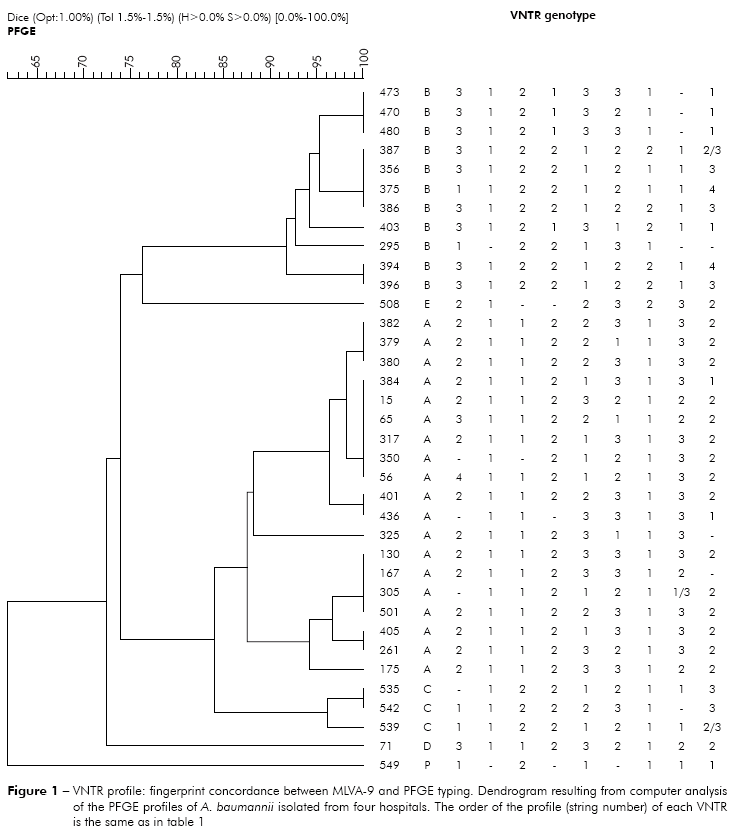
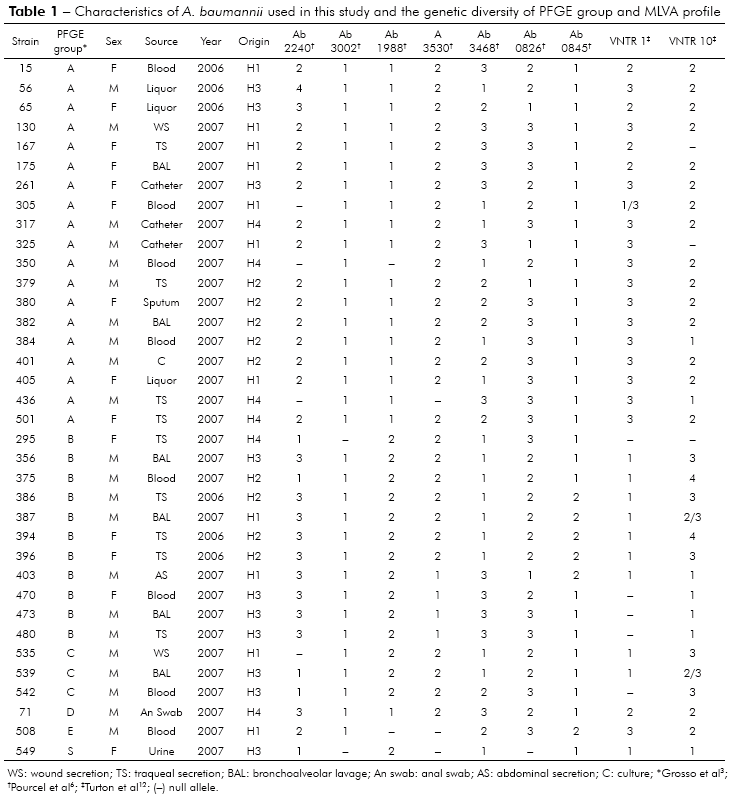
<body><![CDATA[<p><font face="Verdana" size="2">The occurrence of different PFGE types among OXA-23 producing <i>A. baumannii </i>in different hospitals in Rio de Janeiro State, Brazil, was reported in 2011, and more recently Carvalho<sup>13</sup> studied some phenotypic characteristics such as, adherence to epithelial cells and biofilm formation in the same set of strains used in the present study. In addition, the strains were subjected to PCR and phenotypic detection of carbapenemases genes and characterization by MLST for population studies<sup>3</sup>. In light of the existing classification, we decided to investigate the potential utility of VNTR analysis using a small, but representative, panel of 36 strains of this collection of OXA-23-producing <i>A. baumannii </i>clinical isolates which were recovered from four different hospitals in Rio de Janeiro between January 2006 and September 2007 and that represented five PFGE types<sup>3,14</sup>. The 36 strains belong to the five previously defined  PFGE genotypes  (A,  B, C,  D and  E)  and S (non-producing OXA-23) (<a href="#t1">Table 1</a>)<sup>3</sup>. The VNTR profile (string numbers) was obtained by simple agarose gel electrophoresis of PCR amplicons according to previously described methodology<sup>6</sup>.</font></p>     <p><a name="t1"></a></p>     <p>&nbsp;</p>     <p align="center"><img src="/img/revistas/rpas/v5n2/2a08t1.gif" border="0"></p>     <p>&nbsp;</p>     <p><font face="Verdana" size="2">As reported by Grosso et al<sup>3</sup>, strains from PFGE type A, B, C and D were classified as ST131, ST132, ST133 and ST134 in accordance with the MLST-OD scheme (associated with the Oxford Database) and ST79, ST15 and two new allelic profiles within the MLST-IP scheme (developed by the Institute Pasteur). The genotypes E and S were not submitted to multilocus sequence typing (MLST) schemes.</font></p>     <p><font face="Verdana" size="2">In the present study we included nine VNTR primer pairs; Abaum_2240, Abaum_3002, Abaum_1988, Abaum_3530&nbsp;(long-repeats),&nbsp;Abaum_3468, Abaum_0845, Abaum_0826, VNTR1 and VNTR10 (short-repeats). The amplification conditions used were as described by Pourcel et al<sup>6</sup>. The PCR amplicons were submitted to electrophoresis in 3.2% (S-repeats) and 2% (L-repeats) agarose gels. Following electrophoresis the molecular weight (MW) of each band was estimated using the LabImage 1D gel analysis program (Loccus Biotecnologia, Brazil). In the present study a dendrogram based on VNTR profiles (<a href="#f1">Figure 1</a>) was created and comparison of the banding patterns was accomplished employing the unweighted pair-group method with arithmetic averages using the Dice similarity coefficient. Computer-assisted analysis was performed using BioNumerics v.4.0 (Applied Maths, Sint-Martens-Latem, Belgium).</font></p>     <p><a name="f1"></a></p>     <p>&nbsp;</p>     <p align="center"><img src="/img/revistas/rpas/v5n2/2a08f1.gif" border="0"></p>     ]]></body>
<body><![CDATA[<p>&nbsp;</p>     <p><font face="Verdana" size="2"><a href="#t1">Table 1</a> shows the VNTR alleles for each VNTR maker used in the study. The analysis of the 36 <i>A. baumannii </i>strains, detected 30 different VNTR profiles, each represented by string of numbers (<a href="#f1">Figure 1</a>). The superior discrimination of VNTR relative to PFGE is clearly demonstrated in <a href="#f1">figure 1</a> where strains belonging to the same PFGE type presented variation in VNTR, with the exception of the strains LGB380, LGB382, LGB401, and LGB501 (genotype A), LGB317-LGB405 (genotype A), LGB386-LGB396 (genotype B) and LGB473-LGB480 (genotype B). As a specific example, the strains LGB130 and LGB305, both classified as PFGE type A isolated in the same year from the same hospital at the same time, demonstrated differences in four VNTR (VNTR1, Abaum_3468, Abaum_0826 and Abaum_2240).</font></p>     <p><font face="Verdana" size="2">Top    et    al<sup>15</sup>&nbsp;studying <i>Enterococccus    faecium</i> demonstrated    the&nbsp;discriminatory    power    of    six VNTR-MLVA.  More&nbsp;recently strains of <i>A.  baumannii,</i> producers of CHDL&nbsp;belonging to ICL-II, were typed by MLVA-8<sup>16</sup>.  In  addition, Hauck et al<sup>17</sup> utilized an automated VNTR protocol in the investigation of <i>A. calcoaceticus-A. baumannii </i>complex strains from different hospitals. Moreover, Hu et al<sup>18</sup> compared a VNTR based analysis with PFGE typing of <i>A. baumannii </i>in China and observed a remarkable congruence between MLVA-7 and PFGE-based strain clustering.</font></p>     <p><font face="Verdana" size="2">Taken as a whole our results are in congruence with data presented in the literature and support the use of VNTR analysis for discrimination of isolates of <i>A. baumannii. </i>According to <a href="#t1">table 1</a> it can be inferred that the similarity of MLVA is greater within PFGE profiles than between them. As such the use of VNTR does not undermine to PFGE data, but it does show a greater power for detecting genetic variation in clonal groups than can be achieved by PFGE. It was noted that the marker Abaum_1988, except in the case of strain LGB350 (which seems to have a null allele for this VNTR), was conserved among strains of PFGE type A. Nevertheless, more strains should be analyzed in order to confirm if these <i>loci </i>could be employed as a molecular marker of Brazilian PFGE type A. Interestingly, no genetic variation was observed among our samples using the VNTR Abaum_3002, which is in contrast with data reported by Pourcel et al<sup>6 </sup>which showed that this marker generated three numbers of alleles or types.</font></p>     <p><font face="Verdana" size="2">It was suggested previously that determination of the number of repeats in VNTR1 and VNTR10 could be valuable in cross-infection studies, with VNTR1 providing the greatest level of discrimination<sup>12</sup>, at least among the isolates of OXA-23 clone 1 that were included in that study. It is clear that the discriminatory power of this technique depends on the choice of <i>locus. </i>In this context, our data based on the number of alleles showed that VNTR10 was the most polymorphic among the S-repeats while Abaum_2240 were the most polymorphic among the L-repeats, both produced four alleles each (bands) among our strains. Moreover, within the same PFGE group, the VNTR10 and Abaum_2240 markers revealed more differences, an observation which may prove useful in studies that need to be simple, faster and cheaper. In addition, strains with the same PFGE type from different hospitals but from the same hospital chain, e.g. strains LGB382 and LGB130 or strains LGB386 and LGB387 presented a single <i>loci </i>difference: Abaum_3468 and VNTR 10, respectively, S-repeat (<a href="#t1">Table 1</a>), suggesting that the traffic of employees and material between hospitals may serve to promote dissemination of this bacterium. In this context, the analysis of a group of isolates from the same hospital and belonging to the same PFGE group showed higher rates of evolution in the S-repeat in comparison to L-repeat markers. Indeed, with the exception of Abaum_2240 the pattern of L-repeats was maintained among PFGE-types, while the pattern of S-repeats was highly polymorphic.</font></p>     <p><font face="Verdana" size="2">The dissemination of <i>A. baumannii </i>in Rio de Janeiro is reflected by the detection of the same VNTR genotype in different hospitals. This observation calls for improvements in the procedures for prevention of hospital infection and prudence in the use of carbapenems. Improved recognition and early detection of potentially epidemic isolates that show a propensity to emerge in hospital wards can be determined by MLST, and also, based on our data, by VNTR. In light of these data we contend that VNTR should be considered as an important tool for infection control.</font></p>     <p><font face="Verdana" size="2">Although a VNTR data bank (<a href="http://mlva.u-psud.fr/" target="_blank">http://mlva.u-psud.fr/</a>)<sup>9</sup> exists, we did not use this resource since our intention was to facilitate the routine of laboratories which receive samples from hospitals for screening. In conclusion, our results corroborate the impressive discriminatory power of VNTR, as reported by numerous authors and importantly, provide the first report of the applicability of this technique in Brazil. In light of the fact that both MLST and PFGE are technically demanding, expensive and time consuming, the use of VNTR, specifically VNTR10 (due the fact of being a short repeat marker) may be a candidate for further studies on the characterization of strains that belong to an outbreak and to the same PFGE genotype.</font></p>     <p>&nbsp;</p>     <p><font face="Verdana" size="3"><b>ACKNOWLEDGMENT</b></font></p>     <p><font face="Verdana" size="2">To Dr. Douglas Mcintosh for English revision. To the Laborat&oacute;rio de Pesquisa em Infec&ccedil;&atilde;o Hospitalar of the Instituto Oswaldo Cruz who provided the strains of Cole&ccedil;&atilde;o de Culturas de Bact&eacute;rias de Origem Hospitalar used in the present study.</font></p>     ]]></body>
<body><![CDATA[<p>&nbsp;</p>     <p><font face="Verdana" size="3"><b>FINANCIAL SUPPORT</b></font></p>     <p><font face="Verdana" size="2">Conselho Nacional de Desenvolvimento Cient&#237;fico e Tecnol&#243;gico and Funda&#231;&#227;o de Amparo &#224; Pesquisa do Estado do Rio de Janeiro.</font></p>     <p>&nbsp;</p>     <p><font face="Verdana" size="3"><b>REFERENCES</b></font></p>     <!-- ref --><p><font face="Verdana" size="2">1 Vila J, Pach&#243;n J. <i>Acinetobacter baumannii </i>resistant to everything: what should we do? Clin Microbiol Infect. 2011 Jul;17(7):955-6. Doi: 10.1111/j.1469-0691.2011.03566.x &#91;<a href="http://www.ncbi.nlm.nih.gov/pubmed/?term=Clin+Microbiol+Infect.+2011%3B17%287%29%3A955-6." target="_blank">Link</a>&#93;</font><!-- ref --><p><font face="Verdana" size="2">2 Kiffer C, Hsiung A, Oplustiul C, Sampaio J, Sakayami E, Turner P, et al. Antimicrobial susceptibility of Gram-negative bacteria in Brazilian hospitals: the MYSTIC Program Brazil 2003. Braz J Infect Dis. 2005 Jun;9(3):216-24. Doi: 10.1590/S1413-86702005000300004 &#91;<a href="http://www.ncbi.nlm.nih.gov/pubmed/?term=Braz+J+Infect+Dis.+2005+Jun%3B9%283%29%3A216-24" target="_blank">Link</a>&#93;</font><!-- ref --><p><font face="Verdana" size="2">3 Grosso F, Carvalho KR, Quinteira S, Ramos A, Carvalho-Assef APD, Asensi MD, et al. OXA-23-producing <i>Acinetobacter baumannii: </i>a new hotspot of diversity in Rio de Janeiro? J Antimicrob Chemother. 2011 Jan;66(1):62-5. Doi: 10.1093/jac/dkq406 &#91;<a href="http://www.ncbi.nlm.nih.gov/pubmed/21051372" target="_blank">Link</a>&#93;</font><!-- ref --><p><font face="Verdana" size="2">4 Zarrilli R, Pournaras S, Giannouli M, Tsakris A. Global evolution of multidrug-resistant <i>Acinetobacter baumannii </i>clonal lineages. Int J Antimicrob Agents. 2013 Jan;41(1):11-9. Doi: 10.1016/j.ijantimicag.2012.09.008 &#91;<a href="http://www.ncbi.nlm.nih.gov/pubmed/?term=Int+J+Antimicrob+Agents.+2013%3B41+%281%29%3A11-19." target="_blank">Link</a>&#93;</font><!-- ref --><p><font face="Verdana" size="2">5 Dijkshoorn L, Aucken H, Gerner-Smidt P, Janssen P, Kaufmann ME, Garaizar J, et al. Comparison of outbreak and nonoutbreak <i>Acinetobacter baumannii </i>strains by genotypic and phenotypic methods. J Clin Microbiol. 1996 Jun;34(6):1519-25. &#91;<a href="http://www.ncbi.nlm.nih.gov/pubmed/?term=J+Clin+Microbiol.+1996+Jun;34(6)%3A1519-25" target="_blank">Link</a>&#93;</font><!-- ref --><p><font face="Verdana" size="2">6 Pourcel C, Minandri F, Hauck Y, D'Arezzo S, Imperi F, Vergnaude G, et al. Identification of variable-number tandem-repeat (VNTR) sequences in <i>Acinetobacter baumannii </i>and interlaboratory validation of an optimized multiple-locus VNTR analysis typing scheme. J Clin Microbiol. 2011 Feb;49(2):539-48. Doi: 10.1128/JCM.02003-10 &#91;<a href="http://www.ncbi.nlm.nih.gov/pubmed/?term=J+Clin+Microbiol.+2011%3B+49+%282%29%3A539-548" target="_blank">Link</a>&#93;</font><!-- ref --><p><font face="Verdana" size="2">7 Van Belkum A, Kluytmans J, Van Leeuwen W, Bax R, Quint W, Peters E, et al. Multicenter evaluation of arbitrarily primed PCR for typing of <i>Staphylococcus aureus </i>strains. J Clin Microbiol. 1996 Jun;33(6):1537-47. &#91;<a href="http://www.ncbi.nlm.nih.gov/pubmed/?term=J+Clin+Microbiol.+1996%3B+33%286%29%3A1537%E2%80%931547." target="_blank">Link</a>&#93;</font><!-- ref --><p><font face="Verdana" size="2">8 Keim P, Price LB, Klevytska AM, Smith KL, Shupp JM, Okinaka R, et al. Multiple-locus variable-number tandem repeat analysis reveals genetic relationships within    <i>Bacillus   anthracis.    </i>J    Bacteriol.    2000 May;182(10):2928-36. Doi: 10.1128/JB.182.10.2928-2936.2000 &#91;<a href="http://www.ncbi.nlm.nih.gov/pubmed/?term=J+Bacteriol.+2000;+182%3A2928–2936" target="_blank">Link</a>&#93;</font><!-- ref --><p><font face="Verdana" size="2">9 Denoeud F, Vergnaud G. Identification of polymorphic tandem repeats by direct comparison of genome sequence from different bacterial strains: a web-based resource. BMC Bioinformatics. 2004 Jan;5:4. Doi:10.1186/1471-2105-5-4 &#91;<a href="http://www.ncbi.nlm.nih.gov/pubmed/?term=BMC+Bioinformatics.+2004%3B+5%3A4" target="_blank">Link</a>&#93;</font><!-- ref --><p><font face="Verdana" size="2">10 Zahner V, Cabral DA, R&#233;gua-Mangia AH, Rabinovitch L, Moreau G, McIntosh D. Distribution of genes encoding putative virulence factors and fragment length polymorphisms in the <i>vrrA </i>gene among Brazilian isolates of <i>Bacillus cereus </i>and <i>Bacillus thuringiensis.</i> Appl Environ Microbiol. 2005 Dec;71(12):8107-14. Doi:  10.1128/AEM.71.12.8107-8114.2005 &#91;<a href="http://www.ncbi.nlm.nih.gov/pubmed/?term=Appl+Environ+Microbiol.+2005%3B+71%2812%29%3A+8107-14" target="_blank">Link</a>&#93;</font><!-- ref --><p><font face="Verdana" size="2">11 Liao JC, Li CC, Chiou CS. Use of a multilocus variable-number tandem repeat analysis method for molecular subtyping and phylogenetic analysis of <i>Neisseria meningitides </i>isolates. BMC Microbiol. 2006 May;6:44. Doi:  10.1186/1471-2180-6-44 &#91;<a href="http://www.ncbi.nlm.nih.gov/pubmed/?term=BMC+Microbiology.+2006;+6%3A44." target="_blank">Link</a>&#93;</font><!-- ref --><p><font face="Verdana" size="2">12 Turton JF, Matos J, Kaufmann ME, Pitt TL. Variable number tandem repeat loci providing discrimination within widespread genotypes of <i>Acinetobacter baumannii. </i>Eur J Clin Microbiol Infect Dis. 2009 May;28(5):499-507. Doi: 10.1007/s10096-008-0659-3 &#91;<a href="http://www.ncbi.nlm.nih.gov/pubmed/?term=Eur+J+Clin+Microbiol+Infect+Dis.+2009%3B+28%285%29%3A499-507." target="_blank">Link</a>&#93;</font><!-- ref --><p><font face="Verdana" size="2">13 Carvalho KR. Estudo da diversidade gen&#233;tica, caracteriza&#231;&#227;o fenot&#237;pica e molecular de mecanismos de resist&#234;ncia a antimicrobianos e virul&#234;ncia em <i>Acinetobacter baumannii </i>isolados em hospitais do Rio de Janeiro&#91;tese&#93;. Rio de Janeiro (RJ): Funda&#231;&#227;o Oswaldo Cruz, Instituto Oswaldo Cruz; 2013.</font><!-- ref --><p><font face="Verdana" size="2">14 Carvalho KR, Carvalho-Assef APD, Peirano G, Santos LCG, Pereira MJF, Asensi MD. Dissemination of multidrug-resistant <i>Acinetobacter baumannii </i>genotypes carrying bla<sub>OXA23</sub> collected from hospitals in Rio de Janeiro, Brazil. Int J Antimicrob Agents. 2009 Jul;34(1):25-8. Doi: 10.1016/j.ijantimicag.2008.12.009 &#91;<a href="http://www.ncbi.nlm.nih.gov/pubmed/?term=Int+J+Antimicrob+Agents.+2009%3B+34+%281%29+25-28." target="_blank">Link</a>&#93;</font><!-- ref --><p><font face="Verdana" size="2">15 Top J, Schouls LM, Bonten MJ, Willems RJ. Multiple-locus variable-number tandem repeat analysis, a novel typing scheme to study the genetic relatedness and epidemiology of <i>Enterococcus faecium </i>isolates. J Clin Microbiol. 2004 Oct;42(10):4503-11. Doi:  10.1128/JCM.42.10.4503-4511.2004 &#91;<a href="http://www.ncbi.nlm.nih.gov/pubmed/?term=J+Clin+Microbiol.+2004;42(10)%3A4503-11" target="_blank">Link</a>&#93;</font><!-- ref --><p><font face="Verdana" size="2">16 Minandri F, D'Arezzo S, Antunes LC, Pourcel C, Principe L, Petrosillo N, et al. Evidence of diversity among epidemiologically related carbapenemase-producing <i>Acinetobacter baumannii </i>strains belonging to international clonal lineage II. J Clin Microbiol. 2012 Mar;50(3):590-7. Doi:  10.1128/JCM.05555-11 &#91;<a href="http://www.ncbi.nlm.nih.gov/pubmed/?term=J+Clin+Microbiol.+2012%3B+50%283%29%3A590-7.." target="_blank">Link</a>&#93;</font><!-- ref --><p><font face="Verdana" size="2">17 Hauck Y, Soler C, Jault P, M&#233;rens A, G&#233;rome P, Nab CM, et al. Diversity of <i>Acinetobacter baumannii </i>in four French military hospitals, as assessed by multiple locus variable number of tandem repeats analysis. PLoS One. 2012;7(9):e44597. Doi:  10.1371/journal.pone.0044597 &#91;<a href="http://www.ncbi.nlm.nih.gov/pubmed/?term=PLoS+One.+2012%3B+7%289%29%3Ae44597." target="_blank">Link</a>&#93;</font><!-- ref --><p><font face="Verdana" size="2">18 Hu Y, Li B, Jin D, Cui Z, Tao X, Zhang B, et al. Comparison of multiple-locus variable-number tandem-repeat analysis with pulsed-field gel electrophoresis typing of <i>Acinetobacter baumannii </i>in China. J Clin Microbiol. 2013 Apr;51(4):1263-8. Doi: 10.1128/JCM.03108-12 &#91;<a href="http://www.ncbi.nlm.nih.gov/pubmed/?term=J+Clin+Microbiol.+2013;+51(4)%3A1263-8http://www.ncbi.nlm.nih.gov/pubmed/?term=J+Clin+Microbiol.+2013;+51(4)%3A1263-8" target="_blank">Link</a>&#93;</font><p>&nbsp;</p>     <p>&nbsp;</p>     <p><font face="Verdana" size="2"><b><a name="endereco"></a><a href="#topo"><img src="img/revistas/ess/v20n1/seta.gif" border="0"></a>Correspondence / Correspond&#234;ncia   / Correspondencia:</b></font>    <br> <font face="Verdana" size="2">Viviane Zahner</font>    <br> <font face="Verdana" size="2">Instituto Oswaldo Cruz, Funda&#231;&#227;o Oswaldo Cruz    <br> Laborat&#243;rio de Transmissores de Leishmaniose    <br> Setor de Entomologia M&#233;dica e Forense    ]]></body>
<body><![CDATA[<br> Av. Brasil, 4365. Bairro: Manguinhos</font>    <br> <font face="Verdana" size="2">CEP: 21045-900        Rio de Janeiro-Rio de Janeiro-Brazil    <br> Phone#: +55 (21) 2562-1953 / (21) 2562-1915    <br> E-mail: <a href="mailto:vzahner@fiocruz.br">vzahner@fiocruz.br</a></font></p>     <p><font face="Verdana" size="2">Received / Recebido em / Recibido en: 2/10/2013    <br> Accepted / Aceito em / Aceito en: 10/3/2014</font></p> <script type="text/javascript"> var gaJsHost = (("https:" == document.location.protocol) ? "https://ssl." : "http://www."); document.write(unescape("%3Cscript src='" + gaJsHost + "google-analytics.com/ga.js' type='text/javascript'%3E%3C/script%3E"));   </script>   <script type="text/javascript"> try { var pageTracker = _gat._getTracker("UA-7885746-4"); pageTracker._setDomainName("none"); pageTracker._setAllowLinker(true); pageTracker._trackPageview(); } catch(err) {}</script>      ]]></body><back>
<ref-list>
<ref id="B1">
<label>1</label><nlm-citation citation-type="journal">
<person-group person-group-type="author">
<name>
<surname><![CDATA[Vila]]></surname>
<given-names><![CDATA[J]]></given-names>
</name>
<name>
<surname><![CDATA[Pachón]]></surname>
<given-names><![CDATA[J]]></given-names>
</name>
</person-group>
<article-title xml:lang="en"><![CDATA[Acinetobacter baumannii resistant to everything: what should we do]]></article-title>
<source><![CDATA[Clin Microbiol Infect]]></source>
<year>2011</year>
<month> J</month>
<day>ul</day>
<volume>17</volume>
<numero>7</numero>
<issue>7</issue>
<page-range>955-6</page-range></nlm-citation>
</ref>
<ref id="B2">
<label>2</label><nlm-citation citation-type="journal">
<person-group person-group-type="author">
<name>
<surname><![CDATA[Kiffer]]></surname>
<given-names><![CDATA[C]]></given-names>
</name>
<name>
<surname><![CDATA[Hsiung]]></surname>
</name>
<name>
<surname><![CDATA[Oplustiul]]></surname>
<given-names><![CDATA[C]]></given-names>
</name>
<name>
<surname><![CDATA[Sampaio]]></surname>
<given-names><![CDATA[J]]></given-names>
</name>
<name>
<surname><![CDATA[Sakayami]]></surname>
<given-names><![CDATA[E]]></given-names>
</name>
<name>
<surname><![CDATA[Turner]]></surname>
<given-names><![CDATA[P]]></given-names>
</name>
</person-group>
<source><![CDATA[Braz J Infect Dis]]></source>
<year>2005</year>
<month> J</month>
<day>un</day>
<volume>9</volume>
<numero>3</numero>
<issue>3</issue>
<page-range>216-24</page-range></nlm-citation>
</ref>
<ref id="B3">
<label>3</label><nlm-citation citation-type="journal">
<person-group person-group-type="author">
<name>
<surname><![CDATA[Grosso]]></surname>
<given-names><![CDATA[F]]></given-names>
</name>
<name>
<surname><![CDATA[Carvalho]]></surname>
<given-names><![CDATA[KR]]></given-names>
</name>
<name>
<surname><![CDATA[Quinteira]]></surname>
<given-names><![CDATA[S]]></given-names>
</name>
<name>
<surname><![CDATA[Ramos]]></surname>
<given-names><![CDATA[A]]></given-names>
</name>
<name>
<surname><![CDATA[Carvalho-Assef]]></surname>
<given-names><![CDATA[APD]]></given-names>
</name>
<name>
<surname><![CDATA[Asensi]]></surname>
<given-names><![CDATA[MD]]></given-names>
</name>
</person-group>
<article-title xml:lang="en"><![CDATA[OXA-23-producing Acinetobacter baumannii: a new hotspot of diversity in Rio de Janeiro]]></article-title>
<source><![CDATA[J Antimicrob Chemother]]></source>
<year>2011</year>
<month> J</month>
<day>an</day>
<volume>66</volume>
<numero>1</numero>
<issue>1</issue>
<page-range>62-5</page-range></nlm-citation>
</ref>
<ref id="B4">
<label>4</label><nlm-citation citation-type="journal">
<person-group person-group-type="author">
<name>
<surname><![CDATA[Zarrilli]]></surname>
<given-names><![CDATA[R]]></given-names>
</name>
<name>
<surname><![CDATA[Pournaras]]></surname>
<given-names><![CDATA[S]]></given-names>
</name>
<name>
<surname><![CDATA[Giannouli]]></surname>
<given-names><![CDATA[M]]></given-names>
</name>
<name>
<surname><![CDATA[Tsakris]]></surname>
<given-names><![CDATA[A]]></given-names>
</name>
</person-group>
<article-title xml:lang="en"><![CDATA[Global evolution of multidrug-resistant Acinetobacter baumannii clonal lineages]]></article-title>
<source><![CDATA[Int J Antimicrob Agents]]></source>
<year>2013</year>
<month> J</month>
<day>an</day>
<volume>41</volume>
<numero>1</numero>
<issue>1</issue>
<page-range>11-9</page-range></nlm-citation>
</ref>
<ref id="B5">
<label>5</label><nlm-citation citation-type="journal">
<person-group person-group-type="author">
<name>
<surname><![CDATA[Dijkshoorn]]></surname>
<given-names><![CDATA[L]]></given-names>
</name>
<name>
<surname><![CDATA[Aucken]]></surname>
<given-names><![CDATA[H]]></given-names>
</name>
<name>
<surname><![CDATA[Gerner-Smidt]]></surname>
<given-names><![CDATA[P]]></given-names>
</name>
<name>
<surname><![CDATA[Janssen]]></surname>
<given-names><![CDATA[P]]></given-names>
</name>
<name>
<surname><![CDATA[Kaufmann]]></surname>
<given-names><![CDATA[ME]]></given-names>
</name>
<name>
<surname><![CDATA[Garaizar]]></surname>
<given-names><![CDATA[J]]></given-names>
</name>
</person-group>
<article-title xml:lang="en"><![CDATA[Comparison of outbreak and nonoutbreak Acinetobacter baumannii strains by genotypic and phenotypic methods]]></article-title>
<source><![CDATA[J Clin Microbiol]]></source>
<year>1996</year>
<month> J</month>
<day>un</day>
<volume>34</volume>
<numero>6</numero>
<issue>6</issue>
<page-range>1519-25</page-range></nlm-citation>
</ref>
<ref id="B6">
<label>6</label><nlm-citation citation-type="journal">
<person-group person-group-type="author">
<name>
<surname><![CDATA[Pourcel]]></surname>
<given-names><![CDATA[C]]></given-names>
</name>
<name>
<surname><![CDATA[Minandri]]></surname>
<given-names><![CDATA[F]]></given-names>
</name>
<name>
<surname><![CDATA[Hauck]]></surname>
<given-names><![CDATA[Y]]></given-names>
</name>
<name>
<surname><![CDATA[D'Arezzo]]></surname>
<given-names><![CDATA[S]]></given-names>
</name>
<name>
<surname><![CDATA[Imperi]]></surname>
<given-names><![CDATA[F]]></given-names>
</name>
<name>
<surname><![CDATA[Vergnaude]]></surname>
<given-names><![CDATA[G]]></given-names>
</name>
</person-group>
<article-title xml:lang="en"><![CDATA[Identification of variable-number tandem-repeat (VNTR) sequences in Acinetobacter baumannii and interlaboratory validation of an optimized multiple-locus VNTR analysis typing scheme]]></article-title>
<source><![CDATA[J Clin Microbiol]]></source>
<year>2011</year>
<month> F</month>
<day>eb</day>
<volume>49</volume>
<numero>2</numero>
<issue>2</issue>
<page-range>539-48</page-range></nlm-citation>
</ref>
<ref id="B7">
<label>7</label><nlm-citation citation-type="journal">
<person-group person-group-type="author">
<name>
<surname><![CDATA[Van Belkum]]></surname>
<given-names><![CDATA[A]]></given-names>
</name>
<name>
<surname><![CDATA[Kluytmans]]></surname>
<given-names><![CDATA[J]]></given-names>
</name>
<name>
<surname><![CDATA[Van Leeuwen]]></surname>
<given-names><![CDATA[W]]></given-names>
</name>
<name>
<surname><![CDATA[Bax]]></surname>
<given-names><![CDATA[R]]></given-names>
</name>
<name>
<surname><![CDATA[Quint]]></surname>
<given-names><![CDATA[W]]></given-names>
</name>
<name>
<surname><![CDATA[Peters]]></surname>
<given-names><![CDATA[E]]></given-names>
</name>
</person-group>
<article-title xml:lang="en"><![CDATA[Multicenter evaluation of arbitrarily primed PCR for typing of Staphylococcus aureus strains]]></article-title>
<source><![CDATA[J Clin Microbiol]]></source>
<year>1996</year>
<month> J</month>
<day>un</day>
<volume>33</volume>
<numero>6</numero>
<issue>6</issue>
<page-range>1537-47</page-range></nlm-citation>
</ref>
<ref id="B8">
<label>8</label><nlm-citation citation-type="journal">
<person-group person-group-type="author">
<name>
<surname><![CDATA[Keim]]></surname>
<given-names><![CDATA[P]]></given-names>
</name>
<name>
<surname><![CDATA[Price]]></surname>
<given-names><![CDATA[LB]]></given-names>
</name>
<name>
<surname><![CDATA[Klevytska]]></surname>
<given-names><![CDATA[AM]]></given-names>
</name>
<name>
<surname><![CDATA[Smith]]></surname>
<given-names><![CDATA[KL]]></given-names>
</name>
<name>
<surname><![CDATA[Shupp]]></surname>
<given-names><![CDATA[JM]]></given-names>
</name>
<name>
<surname><![CDATA[Okinaka]]></surname>
<given-names><![CDATA[R]]></given-names>
</name>
</person-group>
<article-title xml:lang="en"><![CDATA[Multiple-locus variable-number tandem repeat analysis reveals genetic relationships within Bacillus anthracis]]></article-title>
<source><![CDATA[J Bacteriol]]></source>
<year>2000</year>
<month> M</month>
<day>ay</day>
<volume>182</volume><volume>10</volume>
<page-range>2928-36</page-range></nlm-citation>
</ref>
<ref id="B9">
<label>9</label><nlm-citation citation-type="journal">
<person-group person-group-type="author">
<name>
<surname><![CDATA[Denoeud]]></surname>
<given-names><![CDATA[F]]></given-names>
</name>
<name>
<surname><![CDATA[Vergnaud]]></surname>
<given-names><![CDATA[G]]></given-names>
</name>
</person-group>
<article-title xml:lang="en"><![CDATA[Identification of polymorphic tandem repeats by direct comparison of genome sequence from different bacterial strains: a web-based resource]]></article-title>
<source><![CDATA[BMC Bioinformatics]]></source>
<year>2004</year>
<month> J</month>
<day>an</day>
<volume>5</volume>
<page-range>4</page-range></nlm-citation>
</ref>
<ref id="B10">
<label>10</label><nlm-citation citation-type="journal">
<person-group person-group-type="author">
<name>
<surname><![CDATA[Zahner]]></surname>
<given-names><![CDATA[V]]></given-names>
</name>
<name>
<surname><![CDATA[Cabral]]></surname>
<given-names><![CDATA[DA]]></given-names>
</name>
<name>
<surname><![CDATA[Régua-Mangia]]></surname>
<given-names><![CDATA[AH]]></given-names>
</name>
<name>
<surname><![CDATA[Rabinovitch]]></surname>
<given-names><![CDATA[L]]></given-names>
</name>
<name>
<surname><![CDATA[Moreau]]></surname>
<given-names><![CDATA[G]]></given-names>
</name>
<name>
<surname><![CDATA[McIntosh]]></surname>
<given-names><![CDATA[D]]></given-names>
</name>
</person-group>
<article-title xml:lang="en"><![CDATA[Distribution of genes encoding putative virulence factors and fragment length polymorphisms in the vrrA gene among Brazilian isolates of Bacillus cereus and Bacillus thuringiensis]]></article-title>
<source><![CDATA[Appl Environ Microbiol]]></source>
<year>2005</year>
<month> D</month>
<day>ec</day>
<volume>71</volume>
<numero>12</numero>
<issue>12</issue>
<page-range>8107-14</page-range></nlm-citation>
</ref>
<ref id="B11">
<label>11</label><nlm-citation citation-type="journal">
<person-group person-group-type="author">
<name>
<surname><![CDATA[Liao]]></surname>
<given-names><![CDATA[JC]]></given-names>
</name>
<name>
<surname><![CDATA[Li]]></surname>
<given-names><![CDATA[CC]]></given-names>
</name>
<name>
<surname><![CDATA[Chiou]]></surname>
<given-names><![CDATA[CS]]></given-names>
</name>
</person-group>
<article-title xml:lang="en"><![CDATA[Use of a multilocus variable-number tandem repeat analysis method for molecular subtyping and phylogenetic analysis of Neisseria meningitides isolates]]></article-title>
<source><![CDATA[BMC Microbiol]]></source>
<year>2006</year>
<month> M</month>
<day>ay</day>
<volume>6</volume>
<page-range>44</page-range></nlm-citation>
</ref>
<ref id="B12">
<label>12</label><nlm-citation citation-type="journal">
<person-group person-group-type="author">
<name>
<surname><![CDATA[Turton]]></surname>
<given-names><![CDATA[JF]]></given-names>
</name>
<name>
<surname><![CDATA[Matos]]></surname>
<given-names><![CDATA[J]]></given-names>
</name>
<name>
<surname><![CDATA[Kaufmann]]></surname>
<given-names><![CDATA[ME]]></given-names>
</name>
<name>
<surname><![CDATA[Pitt]]></surname>
<given-names><![CDATA[TL]]></given-names>
</name>
</person-group>
<article-title xml:lang="en"><![CDATA[Variable number tandem repeat loci providing discrimination within widespread genotypes of Acinetobacter baumannii]]></article-title>
<source><![CDATA[Eur J Clin Microbiol Infect Dis]]></source>
<year>2009</year>
<month> M</month>
<day>ay</day>
<volume>28</volume>
<numero>5</numero>
<issue>5</issue>
<page-range>499-507</page-range></nlm-citation>
</ref>
<ref id="B13">
<label>13</label><nlm-citation citation-type="">
<person-group person-group-type="author">
<name>
<surname><![CDATA[KR]]></surname>
<given-names><![CDATA[Carvalho]]></given-names>
</name>
</person-group>
<source><![CDATA[Estudo da diversidade genética, caracterização fenotípica e molecular de mecanismos de resistência a antimicrobianos e virulência em Acinetobacter baumannii isolados em hospitais do Rio de Janeiro]]></source>
<year></year>
</nlm-citation>
</ref>
<ref id="B14">
<label>14</label><nlm-citation citation-type="journal">
<person-group person-group-type="author">
<name>
<surname><![CDATA[Carvalho]]></surname>
<given-names><![CDATA[KR]]></given-names>
</name>
<name>
<surname><![CDATA[Carvalho-Assef]]></surname>
<given-names><![CDATA[APD]]></given-names>
</name>
<name>
<surname><![CDATA[Peirano]]></surname>
<given-names><![CDATA[G]]></given-names>
</name>
<name>
<surname><![CDATA[Santos]]></surname>
<given-names><![CDATA[LCG]]></given-names>
</name>
<name>
<surname><![CDATA[Pereira]]></surname>
<given-names><![CDATA[MJF]]></given-names>
</name>
<name>
<surname><![CDATA[Asensi]]></surname>
<given-names><![CDATA[MD]]></given-names>
</name>
</person-group>
<article-title xml:lang="en"><![CDATA[Dissemination of multidrug-resistant Acinetobacter baumannii genotypes carrying blaOXA23 collected from hospitals in Rio de Janeiro, Brazil]]></article-title>
<source><![CDATA[Int J Antimicrob Agents]]></source>
<year>2009</year>
<month> J</month>
<day>ul</day>
<volume>34</volume>
<numero>1</numero>
<issue>1</issue>
<page-range>25-8</page-range></nlm-citation>
</ref>
<ref id="B15">
<label>15</label><nlm-citation citation-type="journal">
<person-group person-group-type="author">
<name>
<surname><![CDATA[Top]]></surname>
<given-names><![CDATA[J]]></given-names>
</name>
<name>
<surname><![CDATA[Schouls]]></surname>
<given-names><![CDATA[LM]]></given-names>
</name>
<name>
<surname><![CDATA[Bonten]]></surname>
<given-names><![CDATA[MJ]]></given-names>
</name>
<name>
<surname><![CDATA[Willems]]></surname>
<given-names><![CDATA[RJ]]></given-names>
</name>
</person-group>
<article-title xml:lang="en"><![CDATA[Multiple-locus variable-number tandem repeat analysis, a novel typing scheme to study the genetic relatedness and epidemiology of Enterococcus faecium isolates]]></article-title>
<source><![CDATA[J Clin Microbiol]]></source>
<year>2004</year>
<month> O</month>
<day>ct</day>
<volume>42</volume>
<numero>10</numero>
<issue>10</issue>
<page-range>4503-11</page-range></nlm-citation>
</ref>
<ref id="B16">
<label>16</label><nlm-citation citation-type="journal">
<person-group person-group-type="author">
<name>
<surname><![CDATA[Minandri]]></surname>
<given-names><![CDATA[F]]></given-names>
</name>
<name>
<surname><![CDATA[D'Arezzo]]></surname>
<given-names><![CDATA[S]]></given-names>
</name>
<name>
<surname><![CDATA[Antunes]]></surname>
<given-names><![CDATA[LC]]></given-names>
</name>
<name>
<surname><![CDATA[Pourcel]]></surname>
<given-names><![CDATA[C]]></given-names>
</name>
<name>
<surname><![CDATA[Principe]]></surname>
<given-names><![CDATA[L]]></given-names>
</name>
<name>
<surname><![CDATA[Petrosillo]]></surname>
<given-names><![CDATA[N]]></given-names>
</name>
</person-group>
<article-title xml:lang="en"><![CDATA[Evidence of diversity among epidemiologically related carbapenemase-producing Acinetobacter baumannii strains belonging to international clonal lineage II]]></article-title>
<source><![CDATA[J Clin Microbiol]]></source>
<year>2012</year>
<month> M</month>
<day>ar</day>
<volume>50</volume>
<numero>3</numero>
<issue>3</issue>
<page-range>590-7</page-range></nlm-citation>
</ref>
<ref id="B17">
<label>17</label><nlm-citation citation-type="journal">
<person-group person-group-type="author">
<name>
<surname><![CDATA[Hauck]]></surname>
<given-names><![CDATA[Y]]></given-names>
</name>
<name>
<surname><![CDATA[Soler]]></surname>
<given-names><![CDATA[C]]></given-names>
</name>
<name>
<surname><![CDATA[Jault]]></surname>
<given-names><![CDATA[P]]></given-names>
</name>
<name>
<surname><![CDATA[Mérens]]></surname>
<given-names><![CDATA[A]]></given-names>
</name>
<name>
<surname><![CDATA[Gérome]]></surname>
<given-names><![CDATA[P]]></given-names>
</name>
<name>
<surname><![CDATA[Nab]]></surname>
<given-names><![CDATA[CM]]></given-names>
</name>
</person-group>
<article-title xml:lang="en"><![CDATA[Diversity of Acinetobacter baumannii in four French military hospitals, as assessed by multiple locus variable number of tandem repeats analysis]]></article-title>
<source><![CDATA[PLoS One]]></source>
<year>2012</year>
<volume>7</volume>
<numero>9</numero>
<issue>9</issue>
<page-range>44597</page-range></nlm-citation>
</ref>
<ref id="B18">
<label>18</label><nlm-citation citation-type="journal">
<person-group person-group-type="author">
<name>
<surname><![CDATA[Hu]]></surname>
<given-names><![CDATA[Y]]></given-names>
</name>
<name>
<surname><![CDATA[Li]]></surname>
<given-names><![CDATA[B]]></given-names>
</name>
<name>
<surname><![CDATA[Jin]]></surname>
<given-names><![CDATA[D]]></given-names>
</name>
<name>
<surname><![CDATA[Cui]]></surname>
<given-names><![CDATA[Z]]></given-names>
</name>
<name>
<surname><![CDATA[Tao]]></surname>
<given-names><![CDATA[X]]></given-names>
</name>
<name>
<surname><![CDATA[Zhang]]></surname>
<given-names><![CDATA[B]]></given-names>
</name>
</person-group>
<article-title xml:lang="en"><![CDATA[Comparison of multiple-locus variable-number tandem-repeat analysis with pulsed-field gel electrophoresis typing of Acinetobacter baumannii in China]]></article-title>
<source><![CDATA[J Clin Microbiol]]></source>
<year>2013</year>
<month> A</month>
<day>pr</day>
<volume>51</volume>
<numero>4</numero>
<issue>4</issue>
<page-range>1263-8</page-range></nlm-citation>
</ref>
</ref-list>
</back>
</article>