<?xml version="1.0" encoding="ISO-8859-1"?><article xmlns:mml="http://www.w3.org/1998/Math/MathML" xmlns:xlink="http://www.w3.org/1999/xlink" xmlns:xsi="http://www.w3.org/2001/XMLSchema-instance">
<front>
<journal-meta>
<journal-id>0101-5907</journal-id>
<journal-title><![CDATA[Revista Paraense de Medicina]]></journal-title>
<abbrev-journal-title><![CDATA[Rev. Para. Med.]]></abbrev-journal-title>
<issn>0101-5907</issn>
<publisher>
<publisher-name><![CDATA[Fundação Santa Casa de Misericórdia do Pará]]></publisher-name>
</publisher>
</journal-meta>
<article-meta>
<article-id>S0101-59072007000300009</article-id>
<title-group>
<article-title xml:lang="en"><![CDATA[Wolf-Hirschhorn syndrome (terminal deletion of the short arm of chromosome 4p): Case report]]></article-title>
<article-title xml:lang="pt"><![CDATA[Síndrome de Wolf-Hirschhorn (deleção do braço curto do cromossomo 4p): Relato de caso]]></article-title>
</title-group>
<contrib-group>
<contrib contrib-type="author">
<name>
<surname><![CDATA[Duarte]]></surname>
<given-names><![CDATA[Regina Célia Beltrão]]></given-names>
</name>
<xref ref-type="aff" rid="A01"/>
</contrib>
<contrib contrib-type="author">
<name>
<surname><![CDATA[Borges]]></surname>
<given-names><![CDATA[Pablo Vaz Gonçalves]]></given-names>
</name>
<xref ref-type="aff" rid="A02"/>
</contrib>
<contrib contrib-type="author">
<name>
<surname><![CDATA[Novaes]]></surname>
<given-names><![CDATA[Rafael da Silva]]></given-names>
</name>
<xref ref-type="aff" rid="A02"/>
</contrib>
<contrib contrib-type="author">
<name>
<surname><![CDATA[Carvalho]]></surname>
<given-names><![CDATA[Raimundo Miranda de]]></given-names>
</name>
<xref ref-type="aff" rid="A02"/>
</contrib>
<contrib contrib-type="author">
<name>
<surname><![CDATA[Colonnelli]]></surname>
<given-names><![CDATA[Glória]]></given-names>
</name>
<xref ref-type="aff" rid="A03"/>
</contrib>
<contrib contrib-type="author">
<name>
<surname><![CDATA[D'Oliveira]]></surname>
<given-names><![CDATA[Marcelo Silveira]]></given-names>
</name>
<xref ref-type="aff" rid="A04"/>
</contrib>
</contrib-group>
<aff id="A01">
<institution><![CDATA[,Professora de Neurologia, Faculdade de Medicina da Universidade Federal do Pará e da Universidade Estadual do Pará Neuropediatra, Hospital Universitário João de Barros Barreto ]]></institution>
<addr-line><![CDATA[ ]]></addr-line>
</aff>
<aff id="A02">
<institution><![CDATA[,Interno em Medicina. Universidade Federal do Pará  ]]></institution>
<addr-line><![CDATA[ ]]></addr-line>
</aff>
<aff id="A03">
<institution><![CDATA[,Universidade Estadual do Pará Hospital Santa Casa de Misericórdia do Pará ]]></institution>
<addr-line><![CDATA[ ]]></addr-line>
</aff>
<aff id="A04">
<institution><![CDATA[,Graduando de Medicina.da Universidade Estadual do Pará UEPA  ]]></institution>
<addr-line><![CDATA[ ]]></addr-line>
</aff>
<pub-date pub-type="pub">
<day>00</day>
<month>09</month>
<year>2007</year>
</pub-date>
<pub-date pub-type="epub">
<day>00</day>
<month>09</month>
<year>2007</year>
</pub-date>
<volume>21</volume>
<numero>3</numero>
<fpage>53</fpage>
<lpage>57</lpage>
<copyright-statement/>
<copyright-year/>
<self-uri xlink:href="http://scielo.iec.gov.br/scielo.php?script=sci_arttext&amp;pid=S0101-59072007000300009&amp;lng=en&amp;nrm=iso"></self-uri><self-uri xlink:href="http://scielo.iec.gov.br/scielo.php?script=sci_abstract&amp;pid=S0101-59072007000300009&amp;lng=en&amp;nrm=iso"></self-uri><self-uri xlink:href="http://scielo.iec.gov.br/scielo.php?script=sci_pdf&amp;pid=S0101-59072007000300009&amp;lng=en&amp;nrm=iso"></self-uri><abstract abstract-type="short" xml:lang="en"><p><![CDATA[OBJECTIVE: to report a case of Wolf-Hirschhorn Syndrome or partial deletion of the short arm of one chromosome 4 and present a brief literature review. CASE REPORT: the authors report a case of a seven years-old child presenting the main findings of the syndrome: hypertelorism, big and large nose, prominent glabella, high arched eyebrows, antimongoloid palpebral fissures, bilateral low implantation of auricles, and microcephaly. Echodopplercardiographic study evidenced interatrial communication type ostium secundum without hemodynamic repercussion. Radiological examination showed clubfeet. The patient presents many cognitive deficits, mainly in functions as interaction and learning. Evident motor dysfunctions compromising gait and also muscle atrophy. The child also presented convulsive crises in the first year of life that are currently controlled by the use of anticonvulsants. FINAL CONSIDERATIONS: the incidence of the Wolf-Hirschhorn Syndrome is rare, with only 100 cases reported until 1981. The prognosis is relative, with one third of the patients dying with in the first year, while other children are alive with more than twelve years of age. This case was diagnosed based on clinical, radiological, echodopplercardiographical criteria and confirmed by the karyotype's result 46,XX,del(4)(p15?1).]]></p></abstract>
<abstract abstract-type="short" xml:lang="pt"><p><![CDATA[OBJETIVO: descrever um caso de síndrome de Wolf-Hirschhorn ou deleção parcial terminal do braço curto de um dos cromossomos 4 e apresentar uma breve revisão da literatura. RELATO DE CASO: criança de sete anos que apresenta os principais aspectos da síndrome: hipertelorismo, nariz grande e adunco, glabela proeminente, fissuras palpebrais antimongolóides, implantação baixa dos pavilhões auriculares, micrognatia e microcefalia. Radiografias do esqueleto revelaram má formação óssea, causando pés eqüinovaros. A ecodopplercardiografia evidenciou CIA sem repercussão hemodinâmica. A paciente apresenta inúmeros déficits cognitivos, fundamentalmente nas funções de interação e aprendizado, além dos distúrbios motores evidentes, com comprometimento da marcha e atrofia muscular; crises convulsivas no primeiro ano de vida, mas que estão atualmente controladas pelo uso de anticonvulsivante. CONSIDERAÇÕES FINAIS: a incidência da Síndrome de Wolh-Hirschhorn é rara, com 100 casos publicados até 1981. O prognóstico é relativo, com 1/3 dos pacientes morrendo no decorrer do primeiro ano, enquanto outras crianças estão vivas com mais de 12 anos. O caso apresentado foi diagnosticado com base em critérios clínicos, radiológicos, ecodopplercardiogáficos e confirmado pelo resultado do cariótipo: 46,XX,del(4)(p15?1).]]></p></abstract>
<kwd-group>
<kwd lng="en"><![CDATA[Wolf-Hirschhorn Syndrome]]></kwd>
<kwd lng="en"><![CDATA[terminal deletion of the short arm of chromosome 4, 4p-]]></kwd>
<kwd lng="en"><![CDATA[hypertelorism]]></kwd>
<kwd lng="en"><![CDATA[prominent glabella]]></kwd>
<kwd lng="en"><![CDATA[IAC]]></kwd>
<kwd lng="pt"><![CDATA[Síndrome de Wolf-Hirschhorn]]></kwd>
<kwd lng="pt"><![CDATA[deleção do braço curto do cromossomo 4, 4p-]]></kwd>
<kwd lng="pt"><![CDATA[hipertelorismo]]></kwd>
<kwd lng="pt"><![CDATA[glabela proeminente]]></kwd>
<kwd lng="pt"><![CDATA[CIA]]></kwd>
</kwd-group>
</article-meta>
</front><body><![CDATA[ <p align="right"><font size="2" face="Verdana"><b><a name="topo"></a>RELATO DE    CASO</b></font></p>     <p align="left">&nbsp;</p>     <p><font size="4" face="Verdana"><b>Wolf-Hirschhorn syndrome (terminal deletion    of the short arm of chromosome 4p): Case report<sup><a href="#nota"><font size="3">1</font></a></sup></b></font></p>     <p>&nbsp;</p>     <p><font size="3" face="Verdana"><b>S&iacute;ndrome de Wolf-Hirschhorn (dele&ccedil;&atilde;o    do bra&ccedil;o curto do cromossomo 4p): Relato de caso</b></font></p>     <p>&nbsp;</p>     <p>&nbsp;</p>     <p><font size="2" face="Verdana"><b>Regina C&eacute;lia Beltr&atilde;o Duarte<sup>I</sup>;    Pablo Vaz Gon&ccedil;alves Borges<sup>II</sup>; Rafael da Silva Novaes<sup>II</sup>;    Raimundo Miranda de Carvalho<sup>II</sup>; Gl&oacute;ria Colonnelli<sup>III</sup>;    Marcelo Silveira D'Oliveira<sup>IV</sup></b></font></p>     <p><font size="2" face="Verdana"><sup>I</sup>Neuropediatra, Hospital Universit&aacute;rio    Jo&atilde;o de Barros Barreto, PA. Professora de Neurologia, Faculdade de Medicina    da Universidade Federal do Par&aacute; e da Universidade Estadual do Par&aacute;    <br>   <sup>II</sup>Interno em Medicina. Universidade Federal do Par&aacute;    ]]></body>
<body><![CDATA[<br>   <sup>III</sup>M&eacute;dica Geneticista, Hospital Santa Casa de Miseric&oacute;rdia do Par&aacute;.    Professora de Gen&eacute;tica, Universidade Estadual do Par&aacute;    <br>   <sup>IV</sup>Graduando de Medicina.da Universidade Estadual do Par&aacute; UEPA</font></p>     <p><font size="2" face="Verdana"><a href="#endereco">Endere&ccedil;o para Correspond&ecirc;ncia</a></font></p>     <p>&nbsp;</p>     <p>&nbsp;</p> <hr size="1" noshade>     <p><font size="2" face="Verdana"><b>SUMMARY</b></font></p>     <p><font size="2" face="Verdana"><b>OBJECTIVE:</b> to report a case of Wolf-Hirschhorn    Syndrome or partial deletion of the short arm of one chromosome 4 and present    a brief literature review.    <br>   <b>CASE REPORT:</b> the authors report a case of a seven years-old child presenting    the main findings of the syndrome: hypertelorism, big and large nose, prominent    glabella, high arched eyebrows, antimongoloid palpebral fissures, bilateral    low implantation of auricles, and microcephaly. Echodopplercardiographic study    evidenced interatrial communication type ostium secundum without hemodynamic    repercussion. Radiological examination showed clubfeet. The patient presents    many cognitive deficits, mainly in functions as interaction and learning. Evident    motor dysfunctions compromising gait and also muscle atrophy. The child also    presented convulsive crises in the first year of life that are currently controlled    by the use of anticonvulsants.    <br>   <b>FINAL CONSIDERATIONS:</b> the incidence of the Wolf-Hirschhorn Syndrome is    rare, with only 100 cases reported until 1981. The prognosis is relative, with    one third of the patients dying with in the first year, while other children    are alive with more than twelve years of age. This case was diagnosed based    on clinical, radiological, echodopplercardiographical criteria and confirmed    by the karyotype's result 46,XX,del(4)(p15?1).</font></p>     <p><font size="2" face="Verdana">K<b>ey-Words:</b> Wolf-Hirschhorn Syndrome, terminal    deletion of the short arm of chromosome 4, 4p-, hypertelorism, prominent glabella,    IAC.</font></p> <hr size="1" noshade>     ]]></body>
<body><![CDATA[<p><font size="2" face="Verdana"><b>RESUMO</b></font></p>     <p><font size="2" face="Verdana"><b><i>OBJETIVO:</i></b><i> descrever um caso    de s&iacute;ndrome de Wolf-Hirschhorn ou dele&ccedil;&atilde;o parcial terminal    do bra&ccedil;o curto de um dos cromossomos 4 e apresentar uma breve revis&atilde;o    da literatura.    <br>   <b>RELATO DE CASO:</b> crian&ccedil;a de sete anos que apresenta os principais    aspectos da s&iacute;ndrome: hipertelorismo, nariz grande e adunco, glabela    proeminente, fissuras palpebrais antimongol&oacute;ides, implanta&ccedil;&atilde;o    baixa dos pavilh&otilde;es auriculares, micrognatia e microcefalia. Radiografias    do esqueleto revelaram m&aacute; forma&ccedil;&atilde;o &oacute;ssea, causando    p&eacute;s eq&uuml;inovaros. A ecodopplercardiografia evidenciou CIA sem repercuss&atilde;o    hemodin&acirc;mica. A paciente apresenta in&uacute;meros d&eacute;ficits cognitivos,    fundamentalmente nas fun&ccedil;&otilde;es de intera&ccedil;&atilde;o e aprendizado,    al&eacute;m dos dist&uacute;rbios motores evidentes, com comprometimento da    marcha e atrofia muscular; crises convulsivas no primeiro ano de vida, mas que    est&atilde;o atualmente controladas pelo uso de anticonvulsivante.    <br>   <b>CONSIDERA&Ccedil;&Otilde;ES FINAIS:</b> a incid&ecirc;ncia da S&iacute;ndrome    de Wolh-Hirschhorn &eacute; rara, com 100 casos publicados at&eacute; 1981.    O progn&oacute;stico &eacute; relativo, com 1/3 dos pacientes morrendo no decorrer    do primeiro ano, enquanto outras crian&ccedil;as est&atilde;o vivas com mais    de 12 anos. O caso apresentado foi diagnosticado com base em crit&eacute;rios    cl&iacute;nicos, radiol&oacute;gicos, ecodopplercardiog&aacute;ficos e confirmado    pelo resultado do cari&oacute;tipo: 46,XX,del(4)(p15?1).</i></font></p>     <p><font size="2" face="Verdana"><b>Descritores:</b> S&iacute;ndrome de Wolf-Hirschhorn,    dele&ccedil;&atilde;o do bra&ccedil;o curto do cromossomo 4, 4p-, hipertelorismo,    glabela proeminente, CIA.</font></p> <hr size="1" noshade>     <p>&nbsp;</p>     <p>&nbsp;</p>     <p><font size="2" face="Verdana"><b><font size="3">INTRODUCTION</font></b></font></p>     <p><font size="2" face="Verdana">The Wolf-Hirschhorn syndrome (WHS) is a genetic    anomaly that is characterized by a group of clinical manifestations, compromising    the development and the growth. The disease affects the patient's quality of    life and it can be a menace to it, leading to death in the first years. It was    described for the first time by Wolff et al. in 1965 and later by Hirschhorn    et al. The manifestations are the result of a partial delet ion of the short    arm of one chromosome 4<sup>1</sup>.</font></p>     <p><font size="2" face="Verdana">The incidence is rare (1:50.000), being the female    gender more affected (2:1). It has in literature about 100 described cases up    to 1981<sup>1</sup>. The clinical features are vast and known: general development deficit,    cerebellar and olfactory nerve hypoplasias, agenesis of cerebral structures,    hypotonia, seizures, low weight and height (below percentile 3%) and microcefhaly.    Facies is characterized by, hypertelorism, big and large nose, micrognathia    and others craniofacial abnormalities<sup>1,2</sup>.</font></p>     ]]></body>
<body><![CDATA[<p><font size="2" face="Verdana">Ocular alterations are frequent such as blepharoptosis,    coloboma of iris, divergent strabismus, lachrymal stenosis, antimongoloid palpebral    fissures and high arched eyebrows. There are some skeletal features like kyphosis,    scoliosis, hemi vertebrae, dysplasia or displacement of the hip, abnormal implantations    of hallux and thumb. Also hemangiomas, hypospadia, uterine hipoplasia, hernias,    hydronephrosis, polycystic kidney and increased distance between nipples <sup>2,3</sup>.</font></p>     <p><font size="2" face="Verdana">Congenital heart defects can be found in WHS    such as interatrial communication (IAC) and interventricular communication (IVC).    In the literature, there are studies that have found antibodies' deficiency    in children affected by WHS, suggesting a tendency to severe infections, especially    respiratory ones<sup>3,4</sup>.</font></p>     <p><font size="2" face="Verdana">The WHS etiology is known and is related to the    deletion of short arm of one chromosome 4, specifically the region 4p16.3. The    deletion can occur during the formation of parents' gametes or early in the    embryo mitosis and are called <i>de novo</i>. It can be also inherited from    parents carrying a balanced translocation. The use of specific techniques (PCR,    GTG, fluorescence) may help to identify the correct region deleted of the chromosome    4. The Clinical manifestations of the disease can be noticed since the first    years of life, and are important clues to the clinical diagnosis<sup>1,3</sup>.</font></p>     <p><font size="2" face="Verdana">Yet there is not a specific treatment for the    disease and depending on the clinical features of the patient the treatment    can be conducted. However, the life expectation is considered short, especially    due to cardio respiratory complications, although there is a case report of    a children with 12-years-old<sup>4</sup>.</font></p>     <p>&nbsp;</p>     <p><font size="3" face="Verdana"><b>OBJECTIVE</b></font></p>     <p><font size="2" face="Verdana">To report a case of Wolf-Hirschhorn Syndrome    or partial deletion of the short arm of one chromosome 4 and present a brief    literature review.</font></p>     <p>&nbsp;</p>     <p><font size="2" face="Verdana"><b><font size="3">CASE REPORT</font></b></font></p>     <p><font size="2" face="Verdana">Patient L.S.B., female gender, seven years-old,    living in Bel&eacute;m-PA. When she was five years old, she was attended at    Bel&eacute;m's Pronto-Socorro Municipal presenting vesicles all over her    body. Then, the patient was directed to Hospital Universit&aacute;rio Jo&atilde;o    de Barros Barreto in the following day, due to severe clinical condition as    dyspnea, jaundice, inferior members paresthesia, fever, cough and nasal congestion.</font></p>     ]]></body>
<body><![CDATA[<p><font size="2" face="Verdana"><b>Previous history of pregnancy, prenatal care    and birth</b></font></p>     <p><font size="2" face="Verdana">Her 28 year-old mother got pregnant, started    the prenatal care from the third month (making five consultations), reported    vaginal hemorrhage in the fourth month and had received tocolytic agents until    the end of the pregnancy. Born of cesarean surgery. At the birth's moment, the    patient didn't cry, presented central jaundice, she was taken immediately for    the incubator, being at the hospital for eight days with the suspicion of infection.    The weight at birth was 2650g.</font></p>     <p><font size="2" face="Verdana"><b>Personal previous history</b></font></p>     <p><font size="2" face="Verdana"> At six months of age, she presented jaundice    and pneumonia, being hospitalized several times. When she was eight months old,    started having no fever seizures, and still has sporadic seizures until now.    At nine months, heart murmurs were diagnosed in the left ventricle. Immunization    has been brought up to date for her age.</font></p>     <p><font size="2" face="Verdana"><b>Feeding history</b></font></p>     <p><font size="2" face="Verdana">The child was unable to suck and got feed only    by baby's bottle, drinking artificial milk until the age of two. At the age    of one year-old, she started to drink fruit shake and she started to eat steak    six months later. The patient doesn't control the chew. At the breakfast, she    used have papaya shake and coffee with milk. At lunch, she eats a&ccedil;ai    with soup and sticky food. At the afternoon, she has cookies with coffee or    shakes and, at night soup.</font></p>     <p><font size="2" face="Verdana"><b>Growth</b></font></p>     <p><font size="2" face="Verdana">The present weight of the patient is 13750g.    At nine months of age, there was the eruption of her first tooth and the second    dentition has not appeared.</font></p>     <p><font size="2" face="Verdana"><b>Development</b></font></p>     <p><font size="2" face="Verdana">She sustained the head when she was two yearsold,    but she doesn't walk and doesn't stand on her feet without support. She whispers    to communicate with her parents, saying only the word &quot;water&quot;. She    presents irregular sleep-wakefulness cycle, sleeping fourteen hours every day.</font></p>     ]]></body>
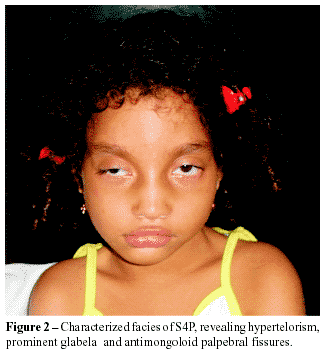
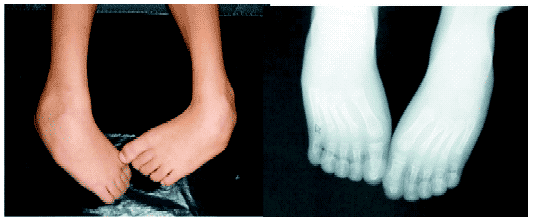
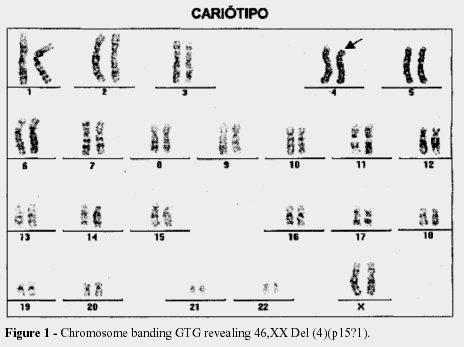
<body><![CDATA[<p><font size="2" face="Verdana"><b>Familiar previous history</b></font></p>     <p><font size="2" face="Verdana">Her 30 year-old father and her 37 year-old mother    are healthy. He had already smoked and she had asthma in childhood, but it's    in control nowadays. There are arterial hypertension cases in the paternal family.    On the mother's side, there are cases of tuberculosis, leprosy, malaria and    mental disease.</font></p>     <p><font size="2" face="Verdana"><b>Physical examination</b></font></p>     <p><font size="2" face="Verdana">Good clinical condition, she has no cyanosis    or jaundice and her respiratory rate is normal. Microcefhaly, cephalometry of    49 cm and thoracic perimeter of 57 cm; typical face; red-faced skin; normal    mucosa; subcutaneous cellular tissue with harmonious distribution, there is    no edema and the fold's thickness is normal; muscle hypotrophy of the inferior    members; clubfeet; non-palpable ganglia. Orofacial examination: hypertelorism,    big and large nose, prominent glabella, antimongoloid palpebral fissures and    high arched eyebrows.</font></p>     <p><font size="2" face="Verdana">Echodopplercardiographic study showed IAC, type    ostium secundum of 3,0 mm of extension without hemodynamic repercussion.</font></p>     <p><font size="2" face="Verdana">The electrocardiogram showed sinus tachycardia.    It was done axial computed tomography that showed: hypo density of cerebellar    and cerebral's white matter, discrete ectasia of supratentorial ventricular    system, especially, occipital portion of lateral ventricles, left putamen infarction    and hyper dense area that may correspond to low density calcification of left    nucleus's head.</font></p>     <p><font size="2" face="Verdana">The digital quantitative electroencephalography    in induced sleep with chloral hydrate 10% evidenced sequences of slow waves    in the right temporal region and left temporal electric activity's depression.</font></p>     <p><font size="2" face="Verdana">She was seen by a medical geneticist that was    responsible for making the karyotype exam that showed the following result 46,    XX, Del (4) (p15? 1). Indicating that the child has a partial deletion of a    terminal region of the short arm of one chromosome 4. This finding is compatible    with the diagnosis of Wolf-Hirschhorn syndrome.</font></p>     <p>&nbsp;</p>     <p><font size="3" face="Verdana"><b>DISCUSSION</b></font></p>     ]]></body>
<body><![CDATA[<p><font size="2" face="Verdana">This patient's clinical signals are characteristic    of WHS, especially those in the face as hypertelorism, big large nose, micrognathia,    antimongoloid palpebral fissures, high arched eyebrows and the microcephaly.</font></p>     <p><font size="2" face="Verdana">They are considered as a frequent finding, according    to Gonzalez et. al.<sup>1</sup>.</font></p>     <p><font size="2" face="Verdana">This child has congenital abnormalities and cytogenetic    findings that are described as typical of WHS</font></p>     <p><font size="2" face="Verdana">Other important signal found in echodopplercardiography    study of this child was IAC because is another preponderant abnormality usually    found is the presence of cardiovascular alterations, particularly, those located    in heart septum, represented by IAC and IVC, according to Bertola et. al.<sup>4</sup>.</font></p>     <p><font size="2" face="Verdana">The involvement of neuropsychomotor development    is common, including cognitive functions and motor activity<sup>5,6,7</sup>. In this case    report, many cognitive deficits are perceptible, basically functions as interaction    and learning. Evident motor dysfunctions with muscle atrophy and compromising    gait are present too.</font></p>     <p><font size="2" face="Verdana">In previous relates, seizures have been described    too1. In this study, they occurred when she was one year-old and these crisis    are controlled, using anticonvulsants.</font></p>     <p><font size="2" face="Verdana">According to recent studies<sup>8,9,10</sup>,    5% to 10% of idiopathic mental retardation's cases are attributed to subtelomeric    chromosome deletions, including those which affect the chromosome 4's short    arm. This fact happens due to this chromosome region's gene variability and    particularitities<sup>11,12</sup>. The treatment is symptomatic.</font></p>     <p><font size="2" face="Verdana">High mortality rate (one third of the patients    die with in the first year of age), feeding difficulties, muscular hypotonia,    seizures (80% of cases), tendency to infections, psychomotor retardation, kyphosis,    scoliosis, dentition delay and precocious or delayed puberty The evolution and    prognosis of the disease is influenced by the clinical signal.</font></p>     <p>&nbsp;</p>     <p><font size="3" face="Verdana"> <b>FINAL CONSIDERATIONS</b></font></p>     ]]></body>
<body><![CDATA[<p><font size="2" face="Verdana">The diagnostic of genetic disorders can be difficult    sometimes because of the heterogeneity of the clinical expression. In this case    the diagnostic was important for the parents because they could began the treatment    of the symptoms as seizures and had a follow up with physicians and services    as neuropediatrics, medical geneticist and others. Besides the parents could    have a session of genetic counseling.</font></p>     <p>&nbsp;</p>     <p align="center"><img src="/img/revistas/rpm/v21n3/3a09f1.gif" border="0"></p>     <p>&nbsp;</p>     <p align="center"><img src="/img/revistas/rpm/v21n3/3a09f2.gif" border="0"></p>     <p>&nbsp;</p>     <p align="center"><img src="/img/revistas/rpm/v21n3/3a09f3.gif" border="0"></p>     <p>&nbsp;</p>     <p><font size="2" face="Verdana"><b><font size="3">REFER&Ecirc;NCIAS</font></b></font></p>     <!-- ref --><p><font size="2" face="Verdana">1. GONZALES, C.H.; WAJNTAL, A.; CAPELOZZI, V.L.    Caso em Foco. <i>J. Pediat</i>. S&atilde;o Paulo, 1981, 3: 180-184.</font><!-- ref --><p><font size="2" face="Verdana">2. HANLEY-LOPEZ, J.; ESTABROOKS, L.L.; STIEHM,    R. Antibody deficiency in Wolf-Hirschhorn syndrome. <i>The Journal of Pediatrics</i>.    Jul. 1998, 133 (1): 141- 143.</font><!-- ref --><p><font size="2" face="Verdana">3. BATAGLIA, A.; GALASSO, C.; CEDERHOLM P.; VISKOCHIL    D.H.; BROTHMAN, AR. Natural history of Wolf Hirschhorn syndrome: experience    with 15 cases. <i>Pediatrics</i>. 1999, 103: 830-836.</font><!-- ref --><p><font size="2" face="Verdana">4. BERTOLA, D.R.; ALBANO, M.J.; KIM, A.E. <i>S&iacute;ndromes    Gen&eacute;ticas e Cardiopatia</i>. Soc. Cardiol. Estado de S&atilde;o Paulo.    2004, 3: 418-28.</font><!-- ref --><p><font size="2" face="Verdana">5. SCHLICKUM, S.; MOGHEKAR, A.; SIMPSON, J.C.;    STEGLICH, C.; O'BRIAN, R.J.; WINTERPACHT, A. LETM1, a gene deleted in Wolf&#8211;Hirschhorn    syndrome, encodes an evolutionarily conserved mitochondrial protein. <i>Genomics</i>.    2004, 83: 254&#8211;261.</font><!-- ref --><p><font size="2" face="Verdana">6. BERGEMANN, A.D.; COLE, F.; HIRSCHHORN, K.    The etiology of Wolf&#8211;Hirschhorn Syndrome. <i>Trends in genetics</i>. March    2005, 21 (3): 188-195.</font><!-- ref --><p><font size="2" face="Verdana">7. STEVENSON, D.A.; CAREY, C.; BRETT, M.P.H.;    COWLEY, B.S.; BROTHMAN, A.R. 4p terminal deletion and 11p subtelomerica duplication    detected by genomic microarray in a pacient with Wolf-Hirshhorn Syndrome and    an atypical phenotype. J Pediatr. 2004; 145: 840-842.</font><!-- ref --><p><font size="2" face="Verdana">8. ENDELE, S.; FUHRY, M.; PAK, S.; ZABEL, B.U.;    WINTERPACHT, A. LETM1, A Novel Gene Encoding a Putative EFHand Ca21-Binding    Protein, Flanks the Wolf&#8211;Hirschhorn Syndrome (WHS) Critical Region and    Is Deleted in Most WHS Patients. Genomics. 1999, 60: 218&#8211;225.</font><!-- ref --><p><font size="2" face="Verdana">9. WU-CHEN, W.Y.; CHRISTIANSEN, S.P.; BERRY,    S.A.; ENGEL, W.K.; FRAY, K.J.; SUMMERS, C.G. Ophthalmic Manifestations of Wolf&#8211;Hirschhorn    Syndrome. Journal of AAPOS. 4 August 2004, 8 (346): 435-438.</font><!-- ref --><p><font size="2" face="Verdana">10. WRIGHT, T.J.; COSTA, J.L.; NARANJO, C.; FRANCIS-WEST,    P.; ALTHERR, M.R. Comparative Analysis of a Novel Gene from the Wolf&#8211;Hirschhorn/Pitt&#8211;Rogers&#8211;Danks    Syndrome Critical Region. Genomics. 1999, 59: 203&#8211;212.</font><!-- ref --><p><font size="2" face="Verdana"> 11. BORSEL, J.V.; GRANDE, S.D.; BUGGENHOUT,    G.V.; FRYNS, J. Speech and language in Wolf-Hirschhorn syndrome: a case-study.    Journal of Communication Disorders. 2004, 37: 21&#8211;33.</font><!-- ref --><p><font size="2" face="Verdana">12. TUTUNCULER, F.; ACUNAS, B.; HICDONMEZ, T.;    DEVIREN, A.; PELITLI, V. Wolf-Hirschhorn syndrome with posterior intraorbital    coloboma cyst: an unusual case. Brain &amp; Development. 2004, 26: 203&#8211;205.</font><p>&nbsp;</p>     <p>&nbsp;</p>     <p><font size="2" face="Verdana"><b><a name="endereco"></a><a href="#topo"><img src="/img/revistas/rpm/v21n3/seta.gif" border="0"></a>Endere&ccedil;o    para Correspond&ecirc;ncia:</b>    <br>   Pablo Vaz Gon&ccedil;alves Borges.    <br>   Rua Oliveira Belo, n<sup>o</sup> 260 - Umarizal    <br>   CEP: 66050-380.    <br>   Bel&eacute;m &#8211; Par&aacute;.    <br>   Fone: (91) 3241-3779.    <br>   E-mail:<a href="mailto:pablo-vaz@hotmail.com">pablo-vaz@hotmail.com</a></font></p>     ]]></body>
<body><![CDATA[<p><font size="2" face="Verdana">Recebido em 11.06.2007    <br>   Aprovado em 19.09.2007</font></p>     <p>&nbsp;</p>     <p>&nbsp;</p>     <p><font size="2" face="Verdana"><a name="nota"></a><a href="#topo">1-</a> Hospital    Universit&aacute;rio Jo&atilde;o de Barros Barreto/UFPA </font></p>      ]]></body><back>
<ref-list>
<ref id="B1">
<label>1</label><nlm-citation citation-type="journal">
<person-group person-group-type="author">
<name>
<surname><![CDATA[GONZALES]]></surname>
<given-names><![CDATA[C.H]]></given-names>
</name>
<name>
<surname><![CDATA[WAJNTAL]]></surname>
<given-names><![CDATA[A]]></given-names>
</name>
<name>
<surname><![CDATA[CAPELOZZI]]></surname>
<given-names><![CDATA[V.L]]></given-names>
</name>
</person-group>
<article-title xml:lang="pt"><![CDATA[Caso em Foco]]></article-title>
<source><![CDATA[J. Pediat. São Paulo,]]></source>
<year>1981</year>
<volume>3</volume>
<page-range>180-184</page-range></nlm-citation>
</ref>
<ref id="B2">
<label>2</label><nlm-citation citation-type="journal">
<person-group person-group-type="author">
<name>
<surname><![CDATA[HANLEY-LOPEZ]]></surname>
<given-names><![CDATA[J]]></given-names>
</name>
<name>
<surname><![CDATA[ESTABROOKS]]></surname>
<given-names><![CDATA[L.L]]></given-names>
</name>
<name>
<surname><![CDATA[STIEHM]]></surname>
<given-names><![CDATA[R]]></given-names>
</name>
</person-group>
<article-title xml:lang="en"><![CDATA[Antibody deficiency in Wolf-Hirschhorn syndrome]]></article-title>
<source><![CDATA[The Journal of Pediatrics]]></source>
<year>1998</year>
<volume>133</volume><volume>1</volume>
<page-range>141- 143</page-range></nlm-citation>
</ref>
<ref id="B3">
<label>3</label><nlm-citation citation-type="journal">
<person-group person-group-type="author">
<name>
<surname><![CDATA[BATAGLIA]]></surname>
<given-names><![CDATA[A]]></given-names>
</name>
<name>
<surname><![CDATA[GALASSO]]></surname>
<given-names><![CDATA[C]]></given-names>
</name>
<name>
<surname><![CDATA[CEDERHOLM]]></surname>
<given-names><![CDATA[P]]></given-names>
</name>
<name>
<surname><![CDATA[VISKOCHIL]]></surname>
<given-names><![CDATA[D.H]]></given-names>
</name>
<name>
<surname><![CDATA[BROTHMAN]]></surname>
<given-names><![CDATA[AR]]></given-names>
</name>
</person-group>
<article-title xml:lang="en"><![CDATA[Natural history of Wolf Hirschhorn syndrome: experience with 15 cases]]></article-title>
<source><![CDATA[Pediatrics]]></source>
<year>1999</year>
<volume>103</volume>
<page-range>830-836</page-range></nlm-citation>
</ref>
<ref id="B4">
<label>4</label><nlm-citation citation-type="journal">
<person-group person-group-type="author">
<name>
<surname><![CDATA[BERTOLA]]></surname>
<given-names><![CDATA[D.R]]></given-names>
</name>
<name>
<surname><![CDATA[ALBANO]]></surname>
<given-names><![CDATA[M.J]]></given-names>
</name>
<name>
<surname><![CDATA[KIM]]></surname>
<given-names><![CDATA[A.E]]></given-names>
</name>
</person-group>
<source><![CDATA[Soc. Cardiol. Estado de São Paulo]]></source>
<year>2004</year>
<volume>3</volume>
<page-range>418-28</page-range></nlm-citation>
</ref>
<ref id="B5">
<label>5</label><nlm-citation citation-type="journal">
<person-group person-group-type="author">
<name>
<surname><![CDATA[SCHLICKUM]]></surname>
<given-names><![CDATA[S]]></given-names>
</name>
<name>
<surname><![CDATA[MOGHEKAR]]></surname>
<given-names><![CDATA[A]]></given-names>
</name>
<name>
<surname><![CDATA[SIMPSON]]></surname>
<given-names><![CDATA[J.C]]></given-names>
</name>
<name>
<surname><![CDATA[STEGLICH]]></surname>
<given-names><![CDATA[C]]></given-names>
</name>
<name>
<surname><![CDATA[O'BRIAN]]></surname>
<given-names><![CDATA[R.J]]></given-names>
</name>
<name>
<surname><![CDATA[WINTERPACHT]]></surname>
<given-names><![CDATA[A]]></given-names>
</name>
</person-group>
<article-title xml:lang="en"><![CDATA[LETM1, a gene deleted in Wolf-Hirschhorn syndrome, encodes an evolutionarily conserved mitochondrial protein]]></article-title>
<source><![CDATA[Genomics]]></source>
<year>2004</year>
<volume>83</volume>
<page-range>254-261</page-range></nlm-citation>
</ref>
<ref id="B6">
<label>6</label><nlm-citation citation-type="journal">
<person-group person-group-type="author">
<name>
<surname><![CDATA[BERGEMANN]]></surname>
<given-names><![CDATA[A.D]]></given-names>
</name>
<name>
<surname><![CDATA[COLE]]></surname>
<given-names><![CDATA[F]]></given-names>
</name>
<name>
<surname><![CDATA[HIRSCHHORN]]></surname>
<given-names><![CDATA[K]]></given-names>
</name>
</person-group>
<article-title xml:lang="en"><![CDATA[The etiology of Wolf-Hirschhorn Syndrome]]></article-title>
<source><![CDATA[Trends in genetics]]></source>
<year>2005</year>
<volume>21</volume>
<numero>3</numero>
<issue>3</issue>
<page-range>188-195</page-range></nlm-citation>
</ref>
<ref id="B7">
<label>7</label><nlm-citation citation-type="journal">
<person-group person-group-type="author">
<name>
<surname><![CDATA[STEVENSON]]></surname>
<given-names><![CDATA[D.A]]></given-names>
</name>
<name>
<surname><![CDATA[CAREY]]></surname>
<given-names><![CDATA[C]]></given-names>
</name>
<name>
<surname><![CDATA[BRETT]]></surname>
<given-names><![CDATA[M.P.H]]></given-names>
</name>
<name>
<surname><![CDATA[COWLEY]]></surname>
<given-names><![CDATA[B.S]]></given-names>
</name>
<name>
<surname><![CDATA[BROTHMAN]]></surname>
<given-names><![CDATA[A.R]]></given-names>
</name>
</person-group>
<article-title xml:lang="en"><![CDATA[4p terminal deletion and 11p subtelomerica duplication detected by genomic microarray in a pacient with Wolf-Hirshhorn Syndrome and an atypical phenotype]]></article-title>
<source><![CDATA[J Pediatr]]></source>
<year>2004</year>
<volume>145</volume>
<page-range>840-842</page-range></nlm-citation>
</ref>
<ref id="B8">
<label>8</label><nlm-citation citation-type="journal">
<person-group person-group-type="author">
<name>
<surname><![CDATA[ENDELE]]></surname>
<given-names><![CDATA[S]]></given-names>
</name>
<name>
<surname><![CDATA[FUHRY]]></surname>
<given-names><![CDATA[M]]></given-names>
</name>
<name>
<surname><![CDATA[PAK]]></surname>
<given-names><![CDATA[S]]></given-names>
</name>
<name>
<surname><![CDATA[ZABEL]]></surname>
<given-names><![CDATA[B.U]]></given-names>
</name>
<name>
<surname><![CDATA[WINTERPACHT]]></surname>
<given-names><![CDATA[A]]></given-names>
</name>
</person-group>
<article-title xml:lang="en"><![CDATA[LETM1, A Novel Gene Encoding a Putative EFHand Ca21-Binding Protein, Flanks the Wolf-Hirschhorn Syndrome (WHS) Critical Region and Is Deleted in Most WHS Patients]]></article-title>
<source><![CDATA[Genomics]]></source>
<year>1999</year>
<volume>60</volume>
<page-range>218-225</page-range></nlm-citation>
</ref>
<ref id="B9">
<label>9</label><nlm-citation citation-type="journal">
<person-group person-group-type="author">
<name>
<surname><![CDATA[WU-CHEN]]></surname>
<given-names><![CDATA[W.Y]]></given-names>
</name>
<name>
<surname><![CDATA[CHRISTIANSEN]]></surname>
<given-names><![CDATA[S.P]]></given-names>
</name>
<name>
<surname><![CDATA[BERRY]]></surname>
<given-names><![CDATA[S.A]]></given-names>
</name>
<name>
<surname><![CDATA[ENGEL]]></surname>
<given-names><![CDATA[W.K]]></given-names>
</name>
<name>
<surname><![CDATA[FRAY]]></surname>
<given-names><![CDATA[K.J]]></given-names>
</name>
<name>
<surname><![CDATA[SUMMERS]]></surname>
<given-names><![CDATA[C.G]]></given-names>
</name>
</person-group>
<article-title xml:lang="en"><![CDATA[Ophthalmic Manifestations of Wolf-Hirschhorn Syndrome]]></article-title>
<source><![CDATA[Journal of AAPOS]]></source>
<year>4 Au</year>
<month>gu</month>
<day>st</day>
<volume>8</volume>
<numero>346</numero>
<issue>346</issue>
<page-range>435-438</page-range></nlm-citation>
</ref>
<ref id="B10">
<label>10</label><nlm-citation citation-type="journal">
<person-group person-group-type="author">
<name>
<surname><![CDATA[WRIGHT]]></surname>
<given-names><![CDATA[T.J]]></given-names>
</name>
<name>
<surname><![CDATA[COSTA]]></surname>
<given-names><![CDATA[J.L]]></given-names>
</name>
<name>
<surname><![CDATA[NARANJO]]></surname>
<given-names><![CDATA[C]]></given-names>
</name>
<name>
<surname><![CDATA[FRANCIS-WEST]]></surname>
<given-names><![CDATA[P]]></given-names>
</name>
<name>
<surname><![CDATA[ALTHERR]]></surname>
<given-names><![CDATA[M.R]]></given-names>
</name>
</person-group>
<article-title xml:lang="en"><![CDATA[Comparative Analysis of a Novel Gene from the Wolf-Hirschhorn/Pitt-Rogers-Danks Syndrome Critical Region]]></article-title>
<source><![CDATA[Genomics]]></source>
<year>1999</year>
<volume>59</volume>
<page-range>203-212</page-range></nlm-citation>
</ref>
<ref id="B11">
<label>11</label><nlm-citation citation-type="journal">
<person-group person-group-type="author">
<name>
<surname><![CDATA[BORSEL]]></surname>
<given-names><![CDATA[J.V]]></given-names>
</name>
<name>
<surname><![CDATA[GRANDE]]></surname>
<given-names><![CDATA[S.D]]></given-names>
</name>
<name>
<surname><![CDATA[BUGGENHOUT]]></surname>
<given-names><![CDATA[G.V]]></given-names>
</name>
<name>
<surname><![CDATA[FRYNS]]></surname>
<given-names><![CDATA[J]]></given-names>
</name>
</person-group>
<article-title xml:lang="en"><![CDATA[Speech and language in Wolf-Hirschhorn syndrome: a case-study]]></article-title>
<source><![CDATA[Journal of Communication Disorders]]></source>
<year>2004</year>
<volume>37</volume>
<page-range>21-33</page-range></nlm-citation>
</ref>
<ref id="B12">
<label>12</label><nlm-citation citation-type="journal">
<person-group person-group-type="author">
<name>
<surname><![CDATA[TUTUNCULER]]></surname>
<given-names><![CDATA[F]]></given-names>
</name>
<name>
<surname><![CDATA[ACUNAS]]></surname>
<given-names><![CDATA[B]]></given-names>
</name>
<name>
<surname><![CDATA[HICDONMEZ]]></surname>
<given-names><![CDATA[T]]></given-names>
</name>
<name>
<surname><![CDATA[DEVIREN]]></surname>
<given-names><![CDATA[A]]></given-names>
</name>
<name>
<surname><![CDATA[PELITLI]]></surname>
<given-names><![CDATA[V]]></given-names>
</name>
</person-group>
<article-title xml:lang="en"><![CDATA[Wolf-Hirschhorn syndrome with posterior intraorbital coloboma cyst: an unusual case]]></article-title>
<source><![CDATA[Brain & Development]]></source>
<year>2004</year>
<volume>26</volume>
<page-range>203-205</page-range></nlm-citation>
</ref>
</ref-list>
</back>
</article>