<?xml version="1.0" encoding="ISO-8859-1"?><article xmlns:mml="http://www.w3.org/1998/Math/MathML" xmlns:xlink="http://www.w3.org/1999/xlink" xmlns:xsi="http://www.w3.org/2001/XMLSchema-instance">
<front>
<journal-meta>
<journal-id>0101-5907</journal-id>
<journal-title><![CDATA[Revista Paraense de Medicina]]></journal-title>
<abbrev-journal-title><![CDATA[Rev. Para. Med.]]></abbrev-journal-title>
<issn>0101-5907</issn>
<publisher>
<publisher-name><![CDATA[Fundação Santa Casa de Misericórdia do Pará]]></publisher-name>
</publisher>
</journal-meta>
<article-meta>
<article-id>S0101-59072007000400003</article-id>
<title-group>
<article-title xml:lang="en"><![CDATA[Profile of hemodynamic and gasometric parameters in rabbits submitted to controlled hemorrhagic shock]]></article-title>
<article-title xml:lang="pt"><![CDATA[Perfil dos parâmetros hemodinâmicos e gasométricos em coelhos submetidos a choque hemorrágico controlado]]></article-title>
</title-group>
<contrib-group>
<contrib contrib-type="author">
<name>
<surname><![CDATA[Fontelles]]></surname>
<given-names><![CDATA[Mauro José]]></given-names>
</name>
<xref ref-type="aff" rid="A01"/>
</contrib>
<contrib contrib-type="author">
<name>
<surname><![CDATA[Carvalho]]></surname>
<given-names><![CDATA[Raimundo Miranda de]]></given-names>
</name>
<xref ref-type="aff" rid="A02"/>
</contrib>
<contrib contrib-type="author">
<name>
<surname><![CDATA[D'Oliveira]]></surname>
<given-names><![CDATA[Luana Maria Relvas]]></given-names>
</name>
<xref ref-type="aff" rid="A02"/>
</contrib>
<contrib contrib-type="author">
<name>
<surname><![CDATA[Madeira]]></surname>
<given-names><![CDATA[André Vilarino]]></given-names>
</name>
<xref ref-type="aff" rid="A02"/>
</contrib>
<contrib contrib-type="author">
<name>
<surname><![CDATA[Borges]]></surname>
<given-names><![CDATA[Pablo Vaz Gonçalves]]></given-names>
</name>
<xref ref-type="aff" rid="A02"/>
</contrib>
<contrib contrib-type="author">
<name>
<surname><![CDATA[D'Oliveira]]></surname>
<given-names><![CDATA[Marcelo Silveira]]></given-names>
</name>
<xref ref-type="aff" rid="A03"/>
</contrib>
</contrib-group>
<aff id="A01">
<institution><![CDATA[,Universidade Federal do Pará Universidade da Amazônia ]]></institution>
<addr-line><![CDATA[ ]]></addr-line>
</aff>
<aff id="A02">
<institution><![CDATA[,Universidade Federal do Pará Medicine Course ]]></institution>
<addr-line><![CDATA[ ]]></addr-line>
</aff>
<aff id="A03">
<institution><![CDATA[,Universidade Estadual do Pará Medicine Course ]]></institution>
<addr-line><![CDATA[ ]]></addr-line>
</aff>
<pub-date pub-type="pub">
<day>00</day>
<month>12</month>
<year>2007</year>
</pub-date>
<pub-date pub-type="epub">
<day>00</day>
<month>12</month>
<year>2007</year>
</pub-date>
<volume>21</volume>
<numero>4</numero>
<fpage>15</fpage>
<lpage>21</lpage>
<copyright-statement/>
<copyright-year/>
<self-uri xlink:href="http://scielo.iec.gov.br/scielo.php?script=sci_arttext&amp;pid=S0101-59072007000400003&amp;lng=en&amp;nrm=iso"></self-uri><self-uri xlink:href="http://scielo.iec.gov.br/scielo.php?script=sci_abstract&amp;pid=S0101-59072007000400003&amp;lng=en&amp;nrm=iso"></self-uri><self-uri xlink:href="http://scielo.iec.gov.br/scielo.php?script=sci_pdf&amp;pid=S0101-59072007000400003&amp;lng=en&amp;nrm=iso"></self-uri><abstract abstract-type="short" xml:lang="en"><p><![CDATA[OBJECTIVE: the aim of this study was to assess the values of hemodynamic, gasometric and electrolytic parameters, in rabbits submitted to controlled hemorrhagic shock, using an experimental model for catheterization of right carotid artery and jugular vein. METHODS: fourteen male California rabbits were submitted to intramuscular anesthesia, and medium cervicotomy was performed for catheterization of right carotid artery and right jugular vein. The animals were bled to a mean arterial pressure of 40mmHg and were maintained at this level, by further blood withdrawal, during 20 minutes, followed by 15 minutes of resuscitation using lactated Ringer's solution and remaining shed blood volume (3:1) to mean arterial pressure equal 80mmHg, and 120 minutes of reperfusion. Arterial blood gas, serum lactate and electrolytes (sodium and potassium) samples were measured at baseline, hemorrhagic shock, at the time of resuscitation, and at the time of reperfusion (30, 60, 90 and 120min). RESULTS: the mean of initial values of hemodynamic parameters were - MAP=82.3mmHg, RR=51.4breaths/min, HR=141.5beats/min; gasometric parameters - pH=7.358, PaCO2=46.6mmHg, PaO2=271.9mmHg, HCO3 -=25.0mmol/L, base deficit=1.5mmol/L, serum lactate=2.6mmol/L; electrolytic parameters - Na+=131.7mEq/L and K+=3.4mEq/L. CONCLUSIONS: this study presents a reproducible model of hemorrhagic shock in Californian rabbits, which describes the progressive hemodynamic and metabolic changes that reflect the changes seen frequently in the clinical situation, besides offers a model to assess novel therapeutics interventions in a controlled setting.]]></p></abstract>
<abstract abstract-type="short" xml:lang="pt"><p><![CDATA[OBJETIVO: avaliar os valores dos parâmetros hemodinâmicos, gasométricos e eletrolíticos, em coelhos submetidos a choque hemorrágico controlado, com a utilização de um modelo experimental de cateterização da artéria carótida e veia jugular direitas. MÉTODO: catorze coelhos Califórnia, machos, foram submetidos à anestesia intramuscular seguida de cervicotomia mediana e cateterização da artéria carótida direita e da veia jugular direita. Os animais foram sangrados até a pressão arterial média (PAM) de 40mmHg e mantidos neste nível durante 20 minutos, seguidos de 15 minutos de reposição com a utilização de solução de Ringer lactato e sangue (3:1) até a PAM atingir 80mmHg, e 120 minutos de reperfusão. Amostras dos gases arteriais, do lactato sérico e dos eletrólitos (sódio e potássio) foram coletadas no início do experimento, no choque hemorrágico, no período de reposição e na reperfusão (30, 60, 90 e 120 minutos). RESULTADOS: a média dos valores iniciais dos parâmetros hemodinâmicos foram - PAM=82.3mmHg, FR=51.4mov/min, FC=141.5bat/min; parâmetros gasométricos - pH=7.358, PaCO2=46.6mmHg, PaO2=271.9mmHg, HCO3 -=25.0mmol/L, déficit de base=1.5mmol/L, lactato sérico=2.6mmol/L; parâmetros eletrolíticos - Na+=131.7mEq/L and K+=3.4mEq/L. CONCLUSÕES: este estudo apresenta um modelo reprodutível de choque hemorrágico controlado em coelhos Califórnia, o qual descreve as progressivas alterações hemodinâmicas e metabólicas que refletem aquelas freqüentemente observadas em situações clínicas, além de oferecer um modelo para avaliar novas terapêuticas em estudos controlados.]]></p></abstract>
<kwd-group>
<kwd lng="en"><![CDATA[Hemorrhagic shock]]></kwd>
<kwd lng="en"><![CDATA[blood gas analysis]]></kwd>
<kwd lng="en"><![CDATA[hemodynamic response]]></kwd>
<kwd lng="en"><![CDATA[rabbits]]></kwd>
<kwd lng="pt"><![CDATA[Choque hemorrágico]]></kwd>
<kwd lng="pt"><![CDATA[gasometria]]></kwd>
<kwd lng="pt"><![CDATA[resposta hemodinâmica]]></kwd>
<kwd lng="pt"><![CDATA[coelhos]]></kwd>
</kwd-group>
</article-meta>
</front><body><![CDATA[ <p align="right"><font size="2" face="verdana"><b><a name="topo"></a>ARTIGO ORIGINAL</b></font></p>     <p>&nbsp;</p>     <p><font size="4" face="verdana"><b>Profile of hemodynamic and gasometric parameters    in rabbits submitted to controlled hemorrhagic shock<sup><a href="#n1"><font size="3">1</font></a><a name="s1"></a></sup></b></font></p>     <p>&nbsp;</p>     <p><font size="3" face="verdana"><b>Perfil dos par&acirc;metros hemodin&acirc;micos    e gasom&eacute;tricos em coelhos submetidos a choque hemorr&aacute;gico controlado</b></font></p>     <p>&nbsp;</p>     <p>&nbsp;</p>     <p><font size="2" face="verdana"><b>Mauro Jos&eacute; Fontelles<sup>I</sup>; Raimundo    Miranda de Carvalho<sup>II</sup>; Luana Maria Relvas D'Oliveira<sup>II</sup>;    Andr&eacute; Vilarino Madeira<sup>II</sup>; Pablo Vaz Gon&ccedil;alves Borges<sup>II</sup>;    Marcelo Silveira D'Oliveira<sup>III</sup></b></font></p>     <p><font size="2" face="verdana"> <sup>I</sup>Ph.D., Trauma Surgery, Professor    of Human Anatomy, Universidade da Amaz&ocirc;nia (UNAMA) and Universidade Federal    do Par&aacute; (UFPA)    <br>   <sup>II</sup>Beginning researcher, Medicine Course, Universidade Federal do Par&aacute;    (UFPA)    ]]></body>
<body><![CDATA[<br>   <sup>III</sup>Beginning researcher, Medicine Course, Universidade Estadual do    Par&aacute; (UEPA)</font></p>     <p><font size="2" face="verdana"><a href="#endereco">Correspondence</a></font></p>     <p>&nbsp;</p>     <p>&nbsp;</p> <hr size="1" noshade>     <p><font size="2" face="verdana"><b>SUMMARY</b></font></p>     <p><font size="2" face="verdana"><b>OBJECTIVE</b>: the aim of this study was to    assess the values of hemodynamic, gasometric and electrolytic parameters, in    rabbits submitted to controlled hemorrhagic shock, using an experimental model    for catheterization of right carotid artery and jugular vein.    <br>   <b>METHODS</b>: fourteen male California rabbits were submitted to intramuscular    anesthesia, and medium cervicotomy was performed for catheterization of right    carotid artery and right jugular vein. The animals were bled to a mean arterial    pressure of 40mmHg and were maintained at this level, by further blood withdrawal,    during 20 minutes, followed by 15 minutes of resuscitation using lactated Ringer's    solution and remaining shed blood volume (3:1) to mean arterial pressure equal    80mmHg, and 120 minutes of reperfusion. Arterial blood gas, serum lactate and    electrolytes (sodium and potassium) samples were measured at baseline, hemorrhagic    shock, at the time of resuscitation, and at the time of reperfusion (30, 60,    90 and 120min).    <br>   <b>RESULTS</b>: the mean of initial values of hemodynamic parameters were &#8211;    MAP=82.3mmHg, RR=51.4breaths/min, HR=141.5beats/min; gasometric parameters -    pH=7.358, PaCO<sub>2</sub>=46.6mmHg, PaO<sub>2</sub>=271.9mmHg, HCO<sub>3</sub> <sup>-</sup>=25.0mmol/L, base deficit=1.5mmol/L,    serum lactate=2.6mmol/L; electrolytic parameters &#8211; Na<sup>+</sup>=131.7mEq/L and    K<sup>+</sup>=3.4mEq/L.    <br>   <b>CONCLUSIONS</b>: this study presents a reproducible model of hemorrhagic    shock in Californian rabbits, which describes the progressive hemodynamic and    metabolic changes that reflect the changes seen frequently in the clinical situation,    besides offers a model to assess novel therapeutics interventions in a controlled    setting.</font></p>     <p><font size="2" face="verdana"><b>KEY WORDS</b>: Hemorrhagic shock, blood gas    analysis, hemodynamic response, rabbits.</font></p> <hr size="1" noshade>     ]]></body>
<body><![CDATA[<p><font size="2" face="verdana"><b>RESUMO</b></font></p>     <p><font size="2" face="verdana"><b><i>OBJETIVO:</i></b><i> avaliar os valores    dos par&acirc;metros hemodin&acirc;micos, gasom&eacute;tricos e eletrol&iacute;ticos,    em coelhos submetidos a choque hemorr&aacute;gico controlado, com a utiliza&ccedil;&atilde;o    de um modelo experimental de cateteriza&ccedil;&atilde;o da art&eacute;ria car&oacute;tida    e veia jugular direitas.    <br>   <b>M&Eacute;TODO:</b> catorze coelhos Calif&oacute;rnia, machos, foram submetidos    &agrave; anestesia intramuscular seguida de cervicotomia mediana e cateteriza&ccedil;&atilde;o    da art&eacute;ria car&oacute;tida direita e da veia jugular direita. Os animais    foram sangrados at&eacute; a press&atilde;o arterial m&eacute;dia (PAM) de 40mmHg    e mantidos neste n&iacute;vel durante 20 minutos, seguidos de 15 minutos de    reposi&ccedil;&atilde;o com a utiliza&ccedil;&atilde;o de solu&ccedil;&atilde;o    de Ringer lactato e sangue (3:1) at&eacute; a PAM atingir 80mmHg, e 120 minutos    de reperfus&atilde;o. Amostras dos gases arteriais, do lactato s&eacute;rico    e dos eletr&oacute;litos (s&oacute;dio e pot&aacute;ssio) foram coletadas no    in&iacute;cio do experimento, no choque hemorr&aacute;gico, no per&iacute;odo    de reposi&ccedil;&atilde;o e na reperfus&atilde;o (30, 60, 90 e 120 minutos).    <br>   <b>RESULTADOS:</b> a m&eacute;dia dos valores iniciais dos par&acirc;metros    hemodin&acirc;micos foram - PAM=82.3mmHg, FR=51.4mov/min, FC=141.5bat/min; par&acirc;metros    gasom&eacute;tricos - pH=7.358, PaCO<sub>2</sub>=46.6mmHg, PaO<sub>2</sub>=271.9mmHg,    HCO<sub>3</sub> <sup>-</sup>=25.0mmol/L, d&eacute;ficit de base=1.5mmol/L, lactato    s&eacute;rico=2.6mmol/L; par&acirc;metros eletrol&iacute;ticos &#8211; Na<sup>+</sup>=131.7mEq/L    and K<sup>+</sup>=3.4mEq/L.    <br>   <b>CONCLUS&Otilde;ES:</b> este estudo apresenta um modelo reprodut&iacute;vel    de choque hemorr&aacute;gico controlado em coelhos Calif&oacute;rnia, o qual    descreve as progressivas altera&ccedil;&otilde;es hemodin&acirc;micas e metab&oacute;licas    que refletem aquelas freq&uuml;entemente observadas em situa&ccedil;&otilde;es    cl&iacute;nicas, al&eacute;m de oferecer um modelo para avaliar novas terap&ecirc;uticas    em estudos controlados.</i></font></p>     <p><font size="2" face="verdana"><b>DESCRITORES</b>: Choque hemorr&aacute;gico,    gasometria, resposta hemodin&acirc;mica, coelhos.</font></p> <hr size="1" noshade>     <p>&nbsp;</p>     <p>&nbsp;</p>     <p><font size="3" face="verdana"><b>INTRODUCTION</b></font></p>     <p><font size="2" face="verdana">Ischemia and subsequent reperfusion lead to substantial    damage to cells and organs, depending on the ischemic time. On the medical practice,    many causes can lead to ischemic-reperfusion lesion, but severe arterial hypotension,    caused by hemorrhages, is that one which is better associated to major traumas<sup>1,2,3</sup>.    Therefore, the quantification of the seriousness of tissue injury incurred following    hemorrhagic shock is important in the management and prognosis of patients,    as well as understanding of its physiopathology, and, for this reason, numerous    recent clinical and experimental study have shown that the physiological response    to hemorrhage can be unpredictable, and, traditionally, hemodynamic an metabolic    parameters have long remained as the key in clinical assessment of the degree    of hypovolemia or predicting outcome following hemorrhagic shock<sup>4,5</sup>.    </font><font size="2" face="verdana">Thus, in many research laboratories, studies    in small animals have been common nowadays, especially with utilization of rats,    rabbits, dogs or pigs, all with purpose of better explain the evolution of different    hemodynamic and metabolic parameters which occur during ischemia-reperfusion    phase following the hemorrhagic shock.</font></p>     ]]></body>
<body><![CDATA[<p>&nbsp;</p>     <p><font size="3" face="verdana"><b>OBJECTIVE</b></font></p>     <p><font size="2" face="verdana">To assess the value of hemodynamic and gasometric    parameters, in rabbits submitted to controlled hemorrhagic shock, using a clinically-relevant    experimental model for catheterization of right carotid artery and jugular vein.</font></p>     <p>&nbsp;</p>     <p><font size="3" face="verdana"><b>METHODS</b></font></p>     <p><font size="2" face="verdana">This study was performed at the Multidisciplinary    Unit of Experimental Medicine, Surgery Department, Federal University of Par&aacute;    (UFPA), Brazil, and done in accordance with guidelines established by the Institutional    Animal Care and Use Committee at the State University of Par&aacute;. Fourteen    male Californian rabbits (2500-3000g), all proceeded from Zootecny Center of    Rural Federal University of Amazon (UFRA), were used in all experiments, which    were kept in, adjusted conditions of light and temperature, receiving standard    diet ad libitum, except for 6 hrs before surgery when there was access to water    only. All the animals were submitted to anesthesic and monitorization procedures    previously to the surgery that was made for the same team, during the entire    study, and were submitted to surgery in the same period of the day, avoiding    any influence that the difference of the period could bring to the results.    Rabbits were anesthetized with an intramuscular solution of ketamine (80mg/kg),    xylazine (10mg/kg) and atropine (0.05 mg/kg). Oxygen was managed in the concentration    of 2 L/min, using a plastic mask that was adapted to the face of the animal,    protecting it partially. The characterization of the anesthesic plan was evaluated    using parameters, such as: mustache and ears movements after stimulation (sedation);    absence of tail and legs' retraction after digital pressure (surgical anesthesia).    Our preliminary studies had determined these procedures settings to maintain    physiological blood gas concentration prior to the onset of hemorrhage.</font></p>     <p><font size="2" face="verdana">After anesthesic induction, it was made   depilation of the neck, followed by apprehension of   members in extension with plastic wires. Using aseptic   technique, the blood vessels were then dissected with   placement of a polyethylene arterial catheter in the   right carotid artery (4mm gauge) for continuous blood   pressure monitoring, arterial blood gas samples and   blood withdrawal, and a venous catheter in the right   jugular vein (4mm gauge) for venous blood gas   samples and volemic infusion. Each catheter was   initially flushed with 0.1 mL of heparin (100 U/mL),   but the rabbits were not heparinized. Following a 5   min stabilization period, baseline (BL) measurements   of mean arterial pressure (MAP), heart rate (HR),   respiratory rate (RR) and rectal temperature (RT) were   recorded, as well as arterial and venous gasometry,   electrolytes and serum lactate. The rabbits were then   bled to a MAP of 40 mmHg over 15 min, and   maintained at this level by further blood withdrawal,   when necessary. The hemorrhagic shock was   continued for 20 min, followed by 15 min of   resuscitation, which consisted of returning all shed   blood volume, plus lactated Ringer's solution (1:3)   with the goal of maintaining the MAP over 80 mmHg.   At the end of the resuscitation period, hemodynamic   monitoring was continued for a total of 4 h   (reperfusion period), after which the animals were   sacrificed by the infusion of 3 ml of Thiopental   through the catheterized right carotid artery. The blood   gas samples, electrolytes and arterial serum lactate   levels were drawn in seven moments: at baseline, end   of hemorrhagic shock period (HS), end of volume   reposition (REP) and four times during the reperfusion   period (30, 60, 90 and 120 min).</font></p>     <p><font size="2" face="verdana">Comparison of parameters between each of the    seven phases of the experiment was performed using one-way analysis of variance    (ANOVA) and Tukey test. Differences were considered significant at p &lt; 0.05.    All results are expressed as men &#177; standard error of mean (SEM).</font></p>     <p>&nbsp;</p>     <p><font size="3" face="verdana"><b>RESULTS</b></font></p>     ]]></body>
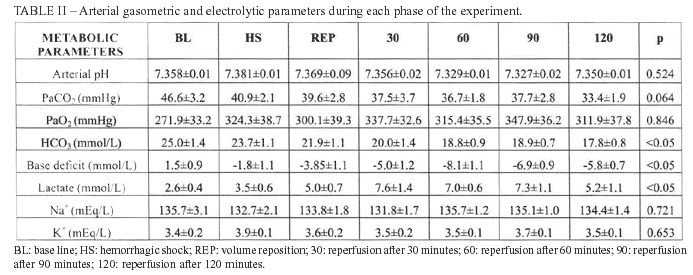
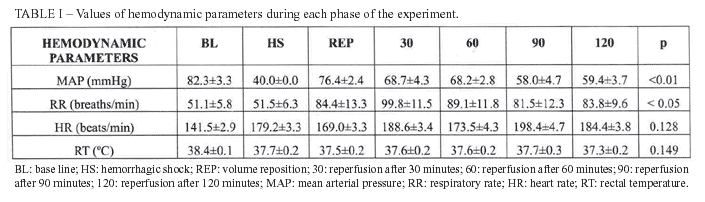
<body><![CDATA[<p><font size="2" face="verdana">The hemodynamic parameters variation during each    phase of the experiment is presented on <a href="#tab1">table I</a>. It was    observed statistical significant difference related to MAP when compared BL    to 90 min and 120 min (p&lt;0.01); related to RR when compared 30 min to BL    and HS (p&lt;0.05).</font></p>     <p><a name="tab1"></a></p>     <p>&nbsp;</p>     <p align="center"><img src="/img/revistas/rpm/v21n4/4a03t1.gif" border="0"></p>     <p>&nbsp;</p>     <p><font size="2" face="verdana">The arterial gasometric data, lactate, sodium    and potassium are expressed in <a href="#tab2">table II</a>. There was statistical    difference related to bicarbonate when compared BL to 60 min, 90 min and 120    min (p&lt;0.01), as well as when compared HS to 60 min and 120 min (p&lt;0.05).    The difference was also found and it was related to Base Deficit when compared    BL to 60 min, 90 min and 120 min (p&lt;0.05); HS to 60 min, 90 min and 120 min    (p&lt;0.05). The serum lactate analysis showed p&lt;0.01 when compared BL to    30min, and p&lt;0.05 when compared BL to 90 min and 120 min.</font></p>     <p><a name="tab2"></a></p>     <p>&nbsp;</p>     <p align="center"><img src="/img/revistas/rpm/v21n4/4a03t2.gif" border="0"></p>     <p>&nbsp;</p>     ]]></body>
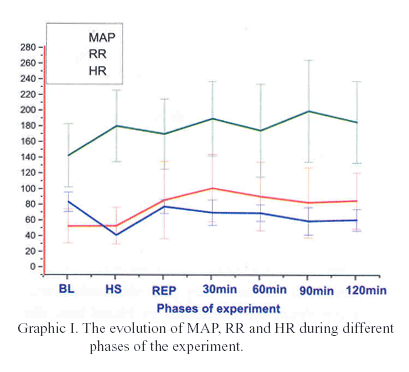
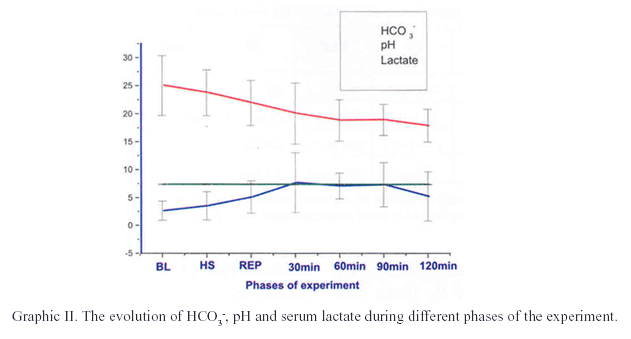
<body><![CDATA[<p><font size="2" face="verdana">The <a href="#fig1">figures I</a> and <a href="#fig2">II</a>    show the evolution of the hemodynamic and metabolic parameters during different    phases of the experiment.</font></p>     <p><a name="fig1" id="fig1"></a></p>     <p>&nbsp;</p>     <p align="center"><img src="/img/revistas/rpm/v21n4/4a03g1.gif" border="0"></p>     <p>&nbsp;</p>     <p><a name="fig2"></a></p>     <p>&nbsp;</p>     <p align="center"><img src="/img/revistas/rpm/v21n4/4a03g2.gif" border="0"></p>     <p>&nbsp;</p>     <p>&nbsp;</p>     ]]></body>
<body><![CDATA[<p><font size="3" face="verdana"><b>DISCUSSION</b></font></p>     <p><font size="2" face="verdana">Hemorrhagic shock remains a major cause of   morbidity and mortality in surgical patients and trauma   victims, mainly due to ischemia-reperfusion lesions   followed by multiple organ dysfunctions.</font></p>     <p><font size="2" face="verdana">Consequently to a considerable blood loss, occurs    a   compensatory redistribution of the blood volume,   from less noble tissues (skin, muscles and splanchnic   organs) to brain, heart and lungs that could be affected   by subsequent reperfusion. This way, patients victims   of severe trauma can develop an important systemic   repercussion, the systemic inflammatory response   syndrome (SIRS), with subsequently respiratory and   infection complications, heart and kidney   dysfunctions, culminating in multiple organs and   systems failure, specially lung and heart<sup>6,7,8</sup>.</font></p>     <p><font size="2" face="verdana">Thus, recent studies have suggested that changes    in hemodynamics and metabolic parameters may be more accurate measures of circulating    blood volume and subsequent prognosis in hemorrhagic shock. On the other hand,    several trials affirm that there are no universally accepted, clinically useful    indicators of tissue hypoperfusion or hypoxia; however, numerous clinical studies    have show that physiological response to hemorrhage can be unpredictable<sup>4,5</sup>.    For this reason, for a long time ago, the experimental models using different    animal species have been utilized as a method to study the ischemia-reperfusion    repercussion following hemorrhagic shock. These models, despite several limitations,    remain essential in the development of new approaches for hemorrhagic shock    treatment, because they provide fundamental information about the magnitude    of blood loss, the repercussion of the different periods of hemorrhagic shock    period, the evaluation of hemodynamic and gasometric parameters, the effect    of the anesthesic method, aggressive fluid resuscitation, the pharmacokinetics,    toxicity and mechanism of drug action, and other major uncontrolled factors,    such as the presence of drugs or alcohol, which cannot be duplicated by other    methods<sup>9</sup>. For instance, Girisgin <i>et al</i><sup>10</sup>, using    a experimental model in rabbits, studied importance of early and effective fluid    resuscitation in hypovolemic shock treatment with the utilization of fluid replacement    via the rectum, as a possible life-saving method in situations where veins cannot    be accessed quickly. Lhuillier <i>et al</i><sup>11</sup>, also with a rabbit    model, evaluate the nitric oxide involvement in the regulation of hepatic microcirculation    under physiological conditions and in hemorrhagic shock, and concluded that    it plays a important role in the autoregulation of liver microcirculation during    the hemorrhagic shock. In the same manner, Komori <i>et al</i><sup>12</sup>,    studied the effects of hydroxyethyl starch on the microcirculation, hemodynamics,    and colloidal osmotic pressure in a rabbit model of hemorrhagic shock, and verified    that intravenous infusion of this solution effectively maintains these parameters    during acute severe hemorrhage.</font></p>     <p><font size="2" face="verdana">Thus, our study consists in the development of   experimental model to perfect the surgical technique   for the vascular catheterization with subsequent   clinical and laboratorial analyses in Californian   rabbits, inasmuch as its consolidation is essential,   because the procedure needs to be done carefully and   it comes only with practice. The basic supposition of   this present experimental study is that if all animals   received the same hemorrhagic shock model, in the   same location, the same duration of hemorrhagic   hypotension, and the same aggressive fluid resuscitation, then injury severity    was proportional to   the amount blood loss. The reliability of data   interpretation depends on the validity of that   assumption.</font></p>     <p><font size="2" face="verdana">In relation to hemodynamic parameters, the MAP    analysis showed that it doesn't return to the initial level (82.30 mmHg) after    120 minutes of reperfusion, evolving with lower values than normal during the    experiment, thus demonstrating hemodynamic stabilization instead of the normalization.    The concept of compensated shock has been used for situations of ongoing inadequate    tissue perfusion despite normalization of blood pressure, heart rate and urine    output<sup>13</sup>. In consequence to a severe and prolonged hypovolemia, the    neuroendocrine responses that are characteristics of compensated shock begin    to fail and a decompensate state develops, which is characterized by failure    of the microcirculation with progressive peripheral vasodilatation, absence    or few reactivity to vasopressor drugs and capillary leak. According to Kazuo    <i>et al</i><sup>14</sup>, with an experimental model in Lewis rats, they demonstrated    that although transient hyperemia may be observed after short-term ischemia,    the final tissue blood flow after ischemia-reperfusion does not reach preischemic    levels. This state frequently occurs in patients that suffered multiple traumas.</font></p>     <p><font size="2" face="verdana">In hemorrhagic shock there is the loss of   metabolic balance, culminating in the production of   metabolic acidosis. The plasmatic catecholamine   levels are elevated soon after injury, and a direct   relationship between the severity of injury and the   plasma catecholamine changes can be observed. These   events are later followed by compensatory   mechanisms that attempt to restore the initial   homeostasis. Thus, the elevation of RR occurs, aiming   the reduction of CO<sub>2</sub> retention and the elimination of   H<sup>+</sup>, leading to an arterial pH normalization<sup>8</sup>. In this   experiment, the fall of RR was present in the beginning   due to the anesthesia. On the other hand, there was   progressive elevation during the hemorrhagic shock   period, with tendency to stabilization in the   subsequently stages, according to what was expected.   The elevation of HR is one of the primordial   compensatory mechanisms to correct the decrease of   tissue perfusion. It generates the increase of cardiac   output, elevating blood pressure<sup>15</sup>. In our study, it was   observed the elevation of HR along the period of   hemorrhagic shock, however no returning to initial   values after the intravenous fluid resuscitation. The   maintenance of these mechanisms and the large blood volume loss keep HR elevated,    aiming to maintain   the tissue perfusion. In the literature, it was found this   progressive elevation during the experiment,   supporting this observation<sup>15,16</sup>.</font></p>     <p><font size="2" face="verdana">One other factor is the anesthesia; anesthetics,   e.g., the ketamine and xylazine used in the present   study, may affect the vascular response and blood flow   after ischemia, which would thus not reflect the   physiological response of each vasculature. However,   in the clinical setting, ischemia-reperfusion following   hemorrhagic shock is usually studied in surgical   procedures occurring under anesthesia.</font></p>     <p><font size="2" face="verdana">In relation to gasometric parameters, the   hemorrhagic shock promotes a deoxygenated   environment leading to a production of organic acids   with metabolic acidosis<sup>15</sup>. In this study, it was ratified   by the presence of arterial pH reduction during shock   period. The results suggest that the recovery to initial   level is a delayed effect because, after 120 minutes, it   didn't happen. On the other hand, there was a   progressive elevation of arterial pH during this stage,   without, however, to reach the normal levels. This   tendency was observed in other studies, where the   values of arterial pH increased after 60 minutes of   reperfusion<sup>17</sup>.</font></p>     <p><font size="2" face="verdana">In compensatory homeostatic situations, the   accumulation of CO<sub>2</sub> stimulates the elevation of H<sup>+</sup>   concentration, dislocating the pH for acidosis limits.   In shock, the elimination of this gas by respiration   reduces its partial pressure, conducting pH to normal   values<sup>15</sup>. This event was very evident in the results of   the study, showing the reduction of PCO<sub>2</sub> just like it   was expected. In the literature, it was found a study   that observed the elevation of PCO<sub>2</sub> during the   progression of the experiment, however it was used,   for volemic reposition, NaCl 7,5% associated to   dextran 6%, a different solution from the one used in   this study<sup>18</sup>. In addition, the elevation of PaO<sub>2</sub> is a   sign of compensation due to inappropriate perfusion.   It leads to better use of residual oxygen by the tissues   that need this supply to generate aerobic metabolism   and energy<sup>15</sup>.</font></p>     ]]></body>
<body><![CDATA[<p><font size="2" face="verdana">In relation to electrolytic measures, there is    a fall of the concentration of Na<sup>+</sup> during the blinding   process and shock because to influx of sodium due to   acidosis. On the other hand, during the reperfusion   process occur the reverse mechanism with inversion   of flows, and the use of a fluid containing sodium   and potassium ions contributes to this increase. In the   literature, this sequence was observed, supporting the   decrease followed by the increase after the   establishment of the reperfusion<sup>18</sup>. During the period of hemorrhagic shock,    potassium tends to leave the   cell, elevating its serum concentration, but it tends to   decrease in reperfusion because of the inverse   mechanism. The elevation of its serum concentration   was observed in other study in the literature<sup>4,5,17,19</sup>. The   increased blood levels of these ions may have a   deleterious effect on the functions of central vital   organs, and an early buffering in treatment of severe   hemorrhagic shock is therefore of major importance<sup>20</sup>.</font></p>     <p><font size="2" face="verdana">Thus, there are several mechanisms to neutralize   the acidosis, and the most important and efficient is   the serum bicarbonate<sup>15</sup>. In our study, is possible to   observe the consumption of bicarbonate in the   beginning of the compensatory processes, because of   the acidosis that was established in shock period.   Another studied parameter was the base deficit, which   is defined as the amount of base required to tritrate   one liter of blood to a normal pH at normal   physiological values of PaO<sub>2</sub>, PaCO<sub>2</sub>, and temperature.   In this study, it was observed the negative progression   of the bases' turnover during the stages of the   experiment. The analysis in the consumption of bases   during shock and reperfusion periods is an indicator   that brings confidence to analyze the process of   installation and reversion of metabolic acidosis. On   the literature, it was observed that the consumption   of bases was increased during the period of shock   when rats were submitted to controlled hemorrhagic   shock, confirming the tendency to correct the   metabolic acidosis<sup>21</sup>.</font></p>     <p><font size="2" face="verdana">Several laboratory and clinical studies have   related the serum lactate measurements as a reliable   and sensitive method for quantification the   hypoperfusion as the result of blood loss, being   considered as an excellent indicator of the progress   of the homeostatic balance loss, indicating the   aggravation of hemorrhagic shock state and the   adequacy of resuscitation.<sup>4,22,23,24</sup>. In our study, the   progressive elevation of serum lactate induced by   hemorrhagic shock was reflected by deteriorating   blood pH, in addition to worsening arterial base   deficit. The author concluded that metabolic   parameters such as the arterial measurements of serum   bicarbonate, base deficit and lactate were more   accurate indicators of degree of shock insult than   hemodynamic parameters.</font></p>     <p><font size="2" face="verdana">Anyway, this study reflects differing responses    of the animals during hemorrhagic shock state, and extends its observations    for other investigators, aiming better comprehension about this dangerous clinical    situation.</font></p>     <p>&nbsp;</p>     <p><font size="3" face="verdana"><b>CONCLUSION</b></font></p>     <p><font size="2" face="verdana">This study presents a reproducible model of   hemorrhagic shock in Californian rabbits, which   describes the progressive hemodynamic and metabolic   changes that reflect the changes seen frequently in   the clinical situation, besides offers a model to assess   novel therapeutics interventions in a controlled setting.</font></p>     <p>&nbsp;</p>     <p><font size="3" face="verdana"><b>REFERENCES</b></font></p>     <!-- ref --><p><font size="2" face="verdana">1. Demetriade SD, Murra YJ, Charalambidesk, et    al. Trauma fatalities: time and location of hospital deaths. <i>J Am Col. Surg</i>,    2004; 198:20-6.</font><!-- ref --><p><font size="2" face="verdana">2. Melniker LA, Leibner E, McKenney MG, Lopez    P, William M, Briggs WM, et al. Randomized controlled clinical trial of point-of-care,    limited ultrasonography for trauma in the emergency department: the first sonography    outcomes assessment program trial. <i>Ann Emerg Med</i>, 2006; 483(3):227-35.</font><!-- ref --><p><font size="2" face="verdana">3. Audonnet-Blaise S. Resuscitation of severe    but brief haemorrhagic shock with PFC in rabbits restores skeletal muscle oxygen    delivery and does not alter skeletal muscle metabolism. <i>Resuscitation</i>,    2006; 70:124-32.</font><!-- ref --><p><font size="2" face="verdana">4. Shah NS, Kelly E, Billiar TR, Marshall HM,    Harbrecht BG, Udekwu AO, Peitzman AB. Utility of clinical parameter of tissue    oxygenation in a quantitative model of irreversible hemorrhagic shock. <i>Shock</i>,    1998; 10(5):343-7.</font><!-- ref --><p><font size="2" face="verdana">5. Moomey CB, Melton SH, Croce MA, Fabian TC.    Prognostic value of blood lactate, base deficit, and oxygen-derived variables    in an LD<sub>50</sub> model of penetrating trauma. <i>Crit Care Med</i>, 1999; 27(1):154-61.</font><!-- ref --><p><font size="2" face="verdana">6. Neff MJ. The epidemiology and definition of    the acute respiratory distress syndrome. <i>Respir Care Clin N Am</i> 2003;    9: 273-82.</font><!-- ref --><p><font size="2" face="verdana">7. Hotchkiss RS, Karl IE. The pathophysiology    and treatment of sepsis. <i>N Engl J Med</i>, 2003; 348:138-50.</font><!-- ref --><p><font size="2" face="verdana">8. Moore FA, Moore EE, Haenel JB. Post injury    multiple organ failure. In: Feliciano DV, Moore EE, Mattox KL. Trauma. 8<sup>a</sup>    ed.   Connecticut: Appleton; 2003. p. 1427-60.</font><!-- ref --><p><font size="2" face="verdana">9. Garrido AG, Figueiredo LFP, Silva MR. Experimental    models of sepsis and septic shock:na overview. <i>Acta Cir bras</i>, 2004; 19(2):82-8.</font><!-- ref --><p><font size="2" face="verdana">10. Girisgin AS, Acar F, Cander B, Gul M, Kocak    S, Bodur S. Fluid replacement via the rectum for treatment of hypovolaemic shock    in an animal model. <i>Emerg M&eacute;d J</i>, 2006; 23(11):862-4.</font><!-- ref --><p><font size="2" face="verdana">11. Lhuillier F, Robert MO, Crova P, Goudable    J, Arnal F, Cespuglio R, Annat G, Viale JP. Nitric oxide and liver microcirculation    during autoregulation and haemorrhagic shock in rabbit model. <i>Br J Anaesth</i>,    2006; 97(2):137-46.</font><!-- ref --><p><font size="2" face="verdana">12. Komori M, Takada K, Tomizawa Y, Uezono S,    Nishiyama K, Ozaki M. Effects of colloid resuscitation on peripheral microcirculation,    hemodynamics, and colloidal osmotic pressure during acute severe hemorrhage    in rabbits. <i>Shock</i>, 2005; 23(4):377-82.</font><!-- ref --><p><font size="2" face="verdana">13. Holm C, Melcer B, H&ouml;rbrand F, Donnersmarck    GH, M&uuml;hlbauer W. The relationship between oxygen delivery and oxygen consumption    during fluid resuscitation of burn-related shock. <i>J Burn Care Rehabil</i>,    2002; 21(2):147-54.</font><!-- ref --><p><font size="2" face="verdana">14. Kazuo H, Nishida T, Seiyama A, Ueshima S,    Hamada E, Ito T, Matsuda H. Recovery of blood flow and oxygen transport after    temporary ischemia of rat liver. <i>Am J Physiol</i>, 1998; 275(1):243-49.</font><!-- ref --><p><font size="2" face="verdana">15. Guyton AC. Tratado de fisiologia m&eacute;dica.    10<sup>a</sup> ed. Rio de Janeiro (RJ): Guanabara Koogan; 2002.</font><!-- ref --><p><font size="2" face="verdana">16. Melleti JFA, Braz JRC, Modolo NSP. Comportamento    hemodin&acirc;mico e metab&oacute;lico do choque hemorr&aacute;gico: estudo    experimental no c&atilde;o. <i>Rev Bras Anestesiol</i>, 2003; 53(5):623-32.</font><!-- ref --><p><font size="2" face="verdana">17. Hirano ES, Mantovani M, Morandin RC. Isquemia    e reperfus&atilde;o hep&aacute;tica total em condi&ccedil;&otilde;es de normalidade    e sob estado de choque hemorr&aacute;gico controlado: efeitos no seq&uuml;estro    de neutr&oacute;filos no rim de rato. <i>Acta Cir Bras</i>, 2005; 20(4):292-9.</font><!-- ref --><p><font size="2" face="verdana">18. Melleti JFA, Braz JRC, Modolo NSP. Efeitos    hemodin&acirc;micos e metab&oacute;licos imediatos determinados pelas solu&ccedil;&otilde;es    de cloreto de s&oacute;dio a 7,5% e de sua associa&ccedil;&atilde;o ao dextran    70 a 6% na reanima&ccedil;&atilde;o do choque hemorr&aacute;gico: estudo experimental    em c&atilde;es. <i>Rev Bras Anestesiol</i>, 2006; 56(5):478-94.</font><!-- ref --><p><font size="2" face="verdana">19. Hirano ES, Mantovani M, Morandin RC. Isquemia    e reperfus&atilde;o hep&aacute;tica total em condi&ccedil;&otilde;es de normalidade    e sob estado de choque hemorr&aacute;gico controlado: efeitos no seq&uuml;estro    de neutr&oacute;filos no rim de rato. <i>Acta Cir Br&aacute;s</i>, 2005; 20(4):292-9.</font><!-- ref --><p><font size="2" face="verdana">20. Haljam&auml;e H. The pathophysiology of shock.    <i>Acta Anaesthesiol Scand</i>, 1993; 37(supl 98):3-6.</font><!-- ref --><p><font size="2" face="verdana">21. Hirano ES, Mantovani M, Morandin RC, Fontelles    MJP. Modelo experimental de choque hemorr&aacute;gico. <i>Acta Cir Bras</i>,    2003; 18(5):465-70.</font><!-- ref --><p><font size="2" face="verdana">22. Muir WW. Shock. Compend. Contin. <i>Educ    Pract Vet</i>, 1998; 20(5):549-66.</font><!-- ref --><p><font size="2" face="verdana">23. Abramson D, Scalea TM, Hitchcock R, et al.    Lactate clearance and survival following injury. <i>J Trauma</i>, 1993; 35:584-8.</font><!-- ref --><p><font size="2" face="verdana">24. Davis JW. The relationship of base d&eacute;ficit    to lactate in porcine hemorrhagic shock. <i>J Trauma</i>, 1994; 36:168-72.</font><p>&nbsp;</p>     <p>&nbsp;</p>     <p><a name="endereco"></a><a href="#topo"><img src="/img/revistas/ess/v12n1/seta.gif" border="0"></a><font size="2" face="verdana"><b>Adress    for reprint requests</b><strong>:</strong>    <br>   Mauro Jos&eacute; Fontelles. E.mail:<a href="mailto:mikefox@uol.com.br">mikefox@uol.com.br</a>    <br>   Rua Ant&ocirc;nio Barreto, 983/1502 &#8211; Umarizal    <br>   Bel&eacute;m &#8211; Par&aacute; &#8211; Brasil    <br>   CEP 66055-050 Fone:    ]]></body>
<body><![CDATA[<br>   (91) 32251850</font></p>     <p> <font size="2" face="verdana">Recebido em 06.08.2007    <br>   Aprovado em 12.12.2007</font></p>     <p>&nbsp;</p>     <p>&nbsp;</p>     <p><font size="2" face="verdana"><a name="n1"></a><a href="#s1"><sup>1</sup></a>From the    Multidisciplinary Unit of Experimental Medicine, Surgery Department, Universidade    Federal do Par&aacute; (UFPA), Brazil.</font></p>      ]]></body><back>
<ref-list>
<ref id="B1">
<label>1</label><nlm-citation citation-type="journal">
<person-group person-group-type="author">
<name>
<surname><![CDATA[Demetriade]]></surname>
<given-names><![CDATA[SD]]></given-names>
</name>
<name>
<surname><![CDATA[Murra]]></surname>
<given-names><![CDATA[YJ]]></given-names>
</name>
<name>
<surname><![CDATA[Charalambidesk]]></surname>
</name>
</person-group>
<article-title xml:lang="en"><![CDATA[Trauma fatalities: time and location of hospital deaths]]></article-title>
<source><![CDATA[J Am Col. Surg]]></source>
<year>2004</year>
<volume>198</volume>
<page-range>20-6</page-range></nlm-citation>
</ref>
<ref id="B2">
<label>2</label><nlm-citation citation-type="journal">
<person-group person-group-type="author">
<name>
<surname><![CDATA[Melniker]]></surname>
<given-names><![CDATA[LA]]></given-names>
</name>
<name>
<surname><![CDATA[Leibner]]></surname>
<given-names><![CDATA[E]]></given-names>
</name>
<name>
<surname><![CDATA[McKenney]]></surname>
<given-names><![CDATA[MG]]></given-names>
</name>
<name>
<surname><![CDATA[Lopez]]></surname>
<given-names><![CDATA[P]]></given-names>
</name>
<name>
<surname><![CDATA[William]]></surname>
<given-names><![CDATA[M]]></given-names>
</name>
<name>
<surname><![CDATA[Briggs]]></surname>
<given-names><![CDATA[WM]]></given-names>
</name>
</person-group>
<article-title xml:lang="en"><![CDATA[Randomized controlled clinical trial of point-of-care, limited ultrasonography for trauma in the emergency department: the first sonography outcomes assessment program trial]]></article-title>
<source><![CDATA[Ann Emerg Med]]></source>
<year>2006</year>
<volume>483</volume>
<numero>3</numero>
<issue>3</issue>
<page-range>227-35</page-range></nlm-citation>
</ref>
<ref id="B3">
<label>3</label><nlm-citation citation-type="journal">
<person-group person-group-type="author">
<name>
<surname><![CDATA[Audonnet-Blaise]]></surname>
<given-names><![CDATA[S]]></given-names>
</name>
</person-group>
<article-title xml:lang="en"><![CDATA[Resuscitation of severe but brief haemorrhagic shock with PFC in rabbits restores skeletal muscle oxygen delivery and does not alter skeletal muscle metabolism]]></article-title>
<source><![CDATA[Resuscitation]]></source>
<year>2006</year>
<volume>70</volume>
<page-range>124-32</page-range></nlm-citation>
</ref>
<ref id="B4">
<label>4</label><nlm-citation citation-type="journal">
<person-group person-group-type="author">
<name>
<surname><![CDATA[Shah]]></surname>
<given-names><![CDATA[NS]]></given-names>
</name>
<name>
<surname><![CDATA[Kelly]]></surname>
<given-names><![CDATA[E]]></given-names>
</name>
<name>
<surname><![CDATA[Billiar]]></surname>
<given-names><![CDATA[TR]]></given-names>
</name>
<name>
<surname><![CDATA[Marshall]]></surname>
<given-names><![CDATA[HM]]></given-names>
</name>
<name>
<surname><![CDATA[Harbrecht]]></surname>
<given-names><![CDATA[BG]]></given-names>
</name>
<name>
<surname><![CDATA[Udekwu]]></surname>
<given-names><![CDATA[AO]]></given-names>
</name>
<name>
<surname><![CDATA[Peitzman]]></surname>
<given-names><![CDATA[AB]]></given-names>
</name>
</person-group>
<article-title xml:lang="en"><![CDATA[Utility of clinical parameter of tissue oxygenation in a quantitative model of irreversible hemorrhagic shock]]></article-title>
<source><![CDATA[Shock]]></source>
<year>1998</year>
<volume>10</volume>
<numero>5</numero>
<issue>5</issue>
<page-range>343-7</page-range></nlm-citation>
</ref>
<ref id="B5">
<label>5</label><nlm-citation citation-type="journal">
<person-group person-group-type="author">
<name>
<surname><![CDATA[Moomey]]></surname>
<given-names><![CDATA[CB]]></given-names>
</name>
<name>
<surname><![CDATA[Melton]]></surname>
<given-names><![CDATA[SH]]></given-names>
</name>
<name>
<surname><![CDATA[Croce]]></surname>
<given-names><![CDATA[MA]]></given-names>
</name>
<name>
<surname><![CDATA[Fabian]]></surname>
<given-names><![CDATA[TC]]></given-names>
</name>
</person-group>
<article-title xml:lang="en"><![CDATA[Prognostic value of blood lactate, base deficit, and oxygen-derived variables in an LD50 model of penetrating trauma]]></article-title>
<source><![CDATA[Crit Care Med]]></source>
<year>1999</year>
<volume>27</volume>
<numero>1</numero>
<issue>1</issue>
<page-range>154-61</page-range></nlm-citation>
</ref>
<ref id="B6">
<label>6</label><nlm-citation citation-type="journal">
<person-group person-group-type="author">
<name>
<surname><![CDATA[Neff]]></surname>
<given-names><![CDATA[MJ]]></given-names>
</name>
</person-group>
<article-title xml:lang="en"><![CDATA[The epidemiology and definition of the acute respiratory distress syndrome]]></article-title>
<source><![CDATA[Respir Care Clin N Am]]></source>
<year>2003</year>
<volume>9</volume>
<page-range>273-82</page-range></nlm-citation>
</ref>
<ref id="B7">
<label>7</label><nlm-citation citation-type="journal">
<person-group person-group-type="author">
<name>
<surname><![CDATA[Hotchkiss]]></surname>
<given-names><![CDATA[RS]]></given-names>
</name>
<name>
<surname><![CDATA[Karl]]></surname>
<given-names><![CDATA[IE]]></given-names>
</name>
</person-group>
<article-title xml:lang="en"><![CDATA[The pathophysiology and treatment of sepsis]]></article-title>
<source><![CDATA[N Engl J Med]]></source>
<year>2003</year>
<volume>348</volume>
<page-range>138-50</page-range></nlm-citation>
</ref>
<ref id="B8">
<label>8</label><nlm-citation citation-type="book">
<person-group person-group-type="author">
<name>
<surname><![CDATA[Moore]]></surname>
<given-names><![CDATA[FA]]></given-names>
</name>
<name>
<surname><![CDATA[Moore]]></surname>
<given-names><![CDATA[EE]]></given-names>
</name>
<name>
<surname><![CDATA[Haenel]]></surname>
<given-names><![CDATA[JB]]></given-names>
</name>
</person-group>
<article-title xml:lang="en"><![CDATA[Post injury multiple organ failure]]></article-title>
<person-group person-group-type="editor">
<name>
<surname><![CDATA[Feliciano]]></surname>
<given-names><![CDATA[DV]]></given-names>
</name>
<name>
<surname><![CDATA[Moore]]></surname>
<given-names><![CDATA[EE]]></given-names>
</name>
<name>
<surname><![CDATA[Mattox]]></surname>
<given-names><![CDATA[KL]]></given-names>
</name>
</person-group>
<source><![CDATA[Trauma]]></source>
<year>2003</year>
<edition>8</edition>
<page-range>1427-60</page-range><publisher-loc><![CDATA[Connecticut ]]></publisher-loc>
<publisher-name><![CDATA[Appleton]]></publisher-name>
</nlm-citation>
</ref>
<ref id="B9">
<label>9</label><nlm-citation citation-type="journal">
<person-group person-group-type="author">
<name>
<surname><![CDATA[Garrido]]></surname>
<given-names><![CDATA[AG]]></given-names>
</name>
<name>
<surname><![CDATA[Figueiredo]]></surname>
<given-names><![CDATA[LFP]]></given-names>
</name>
<name>
<surname><![CDATA[Silva]]></surname>
<given-names><![CDATA[MR]]></given-names>
</name>
</person-group>
<article-title xml:lang="en"><![CDATA[Experimental models of sepsis and septic shock: na overview]]></article-title>
<source><![CDATA[Acta Cir bras]]></source>
<year>2004</year>
<volume>19</volume>
<numero>2</numero>
<issue>2</issue>
<page-range>82-8</page-range></nlm-citation>
</ref>
<ref id="B10">
<label>10</label><nlm-citation citation-type="journal">
<person-group person-group-type="author">
<name>
<surname><![CDATA[Girisgin]]></surname>
<given-names><![CDATA[AS]]></given-names>
</name>
<name>
<surname><![CDATA[Acar]]></surname>
<given-names><![CDATA[F]]></given-names>
</name>
<name>
<surname><![CDATA[Cander]]></surname>
<given-names><![CDATA[B]]></given-names>
</name>
<name>
<surname><![CDATA[Gul]]></surname>
<given-names><![CDATA[M]]></given-names>
</name>
<name>
<surname><![CDATA[Kocak]]></surname>
<given-names><![CDATA[S]]></given-names>
</name>
<name>
<surname><![CDATA[Bodur]]></surname>
<given-names><![CDATA[S]]></given-names>
</name>
</person-group>
<article-title xml:lang="en"><![CDATA[Fluid replacement via the rectum for treatment of hypovolaemic shock in an animal model]]></article-title>
<source><![CDATA[Emerg Méd J]]></source>
<year>2006</year>
<volume>23</volume>
<numero>11</numero>
<issue>11</issue>
<page-range>862-4</page-range></nlm-citation>
</ref>
<ref id="B11">
<label>11</label><nlm-citation citation-type="journal">
<person-group person-group-type="author">
<name>
<surname><![CDATA[Lhuillier]]></surname>
<given-names><![CDATA[F]]></given-names>
</name>
<name>
<surname><![CDATA[Robert]]></surname>
<given-names><![CDATA[MO]]></given-names>
</name>
<name>
<surname><![CDATA[Crova]]></surname>
<given-names><![CDATA[P]]></given-names>
</name>
<name>
<surname><![CDATA[Goudable]]></surname>
<given-names><![CDATA[J]]></given-names>
</name>
<name>
<surname><![CDATA[Arnal]]></surname>
<given-names><![CDATA[F]]></given-names>
</name>
<name>
<surname><![CDATA[Cespuglio]]></surname>
<given-names><![CDATA[R]]></given-names>
</name>
<name>
<surname><![CDATA[Annat]]></surname>
<given-names><![CDATA[G]]></given-names>
</name>
<name>
<surname><![CDATA[Viale]]></surname>
<given-names><![CDATA[JP]]></given-names>
</name>
</person-group>
<article-title xml:lang="en"><![CDATA[Nitric oxide and liver microcirculation during autoregulation and haemorrhagic shock in rabbit model]]></article-title>
<source><![CDATA[Br J Anaesth]]></source>
<year>2006</year>
<volume>97</volume>
<numero>2</numero>
<issue>2</issue>
<page-range>137-46</page-range></nlm-citation>
</ref>
<ref id="B12">
<label>12</label><nlm-citation citation-type="journal">
<person-group person-group-type="author">
<name>
<surname><![CDATA[Komori]]></surname>
<given-names><![CDATA[M]]></given-names>
</name>
<name>
<surname><![CDATA[Takada]]></surname>
<given-names><![CDATA[K]]></given-names>
</name>
<name>
<surname><![CDATA[Tomizawa]]></surname>
<given-names><![CDATA[Y]]></given-names>
</name>
<name>
<surname><![CDATA[Uezono]]></surname>
<given-names><![CDATA[S]]></given-names>
</name>
<name>
<surname><![CDATA[Nishiyama]]></surname>
<given-names><![CDATA[K]]></given-names>
</name>
<name>
<surname><![CDATA[Ozaki]]></surname>
<given-names><![CDATA[M]]></given-names>
</name>
</person-group>
<article-title xml:lang="en"><![CDATA[Effects of colloid resuscitation on peripheral microcirculation, hemodynamics, and colloidal osmotic pressure during acute severe hemorrhage in rabbits]]></article-title>
<source><![CDATA[Shock]]></source>
<year>2005</year>
<volume>23</volume>
<numero>4</numero>
<issue>4</issue>
<page-range>377-82</page-range></nlm-citation>
</ref>
<ref id="B13">
<label>13</label><nlm-citation citation-type="journal">
<person-group person-group-type="author">
<name>
<surname><![CDATA[Holm]]></surname>
<given-names><![CDATA[C]]></given-names>
</name>
<name>
<surname><![CDATA[Melcer]]></surname>
<given-names><![CDATA[B]]></given-names>
</name>
<name>
<surname><![CDATA[Hörbrand]]></surname>
<given-names><![CDATA[F]]></given-names>
</name>
<name>
<surname><![CDATA[Donnersmarck]]></surname>
<given-names><![CDATA[GH]]></given-names>
</name>
<name>
<surname><![CDATA[Mühlbauer]]></surname>
<given-names><![CDATA[W]]></given-names>
</name>
</person-group>
<article-title xml:lang="en"><![CDATA[The relationship between oxygen delivery and oxygen consumption during fluid resuscitation of burn-related shock]]></article-title>
<source><![CDATA[J Burn Care Rehabil]]></source>
<year>2002</year>
<volume>21</volume>
<numero>2</numero>
<issue>2</issue>
<page-range>147-54</page-range></nlm-citation>
</ref>
<ref id="B14">
<label>14</label><nlm-citation citation-type="journal">
<person-group person-group-type="author">
<name>
<surname><![CDATA[Kazuo]]></surname>
<given-names><![CDATA[H]]></given-names>
</name>
<name>
<surname><![CDATA[Nishida]]></surname>
<given-names><![CDATA[T]]></given-names>
</name>
<name>
<surname><![CDATA[Seiyama]]></surname>
<given-names><![CDATA[A]]></given-names>
</name>
<name>
<surname><![CDATA[Ueshima]]></surname>
<given-names><![CDATA[S]]></given-names>
</name>
<name>
<surname><![CDATA[Hamada]]></surname>
<given-names><![CDATA[E]]></given-names>
</name>
<name>
<surname><![CDATA[Ito]]></surname>
<given-names><![CDATA[T]]></given-names>
</name>
<name>
<surname><![CDATA[Matsuda]]></surname>
<given-names><![CDATA[H]]></given-names>
</name>
</person-group>
<article-title xml:lang="en"><![CDATA[Recovery of blood flow and oxygen transport after temporary ischemia of rat liver]]></article-title>
<source><![CDATA[Am J Physiol]]></source>
<year>1998</year>
<volume>275</volume>
<numero>1</numero>
<issue>1</issue>
<page-range>243-49</page-range></nlm-citation>
</ref>
<ref id="B15">
<label>15</label><nlm-citation citation-type="book">
<person-group person-group-type="author">
<name>
<surname><![CDATA[Guyton]]></surname>
<given-names><![CDATA[AC]]></given-names>
</name>
</person-group>
<source><![CDATA[Tratado de fisiologia médica]]></source>
<year>2002</year>
<edition>10</edition>
<publisher-loc><![CDATA[Rio de Janeiro^eRJ RJ]]></publisher-loc>
<publisher-name><![CDATA[Guanabara Koogan]]></publisher-name>
</nlm-citation>
</ref>
<ref id="B16">
<label>16</label><nlm-citation citation-type="journal">
<person-group person-group-type="author">
<name>
<surname><![CDATA[Melleti]]></surname>
<given-names><![CDATA[JFA]]></given-names>
</name>
<name>
<surname><![CDATA[Braz]]></surname>
<given-names><![CDATA[JRC]]></given-names>
</name>
<name>
<surname><![CDATA[Modolo]]></surname>
<given-names><![CDATA[NSP]]></given-names>
</name>
</person-group>
<article-title xml:lang="pt"><![CDATA[Comportamento hemodinâmico e metabólico do choque hemorrágico: estudo experimental no cão]]></article-title>
<source><![CDATA[Rev Bras Anestesiol]]></source>
<year>2003</year>
<volume>53</volume>
<numero>5</numero>
<issue>5</issue>
<page-range>623-32</page-range></nlm-citation>
</ref>
<ref id="B17">
<label>17</label><nlm-citation citation-type="journal">
<person-group person-group-type="author">
<name>
<surname><![CDATA[Hirano]]></surname>
<given-names><![CDATA[ES]]></given-names>
</name>
<name>
<surname><![CDATA[Mantovani]]></surname>
<given-names><![CDATA[M]]></given-names>
</name>
<name>
<surname><![CDATA[Morandin]]></surname>
<given-names><![CDATA[RC]]></given-names>
</name>
</person-group>
<article-title xml:lang="pt"><![CDATA[Isquemia e reperfusão hepática total em condições de normalidade e sob estado de choque hemorrágico controlado: efeitos no seqüestro de neutrófilos no rim de rato]]></article-title>
<source><![CDATA[Acta Cir Bras]]></source>
<year>2005</year>
<volume>20</volume>
<numero>4</numero>
<issue>4</issue>
<page-range>292-9</page-range></nlm-citation>
</ref>
<ref id="B18">
<label>18</label><nlm-citation citation-type="journal">
<person-group person-group-type="author">
<name>
<surname><![CDATA[Melleti]]></surname>
<given-names><![CDATA[JFA]]></given-names>
</name>
<name>
<surname><![CDATA[Braz]]></surname>
<given-names><![CDATA[JRC]]></given-names>
</name>
<name>
<surname><![CDATA[Modolo]]></surname>
<given-names><![CDATA[NSP]]></given-names>
</name>
</person-group>
<article-title xml:lang="pt"><![CDATA[Efeitos hemodinâmicos e metabólicos imediatos determinados pelas soluções de cloreto de sódio a 7,5% e de sua associação ao dextran 70 a 6% na reanimação do choque hemorrágico: estudo experimental em cães]]></article-title>
<source><![CDATA[Rev Bras Anestesiol]]></source>
<year>2006</year>
<volume>56</volume>
<numero>5</numero>
<issue>5</issue>
<page-range>478-94</page-range></nlm-citation>
</ref>
<ref id="B19">
<label>19</label><nlm-citation citation-type="journal">
<person-group person-group-type="author">
<name>
<surname><![CDATA[Hirano]]></surname>
<given-names><![CDATA[ES]]></given-names>
</name>
<name>
<surname><![CDATA[Mantovani]]></surname>
<given-names><![CDATA[M]]></given-names>
</name>
<name>
<surname><![CDATA[Morandin]]></surname>
<given-names><![CDATA[RC]]></given-names>
</name>
</person-group>
<article-title xml:lang="pt"><![CDATA[Isquemia e reperfusão hepática total em condições de normalidade e sob estado de choque hemorrágico controlado: efeitos no seqüestro de neutrófilos no rim de rato]]></article-title>
<source><![CDATA[Acta Cir Brás]]></source>
<year>2005</year>
<volume>20</volume>
<numero>4</numero>
<issue>4</issue>
<page-range>292-9</page-range></nlm-citation>
</ref>
<ref id="B20">
<label>20</label><nlm-citation citation-type="journal">
<person-group person-group-type="author">
<name>
<surname><![CDATA[Haljamäe]]></surname>
<given-names><![CDATA[H]]></given-names>
</name>
</person-group>
<article-title xml:lang="en"><![CDATA[The pathophysiology of shock]]></article-title>
<source><![CDATA[Acta Anaesthesiol Scand]]></source>
<year>1993</year>
<volume>37</volume>
<numero>^s98</numero>
<issue>^s98</issue>
<supplement>98</supplement>
<page-range>3-6</page-range></nlm-citation>
</ref>
<ref id="B21">
<label>21</label><nlm-citation citation-type="journal">
<person-group person-group-type="author">
<name>
<surname><![CDATA[Hirano]]></surname>
<given-names><![CDATA[ES]]></given-names>
</name>
<name>
<surname><![CDATA[Mantovani]]></surname>
<given-names><![CDATA[M]]></given-names>
</name>
<name>
<surname><![CDATA[Morandin]]></surname>
<given-names><![CDATA[RC]]></given-names>
</name>
<name>
<surname><![CDATA[Fontelles]]></surname>
<given-names><![CDATA[MJP]]></given-names>
</name>
</person-group>
<article-title xml:lang="pt"><![CDATA[Modelo experimental de choque hemorrágico]]></article-title>
<source><![CDATA[Acta Cir Bras]]></source>
<year>2003</year>
<volume>18</volume>
<numero>5</numero>
<issue>5</issue>
<page-range>465-70</page-range></nlm-citation>
</ref>
<ref id="B22">
<label>22</label><nlm-citation citation-type="journal">
<person-group person-group-type="author">
<name>
<surname><![CDATA[Muir]]></surname>
<given-names><![CDATA[WW]]></given-names>
</name>
</person-group>
<article-title xml:lang="en"><![CDATA[Shock: Compend. Contin]]></article-title>
<source><![CDATA[Educ Pract Vet]]></source>
<year>1998</year>
<volume>20</volume>
<numero>5</numero>
<issue>5</issue>
<page-range>549-66</page-range></nlm-citation>
</ref>
<ref id="B23">
<label>23</label><nlm-citation citation-type="journal">
<person-group person-group-type="author">
<name>
<surname><![CDATA[Abramson]]></surname>
<given-names><![CDATA[D]]></given-names>
</name>
<name>
<surname><![CDATA[Scalea]]></surname>
<given-names><![CDATA[TM]]></given-names>
</name>
<name>
<surname><![CDATA[Hitchcock]]></surname>
<given-names><![CDATA[R]]></given-names>
</name>
</person-group>
<article-title xml:lang="en"><![CDATA[Lactate clearance and survival following injury]]></article-title>
<source><![CDATA[J Trauma]]></source>
<year>1993</year>
<volume>35</volume>
</nlm-citation>
</ref>
<ref id="B24">
<label>24</label><nlm-citation citation-type="journal">
<person-group person-group-type="author">
<name>
<surname><![CDATA[Davis]]></surname>
<given-names><![CDATA[JW]]></given-names>
</name>
</person-group>
<article-title xml:lang="en"><![CDATA[The relationship of base déficit to lactate in porcine hemorrhagic shock]]></article-title>
<source><![CDATA[J Trauma]]></source>
<year>1994</year>
<volume>36</volume>
<page-range>168-72</page-range></nlm-citation>
</ref>
</ref-list>
</back>
</article>