<?xml version="1.0" encoding="ISO-8859-1"?><article xmlns:mml="http://www.w3.org/1998/Math/MathML" xmlns:xlink="http://www.w3.org/1999/xlink" xmlns:xsi="http://www.w3.org/2001/XMLSchema-instance">
<front>
<journal-meta>
<journal-id>1981-8114</journal-id>
<journal-title><![CDATA[Boletim do Museu Paraense Emílio Goeldi Ciências Naturais]]></journal-title>
<abbrev-journal-title><![CDATA[Bol. Mus. Para. Emilio Goeldi Cienc. Nat.]]></abbrev-journal-title>
<issn>1981-8114</issn>
<publisher>
<publisher-name><![CDATA[Museu Paraense Emílio Goeldi, Ministério da Ciência e Tecnologia]]></publisher-name>
</publisher>
</journal-meta>
<article-meta>
<article-id>S1981-81142009000200003</article-id>
<title-group>
<article-title xml:lang="en"><![CDATA[Bird records from the rural landscape of Igarapé-Açu municipality, Northeastern Pará]]></article-title>
<article-title xml:lang="pt"><![CDATA[Registros de aves na paisagem rural do município de Igarapé-Açu, nordeste paraense]]></article-title>
</title-group>
<contrib-group>
<contrib contrib-type="author">
<name>
<surname><![CDATA[Hohnwald]]></surname>
<given-names><![CDATA[Stefan]]></given-names>
</name>
<xref ref-type="aff" rid="A01"/>
</contrib>
</contrib-group>
<aff id="A01">
<institution><![CDATA[,Institute of Geography Department of Landscape Ecology ]]></institution>
<addr-line><![CDATA[Góttingen Germany]]></addr-line>
</aff>
<pub-date pub-type="pub">
<day>00</day>
<month>08</month>
<year>2009</year>
</pub-date>
<pub-date pub-type="epub">
<day>00</day>
<month>08</month>
<year>2009</year>
</pub-date>
<volume>4</volume>
<numero>2</numero>
<fpage>119</fpage>
<lpage>131</lpage>
<copyright-statement/>
<copyright-year/>
<self-uri xlink:href="http://scielo.iec.gov.br/scielo.php?script=sci_arttext&amp;pid=S1981-81142009000200003&amp;lng=en&amp;nrm=iso"></self-uri><self-uri xlink:href="http://scielo.iec.gov.br/scielo.php?script=sci_abstract&amp;pid=S1981-81142009000200003&amp;lng=en&amp;nrm=iso"></self-uri><self-uri xlink:href="http://scielo.iec.gov.br/scielo.php?script=sci_pdf&amp;pid=S1981-81142009000200003&amp;lng=en&amp;nrm=iso"></self-uri><abstract abstract-type="short" xml:lang="en"><p><![CDATA[This paper reports on bird records from the little studied Bragantina region, in the densely populated Northeastern Amazon. This region was a center of human colonization in the last century, resulting in the nearly complete replacement of rainforests by a dynamic, mosaic-like rural landscape pattern. From February 1999 to January 2001, I surveyed birds at three sites: a 25-ha smallholding farm, and around two small lakes, in the municipality of Igarapé-Açu. Bird species were recorded along 36 days during an agricultural experiment. As would be expected, species lists from these sites show reduced bird diversity in comparison to primary forests. They also reveal a preponderance of robust, widespread generalists, such as Crotophaga ani (Linnaeus, 1758), Ramphocelus carbo (Pallas, 1764), and Columbina passerina (Linnaeus, 1758). However, endemic Xipholena lamellipennis (Lafresnaye, 1839), Tachybaptus dominicus (Linnaeus, 1766), and Primolius maracana (Vieillot, 1816) (high count of 34 at one time), were also observed. In all, 110 bird species (representing 95 genera and 40 families) are listed with information about abundance and habitat. More detailed surveys ofthis region are recommended, which should focus on gallery forests that might serve as refuges for some forest species.]]></p></abstract>
<abstract abstract-type="short" xml:lang="pt"><p><![CDATA[O objetivo deste artigo é comunicar alguns registros de aves na Zona Bragantina, uma região densamente povoada, mas pouco estudada no nordeste paraense. Como esta região foi um centro de colonização no último século, florestas foram destruídas quase completamente e substituídas por uma paisagem rural, fragmentada e dinâmica. Espécies de aves foram registradas durante 36 dias, de fevereiro de 1999 até janeiro de 2001, numa pequena propriedade de 25 ha e em dois lagos pequenos durante o trabalho de campo de um experimento agrícola. As listas de espécies mostram, como esperada, uma reduzida diversidade em comparação com a mata primária e uma dominância de espécies resistentes e de ampla distribuição, e.g. Crotophaga ani (Linnaeus, 1758), Ramphocelus carbo (Pallas, 1764) e Columbina passerina (Linnaeus, 1758). Também foram encontradas as espécies endêmicas Xipholena lamellipennis (Lafresnaye, 1839), Tachybaptus dominicus (Linnaeus, 1766) e até 34 indivíduos de Primolius maracana (Vieillot, 1816) ao mesmo tempo. No total, 110 espécies foram listadas (95 gêneros, 40 famílias), com informações sobre abundância e habitat. Por causa do método usado, os resultados não dão uma imagem completa da comunidade de aves, mas recomenda-se fazer levantamentos mais detalhados na região, especialmente em igapós que poderiam agir como refúgios para algumas espécies florestais.]]></p></abstract>
<kwd-group>
<kwd lng="en"><![CDATA[Amazon]]></kwd>
<kwd lng="en"><![CDATA[Bragantina region]]></kwd>
<kwd lng="en"><![CDATA[Primolius maracana]]></kwd>
<kwd lng="en"><![CDATA[Secondary vegetation]]></kwd>
<kwd lng="en"><![CDATA[Smallholding]]></kwd>
<kwd lng="en"><![CDATA[Xipholena lamellipennis]]></kwd>
<kwd lng="pt"><![CDATA[Amazônia]]></kwd>
<kwd lng="pt"><![CDATA[Zona Bragantina]]></kwd>
<kwd lng="pt"><![CDATA[Primolius maracana]]></kwd>
<kwd lng="pt"><![CDATA[Vegetação secundária]]></kwd>
<kwd lng="pt"><![CDATA[Pequena propriedade]]></kwd>
<kwd lng="pt"><![CDATA[Xipholena lamellipennis]]></kwd>
</kwd-group>
</article-meta>
</front><body><![CDATA[ <p><font size="4" face="Verdana"><b><a name="topo"></a>Bird records from the rural landscape of       Igarap&eacute;-A&ccedil;u     municipality, Northeastern Par&aacute;</b></font></p>     <p>&nbsp;</p>     <p><font size="3" face="Verdana"><b>Registros de aves na paisagem rural do munic&iacute;pio de Igarap&eacute;-A&ccedil;u,   nordeste paraense</b></font></p>     <p>&nbsp;</p>     <p>&nbsp;</p>     <p><font size="2" face="Verdana"><b>Stefan Hohnwald</b></font></p>     <p><font size="2" face="Verdana">Institute of Geography. Department of Landscape     Ecology. G&oacute;ttingen, Germany (<a href="mailto:shohnwa@gwdg.de">shohnwa@gwdg.de</a>)</font></p>     <p><font size="2" face="Verdana"><a href="#endereco">Correspondence</a></font></p>     <p>&nbsp;</p>     <p>&nbsp;</p> <hr size="1" noshade>     ]]></body>
<body><![CDATA[<p><font size="2" face="Verdana"><b>ABSTRACT</b></font></p>     <p><font size="2" face="Verdana">This   paper reports on bird records from the little studied Bragantina region,   in the densely populated Northeastern Amazon. This region was a center of   human colonization in the last century, resulting in the nearly complete   replacement of rainforests by a dynamic, mosaic-like rural landscape pattern.   From February 1999 to January 2001, I surveyed birds at three sites: a 25-ha   smallholding farm, and around two small lakes, in the municipality of Igarap&eacute;-A&ccedil;u.   Bird species were recorded along 36 days during an agricultural experiment.   As would be expected, species lists from these sites show reduced bird diversity   in comparison to primary forests. They also reveal a preponderance of robust,   widespread generalists, such as <i>Crotophaga     ani </i>(Linnaeus, 1758), <i>Ramphocelus carbo </i>(Pallas, 1764), and <i>Columbina       passerina </i>(Linnaeus, 1758). However, endemic <i>Xipholena lamellipennis </i>(Lafresnaye,   1839), <i>Tachybaptus dominicus </i>(Linnaeus, 1766), and <i>Primolius maracana </i>(Vieillot,   1816) (high count of 34 at one time), were also observed. In all, 110 bird   species (representing 95 genera and 40 families) are listed with information   about abundance and habitat. More detailed surveys ofthis region are recommended,   which should focus on gallery forests that might serve as refuges for some   forest species.</font></p>     <p>  <font size="2" face="Verdana"><b>Keywords: </b>Amazon. Bragantina region. <i>Primolius maracana. </i>Secondary vegetation. Smallholding. <i>Xipholena lamellipennis.</i></font></p> <hr size="1" noshade>     <p><font size="2" face="Verdana"><b>RESUMO</b></font></p>     <p><font size="2" face="Verdana">O   objetivo deste artigo &eacute; comunicar alguns registros   de aves na Zona Bragantina, uma regi&atilde;o densamente povoada, mas pouco   estudada no nordeste paraense. Como esta regi&atilde;o foi um centro de coloniza&ccedil;&atilde;o   no &uacute;ltimo s&eacute;culo, florestas foram destru&iacute;das quase completamente   e substitu&iacute;das por uma paisagem rural, fragmentada e din&acirc;mica.   Esp&eacute;cies de aves foram registradas durante 36 dias, de fevereiro de   1999 at&eacute; janeiro de 2001, numa pequena propriedade de 25 ha e em dois   lagos pequenos durante o trabalho de campo de um experimento agr&iacute;cola.   As listas de esp&eacute;cies mostram, como esperada, uma reduzida diversidade   em compara&ccedil;&atilde;o com a mata prim&aacute;ria e uma domin&acirc;ncia   de esp&eacute;cies resistentes e de ampla distribui&ccedil;&atilde;o, e.g. <i>Crotophaga     ani </i>(Linnaeus, 1758), <i>Ramphocelus carbo </i>(Pallas, 1764) e <i>Columbina       passerina </i>(Linnaeus,   1758). Tamb&eacute;m foram encontradas as esp&eacute;cies end&ecirc;micas <i>Xipholena     lamellipennis </i>(Lafresnaye, 1839), <i>Tachybaptus dominicus </i>(Linnaeus,   1766) e at&eacute; 34 indiv&iacute;duos de <i>Primolius maracana </i>(Vieillot,   1816) ao mesmo tempo. No total, 110 esp&eacute;cies foram listadas (95 g&ecirc;neros,   40 fam&iacute;lias), com informa&ccedil;&otilde;es sobre abund&acirc;ncia e   habitat. Por causa do m&eacute;todo usado, os resultados n&atilde;o d&atilde;o   uma imagem completa da comunidade de aves, mas recomenda-se fazer levantamentos   mais detalhados na regi&atilde;o, especialmente em igap&oacute;s que poderiam   agir como ref&uacute;gios para algumas esp&eacute;cies florestais.</font></p>     <p>  <font size="2" face="Verdana"><b>Palavras-chave: </b>Amaz&ocirc;nia. Zona     Bragantina. <i>Primolius maracana. </i>Vegeta&ccedil;&atilde;o   secund&aacute;ria. Pequena propriedade. <i>Xipholena lamellipennis.</i></font></p> <hr size="1" noshade>     <p>&nbsp;</p>     <p>&nbsp;</p>     <p><font size="3" face="Verdana"><b>INTRODUCTION</b></font></p>     <p><font size="2" face="Verdana"> There are huge areas in Central and Western     Amazonia, which are still in a 'primary' state, and which have never been     visited by ornithologists (Oren &amp; Albuquerque,   1991). Since these areas are still mainly forested, they are expected to be   species-rich and might reasonably include species that are rare, endangered,   endemic, or even new to science (e.g. Silva &amp; Pimentel Neto, 1997; Pacheco <i>et   al., </i>2007). Exploration of such areas is a logical priority for biologists, particularly those in the conservation community.</font></p>     ]]></body>
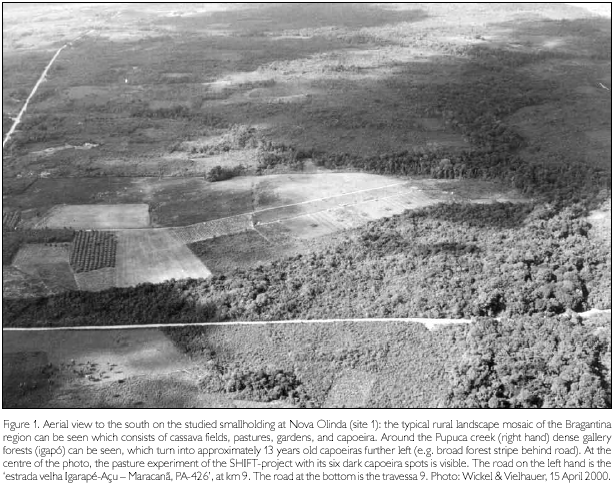
<body><![CDATA[<p><font size="2" face="Verdana"> Conversely, rural landscapes in Amazonia have     received little attention from ornithologists and birdwatchers. Densely settled     rural landscapes, which contain a significantly reduced avifauna in comparison     to primary forests, are typically dominated by widespread common invaders     and well-known neotropical generalists, and hence, attract little attention     from the ornithological and conservation biology societies. A case in point     is provided by the Bragantina region of Northeastern Par&aacute; State. The region is delineated to the west and the east by respectively   the cities of Castanhal and Bragan&ccedil;a, and to the north and south by the   Atlantic Ocean and the river Guam&aacute;. Biogeographically, it belongs to the   drier easternmost frontier of the Amazon, usually referred to as the 'Bel&eacute;m'-area   of endemism (Haffner, 1969; Bates <i>et al., </i>1998; Silva <i>et al., </i>2005).   As the Bragantina region was a center of colonization during the last century,   human population density increased to an extraordinary high level for the Amazon   of 38.9 inhabitants km<sup>-2</sup> in 1996 (IBGE, 2008). From the beginning of the last   century, forested areas were assigned to settlers along the railroad Bel&eacute;m-Bragan&ccedil;a,   who turned the land use of their lots into extensive and fallow-based agricultural   use. As a consequence, the ancient natural vegetation, the evergreen tropical   rain forest, was almost completely converted into agricultural lands (Egler,   1961; Metzger, 2002). Because the common agricultural systems are based on   slash-and-burn activities, the sustainability is based on the forest fallows,   which are nationally called 'capoeira', in Brazil (Denich, 1991). Thus, the   region mainly consists of a mosaic of maize, bean and cassava fields, and especially   of extended capoeiras of various ages (Metzger, 2003). In the last decades,   many of these areas were turned into more intensive agriculture. Capoeira fallows   were shortened or completely replaced by permanent and semi-permanent land   use systems like passion fruit, black pepper, or oil palm plantations (e.g.   Silva <i>et al., </i>1998; IBGE,   2008; Metzger, 2002, 2003). Also, since the 1980s, cattle husbandry became   popular and large areas, even on smallholdings, were turned into pastures,   a process called 'pecuariza&ccedil;&atilde;o' of the Bragantina region (Serr&atilde;o &amp; Toledo,   1992). The municipality of Igarap&eacute;-A&ccedil;u typifies the Bragantina   region and is classified as a rural region of middle to high demographic density   with a tessellated landscape structure of various land use types (Nepstad <i>et     al.</i>, 1996; IBGE, 2008; Metzger, 2002; MMA, 2006). From the former rain     forest, only small fragments remained, mainly as gallery forests along creeks     (igap&oacute;s),   where no other use is possible. The climate of the region belongs to the humid   warm tropics (Lauer <i>et al.</i>, 1996), with a mean annual temperature of   27.6   <sup>o</sup>C   and an average yearly rainfall of 2.469 mm. The 'Marcelino' climate station in   Igarap&eacute;-A&ccedil;u (Embrapa), in comparison to Bel&eacute;m, shows a   prolonged dry season, which lasts from July until January (Denich, 1991; Hohnwald,   2002).</font></p>     <p><font size="2" face="Verdana"> While investigations into the avifauna ofthe     Bel&eacute;m area have a long scientific   history (Novaes &amp; Lima, 1998), there is only some basic information about   the avifauna of Par&aacute; State in general (Novaes, 1980; Oren &amp;  Henriques,   1994; Nepstad <i>et al.</i>, 1996) or the Bragantina region hinterland itself.   However, one checklist includes major parts of adjacent areas east of Bel&eacute;m   and gives an overview and an estimation of the abundance of species, but does   not cover the whole region (Forrester, 1993). Detailed field observations were   carried out in savannas, capoeiras, and mangroves in the municipality of Vigia   (Novaes &amp; Lima, 1992), which will be used as a reference in this study.   There is no explicit publication concerning the avifauna of Igarap&eacute;-A&ccedil;u   itself. Therefore, the objective of this paper is to report the most important   bird observations and to enhance the knowledge of the avifauna of an ornithologically   poorly known region.</font></p>     <p>&nbsp;</p>     <p><font size="3" face="Verdana"><b>METHODS</b></font></p>     <p><font size="2" face="Verdana"><b>STUDY SITES</b></font></p>     <p><font size="2" face="Verdana"> A two-year stay during the bilateral German-Brazilian     SHIFT (Studies of Human Impact on Forests and Floodplains in the Tropics)     project in the rural landscape of Igarap&eacute;-A&ccedil;u, provided the     opportunity to note some bird observation data besides fieldwork on a typical smallholder property.</font></p>     <p><font size="2" face="Verdana"> The main observation location was a 25 ha smallholding     (1 lot) in the vicinity of the village Nova Olinda at 47<sup>o</sup> 30' 18.46&quot; W / 1<sup>o</sup> 2' 54&quot; S   in the northeast of the municipality of Igarap&eacute;-A&ccedil;u, at the 'estrada   velha Igarap&eacute;-A&ccedil;u - Maracan&atilde;' (= road PA-426), at km 9   (site 1). The land use of the smallholding shows the typical mosaic pattern   of a smallholder farm (<a href="#f1">Figure 1</a>) with fruit trees and garden like plantations   around the house located next to the road. Behind that home garden, a rural   mosaic of cassava fields of up to two hectares, passion fruit and pepper plantations,   as well as one to five hectare <i>Brachiaria</i>-pastures can be found. Furthermore,   it also incorporates several small two-to-13 years old capoeira vegetation   (up to 10 m high), and an on average 15 m high mature igap&oacute; forest along the   Pupuca creek, in the back of the lot. Because fields, pastures, and plantations   were not clearly separated from each other there often were young capoeira hedgerows   between the units. The location also included the experimental site of the SHIFT-Pecu&aacute;ria   project, where a 3.2 ha pasture of <i>Brachiaria humidicola </i>(Rendle) Schweick.   (quicuio-da-Amaz&ocirc;nia) was planted (<a href="#f1">Figure 1</a>). The experiment incorporated   treatments with bushy components in the pastures, e.g. a grass-capoeira pasture   in which up to 30% cover of the re-sprouting capoeira re-growth is tolerated,   a bushy grass-legume pasture, and nine 100 m<sup>2</sup> capoeira islands (Hohnwald, 2002;   Hohnwald <i>et al., </i>2006).</font></p>     <p><a name="f1"></a></p>     <p>&nbsp;</p>     <p align="center"><img src="/img/revistas/bmpegcn/v4n2/2a03f1.gif"></p>     ]]></body>
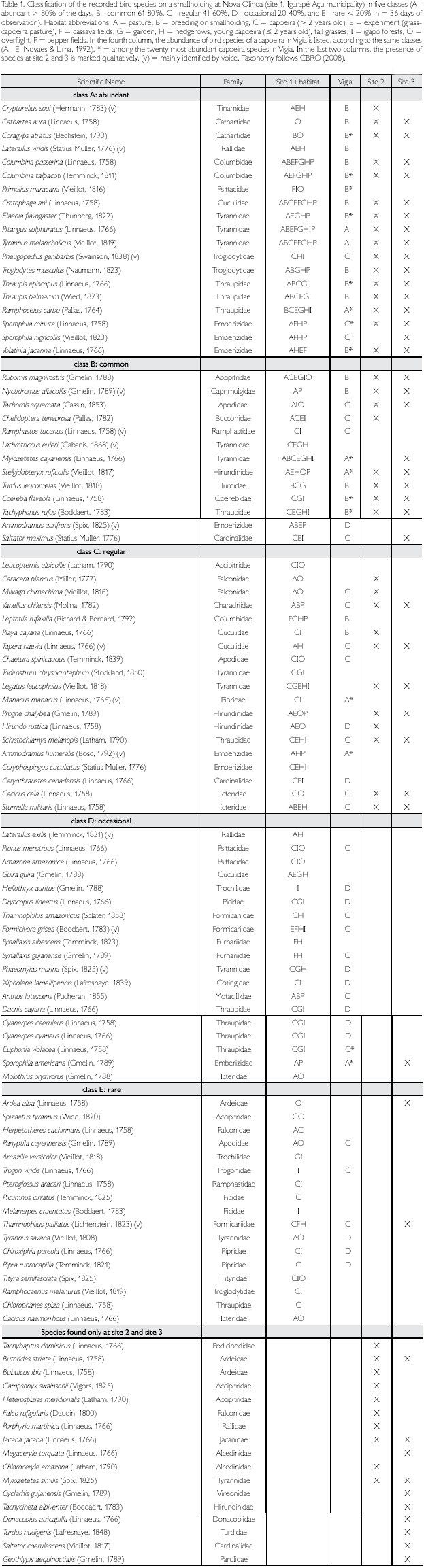
<body><![CDATA[<p>&nbsp;</p>     <p><font size="2" face="Verdana"> At site 1, birds were checked on 36 days: 21 days during the rainy season   (six in 1999, seven in 2000, eight in 2001), and 15 days during the dry season   (seven in 1999, eight in 2000), respectively. Observations were carried out   during the agricultural field work, which lasted usually from approximately   8:00 to 16:00 hours. For data calculation, some single bird observations from   other days were added to the next respective daily checklist.</font></p>     <p><font size="2" face="Verdana"> The second location was a small pond (site     2) at km 2 of the PA-426 road, at 47<sup>o</sup>  32' 03.52&quot; W / 1<sup>o</sup> 06' 34.22&quot; S.     This pond reaches a maximum size of 500 m<sup></sup> during the rainy season in March,     but regularly dries completely out during the dry season, usually from October     until the end of January. Its borders are mainly covered by three to six     year old capoeira vegetation, but cattle trampling also leads to open and     sandy lake borders. Due to its small size and also due to lack of time this     location was only shortly checked during ten days, usually some minutes around     7:30 and at 16:15 hours. Additionally, some single bird observations of up   to 1 km distance from site 2 along the road were added to this checklist.</font></p>     <p><font size="2" face="Verdana"> The third site is the lake at the southern     border of the city of Igarape-Acu at 47<sup>o</sup>  37' 13.60&quot; W / 1<sup>o</sup> 08' 36.56&quot; S     (site 3). This lake was visited seven times, usually at around 17:30 until     dusk. The lake is extensively covered with water hyacinths <i>(Eichhornia crassipes </i>(Mart.) Solms, Pontederiaceae)   and its border consisted of up to three years old capoeira.</font></p>     <p><font size="2" face="Verdana"> Besides these three locations, additional observations from Igarape-Acu municipality   are also included in this paper, giving scientific family and species names,   locations, remarks, and observation dates. Some records of noteworthy species   which occur in <a href="#t1">Table 1</a> are further specified in the text.</font></p>     <p><a name="t1"></a></p>     <p>&nbsp;</p>     <p align="center"><img src="/img/revistas/bmpegcn/v4n2/2a03t1.gif"></p>     <p>&nbsp;</p>     <p>  <font size="2" face="Verdana"><b>OBSERVATIONS AND DATA EVALUATION</b></font></p>     ]]></body>
<body><![CDATA[<p><font size="2" face="Verdana"> All bird observations, including the single     ones in the text, were recorded between March 1999 and January 2001 in the     municipality of Igarape-Acu. Records were made through visual observations     using 7 x 50 mm-binoculars. Some species, e.g. the Rallidae, were mainly     identified by their voices and are marked with a '(v)' in the table. For     species determination, mainly Ridgely  &amp; Tudor (1989; 1994),   Hilty &amp; Brown (1986), and Novaes &amp; Lima (1998) were used. </font></p>     <p><font size="2" face="Verdana">Daily checklists of site 1 were evaluated for     abundance and frequency of each species. According to the frequency, species     were categorized <i>sensu</i> Novaes &amp; Lima   (1992) namely as: abundant (present in &gt; 80% of the days), common (61-80%),   regular (41-60%), occasional (20-40%), and rare (&lt; 20%). Bird records were   also evaluated for wet (January-June) and dry season (July-December). Taxonomy   follows Pacheco <i>et al.</i> (2007) and CBRO (2008), while assessment of species   vulnerability follows Stattersfield &amp; Capper (2000). The total species   number is calculated by adding all species of <a href="#t1">Table 1</a> to the free-living species mentioned in the text.</font></p>     <p>&nbsp;</p>     <p><font size="3" face="Verdana"><b>RESULTS</b></font></p>     <p><font size="2" face="Verdana"> In total, 110 bird species, belonging to 95     genera and 40 families were recorded. At site 1,87 species, 76 genera, and     32 families were found (<a href="#t1">Table   1</a>). Using   the above cited abundance criteria, 19 species were considered abundant, 13   common, 19 regular, 19 occasional, and 17 rare. At site 2, there were 45 species,   43 genera, and 23 families, almost the same numbers as at site 3 (45, 38, 22), respectively.</font></p>     <p><font size="2" face="Verdana"> None of the bird species found on any of the three sites is considered to   be globally endangered, but <i>Primolius maracana, </i>found at site 1, is   classified as 'vulnerable' (Stattersfield &amp; Capper, 2000). </font></p>     <p><font size="2" face="Verdana">The only North-American migrants recorded were five individuals of <i>Hirundo     rustica </i>noted on spring migration on 3, 9, and 22 January (two individuals),     and 5 February 2001, which is much earlier than the record of 9 April from Vigia (Novaes &amp; Lima, 1992).</font></p>     <p><font size="2" face="Verdana"> Mixed flocks of over 40 individuals of <i>Sporophila minuta, Sporophila nigricollis,   Sporophila americana, </i>and <i>Volatinia jacarina </i>were frequent around   site 1 during the dry season, mainly feeding on cassava fields and pastures.   Some of them might be inner-Brazilian migrants from semi-arid Northeastern   Brazil. One mixed-species flock of five <i>Ramphocelus carbo, </i>three <i>Thraupis episcopus, </i>four <i>Saltator     maximus, </i>and two <i>Schistochlamys melanopsis </i>were observed at site   1, on 27 September 2000.</font></p>     <p><font size="2" face="Verdana"> Bird trapping takes place almost daily in Igarape-A&ccedil;u     and a considerable number of birds are sold at local markets. The most often     trapped species are usually good singers, such as <i>Sporophila minuta, Sporophila nigricollis, Turdus leucomelas,     Euphonia violacea, </i>and <i>Amazona amazonica, </i>but also <i>Volatinia jacarina,       Ramphocelus carbo, </i>and the non-residential <i>Paroaria dominicana </i>(Linnaeus,   1758), from Northeastern Brazil.</font></p>     <p><font size="2" face="Verdana"> Some addition al bird observation s from the     municipality of Igarape-Agu and more detailed information about some noteworthy     species are listed below:</font></p>     ]]></body>
<body><![CDATA[<p><font size="2" face="Verdana"><b>Podicipedidae</b></font></p>     <p><font size="2" face="Verdana"><i>Tachybaptus dominicus </i>- Suspected of breeding at site 2 in   2000 and 2001.</font></p>     <p>  <font size="2" face="Verdana"><b>Ardeidae</b></font></p>     <p><font size="2" face="Verdana"><i>Bubulcus ibis </i>- Ten individuals seen     at km 21 of BR 316 (1<sup>o</sup>  18' 42.65&quot; S   / 47<sup>o</sup> 43' 26.20&quot; W) on 21 September 2000. </font></p>     <p><font size="2" face="Verdana"><b>Accipitridae</b></font></p>     <p><font size="2" face="Verdana"><i>Leucopternis albicollis </i>- One individual at site 1 defended its territory by attacking a <i>Herpetotheres cachinnans </i>on 18 May 1999.</font></p>     <p>  <font size="2" face="Verdana"><i>Spizaetus tyrannus </i>- One individual overflying capoeira at site 1 on 27 July 1999.</font></p>     <p>  <font size="2" face="Verdana"><b>Falconidae</b></font></p>     <p><font size="2" face="Verdana"><i>Caracara plancus </i>- One individual at     road PA-242 between Igarap&eacute;-A&ccedil;u   and S&atilde;o Lu&iacute;s do Par&aacute;  on 15 May 1999.</font></p>     <p><font size="2" face="Verdana"><b>Scolopacidae</b></font></p>     ]]></body>
<body><![CDATA[<p><font size="2" face="Verdana"><i>Gallinago paraguaiae </i>(Vieillot, 1816)     - One individual observed on a wet pasture at 1<sup>o</sup> 07' 16.77&quot; S / 47<sup>o</sup> 34' 53.62&quot; W   on 14 March 2000.</font></p>     <p><font size="2" face="Verdana"><b>Columbidae</b></font></p>     <p><font size="2" face="Verdana"><i>Columbina passerina </i>- A nest containing two white eggs was found   in the middle of the grass-capoeira pasture treatment at site 1 on 11 April   2000. Another nest with two eggs was found on another grass-capoeira pasture   replication in May 2001.</font></p>     <p>  <font size="2" face="Verdana"><i>Columba livia </i>(Gmelin, 1789) - This     exotic species is a frequent breeder in the city centre of Igarap&eacute;-A&ccedil;u,   and was recorded throughout 1999-2001. </font></p>     <p><font size="2" face="Verdana"><b>Psittacidae</b></font></p>     <p><font size="2" face="Verdana"><i>Primolius maracana </i>- Thirty-four individuals were observed feeding in   a maize field at site 1 on 16 December 2000.</font></p>     <p><font size="2" face="Verdana"><b>Cuculidae</b></font></p>     <p><font size="2" face="Verdana"><i>Guira guira </i>- Flocks of this species were frequently seen at the roads   BR 316, PA-127, and PA-242 during 1999-2001.</font></p>     <p><font size="2" face="Verdana"><b>Tytonidae</b></font></p>     <p><font size="2" face="Verdana"><i>Tyto alba </i>(Scopoli, 1769) - Breeding     confirmed from the old market ruin in the centre of Igarap&eacute;-A&ccedil;u,   from 1999-2001.</font></p>     ]]></body>
<body><![CDATA[<p><font size="2" face="Verdana"><b>Caprimulgidae</b></font></p>     <p><font size="2" face="Verdana"><i>Nyctidromus albicollis </i>- Pairs or individuals     of this species were observed approximately every 0.7 km on the road PA-426,     outside the small villages, after dusk on 10 March 1999. One individual was also observed in capoeira at the Cumar&uacute; settlement on 17 March 1999.</font></p>     <p><font size="2" face="Verdana"><b>Trogonidae</b></font></p>     <p><font size="2" face="Verdana"><i>Trogon viridis </i>- One male individual     in igap&oacute; forest     at site 1 on 27 September 2000.</font></p>     <p>  <font size="2" face="Verdana"><b>Ramphastidae</b></font></p>     <p><font size="2" face="Verdana"><i>Ramphastos vitellinus </i>(Lichtenstein,     1823) - Two individuals sighted at the road PA-127 at 1<sup>o</sup>  10' 30.05&quot; S / 47<sup>o</sup> 39' 35.84&quot; W on 14 January 2001.</font></p>     <p><font size="2" face="Verdana"><b>Picidae</b></font></p>     <p><font size="2" face="Verdana"><i>Picumnus cirratus - </i>One female individual in capoeira at site 1 on 27 September 2000.</font></p>     <p>  <font size="2" face="Verdana"><b>Cotingidae</b></font></p>     <p><font size="2" face="Verdana"><i>Xipholena lamellipennis </i>- Recorded on     three occasions from site 1: one male passing from igap&oacute; to old capoeira on 28 March 2000; one female in   the canopy of the igap&oacute; forest on 27 December 2000; and one male in the   canopy of the igap&oacute;  forest on 4 January 2001 (<a href="#f1">Figure   1</a>).</font></p>     ]]></body>
<body><![CDATA[<p><font size="2" face="Verdana"><b>Pipridae</b></font></p>     <p><font size="2" face="Verdana"><i>Chiroxiphia pareola - </i>One male (showing     display) and one female in a capoeira (later igap&oacute; forest) at site   one on 1 September 1999.</font></p>     <p><font size="2" face="Verdana"><i>Pipra rubrocapilla </i>- One individual in capoeira at site 1 on 22 September 1999.</font></p>     <p>  <font size="2" face="Verdana"><b>Tityridae</b></font></p>     <p><font size="2" face="Verdana"><i>Tityra semifasciata </i>- One individual flying from capoeira to igap&oacute; forest at site on 29 June 2000.</font></p>     <p>  <font size="2" face="Verdana"><b>Hirundinidae</b></font></p>     <p><font size="2" face="Verdana"><i>Progne tapera </i>(Vieillot, 1817) - A flock of five individuals was   seen at km 6 PA-426 on 25 March 1999.</font></p>     <p>  <font size="2" face="Verdana"><b>Polioptilidae</b></font></p>     <p><font size="2" face="Verdana"><i>Ramphocaenus melanurus- </i>Three individuals in a capoeira   at site 1 on 22 September 2000.</font></p>     <p>  <font size="2" face="Verdana"><b>Emberizidae</b></font></p>     ]]></body>
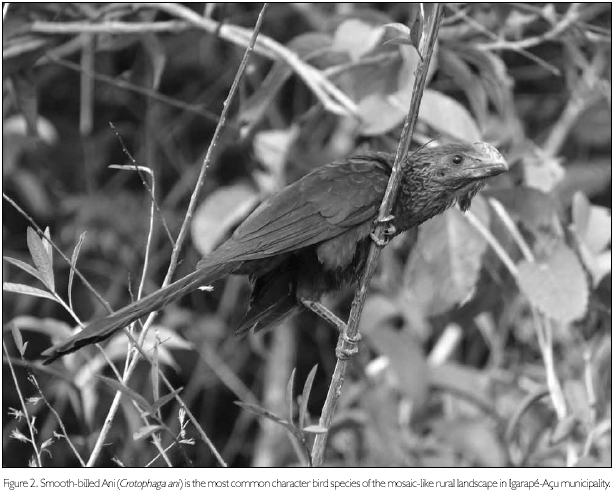
<body><![CDATA[<p><font size="2" face="Verdana"><i>Ammodramus aurifrons </i>- Successful breeding was confirmed on traditional pasture at site 1 on 8 January 2001.</font></p>     <p><font size="2" face="Verdana"><b>Icteridae</b></font></p>     <p><font size="2" face="Verdana"><i>Cacicus haemorrhous </i>- Two individuals     flying above pastures at site 1 on 15 January 2001.</font></p>     <p>  <font size="2" face="Verdana"><i>Cacicus cela </i>- Breeding colony was     found in the centre of Nova Olinda village, at 1<sup>o</sup>  02' 09.76&quot; S / 47<sup>o</sup> 29' 45.19&quot; W on 21 September 2000.</font></p>     <p>  <font size="2" face="Verdana"><i>Sturnella militaris </i>- Frequent breeder on pastures, e.g. along BR 316, PA-127, PA-242, and PA-395 (1999-2001).</font></p>     <p><font size="2" face="Verdana"><b>Passeridae</b></font></p>     <p><font size="2" face="Verdana"><i>Passer domesticus </i>(Linnaeus, 1758) - A common breeder in the city centre of Igarape-Agu (1999-2001).</font></p>     <p>&nbsp;</p>     <p>  <font size="3" face="Verdana"><b>DISCUSSION</b></font></p>     <p><font size="2" face="Verdana"> The records show the expected reduced bird     diversity of rural landscapes (Christiansen &amp; Pitter,   1997; Ribon <i>et al., </i>2003) in comparison to other forested Amazonian   landscapes, especially with primary forests (Silva  &amp; Pimentel Neto, 1997;   Pacheco <i>et     al.</i>, 2007). Thus, the most frequently found bird species, e.g. <i>Crotophaga       ani </i>(<a href="#f2">Figure 2</a>), <i>Columbina passerina, Pitangus sulphuratus, Tyrannus melancholicus,         Volatinia jacarina, Ramphocelus carbo, </i>and <i>Thraupis palmarum, </i>are   generalists with a broad distribution in South America. In general, the results   show the same species spectrum found by Novaes &amp; Lima (1992) in the capoeiras,   savannas and mangroves of Vigia. For instance, if compared with the twenty most   abundant bird species of the capoeira (Novaes  &amp; Lima, 1992: Table 3),   seven species are also found among the 'abundant' species in this study (<a href="#t1">Table   1</a>). However, <i>Campylopterus largipennis </i>(Boddaert, 1783), <i>Myiobius barbatus </i>(Gmelin,   1789), and <i>Hylophilus semicinereus </i>(Sclater  &amp; Salvin, 1867) were   not observed in Igarape-Agu. On the other hand, there are <i>Lathrotriccus euleri,     Leucopternis albicollis, Caracara plancus, Todirostrum chrysocrotaphum, Legatus     leucophaius, Coryphospingus cucullatus </i>which were not mentioned by Novaes &amp; Lima   (1992), although 'regularly' found in Igarape-Agu (<a href="#t1">Table 1</a>). These species might   have been overlooked by Novaes &amp;  Lima (1992) probably just due to  their   limited observation times. Also, <i>Crotophaga ani </i>and <i>Columbina passerina </i>seem   to be much more common in Igarap&eacute;-A&ccedil;u than in Vigia. The main   differences can be explained by the different survey methods, slightly different   habitats, e.g. pure capoeiras, savannas, mangroves in contrast to a rural landscape   mosaic, and different study times.</font></p>     ]]></body>
<body><![CDATA[<p><a name="f2"></a></p>     <p>&nbsp;</p>     <p align="center"><img src="/img/revistas/bmpegcn/v4n2/2a03f2.gif"></p>     <p>&nbsp;</p>     <p><font size="2" face="Verdana"> Besides abundant neotropical generalists, there     are some noteworthy observations in Igarap&eacute;-A&ccedil;u, such as that     of <i>Xipholena lamellipennis, Tityra     semifasciata, Chiroxiphia pareola, Cacicus haemorrhous, Pipra rubrocapilla, Trogon     viridis, Spizaetus tyrannus, Picumnus cirratus, </i>and <i>Ramphocaenus melanurus. </i>These   observations indicate that the mosaic-like rural landscape might still host     more rare forest bird species than expected. The more so probably if major     forest patches and tree islands would be protected (Nepstad <i>et al., </i>1996).     As species conservation strategies should not just concentrate on protected     areas alone, smallholders have a considerable responsibility for the conservation     of the local avifauna. Compensation payments might be an option for farmers   to help maintain larger forest patches on smallholdings.</font></p>     <p>  <font size="2" face="Verdana"><i>Xipholena lamellipennis </i>is classified     as a rare to locally uncommon forest bird species, living in humid tropical     forest canopies and at forest borders (Ridgely &amp; Tudor, 1994). As this species is endemic to the Lower Amazon,   south of the river Amazon (Ridgely &amp; Tudor, 1994), its survival must be seen   as critical for the eastern half of its range to Maranh&atilde;o is already densely   settled and heavily deforested. However, as it was occasionally found in Vigia   (Novaes &amp; Lima, 1992) and the fact that both sexes have been observed at   site 1 indicates that the species might be able to survive in forest islands   of the Bragantina region. <i>Primolius maracana </i>is qualified as worldwide   'vulnerable' because of rapid decline in population due to exploitation, habitat   loss, and degradation (Stattersfield &amp; Capper, 2000; Snyder <i>et al., </i>2000).   The isolated island population of Northeast Par&aacute;  (Juniper &amp; Parr,   1998; Stattersfield &amp; Capper, 2000) must also be considered critical in that   context. However, large flocks of up to 34 individuals and regular observations   of pairs all around Igarap&eacute;-A&ccedil;u municipality and other common observations   within the Bragantina region (Novaes &amp; Lima, 1992) suggests that the population   is stable in the region. But, as the species is said to feed partly on maize   and beans, some farmers regard them as a pest (personal interview with three   farmers). On the other hand, there were no signs that <i>Primolius maracana </i>is   hunted or trapped for cage-bird trading. The species also obviously like to   feed on bacuri trees <i>(Platonia insignis </i>Mart., Clusiaceae), which can   be frequently found on smallholdings.</font></p>     <p>  <font size="2" face="Verdana"><i>Guira guira </i>is declared as 'scarce'     in the Bel&eacute;m hinterland (Forrester,   1993), which seems either a printing error, a rough underestimation, or it might   have become more common in the region with increasing deforestation in the last   decades. Based on permanent observations at the Embrapa Amaz&ocirc;nia Oriental   in Bel&eacute;m, but also along the roads between Bel&eacute;m and Castanhal   (BR 316), between Castanhal and Igarap&eacute;-A&ccedil;u, and within the municipality   of Igarap&eacute;-A&ccedil;u the species should be clearly declared as a normal   'resident'. However, it seems that <i>Guira guira </i>is more abundant around   Bel&eacute;m than in Igarap&eacute;-A&ccedil;u. Besides the character bird   species <i>Croptophaga     ani </i>of the rural landscape, the other member of the Cuculidae family <i>Tapera       naevia </i>seems to be almost as abundant as <i>Guira guira </i>in the   rural landscape of Igarap&eacute;-A&ccedil;u.</font></p>     <p><font size="2" face="Verdana"> Besides bats and monkeys, birds are the most     important seed dispersers in the Neotropics and play a major ecological role     as facilitator species in the recolonization of capoeira tree species on     degraded lands (Vieira <i>et al., </i>1994).   As the capoeira is still the ecological basis of fallow-based agriculture   on smallholdings (Denich, 1991), these species are also agronomically important   for the rural Bragantina region. Fortunately, most seed-dispersing bird   species such as <i>Ramphocelus     carbo, Thraupis episcopus, Thraupis palmarum, Sporophila minuta, Sporophila   nigricollis, Volatinia jacarina, Coereba flaveola, Tachyphonus rufus, Ammodramus   aurifrons, </i>and <i>Saltator maximus </i>are   still quite common in the rural landscape (<a href="#t1">Table 1</a>; classes   A-B) so that the capoeira recuperation abilities seem to be unlimited.</font></p>     <p><font size="2" face="Verdana"> The innovative agro-silvo-pastoral system of a grass-capoeira pasture (Hohnwald,   2002; Hohnwald <i>et al., </i>2006) seems to offer attractive habitats for   some rural bird species, e.g. <i>Crotophaga ani, Ramphocelus carbo, </i>and   especially <i>Columbina     passerina, </i>whose nests were found exactly in the middle of grass-capoeira   pastures.</font></p>     <p><font size="2" face="Verdana"> The presented bird observations were collected alongside field work of an   agricultural field trial and thus surely will not be as complete as intensive   mist-netting or other intense inventories. In many cases there was simply no   time to track down bird vocalizations or other short appearances so that shy,   rare, hidden or nocturnal species are probably underrepresented or overlooked   in this study. This fact makes it also difficult to compare the results with   other studies. However, an advantage of this study is that observations have   been carried out over a rather long period of time, which often provides more   accurate data than intensive studies for a short time (Bibby <i>et al.</i>,   1992).</font></p>     ]]></body>
<body><![CDATA[<p><font size="2" face="Verdana"> However, many common species (Forrester, 1993) of the Northeastern Amazon   were not observed in the study area and might simply have been overlooked,   e.g. <i>Camptostoma     obsoletum </i>(Temminck, 1824), <i>Empidonomus varius </i>(Vieillot, 1818), <i>Leptotila       verreauxi </i>(Bonaparte, 1855), <i>Myiarchus tuberculifer </i>(d'Orbigny &amp; Lafresnaye,   1837), <i>Tyrannulus elatus </i>(Latham, 1790), <i>Hylophilus pectoralis </i>(Sclater,   1866), <i>Pachyramphus rufus </i>(Boddaert, 1783), <i>Pteroglossus inscriptus </i>(Swainson,   1822), <i>Myiophobus</i> <i>fasciatus </i>(Statius Muller, 1776), or <i>Brotogeris   versicolurus </i>(Statius Muller, 1776).</font></p>     <p><font size="2" face="Verdana"> Land use changes constantly take place in the     rural landscape of the Bragantina region, following changing market prices     of various products (Metzger, 2002; IBGE, 2008). As birds are specialized     in their ecological niches, but also are able to quickly react to the environmental     changes by simply flying to more suitable areas, the bird composition might     be as dynamic as the changes in agro-ecosystems. Fortunately for bird life,     most smallholder production systems are still extensively carried out and     often based on capoeira fallows so that bird diversity stayed remarkably     high in Igarap&eacute;-A&ccedil;u.   However, huge areas of the Eastern Amazon are already clear-cut and look worse   than the investigated rural landscape. As deforestation of the Amazon continues,   it is probable that a species-poor 'unattractive' bird community of generalist   species will soon also be found in other parts of the Amazon, although in other   bio-geographical zones these communities might contain slightly different species.   Unfortunately, there are no local bird associations or even clubs, offering   to publish annual bird reports and species lists, and usually infra-structure   for international tourists or birdwatchers are lacking. Nevertheless, it should   be interesting enough for scientists to observe which bird species keep pace   with the dynamic land use changes in the Amazon.</font></p>     <p>&nbsp;</p>     <p>  <font size="3" face="Verdana"><b>ACKNOWLEDGEMENTS</b></font></p>     <p><font size="2" face="Verdana"> The presence of the SHIFT-Pecu&aacute;ria project,     which was jointly financed by the Bundesministerium f&uuml;r Bildung und     Forschung (BMBF), Germany (FKZ: 01LT0002/9) and Conselho Nacional de Desenvolvimento     Cient&iacute;fico e Tecnol&oacute;gico   (CNPq), Brazil (690076/98-3) made this study possible. I am grateful for the   support from Dr. B. Rischkowsky, Dr. A. P. Camar&atilde;o, Dr. T. Abreu S&aacute;,   and Dr. P. Gerhard. Furthermore, I would like to thank Mrs. Maria de Deus Oliveira   Machado and Sr. Jos&eacute; St&eacute;nio Mendes Machado and his family for   their collaboration, Dr. B. Wickel and Dr. K. Vielhauer for the aerial photo,   and the two anonymous reviewers for their improvements.</font></p>     <p>&nbsp;</p>     <p><font size="3" face="Verdana"><b>REFERENCES</b></font></p>     <!-- ref --><p><font size="2" face="Verdana"> BATES, J. M., S. J. HACKETT &amp; J. CRACRAFT,     1998. Arearelationships   in the Neotropical lowlands: an hypothesis based   on raw distributions of Passerine birds. <b>Journal of Biogeography</b>  (25): 783-793.</font><!-- ref --><p><font size="2" face="Verdana"> BIBBY, C. J., N. D. BURGESS &amp; D. A. HILL,     1992. <b>Bird Census   Techniques</b>. Academic Press, New York.</font><!-- ref --><p><font size="2" face="Verdana"> CBRO (COMIT&Ecirc; BRASILEIRO DE REGISTROS ORNITOL&Oacute;GICOS),   2008. <b>Listas das aves do Brasil</b>. Vers&atilde;o 05/10/2008. Disponible in: &lt;<a href="http://www.cbro.org.br" target="_blank">http://www.cbro.org.br</a>&gt;. Accessed in: October 2008.</font><!-- ref --><p><font size="2" face="Verdana"> CHRISTIANSEN, M. B. &amp; E. PITTER, 1997.     Species loss in a forest   bird community near Lagoa Santa in Southeastern Brazil. <b>Biological   Conservation</b> (80): 23-32.</font><!-- ref --><p><font size="2" face="Verdana"> DENICH, M., 1991. <b>Estudo da import&acirc;ncia de uma vegeta&ccedil;&atilde;o   secund&aacute;ria nova para o incremento da produtividade do   sistema de produ&ccedil;&atilde;o na Amaz&ocirc;nia Oriental brasileira</b>. 2.   ed.   EMBRAPA-CPATU/ Gesellschaft f&uuml;r Technische Zusammenarbeit   (GTZ), Bel&eacute;m.</font><!-- ref --><p><font size="2" face="Verdana"> EGLER, E. G., 1961. A Zona Bragantina no Estado     do Par&aacute;.     <b>Revista   Brasileira de Geografia</b> (23): 527-555.</font><!-- ref --><p><font size="2" face="Verdana"> FORRESTER, B. C., 1993. <b>Birding Brazil</b>: a check-list and site guide.   John Geddes Printers, Irvine.</font><!-- ref --><p><font size="2" face="Verdana"> HAFFNER, J., 1969. Speciation in Amazonian forest birds. <b>Science</b>  (165): 131-137.</font><!-- ref --><p><font size="2" face="Verdana"> HILTY, S. L. &amp; W. L. BROWN, 1986. <b>A       guide to the birds of   Colombia</b>. Princeton University Press, Princeton.</font><!-- ref --><p><font size="2" face="Verdana"> HOHNWALD, S., 2002. <b>A grass-capoeira pasture       fits better than a grass-legume pasture in the agricultural system of   smallholdings in the humid Brazilian tropics</b>: 1-136. Cuvillier   Verlag, G&ouml;ttingen.</font><!-- ref --><p><font size="2" face="Verdana"> HOHNWALD, S., B. RISCHKOWSKY, A. P. CAMAR&Atilde;O,     R.   SCHULTZE-KRAFT, J. A. RODRIGUES FILHO &amp; J. M. KING,   2006. Integrating cattle into the slash-and-burn cycle on   smallholdings in the Eastern Amazon: grass-capoeira pasture   versus grass-legume pasture. <b>Agriculture, Ecosystems &amp;   Environment</b> 117(4): 266-276.</font><!-- ref --><p><font size="2" face="Verdana"> IBGE, 2008. <b>Website of the Brazilian Institute       of Geography and Statistics</b>. Disponible in: &lt;<a href="http://www.ibge.gov.br/home" target="_blank">http://www.ibge.gov.br/home</a>&gt;.   Accessed in: October 2008.</font><!-- ref --><p><font size="2" face="Verdana"> JUNIPER, T. &amp; M. PARR, 1998. <b>Parrots</b>. A     guide to the parrots of   the world. Pica Press, Mounfield.</font><!-- ref --><p><font size="2" face="Verdana"> LAUER, W., M. D. RAFIQPOOR &amp; P. FRANKENBERG,     1996.   Die Klimate der Erde. Eine Klassifikation auf &ouml;kophysiologischer   Grundlage der realen Vegetation. <b>Erdkunde</b> 50(4): 275-300.</font><!-- ref --><p><font size="2" face="Verdana">METZGER, J. P., 2002. Landscape dynamics and equilibrium in   areas of slash-and-burn agriculture with short and long fallow period (Bragantina region, NE Brazilian Amazon). <b>Landscape Ecology</b> 17(5): 419-431.</font><!-- ref --><p><font size="2" face="Verdana"> METZGER, J. P., 2003. Effects of slash-and-burn fallow periods   on landscape structure. <b>Environmental Conservation</b> 30(4):   325-333.</font><!-- ref --><p><font size="2" face="Verdana"> MMA, 2006. <b>Mapas tem&aacute;ticos selecionados</b>: Amaz&ocirc;nia     Legal,   Tipologia da Ocupa&ccedil;&atilde;o Territorial, Projeto Macrozoneamento     da   Amaz&ocirc;nia Legal. Bras&iacute;lia.</font><!-- ref --><p><font size="2" face="Verdana"> NEPSTAD, D. C., P. R. MOUTINHO, C. UHL, I.     C. VIEIRA &amp; J.   M. C. SILVA, 1996. The ecological importance of forest remnants   in an Eastern Amazonian frontier landscape. In: J. SCHELHAS &amp; R.   GREENBERG (Ed.): <b>Forest Patches in Tropical Landscapes</b>: 133-   150. Island Press, Washington.</font><!-- ref --><p><font size="2" face="Verdana"> NOVAES, F. C., 1980. Observa&ccedil;&otilde;es     sobre a avifauna do alto curso   do Rio Paru de Leste, Estado do Par&aacute;. <b>Boletim do Museu Paraense   Em&iacute;lio Goeldi, Nova S&eacute;rie Zoologia</b> 100: 1-58.</font><!-- ref --><p><font size="2" face="Verdana"> NOVAES, F. C. &amp; M. F. C. LIMA, 1992. Aves     das campinas, capoeiras   e manguezais do leste do Par&aacute;. <b>Boletim do Museu Paraense Em&iacute;lio   Goeldi, s&eacute;rie Zoologia</b> 8(2): 271-303.</font><!-- ref --><p><font size="2" face="Verdana"> NOVAES, F. C. &amp; M. F. C. LIMA, 1998. <b>Aves       da Grande Bel&eacute;m</b>.   Munic&iacute;pios de Bel&eacute;m e Ananindeua, Par&aacute;: 1-415. Museu Paraense   Em&iacute;lio Goeldi (Cole&ccedil;&atilde;o Emilie Snethlage), Bel&eacute;m.</font><!-- ref --><p><font size="2" face="Verdana"> OREN, D. C. &amp; H. G. ALBUQUERQUE, 1991.     Priority areas for new   Avian collections in Brazilian Amazonia. <b>Goeldiana Zoologia</b> 6: 1-11.</font><!-- ref --><p><font size="2" face="Verdana"> OREN, D. C. &amp; L. M. P. HENRIQUES, 1994.     New and reconfirmed   bird records for Maraj&oacute; island, Amazon river estuary, Brazil. <b>Boletim   do Museu Paraense Em&iacute;lio Goeldi, s&eacute;rie Zoologia</b> 10(2): 169-182.</font><!-- ref --><p><font size="2" face="Verdana"> PACHECO, J. F., G. M. KIRWAN, A. ALEIXO, B. M. WHITNEY, A.   WHITTAKER, J. MINNS, K. J. ZIMMER, P. S. M. FONSECA, M. F.   C. LIMA &amp; D. C. OREN, 2007. An avifaunal inventory of the CVRD   Serra dos Caraj&aacute;s project, Par&aacute;, Brazil. <b>Cotinga</b> 27: 15-30.</font><!-- ref --><p><font size="2" face="Verdana">RIBON, R., J. E. SIMON &amp; G. T. MATTOS, 2003.     Bird extinctions   in Atlantic forest fragments of the Vi&ccedil;osa region, southeastern Brazil. <b>Conservation Biology</b> 17(6): 1827-1839.</font><!-- ref --><p><font size="2" face="Verdana"> RIDGELY, R. S. &amp; G. TUDOR, 1989. <b>The       birds of South America</b>:   the Oscine passerines. University of Texas Press, Austin.</font><!-- ref --><p><font size="2" face="Verdana"> RIDGELY, R. S. &amp; G. TUDOR, 1994. <b>The       birds of South America</b>:   the Suboscine passerines. University of Texas Press, Austin.</font><!-- ref --><p><font size="2" face="Verdana"> SERR&Atilde;O, E. A. S. &amp; J. M. TOLEDO,     1992. Sustaining pasture-based   production systems for the humid tropics. In: T. E. DOWNING, S.   B. HECHT, H. A. PEARSON &amp; C. GARCIA-DOWNING (Eds.):   <b>Development or Destruction</b>. The Conversion of Tropical Forest   to Pasture in Latin America: 257-280. Westview Press, Boulder.</font><!-- ref --><p><font size="2" face="Verdana"> SILVA, J. M. C. &amp; D. C. PIMENTEL NETO,     1997. As aves. In: P. L.   B. LISBOA (Ed.): <b>Caxiuan&atilde;</b>: 5(28): 403-416. Museu Paraense Em&iacute;lio   Goeldi, Bel&eacute;m.</font><!-- ref --><p><font size="2" face="Verdana"> SILVA, A. A., F. R. SOUSA FILHO, J. CORTELETTI,     W. SILVEIRA PINTO, J. L. SILVEIRA, S. R. M. SILVA, A. KASPER, U. M. MARQUES &amp; F. L. SILVA CAHETE, 1998. Historical dynamics of reproduction of agriculture in Igarap&eacute;-A&ccedil;u (Northeast of the State of Par&aacute;):   A   study focusing on agrarian systems. <b>Proceedings of the III SHIFT-Workshop</b>  67-82.</font><!-- ref --><p><font size="2" face="Verdana"> SILVA, J. M. C., A. B. RYLANDS &amp; G. A.     B. FONSECA, 2005. The   fate of the Amazonian areas of endemism. <b>Conservation Biology</b>  19(3): 689-694.</font><!-- ref --><p><font size="2" face="Verdana"> SNYDER, N., P. MCGOWAN, J. GILARDI &amp; A.     GRAJAL (Eds.),   2000. <b>Parrots</b>. Status survey and conservation Action Plan 2000-2004:   1-180. IUCN, Gland, Cambridge.</font><!-- ref --><p><font size="2" face="Verdana"> STATTERSFIELD, A. &amp; D. CAPPER (Eds.), 2000.     <b>Threatened Birds   of the World</b>. BirdLife International, Cambridge.</font><!-- ref --><p><font size="2" face="Verdana"> VIEIRA, I. C. G., C. UHL &amp; D. NEPSTAD,     1994. The role of shrub     <i>Cordia multispicata</i> Cham. as a 'succession facilitator' in an     abandoned   pasture, Paragominas, Amaz&ocirc;nia. <b>Vegetatio</b> 115: 91-99.</font><p>&nbsp;</p>     <p>&nbsp;</p>     <p><font size="2" face="Verdana"><a name="endereco"></a><a href="#topo"><img src="../img/revistas/bmpegcn/v4n2/seta.gif" border="0"></a><b>Mailing       address:    <br> </b>Museu Paraense Em&iacute;lio Goeldi     <br> Editor do Boletim do Museu Paraense Em&iacute;lio Goeldi. Ci&ecirc;ncias Naturais     <br> Av. Magalh&atilde;es Barata, 376     <br> S&atilde;o Braz &#8211; CEP 66040-170     <br> Caixa Postal 399     <br> Telefone/fax: 55-91 - 3249 -1141     ]]></body>
<body><![CDATA[<br> E-mail:<a href="mailto:boletim@museu-goeldi.br">boletim@museu-goeldi.br</a></font></p>     <p><font size="2" face="Verdana">Recebido: 09/02/2009    <br> Aprovado: 12/08/2009</font></p>      ]]></body><back>
<ref-list>
<ref id="B1">
<nlm-citation citation-type="journal">
<person-group person-group-type="author">
<name>
<surname><![CDATA[BATES]]></surname>
<given-names><![CDATA[J. M.]]></given-names>
</name>
<name>
<surname><![CDATA[HACKETT]]></surname>
<given-names><![CDATA[S. J.]]></given-names>
</name>
<name>
<surname><![CDATA[CRACRAFT]]></surname>
<given-names><![CDATA[J.]]></given-names>
</name>
</person-group>
<article-title xml:lang="en"><![CDATA[Arearelationships in the Neotropical lowlands: an hypothesis based on raw distributions of Passerine birds]]></article-title>
<source><![CDATA[Journal of Biogeography]]></source>
<year>1998</year>
<volume>25</volume>
<page-range>783-793</page-range></nlm-citation>
</ref>
<ref id="B2">
<nlm-citation citation-type="book">
<person-group person-group-type="author">
<name>
<surname><![CDATA[BIBBY]]></surname>
<given-names><![CDATA[C. J.]]></given-names>
</name>
<name>
<surname><![CDATA[BURGESS]]></surname>
<given-names><![CDATA[N. D.]]></given-names>
</name>
<name>
<surname><![CDATA[HILL]]></surname>
<given-names><![CDATA[D. A.]]></given-names>
</name>
</person-group>
<source><![CDATA[Bird Census Techniques]]></source>
<year>1992</year>
<publisher-loc><![CDATA[New York ]]></publisher-loc>
<publisher-name><![CDATA[Academic Press]]></publisher-name>
</nlm-citation>
</ref>
<ref id="B3">
<nlm-citation citation-type="">
<collab>CBRO (COMITÊ BRASILEIRO DE REGISTROS ORNITOLÓGICOS)</collab>
<source><![CDATA[Listas das aves do Brasil: Versão 05/10/2008]]></source>
<year>2008</year>
</nlm-citation>
</ref>
<ref id="B4">
<nlm-citation citation-type="journal">
<person-group person-group-type="author">
<name>
<surname><![CDATA[CHRISTIANSEN]]></surname>
<given-names><![CDATA[M. B.]]></given-names>
</name>
<name>
<surname><![CDATA[PITTER]]></surname>
<given-names><![CDATA[E.]]></given-names>
</name>
</person-group>
<article-title xml:lang="en"><![CDATA[Species loss in a forest bird community near Lagoa Santa in Southeastern Brazil]]></article-title>
<source><![CDATA[Biological Conservation]]></source>
<year>1997</year>
<volume>80</volume>
<page-range>23-32</page-range></nlm-citation>
</ref>
<ref id="B5">
<nlm-citation citation-type="book">
<person-group person-group-type="author">
<name>
<surname><![CDATA[DENICH]]></surname>
<given-names><![CDATA[M.]]></given-names>
</name>
</person-group>
<source><![CDATA[Estudo da importância de uma vegetação secundária nova para o incremento da produtividade do sistema de produção na Amazônia Oriental brasileira]]></source>
<year>1991</year>
<edition>2</edition>
<publisher-loc><![CDATA[Belém ]]></publisher-loc>
<publisher-name><![CDATA[EMBRAPA-CPATU/ Gesellschaft für Technische Zusammenarbeit (GTZ)]]></publisher-name>
</nlm-citation>
</ref>
<ref id="B6">
<nlm-citation citation-type="journal">
<person-group person-group-type="author">
<name>
<surname><![CDATA[EGLER]]></surname>
<given-names><![CDATA[E. G.]]></given-names>
</name>
</person-group>
<article-title xml:lang="pt"><![CDATA[A Zona Bragantina no Estado do Pará]]></article-title>
<source><![CDATA[Revista Brasileira de Geografia]]></source>
<year>1961</year>
<volume>23</volume>
<page-range>527-555</page-range></nlm-citation>
</ref>
<ref id="B7">
<nlm-citation citation-type="book">
<person-group person-group-type="author">
<name>
<surname><![CDATA[FORRESTER]]></surname>
<given-names><![CDATA[B. C.]]></given-names>
</name>
</person-group>
<source><![CDATA[Birding Brazil: a check-list and site guide]]></source>
<year>1993</year>
<publisher-loc><![CDATA[Irvine ]]></publisher-loc>
<publisher-name><![CDATA[John Geddes Printers]]></publisher-name>
</nlm-citation>
</ref>
<ref id="B8">
<nlm-citation citation-type="journal">
<person-group person-group-type="author">
<name>
<surname><![CDATA[HAFFNER]]></surname>
<given-names><![CDATA[J.]]></given-names>
</name>
</person-group>
<article-title xml:lang="en"><![CDATA[Speciation in Amazonian forest birds]]></article-title>
<source><![CDATA[Science]]></source>
<year>1969</year>
<volume>165</volume>
<page-range>131-137</page-range></nlm-citation>
</ref>
<ref id="B9">
<nlm-citation citation-type="book">
<person-group person-group-type="author">
<name>
<surname><![CDATA[HILTY]]></surname>
<given-names><![CDATA[S. L.]]></given-names>
</name>
<name>
<surname><![CDATA[BROWN]]></surname>
<given-names><![CDATA[W. L.]]></given-names>
</name>
</person-group>
<source><![CDATA[A guide to the birds of Colombia]]></source>
<year>1986</year>
<publisher-loc><![CDATA[Princeton ]]></publisher-loc>
<publisher-name><![CDATA[Princeton University Press]]></publisher-name>
</nlm-citation>
</ref>
<ref id="B10">
<nlm-citation citation-type="book">
<person-group person-group-type="author">
<name>
<surname><![CDATA[HOHNWALD]]></surname>
<given-names><![CDATA[S.]]></given-names>
</name>
</person-group>
<source><![CDATA[A grass-capoeira pasture fits better than a grass-legume pasture in the agricultural system of smallholdings in the humid Brazilian tropics]]></source>
<year>2002</year>
<page-range>1-136</page-range><publisher-loc><![CDATA[Göttingen ]]></publisher-loc>
<publisher-name><![CDATA[Cuvillier Verlag]]></publisher-name>
</nlm-citation>
</ref>
<ref id="B11">
<nlm-citation citation-type="journal">
<person-group person-group-type="author">
<name>
<surname><![CDATA[HOHNWALD]]></surname>
<given-names><![CDATA[S.]]></given-names>
</name>
<name>
<surname><![CDATA[RISCHKOWSKY]]></surname>
<given-names><![CDATA[B.]]></given-names>
</name>
<name>
<surname><![CDATA[CAMARÃO]]></surname>
<given-names><![CDATA[A. P.]]></given-names>
</name>
<name>
<surname><![CDATA[SCHULTZE-KRAFT]]></surname>
<given-names><![CDATA[R.]]></given-names>
</name>
<name>
<surname><![CDATA[RODRIGUES FILHO]]></surname>
<given-names><![CDATA[J. A.]]></given-names>
</name>
<name>
<surname><![CDATA[KING]]></surname>
<given-names><![CDATA[J. M.]]></given-names>
</name>
</person-group>
<article-title xml:lang="en"><![CDATA[Integrating cattle into the slash-and-burn cycle on smallholdings in the Eastern Amazon: grass-capoeira pasture versus grass-legume pasture]]></article-title>
<source><![CDATA[Agriculture, Ecosystems & Environment]]></source>
<year>2006</year>
<volume>117</volume>
<numero>4</numero>
<issue>4</issue>
<page-range>266-276</page-range></nlm-citation>
</ref>
<ref id="B12">
<nlm-citation citation-type="">
<collab>IBGE</collab>
<source><![CDATA[Website of the Brazilian Institute of Geography and Statistics]]></source>
<year>2008</year>
</nlm-citation>
</ref>
<ref id="B13">
<nlm-citation citation-type="book">
<person-group person-group-type="author">
<name>
<surname><![CDATA[JUNIPER]]></surname>
<given-names><![CDATA[T.]]></given-names>
</name>
<name>
<surname><![CDATA[PARR]]></surname>
<given-names><![CDATA[M.]]></given-names>
</name>
</person-group>
<source><![CDATA[Parrots: A guide to the parrots of the world]]></source>
<year>1998</year>
<publisher-loc><![CDATA[Mounfield ]]></publisher-loc>
<publisher-name><![CDATA[Pica Press]]></publisher-name>
</nlm-citation>
</ref>
<ref id="B14">
<nlm-citation citation-type="journal">
<person-group person-group-type="author">
<name>
<surname><![CDATA[LAUER]]></surname>
<given-names><![CDATA[W.]]></given-names>
</name>
<name>
<surname><![CDATA[RAFIQPOOR]]></surname>
<given-names><![CDATA[M. D.]]></given-names>
</name>
<name>
<surname><![CDATA[FRANKENBERG]]></surname>
<given-names><![CDATA[P.]]></given-names>
</name>
</person-group>
<article-title xml:lang="en"><![CDATA[Die Klimate der Erde. Eine Klassifikation auf ökophysiologischer Grundlage der realen Vegetation]]></article-title>
<source><![CDATA[Erdkunde]]></source>
<year>1996</year>
<volume>50</volume>
<numero>4</numero>
<issue>4</issue>
<page-range>275-300</page-range></nlm-citation>
</ref>
<ref id="B15">
<nlm-citation citation-type="journal">
<person-group person-group-type="author">
<name>
<surname><![CDATA[METZGER]]></surname>
<given-names><![CDATA[J. P.]]></given-names>
</name>
</person-group>
<article-title xml:lang="en"><![CDATA[Landscape dynamics and equilibrium in areas of slash-and-burn agriculture with short and long fallow period (Bragantina region, NE Brazilian Amazon)]]></article-title>
<source><![CDATA[Landscape Ecology]]></source>
<year>2002</year>
<volume>17</volume>
<numero>5</numero>
<issue>5</issue>
<page-range>419-431</page-range></nlm-citation>
</ref>
<ref id="B16">
<nlm-citation citation-type="journal">
<person-group person-group-type="author">
<name>
<surname><![CDATA[METZGER]]></surname>
<given-names><![CDATA[J. P.]]></given-names>
</name>
</person-group>
<article-title xml:lang="en"><![CDATA[Effects of slash-and-burn fallow periods on landscape structure]]></article-title>
<source><![CDATA[Environmental Conservation]]></source>
<year>2003</year>
<volume>30</volume>
<numero>4</numero>
<issue>4</issue>
<page-range>325-333</page-range></nlm-citation>
</ref>
<ref id="B17">
<nlm-citation citation-type="book">
<collab>MMA</collab>
<source><![CDATA[Mapas temáticos selecionados]]></source>
<year>2006</year>
<publisher-loc><![CDATA[Brasília ]]></publisher-loc>
<publisher-name><![CDATA[Amazônia Legal, Tipologia da Ocupação Territorial, Projeto Macrozoneamento da Amazônia Legal]]></publisher-name>
</nlm-citation>
</ref>
<ref id="B18">
<nlm-citation citation-type="book">
<person-group person-group-type="author">
<name>
<surname><![CDATA[NEPSTAD]]></surname>
<given-names><![CDATA[D. C.]]></given-names>
</name>
<name>
<surname><![CDATA[MOUTINHO]]></surname>
<given-names><![CDATA[P. R.]]></given-names>
</name>
<name>
<surname><![CDATA[UHL]]></surname>
<given-names><![CDATA[C.]]></given-names>
</name>
<name>
<surname><![CDATA[VIEIRA]]></surname>
<given-names><![CDATA[I. C.]]></given-names>
</name>
<name>
<surname><![CDATA[SILVA]]></surname>
<given-names><![CDATA[J. M. C.]]></given-names>
</name>
</person-group>
<article-title xml:lang="en"><![CDATA[The ecological importance of forest remnants in an Eastern Amazonian frontier landscape]]></article-title>
<person-group person-group-type="editor">
<name>
<surname><![CDATA[SCHELHAS]]></surname>
<given-names><![CDATA[J.]]></given-names>
</name>
<name>
<surname><![CDATA[GREENBERG]]></surname>
<given-names><![CDATA[R.]]></given-names>
</name>
</person-group>
<source><![CDATA[Forest Patches in Tropical Landscapes]]></source>
<year>1996</year>
<page-range>133- 150</page-range><publisher-loc><![CDATA[Washington ]]></publisher-loc>
<publisher-name><![CDATA[Island Press]]></publisher-name>
</nlm-citation>
</ref>
<ref id="B19">
<nlm-citation citation-type="journal">
<person-group person-group-type="author">
<name>
<surname><![CDATA[NOVAES]]></surname>
<given-names><![CDATA[F. C.]]></given-names>
</name>
</person-group>
<article-title xml:lang="pt"><![CDATA[Observações sobre a avifauna do alto curso do Rio Paru de Leste, Estado do Pará]]></article-title>
<source><![CDATA[Boletim do Museu Paraense Emílio Goeldi, Nova Série Zoologia]]></source>
<year>1980</year>
<volume>100</volume>
<page-range>1-58</page-range></nlm-citation>
</ref>
<ref id="B20">
<nlm-citation citation-type="journal">
<person-group person-group-type="author">
<name>
<surname><![CDATA[NOVAES]]></surname>
<given-names><![CDATA[F. C.]]></given-names>
</name>
<name>
<surname><![CDATA[LIMA]]></surname>
<given-names><![CDATA[M. F. C.]]></given-names>
</name>
</person-group>
<article-title xml:lang="pt"><![CDATA[Aves das campinas, capoeiras e manguezais do leste do Pará]]></article-title>
<source><![CDATA[Boletim do Museu Paraense Emílio Goeldi, série Zoologia]]></source>
<year>1992</year>
<volume>8</volume>
<numero>2</numero>
<issue>2</issue>
<page-range>271-303</page-range></nlm-citation>
</ref>
<ref id="B21">
<nlm-citation citation-type="book">
<person-group person-group-type="author">
<name>
<surname><![CDATA[NOVAES]]></surname>
<given-names><![CDATA[F. C.]]></given-names>
</name>
<name>
<surname><![CDATA[LIMA]]></surname>
<given-names><![CDATA[M. F. C.]]></given-names>
</name>
</person-group>
<source><![CDATA[Aves da Grande Belém: Municípios de Belém e Ananindeua, Pará]]></source>
<year>1998</year>
<page-range>1-415</page-range><publisher-loc><![CDATA[Belém ]]></publisher-loc>
<publisher-name><![CDATA[Museu Paraense Emílio Goeldi (Coleção Emilie Snethlage)]]></publisher-name>
</nlm-citation>
</ref>
<ref id="B22">
<nlm-citation citation-type="journal">
<person-group person-group-type="author">
<name>
<surname><![CDATA[OREN]]></surname>
<given-names><![CDATA[D. C.]]></given-names>
</name>
<name>
<surname><![CDATA[ALBUQUERQUE]]></surname>
<given-names><![CDATA[H. G.]]></given-names>
</name>
</person-group>
<article-title xml:lang="en"><![CDATA[Priority areas for new Avian collections in Brazilian Amazonia]]></article-title>
<source><![CDATA[Goeldiana Zoologia]]></source>
<year>1991</year>
<volume>6</volume>
<page-range>1-11</page-range></nlm-citation>
</ref>
<ref id="B23">
<nlm-citation citation-type="journal">
<person-group person-group-type="author">
<name>
<surname><![CDATA[OREN]]></surname>
<given-names><![CDATA[D. C.]]></given-names>
</name>
<name>
<surname><![CDATA[HENRIQUES]]></surname>
<given-names><![CDATA[L. M. P.]]></given-names>
</name>
</person-group>
<article-title xml:lang="en"><![CDATA[New and reconfirmed bird records for Marajó island, Amazon river estuary, Brazil]]></article-title>
<source><![CDATA[Boletim do Museu Paraense Emílio Goeldi, série Zoologia]]></source>
<year>1994</year>
<volume>10</volume>
<numero>2</numero>
<issue>2</issue>
<page-range>169-182</page-range></nlm-citation>
</ref>
<ref id="B24">
<nlm-citation citation-type="journal">
<person-group person-group-type="author">
<name>
<surname><![CDATA[PACHECO]]></surname>
<given-names><![CDATA[J. F.]]></given-names>
</name>
<name>
<surname><![CDATA[KIRWAN]]></surname>
<given-names><![CDATA[G. M.]]></given-names>
</name>
<name>
<surname><![CDATA[ALEIXO]]></surname>
<given-names><![CDATA[A.]]></given-names>
</name>
<name>
<surname><![CDATA[WHITNEY]]></surname>
<given-names><![CDATA[B. M.]]></given-names>
</name>
<name>
<surname><![CDATA[WHITTAKER]]></surname>
<given-names><![CDATA[A.]]></given-names>
</name>
<name>
<surname><![CDATA[MINNS]]></surname>
<given-names><![CDATA[J.]]></given-names>
</name>
<name>
<surname><![CDATA[ZIMMER]]></surname>
<given-names><![CDATA[K. J.]]></given-names>
</name>
<name>
<surname><![CDATA[FONSECA]]></surname>
<given-names><![CDATA[P. S. M.]]></given-names>
</name>
<name>
<surname><![CDATA[LIMA]]></surname>
<given-names><![CDATA[M. F. C.]]></given-names>
</name>
<name>
<surname><![CDATA[OREN]]></surname>
<given-names><![CDATA[D. C.]]></given-names>
</name>
</person-group>
<article-title xml:lang="en"><![CDATA[An avifaunal inventory of the CVRD Serra dos Carajás project, Pará, Brazil]]></article-title>
<source><![CDATA[Cotinga]]></source>
<year>2007</year>
<volume>27</volume>
<page-range>15-30</page-range></nlm-citation>
</ref>
<ref id="B25">
<nlm-citation citation-type="journal">
<person-group person-group-type="author">
<name>
<surname><![CDATA[RIBON]]></surname>
<given-names><![CDATA[R.]]></given-names>
</name>
<name>
<surname><![CDATA[SIMON]]></surname>
<given-names><![CDATA[J. E.]]></given-names>
</name>
<name>
<surname><![CDATA[MATTOS]]></surname>
<given-names><![CDATA[G. T.]]></given-names>
</name>
</person-group>
<article-title xml:lang="en"><![CDATA[Bird extinctions in Atlantic forest fragments of the Viçosa region, southeastern Brazil]]></article-title>
<source><![CDATA[Conservation Biology]]></source>
<year>2003</year>
<volume>17</volume>
<numero>6</numero>
<issue>6</issue>
<page-range>1827-1839</page-range></nlm-citation>
</ref>
<ref id="B26">
<nlm-citation citation-type="book">
<person-group person-group-type="author">
<name>
<surname><![CDATA[RIDGELY]]></surname>
<given-names><![CDATA[R. S.]]></given-names>
</name>
<name>
<surname><![CDATA[TUDOR]]></surname>
<given-names><![CDATA[G.]]></given-names>
</name>
</person-group>
<source><![CDATA[The birds of South America: the Oscine passerines]]></source>
<year>1989</year>
<publisher-loc><![CDATA[Austin ]]></publisher-loc>
<publisher-name><![CDATA[University of Texas Press]]></publisher-name>
</nlm-citation>
</ref>
<ref id="B27">
<nlm-citation citation-type="book">
<person-group person-group-type="author">
<name>
<surname><![CDATA[RIDGELY]]></surname>
<given-names><![CDATA[R. S.]]></given-names>
</name>
<name>
<surname><![CDATA[TUDOR]]></surname>
<given-names><![CDATA[G.]]></given-names>
</name>
</person-group>
<source><![CDATA[The birds of South America: the Suboscine passerines]]></source>
<year>1994</year>
<publisher-loc><![CDATA[Austin ]]></publisher-loc>
<publisher-name><![CDATA[University of Texas Press]]></publisher-name>
</nlm-citation>
</ref>
<ref id="B28">
<nlm-citation citation-type="book">
<person-group person-group-type="author">
<name>
<surname><![CDATA[SERRÃO]]></surname>
<given-names><![CDATA[E. A. S.]]></given-names>
</name>
<name>
<surname><![CDATA[TOLEDO]]></surname>
<given-names><![CDATA[J. M.]]></given-names>
</name>
</person-group>
<article-title xml:lang="en"><![CDATA[Sustaining pasture-based production systems for the humid tropics]]></article-title>
<person-group person-group-type="editor">
<name>
<surname><![CDATA[DOWNING]]></surname>
<given-names><![CDATA[T. E.]]></given-names>
</name>
<name>
<surname><![CDATA[HECHT]]></surname>
<given-names><![CDATA[S. B.]]></given-names>
</name>
<name>
<surname><![CDATA[PEARSON]]></surname>
<given-names><![CDATA[H. A.]]></given-names>
</name>
<name>
<surname><![CDATA[GARCIA-DOWNING]]></surname>
<given-names><![CDATA[C.]]></given-names>
</name>
</person-group>
<source><![CDATA[Development or Destruction: The Conversion of Tropical Forest to Pasture in Latin America]]></source>
<year>1992</year>
<page-range>257-280</page-range><publisher-loc><![CDATA[Boulder ]]></publisher-loc>
<publisher-name><![CDATA[Westview Press]]></publisher-name>
</nlm-citation>
</ref>
<ref id="B29">
<nlm-citation citation-type="book">
<person-group person-group-type="author">
<name>
<surname><![CDATA[SILVA]]></surname>
<given-names><![CDATA[J. M. C]]></given-names>
</name>
<name>
<surname><![CDATA[PIMENTEL NETO]]></surname>
<given-names><![CDATA[D. C.]]></given-names>
</name>
</person-group>
<article-title xml:lang="pt"><![CDATA[As aves]]></article-title>
<person-group person-group-type="editor">
<name>
<surname><![CDATA[LISBOA]]></surname>
<given-names><![CDATA[P. L. B.]]></given-names>
</name>
</person-group>
<source><![CDATA[Caxiuanã]]></source>
<year>1997</year>
<volume>5</volume>
<page-range>403-416</page-range><publisher-loc><![CDATA[Belém ]]></publisher-loc>
<publisher-name><![CDATA[Museu Paraense Emílio Goeldi]]></publisher-name>
</nlm-citation>
</ref>
<ref id="B30">
<nlm-citation citation-type="">
<person-group person-group-type="author">
<name>
<surname><![CDATA[SILVA]]></surname>
<given-names><![CDATA[A. A.]]></given-names>
</name>
<name>
<surname><![CDATA[SOUSA FILHO]]></surname>
<given-names><![CDATA[F. R.]]></given-names>
</name>
<name>
<surname><![CDATA[CORTELETTI]]></surname>
<given-names><![CDATA[J.]]></given-names>
</name>
<name>
<surname><![CDATA[SILVEIRA PINTO]]></surname>
<given-names><![CDATA[W.]]></given-names>
</name>
<name>
<surname><![CDATA[SILVEIRA]]></surname>
<given-names><![CDATA[J. L.]]></given-names>
</name>
<name>
<surname><![CDATA[SILVA]]></surname>
<given-names><![CDATA[S. R. M.]]></given-names>
</name>
<name>
<surname><![CDATA[KASPER]]></surname>
<given-names><![CDATA[A.]]></given-names>
</name>
<name>
<surname><![CDATA[MARQUES]]></surname>
<given-names><![CDATA[U. M.]]></given-names>
</name>
<name>
<surname><![CDATA[SILVA CAHETE]]></surname>
<given-names><![CDATA[F. L.]]></given-names>
</name>
</person-group>
<source><![CDATA[Historical dynamics of reproduction of agriculture in Igarapé-Açu (Northeast of the State of Pará): A study focusing on agrarian systems. Proceedings of the III SHIFT-Workshop]]></source>
<year>1998</year>
<page-range>67-82</page-range></nlm-citation>
</ref>
<ref id="B31">
<nlm-citation citation-type="journal">
<person-group person-group-type="author">
<name>
<surname><![CDATA[SILVA]]></surname>
<given-names><![CDATA[J. M. C.]]></given-names>
</name>
<name>
<surname><![CDATA[RYLANDS]]></surname>
<given-names><![CDATA[A. B.]]></given-names>
</name>
<name>
<surname><![CDATA[FONSECA]]></surname>
<given-names><![CDATA[G. A. B.]]></given-names>
</name>
</person-group>
<article-title xml:lang="en"><![CDATA[The fate of the Amazonian areas of endemism]]></article-title>
<source><![CDATA[Conservation Biology]]></source>
<year>2005</year>
<volume>19</volume>
<numero>3</numero>
<issue>3</issue>
<page-range>689-694</page-range></nlm-citation>
</ref>
<ref id="B32">
<nlm-citation citation-type="book">
<person-group person-group-type="author">
<name>
<surname><![CDATA[SNYDER]]></surname>
<given-names><![CDATA[N.]]></given-names>
</name>
<name>
<surname><![CDATA[MCGOWAN]]></surname>
<given-names><![CDATA[P.]]></given-names>
</name>
<name>
<surname><![CDATA[GILARDI]]></surname>
<given-names><![CDATA[J.]]></given-names>
</name>
<name>
<surname><![CDATA[GRAJAL]]></surname>
<given-names><![CDATA[A.]]></given-names>
</name>
</person-group>
<source><![CDATA[Parrots: Status survey and conservation Action Plan 2000-2004]]></source>
<year>2000</year>
<page-range>1-180</page-range><publisher-loc><![CDATA[Gland^eCambridge Cambridge]]></publisher-loc>
<publisher-name><![CDATA[IUCN]]></publisher-name>
</nlm-citation>
</ref>
<ref id="B33">
<nlm-citation citation-type="book">
<source><![CDATA[Threatened Birds of the World]]></source>
<year>2000</year>
<publisher-loc><![CDATA[Cambridge ]]></publisher-loc>
<publisher-name><![CDATA[BirdLife International]]></publisher-name>
</nlm-citation>
</ref>
<ref id="B34">
<nlm-citation citation-type="journal">
<person-group person-group-type="author">
<name>
<surname><![CDATA[VIEIRA]]></surname>
<given-names><![CDATA[I. C. G.]]></given-names>
</name>
<name>
<surname><![CDATA[UHL]]></surname>
<given-names><![CDATA[C.]]></given-names>
</name>
<name>
<surname><![CDATA[NEPSTAD]]></surname>
<given-names><![CDATA[D.]]></given-names>
</name>
</person-group>
<article-title xml:lang="en"><![CDATA[The role of shrub Cordia multispicata Cham: as a 'succession facilitator' in an abandoned pasture, Paragominas, Amazônia]]></article-title>
<source><![CDATA[Vegetatio]]></source>
<year>1994</year>
<volume>115</volume>
<page-range>91-99</page-range></nlm-citation>
</ref>
</ref-list>
</back>
</article>