<?xml version="1.0" encoding="ISO-8859-1"?><article xmlns:mml="http://www.w3.org/1998/Math/MathML" xmlns:xlink="http://www.w3.org/1999/xlink" xmlns:xsi="http://www.w3.org/2001/XMLSchema-instance">
<front>
<journal-meta>
<journal-id>1981-8114</journal-id>
<journal-title><![CDATA[Boletim do Museu Paraense Emílio Goeldi Ciências Naturais]]></journal-title>
<abbrev-journal-title><![CDATA[Bol. Mus. Para. Emilio Goeldi Cienc. Nat.]]></abbrev-journal-title>
<issn>1981-8114</issn>
<publisher>
<publisher-name><![CDATA[Museu Paraense Emílio Goeldi, Ministério da Ciência e Tecnologia]]></publisher-name>
</publisher>
</journal-meta>
<article-meta>
<article-id>S1981-81142010000300003</article-id>
<title-group>
<article-title xml:lang="en"><![CDATA[Morphological variation in the striped water snake Helicops trivittatus (Gray, 1849) (Reptilia: Serpentes: Xenodontidae) of eastern Amazonia]]></article-title>
<article-title xml:lang="pt"><![CDATA[Variação morfométrica da cobra-d'agua Helicops trivittatus (Gray, 1849) (Reptilia: Serpentes: Xenodontidae) do leste da Amazônia]]></article-title>
</title-group>
<contrib-group>
<contrib contrib-type="author">
<name>
<surname><![CDATA[Rossman]]></surname>
<given-names><![CDATA[Douglas Athon]]></given-names>
</name>
<xref ref-type="aff" rid="A01"/>
</contrib>
</contrib-group>
<aff id="A01">
<institution><![CDATA[,Luther College Department of Biology ]]></institution>
<addr-line><![CDATA[Decorah Iowa]]></addr-line>
<country>U.S.A</country>
</aff>
<pub-date pub-type="pub">
<day>00</day>
<month>12</month>
<year>2010</year>
</pub-date>
<pub-date pub-type="epub">
<day>00</day>
<month>12</month>
<year>2010</year>
</pub-date>
<volume>5</volume>
<numero>3</numero>
<fpage>271</fpage>
<lpage>278</lpage>
<copyright-statement/>
<copyright-year/>
<self-uri xlink:href="http://scielo.iec.gov.br/scielo.php?script=sci_arttext&amp;pid=S1981-81142010000300003&amp;lng=en&amp;nrm=iso"></self-uri><self-uri xlink:href="http://scielo.iec.gov.br/scielo.php?script=sci_abstract&amp;pid=S1981-81142010000300003&amp;lng=en&amp;nrm=iso"></self-uri><self-uri xlink:href="http://scielo.iec.gov.br/scielo.php?script=sci_pdf&amp;pid=S1981-81142010000300003&amp;lng=en&amp;nrm=iso"></self-uri><abstract abstract-type="short" xml:lang="en"><p><![CDATA[Helicops trivittatus, an aquatic snake endemic to eastern Amazonia, has an essentially invariant colour pattern, but it does exhibit sexual and/or individual variation in many meristic and mensural characters. This study is based on a series of 45 preserved specimens.]]></p></abstract>
<abstract abstract-type="short" xml:lang="pt"><p><![CDATA[Helicops trivittatus, uma cobra aquática endêmica da Amazônia oriental, possui um padrão de coloração essencialmente sem variação, mas apresenta variação sexual e/ou individual em muitos caracteres merísticos e morfométricos. Esse estudo baseia-se em 45 exemplares preservados.]]></p></abstract>
<kwd-group>
<kwd lng="en"><![CDATA[Brazil]]></kwd>
<kwd lng="en"><![CDATA[Serpentes]]></kwd>
<kwd lng="en"><![CDATA[Xenodontidae]]></kwd>
<kwd lng="en"><![CDATA[Helicops trivittatus]]></kwd>
<kwd lng="en"><![CDATA[Variation]]></kwd>
<kwd lng="pt"><![CDATA[Brasil]]></kwd>
<kwd lng="pt"><![CDATA[Serpentes]]></kwd>
<kwd lng="pt"><![CDATA[Xenodontidae]]></kwd>
<kwd lng="pt"><![CDATA[Helicops trivittatus]]></kwd>
<kwd lng="pt"><![CDATA[Variação]]></kwd>
</kwd-group>
</article-meta>
</front><body><![CDATA[ <p><font size="4" face="verdana"><b><a name="topo"></a>Morphological variation in the striped water  snake <i>Helicops trivittatus </i>(Gray, 1849) (Reptilia: Serpentes: Xenodontidae)  of eastern Amazonia</b></font></p>     <p>&nbsp;</p>     <p><font size="3" face="verdana"><b>Varia&ccedil;&atilde;o  morfom&eacute;trica da cobra-d'agua <i>Helicops trivittatus </i>(Gray, 1849) (Reptilia:  Serpentes: Xenodontidae) do leste da Amaz&ocirc;nia</b></font></p>     <p>&nbsp;</p>     <p>&nbsp;</p>     <p><font size="2" face="verdana"><b>Douglas Athon Rossman</b></font></p>     <p><font size="2" face="verdana">Luther   College.  Department of Biology. Decorah, Iowa, U.S.A. (<a href="mailto:rossmado@luther.edu">rossmado@luther.edu</a>)</font></p>     <p><a href="#endereco"><font size="2" face="verdana">Correspondence</font></a></p>     <p>&nbsp;</p>     <p>&nbsp;</p> <hr size="1" noshade>     ]]></body>
<body><![CDATA[<p><font size="2" face="verdana"><b>ABSTRACT</b></font></p>     <p><font size="2" face="verdana"><i>Helicops  trivittatus, </i>an aquatic snake endemic to eastern Amazonia, has an essentially invariant colour pattern,  but it does exhibit sexual and/or individual variation in many meristic and  mensural characters. This study is based on a series of 45 preserved specimens.</font></p>     <p><font size="2" face="verdana"><b>Keywords: </b>Brazil.  Serpentes. Xenodontidae. <i>Helicops trivittatus. </i>Variation.</font></p> <hr size="1" noshade>     <p><font size="2" face="verdana"><b>RESUMO</b></font></p>     <p><font size="2" face="verdana"><i>Helicops trivittatus, </i>uma  cobra aqu&aacute;tica end&ecirc;mica da Amaz&ocirc;nia oriental, possui um padr&atilde;o de colora&ccedil;&atilde;o  essencialmente sem varia&ccedil;&atilde;o, mas apresenta varia&ccedil;&atilde;o sexual e/ou individual em  muitos caracteres mer&iacute;sticos e morfom&eacute;tricos. Esse estudo baseia-se em 45  exemplares preservados.</font></p>     <p><font size="2" face="verdana"><b>Palavras-chave: </b>Brasil. Serpentes. Xenodontidae. <i>Helicops trivittatus. </i>Varia&ccedil;&atilde;o.</font></p> <hr size="1" noshade>     <p>&nbsp;</p>     <p>&nbsp;</p>     <p><font size="3" face="verdana"><b>INTRODUCTION</b></font></p>     <p><font size="2" face="verdana"><i>Helicops  trivittatus </i>was described by Gray (1849) as <i>Myron  trivittatus </i>in the mistaken belief that this species belonged to that  Southeast Asian genus of homalopsid water snakes. The female holotype and a  second, male, specimen had been obtained by the British Museum  (Natural History) (BM(NH)) from the Zoological Society of London. The male  allegedly came from 'India',  while the holotype had no locality data associated with it. The incorrect  locality data almost surely contributed to Gray's faulty generic assignment  inasmuch as snakes of the xenodontid genus <i>Helicops </i>do bear a striking  external resemblance to some of the homalopsid genera, especially <i>Enhydris </i>(see  Rossman &amp; Scott, 1968, for a case in which a specimen of <i>Enhydris  plumbea </i>- erroneously labeled as originating in Costa Rica - was described  as a new species of <i>Helicops!).</i></font></p>     ]]></body>
<body><![CDATA[<p><font size="2" face="verdana">Having  subsequently obtained juvenile specimens from Par&aacute;, Brazil,  Boulenger (1893) correctly assigned Gray's species to the genus <i>Helicops. </i>He  also provided an excellent illustration of the head, neck, and venter, as well  as giving a concise description and basic scale counts for the four specimens  in the British Museum. Gomes (1918) provided basic scale  data for four additional specimens from Par&aacute; in the Museu Paraense, Bel&eacute;m. The  next author to include significant information was Hoge (1953 &#091;1952&#093;), who  reported the first specimen of <i>H. trivittatus </i>to be collected outside  the state of Par&aacute;, a juvenile female from Araguacema, Goi&aacute;s (a locality now in  the state of Tocantins). Subsequently, Hoge (1967)  reported the species from the federal territory of Amap&aacute;,  although he did not cite a specific locality nor any specimens on which the  record was based.</font></p>     <p><font size="2" face="verdana">The  two most informative papers to date were those by Cunha &amp; Nascimento (1978,  1994 &#091;1993&#093;), who examined a combined total of 74 specimens for which they  provided ranges of variation in numbers of ventrals, subcaudals, dorsal scale  rows, and maxillary teeth. Each paper also included a recognizable photograph  of the dorsum of a preserved specimen. Unfortunately, the 1994 paper referred  to Guiana (in the sense of Guyana) - as well as Brazil - as being within the  geographic range of <i>Helicops trivittatus, </i>but no museum specimen or  published reference was cited to justify this statement. In the absence of  supporting evidence, it would seem prudent at this time to exclude Guyana  from the range of <i>H. trivittatus.</i></font></p>     <p><font size="2" face="verdana">Although <i>Helicops trivittatus </i>is readily identified, remarkably consistent in its  colour pattern (in marked contrast to most of its congeners), and not involved  in any taxonomic controversy, a standardized summary of variation in its  meristic and mensural characters seems justified in order that it might contribute  to our understanding of intrageneric variation among the species of <i>Helicops </i>(e. g., see Rossman, 2002a, 2002b).</font></p>     <p>&nbsp;</p>     <p><font size="3" face="verdana"><b>MATERIALS  AND METHODS</b></font></p>     <p><font size="2" face="verdana">In  the course of this study, I examined 45 preserved specimens of <i>Helicops  trivittatus. </i>Meristic data were recorded for all undamaged specimens, but  head length measurements were omitted for female specimens having a snout-vent  length less than 425 mm  (and males less than 325 mm)  to avoid the possible effects of allometric growth. All counts and measurements  were made by the methods described in Rossman <i>et al. </i>(1996). Meristic  counts included: ventrals (V); subcaudals (SC); supralabials (SL); infralabials  (IL); anterior temporals (AT); dorsal scale rows (DSR) at the level of V 10, at  midbody, and two V anterior to the anal plate; and prediastemal maxillary teeth  (Mx).</font></p>     <p><font size="2" face="verdana">Mensural  characters included: tail length/total length (T/TL); head length/snout-vent  length (H/SVL); eye diameter/frontal length (ED/FL); frontal length/ parietal  length (FL/PL); muzzle length (distance from anterior tip frontal to posterior  tip rostral)/frontal length (ML/FL); muzzle width (maximum width of  internasal)/ frontal length (MW/FL); anterior frontal width/frontal length  (FWA/FL); posterior frontal width/anterior frontal width (FWP/FWA); prefrontal  length/internasal length (Prf/ In); combined parietal width/parietal length  (CPW/PL); maximum supraocular width/posterior frontal width (SoW/FWP);  dorsal/ventral loreal length (LD/LV); loreal height/ventral loreal length  (LHt/LV); ventral loreal length/muzzle length (LV/ML); total nasal  length/muzzle length (TN/ML); anterior/posterior chinshield length (ACL/PCL);  anterior/ posterior chinshield width (ACW/PCW); anterior chinshield  width/length (ACW/L); posterior chinshield width/length (PCW/L). All of the  preceding ratios are expressed as percentages. I also recorded width of the outermost  dorsal scale row/width of the vertebral row (DSR 1/VR) at midbody, but  expressed it as an absolute value rather than as a percentage.</font></p>     <p>&nbsp;</p>     <p><font size="3" face="verdana"><b>REDESCRIPTION  OF <i>HELICOPS TRIVITTATUS </i>(GRAY, 1849)</b></font></p>     <p><font size="2" face="verdana">Holotype:  British Museum of Natural History, BM(NH) 1946.1.13.99,  an adult female, obtained from the Zoological Society of London.</font></p>     ]]></body>
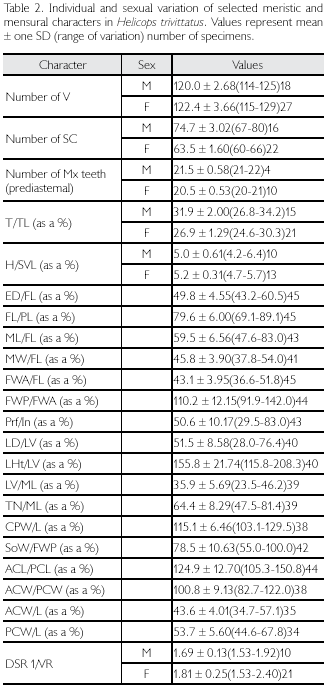
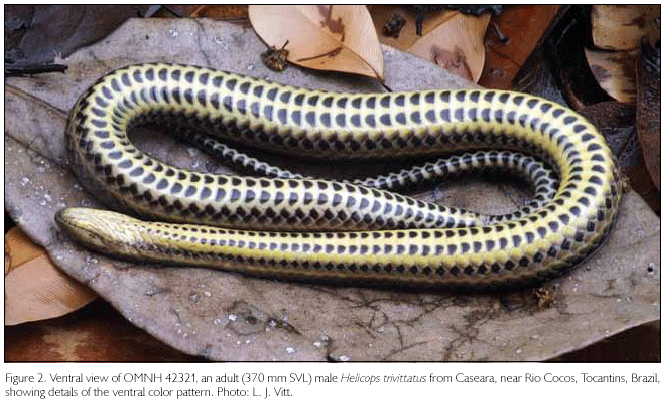
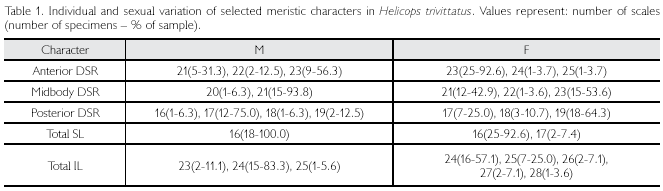
<body><![CDATA[<p><font size="2" face="verdana">Type-locality:  No locality data known (see Introduction).</font></p>     <p><font size="2" face="verdana">Etymology:  The species name, <i>trivittatus, </i>is from the Latin, meaning &quot;three  stripes or lines&quot;.</font></p>     <p><font size="2" face="verdana">Definition:  A large (maximum recorded SVL 711   mm) species of <i>Helicops </i>characterized by having:  a maximum of 23 DSR at midbody in females, 21 in males; the single  internasal usually (ca. 79%) separated from the rostral by the paired nasals; a  moderate number of V (&#9792; 115-129, &#9794;  114-125); a moderately large number of SC (&#9792;  60-66, &#9794; 67-80);  the dorsum with five narrow longitudinal light stripes; the venter light with  two medial rows of broad, black semilunar markings, the same pattern extending  onto the underside of the tail.</font></p>     <p><font size="2" face="verdana">The  combination of five rows of narrow light stripes on the dorsum with a linear  pattern of dark spots on the light underside of body and tail readily  distinguishes <i>Helicops trivittatus </i>from all other species in the genus.   Variation:  Meristic and mensural variation is summarized in <a href="#t1">Tables 1</a> and <a href="#t2">2</a>. Many  characters exhibit sexual dimorphism - some slight (e. g., relative head  length, number of V), some pronounced (e. g., number of DSR, number of SC).  Males tend to have fewer V and IL, but more SC and maxillary teeth. Females tend  to have a proportionately shorter tail, but a wider DSR 1.</font></p>     <p><a name="t1"></a></p>     <p>&nbsp;</p>     <p align="center"><img src="/img/revistas/bmpegcn/v5n3/3a03t1.gif" border="0"></p>     <p>&nbsp;</p>     <p><a name="t2" id="t2"></a></p>     <p>&nbsp;</p>     ]]></body>
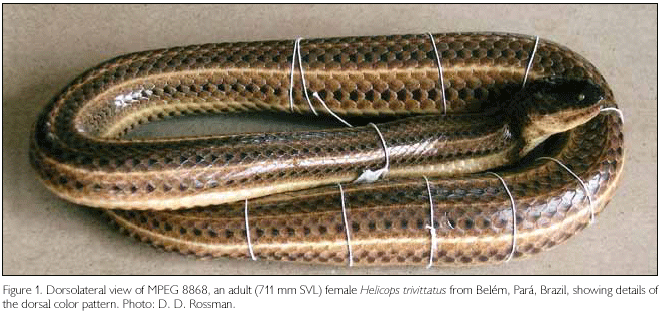
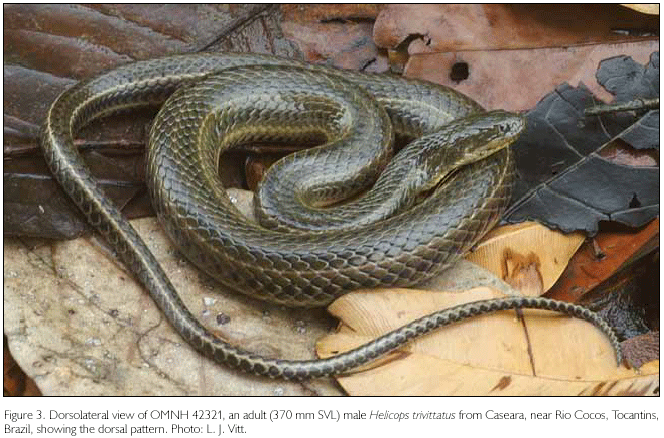
<body><![CDATA[<p align="center"><img src="/img/revistas/bmpegcn/v5n3/3a03t2.gif" border="0"></p>     <p>&nbsp;</p>     <p><font size="2" face="verdana">Reduction in the number of DSR from 23 to 21  results from either fusion of rows four and five or loss of one row or the  other (in MPEG 13328 it is not clear if row five or six is lost). The point of  reduction lies at 52.8% of total number of ventrals in the four specimens  examined for this feature (an apparently anomalous reduction at 11.2% of SVL in  the holotype was omitted from the calculations; the next lowest value was 48.4%).  &nbsp;Reduction from 21 to 19 rows also  results from either fusion of rows four and five or loss of one row or the  other (in one specimen it is not clear if row five or six is lost, and in  another specimen rows five and six are fused). The point of reduction lies at 73.7%  of SVL in seven specimens examined. Reduction from 19 to 17 rows results from  the loss of row three or four (point of reduction lies at 94.6% of total  ventrals in four specimens).</font></p>     <p><font size="2" face="verdana">The  internasal is clearly in contact with the rostral in four specimens, clearly  separated by contact between the opposing nasal scales in 23 specimens, and the  four scales meet at a common point in two specimens. The nostril occupies 28%  of the height of the semi-divided nasal scale in the one specimen measured for  this character (MCZ 87340), and its ventral margin lies 64% of nasal height  above the ventral suture of this scale.</font></p>     <p><font size="2" face="verdana">The  ten largest females examined average 555 mm in SVL (475-711), and the nine largest  males average 385 mm  (335-448). Clearly there is significant sexual size dimorphism in this species.  Mature males (&gt; 320 mm  SVL) have tubercles on the chinshields and anterior infralabials. The <i>in  situ </i>hemipenis (three specimens) extends posteriorly to the level of SC 9, dividing  at the level of SC 7. The organ lacks calyces and is spinose throughout.</font></p>     <p><font size="2" face="verdana">In  terms of colour pattern (<a href="#f1">Figures 1</a>, <a href="#f2">2</a>, <a href="#f3">3</a>), <i>Helicops trivittatus </i>appears  to be one of the least variable species in the genus. The lower half of DSR 1 is  cream coloured, like the adjacent venter. The dorsal ground colour ranges from  tan (lower sides) or brown to very dark brown (upper back). Very dark brown  pigment is present on the anterior half of each scale in DSR 2, 5 or 6, and 9  or 10 (apparently variable position of dark-spotted rows reflects the number of  scale rows present at the point of observation). Continuous cream or yellow  stripes occur on the upper half of DSR 3-lower half of DSR 4 (largely confined  to DSR 3 posterior to DSR reduction point) and on the upper edge of DSR 7 (or  DSR 8 anterior to the reduction point). A very narrow yellow or pale tan stripe  or line is confined to the scales in the vertebral row.</font></p>     <p><a name="f1" id="f1"></a></p>     <p>&nbsp;</p>     <p align="center"><img src="/img/revistas/bmpegcn/v5n3/3a03f1.gif" border="0"></p>     <p>&nbsp;</p>     ]]></body>
<body><![CDATA[<p><font size="2" face="verdana"></font><a name="f2" id="f2"></a></p>     <p>&nbsp;</p>     <p align="center"><img src="/img/revistas/bmpegcn/v5n3/3a03f2.gif" border="0"></p>     <p>&nbsp;</p>     <p><font size="2" face="verdana"></font><a name="f3" id="f3"></a></p>     <p>&nbsp;</p>     <p align="center"><img src="/img/revistas/bmpegcn/v5n3/3a03f3.gif" border="0"></p>     <p>&nbsp;</p>     <p><font size="2" face="verdana"></font><font size="2" face="verdana">The  dorsolateral light stripes expand slightly on the neck to form a pair of light  nuchal spots (separated from the stripe by one tan scale in MPEG 1229), which  are more prominent in younger individuals (but are lacking in MPEG 1221, a neonate). A faint  hint of paired, light parietal spots is seen in some juveniles. The top and  sides of the head are uniformly dark brown, the dark pigment extending  ventrally onto the supralabials for about half their height. The lower half of  each supralabial is cream colored, but densely speckled with brown pigment.</font></p>     <p><font size="2" face="verdana">The  chin and throat are cream or white, unmarked except for brown speckling  laterally - especially on the mental and infralabials. The venter is cream with  two uniform rows of very dark brown to black semilunar spots that collectively  occupy nearly 80% of the width of each scale. The anal plate may (MCZ 87340) or  may not (LSUMZ 36608) be marked with dark pigment, but the dark spots on the  subcaudals are so extensive that they occupy the anterior 1/2 &nbsp;to 2/3 of each scale.</font></p>     ]]></body>
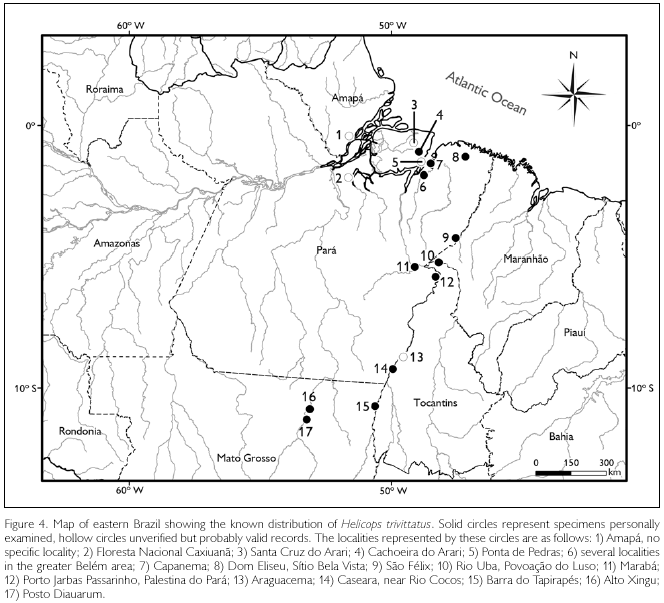
<body><![CDATA[<p><font size="2" face="verdana">Distribution:  North-central Brazil from the upper reaches of the Xingu and Araguaia  rivers to the mouth of the Amazon (<a href="#f4">Figure 4</a>). Known from the states of Amap&aacute;,  Mato Grosso, Par&aacute;, and Tocantins.</font></p>     <p><a name="f4" id="f4"></a></p>     <p>&nbsp;</p>     <p align="center"><img src="/img/revistas/bmpegcn/v5n3/3a03f4.gif" border="0"></p>     <p>&nbsp;</p>     <p><font size="2" face="verdana"></font></p>     <p><font size="3" face="verdana"><b>SPECIMENS  EXAMINED (OR RECORDS CONSIDERED VALID):</b></font></p>     <p><font size="2" face="verdana">No  locality data: BM(NH) 1946,1,13,99 (holotype). &quot;India&quot; &#091;in error&#093;: BM(NH):  III.23.2b. Amap&aacute;. No  specific locality (Hoge, 1967). Mato Grosso. Alto Xingu:  MNUFRJ 7784;  Parque Ind&iacute;gena do Xingu, Posto Diauarum: LSUMZ 36608; Barra do  Tapirap&eacute;s: MZUSP 3815.  Par&aacute;. Bel&eacute;m: MPEG 135, 734, 759-60, 1097,  1124-25, 1218, 1221, 1229, 8867-68, 18699, 18943, 19297; 5 km E Bel&eacute;m, Utinga: KU  127267, 128099, LSUMZ 44994; Capanema, MPEG 17641-42, 17644, 17647, 17654; munic&iacute;pio de Melga&ccedil;o, Floresta Nacional de Caxiuan&atilde; &#091;MPEG  specimens mentioned in Maschio <i>et al., </i>2009&#093;, ilha do Maraj&oacute;, Santa  Cruz do Arari &#091;MPEG  specimens not seen by me&#093;, ilha do Maraj&oacute;, Ponta de  Pedras &#091;MPEG  specimens not seen by me&#093;, Cachoeira do Arari: MPEG 644, 18013, MCZ 873430; Dom  Eliseu, S&iacute;tio Bela Vista: MPEG 13391; S&atilde;o F&eacute;lix, km 11 on PA-222: MPEG 14523; Estrada Moj&uacute;-Acar&aacute;,  rio Uba, Povoa&ccedil;&atilde;o do Luso: MPEG 13325-26, 13328, 13331-34; Marab&aacute;: MPEG 14523; rio Araguaia, Porto  Jarbas Passarinho, Palestina do Par&aacute;: MPEG 15216, 15240-44. Tocantins. Araguacema  (Hoge, 1953  &#091;1952&#093;); Caseara, near rio Cocos: OMNH 42321.</font></p>     <p>&nbsp;</p>     <p><font size="3" face="verdana"><b>ACKNOWLEDGMENTS</b></font></p>     ]]></body>
<body><![CDATA[<p><font size="2" face="verdana">I  wish to thank the curators at Museu Paraense Em&iacute;lio Goeldi (MPEG), Bel&eacute;m, the  British Museum (Natural History), London (BM(NH)), Museu de Zoologia,  Universidade de S&atilde;o Paulo (MZUSP), Museu Nacional, Universidade Federal de Rio  de Janeiro (MNUFRJ), University of Kansas Museum of Natural History, Lawrence  (KU), Museum of Natural Science, Louisiana State University, Baton Rouge  (LSUMZ), Museum of Comparative Zoology, Harvard University, Cambridge (MCZ),  and the University of Oklahoma Museum of Natural History, Norman (OMNH), for  the loan of specimens in their care. Marcelo Sturaro of the herpetology  laboratory at MPEG generously helped to prepare the distributionmap. For other  favours contributing to the completion of this paper, I am also grateful to  Teresa Avila-Pires, Jonathan  Campbell, Marinus Hoogmoed, Ana Lucia Prudente, and  Laurie Vitt.</font></p>     <p>&nbsp;</p>     <p><font size="3" face="verdana"><b>REFERENCES</b></font></p>     <!-- ref --><p><font size="2" face="verdana">BOULENGER,  G. A., 1893. <b>Catalogue of the snakes in the British Museum  (Natural History). </b>v. 1. Trustees of the British  Museum (Natural History), London.</font><!-- ref --><p><font size="2" face="verdana">CUNHA,  O. R. &amp; F. P. NASCIMENTO, 1978. Of&iacute;dios da Amaz&ocirc;nia. X. As cobras da regi&atilde;o leste  do Par&aacute;. <b>Publica&ccedil;oes Avulsas do Museu Paraense Em&iacute;lio Goeldi </b>31: 1-128.</font><!-- ref --><p><font size="2" face="verdana">CUNHA, O. R. &amp; F. P. NASCIMENTO,  1994 &#091;1993&#093;. Of&iacute;dios da Amaz&ocirc;nia. As cobras da regi&atilde;o leste do Par&aacute;. <b>Boletim do Museu  Paraense Em&iacute;lio Goeldi, s&eacute;rie Zoologia </b>9: 1-191.</font><!-- ref --><p><font size="2" face="verdana">GOMES, J. F., 1918. Contribui&ccedil;&atilde;o para o conhecimento dos of&iacute;dios do Brasil - III. 1. Of&iacute;dios do Museu  Paraense. <b>Mem&oacute;rias do Instituto Butantan </b>1: 57-77.</font><!-- ref --><p><font size="2" face="verdana">GRAY J. E., 1849. <b>Catalogue  of the specimens of snakes in the collection of the British Museum. </b>Trustees of the British  Museum, London.</font><!-- ref --><p><font size="2" face="verdana">HOGE,  A. R., 1953 &#091;1952&#093;. Notas herpetol&oacute;gicas. 1a Contribui&ccedil;&atilde;o ao conhecimento dos  of&iacute;dios do Brasil Central. <b>Mem&oacute;rias do Instituto Butantan </b>24: 179-214.</font><p><font size="2" face="verdana">HOGE, A. R., 1967. Serpentes do Territ&oacute;rio Federal do Amap&aacute;. <b>Atas  do Simp&oacute;sio s&ocirc;bre a Biota Amaz&ocirc;nica </b>5(Zoologia): 217-223.</font></p>     ]]></body>
<body><![CDATA[<!-- ref --><p><font size="2" face="verdana">MASCHIO  G. F., M. C. SANTOS-COSTA  &amp; A. L. C. PRUDENTE,  2009. Comunidade de serpentes da regi&atilde;o de Caxiuan&atilde; com avalia&ccedil;&atilde;o da efici&ecirc;ncia  dos m&eacute;todos de captura. In: P. L. B. LISBOA (Ed.): <b>Caxiuan&atilde;. </b>Desafios para a conserva&ccedil;&atilde;o de uma  Floresta Nacional na Amaz&ocirc;nia: 589-603. Museu Paraense  Em&iacute;lio Goeldi, Bel&eacute;m.</font><!-- ref --><p><font size="2" face="verdana">ROSSMAN, D. A., 2002a. Variation  in the xenodontid water snake <i>Helicops scalaris </i>Jan, and the status of <i>H.  hogei </i>Lancini. <b>Occasional Papers of the Museum of Natural Science </b>(78): 1-18.</font><!-- ref --><p><font size="2" face="verdana">ROSSMAN,  D. A., 2002b. Morphological variation in the endemic Colombian water snake, <i>Helicops  danieli </i>Amaral, 1937 (Serpentes: Xenodontidae). <b>Revista de Academia Colombiana Ciencias </b>26: 589-594.</font><!-- ref --><p><font size="2" face="verdana">ROSSMAN, D. A., N. B. FORD  &amp; R. A. SE1GEL, 1996. <b>The Garter Snakes: </b>Evolution and Ecology:  i-xx, 1-332. University   of Oklahoma Press,  Norman.</font><!-- ref --><p><font size="2" face="verdana">ROSSMAN,  D. A. &amp; N. J. SCOTT 1968. Identity of <i>Helicops wettsteini </i>Amaral  (Serpentes: Colubridae). <b>Herpetologica </b>24: 262-263.</font><p>&nbsp;</p>     <p>&nbsp;</p>     <p><font size="2" face="Verdana"><b><a name="endereco"></a><a href="#topo"><img src="img/revistas/bmpegcn/v5n3/seta.gif" border="0" /></a></b></font><font size="2" face="verdana"><b>Mailing address</b>:    <br> Museu Paraense Em&iacute;lio Goeldi    <br> Editor do Boletim do Museu Paraense Em&iacute;lio Goeldi. Ci&ecirc;ncias Naturais    ]]></body>
<body><![CDATA[<br> Av. Magalh&atilde;es Barata, 376    <br> S&atilde;o Braz &ndash; CEP 66040-170    <br> Bel&eacute;m - PA - Brazil    <br> Caixa Postal 399    <br> Phone: 55-91-3182-3246    <br> Fax: 55- 91-3249-6373    <br> E-mail: <a href="mailto:boletim.naturais@museu-goeldi.br">boletim.naturais@museu-goeldi.br</a></font></p>     <p><font size="2" face="verdana">Recebido: 01/10/2009    <br>   Aprovado: 08/09/2010    <br> </font></p>     ]]></body>
<body><![CDATA[<p><font size="2" face="verdana">  Responsabilidade editorial: Marinus Hoogmoed</font></p>      ]]></body><back>
<ref-list>
<ref id="B1">
<nlm-citation citation-type="book">
<person-group person-group-type="author">
<name>
<surname><![CDATA[BOULENGER]]></surname>
<given-names><![CDATA[G. A.]]></given-names>
</name>
</person-group>
<source><![CDATA[Catalogue of the snakes in the British Museum (Natural History)]]></source>
<year>1893</year>
<volume>1</volume>
<publisher-loc><![CDATA[London ]]></publisher-loc>
<publisher-name><![CDATA[Trustees of the British Museum (Natural History)]]></publisher-name>
</nlm-citation>
</ref>
<ref id="B2">
<nlm-citation citation-type="journal">
<person-group person-group-type="author">
<name>
<surname><![CDATA[CUNHA]]></surname>
<given-names><![CDATA[O. R.]]></given-names>
</name>
<name>
<surname><![CDATA[NASCIMENTO]]></surname>
<given-names><![CDATA[F. P.]]></given-names>
</name>
</person-group>
<article-title xml:lang="pt"><![CDATA[Ofídios da Amazônia. X.: As cobras da região leste do Pará]]></article-title>
<source><![CDATA[Publicaçoes Avulsas do Museu Paraense Emílio Goeldi]]></source>
<year>1978</year>
<volume>31</volume>
<page-range>1-128</page-range></nlm-citation>
</ref>
<ref id="B3">
<nlm-citation citation-type="journal">
<person-group person-group-type="author">
<name>
<surname><![CDATA[CUNHA]]></surname>
<given-names><![CDATA[O. R.]]></given-names>
</name>
<name>
<surname><![CDATA[NASCIMENTO]]></surname>
<given-names><![CDATA[F. P.]]></given-names>
</name>
</person-group>
<article-title xml:lang="pt"><![CDATA[Ofídios da Amazônia: As cobras da região leste do Pará]]></article-title>
<source><![CDATA[Boletim do Museu Paraense Emílio Goeldi, série Zoologia]]></source>
<year>1994</year>
<volume>9</volume>
<page-range>1-191</page-range></nlm-citation>
</ref>
<ref id="B4">
<nlm-citation citation-type="journal">
<person-group person-group-type="author">
<name>
<surname><![CDATA[GOMES]]></surname>
<given-names><![CDATA[J. F.]]></given-names>
</name>
</person-group>
<article-title xml:lang="pt"><![CDATA[Contribuição para o conhecimento dos ofídios do Brasil - III: 1. Ofídios do Museu Paraense]]></article-title>
<source><![CDATA[Memórias do Instituto Butantan]]></source>
<year>1918</year>
<volume>1</volume>
<page-range>57-77</page-range></nlm-citation>
</ref>
<ref id="B5">
<nlm-citation citation-type="book">
<person-group person-group-type="author">
<name>
<surname><![CDATA[GRAY]]></surname>
<given-names><![CDATA[J. E.]]></given-names>
</name>
</person-group>
<source><![CDATA[Catalogue of the specimens of snakes in the collection of the British Museum]]></source>
<year>1849</year>
<publisher-loc><![CDATA[London ]]></publisher-loc>
<publisher-name><![CDATA[Trustees of the British Museum]]></publisher-name>
</nlm-citation>
</ref>
<ref id="B6">
<nlm-citation citation-type="journal">
<person-group person-group-type="author">
<name>
<surname><![CDATA[HOGE]]></surname>
<given-names><![CDATA[A. R.]]></given-names>
</name>
</person-group>
<article-title xml:lang="pt"><![CDATA[Notas herpetológicas: 1a Contribuição ao conhecimento dos ofídios do Brasil Central]]></article-title>
<source><![CDATA[Memórias do Instituto Butantan]]></source>
<year>1953</year>
<volume>24</volume>
<page-range>179-214</page-range></nlm-citation>
</ref>
<ref id="B7">
<nlm-citation citation-type="journal">
<person-group person-group-type="author">
<name>
<surname><![CDATA[HOGE]]></surname>
<given-names><![CDATA[A. R.]]></given-names>
</name>
</person-group>
<article-title xml:lang="pt"><![CDATA[Serpentes do Território Federal do Amapá]]></article-title>
<source><![CDATA[Atas do Simpósio sobre a Biota Amazônica 5(Zoologia)]]></source>
<year>1967</year>
<page-range>217-223</page-range></nlm-citation>
</ref>
<ref id="B8">
<nlm-citation citation-type="book">
<person-group person-group-type="author">
<name>
<surname><![CDATA[MASCHIO]]></surname>
<given-names><![CDATA[G. F.]]></given-names>
</name>
<name>
<surname><![CDATA[SANTOS-COSTA]]></surname>
<given-names><![CDATA[M. C.]]></given-names>
</name>
<name>
<surname><![CDATA[PRUDENTE]]></surname>
<given-names><![CDATA[A. L. C]]></given-names>
</name>
</person-group>
<article-title xml:lang="pt"><![CDATA[Comunidade de serpentes da região de Caxiuanã com avaliação da eficiência dos métodos de captura]]></article-title>
<person-group person-group-type="editor">
<name>
<surname><![CDATA[LISBOA]]></surname>
<given-names><![CDATA[P. L. B.]]></given-names>
</name>
</person-group>
<source><![CDATA[Caxiuanã: Desafios para a conservação de uma Floresta Nacional na Amazônia]]></source>
<year>2009</year>
<page-range>589-603</page-range><publisher-loc><![CDATA[Belém ]]></publisher-loc>
<publisher-name><![CDATA[Museu Paraense Emílio Goeldi]]></publisher-name>
</nlm-citation>
</ref>
<ref id="B9">
<nlm-citation citation-type="journal">
<person-group person-group-type="author">
<name>
<surname><![CDATA[ROSSMAN]]></surname>
<given-names><![CDATA[D. A.]]></given-names>
</name>
</person-group>
<article-title xml:lang="en"><![CDATA[Variation in the xenodontid water snake Helicops scalaris Jan, and the status of H. hogei Lancini]]></article-title>
<source><![CDATA[Occasional Papers of the Museum of Natural Science]]></source>
<year>2002</year>
<volume>78</volume>
<page-range>1-18</page-range></nlm-citation>
</ref>
<ref id="B10">
<nlm-citation citation-type="journal">
<person-group person-group-type="author">
<name>
<surname><![CDATA[ROSSMAN]]></surname>
<given-names><![CDATA[D. A.]]></given-names>
</name>
</person-group>
<article-title xml:lang="en"><![CDATA[Morphological variation in the endemic Colombian water snake, Helicops danieli Amaral, 1937 (Serpentes: Xenodontidae)]]></article-title>
<source><![CDATA[Revista de Academia Colombiana Ciencias]]></source>
<year>2002</year>
<volume>26</volume>
<page-range>589-594</page-range></nlm-citation>
</ref>
<ref id="B11">
<nlm-citation citation-type="book">
<person-group person-group-type="author">
<name>
<surname><![CDATA[ROSSMAN]]></surname>
<given-names><![CDATA[D. A.]]></given-names>
</name>
<name>
<surname><![CDATA[FORD]]></surname>
<given-names><![CDATA[N. B.]]></given-names>
</name>
<name>
<surname><![CDATA[SE1GEL]]></surname>
<given-names><![CDATA[R. A.]]></given-names>
</name>
</person-group>
<source><![CDATA[The Garter Snakes: Evolution and Ecology]]></source>
<year>1996</year>
<volume>i-xx</volume>
<page-range>1-332</page-range><publisher-loc><![CDATA[Norman ]]></publisher-loc>
<publisher-name><![CDATA[University of Oklahoma Press]]></publisher-name>
</nlm-citation>
</ref>
<ref id="B12">
<nlm-citation citation-type="journal">
<person-group person-group-type="author">
<name>
<surname><![CDATA[ROSSMAN]]></surname>
<given-names><![CDATA[D. A.]]></given-names>
</name>
<name>
<surname><![CDATA[SCOTT]]></surname>
<given-names><![CDATA[N. J.]]></given-names>
</name>
</person-group>
<article-title xml:lang="en"><![CDATA[Identity of Helicops wettsteini Amaral (Serpentes: Colubridae)]]></article-title>
<source><![CDATA[Herpetologica]]></source>
<year>1968</year>
<volume>24</volume>
<page-range>262-263</page-range></nlm-citation>
</ref>
</ref-list>
</back>
</article>