<?xml version="1.0" encoding="ISO-8859-1"?><article xmlns:mml="http://www.w3.org/1998/Math/MathML" xmlns:xlink="http://www.w3.org/1999/xlink" xmlns:xsi="http://www.w3.org/2001/XMLSchema-instance">
<front>
<journal-meta>
<journal-id>1981-8114</journal-id>
<journal-title><![CDATA[Boletim do Museu Paraense Emílio Goeldi Ciências Naturais]]></journal-title>
<abbrev-journal-title><![CDATA[Bol. Mus. Para. Emilio Goeldi Cienc. Nat.]]></abbrev-journal-title>
<issn>1981-8114</issn>
<publisher>
<publisher-name><![CDATA[Museu Paraense Emílio Goeldi, Ministério da Ciência e Tecnologia]]></publisher-name>
</publisher>
</journal-meta>
<article-meta>
<article-id>S1981-81142010000300005</article-id>
<title-group>
<article-title xml:lang="en"><![CDATA[The birds of Reserva Extrativista Chico Mendes, South Acre, Brazil]]></article-title>
<article-title xml:lang="pt"><![CDATA[Aves da Reserva Extrativista Chico Mendes, Sul do Acre, Brasil]]></article-title>
</title-group>
<contrib-group>
<contrib contrib-type="author">
<name>
<surname><![CDATA[Mestre]]></surname>
<given-names><![CDATA[Luiz Augusto Macedo]]></given-names>
</name>
<xref ref-type="aff" rid="A01"/>
</contrib>
<contrib contrib-type="author">
<name>
<surname><![CDATA[Thom]]></surname>
<given-names><![CDATA[Gregory]]></given-names>
</name>
<xref ref-type="aff" rid="A02"/>
</contrib>
<contrib contrib-type="author">
<name>
<surname><![CDATA[Cochrane]]></surname>
<given-names><![CDATA[Mark Alan]]></given-names>
</name>
<xref ref-type="aff" rid="A03"/>
</contrib>
<contrib contrib-type="author">
<name>
<surname><![CDATA[Barlow]]></surname>
<given-names><![CDATA[Jos]]></given-names>
</name>
<xref ref-type="aff" rid="A04"/>
</contrib>
</contrib-group>
<aff id="A01">
<institution><![CDATA[,South Dakota State University Geographic Information Science Center of Excellence ]]></institution>
<addr-line><![CDATA[Brookings South Dakota]]></addr-line>
<country>U.S.A.</country>
</aff>
<aff id="A02">
<institution><![CDATA[,Museu Faraense Emílio Goeldi Programa de Pós Graduação em Zoologia ]]></institution>
<addr-line><![CDATA[Belém Pará]]></addr-line>
<country>Brasil</country>
</aff>
<aff id="A03">
<institution><![CDATA[,South Dakota State University Geographic Information Science Center of Excellence ]]></institution>
<addr-line><![CDATA[Brookings South Dakota]]></addr-line>
<country>U.S.A.</country>
</aff>
<aff id="A04">
<institution><![CDATA[,Lancaster University Lancaster Environment Centre ]]></institution>
<addr-line><![CDATA[Lancaster Lancashire]]></addr-line>
<country>Inglaterra</country>
</aff>
<pub-date pub-type="pub">
<day>00</day>
<month>12</month>
<year>2010</year>
</pub-date>
<pub-date pub-type="epub">
<day>00</day>
<month>12</month>
<year>2010</year>
</pub-date>
<volume>5</volume>
<numero>3</numero>
<fpage>311</fpage>
<lpage>333</lpage>
<copyright-statement/>
<copyright-year/>
<self-uri xlink:href="http://scielo.iec.gov.br/scielo.php?script=sci_arttext&amp;pid=S1981-81142010000300005&amp;lng=en&amp;nrm=iso"></self-uri><self-uri xlink:href="http://scielo.iec.gov.br/scielo.php?script=sci_abstract&amp;pid=S1981-81142010000300005&amp;lng=en&amp;nrm=iso"></self-uri><self-uri xlink:href="http://scielo.iec.gov.br/scielo.php?script=sci_pdf&amp;pid=S1981-81142010000300005&amp;lng=en&amp;nrm=iso"></self-uri><abstract abstract-type="short" xml:lang="en"><p><![CDATA[This paper describes the avifauna sampled at Reserva Extrativista Chico Mendes, Acre, Brazil, during October and November, 2008. We recorded 344 bird species of 17 orders and 57 families through point counts, mist-nets and general observations. The most prevalent families were Tyrannidae, Thamnophilidae and Thraupidae with 53, 36 and 22 species, respectively. We recorded some range restricted, little know, and habitat specialists birds exemplified by Crypturellus atrocapillus, C. strigulosus, Primolius couloni, Aulacorhynchus prasinus, Drymophila devillei, Simoxenops ucayalae, Cnipodectes superrufus, Hemitriccus flammulatus, Percnostola lophotes, Xiphorhynchus chunchotambo, and Conioptilon mcilhennyi. Although we surveyed only during the dry season, the rarefaction curves indicate a satisfactory sampling effort. The data show that the Chico Mendes reserve holds a unique Amazonian bird community, which is influenced by the presence of bamboo and second growth vegetation. The results of this paper reinforce the biological importance of the RESEX and highlight the need for more inventories and bird studies at this isolated and little known region of the Brazilian Amazon.]]></p></abstract>
<abstract abstract-type="short" xml:lang="pt"><p><![CDATA[Este estudo descreve a avifauna amostrada na Reserva Extrativista Chico Mendes, Acre, Brasil. Foram registradas por contagem por pontos, redes neblina e observações gerais 344 espécies de aves incluídas em 17 ordens e 57 famílias. As famílias mais representadas foram Tyrannidae, Thamnophilidae e Thraupidae com 53, 36 e 22 espécies, respectivamente. Registramos algumas espécies de distribuição restrita, pouco conhecidas ou especialistas, exemplificadas por Crypturellus atrocapillus, C. strigulosus, Primolius couloni, Aulacorhynchusprasinus, Drymophila devillei, Simoxenops ucayalae, Cnipodectes superrufus, Hemitriccus flammulatus, Xiphorhynchus chunchotambo, Percnostola lophotes e Conioptilon mcilhennyi. Apesar de termos amostrado apenas a estação seca, as curvas cumulativas de espécies indicaram um bom esforço amostral. Os resultados deste estudo mostraram que nesta reserva ocorre uma comunidade de aves característica, influenciada por bambus e florestas secundárias. Nossos resultados reforçam a importância biológica da RESEX e enfatizam a necessidade de mais inventários e estudos ornitológicos nesta isolada e ainda pouco conhecida região da Amazônia brasileira.]]></p></abstract>
<kwd-group>
<kwd lng="en"><![CDATA[Aves]]></kwd>
<kwd lng="en"><![CDATA[Brazil]]></kwd>
<kwd lng="en"><![CDATA[Southeast Acre]]></kwd>
<kwd lng="en"><![CDATA[Southwest Amazon]]></kwd>
<kwd lng="en"><![CDATA[Reserva Extrativista Chico Mendes]]></kwd>
<kwd lng="pt"><![CDATA[Aves]]></kwd>
<kwd lng="pt"><![CDATA[Brasil]]></kwd>
<kwd lng="pt"><![CDATA[Sudeste do Acre]]></kwd>
<kwd lng="pt"><![CDATA[Sudoeste da Amazônia]]></kwd>
<kwd lng="pt"><![CDATA[Reserva Extrativista Chico Mendes]]></kwd>
</kwd-group>
</article-meta>
</front><body><![CDATA[ <p><font size="4" face="verdana"><b><a name="topo"></a>The birds  of Reserva Extrativista Chico Mendes, South Acre, Brazil</b></font></p>     <p>&nbsp;</p>     <p><font size="3" face="verdana"><b>Aves da Reserva Extrativista Chico  Mendes, Sul do Acre, Brasil</b></font></p>     <p>&nbsp;</p>     <p>&nbsp;</p>     <p><font size="2" face="verdana"><b>Luiz  Augusto Macedo Mestre<sup>I</sup>; Gregory Thom<sup>II</sup>; Mark Alan Cochrane<sup>III</sup>; Jos  Barlow<sup>IV</sup></b></font></p>     <p><font size="2" face="verdana"><sup>I</sup>South Dakota State University. Geographic Information   Science Center  of Excellence. Brookings, South Dakota, U.S.A.  (<a href="mailto:luiz.mestre@gmail.com">luiz.mestre@gmail.com</a>)    <br>   <sup>II</sup>Museu Faraense Em&iacute;lio Goeldi. Programa de P&oacute;s Gradua&ccedil;&atilde;o em Zoologia. Bel&eacute;m,  Par&aacute;, Brasil (<a href="mailto:biogrego@yahoo.com.br">biogrego@yahoo.com.br</a>)    <br>   <sup>III</sup>South Dakota State University.  Geographic Information   Science Center  of Excellence. Brookings, South Dakota, U.S.A. (<a href="mailto:mark.cochrane@sdstate.edu">mark.cochrane@sdstate.edu</a>)    <br>   <sup>IV</sup>Lancaster University. Lancaster  Environment Centre. Lancaster, Lancashire, Inglaterra (<a href="mailto:josbarlow@gmail.com">josbarlow@gmail.com</a>)</font></p>     ]]></body>
<body><![CDATA[<p><a href="#endereco"><font size="2" face="verdana">Correspondence</font></a></p>     <p>&nbsp;</p>     <p>&nbsp;</p> <hr size="1" noshade>     <p><font size="2" face="verdana"><b>ABSTRACT</b></font></p>     <p><font size="2" face="verdana">This paper describes the avifauna sampled at  Reserva Extrativista Chico Mendes, Acre,   Brazil, during  October and November, 2008. We recorded 344 bird species of 17 orders and 57  families through point counts, mist-nets and general observations. The most  prevalent families were Tyrannidae, Thamnophilidae and Thraupidae with 53, 36  and 22 species, respectively. We recorded some range restricted, little know,  and habitat specialists birds exemplified by <i>Crypturellus atrocapillus</i>, <i>C.  strigulosus, Primolius couloni, Aulacorhynchus prasinus, Drymophila devillei,  Simoxenops ucayalae, Cnipodectes superrufus, Hemitriccus flammulatus,  Percnostola lophotes, Xiphorhynchus chunchotambo</i>, and <i>Conioptilon  mcilhennyi. </i>Although we surveyed only during the dry season, the  rarefaction curves indicate a satisfactory sampling effort. The data show that  the Chico Mendes reserve holds a unique Amazonian bird community, which is  influenced by the presence of bamboo and second growth vegetation. The results  of this paper reinforce the biological importance of the RESEX and highlight  the need for more inventories and bird studies at this isolated and little  known region of the Brazilian Amazon.</font></p>     <p><font size="2" face="verdana"><b>Keywords: </b>Aves. Brazil. Southeast   Acre. Southwest Amazon. Reserva Extrativista  Chico Mendes.</font></p> <hr size="1" noshade>     <p><font size="2" face="verdana"><b>RESUMO</b></font></p>     <p><font size="2" face="verdana">Este estudo descreve a avifauna amostrada  na Reserva Extrativista Chico Mendes, Acre, Brasil. Foram registradas por  contagem por pontos, redes neblina e observa&ccedil;&otilde;es gerais 344 esp&eacute;cies de aves  inclu&iacute;das em 17 ordens e 57 fam&iacute;lias. As fam&iacute;lias mais representadas foram  Tyrannidae, Thamnophilidae e Thraupidae com 53, 36 e 22 esp&eacute;cies,  respectivamente. Registramos algumas esp&eacute;cies de distribui&ccedil;&atilde;o restrita, pouco  conhecidas ou especialistas, exemplificadas por <i>Crypturellus atrocapillus,  C. strigulosus, Primolius couloni, Aulacorhynchusprasinus, Drymophila devillei, Simoxenops ucayalae, Cnipodectes superrufus, Hemitriccus flammulatus,  Xiphorhynchus chunchotambo, Percnostola lophotes </i>e <i>Conioptilon  mcilhennyi. </i>Apesar de termos amostrado apenas a esta&ccedil;&atilde;o seca, as curvas  cumulativas de esp&eacute;cies indicaram um bom esfor&ccedil;o amostral. Os resultados deste  estudo mostraram que nesta reserva ocorre uma comunidade de aves  caracter&iacute;stica, influenciada por bambus e florestas secund&aacute;rias. Nossos  resultados refor&ccedil;am a import&acirc;ncia biol&oacute;gica da RESEX e enfatizam a necessidade  de mais invent&aacute;rios e estudos ornitol&oacute;gicos nesta isolada e ainda  pouco conhecida regi&atilde;o da Amaz&ocirc;nia brasileira.</font></p>     <p><font size="2" face="verdana"><b>Palavras-chave: </b>Aves. Brasil. Sudeste do Acre. Sudoeste da  Amaz&ocirc;nia. Reserva Extrativista Chico Mendes.</font></p> <hr size="1" noshade>     <p>&nbsp;</p>     ]]></body>
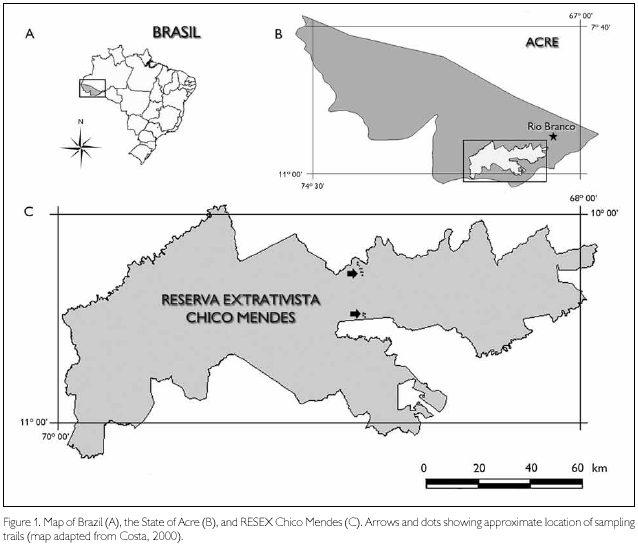
<body><![CDATA[<p>&nbsp;</p>     <p><font size="3" face="verdana"><b>INTRODUCTION</b></font></p>     <p><font size="2" face="verdana">The western Amazonian bird community is very  poorly known, and the Acre avifauna is still  being discovered and described. Despite the recent history of ornithological  surveys of the State of Acre  (less than 60 years of studies), up to 655 bird species have been recorded, and  around 75 new species are likely to be included in the State list in the near  future (Guilherme, 2009). Given the fast rate of change in our knowledge, all  possible information describing the avifauna of this State are significant for  the future management and conservation of this important and remote part of the  Amazon.</font></p>     <p><font size="2" face="verdana">Since the 1950's some researchers have  collected and surveyed birds in the State of Acre. One of the first bird collections in  this State was led by P E. Vanzolini in 1951 (Vanzolini, 1952), who confirmed  the first 140 bird species for Acre State, and four new species for Brazil  (Pinto &amp; Camargo, 1954). A few other bird surveys took place in Acre in late 1950's and 1960's (Novaes, 1957, 1958), but  ornithologists only published the first bird checklists about the avifauna of  this region in the 1980's and 1990's (for a detailed description see Guilherme,  2009). Most of the published bird surveys were carried out in the Jurua river  Basin in northern Acre (i.e. Novaes, 1957,  1958; Whittaker &amp; Oren, 1999; Whittaker <i>et al.</i>, 2002). Other papers  include inventories from the Acre river basin  (i.e. Pinto &amp; Camargo, 1954; Guilherme, 2001). This study describes and  highlights the important observations of the avifauna sampled at Reserva  Extrativista Chico Mendes (RESEX Chico Mendes), a federal extractive reserve  located further south in the Acre river basin,  almost at the Brazilian-Peruvian-Bolivian border.</font></p>     <p>&nbsp;</p>     <p><font size="3" face="verdana"><b>METHODS</b></font></p>     <p><font size="2" face="verdana">This study was conducted in RESEX Chico  Mendes (10<sup>o</sup> to 11<sup>o</sup> S, 68<sup>o</sup> to 70<sup>o</sup> W), in Acre State, Southwest Amazon, Brazil  (<a href="#f1">Figure 1</a>). This reserve has approximately 1-milion hectares of 'terra firme',  non-flooded, opened-canopy forests, with understory dominated by lianas, small  palms and/or bamboos (Costa, 2000). The Chico Mendes Reserve is located in a  region with annual average temperature around 24 <sup>o</sup>C, and a mean  precipitation of 2,000 mm  (Costa, 2000). The rainy period is from December to March and it is drier from  June to August (Costa, 2000). After an extended drought in the region, combined  with slash-and-burn techniques used by most of the reserve inhabitants, about 300,000 ha of forest in  the reserve were accidentally burned during August and October 2005 (Brown <i>et  al., </i>2006; INPE, 2010). For this reason, the study site is a mosaic of  burned and unburned primary Amazonian 'terra firme' forests with patches  dominated by bamboos. Most of the burned areas were forested and had been  regenerating for three years at the time of the study in 2008. We conducted  samples in the end of the dry season, during October 5th and  November 10th 2008,   in the center of the reserve and approximately 100 km from  Bolivian-Peruvian border, in Xapuri municipality (<a href="#f1">Figure 1</a>). By unburned  forests, we refer to sites that had not burned in the 2005 drought -but the  presence of bamboo in the region may indicate a relatively recent history of  fire (Nelson &amp; Irm&atilde;o, 1998).</font></p>     <p><a name="f1"></a></p>     <p>&nbsp;</p>     <p align="center"><img src="/img/revistas/bmpegcn/v5n3/3a05f1.gif" border="0"></p>     ]]></body>
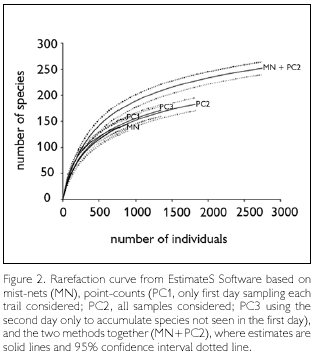
<body><![CDATA[<p>&nbsp;</p>     <p><font size="2" face="verdana">We sampled twelve 550 m trails that were all  located at least 1 km  apart from one another. We used mist-nets, point counts and random observations  (between the coordinates 10<sup>o</sup> 13' S, 68<sup>o</sup> 44' W and 10<sup>o</sup> 32' S, 68<sup>o</sup> 42' W) (<a href="#f1">Figure  1</a>). We performed the random observations at other sites, not just along the  trails, including main roads and plantations. For each avifaunal sampling  trail, 28 mist-nets (12 x 2.5 m;  mesh size 36 mm)  were erected in four groups of seven nets along 550 m transects. Each group  created a netline of 7 x 12 m  extending for 90 - 100 m.  Groups were separated by an open space of 50 m. We opened the 28 nets for two days, from  sunset (6:30 h) to about 13:30 h, accruing 2,050 mist-net hours in total (a  capture effort of 11,720 hm2). We checked the nets hourly and closed  it during periods of heavy rain. All birds captured were identified to species  level, weighed, and measured (standard measurements included wing, tail, bill,  and total length) and, whenever possible, were aged, sexed and photographed.  The captured birds were banded with a numbered metal ring obtained from Centro  Nacional de Pesquisa para Conserva&ccedil;&atilde;o de Aves Silvestres (CEMAVE) - Instituto  Chico Mendes de Conserva&ccedil;&atilde;o e Biodiversidade (ICMBio) ((The Brazilian Bird  Banding Laboratory in the Brazilian National Institute of Environment). All  recaptures from the same sampling period and from the same net line were  excluded from the analysis to avoid double counting.</font></p>     <p><font size="2" face="verdana">In addition to the mist-netting, Luiz Mestre carried  out 96 point counts along the trails. The point counts were accomplished two  times at the same point on two different days, but not the same days as the  mist-netting. First sampling was conducted between 6:30 h and 7:30 h, and the  second between 7:30 h and 9:00 h. Each point count consisted of ten minutes of  bird observations and recording, spaced 150 m each other (50 m, 200 m, 350 m and 500 m along each transect).  All bird registrations were recorded using a digital recorder and a directional  microphone during point counts and confirmed (if possible) visually by  binoculars. Unknown vocalizations were subsequently checked against known calls  and, if necessary, confirmed by consulting with other experienced  ornithologists (i.e. A. Aleixo, S. Dantas, E. Guilherme). The distance from the  observer and the height at first detection were also noted. We excluded from  the richness and abundance analysis all the birds flying or registered outside  the range of 50 m  radius of each point count. We also did not include birds that came from  directions of other sampling points (primarily wide-ranging canopy species such  as Pscitacidae, Embereziidae and Thraupidae), to avoid double counting.  Individuals of most species are unlikely to have been registered on consecutive  days, because sampling was always carried out at different times of the day.  However, we may have inflated numbers of individuals for some territorial  species. For this reason, we compared the cumulative curves in three different  ways. First, we plotted the curves using only first day sampling separately  (<a href="#f2">Figure 2</a>, PC1). Second, we plotted both days together including all  registrations (<a href="#f2">Figure 2</a>, PC2). Third, we only included the first detection  event of a species at a point, using day two only to accumulate species we did  not observe on day one. If a species was recorded on the first day and then  again on day two, we excluded the day two observation (<a href="#f2">Figure 2</a>, PC3).</font></p>     <p><a name="f2"></a></p>     <p>&nbsp;</p>     <p align="center"><img src="/img/revistas/bmpegcn/v5n3/3a05f2.gif" border="0"></p>     <p>&nbsp;</p>     <p><font size="2" face="verdana">We analyzed the three methods used separately  (mist-nets, point counts, general observations) based on number of individuals  and percentages. We used percentages of individuals classified separately in  the levels of order, family and species. For this reason, the sum of percentages  of different categories (taxonomical level) does not reflect the total of upper  taxonomical level. We used point counts and mist-net data to calculate  rarefaction species curves based upon number of individuals. We calculated  these curves with incidence data from point counts and mist-nets separately. We  analyzed the patterns of species richness between different methods comparing  individual-based rarefaction curves constructed using the analytical formulae  from EstimateS v.7 (Colwell, 2004). The comparisons were standardized by of the  number of individuals, as we were interested in patterns of species richness  and not species density (Gotelli &amp; Colwell, 2001). An estimate of the  'true' species richness in each quantitative method (mist-nets and point counts)  were calculated using the software EstimateS v.7, using the mean of the four  commonly employed abundance-based estimators (ACE, CHAO1, JACK1 &#091;Jackknife&#093;,  and BOOTSTRAPPING). We followed the CBRO (2009) list for nomenclature and <i>taxon </i>ordinance.</font></p>     <p>&nbsp;</p>     <p><font size="3" face="verdana"><b>RESULTS AND DISCUSSION</b></font></p>     ]]></body>
<body><![CDATA[<p><font size="2" face="verdana">We registered a total of 344 bird species at  RESEX Chico Mendes. These bird species were included in 17 orders and 57  families. The most representative families were Tyrannidae, Thamnophilidae and  Thraupidae, with 53, 36 and 22 species respectively. Mist-nets captured 868  individuals comprising 137 species from 33 families, and point counts recorded  2,380 individuals from 186 species in 38 families. Mist-nets added 55 species,  and general observations added 105 species to the total number of species.</font></p>     <p><font size="2" face="verdana">At the order level, we captured 77.3 % of  Passeriformes in mist-nets. Considering only families, we captured mainly  Thamnophilidae (33.5%), Dendrocolaptidae (12.3%), Throchilidae (11.2%) and  Tyrannidae (6.6%). The guilds of captured individuals were represented mainly  by arboreal sallying insectivores (20.4%), arboreal gleaning insectivores  (18.8%), nectarivores (11.2%), and terrestrial gleaning insectivores (10.5%).  The most captured species were <i>Myrmoborus myotherinus </i>(3.6%), <i>Arremon  taciturnus </i>(3.3%), <i>Pipra fasciicauda </i>(3.3%), <i>Phaethornis hispidus </i>(3.2%), and <i>Myrmoborus leucophrys </i>(3%). Based on Stotz <i>et al. </i>(1996),  roughly 47.4% of captured birds were medium sensitive species while 44.5% were  highly sensitive to human disturbances. Most of captured individuals (47.8%)  use only one type of habitat. Approximately 42% of all birds captured by  mist-nets use mainly the midstory and understory strata, and 41.6% use only the  understory.   In point counts we detected mostly birds from  families Psittacidae (20.8%), Thamnophilidae (20.7%), Thraupidae (8.8%), and  Tyrannidae (6.8%). We registered 20.7% of arboreal granivorous birds, 17.9% of  arboreal gleaning 14.3% of arboreal omnivores. The most abundant species were <i>Pyrrhura  picta </i>(7.1% of the registrations), <i>Amazona farinosa </i>(4.2%), <i>Aratinga  weddellii </i>(3.3%), <i>Tangara chilensis </i>(3.1%), <i>Myrmeciza hemimelaena </i>(2.9%), and <i>Thamnophilus schistaceus </i>(2.9%). Forty three percent of  these species were classified by Stotz <i>et al. </i>(1996) as highly sensitive  species, and 42.1% as a medium sensitivity bird species. Most of individuals  detected by point counts (36.5%) use only one type of habitat, and 29.9% use  two habitats. About 51.4% of individuals registered by this method were canopy  species.</font></p>     <p><font size="2" face="verdana">The rarefaction curves from mist-nets,  point-counts or both methods together did not reach an asymptote. However,  point counts and both methods summed, showed a possible beginning of  stabilization (<a href="#f2">Figure 2</a>). The point count estimate of the mean 'true' richness  was 213.1 (&#177; 13.6) species, using the four predicted abundance-based  estimators' means (see methods). Mist-net estimated richness was 169.5 (&#177; 9.3)  species using the mean of the four estimators. It is possible to observe a  better-estimated richness on associating both sampling methods, resulting in 288.3  (&#177; 13.8) species (<a href="#t1">Table 1</a>). However, it is important to consider that these  numbers were from limited samplings based only on point counts and mist-nets  and for only one specific season during one year. This result shows the  importance of supplementing standardized methods with general observations when  a complete species list is the desired outcome. The random observation method  added 106 bird species to this checklist, permitting us to estimate for this  period about 400 species in the area if combining this method, point count  estimate, and mist-net estimate (106 + 288.32 = 394.32).</font></p>     <p><a name="t1"></a></p>     <p>&nbsp;</p>     <p align="center"><img src="/img/revistas/bmpegcn/v5n3/3a05t1.gif" border="0"></p>     <p>&nbsp;</p>     <p><font size="2" face="verdana">We highlight important observations of  restricted range and little known southeast Amazon birds (<a href="#t2">Table 2</a>). Relevant  examples include the following species. <i>Crypturellus atrocapillus, </i>a  species limited to the western Amazon (Inambari endemism range). In Brazil, it was only recorded in Acre State;  in Parque Nacional da Serra do Divisor (Guilherme, 2009) and Reserva Extrativista  do Alto Juru&aacute; (Whittaker &amp; Oren, 1999). We recorded <i>C. atrocapillus </i>mostly  in second growth and post-burned sites. <i>Crypturellus strigulosus </i>is a  species with a restricted Amazonian range, apparently using mostly Campinas and Campinaranas  habitats (Guilherme, 2009). We recorded this rare species in three sampling  sites both in pristine and post-burned areas. <i>Jabiru mycteria </i>is  included in a secondary list and has few records for Acre State  (Guilherme, 2009); we saw a dead juvenile hunted by a local resident. We have  no evidence of this registration (picture or skin) but the easy identification  of this distinctive species means we were able to include this species in the  list. <i>Primolius couloni </i>is a species that is globally vulnerable due to  habitat degradation and illegal trade (Birdlife International, 2010; IUCN, 2000);  and the limited range in east Peru, north Bolivia and southwest Brazil, also  contributes to its vulnerability (Tobias &amp; Brightsmith, 2007). In Brazil, <i>P couloni </i>was mainly observed in Acre State  (Whittaker &amp; Oren, 1999; Guilherme, 2009). In the study sites, we observed  the species flying and perched in pairs, mostly in pristine forests, and on few  occasions, we registered larger groups with about eight individuals. <i>Aulacorhynchus  prasinus, </i>despite occurring from Central America to much of western South  America, has only been registered a few times in Brazil,  and only in Acre State (Sick, 1997; Whittaker &amp; Oren,  1999). We captured and recorded few individuals of this species in pristine and  second growth areas. <i>Percnostola lophotes </i>is a species limited to the  western Amazon (Hoyo <i>et al.</i>, 2003). In Brazil,  it was only recorded in Acre   State (Whittaker &amp;  Oren, 1999; Guilherme, 2009). We captured two individuals of <i>P lophotes </i>in  pristine and post-burned sites. <i>Hypocnemis peruviana </i>and <i>H. subflava </i>are  in their range limit and were recorded and photographed in the sites. Their  ranges were also confirmed in Guilherme (2009) and Isler <i>et al. </i>(2007). <i>Xiphorhynchus  chunchotambo </i>occurs in northwest South America, and in Brazil, this species has only been registered in  Acre State (Guilherme, 2009). We registered  about ten individuals of this species both in pristine and second growth sites. <i>Conioptilon mcilhennyi </i>occurs in east Peru,  north Bolivia  and southwest Brazilian Amazonia. This species has only been recorded in Acre State  within Brazil,  but despite being historically rare, has been associated with second growth and  post-burned forests (Guilherme, 2009; Mestre <i>et al., </i>2009).</font></p>     <p><a name="t2"></a></p>     <p>&nbsp;</p>     ]]></body>
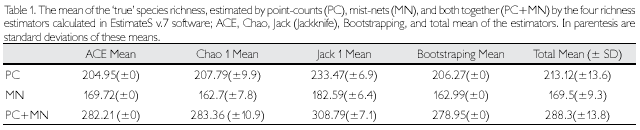
<body><![CDATA[<p align="center"><img src="/img/revistas/bmpegcn/v5n3/3a05t2.gif" border="0"></p>     <p>&nbsp;</p>     <p><font size="2" face="verdana">Additionally, we underline the importance of  this region for the conservation of some North American migratory birds. During  this study, we recorded <i>Pandion haliaetus, </i>which uses most of the large  Amazonian rivers and breeds in northeastern USA  and southern Canada  (Hoyo <i>et. al, </i>1994; Mestre &amp; Bierregaard, 2009). <i>Tringa solitaria </i>which breeds in north of North America (Alaska,  Canada, USA) and migrates to the southern United States, Central and South   America (Hoyo <i>et al., </i>1996). <i>Contopus cooperi </i>that  occurs from Alaska (USA) to Southeast Brazil (Hoyo <i>et al., </i>2004). <i>Contopus virens, </i>which breeds in eastern North  America, migrating to north South America  (Sick, 1997; Hoyo <i>et al., </i>2004). <i>Tyrannus tyrannus </i>occurs from Canada to northern Argentina (Hoyo <i>et al., </i>2004). <i>Progne subis </i>breeds in North America and north Central America migrating  to South America during the Neartic winter (Hoyo <i>et al., </i>2004). <i>Catharus ustulatus </i>breeds in North America and  migrate to South America (Hoyo <i>et al.</i>,  2005). Finally, <i>Coccyzus americanus </i>which, despite having Acre within its proposed range (Erize <i>et al., </i>2006,  Restall <i>et al. </i>, 2007, Infonatura, 2007), had not previously been  registered in the State (<a href="#t2">Table 2</a>). We clearly observed this species in a  forested site, near post-burned forests, perched in the midstory. Although we  do not have a documented register of this species, our observation can be considered  a first important clue regarding its occurrence in these sites.</font></p>     <p><font size="2" face="verdana">The RESEX Chico Mendes forests are also  clearly important for avian bamboo specialists, once we recorded 17 species  within bamboo formations. Based on Kratter (1997) classification, we found two  species that are considered to be obligate bamboo specialists <i>(Drymophila  devillei </i>and <i>Hemitriccus flammulatus), </i>seven species of near  obligate specialists <i>(Celeus spectabilis, Simoxenops ucayalae, Automolus  melanopezus, Percnostola lophotes, Myrmeciza goeldii, Ramphotrigon megacephalum </i>and <i>Ramphotrigon fuscicauda), </i>and three facultative bamboo  specialists <i>(Campylorhamphus trochilirostris</i>, <i>Epinecrophylla ornata, </i>and <i>Microrhopias quixensis). </i>We found <i>D. devillei, H. flammulatus </i>and <i>P. lophotes </i>only in sites with abundant bamboo formations, including  some second growth and post-burned areas. For this reason, our data also  confirm the restriction of these species to bamboo forests as described by Stotz <i>et al. </i>(1996) and Hoyo <i>et al. </i>(2003). The species <i>S. ucayalae </i>is  considered near threatened by IUCN (2000), and in some cases can be considered  as restricted to bamboo forests as well (Guilherme, 2009). We captured this  species mostly in sites dominated by bamboos, including second growth and  post-burn sites. Despite its near threatened status, <i>S. ucayalae </i>populations  may be using these human-influenced environments. It is also relevant to  describe the registration of <i>Cnipodectes superrufus, </i>an uncommon bamboo  specialist from southwest Amazonia, which may  be least abundant and perhaps the most threatened of all bamboo specialists in  the Amazonian forests (Lane <i>et al.</i>, 2007; Tobias <i>et al.</i>, 2008). We  captured only one individual in a bamboo/second growth forest in a post-burned  area (10<sup>o</sup> 20' S, 68<sup>o</sup> 40' W). Finally, it is important to cite five other  species registered in our study <i>(Crypturellus atrocapillus</i>, <i>Nonnula  ruficapilla, Monasa flavirostris, Lophotriccus eulophotes </i>and <i>Neopelma  sulphureiventer) </i>which apparently have a preference of bamboo habitats as  well (Kratter, 1997), however, the few registrations in literature and in our  field samplings do not permit generalizations   (<a href="#t2">Table 2</a>). The results of this paper showed  that the RESEX Chico Mendes holds a unique Amazonian bird community, influenced  by bamboo and second growth vegetation. Although the avifauna described here is  far from a complete census of the RESEX, and needs to be resampled in other seasons,  the rarefaction curves and estimators indicate a good sampling effort. These  data, regarding the local avifauna, reinforce the biological importance of the  RESEX and highlight the need for more inventories and bird studies at this  isolated and little known region of the Amazon.</font></p>     <p>&nbsp;</p>     <p><font size="3" face="verdana"><b>ACKNOWLEDGEMENTS</b></font></p>     <p><font size="2" face="verdana">We thank to local people from Reserva  Extrativista Chico Mendes who welcomed and worked with us. We also thank Sidnei  Dantas, Alexandre Aleixo and Edson Guilherme who gently helped us to identify  the bird songs, pictures and specimens. We also thank to two anonymous referees  who significantly helped to improve this manuscript. The data presented here  are part of the project &quot;Biodiversity implications of forest disturbance  and related landscape dynamics in the Brazilian Amazon&quot; (NNX07AF16G) a collaborative research among South Dakota State  University, National Aeronautics and Space Administration, Lancaster  University, and Museu Paraense Em&iacute;lio Goeldi. The Birders Exchange and Idea  Wild donated important materials for this research.</font></p>     <p>&nbsp;</p>     <p><font size="3" face="verdana"><b>REFERENCES</b></font></p>     <!-- ref --><p><font size="2" face="verdana">BIRDLIFE INTERNATIONAL, 2010. <b>IUCN Red List for birds</b>. Species factsheet: <i>Primolius couloni</i>. Available in: &lt;<a href="http://www.birdlife.org" target="_blank">http://www.birdlife.org</a>&gt;. Accessed on: 13 December 2010.</font><!-- ref --><p><font size="2" face="verdana">BROWN, I. F, W. SCHROEDER,  A. SETZER, M. MALDONADO,  M. DE  LOS RIOS, N. PANTOJA,  A. DUARTE &amp; J.  MARENGO, 2006. Monitoring fires in southwestern Amazonia rain forests. <b>Eos </b>87(26):  253-264.</font><!-- ref --><p><font size="2" face="verdana">CBRO, Comit&ecirc; Brasileiro de Registros Ornitol&oacute;gicos, 2009. <b>Listas das aves do Brasil</b>. Available in: &lt;<a href="http://www.cbro.org.br/CBRO/index.htm" target="_blank">http://www.cbro.org.br/CBRO/index.htm</a>&gt;. Accessed on: 2 December 2009.</font><!-- ref --><p><font size="2" face="verdana">COLWELL, R. K., 2004. <b><i>Estimates, </i>Version 7: </b>Statistical  estimation of species richness and shared species from samples (Software and  User's guide). Freeware. Available in:&lt;<a href="http://viceroy.eeb.uconn.edu/EstimateSPages/EstSUsersGuide/EstimateSUsersGuide.htm" target="_blank">http://viceroy.eeb.uconn.edu/EstimateSPages/EstSUsersGuide/EstimateSUsersGuide.htm</a>&gt;.  Accessed on: 13  December 2010.</font><!-- ref --><p><font size="2" face="verdana">COSTA, S. S. M., 2000. <b>Caracteriza&ccedil;&atilde;o  ambiental da Reserva Extrativista Chico Mendes (Acre-Brasil): </b>subs&iacute;dios ao  plano de manejo: 1-151. Tese (Doutorado em Ecologia) - Universidade Federal de  S&atilde;o Carlos, S&atilde;o Paulo. Available in: &lt;<a href="http://www.ufmt.br/gpea/pub/tese-doutorado-suely-de-sousa-melo-da-costa.pdf" target="_blank">http://www.ufmt.br/gpea/  pub/tese-doutorado-suely-de-sousa-melo-da-costa.pdf</a>&gt;. Accessed  on: 3 December 2010.</font><!-- ref --><p><font size="2" face="verdana">ERIZE, F, J. R. R. MATA  &amp; M. RUMBOLL, 2006. <b>Birds of South America,  Non passerines: </b>Rheas to Woodpeckers. Princeton  University Press, Princeton.</font><!-- ref --><p><font size="2" face="verdana">GOTELLI, N. &amp; R. K. COLWELL, 2001. Quantifying biodiversity:  procedures and pitfalls in the measurement and comparison of species richness. <b>Ecology Letters </b>4(4): 379-391.</font><!-- ref --><p><font size="2" face="verdana">GUILHERME, E., 2001. Comunidade de aves do campus e Parque  Zoobot&acirc;nico da Universidade Federal do Acre, Brasil. <b>Tangara </b>1(2): 57-73.</font><!-- ref --><p><font size="2" face="verdana">GUILHERME, E., 2009. <b>Avifauna do estado do Acre: </b>composi&ccedil;&atilde;o,  distribui&ccedil;&atilde;o geogr&aacute;fica e conserva&ccedil;&atilde;o. Tese (Doutorado em Zoologia) -  Universidade Federal do Acre/Museu Paraense Emilio Goeldi,  Bel&eacute;m, Par&aacute;. Available  in: &lt;<a href="http://www.dominiopublico.gov.br/download/texto/cp093574.pdf" target="_blank">http://www.dominiopublico.gov.br/  download/texto/cp093574.pdf</a>&gt;. Accessed on: 21 November 2010.</font><!-- ref --><p><font size="2" face="verdana">HOYO, J. del,  A. ELLIOT &amp; J. SARGATAL, 1994. <b>Handbook of the birds of the world: </b>New  world vultures to Guineafowl. Vol. 2. Lynx Edicions, Barcelona.</font><!-- ref --><p><font size="2" face="verdana">HOYO, J. del,  A. ELLIOT &amp; J. SARGATAL, 1996. <b>Handbook of the birds of the world: </b>Hoatzin  to Auks. Vol. 3. Lynx  Edicions, Barcelona.</font><!-- ref --><p><font size="2" face="verdana">HOYO, J. del,  A. ELLIOT &amp; J. SARGATAL, 2003. <b>Handbook of the birds of the world: </b>Broadbills  and Tapaculos. Vol. 8. Lynx Edicions, Barcelona.</font><!-- ref --><p><font size="2" face="verdana">HOYO, J. del, A. ELLIOT &amp; J. SARGATAL, 2004. <b>Handbook  of the birds of the world: </b>Cotingas to Pipits and Wagtails. Vol. 9. Lynx Edicions,  Barcelona.</font><!-- ref --><p><font size="2" face="verdana">HOYO, J. del, A. ELLIOT &amp; J. SARGATAL, 2005. <b>Handbook  of the birds of the world: </b>Cuckoos - Shrikes to Thrushes. Vol. 10. Lynx Edicions,  Barcelona.</font><!-- ref --><p><font size="2" face="verdana">INPE, Instituto Nacional de  Pesquisas Espaciais, 2010. <b>Monitoramento da floresta amaz&ocirc;nica brasileira  por sat&eacute;lite. </b>S&atilde;o Jos&eacute; dos Campos, SP Available in: &lt;<a href="http://sigma.cptec.inpe.br/queimadas/" target="_blank">http://sigma.cptec.inpe.br/queimadas/</a>&gt;. Accessed  on: 21 November 2010.</font><!-- ref --><p><font size="2" face="verdana">ISLER, M. L., P. R. ISLER &amp; B. M. WHITNEY, 2007. Species limits in antbirds  (Thamnophilidae): the warbling antbird <i>(Hypocnemis cantator) </i>complex. <b>The  Auk </b>124(1): 11-28.</font><!-- ref --><p><font size="2" face="verdana">INFONATURA, 2007. <b>Animals and ecosystems of Latin   America. </b>Version 5.0. Arlington,  Virginia (USA): NatureServe. Available in:  &lt;<a href="http://www.natureserve.org/infonatura" target="_blank">http://www.natureserve.org/infonatura</a>&gt;.  Accessed on: 3 November 2010.</font><!-- ref --><p><font size="2" face="verdana">IUCN, International Union for  Conservation of Nature and Natural Resources, 2000. <b>Protected areas. </b>Benefits  beyond boundaries - WCPA in Action: 1-17. Available in: &lt;<a href="http://cmsdata.iucn.org/downloads/wcpainaction.pdf" target="_blank">http://cmsdata.iucn.org/downloads/wcpainaction.pdf</a>&gt;. Accessed on: 13 December 2010.</font><!-- ref --><p><font size="2" face="verdana">KRATTER, A. W., 1997. Bamboo specialization by Amazonian birds. <b>Biotropica </b>29(1): 100-110.</font><!-- ref --><p><font size="2" face="verdana">LANE, D. F., G. P. SERVAT, T. VALQUI &amp; F. R. LAMBERT, 2007. A  distinctive new species of tyrant flycatcher (Passeriformes: Tyrannidae: <i>Cnipodectes) </i>from southeastern Peru. <b>The Auk </b>124: 762-772.</font><!-- ref --><p><font size="2" face="verdana">MESTRE, L. A. M., J. BARLOW, G. THOM &amp; M. A. COCHRANE, 2009. Burned forests as a novel habitat for  the black-faced cotinga <i>(Conioptilon mcilhennyi) </i>in the western  Brazilian Amazon. <b>Ornithologia  Neotropical </b>20:  467-470.</font><!-- ref --><p><font size="2" face="verdana">MESTRE, L. A. M. &amp; R. O. B.  BIERREGAARD, 2009. The role of Amazonian rivers for wintering  ospreys <i>(Pandionhaliaetus): </i>clues from North American band recoveries in  Brazil  between 1937 and 2006. <b>Studies on Neotropical Fauna and Environment </b>44(3):  141-147.</font><!-- ref --><p><font size="2" face="verdana">NELSON, B. W. &amp; M. N. IRM&Atilde;O, 1998. Fire penetration in standing Amazon forests. <b>Proceedings Brazilian Remote  Sensing Congress </b>9:  3-18.</font><!-- ref --><p><font size="2" face="verdana">NOVAES, F C., 1957. Contribui&ccedil;&atilde;o &agrave; ornitologia do noroeste do Acre. <b>Boletim do Museu  Paraense Em&iacute;lio Goeldi, Nova S&eacute;rie Zoologia </b>9: 1-29.</font><!-- ref --><p><font size="2" face="verdana">NOVAES, F C., 1958. As aves e as comunidades bi&oacute;ticas no alto rio Juru&aacute;, territ&oacute;rio do Acre. <b>Boletim do Museu  Paraense Em&iacute;lio Goeldi, Nova S&eacute;rie Zoologia </b>14: 1-13.</font><!-- ref --><p><font size="2" face="verdana">PINTO, O. M. O. &amp; E. A. CAMARGO, 1954. Resultados ornitol&oacute;gicos de uma expedi&ccedil;&atilde;o ao territ&oacute;rio do Acre pelo Departamento de  Zoologia. <b>Pap&eacute;is Avulsos do Departamento de Zoologia </b>11(23): 371-418.</font><!-- ref --><p><font size="2" face="verdana">RESTALL, R., C. RODNER &amp; M. LENTINO, 2007. <b>Birds of Northern South America. </b>Yale University Press, Yale.</font><!-- ref --><p><font size="2" face="verdana">SICK, H., 1997. <b>Ornitologia  brasileira. </b>Nova Fronteira, Rio de Janeiro.</font><!-- ref --><p><font size="2" face="verdana">STOTZ, D. F., J. W. FITZPATRICK, T. A. PARKER &amp; D. K. MOSKOVITS, 1996. <b>Neotropical  birds: </b>ecology and conservation. University   of Chicago Press,  Chicago.</font><!-- ref --><p><font size="2" face="verdana">TOBIAS, J. A. &amp; D. J. BRIGHTSMITH, 2007. Distribution, ecology and  conservation status of the blue-headed macaw <i>Primolius couloni. </i><b>Biological  Conservation </b>139(1-2): 126-138.</font><!-- ref --><p><font size="2" face="verdana">TOBIAS, J. A., D. J. LEBBIN, A. ALEIXO, M. J. ANDERSEN, E. GUILHERME, P.  A. HOSNER &amp; N. SEDDON, 2008. Distribution, behavior, and conservation  status ofthe rufous twistwing <i>(Cnipodectes superrufus). </i><b>The Wilson Journal of  Ornithology </b>120(1):  38-49.</font><!-- ref --><p><font size="2" face="verdana">VANZOLINI, P. E., 1952. Relat&oacute;rio  de uma expedi&ccedil;&atilde;o cient&iacute;fica ao Territ&oacute;rio Nacional do Acre no ano de 1951. <b>Pap&eacute;is  Avulsos do Departamento de Zoologia </b>11(1): 1-20.</font><!-- ref --><p><font size="2" face="verdana">WHITTAKER, A. &amp; D. C. OREN, 1999. Important ornithological records from  the Rio Juru&aacute;, western Amazonia, including  twelve additions to the Brazilian avifauna. <b>Bulletin of the British  Ornithologists' Club </b>119(4): 235-260.</font><!-- ref --><p><font size="2" face="verdana">WHITTAKER, A., D. C. OREN, J. F PACHECO, R. PARRINI &amp; J. C. MINNS,  2002. Aves  registradas na Reserva Extrativista do Alto Juru&aacute;. In: M. CARNEIRO DA CUNHA &amp; M. B. ALMEIDA (Eds.): <b>Enciclop&eacute;dia da floresta: </b>O Alto Juru&aacute;:  Pr&aacute;ticas e  Conhecimentos das Popula&ccedil;&otilde;es: 81-99. Companhia das Letras, S&atilde;o  Paulo.</font><p>&nbsp;</p>     <p>&nbsp;</p>     <p><font size="2" face="Verdana"><b><a name="endereco"></a><a href="#topo"><img src="img/revistas/bmpegcn/v5n3/seta.gif" border="0" /></a></b></font><font size="2" face="verdana"><b>Mailing address</b>:    <br> Museu Paraense Em&iacute;lio Goeldi    <br> Editor do Boletim do Museu Paraense Em&iacute;lio Goeldi. Ci&ecirc;ncias Naturais    <br> Av. Magalh&atilde;es Barata, 376    <br> S&atilde;o Braz &ndash; CEP 66040-170    ]]></body>
<body><![CDATA[<br> Bel&eacute;m - PA - Brazil    <br> Caixa Postal 399    <br> Phone: 55-91-3182-3246    <br> Fax: 55- 91-3249-6373    <br> E-mail: <a href="mailto:boletim.naturais@museu-goeldi.br">boletim.naturais@museu-goeldi.br</a></font></p>     <p><font size="2" face="verdana">Recebido:  28/02/2010    <br>   Aprovado:  20/12/2010    <br>   Responsabilidade  editorial: Alexandre Aleixo </font></p>      ]]></body><back>
<ref-list>
<ref id="B1">
<nlm-citation citation-type="">
<collab>BIRDLIFE INTERNATIONAL</collab>
<source><![CDATA[IUCN Red List for birds: Species factsheet: Primolius couloni]]></source>
<year>2010</year>
</nlm-citation>
</ref>
<ref id="B2">
<nlm-citation citation-type="journal">
<person-group person-group-type="author">
<name>
<surname><![CDATA[BROWN]]></surname>
<given-names><![CDATA[I. F]]></given-names>
</name>
<name>
<surname><![CDATA[SCHROEDER]]></surname>
<given-names><![CDATA[W.]]></given-names>
</name>
<name>
<surname><![CDATA[SETZER]]></surname>
<given-names><![CDATA[A.]]></given-names>
</name>
<name>
<surname><![CDATA[MALDONADO]]></surname>
<given-names><![CDATA[M.]]></given-names>
</name>
<name>
<surname><![CDATA[DE LOS RIOS]]></surname>
<given-names><![CDATA[M.]]></given-names>
</name>
<name>
<surname><![CDATA[PANTOJA]]></surname>
<given-names><![CDATA[N.]]></given-names>
</name>
<name>
<surname><![CDATA[DUARTE]]></surname>
<given-names><![CDATA[A.]]></given-names>
</name>
<name>
<surname><![CDATA[MARENGO]]></surname>
<given-names><![CDATA[J.]]></given-names>
</name>
</person-group>
<article-title xml:lang="en"><![CDATA[Monitoring fires in southwestern Amazonia rain forests]]></article-title>
<source><![CDATA[Eos]]></source>
<year>2006</year>
<volume>87</volume>
<numero>26</numero>
<issue>26</issue>
<page-range>253-264</page-range></nlm-citation>
</ref>
<ref id="B3">
<nlm-citation citation-type="">
<collab>CBRO, Comitê Brasileiro de Registros Ornitológicos</collab>
<source><![CDATA[Listas das aves do Brasil]]></source>
<year>2009</year>
</nlm-citation>
</ref>
<ref id="B4">
<nlm-citation citation-type="">
<person-group person-group-type="author">
<name>
<surname><![CDATA[COLWELL]]></surname>
<given-names><![CDATA[R. K.]]></given-names>
</name>
</person-group>
<source><![CDATA[Estimates, Version 7: Statistical estimation of species richness and shared species from samples (Software and User's guide)]]></source>
<year>2004</year>
</nlm-citation>
</ref>
<ref id="B5">
<nlm-citation citation-type="">
<person-group person-group-type="author">
<name>
<surname><![CDATA[COSTA]]></surname>
<given-names><![CDATA[S. S. M.]]></given-names>
</name>
</person-group>
<source><![CDATA[Caracterização ambiental da Reserva Extrativista Chico Mendes (Acre-Brasil): subsídios ao plano de manejo]]></source>
<year>2000</year>
<page-range>1-151</page-range></nlm-citation>
</ref>
<ref id="B6">
<nlm-citation citation-type="book">
<person-group person-group-type="author">
<name>
<surname><![CDATA[ERIZE]]></surname>
<given-names><![CDATA[F]]></given-names>
</name>
<name>
<surname><![CDATA[MATA]]></surname>
<given-names><![CDATA[J. R. R.]]></given-names>
</name>
<name>
<surname><![CDATA[RUMBOLL]]></surname>
<given-names><![CDATA[M.]]></given-names>
</name>
</person-group>
<source><![CDATA[Birds of South America, Non passerines: Rheas to Woodpeckers]]></source>
<year>2006</year>
<publisher-loc><![CDATA[Princeton ]]></publisher-loc>
<publisher-name><![CDATA[Princeton University Press]]></publisher-name>
</nlm-citation>
</ref>
<ref id="B7">
<nlm-citation citation-type="journal">
<person-group person-group-type="author">
<name>
<surname><![CDATA[GOTELLI]]></surname>
<given-names><![CDATA[N.]]></given-names>
</name>
<name>
<surname><![CDATA[COLWELL]]></surname>
<given-names><![CDATA[R. K.]]></given-names>
</name>
</person-group>
<article-title xml:lang="en"><![CDATA[Quantifying biodiversity: procedures and pitfalls in the measurement and comparison of species richness]]></article-title>
<source><![CDATA[Ecology Letters]]></source>
<year>2001</year>
<volume>4</volume>
<numero>4</numero>
<issue>4</issue>
<page-range>379-391</page-range></nlm-citation>
</ref>
<ref id="B8">
<nlm-citation citation-type="journal">
<person-group person-group-type="author">
<name>
<surname><![CDATA[GUILHERME]]></surname>
<given-names><![CDATA[E.]]></given-names>
</name>
</person-group>
<article-title xml:lang="pt"><![CDATA[Comunidade de aves do campus e Parque Zoobotânico da Universidade Federal do Acre, Brasil]]></article-title>
<source><![CDATA[Tangara]]></source>
<year>2001</year>
<volume>1</volume>
<numero>2</numero>
<issue>2</issue>
<page-range>57-73</page-range></nlm-citation>
</ref>
<ref id="B9">
<nlm-citation citation-type="">
<person-group person-group-type="author">
<name>
<surname><![CDATA[GUILHERME]]></surname>
<given-names><![CDATA[E.]]></given-names>
</name>
</person-group>
<source><![CDATA[Avifauna do estado do Acre: composição, distribuição geográfica e conservação. Tese (Doutorado em Zoologia) - Universidade Federal do Acre/Museu Paraense Emilio Goeldi, Belém, Pará]]></source>
<year>2009</year>
</nlm-citation>
</ref>
<ref id="B10">
<nlm-citation citation-type="book">
<person-group person-group-type="author">
<name>
<surname><![CDATA[HOYO]]></surname>
<given-names><![CDATA[J. del]]></given-names>
</name>
<name>
<surname><![CDATA[ELLIOT]]></surname>
<given-names><![CDATA[A.]]></given-names>
</name>
<name>
<surname><![CDATA[SARGATAL]]></surname>
<given-names><![CDATA[J.]]></given-names>
</name>
</person-group>
<source><![CDATA[Handbook of the birds of the world: New world vultures to Guineafowl]]></source>
<year>1994</year>
<volume>2</volume>
<publisher-loc><![CDATA[Barcelona ]]></publisher-loc>
<publisher-name><![CDATA[Lynx Edicions]]></publisher-name>
</nlm-citation>
</ref>
<ref id="B11">
<nlm-citation citation-type="book">
<person-group person-group-type="author">
<name>
<surname><![CDATA[HOYO]]></surname>
<given-names><![CDATA[J. del]]></given-names>
</name>
<name>
<surname><![CDATA[ELLIOT]]></surname>
<given-names><![CDATA[A.]]></given-names>
</name>
<name>
<surname><![CDATA[SARGATAL]]></surname>
<given-names><![CDATA[J.]]></given-names>
</name>
</person-group>
<source><![CDATA[Handbook of the birds of the world: Hoatzin to Auks]]></source>
<year>1996</year>
<volume>3</volume>
<publisher-loc><![CDATA[Barcelona ]]></publisher-loc>
<publisher-name><![CDATA[Lynx Edicions]]></publisher-name>
</nlm-citation>
</ref>
<ref id="B12">
<nlm-citation citation-type="book">
<person-group person-group-type="author">
<name>
<surname><![CDATA[HOYO]]></surname>
<given-names><![CDATA[J. del]]></given-names>
</name>
<name>
<surname><![CDATA[ELLIOT]]></surname>
<given-names><![CDATA[A.]]></given-names>
</name>
<name>
<surname><![CDATA[SARGATAL]]></surname>
<given-names><![CDATA[J.]]></given-names>
</name>
</person-group>
<source><![CDATA[Handbook of the birds of the world: Broadbills and Tapaculos]]></source>
<year>2003</year>
<volume>8</volume>
<page-range>Barcelona</page-range><publisher-name><![CDATA[Lynx Edicions]]></publisher-name>
</nlm-citation>
</ref>
<ref id="B13">
<nlm-citation citation-type="book">
<person-group person-group-type="author">
<name>
<surname><![CDATA[HOYO]]></surname>
<given-names><![CDATA[J. del]]></given-names>
</name>
<name>
<surname><![CDATA[ELLIOT]]></surname>
<given-names><![CDATA[A.]]></given-names>
</name>
<name>
<surname><![CDATA[SARGATAL]]></surname>
<given-names><![CDATA[J.]]></given-names>
</name>
</person-group>
<source><![CDATA[Handbook of the birds of the world: Cotingas to Pipits and Wagtails]]></source>
<year>2004</year>
<volume>9</volume>
<publisher-loc><![CDATA[Barcelona ]]></publisher-loc>
<publisher-name><![CDATA[Lynx Edicions]]></publisher-name>
</nlm-citation>
</ref>
<ref id="B14">
<nlm-citation citation-type="book">
<person-group person-group-type="author">
<name>
<surname><![CDATA[HOYO]]></surname>
<given-names><![CDATA[J. del]]></given-names>
</name>
<name>
<surname><![CDATA[ELLIOT]]></surname>
<given-names><![CDATA[A.]]></given-names>
</name>
<name>
<surname><![CDATA[SARGATAL]]></surname>
<given-names><![CDATA[J.]]></given-names>
</name>
</person-group>
<source><![CDATA[Handbook of the birds of the world: Cuckoos - Shrikes to Thrushes]]></source>
<year>2005</year>
<volume>10</volume>
<publisher-loc><![CDATA[Barcelona ]]></publisher-loc>
<publisher-name><![CDATA[Lynx Edicions]]></publisher-name>
</nlm-citation>
</ref>
<ref id="B15">
<nlm-citation citation-type="">
<collab>Instituto Nacional de Pesquisas Espaciais</collab>
<source><![CDATA[Monitoramento da floresta amazônica brasileira por satélite]]></source>
<year>2010</year>
<publisher-loc><![CDATA[São José dos Campos ]]></publisher-loc>
</nlm-citation>
</ref>
<ref id="B16">
<nlm-citation citation-type="journal">
<person-group person-group-type="author">
<name>
<surname><![CDATA[ISLER]]></surname>
<given-names><![CDATA[M. L.]]></given-names>
</name>
<name>
<surname><![CDATA[ISLER]]></surname>
<given-names><![CDATA[P. R.]]></given-names>
</name>
<name>
<surname><![CDATA[WHITNEY]]></surname>
<given-names><![CDATA[B. M.]]></given-names>
</name>
</person-group>
<article-title xml:lang="pt"><![CDATA[Species limits in antbirds (Thamnophilidae): the warbling antbird (Hypocnemis cantator) complex]]></article-title>
<source><![CDATA[The Auk]]></source>
<year>2007</year>
<volume>124</volume>
<numero>1</numero>
<issue>1</issue>
<page-range>11-28</page-range></nlm-citation>
</ref>
<ref id="B17">
<nlm-citation citation-type="book">
<collab>INFONATURA</collab>
<source><![CDATA[Animals and ecosystems of Latin America: Version 5.0]]></source>
<year>2007</year>
<publisher-loc><![CDATA[Arlington^eVirginia Virginia]]></publisher-loc>
<publisher-name><![CDATA[NatureServe]]></publisher-name>
</nlm-citation>
</ref>
<ref id="B18">
<nlm-citation citation-type="">
<collab>International Union for Conservation of Nature and Natural Resources</collab>
<source><![CDATA[Protected areas: Benefits beyond boundaries - WCPA in Action: 1-17]]></source>
<year>2000</year>
</nlm-citation>
</ref>
<ref id="B19">
<nlm-citation citation-type="journal">
<person-group person-group-type="author">
<name>
<surname><![CDATA[KRATTER]]></surname>
<given-names><![CDATA[A. W.]]></given-names>
</name>
</person-group>
<article-title xml:lang="en"><![CDATA[Bamboo specialization by Amazonian birds]]></article-title>
<source><![CDATA[Biotropica]]></source>
<year>1997</year>
<volume>29</volume>
<numero>1</numero>
<issue>1</issue>
<page-range>100-110</page-range></nlm-citation>
</ref>
<ref id="B20">
<nlm-citation citation-type="journal">
<person-group person-group-type="author">
<name>
<surname><![CDATA[LANE]]></surname>
<given-names><![CDATA[D. F.]]></given-names>
</name>
<name>
<surname><![CDATA[SERVAT]]></surname>
<given-names><![CDATA[G. P.]]></given-names>
</name>
<name>
<surname><![CDATA[VALQUI]]></surname>
<given-names><![CDATA[T.]]></given-names>
</name>
<name>
<surname><![CDATA[LAMBERT]]></surname>
<given-names><![CDATA[F. R.]]></given-names>
</name>
</person-group>
<article-title xml:lang="en"><![CDATA[A distinctive new species of tyrant flycatcher (Passeriformes: Tyrannidae: Cnipodectes) from southeastern Peru]]></article-title>
<source><![CDATA[The Auk]]></source>
<year>2007</year>
<volume>124</volume>
<page-range>762-772</page-range></nlm-citation>
</ref>
<ref id="B21">
<nlm-citation citation-type="journal">
<person-group person-group-type="author">
<name>
<surname><![CDATA[MESTRE]]></surname>
<given-names><![CDATA[L. A. M.]]></given-names>
</name>
<name>
<surname><![CDATA[BARLOW]]></surname>
<given-names><![CDATA[J.]]></given-names>
</name>
<name>
<surname><![CDATA[THOM]]></surname>
<given-names><![CDATA[G.]]></given-names>
</name>
<name>
<surname><![CDATA[COCHRANE]]></surname>
<given-names><![CDATA[M. A.]]></given-names>
</name>
</person-group>
<article-title xml:lang="en"><![CDATA[Burned forests as a novel habitat for the black-faced cotinga (Conioptilon mcilhennyi) in the western Brazilian Amazon]]></article-title>
<source><![CDATA[Ornithologia Neotropical]]></source>
<year>2009</year>
<volume>20</volume>
<page-range>467-470</page-range></nlm-citation>
</ref>
<ref id="B22">
<nlm-citation citation-type="journal">
<person-group person-group-type="author">
<name>
<surname><![CDATA[MESTRE]]></surname>
<given-names><![CDATA[L. A. M.]]></given-names>
</name>
<name>
<surname><![CDATA[BIERREGAARD]]></surname>
<given-names><![CDATA[R. O. B.]]></given-names>
</name>
</person-group>
<article-title xml:lang="en"><![CDATA[The role of Amazonian rivers for wintering ospreys (Pandionhaliaetus): clues from North American band recoveries in Brazil between 1937 and 2006]]></article-title>
<source><![CDATA[Studies on Neotropical Fauna and Environment]]></source>
<year>2009</year>
<volume>44</volume>
<numero>3</numero>
<issue>3</issue>
<page-range>141-147</page-range></nlm-citation>
</ref>
<ref id="B23">
<nlm-citation citation-type="journal">
<person-group person-group-type="author">
<name>
<surname><![CDATA[NELSON]]></surname>
<given-names><![CDATA[B. W.]]></given-names>
</name>
<name>
<surname><![CDATA[IRMÃO]]></surname>
<given-names><![CDATA[M. N.]]></given-names>
</name>
</person-group>
<article-title xml:lang="en"><![CDATA[Fire penetration in standing Amazon forests]]></article-title>
<source><![CDATA[Proceedings Brazilian Remote Sensing Congress]]></source>
<year>1998</year>
<volume>9</volume>
<page-range>3-18</page-range></nlm-citation>
</ref>
<ref id="B24">
<nlm-citation citation-type="journal">
<person-group person-group-type="author">
<name>
<surname><![CDATA[NOVAES]]></surname>
<given-names><![CDATA[F C.]]></given-names>
</name>
</person-group>
<article-title xml:lang="pt"><![CDATA[Contribuição à ornitologia do noroeste do Acre]]></article-title>
<source><![CDATA[Boletim do Museu Paraense Emílio Goeldi, Nova Série Zoologia]]></source>
<year>1957</year>
<volume>9</volume>
<page-range>1-29</page-range></nlm-citation>
</ref>
<ref id="B25">
<nlm-citation citation-type="journal">
<person-group person-group-type="author">
<name>
<surname><![CDATA[NOVAES]]></surname>
<given-names><![CDATA[F C.]]></given-names>
</name>
</person-group>
<article-title xml:lang="pt"><![CDATA[As aves e as comunidades bióticas no alto rio Juruá, território do Acre]]></article-title>
<source><![CDATA[Boletim do Museu Paraense Emílio Goeldi, Nova Série Zoologia]]></source>
<year>1958</year>
<volume>14</volume>
<page-range>1-13</page-range></nlm-citation>
</ref>
<ref id="B26">
<nlm-citation citation-type="journal">
<person-group person-group-type="author">
<name>
<surname><![CDATA[PINTO]]></surname>
<given-names><![CDATA[O. M. O.]]></given-names>
</name>
<name>
<surname><![CDATA[CAMARGO]]></surname>
<given-names><![CDATA[E. A.]]></given-names>
</name>
</person-group>
<article-title xml:lang="pt"><![CDATA[Resultados ornitológicos de uma expedição ao território do Acre pelo Departamento de Zoologia]]></article-title>
<source><![CDATA[Papéis Avulsos do Departamento de Zoologia]]></source>
<year>1954</year>
<volume>11</volume>
<numero>23</numero>
<issue>23</issue>
<page-range>371-418</page-range></nlm-citation>
</ref>
<ref id="B27">
<nlm-citation citation-type="book">
<person-group person-group-type="author">
<name>
<surname><![CDATA[RESTALL]]></surname>
<given-names><![CDATA[R.]]></given-names>
</name>
<name>
<surname><![CDATA[RODNER]]></surname>
<given-names><![CDATA[C.]]></given-names>
</name>
<name>
<surname><![CDATA[LENTINO]]></surname>
<given-names><![CDATA[M.]]></given-names>
</name>
</person-group>
<source><![CDATA[Birds of Northern South America]]></source>
<year>2007</year>
<publisher-loc><![CDATA[Yale ]]></publisher-loc>
<publisher-name><![CDATA[Yale University Press]]></publisher-name>
</nlm-citation>
</ref>
<ref id="B28">
<nlm-citation citation-type="book">
<person-group person-group-type="author">
<name>
<surname><![CDATA[SICK]]></surname>
<given-names><![CDATA[H.]]></given-names>
</name>
</person-group>
<source><![CDATA[Ornitologia brasileira]]></source>
<year>1997</year>
<publisher-loc><![CDATA[Rio de Janeiro ]]></publisher-loc>
<publisher-name><![CDATA[Nova Fronteira]]></publisher-name>
</nlm-citation>
</ref>
<ref id="B29">
<nlm-citation citation-type="book">
<person-group person-group-type="author">
<name>
<surname><![CDATA[STOTZ]]></surname>
<given-names><![CDATA[D. F.]]></given-names>
</name>
<name>
<surname><![CDATA[FITZPATRICK]]></surname>
<given-names><![CDATA[J. W.]]></given-names>
</name>
<name>
<surname><![CDATA[PARKER]]></surname>
<given-names><![CDATA[T. A.]]></given-names>
</name>
<name>
<surname><![CDATA[MOSKOVITS]]></surname>
<given-names><![CDATA[D. K.]]></given-names>
</name>
</person-group>
<source><![CDATA[Neotropical birds: ecology and conservation]]></source>
<year>1996</year>
<publisher-loc><![CDATA[Chicago ]]></publisher-loc>
<publisher-name><![CDATA[University of Chicago Press]]></publisher-name>
</nlm-citation>
</ref>
<ref id="B30">
<nlm-citation citation-type="journal">
<person-group person-group-type="author">
<name>
<surname><![CDATA[TOBIAS]]></surname>
<given-names><![CDATA[J. A.]]></given-names>
</name>
<name>
<surname><![CDATA[BRIGHTSMITH]]></surname>
<given-names><![CDATA[D. J.]]></given-names>
</name>
</person-group>
<article-title xml:lang="en"><![CDATA[Distribution, ecology and conservation status of the blue-headed macaw Primolius couloni]]></article-title>
<source><![CDATA[Biological Conservation]]></source>
<year>2007</year>
<volume>139</volume>
<numero>1-2</numero>
<issue>1-2</issue>
<page-range>126-138</page-range></nlm-citation>
</ref>
<ref id="B31">
<nlm-citation citation-type="journal">
<person-group person-group-type="author">
<name>
<surname><![CDATA[TOBIAS]]></surname>
<given-names><![CDATA[J. A.]]></given-names>
</name>
<name>
<surname><![CDATA[LEBBIN]]></surname>
<given-names><![CDATA[D. J.]]></given-names>
</name>
<name>
<surname><![CDATA[ALEIXO]]></surname>
<given-names><![CDATA[A.]]></given-names>
</name>
<name>
<surname><![CDATA[ANDERSEN]]></surname>
<given-names><![CDATA[M. J.]]></given-names>
</name>
<name>
<surname><![CDATA[GUILHERME]]></surname>
<given-names><![CDATA[E.]]></given-names>
</name>
<name>
<surname><![CDATA[HOSNER]]></surname>
</name>
<name>
<surname><![CDATA[SEDDON]]></surname>
<given-names><![CDATA[N.]]></given-names>
</name>
</person-group>
<article-title xml:lang="en"><![CDATA[Distribution, behavior, and conservation status ofthe rufous twistwing (Cnipodectes superrufus)]]></article-title>
<source><![CDATA[The Wilson Journal of Ornithology]]></source>
<year>2008</year>
<volume>120</volume>
<numero>1</numero>
<issue>1</issue>
<page-range>38-49</page-range></nlm-citation>
</ref>
<ref id="B32">
<nlm-citation citation-type="journal">
<person-group person-group-type="author">
<name>
<surname><![CDATA[VANZOLINI]]></surname>
<given-names><![CDATA[P. E.]]></given-names>
</name>
</person-group>
<article-title xml:lang="pt"><![CDATA[Relatório de uma expedição científica ao Território Nacional do Acre no ano de 1951]]></article-title>
<source><![CDATA[Papéis Avulsos do Departamento de Zoologia]]></source>
<year>1952</year>
<volume>11</volume>
<numero>1</numero>
<issue>1</issue>
<page-range>1-20</page-range></nlm-citation>
</ref>
<ref id="B33">
<nlm-citation citation-type="journal">
<person-group person-group-type="author">
<name>
<surname><![CDATA[WHITTAKER]]></surname>
<given-names><![CDATA[A.]]></given-names>
</name>
<name>
<surname><![CDATA[OREN]]></surname>
<given-names><![CDATA[D. C.]]></given-names>
</name>
</person-group>
<article-title xml:lang="en"><![CDATA[Important ornithological records from the Rio Juruá, western Amazonia, including twelve additions to the Brazilian avifauna]]></article-title>
<source><![CDATA[Bulletin of the British Ornithologists' Club]]></source>
<year>1999</year>
<volume>119</volume>
<numero>4</numero>
<issue>4</issue>
<page-range>235-260</page-range></nlm-citation>
</ref>
<ref id="B34">
<nlm-citation citation-type="book">
<person-group person-group-type="author">
<name>
<surname><![CDATA[WHITTAKER]]></surname>
<given-names><![CDATA[A.]]></given-names>
</name>
<name>
<surname><![CDATA[OREN]]></surname>
<given-names><![CDATA[D. C.]]></given-names>
</name>
<name>
<surname><![CDATA[PACHECO]]></surname>
<given-names><![CDATA[J. F]]></given-names>
</name>
<name>
<surname><![CDATA[PARRINI]]></surname>
<given-names><![CDATA[R.]]></given-names>
</name>
<name>
<surname><![CDATA[MINNS]]></surname>
<given-names><![CDATA[J. C.]]></given-names>
</name>
</person-group>
<article-title xml:lang="pt"><![CDATA[Aves registradas na Reserva Extrativista do Alto Juruá]]></article-title>
<person-group person-group-type="editor">
<name>
<surname><![CDATA[CARNEIRO DA CUNHA]]></surname>
<given-names><![CDATA[M.]]></given-names>
</name>
<name>
<surname><![CDATA[ALMEIDA]]></surname>
<given-names><![CDATA[M. B.]]></given-names>
</name>
</person-group>
<source><![CDATA[Enciclopédia da floresta: O Alto Juruá: Práticas e Conhecimentos das Populações]]></source>
<year>2002</year>
<page-range>81-99</page-range><publisher-loc><![CDATA[São Paulo ]]></publisher-loc>
<publisher-name><![CDATA[Companhia das Letras]]></publisher-name>
</nlm-citation>
</ref>
</ref-list>
</back>
</article>