<?xml version="1.0" encoding="ISO-8859-1"?><article xmlns:mml="http://www.w3.org/1998/Math/MathML" xmlns:xlink="http://www.w3.org/1999/xlink" xmlns:xsi="http://www.w3.org/2001/XMLSchema-instance">
<front>
<journal-meta>
<journal-id>1981-8114</journal-id>
<journal-title><![CDATA[Boletim do Museu Paraense Emílio Goeldi Ciências Naturais]]></journal-title>
<abbrev-journal-title><![CDATA[Bol. Mus. Para. Emilio Goeldi Cienc. Nat.]]></abbrev-journal-title>
<issn>1981-8114</issn>
<publisher>
<publisher-name><![CDATA[Museu Paraense Emílio Goeldi, Ministério da Ciência e Tecnologia]]></publisher-name>
</publisher>
</journal-meta>
<article-meta>
<article-id>S1981-81142010000300006</article-id>
<title-group>
<article-title xml:lang="en"><![CDATA[Vertical distribution and ecology of vascular epiphytes in a lowland tropical rain forest of Brazil]]></article-title>
<article-title xml:lang="pt"><![CDATA[Distribuição vertical e ecologia de epífitas vasculares em uma floresta tropical do Brasil]]></article-title>
</title-group>
<contrib-group>
<contrib contrib-type="author">
<name>
<surname><![CDATA[Pos]]></surname>
<given-names><![CDATA[Edwin Theodoor]]></given-names>
</name>
<xref ref-type="aff" rid="A01"/>
</contrib>
<contrib contrib-type="author">
<name>
<surname><![CDATA[Sleegers]]></surname>
<given-names><![CDATA[Adrianus David Michel]]></given-names>
</name>
<xref ref-type="aff" rid="A02"/>
</contrib>
</contrib-group>
<aff id="A01">
<institution><![CDATA[,Utrecht University Institute of Environmental Biology Department of Biology]]></institution>
<addr-line><![CDATA[Utrecht ]]></addr-line>
<country>Netherlands</country>
</aff>
<aff id="A02">
<institution><![CDATA[,Utrecht University Plant Ecology & Biodiversity Group ]]></institution>
<addr-line><![CDATA[Utrecht ]]></addr-line>
<country>Netherlands</country>
</aff>
<pub-date pub-type="pub">
<day>00</day>
<month>12</month>
<year>2010</year>
</pub-date>
<pub-date pub-type="epub">
<day>00</day>
<month>12</month>
<year>2010</year>
</pub-date>
<volume>5</volume>
<numero>3</numero>
<fpage>335</fpage>
<lpage>344</lpage>
<copyright-statement/>
<copyright-year/>
<self-uri xlink:href="http://scielo.iec.gov.br/scielo.php?script=sci_arttext&amp;pid=S1981-81142010000300006&amp;lng=en&amp;nrm=iso"></self-uri><self-uri xlink:href="http://scielo.iec.gov.br/scielo.php?script=sci_abstract&amp;pid=S1981-81142010000300006&amp;lng=en&amp;nrm=iso"></self-uri><self-uri xlink:href="http://scielo.iec.gov.br/scielo.php?script=sci_pdf&amp;pid=S1981-81142010000300006&amp;lng=en&amp;nrm=iso"></self-uri><abstract abstract-type="short" xml:lang="en"><p><![CDATA[In this study we investigated the vertical distribution and ecology of vascular epiphytes. Ten trees were sampled within the Brazilian National Forest of Caxiuanã, Brazil, using single rope climbing techniques. In total, 476 epiphyte individuals were sampled distributed over 60 species and 19 families. Alpha diversity (Fisher's alpha) of the vascular epiphytes was 18.16. Trees were divided into six separate height zones, species and families were distributed in a clear vertical zonation pattern which was confirmed by both a Detrended Correspondence Analysis (DCA) and Weighted Averaging (WA). Araceae and Orchidaceae showed a similar pattern to sites in Guyana and French Guiana. However, the Pteridophyte/Angiosperm ratio was far higher and no Bromeliaceae were found. Furthermore, trees in the study area appeared to contain a relative small number of epiphytes; nevertheless, overall species richness was relatively high. Only one species (Elaphoglossum styriacum Mickel) appeared to be a true indicator species for a specific height zone, because this species had far more sampled individuals. Other species could not be considered as indicator species, because they were far less abundant.]]></p></abstract>
<abstract abstract-type="short" xml:lang="pt"><p><![CDATA[Neste estudo foi investigada a distribuição vertical e ecologia de epífitas vasculares. Dez árvores foram amostradas na Floresta Nacional de Caxiuanã, Brasil, utilizando técnica de escalada com uma única corda (single rope). No total, 476 epífitas foram amostradas e distribuídas em 60 espécies e 19 famílias. A diversidade alfa (Fisher's alpha) de epífitas vasculares foi 18,16. As árvores amostradas foram divididas em seis zonas distintas de altura; espécies e famílias estavam distribuídas em um claro padrão de zonação vertical, o qual foi confirmado por análise de correspondência 'destendenciada' (Detrended Correspondence Analysis - DCA) e média ponderada (WeightedAveraging - WA). Araceae e Orchidaceae mostraram padrão similar de outros estudos semelhantes realizados na Guiana e Guiana Francesa. Porém, neste estudo, a proporção de Pteridofitás/Angiopermas foi superior e nenhuma Bromeliaceae foi encontrada. Além disso, as árvores do presente estudo tiveram um menor número relativo de epífitas. Apesar disso, a riqueza de espécies foi relativamente alta. Só uma espécie (Elaphoglossumstyriacum Mickel) pareceu ser uma verdadeira indicadora de especificidade com zona de altura, pelo fato de seus indivíduos terem sido mais amostrados. As outras espécies não puderam ser consideradas como indicadoras, pois não tiveram amostragem significativa.]]></p></abstract>
<kwd-group>
<kwd lng="en"><![CDATA[Brazil]]></kwd>
<kwd lng="en"><![CDATA[Lowland Tropical Rain Forest]]></kwd>
<kwd lng="en"><![CDATA[Community structure]]></kwd>
<kwd lng="en"><![CDATA[Vertical zonation]]></kwd>
<kwd lng="en"><![CDATA[Alpha diversity]]></kwd>
<kwd lng="en"><![CDATA[Vascular epiphytes]]></kwd>
<kwd lng="pt"><![CDATA[Brasil]]></kwd>
<kwd lng="pt"><![CDATA[Floresta tropical]]></kwd>
<kwd lng="pt"><![CDATA[Estrutura de comunidades]]></kwd>
<kwd lng="pt"><![CDATA[Zonação vertical]]></kwd>
<kwd lng="pt"><![CDATA[Diversidade alfa]]></kwd>
<kwd lng="pt"><![CDATA[Epífitas vasculares]]></kwd>
</kwd-group>
</article-meta>
</front><body><![CDATA[ <p><font size="4" face="verdana"><b><a name="topo"></a>Vertical distribution and ecology of vascular  epiphytes in a lowland tropical rain forest of Brazil</b></font></p>     <p>&nbsp;</p>     <p><font size="3" face="verdana"><b>Distribui&ccedil;&atilde;o vertical e ecologia de ep&iacute;fitas vasculares em uma floresta  tropical do Brasil</b></font></p>     <p>&nbsp;</p>     <p>&nbsp;</p>     <p><font size="2" face="verdana"><b>Edwin Theodoor Pos<sup>I</sup>;  Adrianus David Michel Sleegers<sup>II</sup></b></font></p>     <p><font size="2" face="verdana"><sup>I</sup>Utrecht University. Institute of Environmental Biology.  Department of Biology. Utrecht, The Netherlands (<a href="mailto:E.TPos@uu.nl">E.TPos@uu.nl</a>)    <br>   <sup>II</sup>Utrecht University. Plant Ecology &amp; Biodiversity Group. Utrecht, The Netherlands (<a href="mailto:A.D.M.Sleegers@students.uu.nl">A.D.M.Sleegers@students.uu.nl</a>) </font></p>     <p><font size="2" face="verdana"><a href="#endereco">Correspondence</a></font></p>     <p>&nbsp;</p>     ]]></body>
<body><![CDATA[<p>&nbsp;</p> <hr size="1" noshade>     <p><font size="2" face="verdana"><b>ABSTRACT</b></font></p>     <p><font size="2" face="verdana">In this study we investigated the vertical  distribution and ecology of vascular epiphytes. Ten trees were sampled within  the Brazilian National   Forest of Caxiuan&atilde;, Brazil, using single rope climbing  techniques. In total, 476 epiphyte individuals were sampled distributed over 60  species and 19 families. Alpha diversity (Fisher's alpha) of the vascular  epiphytes was 18.16. Trees were divided into six separate height zones, species  and families were distributed in a clear vertical zonation pattern which was  confirmed by both a Detrended Correspondence Analysis (DCA) and Weighted  Averaging (WA). Araceae and Orchidaceae showed a similar pattern to sites in Guyana and French Guiana.  However, the Pteridophyte/Angiosperm ratio was far higher and no Bromeliaceae  were found. Furthermore, trees in the study area appeared to contain a relative  small number of epiphytes; nevertheless, overall species richness was  relatively high. Only one species <i>(Elaphoglossum styriacum </i>Mickel)  appeared to be a true indicator species for a specific height zone, because  this species had far more sampled individuals. Other species could not be  considered as indicator species, because they were far less abundant.</font></p>     <p><font size="2" face="verdana"><b>Keywords: </b>Brazil. Lowland   Tropical Rain    Forest. Community structure. Vertical zonation.  Alpha diversity. Vascular epiphytes.</font></p> <hr size="1" noshade>     <p><font size="2" face="verdana"><b>RESUMO</b></font></p>     <p><font size="2" face="verdana">Neste estudo foi  investigada a distribui&ccedil;&atilde;o vertical e ecologia de ep&iacute;fitas vasculares. Dez  &aacute;rvores foram amostradas na Floresta Nacional de Caxiuan&atilde;, Brasil, utilizando  t&eacute;cnica de escalada com uma &uacute;nica corda <i>(single rope). </i>No total, 476  ep&iacute;fitas foram amostradas e distribu&iacute;das em 60 esp&eacute;cies e 19 fam&iacute;lias. A  diversidade alfa (Fisher's alpha) de ep&iacute;fitas vasculares foi 18,16. As &aacute;rvores  amostradas foram divididas em seis zonas distintas de altura; esp&eacute;cies e  fam&iacute;lias estavam distribu&iacute;das em um claro padr&atilde;o de zona&ccedil;&atilde;o vertical, o qual  foi confirmado por an&aacute;lise de correspond&ecirc;ncia 'destendenciada' <i>(Detrended Correspondence  Analysis </i>- DCA) e m&eacute;dia ponderada <i>(WeightedAveraging </i>- WA). Araceae  e Orchidaceae mostraram padr&atilde;o similar de outros estudos semelhantes realizados  na Guiana e Guiana Francesa. Por&eacute;m, neste estudo, a propor&ccedil;&atilde;o de Pteridofit&aacute;s/Angiopermas foi superior e nenhuma Bromeliaceae foi encontrada. Al&eacute;m  disso, as &aacute;rvores do presente estudo tiveram um menor n&uacute;mero relativo de  ep&iacute;fitas. Apesar disso, a riqueza de esp&eacute;cies foi relativamente alta. S&oacute; uma  esp&eacute;cie <i>(Elaphoglossumstyriacum </i>Mickel) pareceu ser uma verdadeira  indicadora de especificidade com zona de altura, pelo fato de seus indiv&iacute;duos  terem sido mais amostrados. As outras esp&eacute;cies n&atilde;o puderam ser consideradas  como indicadoras, pois n&atilde;o tiveram amostragem significativa.</font></p>     <p><font size="2" face="verdana"><b>Palavras-chave: </b>Brasil. Floresta tropical. Estrutura de  comunidades. Zona&ccedil;&atilde;o vertical. Diversidade alfa. Ep&iacute;fitas vasculares.</font></p> <hr size="1" noshade>     <p>&nbsp;</p>     <p>&nbsp;</p>     <p><font size="3" face="verdana"><b>INTRODUCTION</b></font></p>     ]]></body>
<body><![CDATA[<p><font size="2" face="verdana">Tropical rain forests are generally accepted  to be among the most species rich terrestrial habitats of the world. Of all the  species found in tropical rain forests, a considerable amount appears to be  represented by vascular epiphytes (Benzing, 1990; Gentry &amp; Dodson, 1987a; Croat, 1978; Whitmore <i>et al., </i>1985). In some montane cloud forests this can even reach up to 50 percent (Kelly <i>et al.</i>, 1994). Considering this apparent importance of vascular  epiphytes for local diversity, the number of papers that investigate epiphytes  in a natural habitat is relatively small, although the last decade there seems  to have been an increase in interest (e.g., ter Steege &amp; Cornelissen, 1989; Catling &amp; Lefkovitch, 1989; Kelly <i>et al., </i>1994, 2004; Hietz &amp; Hietz-Seifert,  1995a; Freiberg, 1996; Freiberg &amp; Freiberg, 2000; Engwald, 2000; Acebey <i>et al.</i>, 2003; Barthlott <i>et al.</i>,  2001; Kr&#246;mer <i>et al.</i>, 2005; Arevalo &amp; Betancur, 2006; Kreft <i>et al.</i>, 2004; K&uuml;per <i>et al., </i>2004; Benavides <i>et al., </i>2005; Cardel&uuml;s <i>et al.</i>, 2006; K&ouml;ster <i>et al.</i>, 2009).</font></p>     <p><font size="2" face="verdana">The vertical distribution of vascular  epiphytes in a tree is not random and is arguably related to humidity, branch  characteristics and photon-flux densities (Gentry &amp; Dodson, 1987b; ter Steege &amp;  Cornelissen, 1989; Hietz &amp; Hietz-Seifert, 1995b; Freiberg, 1996, 1999; Cardel&uuml;s &amp; Chazdon, 2005; Cardel&uuml;s, 2007; Kr&ouml;mer <i>et al., </i>2007;  Martinez-Melendez <i>et al.</i>, 2008). The characteristics of the environment change  from the bottom of the rainforest upwards into the canopy (Allee, 1926), e.g.: only a limited amount of sunlight penetrates the  dense canopy and reaches the forest floor (Montgomery &amp; Chazdon, 2001); small twigs pose problems for the settlement of  the bigger epiphytes; in the canopy temperatures are higher and humidity is lower  then on the forest floor (Kumagai <i>et al.</i>, 2001). Because each species or species group has a unique set of characteristics  they will all respond in a different way to these environmental factors.</font></p>     <p><font size="2" face="verdana">Here we describe the epiphytic communities of  a Tropical Lowland  Rain Forest in Caxiuan&auml;, Para, Brazil. Although Caxiuan&auml; has been extensively studied, no inventory of vascular epiphytes and  their ecology has been made before. We did not measure environmental  characteristics such as photon-flux densities, humidity or substratum  characteristics. Instead, we used the vertical separation of different parts of  the tree (zones) to act as a surrogate for the differences in climatic  conditions. Zones were sampled for the occurrence of vascular epiphyte species  and their abundances.</font></p>     <p>&nbsp;</p>     <p><font size="3" face="verdana"><b>METHODS</b></font></p>     <p><font size="2" face="verdana"><b>STUDY AREA</b></font></p>     <p><font size="2" face="verdana">The study area is situated within the  Brazilian national forest of Caxiuan&atilde; (1<sup>o</sup> 42' 30&quot; S, 51<sup>o</sup>  31' 45&quot; W; altitude approximately 60 meters), located in  the municipality   of Melga&ccedil;o, approximately  350 km  W of Bel&eacute;m. Total mean annual rainfall is 2,272 mm (&plusmn;193 mm) with a distinct dry  season between July and December, when the average rainfall drops to 555 mm (&plusmn;116 mm) (Fisher <i>et al., </i>2006).  Mean annual temperature is approximately 25.7 <sup>o</sup>C (with a minimum of 22  <sup>o</sup>C and a maximum of 32 <sup>o</sup>C). Relative humidity averages 80%  and the prevailing wind-direction is from the northeast. The amount of sunlight  exceeds 2.100 hours year-1 (Oliveira <i>et al., </i>2008).</font></p>     <p><font size="2" face="verdana">The major part of the Caxiuan&atilde; Forest  is Terra Firme forest, which represents approximately 85% of the total area.  However, prior studies also identified flooded forests (v&aacute;rzea and igap&oacute;) and  savannah-like vegetation. In addition, there is some residual vegetation of  previously existing orchards (Lisboa <i>et al., </i>1997). All data were  collected in the Terra   Firme Forest.</font></p>     <p><font size="2" face="verdana">The Terra Firme forest is found on a flat  surface with yellow oxisol soils of tertiary origin. The average tree density  is 450-500 individuals ha-1 with c. 150-160 species (Almeida <i>et  al., </i>2003; Viana <i>et al., </i>2003). The most dominant tree species in  the Terra Firme parts of the forest belong to the families Lecythidaceae,  Caesalpiniaceae and Burseraceae (Viana <i>et al., </i>2003). The forest  structure is formed by emergent trees (40-50 m), canopy trees (30-35 m), sub-canopy trees (20-25   m) and understory trees (up to 5 m). The opening of the canopy  is approximately 10%; consequently illumination of the forest floor is very  poor (Viana <i>et al., </i>2003).</font></p>     <p><font size="2" face="verdana"><b>DATA COLLECTION</b></font></p>     ]]></body>
<body><![CDATA[<p><font size="2" face="verdana">Between March and June 2009, ten trees were  selected within the Caxiuan&atilde;   National Forest and  sampled for vascular epiphytes. The number of trees to be sampled was based on  a comparison of the results of Nieder <i>etal. </i>(2000) and Freiberg  &amp; Freiberg (2000)  which showed that ten trees should yield the majority of epiphytic species.  More trees only results in the collection of the (very) rare species and fewer  trees d ramatically decreases the amount of species of the area to be found  within the sampling selection. Sampling effort was checked by a species-accumulation  curve with species estimation based on Fisher's alpha. Total coverage area of  the research area was approximately 2 km2.</font></p>     <p><font size="2" face="verdana"><b>Tree selection</b></font></p>     <p><font size="2" face="verdana">Trees were selected using several criteria.  Because the trees should represent the average circumstances of the forest,  trees that either did not reach the upper canopy or emerged above it were not  selected. Furthermore, trees were selected upon the accessibility of the crown  and maturity of the tree. Branches should slope less then 45o for  safety reasons and trees that were either too young or too dangerous to climb  were not selected. Trees were climbed using single-rope techniques (Perry, 1978;  ter Steege &amp; Cornelissen, 1988).</font></p>     <p><font size="2" face="verdana"><b>Sampling</b></font></p>     <p><font size="2" face="verdana">After ter Steege &amp; Cornelissen (1989) trees  were divided into six height zones. Because this scheme is based on conspicuous  differences in epiphyte community composition and the structure of the tree  rather than absolute height, it allows easy application onto many trees  (Gradstein <i>et al.</i>, 2003; Zotz, 2007). The tree is subdivided in the  lower base of the tree (zone 1), the lower and upper trunk (zones 2 and 3), the  lower canopy (zone 4), middle canopy (zone 5) and outer canopy (zone 6). Within  each height zone the tree was searched for vascular epiphytes. Because of the  relative low number of epiphytes per tree, each zone is considered a plot, i.e.  per tree there are 6 plots. Zones 1-4 were sampled directly by hand, only zones  5 and 6 could not be sampled this way. Branches from these zones were sampled  using a long pole with a cutter attached to the end. Of all species, the cover  percentages and number of individuals were estimated and counted. From each  height zone a number of individuals of each observed species were collected for  identification. Collected individuals were photographed and dried on site  before being transported to the herbarium in Bel&eacute;m (Museu Paraense Em&iacute;lio  Goeldi - MG). Before drying, the first identification of species was also done  on site. Confirmation and secondary identification was done at the herbarium in  Bel&eacute;m using the materials collected in earlier studies as well as at the University of Utrecht with the use of photographs.</font></p>     <p><font size="2" face="verdana"><b>DATA ANALYSIS</b></font></p>     <p><font size="2" face="verdana">To investigate vertical distribution patterns  two different analyses were carried out: DECORANA (DCA) and Weighted Averaging  (WA). The DCA is an eigenvector ordination technique which creates a  multidimensional space of the data-set and searches for the axes that explain  the most variance. Considering the plots separately, the number of used segments  for the DCA was set on 26. Many plots contained only 1-3 individuals, therefore  plots were combined by artificially dividing the forest into layers according  to the height zones. In this way all sampled trees are considered at once  (number of used segments was then set to 22).</font></p>     <p><font size="2" face="verdana">Weighted Averaging is based on the abundance  and occurrence of each species in the specific plots and the number indicates  the mean zone-preference. An Indicator Species Analysis (ISA) was used to  search for species occurring faithfully in a specific height zone. ISA combines  species abundances with the occurrence of the species in the particular groups  and produces an indicator value. This value is tested for statistical  significance by a randomization procedure. A species-accumulation curve was  used to test the sampling effort. The extrapolation for the expected number of  species of the area was calculated by making use of the total number of  individuals collected and Fisher's alpha calculated for the area. The expected  number of individuals collected was estimated by doubling the number of trees  and, hence, the number of individuals. The expected number of species was  calculated as: S&nbsp;&nbsp; = 1 1 exp a * ((1 +  N)/a). All analyses were performed by PCORD 5.0 except WA and the  species-accumulation curve, which were carried out with Microsoft Office Excel  2007.</font></p>     <p>&nbsp;</p>     <p><font size="3" face="verdana"><b>RESULTS</b></font></p>     ]]></body>
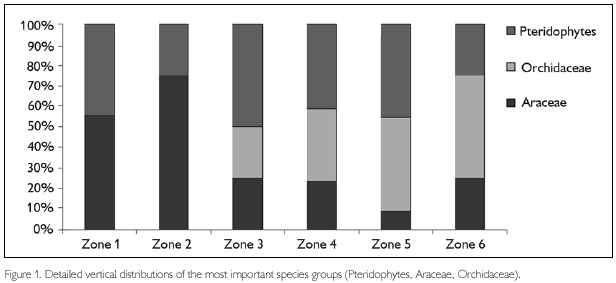
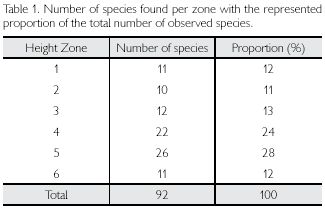
<body><![CDATA[<p><font size="2" face="verdana"><b>FLORISTICS</b></font></p>     <p><font size="2" face="verdana">The ten sampled trees of average canopy  height yielded a total number of 476 individuals belonging to 60 different  species of vascular epiphytes distributed over 19 families (<a href="pdf/bmpegcn/v5n3/apenv5n3a06.pdf" target="_blank">Appendix</a>). Species  belonged to eight Angiosperm families, seven Pteridophyte families and four  unknown families. Fisher's alpha was 18.16. Of all species found, there are  only a few common species and a large tail of rare species, similar to the log  series distribution (Fisher <i>et al., </i>1943). The species-accumulation  curve for the area, based on Fisher's alpha, indicated that, although a  relative small number of trees has been sampled, the number of collected  species is not extremely low. A doubling of the sampled trees (i.e. 20 trees)  would result in an estimated increase of 12 species, even a four-fold increase  of the amount of trees (i.e. 40 trees) is estimated to yield 25 more species.  This suggests that, although a relative low number of trees was sampled, biases  of a lack of sampling are unlikely to have a very strong effect on the results.  Pteridophytes were the most important group (17 species; 28% of the total  number of species). Of the Angiosperms, the most represented families were  Araceae (15 species; 25%) and Orchidaceae (13 species; 22%). Other families  represented 15 species (25%) in total. However, individual families in this  group each represented less than 10% of the total number of species. Mean  number of species found on the trees was ten species per tree with a standard  deviation of three. The maximum number of species found on a single tree was  fifteen and the minimum was six.</font></p>     <p><font size="2" face="verdana"><b>VERTICAL DISTRIBUTION</b></font></p>     <p><font size="2" face="verdana">The highest number of species was found in  zone 5, or the middle canopy (26 species; 28% of all species), followed by zone  4, the lower canopy (22 species; 24%). The lowest number of species was found  on the trunk itself, in zone 2 (ten species; 11%). Number of species in zones  1, 3 and 6 were approximately similar (<a href="#t1">Table 1</a>). The majority of species appear  to be restricted to one specific height zone (38 out of 60 species). Although  such species are found along the complete vertical gradient, zones 1, 4 and 5  included most of these specialist-species (respectively seven, nine and nine  species). Indicator Species Analysis (ISA), however, showed that only one of  these species could be considered as a sign ificant i nd icator species <i>(Elaphoglossum  styriacum </i>in zone 4; P = 0.02). The remaining 22 species were found in more  than one height zone, although none of the species were found in all six height  zones.</font></p>     <p><a name="t1"></a></p>     <p>&nbsp;</p>     <p align="center"><img src="/img/revistas/bmpegcn/v5n3/3a06t1.gif" border="0"></p>     <p>&nbsp;</p>     <p><font size="2" face="verdana">To reveal patterns in the distribution of  species over the specific height zones, a DCA was performed. Considering all  plots as separate sampling units, no strong vertical zonation pattern was found  even after deletion of plots with fewer than three individuals. Grouping all  plots in their specific height zone, however, gave a distinct pattern. DCA Axis  1 scores (zone 1 = 614.9, zone 2 = 490.1, zone 3 = 129, zone 4 = 44.3, zone 5 =  17.2, zone 6 = 0) showed zones 1-6   in exact order. This vertical zonation can be considered  significant, as the probability of finding such an order at random is 1/6!  (1/720 &lt; 0.05). This vertical gradient also became apparent when performing  Weighted Averaging. Species showed a preference for one or more height zones  forming a vertical distribution pattern along the tree axis (<a href="pdf/bmpegcn/v5n3/apenv5n3a06.pdf" target="_blank">Appendix</a>).  Furthermore, DCA showed that zones 1 and 2 are more related to each other than  they are to zones 3, 4, 5 and 6 and vice versa.</font></p>     <p><font size="2" face="verdana">The community composition of vascular  epiphytes at the family level also showed a clear gradient along the vertical  axis. For Angiosperms, the numbers of Araceae were higher on the lower parts of  the tree (buttress and lower trunk). In contrast, the numbers of Orchidaceae  were higher in the canopy of the tree and none were found in zone 1 and 2  (<a href="#f1">Figure 1</a>). Pteridophytes also show an interesting distribution pattern. They  were well represented on the lower parts of the tree and the lower and middle  canopy, but were less abundant on the trunk (i.e. zone 2) and the outer canopy  (zone 6). In addition, the distribution of families within the Pteridophyte  group also shows a distinct pattern on the vertical axis. The Hymenophyllaceae  and Pteridaceae are most abundant in the first two zones, whereas  Dryopteridaceae, Aspleniaceae, Gesneriaceae and Polypodiaceae are most abundant  in the canopy zones (<a href="pdf/bmpegcn/v5n3/apenv5n3a06.pdf" target="_blank">Appendix</a>).</font></p>     ]]></body>
<body><![CDATA[<p><a name="f1"></a></p>     <p>&nbsp;</p>     <p align="center"><img src="/img/revistas/bmpegcn/v5n3/3a06f1.gif" border="0"></p>     <p>&nbsp;</p>     <p><font size="3" face="verdana"><b>DISCUSSION</b></font></p>     <p><font size="2" face="verdana">The species richness (60) of the study area  is comparable to other sites in Guyana  and French Guiana, where similar research was  performed with approximately the same amount of trees. In Wallaba Forest (WA - Guyana),  11 sampled trees yielded 62 different species (ter Steege &amp; Cornelissen, 1989),  in Mora Forest (MO - Guyana) ten sampled trees showed 76 different species (J.  C. Biesmeijer, unpublished data) and Sa&uuml;l (SA - French Guiana) resulted in 152 species  sampled on 26 trees (R. C. Ek &amp; D. Montfoort, unpublished data). Of the 60 species  found in Caxiuan&atilde; only 12 species were also encountered in the sites of Guyana and French Guiana.  Fisher's alpha for local diversity showed that biodiversity in Caxiuan&atilde; was  higher in comparison to Wallaba, Guyana (18.16 compared to 11.58), but lower than  in Sa&uuml;l (SA), French Guiana (18.16 compared to  31.99). Although the number of individuals per tree in Caxiuana was much lower,  species richness was relatively higher.</font></p>     <p><font size="2" face="verdana">Lowest species richness was found on the  lower trunk (i.e. zone 2) while highest species richness was found in de middle  of the canopy, zone 5. Similar results were found in previous studies by ter  Steege &amp; Cornelissen (1989), Freiberg  (1996), Acebey <i>et al. </i>(2003) and Kromer <i>etal. </i>(2007). The  vertical distribution of vascular epiphytes is strongly related to the  microclimatic gradients such as temperature, wind velocity, humidity and light  intensity (Gentry &amp; Dodson, 1987b; ter Steege &amp; Cornelissen, 1989;  Hietz &amp; Hietz-Seifert, 1995b; Freiberg, 1996, 1999; Cardelus &amp; Chazdon,  2005; Cardelus, 2007; Kromer <i>et al., </i>2007; Martinez-Melendez <i>et al., </i>2008).  The outer canopy of trees is characterized by a relatively extreme  microclimate, with higher light intensities due to more direct sunlight and as  a consequence higher temperatures and a lower humidity. The middle canopy  however benefits from the protection of the outer canopy and its inhabitants,  i.e. it benefits from within-crown shading (Cardelus &amp; Chazdon, 2005). As a  consequence, the amount of sunlight is less direct and the microclimate is less  extreme and variable and provides a more suited environment for the  colonization of epiphytes. This may lead to the observed higher species  richness in the middle canopy. In contrast, the lower trunk provides much more  difficulties in the settlement for epiphytes as a result of the simple  structure. The vertical trunks are often relatively smooth and provide little  suitable spots for epiphytes to anchor themselves, as suggested by Kromer <i>et  al. </i>(2007). As a consequence, apart from a number of Hymenophyllaceae and  Araceae, hardly any vascular epiphytes were found on these parts of the tree  (see also <a href="pdf/bmpegcn/v5n3/apenv5n3a06.pdf" target="_blank">Appendix</a>).</font></p>     <p><font size="2" face="verdana">Because of the low density of epiphytes per  tree, it was not possible to find a significant vertical zonation pattern. DCA  per tree only showed separation between zones 1-2 and zones 3-6. Only after  combining all plots in the sampling area according to their specific height  zones, a stronger vertical zonation was discovered. On a species level only one  species was a true indicator species for a specific height zone <i>(E.  styriacum), </i>probably as a consequence of having far more sampled  individuals. Other species were much less abundant and could therefore not be  considered as indicator species. This could be caused by a lack of sampling,  which appears to be unlikely based on the species-accumulation curve calculated  for the area, or because these species are truly rare species. Despite the lack  of true indicator species, species did appear to have a preference for a  specific part of the tree. Out of the 60 species found, 38 were found only in a  single specific zone and 22 were found in more than one zone. Further analysis  of the latter showed a clear distinction in species that were true generalists  (8), i.e. occurring in both the canopy and on the trunk, and species which  occurred either only on the trunk (5) or in the canopy (9). Species occurring  solely on the trunk belonged to Araceae and Hymenophyllaceae, while species  found only in the canopy belonged to Aspleniaceae, Gesneriaceae,  Dryopteridaceae, Polypodiaceae or Orchidaceae. True generalists belonged to  Aspleniaceae, Araceae, Clusiaceae, Pteridaceae and Orchidaceae (and one  Moraceae).</font></p>     <p><font size="2" face="verdana">Trees in the Forest of Caxiuana  apparently contain a relative small number of epiphytic species in comparison  to other areas (CA 15, WA 35, MO 41 and SA 61). This was also observed while  exploring the forest in search for suitable trees. However, vertical  distribution of the three important epiphyte groups Araceae, Orchidaceae, and  Pteridophytes, was similar in all sites. Araceae were most abundant in the  lower zones 1, 2 and 3 while Orchidaceae and Pteridophytes were far more  abundant in the upper zones 4, 5 and 6. Despite the fact that Bromeliaceae  appear to be an important epiphyte family in the other three sites, no species  of the family was collected in Caxiuana on the sampled trees. In addition, no  Bromeliad species were observed in the area which was sampled. In terms of  individuals, the ratio between Pteridophytes and Orchidaceae in CA was 1.07  while the other three areas had far lower ratios (0.12, 0.53 and 0.27 for WA, MO and SA, respectively). Also, in terms of number of species, WA has  the lowest and CA the highest ratio with MO and SA having intermediate values  (WA 0.14, MO 0.56, SA 0.56 and CA 1.14). The high ratio found in CA indicates  that there appear to be approximately the same number of both individuals and  species of Orchidaceae and Pteridophytes in this area. Although this is  unusual, it is not rare, since earlier studies indicated that ratios of  Orchidaceae and Pteridophytes can vary between 0.20 and 0.84 across Neotropical  epiphyte Flora in Western Amazonia (Kreft <i>et  al.</i>, 2004).</font></p>     <p>&nbsp;</p>     ]]></body>
<body><![CDATA[<p><font size="3" face="verdana"><b>ACKNOWLEDGMENTS</b></font></p>     <p><font size="2" face="verdana">We like to thank MPEG for giving us the  opportunity to do fieldwork and for all the arrangements in Brazil and  helpful advice we like to thank Anna Luiza Ilkiu-Borges. For the great help  with collecting and identification we particularly want to thank Ana Kelly  Koch, Adeilza Felipe Sampaio and Jos&eacute; Leonardo Lima Magalh&atilde;es. Furthermore, we  like to thank the Herbarium of University of Utrecht and the Herbarium of MPEG  for making final identification possible. For helpful comments, criticism and  advice at various stages in the completion of this project we would like to  thank Hans ter Steege. This project was funded by Alberta Mennega Stichting,  Van Eeden Fund, Foundation Kronendak and Miquel Fonds and was part of our MSc.  project at the University   of Utrecht.</font></p>     <p>&nbsp;</p>     <p><font size="3" face="verdana"><b>REFERENCES</b></font></p>     <!-- ref --><p><font size="2" face="verdana">ACEBEY, A., S. R. GRADSTEIN, &amp; T. KR&Ouml;MER, 2003. Species  richness and habitat diversification of bryophytes in submontane rain forest  and fallows of Bolivia. <b>Journal of Tropical Ecology</b> 19(1):  9-18.</font><!-- ref --><p><font size="2" face="verdana">ALLEE, W. C., 1926. Measurement of environmental  factors in the Tropical Rain-Forest of Panama. <b>Ecology</b> 7(3): 273-302.</font><!-- ref --><p><font size="2" face="verdana">ALMEIDA, S.  S., M. A. D. FREITAS, A. S. L. SILVA &amp; E. S. G. CAJUEIRO, 2003. Monitoring forest dynamics with permanent forest plots:  the TEAM vegetation protocol and preliminary findings from Caxiuan&atilde;. <b>Semin&aacute;rio Esta&ccedil;&atilde;o Cient&iacute;fica Ferreira  Penna, Dez anos de Pesquisa na Amaz&ocirc;nia</b>: Contribui&ccedil;&otilde;es e Novos Desafios:  1: 13-15. Available in: &lt;<a href="http://www.museu-goeldi.br/semicax/CBO_005.pdf" target="_blank">http://www.museu-goeldi.br/semicax/CBO_005.pdf</a>&gt;.  Access on: 12 December 2010. </font><!-- ref --><p><font size="2" face="verdana">AR&Eacute;VALO, R. &amp; J. BETANCUR, 2006. Vertical  distribution of vascular epiphytes in four forest types of the Serran&iacute;a de  Chiribiquete, Colombian Guayana. <b>Selbyana</b> 27(2):  175-185. </font><!-- ref --><p><font size="2" face="verdana">BARTHLOTT, W., V. SCHMIT-NEUERBURG, J. NIEDER &amp; S.  ENGWALD, 2001. Diversity and abundance of vascular epiphytes: a comparison of  secondary vegetation and primary montane rain forest in the Venezuelan Andes. <b>Plant  Ecology</b> 152(2): 145-156. </font><!-- ref --><p><font size="2" face="verdana">BENAVIDES,  D., A. M., A. J. DUQUE M, J. F. DUIVENVOORDEN, A. VASCO &amp; R. CALLEJAS, 2005. A first quantitative census of vascular epiphytes in rain forests of  Colombian Amazonia. <b>Biodiversity and Conservation</b> 14(3):  739-758. </font><!-- ref --><p><font size="2" face="verdana">BENZING, D. H., 1990. <b>Vascular epiphytes</b>. Cambridge University Press, Cambridge. </font><!-- ref --><p><font size="2" face="verdana">CARDEL&Uacute;S, C. L., 2007. Vascular epiphyte communities  in the inner-crown of <i>Hyeronima alchorneoides </i>and <i>Lecythis ampla </i>at La Selva Biological Station, Costa Rica. <b>Biotropica</b> 39(2):  171-176. </font><!-- ref --><p><font size="2" face="verdana">CARDEL&Uacute;S, C. L. &amp; R. L. CHAZDON, 2005. Inner-crown  microenvironments of two emergent tree species in a lowland wet forest. <b>Biotropica</b> 37(2):  238-244. </font><!-- ref --><p><font size="2" face="verdana">CARDEL&Uacute;S, C. L., R. K. COLWELL &amp; J. E. WATKINS  JR., 2006. Vascular epiphyte distribution patterns: explaining the  mid-elevation richness peak. <b>Journal of Ecology</b> 94(1):  144-156. </font><!-- ref --><p><font size="2" face="verdana">CATLING, P. M. &amp; L. P. LEFKOVITCH, 1989. Associations  of vascular epiphytes in a Guatemalan Cloud Forest. <b>Biotropica</b> 21(1):  35-40. </font><!-- ref --><p><font size="2" face="verdana">CROAT, T. B., 1978. <b>Flora of Barro Colorado   Island</b><i>. </i>Stanford University Press,  Stanford. </font><p><font size="2" face="verdana">ENGWALD, S., V. SCHMIT-NEUERBURG &amp; W. BARTHLOTT, 2000.  Epiphytes in rain forests of Venezuela&ndash;diversity and dynamics of a biocenosis:  1-425 In: S. W. BRECKLE, E. SCHWEIZER &amp; U. ARNDT (Eds.): <b>Results  of worldwide ecological studies</b>. Proceedings of the first  symposium by the AFW Foundation. G&uuml;nter Heimbach, Hoheneim, Holland. </font></p>     <!-- ref --><p><font size="2" face="verdana">FISHER, R. A., M. WILLIAMS, R. L. VALE, A. L. COSTA  &amp; P. MEIR, 2006. Evidence from Amazonian forests is consistent with  isohydric control of leaf water potential. <b>Plant, Cell &amp;  Environment</b> 29(2): 151-165. </font><!-- ref --><p><font size="2" face="verdana">FISHER, R. A., A. S. CORBET &amp; C. B. WILLIAMS,  1943. The relation between the number of species and the number of individuals  in a random sample of an animal population. <b>Journal of Animal  Ecology</b> 12(1): 42-58. </font><!-- ref --><p><font size="2" face="verdana">FREIBERG, M., 1996. Spatial distribution of vascular epiphytes  on three emergent canopy trees in French Guiana. <b>Biotropica</b> 28(3): 345-355. </font><!-- ref --><p><font size="2" face="verdana">FREIBERG, M., 1999.The vascular epiphytes on a <i>Virola michelii </i>tree (Myristicaceae) in French Guiana. <b>Ecotropica</b> 5:  75-81. </font><!-- ref --><p><font size="2" face="verdana">FREIBERG, M. &amp; E. FREIBERG, 2000. Epiphyte diversity and  biomass in the canopy of lowland and montane forests in Ecuador. <b>Journal  of Tropical Ecology</b> 16: 673-688. </font><!-- ref --><p><font size="2" face="verdana">GENTRY, A. H. &amp; C. DODSON, 1987a. Contribution of  Nontrees to species richness of a tropical rain forest. <b>Biotropica</b> 19(2):  149-156. </font><!-- ref --><p><font size="2" face="verdana">GENTRY, A. H. &amp; C. H. DODSON, 1987b. Diversity and  biogeography of neotropical vascular epiphytes. <b>Annals of the Missouri Botanical  Garden </b>74(2): 205-233. </font><!-- ref --><p><font size="2" face="verdana">GRADSTEIN, S. R., N. M. NADKARNI, T. KHR&Ouml;MER, I. HOLZ &amp; N. N&Ouml;SKE, 2003. A protocol for rapid  and representative sampling of vascular and non-vascular epiphyte diversity of  tropical rain forests. <b>Selbyana</b> 24(1):  105-111. </font><!-- ref --><p><font size="2" face="verdana">HIETZ, P.  &amp; U. HIETZ-SEIFERT, 1995a. Structure  and ecology of epiphyte communities of a cloud forest in central Veracruz, Mexico. <b>Journal of Vegetation  Science</b> 6(5): 719-728. </font><!-- ref --><p><font size="2" face="verdana">HIETZ, P.  &amp; U. HIETZ-SEIFERT, 1995b. Composition  and ecology of vascular epiphyte communities along an altitudinal gradient in  central Veracruz, Mexico. <b>Journal of Vegetation  Science</b> 6(4): 487-498. </font><!-- ref --><p><font size="2" face="verdana">KELLY, D. L., E. V. J. TANNER, E. M. N. LUGHADHA &amp;  V. KAPOS, 1994. Floristics and biogeography of a rain-forest in the Venezuelan Andes.  Journal of Biogeography 21(4): 421-440. </font><p><font size="2" face="verdana">KELLY, D. L., G. O&rsquo;DONOVAN, J. FEEHAN, S. MURPHY, S. O.  DRANGEID &amp; L. MARCANO-BERTI, 2004. The epiphyte communities of a montane  rain forest in the Andes of Venezuela: patterns in the distribution of the  flora. <b>Journal of Tropical Ecology</b> 20(6):  643-666. </font></p>     <!-- ref --><p><font size="2" face="verdana">K&Ouml;STER, N., K. FRIEDRICH, J. NIEDER &amp; W.  BARTHLOTT, 2009. Conservation of epiphyte diversity in an Andean landscape transformed  by human land use. <b>Conservation Biology</b> 23(4):  911-919. </font><!-- ref --><p><font size="2" face="verdana">KREFT, H., N. K&Ouml;STER, W. K&Uuml;PER, J. NIEDER &amp; W.  BARTHLOTT, 2004. Diversity and biogeography of vascular epiphytes in Western Amazonia,  Yasun&iacute;, Ecuador. <b>Journal  of Biogeography</b> 31(9): 1463-1476. </font><!-- ref --><p><font size="2" face="verdana">KR&Ouml;MER, T., M. KESSLER, S. R. GRADSTEIN &amp; A.  ACEBEY, 2005. Diversity patterns of vascular epiphytes along an elevational  gradient in the Andes. <b>Journal  of Biogeography</b> 32(10): 1799-1809.</font><!-- ref --><p><font size="2" face="verdana">KR&Ouml;MER, T., M. KESSLER &amp; S. R. GRADSTEIN, 2007. Vertical  stratification of vascular epiphytes in submontane and montane forest of the  Bolivian Andes: the importance of the understory. <b>Plant Ecology</b> 189(2):  261-278.</font><!-- ref --><p><font size="2" face="verdana">KUMAGAI, T., K. KURAJI, H. NOGUCHI, Y. TANAKA, K.  TANAKA &amp; M. SUZUKI, 2001. Vertical profiles of environmental factors within  tropical rainforest, Lambir Hills National Park,  Sarawak, Malaysia. <b>Journal of Forest Research</b> 6(4):  257-264. </font><!-- ref --><p><font size="2" face="verdana">K&Uuml;PER, W., H. KREFT, J. NIEDER, N. K&Ouml;STER &amp; W.  BARTHLOTT, 2004. Large-scale diversity patterns of vascular epiphytes in Neotropical  montane rain forests. <b>Journal of Biogeography</b> 31(9):  1477-1487. </font><!-- ref --><p><font size="2" face="verdana">LISBOA, P.  L. B., S. S. ALMEIDA &amp; A. S. L. SILVA, 1997. Flor&iacute;stica e estrutura dos  ambientes. In: P. L. B. LISBOA (Org.): <b>Caxiuan&atilde;</b>: 163-193. Museu Paraense Em&iacute;lio Goeldi, Bel&eacute;m. </font><!-- ref --><p><font size="2" face="verdana">MART&Iacute;NEZ-MEL&Eacute;NDEZ,  N., M. A. P&Eacute;REZ-FARRERA &amp; A. FLORESPALACIOS, 2008. Estratificaci&oacute;n vertical  y preferencia de hospedero de las ep&iacute;fitas vasculares de un bosque nublado de  Chiapas, M&eacute;xico. <b>Revista  de Biolog&iacute;a Tropical</b> 56(4): 2069-2086. </font><!-- ref --><p><font size="2" face="verdana">MONTGOMERY, R. A. &amp; R. L. CHAZDON, 2001. Forest structure, canopy architecture, and light  transmittance in tropical wet forests. <b>Ecology</b> 82(10): 2707-2718. </font><!-- ref --><p><font size="2" face="verdana">NIEDER, J., S. ENGWALD, M. KLAWUN &amp; W. BARTHLOTT,  2000. Spatial distribution of vascular epiphytes (including hemiepiphytes) in a  lowland amazonian rain forest (Surumoni crane plot) of southern Venezuela. <b>Biotropica</b> 32(3):  385-396. </font><!-- ref --><p><font size="2" face="verdana">OLIVEIRA, L.  L., R. F. COSTA, A. C. L. COSTA, F. A. S. SOUSA &amp; A. P. BRAGA, 2008.  Modelagem da intercepta&ccedil;&atilde;o na Floresta Nacional de Caxiuan&atilde;, no leste da  Amaz&ocirc;nia. <b>Revista Brasileira de  Meteorologia</b> 23(3): 318-326. </font><!-- ref --><p><font size="2" face="verdana">PERRY, D. R., 1978. A method of access into the crowns of  emergent and canopy trees. <b>Biotropica</b> 10(2):  155-157. </font><!-- ref --><p><font size="2" face="verdana">TER STEEGE, H. &amp; J. H. C. CORNELISSEN, 1988. Collecting  and studying bryophytes in the canopy of standing rain forest trees. In: J. M.  GLIME (Ed.): <b>Methods in bryology</b>: 285-290. Hattori Botanical Laboratory, Nichinan. </font><!-- ref --><p><font size="2" face="verdana">TER STEEGE, H. &amp; J. H. C. CORNELISSEN, 1989. Distribution  and Ecology of vascular epiphytes in Lowland Rain Forest of Guyana. <b>Biotropica</b> 21(4):  331-339. </font><p><font size="2" face="verdana">VIANA, J.  S., S. S. ALMEIDA, C. CONCEI&Ccedil;&Atilde;O, E. FERREIRA, N. ALVES &amp; R. SILVA. 2003.  Compara&ccedil;&atilde;o estrutural e flor&iacute;stica entre os ambientes de Terra-Firme e Igap&oacute; do  entorno da Esta&ccedil;&atilde;o Cient&iacute;fica Ferreira Penna &ndash; ECFPn. <b>Semin&aacute;rio Esta&ccedil;&atilde;o Cient&iacute;fica Ferreira Penna,  Dez anos de Pesquisa na Amaz&ocirc;nia</b>: Contribui&ccedil;&otilde;es e Novos Desafios. Available in: &lt;<a href="http://www.museu-goeldi.br/semicax/CBO_001.pdf" target="_blank">http://www.museu-goeldi.br/semicax/CBO_001.pdf</a>&gt;.  Access on: 12 December 2010. </font></p>     <!-- ref --><p><font size="2" face="verdana">WHITMORE, T. C., R. PERALTA &amp; K. BROWN, 1985. Total  Species Count in a Costa   Rican Tropical   Rain Forest. <b>Journal  of Tropical Ecology</b> 1(4): 375-378. </font><!-- ref --><p><font size="2" face="verdana">ZOTZ, G., 2007. Johansson revisited: the spatial  structure of epiphyte assemblages. <b>Journal of Vegetation Science</b> 18(1):  123-130.</font><p>&nbsp;</p>     <p>&nbsp;</p>     <p><font size="2" face="Verdana"><b><a name="endereco"></a><a href="#topo"><img src="img/revistas/bmpegcn/v5n3/seta.gif" border="0" /></a></b></font><font size="2" face="verdana"><b>Endere&ccedil;o para correspond&ecirc;ncia:</b>    <br> Museu  Paraense Em&iacute;lio Goeldi    ]]></body>
<body><![CDATA[<br> Editor  do Boletim do Museu Paraense Em&iacute;lio Goeldi. Ci&ecirc;ncias Naturais    <br> Av.  Magalh&atilde;es Barata, 376    <br> S&atilde;o  Braz &ndash; CEP 66040-170    <br> Bel&eacute;m  - PA - Brasil    <br> Caixa  Postal 399    <br> Telefone:  55-91-3182-3246    <br> Fax:  55-91-3249-6373    <br> E-mail: <a href="mailto:boletim.naturais@museu-goeldi.br">boletim.naturais@museu-goeldi.br</a></font></p>     <p><font size="2" face="verdana">Recebido:  24/09/2009    <br>   Aprovado:  22/12/2010    ]]></body>
<body><![CDATA[<br>   Responsabilidade editorial:  Anna Luiza Ilkiu-Borges </font></p>      ]]></body><back>
<ref-list>
<ref id="B1">
<nlm-citation citation-type="journal">
<person-group person-group-type="author">
<name>
<surname><![CDATA[ACEBEY]]></surname>
<given-names><![CDATA[A.]]></given-names>
</name>
<name>
<surname><![CDATA[GRADSTEIN]]></surname>
<given-names><![CDATA[S. R.]]></given-names>
</name>
<name>
<surname><![CDATA[KRÖMER]]></surname>
<given-names><![CDATA[T.]]></given-names>
</name>
</person-group>
<article-title xml:lang="en"><![CDATA[Species richness and habitat diversification of bryophytes in submontane rain forest and fallows of Bolivia]]></article-title>
<source><![CDATA[Journal of Tropical Ecology]]></source>
<year>2003</year>
<volume>19</volume>
<numero>1</numero>
<issue>1</issue>
<page-range>9-18</page-range></nlm-citation>
</ref>
<ref id="B2">
<nlm-citation citation-type="journal">
<person-group person-group-type="author">
<name>
<surname><![CDATA[ALLEE]]></surname>
<given-names><![CDATA[W. C.]]></given-names>
</name>
</person-group>
<article-title xml:lang="en"><![CDATA[Measurement of environmental factors in the Tropical Rain-Forest of Panama]]></article-title>
<source><![CDATA[Ecology]]></source>
<year>1926</year>
<volume>7</volume>
<numero>3</numero>
<issue>3</issue>
<page-range>273-302</page-range></nlm-citation>
</ref>
<ref id="B3">
<nlm-citation citation-type="confpro">
<person-group person-group-type="author">
<name>
<surname><![CDATA[ALMEIDA]]></surname>
<given-names><![CDATA[S. S.]]></given-names>
</name>
<name>
<surname><![CDATA[FREITAS]]></surname>
<given-names><![CDATA[M. A. D.]]></given-names>
</name>
<name>
<surname><![CDATA[SILVA]]></surname>
<given-names><![CDATA[A. S. L.]]></given-names>
</name>
<name>
<surname><![CDATA[CAJUEIRO]]></surname>
<given-names><![CDATA[E. S. G.]]></given-names>
</name>
</person-group>
<article-title xml:lang="en"><![CDATA[Monitoring forest dynamics with permanent forest plots: the TEAM vegetation protocol and preliminary findings from Caxiuanã]]></article-title>
<source><![CDATA[]]></source>
<year>2003</year>
<conf-name><![CDATA[1 Seminário Estação Científica Ferreira Penna, Dez anos de Pesquisa na Amazônia: Contribuições e Novos Desafios]]></conf-name>
<conf-date>13-15</conf-date>
<conf-loc> </conf-loc>
</nlm-citation>
</ref>
<ref id="B4">
<nlm-citation citation-type="journal">
<person-group person-group-type="author">
<name>
<surname><![CDATA[ARÉVALO]]></surname>
<given-names><![CDATA[R.]]></given-names>
</name>
<name>
<surname><![CDATA[BETANCUR]]></surname>
<given-names><![CDATA[J.]]></given-names>
</name>
</person-group>
<article-title xml:lang="en"><![CDATA[Vertical distribution of vascular epiphytes in four forest types of the Serranía de Chiribiquete, Colombian Guayana]]></article-title>
<source><![CDATA[Selbyana]]></source>
<year>2006</year>
<volume>27</volume>
<numero>2</numero>
<issue>2</issue>
<page-range>175-185</page-range></nlm-citation>
</ref>
<ref id="B5">
<nlm-citation citation-type="journal">
<person-group person-group-type="author">
<name>
<surname><![CDATA[BARTHLOTT]]></surname>
<given-names><![CDATA[W.]]></given-names>
</name>
<name>
<surname><![CDATA[SCHMIT-NEUERBURG]]></surname>
<given-names><![CDATA[V.]]></given-names>
</name>
<name>
<surname><![CDATA[NIEDER]]></surname>
<given-names><![CDATA[J.]]></given-names>
</name>
<name>
<surname><![CDATA[ENGWALD]]></surname>
<given-names><![CDATA[S.]]></given-names>
</name>
</person-group>
<article-title xml:lang="en"><![CDATA[Diversity and abundance of vascular epiphytes: a comparison of secondary vegetation and primary montane rain forest in the Venezuelan Andes]]></article-title>
<source><![CDATA[Plant Ecology]]></source>
<year>2001</year>
<volume>152</volume>
<numero>2</numero>
<issue>2</issue>
<page-range>145-156</page-range></nlm-citation>
</ref>
<ref id="B6">
<nlm-citation citation-type="journal">
<person-group person-group-type="author">
<name>
<surname><![CDATA[BENAVIDES]]></surname>
<given-names><![CDATA[D., A. M.]]></given-names>
</name>
<name>
<surname><![CDATA[DUQUEM]]></surname>
<given-names><![CDATA[A. J.]]></given-names>
</name>
<name>
<surname><![CDATA[DUIVENVOORDEN]]></surname>
<given-names><![CDATA[J. F.]]></given-names>
</name>
<name>
<surname><![CDATA[VASCO]]></surname>
<given-names><![CDATA[A.]]></given-names>
</name>
<name>
<surname><![CDATA[CALLEJAS]]></surname>
<given-names><![CDATA[R.]]></given-names>
</name>
</person-group>
<article-title xml:lang="en"><![CDATA[A first quantitative census of vascular epiphytes in rain forests of Colombian Amazonia]]></article-title>
<source><![CDATA[Biodiversity and Conservation]]></source>
<year>2005</year>
<volume>14</volume>
<numero>3</numero>
<issue>3</issue>
<page-range>739-758</page-range></nlm-citation>
</ref>
<ref id="B7">
<nlm-citation citation-type="book">
<person-group person-group-type="author">
<name>
<surname><![CDATA[BENZING]]></surname>
<given-names><![CDATA[D. H.]]></given-names>
</name>
</person-group>
<source><![CDATA[Vascular epiphytes]]></source>
<year>1990</year>
<publisher-loc><![CDATA[Cambridge ]]></publisher-loc>
<publisher-name><![CDATA[Cambridge University Press]]></publisher-name>
</nlm-citation>
</ref>
<ref id="B8">
<nlm-citation citation-type="journal">
<person-group person-group-type="author">
<name>
<surname><![CDATA[CARDELÚS]]></surname>
<given-names><![CDATA[C. L.]]></given-names>
</name>
</person-group>
<article-title xml:lang="en"><![CDATA[Vascular epiphyte communities in the inner-crown of Hyeronima alchorneoides and Lecythis ampla at La Selva Biological Station, Costa Rica]]></article-title>
<source><![CDATA[Biotropica]]></source>
<year>2007</year>
<volume>39</volume>
<numero>2</numero>
<issue>2</issue>
<page-range>171-176</page-range></nlm-citation>
</ref>
<ref id="B9">
<nlm-citation citation-type="journal">
<person-group person-group-type="author">
<name>
<surname><![CDATA[CARDELÚS]]></surname>
<given-names><![CDATA[C. L.]]></given-names>
</name>
<name>
<surname><![CDATA[CHAZDON]]></surname>
<given-names><![CDATA[R. L.]]></given-names>
</name>
</person-group>
<article-title xml:lang="en"><![CDATA[Inner-crown microenvironments of two emergent tree species in a lowland wet forest]]></article-title>
<source><![CDATA[Biotropica]]></source>
<year>2005</year>
<volume>37</volume>
<numero>2</numero>
<issue>2</issue>
<page-range>238-244</page-range></nlm-citation>
</ref>
<ref id="B10">
<nlm-citation citation-type="journal">
<person-group person-group-type="author">
<name>
<surname><![CDATA[CARDELÚS]]></surname>
<given-names><![CDATA[C. L.]]></given-names>
</name>
<name>
<surname><![CDATA[COLWELL]]></surname>
<given-names><![CDATA[R. K.]]></given-names>
</name>
<name>
<surname><![CDATA[WATKINS JR.]]></surname>
<given-names><![CDATA[J. E.]]></given-names>
</name>
</person-group>
<article-title xml:lang="en"><![CDATA[Vascular epiphyte distribution patterns: explaining the mid-elevation richness peak]]></article-title>
<source><![CDATA[Journal of Ecology]]></source>
<year>2006</year>
<volume>94</volume>
<numero>1</numero>
<issue>1</issue>
<page-range>144-156</page-range></nlm-citation>
</ref>
<ref id="B11">
<nlm-citation citation-type="journal">
<person-group person-group-type="author">
<name>
<surname><![CDATA[CATLING]]></surname>
<given-names><![CDATA[P. M.]]></given-names>
</name>
<name>
<surname><![CDATA[LEFKOVITCH]]></surname>
<given-names><![CDATA[L. P.]]></given-names>
</name>
</person-group>
<article-title xml:lang="en"><![CDATA[Associations of vascular epiphytes in a Guatemalan Cloud Forest]]></article-title>
<source><![CDATA[Biotropica]]></source>
<year>1989</year>
<volume>21</volume>
<numero>1</numero>
<issue>1</issue>
<page-range>35-40</page-range></nlm-citation>
</ref>
<ref id="B12">
<nlm-citation citation-type="book">
<person-group person-group-type="author">
<name>
<surname><![CDATA[CROAT]]></surname>
<given-names><![CDATA[T. B.]]></given-names>
</name>
</person-group>
<source><![CDATA[Flora of Barro Colorado Island]]></source>
<year>1978</year>
<publisher-loc><![CDATA[Stanford ]]></publisher-loc>
<publisher-name><![CDATA[Stanford University Press]]></publisher-name>
</nlm-citation>
</ref>
<ref id="B13">
<nlm-citation citation-type="book">
<person-group person-group-type="author">
<name>
<surname><![CDATA[ENGWALD]]></surname>
<given-names><![CDATA[S.]]></given-names>
</name>
<name>
<surname><![CDATA[SCHMIT-NEUERBURG]]></surname>
<given-names><![CDATA[V.]]></given-names>
</name>
<name>
<surname><![CDATA[BARTHLOTT]]></surname>
<given-names><![CDATA[W.]]></given-names>
</name>
</person-group>
<article-title xml:lang="en"><![CDATA[Epiphytes in rain forests of Venezuela-diversity and dynamics of a biocenosis]]></article-title>
<person-group person-group-type="editor">
<name>
<surname><![CDATA[BRECKLE]]></surname>
<given-names><![CDATA[S. W.]]></given-names>
</name>
<name>
<surname><![CDATA[SCHWEIZER]]></surname>
<given-names><![CDATA[E.]]></given-names>
</name>
<name>
<surname><![CDATA[ARNDT]]></surname>
<given-names><![CDATA[U.]]></given-names>
</name>
</person-group>
<source><![CDATA[Results of worldwide ecological studies: Proceedings of the first symposium by the AFW Foundation]]></source>
<year>2000</year>
<page-range>1-425</page-range><publisher-loc><![CDATA[Hoheneim ]]></publisher-loc>
<publisher-name><![CDATA[Günter Heimbach]]></publisher-name>
</nlm-citation>
</ref>
<ref id="B14">
<nlm-citation citation-type="journal">
<person-group person-group-type="author">
<name>
<surname><![CDATA[FISHER]]></surname>
<given-names><![CDATA[R. A.]]></given-names>
</name>
<name>
<surname><![CDATA[WILLIAMS]]></surname>
<given-names><![CDATA[M.]]></given-names>
</name>
<name>
<surname><![CDATA[VALE]]></surname>
<given-names><![CDATA[R. L.]]></given-names>
</name>
<name>
<surname><![CDATA[COSTA]]></surname>
<given-names><![CDATA[A. L.]]></given-names>
</name>
<name>
<surname><![CDATA[MEIR]]></surname>
<given-names><![CDATA[P.]]></given-names>
</name>
</person-group>
<article-title xml:lang="en"><![CDATA[Evidence from Amazonian forests is consistent with isohydric control of leaf water potential]]></article-title>
<source><![CDATA[Plant, Cell & Environment]]></source>
<year>2006</year>
<volume>29</volume>
<numero>2</numero>
<issue>2</issue>
<page-range>151-165</page-range></nlm-citation>
</ref>
<ref id="B15">
<nlm-citation citation-type="journal">
<person-group person-group-type="author">
<name>
<surname><![CDATA[FISHER]]></surname>
<given-names><![CDATA[R. A.]]></given-names>
</name>
<name>
<surname><![CDATA[CORBET]]></surname>
<given-names><![CDATA[A. S.]]></given-names>
</name>
<name>
<surname><![CDATA[WILLIAMS]]></surname>
<given-names><![CDATA[C. B.]]></given-names>
</name>
</person-group>
<article-title xml:lang="en"><![CDATA[The relation between the number of species and the number of individuals in a random sample of an animal population]]></article-title>
<source><![CDATA[Journal of Animal Ecology]]></source>
<year>1943</year>
<volume>12</volume>
<numero>1</numero>
<issue>1</issue>
<page-range>42-58</page-range></nlm-citation>
</ref>
<ref id="B16">
<nlm-citation citation-type="journal">
<person-group person-group-type="author">
<name>
<surname><![CDATA[FREIBERG]]></surname>
<given-names><![CDATA[M.]]></given-names>
</name>
</person-group>
<article-title xml:lang="en"><![CDATA[Spatial distribution of vascular epiphytes on three emergent canopy trees in French Guiana]]></article-title>
<source><![CDATA[Biotropica]]></source>
<year>1996</year>
<volume>28</volume>
<numero>3</numero>
<issue>3</issue>
<page-range>345-355</page-range></nlm-citation>
</ref>
<ref id="B17">
<nlm-citation citation-type="journal">
<person-group person-group-type="author">
<name>
<surname><![CDATA[FREIBERG]]></surname>
<given-names><![CDATA[M.]]></given-names>
</name>
</person-group>
<article-title xml:lang="en"><![CDATA[The vascular epiphytes on a Virola michelii tree (Myristicaceae) in French Guiana]]></article-title>
<source><![CDATA[Ecotropica]]></source>
<year>1999</year>
<volume>5</volume>
<page-range>75-81</page-range></nlm-citation>
</ref>
<ref id="B18">
<nlm-citation citation-type="journal">
<person-group person-group-type="author">
<name>
<surname><![CDATA[FREIBERG]]></surname>
<given-names><![CDATA[M.]]></given-names>
</name>
<name>
<surname><![CDATA[FREIBERG]]></surname>
<given-names><![CDATA[E.]]></given-names>
</name>
</person-group>
<article-title xml:lang="en"><![CDATA[Epiphyte diversity and biomass in the canopy of lowland and montane forests in Ecuador]]></article-title>
<source><![CDATA[Journal of Tropical Ecology]]></source>
<year>2000</year>
<volume>16</volume>
<page-range>673-688</page-range></nlm-citation>
</ref>
<ref id="B19">
<nlm-citation citation-type="journal">
<person-group person-group-type="author">
<name>
<surname><![CDATA[GENTRY]]></surname>
<given-names><![CDATA[A. H.]]></given-names>
</name>
<name>
<surname><![CDATA[DODSON]]></surname>
<given-names><![CDATA[C.]]></given-names>
</name>
</person-group>
<article-title xml:lang="en"><![CDATA[Contribution of Nontrees to species richness of a tropical rain forest]]></article-title>
<source><![CDATA[Biotropica]]></source>
<year>1987</year>
<volume>19</volume>
<numero>2</numero>
<issue>2</issue>
<page-range>149-156</page-range></nlm-citation>
</ref>
<ref id="B20">
<nlm-citation citation-type="journal">
<person-group person-group-type="author">
<name>
<surname><![CDATA[GENTRY]]></surname>
<given-names><![CDATA[A. H.]]></given-names>
</name>
<name>
<surname><![CDATA[DODSON]]></surname>
<given-names><![CDATA[C. H.]]></given-names>
</name>
</person-group>
<article-title xml:lang="en"><![CDATA[Diversity and biogeography of neotropical vascular epiphytes]]></article-title>
<source><![CDATA[Annals of the Missouri Botanical Garden]]></source>
<year>1987</year>
<volume>74</volume>
<numero>2</numero>
<issue>2</issue>
<page-range>205-233</page-range></nlm-citation>
</ref>
<ref id="B21">
<nlm-citation citation-type="journal">
<person-group person-group-type="author">
<name>
<surname><![CDATA[GRADSTEIN]]></surname>
<given-names><![CDATA[S. R.]]></given-names>
</name>
<name>
<surname><![CDATA[NADKARNI]]></surname>
<given-names><![CDATA[N. M.]]></given-names>
</name>
<name>
<surname><![CDATA[KHRÖMER]]></surname>
<given-names><![CDATA[T.]]></given-names>
</name>
<name>
<surname><![CDATA[HOLZ]]></surname>
<given-names><![CDATA[I.]]></given-names>
</name>
<name>
<surname><![CDATA[NÖSKE]]></surname>
<given-names><![CDATA[N.]]></given-names>
</name>
</person-group>
<article-title xml:lang="en"><![CDATA[A protocol for rapid and representative sampling of vascular and non-vascular epiphyte diversity of tropical rain forests]]></article-title>
<source><![CDATA[Selbyana]]></source>
<year>2003</year>
<volume>24</volume>
<numero>1</numero>
<issue>1</issue>
<page-range>105-111</page-range></nlm-citation>
</ref>
<ref id="B22">
<nlm-citation citation-type="journal">
<person-group person-group-type="author">
<name>
<surname><![CDATA[HIETZ]]></surname>
<given-names><![CDATA[P]]></given-names>
</name>
<name>
<surname><![CDATA[HIETZ-SEIFERT]]></surname>
<given-names><![CDATA[U.]]></given-names>
</name>
</person-group>
<article-title xml:lang="en"><![CDATA[Structure and ecology of epiphyte communities of a cloud forest in central Veracruz, Mexico]]></article-title>
<source><![CDATA[Journal of Vegetation Science]]></source>
<year>1995</year>
<volume>6</volume>
<numero>5</numero>
<issue>5</issue>
<page-range>719-728</page-range></nlm-citation>
</ref>
<ref id="B23">
<nlm-citation citation-type="journal">
<person-group person-group-type="author">
<name>
<surname><![CDATA[HIETZ]]></surname>
<given-names><![CDATA[P.]]></given-names>
</name>
<name>
<surname><![CDATA[HIETZ-SEIFERT]]></surname>
<given-names><![CDATA[U.]]></given-names>
</name>
</person-group>
<article-title xml:lang="en"><![CDATA[Composition and ecology of vascular epiphyte communities along an altitudinal gradient in central Veracruz, Mexico]]></article-title>
<source><![CDATA[Journal of Vegetation Science]]></source>
<year>1995</year>
<volume>6</volume>
<numero>4</numero>
<issue>4</issue>
<page-range>487-498</page-range></nlm-citation>
</ref>
<ref id="B24">
<nlm-citation citation-type="journal">
<person-group person-group-type="author">
<name>
<surname><![CDATA[KELLY]]></surname>
<given-names><![CDATA[D. L.]]></given-names>
</name>
<name>
<surname><![CDATA[TANNER]]></surname>
<given-names><![CDATA[E. V. J.]]></given-names>
</name>
<name>
<surname><![CDATA[LUGHADHA]]></surname>
<given-names><![CDATA[E. M. N.]]></given-names>
</name>
<name>
<surname><![CDATA[KAPOS]]></surname>
<given-names><![CDATA[V.]]></given-names>
</name>
</person-group>
<article-title xml:lang="en"><![CDATA[Floristics and biogeography of a rain-forest in the Venezuelan Andes]]></article-title>
<source><![CDATA[Journal of Biogeography]]></source>
<year>1994</year>
<volume>21</volume>
<numero>4</numero>
<issue>4</issue>
<page-range>421-440</page-range></nlm-citation>
</ref>
<ref id="B25">
<nlm-citation citation-type="journal">
<person-group person-group-type="author">
<name>
<surname><![CDATA[KELLY]]></surname>
<given-names><![CDATA[D. L.]]></given-names>
</name>
<name>
<surname><![CDATA[ODONOVAN]]></surname>
<given-names><![CDATA[G.]]></given-names>
</name>
<name>
<surname><![CDATA[FEEHAN]]></surname>
<given-names><![CDATA[J.]]></given-names>
</name>
<name>
<surname><![CDATA[MURPHY]]></surname>
<given-names><![CDATA[S.]]></given-names>
</name>
<name>
<surname><![CDATA[DRANGEID]]></surname>
<given-names><![CDATA[S. O.]]></given-names>
</name>
<name>
<surname><![CDATA[MARCANO-BERTI]]></surname>
<given-names><![CDATA[L.]]></given-names>
</name>
</person-group>
<article-title xml:lang="en"><![CDATA[The epiphyte communities of a montane rain forest in the Andes of Venezuela: patterns in the distribution of the flora]]></article-title>
<source><![CDATA[Journal of Tropical Ecology]]></source>
<year>2004</year>
<volume>20</volume>
<numero>6</numero>
<issue>6</issue>
<page-range>643-666</page-range></nlm-citation>
</ref>
<ref id="B26">
<nlm-citation citation-type="journal">
<person-group person-group-type="author">
<name>
<surname><![CDATA[KÖSTER]]></surname>
<given-names><![CDATA[N.]]></given-names>
</name>
<name>
<surname><![CDATA[FRIEDRICH]]></surname>
<given-names><![CDATA[K.]]></given-names>
</name>
<name>
<surname><![CDATA[NIEDER]]></surname>
<given-names><![CDATA[J.]]></given-names>
</name>
<name>
<surname><![CDATA[BARTHLOTT]]></surname>
<given-names><![CDATA[W.]]></given-names>
</name>
</person-group>
<article-title xml:lang="en"><![CDATA[Conservation of epiphyte diversity in an Andean landscape transformed by human land use]]></article-title>
<source><![CDATA[Conservation Biology]]></source>
<year>2009</year>
<volume>23</volume>
<numero>4</numero>
<issue>4</issue>
<page-range>911-919</page-range></nlm-citation>
</ref>
<ref id="B27">
<nlm-citation citation-type="journal">
<person-group person-group-type="author">
<name>
<surname><![CDATA[KREFT]]></surname>
<given-names><![CDATA[H.]]></given-names>
</name>
<name>
<surname><![CDATA[KÖSTER]]></surname>
<given-names><![CDATA[N.]]></given-names>
</name>
<name>
<surname><![CDATA[KÜPER]]></surname>
<given-names><![CDATA[W.]]></given-names>
</name>
<name>
<surname><![CDATA[NIEDER]]></surname>
<given-names><![CDATA[J.]]></given-names>
</name>
<name>
<surname><![CDATA[BARTHLOTT]]></surname>
<given-names><![CDATA[W.]]></given-names>
</name>
</person-group>
<article-title xml:lang="en"><![CDATA[Diversity and biogeography of vascular epiphytes in Western Amazonia, Yasuní, Ecuador]]></article-title>
<source><![CDATA[Journal of Biogeography]]></source>
<year>2004</year>
<volume>31</volume>
<numero>9</numero>
<issue>9</issue>
<page-range>1463-1476</page-range></nlm-citation>
</ref>
<ref id="B28">
<nlm-citation citation-type="journal">
<person-group person-group-type="author">
<name>
<surname><![CDATA[KRÖMER]]></surname>
<given-names><![CDATA[T.]]></given-names>
</name>
<name>
<surname><![CDATA[KESSLER]]></surname>
<given-names><![CDATA[M.]]></given-names>
</name>
<name>
<surname><![CDATA[GRADSTEIN]]></surname>
<given-names><![CDATA[S. R.]]></given-names>
</name>
<name>
<surname><![CDATA[ACEBEY]]></surname>
<given-names><![CDATA[A.]]></given-names>
</name>
</person-group>
<article-title xml:lang="en"><![CDATA[Diversity patterns of vascular epiphytes along an elevational gradient in the Andes]]></article-title>
<source><![CDATA[Journal of Biogeography]]></source>
<year>2005</year>
<volume>32</volume>
<numero>10</numero>
<issue>10</issue>
<page-range>1799-1809</page-range></nlm-citation>
</ref>
<ref id="B29">
<nlm-citation citation-type="journal">
<person-group person-group-type="author">
<name>
<surname><![CDATA[KRÖMER]]></surname>
<given-names><![CDATA[T.]]></given-names>
</name>
<name>
<surname><![CDATA[KESSLER]]></surname>
<given-names><![CDATA[M.]]></given-names>
</name>
<name>
<surname><![CDATA[GRADSTEIN]]></surname>
<given-names><![CDATA[S. R.]]></given-names>
</name>
</person-group>
<article-title xml:lang="en"><![CDATA[Vertical stratification of vascular epiphytes in submontane and montane forest of the Bolivian Andes: the importance of the understory]]></article-title>
<source><![CDATA[Plant Ecology]]></source>
<year>2007</year>
<volume>189</volume>
<numero>2</numero>
<issue>2</issue>
<page-range>261-278</page-range></nlm-citation>
</ref>
<ref id="B30">
<nlm-citation citation-type="journal">
<person-group person-group-type="author">
<name>
<surname><![CDATA[KUMAGAI]]></surname>
<given-names><![CDATA[T.]]></given-names>
</name>
<name>
<surname><![CDATA[KURAJI]]></surname>
<given-names><![CDATA[K.]]></given-names>
</name>
<name>
<surname><![CDATA[NOGUCHI]]></surname>
<given-names><![CDATA[H.]]></given-names>
</name>
<name>
<surname><![CDATA[TANAKA]]></surname>
<given-names><![CDATA[Y.]]></given-names>
</name>
<name>
<surname><![CDATA[TANAKA]]></surname>
<given-names><![CDATA[K.]]></given-names>
</name>
<name>
<surname><![CDATA[SUZUKI]]></surname>
<given-names><![CDATA[M.]]></given-names>
</name>
</person-group>
<article-title xml:lang="en"><![CDATA[Vertical profiles of environmental factors within tropical rainforest, Lambir Hills National Park, Sarawak, Malaysia]]></article-title>
<source><![CDATA[Journal of Forest Research]]></source>
<year>2001</year>
<volume>6</volume>
<numero>4</numero>
<issue>4</issue>
<page-range>257-264</page-range></nlm-citation>
</ref>
<ref id="B31">
<nlm-citation citation-type="journal">
<person-group person-group-type="author">
<name>
<surname><![CDATA[KÜPER]]></surname>
<given-names><![CDATA[W.]]></given-names>
</name>
<name>
<surname><![CDATA[KREFT]]></surname>
<given-names><![CDATA[H.]]></given-names>
</name>
<name>
<surname><![CDATA[NIEDER]]></surname>
<given-names><![CDATA[J.]]></given-names>
</name>
<name>
<surname><![CDATA[KÖSTER]]></surname>
<given-names><![CDATA[N.]]></given-names>
</name>
<name>
<surname><![CDATA[BARTHLOTT]]></surname>
<given-names><![CDATA[W.]]></given-names>
</name>
</person-group>
<article-title xml:lang="en"><![CDATA[Large-scale diversity patterns of vascular epiphytes in Neotropical montane rain forests]]></article-title>
<source><![CDATA[Journal of Biogeography]]></source>
<year>2004</year>
<volume>31</volume>
<numero>9</numero>
<issue>9</issue>
<page-range>1477-1487</page-range></nlm-citation>
</ref>
<ref id="B32">
<nlm-citation citation-type="book">
<person-group person-group-type="author">
<name>
<surname><![CDATA[LISBOA]]></surname>
<given-names><![CDATA[P. L. B.]]></given-names>
</name>
<name>
<surname><![CDATA[ALMEIDA]]></surname>
<given-names><![CDATA[S. S.]]></given-names>
</name>
<name>
<surname><![CDATA[SILVA]]></surname>
<given-names><![CDATA[A. S. L.]]></given-names>
</name>
</person-group>
<article-title xml:lang="pt"><![CDATA[Florística e estrutura dos ambientes]]></article-title>
<person-group person-group-type="editor">
<name>
<surname><![CDATA[LISBOA]]></surname>
<given-names><![CDATA[P. L. B.]]></given-names>
</name>
</person-group>
<source><![CDATA[Caxiuanã]]></source>
<year>1997</year>
<page-range>163-193</page-range><publisher-loc><![CDATA[Belém ]]></publisher-loc>
<publisher-name><![CDATA[Museu Paraense Emílio Goeldi]]></publisher-name>
</nlm-citation>
</ref>
<ref id="B33">
<nlm-citation citation-type="journal">
<person-group person-group-type="author">
<name>
<surname><![CDATA[MARTÍNEZ-MELÉNDEZ]]></surname>
<given-names><![CDATA[N.]]></given-names>
</name>
<name>
<surname><![CDATA[PÉREZ-FARRERA]]></surname>
<given-names><![CDATA[M. A.]]></given-names>
</name>
<name>
<surname><![CDATA[FLORESPALACIOS]]></surname>
<given-names><![CDATA[A.]]></given-names>
</name>
</person-group>
<article-title xml:lang="es"><![CDATA[Estratificación vertical y preferencia de hospedero de las epífitas vasculares de un bosque nublado de Chiapas, México]]></article-title>
<source><![CDATA[Revista de Biología Tropical]]></source>
<year>2008</year>
<volume>56</volume>
<numero>4</numero>
<issue>4</issue>
<page-range>2069-2086</page-range></nlm-citation>
</ref>
<ref id="B34">
<nlm-citation citation-type="journal">
<person-group person-group-type="author">
<name>
<surname><![CDATA[MONTGOMERY]]></surname>
<given-names><![CDATA[R. A.]]></given-names>
</name>
<name>
<surname><![CDATA[CHAZDON]]></surname>
<given-names><![CDATA[R. L.]]></given-names>
</name>
</person-group>
<article-title xml:lang="en"><![CDATA[Forest structure, canopy architecture, and light transmittance in tropical wet forests]]></article-title>
<source><![CDATA[Ecology]]></source>
<year>2001</year>
<volume>82</volume>
<numero>10</numero>
<issue>10</issue>
<page-range>2707-2718</page-range></nlm-citation>
</ref>
<ref id="B35">
<nlm-citation citation-type="journal">
<person-group person-group-type="author">
<name>
<surname><![CDATA[NIEDER]]></surname>
<given-names><![CDATA[J.]]></given-names>
</name>
<name>
<surname><![CDATA[ENGWALD]]></surname>
<given-names><![CDATA[S.]]></given-names>
</name>
<name>
<surname><![CDATA[KLAWUN]]></surname>
<given-names><![CDATA[M.]]></given-names>
</name>
<name>
<surname><![CDATA[BARTHLOTT]]></surname>
<given-names><![CDATA[W.]]></given-names>
</name>
</person-group>
<article-title xml:lang="en"><![CDATA[Spatial distribution of vascular epiphytes (including hemiepiphytes) in a lowland amazonian rain forest (Surumoni crane plot) of southern Venezuela]]></article-title>
<source><![CDATA[Biotropica]]></source>
<year>2000</year>
<volume>32</volume>
<numero>3</numero>
<issue>3</issue>
<page-range>385-396</page-range></nlm-citation>
</ref>
<ref id="B36">
<nlm-citation citation-type="journal">
<person-group person-group-type="author">
<name>
<surname><![CDATA[OLIVEIRA]]></surname>
<given-names><![CDATA[L. L.]]></given-names>
</name>
<name>
<surname><![CDATA[COSTA]]></surname>
<given-names><![CDATA[R. F.]]></given-names>
</name>
<name>
<surname><![CDATA[COSTA]]></surname>
<given-names><![CDATA[A. C. L.]]></given-names>
</name>
<name>
<surname><![CDATA[SOUSA]]></surname>
<given-names><![CDATA[F. A. S.]]></given-names>
</name>
<name>
<surname><![CDATA[BRAGA]]></surname>
<given-names><![CDATA[A. P.]]></given-names>
</name>
</person-group>
<article-title xml:lang="pt"><![CDATA[Modelagem da interceptação na Floresta Nacional de Caxiuanã, no leste da Amazônia]]></article-title>
<source><![CDATA[Revista Brasileira de Meteorologia]]></source>
<year>2008</year>
<volume>23</volume>
<numero>3</numero>
<issue>3</issue>
<page-range>318-326</page-range></nlm-citation>
</ref>
<ref id="B37">
<nlm-citation citation-type="journal">
<person-group person-group-type="author">
<name>
<surname><![CDATA[PERRY]]></surname>
<given-names><![CDATA[D. R.]]></given-names>
</name>
</person-group>
<article-title xml:lang="en"><![CDATA[A method of access into the crowns of emergent and canopy trees]]></article-title>
<source><![CDATA[Biotropica]]></source>
<year>1978</year>
<volume>10</volume>
<numero>2</numero>
<issue>2</issue>
<page-range>155-157</page-range></nlm-citation>
</ref>
<ref id="B38">
<nlm-citation citation-type="book">
<person-group person-group-type="author">
<name>
<surname><![CDATA[TER STEEGE]]></surname>
<given-names><![CDATA[H.]]></given-names>
</name>
<name>
<surname><![CDATA[CORNELISSEN]]></surname>
<given-names><![CDATA[J. H. C.]]></given-names>
</name>
</person-group>
<article-title xml:lang="en"><![CDATA[Collecting and studying bryophytes in the canopy of standing rain forest trees]]></article-title>
<person-group person-group-type="editor">
<name>
<surname><![CDATA[GLIME]]></surname>
<given-names><![CDATA[J. M.]]></given-names>
</name>
</person-group>
<source><![CDATA[Methods in bryology]]></source>
<year>1988</year>
<page-range>285-290</page-range><publisher-loc><![CDATA[Nichinan ]]></publisher-loc>
<publisher-name><![CDATA[Hattori Botanical Laboratory]]></publisher-name>
</nlm-citation>
</ref>
<ref id="B39">
<nlm-citation citation-type="journal">
<person-group person-group-type="author">
<name>
<surname><![CDATA[TER STEEGE]]></surname>
<given-names><![CDATA[H.]]></given-names>
</name>
<name>
<surname><![CDATA[CORNELISSEN]]></surname>
<given-names><![CDATA[J. H. C.]]></given-names>
</name>
</person-group>
<article-title xml:lang="en"><![CDATA[Distribution and Ecology of vascular epiphytes in Lowland Rain Forest of Guyana]]></article-title>
<source><![CDATA[Biotropica]]></source>
<year>1989</year>
<volume>21</volume>
<numero>4</numero>
<issue>4</issue>
<page-range>331-339</page-range></nlm-citation>
</ref>
<ref id="B40">
<nlm-citation citation-type="confpro">
<person-group person-group-type="author">
<name>
<surname><![CDATA[VIANA]]></surname>
<given-names><![CDATA[J. S.]]></given-names>
</name>
<name>
<surname><![CDATA[ALMEIDA]]></surname>
<given-names><![CDATA[S. S.]]></given-names>
</name>
<name>
<surname><![CDATA[CONCEIÇÃO]]></surname>
<given-names><![CDATA[C.]]></given-names>
</name>
<name>
<surname><![CDATA[FERREIRA]]></surname>
<given-names><![CDATA[E.]]></given-names>
</name>
<name>
<surname><![CDATA[ALVES]]></surname>
<given-names><![CDATA[N.]]></given-names>
</name>
<name>
<surname><![CDATA[SILVA]]></surname>
<given-names><![CDATA[R.]]></given-names>
</name>
</person-group>
<article-title xml:lang="pt"><![CDATA[Comparação estrutural e florística entre os ambientes de Terra-Firme e Igapó do entorno da Estação Científica Ferreira Penna - ECFPn]]></article-title>
<source><![CDATA[]]></source>
<year>2003</year>
<conf-name><![CDATA[ Seminário Estação Científica Ferreira Penna, Dez anos de Pesquisa na Amazônia: Contribuições e Novos Desafios]]></conf-name>
<conf-date>12 December 2010</conf-date>
<conf-loc> </conf-loc>
</nlm-citation>
</ref>
<ref id="B41">
<nlm-citation citation-type="journal">
<person-group person-group-type="author">
<name>
<surname><![CDATA[WHITMORE]]></surname>
<given-names><![CDATA[T. C.]]></given-names>
</name>
<name>
<surname><![CDATA[PERALTA]]></surname>
<given-names><![CDATA[R.]]></given-names>
</name>
<name>
<surname><![CDATA[BROWN]]></surname>
<given-names><![CDATA[K.]]></given-names>
</name>
</person-group>
<article-title xml:lang="en"><![CDATA[Total Species Count in a Costa Rican Tropical Rain Forest]]></article-title>
<source><![CDATA[Journal of Tropical Ecology]]></source>
<year>1985</year>
<volume>1</volume>
<numero>4</numero>
<issue>4</issue>
<page-range>375-378</page-range></nlm-citation>
</ref>
<ref id="B42">
<nlm-citation citation-type="journal">
<person-group person-group-type="author">
<name>
<surname><![CDATA[ZOTZ]]></surname>
<given-names><![CDATA[G.]]></given-names>
</name>
</person-group>
<article-title xml:lang="en"><![CDATA[Johansson revisited: the spatial structure of epiphyte assemblages]]></article-title>
<source><![CDATA[Journal of Vegetation Science]]></source>
<year>2007</year>
<volume>18</volume>
<numero>1</numero>
<issue>1</issue>
<page-range>123-130</page-range></nlm-citation>
</ref>
</ref-list>
</back>
</article>