<?xml version="1.0" encoding="ISO-8859-1"?><article xmlns:mml="http://www.w3.org/1998/Math/MathML" xmlns:xlink="http://www.w3.org/1999/xlink" xmlns:xsi="http://www.w3.org/2001/XMLSchema-instance">
<front>
<journal-meta>
<journal-id>1981-8114</journal-id>
<journal-title><![CDATA[Boletim do Museu Paraense Emílio Goeldi Ciências Naturais]]></journal-title>
<abbrev-journal-title><![CDATA[Bol. Mus. Para. Emilio Goeldi Cienc. Nat.]]></abbrev-journal-title>
<issn>1981-8114</issn>
<publisher>
<publisher-name><![CDATA[Museu Paraense Emílio Goeldi, Ministério da Ciência e Tecnologia]]></publisher-name>
</publisher>
</journal-meta>
<article-meta>
<article-id>S1981-81142011000100003</article-id>
<title-group>
<article-title xml:lang="en"><![CDATA[Notes on the vertebrates of northern Pará, Brazil: a forgotten part of the Guianan Region, III. A new species of Microcaecilia (Amphibia: Gymnophiona: Caeciliidae)]]></article-title>
<article-title xml:lang="pt"><![CDATA[Notas sobre os vertebrados do norte do Pará, Brasil: uma parte esquecida da Região das Guianas, III. Uma nova espécie de Microcaecilia (Amphibia: Gymnophiona: Caeciliidae)]]></article-title>
</title-group>
<contrib-group>
<contrib contrib-type="author">
<name>
<surname><![CDATA[Maciel]]></surname>
<given-names><![CDATA[Adriano Oliveira]]></given-names>
</name>
<xref ref-type="aff" rid="A01"/>
</contrib>
<contrib contrib-type="author">
<name>
<surname><![CDATA[Hoogmoed]]></surname>
<given-names><![CDATA[Marinus Steven]]></given-names>
</name>
<xref ref-type="aff" rid="A01"/>
</contrib>
</contrib-group>
<aff id="A01">
<institution><![CDATA[,Museu Paraense Emílio Goeldi Coordenação de Zoologia ]]></institution>
<addr-line><![CDATA[ ]]></addr-line>
</aff>
<pub-date pub-type="pub">
<day>00</day>
<month>04</month>
<year>2011</year>
</pub-date>
<pub-date pub-type="epub">
<day>00</day>
<month>04</month>
<year>2011</year>
</pub-date>
<volume>6</volume>
<numero>1</numero>
<fpage>67</fpage>
<lpage>72</lpage>
<copyright-statement/>
<copyright-year/>
<self-uri xlink:href="http://scielo.iec.gov.br/scielo.php?script=sci_arttext&amp;pid=S1981-81142011000100003&amp;lng=en&amp;nrm=iso"></self-uri><self-uri xlink:href="http://scielo.iec.gov.br/scielo.php?script=sci_abstract&amp;pid=S1981-81142011000100003&amp;lng=en&amp;nrm=iso"></self-uri><self-uri xlink:href="http://scielo.iec.gov.br/scielo.php?script=sci_pdf&amp;pid=S1981-81142011000100003&amp;lng=en&amp;nrm=iso"></self-uri><abstract abstract-type="short" xml:lang="en"><p><![CDATA[A new species of Microcaecilia is described from the municipality of Óbidos, state of Pará, in the Brazilian part of the Guianan Region. The new species has a high number of secondary annuli, monocuspid vomeropalatine teeth, and other characteristics that together differentiate it from the other eight known species of the genus.]]></p></abstract>
<abstract abstract-type="short" xml:lang="pt"><p><![CDATA[Uma nova espécie de Microcaecilia é descrita do município de Óbidos, estado do Pará, na porção brasileira da região das Guianas. A nova espécie tem um número alto de anéis secundários, dentes vomero-palatinos monocúspides e outras características que, em conjunto, a diferencia das outras oito espécies conhecidas para o gênero.]]></p></abstract>
<kwd-group>
<kwd lng="en"><![CDATA[Brazil]]></kwd>
<kwd lng="en"><![CDATA[Guianan Region]]></kwd>
<kwd lng="en"><![CDATA[Gymnophiona]]></kwd>
<kwd lng="en"><![CDATA[Microcaecilia]]></kwd>
<kwd lng="en"><![CDATA[New species]]></kwd>
<kwd lng="pt"><![CDATA[Brasil]]></kwd>
<kwd lng="pt"><![CDATA[Região das Guianas]]></kwd>
<kwd lng="pt"><![CDATA[Gymnophiona]]></kwd>
<kwd lng="pt"><![CDATA[Microcaecilia]]></kwd>
<kwd lng="pt"><![CDATA[Nova espécie]]></kwd>
</kwd-group>
</article-meta>
</front><body><![CDATA[ <p><font size="4" face="verdana"><b><a name="topo"></a>Notes on the   vertebrates of northern Par&aacute;, Brazil: a forgotten part of the Guianan Region,   III.</b> <b>A new species of <i>Microcaecilia </i>(Amphibia:     Gymnophiona: Caeciliidae)</b></font></p>     <p>&nbsp;</p>     <p><font size="3" face="verdana"> <b>Notas     sobre os vertebrados do norte do Par&aacute;, Brasil: uma parte esquecida da Regi&atilde;o     das Guianas, III. Uma nova esp&eacute;cie de <i>Microcaecilia </i>(Amphibia: Gymnophiona: Caeciliidae)</b></font></p>     <p>&nbsp;</p>     <p>&nbsp;</p>     <p><font size="2" face="verdana"><b>Adriano Oliveira Maciel; Marinus Steven Hoogmoed</b></font></p>     <p><font size="2" face="verdana">Museu Paraense Em&iacute;lio Goeldi. Coordena&ccedil;&atilde;o de Zoologia</font></p>     <p><font size="2" face="verdana"><a href="#endereco">Autor para correspond&ecirc;ncia</a></font></p>     <p>&nbsp;</p>     <p>&nbsp;</p> <hr size="1" noshade>     ]]></body>
<body><![CDATA[<p><font size="2" face="verdana"><b>ABSTRACT</b></font></p>      <p><font size="2" face="verdana">A new species of <i>Microcaecilia </i>is described from the municipality of &Oacute;bidos, state of Par&aacute;, in the   Brazilian part of the Guianan Region. The new species has a high number of   secondary annuli, monocuspid vomeropalatine teeth, and other characteristics   that together differentiate it from the other eight known species of the genus.</font></p>     <p><font size="2" face="verdana"><b>Keywords:</b> Brazil. Guianan Region. Gymnophiona. <i>Microcaecilia. </i>New species.</font></p> <hr size="1" noshade>     <p><font size="2" face="verdana"><b>RESUMO</b></font></p>     <p><font size="2" face="verdana">Uma nova esp&eacute;cie de <i>Microcaecilia </i>&eacute; descrita do munic&iacute;pio de   &Oacute;bidos, estado do Par&aacute;, na por&ccedil;&atilde;o brasileira da regi&atilde;o das Guianas. A nova   esp&eacute;cie tem um n&uacute;mero alto de an&eacute;is secund&aacute;rios, dentes vomero-palatinos   monoc&uacute;spides e outras caracter&iacute;sticas que, em conjunto, a diferencia das outras   oito esp&eacute;cies conhecidas para o g&ecirc;nero.</font></p>     <p><font size="2" face="verdana"><b>Palavras-chave:</b> Brasil. Regi&atilde;o das Guianas. Gymnophiona. <i>Microcaecilia. </i>Nova esp&eacute;cie.</font></p> <hr size="1" noshade>     <p>&nbsp;</p>     <p>&nbsp;</p>     <p><font size="3" face="verdana"><b>INTRODUCTION</b></font></p>     <p><font size="2" face="verdana">The genus <i>Microcaecilia </i>Taylor, 1968 contains eight recognized species, most from Amazonia, north   of the Amazon river, except for <i>M. taylori </i>Nussbaum &amp; Hoogmoed,   1979, which is distributed from the Guianan Region to south of the Amazon river   in the state of Par&aacute;, Brazil (Maciel &amp; Hoogmoed, in press), and <i>M.     supernumeraria </i>Taylor, 1969, which has Sao Paulo as type locality   (considered &quot;imprecise&quot; by Frost, 2011), with no additional records   since its description based on one specimen (Taylor, 1969).</font></p>     ]]></body>
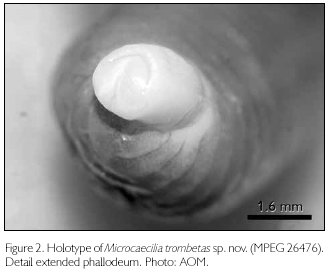
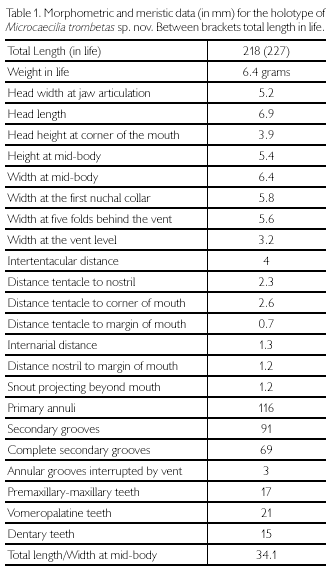
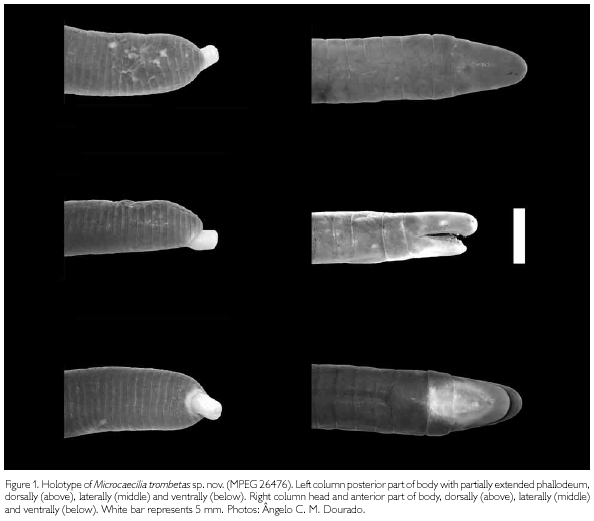
<body><![CDATA[<p><font size="2" face="verdana">Recently three new species   were described from the Guianan Region, <i>M. grandis </i>Wilkinson, Nussbaum   &amp; Hoogmoed, 2009 from Suriname, <i>M. iyob </i>Wilkinson &amp; Kok, 2010   from Guyana, and a third species by Maciel &amp; Hoogmoed (in press) from   northeastern Par&aacute;, Brazil, all based on few type specimens (one, one, and four,   respectively). Here we describe a new species from the Brazilian part of the   Guianan Region based on one specimen recently collected during one of the   expeditions of the Calha Norte Project (Avila-Pires <i>et al., </i>2010) to northern   Par&aacute;, Brazil. Probably other new species of <i>Microcaecilia, </i>will be   recognized as indicated in the recent literature (Wilkinson <i>et al., </i>2009;   Maciel &amp; Hoogmoed, in press).</font></p>     <p><font size="2"><b><font face="verdana">TAXONOMY</font></b></font></p>     <p><font size="2" face="verdana"><b>Species description</b></font></p>     <p><font size="2" face="verdana"><i>Microcaecilia trombetas</i> sp. nov.</font></p>     <p><font size="2" face="verdana"><i>Microcaecilia unicolor</i>: Avila-Pires et al. 2010: 68, 109.</font></p>     <p><font size="2" face="verdana">Holotype:     MPEG 26476 (Field number CN502), mature male, Floresta Estadual (FLOTA)     Trombetas (S 0&deg; 57' 45.97&quot; W 55&deg; 31' 20.28&quot;), municipality of &Oacute;bidos,     state of Par&aacute;, Brazil, 21-IV-2008, collected by M. S. Hoogmoed and W Rocha.</font></p>     <p><font size="2" face="verdana">Diagnosis: Primary annuli   116. Secondary grooves 91. Eye not visible. Premaxillary-maxillary teeth   extending beyond the level of the posterior margin of the choanae.   Vomeropalatine teeth monocuspid. Small terminal shield, one half (only on left   side) annular groove beyond posterior level of the vent. Dermal scales starting   at 8th annular groove; no indication for the presence of subdermal scales.</font></p>     <p><font size="2" face="verdana"><i>Microcaecilia   trombetas</i> sp.     nov. differs from most other <i>Microcaecilia </i>(except <i>M. supernumeraria </i>with     93 secondary grooves instead of 91 in M. <i>trombetas </i>sp. nov.) in having a     higher number of secondary grooves and from <i>M. rabei </i>(Roze &amp; Solano,     1963), <i>M. taylori </i>Nussbaum &amp; Hoogmoed, 1979, <i>M. grandis </i>Wilkinson,     Nussbaum&amp; Hoogmoed, 2009, <i>M. iyob </i>Wilkinson &amp; Kok, 2010, and <i>Microcaecilia </i>sp. nov. Maciel &amp; Hoogmoed (in press), in having monocuspid instead of     bicuspid vomeropalatine teeth; from <i>M. iyob </i>it also differs in having     more primary annuli, 116 instead of 97. it differs from M. <i>supernumeraria </i>in     having distinctly less primary folds (116 instead of 143), in the scales     starting at the 8th annular groove (instead of at the first primary groove), in     having higher numbers of vomeropalatine and dentary teeth and in having a less     slender body (length/width 34.1 instead of 41.6 times).</font></p>     <p><font size="2" face="verdana">Description of the   holotype: An adult male (<a href="#f1">Figure 1</a>) with a total length of 218   mm. Multiple testis lobes and abundant fat bodies. Phallodeum partially   extruded (<a href="#f2">Figure 2</a>), consisting of a short (2.5 mm) cylinder   (diameter 1.6 mm) which at the top shows a vertically divided inverted part   that could not be everted further. A longitudinal ventral incision of   approximately 25 mm is present near mid body. Total length 34.1 times body width.   Head slightly narrower than body; dorsum of head slightly convex in lateral   view. Margin of the upper jaw curving down, with the highest point of the   concavity formed at the level of the tentacle openings. Snout projects 1.2 mm   beyond mouth. Tip of snout rounded in dorsal and lateral views. Mouth slightly   opened, with premaxillary-maxillary and dentary teeth visible externally.   Nostrils subcircular, visible from above. Eyes not visible. Tentacle openings   circular and slightly elevated above the skin, laterally positioned, near   margin of mouth, slightly closer to corner of mouth than to nostrils, visible   from above. Nuchal grooves distinct dorsally, laterally and ventrally, except   the third which ventrally is incomplete. First collar narrower than second;   distance between first and second nuchal groove 1.6 mm, and distance between   second and third nuchal groove 2.6 mm. A dorsal transverse groove is present on   each collar, smaller on the first one. A very thin longitudinal ventral groove   (only visible under stereo zoom microscope) appears on the first nuchal collar   running from the second nuchal groove to the throat. There is another very thin   transverse groove on the ventral surface of the first nuchal collar, forming a   cross with the other one. Body semi-cylindrical, slightly wider than deep.   Width along the body may slightly vary, narrower at the terminal region.   Primary annuli 116. Primary annular grooves completely encircling the body,   except a few grooves that are ventrally incomplete (7, 8, and 19 - 31), and two   (plus one secondary groove) that are interrupted by the vent. Secondary grooves   91; 69 of them complete, starting between primary annular grooves 24 and 25. A   small terminal shield; one half (only on left side) secondary annular groove   posterior to the level of the posterior margin of the vent. Vent with twelve   denticulations: six on the anterior and six on the posterior margin. Dermal   scales starting at 8th annular groove, with at most four rows per body annulus.   Scales at 8th primary groove small and narrow, (0.2 x 0.4 mm); larger   posteriorly (e.g. 0.7 x 0.9 mm at 100th primary annulus). Choanae circular, due   to the preservation it was not possible to measure them. Tongue anteriorly   attached to the mandibular mucosa, no narial plugs on tongue.   Premaxillary-maxillary teeth 17, with little variation in size, posterior   maxillary teeth smaller. Premaxillary-maxillary series extending posteriorly to   beyond the level of the posterior margin of the choanae. Vomeropalatine teeth   21, monocuspid, with no apparent variation in size; teeth smaller than in all   other series. Dentary teeth 15, slightly larger than premaxillary-maxillary   teeth; size of teeth decreasing posteriorly. More data in <a href="#t1">Table 1</a>.</font></p>     <p><a name="f1"></a></p>     ]]></body>
<body><![CDATA[<p>&nbsp;</p>     <p align="center"><img src="/img/revistas/bmpegcn/v6n1/1a03f1.gif" border="0"></p>     <p>&nbsp;</p>     <p><a name="f2"></a></p>     <p>&nbsp;</p>     <p align="center"><img src="/img/revistas/bmpegcn/v6n1/1a03f2.gif" border="0"></p>     <p>&nbsp;</p>     <p><a name="t1"></a></p>     <p>&nbsp;</p>     <p align="center"><img src="/img/revistas/bmpegcn/v6n1/1a03t1.gif" border="0"></p>     ]]></body>
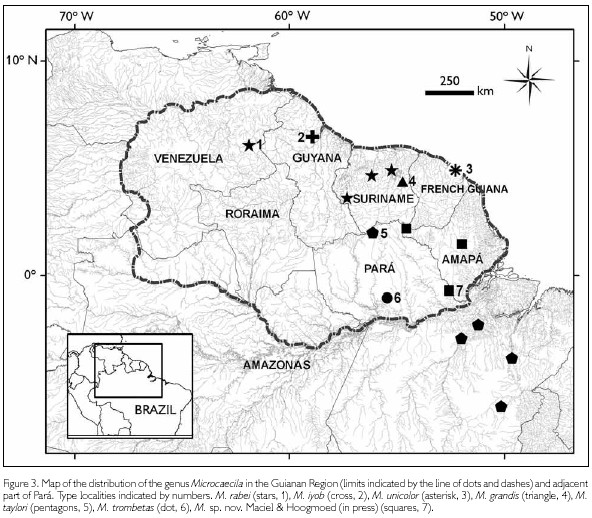
<body><![CDATA[<p>&nbsp;</p>     <p><font size="2" face="verdana">Colour: Holotype in life   &quot;Body purplish blue. Lower jaw pink with inner side bordered by white,   throat [including ventral part of first nuchal collar] blueish. Area around   vent pink&quot; (fieldnotes MSH). in preservative the body is dark gray and the   light areas mentioned above are cream. An U-shaped, cream area on the snout   that connects the nostrils. Mandibles covered by a U-shaped cream area. The   tongue, mandibular mucosa and palatal mucosa are grey, the palatal region   darker than the rest.</font></p>     <p><font size="2" face="verdana">Etymology: The name of   the species refers to the type-locality, FLOTA Trombetas, and is a noun in   apposition.</font></p>     <p><font size="2" face="verdana">Distribution: The species   is only known from the type locality on the southern part of the Guianan Region   (<a href="#f3">Figure 3</a>).</font></p>     <p><a name="f3"></a></p>     <p>&nbsp;</p>     <p align="center"><img src="/img/revistas/bmpegcn/v6n1/1a03f3.gif" border="0"></p>     <p>&nbsp;</p>     <p><font size="2" face="verdana">Natural history: The specimen   was collected in 'terra-firme' (non-inundated) forest in a pitfall (no. 15 in   trail 1) installed at an altitude of 350 m. For a description of the general   area of FLOTA Trombetas see Avila-Pires <i>et al. </i>(2010).</font></p>     <p>&nbsp;</p>     ]]></body>
<body><![CDATA[<p><font size="3" face="verdana"><b>DISCUSSION</b></font></p>     <p><font size="2" face="verdana">In the Guianan Region, <i>Microcaecilia </i>is the most diverse genus of Gymnophiona, and recently some new species   have been described, either from specimens collected recently or from specimens   that earlier had been relegated to other species. Taylor (1968) designated a   lectotype for <i>Microcaecilia unicolor </i>from Cayenne, French Guiana and   described a specimen from Guyana under that name. Taylor (1969, 1972)   recognized that in his monograph of 1968 he referred the specimen of Guyana to <i>M.     unicolor </i>with &quot;some hesitancy&quot; due to the lower number of annuli   and higher number of premaxillary-maxillary teeth than in the other known   specimens from French Guiana. Wilkinson <i>et al. </i>(2009) state that the   specimen studied by Taylor (1968) from Guyana and the specimens from Suriname   cited as <i>M. unicolor </i>by Nussbaum &amp; Hoogmoed (1979), are possibly   undescribed species, or in the case of the Suriname specimens that they could   represent juveniles of <i>M. grandis. </i>Recently, Wilkinson &amp; Kok (2010)   described <i>M. iyob, </i>based on the same Guyanan specimen that earlier was used by Taylor (1968) for his description under <i>M. unicolor.</i></font></p>     <p><font size="2" face="verdana">Maciel &amp; Hoogmoed (in   press) made a taxonomic study of the Gymnophiona of Brazilian Amazonia, and in   that paper cite some specimens of <i>Microcaecilia </i>from the Guianan Region   that could represent undescribed forms.</font></p>     <p><font size="2" face="verdana">Avila-Pires <i>et al.</i> (2010) erroneously considered the specimen here described   to be <i>M. unicolor </i>and they cited its presence in FLOTA Trombetas under   that name. Upon closer study of this specimen it turned out to belong to a   species different from <i>M. unicolor, </i>which is here described.</font></p>     <p>&nbsp;</p>     <p><b><font size="3" face="verdana">ACKNOWLEDGEMENTS</font></b></p>     <p><font size="2" face="verdana">&Acirc;ngelo C. M. Dourado made   the photos of the holotype. The first author was supported     financially by the Conselho Nacional de Desenvolvimento Cient&iacute;fico e     Tecnol&oacute;gico (CNPq 132729/2007-5). Conserva&ccedil;&atilde;o internacional (Ci-Brasil) financed travel from       Bel&eacute;m to Santar&eacute;m and the costs of staying in the field. Mining company Rio       Tinto covered the costs of transport from Santar&eacute;m to FLOTA Trombetas and was       responsible for logistics in the field. The field work was done under license       001/2008 of the Secretaria Estadual do Meio Ambiente (SEMA-PA).</font></p>     <p>&nbsp;</p>     <p><b><font size="3" face="verdana">REFERENCES</font></b></p>     <!-- ref --><p><font size="2" face="verdana">AVILA-PIRES, T. C. S., M.   S. HOOGMOED &amp; W. A. ROCHA, 2010. Notes on the Vertebrates of northern Par&aacute;,   Brazil: a forgotten part of the Guianan Region, I. Herpetofauna. <b>Boletim     do Museu Paraense Em&iacute;lio Goeldi. Ci&ecirc;ncias Naturais</b> 5(1):       13-112.</font><!-- ref --><p><font size="2" face="verdana">FROST, D. R., 2011. <b>Amphibian species of the world: an online reference.</b> American Museum of Natural History,   New York. Version 5.5. Available at: &lt;<a href="http://research.amnh.org/vz/herpetology/amphibia/" target="_blank">http://research.amnh.org/vz/herpetology/amphibia/</a>&gt;.   Accessed on: 15 February 2011.</font><!-- ref --><p><font size="2" face="verdana">MACIEL, A. O. &amp; M. S.   HOOGMOED. Taxonomy and distribution of Gymnophiona of Brazilian Amazonia with a   key to their identification. <b>Zootaxa </b>(in press).</font><!-- ref --><p><font size="2" face="verdana">NUSSBAUM, R. A. &amp; M. S. HOOGMOED, 1979. Surinam caecilians, with notes on <i>Rhinatrema   bivittatum </i>and the description of a new species of <i>Microcaecilia </i>(Amphibia,   Gymnophiona). <b>Zoologische Mededelingen </b>54(14): 217-235.</font><!-- ref --><p><font size="2" face="verdana">TAYLOR, E. H., 1968. <b>The   Caecilians of the World. </b>A taxonomic review: 1-848. University of Kansas   Press, Lawrence.</font><!-- ref --><p><font size="2" face="verdana">TAYLOR, E. H., 1969. A   new caecilian from Brasil. <b>University of Kansas Science Bulletin </b>48:   307-313.</font><!-- ref --><p><font size="2" face="verdana">TAYLOR, E. H., 1972.   Squamation in caecilians, with an atlas of scales. <b>University of Kansas     Science Bulletin </b>49: 989-1164.</font><!-- ref --><p><font size="2" face="verdana">WILKINSON, M., R. A.   NUSSBAUM &amp; M. S. HOOGMOED, 2009. A new species of <i>Microcaecilia </i>(Amphibia:   Gymnophiona: Caeciliidae) from Surinam. <b>Herpetologica </b>65(4): 413-418.</font><!-- ref --><p><font size="2" face="verdana">WILKINSON, M. &amp; P. J.   R. KOK, 2010. A new species <i>of Microcaecilia </i>(Amphibia: Gymnophiona:   Caeciliidae) from Guyana. <b>Zootaxa</b> 2719: 35-40.</font><p>&nbsp;</p>     <p>&nbsp;</p>     ]]></body>
<body><![CDATA[<p><font size="2"><font face="verdana"><a name="endereco"></a><a href="#topo"><img src="img/revistas/bmpegcn/v5n3/seta.gif" border="0"></a><b>Autor para correspond&ecirc;ncia:</b>    <br> Adriano Oliveira Maciel.    <br> Museu Paraense Em&iacute;lio Goeldi.    <br> Coordena&ccedil;&atilde;o de Zoologia.    <br> Av. Perimetral, 1901 - Terra Fime.    <br> Bel&eacute;m, PA, Brasil. CEP       66077-830    <br> (<a href="mailto:aombiologo@yahoo.com.br">aombiologo@yahoo.com.br</a>). </font></font></p>     <p><font size="2" face="verdana">Recebido em 17/02/2011    <br>   Aprovado em 18/03/2011</font></p>     <p><font size="2" face="verdana">Responsabilidade editorial: Hilton Tulio Costi</font></p>     ]]></body>
<body><![CDATA[ ]]></body><back>
<ref-list>
<ref id="B1">
<nlm-citation citation-type="journal">
<person-group person-group-type="author">
<name>
<surname><![CDATA[AVILA-PIRES]]></surname>
<given-names><![CDATA[T. C. S.]]></given-names>
</name>
<name>
<surname><![CDATA[HOOGMOED]]></surname>
<given-names><![CDATA[M. S.]]></given-names>
</name>
<name>
<surname><![CDATA[ROCHA]]></surname>
<given-names><![CDATA[W. A.]]></given-names>
</name>
</person-group>
<article-title xml:lang="en"><![CDATA[Notes on the Vertebrates of northern Pará, Brazil: a forgotten part of the Guianan Region, I. Herpetofauna]]></article-title>
<source><![CDATA[Boletim do Museu Paraense Emílio Goeldi. Ciências Naturais]]></source>
<year>2010</year>
<volume>5</volume>
<numero>1</numero>
<issue>1</issue>
<page-range>13-112</page-range></nlm-citation>
</ref>
<ref id="B2">
<nlm-citation citation-type="book">
<person-group person-group-type="author">
<name>
<surname><![CDATA[FROST]]></surname>
<given-names><![CDATA[D. R.]]></given-names>
</name>
</person-group>
<source><![CDATA[Amphibian species of the world: an online reference]]></source>
<year>2011</year>
<publisher-loc><![CDATA[New York ]]></publisher-loc>
<publisher-name><![CDATA[American Museum of Natural History]]></publisher-name>
</nlm-citation>
</ref>
<ref id="B3">
<nlm-citation citation-type="journal">
<person-group person-group-type="author">
<name>
<surname><![CDATA[MACIEL]]></surname>
<given-names><![CDATA[A. O.]]></given-names>
</name>
<name>
<surname><![CDATA[HOOGMOED]]></surname>
<given-names><![CDATA[M. S.]]></given-names>
</name>
</person-group>
<article-title xml:lang="en"><![CDATA[Taxonomy and distribution of Gymnophiona of Brazilian Amazonia with a key to their identification]]></article-title>
<source><![CDATA[Zootaxa]]></source>
<year></year>
</nlm-citation>
</ref>
<ref id="B4">
<nlm-citation citation-type="journal">
<person-group person-group-type="author">
<name>
<surname><![CDATA[NUSSBAUM]]></surname>
<given-names><![CDATA[R. A.]]></given-names>
</name>
<name>
<surname><![CDATA[HOOGMOED]]></surname>
<given-names><![CDATA[M. S.]]></given-names>
</name>
</person-group>
<article-title xml:lang="en"><![CDATA[Surinam caecilians, with notes on Rhinatrema bivittatum and the description of a new species of Microcaecilia (Amphibia, Gymnophiona)]]></article-title>
<source><![CDATA[Zoologische Mededelingen]]></source>
<year>1979</year>
<volume>54</volume>
<numero>14</numero>
<issue>14</issue>
<page-range>217-235</page-range></nlm-citation>
</ref>
<ref id="B5">
<nlm-citation citation-type="book">
<person-group person-group-type="author">
<name>
<surname><![CDATA[TAYLOR]]></surname>
<given-names><![CDATA[E. H.]]></given-names>
</name>
</person-group>
<source><![CDATA[The Caecilians of the World: A taxonomic review]]></source>
<year>1968</year>
<page-range>1-848</page-range><publisher-loc><![CDATA[Lawrence ]]></publisher-loc>
<publisher-name><![CDATA[University of Kansas Press]]></publisher-name>
</nlm-citation>
</ref>
<ref id="B6">
<nlm-citation citation-type="journal">
<person-group person-group-type="author">
<name>
<surname><![CDATA[TAYLOR]]></surname>
<given-names><![CDATA[E. H.]]></given-names>
</name>
</person-group>
<article-title xml:lang="en"><![CDATA[A new caecilian from Brasil]]></article-title>
<source><![CDATA[University of Kansas Science Bulletin]]></source>
<year>1969</year>
<volume>48</volume>
<page-range>307-313</page-range></nlm-citation>
</ref>
<ref id="B7">
<nlm-citation citation-type="journal">
<person-group person-group-type="author">
<name>
<surname><![CDATA[TAYLOR]]></surname>
<given-names><![CDATA[E. H.]]></given-names>
</name>
</person-group>
<article-title xml:lang="en"><![CDATA[Squamation in caecilians, with an atlas of scales]]></article-title>
<source><![CDATA[University of Kansas Science Bulletin]]></source>
<year>1972</year>
<volume>49</volume>
<page-range>989-1164</page-range></nlm-citation>
</ref>
<ref id="B8">
<nlm-citation citation-type="journal">
<person-group person-group-type="author">
<name>
<surname><![CDATA[WILKINSON]]></surname>
<given-names><![CDATA[M.]]></given-names>
</name>
<name>
<surname><![CDATA[NUSSBAUM]]></surname>
<given-names><![CDATA[R. A.]]></given-names>
</name>
<name>
<surname><![CDATA[HOOGMOED]]></surname>
<given-names><![CDATA[M. S.]]></given-names>
</name>
</person-group>
<article-title xml:lang="en"><![CDATA[A new species of Microcaecilia (Amphibia: Gymnophiona: Caeciliidae) from Surinam]]></article-title>
<source><![CDATA[Herpetologica]]></source>
<year>2009</year>
<volume>65</volume>
<numero>4</numero>
<issue>4</issue>
<page-range>413-418</page-range></nlm-citation>
</ref>
<ref id="B9">
<nlm-citation citation-type="journal">
<person-group person-group-type="author">
<name>
<surname><![CDATA[WILKINSON]]></surname>
<given-names><![CDATA[M.]]></given-names>
</name>
<name>
<surname><![CDATA[KOK]]></surname>
<given-names><![CDATA[P. J. R.]]></given-names>
</name>
</person-group>
<article-title xml:lang="en"><![CDATA[A new species of Microcaecilia (Amphibia: Gymnophiona: Caeciliidae) from Guyana]]></article-title>
<source><![CDATA[Zootaxa]]></source>
<year>2010</year>
<volume>2719</volume>
<page-range>35-40</page-range></nlm-citation>
</ref>
</ref-list>
</back>
</article>