<?xml version="1.0" encoding="ISO-8859-1"?><article xmlns:mml="http://www.w3.org/1998/Math/MathML" xmlns:xlink="http://www.w3.org/1999/xlink" xmlns:xsi="http://www.w3.org/2001/XMLSchema-instance">
<front>
<journal-meta>
<journal-id>1981-8114</journal-id>
<journal-title><![CDATA[Boletim do Museu Paraense Emílio Goeldi Ciências Naturais]]></journal-title>
<abbrev-journal-title><![CDATA[Bol. Mus. Para. Emilio Goeldi Cienc. Nat.]]></abbrev-journal-title>
<issn>1981-8114</issn>
<publisher>
<publisher-name><![CDATA[Museu Paraense Emílio Goeldi, Ministério da Ciência e Tecnologia]]></publisher-name>
</publisher>
</journal-meta>
<article-meta>
<article-id>S1981-81142011000200002</article-id>
<title-group>
<article-title xml:lang="en"><![CDATA[A case of voluntary tail autotomy in the snake Dendrophidion dendrophis (Schlegel, 1837) (Reptilia: Squamata: Colubridae)]]></article-title>
<article-title xml:lang="pt"><![CDATA[Um caso de autotomia voluntária de cauda da serpente Dendrophidion dendrophis (Schlegel, 1837) (Reptilia: Squamata: Colubridae)]]></article-title>
</title-group>
<contrib-group>
<contrib contrib-type="author">
<name>
<surname><![CDATA[Hoogmoed]]></surname>
<given-names><![CDATA[Marinus Steven]]></given-names>
</name>
<xref ref-type="aff" rid="A01"/>
</contrib>
<contrib contrib-type="author">
<name>
<surname><![CDATA[Avila-Pires]]></surname>
<given-names><![CDATA[Teresa Cristina Sauer]]></given-names>
</name>
<xref ref-type="aff" rid="A01"/>
</contrib>
</contrib-group>
<aff id="A01">
<institution><![CDATA[,Museu Paraense Emílio Goeldi Coordenação de Zoologia ]]></institution>
<addr-line><![CDATA[Belém Pará]]></addr-line>
<country>Brasil</country>
</aff>
<pub-date pub-type="pub">
<day>00</day>
<month>08</month>
<year>2011</year>
</pub-date>
<pub-date pub-type="epub">
<day>00</day>
<month>08</month>
<year>2011</year>
</pub-date>
<volume>6</volume>
<numero>2</numero>
<fpage>113</fpage>
<lpage>117</lpage>
<copyright-statement/>
<copyright-year/>
<self-uri xlink:href="http://scielo.iec.gov.br/scielo.php?script=sci_arttext&amp;pid=S1981-81142011000200002&amp;lng=en&amp;nrm=iso"></self-uri><self-uri xlink:href="http://scielo.iec.gov.br/scielo.php?script=sci_abstract&amp;pid=S1981-81142011000200002&amp;lng=en&amp;nrm=iso"></self-uri><self-uri xlink:href="http://scielo.iec.gov.br/scielo.php?script=sci_pdf&amp;pid=S1981-81142011000200002&amp;lng=en&amp;nrm=iso"></self-uri><abstract abstract-type="short" xml:lang="en"><p><![CDATA[We report direct observation of voluntary tail autotomy in the Colubrid snake Dendrophidion dendrophis from Monte Dourado, Pará, Brazil. Voluntary tail autotomy for this species had been reported before, but the process itself never has been described.]]></p></abstract>
<abstract abstract-type="short" xml:lang="pt"><p><![CDATA[Descrevemos uma observação direta de autotomia voluntária da cauda na serpente Colubridae Dendrophidion dendrophis, procedente de Monte Dourado, Fará, Brasil. Autotomia voluntária já havia sido registrada para essa espécie, porém o processo em si não havia sido descrito.]]></p></abstract>
<kwd-group>
<kwd lng="en"><![CDATA[Brazil]]></kwd>
<kwd lng="en"><![CDATA[Amazonas]]></kwd>
<kwd lng="en"><![CDATA[Snake]]></kwd>
<kwd lng="en"><![CDATA[Defensive behaviour]]></kwd>
<kwd lng="en"><![CDATA[Tail autotomy]]></kwd>
<kwd lng="pt"><![CDATA[Brasil]]></kwd>
<kwd lng="pt"><![CDATA[Amazonas]]></kwd>
<kwd lng="pt"><![CDATA[Serpente]]></kwd>
<kwd lng="pt"><![CDATA[Comportamento defensivo]]></kwd>
<kwd lng="pt"><![CDATA[Autotomia de cauda]]></kwd>
</kwd-group>
</article-meta>
</front><body><![CDATA[ <p><font size="4" face="verdana"><b><a name="topo" id="topo"></a>A case of voluntary tail autotomy in the snake <i>Dendrophidion dendrophis </i>(Schlegel, 1837) (Reptilia:  Squamata: Colubridae)</b></font></p>     <p>&nbsp;</p>     <p><font size="3" face="verdana"><b>Um caso de autotomia volunt&aacute;ria  de cauda da serpente <i>Dendrophidion dendrophis </i>(Schlegel, 1837) (Reptilia: Squamata:  Colubridae)</b></font></p>     <p>&nbsp;</p>     <p>&nbsp;</p>     <p><font size="2" face="verdana"><b>Marinus Steven Hoogmoed; Teresa  Cristina Sauer Avila-Pires</b></font></p>     <p><font size="2" face="verdana">Museu Paraense Em&iacute;lio Goeldi. Coordena&ccedil;&atilde;o de  Zoologia. Bel&eacute;m, Par&aacute;,  Brasil</font></p>     <p><font size="2" face="verdana"><a href="#endereco">Autor para correspond&ecirc;ncia</a></font></p>     <p>&nbsp;</p>     <p>&nbsp;</p> <hr size="1" noshade>     ]]></body>
<body><![CDATA[<p><font size="2" face="verdana"><b>ABSTRACT</b></font></p>     <p><font size="2" face="verdana">We report direct observation of voluntary tail  autotomy in the Colubrid snake <i>Dendrophidion dendrophis </i>from Monte Dourado,  Par&aacute;, Brazil. Voluntary tail autotomy for  this species had been reported before, but the process itself never has been described.</font></p>     <p><font size="2" face="verdana"><b>Keywords: </b>Brazil.  Amazonas. Snake. Defensive behaviour. Tail autotomy.</font></p> <hr size="1" noshade>     <p><font size="2" face="verdana"><b>RESUMO</b></font></p>     <p><font size="2" face="verdana">Descrevemos uma observa&ccedil;&atilde;o  direta de autotomia volunt&aacute;ria da cauda na serpente Colubridae <i>Dendrophidion  dendrophis, </i>procedente de Monte Dourado, Far&aacute;, Brasil. Autotomia volunt&aacute;ria  j&aacute; havia sido registrada para essa esp&eacute;cie, por&eacute;m o processo em si n&atilde;o havia  sido descrito.</font></p>     <p><font size="2" face="verdana"><b>Palavras-chave: </b>Brasil. Amazonas. Serpente. Comportamento defensivo. Autotomia de  cauda.</font></p> <hr size="1" noshade>     <p>&nbsp;</p>     <p>&nbsp;</p>     <p><font size="3" face="verdana"><b>INTRODUCTION</b></font></p>     <p><font size="2" face="verdana">Tail autotomy in lizards is a well known and widely  distributed defensive strategy, which occurs in many and diverse families (Zug <i>et  al., </i>2001). In most instances autotomy usually is followed by regeneration  of the tail, as a cartilaginous structure which is shorter than the original  tail (Pianka &amp; Vitt, 2003). In several families, like Agamidae and  Varanidae, this is not the case. in these families tails only break with much  effort, the wound only closes and no regeneration of the tail takes place (MSH,  personal observation).</font></p>     ]]></body>
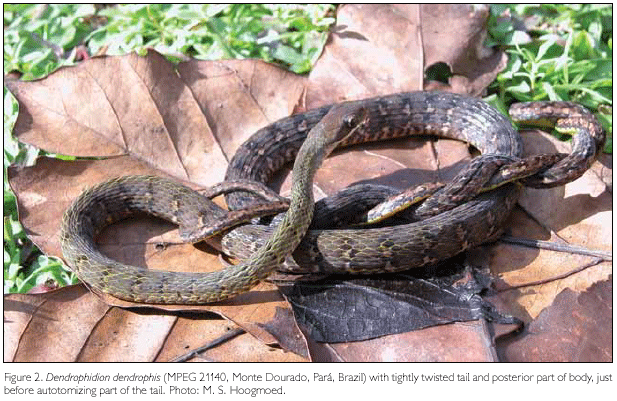
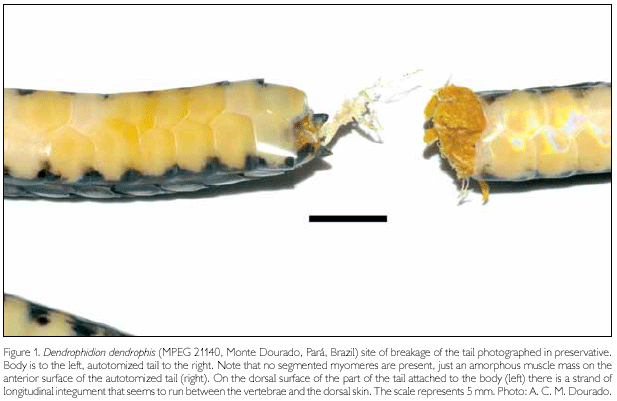
<body><![CDATA[<p><font size="2" face="verdana">Observations on tail autotomy (urotomy) in snakes  are rare. Taylor (1954), cited by Wilson (1968), noted tail autotomy in <i>Scaphiodontophis  venustissimus </i>(Gunther, 1894): &quot;No. 31935, discovered under a rock,  was caught by the tail, which broke off while the snake was suspended; a second  time it was picked up and with little effort the snake freed itself again by  breaking off another portion of the tail. A third time the experiment was tried  and a third section was severed&quot;, and &quot;On another occasion at the  Esquinas Forest Preserve, a young specimen of the species was observed entering  a hole. It was seized by the tail and this broke off easily, allowing the snake  to escape below the root of a forest tree&quot;. We had a similar experience in  July 2009, when we tried to capture a female <i>Thamnophis elegans </i>(Baird  &amp; Girard, 1853) in the Mount Timpanogos area, near Provo, Utah, U.S.A. for photographing. When  grabbed and suspended by the tail, the tail broke and the snake disappeared  between some rocks. No blood was evident on the severed part of the tail. Tail  breakage in North-American <i>Thamnophis </i>and <i>Nerodia </i>and the African <i>Psammophis </i>&quot;<i>phillipsii</i>&quot; has been well documented (Akani <i>et  al., </i>2002; Bowen, 2004; Fitch, 2003; Lockhart &amp; Amiel, 2011).</font></p>     <p><font size="2" face="verdana">Wilson  (1968), acting on some remarks of Liner (1960) about the easy severance of the  tail in <i>Pliocercus elapoides hobartsmithi </i>Liner, 1960, studied skeletal  material of <i>P. e. laticollaris </i>Smith, 1941, <i>P. e. diastemus </i>(Bocourt,  1886) and <i>Scaphiodontophis zeteki nothus </i>Taylor &amp; Smith, 1943 &#91;now  considered a synonym of <i>S. a. annulatus </i>(Dumeril, Bibron &amp; Dumeril,  1854)&#93; for   eventual intravertebral fracture planes in caudal  vertebrae. This initial study revealed the presence of a groove in the expanded  transverse processes of most but the first few caudal vertebrae in <i>Pliocercus, </i>but no other evidence of a fracture was evident. The groove was very  shallow in <i>Scaphiodontophis. </i>Wilson  (1968) came to the conclusion that &quot;this grooving of the transverse  processes of the caudal vertebrae of <i>Pliocercus </i>and perhaps <i>Scaphiodontophis </i>is a point of sufficient weakness that allows the vertebrae to break when  the snake is seized by the tail&quot;. He was ofthe opinion that this  adaptation would be advantageous for snakes, as in lizards that exhibit tail  autotomy: attackers are stuck with the tail and the animal itself escapes. Wilson (1968) also noted  that a difference with lizards is that snakes do not regenerate the damaged  portion of the tail. Arnold  (1984, 1988) extensively discusses tail autotomy in lizards, and Bateman &amp; Fleming  (2009) provide additional, updated information about the subject.</font></p>     <p>&nbsp;</p>     <p><font size="3" face="verdana"><b>RESULTS</b></font></p>     <p><font size="2" face="verdana">In 2004 we executed field work in Brazilian  Amazonia, in Monte Dourado, Jari River, municipality Almeirim, state of Par&aacute;, Brazil,  in the context of a cooperation project between the Museu Paraense Em&iacute;lio Goeldi,  Bel&eacute;m, Par&aacute;, Brazil and the University of East Anglia, U.K. (Gardner <i>et al., </i>2007, 2008; Ribeiro Junior <i>et al., </i>2006, 2008).</font></p>     <p><font size="2" face="verdana">During this fieldwork a specimen of <i>Dendrophidion  dendrophis </i>(Schlegel, 1837) (field number MSH 7610) was collected by us on  June 9, 2004 at 13:50 h in low primary forest on sandy soil, in an area known  as 'Quaruba' (S 01<sup>o</sup> 1' 32&quot; W 52<sup>o</sup> 54' 17&quot;). It was in the shade on the  forest floor on leaf litter, crossing a trail. The specimen (now MPEG 21140) was  collected with intact tail and kept alive overnight, by itself, in a thin,  wetted linen bag, in order to be photographed the next day.</font></p>     <p><font size="2" face="verdana">While  photographing the specimen the next day in a grass field, it was rather weary  and agitated. It was observed to twist its tail and the posterior part of the  body very tightly around each other, which gave it an awkward position. All of  a sudden, without being touched, the larger part of the tail broke off  somewhere in part of the twisted area and the snake continued crawling away.  The autotomized tail did not make any movements and neither the wound at the  part attached to the body, neither the wound of the part thrown off showed  extensive bleeding (a minute amount of blood was visible at both wounds, but no  blood was spilled). The break occurred between subcaudal pairs 16 and 17 and  did not show the characteristic conical pieces of muscle (segmented myomeres)  that are present at the anterior end of recently autotomized lizard tails (Zug <i>et  al., </i>2001; Pianka &amp; Vitt, 2003: 76; personal observation MSH and  TCSAP). The autotomized part of the tail showed a mass of muscle that fitted  into a hollow area in the part of the tail attached to the body, where the  ultimate scales are projecting over the end of the wound (<a href="#f1">Figure 1</a>). The break  occurred between vertebrae and at both ends of the breaking point these are  visible. The behaviour of the snake before and after autotomizing the tail did  not seem different: it remained weary and agitated.</font></p>     <p><a name="f1" id="f1"></a></p>     <p>&nbsp;</p>     <p align="center"><img src="/img/revistas/bmpegcn/v6n2/2a02f1.gif" border="0"></p>     ]]></body>
<body><![CDATA[<p>&nbsp;</p>     <p><font size="2" face="verdana">Unfortunately no pictures of the moment of shedding  the tail are available, neither any detailed pictures of the twisted part of  body and tail, as no such thing as a voluntary tail autotomy in a snake was  expected to occur. We do have a picture that shows some of the twisting of the  posterior part of the body and the tail and we reproduce it here (<a href="#f2">Figure 2</a>).</font></p>     <p><a name="f2" id="f2"></a></p>     <p>&nbsp;</p>     <p align="center"><img src="/img/revistas/bmpegcn/v6n2/2a02f2.gif" border="0"></p>     <p>&nbsp;</p>     <p><font size="2" face="verdana">Duellman (1978) observed that <i>D. dendrophis </i>have  long tails that break readily and that most specimens in collections have  incomplete tails. Martins &amp; Oliveira (1998) observed that this species  rotates the body vigorously when handled, but does not bite. They also noted  that according to their unpublished data some individuals may break their tails  voluntarily. Vitt (in <i>litt. </i>July 14, 2011) remarked &quot;I've had  several <i>Dendrophidion </i>autotomize their tails when I captured them&quot;.  However, none of these authors do further detail those events.</font></p>     <p>&nbsp;</p>     <p><font size="3" face="verdana"><b>CONCLUSIONS</b></font></p>     <p><font size="2" face="verdana">When  counting subcaudal scales in snakes we regularly encounter snakes in which part  of the tail is missing, generally only a small part near the tip, but sometimes  larger parts are missing. Sometimes the break-off point has healed and shows  scar tissue that neatly closes the wound. in other cases the wound looks fresh  and has a similar aspect as the wound of the specimen about which we report.  Until now we have assumed that these wounds were the direct effect of  predation, <i>viz., </i>that predators had bitten off or held on to part of the  tail, causing it to break. However, we now start wondering whether there might  be an overseen defense mechanism in (some) snakes, in which part of the tail is  voluntarily thrown off, even without an external mechanical stimulus. It would  be worthwhile to be attentive to occurrences as the one described above and  determine whether voluntary tail autotomy is rare, or whether this occurs more  often and plays a distinct role in predator avoidance or escape in snakes.</font></p>     ]]></body>
<body><![CDATA[<p>&nbsp;</p>     <p><font size="3" face="verdana"><b>ACKNOWLEDGEMENTS</b></font></p>     <p><font size="2" face="verdana">We  want to thank Toby Gardner of the University  of East Anglia, U.K. Jari project, for  inviting us to visit his study sites, and for offering hospitality during our  stay in Monte Dourado, Par&aacute;,   Brazil. Angelo  C. M. Dourado drew our attention to recent literature and made the picture of  the broken tail in <a href="#f1">Figure 1</a>.</font></p>     <p><font size="2" face="verdana">The  material was collected under collecting permits of the Minist&eacute;rio do Meio  Ambiente issued by the Instituto Brasileiro do Meio Ambiente e dos Recursos  Naturais Renov&aacute;veis (IBAMA) (MMA-IBAMA, license numbers 043/2004-COMON,  0079/2004-CGFAU/LIC, 127/2005 and 048/2005).</font></p>     <p>&nbsp;</p>     <p><font size="3" face="verdana"><b>REFERENCES</b></font></p>     <!-- ref --><p><font size="2" face="verdana">AKANI, G. C., L. LUISELLI, S. M.  WARIBOKO, L. UDE &amp; E. M. ANGELICI, 2002. Erequency of  tail autotomy in the African Olive Grass Snake, <i>Psammophis </i>'<i>phillipsii</i>' from  three habitats in southern Nigeria. <b>African Journal of Herpetology </b>51(2): 143-146.</font><!-- ref --><p><font size="2" face="verdana">ARNOLD,  E. N., 1984. Evolutionary aspects of tail shedding in lizards and their  relatives. <b>Journal of Natural History </b>18: 127-169.</font><!-- ref --><p><font size="2" face="verdana">ARNOLD,  E. N., 1988. Caudal autotomy as a defence. In: C. GANS &amp; R. HUEY (Eds.): <b>Biology  of the Reptilia: </b>16B: 235-273. Alan R. Liss, New York.</font><!-- ref --><p><font size="2" face="verdana">BATEMAN,  P. W. &amp; P. A. FLEMING, 2009. To cut a long tail short: a review of lizard  caudal autotomy studies carried out over the last 20 years. <b>Journal of  Zoology </b>277(1): 1-14.</font><!-- ref --><p><font size="2" face="verdana">BOWEN,  K. D., 2004. Erequency of tail breakage in the northern watersnake, <i>Nerodia  sipedon sipedon. </i><b>The Canadian Field-Naturalist</b>  118:  435-437.</font><!-- ref --><p><font size="2" face="verdana">DUELLMAN,  W. E., 1978. The biology of an equatorial herpetofauna in Amazonian Ecuador. <b>University Kansas Museum of Natural History Miscellaneous Publication </b>65: 1-352.</font><!-- ref --><p><font size="2" face="verdana">FITCH,  H. S., 2003. Tail loss in garter snakes. <b>Herpetological Review </b>34(3):  212-213.</font><!-- ref --><p><font size="2" face="verdana">GARDNER,  T. A., M. A. RIBEIRO JUNIOR, J. BARLOW, T. C. S. AVILA-PIRES, M.  S. HOOGMOED &amp; C. PERES, 2007. The value of primary, secondary and  plantation forests for a neotropical herpetofauna. <b>Conservation Biology </b>21(3): 775-787.</font><p><font size="2" face="verdana">GARDNER, T. A., J. BARLOW, I. S. ARAUJO,  T. C. S. AVILA-PIRES,  A. B. BONALDO, J. E.  COSTA, M. C. ESPOSITO, L. V. FERREIRA, J. HAWES, M. I. M. HERNANDEZ, M. S.  HOOGMOED, R. N. LEITE,</font> <font size="2" face="verdana">N. F. LO-MAN-HUNG, J. R. MALCOLM, M. B.  MARTINS, L. A. M. MESTRE, R. MIRANDA-SANTOS, W. L. OVERAL, L. PARRY, S. L. PETERS,  M. A. RIBEIRO-JUNIOR, M. N. F. SILVA, C. SILVA MOTTA &amp; C. A. PERES, 2008. The  cost-effectiveness of biodiversity surveys in tropical forests. <b>Ecology  Letters </b>11(2): 139-150.</font></p>     <!-- ref --><p><font size="2" face="verdana">LINER,  E. A., 1960. A  new subspecies of false coral snake (<i>Pliocercus elapoides</i>) from San Luis Potosi, Mexico. <b>Southwestern Naturalist </b>5(4):  217-220.</font><!-- ref --><p><font size="2" face="verdana">LOCKHART,  J. &amp; J. AMIEL, 2011. Natural History Notes. <i>Nerodia sipedon </i>(Northern Watersnake). Defensive behavior. <b>Herpetological  Review </b>42(2): 296-297.</font><!-- ref --><p><font size="2" face="verdana">MARTINS,  M. &amp; M. E. OLIVEIRA, 1998. Natural history of snakes in forests of the Manaus region, Central  Amazonia, Brazil. <b>Herpetological Natural History </b>6(2): 78-155.</font><!-- ref --><p><font size="2" face="verdana">PIANKA,  E. R. &amp; L. J. VITT, 2003. <b>Lizards. </b>Windows to the evolution of  diversity: i-xiii, 1-333. University   of California Press,  Berkeley.</font><!-- ref --><p><font size="2" face="verdana">RIBEIRO  JUNIOR, M. A., T. A. GARDNER &amp; T. C. S. AVILA-PIRES, 2006. The effectiveness  of glue traps to sample lizards in a tropical rainforest. <b>South American  Journal of Herpetology </b>1(2): 131-137.</font><!-- ref --><p><font size="2" face="verdana">RIBEIRO  JUNIOR, M. A., T. A. GARDNER &amp; T. C. S. AVILA-PIRES, 2008. Evaluating the  effectiveness of herpetofaunal sampling techniques across a gradient of habitat  change in a tropical forest landscape. <b>Journal of Herpetology </b>42(4):  733-749.</font><!-- ref --><p><font size="2" face="verdana">TAYLOR,  E. H., 1954. Further studies on the serpents of Costa Rica. <b>University of Kansas  Science Bulletin </b>36 (part II) (11): 673-801.</font><!-- ref --><p><font size="2" face="verdana">WILSON,  L. D., 1968. A  fracture plane in the caudal vertebrae of <i>Pliocercus elapoides </i>(Serpentes:  Colubridae). <b>Journal of Herpetology</b>  1(1-4):  93-94.</font><!-- ref --><p><font size="2" face="verdana">ZUG,  G. R., L. J. VITT &amp; J. P. CALDWELL, 2001. <b>Herpetology. </b>An  introductory biology of amphibians and reptiles: i-xiv, 1-630. Academic Press, San Diego.</font><p>&nbsp;</p>     <p>&nbsp;</p>     <p><font size="2"><b><font face="verdana"><b><a name="endereco" id="endereco"></a></b></font><font size="2"><b><font size="2"><b><font face="verdana"><b><a href="#topo"><img src="img/revistas/bmpegcn/v5n3/seta.gif" border="0"></a></b></font></b></font></b></font><font face="verdana"><b><a href="#topo"></a></b>Autor para correspond&ecirc;ncia:</font></b><font face="verdana">    <br> Marinus  steven Hoogmoed.    <br> Museu  Paraense Em&iacute;lio Goeldi.    <br> Coordena&ccedil;&atilde;o  de Zoologia.    ]]></body>
<body><![CDATA[<br> Av.  Perimetral, 1901 &ndash; terra firme    <br> Bel&eacute;m, PA,  Brasil. CEP 66017-970    <br> (<a href="mailto:marinus@museu-goeldi.br">marinus@museu-goeldi.br</a>)</font></font></p>     <p><font size="2" face="verdana">Recebido em 24/02/2011    <br> Aprovado em 18/07/2011</font></p>     <p><font size="2" face="verdana">Responsabilidade Editorial: Hilton tulio Costi</font></p>      ]]></body><back>
<ref-list>
<ref id="B1">
<nlm-citation citation-type="journal">
<person-group person-group-type="author">
<name>
<surname><![CDATA[AKANI]]></surname>
<given-names><![CDATA[G. C.]]></given-names>
</name>
<name>
<surname><![CDATA[LUISELLI]]></surname>
<given-names><![CDATA[L.]]></given-names>
</name>
<name>
<surname><![CDATA[WARIBOKO]]></surname>
<given-names><![CDATA[S. M.]]></given-names>
</name>
<name>
<surname><![CDATA[UDE]]></surname>
<given-names><![CDATA[L.]]></given-names>
</name>
<name>
<surname><![CDATA[ANGELICI]]></surname>
<given-names><![CDATA[E. M.]]></given-names>
</name>
</person-group>
<article-title xml:lang="en"><![CDATA[Erequency of tail autotomy in the African Olive Grass Snake, Psammophis 'phillipsii' from three habitats in southern Nigeria]]></article-title>
<source><![CDATA[African Journal of Herpetology]]></source>
<year>2002</year>
<volume>51</volume>
<numero>2</numero>
<issue>2</issue>
<page-range>143-146</page-range></nlm-citation>
</ref>
<ref id="B2">
<nlm-citation citation-type="journal">
<person-group person-group-type="author">
<name>
<surname><![CDATA[ARNOLD]]></surname>
<given-names><![CDATA[E. N.]]></given-names>
</name>
</person-group>
<article-title xml:lang="en"><![CDATA[Evolutionary aspects of tail shedding in lizards and their relatives]]></article-title>
<source><![CDATA[Journal of Natural History]]></source>
<year>1984</year>
<volume>18</volume>
<page-range>127-169</page-range></nlm-citation>
</ref>
<ref id="B3">
<nlm-citation citation-type="book">
<person-group person-group-type="author">
<name>
<surname><![CDATA[ARNOLD]]></surname>
<given-names><![CDATA[E. N.]]></given-names>
</name>
</person-group>
<article-title xml:lang="en"><![CDATA[Caudal autotomy as a defence]]></article-title>
<person-group person-group-type="editor">
<name>
<surname><![CDATA[GANS]]></surname>
<given-names><![CDATA[C.]]></given-names>
</name>
<name>
<surname><![CDATA[HUEY]]></surname>
<given-names><![CDATA[R.]]></given-names>
</name>
</person-group>
<source><![CDATA[Biology of the Reptilia]]></source>
<year>1988</year>
<volume>16B</volume>
<page-range>235-273</page-range><publisher-loc><![CDATA[New York ]]></publisher-loc>
<publisher-name><![CDATA[Alan R. Liss]]></publisher-name>
</nlm-citation>
</ref>
<ref id="B4">
<nlm-citation citation-type="journal">
<person-group person-group-type="author">
<name>
<surname><![CDATA[BATEMAN]]></surname>
<given-names><![CDATA[P. W.]]></given-names>
</name>
<name>
<surname><![CDATA[FLEMING]]></surname>
<given-names><![CDATA[P. A.]]></given-names>
</name>
</person-group>
<article-title xml:lang="en"><![CDATA[To cut a long tail short: a review of lizard caudal autotomy studies carried out over the last 20 years]]></article-title>
<source><![CDATA[Journal of Zoology]]></source>
<year>2009</year>
<volume>277</volume>
<numero>1</numero>
<issue>1</issue>
<page-range>1-14</page-range></nlm-citation>
</ref>
<ref id="B5">
<nlm-citation citation-type="journal">
<person-group person-group-type="author">
<name>
<surname><![CDATA[BOWEN]]></surname>
<given-names><![CDATA[K. D.]]></given-names>
</name>
</person-group>
<article-title xml:lang="en"><![CDATA[Erequency of tail breakage in the northern watersnake, Nerodia sipedon sipedon]]></article-title>
<source><![CDATA[The Canadian Field-Naturalist]]></source>
<year>2004</year>
<volume>118</volume>
<page-range>435-437</page-range></nlm-citation>
</ref>
<ref id="B6">
<nlm-citation citation-type="journal">
<person-group person-group-type="author">
<name>
<surname><![CDATA[DUELLMAN]]></surname>
<given-names><![CDATA[W. E.]]></given-names>
</name>
</person-group>
<article-title xml:lang="en"><![CDATA[The biology of an equatorial herpetofauna in Amazonian Ecuador]]></article-title>
<source><![CDATA[University Kansas Museum of Natural History Miscellaneous Publication]]></source>
<year>1978</year>
<volume>65</volume>
<page-range>1-352</page-range></nlm-citation>
</ref>
<ref id="B7">
<nlm-citation citation-type="journal">
<person-group person-group-type="author">
<name>
<surname><![CDATA[FITCH]]></surname>
<given-names><![CDATA[H. S.]]></given-names>
</name>
</person-group>
<article-title xml:lang="en"><![CDATA[Tail loss in garter snakes]]></article-title>
<source><![CDATA[Herpetological Review]]></source>
<year>2003</year>
<volume>34</volume>
<numero>3</numero>
<issue>3</issue>
<page-range>212-213</page-range></nlm-citation>
</ref>
<ref id="B8">
<nlm-citation citation-type="journal">
<person-group person-group-type="author">
<name>
<surname><![CDATA[GARDNER]]></surname>
<given-names><![CDATA[T. A.]]></given-names>
</name>
<name>
<surname><![CDATA[RIBEIRO JUNIOR]]></surname>
<given-names><![CDATA[M. A.]]></given-names>
</name>
<name>
<surname><![CDATA[BARLOW]]></surname>
<given-names><![CDATA[J.]]></given-names>
</name>
<name>
<surname><![CDATA[AVILA-PIRES]]></surname>
<given-names><![CDATA[T. C. S.]]></given-names>
</name>
<name>
<surname><![CDATA[HOOGMOED]]></surname>
<given-names><![CDATA[M. S.]]></given-names>
</name>
<name>
<surname><![CDATA[PERES]]></surname>
<given-names><![CDATA[C.]]></given-names>
</name>
</person-group>
<article-title xml:lang="en"><![CDATA[The value of primary, secondary and plantation forests for a neotropical herpetofauna]]></article-title>
<source><![CDATA[Conservation Biology]]></source>
<year>2007</year>
<volume>21</volume>
<numero>3</numero>
<issue>3</issue>
<page-range>775-787</page-range></nlm-citation>
</ref>
<ref id="B9">
<nlm-citation citation-type="journal">
<person-group person-group-type="author">
<name>
<surname><![CDATA[GARDNER]]></surname>
<given-names><![CDATA[T. A.]]></given-names>
</name>
<name>
<surname><![CDATA[BARLOW]]></surname>
<given-names><![CDATA[J.]]></given-names>
</name>
<name>
<surname><![CDATA[ARAUJO]]></surname>
<given-names><![CDATA[S.]]></given-names>
</name>
<name>
<surname><![CDATA[AVILA-PIRES]]></surname>
<given-names><![CDATA[T. C. S.]]></given-names>
</name>
<name>
<surname><![CDATA[BONALDO]]></surname>
<given-names><![CDATA[A. B.]]></given-names>
</name>
<name>
<surname><![CDATA[COSTA]]></surname>
<given-names><![CDATA[J. E.]]></given-names>
</name>
<name>
<surname><![CDATA[ESPOSITO]]></surname>
<given-names><![CDATA[M. C.]]></given-names>
</name>
<name>
<surname><![CDATA[FERREIRA]]></surname>
<given-names><![CDATA[L. V.]]></given-names>
</name>
<name>
<surname><![CDATA[HAWES]]></surname>
<given-names><![CDATA[J.]]></given-names>
</name>
<name>
<surname><![CDATA[HERNANDEZ]]></surname>
<given-names><![CDATA[M. I. M.]]></given-names>
</name>
<name>
<surname><![CDATA[HOOGMOED]]></surname>
<given-names><![CDATA[M. S.]]></given-names>
</name>
<name>
<surname><![CDATA[LEITE]]></surname>
<given-names><![CDATA[R. N.]]></given-names>
</name>
<name>
<surname><![CDATA[LO-MAN-HUNG]]></surname>
<given-names><![CDATA[N. F.]]></given-names>
</name>
<name>
<surname><![CDATA[MALCOLM]]></surname>
<given-names><![CDATA[J. R.]]></given-names>
</name>
<name>
<surname><![CDATA[MARTINS]]></surname>
<given-names><![CDATA[M. B.]]></given-names>
</name>
<name>
<surname><![CDATA[MESTRE]]></surname>
<given-names><![CDATA[L. A. M.]]></given-names>
</name>
<name>
<surname><![CDATA[MIRANDA-SANTOS]]></surname>
<given-names><![CDATA[R.]]></given-names>
</name>
<name>
<surname><![CDATA[OVERAL]]></surname>
<given-names><![CDATA[W. L.]]></given-names>
</name>
<name>
<surname><![CDATA[PARRY]]></surname>
<given-names><![CDATA[L.]]></given-names>
</name>
<name>
<surname><![CDATA[PETERS]]></surname>
<given-names><![CDATA[S. L.]]></given-names>
</name>
<name>
<surname><![CDATA[RIBEIRO-JUNIOR]]></surname>
<given-names><![CDATA[M. A.]]></given-names>
</name>
<name>
<surname><![CDATA[SILVA]]></surname>
<given-names><![CDATA[M. N. F.]]></given-names>
</name>
<name>
<surname><![CDATA[SILVA MOTTA]]></surname>
<given-names><![CDATA[C.]]></given-names>
</name>
<name>
<surname><![CDATA[PERES]]></surname>
<given-names><![CDATA[C. A.]]></given-names>
</name>
</person-group>
<article-title xml:lang="en"><![CDATA[The cost-effectiveness of biodiversity surveys in tropical forests]]></article-title>
<source><![CDATA[Ecology Letters]]></source>
<year>2008</year>
<volume>11</volume>
<numero>2</numero>
<issue>2</issue>
<page-range>139-150</page-range></nlm-citation>
</ref>
<ref id="B10">
<nlm-citation citation-type="journal">
<person-group person-group-type="author">
<name>
<surname><![CDATA[LINER]]></surname>
<given-names><![CDATA[E. A.]]></given-names>
</name>
</person-group>
<article-title xml:lang="en"><![CDATA[A new subspecies of false coral snake (Pliocercus elapoides) from San Luis Potosi, Mexico]]></article-title>
<source><![CDATA[Southwestern Naturalist]]></source>
<year>1960</year>
<volume>5</volume>
<numero>4</numero>
<issue>4</issue>
<page-range>217-220</page-range></nlm-citation>
</ref>
<ref id="B11">
<nlm-citation citation-type="journal">
<person-group person-group-type="author">
<name>
<surname><![CDATA[LOCKHART]]></surname>
<given-names><![CDATA[J.]]></given-names>
</name>
<name>
<surname><![CDATA[AMIEL]]></surname>
<given-names><![CDATA[J.]]></given-names>
</name>
</person-group>
<article-title xml:lang="en"><![CDATA[Natural History Notes. Nerodia sipedon (Northern Watersnake). Defensive behavior]]></article-title>
<source><![CDATA[Herpetological Review]]></source>
<year>2011</year>
<volume>42</volume>
<numero>2</numero>
<issue>2</issue>
<page-range>296-297</page-range></nlm-citation>
</ref>
<ref id="B12">
<nlm-citation citation-type="journal">
<person-group person-group-type="author">
<name>
<surname><![CDATA[MARTINS]]></surname>
<given-names><![CDATA[M.]]></given-names>
</name>
<name>
<surname><![CDATA[OLIVEIRA]]></surname>
<given-names><![CDATA[M. E.]]></given-names>
</name>
</person-group>
<article-title xml:lang="en"><![CDATA[Natural history of snakes in forests of the Manaus region, Central Amazonia, Brazil]]></article-title>
<source><![CDATA[Herpetological Natural History]]></source>
<year>1998</year>
<volume>6</volume>
<numero>2</numero>
<issue>2</issue>
<page-range>78-155</page-range></nlm-citation>
</ref>
<ref id="B13">
<nlm-citation citation-type="book">
<person-group person-group-type="author">
<name>
<surname><![CDATA[PIANKA]]></surname>
<given-names><![CDATA[E. R.]]></given-names>
</name>
<name>
<surname><![CDATA[VITT]]></surname>
<given-names><![CDATA[L. J.]]></given-names>
</name>
</person-group>
<source><![CDATA[Lizards: Windows to the evolution of diversity: i-xiii]]></source>
<year>2003</year>
<page-range>1-333</page-range><publisher-loc><![CDATA[Berkeley ]]></publisher-loc>
<publisher-name><![CDATA[University of California Press]]></publisher-name>
</nlm-citation>
</ref>
<ref id="B14">
<nlm-citation citation-type="journal">
<person-group person-group-type="author">
<name>
<surname><![CDATA[RIBEIRO JUNIOR]]></surname>
<given-names><![CDATA[M. A.]]></given-names>
</name>
<name>
<surname><![CDATA[GARDNER]]></surname>
<given-names><![CDATA[T. A.]]></given-names>
</name>
<name>
<surname><![CDATA[AVILA-PIRES]]></surname>
<given-names><![CDATA[T. C. S.]]></given-names>
</name>
</person-group>
<article-title xml:lang="en"><![CDATA[The effectiveness of glue traps to sample lizards in a tropical rainforest]]></article-title>
<source><![CDATA[South American Journal of Herpetology]]></source>
<year>2006</year>
<volume>1</volume>
<numero>2</numero>
<issue>2</issue>
<page-range>131-137</page-range></nlm-citation>
</ref>
<ref id="B15">
<nlm-citation citation-type="journal">
<person-group person-group-type="author">
<name>
<surname><![CDATA[RIBEIRO JUNIOR]]></surname>
<given-names><![CDATA[M. A.]]></given-names>
</name>
<name>
<surname><![CDATA[GARDNER]]></surname>
<given-names><![CDATA[T. A.]]></given-names>
</name>
<name>
<surname><![CDATA[AVILA-PIRES]]></surname>
<given-names><![CDATA[T. C. S.]]></given-names>
</name>
</person-group>
<article-title xml:lang="en"><![CDATA[Evaluating the effectiveness of herpetofaunal sampling techniques across a gradient of habitat change in a tropical forest landscape]]></article-title>
<source><![CDATA[Journal of Herpetology]]></source>
<year>2008</year>
<volume>42</volume>
<numero>4</numero>
<issue>4</issue>
<page-range>733-749</page-range></nlm-citation>
</ref>
<ref id="B16">
<nlm-citation citation-type="journal">
<person-group person-group-type="author">
<name>
<surname><![CDATA[TAYLOR]]></surname>
<given-names><![CDATA[E. H.]]></given-names>
</name>
</person-group>
<article-title xml:lang="en"><![CDATA[Further studies on the serpents of Costa Rica]]></article-title>
<source><![CDATA[University of Kansas Science Bulletin]]></source>
<year>1954</year>
<volume>36</volume>
<numero>11</numero>
<issue>11</issue>
<page-range>673-801</page-range></nlm-citation>
</ref>
<ref id="B17">
<nlm-citation citation-type="journal">
<person-group person-group-type="author">
<name>
<surname><![CDATA[WILSON]]></surname>
<given-names><![CDATA[L. D.]]></given-names>
</name>
</person-group>
<article-title xml:lang="en"><![CDATA[A fracture plane in the caudal vertebrae of Pliocercus elapoides (Serpentes: Colubridae)]]></article-title>
<source><![CDATA[Journal of Herpetology]]></source>
<year>1968</year>
<volume>1</volume>
<numero>1-4</numero>
<issue>1-4</issue>
<page-range>93-94</page-range></nlm-citation>
</ref>
<ref id="B18">
<nlm-citation citation-type="book">
<person-group person-group-type="author">
<name>
<surname><![CDATA[ZUG]]></surname>
<given-names><![CDATA[G. R.]]></given-names>
</name>
<name>
<surname><![CDATA[VITT]]></surname>
<given-names><![CDATA[L. J.]]></given-names>
</name>
<name>
<surname><![CDATA[CALDWELL]]></surname>
<given-names><![CDATA[J. P.]]></given-names>
</name>
</person-group>
<source><![CDATA[Herpetology: An introductory biology of amphibians and reptiles: i-xiv]]></source>
<year>2001</year>
<page-range>1-630</page-range><publisher-loc><![CDATA[San Diego ]]></publisher-loc>
<publisher-name><![CDATA[Academic Press]]></publisher-name>
</nlm-citation>
</ref>
</ref-list>
</back>
</article>