<?xml version="1.0" encoding="ISO-8859-1"?><article xmlns:mml="http://www.w3.org/1998/Math/MathML" xmlns:xlink="http://www.w3.org/1999/xlink" xmlns:xsi="http://www.w3.org/2001/XMLSchema-instance">
<front>
<journal-meta>
<journal-id>1981-8114</journal-id>
<journal-title><![CDATA[Boletim do Museu Paraense Emílio Goeldi Ciências Naturais]]></journal-title>
<abbrev-journal-title><![CDATA[Bol. Mus. Para. Emilio Goeldi Cienc. Nat.]]></abbrev-journal-title>
<issn>1981-8114</issn>
<publisher>
<publisher-name><![CDATA[Museu Paraense Emílio Goeldi, Ministério da Ciência e Tecnologia]]></publisher-name>
</publisher>
</journal-meta>
<article-meta>
<article-id>S1981-81142011000200003</article-id>
<title-group>
<article-title xml:lang="en"><![CDATA[Avifaunal inventory of the Amazonian savannas and adjacent habitats of the Monte Alegre region (Pará, Brazil), with comments on biogeography and conservation]]></article-title>
<article-title xml:lang="pt"><![CDATA[Levantamento da avifauna das savanas amazônicas e de habitats adjacentes da região de Monte Alegre (Pará, Brasil), com comentários sobre biogeografia e conservação]]></article-title>
</title-group>
<contrib-group>
<contrib contrib-type="author">
<name>
<surname><![CDATA[Vasconcelos]]></surname>
<given-names><![CDATA[Marcelo Ferreira de]]></given-names>
</name>
<xref ref-type="aff" rid="A01"/>
</contrib>
<contrib contrib-type="author">
<name>
<surname><![CDATA[Dantas]]></surname>
<given-names><![CDATA[Sidnei de Melo]]></given-names>
</name>
<xref ref-type="aff" rid="A02"/>
</contrib>
<contrib contrib-type="author">
<name>
<surname><![CDATA[Silva]]></surname>
<given-names><![CDATA[José Maria Cardoso da]]></given-names>
</name>
<xref ref-type="aff" rid="A03"/>
</contrib>
</contrib-group>
<aff id="A01">
<institution><![CDATA[,Pontifícia Universidade Católica de Minas Gerais  ]]></institution>
<addr-line><![CDATA[Belo Horizonte Minas Gerais]]></addr-line>
<country>Brasil</country>
</aff>
<aff id="A02">
<institution><![CDATA[,Museu Paraense Emílio Goeldi Coordenação de Zoologia ]]></institution>
<addr-line><![CDATA[Belém Pará]]></addr-line>
<country>Brasil</country>
</aff>
<aff id="A03">
<institution><![CDATA[,Conservação Internacional do Brasil  ]]></institution>
<addr-line><![CDATA[Belém Pará]]></addr-line>
<country>Brasil</country>
</aff>
<pub-date pub-type="pub">
<day>00</day>
<month>08</month>
<year>2011</year>
</pub-date>
<pub-date pub-type="epub">
<day>00</day>
<month>08</month>
<year>2011</year>
</pub-date>
<volume>6</volume>
<numero>2</numero>
<fpage>119</fpage>
<lpage>145</lpage>
<copyright-statement/>
<copyright-year/>
<self-uri xlink:href="http://scielo.iec.gov.br/scielo.php?script=sci_arttext&amp;pid=S1981-81142011000200003&amp;lng=en&amp;nrm=iso"></self-uri><self-uri xlink:href="http://scielo.iec.gov.br/scielo.php?script=sci_abstract&amp;pid=S1981-81142011000200003&amp;lng=en&amp;nrm=iso"></self-uri><self-uri xlink:href="http://scielo.iec.gov.br/scielo.php?script=sci_pdf&amp;pid=S1981-81142011000200003&amp;lng=en&amp;nrm=iso"></self-uri><abstract abstract-type="short" xml:lang="en"><p><![CDATA[Knowledge of the avifaunal composition of Amazonian savannas is important in facilitating a greater understanding of the patterns of evolution ofthe regional biota. Despite this, this vegetation type has been poorly sampled in comparison to adjacent rainforest habitats. The aim of this paper is to provide an avifaunal inventory of the savannas and other adjacent habitats of Monte Alegre, on the left bank of Amazon River, northwestern Pará, Brazil. Our survey is based both on our own fieldwork and on previously-collected specimens deposited in museums. A total of 300 bird species have been recorded in the region. Ninety-four species (31.3%) were restricted to a single habitat type, indicating that habitat heterogeneity is important to the overall species richness. Despite the fact that the Monte Alegre savannas present typical species restricted to this habitat, several open-country birds that occur in larger savanna areas located on the borders of Amazonia (along the Atlantic coast and close to the 'cerrado' boundaries) were not recorded in this area. Although Monte Alegre is species impoverished relative to other savanna regions in the Amazon basin, the Monte Alegre savannas shelter the Sulfur-breasted Parakeet (Aratinga maculata), a vulnerable species in Pará state that is only known from the Guianan area of endemism (Aleixo et a/., 2011). We also comment on biogeography, taxonomy, noteworthy records, natural history and conservation of the regional avifauna.]]></p></abstract>
<abstract abstract-type="short" xml:lang="pt"><p><![CDATA[O conhecimento sobre a composição da avifauna das savanas amazônicas é muito importante para o entendimento de padrões da evolução da biota regional. Entretanto, este tipo de vegetação foi pouco amostrado em comparação com áreas de florestas adjacentes. O objetivo deste trabalho é apresentar um levantamento da avifauna das savanas e de habitats adjacentes de Monte Alegre, na margem esquerda do rio Amazonas, noroeste do Pará, Brasil. Nossa pesquisa baseou-se em nossos trabalhos de campo e em exemplares coletados anteriormente e depositados em museus. Um total de 300 espécies de aves foi registrado na região. Noventa e quatro espécies (31,3%) estiveram restritas a um único tipo de habitat, indicando que a heterogeneidade de habitats é importante para a riqueza geral de espécies. Apesar de as savanas de Monte Alegre apresentarem espécies típicas deste habitat, faltam outras aves de ambientes abertos que ocorrem em áreas maiores de savana localizadas nas bordas da Amazônia, especialmente ao longo da costa Atlântica ou próximo aos limites do cerrado. Embora a avifauna de Monte Alegre seja relativamente pobre em comparação com outras áreas de savanas na bacia amazônica, as savanas de Monte Alegre abrigam o cacaué (Aratinga maculata), uma espécie vulnerável no estado do Pará, com distribuição restrita à área de endemismo Guiana (Aleixo et al., 2011). Também comentamos sobre biogeografia, taxonomia, registros notáveis, história natural e conservação da avifauna regional.]]></p></abstract>
<kwd-group>
<kwd lng="en"><![CDATA[Avifaunal survey]]></kwd>
<kwd lng="en"><![CDATA[Amazonian savannas]]></kwd>
<kwd lng="en"><![CDATA[Biogeography]]></kwd>
<kwd lng="en"><![CDATA[Natural history]]></kwd>
<kwd lng="en"><![CDATA[Conservation]]></kwd>
<kwd lng="en"><![CDATA[Aratinga maculata]]></kwd>
<kwd lng="pt"><![CDATA[Levantamento de avifauna]]></kwd>
<kwd lng="pt"><![CDATA[Savanas amazônicas]]></kwd>
<kwd lng="pt"><![CDATA[Biogeografia]]></kwd>
<kwd lng="pt"><![CDATA[História natural]]></kwd>
<kwd lng="pt"><![CDATA[Conservação]]></kwd>
<kwd lng="pt"><![CDATA[Aratinga maculata]]></kwd>
</kwd-group>
</article-meta>
</front><body><![CDATA[ <p><font size="4" face="verdana"><b><a name="topo" id="topo"></a>Avifaunal  inventory of the Amazonian savannas and adjacent habitats of the Monte Alegre region (Par&aacute;,   Brazil), with  comments on biogeography and conservation</b></font></p>     <p>&nbsp;</p>     <p><font size="3" face="verdana"><b>Levantamento da avifauna das savanas amaz&ocirc;nicas e de habitats adjacentes da regi&atilde;o de Monte Alegre (Par&aacute;,  Brasil), com coment&aacute;rios sobre biogeografia e conserva&ccedil;&atilde;o</b></font></p>     <p>&nbsp;</p>     <p>&nbsp;</p>     <p><font size="2" face="verdana"><b>Marcelo Ferreira de Vasconcelos<sup>I</sup>, Sidnei de Melo Dantas<sup>II</sup>, Jos&eacute; Maria Cardoso da Silva<sup>III</sup></b></font></p>     <p><font size="2" face="verdana"><sup>I</sup>Pontif&iacute;cia Universidade  Cat&oacute;lica de Minas Gerais. Belo Horizonte, Minas Gerais, Brasil    <br>   <sup>II</sup>Museu Paraense Em&iacute;lio Goeldi. Coordena&ccedil;&atilde;o de Zoologia. Bel&eacute;m, Par&aacute;,  Brasil    <br>   <sup>III</sup>Conserva&ccedil;&atilde;o Internacional  do Brasil. Bel&eacute;m, Par&aacute;, Brasil</font></p>     <p><font size="2" face="verdana"><a href="#endereco">Autor para correspond&ecirc;ncia</a></font></p>     ]]></body>
<body><![CDATA[<p>&nbsp;</p>     <p>&nbsp;</p> <hr size="1" noshade>     <p><font size="2" face="verdana"><b>ABSTRACT</b></font></p>     <p><font size="2" face="verdana">Knowledge  of the avifaunal composition of Amazonian savannas is important in facilitating  a greater understanding of the patterns of evolution ofthe regional biota.  Despite this, this vegetation type has been poorly sampled in comparison to  adjacent rainforest habitats. The aim of this paper is to provide an avifaunal  inventory of the savannas and other adjacent habitats of Monte Alegre, on the  left bank of Amazon River, northwestern Par&aacute;,   Brazil. Our  survey is based both on our own fieldwork and on previously-collected specimens  deposited in museums. A total of 300 bird species have been recorded in the  region. Ninety-four species (31.3%) were restricted to a single habitat type,  indicating that habitat heterogeneity is important to the overall species  richness. Despite the fact that the Monte Alegre savannas present typical  species restricted to this habitat, several open-country birds that occur in  larger savanna areas located on the borders of Amazonia (along the Atlantic  coast and close to the 'cerrado' boundaries) were not recorded in this area.  Although Monte Alegre is species impoverished relative to other savanna regions  in the Amazon basin, the Monte Alegre savannas shelter the Sulfur-breasted  Parakeet (<i>Aratinga maculata</i>), a vulnerable species in Par&aacute; state that is  only known from the Guianan area of endemism (Aleixo <i>et </i>a/., 2011). We  also comment on biogeography, taxonomy, noteworthy records, natural history and  conservation of the regional avifauna.</font></p>     <p><font size="2" face="verdana"><b>Keywords: </b>Avifaunal survey. Amazonian savannas. Biogeography.  Natural history. Conservation. <i>Aratinga maculata.</i></font></p> <hr size="1" noshade>     <p><font size="2" face="verdana"><b>RESUMO</b></font></p>     <p><font size="2" face="verdana">O  conhecimento sobre a composi&ccedil;&atilde;o da avifauna das savanas amaz&ocirc;nicas &eacute; muito importante  para o entendimento de padr&otilde;es da evolu&ccedil;&atilde;o da biota regional. Entretanto, este  tipo de vegeta&ccedil;&atilde;o foi pouco amostrado em compara&ccedil;&atilde;o com &aacute;reas de florestas  adjacentes. O objetivo  deste trabalho &eacute; apresentar um levantamento da avifauna das savanas e de  habitats adjacentes de Monte Alegre, na margem esquerda do rio Amazonas,  noroeste do Par&aacute;, Brasil. Nossa pesquisa baseou-se em nossos trabalhos de campo e em  exemplares coletados  anteriormente e depositados em museus. Um total de 300 esp&eacute;cies de aves foi  registrado na regi&atilde;o. Noventa e quatro esp&eacute;cies (31,3%) estiveram restritas a  um &uacute;nico tipo de habitat, indicando que a heterogeneidade de habitats &eacute;  importante para a riqueza geral de esp&eacute;cies. Apesar de as savanas de Monte  Alegre apresentarem esp&eacute;cies t&iacute;picas deste habitat, faltam outras aves de  ambientes abertos que ocorrem em &aacute;reas maiores de savana localizadas nas bordas  da Amaz&ocirc;nia, especialmente ao longo da costa Atl&acirc;ntica ou pr&oacute;ximo aos limites  do cerrado. Embora a  avifauna de Monte Alegre seja relativamente pobre em compara&ccedil;&atilde;o  com outras &aacute;reas de savanas na bacia amaz&ocirc;nica, as savanas de Monte Alegre  abrigam o cacau&eacute; (<i>Aratinga  maculata</i>), uma esp&eacute;cie vulner&aacute;vel no estado do Par&aacute;, com  distribui&ccedil;&atilde;o restrita &agrave; &aacute;rea de endemismo Guiana (Aleixo <i>et al.</i>, 2011). Tamb&eacute;m comentamos  sobre biogeografia, taxonomia, registros not&aacute;veis, hist&oacute;ria natural e  conserva&ccedil;&atilde;o da avifauna  regional.</font></p>     <p><font size="2" face="verdana"><b>Palavras-chave: </b>Levantamento de avifauna. Savanas amaz&ocirc;nicas. Biogeografia. Hist&oacute;ria natural.  Conserva&ccedil;&atilde;o. <i>Aratinga maculata.</i></font></p> <hr size="1" noshade>     <p>&nbsp;</p>     <p>&nbsp;</p>     ]]></body>
<body><![CDATA[<p><font size="3" face="verdana"><b>INTRODUCTION</b></font></p>     <p><font size="2" face="verdana">Patches of savannas and other open vegetation  biotypes are found nested in extensive areas of rainforest in Brazilian  Amazonia (Prance, 1978; Pires &amp; Prance, 1985; Sanaiotti <i>et al., </i>1997;  Miranda &amp; Absy, 2000; Vicentini, 2004; Gottsberger &amp; Silberbauer-Gottsberger,  2006; Pennington <i>et al.</i>, 2006; Ratter <i>et al.</i>, 2006; Magnusson <i>et  al.</i>, 2008). Amazonian savannas occur mainly on poor, sandy soils on both  banks of the Amazon River (Gottsberger &amp; Silberbauer-Gottsberger,  2006; Pennington <i>et al., </i>2006; Ratter <i>et al., </i>2006). Important  sites include those in the states of Roraima, Amap&aacute;, Amazonas and Par&aacute; (Andrade-Lima,  1958; Miranda, 1993; Miranda &amp; Absy, 2000; Gottsberger &amp;  Silberbauer-Gottsberger, 2006; Pennington <i>et al.</i>, 2006; Ratter <i>et al.</i>,  2006; Magnusson <i>et al.</i>, 2008).</font></p>     <p><font size="2" face="verdana">Knowledge of the avifauna composition of Amazonian  open habitats is crucial to understanding patterns of distribution and  evolution of birds in South America (E.  Snethlage, 1909; Haffer, 1967, 1969, 1974, 1985, 1987; Silva, 1995; Silva <i>et  al., </i>1997; Silva &amp; Bates, 2002; Bates <i>et al., </i>2003; Robbins <i>et  al., </i>2004; Mittermeier <i>et al., </i>2010). Amazonian savannas are  considered present-day 'refugia' of a widespread open vegetation type that  probably expanded across the Amazonian belt of low precipitation during dry  phases of the Cenozoic (Haffer, 1967, 1969, 1974; Prance, 1978, 1987; Haffer &amp;  Prance, 2001; Ab'Saber, 2002). Despite their importance for the Amazonian  biogeography, these areas have been poorly sampled in comparison to rainforest  sites throughout the Amazonian region, and published avifaunal inventories have  focused on savannas in the Sipaliwini region (Suriname) and in the Brazilian  states of Roraima, Amazonas, Par&aacute;, Amap&aacute; and Rond&ocirc;nia (Henriques &amp; Oren,  1997; Silva <i>et al., </i>1997; Sanaiotti &amp; Cintra, 2001; Naka <i>et al.</i>,  2006; Aleixo &amp; Poletto, 2007; Santos &amp; Silva, 2007; Mittermeier <i>et  al., </i>2010; Aleixo <i>et al., </i>2011).</font></p>     <p><font size="2" face="verdana">Monte Alegre is located on  the left (northern) bank of the Amazon River, northwestern Par&aacute;, Brazil.  The region is located on the southern border of the Guianan area of endemism, a  well known area of avian endemism (see Cracraft, 1985).  Monte Alegre savannas are isolated from other large savanna areas (e. g., 'cerrado',  Amap&aacute;, Llanos, Roraima-Rupununi, Sipaliwini) by hundreds of kilometers of  Amazonian rainforest, but are only separated by the Amazon River from other  savanna enclaves on the southern bank (Alter do Ch&atilde;o) (<a href="#f1">Figure 1</a>).</font></p>     <p><a name="f1" id="f1"></a></p>     <p>&nbsp;</p>     <p align="center"><img src="../img/revistas/bmpegcn/v6n2/2a03f1.gif" border="0"></p>     <p>&nbsp;</p>     <p><font size="2" face="verdana">Ornithological  surveys of Monte Alegre started in the 19<sup>th</sup> century, when F W.  Sieber collected some specimens in this region, between 1801 and 1812 (Pinto, 1979).  These specimens were deposited in the Museum f&uuml;r Naturkunde (ZMB), Berlin (Pinto, 1979). The  famous British naturalist A. R. Wallace also explored the area in 1849 and  collected a few specimens that have been deposited in the British Museum  of Natural History (BMNH), Tring (Sclater &amp; Salvin, 1867; Pinto, 1979).  Later, more detailed ornithological collections were made by E. Snethlage, O.  Martins, A. Costa, J. de S&aacute;, J. Anthero and F J.  Jos&eacute; during the first two  decades of the 20<sup>th</sup> century (E. Snethlage, 1906, 1907, 1914; H.  Snethlage, 1930; Miranda-Ribeiro, 1938). During these expeditions, over 720  specimens were collected and deposited in the Museu Paraense Em&iacute;lio Goeldi  (MPEG), Bel&eacute;m. Between 1917 and 1920,   F Q. Lima and E. Garbe, working for  the Museu Paulista (currently Museu de Zoologia da Universidade de S&atilde;o Paulo,  MZUSP), also collected specimens in Monte Alegre (Pinto, 1944, 1945). Shortly  after these expeditions, C. Lako collected birds in the Monte Alegre region (Maicuru River) in 1928 and 1929 (Paynter &amp; Traylor,  1991; Silveira <i>et al., </i>2005). These  specimens were deposited in the Field Museum of Natural History (FMNH) and in  the American Museum of Natural History (AMNH)  (Paynter &amp; Traylor, 1991; Silveira <i>et al., </i>2005).  A. M. Olalla also  visited the region in 1936, when he collected specimens that were sent to the  FMNH (Paynter &amp; Traylor, 1991). Recently, a new species of parakeet  (Psittacidae), <i>Aratinga maculata </i>(Sulfur-breasted Parakeet), was  described from Monte Alegre (Silveira <i>et al., </i>2005) (the species was  described as <i>Aratinga pintoi </i>but this is now considered a junior synonym  of <i>Aratinga maculata, </i>see Nem&eacute;sio &amp; Rasmussen, 2009), and the region  became better known among ornithologists and birdwatchers (Silveira, 2005;  Balchin, 2006). Although this region has been inventoried by generations of  ornithologists, old collections from Monte Alegre have never been studied in  detail and the area lacks an ornithological checklist. Thus, the aim of this  paper is to provide an avifaunal inventory of the Monte Alegre region, based on  our own fieldwork and on specimens held in museums. We also comment on  biogeography, taxonomy, noteworthy records, natural history and conservation of  the avifauna.</font></p>     <p>&nbsp;</p>     ]]></body>
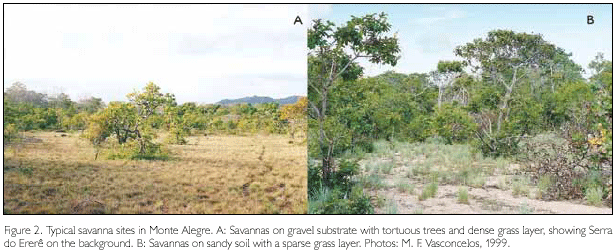
<body><![CDATA[<p><font size="3" face="verdana"><b>MATERIAL  AND METHODS</b></font></p>     <p><font size="2" face="verdana"><b>STUDY  AREA</b></font></p>     <p><font size="2" face="verdana">Our  study was located in the Monte Alegre region (between 01<sup>o</sup> 56' and 02<sup>o</sup> 07' S,  and 54<sup>o</sup> 03'and 54<sup>o</sup> 13' W), state of Par&aacute;, northern Brazil (<a href="#f1">Figure 1</a>). The elevation  ranges from 3 m  to 400 m  (Pastana, 1999) and the climate is hot and humid (type Awi of the K&otilde;ppen classification)  (Ayoade, 1998). Temperatures vary between monthly averages of 25.7o  and 27<sup>o</sup>  C (Oliveira-J&uacute;nior <i>et al., </i>1999) and  mean annual precipitation is 1,678   mm (Moraes <i>et al., </i>2005). Rainfall peaks in April  and the rainy season is concentrated between February and May, when monthly  precipitation surpasses 200   mm. The dry season is between September and October,  when monthly rainfall averages are lower than 50 mm (Oliveira-J&uacute;nior <i>et al., </i>1999).</font></p>     <p><font size="2" face="verdana">Savanna  vegetation (locally named 'coberto') occurs generally on sandy or rocky soils,  with the presence of a few species of grasses and herbs and a very  inconspicuous litter layer (<a href="#f2">Figure 2A</a> and <a href="#f2">Figure 2B</a>). Shrubby-arboreal  vegetation is primarily represented by sparse individuals of the following  species: <i>Curatella americana, Qualea grandiflora</i>, <i>Salvertia convallariodora</i>, <i>Sclerolobium paniculatum, Anacardium  occidentale, Palicourea rigida </i>and <i>Tocoyena formosa, </i>generally varying from  1 to 4 m  in height. At Serra do Erer&eacute; (02<sup>o</sup>  01' 16&quot; S 54<sup>o</sup> 10' 55&quot; W), a mountainous locality in this region  (elevation: 220 m),  savanna occurs mainly over and between rock outcrops, with shrubs of <i>Cereus </i>sp., <i>Phyllodendron </i>sp. and <i>Norantea guianensis. </i>In this area there are  also sparse shrubby-arboreal individuals of <i>Aspidosperma </i>sp., <i>Byrsonima  crassifolia, Q. grandiflora </i>and <i>S. convallariodora </i>growing on sandy  or rocky soils. Some of these trees are parasitized by a mistletoe (<i>Psittachanthus </i>sp.) with hummingbird-pollinated flowers (Vasconcelos &amp;  Silva, 2005). For a  detailed botanical inventory of the Monte Alegre savannas,  see Andrade-Lima (1958).</font></p>     <p><a name="f2" id="f2"></a></p>     <p>&nbsp;</p>     <p align="center"><img src="/img/revistas/bmpegcn/v6n2/2a03f2.gif" border="0"></p>     <p>&nbsp;</p>     <p><font size="2" face="verdana">These  savannas are intermixed with patches of 'campinarana', a low-canopy forest  growing on sandy soil with trees reaching up to 10 m in height. These  'campinaranas' are very dense, with a developed understory with tangles of  vines and shrubs (mainly <i>Miconia </i>sp.). At some places within the  savannas, there are clumps of trees that resemble small patches of  'campinarana', with a denser layer of litter and shrubs of <i>Eugenia </i>sp., <i>Miconia </i>sp. and <i>Cereus </i>sp.</font></p>     <p><font size="2" face="verdana">Original  'terra firme' forests ('floresta  ombr&oacute;fila') were extensively cleared and fragmented (Pereira <i>et  al., </i>2003). Several areas originally covered by this vegetation type are  now occupied by clumps of an abundant pioneer species of palm tree (<i>Attalea </i>sp.),  and the remnant fragments are subject to illegal logging (see below). Typical  tree species of those forests are: <i>Aspidosperma desmanthum, Bellucia </i>sp., <i>Geissospermum sericeum, Hymenaea parviflora, Inga micradenia, Licania </i>spp., <i>Myrcia  paivae, Nectandra mollis </i>and <i>Protium paniculatum </i>(Garcia <i>et al., </i>unpublished  data 2008).</font></p>     ]]></body>
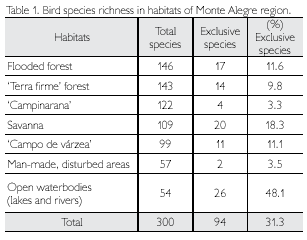
<body><![CDATA[<p><font size="2" face="verdana">Flooded  forests occur along watercourses, usually associated with flooded open habitats  ('campos de v&aacute;rzea'), with 'buriti' (<i>Mauritia flexuosa</i>) and 'a&ccedil;a&iacute;' (<i>Euterpe  oleracea</i>) palm groves. Rivers and lakes also represent important habitats  for water birds in the Monte Alegre region.</font></p>     <p>&nbsp;</p>     <p><font size="3" face="verdana"><b>METHODS</b></font></p>     <p><font size="2" face="verdana">We  made three expeditions to Monte Alegre aiming principally to collect specimens  in the savannas. The first expedition was performed by JMCS, MFV and D. C.  Pimentel Neto between 2 and 20 January 1999.  Specimens were collected with shotguns and mist-nets and have been deposited in  MPEG and in the ornithological collection of the Department of Zoology, Universidade  Federal de Pernambuco (UFPE). Localities sampled during this expedition were:  savannas and 'campinaranas' at km 4 of road PA-423 (01<sup>o</sup> 56' 38&quot; S 54<sup>o</sup> 03'  45&quot; W); savannas of Campo do  Desterro (01<sup>o</sup> 57'  04&quot; S 54<sup>o</sup> 10' 20&quot; W); savannas and 'terra firme' forest  fragments at Col&ocirc;nia do Erer&ecirc; (01<sup>o</sup> 58' 14&quot; S 54<sup>o</sup> 10' 01&quot; W); and  savannas and 'campinaranas' at Serra do Erer&ecirc; (02<sup>o</sup> 01' 16&quot; S 54<sup>o</sup> 10'  55&quot; W). The second expedition was made by SMD and J. N. Santa Br&iacute;gida, between 21 and 28 September  2006, during a study for the management plan of the Monte Alegre State    Park. Fieldwork was conducted in the following  localities: a 'terra firme' forest fragment at Ilha Grande (02<sup>o</sup> 01'  55&quot; S 54<sup>o</sup> 10' 39&quot; W); flooded forest at Aruchi (02<sup>o</sup> 01' 28&quot; S 54<sup>o</sup>  12' 33&quot; W); flooded forest at Igarap&eacute; do Erer&ecirc; (01<sup>o</sup> 59' 20&quot; S 54<sup>o</sup> 08'  57&quot; W); 'terra firme' forest and savannas at Col&ocirc;nia do Erer&ecirc;  (02<sup>o</sup> 00' 06&quot; S 54<sup>o</sup> 10' 48&quot; W); savannas at Santana (02<sup>o</sup> 00' 30&quot; S  54<sup>o</sup> 09' 58&quot; W); and savannas at Serra do Erer&ecirc; (02<sup>o</sup> 01' 32&quot; S 54<sup>o</sup> 11'  07&quot; W). Specimens were collected with mist-nets and deposited in MPEG. The  third expedition was made by SMD, between 19 and 23 March 2009, in the following  localities: lake at Lago da Concei&ccedil;&atilde;o (02<sup>o</sup> 04' 54&quot; S 54<sup>o</sup> 10' 21&quot; W); 'buriti'  palm grove at Mutuac&aacute; (02<sup>o</sup> 03' 18&quot; S 54<sup>o</sup> 12' 21&quot; W); and flooded forests along the  Amazon River (02<sup>o</sup> 07' 08&quot; S 54<sup>o</sup> 09' 36&quot; W). In all expeditions, birds  were also photographed and tape-recorded. Recordings  will be deposited at the Arquivo Sonoro Prof. Elias Coelho (ASEC), Departamento  de Zoologia, Universidade Federal do Rio de Janeiro (UFRJ), Rio de Janeiro,  Brazil. Some  of these recordings have been archived on the online resource Xeno-Canto (2009).</font></p>     <p><font size="2" face="verdana">We  also studied old specimens collected in the Monte Alegre region deposited in  MPEG and checked the literature (Pinto, 1944; Ruschi, 1951; Silveira <i>et al., </i>2005) for additional specimens deposited in the following institutions:  AMNH, FMNH, MZUSP and Museu Nacional do Rio    de Janeiro (MNRJ).</font></p>     <p><font size="2" face="verdana">We took notes in the field  in which habitat each species was observed. For those recorded exclusively in museums,  we classified them by habitat type based on our own field experience and  following Ridgely &amp; Tudor (1989, 1994), Stotz <i>et al. </i>(1996), Cohn-Haft <i>et al. </i>(1997), Borges <i>et al. </i>(2001) and Naka <i>et al. </i>(2006). Systematic order and nomenclature follow those of the  Comit&ecirc; Brasileiro de Registros Ornitol&oacute;gicos (CBRO, 2009).</font></p>     <p>&nbsp;</p>     <p><font size="3" face="verdana"><b>RESULTS  AND DISCUSSION</b></font></p>     <p><font size="2" face="verdana"><b>AVIFAUNAL  SURVEY</b></font></p>     <p><font size="2" face="verdana">A  total of 300 bird species was recorded in the Monte Alegre region (<a href="pdf/bmpegcn/v6n2/apenv6n2a03.pdf" target="_blank">Appendix</a>).  Flooded forests and 'terra firme' forests held the highest species richness (146  and 143 species, respectively), followed by 'campinarana' (122 species),  savannas (109 species) and 'campos de v&aacute;rzea' (99 species) (<a href="#t1">Table 1</a>). Disturbed  areas and open waterbodies (lakes and rivers) had the lowest species richness  (respectively 57 and 54 species, <a href="#t1">Table 1</a>).</font></p>     ]]></body>
<body><![CDATA[<p><a name="t1" id="t1"></a></p>     <p>&nbsp;</p>     <p align="center"><img src="/img/revistas/bmpegcn/v6n2/2a03t1.gif" border="0"></p>     <p>&nbsp;</p>     <p><font size="2" face="verdana">Ninety-four  species (31.3%) were restricted to a single habitat type (<a href="#t1">Table 1</a>). This shows  that habitat heterogeneity is important for the overall species richness (see  Cohn-Haft <i>et al., </i>1997). Similar results were obtained in other surveys  of Amazonian savannas intermixed with other vegetation types (Silva <i>et al., </i>1997;  Aleixo &amp; Poletto, 2007; Santos &amp; Silva, 2007; Aleixo <i>et al., </i>2011).  Open waterbodies (lakes and rivers) hold the highest percentage of exclusive  species (48.1%), followed by savannas, which presented 18.3% exclusive species  (<a href="#t1">Table 1</a>). On the other hand, 'campinaranas' showed the lowest percentage of  exclusive species (3.3%), probably because this habitat shelters several birds  that also live in other forest types, such as 'terra firme' and flooded forests  (Borges, 2004).</font></p>     <p><font size="2" face="verdana"><i>Aratinga  maculata </i>(Sulfur-breasted Parakeet) was the only species  considered to be restricted to the Monte Alegre region (Silveira <i>et al., </i>2005),  although some specimens listed by these authors were taken from Suriname and  considered mislabeled. Recently, Mittermeier <i>et al. </i>(2010) collected an  additional specimen in the Sipaliwini savanna, confirming its presence in Suriname. More  recent records were presented by Aleixo <i>et al. </i>(2011) from Trombetas State  Forest, southern part of the Gr&atilde;o Par&aacute;  Ecological Station and Paru   State Forest. <i>Lophornis ornatus </i>(Tufted Coquette) was previously considered by  Cracraft (1985) as a Guianan area of endemism endemic, but it also occurs in  Cracraft's Parian Montane area of endemism (see map in Z&uuml;chner, 1999) and on the right bank of  the Amazon River, in the savannas of Alter do Ch&atilde;o (Sanaiotti &amp; Cintra,  2001).</font></p>     <p><font size="2" face="verdana">Three  threatened species were recorded in the region (following Machado <i>et al., </i>2005;  SECTAM, 2006; BirdLife International, 2009): <i>Anodorhynchus hyacinthinus </i>(Hyacinth  Macaw) - globally endangered, vulnerable in Brazil and in Par&aacute; state; <i>Primolius  maracana </i>(Blue-winged Macaw) - near threatened globally and in Brazil,  vulnerable in Par&aacute; state; and <i>Aratinga maculata </i>(Sulfur-breasted  Parakeet) - vulnerable in Par&aacute; state, but not yet evaluated by BirdLife  International (2009) and by the Brazilian red list.</font></p>     <p><font size="2" face="verdana"><b>COMMENTS  ON THE BIOGEOGRAPHY OF THE MONTE ALEGRE SAVANNA AVIFAUNA</b></font></p>     <p><font size="2" face="verdana">It  is possible to make some biogeographical comments on the avifauna of the Monte Alegre  savannas. For example, <i>Colinus cristatus </i>(Crested Bobwhite) is the only  species restricted to the savannas north of the Amazon   River found in Monte Alegre (Sick, 1997). On the other hand, 13  savanna species whose ranges in South America are mainly centered on regions  located south of Amazonia ('caatinga', 'cerrado' and 'chaco'; following Silva <i>et  al., </i>1997) were recorded at Monte Alegre: <i>Buteo albicaudatus </i>(White-tailed  Hawk), <i>Aratinga aurea </i>(Peach-fronted Parakeet), <i>Chordeiles pusillus </i>(Least  Nighthawk), <i>Colaptes campestris </i>(Campo Flicker), <i>Formicivora rufa </i>(Rusty-backed  Antwren), <i>Lepidocolaptes angustirostris </i>(Narrow-billed Woodcreeper), <i>Elaenia  cristata </i>(Plain-crested Elaenia), <i>Suiriri suiriri </i>(Suiriri  Flycatcher), <i>Xolmis velatus </i>(White-rumped Monjita), <i>Tyrannus  albogularis </i>(White-throated Kingbird), <i>Tyrannus savana </i>(Fork-tailed  Flycatcher), <i>Mimus saturninus </i>(Chalk-browed Mockingbird) and <i>Ammodramus  humeralis </i>(Grassland Sparrow). These species exhibit the Peri-Atlantic  distribution pattern (following Silva, 1995). This pattern suggests connections  between the 'cerrado' region and the northern South American savannas through  an Atlantic coast savanna corridor (Silva, 1995; Silva &amp; Bates, 2002).  However, other important species sharing this pattern of distribution occur in  coastal savannas (e. g., Maraj&oacute; island and Amap&aacute; state; see Silva, 1995; Henriques  &amp; Oren, 1997; Silva <i>et al., </i>1997), but are absent in the Monte  Alegre savannas. Examples are: <i>Uropelia campestris </i>(Long-tailed  Ground-Dove), <i>Guira guira </i>(Guira Cuckoo), <i>Neothraupis fasciata </i>(White-banded  Tanager) and <i>Coryphaspiza melanotis </i>(Black-masked Finch). Thus, it seems  that the avifauna of the Monte Alegre savannas have been isolated from other  large South American savannas ('cerrado' and Llanos) for a longer period in  comparison to coastal savannas, which seem to have had more recent connections  to the 'cerrado' (Silva, 1995; Silva <i>et al., </i>1997; Silva &amp; Bates,  2002; Bates <i>et al., </i>2003; Mittermeier <i>et al., </i>2010). This pattern  does not support the presence of a broad savanna corridor across the Amazonian  belt of low precipitation, one of the assumptions of the refuge theory (Haffer,  1969, 1974). However, in a recent paper, Haffer &amp; Prance (2001) stressed  that not just savannas were believed to expand and isolate the wet forest 'refugia'.  They suggested that other vegetation types of seasonally dry climates (e.g.,  dry forest, liana forest and bamboo forest) could have been effective barriers  to the dispersal of rainforest 'refugia' organisms (see also Pennington <i>et  al., </i>2000). Bonaccorso <i>et al. </i>(2006) modeled potential distributions  of 17 species of plants and birds during the Last Glacial Maximum and suggested  that past climate changes fragmented rainforest species' ranges but there was  not a clear pattern for savanna species. These results also do not support the  broad expansion of savannas into areas currently covered by Amazonian  rainforests. Various other studies show a similar pattern; most notably those  based on the pollen record (see Bush &amp; de Oliveira, 2006 for a recent  review).</font></p>     <p><font size="2" face="verdana">Furthermore,  the relatively small area of Monte Alegre savannas, coupled with their isolated  location in central Amazonia relative to other larger savanna areas within the  borders of the Amazon region, such as Amap&aacute; (Silva <i>et al., </i>1997), Roraima-Rupununi  (Robbins <i>et al., </i>2004; Santos &amp; Silva, 2007) and the upper Marmelos  River (Aleixo &amp; Poletto, 2007), can also explain the absence of several  other typical South American savanna species recorded in those regions.  Examples are: <i>Heliactin bilophus </i>(Horned Sungem), <i>Melanopareia  torquata </i>(Collared Crescentchest), <i>Polystictus pectoralis </i>(Bearded  Tachuri), <i>Euscarthmus rufomarginatus </i>(Rufous-sided Pygmy-Tyrant), <i>Xolmis  cinereus </i>(Gray Monjita), <i>Anthus lutescens </i>(Yellowish Pipit), <i>Cypsnagra  hirundinacea </i>(White-rumped Tanager), <i>Emberizoides herbicola </i>(Wedge-tailed  Grass-Finch) and <i>Sporophila bouvreuil </i>(Capped Seedeater). Alter do Ch&atilde;o,  another central Amazonian savanna site, also presents an impoverished savanna  avifauna (Sanaiotti &amp; Cintra, 2001). Thus, local extinction is another  potential explanation for the lack of some species in Monte Alegre and other  small and isolated central Amazonian savannas. These species may have colonized  the region during past expansions of non-forest vegetation types into the  Amazonian region (Haffer &amp; Prance, 2001), but may have subsequently become  extinct as either the habitat became unsuitable or habitat patches too small to  support effective metapopulations.</font></p>     ]]></body>
<body><![CDATA[<p><font size="2" face="verdana">Finally,  among the species considered above, it is important to stress that <i>Tyrannus  albogularis </i>and <i>T. savanna </i>are represented by resident and austral  migrant populations in Amazonia (Sick, 1997; infonatura,  2009), while <i>Guira guira, Anthus lutescens </i>and <i>Ammodramus humeralis </i>can  be invasive species in several deforested areas, especially pastures and  farmlands (Sick, 1997; Vasconcelos <i>et al., </i>2007b). Thus, these species  should be treated with some caution in biogeographical analyses of savanna  birds.</font></p>     <p><font size="2" face="verdana"><b>SPECIES  ACCOUNTS</b></font></p>     <p><font size="2" face="verdana">Below,  we present comments on distribution, taxonomy and natural history of selected  species:</font></p>     <p><font size="2" face="verdana"><b><i>Colinus cristatus </i>(Crested Bobwhite)</b></font></p>     <p><font size="2" face="verdana">The  only regional record for this northern South American savanna game bird is  based on two specimens (a couple) collected by O. Martins in October 1916 (MPEG  13006&shy;13007). This record was probably overlooked, since it represents a range  extension for this species to the mid-lower left bank of the Amazon   River (see maps in Carrol, 1994 and Infonatura, 2009). We failed  to find the Crested Bobwhite during our fieldwork and it is possible that the  species could have been extirpated from the region due to hunting pressure (see  below).</font></p>     <p><font size="2" face="verdana"><b><i>Buteo albicaudatus </i>(White-tailed Hawk)</b></font></p>     <p><font size="2" face="verdana">This  is an uncommon species in Amazonia, with sparse records for other savanna  areas, such as Maraj&oacute; island (Henriques &amp; Oren, 1997), Amap&aacute; (Silva <i>et al., </i>1997), Alter do Ch&atilde;o (Sanaiotti &amp; Cintra, 2001), Roraima-Rupununi  (Robbins <i>et al., </i>2004; Santos &amp; Silva, 2007), upper Marmelos River  (Aleixo &amp; Poletto, 2007) and Sipaliwini (Mittermeier <i>et al., </i>2010).  In Amazonia, the species was also recorded  around 'terra firme' forests in the Alta Floresta region (Zimmer <i>et al.</i>,  1997) and on the Serra dos Caiabis, in transitional forest (Lees <i>et al., </i>2008).  The first record for Monte Alegre is an adult bird photographed by MFV on 16 January  1999. The bird was perched on a rock outcrop atop Serra do Erer&ecirc; and took  flight some minutes later. On 19 January 1999, three individuals (one in dark  phase) were seen flying over the same locality.</font></p>     <p><font size="2" face="verdana"><b><i>Aratinga maculata </i>(Sulfur-breasted Parakeet)</b></font></p>     <p><font size="2" face="verdana">This  species is endemic to the Guianan area of endemism (Silveira <i>et al., </i>2005; Mittermeier <i>et al., </i>2010; Aleixo <i>et al., </i>2011); records  from Santar&eacute;m, on the south bank of the Amazon River, are probably from captive  birds or mislabeled old specimens (Silveira <i>et al., </i>2005). We observed  flocks of 3-8 individuals in five localities: Monte Alegre city, Campo do Desterro,  Col&ocirc;nia do Erer&ecirc;, Santana and Aruchi. Birds were observed principally in  savannas but were also recorded close to forest fragments or flying over  forested or urban areas. Two males that were used in the original description  of <i>A. pintoi </i>(Silveira <i>et al., </i>2005) were collected by JMCS, MFV  and D. C. Pimentel Neto, at Col&ocirc;nia do Erer&ecirc; on 9 January 1999 (MPEG 54330, UFPE  1792).</font></p>     <p><font size="2" face="verdana"><i><b>Chordeiles  pusillus </b></i><b>(Least Nighthawk)</b></font></p>     ]]></body>
<body><![CDATA[<p><font size="2" face="verdana">In  Amazonia, this species is restricted to open vegetation enclaves (savannas and 'campinas'), such as Amap&aacute; (Silva <i>et al., </i>1997), Roraima-Rupununi  (Robbins <i>et al., </i>2004; Santos &amp; Silva, 2007), Ja&uacute;  National Park (Borges <i>et al., </i>2001;  Borges, 2004), upper Marmelos   River (Aleixo &amp;  Poletto, 2007) and Sipaliwini (O'Shea, 2005; Mittermeier <i>et al., </i>2010).  In the early morning (05:30 h) of 11 January 1999, several individuals of <i>C.  pusillus </i>were detected at Campo do Desterro by their typical song (see  Cleere &amp; Nurney, 1998). At 07:30 h, four specimens (three males and one  female) were collected by JMCS, MFV and D. C. Pimentel Neto (MPEG 54339-54341,  UFPE 1780).</font> <font size="2" face="verdana">These  birds were shot when roosting on a gravel patch of c. 40 m<sup>2</sup> amidst the  savanna vegetation. Another three birds (not collected) were roosting in the  same area. At dawn on 14 January 1999, five individuals were observed and heard  at Col&ocirc;nia do Erer&ecirc;. Based on plumage, these specimens were identified as <i>C.  p. septentrionalis. </i>However, <i>C. p. esmeraldae </i>is the subspecies that  probably moves to central and eastern Amazonia  during migratory movements (Cleere &amp; Nurney, 1998; Cleere, 1999). Recently,  Mittermeier <i>et al. </i>(2010) found intermixed characters of plumage and  measurements of four subspecies (<i>C. p. septentrionalis, C. p. esmeraldae, C.  p. novaesi </i>and <i>C. p. pusillus</i>) when analyzing 12 specimens from  Sipaliwini. Thus, as pointed out by others (Robbins <i>et al., </i>2004; Aleixo  &amp; Poletto, 2007; Mittermeier <i>et al., </i>2010), more studies are needed  to understand the taxonomy, geographical variation and migratory patterns of  this species in Amazonia. It is possible that  some populations are resident and that one or more subspecies are invalid due  to the great individual variation that occurs in several nightjar species  (Cleere &amp; Nurney, 1998; Cleere, 1999, 2010).</font></p>     <p><font size="2" face="verdana"><b>&nbsp;</b></font><font size="2" face="verdana"><b><i>Lophornis ornatus </i>(Tufted Coquette)</b></font></p>     <p><font size="2" face="verdana">This  species is known from Monte Alegre from a single male specimen (MPEG 4759)  collected by E. Snethlage on 15 February 1906. This appears to be the only  specimen from the mid-lower reaches of the north bank of the Amazon   River (see maps in Zuchner, 1999 and Infonatura, 2009).</font></p>     <p><font size="2" face="verdana"><b><i>Notharchus  ordii</i> (Brown-banded  Puffbird)</b></font></p>     <p><font size="2" face="verdana">This  poorly known puffbird is known from scattered records in the basins of the  Amazon and Orinoco (Zimmer &amp; Hilty, 1997;  Zimmer <i>et al., </i>1997; Borges <i>et al., </i>2001; Rasmussen &amp; Collar,  2002; Infonatura, 2009). The only record for the left bank of the mid-lower Amazon River appears to be a female (MPEG 4405) collected  by A. Costa on 17 November 1905.</font></p>     <p><font size="2" face="verdana"><b><i>Formicivora rufa </i>(Rusty-backed Antwren)</b></font></p>     <p><font size="2" face="verdana">Silva <i>et al. </i>(1997) suspected that the subspecies of the Rusty-backed Antwren  occurring in Monte Alegre would be <i>F. r. chapmani, </i>a taxon restricted to  the Amazonian savannas other than Humaita and the upper Marmelos River (both in  Amazonas state and close to the border of the 'cerrado'), where the nominate  race has been collected (Silva <i>et al., </i>1997; A. Aleixo &amp; F Lima,  personal communication). This species is known in Monte Alegre from a female  (MPEG 4744) and a male (MPEG 6004), collected by E.   Snethlage and O. Martins, on 14 February 1906 and on 21 July 1908,  respectively. Between 10 and 19 January 1999, four specimens (one male and  three females) were obtained in the Monte Alegre savannas by JMCS, MFV and D.  C. Pimentel Neto (MPEG 54367&shy;54370). The female specimens present heavy  streaking on underparts (especially on throat) and blackish tails, typical  features of <i>F r. chapmani, </i>following Zimmer &amp; Isler (2003) (but see  Pinto, 1940, 1947 for a critical point of view, suggesting that some of these  characters may be related to individual variation).</font></p>     <p><font size="2" face="verdana"><b><i>Suiriri suiriri </i>(Suiriri Flycatcher)</b></font></p>     <p><font size="2" face="verdana">Suiriri  Flycatcher is known from few sites in Amazonia  (Silva<i>et al., </i>1997; Sanaiotti &amp; Cintra, 2001; Robbins, 2004;  Infonatura, 2009; Mittermeier <i>et al., </i>2010). However, <i>S. s. affinis </i>is  fairly common in the Monte Alegre savannas, where five specimens were collected  by E. Snethlage (MPEG 5934) and by JMCS, MFV  and D. C. Pimentel Neto (MPEG 54390-54391, UFPE 1770-1771).</font></p>     <p><font size="2" face="verdana"><i><b>Conopias  trivirgatus </b></i><b>(Three-striped Flycatcher)</b></font></p>     ]]></body>
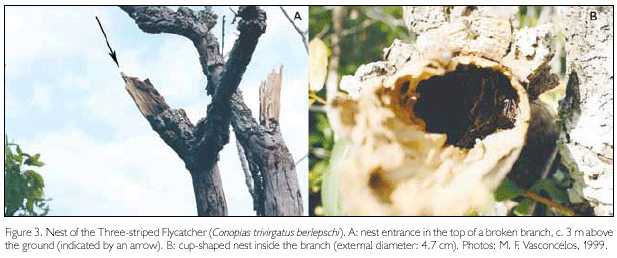
<body><![CDATA[<p><font size="2" face="verdana">The  only nesting record for this species is based on observations of a pair of the  nominate form (in Argentina)  taking leaves to an old woodpecker hole in a broken branch (Narosky &amp;  Salvador, 1998; Mobley, 2004c). The Amazonian subspecies (<i>C. t. berlepschi</i>) possibly  represents a full species (Pinto, 1936; Ridgely &amp; Tudor, 1994; Mobley,  2004c), and virtually nothing is known about its breeding ecology. On 20  January 1999, JMCS and MFV observed one individual taking material to a nest  located in the top of a broken branch of a dead savanna tree, c. 3 m above the ground (<a href="#f3">Figure  3A</a>). The cup-shaped nest was c. 25   cm inside a hollow in this branch without any upper  protection (<a href="#f3">Figure 3B</a>). It was composed of leaves of grass, tree bark and some  feathers, lined with rachis and central veins of dry dicotyledon leaves. Nest  measurements (in cm) were: external diameter 4.7, internal diameter 3.3 and  depth 3.0. This nest was collected and deposited in the MPEG nest collection.  Nesting in holes or tree cavities was also reported for other species of <i>Conopias </i>(Ridgely &amp; Tudor, 1994; Mobley, 2004a, 2004b). It has also been  reported that <i>Conopias </i>flycatchers usurp hanging nests of caciques (<i>Cacicus </i>spp.) and orop&eacute;ndolas (<i>Psarocolius </i>spp.)  (Ridgely &amp; Tudor, 1994; Sick, 1997; Mobley, 2004a, 2004b, 2004d). Close to  the nest (c. 100 m),  there was an active colony (seven nests) of <i>Psarocolius decumanus </i>(Crested  Oropendola), but we did not observe any Three-striped Flycatchers engaged in  nesting activities there.</font></p>     <p><a name="f3" id="f3"></a></p>     <p>&nbsp;</p>     <p align="center"><img src="/img/revistas/bmpegcn/v6n2/2a03f3.gif" border="0"></p>     <p>&nbsp;</p>     <p><font size="2" face="verdana"><i><b>Sicalis citrina </b></i><b>(Stripe-tailed  Yellow-Finch)</b></font></p>     <p><font size="2" face="verdana">The  Stripe-tailed Yellow-Finch is a species with two main populations in South  America: one north of Amazonia and the other  south of this region (the North-South disjunction pattern of distribution  proposed by Silva, 1995). This species has only been previously found on the  borders of Amazonia (Ridgely &amp; Tudor,  1989; Infonatura, 2009). The first record of this species in a central  Amazonian savanna is of a male (MPEG 54434), collected by JMCS, MFV and D. C.  Pimentel Neto, at Serra do Erer&eacute; on  16 January 1999. This bird was associated with a flock of several other  individuals that were vocalizing and performing aerial displays, similar to  those described from populations south of the Amazon (Vasconcelos <i>et  al.</i>, 2007a). Small flocks of 2-5 birds were observed  foraging on the ground, among clumps of grasses. Silva (1995) suggested that  populations of this species might be able to disperse across Amazonia,  since it has a tendency toward long-distance movements (Ridgely &amp; Tudor,  1989; Sick, 1997).</font></p>     <p><font size="2" face="verdana"><b>CONSERVATION</b></font></p>     <p><font size="2" face="verdana">Vegetation  types in Monte Alegre have been severely degraded by human activities since the  first colonizers arrived in the region, during the 17<sup>th</sup> century  (Pastana, 1999). Savannas provided a good opportunity for cattle ranching  (Pastana, 1999), probably because this open physiognomy (with native grasses)  facilitated this activity, and it is possible that non-natural fires have  occurred in this open vegetation type at least since the 18<sup>th</sup>  century. To what extent fires caused faunal and floral impoverishment is  unknown and it is possible that even the earliest naturalists that explored the  region already found degraded savanna vegetation in Monte Alegre. Fires  continue to be set in the savannas, and the herb layer is extremely depauperate  and sparsely vegetated in recently burnt areas.</font></p>     <p><font size="2" face="verdana">Intensive  logging in Monte Alegre started toward the end of the 18<sup>th</sup> century  when the Royal Sawmill (&quot;Serraria Real&quot;) exploited the timber for  commercial purposes (Pastana, 1999). This logging activity and the cocoa  plantation that followed during the first years of the 19<sup>th</sup> century  were probably two early regional drivers of deforestation (Pastana, 1999).  Logging activities continue in the region today, and the remnant fragments of  forest are isolated and impoverished. It is possible that several forest bird  species have disappeared from Monte Alegre; for example, a number of  woodcreepers and antbirds of the Guianan area of endemism have not been  observed despite our intense inventory (<a href="pdf/bmpegcn/v6n2/apenv6n2a03.pdf" target="_blank">Appendix</a>, see Cracraft, 1985; Cohn-Haft <i>et al., </i>1997; Alerxo <i>et al., </i>2011).</font></p>     ]]></body>
<body><![CDATA[<p><font size="2" face="verdana">During  our fieldwork, it was quite common to find traps and see people walking with  shotguns, and we suspect that hunting and trapping activities are other strong  human pressures on the native avifauna. For example, the only regional record  for the Crested Bobwhite is based on two old specimens (see above).  Furthermore, other researchers recently found several individuals of the  Guianan endemic and threatened Sulfur-breasted Parakeet in captivity (A. C.  Lees, N. Moura &amp; B. J. W. Davis, personal communication).</font></p>     <p><font size="2" face="verdana">An  important area for bird conservation was recently identified in the 'v&aacute;rzeas' of  Monte Alegre and adjacent regions, especially because it shelters  restricted-range species such as <i>Myrmotherula kJagesi </i>(Klages' Antwren)  and <i>Cranioleuca muelleri </i>(Scaled Spinetail) (De Luca <i>et al.</i>,  2009).</font></p>     <p><font size="2" face="verdana">Fortunately,  the Monte Alegre State Park  was decreed in November 2001. This important 5,800 ha reserve protects  significant tracts of savannas and forests (Pereira <i>et al., </i>2003; Garcia <i>et al., </i>unpublished data 2008), and will hopefully protect the regional  biodiversity in this unique area of Amazonia.</font></p>     <p>&nbsp;</p>     <p><font size="3" face="verdana"><b>CONCLUSIONS</b></font></p>     <p><font size="2" face="verdana">Although  the avifaunal community of the Monte Alegre savannas is typical of other  savanna habitats, we failed to record several open-country birds that occur in  larger savanna areas located on the borders of Amazonia such as along the  Atlantic coast or close to the 'cerrado' boundaries (southern Amazonian  savannas). The isolated position and small area of the Monte Alegre savannas  could explain their impoverished aspect in comparison to other, larger  Amazonian savannas. Nevertheless, Monte Alegre savannas shelter the Guianan  endemic Sulfur-breasted Parakeet, a vulnerable species in Par&aacute;  state (SECTAM, 2006). Furthermore, the high regional species richness  associated with the mosaic of different vegetation types makes Monte Alegre a  key area for avifaunal conservation in Brazilian Amazonia.</font></p>     <p>&nbsp;</p>     <p><font size="3" face="verdana"><b>ACKNOWLEDGEMENTS</b></font></p>     <p><font size="2" face="verdana">We  are especially grateful to M PEG and Secretaria do Meio Ambiente (SEMA-PA) for  the logistical and financial support of our fieldwork. We also thank D. C. Pimentel  Neto and J. N. Santa Br&iacute;gida for their invaluable help in collecting and  preparing specimens. G. Pereira (UFPE), A. Aleixo and F Lima (MPEG) helped to  obtain data from specimens deposited in those institutions. M.  Maldonado-Coelho, M. S. Hoogmoed, M. Votaw and two anonymous reviewers revised  early <a name="mm" id="mm"></a>versions of the manuscript. D. Hoffmann kindly prepared <a href="#f1">Figure 1</a>. K. -L.  Schuchmann, L. FF Silveira, D. Serripieri, G. N. Maur&iacute;cio, V. T. Lombardi and  A. Aleixo provided important bibliography. This paper is dedicated to the  memory of J. Haffer for his important contributions to the biogeographical  knowledge on the Amazonian avifauna.</font></p>     <p>&nbsp;</p>     ]]></body>
<body><![CDATA[<p><font size="3" face="verdana"><b>REFERENCES</b></font></p>     <!-- ref --><p><font size="2" face="verdana">AB'SABER, A. N., 2002. Bases para  o estudo dos ecossistemas da Amaz&ocirc;nia brasileira. <b>Estudos  Avan&ccedil;ados </b>16(45): 7-30.</font><!-- ref --><p><font size="2" face="verdana">ALEIXO,  A. &amp; F. POLETTO, 2007. Birds of an open vegetation enclave in southern  Brazilian Amazonia. <b>The Wilson Journal of Ornithology </b>119(4): 610-630.</font><!-- ref --><p><font size="2" face="verdana">ALEIXO, A., F. POLETTO, M. F. C. LIMA, M.  CASTRO, E. PORTES &amp; L. S. MIRANDA, 2011. Notes on the  vertebrates of northern Par&aacute;,   Brazil: a  forgotten part of the Guianan Region, II. Avifauna. <b>Boletim do Museu Paraense  Em&iacute;lio Goeldi. Ci&ecirc;ncias Naturais </b>6(1): 11-65.</font><!-- ref --><p><font size="2" face="verdana">ANDRADE-LIMA,  D., 1958. <b>Viagem  aos campos de Monte Alegre, Par&aacute;. </b>Contribui&ccedil;&atilde;o para o  conhecimento de sua flora: 1-162. Instituto Agron&ocirc;mico do Norte (Boletim T&eacute;cnico, 36), Rio Branco.</font><!-- ref --><p><font size="2" face="verdana">AYOADE,  J. O., 1998. <b>Introdu&ccedil;&atilde;o  &agrave; climatologia para os tr&oacute;picos: </b>1-332.  Bertrand  Brasil, Rio de Janeiro.</font><!-- ref --><p><font size="2" face="verdana">BALCHIN,  C., 2006. A  potpourri of recently described species from the Neotropics. <b>Neotropical  Birding </b>1: 24-37.</font><!-- ref --><p><font size="2" face="verdana">BATES, J. M., J. G. TELLO &amp; J. M.  C. SILVA, 2003. Initial assessment of genetic diversity in  ten bird species of South American Cerrado. <b>Studies on Neotropical Fauna and  Environment </b>38(2): 87-94.</font><!-- ref --><p><font size="2" face="verdana">BIRDLIFE  INTERNATIONAL, 2009. <b>Search for species. </b>Available in: &lt;<a href="http://www.birdlife.org/datazone/species/index.html" target="_blank">http://www.birdlife.org/datazone/species/index.html</a>&gt;.  Accessed on: 22 December 2009.</font><!-- ref --><p><font size="2" face="verdana">BONACCORSO,  E., I. KOCH &amp; A. T. PETERSON, 2006. Pleistocene  fragmentation of Amazon species' ranges. <b>Diversity and Distributions </b>12(2):  157-164.</font><!-- ref --><p><font size="2" face="verdana">BORGES, S. H., 2004. Species  poor but distinct: bird assemblages in white sand vegetation in Ja&uacute; National    Park, Brazilian Amazon. <b>Ibis </b>146(1):  114-124.</font><!-- ref --><p><font size="2" face="verdana">BORGES, S. H., M. COHN-HAFT  A. M. P. CARVALHAES, L. M. HENRIQUES, J. F. PACHECO &amp; A. WHITTAKER, 2001. Birds of Ja&uacute;   National Park, Brazilian  Amazon: species check-list, biogeography and conservation. <b>Ornitolog&iacute;a Neotropical </b>12(2): 109-140.</font><!-- ref --><p><font size="2" face="verdana">BUSH,  M. B. &amp; P. E. OLIVEIRA, 2006. The rise and  fall ofthe refugial hypothesis of Amazonian speciation: a paleoecological  perspective. <b>Biota Neotropica </b>6(1): 1-17.</font><!-- ref --><p><font size="2" face="verdana">CARROL,  J. P., 1994. Family Odontophoridae (new world quails). In: J. DEL HOYO,  A. ELLIOTT &amp; J. SARGATAL (Eds.): <b>Handbook of  the birds of the world. </b>v. 2: 412-433. Lynx Edicions, Barcelona.</font><!-- ref --><p><font size="2" face="verdana">CLEERE,  N., 1999. Family Caprimulgidae (nightjars). In: J. DEL HOYO,  A. ELLIOTT &amp; J. SARGATAL (Eds.): <b>Handbook of  the birds of the world. </b>v. 5: 302-386. Lynx Edicions, Barcelona.</font><!-- ref --><p><font size="2" face="verdana">CLEERE,  N., 2010. <b>Nightjars of the world: </b>1-464. Wild Guides, Hampshire.</font><!-- ref --><p><font size="2" face="verdana">CLEERE,  N. &amp; D. NURNEY, 1998. <b>Nightjars: </b>a guide to the nightjars, nighthawks  and their relatives: 1-317. Yale University Press, New Haven  &amp; London.</font><!-- ref --><p><font size="2" face="verdana">COHN-HAFT,  M., A. WHITTAKER &amp; P. C. STOUFFER, 1997. A new look at the  &quot;species-poor&quot; central Amazon: the avifauna north of Manaus, Brazil. <b>Ornithological  Monographs </b>48:  205-235.</font><!-- ref --><p><font size="2" face="verdana">COMIT&Ecirc; BRASILEIRO DE REGISTROS ORNITOL&Oacute;GICOS (CBRO), 2009. <b>Lista das aves do Brasil - 8. ed. </b>Available at: &lt;<a href="http://www.cbro.org.br/CBRO/listabr.htm" target="_blank">http://www.cbro.org.br/CBRO/listabr.htm</a>&gt;.  Accessed on: 5 September 2009.</font><!-- ref --><p><font size="2" face="verdana">CRACRAFT,  J., 1985. Historical biogeography and patterns of differentiation within the  South American avifauna: areas of endemism. <b>Ornithological Monographs </b>36:  49-84.</font><!-- ref --><p><font size="2" face="verdana">DE  LUCA, A. C., P. F. DEVELEY, G. A. BENCKE &amp; J. M.  GOERCK, 2009. <b>&Aacute;reas importantes para a conserva&ccedil;&atilde;o das  aves no Brasil:</b>  parte  II - Amaz&ocirc;nia, Cerrado  e Pantanal: 1-361.  SAVE Brasil, S&atilde;o    Paulo.</font><!-- ref --><p><font size="2" face="verdana">GOTTSBERGER,  G. &amp; I.  SILBERBAUER-GOTTSBERGER, 2006. <b>Life in the Cerrado - a South  American tropical seasonal ecosystem: </b>v.  1: 1-277. Reta Verlag, Ulm.</font><!-- ref --><p><font size="2" face="verdana">HAFFER,  J., 1967. Zoogeographical notes on the &quot;nonforest&quot; lowland bird  faunas of northwestern South America. <b>El  Hornero </b>10(4): 315-333.</font><!-- ref --><p><font size="2" face="verdana">HAFFER,  J., 1969. Speciation in Amazonian forest birds. <b>Science </b>165(3889):  131-137.</font><!-- ref --><p><font size="2" face="verdana">HAFFER,  J., 1974. Avian speciation in tropical South America,  with a systematic survey of the toucans (Ramphastidae) and jacamars  (Galbulidae). <b>Publications of the Nuttall Ornithological Club </b>14: 1-390.</font><!-- ref --><p><font size="2" face="verdana">HAFFER,  J., 1985. Avian zoogeography of the Neotropical lowlands. <b>Ornithological  Monographs </b>36: 113-145.</font><!-- ref --><p><font size="2" face="verdana">HAFFER,  J., 1987. Biogeography of Neotropical birds. In: T. C. WHITMORE &amp; G. T.  PRANCE (Eds.): <b>Biogeography and Quaternary history in tropical America: </b>105-150.  Clarendon Press, Oxford.</font><!-- ref --><p><font size="2" face="verdana">HAFFER,  J. &amp; G. T. PRANCE, 2001. Climatic forcing of evolution in Amazonia  during the Cenozoic: on the refuge theory of biotic differentiation. <b>Amazoniana </b>16(3/4): 579-607.</font><!-- ref --><p><font size="2" face="verdana">HENRIQUES,  L. M. P. &amp; D. C. OREN, 1997. The avifauna of Maraj&oacute;, Caviana and Mexiana  islands, Amazon River estuary, Brazil. <b>Revista Brasileira de  Biologia </b>57(3):  357-382.</font><!-- ref --><p><font size="2" face="verdana">INFONATURA, 2009. <b>Animais e  ecossistemas da Am&eacute;rica Latina. </b>Available in:  &lt;<a href="http://www.natureserve.org/infonatura/" target="_blank">http://www.natureserve.org/infonatura/</a>&gt;.  Accessed on: 29 November 2009.</font><!-- ref --><p><font size="2" face="verdana">LEES, A. C., B. J. W. DAVIS, A. V. G.  OLIVEIRA &amp; C. A. PERES, 2008. Avifauna of a  structurally heterogeneous forest landscape in the Serra dos Caiabis, Mato Grosso, Brazil: a preliminary assessment. <b>Cotinga </b>29: 149-159.</font><!-- ref --><p><font size="2" face="verdana">MACHADO,  A. B. M., C. S. MARTINS &amp;  G. M. DRUMMOND, 2005. <b>Lista da fauna brasileira amea&ccedil;ada de extin&ccedil;&atilde;o: </b>incluindo  as listas de esp&eacute;cies  quase amea&ccedil;adas e deficientes em dados: 1-157. Funda&ccedil;&atilde;o Biodiversitas, Belo  Horizonte.</font><!-- ref --><p><font size="2" face="verdana">MAGNUSSON,  W. E., A. P. LIMA, A. L.  K. M. ALBERNAZ, T. M. SANAIOTTI &amp; J. L. GUILLAUMET, 2008. Composi&ccedil;&atilde;o flor&iacute;stica e cobertura  vegetal das savanas na regi&atilde;o de Alter do Ch&atilde;o, Santar&eacute;m - PA. <b>Revista  Brasileira de Bot&acirc;nica </b>31(1): 165-177.</font><!-- ref --><p><font size="2" face="verdana">MIRANDA,  I. S., 1993. Estrutura do estrato  arb&oacute;reo do cerrado amaz&ocirc;nico  em Alter-do-Ch&atilde;o, Par&aacute;, Brasil. <b>Revista Brasileira  de Bot&acirc;nica </b>16(2): 143-150.</font><!-- ref --><p><font size="2" face="verdana">MIRANDA,  I. S. &amp; M. L. ABSY, 2000. Fisionomia das  savanas de Roraima, Brasil. <b>Acta Amazonica </b>30(3): 423-440.</font><!-- ref --><p><font size="2" face="verdana">MIRANDA-RIBEIRO,  A., 1938. Notas ornithologicas  (XIII) Tinamidae (inhamb&uacute;s, ja&oacute;s, ta&oacute;s, macucos, codornas,  &quot;perdizes&quot;, etc.). <b>Revista do Museu Paulista </b>23: 667-788.</font><!-- ref --><p><font size="2" face="verdana"> MITTERMEIER, J. C., K.  ZYSKOWSKI, E. S. STOWE &amp; J. E. LAI, 2010. Avifauna of the Sipaliwini  savanna (Suriname)  with insights into its biogeographic affinities. <b>Bulletin of the Peabody Museum of Natural History </b>51(1):  97-122.</font><!-- ref --><p><font size="2" face="verdana">MOBLEY,  J. A., 2004a. White-ringed Flycatcher <i>Conopias albovittatus. </i>In: J. DEL HOYO,  A. ELLIOTT &amp; D. A. CHRISTIE (Eds.): <b>Handbook  of the birds of the world. </b>v. 9: 411. Lynx Edicions, Barcelona.</font><!-- ref --><p><font size="2" face="verdana">MOBLEY,  J. A., 2004b. Yellow-throated Flycatcher <i>Conopias parvus. </i>In: J. DEL HOYO,  A. ELLIOTT &amp; D. A. CHRISTIE (Eds.): <b>Handbook  of the birds of the world. </b>v. 9: 411. Lynx Edicions, Barcelona.</font><!-- ref --><p><font size="2" face="verdana">MOBLEY,  J. A., 2004c. Three-striped Flycatcher <i>Conopias trivirgatus. </i>In: J. DEL HOYO,  A. ELLIOTT &amp; D. A. CHRISTIE (Eds.): <b>Handbook  of the birds of the world. </b>v. 9: 411-412. Lynx Edicions, Barcelona.</font><!-- ref --><p><font size="2" face="verdana">MOBLEY,  J. A., 2004d. Lemon-browed Flycatcher <i>Conopias cinchoneti. </i>In: J. DEL HOYO,  A. ELLIOTT &amp; D. A. CHRISTIE (Eds.): <b>Handbook  of the birds of the world. </b>v. 9: 412. Lynx Edicions, Barcelona.</font><!-- ref --><p><font size="2" face="verdana">MORAES, B. G., J. M. N. COSTA, A. C. L. COSTA &amp; M. H. COSTA, 2005.  Varia&ccedil;&atilde;o espacial e temporal da precipita&ccedil;&atilde;o no estado do Par&aacute;. <b>Acta  Amazonica </b>35(2): 207-214.</font><!-- ref --><p><font size="2" face="verdana">NAKA, L. N., M. COHN-HAFT, F.  MALLET-RODRIGUES, M. P. D. SANTOS &amp; M. F. TORRES, 2006. The  avifauna of the Brazilian state of Roraima: bird distribution and biogeography  in the Rio Branco basin. <b>Revista Brasileira de Ornitologia </b>14(3): 197-238.</font><!-- ref --><p><font size="2" face="verdana">NAROSKY, T. &amp; S. SALVADOR, 1998. <b>Nidificaci&oacute;n  de las aves argentinas (Tyrannidae): </b>1-135. Asociaci&oacute;n  Ornitol&oacute;gica del Plata, Buenos Aires.</font><!-- ref --><p><font size="2" face="verdana">NEM&Eacute;SIO,  A. &amp; C.  RASMUSSEN, 2009.  The rediscovery of Buffon's &quot;Guarouba&quot;  or &quot;Perriche  jaune&quot;: two senior synonyms of <i>Aratinga pintoi </i>Silveira,  Lima &amp; H&oacute;fling, 2005 (Aves:  Psittaciformes). <b>Zootaxa </b>2013: 1-16.</font><!-- ref --><p><font size="2" face="verdana">OLIVEIRA-J&Uacute;NIOR,  R. C., T. E. RODRIGUES,  P. L. SANTOS &amp; M. A. VALENTE, 1999. <b>Zoneamento agroecol&oacute;gico do munic&iacute;pio de Monte Alegre, estado do Par&aacute;: </b>1-87. Embrapa Amaz&ocirc;nia  Oriental, Bel&eacute;m.</font><!-- ref --><p><font size="2" face="verdana">O'SHEA, B. J., 2005. Notes on birds of the Sipaliwini savanna  and other localities in southern Suriname, with six new species for  the country. <b>Ornitolog&iacute;a Neotropical </b>16(3): 361-370.</font><!-- ref --><p><font size="2" face="verdana">PASTANA, J. M. N., 1999. <b>Diagn&oacute;stico do potencial ecotur&iacute;stico do munic&iacute;pio de Monte  Alegre: </b>1-88.  Companhia de Pesquisa de Recursos Minerais, Bel&eacute;m. Available  at: &lt;<a href="http://www.cprm.gov.br/gestao/ecotur/diag_ecoturistico.pdf" target="_blank">http://www.cprm.gov.br/gestao/ecotur/diag_ecoturistico.pdf</a>&gt; Accessed on: 29  November 2009.</font><!-- ref --><p><font size="2" face="verdana">PAYNTER,  R. A. &amp; M. A. TRAYLOR, 1991. <b>Ornithological Gazetteer of Brazil: </b>1-789.  Museum of Comparative  Zoology, Cambridge.</font><!-- ref --><p><font size="2" face="verdana">PENNINGTON,  R. T., D. E. PRADO &amp; C. A. PENDRY, 2000. Neotropical seasonally dry forests  and Quaternary vegetation changes. <b>Journal of Biogeography </b>27(2):  261-273.</font><p><font size="2" face="verdana">PENNINGTON,  R. T., G. P. LEWIS &amp; J. A. RATTER, 2006. An overview of the plant diversity,  biogeography and conservation of Neotropical savannas and seasonally dry  forests. In: R. T. PENNINGTON, G. P. LEWIS &amp; J. A. RATTER (Eds.): <b>Neotropical  savannas and seasonally dry forests: </b>plant diversity, biogeography, and  conservation: 1-29. CRC  Press, Boca Raton.</font></p>     <p><font size="2" face="verdana">PEREIRA,  J. L. G., M. F. F. SILVA, M.  C. THALES, A. M. VALENTE &amp; R. OLIVEIRA, 2003. Classifica&ccedil;&atilde;o da cobertura da terra na &aacute;rea do entorno do Parque Estadual de Monte Alegre - PA. <b>Anais XI Simp&oacute;sio Brasileiro  de Sensoriamento Remoto. </b>Available at: &lt;<a href="http://marte.dpi.inpe.br/col/ltid.inpe.br/sbsr/2002/11.14.15.27/doc/19_188.pdf" target="_blank">http://marte.dpi.inpe.br/col/ltid.inpe.br/sbsr/2002/11.14.15.27/doc/19_188.pdf</a>&gt;.  Accessed on: 4 January 2010.</font></p>     <p><font size="2" face="verdana">PINTO, O. M. O., 1936. Notas de Ornithologia Amazonica. <b>Revista do  Museu Paulista </b>20: 229-244.</font></p>     <p><font size="2" face="verdana">PINTO, O. M. O., 1940. Nova contribui&ccedil;&atilde;o &agrave;  Ornitologia de Mato-Grosso. <b>Arquivos de Zoologia do Estado de S&atilde;o Paulo </b>2(1):  1-38.</font></p>     <p><font size="2" face="verdana">PINTO,  O. M. O., 1944. <b>Catalogo das aves do Brasil e lista dos exemplares  existentes na cole&ccedil;&atilde;o do Departamento de Zoologia - 2<sup>a</sup> parte  Ordem Passeriformes (continua&ccedil;&atilde;o): </b>Superfam&iacute;lia  Tyrannoidea e Subordem Passeres: 1-700. Secretaria da Agricultura,  Ind&uacute;stria e Com&eacute;rcio, S&atilde;o Paulo.</font></p>     <p><font size="2" face="verdana">PINTO,  O. M. O., 1945.  Cinq&uuml;enta anos de investiga&ccedil;&atilde;o ornitol&oacute;gica. <b>Arquivos de  Zoologia do Estado de S&atilde;o Paulo </b>4: 1-80.</font></p>     <p><font size="2" face="verdana">PINTO,  O. M. O., 1947. Contribui&ccedil;&atilde;o  &agrave; Ornitologia do baixo Amazonas. <b>Arquivos de Zoologia do Estado de S&atilde;o Paulo </b>5(6): 311-482.</font></p>     <p><font size="2" face="verdana">PINTO,  O. M. O., 1979. <b>A ornitologia do Brasil atrav&eacute;s das idades (s&eacute;culo XVI a s&eacute;culo XIX): </b>1-117. Brasiliensia  Documenta, S&atilde;o Paulo.</font></p>     <p><font size="2" face="verdana">PIRES,  J. M. &amp; G. T. PRANCE, 1985. The vegetation types of the Brazilian  Amazon. In: G. T. PRANCE &amp; T. E. LOVEJOY (Eds.): <b>Key environments: </b>Amazonia: 109-145. Pergamon Press, Oxford.</font></p>     <p><font size="2" face="verdana">PRANCE,  G. T., 1978. The origin and evolution of the Amazon flora. <b>Interciencia </b>3(4):  207-222.</font></p>     ]]></body>
<body><![CDATA[<p><font size="2" face="verdana"> PRANCE, G. T., 1987. Vegetation. In: T. C. WHITMORE &amp; G. T. PRANCE  (Eds.): <b>Biogeography and Quaternary history in tropical America: </b>28-45.  Clarendon Press, Oxford.</font></p>     <p><font size="2" face="verdana">RASMUSSEN,  P. C. &amp; N. J. COLLAR, 2002. Family Bucconidae (puffbirds). In: J. DEL HOYO,  A. ELLIOTT &amp; J. SARGATAL (Eds.): <b>Handbook of the birds of the world. </b>v.  7: 102-138. Lynx  Edicions, Barcelona.</font></p>     <p><font size="2" face="verdana">RATTER, J. A., S. BRIDGEWATER &amp; J.  F. RIBEIRO, 2006. Biodiversity  patterns of the woody vegetation of the Brazilian Cerrado. In: R. T. PENNINGTON,  G. P LEWIS &amp; J. A. RATTER (Eds.): <b>Neotropical savannas and seasonally  dry forests: </b>plant diversity, biogeography, and conservation: 31-66. CRC  Press, Boca Raton.</font></p>     <p><font size="2" face="verdana">RIDGELY,  R. S. &amp; G. TUDOR, 1989. <b>The birds of South America. </b>v. 1: 1-516. University   of Texas Press, Austin.</font></p>     <p><font size="2" face="verdana">RIDGELY,  R. S. &amp; G. TUDOR, 1994. <b>The birds of South America. </b>v. 2: 1-814. University   of Texas Press, Austin.</font></p>     <p><font size="2" face="verdana">ROBBINS,  M. B., 2004. Suiriri Flycatcher <i>Suiriri suiriri. </i>In: J. DEL HOYO, A.  ELLIOTT &amp; D. A. CHRISTIE (Eds.): <b>Handbook of the birds of the world. </b>v.  9: 276. Lynx  Edicions, Barcelona.</font></p>     <p><font size="2" face="verdana">ROBBINS, M. B., M. J. BRAUN  &amp; D. W. FINCH, 2004. Avifauna  of the Guyana southern  Rupununi, with comparisons to other savannas of northern South   America. <b>Ornitolog&iacute;a Neotropical </b>15(2): 173-200.</font></p>     <p><font size="2" face="verdana">RUSCHI, A., 1951. Trochilideos do Museu  Nacional. <b>Boletim do Museu de Biologia Prof. Mello Leit&atilde;o,  S&eacute;rie Biologia </b>10: 1-111.</font></p>     <p><font size="2" face="verdana">SANAIOTTI, T. M. &amp; R. CINTRA,  2001. Breeding  and migrating birds in an Amazonian savanna. <b>Studies on Neotropical Fauna  and Environment </b>36(1): 23-32.</font></p>     <p><font size="2" face="verdana">SANAIOTTI,  T. M., S. BRIDGEWATER  &amp; J. A. RATTER, 1997. A  floristic study of the savanna vegetation of the state of Amap&aacute;, Brazil,  and suggestions for its conservation. <b>Boletim do Museu Paraense Em&iacute;lio Goeldi, s&eacute;rie Bot&acirc;nica </b>13(1): 3-29.</font></p>     ]]></body>
<body><![CDATA[<p><font size="2" face="verdana">SANTOS, M. P. D. &amp; J. M. C. SILVA,  2007. As aves das savanas de Roraima. <b>Revista  Brasileira de Ornitologia </b>15(2): 189-207.</font></p>     <p><font size="2" face="verdana">SCLATER,  P. L. &amp; O. SALVIN, 1867. List of birds collected by Mr. Wallace on the lower  Amazons and Rio Negro. <b>Proceedings of the Zoological Society  of London </b>1867:  566-596.</font></p>     <p><font size="2" face="verdana">SECRETARIA  DE ESTADO DE CI&Ecirc;NCIA, TECNOLOGIA E MEIO AMBIENTE (SECTAM), 2006. <b>Rela&ccedil;&atilde;o das esp&eacute;cies  amea&ccedil;adas do estado do Par&aacute;. </b>Available at: &lt;<a href="http://www.sectam.pa.gov.br/" target="_blank">www.sectam.pa.gov.br</a>&gt;. Accessed on: 2 September 2006.</font></p>     <p><font size="2" face="verdana">SICK, H., 1997. <b>Ornitologia  Brasileira: </b>1-912.  Editora Nova Fronteira, Rio de Janeiro.</font></p>     <p><font size="2" face="verdana">SILVA,  J. M. C., 1995. Biogeographic analysis of the South American Cerrado avifauna. <b>Steenstrupia </b>21(1): 49-67.</font></p>     <p><font size="2" face="verdana">SILVA,  J. M. C., D. C. OREN, J. C. ROMA &amp; L. M. PHENRIQUES, 1997. Composition and  distribution patterns of the avifauna of an Amazonian upland savanna, Amap&aacute;, Brazil. <b>Ornithological Monographs </b>48: 743-762.</font></p>     <p><font size="2" face="verdana">SILVA,  J. M. C. &amp; J. M. BATES, 2002. Biogeographic patterns  and conservation in the  South American Cerrado: a  tropical savanna hotspot. <b>BioScience </b>52(3):  225-233.</font></p>     <p><font size="2" face="verdana">SILVEIRA, L. F., 2005.   A &quot;descoberta&quot; do cacau&eacute; (<i>Aratinga pintai</i>): uma  vis&atilde;o pessoal. <b>Atualidades Ornitol&oacute;gicas </b>123: 14.</font></p>     <p><font size="2" face="verdana">SILVEIRA, L. F., F. C. T. LIMA &amp; E. H&Ouml;FLING, 2005. A new species of <i>Aratinga </i>parakeet (Psittaciformes: Psittacidae) from Brazil, with taxonomic remarks on  the <i>Aratinga solstitialis </i>complex. <b>The Auk </b>122(1): 292-305.</font></p>     <p><font size="2" face="verdana">SNETHLAGE,  E., 1906. &Uuml;ber unteramazonische v&ouml;gel. <b>Journal f&uuml;r Ornithologie </b>54:  407-411, 519-526.</font></p>     ]]></body>
<body><![CDATA[<p><font size="2" face="verdana">SNETHLAGE,  E., 1907. &Uuml;ber unteramazonische v&ouml;gel. <b>Journal f&uuml;r Ornithologie </b>55:  283-299.</font></p>     <p><font size="2" face="verdana">SNETHLAGE,  E., 1909. Sobre  a distribui&ccedil;&atilde;o da avifauna campestre na Amazonia. <b>Boletim  do Museu Goeldi (Museu Paraense) de Hist&oacute;ria Natural e Ethnographia </b>6:  226-235.</font></p>     <p><font size="2" face="verdana">SNETHLAGE,  E., 1914. Catalogo das aves amazonicas contendo todas as especies descriptas e  mencionadas at&eacute; 1913. <b>Boletim do Museu Goeldi (Museu Paraense) de Hist&oacute;ria  Natural e Ethnographia </b>8: 1-530.</font></p>     <p><font size="2" face="verdana">SNETHLAGE,  H., 1930. Dr. Emilie Snethlage zum  Ged&auml;chtnis. <b>Journal f&uuml;r Ornithologie </b>78(1): 123-134.</font></p>     <p><font size="2" face="verdana">STOTZ,  D. F., J. W. FITZPATRICK, T. A. PARKER III &amp;  D. K. MOSKOVITS, 1996. <b>Neotropical birds: </b>ecology and conservation: 1-502.  University of Chicago Press, Chicago.</font></p>     <p><font size="2" face="verdana">VASCONCELOS,  M. F., V. T. LOMBARDI  &amp; S. D'ANGELO NETO,  2007a. Notas  sobre o can&aacute;rio-rasteiro (<i>Sicalis citrina</i>) nas serras de  Minas Gerais, Brasil. <b>Atualidades Ornitol&oacute;gicas </b>140:  6-7.</font></p>     <p><font size="2" face="verdana">VASCONCELOS,  M. F., J. F.  PACHECO &amp; R.  PARRINI, 2007b. Levantamento e conserva&ccedil;&atilde;o da avifauna na zona urbana de  Marab&aacute;, Par&aacute;, Brasil. <b>Cotinga </b>28: 45-51.</font></p>     <p><font size="2" face="verdana">VASCONCELOS,  M. F. &amp; J. M. C.  SILVA, 2005. Plantas  ornit&oacute;filas e beija-flores  observados na savana Amaz&ocirc;nica da Serra do Erer&ecirc;,  Monte Alegre, Par&aacute;, Brasil. <b>Atualidades Ornitol&oacute;gicas </b>128: 14-15.</font></p>     <p><font size="2" face="verdana">VICENTINI,  A., 2004. A  vegeta&ccedil;&atilde;o ao longo de um gradiente ed&aacute;fico no Parque Nacional do Ja&uacute;. In: S. H.  BORGES, S. IWANAGA, C. C. DURIGAN &amp; M. R. PINHEIRO (Eds.): <b>Janelas para a  biodiversidade no Parque Nacional do Ja&uacute;: </b>uma estrat&eacute;gia para o  estudo da biodiversidade na Amaz&ocirc;nia: 105-134. Funda&ccedil;&atilde;o Vit&oacute;ria  Amaz&ocirc;nica, Manaus.</font></p>     <p><font size="2" face="verdana">XENO-CANTO,  2009. <b>Sharing bird sounds from around the world. </b>Available at: &lt;<a href="http://www.xeno-canto.org/" target="_blank">http://www.xeno-canto.org/</a>&gt;. Accessed  on: 22 December 2009.</font></p>     ]]></body>
<body><![CDATA[<p><font size="2" face="verdana">ZIMMER,  K. J., T. A. PARKER III, M. L. ISLER &amp; P. R. ISLER, 1997. Survey of a  southern Amazonia avifauna: the Alta Floresta region, Mato Grosso, Brazil. <b>Ornithological Monographs </b>48: 887-918.</font></p>     <p><font size="2" face="verdana">ZIMMER,  K. J. &amp; S. L. HILTY, 1997. Avifauna of a locality in the upper Orinoco  drainage of Amazonas, Venezuela. <b>Ornithological  Monographs </b>48: 865-885.</font></p>     <p><font size="2" face="verdana">ZIMMER,  K. J. &amp; M. L. ISLER, 2003. Family Thamnophilidae (typical antbirds). In: J.  DEL HOYO, A. ELLIOTT &amp; D. A. CHRISTIE (Eds.): <b>Handbook of the birds of  the world. </b>v. 8: 448-681. Lynx Edicions, Barcelona.</font></p>     <p><font size="2" face="verdana">Z&Uuml;CHNER, T., 1999. Tufted  Coquette <i>Lophornisornatus. </i>In: J. DEL HOYO, A. ELLIOTT &amp; J. SARGATAL  (Eds.): <b>Handbook of the birds of the world. </b>v. 5: 567. Lynx Edicions, Barcelona.</font></p>     <p>&nbsp;</p>     <p>&nbsp;</p>     <p><font size="2"><b><font size="2"><b><font face="verdana"><b><a name="endereco" id="endereco"></a><a href="#topo"><img src="img/revistas/bmpegcn/v5n3/seta.gif" border="0"></a></b></font></b></font><font face="verdana">Autor para correspond&ecirc;ncia:</font></b><font face="verdana">    <br>   Marcelo  Ferreira de Vasconcelos.    <br>   Pontif&iacute;cia  Universidade Cat&oacute;lica de Minas Gerais.    <br>   P&oacute;s-gradua&ccedil;&atilde;o em Zoologia de  Vertebrados e    ]]></body>
<body><![CDATA[<br>   Museu  de Ci&ecirc;ncias Naturais.    <br> Avenida  Dom Jos&eacute; Gaspar, 500,    <br> Pr&eacute;dio  41&nbsp;Cora&ccedil;&atilde;o  Eucar&iacute;stico.    <br> Belo  Horizonte, MG, Brasil.    <br> CEP 30535-610    <br> (<a href="mailto:mfvasconcelos@gmail.com">mfvasconcelos@gmail.com</a>).</font></font></p>     <p><font size="2" face="verdana">Recebido  em 16/03/2010    <br> Aprovado  em 28/06/2011</font></p>     <p><font size="2" face="verdana">Responsabilidade  editorial: Marinus Hoogmoed </font></p>      ]]></body><back>
<ref-list>
<ref id="B1">
<nlm-citation citation-type="journal">
<person-group person-group-type="author">
<name>
<surname><![CDATA[AB'SABER]]></surname>
<given-names><![CDATA[A. N.]]></given-names>
</name>
</person-group>
<article-title xml:lang="pt"><![CDATA[Bases para o estudo dos ecossistemas da Amazônia brasileira]]></article-title>
<source><![CDATA[Estudos Avançados]]></source>
<year>2002</year>
<volume>16</volume>
<numero>45</numero>
<issue>45</issue>
<page-range>7-30</page-range></nlm-citation>
</ref>
<ref id="B2">
<nlm-citation citation-type="journal">
<person-group person-group-type="author">
<name>
<surname><![CDATA[ALEIXO]]></surname>
<given-names><![CDATA[A.]]></given-names>
</name>
<name>
<surname><![CDATA[POLETTO]]></surname>
<given-names><![CDATA[F.]]></given-names>
</name>
</person-group>
<article-title xml:lang="en"><![CDATA[Birds of an open vegetation enclave in southern Brazilian Amazonia]]></article-title>
<source><![CDATA[The Wilson Journal of Ornithology]]></source>
<year>2007</year>
<volume>119</volume>
<numero>4</numero>
<issue>4</issue>
<page-range>610-630</page-range></nlm-citation>
</ref>
<ref id="B3">
<nlm-citation citation-type="journal">
<person-group person-group-type="author">
<name>
<surname><![CDATA[ALEIXO]]></surname>
<given-names><![CDATA[A.]]></given-names>
</name>
<name>
<surname><![CDATA[POLETTO]]></surname>
<given-names><![CDATA[F.]]></given-names>
</name>
<name>
<surname><![CDATA[LIMA]]></surname>
<given-names><![CDATA[M. F. C.]]></given-names>
</name>
<name>
<surname><![CDATA[CASTRO]]></surname>
<given-names><![CDATA[M.]]></given-names>
</name>
<name>
<surname><![CDATA[PORTES]]></surname>
<given-names><![CDATA[E.]]></given-names>
</name>
<name>
<surname><![CDATA[MIRANDA]]></surname>
<given-names><![CDATA[L. S.]]></given-names>
</name>
</person-group>
<article-title xml:lang="en"><![CDATA[Notes on the vertebrates of northern Pará, Brazil: a forgotten part of the Guianan Region, II. Avifauna]]></article-title>
<source><![CDATA[Boletim do Museu Paraense Emílio Goeldi. Ciências Naturais]]></source>
<year>2011</year>
<volume>6</volume>
<numero>1</numero>
<issue>1</issue>
<page-range>11-65</page-range></nlm-citation>
</ref>
<ref id="B4">
<nlm-citation citation-type="book">
<person-group person-group-type="author">
<name>
<surname><![CDATA[ANDRADE-LIMA]]></surname>
<given-names><![CDATA[D.]]></given-names>
</name>
</person-group>
<source><![CDATA[Viagem aos campos de Monte Alegre, Pará: Contribuição para o conhecimento de sua flora]]></source>
<year>1958</year>
<page-range>1-162</page-range><publisher-loc><![CDATA[Rio Branco ]]></publisher-loc>
<publisher-name><![CDATA[Instituto Agronômico do Norte]]></publisher-name>
</nlm-citation>
</ref>
<ref id="B5">
<nlm-citation citation-type="book">
<person-group person-group-type="author">
<name>
<surname><![CDATA[AYOADE]]></surname>
<given-names><![CDATA[J. O.]]></given-names>
</name>
</person-group>
<source><![CDATA[Introdução à climatologia para os trópicos]]></source>
<year>1998</year>
<page-range>1-332</page-range><publisher-loc><![CDATA[Rio de Janeiro ]]></publisher-loc>
<publisher-name><![CDATA[Bertrand Brasil]]></publisher-name>
</nlm-citation>
</ref>
<ref id="B6">
<nlm-citation citation-type="journal">
<person-group person-group-type="author">
<name>
<surname><![CDATA[BALCHIN]]></surname>
<given-names><![CDATA[C.]]></given-names>
</name>
</person-group>
<article-title xml:lang="en"><![CDATA[A potpourri of recently described species from the Neotropics]]></article-title>
<source><![CDATA[Neotropical Birding]]></source>
<year>2006</year>
<volume>1</volume>
<page-range>24-37</page-range></nlm-citation>
</ref>
<ref id="B7">
<nlm-citation citation-type="journal">
<person-group person-group-type="author">
<name>
<surname><![CDATA[BATES]]></surname>
<given-names><![CDATA[J. M.]]></given-names>
</name>
<name>
<surname><![CDATA[TELLO]]></surname>
<given-names><![CDATA[J. G.]]></given-names>
</name>
<name>
<surname><![CDATA[SILVA]]></surname>
<given-names><![CDATA[J. M. C.]]></given-names>
</name>
</person-group>
<article-title xml:lang="en"><![CDATA[Initial assessment of genetic diversity in ten bird species of South American Cerrado]]></article-title>
<source><![CDATA[Studies on Neotropical Fauna and Environment]]></source>
<year>2003</year>
<volume>38</volume>
<numero>2</numero>
<issue>2</issue>
<page-range>87-94</page-range></nlm-citation>
</ref>
<ref id="B8">
<nlm-citation citation-type="">
<collab>BIRDLIFE INTERNATIONAL</collab>
<source><![CDATA[Search for species]]></source>
<year>2009</year>
</nlm-citation>
</ref>
<ref id="B9">
<nlm-citation citation-type="journal">
<person-group person-group-type="author">
<name>
<surname><![CDATA[BONACCORSO]]></surname>
<given-names><![CDATA[E.]]></given-names>
</name>
<name>
<surname><![CDATA[KOCH]]></surname>
<given-names><![CDATA[I.]]></given-names>
</name>
<name>
<surname><![CDATA[PETERSON]]></surname>
<given-names><![CDATA[A. T.]]></given-names>
</name>
</person-group>
<article-title xml:lang="en"><![CDATA[Pleistocene fragmentation of Amazon species' ranges]]></article-title>
<source><![CDATA[Diversity and Distributions]]></source>
<year>2006</year>
<volume>12</volume>
<numero>2</numero>
<issue>2</issue>
<page-range>157-164</page-range></nlm-citation>
</ref>
<ref id="B10">
<nlm-citation citation-type="journal">
<person-group person-group-type="author">
<name>
<surname><![CDATA[BORGES]]></surname>
<given-names><![CDATA[S. H.]]></given-names>
</name>
</person-group>
<article-title xml:lang="en"><![CDATA[Species poor but distinct: bird assemblages in white sand vegetation in Jaú National Park, Brazilian Amazon]]></article-title>
<source><![CDATA[Ibis]]></source>
<year>2004</year>
<volume>146</volume>
<numero>1</numero>
<issue>1</issue>
<page-range>114-124</page-range></nlm-citation>
</ref>
<ref id="B11">
<nlm-citation citation-type="journal">
<person-group person-group-type="author">
<name>
<surname><![CDATA[BORGES]]></surname>
<given-names><![CDATA[S. H.]]></given-names>
</name>
<name>
<surname><![CDATA[COHN-HAFT]]></surname>
<given-names><![CDATA[M.]]></given-names>
</name>
<name>
<surname><![CDATA[CARVALHAES]]></surname>
<given-names><![CDATA[A. M. P.]]></given-names>
</name>
<name>
<surname><![CDATA[HENRIQUES]]></surname>
<given-names><![CDATA[L. M.]]></given-names>
</name>
<name>
<surname><![CDATA[PACHECO]]></surname>
<given-names><![CDATA[J. F.]]></given-names>
</name>
<name>
<surname><![CDATA[WHITTAKER]]></surname>
<given-names><![CDATA[A.]]></given-names>
</name>
</person-group>
<article-title xml:lang="en"><![CDATA[Birds of Jaú National Park, Brazilian Amazon: species check-list, biogeography and conservation]]></article-title>
<source><![CDATA[Ornitología Neotropical]]></source>
<year>2001</year>
<volume>12</volume>
<numero>2</numero>
<issue>2</issue>
<page-range>109-140</page-range></nlm-citation>
</ref>
<ref id="B12">
<nlm-citation citation-type="journal">
<person-group person-group-type="author">
<name>
<surname><![CDATA[BUSH]]></surname>
<given-names><![CDATA[M. B.]]></given-names>
</name>
<name>
<surname><![CDATA[OLIVEIRA]]></surname>
<given-names><![CDATA[P. E.]]></given-names>
</name>
</person-group>
<article-title xml:lang="en"><![CDATA[The rise and fall ofthe refugial hypothesis of Amazonian speciation: a paleoecological perspective]]></article-title>
<source><![CDATA[Biota Neotropica]]></source>
<year>2006</year>
<volume>6</volume>
<numero>1</numero>
<issue>1</issue>
<page-range>1-17</page-range></nlm-citation>
</ref>
<ref id="B13">
<nlm-citation citation-type="book">
<person-group person-group-type="author">
<name>
<surname><![CDATA[CARROL]]></surname>
<given-names><![CDATA[J. P.]]></given-names>
</name>
</person-group>
<article-title xml:lang="en"><![CDATA[Family Odontophoridae (new world quails)]]></article-title>
<person-group person-group-type="editor">
<name>
<surname><![CDATA[DEL HOYO]]></surname>
<given-names><![CDATA[J.]]></given-names>
</name>
<name>
<surname><![CDATA[A.]]></surname>
<given-names><![CDATA[ELLIOTT]]></given-names>
</name>
<name>
<surname><![CDATA[SARGATAL]]></surname>
<given-names><![CDATA[J.]]></given-names>
</name>
</person-group>
<source><![CDATA[Handbook of the birds of the world]]></source>
<year>1994</year>
<volume>2</volume>
<page-range>412-433</page-range><publisher-name><![CDATA[Lynx EdicionsBarcelona]]></publisher-name>
</nlm-citation>
</ref>
<ref id="B14">
<nlm-citation citation-type="book">
<person-group person-group-type="author">
<name>
<surname><![CDATA[CLEERE]]></surname>
<given-names><![CDATA[N.]]></given-names>
</name>
</person-group>
<article-title xml:lang="en"><![CDATA[Family Caprimulgidae (nightjars)]]></article-title>
<person-group person-group-type="editor">
<name>
<surname><![CDATA[DEL HOYO]]></surname>
<given-names><![CDATA[J.]]></given-names>
</name>
<name>
<surname><![CDATA[ELLIOTT]]></surname>
<given-names><![CDATA[A.]]></given-names>
</name>
<name>
<surname><![CDATA[SARGATAL]]></surname>
<given-names><![CDATA[J.]]></given-names>
</name>
</person-group>
<source><![CDATA[Handbook of the birds of the world]]></source>
<year>1999</year>
<volume>5</volume>
<page-range>302-386</page-range><publisher-loc><![CDATA[Barcelona ]]></publisher-loc>
<publisher-name><![CDATA[Lynx Edicions]]></publisher-name>
</nlm-citation>
</ref>
<ref id="B15">
<nlm-citation citation-type="">
<person-group person-group-type="author">
<name>
<surname><![CDATA[CLEERE]]></surname>
<given-names><![CDATA[N.]]></given-names>
</name>
</person-group>
<source><![CDATA[Nightjars of the world]]></source>
<year>2010</year>
</nlm-citation>
</ref>
<ref id="B16">
<nlm-citation citation-type="book">
<person-group person-group-type="author">
<name>
<surname><![CDATA[CLEERE]]></surname>
<given-names><![CDATA[N.]]></given-names>
</name>
<name>
<surname><![CDATA[NURNEY]]></surname>
<given-names><![CDATA[D.]]></given-names>
</name>
</person-group>
<source><![CDATA[Nightjars: a guide to the nightjars, nighthawks and their relatives]]></source>
<year>1998</year>
<page-range>1-317</page-range><publisher-loc><![CDATA[New Haven & London ]]></publisher-loc>
<publisher-name><![CDATA[Yale University Press]]></publisher-name>
</nlm-citation>
</ref>
<ref id="B17">
<nlm-citation citation-type="journal">
<person-group person-group-type="author">
<name>
<surname><![CDATA[COHN-HAFT]]></surname>
<given-names><![CDATA[M.]]></given-names>
</name>
<name>
<surname><![CDATA[WHITTAKER]]></surname>
<given-names><![CDATA[A.]]></given-names>
</name>
<name>
<surname><![CDATA[STOUFFER]]></surname>
<given-names><![CDATA[P. C.]]></given-names>
</name>
</person-group>
<article-title xml:lang="en"><![CDATA[A new look at the "species-poor" central Amazon: the avifauna north of Manaus, Brazil]]></article-title>
<source><![CDATA[Ornithological Monographs]]></source>
<year>1997</year>
<volume>48</volume>
<page-range>205-235</page-range></nlm-citation>
</ref>
<ref id="B18">
<nlm-citation citation-type="">
<collab>COMITÊ BRASILEIRO DE REGISTROS ORNITOLÓGICOS (CBRO)</collab>
<source><![CDATA[Lista das aves do Brasil]]></source>
<year>2009</year>
<edition>8</edition>
</nlm-citation>
</ref>
<ref id="B19">
<nlm-citation citation-type="journal">
<person-group person-group-type="author">
<name>
<surname><![CDATA[CRACRAFT]]></surname>
<given-names><![CDATA[J.]]></given-names>
</name>
</person-group>
<article-title xml:lang="en"><![CDATA[Historical biogeography and patterns of differentiation within the South American avifauna: areas of endemism]]></article-title>
<source><![CDATA[Ornithological Monographs]]></source>
<year>1985</year>
<volume>36</volume>
<page-range>49-84</page-range></nlm-citation>
</ref>
<ref id="B20">
<nlm-citation citation-type="book">
<person-group person-group-type="author">
<name>
<surname><![CDATA[DE LUCA]]></surname>
<given-names><![CDATA[A. C.]]></given-names>
</name>
<name>
<surname><![CDATA[DEVELEY]]></surname>
<given-names><![CDATA[P. F.]]></given-names>
</name>
<name>
<surname><![CDATA[BENCKE]]></surname>
<given-names><![CDATA[G. A.]]></given-names>
</name>
<name>
<surname><![CDATA[GOERCK]]></surname>
<given-names><![CDATA[J. M.]]></given-names>
</name>
</person-group>
<source><![CDATA[Áreas importantes para a conservação das aves no Brasil: parte II - Amazônia, Cerrado e Pantanal]]></source>
<year>2009</year>
<page-range>1-361</page-range><publisher-loc><![CDATA[São Paulo ]]></publisher-loc>
<publisher-name><![CDATA[SAVE Brasil]]></publisher-name>
</nlm-citation>
</ref>
<ref id="B21">
<nlm-citation citation-type="book">
<person-group person-group-type="author">
<name>
<surname><![CDATA[GOTTSBERGER]]></surname>
<given-names><![CDATA[G.]]></given-names>
</name>
<name>
<surname><![CDATA[SILBERBAUER-GOTTSBERGER]]></surname>
<given-names><![CDATA[I.]]></given-names>
</name>
</person-group>
<source><![CDATA[Life in the Cerrado: a South American tropical seasonal ecosystem]]></source>
<year>2006</year>
<volume>1</volume>
<page-range>1-277</page-range><publisher-loc><![CDATA[Ulm ]]></publisher-loc>
<publisher-name><![CDATA[Reta Verlag]]></publisher-name>
</nlm-citation>
</ref>
<ref id="B22">
<nlm-citation citation-type="journal">
<person-group person-group-type="author">
<name>
<surname><![CDATA[HAFFER]]></surname>
<given-names><![CDATA[J.]]></given-names>
</name>
</person-group>
<article-title xml:lang="en"><![CDATA[Zoogeographical notes on the "nonforest" lowland bird faunas of northwestern South America]]></article-title>
<source><![CDATA[El Hornero]]></source>
<year>1967</year>
<volume>10</volume>
<numero>4</numero>
<issue>4</issue>
<page-range>315-333</page-range></nlm-citation>
</ref>
<ref id="B23">
<nlm-citation citation-type="journal">
<person-group person-group-type="author">
<name>
<surname><![CDATA[HAFFER]]></surname>
<given-names><![CDATA[J.]]></given-names>
</name>
</person-group>
<article-title xml:lang="en"><![CDATA[Speciation in Amazonian forest birds]]></article-title>
<source><![CDATA[Science]]></source>
<year>1969</year>
<volume>165</volume>
<numero>3889</numero>
<issue>3889</issue>
<page-range>131-137</page-range></nlm-citation>
</ref>
<ref id="B24">
<nlm-citation citation-type="journal">
<person-group person-group-type="author">
<name>
<surname><![CDATA[HAFFER]]></surname>
<given-names><![CDATA[J.]]></given-names>
</name>
</person-group>
<article-title xml:lang="en"><![CDATA[Avian speciation in tropical South America, with a systematic survey of the toucans (Ramphastidae) and jacamars (Galbulidae)]]></article-title>
<source><![CDATA[Publications of the Nuttall Ornithological Club]]></source>
<year>1974</year>
<volume>14</volume>
<page-range>1-390</page-range></nlm-citation>
</ref>
<ref id="B25">
<nlm-citation citation-type="journal">
<person-group person-group-type="author">
<name>
<surname><![CDATA[HAFFER]]></surname>
<given-names><![CDATA[J.]]></given-names>
</name>
</person-group>
<article-title xml:lang="en"><![CDATA[Avian zoogeography of the Neotropical lowlands]]></article-title>
<source><![CDATA[Ornithological Monographs]]></source>
<year>1985</year>
<volume>36</volume>
<page-range>113-145</page-range></nlm-citation>
</ref>
<ref id="B26">
<nlm-citation citation-type="book">
<person-group person-group-type="author">
<name>
<surname><![CDATA[HAFFER]]></surname>
<given-names><![CDATA[J.]]></given-names>
</name>
</person-group>
<article-title xml:lang="en"><![CDATA[Biogeography of Neotropical birds]]></article-title>
<person-group person-group-type="editor">
<name>
<surname><![CDATA[WHITMORE]]></surname>
<given-names><![CDATA[T. C.]]></given-names>
</name>
<name>
<surname><![CDATA[PRANCE]]></surname>
<given-names><![CDATA[G. T.]]></given-names>
</name>
</person-group>
<source><![CDATA[Biogeography and Quaternary history in tropical America]]></source>
<year>1987</year>
<page-range>105-150</page-range><publisher-loc><![CDATA[Oxford ]]></publisher-loc>
<publisher-name><![CDATA[Clarendon Press]]></publisher-name>
</nlm-citation>
</ref>
<ref id="B27">
<nlm-citation citation-type="journal">
<person-group person-group-type="author">
<name>
<surname><![CDATA[HAFFER]]></surname>
<given-names><![CDATA[J.]]></given-names>
</name>
<name>
<surname><![CDATA[PRANCE]]></surname>
<given-names><![CDATA[G. T.]]></given-names>
</name>
</person-group>
<article-title xml:lang="en"><![CDATA[Climatic forcing of evolution in Amazonia during the Cenozoic: on the refuge theory of biotic differentiation]]></article-title>
<source><![CDATA[Amazoniana]]></source>
<year>2001</year>
<volume>16</volume>
<numero>3/4</numero>
<issue>3/4</issue>
<page-range>579-607</page-range></nlm-citation>
</ref>
<ref id="B28">
<nlm-citation citation-type="journal">
<person-group person-group-type="author">
<name>
<surname><![CDATA[HENRIQUES]]></surname>
<given-names><![CDATA[L. M. P.]]></given-names>
</name>
<name>
<surname><![CDATA[OREN]]></surname>
<given-names><![CDATA[D. C.]]></given-names>
</name>
</person-group>
<article-title xml:lang="en"><![CDATA[The avifauna of Marajó, Caviana and Mexiana islands, Amazon River estuary, Brazil]]></article-title>
<source><![CDATA[Revista Brasileira de Biologia]]></source>
<year>1997</year>
<volume>57</volume>
<numero>3</numero>
<issue>3</issue>
<page-range>357-382</page-range></nlm-citation>
</ref>
<ref id="B29">
<nlm-citation citation-type="">
<collab>INFONATURA</collab>
<source><![CDATA[Animais e ecossistemas da América Latina]]></source>
<year>2009</year>
</nlm-citation>
</ref>
<ref id="B30">
<nlm-citation citation-type="journal">
<person-group person-group-type="author">
<name>
<surname><![CDATA[LEES]]></surname>
<given-names><![CDATA[A. C.]]></given-names>
</name>
<name>
<surname><![CDATA[DAVIS]]></surname>
<given-names><![CDATA[B. J. W.]]></given-names>
</name>
<name>
<surname><![CDATA[OLIVEIRA]]></surname>
<given-names><![CDATA[A. V. G.]]></given-names>
</name>
<name>
<surname><![CDATA[PERES]]></surname>
<given-names><![CDATA[C. A.]]></given-names>
</name>
</person-group>
<article-title xml:lang="en"><![CDATA[Avifauna of a structurally heterogeneous forest landscape in the Serra dos Caiabis, Mato Grosso, Brazil: a preliminary assessment]]></article-title>
<source><![CDATA[Cotinga]]></source>
<year>2008</year>
<volume>29</volume>
<page-range>149-159</page-range></nlm-citation>
</ref>
<ref id="B31">
<nlm-citation citation-type="book">
<person-group person-group-type="author">
<name>
<surname><![CDATA[MACHADO]]></surname>
<given-names><![CDATA[A. B. M.]]></given-names>
</name>
<name>
<surname><![CDATA[MARTINS]]></surname>
<given-names><![CDATA[C. S.]]></given-names>
</name>
<name>
<surname><![CDATA[DRUMMOND]]></surname>
<given-names><![CDATA[G. M.]]></given-names>
</name>
</person-group>
<source><![CDATA[Lista da fauna brasileira ameaçada de extinção: incluindo as listas de espécies quase ameaçadas e deficientes em dados]]></source>
<year>2005</year>
<page-range>1-157</page-range><publisher-loc><![CDATA[Belo Horizonte ]]></publisher-loc>
<publisher-name><![CDATA[Fundação Biodiversitas]]></publisher-name>
</nlm-citation>
</ref>
<ref id="B32">
<nlm-citation citation-type="journal">
<person-group person-group-type="author">
<name>
<surname><![CDATA[MAGNUSSON]]></surname>
<given-names><![CDATA[W. E.]]></given-names>
</name>
<name>
<surname><![CDATA[LIMA]]></surname>
<given-names><![CDATA[A. P.]]></given-names>
</name>
<name>
<surname><![CDATA[ALBERNAZ]]></surname>
<given-names><![CDATA[A. L. K. M.]]></given-names>
</name>
<name>
<surname><![CDATA[SANAIOTTI]]></surname>
<given-names><![CDATA[T. M.]]></given-names>
</name>
<name>
<surname><![CDATA[GUILLAUMET]]></surname>
<given-names><![CDATA[J. L.]]></given-names>
</name>
</person-group>
<article-title xml:lang="pt"><![CDATA[Composição florística e cobertura vegetal das savanas na região de Alter do Chão, Santarém - PA]]></article-title>
<source><![CDATA[Revista Brasileira de Botânica]]></source>
<year>2008</year>
<volume>31</volume>
<numero>1</numero>
<issue>1</issue>
<page-range>165-177</page-range></nlm-citation>
</ref>
<ref id="B33">
<nlm-citation citation-type="journal">
<person-group person-group-type="author">
<name>
<surname><![CDATA[MIRANDA]]></surname>
<given-names><![CDATA[I. S.]]></given-names>
</name>
</person-group>
<article-title xml:lang="pt"><![CDATA[Estrutura do estrato arbóreo do cerrado amazônico em Alter-do-Chão, Pará, Brasil]]></article-title>
<source><![CDATA[Revista Brasileira de Botânica]]></source>
<year>1993</year>
<volume>16</volume>
<numero>2</numero>
<issue>2</issue>
<page-range>143-150</page-range></nlm-citation>
</ref>
<ref id="B34">
<nlm-citation citation-type="journal">
<person-group person-group-type="author">
<name>
<surname><![CDATA[MIRANDA]]></surname>
<given-names><![CDATA[I. S.]]></given-names>
</name>
<name>
<surname><![CDATA[ABSY]]></surname>
<given-names><![CDATA[M. L.]]></given-names>
</name>
</person-group>
<article-title xml:lang="pt"><![CDATA[Fisionomia das savanas de Roraima, Brasil]]></article-title>
<source><![CDATA[Acta Amazonica]]></source>
<year>2000</year>
<volume>30</volume>
<numero>3</numero>
<issue>3</issue>
<page-range>423-440</page-range></nlm-citation>
</ref>
<ref id="B35">
<nlm-citation citation-type="journal">
<person-group person-group-type="author">
<name>
<surname><![CDATA[MIRANDA-RIBEIRO]]></surname>
<given-names><![CDATA[A.]]></given-names>
</name>
</person-group>
<article-title xml:lang="pt"><![CDATA[Notas ornithologicas (XIII) Tinamidae (inhambús, jaós, taós, macucos, codornas, "perdizes", etc.)]]></article-title>
<source><![CDATA[Revista do Museu Paulista]]></source>
<year>1938</year>
<volume>23</volume>
<page-range>667-788</page-range></nlm-citation>
</ref>
<ref id="B36">
<nlm-citation citation-type="journal">
<person-group person-group-type="author">
<name>
<surname><![CDATA[MITTERMEIER]]></surname>
<given-names><![CDATA[J. C.]]></given-names>
</name>
<name>
<surname><![CDATA[ZYSKOWSKI]]></surname>
<given-names><![CDATA[K.]]></given-names>
</name>
<name>
<surname><![CDATA[STOWE]]></surname>
<given-names><![CDATA[E. S.]]></given-names>
</name>
<name>
<surname><![CDATA[LAI]]></surname>
<given-names><![CDATA[J. E.]]></given-names>
</name>
</person-group>
<article-title xml:lang="en"><![CDATA[Avifauna of the Sipaliwini savanna (Suriname) with insights into its biogeographic affinities]]></article-title>
<source><![CDATA[Bulletin of the Peabody Museum of Natural History]]></source>
<year>2010</year>
<volume>51</volume>
<numero>1</numero>
<issue>1</issue>
<page-range>97-122</page-range></nlm-citation>
</ref>
<ref id="B37">
<nlm-citation citation-type="book">
<person-group person-group-type="author">
<name>
<surname><![CDATA[MOBLEY]]></surname>
<given-names><![CDATA[J. A.]]></given-names>
</name>
</person-group>
<article-title xml:lang="en"><![CDATA[White-ringed Flycatcher Conopias albovittatus]]></article-title>
<person-group person-group-type="editor">
<name>
<surname><![CDATA[DEL HOYO]]></surname>
<given-names><![CDATA[J.]]></given-names>
</name>
<name>
<surname><![CDATA[ELLIOTT]]></surname>
<given-names><![CDATA[A.]]></given-names>
</name>
<name>
<surname><![CDATA[CHRISTIE]]></surname>
<given-names><![CDATA[D. A.]]></given-names>
</name>
</person-group>
<source><![CDATA[Handbook of the birds of the world]]></source>
<year>2004</year>
<volume>9</volume>
<page-range>411</page-range><publisher-loc><![CDATA[Barcelona ]]></publisher-loc>
<publisher-name><![CDATA[Lynx Edicions]]></publisher-name>
</nlm-citation>
</ref>
<ref id="B38">
<nlm-citation citation-type="book">
<person-group person-group-type="author">
<name>
<surname><![CDATA[MOBLEY]]></surname>
<given-names><![CDATA[J. A.]]></given-names>
</name>
</person-group>
<article-title xml:lang="en"><![CDATA[Yellow-throated Flycatcher Conopias parvus]]></article-title>
<person-group person-group-type="editor">
<name>
<surname><![CDATA[DEL HOYO]]></surname>
<given-names><![CDATA[J.]]></given-names>
</name>
<name>
<surname><![CDATA[ELLIOTT]]></surname>
<given-names><![CDATA[A.]]></given-names>
</name>
<name>
<surname><![CDATA[CHRISTIE]]></surname>
<given-names><![CDATA[D. A.]]></given-names>
</name>
</person-group>
<source><![CDATA[Handbook of the birds of the world]]></source>
<year>2004</year>
<volume>9</volume>
<page-range>411</page-range><publisher-loc><![CDATA[Barcelona ]]></publisher-loc>
<publisher-name><![CDATA[Lynx Edicions]]></publisher-name>
</nlm-citation>
</ref>
<ref id="B39">
<nlm-citation citation-type="book">
<person-group person-group-type="author">
<name>
<surname><![CDATA[MOBLEY]]></surname>
<given-names><![CDATA[J. A.]]></given-names>
</name>
</person-group>
<article-title xml:lang="en"><![CDATA[Three-striped Flycatcher Conopias trivirgatus]]></article-title>
<person-group person-group-type="editor">
<name>
<surname><![CDATA[DEL HOYO]]></surname>
<given-names><![CDATA[J.]]></given-names>
</name>
<name>
<surname><![CDATA[ELLIOTT]]></surname>
<given-names><![CDATA[A.]]></given-names>
</name>
<name>
<surname><![CDATA[CHRISTIE]]></surname>
<given-names><![CDATA[D. A.]]></given-names>
</name>
</person-group>
<source><![CDATA[Handbook of the birds of the world]]></source>
<year>2004</year>
<volume>9</volume>
<page-range>411-412</page-range><publisher-loc><![CDATA[Barcelona ]]></publisher-loc>
<publisher-name><![CDATA[Lynx Edicions]]></publisher-name>
</nlm-citation>
</ref>
<ref id="B40">
<nlm-citation citation-type="book">
<person-group person-group-type="author">
<name>
<surname><![CDATA[MOBLEY]]></surname>
<given-names><![CDATA[J. A.]]></given-names>
</name>
</person-group>
<article-title xml:lang="en"><![CDATA[Lemon-browed Flycatcher Conopias cinchoneti]]></article-title>
<person-group person-group-type="editor">
<name>
<surname><![CDATA[DEL HOYO]]></surname>
<given-names><![CDATA[J.]]></given-names>
</name>
<name>
<surname><![CDATA[ELLIOTT]]></surname>
<given-names><![CDATA[A.]]></given-names>
</name>
<name>
<surname><![CDATA[CHRISTIE]]></surname>
<given-names><![CDATA[D. A.]]></given-names>
</name>
</person-group>
<source><![CDATA[Handbook of the birds of the world]]></source>
<year>2004</year>
<volume>9</volume>
<publisher-loc><![CDATA[Barcelona ]]></publisher-loc>
<publisher-name><![CDATA[Lynx Edicions]]></publisher-name>
</nlm-citation>
</ref>
<ref id="B41">
<nlm-citation citation-type="journal">
<person-group person-group-type="author">
<name>
<surname><![CDATA[MORAES]]></surname>
<given-names><![CDATA[B. G.]]></given-names>
</name>
<name>
<surname><![CDATA[COSTA]]></surname>
<given-names><![CDATA[J. M. N.]]></given-names>
</name>
<name>
<surname><![CDATA[COSTA]]></surname>
<given-names><![CDATA[A. C. L.]]></given-names>
</name>
<name>
<surname><![CDATA[COSTA]]></surname>
<given-names><![CDATA[M. H.]]></given-names>
</name>
</person-group>
<article-title xml:lang="pt"><![CDATA[Variação espacial e temporal da precipitação no estado do Pará]]></article-title>
<source><![CDATA[Acta Amazonica]]></source>
<year>2005</year>
<volume>35</volume>
<numero>2</numero>
<issue>2</issue>
<page-range>207-214</page-range></nlm-citation>
</ref>
<ref id="B42">
<nlm-citation citation-type="journal">
<person-group person-group-type="author">
<name>
<surname><![CDATA[NAKA]]></surname>
<given-names><![CDATA[L. N.]]></given-names>
</name>
<name>
<surname><![CDATA[COHN-HAFT]]></surname>
<given-names><![CDATA[M.]]></given-names>
</name>
<name>
<surname><![CDATA[MALLET-RODRIGUES]]></surname>
<given-names><![CDATA[F.]]></given-names>
</name>
<name>
<surname><![CDATA[SANTOS]]></surname>
<given-names><![CDATA[M. P. D.]]></given-names>
</name>
<name>
<surname><![CDATA[TORRES]]></surname>
<given-names><![CDATA[M. F.]]></given-names>
</name>
</person-group>
<article-title xml:lang="en"><![CDATA[The avifauna of the Brazilian state of Roraima: bird distribution and biogeography in the Rio Branco basin]]></article-title>
<source><![CDATA[Revista Brasileira de Ornitologia]]></source>
<year>2006</year>
<volume>14</volume>
<numero>3</numero>
<issue>3</issue>
<page-range>197-238</page-range></nlm-citation>
</ref>
<ref id="B43">
<nlm-citation citation-type="book">
<person-group person-group-type="author">
<name>
<surname><![CDATA[NAROSKY]]></surname>
<given-names><![CDATA[T.]]></given-names>
</name>
<name>
<surname><![CDATA[SALVADOR]]></surname>
<given-names><![CDATA[S.]]></given-names>
</name>
</person-group>
<source><![CDATA[Nidificación de las aves argentinas (Tyrannidae)]]></source>
<year>1998</year>
<page-range>1-135</page-range><publisher-loc><![CDATA[Buenos Aires ]]></publisher-loc>
<publisher-name><![CDATA[Asociación Ornitológica del Plata]]></publisher-name>
</nlm-citation>
</ref>
<ref id="B44">
<nlm-citation citation-type="journal">
<person-group person-group-type="author">
<name>
<surname><![CDATA[NEMÉSIO]]></surname>
<given-names><![CDATA[A.]]></given-names>
</name>
<name>
<surname><![CDATA[RASMUSSEN]]></surname>
<given-names><![CDATA[C.]]></given-names>
</name>
</person-group>
<article-title xml:lang="en"><![CDATA[The rediscovery of Buffon's "Guarouba" or "Perriche jaune": two senior synonyms of Aratinga pintoi Silveira, Lima & Hófling, 2005 (Aves: Psittaciformes)]]></article-title>
<source><![CDATA[Zootaxa]]></source>
<year>2009</year>
<volume>2013</volume>
<page-range>1-16</page-range></nlm-citation>
</ref>
<ref id="B45">
<nlm-citation citation-type="book">
<person-group person-group-type="author">
<name>
<surname><![CDATA[OLIVEIRA-JÚNIOR]]></surname>
<given-names><![CDATA[R. C.]]></given-names>
</name>
<name>
<surname><![CDATA[RODRIGUES]]></surname>
<given-names><![CDATA[T. E.]]></given-names>
</name>
<name>
<surname><![CDATA[SANTOS]]></surname>
<given-names><![CDATA[P. L.]]></given-names>
</name>
<name>
<surname><![CDATA[VALENTE]]></surname>
<given-names><![CDATA[M. A.]]></given-names>
</name>
</person-group>
<source><![CDATA[Zoneamento agroecológico do município de Monte Alegre, estado do Pará]]></source>
<year>1999</year>
<page-range>1-87</page-range><publisher-loc><![CDATA[Belém ]]></publisher-loc>
<publisher-name><![CDATA[Embrapa Amazônia Oriental]]></publisher-name>
</nlm-citation>
</ref>
<ref id="B46">
<nlm-citation citation-type="journal">
<person-group person-group-type="author">
<name>
<surname><![CDATA[O'SHEA]]></surname>
<given-names><![CDATA[B. J.]]></given-names>
</name>
</person-group>
<article-title xml:lang="en"><![CDATA[Notes on birds of the Sipaliwini savanna and other localities in southern Suriname, with six new species for the country]]></article-title>
<source><![CDATA[Ornitología Neotropical]]></source>
<year>2005</year>
<volume>16</volume>
<numero>3</numero>
<issue>3</issue>
<page-range>361-370</page-range></nlm-citation>
</ref>
<ref id="B47">
<nlm-citation citation-type="book">
<person-group person-group-type="author">
<name>
<surname><![CDATA[PASTANA]]></surname>
<given-names><![CDATA[J. M. N.]]></given-names>
</name>
</person-group>
<source><![CDATA[Diagnóstico do potencial ecoturístico do município de Monte Alegre]]></source>
<year>1999</year>
<page-range>1-88</page-range><publisher-loc><![CDATA[Belém ]]></publisher-loc>
<publisher-name><![CDATA[Companhia de Pesquisa de Recursos Minerais]]></publisher-name>
</nlm-citation>
</ref>
<ref id="B48">
<nlm-citation citation-type="book">
<person-group person-group-type="author">
<name>
<surname><![CDATA[PAYNTER]]></surname>
<given-names><![CDATA[R. A.]]></given-names>
</name>
<name>
<surname><![CDATA[TRAYLOR]]></surname>
<given-names><![CDATA[M. A.]]></given-names>
</name>
</person-group>
<source><![CDATA[Ornithological Gazetteer of Brazil]]></source>
<year>1991</year>
<page-range>1-789</page-range><publisher-loc><![CDATA[Cambridge ]]></publisher-loc>
<publisher-name><![CDATA[Museum of Comparative Zoology]]></publisher-name>
</nlm-citation>
</ref>
<ref id="B49">
<nlm-citation citation-type="journal">
<person-group person-group-type="author">
<name>
<surname><![CDATA[PENNINGTON]]></surname>
<given-names><![CDATA[R. T.]]></given-names>
</name>
<name>
<surname><![CDATA[PRADO]]></surname>
<given-names><![CDATA[D. E.]]></given-names>
</name>
<name>
<surname><![CDATA[PENDRY]]></surname>
<given-names><![CDATA[C. A.]]></given-names>
</name>
</person-group>
<article-title xml:lang="en"><![CDATA[Neotropical seasonally dry forests and Quaternary vegetation changes]]></article-title>
<source><![CDATA[Journal of Biogeography]]></source>
<year>2000</year>
<volume>27</volume>
<numero>2</numero>
<issue>2</issue>
<page-range>261-273</page-range></nlm-citation>
</ref>
</ref-list>
</back>
</article>