<?xml version="1.0" encoding="ISO-8859-1"?><article xmlns:mml="http://www.w3.org/1998/Math/MathML" xmlns:xlink="http://www.w3.org/1999/xlink" xmlns:xsi="http://www.w3.org/2001/XMLSchema-instance">
<front>
<journal-meta>
<journal-id>1981-8114</journal-id>
<journal-title><![CDATA[Boletim do Museu Paraense Emílio Goeldi Ciências Naturais]]></journal-title>
<abbrev-journal-title><![CDATA[Bol. Mus. Para. Emilio Goeldi Cienc. Nat.]]></abbrev-journal-title>
<issn>1981-8114</issn>
<publisher>
<publisher-name><![CDATA[Museu Paraense Emílio Goeldi, Ministério da Ciência e Tecnologia]]></publisher-name>
</publisher>
</journal-meta>
<article-meta>
<article-id>S1981-81142011000200004</article-id>
<title-group>
<article-title xml:lang="en"><![CDATA[Avifaunal inventory of a Southern Amazonian transitional forest site: the São Luiz farm, Mato Grosso, Brazil]]></article-title>
<article-title xml:lang="pt"><![CDATA[Inventário da avifauna de uma área em floresta de transição no sul da Amazônia: Fazenda São Luiz, Mato Grosso, Brasil]]></article-title>
</title-group>
<contrib-group>
<contrib contrib-type="author">
<name>
<surname><![CDATA[Mestre]]></surname>
<given-names><![CDATA[Luiz Augusto Macedo]]></given-names>
</name>
<xref ref-type="aff" rid="A01"/>
</contrib>
<contrib contrib-type="author">
<name>
<surname><![CDATA[Rechetelo]]></surname>
<given-names><![CDATA[Juliana]]></given-names>
</name>
<xref ref-type="aff" rid="A02"/>
</contrib>
<contrib contrib-type="author">
<name>
<surname><![CDATA[Cochrane]]></surname>
<given-names><![CDATA[Mark Alan]]></given-names>
</name>
<xref ref-type="aff" rid="A03"/>
</contrib>
<contrib contrib-type="author">
<name>
<surname><![CDATA[Barlow]]></surname>
<given-names><![CDATA[Jos]]></given-names>
</name>
<xref ref-type="aff" rid="A04"/>
</contrib>
</contrib-group>
<aff id="A01">
<institution><![CDATA[,Universidade Federal do Paraná  ]]></institution>
<addr-line><![CDATA[Falotina Paraná]]></addr-line>
<country>Brasil</country>
</aff>
<aff id="A02">
<institution><![CDATA[,Universidade Federal do Paraná  ]]></institution>
<addr-line><![CDATA[Falotina Paraná]]></addr-line>
<country>Brasil</country>
</aff>
<aff id="A03">
<institution><![CDATA[,South Dakota State University  ]]></institution>
<addr-line><![CDATA[Brookings South Dakota]]></addr-line>
<country>U.S.A</country>
</aff>
<aff id="A04">
<institution><![CDATA[,Lancaster University  ]]></institution>
<addr-line><![CDATA[Lancaster Lancashire]]></addr-line>
<country>Inglaterra</country>
</aff>
<pub-date pub-type="pub">
<day>00</day>
<month>08</month>
<year>2011</year>
</pub-date>
<pub-date pub-type="epub">
<day>00</day>
<month>08</month>
<year>2011</year>
</pub-date>
<volume>6</volume>
<numero>2</numero>
<fpage>147</fpage>
<lpage>161</lpage>
<copyright-statement/>
<copyright-year/>
<self-uri xlink:href="http://scielo.iec.gov.br/scielo.php?script=sci_arttext&amp;pid=S1981-81142011000200004&amp;lng=en&amp;nrm=iso"></self-uri><self-uri xlink:href="http://scielo.iec.gov.br/scielo.php?script=sci_abstract&amp;pid=S1981-81142011000200004&amp;lng=en&amp;nrm=iso"></self-uri><self-uri xlink:href="http://scielo.iec.gov.br/scielo.php?script=sci_pdf&amp;pid=S1981-81142011000200004&amp;lng=en&amp;nrm=iso"></self-uri><abstract abstract-type="short" xml:lang="en"><p><![CDATA[This paper describes the avifauna sampled at the São Luiz farm, in Northern Mato Grosso State, a Southern Brazilian Amazonian forest site. The avifauna was sampled at forested and open sites, between 29 June and 27 July 2008, using point counts, mist-nets and general observations. We recorded 194 bird species within 18 orders and 46 families. The records of this study expanded the known range limits of at least 16 bird species. Despite the need for sampling in other seasons, the rarefaction curves indicate a representative sampling effort. The bird community observed at this site contains most of the species typically associated with Amazonian forests, south of the Amazon, and suggests that 'transitional forests' found at this site should be qualified as Amazonian' when considering their legal status. Our data highlights the importance of this anthropogenically-impacted and poorly-known region of Amazonia.]]></p></abstract>
<abstract abstract-type="short" xml:lang="pt"><p><![CDATA[Este estudo descreve a avifauna amostrada na fazenda São Luiz, norte do estado do Mato Grosso, uma área de floresta localizada no sul da Amazônia brasileira. A avifauna foi amostrada em florestas e áreas abertas, utilizando os métodos de pontos de contagem, redes-neblina e observações gerais. Registramos 194 espécies de aves, incluídas em 18 ordens e 46 famílias. Os registros deste estudo expandiram a área de ocorrência de ao menos 16 espécies de aves. Apesar da necessidade de amostrar outras estações, as curvas cumulativas de espécies indicaram um esforço amostral representativo. A avifauna observada nesta área contém a maioria das espécies tipicamente associadas com florestas da Amazônia meridional, sugerindo que florestas de 'transição' dessa localidade devam ser qualificadas como 'amazônicas' no que se refere ao seu status legal. Nossos resultados atestam a relevância dessa região impactada e ainda pouco conhecida da Amazônia.]]></p></abstract>
<kwd-group>
<kwd lng="en"><![CDATA[Bird checklist]]></kwd>
<kwd lng="en"><![CDATA[Amazonian Birds]]></kwd>
<kwd lng="en"><![CDATA[Northern Mato Grosso]]></kwd>
<kwd lng="en"><![CDATA[Southern Amazon]]></kwd>
<kwd lng="pt"><![CDATA[Lista de espécies de aves]]></kwd>
<kwd lng="pt"><![CDATA[Aves amazônicas]]></kwd>
<kwd lng="pt"><![CDATA[Norte do Mato Grosso]]></kwd>
<kwd lng="pt"><![CDATA[Sul da Amazônia]]></kwd>
</kwd-group>
</article-meta>
</front><body><![CDATA[ <p><font size="4" face="verdana"><b><a name="topo" id="topo"></a>Avifaunal  inventory of a Southern Amazonian transitional forest site: the S&atilde;o Luiz farm, Mato Grosso, Brazil</b></font></p>     <p>&nbsp;</p>     <p><font size="3" face="verdana"><b>Invent&aacute;rio da avifauna de uma &aacute;rea em floresta de transi&ccedil;&atilde;o no sul da Amaz&ocirc;nia: Fazenda S&atilde;o Luiz,  Mato Grosso, Brasil</b></font></p>     <p>&nbsp;</p>     <p>&nbsp;</p>     <p><font size="2" face="verdana"><b>Luiz Augusto Macedo Mestre<sup>I</sup>, Juliana Rechetelo<sup>II</sup>, Mark Alan Cochrane<sup>III</sup>, Jos Barlow<sup>IV</sup> </b></font></p>     <p><font size="2" face="verdana"><sup>I</sup>South Dakota State   University. Brookings, South Dakota, U.S.A. Universidade Federal do  Paran&aacute;. Falotina, Paran&aacute;, Brasil    <br>   <sup>II</sup>Universidade Federal do  Paran&aacute;. Falotina, Paran&aacute;, Brasil. James Cook University. Townsville, Queensland,  Austr&aacute;lia    <br>   <sup>III</sup></font><font size="2" face="verdana">South Dakota State   University. Brookings, South Dakota, U.S.A</font>    <br>   <font size="2" face="verdana"><sup>IV</sup>Lancaster University.  Lancaster, Lancashire,  Inglaterra</font></p>     ]]></body>
<body><![CDATA[<p><font size="2" face="verdana"><a href="#endereco">Autor para correspond&ecirc;ncia</a></font></p>     <p>&nbsp;</p>     <p>&nbsp;</p> <hr size="1" noshade>     <p><font size="2" face="verdana"><b>ABSTRACT</b></font></p>     <p><font size="2" face="verdana">This  paper describes the avifauna sampled at the S&atilde;o Luiz farm, in Northern Mato   Grosso State,  a Southern Brazilian Amazonian forest site. The avifauna was sampled at  forested and open sites, between 29 June and 27 July 2008, using point counts,  mist-nets and general observations. We recorded 194 bird species within 18 orders  and 46 families. The records of this study expanded the known range limits of  at least 16 bird species. Despite the need for sampling in other seasons, the  rarefaction curves indicate a representative sampling effort. The bird  community observed at this site contains most of the species typically  associated with Amazonian forests, south of the Amazon, and suggests that  'transitional forests' found at this site should be qualified as Amazonian'  when considering their legal <i>status. </i>Our data highlights the importance  of this anthropogenically-impacted and poorly-known region of Amazonia.</font></p>     <p><font size="2" face="verdana"><b>Keywords: </b>Bird checklist. Amazonian Birds. Northern Mato  Grosso. Southern Amazon.</font></p> <hr size="1" noshade>     <p><font size="2" face="verdana"><b>RESUMO</b></font></p>     <p><font size="2" face="verdana">Este estudo descreve a avifauna amostrada na fazenda S&atilde;o Luiz,  norte do estado do Mato Grosso, uma &aacute;rea de floresta localizada no sul da  Amaz&ocirc;nia brasileira. A avifauna foi amostrada em florestas e &aacute;reas abertas,  utilizando os m&eacute;todos de pontos de contagem, redes-neblina e observa&ccedil;&otilde;es gerais. Registramos 194 esp&eacute;cies de aves, inclu&iacute;das  em 18 ordens e 46 fam&iacute;lias. Os registros deste estudo expandiram a &aacute;rea de  ocorr&ecirc;ncia de ao menos 16 esp&eacute;cies de aves. Apesar da necessidade de amostrar  outras esta&ccedil;&otilde;es, as curvas cumulativas de esp&eacute;cies indicaram um esfor&ccedil;o  amostral representativo. A avifauna observada nesta &aacute;rea cont&eacute;m a maioria das  esp&eacute;cies tipicamente associadas com florestas da Amaz&ocirc;nia meridional, sugerindo  que florestas de 'transi&ccedil;&atilde;o' dessa localidade devam ser qualificadas como  'amaz&ocirc;nicas' no que se refere ao seu <i>status </i>legal. Nossos resultados  atestam a relev&acirc;ncia dessa regi&atilde;o impactada e ainda pouco conhecida da  Amaz&ocirc;nia.</font></p>     <p><font size="2" face="verdana"><b>Palavras-chave: </b>Lista  de esp&eacute;cies de aves. Aves amaz&ocirc;nicas. Norte do Mato Grosso. Sul da Amaz&ocirc;nia.</font></p> <hr size="1" noshade>     <p>&nbsp;</p>     ]]></body>
<body><![CDATA[<p>&nbsp;</p>     <p><font size="3" face="verdana"><b>INTRODUCTION</b></font></p>     <p><font size="2" face="verdana">Over  the last thirty years, increasing populations and its development pressures  have lead to extensive deforestation of Amazonian forests (Nepstad <i>et al.</i>,  1999; Skole &amp; Tucker, 1993; Skole <i>et al., </i>1994). Forest  degradation became widespread in the Amazon with the boom of logging activity  in the mid 1980's and in the following decades (Nepstad <i>et al.</i>, 1999; Laurance <i>et al.</i>, 2001; Carvalho <i>et al.</i>, 2002). About 20% of the Brazilian  Amazon has been deforested during 30 years of occupation (INPE, 2010). The  borders of the biome have been the most affected, including the Brazilian  States of Mato Grosso, and Par&aacute;, which together comprise more than 60% of the  deforested territory (INPE, 2010). Most Amazonian forests in Mato Grosso have  already being changed by logging and clear-cutting, then converted to  large-scale plantations and cattle ranching fields. In contrast to this  extensive land exploitation, forests in Mato Grosso and neighboring areas have  been poorly studied in terms of their biodiversity (i.e. Zimmer <i>et al.</i>,  1997; Lees <i>et al., </i>2008; Aleixo &amp; Poletto, 2007; Whittaker, 2009).</font></p>     <p><font size="2" face="verdana">Most  published ornithological inventories for Mato Grosso   State (and neighboring  areas) include the habitats of 'cerrado' and 'pantanal' (Naumburg, 1930; Stone &amp;  Roberts, 1934; Pinto, 1940; Pinto &amp; Camargo, 1948; Silva &amp; Oniki, 1988;  Willis &amp; Oniki, 1990; Dubs, 1992; Silveira &amp; d'Horta, 2002). Only six  bird checklists describing typical or transitional upland Amazonian forests  ('terra firme') in Mato Grosso have been published to date (Fry, 1970; Novaes,  1976; Novaes &amp; Lima, 1991; Zimmer <i>et al., </i>1997; Lees <i>et al.</i>,  2008; Aleixo <i>et al., </i>2010). The published data shows that most of the  birds living in 'terra firme' forests in Mato Grosso come from the Xingu bird endemism area (Borges, 2007). Some sites in  this state can be home to about 350 species with the southern transitional  areas poorer than northern sites (i.e. 362 sp.: Lees <i>et al., </i>2008; 238 sp.:  Aleixo <i>et al., </i>2010). The region has many endemic bird species, and the  relative abundance of more common species may be very different from those  observed in other Amazonian areas. Surveys of community composition have been  recognized as being the key to improving knowledge about Amazonian biodiversity  (Capobianco <i>et al.</i>, 2001). Herein, we report the ornithological results  of a bird survey at the S&atilde;o Luiz farm, emphasizing that these sites are some of  the last patches of 'terra firme' forests  located in southern Mato Grosso State,   Brazil.</font></p>     <p>&nbsp;</p>     <p><font size="3" face="verdana"><b>METHODS</b></font></p>     <p><font size="2" face="verdana">This  study was conducted at the S&atilde;o Luiz farm, located close to the MT 110 State  Road in the municipality of Querencia  in Mato    Grosso State, Brazil.  The site is placed on the east bank of the Tanguro river (an affluent of the Xingu  river), to about 25 km  from the Xingu National Park (S 12<sup>o</sup> 38' 40&quot;, W 52<sup>o</sup> 23' 5&quot;; S 12<sup>o</sup> 41'  15&quot;, W 52<sup>o</sup> 21' 38&quot;). The farm covers an area of 1,300 ha, including 650 ha of fragmented  transitional Amazonian forest. Only one river (the Semp River)  passes through the region. The cultivated areas are primarily comprised of  soybean and corn, with <i>Brachiaria </i>sp. grass pastures for cattle in some  open sites.</font></p>     <p><font size="2" face="verdana">The  avifauna was sampled at forested and open sites (S 12<sup>o</sup> 38' 44.14&quot;, W 52<sup>o</sup>  23' 4.50&quot;; S 12<sup>o</sup> 41' 15.76&quot;, W 52<sup>o</sup> 21' 38.07&quot;), between 29 June  and 27 July 2008. We recorded birds in forested sites using mist-nets, point  counts, and general observations methods, whereas those in open areas were  recorded only through general observations. General observations were performed  not just along the forest trails, but included main roads and plantations.</font></p>     <p><font size="2" face="verdana">Our  sampling units consisted of twelve 550 m long transects, each with four points  separated by 150 m  from each other (i.e., 50 m,  200 m, 350 m, and 500 m). At each of these 12 transects,  28 mist-nets (12 x 2.5 m;  mesh size 36 mm)  were distributed in four groups of seven nets at each point. Mist-nets were  opened for two days, from sunrise (6:30 h) to 13:30 h, yielding a total  sampling effort of 4,700 mist-net-hours. We checked the nets hourly and closed  them during periods of heavy rain. All birds captured were identified to  species level, weighed, measured (standard measurements included wing, tail,  bill, and total length) and, whenever possible, aged, sexed and photographed. Captured birds were banded with numbered metal bands obtained from  Centro Nacional de Pesquisa para Conserva&ccedil;&atilde;o de Aves Silvestres (CEMAVE)  - Instituto Chico Mendes de Conserva&ccedil;&atilde;o da Biodiversidade (ICMBIo). All recaptures from the same  sampling period (two days) and from the same net line were excluded from the  analysis to avoid double counting.</font></p>     <p><font size="2" face="verdana">In  addition to mist-netting, Luiz Mestre carried out 96 point counts along the  same 12 transects and points also sampled with mist-nets. Any given point was  sampled twice on different days, but not on the same days as mist-netting.  Point counts were conducted between 6:30 h and 9:00 h and lasted ten minutes  each. Most birds recorded during point counts were registered with a Marantz  PMD 671 digital recorder coupled to a Sennheiser MKH 60 directional microphone.  Whenever possible, identifications of birds recorded during point counts were  confirmed visually with the aid of binoculars. Unknown vocalizations were  subsequently checked against known calls and songs and, if necessary, confirmed  by consulting other experienced ornithologists (i.e., A. Aleixo and S. Dantas). For each record obtained at point counts, the  distance from the observer and the height at first detection were noted. We  excluded from the richness and abundance estimates all birds flying over or  recorded outside a 50 m  radius from each point count. We also did not include birds that came from  directions of other sampling points (primarily wide-ranging canopy groups such  as Psittacidae, Emberizidae, and Thraupidae) to avoid double counting. We  complemented mist-netting and point count data with general observations (total  of ca. 100 hours), to obtain the final checklist.</font></p>     ]]></body>
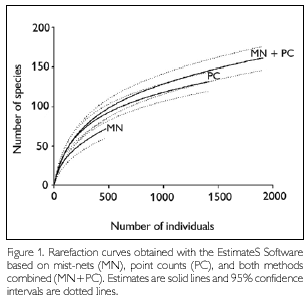
<body><![CDATA[<p><font size="2" face="verdana">We  used point counts and mist-net data to assemble rarefaction species curves.  These curves were calculated with incidence data from point counts, mist-nets,  and both methods together using EstimateS v.7 software (Colwell, 2004). To  maintain independence between point counts (and to avoid any potential double  counting) all detections &gt; 100   m from the observer and all registrations of birds   flying  the point counts were excluded from the analysis. Estimates of the 'true'  species richness in each habitat were also calculated using EstimateS v.7,  using the mean of the four commonly employed abundance-based estimators (ACE,  CHAO1, JACK1 and BOOTSTRAP). Avian guild classification was based on Terborgh <i>et  al. </i>(1990), and species sensitivity and number of habitats used by each  species were taken from Stotz <i>et al. </i>(1996). We followed the CBRO (2009)  list for nomenclature and <i>taxon </i>ordinance.</font></p>     <p>&nbsp;</p>     <p><font size="3" face="verdana"><b>RESULTS  AND DISCUSSION</b></font></p>     <p><font size="2" face="verdana">We  registered 194 bird species from 18 orders and 46 families, occurring at the S&atilde;o  Luiz farm, between 29 June and 27 July 2008. The most representative families  were Tyrannidae, Thraupidae, and Thamnophilidae with 28, 16 and 15 species  respectively. Mist-nets captured 455 individuals of 74 species belonging to 22  families, and point counts recorded 1,880 individuals of 144 species belonging  to 34 families.</font></p>     <p><font size="2" face="verdana">Of  the species captured in mist-nets, 94% were Passeriformes, including Pipridae (32.5%  of individuals), Tyrannidae (16.9%), Thamnophilidae (16%), and Dendrocolaptidae  (12.6%). The dominant guilds captured in mist-nets were arboreal frugivores  (32.5%), arboreal sallying insectivores (28.6%), and arboreal gleaning  insectivores (17.8%). The most captured species in mist-nets were <i>Machaeropterus  pyrocephalus </i>(12.5%), <i>Pipra rubrocapilla </i>(10.1%), <i>Basileuterus  culicivorus </i>(7.7%), <i>Dendrocincla fuliginosa </i>(6.4%), and <i>Lepidothrix  nattereri </i>(6.1%). About 49% of captured species were classified by Stotz <i>et  al. </i>(1996) as highly sensitive species, and most of them (66.1%) use only  one type of habitat. About 55% of all birds captured by mist-nets use mainly  the midstory and understory strata.</font></p>     <p><font size="2" face="verdana">Main  groups detected during point counts included families Pipridae (19.6% of  individuals), Thraupidae (18%), Tyrannidae (12.9%), Thamnophilidae (12.5%), and  Psittacidae (7.9%). The most representative ecological groups detected on point  counts were arboreal frugivores (28.2%), arboreal gleaning insectivores (16%),  arboreal sallying insectivores (15.3%), and arboreal omnivores (14.7%). The  most abundant species were <i>Pipra rubrocapilla </i>(7.6% of the records), <i>Machaeropterus  pyrocephalus </i>(4.8%), <i>Tangara cyanicollis </i>(4.7%), <i>Dacnis lineata </i>(3.2%), <i>Herpsilochmus rufimarginatus </i>(3.2%), and <i>Pionites leucogaster </i>(3%).  Forty two percent of these species were classified by Stotz <i>et al. </i>(1996)  as highly sensitive species, and most of them (40.5%) use only one type of  habitat. About 51% of individuals recorded by point counts were canopy species.</font></p>     <p><font size="2" face="verdana">The  rarefaction curves from mist-nets, point counts, and the two methods combined  did not reach an asymptote. However, the combined point count and mist-netting  data suggested the accumulation curves were beginning to reach an asymptote  (<a href="#f1">Figure 1</a>). The point counts estimate of the mean 'true' richness was 159.6 (&plusmn;  9.6) species, using ACE, CHAO1, JACK1 and BOOTSTRAP means. Mist-nets estimated  richness was 110.5 (&plusmn; 19) using the mean of the above estimators (<a href="#t1">Table 1</a>).  Estimated species richness from combining both sampling methods was 213.7 (&plusmn;  28.2) species, which is still short of the potential regional richness, which  can reach over 350 species (362 sp.: Lees <i>et al., </i>2008, 238 sp.: Aleixo <i>et  al., </i>2010).</font></p>     <p><a name="f1" id="f1"></a></p>     <p>&nbsp;</p>     <p align="center"><img src="/img/revistas/bmpegcn/v6n2/2a04f1.gif" border="0"></p>     ]]></body>
<body><![CDATA[<p>&nbsp;</p>     <p><a name="t1" id="t1"></a></p>     <p>&nbsp;</p>     <p align="center"><img src="/img/revistas/bmpegcn/v6n2/2a04t1.gif" border="0"></p>     <p>&nbsp;</p>     <p><font size="2" face="verdana">Some  of the differences between our richness estimates and those of other studies  are related to the sampling effort, which was smaller in our study and  restricted to just a single season. Species richness would doubtlessly increase  with an increasing sampling effort including additional seasons. However, the  region is clearly a transition between Amazonia  and 'cerrado', and can contain poorer communities compared to other sites  farther north.</font></p>     <p><font size="2" face="verdana">Despite  the fact that all sampling effort was conducted in forested sites and the bulk  of species were Amazonian birds, we did encounter some typical 'cerrado' (open  areas) bird species, such as <i>Rhea americana,  Brotogeris chiriri, Picumnus albosquamatus, Casiornis rufus, </i>and <i>Xenopsaris  albinucha </i>(<a href="#t2">Table 2</a>). The Brazilian Amazonian endemic species <i>Automolus  paraensis </i>was captured (and photographed) twice in recently and post-burned  sites (it was also observed by Aleixo <i>et al.</i>, 2010).</font></p>     <p><a name="t2" id="t2"></a></p>     <p>&nbsp;</p>     <p align="center"><img src="/img/revistas/bmpegcn/v6n2/2a04t2.gif" border="0"></p>     ]]></body>
<body><![CDATA[<p>&nbsp;</p>     <p><font size="2" face="verdana">We  highlight some bird species recorded here, which are at their range limits  and/or had their ranges expanded. We found that <i>Pteroglossus bitorquatus, </i>despite  its large range (Brazilian Amazonia, and Bolivian Amazon border), had not  previously been recorded on the east side of the Tanguro/Xingu river (Erize <i>et  al., </i>2006; Infonatura, 2007; BirdLife, 2010). We captured and photographed  one individual of the sub-species <i>P. b. sturmii </i>(which has an all dark  mandible, see Grosset, 2011) in a secondary post-burned site. We also recorded  individuals during point counts in undisturbed and disturbed sites, and they  were found in smaller numbers than the congener <i>P. aracari. </i>This last  cited species was mostly found in undisturbed sites and can be considered to be  near its southern range limit (Erize <i>et al., </i>2006). <i>P. aracari </i>was  also recorded 30 km  south by Aleixo <i>et al. </i>(2010). We also registered <i>Picumnus  albosquamatus </i>in its northern range limit (InfoNatura, 2007). A female of  this species was recaptured once (and photographed) in a recently burned site.</font></p>     <p><font size="2" face="verdana">We  obtained in this study a significant increase in the range of <i>Myrmotherula  sclateri, </i>which was also observed by Aleixo <i>et al. </i>(2010) 30 km to the south. We  recorded the species on three occasions, only in undisturbed sites. <i>Myrmotherula  hauxwelli </i>was recorded at the southern limit of its range (Ridgely &amp;  Tudor, 1994; Infonatura, 2007), and was detected in undisturbed and old-growth  secondary forests. <i>Herpsilochmus rufimarginatus </i>had not previously been  registered east of the Xingu   River (Ridgely &amp; Tudor,  1994; Infonatura, 2007), but had been registered at the Tanguro farm, 30 km to the south (Aleixo <i>et  al.</i>, 2010). The species was commonly recorded in secondary and undisturbed  forests at the study sites. The species <i>Myrmornis torquata </i>was recorded  once in a post-burned site and was also recorded at the Tanguro farm, 30 km to the south (Aleixo <i>et  al.</i>, 2010); these records expand the known species range by about 1,000 km to the south. <i>Willisornis  poecilinotus </i>was commonly captured at the study sites and had its range  expanded eastward by about 700   km, as also observed by Aleixo <i>et al.</i>(2010) at  the Tanguro farm, 30 km  to the south (Ridgely &amp; Tudor, 1994; Infonatura, 2007). <i>Hemitriccus  griseipectus </i>was recorded only once in an undisturbed forest site, expanding  its range about 700 km  eastward (Infonatura, 2007). </font><font size="2" face="verdana">Another important record was <i>Hemitriccus  minimus </i>which has patchy distribution, centered mainly in western Amazonia. We recorded five and captured three individuals  of <i>H. minimus </i>(photographed), mostly in secondary habitats, about 700 km east to its published  distribution. <i>H. minimus </i>was also recorded by Aleixo <i>et al. </i>(2010)  in the Tanguro farm. <i>Poecilotriccus fumifrons </i>was captured once (and  photographed) in secondary forest, and registered here about 300 km south of the  previously published limit (Ridgely &amp; Tudor, 1994; Infonatura, 2007). <i>lodopleura  isabellae </i>was recorded twice in secondary forests, and, along with those  records for Tanguro farm (Aleixo <i>et al.</i>, 2010), expand the known species  range by about 600 km. <i>Tangara chilensis</i> was  recorded seven times in secondary and undisturbed sites, more than 700 km east of its published  range (Ridgely &amp; Tudor, 1989; Infonatura, 2007). </font><font size="2" face="verdana"><i>Tangara gyrola </i>was  found 1,000 km  east its published range (Ridgely &amp; Tudor, 1989; Infonatura, 2007), being  recorded five times in disturbed and undisturbed sites. <i>Euphonia rufiventris </i>was registered four times in disturbed and undisturbed forests and, along  with those records for Tanguro farm (Aleixo <i>et al.</i>, 2010), expand its  published range 700 km  eastward (Ridgely &amp; Tudor, 1989; Infonatura, 2007). <i>Xenopipo atronitens </i>is  a white sand forest specialist, and we captured this species only once in a  disturbed site (photographed). We also captured two males and two females of <i>Turdus  subalaris </i>in undisturbed forests. This record is an important northern  range extension for this austral migrant (also recorded by Aleixo <i>et al., </i>2010  at Tanguro farm). We also emphasize the importance of this site for large and  medium-sized granivorous species that are highly sensitive to human  disturbances, such as <i>Tinamus tao, Tinamus major, Crypturellus strigulosus,  Pionites leucogaster, </i>and <i>Pyrrhura perlata.</i></font></p>     <p><font size="2" face="verdana">Our  results indicate that the avifaunal community of primary forests at S&atilde;o Luiz farm  (and surrounding region) is typically Amazonian. More than 75% of the bird  species recorded have previously been observed in regions of northern Mato  Grosso characterized by typical Amazonian 'terra firme' forests  (InfoNatura, 2007; Lees <i>et al., </i>2008). Although Brazilian environmental  laws ('C&oacute;digo Florestal'; Brasil, 1965)  classify the legal Amazon as forests north of 13<sup>o</sup> S,  our results, obtained some kilometers to the south of this (S 12<sup>o</sup> 38'  44.14&quot;, W 52<sup>o</sup> 23' 4.50&quot;; S 12<sup>o</sup> 41' 15.76&quot;, W 52<sup>o</sup> 21'  38.07&quot;) indicate that the local avifauna is representative of an Amazonian  bird community. The environmental act 'C&oacute;digo  Florestal' (Brasil, 1965) determines the percentage of private  properties that can be converted into farmland, and non-Amazonian sites have  more flexibility and greater areas for exploitation. Thus, classification of  these areas as no-Amazonian by environmental laws in Brazil can lead to  overexploitation, rapidly fragmenting and degrading the local forest cover.  Herein, our data provided a contribution to the knowledge of the avifauna of  this comparatively poorly-studied transitional area ofthe Amazon, underscoring  the need to conserve it with the same policies directed at preserving the main  Amazonian biome.</font></p>     <p>&nbsp;</p>     <p><font size="3" face="verdana"><b>ACKNOWLEDGEMENTS</b></font></p>     <p><font size="2" face="verdana">We  thank the farm owner Jos&eacute; Pirani, who  welcomed and permitted us to work on his property. We also thank Sidnei Dantas  and Alexandre Aleixo, who helped us to identify some bird songs and specimens.  Important comments from Alexandre Aleixo also helped to improve the manuscript.  The data presented here are part of the project &quot;Biodiversity implications  of forest disturbance and related landscape dynamics in the Brazilian  Amazon&quot;, a collaborative research between South   Dakota State University, Lancaster  University, and Museu Paraense Em&iacute;lio Goeldi funded by the National Aeronautics  and Space Administration (grant NNX07AF16G). Birders Exchange and Idea Wild  donated important materials for this research</font></p>     <p>&nbsp;</p>     <p><font size="3" face="verdana"><b>REFERENCES</b></font></p>     <!-- ref --><p><font size="2" face="verdana">ALEIXO, A. &amp; P. POLETTO, 2007. Birds  of an open vegetation enclave in Southern Brazilian Amazonia. <b>The Wilson  Journal of Ornithology </b>119(4): 610-630.</font><!-- ref --><p><font size="2" face="verdana">ALEIXO, A., F. POLETTO, E. PORTES &amp; M.  F. C. LIMA, 2010. Aves. In: A. C. M. OLIVEIRA, J. B. SANTOS &amp; M. C.  SANTOS-COSTA (Orgs.): <b>Os animais da Tanguro, Mato Grosso: </b>diversidade na  zona de transi&ccedil;&atilde;o entre a Floresta Amaz&ocirc;nica e o Cerrado: 53-56.  MPEG/UFPA/IPAM, Bel&eacute;m.</font><!-- ref --><p><font size="2" face="verdana">BRASIL, 1965. Decreto-Lei n<sup>o</sup> 4771, de 15 de setembro de 1965.  Institui o novo C&oacute;digo Florestal Brasileiro e d&aacute; outras provid&ecirc;ncias: 9529. <b>Di&aacute;rio  Oficial &#091;da Rep&uacute;blica Federativa do Brasil&#093;, </b>16 setembro 1965. Bras&iacute;lia.</font><!-- ref --><p><font size="2" face="verdana">BIRDLIFE  INTERNATIONAL, 2010. <i>Pteroglossus  bitorquatus. </i>In: International Union  for Conservation of Nature and Natural Resources (IUCN). <b>IUCN Red List of  Threatened Species. </b>Version 2010.4. Available in: &lt;<a href="http://www.iucnredlist.org/" target="_blank">www.iucnredlist.org</a>&gt;. Accessed on: 3 April 2011.</font><!-- ref --><p><font size="2" face="verdana">BORGES, S. H., 2007. An&aacute;lise biogeogr&aacute;fica da avifauna da regi&atilde;o  oeste do baixo Rio Negro, Amaz&ocirc;nia brasileira. <b>Revista Brasileira de  Zoologia </b>24(4): 919-940.</font><!-- ref --><p><font size="2" face="verdana">CAPOBIANCO, J. P. R., A. VER&Iacute;SSIMO, A.  MOREIRA, D. SAWYER, I. SANTOS &amp; L. P. PINTO, 2001. <b>Biodiversidade na  Amaz&ocirc;nia brasileira: </b>avalia&ccedil;&atilde;o e a&ccedil;&otilde;es priorit&aacute;rias para a conserva&ccedil;&atilde;o, uso  sustent&aacute;vel e reparti&ccedil;&atilde;o de benef&iacute;cios: 1-540. Instituto Socioambiental, S&atilde;o  Paulo.</font><!-- ref --><p><font size="2" face="verdana">CARVALHO, G. O., D. NEPSTAD, D. MCGRATH, M. C. VERA DIAZ, M. SANTILLI &amp; A. C. BARROS, 2002. Frontier expansion  in the Amazon: Balancing development and sustainability. <b>Environment </b>44(3): 34-45.</font><!-- ref --><p><font size="2" face="verdana">COMIT&Ecirc; BRASILEIRO DE REGISTROS ORNITOL&Oacute;GICOS (CBRO), 2009. <b>Listas  das aves do Brasil. </b>Available in: &lt;<a href="http://www.cbro.org.br/CBRO/index.htm" target="_blank">http://www.cbro.org.br/CBRO/index.htm</a>&gt;.  Accessed on: Dezembro 2009</font><!-- ref --><p><font size="2" face="verdana"> COLWELL, R. K., 2004. Estimates, Version 7: Statistical estimation of species richness and shared species from samples (Software and User's guide). Freeware. Available in: &lt;<a href="http://viceroy.eeb.uconn.edu/EstimateSPages/EstSUsersGuide/EstimateSUsersGuide.htm" target="_blank">http://viceroy.eeb.uconn.edu/EstimateSPages/EstSUsersGuide/EstimateSUsersGuide.htm</a>&gt;. Accessed on: 13 December 2010.</font><!-- ref --><p><font size="2" face="verdana">DUBS,  B., 1992. <b>Birds of Southwestern Brazil: </b>catalogue,  and guide to the birds of Mato Grosso and its border areas: 1-164. Verlag, Betrona.</font><!-- ref --><p><font size="2" face="verdana">ERIZE, F., J. R. R. MATA &amp; M.  RUMBOLL, 2006. <b>Birds of South America  non passerines: </b>Rheas to Woodpeckers. Princeton  University Press, Princeton.</font><!-- ref --><p><font size="2" face="verdana">FRY,  C. H., 1970. Ecological distribution of birds in North-Eastern Mato Grosso State, Brazil. <b>Anais da Academia Brasileira de  Ci&ecirc;ncias </b>42(2): 275-318.</font><!-- ref --><p><font size="2" face="verdana">GROSSET, A., 2011. Arthur Grosset's Birds. Available in: &lt;<a href="http://www.arthurgrosset.com/sabirds/red-neckedaracari.html" target="_blank">www.arthurgrosset.com/sabirds/red-neckedaracari.html</a>&gt;. Accessed on:   April 2011.</font><!-- ref --><p><font size="2" face="verdana">INSTITUTO NACIONAL DE PESQUISAS  ESPACIAIS (INPE), 2010. <b>Monitoramento da floresta amaz&ocirc;nica brasileira por  sat&eacute;lite. </b>S&atilde;o Jos&eacute; dos Campos, SP Available  in: &lt;<a href="http://sigma.cptec.inpe.br/queimadas/" target="_blank">http://sigma.cptec.inpe.  br/queimadas/</a>&gt;. Accessed on: 21 November 2010.</font><!-- ref --><p><font size="2" face="verdana">INFONATURA, 2007. Animals and ecosystems of Latin America. Version 5.0. Arlington, Virginia (USA): NatureServe. Available in: &lt;<a href="http://www.natureserve.org/infonatura/" target="_blank">http://www.natureserve.org/infonatura</a>&gt;. Accessed on: 3 November 2010.</font><!-- ref --><p><font size="2" face="verdana">LAURANCE,  W. F., M. A. COCHRANE, S. BERGEN, P. M. FEARNSIDE, P. DELAMONICA, C. BARBER, S.  D'ANGELO &amp; T. FERNANDES, 2001. Environment -  The future of the Brazilian Amazon. <b>Science </b>291(5503): 438-439.</font><!-- ref --><p><font size="2" face="verdana">LEES, A. C., B. J. W. DAVIS, A. V. G.  OLIVEIRA &amp; C. A. PERES, 2008. Avifauna of a  structurally heterogeneous forest landscape in the Serra dos Caiabis, Mato Grosso, Brazil: a preliminary assessment. <b>Cotinga </b>29: 149-159.</font><!-- ref --><p><font size="2" face="verdana">NEPSTAD, D. C., A. VER&Iacute;SSIMO, A.  ALENCAR, C. NOBRE, E. LIMA, P. LEFEBVRE, P. SCHLESINGER, C. POTTER, P. MOUTINHO,  E. MENDOZA, M. COCHRANE &amp; V. BROOKS, 1999.  Large-scale  impoverishment of Amazonian forests by logging and fire. <b>Nature </b>398(6727): 505-508.</font><!-- ref --><p><font size="2" face="verdana">NAUMBURG,  E. M. B., 1930. The Birds of Matto    Grosso, Brazil.  A report on the birds secured by the Roosevelt - Rondon Expedition. With field  notes by G. K. Cherrie. <b>Bulletin of American Museum  of Natural History </b>60: 1-432.</font><!-- ref --><p><font size="2" face="verdana">NOVAES,  F. C., 1976. As aves do Rio Aripuan&atilde;, Estado do Mato Grosso e  Amazonas. <b>Acta Amazonica </b>6(4): 61-85.</font><!-- ref --><p><font size="2" face="verdana">NOVAES,  F. C. &amp; M. F. C. LIMA, 1991.  As aves do rio Peixoto de Azevedo, Mato Grosso, Brasil. <b>Revista  Brasileira de Zoologia</b>  7(3):  351-381.</font><!-- ref --><p><font size="2" face="verdana">PINTO, O. M. O., 1940. Nova contribui&ccedil;&atilde;o &agrave;  ornitologia de Mato Grosso. <b>Arquivos de Zoologia </b>2(1): 1-37.</font><!-- ref --><p><font size="2" face="verdana">PINTO,  O. M. O. &amp; E. A.  CAMARGO, 1948. Sobre  uma cole&ccedil;&atilde;o de  aves do Rio das Mortes (Estado do Mato Grosso). <b>Pap&eacute;is Avulsos de  Zoologia </b>8(26): 287-336.</font><!-- ref --><p><font size="2" face="verdana">RIDGELY,  R. S. &amp; G. TUDOR, 1989. <b>The Birds of South America. </b>I. The Oscine Passerines. Oxford University Press, Oxford. </font><!-- ref --><p><font size="2" face="verdana">RIDGELY,  R. S. &amp; G. TUDOR, 1994. <b>The Birds of South America. </b>II. The Suboscine Passerines. Oxford  University Press, Oxford.</font><!-- ref --><p><font size="2" face="verdana">SILVA, J. M. C. &amp; Y. ONIKI, 1988. Lista preliminar da avifauna  da Esta&ccedil;&atilde;o Ecol&oacute;gica Serra das Araras, Mato Grosso, Brasil. <b>Boletim do Museu  Paraense Em&iacute;lio Goeldi, s&eacute;rie Zoologia </b>4(2): 123-143.</font><!-- ref --><p><font size="2" face="verdana">SILVEIRA, L. S. &amp; F. M. D'HORTA, 2002. A avifauna da regi&atilde;o  de Vila Bela da Sant&iacute;ssima Trindade, Mato Grosso. <b>Pap&eacute;is Avulsos de Zoologia </b>42(10): 265-286.</font><!-- ref --><p><font size="2" face="verdana">SKOLE,  D. L., W. H. CHOMENTOWSKI,  W. A. SALAS &amp; A. D.  NOBRE, 1994. Physical and human dimensions of deforestation in Amazonia. <b>BioScience </b>44(5): 314-322.</font><!-- ref --><p><font size="2" face="verdana">SKOLE, D. &amp; C. TUCKER, 1993.  Tropical deforestation and habitat fragmentation in the Amazon - satellite data  from 1978 to 1988. <b>Science </b>260(5116):  1905-1910.</font><!-- ref --><p><font size="2" face="verdana">STONE,  W. &amp; R. ROBERTS, 1934. Zoological results of Mato Grosso Expedition to Brazil in 1931,  III Birds. <b>Proceedings Academy of Natural Sciences Philadelphia </b>86: 363-397.</font><!-- ref --><p><font size="2" face="verdana">STOTZ,  D. F., J. W. FITZPATRICK,  T. A. PARKER III &amp; D. K. MOSKOVITS, 1996. <b>Neotropical birds: </b>Ecology  and Conservation. University   of Chicago Press,  Chicago.</font><!-- ref --><p><font size="2" face="verdana">TERBORGH,  J., S. K. ROBINSON, T. A. PARKER,  C. A. MUNN &amp; N. PIERPONT, 1990. Structure and organization of an Amazonian  forest bird community. <b>Ecological Monographs </b>60(2): 213-238.</font><!-- ref --><p><font size="2" face="verdana">WILLIS,  E. O. &amp; Y. ONIKI, 1990. Levantamento  preliminar das aves de inverno em dez &aacute;reas do sudoeste de Mato Grosso, Brasil. <b>Ararajuba - Revista Brasileira de Ornitologia </b>1:  19-38.</font><!-- ref --><p><font size="2" face="verdana">WHITTAKER,  A., 2009. Pousada Rio Roosevelt: a provisional  avifaunal inventory in south-western Amazonian Brazil, with information on life  history, new distributional data and comments on taxonomy. <b>Cotinga </b>31:  23-46.</font><!-- ref --><p><font size="2" face="verdana">ZIMMER,  K. J., T. A. PARKER III, M. L. ISLER &amp; P. R. ISLER,  1997. Survey of a southern Amazonian avifauna: the Alta Floresta region,   Mato Grosso,   Brazil. <b>Ornithological Monographs </b>48: 887-918.</font><p>&nbsp;</p>     <p>&nbsp;</p>     <p><font size="2" face="verdana"><b><a name="endereco" id="endereco"></a></b></font><font face="verdana"><b><font size="2"><b><font face="verdana"><b><a href="#topo"><img src="img/revistas/bmpegcn/v5n3/seta.gif" border="0"></a></b></font></b></font></b></font><font size="2" face="verdana"><b>Autor para correspond&ecirc;ncia:</b>    <br> Luiz Augusto  Macedo Mestre.    <br> Universidade  Federal do Paran&aacute;.    <br> Rua  Pioneiro, 2153 &ndash; Jardim Dallas. Palotina,    ]]></body>
<body><![CDATA[<br> PR, Brasil. CEP 83255-000    <br> (<a href="mailto:luiz.mestre@gmail.com">luiz.mestre@gmail.com</a>).</font></p>     <p><font size="2" face="verdana">Recebido em  02/02/2010    <br>   Aprovado em  20/07/2011</font></p>     <p><font size="2" face="verdana">Responsabilidade  editorial: Alexandre Aleixo</font></p>      ]]></body><back>
<ref-list>
<ref id="B1">
<nlm-citation citation-type="journal">
<person-group person-group-type="author">
<name>
<surname><![CDATA[ALEIXO]]></surname>
<given-names><![CDATA[A.]]></given-names>
</name>
<name>
<surname><![CDATA[POLETTO]]></surname>
<given-names><![CDATA[P.]]></given-names>
</name>
</person-group>
<article-title xml:lang="en"><![CDATA[Birds of an open vegetation enclave in Southern Brazilian Amazonia]]></article-title>
<source><![CDATA[The Wilson Journal of Ornithology]]></source>
<year>2007</year>
<volume>119</volume>
<numero>4</numero>
<issue>4</issue>
<page-range>610-630</page-range></nlm-citation>
</ref>
<ref id="B2">
<nlm-citation citation-type="book">
<person-group person-group-type="author">
<name>
<surname><![CDATA[ALEIXO]]></surname>
<given-names><![CDATA[A.]]></given-names>
</name>
<name>
<surname><![CDATA[POLETTO]]></surname>
<given-names><![CDATA[F.]]></given-names>
</name>
<name>
<surname><![CDATA[PORTES]]></surname>
<given-names><![CDATA[E.]]></given-names>
</name>
<name>
<surname><![CDATA[LIMA]]></surname>
<given-names><![CDATA[M. F. C.]]></given-names>
</name>
</person-group>
<article-title xml:lang="pt"><![CDATA[Aves]]></article-title>
<person-group person-group-type="editor">
<name>
<surname><![CDATA[OLIVEIRA]]></surname>
<given-names><![CDATA[A. C. M.]]></given-names>
</name>
<name>
<surname><![CDATA[SANTOS]]></surname>
<given-names><![CDATA[J. B.]]></given-names>
</name>
<name>
<surname><![CDATA[SANTOS-COSTA]]></surname>
<given-names><![CDATA[M. C.]]></given-names>
</name>
</person-group>
<source><![CDATA[Os animais da Tanguro, Mato Grosso: diversidade na zona de transição entre a Floresta Amazônica e o Cerrado]]></source>
<year>2010</year>
<page-range>53-56</page-range><publisher-loc><![CDATA[Belém ]]></publisher-loc>
<publisher-name><![CDATA[MPEG/UFPA/IPAM]]></publisher-name>
</nlm-citation>
</ref>
<ref id="B3">
<nlm-citation citation-type="journal">
<collab>BRASIL</collab>
<article-title xml:lang="pt"><![CDATA[Decreto-Lei nº 4771, de 15 de setembro de 1965: Institui o novo Código Florestal Brasileiro e dá outras providências: 9529]]></article-title>
<source><![CDATA[Diário Oficial [da República Federativa do Brasil]]]></source>
<year>1965</year>
<month>16</month>
<day> s</day>
<publisher-loc><![CDATA[Brasília ]]></publisher-loc>
</nlm-citation>
</ref>
<ref id="B4">
<nlm-citation citation-type="">
<collab>BIRDLIFE INTERNATIONAL</collab>
<article-title xml:lang="en"><![CDATA[Pteroglossus bitorquatus]]></article-title>
<collab>International Union for Conservation of Nature and Natural Resources (IUCN)</collab>
<source><![CDATA[IUCN Red List of Threatened Species: Version 2010.4]]></source>
<year>2010</year>
<month>3 </month>
<day>Ap</day>
</nlm-citation>
</ref>
<ref id="B5">
<nlm-citation citation-type="journal">
<person-group person-group-type="author">
<name>
<surname><![CDATA[BORGES]]></surname>
<given-names><![CDATA[S. H.]]></given-names>
</name>
</person-group>
<article-title xml:lang="pt"><![CDATA[Análise biogeográfica da avifauna da região oeste do baixo Rio Negro, Amazônia brasileira]]></article-title>
<source><![CDATA[Revista Brasileira de Zoologia]]></source>
<year>2007</year>
<volume>24</volume>
<numero>4</numero>
<issue>4</issue>
<page-range>919-940</page-range></nlm-citation>
</ref>
<ref id="B6">
<nlm-citation citation-type="book">
<person-group person-group-type="author">
<name>
<surname><![CDATA[CAPOBIANCO]]></surname>
<given-names><![CDATA[J. P. R.]]></given-names>
</name>
<name>
<surname><![CDATA[VERÍSSIMO]]></surname>
<given-names><![CDATA[A.]]></given-names>
</name>
<name>
<surname><![CDATA[MOREIRA]]></surname>
<given-names><![CDATA[A.]]></given-names>
</name>
<name>
<surname><![CDATA[SAWYER]]></surname>
<given-names><![CDATA[D.]]></given-names>
</name>
<name>
<surname><![CDATA[SANTOS]]></surname>
<given-names><![CDATA[I.]]></given-names>
</name>
<name>
<surname><![CDATA[PINTO]]></surname>
<given-names><![CDATA[L. P.]]></given-names>
</name>
</person-group>
<source><![CDATA[Biodiversidade na Amazônia brasileira: avaliação e ações prioritárias para a conservação, uso sustentável e repartição de benefícios]]></source>
<year>2001</year>
<page-range>1-540</page-range><publisher-loc><![CDATA[São Paulo ]]></publisher-loc>
<publisher-name><![CDATA[Instituto Socioambiental]]></publisher-name>
</nlm-citation>
</ref>
<ref id="B7">
<nlm-citation citation-type="journal">
<person-group person-group-type="author">
<name>
<surname><![CDATA[CARVALHO]]></surname>
<given-names><![CDATA[G. O.]]></given-names>
</name>
<name>
<surname><![CDATA[NEPSTAD]]></surname>
<given-names><![CDATA[D.]]></given-names>
</name>
<name>
<surname><![CDATA[MCGRATH]]></surname>
<given-names><![CDATA[D.]]></given-names>
</name>
<name>
<surname><![CDATA[VERA DIAZ]]></surname>
<given-names><![CDATA[M. C.]]></given-names>
</name>
<name>
<surname><![CDATA[SANTILLI]]></surname>
<given-names><![CDATA[M.]]></given-names>
</name>
<name>
<surname><![CDATA[BARROS]]></surname>
<given-names><![CDATA[A. C.]]></given-names>
</name>
</person-group>
<article-title xml:lang="en"><![CDATA[Frontier expansion in the Amazon: Balancing development and sustainability]]></article-title>
<source><![CDATA[Environment]]></source>
<year>2002</year>
<volume>44</volume>
<numero>3</numero>
<issue>3</issue>
<page-range>34-45</page-range></nlm-citation>
</ref>
<ref id="B8">
<nlm-citation citation-type="">
<collab>COMITÊ BRASILEIRO DE REGISTROS ORNITOLÓGICOS (CBRO)</collab>
<source><![CDATA[Listas das aves do Brasil]]></source>
<year>2009</year>
<month>De</month>
<day>ze</day>
</nlm-citation>
</ref>
<ref id="B9">
<nlm-citation citation-type="">
<person-group person-group-type="author">
<name>
<surname><![CDATA[COLWELL]]></surname>
<given-names><![CDATA[R. K.]]></given-names>
</name>
</person-group>
<source><![CDATA[Estimates, Version 7: Statistical estimation of species richness and shared species from samples (Software and User's guide). Freeware]]></source>
<year>2004</year>
<month>13</month>
<day> D</day>
</nlm-citation>
</ref>
<ref id="B10">
<nlm-citation citation-type="book">
<person-group person-group-type="author">
<name>
<surname><![CDATA[DUBS]]></surname>
<given-names><![CDATA[B.]]></given-names>
</name>
</person-group>
<source><![CDATA[Birds of Southwestern Brazil: catalogue, and guide to the birds of Mato Grosso and its border areas]]></source>
<year>1992</year>
<page-range>1-164</page-range><publisher-loc><![CDATA[Betrona ]]></publisher-loc>
<publisher-name><![CDATA[Verlag]]></publisher-name>
</nlm-citation>
</ref>
<ref id="B11">
<nlm-citation citation-type="book">
<person-group person-group-type="author">
<name>
<surname><![CDATA[ERIZE]]></surname>
<given-names><![CDATA[F.]]></given-names>
</name>
<name>
<surname><![CDATA[MATA]]></surname>
<given-names><![CDATA[J. R. R.]]></given-names>
</name>
<name>
<surname><![CDATA[RUMBOLL]]></surname>
<given-names><![CDATA[M.]]></given-names>
</name>
</person-group>
<source><![CDATA[Birds of South America non passerines: Rheas to Woodpeckers]]></source>
<year>2006</year>
<publisher-loc><![CDATA[Princeton ]]></publisher-loc>
<publisher-name><![CDATA[Princeton University Press]]></publisher-name>
</nlm-citation>
</ref>
<ref id="B12">
<nlm-citation citation-type="journal">
<person-group person-group-type="author">
<name>
<surname><![CDATA[FRY]]></surname>
<given-names><![CDATA[C. H.]]></given-names>
</name>
</person-group>
<article-title xml:lang="en"><![CDATA[Ecological distribution of birds in North-Eastern Mato Grosso State, Brazil]]></article-title>
<source><![CDATA[Anais da Academia Brasileira de Ciências]]></source>
<year>1970</year>
<volume>42</volume>
<numero>2</numero>
<issue>2</issue>
<page-range>275-318</page-range></nlm-citation>
</ref>
<ref id="B13">
<nlm-citation citation-type="">
<person-group person-group-type="author">
<name>
<surname><![CDATA[GROSSET]]></surname>
<given-names><![CDATA[A.]]></given-names>
</name>
</person-group>
<source><![CDATA[Arthur Grosset's Birds]]></source>
<year>2011</year>
<month>Ap</month>
<day>ri</day>
</nlm-citation>
</ref>
<ref id="B14">
<nlm-citation citation-type="">
<collab>INSTITUTO NACIONAL DE PESQUISAS ESPACIAIS (INPE)</collab>
<source><![CDATA[Monitoramento da floresta amazônica brasileira por satélite]]></source>
<year>2010</year>
<month>21</month>
<day> N</day>
<publisher-loc><![CDATA[São José dos Campos^eSP SP]]></publisher-loc>
</nlm-citation>
</ref>
<ref id="B15">
<nlm-citation citation-type="book">
<collab>INFONATURA</collab>
<source><![CDATA[Animals and ecosystems of Latin America: Version 5.0]]></source>
<year>2007</year>
<month>3 </month>
<day>No</day>
<publisher-loc><![CDATA[Arlington^eVirginia Virginia]]></publisher-loc>
<publisher-name><![CDATA[NatureServe]]></publisher-name>
</nlm-citation>
</ref>
<ref id="B16">
<nlm-citation citation-type="journal">
<person-group person-group-type="author">
<name>
<surname><![CDATA[LAURANCE]]></surname>
<given-names><![CDATA[W. F.]]></given-names>
</name>
<name>
<surname><![CDATA[COCHRANE]]></surname>
<given-names><![CDATA[M. A.]]></given-names>
</name>
<name>
<surname><![CDATA[BERGEN]]></surname>
<given-names><![CDATA[S.]]></given-names>
</name>
<name>
<surname><![CDATA[FEARNSIDE]]></surname>
<given-names><![CDATA[P. M.]]></given-names>
</name>
<name>
<surname><![CDATA[DELAMONICA]]></surname>
<given-names><![CDATA[P.]]></given-names>
</name>
<name>
<surname><![CDATA[BARBER]]></surname>
<given-names><![CDATA[C.]]></given-names>
</name>
<name>
<surname><![CDATA[D'ANGELO]]></surname>
<given-names><![CDATA[S.]]></given-names>
</name>
<name>
<surname><![CDATA[FERNANDES]]></surname>
<given-names><![CDATA[T.]]></given-names>
</name>
</person-group>
<article-title xml:lang="en"><![CDATA[Environment: The future of the Brazilian Amazon]]></article-title>
<source><![CDATA[Science]]></source>
<year>2001</year>
<volume>291</volume>
<numero>5503</numero>
<issue>5503</issue>
<page-range>438-439</page-range></nlm-citation>
</ref>
<ref id="B17">
<nlm-citation citation-type="journal">
<person-group person-group-type="author">
<name>
<surname><![CDATA[LEES]]></surname>
<given-names><![CDATA[A. C.]]></given-names>
</name>
<name>
<surname><![CDATA[DAVIS]]></surname>
<given-names><![CDATA[B. J. W.]]></given-names>
</name>
<name>
<surname><![CDATA[OLIVEIRA]]></surname>
<given-names><![CDATA[A. V. G.]]></given-names>
</name>
<name>
<surname><![CDATA[PERES]]></surname>
<given-names><![CDATA[C. A.]]></given-names>
</name>
</person-group>
<article-title xml:lang="en"><![CDATA[Avifauna of a structurally heterogeneous forest landscape in the Serra dos Caiabis, Mato Grosso, Brazil: a preliminary assessment]]></article-title>
<source><![CDATA[Cotinga]]></source>
<year>2008</year>
<volume>29</volume>
<page-range>149-159</page-range></nlm-citation>
</ref>
<ref id="B18">
<nlm-citation citation-type="journal">
<person-group person-group-type="author">
<name>
<surname><![CDATA[NEPSTAD]]></surname>
<given-names><![CDATA[D. C.]]></given-names>
</name>
<name>
<surname><![CDATA[VERÍSSIMO]]></surname>
<given-names><![CDATA[A.]]></given-names>
</name>
<name>
<surname><![CDATA[ALENCAR]]></surname>
<given-names><![CDATA[A.]]></given-names>
</name>
<name>
<surname><![CDATA[NOBRE]]></surname>
<given-names><![CDATA[C.]]></given-names>
</name>
<name>
<surname><![CDATA[LIMA]]></surname>
<given-names><![CDATA[E.]]></given-names>
</name>
<name>
<surname><![CDATA[LEFEBVRE]]></surname>
<given-names><![CDATA[P.]]></given-names>
</name>
<name>
<surname><![CDATA[SCHLESINGER]]></surname>
<given-names><![CDATA[P.]]></given-names>
</name>
<name>
<surname><![CDATA[POTTER]]></surname>
<given-names><![CDATA[C.]]></given-names>
</name>
<name>
<surname><![CDATA[MOUTINHO]]></surname>
<given-names><![CDATA[P.]]></given-names>
</name>
<name>
<surname><![CDATA[MENDOZA]]></surname>
<given-names><![CDATA[E.]]></given-names>
</name>
<name>
<surname><![CDATA[COCHRANE]]></surname>
<given-names><![CDATA[M.]]></given-names>
</name>
<name>
<surname><![CDATA[BROOKS]]></surname>
<given-names><![CDATA[V.]]></given-names>
</name>
</person-group>
<article-title xml:lang="en"><![CDATA[Large-scale impoverishment of Amazonian forests by logging and fire]]></article-title>
<source><![CDATA[Nature]]></source>
<year>1999</year>
<volume>398</volume>
<numero>6727</numero>
<issue>6727</issue>
<page-range>505-508</page-range></nlm-citation>
</ref>
<ref id="B19">
<nlm-citation citation-type="journal">
<person-group person-group-type="author">
<name>
<surname><![CDATA[NAUMBURG]]></surname>
<given-names><![CDATA[E. M. B.]]></given-names>
</name>
</person-group>
<article-title xml:lang="en"><![CDATA[The Birds of Matto Grosso, Brazil: A report on the birds secured by the Roosevelt - Rondon Expedition. With field notes by G. K. Cherrie]]></article-title>
<source><![CDATA[Bulletin of American Museum of Natural History]]></source>
<year>1930</year>
<volume>60</volume>
<page-range>1-432</page-range></nlm-citation>
</ref>
<ref id="B20">
<nlm-citation citation-type="journal">
<person-group person-group-type="author">
<name>
<surname><![CDATA[NOVAES]]></surname>
<given-names><![CDATA[F. C.]]></given-names>
</name>
</person-group>
<article-title xml:lang="pt"><![CDATA[As aves do Rio Aripuanã, Estado do Mato Grosso e Amazonas]]></article-title>
<source><![CDATA[Acta Amazonica]]></source>
<year>1976</year>
<volume>6</volume>
<numero>4</numero>
<issue>4</issue>
<page-range>61-85</page-range></nlm-citation>
</ref>
<ref id="B21">
<nlm-citation citation-type="journal">
<person-group person-group-type="author">
<name>
<surname><![CDATA[NOVAES]]></surname>
<given-names><![CDATA[F. C.]]></given-names>
</name>
<name>
<surname><![CDATA[LIMA]]></surname>
<given-names><![CDATA[M. F. C.]]></given-names>
</name>
</person-group>
<article-title xml:lang="pt"><![CDATA[As aves do rio Peixoto de Azevedo, Mato Grosso, Brasil]]></article-title>
<source><![CDATA[Revista Brasileira de Zoologia]]></source>
<year>1991</year>
<volume>7</volume>
<numero>3</numero>
<issue>3</issue>
<page-range>351-381</page-range></nlm-citation>
</ref>
<ref id="B22">
<nlm-citation citation-type="journal">
<person-group person-group-type="author">
<name>
<surname><![CDATA[PINTO]]></surname>
<given-names><![CDATA[O. M. O.]]></given-names>
</name>
</person-group>
<article-title xml:lang="pt"><![CDATA[Nova contribuição à ornitologia de Mato Grosso]]></article-title>
<source><![CDATA[Arquivos de Zoologia]]></source>
<year>1940</year>
<volume>2</volume>
<numero>1</numero>
<issue>1</issue>
<page-range>1-37</page-range></nlm-citation>
</ref>
<ref id="B23">
<nlm-citation citation-type="journal">
<person-group person-group-type="author">
<name>
<surname><![CDATA[PINTO]]></surname>
<given-names><![CDATA[O. M. O.]]></given-names>
</name>
<name>
<surname><![CDATA[CAMARGO]]></surname>
<given-names><![CDATA[E. A.]]></given-names>
</name>
</person-group>
<article-title xml:lang="pt"><![CDATA[Sobre uma coleção de aves do Rio das Mortes (Estado do Mato Grosso)]]></article-title>
<source><![CDATA[Papéis Avulsos de Zoologia]]></source>
<year>1948</year>
<volume>8</volume>
<numero>26</numero>
<issue>26</issue>
<page-range>287-336</page-range></nlm-citation>
</ref>
<ref id="B24">
<nlm-citation citation-type="book">
<person-group person-group-type="author">
<name>
<surname><![CDATA[RIDGELY]]></surname>
<given-names><![CDATA[R. S.]]></given-names>
</name>
<name>
<surname><![CDATA[TUDOR]]></surname>
<given-names><![CDATA[G.]]></given-names>
</name>
</person-group>
<source><![CDATA[The Birds of South America: I. The Oscine Passerines]]></source>
<year>1989</year>
<publisher-loc><![CDATA[Oxford ]]></publisher-loc>
<publisher-name><![CDATA[Oxford University Press]]></publisher-name>
</nlm-citation>
</ref>
<ref id="B25">
<nlm-citation citation-type="book">
<person-group person-group-type="author">
<name>
<surname><![CDATA[RIDGELY]]></surname>
<given-names><![CDATA[R. S.]]></given-names>
</name>
<name>
<surname><![CDATA[TUDOR]]></surname>
<given-names><![CDATA[G.]]></given-names>
</name>
</person-group>
<source><![CDATA[The Birds of South America: II. The Suboscine Passerines]]></source>
<year>1994</year>
<publisher-loc><![CDATA[Oxford ]]></publisher-loc>
<publisher-name><![CDATA[Oxford University Press]]></publisher-name>
</nlm-citation>
</ref>
<ref id="B26">
<nlm-citation citation-type="journal">
<person-group person-group-type="author">
<name>
<surname><![CDATA[SILVA]]></surname>
<given-names><![CDATA[J. M. C.]]></given-names>
</name>
<name>
<surname><![CDATA[ONIKI]]></surname>
<given-names><![CDATA[Y.]]></given-names>
</name>
</person-group>
<article-title xml:lang="pt"><![CDATA[Lista preliminar da avifauna da Estação Ecológica Serra das Araras, Mato Grosso, Brasil]]></article-title>
<source><![CDATA[Boletim do Museu Paraense Emílio Goeldi, série Zoologia]]></source>
<year>1988</year>
<volume>4</volume>
<numero>2</numero>
<issue>2</issue>
<page-range>123-143</page-range></nlm-citation>
</ref>
<ref id="B27">
<nlm-citation citation-type="journal">
<person-group person-group-type="author">
<name>
<surname><![CDATA[SILVEIRA]]></surname>
<given-names><![CDATA[L. S.]]></given-names>
</name>
<name>
<surname><![CDATA[D'HORTA]]></surname>
<given-names><![CDATA[F. M.]]></given-names>
</name>
</person-group>
<article-title xml:lang="pt"><![CDATA[A avifauna da região de Vila Bela da Santíssima Trindade, Mato Grosso]]></article-title>
<source><![CDATA[Papéis Avulsos de Zoologia]]></source>
<year>2002</year>
<volume>42</volume>
<numero>10</numero>
<issue>10</issue>
<page-range>265-286</page-range></nlm-citation>
</ref>
<ref id="B28">
<nlm-citation citation-type="journal">
<person-group person-group-type="author">
<name>
<surname><![CDATA[SKOLE]]></surname>
<given-names><![CDATA[D. L.]]></given-names>
</name>
<name>
<surname><![CDATA[CHOMENTOWSKI]]></surname>
<given-names><![CDATA[W. H.]]></given-names>
</name>
<name>
<surname><![CDATA[SALAS]]></surname>
<given-names><![CDATA[W. A.]]></given-names>
</name>
<name>
<surname><![CDATA[NOBRE]]></surname>
<given-names><![CDATA[A. D.]]></given-names>
</name>
</person-group>
<article-title xml:lang="en"><![CDATA[Physical and human dimensions of deforestation in Amazonia]]></article-title>
<source><![CDATA[BioScience]]></source>
<year>1994</year>
<volume>44</volume>
<numero>5</numero>
<issue>5</issue>
<page-range>314-322</page-range></nlm-citation>
</ref>
<ref id="B29">
<nlm-citation citation-type="journal">
<person-group person-group-type="author">
<name>
<surname><![CDATA[SKOLE]]></surname>
<given-names><![CDATA[D.]]></given-names>
</name>
<name>
<surname><![CDATA[TUCKER]]></surname>
<given-names><![CDATA[C.]]></given-names>
</name>
</person-group>
<article-title xml:lang="en"><![CDATA[Tropical deforestation and habitat fragmentation in the Amazon - satellite data from 1978 to 1988]]></article-title>
<source><![CDATA[Science]]></source>
<year>1993</year>
<volume>260</volume>
<numero>5116</numero>
<issue>5116</issue>
<page-range>1905-1910</page-range></nlm-citation>
</ref>
<ref id="B30">
<nlm-citation citation-type="journal">
<person-group person-group-type="author">
<name>
<surname><![CDATA[STONE]]></surname>
<given-names><![CDATA[W.]]></given-names>
</name>
<name>
<surname><![CDATA[ROBERTS]]></surname>
<given-names><![CDATA[R.]]></given-names>
</name>
</person-group>
<article-title xml:lang="en"><![CDATA[Zoological results of Mato Grosso Expedition to Brazil in 1931, III Birds]]></article-title>
<source><![CDATA[Proceedings Academy of Natural Sciences Philadelphia]]></source>
<year>1934</year>
<volume>86</volume>
<page-range>363-397</page-range></nlm-citation>
</ref>
<ref id="B31">
<nlm-citation citation-type="book">
<person-group person-group-type="author">
<name>
<surname><![CDATA[STOTZ]]></surname>
<given-names><![CDATA[D. F.]]></given-names>
</name>
<name>
<surname><![CDATA[FITZPATRICK]]></surname>
<given-names><![CDATA[J. W.]]></given-names>
</name>
<name>
<surname><![CDATA[PARKER III]]></surname>
<given-names><![CDATA[T. A.]]></given-names>
</name>
<name>
<surname><![CDATA[MOSKOVITS]]></surname>
<given-names><![CDATA[D. K.]]></given-names>
</name>
</person-group>
<source><![CDATA[Neotropical birds: Ecology and Conservation]]></source>
<year>1996</year>
<publisher-loc><![CDATA[Chicago ]]></publisher-loc>
<publisher-name><![CDATA[University of Chicago Press]]></publisher-name>
</nlm-citation>
</ref>
<ref id="B32">
<nlm-citation citation-type="journal">
<person-group person-group-type="author">
<name>
<surname><![CDATA[TERBORGH]]></surname>
<given-names><![CDATA[J.]]></given-names>
</name>
<name>
<surname><![CDATA[ROBINSON]]></surname>
<given-names><![CDATA[S. K.]]></given-names>
</name>
<name>
<surname><![CDATA[PARKER]]></surname>
<given-names><![CDATA[T. A.]]></given-names>
</name>
<name>
<surname><![CDATA[MUNN]]></surname>
<given-names><![CDATA[C. A.]]></given-names>
</name>
<name>
<surname><![CDATA[PIERPONT]]></surname>
<given-names><![CDATA[N.]]></given-names>
</name>
</person-group>
<article-title xml:lang="en"><![CDATA[Structure and organization of an Amazonian forest bird community]]></article-title>
<source><![CDATA[Ecological Monographs]]></source>
<year>1990</year>
<volume>60</volume>
<numero>2</numero>
<issue>2</issue>
<page-range>213-238</page-range></nlm-citation>
</ref>
<ref id="B33">
<nlm-citation citation-type="journal">
<person-group person-group-type="author">
<name>
<surname><![CDATA[WILLIS]]></surname>
<given-names><![CDATA[E. O.]]></given-names>
</name>
<name>
<surname><![CDATA[ONIKI]]></surname>
<given-names><![CDATA[Y.]]></given-names>
</name>
</person-group>
<article-title xml:lang="pt"><![CDATA[Levantamento preliminar das aves de inverno em dez áreas do sudoeste de Mato Grosso, Brasil]]></article-title>
<source><![CDATA[Ararajuba - Revista Brasileira de Ornitologia]]></source>
<year>1990</year>
<volume>1</volume>
<page-range>19-38</page-range></nlm-citation>
</ref>
<ref id="B34">
<nlm-citation citation-type="journal">
<person-group person-group-type="author">
<name>
<surname><![CDATA[WHITTAKER]]></surname>
<given-names><![CDATA[A.]]></given-names>
</name>
</person-group>
<article-title xml:lang="pt"><![CDATA[Pousada Rio Roosevelt: a provisional avifaunal inventory in south-western Amazonian Brazil, with information on life history, new distributional data and comments on taxonomy]]></article-title>
<source><![CDATA[Cotinga]]></source>
<year>2009</year>
<volume>31</volume>
<page-range>23-46</page-range></nlm-citation>
</ref>
<ref id="B35">
<nlm-citation citation-type="journal">
<person-group person-group-type="author">
<name>
<surname><![CDATA[ZIMMER]]></surname>
<given-names><![CDATA[K. J.]]></given-names>
</name>
<name>
<surname><![CDATA[PARKER III]]></surname>
<given-names><![CDATA[T. A.]]></given-names>
</name>
<name>
<surname><![CDATA[ISLER]]></surname>
<given-names><![CDATA[M. L.]]></given-names>
</name>
<name>
<surname><![CDATA[ISLER]]></surname>
<given-names><![CDATA[P. R.]]></given-names>
</name>
</person-group>
<article-title xml:lang="en"><![CDATA[Survey of a southern Amazonian avifauna: the Alta Floresta region, Mato Grosso, Brazil]]></article-title>
<source><![CDATA[Ornithological Monographs]]></source>
<year>1997</year>
<volume>48</volume>
<page-range>887-918</page-range></nlm-citation>
</ref>
</ref-list>
</back>
</article>

