<?xml version="1.0" encoding="ISO-8859-1"?><article xmlns:mml="http://www.w3.org/1998/Math/MathML" xmlns:xlink="http://www.w3.org/1999/xlink" xmlns:xsi="http://www.w3.org/2001/XMLSchema-instance">
<front>
<journal-meta>
<journal-id>1981-8114</journal-id>
<journal-title><![CDATA[Boletim do Museu Paraense Emílio Goeldi Ciências Naturais]]></journal-title>
<abbrev-journal-title><![CDATA[Bol. Mus. Para. Emilio Goeldi Cienc. Nat.]]></abbrev-journal-title>
<issn>1981-8114</issn>
<publisher>
<publisher-name><![CDATA[Museu Paraense Emílio Goeldi, Ministério da Ciência e Tecnologia]]></publisher-name>
</publisher>
</journal-meta>
<article-meta>
<article-id>S1981-81142012000100003</article-id>
<title-group>
<article-title xml:lang="en"><![CDATA[The Pirabas formation (Early Miocene from Brazil) and the Tropical Western Central Atlantic Subprovince]]></article-title>
<article-title xml:lang="pt"><![CDATA[A Formação Pirabas do Brasil (Mioceno inferior) e a subprovíncia tropical do Atlântico Noroeste Central]]></article-title>
</title-group>
<contrib-group>
<contrib contrib-type="author">
<name>
<surname><![CDATA[Socorro]]></surname>
<given-names><![CDATA[Orangel Aguilera]]></given-names>
</name>
<xref ref-type="aff" rid="A01"/>
</contrib>
<contrib contrib-type="author">
<name>
<surname><![CDATA[Páes]]></surname>
<given-names><![CDATA[Eduardo Tavares]]></given-names>
</name>
<xref ref-type="aff" rid="A02"/>
</contrib>
</contrib-group>
<aff id="A01">
<institution><![CDATA[,Museu Paraense Emílio Goeldi/Ministério da Ciência  ]]></institution>
<addr-line><![CDATA[Belém Pará]]></addr-line>
<country>Brasil</country>
</aff>
<aff id="A02">
<institution><![CDATA[,Universidade Federal Rural da Amazônia  ]]></institution>
<addr-line><![CDATA[Belém Pará]]></addr-line>
<country>Brasil</country>
</aff>
<pub-date pub-type="pub">
<day>00</day>
<month>04</month>
<year>2012</year>
</pub-date>
<pub-date pub-type="epub">
<day>00</day>
<month>04</month>
<year>2012</year>
</pub-date>
<volume>7</volume>
<numero>1</numero>
<fpage>29</fpage>
<lpage>45</lpage>
<copyright-statement/>
<copyright-year/>
<self-uri xlink:href="http://scielo.iec.gov.br/scielo.php?script=sci_arttext&amp;pid=S1981-81142012000100003&amp;lng=en&amp;nrm=iso"></self-uri><self-uri xlink:href="http://scielo.iec.gov.br/scielo.php?script=sci_abstract&amp;pid=S1981-81142012000100003&amp;lng=en&amp;nrm=iso"></self-uri><self-uri xlink:href="http://scielo.iec.gov.br/scielo.php?script=sci_pdf&amp;pid=S1981-81142012000100003&amp;lng=en&amp;nrm=iso"></self-uri><abstract abstract-type="short" xml:lang="pt"><p><![CDATA[The Neogene Tropical Western Central Atlantic-South American faunal assemblage from the Pirabas Formation (Early Miocene) has specific and unique features, which distinguishes it from the rest of the Proto-Caribbean Subprovince in diversity, paleoceanographic condition and ecosystems. Principal component analysis (PCA) distinguished three groups of localities with similar faunas (Group A: ilha de Fortaleza, Colônia Pedro Teixeira and Praia de Fortalezinha; Group B: Estação Agronômica, ilha de Marajó, Turiacu, Baixo Parnaíba, Aricuru and Salinópolis; Group C: Capanema B-17 Mine) and five different depositional facies (surf zone, beach, lagoons, tidal channel and tidal delta), in agreement with previous geological studies showing heterogeneous paleoenvironments among the outcrops. These heterogeneous lithostratigraphic sequences suggest different members, and may be related to different ages along the Pirabas sequence. The Neogene Northwestern Atlantic Subprovince is erected to encompass this entire geographical area.]]></p></abstract>
<abstract abstract-type="short" xml:lang="en"><p><![CDATA[A assembleia da fauna Neógena Tropical Sul Americana da Formação Pirabas (Mioceno inferior) possui características específicas e únicas que a distinguem do resto das subprovíncias Proto-Caribenhas em diversidade, condições paleoceanográficas e ecossistemas. A análise de componentes principais distingue três grupos de localidades com faunas similares (Grupo A: ilha de Fortaleza, colônia Pedro Teixeira e praia de Fortalezinha; Grupo B: Estação Agronômica, ilha de Marajó, Turiaçu, baixo Parnaíba, Aricuru e Salinópolis; Grupo C: Mina B-17, Capanema) e cinco diferentes fácies deposicionais (zona de arrebentação, praia, lagoa, canal de maré e delta de maré), corroborando estudos geológicos prévios, que mostram uma série de paleoambientes heterogêneos nestes afloramentos. Essa sequência litológica heterogênea sugere a presença de vários membros, que poderiam ser correlacionados a diferentes idades ao longo da sequência da Formação Pirabas. A denominação de subprovíncia tropical do Atlântico Noroeste Central é proposta para o Neógeno dessa área geográfica.]]></p></abstract>
<kwd-group>
<kwd lng="pt"><![CDATA[Neogene]]></kwd>
<kwd lng="pt"><![CDATA[Pirabas]]></kwd>
<kwd lng="pt"><![CDATA[Paleoecology]]></kwd>
<kwd lng="pt"><![CDATA[Paleobiogeography]]></kwd>
<kwd lng="pt"><![CDATA[Proto-Caribbean]]></kwd>
<kwd lng="en"><![CDATA[Neógeno]]></kwd>
<kwd lng="en"><![CDATA[Pirabas]]></kwd>
<kwd lng="en"><![CDATA[Paleoecologia]]></kwd>
<kwd lng="en"><![CDATA[Paleobiogeografia]]></kwd>
<kwd lng="en"><![CDATA[Proto-Caribe]]></kwd>
</kwd-group>
</article-meta>
</front><body><![CDATA[ <p align="right">&nbsp;</p>     <p align="justify"><font face="Verdana"><b><font size="4"><a name="topo"></a>The Pirabas formation (Early Miocene from Brazil) and the Tropical Western Central Atlantic Subprovince </font></b></font></p>     <p align="justify">&nbsp;</p>     <p align="justify"><font size="3" face="Verdana"><b>A Forma&ccedil;&atilde;o Pirabas do Brasil (Mioceno inferior) e a subprov&iacute;ncia tropical do Atl&acirc;ntico Noroeste Central</b></font></p>     <p align="justify">&nbsp;</p>     <p align="justify">&nbsp;</p>     <p align="justify"><font size="2" face="Verdana"><b>Orangel Aguilera Socorro<sup>I</sup>, Eduardo Tavares P&aacute;es<sup>II</sup></b></font></p>     <p align="justify"><font size="2" face="Verdana"><sup>I</sup>Museu Paraense Em&iacute;lio Goeldi/Minist&eacute;rio da Ci&ecirc;ncia, Tecnologia e Inova&ccedil;&atilde;o. Bel&eacute;m, Par&aacute;, Brasil    <br> </font><font size="2" face="Verdana"><sup>II</sup>Universidade Federal Rural da Amaz&ocirc;nia. Bel&eacute;m, Par&aacute;, Brasil</font></p>     <p align="justify"><font size="2" face="Verdana"><a href="#endereco">Autor para correspond&ecirc;ncia</a></font></p>     ]]></body>
<body><![CDATA[<p align="justify">&nbsp;</p>     <p align="justify">&nbsp;</p> <hr size="1">     <p align="justify"><font face="Verdana"><b><font size="2">ABSTRACT</font></b></font></p>     <p align="justify"><font size="2" face="Verdana">The Neogene Tropical Western Central Atlantic-South American faunal assemblage from the Pirabas Formation (Early Miocene) has specific and unique features, which distinguishes it from the rest of the Proto-Caribbean Subprovince in diversity, paleoceanographic condition and ecosystems. Principal component analysis (PCA) distinguished three groups of localities with similar faunas (Group A: ilha de Fortaleza, Col&ocirc;nia Pedro Teixeira and Praia de Fortalezinha; Group B: Esta&ccedil;&atilde;o Agron&ocirc;mica, ilha de Maraj&oacute;, Turiacu, Baixo Parna&iacute;ba, Aricuru and Salin&oacute;polis; Group C: Capanema B-17 Mine) and five different depositional facies (surf zone, beach, lagoons, tidal channel and tidal delta), in agreement with previous geological studies showing heterogeneous paleoenvironments among the outcrops. These heterogeneous lithostratigraphic sequences suggest different members, and may be related to different ages along the Pirabas sequence. The Neogene Northwestern Atlantic Subprovince is erected to encompass this entire geographical area.</font></p>     <p align="justify"><font size="2" face="Verdana"><b>Keywords</b>: Neogene. Pirabas. Paleoecology. Paleobiogeography. Proto-Caribbean.</font></p> <hr size="1">     <p align="justify"><font size="2" face="Verdana"><b>RESUMO</b></font></p>     <p align="justify"><font size="2" face="Verdana">A assembleia da fauna Ne&oacute;gena Tropical Sul Americana da Forma&ccedil;&atilde;o Pirabas (Mioceno inferior) possui caracter&iacute;sticas espec&iacute;ficas e &uacute;nicas que a distinguem do resto das subprov&iacute;ncias Proto-Caribenhas em diversidade, condi&ccedil;&otilde;es paleoceanogr&aacute;ficas e ecossistemas. A an&aacute;lise de componentes principais distingue tr&ecirc;s grupos de localidades com faunas similares (Grupo A: ilha de Fortaleza, col&ocirc;nia Pedro Teixeira e praia de Fortalezinha; Grupo B: Esta&ccedil;&atilde;o Agron&ocirc;mica, ilha de Maraj&oacute;, Turia&ccedil;u, baixo Parna&iacute;ba, Aricuru e Salin&oacute;polis; Grupo C: Mina B-17, Capanema) e cinco diferentes f&aacute;cies deposicionais (zona de arrebenta&ccedil;&atilde;o, praia, lagoa, canal de mar&eacute; e delta de mar&eacute;), corroborando estudos geol&oacute;gicos pr&eacute;vios, que mostram uma s&eacute;rie de paleoambientes heterog&ecirc;neos nestes afloramentos. Essa sequ&ecirc;ncia litol&oacute;gica heterog&ecirc;nea sugere a presen&ccedil;a de v&aacute;rios membros, que poderiam ser correlacionados a diferentes idades ao longo da sequ&ecirc;ncia da Forma&ccedil;&atilde;o Pirabas. A denomina&ccedil;&atilde;o de subprov&iacute;ncia tropical do Atl&acirc;ntico Noroeste Central &eacute; proposta para o Ne&oacute;geno dessa &aacute;rea geogr&aacute;fica.</font></p>     <p align="justify"><font size="2" face="Verdana"><b>Palavras-chave</b>: Ne&oacute;geno. Pirabas. Paleoecologia. Paleobiogeografia. Proto-Caribe.</font></p> <hr size="1">     <p align="justify">&nbsp;</p>     <p align="justify">&nbsp;</p>     ]]></body>
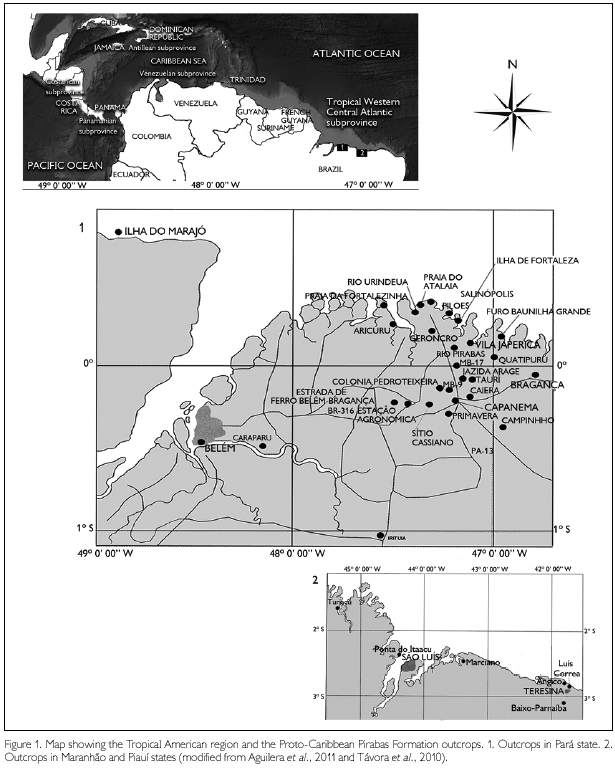
<body><![CDATA[<p align="justify"><font size="2" face="Verdana"><b><font size="3">INTRODUCTION</font></b></font></p>     <p align="justify"><font size="2" face="Verdana"> Since the 19th century, the fossiliferous limestone studied by Ferreira Penna (1876) has yielded a high species diversity from the exclusively Cenozoic deposits (<a href="#f1">Figure 1</a>) along the northern Atlantic coast of South America in Brazil (Par&aacute;, Maranh&atilde;o and Piau&iacute; states).</font></p>     <p align="justify"><font size="2" face="Verdana"><a name="f1"></a></font></p>     <p align="justify">&nbsp;</p>     <p align="center"><img src="/img/revistas/bmpegcn/v7n1/1a03f1.gif" border="0"></p>     <p align="justify">&nbsp;</p>     <p align="justify"><font size="2" face="Verdana">The early contributions of White (1887) and Maury (1925) were the basal references on the Pirabas Formation (Early Miocene from Brazil), particularly in mollusk, bryozoan and coral research, followed by the contributions of Petri (1954, 1957) on foraminifera, Beurlen (1958), Brito (1971, 1972, 1977) and Martins-Neto (2001) on crustaceans, Santos (1958, 1967) on echinoids, Santos &amp; Travassos (1960) and Santos &amp; Salgado (1971) on fishes, Paula-Couto (1967) and Toledo &amp; Domning (1989) on sirenians. Many other references, summarized in Rossetti &amp; G&oacute;es (2004) and T&aacute;vora <i>et al</i>. (2010) provide additional descriptions, records and/or reviews of different fossil taxa.</font></p>     <p align="justify"><font size="2" face="Verdana">All of these authors suggest close relationships between the faunal assemblages from the Pirabas Formation and the Caribbean Neogene fauna, based on qualitative analysis, species co-occurrence and personal conclusions. However, based on fossil fish faunas, Aguilera <i>et al</i>. (2011 and in progress) conclude that the Pirabas Formation has a distant relationship with the Gatunian Province in the Caribbean region. This is true even when the Pirabas Formation is compared with the Early Miocene Husillo and Cojimar formations from Cuba, the Mao Formation from the Dominican Republic, the Cantaure and Castillo (lower section) formations from Venezuela, the Tuira Formation from Panama, the Brasso Formation from Trinidad, the Kendeace Formation from Grenada, and the Viche Formation from Ecuador.</font></p>     <p align="justify"><font size="2" face="Verdana">The topics considered here are the faunal composition, the influence of the Tropical Atlantic water mass on the North Brazilian Current (Johns <i>et al</i>., 1998, 2002), the high tidal range (Beardsley <i>et al</i>., 1995; DHN, s. d.), the eustatic sea level changes (Haq <i>et al</i>., 1988; Carter, 1998; Kominz <i>et al</i>., 2008) and the sea level fluctuations in northern Brazil (Rossetti, 2001), the early Miocene age of the Pirabas Formation, and the geographic location of the Pirabas Basin previous to the present configuration of the Caribbean Sea.</font></p>     <p align="justify"><font size="2" face="Verdana">The main lithostratigraphic and paleoenvironmental interpretation of the Pirabas Formation is that of G&oacute;es <i>et al</i>. (1990), Rossetti (2001) and Rossetti &amp; G&oacute;es (2004). These authors present a representative vertical profile (<a href="#f2">Figure 2</a>), synthesizing the depositional sequence and characterizing the Pirabas Formation as consisting of carbonate rocks from offshore platform deposits (grainstone and consolidated packstone, stratigraphic wackestone-packstone and laminated mudstone), littoral facies (shoreface/foreshore), marginal lagoons and restricted platform (gray to olive mudstone and conglomeratic sandstone), and mangrove estuarine lagoons (dark mudstone, massive or laminated). The Early Miocene age assignment of the Pirabas Formation follows Petri (1957), Fernandes (1984), Ferreira <i>et al</i>. (1978), Fernandes &amp; T&aacute;vora (1990) and T&aacute;vora &amp; Fernandes (1999).</font></p>     ]]></body>
<body><![CDATA[<p align="justify"><a name="f2"></a></p>     <p align="justify">&nbsp;</p>     <p align="center"><img src="/img/revistas/bmpegcn/v7n1/1a03f2.gif" border="0"></p>     <p align="justify">&nbsp;</p>     <p align="justify"><font size="2" face="Verdana">Recent research (S. A. F. Costa, A. E. A. Santos Junior, H. M. Moraes-Santos &amp; O. Aguilera, personal communication) described a heterogeneous lithostratigraphic sequence along a section in the Capanema B-17 Mine, and proposed five lithofacies: surf zone, beach, lagoons, tidal channel and tidal delta, which would describe an littoral system with wave and tidal influence.</font></p>     <p align="justify"><font size="2" face="Verdana">These heterogeneous sequences and the faunal assemblages recorded in different outcrops suggest that different members should be recognized, and accurate geochronological research may reveal different ages within the Pirabas sequence.</font></p>     <p align="justify"><font size="2" face="Verdana">Based on this heterogeneous lithostratigraphic profile and the diverse fossil record (which includes 214 invertebrates and vertebrates from 21 outcrop-localities), our objective is a quantitative analysis aimed at producing an appropriate interpretation to support future research on the context of geochronology, paleoenvironments, paleobiogeography and stratigraphic review for the Pirabas Formation.</font></p>     <p align="justify">&nbsp;</p>     <p align="justify"><font face="Verdana"><b><font size="3">METHODS</font></b></font></p>     <p align="justify"><font face="Verdana"><font size="2"> The data presented were taken from published literature (White, 1887; Maury, 1925; Petri, 1954, 1957; Beurlen, 1958; Santos, 1958, 1967; Santos &amp; Travassos, 1960; Paula-Couto, 1967; Santos &amp; Salgado, 1971; Brito, 1971, 1972, 1977; Fernandes, 1981; Toledo &amp; Domning, 1989; Martins-Neto, 2001), including a variety of invertebrates (bryozoans, echinoids, mollusks and crustaceans) and vertebrates (sirenians and fishes), recompiled in a recent paper by T&aacute;vora <i>et al</i>. (2010), and consulted during a general overview of the fossil collection in the Museu Paraense Em&iacute;lio Goeldi (MPEG) repository. Some original taxonomic names listed by T&aacute;vora <i>et al</i>. (2010) may need to be revised. However, the genus-level data can be used with confidence in the present analysis. The description of the local geology and stratigraphy follows G&oacute;es <i>et al</i>. (1990), Rossetti (2001) and Rossetti &amp; G&oacute;es (2004). Field study of the main sections at Atalaia beach, Ponta do Castelo, Fazenda, Fortalezinha and the Capanema B-17 Mine was conducted as part of the Museu Em&iacute;lio Goeldi Vertebrate </font></font><font size="2" face="Verdana">Paleontology Project. The data were standardized at the generic level, as is common in this kind of study (Foote &amp; Miller, 2007). This procedure served also to diminish distortions caused by preservation and sampling biases, endemic groups, and nomenclatural uncertainties.</font></p>     ]]></body>
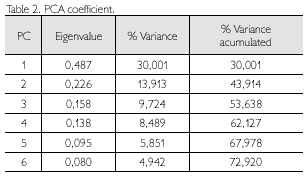
<body><![CDATA[<p align="justify"><font size="2" face="Verdana">We grouped localities according to the outcrops studied, which are deemed good geographic and paleoenvironmental representatives of the early Miocene Pirabas Formation sections. A few samples of taxa in certain localities are biased or absent due to lack of preservation or study. The binary data matrix includes 214 fossil invertebrates and vertebrates from 21 outcrop-localities (<a href="#t1">Table 1</a>).</font></p>     <p align="justify"><a name="t1"></a></p>     <p align="justify">&nbsp;</p>     <p align="center"><img src="/img/revistas/bmpegcn/v7n1/1a03t1.gif" border="0"></p>     <p align="justify">&nbsp;</p>     <p align="justify"><font size="2" face="Verdana">One of the most important multivariate methods of data analysis is PCA (Ferreira <i>et al</i>., 1999; Malinowski, 1991) based on the correlation between variables. it aims to group these correlated variables, generating a new set of variables called principal components (PC) onto which the data is projected. These PC are built as linear combination of original variables and have the important property of being completely uncorrelated. The first new axis is chosen in such a direction that it maximizes the variance along the axis, the second must be chosen orthogonal to the first one and the direction to describe as much variance left as possible so on.</font></p>     <p align="justify"><font size="2" face="Verdana">The Principal Components Analysis (PCA) uses the calculated covariance and variance between localities; for this reason this is a Q-PCA according to Fasham (1977). The Q-PCA analysis was run using the free software PAST (Hammer <i>et al</i>., 2001), and the taxonomic groups was expressed in the PCAs planes using the concentration ellipse level of 30%. Following Jackson <i>et al</i>. (1989), the size effect of the linear relationship between the PCA axis 1 and the relative frequency of species occurrence were established with the largest occurrence. The coefficient from each PCA are present in the <a href="#t2">Table 2</a>.</font></p>     <p align="justify"><a name="t2"></a></p>     <p align="justify">&nbsp;</p>     <p align="center"><img src="/img/revistas/bmpegcn/v7n1/1a03t2.gif" border="0"></p>     ]]></body>
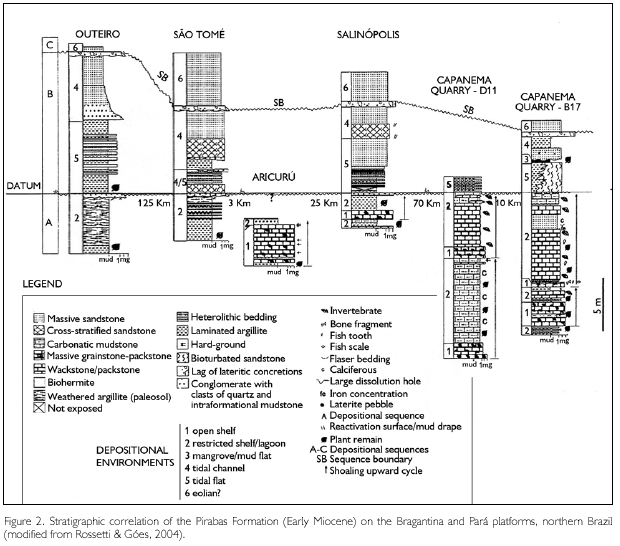
<body><![CDATA[<p align="justify">&nbsp;</p>     <p align="justify"><font size="2" face="Verdana">The confidence ellipses of genera groups were formed by computing the three following quantities using the PAST software (Hammer <i>et al</i>., 2001), as proposed by Abdi <i>et al</i>. (2009): (1) the coordinates of the center of the ellipse of each group in the factorial plane (Axis II and Axis III), (2) the angle between the major axis of the ellipse and the first dimension of the plane, and (3) the relative size of the minor axis compared to the major axis of the ellipse. To perform these procedures one must set the center of the ellipse at the center of mass of the points. Thereafter, the ratio between the minor axis and the major axis is calculated as the ratio of the second eigenvalue to the first eigenvalue. Finally, the angle of rotation is given by the first eigenvector. For a 30% confidence interval, the lengths of the axes of the ellipse are set to ensure that the ellipse comprehends 30% of the points. The value of 30% was chosen for visual clarification so as to avoid overlapping the ellipses and better identify the centroids of taxonomic groups in factorial plane.</font></p>     <p align="justify">&nbsp;</p>     <p align="justify"><font face="Verdana"><b><font size="3">RESULTS AND DISCUSSION</font></b></font></p>     <p align="justify"><font size="2" face="Verdana">The Early Miocene faunal assemblage identified in northern Brazil is called here the Proto-Caribbean Pirabas fauna (not Caribbean), based on the nature of this fauna and because the Caribbean Sea proper was only formed after the Pacific and Atlantic were completely isolated in the Pliocene (Coates <i>et al</i>., 1992, 2004; Coates &amp; Obando, 1996). The paleobiogeographic model for the southern Caribbean comprises the lower Miocene-lower Pleistocene Gatunian Province and the middle Pleistocene-upper Pleistocene Caribbean Province (Landau <i>et al</i>., 2008). According to this system the Neogene Tropical Western Central Atlantic Subprovince can be erected to encompass this entire geographical area.</font></p>     <p align="justify"><font size="2" face="Verdana">In our assessment, the Proto-Caribbean Pirabas fauna is arranged in three faunal groups and five different facies. Faunal group A, includes the isolated vector of ilha de Fortaleza (IFOR), Col&ocirc;nia Pedro Teixeira (CTEI), and Praia de Fortalezinha (PFORT). This group exhibits a pattern of co-occurrence and singularity of fossil faunas indicated by the assemblages of gastropods, echinoids, crustaceans and vertebrates (<a href="#f3">Figure 3</a>, left projection). Group B includes vector from Esta&ccedil;&atilde;o Agron&ocirc;mica (ESTA), Salin&oacute;polis (SALI), ilha de Maraj&oacute; (IMAR), Turiacu (TURI), Baixo Parna&iacute;ba</font> <font size="2" face="Verdana">(BPAR) and Aricuru (ARIC). All of these exhibit a pattern of co-occurrence of bryozoans, bivalves, and gastropods in lesser proportion (<a href="#f3">Figure 3</a>, right projection). An independent vector from the Capanema B-17 Mine (MB17), without a significant relationship with Groups A and B, forms Group C.</font></p>     <p align="justify"><font size="2" face="Verdana"><a name="f3"></a></font></p>     <p align="justify">&nbsp;</p>     <p align="center"><img src="/img/revistas/bmpegcn/v7n1/1a03f3.gif" border="0"></p>     <p align="justify">&nbsp;</p>     ]]></body>
<body><![CDATA[<p align="justify"><font size="2" face="Verdana">  The close relationship among the bryozoans in Group B is clear. However, the condition in Group A is closely related to the co-occurrence of echinoids, crustaceans and vertebrates.</font></p>     <p align="justify"><font size="2" face="Verdana">The facies, called previously by Petri (1957) Castelo (shallow coastal marine, reaching 30 m deep), Caneco (littoral coastal marine to transitional basin border, reaching 10 m deep) and Baunilha Grande (mangrove marginal lagoons), are the basis for review and proposing the subdivision of the Pirabas Formation according to the isolated vector or vector complex into the following five facies: Ilha de Fortaleza (IFOR), Esta&ccedil;&atilde;o Agron&ocirc;mica (ESTA), Aricuru (ARIC), Capanema (MB17) and Col&ocirc;nia Pedro Teixeira (CTEI) (<a href="#f3">Figure 3</a>).</font></p>     <p align="justify">&nbsp;</p>     <p align="justify"><font face="Verdana"><b><font size="3">CONCLUSION</font></b></font></p>     <p align="justify"><font size="2" face="Verdana">The Neogene Tropical Western Central Atlantic-South American faunal assemblage from the Early Miocene Pirabas Formation has specific and unique features,which distinguish it from the rest of the Proto-Caribbean Subprovince in diversity, paleoceanographic condition and ecosystems.</font></p>     <p align="justify"><font size="2" face="Verdana">The proposed Tropical Western Central Atlantic Subprovince is supported by the faunal assemblage analysis for the Proto-Caribbean Pirabas Formation, which is an exclusively Cenozoic unit cropping out along the northern Atlantic coast of Brazil in South America.</font></p>     <p align="justify"><font size="2" face="Verdana">As a result of the PCA analysis, three faunal groups and five different facies were observed, in agreement with previous geological studies that indicated heterogeneous paleoenvironments along the section. These heterogeneous sequences in this lithostratigraphic unit could support a division into different formal or informal members, and/or indicate different ages of parts of the Pirabas Formation.</font></p>     <p align="justify"><font size="2" face="Verdana">This study showed the diagnostic faunal assemblages and priority areas for future research in taxonomy, taphonomy, geochemistry, stratigraphy needed to establish detailed relationships between the different outcrops assigned to the Pirabas Formation. The paleoenvironments and paleobiogeography must be combined with complementary geochronologic research to provide absolute age determinations.</font></p>     <p align="justify">&nbsp;</p>     <p align="justify"><font face="Verdana"><b><font size="3">ACKNOWLEGEDMENTS</font></b></font></p>     ]]></body>
<body><![CDATA[<p align="justify"><font size="2" face="Verdana">The Museu Paraense Em&iacute;lio Goeldi, the Universidade Federal Rural do Par&aacute; and the Conselho Nacional de Desenvolvimento Cient&iacute;fico e Tecnol&oacute;gico (CNPq), Brazil, support this research. We thank to Daryl Domning for the early reviewing and English corrections, Maria in&ecirc;s Ramos, Helo&iacute;sa Moraes-Santos and Maria de Lourdes Ruivo for support under the CNPq project, Francileila Jatene Cavalcante for the library assistance, the Editors Board from the Boletim do Museu Paraense Em&iacute;lio Goeldi for allowing the reproduction (modified from Rossetti &amp; G&oacute;es, 2004 and T&aacute;vora <i>et al</i>., 2010) of the lithostratigraphic section and the outcrops map. The authors would like to thank two anonymous reviewers for comments and suggestions that improved the manuscript.</font></p>     <p align="justify">&nbsp;</p>     <p align="justify"><font face="Verdana"><b><font size="3">REFERENCES</font></b></font></p>     <!-- ref --><p align="justify"><font size="2" face="Verdana">ABDI, H., J. P. DUNLOP &amp; L. J. WILLIAMS, 2009. How to compute reliability estimates and display confidence and tolerance intervals for pattern classifiers using the Bootstrap and 3-way multidimensional scaling (DISTATIS). <b>Neuroimage</b> 45(1): 89-95. </font><!-- ref --><p align="justify"><font size="2" face="Verdana"> AGUILERA, O., M. I. RAMOS, E. P&Aacute;ES, S. COSTA &amp; M. S&Aacute;NCHEZ-VILLAGRA, 2011. The Neogene tropical American fish assemblage and the paleobiogeography of the Caribbean region. <b>Swiss Journal of Palaeontology</b> 130: 217-240. </font><!-- ref --><p align="justify"><font size="2" face="Verdana"> BEARDSLEY, R., J. CANDELA, R. LIMEBURNER, W. GLEYER, S. J. LENTZ, B. M. CASTRO, D. CACCHIONE &amp; N. CARNEIRO, 1995. The M<sub>2</sub> Tide on The Amazon Shelf. <b>Journal of Geophysical Research</b> 100(C2): 2283-2319. </font><!-- ref --><p align="justify"><font size="2" face="Verdana"> BEURLEN, K., 1958. Contribui&ccedil;&atilde;o &agrave; Paleontolog&iacute;a do estado do Par&aacute;. Crust&aacute;ceos dec&aacute;podes da Forma&ccedil;&atilde;o Pirabas. <b>Boletim do Museu Paraense Em&iacute;lio Goeldi, Nova S&eacute;rie Geologia</b> 5: 1-48. </font><!-- ref --><p align="justify"><font size="2" face="Verdana"> BRITO, I. M., 1971. Contribui&ccedil;&atilde;o ao conhecimento dos Crust&aacute;ceos dec&aacute;podes da Forma&ccedil;&atilde;o Pirabas. I - Brachyura Brachyrhyncha. <b>Anais da Academia Brasileira de Ci&ecirc;ncias</b> 43(suplemento): 489-498. </font><!-- ref --><p align="justify"><font size="2" face="Verdana"> BRITO, I. M., 1972. Contribui&ccedil;&atilde;o ao conhecimento dos Crust&aacute;ceos dec&aacute;podes da Forma&ccedil;&atilde;o Pirabas. II - Brachyura Ocypodidae. <b>Anais da Academia Brasileira de Ci&ecirc;ncias</b> 44(1): 95-98. </font><!-- ref --><p align="justify"><font size="2" face="Verdana"> BRITO, I. M., 1977. Novas ocorr&ecirc;ncias de cirr&iacute;pedes balanomorfos na Forma&ccedil;&atilde;o Pirabas, Mioceno Inferior do Estado do Par&aacute;. <b>Anais da Academia Brasileira de Ci&ecirc;ncias</b> 49(3): 465-468. </font><!-- ref --><p align="justify"><font size="2" face="Verdana">  CARTER, R. M., 1998. Two models: global sea-level change and sequence stratigraphic architecture. <b>Sedimentary Geology</b> 122(1-4): 23-36. </font><!-- ref --><p align="justify"><font size="2" face="Verdana"> COATES, A. G., J. B. C. JACKSON, L. S. COLLINS, T. M. CRONIN, H. T. DOWSETT, L. M. BYBELL, P. Y. JUNG &amp; J. OBANDO, 1992. Closure of the Isthmus of Panama: the near-shore marine record of Costa Rica and western Panama. <b>Geological Society of America Bulletin</b> 104(7): 814-828. </font><!-- ref --><p align="justify"><font size="2" face="Verdana"> COATES, A. G., L. S. COLLINS, M.-P. AUBRY &amp; W. A. BERGGREN, 2004. The Geology of the Darien, Panama, and the late Miocene-Pliocene collision of the Panama arc with northwestern South America. <b>Geological Society of America Bulletin</b> 116(11-12): 1327-1344. </font><!-- ref --><p align="justify"><font size="2" face="Verdana"> COATES, A. G. &amp; J. A. OBANDO, 1996. The geologic evolution of the Central American Isthmus. In: J. B. C. JACKSON, A. F. BUDD &amp; A. G. COATES (Eds.): <b>Evolution and environment in tropical America</b>: 21-56. University of Chicago Press, Chicago. </font><!-- ref --><p align="justify"><font size="2" face="Verdana"> DIRETORIA DE HIDROGRAFIA E NAVEGA&Ccedil;&Atilde;O (DHN). <b>Previs&otilde;es de Mar&eacute;</b>. &#91;s.d.&#93;. Available at: &lt;<a href="https://www.mar.mil.br/dhn/chm/tabuas/index.htm" target="_blank">https:/www.mar.mil.br/dhn/chm/tabuas/index.htm</a>&gt;. Accessed on: November 2011. </font><!-- ref --><p align="justify"><font size="2" face="Verdana">  FASHAM, M. J. R., 1977. A comparison of nonmetric multidimensional scaling, principal components and reciprocal averaging for the ordination of simulated coenoclines and coenoplanes. <b>Ecology</b> 58: 551-561. </font><!-- ref --><p align="justify"><font size="2" face="Verdana"> FERNANDES, A. C. S., 1981. Contribui&ccedil;&atilde;o &agrave; Paleontologia do estado do Par&aacute; - Um novo Flabellum (Anthozoa - Scleractinia) na Forma&ccedil;&atilde;o Pirabas. <b>Boletim do Museu Paraense Em&iacute;lio Goeldi, Nova S&eacute;rie Geologia</b> 24: 1-7. </font><!-- ref --><p align="justify"><font size="2" face="Verdana"> FERNANDES, J. M. G., 1984. Paleoecology of Formation Pirabas, Par&aacute; State. <b>Anais da Academia Brasileira de Ci&ecirc;ncias </b>1: 330-340. </font><!-- ref --><p align="justify"><font size="2" face="Verdana"> FERNANDES, M. J. G. &amp; V. A. T&Aacute;VORA, 1990. Estudo dos Foramin&iacute;feros da Forma&ccedil;&atilde;o Pirabas procedentes do furo CB-UFPa-PI (85), munic&iacute;pio de Capanema, Estado do Par&aacute;. <b>Anais do 36<sup>o</sup> Congresso Brasilerio de Geologia</b> 1: 470-475. </font><!-- ref --><p align="justify"><font size="2" face="Verdana"> FERREIRA, C. S., A. C. M. MACEDO &amp; J. F. P. ASSIS, 1978. A Forma&ccedil;&atilde;o Pirabas no Estado do Par&aacute;. Novo registro de subsuperf&iacute;cie: Bel&eacute;m (Furo 4be-01-Pa, Cprm). <b>Anais da Academia Brasileira de Ci&ecirc;ncias</b> 50(3): 427. </font><!-- ref --><p align="justify"><font size="2" face="Verdana"> FERREIRA, M. C., C. G. FARIA &amp; E. T. PAES, 1999. Oceanographic characterization of northern S&atilde;o Paulo Coast: a chemometric study. <b>Chemometrics and Intelligent Laboratory Systems</b> 47: 289-297. </font><!-- ref --><p align="justify"><font size="2" face="Verdana"> FERREIRA PENNA, D. S., 1876. Breves not&iacute;cias sobre os sambaquis do Par&aacute;. <b>Arquivo do Museu Nacional</b> 1: 85-89. </font><!-- ref --><p align="justify"><font size="2" face="Verdana"> FOOTE, M. &amp; A. I. MILLER, 2007. <b>Principles of Paleontology</b>. 3rd ed. Freeman and Company, New York. </font><!-- ref --><p align="justify"><font size="2" face="Verdana"> G&Oacute;ES, A. M., D. ROSSETTI, A. NOGUEIRA &amp; P. M. TOELDO, 1990. Modelo deposicional preliminar da Forma&ccedil;&atilde;o Pirabas no Nordeste do Estado do Par&aacute;. <b>Boletim do Museu Paraense Emilio Goeldi, s&eacute;rie Ci&ecirc;ncias da Terra</b> 2: 3-15. </font><!-- ref --><p align="justify"><font size="2" face="Verdana"> HAMMER, O., D. A. T. HARPER &amp; P. D. RYAN, 2001. PAST: Paleontological Statistics Software Package for Education and Data Analysis.<b> Palaeontologia Electronica</b> 4(1): 9. Available at: &lt;<a href="http://palaeo-electronica.org/2001_1/past/past.pdf" target="_blank">http://palaeo-electronica.org/2001_1/past/past.pdf</a>&gt;. Accessed on: October 2011. </font><!-- ref --><p align="justify"><font size="2" face="Verdana"> HAQ, B. V., P. R. VALI &amp; J. HARDENHOL, 1988. Mesozoic and Cenozoic chronostratigraphy and eustatic cycles. In: C. K. WILGUS, B. S. HASTINGS, C. A. ROSS, H. POSAMENTIER, J. VAN WAGONER, C. G. ST. C. KENDALL (Eds.): <b>Sea Level Changes - an Integrated Approach</b>: 71-108. Society of Economic Paleontologists and Mineralogists (Special Publication, 42), Tulsa, Oklahoma. </font><!-- ref --><p align="justify"><font size="2" face="Verdana"> JACKSON, D. A., K. M. SOMERS &amp; H. H. HARVEY, 1989. Similarity coefficients: measures of co-occurrence and association or simply measures of occurrence. <b>The American Naturalist</b> 133(3): 436-453. </font><!-- ref --><p align="justify"><font size="2" face="Verdana"> JOHNS, W. E., T. N. LEE, R. C. BEARDSLEY, J. CANDELA, R. LIMEBURNER &amp; B. CASTRO, 1998. Annual cycle and variability of the North Brazil Current. <b>Journal of Physical Oceanography</b> 28(1): 103-128. </font><!-- ref --><p align="justify"><font size="2" face="Verdana"> JOHNS, W. E., T. L. TOWNSEND, D. M. FRATANTONI &amp; W. D. WILSON, 2002. On the Atlantic inflow to the Caribbean Sea. <b>Deep-Sea Research Part I</b> 49: 211-243.</font><!-- ref --><p align="justify"><font size="2" face="Verdana"> KOMINZ, M. A., J. V. BROWNING, K. G. MILLER, P. J. SUGARMAN, S. MIZINTSEVA &amp; C. R. SCOTESE, 2008. Late Cretaceous to Miocene sea-level estimates from the New Jersey and Delaware coastal plain coreholes: an error analysis. <b>Basin Research</b> 20(2): 211-226. </font><!-- ref --><p align="justify"><font size="2" face="Verdana"> LANDAU, B., G. VERMEIJ &amp; C. MARQUES DA SILVA, 2008. Southern Caribbean Neogene palaeobiogeography revisited. New data from the Pliocene of Cubagua, Venezuela. <b>Palaeogeography, Palaeoclimatology, Palaeoecology </b>257(4): 445-461. </font><!-- ref --><p align="justify"><font size="2" face="Verdana">  MALINOWSKI, E. R., 1991.<b> Factor analysis in chemistry</b>. 3rd edition: 1-422. Wiley, New York. </font><!-- ref --><p align="justify"><font size="2" face="Verdana"> MARTINS-NETO, R. G., 2001. Review of some Crustacea (1sopoda and Decapoda) from Brazilian deposits (Paleozoic, Mesozoic and Cenozoic) with descriptions of new taxa. <b>Acta Geol&oacute;gica Leopoldensia</b> 24(52-53): 237-254. </font><!-- ref --><p align="justify"><font size="2" face="Verdana"> MAURY, C. J., 1925. <b>F&oacute;sseis terci&aacute;rios do Brasil com descri&ccedil;&atilde;o de novas formas Cret&aacute;ceas</b>: 1-665. Servi&ccedil;o Geol&oacute;gica e Mineral&oacute;gico do Brasil (Monografia 4), Rio de Janeiro. </font><!-- ref --><p align="justify"><font size="2" face="Verdana"> PAULA-COUTO, C., 1967. Contribui&ccedil;&atilde;o &agrave; paleontologia do estado de Par&aacute;. Um sir&ecirc;nio na forma&ccedil;&atilde;o Pirabas. <b>Atas do 1<sup>o</sup> Simp&oacute;sio sobre a Biota Amaz&ocirc;nica</b> 1: 345-357. </font><!-- ref --><p align="justify"><font size="2" face="Verdana">PETRI, S., 1954. Foramin&iacute;feros f&oacute;sseis da Bacia de Maraj&oacute;. <b>Boletim da Faculdade de Filosofia, Ci&ecirc;ncias e Letras da Universidade de S&atilde;o Paulo (Geologia)</b> 134(11): 1-70. </font><!-- ref --><p align="justify"><font size="2" face="Verdana"> PETRI, S., 1957. Foramin&iacute;feros mioc&ecirc;nicos da Forma&ccedil;&atilde;o Pirabas. <b>Boletim da Faculdade de Filosofia, Ci&ecirc;ncias e Letras da Universidade de S&atilde;o Paulo (Geologia)</b> 216(16): 1-79. </font><!-- ref --><p align="justify"><font size="2" face="Verdana"> ROSSETTI, D., 2001. Late Cenozoic sedimentary evolution in northeastern Par&aacute;, Brazil, within the context of sea level changes. <b>Journal of South American Earth Sciences</b> 14(1): 77-89. </font><!-- ref --><p align="justify"><font size="2" face="Verdana"> ROSSETTI, D. &amp; A. G&Oacute;ES, 2004. Geologia. In: D. ROSSETTI &amp; A. G&Oacute;ES (Ed.): <b>O Ne&oacute;geno da Amaz&ocirc;nia Oriental</b>: 13-52. Museu Paraense Em&iacute;lio Goeldi (Cole&ccedil;&atilde;o Friederich Katzer), Bel&eacute;m. </font><!-- ref --><p align="justify"><font size="2" face="Verdana"> SANTOS, M. E. C. M., 1958. Equin&oacute;ides mioc&ecirc;nicos da Forma&ccedil;&atilde;o Pirabas. <b>Boletim da Divis&atilde;o de Geologia e Mineralogia</b> 179: 1-24. </font><!-- ref --><p align="justify"><font size="2" face="Verdana"> SANTOS, M. E. C. M., 1967. Equin&oacute;ides mioc&ecirc;nicos da Forma&ccedil;&atilde;o Pirabas. <b>Atas do 1<sup>o</sup> Simp&oacute;sio sobre a Biota Amaz&ocirc;nica</b> 1: 407-410. </font><!-- ref --><p align="justify"><font size="2" face="Verdana">SANTOS, R. S. &amp; S. TRAVASSOS, 1960. Contribui&ccedil;&atilde;o &agrave; paleontologia do Estado do Par&aacute;. Peixes f&oacute;sseis da Forma&ccedil;&atilde;o Pirabas. <b>Monografia da Divis&atilde;o de Geologia e Mineralogia, Departamento Nacional da Produ&ccedil;&atilde;o Mineral</b> 16: 1-35. </font><!-- ref --><p align="justify"><font size="2" face="Verdana"> SANTOS, R. S. &amp; M. S. SALGADO, 1971. Contribui&ccedil;&atilde;o &agrave; paleontologia do Estado do Par&aacute;. Novos restos de peixes da Forma&ccedil;&atilde;o Pirabas. <b>Boletim do Museu Paraense Em&iacute;lio Goeldi, Nova S&eacute;rie Geologia</b> 16: 1-13. </font><!-- ref --><p align="justify"><font size="2" face="Verdana"> T&Aacute;VORA, V. &amp; J. M. FERNANDES, 1999. Est&uacute;dio de los foramin&iacute;feros de la Formaci&oacute;n Pirabas (Mioceno Inferior), Estado de Par&aacute;, Brasil, y su correlaci&oacute;n con faunas del Caribe. <b>Revista Geol&oacute;gica de America Central</b> 22: 63-74. </font><!-- ref --><p align="justify"><font size="2" face="Verdana"> T&Aacute;VORA, V., A. A. SANTOS &amp; R. N. ARA&Uacute;JO, 2010. Localidades fossil&iacute;feras da Forma&ccedil;&atilde;o Pirabas (Mioceno Inferior). <b>Boletim do Museu Paraense Em&iacute;lio Goeldi. Ci&ecirc;ncias Naturais</b> 5(2): 207-224. </font><!-- ref --><p align="justify"><font size="2" face="Verdana"> TOLEDO, P. M. &amp; D. P. DOMNING, 1989. Fossil Sirenia (Mammalia: Dugongidae) from the Pirabas Formation (Early Miocene), northern Brazil. <b>Boletim do Museu Paraense Em&iacute;lio Goeldi, s&eacute;rie Ci&ecirc;ncias da Terra</b> 1(2): 119-146. </font><!-- ref --><p align="justify"><font size="2" face="Verdana"> WHITE, C. A., 1887. Contribui&ccedil;&otilde;es &agrave; Paleontologia do Brasil. <b>Archivos do Museu Nacional</b> 7: 1-273. </font><p align="justify">&nbsp;</p>     <p align="justify">&nbsp;</p>     <p><font size="2" face="verdana"><b><a name="endereco"></a><a href="#topo"><img src="img/revistas/bmpegcn/v5n3/seta.gif" border="0"></a>Autor para  correspond&ecirc;ncia:</b>    ]]></body>
<body><![CDATA[<br>   Orangel Aguilera Socorro.    <br>   Museu Paraense Em&iacute;lio Goeldi/Minist&eacute;rio da Ci&ecirc;ncia,    <br>   Tecnologia e Inova&ccedil;&atilde;o.    <br>   Coordena&ccedil;&atilde;o de Ci&ecirc;ncias da Terra e Ecologia.</font><font size="2" face="Verdana">    <br>   Departamento de Geoci&ecirc;ncias.    <br>   Av. Perimetral, 1901 &ndash; Terra Firme. Bel&eacute;m, PA, Brasil.    <br>   CEP 66077-830.    <br>   (<a href="mailto:orangel.aguilera@gmail.com">orangel.aguilera@gmail.com</a></font><font size="2" face="Verdana">)</font></p>     <p><font size="2" face="Verdana">Recebido em 19/09/2011    <br> Aprovado em 03/04/2012</font></p>     ]]></body>
<body><![CDATA[<p><font size="2" face="Verdana">Responsabilidade editorial: Hilton Tulio Costi</font></p>      ]]></body><back>
<ref-list>
<ref id="B1">
<nlm-citation citation-type="journal">
<person-group person-group-type="author">
<name>
<surname><![CDATA[ABDI]]></surname>
<given-names><![CDATA[H.]]></given-names>
</name>
<name>
<surname><![CDATA[DUNLOP]]></surname>
<given-names><![CDATA[J. P.]]></given-names>
</name>
<name>
<surname><![CDATA[WILLIAMS]]></surname>
<given-names><![CDATA[L. J.]]></given-names>
</name>
</person-group>
<article-title xml:lang="en"><![CDATA[How to compute reliability estimates and display confidence and tolerance intervals for pattern classifiers using the Bootstrap and 3-way multidimensional scaling (DISTATIS)]]></article-title>
<source><![CDATA[Neuroimage]]></source>
<year>2009</year>
<volume>45</volume>
<numero>1</numero>
<issue>1</issue>
<page-range>89-95</page-range></nlm-citation>
</ref>
<ref id="B2">
<nlm-citation citation-type="journal">
<person-group person-group-type="author">
<name>
<surname><![CDATA[AGUILERA]]></surname>
<given-names><![CDATA[O.]]></given-names>
</name>
<name>
<surname><![CDATA[RAMOS]]></surname>
<given-names><![CDATA[M. I.]]></given-names>
</name>
<name>
<surname><![CDATA[PÁES]]></surname>
<given-names><![CDATA[E.]]></given-names>
</name>
<name>
<surname><![CDATA[COSTA]]></surname>
<given-names><![CDATA[S.]]></given-names>
</name>
<name>
<surname><![CDATA[SÁNCHEZ-VILLAGRA]]></surname>
<given-names><![CDATA[M.]]></given-names>
</name>
</person-group>
<article-title xml:lang="en"><![CDATA[The Neogene tropical American fish assemblage and the paleobiogeography of the Caribbean region]]></article-title>
<source><![CDATA[Swiss Journal of Palaeontology]]></source>
<year>2011</year>
<volume>130</volume>
<page-range>217-240</page-range></nlm-citation>
</ref>
<ref id="B3">
<nlm-citation citation-type="journal">
<person-group person-group-type="author">
<name>
<surname><![CDATA[BEARDSLEY]]></surname>
<given-names><![CDATA[R.]]></given-names>
</name>
<name>
<surname><![CDATA[CANDELA]]></surname>
<given-names><![CDATA[J.]]></given-names>
</name>
<name>
<surname><![CDATA[LIMEBURNER]]></surname>
<given-names><![CDATA[R.]]></given-names>
</name>
<name>
<surname><![CDATA[GLEYER]]></surname>
<given-names><![CDATA[W.]]></given-names>
</name>
<name>
<surname><![CDATA[LENTZ]]></surname>
<given-names><![CDATA[S. J.]]></given-names>
</name>
<name>
<surname><![CDATA[CASTRO]]></surname>
<given-names><![CDATA[B. M.]]></given-names>
</name>
<name>
<surname><![CDATA[CACCHIONE]]></surname>
<given-names><![CDATA[D.]]></given-names>
</name>
<name>
<surname><![CDATA[CARNEIRO]]></surname>
<given-names><![CDATA[N.]]></given-names>
</name>
</person-group>
<article-title xml:lang="en"><![CDATA[The M2 Tide on The Amazon Shelf]]></article-title>
<source><![CDATA[Journal of Geophysical Research]]></source>
<year>1995</year>
<volume>100</volume>
<numero>2</numero>
<issue>2</issue>
<page-range>2283-2319</page-range></nlm-citation>
</ref>
<ref id="B4">
<nlm-citation citation-type="journal">
<person-group person-group-type="author">
<name>
<surname><![CDATA[BEURLEN]]></surname>
<given-names><![CDATA[K.]]></given-names>
</name>
</person-group>
<article-title xml:lang="pt"><![CDATA[Contribuição à Paleontología do estado do Pará. Crustáceos decápodes da Formação Pirabas]]></article-title>
<source><![CDATA[Boletim do Museu Paraense Emílio Goeldi, Nova Série Geologia]]></source>
<year>1958</year>
</nlm-citation>
</ref>
<ref id="B5">
<nlm-citation citation-type="journal">
<person-group person-group-type="author">
<name>
<surname><![CDATA[BRITO]]></surname>
<given-names><![CDATA[I. M.]]></given-names>
</name>
</person-group>
<article-title xml:lang="pt"><![CDATA[Contribuição ao conhecimento dos Crustáceos decápodes da Formação Pirabas: I - Brachyura Brachyrhyncha]]></article-title>
<source><![CDATA[Anais da Academia Brasileira de Ciências]]></source>
<year>1971</year>
<volume>43</volume>
<numero>^ssuplemento</numero>
<issue>^ssuplemento</issue>
<supplement>suplemento</supplement>
<page-range>489-498</page-range></nlm-citation>
</ref>
<ref id="B6">
<nlm-citation citation-type="journal">
<person-group person-group-type="author">
<name>
<surname><![CDATA[BRITO]]></surname>
<given-names><![CDATA[I. M.]]></given-names>
</name>
</person-group>
<article-title xml:lang="pt"><![CDATA[Contribuição ao conhecimento dos Crustáceos decápodes da Formação Pirabas: II - Brachyura Ocypodidae]]></article-title>
<source><![CDATA[Anais da Academia Brasileira de Ciências]]></source>
<year>1972</year>
<volume>44</volume>
<numero>1</numero>
<issue>1</issue>
<page-range>95-98</page-range></nlm-citation>
</ref>
<ref id="B7">
<nlm-citation citation-type="journal">
<person-group person-group-type="author">
<name>
<surname><![CDATA[BRITO]]></surname>
<given-names><![CDATA[I. M.]]></given-names>
</name>
</person-group>
<article-title xml:lang="pt"><![CDATA[Novas ocorrências de cirrípedes balanomorfos na Formação Pirabas, Mioceno Inferior do Estado do Pará]]></article-title>
<source><![CDATA[Anais da Academia Brasileira de Ciências]]></source>
<year>1977</year>
<volume>49</volume>
<numero>3</numero>
<issue>3</issue>
<page-range>465-468</page-range></nlm-citation>
</ref>
<ref id="B8">
<nlm-citation citation-type="journal">
<person-group person-group-type="author">
<name>
<surname><![CDATA[CARTER]]></surname>
<given-names><![CDATA[R. M.]]></given-names>
</name>
</person-group>
<article-title xml:lang="en"><![CDATA[Two models: global sea-level change and sequence stratigraphic architecture]]></article-title>
<source><![CDATA[Sedimentary Geology]]></source>
<year>1998</year>
<volume>122</volume>
<numero>1-4</numero>
<issue>1-4</issue>
<page-range>23-36</page-range></nlm-citation>
</ref>
<ref id="B9">
<nlm-citation citation-type="journal">
<person-group person-group-type="author">
<name>
<surname><![CDATA[COATES]]></surname>
<given-names><![CDATA[A. G.]]></given-names>
</name>
<name>
<surname><![CDATA[JACKSON]]></surname>
<given-names><![CDATA[J. B. C.]]></given-names>
</name>
<name>
<surname><![CDATA[COLLINS]]></surname>
<given-names><![CDATA[L. S.]]></given-names>
</name>
<name>
<surname><![CDATA[CRONIN]]></surname>
<given-names><![CDATA[T. M.]]></given-names>
</name>
<name>
<surname><![CDATA[DOWSETT]]></surname>
<given-names><![CDATA[H. T.]]></given-names>
</name>
<name>
<surname><![CDATA[BYBELL]]></surname>
<given-names><![CDATA[L. M.]]></given-names>
</name>
<name>
<surname><![CDATA[JUNG]]></surname>
<given-names><![CDATA[P. Y.]]></given-names>
</name>
<name>
<surname><![CDATA[OBANDO]]></surname>
<given-names><![CDATA[J.]]></given-names>
</name>
</person-group>
<article-title xml:lang="en"><![CDATA[Closure of the Isthmus of Panama: the near-shore marine record of Costa Rica and western Panama]]></article-title>
<source><![CDATA[Geological Society of America Bulletin]]></source>
<year>1992</year>
<volume>104</volume>
<numero>7</numero>
<issue>7</issue>
<page-range>814-828</page-range></nlm-citation>
</ref>
<ref id="B10">
<nlm-citation citation-type="journal">
<person-group person-group-type="author">
<name>
<surname><![CDATA[COATES]]></surname>
<given-names><![CDATA[A. G.]]></given-names>
</name>
<name>
<surname><![CDATA[COLLINS]]></surname>
<given-names><![CDATA[L. S.]]></given-names>
</name>
<name>
<surname><![CDATA[AUBRY]]></surname>
<given-names><![CDATA[M.-P.]]></given-names>
</name>
<name>
<surname><![CDATA[BERGGREN]]></surname>
<given-names><![CDATA[W. A.]]></given-names>
</name>
</person-group>
<article-title xml:lang="en"><![CDATA[The Geology of the Darien, Panama, and the late Miocene-Pliocene collision of the Panama arc with northwestern South America]]></article-title>
<source><![CDATA[Geological Society of America Bulletin]]></source>
<year>2004</year>
<volume>116</volume>
<numero>11-12</numero>
<issue>11-12</issue>
<page-range>1327-1344</page-range></nlm-citation>
</ref>
<ref id="B11">
<nlm-citation citation-type="book">
<person-group person-group-type="author">
<name>
<surname><![CDATA[COATES]]></surname>
<given-names><![CDATA[A. G.]]></given-names>
</name>
<name>
<surname><![CDATA[OBANDO]]></surname>
<given-names><![CDATA[J. A.]]></given-names>
</name>
</person-group>
<article-title xml:lang="en"><![CDATA[The geologic evolution of the Central American Isthmus]]></article-title>
<person-group person-group-type="editor">
<name>
<surname><![CDATA[JACKSON]]></surname>
<given-names><![CDATA[J. B. C.]]></given-names>
</name>
<name>
<surname><![CDATA[BUDD]]></surname>
<given-names><![CDATA[A. F.]]></given-names>
</name>
<name>
<surname><![CDATA[COATES]]></surname>
<given-names><![CDATA[A. G.]]></given-names>
</name>
</person-group>
<source><![CDATA[Evolution and environment in tropical America]]></source>
<year>1996</year>
<page-range>21-56</page-range><publisher-loc><![CDATA[Chicago ]]></publisher-loc>
<publisher-name><![CDATA[University of Chicago Press]]></publisher-name>
</nlm-citation>
</ref>
<ref id="B12">
<nlm-citation citation-type="">
<collab>DIRETORIA DE HIDROGRAFIA E NAVEGAÇÃO (DHN)</collab>
<source><![CDATA[Previsões de Maré]]></source>
<year></year>
</nlm-citation>
</ref>
<ref id="B13">
<nlm-citation citation-type="journal">
<person-group person-group-type="author">
<name>
<surname><![CDATA[FASHAM]]></surname>
<given-names><![CDATA[M. J. R.]]></given-names>
</name>
</person-group>
<article-title xml:lang="pt"><![CDATA[A comparison of nonmetric multidimensional scaling, principal components and reciprocal averaging for the ordination of simulated coenoclines and coenoplanes]]></article-title>
<source><![CDATA[Ecology]]></source>
<year>1977</year>
<volume>58</volume>
<page-range>551-561</page-range></nlm-citation>
</ref>
<ref id="B14">
<nlm-citation citation-type="journal">
<person-group person-group-type="author">
<name>
<surname><![CDATA[FERNANDES]]></surname>
<given-names><![CDATA[A. C. S.]]></given-names>
</name>
</person-group>
<article-title xml:lang="pt"><![CDATA[Contribuição à Paleontologia do estado do Pará - Um novo Flabellum (Anthozoa - Scleractinia) na Formação Pirabas]]></article-title>
<source><![CDATA[Boletim do Museu Paraense Emílio Goeldi, Nova Série Geologia]]></source>
<year>1981</year>
<volume>24</volume>
<page-range>1-7</page-range></nlm-citation>
</ref>
<ref id="B15">
<nlm-citation citation-type="journal">
<person-group person-group-type="author">
<name>
<surname><![CDATA[FERNANDES]]></surname>
<given-names><![CDATA[J. M. G.]]></given-names>
</name>
</person-group>
<article-title xml:lang="en"><![CDATA[Paleoecology of Formation Pirabas, Pará State]]></article-title>
<source><![CDATA[Anais da Academia Brasileira de Ciências]]></source>
<year>1984</year>
<volume>1</volume>
<page-range>330-340</page-range></nlm-citation>
</ref>
<ref id="B16">
<nlm-citation citation-type="journal">
<person-group person-group-type="author">
<name>
<surname><![CDATA[FERNANDES]]></surname>
<given-names><![CDATA[M. J. G.]]></given-names>
</name>
<name>
<surname><![CDATA[TÁVORA]]></surname>
<given-names><![CDATA[V. A.]]></given-names>
</name>
</person-group>
<article-title xml:lang="pt"><![CDATA[Estudo dos Foraminíferos da Formação Pirabas procedentes do furo CB-UFPa-PI (85), município de Capanema, Estado do Pará]]></article-title>
<source><![CDATA[Anais do 36º Congresso Brasilerio de Geologia]]></source>
<year>1990</year>
<volume>1</volume>
<page-range>470-475</page-range></nlm-citation>
</ref>
<ref id="B17">
<nlm-citation citation-type="journal">
<person-group person-group-type="author">
<name>
<surname><![CDATA[FERREIRA]]></surname>
<given-names><![CDATA[C. S.]]></given-names>
</name>
<name>
<surname><![CDATA[MACEDO]]></surname>
<given-names><![CDATA[A. C. M.]]></given-names>
</name>
<name>
<surname><![CDATA[ASSIS]]></surname>
<given-names><![CDATA[J. F. P.]]></given-names>
</name>
</person-group>
<article-title xml:lang="pt"><![CDATA[A Formação Pirabas no Estado do Pará. Novo registro de subsuperfície: Belém (Furo 4be-01-Pa, Cprm)]]></article-title>
<source><![CDATA[Anais da Academia Brasileira de Ciências]]></source>
<year>1978</year>
<volume>50</volume>
<numero>3</numero>
<issue>3</issue>
<page-range>427</page-range></nlm-citation>
</ref>
<ref id="B18">
<nlm-citation citation-type="journal">
<person-group person-group-type="author">
<name>
<surname><![CDATA[FERREIRA]]></surname>
<given-names><![CDATA[M. C.]]></given-names>
</name>
<name>
<surname><![CDATA[FARIA]]></surname>
<given-names><![CDATA[C. G.]]></given-names>
</name>
<name>
<surname><![CDATA[PAES]]></surname>
<given-names><![CDATA[E. T.]]></given-names>
</name>
</person-group>
<article-title xml:lang="en"><![CDATA[Oceanographic characterization of northern São Paulo Coast: a chemometric study]]></article-title>
<source><![CDATA[Chemometrics and Intelligent Laboratory Systems]]></source>
<year>1999</year>
<volume>47</volume>
<page-range>289-297</page-range></nlm-citation>
</ref>
<ref id="B19">
<nlm-citation citation-type="journal">
<person-group person-group-type="author">
<name>
<surname><![CDATA[FERREIRA PENNA]]></surname>
<given-names><![CDATA[D. S.]]></given-names>
</name>
</person-group>
<article-title xml:lang="pt"><![CDATA[Breves notícias sobre os sambaquis do Pará]]></article-title>
<source><![CDATA[Arquivo do Museu Nacional]]></source>
<year>1876</year>
<volume>1</volume>
<page-range>85-89</page-range></nlm-citation>
</ref>
<ref id="B20">
<nlm-citation citation-type="book">
<person-group person-group-type="author">
<name>
<surname><![CDATA[FOOTE]]></surname>
<given-names><![CDATA[M.]]></given-names>
</name>
<name>
<surname><![CDATA[MILLER]]></surname>
<given-names><![CDATA[A. I.]]></given-names>
</name>
</person-group>
<source><![CDATA[Principles of Paleontology]]></source>
<year>2007</year>
<edition>3</edition>
<publisher-loc><![CDATA[New York ]]></publisher-loc>
<publisher-name><![CDATA[Freeman and Company]]></publisher-name>
</nlm-citation>
</ref>
<ref id="B21">
<nlm-citation citation-type="journal">
<person-group person-group-type="author">
<name>
<surname><![CDATA[GÓES]]></surname>
<given-names><![CDATA[A. M.]]></given-names>
</name>
<name>
<surname><![CDATA[ROSSETTI]]></surname>
<given-names><![CDATA[D.]]></given-names>
</name>
<name>
<surname><![CDATA[NOGUEIRA]]></surname>
<given-names><![CDATA[A.]]></given-names>
</name>
<name>
<surname><![CDATA[TOELDO]]></surname>
<given-names><![CDATA[P. M.]]></given-names>
</name>
</person-group>
<article-title xml:lang="pt"><![CDATA[Modelo deposicional preliminar da Formação Pirabas no Nordeste do Estado do Pará]]></article-title>
<source><![CDATA[Boletim do Museu Paraense Emilio Goeldi, série Ciências da Terra]]></source>
<year>1990</year>
<volume>2</volume>
<page-range>3-15</page-range></nlm-citation>
</ref>
<ref id="B22">
<nlm-citation citation-type="journal">
<person-group person-group-type="author">
<name>
<surname><![CDATA[HAMMER]]></surname>
<given-names><![CDATA[O.]]></given-names>
</name>
<name>
<surname><![CDATA[HARPER]]></surname>
<given-names><![CDATA[D. A. T.]]></given-names>
</name>
<name>
<surname><![CDATA[RYAN]]></surname>
<given-names><![CDATA[P. D.]]></given-names>
</name>
</person-group>
<article-title xml:lang="en"><![CDATA[PAST: Paleontological Statistics Software Package for Education and Data Analysis]]></article-title>
<source><![CDATA[Palaeontologia Electronica]]></source>
<year>2001</year>
<volume>4</volume>
<numero>1</numero>
<issue>1</issue>
<page-range>9</page-range></nlm-citation>
</ref>
<ref id="B23">
<nlm-citation citation-type="book">
<person-group person-group-type="author">
<name>
<surname><![CDATA[HAQ]]></surname>
<given-names><![CDATA[B. V.]]></given-names>
</name>
<name>
<surname><![CDATA[VALI]]></surname>
<given-names><![CDATA[P. R.]]></given-names>
</name>
<name>
<surname><![CDATA[HARDENHOL]]></surname>
<given-names><![CDATA[J.]]></given-names>
</name>
</person-group>
<article-title xml:lang="en"><![CDATA[Mesozoic and Cenozoic chronostratigraphy and eustatic cycles]]></article-title>
<person-group person-group-type="editor">
<name>
<surname><![CDATA[WILGUS]]></surname>
<given-names><![CDATA[C. K.]]></given-names>
</name>
<name>
<surname><![CDATA[HASTINGS]]></surname>
<given-names><![CDATA[B. S.]]></given-names>
</name>
<name>
<surname><![CDATA[ROSS]]></surname>
<given-names><![CDATA[C. A.]]></given-names>
</name>
<name>
<surname><![CDATA[POSAMENTIER]]></surname>
<given-names><![CDATA[H.]]></given-names>
</name>
<name>
<surname><![CDATA[VAN WAGONER]]></surname>
<given-names><![CDATA[J.]]></given-names>
</name>
<name>
<surname><![CDATA[KENDALL]]></surname>
<given-names><![CDATA[C. G. ST. C.]]></given-names>
</name>
</person-group>
<source><![CDATA[Sea Level Changes: an Integrated Approach]]></source>
<year>1988</year>
<page-range>71-108</page-range><publisher-loc><![CDATA[Oklahoma ]]></publisher-loc>
<publisher-name><![CDATA[Tulsa]]></publisher-name>
</nlm-citation>
</ref>
<ref id="B24">
<nlm-citation citation-type="journal">
<person-group person-group-type="author">
<name>
<surname><![CDATA[JACKSON]]></surname>
<given-names><![CDATA[D. A.]]></given-names>
</name>
<name>
<surname><![CDATA[SOMERS]]></surname>
<given-names><![CDATA[K. M.]]></given-names>
</name>
<name>
<surname><![CDATA[HARVEY]]></surname>
<given-names><![CDATA[H. H.]]></given-names>
</name>
</person-group>
<article-title xml:lang="en"><![CDATA[Similarity coefficients: measures of co-occurrence and association or simply measures of occurrence]]></article-title>
<source><![CDATA[The American Naturalist]]></source>
<year>1989</year>
<volume>133</volume>
<numero>3</numero>
<issue>3</issue>
<page-range>436-453</page-range></nlm-citation>
</ref>
<ref id="B25">
<nlm-citation citation-type="journal">
<person-group person-group-type="author">
<name>
<surname><![CDATA[JOHNS]]></surname>
<given-names><![CDATA[W. E.]]></given-names>
</name>
<name>
<surname><![CDATA[LEE]]></surname>
<given-names><![CDATA[T. N.]]></given-names>
</name>
<name>
<surname><![CDATA[BEARDSLEY]]></surname>
<given-names><![CDATA[R. C.]]></given-names>
</name>
<name>
<surname><![CDATA[CANDELA]]></surname>
<given-names><![CDATA[J.]]></given-names>
</name>
<name>
<surname><![CDATA[LIMEBURNER]]></surname>
<given-names><![CDATA[R.]]></given-names>
</name>
<name>
<surname><![CDATA[CASTRO]]></surname>
<given-names><![CDATA[B.]]></given-names>
</name>
</person-group>
<article-title xml:lang="en"><![CDATA[Annual cycle and variability of the North Brazil Current]]></article-title>
<source><![CDATA[Journal of Physical Oceanography]]></source>
<year>1998</year>
<volume>28</volume>
<numero>1</numero>
<issue>1</issue>
<page-range>103-128</page-range></nlm-citation>
</ref>
<ref id="B26">
<nlm-citation citation-type="journal">
<person-group person-group-type="author">
<name>
<surname><![CDATA[JOHNS]]></surname>
<given-names><![CDATA[W. E.]]></given-names>
</name>
<name>
<surname><![CDATA[TOWNSEND]]></surname>
<given-names><![CDATA[T. L.]]></given-names>
</name>
<name>
<surname><![CDATA[FRATANTONI]]></surname>
<given-names><![CDATA[D. M.]]></given-names>
</name>
<name>
<surname><![CDATA[WILSON]]></surname>
<given-names><![CDATA[W. D.]]></given-names>
</name>
</person-group>
<article-title xml:lang="en"><![CDATA[On the Atlantic inflow to the Caribbean Sea]]></article-title>
<source><![CDATA[Deep-Sea Research Part I]]></source>
<year>2002</year>
<volume>49</volume>
<page-range>211-243</page-range></nlm-citation>
</ref>
<ref id="B27">
<nlm-citation citation-type="journal">
<person-group person-group-type="author">
<name>
<surname><![CDATA[KOMINZ]]></surname>
<given-names><![CDATA[M. A.]]></given-names>
</name>
<name>
<surname><![CDATA[BROWNING]]></surname>
<given-names><![CDATA[J. V.]]></given-names>
</name>
<name>
<surname><![CDATA[MILLER]]></surname>
<given-names><![CDATA[K. G.]]></given-names>
</name>
<name>
<surname><![CDATA[SUGARMAN]]></surname>
<given-names><![CDATA[P. J.]]></given-names>
</name>
<name>
<surname><![CDATA[MIZINTSEVA]]></surname>
<given-names><![CDATA[S.]]></given-names>
</name>
<name>
<surname><![CDATA[SCOTESE]]></surname>
<given-names><![CDATA[C. R.]]></given-names>
</name>
</person-group>
<article-title xml:lang="en"><![CDATA[Late Cretaceous to Miocene sea-level estimates from the New Jersey and Delaware coastal plain coreholes: an error analysis]]></article-title>
<source><![CDATA[Basin Research]]></source>
<year>2008</year>
<volume>20</volume>
<numero>2</numero>
<issue>2</issue>
<page-range>211-226</page-range></nlm-citation>
</ref>
<ref id="B28">
<nlm-citation citation-type="journal">
<person-group person-group-type="author">
<name>
<surname><![CDATA[LANDAU]]></surname>
<given-names><![CDATA[B.]]></given-names>
</name>
<name>
<surname><![CDATA[VERMEIJ]]></surname>
<given-names><![CDATA[G.]]></given-names>
</name>
<name>
<surname><![CDATA[MARQUES DA SILVA]]></surname>
<given-names><![CDATA[C.]]></given-names>
</name>
</person-group>
<article-title xml:lang="en"><![CDATA[Southern Caribbean Neogene palaeobiogeography revisited: New data from the Pliocene of Cubagua, Venezuela]]></article-title>
<source><![CDATA[Palaeogeography, Palaeoclimatology, Palaeoecology]]></source>
<year>2008</year>
<volume>257</volume>
<numero>4</numero>
<issue>4</issue>
<page-range>445-461</page-range></nlm-citation>
</ref>
<ref id="B29">
<nlm-citation citation-type="book">
<person-group person-group-type="author">
<name>
<surname><![CDATA[MALINOWSKI]]></surname>
<given-names><![CDATA[E. R.]]></given-names>
</name>
</person-group>
<source><![CDATA[Factor analysis in chemistry]]></source>
<year>1991</year>
<edition>3</edition>
<page-range>1-422</page-range><publisher-loc><![CDATA[New York ]]></publisher-loc>
<publisher-name><![CDATA[Wiley]]></publisher-name>
</nlm-citation>
</ref>
<ref id="B30">
<nlm-citation citation-type="journal">
<person-group person-group-type="author">
<name>
<surname><![CDATA[MARTINS-NETO]]></surname>
<given-names><![CDATA[R. G.]]></given-names>
</name>
</person-group>
<article-title xml:lang="en"><![CDATA[Review of some Crustacea (1sopoda and Decapoda) from Brazilian deposits (Paleozoic, Mesozoic and Cenozoic) with descriptions of new taxa]]></article-title>
<source><![CDATA[Acta Geológica Leopoldensia]]></source>
<year>2001</year>
<volume>24</volume>
<numero>52-53</numero>
<issue>52-53</issue>
<page-range>237-254</page-range></nlm-citation>
</ref>
<ref id="B31">
<nlm-citation citation-type="book">
<person-group person-group-type="author">
<name>
<surname><![CDATA[MAURY]]></surname>
<given-names><![CDATA[C. J.]]></given-names>
</name>
</person-group>
<source><![CDATA[Fósseis terciários do Brasil com descrição de novas formas Cretáceas]]></source>
<year>1925</year>
<page-range>1-665</page-range><publisher-loc><![CDATA[Rio de Janeiro ]]></publisher-loc>
<publisher-name><![CDATA[Serviço Geológica e Mineralógico do Brasil (Monografia 4)]]></publisher-name>
</nlm-citation>
</ref>
<ref id="B32">
<nlm-citation citation-type="journal">
<person-group person-group-type="author">
<name>
<surname><![CDATA[PAULA-COUTO]]></surname>
<given-names><![CDATA[C.]]></given-names>
</name>
</person-group>
<article-title xml:lang="pt"><![CDATA[Contribuição à paleontologia do estado de Pará. Um sirênio na formação Pirabas]]></article-title>
<source><![CDATA[Atas do 1º Simpósio sobre a Biota Amazônica]]></source>
<year>1967</year>
<volume>1</volume>
<page-range>345-357</page-range></nlm-citation>
</ref>
<ref id="B33">
<nlm-citation citation-type="journal">
<person-group person-group-type="author">
<name>
<surname><![CDATA[PETRI]]></surname>
<given-names><![CDATA[S.]]></given-names>
</name>
</person-group>
<article-title xml:lang="pt"><![CDATA[Foraminíferos fósseis da Bacia de Marajó]]></article-title>
<source><![CDATA[Boletim da Faculdade de Filosofia, Ciências e Letras da Universidade de São Paulo (Geologia)]]></source>
<year>1954</year>
<volume>134</volume>
<numero>11</numero>
<issue>11</issue>
<page-range>1-70</page-range></nlm-citation>
</ref>
<ref id="B34">
<nlm-citation citation-type="journal">
<person-group person-group-type="author">
<name>
<surname><![CDATA[PETRI]]></surname>
<given-names><![CDATA[S.]]></given-names>
</name>
</person-group>
<article-title xml:lang="pt"><![CDATA[Foraminíferos miocênicos da Formação Pirabas]]></article-title>
<source><![CDATA[Boletim da Faculdade de Filosofia, Ciências e Letras da Universidade de São Paulo (Geologia)]]></source>
<year>1957</year>
<volume>216</volume>
<numero>16</numero>
<issue>16</issue>
<page-range>1-79</page-range></nlm-citation>
</ref>
<ref id="B35">
<nlm-citation citation-type="journal">
<person-group person-group-type="author">
<name>
<surname><![CDATA[ROSSETTI]]></surname>
<given-names><![CDATA[D.]]></given-names>
</name>
</person-group>
<article-title xml:lang="en"><![CDATA[Late Cenozoic sedimentary evolution in northeastern Pará, Brazil, within the context of sea level changes]]></article-title>
<source><![CDATA[Journal of South American Earth Sciences]]></source>
<year>2001</year>
<volume>14</volume>
<numero>1</numero>
<issue>1</issue>
<page-range>77-89</page-range></nlm-citation>
</ref>
<ref id="B36">
<nlm-citation citation-type="book">
<person-group person-group-type="author">
<name>
<surname><![CDATA[ROSSETTI]]></surname>
<given-names><![CDATA[D.]]></given-names>
</name>
<name>
<surname><![CDATA[GÓES]]></surname>
<given-names><![CDATA[A.]]></given-names>
</name>
</person-group>
<article-title xml:lang="pt"><![CDATA[Geologia]]></article-title>
<person-group person-group-type="editor">
<name>
<surname><![CDATA[ROSSETTI]]></surname>
<given-names><![CDATA[D.]]></given-names>
</name>
<name>
<surname><![CDATA[GÓES]]></surname>
<given-names><![CDATA[A.]]></given-names>
</name>
</person-group>
<source><![CDATA[O Neógeno da Amazônia Oriental]]></source>
<year>2004</year>
<page-range>13-52</page-range><publisher-loc><![CDATA[Belém ]]></publisher-loc>
<publisher-name><![CDATA[Museu Paraense Emílio Goeldi (Coleção Friederich Katzer)]]></publisher-name>
</nlm-citation>
</ref>
<ref id="B37">
<nlm-citation citation-type="journal">
<person-group person-group-type="author">
<name>
<surname><![CDATA[SANTOS]]></surname>
<given-names><![CDATA[M. E. C. M.]]></given-names>
</name>
</person-group>
<article-title xml:lang="pt"><![CDATA[Equinóides miocênicos da Formação Pirabas]]></article-title>
<source><![CDATA[Boletim da Divisão de Geologia e Mineralogia]]></source>
<year>1958</year>
<volume>179</volume>
<page-range>1-24</page-range></nlm-citation>
</ref>
<ref id="B38">
<nlm-citation citation-type="journal">
<person-group person-group-type="author">
<name>
<surname><![CDATA[SANTOS]]></surname>
<given-names><![CDATA[M. E. C. M.]]></given-names>
</name>
</person-group>
<article-title xml:lang="pt"><![CDATA[Equinóides miocênicos da Formação Pirabas]]></article-title>
<source><![CDATA[Atas do 1º Simpósio sobre a Biota Amazônica]]></source>
<year>1967</year>
<volume>1</volume>
<page-range>407-410</page-range></nlm-citation>
</ref>
<ref id="B39">
<nlm-citation citation-type="journal">
<person-group person-group-type="author">
<name>
<surname><![CDATA[SANTOS]]></surname>
<given-names><![CDATA[R. S.]]></given-names>
</name>
<name>
<surname><![CDATA[TRAVASSOS]]></surname>
<given-names><![CDATA[S.]]></given-names>
</name>
</person-group>
<article-title xml:lang="pt"><![CDATA[Contribuição à paleontologia do Estado do Pará: Peixes fósseis da Formação Pirabas]]></article-title>
<source><![CDATA[Monografia da Divisão de Geologia e Mineralogia, Departamento Nacional da Produção Mineral]]></source>
<year>1960</year>
<volume>16</volume>
<page-range>1-35</page-range></nlm-citation>
</ref>
<ref id="B40">
<nlm-citation citation-type="journal">
<person-group person-group-type="author">
<name>
<surname><![CDATA[SANTOS]]></surname>
<given-names><![CDATA[R. S.]]></given-names>
</name>
<name>
<surname><![CDATA[SALGADO]]></surname>
<given-names><![CDATA[M. S.]]></given-names>
</name>
</person-group>
<article-title xml:lang="pt"><![CDATA[Contribuição à paleontologia do Estado do Pará. Novos restos de peixes da Formação Pirabas]]></article-title>
<source><![CDATA[Boletim do Museu Paraense Emílio Goeldi, Nova Série Geologia]]></source>
<year>1971</year>
<volume>16</volume>
<page-range>1-13</page-range></nlm-citation>
</ref>
<ref id="B41">
<nlm-citation citation-type="journal">
<person-group person-group-type="author">
<name>
<surname><![CDATA[TÁVORA]]></surname>
<given-names><![CDATA[V.]]></given-names>
</name>
<name>
<surname><![CDATA[FERNANDES]]></surname>
<given-names><![CDATA[J. M.]]></given-names>
</name>
</person-group>
<article-title xml:lang="es"><![CDATA[Estúdio de los foraminíferos de la Formación Pirabas (Mioceno Inferior), Estado de Pará, Brasil, y su correlación con faunas del Caribe]]></article-title>
<source><![CDATA[Revista Geológica de America Central]]></source>
<year>1999</year>
<volume>22</volume>
<page-range>63-74</page-range></nlm-citation>
</ref>
<ref id="B42">
<nlm-citation citation-type="journal">
<person-group person-group-type="author">
<name>
<surname><![CDATA[TÁVORA]]></surname>
<given-names><![CDATA[V.]]></given-names>
</name>
<name>
<surname><![CDATA[SANTOS]]></surname>
<given-names><![CDATA[A. A.]]></given-names>
</name>
<name>
<surname><![CDATA[ARAÚJO]]></surname>
<given-names><![CDATA[R. N.]]></given-names>
</name>
</person-group>
<article-title xml:lang="pt"><![CDATA[Localidades fossilíferas da Formação Pirabas (Mioceno Inferior)]]></article-title>
<source><![CDATA[Boletim do Museu Paraense Emílio Goeldi. Ciências Naturais]]></source>
<year>2010</year>
<volume>5</volume>
<numero>2</numero>
<issue>2</issue>
<page-range>207-224</page-range></nlm-citation>
</ref>
<ref id="B43">
<nlm-citation citation-type="journal">
<person-group person-group-type="author">
<name>
<surname><![CDATA[TOLEDO]]></surname>
<given-names><![CDATA[P. M.]]></given-names>
</name>
<name>
<surname><![CDATA[DOMNING]]></surname>
<given-names><![CDATA[D. P.]]></given-names>
</name>
</person-group>
<article-title xml:lang="en"><![CDATA[Fossil Sirenia (Mammalia: Dugongidae) from the Pirabas Formation (Early Miocene), northern Brazil]]></article-title>
<source><![CDATA[Boletim do Museu Paraense Emílio Goeldi, série Ciências da Terra]]></source>
<year>1989</year>
<volume>1</volume>
<numero>2</numero>
<issue>2</issue>
<page-range>119-146</page-range></nlm-citation>
</ref>
<ref id="B44">
<nlm-citation citation-type="journal">
<person-group person-group-type="author">
<name>
<surname><![CDATA[WHITE]]></surname>
<given-names><![CDATA[C. A.]]></given-names>
</name>
</person-group>
<article-title xml:lang="pt"><![CDATA[Contribuições à Paleontologia do Brasil]]></article-title>
<source><![CDATA[Archivos do Museu Nacional]]></source>
<year>1887</year>
<volume>7</volume>
<page-range>1-273</page-range></nlm-citation>
</ref>
</ref-list>
</back>
</article>