<?xml version="1.0" encoding="ISO-8859-1"?><article xmlns:mml="http://www.w3.org/1998/Math/MathML" xmlns:xlink="http://www.w3.org/1999/xlink" xmlns:xsi="http://www.w3.org/2001/XMLSchema-instance">
<front>
<journal-meta>
<journal-id>2176-6223</journal-id>
<journal-title><![CDATA[Revista Pan-Amazônica de Saúde]]></journal-title>
<abbrev-journal-title><![CDATA[Rev Pan-Amaz Saude]]></abbrev-journal-title>
<issn>2176-6223</issn>
<publisher>
<publisher-name><![CDATA[Instituto Evandro Chagas. Secretaria de Vigilância em Saúde e Ambiente. Ministério da Saúde]]></publisher-name>
</publisher>
</journal-meta>
<article-meta>
<article-id>S2176-62232010000100012</article-id>
<article-id pub-id-type="doi">10.5123/S2176-62232010000100012</article-id>
<title-group>
<article-title xml:lang="en"><![CDATA[Epidemiology of Saint Louis encephalitis virus in the Brazilian Amazon region and in the State of Mato Grosso do Sul, Brazil: elevated prevalence of antibodies in horses]]></article-title>
<article-title xml:lang="pt"><![CDATA[Epidemiologia do vírus da Encefalite de Saint Louis na Amazônia brasileira e no Estado do Mato Grosso do Sul, Brasil: elevada prevalência de anticorpos em equinos]]></article-title>
<article-title xml:lang="es"><![CDATA[Epidemiología del virus de la encefalitis de Saint Louis en la Amazonia brasileña y en el Estado de Mato Grosso do Sul (Brasil): alta prevalencia de anticuerpos en equinos]]></article-title>
</title-group>
<contrib-group>
<contrib contrib-type="author">
<name>
<surname><![CDATA[Rodrigues]]></surname>
<given-names><![CDATA[Sueli Guerreiro]]></given-names>
</name>
<xref ref-type="aff" rid="A01"/>
</contrib>
<contrib contrib-type="author">
<name>
<surname><![CDATA[Oliva]]></surname>
<given-names><![CDATA[Otávio Pinheiro]]></given-names>
</name>
<xref ref-type="aff" rid="A02"/>
</contrib>
<contrib contrib-type="author">
<name>
<surname><![CDATA[Araujo]]></surname>
<given-names><![CDATA[Francisco Anilton Alves]]></given-names>
</name>
<xref ref-type="aff" rid="A03"/>
</contrib>
<contrib contrib-type="author">
<name>
<surname><![CDATA[Martins]]></surname>
<given-names><![CDATA[Lívia Carício]]></given-names>
</name>
<xref ref-type="aff" rid="A03"/>
</contrib>
<contrib contrib-type="author">
<name>
<surname><![CDATA[Chiang]]></surname>
<given-names><![CDATA[Janiffer Oliveira]]></given-names>
</name>
<xref ref-type="aff" rid="A03"/>
</contrib>
<contrib contrib-type="author">
<name>
<surname><![CDATA[Henriques]]></surname>
<given-names><![CDATA[Daniele Freitas]]></given-names>
</name>
<xref ref-type="aff" rid="A03"/>
</contrib>
<contrib contrib-type="author">
<name>
<surname><![CDATA[Silva]]></surname>
<given-names><![CDATA[Eliana Vieira Pinto da]]></given-names>
</name>
<xref ref-type="aff" rid="A03"/>
</contrib>
<contrib contrib-type="author">
<name>
<surname><![CDATA[Rodrigues]]></surname>
<given-names><![CDATA[Daniela Sueli Guerreiro]]></given-names>
</name>
<xref ref-type="aff" rid="A03"/>
</contrib>
<contrib contrib-type="author">
<name>
<surname><![CDATA[Prazeres]]></surname>
<given-names><![CDATA[Assis do Socorro Correa dos]]></given-names>
</name>
<xref ref-type="aff" rid="A03"/>
</contrib>
<contrib contrib-type="author">
<name>
<surname><![CDATA[Tavares-Neto]]></surname>
<given-names><![CDATA[José]]></given-names>
</name>
<xref ref-type="aff" rid="A04"/>
</contrib>
<contrib contrib-type="author">
<name>
<surname><![CDATA[Vasconcelos]]></surname>
<given-names><![CDATA[Pedro Fernando da Costa]]></given-names>
</name>
<xref ref-type="aff" rid="A03"/>
</contrib>
</contrib-group>
<aff id="A01">
<institution><![CDATA[,Instituto Evandro Chagas/SVS/MS Seção de Arbovirologia e Febres Hemorrágicas ]]></institution>
<addr-line><![CDATA[Ananindeua Pará]]></addr-line>
<country>Brasil</country>
</aff>
<aff id="A02">
<institution><![CDATA[,Pan American Health Organization  ]]></institution>
<addr-line><![CDATA[Washington ]]></addr-line>
<country>EUA</country>
</aff>
<aff id="A03">
<institution><![CDATA[,Ministério da Saúde Secretaria de Vigilância em Saúde COVEV/CGDT/DEVEP]]></institution>
<addr-line><![CDATA[Brasília Distrito Federal]]></addr-line>
<country>Brasil</country>
</aff>
<aff id="A04">
<institution><![CDATA[,Universidade Federal da Bahia Faculdade de Medicina da Bahia Departamento de Medicina]]></institution>
<addr-line><![CDATA[Salvador Bahia]]></addr-line>
<country>Brasil</country>
</aff>
<pub-date pub-type="pub">
<day>00</day>
<month>03</month>
<year>2010</year>
</pub-date>
<pub-date pub-type="epub">
<day>00</day>
<month>03</month>
<year>2010</year>
</pub-date>
<volume>1</volume>
<numero>1</numero>
<fpage>81</fpage>
<lpage>86</lpage>
<copyright-statement/>
<copyright-year/>
<self-uri xlink:href="http://scielo.iec.gov.br/scielo.php?script=sci_arttext&amp;pid=S2176-62232010000100012&amp;lng=en&amp;nrm=iso"></self-uri><self-uri xlink:href="http://scielo.iec.gov.br/scielo.php?script=sci_abstract&amp;pid=S2176-62232010000100012&amp;lng=en&amp;nrm=iso"></self-uri><self-uri xlink:href="http://scielo.iec.gov.br/scielo.php?script=sci_pdf&amp;pid=S2176-62232010000100012&amp;lng=en&amp;nrm=iso"></self-uri><abstract abstract-type="short" xml:lang="en"><p><![CDATA[The immunity of horses (n = 1401) against Saint Louis encephalitis virus (SLEV) was investigated in the Brazilian Amazon region (Bragança and Salvaterra / Pará, Macapá / Amapá and Rio Branco / Acre) and Maracaju, State of Mato Grosso do Sul, by the hemagglutination inhibition (HI) and plaque reduction neutralization (PRNT) tests. HI and neutralizing antibodies specific (monotypic reactivity, MR) for SLEV and other flaviviruses included in the tests were detected, as was cross-reactivity (CR) against flaviviruses. In the HI test, MR was observed in 248 (17.7%) serum samples, 137 of which were (55.2%) against SLEV; CR was detected in 380 (27.1%). The frequency of MR against SLEV was significantly higher in Macapá and CR was significantly higher in Salvaterra. In the PRNT, neutralization of SLEV was observed in 713 (50.9%) samples, and the prevalence of neutralizing antibodies was significantly higher in Macapá than in Salvaterra (p = 0.0083). This study adds new data regarding the immunity of horses against SLEV in Brazil, and it confirms the wide distribution of SLEV and the diversity of flaviviruses in the country, as well as the apparent absence of disease in SLEV-infected horses.]]></p></abstract>
<abstract abstract-type="short" xml:lang="pt"><p><![CDATA[A imunidade de equinos (n = 1401) contra o vírus da Encefalite de Saint Louis (SLEV) foi investigada na Amazônia brasileira (Bragança e Salvaterra/PA, Macapá/AP e Rio Branco/AC) e Maracaju, no Estado do Mato Grosso do Sul, por meio de testes de inibição da hemaglutinação (IH) e neutralização por redução de placas (PRNT). Foram detectados anticorpos IH e neutralizantes específicos (reações monotípicas - RM) para SLEV e outros flavivírus incluídos nos testes, assim como reações cruzadas para flavivírus. Pelo teste de IH, reações monotípicas foram observadas em 248 (17,7%) amostras de soro, 137 (55,2%) para SLEV, e reações cruzadas foram detectadas em 380 (27,1%). A frequência de reações monotípicas para SLEV e para reações cruzadas foi significativamente maior em Macapá e Salvaterra, respectivamente. Pelo PRNT, foi observada a neutralização de SLEV em 713 (50,9%) amostras, e a prevalência de anticorpos neutralizantes foi significativamente maior em Macapá, em comparação com Salvaterra (p = 0,0083). Este estudo traz novos dados a respeito da imunidade de equinos contra SLEV no Brasil, e confirma a ampla distribuição de SLEV e a diversidade de flavivírus no País, bem como a aparente ausência de doenças em equinos infectados por SLEV.]]></p></abstract>
<abstract abstract-type="short" xml:lang="es"><p><![CDATA[La inmunidad de los equinos (n = 1401) contra el virus de la encefalitis de Saint Louis (VESL) fue investigado en la Amazonia brasileña (Bragança/Pará, Salvaterra/Pará, Macapá/Amapá y Rio Branco/Acre) y Maracaju en el Estado de Mato Grosso do Sul, a través de pruebas de inhibición de la hemaglutinación (IH) y la neutralización por reducción de placas (PRNT). Se detectaron anticuerpos IH y neutralizantes específicos (reacciones monotípicas, RM) para VESL y otros flavivirus incluidos en las pruebas, así como reacciones cruzadas (RC) para flavivirus. En la prueba de IH se observaron RM en 248 (17,7%) muestras de suero, 137 (55,2%) para VESL, y las RC fueron detectadas en 380 (27,1%). La frecuencia de RM del VESL y la RC fue significativamente mayor en Macapá y Salvaterra, respectivamente. Por el PRNT, se observó la neutralización del VESL en 713 (50,9%) muestras, y la prevalencia de anticuerpos neutralizantes fue significativamente mayor en Macapá, si se compara con Salvaterra (p = 0,0083). Este estudio proporciona nuevos datos sobre la inmunidad de los equinos frente al VESL en Brasil, y confirma la amplia distribución del VESL y la diversidad de flavivirus en este país, así como la aparente ausencia de enfermedad en los equinos infectados por el VESL.]]></p></abstract>
<kwd-group>
<kwd lng="en"><![CDATA[Encephalitis, St. Louis]]></kwd>
<kwd lng="en"><![CDATA[Horses]]></kwd>
<kwd lng="en"><![CDATA[Serologic Tests]]></kwd>
<kwd lng="en"><![CDATA[Encephalitis]]></kwd>
<kwd lng="en"><![CDATA[Arbovirus]]></kwd>
<kwd lng="pt"><![CDATA[Encefalite de St. Louis]]></kwd>
<kwd lng="pt"><![CDATA[Cavalos]]></kwd>
<kwd lng="pt"><![CDATA[Testes Sorológicos]]></kwd>
<kwd lng="pt"><![CDATA[Encefalitis por Arbovirus]]></kwd>
<kwd lng="es"><![CDATA[Encefalitis de Saint Louis]]></kwd>
<kwd lng="es"><![CDATA[Caballos]]></kwd>
<kwd lng="es"><![CDATA[Pruebas Serológicas]]></kwd>
<kwd lng="es"><![CDATA[Encefalitis por Arbovirus]]></kwd>
</kwd-group>
</article-meta>
</front><body><![CDATA[ <p align="right"><b><font size="2" face="verdana"><a name="topo"></a>ARTIGO ORIGINAL    | ORIGINAL ARTICLE | ART&Iacute;CULO ORIGINAL</font></b></p>     <p>&nbsp;</p>     <p><font size="4" face="verdana"><b>Epidemiology of Saint Louis encephalitis virus in the Brazilian Amazon region   and in the State of Mato Grosso do Sul, Brazil: elevated prevalence of antibodies   in horses</b></font></p>     <p>&nbsp;</p>     <p><font size="3" face="verdana"><b>Epidemiologia do v&iacute;rus da Encefalite de Saint Louis na Amaz&ocirc;nia   brasileira e no Estado do Mato Grosso do Sul, Brasil: elevada preval&ecirc;ncia   de anticorpos em equinos</b></font></p>     <p>&nbsp;</p>     <p><font size="3" face="verdana"><b>Epidemiolog&iacute;a del virus de la encefalitis de Saint Louis en la Amazonia   brasile&ntilde;a y en el Estado de Mato Grosso do Sul (Brasil): alta prevalencia   de anticuerpos en equinos</b></font></p>     <p>&nbsp;</p>     <p>&nbsp;</p>     <p><b><font size="2" face="verdana">Sueli Guerreiro Rodrigues<sup>I</sup>; Ot&aacute;vio Pinheiro Oliva<sup>II</sup>; Francisco Anilton   Alves Araujo<sup>III</sup>; L&iacute;via Car&iacute;cio Martins<sup>III</sup>; Janiffer   Oliveira Chiang<sup>I</sup>; Daniele Freitas Henriques<sup>I</sup>; Eliana Vieira Pinto da Silva<sup>I</sup>; Daniela   Sueli Guerreiro Rodrigues<sup>I</sup>; Assis do Socorro Correa dos Prazeres<sup>I</sup>; Jos&eacute; Tavares-Neto<sup>IV</sup>; Pedro Fernando da Costa Vasconcelos<sup>I</sup></font></b></p>     ]]></body>
<body><![CDATA[<p><font size="2" face="verdana"><sup>I</sup>Se&ccedil;&atilde;o de Arbovirologia e Febres Hemorr&aacute;gicas, Instituto Evandro Chagas/SVS/MS, Ananindeua, Par&aacute;, Brasil    <br> <sup>II</sup>Pan American Health Organization, Washington, DC, EUA    <br> <sup>III</sup>COVEV/CGDT/DEVEP, Secretaria de Vigil&acirc;ncia em Sa&uacute;de, Minist&eacute;rio   da Sa&uacute;de, Bras&iacute;lia, Distrito Federal, Brasil    <br> <sup>IV</sup>Departamento de Medicina, Faculdade de Medicina da Bahia, Universidade Federal da Bahia, Salvador, Bahia, Brasil</font></p>     <p><font size="2" face="verdana"><a href="#endereco">Endere&ccedil;o para correspond&ecirc;ncia    <br>   Correspondence    <br> Direcci&oacute;n para correspondencia</a></font></p>     <p>&nbsp;</p>     <p>&nbsp;</p> <hr size="1" noshade>     <p><font size="2" face="verdana"><b>ABSTRACT</b></font></p>     ]]></body>
<body><![CDATA[<p><font size="2" face="verdana">The immunity of horses (n = 1401) against Saint     Louis encephalitis virus (SLEV) was investigated in the Brazilian Amazon     region (Bragan&ccedil;a and   Salvaterra / Par&aacute;, Macap&aacute;  / Amap&aacute; and Rio Branco / Acre)   and Maracaju, State of Mato Grosso do Sul, by the hemagglutination inhibition   (HI) and plaque reduction neutralization (PRNT) tests. HI and neutralizing   antibodies specific (monotypic reactivity, MR) for SLEV and other flaviviruses   included in the tests were detected, as was cross-reactivity (CR) against flaviviruses.   In the HI test, MR was observed in 248 (17.7%) serum samples, 137 of which   were (55.2%) against SLEV; CR was detected in 380 (27.1%). The frequency of   MR against SLEV was significantly higher in Macap&aacute; and CR was significantly   higher in Salvaterra. In the PRNT, neutralization of SLEV was observed in 713   (50.9%) samples, and the prevalence of neutralizing antibodies was significantly   higher in Macap&aacute; than in Salvaterra (p = 0.0083). This study adds new   data regarding the immunity of horses against SLEV in Brazil, and it confirms   the wide distribution of SLEV and the diversity of flaviviruses in the country, as well as the apparent absence of disease in SLEV-infected horses.</font></p>     <p><font size="2" face="verdana"><b>Keywords:</b> Encephalitis, St. Louis; Horses; Serologic Tests; Encephalitis,   Arbovirus.</font></p> <hr size="1" noshade>     <p><font size="2" face="verdana"><b>RESUMO</b></font></p>     <p><font size="2" face="verdana">A imunidade de equinos (n = 1401) contra o v&iacute;rus da Encefalite de Saint   Louis (SLEV) foi investigada na Amaz&ocirc;nia brasileira (Bragan&ccedil;a   e Salvaterra/PA, Macap&aacute;/AP e Rio Branco/AC) e Maracaju, no Estado do   Mato Grosso do Sul, por meio de testes de inibi&ccedil;&atilde;o da hemaglutina&ccedil;&atilde;o   (IH) e neutraliza&ccedil;&atilde;o por redu&ccedil;&atilde;o de placas (PRNT).   Foram detectados anticorpos IH e neutralizantes espec&iacute;ficos (rea&ccedil;&otilde;es   monot&iacute;picas &ndash; RM) para SLEV e outros flaviv&iacute;rus inclu&iacute;dos   nos testes, assim como rea&ccedil;&otilde;es cruzadas para flaviv&iacute;rus.   Pelo teste de IH, rea&ccedil;&otilde;es monot&iacute;picas foram observadas   em 248 (17,7%) amostras de soro, 137 (55,2%) para SLEV, e rea&ccedil;&otilde;es   cruzadas foram detectadas em 380 (27,1%). A frequ&ecirc;ncia de rea&ccedil;&otilde;es   monot&iacute;picas para SLEV e para rea&ccedil;&otilde;es cruzadas foi significativamente   maior em Macap&aacute; e Salvaterra, respectivamente. Pelo PRNT, foi observada   a neutraliza&ccedil;&atilde;o de SLEV em 713 (50,9%) amostras, e a preval&ecirc;ncia   de anticorpos neutralizantes foi significativamente maior em Macap&aacute;,   em compara&ccedil;&atilde;o com Salvaterra (p = 0,0083). Este estudo traz novos   dados a respeito da imunidade de equinos contra SLEV no Brasil, e confirma   a ampla distribui&ccedil;&atilde;o de SLEV e a diversidade de flaviv&iacute;rus   no Pa&iacute;s, bem como a aparente aus&ecirc;ncia de doen&ccedil;as em equinos   infectados por SLEV.</font></p>     <p><font size="2" face="verdana"><b>Palavras-chave:</b> Encefalite de St. Louis; Cavalos;     Testes Sorol&oacute;gicos;   Encefalitis por Arbovirus.</font></p> <hr size="1" noshade>     <p><font size="2" face="verdana"><b>RESUMEN</b></font></p>     <p><font size="2" face="verdana">La inmunidad de los equinos (n = 1401) contra el virus de la encefalitis de Saint Louis (VESL) fue investigado en la   Amazonia brasile&ntilde;a (Bragan&ccedil;a/Par&aacute;, Salvaterra/Par&aacute;, Macap&aacute;/Amap&aacute; y Rio Branco/Acre) y Maracaju en el Estado de   Mato Grosso do Sul, a trav&eacute;s de pruebas de inhibici&oacute;n de la hemaglutinaci&oacute;n (IH) y la neutralizaci&oacute;n por reducci&oacute;n de   placas (PRNT). Se detectaron anticuerpos IH y neutralizantes espec&iacute;ficos (reacciones monot&iacute;picas, RM) para VESL y otros   flavivirus incluidos en las pruebas, as&iacute; como reacciones cruzadas (RC) para flavivirus. En la prueba de IH se observaron RM   en 248 (17,7%) muestras de suero, 137 (55,2%) para VESL, y las RC fueron detectadas en 380 (27,1%). La frecuencia de   RM del VESL y la RC fue significativamente mayor en Macap&aacute; y Salvaterra, respectivamente. Por el PRNT, se observ&oacute; la   neutralizaci&oacute;n del VESL en 713 (50,9%) muestras, y la prevalencia de anticuerpos neutralizantes fue significativamente   mayor en Macap&aacute;, si se compara con Salvaterra (p = 0,0083). Este estudio proporciona nuevos datos sobre la inmunidad   de los equinos frente al VESL en Brasil, y confirma la amplia distribuci&oacute;n del VESL y la diversidad de flavivirus en este pa&iacute;s, as&iacute; como la aparente ausencia de enfermedad en los equinos infectados por el VESL.</font></p>     <p><font size="2" face="verdana"><b>Palabras clave:</b> Encefalitis de Saint Louis; Caballos;     Pruebas Serol&oacute;gicas;   Encefalitis por Arbovirus. </font></p> <hr size="1" noshade>     <p>&nbsp;</p>     <p>&nbsp;</p>     ]]></body>
<body><![CDATA[<p><font size="3" face="verdana"><b>INTRODUCTION</b></font></p>     <p><font size="2" face="verdana">Saint Louis encephalitis virus (SLEV) is an encephalitogenic arbovirus that   taxonomically belongs to the Japanese encephalitis virus complex within the   genus <i>Flavivirus</i>, family <i>Flaviviridae</i><sup>2</sup>. SLEV is widely distributed throughout   the western hemisphere; however, strains isolated in the United States and   Canada are apparently more virulent than those isolated in the Caribbean and   Central and South America<sup>4</sup>. Mosquitoes of the genus <i>Culex</i> and wild birds serve   as the primary amplification host for SLEV<sup>21,24,16</sup>. Horses, which are typically   dead-end hosts of other encephalitogenic arboviruses, do not show elevated   viremia or clinical disease when infected with SLEV through the bite of a mosquito   or subcutaneous inoculation<sup>16,24</sup>. Although antibodies against SLEV are detected   in naturally infected horses<sup>10,9</sup>, there is a lack of data regarding the true   role of these animals in the transmission of SLEV in nature.</font></p>     <p><font size="2" face="verdana">Encephalitis is one of the most severe clinical     manifestations of arbovirus infection, and it may result in death or leave     severe sequelae characterized by residual motor and/or psychological dysfunction     in survivors. Arbovirus infection thus represents an important public and     veterinary health problem<sup>21,24</sup>. Infection of humans with SLEV does not always     result in the clinical manifestations of encephalitis and often passes unnoticed,     except during epidemics<sup>16</sup>. The apparent to inapparent infection ratio estimated     from epidemics ranges from 1:16 to 1:425 depending on the virulence of the     SLEV strain and the history of infection of the population<sup>11,16</sup>. Lethality     rates usually reach 5-20%<sup>22</sup> and are always higher among elderly patients   (&gt;75 years)<sup>16</sup>.</font></p>     <p><font size="2" face="verdana">In Brazil, SLEV has been isolated frequently     from hematophagous arthropods and birds, especially in the Brazilian Amazon     region, but only rarely from humans despite a prevalence of hemagglutination-inhibiting     antibodies ranging from 1% to 5% in serological studies<sup>21,23,24</sup>. In the 1980s,     four small SLEV epizootics involving wild birds and sentinel animals were     reported in the State of Par&aacute; in   forests adjacent to Bel&eacute;m<sup>23</sup>. However, no information exists regarding   the rates of immunity of horses against SLEV in Brazil.</font></p>     <p><font size="2" face="verdana">In Brazil, three SLEV strains were isolated     from the blood of patients without neurological symptoms, two from Par&aacute; with fever and jaundice<sup>14,24</sup> and   one from S&atilde;o Paulo with a clinical suspicion of dengue<sup>17</sup>. Recently,   SLEV was detected by molecular techniques in four patients with dengue-like   clinical symptoms and two with a suspicion of viral meningoencephalitis from   the municipality of S&atilde;o Jos&eacute; do Rio Preto, S&atilde;o Paulo<sup>12,13</sup>.</font></p>     <p><font size="2" face="verdana">It should be emphasized that the interpretation of flavivirus serological   results requires caution because of the complex combination of cross-reactivity   (CR) between antibodies and sequential (secondary) infections with different   flaviviruses<sup>8</sup>. Antibodies produced during an infection normally react against   antigens of various flaviviruses in serological tests. This CR is even stronger   during secondary infections. The monotypic specificity (monotypic reactivity   - MR) of IgG in primary infections, i.e., the production of antibodies against   antigens from only one flavivirus, was recognized early<sup>8</sup>. Serological tests   for the detection of flaviviruses applied to Brazilian populations tend to   show high rates of CR, since 11 different flaviviruses have already been isolated   in Brazil<sup>3,2,25</sup>.</font></p>     <p><font size="2" face="verdana">CR between flaviviruses can be clearly demonstrated in the hemagglutination   inhibition (HI) test, a method that permits the simultaneous testing of a large   number of samples against different arboviruses. Thus, this test provides knowledge   about the immune response of a certain population to arboviruses.</font></p>     <p><font size="2" face="verdana">The known specificity of neutralization tests generally permits the identification   of a viral agent responsible for manifestations during primary infection, but   this fact does not apply to secondary infections when the test is used for   serodiagnosis in vitro. The plaque reduction neutralization test (PRNT) is   currently the most widely used in vitro test. However, despite the importance   of the PRNT for evaluating the efficacy of vaccines and for confirming serodiagnoses   due to its high specificity and sensitivity, the lack of a standard procedure   and of diagnostic criteria results in wide variations between laboratories<sup>8,18</sup>.</font></p>     <p><font size="2" face="verdana">This study investigated the immunity of horses   against SLEV in four municipalities of the Brazilian Amazon region and in the   State of Mato Grosso do Sul in order to contribute to a better understanding of the epidemiology of this virus.</font></p>     <p>&nbsp;</p>     ]]></body>
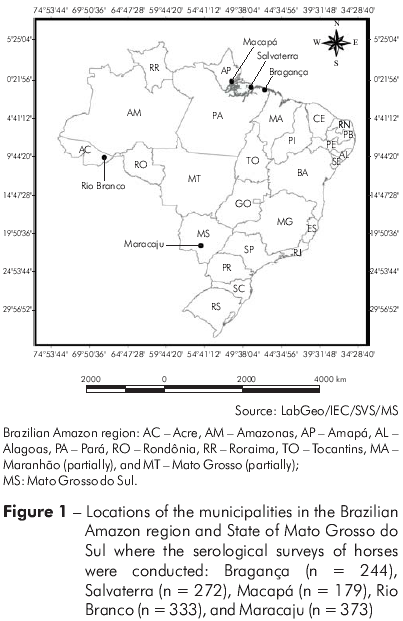
<body><![CDATA[<p><font size="3" face="verdana"><b>MATERIALS AND METHODS</b></font></p>     <p><font size="2" face="verdana"><b>STUDY DESIGN</b></font></p>     <p><font size="2" face="verdana">A descriptive cross-sectional observational study.</font></p>     <p><font size="2" face="verdana"><b>HORSE SERA</b></font></p>     <p><font size="2" face="verdana">Serum samples were collected from 1401 horses     selected by convenience sampling between March and September 2005. The serological     surveys were conducted on farms in the municipalities of Bragan&ccedil;a (n = 244) and Salvaterra (n   = 272), State of Par&aacute;, and Macap&aacute; (n = 179), State of Amap&aacute;,   and at state farm shows in Rio Branco (n = 333), State of Acre, and Maracaju   (n = 373), State of Mato Grosso do Sul (<a href="#f1">Figure 1</a>). The horses were healthy   at the time of blood collection and had no history of vaccination against flaviviruses.</font></p>     <p><a name="f1"></a></p>     <p>&nbsp;</p>     <p align="center"><img src="/img/revistas/rpas/v1n1/1a12f1.gif" border="0"></p>     <p>&nbsp;</p>     <p><font size="2" face="verdana">This study is part of a larger investigation     on equine encephalitis viruses and WestNile virus (WNV) conducted by the     Pan American Health Organization (PAHO)/Centers for Disease Control and Prevention     (CDC) in various Latin American countries.</font></p>     ]]></body>
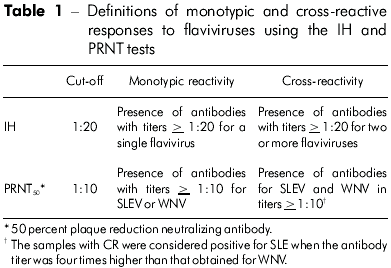
<body><![CDATA[<p><font size="2" face="verdana"><b>HEMAGGLUTINATION INHIBITION TEST</b></font></p>     <p><font size="2" face="verdana">For the HI test adapted to microplates<sup>19</sup>, serum     samples were tested against antigens from the SLEV, Rocio (ROCV), Ilh&eacute;us (ILHV), Cacipacor&eacute; (CPCV)   and Bussuquara (BSQV) flaviviruses. First, the samples were screened at a dilution   of 1:20 against antigens containing four hemagglutination units, and positive   sera were titrated up to a dilution (by factors of 2) of 1:1280.</font></p>     <p><font size="2" face="verdana"><b>PLAQUE REDUCTION NEUTRALIZATION TEST</b></font></p>     <p><font size="2" face="verdana">The PRNT was carried out simultaneously for     SLEV and another genetically closely related flavivirus (WNV) according to     the protocol for the detection of antibodies against flaviviruses (yellow     fever virus)<sup>20</sup>. Microtiter plates and Vero cells&nbsp; at   a concentration of 1.6 x 10<sup>5</sup> were used. The samples were tested at two-fold   serial dilutions (1:10 to 1:640) against a mean of 20 plaque forming units   (PFU) of SLEV (ChimeriVax-SLEV) and 16 PFU of WNV (ChimeriVax-WNV). The plates   were incubated for seven and six days, respectively. The titer of the neutralizing   antibodies was defined as the reciprocal of the serum dilution that reduced   the number of plaques by 50%. Samples containing neutralizing antibodies against   both viruses were considered to be positive for one of them when the antibody   titer was four times higher than that obtained for the other virus; otherwise,   the sample was said to present CR against the virus in question<sup>6</sup>.</font></p>     <p><font size="2" face="verdana">Since the PRNT for SLEV and WNV requires a biosafety level 3 laboratory (NB-3),   highly attenuated chimerae of these viruses with vaccine strain 17D of yellow   fever virus developed for diagnostic and surveillance purposes<sup>15,7</sup> were kindly   donated by the CDC to the Evandro Chagas Institute.</font></p>     <p><font size="2" face="verdana">In this study, MR refers to the presence of antibodies to a single flavivirus;   CR refers to the presence of antibodies to two or more flaviviruses<sup>6,8,19</sup> (<a href="#t1">Table   1</a>).</font></p>     <p><a name="t1"></a></p>     <p>&nbsp;</p>     <p align="center"><img src="/img/revistas/rpas/v1n1/1a12t1.gif" border="0"></p>     <p>&nbsp;</p>     ]]></body>
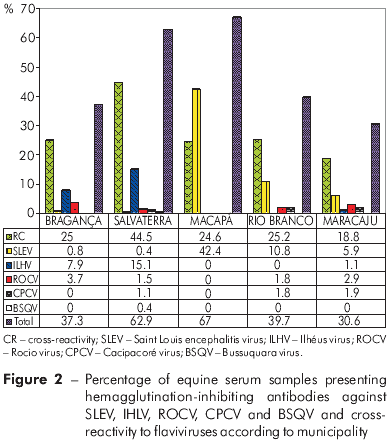
<body><![CDATA[<p><font size="2" face="verdana"><b>STATISTICAL ANALYSIS</b></font></p>     <p><font size="2" face="verdana">The prevalences of HI and neutralizing antibodies were compared by a binomial   test of proportions for independent samples with the level of significance   set at 5% (0.05). Statistical analysis was performed using the BioEstat program   version 5.0<sup>1</sup>.</font></p>     <p>&nbsp;</p>     <p><font size="3" face="verdana"><b>RESULTS</b></font></p>     <p><font size="2" face="verdana">HI antibodies against the tested flaviviruses were detected in 628 (44.8%)   of the 1401 equine serum samples, with 380 (27.1%) presenting CR between flaviviruses   and 248 (17.7%) presenting MR against the following viruses: SLEV (n=137, 9.8%),   ILHV (n=64, 4.6%), ROCV (n=30, 2.1%), CPCV (n=16, 1.1%), and BSQV (n=1, 0.1%).   Of the 248 samples presenting MR, 137 (55.2%) were reactive against SLEV.</font></p>     <p><font size="2" face="verdana">Analysis of the distribution of HI antibodies     according to municipality (<a href="#F2">Figure 2</a>) showed a higher prevalence among horses     from the municipalities of Macap&aacute;/Amap&aacute; (67%)   and Salvaterra/Par&aacute; (62.9%). The number of samples presenting MR against   SLEV was significantly higher in Macap&aacute; than in Bragan&ccedil;a (p=0.0022),   Salvaterra (p=0.0031), Rio Branco (p=0.0043), or Maracaju (p=0.0063).</font></p>     <p><a name="f2"></a></p>     <p>&nbsp;</p>     <p align="center"><img src="/img/revistas/rpas/v1n1/1a12f2.gif" border="0"></p>     <p>&nbsp;</p>     ]]></body>
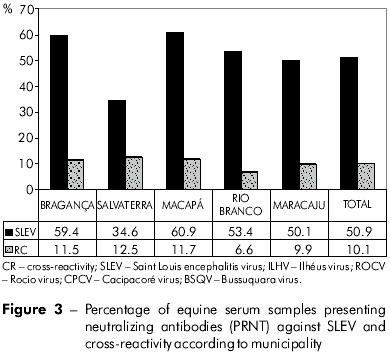
<body><![CDATA[<p><font size="2" face="verdana">Samples from Salvaterra presented MR against     antigens from all flaviviruses included in the test, and the highest frequency     of MR was observed for ILHV (n= 41, 15.5%) (<a href="#f2">Figure 2</a>).     In addition, the frequency of CR between flaviviruses     was significantly higher among samples from Salvaterra (p=0.037) than among     samples from Macap&aacute; or   the other municipalities. </font></p>     <p><font size="2" face="verdana">Using the PRNT, neutralizing antibodies against     SLEV were detected in 713 (50.9%) samples, with their frequency ranging from   34.6% (n=94) in Salvaterra to 60.9% (n=109) in Macap&aacute; (<a href="#f3">Figure   3</a>).</font></p>     <p><a name="f3"></a></p>     <p>&nbsp;</p>     <p align="center"><img src="/img/revistas/rpas/v1n1/1a12f3.gif" border="0"></p>     <p>&nbsp;</p>     <p><font size="2" face="verdana">The prevalence of neutralizing antibodies was     significantly higher in samples from Macap&aacute; when compared to Salvaterra (p=0.0083) and Maracaju (p=0.0176),   but no significant difference was observed compared to samples from Bragan&ccedil;a   (p=0.7608) or Rio Branco (p=0.1058).</font></p>     <p><font size="2" face="verdana">CR was detected by the PRNT in 142 (10.1%) serum samples from all five municipalities,   with the frequency ranging from 6.6% in Rio Branco/Acre to 12.5% in Salvaterra.   In addition, 123 (19.5%) of the HI-positive samples tested negative for SLEV   and WNV in the PRNT.</font></p>     <p>&nbsp;</p>     <p><font size="3" face="verdana"><b>DISCUSSION</b></font></p>     ]]></body>
<body><![CDATA[<p><font size="2" face="verdana">This study, the first of this type conducted in Brazil, detected HI and neutralizing   antibodies against SLEV in naturally infected horses in five geographically   distant municipalities (<a href="#f1">Figures 1</a>, <a href="#f2">2</a> and <a href="#f3">3</a>). Our results demonstrate the widespread   distribution of this virus, and they agree with previous studies conducted   on humans and wild vertebrates in Brazil (especially in the Brazilian Amazon   region) reporting a prevalence of HI antibodies ranging from 0.1 to 5.0%<sup>21,24</sup>.</font></p>     <p><font size="2" face="verdana">It should be mentioned that the horses from     Rio Branco/Acre and Maracaju/Mato Grosso do Sul were from various regions     of the state, whereas the animals from Macap&aacute;/Amap&aacute;, Salvaterra/Par&aacute; and     Bragan&ccedil;a/Par&aacute; belonged to a selected area within each municipality     and had no history of transfer or vaccination, indicating that the infections     in these latter areas were autochthonous.</font></p>     <p><font size="2" face="verdana">The results of the HI test suggest a notable     occurrence of SLEV infection in the municipality of Macap&aacute; (Amap&aacute;), where the high frequency   of antibodies was due to MR against SLEV. Furthermore, a predominance of MR   against ILHV was observed in Bragan&ccedil;a and Salvaterra, Par&aacute; State.   This virus is widely distributed in Central and South America and the prevalence   of neutralizing antibodies against ILHV in the Amazon region ranges from 3   to 36%<sup>21,25</sup>. MR against ILHV was also detected in horses that participated   in the state farm show of Maracaju, Mato Grosso do Sul, in agreement with the   previous observation of antibodies against ILHV in horses from the Brazilian   Pantanal area<sup>5</sup>.</font></p>     <p><font size="2" face="verdana">The HI test also showed that the horse populations     studied possessed an immune response pattern consistent with that of a population     exposed to infection with different flaviviruses, in agreement with the previously     demonstrated diversity of flaviviruses in Brazil<sup>21,3,2,25</sup>. In addition, the     variety of MR against other flaviviruses suggests the possible co-circulation     of SLEV with these viruses.This fact was well documented in the&nbsp; municipality     of Salvaterra, where samples presented the highest frequency of CR and MR     against antigens from all flaviviruses included in the study. In this respect,     the PRNT results also suggest the occurrence of infection with other flaviviruses     in the horse populations studied, with 10.1% of the samples being characterized     as cross-reactive and 19.5% of the HI-positive samples being negative for   SLEV and WNV.</font></p>     <p><font size="2" face="verdana">The serological evidence presented here, together with the lack of reports   of epizootics in horses, suggests the occurrence of inapparent, subclinical   or oligosymptomatic infections. This agrees with previous studies suggesting   that SLEV normally does not cause apparent clinical disease in horses<sup>24,16</sup>.</font></p>     <p><font size="2" face="verdana">In conclusion, the SLEV activity in horses and     possible co-circulation of other flaviviruses observed in the present study     agree with studies investigating human cases of SLEV infection diagnosed     in S&atilde;o     Paulo with dengue as the main clinical suspicion<sup>17,12,13</sup>. The small number     of human cases of SLEV infection is probably due to the occurrence of inapparent     infection, but it may also be the result of subdetection of clinical cases   due to the difficulty of making a differential diagnosis.</font></p>     <p>&nbsp;</p>     <p><font size="3" face="verdana"><b>ACKNOWLEDGEMENTS</b></font></p>     <p><font size="2" face="verdana">We thank Bas&iacute;lio Silva Buna, Luiz Roberto   Oliveira da Costa, and Geraldo Mendes da Silva for help with the field work and   laboratory activities. We are also indebted to dr. Barbara Johnson (CDC) for   kindly providing the chimera (ChimeriVax-SLE and ChimeriVax-WN). This work has   received financial support from Instituto Evandro Chagas/SVS/MS, PAHO (grant   109/2005) and National Counsel of Technological and Scientific Development (Conselho   Nacional de Desenvolvimento Cient&iacute;fico e Tecnol&oacute;gico - CNPq) (grant 300460/2005-8).</font></p>     <p>&nbsp;</p>     ]]></body>
<body><![CDATA[<p><font size="3" face="verdana"><b>REFERENCES</b></font></p>     <!-- ref --><p><font size="2" face="verdana">1 Ayres M, Ayres J&uacute;nior M, Ayres DL, Santos    AS. Bioestat 5.0: aplica&ccedil;&otilde;es estat&iacute;sticas nas &aacute;reas    das ci&ecirc;ncias biol&oacute;gicas e m&eacute;dicas. Bel&eacute;m: Sociedade    Civil Mamirau&aacute;; 2007.</font><!-- ref --><p><font size="2" face="verdana">2 Calisher CH, Gould EA. Taxonomy of the virus    family <i>Flaviviridae</i>. In: Maramorosch K, Murphy FA, Shatkin AJ, editors. Advances    in virus research. San Diego: Academic Press; 2003. Vol. 59, p. 1-19.</font><!-- ref --><p><font size="2" face="verdana">3 Figueiredo LT. The Brazilian flaviviruses.    Microbes Infect. 2000 Nov;2(13):1643-9.</font><font size="2" face="Verdana">    DOI:10.1016/S1286-4579(00)01320-4 &nbsp; &nbsp; &nbsp; &nbsp; &nbsp;&#91; <a href="http://www.sciencedirect.com/science?_ob=ArticleURL&_udi=B6VPN-41V2NYG-D&_user=10&_rdoc=1&_fmt=&_orig=search&_sort=d&_docanchor=&view=c&_acct=C000050221&_version=1&_urlVersion=0&_userid=10&md5=1b39544b0439cd5b2bcd0dc24404b1ef" target="_blank">Links</a>    &#93;</font><!-- ref --><p><font size="2" face="verdana">4 Gubler DJ, Kuno G, Markoff L. Flaviviruses.    In: Knipe DM, Howley PM, editors. Fields virology. 5th ed. Philadelphia: Lippincott    Williams &amp; Wilkins; 2007. p. 1153-252.</font><!-- ref --><p><font size="2" face="verdana">5 Iversson LB, Silva RA, Travassos da Rosa AP,    Barros VL. Circulation of eastern equine encephalitis, western equine encephalitis,    Ilh&eacute;us, Maguari and Tacaiuma viruses in equines of the Brazilian Pantanal,    South America. Rev Inst Med Trop Sao Paulo. 1993 Jul-Aug;35(4):355-9.</font><font size="2" face="Verdana">    DOI: 10.1590/S0036-46651993000400009 &nbsp; &nbsp; &nbsp; &nbsp; &nbsp;&#91;    <a href="http://www.scielo.br/scielo.php?script=sci_arttext&pid=S0036-46651993000400009" target="_blank">Links</a>    &#93;</font><!-- ref --><p><font size="2" face="verdana">6 Johnson BW, Kosoy O, Martin DA, Noga AJ, Russell    BJ, Johnson AA, et al. West Nile virus infection and serologic response among    persons previously vaccinated against yellow fever and Japanese encephalitis    viruses. Vector Borne Zoonotic Dis. 2005;5(2):137-45.</font><font size="2" face="Verdana">&nbsp;    &nbsp; &nbsp; &nbsp; &nbsp;&#91; <a href="http://www.ncbi.nlm.nih.gov/pubmed/16011430" target="_blank">Links</a>    &#93;</font><!-- ref --><p><font size="2" face="verdana">7 Komar N, Langevin S, Monath TP. Use of a surrogate    chimeric virus to detect west Nile virus-neutralizing antibodies in avian and    equine sera. Clin Vaccine Immunol. 2009 Jan;6(1):134-5. DOI: 10.1128/CVI.00220-08</font><font size="2" face="Verdana">&nbsp;    &nbsp; &nbsp; &nbsp; &nbsp;&#91; <a href="http://www.ncbi.nlm.nih.gov/pmc/articles/PMC2620674/" target="_blank">Links</a>    &#93;</font><!-- ref --><p><font size="2" face="verdana">8 Kuno G. Serodiagnosis of flaviviral infections    and vaccinations in humans. In: Maramorosch K, Murphy FA, Shatkin AJ, editors.    Advances in virus research. San Diego: Academic Press; 2003. Vol. 61, p. 3-65.</font><!-- ref --><p><font size="2" face="verdana">9 Marlenee NL, Loro&ntilde;o-Pino MA, Beaty BJ,    Blitvich BJ, Fern&aacute;ndez Salas I, Contreras Cordero JF, et al. Detection    of antibodies to west Nile and Saint Louis encephalitis viruses in horses. Salud    Publica Mex. 2004 Sep-Oct;46(5):373-5. DOI: 10.1590/S0036-36342004000500002</font><font size="2" face="Verdana">&nbsp;    &nbsp; &nbsp; &nbsp; &nbsp;&#91; <a href="http://www.scielosp.org/scielo.php?script=sci_arttext&pid=S0036-36342004000500002" target="_blank">Links</a>    &#93;</font><!-- ref --><p><font size="2" face="verdana">10 Mettler NE, Fern&aacute;ndez AS, Di Santo    MI, Pardo DA. Flavivirus: serological survey in horses from the Tandil area.    Rev Argent Microbiol. 1985;17(1):47-9.</font><font size="2" face="Verdana">&nbsp;    &nbsp; &nbsp; &nbsp; &nbsp;&#91; <a href="http://www.ncbi.nlm.nih.gov/pubmed/2829272" target="_blank">Links</a>    &#93;</font><!-- ref --><p><font size="2" face="verdana">11 Monath TP, editor. St. Louis encephalitis.    Washington: American Public Health Association; 1980. Epidemiology. p. 239-312.</font><!-- ref --><p><font size="2" face="verdana">12 Mondini A, Bronzoni R, Cardeal I, Santos     T, L&aacute;zaro   E, Nunes S, et al. Simultaneous infection by DENV-3 and SLEV in Brazil. J   Clin Virol. 2007 Sep;40(1):84-6.</font><!-- ref --><p><font size="2" face="verdana">13 Mondini A, Cardeal ILS, L&aacute;zaro E, Nunes    SH, Moreira CC, Rahal P, et al. Saint Louis encephalitis virus, Brazil. Emerg    Infect Dis. 2007 Jan;13(1):176-8.</font><font size="2" face="Verdana">&nbsp;    &nbsp; &nbsp; &nbsp; &nbsp;&#91; <a href="http://www.cdc.gov/ncidod/eid/13/1/176.htm" target="_blank">Links</a>    &#93;</font><!-- ref --><p><font size="2" face="verdana">14 Pinheiro FP, LeDuc JW, Travassos da Rosa AP,    Leite OF. Isolation of St. Louis encephalitis virus from a patient in Bel&eacute;m,    Brazil. Am J Trop Med Hyg. 1981 Jan;30(1):145-8.</font><font size="2" face="Verdana">&nbsp;    &nbsp; &nbsp; &nbsp; &nbsp;&#91; <a href="http://www.ajtmh.org/cgi/content/abstract/30/1/145" target="_blank">Links</a>    &#93;</font><!-- ref --><p><font size="2" face="verdana">15 Pugachev KV, Guirakhoo F, Mitchell F, Ocran    SW, Parsons M, Johnson BW, et al. Construction of yellow fever/St. Louis encephalitis    chimeric virus and the use of chimeras as a diagnostic tool. Am J Trop Med Hyg.    2004 Nov;71(5):639-45.</font><font size="2" face="Verdana">&nbsp; &nbsp; &nbsp;    &nbsp; &nbsp;&#91; <a href="http://www.ajtmh.org/cgi/content/abstract/71/5/639" target="_blank">Links</a>    &#93;</font><!-- ref --><p><font size="2" face="verdana">16 Reisen WK. Epidemiology of St. Louis encephalitis    virus. In: Maramorosch K, Murphy FA, Shatkin AJ, editors. Advances in virus    research. San Diego: Academic Press; 2003. Vol. 61, p. 139-83.</font><!-- ref --><p><font size="2" face="verdana">17 Rocco IM, Santos CL, Bisordi I, Petrella SM,    Pereira LE, Souza RP, et al. St. Louis encephalitis virus: first virus isolation    from a human in S&atilde;o Paulo State, Brazil. Rev Inst Med Trop Sao Paulo.    2005 Sep-Oct;47(5):281-5.</font><font size="2" face="Verdana"> DOI: 10.1590/S0036-46652005000500008&nbsp;    &nbsp; &nbsp; &nbsp; &nbsp;&#91; <a href="http://www.scielo.br/scielo.php?pid=S0036-46652005000500008&script=sci_abstract" target="_blank">Links</a>    &#93;</font><!-- ref --><p><font size="2" face="verdana">18 Roehrig JT, Hombach J, Barrett AD. Guidelines    for plaque-reduction neutralization testing of human antibodies to dengue viruses.    Viral Immunol. 2008 Jun;21(2):123-32.</font><font size="2" face="Verdana">&nbsp;    &nbsp; &nbsp; &nbsp; &nbsp;&#91; <a href="http://www.ncbi.nlm.nih.gov/pubmed/18476771" target="_blank">Links</a>    &#93;</font><!-- ref --><p><font size="2" face="verdana">19 Shope RE. The use of a microhemagglutination-inhibition test   to follow antibody response after arthropod-borne virus infection in a community   of forest animals. An Microbiol. 1963;11:167-71.</font><!-- ref --><p><font size="2" face="verdana">20 Stefano I, Sato HK, Pannuti CS, Omoto TM,    Mann G, Freire MS, et al. Recent immunization against measles does not interfere    with the efficacy of yellow fever vaccination. Vaccine. 1999 Mar;17(9-10):1042-6.</font><font size="2" face="Verdana">&nbsp;    &nbsp; &nbsp; &nbsp; &nbsp;&#91; <a href="http://iah2lab.iec.pa.gov.br/cgi-bin/wxis.exe/iah/iecbvs/?IsisScript=iah/iah.xis&lang=P&base=iecbvs&nextAction=lnk&exprSearch=ELEMENTO%20DE%20RESPOSTA%20SERICA&indexSearch=MH" target="_blank">Links</a>    &#93;</font><!-- ref --><p><font size="2" face="verdana">21 Travassos da Rosa APA, Travassos da Rosa JFS,    Pinheiro FP, Vasconcelos PFC. Arboviroses. In: Le&atilde;o RNQ, coordenador.    Doen&ccedil;as infecciosas e parasit&aacute;rias: enfoque amaz&ocirc;nico. Bel&eacute;m:    CEJUP; 1997. p. 208-225.</font><font size="2" face="Verdana">&nbsp; &nbsp; &nbsp;    &nbsp; &nbsp;&#91; <a href="http://iah2lab.iec.pa.gov.br/cgi-bin/wxis.exe/iah/?IsisScript=iah/iah.xis&lang=P&base=iecbvs&nextAction=lnk&exprSearch=858&indexSearch=ID" target="_blank">Links</a>    &#93;</font><!-- ref --><p><font size="2" face="verdana">22 Tsai TF, Mitchell CJ. St. Louis encephalitis. In: Monath TP,   editor. The arboviruses: epidemiology and ecology. Boca Raton: Academic Press;   1989. p. 431-58.</font><!-- ref --><p><font size="2" face="verdana">23 Vasconcelos PFC, Travassos da Rosa JFS, Travassos    da Rosa APA, D&eacute;gallier N, Pinheiro FP, S&aacute; Filho GC. Epidemiologia    das encefalites por arbov&iacute;rus na Amaz&ocirc;nia brasileira. Rev Inst    Med Trop Sao Paulo. 1991 nov-dec;33(6):465-76.</font><font size="2" face="Verdana">&nbsp;    &nbsp; &nbsp; &nbsp; &nbsp;&#91; <a href="http://www.scielo.br/scielo.php?script=sci_arttext&pid=S0036-46651991000600007" target="_blank">Links</a>    &#93;</font><!-- ref --><p><font size="2" face="verdana">24&nbsp;&nbsp; Vasconcelos PFC, Travassos da    Rosa APA, Pinheiro FP, Shope RE, Travassos da Rosa JFS, Rodrigues SG, et al.    Arboviruses pathogenic for man in Brazil. In: Travassos da Rosa APA, Vasconcelos    PFC, Travassos da Rosa JFS, editors. An overview of arbovirology in Brazil and    neighbouring countries. Bel&eacute;m: CEJUP; 1998. p. 72-99.</font><font size="2" face="Verdana">&nbsp;    &nbsp; &nbsp; &nbsp; &nbsp;&#91; <a href="http://bases.bireme.br/cgi-bin/wxislind.exe/iah/online/?IsisScript=iah/iah.xis&src=google&base=LILACS&lang=p&nextAction=lnk&exprSearch=248895&indexSearch=ID" target="_blank">Links</a>    &#93;</font><!-- ref -->25 Vasconcelos PFC, Travassos da Rosa APA, Pinheiro FP, Travassos da Rosa JFS. Arboviroses. In: Focaccia R, Veronesi R, editores. Tratado de infectologia. S&atilde;o Paulo: Atheneu; 2005. Vol. 1, p. 289-302.</font>    <p>&nbsp;</p>     <p>&nbsp;</p>     <p><font size="2" face="verdana"><b><a name="endereco"></a><a href="#topo"><img src="/img/revistas/rpas/v1n1/seta.gif" border="0"></a>Correspond&ecirc;ncia/Correspondence/Correspondencia:</b>    <br>   Sueli Guerreiro Rodrigues    ]]></body>
<body><![CDATA[<br>   Instituto Evandro Chagas    <br>   Rodovia BR316, km 7, s/n<sup>o</sup>, Levil&acirc;ndia    <br>   CEP: 67030-000    <br>   Ananindeua-Par&aacute;-Brasil    <br>   E-mail:<a href="mailto">suelirodrigues@iec.pa.gov.br</a></font></p>     <p>&nbsp;</p>     <p>&nbsp;</p>     <p><font size="2" face="verdana">Recebido em / Received / Recibido en: 29/7/2009    <br> Aceito em / Accepted / Aceito en: 28/9/2009</font></p> <script type="text/javascript"> var gaJsHost = (("https:" == document.location.protocol) ? "https://ssl." : "http://www."); document.write(unescape("%3Cscript src='" + gaJsHost + "google-analytics.com/ga.js' type='text/javascript'%3E%3C/script%3E")); </script> <script type="text/javascript"> try { var pageTracker = _gat._getTracker("UA-7885746-4"); pageTracker._setDomainName("none"); pageTracker._setAllowLinker(true); pageTracker._trackPageview(); } catch(err) {}</script>      ]]></body><back>
<ref-list>
<ref id="B1">
<label>1</label><nlm-citation citation-type="book">
<person-group person-group-type="author">
<name>
<surname><![CDATA[Ayres]]></surname>
<given-names><![CDATA[M]]></given-names>
</name>
<name>
<surname><![CDATA[Ayres Júnior]]></surname>
<given-names><![CDATA[M]]></given-names>
</name>
<name>
<surname><![CDATA[Ayres]]></surname>
<given-names><![CDATA[DL]]></given-names>
</name>
<name>
<surname><![CDATA[Santos]]></surname>
<given-names><![CDATA[AS]]></given-names>
</name>
</person-group>
<source><![CDATA[Bioestat 5.0: aplicações estatísticas nas áreas das ciências biológicas e médicas]]></source>
<year>2007</year>
<publisher-loc><![CDATA[Belém ]]></publisher-loc>
<publisher-name><![CDATA[Sociedade Civil Mamirauá]]></publisher-name>
</nlm-citation>
</ref>
<ref id="B2">
<label>2</label><nlm-citation citation-type="book">
<person-group person-group-type="author">
<name>
<surname><![CDATA[Calisher]]></surname>
<given-names><![CDATA[CH]]></given-names>
</name>
<name>
<surname><![CDATA[Gould]]></surname>
<given-names><![CDATA[EA]]></given-names>
</name>
</person-group>
<article-title xml:lang="en"><![CDATA[Taxonomy of the virus family Flaviviridae]]></article-title>
<person-group person-group-type="editor">
<name>
<surname><![CDATA[Maramorosch]]></surname>
<given-names><![CDATA[K]]></given-names>
</name>
<name>
<surname><![CDATA[Murphy]]></surname>
<given-names><![CDATA[FA]]></given-names>
</name>
<name>
<surname><![CDATA[Shatkin]]></surname>
<given-names><![CDATA[AJ]]></given-names>
</name>
</person-group>
<source><![CDATA[Advances in virus research]]></source>
<year>2003</year>
<page-range>1-19</page-range><publisher-loc><![CDATA[San Diego ]]></publisher-loc>
<publisher-name><![CDATA[Academic Press]]></publisher-name>
</nlm-citation>
</ref>
<ref id="B3">
<label>3</label><nlm-citation citation-type="journal">
<person-group person-group-type="author">
<name>
<surname><![CDATA[Figueiredo]]></surname>
<given-names><![CDATA[LT]]></given-names>
</name>
</person-group>
<article-title xml:lang="en"><![CDATA[The Brazilian flaviviruses]]></article-title>
<source><![CDATA[Microbes Infect]]></source>
<year>2000</year>
<month> N</month>
<day>ov</day>
<volume>2</volume>
<numero>13</numero>
<issue>13</issue>
<page-range>1643-9</page-range></nlm-citation>
</ref>
<ref id="B4">
<label>4</label><nlm-citation citation-type="book">
<person-group person-group-type="author">
<name>
<surname><![CDATA[Gubler]]></surname>
<given-names><![CDATA[DJ]]></given-names>
</name>
<name>
<surname><![CDATA[Kuno]]></surname>
<given-names><![CDATA[G]]></given-names>
</name>
<name>
<surname><![CDATA[Markoff]]></surname>
<given-names><![CDATA[L]]></given-names>
</name>
</person-group>
<article-title xml:lang="en"><![CDATA[Flaviviruses]]></article-title>
<person-group person-group-type="editor">
<name>
<surname><![CDATA[Knipe]]></surname>
<given-names><![CDATA[DM]]></given-names>
</name>
<name>
<surname><![CDATA[Howley]]></surname>
<given-names><![CDATA[PM]]></given-names>
</name>
</person-group>
<source><![CDATA[Fields virology]]></source>
<year>2007</year>
<edition>5</edition>
<page-range>1153-252</page-range><publisher-loc><![CDATA[Philadelphia ]]></publisher-loc>
<publisher-name><![CDATA[Lippincott Williams & Wilkins]]></publisher-name>
</nlm-citation>
</ref>
<ref id="B5">
<label>5</label><nlm-citation citation-type="journal">
<person-group person-group-type="author">
<name>
<surname><![CDATA[Iversson]]></surname>
<given-names><![CDATA[LB]]></given-names>
</name>
<name>
<surname><![CDATA[Silva]]></surname>
<given-names><![CDATA[RA]]></given-names>
</name>
<name>
<surname><![CDATA[Travassos da Rosa]]></surname>
<given-names><![CDATA[AP]]></given-names>
</name>
<name>
<surname><![CDATA[Barros]]></surname>
<given-names><![CDATA[VL]]></given-names>
</name>
</person-group>
<article-title xml:lang="en"><![CDATA[Circulation of eastern equine encephalitis, western equine encephalitis, Ilhéus, Maguari and Tacaiuma viruses in equines of the Brazilian Pantanal, South America]]></article-title>
<source><![CDATA[Rev Inst Med Trop Sao Paulo]]></source>
<year>1993</year>
<month> J</month>
<day>ul</day>
<volume>35</volume>
<numero>4</numero>
<issue>4</issue>
<page-range>355-9</page-range></nlm-citation>
</ref>
<ref id="B6">
<label>6</label><nlm-citation citation-type="journal">
<person-group person-group-type="author">
<name>
<surname><![CDATA[Johnson]]></surname>
<given-names><![CDATA[BW]]></given-names>
</name>
<name>
<surname><![CDATA[Kosoy]]></surname>
<given-names><![CDATA[O]]></given-names>
</name>
<name>
<surname><![CDATA[Martin]]></surname>
<given-names><![CDATA[DA]]></given-names>
</name>
<name>
<surname><![CDATA[Noga]]></surname>
<given-names><![CDATA[AJ]]></given-names>
</name>
<name>
<surname><![CDATA[Russell]]></surname>
<given-names><![CDATA[BJ]]></given-names>
</name>
<name>
<surname><![CDATA[Johnson]]></surname>
<given-names><![CDATA[AA]]></given-names>
</name>
</person-group>
<article-title xml:lang="en"><![CDATA[West Nile virus infection and serologic response among persons previously vaccinated against yellow fever and Japanese encephalitis viruses]]></article-title>
<source><![CDATA[Vector Borne Zoonotic Dis]]></source>
<year>2005</year>
<volume>5</volume>
<numero>2</numero>
<issue>2</issue>
<page-range>137-45</page-range></nlm-citation>
</ref>
<ref id="B7">
<label>7</label><nlm-citation citation-type="journal">
<person-group person-group-type="author">
<name>
<surname><![CDATA[Komar]]></surname>
<given-names><![CDATA[N]]></given-names>
</name>
<name>
<surname><![CDATA[Langevin]]></surname>
<given-names><![CDATA[S]]></given-names>
</name>
<name>
<surname><![CDATA[Monath]]></surname>
<given-names><![CDATA[TP]]></given-names>
</name>
</person-group>
<article-title xml:lang="en"><![CDATA[Use of a surrogate chimeric virus to detect west Nile virus-neutralizing antibodies in avian and equine sera]]></article-title>
<source><![CDATA[Clin Vaccine Immunol]]></source>
<year>2009</year>
<month> J</month>
<day>an</day>
<volume>6</volume>
<numero>1</numero>
<issue>1</issue>
<page-range>134-5</page-range></nlm-citation>
</ref>
<ref id="B8">
<label>8</label><nlm-citation citation-type="book">
<person-group person-group-type="author">
<name>
<surname><![CDATA[Kuno]]></surname>
<given-names><![CDATA[G]]></given-names>
</name>
</person-group>
<person-group person-group-type="editor">
<name>
<surname><![CDATA[Maramorosch]]></surname>
<given-names><![CDATA[K]]></given-names>
</name>
<name>
<surname><![CDATA[Murphy]]></surname>
<given-names><![CDATA[FA]]></given-names>
</name>
<name>
<surname><![CDATA[Shatkin]]></surname>
<given-names><![CDATA[AJ]]></given-names>
</name>
</person-group>
<source><![CDATA[Advances in virus research]]></source>
<year>2003</year>
<page-range>3-65</page-range><publisher-loc><![CDATA[San Diego ]]></publisher-loc>
<publisher-name><![CDATA[Academic Press]]></publisher-name>
</nlm-citation>
</ref>
<ref id="B9">
<label>9</label><nlm-citation citation-type="journal">
<person-group person-group-type="author">
<name>
<surname><![CDATA[Marlenee]]></surname>
<given-names><![CDATA[NL]]></given-names>
</name>
<name>
<surname><![CDATA[Loroño-Pino]]></surname>
<given-names><![CDATA[MA]]></given-names>
</name>
<name>
<surname><![CDATA[Beaty]]></surname>
<given-names><![CDATA[BJ]]></given-names>
</name>
<name>
<surname><![CDATA[Blitvich]]></surname>
<given-names><![CDATA[BJ]]></given-names>
</name>
<name>
<surname><![CDATA[Fernández Salas]]></surname>
<given-names><![CDATA[I]]></given-names>
</name>
<name>
<surname><![CDATA[Contreras Cordero]]></surname>
<given-names><![CDATA[JF]]></given-names>
</name>
</person-group>
<article-title xml:lang="en"><![CDATA[Detection of antibodies to west Nile and Saint Louis encephalitis viruses in horses]]></article-title>
<source><![CDATA[Salud Publica Mex]]></source>
<year>2004</year>
<month> S</month>
<day>ep</day>
<volume>46</volume>
<numero>5</numero>
<issue>5</issue>
<page-range>373-5</page-range></nlm-citation>
</ref>
<ref id="B10">
<label>10</label><nlm-citation citation-type="journal">
<person-group person-group-type="author">
<name>
<surname><![CDATA[Mettler]]></surname>
<given-names><![CDATA[NE]]></given-names>
</name>
<name>
<surname><![CDATA[Fernández]]></surname>
<given-names><![CDATA[AS]]></given-names>
</name>
<name>
<surname><![CDATA[Di Santo]]></surname>
<given-names><![CDATA[MI]]></given-names>
</name>
<name>
<surname><![CDATA[Pardo]]></surname>
<given-names><![CDATA[DA]]></given-names>
</name>
</person-group>
<article-title xml:lang="en"><![CDATA[Flavivirus: serological survey in horses from the Tandil area]]></article-title>
<source><![CDATA[Rev Argent Microbiol]]></source>
<year>1985</year>
<volume>17</volume>
<numero>1</numero>
<issue>1</issue>
<page-range>47-9</page-range></nlm-citation>
</ref>
<ref id="B11">
<label>11</label><nlm-citation citation-type="book">
<person-group person-group-type="author">
<name>
<surname><![CDATA[Monath]]></surname>
<given-names><![CDATA[TP]]></given-names>
</name>
</person-group>
<source><![CDATA[St. Louis encephalitis]]></source>
<year>1980</year>
<page-range>239-312</page-range><publisher-loc><![CDATA[Washington ]]></publisher-loc>
<publisher-name><![CDATA[American Public Health Association]]></publisher-name>
</nlm-citation>
</ref>
<ref id="B12">
<label>12</label><nlm-citation citation-type="journal">
<person-group person-group-type="author">
<name>
<surname><![CDATA[Mondini]]></surname>
<given-names><![CDATA[A]]></given-names>
</name>
<name>
<surname><![CDATA[Bronzoni]]></surname>
<given-names><![CDATA[R]]></given-names>
</name>
<name>
<surname><![CDATA[Cardeal]]></surname>
<given-names><![CDATA[I]]></given-names>
</name>
<name>
<surname><![CDATA[Santos]]></surname>
<given-names><![CDATA[T]]></given-names>
</name>
<name>
<surname><![CDATA[Lázaro]]></surname>
<given-names><![CDATA[E]]></given-names>
</name>
<name>
<surname><![CDATA[Nunes]]></surname>
<given-names><![CDATA[S]]></given-names>
</name>
</person-group>
<article-title xml:lang="en"><![CDATA[Simultaneous infection by DENV-3 and SLEV in Brazil]]></article-title>
<source><![CDATA[J Clin Virol]]></source>
<year>2007</year>
<month> S</month>
<day>ep</day>
<volume>40</volume>
<numero>1</numero>
<issue>1</issue>
<page-range>84-6</page-range></nlm-citation>
</ref>
<ref id="B13">
<label>13</label><nlm-citation citation-type="journal">
<person-group person-group-type="author">
<name>
<surname><![CDATA[Mondini]]></surname>
<given-names><![CDATA[A]]></given-names>
</name>
<name>
<surname><![CDATA[Cardeal]]></surname>
<given-names><![CDATA[ILS]]></given-names>
</name>
<name>
<surname><![CDATA[Lázaro]]></surname>
<given-names><![CDATA[E]]></given-names>
</name>
<name>
<surname><![CDATA[Nunes]]></surname>
<given-names><![CDATA[SH]]></given-names>
</name>
<name>
<surname><![CDATA[Moreira]]></surname>
<given-names><![CDATA[CC]]></given-names>
</name>
<name>
<surname><![CDATA[Rahal]]></surname>
<given-names><![CDATA[P]]></given-names>
</name>
</person-group>
<article-title xml:lang="en"><![CDATA[Saint Louis encephalitis virus, Brazil]]></article-title>
<source><![CDATA[Emerg Infect Dis]]></source>
<year>2007</year>
<month> J</month>
<day>an</day>
<volume>13</volume>
<numero>1</numero>
<issue>1</issue>
<page-range>176-8</page-range></nlm-citation>
</ref>
<ref id="B14">
<label>14</label><nlm-citation citation-type="journal">
<person-group person-group-type="author">
<name>
<surname><![CDATA[Pinheiro]]></surname>
<given-names><![CDATA[FP]]></given-names>
</name>
<name>
<surname><![CDATA[LeDuc]]></surname>
<given-names><![CDATA[JW]]></given-names>
</name>
<name>
<surname><![CDATA[Travassos da Rosa]]></surname>
<given-names><![CDATA[AP]]></given-names>
</name>
<name>
<surname><![CDATA[Leite]]></surname>
<given-names><![CDATA[OF]]></given-names>
</name>
</person-group>
<article-title xml:lang="en"><![CDATA[Isolation of St. Louis encephalitis virus from a patient in Belém, Brazil]]></article-title>
<source><![CDATA[Am J Trop Med Hyg]]></source>
<year>1981</year>
<month> J</month>
<day>an</day>
<volume>30</volume>
<numero>1</numero>
<issue>1</issue>
<page-range>145-8</page-range></nlm-citation>
</ref>
<ref id="B15">
<label>15</label><nlm-citation citation-type="journal">
<person-group person-group-type="author">
<name>
<surname><![CDATA[Pugachev]]></surname>
<given-names><![CDATA[KV]]></given-names>
</name>
<name>
<surname><![CDATA[Guirakhoo]]></surname>
<given-names><![CDATA[F]]></given-names>
</name>
<name>
<surname><![CDATA[Mitchell]]></surname>
<given-names><![CDATA[F]]></given-names>
</name>
<name>
<surname><![CDATA[Ocran]]></surname>
<given-names><![CDATA[SW]]></given-names>
</name>
<name>
<surname><![CDATA[Parsons]]></surname>
<given-names><![CDATA[M]]></given-names>
</name>
<name>
<surname><![CDATA[Johnson]]></surname>
<given-names><![CDATA[BW]]></given-names>
</name>
</person-group>
<article-title xml:lang="en"><![CDATA[Construction of yellow fever/St. Louis encephalitis chimeric virus and the use of chimeras as a diagnostic tool]]></article-title>
<source><![CDATA[Am J Trop Med Hyg]]></source>
<year>2004</year>
<month> N</month>
<day>ov</day>
<volume>71</volume>
<numero>5</numero>
<issue>5</issue>
<page-range>639-45</page-range></nlm-citation>
</ref>
<ref id="B16">
<label>16</label><nlm-citation citation-type="book">
<person-group person-group-type="author">
<name>
<surname><![CDATA[Reisen]]></surname>
<given-names><![CDATA[WK]]></given-names>
</name>
</person-group>
<article-title xml:lang="en"><![CDATA[Epidemiology of St. Louis encephalitis virus]]></article-title>
<person-group person-group-type="editor">
<name>
<surname><![CDATA[Maramorosch]]></surname>
<given-names><![CDATA[K]]></given-names>
</name>
<name>
<surname><![CDATA[Murphy]]></surname>
<given-names><![CDATA[FA]]></given-names>
</name>
<name>
<surname><![CDATA[Shatkin]]></surname>
<given-names><![CDATA[AJ]]></given-names>
</name>
</person-group>
<source><![CDATA[Advances in virus research]]></source>
<year>2003</year>
<page-range>139-83</page-range><publisher-loc><![CDATA[San Diego ]]></publisher-loc>
<publisher-name><![CDATA[Academic Press]]></publisher-name>
</nlm-citation>
</ref>
<ref id="B17">
<label>17</label><nlm-citation citation-type="journal">
<person-group person-group-type="author">
<name>
<surname><![CDATA[Rocco]]></surname>
<given-names><![CDATA[IM]]></given-names>
</name>
<name>
<surname><![CDATA[Santos]]></surname>
<given-names><![CDATA[CL]]></given-names>
</name>
<name>
<surname><![CDATA[Bisordi]]></surname>
<given-names><![CDATA[I]]></given-names>
</name>
<name>
<surname><![CDATA[Petrella]]></surname>
<given-names><![CDATA[SM]]></given-names>
</name>
<name>
<surname><![CDATA[Pereira]]></surname>
<given-names><![CDATA[LE]]></given-names>
</name>
<name>
<surname><![CDATA[Souza]]></surname>
<given-names><![CDATA[RP]]></given-names>
</name>
</person-group>
<article-title xml:lang="en"><![CDATA[St. Louis encephalitis virus: first virus isolation from a human in São Paulo State, Bra]]></article-title>
<source><![CDATA[Rev Inst Med Trop Sao Paulo]]></source>
<year>2005</year>
<month> S</month>
<day>ep</day>
<volume>47</volume>
<numero>5</numero>
<issue>5</issue>
<page-range>281-5</page-range></nlm-citation>
</ref>
<ref id="B18">
<label>18</label><nlm-citation citation-type="journal">
<person-group person-group-type="author">
<name>
<surname><![CDATA[Roehrig]]></surname>
<given-names><![CDATA[JT]]></given-names>
</name>
<name>
<surname><![CDATA[Hombach]]></surname>
<given-names><![CDATA[J]]></given-names>
</name>
<name>
<surname><![CDATA[Barrett]]></surname>
<given-names><![CDATA[AD]]></given-names>
</name>
</person-group>
<article-title xml:lang="en"><![CDATA[Guidelines for plaque-reduction neutralization testing of human antibodies to dengue viruses]]></article-title>
<source><![CDATA[Viral Immunol]]></source>
<year>2008</year>
<month> J</month>
<day>un</day>
<volume>21</volume>
<numero>2</numero>
<issue>2</issue>
<page-range>123-32</page-range></nlm-citation>
</ref>
<ref id="B19">
<label>19</label><nlm-citation citation-type="journal">
<person-group person-group-type="author">
<name>
<surname><![CDATA[Shope]]></surname>
<given-names><![CDATA[RE]]></given-names>
</name>
</person-group>
<article-title xml:lang="en"><![CDATA[The use of a microhemagglutination-inhibition test to follow antibody response after arthropod-borne virus infection in a community of forest animals]]></article-title>
<source><![CDATA[An Microbiol]]></source>
<year>1963</year>
<volume>11</volume>
<page-range>167-71</page-range></nlm-citation>
</ref>
<ref id="B20">
<label>20</label><nlm-citation citation-type="journal">
<person-group person-group-type="author">
<name>
<surname><![CDATA[Stefano]]></surname>
<given-names><![CDATA[I]]></given-names>
</name>
<name>
<surname><![CDATA[Sato]]></surname>
<given-names><![CDATA[HK]]></given-names>
</name>
<name>
<surname><![CDATA[Pannuti]]></surname>
<given-names><![CDATA[CS]]></given-names>
</name>
<name>
<surname><![CDATA[Omoto]]></surname>
<given-names><![CDATA[TM]]></given-names>
</name>
<name>
<surname><![CDATA[Mann]]></surname>
<given-names><![CDATA[G]]></given-names>
</name>
<name>
<surname><![CDATA[Freire]]></surname>
<given-names><![CDATA[MS]]></given-names>
</name>
</person-group>
<article-title xml:lang="en"><![CDATA[Recent immunization against measles does not interfere with the efficacy of yellow fever vaccination]]></article-title>
<source><![CDATA[Vaccine]]></source>
<year>1999</year>
<month> M</month>
<day>ar</day>
<volume>17</volume>
<numero>9-10</numero>
<issue>9-10</issue>
<page-range>1042-6</page-range></nlm-citation>
</ref>
<ref id="B21">
<label>21</label><nlm-citation citation-type="book">
<person-group person-group-type="author">
<name>
<surname><![CDATA[Travassos da Rosa]]></surname>
<given-names><![CDATA[APA]]></given-names>
</name>
<name>
<surname><![CDATA[Travassos da Rosa]]></surname>
<given-names><![CDATA[JFS]]></given-names>
</name>
<name>
<surname><![CDATA[Pinheiro]]></surname>
<given-names><![CDATA[FP]]></given-names>
</name>
<name>
<surname><![CDATA[Vasconcelos]]></surname>
<given-names><![CDATA[PFC]]></given-names>
</name>
</person-group>
<article-title xml:lang="pt"><![CDATA[Arboviroses]]></article-title>
<person-group person-group-type="editor">
<name>
<surname><![CDATA[Leão]]></surname>
<given-names><![CDATA[RNQ]]></given-names>
</name>
</person-group>
<source><![CDATA[Doenças infecciosas e parasitárias: enfoque amazônico]]></source>
<year>1997</year>
<page-range>208-225</page-range><publisher-loc><![CDATA[Belém ]]></publisher-loc>
<publisher-name><![CDATA[CEJUP]]></publisher-name>
</nlm-citation>
</ref>
<ref id="B22">
<label>22</label><nlm-citation citation-type="book">
<person-group person-group-type="author">
<name>
<surname><![CDATA[Tsai]]></surname>
<given-names><![CDATA[TF]]></given-names>
</name>
<name>
<surname><![CDATA[Mitchell]]></surname>
<given-names><![CDATA[CJ]]></given-names>
</name>
</person-group>
<article-title xml:lang="en"><![CDATA[St. Louis encephalitis]]></article-title>
<person-group person-group-type="editor">
<name>
<surname><![CDATA[Monath]]></surname>
<given-names><![CDATA[TP]]></given-names>
</name>
</person-group>
<source><![CDATA[The arboviruses: epidemiology and ecology]]></source>
<year>1989</year>
<page-range>431-58</page-range><publisher-loc><![CDATA[Boca Raton ]]></publisher-loc>
<publisher-name><![CDATA[Academic Press]]></publisher-name>
</nlm-citation>
</ref>
<ref id="B23">
<label>23</label><nlm-citation citation-type="journal">
<person-group person-group-type="author">
<name>
<surname><![CDATA[Vasconcelos]]></surname>
<given-names><![CDATA[PFC]]></given-names>
</name>
<name>
<surname><![CDATA[Travassos da Rosa]]></surname>
<given-names><![CDATA[JFS]]></given-names>
</name>
<name>
<surname><![CDATA[Travassos da Rosa]]></surname>
<given-names><![CDATA[APA]]></given-names>
</name>
<name>
<surname><![CDATA[Dégallier]]></surname>
<given-names><![CDATA[N]]></given-names>
</name>
<name>
<surname><![CDATA[Pinheiro]]></surname>
<given-names><![CDATA[FP]]></given-names>
</name>
<name>
<surname><![CDATA[Sá Filho]]></surname>
<given-names><![CDATA[GC]]></given-names>
</name>
</person-group>
<article-title xml:lang="pt"><![CDATA[Epidemiologia das encefalites por arbovírus na Amazônia brasileira]]></article-title>
<source><![CDATA[Rev Inst Med Trop Sao Paulo]]></source>
<year>1991</year>
<month> n</month>
<day>ov</day>
<volume>33</volume>
<numero>6</numero>
<issue>6</issue>
<page-range>465-76</page-range></nlm-citation>
</ref>
<ref id="B24">
<label>24</label><nlm-citation citation-type="book">
<person-group person-group-type="author">
<name>
<surname><![CDATA[Vasconcelos]]></surname>
<given-names><![CDATA[PFC]]></given-names>
</name>
<name>
<surname><![CDATA[Travassos da Rosa]]></surname>
<given-names><![CDATA[APA]]></given-names>
</name>
<name>
<surname><![CDATA[Pinheiro]]></surname>
<given-names><![CDATA[FP]]></given-names>
</name>
<name>
<surname><![CDATA[Shope]]></surname>
<given-names><![CDATA[RE]]></given-names>
</name>
<name>
<surname><![CDATA[Travassos da Rosa]]></surname>
<given-names><![CDATA[JFS]]></given-names>
</name>
<name>
<surname><![CDATA[Rodrigues]]></surname>
<given-names><![CDATA[SG]]></given-names>
</name>
</person-group>
<article-title xml:lang="en"><![CDATA[Arboviruses pathogenic for man in Brazil]]></article-title>
<person-group person-group-type="editor">
<name>
<surname><![CDATA[Travassos da Rosa]]></surname>
<given-names><![CDATA[APA]]></given-names>
</name>
<name>
<surname><![CDATA[Vasconcelos]]></surname>
<given-names><![CDATA[PFC]]></given-names>
</name>
<name>
<surname><![CDATA[Travassos da Rosa]]></surname>
<given-names><![CDATA[JFS]]></given-names>
</name>
</person-group>
<source><![CDATA[An overview of arbovirology in Brazil and neighbouring countries]]></source>
<year>1998</year>
<page-range>72-99</page-range><publisher-loc><![CDATA[Belém ]]></publisher-loc>
<publisher-name><![CDATA[CEJUP]]></publisher-name>
</nlm-citation>
</ref>
<ref id="B25">
<label>25</label><nlm-citation citation-type="book">
<person-group person-group-type="author">
<name>
<surname><![CDATA[Vasconcelos]]></surname>
<given-names><![CDATA[PFC]]></given-names>
</name>
<name>
<surname><![CDATA[Travassos da Rosa]]></surname>
<given-names><![CDATA[APA]]></given-names>
</name>
<name>
<surname><![CDATA[Pinheiro]]></surname>
<given-names><![CDATA[FP]]></given-names>
</name>
<name>
<surname><![CDATA[Travassos da Rosa]]></surname>
<given-names><![CDATA[JFS]]></given-names>
</name>
</person-group>
<article-title xml:lang="pt"><![CDATA[Arboviroses]]></article-title>
<person-group person-group-type="editor">
<name>
<surname><![CDATA[Focaccia]]></surname>
<given-names><![CDATA[R]]></given-names>
</name>
<name>
<surname><![CDATA[Veronesi]]></surname>
<given-names><![CDATA[R]]></given-names>
</name>
</person-group>
<source><![CDATA[Tratado de infectologia]]></source>
<year>2005</year>
<page-range>289-302</page-range><publisher-loc><![CDATA[São Paulo ]]></publisher-loc>
<publisher-name><![CDATA[Atheneu]]></publisher-name>
</nlm-citation>
</ref>
</ref-list>
</back>
</article>