<?xml version="1.0" encoding="ISO-8859-1"?><article xmlns:mml="http://www.w3.org/1998/Math/MathML" xmlns:xlink="http://www.w3.org/1999/xlink" xmlns:xsi="http://www.w3.org/2001/XMLSchema-instance">
<front>
<journal-meta>
<journal-id>2176-6223</journal-id>
<journal-title><![CDATA[Revista Pan-Amazônica de Saúde]]></journal-title>
<abbrev-journal-title><![CDATA[Rev Pan-Amaz Saude]]></abbrev-journal-title>
<issn>2176-6223</issn>
<publisher>
<publisher-name><![CDATA[Instituto Evandro Chagas. Secretaria de Vigilância em Saúde e Ambiente. Ministério da Saúde]]></publisher-name>
</publisher>
</journal-meta>
<article-meta>
<article-id>S2176-62232010000100018</article-id>
<article-id pub-id-type="doi">10.5123/S2176-62232010000100018</article-id>
<title-group>
<article-title xml:lang="en"><![CDATA[Molecular characterization of G1 human rotaviruses detected in children from Belém, Pará, Brazil]]></article-title>
<article-title xml:lang="pt"><![CDATA[Caracterização molecular de rotavírus humanos do tipo G1 detectados em crianças de Belém, Pará, Brasil]]></article-title>
<article-title xml:lang="es"><![CDATA[Caracterización molecular de rotavirus humano tipo G1 detectado en niños de Belém (Estado de Pará, Brasil)]]></article-title>
</title-group>
<contrib-group>
<contrib contrib-type="author">
<name>
<surname><![CDATA[Soares]]></surname>
<given-names><![CDATA[Luana da Silva]]></given-names>
</name>
<xref ref-type="aff" rid="A01"/>
</contrib>
<contrib contrib-type="author">
<name>
<surname><![CDATA[Mascarenhas]]></surname>
<given-names><![CDATA[Joana D'Arc Pereira]]></given-names>
</name>
<xref ref-type="aff" rid="A01"/>
</contrib>
<contrib contrib-type="author">
<name>
<surname><![CDATA[Gabbay]]></surname>
<given-names><![CDATA[Yvone Benchimol]]></given-names>
</name>
<xref ref-type="aff" rid="A01"/>
</contrib>
<contrib contrib-type="author">
<name>
<surname><![CDATA[Gusmão]]></surname>
<given-names><![CDATA[Rosa Helena Porto]]></given-names>
</name>
<xref ref-type="aff" rid="A02"/>
</contrib>
<contrib contrib-type="author">
<name>
<surname><![CDATA[Linhares]]></surname>
<given-names><![CDATA[Alexandre da Costa]]></given-names>
</name>
<xref ref-type="aff" rid="A01"/>
</contrib>
</contrib-group>
<aff id="A01">
<institution><![CDATA[,Seção de Virologia, Instituto Evandro Chagas/SVS/MS  ]]></institution>
<addr-line><![CDATA[Ananindeua Pará]]></addr-line>
<country>Brazil</country>
</aff>
<aff id="A02">
<institution><![CDATA[,Universidade do Estado do Pará Centro de Ciências Biológicas e da Saúde ]]></institution>
<addr-line><![CDATA[Belém Pará]]></addr-line>
<country>Brazil</country>
</aff>
<pub-date pub-type="pub">
<day>00</day>
<month>03</month>
<year>2010</year>
</pub-date>
<pub-date pub-type="epub">
<day>00</day>
<month>03</month>
<year>2010</year>
</pub-date>
<volume>1</volume>
<numero>1</numero>
<fpage>125</fpage>
<lpage>130</lpage>
<copyright-statement/>
<copyright-year/>
<self-uri xlink:href="http://scielo.iec.gov.br/scielo.php?script=sci_arttext&amp;pid=S2176-62232010000100018&amp;lng=en&amp;nrm=iso"></self-uri><self-uri xlink:href="http://scielo.iec.gov.br/scielo.php?script=sci_abstract&amp;pid=S2176-62232010000100018&amp;lng=en&amp;nrm=iso"></self-uri><self-uri xlink:href="http://scielo.iec.gov.br/scielo.php?script=sci_pdf&amp;pid=S2176-62232010000100018&amp;lng=en&amp;nrm=iso"></self-uri><abstract abstract-type="short" xml:lang="en"><p><![CDATA[Rotavirus is responsible for 40% of gastroenteritis infections worldwide, resulting in 611 thousand deaths annually among infants and young children. The aim of the present study was to perform molecular characterization of strains of the most common circulating rotavirus genotype (G1), which was obtained from children participating in studies previously conducted in Belém, northern Brazil over a 21-year period (1982 to 2003). G1 type rotavirus was detected by polyacrylamide gel electrophoresis, enzyme immunoassay and by reverse transcription polymerase chain reaction for the VP7 and VP4 genes. Of 798 specimens that were found to be positive for rotavirus, 330 (41%) had G1-specificity by EIA using monoclonal antibodies. A total of 148 G1 strains were analyzed by reverse transcription polymerase chain reaction. Electropherotypes and P genotypes characterization of G1 rotavirus occurred at frequencies of 78% and 88%, respectively. Three long electropherotype varieties were identified, with the L1 variety the most frequently found (79%). The G1P[8] combination was the most frequent, responsible for 64% of cases. Mixed infections of G1P[6]+P[8], G1P[4]+P[8], G1P[4]+P[6] and G1P[4]+P[6]+P[8] were found in 11 (7%), 11 (7%), 3 (2%) and 1 (0.6%) samples, respectively. One sample displaying a mixed G1+G4 infection was found. To our knowledge, this is the first study to focus on G1 rotavirus molecular characterization in Brazil. Our findings provide information that will allow a better understanding of the molecular diversity of G1 rotavirus infections in our region.]]></p></abstract>
<abstract abstract-type="short" xml:lang="pt"><p><![CDATA[Os rotavírus são responsáveis por 40% das ocorrências de gastroenterites infantil no mundo, resultando em 611 mil mortes anualmente, e o rotavírus do tipo G1 representa o seu genótipo circulante mais comum. O objetivo do presente artigo foi realizar a caracterização molecular das amostras de rotavírus do tipo G1 obtidas de crianças que participaram de estudos anteriormente conduzidos na Cidade de Belém, norte do Brasil, por um período de 21 anos (1982 a 2003). O rotavírus do tipo G1 foi detectado por meio de eletroforese em gel de poliacrilamida, ensaio imunoenzimático (EIA) e reação em cadeia da polimerase precedida da transcrição reversa para os genes VP7 e VP4. Dos 798 espécimes positivos para rotavírus, 330 (41%) apresentavam especificidade G1 por EIA, usando anticorpos monoclonais. Um total de 148 amostras do tipo G1 foram analisadas por meio da reação em cadeia da polimerase precedida da transcrição reversa. A caracterização dos eletroferotipos e genótipos P dos rotavírus do tipo G1 ocorreu em frequências de 78% e 88%, respectivamente. Três variedades de eletroferotipos longos foram identificados, sendo L1 a predominante (79%). A combinação G1P[8] foi a mais frequente, responsável por 64% dos casos. As infecções mistas G1P[6]+P[8], G1P[4]+P[8], G1P[4]+P[6] e G1P[4]+P[6]+P[8] foram encontradas em 11 (7%), 11 (7%), 3 (2%) e 1 (0,6%) amostras, respectivamente. Uma amostra apresentando infecção mista G1+G4 foi identificada. Ressalte-se que este é o primeiro estudo a abordar a caracterização molecular de rotavírus do tipo G1 no Brasil. Nossos achados permitirão melhor compreensão a respeito da diversidade molecular associada às infecções por rotavírus do tipo G1 em nossa região.]]></p></abstract>
<abstract abstract-type="short" xml:lang="es"><p><![CDATA[Los rotavirus son responsables por 40% de los casos de gastroenteritis infantil en el mundo, con más de 611 mil muertes al año, y el rotavirus tipo G1 representa su genotipo mas común en circulación. El objetivo de este trabajo fue realizar la caracterización molecular de las muestras de rotavirus de tipo G1 obtenido en niños que participaron en estudios realizados anteriormente en Belém, ciudad situada en el norte de Brasil, durante un período de 21 años (1982 a 2003). El rotavirus de tipo G1 fue detectado por electroforesis en gel de poliacrilamida, e inmunoensayo enzimático (IEE), y por la reacción en cadena de la polimerasa precedida por transcriptasa inversa para los genes VP7 y VP4. De las 798 especies positivas para rotavirus, 330 (41%) presentaron especificidad G1 por IEE, usando anticuerpos monoclonales. Se analizó mediante la reacción en cadena de la polimerasa precedida de trascripción inversa un total de 148 cepas de tipo G1. La caracterización de genotipos P y electroferotipos de rotavirus de tipo G1 se produjo en las frecuencias de 78% y 88%, respectivamente. Se identificaron tres variedades de electroferotipos largos, siendo el L1 predominante (79%). La combinación G1P [8] fue el más frecuente, representando el 64% de los casos. Las infecciones mixtas G1P[6]+P[8], G1P[4]+P[8], G1P[4]+P[6] y G1P[4]+P[6]+P[8] fueron encontradas en 11 (7%), 11 (7%), 3 (2%) y 1 (0,6%) de las muestras, respectivamente. Se identificó una muestra que presentaba una infección mixta G1+G4. Cabe señalar que este es el primer estudio que analiza la caracterización molecular del rotavirus tipo G1 en Brasil. Nuestros hallazgos harán posible una mejor comprensión de la diversidad molecular asociada a la infección por rotavirus de tipo G1 en nuestra región.]]></p></abstract>
<kwd-group>
<kwd lng="en"><![CDATA[Gastroenteritis]]></kwd>
<kwd lng="en"><![CDATA[Rotavirus Infections]]></kwd>
<kwd lng="en"><![CDATA[Genetic Variation]]></kwd>
<kwd lng="pt"><![CDATA[Gastroenterites]]></kwd>
<kwd lng="pt"><![CDATA[Infecções por Rotavírus]]></kwd>
<kwd lng="pt"><![CDATA[Variação Genética]]></kwd>
<kwd lng="es"><![CDATA[Gastroenteritis]]></kwd>
<kwd lng="es"><![CDATA[Infecciones por Rotavirus]]></kwd>
<kwd lng="es"><![CDATA[Variación Genética]]></kwd>
</kwd-group>
</article-meta>
</front><body><![CDATA[ <p align="right"><font size="2" face="Verdana"><b>ARTIGO ORIGINAL | ORIGINAL       ARTICLE | ART&Iacute;CULO ORIGINAL </b></font></p>     <p>&nbsp;</p>     <p><font size="4" face="Verdana"><b><a name="topo"></a>Molecular characterization of G1 human rotaviruses   detected in children from Bel&eacute;m, Par&aacute;, Brazil </b></font></p>     <p>&nbsp;</p>     <p><b><font size="3" face="Verdana">Caracteriza&ccedil;&atilde;o molecular de rotav&iacute;rus humanos do tipo   G1 detectados em crian&ccedil;as de Bel&eacute;m, Par&aacute;, Brasil</font></b></p>     <p>&nbsp;</p>     <p><b><font size="3" face="Verdana">Caracterizaci&oacute;n molecular de rotavirus humano tipo G1 detectado en   ni&ntilde;os de Bel&eacute;m (Estado de Par&aacute;, Brasil) </font></b></p>     <p>&nbsp;</p>     <p>&nbsp;</p>     <p><font size="2" face="Verdana"><b>Luana da Silva Soares<sup>I</sup>; Joana D'Arc Pereira       Mascarenhas<sup>I</sup>; Yvone Benchimol Gabbay<sup>I</sup>; Rosa Helena Porto Gusm&atilde;o<sup>II</sup>;     Alexandre da Costa Linhares<sup>I</sup></b></font></p>     ]]></body>
<body><![CDATA[<p><font size="2" face="Verdana"><sup>I</sup>Se&ccedil;&atilde;o de Virologia, Instituto Evandro Chagas/SVS/MS, Ananindeua, Par&aacute;, Brazil</font>    <br> <font size="2" face="Verdana"><sup>II</sup>Centro de Ci&ecirc;ncias Biol&oacute;gicas e da Sa&uacute;de, Universidade   do Estado do Par&aacute;, Bel&eacute;m, Par&aacute;, Brazil</font></p>     <p><a href="#endereco"><font size="2" face="Verdana">Endere&ccedil;o para correspond&ecirc;ncia    <br> Correspondence    <br> Direcci&oacute;n para correspondencia</font></a></p>     <p>&nbsp;</p>     <p>&nbsp;</p> <hr size="1" noshade>     <p><font size="2" face="Verdana"><b>ABSTRACT</b></font></p>     <p><font size="2" face="Verdana">Rotavirus is responsible for 40% of gastroenteritis     infections worldwide, resulting in 611 thousand deaths annually among   infants and young children. The aim of the present study was to perform molecular   characterization of strains of the most   common circulating rotavirus genotype (G1), which was obtained from children   participating in studies previously   conducted in Bel&eacute;m, northern Brazil over a 21-year period (1982 to 2003).   G1 type rotavirus was detected by   polyacrylamide gel electrophoresis, enzyme immunoassay and by reverse transcription   polymerase chain reaction for the   VP7 and VP4 genes. Of 798 specimens that were found to be positive for rotavirus,   330 (41%) had G1-specificity by EIA   using monoclonal antibodies. A total of 148 G1 strains were analyzed by reverse   transcription polymerase chain reaction.   Electropherotypes and P genotypes characterization of G1 rotavirus occurred   at frequencies of 78% and 88%, respectively.   Three long electropherotype varieties were identified, with the L1 variety   the most frequently found (79%). The G1P&#91;8&#93;   combination was the most frequent, responsible for 64% of cases. Mixed infections   of G1P&#91;6&#93;+P&#91;8&#93;, G1P&#91;4&#93;+P&#91;8&#93;,   G1P&#91;4&#93;+P&#91;6&#93; and G1P&#91;4&#93;+P&#91;6&#93;+P&#91;8&#93; were found in 11 (7%), 11 (7%), 3 (2%) and   1 (0.6%) samples, respectively. One   sample displaying a mixed G1+G4 infection was found. To our knowledge, this   is the first study to focus on G1 rotavirus   molecular characterization in Brazil. Our findings provide information that   will allow a better understanding of the   molecular diversity of G1 rotavirus infections in our region.</font></p>     <p><font size="2" face="Verdana"><b>Keywords:</b> Gastroenteritis; Rotavirus Infections; Genetic Variation.</font></p> <hr size="1" noshade>     ]]></body>
<body><![CDATA[<p><font size="2" face="Verdana"><b>RESUMO</b></font></p>     <p><font size="2" face="Verdana">Os rotav&iacute;rus s&atilde;o respons&aacute;veis por 40% das ocorr&ecirc;ncias   de gastroenterites infantil no mundo, resultando em 611 mil   mortes anualmente, e o rotav&iacute;rus do tipo G1 representa o seu gen&oacute;tipo   circulante mais comum. O objetivo do presente   artigo foi realizar a caracteriza&ccedil;&atilde;o molecular das amostras de   rotav&iacute;rus do tipo G1 obtidas de crian&ccedil;as que participaram   de estudos anteriormente conduzidos na Cidade de Bel&eacute;m, norte do Brasil,   por um per&iacute;odo de 21 anos (1982 a 2003). O   rotav&iacute;rus do tipo G1 foi detectado por meio de eletroforese em gel de   poliacrilamida, ensaio imunoenzim&aacute;tico (EIA) e   rea&ccedil;&atilde;o em cadeia da polimerase precedida da transcri&ccedil;&atilde;o   reversa para os genes VP7 e VP4. Dos 798 esp&eacute;cimes positivos   para rotav&iacute;rus, 330 (41%) apresentavam especificidade G1 por EIA, usando   anticorpos monoclonais. Um total de 148   amostras do tipo G1 foram analisadas por meio da rea&ccedil;&atilde;o em cadeia   da polimerase precedida da transcri&ccedil;&atilde;o reversa. A   caracteriza&ccedil;&atilde;o dos eletroferotipos e gen&oacute;tipos P dos rotav&iacute;rus   do tipo G1 ocorreu em frequ&ecirc;ncias de 78% e 88%,   respectivamente. Tr&ecirc;s variedades de eletroferotipos longos foram identificados,   sendo L1 a predominante (79%). A   combina&ccedil;&atilde;o G1P&#91;8&#93; foi a mais frequente, respons&aacute;vel por   64% dos casos. As infec&ccedil;&otilde;es mistas G1P&#91;6&#93;+P&#91;8&#93;,   G1P&#91;4&#93;+P&#91;8&#93;, G1P&#91;4&#93;+P&#91;6&#93; e G1P&#91;4&#93;+P&#91;6&#93;+P&#91;8&#93; foram encontradas em 11 (7%), 11   (7%), 3 (2%) e 1 (0,6%) amostras,   respectivamente. Uma amostra apresentando infec&ccedil;&atilde;o mista G1+G4   foi identificada. Ressalte-se que este &eacute; o primeiro   estudo a abordar a caracteriza&ccedil;&atilde;o molecular de rotav&iacute;rus   do tipo G1 no Brasil. Nossos achados permitir&atilde;o melhor   compreens&atilde;o a respeito da diversidade molecular associada &agrave;s infec&ccedil;&otilde;es por rotav&iacute;rus do tipo G1 em nossa regi&atilde;o.</font></p>     <p><font size="2" face="Verdana"><b>Palavras-chave:</b> Gastroenterites; Infec&ccedil;&otilde;es por Rotav&iacute;rus;   Varia&ccedil;&atilde;o Gen&eacute;tica.</font></p> <hr size="1" noshade>     <p><font size="2" face="Verdana"><b>RESUMEN</b></font></p>     <p><font size="2" face="Verdana">Los rotavirus son responsables por 40% de los     casos de gastroenteritis infantil en el mundo, con m&aacute;s de 611 mil muertes al   a&ntilde;o, y el rotavirus tipo G1 representa su genotipo mas com&uacute;n   en circulaci&oacute;n. El objetivo de este trabajo fue realizar la   caracterizaci&oacute;n molecular de las muestras de rotavirus de tipo G1 obtenido   en ni&ntilde;os que participaron en estudios realizados   anteriormente en Bel&eacute;m, ciudad situada en el norte de Brasil, durante   un per&iacute;odo de 21 a&ntilde;os (1982 a 2003). El rotavirus de   tipo G1 fue detectado por electroforesis en gel de poliacrilamida, e inmunoensayo   enzim&aacute;tico (IEE), y por la reacci&oacute;n en   cadena de la polimerasa precedida por transcriptasa inversa para los genes   VP7 y VP4. De las 798 especies positivas para   rotavirus, 330 (41%) presentaron especificidad G1 por IEE, usando anticuerpos   monoclonales. Se analiz&oacute; mediante la   reacci&oacute;n en cadena de la polimerasa precedida de trascripci&oacute;n   inversa un total de 148 cepas de tipo G1. La caracterizaci&oacute;n   de genotipos P y electroferotipos de rotavirus de tipo G1 se produjo en las   frecuencias de 78% y 88%, respectivamente. Se   identificaron tres variedades de electroferotipos largos, siendo el L1 predominante   (79%). La combinaci&oacute;n G1P &#91;8&#93; fue el   m&aacute;s frecuente, representando el 64% de los casos. Las infecciones mixtas   G1P&#91;6&#93;+P&#91;8&#93;, G1P&#91;4&#93;+P&#91;8&#93;, G1P&#91;4&#93;+P&#91;6&#93; y   G1P&#91;4&#93;+P&#91;6&#93;+P&#91;8&#93; fueron encontradas en 11 (7%), 11 (7%), 3 (2%) y 1   (0,6%) de las muestras, respectivamente. Se   identific&oacute; una muestra que presentaba una infecci&oacute;n mixta G1+G4. Cabe se&ntilde;alar que este es el primer estudio que analiza   la caracterizaci&oacute;n molecular del rotavirus tipo G1 en Brasil. Nuestros   hallazgos har&aacute;n posible una mejor comprensi&oacute;n de la   diversidad molecular asociada a la infecci&oacute;n por rotavirus de tipo G1 en nuestra regi&oacute;n.</font></p>     <p><font size="2" face="Verdana"><b>Palabras clave:</b> Gastroenteritis; Infecciones     por Rotavirus; Variaci&oacute;n   Gen&eacute;tica. </font></p> <hr size="1" noshade>     <p>&nbsp;</p>     <p>&nbsp;</p>     <p><font size="3" face="Verdana"><b>INTRODUCTION</b></font></p>     <p><font size="2" face="Verdana">Group A rotavirus (RV-A) is the most common   etiological agent of severe gastroenteritis worldwide. It is   responsible for 40% of gastroenteritis infections and results   in 611 thousand deaths annually among infants and young   children, mostly in the poorest countries. The global   magnitude of rotavirus disease is widely recognized; in fact,   each child will have an episode of rotavirus gastroenteritis before 5 years of age<sup>7,24,25</sup>.</font></p>     ]]></body>
<body><![CDATA[<p><font size="2" face="Verdana">Rotavirus belongs to the <i>Reoviridae</i> family and is   classified into seven groups (A-G) and four subgroups (I, II,   I+II, and non I/II) according to the specificities of epitopes   on the inner layer capsid VP6 protein. The rotavirus genome   contains 11 segments of double-stranded RNA (dsRNA)   inside the core of a tripled-layered capsid. The outer capsid   is composed of two structural proteins, VP4 and VP7, which   define the P (protease-cleaved protein) and G (glycoprotein)   genotypes, respectively. Based on the mobility of the 11   gene segments in polyacrylamide gels, rotaviruses can be 11 identified as long, short or super-short electropherotypes<sup>11</sup>.</font></p>     <p><font size="2" face="Verdana">To date, at least 23 G and 30 P types have been   identified based on sequence analysis of the VP7 and VP4   genes, respectively; however, few genotypes are known to   cause infection in humans<sup>5,6,11,31,32</sup>. Although theoretically a   high number of G/P combinations are possible,   epidemiological studies worldwide have documented the   circulation of five major types: G1P&#91;8&#93;, G2P&#91;4&#93;, G3P&#91;8&#93;,   G4P&#91;8&#93; and G9P&#91;8&#93;<sup>6,7,11,19,29</sup>.</font></p>     <p><font size="2" face="Verdana">G1 rotavirus is the most prevalent genotype, and it has   been detected in frequencies ranging from 36% to 74% in   different regions of the world. G1P&#91;8&#93; strains represent    approximately 65% of rotavirus types identified globally<sup>29</sup>.   Castello et al<sup>6</sup> have recorded G1P&#91;8&#93; strains in 40% of    rotavirus infections in Latin America. Recently, Leite et al<sup>19</sup>   reported that G1 strains were detected in 43% of cases   during the pre-vaccine period in Brazil; by contrast, after   vaccine introduction this genotype was reduced to 3% of   rotavirus infections due to a large predominance of G2P&#91;4&#93;   strains. </font></p>     <p><font size="2" face="Verdana">Sequence analysis of the VP7 gene of G1 human   rotavirus strains in Italy has revealed the existence of at least   three VP7 genetic lineages. These antigenic variants might   be responsible for the continuous circulation of G1 rotavirus<sup>2</sup>. Phan et al<sup>28</sup> analyzed the VP7 gene of G1   rotavirus strains collected around the world and have   suggested a novel nomenclature that includes 11 lineages   and 17 sublineages. </font></p>     <p><font size="2" face="Verdana">The aim of the present study was to perform     molecular characterization of G1 rotavirus strains obtained from   children participating in various studies previously   conducted in Bel&eacute;m, northern Brazil over a 21-year period   (1982 to 2003). </font></p>     <p>&nbsp;</p>     <p><font size="4"><b><font size="3" face="Verdana">MATERIALS AND METHODS</font></b></font></p>     <p><font size="2" face="Verdana"><b>PATIENTS AND CLINICAL SPECIMENS</b> </font></p>     <p><font size="2" face="Verdana">Specimens obtained from five viral gastroenteritis   studies conducted in Bel&eacute;m, Brazil, between December   1982 and October 2003, were analyzed for rotavirus    detection<sup>1,15,20,21</sup>. Of 798 specimens that were found to be   positive for rotavirus by enzyme immunoassay (EIA), 330   (41%) were G1 typed by EIA using monoclonal antibodies.   A total of 148 G1 strains were analyzed by reverse   transcription polymerase chain reaction (RT-PCR) to   confirm these results. This analysis involved all the G1   strains detected in Studies A, B, C and D, and 20% of the   cases from Study E. This study was approved by the   Institutional Ethical Review Board from Evandro Chagas Institute, Health Surveillance Secretary. </font></p>     <p><font size="2" face="Verdana"><b>RNA EXTRACTION</b></font></p>     ]]></body>
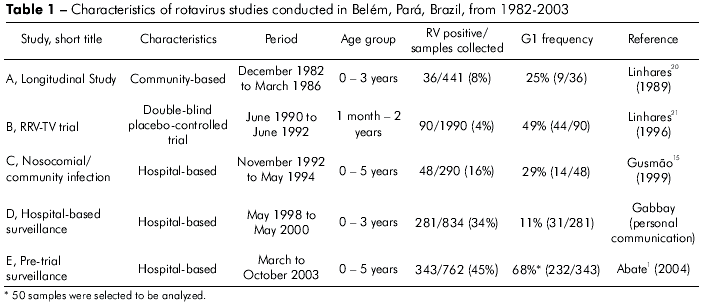
<body><![CDATA[<p><font size="2" face="Verdana">Rotavirus dsRNA was extracted from 10% fecal   suspension by using guanidinium isothiocyanate-silica   nucleic acid extraction as described previously by Boom  et al<sup>3</sup>.</font></p>     <p><font size="2" face="Verdana"><b>POLYACRYLAMIDE GEL ELECTROPHORESIS (PAGE)</b> </font></p>     <p><font size="2" face="Verdana">The RNA profile was analyzed by PAGE with silver staining as described previously<sup>16,27</sup>.</font></p>     <p><font size="2" face="Verdana"><b>CHARACTERIZATION OF G AND P ROTAVIRUS</b>   <b>GENOTYPES BY REVERSE TRANSCRIPTION POLYMERASE</b> <b>CHAIN REACTION (RT-PCR)</b> </font></p>     <p><font size="2" face="Verdana">The VP7 genotype was determined by using reverse   transcription followed by multiplex PCR as previously published<sup>9,14,18</sup>. Two different sets of type-specific primers   were used for G genotyping: pool A, which contained G1   (9T1-1), G2 (9T1-2), G3 (9T-3P), G4 (9T-4) and G9 (9T-B)   specific primers; and pool B which contained primers   specific for the G5 (FT5), G6 (DT6), G8 (HT8) and G10   (ET10) genotypes. </font></p>     <p><font size="2" face="Verdana">Determination of VP4 genotype was performed by RTPCR   followed by nested-PCR, as described by Gentsch et al<sup>12</sup>. Briefly, the full-length VP4 gene was reverse transcribed   and a fragment of 876 base pair (bp) was amplified. The   primers utilized were specific to P&#91;8&#93; (1T-1), P&#91;4&#93; (2T-1), P&#91;6&#93;   (3T-1) and P&#91;9&#93; (4T-1) genotypes.</font></p>     <p>&nbsp;</p>     <p><b><font size="3" face="Verdana">RESULTS</font></b></p>     <p><font size="2" face="Verdana"><b>MOLECULAR EPIDEMIOLOGY OF G1 ROTAVIRUS INFECTION</b></font></p>     <p><font size="2" face="Verdana">The highest frequency of G1 rotavirus was found    in 2003 during a pediatric hospital-based survey (2003) (68%, 232 of 343), and    the lowest was seen during a survey involving hospitalized children (1998 to    2000) (11%, 31 of 281) (<a href="#t1">Table 1</a>). The median age of the 148    G1-infected children was 13 months (range, 2 month&ndash;3 years). Of these,    70 (47%) were &lt;1 year of age, 68 (46%) were 1&ndash;2 years of age, and 10    (7%) were &gt;2 years of age.</font></p>     ]]></body>
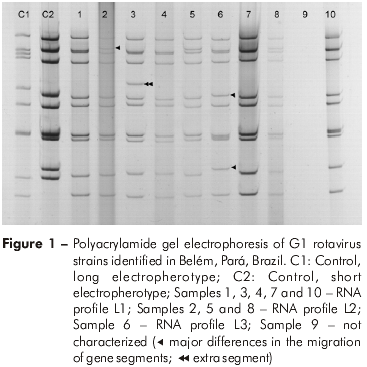
<body><![CDATA[<p><font size="2" face="Verdana"><a name="t1"></a></font></p>     <p>&nbsp;</p>     <p align="center"><img src="/img/revistas/rpas/v1n1/1a18t1.gif" border="0"></p>     <p>&nbsp;</p>     <p><font size="2" face="Verdana"><b>PAGE OF G1 STRAINS</b></font></p>     <p><font size="2" face="Verdana">The RNA profiles were visualized in 116 (78%)    of 148 G1 samples tested. Based on migration differences of gene segments 2,    5 and 10, three distinct long electropherotypes were identified (L1, L2 and    L3). When the L1 electropherotype is compared with L2, gene segment 2 of L2    migrates more slowly than its corresponding gene in L1. With regards to L3,    migration differences for gene segments 5 and 10 were seen with respect to L1.    An additional gene segment was found in a sample displaying the L1 pattern (<a href="#f1">Figure    1</a>). The most frequent electropherotype was L1 (79%, 92 of 116). Study E    provided the highest number of samples available for further characterization    by PAGE (96%, 48 of 50).</font></p>     <p><font size="2" face="Verdana"><a name="f1"></a></font></p>     <p>&nbsp;</p>     <p align="center"><img src="/img/revistas/rpas/v1n1/1a18f1.gif" border="0"></p>     <p>&nbsp;</p>     ]]></body>
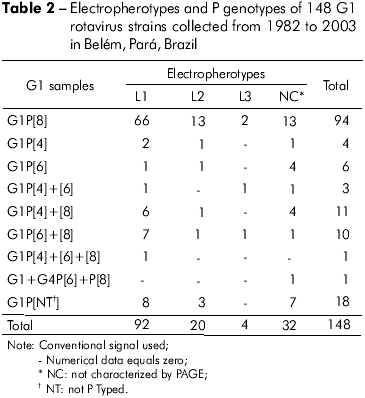
<body><![CDATA[<p><font size="2" face="Verdana"><b>G AND P GENOTYPING</b></font></p>     <p><font size="2" face="Verdana">One hundred and forty seven samples bearing G1    specificity and one sample displaying a mixed G1+G4 infection were found. P    type could be determined in 130 (88%) samples. P&#91;8&#93; was the most frequent VP4-specificity    (64% of cases). In addition, the mixed infections P&#91;6&#93;+P&#91;8&#93;, P&#91;4&#93;+P&#91;8&#93;, P&#91;4&#93;+P&#91;6&#93;    and P&#91;4&#93;+P&#91;6&#93;+P&#91;8&#93; were found in 11 (7%), 11 (7%), 3 (2%) and 1 (0,6%) samples,    respectively. <a href="#t2">Table 2</a> shows PAGE and RT-PCR (VP4 and VP7 genes)    characterization of the 148 samples. The G1P&#91;8&#93; combination displaying the L1    pattern was responsible for 45% of infections.</font></p>     <p><a name="t2"></a></p>     <p>&nbsp;</p>     <p align="center"><img src="/img/revistas/rpas/v1n1/1a18t2.gif" border="0"></p>     <p>&nbsp;</p>     <p><b><font size="3" face="Verdana">DISCUSSION</font></b></p>     <p><font size="2" face="Verdana">G1 rotavirus still seems to be the most prevalent   genotype, representing approximately half of the strains    circulating worldwide<sup>29</sup>. In developed countries, G1 occurs   at the highest frequencies (70%-73%). In developing   countries, these rates appear to be lower (36%-57%). These   differences might be due to the more frequent circulation of   unusual strains, as well as the emergence of new types in the poorest countries<sup>13,29</sup>.</font></p>     <p><font size="2" face="Verdana">In the present report, the G1 strain was detected in 41%   of rotavirus cases over 21 years in studies using different   approaches in target populations. Our results are similar to   those of a study carried out in Rio de Janeiro, where 50% of   samples obtained from children with acute diarrhea were    G1 type<sup>33</sup>. Parra et al<sup>26</sup> reported G1 strains in 17% of cases   in a study conducted in Paraguay from 1998 to 2000. This   difference might be associated with the high prevalence of   the G4 type and the detection of the G9 type in the   Paraguayan study. </font></p>     <p><font size="2" face="Verdana">G1 rotavirus rates ranged from 11% to 68% across     the analyzed studies. The lowest rates were observed between   1998 and 2000. It is likely that these results are related to the   high frequency of untyped strains, as well as to the    emergence of G9 during this period. Santos et al<sup>30</sup> reported   that 79% of all samples analyzed in Salvador were G9.   Similar results were also reported in Goi&aacute;s, where Costa et   al<sup>8</sup>, detected 34% G9 rotavirus infections. These findings   suggest that the emergence of G9 in Brazil was followed by   wide circulation of strains with this genotype.</font></p>     ]]></body>
<body><![CDATA[<p><font size="2" face="Verdana">It is worth mentioning that all G1 samples displayed   long electropherotypes in the present analysis. These RNA   profiles showed three different patterns, thus demonstrating   a broad diversity of circulating electropherotypes in the   region. All varieties were found in specimens from Studies B   and D, in which a high frequency of unusual and untyped    strains were detected (data not shown). Luz et al<sup>22</sup> detected   two varieties of long electropherotypes and 19% G1   specimens bearing a short profile with three varieties   circulating among children with diarrhea in Maranh&atilde;o. </font></p>     <p><font size="2" face="Verdana">The G1P&#91;8&#93; genotype has been found circulating     in  several countries as the predominant type<sup>29</sup>. In the present   study this genotype was detected in 64% of the samples.    Similar results were obtained by Gentsch et al<sup>13</sup> and    Castello et al<sup>6</sup> in studies conducted in Latin America, who found that this   strain occurred in 52% and 40% of rotavirus infections, respectively. In Brazil, Carmona et al<sup>4</sup> detected   G1P&#91;8&#93; in 67% of the specimens collected over eight years   in S&atilde;o Paulo.</font></p>     <p><font size="2" face="Verdana">In the present analysis, one mixed infection involving G types was found (G1+G4). Mascarenhas et al<sup>23</sup> analyzed   stool samples from a neonate hospitalized for   mild/moderate community-acquired diarrhea and noted the occurrence of a G1 plus G4 mixture. Kebaabetswe et al<sup>17</sup>, in   a survey in Botswana involving children with gastroenteritis,   detected the mixed infections G1+G2, G1+G8 and   G1+G3+G9 in 6%, 22% and 6% of cases, respectively. </font></p>     <p><font size="2" face="Verdana">It is important to highlight the frequency of mixed infections involving G1 types (17% of cases). Das et al<sup>10</sup> reported 30% of     cases with mixed infections in an   investigation with children hospitalized in India, although   other G types were also described. The highest rates of   mixed infections are found mostly in developing countries,   probably owing to rotavirus gene rearrangements. This   might result in the emergence of novel G and P circulating   types as well as escape mutants.</font></p>     <p><font size="2" face="Verdana">To our knowledge, this is the first study focusing on G1   rotavirus molecular characterization in Brazil. Our findings   provide information that will allow a better understanding   of the molecular diversity of G1 rotavirus infections prior to   the advent of RV-vaccine. Further approaches involving   nucleotide sequencing might be carried out to assess the   circulation of G1 genetic varieties and their possible impact   on vaccination strategies.</font></p>     <p>&nbsp;</p>     <p><b><font size="3" face="Verdana">REFERENCES</font></b></p>     <!-- ref --><p><font size="2" face="Verdana">1 Abate H, Linhares AC, Venegas G, Vergara R,    Lopez P, Jimenez E, et al. Results of a hospital-based study on rotavirus gastroenteritis    in Latin American children &#91;abstract&#93;. In: 24th International Congress of Pediatrics    (ICP); 2004 Aug 15-20; Cancun, Mexico; 2004. p. 656.</font><!-- ref --><p><font size="2" face="Verdana">2 Arista S, Giammanco GM, De Grazia S, Ramirez    S, Lo Biundo C, Colomba C, et al. Heterogeneity and temporal dynamics of evolution    of G1 human rotaviruses in a settled population. J Virol. 2006 Nov;80(21):10724-33.    DOI:10.1128/JVI.00340-06</font><font size="2" face="verdana"><span style='font-size:10.0pt; font-family:Verdana'><font size="2" face="verdana">&nbsp; &nbsp; &nbsp; &nbsp;    &nbsp;&#91; <a href="http://jvi.asm.org/cgi/content/abstract/80/21/10724" target="_blank">Links</a>    &#93;</font></span></font><!-- ref --><p><font size="2" face="Verdana">3 Boom R, Sol CJ, Salimans MM, Jansen CL, Wertheimvan    Dillen PM, Noordaa J. Rapid and simple method for purification of nucleic acids.    J Clin Microbiol. 1990 Mar;28(3):495-503.</font><font size="2" face="verdana"><span style='font-size:10.0pt; font-family:Verdana'><font size="2" face="verdana">&nbsp; &nbsp; &nbsp; &nbsp;    &nbsp;&#91; <a href="http://www.ncbi.nlm.nih.gov/pmc/articles/PMC269651/?tool=pubmed" target="_blank">Links</a>    &#93;</font></span></font><!-- ref --><p><font size="2" face="Verdana">4 Carmona RC, Timenetsky MC, Morillo SG, Richtzenhain    LJ. Human rotavirus serotype G9, S&atilde;o Paulo, Brazil, 1996-2003. Emerg    Infect Dis. 2006 Jun;12(6):963-8.</font><font size="2" face="verdana"><span style='font-size:10.0pt; font-family:Verdana'><font size="2" face="verdana">&nbsp; &nbsp; &nbsp; &nbsp;    &nbsp;&#91; <a href="http://www.ncbi.nlm.nih.gov/pubmed/16707053" target="_blank">Links</a>    &#93;</font></span></font><!-- ref --><p><font size="2" face="Verdana">5 Castello AA, Arg&uuml;elles MH, Rota RP, Olthoff    A, Jiang B, Glass RI, et al. Molecular epidemiology of group A rotavirus diarrhea    among children in Buenos Aires, Argentina, from 1999 to 2003 and emergence of    the infrequent genotype G12. J Clin Microbiol. 2006 Jun;44(6):2046-50. </font><font size="2" face="verdana"><span style='font-size:10.0pt; font-family:Verdana'><font size="2" face="verdana">DOI: 10.1128/JCM.02436-05&nbsp;    &nbsp; &nbsp; &nbsp; &nbsp;&#91; <a href="http://jcm.asm.org/cgi/content/abstract/44/6/2046?maxtoshow=&HITS=10&hits=10&RESULTFORMAT=&fulltext=hybridization&searchid=1&FIRSTINDEX=2270&resourcetype=HWFIG" target="_blank">Links</a>    &#93;</font></span></font><!-- ref --><p><font size="2" face="Verdana">6 Castello AA, Arvay ML, Glass RI, Gentsch J.    Rotavirus strain surveillance in Latin America: a review of the last nine years.    Pediatr Infect Dis J. 2004 Oct;23(10 Suppl):S168-72.</font><font size="2" face="verdana"><span style='font-size:10.0pt; font-family:Verdana'><font size="2" face="verdana">&nbsp; &nbsp; &nbsp; &nbsp;    &nbsp;&#91; <a href="http://www.ncbi.nlm.nih.gov/pubmed/15502697" target="_blank">Links</a>    &#93;</font></span></font><!-- ref --><p><font size="2" face="Verdana">7 Centers for Disease Control and Prevention.    Rotavirus surveillance&#8212;worldwide, 2001-2008. MMWR Morb Mortal Wkly Rep.    2008 Nov;57(46):1255-7.</font><font size="2" face="verdana"><span style='font-size:10.0pt; font-family:Verdana'><font size="2" face="verdana">&nbsp; &nbsp; &nbsp; &nbsp;    &nbsp;&#91; <a href="http://www.cdc.gov/mmwr/preview/mmwrhtml/mm5746a3.htm" target="_blank">Links</a>    &#93; </font></span></font><!-- ref --><p><font size="2" face="Verdana">8 Costa PS, Cardoso DD, Grisi SJ, Silva PA, Fiaccadori    F, Souza MB, et al. Rotavirus A infections and reinfections: genotyping and    vaccine implications. J Pediatr (Rio J). 2004 Mar-Apr;80(2):119-22.</font><font size="2" face="verdana"><span style='font-size:10.0pt; font-family:Verdana'><font size="2" face="verdana">&nbsp; &nbsp; &nbsp; &nbsp;    &nbsp;&#91; <a href="http://www.jped.com.br/conteudo/04-80-02-119/ing.asp" target="_blank">Links</a>    &#93;</font></span></font><!-- ref --><p><font size="2" face="Verdana">9 Das BK, Gentsch JR, Cicirello HG, Woods PA,    Gupta A, Ramachandran M, et al. Characterization of rotavirus strains from newborns    in New Delhi, India. J Clin Microbiol. 1994 Jul;32(7):1820-2.</font><font size="2" face="verdana"><span style='font-size:10.0pt; font-family:Verdana'><font size="2" face="verdana">&nbsp; &nbsp; &nbsp; &nbsp;    &nbsp;&#91; <a href="http://www.ncbi.nlm.nih.gov/pmc/articles/PMC263808/?tool=pubmed" target="_blank">Links</a>    &#93;</font></span></font><!-- ref --><p><font size="2" face="Verdana">10 Das S, Varghese V, Chaudhuri S, Barman P,    Kojima K, Dutta P, et al. Genetic variability of human rotavirus strains isolated    from Eastern and Northern India. J Med Virol. 2004 Jan;72(1):156-61.</font><font size="2" face="verdana"><span style='font-size:10.0pt; font-family:Verdana'><font size="2" face="verdana">&nbsp; &nbsp; &nbsp; &nbsp;    &nbsp;&#91; <a href="http://www.ncbi.nlm.nih.gov/pubmed/14635025" target="_blank">Links</a>    &#93;</font></span></font><!-- ref --><p><font size="2" face="Verdana">11 Estes MK, Kapikian AZ. Rotaviruses. In: Knipe DM,   Howley PM, editors. Fields virology. 5th ed.   Philadelphia: Lippincott Williams and Wilkins; 2007.   p. 1917-74.</font><!-- ref --><p><font size="2" face="Verdana">12 Gentsch JR, Glass RI, Woods P, Gouvea V, Gorziglia    M, Flores J, et al. Identification of group A rotavirus gene 4 types by polymerase    chain reaction. J Clin Microbiol. 1992 Jun;30(6):1365-73.</font><font size="2" face="verdana"><span style='font-size:10.0pt; font-family:Verdana'><font size="2" face="verdana">&nbsp; &nbsp; &nbsp; &nbsp;    &nbsp;&#91; <a href="http://www.ncbi.nlm.nih.gov/pmc/articles/PMC265294/?tool=pubmed" target="_blank">Links</a>    &#93;</font></span></font><font size="2" face="Verdana"> </font><!-- ref --><p><font size="2" face="Verdana">13 Gentsch JR, Laird AR, Bielfelt B, Griffin    DD, Banyai K, Ramachandran M, et al. Serotype diversity and reassortment between    human and animal rotavirus strains: implications for rotavirus vaccine programs.    J Infect Dis. 2005 Sep;192 Suppl 1:S146-59.</font><font size="2" face="verdana"><span style='font-size:10.0pt; font-family:Verdana'><font size="2" face="verdana">&nbsp; &nbsp; &nbsp; &nbsp;    &nbsp;&#91; <a href="http://www.ncbi.nlm.nih.gov/pubmed/16088798" target="_blank">Links</a>    &#93;</font></span></font><font size="2" face="Verdana"></font><!-- ref --><p><font size="2" face="Verdana">14 Gouvea V, Santos N, Timenetsky MC. Identification    of bovine and porcine rotavirus G types by PCR. J Clin Microbiol. 1994 May;32(5):1338-40.</font><font size="2" face="verdana"><span style='font-size:10.0pt; font-family:Verdana'><font size="2" face="verdana">&nbsp; &nbsp; &nbsp; &nbsp;    &nbsp;&#91; <a href="http://jcm.asm.org/cgi/content/abstract/32/5/1338" target="_blank">Links</a>    &#93;</font></span></font><font size="2" face="Verdana"></font><!-- ref --><p><font size="2" face="Verdana">15 Gusm&atilde;o RH, Mascarenhas JD, Gabbay YB,    Lins-Lainson Z, Ramos FL, Monteiro TA, et al. Rotavirus subgroups, G serotypes,    and electrophoretypes in cases of nosocomial infantile diarrhoea in Bel&eacute;m,    Brazil. J Trop Pediatr. 1999 Apr;45(2):81-6.</font><font size="2" face="verdana"><span style='font-size:10.0pt; font-family:Verdana'><font size="2" face="verdana"> DOI:10.1093/tropej/45.2.81&nbsp;    &nbsp; &nbsp; &nbsp; &nbsp;&#91; <a href="http://tropej.oxfordjournals.org/cgi/content/abstract/45/2/81" target="_blank">Links</a>    &#93;</font></span></font><font size="2" face="Verdana"></font><!-- ref --><p><font size="2" face="Verdana">16 Herring AJ, Inglis NF, Ojeh CK, Snodgrass    DR, Menzies JD. Rapid diagnosis of rotavirus infection by direct detection of    viral nucleic acid in silver-stained polyacrylamide gels. J Clin Microbiol.    1982 Sep;16(3):473-7.</font><font size="2" face="verdana"><span style='font-size:10.0pt; font-family:Verdana'><font size="2" face="verdana">&nbsp; &nbsp; &nbsp; &nbsp;    &nbsp;&#91; <a href="http://www.ncbi.nlm.nih.gov/pmc/articles/PMC272392/" target="_blank">Links</a>    &#93;</font></span></font><font size="2" face="Verdana"></font><p><font size="2" face="Verdana">17 Kebaabetswe LP, Sebunya TK, Matsheka MI, Ndung&rsquo;u    T. Detection and molecular characterisation of group a rotavirus from children    in northern Botswana. East Afr Med J. 2005 Apr;82(4):203-8.</font><font size="2" face="verdana"><span style='font-size:10.0pt; font-family:Verdana'><font size="2" face="verdana">&nbsp; &nbsp; &nbsp; &nbsp;    &nbsp;&#91; <a href="http://www.ncbi.nlm.nih.gov/pubmed/16122089" target="_blank">Links</a>    &#93;</font></span></font><font size="2" face="Verdana"></font></p>     <!-- ref --><p><font size="2" face="Verdana">18 Leite JP, Alfieri AA, Woods PA, Glass RI,    Gentsch JR. Rotavirus G and P types circulating in Brazil: characterization    by RT-PCR, probe hybridization, and sequence analysis. Arch Virol. 1996;141(12):2365-74.</font><font size="2" face="verdana"><span style='font-size:10.0pt; font-family:Verdana'><font size="2" face="verdana">&nbsp; &nbsp; &nbsp; &nbsp;    &nbsp;&#91; <a href="http://www.ncbi.nlm.nih.gov/pubmed/9526543" target="_blank">Links</a>    &#93;</font></span></font><font size="2" face="Verdana"></font><!-- ref --><p><font size="2" face="Verdana">19 Leite JP, Carvalho-Costa FA, Linhares AC.    Group A rotavirus genotypes and the ongoing Brazilian experience: A review.    Mem Inst Oswaldo Cruz. 2008 Dec;103(8):745-53. </font><font size="2" face="verdana"><span style='font-size:10.0pt; font-family:Verdana'><font size="2" face="verdana">DOI:10.1590/S0074-02762008000800001&nbsp;    &nbsp; &nbsp; &nbsp; &nbsp;&#91; <a href="http://www.scielo.br/scielo.php?script=sci_arttext&pid=S0074-02762008000800001" target="_blank">Links</a>    &#93;</font></span></font><font size="2" face="Verdana"></font><!-- ref --><p><font size="2" face="Verdana">20 Linhares AC, Gabbay YB, Freitas RB, Travassos    da Rosa ES, Mascarenhas JD, Loureiro ECB. Longitudinal study of rotavirus infections    among children from Bel&eacute;m, Brazil. Epidemiol Infect. 1989 Feb;102(1):129-45.</font><font size="2" face="verdana"><span style='font-size:10.0pt; font-family:Verdana'><font size="2" face="verdana">&nbsp; &nbsp; &nbsp; &nbsp;    &nbsp;&#91; <a href="http://www.ncbi.nlm.nih.gov/pubmed/2537221?ordinalpos=&itool=EntrezSystem2.PEntrez.Pubmed.Pubmed_ResultsPanel.SmartSearch&log$=citationsensor" target="_blank">Links</a>    &#93;</font></span></font><font size="2" face="Verdana"></font><!-- ref --><p><font size="2" face="Verdana">21 Linhares AC, Gabbay YB, Mascarenhas JD, Freitas    RB, Oliveira CS, Bellesi N, et al. Immunogenicity, safety and efficacy of tetravalent    rhesus-human, reassortant rotavirus vaccine in Bel&eacute;m, Brazil. Bull World    Health Organ. 1996;74(5):491-50.</font><font size="2" face="verdana"><span style='font-size:10.0pt; font-family:Verdana'><font size="2" face="verdana">&nbsp; &nbsp; &nbsp; &nbsp;    &nbsp;&#91; <a href="http://www.ncbi.nlm.nih.gov/pmc/articles/PMC2486862/?page=1" target="_blank">Links</a>    &#93;</font></span></font><font size="2" face="Verdana"></font><!-- ref --><p><font size="2" face="Verdana">22 Luz CR, Mascarenhas JD, Gabbay YB, Motta AR,    Lima TV, Soares LS, et al. Rotavirus serotypes and electropherotypes identified    among hospitalized children in S&atilde;o Lu&iacute;s, Maranh&atilde;o, Brazil.    Rev Inst Med Trop Sao Paulo. 2005 Sep-Oct;47(5):287-93. DOI:10.1590/S0036-46652005000500009</font><font size="2" face="verdana"><span style='font-size:10.0pt; font-family:Verdana'><font size="2" face="verdana">&nbsp; &nbsp; &nbsp; &nbsp;    &nbsp;&#91; <a href="http://www.scielo.br/scielo.php?script=sci_arttext&pid=S0036-46652005000500009&lng=en&nrm=iso&tlng=en" target="_blank">Links</a>    &#93;</font></span></font><font size="2" face="Verdana"></font><!-- ref --><p><font size="2" face="Verdana">23 Mascarenhas JD, Leite JP, Lima JC, Heinemann    MB, Oliveira DS, Ara&uacute;jo IT, et al. Detection of a neonatal human rotavirus    strain with VP4 and NSP4 genes of porcine origin. J Med Microbiol. 2007 Apr;56(Pt    4):524-32. DOI:10.1099/jmm.0.46635-0</font><font size="2" face="verdana"><span style='font-size:10.0pt; font-family:Verdana'><font size="2" face="verdana">&nbsp; &nbsp; &nbsp; &nbsp;    &nbsp;&#91; <a href="http://jmm.sgmjournals.org/cgi/content/full/56/4/524" target="_blank">Links</a>    &#93;</font></span></font><font size="2" face="Verdana"></font><!-- ref --><p><font size="2" face="Verdana">24 Parashar UD, Gibson CJ, Bresse JS, Glass RI.    Rotavirus and severe childhood diarrhea. Emerg Infect Dis. 2006 Feb;12(2):304-6.</font><font size="2" face="verdana"><span style='font-size:10.0pt; font-family:Verdana'><font size="2" face="verdana">&nbsp; &nbsp; &nbsp; &nbsp;    &nbsp;&#91; <a href="http://www.cdc.gov/ncidod/eid/vol12no02/05-0006.htm" target="_blank">Links</a>    &#93;</font></span></font><font size="2" face="Verdana"></font><!-- ref --><p><font size="2" face="Verdana">25 Parashar UD, Hummelman EG, Bresee JS, Miller    MA, Glass RI. Global illness and deaths caused by rotavirus disease in children.    Emerg Infect Dis. 2003 May;9(5):565-72.</font><font size="2" face="verdana"><span style='font-size:10.0pt; font-family:Verdana'><font size="2" face="verdana">&nbsp; &nbsp; &nbsp; &nbsp;    &nbsp;&#91; <a href="http://www.cdc.gov/ncidod/EID/vol9no5/02-0562.htm" target="_blank">Links</a>    &#93;</font></span></font><font size="2" face="Verdana"></font><!-- ref --><p><font size="2" face="Verdana">26 Parra GI, Bok K, Mart&iacute;nez V, Russomando    G, G&oacute;mez J. Molecular characterization and genetic variation of the VP7    gene of human rotaviruses isolated in Paraguay. J Med Virol. 2005 Dec;77(4):579-86.    DOI:10.1002/jmv.20495</font><font size="2" face="verdana"><span style='font-size:10.0pt; font-family:Verdana'><font size="2" face="verdana">&nbsp; &nbsp; &nbsp; &nbsp;    &nbsp;&#91; <a href="http://www.ncbi.nlm.nih.gov/pubmed/16254962?itool=EntrezSystem2.PEntrez.Pubmed.Pubmed_ResultsPanel.Pubmed_RVDocSum&ordinalpos=1" target="_blank">Links</a>    &#93;</font></span></font><font size="2" face="Verdana"></font><!-- ref --><p><font size="2" face="Verdana">27 Pereira HG, Azeredo RS, Leite JP, Barth OM,    Sutmoller F, Farias V, et al. Comparison of polyacrylamide gel electrophoresis    (PAGE), immuno-electron microscopy (IEM) and enzyme immunoassay (EIA) for the    rapid diagnosis of rotavirus infection in children. Mem Inst Oswaldo Cruz. 1983    Oct-Dec;78(4):483-90. DOI:10.1590/S0074-02761983000400012</font><font size="2" face="verdana"><span style='font-size:10.0pt; font-family:Verdana'><font size="2" face="verdana">&nbsp; &nbsp; &nbsp; &nbsp;    &nbsp;&#91; <a href="http://www.scielo.br/scielo.php?script=sci_arttext&pid=S0074-02761983000400012&lng=en&nrm=iso&tlng=en" target="_blank">Links</a>    &#93;</font></span></font><font size="2" face="Verdana"></font><!-- ref --><p><font size="2" face="Verdana">28 Phan TG, Okitsu S, Maneekarn N, Ushijima H.    Evidence of intragenic recombination in G1 rotavirus VP7 genes. J Virol. 2007    Sep;81(18):10188-94.</font><font size="2" face="verdana"><span style='font-size:10.0pt; font-family:Verdana'><font size="2" face="verdana"> DOI:10.1128/JVI.00337-07&nbsp;    &nbsp; &nbsp; &nbsp; &nbsp;&#91; <a href="http://jvi.asm.org/cgi/content/abstract/81/18/10188" target="_blank">Links</a>    &#93;</font></span></font><font size="2" face="Verdana"></font><!-- ref --><p><font size="2" face="Verdana">29 Santos N, Hoshino Y. Global distribution of    rotavirus serotypes/genotypes and its implication for the development and implementation    of an effective rotavirus vaccine. Rev Med Virol. 2005 Jan-Feb;15(1):29-56.</font><font size="2" face="verdana"><span style='font-size:10.0pt; font-family:Verdana'><font size="2" face="verdana">&nbsp; &nbsp; &nbsp; &nbsp;    &nbsp;&#91; <a href="http://www.ncbi.nlm.nih.gov/pubmed/15484186?itool=EntrezSystem2.PEntrez.Pubmed.Pubmed_ResultsPanel.Pubmed_RVDocSum&ordinalpos=1" target="_blank">Links</a>    &#93;</font></span></font><font size="2" face="Verdana"></font><!-- ref --><p><font size="2" face="Verdana">30 Santos N, Volot&atilde;o EM, Soares CC, Campos    GS, Sardi SI, Hoshino Y. Predominance of rotavirus genotype G9 during the 1999,    2000, and 2002 seasons among hospitalized children in the city of Salvador,    Bahia, Brazil: implications for future vaccine strategies. J Clin Microbiol.    2005 Aug;43(8):4064-9. DOI:10.1128/JCM.43.8.4064-4069.2005</font><font size="2" face="verdana"><span style='font-size:10.0pt; font-family:Verdana'><font size="2" face="verdana">&nbsp; &nbsp; &nbsp; &nbsp;    &nbsp;&#91; <a href="http://jcm.asm.org/cgi/content/abstract/43/8/4064" target="_blank">Links</a>    &#93;</font></span></font><font size="2" face="Verdana"></font><!-- ref --><p><font size="2" face="Verdana">31 Trojnar E, Otto P, Johne R. The first complete    genome sequence of a chicken group A rotavirus indicates independent evolution    of mammalian and avian strains. Virology. 2009 Apr;386(2):325-33.</font><font size="2" face="verdana"><span style='font-size:10.0pt; font-family:Verdana'><font size="2" face="verdana"> DOI:10.1016/j.virol.2009.01.034&nbsp;    &nbsp; &nbsp; &nbsp; &nbsp;&#91; <a href="http://www.sciencedirect.com/science?_ob=ArticleURL&_udi=B6WXR-4VPKPTM-1&_user=10&_rdoc=1&_fmt=&_orig=search&_sort=d&_docanchor=&view=c&_acct=C000050221&_version=1&_urlVersion=0&_userid=10&md5=d26b2f15e0364650a79ac69ce36ade65" target="_blank">Links</a>    &#93;</font></span></font><font size="2" face="Verdana"></font><!-- ref --><p><font size="2" face="Verdana">32 Ursu K, Kisfali P, Rig&oacute; D, Ivanics    E, Erd&eacute;lyi K, D&aacute;n A, et al. Molecular analysis of the VP7 gene    of pheasant rotaviruses identifies a new genotype, designated G23. Arch Virol.    2009;154(8):1365-9.</font><font size="2" face="verdana"><span style='font-size:10.0pt; font-family:Verdana'><font size="2" face="verdana"> DOI:10.1007/s00705-009-0439-0&nbsp;    &nbsp; &nbsp; &nbsp; &nbsp;&#91; <a href="http://www.springerlink.com/content/un03w2300x602734/" target="_blank">Links</a>    &#93;</font></span></font><font size="2" face="Verdana"></font><!-- ref --><p><font size="2" face="Verdana">33 Volot&atilde;o EM, Soares CC, Maranh&atilde;o    AG, Rocha LN, Hoshino Y, Santos N. Rotavirus surveillance in the city of Rio    de Janeiro-Brazil during 2000-2004: detection of unusual strains with G8P&#91;4&#93;    or G10P&#91;9&#93; specificities. J Med Virol. 2006 Feb;78(2):263-72. DOI:10.1002/jmv.20535</font><font size="2" face="verdana"><span style='font-size:10.0pt; font-family:Verdana'><font size="2" face="verdana">&nbsp; &nbsp; &nbsp; &nbsp;    &nbsp;&#91; <a href="http://www3.interscience.wiley.com/journal/112221489/abstract" target="_blank">Links</a>    &#93;</font></span></font><font size="2" face="Verdana"></font><p>&nbsp;</p>     <p>&nbsp;</p>     <p><font size="2" face="Verdana"><b><a name="endereco"></a><a href="#topo"><img src="img/revistas/rpas/v1n1/seta.gif" border="0"></a>Correspond&ecirc;ncia    / Correspondence / Correspondencia:</b>    <br>   Luana da Silva Soares    <br>   Instituto Evandro Chagas    <br>   Rodovia BR316, km 7, s/n<sup>o</sup>, Levil&acirc;ndia    <br>   CEP: 67030-000    <br>   Ananindeua-Par&aacute;-Brasil    <br>   Fax + 00 55 91 32142006    <br>   E-mail:<a href="mailto:luanasoares@iec.pa.gov.br">luanasoares@iec.pa.gov.br</a>    </font></p>     ]]></body>
<body><![CDATA[<p><font size="2" face="Verdana">Recebido em / Received / Recibido en: 31/7/2009    <br>   Aceito em / Accepted / Aceito en: 25/9/2009 </font></p>   <script type="text/javascript"> var gaJsHost = (("https:" == document.location.protocol) ? "https://ssl." : "http://www."); document.write(unescape("%3Cscript src='" + gaJsHost + "google-analytics.com/ga.js' type='text/javascript'%3E%3C/script%3E")); </script> <script type="text/javascript"> try { var pageTracker = _gat._getTracker("UA-7885746-4"); pageTracker._setDomainName("none"); pageTracker._setAllowLinker(true); pageTracker._trackPageview(); } catch(err) {}</script>      ]]></body><back>
<ref-list>
<ref id="B1">
<label>1</label><nlm-citation citation-type="confpro">
<person-group person-group-type="author">
<name>
<surname><![CDATA[Abate]]></surname>
<given-names><![CDATA[H]]></given-names>
</name>
<name>
<surname><![CDATA[Linhares]]></surname>
<given-names><![CDATA[AC]]></given-names>
</name>
<name>
<surname><![CDATA[Venegas]]></surname>
<given-names><![CDATA[G]]></given-names>
</name>
<name>
<surname><![CDATA[Vergara]]></surname>
<given-names><![CDATA[R]]></given-names>
</name>
<name>
<surname><![CDATA[Lopez]]></surname>
<given-names><![CDATA[P]]></given-names>
</name>
<name>
<surname><![CDATA[Jimenez]]></surname>
<given-names><![CDATA[E]]></given-names>
</name>
</person-group>
<article-title xml:lang="en"><![CDATA[Results of a hospital-based study on rotavirus gastroenteritis in Latin American children [abstract]]]></article-title>
<source><![CDATA[]]></source>
<year>2004</year>
<conf-name><![CDATA[24 International Congress of Pediatrics (ICP)]]></conf-name>
<conf-date>2004 Aug 15-20</conf-date>
<conf-loc>Cancun </conf-loc>
<page-range>656</page-range></nlm-citation>
</ref>
<ref id="B2">
<label>2</label><nlm-citation citation-type="journal">
<person-group person-group-type="author">
<name>
<surname><![CDATA[Arista]]></surname>
<given-names><![CDATA[S]]></given-names>
</name>
<name>
<surname><![CDATA[Giammanco]]></surname>
<given-names><![CDATA[GM]]></given-names>
</name>
<name>
<surname><![CDATA[De Grazia]]></surname>
<given-names><![CDATA[S]]></given-names>
</name>
<name>
<surname><![CDATA[Ramirez]]></surname>
<given-names><![CDATA[S]]></given-names>
</name>
<name>
<surname><![CDATA[Lo Biundo]]></surname>
<given-names><![CDATA[C]]></given-names>
</name>
<name>
<surname><![CDATA[Colomba]]></surname>
<given-names><![CDATA[C]]></given-names>
</name>
</person-group>
<article-title xml:lang="en"><![CDATA[Heterogeneity and temporal dynamics of evolution of G1 human rotaviruses in a settled population]]></article-title>
<source><![CDATA[J Virol]]></source>
<year>2006</year>
<month> N</month>
<day>ov</day>
<volume>80</volume>
<numero>21</numero>
<issue>21</issue>
<page-range>10724-33</page-range></nlm-citation>
</ref>
<ref id="B3">
<label>3</label><nlm-citation citation-type="journal">
<person-group person-group-type="author">
<name>
<surname><![CDATA[Boom]]></surname>
<given-names><![CDATA[R]]></given-names>
</name>
<name>
<surname><![CDATA[Sol]]></surname>
<given-names><![CDATA[CJ]]></given-names>
</name>
<name>
<surname><![CDATA[Salimans]]></surname>
<given-names><![CDATA[MM]]></given-names>
</name>
<name>
<surname><![CDATA[Jansen]]></surname>
<given-names><![CDATA[CL]]></given-names>
</name>
<name>
<surname><![CDATA[Wertheimvan Dillen]]></surname>
<given-names><![CDATA[PM]]></given-names>
</name>
<name>
<surname><![CDATA[Noordaa]]></surname>
<given-names><![CDATA[J]]></given-names>
</name>
</person-group>
<article-title xml:lang="en"><![CDATA[Rapid and simple method for purification of nucleic acids]]></article-title>
<source><![CDATA[J Clin Microbiol]]></source>
<year>1990</year>
<month> M</month>
<day>ar</day>
<volume>28</volume>
<numero>3</numero>
<issue>3</issue>
<page-range>495-503</page-range></nlm-citation>
</ref>
<ref id="B4">
<label>4</label><nlm-citation citation-type="journal">
<person-group person-group-type="author">
<name>
<surname><![CDATA[Carmona]]></surname>
<given-names><![CDATA[RC]]></given-names>
</name>
<name>
<surname><![CDATA[Timenetsky]]></surname>
<given-names><![CDATA[MC]]></given-names>
</name>
<name>
<surname><![CDATA[Morillo]]></surname>
<given-names><![CDATA[SG]]></given-names>
</name>
<name>
<surname><![CDATA[Richtzenhain]]></surname>
<given-names><![CDATA[LJ]]></given-names>
</name>
</person-group>
<article-title xml:lang="en"><![CDATA[Human rotavirus serotype G9, São Paulo, Brazil, 1996-2003]]></article-title>
<source><![CDATA[Emerg Infect Dis]]></source>
<year>2006</year>
<month> J</month>
<day>un</day>
<volume>12</volume>
<numero>6</numero>
<issue>6</issue>
<page-range>963-8</page-range></nlm-citation>
</ref>
<ref id="B5">
<label>5</label><nlm-citation citation-type="journal">
<person-group person-group-type="author">
<name>
<surname><![CDATA[Castello]]></surname>
<given-names><![CDATA[AA]]></given-names>
</name>
<name>
<surname><![CDATA[Argüelles]]></surname>
<given-names><![CDATA[MH]]></given-names>
</name>
<name>
<surname><![CDATA[Rota]]></surname>
<given-names><![CDATA[RP]]></given-names>
</name>
<name>
<surname><![CDATA[Olthoff]]></surname>
<given-names><![CDATA[A]]></given-names>
</name>
<name>
<surname><![CDATA[Jiang]]></surname>
<given-names><![CDATA[B]]></given-names>
</name>
<name>
<surname><![CDATA[Glass]]></surname>
<given-names><![CDATA[RI]]></given-names>
</name>
</person-group>
<article-title xml:lang="en"><![CDATA[Molecular epidemiology of group A rotavirus diarrhea among children in Buenos Aires, Argentina, from 1999 to 2003 and emergence of the infrequent genotype G12]]></article-title>
<source><![CDATA[J Clin Microbiol]]></source>
<year>2006</year>
<month> J</month>
<day>un</day>
<volume>44</volume>
<numero>6</numero>
<issue>6</issue>
<page-range>2046-50</page-range></nlm-citation>
</ref>
<ref id="B6">
<label>6</label><nlm-citation citation-type="journal">
<person-group person-group-type="author">
<name>
<surname><![CDATA[Castello]]></surname>
<given-names><![CDATA[AA]]></given-names>
</name>
<name>
<surname><![CDATA[Arvay]]></surname>
<given-names><![CDATA[ML]]></given-names>
</name>
<name>
<surname><![CDATA[Glass]]></surname>
<given-names><![CDATA[RI]]></given-names>
</name>
<name>
<surname><![CDATA[Gentsch]]></surname>
<given-names><![CDATA[J]]></given-names>
</name>
</person-group>
<article-title xml:lang="en"><![CDATA[Rotavirus strain surveillance in Latin America: a review of the last nine years]]></article-title>
<source><![CDATA[Pediatr Infect Dis J]]></source>
<year>2004</year>
<month> O</month>
<day>ct</day>
<volume>23</volume>
<numero>^s10</numero>
<issue>^s10</issue>
<supplement>10</supplement>
<page-range>168-72</page-range></nlm-citation>
</ref>
<ref id="B7">
<label>7</label><nlm-citation citation-type="journal">
<collab>Centers for Disease Control and Prevention</collab>
<article-title xml:lang="en"><![CDATA[Rotavirus surveillance&#8212;worldwide, 2001-2008]]></article-title>
<source><![CDATA[MMWR Morb Mortal Wkly Rep]]></source>
<year>2008</year>
<month> N</month>
<day>ov</day>
<volume>57</volume>
<numero>46</numero>
<issue>46</issue>
<page-range>1255-7</page-range></nlm-citation>
</ref>
<ref id="B8">
<label>8</label><nlm-citation citation-type="journal">
<person-group person-group-type="author">
<name>
<surname><![CDATA[Costa]]></surname>
<given-names><![CDATA[PS]]></given-names>
</name>
<name>
<surname><![CDATA[Cardoso]]></surname>
<given-names><![CDATA[DD]]></given-names>
</name>
<name>
<surname><![CDATA[Grisi]]></surname>
<given-names><![CDATA[SJ]]></given-names>
</name>
<name>
<surname><![CDATA[Silva]]></surname>
<given-names><![CDATA[PA]]></given-names>
</name>
<name>
<surname><![CDATA[Fiaccadori]]></surname>
<given-names><![CDATA[F]]></given-names>
</name>
<name>
<surname><![CDATA[Souza]]></surname>
<given-names><![CDATA[MB]]></given-names>
</name>
</person-group>
<article-title xml:lang="en"><![CDATA[Rotavirus A infections and reinfections: genotyping and vaccine implications]]></article-title>
<source><![CDATA[J Pediatr]]></source>
<year>2004</year>
<month> M</month>
<day>ar</day>
<volume>80</volume>
<numero>2</numero>
<issue>2</issue>
<page-range>119-22</page-range></nlm-citation>
</ref>
<ref id="B9">
<label>9</label><nlm-citation citation-type="journal">
<person-group person-group-type="author">
<name>
<surname><![CDATA[Das]]></surname>
<given-names><![CDATA[BK]]></given-names>
</name>
<name>
<surname><![CDATA[Gentsch]]></surname>
<given-names><![CDATA[JR]]></given-names>
</name>
<name>
<surname><![CDATA[Cicirello]]></surname>
<given-names><![CDATA[HG]]></given-names>
</name>
<name>
<surname><![CDATA[Woods]]></surname>
<given-names><![CDATA[PA]]></given-names>
</name>
<name>
<surname><![CDATA[Gupta]]></surname>
<given-names><![CDATA[A]]></given-names>
</name>
<name>
<surname><![CDATA[Ramachandran]]></surname>
<given-names><![CDATA[M]]></given-names>
</name>
</person-group>
<article-title xml:lang="en"><![CDATA[Characterization of rotavirus strains from newborns in New Delhi, India]]></article-title>
<source><![CDATA[J Clin Microbiol]]></source>
<year>1994</year>
<month> J</month>
<day>ul</day>
<volume>32</volume>
<numero>7</numero>
<issue>7</issue>
<page-range>1820-2</page-range></nlm-citation>
</ref>
<ref id="B10">
<label>10</label><nlm-citation citation-type="journal">
<person-group person-group-type="author">
<name>
<surname><![CDATA[Das]]></surname>
<given-names><![CDATA[S]]></given-names>
</name>
<name>
<surname><![CDATA[Varghese]]></surname>
<given-names><![CDATA[V]]></given-names>
</name>
<name>
<surname><![CDATA[Chaudhuri]]></surname>
<given-names><![CDATA[S]]></given-names>
</name>
<name>
<surname><![CDATA[Barman]]></surname>
<given-names><![CDATA[P]]></given-names>
</name>
<name>
<surname><![CDATA[Kojima]]></surname>
<given-names><![CDATA[K]]></given-names>
</name>
<name>
<surname><![CDATA[Dutta]]></surname>
<given-names><![CDATA[P]]></given-names>
</name>
</person-group>
<article-title xml:lang="en"><![CDATA[Genetic variability of human rotavirus strains isolated from Eastern and Northern India]]></article-title>
<source><![CDATA[J Med Virol]]></source>
<year>2004</year>
<month> J</month>
<day>an</day>
<volume>72</volume>
<numero>1</numero>
<issue>1</issue>
<page-range>156-61</page-range></nlm-citation>
</ref>
<ref id="B11">
<label>11</label><nlm-citation citation-type="book">
<person-group person-group-type="author">
<name>
<surname><![CDATA[Estes]]></surname>
<given-names><![CDATA[MK]]></given-names>
</name>
<name>
<surname><![CDATA[Kapikian]]></surname>
<given-names><![CDATA[AZ]]></given-names>
</name>
</person-group>
<article-title xml:lang="en"><![CDATA[Rotaviruses]]></article-title>
<person-group person-group-type="editor">
<name>
<surname><![CDATA[Knipe]]></surname>
<given-names><![CDATA[DM]]></given-names>
</name>
<name>
<surname><![CDATA[Howley]]></surname>
<given-names><![CDATA[PM]]></given-names>
</name>
</person-group>
<source><![CDATA[Fields virology]]></source>
<year>2007</year>
<edition>5</edition>
<page-range>1917-74</page-range><publisher-loc><![CDATA[Philadelphia ]]></publisher-loc>
<publisher-name><![CDATA[Lippincott Williams and Wilkins]]></publisher-name>
</nlm-citation>
</ref>
<ref id="B12">
<label>12</label><nlm-citation citation-type="journal">
<person-group person-group-type="author">
<name>
<surname><![CDATA[Gentsch]]></surname>
<given-names><![CDATA[JR]]></given-names>
</name>
<name>
<surname><![CDATA[Glass]]></surname>
<given-names><![CDATA[RI]]></given-names>
</name>
<name>
<surname><![CDATA[Woods]]></surname>
<given-names><![CDATA[P]]></given-names>
</name>
<name>
<surname><![CDATA[Gouvea]]></surname>
<given-names><![CDATA[V]]></given-names>
</name>
<name>
<surname><![CDATA[Gorziglia]]></surname>
<given-names><![CDATA[M]]></given-names>
</name>
<name>
<surname><![CDATA[Flores]]></surname>
<given-names><![CDATA[J]]></given-names>
</name>
</person-group>
<article-title xml:lang="en"><![CDATA[Identification of group A rotavirus gene 4 types by polymerase chain reaction]]></article-title>
<source><![CDATA[J Clin Microbiol]]></source>
<year>1992</year>
<month> J</month>
<day>un</day>
<volume>30</volume>
<numero>6</numero>
<issue>6</issue>
<page-range>1365-73</page-range></nlm-citation>
</ref>
<ref id="B13">
<label>13</label><nlm-citation citation-type="journal">
<person-group person-group-type="author">
<name>
<surname><![CDATA[Gentsch]]></surname>
<given-names><![CDATA[JR]]></given-names>
</name>
<name>
<surname><![CDATA[Laird]]></surname>
<given-names><![CDATA[AR]]></given-names>
</name>
<name>
<surname><![CDATA[Bielfelt]]></surname>
<given-names><![CDATA[B]]></given-names>
</name>
<name>
<surname><![CDATA[Griffin]]></surname>
<given-names><![CDATA[DD]]></given-names>
</name>
<name>
<surname><![CDATA[Banyai]]></surname>
<given-names><![CDATA[K]]></given-names>
</name>
<name>
<surname><![CDATA[Ramachandran]]></surname>
<given-names><![CDATA[M]]></given-names>
</name>
</person-group>
<article-title xml:lang="en"><![CDATA[Serotype diversity and reassortment between human and animal rotavirus strains: implications for rotavirus vaccine programs]]></article-title>
<source><![CDATA[J Infect Dis]]></source>
<year>2005</year>
<month> S</month>
<day>ep</day>
<volume>192</volume>
<numero>^s1</numero>
<issue>^s1</issue>
<supplement>1</supplement>
<page-range>146-59</page-range></nlm-citation>
</ref>
<ref id="B14">
<label>14</label><nlm-citation citation-type="journal">
<person-group person-group-type="author">
<name>
<surname><![CDATA[Gouvea]]></surname>
<given-names><![CDATA[V]]></given-names>
</name>
<name>
<surname><![CDATA[Santos]]></surname>
<given-names><![CDATA[N]]></given-names>
</name>
<name>
<surname><![CDATA[Timenetsky]]></surname>
<given-names><![CDATA[MC]]></given-names>
</name>
</person-group>
<article-title xml:lang="en"><![CDATA[Identification of bovine and porcine rotavirus G types by PCR]]></article-title>
<source><![CDATA[J Clin Microbiol]]></source>
<year>1994</year>
<month> M</month>
<day>ay</day>
<volume>32</volume>
<numero>5</numero>
<issue>5</issue>
<page-range>1338-40</page-range></nlm-citation>
</ref>
<ref id="B15">
<label>15</label><nlm-citation citation-type="journal">
<person-group person-group-type="author">
<name>
<surname><![CDATA[Gusmão]]></surname>
<given-names><![CDATA[RH]]></given-names>
</name>
<name>
<surname><![CDATA[Mascarenhas]]></surname>
<given-names><![CDATA[JD]]></given-names>
</name>
<name>
<surname><![CDATA[Gabbay]]></surname>
<given-names><![CDATA[YB]]></given-names>
</name>
<name>
<surname><![CDATA[Lins-Lainson]]></surname>
<given-names><![CDATA[Z]]></given-names>
</name>
<name>
<surname><![CDATA[Ramos]]></surname>
<given-names><![CDATA[FL]]></given-names>
</name>
<name>
<surname><![CDATA[Monteiro]]></surname>
<given-names><![CDATA[TA]]></given-names>
</name>
</person-group>
<article-title xml:lang="en"><![CDATA[Rotavirus subgroups, G serotypes, and electrophoretypes in cases of nosocomial infantile diarrhoea in Belém, Brazil]]></article-title>
<source><![CDATA[J Trop Pediatr]]></source>
<year>1999</year>
<month> A</month>
<day>pr</day>
<volume>45</volume>
<numero>2</numero>
<issue>2</issue>
<page-range>81-6</page-range></nlm-citation>
</ref>
<ref id="B16">
<label>16</label><nlm-citation citation-type="journal">
<person-group person-group-type="author">
<name>
<surname><![CDATA[Herring]]></surname>
<given-names><![CDATA[AJ]]></given-names>
</name>
<name>
<surname><![CDATA[Inglis]]></surname>
<given-names><![CDATA[NF]]></given-names>
</name>
<name>
<surname><![CDATA[Ojeh]]></surname>
<given-names><![CDATA[CK]]></given-names>
</name>
<name>
<surname><![CDATA[Snodgrass]]></surname>
<given-names><![CDATA[DR]]></given-names>
</name>
<name>
<surname><![CDATA[Menzies]]></surname>
<given-names><![CDATA[JD]]></given-names>
</name>
</person-group>
<article-title xml:lang="en"><![CDATA[Rapid diagnosis of rotavirus infection by direct detection of viral nucleic acid in silver-stained polyacrylamide gels]]></article-title>
<source><![CDATA[J Clin Microbiol]]></source>
<year>1982</year>
<month> S</month>
<day>ep</day>
<volume>16</volume>
<numero>3</numero>
<issue>3</issue>
<page-range>473-7</page-range></nlm-citation>
</ref>
<ref id="B17">
<label>17</label><nlm-citation citation-type="journal">
<person-group person-group-type="author">
<name>
<surname><![CDATA[Kebaabetswe]]></surname>
<given-names><![CDATA[LP]]></given-names>
</name>
<name>
<surname><![CDATA[Sebunya]]></surname>
<given-names><![CDATA[TK]]></given-names>
</name>
<name>
<surname><![CDATA[Matsheka]]></surname>
<given-names><![CDATA[MI]]></given-names>
</name>
<name>
<surname><![CDATA[Ndungu]]></surname>
<given-names><![CDATA[T]]></given-names>
</name>
</person-group>
<article-title xml:lang="en"><![CDATA[Detection and molecular characterisation of group a rotavirus from children in northern Botswana]]></article-title>
<source><![CDATA[East Afr Med J]]></source>
<year>2005</year>
<month> A</month>
<day>pr</day>
<volume>82</volume>
<numero>4</numero>
<issue>4</issue>
<page-range>203-8</page-range></nlm-citation>
</ref>
<ref id="B18">
<label>18</label><nlm-citation citation-type="journal">
<person-group person-group-type="author">
<name>
<surname><![CDATA[Leite]]></surname>
<given-names><![CDATA[JP]]></given-names>
</name>
<name>
<surname><![CDATA[Alfieri]]></surname>
<given-names><![CDATA[AA]]></given-names>
</name>
<name>
<surname><![CDATA[Woods]]></surname>
<given-names><![CDATA[PA]]></given-names>
</name>
<name>
<surname><![CDATA[Glass]]></surname>
<given-names><![CDATA[RI]]></given-names>
</name>
<name>
<surname><![CDATA[Gentsch]]></surname>
<given-names><![CDATA[JR]]></given-names>
</name>
</person-group>
<article-title xml:lang="en"><![CDATA[Rotavirus G and P types circulating in Brazil: characterization by RT-PCR, probe hybridization, and sequence analysis]]></article-title>
<source><![CDATA[Arch Virol]]></source>
<year>1996</year>
<volume>141</volume>
<numero>12</numero>
<issue>12</issue>
<page-range>2365-74</page-range></nlm-citation>
</ref>
<ref id="B19">
<label>19</label><nlm-citation citation-type="journal">
<person-group person-group-type="author">
<name>
<surname><![CDATA[Leite]]></surname>
<given-names><![CDATA[JP]]></given-names>
</name>
<name>
<surname><![CDATA[Carvalho-Costa]]></surname>
<given-names><![CDATA[FA]]></given-names>
</name>
<name>
<surname><![CDATA[Linhares]]></surname>
<given-names><![CDATA[AC]]></given-names>
</name>
</person-group>
<article-title xml:lang="en"><![CDATA[Group A rotavirus genotypes and the ongoing Brazilian experience: A review]]></article-title>
<source><![CDATA[Mem Inst Oswaldo Cruz]]></source>
<year>2008</year>
<month> D</month>
<day>ec</day>
<volume>103</volume>
<numero>8</numero>
<issue>8</issue>
<page-range>745-53</page-range></nlm-citation>
</ref>
<ref id="B20">
<label>20</label><nlm-citation citation-type="journal">
<person-group person-group-type="author">
<name>
<surname><![CDATA[Linhares]]></surname>
<given-names><![CDATA[AC]]></given-names>
</name>
<name>
<surname><![CDATA[Gabbay]]></surname>
<given-names><![CDATA[YB]]></given-names>
</name>
<name>
<surname><![CDATA[Freitas]]></surname>
<given-names><![CDATA[RB]]></given-names>
</name>
<name>
<surname><![CDATA[Travassos da Rosa]]></surname>
<given-names><![CDATA[ES]]></given-names>
</name>
<name>
<surname><![CDATA[Mascarenhas]]></surname>
<given-names><![CDATA[JD]]></given-names>
</name>
<name>
<surname><![CDATA[Loureiro]]></surname>
<given-names><![CDATA[ECB]]></given-names>
</name>
</person-group>
<article-title xml:lang="en"><![CDATA[Longitudinal study of rotavirus infections among children from Belém, Brazil]]></article-title>
<source><![CDATA[Epidemiol Infect]]></source>
<year>1989</year>
<month> F</month>
<day>eb</day>
<volume>102</volume>
<numero>1</numero>
<issue>1</issue>
<page-range>129-45</page-range></nlm-citation>
</ref>
<ref id="B21">
<label>21</label><nlm-citation citation-type="journal">
<person-group person-group-type="author">
<name>
<surname><![CDATA[Linhares]]></surname>
<given-names><![CDATA[AC]]></given-names>
</name>
<name>
<surname><![CDATA[Gabbay]]></surname>
<given-names><![CDATA[YB]]></given-names>
</name>
<name>
<surname><![CDATA[Mascarenhas]]></surname>
<given-names><![CDATA[JD]]></given-names>
</name>
<name>
<surname><![CDATA[Freitas]]></surname>
<given-names><![CDATA[RB]]></given-names>
</name>
<name>
<surname><![CDATA[Oliveira]]></surname>
<given-names><![CDATA[CS]]></given-names>
</name>
<name>
<surname><![CDATA[Bellesi]]></surname>
<given-names><![CDATA[N]]></given-names>
</name>
</person-group>
<article-title xml:lang="en"><![CDATA[Immunogenicity, safety and efficacy of tetravalent rhesus-human, reassortant rotavirus vaccine in Belém, Brazil]]></article-title>
<source><![CDATA[Bull World Health Organ]]></source>
<year>1996</year>
<volume>74</volume>
<numero>5</numero>
<issue>5</issue>
<page-range>491-50</page-range></nlm-citation>
</ref>
<ref id="B22">
<label>22</label><nlm-citation citation-type="journal">
<person-group person-group-type="author">
<name>
<surname><![CDATA[Luz]]></surname>
<given-names><![CDATA[CR]]></given-names>
</name>
<name>
<surname><![CDATA[Mascarenhas]]></surname>
<given-names><![CDATA[JD]]></given-names>
</name>
<name>
<surname><![CDATA[Gabbay]]></surname>
<given-names><![CDATA[YB]]></given-names>
</name>
<name>
<surname><![CDATA[Motta]]></surname>
<given-names><![CDATA[AR]]></given-names>
</name>
<name>
<surname><![CDATA[Lima]]></surname>
<given-names><![CDATA[TV]]></given-names>
</name>
<name>
<surname><![CDATA[Soares]]></surname>
<given-names><![CDATA[LS]]></given-names>
</name>
</person-group>
<article-title xml:lang="en"><![CDATA[Rotavirus serotypes and electropherotypes identified among hospitalized children in São Luís, Maranhão, Brazil]]></article-title>
<source><![CDATA[Rev Inst Med Trop Sao Paulo]]></source>
<year>2005</year>
<month> S</month>
<day>ep</day>
<volume>47</volume>
<numero>5</numero>
<issue>5</issue>
<page-range>287-93</page-range></nlm-citation>
</ref>
<ref id="B23">
<label>23</label><nlm-citation citation-type="journal">
<person-group person-group-type="author">
<name>
<surname><![CDATA[Mascarenhas]]></surname>
<given-names><![CDATA[JD]]></given-names>
</name>
<name>
<surname><![CDATA[Leite]]></surname>
<given-names><![CDATA[JP]]></given-names>
</name>
<name>
<surname><![CDATA[Lima]]></surname>
<given-names><![CDATA[JC]]></given-names>
</name>
<name>
<surname><![CDATA[Heinemann]]></surname>
<given-names><![CDATA[MB]]></given-names>
</name>
<name>
<surname><![CDATA[Oliveira]]></surname>
<given-names><![CDATA[DS]]></given-names>
</name>
<name>
<surname><![CDATA[Araújo]]></surname>
<given-names><![CDATA[IT]]></given-names>
</name>
</person-group>
<article-title xml:lang="en"><![CDATA[Detection of a neonatal human rotavirus strain with VP4 and NSP4 genes of porcine origin]]></article-title>
<source><![CDATA[J Med Microbiol]]></source>
<year>2007</year>
<month> A</month>
<day>pr</day>
<volume>56</volume>
<page-range>524-32</page-range></nlm-citation>
</ref>
<ref id="B24">
<label>24</label><nlm-citation citation-type="journal">
<person-group person-group-type="author">
<name>
<surname><![CDATA[Parashar]]></surname>
<given-names><![CDATA[UD]]></given-names>
</name>
<name>
<surname><![CDATA[Gibson]]></surname>
<given-names><![CDATA[CJ]]></given-names>
</name>
<name>
<surname><![CDATA[Bresse]]></surname>
<given-names><![CDATA[JS]]></given-names>
</name>
<name>
<surname><![CDATA[Glass]]></surname>
<given-names><![CDATA[RI]]></given-names>
</name>
</person-group>
<article-title xml:lang="en"><![CDATA[Rotavirus and severe childhood diarrhea]]></article-title>
<source><![CDATA[Emerg Infect Dis]]></source>
<year>2006</year>
<month> F</month>
<day>eb</day>
<volume>12</volume>
<numero>2</numero>
<issue>2</issue>
<page-range>304-6</page-range></nlm-citation>
</ref>
<ref id="B25">
<label>25</label><nlm-citation citation-type="journal">
<person-group person-group-type="author">
<name>
<surname><![CDATA[Parashar]]></surname>
<given-names><![CDATA[UD]]></given-names>
</name>
<name>
<surname><![CDATA[Hummelman]]></surname>
<given-names><![CDATA[EG]]></given-names>
</name>
<name>
<surname><![CDATA[Bresee]]></surname>
<given-names><![CDATA[JS]]></given-names>
</name>
<name>
<surname><![CDATA[Miller]]></surname>
<given-names><![CDATA[MA]]></given-names>
</name>
<name>
<surname><![CDATA[Glass]]></surname>
<given-names><![CDATA[RI]]></given-names>
</name>
</person-group>
<article-title xml:lang="en"><![CDATA[Global illness and deaths caused by rotavirus disease in children]]></article-title>
<source><![CDATA[Emerg Infect Dis]]></source>
<year>2003</year>
<month> M</month>
<day>ay</day>
<volume>9</volume>
<numero>5</numero>
<issue>5</issue>
<page-range>565-72</page-range></nlm-citation>
</ref>
<ref id="B26">
<label>26</label><nlm-citation citation-type="journal">
<person-group person-group-type="author">
<name>
<surname><![CDATA[Parra]]></surname>
<given-names><![CDATA[GI]]></given-names>
</name>
<name>
<surname><![CDATA[Bok]]></surname>
<given-names><![CDATA[K]]></given-names>
</name>
<name>
<surname><![CDATA[Martínez]]></surname>
<given-names><![CDATA[V]]></given-names>
</name>
<name>
<surname><![CDATA[Russomando]]></surname>
<given-names><![CDATA[G]]></given-names>
</name>
<name>
<surname><![CDATA[Gómez]]></surname>
<given-names><![CDATA[J]]></given-names>
</name>
</person-group>
<article-title xml:lang="en"><![CDATA[Molecular characterization and genetic variation of the VP7 gene of human rotaviruses isolated in Paraguay]]></article-title>
<source><![CDATA[J Med Virol]]></source>
<year>2005</year>
<month> D</month>
<day>ec</day>
<volume>77</volume>
<numero>4</numero>
<issue>4</issue>
<page-range>579-86</page-range></nlm-citation>
</ref>
<ref id="B27">
<label>27</label><nlm-citation citation-type="journal">
<person-group person-group-type="author">
<name>
<surname><![CDATA[Pereira]]></surname>
<given-names><![CDATA[HG]]></given-names>
</name>
<name>
<surname><![CDATA[Azeredo]]></surname>
<given-names><![CDATA[RS]]></given-names>
</name>
<name>
<surname><![CDATA[Leite]]></surname>
<given-names><![CDATA[JP]]></given-names>
</name>
<name>
<surname><![CDATA[Barth]]></surname>
<given-names><![CDATA[OM]]></given-names>
</name>
<name>
<surname><![CDATA[Sutmoller]]></surname>
<given-names><![CDATA[F]]></given-names>
</name>
<name>
<surname><![CDATA[Farias]]></surname>
<given-names><![CDATA[V]]></given-names>
</name>
</person-group>
<article-title xml:lang="en"><![CDATA[Comparison of polyacrylamide gel electrophoresis (PAGE), immuno-electron microscopy (IEM) and enzyme immunoassay (EIA) for the rapid diagnosis of rotavirus infection in children]]></article-title>
<source><![CDATA[Mem Inst Oswaldo Cruz]]></source>
<year>1983</year>
<month> O</month>
<day>ct</day>
<volume>78</volume>
<numero>4</numero>
<issue>4</issue>
<page-range>483-90</page-range></nlm-citation>
</ref>
<ref id="B28">
<label>28</label><nlm-citation citation-type="journal">
<person-group person-group-type="author">
<name>
<surname><![CDATA[Phan]]></surname>
<given-names><![CDATA[TG]]></given-names>
</name>
<name>
<surname><![CDATA[Okitsu]]></surname>
<given-names><![CDATA[S]]></given-names>
</name>
<name>
<surname><![CDATA[Maneekarn]]></surname>
<given-names><![CDATA[N]]></given-names>
</name>
<name>
<surname><![CDATA[Ushijima]]></surname>
<given-names><![CDATA[H]]></given-names>
</name>
</person-group>
<article-title xml:lang="en"><![CDATA[Evidence of intragenic recombination in G1 rotavirus VP7 genes]]></article-title>
<source><![CDATA[J Virol]]></source>
<year>2007</year>
<month> S</month>
<day>ep</day>
<volume>81</volume>
<numero>18</numero>
<issue>18</issue>
<page-range>10188-94</page-range></nlm-citation>
</ref>
<ref id="B29">
<label>29</label><nlm-citation citation-type="journal">
<person-group person-group-type="author">
<name>
<surname><![CDATA[Santos]]></surname>
<given-names><![CDATA[N]]></given-names>
</name>
<name>
<surname><![CDATA[Hoshino]]></surname>
<given-names><![CDATA[Y]]></given-names>
</name>
</person-group>
<article-title xml:lang="en"><![CDATA[Global distribution of rotavirus serotypes/genotypes and its implication for the development and implementation of an effective rotavirus vaccine]]></article-title>
<source><![CDATA[Rev Med Virol]]></source>
<year>2005</year>
<month> J</month>
<day>an</day>
<volume>15</volume>
<numero>1</numero>
<issue>1</issue>
<page-range>29-56</page-range></nlm-citation>
</ref>
<ref id="B30">
<label>30</label><nlm-citation citation-type="journal">
<person-group person-group-type="author">
<name>
<surname><![CDATA[Santos]]></surname>
<given-names><![CDATA[N]]></given-names>
</name>
<name>
<surname><![CDATA[Volotão]]></surname>
<given-names><![CDATA[EM]]></given-names>
</name>
<name>
<surname><![CDATA[Soares]]></surname>
<given-names><![CDATA[CC]]></given-names>
</name>
<name>
<surname><![CDATA[Campos]]></surname>
<given-names><![CDATA[GS]]></given-names>
</name>
<name>
<surname><![CDATA[Sardi]]></surname>
<given-names><![CDATA[SI]]></given-names>
</name>
<name>
<surname><![CDATA[Hoshino]]></surname>
<given-names><![CDATA[Y]]></given-names>
</name>
</person-group>
<article-title xml:lang="en"><![CDATA[Predominance of rotavirus genotype G9 during the 1999, 2000, and 2002 seasons among hospitalized children in the city of Salvador, Bahia, Brazil: implications for future vaccine strategies]]></article-title>
<source><![CDATA[J Clin Microbiol]]></source>
<year>2005</year>
<month> A</month>
<day>ug</day>
<volume>43</volume>
<numero>8</numero>
<issue>8</issue>
<page-range>4064-9</page-range></nlm-citation>
</ref>
<ref id="B31">
<label>31</label><nlm-citation citation-type="journal">
<person-group person-group-type="author">
<name>
<surname><![CDATA[Trojnar]]></surname>
<given-names><![CDATA[E]]></given-names>
</name>
<name>
<surname><![CDATA[Otto]]></surname>
<given-names><![CDATA[P]]></given-names>
</name>
<name>
<surname><![CDATA[Johne]]></surname>
<given-names><![CDATA[R]]></given-names>
</name>
</person-group>
<article-title xml:lang="en"><![CDATA[The first complete genome sequence of a chicken group A rotavirus indicates independent evolution of mammalian and avian strains]]></article-title>
<source><![CDATA[Virology]]></source>
<year>2009</year>
<month> A</month>
<day>pr</day>
<volume>386</volume>
<numero>2</numero>
<issue>2</issue>
<page-range>325-33</page-range></nlm-citation>
</ref>
<ref id="B32">
<label>32</label><nlm-citation citation-type="journal">
<person-group person-group-type="author">
<name>
<surname><![CDATA[Ursu]]></surname>
<given-names><![CDATA[K]]></given-names>
</name>
<name>
<surname><![CDATA[Kisfali]]></surname>
<given-names><![CDATA[P]]></given-names>
</name>
<name>
<surname><![CDATA[Rigó]]></surname>
<given-names><![CDATA[D]]></given-names>
</name>
<name>
<surname><![CDATA[Ivanics]]></surname>
<given-names><![CDATA[E]]></given-names>
</name>
<name>
<surname><![CDATA[Erdélyi]]></surname>
<given-names><![CDATA[K]]></given-names>
</name>
<name>
<surname><![CDATA[Dán]]></surname>
<given-names><![CDATA[A]]></given-names>
</name>
</person-group>
<article-title xml:lang="en"><![CDATA[Molecular analysis of the VP7 gene of pheasant rotaviruses identifies a new genotype, designated G23]]></article-title>
<source><![CDATA[Arch Virol]]></source>
<year>2009</year>
<volume>154</volume>
<numero>8</numero>
<issue>8</issue>
<page-range>1365-9</page-range></nlm-citation>
</ref>
<ref id="B33">
<label>33</label><nlm-citation citation-type="journal">
<person-group person-group-type="author">
<name>
<surname><![CDATA[Volotão]]></surname>
<given-names><![CDATA[EM]]></given-names>
</name>
<name>
<surname><![CDATA[Soares]]></surname>
<given-names><![CDATA[CC]]></given-names>
</name>
<name>
<surname><![CDATA[Maranhão]]></surname>
<given-names><![CDATA[AG]]></given-names>
</name>
<name>
<surname><![CDATA[Rocha]]></surname>
<given-names><![CDATA[LN]]></given-names>
</name>
<name>
<surname><![CDATA[Hoshino]]></surname>
<given-names><![CDATA[Y]]></given-names>
</name>
<name>
<surname><![CDATA[Santos]]></surname>
<given-names><![CDATA[N]]></given-names>
</name>
</person-group>
<article-title xml:lang="en"><![CDATA[Rotavirus surveillance in the city of Rio de Janeiro-Brazil during 2000-2004: detection of unusual strains with G8P[4] or G10P[9] specificities]]></article-title>
<source><![CDATA[J Med Virol]]></source>
<year>2006</year>
<month> F</month>
<day>eb</day>
<volume>78</volume>
<numero>2</numero>
<issue>2</issue>
<page-range>263-72</page-range></nlm-citation>
</ref>
</ref-list>
</back>
</article>