<?xml version="1.0" encoding="ISO-8859-1"?><article xmlns:mml="http://www.w3.org/1998/Math/MathML" xmlns:xlink="http://www.w3.org/1999/xlink" xmlns:xsi="http://www.w3.org/2001/XMLSchema-instance">
<front>
<journal-meta>
<journal-id>2176-6223</journal-id>
<journal-title><![CDATA[Revista Pan-Amazônica de Saúde]]></journal-title>
<abbrev-journal-title><![CDATA[Rev Pan-Amaz Saude]]></abbrev-journal-title>
<issn>2176-6223</issn>
<publisher>
<publisher-name><![CDATA[Instituto Evandro Chagas. Secretaria de Vigilância em Saúde e Ambiente. Ministério da Saúde]]></publisher-name>
</publisher>
</journal-meta>
<article-meta>
<article-id>S2176-62232010000200002</article-id>
<article-id pub-id-type="doi">10.5123/S2176-62232010000200002</article-id>
<title-group>
<article-title xml:lang="en"><![CDATA[The Neotropical Leishmania species: a brief historical review of their discovery, ecology and taxonomy]]></article-title>
<article-title xml:lang="pt"><![CDATA[Espécies neotropicais de Leishmania: uma breve revisão histórica sobre sua descoberta, ecologia e taxonomia]]></article-title>
<article-title xml:lang="es"><![CDATA[Especies neotropicales de Leishmania: una breve revisión histórica sobre su descubrimiento, ecología y taxonomía]]></article-title>
</title-group>
<contrib-group>
<contrib contrib-type="author">
<name>
<surname><![CDATA[Lainson]]></surname>
<given-names><![CDATA[Ralph]]></given-names>
</name>
<xref ref-type="aff" rid="A01"/>
</contrib>
</contrib-group>
<aff id="A01">
<institution><![CDATA[,Instituto Evandro Chagas/SVS/MS Seção de Parasitologia ]]></institution>
<addr-line><![CDATA[Belém Pará]]></addr-line>
<country>Brasil</country>
</aff>
<pub-date pub-type="pub">
<day>00</day>
<month>06</month>
<year>2010</year>
</pub-date>
<pub-date pub-type="epub">
<day>00</day>
<month>06</month>
<year>2010</year>
</pub-date>
<volume>1</volume>
<numero>2</numero>
<fpage>13</fpage>
<lpage>32</lpage>
<copyright-statement/>
<copyright-year/>
<self-uri xlink:href="http://scielo.iec.gov.br/scielo.php?script=sci_arttext&amp;pid=S2176-62232010000200002&amp;lng=en&amp;nrm=iso"></self-uri><self-uri xlink:href="http://scielo.iec.gov.br/scielo.php?script=sci_abstract&amp;pid=S2176-62232010000200002&amp;lng=en&amp;nrm=iso"></self-uri><self-uri xlink:href="http://scielo.iec.gov.br/scielo.php?script=sci_pdf&amp;pid=S2176-62232010000200002&amp;lng=en&amp;nrm=iso"></self-uri><abstract abstract-type="short" xml:lang="en"><p><![CDATA[This paper is a review of the major historical events leading to our present classification of the Neotropical Leishmania species, and apart from indicating the basic type of disease these different parasites may cause in humans, it does not discuss the clinical or epidemiological features of the leishmaniases. For each of these species, information is given on the known geographical distribution, recorded phlebotomine sand fly host(s) and the secondary, wild or domestic mammalian hosts. Reasons are given for regarding the parasite referred to as Leishmania (L.) infantum chagasi, the causative agent of American visceral leishmaniasis, as most probably indigenous to the Neotropics rather than imported during the Iberian colonisation.]]></p></abstract>
<abstract abstract-type="short" xml:lang="pt"><p><![CDATA[Este artigo apresenta uma revisão dos mais importantes eventos históricos que levaram à atual classificação das espécies neotropicais de Leishmania e indica as doenças básicas causadas em seres humanos por estes diferentes parasitos, sem discutir os aspectos clínicos e epidemiológicos das leishmanioses. Para cada uma das espécies descritas, são fornecidas informações a respeito de sua conhecida distribuição geográfica, dos flebotomíneos hospedeiros registrados e de seus reservatórios mamíferos secundários, selvagens ou domésticos. Os dados apresentados levam à conclusão de que o parasito Leishmania (L.) infantum chagasi, agente causador da leishmaniose visceral americana, é provavelmente autóctone da região neotropical, e não importado durante a colonização ibérica.]]></p></abstract>
<abstract abstract-type="short" xml:lang="es"><p><![CDATA[Este artículo presenta una revisión sobre los más importantes eventos históricos que llevaron a la actual clasificación de las especies neotropicales de Leishmania e indica las enfermedades básicas causadas a humanos por estos diferentes parásitos, sin discutir los aspectos clínicos y epidemiológicos de las leishmaniasis. Para cada una de las especies descritas, se suministran informaciones a respecto de su conocida distribución geográfica, de los flebótomos hospederos registrados y de sus reservatorios mamíferos secundarios, salvajes o domésticos. Los datos presentados llevan a la conclusión que el parásito Leishmania (L.) infantum chagasi, agente causador de la leishmaniasis visceral americana, es probablemente autóctono de la región neotropical, y no importado durante la colonización ibérica.]]></p></abstract>
<kwd-group>
<kwd lng="en"><![CDATA[Leishmania]]></kwd>
<kwd lng="en"><![CDATA[Neotropics]]></kwd>
<kwd lng="en"><![CDATA[Ecology]]></kwd>
<kwd lng="en"><![CDATA[Taxonomy]]></kwd>
<kwd lng="pt"><![CDATA[Leishmania]]></kwd>
<kwd lng="pt"><![CDATA[Neotrópico]]></kwd>
<kwd lng="pt"><![CDATA[Ecologia]]></kwd>
<kwd lng="pt"><![CDATA[Taxonomia]]></kwd>
<kwd lng="es"><![CDATA[Leishmania]]></kwd>
<kwd lng="es"><![CDATA[Neotrópico]]></kwd>
<kwd lng="es"><![CDATA[Ecología]]></kwd>
<kwd lng="es"><![CDATA[Taxonomía]]></kwd>
</kwd-group>
</article-meta>
</front><body><![CDATA[ <p align="right"><font face="Verdana"><b><font size="2" face="Verdana"><b><a name="topo"></a></b></font><font size="2">ARTIGO HIST&Oacute;RICO </font><font size="2" face="Verdana"><b>|</b></font><font size="2">HISTORICAL ARTICLE </font><font size="2" face="Verdana"><b>|</b></font><font size="2"> ART&Iacute;CULO HIST&Oacute;RICO</font></b></font></p>     <p align="right" class="style8">&nbsp;</p>     <p><b><font size="4" face="Verdana">The Neotropical <i>Leishmania </i>species: a brief historical review of their discovery, ecology and taxonomy</font></b></p>     <p>&nbsp;</p>     <p><b><font size="3" face="Verdana">Esp&eacute;cies neotropicais de <i>Leishmania</i>: uma breve revis&atilde;o hist&oacute;rica sobre sua descoberta, ecologia e taxonomia</font></b></p>     <p>&nbsp;</p>     <p><b><font size="3" face="Verdana">Especies neotropicales de <i>Leishmania</i>: una breve revisi&oacute;n hist&oacute;rica sobre su descubrimiento, ecolog&iacute;a y taxonom&iacute;a</font></b></p>     <p>&nbsp;</p>     <p>&nbsp;</p>     <p><font size="2" face="Verdana"><b>Ralph Lainson</b></font></p>     ]]></body>
<body><![CDATA[<p><font size="2" face="Verdana">Se&ccedil;&atilde;o de Parasitologia,     Instituto Evandro Chagas/SVS/MS, Bel&eacute;m, Par&aacute;, Brasil</font></p>     <p><font size="2"><a href="#endereco"><font face="verdana">Endere&ccedil;o         para correspond&ecirc;ncia    <br> Correspondence    <br> Direcci&oacute;n para correspondencia</font></a></font></p>     <p>&nbsp;</p>     <p>&nbsp;</p> <hr size="1" noshade>     <p><font size="2" face="Verdana"><b>ABSTRACT</b></font></p>     <p><font size="2" face="Verdana">This paper is a review of the major historical events leading to our present   classification of the Neotropical <i>Leishmania </i>species, and apart from   indicating the basic type of disease these different parasites may cause in   humans, it does not discuss the clinical or epidemiological features of the   leishmaniases. For each of these species, information is given on the known   geographical distribution, recorded phlebotomine sand fly host(s) and the secondary,   wild or domestic mammalian hosts. Reasons are given for regarding the parasite   referred to as <i>Leishmania </i>(<i>L.</i>) <i>infantum chagasi, </i>the causative   agent of American visceral leishmaniasis, as most probably indigenous to the   Neotropics rather than imported during the Iberian colonisation.</font></p>     <p><font size="2" face="Verdana"><b>Keywords: </b><i>Leishmania; </i>Neotropics;     Ecology; Taxonomy.</font></p> <hr size="1" noshade>     <p><font size="2" face="Verdana"><b>RESUMO</b></font></p>     ]]></body>
<body><![CDATA[<p><font size="2" face="Verdana">Este artigo apresenta uma revis&atilde;o dos     mais importantes eventos hist&oacute;ricos que levaram &agrave; atual classifica&ccedil;&atilde;o     das esp&eacute;cies neotropicais de <i>Leishmania </i>e indica as doen&ccedil;as     b&aacute;sicas causadas em seres humanos por estes diferentes parasitos,     sem discutir os aspectos cl&iacute;nicos e epidemiol&oacute;gicos das leishmanioses.     Para cada uma das esp&eacute;cies descritas, s&atilde;o fornecidas informa&ccedil;&otilde;es     a respeito de sua conhecida distribui&ccedil;&atilde;o geogr&aacute;fica,     dos flebotom&iacute;neos hospedeiros registrados e de seus reservat&oacute;rios     mam&iacute;feros secund&aacute;rios, selvagens ou dom&eacute;sticos. Os dados     apresentados levam &agrave; conclus&atilde;o de que o parasito <i>Leishmania </i>(<i>L.</i>) <i>infantum     chagasi, </i>agente causador da leishmaniose visceral americana, &eacute; provavelmente     aut&oacute;ctone da regi&atilde;o neotropical, e n&atilde;o importado durante     a coloniza&ccedil;&atilde;o ib&eacute;rica.</font></p>     <p><font size="2" face="Verdana"><b>Palavras-chave: </b><i>Leishmania; </i>Neotr&oacute;pico;     Ecologia; Taxonomia.</font></p> <hr size="1" noshade>     <p><font size="2" face="Verdana"><b>RESUMEN</b></font></p>     <p><font size="2" face="Verdana">Este art&iacute;culo presenta una revisi&oacute;n     sobre los m&aacute;s importantes eventos hist&oacute;ricos que llevaron a     la actual clasificaci&oacute;n de las especies neotropicales de <i>Leishmania </i>e     indica las enfermedades b&aacute;sicas causadas a humanos por estos diferentes     par&aacute;sitos, sin discutir los aspectos cl&iacute;nicos y epidemiol&oacute;gicos     de las leishmaniasis. Para cada una de las especies descritas, se suministran     informaciones a respecto de su conocida distribuci&oacute;n geogr&aacute;fica,     de los fleb&oacute;tomos hospederos registrados y de sus reservatorios mam&iacute;feros     secundarios, salvajes o dom&eacute;sticos. Los datos presentados llevan a     la conclusi&oacute;n que el par&aacute;sito <i>Leishmania </i>(<i>L.</i>) <i>infantum     chagasi, </i>agente causador de la leishmaniasis visceral americana, es probablemente     aut&oacute;ctono de la regi&oacute;n neotropical, y no importado durante     la colonizaci&oacute;n ib&eacute;rica.</font></p>     <p><font size="2" face="Verdana"><b>Palabras clave: </b><i>Leishmania; </i>Neotr&oacute;pico;     Ecolog&iacute;a; Taxonom&iacute;a.</font></p> <hr size="1" noshade>     <p>&nbsp;</p>     <p>&nbsp;</p>     <p><font size="3" face="Verdana"><b>INTRODUCTION</b></font></p>     <p><font size="2" face="Verdana">American cutaneous leishmaniasis (ACL) would appear to be an ancient disease   afflicting humans in the tropical and sub-tropical areas of the New World,   as suggested by early ceramics from Peru and Ecuador (<i>huacos</i>), which   often depict human faces with ugly disfigurations very similar to those caused   by mucocutaneous leishmaniasis. In addition, historians at the time of the   Iberian colonisation often mentioned the frequency of indigenous inhabitants   with cutaneous lesions. As long ago as 1571, Pedro Pizarro<sup>83</sup> described the   destruction of the nose and lips of coca growers working on the lower eastern   slopes of the Andes; because mucocutaneous leishmaniasis is now well known   to be endemic in this area, it is highly likely that he was giving an early   description of this disease.</font></p>     <p><font size="2" face="Verdana"> It slowly became apparent that the skin lesions     referred to by the Peruvian Indians as <i>uta </i>and the mucocutaneous disease     known as <i>espundia </i>were   both widespread throughout most of the Latin American continent, where they   were given various names. For the less destructive skin lesions: <i>uta seco, &uacute;lcera     de Velez, ulcer de los chicleros, buba, &uacute;lcera de Baur&uacute;, ferida     brava, bot&atilde;o do     oriente, </i>forest yaws, Bay-sore, <i>pian-bois </i>and bosch-yaws. For     the highly destructive mucocutaneous leishmaniasis: <i>espundia, llaga corrosiva,     cancro esp&uacute;ndico, nariz de tapir, tiacara&ntilde;a, gangosa, ferida     esponjosa, </i>and <i>cancro fagend&ecirc;nico. </i>The   aetiology of these lesions, however, long remained unknown.</font></p>     ]]></body>
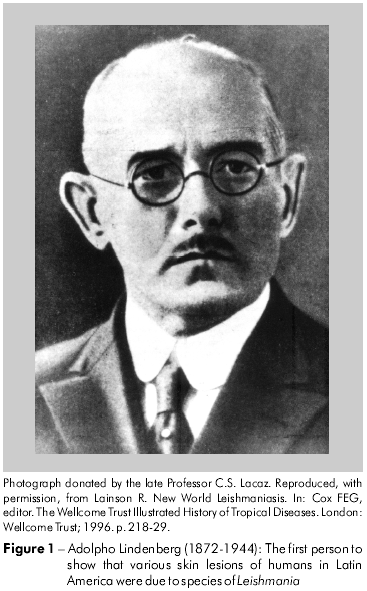
<body><![CDATA[<p><font size="2" face="Verdana"> American visceral leishmaniasis (AVL) may have     an equally ancient history in Latin America, but would clearly offer less     visual evidence of its existence. However, the condition known in Brazil     as <i>barriga d'&aacute;gua </i>(an   abnormally distended abdomen), which is associated with fever and general malaise,   was well known, and many such cases in the past were likely to have been undiagnosed   AVL.</font></p>     <p><font size="2" face="Verdana"> The following key chronological events in the     history of ACL and AVL in the Neotropics, and in particular Brazil, will     perhaps help to more readily see how the present classification of their     causal agents took shape.</font></p>     <p>&nbsp;</p>     <p><font size="3" face="Verdana"><b>EARLY BEGINNINGS</b></font></p>     <p><font size="2" face="Verdana">For many years, Peruvian <i>uta</i> and     similar skin lesions in other countries of Latin America were considered     to be identical with  &quot;oriental sore&quot; in   Mediterranean and Asian countries, the aetiology of which was, at that time,   also in doubt.</font></p>     <p><font size="2" face="Verdana">1909-1911</font></p>     <p><font size="2" face="Verdana"> The causative agent of Old World oriental sore     was discovered in 1903<sup>115</sup> and named <i>Leishmania tropica </i>in     1906<sup>62</sup>.     Similar skin lesions in the Neotropics were not associated with a leishmanial     parasite until 1909, when Lindenberg<sup>60</sup> and Carini and Paranhos<sup>6</sup> independently     demonstrated &quot;Leishman-Donovan   bodies&quot; (amastigotes) in the skin lesions of individuals with &quot;Baur&uacute; ulcer&quot; from   the State of S&atilde;o Paulo, Brazil. Curiously, Lindenberg (<a href="#f1">Figure   1</a>) first   published his discovery in a newspaper, <i>O Estado de S&atilde;o Paulo, </i>on   30<sup>th</sup>   March 1909, and Carini and Paranhos recorded their findings the next day   - in the same newspaper! Finally, in 1911, Splendore demonstrated the presence   of the parasite in mucocutaneous lesions of espundia.</font></p>     <p><a name="f1"></a></p>     <p>&nbsp;</p>     <p align="center"><img src="/img/revistas/rpas/v1n2/2a02f1.gif" border="0"></p>     ]]></body>
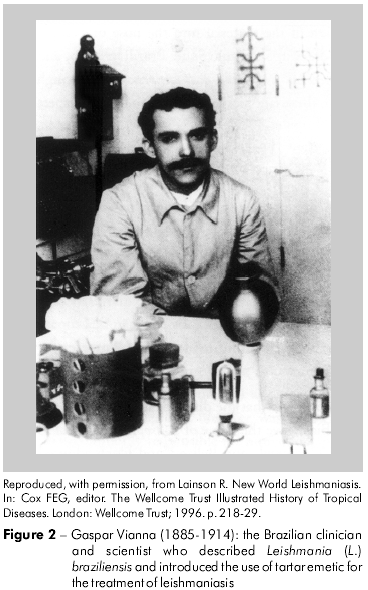
<body><![CDATA[<p>&nbsp;</p>     <p><font size="2" face="Verdana">At first it was thought that the causative parasite     should be referred to as <i>Leishmania tropica </i>(Wright, 1903) L&uuml;he,     1906, but the Brazilian clinician and parasitologist Gaspar Vianna<sup>111</sup> (<a href="#f2">Figure   2</a>) studied amastigotes in the skin lesion of a patient in Al&eacute;m Para&iacute;ba,     Minas Gerais State, Brazil, and concluded (erroneously, as it was later shown)     that their morphology differed from that of <i>L. tropica </i>amastigotes.     He therefore named the parasite <i>Leishmania brazilienses, </i>later amended     to <i>L. braziliensis </i>by   Matta<sup>69</sup>, in 1916.</font></p>     <p><a name="f2"></a></p>     <p>&nbsp;</p>     <p align="center"><img src="/img/revistas/rpas/v1n2/2a02f2.gif" border="0"></p>     <p>&nbsp;</p>     <p><font size="2" face="Verdana">1913</font></p>     <p><font size="2" face="Verdana">For several years, there was a general opinion that all American cutaneous   and mucocutaneous leishmaniasis was due to the single parasite, <i>L. braziliensis. </i>Nevertheless,   Velez<sup>110</sup> decided, if only for patriotic reasons, that the parasite causing   Peruvian uta was neither <i>L. tropica </i>nor <i>L. braziliensis </i>and thus   named it <i>Leishmania peruviana.</i></font></p>     <p><font size="2" face="Verdana">The first report of AVL in the     Americas was probably that of Migone<sup>74</sup> in 1913, who saw what he considered     to be amastigotes in the blood of a patient in Paraguay. The man's symptoms     were highly indicative of AVL, and after failing to respond to treatment     for malaria, he died. Before his illness, he had worked on the construction     of the notorious S&atilde;o Paulo-Corumb&aacute; railway   in Brazil, where it was thought he probably acquired his infection.</font></p>     <p><font size="2" face="Verdana">1934-1937</font></p>     ]]></body>
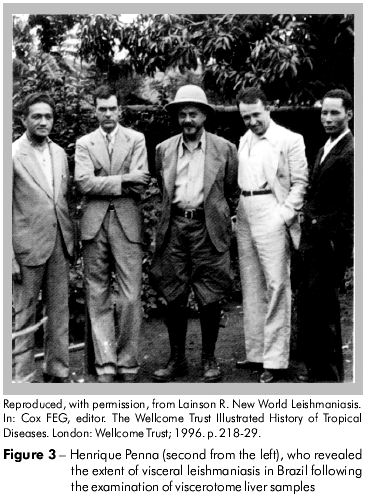
<body><![CDATA[<p><font size="2" face="Verdana">Although sporadic cases of AVL     had begun to appear in a number of other South and Central American countries,     some time elapsed before definitive proof of the existence of the disease     was obtained in Brazil. In 1934, however, 41 cases were diagnosed following     the examination of liver tissue removed by viscerotome<sup>80 </sup>(<a href="#f3">Figure   3</a>). Three of these were from the State of Par&aacute;  and represented the     first record of Amazonian AVL.</font></p>     <p><a name="f3"></a></p>     <p>&nbsp;</p>     <p align="center"><img src="/img/revistas/rpas/v1n2/2a02f3.gif" border="0"></p>     <p>&nbsp;</p>     <p><font size="2" face="Verdana">Both <i>L. donovani </i>and <i>L. infantum, </i>the causative agents of Old   World visceral leishmaniasis, were known to readily infect laboratory animals.   Therefore, in 1937, when Cunha and Chagas<sup>12</sup> were, for some reason, unable to   infect similar hosts with the parasite from Brazilian cases of AVL, it prompted them to name the parasite <i>Leishmania chagasi.</i></font></p>     <p><font size="2" face="Verdana">1945-1948</font></p>     <p><font size="2" face="Verdana">A notable event in Brazil was the discovery     by Medina<sup>71</sup> of an enigmatic parasite causing lesions in the skin     of the domestic guinea pig (<i>Cavia porcellus</i>) in   1946; this parasite was later named <i>Leishmania enriettii </i>Muniz &amp; Medina,   1948. This discovery was a clear indication that dermotropic species of <i>Leishmania </i>other   than <i>L. braziliensis </i>might be infecting humans in Brazil. Until the   1960s, it was still thought that all cases of human ACL in this country were   due to <i>L. braziliensis. </i>This general opinion persisted despite the fact   that the causative agent of the disease in the confluent forest of neighbouring   French Guyana had been named <i>L. guyanensis </i>Floch, 1954.</font></p>     <p><font size="2" face="Verdana">In 1946, Convit and Lapenta<sup>9</sup> described a strange form of cutaneous leishmaniasis   in some patients in Venezuela that was characterised by a large number of nodular   lesions scattered over the body and containing enormous numbers of large amastigotes.   The patients showed a negative Montenegro skin test and did not respond to   the usual antimonial drug treatment. The condition was referred to as diffuse   cutaneous leishmaniasis (DCL) and the causative agent in Venezuela was later   named <i>Leishmania pifanoi</i><sup>73</sup>. </font></p>     <p><font size="2" face="Verdana">1953-1961</font></p>     ]]></body>
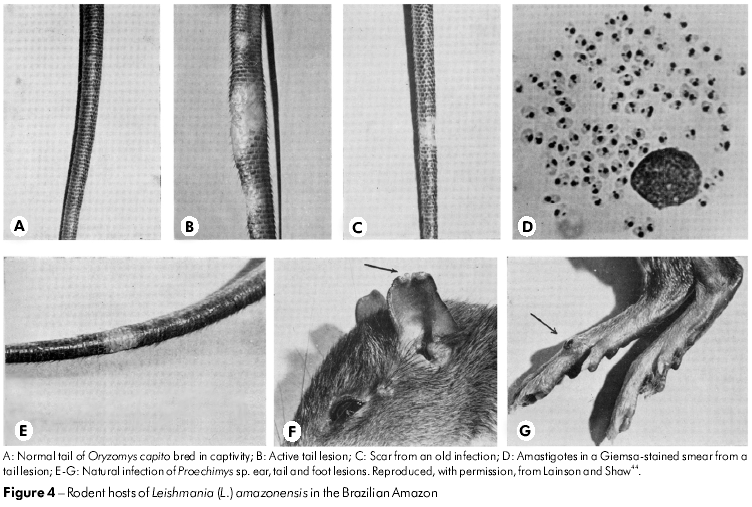
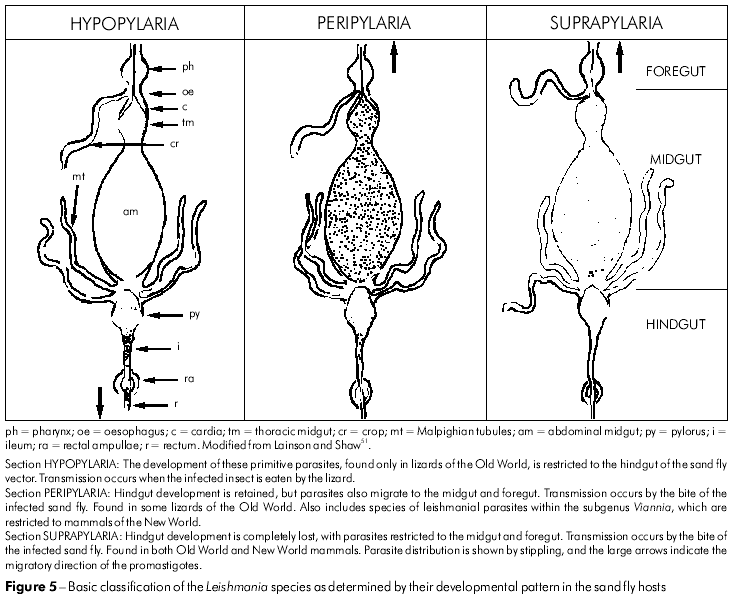
<body><![CDATA[<p><font size="2" face="Verdana">In 1957, researchers in Panama<sup>107,106</sup> demonstrated     the presence of a <i>Leishmania</i>  species in the forest rodent <i>Proechimys     semispinosus</i>, and other infections   were recorded in forest rodents in the State of S&atilde;o Paulo, Brazil, by   Forattini<sup>20</sup> in 1960. In neither case, however, was it conclusively shown that   the organism was identical to the parasite commonly infecting humans in the   same locality.</font></p>     <p><font size="2" face="Verdana">By now it was becoming clear     that different dermotropic leishmanial parasites were probably responsible     for cutaneous leishmaniasis in different parts of the Neotropics. That causing  &quot;chiclero's     ulcer&quot; in     the Yucatan, Guatemala and Belize was named <i>Leishmania tropica mexicana </i>by     Biagi<sup>3</sup>, in 1953, and in French Guyana, Floch<sup>19</sup> adopted this same trinomial     nomenclature by referring to the cause of  &quot;pian-bois&quot; as <i>L.     tropica guyanensis</i> in   1954. Similarly, in other parts of South America, he regarded cutaneous leishmaniasis   as being due to <i>L. tropica braziliensis. </i>However, in 1959, Medina and   Romero<sup>73</sup>, together with several other researchers, rightly disapproved of the   specific name  &quot;tropica&quot; for these parasites and instead gave the   name <i>Leishmania braziliensis pifanoi </i>to the parasite associated with   DCL in Venezuela. The Brazilian parasitologist Pess&ocirc;a<sup>81</sup> followed suit   in 1961 by listing the known <i>Leishmania </i>species in the Americas as <i>L.   braziliensis braziliensis, L. b. guyanensis, L. b. peruviana, L. b. pifanoi, </i>and <i>L.   b. mexicana.</i></font></p>     <p><font size="2" face="Verdana">1962-1965</font></p>     <p><font size="2" face="Verdana">In 1962, Garnham<sup>23</sup> raised the parasite causing chiclero's ulcer in Belize,   Central America, to specific rank as <i>Leishmania mexicana. </i>Additionally,   in 1962 and 1964, during studies on the epidemiology of this disease, Lainson   and Strangways-Dixon<sup>56,57</sup> established that forest rodents were reservoir hosts   of the parasite and frequently showed visible lesions, rich in amastigotes,   on their tails. A volunteer was successfully infected with the rodent parasite,   and a biological and biochemical comparison of the organism with that from   cases of ACL showed them to be identical. This represented the first conclusive   association of a Neotropical leishmanial parasite known to infect man with   a sylvatic reservoir in wild animals.</font></p>     <p><font size="2" face="Verdana">It was natural to suspect that a similar rodent reservoir of <i>L. braziliensis </i>probably   existed in the forests of Brazil. Thus, during a visit to the Instituto Evandro   Chagas (IEC) in 1963, the present author discussed the possibility of a collaborative   programme on the eco-epidemiology of ACL in the Amazon Region with the late   Director, Dr. Orlando Costa, and the late Dr. Otis Causey, at that time head   of the lEC's arbovirus programme.</font></p>     <p><font size="2" face="Verdana">Causey was impressed by the similarity of the tail lesions caused by <i>L.     mexicana </i>to similar lesions on the tails of rodents he had noted among     animals captured in the Utinga forest in Bel&eacute;m, Brazil. He had, however,     thought they were due to bacterial infections of damaged tails, and he promised     to examine them more carefully in the future. A few weeks later, he presented     the author with a Giemsa-stained smear from a lesion on the tail of a specimen     of <i>Oryzomys capito, </i>a common forest rodent in his capture area, and     it was rich in leishmanial amastigotes. This unexpectedly rapid discovery     prompted a discussion with the Wellcome Trust in </font><font size="2" face="Verdana">London, who agreed to the establishment of the Wellcome Parasitology Unit   (WPU) in the Department of Parasitology of the IEC for a provisional period   of three years, with the promise of further support should the results of the   research warrant it. The IEC/WPU programme lasted until 1992.</font></p>     <p><font size="2" face="Verdana">1965-1967</font></p>     <p><font size="2" face="Verdana">Although the parasite of <i>Oryzomys</i> was at first assumed to be <i>L.     braziliensis </i>by Nery-Guimaraes and Costa<sup>77</sup> in 1964, this conclusion was     not supported by the WPU's comparison of the rodent parasite with that from     cases of human cutaneous and mucocutaneous leishmaniasis. First, the amastigotes     of the rodent parasite were clearly much larger than those of <i>L. braziliensis </i>and,     when inoculated into the skin of laboratory hamsters and mice, rapidly produced     huge tumour-like lesions packed with amastigotes. In contrast, <i>L. braziliensis </i>produced     a small nodule that often required several months to become visible and only     contained a small number of relatively tiny amastigotes. In addition, the     rodent parasite - by now found to infect a variety of forest rodents (<a href="#f4">Figure   4</a>) and marsupials - grew luxuriantly in a very simple blood-agar culture     medium (NNN), whereas <i>L. braziliensis </i>struggled to survive in the     same medium, with successful isolates often dying out after several sub-cultures.     In 1969 and 1970, Lainson and Shaw<sup>49,45</sup> referred to these differences as     the behaviour of &quot;fast and slow strains&quot; of <i>Leishmania</i>.</font></p>     <p><a name="f4"></a></p>     <p>&nbsp;</p>     ]]></body>
<body><![CDATA[<p align="center"><img src="/img/revistas/rpas/v1n2/2a02f4.gif" border="0"></p>     <p>&nbsp;</p>     <p><font size="2" face="Verdana">The continued examination of <i>Leishmania </i>isolates from patients coming   to the IEC soon showed that a small number of the parasites were the same as   those from <i>Oryzomys </i>and other rodents. Importantly, this identification   indicated that the parasite was a causal agent of the condition known as DCL   or, more correctly, anergic diffuse cutaneous leishmaniasis (ADCL), a very   disfiguring infection produced in immunologically incompetent individuals that   resists the usual treatment by anti-leishmanial drugs. Because the parasite's   biological features closely resembled those of <i>L. mexicana </i>of Central   America, it was given the name <i>L. mexicana amazonensis </i>Lainson and Shaw, 1972.</font></p>     <p><font size="2" face="Verdana">1968</font></p>     <p><font size="2" face="Verdana">This year saw the first incrimination of the     fox <i>Cerdocyon thous </i>as   an important reservoir host of the parasite responsible for Amazonian canine   and human visceral leishmaniasis, variously referred to as <i>L. chagasi</i> or <i>L.   donovani. </i>Three infected foxes<sup>52,54</sup> were found near Utinga,   on the outskirts of Bel&eacute;m, and ten infected animals, a surprisingly   high number, were later found among 25 examined (40%) on the island of Maraj&oacute;,   Par&aacute;<sup>54</sup>.   None of these infected animals showed outward signs of disease.</font></p>     <p><font size="2" face="Verdana">1977</font></p>     <p><font size="2" face="Verdana">Smears of liver and spleen tissue from a porcupine <i>Coendou       prehensilis, </i>captured   in a forested area of Par&aacute;, revealed the presence of amastigotes measuring   up to 6.8 x 4.5 &#181;m<sup>43</sup>, an unusually large size even when compared with <i>L.   m. amazonensis </i>amastigotes. In 1971, Herrer<sup>27</sup> had given the name <i>Leishmania   hertigi </i>to a parasite of Panamanian porcupines; therefore, the Brazilian <i>Coendou </i>parasite   was given the subspecific name <i>Leishmania hertigi deanei </i>in honour of   Leonidas Deane. Deane had encountered what was probably the same parasite in   porcupines from the State of Piau&iacute;, Brazil, but, unsure of its nature,   had refrained from naming it. The leishmanial nature of this strange parasite   was indicated by its production (albeit only transitory) of amastigotes in   the skin of experimentally inoculated hamsters and its formation of typical   promastigote stages in blood-agar culture medium. In 1980, Miles et al<sup>76</sup> differentiated   the parasite from <i>L.</i> (<i>L.</i>) <i>hertigi hertigi </i>and <i>L. mexicana amazonensis </i>by comparative isoenzyme profiles.</font></p>     <p><font size="2" face="Verdana">1979</font></p>     <p><font size="2" face="Verdana">A species of <i>Leishmania </i>was isolated   from the liver and spleen of a nine-banded armadillo, <i>Dasypus novemcinctus, </i>from   the Monte Dourado (Jari) area of northern Par&aacute;, Brazil<sup>51</sup>.</font></p>     <p><font size="2" face="Verdana">Biological features and the     development of biochemical and immunological techniques gradually laid the     foundation for preliminary attempts to classify the increasing number of   accepted species  of the genus <i>Leishmania</i><sup>46,50,42,117,51</sup>.</font> <font size="2" face="Verdana">Particularly important were observations on the mode of development of these   species in their phlebotomine vectors, which enabled the division of the parasites   into three distinct groups referred to as Sections (<a href="#f5">Figure   5</a>).</font></p>     ]]></body>
<body><![CDATA[<p><a name="f5"></a></p>     <p>&nbsp;</p>     <p align="center"><img src="/img/revistas/rpas/v1n2/2a02f5.gif" border="0"></p>     <p>&nbsp;</p>     <p><font size="3" face="Verdana"><b>AN EARLY CLASSIFICATION OF THE <i>LEISHMANIA </i>SPECIES<sup>51</sup></b></font></p>     <p><font size="2" face="Verdana">SECTION HYPOPYLARIA (from <i>hypo </i>= under, and <i>pyl </i>= gate)</font></p>     <p><font size="2" face="Verdana">The parasites included in this group were considered the most primitive species,   and their development is limited to a posterior position in the pylorus, ileum   and rectum of the sand fly gut. The reservoir hosts are apparently restricted   to certain lizards of the Old World, in which the parasite may be in the promastigote   and/or amastigote form in the viscera or blood. Listed species included <i>Leishmania   agamae </i>David, 1929, and <i>L. ceramodactyli </i>Adler &amp; Theodor, 1928.   Transmission presumably follows the ingestion of an infected sand fly by the   lizard. Some<sup>35</sup>, including the present author, consider that these parasites   are better placed in the genus <i>Sauroleishmania </i>Ranque, 1973. </font></p>     <p><font size="2" face="Verdana">SECTION PERIPYLARIA (from <i>peri </i>= on all sides, and <i>pyl </i>= gate)</font></p>     <p><font size="2" face="Verdana">These <i>Leishmania </i>species have maintained an obligate hindgut development   in the sand fly, but, in addition, have now developed a migration to the foregut.   Included here are the following parasites of Old World lizards: <i>Leishmania   adleri </i>Heisch,   1958, and <i>Leishmania tarentolae </i>Wenyon, 1921. The parasite can now be   transmitted by the bite of an infected sand fly or when the fly is eaten. This   Section, however, was dominated by what Lainson and Shaw referred to as the <i>L.   braziliensis </i>complex<sup>51</sup> of the New World. At that time, this complex included   the following parasites, all of which infect humans: <i>L. braziliensis </i>Vianna,   1911; <i>L. peruviana </i>Velez, 1913; <i>L. guyanensis </i>Floch, 1954; and <i>L.   panamensis </i>Lainson &amp; Shaw, 1972.</font></p>     <p><font size="2" face="Verdana">SECTION SUPRAPYLARIA (from <i>supra </i>= above, and <i>pyl </i>= gate)</font></p>     ]]></body>
<body><![CDATA[<p><font size="2" face="Verdana">These <i>Leishmania </i>species were considered to have lost the primitive   hindgut development in the sand fly, with the parasites now restricted to the   midgut and foregut. They are found in the skin, viscera or blood of both Old   World and Neotropical mammals, and transmission is by the bite of the infected   sand fly vector. The Section was divided into four complexes, as follows:</font></p>     <p><font size="2" face="Verdana"><b>The <i>L. donovani </i>complex</b></font></p>     <p><font size="2" face="Verdana"><i>Leishmania donovani </i>(Laveran &amp; Mesnil,     1902) Ross,   1903 (Old World); <i>Leishmania infantum </i>Nicolle, 1908   (Old World); <i>Leishmania chagasi </i>Cunha &amp; Chagas, 1937 (New World).</font></p>     <p><font size="2" face="Verdana"><b>The <i>L. mexicana </i>complex</b></font></p>     <p><font size="2" face="Verdana"><i>L. mexicana mexicana </i>(Biagi,     1953) Lainson &amp;  Shaw, 1979; <i>L.     mexicana amazonensis </i>Lainson &amp; Shaw, 1972; <i>L. mexicana pifanoi </i>(Medina &amp; Romero,     1959) Medina &amp; Romero, 1962; <i>L. mexicana aristidesi </i>Lainson &amp; Shaw,     1979; <i>L. mexicana enriettii </i>Muniz &amp; Medina, 1948 (All in the New     World).</font></p>     <p><font size="2" face="Verdana"><b>The <i>L. hertigi </i>complex</b></font></p>     <p><font size="2" face="Verdana"><i>L. hertigi hertigi </i>Herrer, 1971; <i>L. hertigi deanei </i>Lainson &amp; Shaw,   1977 (New World).</font></p>     <p><font size="2" face="Verdana"><b>The <i>L. tropica </i>complex</b></font></p>     <p><font size="2" face="Verdana"><i>Leishmania tropica </i>(Wright, 1903) Luhe,1906; <i>Leishmania major </i>Yakimov &amp; Schockov,   1914; <i>Leishmania aethiopica </i>Bray, Ashford &amp; Bray, 1973 (All in the   Old World).</font></p>     <p><font size="2" face="Verdana">In 1982, the Russian researcher Saf'janova<sup>91</sup> separated     the leishmanias of lizards from the true <i>Leishmania </i>species of mammals     by the subgeneric use of the names <i>Sauroleishmania </i>Ranque, 1973, and <i>Leishmania </i>Ross,     1903, respectively. Within the subgenus <i>Leishmania, </i>she considered     the <i>L.     donovani </i>complex to consist of <i>Leishmania </i>(<i>L</i>.)<i> donovani, <i>L.</i> </i>(<i><i>L.</i></i>)<i> infantum </i>(Old   World) and <i>L.</i> (<i>L.</i>) <i>chagasi </i>(New World). She did not consider the development   of <i>L. braziliensis </i>and related Neotropical leishmanias in the sand fly's   hindgut (members of the Peripylaria<sup>51</sup>) to be of taxonomic importance,   however, and grouped all the Neotropical parasites together as <i>L.</i> (<i>L.</i>) <i>amazonensis;</i>     <i>L.</i> (<i>L.</i>) mexicana; <i>L.</i> (<i>L.</i>) braziliensis </i>and <i>L.</i> (<i>L.</i>) <i>panamensis </i>(dermal   leishmaniases); and <i>L.</i> (<i>L.</i>) <i>chagasi </i>(visceral leishmaniasis). Furthermore,   Saf'janova was of the opinion that there were insufficient taxonomic criteria   to include <i>L. braziliensis peruviana </i>and <i>L. braziliensis guyanensis </i>in   her classification. The exclusion of the latter two parasites was most likely   due to the unavailability of recent literature that had clearly indicated specific   characterisation on  biological, biochemical and   serological evidence<sup>40,70,75</sup>.</font></p>     ]]></body>
<body><![CDATA[<p>&nbsp;</p>     <p><font size="3" face="Verdana"><b>1987 A REVISED CLASSIFICATION OF THE NEOTROPICAL <i>LEISHMANIA </i>SPECIES</b></font></p>     <p><font size="2" face="Verdana">Extensive studies of the ecology and epidemiology     of cutaneous leishmaniasis in the Brazilian Amazon Region revealed a steadily     increasing number of <i>Leishmania </i>species   that were now more adequately characterised by their isoenzyme profiles<sup>76</sup>,   and this prompted a taxonomic revision<sup>41</sup>.</font></p>     <p><font size="2" face="Verdana">In 1977, Lainson et al<sup>58</sup> had stressed the importance of using the presence   or absence of hindgut development in the sand fly to distinguish parasites   of the <i>L. braziliensis </i>complex (hindgut development present) from those   of the <i>L. mexicana </i>complex (hindgut development absent)<sup>58</sup>. Accordingly,   in the revised classification, all species with hindgut development were placed   in the new subgenus <i>Viannia, </i>which was named in honour of Gaspar Vianna,   who had described <i>L.</i> (<i>V.</i>) <i>braziliensis, </i>now the type species of the   subgenus. It followed that all species lacking hindgut development were housed   in the subgenus <i>Leishmania </i>Ross, 1903 used by Saf'janova<sup>91</sup> in 1982.   In addition, while commenting on &quot;the cumbersome combination of geographic   names of parasites, which at times entered into absurd conflict with each other&quot;  (e.g., <i>L.   braziliensis guyanensis </i>and <i>L. mexicana venezuelensis), </i>it was also   proposed to raise the subspecific names to specific level. With these modifications,   the following classification was given for <i>Leishmania </i>species of the   Neotropics.</font></p>     <p><font size="2" face="Verdana">SUBGENUS <i>LEISHMANIA </i>ROSS, 1903</font></p>     <p><font size="2" face="Verdana">Definition: With the characters of the genus <i>Leishmania. </i>Life cycle   in the insect host limited to the midgut and foregut. Type species: <i>Leishmania   </i>(<i>Leishmania</i>)<i> donovani </i>(Laveran &amp; Mesnil, 1903) Ross, 1903. It contained   the following Neotropical parasites: <i>Leishmania </i>(L.) <i>chagasi </i>Cunha &amp; Chagas,   1937; <i>L.</i> (<i>L.</i>) <i>enriettii </i>Muniz &amp; Medina, 1948; <i>L.</i> (<i>L.</i>) <i>mexicana </i>Biagi,   1953 emend. Garnham, 1962; <i>L.</i> (<i>L.</i>) <i>amazonensis </i>Lainson &amp; Shaw, 1972;   <i>L.</i> (<i>L.</i>) <i>aristidesi </i>Lainson &amp;  Shaw, 1979; <i>L.</i> (<i>L.</i>) <i>venezuelensis </i>Bonfante-Garrido,   1980; <i>L.</i> (<i>L.</i>) <i>garnhami </i>Scorza et al, 1979; <i>L.</i> (<i>L.</i>) <i>pifanoi </i>(Medina &amp; Romero,   1959) Medina &amp; Romero, 1962; <i>L.</i> (<i>L.</i>) <i>hertigi </i>Herrer, 1971; <i>L.</i> (<i>L.</i>) <i>deanei </i>Lainson &amp; Shaw, 1977.</font></p>     <p><font size="2" face="Verdana">SUBGENUS <i>VIANNIA </i>LAINSON &amp;  SHAW, 1987</font></p>     <p><font size="2" face="Verdana">Definition: With the characters of the genus <i>Leishmania. </i>Life     cycle in the insect host including a prolific phase of development as rounded     or stumpy paramastigotes and promastigotes attached to the wall of the hindgut   (pylorus and/or ileum) by flagellar hemidesmosomes, but with later migration   of the parasites to the midgut and foregut. Type species: <i>Leishmania</i> (<i>Viannia</i>)   <i>braziliensis</i>.</font></p>     <p><font size="2" face="Verdana">Species of this subgenus are known only in the     New World and were listed as follows: <i>L.</i> (<i>V.</i>) <i>braziliensis </i>Vianna,     1911, emend Matta, 1916; <i>L.</i> (<i>V.</i>) <i>peruviana </i>Velez,   1913; <i>L.</i> (<i>V.</i>) <i>guyanensis </i>Floch, 1954; <i>L.</i> (<i>V.</i>) <i>panamensis </i>Lainson &amp; Shaw,   1972.</font></p>     <p>&nbsp;</p>     ]]></body>
<body><![CDATA[<p><font size="3" face="Verdana"><b>CONTINUING RESEARCH ON NEOTROPICAL <i>LEISHMANIA </i>SPECIES</b></font></p>     <p><font size="2" face="Verdana">1987</font></p>     <p><font size="2" face="Verdana">The use of monoclonal antibodies became an established method for the identification   of <i>Leishmania </i>(<i>Viannia</i>)<i> braziliensis </i>in infected sand flies<sup>97</sup>.</font></p>     <p><font size="2" face="Verdana">1988-1989</font></p>     <p><font size="2" face="Verdana">A new species of the subgenus <i>Viannia </i>was     isolated from a sloth, a procyonid and two species of monkeys in lowland     forest at the foot of the Caraj&aacute;s   hills, Par&aacute;   State, Brazil<sup>38</sup>. This parasite was named <i>Leishmania   </i>(<i>Viannia</i>)<i> shawi </i>Lainson et al, 1989.</font></p>     <p><font size="2" face="Verdana">The parasite that had been isolated from the nine-banded armadillo (<i>Dasypus     novemcinctus</i>) in 1979 was characterised and finally named as <i>Leishmania</i>  (<i>Viannia</i>) <i>naiffi</i> Lainson &amp; Shaw, 1989.</font></p>     <p><font size="2" face="Verdana">1991</font></p>     <p><font size="2" face="Verdana">Kreutzer et al<sup>36</sup> described a new species of <i>Leishmania </i>infecting   humans in Colombia and Panama and named it <i>L.</i> (<i>Viannia</i>) <i>colombiensis.</i></font></p>     <p><font size="2" face="Verdana">1992</font></p>     <p><font size="2" face="Verdana">Grimaldi et al<sup>26</sup> isolated another previously undescribed parasite from the   sloth <i>Choloepus hoffmanni </i>and the squirrel <i>Sciurus granatensis </i>in   Ecuador and gave it the name <i>L.</i> (<i>V.</i>) <i>equatorensis.</i></font></p>     ]]></body>
<body><![CDATA[<p><font size="2" face="Verdana">2002</font></p>     <p><font size="2" face="Verdana">A parasite isolated from cases     of ACL in soldiers engaged in manoeuvres in degraded forest in Bel&eacute;m,     Par&aacute; State,     Brazil, was found to differ from all previous <i>Leishmania </i>species in     the Amazon region<sup>99</sup> and was   given the name <i>Leishmania </i>(<i>Viannia</i>)<i> lindenbergi</i> Silveira et al, 2002.</font></p>     <p><font size="2" face="Verdana">2003</font></p>     <p><font size="2" face="Verdana">In 1977, a <i>Leishmania </i>of the subgenus <i>Viannia </i>was isolated from   a single specimen of the sand fly <i>Lutzomyia tuberculata </i>taken from the   trunk of a large tree in the Utinga forest. It remained for a long period in   the IEC cryobank until it was finally characterised and named<sup>4</sup> <i>Leishmania</i> <span style="font-size:10.0pt;font-family:Verdana">(</span><i>Viannia</i>) <i>utingensis</i> Braga et al, 2003</font><font size="2" face="verdana"><sup>4</sup></font><font size="2" face="Verdana">.</font></p>     <p><font size="2" face="Verdana">1998/2005</font></p>     <p><font size="2" face="Verdana">The establishment of the subgenus <i>Viannia </i>and characterisation of additional   leishmanial parasites isolated from sand flies, wild mammals and patients with   ACL necessitated two further publications that updated and modified the classification<sup>48,47</sup>.</font></p>     <p><font size="2" face="Verdana">A major change to the previous listing of parasites in the subgenus <i>Leishmania </i>was   the proposal of the authors Lainson and Shaw<sup>47</sup>, in 2005, to divide <i>Leishmania </i>(<i>L.</i>) <i>infantum </i>into   two subspecies: <i>L.</i> (<i>L.</i>) <i>infantum infantum </i>(Old World) and <i>L.</i> (<i>L.</i>) <i>infantum   chagasi </i>(New World). In addition, the new classification included <i>Leishmania</i>  (<i>L.</i>) <i>forattinii</i> Yoshida et al, 1993, a parasite found in Brazil in an opossum, <i>Didelphis   marsupialis aurita, </i>and a rodent, <i>Proechimys iheringi denigratus.</i></font></p>     <p><font size="2" face="Verdana">All the presently recognised Neotropical species of <i>Leishmania, </i>their   recorded geographical distribution, proven or suspected sand fly hosts, recorded   mammalian reservoir hosts, and clinical data concerning those known to infect   humans are given below.</font></p>     <p>&nbsp;</p>     <p><font size="3" face="Verdana"><b>PRESENT CLASSIFICATION OF THE NEOTROPICAL <i>LEISHMANIA </i>SPECIES</b></font></p>     ]]></body>
<body><![CDATA[<p><font size="2" face="Verdana">Adapted from Cox<sup>11</sup> and Lainson and Shaw<sup>47</sup>.</font></p>     <p><font size="2" face="Verdana">Kingdom: <b>Protozoa </b>Goldfuss,   1818</font></p>     <p><font size="2" face="Verdana">Phylum: <b>Euglenozoa </b>Cavalier-Smith, 1998</font></p>     <p><font size="2" face="Verdana">Class: <b>Kinetoplastea: </b>Honigberg,   1963</font></p>     <p><font size="2" face="Verdana">Order: <b>Trypanosomatida </b>Kent, 1880</font></p>     <p><font size="2" face="Verdana">Family: <b>Trypanosomatidae </b>Doflein,   1901</font></p>     <p><font size="2" face="Verdana">Genus: <b><i>Leishmania </i></b>Ross, 1903</font></p>     <p><font size="2" face="Verdana">Subgenus: <b><i>Leishmania </i></b>Ross,   1903</font></p>     <p><font size="2" face="Verdana">Subgenus: <b><i>Viannia </i></b>Lainson &amp; Shaw,     1987</font></p>     <p>&nbsp;</p>     ]]></body>
<body><![CDATA[<p><font size="3" face="Verdana"><b>SUBGENUS <i>LEISHMANIA</i></b></font></p>     <p><font size="2" face="Verdana"><i>LEISHMANIA (LEISHMANIA) INFANTUM CHAGASI </i>(CUNHA &amp; CHAGAS,   1937) SHAW, 2002</font></p>     <p><font size="2" face="Verdana">Known geographical distribution</font></p>     <p><font size="2" face="Verdana">Most of the Latin American continent, including Argentina, Bolivia, Brazil,   Colombia, Ecuador, El Salvador, Guadeloupe, Guatemala, Honduras, Martinique,   Mexico, Nicaragua, Paraguay, Surinam and Venezuela.</font></p>     <p><font size="2" face="Verdana">Known sand fly hosts</font></p>     <p><font size="2" face="Verdana"><i>Lutzomyia </i>(<i>Lutzomyia</i>)<i> longipalpis </i>is the     principal vector throughout the range of AVL<sup>14,37</sup>, but <i>Lu. evansi </i>has     also been incriminated in Colombia and Venezuela<sup>109,17</sup>. <i>Lu.</i> (<i>Lu.</i>) <i>cruzi </i>became     highly suspected as an alternative vector in the State of Mato Grosso do     Sul, Brazil, when <i>L.</i> (<i>L.</i>) <i>infantum chagasi </i>was isolated from 14 specimens<sup>93</sup>.     The females of <i>Lu. cruzi, </i>however, are indistinguishable from those     of <i>Lu. longipalpis, </i>and   even the males of the two species can only be separated based on small differences.   The authors concluded that because <i>Lu. longipalpis </i>males were apparently   absent at the time of their study, the infected females were <i>Lu. cruzi. </i>Although   the presence of <i>Lu. longipalpis </i>in the same area has since been established<sup>94</sup>,   there now seems to be little doubt that <i>Lu.</i> (<i>Lu.</i>) <i>cruzi </i>may   be an alternative vector of <i>Leishmania</i> (<i>L.</i>) <i>infantum</i> chagasi in the State of Mato Gosso   do Sul.</font></p>     <p><font size="2" face="Verdana">Recorded mammalian hosts</font></p>     <p><font size="2" face="Verdana">The sylvatic canids <i>Cerdocyon thous </i>(&quot;crab-eating     fox&quot;)<sup>52,54</sup>   and <i>Speothos venaticus </i>(&quot;bush-dog&quot;)<sup>18</sup>; the felids <i>Panthera   onca </i>(jaguar) and <i>Felis concolor </i>(puma)<sup>13</sup>; the opossums <i>Didelphis   marsupialis</i><sup>10,108</sup> and <i>D. albiventris</i><sup>98</sup>; the domestic dog; and humans.</font></p>     <p><font size="2" face="Verdana">Human infection</font></p>     <p><font size="2" face="Verdana"><i>L.</i> (<i>L.</i>) <i>chagasi </i>predominantly produces     visceral leishmaniasis, which is often fatal unless adequately treated, but     infection can be asymptomatic in some individuals. In Costa Rica, infection     is largely in the form of non-ulcerative cutaneous lesions<sup>116</sup>, and in Honduras     and Nicaragua, infection is both visceral and cutaneous<sup>84,2</sup>.</font></p>     ]]></body>
<body><![CDATA[<p><font size="2" face="Verdana">Opinions have been divided as to whether the     parasite named <i>L.</i> (<i>L.</i>) <i>chagasi </i>is   indigenous to the American tropics or if the disease in the New World is due   to <i>L.</i> (<i>L.</i>) <i>infantum, </i>which was introduced by Iberian immigrants, or   their dogs, as recently as about 500 years ago. Arguments favouring the indigenous   hypothesis have been  given as   follows<sup>37,54,48,47</sup>:</font></p>     <p><font size="2" face="Verdana">1. In terms of geological time, 500 years is a very short period for the parasite   to have achieved such a wide distribution throughout the Latin American continent,   from Mexico to Argentina.</font></p>     <p><font size="2" face="Verdana">2. The host-specificity of the <i>Leishmania </i>species     in nature is most pronounced in the sand fly, which is generally regarded     as the primary host of <i>Leishmania </i>species. Therefore, it seems unlikely     that introduced <i>L.</i> (<i>L.</i>) <i>infantum </i>could have made a sudden jump from     the genus <i>Phlebotomus </i>in   the Old World to the genus <i>Lutzomyia </i>in the Americas. <i>Lutzomyia </i>(<i>Lutzomyia</i>)<i> longipalpis </i>is the principal vector of <i>L.</i> (<i>L.</i>) <i>infantum chagasi </i>throughout   the geographical range<sup>14,37</sup>, and it is not known to naturally transmit any   other species of <i>Leishmania.</i></font></p>     <p><font size="2" face="Verdana">3. Based on molecular data, it is frequently stated that the parasites referred   to as <i>L.</i> (<i>L.</i>) <i>infantum </i>and <i>L.</i> (<i>L.</i>) <i>chagasi </i>are identical. There   have been, however, a few publications (conveniently disregarded) claiming   the demonstration of some differences between the two organisms. These, it   has been claimed, have been demonstrated by restriction endonuclease digestion   and hybridisation of kinetoplast DNA<sup>33,32</sup> and in radiorespirometry profiles   of the two parasites<sup>16,15</sup>; finally, antigenic differences have been claimed   for their respective promastigotes<sup>92</sup>. Unless these findings are disproved,   it would therefore seem necessary to consider them in any discussion on the   taxonomy of the two organisms.</font></p>     <p><font size="2" face="Verdana">4. In the transmission cycle of <i><i>L.</i> </i>(<i><i>L.</i></i>)<i> infantum chagasi </i>among wild   animals by the sylvatic population of <i>Lutzomyia longipalpis, </i>there is   a high prevalence of infection in the native fox <i>Cerdocyon thous </i>in   Brazil<sup>54</sup> and in the opossum <i>Didelphis marsupialis </i>in Colombia<sup>10,108</sup>.   Infections have also been sporadically reported in other wild animals, including   the opossum <i>Didelphis albiventris</i><sup>98</sup> the &quot;bush dog&quot; <i>Speothos   venaticus</i><sup>18</sup><i>,</i>the jaguar <i>Panthera onca </i>and the puma <i>Felis concolor</i><sup>13</sup>. All   of the infections recorded in these wild animals have consistently been of   a benign inapparent nature, which is more suggestive of a very ancient host-parasite   relationship rather than infection with a strange and recently introduced parasite.</font></p>     <p><font size="2" face="Verdana">The great diversity of <i>Leishmania </i>species in the New World has prompted   the suggestion that leishmanial parasites originated in the American tropics<sup>78,79</sup>,   and that the genus <i>Leishmania </i>gained entrance to the Old World via the   Bering land bridge. Other authors<sup>63</sup>, while agreeing with this hypothesis, have   postulated that, following the introduction of the ancestral leishmanial parasite   into the Old World and the evolution of <i>Leishmania donovani </i>and <i>Leishmania   infantum </i>(an estimated 14-24 million years ago), the latter parasite gained   entrance to the New World by way of the Iberian colonists.</font></p>     <p><font size="2" face="Verdana">To the present author, it seems equally reasonable to suggest that while this   evolution of the ancestral parasite was taking place in the Old World, giving   rise not only to the viscerotropic parasites <i>L.</i> (<i>L.</i>) <i>donovani </i>and <i>L.</i> (<i>L.</i>) <i>infantum, </i>but also to the dermotropic members of the <i>L.</i> (<i>L.</i>) <i>tropica </i>complex,   another such evolutionary process of the ancestral parasite continued in the   New World, producing the viscerotropic parasite named as <i>L. chagasi</i> and   dermotropic parasites of the subgenus <i>Leishmania </i>(e.g., those of the <i>L.   mexicana </i>and <i>L. hertigi </i>complexes). At the same time, another ancient   line diverged to form the subgenus <i>Viannia, </i>the members of which retained   the primitive characteristic of hindgut development in the sand fly gut. This   group of leishmanial parasites is unknown in the Old World, possibly because   their ancestral form never gained entrance via the Bering land bridge due to   a restricted locomotor capacity of the mammalian reservoir hosts.</font></p>     <p><font size="2" face="Verdana">The name <i>L.</i> (<i>L.</i>) <i>infantum </i>Nicolle, 1908 clearly has chronological priority   over the name <i>L.</i> (<i>L.</i>) <i>chagasi </i>Cunha &amp; Chagas, 1937, and we are   obliged to accept the specific name of <i>infantum </i>for the parasite in   both hemispheres. The prolonged geographical separation might explain the above-mentioned   recorded differences between the two populations, leading to the view that   it is best to now regard them as the subspecies <i>L.</i> (<i>L.</i>) <i>infantum chagasi </i>and <i>L.</i> (<i>L.</i>) <i>infantum infantum</i><sup>95,39,47,11</sup>.</font></p>     <p><font size="2" face="Verdana">Some confusion has occurred     regarding the authorship of this proposal. It was first made by Lainson and     Shaw<sup>47</sup> when their chapter &quot;New World Leishmaniasis&quot; was   submitted for publication in the 10<sup>th</sup> edition of &quot;Topley &amp; Wilson's   Microbiology and Microbial Infections&quot;. There was an unusually long delay,   however, before this edition finally appeared in print in 2005, and during   this time, both Shaw<sup>95</sup>, in 2002, and Lainson and Rangel<sup>39</sup>, in 2003 used the   new subspecific names in other publications. Chronologically, therefore, the   correct subspecific names of <i>L. infantum </i>should be written as <i>L.</i> (<i>L.</i>) <i>infantum infantum </i>(Nicolle, 1908) Shaw, 2002 and <i>L.</i> (<i>L.</i>) <i>infantum   chagasi </i>(Cunha &amp; Chagas, 1937) Shaw, 2002.</font></p>     <p><font size="2" face="Verdana"><i>LEISHMANIA </i>(<i>L.</i>) <i>ENRIETTII </i>MUNIZ &amp; MEDINA, 1948</font></p>     ]]></body>
<body><![CDATA[<p><font size="2" face="Verdana">Known geographical distribution</font></p>     <p><font size="2" face="Verdana">Known only in the States of     Paran&aacute;<sup>71</sup> and S&atilde;o Paulo<sup>65</sup>, Brazil.</font></p>     <p><font size="2" face="Verdana">Known sand fly hosts</font></p>     <p><font size="2" face="Verdana"><i>Lu. monticola </i>and <i>Lu. correalimai </i>are suspected, the former   having been experimentally infected when fed on the lesions of guinea pigs<sup>64</sup>.</font></p>     <p><font size="2" face="Verdana">Recorded mammalian hosts</font></p>     <p><font size="2" face="Verdana">Natural infections only recorded in the domestic guinea pig (<i>Cavia porcellus</i>).</font></p>     <p><font size="2" face="Verdana">Human infection</font></p>     <p><font size="2" face="Verdana">Not yet reported, and attempts to infect volunteers failed.</font></p>     <p><font size="2" face="Verdana"><i>LEISHMANIA </i>(<i>L.</i>) <i>MEXICANA </i>(BIAGI,     1953) GARNHAM, 1962</font></p>     <p><font size="2" face="Verdana">Known geographical distribution</font></p>     ]]></body>
<body><![CDATA[<p><font size="2" face="Verdana">Belize, Guatemala, Honduras, Costa Rica, southern USA. Reports in geographically   widely separated South American countries must be viewed with caution.</font></p>     <p><font size="2" face="Verdana">Known sand fly hosts</font></p>     <p><font size="2" face="Verdana"><i>Lutzomyia olmeca olmeca </i>is a proven vector. <i>Lu. diabolica </i>is   suspected in northern Mexico and southern Texas, and <i>Lu. anthophora </i>is   suspected in Arizona.</font></p>     <p><font size="2" face="Verdana">Recorded mammalian hosts</font></p>     <p><font size="2" face="Verdana">The forest rodents <i>Ototylomys phyllotis,       Nyctomys sumichrasti, Heteromys desmarestianus </i>and <i>Sigmodon hispidus, </i>and <i>Neotoma       albigula </i>in     the southern USA (Arizona); humans.</font></p>     <p><font size="2" face="Verdana">Human infection</font></p>     <p><font size="2" face="Verdana">Cutaneous leishmaniasis, with     a pronounced tendency to cause lesions of the external ear (&quot;chiclero's     ulcer&quot; or &quot;chiclero's ear&quot;).   Occasional cases of ADCL.</font></p>     <p><font size="2" face="Verdana"><i>LEISHMANIA </i>(<i>L.</i>) <i>PIFANOI </i>(MEDINA &amp; ROMERO,     1959) MEDINA &amp; ROMERO,   1962</font></p>     <p><font size="2" face="Verdana">Known geographic distribution</font></p>     <p><font size="2" face="Verdana">Apparently limited to Venezuela, particularly in the States of Yaracuy, Lara   and Miranda.</font></p>     ]]></body>
<body><![CDATA[<p><font size="2" face="Verdana">Known sand fly hosts</font></p>     <p><font size="2" face="Verdana">Uncertain, but possibly <i>Lutzomyia flaviscutellata.</i></font></p>     <p><font size="2" face="Verdana">Recorded mammalian hosts</font></p>     <p><font size="2" face="Verdana">Humans. Although the wild animal reservoir hosts     of <i>L. </i>(<i>L.</i>) <i>pifanoi </i>remain   unknown, Lima et al59 suggested that the rodents <i>Sigmodon hispidus </i>and <i>Rattus   rattus </i>could be reservoirs of various <i>Leishmania </i>spp., including,   presumably, <i>L.</i> (<i>L.</i>) <i>pifanoi.</i></font></p>     <p><font size="2" face="Verdana">Human infection</font></p>     <p><font size="2" face="Verdana">So far, all cases recorded have been ADCL. </font></p>     <p><font size="2" face="Verdana"><i>LEISHMANIA</i> (<i>LEISHMANIA</i>) <i>AMAZONENSIS</i> LAINSON &amp; SHAW, 1972</font></p>     <p><font size="2" face="Verdana">Known geographical distribution</font></p>     <p><font size="2" face="Verdana">Bolivia, Brazil, Colombia, French Guyana and Paraguay. Probably occurs in   other Neotropical countries where the sand fly vector exists.</font></p>     <p><font size="2" face="Verdana">Known sand fly hosts</font></p>     ]]></body>
<body><![CDATA[<p><font size="2" face="Verdana"><i>Lutzomyia</i> (<i>Nyssomyia</i>) <i>flaviscutellata </i>is     the major vector<sup>44,96,113,112</sup>, with occasional infections reported     in the closely related <i>Lu. </i>(<i>N.</i>) <i>olmeca   olmeca </i>and <i>Lu.</i> (<i>N.</i>) <i>reducta. </i>A parasite identified   as <i>L.</i> (<i>L.</i>)   <i>amazonensis </i>was isolated from 16 of 1,715 specimens of <i>Lu. nuneztovari</i><sup>68</sup> in   Bolivia.</font></p>     <p><font size="2" face="Verdana">Recorded mammalian hosts</font></p>     <p><font size="2" face="Verdana">The terrestrial forest rodents <i>Proechimys </i>spp., <i>Oryzomys </i>spp., <i>Nectomys,     Neacomys, </i>and <i>Dasyprocta; </i>the marsupials <i>Marmosa, Metachirus,     Didelphis </i>and <i>Philander; </i>the fox <i>Cerdocyon thous; </i>humans.</font></p>     <p><font size="2" face="Verdana">Human infection</font></p>     <p><font size="2" face="Verdana">Localised single-sore cutaneous leishmaniasis     and, in patients with a defective cell-mediated immune system, ADCL. Rare     cases of visceral leishmaniasis have been attributed to this parasite in     the State of Bahia, Brazil<sup>1</sup>, but not elsewhere.   The clinical and immunopathological spectrum of American cutaneous leishmaniasis,   with particular reference to the disseminated form of the disease due to <i>L.</i>   (<i>L.</i>) <i>amazonensis </i>and <i>L.</i> (<i>V.</i>) <i>braziliensis </i>and illustrating the   extreme pathogenicity at the poles of ADCL and mucocutaneous leishmaniasis,   has been described elsewhere<sup>100</sup>.</font></p>     <p><font size="2" face="Verdana"><i>LEISHMANIA</i> (<i>LEISHMANIA</i>) <i>ARISTIDESI </i>(LAINSON  &amp; SHAW,     1979) EMEND LAINSON &amp; SHAW, 1987</font></p>     <p><font size="2" face="Verdana">Known geographical distribution</font></p>     <p><font size="2" face="Verdana">Sasardi forest in the San Blas Territory of Eastern Panama.</font></p>     <p><font size="2" face="Verdana">Known sand fly hosts</font></p>     <p><font size="2" face="Verdana">A putative vector is <i>Lutzomyia</i> (<i>Nyssomyia</i>)       <i>olmeca bicolor</i> based on   its predominance in rodent and marsupial-baited Disney traps in areas where   infected animals were also obtained<sup>7</sup>.</font></p>     ]]></body>
<body><![CDATA[<p><font size="2" face="Verdana">Recorded mammalian hosts</font></p>     <p><font size="2" face="Verdana">The opossum <i>Marmosa robinsoni </i>and the rodents <i>Proechimys semispinosus </i>and <i>Dasyprocta     punctata</i><sup>29,30</sup>.</font></p>     <p><font size="2" face="Verdana">Human infection</font></p>     <p><font size="2" face="Verdana">Not known, although <i>Lu. olmeca bicolor </i>has occasionally been found   to feed on humans.</font></p>     <p><font size="2" face="Verdana"><i>LEISHMANIA</i> (<i>LEISHMANIA</i>) <i>GARNHAMI </i>SCORZA     ET AL, 1979</font></p>     <p><font size="2" face="Verdana">Known geographical distribution The Venezuelan Andes.</font></p>     <p><font size="2" face="Verdana">Known sand fly hosts</font></p>     <p><font size="2" face="Verdana">The most suspected vector is <i>Lu. youngi. </i>A     parasite found in an infected specimen produced amastigotes in the skin of     an inoculated hamster that were thought to be <i>L.</i>(<i>L.</i>) <i>garnhami</i>, but     the parasite was not definitively identified<sup>66</sup>.</font></p>     <p><font size="2" face="Verdana">Recorded mammalian hosts</font></p>     <p><font size="2" face="Verdana">The opossum <i>Didelphis marsupialis </i>and humans.</font></p>     ]]></body>
<body><![CDATA[<p><font size="2" face="Verdana">Human infection</font></p>     <p><font size="2" face="Verdana">ACL, of the simple localised lesion type.</font></p>     <p><font size="2" face="Verdana"><i>LEISHMANIA </i>(<i>LEISHMANIA</i>) <i>VENEZUELENSIS </i>BONFANTE-GARRIDO, 1980</font></p>     <p><font size="2" face="Verdana">Known geographical distribution</font></p>     <p><font size="2" face="Verdana">Venezuela, in the States of Lara and Yaracuy.</font></p>     <p><font size="2" face="Verdana">Known sand fly hosts</font></p>     <p><font size="2" face="Verdana">A definite vector has not been identified, but <i>Lu.       olmeca bicolor </i>and <i>Lu.     rangeliana </i>are suspected to be involved.</font></p>     <p><font size="2" face="Verdana">Recorded mammalian hosts</font></p>     <p><font size="2" face="Verdana">The wild mammalian hosts remain uncertain, but the parasite has been recorded   in the domestic cat and humans. It has been suggested that the rodents <i>Sigmodon   hispidus </i>and <i>Rattus rattus </i>are potential reservoir hosts of various <i>Leishmania </i>spp.<sup>59</sup>,   including, presumably, <i>L.</i> (<i>L.</i>) <i>venezuelensis.</i></font></p>     <p><font size="2" face="Verdana">Human infection</font></p>     ]]></body>
<body><![CDATA[<p><font size="2" face="Verdana">Single or multiple skin lesions. Sometimes disseminated nodules that can be   confused with ADCL, but the infection responds well to antimonial treatment.</font></p>     <p><font size="2" face="Verdana"><i>LEISHMANIA</i> (<i>LEISHMANIA</i>) <i>FORATTINII </i>YOSHIDA ET AL, 1993</font></p>     <p><font size="2" face="Verdana">Known geographical distribution</font></p>     <p><font size="2" face="Verdana">Brazil, in the States of S&atilde;o Paulo, Bahia and Esp&iacute;rito Santo.</font></p>     <p><font size="2" face="Verdana">Known sand fly hosts</font></p>     <p><font size="2" face="Verdana">Not yet identified, but <i>Lu.</i> (<i>Psychodopygus</i>) <i>ayrozai </i>and <i>Lu. yuilli </i>have   been experimentally infected.</font></p>     <p><font size="2" face="Verdana">Recorded mammalian hosts</font></p>     <p><font size="2" face="Verdana">The rodent <i>Proechimys iheringi </i>and the marsupial <i>Didelphis marsupialis </i>in   the State of S&atilde;o Paulo.</font></p>     <p><font size="2" face="Verdana">Human infection</font></p>     <p><font size="2" face="Verdana">Not yet recorded, but as the suspected vectors are known to feed on humans,   infections might be found in the future.</font></p>     ]]></body>
<body><![CDATA[<p><font size="2" face="Verdana"><i>LEISHMANIA</i> (<i>LEISHMANIA</i>) <i>HERTIGI </i>HERRER,   1971</font></p>     <p><font size="2" face="Verdana">Known geographical distribution</font></p>     <p><font size="2" face="Verdana">Panama and Costa Rica.</font></p>     <p><font size="2" face="Verdana">Known sand fly hosts</font></p>     <p><font size="2" face="Verdana">The sand fly vector has yet to be discovered. The high rate of infection in   the mammalian host suggests that it lives in close proximity to the vector(s),   possibly in hollow trees.</font></p>     <p><font size="2" face="Verdana">Recorded mammalian hosts</font></p>     <p><font size="2" face="Verdana">The tropical porcupine <i>Coendou rothschildi. </i>Extensive examinations   of other wild animals have revealed no other mammalian reservoir host.</font></p>     <p><font size="2" face="Verdana">Human infection</font></p>     <p><font size="2" face="Verdana">Unrecorded, possibly due to the inability of the parasite to survive in human   tissues or because the vector never bites humans.</font></p>     <p><font size="2" face="Verdana"><i>LEISHMANIA</i> (<i>LEISHMANIA</i>) <i>DEANEI </i>LAINSON  &amp; SHAW, 1977</font></p>     ]]></body>
<body><![CDATA[<p><font size="2" face="Verdana">Known geographical distribution</font></p>     <p><font size="2" face="Verdana">To date, only recorded in the Brazilian Amazon     Region.</font></p>     <p><font size="2" face="Verdana">Known sand fly hosts</font></p>     <p><font size="2" face="Verdana">The invertebrate host remains unknown. Tree-inhabiting sand flies of the species <i>Lutzomyia     </i>(<i>Viannamyia</i>)<i> furcata </i>were taken from a hollow tree inhabited by an infected     porcupine in Utinga forest, Bel&eacute;m, Par&aacute;, Brazil, and were shown     to contain promastigotes in their undigested bloodmeals. However, there was     no evidence that the parasites had migrated to the foregut, and they disappeared     with the complete digestion of the blood<sup>41</sup>.</font></p>     <p><font size="2" face="Verdana">Recorded mammalian hosts</font></p>     <p><font size="2" face="Verdana">The tree porcupine <i>Coendou p. prehensilis. </i>Like <i>L.</i> (<i>L.</i>) <i>hertigi</i>, <i>L.</i> (<i>L.</i>) <i>deanei </i>has a very high infection rate in       this porcupine, and an exhaustive examination of other wild animals suggests       that it is the sole mammalian reservoir host of the parasite.</font></p>     <p><font size="2" face="Verdana">Human infection</font></p>     <p><font size="2" face="Verdana">Unrecorded. Again, as is the case with <i>L.</i> (<i>L.</i>) <i>hertigi</i>, this may be   because the organism cannot survive in human tissues or simply because the   vector never bites humans.</font></p>     <p><font size="2" face="Verdana">In the 2005 classification<sup>47</sup> these two enigmatic parasites were placed under   the heading of <i>&quot;Leishmania-</i>like parasites of uncertain taxonomic   position&quot;, largely because molecular studies<sup>79</sup> had suggested them to be   more closely related to <i>Endotrypanum </i>(an endoerythrocytic flagellate   of sloths) than to <i>Leishmania. </i>However, their present names were retained<sup>47</sup>   until further information could be obtained, and, for this reason, I am grouping   them here with members of the subgenus <i>Leishmania. </i>Based on the absence   of attached hindgut forms of <i>L.</i> (<i>L.</i>) <i>deanei </i>in <i>Lutzomyia furcata, </i>albeit   in transitory infections, this parasite certainly does not appear to be a member   of the subgenus <i>Viannia. </i>Knowledge of the complete life cycles of these   two organisms in their natural invertebrate hosts will hopefully indicate their   exact taxonomic status.</font></p>     <p><font size="2" face="Verdana">Although both members of the <i>L. hertigi </i>complex     appear to be peculiar to porcupines, they are easily distinguished by isoenzyme     profiles and a marked difference in the morphology of their amastigotes:     those of <i>L.</i> (<i>L.</i>) <i>hertigi</i> are   strangely elongated and measure only from 3.5 x 1.2 to 4.8 x 2.5 &#956;m, while   those of <i>L.</i> (<i>L.</i>) <i>deanei</i> are rounded in form and, at 5.1   x 3.1 to 6.8 x 3.7 &#956;m, are the largest of all recorded species of <i>Leishmania.</i></font></p>     ]]></body>
<body><![CDATA[<p>&nbsp;</p>     <p><font size="3" face="Verdana"><b>THE SUBGENUS <i>VIANNIA</i></b></font></p>     <p><font size="2" face="Verdana"><i>LEISHMANIA</i> (<i>VIANNIA</i>) <i>BRAZILIENSIS</i> (VIANNA, 1911) EMEND MATTA, 1916</font></p>     <p><font size="2" face="Verdana">Known geographical distribution</font></p>     <p><font size="2" face="Verdana">Although parasites variously referred to as <i>L. braziliensis </i>or <i>L.     braziliensis sensu lato </i>have been reported in almost all Latin American     countries from Argentina to Mexico, doubt remains as to the true nature of     many records due to inadequate methods of identification in the past. Some     may be simple zymodemes of <i>L.</i> (<i>V.</i>) <i>braziliensis</i>, but others may prove     to be different, unidentified species of the subgenus <i>Viannia.</i></font></p>     <p><font size="2" face="Verdana">Known sand fly hosts</font></p>     <p><font size="2" face="Verdana">The existing uncertainties regarding the exact geographical distribution of <i>L.</i> (<i>V.</i>) <i>braziliensis </i>make it difficult to identify all of its vectors. However,     at least in Brazil, where the parasite has been recorded in every State,     it is clear that there are numerous sand fly species involved in its transmission.     These include <i>Lutzomyia </i>(<i>Nyssomyia</i>)<i> intermedia, <i>Lu.</i> </i>(<i><i>N.</i></i>)<i> whitmani sensu     stricto, Lu. </i>(<i>Psychodopygus</i>)<i> wellcomei, Lu. migonei</i><sup>85</sup> and <i>Lu.</i> (<i>N.</i>) <i>neivae </i>(Pinto,     1926) (for reference, see &quot;Concluding Remarks&quot;).</font></p>     <p><font size="2" face="Verdana">In a recent study in the Salobo     area of the Serra dos Caraj&aacute;s, Par&aacute;,   Brazil, promastigotes from four specimens of <i>Lu. </i>(<i>Psychodopygus</i>)<i> davisi </i>were   identified as <i>L.</i> (<i>V.</i>) <i>braziliensis</i>, while others from   specimens of <i>Lu.</i>   (<i>Psychodopygus</i>) <i>hirsuta </i>(3 infected), <i>Lu.</i> (<i>Nyssomyia</i>) <i>umbratilis</i> (3), <i>Lu.</i>   (<i>N.</i>) <i>richardwardi </i>(2), <i>Lu.</i> (<i>Trichophoromyia</i>) <i>brachipyga</i> (2), <i>Lu.</i>   (<i>T.</i>) <i>ubiquitalis </i>(2), <i>Lu. trinidadensis </i>(1) and <i>Lu. migonei </i>(1)   remain to be identified<sup>104</sup>. <i>Lu.</i> (<i>P.</i>) <i>davisi </i>has previously been indicated   as an important vector of zoonotic cutaneous leishmaniasis in the State of   Rond&ocirc;nia<sup>25</sup>.</font></p>     <p><font size="2" face="Verdana">In Par&aacute; State (near Paragominas),     a parasite identified as <i><i>L.</i> </i>(<i><i>V.</i></i>)<i> braziliensis </i>was isolated from a sand fly with the dual female morphology     of <i>Lu.</i> (<i>P.</i>) <i>complexa </i>and <i>Lu.</i> (<i>P.</i>) <i>wellcomei</i><sup>103</sup>. The females     of these two species are morphologically indistinguishable, but it was concluded     that the infected specimen was <i>Lu.</i> (<i>P.</i>) <i>complexa</i> due to the apparent     absence of any males of <i>Lu.</i> (<i>P.</i>) <i>wellcomei.</i></font></p>     <p><font size="2" face="Verdana">Recorded mammalian hosts</font></p>     ]]></body>
<body><![CDATA[<p><font size="2" face="Verdana">The low-level flight and high attraction to rodent-baited traps of the sand   fly <i>Lu. </i>(<i>Psychodopygus</i>)<i> wellcomei, </i>an important vector of <i>L.</i> (<i>V.</i>) <i>braziliensis </i>in   the Serra dos Caraj&aacute;s, Par&aacute;<sup>55</sup>, led to early suspicions that terrestrial   rodents and some marsupials might be the reservoir hosts of this parasite<sup>114,55</sup>.</font></p>     <p><font size="2" face="Verdana">Before the development of biochemical, serological     and molecular techniques for the characterisation and identification of <i>Leishmania </i>isolates,   it was only possible to use biological (&quot;extrinsic&quot;) characters of   the parasites, such as the size of amastigotes and their behaviour in a standardised   culture medium and in inoculated laboratory animals. Using such characters   together with the pattern of development of parasites in experimentally infected   sand flies (to indicate members of the subgenus <i>Viannia</i>), early researchers   could at least say that isolates made from wild animals in an area highly endemic   for human ACL due to <i>L.</i> (<i>V</i>) <i>braziliensis </i>were probably   this parasite. These records include the following wild animals.</font></p>     <p><font size="2" face="Verdana"><i>Oryzomys concolor, O. capito, O. nigripes,       Akodon arviculoides, Proechimys </i>spp., <i>Rattus     rattus, Rhipidomys leucodactylus </i>(Rodentia) and <i>Didelphis marsupialis </i>(Marsupialia)<sup>21,22,45,51,53,88</sup>,     all in Brazil; in Venezuela, <i>Rattus rattus </i>and <i>Sigmodon hispidus </i>(Rodentia)<sup>59</sup>.     Finally, parasites from the Brazilian rodents <i>Bolomys lasiurus </i>and <i>Rattus     rattus </i>were conclusively shown to be <i>L.</i> (<i>V.) braziliensis </i>by     multilocus enzyme electrophoresis<sup>5</sup>.</font></p>     <p><font size="2" face="Verdana">Domestic animals, including equines, dogs and     cats, have been found with skin lesions due to <i>L.</i> (<i>V</i>) <i>braziliensis</i> in     areas that suggest a peridomestic transmission cycle. These reports have     come primarily from Argentina, Bolivia, Brazil, Colombia and Venezuela. Humans     are commonly infected.</font></p>     <p><font size="2" face="Verdana">Human infection</font></p>     <p><font size="2" face="Verdana">Cutaneous leishmaniasis, usually with one or a few lesions. Infection commonly   leads to mucocutaneous disease. The clinical and immunopathological spectrum   of American cutaneous leishmaniasis, with particular reference to the disseminated   and mucocutaneous diseases, has been described elsewhere<sup>100</sup>.</font></p>     <p><font size="2" face="Verdana"><i>LEISHMANIA</i> (<i>VIANNIA</i>) <i>PERUVIANA </i>VELEZ,     1913</font></p>     <p><font size="2" face="Verdana">Known geographical distribution</font></p>     <p><font size="2" face="Verdana">Peru, on the western side of the Andes, in areas with scant vegetation and   a restricted population of wild animals. Could extend into the Argentinean   highlands and other Andean countries.</font></p>     <p><font size="2" face="Verdana">Known sand fly hosts</font></p>     ]]></body>
<body><![CDATA[<p><font size="2" face="Verdana"><i>Lutzomyia</i> (<i>Helcocyrtomyia</i>) <i>peruensis </i>and <i>Lutzomyia verrucarum </i>are   highly suspected, and a parasite with biological features similar to those   obtained from humans and dogs has been isolated from the former<sup>28</sup>.</font></p>     <p><font size="2" face="Verdana">Recorded mammalian hosts</font></p>     <p><font size="2" face="Verdana">Dogs and humans. A recent study reported the isolation of this parasite from   the rodent <i>Phyllotis andinum </i>and the opossum <i>Didelphis marsupialis</i><sup>61</sup>.</font></p>     <p><font size="2" face="Verdana">Human infection</font></p>     <p><font size="2" face="Verdana">Simple cutaneous leishmaniasis with one or few lesions. The parasite is not   known to produce the mucocutaneous disease.</font></p>     <p><font size="2" face="Verdana"><i>LEISHMANIA</i> (<i>VIANNIA</i>) <i>GUYANENSIS </i>FLOCH, 1954</font></p>     <p><font size="2" face="Verdana">Known geographical distribution</font></p>     <p><font size="2" face="Verdana">This sylvatic species commonly infects humans in Brazil, particularly north   of the Amazon River, and in the neighbouring countries of French Guyana and   Surinam. Also reported in Colombia, Ecuador, Venezuela and the lowland forest   of Peru.</font></p>     <p><font size="2" face="Verdana">Known sand fly hosts</font></p>     <p><font size="2" face="Verdana">The principal vector is <i>Lutzomyia</i> (<i>Nyssomyia</i>) <i>umbratilis</i>,     with relatively infrequent infections recorded in <i>Lu.</i> (<i>N.</i>) <i>anduzei </i>(Reviews<sup>47,85</sup>).     Some early reports of infection in <i>Lu.</i> (<i>N.</i>) <i>whitmani s.l. </i>may have     actually been <i>Leishmania</i> (<i>Viannia</i>) <i>shawi.</i></font></p>     ]]></body>
<body><![CDATA[<p><font size="2" face="Verdana">Recorded mammalian hosts</font></p>     <p><font size="2" face="Verdana">Major sylvatic hosts are the sloth <i>Choloepus didactylus </i>and the lesser   anteater <i>Tamandua tetradactyla</i><sup>53,24</sup>, with occasional infections in rodents   and opossums. Infection in wild animals is benign and inapparent.</font></p>     <p><font size="2" face="Verdana">Human infection</font></p>     <p><font size="2" face="Verdana">Cutaneous leishmaniasis with one or multiple lesions. The latter may arise   from multiple bites of infected sand flies or metastatic lymphatic spread.   Rare cases of mucocutaneous involvement have been reported.</font></p>     <p><font size="2" face="Verdana"><i>LEISHMANIA</i> (<i>VIANNIA</i>) <i>PANAMENSIS </i>LAINSON  &amp; SHAW, 1972</font></p>     <p><font size="2" face="Verdana">Known geographical distribution</font></p>     <p><font size="2" face="Verdana">Canal Zone, Panama; also recorded in Colombia, Costa Rica, Ecuador, Honduras,   Nicaragua and Venezuela.</font></p>     <p><font size="2" face="Verdana">Known sand fly hosts</font></p>     <p><font size="2" face="Verdana">The major vector is considered to be <i>Lutzomyia</i>       (<i>N.</i>) <i>trapidoi</i>. A number   of other species are thought to act as secondary vectors, including <i>Lu.</i> (<i>N.</i>)   <i>ylephiletor</i>, <i>Lu.</i> (<i>Lu.</i>) <i>gomez </i>and <i>Lu.</i> (<i>Psychodopygus</i>)   <i>panamensis</i><sup>34,8</sup>.</font></p>     <p><font size="2" face="Verdana">Recorded mammalian hosts</font></p>     ]]></body>
<body><![CDATA[<p><font size="2" face="Verdana">The sloth <i>Choloepus hoffmanni </i>is the major host, with occasional infections   reported in the sloths <i>Bradypus infuscatus </i>and <i>B. griseus. </i>This   parasite has also been reported in a number of other arboreal animals, including <i>Bassaricyon   gabbi, Nasua nasua </i>and <i>Potos flavus </i>(Procyonidae), the monkeys <i>Aotus   trivirgatus </i>and <i>Saguinus geoffroyi </i>and the terrestrial rodent <i>Heteromys </i>sp.<sup>29,30</sup>.   Hunting dogs, like humans, often become &quot;victim hosts&quot; with visible   skin lesions.</font></p>     <p><font size="2" face="Verdana">Human infection</font></p>     <p><font size="2" face="Verdana">Cutaneous leishmaniasis, with one to several lesions; rare cases of the mucocutaneous   disease have been reported.</font></p>     <p><font size="2" face="Verdana"><i>LEISHMANIA</i> (<i>VIANNIA</i>) <i>LAINSONI</i> SILVEIRA ET AL, 1987</font></p>     <p><font size="2" face="Verdana">Known geographical distribution</font></p>     <p><font size="2" face="Verdana">Forested areas of Brazil, Peru and Bolivia.</font></p>     <p><font size="2" face="Verdana">Known sand fly hosts</font></p>     <p><font size="2" face="Verdana">To date, the only known vector is <i>Lutzomyia</i>  (<i>Trichophoromyia</i>) <i>ubiquitalis</i><sup>102</sup>. This   insect is the first representative of the subgenus <i>Trichophoromyia </i>to   be incriminated as a vector of a <i>Leishmania </i>species. <i>Lu.</i> (<i>T.</i>) <i>velascoi</i> is   highly suspected as a vector in Bolivia<sup>67</sup>.</font></p>     <p><font size="2" face="Verdana">Recorded mammalian hosts</font></p>     <p><font size="2" face="Verdana">So far, only the large rodent <i>Agoutipaca</i><sup>101</sup> and humans have been identified   as hosts.</font></p>     ]]></body>
<body><![CDATA[<p><font size="2" face="Verdana">Human infection</font></p>     <p><font size="2" face="Verdana">Infection by this parasite usually presents as a single lesion, and no case   of the mucocutaneous disease has yet been recorded.</font></p>     <p><font size="2" face="Verdana"><i>LEISHMANIA </i>(<i>VIANNIA</i>)<i> NAIFFI </i>LAINSON &amp; SHAW, 1989</font></p>     <p><font size="2" face="Verdana">Known geographical distribution</font></p>     <p><font size="2" face="Verdana">This species has been isolated     in the States of Par&aacute; and Amazonas,   Brazil, and in French Guyana. However, it will almost certainly be reported   in other parts of Latin America where the mammalian reservoir host and sand   fly vectors coexist.</font></p>     <p><font size="2" face="Verdana">Known sand fly hosts</font></p>     <p><font size="2" face="Verdana">The principal vector of infection among the     armadillo reservoir hosts appears to be <i>Lutzomyia</i> (<i>Psychodopygus</i>) <i>ayrozai</i>. This sand fly is not greatly   anthropophilic, however, which probably accounts for the low rate of human   infection. Rare infections have been recorded in <i>Lu.</i> (<i>P.</i>) <i>paraensis </i>and   <i>Lu.</i> (<i>P.</i>) <i>squamiventris, </i>which are highly anthropophilic and are therefore   likely vectors of the parasite to humans.</font></p>     <p><font size="2" face="Verdana">Recorded mammalian hosts</font></p>     <p><font size="2" face="Verdana">The only wild animal host known at present is the nine-banded armadillo <i>Dasypus     novemcinctus, </i>in which infection is very common in apparently normal     skin and viscera.</font></p>     <p><font size="2" face="Verdana">Human infection</font></p>     ]]></body>
<body><![CDATA[<p><font size="2" face="Verdana">Cutaneous leishmaniasis, usually in the form of a single lesion. Unlike most   Neotropical <i>Leishmania </i>species, <i>L.</i> (<i>V.</i>) <i>naiffi </i>rarely produces   a visible lesion in the skin of the laboratory hamster. If this parasite also   produces occult infection in the skin of humans, it is possible that transmission   to man is much more frequent than is generally thought.</font></p>     <p><font size="2" face="Verdana"><i>LEISHMANIA</i> (<i>VIANNIA</i>) <i>SHAWI</i> LAINSON ET AL, 1989</font></p>     <p><font size="2" face="Verdana">Known geographic distribution</font></p>     <p><font size="2" face="Verdana">Various areas of the Brazilian Amazon Region.</font></p>     <p><font size="2" face="Verdana">Known sand fly hosts</font></p>     <p><font size="2" face="Verdana"><i>Lutzomyia</i> (<i>N.</i>) <i>whitmani sensu lato</i>. Morphometric     differences have been recorded between <i>Lu.</i> (<i>N.</i>) <i>whitmani sensu stricto </i>from     the type locality in Bahia State, northeast Brazil, and the vector of <i>L.</i> (<i>V.</i>) <i>shawi </i>in   the State of Par&aacute;, Brazilian Amazon<sup>86</sup>. These differences, together with   separation of the two populations by DNA probes<sup>87</sup>, suggest that the vector   of <i>L.</i> (<i>V.</i>) <i>shawi </i>might be a  &quot;cryptic species&quot; of a <i>Lu.</i> (<i>N.</i>) <i>whitmani </i>complex.   This suggestion has been disputed, however, following a phylogenetic analysis   of the mitochondrial (cytochrome b) haplotypes of <i>Lu.</i> (<i>N.</i>) <i>whitmani, </i>which   led to the conclusion that clades of haplotypes and a continuum of interbreeding   populations of this sand fly exist in the forests of Brazil<sup>31</sup>. Nevertheless,   the behaviours of the type species of the sand fly in Bahia and of <i>Lu.</i> (<i>N.</i>) <i>whitmani   s.l. </i>in the State of Par&aacute; are very different. In the former locality,   the insect is highly anthropophilic, is commonly found in houses and is a vector   of <i>L.</i> (<i>V.</i>) <i>braziliensis</i>. In the primary forest of Par&aacute;, however,   the fly very rarely bites humans, has not been found to enter houses even when   they are close to the forest, and is a vector of <i>L.</i> (<i>V.</i>) <i>shawi</i>.</font></p>     <p><font size="2" face="Verdana">Recorded mammalian hosts</font></p>     <p><font size="2" face="Verdana">The monkeys <i>Cebus apella </i>and <i>Chiropotes satanas </i>(Cebidae), the   sloths <i>Choloepus didactylus </i>and <i>Bradypus tridactylus </i>(Xenarthra),   the coatimundi <i>Nasua nasua </i>(Procyonidae), and humans.</font></p>     <p><font size="2" face="Verdana">Human infection</font></p>     <p><font size="2" face="Verdana">The parasite is responsible for cutaneous leishmaniasis, usually of the single   lesion type, but cases of multiple lesions, clearly due to metastases, are   occasionally seen. Mucocutaneous disease due to <i>L.</i> (<i>V.</i>) <i>shawi </i>has not   yet been reported.</font></p>     ]]></body>
<body><![CDATA[<p><font size="2" face="Verdana"><i>LEISHMANIA</i> (<i>VIANNIA</i>) <i>COLOMBIENSIS</i> KREUTZER ET AL, 1991</font></p>     <p><font size="2" face="Verdana">Known geographical distribution</font></p>     <p><font size="2" face="Verdana">First recorded in Colombia and Panama, this parasite was also subsequently   found in Venezuela. Its distribution likely extends into the forests of Brazil   and of the Peruvian lowlands, as well as into other Latin American countries   where the sylvatic mammalian and sand fly hosts coexist.</font></p>     <p><font size="2" face="Verdana">Known sand fly hosts</font></p>     <p><font size="2" face="Verdana"><i>Lutzomyia</i> (<i>Helcocyrtomyia</i>) <i>hartmanni</i> in Colombia; <i>Lu.</i> (<i>Lu.</i>) <i>gomezi </i>and   <i>Lu.</i> (P<i>sychodopygus)</i> <i>panamensis</i> in Panama.</font></p>     <p><font size="2" face="Verdana">Recorded mammalian hosts</font></p>     <p><font size="2" face="Verdana">The sloth <i>Choloepus hoffmanni </i>and humans (Panama).</font></p>     <p><font size="2" face="Verdana">Human infection</font></p>     <p><font size="2" face="Verdana">Single or multiple cutaneous lesions. No case of the mucocutaneous disease   due to this parasite has been reported.</font></p>     <p><font size="2" face="Verdana"><i>LEISHMANIA</i> (<i>VIANNIA</i>) <i>EQUATORENSIS</i> GRIMALDI ET AL, 1992</font></p>     ]]></body>
<body><![CDATA[<p><font size="2" face="Verdana">Known geographical distribution</font></p>     <p><font size="2" face="Verdana">To date, this parasite appears to be limited to the Pacific coast of Ecuador.</font></p>     <p><font size="2" face="Verdana">Known sand fly hosts</font></p>     <p><font size="2" face="Verdana"><i>Lutzomyia </i>(<i>N.</i>) <i>hartmanni.</i></font></p>     <p><font size="2" face="Verdana"><i>Recorded mammalian hosts</i></font></p>     <p><font size="2" face="Verdana">The sloth <i>Choloepus hoffmanni </i>and the squirrel <i>Sciurus granatensis.</i></font></p>     <p><font size="2" face="Verdana">Human infection</font></p>     <p><font size="2" face="Verdana">Not yet recorded.</font></p>     <p><font size="2" face="Verdana"><i>LEISHMANIA</i> (<i>VIANNIA</i>) <i>LINDENBERGI </i>SILVEIRA     ET AL, 2002</font></p>     <p><font size="2" face="Verdana">Known geographic distribution</font></p>     ]]></body>
<body><![CDATA[<p><font size="2" face="Verdana">This parasite has only been     found in degraded forest in Bel&eacute;m, Par&aacute;,   Brazil.</font></p>     <p><font size="2" face="Verdana">Known sand fly hosts</font></p>     <p><font size="2" face="Verdana">The vector is currently unknown, but <i>Lutzomyia </i>(<i>N.</i>) <i>antunesi </i>is   highly suspected. This insect was shown to be the predominant anthropophilic   sand fly in an area where a number of soldiers acquired <i>L.</i> (<i>V.</i>) <i>lindenbergi </i>infections   while carrying out manoeuvres in the forest. In addition, the low-level flight   of Lu. (<i>N.</i>) <i>antunesi </i>would explain why the skin lesions of these men   were mostly on their faces and arms. Because the men spent most of their time   standing in trenches, these parts of the body would be the most exposed to   the bites of a low-flying sand fly. An unidentified <i>Leishmania </i>species   was found in specimens of <i>Lu.</i> (<i>N.</i>) <i>antunesi </i>on the island of Maraj&oacute;,   Par&aacute;<sup>90</sup>, but its development in the sand fly was suprapylarian. In contrast,   in experimentally infected sand flies, the development of <i>L. lindenbergi </i>is   peripylarian, which is typical of parasites in the subgenus <i>Viannia.</i></font></p>     <p><font size="2" face="Verdana">Recorded mammalian hosts</font></p>     <p><font size="2" face="Verdana">To date, humans are the only known hosts. It is suspected that the wild animal   reservoirs are probably terrestrial.</font></p>     <p><font size="2" face="Verdana">Human infection</font></p>     <p><font size="2" face="Verdana">Localised cutaneous lesions: to date, no case of the mucocutaneous disease   has been reported.</font></p>     <p><font size="2" face="Verdana"><i>LEISHMANIA</i> (<i>VIANNIA</i>) <i>UTINGENSIS</i> BRAGA ET AL, 2003</font></p>     <p><font size="2" face="Verdana">Known geographic distribution</font></p>     <p><font size="2" face="Verdana">Bel&eacute;m, Par&aacute;, Brazil.</font></p>     ]]></body>
<body><![CDATA[<p><font size="2" face="Verdana">Known sand fly hosts</font></p>     <p><font size="2" face="Verdana">Only recorded from a single specimen of the sand fly <i>Lutzomyia</i> (<i>Viannamyia</i>)     <i>tuberculata </i>that was taken from the trunk of a large tree in the Utinga     forest, Bel&eacute;m, Par&aacute;, Brazil.</font></p>     <p><font size="2" face="Verdana">Recorded mammalian hosts</font></p>     <p><font size="2" face="Verdana">Currently unknown.</font></p>     <p><font size="2" face="Verdana">Human infection</font></p>     <p><font size="2" face="Verdana">The parasite has not been recorded in humans.</font></p>     <p><font size="2" face="Verdana">&quot;HYBRIDS&quot; OF <i>LEISHMANIA </i>SPECIES WITHIN THE SUBGENUS <i>VIANNIA</i></font></p>     <p><font size="2" face="Verdana">These include <i>L.</i> (<i>V.</i>) <i>braziliensis </i>/ <i>L.</i> (<i>V.</i>) <i>panamensis; L. </i>(V.) <i>braziliensis </i>/   <i>L.</i> (<i>V.</i>) <i>guyanensis; </i>and <i>L.</i> (<i>V.</i>) <i>braziliensis </i>/ <i>L.</i> (<i>V.</i>) <i>peruviana, </i>all   of which have only been isolated from cases of human ACL. Only the latter &quot;hybrid&quot; has   been associated with the mucocutaneous disease. It has been suggested that   these &quot;hybrids&quot; are the result of genetic exchange. For more details   and references, consult Lainson and Shaw<sup>47</sup>.</font></p>     <p>&nbsp;</p>     <p><font size="3" face="Verdana"><b>CONCLUDING REMARKS</b></font></p>     ]]></body>
<body><![CDATA[<p><font size="2" face="Verdana">Since preparing this paper, I have been informed     that the sand fly <i>Lutzomyia     </i>(<i>Nyssomyia</i>)<i> neivae </i>(Pinto, 1926) has now been found to be naturally infected     by <i>Leishmania </i>(V.) <i>braziliensis </i>in southern Brazil<sup>82</sup>. I am indebted     to the reviewer of my paper for this information.</font></p>     <p><font size="2" face="Verdana">The difficulties in obtaining irrefutable proof     of the participation of <i>Lutzomyia     cruzi </i>in the transmission of <i>Leishmania</i> (<i>L.</i>) <i>infantum chagasi</i>, due     to the fact that the females of this sand fly cannot be morphologically distinguished     from those of <i><i>Lu.</i> </i>(<i><i>Lu.</i></i>)<i> longipalpis, </i>is paralleled by     a similar problem that arose during the search for the vector(s) of <i>Leishmania     </i>(<i>V</i>.)<i> braziliensis </i>in     the Serra dos Caraj&aacute;s, Par&aacute;, Brazil. The two predominant anthropophilic     sand fly species in the area were found to be <i>Lutzomyia </i>(<i>Psychodopygus</i>)<i> wellcomei </i>and <i>Lu </i>(<i>P</i>.)<i> complexa, </i>the females of which are also     morphologically indistinguishable. Numerous infected females were found to     be infected by <i><i>L.</i> </i>(<i><i>V.</i></i>)<i> braziliensis, </i>and the problem     was in deciding to which species they belonged. This dilemma was eventually     solved by breeding out the adult flies from the eggs of infected females;     this strategy provided the all-important males and conclusively showed the     infected flies to be <i>Lu.</i> (<i>P.</i>) <i>welcomei</i><sup>89</sup>. This method could perhaps     also be used to identify infected <i>Lu.</i> <i>cruzi </i>/ <i>Lu.</i> <i>longipalpis </i>in     the State of Mato Grosso do Sul.</font></p>     <p><font size="2" face="Verdana">Considering the remarkable number of <i>Leishmania </i>species     that have now been recorded in the Neotropics, and particularly in the Amazon     region, this area might well be the birthplace of this genus. This hypothesis     is supported by the observation that many of these parasites (species of     the&nbsp; subgenus <i>Viannia</i>) have retained a hindgut   development in the sand fly host, which is reminiscent of the life cycle of   the monoxenous flagellates of insects from which <i>Leishmania </i>is thought   to have evolved.</font></p>     <p><font size="2" face="Verdana">The existence of species of <i>Leishmania </i>that are known only in the sand   fly host (e.g., <i>L.</i> (<i>V.</i>) <i>utingensis </i>in <i>Lutzomyia tuberculata</i>) suggests   that others remain undetected among the numerous sand fly species that are   non-anthropophilic. The continued search for these parasites and their wild   mammalian reservoir hosts will be essential in generating an even more complete   picture of the ecology of this fascinating group of parasites.</font></p>     <p>&nbsp;</p>     <p><font size="3" face="Verdana"><b>ACKNOWLEDGEMENTS</b></font></p>     <p><font size="2" face="Verdana">The author is indebted to the     Wellcome Trust, London, for their continued support of the Wellcome Parasitology     Unit over nearly 30 years, and to the succession of Directors of the Instituto     Evandro Chagas, Secretaria de Vigil&acirc;ncia   em Sa&uacute;de, Minist&eacute;rio da Sa&uacute;de, Brazil, where this work   was carried out. There is not enough space to list all the participants during   this long period, but thanks must be given to the following: to Prof. Jeffrey   J. Shaw, old friend and colleague who worked with the author from the date   of the establishment of the WPU in 1965 until it was disbanded in 1992. To   those who pioneered the biochemical, serological and molecular techniques for   the identification of <i>Leishmania </i>species and enabled their installation   in the IEC/WPU Leishmaniasis Programme, including Drs. M. L. Chance, P J. Gardener,   Prof. M. A. Miles, Prof. D. C. Barker, Dr. Diane McMahon-Pratt and Dr. J. David;   and to Drs. Marinete M. P&oacute;voa, Roseli R. Braga and Edna A. Y. Ishikawa,   who so effectively used them. To our highly productive line of entomologists,   Dr. Habib Fraiha, Prof. Richard Ward, Drs. Paul Ready, Adelson A. A. Souza,   and Lee Ryan, and to clinician and parasitologist Fernando T. Silveira who,   as the present head of the lEC's Leishmaniasis Programme, is using his long   experience in the field and laboratory, with past members of the WPU, to ensure   that it continues to flourish. Finally, to all past and present technical staff,   in particular Maria das Gra&ccedil;as S. da Silva, Sued Freitas Silva, Manoel   C. de Souza, Roberto D. Naiff and Maricleide Naiff, Antonio Julio Monteiro,   Deocleciano G. Primo, Jos&eacute; Apr&iacute;gio N. de Lima, Jo&atilde;o B.   P. da Luz, Ant&oacute;nio F. P. Martins, Nonato B. Pires, Iorlando da Rocha   Barata and Jo&atilde;o A. Brand&atilde;o.</font></p>     <p>&nbsp;</p>     <p><font size="3" face="Verdana"><b>REFERENCES</b></font></p>     <!-- ref --><p><font size="2" face="Verdana">1 Barrai A, Badar&oacute; R,     Barral-Netto M, Grimaldi Jr G, Momen H, Carvalho EM. Isolation of <i>Leishmania mexicana amazonensis </i>from the bone marrow   in a case of American visceral leishmaniasis. Am J Trop Med Hyg. 1986 Jul;35(4):732-4.&nbsp; &nbsp; &nbsp; &nbsp;    &nbsp;&#91; <a href="http://cat.inist.fr/?aModele=afficheN&cpsidt=8780597" target="_blank">Links</a> &#93;</font><!-- ref --><p><font size="2" face="Verdana">2 Belli A, Garcia D, Palacios X, Rodriguez B, Valle S, Videa E, et al. Widespread   atypical cutaneous leishmaniasis caused by <i>Leishmania </i>(<i>L.</i>) <i>chagasi </i>in   Nicaragua. Am J Trop Med Hyg. 1999 Sep;61(3): 380-5.&nbsp; &nbsp; &nbsp; &nbsp;    &nbsp;&#91; <a href="http://www.ajtmh.org/cgi/reprint/61/3/380.pdf" target="_blank">Links</a> &#93;</font><!-- ref --><p><font size="2" face="Verdana">3 Biagi FF. Algunos comentarios     sobra las leishmaniasis y sus agentes etiol&oacute;gicos, <i>Leishmania tropica     mexicana,&nbsp; </i>nueva&nbsp;  subspecie.&nbsp; Medicina,   Mexico. 1953;33:401-6.</font><!-- ref --><p><font size="2" face="Verdana">4 Braga RR, Lainson R, Ishikawa EAY, Shaw JJ. <i>Leishmania utingensis </i>n.sp.,   a parasite from the sand fly <i>Lutzomyia </i>(<i>Viannamyia</i>)<i> tuberculata </i>in Amazonian Brazil. Parasite. 2003;10:111-8.</font><!-- ref --><p><font size="2" face="Verdana">5 Brand&atilde;o Filho SP, Brito     ME, Carvalho FG, Ishikawa EA, Cupolillo E, Floeter-Winter L, et al. Wild     and synanthropic hosts of <i>Leishmania</i> (<i>Viannia</i>)   <i>braziliensis </i>in the endemic cutaneous leishmaniasis locality of Amaraji, Pernambuco State, Brazil. Trans R Soc Trop Med Hyg. 2003 May-Jun;97(3):291-6.</font><!-- ref --><p><font size="2" face="Verdana">6 Carini A, Paranhos U. Identification     de l'ulcera de Baur&uacute; avec le   bouton d'Orient. Bull Soc Path Exot. 1909;2:225-6.</font><!-- ref --><p><font size="2" face="Verdana">7 Christensen HA, Herrer A, Telford SR. Enzootic cutaneous leishmaniasis in   eastern Panama. II. Entomological investigations. Ann Trop Med Parasitol. 1972   Mar;66(1):55-66.</font><!-- ref --><p><font size="2" face="Verdana">8 Christensen HA, Herrer A, Telford SR. <i>Leishmania braziliensis </i>from <i>Lutzomyia     panamensis </i>in Panama. J Parasitol. 1969;55:1090-1.</font><!-- ref --><p><font size="2" face="Verdana">9 Convit J, Lapenta P. Sobre     un caso de leishmaniose tegumentaria de forma diseminada.&nbsp;  Rev Policlin   Caracas. 1946;18:153-8.</font><!-- ref --><p><font size="2" face="Verdana">10 Corredor A, Gallego JF, Tesh RB, Morales A, Carrasquilla CF, Young DG,   et al. <i>Didelphis marsupialis, </i>an apparent wild reservoir of <i>Leishmania   donovani chagasi </i>in Colombia, South America. Am J Trop Med Hyg. 1989;40(5):480-6.</font><!-- ref --><p><font size="2" face="Verdana">11 Cox FE. Classification and     introduction to the parasitic protozoa. In: Cox FE, Wakelin D, Gillespie     SH, Despommier DD, editors. Topley &amp;  Wilson's   Microbiology and Microbial Infections, Parasitology. 10th ed. London: Hodder   Arnold Press; 2005. p.186-99.</font><!-- ref --><p><font size="2" face="Verdana">12 Cunha AM, Chagas E. Nova     esp&eacute;cie de protozo&aacute;rio do g&eacute;nero <i>Leishmania </i>pathogenico   para o homem. <i>Leishmania chagasi </i>n.sp. Nota Pr&eacute;via. O Hospital,   Rio de Janeiro. 1937;11:3-9.</font><!-- ref --><p><font size="2" face="Verdana">13 Dahroug MA, Almeida AB, Sousa VR, Dutra V,     Turbino NC, Nakazato L, et al. <i>Leishmania</i> (<i>Leishmania</i>) <i>chagasi</i> in captive wild felids in Brazil. Trans R     Soc Trop Med Hyg. 2010 Jan;104(1):73-4.&nbsp; &nbsp; &nbsp; &nbsp;    &nbsp;&#91; <a href="http://www.tropicalmedandhygienejrnl.net/article/S0035-9203(09)00290-9/abstract" target="_blank">Links</a> &#93;</font><!-- ref --><p><font size="2" face="Verdana">14 Deane LM, Grimaldi G. Leishmaniasis in Brazil. In: Chang KP, Bray RS, editors.   Leishmaniasis. New York: Elsevier; 1985. p. 247-75.</font><!-- ref --><p><font size="2" face="Verdana">15 Decker-Jackson JE, Schrot JR, Levin GV. Identification of <i>Leishmania </i>spp   by radiorespirometry. J Protozool.1977;24(3):463-70.&nbsp; &nbsp; &nbsp; &nbsp;    &nbsp;&#91; <a href="http://www.gillevin.com/Health-and-Environment/081%20GilVLevin.pdf" target="_blank">Links</a> &#93;</font><!-- ref --><p><font size="2" face="Verdana">16 Decker-Jackson JE, Tang DB. Identification of <i>Leishmania </i>spp by   radiorespirometry. II. A statistical method of data analysis to evaluate the   reproductibility and sensitivity of the technique. In: Chance ML, Walton BC,   editors. Biochemical Characterization of <i>Leishmania. </i>Proccedings of   a Workshop Pan Am Health Organization; 1980 Dec 1&shy;9; Washington (DC): Switzerland.UNDP/World   Bank/WHO Special Programme for Research. Training in Tropical Diseases; 1980.   p. 205-45.</font><!-- ref --><p><font size="2" face="Verdana">17 Feliciangeli MD, Rodriguez N, De Guglielmo Z, Rodriguez A. The re-emergence   of American visceral leishmaniasis in an old focus in Venezuela. II. Vectors   and parasites. Parasite. 1999 Jun;6(2):113-20.</font><!-- ref --><p><font size="2" face="Verdana">18 Figueiredo FB, Gremi&atilde;o     ID, Pereira SA, Fedulo LP, Menezes RC, Balthazar DA, et al. First report     of natural infection of a bush dog (<i>Speothos venaticus</i>) with <i>Leishmania</i>   (<i>Leishmania</i>) <i>chagasi</i> in Brazil. Trans R Soc Trop Med Hyg. 2008 Feb;   102(2):200-1.&nbsp; &nbsp; &nbsp; &nbsp;    &nbsp;&#91; <a href="http://www.tropicalmedandhygienejrnl.net/article/S0035-9203(07)00328-8/abstract" target="_blank">Links</a> &#93;</font><!-- ref --><p><font size="2" face="Verdana">19 Floch H. <i>Leishmania tropica guyanensis </i>n.sp.     agent de la leishmaniose t&eacute;gumentaire des Guyanes et l'Am&eacute;rique   Centrale. Arch Inst Pasteur Guyane Franc Terit Inini. 1954;328:1-4.</font><!-- ref --><p><font size="2" face="Verdana">20 Forattini OP. Sobre os reservat&oacute;rios     naturais da leishmaniose tegumentar americana. Rev Inst Med Trop Sao Paulo.   1960;2:195-203.&nbsp; &nbsp; &nbsp; &nbsp;    &nbsp;&#91; <a href="http://www.imt.usp.br/revista/1960%20vol%202/v2%2004/195-203.pdf" target="_blank">Links</a> &#93;</font><!-- ref --><p><font size="2" face="Verdana">21 Forattini OP, Pattoli DB,     Rabello EX, Ferreira OA. Infec&ccedil;&otilde;es   naturais de mam&iacute;feros silvestres em &aacute;rea end&eacute;mica de leishmaniose   tegumentar do Estado de S&atilde;o Paulo, Brasil. Rev   Saude Publica. 1972;6(3):255-61.&nbsp; &nbsp; &nbsp; &nbsp;    &nbsp;&#91; <a href="http://www.scielo.br/pdf/rsp/v6n3/03.pdf" target="_blank">Links</a> &#93;</font><!-- ref --><p><font size="2" face="Verdana">22 Forattini OP, Pattoli DB,     Rabello EX, Ferreira OA. Nota sobre infec&ccedil;&atilde;o   natural de <i>Oryzomys capito laticeps </i>em foco enzo&oacute;tico de leishmaniose   tegumentar no Estado de S&atilde;o Paulo, Brasil. Rev Saude Publica.1973;7:181-4.</font><!-- ref --><p><font size="2" face="Verdana">23 Garnham PCC. Cutaneous leishmaniasis in the New World, with special reference   to <i>Leishmania mexicana. </i>Sci Rep Inst Sup Sanit. 1962;2:76-82.</font><!-- ref --><p><font size="2" face="Verdana">24 Gentile BF, Le Pont F, Pajot FX, Besnard R. Dermal leishmaniasis in French   Guiana: the sloth <i>(Choloepus didactylus) </i>as a reservoir host. Trans   R Soc Trop Med Hyg. 1981;75(4):612-3.&nbsp; &nbsp; &nbsp; &nbsp;    &nbsp;&#91; <a href="http://www.ncbi.nlm.nih.gov/pubmed/7324144" target="_blank">Links</a> &#93;</font><!-- ref --><p><font size="2" face="Verdana">25 Gil LH, Basano SA, Souza     AA, Silva MG, Barata I, Ishikawa EA, et al. Recent observations on the sand     fly (Diptera: Psychodidae) fauna of the State of Rond&ocirc;nia,   western Amaz&oacute;nia, Brazil: the importance of <i>Psychodopygus davisi </i>as   a vector of zoonotic cutaneous leishmaniasis. Mem Inst Oswaldo Cruz. 2003 Sep;98(6):751-5.&nbsp; &nbsp; &nbsp; &nbsp;    &nbsp;&#91; <a href="http://www.scielo.br/scielo.php?script=sci_arttext&pid=S0074-02762003000600007&lng=en&nrm=iso&tlng=en" target="_blank">Links</a> &#93;</font><!-- ref --><p><font size="2" face="Verdana">26 Grimaldi G, Kreutzer RD, Hashiguchi Y, Gomez     EA, Mimory T, Tesh RB. Description of <i>Leishmania equatorensis </i>sp.n     (Kinetoplastida: Trypanosomatidae), a new parasite infecting arboreal mammals     in Ecuador. Mem Inst Oswaldo Cruz. 1992;87(2):221-8.&nbsp; &nbsp; &nbsp; &nbsp;    &nbsp;&#91; <a href="http://www.scielo.br/scielo.php?pid=S0074-02761992000200009&script=sci_arttext" target="_blank">Links</a> &#93;</font><!-- ref --><p><font size="2" face="Verdana">27 Herrer A. <i>Leishmania hertigi </i>sp.n., from the tropical porcupine, <i>Coendou     rothschildi </i>Thomas. J Parasitol. 1971 Jun;57(3):626-9.&nbsp; &nbsp; &nbsp; &nbsp;    &nbsp;&#91; <a href="http://www.jstor.org/pss/3277928" target="_blank">Links</a> &#93;</font><!-- ref --><p><font size="2" face="Verdana">28 Herrer A. <i>Lutzomyia peruensis </i>(Shannon,     1929), posible vector natural de la uta (leishmaniose tegumentaria). Rev Inst Trop Sao Paulo.   1982;24:168-72.</font><!-- ref --><p><font size="2" face="Verdana">29 Herrer A, Christensen HA,     Beumer RJ. Reservoir hosts of cutaneous leishmaniasis among Panamanian forest mammals. Am J Trop Med Hyg. 1973   Sep;22(5):585-91.&nbsp; &nbsp; &nbsp; &nbsp;    &nbsp;&#91; <a href="http://www.ncbi.nlm.nih.gov/pubmed/4199699" target="_blank">Links</a> &#93;</font><!-- ref --><p><font size="2" face="Verdana">30 Herrer A, Telford SR, Christensen HA. Enzootic cutaneous leishmaniasis   in eastern Panama. I. Investigation of the infection among forest mammals.   Ann Trop Med Parasitol. 1971 Sep;65(3):349-58.&nbsp; &nbsp; &nbsp; &nbsp;    &nbsp;&#91; <a href="http://www.ncbi.nlm.nih.gov/pubmed/4999520" target="_blank">Links</a> &#93;</font><!-- ref --><p><font size="2" face="Verdana">31 Ishikawa EA, Ready PD, Souza AA, Day JC, Rangel EF, Davies CR, et al. A   mitochondrial DNA phylogeny indicates close relationships between populations   of <i>Lutzomyia whitmani </i>(Diptera: Psychodidae: Phlebotominae) from the   rain-forest regions of Amazonia and northeast Brazil. Mem Inst Oswaldo Cruz.   1999 May-Jun;94(3):339-45.&nbsp; &nbsp; &nbsp; &nbsp;    &nbsp;&#91; <a href="http://www.ncbi.nlm.nih.gov/pubmed/10419383" target="_blank">Links</a> &#93;</font><!-- ref --><p><font size="2" face="Verdana">32 Jackson PD, Stiteler JM, Wohlhieter JA, Reed     SG, Badaro R, Inverso J, et al. Characterization of <i>Leishmania </i>responsible     for visceral disease in Brazil by restriction endonuclease digestion and     hybridization of kinetoplastic DNA. In: 11th International Congress of Tropical     Medicine and Malaria; 2004 Sep 16-22; Calgary, Canada. 1984. p. 68.</font><!-- ref --><p><font size="2" face="Verdana">33 Jackson PD, Wohlhieter JA, Hockmeyer WT. <i>Leishmania </i>characterization   by restriction endonuclease digestion of kinetoplastic DNA &#91;abstracts&#93;.   In: 5th International Congress of Parasitology; 1982 Aug 7-14; Toronto, Canada,   1982. p. 342.</font><!-- ref --><p><font size="2" face="Verdana">34 Johnson PT, McConnell E,     Hertig M. Natural infections of leptomonad flagellates in Panamanian phlebotomus sandflies.     Exp  Parasitol. 1963 Aug;14:107-22.&nbsp; &nbsp; &nbsp; &nbsp;    &nbsp;&#91; <a href="http://www.ncbi.nlm.nih.gov/pubmed/14053096" target="_blank">Links</a> &#93;</font><!-- ref --><p><font size="2" face="Verdana">35 Killick-Kendrick R, Lainson R, Rioux J-A, Saf'janova VM. The taxonomy of   Leishmania-like parasites of reptiles. In: Rioux J-A, editor. <i>Leishmania</i>, Taxonomie   et phylogenese: applications eco-epidemiologiques. Colloque International CNRS/INSERM;   1984 Jul 2-6; Montpellier, Montpellie:IMEE 1984; France. p. 143-148.</font><!-- ref --><p><font size="2" face="Verdana">36 Kreutzer RD, Corredor A, Grimaldi Jr G, Grogl     M, Rowton ED, Young DG, et al. Characterization of <i>Leishmania colombiensis </i>(Kinetoplastida:Trypanosomatidae),     a new parasite infecting humans, animals and phlebotomine sand flies in Colombia     and Panama. Am J Trop Med Hyg. 1991   Jun;44(6):662-75.&nbsp; &nbsp; &nbsp; &nbsp;    &nbsp;&#91; <a href="http://www.ajtmh.org/cgi/reprint/44/6/662" target="_blank">Links</a> &#93;</font><!-- ref --><p><font size="2" face="Verdana">37 Lainson R. Demographic changes and their influence on the epidemiology   of the American leishmaniases. In: Service MW, editors. Demography and Vector-Borne   Diseases. Florida: CRC Press Inc; 1989. p. 85-106.</font><!-- ref --><p><font size="2" face="Verdana">38 Lainson R, Braga RR, Souza AA, Povoa MM, Ishikawa EA, Silveira FT. <i>Leishmania     </i>(<i>Viannia</i>)<i> shawi </i>sp.n., a parasite of monkeys, sloths and procyonids in     Amazonian Brazil. Ann Parasitol Hum Comp. 1989;64(3):200-7.&nbsp; &nbsp; &nbsp; &nbsp;    &nbsp;&#91; <a href="http://www.ncbi.nlm.nih.gov/pubmed/2504099" target="_blank">Links</a> &#93;</font><!-- ref --><p><font size="2" face="Verdana">39 Lainson R, Rangel EF. Ecologia das leishmanioses: <i>Lutzomyia longipalpis </i>e   a eco-epidemiologia da leishmaniose visceral americana (LVA) no Brasil. In:   Rangel EF, Lainson R, editors. Flebotomineos do Brasil. Rio de Janeiro: Fiocruz;   2003. p. 311-36.&nbsp; &nbsp; &nbsp; &nbsp;    &nbsp;&#91; <a href="http://www.ncbi.nlm.nih.gov/pubmed/2504099" target="_blank">Links</a> &#93;</font><!-- ref --><p><font size="2" face="Verdana">40 Lainson R, Ready PD, Shaw JJ. <i>Leishmania </i>in phlebotomid sandflies.   VII. On the taxonomic status of <i>Leishmania peruviana, </i>causative agent   of Peruvian 'uta', as indicated by its development in the sandfly, <i>Lutzomyia   longipalpis. </i>Proc R Soc Lond B Biol Sci. 1979 Dec;206(1164):307-18.&nbsp; &nbsp; &nbsp; &nbsp;    &nbsp;&#91; <a href="http://www.ncbi.nlm.nih.gov/pubmed/43976" target="_blank">Links</a> &#93;</font><!-- ref --><p><font size="2" face="Verdana">41 Lainson R, Shaw JJ. Evolution, classification     and geographical distribution. In: Peters W, Killick-Kendrick R, editors.     The leishmaniases in biology and medicine. London: Academic Press; 1987.     p. 12-120.&nbsp; &nbsp; &nbsp; &nbsp;    &nbsp;&#91; <a href="http://www.cababstractsplus.org/abstracts/Abstract.aspx?AcNo=19880852011" target="_blank">Links</a> &#93;</font><!-- ref --><p><font size="2" face="Verdana">42 Lainson R, Shaw JJ. Leishmanias and leishmaniasis of the New World, with   particular reference to Brazil. Bull Pan Am Health Org. 1973;7(4):1-19.</font><!-- ref --><p><font size="2" face="Verdana">43 Lainson R, Shaw JJ. Leishmanias of neotropical porcupines: <i>Leishmania     hertigi deanei </i>nov. subsp. Acta Amaz. 1977;7(1):51-7.</font><!-- ref --><p><font size="2" face="Verdana">44 Lainson R, Shaw JJ. Leishmaniasis in Brazil.     I. Observations on enzootic rodent leishmaniasis-incrimination of <i>Lutzomyia     flaviscutellata </i>(Mangabeira)   as the vector in the lower Amazonian basin. Trans R Soc Trop Med Hyg. 1968;62(3):385-95.&nbsp; &nbsp; &nbsp; &nbsp;    &nbsp;&#91; <a href="http://www.journals.elsevierhealth.com/periodicals/trstmh/article/0035-9203(68)90090-4/abstract" target="_blank">Links</a> &#93;</font><!-- ref --><p><font size="2" face="Verdana">45 Lainson R, Shaw JJ. Leishmaniasis in Brazil. V. Studies on the epidemiology   of cutaneous leishmaniasis in Mato Grosso State, and observations on two distinct   strains of <i>Leishmania </i>isolated form man and forest animals. Trans R   Soc Trop Med Hyg. 1970;64(5):654-67.&nbsp; &nbsp; &nbsp; &nbsp;    &nbsp;&#91; <a href="http://www.journals.elsevierhealth.com/periodicals/trstmh/article/PII0035920370900027/abstract?showOmimLinks=true" target="_blank">Links</a> &#93;</font><!-- ref --><p><font size="2" face="Verdana">46 Lainson R, Shaw JJ. Leishmaniasis     of the New World: taxonomic problems. Brit  Med Bull. 1972   Jan;28(1):44-8.&nbsp; &nbsp; &nbsp; &nbsp;    &nbsp;&#91; <a href="http://bmb.oxfordjournals.org/cgi/pdf_extract/28/1/44" target="_blank">Links</a> &#93;</font><!-- ref --><p><font size="2" face="Verdana">47 Lainson R, Shaw JJ. New World     Leishmaniasis. In: Cox FEG, Wakelin D, Gillespie SH, Despommier DD, editors.     Topley &amp; Wilson's     Microbiology and Microbial Infections: parasitology. 10th ed. London: Hodder   Arnold ASM Press; 2005. p. 313-49.&nbsp; &nbsp; &nbsp; &nbsp;    &nbsp;&#91; <a href="http://www.topleyandwilson.com/pdf/Parasitology%20sample%20chapter.pdf" target="_blank">Links</a> &#93;</font><!-- ref --><p><font size="2" face="Verdana">48 Lainson R, Shaw JJ. New World leishmaniasis     - the Neotropical <i>Leishmania </i>species.   In: Cox FE, Kreier JP, Wakelin D, editors. Topley &amp; Wilson's Microbiology   and Microbial Infections. 9th ed. London: Hodder Headline Group; 1998. p. 241-66.&nbsp; &nbsp; &nbsp; &nbsp;    &nbsp;&#91; <a href="http://www.topleyandwilson.com/pdf/Parasitology%20sample%20chapter.pdf" target="_blank">Links</a> &#93;</font><!-- ref --><p><font size="2" face="Verdana">49 Lainson R, Shaw JJ. Some reservoir-hosts of <i>Leishmania </i>in wild animals   of Mato Grosso State, Brazil. Two distinct strains of parasites isolated from   man and rodents. Trans R Soc Trop Med Hyg. 1969;63(3):408-9.&nbsp; &nbsp; &nbsp; &nbsp;    &nbsp;&#91; <a href="http://www.ncbi.nlm.nih.gov/pubmed/5815875" target="_blank">Links</a> &#93;</font><!-- ref --><p><font size="2" face="Verdana">50 Lainson R, Shaw JJ. Taxonomy of the New World <i>Leishmania </i>species.   Trans R Soc Trop Med Hyg. 1972;66(6):943-4.</font><!-- ref --><p><font size="2" face="Verdana">51 Lainson R, Shaw JJ. The role     of animals in the epidemiology of South American leishmaniasis. In: Lumsden     WHR, Evans DA, editors. Biology of the Kinetoplastida. London: Academic Press;   1979. p. 1-116.&nbsp; &nbsp; &nbsp; &nbsp;    &nbsp;&#91; <a href="http://www.cababstractsplus.org/abstracts/Abstract.aspx?AcNo=19790564717" target="_blank">Links</a> &#93;</font><!-- ref --><p><font size="2" face="Verdana">52 Lainson R, Shaw JJ, Lins ZC. Leishmaniasis in Brazil: IV The fox, <i>Cerdocyon     thous </i>(L) as a reservoir of <i>Leishmania donovani </i>in Para State,     Brazil. Trans R Soc Trop Med Hyg. 1969;63(6):741-5.&nbsp; &nbsp; &nbsp; &nbsp;    &nbsp;&#91; <a href="http://www.journals.elsevierhealth.com/periodicals/trstmh/article/PII0035920369901187/abstract" target="_blank">Links</a> &#93;</font><!-- ref --><p><font size="2" face="Verdana">53 Lainson R, Shaw JJ, P&oacute;voa     M. The importance of edentates (sloths and anteaters) as primary reservoirs     of <i>Leishmania braziliensis guyanensis, </i>causative   agent of &quot;pian-bois&quot; in North Brazil. Trans R Soc Trop Med Hyg. 1981;75(4):611-2.</font><!-- ref --><p><font size="2" face="Verdana">54 Lainson R, Shaw JJ, Silveira FT, Braga RR. American visceral leishmaniasis:   on the origin of <i>Leishmania</i> (<i>Leishmania</i>) <i>chagasi</i>. Trans R Soc Trop Med   Hyg. 1987;81(3):517.</font><!-- ref --><p><font size="2" face="Verdana">55 Lainson R, Shaw JJ, Ward RD, Fraiha H. Leishmaniasis in Brazil. IX. Considerations   on the <i>Leishmania braziliensis </i>complex: importance of sandflies of the   genus <i>Psychodopygus </i>(Mangabeira) in the transmission of <i>L. braziliensis </i>in   north Brazil. Trans R Soc Trop Med Hyg. 1973;67(2):184-96.&nbsp; &nbsp; &nbsp; &nbsp;    &nbsp;&#91; <a href="http://www.journals.elsevierhealth.com/periodicals/trstmh/article/PII0035920373901430/abstract" target="_blank">Links</a> &#93;</font><!-- ref --><p><font size="2" face="Verdana">56 Lainson R, Strangways-Dixon J. Dermal leishmaniasis in British Honduras:   some host-reservoirs of <i>Leishmania braziliensis mexicana. </i>A preliminary   note. Brit Med J. 1962;1:1596-8.&nbsp; &nbsp; &nbsp; &nbsp;    &nbsp;&#91; <a href="http://www.ncbi.nlm.nih.gov/pmc/articles/PMC1958916/" target="_blank">Links</a> &#93;</font><!-- ref --><p><font size="2" face="Verdana">57 Lainson R, Strangways-Dixon J. The epidemiology     of dermal leishmaniasis in British Honduras. Part II. Reservoir-hosts of <i>Leishmania     mexicana </i>among   the forest rodents. Trans R Soc Trop Med Hyg.   1964;58:136-53.&nbsp; &nbsp; &nbsp; &nbsp;    &nbsp;&#91; <a href="http://www.journals.elsevierhealth.com/periodicals/trstmh/article/0035-9203(64)90003-3/abstract" target="_blank">Links</a> &#93;</font><!-- ref --><p><font size="2" face="Verdana">58 Lainson R, Ward RD, Shaw JJ. <i>Leishmania </i>in     phlebotomid sandflies: VI. Importance of hindgut development in distinguishing     between parasites of the <i>Leishmania mexicana </i>and <i>L. braziliensis </i>complexes.     Proc R Soc Lond B Biol Sci. 1977;199:309-20.&nbsp; &nbsp; &nbsp; &nbsp;    &nbsp;&#91; <a href="http://www.jstor.org/pss/77262" target="_blank">Links</a> &#93;</font><!-- ref --><p><font size="2" face="Verdana">59 Lima H, de Gugielmo Z, Rodr&iacute;guez     A, Convit J, Rodriguez N. Cotton rats (<i>Sigmodon hispidus</i>) and black rats (<i>Rattus rattus</i>) as possible   reservoirs of <i>Leishmania </i>spp. in Lara State, Venezuela. Mem Inst Oswaldo   Cruz. 2002 Mar;97(2):169-74.&nbsp; &nbsp; &nbsp; &nbsp;    &nbsp;&#91; <a href="http://www.scielo.br/scielo.php?script=sci_arttext&pid=S0074-02762002000200004" target="_blank">Links</a> &#93;</font><!-- ref --><p><font size="2" face="Verdana">60 Lindenberg A. L'ulcere de     Bauru ou le bouton d'orient au Br&eacute;sil.   Bull Soc Path Exot. 1909;2:252-4.</font><!-- ref --><p><font size="2" face="Verdana">61 Llanos-Cuentas EA, Roncal N, Villaseca P, Paz L, Ogusuku E, Perez JE, et   al. Natural infections of <i>Leishmania peruviana </i>in animals in the Peruvian   Andes. Trans R Soc Trop Med Hyg. 1999 Jan-Feb;93(1):15-20.&nbsp; &nbsp; &nbsp; &nbsp;    &nbsp;&#91; <a href="http://www.ncbi.nlm.nih.gov/pubmed/10492779" target="_blank">Links</a> &#93;</font><!-- ref --><p><font size="2" face="Verdana">62 L&uuml;he M. Die im Blute     schmarotzenden Protozoen und ihre nachsten Verwandren. In: Mense C, Barth   IA, editors. Hanbuch der Tropenkrankheiten; 1906. p.203.</font><!-- ref --><p><font size="2" face="Verdana">63 Lukes J, Maurico IL, Sch&ouml;nian     G, Dujardin JC, Soteriadon K, Dedet J-P, et al. Evolutionary and geographical     history of the <i>Leishmania donovani </i>complex, with a revision of current taxonomy. Proc Natl Acad Sci USA. 2007 May;104(22):9375-80.&nbsp; &nbsp; &nbsp; &nbsp;    &nbsp;&#91; <a href="http://www.ncbi.nlm.nih.gov/pmc/articles/PMC1890502/" target="_blank">Links</a> &#93;</font><!-- ref --><p><font size="2" face="Verdana">64 Luz E, Giovannoni M, Borba     AM. Infec&ccedil;&atilde;o     de Lutzomyia monticola por Leishmania enriettii. Ann Fac Med Univers Fed   Parana. 1967;9-10:121-B.</font><p><font size="2" face="Verdana">65 Machado MI, Milder RV, Pacheco     RS, Silva M, Braga RR, Lainson R. Naturally acquired infections with <i>Leishmania     enriettii</i> Muniz and Medina 194B in guinea-pigs from S&atilde;o Paulo,     Brazil. Parasitology. 1994;109(Pt2):135-8.</font></p>     <!-- ref --><p><font size="2" face="Verdana">66 M&aacute;rquez M, Scorza     JV. Criterios de nuliparidad y de paridad en <i>Lutzomyia townsend</i>i (Ortiz,   1959) del occidente de Venezuela. Mem Inst Oswaldo Cruz 1982;77(3):229-46.&nbsp; &nbsp; &nbsp; &nbsp;    &nbsp;&#91; <a href="http://www.scielo.br/scielo.php?pid=S0074-02761982000300002&script=sci_arttext" target="_blank">Links</a> &#93;</font><!-- ref --><p><font size="2" face="Verdana">67 Martinez E, Le Pont F, Mollinedo S, Cupolillo E. A first case of cutaneous   leishmaniasis due to <i>Leishmania</i> (<i>Viannia</i>) <i>lainsoni</i> in Bolivia. Trans R Soc   Trop Med Hyg 2001 Jul;95(4):375-7.&nbsp; &nbsp; &nbsp; &nbsp;    &nbsp;&#91; <a href="http://www.tropicalmedandhygienejrnl.net/article/S0035-9203(01)90185-3/abstract" target="_blank">Links</a> &#93;</font><!-- ref --><p><font size="2" face="Verdana">68 Martinez E, Le Pont F, Torrez M, Telleria J, Vargas F, Dujardin JC, et   al. <i>Lutzomyia nuneztovari anglesi</i> (Le Pont and Desjeux, 19B4) as a vector of   <i>Leishmania amazonensis</i> in a sub-Andean leishmaniasis focus of Bolivia. Am J   Trop Med Hyg. 1999 Nov;61(5): B46-9.</font><!-- ref --><p><font size="2" face="Verdana">69 Matta AA. Sur les leishmanioses     t&eacute;gumentaires. Classification g&eacute;n&eacute;rale   des leishmanioses. Bull Soc Path Exot. 1916;9:494-503.</font><!-- ref --><p><font size="2" face="Verdana">70 McMahon-Pratt D, Bennett     E, David JR. Monoclonal antibodies that distingu ish su bspecies of Leishmania     braziliensis. Am J  Immunol. 1982   Sep;129(3):926-7.&nbsp; &nbsp; &nbsp; &nbsp;    &nbsp;&#91; <a href="http://www.jimmunol.org/cgi/content/citation/129/3/926" target="_blank">Links</a> &#93;</font><!-- ref --><p><font size="2" face="Verdana">71 Medina HSG. Estudos s&ocirc;bre leishmaniose. I. Primeiros casos de leishmaniose   espont&acirc;nea observados em cobaios. Arq Bioi Tec. 1946;1:39-74.&nbsp; &nbsp; &nbsp; &nbsp;    &nbsp;&#91; <a href="http://www.scielo.br/pdf/babt/vjubilee/a03vjub.pdf" target="_blank">Links</a> &#93;</font><!-- ref --><p><font size="2" face="Verdana">72 Medina R, Romero J. Estudio     cl&iacute;nico y parasitol&oacute;gico     de una nueva cepa de leishmania. Arch Venez Med Trop Parasitol Med. 1959   Jul;3:298-326.</font><!-- ref --><p><font size="2" face="Verdana">73 Medina R, Romero J. Leishmania pifanoi n.sp. El agente causal de la leishmaniasis   tegumentaria difusa. Arch Venez Pat Trop Parasitol Med. 1962;4:349-53.</font><!-- ref --><p><font size="2" face="Verdana">74 Migone LE. Un caso de kala-azar     a Asunci&oacute;n   (Paraguay). Bull Soc Path Exot. 1913;6:118-20.</font><!-- ref --><p><font size="2" face="Verdana">75 Miles MA, Lainson R, Shaw     JJ, P&oacute;voa     M, Souza AA. Leishmaniasis in Brazil: XV. Biochemical distinction of <i>Leishmania     mexicana amazonensis</i>, <i>L. braziliensis braziliensis</i> and <i>L. braziliensis     guyanensis</i>  - aetiological agents of cutaneous leishmaniasis in the Amazon     Basin of Brazil. Trans R Soc Trop Med Hyg. 1981;75(4):524-9.&nbsp; &nbsp; &nbsp; &nbsp;    &nbsp;&#91; <a href="http://www.ncbi.nlm.nih.gov/pubmed/7324127" target="_blank">Links</a> &#93;</font><!-- ref --><p><font size="2" face="Verdana">76 Miies MA, P&oacute;voa MM,     Souza AA, Lainson R, Shaw JJ. Some methods for the enzymic characterization     of Latin-American Leishmania with particular reference to Leishmania mexicana     amazonensis and subspecies of Leishmania hertigi. Trans R Soc Trop Med Hyg.   1980;74(2):243-52.&nbsp; &nbsp; &nbsp; &nbsp;    &nbsp;&#91; <a href="http://www.journals.elsevierhealth.com/periodicals/trstmh/article/0035-9203(80)90253-9/abstract" target="_blank">Links</a> &#93;</font><!-- ref --><p><font size="2" face="Verdana">77 Nery-Guimar&atilde;es F, Costa O. Observa&ccedil;&otilde;es     s&ocirc;bre   o comportamento da  &quot;Leishmania&quot; produtora de infec&ccedil;&atilde;o   natural em &quot;Oryzomys goeldi&quot; na Amaz&ocirc;nia. (Segunda nota). O   Hospital, Rio de Janeiro. 1964;66:287-92.</font><!-- ref --><p><font size="2" face="Verdana">78 Noyes HA. Implications of a Neotropical origin of the genus <i>Leishmania. </i>Mem   Inst Oswaldo Cruz. 1998 Sep;93(5):657-62.&nbsp; &nbsp; &nbsp; &nbsp;    &nbsp;&#91; <a href="http://www.scielo.br/pdf/mioc/v93n5/5.pdf" target="_blank">Links</a> &#93;</font><!-- ref --><p><font size="2" face="Verdana">79 Noyes HA, Arana BA, Chance ML, Maignon R. The <i>Leishmania hertigi </i>(Kinetoplastida;   Trypanosomatidae) complex and the lizard <i>Leishmania: </i>their classification   and evidence for a neotropical origin of the <i>Leishmania-Endotrypanum </i>clade.   J Eukaryot Microbiol. 1997 Sep-Oct;44(5):511-7.&nbsp; &nbsp; &nbsp; &nbsp;    &nbsp;&#91; <a href="http://www3.interscience.wiley.com/journal/119160432/abstract?CRETRY=1&SRETRY=0" target="_blank">Links</a> &#93;</font><!-- ref --><p><font size="2" face="Verdana">80 Penna HA. Leishmaniose visceral no Brasil. Brasil Med. 1934;48:949-50.</font><!-- ref --><p><font size="2" face="Verdana">81 Pess&ocirc;a SB. Classifica&ccedil;&atilde;o das leishmanioses e das esp&eacute;cies   do g&ecirc;nero <i>Leishmania. </i>Arq Hig Saude Pub. 1961;26:41-50.</font><!-- ref --><p><font size="2" face="Verdana">82 Pita-Pereira D, Souza GD, Zwetsch A, Alves CR, Britto C, Rangel EF. First   report of <i>Lutzomyia</i> (<i>Nyssomyia</i>) <i>neivai </i>(Diptera: Psychodidae: Phlebotominae)   naturally infected by <i>Leishmania (Viannia) braziliensis </i>in a periurban   area of South Brazil using a multiplex polymerase chain reaction assay. Am   J Trop Med Hyg. 2009 Apr;80(4):593-5.&nbsp; &nbsp; &nbsp; &nbsp;    &nbsp;&#91; <a href="http://www.ajtmh.org/cgi/content/abstract/80/4/593" target="_blank">Links</a> &#93;</font><!-- ref --><p><font size="2" face="Verdana">83 Pizarro P. Relaci&oacute;n de la conquista     del Per&uacute;. Colecci&oacute;n   de libros y documentos referentes a la historia del Per&uacute;. Lima: Collection   Urteaga-Romero; 1571. (1st   Series)&nbsp; &nbsp; &nbsp; &nbsp;    &nbsp;&#91; <a href="http://www.google.com.br/url?sa=t&source=web&cd=1&ved=0CBUQFjAA&url=http%3A%2F%2Fwww.bnm.me.gov.ar%2Fcgi-bin%2Fwxis.exe%2Fopac%2F%3FIsisScript%3Dopac%2Fopac.xis%26dbn%3DBINAM%26src%3Dlink%26tb%3Dcol%26query%3DCOLECCION%2520DE%2520LIBROS%2520Y%2520DOCUMENTOS%2520REFERENTES%2520A%2520LA%2520HISTORIA%2520DEL%2520PERU%26cantidad%3D10%26formato%3D%26sala%3D%2F&ei=bzBQTIb8DIinuAfF6sSbAw&usg=AFQjCNHO6UWIgradAOI_mdyvg8HuWlct6w" target="_blank">Links</a> &#93;</font><!-- ref --><p><font size="2" face="Verdana">84 Ponce C, Ponce E, Morrison A, Cruz A, Kreutzer R, McMahon-Pratt D, et al. <i>Leishmania     donovani chagasi: </i>a new clinical variant of cutaneous leishmaniasis in   Honduras. Lancet. 1991 Jan;337(8733):67-70.&nbsp; &nbsp; &nbsp; &nbsp;    &nbsp;&#91; <a href="http://www.ncbi.nlm.nih.gov/pubmed/1670724" target="_blank">Links</a> &#93;</font><!-- ref --><p><font size="2" face="Verdana">85 Rangel EF, Lainson R. Proven and putative vectors of American cutaneous   leishmaniasis in Brazil: aspects of their biology and vectorial competence.   Mem Inst Oswaldo Cruz. 2009 Nov;104(7):937-54.&nbsp; &nbsp; &nbsp; &nbsp;    &nbsp;&#91; <a href="http://www.scielo.br/scielo.php?script=sci_arttext&pid=S0074-02762009000700001" target="_blank">Links</a> &#93;</font><!-- ref --><p><font size="2" face="Verdana">86 Rangel EF, Lainson R, Souza AA, Ready P,     Azevedo ACR. Variation between geographical populations of <i>Lutzomyia</i> (<i>Nyssomyia</i>)     <i>whitmani</i> (Antunes &amp; Coutinho,   1939) <i>sensu lato </i>(Diptera: Psychodidae: Phlebotominae) in Brazil. Mem   Inst Oswaldo Cruz. 1996 Jan-Feb;91(1):43-50.&nbsp; &nbsp; &nbsp; &nbsp;    &nbsp;&#91; <a href="http://www.scielo.br/scielo.php?script=sci_arttext&pid=S0074-02761996000100007" target="_blank">Links</a> &#93;</font><!-- ref --><p><font size="2" face="Verdana">87 Ready PD, Day JC, Souza AA, Rangel EF, Davies     CR. Mitochondrial DNA characterization of populations of <i>Lutzomyia whitmani </i>(Diptera:     Psychodidae) incriminated in the peri-domestic and silvatic transmission     of <i>Leishmania </i>species   in Brazil. Bull Entomol Res. 1997 Apr;87(2):187-95.&nbsp; &nbsp; &nbsp; &nbsp;    &nbsp;&#91; <a href="http://journals.cambridge.org/action/displayAbstract;jsessionid=22F65E0C7A214B1715AB98FA0418816B.tomcat1?fromPage=online&aid=2441000" target="_blank">Links</a> &#93;</font><!-- ref --><p><font size="2" face="Verdana">88 Rocha NM, Melo MN, Bab&aacute; EH,     Dias M, Michalick MS, Costa CA, et al. <i>Leishmania     braziliensis braziliensis </i>isolated from <i>Akodon arviculoides </i>captured     in Caratinga, Minas Gerais, Brazil. Trans R Soc Trop Med Hyg. 1988 Jan;82(1):68.&nbsp; &nbsp; &nbsp; &nbsp;    &nbsp;&#91; <a href="http://www.ncbi.nlm.nih.gov/pubmed/3176154" target="_blank">Links</a> &#93;</font><!-- ref --><p><font size="2" face="Verdana">89 Ryan L, Lainson R, Shaw JJ.     Leishmaniasis in Brazil. XXIV. Natural flagellate infections of sandflies     (Diptera: Psychodidae) in Par&aacute; State, with particular   reference to the r&ocirc;le of <i>Psychodopygus wellcomei </i>as the vector   of <i>Leishmania braziliensis braziliensis </i>in the Serra dos Caraj&aacute;s.   Trans R Soc Trop Med Hyg. 1987 May-Jun;81(3):353-9.&nbsp; &nbsp; &nbsp; &nbsp;    &nbsp;&#91; <a href="http://www.journals.elsevierhealth.com/periodicals/trstmh/article/PII0035920387901337/abstract" target="_blank">Links</a> &#93;</font><!-- ref --><p><font size="2" face="Verdana">90 Ryan L, Silveira FT, Lainson R, Shaw JJ. Leishmanial infections in <i>Lutzomyia     longipalpis </i>and <i>Lu. antunesi </i>(Diptera: Psychodidae) on the island     of Maraj&oacute;, Par&aacute; State, Brazil. Trans R Soc Trop Med Hyg. 1984;78(4):547-8.&nbsp; &nbsp; &nbsp; &nbsp;    &nbsp;&#91; <a href="http://www.journals.elsevierhealth.com/periodicals/trstmh/article/0035-9203(84)90081-6/abstract" target="_blank">Links</a> &#93;</font><!-- ref --><p><font size="2" face="Verdana">91 Saf'janova VM. Classification of the genus <i>Leishmania </i>Ross. In:   The Leishmanias, Protozoology. Leningrad: Academy of Sciences; All Union Society   of Protozoologists; 1982. p. 95-101.</font><!-- ref --><p><font size="2" face="Verdana">92 Santoro F, Lemesre JL, Rizvi     FS, Afchain D, Sadogirsky M. Sp&eacute;cificit&eacute; au   niveau de proteins de surface des promastigotas de <i>Leishmania donovani </i>(Laveran   et Mesnil, 1903), <i>Leishmania infantum </i>Nicolle, 1908 et <i>Leishmania chagasi </i>Cunha   et Chagas, 1937. In: Rioux JA, editor. <i>Leishmania</i>. Taxonomie et Phylogenese.   Applications &Eacute;co-&Eacute;pid&eacute;miologiques. Colloque Internat; 1984   July 2-6; Montpellier: L'Institut M&eacute;diterran&eacute;en d'&Eacute;tudes  &Eacute;pid&eacute;miologiques   et &Eacute;cologiques; 1986. p. 71-6. </font><!-- ref --><p><font size="2" face="Verdana">93 Santos SO, Arias J, Ribeiro AA, Paiva Hoffmann M, Freitas RA, Malacco MA.   Incrimination of <i>Lutzomyia cruzi </i>as a vector of American visceral leishmaniasis. Med Vet Entomol. 1998 Jul;12(3):315-7.&nbsp; &nbsp; &nbsp; &nbsp;    &nbsp;&#91; <a href="http://www3.interscience.wiley.com/journal/120102902/abstract" target="_blank">Links</a> &#93;</font><!-- ref --><p><font size="2" face="Verdana">94 Santos SO, Arias JR, Hoffmann MP, Fulan MB, Ferreira WF, Pereira C, et   al. The presence of <i>Lutzomyia longipalpis </i>in a focus of American visceral   leishmaniasis where the only proven vector is <i>Lutzomyia cruzi, </i>Corumb&aacute;.   Mato Grosso do Sul State. Rev Soc Bras Med Trop. 2003 Sep-Oct;36(5):633-4.&nbsp; &nbsp; &nbsp; &nbsp;    &nbsp;&#91; <a href="http://www.ncbi.nlm.nih.gov/pubmed/14576882" target="_blank">Links</a> &#93;</font><!-- ref --><p><font size="2" face="Verdana">95 Shaw JJ. New World leishmaniasis: the ecology of leishmaniasis and the   diversity of leishmanial species in Central and South America. In: J Farrell,   editors. World Class Parasites: <i>Leishmania. </i>London: Kluwer Academic   Publishers Boston; 2002. p. 11-31.</font><!-- ref --><p><font size="2" face="Verdana">96 Shaw JJ, Lainson R. Leishmaniasis in Brazil: II. Observations on enzootic   rodent leishmaniasis in the lower Amazon Region the feeding habits of the vector, <i>Lutzomyia   flaviscutellata </i>in reference to man, rodents and other animals. Trans R   Soc Trop Med Hyg. 1968;62(3):396-405.&nbsp; &nbsp; &nbsp; &nbsp;    &nbsp;&#91; <a href="http://www.tropicalmedandhygienejrnl.net/article/0035-9203(68)90091-6/abstract" target="_blank">Links</a> &#93;</font><!-- ref --><p><font size="2" face="Verdana">97 Shaw JJ, Lainson R, Ryan L, Braga RR, McMahon-Pratt     D, David JR. Leishmaniasis in Brazil: XXIII. The identification of <i>Leishmania     braziliensis braziliensis </i>in   wild-caught neotropical sandflies using monoclonal antibodies. Trans R Soc   Trop Med Hyg. 1987;81(1):69-72.&nbsp; &nbsp; &nbsp; &nbsp;    &nbsp;&#91; <a href="http://www.ncbi.nlm.nih.gov/pubmed/3445325" target="_blank">Links</a> &#93;</font><!-- ref --><p><font size="2" face="Verdana">98 Sherlock IA, Miranda JC, Sadigursky M, Grimaldi G. Natural infection of   the opossum <i>Didelphis albiventris </i>(Marsupialia, Didelphidae) with <i>Leishmania   donovani </i>in Brazil. Mem Inst Oswaldo Cruz. 1984 Oct-Dec;79(4):511.&nbsp; &nbsp; &nbsp; &nbsp;    &nbsp;&#91; <a href="http://www.scielo.br/pdf/mioc/v79n4/vol79(f4)_105.pdf" target="_blank">Links</a> &#93;</font><!-- ref --><p><font size="2" face="Verdana">99 Silveira FT, Ishikawa EA,     Souza AA, Lainson R. An outbreak of cutaneous leishmaniasis among soldiers     in Bel&eacute;m, Par&aacute; State,     Brazil, caused by <i>Leishmania</i> (<i>Viannia</i>) <i>lindenbergi</i> n.sp.   A new leishmanial parasite of man in the Amazon Region. Parasite. 2002 Mar;9(1):43-50.&nbsp; &nbsp; &nbsp; &nbsp;    &nbsp;&#91; <a href="http://www.ncbi.nlm.nih.gov/pubmed/11938695" target="_blank">Links</a> &#93;</font><!-- ref --><p><font size="2" face="Verdana">100 Silveira FT, Lainson R, Corbett CEP. Clinical and immunopathological spectrum   of American cutaneous leishmaniasis with special reference to the disease in   Amazonian Brazil a review. Mem Inst Oswaldo Cruz. 2004 May;99(3):239-51.&nbsp; &nbsp; &nbsp; &nbsp;    &nbsp;&#91; <a href="http://www.scielo.br/scielo.php?script=sci_arttext&pid=S0074-02762004000300001" target="_blank">Links</a> &#93;</font><!-- ref --><p><font size="2" face="Verdana">101 Silveira FT, Lainson R,     Shaw JJ, Braga RR, Ishikawa EAY, Souza AAA. Leishmaniose cut&acirc;nea na Amaz&ocirc;nia:     isolamento de <i>Leishmania </i>(<i>Viannia</i>)<i> lainsoni </i>do   roedor <i>Agouti paca </i>(Rodentia: Dasyproctidae) no Estado do Par&aacute;,   Brasil. Rev Inst Med Trop Sao Paulo. 1991 Jan-Feb;33(1):18-22.&nbsp; &nbsp; &nbsp; &nbsp;    &nbsp;&#91; <a href="http://www.scielo.br/scielo.php?script=sci_arttext&pid=S0036-46651991000100004&lng=pt&nrm=iso&tlng=pt" target="_blank">Links</a> &#93;</font><!-- ref --><p><font size="2" face="Verdana">102 Silveira FT, Souza AAA, Lainson R, Shaw JJ, Braga RR, Ishikawa EAY. Cutaneous   leishmaniasis in the Amazon Region: natural infection of the sandfly <i>Lutzomyia   ubiquitalis </i>(Psychodidae:   Phlebotominidae) by <i>Leishmania lainsoni </i>in Par&aacute; State, Brazil.   Mem Inst Oswaldo Cruz. 1991 Jan-Mar;86(1):127-30.</font><!-- ref --><p><font size="2" face="Verdana">103 Souza A, Ishikawa E, Braga R, Silveira F, Lainson R, Shaw JJ. <i>Psychodopygus complexus</i>,   a new vector of <i>Leishmania braziliensis </i>to humans in Par&aacute; State,   Brazil. Trans R Soc Trop Med Hyg. 1996 Mar-Apr;90(2):112-3.&nbsp; &nbsp; &nbsp; &nbsp;    &nbsp;&#91; <a href="http://www.ncbi.nlm.nih.gov/pubmed/8761563" target="_blank">Links</a> &#93;</font><!-- ref --><p><font size="2" face="Verdana">104 Souza AAA, Silveira FT,     Lainson R, Barata IR, Silva MGS, Lima JAN, et al. Fauna flebotom&iacute;nica da Serra dos Caraj&aacute;s, Estado do Par&aacute;,   Brasil, e sua poss&iacute;vel implica&ccedil;&atilde;o na transmiss&atilde;o   da leishmaniose tegumentar americana. Rev  Pan-Amaz Saude.   2010;1(1):45-51.&nbsp; &nbsp; &nbsp; &nbsp;    &nbsp;&#91; <a href="http://scielo.iec.pa.gov.br/scielo.php?script=sci_arttext&pid=S2176-62232010000100007&lng=pt&nrm=iso" target="_blank">Links</a> &#93;</font><!-- ref --><p><font size="2" face="Verdana">105 Splendore A. Buba-blastomicosi-leishmanosi.   Nota sopra alcune affezioni framboesiche osservate in Brasile. Arch f&uuml;r   Schiffs-und Tropenhyg.  1911;15:105-15.</font><!-- ref --><p><font size="2" face="Verdana">106 The thirtieth annual report of the work and operation of the Gorgas Memorial   Laboratory, covering the fiscal year ended; 1957 June 30. Washington: United   States Government Printing Office; 1957.</font><!-- ref --><p><font size="2" face="Verdana">107 The twenty-ninth annual     report of the work and operation of the Gorgas Memorial Laboratory, covering     the fiscal year ended; 1956 June 30. Washington: United States Government   Printing Office; 1957.</font><!-- ref --><p><font size="2" face="Verdana">108 Travi BL, Jaramillo C, Montoya     J, Segura I, Zea A, Gon&ccedil;alves A,   et al. <i>Didelphis marsupialis, </i>an important reservoir of <i>Trypanosoma</i>  (<i>Schizotrypanum</i>) <i>cruzi</i> and   <i>Leishmania</i> (<i>Leishmania</i>) <i>chagasi</i> in   Colombia. Am J Trop Med Hyg. 1994 May;50(5):557-65.&nbsp; &nbsp; &nbsp; &nbsp;    &nbsp;&#91; <a href="http://www.ajtmh.org/cgi/reprint/50/5/557" target="_blank">Links</a> &#93;</font><!-- ref --><p><font size="2" face="Verdana">109 Travi BL, V&eacute;lez ID,     Brutus L, Segura I, Jaramillo C, Montoya J. <i>Lutzomyia     evansi, </i>an alternative vector of <i>Leishmania chagasi </i>in     a Colombian focus of visceral leishmaniasis. Trans R Soc Trop Med Hyg. 1990     Sep-Oct;84(5):676-7.&nbsp; &nbsp; &nbsp; &nbsp;    &nbsp;&#91; <a href="http://www.ncbi.nlm.nih.gov/pubmed/2278068" target="_blank">Links</a> &#93;</font><!-- ref --><p><font size="2" face="Verdana">110 Velez IR. Uta et espundia. Bull Soc Path     Exot. 1913;6:545.</font><!-- ref --><p><font size="2" face="Verdana">111 Vianna G. Sobre uma nova especie de <i>Leishmania </i>(Nota Preliminar).   Bras Med. 1911;25:411.</font><!-- ref --><p><font size="2" face="Verdana">112 Ward RD, Lainson R, Shaw JJ. Experimental transmissions of <i>Leishmania     mexicana amazonensis </i>Lainson &amp; Shaw, between hamsters by the bite     of <i>Lutzomyia flaviscutellata </i>(Mangabeira). Trans R Soc Trop Med Hyg.     1977;71(3):265-6.</font><!-- ref --><p><font size="2" face="Verdana">113 Ward RD, Lainson R, Shaw     JJ. Further evidence of the r&ocirc;le of <i>Lutzomyia     flaviscutellata </i>(Mangabeira) as the vector of <i>Leishmania mexicana     amazonensis </i>in Brazil. Trans R Soc Trop Med Hyg. 1973;67(4):608-9.&nbsp; &nbsp; &nbsp; &nbsp;    &nbsp;&#91; <a href="http://www.ncbi.nlm.nih.gov/pubmed/4785465" target="_blank">Links</a> &#93;</font><!-- ref --><p><font size="2" face="Verdana">114 Ward RD, Shaw JJ, Lainson     R, Fraiha H. Leishmaniasis in Brazil: VIII. Observations on the phlebotomine     fauna of an area highly endemic for cutaneous leishmaniasis, in the Serra     dos Carajas, Par&aacute; State. Trans R Soc Trop   Med Hyg. 1973;67(2):174-83.&nbsp; &nbsp; &nbsp; &nbsp;    &nbsp;&#91; <a href="http://www.journals.elsevierhealth.com/periodicals/trstmh/article/0035-9203(73)90142-9/abstract" target="_blank">Links</a> &#93;</font><!-- ref --><p><font size="2" face="Verdana">115 Wright JH. Protozoa in a     case of tropical ulcer (&quot;Delhi sore&quot;).   J Med Res. 1903 Dec;10(3):472-82.&nbsp; &nbsp; &nbsp; &nbsp;    &nbsp;&#91; <a href="http://www.ncbi.nlm.nih.gov/pmc/articles/PMC2105980/" target="_blank">Links</a> &#93;</font><!-- ref --><p><font size="2" face="Verdana">116 Zeled&oacute;n R, Hidalgo     H, Viquez A, Urbina A. Atypical cutaneous leishmaniasis in a semi-arid region   of north-west Costa Rica. Trans R Soc Trop Med Hyg. 1989 Nov-Dec;83(6):786.&nbsp; &nbsp; &nbsp; &nbsp;    &nbsp;&#91; <a href="http://www.ncbi.nlm.nih.gov/pubmed/2617646" target="_blank">Links</a> &#93;</font><!-- ref --><p><font size="2" face="Verdana">117 Zuckerman A, Lainson R. <i>Leishmania. </i>In:     Kreier JP, editor. Parasitic protozoa. London: Academic Press;   1977. p. 57-133.&nbsp; &nbsp; &nbsp; &nbsp;    &nbsp;&#91; <a href="http://www.cartage.org.lb/en/themes/sciences/lifescience/generalbiology/microbiology/ParasiticProtozoa/ParasiticProtozoa.htm" target="_blank">Links</a> &#93;</font><p>&nbsp;</p>     <p>&nbsp;</p>     <p><font size="2" face="Verdana"><a name="endereco"></a><a href="#topo"><img src="/img/revistas/rpas/v1n1/seta.gif" border="0"></a><b>Correspond&ecirc;ncia / Correspondence       / Correspondencia:</b>    <br>   Instituto Evandro Chagas    ]]></body>
<body><![CDATA[<br>   Se&ccedil;&atilde;o de Parasitologia    <br>   Av. Almirante Barroso, 492    <br>   CEP: 66090-000    <br>   Bel&eacute;m-Par&aacute;-Brasil    <br> E-mail: <a href="mailto:ralphlainson@iec.pa.gov.br">ralphlainson@iec.pa.gov.br</a></font></p>     <p><font size="2" face="Verdana">Recebido em / Received / Recibido en: 16/4/2010</font>    <br>   <font size="2" face="Verdana">Aceito em / Accepted / Aceito en: 28/5/2010</font></p>   <script type="text/javascript"> var gaJsHost = (("https:" == document.location.protocol) ? "https://ssl." : "http://www."); document.write(unescape("%3Cscript src='" + gaJsHost + "google-analytics.com/ga.js' type='text/javascript'%3E%3C/script%3E")); </script> <script type="text/javascript"> try { var pageTracker = _gat._getTracker("UA-7885746-4"); pageTracker._setDomainName("none"); pageTracker._setAllowLinker(true); pageTracker._trackPageview(); } catch(err) {}</script>      ]]></body><back>
<ref-list>
<ref id="B1">
<label>1</label><nlm-citation citation-type="journal">
<person-group person-group-type="author">
<name>
<surname><![CDATA[Barrai]]></surname>
<given-names><![CDATA[A]]></given-names>
</name>
<name>
<surname><![CDATA[Badaró]]></surname>
<given-names><![CDATA[R]]></given-names>
</name>
<name>
<surname><![CDATA[Barral-Netto]]></surname>
<given-names><![CDATA[M]]></given-names>
</name>
<name>
<surname><![CDATA[Grimaldi Jr]]></surname>
<given-names><![CDATA[G]]></given-names>
</name>
<name>
<surname><![CDATA[Momen]]></surname>
<given-names><![CDATA[H]]></given-names>
</name>
<name>
<surname><![CDATA[Carvalho]]></surname>
<given-names><![CDATA[EM]]></given-names>
</name>
</person-group>
<article-title xml:lang="en"><![CDATA[Isolation of Leishmania mexicana amazonensis from the bone marrow in a case of American visceral leishmaniasis]]></article-title>
<source><![CDATA[Am J Trop Med Hyg]]></source>
<year>1986</year>
<month> J</month>
<day>ul</day>
<volume>35</volume>
<numero>4</numero>
<issue>4</issue>
<page-range>732-4</page-range></nlm-citation>
</ref>
<ref id="B2">
<label>2</label><nlm-citation citation-type="journal">
<person-group person-group-type="author">
<name>
<surname><![CDATA[Belli]]></surname>
<given-names><![CDATA[A]]></given-names>
</name>
<name>
<surname><![CDATA[Garcia]]></surname>
<given-names><![CDATA[D]]></given-names>
</name>
<name>
<surname><![CDATA[Palacios]]></surname>
<given-names><![CDATA[X]]></given-names>
</name>
<name>
<surname><![CDATA[Rodriguez]]></surname>
<given-names><![CDATA[B]]></given-names>
</name>
<name>
<surname><![CDATA[Valle]]></surname>
<given-names><![CDATA[S]]></given-names>
</name>
<name>
<surname><![CDATA[Videa]]></surname>
<given-names><![CDATA[E]]></given-names>
</name>
</person-group>
<article-title xml:lang="en"><![CDATA[Widespread atypical cutaneous leishmaniasis caused by Leishmania (L.) chagasi in Nicaragua]]></article-title>
<source><![CDATA[Am J Trop Med Hyg]]></source>
<year>1999</year>
<month> S</month>
<day>ep</day>
<volume>61</volume>
<numero>3</numero>
<issue>3</issue>
<page-range>380-5</page-range></nlm-citation>
</ref>
<ref id="B3">
<label>3</label><nlm-citation citation-type="">
<person-group person-group-type="author">
<name>
<surname><![CDATA[Biagi]]></surname>
<given-names><![CDATA[FF]]></given-names>
</name>
</person-group>
<article-title xml:lang="es"><![CDATA[Algunos comentarios sobra las leishmaniasis y sus agentes etiológicos, Leishmania tropica mexicana, nueva subspecie]]></article-title>
<source><![CDATA[Medicina]]></source>
<year>1953</year>
<edition>33</edition>
<page-range>401-6</page-range><publisher-loc><![CDATA[Mexico ]]></publisher-loc>
</nlm-citation>
</ref>
<ref id="B4">
<label>4</label><nlm-citation citation-type="journal">
<person-group person-group-type="author">
<name>
<surname><![CDATA[Braga]]></surname>
<given-names><![CDATA[RR]]></given-names>
</name>
<name>
<surname><![CDATA[Lainson]]></surname>
<given-names><![CDATA[R]]></given-names>
</name>
<name>
<surname><![CDATA[Ishikawa]]></surname>
<given-names><![CDATA[EAY]]></given-names>
</name>
<name>
<surname><![CDATA[Shaw]]></surname>
<given-names><![CDATA[JJ]]></given-names>
</name>
</person-group>
<article-title xml:lang="en"><![CDATA[Leishmania utingensis n.sp., a parasite from the sand fly Lutzomyia (Viannamyia) tuberculata in Amazonian Brazil]]></article-title>
<source><![CDATA[Parasite]]></source>
<year>2003</year>
<volume>10</volume>
<page-range>111-8</page-range></nlm-citation>
</ref>
<ref id="B5">
<label>5</label><nlm-citation citation-type="journal">
<person-group person-group-type="author">
<name>
<surname><![CDATA[Brandão Filho]]></surname>
<given-names><![CDATA[SP]]></given-names>
</name>
<name>
<surname><![CDATA[Brito]]></surname>
<given-names><![CDATA[ME]]></given-names>
</name>
<name>
<surname><![CDATA[Carvalho]]></surname>
<given-names><![CDATA[FG]]></given-names>
</name>
<name>
<surname><![CDATA[Ishikawa]]></surname>
<given-names><![CDATA[EA]]></given-names>
</name>
<name>
<surname><![CDATA[Cupolillo]]></surname>
<given-names><![CDATA[E]]></given-names>
</name>
<name>
<surname><![CDATA[Floeter-Winter]]></surname>
<given-names><![CDATA[L]]></given-names>
</name>
</person-group>
<article-title xml:lang="en"><![CDATA[Wild and synanthropic hosts of Leishmania (Viannia) braziliensis in the endemic cutaneous leishmaniasis locality of Amaraji, Pernambuco State, Brazil]]></article-title>
<source><![CDATA[Trans R Soc Trop Med Hyg]]></source>
<year>2003</year>
<month> M</month>
<day>ay</day>
<volume>97</volume>
<numero>3</numero>
<issue>3</issue>
<page-range>291-6</page-range></nlm-citation>
</ref>
<ref id="B6">
<label>6</label><nlm-citation citation-type="journal">
<person-group person-group-type="author">
<name>
<surname><![CDATA[Carini]]></surname>
<given-names><![CDATA[A]]></given-names>
</name>
<name>
<surname><![CDATA[Paranhos]]></surname>
<given-names><![CDATA[U]]></given-names>
</name>
</person-group>
<article-title xml:lang="fr"><![CDATA[Identification de l'ulcera de Baurú avec le bouton d'Orient]]></article-title>
<source><![CDATA[Bull Soc Path Exot]]></source>
<year>1909</year>
<volume>2</volume>
<page-range>225-6</page-range></nlm-citation>
</ref>
<ref id="B7">
<label>7</label><nlm-citation citation-type="journal">
<person-group person-group-type="author">
<name>
<surname><![CDATA[Christensen]]></surname>
<given-names><![CDATA[HA]]></given-names>
</name>
<name>
<surname><![CDATA[Herrer]]></surname>
<given-names><![CDATA[A]]></given-names>
</name>
<name>
<surname><![CDATA[Telford]]></surname>
<given-names><![CDATA[SR]]></given-names>
</name>
</person-group>
<article-title xml:lang="en"><![CDATA[Enzootic cutaneous leishmaniasis in eastern Panama. II: Entomological investigations]]></article-title>
<source><![CDATA[Ann Trop Med Parasitol]]></source>
<year>1972</year>
<month> M</month>
<day>ar</day>
<volume>66</volume>
<numero>1</numero>
<issue>1</issue>
<page-range>55-66</page-range></nlm-citation>
</ref>
<ref id="B8">
<label>8</label><nlm-citation citation-type="journal">
<person-group person-group-type="author">
<name>
<surname><![CDATA[Christensen]]></surname>
<given-names><![CDATA[HA]]></given-names>
</name>
<name>
<surname><![CDATA[Herrer]]></surname>
<given-names><![CDATA[A]]></given-names>
</name>
<name>
<surname><![CDATA[Telford]]></surname>
<given-names><![CDATA[SR]]></given-names>
</name>
</person-group>
<article-title xml:lang="en"><![CDATA[Leishmania braziliensis from Lutzomyia panamensis in Panama]]></article-title>
<source><![CDATA[J Parasitol]]></source>
<year>1969</year>
<volume>55</volume>
<page-range>1090-1</page-range></nlm-citation>
</ref>
<ref id="B9">
<label>9</label><nlm-citation citation-type="journal">
<person-group person-group-type="author">
<name>
<surname><![CDATA[Convit]]></surname>
<given-names><![CDATA[J]]></given-names>
</name>
<name>
<surname><![CDATA[Lapenta]]></surname>
<given-names><![CDATA[P]]></given-names>
</name>
</person-group>
<article-title xml:lang="es"><![CDATA[Sobre un caso de leishmaniose tegumentaria de forma diseminada]]></article-title>
<source><![CDATA[Rev Policlin Caracas]]></source>
<year>1946</year>
<volume>18</volume>
<page-range>153-8</page-range></nlm-citation>
</ref>
<ref id="B10">
<label>10</label><nlm-citation citation-type="journal">
<person-group person-group-type="author">
<name>
<surname><![CDATA[Corredor]]></surname>
<given-names><![CDATA[A]]></given-names>
</name>
<name>
<surname><![CDATA[Gallego]]></surname>
<given-names><![CDATA[JF]]></given-names>
</name>
<name>
<surname><![CDATA[Tesh]]></surname>
<given-names><![CDATA[RB]]></given-names>
</name>
<name>
<surname><![CDATA[Morales]]></surname>
<given-names><![CDATA[A]]></given-names>
</name>
<name>
<surname><![CDATA[Carrasquilla]]></surname>
<given-names><![CDATA[CF]]></given-names>
</name>
<name>
<surname><![CDATA[Young]]></surname>
<given-names><![CDATA[DG]]></given-names>
</name>
</person-group>
<article-title xml:lang="en"><![CDATA[Didelphis marsupialis, an apparent wild reservoir of Leishmania donovani chagasi in Colombia, South America]]></article-title>
<source><![CDATA[Am J Trop Med Hyg]]></source>
<year>1989</year>
<volume>40</volume>
<numero>5</numero>
<issue>5</issue>
<page-range>480-6</page-range></nlm-citation>
</ref>
<ref id="B11">
<label>11</label><nlm-citation citation-type="book">
<person-group person-group-type="author">
<name>
<surname><![CDATA[Cox]]></surname>
<given-names><![CDATA[FE]]></given-names>
</name>
</person-group>
<article-title xml:lang="en"><![CDATA[Classification and introduction to the parasitic pro]]></article-title>
<person-group person-group-type="editor">
<name>
<surname><![CDATA[Cox]]></surname>
<given-names><![CDATA[FE]]></given-names>
</name>
<name>
<surname><![CDATA[Wakelin]]></surname>
<given-names><![CDATA[D]]></given-names>
</name>
<name>
<surname><![CDATA[Gillespie]]></surname>
<given-names><![CDATA[SH]]></given-names>
</name>
<name>
<surname><![CDATA[Despommier]]></surname>
<given-names><![CDATA[DD]]></given-names>
</name>
</person-group>
<source><![CDATA[Topley & Wilson's Microbiology and Microbial Infections, Parasitology]]></source>
<year>2005</year>
<edition>10</edition>
<page-range>186-99</page-range><publisher-loc><![CDATA[London ]]></publisher-loc>
<publisher-name><![CDATA[Hodder Arnold Press]]></publisher-name>
</nlm-citation>
</ref>
<ref id="B12">
<label>12</label><nlm-citation citation-type="book">
<person-group person-group-type="author">
<name>
<surname><![CDATA[Cunha]]></surname>
<given-names><![CDATA[AM]]></given-names>
</name>
<name>
<surname><![CDATA[Chagas]]></surname>
<given-names><![CDATA[E]]></given-names>
</name>
</person-group>
<source><![CDATA[Nova espécie de protozoário do género Leishmania pathogenico para o homem: Leishmania chagasi n.sp]]></source>
<year>1937</year>
<edition>11</edition>
<page-range>3-9</page-range><publisher-loc><![CDATA[Rio de Janeiro ]]></publisher-loc>
<publisher-name><![CDATA[O Hospital]]></publisher-name>
</nlm-citation>
</ref>
<ref id="B13">
<label>13</label><nlm-citation citation-type="journal">
<person-group person-group-type="author">
<name>
<surname><![CDATA[Dahroug]]></surname>
<given-names><![CDATA[MA]]></given-names>
</name>
<name>
<surname><![CDATA[Almeida]]></surname>
<given-names><![CDATA[AB]]></given-names>
</name>
<name>
<surname><![CDATA[Sousa]]></surname>
<given-names><![CDATA[VR]]></given-names>
</name>
<name>
<surname><![CDATA[Dutra]]></surname>
</name>
<name>
<surname><![CDATA[Turbino]]></surname>
<given-names><![CDATA[NC]]></given-names>
</name>
<name>
<surname><![CDATA[Nakazato]]></surname>
<given-names><![CDATA[L]]></given-names>
</name>
</person-group>
<article-title xml:lang="en"><![CDATA[Leishmania (Leishmania) chagasi in captive wild felids in Brazil]]></article-title>
<source><![CDATA[Trans R Soc Trop Med Hyg]]></source>
<year>2010</year>
<month> J</month>
<day>an</day>
<volume>104</volume>
<numero>1</numero>
<issue>1</issue>
<page-range>73-4</page-range></nlm-citation>
</ref>
<ref id="B14">
<label>14</label><nlm-citation citation-type="book">
<person-group person-group-type="author">
<name>
<surname><![CDATA[Deane]]></surname>
<given-names><![CDATA[LM]]></given-names>
</name>
<name>
<surname><![CDATA[Grimaldi]]></surname>
<given-names><![CDATA[G]]></given-names>
</name>
</person-group>
<article-title xml:lang="en"><![CDATA[Leishmaniasis in Brazil]]></article-title>
<person-group person-group-type="editor">
<name>
<surname><![CDATA[Chang]]></surname>
<given-names><![CDATA[KP]]></given-names>
</name>
<name>
<surname><![CDATA[Bray]]></surname>
<given-names><![CDATA[RS]]></given-names>
</name>
</person-group>
<source><![CDATA[Leishmaniasis]]></source>
<year>1985</year>
<page-range>247-75</page-range><publisher-loc><![CDATA[New York ]]></publisher-loc>
<publisher-name><![CDATA[Elsevier]]></publisher-name>
</nlm-citation>
</ref>
<ref id="B15">
<label>15</label><nlm-citation citation-type="journal">
<person-group person-group-type="author">
<name>
<surname><![CDATA[Decker-Jackson]]></surname>
<given-names><![CDATA[JE]]></given-names>
</name>
<name>
<surname><![CDATA[Schrot]]></surname>
<given-names><![CDATA[JR]]></given-names>
</name>
<name>
<surname><![CDATA[Levin]]></surname>
<given-names><![CDATA[GV]]></given-names>
</name>
</person-group>
<article-title xml:lang="en"><![CDATA[Identification of Leishmania spp by radiorespirometry]]></article-title>
<source><![CDATA[J Protozool]]></source>
<year>1977</year>
<volume>24</volume>
<numero>3</numero>
<issue>3</issue>
<page-range>463-70</page-range></nlm-citation>
</ref>
<ref id="B16">
<label>16</label><nlm-citation citation-type="book">
<person-group person-group-type="author">
<name>
<surname><![CDATA[Decker-Jackson]]></surname>
<given-names><![CDATA[JE]]></given-names>
</name>
<name>
<surname><![CDATA[Tang]]></surname>
<given-names><![CDATA[DB]]></given-names>
</name>
</person-group>
<article-title xml:lang="en"><![CDATA[Identification of Leishmania spp by radiorespirometry. II: A statistical method of data analysis to evaluate the reproductibility and sensitivity of the technique]]></article-title>
<person-group person-group-type="editor">
<name>
<surname><![CDATA[Chance]]></surname>
<given-names><![CDATA[ML]]></given-names>
</name>
<name>
<surname><![CDATA[Walton]]></surname>
<given-names><![CDATA[BC]]></given-names>
</name>
</person-group>
<source><![CDATA[Biochemical Characterization of Leishmania: Proccedings of a Workshop Pan Am Health Organization]]></source>
<year>1980</year>
<month> D</month>
<day>ec</day>
<page-range>205-45</page-range><publisher-loc><![CDATA[Washington^eDC DC]]></publisher-loc>
<publisher-name><![CDATA[SwitzerlandUNDP/ World Bank/WHO Special Programme for Research. Training in Tropical Diseases]]></publisher-name>
</nlm-citation>
</ref>
<ref id="B17">
<label>17</label><nlm-citation citation-type="journal">
<person-group person-group-type="author">
<name>
<surname><![CDATA[Feliciangeli]]></surname>
<given-names><![CDATA[MD]]></given-names>
</name>
<name>
<surname><![CDATA[Rodriguez]]></surname>
<given-names><![CDATA[N]]></given-names>
</name>
<name>
<surname><![CDATA[De Guglielmo]]></surname>
<given-names><![CDATA[Z]]></given-names>
</name>
<name>
<surname><![CDATA[Rodriguez]]></surname>
<given-names><![CDATA[A]]></given-names>
</name>
</person-group>
<article-title xml:lang="en"><![CDATA[The re-emergence of American visceral leishmaniasis in an old focus in Venezuela. II: Vectors and parasites]]></article-title>
<source><![CDATA[Parasite]]></source>
<year>1999</year>
<month> J</month>
<day>un</day>
<volume>6</volume>
<numero>2</numero>
<issue>2</issue>
<page-range>113-20</page-range></nlm-citation>
</ref>
<ref id="B18">
<label>18</label><nlm-citation citation-type="journal">
<person-group person-group-type="author">
<name>
<surname><![CDATA[Figueiredo]]></surname>
<given-names><![CDATA[FB]]></given-names>
</name>
<name>
<surname><![CDATA[Gremião]]></surname>
<given-names><![CDATA[ID]]></given-names>
</name>
<name>
<surname><![CDATA[Pereira]]></surname>
<given-names><![CDATA[SA]]></given-names>
</name>
<name>
<surname><![CDATA[Fedulo]]></surname>
<given-names><![CDATA[LP]]></given-names>
</name>
<name>
<surname><![CDATA[Menezes]]></surname>
<given-names><![CDATA[RC]]></given-names>
</name>
<name>
<surname><![CDATA[Balthazar]]></surname>
<given-names><![CDATA[DA]]></given-names>
</name>
</person-group>
<article-title xml:lang="en"><![CDATA[First report of natural infection of a bush dog (Speothos venaticus) with Leishmania (Leishmania) chagasi in Brazil]]></article-title>
<source><![CDATA[Trans R Soc Trop Med Hyg]]></source>
<year>2008</year>
<month> F</month>
<day>eb</day>
<volume>102</volume><volume>2</volume>
<page-range>200-1</page-range></nlm-citation>
</ref>
<ref id="B19">
<label>19</label><nlm-citation citation-type="journal">
<person-group person-group-type="author">
<name>
<surname><![CDATA[Floch]]></surname>
<given-names><![CDATA[H]]></given-names>
</name>
</person-group>
<article-title xml:lang="fr"><![CDATA[Leishmania tropica guyanensis n.sp. agent de la leishmaniose tégumentaire des Guyanes et l'Amérique Centrale]]></article-title>
<source><![CDATA[Arch Inst Pasteur Guyane Franc Terit Inini]]></source>
<year>1954</year>
<volume>328</volume>
<page-range>1-4</page-range></nlm-citation>
</ref>
<ref id="B20">
<label>20</label><nlm-citation citation-type="journal">
<person-group person-group-type="author">
<name>
<surname><![CDATA[Forattini]]></surname>
<given-names><![CDATA[OP]]></given-names>
</name>
</person-group>
<article-title xml:lang="pt"><![CDATA[Sobre os reservatórios naturais da leishmaniose tegumentar americana]]></article-title>
<source><![CDATA[Rev Inst Med Trop Sao Paulo]]></source>
<year>1960</year>
<volume>2</volume>
<page-range>195-203</page-range></nlm-citation>
</ref>
<ref id="B21">
<label>21</label><nlm-citation citation-type="journal">
<person-group person-group-type="author">
<name>
<surname><![CDATA[Forattini]]></surname>
<given-names><![CDATA[OP]]></given-names>
</name>
<name>
<surname><![CDATA[Pattoli]]></surname>
<given-names><![CDATA[DB]]></given-names>
</name>
<name>
<surname><![CDATA[Rabello]]></surname>
<given-names><![CDATA[EX]]></given-names>
</name>
<name>
<surname><![CDATA[Ferreira]]></surname>
<given-names><![CDATA[OA]]></given-names>
</name>
</person-group>
<article-title xml:lang="pt"><![CDATA[Infecções naturais de mamíferos silvestres em área endémica de leishmaniose tegumentar do Estado de São Paulo, Brasil]]></article-title>
<source><![CDATA[Rev Saude Publica]]></source>
<year>1972</year>
<volume>6</volume>
<numero>3</numero>
<issue>3</issue>
<page-range>255-61</page-range></nlm-citation>
</ref>
<ref id="B22">
<label>22</label><nlm-citation citation-type="journal">
<person-group person-group-type="author">
<name>
<surname><![CDATA[Forattini]]></surname>
<given-names><![CDATA[OP]]></given-names>
</name>
<name>
<surname><![CDATA[Pattoli]]></surname>
<given-names><![CDATA[DB]]></given-names>
</name>
<name>
<surname><![CDATA[Rabello]]></surname>
<given-names><![CDATA[EX]]></given-names>
</name>
<name>
<surname><![CDATA[Ferreira]]></surname>
<given-names><![CDATA[OA]]></given-names>
</name>
</person-group>
<article-title xml:lang="pt"><![CDATA[Nota sobre infecção natural de Oryzomys capito laticeps em foco enzoótico de leishmaniose tegumentar no Estado de São Paulo, Brasil]]></article-title>
<source><![CDATA[Rev Saude Publica]]></source>
<year>1973</year>
<volume>7</volume>
<page-range>181-4</page-range></nlm-citation>
</ref>
<ref id="B23">
<label>23</label><nlm-citation citation-type="journal">
<person-group person-group-type="author">
<name>
<surname><![CDATA[Garnham]]></surname>
<given-names><![CDATA[PCC]]></given-names>
</name>
</person-group>
<article-title xml:lang="en"><![CDATA[Cutaneous leishmaniasis in the New World, with special reference to Leishmania mexicana]]></article-title>
<source><![CDATA[Sci Rep Inst Sup Sanit]]></source>
<year>1962</year>
<volume>2</volume>
<page-range>76-82</page-range></nlm-citation>
</ref>
<ref id="B24">
<label>24</label><nlm-citation citation-type="journal">
<person-group person-group-type="author">
<name>
<surname><![CDATA[Gentile]]></surname>
</name>
<name>
<surname><![CDATA[Le Pont]]></surname>
<given-names><![CDATA[F]]></given-names>
</name>
<name>
<surname><![CDATA[Pajot]]></surname>
<given-names><![CDATA[FX]]></given-names>
</name>
<name>
<surname><![CDATA[Besnard]]></surname>
<given-names><![CDATA[R]]></given-names>
</name>
</person-group>
<article-title xml:lang="en"><![CDATA[Dermal leishmaniasis in French Guiana: the sloth (Choloepus didactylus) as a reservoir host]]></article-title>
<source><![CDATA[Trans R Soc Trop Med Hyg]]></source>
<year>1981</year>
<volume>75</volume>
<numero>4</numero>
<issue>4</issue>
<page-range>612-3</page-range></nlm-citation>
</ref>
<ref id="B25">
<label>25</label><nlm-citation citation-type="journal">
<person-group person-group-type="author">
<name>
<surname><![CDATA[Gil]]></surname>
<given-names><![CDATA[LH]]></given-names>
</name>
<name>
<surname><![CDATA[Basano]]></surname>
<given-names><![CDATA[SA]]></given-names>
</name>
<name>
<surname><![CDATA[Souza]]></surname>
<given-names><![CDATA[AA]]></given-names>
</name>
<name>
<surname><![CDATA[Silva]]></surname>
<given-names><![CDATA[MG]]></given-names>
</name>
<name>
<surname><![CDATA[Barata]]></surname>
<given-names><![CDATA[I]]></given-names>
</name>
<name>
<surname><![CDATA[Ishikawa]]></surname>
<given-names><![CDATA[EA]]></given-names>
</name>
</person-group>
<article-title xml:lang="en"><![CDATA[Recent observations on the sand fly (Diptera: Psychodidae) fauna of the State of Rondônia, western Amazónia, Brazil: the importance of Psychodopygus davisi as a vector of zoonotic cutaneous leishmaniasis]]></article-title>
<source><![CDATA[Mem Inst Oswaldo Cruz]]></source>
<year>2003</year>
<month> S</month>
<day>ep</day>
<volume>98</volume><volume>6</volume>
<page-range>751-5</page-range></nlm-citation>
</ref>
<ref id="B26">
<label>26</label><nlm-citation citation-type="journal">
<person-group person-group-type="author">
<name>
<surname><![CDATA[Grimaldi]]></surname>
<given-names><![CDATA[G]]></given-names>
</name>
<name>
<surname><![CDATA[Kreutzer]]></surname>
<given-names><![CDATA[RD]]></given-names>
</name>
<name>
<surname><![CDATA[Hashiguchi]]></surname>
<given-names><![CDATA[Y]]></given-names>
</name>
<name>
<surname><![CDATA[Gomez]]></surname>
<given-names><![CDATA[EA]]></given-names>
</name>
<name>
<surname><![CDATA[Mimory]]></surname>
<given-names><![CDATA[T]]></given-names>
</name>
<name>
<surname><![CDATA[Tesh]]></surname>
<given-names><![CDATA[RB]]></given-names>
</name>
</person-group>
<article-title xml:lang="en"><![CDATA[Description of Leishmania equatorensis sp.n (Kinetoplastida: Trypanosomatidae), a new parasite infecting arboreal mammals in Ecuador]]></article-title>
<source><![CDATA[Mem Inst Oswaldo Cruz]]></source>
<year>1992</year>
<volume>87</volume>
<numero>2</numero>
<issue>2</issue>
<page-range>221-8</page-range></nlm-citation>
</ref>
<ref id="B27">
<label>27</label><nlm-citation citation-type="journal">
<person-group person-group-type="author">
<name>
<surname><![CDATA[Herrer]]></surname>
<given-names><![CDATA[A]]></given-names>
</name>
</person-group>
<article-title xml:lang="en"><![CDATA[Leishmania hertigi sp.n., from the tropical porcupine, Coendou rothschildi Thomas]]></article-title>
<source><![CDATA[J Parasitol]]></source>
<year>1971</year>
<month> J</month>
<day>un</day>
<volume>57</volume>
<numero>3</numero>
<issue>3</issue>
<page-range>626-9</page-range></nlm-citation>
</ref>
<ref id="B28">
<label>28</label><nlm-citation citation-type="journal">
<person-group person-group-type="author">
<name>
<surname><![CDATA[Herrer]]></surname>
<given-names><![CDATA[A]]></given-names>
</name>
</person-group>
<article-title xml:lang="es"><![CDATA[Lutzomyia peruensis (Shannon, 1929), posible vector natural de la uta (leishmaniose tegumentaria)]]></article-title>
<source><![CDATA[Rev Inst Trop Sao Paulo]]></source>
<year>1982</year>
<volume>24</volume>
<page-range>168-72</page-range></nlm-citation>
</ref>
<ref id="B29">
<label>29</label><nlm-citation citation-type="journal">
<person-group person-group-type="author">
<name>
<surname><![CDATA[Herrer]]></surname>
<given-names><![CDATA[A]]></given-names>
</name>
<name>
<surname><![CDATA[Christensen]]></surname>
<given-names><![CDATA[HA]]></given-names>
</name>
<name>
<surname><![CDATA[Beumer]]></surname>
<given-names><![CDATA[RJ]]></given-names>
</name>
</person-group>
<article-title xml:lang="en"><![CDATA[Reservoir hosts of cutaneous leishmaniasis among Panamanian forest mammals]]></article-title>
<source><![CDATA[Am J Trop Med Hyg]]></source>
<year>1973</year>
<month> S</month>
<day>ep</day>
<volume>22</volume>
<numero>5</numero>
<issue>5</issue>
<page-range>585-91</page-range></nlm-citation>
</ref>
<ref id="B30">
<label>30</label><nlm-citation citation-type="journal">
<person-group person-group-type="author">
<name>
<surname><![CDATA[Herrer]]></surname>
<given-names><![CDATA[A]]></given-names>
</name>
<name>
<surname><![CDATA[Telford]]></surname>
<given-names><![CDATA[SR]]></given-names>
</name>
<name>
<surname><![CDATA[Christensen]]></surname>
<given-names><![CDATA[HA]]></given-names>
</name>
</person-group>
<article-title xml:lang="en"><![CDATA[Enzootic cutaneous leishmaniasis in eastern Panama. I: Investigation of the infection among forest mammals]]></article-title>
<source><![CDATA[Ann Trop Med Parasitol]]></source>
<year>1971</year>
<month> S</month>
<day>ep</day>
<volume>65</volume>
<numero>3</numero>
<issue>3</issue>
<page-range>349-58</page-range></nlm-citation>
</ref>
<ref id="B31">
<label>31</label><nlm-citation citation-type="journal">
<person-group person-group-type="author">
<name>
<surname><![CDATA[Ishikawa]]></surname>
<given-names><![CDATA[EA]]></given-names>
</name>
<name>
<surname><![CDATA[Ready]]></surname>
<given-names><![CDATA[PD]]></given-names>
</name>
<name>
<surname><![CDATA[Souza]]></surname>
<given-names><![CDATA[AA]]></given-names>
</name>
<name>
<surname><![CDATA[Day]]></surname>
<given-names><![CDATA[JC]]></given-names>
</name>
<name>
<surname><![CDATA[Rangel]]></surname>
<given-names><![CDATA[EF]]></given-names>
</name>
<name>
<surname><![CDATA[Davies]]></surname>
<given-names><![CDATA[CR]]></given-names>
</name>
</person-group>
<article-title xml:lang="en"><![CDATA[A mitochondrial DNA phylogeny indicates close relationships between populations of Lutzomyia whitmani (Diptera: Psychodidae: Phlebotominae) from the rain-forest regions of Amazonia and northeast Brazil]]></article-title>
<source><![CDATA[Mem Inst Oswaldo Cruz]]></source>
<year>1999</year>
<month> M</month>
<day>ay</day>
<volume>94</volume>
<numero>3</numero>
<issue>3</issue>
<page-range>339-45</page-range></nlm-citation>
</ref>
<ref id="B32">
<label>32</label><nlm-citation citation-type="confpro">
<person-group person-group-type="author">
<name>
<surname><![CDATA[Jackson]]></surname>
<given-names><![CDATA[PD]]></given-names>
</name>
<name>
<surname><![CDATA[Stiteler]]></surname>
<given-names><![CDATA[JM]]></given-names>
</name>
<name>
<surname><![CDATA[Wohlhieter]]></surname>
<given-names><![CDATA[JA]]></given-names>
</name>
<name>
<surname><![CDATA[Reed]]></surname>
<given-names><![CDATA[SG]]></given-names>
</name>
<name>
<surname><![CDATA[Badaro]]></surname>
<given-names><![CDATA[R]]></given-names>
</name>
<name>
<surname><![CDATA[Inverso]]></surname>
<given-names><![CDATA[J]]></given-names>
</name>
</person-group>
<article-title xml:lang="en"><![CDATA[Characterization of Leishmania responsible for visceral disease in Brazil by restriction endonuclease digestion and hybridization of kinetoplastic DNA]]></article-title>
<source><![CDATA[]]></source>
<year>1984</year>
<conf-name><![CDATA[11 International Congress of Tropical Medicine and Malaria]]></conf-name>
<conf-date>2004 Sep 16-22</conf-date>
<conf-loc>Calgary </conf-loc>
<page-range>68</page-range></nlm-citation>
</ref>
<ref id="B33">
<label>33</label><nlm-citation citation-type="confpro">
<person-group person-group-type="author">
<name>
<surname><![CDATA[Jackson]]></surname>
<given-names><![CDATA[PD]]></given-names>
</name>
<name>
<surname><![CDATA[Wohlhieter]]></surname>
<given-names><![CDATA[JA]]></given-names>
</name>
<name>
<surname><![CDATA[Hockmeyer]]></surname>
<given-names><![CDATA[WT]]></given-names>
</name>
</person-group>
<article-title xml:lang="en"><![CDATA[Leishmania characterization by restriction endonuclease digestion of kinetoplastic DNA]]></article-title>
<source><![CDATA[]]></source>
<year>1982</year>
<conf-name><![CDATA[5 International Congress of Parasitology]]></conf-name>
<conf-date>1982 Aug 7-14</conf-date>
<conf-loc>Toronto </conf-loc>
<page-range>342</page-range></nlm-citation>
</ref>
<ref id="B34">
<label>34</label><nlm-citation citation-type="journal">
<person-group person-group-type="author">
<name>
<surname><![CDATA[Johnson]]></surname>
<given-names><![CDATA[PT]]></given-names>
</name>
<name>
<surname><![CDATA[McConnell]]></surname>
<given-names><![CDATA[E]]></given-names>
</name>
<name>
<surname><![CDATA[Hertig]]></surname>
<given-names><![CDATA[M]]></given-names>
</name>
</person-group>
<article-title xml:lang="en"><![CDATA[Natural infections of leptomonad flagellates in Panamanian phlebotomus sandflies]]></article-title>
<source><![CDATA[Exp Parasitol]]></source>
<year>1963</year>
<month> A</month>
<day>ug</day>
<volume>14</volume>
<page-range>107-22</page-range></nlm-citation>
</ref>
<ref id="B35">
<label>35</label><nlm-citation citation-type="book">
<person-group person-group-type="author">
<name>
<surname><![CDATA[Killick-Kendrick]]></surname>
<given-names><![CDATA[R]]></given-names>
</name>
<name>
<surname><![CDATA[Lainson]]></surname>
<given-names><![CDATA[R]]></given-names>
</name>
<name>
<surname><![CDATA[Rioux]]></surname>
<given-names><![CDATA[J-A]]></given-names>
</name>
<name>
<surname><![CDATA[Saf'janova]]></surname>
<given-names><![CDATA[VM]]></given-names>
</name>
</person-group>
<article-title xml:lang="en"><![CDATA[The taxonomy of Leishmania-like parasites of reptiles]]></article-title>
<person-group person-group-type="editor">
<name>
<surname><![CDATA[Rioux]]></surname>
<given-names><![CDATA[J-A]]></given-names>
</name>
</person-group>
<source><![CDATA[Leishmania, Taxonomie et phylogenese: applications eco-epidemiologiques]]></source>
<year>1984</year>
<month> J</month>
<day>ul</day>
<page-range>143-148</page-range><publisher-loc><![CDATA[Montpellier^eMontpellie Montpellie]]></publisher-loc>
<publisher-name><![CDATA[IMEE]]></publisher-name>
</nlm-citation>
</ref>
<ref id="B36">
<label>36</label><nlm-citation citation-type="journal">
<person-group person-group-type="author">
<name>
<surname><![CDATA[Kreutzer]]></surname>
<given-names><![CDATA[RD]]></given-names>
</name>
<name>
<surname><![CDATA[Corredor]]></surname>
<given-names><![CDATA[A]]></given-names>
</name>
<name>
<surname><![CDATA[Grimaldi Jr]]></surname>
<given-names><![CDATA[G]]></given-names>
</name>
<name>
<surname><![CDATA[Grogl]]></surname>
<given-names><![CDATA[M]]></given-names>
</name>
<name>
<surname><![CDATA[Rowton]]></surname>
<given-names><![CDATA[ED]]></given-names>
</name>
<name>
<surname><![CDATA[Young]]></surname>
<given-names><![CDATA[DG]]></given-names>
</name>
</person-group>
<article-title xml:lang="en"><![CDATA[Characterization of Leishmania colombiensis (Kinetoplastida:Trypanosomatidae), a new parasite infecting humans, animals and phlebotomine sand flies in Colombia and Panama]]></article-title>
<source><![CDATA[Am J Trop Med Hyg]]></source>
<year>1991</year>
<month> J</month>
<day>un</day>
<volume>44</volume>
<numero>6</numero>
<issue>6</issue>
<page-range>662-75</page-range></nlm-citation>
</ref>
<ref id="B37">
<label>37</label><nlm-citation citation-type="book">
<person-group person-group-type="author">
<name>
<surname><![CDATA[Lainson]]></surname>
<given-names><![CDATA[R]]></given-names>
</name>
</person-group>
<article-title xml:lang="en"><![CDATA[Demographic changes and their influence on the epidemiology of the American leishmaniases]]></article-title>
<person-group person-group-type="editor">
<name>
<surname><![CDATA[Service]]></surname>
<given-names><![CDATA[MW]]></given-names>
</name>
</person-group>
<source><![CDATA[Demography and Vector-Borne Diseases]]></source>
<year>1989</year>
<page-range>85-106</page-range><publisher-loc><![CDATA[Florida ]]></publisher-loc>
<publisher-name><![CDATA[CRC Press Inc]]></publisher-name>
</nlm-citation>
</ref>
<ref id="B38">
<label>38</label><nlm-citation citation-type="journal">
<person-group person-group-type="author">
<name>
<surname><![CDATA[Lainson]]></surname>
<given-names><![CDATA[R]]></given-names>
</name>
<name>
<surname><![CDATA[Braga]]></surname>
<given-names><![CDATA[RR]]></given-names>
</name>
<name>
<surname><![CDATA[Souza]]></surname>
<given-names><![CDATA[AA]]></given-names>
</name>
<name>
<surname><![CDATA[Povoa]]></surname>
<given-names><![CDATA[MM]]></given-names>
</name>
<name>
<surname><![CDATA[Ishikawa]]></surname>
<given-names><![CDATA[EA]]></given-names>
</name>
<name>
<surname><![CDATA[Silveira]]></surname>
<given-names><![CDATA[FT]]></given-names>
</name>
</person-group>
<article-title xml:lang="en"><![CDATA[Leishmania (Viannia) shawi sp.n., a parasite of monkeys, sloths and procyonids in Amazonian Brazil]]></article-title>
<source><![CDATA[Ann Parasitol Hum Comp]]></source>
<year>1989</year>
<volume>64</volume>
<numero>3</numero>
<issue>3</issue>
<page-range>200-7</page-range></nlm-citation>
</ref>
<ref id="B39">
<label>39</label><nlm-citation citation-type="book">
<person-group person-group-type="author">
<name>
<surname><![CDATA[Lainson]]></surname>
<given-names><![CDATA[R]]></given-names>
</name>
<name>
<surname><![CDATA[Rangel]]></surname>
<given-names><![CDATA[EF]]></given-names>
</name>
</person-group>
<article-title xml:lang="pt"><![CDATA[Ecologia das leishmanioses: Lutzomyia longipalpis e a eco-epidemiologia da leishmaniose visceral americana (LVA) no Brasil]]></article-title>
<person-group person-group-type="editor">
<name>
<surname><![CDATA[Rangel]]></surname>
<given-names><![CDATA[EF]]></given-names>
</name>
<name>
<surname><![CDATA[Lainson]]></surname>
<given-names><![CDATA[R]]></given-names>
</name>
</person-group>
<source><![CDATA[Flebotomineos do Brasil]]></source>
<year>2003</year>
<page-range>311-36</page-range><publisher-loc><![CDATA[Rio de Janeiro ]]></publisher-loc>
<publisher-name><![CDATA[Fiocruz]]></publisher-name>
</nlm-citation>
</ref>
<ref id="B40">
<label>40</label><nlm-citation citation-type="journal">
<person-group person-group-type="author">
<name>
<surname><![CDATA[Lainson]]></surname>
<given-names><![CDATA[R]]></given-names>
</name>
<name>
<surname><![CDATA[Ready]]></surname>
<given-names><![CDATA[PD]]></given-names>
</name>
<name>
<surname><![CDATA[Shaw]]></surname>
<given-names><![CDATA[JJ]]></given-names>
</name>
</person-group>
<article-title xml:lang="en"><![CDATA[Leishmania in phlebotomid sandflies. VII: On the taxonomic status of Leishmania peruviana, causative agent of Peruvian 'uta', as indicated by its development in the sandfly, Lutzomyia longipalpis]]></article-title>
<source><![CDATA[Proc R Soc Lond B Biol Sci]]></source>
<year>1979</year>
<month> D</month>
<day>ec</day>
<volume>206</volume>
<numero>1164</numero>
<issue>1164</issue>
<page-range>307-18</page-range></nlm-citation>
</ref>
<ref id="B41">
<label>41</label><nlm-citation citation-type="book">
<person-group person-group-type="author">
<name>
<surname><![CDATA[Lainson]]></surname>
<given-names><![CDATA[R]]></given-names>
</name>
<name>
<surname><![CDATA[Shaw]]></surname>
<given-names><![CDATA[JJ]]></given-names>
</name>
</person-group>
<article-title xml:lang="en"><![CDATA[Evolution, classification and geographical distribution]]></article-title>
<person-group person-group-type="editor">
<name>
<surname><![CDATA[Peters]]></surname>
<given-names><![CDATA[W]]></given-names>
</name>
<name>
<surname><![CDATA[Killick-Kendrick]]></surname>
<given-names><![CDATA[R]]></given-names>
</name>
</person-group>
<source><![CDATA[The leishmaniases in biology and medicine]]></source>
<year>1987</year>
<page-range>12-120</page-range><publisher-loc><![CDATA[London ]]></publisher-loc>
<publisher-name><![CDATA[Academic Press]]></publisher-name>
</nlm-citation>
</ref>
<ref id="B42">
<label>42</label><nlm-citation citation-type="journal">
<person-group person-group-type="author">
<name>
<surname><![CDATA[Lainson]]></surname>
<given-names><![CDATA[R]]></given-names>
</name>
<name>
<surname><![CDATA[Shaw]]></surname>
<given-names><![CDATA[JJ]]></given-names>
</name>
</person-group>
<article-title xml:lang="en"><![CDATA[Leishmanias and leishmaniasis of the New World, with particular reference to Brazil]]></article-title>
<source><![CDATA[Bull Pan Am Health Org]]></source>
<year>1973</year>
<volume>7</volume>
<numero>4</numero>
<issue>4</issue>
<page-range>1-19</page-range></nlm-citation>
</ref>
<ref id="B43">
<label>43</label><nlm-citation citation-type="journal">
<person-group person-group-type="author">
<name>
<surname><![CDATA[Lainson]]></surname>
<given-names><![CDATA[R]]></given-names>
</name>
<name>
<surname><![CDATA[Shaw]]></surname>
<given-names><![CDATA[JJ]]></given-names>
</name>
</person-group>
<article-title xml:lang="en"><![CDATA[Leishmanias of neotropical porcupines: Leishmania hertigi deanei nov. subsp]]></article-title>
<source><![CDATA[Acta Amaz]]></source>
<year>1977</year>
<volume>7</volume>
<numero>1</numero>
<issue>1</issue>
<page-range>51-7</page-range></nlm-citation>
</ref>
<ref id="B44">
<label>44</label><nlm-citation citation-type="journal">
<person-group person-group-type="author">
<name>
<surname><![CDATA[Lainson]]></surname>
<given-names><![CDATA[R]]></given-names>
</name>
<name>
<surname><![CDATA[Shaw]]></surname>
<given-names><![CDATA[JJ]]></given-names>
</name>
</person-group>
<article-title xml:lang="en"><![CDATA[Leishmaniasis in Brazil. I. Observations on enzootic rodent leishmaniasis-incrimination of Lutzomyia flaviscutellata (Mangabeira) as the vector in the lower Amazonian basin]]></article-title>
<source><![CDATA[Trans R Soc Trop Med Hyg]]></source>
<year>1968</year>
<volume>62</volume>
<numero>3</numero>
<issue>3</issue>
<page-range>385-95</page-range></nlm-citation>
</ref>
<ref id="B45">
<label>45</label><nlm-citation citation-type="journal">
<person-group person-group-type="author">
<name>
<surname><![CDATA[Lainson]]></surname>
<given-names><![CDATA[R]]></given-names>
</name>
<name>
<surname><![CDATA[Shaw]]></surname>
<given-names><![CDATA[JJ]]></given-names>
</name>
</person-group>
<article-title xml:lang="en"><![CDATA[Leishmaniasis in Brazil. V. Studies on the epidemiology of cutaneous leishmaniasis in Mato Grosso State, and observations on two distinct strains of Leishmania isolated form man and forest animals]]></article-title>
<source><![CDATA[Trans R Soc Trop Med Hyg]]></source>
<year>1970</year>
<volume>64</volume>
<numero>5</numero>
<issue>5</issue>
<page-range>654-67</page-range></nlm-citation>
</ref>
<ref id="B46">
<label>46</label><nlm-citation citation-type="journal">
<person-group person-group-type="author">
<name>
<surname><![CDATA[Lainson]]></surname>
<given-names><![CDATA[R]]></given-names>
</name>
<name>
<surname><![CDATA[Shaw]]></surname>
<given-names><![CDATA[JJ]]></given-names>
</name>
</person-group>
<article-title xml:lang="en"><![CDATA[Leishmaniasis of the New World: taxonomic problems]]></article-title>
<source><![CDATA[Brit Med Bull]]></source>
<year>1972</year>
<month> J</month>
<day>an</day>
<volume>28</volume>
<numero>1</numero>
<issue>1</issue>
<page-range>44-8</page-range></nlm-citation>
</ref>
<ref id="B47">
<label>47</label><nlm-citation citation-type="book">
<person-group person-group-type="author">
<name>
<surname><![CDATA[Lainson]]></surname>
<given-names><![CDATA[R]]></given-names>
</name>
<name>
<surname><![CDATA[Shaw]]></surname>
<given-names><![CDATA[JJ]]></given-names>
</name>
</person-group>
<article-title xml:lang="en"><![CDATA[New World Leishmaniasis]]></article-title>
<person-group person-group-type="editor">
<name>
<surname><![CDATA[Cox]]></surname>
<given-names><![CDATA[FEG]]></given-names>
</name>
<name>
<surname><![CDATA[Wakelin]]></surname>
<given-names><![CDATA[D]]></given-names>
</name>
<name>
<surname><![CDATA[Gillespie]]></surname>
<given-names><![CDATA[SH]]></given-names>
</name>
<name>
<surname><![CDATA[Despommier]]></surname>
<given-names><![CDATA[DD]]></given-names>
</name>
</person-group>
<source><![CDATA[Topley & Wilson's Microbiology and Microbial Infections: parasitology]]></source>
<year>2005</year>
<edition>10</edition>
<page-range>313-49</page-range><publisher-loc><![CDATA[London ]]></publisher-loc>
<publisher-name><![CDATA[Hodder Arnold ASM Press]]></publisher-name>
</nlm-citation>
</ref>
<ref id="B48">
<label>48</label><nlm-citation citation-type="book">
<person-group person-group-type="author">
<name>
<surname><![CDATA[Lainson]]></surname>
<given-names><![CDATA[R]]></given-names>
</name>
<name>
<surname><![CDATA[Shaw]]></surname>
<given-names><![CDATA[JJ]]></given-names>
</name>
</person-group>
<article-title xml:lang="en"><![CDATA[New World leishmaniasis: the Neotropical Leishmania species]]></article-title>
<person-group person-group-type="editor">
<name>
<surname><![CDATA[Cox]]></surname>
<given-names><![CDATA[FE]]></given-names>
</name>
<name>
<surname><![CDATA[Kreier]]></surname>
<given-names><![CDATA[JP]]></given-names>
</name>
<name>
<surname><![CDATA[D]]></surname>
<given-names><![CDATA[Wakelin]]></given-names>
</name>
</person-group>
<source><![CDATA[Topley & Wilson's Microbiology and Microbial Infections]]></source>
<year>1998</year>
<edition>9</edition>
<publisher-loc><![CDATA[London ]]></publisher-loc>
<publisher-name><![CDATA[Hodder Headline Group]]></publisher-name>
</nlm-citation>
</ref>
<ref id="B49">
<label>49</label><nlm-citation citation-type="journal">
<person-group person-group-type="author">
<name>
<surname><![CDATA[Lainson]]></surname>
<given-names><![CDATA[R]]></given-names>
</name>
<name>
<surname><![CDATA[Shaw]]></surname>
<given-names><![CDATA[JJ]]></given-names>
</name>
</person-group>
<article-title xml:lang="en"><![CDATA[Some reservoir-hosts of Leishmania in wild animals of Mato Grosso State, Brazil: Two distinct strains of parasites isolated from man and rodents]]></article-title>
<source><![CDATA[Trans R Soc Trop Med Hyg]]></source>
<year>1969</year>
<volume>63</volume>
<numero>3</numero>
<issue>3</issue>
<page-range>408-9</page-range></nlm-citation>
</ref>
<ref id="B50">
<label>50</label><nlm-citation citation-type="journal">
<person-group person-group-type="author">
<name>
<surname><![CDATA[Lainson]]></surname>
<given-names><![CDATA[R]]></given-names>
</name>
<name>
<surname><![CDATA[Shaw]]></surname>
<given-names><![CDATA[JJ]]></given-names>
</name>
</person-group>
<article-title xml:lang="en"><![CDATA[Taxonomy of the New World Leishmania species]]></article-title>
<source><![CDATA[Trans R Soc Trop Med Hyg]]></source>
<year>1972</year>
<volume>66</volume>
<numero>6</numero>
<issue>6</issue>
<page-range>943-4</page-range></nlm-citation>
</ref>
<ref id="B51">
<label>51</label><nlm-citation citation-type="book">
<person-group person-group-type="author">
<name>
<surname><![CDATA[Lainson]]></surname>
<given-names><![CDATA[R]]></given-names>
</name>
<name>
<surname><![CDATA[Shaw]]></surname>
<given-names><![CDATA[JJ]]></given-names>
</name>
</person-group>
<article-title xml:lang="en"><![CDATA[The role of animals in the epidemiology of South American leishmaniasis]]></article-title>
<person-group person-group-type="editor">
<name>
<surname><![CDATA[Lumsden]]></surname>
<given-names><![CDATA[WHR]]></given-names>
</name>
<name>
<surname><![CDATA[Evans]]></surname>
<given-names><![CDATA[DA]]></given-names>
</name>
</person-group>
<source><![CDATA[Biology of the Kinetoplastida]]></source>
<year>1979</year>
<page-range>1-116</page-range><publisher-loc><![CDATA[London ]]></publisher-loc>
<publisher-name><![CDATA[Academic Press]]></publisher-name>
</nlm-citation>
</ref>
<ref id="B52">
<label>52</label><nlm-citation citation-type="journal">
<person-group person-group-type="author">
<name>
<surname><![CDATA[Lainson]]></surname>
<given-names><![CDATA[R]]></given-names>
</name>
<name>
<surname><![CDATA[Shaw]]></surname>
<given-names><![CDATA[JJ]]></given-names>
</name>
<name>
<surname><![CDATA[Lins]]></surname>
<given-names><![CDATA[ZC]]></given-names>
</name>
</person-group>
<article-title xml:lang="en"><![CDATA[Leishmaniasis in Brazil: IV The fox, Cerdocyon thous (L) as a reservoir of Leishmania donovani in Para State, Brazil]]></article-title>
<source><![CDATA[Trans R Soc Trop Med Hyg]]></source>
<year>1969</year>
<volume>63</volume>
<numero>6</numero>
<issue>6</issue>
<page-range>741-5</page-range></nlm-citation>
</ref>
<ref id="B53">
<label>53</label><nlm-citation citation-type="journal">
<person-group person-group-type="author">
<name>
<surname><![CDATA[Lainson]]></surname>
<given-names><![CDATA[R]]></given-names>
</name>
<name>
<surname><![CDATA[Shaw]]></surname>
<given-names><![CDATA[JJ]]></given-names>
</name>
<name>
<surname><![CDATA[Póvoa]]></surname>
<given-names><![CDATA[M]]></given-names>
</name>
</person-group>
<article-title xml:lang="en"><![CDATA[The importance of edentates (sloths and anteaters) as primary reservoirs of Leishmania braziliensis guyanensis, causative agent of "pian-bois" in North Brazil]]></article-title>
<source><![CDATA[Trans R Soc Trop Med Hyg]]></source>
<year>1981</year>
<volume>75</volume>
<numero>4</numero>
<issue>4</issue>
<page-range>611-2</page-range></nlm-citation>
</ref>
<ref id="B54">
<label>54</label><nlm-citation citation-type="journal">
<person-group person-group-type="author">
<name>
<surname><![CDATA[Lainson]]></surname>
<given-names><![CDATA[R]]></given-names>
</name>
<name>
<surname><![CDATA[Shaw]]></surname>
<given-names><![CDATA[JJ]]></given-names>
</name>
<name>
<surname><![CDATA[Silveira]]></surname>
<given-names><![CDATA[FT]]></given-names>
</name>
<name>
<surname><![CDATA[Braga]]></surname>
<given-names><![CDATA[RR]]></given-names>
</name>
</person-group>
<article-title xml:lang="en"><![CDATA[American visceral leishmaniasis: on the origin of Leishmania (Leishmania) chagasi]]></article-title>
<source><![CDATA[Trans R Soc Trop Med Hyg]]></source>
<year>1987</year>
<volume>81</volume>
<numero>3</numero>
<issue>3</issue>
<page-range>517</page-range></nlm-citation>
</ref>
<ref id="B55">
<label>55</label><nlm-citation citation-type="journal">
<person-group person-group-type="author">
<name>
<surname><![CDATA[Lainson]]></surname>
<given-names><![CDATA[R]]></given-names>
</name>
<name>
<surname><![CDATA[Shaw]]></surname>
<given-names><![CDATA[JJ]]></given-names>
</name>
<name>
<surname><![CDATA[Ward]]></surname>
<given-names><![CDATA[RD]]></given-names>
</name>
<name>
<surname><![CDATA[Fraiha]]></surname>
<given-names><![CDATA[H]]></given-names>
</name>
</person-group>
<article-title xml:lang="en"><![CDATA[Leishmaniasis in Brazil: IX. Considerations on the Leishmania braziliensis complex: importance of sandflies of the genus Psychodopygus (Mangabeira) in the transmission of L. braziliensis in north Brazil]]></article-title>
<source><![CDATA[Trans R Soc Trop Med Hyg]]></source>
<year>1973</year>
<volume>67</volume>
<numero>2</numero>
<issue>2</issue>
<page-range>184-96</page-range></nlm-citation>
</ref>
<ref id="B56">
<label>56</label><nlm-citation citation-type="journal">
<person-group person-group-type="author">
<name>
<surname><![CDATA[Lainson]]></surname>
<given-names><![CDATA[R]]></given-names>
</name>
<name>
<surname><![CDATA[Strangways-Dixon]]></surname>
<given-names><![CDATA[J]]></given-names>
</name>
</person-group>
<article-title xml:lang="en"><![CDATA[Dermal leishmaniasis in British Honduras: some host-reservoirs of Leishmania braziliensis mexicana. A preliminary note]]></article-title>
<source><![CDATA[Brit Med J]]></source>
<year>1962</year>
<volume>1</volume>
<page-range>1596-8</page-range></nlm-citation>
</ref>
<ref id="B57">
<label>57</label><nlm-citation citation-type="journal">
<person-group person-group-type="author">
<name>
<surname><![CDATA[Lainson]]></surname>
<given-names><![CDATA[R]]></given-names>
</name>
<name>
<surname><![CDATA[Strangways-Dixon]]></surname>
<given-names><![CDATA[J]]></given-names>
</name>
</person-group>
<article-title xml:lang="en"><![CDATA[The epidemiology of dermal leishmaniasis in British Honduras: Part II. Reservoir-hosts of Leishmania mexicana among the forest rodents]]></article-title>
<source><![CDATA[Trans R Soc Trop Med Hyg]]></source>
<year>1964</year>
<volume>58</volume>
<page-range>136-53</page-range></nlm-citation>
</ref>
<ref id="B58">
<label>58</label><nlm-citation citation-type="journal">
<person-group person-group-type="author">
<name>
<surname><![CDATA[Lainson]]></surname>
<given-names><![CDATA[R]]></given-names>
</name>
<name>
<surname><![CDATA[Ward]]></surname>
<given-names><![CDATA[RD]]></given-names>
</name>
<name>
<surname><![CDATA[Shaw]]></surname>
<given-names><![CDATA[JJ]]></given-names>
</name>
</person-group>
<article-title xml:lang="en"><![CDATA[Leishmania in phlebotomid sandflies: VI. Importance of hindgut development in distinguishing between parasites of the Leishmania mexicana and L. braziliensis complexes]]></article-title>
<source><![CDATA[Proc R Soc Lond B Biol Sci]]></source>
<year>1977</year>
<volume>199</volume>
<page-range>309-20</page-range></nlm-citation>
</ref>
<ref id="B59">
<label>59</label><nlm-citation citation-type="journal">
<person-group person-group-type="author">
<name>
<surname><![CDATA[Lima]]></surname>
<given-names><![CDATA[H]]></given-names>
</name>
<name>
<surname><![CDATA[de Gugielmo]]></surname>
<given-names><![CDATA[Z]]></given-names>
</name>
<name>
<surname><![CDATA[Rodríguez]]></surname>
<given-names><![CDATA[A]]></given-names>
</name>
<name>
<surname><![CDATA[Convit]]></surname>
<given-names><![CDATA[J]]></given-names>
</name>
<name>
<surname><![CDATA[Rodriguez]]></surname>
<given-names><![CDATA[N]]></given-names>
</name>
</person-group>
<article-title xml:lang="en"><![CDATA[Cotton rats (Sigmodon hispidus) and black rats (Rattus rattus) as possible reservoirs of Leishmania spp. in Lara State, Venezuela]]></article-title>
<source><![CDATA[Mem Inst Oswaldo Cruz]]></source>
<year>2002</year>
<month> M</month>
<day>ar</day>
<volume>97</volume>
<numero>2</numero>
<issue>2</issue>
<page-range>169-74</page-range></nlm-citation>
</ref>
<ref id="B60">
<label>60</label><nlm-citation citation-type="journal">
<person-group person-group-type="author">
<name>
<surname><![CDATA[Lindenberg]]></surname>
<given-names><![CDATA[A]]></given-names>
</name>
</person-group>
<article-title xml:lang="fr"><![CDATA[L'ulcere de Bauru ou le bouton d'orient au Brésil]]></article-title>
<source><![CDATA[Bull Soc Path Exot]]></source>
<year>1909</year>
<volume>2</volume>
<page-range>252-4</page-range></nlm-citation>
</ref>
<ref id="B61">
<label>61</label><nlm-citation citation-type="journal">
<person-group person-group-type="author">
<name>
<surname><![CDATA[Llanos-Cuentas]]></surname>
<given-names><![CDATA[EA]]></given-names>
</name>
<name>
<surname><![CDATA[Roncal]]></surname>
<given-names><![CDATA[N]]></given-names>
</name>
<name>
<surname><![CDATA[Villaseca]]></surname>
<given-names><![CDATA[P]]></given-names>
</name>
<name>
<surname><![CDATA[Paz]]></surname>
<given-names><![CDATA[L]]></given-names>
</name>
<name>
<surname><![CDATA[Ogusuku]]></surname>
<given-names><![CDATA[E]]></given-names>
</name>
<name>
<surname><![CDATA[Perez]]></surname>
<given-names><![CDATA[JE]]></given-names>
</name>
</person-group>
<article-title xml:lang="en"><![CDATA[Natural infections of Leishmania peruviana in animals in the Peruvian Andes]]></article-title>
<source><![CDATA[Trans R Soc Trop Med Hyg]]></source>
<year>1999</year>
<month> J</month>
<day>an</day>
<volume>93</volume>
<numero>1</numero>
<issue>1</issue>
<page-range>15-20</page-range></nlm-citation>
</ref>
<ref id="B62">
<label>62</label><nlm-citation citation-type="">
<person-group person-group-type="author">
<name>
<surname><![CDATA[Lühe]]></surname>
<given-names><![CDATA[M]]></given-names>
</name>
</person-group>
<article-title xml:lang="de"><![CDATA[Die im Blute schmarotzenden Protozoen und ihre nachsten Verwandren]]></article-title>
<person-group person-group-type="editor">
<name>
<surname><![CDATA[Mense]]></surname>
<given-names><![CDATA[C]]></given-names>
</name>
<name>
<surname><![CDATA[Barth]]></surname>
<given-names><![CDATA[IA]]></given-names>
</name>
</person-group>
<source><![CDATA[Hanbuch der Tropenkrankheiten]]></source>
<year>1906</year>
<page-range>203</page-range></nlm-citation>
</ref>
<ref id="B63">
<label>63</label><nlm-citation citation-type="journal">
<person-group person-group-type="author">
<name>
<surname><![CDATA[Lukes]]></surname>
<given-names><![CDATA[J]]></given-names>
</name>
<name>
<surname><![CDATA[Maurico]]></surname>
<given-names><![CDATA[IL]]></given-names>
</name>
<name>
<surname><![CDATA[Schönian]]></surname>
<given-names><![CDATA[G]]></given-names>
</name>
<name>
<surname><![CDATA[Dujardin]]></surname>
<given-names><![CDATA[JC]]></given-names>
</name>
<name>
<surname><![CDATA[Soteriadon]]></surname>
<given-names><![CDATA[K]]></given-names>
</name>
<name>
<surname><![CDATA[Dedet]]></surname>
<given-names><![CDATA[J-P]]></given-names>
</name>
</person-group>
<article-title xml:lang="en"><![CDATA[Evolutionary and geographical history of the Leishmania donovani complex, with a revision of current taxonomy]]></article-title>
<source><![CDATA[Proc Natl Acad Sci USA]]></source>
<year>2007</year>
<month> M</month>
<day>ay</day>
<volume>104</volume>
<numero>22</numero>
<issue>22</issue>
<page-range>9375-80</page-range></nlm-citation>
</ref>
<ref id="B64">
<label>64</label><nlm-citation citation-type="journal">
<person-group person-group-type="author">
<name>
<surname><![CDATA[Luz]]></surname>
<given-names><![CDATA[E]]></given-names>
</name>
<name>
<surname><![CDATA[Giovannoni]]></surname>
<given-names><![CDATA[M]]></given-names>
</name>
<name>
<surname><![CDATA[Borba]]></surname>
<given-names><![CDATA[AM]]></given-names>
</name>
</person-group>
<article-title xml:lang="pt"><![CDATA[Infecção de Lutzomyia monticola por Leishmania enriettii]]></article-title>
<source><![CDATA[Ann Fac Med Univers Fed Parana]]></source>
<year>1967</year>
<volume>9-10</volume>
<page-range>121-B</page-range></nlm-citation>
</ref>
<ref id="B65">
<label>65</label><nlm-citation citation-type="journal">
<person-group person-group-type="author">
<name>
<surname><![CDATA[Machado]]></surname>
<given-names><![CDATA[MI]]></given-names>
</name>
<name>
<surname><![CDATA[Milder]]></surname>
<given-names><![CDATA[RV]]></given-names>
</name>
<name>
<surname><![CDATA[Pacheco]]></surname>
<given-names><![CDATA[RS]]></given-names>
</name>
<name>
<surname><![CDATA[Silva]]></surname>
<given-names><![CDATA[M]]></given-names>
</name>
<name>
<surname><![CDATA[Braga]]></surname>
<given-names><![CDATA[RR]]></given-names>
</name>
<name>
<surname><![CDATA[Lainson]]></surname>
<given-names><![CDATA[R]]></given-names>
</name>
</person-group>
<article-title xml:lang="en"><![CDATA[Naturally acquired infections with Leishmania enriettii Muniz and Medina 1948 in guinea-pigs from São Paulo, Brazil]]></article-title>
<source><![CDATA[Parasitology]]></source>
<year>1994</year>
<volume>109</volume>
<page-range>135-8</page-range></nlm-citation>
</ref>
<ref id="B66">
<label>66</label><nlm-citation citation-type="journal">
<person-group person-group-type="author">
<name>
<surname><![CDATA[Márquez]]></surname>
<given-names><![CDATA[M]]></given-names>
</name>
<name>
<surname><![CDATA[Scorza]]></surname>
<given-names><![CDATA[JV]]></given-names>
</name>
</person-group>
<article-title xml:lang="es"><![CDATA[Criterios de nuliparidad y de paridad en Lutzomyia townsendi (Ortiz, 1959) del occidente de Venezuela]]></article-title>
<source><![CDATA[Mem Inst Oswaldo Cruz]]></source>
<year>1982</year>
<volume>77</volume>
<numero>3</numero>
<issue>3</issue>
<page-range>229-46</page-range></nlm-citation>
</ref>
<ref id="B67">
<label>67</label><nlm-citation citation-type="journal">
<person-group person-group-type="author">
<name>
<surname><![CDATA[Martinez]]></surname>
<given-names><![CDATA[E]]></given-names>
</name>
<name>
<surname><![CDATA[Le Pont]]></surname>
<given-names><![CDATA[F]]></given-names>
</name>
<name>
<surname><![CDATA[Mollinedo]]></surname>
<given-names><![CDATA[S]]></given-names>
</name>
<name>
<surname><![CDATA[Cupolillo]]></surname>
<given-names><![CDATA[E]]></given-names>
</name>
</person-group>
<article-title xml:lang="en"><![CDATA[A first case of cutaneous leishmaniasis due to Leishmania (Viannia) lainsoni in Bolivia]]></article-title>
<source><![CDATA[Trans R Soc Trop Med Hyg]]></source>
<year>2001</year>
<month> J</month>
<day>ul</day>
<volume>95</volume>
<numero>4</numero>
<issue>4</issue>
<page-range>375-7</page-range></nlm-citation>
</ref>
<ref id="B68">
<label>68</label><nlm-citation citation-type="journal">
<person-group person-group-type="author">
<name>
<surname><![CDATA[Martinez]]></surname>
<given-names><![CDATA[E]]></given-names>
</name>
<name>
<surname><![CDATA[Le Pont]]></surname>
<given-names><![CDATA[F]]></given-names>
</name>
<name>
<surname><![CDATA[Torrez]]></surname>
<given-names><![CDATA[M]]></given-names>
</name>
<name>
<surname><![CDATA[Telleria]]></surname>
<given-names><![CDATA[J]]></given-names>
</name>
<name>
<surname><![CDATA[Vargas]]></surname>
<given-names><![CDATA[F]]></given-names>
</name>
<name>
<surname><![CDATA[Dujardin]]></surname>
<given-names><![CDATA[JC]]></given-names>
</name>
</person-group>
<article-title xml:lang="en"><![CDATA[Lutzomyia nuneztovari anglesi (Le Pont and Desjeux, 19B4) as a vector of Leishmania amazonensis in a sub-Andean leishmaniasis focus of Bolivia]]></article-title>
<source><![CDATA[Am J Trop Med Hyg]]></source>
<year>1999</year>
<month> N</month>
<day>ov</day>
<volume>61</volume>
<numero>5</numero>
<issue>5</issue>
<page-range>46-9</page-range></nlm-citation>
</ref>
<ref id="B69">
<label>69</label><nlm-citation citation-type="journal">
<person-group person-group-type="author">
<name>
<surname><![CDATA[Matta]]></surname>
<given-names><![CDATA[AA]]></given-names>
</name>
</person-group>
<article-title xml:lang="fr"><![CDATA[Sur les leishmanioses tégumentaires: Classification générale des leishmanioses]]></article-title>
<source><![CDATA[Bull Soc Path Exot]]></source>
<year>1916</year>
<volume>9</volume>
<page-range>494-503</page-range></nlm-citation>
</ref>
<ref id="B70">
<label>70</label><nlm-citation citation-type="journal">
<person-group person-group-type="author">
<name>
<surname><![CDATA[McMahon-Pratt]]></surname>
<given-names><![CDATA[D]]></given-names>
</name>
<name>
<surname><![CDATA[Bennett]]></surname>
<given-names><![CDATA[E]]></given-names>
</name>
<name>
<surname><![CDATA[David]]></surname>
<given-names><![CDATA[JR]]></given-names>
</name>
</person-group>
<article-title xml:lang="en"><![CDATA[Monoclonal antibodies that distingu ish subspecies of Leishmania braziliensis]]></article-title>
<source><![CDATA[Am J Immunol]]></source>
<year>1982</year>
<month> S</month>
<day>ep</day>
<volume>129</volume>
<numero>3</numero>
<issue>3</issue>
<page-range>926-7</page-range></nlm-citation>
</ref>
<ref id="B71">
<label>71</label><nlm-citation citation-type="journal">
<person-group person-group-type="author">
<name>
<surname><![CDATA[Medina]]></surname>
<given-names><![CDATA[HSG]]></given-names>
</name>
</person-group>
<article-title xml:lang="pt"><![CDATA[Estudos sôbre leishmaniose: I. Primeiros casos de leishmaniose espontânea observados em cobaios]]></article-title>
<source><![CDATA[Arq Bioi Tec]]></source>
<year>1946</year>
<volume>1</volume>
<page-range>39-74</page-range></nlm-citation>
</ref>
<ref id="B72">
<label>72</label><nlm-citation citation-type="journal">
<person-group person-group-type="author">
<name>
<surname><![CDATA[Medina]]></surname>
<given-names><![CDATA[R]]></given-names>
</name>
<name>
<surname><![CDATA[Romero]]></surname>
<given-names><![CDATA[J]]></given-names>
</name>
</person-group>
<article-title xml:lang="es"><![CDATA[Estudio clínico y parasitológico de una nueva cepa de leishmania]]></article-title>
<source><![CDATA[Arch Venez Med Trop Parasitol Med]]></source>
<year>1959</year>
<month> J</month>
<day>ul</day>
<volume>3</volume>
<page-range>298-326</page-range></nlm-citation>
</ref>
<ref id="B73">
<label>73</label><nlm-citation citation-type="journal">
<person-group person-group-type="author">
<name>
<surname><![CDATA[Medina]]></surname>
<given-names><![CDATA[R]]></given-names>
</name>
<name>
<surname><![CDATA[Romero]]></surname>
<given-names><![CDATA[J]]></given-names>
</name>
</person-group>
<article-title xml:lang="es"><![CDATA[Leishmania pifanoi n.sp: El agente causal de la leishmaniasis tegumentaria difusa]]></article-title>
<source><![CDATA[Arch Venez Pat Trop Parasitol Med]]></source>
<year>1962</year>
<volume>4</volume>
<page-range>349-53</page-range></nlm-citation>
</ref>
<ref id="B74">
<label>74</label><nlm-citation citation-type="journal">
<person-group person-group-type="author">
<name>
<surname><![CDATA[Migone]]></surname>
<given-names><![CDATA[LE]]></given-names>
</name>
</person-group>
<article-title xml:lang="es"><![CDATA[Un caso de kala-azar a Asunción (Paraguay)]]></article-title>
<source><![CDATA[Bull Soc Path Exot]]></source>
<year>1913</year>
<volume>6</volume>
<page-range>118-20</page-range></nlm-citation>
</ref>
<ref id="B75">
<label>75</label><nlm-citation citation-type="journal">
<person-group person-group-type="author">
<name>
<surname><![CDATA[Miles]]></surname>
<given-names><![CDATA[MA]]></given-names>
</name>
<name>
<surname><![CDATA[Lainson]]></surname>
<given-names><![CDATA[R]]></given-names>
</name>
<name>
<surname><![CDATA[Shaw]]></surname>
<given-names><![CDATA[JJ]]></given-names>
</name>
<name>
<surname><![CDATA[Póvoa]]></surname>
<given-names><![CDATA[M]]></given-names>
</name>
<name>
<surname><![CDATA[Souza]]></surname>
<given-names><![CDATA[AA]]></given-names>
</name>
</person-group>
<article-title xml:lang="en"><![CDATA[Leishmaniasis in Brazil: XV. Biochemical distinction of Leishmania mexicana amazonensis, L. braziliensis braziliensis and L. braziliensis guyanensis - aetiological agents of cutaneous leishmaniasis in the Amazon Basin of Brazil]]></article-title>
<source><![CDATA[Trans R Soc Trop Med Hyg]]></source>
<year>1981</year>
<volume>75</volume>
<numero>4</numero>
<issue>4</issue>
<page-range>524-9</page-range></nlm-citation>
</ref>
<ref id="B76">
<label>76</label><nlm-citation citation-type="journal">
<person-group person-group-type="author">
<name>
<surname><![CDATA[Miies]]></surname>
<given-names><![CDATA[MA]]></given-names>
</name>
<name>
<surname><![CDATA[Póvoa]]></surname>
<given-names><![CDATA[MM]]></given-names>
</name>
<name>
<surname><![CDATA[Souza]]></surname>
<given-names><![CDATA[AA]]></given-names>
</name>
<name>
<surname><![CDATA[Lainson]]></surname>
<given-names><![CDATA[R]]></given-names>
</name>
<name>
<surname><![CDATA[Shaw]]></surname>
<given-names><![CDATA[JJ]]></given-names>
</name>
</person-group>
<article-title xml:lang="en"><![CDATA[Some methods for the enzymic characterization of Latin-American Leishmania with particular reference to Leishmania mexicana amazonensis and subspecies of Leishmania hertigi]]></article-title>
<source><![CDATA[Trans R Soc Trop Med Hyg]]></source>
<year>1980</year>
<volume>74</volume>
<numero>2</numero>
<issue>2</issue>
<page-range>243-52</page-range></nlm-citation>
</ref>
<ref id="B77">
<label>77</label><nlm-citation citation-type="journal">
<person-group person-group-type="author">
<name>
<surname><![CDATA[Nery-Guimarães]]></surname>
<given-names><![CDATA[F]]></given-names>
</name>
<name>
<surname><![CDATA[Costa]]></surname>
<given-names><![CDATA[O]]></given-names>
</name>
</person-group>
<article-title xml:lang="pt"><![CDATA[Observações sôbre o comportamento da "Leishmania" produtora de infecção natural em "Oryzomys goeldi" na Amazônia. (Segunda nota)]]></article-title>
<source><![CDATA[O Hospital, Rio de Janeiro]]></source>
<year>1964</year>
<volume>66</volume>
<page-range>287-92</page-range></nlm-citation>
</ref>
<ref id="B78">
<label>78</label><nlm-citation citation-type="">
<person-group person-group-type="author">
<name>
<surname><![CDATA[Noyes]]></surname>
<given-names><![CDATA[HA]]></given-names>
</name>
</person-group>
<source><![CDATA[]]></source>
<year></year>
</nlm-citation>
</ref>
<ref id="B79">
<label>79</label><nlm-citation citation-type="journal">
<person-group person-group-type="author">
<name>
<surname><![CDATA[Noyes]]></surname>
<given-names><![CDATA[HA]]></given-names>
</name>
<name>
<surname><![CDATA[Arana]]></surname>
<given-names><![CDATA[BA]]></given-names>
</name>
<name>
<surname><![CDATA[Chance]]></surname>
<given-names><![CDATA[ML]]></given-names>
</name>
<name>
<surname><![CDATA[Maignon]]></surname>
<given-names><![CDATA[R]]></given-names>
</name>
</person-group>
<article-title xml:lang="en"><![CDATA[The Leishmania hertigi (Kinetoplastida; Trypanosomatidae) complex and the lizard Leishmania: their classification and evidence for a neotropical origin of the Leishmania-Endotrypanum clade]]></article-title>
<source><![CDATA[J Eukaryot Microbiol]]></source>
<year>1997</year>
<month> S</month>
<day>ep</day>
<volume>44</volume>
<numero>5</numero>
<issue>5</issue>
<page-range>511-7</page-range></nlm-citation>
</ref>
<ref id="B80">
<label>80</label><nlm-citation citation-type="journal">
<person-group person-group-type="author">
<name>
<surname><![CDATA[Penna]]></surname>
<given-names><![CDATA[HA]]></given-names>
</name>
</person-group>
<article-title xml:lang="pt"><![CDATA[Leishmaniose visceral no Brasil]]></article-title>
<source><![CDATA[Brasil Med]]></source>
<year>1934</year>
<volume>48</volume>
<page-range>949-50</page-range></nlm-citation>
</ref>
<ref id="B81">
<label>81</label><nlm-citation citation-type="journal">
<person-group person-group-type="author">
<name>
<surname><![CDATA[Pessôa]]></surname>
<given-names><![CDATA[SB]]></given-names>
</name>
</person-group>
<article-title xml:lang="en"><![CDATA[Classificação das leishmanioses e das espécies do gênero Leishmania]]></article-title>
<source><![CDATA[Arq Hig Saude Pub]]></source>
<year>1961</year>
<volume>26</volume>
<page-range>41-50</page-range></nlm-citation>
</ref>
<ref id="B82">
<label>82</label><nlm-citation citation-type="journal">
<person-group person-group-type="author">
<name>
<surname><![CDATA[Pita-Pereira]]></surname>
<given-names><![CDATA[D]]></given-names>
</name>
<name>
<surname><![CDATA[Souza]]></surname>
<given-names><![CDATA[GD]]></given-names>
</name>
<name>
<surname><![CDATA[Zwetsch]]></surname>
<given-names><![CDATA[A]]></given-names>
</name>
<name>
<surname><![CDATA[Alves]]></surname>
<given-names><![CDATA[CR]]></given-names>
</name>
<name>
<surname><![CDATA[Britto]]></surname>
<given-names><![CDATA[C]]></given-names>
</name>
<name>
<surname><![CDATA[Rangel]]></surname>
<given-names><![CDATA[EF]]></given-names>
</name>
</person-group>
<article-title xml:lang="en"><![CDATA[First report of Lutzomyia (Nyssomyia) neivai (Diptera: Psychodidae: Phlebotominae) naturally infected by Leishmania (Viannia) braziliensis in a periurban area of South Brazil using a multiplex polymerase chain reaction assay]]></article-title>
<source><![CDATA[Am J Trop Med Hyg]]></source>
<year>2009</year>
<month> A</month>
<day>pr</day>
<volume>80</volume>
<numero>4</numero>
<issue>4</issue>
<page-range>593-5</page-range></nlm-citation>
</ref>
<ref id="B83">
<label>83</label><nlm-citation citation-type="book">
<person-group person-group-type="author">
<name>
<surname><![CDATA[Pizarro]]></surname>
<given-names><![CDATA[P]]></given-names>
</name>
</person-group>
<source><![CDATA[Relación de la conquista del Perú: Colección de libros y documentos referentes a la historia del Perú]]></source>
<year>1571</year>
<publisher-loc><![CDATA[Lima ]]></publisher-loc>
<publisher-name><![CDATA[Collection Urteaga-Romero]]></publisher-name>
</nlm-citation>
</ref>
<ref id="B84">
<label>84</label><nlm-citation citation-type="journal">
<person-group person-group-type="author">
<name>
<surname><![CDATA[Ponce]]></surname>
<given-names><![CDATA[C]]></given-names>
</name>
<name>
<surname><![CDATA[Ponce]]></surname>
<given-names><![CDATA[E]]></given-names>
</name>
<name>
<surname><![CDATA[Morrison]]></surname>
<given-names><![CDATA[A]]></given-names>
</name>
<name>
<surname><![CDATA[Cruz]]></surname>
<given-names><![CDATA[A]]></given-names>
</name>
<name>
<surname><![CDATA[Kreutzer]]></surname>
<given-names><![CDATA[R]]></given-names>
</name>
<name>
<surname><![CDATA[McMahon-Pratt]]></surname>
<given-names><![CDATA[D]]></given-names>
</name>
</person-group>
<article-title xml:lang="en"><![CDATA[Leishmania donovani chagasi: a new clinical variant of cutaneous leishmaniasis in Honduras]]></article-title>
<source><![CDATA[Lancet]]></source>
<year>1991</year>
<month> J</month>
<day>an</day>
<volume>337</volume>
<numero>8733</numero>
<issue>8733</issue>
<page-range>67-70</page-range></nlm-citation>
</ref>
<ref id="B85">
<label>85</label><nlm-citation citation-type="journal">
<person-group person-group-type="author">
<name>
<surname><![CDATA[Rangel]]></surname>
<given-names><![CDATA[EF]]></given-names>
</name>
<name>
<surname><![CDATA[Lainson]]></surname>
<given-names><![CDATA[R]]></given-names>
</name>
</person-group>
<article-title xml:lang="en"><![CDATA[Proven and putative vectors of American cutaneous leishmaniasis in Brazil: aspects of their biology and vectorial competence]]></article-title>
<source><![CDATA[Mem Inst Oswaldo Cruz]]></source>
<year>2009</year>
<month> N</month>
<day>ov</day>
<volume>104</volume>
<numero>7</numero>
<issue>7</issue>
<page-range>937-54</page-range></nlm-citation>
</ref>
<ref id="B86">
<label>86</label><nlm-citation citation-type="journal">
<person-group person-group-type="author">
<name>
<surname><![CDATA[Rangel]]></surname>
<given-names><![CDATA[EF]]></given-names>
</name>
<name>
<surname><![CDATA[Lainson]]></surname>
<given-names><![CDATA[R]]></given-names>
</name>
<name>
<surname><![CDATA[Souza]]></surname>
<given-names><![CDATA[AA]]></given-names>
</name>
<name>
<surname><![CDATA[Ready]]></surname>
<given-names><![CDATA[P]]></given-names>
</name>
<name>
<surname><![CDATA[Azevedo]]></surname>
<given-names><![CDATA[ACR]]></given-names>
</name>
</person-group>
<article-title xml:lang="en"><![CDATA[Variation between geographical populations of Lutzomyia (Nyssomyia) whitmani (Antunes & Coutinho, 1939) sensu lato (Diptera: Psychodidae: Phlebotominae) in Brazil]]></article-title>
<source><![CDATA[Mem Inst Oswaldo Cruz]]></source>
<year>1996</year>
<month> J</month>
<day>an</day>
<volume>91</volume>
<numero>1</numero>
<issue>1</issue>
<page-range>43-50</page-range></nlm-citation>
</ref>
<ref id="B87">
<label>87</label><nlm-citation citation-type="journal">
<person-group person-group-type="author">
<name>
<surname><![CDATA[Ready]]></surname>
<given-names><![CDATA[PD]]></given-names>
</name>
<name>
<surname><![CDATA[Day]]></surname>
<given-names><![CDATA[JC]]></given-names>
</name>
<name>
<surname><![CDATA[Souza]]></surname>
<given-names><![CDATA[AA]]></given-names>
</name>
<name>
<surname><![CDATA[Rangel]]></surname>
<given-names><![CDATA[EF]]></given-names>
</name>
<name>
<surname><![CDATA[Davies]]></surname>
<given-names><![CDATA[CR]]></given-names>
</name>
</person-group>
<article-title xml:lang="en"><![CDATA[Mitochondrial DNA characterization of populations of Lutzomyia whitmani (Diptera: Psychodidae) incriminated in the peri-domestic and silvatic transmission of Leishmania species in Brazil]]></article-title>
<source><![CDATA[Bull Entomol Res]]></source>
<year>1997</year>
<month> A</month>
<day>pr</day>
<volume>87</volume>
<numero>2</numero>
<issue>2</issue>
<page-range>187-95</page-range></nlm-citation>
</ref>
<ref id="B88">
<label>88</label><nlm-citation citation-type="journal">
<person-group person-group-type="author">
<name>
<surname><![CDATA[Rocha]]></surname>
<given-names><![CDATA[NM]]></given-names>
</name>
<name>
<surname><![CDATA[Melo]]></surname>
<given-names><![CDATA[MN]]></given-names>
</name>
<name>
<surname><![CDATA[Babá]]></surname>
<given-names><![CDATA[EH]]></given-names>
</name>
<name>
<surname><![CDATA[Dias]]></surname>
<given-names><![CDATA[M]]></given-names>
</name>
<name>
<surname><![CDATA[Michalick]]></surname>
<given-names><![CDATA[MS]]></given-names>
</name>
<name>
<surname><![CDATA[Costa]]></surname>
<given-names><![CDATA[CA]]></given-names>
</name>
</person-group>
<article-title xml:lang="en"><![CDATA[Leishmania braziliensis braziliensis isolated from Akodon arviculoides captured in Caratinga, Minas Gerais, Brazil]]></article-title>
<source><![CDATA[Trans R Soc Trop Med Hyg]]></source>
<year>1988</year>
<month> J</month>
<day>an</day>
<volume>82</volume>
<numero>1</numero>
<issue>1</issue>
<page-range>68</page-range></nlm-citation>
</ref>
<ref id="B89">
<label>89</label><nlm-citation citation-type="journal">
<person-group person-group-type="author">
<name>
<surname><![CDATA[Ryan]]></surname>
<given-names><![CDATA[L]]></given-names>
</name>
<name>
<surname><![CDATA[Lainson]]></surname>
<given-names><![CDATA[R]]></given-names>
</name>
<name>
<surname><![CDATA[Shaw]]></surname>
<given-names><![CDATA[JJ]]></given-names>
</name>
</person-group>
<article-title xml:lang="en"><![CDATA[Leishmaniasis in Brazil: XXIV. Natural flagellate infections of sandflies (Diptera: Psychodidae) in Pará State, with particular reference to the rôle of Psychodopygus wellcomei as the vector of Leishmania braziliensis braziliensis in the Serra dos Carajás]]></article-title>
<source><![CDATA[Trans R Soc Trop Med Hyg]]></source>
<year>1987</year>
<month> M</month>
<day>ay</day>
<volume>81</volume>
<numero>3</numero>
<issue>3</issue>
<page-range>353-9</page-range></nlm-citation>
</ref>
<ref id="B90">
<label>90</label><nlm-citation citation-type="journal">
<person-group person-group-type="author">
<name>
<surname><![CDATA[Ryan]]></surname>
<given-names><![CDATA[L]]></given-names>
</name>
<name>
<surname><![CDATA[Silveira]]></surname>
<given-names><![CDATA[FT]]></given-names>
</name>
<name>
<surname><![CDATA[Lainson]]></surname>
<given-names><![CDATA[R]]></given-names>
</name>
<name>
<surname><![CDATA[Shaw]]></surname>
<given-names><![CDATA[JJ]]></given-names>
</name>
</person-group>
<article-title xml:lang="en"><![CDATA[Leishmanial infections in Lutzomyia longipalpis and Lu. antunesi (Diptera: Psychodidae) on the island of Marajó, Pará State, Brazil]]></article-title>
<source><![CDATA[Trans R Soc Trop Med Hyg]]></source>
<year>1984</year>
<volume>78</volume>
<numero>4</numero>
<issue>4</issue>
<page-range>547-8</page-range></nlm-citation>
</ref>
<ref id="B91">
<label>91</label><nlm-citation citation-type="book">
<person-group person-group-type="author">
<name>
<surname><![CDATA[Saf'janova]]></surname>
<given-names><![CDATA[VM]]></given-names>
</name>
</person-group>
<article-title xml:lang="en"><![CDATA[Classification of the genus Leishmania Ross]]></article-title>
<source><![CDATA[The Leishmanias, Protozoology]]></source>
<year>1982</year>
<page-range>95-101</page-range><publisher-loc><![CDATA[Leningrad ]]></publisher-loc>
<publisher-name><![CDATA[Academy of Sciences; All Union Society of Protozoologists]]></publisher-name>
</nlm-citation>
</ref>
<ref id="B92">
<label>92</label><nlm-citation citation-type="book">
<person-group person-group-type="author">
<name>
<surname><![CDATA[Santoro]]></surname>
<given-names><![CDATA[F]]></given-names>
</name>
<name>
<surname><![CDATA[Lemesre]]></surname>
<given-names><![CDATA[JL]]></given-names>
</name>
<name>
<surname><![CDATA[Rizvi]]></surname>
<given-names><![CDATA[FS]]></given-names>
</name>
<name>
<surname><![CDATA[Afchain]]></surname>
<given-names><![CDATA[D]]></given-names>
</name>
<name>
<surname><![CDATA[Sadogirsky]]></surname>
<given-names><![CDATA[M]]></given-names>
</name>
</person-group>
<article-title xml:lang="fr"><![CDATA[Spécificité au niveau de proteins de surface des promastigotas de Leishmania donovani (Laveran et Mesnil, 1903), Leishmania infantum Nicolle, 1908 et Leishmania chagasi Cunha et Chagas, 1937]]></article-title>
<person-group person-group-type="editor">
<name>
<surname><![CDATA[Rioux]]></surname>
<given-names><![CDATA[JA]]></given-names>
</name>
</person-group>
<source><![CDATA[Leishmania. Taxonomie et Phylogenese. Applications Éco-Épidémiologiques. Colloque Internat; 1984 July 2-6]]></source>
<year>1986</year>
<page-range>71-6</page-range><publisher-loc><![CDATA[Montpellier ]]></publisher-loc>
<publisher-name><![CDATA[L'Institut Méditerranéen d'Études Épidémiologiques et Écologiques]]></publisher-name>
</nlm-citation>
</ref>
<ref id="B93">
<label>93</label><nlm-citation citation-type="journal">
<person-group person-group-type="author">
<name>
<surname><![CDATA[Santos]]></surname>
<given-names><![CDATA[SO]]></given-names>
</name>
<name>
<surname><![CDATA[Arias]]></surname>
<given-names><![CDATA[J]]></given-names>
</name>
<name>
<surname><![CDATA[Ribeiro]]></surname>
<given-names><![CDATA[AA]]></given-names>
</name>
<name>
<surname><![CDATA[Paiva Hoffmann]]></surname>
<given-names><![CDATA[M]]></given-names>
</name>
<name>
<surname><![CDATA[Freitas]]></surname>
<given-names><![CDATA[RA]]></given-names>
</name>
<name>
<surname><![CDATA[Malacco]]></surname>
<given-names><![CDATA[MA]]></given-names>
</name>
</person-group>
<article-title xml:lang="en"><![CDATA[Incrimination of Lutzomyia cruzi as a vector of American visceral leishmaniasis]]></article-title>
<source><![CDATA[Med Vet Entomol]]></source>
<year>1998</year>
<month> J</month>
<day>ul</day>
<volume>12</volume>
<numero>3</numero>
<issue>3</issue>
<page-range>315-7</page-range></nlm-citation>
</ref>
<ref id="B94">
<label>94</label><nlm-citation citation-type="journal">
<person-group person-group-type="author">
<name>
<surname><![CDATA[Santos]]></surname>
<given-names><![CDATA[SO]]></given-names>
</name>
<name>
<surname><![CDATA[Arias]]></surname>
<given-names><![CDATA[JR]]></given-names>
</name>
<name>
<surname><![CDATA[Hoffmann]]></surname>
<given-names><![CDATA[MP]]></given-names>
</name>
<name>
<surname><![CDATA[Fulan]]></surname>
<given-names><![CDATA[MB]]></given-names>
</name>
<name>
<surname><![CDATA[Ferreira]]></surname>
<given-names><![CDATA[WF]]></given-names>
</name>
<name>
<surname><![CDATA[Pereira]]></surname>
<given-names><![CDATA[C]]></given-names>
</name>
</person-group>
<article-title xml:lang="en"><![CDATA[The presence of Lutzomyia longipalpis in a focus of American visceral leishmaniasis where the only proven vector is Lutzomyia cruzi, Corumbá. Mato Grosso do Sul State]]></article-title>
<source><![CDATA[Rev Soc Bras Med Trop]]></source>
<year>2003</year>
<month> S</month>
<day>ep</day>
<volume>36</volume>
<numero>5</numero>
<issue>5</issue>
<page-range>633-4</page-range></nlm-citation>
</ref>
<ref id="B95">
<label>95</label><nlm-citation citation-type="book">
<person-group person-group-type="author">
<name>
<surname><![CDATA[Shaw]]></surname>
<given-names><![CDATA[JJ]]></given-names>
</name>
</person-group>
<article-title xml:lang="en"><![CDATA[New World leishmaniasis: the ecology of leishmaniasis and the diversity of leishmanial species in Central and South America]]></article-title>
<person-group person-group-type="editor">
<name>
<surname><![CDATA[Farrell]]></surname>
<given-names><![CDATA[J]]></given-names>
</name>
</person-group>
<source><![CDATA[World Class Parasites: Leishmania]]></source>
<year>2002</year>
<page-range>11-31</page-range><publisher-loc><![CDATA[London ]]></publisher-loc>
<publisher-name><![CDATA[Kluwer Academic Publishers Boston]]></publisher-name>
</nlm-citation>
</ref>
<ref id="B96">
<label>96</label><nlm-citation citation-type="journal">
<person-group person-group-type="author">
<name>
<surname><![CDATA[Shaw]]></surname>
<given-names><![CDATA[JJ]]></given-names>
</name>
<name>
<surname><![CDATA[Lainson]]></surname>
<given-names><![CDATA[R]]></given-names>
</name>
</person-group>
<article-title xml:lang="en"><![CDATA[Leishmaniasis in Brazil: II. Observations on enzootic rodent leishmaniasis in the lower Amazon Region the feeding habits of the vector, Lutzomyia flaviscutellata in reference to man, rodents and other animals]]></article-title>
<source><![CDATA[Trans R Soc Trop Med Hyg]]></source>
<year>1968</year>
<volume>62</volume>
<numero>3</numero>
<issue>3</issue>
<page-range>396-405</page-range></nlm-citation>
</ref>
<ref id="B97">
<label>97</label><nlm-citation citation-type="journal">
<person-group person-group-type="author">
<name>
<surname><![CDATA[Shaw]]></surname>
<given-names><![CDATA[JJ]]></given-names>
</name>
<name>
<surname><![CDATA[Lainson]]></surname>
<given-names><![CDATA[R]]></given-names>
</name>
<name>
<surname><![CDATA[Ryan]]></surname>
<given-names><![CDATA[L]]></given-names>
</name>
<name>
<surname><![CDATA[Braga]]></surname>
<given-names><![CDATA[RR]]></given-names>
</name>
<name>
<surname><![CDATA[McMahon-Pratt]]></surname>
<given-names><![CDATA[D]]></given-names>
</name>
<name>
<surname><![CDATA[David]]></surname>
<given-names><![CDATA[JR]]></given-names>
</name>
</person-group>
<article-title xml:lang="en"><![CDATA[Leishmaniasis in Brazil: XXIII. The identification of Leishmania braziliensis braziliensis in wild-caught neotropical sandflies using monoclonal antibodies]]></article-title>
<source><![CDATA[Trans R Soc Trop Med Hyg]]></source>
<year>1987</year>
<volume>81</volume>
<numero>1</numero>
<issue>1</issue>
<page-range>69-72</page-range></nlm-citation>
</ref>
<ref id="B98">
<label>98</label><nlm-citation citation-type="journal">
<person-group person-group-type="author">
<name>
<surname><![CDATA[Sherlock]]></surname>
<given-names><![CDATA[IA]]></given-names>
</name>
<name>
<surname><![CDATA[Miranda]]></surname>
<given-names><![CDATA[JC]]></given-names>
</name>
<name>
<surname><![CDATA[Sadigursky]]></surname>
<given-names><![CDATA[M]]></given-names>
</name>
<name>
<surname><![CDATA[Grimaldi]]></surname>
<given-names><![CDATA[G]]></given-names>
</name>
</person-group>
<article-title xml:lang="en"><![CDATA[Natural infection of the opossum Didelphis albiventris (Marsupialia, Didelphidae) with Leishmania donovani in Brazil]]></article-title>
<source><![CDATA[Mem Inst Oswaldo Cruz]]></source>
<year>1984</year>
<month> O</month>
<day>ct</day>
<volume>79</volume>
<numero>4</numero>
<issue>4</issue>
<page-range>511</page-range></nlm-citation>
</ref>
<ref id="B99">
<label>99</label><nlm-citation citation-type="journal">
<person-group person-group-type="author">
<name>
<surname><![CDATA[Silveira]]></surname>
<given-names><![CDATA[FT]]></given-names>
</name>
<name>
<surname><![CDATA[Ishikawa]]></surname>
<given-names><![CDATA[EA]]></given-names>
</name>
<name>
<surname><![CDATA[Souza]]></surname>
<given-names><![CDATA[AA]]></given-names>
</name>
<name>
<surname><![CDATA[Lainson]]></surname>
<given-names><![CDATA[R]]></given-names>
</name>
</person-group>
<article-title xml:lang="en"><![CDATA[An outbreak of cutaneous leishmaniasis among soldiers in Belém, Pará State, Brazil, caused by Leishmania (Viannia) lindenbergi n.sp. A new leishmanial parasite of man in the Amazon Region]]></article-title>
<source><![CDATA[Parasite]]></source>
<year>2002</year>
<month> M</month>
<day>ar</day>
<volume>9</volume>
<numero>1</numero>
<issue>1</issue>
<page-range>43-50</page-range></nlm-citation>
</ref>
<ref id="B100">
<label>100</label><nlm-citation citation-type="journal">
<person-group person-group-type="author">
<name>
<surname><![CDATA[Silveira]]></surname>
<given-names><![CDATA[FT]]></given-names>
</name>
<name>
<surname><![CDATA[Lainson]]></surname>
<given-names><![CDATA[R]]></given-names>
</name>
<name>
<surname><![CDATA[Corbett]]></surname>
<given-names><![CDATA[CEP]]></given-names>
</name>
</person-group>
<article-title xml:lang="en"><![CDATA[Clinical and immunopathological spectrum of American cutaneous leishmaniasis with special reference to the disease in Amazonian Brazil a review]]></article-title>
<source><![CDATA[Mem Inst Oswaldo Cruz]]></source>
<year>2004</year>
<month> M</month>
<day>ay</day>
<volume>99</volume>
<numero>3</numero>
<issue>3</issue>
<page-range>239-51</page-range></nlm-citation>
</ref>
<ref id="B101">
<label>101</label><nlm-citation citation-type="journal">
<person-group person-group-type="author">
<name>
<surname><![CDATA[Silveira]]></surname>
<given-names><![CDATA[FT]]></given-names>
</name>
<name>
<surname><![CDATA[Lainson]]></surname>
<given-names><![CDATA[R]]></given-names>
</name>
<name>
<surname><![CDATA[Shaw]]></surname>
<given-names><![CDATA[JJ]]></given-names>
</name>
<name>
<surname><![CDATA[Braga]]></surname>
<given-names><![CDATA[RR]]></given-names>
</name>
<name>
<surname><![CDATA[Ishikawa]]></surname>
<given-names><![CDATA[EAY]]></given-names>
</name>
<name>
<surname><![CDATA[Souza]]></surname>
<given-names><![CDATA[AAA]]></given-names>
</name>
</person-group>
<article-title xml:lang="pt"><![CDATA[Leishmaniose cutânea na Amazônia: isolamento de Leishmania (Viannia) lainsoni do roedor Agouti paca (Rodentia: Dasyproctidae) no Estado do Pará, Brasil]]></article-title>
<source><![CDATA[Rev Inst Med Trop Sao Paulo]]></source>
<year>1991</year>
<month> J</month>
<day>an</day>
<volume>33</volume>
<numero>1</numero>
<issue>1</issue>
<page-range>18-22</page-range></nlm-citation>
</ref>
<ref id="B102">
<label>102</label><nlm-citation citation-type="journal">
<person-group person-group-type="author">
<name>
<surname><![CDATA[Silveira]]></surname>
<given-names><![CDATA[FT]]></given-names>
</name>
<name>
<surname><![CDATA[Souza]]></surname>
<given-names><![CDATA[AAA]]></given-names>
</name>
<name>
<surname><![CDATA[Lainson]]></surname>
<given-names><![CDATA[R]]></given-names>
</name>
<name>
<surname><![CDATA[Shaw]]></surname>
<given-names><![CDATA[JJ]]></given-names>
</name>
<name>
<surname><![CDATA[Braga]]></surname>
<given-names><![CDATA[RR]]></given-names>
</name>
<name>
<surname><![CDATA[Ishikawa]]></surname>
<given-names><![CDATA[EAY]]></given-names>
</name>
</person-group>
<article-title xml:lang="en"><![CDATA[Cutaneous leishmaniasis in the Amazon Region: natural infection of the sandfly Lutzomyia ubiquitalis (Psychodidae: Phlebotominidae) by Leishmania lainsoni in Pará State, Brazil]]></article-title>
<source><![CDATA[Mem Inst Oswaldo Cruz]]></source>
<year>1991</year>
<month> J</month>
<day>an</day>
<volume>86</volume>
<numero>1</numero>
<issue>1</issue>
<page-range>127-30</page-range></nlm-citation>
</ref>
<ref id="B103">
<label>103</label><nlm-citation citation-type="journal">
<person-group person-group-type="author">
<name>
<surname><![CDATA[Souza]]></surname>
<given-names><![CDATA[A]]></given-names>
</name>
<name>
<surname><![CDATA[Ishikawa]]></surname>
<given-names><![CDATA[E]]></given-names>
</name>
<name>
<surname><![CDATA[Braga]]></surname>
<given-names><![CDATA[R]]></given-names>
</name>
<name>
<surname><![CDATA[Silveira]]></surname>
<given-names><![CDATA[F]]></given-names>
</name>
<name>
<surname><![CDATA[Lainson]]></surname>
<given-names><![CDATA[R]]></given-names>
</name>
<name>
<surname><![CDATA[Shaw]]></surname>
<given-names><![CDATA[JJ]]></given-names>
</name>
</person-group>
<article-title xml:lang="en"><![CDATA[Psychodopygus complexus, a new vector of Leishmania braziliensis to humans in Pará State, Brazil]]></article-title>
<source><![CDATA[Trans R Soc Trop Med Hyg]]></source>
<year>1996</year>
<month> M</month>
<day>ar</day>
<volume>90</volume>
<numero>2</numero>
<issue>2</issue>
<page-range>112-3</page-range></nlm-citation>
</ref>
<ref id="B104">
<label>104</label><nlm-citation citation-type="journal">
<person-group person-group-type="author">
<name>
<surname><![CDATA[Souza]]></surname>
<given-names><![CDATA[AAA]]></given-names>
</name>
<name>
<surname><![CDATA[Silveira]]></surname>
<given-names><![CDATA[FT]]></given-names>
</name>
<name>
<surname><![CDATA[Lainson]]></surname>
<given-names><![CDATA[R]]></given-names>
</name>
<name>
<surname><![CDATA[Barata]]></surname>
<given-names><![CDATA[IR]]></given-names>
</name>
<name>
<surname><![CDATA[Silva]]></surname>
<given-names><![CDATA[MGS]]></given-names>
</name>
<name>
<surname><![CDATA[Lima]]></surname>
<given-names><![CDATA[JAN]]></given-names>
</name>
</person-group>
<article-title xml:lang="pt"><![CDATA[Fauna flebotomínica da Serra dos Carajás, Estado do Pará, Brasil, e sua possível implicação na transmissão da leishmaniose tegumentar americana]]></article-title>
<source><![CDATA[Rev Pan-Amaz Saude]]></source>
<year>2010</year>
<volume>1</volume>
<numero>1</numero>
<issue>1</issue>
<page-range>45-51</page-range></nlm-citation>
</ref>
<ref id="B105">
<label>105</label><nlm-citation citation-type="journal">
<person-group person-group-type="author">
<name>
<surname><![CDATA[Splendore]]></surname>
<given-names><![CDATA[A]]></given-names>
</name>
</person-group>
<article-title xml:lang="es"><![CDATA[Buba-blastomicosi-leishmanosi. Nota sopra alcune affezioni framboesiche osservate in Brasile]]></article-title>
<source><![CDATA[Arch für Schiffs-und Tropenhyg]]></source>
<year>1911</year>
<volume>15</volume>
<page-range>105-15</page-range></nlm-citation>
</ref>
<ref id="B106">
<label>106</label><nlm-citation citation-type="book">
<source><![CDATA[The thirtieth annual report of the work and operation of the Gorgas Memorial Laboratory, covering the fiscal year ended; 1957 June 30]]></source>
<year>1957</year>
<publisher-loc><![CDATA[Washington ]]></publisher-loc>
<publisher-name><![CDATA[United States Government Printing Office]]></publisher-name>
</nlm-citation>
</ref>
<ref id="B107">
<label>107</label><nlm-citation citation-type="book">
<source><![CDATA[The twenty-ninth annual report of the work and operation of the Gorgas Memorial Laboratory, covering the fiscal year ended; 1956 June 30]]></source>
<year>1957</year>
<publisher-loc><![CDATA[Washington ]]></publisher-loc>
<publisher-name><![CDATA[United States Government Printing Office]]></publisher-name>
</nlm-citation>
</ref>
<ref id="B108">
<label>108</label><nlm-citation citation-type="journal">
<person-group person-group-type="author">
<name>
<surname><![CDATA[Travi]]></surname>
<given-names><![CDATA[BL]]></given-names>
</name>
<name>
<surname><![CDATA[Jaramillo]]></surname>
<given-names><![CDATA[C]]></given-names>
</name>
<name>
<surname><![CDATA[Montoya]]></surname>
<given-names><![CDATA[J]]></given-names>
</name>
<name>
<surname><![CDATA[Segura]]></surname>
<given-names><![CDATA[I]]></given-names>
</name>
<name>
<surname><![CDATA[Zea]]></surname>
<given-names><![CDATA[A]]></given-names>
</name>
<name>
<surname><![CDATA[Gonçalves]]></surname>
<given-names><![CDATA[A]]></given-names>
</name>
</person-group>
<article-title xml:lang="en"><![CDATA[Didelphis marsupialis, an important reservoir of Trypanosoma (Schizotrypanum) cruzi and Leishmania (Leishmania) chagasi in Colombia]]></article-title>
<source><![CDATA[Am J Trop Med Hyg]]></source>
<year>1994</year>
<month> M</month>
<day>ay</day>
<volume>50</volume>
<numero>5</numero>
<issue>5</issue>
<page-range>557-65</page-range></nlm-citation>
</ref>
<ref id="B109">
<label>109</label><nlm-citation citation-type="journal">
<person-group person-group-type="author">
<name>
<surname><![CDATA[Travi]]></surname>
<given-names><![CDATA[BL]]></given-names>
</name>
<name>
<surname><![CDATA[Vélez]]></surname>
<given-names><![CDATA[ID]]></given-names>
</name>
<name>
<surname><![CDATA[Brutus]]></surname>
<given-names><![CDATA[L]]></given-names>
</name>
<name>
<surname><![CDATA[Segura]]></surname>
<given-names><![CDATA[I]]></given-names>
</name>
<name>
<surname><![CDATA[Jaramillo]]></surname>
<given-names><![CDATA[C]]></given-names>
</name>
<name>
<surname><![CDATA[Montoya]]></surname>
<given-names><![CDATA[J]]></given-names>
</name>
</person-group>
<article-title xml:lang="en"><![CDATA[Lutzomyia evansi, an alternative vector of Leishmania chagasi in a Colombian focus of visceral leishmaniasis]]></article-title>
<source><![CDATA[Trans R Soc Trop Med Hyg]]></source>
<year>1990</year>
<month> S</month>
<day>ep</day>
<volume>84</volume>
<numero>5</numero>
<issue>5</issue>
<page-range>676-7</page-range></nlm-citation>
</ref>
<ref id="B110">
<label>110</label><nlm-citation citation-type="journal">
<person-group person-group-type="author">
<name>
<surname><![CDATA[Velez]]></surname>
<given-names><![CDATA[IR]]></given-names>
</name>
</person-group>
<article-title xml:lang="en"><![CDATA[Uta et espundia]]></article-title>
<source><![CDATA[Bull Soc Path Exot]]></source>
<year>1913</year>
<volume>6</volume>
<page-range>545</page-range></nlm-citation>
</ref>
<ref id="B111">
<label>111</label><nlm-citation citation-type="journal">
<person-group person-group-type="author">
<name>
<surname><![CDATA[Vianna]]></surname>
<given-names><![CDATA[G]]></given-names>
</name>
</person-group>
<article-title xml:lang="pt"><![CDATA[Sobre uma nova especie de Leishmania (Nota Preliminar)]]></article-title>
<source><![CDATA[Bras Med]]></source>
<year>1911</year>
<volume>25</volume>
<numero>411</numero>
<issue>411</issue>
</nlm-citation>
</ref>
<ref id="B112">
<label>112</label><nlm-citation citation-type="journal">
<person-group person-group-type="author">
<name>
<surname><![CDATA[Ward]]></surname>
<given-names><![CDATA[RD]]></given-names>
</name>
<name>
<surname><![CDATA[Lainson]]></surname>
<given-names><![CDATA[R]]></given-names>
</name>
<name>
<surname><![CDATA[Shaw]]></surname>
<given-names><![CDATA[JJ]]></given-names>
</name>
</person-group>
<article-title xml:lang="en"><![CDATA[Experimental transmissions of Leishmania mexicana amazonensis Lainson & Shaw, between hamsters by the bite of Lutzomyia flaviscutellata (Mangabeira)]]></article-title>
<source><![CDATA[Trans R Soc Trop Med Hyg]]></source>
<year>1977</year>
<volume>71</volume>
<numero>3</numero>
<issue>3</issue>
<page-range>265-6</page-range></nlm-citation>
</ref>
<ref id="B113">
<label>113</label><nlm-citation citation-type="journal">
<person-group person-group-type="author">
<name>
<surname><![CDATA[Ward]]></surname>
<given-names><![CDATA[RD]]></given-names>
</name>
<name>
<surname><![CDATA[Lainson]]></surname>
<given-names><![CDATA[R]]></given-names>
</name>
<name>
<surname><![CDATA[Shaw]]></surname>
<given-names><![CDATA[JJ]]></given-names>
</name>
</person-group>
<article-title xml:lang="en"><![CDATA[Further evidence of the rôle of Lutzomyia flaviscutellata (Mangabeira) as the vector of Leishmania mexicana amazonensis in Brazil]]></article-title>
<source><![CDATA[Trans R Soc Trop Med Hyg]]></source>
<year>1973</year>
<volume>67</volume>
<numero>4</numero>
<issue>4</issue>
<page-range>608-9</page-range></nlm-citation>
</ref>
<ref id="B114">
<label>114</label><nlm-citation citation-type="journal">
<person-group person-group-type="author">
<name>
<surname><![CDATA[Ward]]></surname>
<given-names><![CDATA[RD]]></given-names>
</name>
<name>
<surname><![CDATA[Shaw]]></surname>
<given-names><![CDATA[JJ]]></given-names>
</name>
<name>
<surname><![CDATA[Lainson]]></surname>
<given-names><![CDATA[R]]></given-names>
</name>
<name>
<surname><![CDATA[Fraiha]]></surname>
<given-names><![CDATA[H]]></given-names>
</name>
</person-group>
<article-title xml:lang="en"><![CDATA[Leishmaniasis in Brazil: VIII. Observations on the phlebotomine fauna of an area highly endemic for cutaneous leishmaniasis, in the Serra dos Carajas, Pará State]]></article-title>
<source><![CDATA[Trans R Soc Trop Med Hyg]]></source>
<year>1973</year>
<volume>67</volume>
<numero>2</numero>
<issue>2</issue>
<page-range>174-83</page-range></nlm-citation>
</ref>
<ref id="B115">
<label>115</label><nlm-citation citation-type="journal">
<person-group person-group-type="author">
<name>
<surname><![CDATA[Wright]]></surname>
<given-names><![CDATA[JH]]></given-names>
</name>
</person-group>
<article-title xml:lang="en"><![CDATA[Protozoa in a case of tropical ulcer ("Delhi sore")]]></article-title>
<source><![CDATA[J Med Res]]></source>
<year>1903</year>
<month> D</month>
<day>ec</day>
<volume>10</volume>
<numero>3</numero>
<issue>3</issue>
<page-range>472-82</page-range></nlm-citation>
</ref>
<ref id="B116">
<label>116</label><nlm-citation citation-type="journal">
<person-group person-group-type="author">
<name>
<surname><![CDATA[Zeledón]]></surname>
<given-names><![CDATA[R]]></given-names>
</name>
<name>
<surname><![CDATA[Hidalgo]]></surname>
<given-names><![CDATA[H]]></given-names>
</name>
<name>
<surname><![CDATA[Viquez]]></surname>
<given-names><![CDATA[A]]></given-names>
</name>
<name>
<surname><![CDATA[Urbina]]></surname>
<given-names><![CDATA[A]]></given-names>
</name>
</person-group>
<article-title xml:lang="en"><![CDATA[Atypical cutaneous leishmaniasis in a semi-arid region of north-west Costa Rica]]></article-title>
<source><![CDATA[Trans R Soc Trop Med Hyg]]></source>
<year>1989</year>
<month> N</month>
<day>ov</day>
<volume>83</volume>
<numero>6</numero>
<issue>6</issue>
<page-range>786</page-range></nlm-citation>
</ref>
<ref id="B117">
<label>117</label><nlm-citation citation-type="book">
<person-group person-group-type="author">
<name>
<surname><![CDATA[Zuckerman]]></surname>
<given-names><![CDATA[A]]></given-names>
</name>
<name>
<surname><![CDATA[Lainson]]></surname>
<given-names><![CDATA[R]]></given-names>
</name>
</person-group>
<article-title xml:lang="pt"><![CDATA[Leishmania]]></article-title>
<person-group person-group-type="editor">
<name>
<surname><![CDATA[Kreier]]></surname>
<given-names><![CDATA[JP]]></given-names>
</name>
</person-group>
<source><![CDATA[Parasitic protozoa]]></source>
<year>1977</year>
<page-range>57-133</page-range><publisher-loc><![CDATA[London ]]></publisher-loc>
<publisher-name><![CDATA[Academic Press]]></publisher-name>
</nlm-citation>
</ref>
</ref-list>
</back>
</article>