<?xml version="1.0" encoding="ISO-8859-1"?><article xmlns:mml="http://www.w3.org/1998/Math/MathML" xmlns:xlink="http://www.w3.org/1999/xlink" xmlns:xsi="http://www.w3.org/2001/XMLSchema-instance">
<front>
<journal-meta>
<journal-id>2176-6223</journal-id>
<journal-title><![CDATA[Revista Pan-Amazônica de Saúde]]></journal-title>
<abbrev-journal-title><![CDATA[Rev Pan-Amaz Saude]]></abbrev-journal-title>
<issn>2176-6223</issn>
<publisher>
<publisher-name><![CDATA[Instituto Evandro Chagas. Secretaria de Vigilância em Saúde e Ambiente. Ministério da Saúde]]></publisher-name>
</publisher>
</journal-meta>
<article-meta>
<article-id>S2176-62232010000200012</article-id>
<article-id pub-id-type="doi">10.5123/S2176-62232010000200012</article-id>
<title-group>
<article-title xml:lang="en"><![CDATA[Partial genetic characterization of Seoul hantavirus in rats from Buenos Aires City, Argentina, and generation of a Seoul recombinant nucleoprotein antigen]]></article-title>
<article-title xml:lang="pt"><![CDATA[Caracterização genética parcial do hantavírus Seoul em ratazanas provenientes de Buenos Aires, Argentina, e geração de um antígeno a partir da nucleoproteína recombinante do vírus Seoul]]></article-title>
<article-title xml:lang="es"><![CDATA[Caracterización genética parcial del hantavirus Seoul en ratas provenientes de Buenos Aires, Argentina, y generación de un antígeno a partir de la nucleoproteína recombinante del virus Seoul]]></article-title>
</title-group>
<contrib-group>
<contrib contrib-type="author">
<name>
<surname><![CDATA[Padula]]></surname>
<given-names><![CDATA[Paula Julieta]]></given-names>
</name>
<xref ref-type="aff" rid="A01"/>
</contrib>
<contrib contrib-type="author">
<name>
<surname><![CDATA[Martínez]]></surname>
<given-names><![CDATA[Valeria Paula]]></given-names>
</name>
<xref ref-type="aff" rid="A01"/>
</contrib>
<contrib contrib-type="author">
<name>
<surname><![CDATA[Cueto]]></surname>
<given-names><![CDATA[Gerardo Rubén]]></given-names>
</name>
<xref ref-type="aff" rid="A02"/>
</contrib>
<contrib contrib-type="author">
<name>
<surname><![CDATA[Cavia]]></surname>
<given-names><![CDATA[Regino]]></given-names>
</name>
<xref ref-type="aff" rid="A02"/>
</contrib>
<contrib contrib-type="author">
<name>
<surname><![CDATA[Suárez]]></surname>
<given-names><![CDATA[Olga Virginia]]></given-names>
</name>
<xref ref-type="aff" rid="A02"/>
</contrib>
</contrib-group>
<aff id="A01">
<institution><![CDATA[,Administración Nacional de Laboratorios e Institutos de Salud Dr. Carlos G. Malbrán Instituto Nacional de Enfermedades Infecciosas Departamento de Virología]]></institution>
<addr-line><![CDATA[Buenos Aires ]]></addr-line>
<country>Argentina</country>
</aff>
<aff id="A02">
<institution><![CDATA[,Universidad de Buenos Aires Facultad de Ciencias Exactas y Naturales Departamento de Ecología Genética y Evolución]]></institution>
<addr-line><![CDATA[Buenos Aires ]]></addr-line>
<country>Argentina</country>
</aff>
<pub-date pub-type="pub">
<day>00</day>
<month>06</month>
<year>2010</year>
</pub-date>
<pub-date pub-type="epub">
<day>00</day>
<month>06</month>
<year>2010</year>
</pub-date>
<volume>1</volume>
<numero>2</numero>
<fpage>97</fpage>
<lpage>103</lpage>
<copyright-statement/>
<copyright-year/>
<self-uri xlink:href="http://scielo.iec.gov.br/scielo.php?script=sci_arttext&amp;pid=S2176-62232010000200012&amp;lng=en&amp;nrm=iso"></self-uri><self-uri xlink:href="http://scielo.iec.gov.br/scielo.php?script=sci_abstract&amp;pid=S2176-62232010000200012&amp;lng=en&amp;nrm=iso"></self-uri><self-uri xlink:href="http://scielo.iec.gov.br/scielo.php?script=sci_pdf&amp;pid=S2176-62232010000200012&amp;lng=en&amp;nrm=iso"></self-uri><abstract abstract-type="short" xml:lang="en"><p><![CDATA[Hemorrhagic fever with renal syndrome (HFRS) is a severe infectious disease characterized by fever, hemorrhage, renal impairment, and thrombocytopenia. At least seven hantaviruses cause HFRS: Hantaan, Seoul (SEOV) (distributed worldwide), Dobrava/Belgrade, Saaremaa, Amur, Thailand and Puumala. To investigate the epidemiology of HFRS and virus transmission in Argentina, we constructed a prokaryotic plasmid encoding the SEOV rNP, of 430 amino acids. After expression, the rNP was tested as an antigen for use in an enzyme-linked immunosorbent assay for infection diagnosis. To determine the current level of virus transmission in wild brown rats or Norway rats (Rattus norvegicus) captured in Buenos Aires City, Argentina, we tested tissues from rats that were determined to be serologically positive for the SEOV, and the viral genome were detected by RT-PCR using specific primers for two fragments of M segment-encoding Gn and Gc proteins. The viral genome was detected in 11 of 21 seropositive rats (52.4%) captured in two parklands. Sequence analysis of a 333-nt region of the Gc-encoding M segment revealed 97% and 96% identity with strains of SEOV from Baltimore and Brazil, respectively. Our genetic data confirm a very low diversity among SEOV virus strains.]]></p></abstract>
<abstract abstract-type="short" xml:lang="pt"><p><![CDATA[A febre hemorrágica com síndrome renal (FHSR) é uma doença grave, caracterizada por febre, hemorragia, falência renal e trombocitopenia. Pelo menos sete hantavírus causam a FHSR: Hantaan, Seoul (SEOV) (de distribuição global), Dobrava-Belgrade, Saaremaa, Amur, Thailand e Puumala. Para investigar a epidemiologia da FHRS e a transmissão viral na Argentina, criamos um plasmídio procariótico que "codifica" a nucleoproteína recombinante do vírus SEOV de 430 aminoácidos. Após a expressão, a nucleoproteína recombinante foi testada como antígeno para uso em ensaio imunoenzimático (ELISA) para diagnóstico da infecção. Para determinar o nível atual de transmissão viral em populações de ratos-marrons ou ratazanas (Rattus norvegicus) capturadas na cidade de Buenos Aires, Argentina, testamos tecidos de ratos selecionados para serem sorologicamente positivos para o vírus SEOV, e o seu genoma viral foi detectado após submetido a RT-PCR utilizando primers específicos para dois fragmentos de proteínas Gn e Gc codificadas pelo segmento M. O genoma viral foi detectado em 11 das 21 ratazanas soropositivas (52,4%), previamente capturadas em dois parques. A análise sequencial de uma região gênica (333 nt) do segmento M "codificador" da proteína Gc apresentou 97% e 96% de similaridade com as cepas de SEOV coletadas em Baltimore e no Brasil, respectivamente. Os dados genéticos levantados confirmam a informação de que há uma diversidade muito pequena entre as cepas do vírus SEOV.]]></p></abstract>
<abstract abstract-type="short" xml:lang="es"><p><![CDATA[La fiebre hemorrágica con síndrome renal (FHSR) es una enfermedad grave, caracterizada por fiebre, hemorragia, falencia renal y trombocitopenia. Al menos siete hantavirus causan la FHSR: Hantaan, Seoul (SEOV) (de distribución global), Dobrava-Belgrade, Saaremaa, Amur, Thailand y Puumala. Para investigar la epidemiología de la FHRS y la transmisión viral en Argentina, creamos un plásmido procariotas que "codifica" la nucleoproteína recombinante del virus SEOV de 430 aminoácidos. Luego de la expresión, la nucleoproteína recombinante fue probada como antígeno para uso en ensayo inmunoenzimático (ELISA) para diagnóstico de la infección. Para determinar el nivel actual de transmisión viral en poblaciones de ratas marrones o ratas (Rattus norvegicus) capturadas en la ciudad de Buenos Aires, Argentina, analizamos tejidos de ratas seleccionadas para ser serológicamente positivas para el virus SEOV, y su genoma viral fue detectado luego de sometido a RT-PCR utilizando primers específicos para dos fragmentos de proteínas Gn y Gc codificadas por el segmento M. El genoma viral fue detectado en 11 de las 21 ratas seropositivas (52,4%), previamente capturadas en dos parques. El análisis secuencial de una región génica (333 nt) del segmento M "codificador" de la proteína Gc presentó un 97% y un 96% de similitud con las cepas de SEOV colectadas en Baltimore y en Brasil, respectivamente. Los datos genéticos listados confirman la información de que hay una diversidad muy pequeña entre las cepas del virus SEOV.]]></p></abstract>
<kwd-group>
<kwd lng="en"><![CDATA[Hantavirus]]></kwd>
<kwd lng="en"><![CDATA[Seoul virus]]></kwd>
<kwd lng="en"><![CDATA[Rats]]></kwd>
<kwd lng="en"><![CDATA[Prokaryotic Cells]]></kwd>
<kwd lng="en"><![CDATA[Recombinant Proteins]]></kwd>
<kwd lng="en"><![CDATA[Enzyme-Linked Immunosorbent Assay]]></kwd>
<kwd lng="pt"><![CDATA[Hantavirus]]></kwd>
<kwd lng="pt"><![CDATA[Vírus Seul]]></kwd>
<kwd lng="pt"><![CDATA[Ratos]]></kwd>
<kwd lng="pt"><![CDATA[Células Procarióticas]]></kwd>
<kwd lng="pt"><![CDATA[Proteínas Recombinantes]]></kwd>
<kwd lng="pt"><![CDATA[ELISA]]></kwd>
<kwd lng="es"><![CDATA[Hantavirus]]></kwd>
<kwd lng="es"><![CDATA[Virus Seoul]]></kwd>
<kwd lng="es"><![CDATA[Ratas]]></kwd>
<kwd lng="es"><![CDATA[Células Procarióticas]]></kwd>
<kwd lng="es"><![CDATA[Proteínas Recombinantes]]></kwd>
<kwd lng="es"><![CDATA[Prueba ELISA]]></kwd>
</kwd-group>
</article-meta>
</front><body><![CDATA[ <p align="right"><font face="Verdana"><b><font size="2">ARTIGO ORIGINAL | ORIGINAL    ARTICLE | ART&Iacute;CULO ORIGINAL</font></b></font></p>     <p align="right">&nbsp;</p>     <p><font size="4" face="verdana"><b><a name="topo"></a>Partial genetic characterization    of Seoul hantavirus in rats from Buenos Aires City, Argentina, and generation    of a Seoul recombinant nucleoprotein antigen</b></font></p>     <p>&nbsp;</p>     <p><font size="2" face="verdana"> <font size="3"><b>Caracteriza&ccedil;&atilde;o    gen&eacute;tica parcial do hantav&iacute;rus Seoul em ratazanas provenientes    de Buenos Aires, Argentina, e gera&ccedil;&atilde;o de um ant&iacute;geno a    partir da nucleoprote&iacute;na recombinante do v&iacute;rus Seoul</b></font></font></p>     <p>&nbsp;</p>     <p><font size="3" face="verdana"> <b>Caracterizaci&oacute;n gen&eacute;tica parcial    del hantavirus Seoul en ratas provenientes de Buenos Aires, Argentina, y generaci&oacute;n    de un ant&iacute;geno a partir de la nucleoprote&iacute;na recombinante del    virus Seoul</b></font></p>     <p>&nbsp;</p>     <p>&nbsp;</p>     <p><font size="2" face="verdana"><b>Paula Julieta Padula<sup>I</sup>; Valeria Paula Mart&iacute;nez<sup>I</sup>;    Gerardo Rub&eacute;n Cueto<sup>II</sup>; Regino Cavia<sup>II</sup>; Olga Virginia Su&aacute;rez<sup>II</sup></b></font></p>     ]]></body>
<body><![CDATA[<p><font size="2" face="verdana"> <sup>I</sup>Departamento de Virolog&iacute;a,    <i>Instituto Nacional de Enfermedades</i> <i>Infecciosas, Administraci&oacute;n    Nacional de Laboratorios e Institutos de Salud &quot;Dr. Carlos G. Malbr&aacute;n&quot;,    Buenos Aires, Argentina    <br>   </i></font><font size="2" face="verdana"><sup>II</sup><i>Laboratorio de Ecolog&iacute;a    de Roedores, Departamento de Ecolog&iacute;a Gen&eacute;tica y Evoluci&oacute;n,    Facultad de Ciencias Exactas y Naturales, Universidad de Buenos Aires, Buenos    Aires, Argentina</i></font></p>     <p><font size="2"><a href="#endereco"><font face="verdana">Endere&ccedil;o para    correspond&ecirc;ncia    <br>   Correspondence    <br>   Direcci&oacute;n para correspondencia</font></a></font></p>     <p>&nbsp;</p>     <p>&nbsp;</p> <hr size="1" noshade>     <p><font size="2" face="verdana"><b>ABSTRACT</b></font></p>     <p><font size="2" face="verdana"> Hemorrhagic fever with renal syndrome (HFRS)    is a severe infectious disease characterized by fever, hemorrhage, renal impairment,    and thrombocytopenia. At least seven hantaviruses cause HFRS: Hantaan, Seoul    (SEOV) (distributed worldwide), Dobrava/Belgrade, Saaremaa, Amur, Thailand and    Puumala. To investigate the epidemiology of HFRS and virus transmission in Argentina,    we constructed a prokaryotic plasmid encoding the SEOV rNP, of 430 amino acids.    After expression, the rNP was tested as an antigen for use in an enzyme-linked    immunosorbent assay for infection diagnosis. To determine the current level    of virus transmission in wild brown rats or Norway rats (<i>Rattus norvegicus</i>) captured in Buenos Aires City, Argentina, we tested tissues from rats that    were determined to be serologically positive for the SEOV, and the viral genome    were detected by RT-PCR using specific primers for two fragments of M segment-encoding    Gn and Gc proteins. The viral genome was detected in 11 of 21 seropositive rats    (52.4%) captured in two parklands. Sequence analysis of a 333-nt region of the    Gc-encoding M segment revealed 97% and 96% identity with strains of SEOV from    Baltimore and Brazil, respectively. Our genetic data confirm a very low diversity    among SEOV virus strains.</font></p>     <p><font size="2" face="verdana"> <b>Keywords: </b>Hantavirus; Seoul virus; Rats;    Prokaryotic Cells; Recombinant Proteins; Enzyme-Linked Immunosorbent Assay.</font></p> <hr size="1" noshade>     ]]></body>
<body><![CDATA[<p><font size="2" face="verdana"><b>RESUMO</b> </font></p>     <p><font size="2" face="verdana">A febre hemorr&aacute;gica com s&iacute;ndrome    renal (FHSR) &eacute; uma doen&ccedil;a grave, caracterizada por febre, hemorragia,    fal&ecirc;ncia renal e trombocitopenia. Pelo menos sete hantav&iacute;rus causam    a FHSR: Hantaan, Seoul (SEOV) (de distribui&ccedil;&atilde;o global), Dobrava-Belgrade,    Saaremaa, Amur, Thailand e Puumala. Para investigar a epidemiologia da FHRS    e a transmiss&atilde;o viral na Argentina, criamos um plasm&iacute;dio procari&oacute;tico    que &quot;codifica&quot; a nucleoprote&iacute;na recombinante do v&iacute;rus    SEOV de 430 amino&aacute;cidos. Ap&oacute;s a express&atilde;o, a nucleoprote&iacute;na    recombinante foi testada como ant&iacute;geno para uso em ensaio imunoenzim&aacute;tico    (ELISA) para diagn&oacute;stico da infec&ccedil;&atilde;o. Para determinar o    n&iacute;vel atual de transmiss&atilde;o viral em popula&ccedil;&otilde;es de    ratos-marrons ou ratazanas (<i>Rattus norvegicus</i>) capturadas na cidade de    Buenos Aires, Argentina, testamos tecidos de ratos selecionados para serem sorologicamente    positivos para o v&iacute;rus SEOV, e o seu genoma viral foi detectado ap&oacute;s    submetido a RT-PCR utilizando <i>primers</i> espec&iacute;ficos para dois fragmentos    de prote&iacute;nas Gn e Gc codificadas pelo segmento M. O genoma viral foi    detectado em 11 das 21 ratazanas soropositivas (52,4%), previamente capturadas    em dois parques. A an&aacute;lise sequencial de uma regi&atilde;o g&ecirc;nica    (333 nt) do segmento M &quot;codificador&quot; da prote&iacute;na Gc apresentou    97% e 96% de similaridade com as cepas de SEOV coletadas em Baltimore e no Brasil,    respectivamente. Os dados gen&eacute;ticos levantados confirmam a informa&ccedil;&atilde;o    de que h&aacute; uma diversidade muito pequena entre as cepas do v&iacute;rus    SEOV. </font></p>     <p><font size="2" face="verdana"><b>Palavras-chave: </b>Hantavirus; V&iacute;rus    Seul; Ratos; C&eacute;lulas Procari&oacute;ticas; Prote&iacute;nas Recombinantes;    ELISA.</font></p> <hr size="1" noshade>     <p><font size="2" face="verdana"><b>RESUMEN</b></font></p>     <p><font size="2" face="verdana"> La fiebre hemorr&aacute;gica con s&iacute;ndrome    renal (FHSR) es una enfermedad grave, caracterizada por fiebre, hemorragia,    falencia renal y trombocitopenia. Al menos siete hantavirus causan la FHSR:    Hantaan, Seoul (SEOV) (de distribuci&oacute;n global), Dobrava-Belgrade, Saaremaa,    Amur, Thailand y Puumala. Para investigar la epidemiolog&iacute;a de la FHRS    y la transmisi&oacute;n viral en Argentina, creamos un pl&aacute;smido procariotas    que &quot;codifica&quot; la nucleoprote&iacute;na recombinante del virus SEOV    de 430 amino&aacute;cidos. Luego de la expresi&oacute;n, la nucleoprote&iacute;na    recombinante fue probada como ant&iacute;geno para uso en ensayo inmunoenzim&aacute;tico    (ELISA) para diagn&oacute;stico de la infecci&oacute;n. Para determinar el nivel    actual de transmisi&oacute;n viral en poblaciones de ratas marrones o ratas    (<i>Rattus norvegicus</i>) capturadas en la ciudad de Buenos Aires, Argentina,    analizamos tejidos de ratas seleccionadas para ser serol&oacute;gicamente positivas    para el virus SEOV, y su genoma viral fue detectado luego de sometido a RT-PCR    utilizando <i>primers </i>espec&iacute;ficos para dos fragmentos de prote&iacute;nas    Gn y Gc codificadas por el segmento M. El genoma viral fue detectado en 11 de    las 21 ratas seropositivas (52,4%), previamente capturadas en dos parques. El    an&aacute;lisis secuencial de una regi&oacute;n g&eacute;nica (333 nt) del segmento    M &quot;codificador&quot; de la prote&iacute;na Gc present&oacute; un 97% y    un 96% de similitud con las cepas de SEOV colectadas en Baltimore y en Brasil,    respectivamente. Los datos gen&eacute;ticos listados confirman la informaci&oacute;n    de que hay una diversidad muy peque&ntilde;a entre las cepas del virus SEOV.    </font></p>     <p><font size="2" face="verdana"><b>Palabras clave: </b>Hantavirus; Virus Seoul;    Ratas; C&eacute;lulas Procari&oacute;ticas; Prote&iacute;nas Recombinantes;    Prueba ELISA.</font></p> <hr size="1" noshade>     <p>&nbsp;</p>     <p>&nbsp;</p>     <p><font size="3" face="verdana"><b>INTRODUCTION</b></font></p>     <p><font size="2" face="verdana"> Hantaviruses (family <i>Bunyaviridae, </i>genus    <i>Hantavirus</i>) are rodent-borne viruses that cause two serious diseases.    In Eurasia, hemorrhagic fever with renal syndrome (HFRS) is a severe infectious    disease caused by at least four antigenically and genetically distinct hantaviruses    defined as different serotypes: Hantaan (HTNV), Seoul (SEOV), Dobrava/Belgrade    (DOBV), and Puumala (PUUV)<sup>21</sup>. In the Americas, sigmodontine-associated hantaviruses,    such as Sin Nombre virus (SNV) in North America and Andes virus (ANDV) in South    America, cause hantavirus pulmonary syndrome<sup>17,14</sup>. The hantaviruses have a tripartite,    negative-stranded RNA genome that encodes an RNA-dependent RNA polymerase, two    envelope glycoproteins (Gn and Gc), and a nucleocapsid protein (NP)<sup>20</sup>.</font></p>     ]]></body>
<body><![CDATA[<p><font size="2" face="verdana"> In nature, each hantavirus is predominantly    carried by rodents of separate species, and diseases caused by infections with    these viruses are confined to the region corresponding to the distribution of    the rodent host<sup>22</sup>. However, as <i>Rattus </i>species are cosmopolitan,    SEOV has the potential to cause human disease worldwide due to the distribution    of its infected hosts, black rats (<i>R. rattus</i>) and Norway rats (R. <i>notvegicus</i>)<sup>13</sup><i>,    </i>through international freight transportation. At present, there are only    a few reports of confirmed human SEOV infections outside Asia, including the    USA<sup>7</sup> and Brazil<sup>9</sup>. To date, HFRS resulting from SEOV infection    has been confined mainly to Asian countries<sup>19</sup>. In Buenos Aires, SEOV    has been serologically detected in Norway rats since 1985<sup>12,23,26</sup>; however,    no HFRS cases caused by SEOV have been registered<sup>23</sup>. Recently, a seroprevalence    study of SEOV infection in Norway rats from Buenos Aires City revealed a positivity    of 11.9%<sup>2</sup>, but the viral genome was not characterized. </font></p>     <p><font size="2" face="verdana">Due to the hazardous nature of hantaviruses,    their slow replication, and low and variable yield in cell culture, recombinant    hantavirus proteins have been produced for use as antigens in serological assays    including those for SEOV<sup>10,27,25,5,4,18,1</sup>.</font></p>     <p><font size="2" face="verdana"> Here, we present the first genetic evidence    of SEOV in Norway rats in Buenos Aires City, Argentina. We also generated a    SEOV recombinant nucleocapsid protein (rNP) antigen for use in serologic tests.</font></p>     <p>&nbsp;</p>     <p><font size="3" face="verdana"><b>MATERIALS AND METHODS</b></font></p>     <p><font size="2" face="verdana"> <b>WILD-CAUGHT ANIMALS</b></font></p>     <p><font size="2" face="verdana">   From 2003 to 2005, wild rats were trapped from several locations in Buenos Aires    City, Argentina, such as urban parklands larger than 20 hectares, urban residential    areas with high densities of humans and shantytowns. During the study, 151 Norway    rats and 33 black rats were captured, with a total trapping effort of 14,088    trap-nights<sup>2</sup>.</font></p>     <p><font size="2" face="verdana">   Blood samples were collected by cardiac puncture from all individuals captured    and were used for serological analysis. The lung, liver and kidney tissues were    removed from each rodent and stored in liquid nitrogen until tested.</font></p>     <p><font size="2" face="verdana"> <b>CLONING, EXPRESSION AND PURIFICATION OF SEOV    EXPRESSING rNP</b></font></p>     <p><font size="2" face="verdana">   For cloning, we used the pGEM-T vector and DH5&#945; <i>Escherichia coli </i>strain    grown in Luria-Bertani medium. The SEOV Sapporo rat strain stock virus (kindly    provided by Jay Hooper and Connie Schmaljohn, United States Army Medical Research    Institute of Infectious Diseases, Fort Detrick, Frederick, MD) was amplified    in Vero cells, and the viral RNA was extracted from the cell supernatant. To    generate a plasmid containing the complete ORF of the N protein, we conducted    RT-PCR with primers designated to contain restriction sites annealing immediately    upstream of the N start codon and immediately down-stream of the N stop codon.    The pGEM-T ligated plasmid with the cDNA insert was transformed into DH5&#945; <i>E.    coli.</i></font></p>     ]]></body>
<body><![CDATA[<p><font size="2" face="verdana">   For recombinant protein expression, we used pRSET B (Invitrogen Life Technologies)    to transform the plasmid into the BL21 (DE3) <i>E. coli </i>strain, according    to the manufacturer's instructions, and selected for ampicillin-resistant transformants.    After cell lysis and centrifugation, the supernatant was purified by Ni-affinity    chromatography. The purified proteins were analyzed by glycine, sodium dodecyl    sulfate, 10% polyacrylamide gel electrophoresis (SDS-PAGE). </font></p>     <p><font size="2" face="verdana"><b>ENZYME-LINKED IMMUNOSORBENT ASSAY</b></font></p>     <p><font size="2" face="verdana">   An enzyme-linked immunosorbent assay (ELISA) was performed on whole blood samples    for detection of IgG antibodies, as previously described for ANDV<sup>18</sup>. Briefly,    plates were coated overnight at 4&deg; C with SEOV rNP and control recombinant    antigen or Vero E6 cells infected with SEOV and uninfected Vero E6 cells. Samples    were diluted 1:200 in phosphate-buffered saline-Tween 20 and added in duplicate    to antigen-coated wells containing infected or uninfected Vero E6 cells. The    plates were washed with the same buffer and incubated at 37&deg; C for 1 h with    secondary antibody, alkaline phosphatase-conjugated anti-rat IgG (H + L; Kirkegaard    and Perry Laboratories, Gaithersburg, MD). The plates were incubated for one    hour at 37&deg; C, and the substrate for peroxidase was added. The optical density    (OD) was measured at 405 nm, and the average OD for each set of uninfected Vero    E6 duplicates or control recombinant antigen was subtracted from the average    OD for each set of infected Vero E6 duplicates or SEOV rNP antigen, respectively.    Samples were considered positive if the difference between OD values was greater    than 0.3. Because sigmodontine-borne hantaviruses have been reported to be circulating    in Buenos Aires and its surrounding areas, we also analyzed rat sera with low    SEOV-ELISA test values using ANDV recombinant antigen, as previously described<sup>18</sup>.</font></p>     <p><font size="2" face="verdana">   The end-point ELISA titer was defined as the reciprocal of the highest dilution    at which the OD value was 0.3 or greater.</font></p>     <p><font size="2" face="verdana"> <b>ISOLATION OF RNA, AMPLIFICATION, SEQUENCING    AND DNA ANALYSIS</b></font></p>     <p><font size="2" face="verdana"> Total RNA, extracted from lung or kidney tissues    of rodents with Trizol reagent (Invitrogen Life Technologies<sup>&reg;</sup>),    was reverse transcribed using AMV (Promega Corp.<sup>&reg;</sup>) and specific    primers following the instructions of the manufacturer. Hemi-nested and single    round RT-PCR procedures were performed to amplify two partial M-segment hantaviral    RNA fragments. To amplify Gn fragment of 437 nt (6 to 442), we used primers    P0 (5'- TAGTAGTAGACTCCGC-3') with P10 (5' - GTTTGATTACAGGCCAGATCATAACA-3')    for the first round and P57 (5'-GACTCCGCAAGAAGAAGC-3') with P10 for the second    round. A sequence of 385 nt was obtained. For the analysis of Gc fragment (333    nt from 1984 to 2316) were sequenced<sup>24</sup>. All positions were related    to the SEOV Sapporo strain. The PCR products were separated by agarose gel electrophoresis,    stained with ethidium bromide, and visualized under UV light. The products were    purified and sequenced directly with an automated DNA sequencer (ABI PRISM<sup>&reg;</sup>    3100-Avant Genetic Analyzer System, Perkin-Elmer, USA).</font></p>     <p><font size="2" face="verdana"> The Genbank accession numbers of the previously    published reference strains used are as follows: AF324901 (ANDV); AF00578 Laguna    Negra virus (LNV); L25783 (SNV); M29979 (PUUV); NC005228 (TULV); L33685 (DOBV);    M14627 (HTNV); SEOV strain U00151 (Baltimore), SEOV strain U00460 (Brazil),    SEOV Chinese strains: DQ133505 (BjHD01), YS32 EF205404 (YS32), AF035832 (HB55),    EF2053277 (HLD65), laboratory-acquired SEOV AF458104 (Ir461); SEOV strain U00465    (Houston), SEOV strain M34882 (Sapporo), SEOV strain U00463 (Egypt).</font></p>     <p>&nbsp;</p>     <p><font size="3" face="verdana">   <b>RESULTS</b></font></p>     <p><font size="2" face="verdana"> <b>CHARACTERIZATION AND EVALUATION OF SEOV rNP    EXPRESSED IN BACTERIA</b></font></p>     ]]></body>
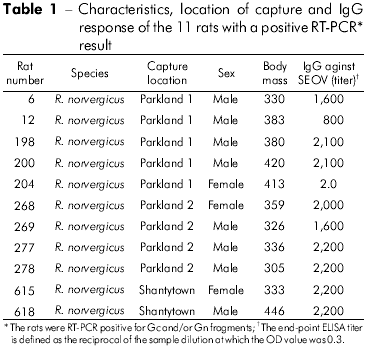
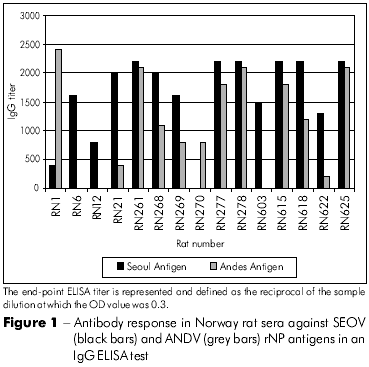
<body><![CDATA[<p><font size="2" face="verdana">   We used pRSET B in the BL21 inducible system, in which the SEOV rNP of 430 amino    acids expresses and purifies very well. The nucleotide sequence of the expression    vector construct identified the expected sequence. SDS-PAGE revealed highly    purified rNP with a molecular weight of about 51 kDa. The yield of SEOV rNP    per 500 mL of <i>E. coli </i>cells ranged from 3 to 4 mg of protein.</font></p>     <p><font size="2" face="verdana"> The newly generated rNP was evaluated for use    as a diagnostic antigen in an IgG ELISA. The reactivity patterns of rNP agreed    with the reactivity patterns of Vero E6 cell-cultured authentic virus (data    not shown). To analyze the cross-reactivity of ANDV virus with SEOV, rat sera    were evaluated in an ELISA using both rNP antigens. The reactivity pattern of    the ANDV rNP was different from the reactivity pattern of SEOV rNP (<a href="#f1">Figure    1</a>). The OD values varied between different samples at the serum dilution    (1:200) used and for the end-point titer values. Rat sera with low OD values    could not be detected by ANDV rNP, whereas in sera with high IgG titers rNPs    were not able to differentiate ANDV from SEOV infections serologically. Three    SEOV RT-PCR positive rat samples with high OD values were indistinguishable    for ANDV and SEOV rNPs.</font></p>     <p><font size="2" face="verdana"><a name="f1"></a></font></p>     <p>&nbsp;</p>     <p align="center"><img src="/img/revistas/rpas/v1n2/2a12f1.gif" border="0"></p>     <p>&nbsp;</p>     <p><font size="2" face="verdana"><b>SCREENING OF RODENTS FOR THE PRESENCE OF VIRAL    GENOME</b></font></p>     <p><font size="2" face="verdana"> Of 151 rats captured in Buenos Aires City, 21    Norway rats (13.9%) were seropositive for SEOV rNP antigen. Serologically positive    rats were tested for SEOV by RT-PCR using specific primers from two fragments    of the M segment that encode Gn and Gc proteins. The viral genome was detected    in the lungs of 11 of 21 seropositive rats (52.4%) captured in two parklands    (<a href="#t1">Table 1</a>). Eight out of 11 rats were males (72.7%), and all    of them had adequate antibody responses. As expected, no product was amplified    from the organs of the six seronegative rodents. In our ELISA tests, two of    the Norway rats had high titers against the ANDV antigen and very low titers    against the SEOV rNP antigen. We do not know if these rats had previous contact    with infected <i>Oligoryzomys </i>spp rodents. Unfortunately, no viral genome    was amplified from these animals.</font></p>     <p><font size="2" face="verdana"><a name="t1"></a></font></p>     <p>&nbsp;</p>     ]]></body>
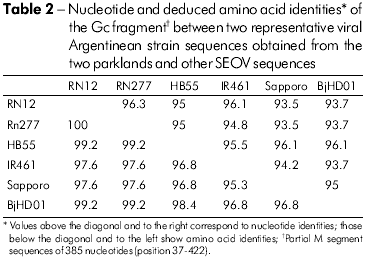
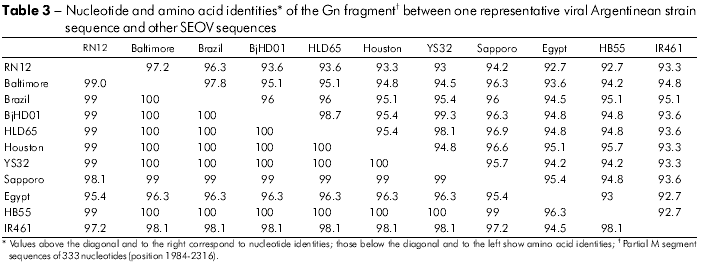
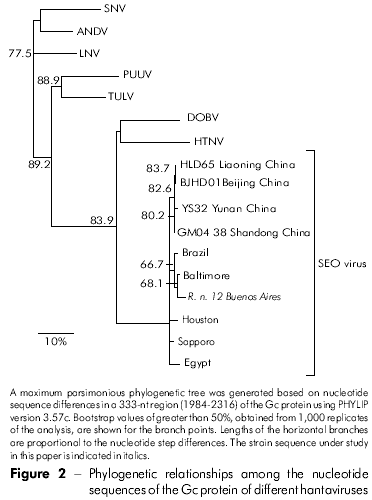
<body><![CDATA[<p align="center"><img src="/img/revistas/rpas/v1n2/2a12t1.gif" border="0"></p>     <p>&nbsp;</p>     <p><font size="2" face="verdana"><b>GENETIC COMPARISON AND PHYLOGENETIC ANALYSIS</b></font></p>     <p><font size="2" face="verdana"> Among the 11 Gn amplified products, six cDNAs    representative of two capture sites were sequenced. Pairwise comparison of sequences    from Gn fragment (385 nt) among the three Norway rats (RN 12, RN 198 and RN    200) from one park and three from the second park (RN204, RN277, and RN278)    showed 100% identity between the three rats from each group (<a href="#t2">Table    2</a>). Representative rats from the two parks (RN12 and RN277) showed 96.3%    nucleotide identity. Comparison of the deduced amino acid sequences of the six    rats revealed 100% identity. Comparison of the Gn fragments from both rats with    those of other representative SEOV showed the highest nucleotide identity with    IR461 and HB55 Chinese strains (AF458104 and AF035832). Sequence comparisons    of a 333-nt Gc fragment from one representative Argentinean rat (RN12) with    other SEOV strains showed higher nucleotide identities with those strains from    Baltimore, USA, and from Brazil (97% and 96%, respectively; <a href="#t3">Table    3</a>). Phylogenetic analyses based on the 333-nt Gc fragment generated by the    parsimonious method placed the SEOV RN 12 strain from Buenos Aires City together    with the Baltimore and Brazil strains (<a href="#f2">Figure 2</a>).</font></p>     <p><font size="2" face="verdana"><a name="t2"></a></font></p>     <p>&nbsp;</p>     <p align="center"><img src="/img/revistas/rpas/v1n2/2a12t2.gif" border="0"></p>     <p>&nbsp;</p>     <p><a name="t3"></a></p>     <p>&nbsp;</p>     ]]></body>
<body><![CDATA[<p align="center"><img src="/img/revistas/rpas/v1n2/2a12t3.gif" border="0"></p>     <p>&nbsp;</p>     <p><a name="f2"></a></p>     <p>&nbsp;</p>     <p align="center"><img src="/img/revistas/rpas/v1n2/2a12f2.gif" border="0"></p>     <p>&nbsp;</p>     <p><font size="3" face="verdana"><b>DISCUSSION</b></font></p>     <p><font size="2" face="verdana">   In this study, we report for the first time the detection of genetic material    of SEOV in seropositive rats captured in Buenos Aires City, Argentina. The presence    of SEOV in Buenos Aires City is not surprising, as previous studies have reported    31% seropositivity for SEOV<sup>23</sup>. Its reservoirs, <i>R. norvegicus </i>and <i>R.    rattus, </i>are present in the country, and the distribution of this virus is    reported worldwide. No seropositive black rats were detected; in addition, seropositive    Norway rats were not equally distributed in the five different sites studied    in Buenos Aires City, where the seroprevalence varied from 0% to 26.1%<sup>2</sup>. The    serologic assay is an indirect measure of viral infection and is variably affected    by the immune status of the host; however, it is the method most frequently    used to evaluate hantavirus infection in the blood of rodents.</font></p>     <p><font size="2" face="verdana">   Earlier, we showed that ANDV rNP-based ELISA works well for the detection of    virus-specific antibodies in patients and rodents with ANDV. In the present    work, a serological assay was developed for use in the diagnosis of SEOV. We    showed that the antigenicity of the complete SEOV rNP was strong enough to be    utilized in an ELISA test. The ELISA based on the use of this antigen yielded    results that were in good agreement with the results obtained by using cell    culture fluids of SEOV. The assay could detect IgG antibody reactivity in rats    and in control patient samples with SEOV infections from other parts of the    world (data not shown). We also analyzed rat sera with low SEOV-ELISA values    using ANDV rNP antigen, as previously described<sup>18</sup>, because sigmodontine-borne    viruses were reported to be circulating around Buenos Aires City<sup>15</sup>. In a latitudinal    study in natural areas of continental Chile, of 178 black rats studied, only    one was found to be reactive in an ANDV-based ELISA serological test<sup>16</sup>.</font></p>     <p><font size="2" face="verdana"> The detection of antibodies does not necessarily    indicate that the rodent is currently infected or infectious, but provides only    indirect evidence of the current level of virus transmission. In areas where    rats share habitat with sigmodontines, such as in the surroundings of Buenos    Aires City, positive serologic results could represent the incidental spillover    of AND-like virus. Thus, serum from rodents with antibodies&nbsp; to&nbsp;&nbsp;    other&nbsp; non-pathogenic&nbsp;&nbsp; or&nbsp; pathogenic hantaviruses can    test positive (i.e., cross-react) in the SEOV assay. For this reason, direct    nucleic acid detection by RT-PCR has surfaced as the method-of-choice for a    variety of viral pathogens. Successful viral genome amplifications were obtained    from 11 seropositive rats. Our results confirm that SEOV is circulating in Buenos    Aires City. This work constitutes direct evidence of current viral infection    and indicates a high level of infected rats among seropositive Norway rat populations    in the city because more than half of the seropositive rats carried detectable    viral genomes. It is of interest that the newly described SEOV strain from Buenos    Aires is most closely related to the wild type strains from Baltimore, USA,    and from Brazil, both of which are associated with the Norway rat. The port    of Buenos Aires is responsible for 80% of the transport of Argentine imports.    Approximately 50% of the male Norway rats in Baltimore, Maryland, are infected    with SEOV<sup>3,6</sup>. Studies with marked and released Norway rats in Baltimore    demonstrate that male rats wounded between captures are more likely to become    infected with SEOV upon recapture than are males that were not wounded between    captures<sup>6</sup>. In our study, 72.7% of the rats with SEOV genome were    males, although wounds were rarely observed in the captured rats. Among natural    populations of Norway rats, males with more severe wounds are also more likely    to shed SEOV and have viral RNA present in target tissues, such as the lungs,    than are males with less severe or no wounds<sup>8</sup>.</font></p>     ]]></body>
<body><![CDATA[<p><font size="2" face="verdana"> SEOV has been reported to cause generally milder    human disease than do HTNV and DOBV, but it is still responsible for 25% of    the HFRS cases in Asia<sup>11</sup>. No human SEOV infections have been reported    in Argentina. The presence of Norway rats with antibodies against SEOV is only    one of many factors to consider when evaluating the risk of HFRS. Agents, reservoirs,    the environment, and host factors interact to determine whether effective transmission,    infection, and disease are likely. Agent factors include viral strain and the    infecting dose of the particular hantavirus. Reservoir factors include active    infection (vs. serologic evidence of past infection), the concentration of virus    shed in the excreta, the density of rodents, and the frequency and spread of    excretion. All of these factors should be considered when evaluating the significance    of rodent serology data and when designing an appropriate preventive plan. Therefore,    the significance of hantavirus RNA detection in rats as the causative agents    for HFRS in Buenos Aires City remains unclear, and further serological surveys    amongst healthy people or renal disease patients are needed, as well as environmental    studies. Nevertheless, our results indicate that control strategies are needed    to reduce the risk of rat-borne pathogen spillover to humans.</font></p>     <p>&nbsp;</p>     <p><font size="3" face="verdana"> <b>FINANCIAL SUPPORT</b></font></p>     <p><font size="2" face="verdana"> This work has been partially supported by the    Government of Buenos Aires City.</font></p>     <p>&nbsp;</p>     <p><font size="3" face="verdana"><b>REFERENCES</b></font></p>     <!-- ref --><p><font size="2" face="verdana"> 1 Billecocq A, Coudrier D, Boue F, Combes B,      Zeller H, Artois M, et al. Expression of the nucleoprotein of the Puumala     virus  from the recombinant Semliki Forest virus replicon: characterization     and use  as a potential diagnostic tool. Clin Diagn Lab Immunol. 2003 Jul;10(4):658-63.&nbsp; &nbsp; &nbsp; &nbsp;    &nbsp;&#91; <a href="http://www.ncbi.nlm.nih.gov/pubmed/12853401" target="_blank">Links</a> &#93;</font><!-- ref --><p><font size="2" face="verdana">2 Cueto GR, Cavia R, Bellomo C, Padula PJ, Suarez      OV. Prevalence of hantavirus infection in wild <i>Rattus norvegicus </i>and <i>R.       rattus </i>populations of Buenos Aires City, Argentina. Trop Med&nbsp;Int       Health. 2008 Jan;13(1):46-51.&nbsp; &nbsp; &nbsp; &nbsp;    &nbsp;&#91; <a href="http://www.ncbi.nlm.nih.gov/pubmed/18291001" target="_blank">Links</a> &#93;</font><!-- ref --><p><font size="2" face="verdana">3 Easterbrook JD, Kaplan JB, Glass GE, Pletnikov    MV, Klein SL. Elevated testosterone and reduced 5-HIAA concentrations are associated    with wounding and hantavirus infection in male Norway rats. Horm Behav. 2007    Nov;52(4):474-81.&nbsp; &nbsp; &nbsp; &nbsp;    &nbsp;&#91; <a href="http://www.ncbi.nlm.nih.gov/sites/entrez" target="_blank">Links</a> &#93; </font><!-- ref --><p><font size="2" face="verdana">4 Elgh F, Lundkvist A, Alexeyev OA, Stenlund      H, Avsic-Zupanc T, Hjelle B, et al. Serological diagnosis of hantavirus     infections  by an enzyme-linked immunosorbent assay based on detection of     immunoglobulin  G and M responses to recombinant nucleocapsid proteins of     five viral serotypes.  J Clin Microbiol. 1997 May;35(5):1122-30.&nbsp; &nbsp; &nbsp; &nbsp;    &nbsp;&#91; <a href="http://jcm.asm.org/cgi/content/abstract/35/5/1122" target="_blank">Links</a> &#93; </font><!-- ref --><p><font size="2" face="verdana">5 Feldmann H, Sanchez A, Morzunov S, Spiropoulou    CF, Rollin PE, Ksiazek TG, et al. Utilization of autopsy RNA for the synthesis    of the nucleocapsid antigen of a newly recognized virus associated with hantavirus    pulmonary syndrome. Virus Res. 1993 Dec;30(3):351-67.&nbsp; &nbsp; &nbsp; &nbsp;    &nbsp;&#91; <a href="http://www.ncbi.nlm.nih.gov/pubmed/8109165" target="_blank">Links</a> &#93; </font><!-- ref --><p><font size="2" face="verdana">6 Glass GE, Childs JE, Korch GW, LeDuc JW. Association    of intraspecific wounding with hantaviral infection in wild rats (<i>Rattus    norvegicus</i>). Epidemiol Infect. 1988 Oct;101(2):459-72.</font><font size="2" face="verdana">&nbsp; &nbsp; &nbsp; &nbsp;    &nbsp;&#91; <a href="http://www.ncbi.nlm.nih.gov/pubmed/3141203" target="_blank">Links</a> &#93;</font><!-- ref --><p><font size="2" face="verdana">7 Glass GE, Watson AJ, LeDuc JW, Childs JE. Domestic    cases of hemorrhagic fever with renal syndrome in the United States. Nephron.    1994;68(1):48-51.&nbsp; &nbsp; &nbsp; &nbsp;    &nbsp;&#91; <a href="http://www.ncbi.nlm.nih.gov/pubmed/7991040" target="_blank">Links</a> &#93; </font><!-- ref --><p><font size="2" face="verdana">8 Hinson ER, Shone SM, Zink MC, Glass GE, Klein    SL. Wounding: the primary mode of Seoul virus transmission among male Norway    rats. Am J Trop Med Hyg. 2004 Mar;70(3):310-7.&nbsp; &nbsp; &nbsp; &nbsp;    &nbsp;&#91; <a href="http://www.ncbi.nlm.nih.gov/pubmed/15031523" target="_blank">Links</a> &#93; </font><!-- ref --><p><font size="2" face="verdana">9 Iversson LB, Rosa APA, Travassos da Rosa MDB,    Lomar AV, Sasaki MGM, LeDuc JW. Human infection by hantavirus in southern and    southeastern Brazil. Rev Assoc Med Bras. 1994 Apr-Jun;40(2):85-92.&nbsp; &nbsp; &nbsp; &nbsp;    &nbsp;&#91; <a href="http://www.ncbi.nlm.nih.gov/pubmed/7820156" target="_blank">Links</a> &#93; </font><!-- ref --><p><font size="2" face="verdana">10 Kallio-Kokko H, Vapalahti O, Hedman K, Brummer-Korvenkontio      M, Vaheri A. Puumala virus antibody and immunoglobulin G avidity assays     based  on a recombinant nucleocapsid antigen. J Clin Microbiol. 1993 Mar;31(3):677-80.&nbsp; &nbsp; &nbsp; &nbsp;    &nbsp;&#91; <a href="http://www.ncbi.nlm.nih.gov/pubmed/8096217" target="_blank">Links</a> &#93;  </font><!-- ref --><p><font size="2" face="verdana">11 Kim YS, Ahn C, Han JS, Kim S, Lee JS, Lee      PW. Hemorrhagic fever with renal syndrome caused by the Seoul virus. Nephron.      1995;71(4):419-27.&nbsp; &nbsp; &nbsp; &nbsp;    &nbsp;&#91; <a href="http://www.ncbi.nlm.nih.gov/pubmed/8587622" target="_blank">Links</a> &#93; </font><!-- ref --><p><font size="2" face="verdana">12 LeDuc JW, Smith GA, Pinheiro FP, Vasconcelos      PFC, Rosa EST, Maiztegui JI. Isolation of a Hantaan-related virus from Brazilian      rats and serologic evidence of its widespread distribution in South America.      Am J Trop Med Hyg. 1985 Jul;34(4):810-5.&nbsp; &nbsp; &nbsp; &nbsp;    &nbsp;&#91; <a href="http://www.ncbi.nlm.nih.gov/pubmed/2862803" target="_blank">Links</a> &#93; </font><!-- ref --><p><font size="2" face="verdana">13 Lee HW. Hemorrhagic fever with renal syndrome      (HFRS). Scand J Infect Dis Suppl. 1982;36:82-5. </font><!-- ref --><p><font size="2" face="verdana">14 Lopez N, Padula P, Rossi C, Lazaro ME, Franze-Fernandez      MT. Genetic identification of a new hantavirus causing severe pulmonary     syndrome  in Argentina. Virology. 1996 Jun;220(1):223-6.&nbsp; &nbsp; &nbsp; &nbsp;    &nbsp;&#91; <a href="http://www.ncbi.nlm.nih.gov/pubmed/8659118" target="_blank">Links</a> &#93;</font><!-- ref --><p><font size="2" face="verdana">15 Martinez VP, Colavecchia SB, Garcia Alay     M,  Suzuki B, Trincheri A, Busto S, et al. Hantavirus pulmonary syndrome     in Buenos  Aires Province. Medicina (B Aires). 2001;61(2):147-56.&nbsp; &nbsp; &nbsp; &nbsp;    &nbsp;&#91; <a href="http://www.ncbi.nlm.nih.gov/pubmed/11374136" target="_blank">Links</a> &#93; </font><!-- ref --><p><font size="2" face="verdana">16 Medina RA, Torres-Perez F, Galeno H, Navarrete      M, Vial PA, Palma RE, et al. Ecology, genetic diversity, and phylogeographic      structure of Andes virus in humans and rodents in Chile. J Virol. 2009 Mar;83(6):2446-59.&nbsp; &nbsp; &nbsp; &nbsp;    &nbsp;&#91; <a href="http://www.ncbi.nlm.nih.gov/pubmed/19116256" target="_blank">Links</a> &#93;  </font><!-- ref --><p><font size="2" face="verdana">17 Nichol ST, Spiropoulou CF, Morzunov S, Rollin      PE, Ksiazek TG, Feldmann H, et al. Genetic identification of a hantavirus     associated  with an outbreak of acute respiratory illness. Science.&nbsp; 1993     Nov;262(5135):  914-7.&nbsp; &nbsp; &nbsp; &nbsp;    &nbsp;&#91; <a href="http://www.ncbi.nlm.nih.gov/pubmed/8235615" target="_blank">Links</a> &#93; </font><!-- ref --><p><font size="2" face="verdana">18 Padula P, Rossi CM, Della Valle MO, Mart&iacute;nez      PV, Colavecchia SB, Edelstein A, et al. Development and evaluation of a     solid-phase  enzyme immunoassay based on Andes hantavirus recombinant nucleoprotein.     J Med  Microbiol. 2000 Feb;49(2):149-55.&nbsp; &nbsp; &nbsp; &nbsp;    &nbsp;&#91; <a href="http://www.ncbi.nlm.nih.gov/pubmed/10670565" target="_blank">Links</a> &#93; </font><!-- ref --><p><font size="2" face="verdana">19 Reynes JM, Soares JL, Hue T, Bouloy M, Sun      S, Kruy SL, et al. Evidence of the presence of Seoul virus in Cambodia.     Microbes  Infect. 2003 Jul;5(9):769-73.&nbsp; &nbsp; &nbsp; &nbsp;    &nbsp;&#91; <a href="http://www.ncbi.nlm.nih.gov/pubmed/12850202" target="_blank">Links</a> &#93; </font><!-- ref --><p><font size="2" face="verdana">20 Schmaljohn CS, Hasty SE, Harrison SA, Dalrymple      JM. Characterization of Hantaan virions, the prototype virus of hemorrhagic      fever with renal syndrome. J Infect Dis. 1983 Dec;148(6):1005-12.&nbsp; &nbsp; &nbsp; &nbsp;    &nbsp;&#91; <a href="http://www.ncbi.nlm.nih.gov/pubmed/6140290" target="_blank">Links</a> &#93; </font><!-- ref --><p><font size="2" face="verdana">21 Schmaljohn CS, Hasty SE, Dalrymple JM, LeDuc      JW, Lee HW, von Bonsdorff CH, et al. Antigenic and genetic properties of     viruses  linked to hemorrhagic fever with renal syndrome. Science. 1985 Mar;227(4690):1041-4.</font><!-- ref --><p><font size="2" face="verdana">22 Schmaljohn CS, Lee HW, Dalrymple JM. Detection    of hantaviruses with RNA probes generated from recombinant DNA. Arch Virol.    1987;95(3-4):291-301.&nbsp; &nbsp; &nbsp; &nbsp;    &nbsp;&#91; <a href="http://www.ncbi.nlm.nih.gov/pubmed/2886113" target="_blank">Links</a> &#93; </font><!-- ref --><p><font size="2" face="verdana">23 Seijo A, Pini N, Levis S, Coto H, Deodato      B, Cernigoi B, et al. Study of hantavirus seoul in a human and rodent population      from a marginal area in Buenos Aires City. Medicina (B Aires). 2003;63(3):193-6.&nbsp; &nbsp; &nbsp; &nbsp;    &nbsp;&#91; <a href="http://www.ncbi.nlm.nih.gov/pubmed/12876901" target="_blank">Links</a> &#93;  </font><!-- ref --><p><font size="2" face="verdana">24 Xiao SY, Leduc JW, Chu YK, Schmaljohn CS.      Phylogenetic analyses of virus isolates in the genus Hantavirus, family     Bunyaviridae. Virology. 1994 Jan;198(1):205-17.  </font><!-- ref --><p><font size="2" face="verdana">25 Wang M, Rossi C, Schmaljohn CS. Expression    of non-conserved regions of the S genome segments of three hantaviruses: evaluation    of the expressed polypeptides for diagnosis of haemorrhagic fever with renal    syndrome. J Gen Virol. 1993 Jun;74(Pt 6):1115-24.&nbsp; &nbsp; &nbsp; &nbsp;    &nbsp;&#91; <a href="http://www.ncbi.nlm.nih.gov/pubmed/8099603" target="_blank">Links</a> &#93; </font><!-- ref --><p><font size="2" face="verdana">26 Weissenbacher MC, Merani MS, Hodara VL, Villafane    G, Gajdusek DC, Chu YK, et al. Hantavirus infection in laboratory and wild rodents    in Argentina. Medicina (B Aires). 1990;50(1):43-6.&nbsp; &nbsp; &nbsp; &nbsp;    &nbsp;&#91; <a href="http://www.ncbi.nlm.nih.gov/pubmed/1981381" target="_blank">Links</a> &#93;</font><!-- ref --><p><font size="2" face="verdana"> 27 Zoller L, Yang S, Gott P, Bautz EK, Darai    G. Use of recombinant nucleocapsid proteins of the Hantaan and nephropathia    epidemica serotypes of hantaviruses as immunodiagnostic antigens. J Med Virol.    1993 Mar;39(3):200-7.&nbsp; &nbsp; &nbsp; &nbsp;    &nbsp;&#91; <a href="http://www.ncbi.nlm.nih.gov/pubmed/8096868" target="_blank">Links</a> &#93;</font><p>&nbsp;</p>     <p>&nbsp;</p>     <p><font size="2" face="Verdana"><b><a name="endereco"></a><a href="#topo"><img src="/img/revistas/rpas/v1n1/seta.gif" border="0"></a></b></font><font size="2" face="verdana"><b>Correspond&ecirc;ncia    / Correspondence / Correspondencia:</b>    <br>   Paula Julieta Padula Departamento&nbsp; de&nbsp; Virolog&iacute;a,    <br>   Instituto&nbsp; Nacional&nbsp; de&nbsp; Enfermedades Infecciosas,    <br>   A.N.L.I.S. &quot;Dr. Carlos G. Malbr&aacute;n&quot;    <br>   Av. V&eacute;lez Sarsfield 563 (1281)    ]]></body>
<body><![CDATA[<br>   Buenos Aires-Argentina    <br>   E-mail:<a href="mailto:ppadula@gmail.com">ppadula@gmail.com</a>    <br>   Phone/Fax: 5411 - 43013146</font></p>     <p><font size="2" face="verdana">Recebido em / Received / Recibido en: 27/8/2009    <br>   Aceito em / Accepted / Aceito en: 30/3/2010</font></p>   <script type="text/javascript"> var gaJsHost = (("https:" == document.location.protocol) ? "https://ssl." : "http://www."); document.write(unescape("%3Cscript src='" + gaJsHost + "google-analytics.com/ga.js' type='text/javascript'%3E%3C/script%3E")); </script> <script type="text/javascript"> try { var pageTracker = _gat._getTracker("UA-7885746-4"); pageTracker._setDomainName("none"); pageTracker._setAllowLinker(true); pageTracker._trackPageview(); } catch(err) {}</script>      ]]></body><back>
<ref-list>
<ref id="B1">
<label>1</label><nlm-citation citation-type="journal">
<person-group person-group-type="author">
<name>
<surname><![CDATA[Billecocq]]></surname>
<given-names><![CDATA[A]]></given-names>
</name>
<name>
<surname><![CDATA[Coudrier]]></surname>
<given-names><![CDATA[D]]></given-names>
</name>
<name>
<surname><![CDATA[Boue]]></surname>
<given-names><![CDATA[F]]></given-names>
</name>
<name>
<surname><![CDATA[Combes]]></surname>
<given-names><![CDATA[B]]></given-names>
</name>
<name>
<surname><![CDATA[Zeller]]></surname>
<given-names><![CDATA[H]]></given-names>
</name>
<name>
<surname><![CDATA[Artois]]></surname>
<given-names><![CDATA[M]]></given-names>
</name>
</person-group>
<article-title xml:lang="en"><![CDATA[Expression of the nucleoprotein of the Puumala virus from the recombinant Semliki Forest virus replicon: characterization and use as a potential diagnostic]]></article-title>
<source><![CDATA[Clin Diagn Lab Immunol]]></source>
<year>2003</year>
<month> J</month>
<day>ul</day>
<volume>10</volume>
<numero>4</numero>
<issue>4</issue>
<page-range>658-63</page-range></nlm-citation>
</ref>
<ref id="B2">
<label>2</label><nlm-citation citation-type="journal">
<person-group person-group-type="author">
<name>
<surname><![CDATA[Cueto]]></surname>
<given-names><![CDATA[GR]]></given-names>
</name>
<name>
<surname><![CDATA[Cavia]]></surname>
<given-names><![CDATA[R]]></given-names>
</name>
<name>
<surname><![CDATA[Bellomo]]></surname>
<given-names><![CDATA[C]]></given-names>
</name>
<name>
<surname><![CDATA[Padula]]></surname>
<given-names><![CDATA[PJ]]></given-names>
</name>
<name>
<surname><![CDATA[Suarez]]></surname>
<given-names><![CDATA[OV]]></given-names>
</name>
</person-group>
<article-title xml:lang="en"><![CDATA[Prevalence of hantavirus infection in wild Rattus norvegicus and R. rattus populations of Buenos Aires City, Argentina]]></article-title>
<source><![CDATA[Trop Med Int Health]]></source>
<year>2008</year>
<month> J</month>
<day>an</day>
<volume>13</volume>
<numero>1</numero>
<issue>1</issue>
<page-range>46-51</page-range></nlm-citation>
</ref>
<ref id="B3">
<label>3</label><nlm-citation citation-type="journal">
<person-group person-group-type="author">
<name>
<surname><![CDATA[Easterbrook]]></surname>
<given-names><![CDATA[JD]]></given-names>
</name>
<name>
<surname><![CDATA[Kaplan]]></surname>
<given-names><![CDATA[JB]]></given-names>
</name>
<name>
<surname><![CDATA[Glass]]></surname>
<given-names><![CDATA[GE]]></given-names>
</name>
<name>
<surname><![CDATA[Pletnikov]]></surname>
<given-names><![CDATA[MV]]></given-names>
</name>
<name>
<surname><![CDATA[Klein]]></surname>
<given-names><![CDATA[SL]]></given-names>
</name>
</person-group>
<article-title xml:lang="en"><![CDATA[Elevated testosterone and reduced 5-HIAA concentrations are associated with wounding and hantavirus infection in male Norway rats]]></article-title>
<source><![CDATA[Horm Behav]]></source>
<year>2007</year>
<month> N</month>
<day>ov</day>
<volume>52</volume>
<numero>4</numero>
<issue>4</issue>
<page-range>474-81</page-range></nlm-citation>
</ref>
<ref id="B4">
<label>4</label><nlm-citation citation-type="journal">
<person-group person-group-type="author">
<name>
<surname><![CDATA[Elgh]]></surname>
<given-names><![CDATA[F]]></given-names>
</name>
<name>
<surname><![CDATA[Lundkvist]]></surname>
<given-names><![CDATA[A]]></given-names>
</name>
<name>
<surname><![CDATA[Alexeyev]]></surname>
<given-names><![CDATA[OA]]></given-names>
</name>
<name>
<surname><![CDATA[Stenlund]]></surname>
<given-names><![CDATA[H]]></given-names>
</name>
<name>
<surname><![CDATA[Avsic-Zupanc]]></surname>
<given-names><![CDATA[T]]></given-names>
</name>
<name>
<surname><![CDATA[Hjelle]]></surname>
<given-names><![CDATA[B]]></given-names>
</name>
</person-group>
<article-title xml:lang="en"><![CDATA[Serological diagnosis of hantavirus infections by an enzyme-linked immunosorbent assay based on detection of immunoglobulin G and M responses to recombinant nucleocapsid proteins of five viral serotypes]]></article-title>
<source><![CDATA[J Clin Microbiol]]></source>
<year>1997</year>
<month> M</month>
<day>ay</day>
<volume>35</volume>
<numero>5</numero>
<issue>5</issue>
<page-range>1122-30</page-range></nlm-citation>
</ref>
<ref id="B5">
<label>5</label><nlm-citation citation-type="journal">
<person-group person-group-type="author">
<name>
<surname><![CDATA[Feldmann]]></surname>
<given-names><![CDATA[H]]></given-names>
</name>
<name>
<surname><![CDATA[Sanchez]]></surname>
<given-names><![CDATA[A]]></given-names>
</name>
<name>
<surname><![CDATA[Morzunov]]></surname>
<given-names><![CDATA[S]]></given-names>
</name>
<name>
<surname><![CDATA[Spiropoulou]]></surname>
<given-names><![CDATA[CF]]></given-names>
</name>
<name>
<surname><![CDATA[Rollin]]></surname>
<given-names><![CDATA[PE]]></given-names>
</name>
<name>
<surname><![CDATA[Ksiazek]]></surname>
<given-names><![CDATA[TG]]></given-names>
</name>
</person-group>
<article-title xml:lang="en"><![CDATA[Utilization of autopsy RNA for the synthesis of the nucleocapsid antigen of a newly recognized virus associated with hantavirus pulmonary syndrome]]></article-title>
<source><![CDATA[Virus Res]]></source>
<year>1993</year>
<month> D</month>
<day>ec</day>
<volume>30</volume>
<numero>3</numero>
<issue>3</issue>
<page-range>351-67</page-range></nlm-citation>
</ref>
<ref id="B6">
<label>6</label><nlm-citation citation-type="journal">
<person-group person-group-type="author">
<name>
<surname><![CDATA[Glass]]></surname>
<given-names><![CDATA[GE]]></given-names>
</name>
<name>
<surname><![CDATA[Childs]]></surname>
<given-names><![CDATA[JE]]></given-names>
</name>
<name>
<surname><![CDATA[Korch]]></surname>
<given-names><![CDATA[GW]]></given-names>
</name>
<name>
<surname><![CDATA[LeDuc]]></surname>
<given-names><![CDATA[JW]]></given-names>
</name>
</person-group>
<article-title xml:lang="en"><![CDATA[Association of intraspecific wounding with hantaviral infection in wild rats (Rattus norvegicus)]]></article-title>
<source><![CDATA[Epidemiol Infect]]></source>
<year>1988</year>
<month> O</month>
<day>ct</day>
<volume>101</volume>
<numero>2</numero>
<issue>2</issue>
<page-range>459-72</page-range></nlm-citation>
</ref>
<ref id="B7">
<label>7</label><nlm-citation citation-type="journal">
<person-group person-group-type="author">
<name>
<surname><![CDATA[Glass]]></surname>
<given-names><![CDATA[GE]]></given-names>
</name>
<name>
<surname><![CDATA[Watson]]></surname>
<given-names><![CDATA[AJ]]></given-names>
</name>
<name>
<surname><![CDATA[LeDuc]]></surname>
<given-names><![CDATA[JW]]></given-names>
</name>
<name>
<surname><![CDATA[Childs]]></surname>
<given-names><![CDATA[JE]]></given-names>
</name>
</person-group>
<article-title xml:lang="en"><![CDATA[Domestic cases of hemorrhagic fever with renal syndrome in the United States]]></article-title>
<source><![CDATA[Nephron]]></source>
<year>1994</year>
<volume>68</volume>
<numero>1</numero>
<issue>1</issue>
<page-range>48-51</page-range></nlm-citation>
</ref>
<ref id="B8">
<label>8</label><nlm-citation citation-type="journal">
<person-group person-group-type="author">
<name>
<surname><![CDATA[Hinson]]></surname>
<given-names><![CDATA[ER]]></given-names>
</name>
<name>
<surname><![CDATA[Shone]]></surname>
<given-names><![CDATA[SM]]></given-names>
</name>
<name>
<surname><![CDATA[Zink]]></surname>
<given-names><![CDATA[MC]]></given-names>
</name>
<name>
<surname><![CDATA[Glass]]></surname>
<given-names><![CDATA[GE]]></given-names>
</name>
<name>
<surname><![CDATA[Klein]]></surname>
<given-names><![CDATA[SL]]></given-names>
</name>
</person-group>
<article-title xml:lang="en"><![CDATA[Wounding: the primary mode of Seoul virus transmission among male Norway rats]]></article-title>
<source><![CDATA[Am J Trop Med Hyg]]></source>
<year>2004</year>
<month> M</month>
<day>ar</day>
<volume>70</volume>
<numero>3</numero>
<issue>3</issue>
<page-range>310-7</page-range></nlm-citation>
</ref>
<ref id="B9">
<label>9</label><nlm-citation citation-type="journal">
<person-group person-group-type="author">
<name>
<surname><![CDATA[Iversson]]></surname>
<given-names><![CDATA[LB]]></given-names>
</name>
<name>
<surname><![CDATA[Rosa]]></surname>
<given-names><![CDATA[APA]]></given-names>
</name>
<name>
<surname><![CDATA[Travassos da Rosa]]></surname>
<given-names><![CDATA[MDB]]></given-names>
</name>
<name>
<surname><![CDATA[Lomar]]></surname>
<given-names><![CDATA[AV]]></given-names>
</name>
<name>
<surname><![CDATA[Sasaki]]></surname>
<given-names><![CDATA[MGM]]></given-names>
</name>
<name>
<surname><![CDATA[LeDuc]]></surname>
<given-names><![CDATA[JW]]></given-names>
</name>
</person-group>
<article-title xml:lang="en"><![CDATA[Human infection by hantavirus in southern and southeastern Brazil]]></article-title>
<source><![CDATA[Rev Assoc Med Bras]]></source>
<year>1994</year>
<month> A</month>
<day>pr</day>
<volume>40</volume>
<numero>2</numero>
<issue>2</issue>
<page-range>85-92</page-range></nlm-citation>
</ref>
<ref id="B10">
<label>10</label><nlm-citation citation-type="journal">
<person-group person-group-type="author">
<name>
<surname><![CDATA[Kallio-Kokko]]></surname>
<given-names><![CDATA[H]]></given-names>
</name>
<name>
<surname><![CDATA[Vapalahti]]></surname>
<given-names><![CDATA[O]]></given-names>
</name>
<name>
<surname><![CDATA[Hedman]]></surname>
<given-names><![CDATA[K]]></given-names>
</name>
<name>
<surname><![CDATA[Brummer-Korvenkontio]]></surname>
<given-names><![CDATA[M]]></given-names>
</name>
<name>
<surname><![CDATA[Vaheri]]></surname>
<given-names><![CDATA[A]]></given-names>
</name>
</person-group>
<article-title xml:lang="en"><![CDATA[Puumala virus antibody and immunoglobulin G avidity assays based on a recombinant nucleocapsid antigen]]></article-title>
<source><![CDATA[J Clin Microbiol]]></source>
<year>1993</year>
<month> M</month>
<day>ar</day>
<volume>31</volume>
<numero>3</numero>
<issue>3</issue>
<page-range>677-80</page-range></nlm-citation>
</ref>
<ref id="B11">
<label>11</label><nlm-citation citation-type="journal">
<person-group person-group-type="author">
<name>
<surname><![CDATA[Kim]]></surname>
<given-names><![CDATA[YS]]></given-names>
</name>
<name>
<surname><![CDATA[Ahn]]></surname>
<given-names><![CDATA[C]]></given-names>
</name>
<name>
<surname><![CDATA[Han]]></surname>
<given-names><![CDATA[JS]]></given-names>
</name>
<name>
<surname><![CDATA[Kim]]></surname>
<given-names><![CDATA[S]]></given-names>
</name>
<name>
<surname><![CDATA[Lee]]></surname>
<given-names><![CDATA[JS]]></given-names>
</name>
<name>
<surname><![CDATA[Lee]]></surname>
<given-names><![CDATA[PW]]></given-names>
</name>
</person-group>
<article-title xml:lang="en"><![CDATA[Hemorrhagic fever with renal syndrome caused by the Seoul virus]]></article-title>
<source><![CDATA[Nephron]]></source>
<year>1995</year>
<volume>71</volume>
<numero>4</numero>
<issue>4</issue>
<page-range>419-27</page-range></nlm-citation>
</ref>
<ref id="B12">
<label>12</label><nlm-citation citation-type="journal">
<person-group person-group-type="author">
<name>
<surname><![CDATA[LeDuc]]></surname>
<given-names><![CDATA[W]]></given-names>
</name>
<name>
<surname><![CDATA[Smith]]></surname>
<given-names><![CDATA[GA]]></given-names>
</name>
<name>
<surname><![CDATA[Pinheiro]]></surname>
<given-names><![CDATA[FP]]></given-names>
</name>
<name>
<surname><![CDATA[Vasconcelos]]></surname>
<given-names><![CDATA[PFC]]></given-names>
</name>
<name>
<surname><![CDATA[Rosa]]></surname>
<given-names><![CDATA[EST]]></given-names>
</name>
<name>
<surname><![CDATA[Maiztegui]]></surname>
<given-names><![CDATA[JI]]></given-names>
</name>
</person-group>
<article-title xml:lang="en"><![CDATA[Isolation of a Hantaan-related virus from Brazilian rats and serologic evidence of its widespread distribution in South America]]></article-title>
<source><![CDATA[Am J Trop Med Hyg]]></source>
<year>1985</year>
<month> J</month>
<day>ul</day>
<volume>34</volume>
<numero>4</numero>
<issue>4</issue>
<page-range>810-5</page-range></nlm-citation>
</ref>
<ref id="B13">
<label>13</label><nlm-citation citation-type="journal">
<person-group person-group-type="author">
<name>
<surname><![CDATA[Lee]]></surname>
<given-names><![CDATA[HW]]></given-names>
</name>
</person-group>
<article-title xml:lang="en"><![CDATA[Hemorrhagic fever with renal syndrome (HFRS)]]></article-title>
<source><![CDATA[Scand J Infect Dis Suppl]]></source>
<year>1982</year>
<volume>36</volume>
<page-range>82-5</page-range></nlm-citation>
</ref>
<ref id="B14">
<label>14</label><nlm-citation citation-type="journal">
<person-group person-group-type="author">
<name>
<surname><![CDATA[Lopez]]></surname>
<given-names><![CDATA[N]]></given-names>
</name>
<name>
<surname><![CDATA[Padula]]></surname>
<given-names><![CDATA[P]]></given-names>
</name>
<name>
<surname><![CDATA[Rossi]]></surname>
<given-names><![CDATA[C]]></given-names>
</name>
<name>
<surname><![CDATA[Lazaro]]></surname>
<given-names><![CDATA[ME]]></given-names>
</name>
<name>
<surname><![CDATA[Franze-Fernandez]]></surname>
<given-names><![CDATA[MT]]></given-names>
</name>
</person-group>
<article-title xml:lang="en"><![CDATA[Genetic identification of a new hantavirus causing severe pulmonary syndrome in Argentina]]></article-title>
<source><![CDATA[Virology]]></source>
<year>1996</year>
<month> J</month>
<day>un</day>
<volume>220</volume>
<numero>1</numero>
<issue>1</issue>
<page-range>223-6</page-range></nlm-citation>
</ref>
<ref id="B15">
<label>15</label><nlm-citation citation-type="journal">
<person-group person-group-type="author">
<name>
<surname><![CDATA[Martinez]]></surname>
<given-names><![CDATA[VP]]></given-names>
</name>
<name>
<surname><![CDATA[Colavecchia]]></surname>
<given-names><![CDATA[SB]]></given-names>
</name>
<name>
<surname><![CDATA[Garcia Alay]]></surname>
<given-names><![CDATA[M]]></given-names>
</name>
<name>
<surname><![CDATA[Suzuki]]></surname>
<given-names><![CDATA[B]]></given-names>
</name>
<name>
<surname><![CDATA[Trincheri]]></surname>
<given-names><![CDATA[A]]></given-names>
</name>
<name>
<surname><![CDATA[Busto]]></surname>
<given-names><![CDATA[S]]></given-names>
</name>
</person-group>
<article-title xml:lang="en"><![CDATA[Hantavirus pulmonary syndrome in Buenos Aires Province]]></article-title>
<source><![CDATA[Medicina]]></source>
<year>2001</year>
<volume>61</volume>
<numero>2</numero>
<issue>2</issue>
<page-range>147-56</page-range></nlm-citation>
</ref>
<ref id="B16">
<label>16</label><nlm-citation citation-type="journal">
<person-group person-group-type="author">
<name>
<surname><![CDATA[Medina]]></surname>
<given-names><![CDATA[RA]]></given-names>
</name>
<name>
<surname><![CDATA[Torres-Perez]]></surname>
<given-names><![CDATA[F]]></given-names>
</name>
<name>
<surname><![CDATA[Galeno]]></surname>
<given-names><![CDATA[H]]></given-names>
</name>
<name>
<surname><![CDATA[Navarrete]]></surname>
<given-names><![CDATA[M]]></given-names>
</name>
<name>
<surname><![CDATA[Vial]]></surname>
<given-names><![CDATA[PA]]></given-names>
</name>
<name>
<surname><![CDATA[Palma]]></surname>
<given-names><![CDATA[RE]]></given-names>
</name>
</person-group>
<article-title xml:lang="en"><![CDATA[Ecology, genetic diversity, and phylogeographic structure of Andes virus in humans and rodents in Chile]]></article-title>
<source><![CDATA[J Virol]]></source>
<year>2009</year>
<month> M</month>
<day>ar</day>
<volume>83</volume>
<numero>6</numero>
<issue>6</issue>
<page-range>2446-59</page-range></nlm-citation>
</ref>
<ref id="B17">
<label>17</label><nlm-citation citation-type="journal">
<person-group person-group-type="author">
<name>
<surname><![CDATA[Nichol]]></surname>
<given-names><![CDATA[ST]]></given-names>
</name>
<name>
<surname><![CDATA[Spiropoulou]]></surname>
<given-names><![CDATA[CF]]></given-names>
</name>
<name>
<surname><![CDATA[Morzunov]]></surname>
<given-names><![CDATA[S]]></given-names>
</name>
<name>
<surname><![CDATA[Rollin]]></surname>
<given-names><![CDATA[PE]]></given-names>
</name>
<name>
<surname><![CDATA[Ksiazek]]></surname>
<given-names><![CDATA[TG]]></given-names>
</name>
<name>
<surname><![CDATA[Feldmann]]></surname>
<given-names><![CDATA[H]]></given-names>
</name>
</person-group>
<article-title xml:lang="en"><![CDATA[Genetic identification of a hantavirus associated with an outbreak of acute respiratory illness]]></article-title>
<source><![CDATA[Science]]></source>
<year>1993</year>
<month> N</month>
<day>ov</day>
<volume>262</volume>
<numero>5135</numero>
<issue>5135</issue>
<page-range>914-7</page-range></nlm-citation>
</ref>
<ref id="B18">
<label>18</label><nlm-citation citation-type="journal">
<person-group person-group-type="author">
<name>
<surname><![CDATA[Padula]]></surname>
<given-names><![CDATA[P]]></given-names>
</name>
<name>
<surname><![CDATA[Rossi]]></surname>
<given-names><![CDATA[CM]]></given-names>
</name>
<name>
<surname><![CDATA[Della Valle]]></surname>
<given-names><![CDATA[MO]]></given-names>
</name>
<name>
<surname><![CDATA[Martínez]]></surname>
<given-names><![CDATA[PV]]></given-names>
</name>
<name>
<surname><![CDATA[Colavecchia]]></surname>
<given-names><![CDATA[SB]]></given-names>
</name>
<name>
<surname><![CDATA[Edelstein]]></surname>
<given-names><![CDATA[A]]></given-names>
</name>
</person-group>
<article-title xml:lang="en"><![CDATA[Development and evaluation of a solid-phase enzyme immunoassay based on Andes hantavirus recombinant nucleoprotein]]></article-title>
<source><![CDATA[J Med Microbiol]]></source>
<year>2000</year>
<month> F</month>
<day>eb</day>
<volume>49</volume>
<numero>2</numero>
<issue>2</issue>
<page-range>149-55</page-range></nlm-citation>
</ref>
<ref id="B19">
<label>19</label><nlm-citation citation-type="journal">
<person-group person-group-type="author">
<name>
<surname><![CDATA[Reynes]]></surname>
<given-names><![CDATA[JM]]></given-names>
</name>
<name>
<surname><![CDATA[Soares]]></surname>
<given-names><![CDATA[JL]]></given-names>
</name>
<name>
<surname><![CDATA[Hue]]></surname>
<given-names><![CDATA[T]]></given-names>
</name>
<name>
<surname><![CDATA[Bouloy]]></surname>
<given-names><![CDATA[M]]></given-names>
</name>
<name>
<surname><![CDATA[Sun]]></surname>
<given-names><![CDATA[S]]></given-names>
</name>
<name>
<surname><![CDATA[Kruy]]></surname>
<given-names><![CDATA[SL]]></given-names>
</name>
</person-group>
<article-title xml:lang="en"><![CDATA[Evidence of the presence of Seoul virus in Cambodia]]></article-title>
<source><![CDATA[Microbes Infect]]></source>
<year>2003</year>
<month> J</month>
<day>ul</day>
<volume>5</volume>
<numero>9</numero>
<issue>9</issue>
<page-range>769-73</page-range></nlm-citation>
</ref>
<ref id="B20">
<label>20</label><nlm-citation citation-type="journal">
<person-group person-group-type="author">
<name>
<surname><![CDATA[Schmaljohn]]></surname>
<given-names><![CDATA[CS]]></given-names>
</name>
<name>
<surname><![CDATA[Hasty]]></surname>
<given-names><![CDATA[SE]]></given-names>
</name>
<name>
<surname><![CDATA[Harrison]]></surname>
<given-names><![CDATA[SA]]></given-names>
</name>
<name>
<surname><![CDATA[Dalrymple]]></surname>
<given-names><![CDATA[JM]]></given-names>
</name>
</person-group>
<article-title xml:lang="en"><![CDATA[Characterization of Hantaan virions, the prototype virus of hemorrhagic fever with renal syndrome]]></article-title>
<source><![CDATA[J Infect Dis]]></source>
<year>1983</year>
<month> D</month>
<day>ec</day>
<volume>148</volume>
<numero>6</numero>
<issue>6</issue>
<page-range>1005-12</page-range></nlm-citation>
</ref>
<ref id="B21">
<label>21</label><nlm-citation citation-type="journal">
<person-group person-group-type="author">
<name>
<surname><![CDATA[Schmaljohn]]></surname>
<given-names><![CDATA[CS]]></given-names>
</name>
<name>
<surname><![CDATA[Hasty]]></surname>
<given-names><![CDATA[SE]]></given-names>
</name>
<name>
<surname><![CDATA[Dalrymple]]></surname>
<given-names><![CDATA[JM]]></given-names>
</name>
<name>
<surname><![CDATA[LeDuc]]></surname>
<given-names><![CDATA[JW]]></given-names>
</name>
<name>
<surname><![CDATA[Lee]]></surname>
<given-names><![CDATA[HW]]></given-names>
</name>
<name>
<surname><![CDATA[von Bonsdorff]]></surname>
<given-names><![CDATA[CH]]></given-names>
</name>
</person-group>
<article-title xml:lang="en"><![CDATA[Antigenic and genetic properties of viruses linked to hemorrhagic fever with renal syndrome]]></article-title>
<source><![CDATA[Science]]></source>
<year>1985</year>
<month> M</month>
<day>ar</day>
<volume>227</volume>
<numero>4690</numero>
<issue>4690</issue>
<page-range>1041-4</page-range></nlm-citation>
</ref>
<ref id="B22">
<label>22</label><nlm-citation citation-type="journal">
<person-group person-group-type="author">
<name>
<surname><![CDATA[Schmaljohn]]></surname>
<given-names><![CDATA[CS]]></given-names>
</name>
<name>
<surname><![CDATA[Lee]]></surname>
<given-names><![CDATA[HW]]></given-names>
</name>
<name>
<surname><![CDATA[Dalrymple]]></surname>
<given-names><![CDATA[JM]]></given-names>
</name>
</person-group>
<article-title xml:lang="en"><![CDATA[Detection of hantaviruses with RNA probes generated from recombinant DNA]]></article-title>
<source><![CDATA[Arch Virol]]></source>
<year>1987</year>
<volume>95</volume>
<numero>3-4</numero>
<issue>3-4</issue>
<page-range>291-301</page-range></nlm-citation>
</ref>
<ref id="B23">
<label>23</label><nlm-citation citation-type="journal">
<person-group person-group-type="author">
<name>
<surname><![CDATA[Seijo]]></surname>
<given-names><![CDATA[A]]></given-names>
</name>
<name>
<surname><![CDATA[Pini]]></surname>
<given-names><![CDATA[N]]></given-names>
</name>
<name>
<surname><![CDATA[Levis]]></surname>
<given-names><![CDATA[S]]></given-names>
</name>
<name>
<surname><![CDATA[Coto]]></surname>
<given-names><![CDATA[H]]></given-names>
</name>
<name>
<surname><![CDATA[Deodato]]></surname>
<given-names><![CDATA[B]]></given-names>
</name>
<name>
<surname><![CDATA[Cernigoi]]></surname>
<given-names><![CDATA[B]]></given-names>
</name>
</person-group>
<article-title xml:lang="en"><![CDATA[Study of hantavirus seoul in a human and rodent population from a marginal area in Buenos Aires City]]></article-title>
<source><![CDATA[Medicina]]></source>
<year>2003</year>
<volume>63</volume>
<numero>3</numero>
<issue>3</issue>
<page-range>193-6</page-range></nlm-citation>
</ref>
<ref id="B24">
<label>24</label><nlm-citation citation-type="journal">
<person-group person-group-type="author">
<name>
<surname><![CDATA[Xiao]]></surname>
<given-names><![CDATA[SY]]></given-names>
</name>
<name>
<surname><![CDATA[Leduc]]></surname>
<given-names><![CDATA[JW]]></given-names>
</name>
<name>
<surname><![CDATA[Chu]]></surname>
<given-names><![CDATA[YK]]></given-names>
</name>
<name>
<surname><![CDATA[Schmaljohn]]></surname>
<given-names><![CDATA[CS]]></given-names>
</name>
</person-group>
<article-title xml:lang="en"><![CDATA[Phylogenetic analyses of virus isolates in the genus Hantavirus, family Bunyaviridae]]></article-title>
<source><![CDATA[Virology]]></source>
<year>1994</year>
<month> J</month>
<day>an</day>
<volume>198</volume>
<numero>1</numero>
<issue>1</issue>
<page-range>205-17</page-range></nlm-citation>
</ref>
<ref id="B25">
<label>25</label><nlm-citation citation-type="journal">
<person-group person-group-type="author">
<name>
<surname><![CDATA[Wang]]></surname>
<given-names><![CDATA[M]]></given-names>
</name>
<name>
<surname><![CDATA[Rossi]]></surname>
<given-names><![CDATA[C]]></given-names>
</name>
<name>
<surname><![CDATA[Schmaljohn]]></surname>
<given-names><![CDATA[CS]]></given-names>
</name>
</person-group>
<article-title xml:lang="en"><![CDATA[Expression of non-conserved regions of the S genome segments of three hantaviruses: evaluation of the expressed polypeptides for diagnosis of haemorrhagic fever with renal syndrome]]></article-title>
<source><![CDATA[J Gen Virol]]></source>
<year>1993</year>
<month> J</month>
<day>un</day>
<volume>74</volume>
<page-range>1115-24</page-range></nlm-citation>
</ref>
<ref id="B26">
<label>26</label><nlm-citation citation-type="journal">
<person-group person-group-type="author">
<name>
<surname><![CDATA[Weissenbacher]]></surname>
<given-names><![CDATA[MC]]></given-names>
</name>
<name>
<surname><![CDATA[Merani]]></surname>
<given-names><![CDATA[MS]]></given-names>
</name>
<name>
<surname><![CDATA[Hodara]]></surname>
<given-names><![CDATA[VL]]></given-names>
</name>
<name>
<surname><![CDATA[Villafane]]></surname>
<given-names><![CDATA[G]]></given-names>
</name>
<name>
<surname><![CDATA[Gajdusek]]></surname>
<given-names><![CDATA[DC]]></given-names>
</name>
<name>
<surname><![CDATA[Chu]]></surname>
<given-names><![CDATA[YK]]></given-names>
</name>
</person-group>
<article-title xml:lang="en"><![CDATA[Hantavirus infection in laboratory and wild rodents in Argentina]]></article-title>
<source><![CDATA[Medicina]]></source>
<year>1990</year>
<volume>50</volume>
<numero>1</numero>
<issue>1</issue>
<page-range>43-6</page-range></nlm-citation>
</ref>
<ref id="B27">
<label>27</label><nlm-citation citation-type="journal">
<person-group person-group-type="author">
<name>
<surname><![CDATA[Zoller]]></surname>
<given-names><![CDATA[L]]></given-names>
</name>
<name>
<surname><![CDATA[Yang]]></surname>
<given-names><![CDATA[S]]></given-names>
</name>
<name>
<surname><![CDATA[Gott]]></surname>
<given-names><![CDATA[P]]></given-names>
</name>
<name>
<surname><![CDATA[Bautz]]></surname>
<given-names><![CDATA[EK]]></given-names>
</name>
<name>
<surname><![CDATA[Darai]]></surname>
<given-names><![CDATA[G]]></given-names>
</name>
</person-group>
<article-title xml:lang="en"><![CDATA[Use of recombinant nucleocapsid proteins of the Hantaan and nephropathia epidemica serotypes of hantaviruses as immunodiagnostic antigens]]></article-title>
<source><![CDATA[J Med Virol]]></source>
<year>1993</year>
<month> M</month>
<day>ar</day>
<volume>39</volume>
<numero>3</numero>
<issue>3</issue>
<page-range>200-7</page-range></nlm-citation>
</ref>
</ref-list>
</back>
</article>