<?xml version="1.0" encoding="ISO-8859-1"?><article xmlns:mml="http://www.w3.org/1998/Math/MathML" xmlns:xlink="http://www.w3.org/1999/xlink" xmlns:xsi="http://www.w3.org/2001/XMLSchema-instance">
<front>
<journal-meta>
<journal-id>2176-6223</journal-id>
<journal-title><![CDATA[Revista Pan-Amazônica de Saúde]]></journal-title>
<abbrev-journal-title><![CDATA[Rev Pan-Amaz Saude]]></abbrev-journal-title>
<issn>2176-6223</issn>
<publisher>
<publisher-name><![CDATA[Instituto Evandro Chagas. Secretaria de Vigilância em Saúde e Ambiente. Ministério da Saúde]]></publisher-name>
</publisher>
</journal-meta>
<article-meta>
<article-id>S2176-62232010000300004</article-id>
<article-id pub-id-type="doi">10.5123/S2176-62232010000300004</article-id>
<title-group>
<article-title xml:lang="en"><![CDATA[Molecular epidemiology of dengue virus serotypes 2 and 3 isolated in Brazil from 1991 to 2008]]></article-title>
<article-title xml:lang="pt"><![CDATA[Epidemiologia molecular dos sorotipos 2 e 3 do vírus dengue, isolados no Brasil de 1991 a 2008]]></article-title>
<article-title xml:lang="es"><![CDATA[Epidemiología molecular de los serotipos 2 y 3 del virus dengue, aislados en Brasil de 1991 a 2008]]></article-title>
</title-group>
<contrib-group>
<contrib contrib-type="author">
<name>
<surname><![CDATA[Cruz]]></surname>
<given-names><![CDATA[Ana Cecília Ribeiro]]></given-names>
</name>
<xref ref-type="aff" rid="A01"/>
</contrib>
<contrib contrib-type="author">
<name>
<surname><![CDATA[Galler]]></surname>
<given-names><![CDATA[Ricardo]]></given-names>
</name>
<xref ref-type="aff" rid="A02"/>
</contrib>
<contrib contrib-type="author">
<name>
<surname><![CDATA[Silva]]></surname>
<given-names><![CDATA[Eliana Vieira Pinto da]]></given-names>
</name>
<xref ref-type="aff" rid="A01"/>
</contrib>
<contrib contrib-type="author">
<name>
<surname><![CDATA[Silva]]></surname>
<given-names><![CDATA[Mayra de Oliveira e]]></given-names>
</name>
<xref ref-type="aff" rid="A01"/>
</contrib>
<contrib contrib-type="author">
<name>
<surname><![CDATA[Carneiro]]></surname>
<given-names><![CDATA[Adriana Ribeiro]]></given-names>
</name>
<xref ref-type="aff" rid="A01"/>
</contrib>
<contrib contrib-type="author">
<name>
<surname><![CDATA[Rosa]]></surname>
<given-names><![CDATA[Elizabeth Salbé Travassos da]]></given-names>
</name>
<xref ref-type="aff" rid="A01"/>
</contrib>
<contrib contrib-type="author">
<name>
<surname><![CDATA[Vasconcelos]]></surname>
<given-names><![CDATA[Helena Baldez]]></given-names>
</name>
<xref ref-type="aff" rid="A01"/>
</contrib>
<contrib contrib-type="author">
<name>
<surname><![CDATA[Sá]]></surname>
<given-names><![CDATA[Eric Luiz Rodrigues de]]></given-names>
</name>
<xref ref-type="aff" rid="A03"/>
</contrib>
<contrib contrib-type="author">
<name>
<surname><![CDATA[Vasconcelos]]></surname>
<given-names><![CDATA[Pedro Fernando da Costa]]></given-names>
</name>
<xref ref-type="aff" rid="A01"/>
</contrib>
</contrib-group>
<aff id="A01">
<institution><![CDATA[,Instituto Evandro Chagas/SVS/MS Seção de Arbovirologia e Febres Hemorrágicas ]]></institution>
<addr-line><![CDATA[Ananindeua Pará]]></addr-line>
<country>Brasil</country>
</aff>
<aff id="A02">
<institution><![CDATA[,Fundação Oswaldo Cruz Instituto de Tecnologia em Imunobiológicos Bio-Manguinhos ]]></institution>
<addr-line><![CDATA[Rio de Janeiro Rio de Janeiro]]></addr-line>
<country>Brasil</country>
</aff>
<aff id="A03">
<institution><![CDATA[,Fundação de Medicina Tropical do Tocantins  ]]></institution>
<addr-line><![CDATA[Araguaina Tocantins]]></addr-line>
<country>Brasil</country>
</aff>
<pub-date pub-type="pub">
<day>00</day>
<month>09</month>
<year>2010</year>
</pub-date>
<pub-date pub-type="epub">
<day>00</day>
<month>09</month>
<year>2010</year>
</pub-date>
<volume>1</volume>
<numero>3</numero>
<fpage>25</fpage>
<lpage>34</lpage>
<copyright-statement/>
<copyright-year/>
<self-uri xlink:href="http://scielo.iec.gov.br/scielo.php?script=sci_arttext&amp;pid=S2176-62232010000300004&amp;lng=en&amp;nrm=iso"></self-uri><self-uri xlink:href="http://scielo.iec.gov.br/scielo.php?script=sci_abstract&amp;pid=S2176-62232010000300004&amp;lng=en&amp;nrm=iso"></self-uri><self-uri xlink:href="http://scielo.iec.gov.br/scielo.php?script=sci_pdf&amp;pid=S2176-62232010000300004&amp;lng=en&amp;nrm=iso"></self-uri><abstract abstract-type="short" xml:lang="en"><p><![CDATA[The dengue virus (DENV1-4) causes dengue fever and dengue hemorrhagic fever/dengue shock syndrome (DHF/DSS) in tropical and subtropical areas. The aim of this study was to evaluate the circulating genotypes of DENV. This was accomplished by sequencing the PrM and E genes of Brazilian isolates of DENV2 and DENV3 that were obtained between 1991 and 2008 from various geographic regions. Phylogenetic analyses of DENV2 demonstrated that the genotype III (Southeast Asian/American), in spite of several nucleotide and amino acid changes, was the only one that circulated over the past 19 years. Since its introduction in 2000, the DENV3 isolates that have been analyzed have all grouped into genotype III (Indian subcontinent) and there has been no evidence of DENV3 belonging to other genotypes in this study.]]></p></abstract>
<abstract abstract-type="short" xml:lang="pt"><p><![CDATA[O vírus dengue (DENV1-4) causa a dengue clássica e a febre hemorrágica da dengue / síndrome de choque da dengue (FHD/SCD) em regiões tropicais e subtropicais. O objetivo deste estudo foi avaliar os genótipos circulantes de DENV2 e DENV3 obtidos em distintas regiões geográficas no período de 1991 a 2008. As análises filogenéticas de DENV2 demonstraram que o genótipo III (Sudeste da Ásia/América), apesar das diversas alterações nucleotídicas e de aminoácidos, foi o único a circular durante os últimos 19 anos. Desde a sua introdução no estudo, em 2000, todas as amostras isoladas de DENV3 analisadas foram agrupados no genótipo III (subcontinente indiano). Não foram encontradas evidências de que o DENV3 pertença a outros genótipos investigados.]]></p></abstract>
<abstract abstract-type="short" xml:lang="es"><p><![CDATA[El virus dengue (DENV1-4) causa el dengue clásico y la fiebre hemorrágica del dengue / síndrome de choque del dengue (FHD/SCD) en regiones tropicales y subtropicales. El objetivo de este estudio fue el de evaluar los genotipos circulantes de DENV2 y DENV3 obtenidos en distintas regiones geográficas en el período de 1991 a 2008. Los análisis filogenéticos de DENV2 demostraron que el genotipo III (Sudeste de Asia/América), a pesar de las diversas alteraciones nucleotídicas y de aminoácidos, fue el único que circuló durante los últimos 19 años. Desde su introducción en el estudio, en el año 2000, todas las muestras aisladas de DENV3 analizadas, fueron agrupadas en el genotipo III (subcontinente indio). No se encontraron evidencias de que el DENV3 pertenezca a otros genotipos investigados.]]></p></abstract>
<kwd-group>
<kwd lng="en"><![CDATA[Dengue Virus]]></kwd>
<kwd lng="en"><![CDATA[Dengue Hemorrhagic Fever]]></kwd>
<kwd lng="en"><![CDATA[Flavivirus]]></kwd>
<kwd lng="pt"><![CDATA[Vírus da Dengue]]></kwd>
<kwd lng="pt"><![CDATA[Febre Hemorrágica da Dengue]]></kwd>
<kwd lng="pt"><![CDATA[Flavivirus]]></kwd>
<kwd lng="es"><![CDATA[Virus del Dengue]]></kwd>
<kwd lng="es"><![CDATA[Fiebre Hemorrágica Dengue]]></kwd>
<kwd lng="es"><![CDATA[Flavivirus]]></kwd>
</kwd-group>
</article-meta>
</front><body><![CDATA[ <p align="right"><font size="2" face="Verdana"> <b>ARTIGO ORIGINAL | ORIGINAL    ARTICLE | ART&Iacute;CULO ORIGINAL</b></font></p>     <p>&nbsp;</p>     <p><font size="4" face="Verdana"><b><a name="topo"></a>Molecular epidemiology    of dengue virus serotypes 2 and 3 isolated in Brazil from 1991 to 2008</b></font></p>     <p>&nbsp;</p>     <p><font size="2" face="Verdana"><b><font size="3">Epidemiologia molecular dos    sorotipos 2 e 3 do v&iacute;rus dengue, isolados no Brasil de 1991 a 2008</font></b></font></p>     <p>&nbsp;</p>     <p><font size="3" face="Verdana"><b>Epidemiolog&iacute;a molecular de los serotipos    2 y 3 del virus dengue, aislados en Brasil de 1991 a 2008</b></font></p>     <p>&nbsp;</p>     <p>&nbsp;</p>     <p><font size="2" face="Verdana"><b>Ana Cec&iacute;lia Ribeiro Cruz<sup>I</sup>; Ricardo    Galler<sup>II</sup>; Eliana Vieira Pinto da Silva<sup>I</sup>; Mayra de Oliveira e Silva<sup>I</sup>; Adriana    Ribeiro Carneiro<sup>I</sup>; Elizabeth Salb&eacute; Travassos da Rosa<sup>I</sup>; Helena Baldez    Vasconcelos<sup>I</sup>; Eric Luiz Rodrigues de S&aacute;<sup>III</sup>; Pedro Fernando da Costa Vasconcelos<sup>I</sup></b></font></p>     ]]></body>
<body><![CDATA[<p><font size="2" face="Verdana"><sup>I</sup><i>Se&ccedil;&atilde;o de    Arbovirologia e Febres Hemorr&aacute;gicas, Instituto Evandro Chagas/SVS/MS,    Ananindeua, Par&aacute;, Brasil</i>    <br>   <sup>II</sup><i>Instituto de Tecnologia em Imunobiol&oacute;gicos Bio-Manguinhos,    Funda&ccedil;&atilde;o Oswaldo Cruz, Rio de Janeiro, Rio de Janeiro, Brasil</i>    <br>   <sup>III</sup><i>Funda&ccedil;&atilde;o de Medicina Tropical do Tocantins,   Araguaina, Tocantins, Brasil</i></font></p>     <p><font size="2" face="Verdana"><a href="#endereco">Endere&ccedil;o para correspond&ecirc;ncia</a></font><font size="2" face="Verdana"><a href="#endereco">    <br>   Correspondence    <br>   Direcci&oacute;n para correspondencia</a></font></p>     <p>&nbsp;</p>     <p>&nbsp;</p> <hr size="1" noshade>     <p><font size="2" face="Verdana"><b>ABSTRACT</b></font></p>     <p><font size="2" face="Verdana">The dengue virus (DENV1-4) causes dengue fever    and dengue hemorrhagic fever/dengue shock syndrome (DHF/DSS) in tropical and    subtropical areas. The aim of this study was to evaluate the circulating genotypes    of DENV. This was accomplished by sequencing the PrM and E genes of Brazilian    isolates of DENV2 and DENV3 that were obtained between 1991 and 2008 from various    geographic regions. Phylogenetic analyses of DENV2 demonstrated that the genotype    III (Southeast Asian/American), in spite of several nucleotide and amino acid    changes, was the only one that circulated over the past 19 years. Since its    introduction in 2000, the DENV3 isolates that have been analyzed have all grouped    into genotype III (Indian subcontinent) and there has been no evidence of DENV3    belonging to other genotypes in this study.</font></p>     ]]></body>
<body><![CDATA[<p><font size="2" face="Verdana"><b>Keywords:</b> Dengue Virus; Dengue Hemorrhagic    Fever; <i>Flavivirus</i>.</font></p> <hr size="1" noshade>     <p><font size="2" face="Verdana"><b>RESUMO</b></font></p>     <p><font size="2" face="Verdana"> O v&iacute;rus dengue (DENV1-4) causa a dengue    cl&aacute;ssica e a febre hemorr&aacute;gica da dengue / s&iacute;ndrome de    choque da dengue (FHD/SCD) em regi&otilde;es tropicais e subtropicais. O objetivo    deste estudo foi avaliar os gen&oacute;tipos circulantes de DENV2 e DENV3 obtidos    em distintas regi&otilde;es geogr&aacute;ficas no per&iacute;odo de 1991 a 2008.    As an&aacute;lises filogen&eacute;ticas de DENV2 demonstraram que o gen&oacute;tipo    III (Sudeste da &Aacute;sia/Am&eacute;rica), apesar das diversas altera&ccedil;&otilde;es    nucleot&iacute;dicas e de amino&aacute;cidos, foi o &uacute;nico a circular    durante os &uacute;ltimos 19 anos. Desde a sua introdu&ccedil;&atilde;o no estudo,    em 2000, todas as amostras isoladas de DENV3 analisadas foram agrupados no gen&oacute;tipo    III (subcontinente indiano). N&atilde;o foram encontradas evid&ecirc;ncias de    que o DENV3 perten&ccedil;a a outros gen&oacute;tipos investigados.</font></p>     <p><font size="2" face="Verdana"><b>Palavras-chave:</b> V&iacute;rus da Dengue;    Febre Hemorr&aacute;gica da Dengue; <i>Flavivirus</i>.</font></p> <hr size="1" noshade>     <p><font size="2" face="Verdana"><b>RESUMEN</b></font></p>     <p><font size="2" face="Verdana">El virus dengue (DENV1-4) causa el dengue cl&aacute;sico    y la fiebre hemorr&aacute;gica del dengue / s&iacute;ndrome de choque del dengue    (FHD/SCD) en regiones tropicales y subtropicales. El objetivo de este estudio    fue el de evaluar los genotipos circulantes de DENV2 y DENV3 obtenidos en distintas    regiones geogr&aacute;ficas en el per&iacute;odo de 1991 a 2008. Los an&aacute;lisis    filogen&eacute;ticos de DENV2 demostraron que el genotipo III (Sudeste de Asia/Am&eacute;rica),    a pesar de las diversas alteraciones nucleot&iacute;dicas y de amino&aacute;cidos,    fue el &uacute;nico que circul&oacute; durante los &uacute;ltimos 19 a&ntilde;os.    Desde su introducci&oacute;n en el estudio, en el a&ntilde;o 2000, todas las    muestras aisladas de DENV3 analizadas, fueron agrupadas en el genotipo III (subcontinente    indio). No se encontraron evidencias de que el DENV3 pertenezca a otros genotipos    investigados.</font></p>     <p><font size="2" face="Verdana"><b>Palabras clave:</b> Virus del Dengue; Fiebre    Hemorr&aacute;gica Dengue; <i>Flavivirus</i>.</font></p> <hr size="1" noshade>     <p>&nbsp;</p>     <p>&nbsp;</p>     <p><font size="3" face="Verdana"><b>INTRODUCTION</b></font></p>     ]]></body>
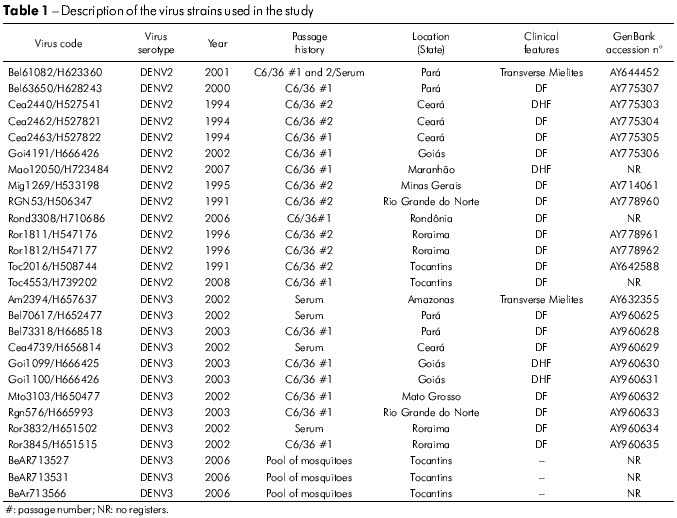
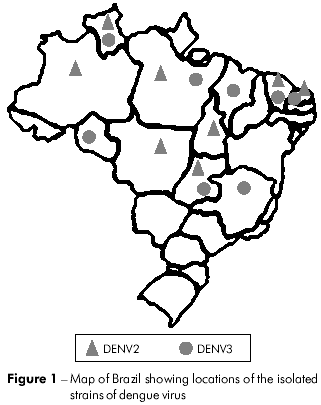
<body><![CDATA[<p><font size="2" face="Verdana">Dengue fever (DF) and dengue hemorrhagic fever/dengue    shock syndrome (DHF/DSS) are major health problems in the tropical and subtropical    regions. The increasing number of patients with severe clinical manifestations    and the expansion of epidemic areas have led to extensive research on its causative    agent, dengue virus (DENV), which is the most widespread and important arthropod-borne    virus in terms of morbidity and mortality<sup>1,2,3</sup>. A global dengue pandemic,    which started during World War II has progressively spread worldwide and involves    predominantly tropical countries. According to the World Health Organization<sup>4</sup>,    dengue fever results in approximately 5 million hospitalized children and at    least 50 thousand deaths are caused by DHF/DSS annually.</font></p>     <p><font size="2" face="Verdana">The DENV serotypes 1 to 4 (DENV1 to DENV4) belong    to the <i>Flavivirus</i> genus of the family <i>Flaviviridae</i>. The genome    of flaviviruses is a positive-sense, singlestranded RNA approximately 11 Kb    in length, from which a single polyprotein is produced. This polyprotein is    proteolytically processed by cellular and viral proteases to generate ten viral    proteins. The gene order of the dengue polyprotein is 5'-C-prM(M)-E-NS1-NS2A-NS2B-NS3-    NS4A-NS4B-NS5-3'<sup>5,6</sup>.</font></p>     <p><font size="2" face="Verdana"> Dengue infections can be manifested from asymptomatic    to subclinical pictures through DF and DHF/DSS, all of which may be observed    during a dengue outbreak. Nonetheless, dengue infections usually result in two    well-defined syndromes, DF and DHF. The mechanism by which the DENV-infected    host exhibits benign or severe disease remains to be elucidated. The antibody-dependent    enhancement (ADE) pathway postulates that circulating antibodies from a primary    infection bind to a heterologous virus in a secondary infection facilitating    penetration of virus particles into mononuclear cells<sup>7,8</sup>. Further    studies have shown that host immune system mediators, such as cytokines and    complement, may have a direct role in the pathogenesis of plasma leakage, a    defining feature of DHF<sup>9,10,11,12</sup>.</font></p>     <p><font size="2" face="Verdana"> In Brazil, DENV2 was first isolated in 1989    from an imported case from Uganda, Africa. Prior to that case, DENV1 and DENV4    caused an epidemic in Boa Vista, Roraima State, Brazil<sup>13</sup>. In 1986    DENV1 caused epidemics in Rio de Janeiro and additional cities<sup>14</sup>.    In 1990, the first autochthonous DENV2 outbreak occurred in the State of Rio    de Janeiro. The introduction of DENV2 increased the number of severe disease    cases with the appearance of several cases of DHF/DSS<sup>15,16</sup>. Furthermore,    DENV3 was isolated in S&atilde;o Paulo State from an imported case that occurred    in 2000<sup>17</sup>. One year after its introduction into Brazil, DENV3 caused    a large dengue outbreak in Rio de Janeiro State and has quickly spread to several    other Brazilian States<sup>18</sup>.</font></p>     <p><font size="2" face="Verdana">In this study, we have sequenced the C, prM/M    and E genes of both DENV2 and DENV3 in 27 Brazilian strains from distinct geographic    areas and at different periods of collection between 1991 and 2008 to investigate    the molecular epidemiology of these serotypes that are circulating in the Country.</font></p>     <p>&nbsp;</p>     <p><font size="3" face="Verdana"><b>MATERIALS AND METHODS</b></font></p>     <p><font size="2" face="Verdana"> <b>VIRUS ISOLATION</b></font></p>     <p><font size="2" face="Verdana">Twenty-seven DENV strains (14 DENV2 and 13 DENV3)    were obtained from the virus collection at the Department of Arbovirology and    Hemorrhagic Fever in the Instituto Evandro Chagas (IEC). These viruses were    isolated from sera collected from patients that were clinically diagnosed as    cases of DF, DHF/DSS and encephalitis during the outbreaks that occurred between    the period of 1991 to 2008 and from mosquitoes captured in the endemic area    (<a href="#f1">Figure 1</a>). Viruses were grown in cultured <i>Aedes albopictus</i> cells (clone    C6/36). Relevant information on each isolate is summarized in <a href="#t1">table   1</a>.</font></p>     <p><a name="f1"></a></p>     ]]></body>
<body><![CDATA[<p>&nbsp;</p>     <p align="center"><img src="/img/revistas/rpas/v1n3/3a04f1.gif" border="0"></p>     <p>&nbsp;</p>     <p><a name="t1"></a></p>     <p>&nbsp;</p>     <p align="center"><img src="/img/revistas/rpas/v1n3/3a04t1.gif" border="0"></p>     <p>&nbsp;</p>     <p><font size="2" face="Verdana"><b>RNA EXTRACTION AND RT-PCR AMPLIFICATION</b></font></p>     <p><font size="2" face="Verdana"> Genomic RNA samples were extracted using Trizol    reagent ( Invitrogen, USA) according to the manufacturer's instructions. cDNAs    were synthesized and amplified with a standard two step RT-PCR assay with specific    primers for DENV2 and DENV3 that were des igned to generate over lapping products    corresponding to the C/prM/M/E structural genomic region as previously reported.    Initially, 0.2-1 &#181;g of viral RNA and 20 &#181;M of antisense primer were    heated at 90 <sup>o</sup>C for 90 s and then placed on ice. RT mix containing    1X RT buffer (200 mM Tris-HCl (pH 8.4), 500 mM KCl), 0.2 mM DNTP (deoxynucleotides)    mixture, 100 mM DTT (dithiothreitol), 40 U RNAse inhibitor (Invitrogen, USA)    and 200 U Superscript II Reverse transcriptase (Invitrogen, USA) was added to    the pre-heated RNA and the volume adjusted to 20 &#181;L. The RT reaction was    carried out at 45 <sup>o</sup>C for 1 h, followed by heating at 94 <sup>o</sup>C    for 10 min. The RT products were used as templates for PCR amplification. Reactions    were composed of 20 &#181;M each of the forward and reverse primers, 1X PCR    buffer, 1 mM of MgCl<sub>2</sub> , 0.2 mM of dNTP mixture, 5 U/&#181;L of Platinum    Taq Polymerase (Invitrogen) and the final volume adjusted to 50 &#181;L with    RNAse-free water. The samples were placed in a thermal cycler (Perkin Elmer    9600, USA) at 94 <sup>o</sup>C for 90 s (for initial denaturation) followed    by 35 cycles of: 94 <sup>o</sup>C for 30 s, 55 <sup>o</sup>C for 30 s, and 72    <sup>o</sup>C for 120 s and a final extension step at 72 <sup>o</sup>C for 5    min. RT-PCR products were visualized in a 1.5% agarose gel stained with ethidium    bromide (5 &#181;g/mL).</font></p>     <p><font size="2" face="Verdana"><b>NUCLEOTIDE SEQUENCING AND SEQUENCE ANALYSES</b></font></p>     ]]></body>
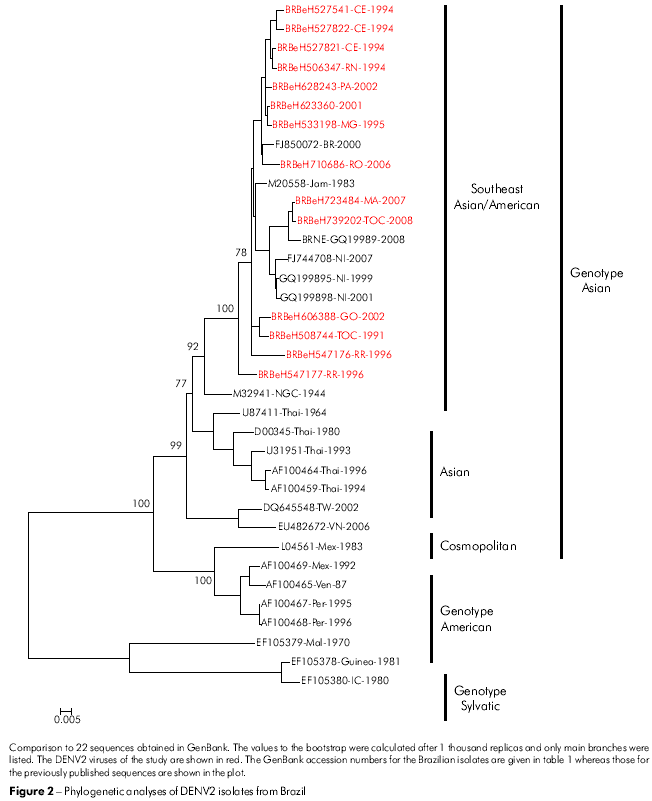
<body><![CDATA[<p><font size="2" face="Verdana">The RT-PCR products were purified using the QlAquick    gel extraction kit (Qiagen, Inc., Valencia, CA). Purified cDNA was used as the    template for sequencing using the Big Dye Terminator 3.0 kit (Applied Biosystems,    Inc., USA) according to the manufacturer's instructions. Sequencing was performed    using the ABI Prism 377 (Applied Biosystems) equipment. Nucleotide sequences    were analyzed and edited with SeqMan software (DNASTAR, Lasergene software package).    Phylogenetic analysis were generated by progressive pairwise multiple sequence    alignments using CLUSTAL W (Megalign software; Lasergene software package DNASTAR).</font></p>     <p><font size="2" face="Verdana">A 2271-base sequence spanning the C-prM-E structural    protein genes was used for comparing the 14 isolates described here and 22 previously    published sequences of DENV2 retrieved from GenBank (<a href="http://www.ncbi.nlm.nih.gov" target="_blank">http://www.ncbi.nlm.nih.gov</a>).    For DENV3, 1,977 bases from the M and E genes were used to compare our 13 isolates    with the 27 previously published sequences of DENV3. The DENV2 sequence (strain    Jamaica access number M20558) was used as an outgroup.</font></p>     <p><font size="2" face="Verdana">Phylogenetic analyses were performed with bootstrap    values of 1 thousand pseudoreplicas using the neighbor-joining method (NJ) Kimura-2-parameter<sup>19,20,21</sup>    (MEGA 2.1 software).</font></p>     <p>&nbsp;</p>     <p><font size="3" face="Verdana"><b>RESULTS</b></font></p>     <p><font size="2" face="Verdana"><b>ANALYSIS OF DENV2</b></font></p>     <p><font size="2" face="Verdana">We have determined the full nucleotide sequence    of the structural genome of 14 DENV2 isolates from patients exhibiting different    patterns of disease severity (<a href="#t1">Table 1</a>). Comparative differences in nucleotide    numbers between all viruses studied and the DENV2 Jamaica (Jam83) strain revealed    high nucleotide sequence similarity (89.0 to 99.9%) among our isolates. The    average similarity between the DENV2 subtypes was 89.5 and 99.8% for the nucleotide    and amino acids sequences respectively.</font></p>     <p><font size="2" face="Verdana">The classification of the genotypes used was    proposed in the studies by Rodriguez-Roche<sup>22</sup> and Vasilaks and Weaver<sup>23</sup>    where the sylvatic genotype was used as the outgroup. The phylogenetic tree    constructed for the C/prM/M/E nucleotide sequences of our DENV2 isolates grouped    all the isolates into the Jamaica genotype (<a href="#f2">Figure 2</a>; genotype III). In addition,    our DENV2 isolates were more closely related to a strain from Brazil (RJ2000;    FJ850072) and with the DENV2 Jamaica strain (JAM1983; M20558). The Asian genotype    (III) was divided into four different lineages, representing the Southeast Asian/American    strains, Asian I, Asian II and Asian III.</font></p>     <p><a name="f2"></a></p>     <p>&nbsp;</p>     ]]></body>
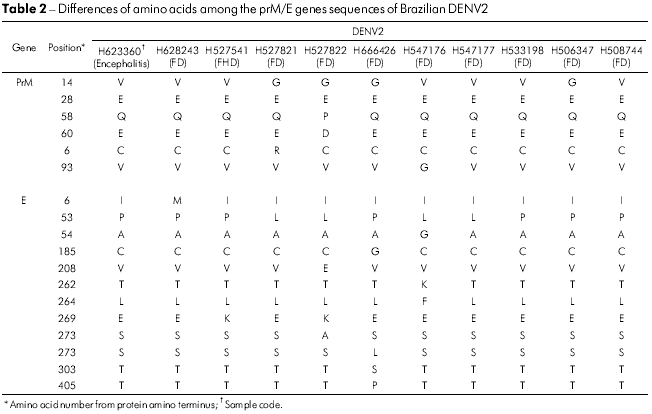
<body><![CDATA[<p align="center"><img src="/img/revistas/rpas/v1n3/3a04f2.gif" border="0"></p>     <p>&nbsp;</p>     <p><font size="2" face="Verdana"> The prM/M/E amino acid sequences of all 14 DENV2    isolates from Brazil showed that these proteins were highly conserved. Only    five positions in the prM/M/E genes varied in the five isolates, the most variable    being prM amino acid 14, which was a glycine (V &#8594; G) in four strains. Isolate    BeH527822 accumulated two additional changes at prM/M 58 (Q &#8594; P) and 60    (E &#8594; D) as shown in <a href="#t2">table 2</a>. In the E gene, 12 amino acid positions were    variable with E53 (P &#8594; L) and E269 (E &#8594; K) being observed in four and    two isolates, respectively. The most variable isolates were BeH527822, BeH666426    and BeH547176 with changes at four positions where the only one that was common    to them all was E53 (P &#8594; L) (<a href="#t2">Table 2</a>).</font></p>     <p><a name="t2"></a></p>     <p>&nbsp;</p>     <p align="center"><img src="/img/revistas/rpas/v1n3/3a04t2.gif" border="0"></p>     <p align="center">&nbsp;</p>     <p><font size="2" face="Verdana"><b>ANALYSIS OF DENV3</b></font></p>     <p><font size="2" face="Verdana">Nucleotide sequence homology among the DENV3    strains ranged from 89.7 to 100%. The deduced prM/M and E amino acid sequences    for all ten DENV3 isolates showed that their proteins were highly conserved,    with a similarity ranging from 93.2 to 100%. The average sequence homology was    94.8% and 96.6% for the nucleotide and amino acid sequences respectively.</font></p>     <p><font size="2" face="Verdana">The phylogenetic tree constructed for the DENV3    isolates was based on the alignment of sequences at the E/NS1 region (992-2550    nt), using the criteria for division of the genotypes described by Lanciotti<sup>24</sup>.    All DENV3 isolates were identified as members of genotype III (Indian subcontinent)    and clustered separately in two subclades (A and B). Subclade A contains the    Latin American strains and is genetically more closely related to subclade B    strains isolated in Sri Lanka (L11437, L11438) (<a href="#f3">Figure 3</a>).</font></p>     ]]></body>
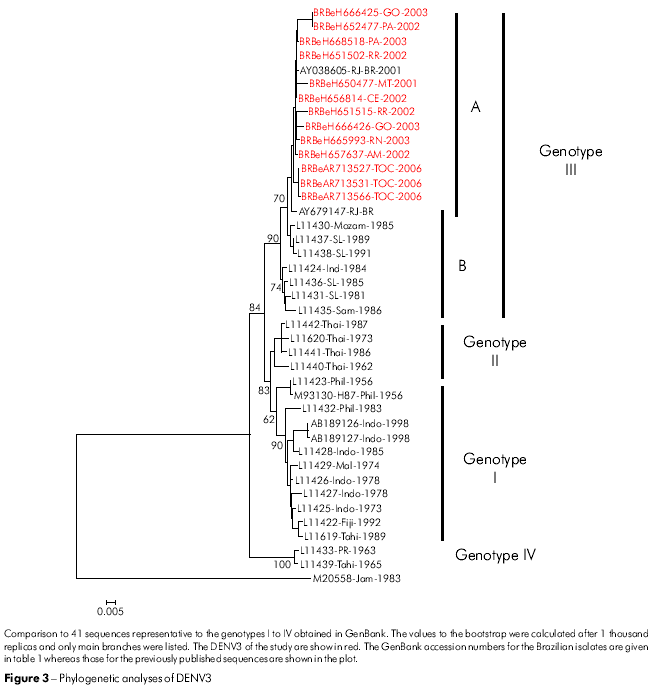
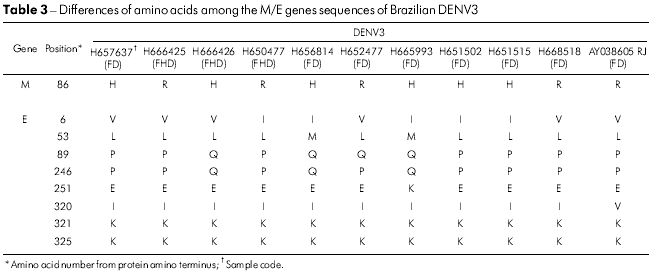
<body><![CDATA[<p><a name="f3"></a></p>     <p>&nbsp;</p>     <p align="center"><img src="/img/revistas/rpas/v1n3/3a04f3.gif" border="0"></p>     <p>&nbsp;</p>     <p><font size="2" face="Verdana">The variability of amino acid sequences for     the  DENV3 isolates was restricted to one position in the M gene (M86 H &#8594; R),      whereas six positions were found to vary in the E gene (<a href="#t3">Table   3</a>). The most variable    were E6 (l &#8594; V), E89 (Q &#8594; P) and E246 (Q &#8594; P). Isolates BeH657637    and BeH665993 had accumulated changes in three of the six variable amino acid    positions (<a href="#t3">Table 3</a>).</font></p>     <p><a name="t3"></a></p>     <p>&nbsp;</p>     <p align="center"><img src="/img/revistas/rpas/v1n3/3a04t3.gif" border="0"></p>     <p>&nbsp;</p>     <p><font size="3" face="Verdana"><b>DISCUSSION</b></font></p>     ]]></body>
<body><![CDATA[<p><font size="2" face="Verdana">The nucleotide sequence divergence (10.5%) obtained    in this study for DENV2 suggests an accumulation of mutations during the period    of high circulation of this DENV serotype<sup>25</sup>. Indeed, DENV2 has circulated    in Brazil for almost two decades; however, there has been a surprisingly low    incidence of DHF cases when compared to other countries. After introduction    of DENV3 in 2002, the number of DHF has increased sharply, suggesting a high    virulence of this serotype<sup>26</sup>. Previous studies on DENV2 from the    Americas had shown that the appearance of DHF was related to the introduction    of an Asian genotype into the Caribbean Region<sup>27</sup>. Our data confirms that this    DENV2 genotype has been predominant in Brazil throughout the 19 years of its    circulation.</font></p>     <p><font size="2" face="Verdana">According to the classification of Rodriguez-Roche    et al<sup>22</sup> and Vasilaks and Weaver<sup>23</sup>, the DENV2 is grouped    into three genotypes, with the circulation of genotypes III and IV in the Americas.    Genotype III circulated in all countries of the American Region having, as its    prototype, the Jamaican strain, which has been associated with DHF cases. The    genotype IV (American) has been associated with strains of lower virulence and    only associated with DF. It is of interest that this genotype has circulated    only in the American subcontinent<sup>28</sup>. In our study, none of the Brazilian sequences    studied were included in the DENV2 genotype IV (American). In fact, all of sequences    were included in the genotype III (<a href="#f2">Figure 2</a>).</font></p>     <p><font size="2" face="Verdana">The first studies comparing nucleotide sequence    of the gene of 12 DENV2 showed no correlation between disease severity and specific    nucleotide or amino acid sequence<sup>29</sup> . Further analysis of the complete    genome of the Southeast Asian DENV2 also failed to identify specific sites that    could determine virulence<sup>30,31</sup>. Leitmeyer et al<sup>28</sup> conducted    a more consistent analysis of the genetic diversity of DENV2. This study identified    an amino acid substitution at position E390 as a primary determinant of severe    dengue. In the American genotype, the cases of DF were found to be associated    with the presence of an aspartic acid (Asp-D), which may alter interactions    with cellular receptors. However, the results obtained with 14 sequences of    DENV2 in our study identified an Asn at position E390 in all the sequences studied    when the sequences were compared within the 14 strains and with strains of Asian    and American genotypes<sup>28</sup>. The results indicate that the Brazilian    DENV2 analyzed have the potential to cause DHF, which is consistent with the    data reported with isolates from 32 Venezuela<sup>32</sup>.</font></p>     <p><font size="2" face="Verdana">The change of amino acid E390 is located in the    carboxyl-terminal domain III (aa 303-395) on the lateral surface, which is believed    to contain residues that are involved in tropism and virulence in different    flaviviruses<sup>33,34,35</sup>. In the E gene of 14 Brazilian viruses analyzed, 12 changes    were present, and only five amino acids substitutions were significantly associated    with a change of character and polarity. Those positions were: E208 (Val/V &#8594;    Glu/E), 262 (Thr/T &#8594; Lys/K), 273 (Ser/S &#8594; Leu/L), 274 (Ser/S &#8594; Ala/A)    and 405 (Thr/T &#8594; Pro/P). All amino acid changes are shown in <a href="#t2">table   2</a>. The    changes were present in the ectodomain III or outside of the ectodomain of the    protein such as in the residue 405 of sample H666426/Goi4191. Some changes shown    in <a href="#t2">table 2</a>, such as E262 and 264 that are present in H547176/ROR1811 and the    viral strain from Venezuela (AF100466), suggest that the virus may have originated    from this Country, thus confirming the existence of two modes of entrance of    the DENV2 into Brazil.</font></p>     <p><font size="2" face="Verdana">Over the past two decades, DENV3 has caused epidemics    of DHF in Southeast Asia, East Africa and Latin America. The first phylogenetic    analysis of the E protein of this dengue serotype resulted in the recognition    of four distinct genotypes<sup>24</sup>. In general, genotypes can be grouped    by distinct geographic origin: American, Indian subcontinent, Thailand and Southeast    Asian/South Pacific<sup>25</sup>.</font></p>     <p><font size="2" face="Verdana">The DENV3 genotype that circulated in the Americas    until 1989 had low epidemic potential and was isolated only from DF patients.    Between 1980 and 1990, two new genotypes were introduced into the South Pacific    and Americas: the Southeast Asian genotype (genotype I) is associated with large    epidemics of DHF in Tahiti and Fiji<sup>36</sup>, and the Indian subcontinent    genotype (genotype III) was introduced into Central America in the 1990s in    Nicaragua<sup>37,38,39,40</sup>.</font></p>     <p><font size="2" face="Verdana">In 1994 DENV3 resurged in the Americas, causing    a small outbreak associated with classic DF in Panama. The virus spread toward    Northern Central America and reaching Nicaragua and Mexico<sup>41,2</sup>. Seven years    after its introduction into the Americas, DENV3 spread throughout South America    reaching Venezuela, Paraguay and Brazil and causing large epidemics<sup>42,43,17,44,45</sup>.</font></p>     <p><font size="2" face="Verdana">The 13 Brazilian DENV3 isolates from our study    that were collected from different geographical regions, together with those    obtained from neighboring countries<sup>45,46,40</sup>, have all been grouped    into genotype III (Indian subcontinent). They are genetically different from    the DENV3 strain that previously circulated in the Americas in the 1960s belonging    to the genotype V<sup>47</sup>. It is possible that this accumulated variability is the    result of the rapid dispersion and increase in viral replication. This hypothesis    is supported by the bootstrap values of around 84% shown in the phylogenic tree    based on the neighbor-joining method (<a href="#f3">Figure 3</a>). The variability of the DENV3    (genotype III) strain may be due to multiple introductions into Brazil, which    give rise to subgroups according to origin and year of isolation of the viral    strain (<a href="#f3">Figure 3</a>).</font></p>     <p><font size="2" face="Verdana">Local transmission of DENV3 was initially detected      in Rio de Janeiro State in December 2000. In the summer of 2001, the first     autochthonous  epidemic occurred in Rio de Janeiro City, with a large number     of DHF cases,  followed by the spread of this genotype throughout Brazil.     All viruses isolated  belonged to genotype III, similar to that circulating     in Sri Lanka, which is  in agreement with previously described studies<sup>47,48,49</sup>.     Our results  show, based on the chronology of the virus isolation, that the     dispersion of  the DENV3 genotype III in Brazil occurred from the Southeast     to the Northern  region. These results differ from those of Figueiredo et     al<sup>50</sup>, which   recorded the circulation of the DENV3 genotype I in the State of Minas Gerais,   Southeast to Brazil and Ara&uacute;jo et al<sup>51</sup> suggesting the formation   of a new genotype (V) that grouped the DENV3 strains from Brazil, China and   Japan. The differences in results show that the circulation of new genotypes   appeared to be restricted to a specific region in Brazil or to a certain period   of time. This raises some important questions: Why have other strains of these   genotypes failed to be identified? Does this strain have a potential transmission   vector? Therefore, the emergence of other genotypes or novel genotypes should   be further investigated. This should include analyzing the complete genome   sequences of DENV3 and its epidemiological profile.</font></p>     <p>&nbsp;</p>     ]]></body>
<body><![CDATA[<p><font size="3" face="Verdana"><b>CONCLUSION</b></font></p>     <p><font size="2" face="Verdana">In summary, our study suggests that the low genetic    variability for DENV2 circulating in Brazil may explain the low incidence of    severe cases of the disease that have been reported to date. However, the explosive    spread of DENV2 genotype III, which has been found to be more variable than    DENV3, may have accumulated genetic changes associated with an increase of virulence,    immune status and other important factors previously described. This would explain    the higher number of severe dengue cases since the introduction of DENV2 and    DENV3 into Brazil.</font></p>     <p>&nbsp;</p>     <p><font size="3" face="Verdana"><b>ACKNOWLEDGMENTS</b></font></p>     <p><font size="2" face="Verdana">We gratefully acknowledge the valuable support    provided by Drs. M&aacute;rcio Roberto Teixeira Nunes, Ralph Lainson and Elena    Caride, Creuza Lima Carvalho and Maria Natividade.</font></p>     <p>&nbsp;</p>     <p><font size="3" face="Verdana"><b>FINANCIAL SUPPORT</b></font></p>     <p><font size="2" face="Verdana">This work was partially supported by the Conselho      Nacional de Desenvolvimento Cient&iacute;fico e Tecnol&oacute;gico &#8211; CNPq,       Brazil (grants 300460/2005-8 and 501558/2003-9).</font></p>     <p>&nbsp;</p>     <p><font size="3" face="Verdana"><b>REFERENCES</b></font></p>     ]]></body>
<body><![CDATA[<!-- ref --><p><font size="2" face="Verdana">1 Monath TP, Heinz FX. Flaviviruses. In: Fields    BN, Knipe DM, Howley PM, editors. Field's Virology. Philadelphia: Lippincott    Williams Wilkins; 1996. p. 961-1034.</font><!-- ref --><p><font size="2" face="Verdana">2 Guzm&aacute;n MG, Kouri G. Dengue: an update.    Lancet Infect Dis. 2002 Jan;2(1):33-42.</font><!-- ref --><p><font size="2" face="Verdana">3 Kour&iacute; G. El dengue, un problema cresciente    de salud en las Am&eacute;ricas. Rev Panam Salud Publica. 2006;19(3):143-5.</font><font size="2" face="verdana"><font size="2" face="verdana">&nbsp; &nbsp; &nbsp; &nbsp;  &nbsp;&#91; <a href="http://www.ncbi.nlm.nih.gov/pubmed/11892494" target="_blank">Links</a> &#93;</font></font><!-- ref --><p><font size="2" face="Verdana">4 World Health Organization. Bulletin of Dengue.    1986</font><!-- ref --><p><font size="2" face="Verdana"> 5 Chambers TJ, Hahn CS, Galler R, Rice CM. Flavivirus    genome organization, expression, and replication. Annu Rev Microbiol. 1990;44:649-88.</font><!-- ref --><p><font size="2" face="Verdana">6 Rice CM. Flaviviridae: the viruses and their    replication. In: Fields BN, Knipe DM, Howley PM, editors. Fields Virology. Philadelphia:    Lippincott Williams Wilkins; 1996. p. 931-60.</font><!-- ref --><p><font size="2" face="Verdana">7 Halstead SB. Pathogenesis of dengue: challenges      to molecular biology. Science. 1988 Jan;239(4839):476-81.</font><font size="2" face="verdana"><font size="2" face="verdana">&nbsp; &nbsp; &nbsp; &nbsp;  &nbsp;&#91; <a href="http://www.ncbi.nlm.nih.gov/pubmed/3277268" target="_blank">Links</a> &#93;</font></font><!-- ref --><p><font size="2" face="Verdana">8 Littaua R, Kurane I, Ennis FA. Human IgG Fc      receptor II mediates antibody-dependent enhancement of dengue virus infection.      J Immunol. 1990 Apr;144(8):3183-6.</font><font size="2" face="verdana"><font size="2" face="verdana">&nbsp; &nbsp; &nbsp; &nbsp;  &nbsp;&#91; <a href="http://www.ncbi.nlm.nih.gov/pubmed/2139079" target="_blank">Links</a> &#93;</font></font><!-- ref --><p><font size="2" face="Verdana">9 Kurane I, Ennis FE. Immunity and immunopathology    in dengue virus infections. Semin Immunol. 1992 Apr;4(2):121-7.</font><font size="2" face="verdana"><font size="2" face="verdana">&nbsp; &nbsp; &nbsp; &nbsp;  &nbsp;&#91; <a href="http://www.ncbi.nlm.nih.gov/pubmed/1617166" target="_blank">Links</a> &#93;</font></font><!-- ref --><p><font size="2" face="Verdana">10 Rothman AL, Ennis FA. Imunnopathogenesis of    dengue haemorrhagic fever. Virology. 1999;257:1-6.</font><!-- ref --><p><font size="2" face="Verdana">11 Chaturvedi UC, Argwal R, Elbishbishi EA, Mustaf&aacute;    AS. Cytokine cascade in dengue haemorrhagic fever: inplications for pathgenesis.    FEMS Immunol Med Microbiol. 2000 Jul;28(3):183-8.</font><font size="2" face="verdana"><font size="2" face="verdana">&nbsp; &nbsp; &nbsp; &nbsp;  &nbsp;&#91; <a href="http://www.ncbi.nlm.nih.gov/pubmed/10865168" target="_blank">Links</a> &#93;</font></font><!-- ref --><p><font size="2" face="Verdana">12 Rothman AL. Dengue: defining protective versus      pathologic immunity. J Clin Invest. 2004 Apr;113(7):946-51.</font><!-- ref --><p><font size="2" face="Verdana"> 13 Travassos da Rosa APA, Travassos da Rosa      JFS, Pinheiro FP, Vasconcelos PFC. Arboviroses. In: Le&atilde;o RNQ, editor.       Doen&ccedil;as Infecciosas e Parasit&aacute;rias. Bel&eacute;m: CEJUP;       1997. p. 207-26.</font><!-- ref --><p><font size="2" face="Verdana">14 Schatzmayr HG, Nohueira RM, Travassos da Rosa    AP. An outbreak of dengue virus at Rio de Janeiro &#8211; 1986. Mem Inst Oswaldo    Cruz. 1986 Apr-Jun;81(2):245-6.</font><font size="2" face="verdana"><font size="2" face="verdana">&nbsp; &nbsp; &nbsp; &nbsp;  &nbsp;&#91; <a href="http://www.ncbi.nlm.nih.gov/pubmed/3587006" target="_blank">Links</a> &#93;</font></font><!-- ref --><p><font size="2" face="Verdana">15 Nogueira RM, Miagostovich MP, Lampe E, Souza    RW, Zagne SM, Schatzmayr HG. Dengue epidemic in the stage of Rio de Janeiro,    Brazil, 1990-1: co-circulation of dengue 1 and dengue 2 serotypes. Epidemiol    Infect. 1993 Aug;111(1):163-70.</font><font size="2" face="verdana"><font size="2" face="verdana">&nbsp; &nbsp; &nbsp; &nbsp;  &nbsp;&#91; <a href="http://www.ncbi.nlm.nih.gov/pubmed/8348928" target="_blank">Links</a> &#93;</font></font><!-- ref --><p><font size="2" face="Verdana">16 Zagne SM, Alves VG, Nogueira RM, Miagostovich    MP, Lampe E, Tavares W. Dengue haemorrhagic fever in the state of Rio de Janeiro,    Brazil: a study of 56 confirmed cases. Trans R Soc Trop Med Hyg. 1994 Nov-Dec;88(6):677-9.</font><!-- ref --><p><font size="2" face="Verdana">17 Rocco IM, Kavakama BB, Santos CL. First isolation    of dengue 3 in Brazil from an imported case. Rev Inst Med Trop Sao Paulo. 2001    Jan-Feb;43(1):55-7.</font><!-- ref --><p><font size="2" face="Verdana">18 Siqueira Jr JB, Martelli CMT, Coelho GE, Simpl&iacute;cio    ACR, Hatch DL. Dengue and dengue hemorrhagic fever, Brazil, 1981-2002. Emerg    Infect Dis. 2005 Jan;11(1):48-53.</font><!-- ref --><p><font size="2" face="Verdana">19 Kumar S, Tamura K, Nei M. MEGA3: integrated    software for molecular evolutionary genetics analysis and sequence alignment.    Brief Bioinform. 2004 Jun;5(2):150-63.</font><font size="2" face="Verdana"></font><font size="2" face="verdana"><font size="2" face="verdana">&nbsp; &nbsp; &nbsp; &nbsp;  &nbsp;&#91; <a href="http://www.ncbi.nlm.nih.gov/pubmed/15260895" target="_blank">Links</a> &#93;</font></font><!-- ref --><p><font size="2" face="Verdana">20 Saitou N, Nei M. The neighbor-joining method:    a new method for reconstructing phylogenetic trees. Mol Biol Evol. 1987 Jul;4(4):406-25.</font><font size="2" face="verdana"><font size="2" face="verdana">&nbsp; &nbsp; &nbsp; &nbsp;  &nbsp;&#91; <a href="http://www.ncbi.nlm.nih.gov/pubmed/3447015" target="_blank">Links</a> &#93;</font></font><!-- ref --><p><font size="2" face="Verdana">21 Kimura M. A simple method for estimating evolutionary    rates of base substitutions through comparative studies of nucleotide sequence.    J Mol Evol. 1980 Dec;16(2):111-20.</font><!-- ref --><p><font size="2" face="Verdana">22 Rodriguez-Roche R, Alvarez M, Gritsun T,     Halstead  S, Kouri G, Gould EA, et al. Virus evolution during a severe dengue     epidemic  in Cuba, 1997. Virology. 2005;334(2):154-9.</font><!-- ref --><p><font size="2" face="Verdana">23 Vasilakis N, Weaver SC. History and evolution      of human dengue emergence. In: Maramorosch K, Shatkin AS, Murphy FA, editors.      Advances in Virus Research. California: Academic Press; 2008. p. 1-76.</font><!-- ref --><p><font size="2" face="Verdana">24 Lanciotti RS, Lewis JG, Gubler D, Trent DW.    Molecular evolution and epidemiology of dengue 3 viruses. J Gen Virol. 1994    Jan;75(1):65-75.</font><font size="2" face="verdana"><font size="2" face="verdana">&nbsp; &nbsp; &nbsp; &nbsp;  &nbsp;&#91; <a href="http://www.ncbi.nlm.nih.gov/pubmed/8113741" target="_blank">Links</a> &#93;</font></font><!-- ref --><p><font size="2" face="Verdana">25 Rico-Hesse R. Microevolution and virulence      of dengue virus. In: Chambers TJ, Monath TP, editors. The Flaviviruses:     structure,  replication and evolution. California: Academic Press; 2003.     p. 316-41.</font><!-- ref --><p><font size="2" face="Verdana">26 Secretaria de Vigil&acirc;ncia em Sa&uacute;de.    Plano Nacional de Combate a Dengue. Bras&iacute;lia: Minist&eacute;rio da Sa&uacute;de;    2006.</font><!-- ref --><p><font size="2" face="Verdana">27 Rico-Hesse R, Harrison LM, Salas RA, Tovar    D, Nisalak A, Ramos C, et al. Origins of dengue type 2 viruses associated with    increased pathogenicity in the Americas. Virology. 1997 Apr;230(2):224-51.</font><!-- ref --><p><font size="2" face="Verdana">28 Leitmeyer KC, Vaughn DW, Watts DG, Salas R,    Chacon IV, Ramos C, et al. Dengue virus structural differences that correlate    with pathogenesis. J Virol. 1999 Jun;73(6):4738-47.</font><font size="2" face="verdana"><font size="2" face="verdana">&nbsp; &nbsp; &nbsp; &nbsp;  &nbsp;&#91; <a href="http://jvi.asm.org/cgi/content/full/73/6/4738?view=long&pmid=10233934" target="_blank">Links</a> &#93;</font></font><!-- ref --><p><font size="2" face="Verdana">29 Block J, Samuel S, Gibbs AJ, Vitarana UT.    Variation of the nucleotide and encoded amino acid sequences of the envelope    gene from eight dengue 2 viruses. Arch Virol. 1989;105(1-2):39-53.</font><font size="2" face="verdana"><font size="2" face="verdana">&nbsp; &nbsp; &nbsp; &nbsp;  &nbsp;&#91; <a href="http://www.ncbi.nlm.nih.gov/pubmed/2719554" target="_blank">Links</a> &#93;</font></font><!-- ref --><p><font size="2" face="Verdana">30 Mangada MN, IgarashI A. Molecular and in vitro    analysis of eigth dengue type 2 viruses isolated from patients exhibiting different    disease severities. Virology. 1998 May;244(2):458-66.</font><!-- ref --><p><font size="2" face="Verdana">31 Pandey BD, Igarashi A. Severity-related molecular      differences among nineteen strains of dengue type 2 viruses. Microbiol Immunol.      2000 Feb;44(3):179-88.</font><font size="2" face="verdana"><font size="2" face="verdana">&nbsp; &nbsp; &nbsp; &nbsp;  &nbsp;&#91; <a href="http://www.researchgate.net/publication/12526874_Severity-related_molecular_differences_among_nineteen_strains_of_dengue_type_2_viruses" target="_blank">Links</a> &#93;</font></font><!-- ref --><p><font size="2" face="Verdana">32 Uzcategui NY, Camacho D, Comach G, Cuello      de Uzcategui R, Holmes EC, Gould EA. Molecular epidemiology of dengue type     2  virus in Venezuela: evidence for <i>in situ </i>virus evolution and recombination.      J Gen Virol. 2001 Dec;82(12):2945-53.</font><font size="2" face="verdana"><font size="2" face="verdana">&nbsp; &nbsp; &nbsp; &nbsp;  &nbsp;&#91; <a href="http://www.ncbi.nlm.nih.gov/pubmed/11714970" target="_blank">Links</a> &#93;</font></font><!-- ref --><p><font size="2" face="Verdana">33 Hasegawa HM, Yoshida T, Shiosaka S, Kobayashi      Y. Mutations in the envelope protein of Japanese encephalitis virus affect     entry  into cultured cells and virulence in mice. Virology. 1992 Nov;191(1):158-65.</font><font size="2" face="Verdana"></font><font size="2" face="verdana"><font size="2" face="verdana">&nbsp; &nbsp; &nbsp; &nbsp;  &nbsp;&#91; <a href="http://www.ncbi.nlm.nih.gov/pubmed/1329314" target="_blank">Links</a> &#93;</font></font><!-- ref --><p><font size="2" face="Verdana">34 Jiang WR, Lowe A, Higgs S, Reid S, Gould EA.    Single amino acid codon changes detected in louping ill virus antibody-resistant    mutants with reduced neurovirulence. J Gen Virol. 1993 May;74(5):931-5.</font><font size="2" face="Verdana"></font><font size="2" face="Verdana"></font><font size="2" face="verdana"><font size="2" face="verdana">&nbsp; &nbsp; &nbsp; &nbsp;  &nbsp;&#91; <a href="http://www.ncbi.nlm.nih.gov/pubmed/8388021" target="_blank">Links</a> &#93;</font></font><!-- ref --><p><font size="2" face="Verdana">35 Mandl CW, Guirakhoo F, Holzmann H, Heinz FX,    Kunz C. Antigenic structure of the flavivirus envelope protein E at the molecular    level, using tick-borne encephalitis virus as a model. J Virol. 1989 Feb;63(2):564-71.</font><font size="2" face="Verdana"></font><font size="2" face="Verdana"></font><font size="2" face="Verdana"></font><font size="2" face="verdana"><font size="2" face="verdana">&nbsp; &nbsp; &nbsp; &nbsp;  &nbsp;&#91; <a href="http://www.ncbi.nlm.nih.gov/pubmed/2463377" target="_blank">Links</a> &#93;</font></font><!-- ref --><p><font size="2" face="Verdana">36 Chungue E, Deubel V, Cassar O, Laille M, Martin    PMV. Molecular epidemiology of dengue 3 viruses and genetic relatedness among    dengue 3 strains isolated from patients with wild or severe form for dengue    fever in French Polynesia. J Gen Virol. 1993 Dec;74(12):2765-70.</font><!-- ref --><p><font size="2" face="Verdana">37 Balmaseda A, Sandoval E, Perez L, Gutierrez    CM, Harris E. Application of molecular typing techniques in the 1998 dengue    epidemic in Nicaragua. Am J Trop Med Hyg. 1999 Dec;61(6):893-7.</font><!-- ref --><p><font size="2" face="Verdana">38 Harris E, Roberts TG, Smith L, Selle J, Kramer    LD, Valle S, et al. Typing of dengue viruses in clinical specimens and mosquitoes    by single-tube multiplex reverse transcriptase PCR. J Clin Microbiol. 1998 Sep;36(9):2634-9.</font><font size="2" face="Verdana"></font><font size="2" face="Verdana"></font><font size="2" face="Verdana"></font><font size="2" face="Verdana"></font><font size="2" face="verdana"><font size="2" face="verdana">&nbsp; &nbsp; &nbsp; &nbsp;  &nbsp;&#91; <a href="http://jcm.asm.org/cgi/content/full/36/9/2634?view=long&pmid=9705406" target="_blank">Links</a> &#93;</font></font><!-- ref --><p><font size="2" face="Verdana">39 Harris E, Videa E, Perez L, Sandoval E, Tellez    Y, Perez ML, et al. Clinical, epidemiologic, and virologic features of dengue    in the 1998 epidemic in Nicaragua. Am J Trop Med Hyg. 2000 Jul-Aug;63(1- 2):5-11.</font><font size="2" face="verdana"><font size="2" face="verdana">&nbsp; &nbsp; &nbsp; &nbsp;  &nbsp;&#91; <a href="http://www.ncbi.nlm.nih.gov/pubmed/11357995" target="_blank">Links</a> &#93;</font></font><!-- ref --><p><font size="2" face="Verdana">40 Usuku S, Castillo L, Sugimoto C, Noguchi     Y,  Yogo Y, Kobayashi N. Phylogenetic analysis of dengue 3 viruses prevalent     in  Guatemala during 1996-1998. Arch Virol. 2001 Jul;146(7):1381-90.</font><font size="2" face="verdana"><font size="2" face="verdana"> DOI:10.1007/s007050170098&nbsp; &nbsp; &nbsp; &nbsp;  &nbsp;&#91; <a href="http://www.springerlink.com/content/7rpw2yf860fdkttc/" target="_blank">Links</a> &#93;</font></font><!-- ref --><p><font size="2" face="Verdana">41 Centers for Disease Control and Prevention.      Dengue type 3 infection &#8211; Nicaragua and Panama, October-November 1994.       MMWR Morb Mortal Wkly Rep. 1995 Jan;44(2):21-4.</font><font size="2" face="verdana"><font size="2" face="verdana">&nbsp; &nbsp; &nbsp; &nbsp;  &nbsp;&#91; <a href="http://www.cdc.gov/mmwr/preview/mmwrhtml/00035553.htm" target="_blank">Links</a> &#93;</font></font><!-- ref --><p><font size="2" face="Verdana">42 Halstead SB. Dengue in the Americas and Southeast    Asia: do they differ? Rev Panam Salud Publica. 2006 Dec;20(6):407-15.</font><font size="2" face="verdana"><font size="2" face="verdana">&nbsp; &nbsp; &nbsp; &nbsp;  &nbsp;&#91; <a href="http://www.ingentaconnect.com/content/paho/pajph/2006/00000020/00000006/art00007?token=005016083fcc866e58654624316a6f2c6b5f217a3f6725455e4e26634a492f253033297615eb7a06" target="_blank">Links</a> &#93;</font></font><!-- ref --><p><font size="2" face="Verdana">43 Nogueira RMR, Miagostovich MP, Filippis AM,      Pereira MA, Schatzmayr HG. Dengue virus type 3 in Rio de Janeiro, Brazil.     Mem  Inst Oswaldo Cruz. 2001 Oct;96(7):925-6.</font><font size="2" face="verdana"><font size="2" face="verdana"> DOI:10.1590/S0074-02762001000700007&nbsp; &nbsp; &nbsp; &nbsp;  &nbsp;&#91; <a href="http://www.scielo.br/scielo.php?script=sci_arttext&pid=S0074-02762001000700007&lng=en&nrm=iso&tlng=en" target="_blank">Links</a> &#93;</font></font><!-- ref --><p><font size="2" face="Verdana">44 Simone TS, Nogueira RM, Ara&uacute;jo ES,    Guimar&atilde;es FR, Santos FB, Schatzmayr HG, et al. Dengue virus surveillance:    the co-circulation of DENV1, DENV2 and DENV3 in the State of Rio de Janeiro,    Brazil. Trans R Soc Trop Med Hyg. 2004 Sep;98(9):553-62.</font><font size="2" face="verdana"><font size="2" face="verdana">&nbsp; &nbsp; &nbsp; &nbsp;  &nbsp;&#91; <a href="http://www.ncbi.nlm.nih.gov/pubmed/15251405" target="_blank">Links</a> &#93;</font></font><!-- ref --><p><font size="2" face="Verdana">45 Aquino VH, Anatriello E, Gon&ccedil;alves    PF, Silva EV, Vasconcelos PF, Vieira DS, et al. Molecular Epidemiology of dengue    type 3 virus in Brazil and Paraguay, 2002-2004. Am J Trop Med Hyg. 2006;75(4):710-5.</font><font size="2" face="verdana"><font size="2" face="verdana">&nbsp; &nbsp; &nbsp; &nbsp;  &nbsp;&#91; <a href="http://www.ajtmh.org/cgi/content/full/75/4/710" target="_blank">Links</a> &#93;</font></font><!-- ref --><p><font size="2" face="Verdana">46 Alvarez M, Rodriguez-Roche R, Bernardo L,      V&aacute;zquez S, Morier L, Gonzalez D, et al. Dengue Hemorrhagic Fever      caused  by sequential dengue 1-3 virus infections over a long time interval:      Havana  epidemic, 2001-2002. Am J Trop Med Hyg. 2006;75(6):1113-7.</font><font size="2" face="Verdana"></font><font size="2" face="verdana"><font size="2" face="verdana">&nbsp; &nbsp; &nbsp; &nbsp;  &nbsp;&#91; <a href="http://www.ajtmh.org/cgi/content/full/75/6/1113" target="_blank">Links</a> &#93;</font></font><!-- ref --><p><font size="2" face="Verdana">47 Uzcategui NY, Comach G, Camacho D, Salcedo    M, Cabello de Quintana M, Jimenez M, et al. Molecular epidemiology of dengue    virus type 3 in Venezuela. J Gen Virol. 2003 Jun;84(6):1569-75.</font><font size="2" face="verdana"><font size="2" face="verdana">&nbsp; &nbsp; &nbsp; &nbsp;  &nbsp;&#91; <a href="http://www.ncbi.nlm.nih.gov/pubmed/12771427" target="_blank">Links</a> &#93;</font></font><!-- ref --><p><font size="2" face="Verdana">48 Messer WB, Gubler DJ, Harris E, Sivananthan    K, Silva AM. Emergence and global spread of a dengue serotype 3, subtype III    virus. Emerg Infect Dis. 2003 Jul;9(7):800-9.</font><font size="2" face="Verdana"></font><font size="2" face="verdana"><font size="2" face="verdana">&nbsp; &nbsp; &nbsp; &nbsp;  &nbsp;&#91; <a href="http://www.ncbi.nlm.nih.gov/pubmed/12899133" target="_blank">Links</a> &#93;</font></font><!-- ref --><p><font size="2" face="Verdana">49 Nogueira RM, Schatzmayr HG, Filippis AM,     Santos  FB, Cunha RV, Coelho JO, et al. Dengue virus type 3, Brazil, 2002.     Emerg Infect  Dis. 2005 Sep;11(9):1376-81.</font><font size="2" face="verdana"><font size="2" face="verdana">&nbsp; &nbsp; &nbsp; &nbsp;  &nbsp;&#91; <a href="http://www.cdc.gov/ncidod/EID/vol11no09/04-1043.htm" target="_blank">Links</a> &#93;</font></font><!-- ref --><p><font size="2" face="Verdana">50 Figueiredo LB, Cec&iacute;lio AB, Ferreira    GP, Drumond BP, Oliveira JG, Bonjardim CA, et al. Dengue virus 3 genotype 1    associated with dengue fever and dengue hemorrhagic fever, Brazil. Emerg Infect    Dis. 2008 Feb;14(2):314-6.</font><font size="2" face="verdana"><font size="2" face="verdana">&nbsp; &nbsp; &nbsp; &nbsp;  &nbsp;&#91; <a href="http://www.cdc.gov/ncidod/EID/vol11no09/04-1043.htm" target="_blank">Links</a> &#93;</font></font><!-- ref --><p><font size="2" face="Verdana">51 Ara&uacute;jo JMG, Bello G, Schatzmayr HG,    Santos FB, Nogueira RMR. Dengue virus type 3 in Brazil: a phylogentic perspective.    Mem Inst Oswaldo Cruz. 2009;104(3):526-9.</font><p>&nbsp;</p>     <p>&nbsp;</p>     <p><font size="2" face="Verdana"><b><a name="endereco"></a><a href="#topo"><img src="/img/revistas/rpas/v1n3/seta.gif" border="0"></a>Correspond&ecirc;ncia    / Correspondence / Correspondencia:</b>    <br>   Ana Cec&iacute;lia Ribeiro Cruz    <br>   Instituto Evandro Chagas,    <br>   Se&ccedil;&atilde;o de Arbovirologia e Febres Hemorr&aacute;gicas    <br>   Rodovia BR 316, km 7, s/n&ordm;. Bairro: Levil&acirc;ndia    <br>   CEP: 67030-000 Ananindeua-Par&aacute;-Brasil    <br>   Tel.: 55 (91) 3217-3199 | Fax: 55 (91) 3226-5262    ]]></body>
<body><![CDATA[<br>   E-mail:<a href="mailto:anacecilia@iec.pa.gov.br">anacecilia@iec.pa.gov.b</a></font><a href="mailto:anacecilia@iec.pa.gov.br">r</a></p>     <p><font size="2" face="Verdana">Recebido em / Received / Recibido en: 31/7/2009    <br>   Aceito em / Accepted / Aceito en: 1/2/2010</font></p>   <script type="text/javascript"> var gaJsHost = (("https:" == document.location.protocol) ? "https://ssl." : "http://www."); document.write(unescape("%3Cscript src='" + gaJsHost + "google-analytics.com/ga.js' type='text/javascript'%3E%3C/script%3E")); </script> <script type="text/javascript"> try { var pageTracker = _gat._getTracker("UA-7885746-4"); pageTracker._setDomainName("none"); pageTracker._setAllowLinker(true); pageTracker._trackPageview(); } catch(err) {}</script>      ]]></body><back>
<ref-list>
<ref id="B1">
<label>1</label><nlm-citation citation-type="book">
<person-group person-group-type="author">
<name>
<surname><![CDATA[Monath]]></surname>
<given-names><![CDATA[TP]]></given-names>
</name>
<name>
<surname><![CDATA[Heinz]]></surname>
<given-names><![CDATA[FX]]></given-names>
</name>
</person-group>
<article-title xml:lang="en"><![CDATA[Flaviviruses]]></article-title>
<person-group person-group-type="editor">
<name>
<surname><![CDATA[Fields]]></surname>
<given-names><![CDATA[BN]]></given-names>
</name>
<name>
<surname><![CDATA[Knipe]]></surname>
<given-names><![CDATA[DM]]></given-names>
</name>
<name>
<surname><![CDATA[Howley]]></surname>
<given-names><![CDATA[PM]]></given-names>
</name>
</person-group>
<source><![CDATA[Field's Virology]]></source>
<year>1996</year>
<page-range>961-1034</page-range><publisher-loc><![CDATA[Philadelphia ]]></publisher-loc>
<publisher-name><![CDATA[Lippincott Williams Wilkins]]></publisher-name>
</nlm-citation>
</ref>
<ref id="B2">
<label>2</label><nlm-citation citation-type="journal">
<person-group person-group-type="author">
<name>
<surname><![CDATA[Guzmán]]></surname>
<given-names><![CDATA[MG]]></given-names>
</name>
<name>
<surname><![CDATA[Kouri]]></surname>
<given-names><![CDATA[G]]></given-names>
</name>
</person-group>
<article-title xml:lang="en"><![CDATA[Dengue: an update]]></article-title>
<source><![CDATA[Lancet Infect Dis]]></source>
<year>2002</year>
<month> J</month>
<day>an</day>
<volume>2</volume>
<numero>1</numero>
<issue>1</issue>
<page-range>33-42</page-range></nlm-citation>
</ref>
<ref id="B3">
<label>3</label><nlm-citation citation-type="journal">
<person-group person-group-type="author">
<name>
<surname><![CDATA[Kourí]]></surname>
<given-names><![CDATA[G]]></given-names>
</name>
</person-group>
<article-title xml:lang="es"><![CDATA[El dengue, un problema cresciente de salud en las Américas]]></article-title>
<source><![CDATA[Rev Panam Salud Publica]]></source>
<year>2006</year>
<volume>19</volume>
<numero>3</numero>
<issue>3</issue>
<page-range>143-5</page-range></nlm-citation>
</ref>
<ref id="B4">
<label>4</label><nlm-citation citation-type="">
<collab>World Health Organization</collab>
<source><![CDATA[Bulletin of Dengue]]></source>
<year>1986</year>
</nlm-citation>
</ref>
<ref id="B5">
<label>5</label><nlm-citation citation-type="journal">
<person-group person-group-type="author">
<name>
<surname><![CDATA[Chambers]]></surname>
<given-names><![CDATA[TJ]]></given-names>
</name>
<name>
<surname><![CDATA[Hahn]]></surname>
<given-names><![CDATA[CS]]></given-names>
</name>
<name>
<surname><![CDATA[Galler]]></surname>
<given-names><![CDATA[R]]></given-names>
</name>
<name>
<surname><![CDATA[Rice]]></surname>
<given-names><![CDATA[CM]]></given-names>
</name>
</person-group>
<article-title xml:lang="en"><![CDATA[Flavivirus genome organization, expression, and replica]]></article-title>
<source><![CDATA[Annu Rev Microbiol]]></source>
<year>1990</year>
<volume>44</volume>
<page-range>649-88</page-range></nlm-citation>
</ref>
<ref id="B6">
<label>6</label><nlm-citation citation-type="book">
<person-group person-group-type="author">
<name>
<surname><![CDATA[Rice]]></surname>
<given-names><![CDATA[CM]]></given-names>
</name>
</person-group>
<article-title xml:lang="en"><![CDATA[Flaviviridae: the viruses and their replication]]></article-title>
<person-group person-group-type="editor">
<name>
<surname><![CDATA[Fields]]></surname>
<given-names><![CDATA[BN]]></given-names>
</name>
<name>
<surname><![CDATA[Knipe]]></surname>
<given-names><![CDATA[DM]]></given-names>
</name>
<name>
<surname><![CDATA[Howley]]></surname>
<given-names><![CDATA[PM]]></given-names>
</name>
</person-group>
<source><![CDATA[Fields Virology]]></source>
<year>1996</year>
<page-range>931-60</page-range><publisher-loc><![CDATA[Philadelphia ]]></publisher-loc>
<publisher-name><![CDATA[Lippincott Williams Wilkins]]></publisher-name>
</nlm-citation>
</ref>
<ref id="B7">
<label>7</label><nlm-citation citation-type="journal">
<person-group person-group-type="author">
<name>
<surname><![CDATA[Halstead]]></surname>
<given-names><![CDATA[SB]]></given-names>
</name>
</person-group>
<article-title xml:lang="en"><![CDATA[Pathogenesis of dengue: challenges to molecular biology]]></article-title>
<source><![CDATA[Science]]></source>
<year>1988</year>
<month> J</month>
<day>an</day>
<volume>239</volume>
<numero>4839</numero>
<issue>4839</issue>
<page-range>476-81</page-range></nlm-citation>
</ref>
<ref id="B8">
<label>8</label><nlm-citation citation-type="journal">
<person-group person-group-type="author">
<name>
<surname><![CDATA[Littaua]]></surname>
<given-names><![CDATA[R]]></given-names>
</name>
<name>
<surname><![CDATA[Kurane]]></surname>
<given-names><![CDATA[I]]></given-names>
</name>
<name>
<surname><![CDATA[Ennis]]></surname>
<given-names><![CDATA[FA]]></given-names>
</name>
</person-group>
<article-title xml:lang="en"><![CDATA[Human IgG Fc receptor II mediates antibody-dependent enhancement of dengue virus infection]]></article-title>
<source><![CDATA[J Immunol]]></source>
<year>1990</year>
<month> A</month>
<day>pr</day>
<volume>144</volume>
<numero>8</numero>
<issue>8</issue>
<page-range>3183-6</page-range></nlm-citation>
</ref>
<ref id="B9">
<label>9</label><nlm-citation citation-type="journal">
<person-group person-group-type="author">
<name>
<surname><![CDATA[Kurane]]></surname>
<given-names><![CDATA[I]]></given-names>
</name>
<name>
<surname><![CDATA[Ennis]]></surname>
<given-names><![CDATA[FE]]></given-names>
</name>
</person-group>
<article-title xml:lang="en"><![CDATA[Immunity and immunopathology in dengue virus infections]]></article-title>
<source><![CDATA[Semin Immunol]]></source>
<year>1992</year>
<month> A</month>
<day>pr</day>
<volume>4</volume>
<numero>2</numero>
<issue>2</issue>
<page-range>121-7</page-range></nlm-citation>
</ref>
<ref id="B10">
<label>10</label><nlm-citation citation-type="journal">
<person-group person-group-type="author">
<name>
<surname><![CDATA[Rothman]]></surname>
<given-names><![CDATA[AL]]></given-names>
</name>
<name>
<surname><![CDATA[Ennis]]></surname>
<given-names><![CDATA[FA]]></given-names>
</name>
</person-group>
<article-title xml:lang="en"><![CDATA[Imunnopathogenesis of dengue haemorrhagic fever]]></article-title>
<source><![CDATA[Virology]]></source>
<year>1999</year>
<volume>257</volume>
<page-range>1-6</page-range></nlm-citation>
</ref>
<ref id="B11">
<label>11</label><nlm-citation citation-type="journal">
<person-group person-group-type="author">
<name>
<surname><![CDATA[Chaturvedi]]></surname>
<given-names><![CDATA[UC]]></given-names>
</name>
<name>
<surname><![CDATA[Argwal]]></surname>
<given-names><![CDATA[R]]></given-names>
</name>
<name>
<surname><![CDATA[Elbishbishi]]></surname>
<given-names><![CDATA[EA]]></given-names>
</name>
<name>
<surname><![CDATA[Mustafá]]></surname>
<given-names><![CDATA[AS]]></given-names>
</name>
</person-group>
<article-title xml:lang="en"><![CDATA[Cytokine cascade in dengue haemorrhagic fever: inplications for pathgenesis]]></article-title>
<source><![CDATA[FEMS Immunol Med Microbiol]]></source>
<year>2000</year>
<month> J</month>
<day>ul</day>
<volume>28</volume>
<numero>3</numero>
<issue>3</issue>
<page-range>183-8</page-range></nlm-citation>
</ref>
<ref id="B12">
<label>12</label><nlm-citation citation-type="journal">
<person-group person-group-type="author">
<name>
<surname><![CDATA[Rothman]]></surname>
<given-names><![CDATA[AL]]></given-names>
</name>
</person-group>
<article-title xml:lang="en"><![CDATA[Dengue: defining protective versus pathologic immunity]]></article-title>
<source><![CDATA[J Clin Invest]]></source>
<year>2004</year>
<month> A</month>
<day>pr</day>
<volume>113</volume>
<numero>7</numero>
<issue>7</issue>
<page-range>946-51</page-range></nlm-citation>
</ref>
<ref id="B13">
<label>13</label><nlm-citation citation-type="book">
<person-group person-group-type="author">
<name>
<surname><![CDATA[Travassos da Rosa]]></surname>
<given-names><![CDATA[APA]]></given-names>
</name>
<name>
<surname><![CDATA[Travassos da Rosa]]></surname>
<given-names><![CDATA[JFS]]></given-names>
</name>
<name>
<surname><![CDATA[Pinheiro]]></surname>
<given-names><![CDATA[FP]]></given-names>
</name>
<name>
<surname><![CDATA[Vasconcelos]]></surname>
<given-names><![CDATA[PFC]]></given-names>
</name>
</person-group>
<article-title xml:lang="en"><![CDATA[Arboviroses]]></article-title>
<source><![CDATA[Doenças Infecciosas e Parasitárias]]></source>
<year>1997</year>
<page-range>207-26</page-range><publisher-loc><![CDATA[Belém ]]></publisher-loc>
<publisher-name><![CDATA[CEJUP]]></publisher-name>
</nlm-citation>
</ref>
<ref id="B14">
<label>14</label><nlm-citation citation-type="journal">
<person-group person-group-type="author">
<name>
<surname><![CDATA[Schatzmayr]]></surname>
<given-names><![CDATA[HG]]></given-names>
</name>
<name>
<surname><![CDATA[Nohueira]]></surname>
<given-names><![CDATA[RM]]></given-names>
</name>
<name>
<surname><![CDATA[Travassos da Rosa]]></surname>
<given-names><![CDATA[AP]]></given-names>
</name>
</person-group>
<article-title xml:lang="en"><![CDATA[An outbreak of dengue virus at Rio de Janeiro - 1986]]></article-title>
<source><![CDATA[Mem Inst Oswaldo Cruz]]></source>
<year>1986</year>
<month> A</month>
<day>pr</day>
<volume>81</volume>
<numero>2</numero>
<issue>2</issue>
<page-range>245-6</page-range></nlm-citation>
</ref>
<ref id="B15">
<label>15</label><nlm-citation citation-type="journal">
<person-group person-group-type="author">
<name>
<surname><![CDATA[Nogueira]]></surname>
<given-names><![CDATA[RM]]></given-names>
</name>
<name>
<surname><![CDATA[Miagostovich]]></surname>
<given-names><![CDATA[MP]]></given-names>
</name>
<name>
<surname><![CDATA[Lampe]]></surname>
<given-names><![CDATA[E]]></given-names>
</name>
<name>
<surname><![CDATA[Souza]]></surname>
<given-names><![CDATA[RW]]></given-names>
</name>
<name>
<surname><![CDATA[Zagne]]></surname>
<given-names><![CDATA[SM]]></given-names>
</name>
<name>
<surname><![CDATA[Schatzmayr]]></surname>
<given-names><![CDATA[HG]]></given-names>
</name>
</person-group>
<article-title xml:lang="en"><![CDATA[Dengue epidemic in the stage of Rio de Janeiro, Brazil, 1990-1: co-circulation of dengue 1 and dengue 2 serotypes]]></article-title>
<source><![CDATA[Epidemiol Infect]]></source>
<year>1993</year>
<month> A</month>
<day>ug</day>
<volume>111</volume>
<numero>1</numero>
<issue>1</issue>
<page-range>163-70</page-range></nlm-citation>
</ref>
<ref id="B16">
<label>16</label><nlm-citation citation-type="journal">
<person-group person-group-type="author">
<name>
<surname><![CDATA[Zagne]]></surname>
<given-names><![CDATA[SM]]></given-names>
</name>
<name>
<surname><![CDATA[Alves]]></surname>
<given-names><![CDATA[VG]]></given-names>
</name>
<name>
<surname><![CDATA[Nogueira]]></surname>
<given-names><![CDATA[RM]]></given-names>
</name>
<name>
<surname><![CDATA[Miagostovich]]></surname>
<given-names><![CDATA[MP]]></given-names>
</name>
<name>
<surname><![CDATA[Lampe]]></surname>
<given-names><![CDATA[E]]></given-names>
</name>
<name>
<surname><![CDATA[Tavares]]></surname>
<given-names><![CDATA[W]]></given-names>
</name>
</person-group>
<article-title xml:lang="en"><![CDATA[Dengue haemorrhagic fever in the state of Rio de Janeiro, Brazil: a study of 56 confirmed cases]]></article-title>
<source><![CDATA[Trans R Soc Trop Med Hyg]]></source>
<year>1994</year>
<month> N</month>
<day>ov</day>
<volume>88</volume>
<numero>6</numero>
<issue>6</issue>
<page-range>677-9</page-range></nlm-citation>
</ref>
<ref id="B17">
<label>17</label><nlm-citation citation-type="journal">
<person-group person-group-type="author">
<name>
<surname><![CDATA[Rocco]]></surname>
<given-names><![CDATA[IM]]></given-names>
</name>
<name>
<surname><![CDATA[Kavakama]]></surname>
<given-names><![CDATA[BB]]></given-names>
</name>
<name>
<surname><![CDATA[Santos]]></surname>
<given-names><![CDATA[CL]]></given-names>
</name>
</person-group>
<article-title xml:lang="en"><![CDATA[First isolation of dengue 3 in Brazil from an imported case]]></article-title>
<source><![CDATA[Rev Inst Med Trop Sao Paulo]]></source>
<year>2001</year>
<month> J</month>
<day>an</day>
<volume>43</volume>
<numero>1</numero>
<issue>1</issue>
<page-range>55-7</page-range></nlm-citation>
</ref>
<ref id="B18">
<label>18</label><nlm-citation citation-type="journal">
<person-group person-group-type="author">
<name>
<surname><![CDATA[Siqueira Jr]]></surname>
<given-names><![CDATA[JB]]></given-names>
</name>
<name>
<surname><![CDATA[Martelli]]></surname>
<given-names><![CDATA[CMT]]></given-names>
</name>
<name>
<surname><![CDATA[Coelho]]></surname>
<given-names><![CDATA[GE]]></given-names>
</name>
<name>
<surname><![CDATA[Simplício]]></surname>
<given-names><![CDATA[ACR]]></given-names>
</name>
<name>
<surname><![CDATA[Hatch]]></surname>
<given-names><![CDATA[DL]]></given-names>
</name>
</person-group>
<article-title xml:lang="en"><![CDATA[Dengue and dengue hemorrhagic fever, Brazil, 1981-2002]]></article-title>
<source><![CDATA[Emerg Infect Dis]]></source>
<year>2005</year>
<month> J</month>
<day>an</day>
<volume>11</volume>
<numero>1</numero>
<issue>1</issue>
<page-range>48-53</page-range></nlm-citation>
</ref>
<ref id="B19">
<label>19</label><nlm-citation citation-type="journal">
<person-group person-group-type="author">
<name>
<surname><![CDATA[Kumar]]></surname>
<given-names><![CDATA[S]]></given-names>
</name>
<name>
<surname><![CDATA[Tamura]]></surname>
<given-names><![CDATA[K]]></given-names>
</name>
<name>
<surname><![CDATA[Nei]]></surname>
<given-names><![CDATA[M]]></given-names>
</name>
</person-group>
<article-title xml:lang="en"><![CDATA[MEGA3: integrated software for molecular evolutionary genetics analysis and sequence alignment]]></article-title>
<source><![CDATA[Brief Bioinform]]></source>
<year>2004</year>
<month> J</month>
<day>un</day>
<volume>5</volume>
<numero>2</numero>
<issue>2</issue>
<page-range>150-63</page-range></nlm-citation>
</ref>
<ref id="B20">
<label>20</label><nlm-citation citation-type="journal">
<person-group person-group-type="author">
<name>
<surname><![CDATA[Saitou]]></surname>
<given-names><![CDATA[N]]></given-names>
</name>
<name>
<surname><![CDATA[Nei]]></surname>
<given-names><![CDATA[M]]></given-names>
</name>
</person-group>
<source><![CDATA[Mol Biol Evol]]></source>
<year>1987</year>
<month> J</month>
<day>ul</day>
<volume>4</volume>
<numero>4</numero>
<issue>4</issue>
<page-range>406-25</page-range></nlm-citation>
</ref>
<ref id="B21">
<label>21</label><nlm-citation citation-type="journal">
<person-group person-group-type="author">
<name>
<surname><![CDATA[Kimura]]></surname>
<given-names><![CDATA[M]]></given-names>
</name>
</person-group>
<article-title xml:lang="en"><![CDATA[A simple method for estimating evolutionary rates of base substitutions through comparative studies of nucleotide sequence]]></article-title>
<source><![CDATA[J Mol Evol]]></source>
<year>1980</year>
<month> D</month>
<day>ec</day>
<volume>16</volume>
<numero>2</numero>
<issue>2</issue>
<page-range>111-20</page-range></nlm-citation>
</ref>
<ref id="B22">
<label>22</label><nlm-citation citation-type="journal">
<person-group person-group-type="author">
<name>
<surname><![CDATA[Rodriguez-Roche]]></surname>
<given-names><![CDATA[R]]></given-names>
</name>
<name>
<surname><![CDATA[Alvarez]]></surname>
<given-names><![CDATA[M]]></given-names>
</name>
<name>
<surname><![CDATA[Gritsun]]></surname>
<given-names><![CDATA[T]]></given-names>
</name>
<name>
<surname><![CDATA[Halstead]]></surname>
<given-names><![CDATA[S]]></given-names>
</name>
<name>
<surname><![CDATA[Kouri]]></surname>
<given-names><![CDATA[G]]></given-names>
</name>
<name>
<surname><![CDATA[Gould]]></surname>
<given-names><![CDATA[EA]]></given-names>
</name>
</person-group>
<article-title xml:lang="en"><![CDATA[Virus evolution during a severe dengue epidemic in Cuba, 1997]]></article-title>
<source><![CDATA[Virology]]></source>
<year>2005</year>
<volume>334</volume>
<numero>2</numero>
<issue>2</issue>
<page-range>154-9</page-range></nlm-citation>
</ref>
<ref id="B23">
<label>23</label><nlm-citation citation-type="book">
<person-group person-group-type="author">
<name>
<surname><![CDATA[Vasilakis]]></surname>
<given-names><![CDATA[N]]></given-names>
</name>
<name>
<surname><![CDATA[Weaver]]></surname>
<given-names><![CDATA[SC]]></given-names>
</name>
</person-group>
<article-title xml:lang="en"><![CDATA[History and evolution of human dengue emergence]]></article-title>
<person-group person-group-type="editor">
<name>
<surname><![CDATA[Maramorosch]]></surname>
<given-names><![CDATA[K]]></given-names>
</name>
<name>
<surname><![CDATA[Shatkin]]></surname>
<given-names><![CDATA[AS]]></given-names>
</name>
<name>
<surname><![CDATA[Murphy]]></surname>
<given-names><![CDATA[FA]]></given-names>
</name>
</person-group>
<source><![CDATA[Advances in Virus Research]]></source>
<year>2008</year>
<page-range>1-76</page-range><publisher-loc><![CDATA[California ]]></publisher-loc>
<publisher-name><![CDATA[Academic Press]]></publisher-name>
</nlm-citation>
</ref>
<ref id="B24">
<label>24</label><nlm-citation citation-type="journal">
<person-group person-group-type="author">
<name>
<surname><![CDATA[Lanciotti]]></surname>
<given-names><![CDATA[RS]]></given-names>
</name>
<name>
<surname><![CDATA[Lewis]]></surname>
<given-names><![CDATA[JG]]></given-names>
</name>
<name>
<surname><![CDATA[Gubler]]></surname>
<given-names><![CDATA[D]]></given-names>
</name>
<name>
<surname><![CDATA[Trent]]></surname>
<given-names><![CDATA[DW]]></given-names>
</name>
</person-group>
<article-title xml:lang="en"><![CDATA[Molecular evolution and epidemiology of dengue 3 viruses]]></article-title>
<source><![CDATA[J Gen Virol]]></source>
<year>1994</year>
<month> J</month>
<day>an</day>
<volume>75</volume>
<numero>1</numero>
<issue>1</issue>
<page-range>65-75</page-range></nlm-citation>
</ref>
<ref id="B25">
<label>25</label><nlm-citation citation-type="book">
<person-group person-group-type="author">
<name>
<surname><![CDATA[Rico-Hesse]]></surname>
<given-names><![CDATA[R]]></given-names>
</name>
</person-group>
<article-title xml:lang="en"><![CDATA[Microevolution and virulence of dengue virus]]></article-title>
<person-group person-group-type="editor">
<name>
<surname><![CDATA[Chambers]]></surname>
<given-names><![CDATA[TJ]]></given-names>
</name>
<name>
<surname><![CDATA[Monath]]></surname>
<given-names><![CDATA[TP]]></given-names>
</name>
</person-group>
<source><![CDATA[The Flaviviruses: structure, replication and evolution]]></source>
<year>2003</year>
<page-range>316-41</page-range><publisher-loc><![CDATA[California ]]></publisher-loc>
<publisher-name><![CDATA[Academic Press]]></publisher-name>
</nlm-citation>
</ref>
<ref id="B26">
<label>26</label><nlm-citation citation-type="book">
<collab>Secretaria de Vigilância em Saúde</collab>
<source><![CDATA[Plano Nacional de Combate a Dengue]]></source>
<year>2006</year>
<publisher-loc><![CDATA[Brasília ]]></publisher-loc>
<publisher-name><![CDATA[Ministério da Saúde]]></publisher-name>
</nlm-citation>
</ref>
<ref id="B27">
<label>27</label><nlm-citation citation-type="journal">
<person-group person-group-type="author">
<name>
<surname><![CDATA[Rico-Hesse]]></surname>
<given-names><![CDATA[R]]></given-names>
</name>
<name>
<surname><![CDATA[Harrison]]></surname>
<given-names><![CDATA[LM]]></given-names>
</name>
<name>
<surname><![CDATA[Salas]]></surname>
<given-names><![CDATA[RA]]></given-names>
</name>
<name>
<surname><![CDATA[Tovar]]></surname>
<given-names><![CDATA[D]]></given-names>
</name>
<name>
<surname><![CDATA[Nisalak]]></surname>
<given-names><![CDATA[A]]></given-names>
</name>
<name>
<surname><![CDATA[Ramos]]></surname>
<given-names><![CDATA[C]]></given-names>
</name>
</person-group>
<article-title xml:lang="en"><![CDATA[Origins of dengue type 2 viruses associated with increased pathogenicity in the Americas]]></article-title>
<source><![CDATA[Virology]]></source>
<year>1997</year>
<month> A</month>
<day>pr</day>
<volume>230</volume>
<numero>2</numero>
<issue>2</issue>
<page-range>224-51</page-range></nlm-citation>
</ref>
<ref id="B28">
<label>28</label><nlm-citation citation-type="journal">
<person-group person-group-type="author">
<name>
<surname><![CDATA[Leitmeyer]]></surname>
<given-names><![CDATA[KC]]></given-names>
</name>
<name>
<surname><![CDATA[Vaughn]]></surname>
<given-names><![CDATA[DW]]></given-names>
</name>
<name>
<surname><![CDATA[Watts]]></surname>
<given-names><![CDATA[DG]]></given-names>
</name>
<name>
<surname><![CDATA[Salas]]></surname>
<given-names><![CDATA[R]]></given-names>
</name>
<name>
<surname><![CDATA[Chacon]]></surname>
<given-names><![CDATA[IV]]></given-names>
</name>
<name>
<surname><![CDATA[Ramos]]></surname>
<given-names><![CDATA[C]]></given-names>
</name>
</person-group>
<article-title xml:lang="en"><![CDATA[Dengue virus structural differences that correlate with pathogenesis]]></article-title>
<source><![CDATA[J Virol]]></source>
<year>1999</year>
<month> J</month>
<day>un</day>
<volume>73</volume>
<numero>6</numero>
<issue>6</issue>
<page-range>4738-47</page-range></nlm-citation>
</ref>
<ref id="B29">
<label>29</label><nlm-citation citation-type="journal">
<person-group person-group-type="author">
<name>
<surname><![CDATA[Block]]></surname>
<given-names><![CDATA[J]]></given-names>
</name>
<name>
<surname><![CDATA[Samuel]]></surname>
<given-names><![CDATA[S]]></given-names>
</name>
<name>
<surname><![CDATA[Gibbs]]></surname>
<given-names><![CDATA[AJ]]></given-names>
</name>
<name>
<surname><![CDATA[Vitarana]]></surname>
<given-names><![CDATA[UT]]></given-names>
</name>
</person-group>
<article-title xml:lang="en"><![CDATA[Variation of the nucleotide and encoded amino acid sequences of the envelope gene from eight dengue 2 viruses]]></article-title>
<source><![CDATA[Arch Virol]]></source>
<year>1989</year>
<volume>105</volume>
<numero>1-2</numero>
<issue>1-2</issue>
<page-range>39-53</page-range></nlm-citation>
</ref>
<ref id="B30">
<label>30</label><nlm-citation citation-type="journal">
<person-group person-group-type="author">
<name>
<surname><![CDATA[Mangada]]></surname>
<given-names><![CDATA[MN]]></given-names>
</name>
<name>
<surname><![CDATA[IgarashI]]></surname>
<given-names><![CDATA[A]]></given-names>
</name>
</person-group>
<article-title xml:lang="en"><![CDATA[Molecular and in vitro analysis of eigth dengue type 2 viruses isolated from patients exhibiting different disease severities]]></article-title>
<source><![CDATA[Virology]]></source>
<year>1998</year>
<month> M</month>
<day>ay</day>
<volume>244</volume>
<numero>2</numero>
<issue>2</issue>
<page-range>458-66</page-range></nlm-citation>
</ref>
<ref id="B31">
<label>31</label><nlm-citation citation-type="journal">
<person-group person-group-type="author">
<name>
<surname><![CDATA[Pandey]]></surname>
<given-names><![CDATA[BD]]></given-names>
</name>
<name>
<surname><![CDATA[Igarashi]]></surname>
<given-names><![CDATA[A]]></given-names>
</name>
</person-group>
<article-title xml:lang="en"><![CDATA[Severity-related molecular differences among nineteen strains of dengue type 2 viruses]]></article-title>
<source><![CDATA[Microbiol Immunol]]></source>
<year>2000</year>
<month> F</month>
<day>eb</day>
<volume>44</volume>
<numero>3</numero>
<issue>3</issue>
<page-range>179-88</page-range></nlm-citation>
</ref>
<ref id="B32">
<label>32</label><nlm-citation citation-type="journal">
<person-group person-group-type="author">
<name>
<surname><![CDATA[Uzcategui]]></surname>
<given-names><![CDATA[NY]]></given-names>
</name>
<name>
<surname><![CDATA[Camacho]]></surname>
<given-names><![CDATA[D]]></given-names>
</name>
<name>
<surname><![CDATA[Comach]]></surname>
<given-names><![CDATA[G]]></given-names>
</name>
<name>
<surname><![CDATA[Cuello de Uzcategui]]></surname>
<given-names><![CDATA[R]]></given-names>
</name>
<name>
<surname><![CDATA[Holmes]]></surname>
<given-names><![CDATA[EC]]></given-names>
</name>
<name>
<surname><![CDATA[Gould]]></surname>
<given-names><![CDATA[EA]]></given-names>
</name>
</person-group>
<article-title xml:lang="en"><![CDATA[Molecular epidemiology of dengue type 2 virus in Venezuela: evidence for in situ virus evolution and recombination]]></article-title>
<source><![CDATA[J Gen Virol]]></source>
<year>2001</year>
<month> D</month>
<day>ec</day>
<volume>82</volume>
<numero>12</numero>
<issue>12</issue>
<page-range>2945-53</page-range></nlm-citation>
</ref>
<ref id="B33">
<label>33</label><nlm-citation citation-type="journal">
<person-group person-group-type="author">
<name>
<surname><![CDATA[Hasegawa]]></surname>
<given-names><![CDATA[HM]]></given-names>
</name>
<name>
<surname><![CDATA[Yoshida]]></surname>
<given-names><![CDATA[T]]></given-names>
</name>
<name>
<surname><![CDATA[Shiosaka]]></surname>
<given-names><![CDATA[S]]></given-names>
</name>
<name>
<surname><![CDATA[Kobayashi]]></surname>
<given-names><![CDATA[Y]]></given-names>
</name>
</person-group>
<article-title xml:lang="en"><![CDATA[Mutations in the envelope protein of Japanese encephalitis virus affect entry into cultured cells and virulence in mice]]></article-title>
<source><![CDATA[Virology]]></source>
<year>1992</year>
<month> N</month>
<day>ov</day>
<volume>191</volume>
<numero>1</numero>
<issue>1</issue>
<page-range>158-65</page-range></nlm-citation>
</ref>
<ref id="B34">
<label>34</label><nlm-citation citation-type="journal">
<person-group person-group-type="author">
<name>
<surname><![CDATA[Jiang]]></surname>
<given-names><![CDATA[WR]]></given-names>
</name>
<name>
<surname><![CDATA[Lowe]]></surname>
<given-names><![CDATA[A]]></given-names>
</name>
<name>
<surname><![CDATA[Higgs]]></surname>
<given-names><![CDATA[S]]></given-names>
</name>
<name>
<surname><![CDATA[Reid]]></surname>
<given-names><![CDATA[S]]></given-names>
</name>
<name>
<surname><![CDATA[Gould]]></surname>
<given-names><![CDATA[EA]]></given-names>
</name>
</person-group>
<article-title xml:lang="en"><![CDATA[Single amino acid codon changes detected in louping ill virus antibody-resistant mutants with reduced neurovirulence]]></article-title>
<source><![CDATA[J Gen Virol]]></source>
<year>1993</year>
<month> M</month>
<day>ay</day>
<volume>74</volume>
<numero>5</numero>
<issue>5</issue>
<page-range>931-5</page-range></nlm-citation>
</ref>
<ref id="B35">
<label>35</label><nlm-citation citation-type="journal">
<person-group person-group-type="author">
<name>
<surname><![CDATA[Mandl]]></surname>
<given-names><![CDATA[CW]]></given-names>
</name>
<name>
<surname><![CDATA[Guirakhoo]]></surname>
<given-names><![CDATA[F]]></given-names>
</name>
<name>
<surname><![CDATA[Holzmann]]></surname>
<given-names><![CDATA[H]]></given-names>
</name>
<name>
<surname><![CDATA[Heinz]]></surname>
<given-names><![CDATA[FX]]></given-names>
</name>
<name>
<surname><![CDATA[Kunz]]></surname>
<given-names><![CDATA[C]]></given-names>
</name>
</person-group>
<article-title xml:lang="en"><![CDATA[Antigenic structure of the flavivirus envelope protein E at the molecular level, using tick-borne encephalitis virus as a model]]></article-title>
<source><![CDATA[J Virol]]></source>
<year>1989</year>
<month> F</month>
<day>eb</day>
<volume>63</volume>
<numero>2</numero>
<issue>2</issue>
<page-range>564-71</page-range></nlm-citation>
</ref>
<ref id="B36">
<label>36</label><nlm-citation citation-type="journal">
<person-group person-group-type="author">
<name>
<surname><![CDATA[Chungue]]></surname>
<given-names><![CDATA[E]]></given-names>
</name>
<name>
<surname><![CDATA[Deubel]]></surname>
<given-names><![CDATA[V]]></given-names>
</name>
<name>
<surname><![CDATA[Cassar]]></surname>
<given-names><![CDATA[O]]></given-names>
</name>
<name>
<surname><![CDATA[Laille]]></surname>
<given-names><![CDATA[M]]></given-names>
</name>
<name>
<surname><![CDATA[Martin]]></surname>
<given-names><![CDATA[PMV]]></given-names>
</name>
</person-group>
<article-title xml:lang="en"><![CDATA[Molecular epidemiology of dengue 3 viruses and genetic relatedness among dengue 3 strains isolated from patients with wild or severe form for dengue fever in French Polynesia]]></article-title>
<source><![CDATA[J Gen Virol]]></source>
<year>1993</year>
<month> D</month>
<day>ec</day>
<volume>74</volume>
<numero>12</numero>
<issue>12</issue>
<page-range>2765-70</page-range></nlm-citation>
</ref>
<ref id="B37">
<label>37</label><nlm-citation citation-type="journal">
<person-group person-group-type="author">
<name>
<surname><![CDATA[Balmaseda]]></surname>
<given-names><![CDATA[A]]></given-names>
</name>
<name>
<surname><![CDATA[Sandoval]]></surname>
<given-names><![CDATA[E]]></given-names>
</name>
<name>
<surname><![CDATA[Perez]]></surname>
<given-names><![CDATA[L]]></given-names>
</name>
<name>
<surname><![CDATA[Gutierrez]]></surname>
<given-names><![CDATA[CM]]></given-names>
</name>
<name>
<surname><![CDATA[Harris]]></surname>
<given-names><![CDATA[E]]></given-names>
</name>
</person-group>
<article-title xml:lang="en"><![CDATA[Application of molecular typing techniques in the 1998 dengue epidemic in Nicaragua]]></article-title>
<source><![CDATA[Am J Trop Med Hyg]]></source>
<year>1999</year>
<month> D</month>
<day>ec</day>
<volume>61</volume>
<numero>6</numero>
<issue>6</issue>
<page-range>893-7</page-range></nlm-citation>
</ref>
<ref id="B38">
<label>38</label><nlm-citation citation-type="journal">
<person-group person-group-type="author">
<name>
<surname><![CDATA[Harris]]></surname>
<given-names><![CDATA[E]]></given-names>
</name>
<name>
<surname><![CDATA[Roberts]]></surname>
<given-names><![CDATA[TG]]></given-names>
</name>
<name>
<surname><![CDATA[Smith]]></surname>
<given-names><![CDATA[L]]></given-names>
</name>
<name>
<surname><![CDATA[Selle]]></surname>
<given-names><![CDATA[J]]></given-names>
</name>
<name>
<surname><![CDATA[Kramer]]></surname>
<given-names><![CDATA[LD]]></given-names>
</name>
<name>
<surname><![CDATA[Valle]]></surname>
<given-names><![CDATA[S]]></given-names>
</name>
</person-group>
<article-title xml:lang="en"><![CDATA[Typing of dengue viruses in clinical specimens and mosquitoes by single-tube multiplex reverse transcriptase PCR]]></article-title>
<source><![CDATA[J Clin Microbiol]]></source>
<year>1998</year>
<month> S</month>
<day>ep</day>
<volume>36</volume>
<numero>9</numero>
<issue>9</issue>
<page-range>2634-9</page-range></nlm-citation>
</ref>
<ref id="B39">
<label>39</label><nlm-citation citation-type="journal">
<person-group person-group-type="author">
<name>
<surname><![CDATA[Harris]]></surname>
<given-names><![CDATA[E]]></given-names>
</name>
<name>
<surname><![CDATA[Videa]]></surname>
<given-names><![CDATA[E]]></given-names>
</name>
<name>
<surname><![CDATA[Perez]]></surname>
<given-names><![CDATA[L]]></given-names>
</name>
<name>
<surname><![CDATA[Sandoval]]></surname>
<given-names><![CDATA[E]]></given-names>
</name>
<name>
<surname><![CDATA[Tellez]]></surname>
<given-names><![CDATA[Y]]></given-names>
</name>
<name>
<surname><![CDATA[Perez]]></surname>
<given-names><![CDATA[ML]]></given-names>
</name>
</person-group>
<article-title xml:lang="en"><![CDATA[Clinical, epidemiologic, and virologic features of dengue in the 1998 epidemic in Nicaragua]]></article-title>
<source><![CDATA[Am J Trop Med Hyg]]></source>
<year>2000</year>
<month> J</month>
<day>ul</day>
<volume>63</volume>
<page-range>1- 2</page-range><page-range>5-11</page-range></nlm-citation>
</ref>
<ref id="B40">
<label>40</label><nlm-citation citation-type="journal">
<person-group person-group-type="author">
<name>
<surname><![CDATA[Usuku]]></surname>
<given-names><![CDATA[S]]></given-names>
</name>
<name>
<surname><![CDATA[Castillo]]></surname>
<given-names><![CDATA[L]]></given-names>
</name>
<name>
<surname><![CDATA[Sugimoto]]></surname>
<given-names><![CDATA[C]]></given-names>
</name>
<name>
<surname><![CDATA[Noguchi]]></surname>
<given-names><![CDATA[Y]]></given-names>
</name>
<name>
<surname><![CDATA[Yogo]]></surname>
<given-names><![CDATA[Y]]></given-names>
</name>
<name>
<surname><![CDATA[Kobayashi]]></surname>
<given-names><![CDATA[N]]></given-names>
</name>
</person-group>
<article-title xml:lang="en"><![CDATA[Phylogenetic analysis of dengue 3 viruses prevalent in Guatemala during 1996-1998]]></article-title>
<source><![CDATA[Arch Virol]]></source>
<year>2001</year>
<month> J</month>
<day>ul</day>
<volume>146</volume>
<numero>7</numero>
<issue>7</issue>
<page-range>1381-90</page-range></nlm-citation>
</ref>
<ref id="B41">
<label>41</label><nlm-citation citation-type="journal">
<collab>Centers for Disease Control and Prevention</collab>
<article-title xml:lang="en"><![CDATA[Dengue type 3 infection: Nicaragua and Panama, October-November 1994]]></article-title>
<source><![CDATA[MMWR Morb Mortal Wkly Rep]]></source>
<year>1995</year>
<month> J</month>
<day>an</day>
<volume>44</volume>
<numero>2</numero>
<issue>2</issue>
<page-range>21-4</page-range></nlm-citation>
</ref>
<ref id="B42">
<label>42</label><nlm-citation citation-type="journal">
<person-group person-group-type="author">
<name>
<surname><![CDATA[Halstead]]></surname>
<given-names><![CDATA[SB]]></given-names>
</name>
</person-group>
<article-title xml:lang="en"><![CDATA[Dengue in the Americas and Southeast Asia: do they differ?]]></article-title>
<source><![CDATA[Rev Panam Salud Publica]]></source>
<year>2006</year>
<month> D</month>
<day>ec</day>
<volume>20</volume>
<numero>6</numero>
<issue>6</issue>
<page-range>407-15</page-range></nlm-citation>
</ref>
<ref id="B43">
<label>43</label><nlm-citation citation-type="journal">
<person-group person-group-type="author">
<name>
<surname><![CDATA[Nogueira]]></surname>
<given-names><![CDATA[RMR]]></given-names>
</name>
<name>
<surname><![CDATA[Miagostovich]]></surname>
<given-names><![CDATA[MP]]></given-names>
</name>
<name>
<surname><![CDATA[Filippis]]></surname>
<given-names><![CDATA[AM]]></given-names>
</name>
<name>
<surname><![CDATA[Pereira]]></surname>
<given-names><![CDATA[MA]]></given-names>
</name>
<name>
<surname><![CDATA[Schatzmayr]]></surname>
<given-names><![CDATA[HG]]></given-names>
</name>
</person-group>
<article-title xml:lang="en"><![CDATA[Dengue virus type 3 in Rio de Janeiro, Brazil]]></article-title>
<source><![CDATA[Mem Inst Oswaldo Cruz]]></source>
<year>2001</year>
<month> O</month>
<day>ct</day>
<volume>96</volume>
<numero>7</numero>
<issue>7</issue>
<page-range>925-6</page-range></nlm-citation>
</ref>
<ref id="B44">
<label>44</label><nlm-citation citation-type="journal">
<person-group person-group-type="author">
<name>
<surname><![CDATA[Simone]]></surname>
<given-names><![CDATA[TS]]></given-names>
</name>
<name>
<surname><![CDATA[Nogueira]]></surname>
<given-names><![CDATA[RM]]></given-names>
</name>
<name>
<surname><![CDATA[Araújo]]></surname>
<given-names><![CDATA[ES]]></given-names>
</name>
<name>
<surname><![CDATA[Guimarães]]></surname>
<given-names><![CDATA[FR]]></given-names>
</name>
<name>
<surname><![CDATA[Santos]]></surname>
<given-names><![CDATA[FB]]></given-names>
</name>
<name>
<surname><![CDATA[Schatzmayr]]></surname>
<given-names><![CDATA[HG]]></given-names>
</name>
</person-group>
<article-title xml:lang="en"><![CDATA[Dengue virus surveillance: the co-circulation of DENV1, DENV2 and DENV3 in the State of Rio de Janeiro, Brazil]]></article-title>
<source><![CDATA[Trans R Soc Trop Med Hyg]]></source>
<year>2004</year>
<month> S</month>
<day>ep</day>
<volume>98</volume>
<numero>9</numero>
<issue>9</issue>
<page-range>553-62</page-range></nlm-citation>
</ref>
<ref id="B45">
<label>45</label><nlm-citation citation-type="journal">
<person-group person-group-type="author">
<name>
<surname><![CDATA[Aquino]]></surname>
<given-names><![CDATA[VH]]></given-names>
</name>
<name>
<surname><![CDATA[Anatriello]]></surname>
<given-names><![CDATA[E]]></given-names>
</name>
<name>
<surname><![CDATA[Gonçalves]]></surname>
<given-names><![CDATA[PF]]></given-names>
</name>
<name>
<surname><![CDATA[Silva]]></surname>
<given-names><![CDATA[EV]]></given-names>
</name>
<name>
<surname><![CDATA[Vasconcelos]]></surname>
<given-names><![CDATA[PF]]></given-names>
</name>
<name>
<surname><![CDATA[Vieira]]></surname>
<given-names><![CDATA[DS]]></given-names>
</name>
</person-group>
<article-title xml:lang="en"><![CDATA[Molecular Epidemiology of dengue type 3 virus in Brazil and Paraguay, 2002-2004]]></article-title>
<source><![CDATA[Am J Trop Med Hyg]]></source>
<year>2006</year>
<volume>75</volume>
<numero>4</numero>
<issue>4</issue>
<page-range>710-5</page-range></nlm-citation>
</ref>
<ref id="B46">
<label>46</label><nlm-citation citation-type="journal">
<person-group person-group-type="author">
<name>
<surname><![CDATA[Alvarez]]></surname>
<given-names><![CDATA[M]]></given-names>
</name>
<name>
<surname><![CDATA[Rodriguez-Roche]]></surname>
<given-names><![CDATA[R]]></given-names>
</name>
<name>
<surname><![CDATA[Bernardo]]></surname>
<given-names><![CDATA[L]]></given-names>
</name>
<name>
<surname><![CDATA[Vázquez]]></surname>
<given-names><![CDATA[S]]></given-names>
</name>
<name>
<surname><![CDATA[Morier]]></surname>
<given-names><![CDATA[L]]></given-names>
</name>
<name>
<surname><![CDATA[Gonzalez]]></surname>
<given-names><![CDATA[D]]></given-names>
</name>
</person-group>
<article-title xml:lang="en"><![CDATA[Dengue Hemorrhagic Fever caused by sequential dengue 1-3 virus infections over a long time interval: Havana epidemic, 2001-2002]]></article-title>
<source><![CDATA[Am J Trop Med Hyg]]></source>
<year>2006</year>
<volume>75</volume>
<numero>6</numero>
<issue>6</issue>
<page-range>1113-7</page-range></nlm-citation>
</ref>
<ref id="B47">
<label>47</label><nlm-citation citation-type="journal">
<person-group person-group-type="author">
<name>
<surname><![CDATA[Uzcategui]]></surname>
<given-names><![CDATA[NY]]></given-names>
</name>
<name>
<surname><![CDATA[Comach]]></surname>
<given-names><![CDATA[G]]></given-names>
</name>
<name>
<surname><![CDATA[Camacho]]></surname>
<given-names><![CDATA[D]]></given-names>
</name>
<name>
<surname><![CDATA[Salcedo]]></surname>
<given-names><![CDATA[M]]></given-names>
</name>
<name>
<surname><![CDATA[Cabello de Quintana]]></surname>
<given-names><![CDATA[M]]></given-names>
</name>
<name>
<surname><![CDATA[Jimenez]]></surname>
<given-names><![CDATA[M]]></given-names>
</name>
</person-group>
<article-title xml:lang="en"><![CDATA[Molecular epidemiology of dengue virus type 3 in Venezuela]]></article-title>
<source><![CDATA[J Gen Virol]]></source>
<year>2003</year>
<month> J</month>
<day>un</day>
<volume>84</volume>
<numero>6</numero>
<issue>6</issue>
<page-range>1569-75</page-range></nlm-citation>
</ref>
<ref id="B48">
<label>48</label><nlm-citation citation-type="journal">
<person-group person-group-type="author">
<name>
<surname><![CDATA[Messer]]></surname>
<given-names><![CDATA[WB]]></given-names>
</name>
<name>
<surname><![CDATA[Gubler]]></surname>
<given-names><![CDATA[DJ]]></given-names>
</name>
<name>
<surname><![CDATA[Harris]]></surname>
<given-names><![CDATA[E]]></given-names>
</name>
<name>
<surname><![CDATA[Sivananthan]]></surname>
<given-names><![CDATA[K]]></given-names>
</name>
<name>
<surname><![CDATA[Silva]]></surname>
<given-names><![CDATA[AM]]></given-names>
</name>
</person-group>
<article-title xml:lang="en"><![CDATA[Emergence and global spread of a dengue serotype 3, subtype III virus]]></article-title>
<source><![CDATA[Emerg Infect Dis]]></source>
<year>2003</year>
<month> J</month>
<day>ul</day>
<volume>9</volume>
<numero>7</numero>
<issue>7</issue>
<page-range>800-9</page-range></nlm-citation>
</ref>
<ref id="B49">
<label>49</label><nlm-citation citation-type="journal">
<person-group person-group-type="author">
<name>
<surname><![CDATA[Nogueira]]></surname>
<given-names><![CDATA[RM]]></given-names>
</name>
<name>
<surname><![CDATA[Schatzmayr]]></surname>
<given-names><![CDATA[HG]]></given-names>
</name>
<name>
<surname><![CDATA[Filippis]]></surname>
<given-names><![CDATA[AM]]></given-names>
</name>
<name>
<surname><![CDATA[Santos]]></surname>
<given-names><![CDATA[FB]]></given-names>
</name>
<name>
<surname><![CDATA[Cunha]]></surname>
<given-names><![CDATA[RV]]></given-names>
</name>
<name>
<surname><![CDATA[Coelho]]></surname>
<given-names><![CDATA[JO]]></given-names>
</name>
</person-group>
<article-title xml:lang="en"><![CDATA[Dengue virus type 3, Brazil, 2002]]></article-title>
<source><![CDATA[Emerg Infect Dis]]></source>
<year>2005</year>
<month> S</month>
<day>ep</day>
<volume>11</volume>
<numero>9</numero>
<issue>9</issue>
<page-range>1376-81</page-range></nlm-citation>
</ref>
<ref id="B50">
<label>50</label><nlm-citation citation-type="journal">
<person-group person-group-type="author">
<name>
<surname><![CDATA[Figueiredo]]></surname>
<given-names><![CDATA[LB]]></given-names>
</name>
<name>
<surname><![CDATA[Cecílio]]></surname>
<given-names><![CDATA[AB]]></given-names>
</name>
<name>
<surname><![CDATA[Ferreira]]></surname>
<given-names><![CDATA[GP]]></given-names>
</name>
<name>
<surname><![CDATA[Drumond]]></surname>
<given-names><![CDATA[BP]]></given-names>
</name>
<name>
<surname><![CDATA[Oliveira]]></surname>
<given-names><![CDATA[JG]]></given-names>
</name>
<name>
<surname><![CDATA[Bonjardim]]></surname>
<given-names><![CDATA[CA]]></given-names>
</name>
</person-group>
<article-title xml:lang="en"><![CDATA[Dengue virus 3 genotype 1 associated with dengue fever and dengue hemorrhagic fever, Brazil]]></article-title>
<source><![CDATA[Emerg Infect Dis]]></source>
<year>2008</year>
<month> F</month>
<day>eb</day>
<volume>14</volume>
<numero>2</numero>
<issue>2</issue>
<page-range>314-6</page-range></nlm-citation>
</ref>
<ref id="B51">
<label>51</label><nlm-citation citation-type="journal">
<person-group person-group-type="author">
<name>
<surname><![CDATA[Araújo]]></surname>
<given-names><![CDATA[JMG]]></given-names>
</name>
<name>
<surname><![CDATA[Bello]]></surname>
<given-names><![CDATA[G]]></given-names>
</name>
<name>
<surname><![CDATA[Schatzmayr]]></surname>
<given-names><![CDATA[HG]]></given-names>
</name>
<name>
<surname><![CDATA[Santos]]></surname>
<given-names><![CDATA[FB]]></given-names>
</name>
<name>
<surname><![CDATA[Nogueira]]></surname>
<given-names><![CDATA[RMR]]></given-names>
</name>
</person-group>
<article-title xml:lang="en"><![CDATA[Dengue virus type 3 in Brazil: a phylogentic perspective]]></article-title>
<source><![CDATA[Mem Inst Oswaldo Cruz]]></source>
<year>2009</year>
<volume>104</volume>
<numero>3</numero>
<issue>3</issue>
<page-range>526-9</page-range></nlm-citation>
</ref>
</ref-list>
</back>
</article>