<?xml version="1.0" encoding="ISO-8859-1"?><article xmlns:mml="http://www.w3.org/1998/Math/MathML" xmlns:xlink="http://www.w3.org/1999/xlink" xmlns:xsi="http://www.w3.org/2001/XMLSchema-instance">
<front>
<journal-meta>
<journal-id>2176-6223</journal-id>
<journal-title><![CDATA[Revista Pan-Amazônica de Saúde]]></journal-title>
<abbrev-journal-title><![CDATA[Rev Pan-Amaz Saude]]></abbrev-journal-title>
<issn>2176-6223</issn>
<publisher>
<publisher-name><![CDATA[Instituto Evandro Chagas. Secretaria de Vigilância em Saúde e Ambiente. Ministério da Saúde]]></publisher-name>
</publisher>
</journal-meta>
<article-meta>
<article-id>S2176-62232010000400008</article-id>
<article-id pub-id-type="doi">10.5123/S2176-62232010000400008</article-id>
<title-group>
<article-title xml:lang="en"><![CDATA[The frequency of HLA-DRB1 polymorphisms in Brazilian Plasmodium vivax malaria patients and in blood donors from the Amazon Region]]></article-title>
<article-title xml:lang="pt"><![CDATA[Frequência de polimorfismos HLA-DRB1 em pacientes brasileiros com malária por Plasmodium vivaxe em doadores de sangue da Região Amazônica]]></article-title>
<article-title xml:lang="es"><![CDATA[Frecuencia de polimorfismos HLA-DRB1 en pacientes brasileños con malaria por Plasmodium vivax y en donantes de sangre de la Región Amazónica]]></article-title>
</title-group>
<contrib-group>
<contrib contrib-type="author">
<name>
<surname><![CDATA[Storti-Melo]]></surname>
<given-names><![CDATA[Luciane Moreno]]></given-names>
</name>
<xref ref-type="aff" rid="A01"/>
</contrib>
<contrib contrib-type="author">
<name>
<surname><![CDATA[Costa]]></surname>
<given-names><![CDATA[Daniela Reis da]]></given-names>
</name>
<xref ref-type="aff" rid="A01"/>
</contrib>
<contrib contrib-type="author">
<name>
<surname><![CDATA[Souza-Neiras]]></surname>
<given-names><![CDATA[Wanessa Christina]]></given-names>
</name>
<xref ref-type="aff" rid="A01"/>
</contrib>
<contrib contrib-type="author">
<name>
<surname><![CDATA[Cassiano]]></surname>
<given-names><![CDATA[Gustavo Capatti]]></given-names>
</name>
<xref ref-type="aff" rid="A01"/>
</contrib>
<contrib contrib-type="author">
<name>
<surname><![CDATA[Bonini-Domingos]]></surname>
<given-names><![CDATA[Cláudia Regina]]></given-names>
</name>
<xref ref-type="aff" rid="A01"/>
</contrib>
<contrib contrib-type="author">
<name>
<surname><![CDATA[Rossit]]></surname>
<given-names><![CDATA[Andrea Regina Baptista]]></given-names>
</name>
<xref ref-type="aff" rid="A02"/>
</contrib>
<contrib contrib-type="author">
<name>
<surname><![CDATA[Mattos]]></surname>
<given-names><![CDATA[Luiz Carlos de]]></given-names>
</name>
<xref ref-type="aff" rid="A03"/>
</contrib>
<contrib contrib-type="author">
<name>
<surname><![CDATA[Machado]]></surname>
<given-names><![CDATA[Ricardo Luiz Dantas]]></given-names>
</name>
<xref ref-type="aff" rid="A04"/>
</contrib>
</contrib-group>
<aff id="A01">
<institution><![CDATA[,Universidade Estadual Paulista  ]]></institution>
<addr-line><![CDATA[São José do Rio Preto São Paulo]]></addr-line>
<country>Brasil</country>
</aff>
<aff id="A02">
<institution><![CDATA[,Universidade Federal Fluminense Instituto Biomédico ]]></institution>
<addr-line><![CDATA[Niterói Rio de Janeiro]]></addr-line>
<country>Brasil</country>
</aff>
<aff id="A03">
<institution><![CDATA[,Faculdade de Medicina de São José do Rio Preto Laboratório de Imunohematologia ]]></institution>
<addr-line><![CDATA[São José do Rio Preto , São Paulo]]></addr-line>
<country>Brasil</country>
</aff>
<aff id="A04">
<institution><![CDATA[,Faculdade de Medicina de São José do Rio Preto Centro de Investigação de Microrganismos ]]></institution>
<addr-line><![CDATA[São José do Rio Preto São Paulo]]></addr-line>
<country>Brasil</country>
</aff>
<pub-date pub-type="pub">
<day>00</day>
<month>12</month>
<year>2010</year>
</pub-date>
<pub-date pub-type="epub">
<day>00</day>
<month>12</month>
<year>2010</year>
</pub-date>
<volume>1</volume>
<numero>4</numero>
<fpage>51</fpage>
<lpage>55</lpage>
<copyright-statement/>
<copyright-year/>
<self-uri xlink:href="http://scielo.iec.gov.br/scielo.php?script=sci_arttext&amp;pid=S2176-62232010000400008&amp;lng=en&amp;nrm=iso"></self-uri><self-uri xlink:href="http://scielo.iec.gov.br/scielo.php?script=sci_abstract&amp;pid=S2176-62232010000400008&amp;lng=en&amp;nrm=iso"></self-uri><self-uri xlink:href="http://scielo.iec.gov.br/scielo.php?script=sci_pdf&amp;pid=S2176-62232010000400008&amp;lng=en&amp;nrm=iso"></self-uri><abstract abstract-type="short" xml:lang="en"><p><![CDATA[We evaluated the frequency of different HLA-DRB1 alleles in Plasmodium vivax-infected individuals and in healthy blood donors from malaria endemic areas of Brazil. Low-resolution human leukocyte antigen-DRB1 genotyping was performed for 73 malaria patients and 29 healthy blood donors. The most frequent alleles in individuals from northern Brazil were human leukocyte antigen-DRB1*04, *08, *07 and *13. The frequency of human leukocyte antigen-DRB1*07 was higher in malaria-infected individuals than in the control group, which reinforces the theory that this allele plays an important role in susceptibility to malaria. This study offers new information about a potential susceptibility factor for P. vivax malaria in a Brazilian population that is naturally exposed to malaria.]]></p></abstract>
<abstract abstract-type="short" xml:lang="pt"><p><![CDATA[Este estudo avaliou a frequência de diferentes alelos HLA-DRB1 em indivíduos infectados por Plasmodium vivax e em doadores de sangue saudáveis provenientes de áreas endêmicas de malária do Brasil. Foi realizada uma genotipagem de baixa resolução dos alelos HLA-DRB1 em 73 pacientes com malária e em 29 doadores de sangue saudáveis. Os alelos mais frequentes em indivíduos do norte do Brasil foram HLA-DRB1*04, *08, *07 e *13. A frequência de HLA-DRB1*07 foi maior nos indivíduos infectados com malária do que no grupo controle, o que reforça a hipótese de que esse alelo desempenha um papel importante na suscetibilidade à malária. Esta pesquisa fornece novas informações sobre um fator potencial de suscetibilidade à malária por P. vivax em uma população brasileira naturalmente exposta à doença.]]></p></abstract>
<abstract abstract-type="short" xml:lang="es"><p><![CDATA[Este estudio evaluó la frecuencia de diferentes alelos HLA-DRB1 en individuos infectados por Plasmodium vivax y en donantes de sangre saludables provenientes de áreas endémicas de malaria de Brasil. Se realizó un genotipado de baja resolución de los alelos HLA-DRB1 en 73 pacientes con malaria y en 29 donantes de sangre saludables. Los alelos más frecuentes en individuos del norte de Brasil fueron HLA-DRB1*04, *08, *07 y *13. La frecuencia de HLA-DRB1*07 fue más grande en individuos infectados con malaria que en el grupo control, lo que refuerza la hipótesis de que ese alelo desempeña un papel importante en la susceptibilidad a la malaria. Esta investigación suministra nuevas informaciones sobre un factor potencial de susceptibilidad a la malaria por P. vivax en una población brasileña naturalmente expuesta a la enfermedad.]]></p></abstract>
<kwd-group>
<kwd lng="en"><![CDATA[Malaria]]></kwd>
<kwd lng="en"><![CDATA[Plasmodium vivax]]></kwd>
<kwd lng="en"><![CDATA[MHC Class II genes]]></kwd>
<kwd lng="pt"><![CDATA[Malária]]></kwd>
<kwd lng="pt"><![CDATA[Plasmodium vivax]]></kwd>
<kwd lng="pt"><![CDATA[Genes Classe II do Complexo de Histocompatibilidade (MHC)]]></kwd>
<kwd lng="es"><![CDATA[Malaria]]></kwd>
<kwd lng="es"><![CDATA[Plasmodium vivax]]></kwd>
<kwd lng="es"><![CDATA[Genes Clase II del Complejo de Histocompatibilidad (MHC)]]></kwd>
</kwd-group>
</article-meta>
</front><body><![CDATA[ <p align="right"><font size="2" face="Verdana"><b>ORIGINAL ARTICLE |  ARTIGO  ORIGINAL | ART&Iacute;CULO ORIGINAL</b></font></p>     <p>&nbsp;</p>     <p><font size="2" face="verdana"><b><a name="topo" id="topo"></a><font size="4">The frequency  of HLA-DRB1 polymorphisms in Brazilian <i>Plasmodium  vivax </i>malaria patients and in blood donors from the Amazon Region</font></b></font></p>     <p>&nbsp;</p>     <p><b><font size="3" face="verdana"> Frequ&ecirc;ncia de polimorfismos HLA-DRB1 em pacientes brasileiros com mal&aacute;ria por <i>Plasmodium vivax</i>e em doadores de sangue da Regi&atilde;o Amaz&ocirc;nica</font></b></p>     <p>&nbsp;</p>     <p><font size="3" face="verdana"> <b>Frecuencia  de polimorfismos HLA-DRB1 en  pacientes brasile&ntilde;os con malaria por <i>Plasmodium vivax </i>y en  donantes de sangre de la Regi&oacute;n Amaz&oacute;nica</b></font></p>     <p>&nbsp;</p>     <p>&nbsp;</p>     <p><font size="2" face="verdana"> <b>Luciane  Moreno Storti-Melo<sup>I</sup>; Daniela Reis da Costa<sup>I</sup>; Wanessa Christina Souza-Neiras<sup>I</sup>; Gustavo  Capatti Cassiano<sup>I</sup>; Cl&aacute;udia  Regina Bonini-Domingos<sup>I</sup>; Andrea Regina Baptista Rossit<sup>II</sup>; </b></font> <b><font size="2" face="verdana">Luiz  Carlos de Mattos<sup>III</sup>; Ricardo  Luiz Dantas Machado<sup>IV</sup></font></b></p>     ]]></body>
<body><![CDATA[<p><font size="2" face="verdana">  <sup>I</sup><i>Universidade  Estadual Paulista &quot;J&uacute;lio de Mesquita Filho&quot;, S&atilde;o  Jos&eacute; do Rio Preto, S&atilde;o Paulo, Brasil</i><br />     <sup>II</sup><i>Instituto Biom&eacute;dico, Universidade  Federal Fluminense, Niter&oacute;i, Rio de Janeiro, Brasil</i><br /> <sup>III</sup><i>Laborat&oacute;rio  de Imunohematologia, Faculdade  de Medicina de S&atilde;o Jos&eacute; do Rio Preto, S&atilde;o Jos&eacute; do Rio Preto, S&atilde;o Paulo, Brasil</i><br /> <sup>IV</sup><i>Centro  de Investiga&ccedil;&atilde;o de Microrganismos, Faculdade de Medicina de S&atilde;o Jos&eacute; do Rio Preto, S&atilde;o Jos&eacute; do Rio  Preto, S&atilde;o Paulo, Brasil</i></font></p>     <p><font size="2" face="Verdana"><a href="#endereco">Endere&ccedil;o para correspond&ecirc;ncia</a></font><font size="2" face="Verdana"><a href="#endereco"><br /> Correspondence<br /> Direcci&oacute;n para correspondencia</a></font></p>     <p>&nbsp;</p>     <p>&nbsp;</p> <hr size="1" noshade="noshade" />     <p><font size="2" face="verdana"><b>ABSTRACT</b></font></p>     <p><font size="2" face="verdana">  We evaluated the frequency  of different HLA-DRB1 alleles in <i>Plasmodium </i>vivax-infected individuals  and in healthy blood donors from malaria endemic areas of Brazil.  Low-resolution human leukocyte antigen-DRB1 genotyping was performed for 73  malaria patients and 29 healthy blood donors. The most frequent alleles in  individuals from northern Brazil were human leukocyte antigen-DRB1<sup>*</sup>04, <sup>*</sup>08, <sup>*</sup>07  and <sup>*</sup>13. The frequency of human leukocyte antigen-DRB1<sup>*</sup>07 was higher in  malaria-infected individuals than in the control group, which reinforces the  theory that this allele plays an important role in susceptibility to malaria.  This study offers new information about a potential susceptibility factor for <i>P.  vivax </i>malaria in a Brazilian population that is naturally exposed to  malaria.</font></p>     <p><font size="2" face="verdana">  <b>Keywords: </b>Malaria; <i>Plasmodium  vivax; </i>MHC Class II genes.</font></p> <hr size="1" noshade="noshade" />     <p><font size="2" face="verdana"><b>RESUMO</b></font></p>     <p><font size="2" face="verdana"> Este estudo avaliou a frequ&ecirc;ncia  de diferentes alelos HLA-DRB1 em indiv&iacute;duos infectados  por <i>Plasmodium vivax </i>e em doadores de sangue saud&aacute;veis  provenientes de &aacute;reas end&ecirc;micas de mal&aacute;ria do Brasil. Foi  realizada uma genotipagem de baixa resolu&ccedil;&atilde;o dos alelos HLA-DRB1 em 73 pacientes com mal&aacute;ria e em 29 doadores de sangue saud&aacute;veis. Os alelos mais  frequentes em indiv&iacute;duos do norte do Brasil foram HLA-DRB1 <sup>*</sup>04, <sup>*</sup>08, <sup>*</sup>07 e <sup>*</sup>13.  A frequ&ecirc;ncia de HLA-DRB1 <sup>*</sup>07 foi maior nos  indiv&iacute;duos infectados com mal&aacute;ria do que no grupo controle, o que refor&ccedil;a a  hip&oacute;tese de que esse alelo desempenha um papel importante na suscetibilidade &agrave;  mal&aacute;ria. Esta pesquisa fornece novas informa&ccedil;&otilde;es sobre um fator potencial de suscetibilidade &agrave; mal&aacute;ria por <i>P. vivax </i>em uma popula&ccedil;&atilde;o brasileira naturalmente exposta &agrave; doen&ccedil;a.</font></p>     <p><font size="2" face="verdana">  <b>Palavras-chave: </b>Mal&aacute;ria; <i>Plasmodium vivax; </i>Genes Classe II do Complexo de  Histocompatibilidade (MHC).</font></p> <hr size="1" noshade="noshade" />     ]]></body>
<body><![CDATA[<p><font size="2" face="verdana"><b>RESUMEN</b></font></p>     <p><font size="2" face="verdana">Este  estudio evalu&oacute; la frecuencia de diferentes alelos HLA-DRB1 en individuos  infectados por <i>Plasmodium vivax </i>y  en   donantes  de sangre saludables provenientes de &aacute;reas end&eacute;micas de malaria de Brasil. Se  realiz&oacute; un genotipado de baja   resoluci&oacute;n  de los alelos HLA-DRB1 en 73 pacientes con malaria y en 29 donantes de sangre  saludables. Los alelos m&aacute;s   frecuentes  en individuos del norte de Brasil fueron HLA-DRB1<sup>*</sup>04, <sup>*</sup>08, <sup>*</sup>07 y <sup>*</sup>13. La  frecuencia de HLA-DRB1<sup>*</sup>07 fue m&aacute;s   grande  en individuos infectados con malaria que en el grupo control, lo que refuerza  la hip&oacute;tesis de que ese alelo   desempe&ntilde;a  un papel importante en la susceptibilidad a la malaria. Esta investigaci&oacute;n  suministra nuevas informaciones sobre  un factor potencial de susceptibilidad a la malaria por <i>P. vivax </i>en una poblaci&oacute;n  brasile&ntilde;a naturalmente expuesta a la enfermedad.</font></p>     <p><font size="2" face="verdana"><b>Palabras clave:</b> Malaria; <i>Plasmodium vivax; </i>Genes  Clase II del Complejo de Histocompatibilidad (MHC).</font></p> <hr size="1" noshade="noshade" />     <p>&nbsp;</p>     <p>&nbsp;</p>     <p><font size="3" face="verdana"><b>INTRODUCTION</b></font></p>     <p><font size="2" face="verdana">  Human leukocyte antigen  (HLA) class II genes were originally described as genes involved in immune  response because different alleles of these genes are known to influence  antibody production<sup>1</sup>. Studies have associated these alleles with  diseases of the immune system, such as   leukemia<sup>2</sup>  and vitiligo<sup>3</sup>. Moreover, population studies have reported the  association of certain HLA alleles with susceptibility or resistance to  infectious diseases, including leprosy<sup>4</sup>, mucosal leishmaniasis<sup>5</sup>, tuberculosis<sup>6</sup>  and hepatosplenomegaly in schistosomiasis<sup>7</sup>. Few studies have  examined the influence of HLA alleles on immunity to malaria. The authors of  two studies (published in 1989) were unable to establish a relationship between  the HLA-DR types and the immune response to circumsporozoite protein (CSP) of <i>Plasmodium  falciparum</i><sup>8</sup><i> </i>and to  sporozoite and gametocytes epitopes in Papua New Guinea<sup>9</sup>. However,  two years later, protection against severe <i>P. falciparum </i>malaria was  found to be associated with the presence of the HLA-Bw53, DRB1<sup>*</sup>1302 and  DQB1<sup>*</sup>0501 alleles in African children<sup>10</sup>. By the turn of the 21<sup>st</sup> century, some HLA-DR alleles had  been associated with an increased antibody response to Nt47 (p126  amino-terminal portion)<sup>11</sup>, to apical membrane antigen-1 (AMA-1)<sup>12</sup>  of <i>P. falciparum </i>and to the VK247 CSP repetition of <i>P.</i><i> vivax</i><sup>13</sup>.</font></p>     <p><font size="2" face="verdana"> The majority of studies  investigating the influence of HLA alleles on the immune response to malaria  have been conducted with <i>P. falciparum </i>antigens because of the higher  mortality attributed to malaria caused by this parasite. However, <i>P. vivax </i>is  the species responsible for the majority of malaria cases in South and Central America. In Brazil, this species accounts for  more than 80% of the clinical cases reported in the Amazon Region<sup>14</sup>.  Thus, it is important to understand the factors that control the immune  response to vaccine candidate antigens, such as the asexual-blood stage  proteins of <i>P. vivax, </i>in Brazilian people naturally exposed to the  parasite. In this study, we evaluated the HLA-DRB1 allelic frequency in samples  from individuals infected with <i>P. vivax </i>and from healthy blood donors in  malaria endemic areas of Brazil.</font></p>     <p>&nbsp;</p>     <p><font size="3" face="verdana">  <b>MATERIALS AND METHODS</b></font></p>     ]]></body>
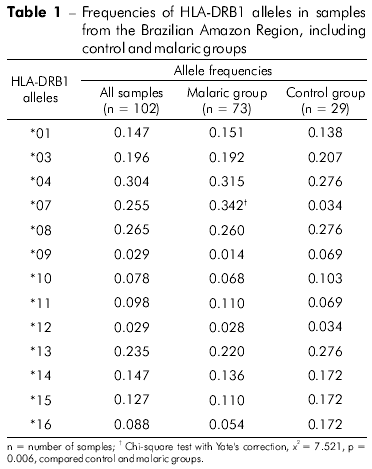
<body><![CDATA[<p><b><font size="2" face="verdana">  STUDY SUBJECTS AND  LOCATIONS</font></b></p>     <p><font size="2" face="verdana"> The patients who were  enrolled in this study met the following criteria: they sought medical  assistance for clinical malaria symptoms, were over 18 years old and had a  positive <i>P. vivax </i>malaria diagnosis by thick blood film. Signed, written  informed consent was obtained before peripheral blood samples were collected  from each patient. The study subjects were distributed among four Brazilian  malaria endemic areas: Macap&aacute;, Amap&aacute; State (00<sup>o</sup>02'20&quot;  S, 51<sup>o</sup>03'59&quot; W); Novo Repartimento, Par&aacute; State (04<sup>o</sup>19'50&quot; S, 49<sup>o</sup>47'47&quot;  W); Porto Velho, Rond&ocirc;nia State (-08<sup>o</sup>45'43&quot;  S, 63<sup>o</sup>54'14&quot; W); and Pl&aacute;cido de Castro, Acre State (10<sup>o</sup>16'33&quot; S, 67<sup>o</sup>09'00&quot;  W). Macap&aacute; is the capital of the State  of Amap&aacute;, which is located on the  banks of the Amazon River, in a tropical forest region. The estimated  population of Macap&aacute; is 366,486 inhabitants, and  its annual parasitic index (API) was 6.0  in 2009. Porto Velho is in the State of Rond&ocirc;nia, located in the upper Amazon River Basin. In 2010, Porto Velho  had  approximately 383,425 inhabitants and an API of 53.7. Pl&aacute;cido de Castro is located at the  border of the States of Rond&ocirc;nia and Amazonas, and it has a  population of 18,235 inhabitants. The API of Pl&aacute;cido de Castro was 20.6  in 2009. Novo Repartimento  is a gold  mining area in the southeast of the State of Par&aacute;. Its  population was approximately 55,759 inhabitants and it had an API of 15.4 in  2010. These areas are characterized by having a tropical climate without a dry  season; the mean monthly precipitation level is at least 60 mm.</font></p>     <p><font size="2" face="verdana"> Subjects in the control  group were blood donors who, according to the Brazilian blood bank policy and  the inclusion requirements for this study, met the following criteria: they  were over 18 years old; their place of  birth was within the study area; they reported never having suffered from  malaria attacks and had no signs of malaria during the initial interview; and  they had negative results for thick   blood film. Molecular  diagnosis methods were used for HLA-DRB frequency comparisons. The subjects of  the two groups showed no statistically significant differences in mean age or  ethnicity, indicating a well-matched population (Fisher's exact test, p &gt; 0.05). DNA samples were extracted  from frozen peripheral blood, using the Easy-DNA<sup>TM</sup> extraction kit  (Invitrogen, Carlsbad, CA, USA); malaria diagnosis was confirmed using a  semi-nested polymerase chain reaction (PCR) with specific small-subunit rDNA  primers<sup>15</sup>. The protocol for this study was reviewed and approved by  the Research Board of the Faculdade de Medicina  de S&atilde;o Jos&eacute; do Rio Preto, S&atilde;o Paulo State, Brazil (Process number 235/2006).</font></p>     <p><b><font size="2" face="verdana"> HLA CLASS II ALLELES</font></b></p>     <p><font size="2" face="verdana"> DNA samples from the  malaria patients (n = 73) and the control group (n = 29) were subjected to genotyping of the HLA-DRB1  alleles. The DNA concentration was measured using a spectrophotometer at 260 and 280 nm, and a concentration of  100 ng/mL was used for low-resolution genotyping of HLA-DRB1 by PCR with  sequence-specific primers (PCR-SSP), as previously described<sup>16</sup>.</font></p>     <p><b><font size="2" face="verdana"> STATISTICAL ANALYSIS</font></b></p>     <p><font size="2" face="verdana"> Allele frequencies were  calculated with the formula AF = <i>a/N, </i>in which <i>a </i>represents  the number of positive samples for a specific allele and <i>N </i>represents  the total number of alleles in the study population<sup>17</sup>. R version 2.8.1 statistical software (The R Foundation for  Statistical Computing, Vienna, Austria, <a href="http://www.r-project.org/" target="_blank">http://www.r-project.org</a>)  was used for the statistical analyses. The Hardy-Weinberg equilibrium was  tested according to Guo and Thompson<sup>18</sup>. The heterogeneity of HLA  allelic frequencies between control and malaria-infected groups was evaluated  using a Chi-square analysis, with Yate's correction test or Fisher's exact  test. P-values less than 0.05 were considered statistically significant.</font></p>     <p>&nbsp;</p>     <p><font size="3" face="verdana">  <b>RESULTS</b></font></p>     <p><font size="2" face="verdana">  HLA-DRB1 genotyping was  performed in a total of 102 individuals, including malaria-infected individuals  and uninfected controls, from four endemic areas in the north of Brazil. As  summarized in <a href="#t1">table 1</a>, 13 different alleles were  found; the frequencies observed for each individual and for each group are also  described in <a href="#t1">table 1</a>. The most frequent alleles  for both groups were HLA-DRB1<sup>*</sup>04, <sup>*</sup>08, <sup>*</sup>07 and <sup>*</sup>13. In malaria-infected  individuals, HLA-DRB1<sup>*</sup>04, <sup>*</sup>08 and <sup>*</sup>13 were the most frequent alleles, followed  by HLA-DRB1<sup>*</sup>07. In the control group, HLA-DRB1<sup>*</sup>04, <sup>*</sup>08 and <sup>*</sup>13 were also the  most frequent, but HLA-DRB1<sup>*</sup>07 was one of the least frequent alleles in this  group. When we compared the malaria-infected group with the control group, the  HLA-DRB1<sup>*</sup>07 frequency was higher in the infected group than in the control  group; this difference was statistically significant (p = 0.006, Chi-square  test with Yate's correction). The loci were in Hardy-Weinberg equilibrium in  the studied population (Pearson's x<sup>2</sup> = 0.5, p   = 0.799).</font></p>     ]]></body>
<body><![CDATA[<p><a name="t1" id="t1"></a></p>     <p>&nbsp;</p>     <p align="center"><img src="/img/revistas/rpas/v1n4/4a08t1.gif" border="0" /></p>     <p>&nbsp;</p>     <p><font size="3" face="verdana"><b>DISCUSSION</b></font></p>     <p><font size="2" face="verdana">HLA class II molecules are  crucial components of the adaptive immune response, and a correlation between  HLA alleles and susceptibility to several diseases, including malaria, has been  documented<sup>2,3,4,5,6,7,8,9,10,11,12,13</sup>. Moreover,   ethnic and/or geographic  variations apparently play a major role in this correlation. The nation of Brazil is as  large as an entire continent, and its inhabitants are genetically diverse. This  diversity results in a mixed population formed by the contributions of three  important groups: Caucasians, Africans and Amerindians<sup>19</sup>. Due to the  diverse history of colonization, different regions of the country have  different levels of prevalence of the three ethnic groups<sup>20,21</sup>. We  found a high frequency of HLA-DRB1<sup>*</sup>04 in our subjects, which is similar to the  results seen in previous studies<sup>22,23</sup>. Because this allele is  characteristic of indigenous Americans, its prevalence reflects the Amerindian  contribution to the Brazilian population, especially in the north of the  country<sup>24</sup>. Additionally, the high frequency of HLA-DRB1<sup>*</sup>04 that was  observed in both malaria-infected and healthy individuals indicates that this  allele is not associated with susceptibility to or protection from <i>P. vivax </i>malaria.  On the other hand, the significantly higher frequency of the HLA-DRB1<sup>*</sup>07 in the  infected group suggests a role for this allele in susceptibility to malaria.  Oliveira-Ferreira et al<sup>13</sup> detected a poor immune response induced by  HLA-DRB1<sup>*</sup>07 against the VK210 repetitive region of <i>P. vivax </i>CSP In fact,  studies with viral vaccine<sup>22,25</sup> and vaccine trials with CSP of <i>P.  falciparum</i><sup>26</sup> have shown that this allele  fails to trigger a consistent immune response.</font></p>     <p><font size="2" face="verdana">Although differences have  been observed in the HLA-DRB1<sup>*</sup>07&nbsp;  frequencies&nbsp; between malaria-infected and   uninfected individuals, we  have not established a mechanism by which this allele may function in malaria  susceptibility. There may be multiple HLA molecules associated with human  malaria, although we were only able to analyze the HLA-DRB1 alleles in this  study. Analysis of a single HLA molecule cannot fully reflect how multiple  genetic variations impact the MHC region. One possibility is that MHC alleles  could be in linkage disequilibrium with other relevant genes involved in  susceptibility to <i>P. vivax </i>malaria. Additionally, patients homozygous  for the HLA-DRB1<sup>*</sup>07 allele could not be distinguished from carriers due to the  sampling limitations of this study.</font></p>     <p><font size="2" face="verdana"> In the Brazilian Amazon  Region, malaria predominates in mesoendemic conditions with a wide variation in  transmission<sup>14,27</sup>. Thus, malaria endemicity could be viewed as a  selective pressure for maintenance of the genotype frequencies of the HLA  molecules. Investigation of other malaria-associated HLA alleles, using  serological, clinical and epidemiological analysis of a large sample size, is  necessary. Such a study should also evaluate the influence of other infectious  diseases. The epidemiology of infectious diseases is conditioned by a complex  interrelationship between the parasite, its vector and the human being. The  parasite-host coevolutionary process can be viewed as an arms race, in which  adaptive genetic changes in one are eventually matched by alterations in the  other, in this case, within the genetically diverse Amazonian populations<sup>28</sup>.</font></p>     <p>&nbsp;</p>     <p><font size="3" face="verdana">  <b>CONCLUSION</b></font></p>     ]]></body>
<body><![CDATA[<p><font size="2" face="verdana">  We found that the  HLA-DRB1<sup>*</sup>07 allele frequency was higher in malaria patients than in the control  group, which could suggest a role for this allele in susceptibility of the  immune system to <i>P. vivax </i>malaria. Our results reinforce the need for  studies that focus on genes linked to the histocompatibility complex; there is  a particular need for studies using a larger sample size, as well as  individuals from areas with different rates of infection, to better establish  the role of the HLA in susceptibility to <i>P. vivax </i>parasites in this  region.</font></p>     <p>&nbsp;</p>     <p><font size="3" face="verdana">  <b>ACKNOWLEDGMENTS</b></font></p>     <p><font size="2" face="verdana"> To all individuals enrolled  in this study. We thank Drs. Carlos Eug&ecirc;nio Cavasini, Aline Barroso, Maria Cristina Figueredo  and Mauro Tada for helping in the malaria field work. To Juliana Cintra for assistance in HLA  genotyping analysis. To Dr. Antonio Jos&eacute; Cordeiro for his  participation in statistical analysis. To Professor Luiz Hildebrando Pereira da  Silva for allowing the use of all facilities at Centro de Pesquisas em Medicina Tropical  (Cepem).</font></p>     <p>&nbsp;</p>     <p><font size="3" face="verdana">  <b>FINANCIAL SUPPORT</b></font></p>     <p><font size="2" face="verdana"> This work was supported by Funda&ccedil;&atilde;o  de Amparo &agrave; Pesquisa do Estado de S&atilde;o Paulo, S&atilde;o Paulo State, Brazil (02/09546-1;  06/00982-4) and Conselho Nacional para o Desenvolvimento Cient&iacute;fico e Tecnol&oacute;gico,  Bras&iacute;lia, Brazil (302353/03-8; 410405/2006-0).</font></p>     <p>&nbsp;</p>     <p><font size="3" face="verdana"><b>REFERENCES</b></font></p>     <!-- ref --><p><font size="2" face="verdana"> 1 Germain RN.  Antigen processing and presentation. In: Paul WE, editor. Fundamental  Immunology. 4th ed. Philadelphia:  Lippincott-Raven; 1999. p. 287-340.</font><!-- ref --><p><font size="2" face="verdana"> 2 Ozdilli K, Oguz FS, Anak S, Kekik C, Carin M,  Gedikoglu G. The frequency of HLA class I and II alleles in Turkish childhood  acute leukaemia patients. J Int Med Res. 2010 Sep-Oct;38(5):1835-44.</font><font size="2" face="verdana"><font size="2" face="verdana">&nbsp;&nbsp; &nbsp; &nbsp; &nbsp;    &nbsp;&#91; <a href="http://www.ncbi.nlm.nih.gov/pubmed/21309500" target="_blank">Links</a> &#93;</font></font><!-- ref --><p><font size="2" face="verdana"> 3 Hu DY, Ren YQ, Zhu KJ, Lv YM,  Cheng H, Zhang Z, et al. Comparisons of clinical features  of HLA-DRB1<sup>*</sup>07 positive and negative vitiligo patients in Chinese Han  population. J Eur Acad Dermatol Venereol. In Press   2011. Doi:10.1111/j.1468-3083.2010.03971.x</font><font size="2" face="verdana"><font size="2" face="verdana">&nbsp;&nbsp; &nbsp; &nbsp; &nbsp;    &nbsp;&#91; <a href="http://onlinelibrary.wiley.com/doi/10.1111/j.1468-3083.2010.03971.x/abstract;jsessionid=B01F8C12512D5777D1EC3ECC741BD31A.d01t02" target="_blank">Links</a> &#93;</font></font><!-- ref --><p><font size="2" face="verdana"> 4 Todd JR, West  BC, McDonald JC. Human leukocyte   antigen and leprosy: study  in northern Louisiana  and review. Rev Infect Dis. 1990 Jan-Fev;12(1):63-74.</font><font size="2" face="verdana"><font size="2" face="verdana">&nbsp;&nbsp; &nbsp; &nbsp; &nbsp;    &nbsp;&#91; <a href="http://www.ncbi.nlm.nih.gov/pubmed/2300741" target="_blank">Links</a> &#93;</font></font><!-- ref --><p><font size="2" face="verdana"> 5 Petzl-Erler  ML, Belich MP, Queiroz-Telles F. Association of mucosal leishmaniasis with HLA.  Hum Immunol.   1991 Dec;32(4):254-60. D<img width="1" height="10" src="v1n4a-340_clip_image002.gif" />oi:10.1016/0198-8859(91)90088-Q </font><font size="2" face="verdana"><font size="2" face="verdana">&nbsp;&nbsp; &nbsp; &nbsp; &nbsp;    &nbsp;&#91; <a href="http://www.sciencedirect.com/science/article/pii/019888599190088Q" target="_blank">Links</a> &#93;</font></font><!-- ref --><p><font size="2" face="verdana"> 6 Duarte R,  Carvalho C, Pereira C, Bettencourt A, Carvalho A, Villar M, et al. HLA class II alleles as  markers of tuberculosis susceptibility and resistance. Rev Port Pneumol. 2011 Jan;17(1):15-9.</font><font size="2" face="verdana"><font size="2" face="verdana">&nbsp;&nbsp; &nbsp; &nbsp; &nbsp;    &nbsp;&#91; <a href="http://www.ncbi.nlm.nih.gov/pubmed/21251479" target="_blank">Links</a> &#93;</font></font><!-- ref --><p><font size="2" face="verdana"> 7 Assaad-Khalil  SH, Helmy MA, Zaki A, Mikhail MM, el-Hai MA, el-Sawy M. Some genetic, clinical  and immunologic interrelations in schistosomiasis mansoni. Ann Biol Clin (Paris).  1993;51(6):619-26.</font><font size="2" face="verdana"><font size="2" face="verdana">&nbsp;&nbsp; &nbsp; &nbsp; &nbsp;    &nbsp;&#91; <a href="http://www.ncbi.nlm.nih.gov/pubmed/8172401" target="_blank">Links</a> &#93;</font></font><!-- ref --><p><font size="2" face="verdana"> 8 Brown AE,  Chandanayingyong D, Fuggle SV, Webster HK. Immune responses to the  circumsporozoite protein of <i>Plasmodium falciparum </i>in relation to HLA-DR  type. Tissue Antigens. 1989 Sep;34(3):200-4.</font><font size="2" face="verdana"><font size="2" face="verdana">&nbsp;&nbsp; &nbsp; &nbsp; &nbsp;    &nbsp;&#91; <a href="http://www.ncbi.nlm.nih.gov/pubmed/2688192" target="_blank">Links</a> &#93;</font></font><!-- ref --><p><font size="2" face="verdana"> 9 Graves PM, Bhatia K, Burkot TR,  Prasad M, Wirtz RA,   Beckers P. Association  between HLA type and antibody response to malaria sporozoite and gametocyte  epitopes is not evident in immune Papua New Guineans. Clin Exp Immunol. 1989 Dec;78(3):418-   23.</font><font size="2" face="verdana"><font size="2" face="verdana">&nbsp;&nbsp; &nbsp; &nbsp; &nbsp;    &nbsp;&#91; <a href="http://www.ncbi.nlm.nih.gov/pmc/articles/PMC1534822/?page=1" target="_blank">Links</a> &#93;</font></font><!-- ref --><p><font size="2" face="verdana"> 10 Hill AVS,  Yates SNR, Allsopp CEM, Gupta S, Gilbert   SC, Lalvani A, et al. Human  leucocyte antigens and natural selection by malaria. Philos Trans R Soc Lond B Biol Sci. 1994 Nov;346(1317):379-85.</font><font size="2" face="verdana"><font size="2" face="verdana">&nbsp;&nbsp; &nbsp; &nbsp; &nbsp;    &nbsp;&#91; <a href="http://www.ncbi.nlm.nih.gov/pubmed/7708832" target="_blank">Links</a> &#93;</font></font><!-- ref --><p><font size="2" face="verdana"> 11 Banic DM, Goldberg AC, Pratt-Riccio LR, Oliveira-Ferreira J, Santos F, Gras-Masse H, et al. Human leukocyte antigen class  II control of the immune response to p126-derived amino terminal peptide from <i>Plasmodium  falciparum. </i>Am J Trop Med Hyg.   2002  May;66(5):509-15.</font><font size="2" face="verdana"><font size="2" face="verdana">&nbsp;&nbsp; &nbsp; &nbsp; &nbsp;    &nbsp;&#91; <a href="http://www.ncbi.nlm.nih.gov/pubmed/12201584" target="_blank">Links</a> &#93;</font></font><!-- ref --><p><font size="2" face="verdana">12 Johnson AH,  Lee RG, Mendell NR, Shon D, Suh YJ, Bomba-Nkolo D, et al. Human leukocyte  antigen class II alleles influence levels of antibodies to the <i>Plasmodium  falciparum </i>asexual-stage apical membrane antigen 1 but not to merozoite  surface antigen 2 and merozoite surface protein 1. Infect Immun. 2004  May;72(5):2762-71 . Doi:10.1128/IAI.72.5.2762-2771.2004.</font><font size="2" face="verdana"><font size="2" face="verdana">&nbsp;&nbsp; &nbsp; &nbsp; &nbsp;    &nbsp;&#91; <a href="http://iai.asm.org/cgi/content/full/72/5/2762?view=long&amp;pmid=15102786" target="_blank">Links</a> &#93;</font></font><!-- ref --><p><font size="2" face="verdana"> 13 Oliveira-Ferreira  J, Pratt-Riccio LR, Arruda M, Santos F, Ribeiro CT, Goldberg AC, et al. HLA class II and antibody  responses to circumsporozoite protein repeats of <i>P. vivax </i>(VK210, VK247  and <i>P. </i>vivax-like) in individuals naturally exposed to malaria. Acta  Trop. 2004 Sep;92(1):63-9. Doi:10.1016/J.Acta tropica.2004.02.011</font><font size="2" face="verdana"><font size="2" face="verdana">&nbsp;&nbsp; &nbsp; &nbsp; &nbsp;    &nbsp;&#91; <a href="http://www.sciencedirect.com/science/article/pii/S0001706X0400110X" target="_blank">Links</a> &#93;</font></font><!-- ref --><p><font size="2" face="verdana"> 14 Oliveira-Ferreira  J, Lacerda MVG, Brasil P, Ladislau JLB, Tauil PL, Daniel-Ribeiro CT. Malaria in  Brazil: an overview. Malar J. 2010;9:115. Doi:10.1186/1475-2875-9-115.</font><font size="2" face="verdana"><font size="2" face="verdana">&nbsp;&nbsp; &nbsp; &nbsp; &nbsp;    &nbsp;&#91; <a href="http://www.malariajournal.com/content/pdf/1475-2875-9-115.pdf" target="_blank">Links</a> &#93;</font></font><!-- ref --><p><font size="2" face="verdana"> 15 Kimura M,  Kaneko O, Liu Q, Zhou M, Kawamoto F, Wataya Y, et al. Identification of the  four species of human malaria parasites by nested PCR that targets variant  sequences in the small subunit rRNA gene. Parasitol Intern. 1997  Jul;46(2):91-5. Doi:10.1016/s1383-5769(97)00013-5</font><font size="2" face="verdana"><font size="2" face="verdana">&nbsp;&nbsp; &nbsp; &nbsp; &nbsp;    &nbsp;&#91; <a href="http://www.sciencedirect.com/science/article/pii/S1383576997000135" target="_blank">Links</a> &#93;</font></font><!-- ref --><p><font size="2" face="verdana"> 16 Olerup O, Zetterquist  H. HLA-DR typing by PCR   amplification with  sequence-specific primers (PCR-SSP) in 2 hours: an alternative to serological  DR typing in clinical practice including donor-recipient matching in cadaveric  transplantation. Tissue Antigens. 1992   May;39(5):225-35.</font><font size="2" face="verdana"><font size="2" face="verdana">&nbsp;&nbsp; &nbsp; &nbsp; &nbsp;    &nbsp;&#91; <a href="http://www.ncbi.nlm.nih.gov/pubmed/1357775" target="_blank">Links</a> &#93;</font></font><!-- ref --><p><font size="2" face="verdana"> 17 Garavito EG. Asociaci&oacute;n HLA y artritis reumatoidea juvenil: en  busca de las bases moleculares dependiente del MHC &#91;tese&#93;. Colombia (CO): Universidad  del Norte; 2003.</font><!-- ref --><p><font size="2" face="verdana"> 18 Guo SW,  Thompson EA. Performing  the exact test of Hardy-Weinberg proportion for multiple alleles.  Biometrics.1992 Jun;48(2):361-72.</font><font size="2" face="verdana"><font size="2" face="verdana">&nbsp;&nbsp; &nbsp; &nbsp; &nbsp;    &nbsp;&#91; <a href="http://www.ncbi.nlm.nih.gov/pubmed/1637966" target="_blank">Links</a> &#93;</font></font><!-- ref --><p><font size="2" face="verdana"> 19 Moraes ME, Fernandez-Vi&ntilde;a  M, Salatiel  I, Tsai S, Moraes JR, Stastny P HLA class II DNA typing in two Brazilian&nbsp;&nbsp; populations.&nbsp;&nbsp; Tissue&nbsp;  Antigens.&nbsp;&nbsp; 1993   May;41(5):238-42.</font><font size="2" face="verdana"><font size="2" face="verdana">&nbsp;&nbsp; &nbsp; &nbsp; &nbsp;    &nbsp;&#91; <a href="http://www.ncbi.nlm.nih.gov/pubmed/8236236" target="_blank">Links</a> &#93;</font></font><!-- ref --><p><font size="2" face="verdana"> 20 Alves-Silva  J, Silva SM, Guimar&atilde;es PEM,  Ferreira ACS,  Bandelt HJ, Pena SDJ, et al. The ancestry of Brazilian mtDNA lineages.  Am J Hum Genet. 2000 Aug;67(2):444-61.</font><font size="2" face="verdana"><font size="2" face="verdana">&nbsp;&nbsp; &nbsp; &nbsp; &nbsp;    &nbsp;&#91; <a href="http://www.ncbi.nlm.nih.gov/pmc/articles/PMC1287189/?tool=pubmed" target="_blank">Links</a> &#93;</font></font><!-- ref --><p><font size="2" face="verdana"> 21 Carvalho-Silva  DR, Santos FR, Rocha J, Pena  SDJ. The phyleogeography of Brazilian  Y-chromossomes lineages. Am J Hum Genet. 2001 Jan;68(1):281-6.</font><font size="2" face="verdana"><font size="2" face="verdana">&nbsp;&nbsp; &nbsp; &nbsp; &nbsp;    &nbsp;&#91; <a href="http://www.ncbi.nlm.nih.gov/pmc/articles/PMC1234928/?tool=pubmed" target="_blank">Links</a> &#93;</font></font><!-- ref --><p><font size="2" face="verdana"> 22 Polland  GA. Influenza Immunization of schoolchildren: can we interrupt community  epidemics? Pediatrics.   1999 Jun;103(6  Pt1):1280-2.</font><!-- ref --><p><font size="2" face="verdana"> 23 Parol&iacute;n ML,  Carnese FR. HLA-DRB1 alleles in four Amerindian populations from Argentina and  Paraguay. Genet Mol Biol. 2009 Apr;32(2):212-9.</font><font size="2" face="verdana"><font size="2" face="verdana">&nbsp;&nbsp; &nbsp; &nbsp; &nbsp;    &nbsp;&#91; <a href="http://www.ncbi.nlm.nih.gov/pubmed/21637670" target="_blank">Links</a> &#93;</font></font><!-- ref --><p><font size="2" face="verdana"> 24 Zago  MA, Silva J&uacute;nior WA, Tavella MH, Santos SE, Guerreiro JF, Figueiredo  MS. Interpopulational and intrapopulational genetic diversity of Amerindians as  revealed by six variable number of tandem repeats. Hum Hered. 1996 Sep-Oct;46(5):274-89.</font><font size="2" face="verdana"><font size="2" face="verdana">&nbsp;&nbsp; &nbsp; &nbsp; &nbsp;    &nbsp;&#91; <a href="http://www.ncbi.nlm.nih.gov/pubmed/8854143" target="_blank">Links</a> &#93;</font></font><!-- ref --><p><font size="2" face="verdana"> 25 Desombere  I, Willems A, Leroux-Roels G. Response to hepatitis B vaccine: multiple HLA  genes are involved. Tissue Antigens. 1998 Jun;51(6):593-604.</font><font size="2" face="verdana"><font size="2" face="verdana">&nbsp;&nbsp; &nbsp; &nbsp; &nbsp;    &nbsp;&#91; <a href="http://www.ncbi.nlm.nih.gov/pubmed/9694351" target="_blank">Links</a> &#93;</font></font><!-- ref --><p><font size="2" face="verdana"> 26 Nardin EH,  Oliveira GA, Calvo-Calle JM, Castro ZR,   Nussenzweig RS, Schmeckpeper B, et al. Synthetic malaria peptide  vaccine elicits high levels of antibodies in vaccinees of defined HLA  genotypes. J Infect Dis.   2000 Nov;182(5):1486-96. Doi:10.1086/315871</font><font size="2" face="verdana"><font size="2" face="verdana">&nbsp;&nbsp; &nbsp; &nbsp; &nbsp;    &nbsp;&#91; <a href="http://jid.oxfordjournals.org/content/182/5/1486.long" target="_blank">Links</a> &#93;</font></font><!-- ref --><p><font size="2" face="verdana"> 27 Lorenzetti A,  Fornazari PA, Bonini-Domingos AC, Souza R, Penhalbel R, Fugikaha E, et al.  Mixed <i>Plasmodium falciparum </i>infections and its clinical implications in  four areas of the Brazilian Amazon   region. Acta Trop.  2008;107(1):8-12.</font><font size="2" face="verdana"><font size="2" face="verdana"> Doi:10.1016/j.actatropica.2008.03.012&nbsp;&nbsp; &nbsp; &nbsp; &nbsp;    &nbsp;&#91; <a href="http://www.sciencedirect.com/science/article/pii/S0001706X08000818" target="_blank">Links</a> &#93;</font></font><!-- ref --><p><font size="2" face="verdana"> 28 Nesse RM,  Williams GC. Health and disease. In: Salzano FM, Bortolini MC, editors. The  evolution and genetics of Latin American populations. Cambridge: Cambridge  University Press; 2002. p. 165-88.</font><p>&nbsp;</p>     <p>&nbsp;</p>     <p><font size="2" face="Verdana"><b><a name="endereco" id="endereco"></a><a href="#topo"><img src="/img/revistas/rpas/v1n4/seta.gif" border="0" /></a></b></font><font size="2" face="verdana"><b>Correspondence / Correspond&ecirc;ncia / Correspondencia:</b>    ]]></body>
<body><![CDATA[<br>   Luciane Moreno Storti-Melo<br/>   Rua Jos&eacute; Duran, n<sup>o</sup> 112.    <br>   Bairro: Bosque da Felicidade    <br>   CEP: 67030-000    <br>   S&atilde;o Jos&eacute; do Rio Preto-S&atilde;o Paulo-Brasil    <br>   Tel.: +55  (17) 3014-5396    <br>   E-mail: <a href="mailto:stortilu@yahoo.com.br">stortilu@yahoo.com.br</a></font></p>     <p><font size="2" face="verdana"> Received / Recebido em / Recibido en: 2/28/2011    <br> Accepted / Aceito em / Aceito en: 5/17/2011</font></p> <script type="text/javascript"> var gaJsHost = (("https:" == document.location.protocol) ? "https://ssl." : "http://www."); document.write(unescape("%3Cscript src='" + gaJsHost + "google-analytics.com/ga.js' type='text/javascript'%3E%3C/script%3E")); </script> <script type="text/javascript"> try { var pageTracker = _gat._getTracker("UA-7885746-4"); pageTracker._setDomainName("none"); pageTracker._setAllowLinker(true); pageTracker._trackPageview(); } catch(err) {}</script>      ]]></body><back>
<ref-list>
<ref id="B1">
<label>1</label><nlm-citation citation-type="book">
<person-group person-group-type="author">
<name>
<surname><![CDATA[Germain]]></surname>
<given-names><![CDATA[RN]]></given-names>
</name>
</person-group>
<article-title xml:lang="en"><![CDATA[Antigen processing and presentation]]></article-title>
<person-group person-group-type="editor">
<name>
<surname><![CDATA[Paul]]></surname>
<given-names><![CDATA[WE]]></given-names>
</name>
</person-group>
<source><![CDATA[Fundamental Immunology]]></source>
<year>1999</year>
<edition>4</edition>
<page-range>287-340</page-range><publisher-loc><![CDATA[Philadelphia ]]></publisher-loc>
<publisher-name><![CDATA[Lippincott-Raven]]></publisher-name>
</nlm-citation>
</ref>
<ref id="B2">
<label>2</label><nlm-citation citation-type="journal">
<person-group person-group-type="author">
<name>
<surname><![CDATA[Ozdilli]]></surname>
<given-names><![CDATA[K]]></given-names>
</name>
<name>
<surname><![CDATA[Oguz]]></surname>
<given-names><![CDATA[FS]]></given-names>
</name>
<name>
<surname><![CDATA[Anak]]></surname>
<given-names><![CDATA[S]]></given-names>
</name>
<name>
<surname><![CDATA[Kekik]]></surname>
<given-names><![CDATA[C]]></given-names>
</name>
<name>
<surname><![CDATA[Carin]]></surname>
<given-names><![CDATA[M]]></given-names>
</name>
<name>
<surname><![CDATA[Gedikoglu]]></surname>
<given-names><![CDATA[G]]></given-names>
</name>
</person-group>
<article-title xml:lang="en"><![CDATA[The frequency of HLA class I and II alleles in Turkish childhood acute leukaemia patients]]></article-title>
<source><![CDATA[J Int Med Res]]></source>
<year>2010</year>
<month> S</month>
<day>ep</day>
<volume>38</volume>
<numero>5</numero>
<issue>5</issue>
<page-range>1835-44</page-range></nlm-citation>
</ref>
<ref id="B3">
<label>3</label><nlm-citation citation-type="journal">
<person-group person-group-type="author">
<name>
<surname><![CDATA[Hu]]></surname>
<given-names><![CDATA[DY]]></given-names>
</name>
<name>
<surname><![CDATA[Ren]]></surname>
<given-names><![CDATA[YQ]]></given-names>
</name>
<name>
<surname><![CDATA[Zhu]]></surname>
<given-names><![CDATA[KJ]]></given-names>
</name>
<name>
<surname><![CDATA[Lv]]></surname>
<given-names><![CDATA[YM]]></given-names>
</name>
<name>
<surname><![CDATA[Cheng]]></surname>
<given-names><![CDATA[H]]></given-names>
</name>
<name>
<surname><![CDATA[Zhang]]></surname>
<given-names><![CDATA[Z]]></given-names>
</name>
</person-group>
<article-title xml:lang="en"><![CDATA[Comparisons of clinical features of HLA-DRB1*07 positive and negative vitiligo patients in Chinese Han population]]></article-title>
<source><![CDATA[J Eur Acad Dermatol Venereol]]></source>
<year>2011</year>
</nlm-citation>
</ref>
<ref id="B4">
<label>4</label><nlm-citation citation-type="journal">
<person-group person-group-type="author">
<name>
<surname><![CDATA[Todd]]></surname>
<given-names><![CDATA[JR]]></given-names>
</name>
<name>
<surname><![CDATA[West]]></surname>
<given-names><![CDATA[BC]]></given-names>
</name>
<name>
<surname><![CDATA[McDonald]]></surname>
<given-names><![CDATA[JC]]></given-names>
</name>
</person-group>
<article-title xml:lang="en"><![CDATA[Human leukocyte antigen and leprosy: study in northern Louisiana and review]]></article-title>
<source><![CDATA[Rev Infect Dis]]></source>
<year>1990</year>
<month> J</month>
<day>an</day>
<volume>12</volume>
<numero>1</numero>
<issue>1</issue>
<page-range>63-74</page-range></nlm-citation>
</ref>
<ref id="B5">
<label>5</label><nlm-citation citation-type="journal">
<person-group person-group-type="author">
<name>
<surname><![CDATA[Petzl-Erler]]></surname>
<given-names><![CDATA[ML]]></given-names>
</name>
<name>
<surname><![CDATA[Belich]]></surname>
<given-names><![CDATA[MP]]></given-names>
</name>
<name>
<surname><![CDATA[Queiroz-Telles]]></surname>
<given-names><![CDATA[F]]></given-names>
</name>
</person-group>
<article-title xml:lang="en"><![CDATA[Association of mucosal leishmaniasis with HLA]]></article-title>
<source><![CDATA[Hum Immunol]]></source>
<year>1991</year>
<month> D</month>
<day>ec</day>
<volume>32</volume>
<numero>4</numero>
<issue>4</issue>
<page-range>254-60</page-range></nlm-citation>
</ref>
<ref id="B6">
<label>6</label><nlm-citation citation-type="journal">
<person-group person-group-type="author">
<name>
<surname><![CDATA[Duarte]]></surname>
<given-names><![CDATA[R]]></given-names>
</name>
<name>
<surname><![CDATA[Carvalho]]></surname>
<given-names><![CDATA[C]]></given-names>
</name>
<name>
<surname><![CDATA[Pereira]]></surname>
<given-names><![CDATA[C]]></given-names>
</name>
<name>
<surname><![CDATA[Bettencourt]]></surname>
<given-names><![CDATA[A]]></given-names>
</name>
<name>
<surname><![CDATA[Carvalho]]></surname>
<given-names><![CDATA[A]]></given-names>
</name>
<name>
<surname><![CDATA[Villar]]></surname>
<given-names><![CDATA[M]]></given-names>
</name>
</person-group>
<article-title xml:lang="en"><![CDATA[HLA class II alleles as markers of tuberculosis susceptibility and resistance]]></article-title>
<source><![CDATA[Rev Port Pneumol]]></source>
<year>2011</year>
<month> J</month>
<day>an</day>
<volume>17</volume>
<numero>1</numero>
<issue>1</issue>
<page-range>15-9</page-range></nlm-citation>
</ref>
<ref id="B7">
<label>7</label><nlm-citation citation-type="journal">
<person-group person-group-type="author">
<name>
<surname><![CDATA[Assaad-Khalil]]></surname>
<given-names><![CDATA[SH]]></given-names>
</name>
<name>
<surname><![CDATA[Helmy]]></surname>
<given-names><![CDATA[MA]]></given-names>
</name>
<name>
<surname><![CDATA[Zaki]]></surname>
<given-names><![CDATA[A]]></given-names>
</name>
<name>
<surname><![CDATA[Mikhail]]></surname>
<given-names><![CDATA[MM]]></given-names>
</name>
<name>
<surname><![CDATA[el-Hai]]></surname>
<given-names><![CDATA[MA]]></given-names>
</name>
<name>
<surname><![CDATA[el-Sawy]]></surname>
<given-names><![CDATA[M]]></given-names>
</name>
</person-group>
<article-title xml:lang="en"><![CDATA[Some genetic, clinical and immunologic interrelations in schistosomiasis mansoni]]></article-title>
<source><![CDATA[Ann Biol Clin (Paris)]]></source>
<year>1993</year>
<volume>51</volume>
<numero>6</numero>
<issue>6</issue>
<page-range>619-26</page-range></nlm-citation>
</ref>
<ref id="B8">
<label>8</label><nlm-citation citation-type="journal">
<person-group person-group-type="author">
<name>
<surname><![CDATA[Brown]]></surname>
<given-names><![CDATA[AE]]></given-names>
</name>
<name>
<surname><![CDATA[Chandanayingyong]]></surname>
<given-names><![CDATA[D]]></given-names>
</name>
<name>
<surname><![CDATA[Fuggle]]></surname>
<given-names><![CDATA[SV]]></given-names>
</name>
<name>
<surname><![CDATA[Webster]]></surname>
<given-names><![CDATA[HK]]></given-names>
</name>
</person-group>
<article-title xml:lang="en"><![CDATA[Immune responses to the circumsporozoite protein of Plasmodium falciparum in relation to HLA-DR type]]></article-title>
<source><![CDATA[Tissue Antigens]]></source>
<year>1989</year>
<month> S</month>
<day>ep</day>
<volume>34</volume>
<numero>3</numero>
<issue>3</issue>
<page-range>200-4</page-range></nlm-citation>
</ref>
<ref id="B9">
<label>9</label><nlm-citation citation-type="journal">
<person-group person-group-type="author">
<name>
<surname><![CDATA[Graves]]></surname>
<given-names><![CDATA[PM]]></given-names>
</name>
<name>
<surname><![CDATA[Bhatia]]></surname>
<given-names><![CDATA[K]]></given-names>
</name>
<name>
<surname><![CDATA[Burkot]]></surname>
<given-names><![CDATA[TR]]></given-names>
</name>
<name>
<surname><![CDATA[Prasad]]></surname>
<given-names><![CDATA[M]]></given-names>
</name>
<name>
<surname><![CDATA[Wirtz]]></surname>
<given-names><![CDATA[RA]]></given-names>
</name>
<name>
<surname><![CDATA[Beckers]]></surname>
<given-names><![CDATA[P]]></given-names>
</name>
</person-group>
<article-title xml:lang="en"><![CDATA[Association between HLA type and antibody response to malaria sporozoite and gametocyte epitopes is not evident in immune Papua New Guineans]]></article-title>
<source><![CDATA[Clin Exp Immunol]]></source>
<year>1989</year>
<month> D</month>
<day>ec</day>
<volume>78</volume>
<numero>3</numero>
<issue>3</issue>
<page-range>418- 23</page-range></nlm-citation>
</ref>
<ref id="B10">
<label>10</label><nlm-citation citation-type="journal">
<person-group person-group-type="author">
<name>
<surname><![CDATA[Hill]]></surname>
<given-names><![CDATA[AVS]]></given-names>
</name>
<name>
<surname><![CDATA[Yates]]></surname>
<given-names><![CDATA[SNR]]></given-names>
</name>
<name>
<surname><![CDATA[Allsopp]]></surname>
<given-names><![CDATA[CEM]]></given-names>
</name>
<name>
<surname><![CDATA[Gupta]]></surname>
<given-names><![CDATA[S]]></given-names>
</name>
<name>
<surname><![CDATA[Gilbert]]></surname>
<given-names><![CDATA[SC]]></given-names>
</name>
<name>
<surname><![CDATA[Lalvani]]></surname>
<given-names><![CDATA[A]]></given-names>
</name>
</person-group>
<article-title xml:lang="en"><![CDATA[Human leucocyte antigens and natural selection by malaria]]></article-title>
<source><![CDATA[Philos Trans R Soc Lond B Biol Sci]]></source>
<year>1994</year>
<month> N</month>
<day>ov</day>
<volume>346</volume>
<numero>1317</numero>
<issue>1317</issue>
<page-range>379-85</page-range></nlm-citation>
</ref>
<ref id="B11">
<label>11</label><nlm-citation citation-type="journal">
<person-group person-group-type="author">
<name>
<surname><![CDATA[Banic]]></surname>
<given-names><![CDATA[DM]]></given-names>
</name>
<name>
<surname><![CDATA[Goldberg]]></surname>
<given-names><![CDATA[AC]]></given-names>
</name>
<name>
<surname><![CDATA[Pratt-Riccio]]></surname>
<given-names><![CDATA[LR]]></given-names>
</name>
<name>
<surname><![CDATA[Oliveira-Ferreira]]></surname>
<given-names><![CDATA[J]]></given-names>
</name>
<name>
<surname><![CDATA[Santos]]></surname>
<given-names><![CDATA[F]]></given-names>
</name>
<name>
<surname><![CDATA[Gras-Masse]]></surname>
<given-names><![CDATA[H]]></given-names>
</name>
</person-group>
<article-title xml:lang="en"><![CDATA[Human leukocyte antigen class II control of the immune response to p126-derived amino terminal peptide from Plasmodium falciparum]]></article-title>
<source><![CDATA[Am J Trop Med Hyg]]></source>
<year>2002</year>
<month> M</month>
<day>ay</day>
<volume>66</volume>
<numero>5</numero>
<issue>5</issue>
<page-range>509-15</page-range></nlm-citation>
</ref>
<ref id="B12">
<label>12</label><nlm-citation citation-type="journal">
<person-group person-group-type="author">
<name>
<surname><![CDATA[Johnson]]></surname>
<given-names><![CDATA[AH]]></given-names>
</name>
<name>
<surname><![CDATA[Lee]]></surname>
<given-names><![CDATA[RG]]></given-names>
</name>
<name>
<surname><![CDATA[Mendell]]></surname>
<given-names><![CDATA[NR]]></given-names>
</name>
<name>
<surname><![CDATA[Shon]]></surname>
<given-names><![CDATA[D]]></given-names>
</name>
<name>
<surname><![CDATA[Suh]]></surname>
<given-names><![CDATA[YJ]]></given-names>
</name>
<name>
<surname><![CDATA[Bomba-Nkolo]]></surname>
<given-names><![CDATA[D]]></given-names>
</name>
</person-group>
<article-title xml:lang="en"><![CDATA[Human leukocyte antigen class II alleles influence levels of antibodies to the Plasmodium falciparum asexual-stage apical membrane antigen 1 but not to merozoite surface antigen 2 and merozoite surface protein 1]]></article-title>
<source><![CDATA[Infect Immun]]></source>
<year>2004</year>
<month> M</month>
<day>ay</day>
<volume>72</volume>
<numero>5</numero>
<issue>5</issue>
<page-range>2762-71</page-range></nlm-citation>
</ref>
<ref id="B13">
<label>13</label><nlm-citation citation-type="journal">
<person-group person-group-type="author">
<name>
<surname><![CDATA[Oliveira-Ferreira]]></surname>
<given-names><![CDATA[J]]></given-names>
</name>
<name>
<surname><![CDATA[Pratt-Riccio]]></surname>
<given-names><![CDATA[LR]]></given-names>
</name>
<name>
<surname><![CDATA[Arruda]]></surname>
<given-names><![CDATA[M]]></given-names>
</name>
<name>
<surname><![CDATA[Santos]]></surname>
<given-names><![CDATA[F]]></given-names>
</name>
<name>
<surname><![CDATA[Ribeiro]]></surname>
<given-names><![CDATA[CT]]></given-names>
</name>
<name>
<surname><![CDATA[Goldberg]]></surname>
<given-names><![CDATA[AC]]></given-names>
</name>
</person-group>
<article-title xml:lang="en"><![CDATA[HLA class II and antibody responses to circumsporozoite protein repeats of P. vivax (VK210, VK247 and P. vivax-like) in individuals naturally exposed to malaria]]></article-title>
<source><![CDATA[Acta Trop]]></source>
<year>2004</year>
<month> S</month>
<day>ep</day>
<volume>92</volume>
<numero>1</numero>
<issue>1</issue>
<page-range>63-9</page-range></nlm-citation>
</ref>
<ref id="B14">
<label>14</label><nlm-citation citation-type="journal">
<person-group person-group-type="author">
<name>
<surname><![CDATA[Oliveira-Ferreira]]></surname>
<given-names><![CDATA[J]]></given-names>
</name>
<name>
<surname><![CDATA[Lacerda]]></surname>
<given-names><![CDATA[MVG]]></given-names>
</name>
<name>
<surname><![CDATA[Brasil]]></surname>
<given-names><![CDATA[P]]></given-names>
</name>
<name>
<surname><![CDATA[Ladislau]]></surname>
<given-names><![CDATA[JLB]]></given-names>
</name>
<name>
<surname><![CDATA[Tauil]]></surname>
<given-names><![CDATA[PL]]></given-names>
</name>
<name>
<surname><![CDATA[Daniel-Ribeiro]]></surname>
<given-names><![CDATA[CT]]></given-names>
</name>
</person-group>
<article-title xml:lang="en"><![CDATA[Malaria in Brazil: an overview]]></article-title>
<source><![CDATA[Malar J]]></source>
<year>2010</year>
<volume>9</volume>
<page-range>115</page-range></nlm-citation>
</ref>
<ref id="B15">
<label>15</label><nlm-citation citation-type="journal">
<person-group person-group-type="author">
<name>
<surname><![CDATA[Kimura]]></surname>
<given-names><![CDATA[M]]></given-names>
</name>
<name>
<surname><![CDATA[Kaneko]]></surname>
<given-names><![CDATA[O]]></given-names>
</name>
<name>
<surname><![CDATA[Liu]]></surname>
<given-names><![CDATA[Q]]></given-names>
</name>
<name>
<surname><![CDATA[Zhou]]></surname>
<given-names><![CDATA[M]]></given-names>
</name>
<name>
<surname><![CDATA[Kawamoto]]></surname>
<given-names><![CDATA[F]]></given-names>
</name>
<name>
<surname><![CDATA[Wataya]]></surname>
<given-names><![CDATA[Y]]></given-names>
</name>
</person-group>
<article-title xml:lang="en"><![CDATA[Identification of the four species of human malaria parasites by nested PCR that targets variant sequences in the small subunit rRNA gene]]></article-title>
<source><![CDATA[Parasitol Intern]]></source>
<year>1997</year>
<month> J</month>
<day>ul</day>
<volume>46</volume>
<numero>2</numero>
<issue>2</issue>
<page-range>91-5</page-range></nlm-citation>
</ref>
<ref id="B16">
<label>16</label><nlm-citation citation-type="journal">
<person-group person-group-type="author">
<name>
<surname><![CDATA[Olerup]]></surname>
<given-names><![CDATA[O]]></given-names>
</name>
<name>
<surname><![CDATA[Zetterquist]]></surname>
<given-names><![CDATA[H]]></given-names>
</name>
</person-group>
<article-title xml:lang="en"><![CDATA[HLA-DR typing by PCR amplification with sequence-specific primers (PCR-SSP) in 2 hours: an alternative to serological DR typing in clinical practice including donor-recipient matching in cadaveric transplantation]]></article-title>
<source><![CDATA[Tissue Antigens]]></source>
<year>1992</year>
<month> M</month>
<day>ay</day>
<volume>39</volume>
<numero>5</numero>
<issue>5</issue>
<page-range>225-35</page-range></nlm-citation>
</ref>
<ref id="B17">
<label>17</label><nlm-citation citation-type="book">
<person-group person-group-type="author">
<name>
<surname><![CDATA[Garavito]]></surname>
<given-names><![CDATA[EG]]></given-names>
</name>
</person-group>
<source><![CDATA[Asociación HLA y artritis reumatoidea juvenil: en busca de las bases moleculares dependiente del MHC]]></source>
<year>2003</year>
<publisher-loc><![CDATA[Colombia ]]></publisher-loc>
<publisher-name><![CDATA[Universidad del Norte]]></publisher-name>
</nlm-citation>
</ref>
<ref id="B18">
<label>18</label><nlm-citation citation-type="journal">
<person-group person-group-type="author">
<name>
<surname><![CDATA[Guo]]></surname>
<given-names><![CDATA[SW]]></given-names>
</name>
<name>
<surname><![CDATA[Thompson]]></surname>
<given-names><![CDATA[EA]]></given-names>
</name>
</person-group>
<article-title xml:lang="en"><![CDATA[Performing the exact test of Hardy-Weinberg proportion for multiple alleles]]></article-title>
<source><![CDATA[Biometrics]]></source>
<year>1992</year>
<month> J</month>
<day>un</day>
<volume>48</volume>
<numero>2</numero>
<issue>2</issue>
<page-range>361-72</page-range></nlm-citation>
</ref>
<ref id="B19">
<label>19</label><nlm-citation citation-type="journal">
<person-group person-group-type="author">
<name>
<surname><![CDATA[Moraes]]></surname>
<given-names><![CDATA[ME]]></given-names>
</name>
<name>
<surname><![CDATA[Fernandez-Viña]]></surname>
<given-names><![CDATA[M]]></given-names>
</name>
<name>
<surname><![CDATA[Salatiel]]></surname>
<given-names><![CDATA[I]]></given-names>
</name>
<name>
<surname><![CDATA[Tsai]]></surname>
<given-names><![CDATA[S]]></given-names>
</name>
<name>
<surname><![CDATA[Moraes]]></surname>
<given-names><![CDATA[JR]]></given-names>
</name>
<name>
<surname><![CDATA[Stastny]]></surname>
<given-names><![CDATA[P]]></given-names>
</name>
</person-group>
<article-title xml:lang="en"><![CDATA[HLA class II DNA typing in two Brazilian populations]]></article-title>
<source><![CDATA[Tissue Antigens]]></source>
<year>1993</year>
<month> M</month>
<day>ay</day>
<volume>41</volume>
<numero>5</numero>
<issue>5</issue>
<page-range>238-42</page-range></nlm-citation>
</ref>
<ref id="B20">
<label>20</label><nlm-citation citation-type="journal">
<person-group person-group-type="author">
<name>
<surname><![CDATA[Alves-Silva]]></surname>
<given-names><![CDATA[J]]></given-names>
</name>
<name>
<surname><![CDATA[Silva]]></surname>
<given-names><![CDATA[SM]]></given-names>
</name>
<name>
<surname><![CDATA[Guimarães]]></surname>
<given-names><![CDATA[PEM]]></given-names>
</name>
<name>
<surname><![CDATA[Ferreira]]></surname>
<given-names><![CDATA[ACS]]></given-names>
</name>
<name>
<surname><![CDATA[Bandelt]]></surname>
<given-names><![CDATA[HJ]]></given-names>
</name>
<name>
<surname><![CDATA[Pena]]></surname>
<given-names><![CDATA[SDJ]]></given-names>
</name>
</person-group>
<article-title xml:lang="en"><![CDATA[The ancestry of Brazilian mtDNA lineages]]></article-title>
<source><![CDATA[Am J Hum Genet]]></source>
<year>2000</year>
<month> A</month>
<day>ug</day>
<volume>67</volume>
<numero>2</numero>
<issue>2</issue>
<page-range>444-61</page-range></nlm-citation>
</ref>
<ref id="B21">
<label>21</label><nlm-citation citation-type="journal">
<person-group person-group-type="author">
<name>
<surname><![CDATA[Carvalho-Silva]]></surname>
<given-names><![CDATA[DR]]></given-names>
</name>
<name>
<surname><![CDATA[Santos]]></surname>
<given-names><![CDATA[FR]]></given-names>
</name>
<name>
<surname><![CDATA[Rocha]]></surname>
<given-names><![CDATA[J]]></given-names>
</name>
<name>
<surname><![CDATA[Pena]]></surname>
<given-names><![CDATA[SDJ]]></given-names>
</name>
</person-group>
<article-title xml:lang="en"><![CDATA[The phyleogeography of Brazilian Y-chromossomes lineages]]></article-title>
<source><![CDATA[Am J Hum Genet]]></source>
<year>2001</year>
<month> J</month>
<day>an</day>
<volume>68</volume>
<numero>1</numero>
<issue>1</issue>
<page-range>281-6</page-range></nlm-citation>
</ref>
<ref id="B22">
<label>22</label><nlm-citation citation-type="journal">
<person-group person-group-type="author">
<name>
<surname><![CDATA[Polland]]></surname>
<given-names><![CDATA[GA]]></given-names>
</name>
</person-group>
<article-title xml:lang="en"><![CDATA[Influenza Immunization of schoolchildren: can we interrupt community epidemics?]]></article-title>
<source><![CDATA[Pediatrics]]></source>
<year>1999</year>
<month> J</month>
<day>un</day>
<volume>103</volume>
<page-range>1280-2</page-range></nlm-citation>
</ref>
<ref id="B23">
<label>23</label><nlm-citation citation-type="journal">
<person-group person-group-type="author">
<name>
<surname><![CDATA[Parolín]]></surname>
<given-names><![CDATA[ML]]></given-names>
</name>
<name>
<surname><![CDATA[Carnese]]></surname>
<given-names><![CDATA[FR]]></given-names>
</name>
</person-group>
<article-title xml:lang="en"><![CDATA[HLA-DRB1 alleles in four Amerindian populations from Argentina and Paraguay]]></article-title>
<source><![CDATA[Genet Mol Biol]]></source>
<year>2009</year>
<month> A</month>
<day>pr</day>
<volume>32</volume>
<numero>2</numero>
<issue>2</issue>
<page-range>212-9</page-range></nlm-citation>
</ref>
<ref id="B24">
<label>24</label><nlm-citation citation-type="journal">
<person-group person-group-type="author">
<name>
<surname><![CDATA[Zago]]></surname>
<given-names><![CDATA[MA]]></given-names>
</name>
<name>
<surname><![CDATA[Silva Júnior]]></surname>
<given-names><![CDATA[WA]]></given-names>
</name>
<name>
<surname><![CDATA[Tavella]]></surname>
<given-names><![CDATA[MH]]></given-names>
</name>
<name>
<surname><![CDATA[Santos]]></surname>
<given-names><![CDATA[SE]]></given-names>
</name>
<name>
<surname><![CDATA[Guerreiro]]></surname>
<given-names><![CDATA[JF]]></given-names>
</name>
<name>
<surname><![CDATA[Figueiredo]]></surname>
<given-names><![CDATA[MS]]></given-names>
</name>
</person-group>
<article-title xml:lang="en"><![CDATA[Interpopulational and intrapopulational genetic diversity of Amerindians as revealed by six variable number of tandem repeats]]></article-title>
<source><![CDATA[Hum Hered]]></source>
<year>1996</year>
<month> S</month>
<day>ep</day>
<volume>46</volume>
<numero>5</numero>
<issue>5</issue>
<page-range>274-89</page-range></nlm-citation>
</ref>
<ref id="B25">
<label>25</label><nlm-citation citation-type="journal">
<person-group person-group-type="author">
<name>
<surname><![CDATA[Desombere]]></surname>
<given-names><![CDATA[I]]></given-names>
</name>
<name>
<surname><![CDATA[Willems]]></surname>
<given-names><![CDATA[A]]></given-names>
</name>
<name>
<surname><![CDATA[Leroux-Roels]]></surname>
<given-names><![CDATA[G]]></given-names>
</name>
</person-group>
<article-title xml:lang="en"><![CDATA[Response to hepatitis B vaccine: multiple HLA genes are involved]]></article-title>
<source><![CDATA[Tissue Antigens]]></source>
<year>1998</year>
<month> J</month>
<day>un</day>
<volume>51</volume>
<numero>6</numero>
<issue>6</issue>
<page-range>593-604</page-range></nlm-citation>
</ref>
<ref id="B26">
<label>26</label><nlm-citation citation-type="journal">
<person-group person-group-type="author">
<name>
<surname><![CDATA[Nardin]]></surname>
<given-names><![CDATA[EH]]></given-names>
</name>
<name>
<surname><![CDATA[Oliveira]]></surname>
<given-names><![CDATA[GA]]></given-names>
</name>
<name>
<surname><![CDATA[Calvo-Calle]]></surname>
<given-names><![CDATA[JM]]></given-names>
</name>
<name>
<surname><![CDATA[Castro]]></surname>
<given-names><![CDATA[ZR]]></given-names>
</name>
<name>
<surname><![CDATA[Nussenzweig]]></surname>
<given-names><![CDATA[RS]]></given-names>
</name>
<name>
<surname><![CDATA[Schmeckpeper]]></surname>
<given-names><![CDATA[B]]></given-names>
</name>
</person-group>
<article-title xml:lang="en"><![CDATA[Synthetic malaria peptide vaccine elicits high levels of antibodies in vaccinees of defined HLA genotypes]]></article-title>
<source><![CDATA[J Infect Dis]]></source>
<year>2000</year>
<month> N</month>
<day>ov</day>
<volume>182</volume>
<numero>5</numero>
<issue>5</issue>
<page-range>1486-96</page-range></nlm-citation>
</ref>
<ref id="B27">
<label>27</label><nlm-citation citation-type="journal">
<person-group person-group-type="author">
<name>
<surname><![CDATA[Lorenzetti]]></surname>
<given-names><![CDATA[A]]></given-names>
</name>
<name>
<surname><![CDATA[Fornazari]]></surname>
<given-names><![CDATA[PA]]></given-names>
</name>
<name>
<surname><![CDATA[Bonini-Domingos]]></surname>
<given-names><![CDATA[AC]]></given-names>
</name>
<name>
<surname><![CDATA[Souza]]></surname>
<given-names><![CDATA[R]]></given-names>
</name>
<name>
<surname><![CDATA[Penhalbel]]></surname>
<given-names><![CDATA[R]]></given-names>
</name>
<name>
<surname><![CDATA[Fugikaha]]></surname>
<given-names><![CDATA[E]]></given-names>
</name>
</person-group>
<article-title xml:lang="en"><![CDATA[Mixed Plasmodium falciparum infections and its clinical implications in four areas of the Brazilian Amazon region]]></article-title>
<source><![CDATA[Acta Trop]]></source>
<year>2008</year>
<volume>107</volume>
<numero>1</numero>
<issue>1</issue>
<page-range>8-12</page-range></nlm-citation>
</ref>
<ref id="B28">
<label>28</label><nlm-citation citation-type="book">
<person-group person-group-type="author">
<name>
<surname><![CDATA[Nesse]]></surname>
<given-names><![CDATA[RM]]></given-names>
</name>
<name>
<surname><![CDATA[Williams]]></surname>
<given-names><![CDATA[GC]]></given-names>
</name>
</person-group>
<article-title xml:lang="en"><![CDATA[Health and disease]]></article-title>
<person-group person-group-type="editor">
<name>
<surname><![CDATA[Salzano]]></surname>
<given-names><![CDATA[FM]]></given-names>
</name>
<name>
<surname><![CDATA[Bortolini]]></surname>
<given-names><![CDATA[MC]]></given-names>
</name>
</person-group>
<source><![CDATA[The evolution and genetics of Latin American populations]]></source>
<year>2002</year>
<page-range>165-88</page-range><publisher-loc><![CDATA[Cambridge ]]></publisher-loc>
<publisher-name><![CDATA[Cambridge University Press]]></publisher-name>
</nlm-citation>
</ref>
</ref-list>
</back>
</article>
