<?xml version="1.0" encoding="ISO-8859-1"?><article xmlns:mml="http://www.w3.org/1998/Math/MathML" xmlns:xlink="http://www.w3.org/1999/xlink" xmlns:xsi="http://www.w3.org/2001/XMLSchema-instance">
<front>
<journal-meta>
<journal-id>2176-6223</journal-id>
<journal-title><![CDATA[Revista Pan-Amazônica de Saúde]]></journal-title>
<abbrev-journal-title><![CDATA[Rev Pan-Amaz Saude]]></abbrev-journal-title>
<issn>2176-6223</issn>
<publisher>
<publisher-name><![CDATA[Instituto Evandro Chagas. Secretaria de Vigilância em Saúde e Ambiente. Ministério da Saúde]]></publisher-name>
</publisher>
</journal-meta>
<article-meta>
<article-id>S2176-62232011000200005</article-id>
<article-id pub-id-type="doi">10.5123/S2176-62232011000200005</article-id>
<title-group>
<article-title xml:lang="en"><![CDATA[Hemocyte production in Biomphalaria glabrata snails after exposure to different Schistosoma mansoni infection protocols]]></article-title>
<article-title xml:lang="pt"><![CDATA[Produção de hemócitos de caramujos da espécie Biomphalaria glabrata após a exposição a diferentes protocolos de infecção por Schistosoma mansoni]]></article-title>
<article-title xml:lang="es"><![CDATA[Producción de hemocitos de caracoles de la especie Biomphalaria glabrata luego de la exposición a diferentes protocolos de infección por Schistosoma mansoni]]></article-title>
</title-group>
<contrib-group>
<contrib contrib-type="author">
<name>
<surname><![CDATA[Santos]]></surname>
<given-names><![CDATA[Daniel Valle Vasconcelos]]></given-names>
</name>
<xref ref-type="aff" rid="A01"/>
</contrib>
<contrib contrib-type="author">
<name>
<surname><![CDATA[Santos]]></surname>
<given-names><![CDATA[Marco Antonio Vasconcelos]]></given-names>
</name>
<xref ref-type="aff" rid="A02"/>
</contrib>
<contrib contrib-type="author">
<name>
<surname><![CDATA[Rodrigues]]></surname>
<given-names><![CDATA[Izabel Raimunda de Carvalho]]></given-names>
</name>
<xref ref-type="aff" rid="A02"/>
</contrib>
</contrib-group>
<aff id="A01">
<institution><![CDATA[,Universidade Federal do Pará Instituto de Ciências Biológicas Laboratório de Biofísica Celular]]></institution>
<addr-line><![CDATA[Belém Pará]]></addr-line>
<country>Brasil</country>
</aff>
<aff id="A02">
<institution><![CDATA[,Instituto Evandro Chagas Seção de Parasitologia Laboratório de Parasitoses Intestinais e Malacologia]]></institution>
<addr-line><![CDATA[Ananindeua Pará]]></addr-line>
<country>Brasil</country>
</aff>
<pub-date pub-type="pub">
<day>00</day>
<month>06</month>
<year>2011</year>
</pub-date>
<pub-date pub-type="epub">
<day>00</day>
<month>06</month>
<year>2011</year>
</pub-date>
<volume>2</volume>
<numero>2</numero>
<fpage>33</fpage>
<lpage>38</lpage>
<copyright-statement/>
<copyright-year/>
<self-uri xlink:href="http://scielo.iec.gov.br/scielo.php?script=sci_arttext&amp;pid=S2176-62232011000200005&amp;lng=en&amp;nrm=iso"></self-uri><self-uri xlink:href="http://scielo.iec.gov.br/scielo.php?script=sci_abstract&amp;pid=S2176-62232011000200005&amp;lng=en&amp;nrm=iso"></self-uri><self-uri xlink:href="http://scielo.iec.gov.br/scielo.php?script=sci_pdf&amp;pid=S2176-62232011000200005&amp;lng=en&amp;nrm=iso"></self-uri><abstract abstract-type="short" xml:lang="en"><p><![CDATA[The objective of this work was to determine the profile of the cellular defense system during mansonic infection. Specifically, this study assessed the number of hemocytes that were produced and released into the hemolymph in response to the parasitic infection. The quantification of the Biomphalaria glabrata hemocytes was performed on groups of snails at 1, 5, 10, 15, 20 and 30 days post-infection that had been individually infected with 5, 10, 15 or 30 Schistosoma mansoni miracidia. The results revealed that B. glabrata possesses a cellular defense mechanism that is characterized by the release of hemocytes into the hemolymph. The maximum peak of cellular production occurred 24 hours after infection, and there was a significant reduction in the hemocyte concentration over the following 10 days. However, at 15 days post-infection, there was a second increase in the cellular hemocyte production, although this was not as strong as the primary peak. At 30 days post-infection, there was another moderate rise in the cellular hemocyte production. Based on this cellular response profile, the defense system of the snail appears to be effective immediately following infection, but the response does not ensure the destruction of all parasites during the course of the infection.]]></p></abstract>
<abstract abstract-type="short" xml:lang="pt"><p><![CDATA[O objetivo deste artigo foi determinar o perfil do sistema de defesa celular durante a infecção mansônica. Especificamente, este estudo avaliou o número de hemócitos produzidos e liberados na hemolinfa em resposta à infecção pelo parasita. A quantificação dos hemócitos de Biomphalaria glabrata foi realizada em grupos de caramujos previamente infectados com 5, 10, 15 ou 30 miracídios de Schistosoma mansoni nos dias 1, 5, 10, 15, 20 e 30 pós-infecção. Os resultados revelaram que B. glabrata possui um mecanismo de defesa celular caracterizado pela liberação de hemócitos na hemolinfa. O maior registro de produção celular ocorreu 24 h após a infecção e houve uma redução significante na concentração de hemócitos durante os 10 dias seguintes. No entanto, no dia 15 pós-infecção, houve um segundo aumento na produção de hemócitos, porém não tão acentuado como o primeiro pico. No dia 30 pós-infecção, foi observado outro aumento moderado da produção de hemócitos. Com base neste perfil de resposta celular, o sistema de defesa do caramujo aparenta ser eficiente nos momentos imediatamente posteriores à infecção, mas essa resposta não assegura a destruição de todos os parasitas no curso da infecção.]]></p></abstract>
<abstract abstract-type="short" xml:lang="es"><p><![CDATA[El objetivo de este artículo fue el de determinar el perfil del sistema de defensa celular durante la infección mansónica. Específicamente, este estudio evaluó el número de hemocitos producidos y liberados en la hemolinfa como respuesta a la infección por el parásito. La cuantificación de los hemocitos de Biomphalaria glabrata se realizó en grupos de caracoles previamente infectados con 5, 10, 15 o 30 miracideos de Schistosoma mansoni en los días 1, 5, 10, 15, 20 y 30 pos infección. Los resultados revelaron que B. glabrata posee un mecanismo de defensa celular caracterizado por la liberación de hemocitos en la hemolinfa. El mayor registro de producción celular ocurrió 24 h luego de la infección y hubo una reducción significante en la concentración de hemocitos durante los 10 días siguientes. Sin embargo, al 15º día pos infección, hubo un segundo aumento en la producción de hemocitos, aunque no tan acentuado como el primer pico. Al 30º día pos infección, se verificó otro aumento moderado de la producción de hemocitos. Con base en este perfil de respuesta celular, el sistema de defensa del caracol aparenta ser eficiente en los momentos inmediatamente posteriores a la infección, pero esa respuesta no asegura la destrucción de todos los parásitos en el curso de la infección.]]></p></abstract>
<kwd-group>
<kwd lng="en"><![CDATA[Biomphalaria]]></kwd>
<kwd lng="en"><![CDATA[Schistosoma mansoni]]></kwd>
<kwd lng="en"><![CDATA[hemocytes]]></kwd>
<kwd lng="pt"><![CDATA[Biomphalaria]]></kwd>
<kwd lng="pt"><![CDATA[Schistosoma mansoni]]></kwd>
<kwd lng="pt"><![CDATA[hemócitos]]></kwd>
<kwd lng="es"><![CDATA[Biomphalaria]]></kwd>
<kwd lng="es"><![CDATA[Schistosoma mansoni]]></kwd>
<kwd lng="es"><![CDATA[hemocitos]]></kwd>
</kwd-group>
</article-meta>
</front><body><![CDATA[ <p align="right"><font size="2" face="verdana"><b>ORIGINAL ARTICLE | ARTIGO ORIGINAL |  ART&Iacute;CULO ORIGINAL</b></font></p>     <p>&nbsp;</p>     <p><font size="4" face="verdana"><b><a name="topo" id="topo"></a>Hemocyte  production in <i>Biomphalaria glabrata </i>snails after exposure to different <i>Schistosoma  mansoni </i>infection protocols</b></font></p>     <p>&nbsp;</p>     <p><font size="3" face="verdana"><b>Produ&ccedil;&atilde;o de hem&oacute;citos de caramujos da esp&eacute;cie <i>Biomphalaria glabrata </i>ap&oacute;s a exposi&ccedil;&atilde;o a diferentes protocolos de infec&ccedil;&atilde;o por <i>Schistosoma mansoni</i></b></font></p>     <p>&nbsp;</p>     <p><font size="3" face="verdana"><b>Producci&oacute;n de hemocitos de caracoles de  la especie <i>Biomphalaria glabrata </i>luego de la exposici&oacute;n a diferentes  protocolos de infecci&oacute;n por <i>Schistosoma mansoni</i></b></font></p>     <p>&nbsp;</p>     <p>&nbsp;</p>     <p><font size="2" face="verdana"><b>Daniel Valle Vasconcelos Santos<sup>I</sup>; Marco Antonio  Vasconcelos Santos<sup>II</sup>; Izabel Raimunda de Carvalho Rodrigues<sup>II</sup></b></font></p>     ]]></body>
<body><![CDATA[<p><font size="2" face="verdana"><sup>I</sup><i>Laborat&oacute;rio de Biof&iacute;sica Celular, Instituto de Ci&ecirc;ncias Biol&oacute;gicas,  Universidade Federal do Par&aacute;, Bel&eacute;m, Par&aacute;, Brasil</i>    <br>   <sup>II</sup><i>Laborat&oacute;rio de Parasitoses Intestinais e Malacologia, Se&ccedil;&atilde;o de Parasitologia,  Instituto Evandro Chagas/SVS/MS, Ananindeua, Par&aacute;, Brasil</i></font></p>     <p><font size="2" face="Verdana"><a href="#endereco">Endere&ccedil;o para correspond&ecirc;ncia</a></font><font size="2" face="Verdana"><a href="#endereco">    <br> Correspondence    <br> Direcci&oacute;n para correspondencia</a></font></p>     <p>&nbsp;</p>     <p>&nbsp;</p> <hr size="1" noshade>     <p><font size="2" face="verdana"><b>ABSTRACT</b></font></p>     <p><font size="2" face="verdana">The  objective of this work was to determine the profile of the cellular defense  system during mansonic infection. Specifically, this study assessed the number  of hemocytes that were produced and released into the hemolymph in response to  the parasitic infection. The quantification of the <i>Biomphalaria glabrata </i>hemocytes  was performed on groups of snails at 1, 5, 10, 15, 20 and 30 days  post-infection that had been individually infected with 5, 10, 15 or 30 <i>Schistosoma  mansoni </i>miracidia. The results revealed that <i>B. glabrata </i>possesses a  cellular defense mechanism that is characterized by the release of hemocytes  into the hemolymph. The maximum peak of cellular production occurred 24 hours  after infection, and there was a significant reduction in the hemocyte  concentration over the following 10 days. However, at 15 days post-infection,  there was a second increase in the cellular hemocyte production, although this  was not as strong as the primary peak. At 30 days post-infection, there was  another moderate rise in the cellular hemocyte production. Based on this  cellular response profile, the defense system of the snail appears to be  effective immediately following infection, but the response does not ensure the  destruction of all parasites during the course of the infection.</font></p>     <p><font size="2" face="verdana"><b>Keywords: </b><i>Biomphalaria; Schistosoma mansoni; </i>hemocytes.</font></p> <hr size="1" noshade>     ]]></body>
<body><![CDATA[<p><font size="2" face="verdana"><b>RESUMO</b></font></p>     <p><font size="2" face="verdana">O objetivo deste artigo foi determinar o perfil do sistema de  defesa celular durante a infec&ccedil;&atilde;o mans&ocirc;nica.  Especificamente, este estudo avaliou o n&uacute;mero de hem&oacute;citos produzidos e  liberados na hemolinfa em resposta &agrave; infec&ccedil;&atilde;o pelo parasita. A  quantifica&ccedil;&atilde;o dos hem&oacute;citos de <i>Biomphalaria glabrata </i>foi realizada em  grupos de caramujos previamente infectados com 5, 10, 15 ou 30 mirac&iacute;dios de <i>Schistosoma  mansoni </i>nos dias 1, 5, 10, 15, 20 e 30 p&oacute;s-infec&ccedil;&atilde;o. Os resultados  revelaram que <i>B. glabrata </i>possui um mecanismo de defesa celular  caracterizado pela libera&ccedil;&atilde;o de hem&oacute;citos na hemolinfa. O maior registro de  produ&ccedil;&atilde;o celular ocorreu 24 h ap&oacute;s a infec&ccedil;&atilde;o e houve uma  redu&ccedil;&atilde;o significante  na concentra&ccedil;&atilde;o de hem&oacute;citos durante os 10 dias  seguintes. No entanto, no dia 15 p&oacute;s-infec&ccedil;&atilde;o, houve um segundo aumento na  produ&ccedil;&atilde;o de hem&oacute;citos, por&eacute;m n&atilde;o t&atilde;o acentuado como o primeiro pico. No dia 30  p&oacute;s-infec&ccedil;&atilde;o, foi observado outro aumento moderado da produ&ccedil;&atilde;o de hem&oacute;citos.  Com base neste perfil de resposta celular, o sistema de defesa do caramujo  aparenta ser eficiente nos momentos imediatamente posteriores &agrave; infec&ccedil;&atilde;o, mas  essa resposta n&atilde;o assegura a destrui&ccedil;&atilde;o de todos os parasitas no curso da infec&ccedil;&atilde;o.</font></p>     <p><font size="2" face="verdana"><b>Palavras-chave: </b><i>Biomphalaria;  Schistosoma mansoni; </i>hem&oacute;citos<i>.</i></font></p> <hr size="1" noshade>     <p><font size="2" face="verdana"><b>RESUMEN</b></font></p>     <p><font size="2" face="verdana">El objetivo de este art&iacute;culo fue el de determinar el perfil del  sistema de defensa celular durante la infecci&oacute;n mans&oacute;nica. Espec&iacute;ficamente,  este estudio evalu&oacute; el n&uacute;mero de hemocitos producidos y liberados en la  hemolinfa como respuesta a la infecci&oacute;n por el par&aacute;sito. La cuantificaci&oacute;n de  los hemocitos de <i>Biomphalaria glabrata </i>se realiz&oacute; en grupos de caracoles  previamente infectados con 5, 10, 15 o 30 miracideos de <i>Schistosoma mansoni </i>en  los d&iacute;as 1, 5, 10, 15, 20 y 30 pos infecci&oacute;n. Los resultados revelaron que <i>B.  glabrata </i>posee un mecanismo de defensa celular caracterizado por la  liberaci&oacute;n de hemocitos en la hemolinfa. El mayor registro de producci&oacute;n  celular ocurri&oacute; 24 h luego de la infecci&oacute;n y hubo una reducci&oacute;n significante en  la concentraci&oacute;n de hemocitos durante los 10 d&iacute;as siguientes. Sin  embargo, al 15<sup>o</sup>  d&iacute;a pos infecci&oacute;n, hubo un segundo aumento en la  producci&oacute;n de hemocitos, aunque no tan acentuado como el primer pico. Al 30<sup>o</sup>  d&iacute;a pos infecci&oacute;n, se verific&oacute; otro aumento moderado de la producci&oacute;n de  hemocitos. Con base en este perfil de respuesta celular, el sistema de defensa  del caracol aparenta ser eficiente en los momentos inmediatamente posteriores a  la infecci&oacute;n, pero esa respuesta no asegura la destrucci&oacute;n de todos los  par&aacute;sitos en el curso de la infecci&oacute;n.</font></p>     <p><font size="2" face="verdana"><b>Palabras clave: </b><i>Biomphalaria; Schistosoma mansoni; </i>hemocitos.</font></p> <hr size="1" noshade>     <p>&nbsp;</p>     <p>&nbsp;</p>     <p><font size="3" face="verdana"><b>INTRODUCTION</b></font></p>     <p><font size="2" face="verdana">The  resistance of <i>Biomphalaria </i>snails to parasitic infection with <i>Schistosoma  mansoni </i>is directly related to the hemocyte capacity of the vector to  phagocytose and destroy newly penetrated parasites<sup>1,2,3,4</sup>. The  hemocytes are the mollusk's main line of defense against parasites and bacteria<sup>5</sup>,  and these cells are believed to originate from the amoebocyte-producing organ<sup>6</sup>,  although some authors have suggested that these specialized cells may have a  multicentric origin<sup>7,8</sup>.</font></p>     ]]></body>
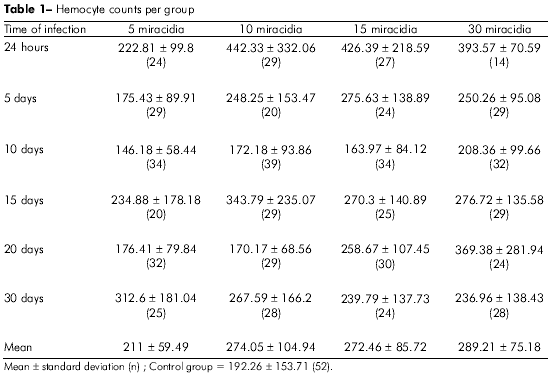
<body><![CDATA[<p><font size="2" face="verdana">Miracidium  encapsulation occurs immediately after parasite penetration and determines the  life or death of the parasite in its host<sup>9,10</sup>. Basch<sup>11</sup>  demonstrated that this process can be altered by numerous factors, such as the  vector's nutritional state, the virulence of the parasitic strain, the hemocyte  quantity in the hemolymph, certain direct or indirect environmental conditions  and the number of miracidia that manage to penetrate the host.</font></p>     <p><font size="2" face="verdana">The  objective of the present study was to evaluate the hemocyte production profile  of captive <i>Biomphalaria glabrata </i>snails after experimental infection  with different numbers of <i>S. mansoni </i>miracidia. The characterization of  the variability in hemocyte production is fundamental for understanding the  resistance mechanisms of different <i>Biomphalaria </i>species for infection  with <i>S. mansoni.</i></font></p>     <p>&nbsp;</p>     <p><font size="3" face="verdana"><b>MATERIAL  AND METHODS</b></font></p>     <p><font size="2" face="verdana">Brazilian  albino (non-pigmented) and pigmented (wild type) strains of <i>B. glabrata </i>differ  in their susceptibility to <i>S.</i> <i>mansoni </i>infection<sup>12</sup>. The <i>B.  glabrata </i>specimens used in this study descended from snails captured in the  Bragantine region in the state of Par&aacute;    State, Brazil.  This snail colony was kept in captivity and was bred in specialized tanks at  the Laboratory of Intestinal Parasitosis and Malacology at the Instituto Evandro  Chagas, (Par&aacute; State, Brazil). The <i>S.</i> <i>mansoni </i>strain  used was extracted from infected mice at this laboratory, but it was initially  isolated from infected snails captured at freshwater reservoirs in the City of Bel&eacute;m, Par&aacute; State,   Brazil.</font></p>     <p><font size="2" face="verdana">The  livers of the infected mice were macerated, filtrated though gauze and  subjected to spontaneous sedimentation. The sediment was exposed to light for 45  min, and the miracidia were collected with micropipettes using a  stereomicroscope (Zeiss, Stemi SV 11).</font></p>     <p><font size="2" face="verdana">A  total of 752 snails, which were approximately 8 months of age and had a shell  diameter of 1.5 cm,  were individually infected in glass vials filled with 2 mL of declorinated  freshwater that contained 5, 10, 15 or 30 miracidia. The infection was  considered successful if no miracidia were visualized in the recipient after 90  minutes of light exposure. Following this procedure, the mollusks were  transferred to special aquariums that were labeled with their infection  protocol. The control group consisted of 52 uninfected snails from the same  initial colony.</font></p>     <p><font size="2" face="verdana">Hemolymph  samples (20&#181;L) were collected by direct puncture from each snail at 1, 5, 10,  15, 20 and 30 days post-infection to evaluate the quantity of the circulating  hemocytes. The samples were mixed with Turk's solution (0.1% crystal violet in  1% glacial acetic acid) at a 1:1 ratio, and 5&#181;L of the resulting solution were  placed in each side of a Neubauer chamber. As a result, each hemolymph sample  was analyzed in duplicate using an optical microscope (Leitz, Dialux 20 EB) at  100x and 400x magnification.</font></p>     <p><font size="2" face="verdana">The  results are presented as the mean values and the standard deviations. The  differences between the values from each group were evaluated using an analysis  of variance (ANOVA) and Student's &#134; test (&#945; = 0.05). All statistical analyses  were performed using the BioEstat<sup>&#174;</sup> 5.0 software (IDSM/MCT/CNPq).</font></p>     <p>&nbsp;</p>     ]]></body>
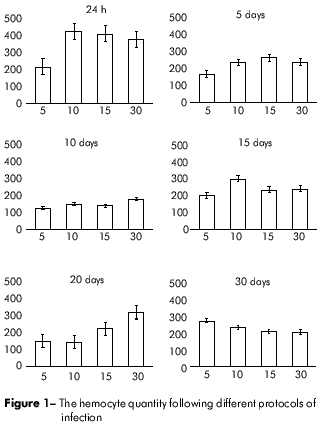
<body><![CDATA[<p><font size="3" face="verdana"><b>RESULTS</b></font></p>     <p><font size="2" face="verdana">Of  the 752 infected snails, 8% died during the course of the infection, and there  was no correlation found between the mortality rate and the number of miracidia  used for the infection. As a result of this snail death, 710 snails were used  for the quantification of circulating hemocytes. These snails were divided into  24 groups of approximately 30 individuals, and the control group consisted of  52 specimens. A summary of these results is presented in <a href="#t1">table 1</a>.</font></p>     <p><a name="t1" id="t1"></a></p>     <p>&nbsp;</p>     <p align="center"><img src="/img/revistas/rpas/v2n2/2a05t1.gif" border="0"></p>     <p>&nbsp;</p>     <p><font size="2" face="verdana">There was a discrete increase (9.7%) in the circulating hemocyte count  in the group that was infected with five miracidia, but these values were not  significant when they were compared with the control group. There were,  however, very sharp increases in hemocyte production at 24 h post-infection in the groups that were infected with greater numbers of miracidia. The  hemocyte production was increased by 130.07%, 121.78% and 104.71% in the groups  receiving 10, 15 and 30 miracidia, respectively. After five days of infection,  there was a significant reduction in the number of hemocytes in each of the  snail groups, although the group that had been infected with five miracidia had  a smaller production rate the other experimental groups (p &lt; 0.05).</font></p>     <p><font size="2" face="verdana">At 10 days post-infection, there were the fewest numbers of circulating  hemocytes in all groups, and the group that had been infected with 30 miracidia  experienced the smallest reduction.</font></p>     <p><font size="2" face="verdana">At 15 days post-infection, the circulating hemocyte count increased  proportionally to the initial parasitic load, and this trend continued through  day 20 post-infection. At day 30, the cellular production stabilized, and there  were no significant differences between the experimental groups. These results  are shown in <a href="#f1">figure 1</a>.</font></p>     <p><a name="f1" id="f1"></a></p>     ]]></body>
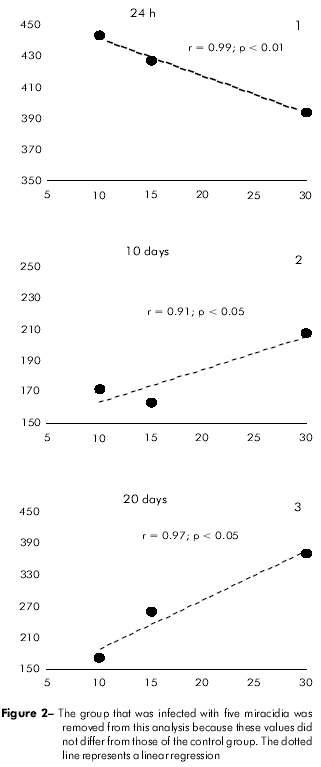
<body><![CDATA[<p>&nbsp;</p>     <p align="center"><img src="/img/revistas/rpas/v2n2/2a05f1.gif" border="0"></p>     <p>&nbsp;</p>     <p><font size="2" face="verdana">After 24 h of infection, there was a strong inverse correlation between  the circulating hemocyte count and the number of miracidia used for the  infection (r = 0.99; p &lt; 0.01). This relationship was inverted at day 10  post-infection (r = 0.91; p &lt; 0.05) and was maintained until the last phase  of the infection (r = 0.97; p &lt; 0.05) (<a href="#f2">Figure 2</a>).</font></p>     <p><a name="f2" id="f2"></a></p>     <p>&nbsp;</p>     <p align="center"><img src="/img/revistas/rpas/v2n2/2a05f2.gif" border="0"></p>     <p>&nbsp;</p>     <p><font size="3" face="verdana"><b>DISCUSSION</b></font></p>     <p><font size="2" face="verdana">Hemocytes, which are mobile amoeboid cells, are critical constituents of  the <i>Biomphalaria </i>snail's defense against infection with <i>S.</i> <i>mansoni </i>miracidia<sup>3,13</sup>.  These cells form the primary barrier against invading parasites and bacteria<sup>13,14</sup>;  their cytoskeletal mobility and the adaptations of their plasma membranes  encapsulate foreign organisms<sup>15</sup>, and these cells also cooperate with  several humoral defense factors. There have been many studies that have  attempted to elucidate the complex parasite/host interaction in this model<sup>16,17,18,19</sup>.</font></p>     ]]></body>
<body><![CDATA[<p><font size="2" face="verdana">In  this paper, we have evaluated variations in the circulating hemocyte counts of  individual <i>B. glabrata </i>snails following exposure to diferent numbers of  <i>S.</i> <i>mansoni </i>miracidia. The main finding of this study was that there was  a significant increase in hemocyte production only when more than five miracidia  penetrated the snail. This increase was followed by a dramatic decrease in the  hemocyte count at 24 h, which persisted during the first 10 days of infection.  At 15 days post-infection, a recovery in the hemocyte cell production was  initiated, and the hemocyte level became stable at 30 days post-infection.  Moreover, this was independent of the initial parasitic load. There was a  strong negative correlation between the hemocyte count and the number of  miracidia used for the infection at 24 h post-infection, but  this relationship was inverted at 10 and 20 days post-infection.</font></p>     <p><font size="2" face="verdana">After  24 h of infection, the mean increase in the number of circulating hemocytes was  93.11%. Stumpf and Gilbertson<sup>19</sup> reported a twofold increase in the <i>B.  glabrata </i>hemocyte count at 2 h after exposure to the miracidia. Similar  results were obtained by Joky et al<sup>20</sup> and Jeong et al<sup>13</sup>;  there was an increase in the <i>B. glabrata </i>hemocyte count immediately  following exposure to a smaller number of miracidia, which was followed by the  peak of the cellular production at the third and fourth days and a marked  decrease in the hemocyte counts at the sixth and the seventh days.  Martins-Souza et al<sup>21</sup> characterized the live hemocytes present after  schistosomal infection using a cytometric analysis and identified the peak  hemocyte production to be 24 h post-infection.</font></p>     <p><font size="2" face="verdana">These  data support our results in regard to the rise in the hemocyte count during the  first hours after miracidia penetration, as well as to the subsequent decline  in the circulating hemocyte numbers<sup>22,23,24</sup>.</font></p>     <p><font size="2" face="verdana">This  study has also demonstrated that following exposure to <i>S. mansoni, </i>the  hemocyte level in the hemolymph was maintained to a greater extent than in the  control group and for a longer period of time than that reported by previous  papers<sup>25</sup>. This finding supports the potential existence of a  long-term effect on the hemocytes, which most likely consists of humoral  factors, after the snail has reacted to the invading organisms.</font></p>     <p><font size="2" face="verdana">Our  study has also demonstrated that the number of infectious miracidia is a  deterministic factor for the magnitude of the cellular response to schistosomal  infection. For example, the number of hemocytes produced in the first 24 h  after infection was much greater in mollusks infected with 10, 15 or 30 miracidia  than in those infected with five of these larvae.</font></p>     <p><font size="2" face="verdana">In  regard to the dynamics of the snail's hemocytic cellular response to the  invading miracidia, previous papers<sup>9,10</sup> have reported that the  hemocytes interact with or adhere to the parasite's surface 3 h after the  penetration of the larvae. Seven and a half hours after this contact, the  hemocytes phagocytize the microvilli on the parasite surface. Twenty-four hours  later, there is great hemocyte activity, and encapsulation processes and the  formation of large phagosomes have been observed. Forty-eight hours later,  capsules are found along with large numbers of hemocytes that contain numerous  phagosomes. At the fourth day, however, these capsules are much scarcer.</font></p>     <p><font size="2" face="verdana">The  results obtained by Cheng and Garrabrant<sup>12</sup> on two diferent strains  of <i>B. glabrata </i>(PR-albino and 10-R2) infected by <i>S. mansoni </i>demonstrated  that the hemolymph acid phosphatase levels increased eightfold after 24 h of  infection with the 10-R2 strain when compared to the non-infected control group,  but that there was only a discrete increase in these levels at the same time  period for the group infected with the PR-albino strain. In regard to the  hemocyte numbers, the results were completely reversed. The PR-albino strain  induced a peak of hemocyte production during the first 12 h of the infection,  which was immediately followed by a marked reduction in the circulating  hemocyte numbers, while the 10-R2 strain did not significantly alter the  hemocyte count during the infectious process, which indicated that acid  phosphatases may have an important role in the regulation of hemocyte  production following parasite exposure.</font></p>     <p>&nbsp;</p>     <p><font size="3" face="verdana"><b>CONCLUSION</b></font></p>     <p><font size="2" face="verdana">The  dynamics of the phagocytosis process, which were observed through the fourth  day post-infection, suggest that the mobilization of these defensive cells is  only effective during the first phase of the infectious process after a large  number of parasites have penetrated the snail. Moreover, this mobilization does  not guarantee the elimination of the larvae during the course of the infection.  The mollusk's defense response against the parasitic larvae could be more  effective if it were not only regulated by a cellular process, but also by  biochemical mechanisms that would directly stimulate the hematopoietic organs  to produce more hemocytes.</font></p>     ]]></body>
<body><![CDATA[<p>&nbsp;</p>     <p><font size="3" face="verdana"><b>ACKNOWLEDGEMENTS</b></font></p>     <p><font size="2" face="verdana">We  would like to thank Ros&acirc;ngela Barros do Nascimento, Carlos da Silva Faria and  Bruno Silva de Lima for technical support throughout the course of our  research. We also thank Kau&ecirc; Machado Costa for critically reviewing the  manuscript and his thoughtful suggestions.</font></p>     <p>&nbsp;</p>     <p><font size="3" face="verdana"><b>FINANCIAL  SUPPORT</b></font></p>     <p><font size="2" face="verdana">Instituto Evandro  Chagas / Funda&ccedil;&atilde;o Nacional  de Sa&uacute;de.</font></p>     <p>&nbsp;</p>     <p><font size="3" face="verdana"><b>REFERENCES</b></font></p>     <!-- ref --><p><font size="2" face="verdana">1 Newton W. The comparative tissue reaction of two  strains of <i>Australorbis glabratus </i>to infection with <i>Schistosomia mansoni. </i>J Parasitol. 1952 Aug;38(4 Sec. A. 1):362-6.</font><!-- ref --><p><font size="2" face="verdana">2 Barbosa F, Coelho  M, Dobbin J. Qualidade de vetor dos hospedeiros de <i>Schistosoma mansoni </i>no  Nordeste do Brasil. II. Dura&ccedil;&atilde;o da infesta&ccedil;&atilde;o e elimina&ccedil;&atilde;o de cercarias em <i>Australorbis  glabratus. </i>Publ  Av Inst Aggeu Magalh&atilde;es. 1954;7:79-92.</font><!-- ref --><p><font size="2" face="verdana">3 Lie J, Heyneman D, Jeong K. Studies on resistance in  snails. 4. Induction of ventricular capsules and changes in the  amebocyte-producing organ during sensitization of <i>Biomphalaria glabrata </i>snails.  J Parasitol. 1976 Apr;62(2):286-91. &#091;<a href="http://www.ncbi.nlm.nih.gov/pubmed/1263041" target="_blank">Link</a>&#093;</font><!-- ref --><p><font size="2" face="verdana">4 Negr&atilde;o-Corr&ecirc;a  D, Pereira C, Rosa F, Martins R, Martins-Souza RL, Andrade ZA, et al. Molluscan response to parasite:  Biomphalaria and Schistosoma mansoni interaction. ISJ. 2007;4:101-11. &#091;<a href="http://www.isj.unimo.it/articoli/ISJ144.pdf" target="_blank">Link</a>&#093;</font><!-- ref --><p><font size="2" face="verdana">5 Granath  Jr WO, Yoshino TP. Lysosomal enzyme activities  in susceptible and refractory strains of <i>Biomphalaria glabrata </i>during  the course of infection with <i>Schistosoma mansoni. </i>J Parasitol. 1983  Dec;69(6):1018-26. &#091;<a href="http://www.ncbi.nlm.nih.gov/pubmed/6674450" target="_blank">Link</a>&#093;</font><!-- ref --><p><font size="2" face="verdana">6 Cheng  TC, Auld KR. Hemocytes of the pulmonate gastropod <i>Biomphalaria glabrata. </i>J  Invertebr Pathol. 1977 Jul;30(1):119-22.</font><!-- ref --><p><font size="2" face="verdana">7 Connors VA, Buron I,  Granath Jr WO. <i>Schistosoma mansoni: </i>interleukin-1 increases phagocytosis  and superoxide production by hemocytes and decreases output of cercariae in  schistosome-susceptible <i>Biomphalaria glabrata</i>. Exp  Parasitol. 1995 Feb;80:139-48. &#091;<a href="http://www.sciencedirect.com/science/article/pii/S0014489485710168" target="_blank">Link</a>&#093;</font><!-- ref --><p><font size="2" face="verdana">8 Souza S,  Andrade Z. On the origin of the <i>Biomphalaria glabrata </i>hemocytes. Mem  Inst Oswaldo Cruz. 2006 Sep;101 Suppl 1:S213-8. &#091;<a href="http://www.scielo.br/scielo.php?script=sci_arttext&amp;pid=S0074-02762006000900033&amp;lng=en&amp;nrm=iso&amp;tlng=en" target="_blank">Link</a>&#093;</font><!-- ref --><p><font size="2" face="verdana">9 Loker ES, Bayne  CJ, Buckley PM, Kruse KT. Ultrastructure of encapsulation of <i>Schistosoma mansoni </i>mother  sporocysts by hemocytes of juveniles of the 10-R2 strain of <i>Biomphalaria  glabrata. </i>J Parasitol. 1982 Feb;68(1):84-94.</font><!-- ref --><p><font size="2" face="verdana">10 Van  der Knaap WP, Loker E. Immune mechanisms in trematod-snail interactions. Parasitol  Today. 1990 Jun;6(6):175-82. Doi:10.1016/0169-4758(90)90349-9 &#091;<a href="http://www.sciencedirect.com/science/article/pii/0169475890903499" target="_blank">Link</a>&#093;</font><!-- ref --><p><font size="2" face="verdana">11 Basch  PF. Intermediate host specificity in <i>Schistosoma mansoni. </i>Exp Parasitol.  1976 Feb;39(1):150-69.</font><!-- ref --><p><font size="2" face="verdana">12 Cheng T, Garrabrant T. Acid phosphatase in granulocytic capsules formed  in strains of <i>Biomphalaria glabrata </i>totally and partially resistant to <i>Schistosoma  mansoni. </i>Int J Parasitol. 1977 Dec;7(6):467-72.</font><!-- ref --><p><font size="2" face="verdana">13 Jeong KH, Lie KJ, Heyneman D. Leucocytosis in <i>Biomphalaria glabrata </i>sensitized  and resensitized to <i>Echinostoma lindoense. </i>J Invertebr Pathol. 1980 Jan;35(1):9-13.</font><!-- ref --><p><font size="2" face="verdana">14 Matricon-Gondran M, Letocart M. Internal defenses of the snail <i>Biomphalaria  glabrata </i>II. Defense cells have different phagocytic responses to various  injected foreign materials. J Invertebr Pathol. 1999 Nov;74(3):235-47. Doi:10.1006/Jipa.1999.4877 &#091;<a href="http://www.sciencedirect.com/science/article/pii/S0022201199948772" target="_blank">Link</a>&#093;</font><!-- ref --><p><font size="2" face="verdana">15 Loker ES, Bayne CJ, Yui MA. <i>Echinostoma paraensei</i>: hemocytes of <i>Biomphalaria  glabrata </i>as targets of echinostome mediated interference with host snail  resistance to <i>Schistosoma mansoni. </i>Exp Parasitol. 1986 Aug;62(1):149-54. &#091;<a href="http://www.ncbi.nlm.nih.gov/pubmed/3087765" target="_blank">Link</a>&#093;</font><!-- ref --><p><font size="2" face="verdana">16 Barracco MA, Steil AA, Gargioni R. Morphological characterization of the  hemocytes of the pulmonate snail <i>Biomphalaria tenagophila. </i>Mem Inst  Oswaldo Cruz. 1993 Jan-Mar;88(1):73-83. http://dx.doi.org/10.1590/S0074-02761993000100012 &#091;<a href="http://www.scielo.br/scielo.php?script=sci_arttext&amp;pid=S0074-02761993000100012&amp;lng=en&amp;nrm=iso&amp;tlng=en" target="_blank">Link</a>&#093;</font><!-- ref --><p><font size="2" face="verdana">17 Bayne CJ, Buckley PM, DeWan PC. <i>Schistosoma mansoni: </i>cytotoxicity  of hemocytes from susceptible snail hosts for sporocysts in plasma from  resistant <i>Biomphalaria glabrata</i>. Exp Parasitol. 1980 Dec;50(3):409-16.</font><!-- ref --><p><font size="2" face="verdana">18 Bayne CJ, Loker ES, Yui MA, Stephens J. Immune-recognition of <i>Schistosoma  mansoni </i>primary sporocysts may require specific receptors on <i>Biomphalaria  glabrata </i>hemocytes. Parasite Immunol. 1984 Dec;6(6):519-28. DOI:10.1111/j.1365-3024.1984.tb00822.x &#091;<a href="http://onlinelibrary.wiley.com/doi/10.1111/j.1365-3024.1984.tb00822.x/abstract" target="_blank">Link</a>&#093;</font><!-- ref --><p><font size="2" face="verdana">19 Stumpf JL, Gilbertson DE. Hemocytes of <i>Biomphalaria glabrata: </i>factors  affecting variability. J Invertebr Pathol. 1978 Sep;32(2):177-81. Doi:10.1016/0022-2011(78)90027-7  &#091;<a href="http://www.sciencedirect.com/science/article/pii/0022201178900277" target="_blank">Link</a>&#093;</font><!-- ref --><p><font size="2" face="verdana">20 Joky A, Matricon-Gondran M, Benex J. Response to the  amoebocyte-producing organ of sensitized <i>Biomphalaria glabrata </i>after  exposure to <i>Echinostoma caproni </i>miracidia. J Invertebr Pathol. 1985 Jan;45(1):28-33. Doi:10.1016/0022-2011(85)90045-X &#091;<a href="http://www.sciencedirect.com/science/article/pii/002220118590045X" target="_blank">Link</a>&#093;</font><!-- ref --><p><font size="2" face="verdana">21 Martins-Souza RL, Pereira CA, Coelho PM, Martins-Filho O, Negr&atilde;o-Corr&ecirc;a  D. Flow cytometry analysis of the circulating haemocytes from <i>Biomphalaria  glabrata </i>and <i>Biomphalaria tenagophila </i>following <i>Schistosoma  mansoni </i>infection. Parasitology. 2009 Jan;136(1):67-76. DOI:10.1017/S0031182008005155 &#091;<a href="http://journals.cambridge.org/action/displayAbstract?fromPage=online&amp;aid=3260396" target="_blank">Link</a>&#093;</font><!-- ref --><p><font size="2" face="verdana">22 Matricon-Gondran M. The site of ultrafiltration in the kidney sac of the  pulmonate gastropod <i>Biomphalaria glabrata. </i>Tissue &amp; cell. 1990;22:911-23. Doi:10.1016/0040-8166(90)90052-B &#091;<a href="http://www.sciencedirect.com/science/article/pii/004081669090052B" target="_blank">Link</a>&#093;</font><!-- ref --><p><font size="2" face="verdana">23 Bayne CJ, Hahn UK,  Bender RC. Mechanisms of molluscan host resistance and of parasite strategies  for survival. Parasitology. 2001;123 Suppl:S159-67. &#091;<a href="http://www.ncbi.nlm.nih.gov/pubmed/11769280" target="_blank">Link</a>&#093;</font><!-- ref --><p><font size="2" face="verdana">24 Martins-Souza RL, Pereira CA, Coelho PM, Negr&atilde;o-Corr&ecirc;a D. Silica  treatment increases the susceptibility of the Cabo Frio strain of <i>Biomphalaria  tenagophila </i>to <i>Schistosoma mansoni </i>infection but does not alter the  natural resistance of the Taim strain. Parasitol Res. 2003 Dec;91(6):500-7. DOI: 10.1007/s00436-003-0985-4 &#091;<a href="http://www.springerlink.com/content/hmnhp9v2r93jjwj8/" target="_blank">Link</a>&#093;</font><!-- ref --><p><font size="2" face="verdana">25 Oliveira AL, Silva D, Manzano BC,  Abdel-Hamid AZ, Marcelino MY, Zanotti-Magalhaes EM, et al. Genetic differences between strains of <i>Biomphalaria glabrata </i>(Planorbidae)  that are susceptible and unsusceptible to schistosomiasis. Genet Mol Res. 2010  Jul;9(3):1450-9. DOI 10.4238/vol9-3gmr821 &#091;<a href="http://www.funpecrp.com.br/gmr/year2010/vol9-3/pdf/gmr821.pdf" target="_blank">Link</a>&#093;</font><p>&nbsp;</p>     <p>&nbsp;</p>     <p><font size="2" face="Verdana"><b><a name="endereco" id="endereco"></a><a href="#topo"><img src="/img/revistas/rpas/v1n4/seta.gif" border="0"></a></b></font><font size="2" face="verdana"><b>Correspondence / Correspond&ecirc;ncia / Correspondencia:</b>    <br>   Daniel Valle  Vasconcelos Santos    <br>   Rua Arciprestes  Manoel Teodoro, n<sup>o</sup> 265 Bairro: Batista  Campos    <br>   CEP: 66023700 Bel&eacute;m - Par&aacute; &ndash; Brasil    <br>   Tel.: 55 (91) 81299664    ]]></body>
<body><![CDATA[<br>   E-mail: <a href="mailto:danielsantos@ufpa.br">danielsantos@ufpa.br</a> </font></p>     <p><font size="2" face="verdana">Received / Recebido em / Recibido en:  27/5/2011    <br>   Accepted / Aceito em / Aceito en:  1/9/2011</font>   <script type="text/javascript"> var gaJsHost = (("https:" == document.location.protocol) ? "https://ssl." : "http://www."); document.write(unescape("%3Cscript src='" + gaJsHost + "google-analytics.com/ga.js' type='text/javascript'%3E%3C/script%3E"));   </script>   <script type="text/javascript"> try { var pageTracker = _gat._getTracker("UA-7885746-4"); pageTracker._setDomainName("none"); pageTracker._setAllowLinker(true); pageTracker._trackPageview(); } catch(err) {}</script> </p>      ]]></body><back>
<ref-list>
<ref id="B1">
<label>1</label><nlm-citation citation-type="journal">
<person-group person-group-type="author">
<name>
<surname><![CDATA[Newton]]></surname>
<given-names><![CDATA[W]]></given-names>
</name>
</person-group>
<article-title xml:lang="en"><![CDATA[The comparative tissue reaction of two strains of Australorbis glabratus to infection with Schistosomia mansoni]]></article-title>
<source><![CDATA[J Parasitol]]></source>
<year>1952</year>
<month> A</month>
<day>ug</day>
<volume>38</volume>
<numero>4</numero>
<issue>4</issue>
<page-range>362-6</page-range></nlm-citation>
</ref>
<ref id="B2">
<label>2</label><nlm-citation citation-type="journal">
<person-group person-group-type="author">
<name>
<surname><![CDATA[Barbosa]]></surname>
<given-names><![CDATA[F]]></given-names>
</name>
<name>
<surname><![CDATA[Coelho]]></surname>
<given-names><![CDATA[M]]></given-names>
</name>
<name>
<surname><![CDATA[Dobbin]]></surname>
<given-names><![CDATA[J]]></given-names>
</name>
</person-group>
<article-title xml:lang="pt"><![CDATA[Qualidade de vetor dos hospedeiros de Schistosoma mansoni no Nordeste do Brasil: II. Duração da infestação e eliminação de cercarias em Australorbis glabratus]]></article-title>
<source><![CDATA[Publ Av Inst Aggeu Magalhães]]></source>
<year>1954</year>
<volume>7</volume>
<page-range>79-92</page-range></nlm-citation>
</ref>
<ref id="B3">
<label>3</label><nlm-citation citation-type="journal">
<person-group person-group-type="author">
<name>
<surname><![CDATA[Lie]]></surname>
<given-names><![CDATA[J]]></given-names>
</name>
<name>
<surname><![CDATA[Heyneman]]></surname>
<given-names><![CDATA[D]]></given-names>
</name>
<name>
<surname><![CDATA[Jeong]]></surname>
<given-names><![CDATA[K]]></given-names>
</name>
</person-group>
<article-title xml:lang="en"><![CDATA[Studies on resistance in snails: 4. Induction of ventricular capsules and changes in the amebocyte-producing organ during sensitization of Biomphalaria glabrata snails]]></article-title>
<source><![CDATA[J Parasitol]]></source>
<year>1976</year>
<month> A</month>
<day>pr</day>
<volume>62</volume>
<numero>2</numero>
<issue>2</issue>
<page-range>286-91</page-range></nlm-citation>
</ref>
<ref id="B4">
<label>4</label><nlm-citation citation-type="journal">
<person-group person-group-type="author">
<name>
<surname><![CDATA[Negrão-Corrêa]]></surname>
<given-names><![CDATA[D]]></given-names>
</name>
<name>
<surname><![CDATA[Pereira]]></surname>
<given-names><![CDATA[C]]></given-names>
</name>
<name>
<surname><![CDATA[Rosa]]></surname>
<given-names><![CDATA[F]]></given-names>
</name>
<name>
<surname><![CDATA[Martins]]></surname>
<given-names><![CDATA[R]]></given-names>
</name>
<name>
<surname><![CDATA[Martins-Souza]]></surname>
<given-names><![CDATA[RL]]></given-names>
</name>
<name>
<surname><![CDATA[Andrade]]></surname>
<given-names><![CDATA[ZA]]></given-names>
</name>
</person-group>
<article-title xml:lang="en"><![CDATA[Molluscan response to parasite: Biomphalaria and Schistosoma mansoni interaction]]></article-title>
<source><![CDATA[ISJ]]></source>
<year>2007</year>
<volume>4</volume>
<page-range>101-11</page-range></nlm-citation>
</ref>
<ref id="B5">
<label>5</label><nlm-citation citation-type="journal">
<person-group person-group-type="author">
<name>
<surname><![CDATA[Granath Jr]]></surname>
<given-names><![CDATA[WO]]></given-names>
</name>
<name>
<surname><![CDATA[Yoshino]]></surname>
<given-names><![CDATA[TP]]></given-names>
</name>
</person-group>
<article-title xml:lang="en"><![CDATA[Lysosomal enzyme activities in susceptible and refractory strains of Biomphalaria glabrata during the course of infection with Schistosoma mansoni]]></article-title>
<source><![CDATA[J Parasitol]]></source>
<year>1983</year>
<month> D</month>
<day>ec</day>
<volume>69</volume>
<numero>6</numero>
<issue>6</issue>
<page-range>1018-26</page-range></nlm-citation>
</ref>
<ref id="B6">
<label>6</label><nlm-citation citation-type="journal">
<person-group person-group-type="author">
<name>
<surname><![CDATA[Cheng]]></surname>
<given-names><![CDATA[TC]]></given-names>
</name>
<name>
<surname><![CDATA[Auld]]></surname>
<given-names><![CDATA[KR]]></given-names>
</name>
</person-group>
<article-title xml:lang="en"><![CDATA[Hemocytes of the pulmonate gastropod Biomphalaria glabrata]]></article-title>
<source><![CDATA[J Invertebr Pathol]]></source>
<year>1977</year>
<month> J</month>
<day>ul</day>
<volume>30</volume>
<numero>1</numero>
<issue>1</issue>
<page-range>119-22</page-range></nlm-citation>
</ref>
<ref id="B7">
<label>7</label><nlm-citation citation-type="journal">
<person-group person-group-type="author">
<name>
<surname><![CDATA[Connors]]></surname>
<given-names><![CDATA[VA]]></given-names>
</name>
<name>
<surname><![CDATA[Buron]]></surname>
<given-names><![CDATA[I]]></given-names>
</name>
<name>
<surname><![CDATA[Granath Jr]]></surname>
<given-names><![CDATA[WO]]></given-names>
</name>
</person-group>
<article-title xml:lang="en"><![CDATA[Schistosoma mansoni: interleukin-1 increases phagocytosis and superoxide production by hemocytes and decreases output of cercariae in schistosome-susceptible Biomphalaria glabrata]]></article-title>
<source><![CDATA[Exp Parasitol]]></source>
<year>1995</year>
<month> F</month>
<day>eb</day>
<volume>80</volume>
<page-range>139-48</page-range></nlm-citation>
</ref>
<ref id="B8">
<label>8</label><nlm-citation citation-type="journal">
<person-group person-group-type="author">
<name>
<surname><![CDATA[Souza]]></surname>
<given-names><![CDATA[S]]></given-names>
</name>
<name>
<surname><![CDATA[Andrade]]></surname>
<given-names><![CDATA[Z]]></given-names>
</name>
</person-group>
<article-title xml:lang="en"><![CDATA[On the origin of the Biomphalaria glabrata hemocytes]]></article-title>
<source><![CDATA[Mem Inst Oswaldo Cruz]]></source>
<year>2006</year>
<month> S</month>
<day>ep</day>
<volume>101</volume>
<numero>1</numero>
<issue>1</issue>
<page-range>213-8</page-range></nlm-citation>
</ref>
<ref id="B9">
<label>9</label><nlm-citation citation-type="journal">
<person-group person-group-type="author">
<name>
<surname><![CDATA[Loker]]></surname>
<given-names><![CDATA[ES]]></given-names>
</name>
<name>
<surname><![CDATA[Bayne]]></surname>
<given-names><![CDATA[CJ]]></given-names>
</name>
<name>
<surname><![CDATA[Buckley]]></surname>
<given-names><![CDATA[PM]]></given-names>
</name>
<name>
<surname><![CDATA[Kruse]]></surname>
<given-names><![CDATA[KT]]></given-names>
</name>
</person-group>
<article-title xml:lang="en"><![CDATA[Ultrastructure of encapsulation of Schistosoma mansoni mother sporocysts by hemocytes of juveniles of the 10-R2 strain of Biomphalaria glabrata]]></article-title>
<source><![CDATA[J Parasitol]]></source>
<year>1982</year>
<month> F</month>
<day>eb</day>
</nlm-citation>
</ref>
<ref id="B10">
<label>10</label><nlm-citation citation-type="journal">
<person-group person-group-type="author">
<name>
<surname><![CDATA[Van der Knaap]]></surname>
<given-names><![CDATA[WP]]></given-names>
</name>
<name>
<surname><![CDATA[Loker]]></surname>
<given-names><![CDATA[E]]></given-names>
</name>
</person-group>
<article-title xml:lang="en"><![CDATA[Immune mechanisms in trematod-snail interactions]]></article-title>
<source><![CDATA[Parasitol Today]]></source>
<year>1990</year>
<month> J</month>
<day>un</day>
<volume>6</volume>
<numero>6</numero>
<issue>6</issue>
<page-range>175-82</page-range></nlm-citation>
</ref>
<ref id="B11">
<label>11</label><nlm-citation citation-type="journal">
<person-group person-group-type="author">
<name>
<surname><![CDATA[Basch]]></surname>
<given-names><![CDATA[PF]]></given-names>
</name>
</person-group>
<article-title xml:lang="en"><![CDATA[Intermediate host specificity in Schistosoma mansoni]]></article-title>
<source><![CDATA[Exp Parasitol]]></source>
<year>1976</year>
<month> F</month>
<day>eb</day>
<volume>39</volume>
<numero>1</numero>
<issue>1</issue>
<page-range>150-69</page-range></nlm-citation>
</ref>
<ref id="B12">
<label>12</label><nlm-citation citation-type="journal">
<person-group person-group-type="author">
<name>
<surname><![CDATA[Cheng]]></surname>
<given-names><![CDATA[T]]></given-names>
</name>
<name>
<surname><![CDATA[Garrabrant]]></surname>
<given-names><![CDATA[T]]></given-names>
</name>
</person-group>
<article-title xml:lang="en"><![CDATA[Acid phosphatase in granulocytic capsules formed in strains of Biomphalaria glabrata totally and partially resistant to Schistosoma mansoni]]></article-title>
<source><![CDATA[Int J Parasitol]]></source>
<year>1977</year>
<month> D</month>
<day>ec</day>
<volume>7</volume>
<numero>6</numero>
<issue>6</issue>
<page-range>467-72</page-range></nlm-citation>
</ref>
<ref id="B13">
<label>13</label><nlm-citation citation-type="journal">
<person-group person-group-type="author">
<name>
<surname><![CDATA[Jeong]]></surname>
<given-names><![CDATA[KH]]></given-names>
</name>
<name>
<surname><![CDATA[Lie]]></surname>
<given-names><![CDATA[KJ]]></given-names>
</name>
<name>
<surname><![CDATA[Heyneman]]></surname>
<given-names><![CDATA[D]]></given-names>
</name>
</person-group>
<article-title xml:lang="en"><![CDATA[Leucocytosis in Biomphalaria glabrata sensitized and resensitized to Echinostoma lindoense]]></article-title>
<source><![CDATA[J Invertebr Pathol]]></source>
<year>1980</year>
<month> J</month>
<day>an</day>
<volume>35</volume>
<numero>1</numero>
<issue>1</issue>
<page-range>9-13</page-range></nlm-citation>
</ref>
<ref id="B14">
<label>14</label><nlm-citation citation-type="journal">
<person-group person-group-type="author">
<name>
<surname><![CDATA[Matricon-Gondran]]></surname>
<given-names><![CDATA[M]]></given-names>
</name>
<name>
<surname><![CDATA[Letocart]]></surname>
<given-names><![CDATA[M]]></given-names>
</name>
</person-group>
<article-title xml:lang="en"><![CDATA[Internal defenses of the snail Biomphalaria glabrata II: Defense cells have different phagocytic responses to various injected foreign materials]]></article-title>
<source><![CDATA[J Invertebr Pathol]]></source>
<year>1999</year>
<month> N</month>
<day>ov</day>
<volume>74</volume>
<numero>3</numero>
<issue>3</issue>
<page-range>235-47</page-range></nlm-citation>
</ref>
<ref id="B15">
<label>15</label><nlm-citation citation-type="journal">
<person-group person-group-type="author">
<name>
<surname><![CDATA[Loker]]></surname>
<given-names><![CDATA[ES]]></given-names>
</name>
<name>
<surname><![CDATA[Bayne]]></surname>
<given-names><![CDATA[CJ]]></given-names>
</name>
<name>
<surname><![CDATA[Yui]]></surname>
<given-names><![CDATA[MA]]></given-names>
</name>
</person-group>
<article-title xml:lang="en"><![CDATA[Echinostoma paraensei: emocytes of Biomphalaria glabrata as targets of echinostome mediated interference with host snail resistance to Schistosoma mansoni]]></article-title>
<source><![CDATA[Exp Parasitol]]></source>
<year>1986</year>
<month> A</month>
<day>ug</day>
<volume>62</volume>
<numero>1</numero>
<issue>1</issue>
<page-range>149-54</page-range></nlm-citation>
</ref>
<ref id="B16">
<label>16</label><nlm-citation citation-type="journal">
<person-group person-group-type="author">
<name>
<surname><![CDATA[Barracco]]></surname>
<given-names><![CDATA[MA]]></given-names>
</name>
<name>
<surname><![CDATA[Steil]]></surname>
<given-names><![CDATA[AA]]></given-names>
</name>
<name>
<surname><![CDATA[Gargioni]]></surname>
<given-names><![CDATA[R]]></given-names>
</name>
</person-group>
<article-title xml:lang="en"><![CDATA[Morphological characterization of the hemocytes of the pulmonate snail Biomphalaria tenagophila]]></article-title>
<source><![CDATA[Mem Inst Oswaldo Cruz]]></source>
<year>1993</year>
<month> J</month>
<day>an</day>
<volume>88</volume>
<numero>1</numero>
<issue>1</issue>
<page-range>73-83</page-range></nlm-citation>
</ref>
<ref id="B17">
<label>17</label><nlm-citation citation-type="journal">
<person-group person-group-type="author">
<name>
<surname><![CDATA[Bayne]]></surname>
<given-names><![CDATA[CJ]]></given-names>
</name>
<name>
<surname><![CDATA[Buckley]]></surname>
<given-names><![CDATA[PM]]></given-names>
</name>
<name>
<surname><![CDATA[DeWan]]></surname>
<given-names><![CDATA[PC]]></given-names>
</name>
</person-group>
<article-title xml:lang="en"><![CDATA[Schistosoma mansoni: cytotoxicity of hemocytes from susceptible snail hosts for sporocysts in plasma from resistant Biomphalaria glabrata]]></article-title>
<source><![CDATA[Exp Parasitol]]></source>
<year>1980</year>
<month> D</month>
<day>ec</day>
<volume>50</volume>
<numero>3</numero>
<issue>3</issue>
<page-range>409-16</page-range></nlm-citation>
</ref>
<ref id="B18">
<label>18</label><nlm-citation citation-type="journal">
<person-group person-group-type="author">
<name>
<surname><![CDATA[Bayne]]></surname>
<given-names><![CDATA[CJ]]></given-names>
</name>
<name>
<surname><![CDATA[Loker]]></surname>
<given-names><![CDATA[ES]]></given-names>
</name>
<name>
<surname><![CDATA[Yui]]></surname>
<given-names><![CDATA[MA]]></given-names>
</name>
<name>
<surname><![CDATA[Stephens]]></surname>
<given-names><![CDATA[J]]></given-names>
</name>
</person-group>
<article-title xml:lang="en"><![CDATA[Immune-recognition of Schistosoma mansoni primary sporocysts may require specific receptors on Biomphalaria glabrata hemocytes]]></article-title>
<source><![CDATA[Parasite Immunol]]></source>
<year>1984</year>
<month> D</month>
<day>ec</day>
<volume>6</volume>
<numero>6</numero>
<issue>6</issue>
<page-range>519-28</page-range></nlm-citation>
</ref>
<ref id="B19">
<label>19</label><nlm-citation citation-type="journal">
<person-group person-group-type="author">
<name>
<surname><![CDATA[Stumpf]]></surname>
<given-names><![CDATA[JL]]></given-names>
</name>
<name>
<surname><![CDATA[Gilbertson]]></surname>
<given-names><![CDATA[DE]]></given-names>
</name>
</person-group>
<article-title xml:lang="en"><![CDATA[Hemocytes of Biomphalaria glabrata: factors affecting variability]]></article-title>
<source><![CDATA[J Invertebr Pathol]]></source>
<year>1978</year>
<month> S</month>
<day>ep</day>
<volume>32</volume>
<numero>2</numero>
<issue>2</issue>
<page-range>177-81</page-range></nlm-citation>
</ref>
<ref id="B20">
<label>20</label><nlm-citation citation-type="journal">
<person-group person-group-type="author">
<name>
<surname><![CDATA[Joky]]></surname>
<given-names><![CDATA[A]]></given-names>
</name>
<name>
<surname><![CDATA[Matricon-Gondran]]></surname>
<given-names><![CDATA[M]]></given-names>
</name>
<name>
<surname><![CDATA[Benex]]></surname>
<given-names><![CDATA[J]]></given-names>
</name>
</person-group>
<article-title xml:lang="en"><![CDATA[Response to the amoebocyte-producing organ of sensitized Biomphalaria glabrata after exposure to Echinostoma caproni miracidia]]></article-title>
<source><![CDATA[J Invertebr Pathol]]></source>
<year>1985</year>
<month> J</month>
<day>an</day>
<volume>45</volume>
<numero>1</numero>
<issue>1</issue>
<page-range>28-33</page-range></nlm-citation>
</ref>
<ref id="B21">
<label>21</label><nlm-citation citation-type="journal">
<person-group person-group-type="author">
<name>
<surname><![CDATA[Martins-Souza]]></surname>
<given-names><![CDATA[RL]]></given-names>
</name>
<name>
<surname><![CDATA[Pereira]]></surname>
<given-names><![CDATA[CA]]></given-names>
</name>
<name>
<surname><![CDATA[Coelho]]></surname>
<given-names><![CDATA[PM]]></given-names>
</name>
<name>
<surname><![CDATA[Martins-Filho]]></surname>
<given-names><![CDATA[O]]></given-names>
</name>
<name>
<surname><![CDATA[Negrão-Corrêa]]></surname>
<given-names><![CDATA[D]]></given-names>
</name>
</person-group>
<article-title xml:lang="en"><![CDATA[Flow cytometry analysis of the circulating haemocytes from Biomphalaria glabrata and Biomphalaria tenagophila following Schistosoma mansoni infection]]></article-title>
<source><![CDATA[Parasitology]]></source>
<year>2009</year>
<month> J</month>
<day>an</day>
<volume>136</volume>
<numero>1</numero>
<issue>1</issue>
<page-range>67-76</page-range></nlm-citation>
</ref>
<ref id="B22">
<label>22</label><nlm-citation citation-type="journal">
<person-group person-group-type="author">
<name>
<surname><![CDATA[Matricon-Gondran]]></surname>
<given-names><![CDATA[M]]></given-names>
</name>
</person-group>
<article-title xml:lang="en"><![CDATA[The site of ultrafiltration in the kidney sac of the pulmonate gastropod Biomphalaria glabrata]]></article-title>
<source><![CDATA[Tissue & cell]]></source>
<year>1990</year>
<volume>22</volume>
<page-range>911-23</page-range></nlm-citation>
</ref>
<ref id="B23">
<label>23</label><nlm-citation citation-type="journal">
<person-group person-group-type="author">
<name>
<surname><![CDATA[Bayne]]></surname>
<given-names><![CDATA[CJ]]></given-names>
</name>
<name>
<surname><![CDATA[Hahn]]></surname>
<given-names><![CDATA[UK]]></given-names>
</name>
<name>
<surname><![CDATA[Bender]]></surname>
<given-names><![CDATA[RC]]></given-names>
</name>
</person-group>
<article-title xml:lang="en"><![CDATA[Mechanisms of molluscan host resistance and of parasite strategies for survival]]></article-title>
<source><![CDATA[Parasitology]]></source>
<year>2001</year>
<volume>123</volume>
<page-range>S159-67</page-range></nlm-citation>
</ref>
<ref id="B24">
<label>24</label><nlm-citation citation-type="journal">
<person-group person-group-type="author">
<name>
<surname><![CDATA[Martins-Souza]]></surname>
<given-names><![CDATA[RL]]></given-names>
</name>
<name>
<surname><![CDATA[Pereira]]></surname>
<given-names><![CDATA[CA]]></given-names>
</name>
<name>
<surname><![CDATA[Coelho]]></surname>
<given-names><![CDATA[PM]]></given-names>
</name>
<name>
<surname><![CDATA[Negrão-Corrêa]]></surname>
<given-names><![CDATA[D]]></given-names>
</name>
</person-group>
<article-title xml:lang="en"><![CDATA[Silica treatment increases the susceptibility of the Cabo Frio strain of Biomphalaria tenagophila to Schistosoma mansoni infection but does not alter the natural resistance of the Taim strain]]></article-title>
<source><![CDATA[Parasitol Res]]></source>
<year>2003</year>
<month> D</month>
<day>ec</day>
<volume>91</volume>
<numero>6</numero>
<issue>6</issue>
<page-range>500-7</page-range></nlm-citation>
</ref>
<ref id="B25">
<label>25</label><nlm-citation citation-type="journal">
<person-group person-group-type="author">
<name>
<surname><![CDATA[Oliveira]]></surname>
<given-names><![CDATA[AL]]></given-names>
</name>
<name>
<surname><![CDATA[Silva]]></surname>
<given-names><![CDATA[D]]></given-names>
</name>
<name>
<surname><![CDATA[Manzano]]></surname>
<given-names><![CDATA[BC]]></given-names>
</name>
<name>
<surname><![CDATA[Abdel-Hamid]]></surname>
<given-names><![CDATA[AZ]]></given-names>
</name>
<name>
<surname><![CDATA[Marcelino]]></surname>
<given-names><![CDATA[MY]]></given-names>
</name>
<name>
<surname><![CDATA[Zanotti-Magalhaes]]></surname>
<given-names><![CDATA[EM]]></given-names>
</name>
</person-group>
<article-title xml:lang="en"><![CDATA[Genetic differences between strains of Biomphalaria glabrata (Planorbidae) that are susceptible and unsusceptible to schistosomiasis]]></article-title>
<source><![CDATA[Genet Mol Res]]></source>
<year>2010</year>
<month> J</month>
<day>ul</day>
<volume>9</volume>
<numero>3</numero>
<issue>3</issue>
<page-range>1450-9</page-range></nlm-citation>
</ref>
</ref-list>
</back>
</article>