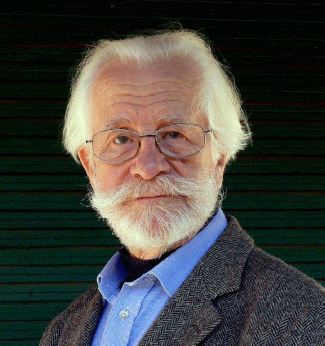
ROBERT RENÉ KILLICK-KENDRICK MPhil, PhD, DSc, FSB 20 June, 1929 - 22 October, 2011
Ralph Lainson, John R. Baker
This obituary first appeared on the Website of the Royal Society of Hygiene and Tropical Medicine, London, and we are grateful for their permission to reproduce it here for the benefit of the many friends and collaborators that Professor Killick-Kendrick had in Brazil, particularly among members of the Department of Parasitology in the Instituto Evandro Chagas. A few modifications have been made following receipt of additional information on his life and work.
EARLY YEARS
Robert René Killick-Kendrick, son of Reginald Robert Killick and Ellen Irene Elsie Killick, was born on 20 June, 1929 in Hampton, UK, and educated at Woking Grammar School, Surrey, UK. He died in France following a relatively rapid illness due to a particularly aggressive form of cancer. He is survived by his wife Mireille, and his daughters Anne and Jacqueline and son Timothy from his first marriage, in 1950, with Jean Killick-Kendrick. "Bob", as he was known to all his friends and colleagues had a sister Una Adelaide, and a brother Anthony, now aged 85.
Bob left school when he was 16 and, at the age of 17, spent one year as a Laboratory Assistant in the Biochemistry Department of the Ministry of Agriculture & Fisheries, Weybridge, Surrey. He then spent two years of military service in the Royal Army Medical Corps., during which he underwent a six month course of training in Anatomy, Physiology and Laboratory Techniques at York Military Hospital in order to gain the position of a Grade III Laboratory Technician. This achieved, he was posted to the RAMC Medical College in London to work with a senior technician who organized the practical training of military doctors who were studying for their Diploma in Tropical Medicine & Hygiene (DTM&H). He found the subject of Parasitology so interesting that he answered an advertisement for the post of Laboratory Technician in the Department of Parasitology in the London School of Hygiene & Tropical Medicine (LSHTM). To his delight he was invited to an interview with Colonel HE Shortt FRS, Head of the Department of Parasitology and renowned research worker on malaria. In Bob's own words "the interview was very brief": "- When do you leave the RAMC, Killick?"; "- September the 5th, Sir."; "- Then start work here on the 6th!".
On joining the Department of Parasitology, Bob was promptly assigned to work in the LSHTM field station at Winches Farm, St. Albans where he was to help the first faltering steps of several PhD students (including RL and JRB). Here his previous training was of immense use to these students who were not only instructed in all the basic laboratory techniques with which to carry out their research, but also had his constant, good-humoured participation in their field-work. He was a keen and proficient photographer and provided excellent illustrations for many of their first publications.
Under constant advice from RL and JRB that he must obtain a University Degree in order to use his expertise as a research worker rather than a laboratory technician, Bob somehow found time to study for a number of Diplomas and Degrees, eventually culminating in his DSc (at that time the highest academic qualification offered by London University). As far as we are aware, this was for much of the time without financial aid.
Before briefly discussing some of the more important publications among nearly 300 that were written or co-written by Bob, the following extract from an abbreviated CV indicates both the meteoric acquisition of his academic qualifications and his extensive activity in the field of Parasitology.
]]>
CURRICULUM VITAE
Robert René KILLICK-KENDRICK
Born Hampton, UK on 20 June, 1929
Educated at Woking Grammar School, Surrey, UK
British and French Nationalities
DEGREES & DIPLOMAS
Fellow, Institute of Biomedical Sciences (FIBMA), 1970 ]]>
Diploma of Imperial College, London (DIC), 1970
Master of Philosophy, London University (MPhil), 1970
Doctor of Philosophy, London University (PhD), 1972
Doctor of Science, London University (DSc), 1978
Chartered Biologist (CBiol), 1979
Fellow of the Society of Biology (FSB), 1979
HONOURS
Hon Member Algerian Society of Parasitology, 1985
Hon Member Societá Italiana de Parasitologia, 1991 ]]>
Hon Member American Society of Tropical Medicine & Hygiene, 2005
Hon Fellow Royal Entomological Society, 2007
Hon Member Turkish Society for Parasitology, 2011
Sir Rickard Christophers Medal: Royal Society of Tropical Medicine & Hygiene, 1991
Emile Brumpt International Prize, Societé de Pathologie Exotique, 2007
Academician of l'Académie des Hauts Cantons (Artes, Sciences et Belles Lettres), 2008
PROFESSIONAL CAREER
1946 - 1947: Laboratory Assistant, Biochemistry Dept., Ministry of Agriculture & Fisheries Weybridge, Surrey, UK
1947 - 1949: Medical Laboratory Assistant, Royal Army Medical Corps ]]>
1949 - 1955: Laboratory Technician, Dept. Parasitology, London School of Hygiene & Tropical Medicine, UK
1955 - 1963: Senior Laboratory Superintendent, West African Institute for Trypanosomiasis Research, Nigeria
1963 - 1969: Chief Technician, then Senior Technical Officer, Dept. of Parasitology, London School of Hygiene & Tropical Medicine, UK and Part-time Lecturer at Sir John Cass College, London
1969 - 1976: Research Fellow, Dept. of Zoology and applied Entomology, Imperial College, London
1976 - 1994: Scientist and then Senior Scientist, Special Appointments Grade, Medical Research Council External Scientific Staff. Teacher of London University
1994 - 1997: Visiting Professor & Leverhulme Scholar, Dept. of Biology, Imperial College London
1997 - 1907: Senior Research Fellow, Dept. of Biological Sciences, Imperial College, London
2007 - 1911: Honorary Research Fellow, Division of Biology, Faculty of Natural Sciences, Imperial College, London
WHO APPOINTMENTS
]]> 1967 & 1970: Consultant (Malaria), Nigeria, Ivory Coast, Cameroon, Sierra Leone
PROFESSIONAL SOCIETIES
ROYAL SOCIETY OF TROPICAL MEDICINE & HYGIENE
Councillor, 1975 - 1978
Honorary Secretary, 1979 - 1986
Chairman, Meetings Committee, 1975 - 1979
Chairman Editorial Board, 1979 - 1986
Chairman, Garnham Fellowship Committee, 1996 - 2004
AMERICAN SOCIETY OF TROPICAL MEDICINE & HYGIENE
]]> Royal Entomological Society, London]]> SCIENTIFIC ACHIEVEMENTS
MALARIA PARASITES - THE GENUS PLASMODIUM
As virtually the personal laboratory technician of PCC Garnham FRS during 1963 - 1969, Bob assisted in much of the research of Garnham and his team on the exoerthrocytic development of a variety of Plasmodium species of humans, non-human primates and rodents, and was frequently included as a co-author in the resulting publications.
MALARIA PARASITES OF RODENTS
Bob's interest in these parasites led to his later collaborative work with Irène Landau on the detection of Plasmodium species in African rodents and demonstration of their exoerythrocytic development. With mammalogist Louis Bellier he discovered and named two new Plasmodium species in "flying squirrels" of the Ivory Coast and numerous other publications were made on the malaria parasites of rodents. In review papers he indicated field and laboratory techniques for the detection and isolation of these organisms and their taxonomy, zoogeography and evolution. All this led to the production of the book "Rodent Malaria" edited by W. Peters & R. Killick-Kendrick in 1978.
A MALARIA PARASITE OF THE ORANG-UTAN
In 1972, Bob played a major role during his participation in Garnham's plan of an expedition to Peninsular Malaysia in order to isolate and redescribe the poorly studied Plasmodium pitheci of this primate, originally encountered in an orang-utan in a German zoo. The parasite was successfully isolated, and its development described in the blood and liver of a splenectomized chimpanzee that had been inoculated with sporozoites from experimentally infected mosquitoes. In addition, a second malaria parasite was detected and described under the name of Plasmodium silvaticum (Peters et al, 1976).
THE "HYPNOZOITE" - THE LATENT STAGE OF THE MALARIA PARASITE IN THE LIVER
Much later, in 1983, Killick's technical skills were again to play an important role in Krotoski and Garnham's investigations on the earliest development of the sporozoites of a Plasmodium species when they reach the liver following their inoculation into the vertebrate host by the mosquito. These studies involved the inoculation of rhesus monkeys with millions of sporozoites obtained by the dissection of a large number of infected mosquitoes, taking liver biopsies of these animals at different times, the preparation of sections stained by a special technique and patient work at the microscope to detect the tiny hypnozoites in the parenchyma cells of the liver. The discovery of these latent sporozoites at last explained the relapses of patients apparently recovered from malaria.
TRYPANOSOMES - TRYPANOSOMIASIS OF MAN AND HIS LIVESTOCK
]]> In 1955, Bob started to work for the Colonial Research Service at the West African Institute of Trypanosomiasis Research (WAITR) in Nigeria and, together with the late David Godfrey, created the Field Survey Unit of that Institute. After many observations on the best methods of diagnosing infections by different trypanosomes in all manner of animals, they made a 28-day trek of 415 miles accompanied by 28 uninfected cattle from a non-trypanosomiasis area to a distant locality where this disease of livestock was of common occurrence. Technical staff made a daily check for symptoms of infection developing in the cattle, examination of stained, thick blood films from each animal to detect possible trypanosomes, and a search for the 'tsetse-fly' vectors of the trypanosomes. In this way the precise areas of infection-risk for livestock and humans were clearly pin-pointed.LEISHMANIA SPECIES, LEISHMANIASIS AND THE PHLEBOTOMINE SAND FLY VECTORS
On his return from Nigeria, Bob resumed his work in the Department of Parasitology at the LSHTM, once more principally on malaria parasites. When Garnham "retired" and moved to the Imperial College's premises in Ascot, however, he soon followed his mentor and occupied the position of Research Fellow in the Department of Zoology & Applied Entomology; his grant for his work on Plasmodium species of rodents had expired and he was anxious to embark on further studies As he was particularly fascinated by the life-cycles of digenetic parasites in their invertebrate vectors he decided to set up a closed colony of a phlebotomine sand fly in order to follow the development of species of Leishmania in the insect host. He obtained a grant from the Wellcome Trust and paid a visit to the Instituto Evandro Chagas in Belém, Pará State, Amazonian Brazil, to discuss his idea with RL's group of workers who also had a Wellcome-sponsered programme to investigate the eco-epidemiology of leishmaniasis in the Amazon Region.
He was advised that the best species of sand fly with which to produce a closed self-perpetuating colony was Lutzomyia longipalpis, the major vector of American visceral leishmaniasis. Brazilian workers in Minas Gerais State had raised a laboratory colony of this insect for several generations and could show him where to collect specimens. Bob duly went to Belo Horizonte where he collected a large number of engorged female Lu. longipalpis from a local cave; these he took back alive to Ascot and produced a thriving closed colony.
During this and subsequent visits to RL's laboratory he was shown the unusual behaviour of some Amazonian species of Leishmania that undergo a luxuriant multiplication while attached to the surface of the hindgut of the sand fly vector prior to the migration of the flagellate stages to the midgut, foregut and biting mouthparts, from where they are inoculated into the skin of their vertebrate host. He also accompanied the Belém group to a transmission area of Leishmania braziliensis in primary forest, where a capture of the sand fly vector was made using human bait (a method now severely frowned on by WHO). Bob not only returned to UK with infected sand flies for further study but also as a patient with a lesion due to L. braziliensis - luckily successfully treated! His subsequent study of the hindgut developmental stages of L. braziliensis and L. guyanensis showed the attached forms to be principally paramastigotes, and a few promastigotes, attached to the gut wall by the insertion of the unusually short, stumpy flagellum into a crevice on the gut wall. Hemidesmosomes produced from the flagellum then securely anchor the parasite to the gut wall (Killick-Kendrick, 1979). These hindgut forms were clearly not degenerate parasites, as supposed by most observers, but an integral part of the parasite's life cycle. This finding amply warranted the decision of the Belém workers to place all neotropical Leishmania species having this hindgut development into the new subgenus Viannia Lainson & Shaw, 1985.
Leishmania, leishmaniasis and phlebotomine sand flies were to remain Bob's major scientific interests for the rest of his life. His collaborative studies with Prof. JA Rioux and his team on the eco-epidemiology of L. (L.) infantum and role of Phlebotomus ariasi as the vector of visceral leishmaniasis in France and neighbouring countries, resulted in a number of fascinating papers concerning the sand fly-parasite relationship, mechanism of sand fly bite transmission, ecology and wind dispersal, and the need of the sand fly vector not only to take blood but also certain types of sugars from plants and "honey-dew" from aphids. Finally, he was largely responsible for demonstrating the effectiveness of insecticide impregnated dog collars in killing or repelling sand fly vectors attempting to bite the major, canine reservoir host of L. infantum. It was in Rioux's laboratory that Bob first met Mireille, his second wife, who, with her uncanny magic in rearing the most difficult species of sand flies, led them to spend many years of a very happy life in their home (and sand fly-breeding centre!) in Sumene, France.
As close friends since 1953, we will greatly miss Bob; but we are sure that all past students and colleagues of this remarkable man will share with us this sad loss.
SCIENTIFIC CONTRIBUTIONS
EDITED BOOKS
]]> Killick-Kendrick R, Peters W, editors. Rodent malaria. London: Academic Press; 1978. 406 p.Garnham PCC, Killick-Kendrick R, editors. Festschrift in Honour of CA. Hoare, FRS. on the occasion of his 85th birthday: protozoology vol 3. England: Dawson Wm & Sons Ltd; 1977. 199. p.
Peters W, Killick-Kendrick R, editors. The Leishmaniases in Biology and Medicine. London: Academic Press; 1987.
Killick-Kendrick R, editor. Canine Leishmaniasis: an update. Proceedings of the International Canine Leishmaniasis Forum, 1999 Aug 1; Barcelona, Spain. Barcelona: Wiesbaden Hoechst Roussel Vet; 1999. 103 p.
Killick-Kendrick R, editor. Canine Leishmaniasis: moving towards a solution. Proceedings of the 2nd International Canine Leishmaniasis Forum; 2002 Feb 6-9; Sevilla, Spain. Sevilla: Boxmeer: Intervet international; 2002.100 p.
PEER-REVIEWED PAPERS
Of nearly 300 publications written or co-written by Killick-Kendrick, the following have been selected as of major interest or importance in the fields of Malaria, Trypanosomiasis, and Leishmaniasis.
Landau I, Killick-Kendrick R. Rodent plasmodia of the Republique Centrafricaine: the sporogony and tissue stages of Plasmodium chabaudi and P. berghei yoelii. Trans R Soc Trop Med Hyg. 1966;60(5):633-49.
Krotoski WA, Garnham PCC, Bray RS, Krotoski DM, Killick-Kendrick R, Draper CC, et al. Observations on early and late post-sporozoite tissue stages in primate malaria. I. Discovery of a new latent form of Plasmodium cynomolgi (the hypnozoite), and the failure to detect hepatic forms within the first 24 hours after infection. Am J Trop Med Hyg. 1982 Jan;31(1):24-35.
Godfrey DG, Killick-Kendrick R, Ferguson W. Bovine trypanosomiasis in Nigeria. IV. Observations on cattle trekked along a trade-cattle route through areas infested with tsetse fly. Ann Trop Med Parasitol. 1965;59:255-69.
]]> Killick-Kendrick R. The diagnosis of trypanosomiasis of livestock: a review of current techniques. Vet Bull. 1968;38:191-7.Killick-Kendrick R. Biology of Leishmania in Phlebotomine Sandflies. In: Lumsden WHR, Evans DA, editors. Biology of the Kinetoplastida. London: Academic Press; 1979. p. 395-460.
Killick-Kendrick R, Rioux JA, Bailly M, Guy MW, Wilkes TJ, Guy FFM, et al. Ecology of leishmaniasis in the South of France 20. Dispersal of Phlebotomus ariasi Tonnoir, 1921 as a factor in the spread of visceral leishmaniasis in the Cevennes. Ann Parasitol Hum Comp. 1984;59(6):555-72.
 Endereço para correspondência:
Ralph Lainson
Instituto Evandro Chagas,
Seção de Parasitologia,
Av. Almirante Barroso, 492. Bairro: Marco ]]>
CEP: 66090-000 Belém-Pará-Brasil,
E-mail: ralphlainson@iec.pa.gov.br
Recebido em 02/12/2011
Aprovado em 17/12/2011