<?xml version="1.0" encoding="ISO-8859-1"?><article xmlns:mml="http://www.w3.org/1998/Math/MathML" xmlns:xlink="http://www.w3.org/1999/xlink" xmlns:xsi="http://www.w3.org/2001/XMLSchema-instance">
<front>
<journal-meta>
<journal-id>2176-6223</journal-id>
<journal-title><![CDATA[Revista Pan-Amazônica de Saúde]]></journal-title>
<abbrev-journal-title><![CDATA[Rev Pan-Amaz Saude]]></abbrev-journal-title>
<issn>2176-6223</issn>
<publisher>
<publisher-name><![CDATA[Instituto Evandro Chagas. Secretaria de Vigilância em Saúde e Ambiente. Ministério da Saúde]]></publisher-name>
</publisher>
</journal-meta>
<article-meta>
<article-id>S2176-62232012000200002</article-id>
<article-id pub-id-type="doi">10.5123/S2176-62232012000200002</article-id>
<title-group>
<article-title xml:lang="en"><![CDATA[Distribution of HIV-1 subtypes in patients with HAART therapeutic failure in the States of Pará and Amazonas, Brazil: 2002 to 2006]]></article-title>
<article-title xml:lang="pt"><![CDATA[Distribuição de subtipos de HIV-1 em pacientes com falha terapêutica à HAART nos Estados do Pará e Amazonas, Brasil, entre 2002 e 2006]]></article-title>
<article-title xml:lang="es"><![CDATA[Distribución de subtipos de VIH-1 en pacientes con fallo terapéutico al HAART en los Estados de Pará y Amazonas, Brasil, entre 2002 y 2006]]></article-title>
</title-group>
<contrib-group>
<contrib contrib-type="author">
<name>
<surname><![CDATA[Macêdo]]></surname>
<given-names><![CDATA[Olinda]]></given-names>
</name>
<xref ref-type="aff" rid="A01"/>
</contrib>
<contrib contrib-type="author">
<name>
<surname><![CDATA[Ferreira]]></surname>
<given-names><![CDATA[Luciana Macêdo]]></given-names>
</name>
<xref ref-type="aff" rid="A02"/>
</contrib>
<contrib contrib-type="author">
<name>
<surname><![CDATA[Lopes]]></surname>
<given-names><![CDATA[Carmen Andréa Freitas]]></given-names>
</name>
<xref ref-type="aff" rid="A03"/>
</contrib>
<contrib contrib-type="author">
<name>
<surname><![CDATA[Sousa]]></surname>
<given-names><![CDATA[Rita Catarina Medeiros de]]></given-names>
</name>
<xref ref-type="aff" rid="A04"/>
</contrib>
<contrib contrib-type="author">
<name>
<surname><![CDATA[Araújo]]></surname>
<given-names><![CDATA[José Ricardo Mourão]]></given-names>
</name>
<xref ref-type="aff" rid="A05"/>
</contrib>
<contrib contrib-type="author">
<name>
<surname><![CDATA[Vasconcelos]]></surname>
<given-names><![CDATA[Pedro Fernando da Costa]]></given-names>
</name>
<xref ref-type="aff" rid="A02"/>
</contrib>
</contrib-group>
<aff id="A01">
<institution><![CDATA[,Instituto Evandro Chagas/SVS/MS Seção de Virologia ]]></institution>
<addr-line><![CDATA[Ananindeua Pará]]></addr-line>
<country>Brasil</country>
</aff>
<aff id="A02">
<institution><![CDATA[,Instituto Evandro Chagas/SVS/MS Seção de Arbovirologia e Febres Hemorrágicas ]]></institution>
<addr-line><![CDATA[Ananindeua Pará]]></addr-line>
<country>Brasil</country>
</aff>
<aff id="A03">
<institution><![CDATA[,Universidade Federal do Pará Hospital Universitário João de Barros Barreto ]]></institution>
<addr-line><![CDATA[Belém Pará]]></addr-line>
<country>Brasil</country>
</aff>
<aff id="A04">
<institution><![CDATA[,Universidade Federal do Pará Núcleo de Medicina Tropical ]]></institution>
<addr-line><![CDATA[Belém Pará]]></addr-line>
<country>Brasil</country>
</aff>
<aff id="A05">
<institution><![CDATA[,Casa Dia Centro de Ats em Doenças Infecciosas Adquiridas  ]]></institution>
<addr-line><![CDATA[Belém Pará]]></addr-line>
<country>Brasil</country>
</aff>
<pub-date pub-type="pub">
<day>00</day>
<month>06</month>
<year>2012</year>
</pub-date>
<pub-date pub-type="epub">
<day>00</day>
<month>06</month>
<year>2012</year>
</pub-date>
<volume>3</volume>
<numero>2</numero>
<fpage>11</fpage>
<lpage>16</lpage>
<copyright-statement/>
<copyright-year/>
<self-uri xlink:href="http://scielo.iec.gov.br/scielo.php?script=sci_arttext&amp;pid=S2176-62232012000200002&amp;lng=en&amp;nrm=iso"></self-uri><self-uri xlink:href="http://scielo.iec.gov.br/scielo.php?script=sci_abstract&amp;pid=S2176-62232012000200002&amp;lng=en&amp;nrm=iso"></self-uri><self-uri xlink:href="http://scielo.iec.gov.br/scielo.php?script=sci_pdf&amp;pid=S2176-62232012000200002&amp;lng=en&amp;nrm=iso"></self-uri><abstract abstract-type="short" xml:lang="en"><p><![CDATA[The aim of this study was to determine the distribution of HIV-1 subtypes in patients undergoing highly active antiretroviral therapy (HAART) therapeutic failure in Amazonas and Pará, two States in northern Brazil, from 2002 to 2006. This study was performed using plasma collected from individuals with human immunodeficiency virus-1 (HIV-1) and/or acquired immunodeficiency syndrome (AIDS) who were selected from the National Genotyping Network (Rede Nacional de Genotipagem - RENAGENO). From 2002 to 2006, a total of 127 plasma samples from the States of Amazonas and Pará, in northern Brazil, were obtained from AIDS and/or HIV-positive patients and subjected to genotyping and resistance testing using the ViroSeqTM Genotyping System kit. Using the genetic information obtained from the HIV-1 protease and/or reverse transcriptase regions, HIV-1 subtype B was identified in 85% of the cases, followed by subtype F1 (4.6%) and the recombinant forms BF1 (4.6%) and CF1 (0.8%). The results of this study were similar to the results of other studies conducted in other regions of Brazil, with the exception of the detection of recombinant CF1, which was described for the first time in the Amazon Region.]]></p></abstract>
<abstract abstract-type="short" xml:lang="pt"><p><![CDATA[O objetivo deste estudo foi determinar a distribuição dos subtipos de HIV-1 em pacientes com falha terapêutica à highly active antiretroviral therapy (HAART) nos Estados do Amazonas e Pará, Região Norte do Brasil, entre 2002 e 2006. Este estudo foi realizado utilizando-se soro coletado de indivíduos infectados com o vírus da imunodeficiência humana tipo 1 (HIV-1), e/ou portadores da síndrome da imunodeficiência adquirida (aids), selecionados a partir do banco de dados da Rede Nacional de Genotipagem (RENAGENO). Entre 2002 e 2006, foram obtidas 127 amostras sorológicas de pacientes portadores de aids e/ou HIV-positivos dos Estados do Amazonas e Pará, as quais foram submetidas a genotipagem e teste de resistência com o kit ViroSeqTM Genotyping System. Considerando as informações genéticas obtidas das regiões da protease e/ou transcriptase reversa do HIV-1, o subtipo B foi identificado em 85% dos casos, seguido do subtipo F1 (4,6%) e as formas recombinantes BF1 (4,6%) e CF1 (0,8%). Os resultados dessa pesquisa foram semelhantes aos encontrados em estudos realizados em outras regiões do Brasil, exceto pela detecção da forma recombinante CF1, que foi descrita pela primeira vez na Região Amazônica.]]></p></abstract>
<abstract abstract-type="short" xml:lang="es"><p><![CDATA[El objetivo de este estudio fue de determinar la distribución de los subtipos de VIH-1 en pacientes con fallo terapéutico al highly active antiretroviral therapy (HAART) en los Estados de Amazonas y Pará, Región Norte de Brasil, entre 2002 y 2006. Este estudio se realizó utilizando suero colectado de individuos infectados con el virus de inmunodeficiencia humana tipo 1 (VIH-1), y/o portadores del síndrome de inmunodeficiencia adquirida (sida), seleccionados a partir del banco de datos de la Red Nacional de Genotipado (RENAGENO). Entre 2002 y 2006, se obtuvieron 127 muestras serológicas de pacientes portadores de sida y/o VIH-positivos de los Estados de Amazonas y Pará, las que fueron sometidas a genotipado y a prueba de resistencia con el kit ViroSeqTM Genotyping System. Considerando las informaciones genéticas obtenidas de las regiones de la proteasa y/o transcriptasa reversa del VIH-1, el subtipo B fue identificado en un 85% de los casos, seguido del subtipo F1 (4,6%) y las formas recombinantes BF1 (4,6%) y CF1 (0,8%). Los resultados de esa investigación fueron similares a los encontrados en estudios realizados en otras regiones de Brasil, excepto por la detección de la forma recombinante CF1, que fue descrita por primera vezen la Región Amazónica.]]></p></abstract>
<kwd-group>
<kwd lng="en"><![CDATA[HIV-1]]></kwd>
<kwd lng="en"><![CDATA[Subtypes]]></kwd>
<kwd lng="en"><![CDATA[CF1 Recombinant Form]]></kwd>
<kwd lng="en"><![CDATA[HAART Therapeutic Failure]]></kwd>
<kwd lng="pt"><![CDATA[HIV-1]]></kwd>
<kwd lng="pt"><![CDATA[Subtipos]]></kwd>
<kwd lng="pt"><![CDATA[Forma Recombinante CF1]]></kwd>
<kwd lng="pt"><![CDATA[Fracasso Terapêutico da HAART]]></kwd>
<kwd lng="es"><![CDATA[VIH-1]]></kwd>
<kwd lng="es"><![CDATA[Subtipos]]></kwd>
<kwd lng="es"><![CDATA[Forma Recombinante CF1]]></kwd>
<kwd lng="es"><![CDATA[Fracaso Terapéutico de la HAART]]></kwd>
</kwd-group>
</article-meta>
</front><body><![CDATA[ <p align="right"><font size="2" face="Verdana"><b>ORIGINAL ARTICLE |ARTIGO ORIGINAL  |   ART&Iacute;CULO ORIGINAL</b></font></p>     <p align="right">&nbsp;</p>     <p><font size="4" face="verdana"><b><a name="topo"></a></b></font><font size="4" face="Verdana"><b>Distribution of HIV-1 subtypes in  patients with HAART therapeutic  failure in the States of Par&aacute; and Amazonas, Brazil: 2002 to 2006</b></font></p>     <p>&nbsp;</p>     <p><b><font size="3" face="Verdana">Distribui&ccedil;&atilde;o de subtipos de</font></b><font size="3" face="Verdana"><b> HIV-1 em pacientes com falha terap&ecirc;utica &agrave; HAART nos Estados do Par&aacute; e Amazonas, Brasil,  entre 2002 e 2006</b></font></p>     <p>&nbsp;</p>     <p><b><font size="3" face="Verdana">Distribuci&oacute;n  de subtipos de VIH-1 en pacientes con fallo terap&eacute;utico al HAART en los Estados de Par&aacute; y Amazonas, Brasil, entre 2002  y 2006</font></b></p>     <p>&nbsp;</p>     <p>&nbsp;</p>     <p><font size="2" face="Verdana"><b>Olinda Mac&ecirc;do<sup>I</sup>;</b></font> <font size="2" face="Verdana"><b>Luciana  Mac&ecirc;do  Ferreira<sup>II</sup>; Carmen  Andr&eacute;a Freitas Lopes <sup>III</sup>;</b></font> <font size="2" face="Verdana"><b>Rita Catarina Medeiros de Sousa<sup>IV</sup>;</b></font> <font size="2" face="Verdana"><b>Jos&eacute; Ricardo Mour&atilde;o  Ara&uacute;jo<sup>V</sup>;</b></font> <font size="2" face="Verdana"><b>Pedro Fernando da Costa Vasconcelos<sup></sup><sup>II</sup>;</b></font></p>     ]]></body>
<body><![CDATA[<p><font size="2" face="Verdana">    <sup>I</sup><i>Se&ccedil;&atilde;o de Virologia, Instituto Evandro Chagas/SVS/MS, Ananindeua, Par&aacute;,  Brasil</i></font>    <br>   <font size="2" face="Verdana"><sup>II</sup><i>Se&ccedil;&atilde;o de  Arbovirologia e Febres Hemorr&aacute;gicas, Instituto Evandro Chagas/SVS/MS,  Ananindeua, Par&aacute;, Brasil</i></font>    <br>   <font size="2" face="Verdana"><sup>III</sup><i>Hospital  Universit&aacute;rio Jo&atilde;o de Barros Barreto,  Universidade Federal do Par&aacute;, Bel&eacute;m, Par&aacute;, Brasil</i></font>    <br>   <font size="2" face="Verdana"><sup>IV</sup><i>N&uacute;cleo de Medicina  Tropical, Universidade Federal do Par&aacute;, Bel&eacute;m, Par&aacute;, Brasil</i></font>    <br>   <font size="2" face="Verdana"><sup>V</sup><i>Casa Dia Centro de  Ats em Doen&ccedil;as Infecciosas Adquiridas, Bel&eacute;m, Par&aacute;, Brasil</i></font></p>     <p><font size="2" face="verdana"><a href="#endereco">Correspondence</a></font>    <br>   <font size="2" face="verdana"><a href="#endereco">Endere&ccedil;o para correspond&ecirc;ncia    <br>      Direcci&oacute;n para correspondencia</a></font></p>     <p>&nbsp;</p>     <p>&nbsp;</p> <hr size="1" noshade>     ]]></body>
<body><![CDATA[<p><font size="2" face="Verdana"><b>ABSTRACT</b></font></p>     <p><font size="2" face="Verdana"> The aim of this study  was to determine the distribution of HIV-1 subtypes in patients undergoing  highly active antiretroviral therapy (HAART) therapeutic failure in Amazonas and  Par&aacute;, two States in northern Brazil, from 2002 to 2006. This study was  performed using plasma collected from individuals with human immunodeficiency  virus-1 (HIV-1) and/or acquired immunodeficiency syndrome (AIDS) who were selected  from the National Genotyping Network <i>(Rede Nacional de Genotipagem </i>- RENAGENO).  From 2002 to 2006, a total of 127 plasma samples from the States of Amazonas and  Par&aacute;, in northern Brazil, were obtained from AIDS and/or HIV-positive patients  and subjected to genotyping and resistance testing using the ViroSeq<sup>TM</sup> Genotyping  System kit. Using the genetic information obtained from the HIV-1 protease  and/or reverse transcriptase regions, HIV-1 subtype B was identified in 85% of  the cases, followed by subtype F1 (4.6%) and the recombinant forms BF1 (4.6%) and  CF1 (0.8%). The results of this study were similar to the results of other  studies conducted in other regions of Brazil, with the exception of the  detection of recombinant CF1, which was described for the first time in the  Amazon Region.</font></p>     <p><font size="2" face="Verdana"><b>Keywords: </b>HIV-1;  Subtypes; CF1 Recombinant Form; HAART Therapeutic Failure.</font></p> <hr size="1" noshade>     <p><font size="2" face="Verdana"><b>RESUMO</b></font></p>     <p><font size="2" face="Verdana"> O objetivo deste estudo foi  determinar a distribui&ccedil;&atilde;o dos subtipos de HIV-1 em  pacientes com falha terap&ecirc;utica &agrave; highly active antiretroviral therapy (HAART) nos Estados do Amazonas e  Par&aacute;, Regi&atilde;o Norte do Brasil, entre 2002 e 2006. Este estudo foi realizado  utilizando-se soro coletado de indiv&iacute;duos infectados com o v&iacute;rus da imunodefici&ecirc;ncia humana tipo 1 (HIV-1), e/ou portadores  da s&iacute;ndrome da imunodefici&ecirc;ncia  adquirida  (aids), selecionados a partir do banco de  dados da Rede Nacional de Genotipagem (RENAGENO). Entre 2002 e 2006, foram  obtidas 127 amostras sorol&oacute;gicas de pacientes portadores de aids e/ou  HIV-positivos dos Estados do Amazonas e Par&aacute;, as quais foram submetidas a  genotipagem e teste de resist&ecirc;ncia com o kit ViroSeq<sup>TM</sup> Genotyping  System. Considerando as informa&ccedil;&otilde;es gen&eacute;ticas obtidas das regi&otilde;es da protease  e/ou transcriptase reversa do HIV-1, o subtipo B foi identificado  em 85% dos casos, seguido do subtipo F1 (4,6%) e as  formas recombinantes BF1 (4,6%) e CF1 (0,8%). Os resultados dessa pesquisa  foram semelhantes aos encontrados em estudos realizados em outras regi&otilde;es do  Brasil, exceto pela detec&ccedil;&atilde;o da forma recombinante CF1, que foi descrita pela  primeira vez na Regi&atilde;o Amaz&ocirc;nica.</font></p>     <p><font size="2" face="Verdana"><b>Palavras-chave: </b>HIV-1; Subtipos; Forma Recombinante CF1; Fracasso  Terap&ecirc;utico da HAART.</font></p> <hr size="1" noshade>     <p><font size="2" face="Verdana"><b>RESUMEN</b></font></p>     <p><font size="2" face="Verdana"> El objetivo de este estudio fue de determinar la distribuci&oacute;n de los  subtipos de VIH-1 en pacientes con fallo terap&eacute;utico al highly active  antiretroviral therapy (HAART) en los Estados de Amazonas y Par&aacute;, Regi&oacute;n Norte de Brasil, entre 2002 y 2006. Este  estudio se realiz&oacute; utilizando suero colectado de individuos infectados con el  virus de inmunodeficiencia humana tipo 1 (VIH-1), y/o portadores del s&iacute;ndrome de inmunodeficiencia adquirida  (sida), seleccionados a partir del banco de datos de la Red Nacional de  Genotipado (RENAGENO). Entre 2002 y 2006, se obtuvieron 127 muestras serol&oacute;gicas de pacientes portadores de sida y/o VIH-positivos  de los Estados de Amazonas y Par&aacute;, las que  fueron sometidas a genotipado y a prueba de resistencia con el kit ViroSeq<sup>TM</sup> Genotyping System.  Considerando las informaciones gen&eacute;ticas obtenidas de las regiones de la  proteasa y/o transcriptasa reversa del VIH-1, el subtipo B fue identificado en  un 85%  de los casos, seguido del subtipo F1 (4,6%) y las formas recombinantes BF1 (4,6%) y CF1 (0,8%). Los resultados de esa investigaci&oacute;n fueron similares a los encontrados  en estudios realizados en otras regiones de Brasil, excepto por la detecci&oacute;n de  la forma recombinante CF1, que fue descrita por primera vezen la Regi&oacute;n  Amaz&oacute;nica.</font></p>     <p><font size="2" face="Verdana"><b>Palabras clave: </b>VIH-1;  Subtipos; Forma Recombinante CF1; Fracaso Terap&eacute;utico de la HAART.</font></p> <hr size="1" noshade>     <p>&nbsp;</p>     ]]></body>
<body><![CDATA[<p>&nbsp;</p>     <p><font size="3"><font face="Verdana"><b>INTRODUCTION</b></font></font></p>     <p><font size="2" face="Verdana">Since the late 1970s,  patients  have lived with human immunodeficiency virus (HIV), a retrovirus that causes  acquired immunodeficiency syndrome (AIDS). HIV, a member of the <i>Lentivirus </i>genus,  is classified into two types, HIV-1 and HIV-2, which differ in the molecular  weights of their proteins, their accessory genes and their epidemiological  dispersal patterns. Although the spread of HIV-2 is restricted, HIV-1 has  spread rapidly worldwide and has become a pandemic that is responsible for  thousands of deaths every year<sup>1,2</sup>.</font></p>     <p><font size="2" face="Verdana">In Brazil, from 1980 to  June 2011, 608,230 cases of HIV infection were reported. According to the  Ministry of Health (MS), from 1980 to 2010, 241,469 people died in Brazil due  to AIDS, and in 2010 alone, 11,865 Brazilians died from AIDS. Early diagnosis  and treatment were key to reducing deaths of patients infected with HIV<sup>3,4,5,6</sup>.</font></p>     <p><font size="2" face="Verdana">The course of the  disease varies widely among infected individuals. The transition from acute  infection to the development of AIDS is defined by a CD4<sup>+</sup> T cell count between  200 and 350 cells/mm<sup>3</sup> for asymptomatic individuals. This definition was adopted  by the Brazilian Advisory Committee of the Ministry of Health, which also  recommended an earlier initiation of antiretroviral (ARV) treatment compared  with the previous regimen<sup>7</sup>, a change that aimed to prevent  lymphocyte counts from reaching 200 cells/mm<sup>3</sup>, and to prevent the  onset of opportunistic infections<sup>8,9</sup>.</font></p>     <p><font size="2" face="Verdana">In the course of a  natural infection by HIV-1, an initially high rate of viral replication occurs,  leading to the production of approximately 10<sup>10</sup> viral particles  perday and a mutation rate of approximately 3.5 x 10<sup>-5</sup> nucleotides  per replication cycle. This high mutation rate contributes to the appearance of  viral quasispecies, i.e., closely related variants of the virus that are  genetically distinct from each otherand that can infect the same cell<sup>9,10,11</sup></font>.</p>     <p><font size="2" face="Verdana">The HIV-1 subtypes are classified  based on phylogenetic analysis and are distributed into the main (M), outlier  (O) and non-M/non-O (N) groups. The most prevalent is group M, which is divided  into subtypes, subtypes (A1, A2, B, C, D, F1, F2, G, H, J, K) and circulating  recombinant forms (CRFs) that are hybrids between different subtypes<sup>12,13,14,15</sup>.</font></p>     <p><font size="2" face="Verdana">Most HIV-1 samples that  have been tested fall into a defined set of subtypes. However, a small number  of HIV-1 samples contain genomes with regions from multiple subtypes; these  circulating, recombinant forms are found in geographical areas where multiple  subtypes of the virus coexist. These hybrid samples are the products of  recombination events that occur in HIV-1. If two different subtypes infect a  single cell, a mosaic virus can be generated that includes regions from each of  the two subtypes.</font></p>     <p><font size="2" face="Verdana">Equatorial Africa  presents a great diversity of group N and O variants. All group M subtypes and  several CRFs co-circulate in Cameroon, Equatorial Guinea, Gabon and the  Democratic Republic of the Congo<sup>16</sup>. In Brazil, subtype B is the most  prevalent, followed by F, C and CRFs<sup>17,18,19</sup>.</font></p>     <p><font size="2" face="Verdana">This study aimed to  assess the proportional distribution of HIV-1 subtypes in individuals living in  the States of Par&aacute; and Amazonas, Northern Brazil, in the period from 2002 to 2006.</font></p>     ]]></body>
<body><![CDATA[<p>&nbsp;</p>     <p><font size="3" face="Verdana"><b>MATERIALS AND METHODS</b></font></p>     <p><font size="2" face="Verdana">  <b>STUDY POPULATION</b></font></p>     <p><font size="2" face="Verdana"> The material in this  retrospective study, conducted from 2002 to 2006, was processed according to  the following procedures. All patients presented with highly active  antiretroviral therapy (HAART) therapeutic failure.</font></p>     <p><font size="2" face="Verdana"> The study population  consisted of 127 patients. A total of 95 patients were from Par&aacute; State, and 32  were from Amazonas State, all of whom were monitored by RENAGENO (the National  Genotyping Network) physicians. The project that originated this study,  registered under CEP/IEC N&deg; 0030/07 and CAAE 0027.0.072.000&shy;07, was submitted  and approved on December 19 2007 by the Ethics Committee of the Instituto Evandro  Chagas (IEC).</font></p>     <p><font size="2" face="Verdana"><b>INCLUSION CRITERIA</b></font></p>     <p><font size="2" face="Verdana"> We used the RENAGENO  network forms, which contained personal, clinical, laboratory and  epidemiological information. Subsequently, this group was evaluated using the  RENAGENO criteria listed below. Patients who agreed to participate in the study  signed informed consent forms from the National STD/AIDS Control Program (CN  DST/AIDS) of the Brazilian Ministry of Health and from the RENAGENO network.  Plasma samples (1 mL) were collected from patients who met the inclusion  criteria for the study being stored in low temperature freezers at the IEC  until its timely use.</font></p>     <p><font size="2" face="Verdana"> Patients who were  selected for genotyping examination had submitted evidence of adequate adhesion  to ARV medication to avoid unnecessary use of the test.</font></p>     <p><font size="2" face="Verdana"><b>MOLECULAR ANALYSIS</b></font></p>     <p><font size="2" face="Verdana">The molecular analyses  began with the isolation and purification of viral RNA from patient plasma,  followed by cDNA synthesis and polymerase chain reaction (PCR) amplification of  the HIV-1 <i>pol </i>fragment, which spans the entire protease gene and  approximately two thirds of the reverse transcriptase (RT) gene. The resulting  1.8-kb fragments were sequenced using the BigDye Terminator Sequencing Kit v2.0  on the ABI Prism 3100 Genetic Analyzer (Applied Biosystems, USA) coupled to DNA  sequence analysis software. To determine the FASTA sequence, the sequence  generated by the software was compared with the reference base sequence (HXB-2)  of the B subtype of HIV-1. After comparing both sequences, it was possible to  identify different genetic subtypes and/or CRFs.</font></p>     ]]></body>
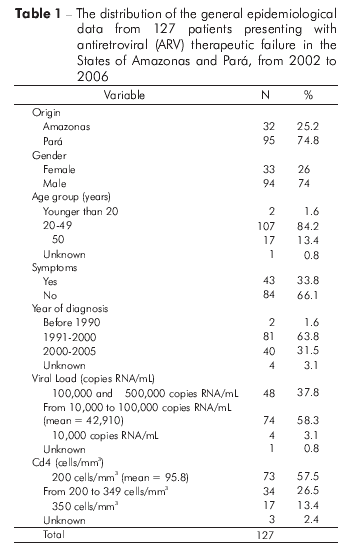
<body><![CDATA[<p><font size="2" face="Verdana"> Genotyping was  performed on all of the samples using theViroSeq<sup>TM</sup> HIV-1 Genotyping  System (Celera Diagnostic, Abbott, USA)<sup>20</sup>.</font></p>     <p><font size="2" face="Verdana"> All of the nucleotide  sequences were analyzed using the Stanford Sequence Resistance database<sup>21</sup>  and the National STD/AIDS Program algorithm (version from February 2005) from  the Brazilian Health Surveillance Department (Secretaria de Vigil&acirc;ncia em Sa&uacute;de  - SVS/MS).</font></p>     <p><font size="2" face="Verdana"> This identification was  performed using FASTA and genotype sequence analyses with the PN/STD/AIDS  Brazilian algorithm (version from February 2004) of the   SVS/MS<sup>22</sup>.</font></p>     <p>&nbsp;</p>     <p><font size="3" face="Verdana"><b>RESULTS</b></font></p>     <p><font size="2" face="Verdana"><b>STUDY POPULATION  CHARACTERISTICS</b></font></p>     <p><font size="2" face="Verdana"> This study included 32  (25.2%) patients from Amazonas, 19 (59.4%) of whom were male, and 95 (74.8%) patients  from Par&aacute;, 75 (78.9%) of whom were male (<a href="#t1">Table 1</a>). All of the patients received  highly active antiretroviral therapy (HAART) and met the inclusion criteria for  this study.</font></p>     <p><a name="t1"></a></p>     <p>&nbsp;</p>     <p align="center"><img src="/img/revistas/rpas/v3n2/2a02t1.gif" border="0"></p>     ]]></body>
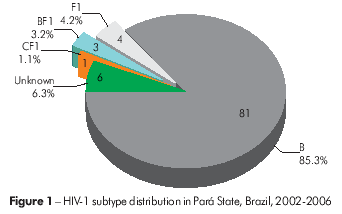
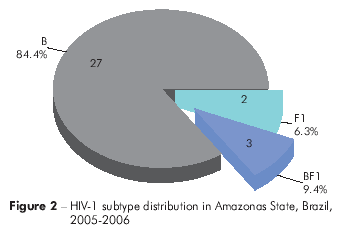
<body><![CDATA[<p>&nbsp;</p>     <p><font size="2" face="Verdana">The 32 samples from the  Amazonas patients were received between 2005 and 2006, and most of the samples (87.5%)  belonged to asymptomatic individuals. The percentage of asymptomatic  individuals was lower (58.9%) in the serum samples collected in Par&aacute; between 2002  and 2006. In both states, most patients had no clinical symptoms. In both  states, the samples were collected primarily from men, and the majority of  these patients (64%) were diagnosed with HIV-1 in the 1990s, 18% of whom were  diagnosed in the year 1997 alone. Therefore, these patients had been living  with HIV for at least ten years.</font></p>     <p><font size="2" face="Verdana"> The patients' ages  ranged from 19 to 72 years old (with a mean of 39 years), and most patients (107,  84.3%) were between 20 and 49 years old.</font></p>     <p><font size="2" face="Verdana"> At the time of  genotyping, 84 (66.1%) individuals from both States were asymptomatic, and the  diagnosis of HIV-1 infection was performed between 1991 and 1999 for 63.8% of  the patients (<a href="#t1">Table 1</a>).</font></p>     <p><font size="2" face="Verdana">A total of 58.3% of the  patients possessed a viral load between 10 thousand and 100 thousand RNA  copies/mL (with a mean of 42,910 RNA copies/mL). The CD4<sup>+</sup> T lymphocyte count  in 57.5% of the patients at the time of inclusion in the study was below 200  cells/mm<sup>3 </sup>(with a mean of 95.8 cells/mm<sup>3</sup>) (<a href="#t1">Table1</a>).</font></p>     <p><font size="2" face="Verdana"> Based on the genotyping  data, in Par&aacute;, 81 (85.3%) HIV-1 viral samples were classified as subtype B,  four samples (4.2%) as subtype F1, three samples (3.2%) as BF1 recombinants and one  sample (1.1%) asa CF1 recombinant. Additionally, six samples (6.3%) were of an  unknown genotype (<a href="#f1">Figure 1</a>). In Amazonas, 27 samples (84.4%) were classified as  subtype B, two samples (6.3%) as subtype F1 and three samples (9.4%) as BF1  recombinants (<a href="#f2">Figure 2</a>).</font></p>     <p><a name="f1"></a></p>     <p>&nbsp;</p>     <p align="center"><img src="/img/revistas/rpas/v3n2/2a02f1.gif" border="0"></p>     <p align="left"><a name="f2"></a></p>     ]]></body>
<body><![CDATA[<p align="left">&nbsp;</p>     <p align="center"><img src="/img/revistas/rpas/v3n2/2a02f2.gif" border="0"></p>     <p align="left">&nbsp;</p>     <p><font size="3" face="Verdana"><b>DISCUSSION</b></font></p>     <p><font size="2" face="Verdana"> This study, similarly  to other RENAGENO studies, investigated adult patients (with a median age of 39  years old) who were chronically infected with HIV-1 and were undergoing ARV  treatment. This study included patients from the States of Amazonas and Par&aacute;, both  located in northern Brazil.</font></p>     <p><font size="2" face="Verdana"> All 127 patients were  in virological failure; the median viral load was 67 thousand RNA copies/mL,  and the median CD4<sup>+</sup> T cell count was 171.5 cells/mm<sup>3</sup>. The viral load  and the CD4<sup>+</sup> T cell count are the primary markers used to monitor the course of  AIDS in patients who are treated with ARVs<sup>4</sup>. In particular, a count  of fewer than 200 CD4<sup>+</sup> T cells/mm<sup>3</sup> in the peripheral blood indicates  the onset of an important immunodeficiency condition that is directly  associated with an increase in opportunistic infections and, consequently, with  the possibility of presenting a less complete therapeutic response<sup>23</sup>.</font></p>     <p><font size="2" face="Verdana">According to Morgado et  al<sup>24</sup>, 131 patients in Rio de Janeiro were divided into subtypes as  follows: 80.9% subtype B, 15.3% subtype F and 1% subtype D. An additional study  performed a year later in this city (involving 43 samples from &quot;blood  donors&quot;) obtained similar results: 76.7% of the samples were identified as  subtype B, 14% as subtype F and 9.3% as B/F or B/D recombinants<sup>18</sup>.</font></p>     <p><font size="2" face="Verdana">Brazil possesses a  variety of HIV-1 subtypes, which are distributed unevenly throughout the  country's geographical regions. However, in general, subtype B is the most  prevalent subtype in the country<sup>25,26,27,28</sup>.</font></p>     <p><font size="2" face="Verdana"> In the Brazilian  Amazon, the prevalence of subtype B was greater than the prevalence of subtype  F in the Cities of Bel&eacute;m and Macap&aacute;, Par&aacute; State. However, genetic analysis in Bel&eacute;m  revealed the presence of <i>env </i>segments from subtypes B, F, D and C and  the presence of <i>pro </i>segments from subtypes B, F, D and CRF02_AG<sup>29</sup>.</font></p>     <p><font size="2" face="Verdana">In this study, the  molecular epidemiology of HIV-1 samples collected from 127 infected patients in  the States of Par&aacute; and Amazonas was characterized. In addition, the  proportional distribution of different subtypes in these states was estimated.  Our results for the Amazon Region are similar to the results of previous  studies conducted in other regions of Brazil<sup>30</sup>.</font></p>     ]]></body>
<body><![CDATA[<p><font size="2" face="Verdana">The proportion of HIV-1  subtype B infections found in this study was higher than that of subtype F1,  confirming a previous report by Machado<sup>29</sup> from the Cities of Bel&eacute;m and Macap&aacute;. This  study differs, however, from the study by Vicente et al<sup>31</sup> with  respect to the prevalence of subtype F in Amazonas, which we observed to be  nearly equal to that of subtype B. Indeed, in the present study, HIV-1 subtype  B comprised 85.3% Par&aacute; and 84.4% Amazonas of HIV-1 circulating in these states,  which contrasts with the results previously obtained in Amazonas State<sup>31</sup>,  but another study conducted in the Amazonas revealed the high prevalence of  subtype B over F and C, respectively<sup>32</sup>.</font></p>     <p><font size="2" face="Verdana"> One example of HIV-1  subtype C was isolated from blood donors in Amazonas recently<sup>33</sup>.</font></p>     <p><font size="2" face="Verdana"> These results support  the higher prevalence of subtype B and indicate the introduction of other non-B  subtypes. However, our results are consistent with those obtained by Machado<sup>29</sup> for  Par&aacute;. In contrast to subtype B, the prevalence of subtype F1 was low &#91;Par&aacute;  (4.2%), Amazonas (6.3%)&#93;, and its occurrence even included the recombinant  forms B/F1 &#91;Par&aacute; (3.2%), Amazonas (9.4%)&#93; and CF1   (isolated only once).  Notably, the detection of the latter recombinant was the first reported in Par&aacute;  and the Amazon Region, and recombinant CF1 has also been described in a newly  infected individual in Curitiba, Paran&aacute; State, southern Brazil<sup>34</sup>.</font></p>     <p>&nbsp;</p>     <p><font size="3" face="Verdana"><b>CONCLUSION</b></font></p>     <p><font size="2" face="Verdana"> Based on these results,  we conclude that HIV-1 subtype B was the most prevalent subtype in the samples  of patients with treatment failure in the States of Amazonas and Par&aacute;, followed  by subtype Fl and recombinant subtype BF1 in Par&aacute;. However, in Amazonas, recombinant  subtype BF1 was more prevalent than subtype F1. In Par&aacute;, the first occurrence  of recombinant CF1 in that State and the Amazon Region of Brazil was described.</font></p>     <p>&nbsp;</p>     <p><font size="3" face="Verdana"><b>ACKNOWLEDGMENTS</b></font></p>     <p><font size="2" face="Verdana"> We thank Raimundo  Mac&ecirc;do dos Reis and Celina Serra de  Freitas  from the Instituto Evandro Chagas for their technical support.</font></p>     <p>&nbsp;</p>     ]]></body>
<body><![CDATA[<p><font size="3" face="Verdana"><b>REFERENCES</b></font></p>     <!-- ref --><p><font size="2" face="Verdana"> 1 Barr&eacute;-Sinoussi F, Chermann JC, Rey F, Nugeyre  MT, Chamaret S, Gruest J, et al. Isolation of  a T-lymphotropic retrovirus from a patient at risk for acquired immune  deficiency syndrome (AIDS). Science. 1983 May;220(4599):868-71. &#91;<a href="https://www.msu.edu/~luckie/paris/290B/Montagnier.pdf">Link</a>&#93;</font><!-- ref --><p><font size="2" face="Verdana">2 Clavel F, Gu&eacute;tard D,  Brun-V&eacute;zinet  F,  Chamaret S, Rey MA, Santos-Ferreira MO, et al. Isolation  of a new human retrovirus from West African patients with AIDS.</font> <font size="2" face="Verdana">Science. 1986 Jul;233(4761):343-6. &#91;<a href="http://www.ncbi.nlm.nih.gov/pubmed/2425430">Link</a>&#93;</font><!-- ref --><p><font size="2" face="Verdana">3 Minist&eacute;rio da Sa&uacute;de  (BR). Secretaria de Vigil&acirc;ncia em Sa&uacute;de. Departamento de DST, Aids e Hepatites  Virais. Bol Epidemiol Aids Dst. 2012;8(1):164.</font><!-- ref --><p><font size="2" face="Verdana">4 Minist&eacute;rio da Sa&uacute;de  (BR). Secretaria de Vigil&acirc;ncia em Sa&uacute;de. Recomenda&ccedil;&otilde;es para terapia  anti-retroviral em adultos infectados pelo HIV.  Minist&eacute;rio  da Sa&uacute;de; 2008. &#91;<a href="http://www.ensp.fiocruz.br/portal-ensp/judicializacao/pdfs/491.pdf">Link</a>&#93;</font><!-- ref --><p><font size="2" face="Verdana">5 Vimalanand SP, Paul  GF, Angela BH, Sada S, James DH, Matthew RG, et al. Cost - effectiveness of HIV  sccreening in STD clinics, emergency departments, and inpatient units: a model - based analysis. PLoS   ONE. 2011 May;6(5):e19936. DOI: 10.1371/journal.pone.0019936 &#91;<a href="http://www.ncbi.nlm.nih.gov/pmc/articles/PMC3098845/pdf/pone.0019936.pdf">Link</a>&#93;</font><!-- ref --><p><font size="2" face="Verdana">6 Alencastro C. De 1998 a  2010 n&uacute;mero de novos casos subiu no pa&iacute;s, atingindo mais os jovens gays. O  Globo &#91;Internet&#93;. 2011 nov  29 &#91;citado  2012 ago 11&#93;. Dispon&iacute;vel  em: <a href="http://oglobo.globo.com/pais/de-1998-2010-numero-de-novos-casos-de-aids-subiu-no-pais-3344419" target="_blank">http://oglobo.globo.com/pais/de-1998-2010-numero-de-novos-casos-de-aids-subiu-no-pais-3344419</a>.</font><!-- ref --><p><font size="2" face="Verdana">7 Miller V, Phillips AN, Clotet B, Mocroft A, Ledergerber B, Kirk O, et al. Association of virus load, CD4 cell count, and  treatment with clinical progression in human immunodeficiency virus-infected  patients with very low CD4 cell counts. J Infect Dis. 2002 Jul;186(2):189-97. &#91;<a href="http://jid.oxfordjournals.org/content/186/2/189.full.pdf">Link</a>&#93;</font><!-- ref --><p><font size="2" face="Verdana"> 8 Ledergerber B, Lundgren JD, Walker AS,  Sabin C, Justice A, Reiss P, et al. Predictors of trend in CD4-positive T-cell  count and mortality among HIV-1-infected individuals with virological failure  to all three antiretroviral-drug classes. Lancet. 2004 Jul;364(9428):51-62. &#91;<a href="http://www.ncbi.nlm.nih.gov/pubmed/15234856">Link</a>&#93;</font><!-- ref --><p><font size="2" face="Verdana">9 Saag MS, Hahn BH, GibbonsJ, Li Y, Parks ES,  ParksWP, et al. Extensive  variation of human immunodeficiency virus type-1 <i>in vivo. </i>Nature. 1988 Aug;334:440-4. DOI:10.1038/334440a0 &#91;<a href="http://www.nature.com/nature/journal/v334/n6181/abs/334440a0.html">Link</a>&#93;</font><!-- ref --><p><font size="2" face="Verdana">10 Boyer JC, Bebenek K, Kunkel  TA. Unequal human  immunodeficiency virus type 1 reverse transcriptase error rates with RNA  and DNA templates. Proc Natl Acad Sci USA. 1992 Aug; 89(15):6919-23. &#91;<a href="http://www.ncbi.nlm.nih.gov/pmc/articles/PMC49616/pdf/pnas01089-0266.pdf">Link</a>&#93;</font><!-- ref --><p><font size="2" face="Verdana"> 11 Bebenek K, Abbotts J, Wilson SH, Kunkel  TA. Error-   prone polymerization by  HIV-1 reverse transcriptase. Contribution of template-primer misalignment,  miscoding, and termination probability to mutational hot spots. J Biol Chem.  1993 May;268(14):10324-34. &#91;<a href="http://www.jbc.org/content/268/14/10324.full.pdf">Link</a>&#93; </font><!-- ref --><p><font size="2" face="Verdana"> 12 G&uuml;rtler LG, Hauser PH, Eberle J, Von Brunn A, Knapp  S, Zekeng L, et al. A new subtype of human  immunodeficiency virus type 1 (MVP-5180) from Cameroon. J Virol. 1994 Mar;68(3):1581-5. &#91;<a href="http://www.ncbi.nlm.nih.gov/pmc/articles/PMC236615/pdf/jvirol00012-0329.pdf">Link</a>&#93;</font><!-- ref --><p><font size="2" face="Verdana">13 Simon F, Maucl&egrave;re P, Roques P, Loussert-Ajaka I, M&uuml;ller-Trutwin MC, Saragosti S, et al.  Identification of a new human immunodeficiency virus type 1 distinct from group  M and group O. Nat Med. 1998 Sep;4(9):1032-7. DOI:10.1038/2017 &#91;<a href="http://www.ncbi.nlm.nih.gov/pubmed/9734396">Link</a>&#93;</font><!-- ref --><p><font size="2" face="Verdana">14 Robertson DL, Anderson JP, Bradac JA, CarrJK, Foley  B, Funkhouser RK, et al. HIV-1  nomenclature proposal. Science. 2000 Apri;288(5463):55-6. &#91;<a href="http://www.ncbi.nlm.nih.gov/pubmed/10766634">Link</a>&#93;</font><!-- ref --><p><font size="2" face="Verdana">15 Vidal N, Peeters M, Mulanga-Kabeya C,  Nzilambi N, Robertson D, Ilunga W, etal. Unprecedented degree of human immunodeficiency  virus type 1 (HIV-1) group M genetic diversity in the Democratic Republic of  Congo suggests thatthe HIV-1 pandemic originated in Central Africa. J  Virol. 2000 Nov;74(22):10498-507. DOI:10.1128/JVI.74.22.10498-10507.2000. &#91;<a href="http://jvi.asm.org/content/74/22/10498.full.pdf">Link</a>&#93;</font><!-- ref --><p><font size="2" face="Verdana">16 Overbaugh J, Bangham CR. Selection  forces and constraints on retroviral sequence variation. Science. 2001 May;292(5519):1106-9. DOI:10.1126/science.1059128 &#91;<a href="http://www.sciencemag.org/content/292/5519/1106.short">Link</a>&#93;</font><!-- ref --><p><font size="2" face="Verdana">17 Louwagie J, McCutchan FE,  Peeters M, Brennan TP Sanders-Buell E, Eddy GA, et al.  Phylogenetic analysis of gag genes from 70 international HIV-1 isolates  provides evidence&nbsp; for&nbsp; multiple genotypes. AIDS. 1993   Jun;7(6):769-80. &#91;<a href="http://www.ncbi.nlm.nih.gov/pubmed/8363755">Link</a>&#93;</font><!-- ref --><p><font size="2" face="Verdana">18 Tanuri A, Swanson P,  Devare S, Berro OJ, Savedra A, Costa LJ, et al. HIV-1 subtypes among  blood donors from Rio de Janeiro, Brazil. J Acquir Immune Defic SyndrHumRetrovirol. 1999 Jan;20(1):60-6. &#91;<a href="http://journals.lww.com/jaids/Abstract/1999/01010/HIV_1_Subtypes_Among_Blood_Donors_From_Rio_de.9.aspx">Link</a>&#93;</font><!-- ref --><p><font size="2" face="Verdana">19 Delgado E, Le&oacute;n-Ponte  M, Villahermosa ML, Cuevas  MT, Deibis  L, Echeverria G, et  al.  Analysis of HIV type 1 protease and reverse  transcriptase sequences from Venezuela for drug resistance-associated mutations  and subtype classification: a UNAIDS Study. AIDS Res Hum Retroviruses. 2001;17(8):753-8. DOI:10.1089/088922201750237022. &#91;<a href="http://online.liebertpub.com/doi/abs/10.1089/088922201750237022">Link</a>&#93;</font><!-- ref --><p><font size="2" face="Verdana">20 Celera Diagnostic. ViroSeqTM HIV-1  Genotyping System vers&atilde;o 2.0: Instructions for use. ABBOTT; 2004.</font><!-- ref --><p><font size="2" face="Verdana">21 Stanford University. HIV drug resistance  database &#91;Internet&#93;. 2006 &#91;cited 2006 Jul&#93;. Available from: <a href="http://hivdb.stanford.edu/index.html" target="_blank">http://hivdb.stanford.edu/index.html</a>.</font><!-- ref --><p><font size="2" face="Verdana">22 Minist&eacute;rio da Sa&uacute;de  (BR). Secretaria de Vigil&acirc;ncia em Sa&uacute;de. Algoritmo  brasileiro do Programa Nacional de DST-Aids. Brasilia: Minist&eacute;rio da Sa&uacute;de;  2005.</font><!-- ref --><p><font size="2" face="Verdana">23 Minist&eacute;rio da Sa&uacute;de (BR). Secretaria de Vigil&acirc;ncia em  Sa&uacute;de. Recomenda&ccedil;&otilde;es para a terapia anti-retroviral em adultos e adolescentes  infectados pelo HIV Brasilia: Minist&eacute;rio da Sa&uacute;de; 2003. &#91;<a href="http://bvsms.saude.gov.br/bvs/publicacoes/adulto.pdf">Link</a>&#93;</font><!-- ref --><p><font size="2" face="Verdana">24 Morgado MG, Guimar&atilde;es ML, Gripp CB, Costa CI, Neves I  Jr, Veloso VG, et al. Molecular epidemiology  of HIV-1 in Brazil: high prevalence of HIV-1 subtype B and identification of an  HIV-1 subtype D infection in the city of Rio de Janeiro, Brazil. J Acquir  Immune Defic Syndr Hum Retrovirol. 1998 Aug;18(5):488-94. &#91;<a href="http://journals.lww.com/jaids/Abstract/1998/08150/Molecular_Epidemiology_of_HIV_1_in_Brazil__High.11.aspx">Link</a>&#93;</font><!-- ref --><p><font size="2" face="Verdana">25 Morgado MG, Guimar&atilde;es ML, Galv&atilde;o-Castro B.  HIV-1 polymorphism: a challenge forvaccine development - a review. Mem Inst  Oswaldo Cruz. 2002;97(2):143-50. http://dx.doi.org/10.1590/S0074-02762002000200001 &#91;<a href="http://www.scielo.br/scielo.php?pid=S0074-02762002000200001&script=sci_arttext">Link</a>    &#93;</font></p>     <!-- ref --><p><font size="2" face="Verdana">26 Brindeiro RM, Diaz RS, Sabino EC, Morgado MG, Pires  IL, Brigido L. Brazilian  network for HIV drug resistance surveillance (HIV-BResNet): a survey of  chronically infected individuals. AIDS. 2003 May;17(7):1063-9. &#91;<a href="http://journals.lww.com/aidsonline/Abstract/2003/05020/Brazilian_Network_for_HIV_Drug_Resistance.16.aspx">Link</a>&#93;</font><!-- ref --><p><font size="2" face="Verdana">27 Couto-Fernandez JC,  Silva-de-Jesus C, Veloso VG, Rachid  M,  Gracie RS, Chequer-Fernandez SL, et  al.  Human immunodeficiency virus type1 (HIV-1) genotyping in  Rio de Janeiro, Brazil: assessing subtype and drug-resistance associated  mutations in HIV-1 infected individuals failing highly active antiretroviral  therapy. Mem Inst Oswaldo Cruz.  2005 Feb;100(1):73-8. &#91;<a href="http://www.scielo.br/pdf/mioc/v100n1/v100n1a14.pdf">Link</a>&#93;</font><!-- ref --><p><font size="2" face="Verdana">28 Cavalcanti AM, Lacerda HR, Brito AM,  Pereira S, Medeiros D, Oliveira S. Antiretroviral resistance in individuals  presenting therapeutic failure and subtypes of the human immunodeficiency virus  type 1 in the Northeast Region of Brazil. Mem Inst Oswaldo Cruz. 2007 Nov;102(7):785-92. &#91;<a href="http://www.scielo.br/pdf/mioc/v102n7/5774.pdf">Link</a>&#93;</font><!-- ref --><p><font size="2" face="Verdana">29 Machado LFA. Epidemiologia  molecular  do v&iacute;rus da imunodefici&ecirc;ncia  humana tipo 1  (HIV-1) nas Cidades de Bel&eacute;m (Par&aacute;) e de Macap&aacute; (Amap&aacute;),  Brasil. &#91;tese&#93;. Bel&eacute;m (PA): Universidade Federal do Par&aacute;, 2004.</font><!-- ref --><p><font size="2" face="Verdana">30 Tanuri A, Caridea E, Dantas MC, Morgado MG, Mello  DL, Borges S, et al. Prevalence of mutations  related to HIV-1 antiretroviral resistance in Brazilian patients failing HAART. J Clin Virol.  2002 Jul;25(1):39-46. &#91;<a href="http://www.journalofclinicalvirology.com/article/S1386-6532%2801%2900249-9/abstract">Link</a>&#93;</font><!-- ref --><p><font size="2" face="Verdana">31 Vicente AC, Otsuki  K, Silva NB, Castilho MC, Barros FS, Pieniazek D, et  al. The HIV epidemic in the Amazon Basin is driven by  prototypic and recombinant HIV-1 subtypes B and F. J Acquir Immune Defic Syndr.  2000  Apr;23(4):327-31. &#91;<a href="http://www.ncbi.nlm.nih.gov/pubmed/10836755">Link</a>&#93;</font><!-- ref --><p><font size="2" face="Verdana">32 Jacomini DLJ. Caracteriza&ccedil;&atilde;o molecular do v&iacute;rus  da  imunodefici&ecirc;ncia Humana tipo  1  (HIV-1) em pacientes atendidos na Funda&ccedil;&atilde;o de Medicina Tropical  do Amazonas &#91;disserta&ccedil;&atilde;o&#93;. Manaus (AM): Universidade do Estado do Amazonas,  Funda&ccedil;&atilde;o de Medicina Tropical do Amazonas; 2007. &#91;<a href="http://webcache.googleusercontent.com/search?q=cache:uAy5yHvVYmsJ:http://www.pos.uea.edu.br/data/area/dissertacao/download/11-1.pdf%2B%22Caracteriza%C3%A7%C3%A3o+molecular+do+v%C3%ADrus+da+imunodefici%C3%AAncia+Humana+tipo+1+(HIV-1)%22&hl=pt&gbv=2&gs_l=hei">Link</a>    &#93; </font></p>     <!-- ref --><p><font size="2" face="Verdana">33 Cunha LKH, Kashima S, Amarante MFC, Haddad R,  Rodrigues ES, Silva KLT, et al. Distribution  of human immunodeficiency virus type 1 subtypes in the State of Amazonas,  Brazil, and subtype C identification. Braz J Med Biol Res. 2012 Feb;45(2):104-12. &#91;<a href="http://www.scielo.br/pdf/bjmbr/v45n2/599.pdf">Link</a>&#93; </font> <!-- ref --><p><font size="2" face="Verdana">34 Ferreira JL, Thomaz M,  Rodrigues R, Harrad D, Oliveira CM,  Oliveira  CA, et al. Molecular  characterization of newly identified HIV-1 infections in Curitiba, Brazil:  preponderance of clade C among males with recent infections. Mem Inst Oswaldo  Cruz. 2008 Dec;103(8):800-8. &#91;<a href="http://www.scielo.br/pdf/mioc/v103n8/10.pdf">Link</a>&#93;</font><p>&nbsp;</p>     <p>&nbsp;</p>     <p><font size="2"><b><font size="2" face="verdana"><b><b><a name="endereco"></a><a href="#topo"><img src="img/revistas/ess/v20n1/seta.gif" border="0"></a></b></b></font></b></font><font size="2" face="Verdana"><b>Correspondence / Correspond&ecirc;ncia / Correspondencia:</b>    ]]></body>
<body><![CDATA[<br>   Olinda Mac&ecirc;do    <br>   Instituto Evandro  Chagas    <br>   Rodovia BR 316, km 7, s/n.     <br>   Bairro:  Levil&acirc;ndia    <br>   CEP: 67030-000&nbsp;&nbsp;&nbsp;     <br>   Ananindeua-Par&aacute;-Brazil    <br>   Phone: +55(91)3214-2006    <br> E-mail: <a href="mailto:olindamacedo@iec.pa.gov.br">olindamacedo@iec.pa.gov.br</a></font></p>     <p><font size="2" face="Verdana">Received  / Recibido em / </font><font size="2" face="verdana">Recibido en</font><font size="2" face="Verdana">: 28/6/2012     <br> Accepted / Aceito  em  / </font><font size="2" face="verdana">Aceito  en</font><font size="2" face="Verdana">: 13/12/2012</font></p> <script type="text/javascript"> var gaJsHost = (("https:" == document.location.protocol) ? "https://ssl." : "http://www."); document.write(unescape("%3Cscript src='" + gaJsHost + "google-analytics.com/ga.js' type='text/javascript'%3E%3C/script%3E")); </script> <script type="text/javascript"> try { var pageTracker = _gat._getTracker("UA-7885746-4"); pageTracker._setDomainName("none"); pageTracker._setAllowLinker(true); pageTracker._trackPageview(); } catch(err) {}</script>     ]]></body>
<body><![CDATA[ ]]></body><back>
<ref-list>
<ref id="B1">
<label>1</label><nlm-citation citation-type="journal">
<person-group person-group-type="author">
<name>
<surname><![CDATA[Barré-Sinoussi]]></surname>
<given-names><![CDATA[F]]></given-names>
</name>
<name>
<surname><![CDATA[Chermann]]></surname>
<given-names><![CDATA[JC]]></given-names>
</name>
<name>
<surname><![CDATA[Rey]]></surname>
<given-names><![CDATA[F]]></given-names>
</name>
<name>
<surname><![CDATA[Nugeyre]]></surname>
<given-names><![CDATA[MT]]></given-names>
</name>
<name>
<surname><![CDATA[Chamaret]]></surname>
<given-names><![CDATA[S]]></given-names>
</name>
<name>
<surname><![CDATA[Gruest]]></surname>
<given-names><![CDATA[J]]></given-names>
</name>
</person-group>
<article-title xml:lang="en"><![CDATA[Isolation of a T-lymphotropic retrovirus from a patient at risk for acquired immune deficiency syndrome (AIDS)]]></article-title>
<source><![CDATA[Science]]></source>
<year>1983</year>
<month> M</month>
<day>ay</day>
<volume>220</volume>
<numero>4599</numero>
<issue>4599</issue>
<page-range>868-71</page-range></nlm-citation>
</ref>
<ref id="B2">
<label>2</label><nlm-citation citation-type="journal">
<person-group person-group-type="author">
<name>
<surname><![CDATA[Clavel]]></surname>
<given-names><![CDATA[F]]></given-names>
</name>
<name>
<surname><![CDATA[Guétard]]></surname>
<given-names><![CDATA[D]]></given-names>
</name>
<name>
<surname><![CDATA[Brun-Vézinet]]></surname>
<given-names><![CDATA[F]]></given-names>
</name>
<name>
<surname><![CDATA[Chamaret]]></surname>
<given-names><![CDATA[S]]></given-names>
</name>
<name>
<surname><![CDATA[Rey]]></surname>
<given-names><![CDATA[MA]]></given-names>
</name>
<name>
<surname><![CDATA[Santos-Ferreira]]></surname>
<given-names><![CDATA[MO]]></given-names>
</name>
</person-group>
<article-title xml:lang="en"><![CDATA[Isolation of a new human retrovirus from West African patients with AIDS]]></article-title>
<source><![CDATA[Science]]></source>
<year>1986</year>
<month> J</month>
<day>ul</day>
<volume>233</volume>
<numero>4761</numero>
<issue>4761</issue>
<page-range>343-6</page-range></nlm-citation>
</ref>
<ref id="B3">
<label>3</label><nlm-citation citation-type="journal">
<collab>Ministério da Saúde (BR)^dSecretaria de Vigilância em Saúde</collab>
<article-title xml:lang="pt"><![CDATA[Departamento de DST, Aids e Hepatites Virais]]></article-title>
<source><![CDATA[Bol Epidemiol Aids Dst]]></source>
<year>2012</year>
<volume>8</volume>
<numero>1</numero>
<issue>1</issue>
<page-range>164</page-range></nlm-citation>
</ref>
<ref id="B4">
<label>4</label><nlm-citation citation-type="book">
<collab>Ministério da Saúde^dSecretaria de Vigilância em Saúde</collab>
<source><![CDATA[Recomendações para terapia anti-retroviral em adultos infectados pelo HIV]]></source>
<year>2008</year>
<publisher-name><![CDATA[Ministério da Saúde]]></publisher-name>
</nlm-citation>
</ref>
<ref id="B5">
<label>5</label><nlm-citation citation-type="journal">
<person-group person-group-type="author">
<name>
<surname><![CDATA[Vimalanand]]></surname>
<given-names><![CDATA[SP]]></given-names>
</name>
<name>
<surname><![CDATA[Paul]]></surname>
<given-names><![CDATA[GF]]></given-names>
</name>
<name>
<surname><![CDATA[Angela]]></surname>
<given-names><![CDATA[BH]]></given-names>
</name>
<name>
<surname><![CDATA[Sada]]></surname>
<given-names><![CDATA[S]]></given-names>
</name>
<name>
<surname><![CDATA[James]]></surname>
<given-names><![CDATA[DH]]></given-names>
</name>
<name>
<surname><![CDATA[Matthew]]></surname>
<given-names><![CDATA[RG]]></given-names>
</name>
</person-group>
<article-title xml:lang="en"><![CDATA[Cost - effectiveness of HIV sccreening in STD clinics, emergency departments, and inpatient units: a model - based analysis]]></article-title>
<source><![CDATA[PLoS ONE]]></source>
<year>2011</year>
<month> M</month>
<day>ay</day>
<volume>6</volume>
<numero>5</numero>
<issue>5</issue>
<page-range>19936</page-range></nlm-citation>
</ref>
<ref id="B6">
<label>6</label><nlm-citation citation-type="book">
<person-group person-group-type="author">
<name>
<surname><![CDATA[Alencastro]]></surname>
<given-names><![CDATA[C]]></given-names>
</name>
</person-group>
<source><![CDATA[De 1998 a 2010 número de novos casos subiu no país, atingindo mais os jovens gays]]></source>
<year>2011</year>
<month> n</month>
<day>ov</day>
<publisher-name><![CDATA[O Globo]]></publisher-name>
</nlm-citation>
</ref>
<ref id="B7">
<label>7</label><nlm-citation citation-type="journal">
<person-group person-group-type="author">
<name>
<surname><![CDATA[Miller]]></surname>
<given-names><![CDATA[V]]></given-names>
</name>
<name>
<surname><![CDATA[Phillips]]></surname>
<given-names><![CDATA[AN]]></given-names>
</name>
<name>
<surname><![CDATA[Clotet]]></surname>
<given-names><![CDATA[B]]></given-names>
</name>
<name>
<surname><![CDATA[Mocroft]]></surname>
<given-names><![CDATA[A]]></given-names>
</name>
<name>
<surname><![CDATA[Ledergerber]]></surname>
<given-names><![CDATA[B]]></given-names>
</name>
<name>
<surname><![CDATA[Kirk]]></surname>
<given-names><![CDATA[O]]></given-names>
</name>
</person-group>
<article-title xml:lang="en"><![CDATA[Association of virus load, CD4 cell count, and treatment with clinical progression in human immunodeficiency virus-infected patients with very low CD4 cell counts]]></article-title>
<source><![CDATA[J Infect Dis]]></source>
<year>2002</year>
<month> J</month>
<day>ul</day>
<volume>186</volume>
<numero>2</numero>
<issue>2</issue>
<page-range>189-97</page-range></nlm-citation>
</ref>
<ref id="B8">
<label>8</label><nlm-citation citation-type="journal">
<person-group person-group-type="author">
<name>
<surname><![CDATA[Ledergerber]]></surname>
<given-names><![CDATA[B]]></given-names>
</name>
<name>
<surname><![CDATA[Lundgren]]></surname>
<given-names><![CDATA[JD]]></given-names>
</name>
<name>
<surname><![CDATA[Walker]]></surname>
<given-names><![CDATA[AS]]></given-names>
</name>
<name>
<surname><![CDATA[Sabin]]></surname>
<given-names><![CDATA[C]]></given-names>
</name>
<name>
<surname><![CDATA[Justice]]></surname>
<given-names><![CDATA[A]]></given-names>
</name>
<name>
<surname><![CDATA[Reiss]]></surname>
<given-names><![CDATA[P]]></given-names>
</name>
</person-group>
<article-title xml:lang="en"><![CDATA[Predictors of trend in CD4-positive T-cell count and mortality among HIV-1-infected individuals with virological failure to all three antiretroviral-drug classes]]></article-title>
<source><![CDATA[Lancet]]></source>
<year>2004</year>
<month> J</month>
<day>ul</day>
<volume>364</volume>
<numero>9428</numero>
<issue>9428</issue>
<page-range>51-62</page-range></nlm-citation>
</ref>
<ref id="B9">
<label>9</label><nlm-citation citation-type="journal">
<person-group person-group-type="author">
<name>
<surname><![CDATA[Saag]]></surname>
<given-names><![CDATA[MS]]></given-names>
</name>
<name>
<surname><![CDATA[Hahn]]></surname>
<given-names><![CDATA[BH]]></given-names>
</name>
<name>
<surname><![CDATA[Gibbons]]></surname>
<given-names><![CDATA[J]]></given-names>
</name>
<name>
<surname><![CDATA[Li]]></surname>
<given-names><![CDATA[Y]]></given-names>
</name>
<name>
<surname><![CDATA[Parks]]></surname>
<given-names><![CDATA[ES]]></given-names>
</name>
<name>
<surname><![CDATA[Parks]]></surname>
<given-names><![CDATA[WP]]></given-names>
</name>
</person-group>
<article-title xml:lang="en"><![CDATA[Extensive variation of human immunodeficiency virus type-1 in vivo]]></article-title>
<source><![CDATA[Nature]]></source>
<year>1988</year>
<month> A</month>
<day>ug</day>
<volume>334</volume>
<page-range>440-4</page-range></nlm-citation>
</ref>
<ref id="B10">
<label>10</label><nlm-citation citation-type="journal">
<person-group person-group-type="author">
<name>
<surname><![CDATA[Boyer]]></surname>
<given-names><![CDATA[JC]]></given-names>
</name>
<name>
<surname><![CDATA[Bebenek]]></surname>
<given-names><![CDATA[K]]></given-names>
</name>
<name>
<surname><![CDATA[Kunkel]]></surname>
<given-names><![CDATA[TA]]></given-names>
</name>
</person-group>
<article-title xml:lang="en"><![CDATA[Unequal human immunodeficiency virus type 1 reverse transcriptase error rates with RNA and DNA templates]]></article-title>
<source><![CDATA[Proc Natl Acad Sci USA]]></source>
<year>1992</year>
<month> A</month>
<day>ug</day>
<volume>89</volume>
<numero>15</numero>
<issue>15</issue>
<page-range>6919-23</page-range></nlm-citation>
</ref>
<ref id="B11">
<label>11</label><nlm-citation citation-type="journal">
<person-group person-group-type="author">
<name>
<surname><![CDATA[Bebenek]]></surname>
<given-names><![CDATA[K]]></given-names>
</name>
<name>
<surname><![CDATA[Abbotts]]></surname>
<given-names><![CDATA[J]]></given-names>
</name>
<name>
<surname><![CDATA[Wilson]]></surname>
<given-names><![CDATA[SH]]></given-names>
</name>
<name>
<surname><![CDATA[Kunkel]]></surname>
<given-names><![CDATA[TA]]></given-names>
</name>
</person-group>
<article-title xml:lang="en"><![CDATA[Error- prone polymerization by HIV-1 reverse transcriptase: Contribution of template-primer misalignment, miscoding, and termination probability to mutational hot spots]]></article-title>
<source><![CDATA[J Biol Chem]]></source>
<year>1993</year>
<month> M</month>
<day>ay</day>
<volume>268</volume>
<numero>14</numero>
<issue>14</issue>
<page-range>10324-34</page-range></nlm-citation>
</ref>
<ref id="B12">
<label>12</label><nlm-citation citation-type="journal">
<person-group person-group-type="author">
<name>
<surname><![CDATA[Gürtler]]></surname>
<given-names><![CDATA[LG]]></given-names>
</name>
<name>
<surname><![CDATA[Hauser]]></surname>
<given-names><![CDATA[PH]]></given-names>
</name>
<name>
<surname><![CDATA[Eberle]]></surname>
<given-names><![CDATA[J]]></given-names>
</name>
<name>
<surname><![CDATA[Von Brunn]]></surname>
<given-names><![CDATA[A]]></given-names>
</name>
<name>
<surname><![CDATA[Knapp]]></surname>
<given-names><![CDATA[S]]></given-names>
</name>
<name>
<surname><![CDATA[Zekeng]]></surname>
<given-names><![CDATA[L]]></given-names>
</name>
</person-group>
<article-title xml:lang="en"><![CDATA[A new subtype of human immunodeficiency virus type 1 (MVP-5180) from Cameroon]]></article-title>
<source><![CDATA[J Virol]]></source>
<year>1994</year>
<month> M</month>
<day>ar</day>
<volume>68</volume>
<numero>3</numero>
<issue>3</issue>
<page-range>1581-5</page-range></nlm-citation>
</ref>
<ref id="B13">
<label>13</label><nlm-citation citation-type="journal">
<person-group person-group-type="author">
<name>
<surname><![CDATA[Simon]]></surname>
<given-names><![CDATA[F]]></given-names>
</name>
<name>
<surname><![CDATA[Mauclère]]></surname>
<given-names><![CDATA[P]]></given-names>
</name>
<name>
<surname><![CDATA[Roques]]></surname>
<given-names><![CDATA[P]]></given-names>
</name>
<name>
<surname><![CDATA[Loussert-Ajaka]]></surname>
<given-names><![CDATA[I]]></given-names>
</name>
<name>
<surname><![CDATA[Müller-Trutwin]]></surname>
<given-names><![CDATA[MC]]></given-names>
</name>
<name>
<surname><![CDATA[Saragosti]]></surname>
<given-names><![CDATA[S]]></given-names>
</name>
</person-group>
<article-title xml:lang="en"><![CDATA[Identification of a new human immunodeficiency virus type 1 distinct from group M and group O]]></article-title>
<source><![CDATA[Nat Med]]></source>
<year>1998</year>
<month> S</month>
<day>ep</day>
<volume>4</volume>
<numero>9</numero>
<issue>9</issue>
<page-range>1032-7</page-range></nlm-citation>
</ref>
<ref id="B14">
<label>14</label><nlm-citation citation-type="journal">
<person-group person-group-type="author">
<name>
<surname><![CDATA[Robertson]]></surname>
<given-names><![CDATA[DL]]></given-names>
</name>
<name>
<surname><![CDATA[Anderson]]></surname>
<given-names><![CDATA[JP]]></given-names>
</name>
<name>
<surname><![CDATA[Bradac]]></surname>
<given-names><![CDATA[JA]]></given-names>
</name>
<name>
<surname><![CDATA[Carr]]></surname>
<given-names><![CDATA[JK]]></given-names>
</name>
<name>
<surname><![CDATA[Foley]]></surname>
<given-names><![CDATA[B]]></given-names>
</name>
<name>
<surname><![CDATA[Funkhouser]]></surname>
<given-names><![CDATA[RK]]></given-names>
</name>
</person-group>
<article-title xml:lang="en"><![CDATA[HIV-1 nomenclature proposal]]></article-title>
<source><![CDATA[Science]]></source>
<year>2000</year>
<month> A</month>
<day>pr</day>
<volume>288</volume>
<numero>5463</numero>
<issue>5463</issue>
<page-range>55-6</page-range></nlm-citation>
</ref>
<ref id="B15">
<label>15</label><nlm-citation citation-type="journal">
<person-group person-group-type="author">
<name>
<surname><![CDATA[Vidal]]></surname>
<given-names><![CDATA[N]]></given-names>
</name>
<name>
<surname><![CDATA[Peeters]]></surname>
<given-names><![CDATA[M]]></given-names>
</name>
<name>
<surname><![CDATA[Mulanga-Kabeya]]></surname>
<given-names><![CDATA[C]]></given-names>
</name>
<name>
<surname><![CDATA[Nzilambi]]></surname>
<given-names><![CDATA[N]]></given-names>
</name>
<name>
<surname><![CDATA[Robertson]]></surname>
<given-names><![CDATA[D]]></given-names>
</name>
<name>
<surname><![CDATA[Ilunga]]></surname>
<given-names><![CDATA[W]]></given-names>
</name>
</person-group>
<article-title xml:lang="en"><![CDATA[Unprecedented degree of human immunodeficiency virus type 1 (HIV-1) group M genetic diversity in the Democratic Republic of Congo suggests thatthe HIV-1 pandemic originated in Central Africa]]></article-title>
<source><![CDATA[J Virol]]></source>
<year>2000</year>
<month> N</month>
<day>ov</day>
<volume>74</volume>
<numero>22</numero>
<issue>22</issue>
<page-range>10498-507</page-range></nlm-citation>
</ref>
<ref id="B16">
<label>16</label><nlm-citation citation-type="journal">
<person-group person-group-type="author">
<name>
<surname><![CDATA[Overbaugh]]></surname>
<given-names><![CDATA[J]]></given-names>
</name>
<name>
<surname><![CDATA[Bangham]]></surname>
<given-names><![CDATA[CR]]></given-names>
</name>
</person-group>
<article-title xml:lang="en"><![CDATA[Selection forces and constraints on retroviral sequence variation]]></article-title>
<source><![CDATA[Science]]></source>
<year>2001</year>
<month> M</month>
<day>ay</day>
<volume>292</volume>
<numero>5519</numero>
<issue>5519</issue>
<page-range>1106-9</page-range></nlm-citation>
</ref>
<ref id="B17">
<label>17</label><nlm-citation citation-type="journal">
<person-group person-group-type="author">
<name>
<surname><![CDATA[Louwagie]]></surname>
<given-names><![CDATA[J]]></given-names>
</name>
<name>
<surname><![CDATA[McCutchan]]></surname>
<given-names><![CDATA[FE]]></given-names>
</name>
<name>
<surname><![CDATA[Peeters]]></surname>
<given-names><![CDATA[M]]></given-names>
</name>
<name>
<surname><![CDATA[Brennan]]></surname>
<given-names><![CDATA[TP]]></given-names>
</name>
<name>
<surname><![CDATA[Sanders-Buell]]></surname>
<given-names><![CDATA[E]]></given-names>
</name>
<name>
<surname><![CDATA[Eddy]]></surname>
<given-names><![CDATA[GA]]></given-names>
</name>
</person-group>
<article-title xml:lang="en"><![CDATA[Phylogenetic analysis of gag genes from 70 international HIV-1 isolates provides evidence for multiple genotypes]]></article-title>
<source><![CDATA[AIDS]]></source>
<year>1993</year>
<month> J</month>
<day>un</day>
<volume>7</volume>
<numero>6</numero>
<issue>6</issue>
<page-range>769-80</page-range></nlm-citation>
</ref>
<ref id="B18">
<label>18</label><nlm-citation citation-type="journal">
<person-group person-group-type="author">
<name>
<surname><![CDATA[Tanuri]]></surname>
<given-names><![CDATA[A]]></given-names>
</name>
<name>
<surname><![CDATA[Swanson]]></surname>
<given-names><![CDATA[P]]></given-names>
</name>
<name>
<surname><![CDATA[Devare]]></surname>
<given-names><![CDATA[S]]></given-names>
</name>
<name>
<surname><![CDATA[Berro]]></surname>
<given-names><![CDATA[OJ]]></given-names>
</name>
<name>
<surname><![CDATA[Savedra]]></surname>
<given-names><![CDATA[A]]></given-names>
</name>
<name>
<surname><![CDATA[Costa]]></surname>
<given-names><![CDATA[LJ]]></given-names>
</name>
</person-group>
<article-title xml:lang="en"><![CDATA[HIV-1 subtypes among blood donors from Rio de Janeiro, Brazil]]></article-title>
<source><![CDATA[J Acquir Immune Defic Syndr Hum Retrovirol]]></source>
<year>1999</year>
<month> J</month>
<day>an</day>
<volume>20</volume>
<numero>1</numero>
<issue>1</issue>
<page-range>60-6</page-range></nlm-citation>
</ref>
<ref id="B19">
<label>19</label><nlm-citation citation-type="journal">
<person-group person-group-type="author">
<name>
<surname><![CDATA[Delgado]]></surname>
<given-names><![CDATA[E]]></given-names>
</name>
<name>
<surname><![CDATA[León-Ponte]]></surname>
<given-names><![CDATA[M]]></given-names>
</name>
<name>
<surname><![CDATA[Villahermosa]]></surname>
<given-names><![CDATA[ML]]></given-names>
</name>
<name>
<surname><![CDATA[Cuevas]]></surname>
<given-names><![CDATA[MT]]></given-names>
</name>
<name>
<surname><![CDATA[Deibis]]></surname>
<given-names><![CDATA[L]]></given-names>
</name>
<name>
<surname><![CDATA[Echeverria]]></surname>
<given-names><![CDATA[G]]></given-names>
</name>
</person-group>
<article-title xml:lang="en"><![CDATA[Analysis of HIV type 1 protease and reverse transcriptase sequences from Venezuela for drug resistance-associated mutations and subtype classification: a UNAIDS Study]]></article-title>
<source><![CDATA[AIDS Res Hum Retroviruses]]></source>
<year>2001</year>
<volume>17</volume>
<numero>8</numero>
<issue>8</issue>
<page-range>753-8</page-range></nlm-citation>
</ref>
<ref id="B20">
<label>20</label><nlm-citation citation-type="book">
<collab>Celera Diagnostic</collab>
<source><![CDATA[ViroSeqTM HIV-1 Genotyping System versão 2.0: Instructions for use]]></source>
<year>2004</year>
<publisher-name><![CDATA[ABBOTT]]></publisher-name>
</nlm-citation>
</ref>
<ref id="B21">
<label>21</label><nlm-citation citation-type="">
<collab>Stanford University</collab>
<source><![CDATA[HIV drug resistance database]]></source>
<year>2006</year>
</nlm-citation>
</ref>
<ref id="B22">
<label>22</label><nlm-citation citation-type="book">
<collab>Ministério da Saúde^dSecretaria de Vigilância em Saúde</collab>
<source><![CDATA[Algoritmo brasileiro do Programa Nacional de DST-Aids]]></source>
<year>2005</year>
<publisher-loc><![CDATA[Brasilia ]]></publisher-loc>
<publisher-name><![CDATA[Ministério da Saúde]]></publisher-name>
</nlm-citation>
</ref>
<ref id="B23">
<label>23</label><nlm-citation citation-type="book">
<collab>Ministério da Saúde^dSecretaria de Vigilância em Saúde</collab>
<source><![CDATA[Recomendações para a terapia anti-retroviral em adultos e adolescentes infectados pelo HIV]]></source>
<year>2003</year>
<publisher-loc><![CDATA[Brasilia ]]></publisher-loc>
<publisher-name><![CDATA[Ministério da Saúde]]></publisher-name>
</nlm-citation>
</ref>
<ref id="B24">
<label>24</label><nlm-citation citation-type="journal">
<person-group person-group-type="author">
<name>
<surname><![CDATA[Morgado]]></surname>
<given-names><![CDATA[MG]]></given-names>
</name>
<name>
<surname><![CDATA[Guimarães]]></surname>
<given-names><![CDATA[ML]]></given-names>
</name>
<name>
<surname><![CDATA[Gripp]]></surname>
<given-names><![CDATA[CB]]></given-names>
</name>
<name>
<surname><![CDATA[Costa]]></surname>
<given-names><![CDATA[CI]]></given-names>
</name>
<name>
<surname><![CDATA[Neves]]></surname>
<given-names><![CDATA[I Jr]]></given-names>
</name>
<name>
<surname><![CDATA[Veloso]]></surname>
<given-names><![CDATA[VG]]></given-names>
</name>
</person-group>
<article-title xml:lang="en"><![CDATA[Molecular epidemiology of HIV-1 in Brazil: high prevalence of HIV-1 subtype B and identification of an HIV-1 subtype D infection in the city of Rio de Janeiro, Brazil]]></article-title>
<source><![CDATA[J Acquir Immune Defic Syndr Hum Retrovirol]]></source>
<year>1998</year>
<month> A</month>
<day>ug</day>
<volume>18</volume>
<numero>5</numero>
<issue>5</issue>
<page-range>488-94</page-range></nlm-citation>
</ref>
<ref id="B25">
<label>25</label><nlm-citation citation-type="journal">
<person-group person-group-type="author">
<name>
<surname><![CDATA[Morgado]]></surname>
<given-names><![CDATA[MG]]></given-names>
</name>
<name>
<surname><![CDATA[Guimarães]]></surname>
<given-names><![CDATA[ML]]></given-names>
</name>
<name>
<surname><![CDATA[Galvão-Castro]]></surname>
<given-names><![CDATA[B]]></given-names>
</name>
</person-group>
<article-title xml:lang="en"><![CDATA[HIV-1 polymorphism: a challenge forvaccine development - a review]]></article-title>
<source><![CDATA[Mem Inst Oswaldo Cruz]]></source>
<year>2002</year>
<volume>97</volume>
<numero>2</numero>
<issue>2</issue>
<page-range>143-50</page-range></nlm-citation>
</ref>
<ref id="B26">
<label>26</label><nlm-citation citation-type="journal">
<person-group person-group-type="author">
<name>
<surname><![CDATA[Brindeiro]]></surname>
<given-names><![CDATA[RM]]></given-names>
</name>
<name>
<surname><![CDATA[Diaz]]></surname>
<given-names><![CDATA[RS]]></given-names>
</name>
<name>
<surname><![CDATA[Sabino]]></surname>
<given-names><![CDATA[EC]]></given-names>
</name>
<name>
<surname><![CDATA[Morgado]]></surname>
<given-names><![CDATA[MG]]></given-names>
</name>
<name>
<surname><![CDATA[Pires]]></surname>
<given-names><![CDATA[IL]]></given-names>
</name>
<name>
<surname><![CDATA[Brigido]]></surname>
<given-names><![CDATA[L]]></given-names>
</name>
</person-group>
<article-title xml:lang="en"><![CDATA[Brazilian network for HIV drug resistance surveillance (HIV-BResNet): a survey of chronically infected individuals]]></article-title>
<source><![CDATA[AIDS]]></source>
<year>2003</year>
<month> M</month>
<day>ay</day>
<volume>17</volume>
<numero>7</numero>
<issue>7</issue>
<page-range>1063-9</page-range></nlm-citation>
</ref>
<ref id="B27">
<label>27</label><nlm-citation citation-type="journal">
<person-group person-group-type="author">
<name>
<surname><![CDATA[Couto-Fernandez]]></surname>
<given-names><![CDATA[JC]]></given-names>
</name>
<name>
<surname><![CDATA[Silva-de-Jesus]]></surname>
<given-names><![CDATA[C]]></given-names>
</name>
<name>
<surname><![CDATA[Veloso]]></surname>
<given-names><![CDATA[VG]]></given-names>
</name>
<name>
<surname><![CDATA[Rachid]]></surname>
<given-names><![CDATA[M]]></given-names>
</name>
<name>
<surname><![CDATA[Gracie]]></surname>
<given-names><![CDATA[RS]]></given-names>
</name>
<name>
<surname><![CDATA[Chequer-Fernandez]]></surname>
<given-names><![CDATA[SL]]></given-names>
</name>
</person-group>
<article-title xml:lang="en"><![CDATA[Human immunodeficiency virus type1 (HIV-1) genotyping in Rio de Janeiro, Brazil: assessing subtype and drug-resistance associated mutations in HIV-1 infected individuals failing highly active antiretroviral therapy]]></article-title>
<source><![CDATA[Mem Inst Oswaldo Cruz]]></source>
<year>2005</year>
<month> F</month>
<day>eb</day>
<volume>100</volume>
<numero>1</numero>
<issue>1</issue>
<page-range>73-8</page-range></nlm-citation>
</ref>
<ref id="B28">
<label>28</label><nlm-citation citation-type="journal">
<person-group person-group-type="author">
<name>
<surname><![CDATA[Cavalcanti]]></surname>
<given-names><![CDATA[AM]]></given-names>
</name>
<name>
<surname><![CDATA[Lacerda]]></surname>
<given-names><![CDATA[HR]]></given-names>
</name>
<name>
<surname><![CDATA[Brito]]></surname>
<given-names><![CDATA[AM]]></given-names>
</name>
<name>
<surname><![CDATA[Pereira]]></surname>
<given-names><![CDATA[S]]></given-names>
</name>
<name>
<surname><![CDATA[Medeiros]]></surname>
<given-names><![CDATA[D]]></given-names>
</name>
<name>
<surname><![CDATA[Oliveira]]></surname>
<given-names><![CDATA[S]]></given-names>
</name>
</person-group>
<article-title xml:lang="en"><![CDATA[Antiretroviral resistance in individuals presenting therapeutic failure and subtypes of the human immunodeficiency virus type 1 in the Northeast Region of Brazil]]></article-title>
<source><![CDATA[Mem Inst Oswaldo Cruz]]></source>
<year>2007</year>
<month> N</month>
<day>ov</day>
<volume>102</volume>
<numero>7</numero>
<issue>7</issue>
<page-range>785-92</page-range></nlm-citation>
</ref>
<ref id="B29">
<label>29</label><nlm-citation citation-type="book">
<person-group person-group-type="author">
<name>
<surname><![CDATA[Machado]]></surname>
<given-names><![CDATA[LFA]]></given-names>
</name>
</person-group>
<source><![CDATA[Epidemiologia molecular do vírus da imunodeficiência humana tipo 1 (HIV-1) nas Cidades de Belém (Pará) e de Macapá (Amapá), Brasil]]></source>
<year>2004</year>
<publisher-loc><![CDATA[Belém^ePA PA]]></publisher-loc>
<publisher-name><![CDATA[Universidade Federal do Pará]]></publisher-name>
</nlm-citation>
</ref>
<ref id="B30">
<label>30</label><nlm-citation citation-type="journal">
<person-group person-group-type="author">
<name>
<surname><![CDATA[Tanuri]]></surname>
<given-names><![CDATA[A]]></given-names>
</name>
<name>
<surname><![CDATA[Caridea]]></surname>
<given-names><![CDATA[E]]></given-names>
</name>
<name>
<surname><![CDATA[Dantas]]></surname>
<given-names><![CDATA[MC]]></given-names>
</name>
<name>
<surname><![CDATA[Morgado]]></surname>
<given-names><![CDATA[MG]]></given-names>
</name>
<name>
<surname><![CDATA[Mello]]></surname>
<given-names><![CDATA[DL]]></given-names>
</name>
<name>
<surname><![CDATA[Borges]]></surname>
<given-names><![CDATA[S]]></given-names>
</name>
</person-group>
<article-title xml:lang="en"><![CDATA[Prevalence of mutations related to HIV-1 antiretroviral resistance in Brazilian patients failing HAART]]></article-title>
<source><![CDATA[J Clin Virol]]></source>
<year>2002</year>
<month> J</month>
<day>ul</day>
<volume>25</volume>
<numero>1</numero>
<issue>1</issue>
<page-range>39-46</page-range></nlm-citation>
</ref>
<ref id="B31">
<label>31</label><nlm-citation citation-type="journal">
<person-group person-group-type="author">
<name>
<surname><![CDATA[Vicente]]></surname>
<given-names><![CDATA[AC]]></given-names>
</name>
<name>
<surname><![CDATA[Otsuki]]></surname>
<given-names><![CDATA[K]]></given-names>
</name>
<name>
<surname><![CDATA[Silva]]></surname>
<given-names><![CDATA[NB]]></given-names>
</name>
<name>
<surname><![CDATA[Castilho]]></surname>
<given-names><![CDATA[MC]]></given-names>
</name>
<name>
<surname><![CDATA[Barros]]></surname>
<given-names><![CDATA[FS]]></given-names>
</name>
<name>
<surname><![CDATA[Pieniazek]]></surname>
<given-names><![CDATA[D]]></given-names>
</name>
</person-group>
<article-title xml:lang="en"><![CDATA[The HIV epidemic in the Amazon Basin is driven by prototypic and recombinant HIV-1 subtypes B and F]]></article-title>
<source><![CDATA[J Acquir Immune Defic Syndr]]></source>
<year>2000</year>
<month> A</month>
<day>pr</day>
<volume>23</volume>
<numero>4</numero>
<issue>4</issue>
<page-range>327-31</page-range></nlm-citation>
</ref>
<ref id="B32">
<label>32</label><nlm-citation citation-type="book">
<person-group person-group-type="author">
<name>
<surname><![CDATA[Jacomini]]></surname>
<given-names><![CDATA[DLJ]]></given-names>
</name>
</person-group>
<source><![CDATA[Caracterização molecular do vírus da imunodeficiência Humana tipo 1 (HIV-1) em pacientes atendidos na Fundação de Medicina Tropical do Amazonas]]></source>
<year>2007</year>
<publisher-loc><![CDATA[Manaus^eAM AM]]></publisher-loc>
<publisher-name><![CDATA[Universidade do Estado do Amazonas, Fundação de Medicina Tropical do Amazonas]]></publisher-name>
</nlm-citation>
</ref>
<ref id="B33">
<label>33</label><nlm-citation citation-type="journal">
<person-group person-group-type="author">
<name>
<surname><![CDATA[Cunha]]></surname>
<given-names><![CDATA[LKH]]></given-names>
</name>
<name>
<surname><![CDATA[Kashima]]></surname>
<given-names><![CDATA[S]]></given-names>
</name>
<name>
<surname><![CDATA[Amarante]]></surname>
<given-names><![CDATA[MFC]]></given-names>
</name>
<name>
<surname><![CDATA[Haddad]]></surname>
<given-names><![CDATA[R]]></given-names>
</name>
<name>
<surname><![CDATA[Rodrigues]]></surname>
<given-names><![CDATA[ES]]></given-names>
</name>
<name>
<surname><![CDATA[Silva]]></surname>
<given-names><![CDATA[KLT]]></given-names>
</name>
</person-group>
<article-title xml:lang="en"><![CDATA[Distribution of human immunodeficiency virus type 1 subtypes in the State of Amazonas, Brazil, and subtype C identification]]></article-title>
<source><![CDATA[Braz J Med Biol Res]]></source>
<year>2012</year>
<month> F</month>
<day>eb</day>
<volume>45</volume>
<numero>2</numero>
<issue>2</issue>
<page-range>104-12</page-range></nlm-citation>
</ref>
<ref id="B34">
<label>34</label><nlm-citation citation-type="journal">
<person-group person-group-type="author">
<name>
<surname><![CDATA[Ferreira]]></surname>
<given-names><![CDATA[JL]]></given-names>
</name>
<name>
<surname><![CDATA[Thomaz]]></surname>
<given-names><![CDATA[M]]></given-names>
</name>
<name>
<surname><![CDATA[Rodrigues]]></surname>
<given-names><![CDATA[R]]></given-names>
</name>
<name>
<surname><![CDATA[Harrad]]></surname>
<given-names><![CDATA[D]]></given-names>
</name>
<name>
<surname><![CDATA[Oliveira]]></surname>
<given-names><![CDATA[CM]]></given-names>
</name>
<name>
<surname><![CDATA[Oliveira]]></surname>
<given-names><![CDATA[CA]]></given-names>
</name>
</person-group>
<article-title xml:lang="en"><![CDATA[Molecular characterization of newly identified HIV-1 infections in Curitiba, Brazil: preponderance of clade C among males with recent infections]]></article-title>
<source><![CDATA[Mem Inst Oswaldo Cruz]]></source>
<year>2008</year>
<month> D</month>
<day>ec</day>
<volume>103</volume>
<numero>8</numero>
<issue>8</issue>
<page-range>800-8</page-range></nlm-citation>
</ref>
</ref-list>
</back>
</article>